Cambridge IGCSE Mathematics - International 0607 — 2010 May/June Paper 4 · Variant 1
0607/41/M/J/10
The question paper and its mark scheme, free to read here and free to download. This is Cambridge’s own paper, exactly as it was sat.
Question paper20 pages
Mark scheme7 pages
Answers below. Sit the paper first if you are practising.
Paper as text
Question paper, page 1
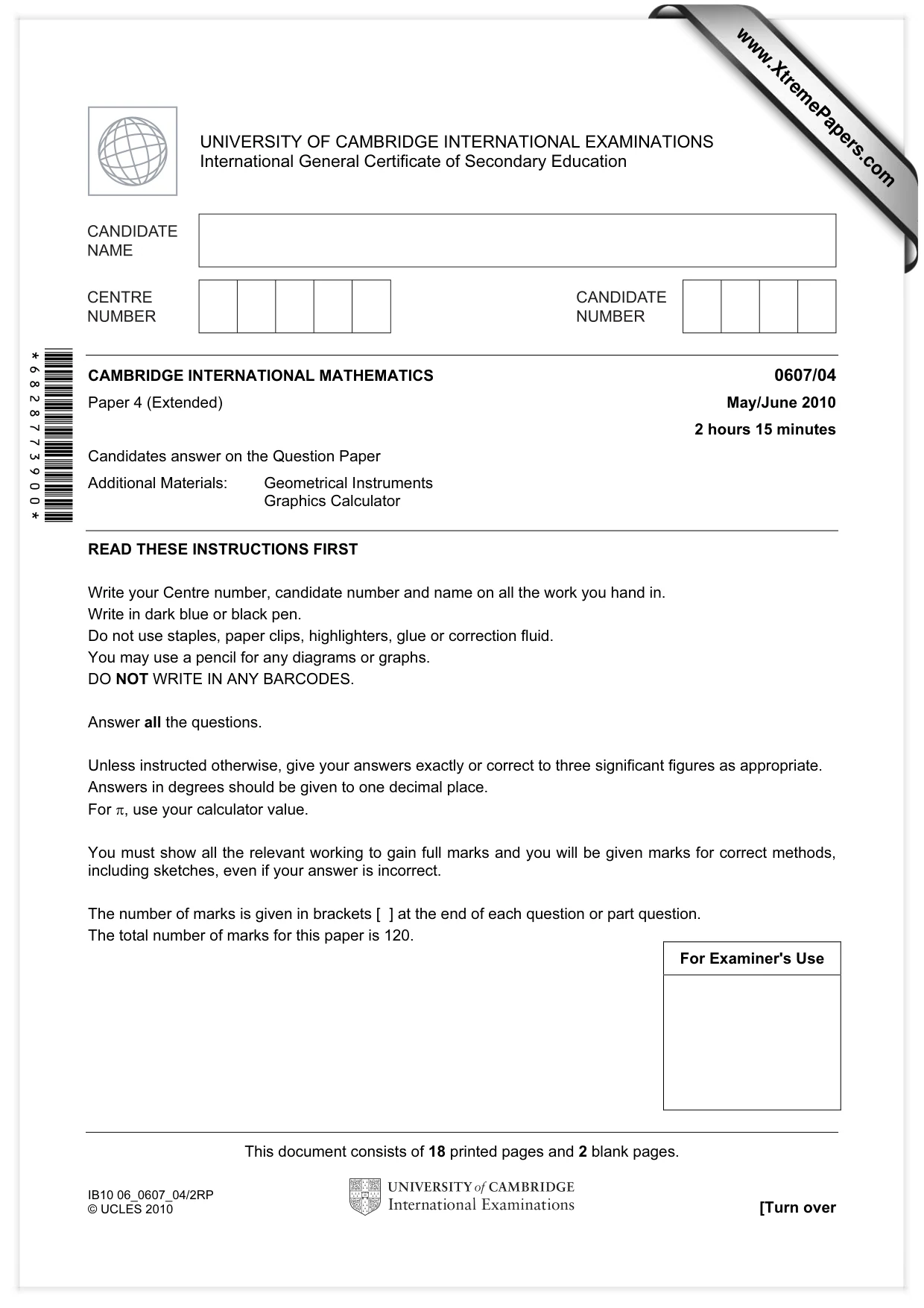
This document consists of 18 printed pages and 2 blank pages. IB10 06_0607_04/2RP © UCLES 2010 [Turn over *6828773900* For Examiner's Use UNIVERSITY OF CAMBRIDGE INTERNATIONAL EXAMINATIONS International General Certificate of Secondary Education CAMBRIDGE INTERNATIONAL MATHEMATICS 0607/04 Paper 4 (Extended) May/June 2010 2 hours 15 minutes Candidates answer on the Question Paper Additional Materials: Geometrical Instruments Graphics Calculator READ THESE INSTRUCTIONS FIRST Write your Centre number, candidate number and name on all the work you hand in. Write in dark blue or black pen. Do not use staples, paper clips, highlighters, glue or correction fluid. You may use a pencil for any diagrams or graphs. DO NOT WRITE IN ANY BARCODES. Answer all the questions. Unless instructed otherwise, give your answers exactly or correct to three significant figures as appropriate. Answers in degrees should be given to one decimal place. For π, use your calculator value. You must show all the relevant working to gain full marks and you will be given marks for correct methods, including sketches, even if your answer is incorrect. The number of marks is given in brackets [ ] at the end of each question or part question. The total number of marks for this paper is 120. www.XtremePapers.com
Question paper, page 2
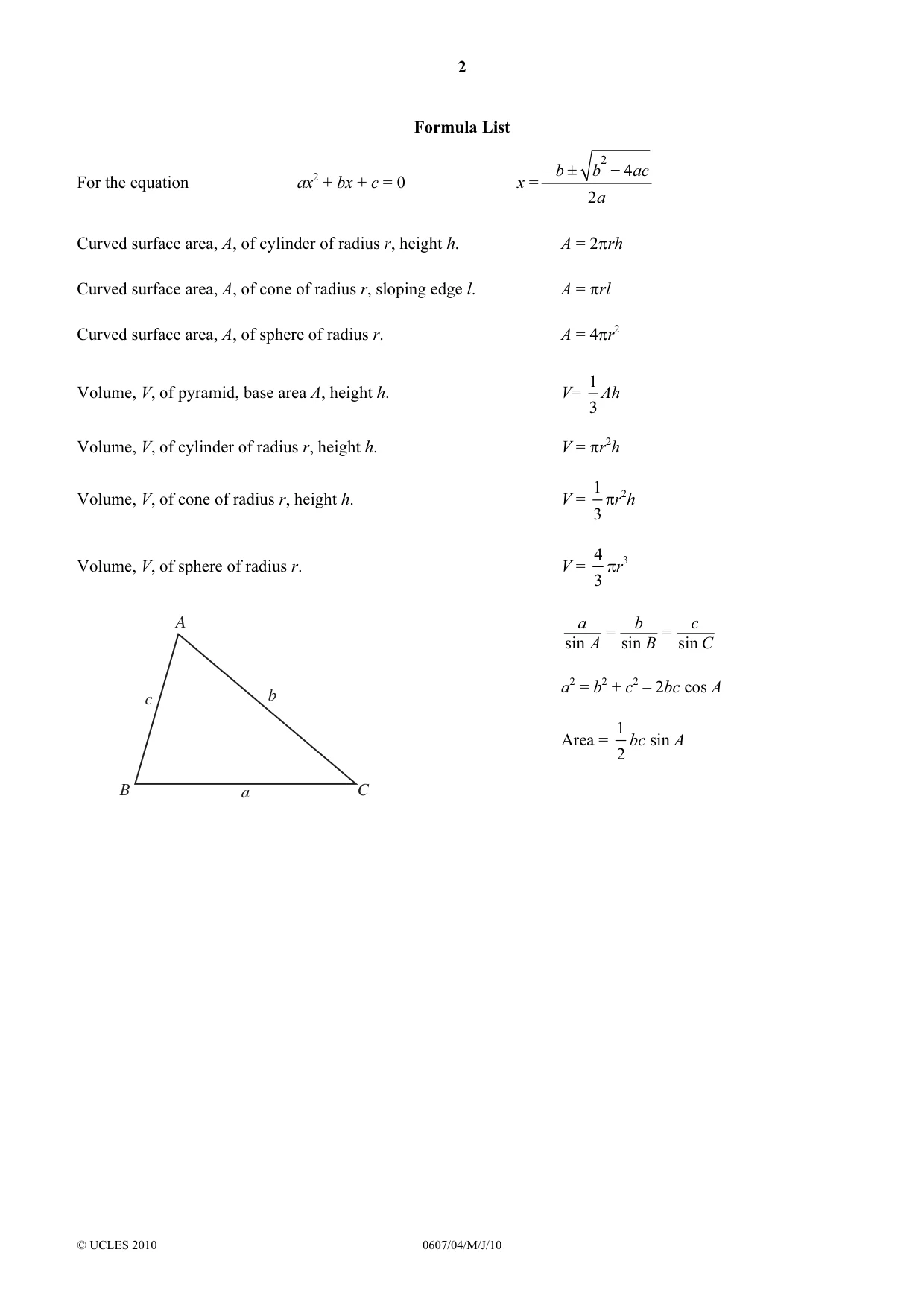
2 © UCLES 2010 0607/04/M/J/10 Formula List For the equation ax2 + bx + c = 0 x = 2 _ ± 4 2 _ b b ac a Curved surface area, A, of cylinder of radius r, height h. A = 2πrh Curved surface area, A, of cone of radius r, sloping edge l. A = πrl Curved surface area, A, of sphere of radius r. A = 4πr2 Volume, V, of pyramid, base area A, height h. V= 1 3 Ah Volume, V, of cylinder of radius r, height h. V = πr2h Volume, V, of cone of radius r, height h. V = 1 3 πr2h Volume, V, of sphere of radius r. V = 4 3 πr3 = = sin sin sin a b c A B C a2 = b2 + c2 – 2bc cos A Area = 1 2 bc sin A A a B C b c
Question paper, page 3
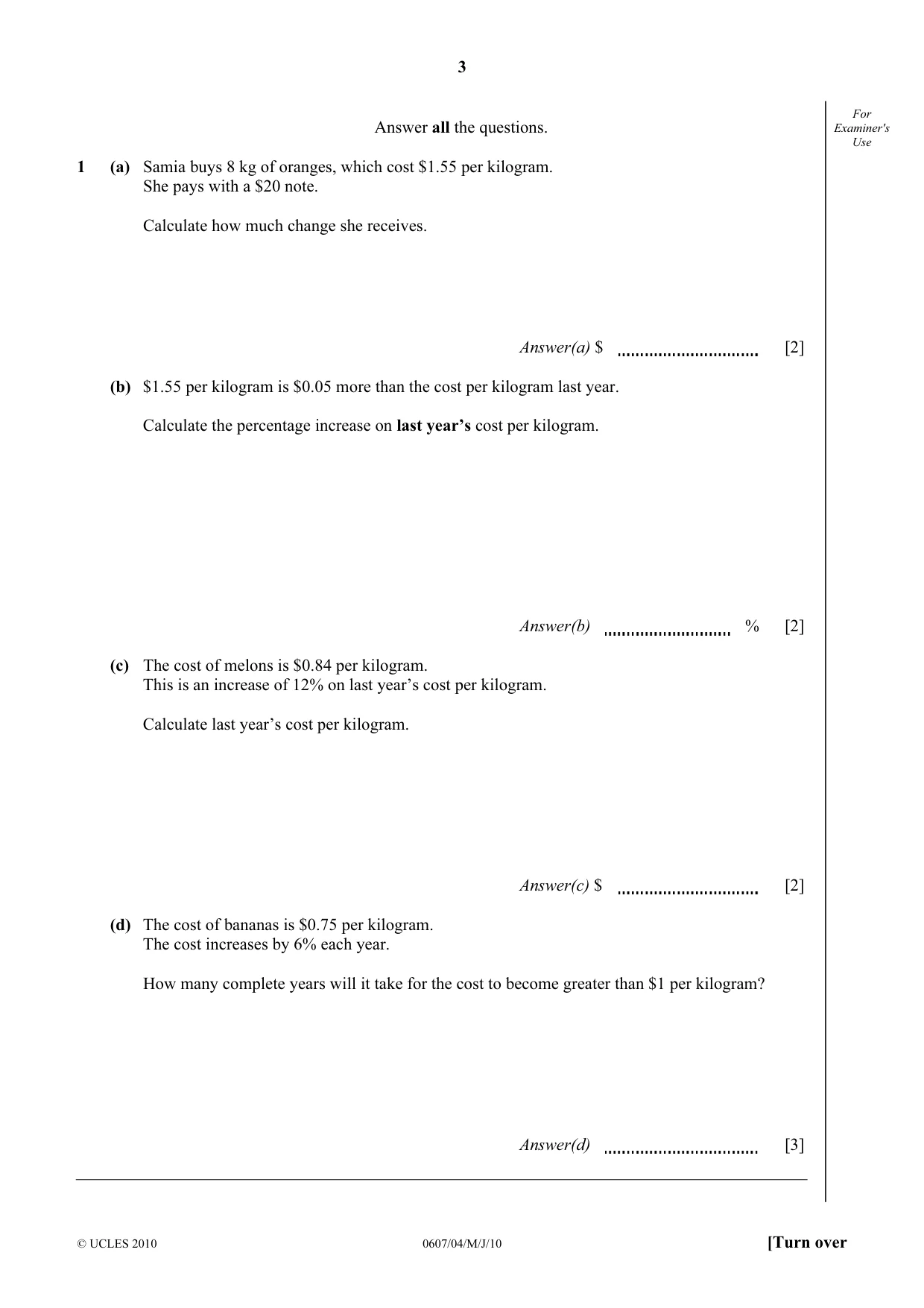
3 © UCLES 2010 0607/04/M/J/10 [Turn over For Examiner's Use Answer all the questions. 1 (a) Samia buys 8 kg of oranges, which cost $1.55 per kilogram. She pays with a $20 note. Calculate how much change she receives. Answer(a) $ [2] (b) $1.55 per kilogram is $0.05 more than the cost per kilogram last year. Calculate the percentage increase on last year’s cost per kilogram. Answer(b) % [2] (c) The cost of melons is $0.84 per kilogram. This is an increase of 12% on last year’s cost per kilogram. Calculate last year’s cost per kilogram. Answer(c) $ [2] (d) The cost of bananas is $0.75 per kilogram. The cost increases by 6% each year. How many complete years will it take for the cost to become greater than $1 per kilogram? Answer(d) [3]
Question paper, page 4
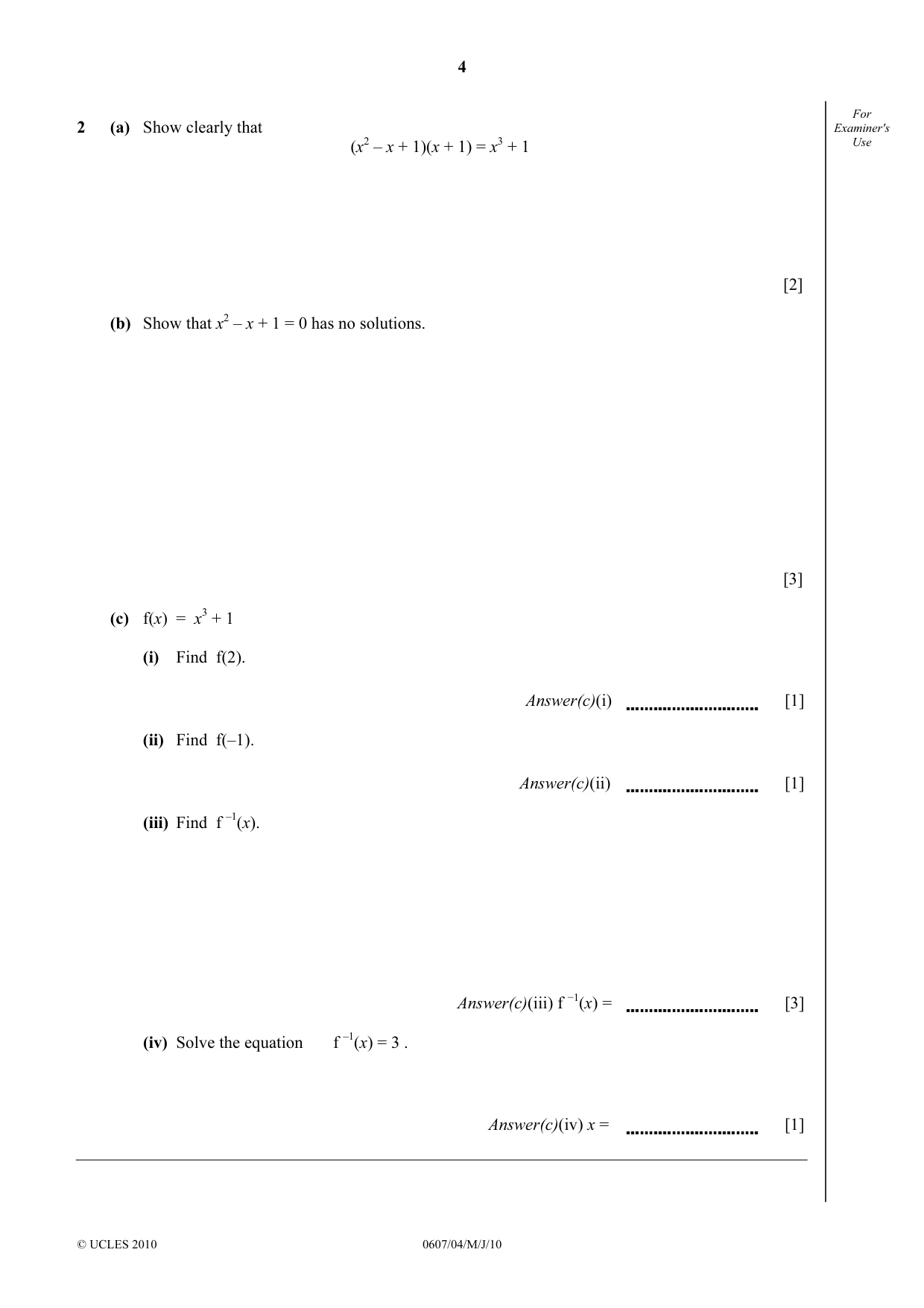
4 © UCLES 2010 0607/04/M/J/10 For Examiner's Use 2 (a) Show clearly that (x2 – x + 1)(x + 1) = x3 + 1 [2] (b) Show that x2 – x + 1 = 0 has no solutions. [3] (c) f(x) = x3 + 1 (i) Find f(2). Answer(c)(i) [1] (ii) Find f(–1). Answer(c)(ii) [1] (iii) Find f –1(x). Answer(c)(iii) f −1(x) = [3] (iv) Solve the equation f –1(x) = 3 . Answer(c)(iv) x = [1]
Question paper, page 5
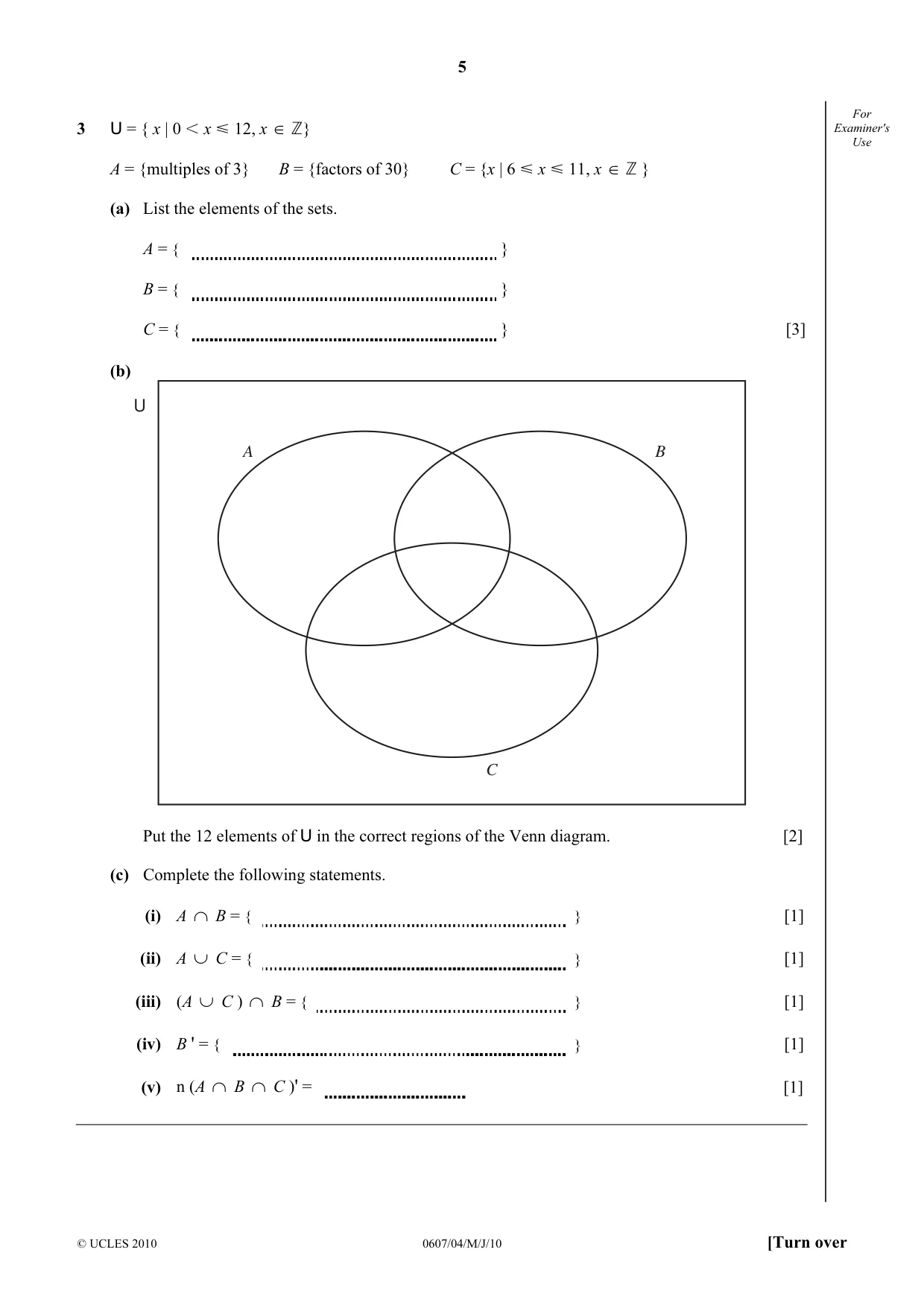
5 © UCLES 2010 0607/04/M/J/10 [Turn over For Examiner's Use 3 U = { x | 0 I x Y 12, x ∈ w} A = {multiples of 3} B = {factors of 30} C = {x=| 6 Y x Y 11, x ∈ w } (a) List the elements of the sets. A = { } B = { } C = { } [3] (b) U A B C Put the 12 elements of U in the correct regions of the Venn diagram. [2] (c) Complete the following statements. (i) A ∩ B = { } [1] (ii) A ∪ C = { } [1] (iii) (A ∪ C ) ∩ B = { } [1] (iv) B ' = { } [1] (v) n (A ∩ B ∩ C )' = [1]
Question paper, page 6
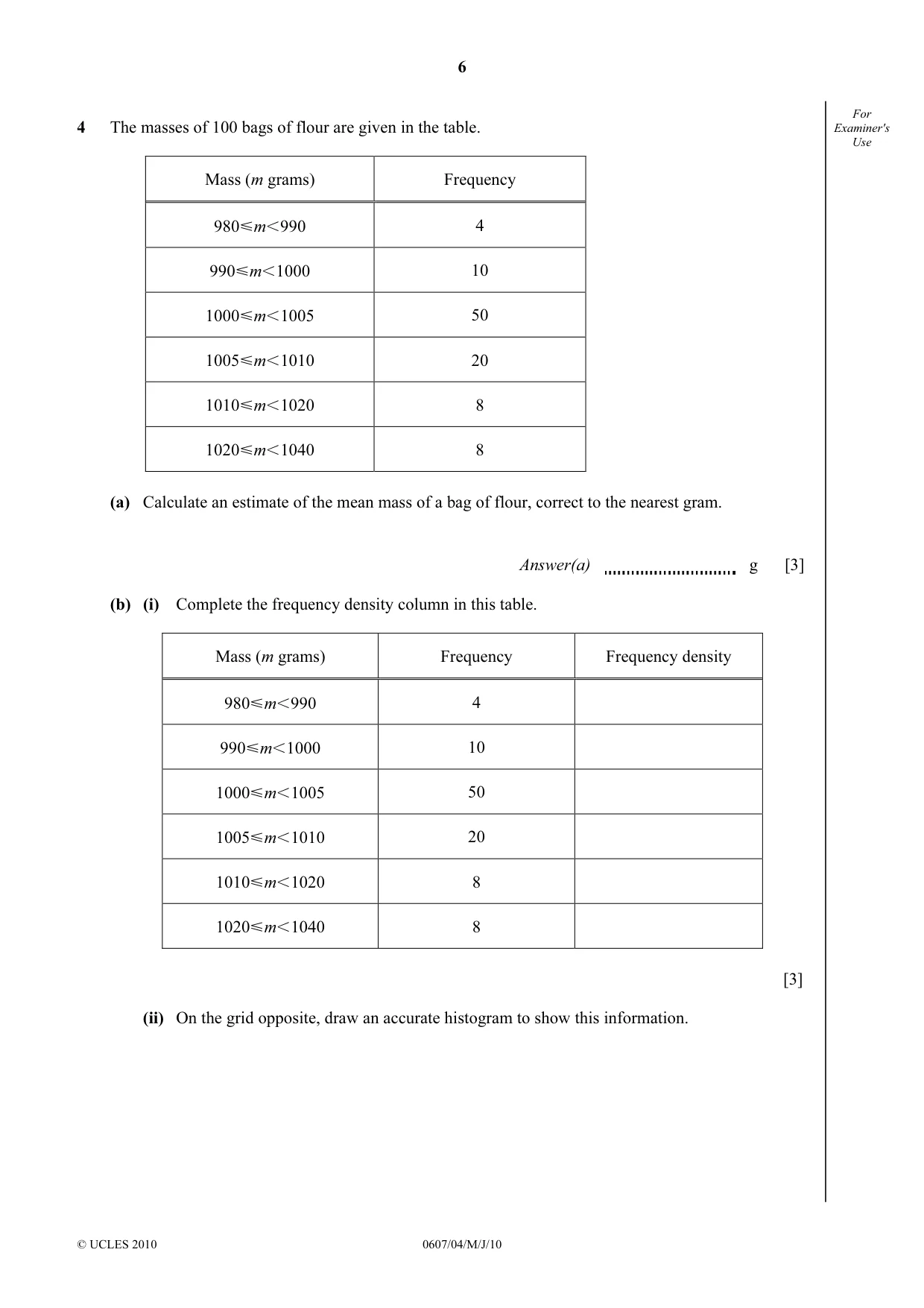
6 © UCLES 2010 0607/04/M/J/10 For Examiner's Use 4 The masses of 100 bags of flour are given in the table. Mass (m grams) Frequency 980YmI990 4 990YmI1000 10 1000YmI1005 50 1005YmI1010 20 1010YmI1020 8 1020YmI1040 8 (a) Calculate an estimate of the mean mass of a bag of flour, correct to the nearest gram. Answer(a) g [3] (b) (i) Complete the frequency density column in this table. Mass (m grams) Frequency Frequency density 980YmI990 4 990YmI1000 10 1000YmI1005 50 1005YmI1010 20 1010YmI1020 8 1020YmI1040 8 [3] (ii) On the grid opposite, draw an accurate histogram to show this information.
Question paper, page 7
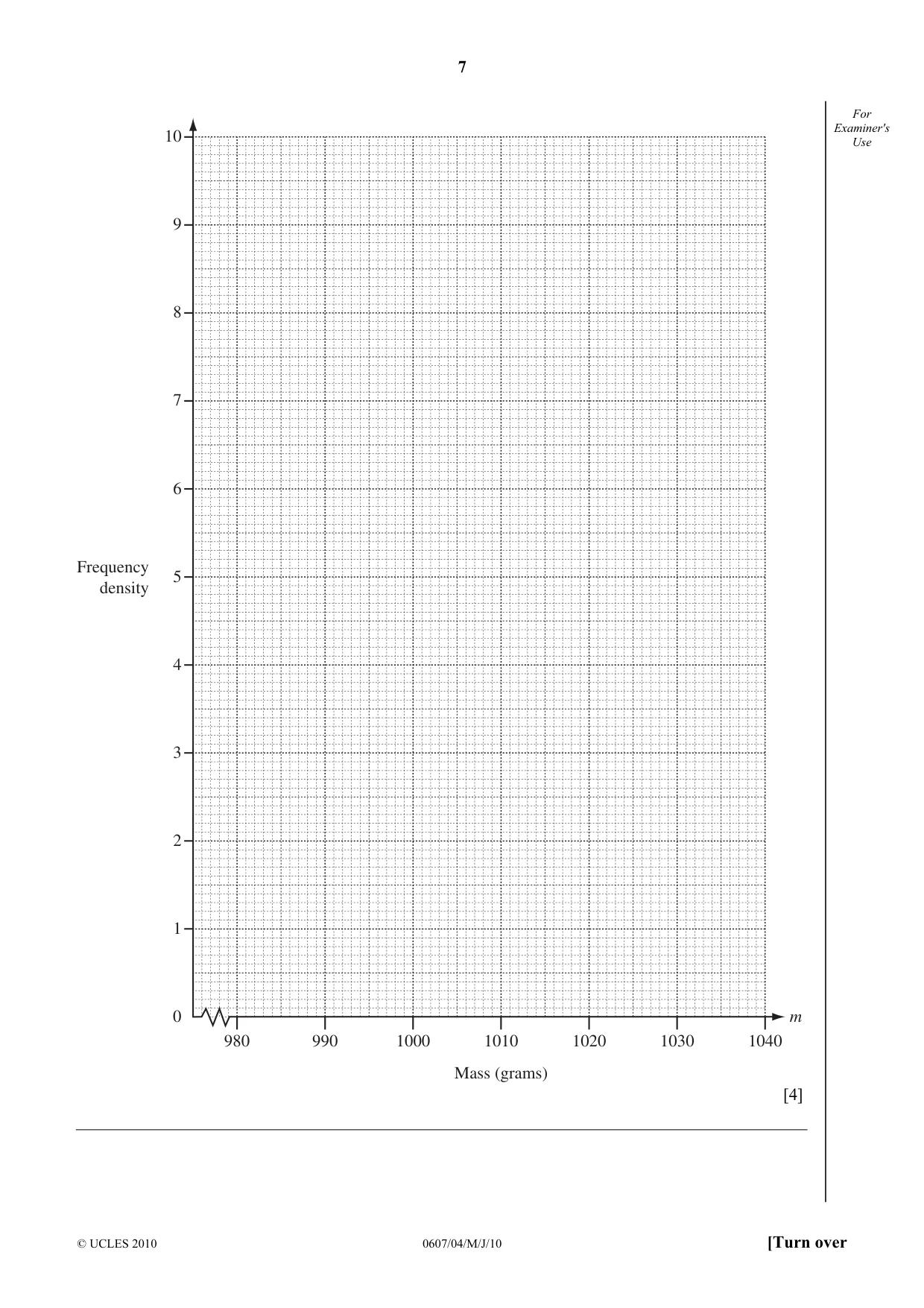
7 © UCLES 2010 0607/04/M/J/10 [Turn over For Examiner's Use 10 9 8 7 6 5 4 3 2 1 980 990 1000 1010 1020 1030 1040 Mass (grams) Frequency density m 0 [4]
Question paper, page 8
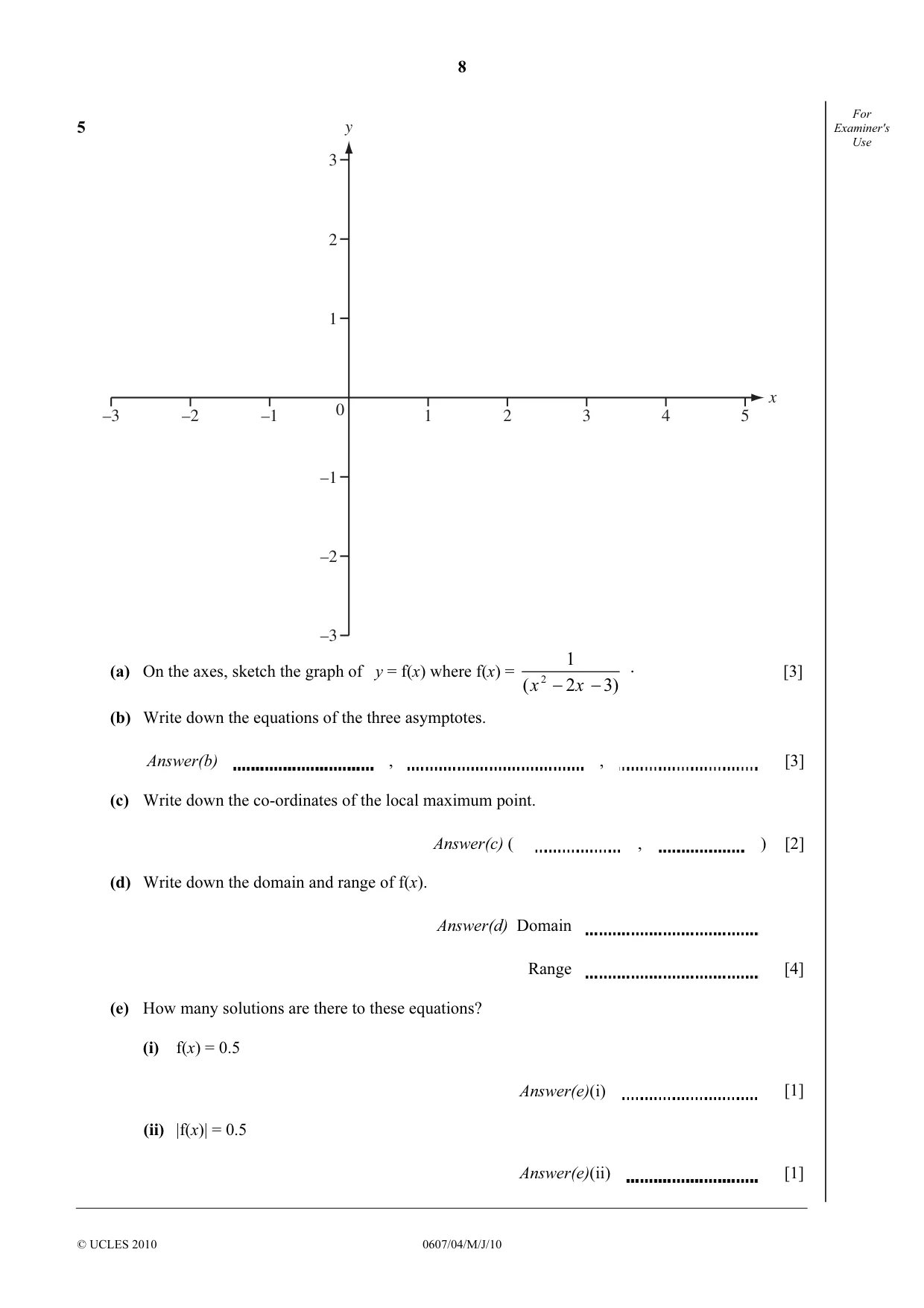
8 © UCLES 2010 0607/04/M/J/10 For Examiner's Use 5 (a) On the axes, sketch the graph of y = f(x) where f(x) = 2 1 . ( 2 3) x x − − [3] (b) Write down the equations of the three asymptotes. Answer(b) , , [3] (c) Write down the co-ordinates of the local maximum point. Answer(c) ( , ) [2] (d) Write down the domain and range of f(x). Answer(d) Domain Range [4] (e) How many solutions are there to these equations? (i) f(x) = 0.5 Answer(e)(i) [1] (ii) |f(x)| = 0.5 Answer(e)(ii) [1] 3 2 1 –1 –2 –3 –3 –2 –1 1 2 3 4 5 0 y x
Question paper, page 9
9 © UCLES 2010 0607/04/M/J/10 [Turn over For Examiner's Use 6 (a) A car uses fuel at a rate of 5.6 litres per 100 km. Calculate the distance travelled when the car has used 14 litres of fuel. Answer(a) km [2] (b) The car passes a post at a speed of 72 km/h. (i) Change 72 km/h into m/s. Answer(b)(i) m/s [2] (ii) The car has a length of 4.5 metres. Calculate, in seconds, the time the car takes to pass the post completely. Answer(b)(ii) s [2]
Question paper, page 10
10 © UCLES 2010 0607/04/M/J/10 For Examiner's Use 7 (a) One day Zak sold some books at $5 each. He received a total of $x. Write down, in terms of x, the number of books he sold. Answer(a) [1] (b) The next day Zak reduced the price of each book to $4. He received $13 more than on the first day. (i) Write down, in terms of x, the number of books he sold on this day. Answer(b)(i) [1] (ii) He sold a total of 46 books during the 2 days. Write down an equation in x to show this information. Answer(b)(ii) [1] (iii) Solve your equation. Answer(b)(iii) x = [3] (c) Calculate the mean price of a book during these two days. Give your answer correct to 2 decimal places. Answer(c) $ [2]
Question paper, page 11
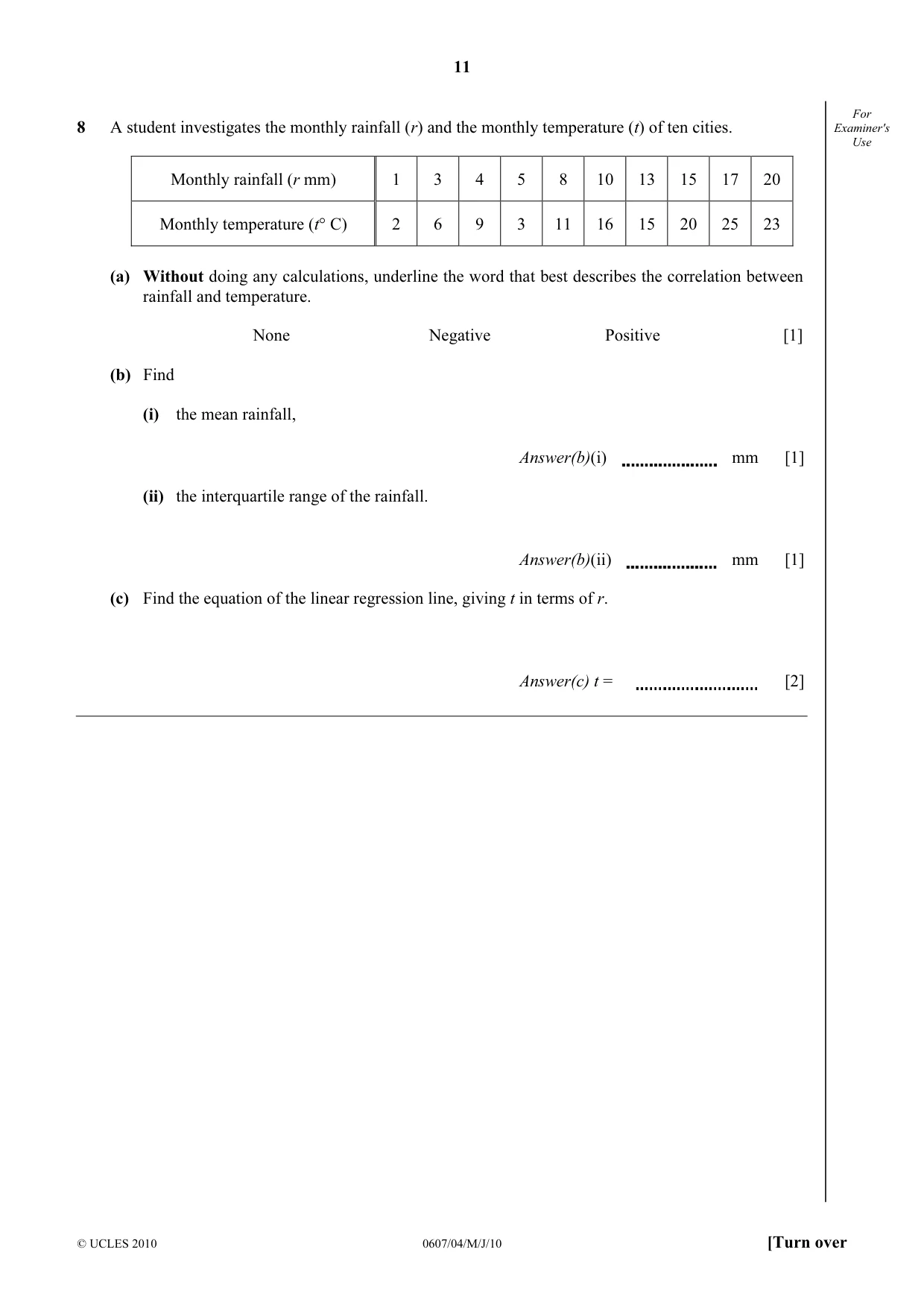
11 © UCLES 2010 0607/04/M/J/10 [Turn over For Examiner's Use 8 A student investigates the monthly rainfall (r) and the monthly temperature (t) of ten cities. Monthly rainfall (r mm) 1 3 4 5 8 10 13 15 17 20 Monthly temperature (t° C) 2 6 9 3 11 16 15 20 25 23 (a) Without doing any calculations, underline the word that best describes the correlation between rainfall and temperature. None Negative Positive [1] (b) Find (i) the mean rainfall, Answer(b)(i) mm [1] (ii) the interquartile range of the rainfall. Answer(b)(ii) mm [1] (c) Find the equation of the linear regression line, giving t in terms of r. Answer(c) t = [2]
Question paper, page 12
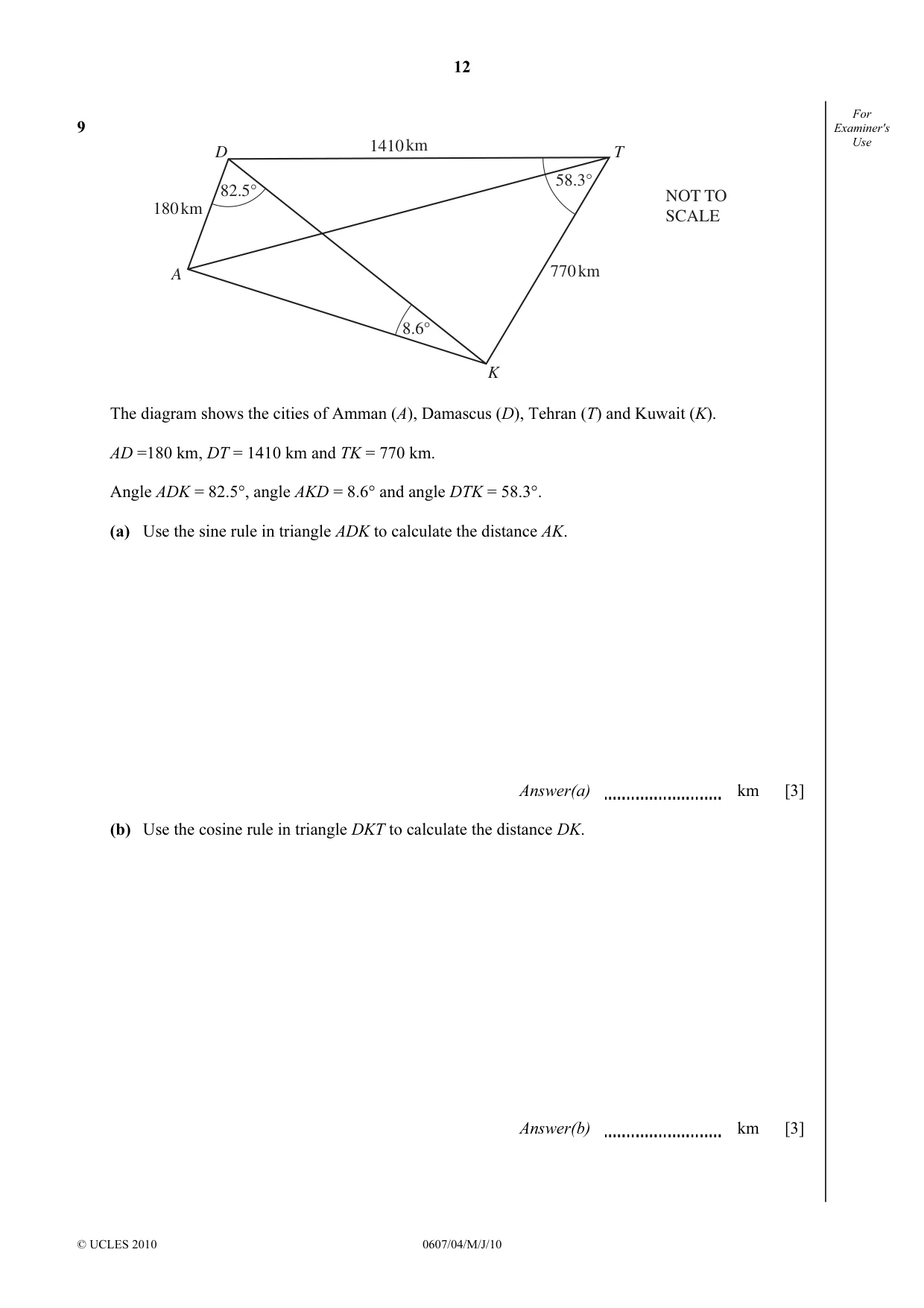
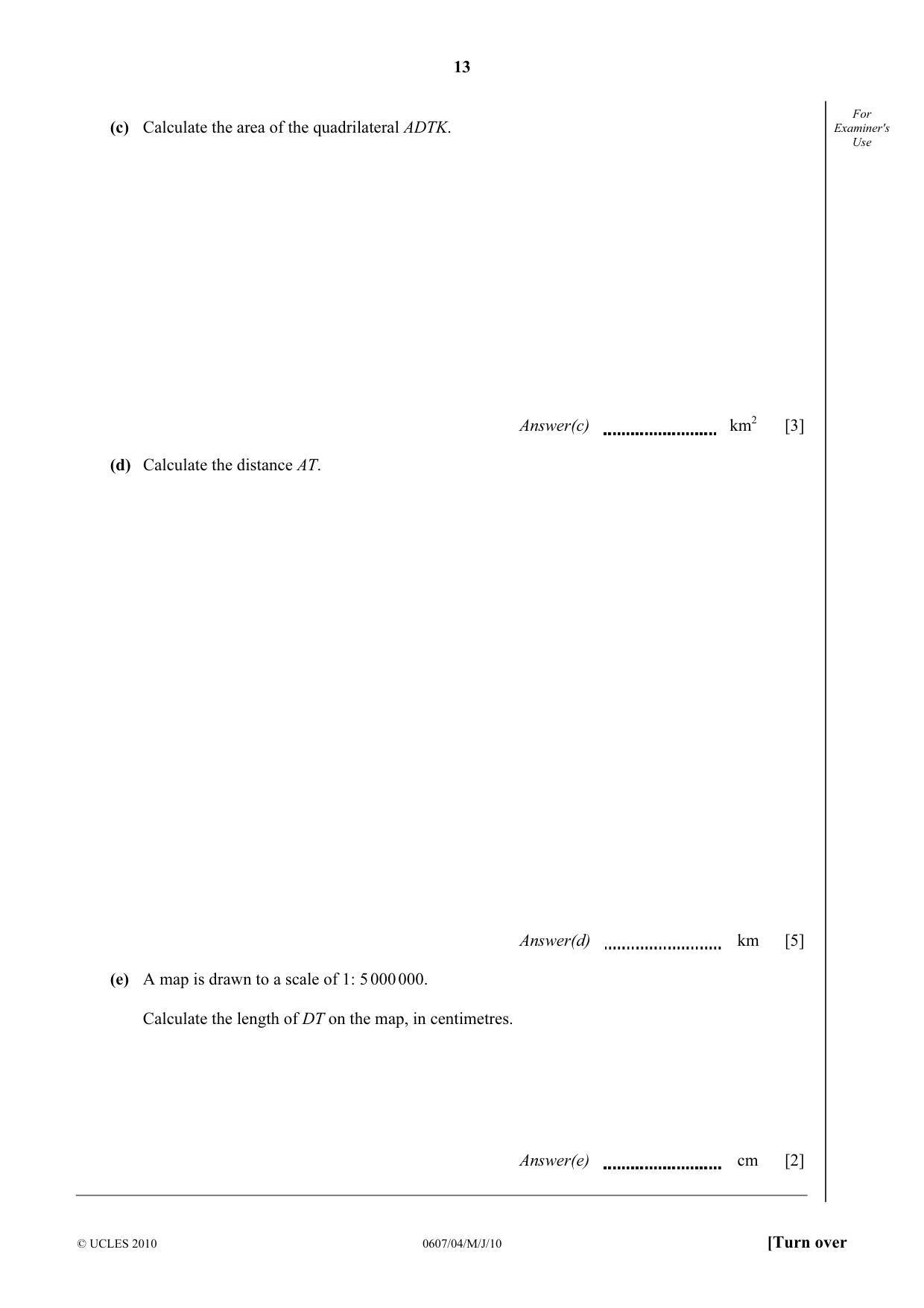
12 © UCLES 2010 0607/04/M/J/10 For Examiner's Use 9 8.6° 58.3° 82.5° T D A K 770 km 1410 km 180 km NOT TO SCALE The diagram shows the cities of Amman (A), Damascus (D), Tehran (T) and Kuwait (K). AD =180 km, DT = 1410 km and TK = 770 km. Angle ADK = 82.5°, angle AKD = 8.6° and angle DTK = 58.3°. (a) Use the sine rule in triangle ADK to calculate the distance AK. Answer(a) km [3] (b) Use the cosine rule in triangle DKT to calculate the distance DK. Answer(b) km [3]
Question paper, page 13
13 © UCLES 2010 0607/04/M/J/10 [Turn over For Examiner's Use (c) Calculate the area of the quadrilateral ADTK. Answer(c) km2 [3] (d) Calculate the distance AT. Answer(d) km [5] (e) A map is drawn to a scale of 1: 5 000 000. Calculate the length of DT on the map, in centimetres. Answer(e) cm [2]
Question paper, page 14
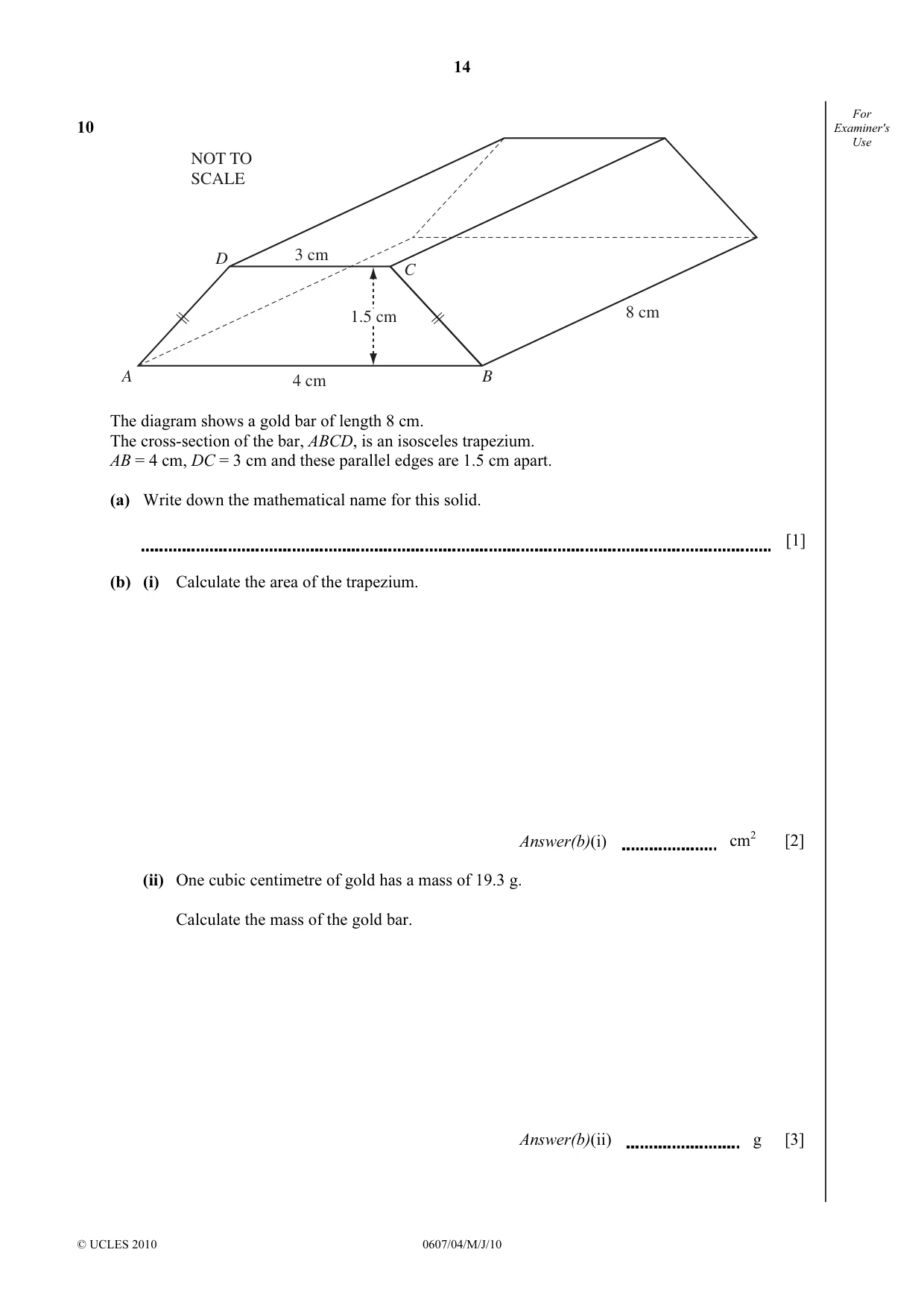
14 © UCLES 2010 0607/04/M/J/10 For Examiner's Use 10 NOT TO SCALE D A B C 4 cm 3 cm 8 cm 1.5 cm The diagram shows a gold bar of length 8 cm. The cross-section of the bar, ABCD, is an isosceles trapezium. AB = 4 cm, DC = 3 cm and these parallel edges are 1.5 cm apart. (a) Write down the mathematical name for this solid. [1] (b) (i) Calculate the area of the trapezium. Answer(b)(i) cm2 [2] (ii) One cubic centimetre of gold has a mass of 19.3 g. Calculate the mass of the gold bar. Answer(b)(ii) g [3]
Question paper, page 15
15 © UCLES 2010 0607/04/M/J/10 [Turn over For Examiner's Use (iii) Calculate the total surface area of the gold bar. Answer(b)(iii) cm2 [4] (c) A box can hold a maximum of 20 kg. Find the largest number of gold bars that can be put in the box. Answer(c) [3]
Question paper, page 16
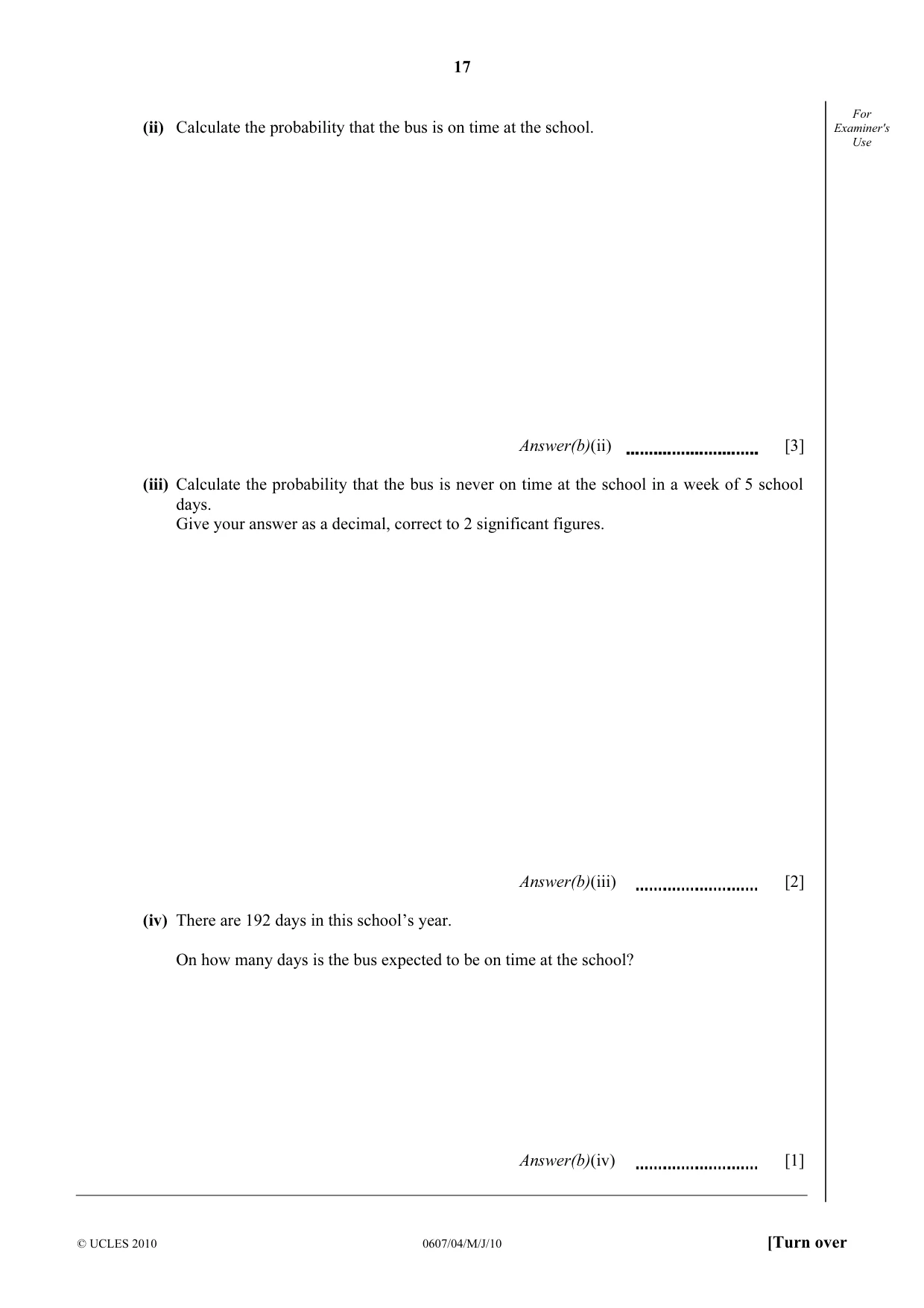
16 © UCLES 2010 0607/04/M/J/10 For Examiner's Use 11 A school bus picks up students at the town centre and takes them to the school. On any day the probability that the bus is on time at the town centre is 5 6 . (a) Write down the probability that the bus is not on time at the town centre. Answer(a) [1] (b) If the bus is on time at the town centre, the probability that it is on time at the school is 7 8 . If the bus is not on time at the town centre then the probability that it is on time at the school is 1 4 . (i) Draw a tree diagram and write the correct probability against each branch. [4]
Question paper, page 17
17 © UCLES 2010 0607/04/M/J/10 [Turn over For Examiner's Use (ii) Calculate the probability that the bus is on time at the school. Answer(b)(ii) [3] (iii) Calculate the probability that the bus is never on time at the school in a week of 5 school days. Give your answer as a decimal, correct to 2 significant figures. Answer(b)(iii) [2] (iv) There are 192 days in this school’s year. On how many days is the bus expected to be on time at the school? Answer(b)(iv) [1]
Question paper, page 18
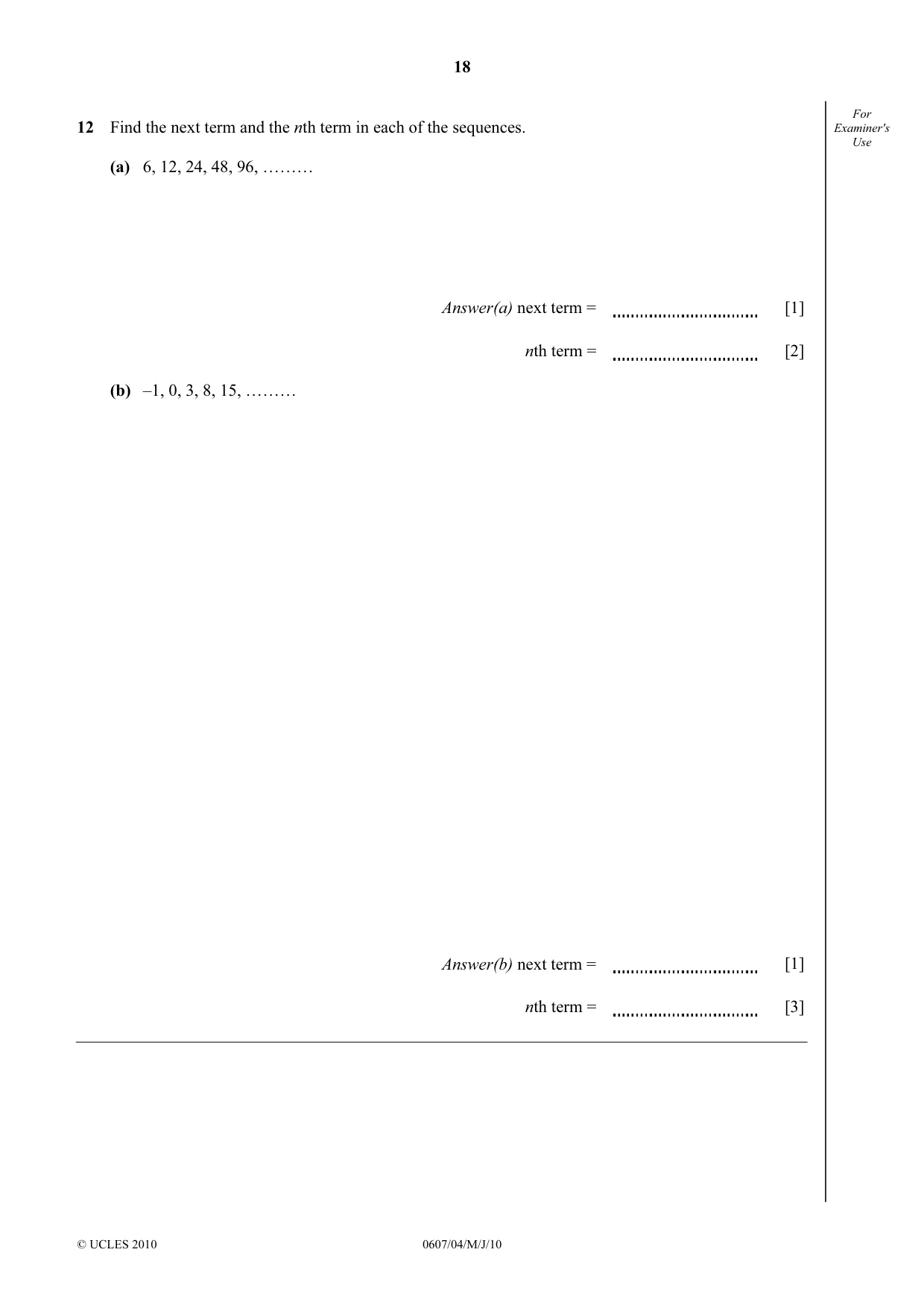
18 © UCLES 2010 0607/04/M/J/10 For Examiner's Use 12 Find the next term and the nth term in each of the sequences. (a) 6, 12, 24, 48, 96, ……… Answer(a) next term = [1] nth term = [2] (b) –1, 0, 3, 8, 15, ……… Answer(b) next term = [1] nth term = [3]
Question paper, page 19
19 © UCLES 2010 0607/04/M/J/10 BLANK PAGE
Question paper, page 20
20 Permission to reproduce items where third-party owned material protected by copyright is included has been sought and cleared where possible. Every reasonable effort has been made by the publisher (UCLES) to trace copyright holders, but if any items requiring clearance have unwittingly been included, the publisher will be pleased to make amends at the earliest possible opportunity. University of Cambridge International Examinations is part of the Cambridge Assessment Group. Cambridge Assessment is the brand name of University of Cambridge Local Examinations Syndicate (UCLES), which is itself a department of the University of Cambridge. © UCLES 2010 0607/04/M/J/10 BLANK PAGE
Mark scheme, page 1
UNIVERSITY OF CAMBRIDGE INTERNATIONAL EXAMINATIONS International General Certificate of Secondary Education MARK SCHEME for the May/June 2010 question paper for the guidance of teachers 0607 CAMBRIDGE INTERNATIONAL MATHEMATICS 0607/04 Paper 4 (Extended), maximum raw mark 120 This mark scheme is published as an aid to teachers and candidates, to indicate the requirements of the examination. It shows the basis on which Examiners were instructed to award marks. It does not indicate the details of the discussions that took place at an Examiners’ meeting before marking began, which would have considered the acceptability of alternative answers. Mark schemes must be read in conjunction with the question papers and the report on the examination. • CIE will not enter into discussions or correspondence in connection with these mark schemes. CIE is publishing the mark schemes for the May/June 2010 question papers for most IGCSE, GCE Advanced Level and Advanced Subsidiary Level syllabuses and some Ordinary Level syllabuses. www.XtremePapers.com
Mark scheme, page 2
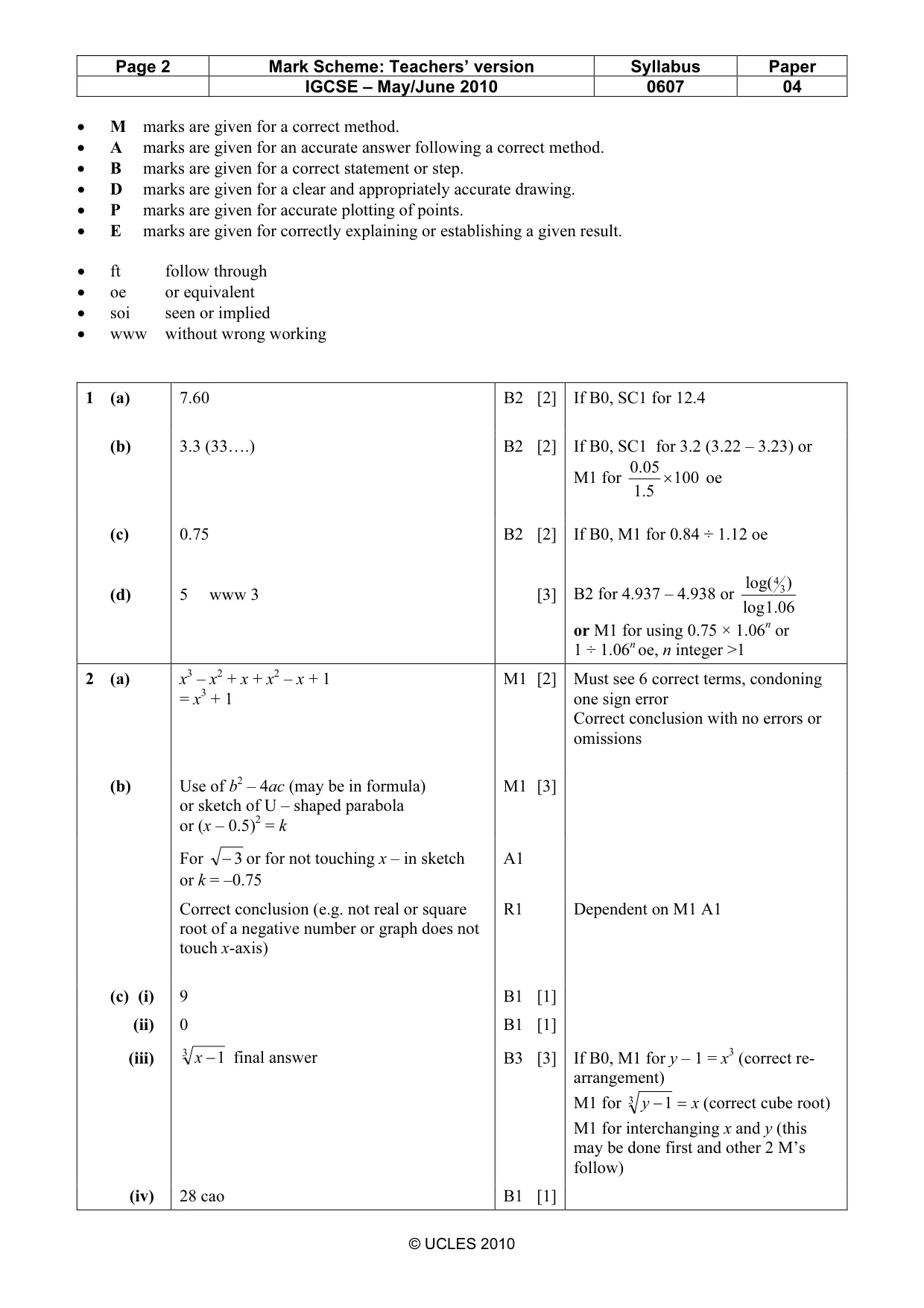
Page 2 Mark Scheme: Teachers’ version Syllabus Paper IGCSE – May/June 2010 0607 04 © UCLES 2010 • M marks are given for a correct method. • A marks are given for an accurate answer following a correct method. • B marks are given for a correct statement or step. • D marks are given for a clear and appropriately accurate drawing. • P marks are given for accurate plotting of points. • E marks are given for correctly explaining or establishing a given result. • ft follow through • oe or equivalent • soi seen or implied • www without wrong working 1 (a) 7.60 B2 [2] If B0, SC1 for 12.4 (b) 3.3 (33….) B2 [2] If B0, SC1 for 3.2 (3.22 – 3.23) or M1 for 100 5.1 05 .0 × oe (c) 0.75 B2 [2] If B0, M1 for 0.84 ÷ 1.12 oe (d) 5 www 3 [3] B2 for 4.937 – 4.938 or 06 .1 log ) log( 3 4 or M1 for using 0.75 × 1.06n or 1 ÷ 1.06n oe, n integer >1 2 (a) x3 – x2 + x + x2 – x + 1 = x3 + 1 M1 [2] Must see 6 correct terms, condoning one sign error Correct conclusion with no errors or omissions (b) Use of b2 – 4ac (may be in formula) or sketch of U – shaped parabola or (x – 0.5)2 = k M1 [3] For 3 − or for not touching x – in sketch or k = –0.75 A1 Correct conclusion (e.g. not real or square root of a negative number or graph does not touch x-axis) R1 Dependent on M1 A1 (c) (i) 9 B1 [1] (ii) 0 B1 [1] (iii) 3 1 − x final answer B3 [3] If B0, M1 for y – 1 = x3 (correct re- arrangement) M1 for x y = − 3 1 (correct cube root) M1 for interchanging x and y (this may be done first and other 2 M’s follow) (iv) 28 cao B1 [1]
Mark scheme, page 3
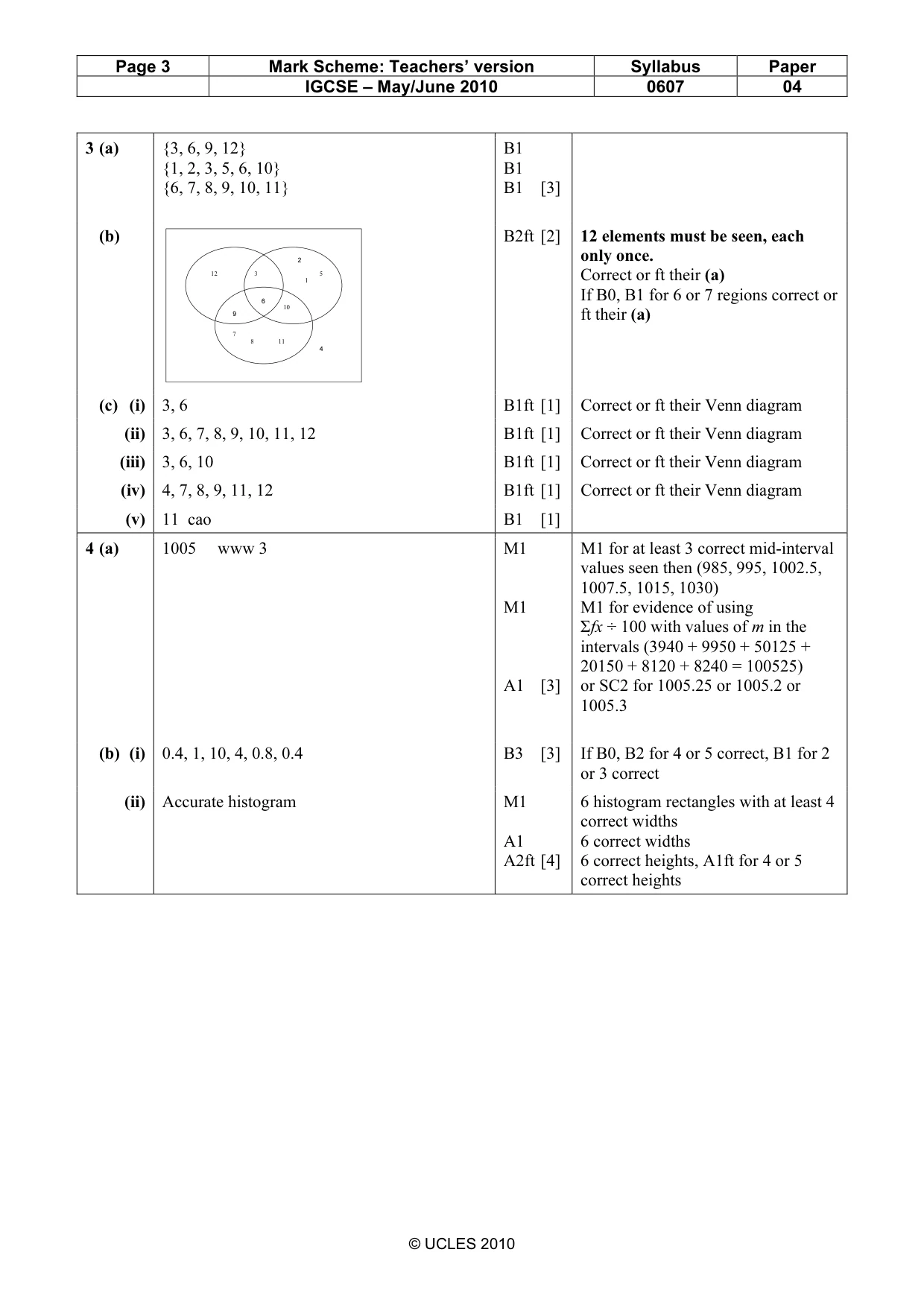
Page 3 Mark Scheme: Teachers’ version Syllabus Paper IGCSE – May/June 2010 0607 04 © UCLES 2010 3 (a) {3, 6, 9, 12} {1, 2, 3, 5, 6, 10} {6, 7, 8, 9, 10, 11} B1 B1 B1 [3] (b) 6 9 2 4 12 1 10 5 3 7 8 11 B2ft [2] 12 elements must be seen, each only once. Correct or ft their (a) If B0, B1 for 6 or 7 regions correct or ft their (a) (c) (i) 3, 6 B1ft [1] Correct or ft their Venn diagram (ii) 3, 6, 7, 8, 9, 10, 11, 12 B1ft [1] Correct or ft their Venn diagram (iii) 3, 6, 10 B1ft [1] Correct or ft their Venn diagram (iv) 4, 7, 8, 9, 11, 12 B1ft [1] Correct or ft their Venn diagram (v) 11 cao B1 [1] 4 (a) 1005 www 3 M1 M1 A1 [3] M1 for at least 3 correct mid-interval values seen then (985, 995, 1002.5, 1007.5, 1015, 1030) M1 for evidence of using Σfx ÷ 100 with values of m in the intervals (3940 + 9950 + 50125 + 20150 + 8120 + 8240 = 100525) or SC2 for 1005.25 or 1005.2 or 1005.3 (b) (i) 0.4, 1, 10, 4, 0.8, 0.4 B3 [3] If B0, B2 for 4 or 5 correct, B1 for 2 or 3 correct (ii) Accurate histogram M1 A1 A2ft [4] 6 histogram rectangles with at least 4 correct widths 6 correct widths 6 correct heights, A1ft for 4 or 5 correct heights
Mark scheme, page 4
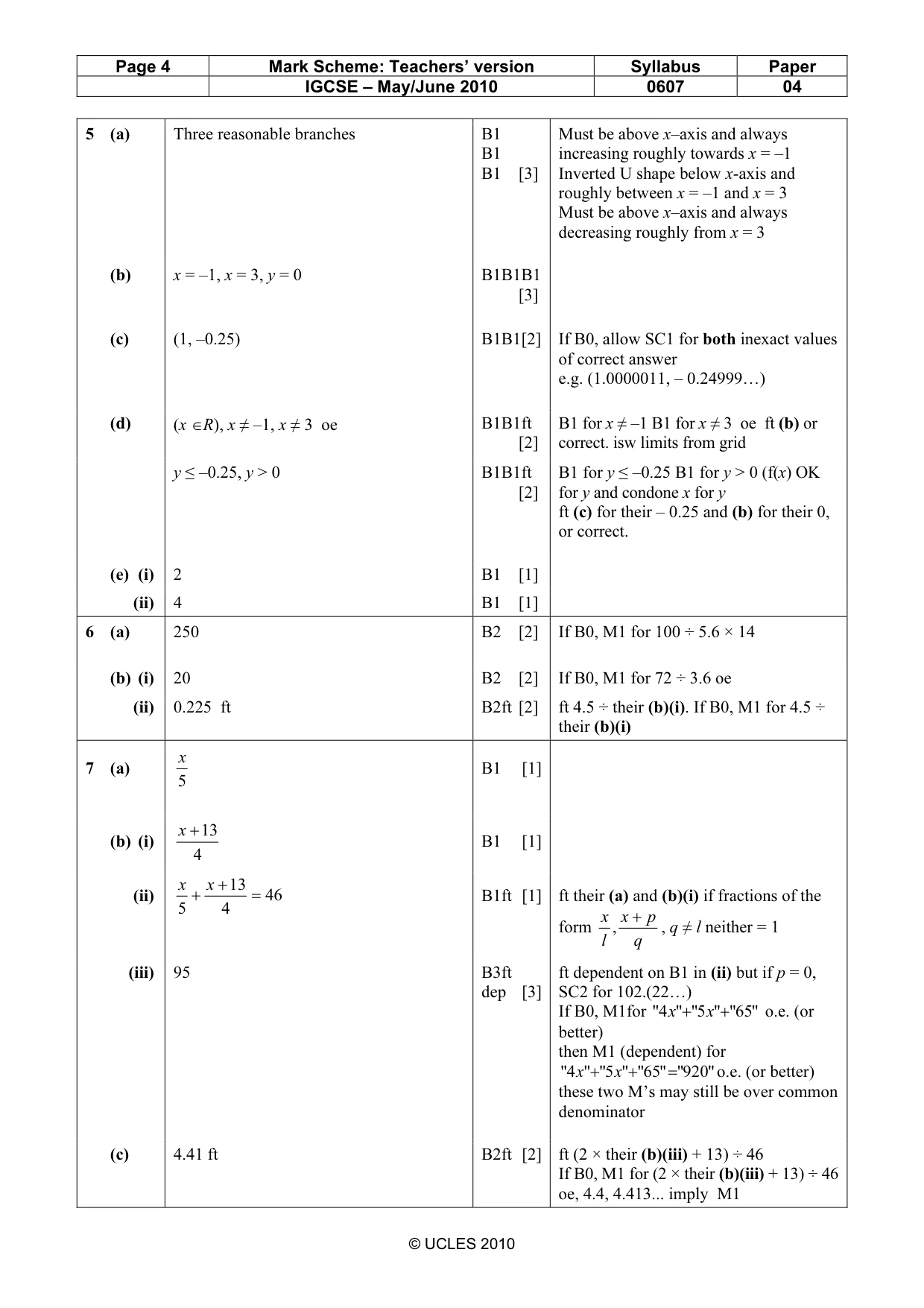
Page 4 Mark Scheme: Teachers’ version Syllabus Paper IGCSE – May/June 2010 0607 04 © UCLES 2010 5 (a) Three reasonable branches B1 B1 B1 [3] Must be above x–axis and always increasing roughly towards x = –1 Inverted U shape below x-axis and roughly between x = –1 and x = 3 Must be above x–axis and always decreasing roughly from x = 3 (b) x = –1, x = 3, y = 0 B1B1B1 [3] (c) (1, –0.25) B1B1[2] If B0, allow SC1 for both inexact values of correct answer e.g. (1.0000011, – 0.24999…) (d) (x ∈R), x ≠ –1, x ≠ 3 oe B1B1ft [2] B1 for x ≠ –1 B1 for x ≠ 3 oe ft (b) or correct. isw limits from grid y ≤ –0.25, y > 0 B1B1ft [2] B1 for y ≤ –0.25 B1 for y > 0 (f(x) OK for y and condone x for y ft (c) for their – 0.25 and (b) for their 0, or correct. (e) (i) 2 B1 [1] (ii) 4 B1 [1] 6 (a) 250 B2 [2] If B0, M1 for 100 ÷ 5.6 × 14 (b) (i) 20 B2 [2] If B0, M1 for 72 ÷ 3.6 oe (ii) 0.225 ft B2ft [2] ft 4.5 ÷ their (b)(i). If B0, M1 for 4.5 ÷ their (b)(i) 7 (a) 5 x B1 [1] (b) (i) 4 13 + x B1 [1] (ii) 46 4 13 5 = + + x x B1ft [1] ft their (a) and (b)(i) if fractions of the form q p x l x + , , q ≠ l neither = 1 (iii) 95 B3ft dep [3] ft dependent on B1 in (ii) but if p = 0, SC2 for 102.(22…) If B0, M1for " 65 " " 5 " " 4 " + + x x o.e. (or better) then M1 (dependent) for " 920 " " 65 " " 5 " " 4 " = + + x x o.e. (or better) these two M’s may still be over common denominator (c) 4.41 ft B2ft [2] ft (2 × their (b)(iii) + 13) ÷ 46 If B0, M1 for (2 × their (b)(iii) + 13) ÷ 46 oe, 4.4, 4.413... imply M1
Mark scheme, page 5
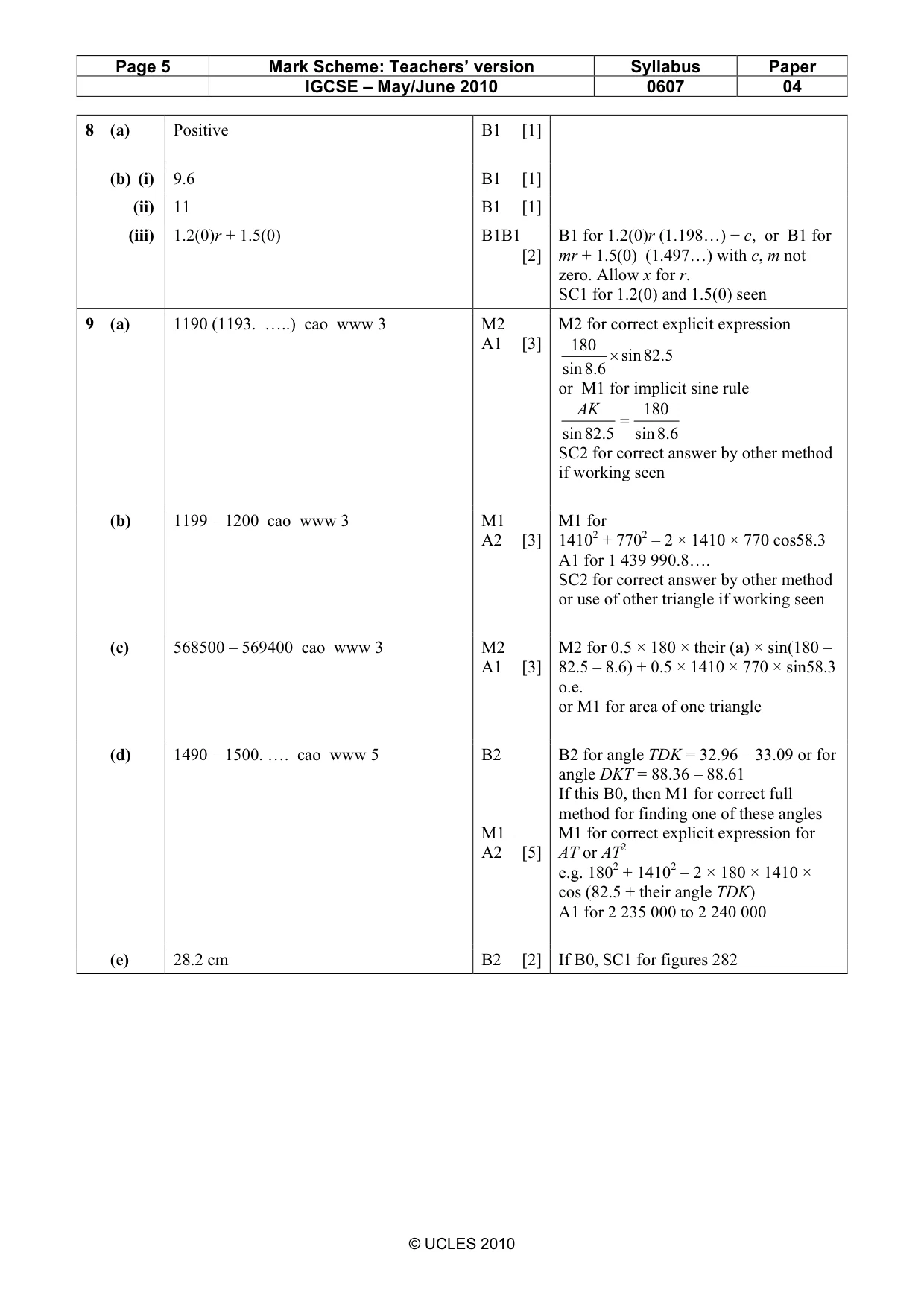
Page 5 Mark Scheme: Teachers’ version Syllabus Paper IGCSE – May/June 2010 0607 04 © UCLES 2010 8 (a) Positive B1 [1] (b) (i) 9.6 B1 [1] (ii) 11 B1 [1] (iii) 1.2(0)r + 1.5(0) B1B1 [2] B1 for 1.2(0)r (1.198…) + c, or B1 for mr + 1.5(0) (1.497…) with c, m not zero. Allow x for r. SC1 for 1.2(0) and 1.5(0) seen 9 (a) 1190 (1193. …..) cao www 3 M2 A1 [3] M2 for correct explicit expression 5. 82 sin 6.8 sin 180 × or M1 for implicit sine rule 6.8 sin 180 5. 82 sin = AK SC2 for correct answer by other method if working seen (b) 1199 – 1200 cao www 3 M1 A2 [3] M1 for 14102 + 7702 – 2 × 1410 × 770 cos58.3 A1 for 1 439 990.8…. SC2 for correct answer by other method or use of other triangle if working seen (c) 568500 – 569400 cao www 3 M2 A1 [3] M2 for 0.5 × 180 × their (a) × sin(180 – 82.5 – 8.6) + 0.5 × 1410 × 770 × sin58.3 o.e. or M1 for area of one triangle (d) 1490 – 1500. …. cao www 5 B2 M1 A2 [5] B2 for angle TDK = 32.96 – 33.09 or for angle DKT = 88.36 – 88.61 If this B0, then M1 for correct full method for finding one of these angles M1 for correct explicit expression for AT or AT2 e.g. 1802 + 14102 – 2 × 180 × 1410 × cos (82.5 + their angle TDK) A1 for 2 235 000 to 2 240 000 (e) 28.2 cm B2 [2] If B0, SC1 for figures 282
Mark scheme, page 6
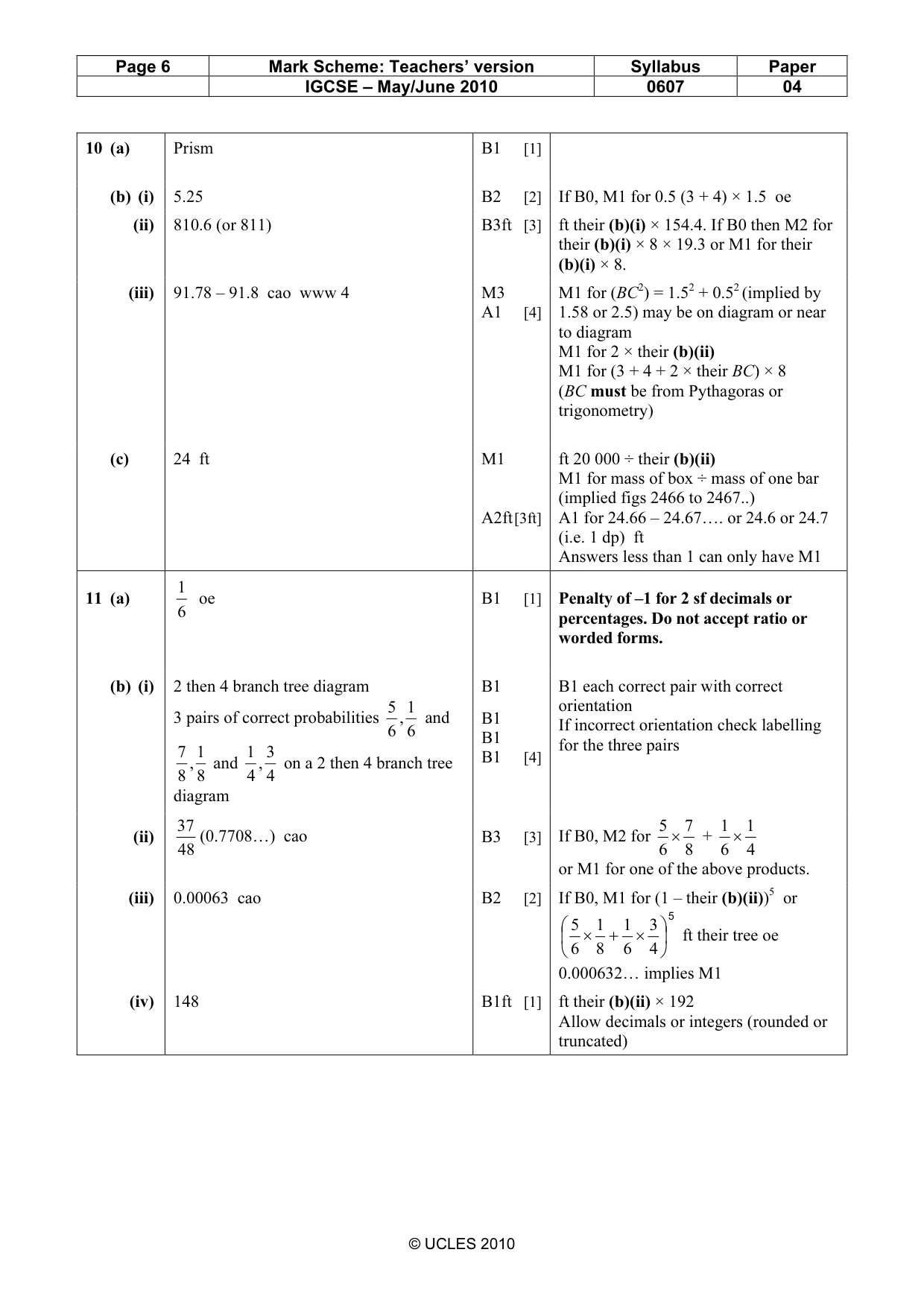
Page 6 Mark Scheme: Teachers’ version Syllabus Paper IGCSE – May/June 2010 0607 04 © UCLES 2010 10 (a) Prism B1 [1] (b) (i) 5.25 B2 [2] If B0, M1 for 0.5 (3 + 4) × 1.5 oe (ii) 810.6 (or 811) B3ft [3] ft their (b)(i) × 154.4. If B0 then M2 for their (b)(i) × 8 × 19.3 or M1 for their (b)(i) × 8. (iii) 91.78 – 91.8 cao www 4 M3 A1 [4] M1 for (BC2) = 1.52 + 0.52 (implied by 1.58 or 2.5) may be on diagram or near to diagram M1 for 2 × their (b)(ii) M1 for (3 + 4 + 2 × their BC) × 8 (BC must be from Pythagoras or trigonometry) (c) 24 ft M1 A2ft [3ft] ft 20 000 ÷ their (b)(ii) M1 for mass of box ÷ mass of one bar (implied figs 2466 to 2467..) A1 for 24.66 – 24.67…. or 24.6 or 24.7 (i.e. 1 dp) ft Answers less than 1 can only have M1 11 (a) 6 1 oe B1 [1] Penalty of –1 for 2 sf decimals or percentages. Do not accept ratio or worded forms. (b) (i) 2 then 4 branch tree diagram 3 pairs of correct probabilities 6 1 , 6 5 and 8 1 , 8 7 and 4 3 , 4 1 on a 2 then 4 branch tree diagram B1 B1 B1 B1 [4] B1 each correct pair with correct orientation If incorrect orientation check labelling for the three pairs (ii) 48 37 (0.7708…) cao B3 [3] If B0, M2 for 8 7 6 5 × + 4 1 6 1 × or M1 for one of the above products. (iii) 0.00063 cao B2 [2] If B0, M1 for (1 – their (b)(ii))5 or 5 × + × 4 3 6 1 8 1 6 5 ft their tree oe 0.000632… implies M1 (iv) 148 B1ft [1] ft their (b)(ii) × 192 Allow decimals or integers (rounded or truncated)
Mark scheme, page 7
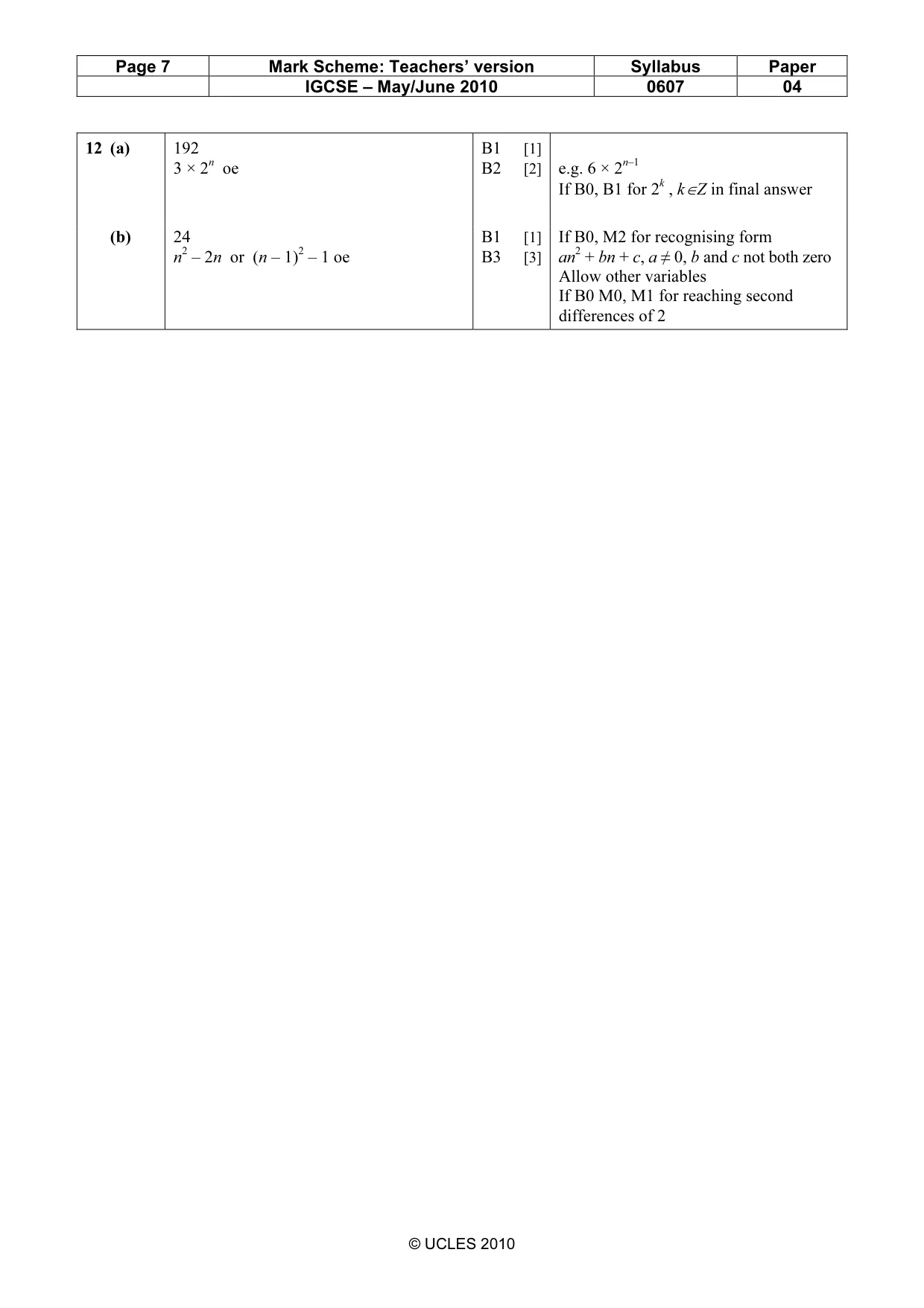
Page 7 Mark Scheme: Teachers’ version Syllabus Paper IGCSE – May/June 2010 0607 04 © UCLES 2010 12 (a) 192 3 × 2n oe B1 [1] B2 [2] e.g. 6 × 2n–1 If B0, B1 for 2k , k∈Z in final answer (b) 24 n2 – 2n or (n – 1)2 – 1 oe B1 [1] B3 [3] If B0, M2 for recognising form an2 + bn + c, a ≠ 0, b and c not both zero Allow other variables If B0 M0, M1 for reaching second differences of 2