Cambridge IGCSE Mathematics - International 0607 — 2009 May/June Paper 4 · Variant 1
0607/41/M/J/09 · 120 marks · ≈135 min
The question paper and its mark scheme, free to read here and free to download. This is Cambridge’s own paper, exactly as it was sat.
Question paper24 pages
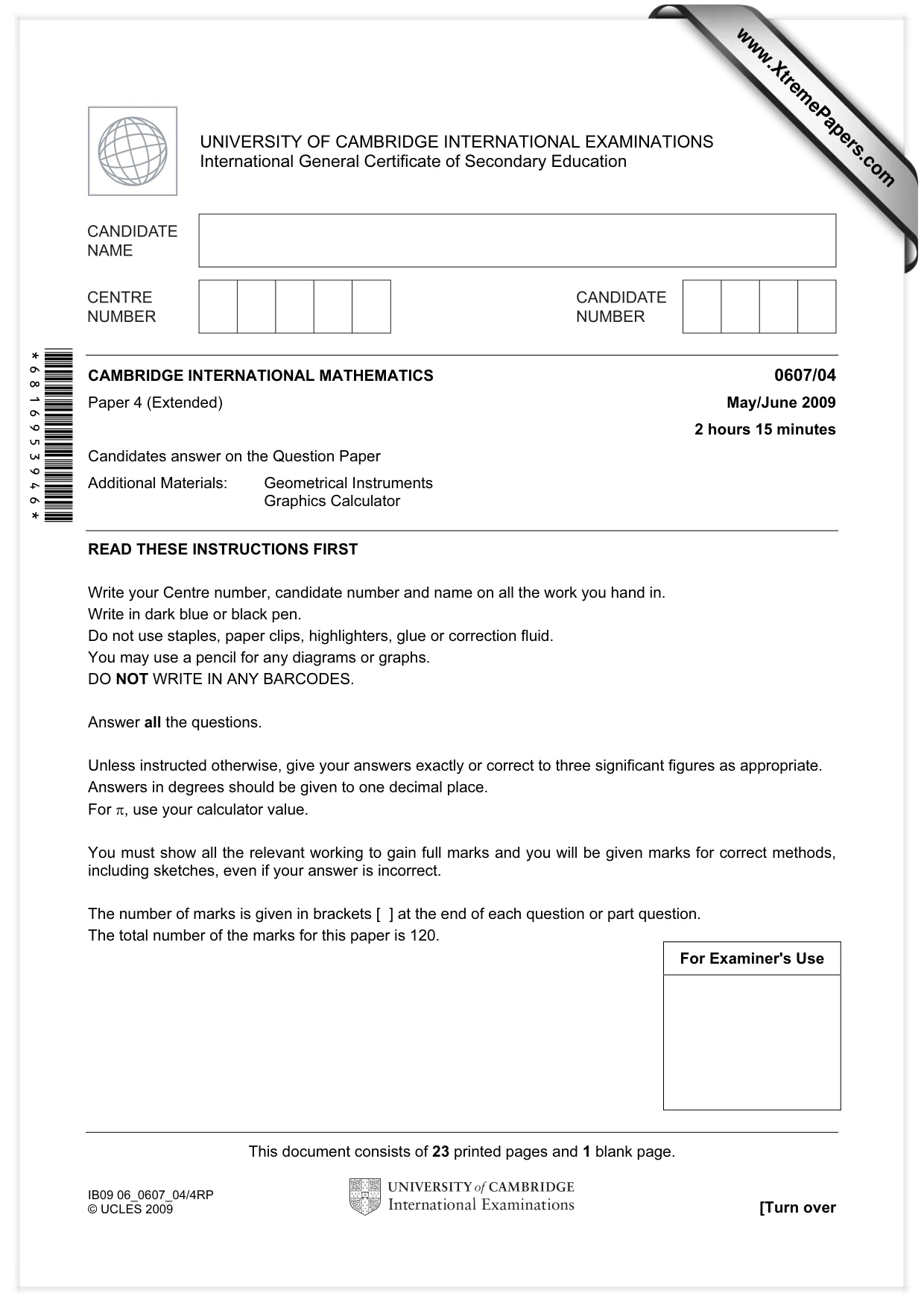
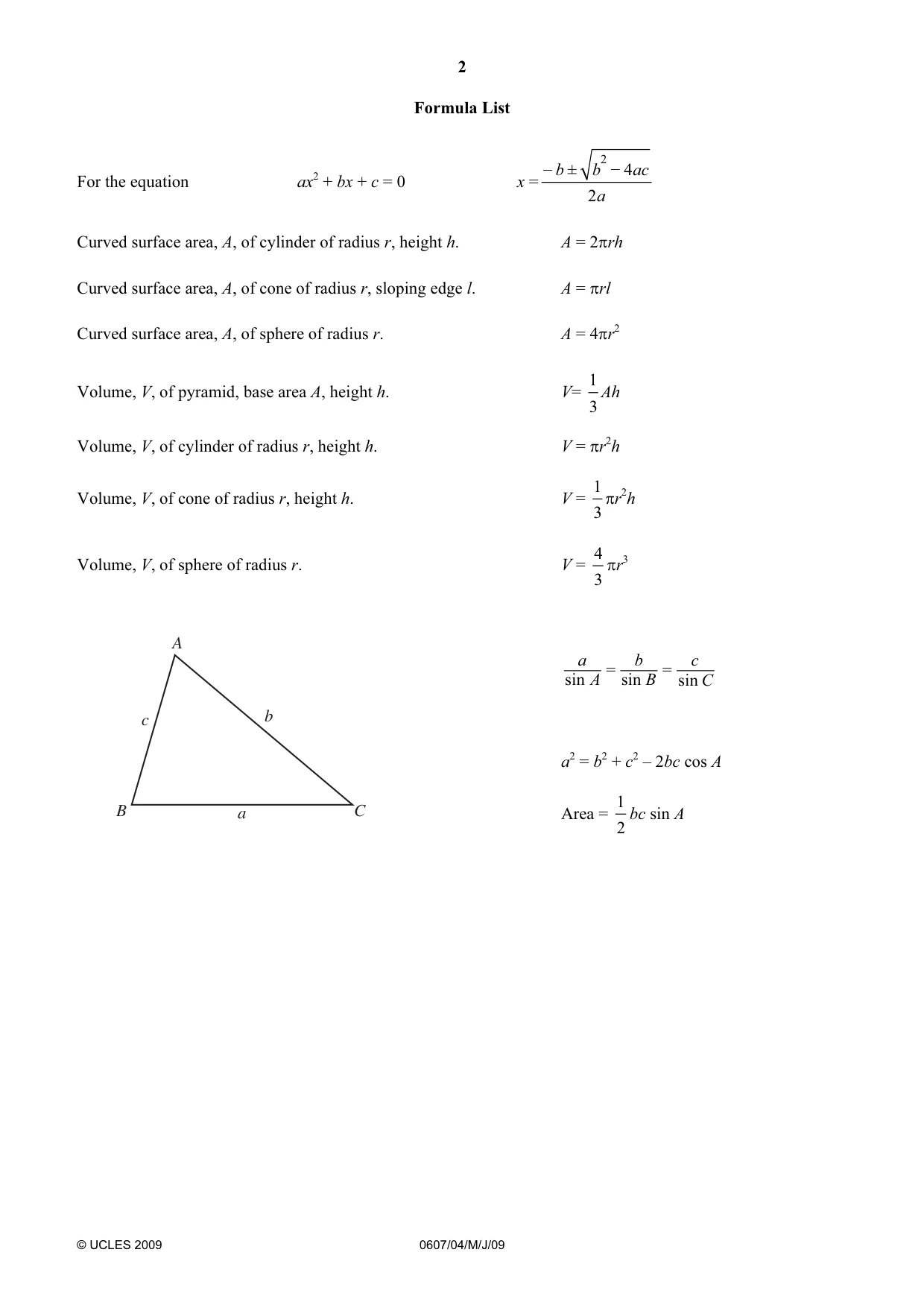
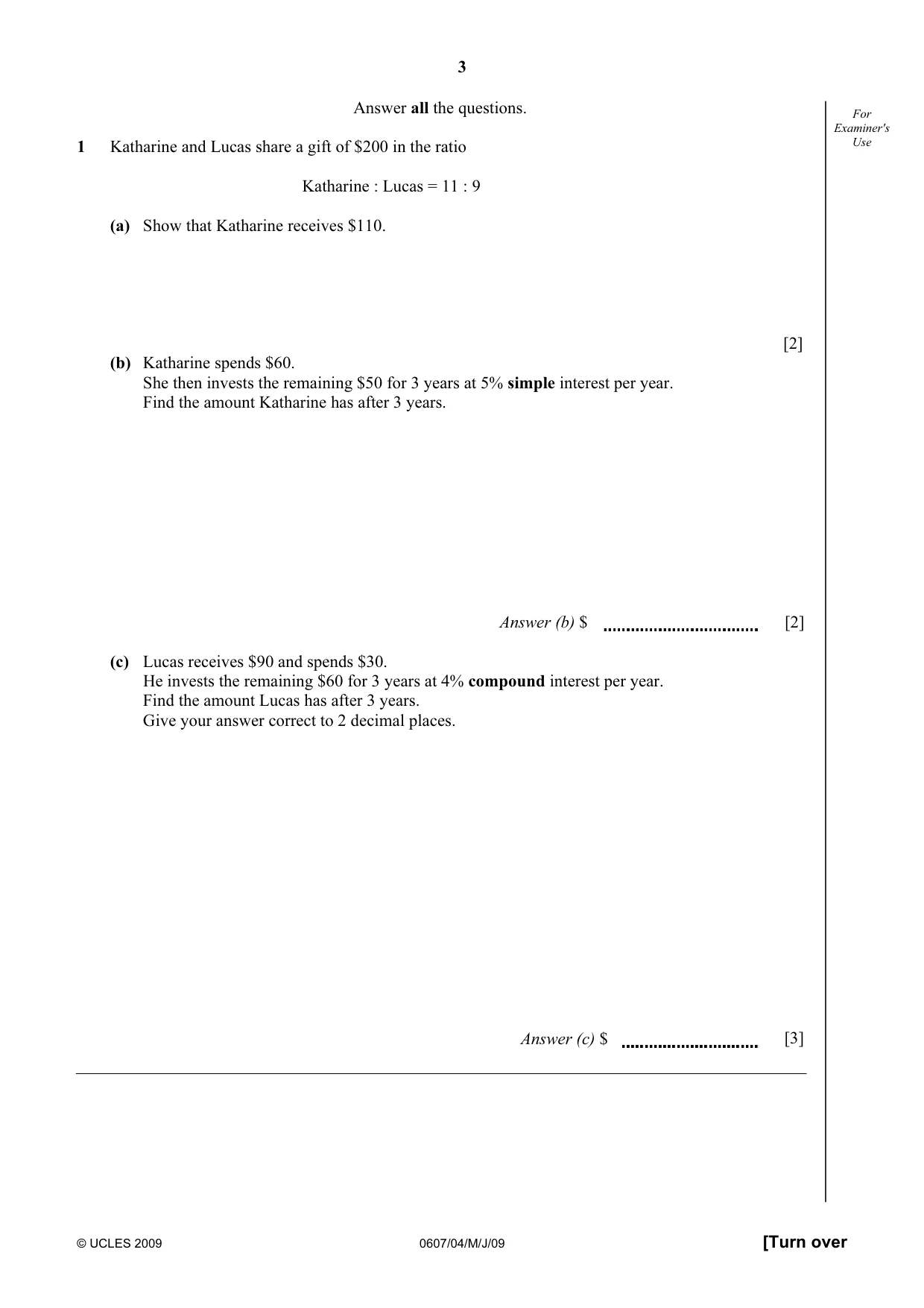
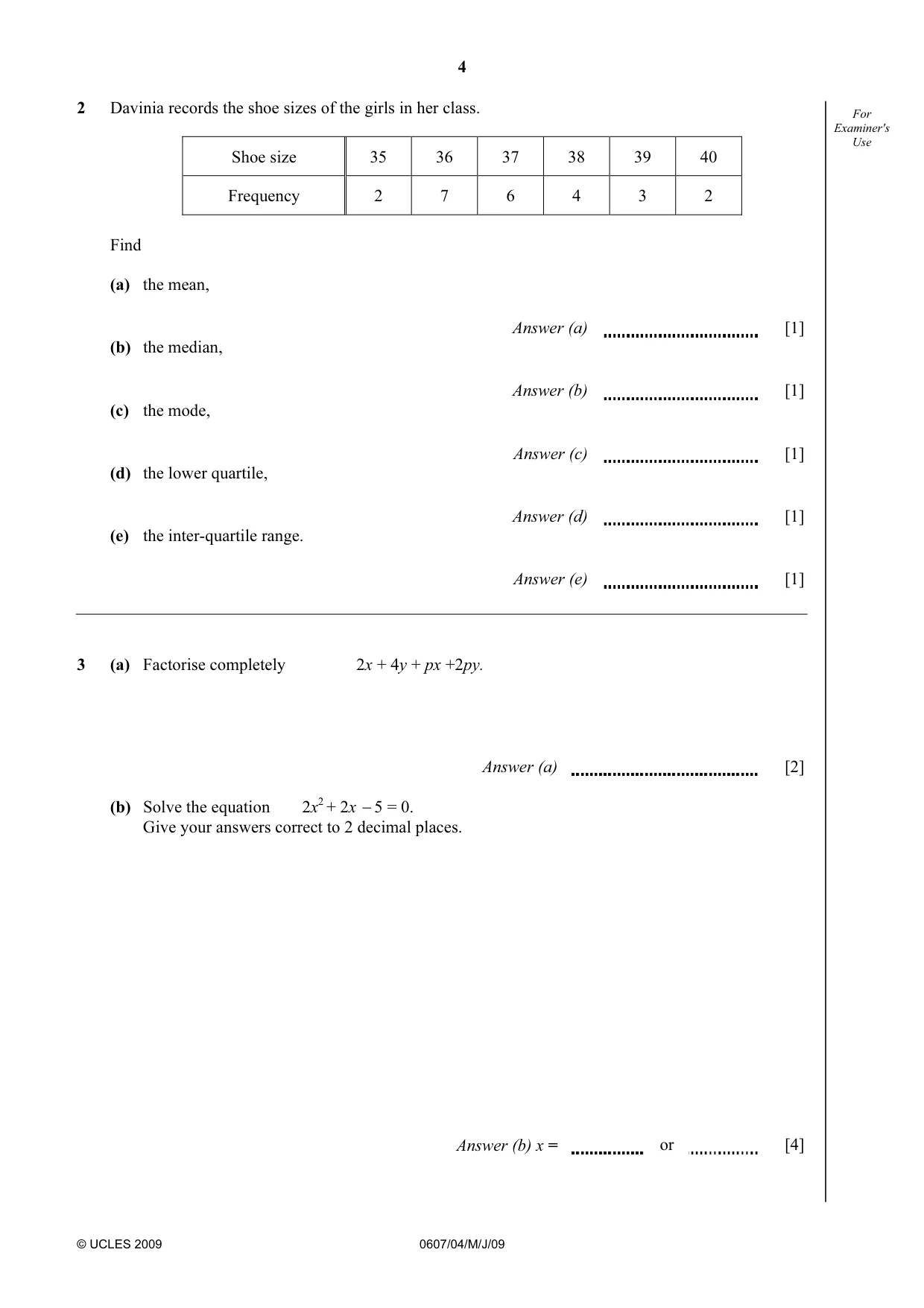
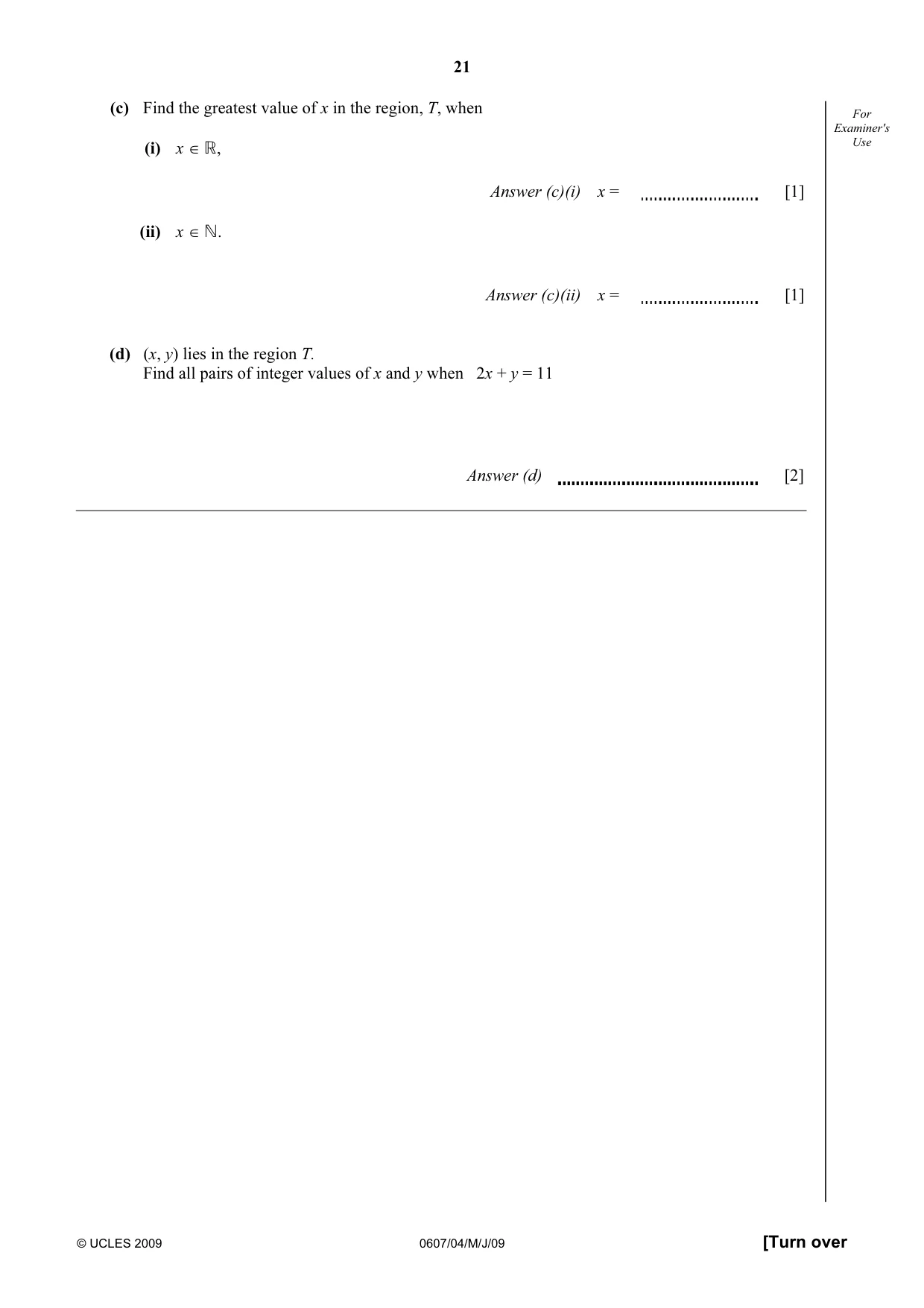
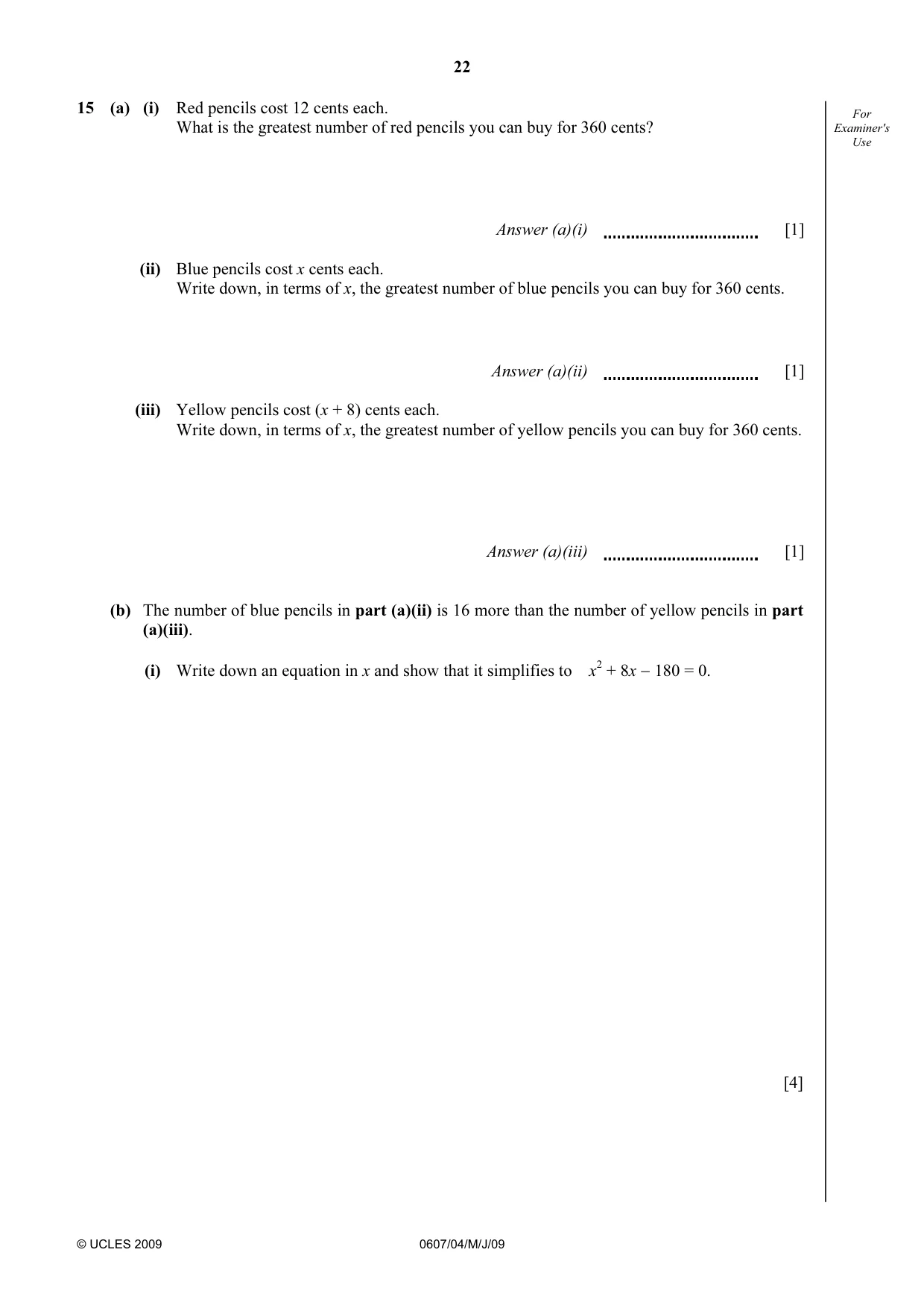
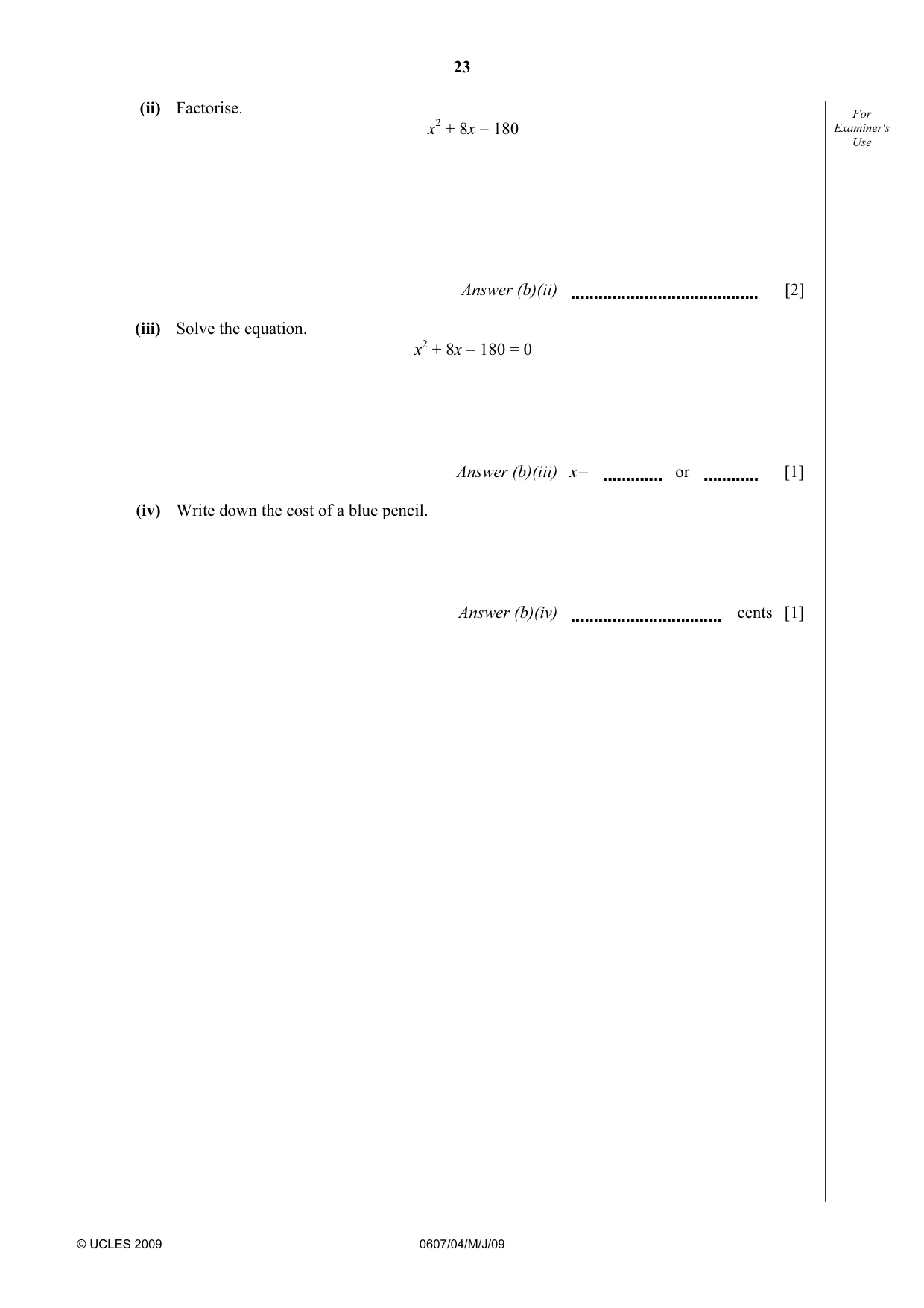
Mark scheme9 pages
Answers below. Sit the paper first if you are practising.
Paper as text
Question paper, page 1
This document consists of 23 printed pages and 1 blank page. IB09 06_0607_04/4RP © UCLES 2009 [Turn over *6816953946* For Examiner's Use UNIVERSITY OF CAMBRIDGE INTERNATIONAL EXAMINATIONS International General Certificate of Secondary Education CAMBRIDGE INTERNATIONAL MATHEMATICS 0607/04 Paper 4 (Extended) May/June 2009 2 hours 15 minutes Candidates answer on the Question Paper Additional Materials: Geometrical Instruments Graphics Calculator READ THESE INSTRUCTIONS FIRST Write your Centre number, candidate number and name on all the work you hand in. Write in dark blue or black pen. Do not use staples, paper clips, highlighters, glue or correction fluid. You may use a pencil for any diagrams or graphs. DO NOT WRITE IN ANY BARCODES. Answer all the questions. Unless instructed otherwise, give your answers exactly or correct to three significant figures as appropriate. Answers in degrees should be given to one decimal place. For π, use your calculator value. You must show all the relevant working to gain full marks and you will be given marks for correct methods, including sketches, even if your answer is incorrect. The number of marks is given in brackets [ ] at the end of each question or part question. The total number of the marks for this paper is 120. www.XtremePapers.com
Question paper, page 2
2 © UCLES 2009 0607/04/M/J/09 Formula List For the equation ax2 + bx + c = 0 x = 2 _ ± 4 2 _ b b ac a Curved surface area, A, of cylinder of radius r, height h. A = 2πrh Curved surface area, A, of cone of radius r, sloping edge l. A = πrl Curved surface area, A, of sphere of radius r. A = 4πr2 Volume, V, of pyramid, base area A, height h. V= 1 3 Ah Volume, V, of cylinder of radius r, height h. V = πr2h Volume, V, of cone of radius r, height h. V = 1 3 πr2h Volume, V, of sphere of radius r. V = 4 3 πr3 = = sin sin sin a b c A B C a2 = b2 + c2 – 2bc cos A Area = 1 2 bc sin A A a B C b c
Question paper, page 3
3 © UCLES 2009 0607/04/M/J/09 [Turn over For Examiner's Use Answer all the questions. 1 Katharine and Lucas share a gift of $200 in the ratio Katharine : Lucas = 11 : 9 (a) Show that Katharine receives $110. [2] (b) Katharine spends $60. She then invests the remaining $50 for 3 years at 5% simple interest per year. Find the amount Katharine has after 3 years. Answer (b) $ [2] (c) Lucas receives $90 and spends $30. He invests the remaining $60 for 3 years at 4% compound interest per year. Find the amount Lucas has after 3 years. Give your answer correct to 2 decimal places. Answer (c) $ [3]
Question paper, page 4
4 © UCLES 2009 0607/04/M/J/09 For Examiner's Use 2 Davinia records the shoe sizes of the girls in her class. Shoe size 35 36 37 38 39 40 Frequency 2 7 6 4 3 2 Find (a) the mean, Answer (a) [1] (b) the median, Answer (b) [1] (c) the mode, Answer (c) [1] (d) the lower quartile, Answer (d) [1] (e) the inter-quartile range. Answer (e) [1] 3 (a) Factorise completely 2x + 4y + px +2py. Answer (a) [2] (b) Solve the equation 2x2 + 2x − 5 = 0. Give your answers correct to 2 decimal places. Answer (b) x = or [4]
Question paper, page 5
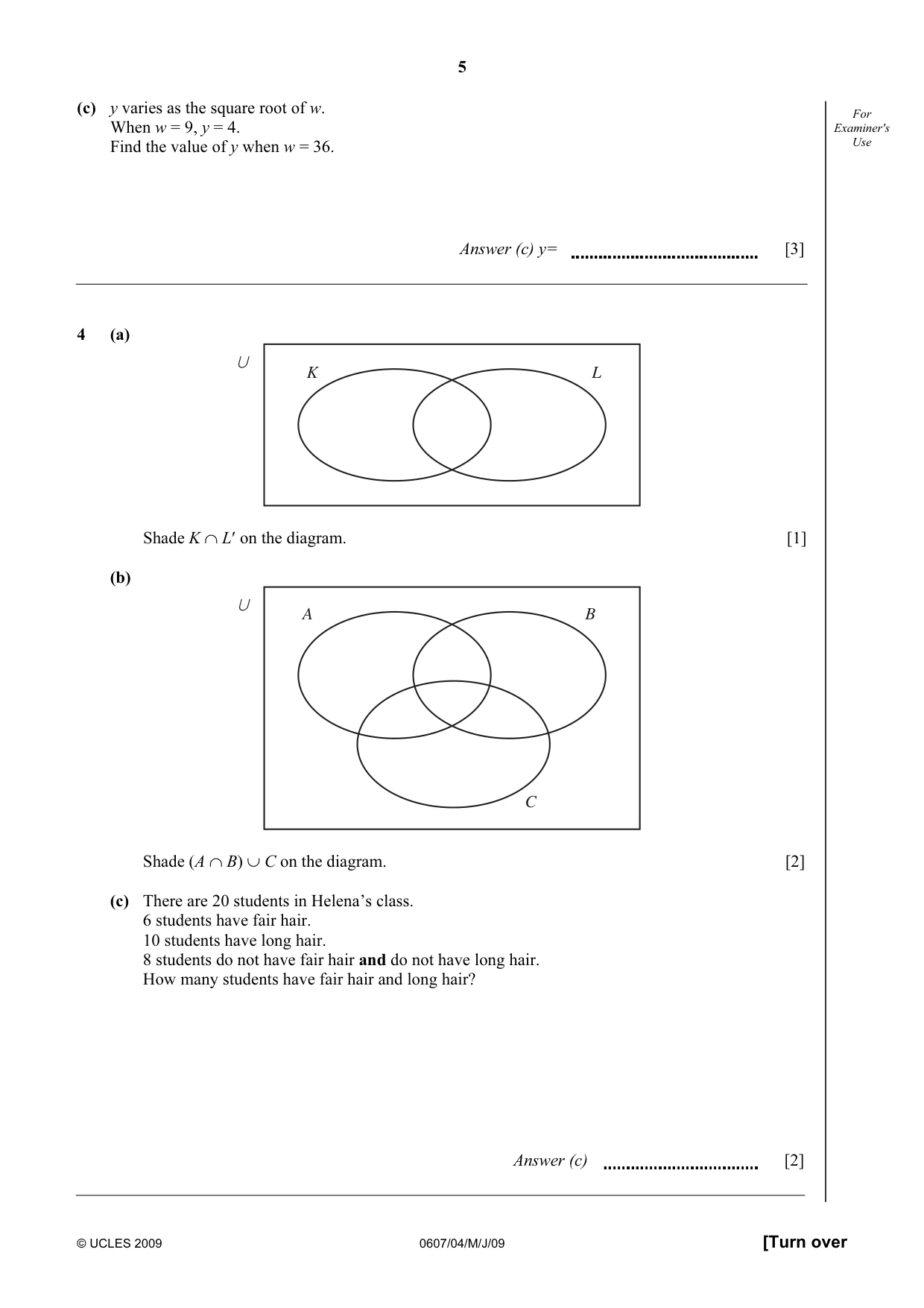
5 © UCLES 2009 0607/04/M/J/09 [Turn over For Examiner's Use (c) y varies as the square root of w. When w = 9, y = 4. Find the value of y when w = 36. Answer (c) y= [3] 4 (a) K L Shade K ∩ L′ on the diagram. [1] (b) A B C Shade (A ∩ B) ∪ C on the diagram. [2] (c) There are 20 students in Helena’s class. 6 students have fair hair. 10 students have long hair. 8 students do not have fair hair and do not have long hair. How many students have fair hair and long hair? Answer (c) [2]
Question paper, page 6
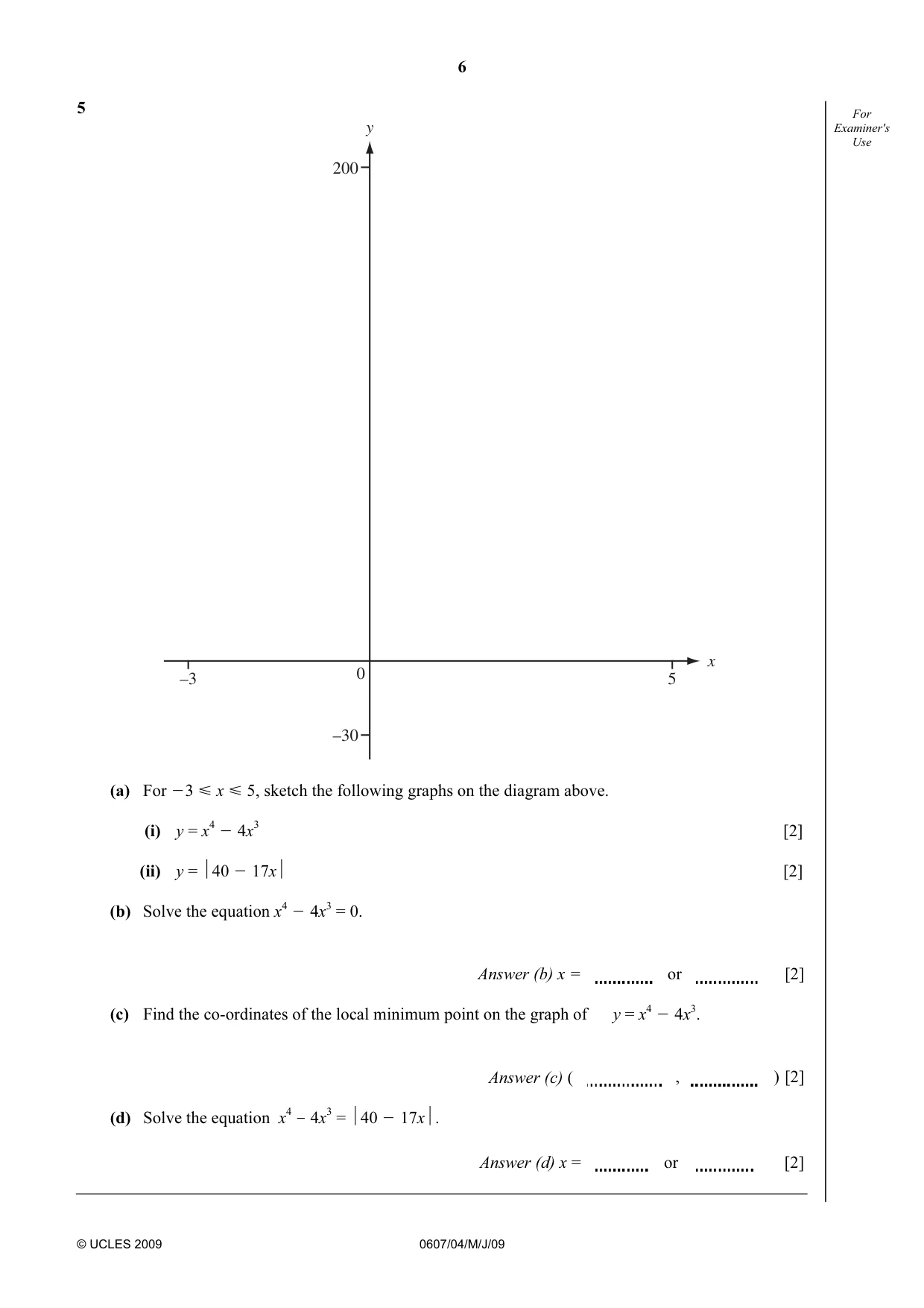
6 © UCLES 2009 0607/04/M/J/09 For Examiner's Use 5 200 –30 –3 5 0 y x (a) For O3 Y x Y 5, sketch the following graphs on the diagram above. (i) y = x4 O 4x3 [2] (ii) y = 40 O 17x [2] (b) Solve the equation x4 O 4x3 = 0. Answer (b) x = or [2] (c) Find the co-ordinates of the local minimum point on the graph of y = x4 O 4x3. Answer (c) ( , ) [2] (d) Solve the equation x4 − 4x3 = 40 O 17x. Answer (d) x = or [2]
Question paper, page 7
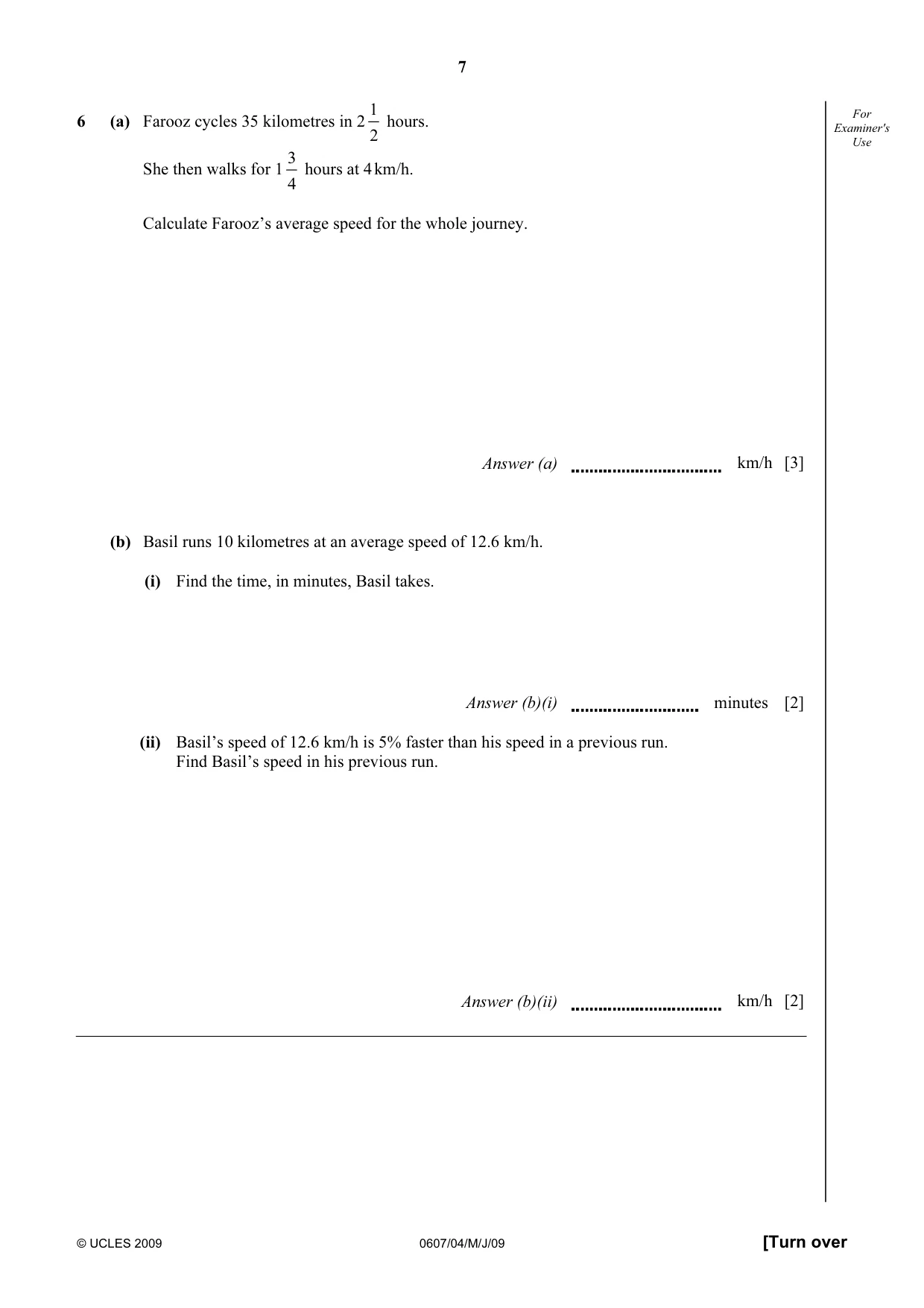
7 © UCLES 2009 0607/04/M/J/09 [Turn over For Examiner's Use 6 (a) Farooz cycles 35 kilometres in 2 1 2 hours. She then walks for 1 3 4 hours at 4 km/h. Calculate Farooz’s average speed for the whole journey. Answer (a) km/h [3] (b) Basil runs 10 kilometres at an average speed of 12.6 km/h. (i) Find the time, in minutes, Basil takes. Answer (b)(i) minutes [2] (ii) Basil’s speed of 12.6 km/h is 5% faster than his speed in a previous run. Find Basil’s speed in his previous run. Answer (b)(ii) km/h [2]
Question paper, page 8
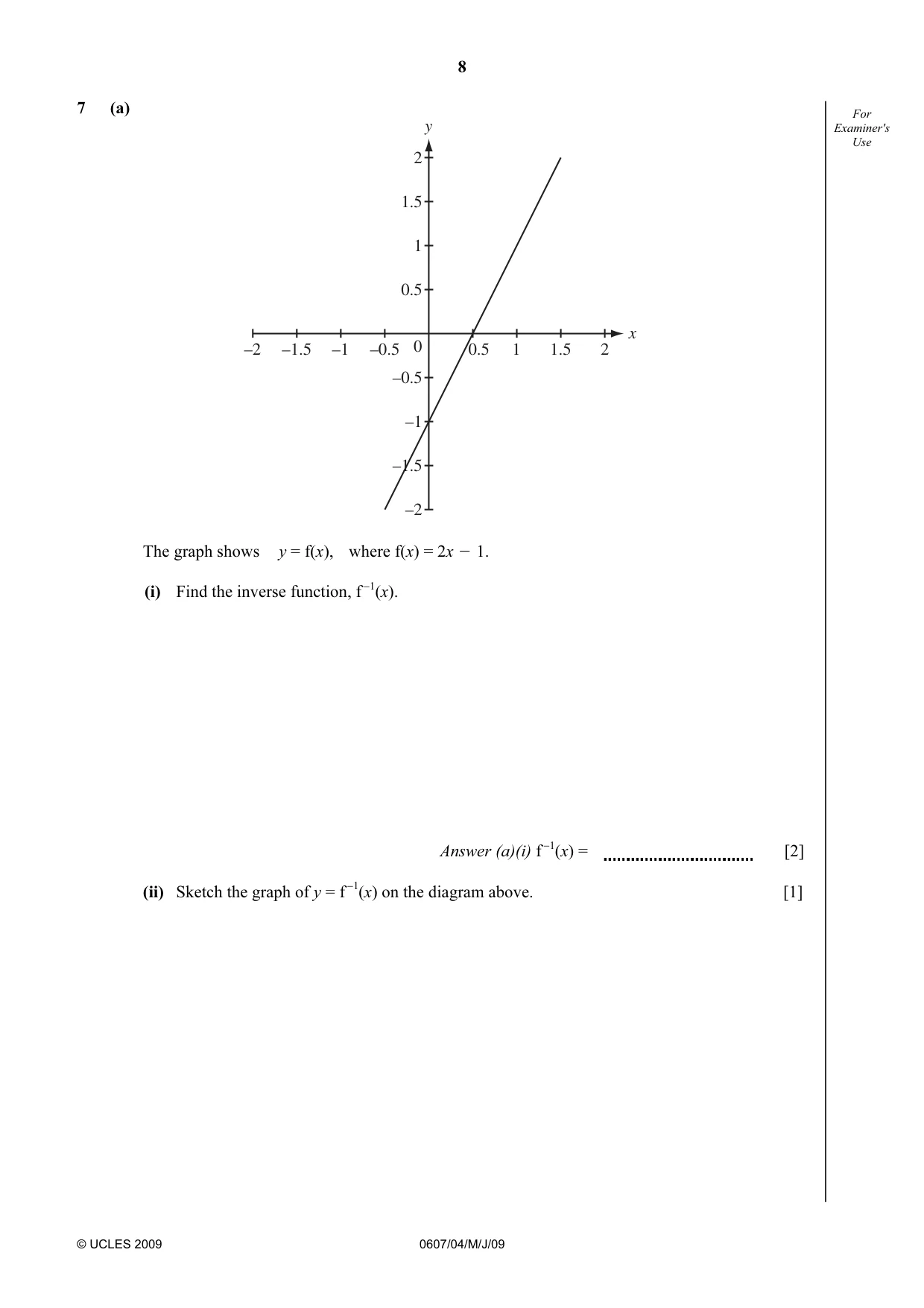
8 © UCLES 2009 0607/04/M/J/09 For Examiner's Use 7 (a) 2 1.5 1 0.5 –0.5 –1 –1.5 –2 0 –1 1 2 –2 –1.5 –0.5 0.5 1.5 y x The graph shows y = f(x), where f(x) = 2x O 1. (i) Find the inverse function, f −1(x). Answer (a)(i) f −1(x) = [2] (ii) Sketch the graph of y = f −1(x) on the diagram above. [1]
Question paper, page 9
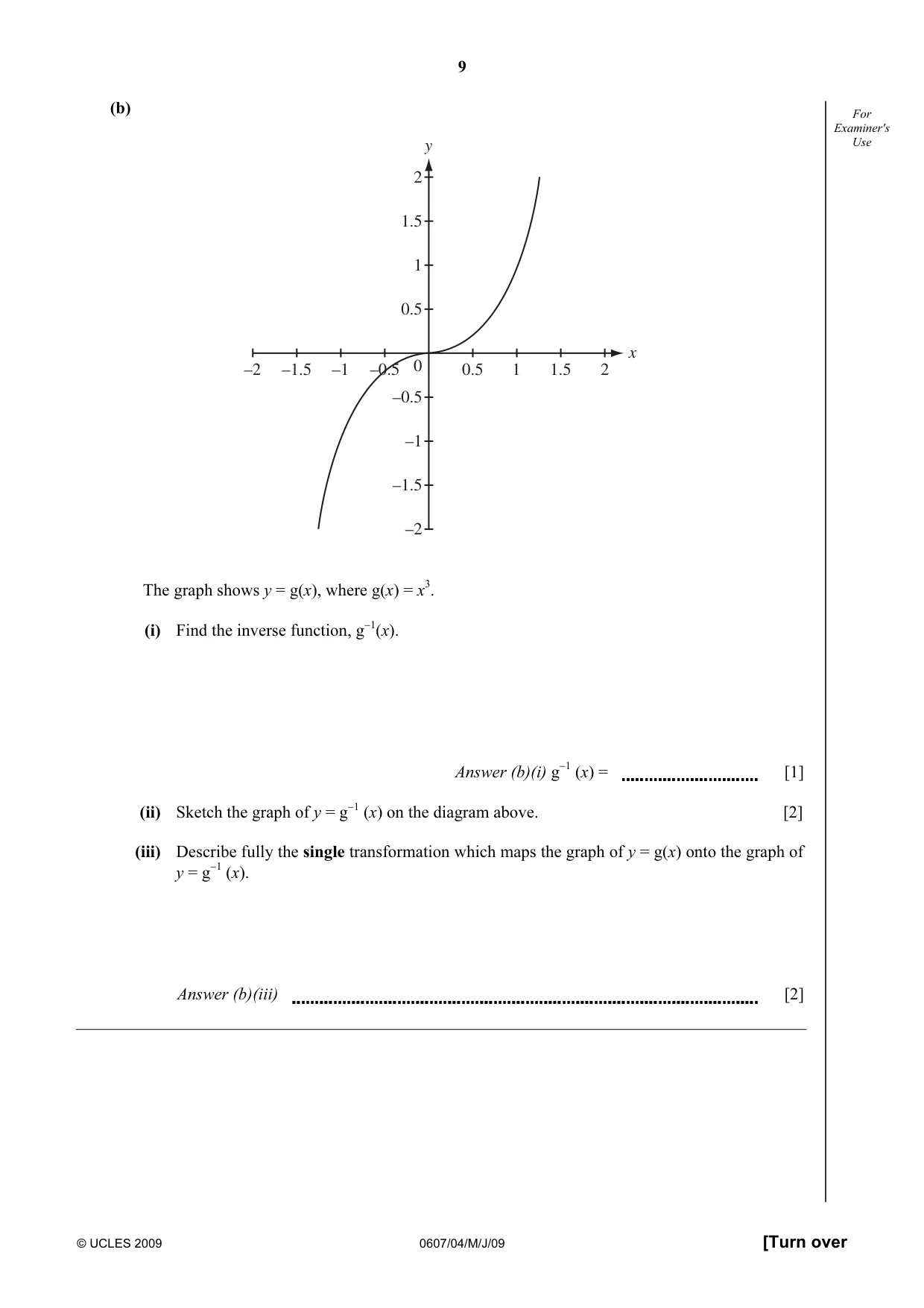
9 © UCLES 2009 0607/04/M/J/09 [Turn over For Examiner's Use (b) 2 1.5 1 0.5 –0.5 –1 –1.5 –2 0 –1 1 2 –2 –1.5 –0.5 0.5 1.5 y x The graph shows y = g(x), where g(x) = x3. (i) Find the inverse function, g−1(x). Answer (b)(i) g−1 (x) = [1] (ii) Sketch the graph of y = g−1 (x) on the diagram above. [2] (iii) Describe fully the single transformation which maps the graph of y = g(x) onto the graph of y = g−1 (x). Answer (b)(iii) [2]
Question paper, page 10
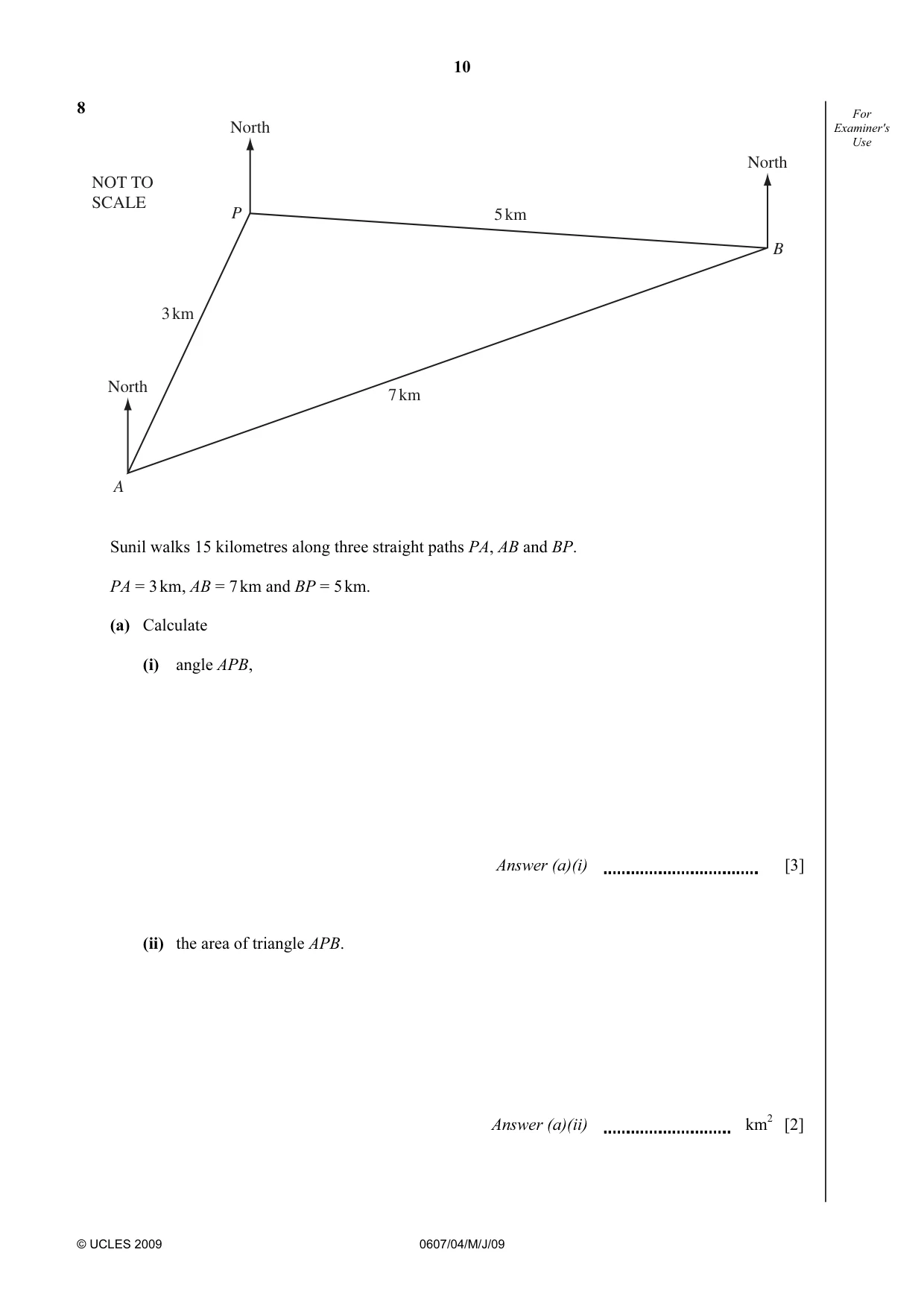
10 © UCLES 2009 0607/04/M/J/09 For Examiner's Use 8 A P B 7 km 5 km 3 km North North North NOT TO SCALE Sunil walks 15 kilometres along three straight paths PA, AB and BP. PA = 3 km, AB = 7 km and BP = 5 km. (a) Calculate (i) angle APB, Answer (a)(i) [3] (ii) the area of triangle APB. Answer (a)(ii) km2 [2]
Question paper, page 11
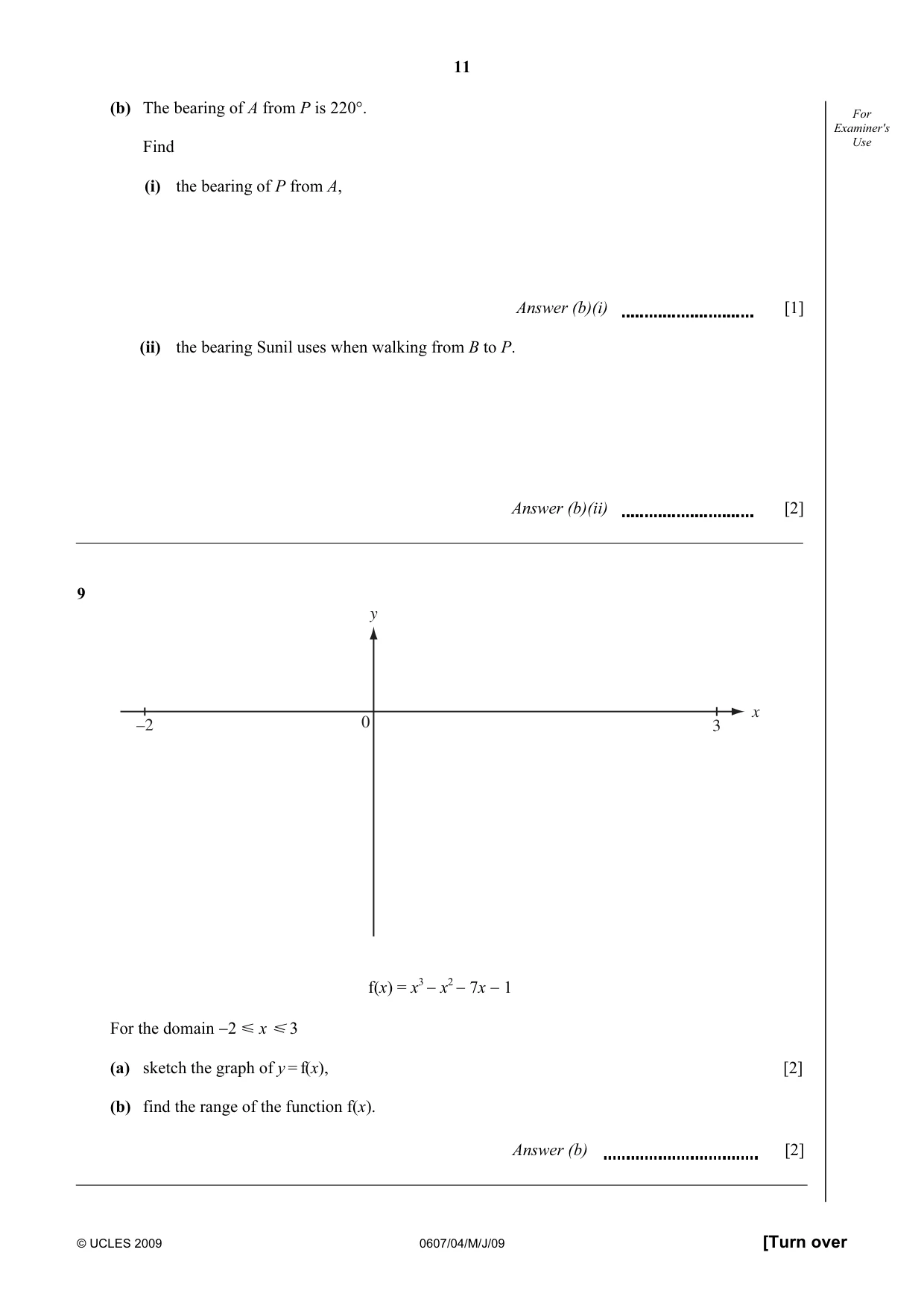
11 © UCLES 2009 0607/04/M/J/09 [Turn over For Examiner's Use (b) The bearing of A from P is 220°. Find (i) the bearing of P from A, Answer (b)(i) [1] (ii) the bearing Sunil uses when walking from B to P. Answer (b)(ii) [2] 9 –2 3 y x 0 f(x) = x3 − x2 − 7x − 1 For the domain −2 Y x Y 3 (a) sketch the graph of y = f(x), [2] (b) find the range of the function f(x). Answer (b) [2]
Question paper, page 12
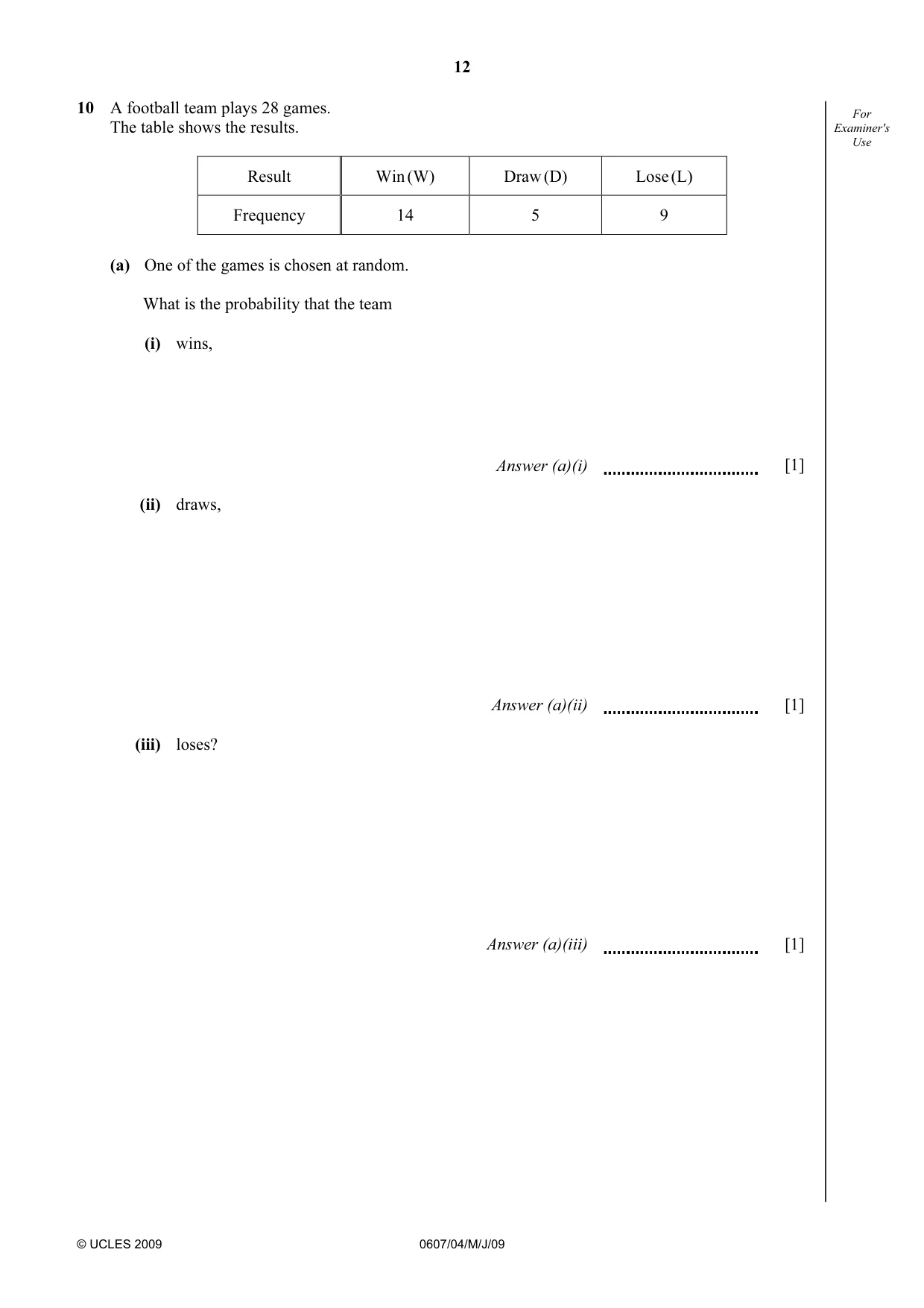
12 © UCLES 2009 0607/04/M/J/09 For Examiner's Use 10 A football team plays 28 games. The table shows the results. Result Win (W) Draw (D) Lose (L) Frequency 14 5 9 (a) One of the games is chosen at random. What is the probability that the team (i) wins, Answer (a)(i) [1] (ii) draws, Answer (a)(ii) [1] (iii) loses? Answer (a)(iii) [1]
Question paper, page 13
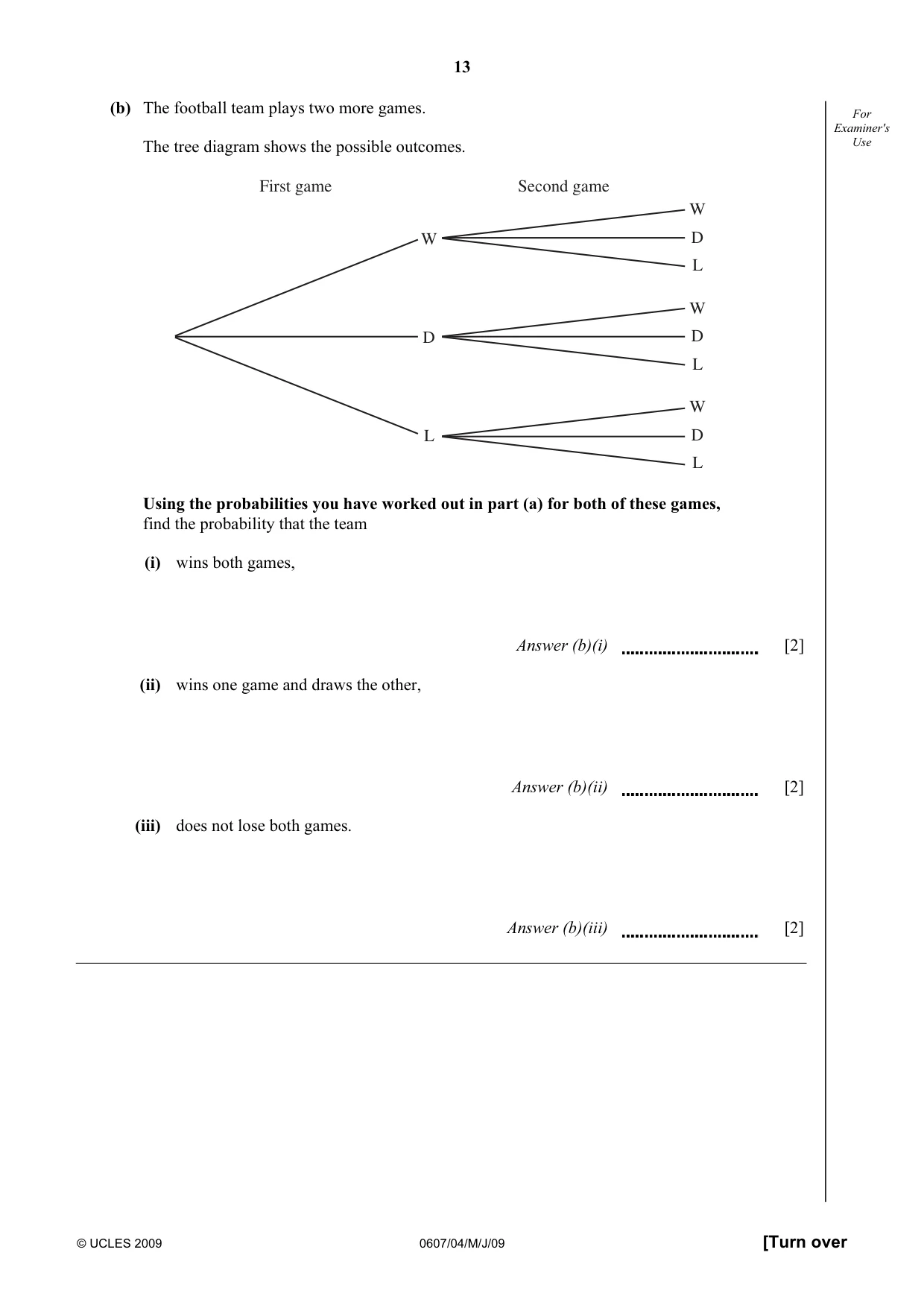
13 © UCLES 2009 0607/04/M/J/09 [Turn over For Examiner's Use (b) The football team plays two more games. The tree diagram shows the possible outcomes. First game Second game W D L W D L W D L W D L Using the probabilities you have worked out in part (a) for both of these games, find the probability that the team (i) wins both games, Answer (b)(i) [2] (ii) wins one game and draws the other, Answer (b)(ii) [2] (iii) does not lose both games. Answer (b)(iii) [2]
Question paper, page 14
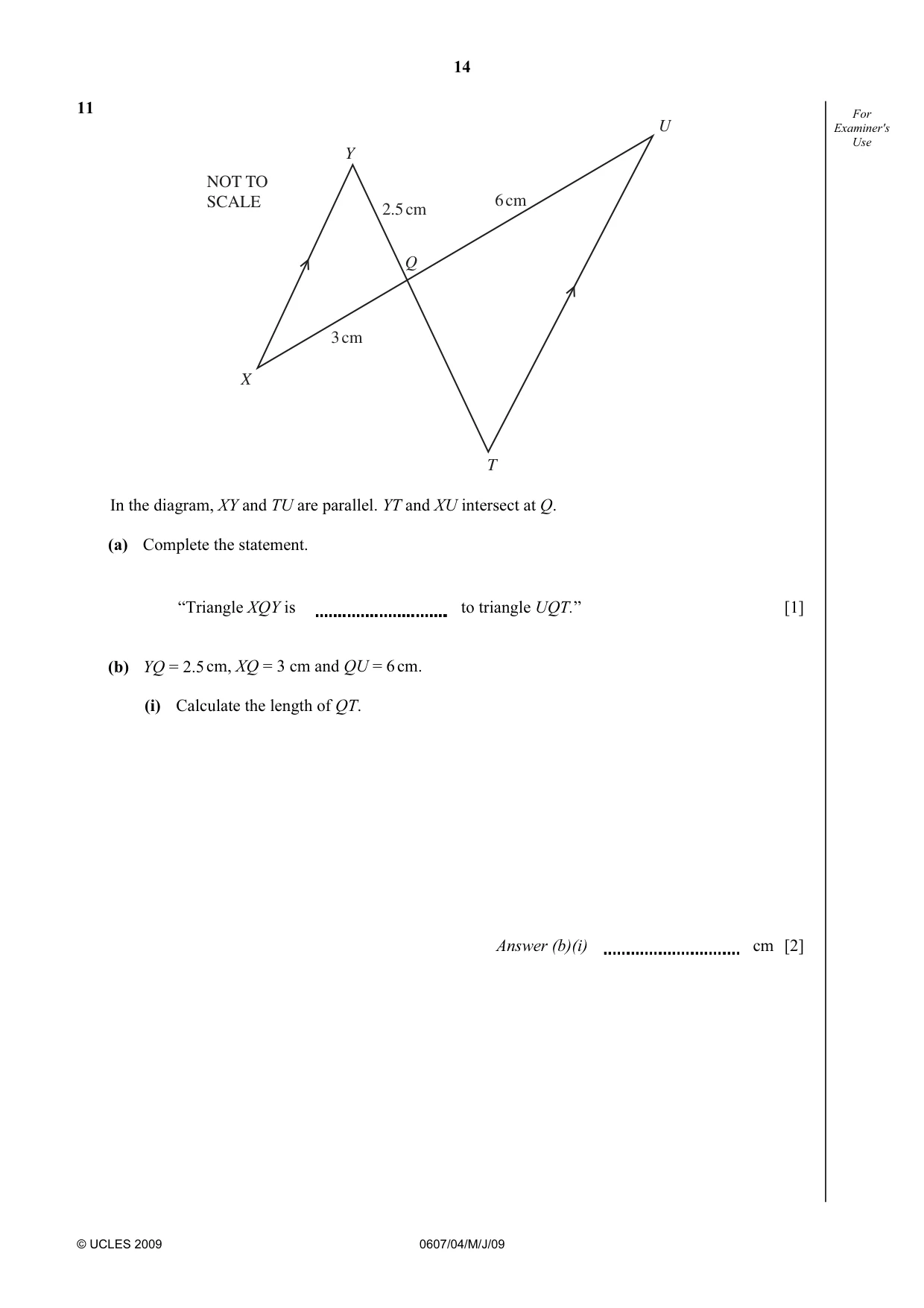
14 © UCLES 2009 0607/04/M/J/09 For Examiner's Use 11 Y X T U Q 6 cm 2.5 cm 3 cm NOT TO SCALE In the diagram, XY and TU are parallel. YT and XU intersect at Q. (a) Complete the statement. “Triangle XQY is to triangle UQT.” [1] (b) YQ = 2.5 cm, XQ = 3 cm and QU = 6 cm. (i) Calculate the length of QT. Answer (b)(i) cm [2]
Question paper, page 15
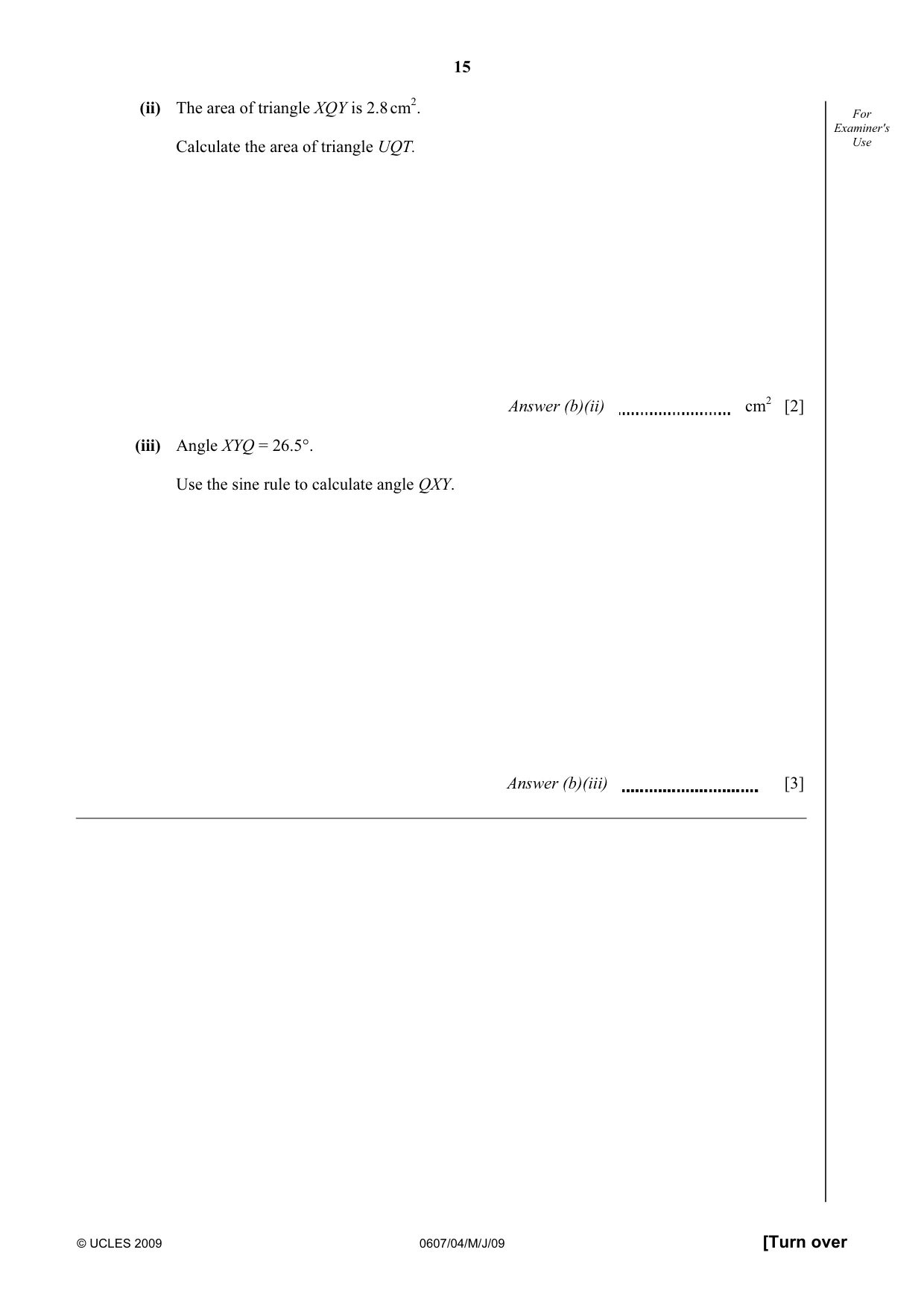
15 © UCLES 2009 0607/04/M/J/09 [Turn over For Examiner's Use (ii) The area of triangle XQY is 2.8 cm2. Calculate the area of triangle UQT. Answer (b)(ii) cm2 [2] (iii) Angle XYQ = 26.5°. Use the sine rule to calculate angle QXY. Answer (b)(iii) [3]
Question paper, page 16
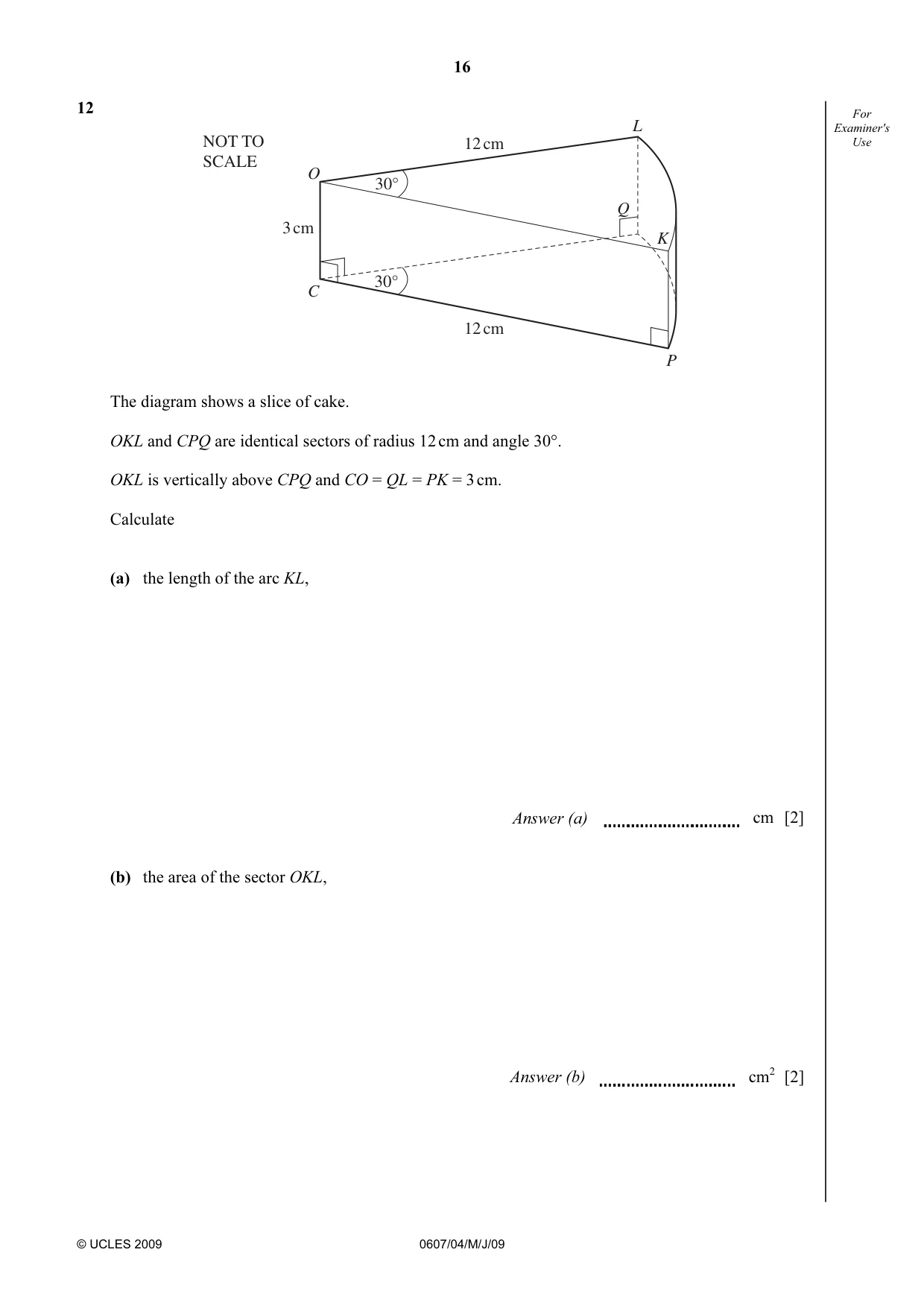
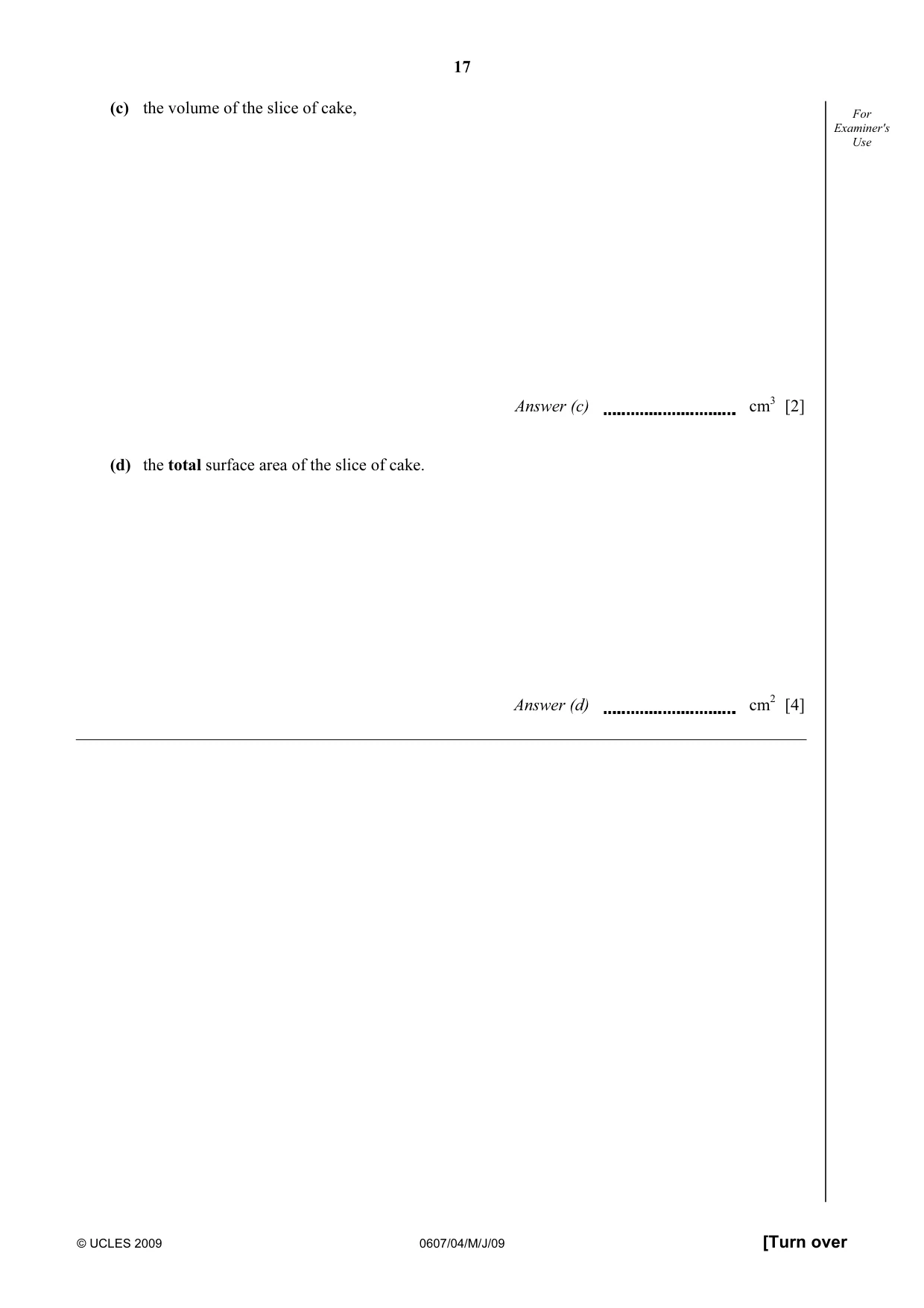
16 © UCLES 2009 0607/04/M/J/09 For Examiner's Use 12 O C L Q K P 30° 30° 12 cm 3 cm 12 cm NOT TO SCALE The diagram shows a slice of cake. OKL and CPQ are identical sectors of radius 12 cm and angle 30°. OKL is vertically above CPQ and CO = QL = PK = 3 cm. Calculate (a) the length of the arc KL, Answer (a) cm [2] (b) the area of the sector OKL, Answer (b) cm2 [2]
Question paper, page 17
17 © UCLES 2009 0607/04/M/J/09 [Turn over For Examiner's Use (c) the volume of the slice of cake, Answer (c) cm3 [2] (d) the total surface area of the slice of cake. Answer (d) cm2 [4]
Question paper, page 18
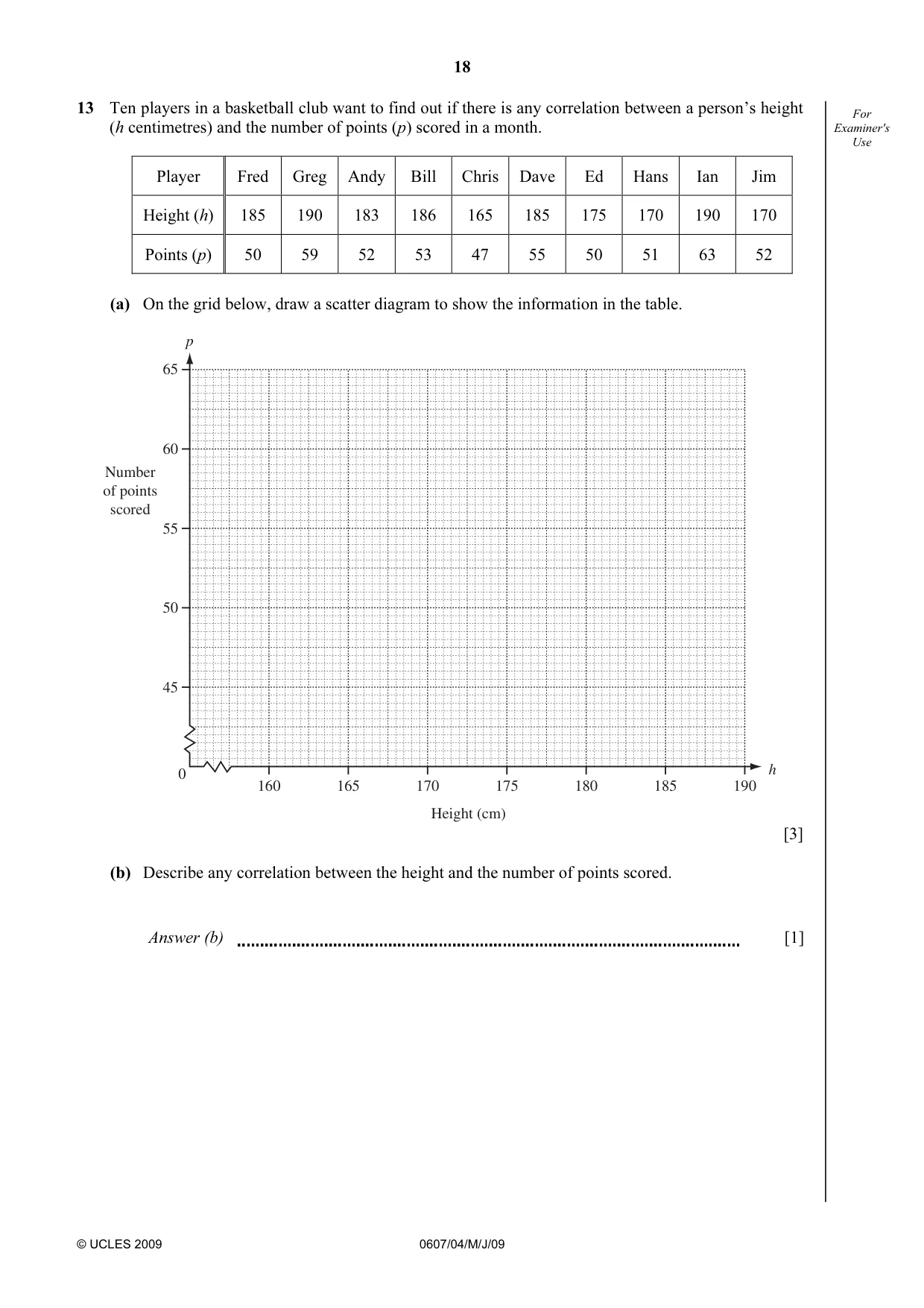
18 © UCLES 2009 0607/04/M/J/09 For Examiner's Use 13 Ten players in a basketball club want to find out if there is any correlation between a person’s height (h centimetres) and the number of points (p) scored in a month. Player Fred Greg Andy Bill Chris Dave Ed Hans Ian Jim Height (h) 185 190 183 186 165 185 175 170 190 170 Points (p) 50 59 52 53 47 55 50 51 63 52 (a) On the grid below, draw a scatter diagram to show the information in the table. p h Height (cm) Number of points scored 65 60 55 50 45 160 165 170 175 180 185 190 0 [3] (b) Describe any correlation between the height and the number of points scored. Answer (b) [1]
Question paper, page 19
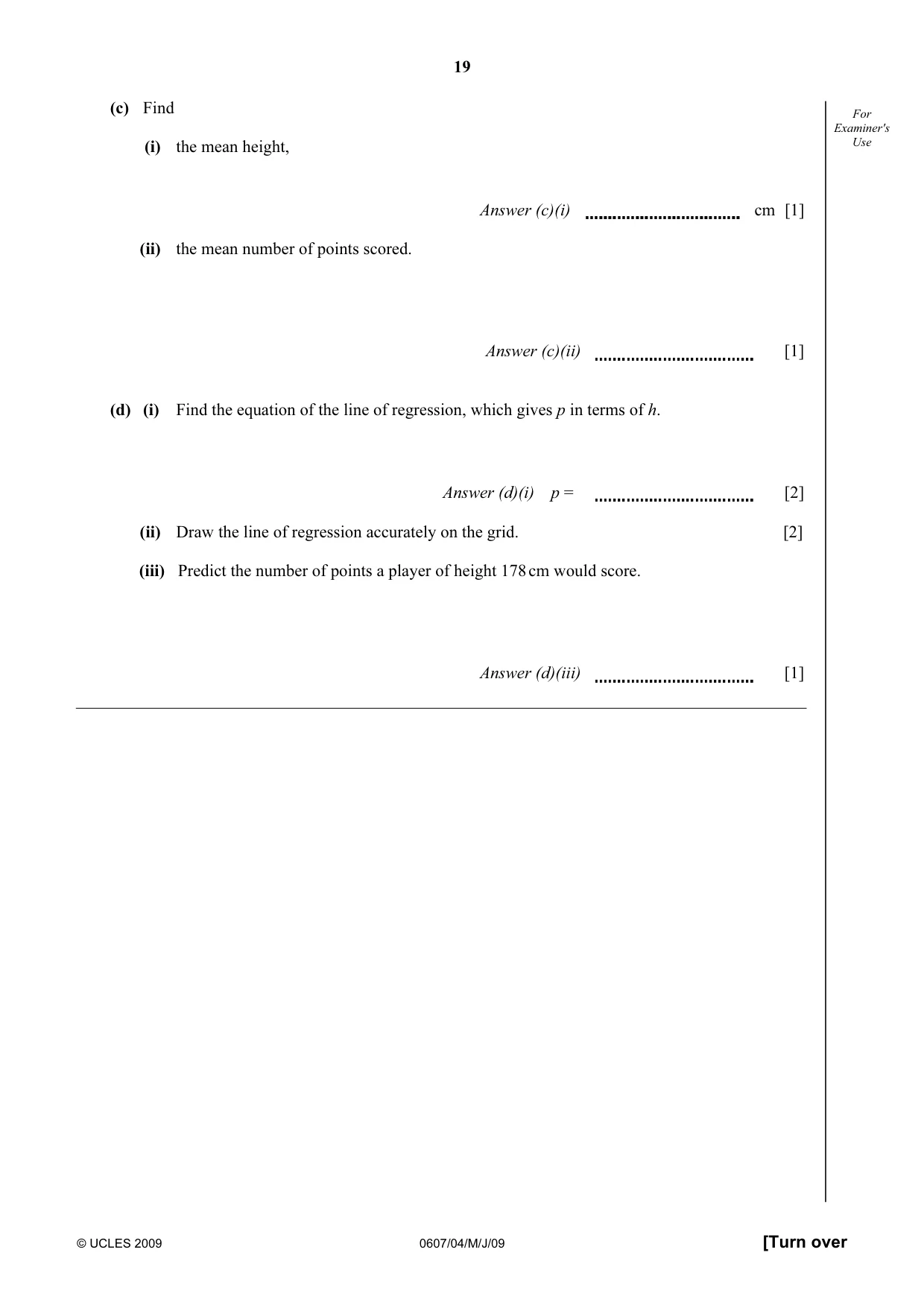
19 © UCLES 2009 0607/04/M/J/09 [Turn over For Examiner's Use (c) Find (i) the mean height, Answer (c)(i) cm [1] (ii) the mean number of points scored. Answer (c)(ii) [1] (d) (i) Find the equation of the line of regression, which gives p in terms of h. Answer (d)(i) p = [2] (ii) Draw the line of regression accurately on the grid. [2] (iii) Predict the number of points a player of height 178 cm would score. Answer (d)(iii) [1]
Question paper, page 20
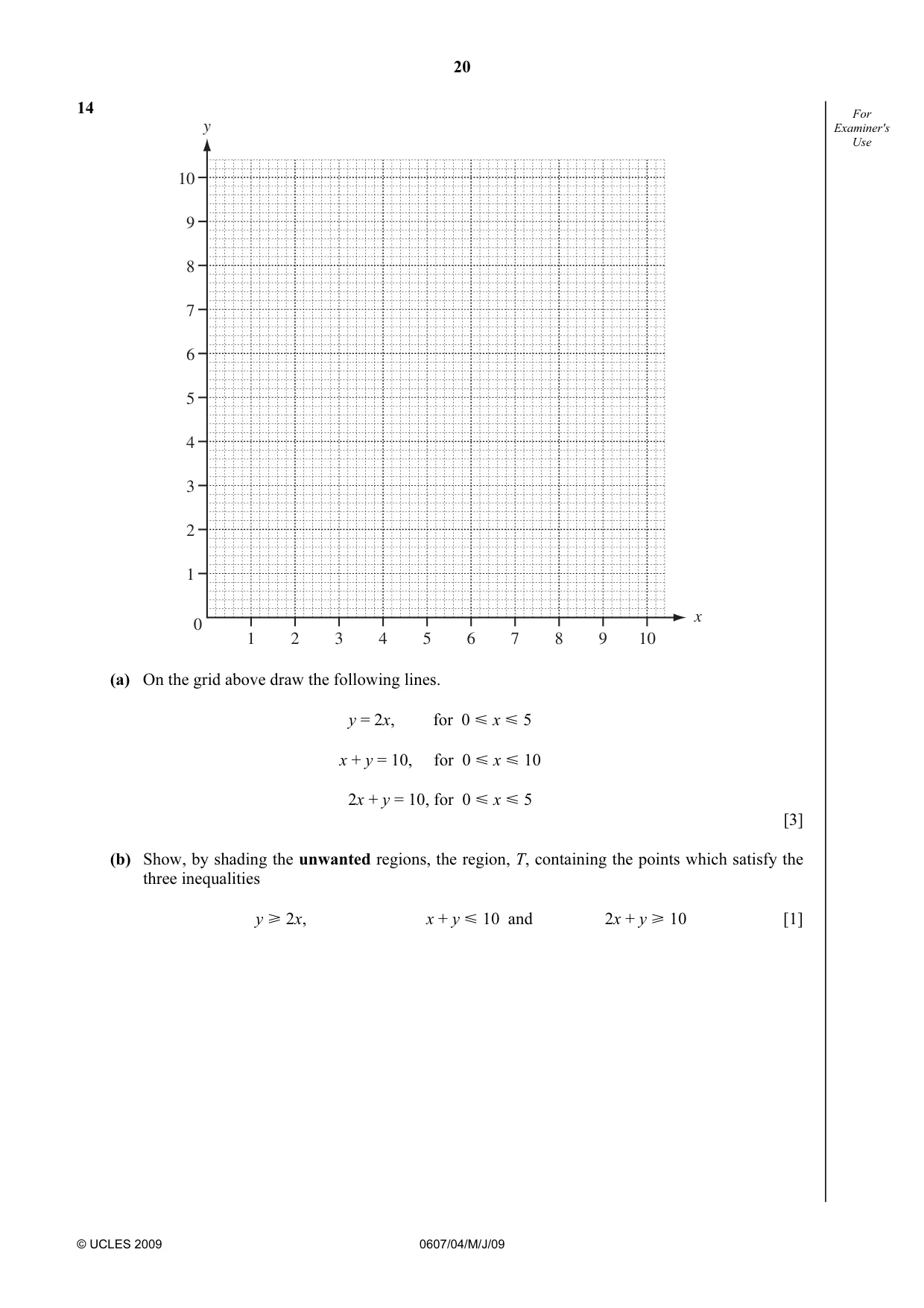
20 © UCLES 2009 0607/04/M/J/09 For Examiner's Use 14 y x 10 9 8 7 6 5 4 3 2 1 0 1 2 3 4 5 6 7 8 9 10 (a) On the grid above draw the following lines. y = 2x, for 0 Y x Y 5 x + y = 10, for 0 Y x Y 10 2x + y = 10, for 0 Y x Y 5 [3] (b) Show, by shading the unwanted regions, the region, T, containing the points which satisfy the three inequalities y [ 2x, x + y Y 10 and 2x + y [ 10 [1]
Question paper, page 21
21 © UCLES 2009 0607/04/M/J/09 [Turn over For Examiner's Use (c) Find the greatest value of x in the region, T, when (i) x ∈ o, Answer (c)(i) x = [1] (ii) x ∈ k. Answer (c)(ii) x = [1] (d) (x, y) lies in the region T. Find all pairs of integer values of x and y when 2x + y = 11 Answer (d) [2]
Question paper, page 22
22 © UCLES 2009 0607/04/M/J/09 For Examiner's Use 15 (a) (i) Red pencils cost 12 cents each. What is the greatest number of red pencils you can buy for 360 cents? Answer (a)(i) [1] (ii) Blue pencils cost x cents each. Write down, in terms of x, the greatest number of blue pencils you can buy for 360 cents. Answer (a)(ii) [1] (iii) Yellow pencils cost (x + 8) cents each. Write down, in terms of x, the greatest number of yellow pencils you can buy for 360 cents. Answer (a)(iii) [1] (b) The number of blue pencils in part (a)(ii) is 16 more than the number of yellow pencils in part (a)(iii). (i) Write down an equation in x and show that it simplifies to x2 + 8x − 180 = 0. [4]
Question paper, page 23
23 © UCLES 2009 0607/04/M/J/09 For Examiner's Use (ii) Factorise. x2 + 8x − 180 Answer (b)(ii) [2] (iii) Solve the equation. x2 + 8x − 180 = 0 Answer (b)(iii) x= or [1] (iv) Write down the cost of a blue pencil. Answer (b)(iv) cents [1]
Question paper, page 24
24 Permission to reproduce items where third-party owned material protected by copyright is included has been sought and cleared where possible. Every reasonable effort has been made by the publisher (UCLES) to trace copyright holders, but if any items requiring clearance have unwittingly been included, the publisher will be pleased to make amends at the earliest possible opportunity. University of Cambridge International Examinations is part of the Cambridge Assessment Group. Cambridge Assessment is the brand name of University of Cambridge Local Examinations Syndicate (UCLES), which is itself a department of the University of Cambridge. 0607/04/M/J/09 BLANK PAGE
Mark scheme, page 1
UNIVERSITY OF CAMBRIDGE INTERNATIONAL EXAMINATIONS International General Certificate of Secondary Education MARK SCHEME for the May/June 2009 question paper for the guidance of teachers 0607 CAMBRIDGE INTERNATIONAL MATHEMATICS 0607/04 Paper 4 (Extended), maximum raw mark 120 This mark scheme is published as an aid to teachers and candidates, to indicate the requirements of the examination. It shows the basis on which Examiners were instructed to award marks. It does not indicate the details of the discussions that took place at an Examiners’ meeting before marking began, which would have considered the acceptability of alternative answers. Mark schemes must be read in conjunction with the question papers and the report on the examination. • CIE will not enter into discussions or correspondence in connection with these mark schemes. CIE is publishing the mark schemes for the May/June 2009 question papers for most IGCSE, GCE Advanced Level and Advanced Subsidiary Level syllabuses and some Ordinary Level syllabuses. www.XtremePapers.com
Mark scheme, page 2
Page 2 Mark Scheme: Teachers’ version Syllabus Paper IGCSE – May/June 2009 0607 04 © UCLES 2009 M marks are given for a correct method. A marks are given for an accurate answer following a correct method. B marks are given for a correct statement or step. D marks are given for a clear and appropriately accurate drawing. P marks are given for accurate plotting of points. E marks are given for correctly explaining or establishing a given result. Abbreviations cao correct answer only cso correct solution only ft follow through oe or equivalent soi seen or implied ww without working www without wrong working
Mark scheme, page 3
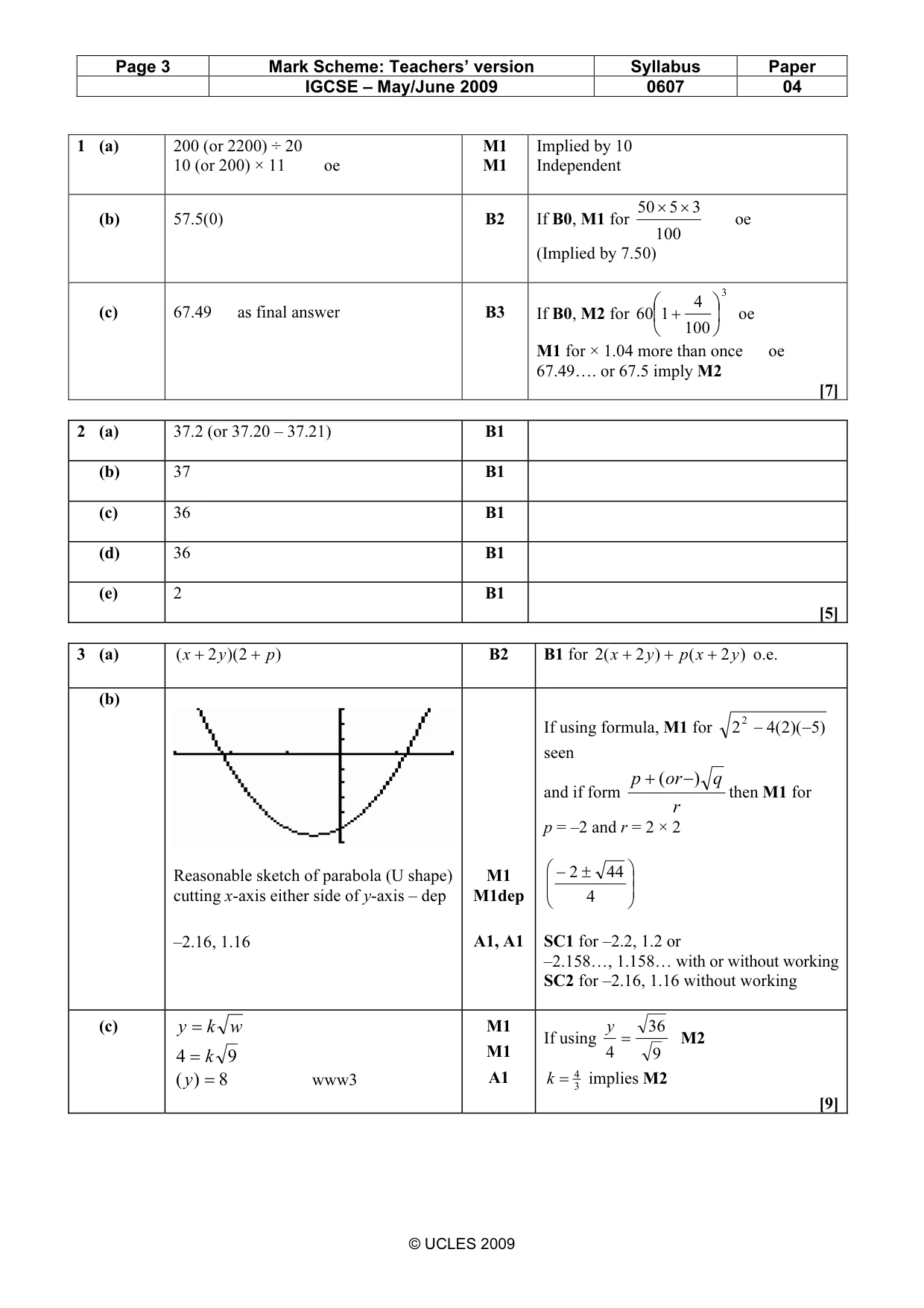
Page 3 Mark Scheme: Teachers’ version Syllabus Paper IGCSE – May/June 2009 0607 04 © UCLES 2009 1 (a) 200 (or 2200) ÷ 20 10 (or 200) × 11 oe M1 M1 Implied by 10 Independent (b) 57.5(0) B2 If B0, M1 for 100 3 5 50 × × oe (Implied by 7.50) (c) 67.49 as final answer B3 If B0, M2 for 3 100 4 1 60 + oe M1 for × 1.04 more than once oe 67.49…. or 67.5 imply M2 [7] 2 (a) 37.2 (or 37.20 – 37.21) B1 (b) 37 B1 (c) 36 B1 (d) 36 B1 (e) 2 B1 [5] 3 (a) ) 2 )( 2 ( p y x + + B2 B1 for ) 2 ( ) 2 ( 2 y x p y x + + + o.e. (b) Reasonable sketch of parabola (U shape) cutting x-axis either side of y-axis – dep –2.16, 1.16 M1 M1dep A1, A1 If using formula, M1 for ) 5 )( 2 ( 4 2 2 − − seen and if form r q or p ) ( − + then M1 for p = –2 and r = 2 × 2 ± − 4 44 2 SC1 for –2.2, 1.2 or –2.158…, 1.158… with or without working SC2 for –2.16, 1.16 without working (c) w k y = 9 4 k = 8 ) ( = y www3 M1 M1 A1 If using 9 36 4 = y M2 3 4 = k implies M2 [9]
Mark scheme, page 4
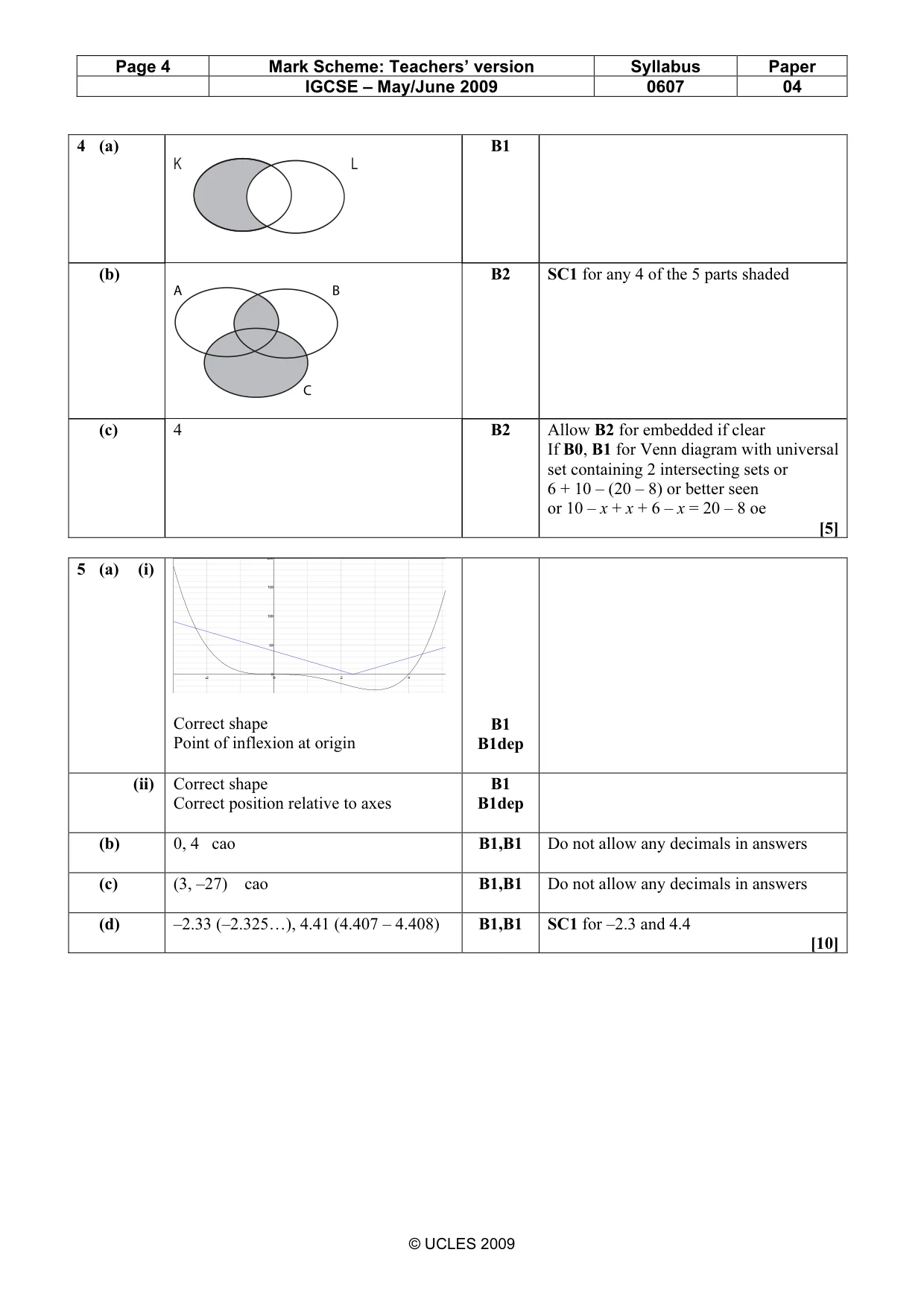
Page 4 Mark Scheme: Teachers’ version Syllabus Paper IGCSE – May/June 2009 0607 04 © UCLES 2009 4 (a) K L B1 (b) A B C B2 SC1 for any 4 of the 5 parts shaded (c) 4 B2 Allow B2 for embedded if clear If B0, B1 for Venn diagram with universal set containing 2 intersecting sets or 6 + 10 – (20 – 8) or better seen or 10 – x + x + 6 – x = 20 – 8 oe [5] 5 (a) (i) 4 2 0 -2 200 150 100 50 0 4 2 0 -2 200 150 100 50 0 4 2 0 -2 200 150 100 50 0 4 2 0 -2 200 150 100 50 0 Correct shape Point of inflexion at origin B1 B1dep (ii) Correct shape Correct position relative to axes B1 B1dep (b) 0, 4 cao B1,B1 Do not allow any decimals in answers (c) (3, –27) cao B1,B1 Do not allow any decimals in answers (d) –2.33 (–2.325…), 4.41 (4.407 – 4.408) B1,B1 SC1 for –2.3 and 4.4 [10]
Mark scheme, page 5
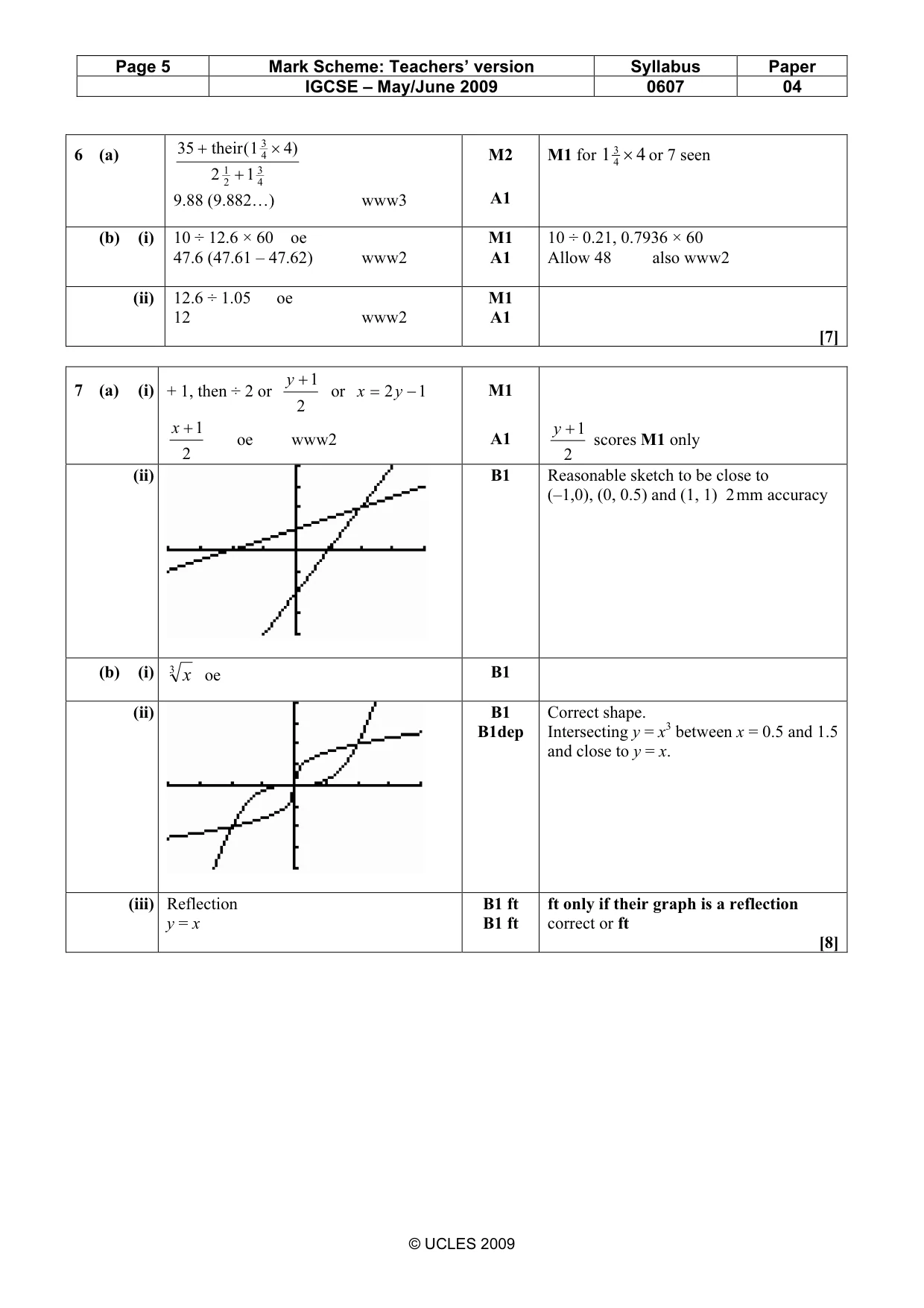
Page 5 Mark Scheme: Teachers’ version Syllabus Paper IGCSE – May/June 2009 0607 04 © UCLES 2009 6 (a) 4 3 2 1 4 3 1 2 ) 4 1 ( their 35 + × + 9.88 (9.882…) www3 M2 A1 M1 for 4 1 4 3 × or 7 seen (b) (i) 10 ÷ 12.6 × 60 oe 47.6 (47.61 – 47.62) www2 M1 A1 10 ÷ 0.21, 0.7936 × 60 Allow 48 also www2 (ii) 12.6 ÷ 1.05 oe 12 www2 M1 A1 [7] 7 (a) (i) + 1, then ÷ 2 or 2 1 + y or 1 2 − = y x 2 1 + x oe www2 M1 A1 2 1 + y scores M1 only (ii) B1 Reasonable sketch to be close to (–1,0), (0, 0.5) and (1, 1) 2 mm accuracy (b) (i) 3 x oe B1 (ii) B1 B1dep Correct shape. Intersecting y = x3 between x = 0.5 and 1.5 and close to y = x. (iii) Reflection y = x B1 ft B1 ft ft only if their graph is a reflection correct or ft [8]
Mark scheme, page 6
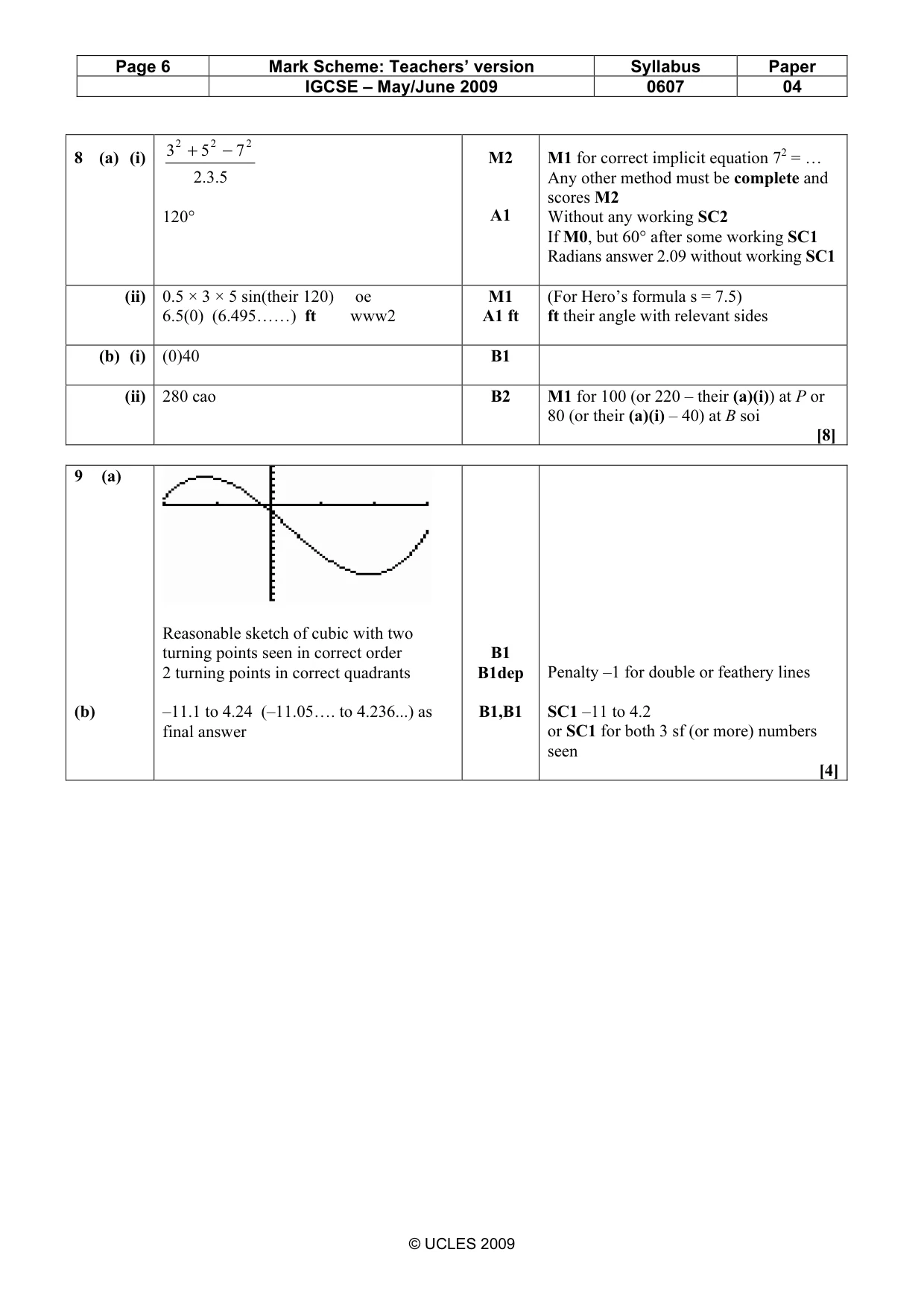
Page 6 Mark Scheme: Teachers’ version Syllabus Paper IGCSE – May/June 2009 0607 04 © UCLES 2009 8 (a) (i) 5.3.2 7 5 3 2 2 2 − + 120° M2 A1 M1 for correct implicit equation 72 = … Any other method must be complete and scores M2 Without any working SC2 If M0, but 60° after some working SC1 Radians answer 2.09 without working SC1 (ii) 0.5 × 3 × 5 sin(their 120) oe 6.5(0) (6.495……) ft www2 M1 A1 ft (For Hero’s formula s = 7.5) ft their angle with relevant sides (b) (i) (0)40 B1 (ii) 280 cao B2 M1 for 100 (or 220 – their (a)(i)) at P or 80 (or their (a)(i) – 40) at B soi [8] 9 (a) (b) Reasonable sketch of cubic with two turning points seen in correct order 2 turning points in correct quadrants –11.1 to 4.24 (–11.05…. to 4.236...) as final answer B1 B1dep B1,B1 Penalty –1 for double or feathery lines SC1 –11 to 4.2 or SC1 for both 3 sf (or more) numbers seen [4]
Mark scheme, page 7
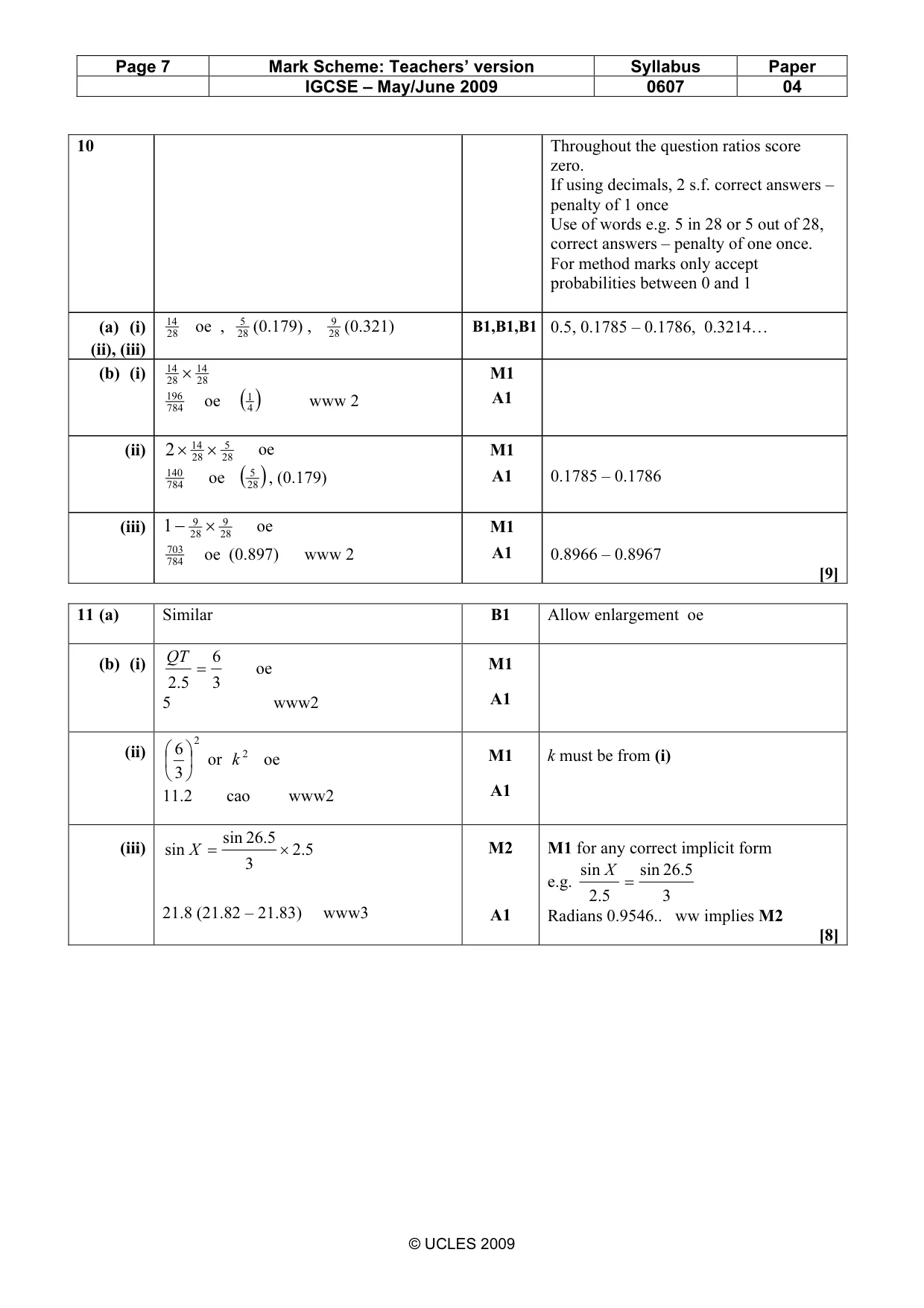
Page 7 Mark Scheme: Teachers’ version Syllabus Paper IGCSE – May/June 2009 0607 04 © UCLES 2009 10 Throughout the question ratios score zero. If using decimals, 2 s.f. correct answers – penalty of 1 once Use of words e.g. 5 in 28 or 5 out of 28, correct answers – penalty of one once. For method marks only accept probabilities between 0 and 1 (a) (i) (ii), (iii) 28 14 oe , 28 5 (0.179) , 28 9 (0.321) B1,B1,B1 0.5, 0.1785 – 0.1786, 0.3214… (b) (i) 28 14 28 14 × 784 196 oe ( ) 4 1 www 2 M1 A1 (ii) 28 5 28 14 2 × × oe 784 140 oe ( ) 28 5 , (0.179) M1 A1 0.1785 – 0.1786 (iii) 28 9 28 9 1 × − oe 784 703 oe (0.897) www 2 M1 A1 0.8966 – 0.8967 [9] 11 (a) Similar B1 Allow enlargement oe (b) (i) 3 6 5.2 = QT oe 5 www2 M1 A1 (ii) 2 2 or 3 6 k oe 11.2 cao www2 M1 A1 k must be from (i) (iii) 5.2 3 5. 26 sin sin × = X 21.8 (21.82 – 21.83) www3 M2 A1 M1 for any correct implicit form e.g. 3 5. 26 sin 5.2 sin = X Radians 0.9546.. ww implies M2 [8]
Mark scheme, page 8
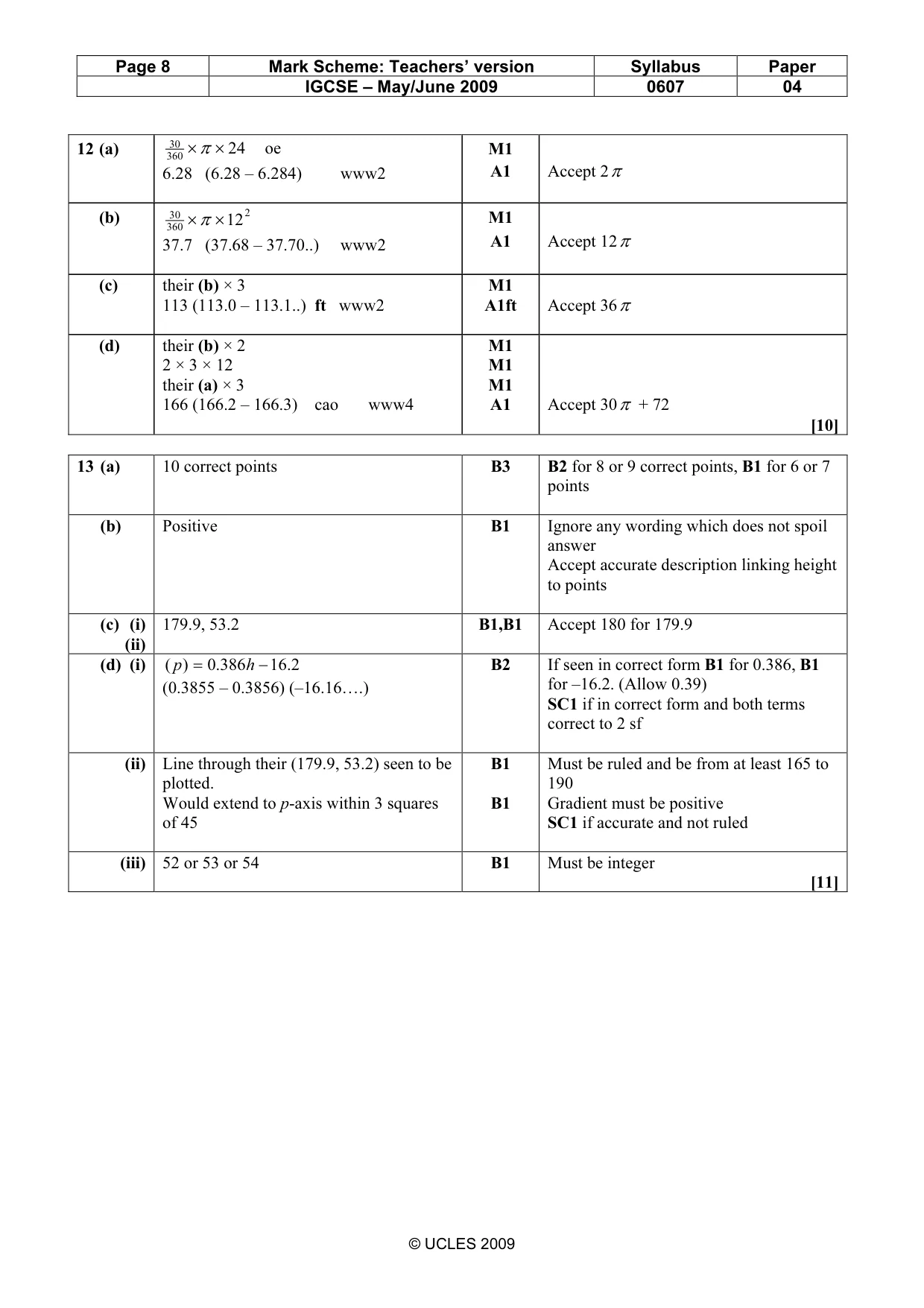
Page 8 Mark Scheme: Teachers’ version Syllabus Paper IGCSE – May/June 2009 0607 04 © UCLES 2009 12 (a) 24 360 30 × ×π oe 6.28 (6.28 – 6.284) www2 M1 A1 Accept 2π (b) 2 360 30 12 × ×π 37.7 (37.68 – 37.70..) www2 M1 A1 Accept 12π (c) their (b) × 3 113 (113.0 – 113.1..) ft www2 M1 A1ft Accept 36π (d) their (b) × 2 2 × 3 × 12 their (a) × 3 166 (166.2 – 166.3) cao www4 M1 M1 M1 A1 Accept 30π + 72 [10] 13 (a) 10 correct points B3 B2 for 8 or 9 correct points, B1 for 6 or 7 points (b) Positive B1 Ignore any wording which does not spoil answer Accept accurate description linking height to points (c) (i) (ii) 179.9, 53.2 B1,B1 Accept 180 for 179.9 (d) (i) 2. 16 386 .0 ) ( − = h p (0.3855 – 0.3856) (–16.16….) B2 If seen in correct form B1 for 0.386, B1 for –16.2. (Allow 0.39) SC1 if in correct form and both terms correct to 2 sf (ii) Line through their (179.9, 53.2) seen to be plotted. Would extend to p-axis within 3 squares of 45 B1 B1 Must be ruled and be from at least 165 to 190 Gradient must be positive SC1 if accurate and not ruled (iii) 52 or 53 or 54 B1 Must be integer [11]
Mark scheme, page 9
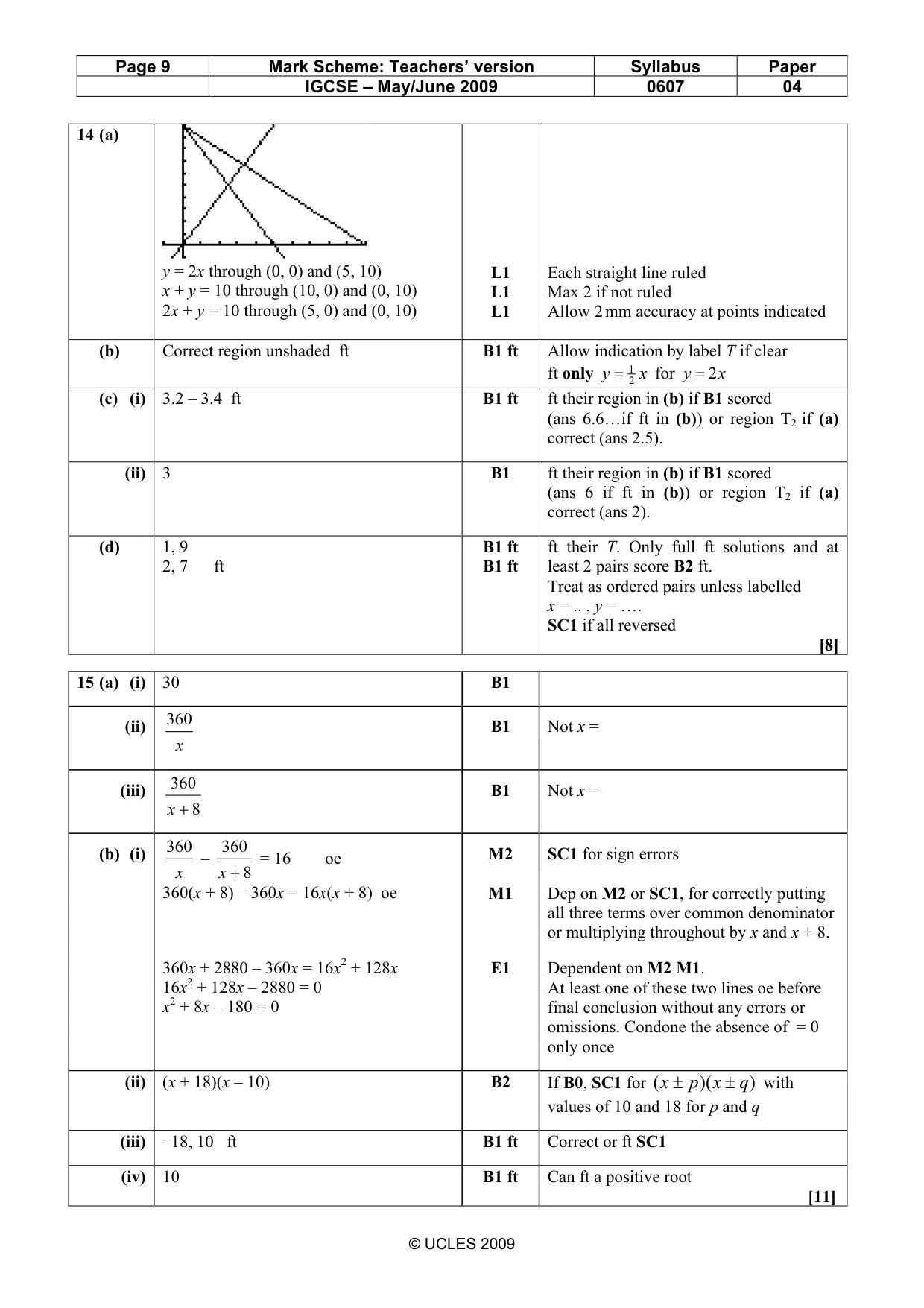
Page 9 Mark Scheme: Teachers’ version Syllabus Paper IGCSE – May/June 2009 0607 04 © UCLES 2009 14 (a) y = 2x through (0, 0) and (5, 10) x + y = 10 through (10, 0) and (0, 10) 2x + y = 10 through (5, 0) and (0, 10) L1 L1 L1 Each straight line ruled Max 2 if not ruled Allow 2 mm accuracy at points indicated (b) Correct region unshaded ft B1 ft Allow indication by label T if clear ft only x y 2 1 = for x y 2 = (c) (i) 3.2 – 3.4 ft B1 ft ft their region in (b) if B1 scored (ans 6.6…if ft in (b)) or region T2 if (a) correct (ans 2.5). (ii) 3 B1 ft their region in (b) if B1 scored (ans 6 if ft in (b)) or region T2 if (a) correct (ans 2). (d) 1, 9 2, 7 ft B1 ft B1 ft ft their T. Only full ft solutions and at least 2 pairs score B2 ft. Treat as ordered pairs unless labelled x = .. , y = …. SC1 if all reversed [8] 15 (a) (i) 30 B1 (ii) x 360 B1 Not x = (iii) 8 360 + x B1 Not x = (b) (i) x 360 – 8 360 + x = 16 oe 360(x + 8) – 360x = 16x(x + 8) oe 360x + 2880 – 360x = 16x2 + 128x 16x2 + 128x – 2880 = 0 x2 + 8x – 180 = 0 M2 M1 E1 SC1 for sign errors Dep on M2 or SC1, for correctly putting all three terms over common denominator or multiplying throughout by x and x + 8. Dependent on M2 M1. At least one of these two lines oe before final conclusion without any errors or omissions. Condone the absence of = 0 only once (ii) (x + 18)(x – 10) B2 If B0, SC1 for ) )( ( q x p x ± ± with values of 10 and 18 for p and q (iii) –18, 10 ft B1 ft Correct or ft SC1 (iv) 10 B1 ft Can ft a positive root [11]
What you needed in this session
Cambridge’s own grade thresholds for 2009 May/June, Paper 4 · Variant 1. A higher threshold means an easier paper — the bar moves with how the cohort did.