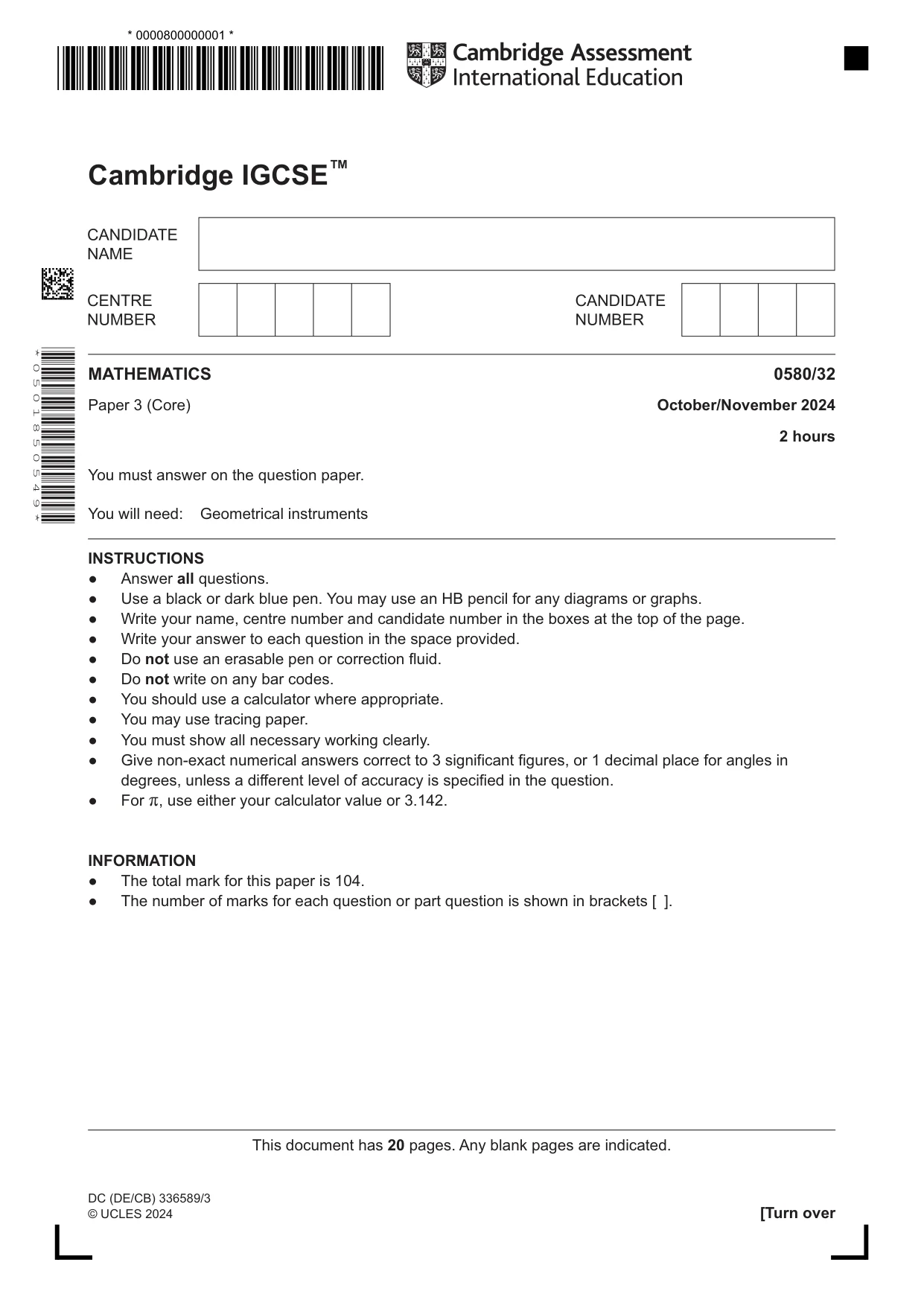
Cambridge IGCSE Mathematics 0580 — 2024 Oct/Nov Paper 3 · Variant 2
0580/32/O/N/24 · 9 questions · 104 marks · ≈117 min
The question paper and its mark scheme, free to read here and free to download. This is Cambridge’s own paper, exactly as it was sat.
Question paper20 pages
Mark scheme8 pages
Answers below. Sit the paper first if you are practising.
Questions as text
Q1 · Onions cost $1.85 per kilogram and potatoes cost $2.34 per kilogram
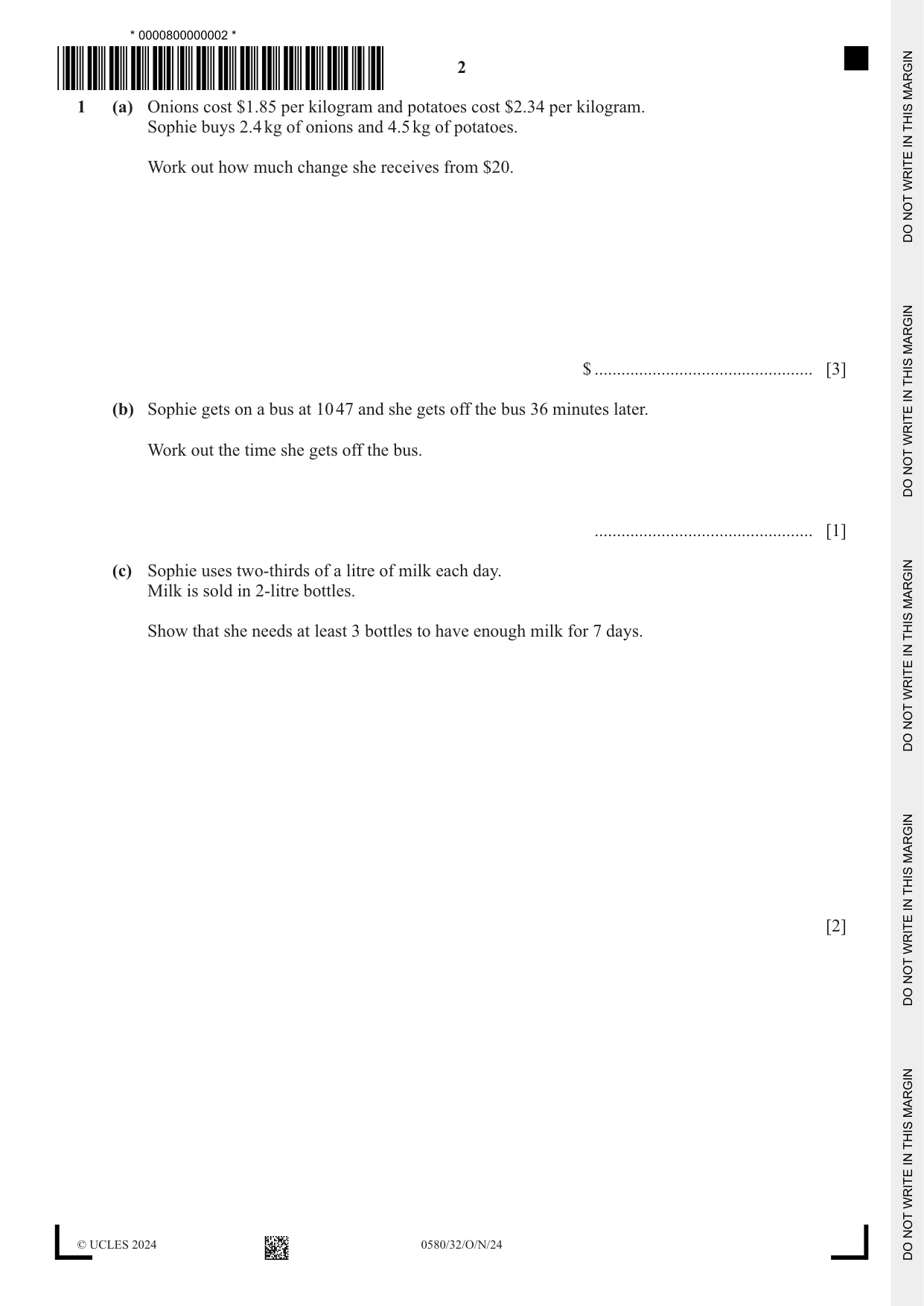
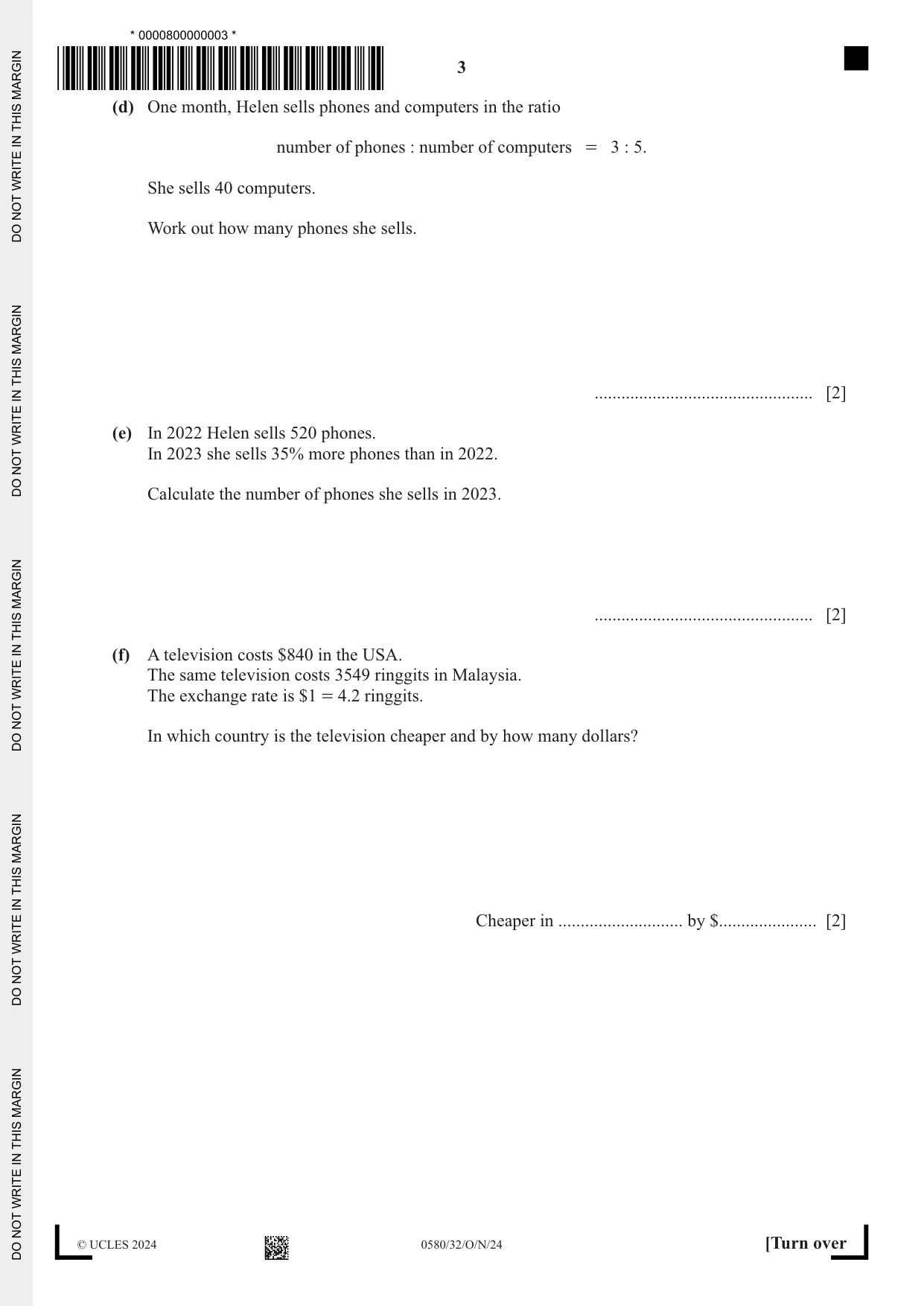
1 (a) Onions cost $1.85 per kilogram and potatoes cost $2.34 per kilogram. Sophie buys 2.4 kg of onions and 4.5 kg of potatoes. Work out how much change she receives from $20. $ ................................................. [3] (b) Sophie gets on a bus at 10 47 and she gets off the bus 36 minutes later. Work out the time she gets off the bus. ................................................. [1] (c) Sophie uses two-thirds of a litre of milk each day. Milk is sold in 2-litre bottles. Show that she needs at least 3 bottles to have enough milk for 7 days. [2] (d) One month, Helen sells phones and computers in the ratio number of phones : number of computers = 3 : 5. She sells 40 computers. Work out how many phones she sells. ................................................. [2] (e) In 2022 Helen sells 520 phones. In 2023 she sells 35% more phones than in 2022. Calculate the number of phones she sells in 2023. ................................................. [2] (f) A television costs $840 in the USA. The same television costs 3549 ringgits in Malaysia. The exchange rate is $1 = 4.2 ringgits. In which country is the television cheaper and by how many dollars? Cheaper in ............................ by $...................... [2]
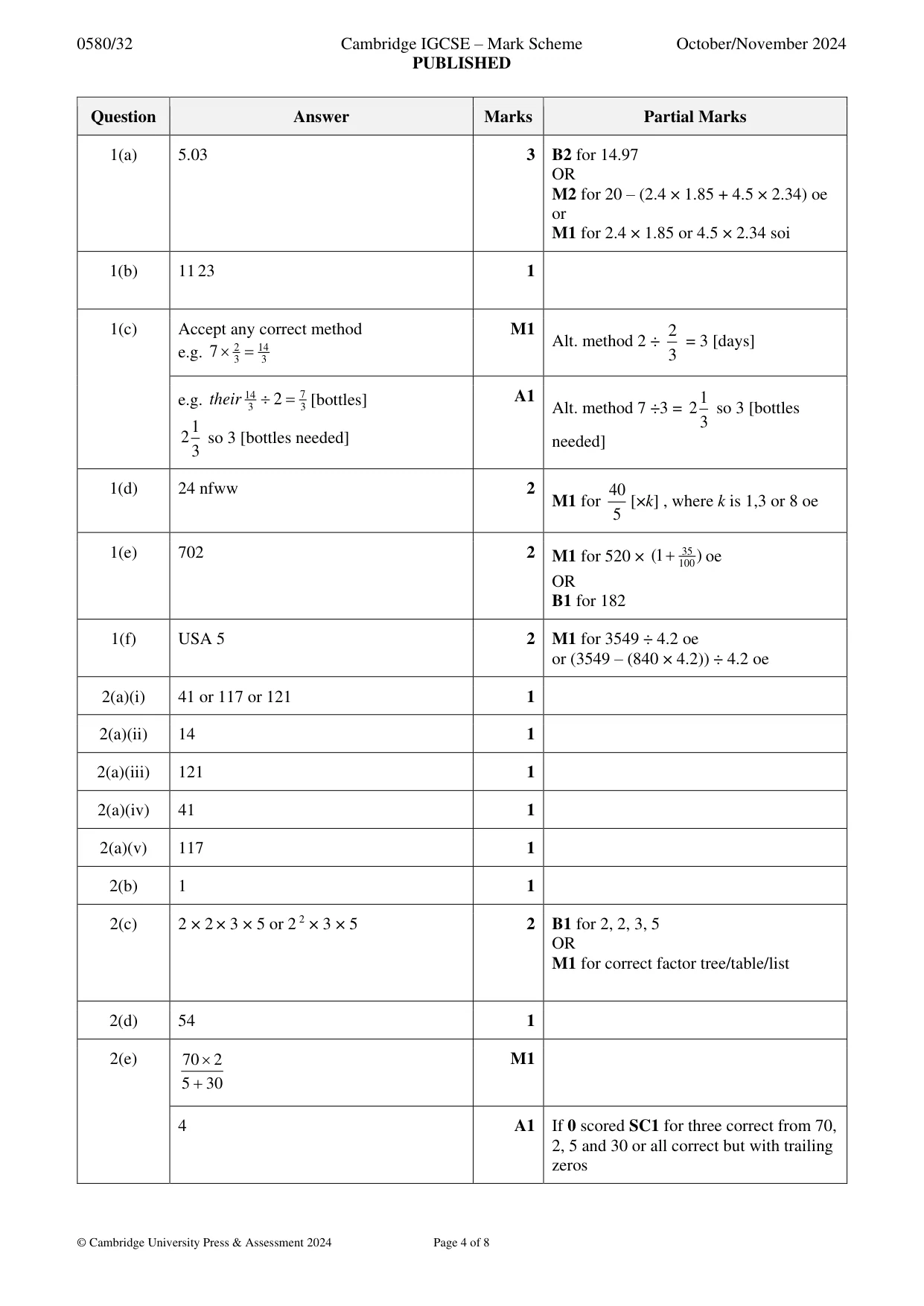
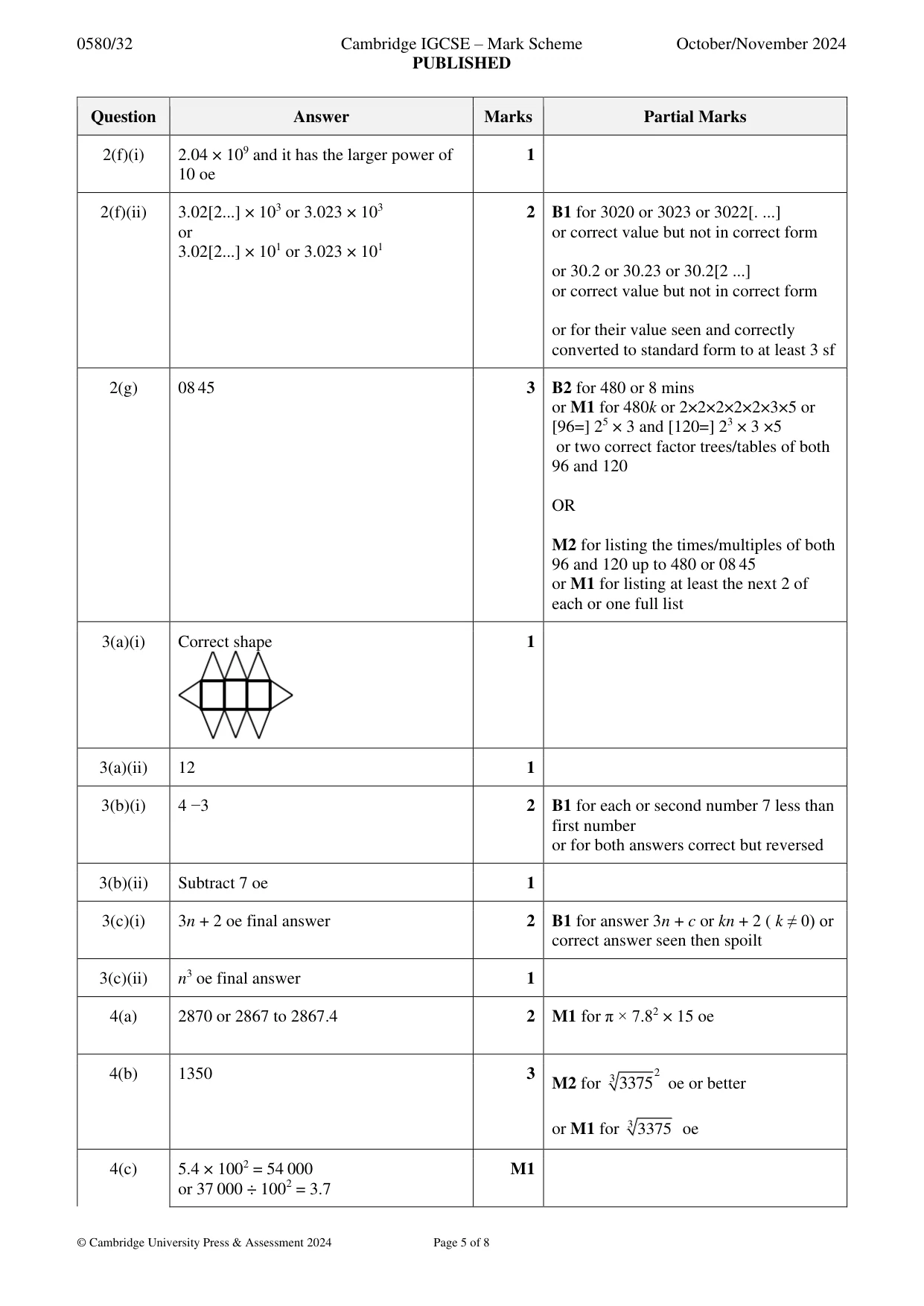
Mark scheme: Question Answer Marks Partial Marks 1(a) 5.03 3 B2 for 14.97 OR M2 for 20 – (2.4 × 1.85 + 4.5 × 2.34) oe or M1 for 2.4 × 1.85 or 4.5 × 2.34 soi 1(b) 11 23 1 1(c) Accept any correct method M1 2 2 14 Alt. method 2 ÷ = 3 [days] e.g. 7 3 = 3 3 e.g. their 143 2 = 73 [bottles] A1 1 Alt. method 7 ÷3 = 2 so 3 [bottles 1 3 2 so 3 [bottles needed] needed] 3 1(d) 24 nfww 2 40 M1 for [×k] , where k is 1,3 or 8 oe 5 1(e) 702 2 M1 for 520 × (1 + 10035 ) oe OR B1 for 182 1(f) USA 5 2 M1 for 3549 ÷ 4.2 oe or (3549 – (840 × 4.2)) ÷ 4.2 oe
Q2 · 3.142 87 14 41 56 117 121 From this list, write down (i) an odd number…
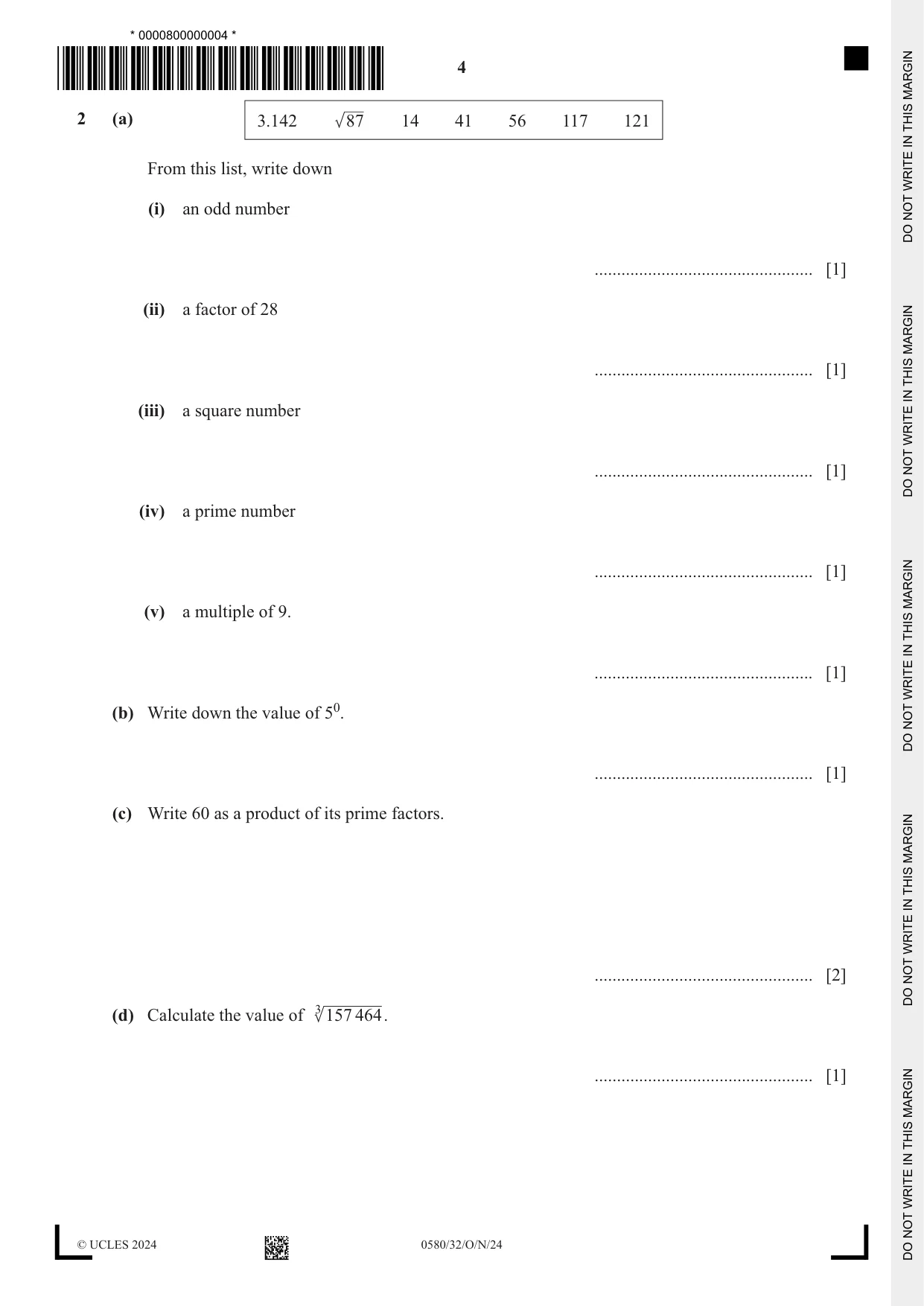
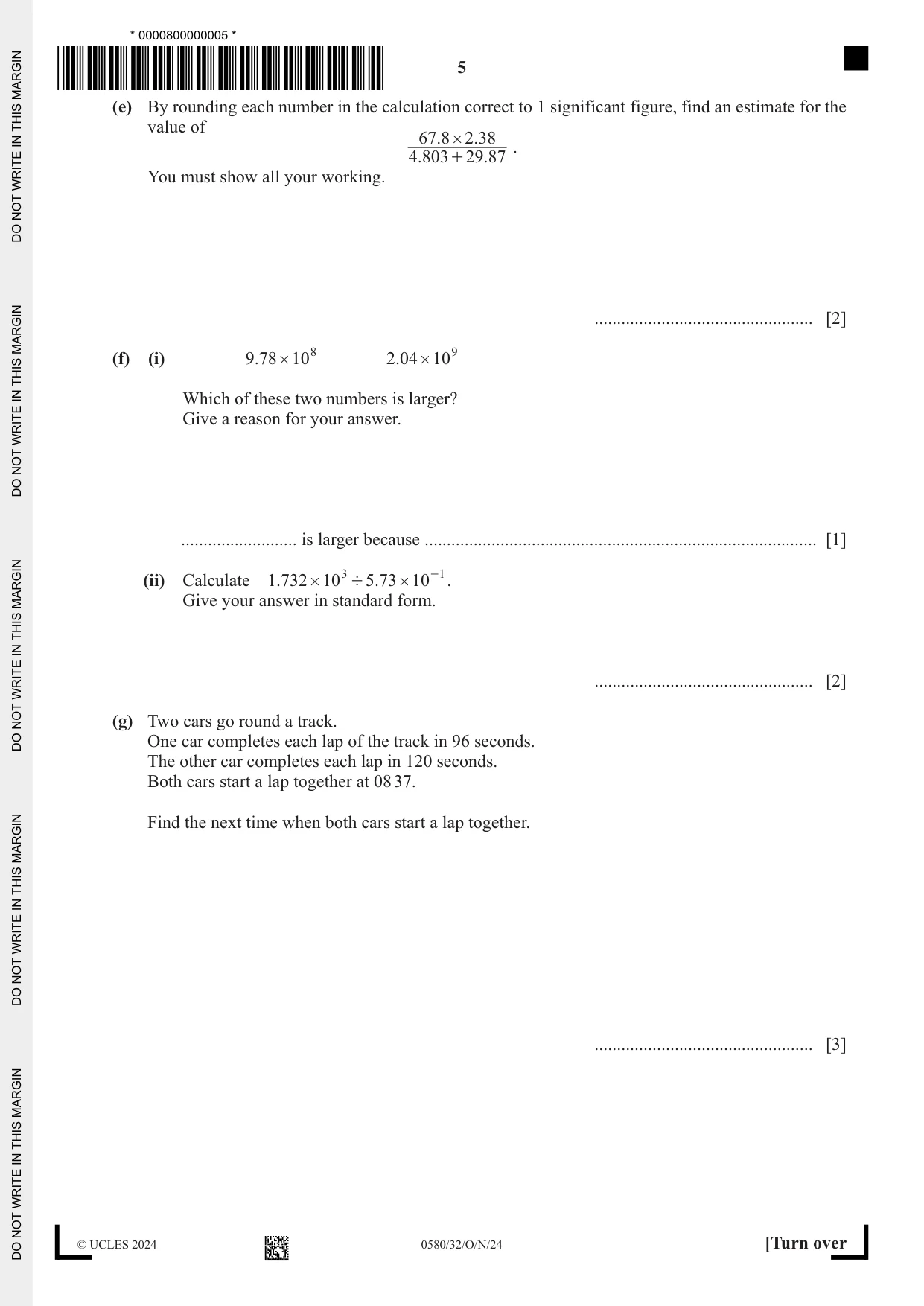
2 (a) 3.142 87 14 41 56 117 121 From this list, write down (i) an odd number ................................................. [1] (ii) a factor of 28 ................................................. [1] (iii) a square number ................................................. [1] (iv) a prime number ................................................. [1] (v) a multiple of 9. ................................................. [1] (b) Write down the value of 50. ................................................. [1] (c) Write 60 as a product of its prime factors. ................................................. [2] (d) Calculate the value of 3 157 464 . ................................................. [1] (e) By rounding each number in the calculation correct to 1 significant figure, find an estimate for the value of 67.8 # 2.38 . 4.803 + 29.87 You must show all your working. ................................................. [2] (f) (i) .978 # 108 2 .04 # 10 9 Which of these two numbers is larger? Give a reason for your answer. .......................... is larger because ........................................................................................ [1] (ii) Calculate 1.732 # 10 3 ' 5 .73 # 10 -1 . Give your answer in standard form. ................................................. [2] (g) Two cars go round a track. One car completes each lap of the track in 96 seconds. The other car completes each lap in 120 seconds. Both cars start a lap together at 08 37. Find the next time when both cars start a lap together. ................................................. [3]
Mark scheme: 2(a)(i) 41 or 117 or 121 1 2(a)(ii) 14 1 2(a)(iii) 121 1 2(a)(iv) 41 1 2(a)(v) 117 1 2(b) 1 1 2(c) 2 × 2 × 3 × 5 or 2 2 × 3 × 5 2 B1 for 2, 2, 3, 5 OR M1 for correct factor tree/table/list 2(d) 54 1 2(e) 70 2 M1 5 + 30 4 A1 If 0 scored SC1 for three correct from 70, 2, 5 and 30 or all correct but with trailing zeros 2(f)(i) 2.04 × 10⁹ and it has the larger power of 1 10 oe 2(f)(ii) 3.02[2...] × 103 or 3.023 × 10³ 2 B1 for 3020 or 3023 or 3022[. ...] or or correct value but not in correct form 3.02[2...] × 101 or 3.023 × 101 or 30.2 or 30.23 or 30.2[2 ...] or correct value but not in correct form or for their value seen and correctly converted to standard form to at least 3 sf 2(g) 08 45 3 B2 for 480 or 8 mins or M1 for 480k or 2×2×2×2×2×3×5 or [96=] 25 × 3 and [120=] 23 × 3 ×5 or two correct factor trees/tables of both 96 and 120 OR M2 for listing the times/multiples of both 96 and 120 up to 480 or 08 45 or M1 for listing at least the next 2 of each or one full list
Q3 · A sequence of shapes is made with squares and triangles
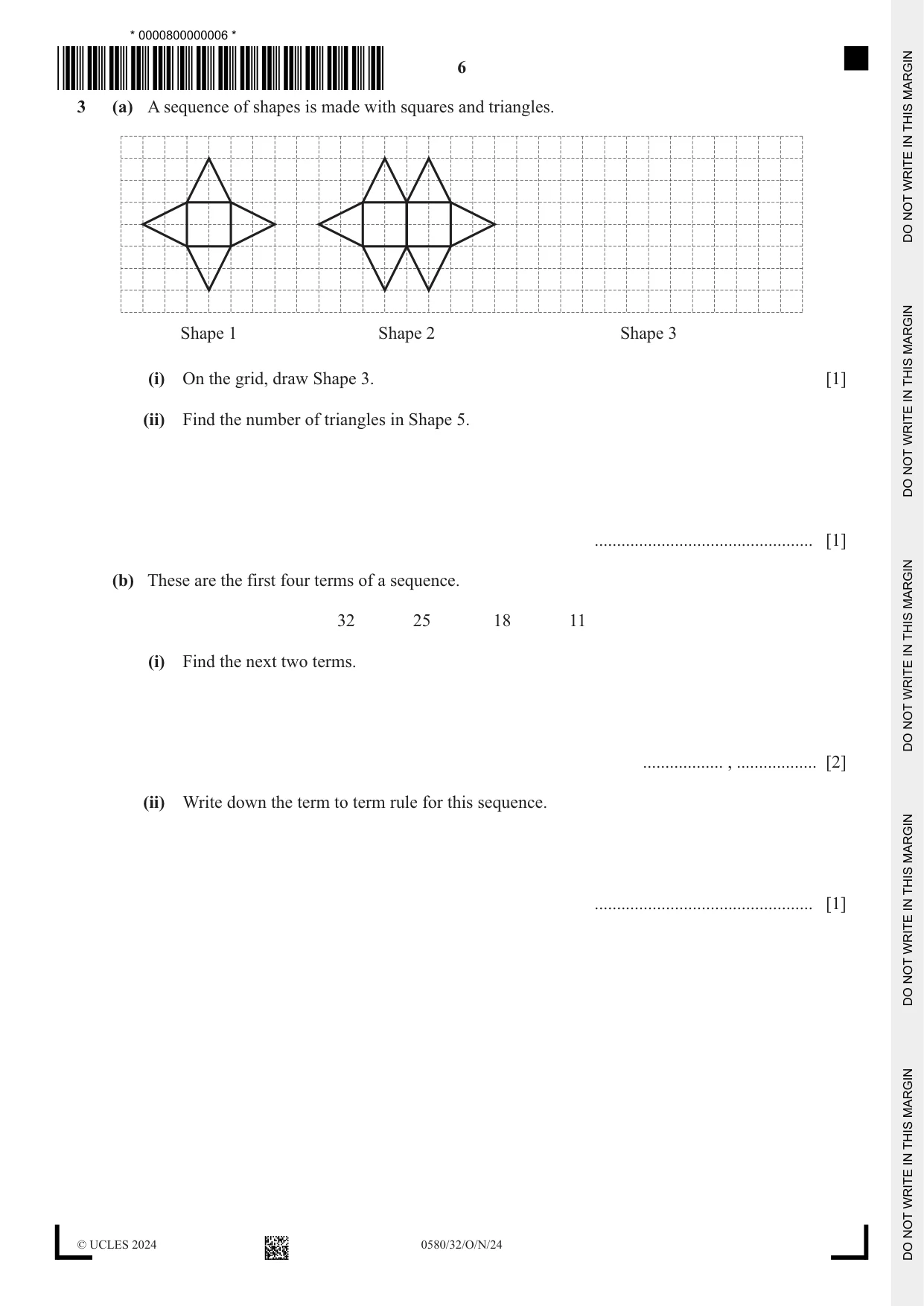
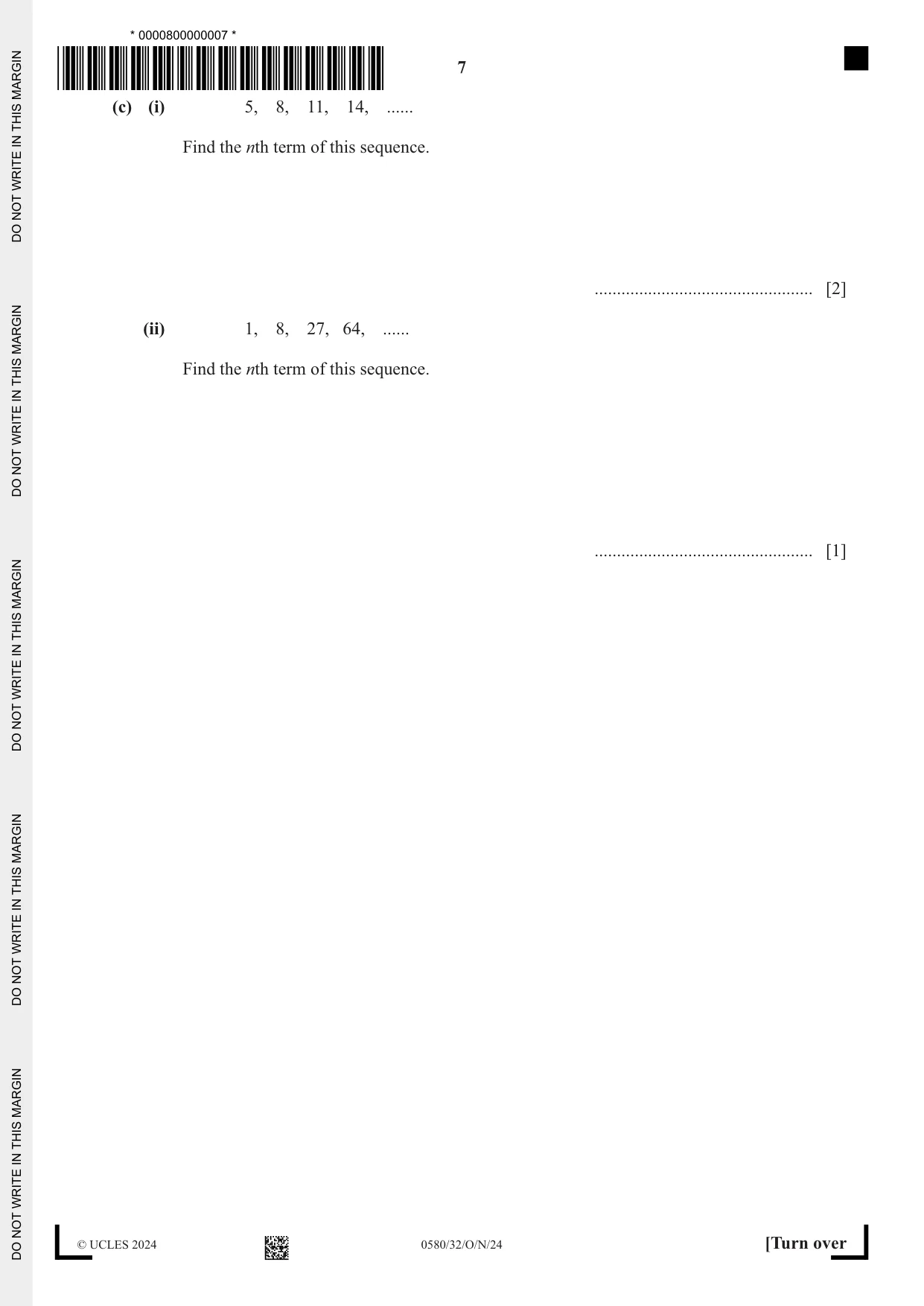
3 (a) A sequence of shapes is made with squares and triangles. Shape 1 Shape 2 Shape 3 (i) On the grid, draw Shape 3. [1] (ii) Find the number of triangles in Shape 5. ................................................. [1] (b) These are the first four terms of a sequence. 32 25 18 11 (i) Find the next two terms. .................. , .................. [2] (ii) Write down the term to term rule for this sequence. ................................................. [1] (c) (i) 5, 8, 11, 14, ...... Find the nth term of this sequence. ................................................. [2] (ii) 1, 8, 27, 64, ...... Find the nth term of this sequence. ................................................. [1]
Mark scheme: 3(a)(i) Correct shape 1 3(a)(ii) 12 1 3(b)(i) 4 −3 2 B1 for each or second number 7 less than first number or for both answers correct but reversed 3(b)(ii) Subtract 7 oe 1 3(c)(i) 3n + 2 oe final answer 2 B1 for answer 3n + c or kn + 2 ( k ≠ 0) or correct answer seen then spoilt 3(c)(ii) n3 oe final answer 1
Q4 · Calculate the volume of a cylinder with radius 7.8 cm and height 15 cm
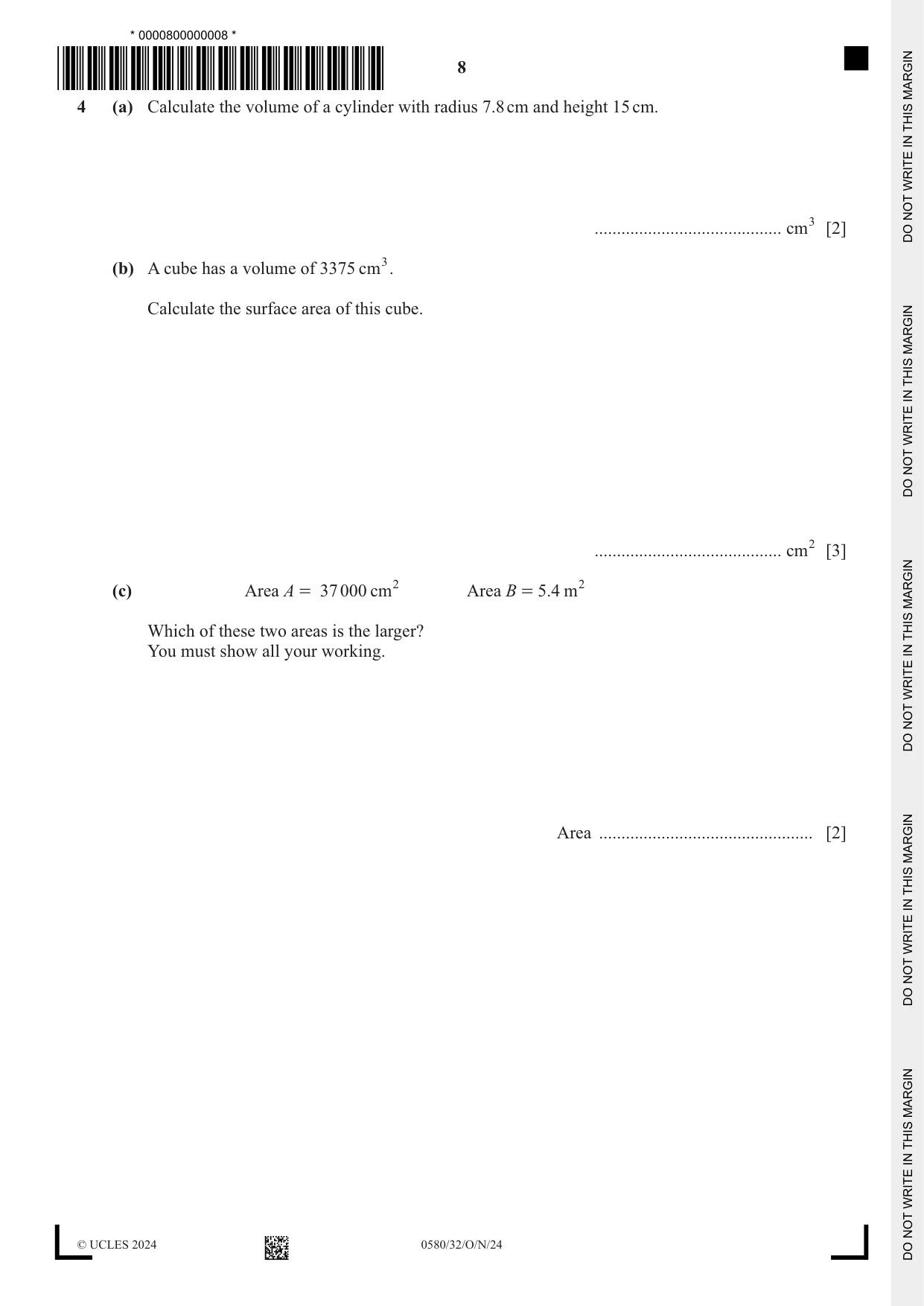
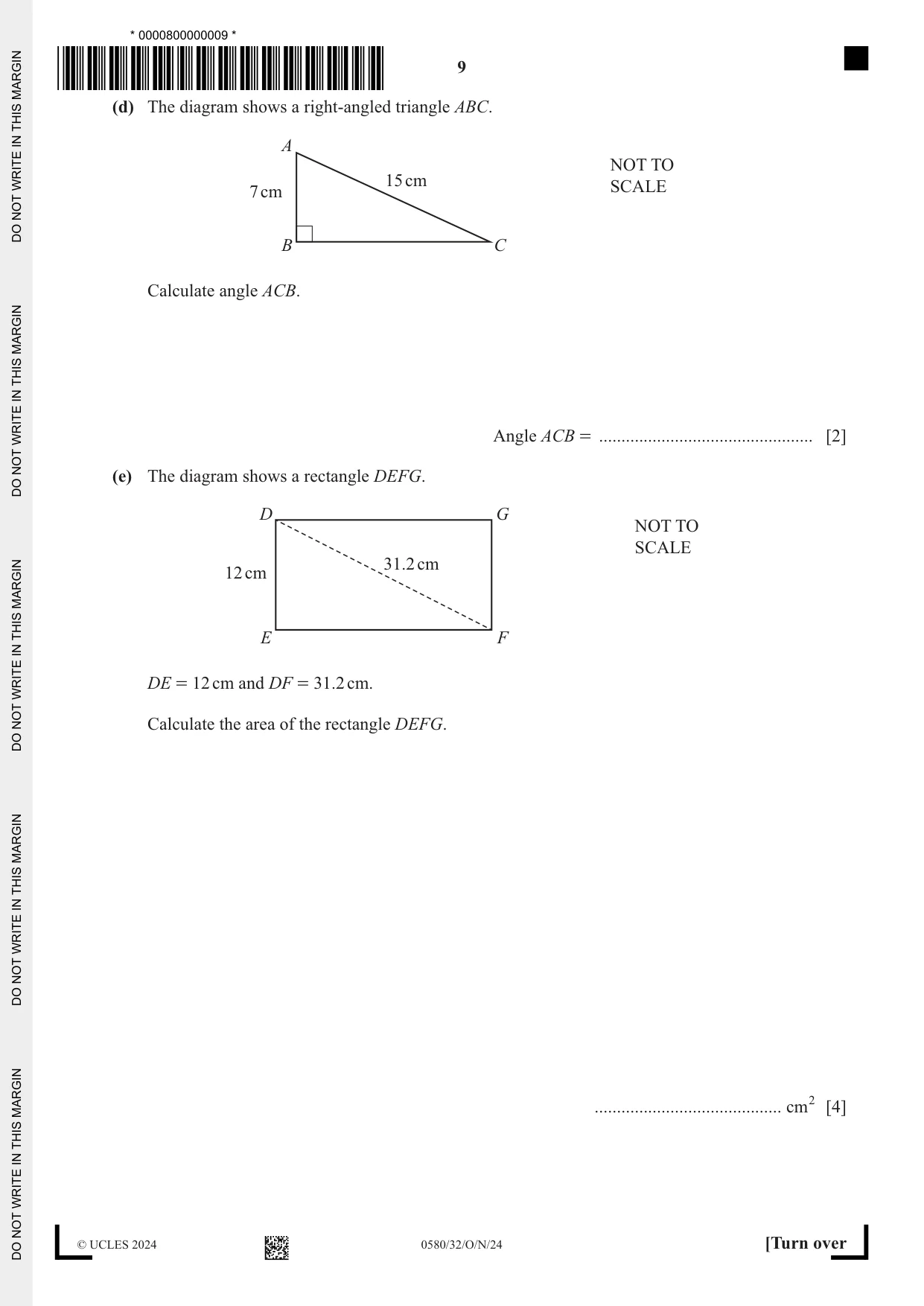
4 (a) Calculate the volume of a cylinder with radius 7.8 cm and height 15 cm. .......................................... cm3 [2] (b) A cube has a volume of 3375 cm3. Calculate the surface area of this cube. .......................................... cm2 [3] (c) Area A = 37 000 cm2 Area B = 5.4 m2 Which of these two areas is the larger? You must show all your working. Area ................................................ [2] (d) The diagram shows a right-angled triangle ABC. A NOT TO 15 cm SCALE 7 cm B C Calculate angle ACB. Angle ACB = ................................................ [2] (e) The diagram shows a rectangle DEFG. D G NOT TO SCALE 31.2 cm 12 cm E F DE = 12 cm and DF = 31.2 cm. Calculate the area of the rectangle DEFG. .......................................... cm2 [4]
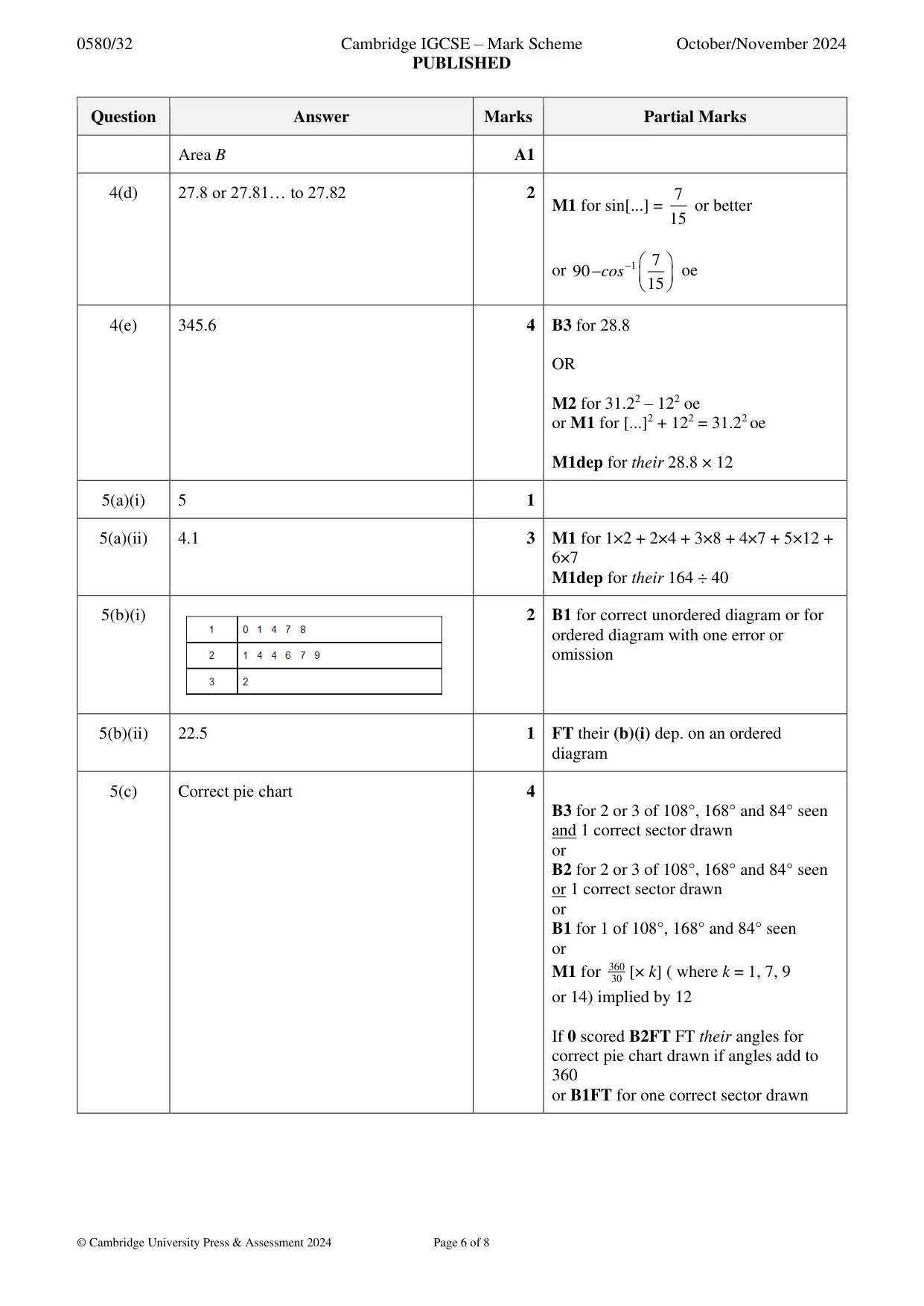
Mark scheme: 4(a) 2870 or 2867 to 2867.4 2 M1 for π × 7.82 × 15 oe 4(b) 1350 3 3 2 M2 for 3375 oe or better or M1 for 3 3375 oe 4(c) 5.4 × 1002 = 54 000 M1 or 37 000 ÷ 1002 = 3.7 Area B A1 4(d) 27.8 or 27.81… to 27.82 2 7 M1 for sin[...] = or better 15 −1 7 or 90 − cos oe 15 4(e) 345.6 4 B3 for 28.8 OR M2 for 31.22 – 122 oe or M1 for [...]2 + 122 = 31.22 oe M1dep for their 28.8 × 12
Q5 · Students solve a puzzle by making guesses
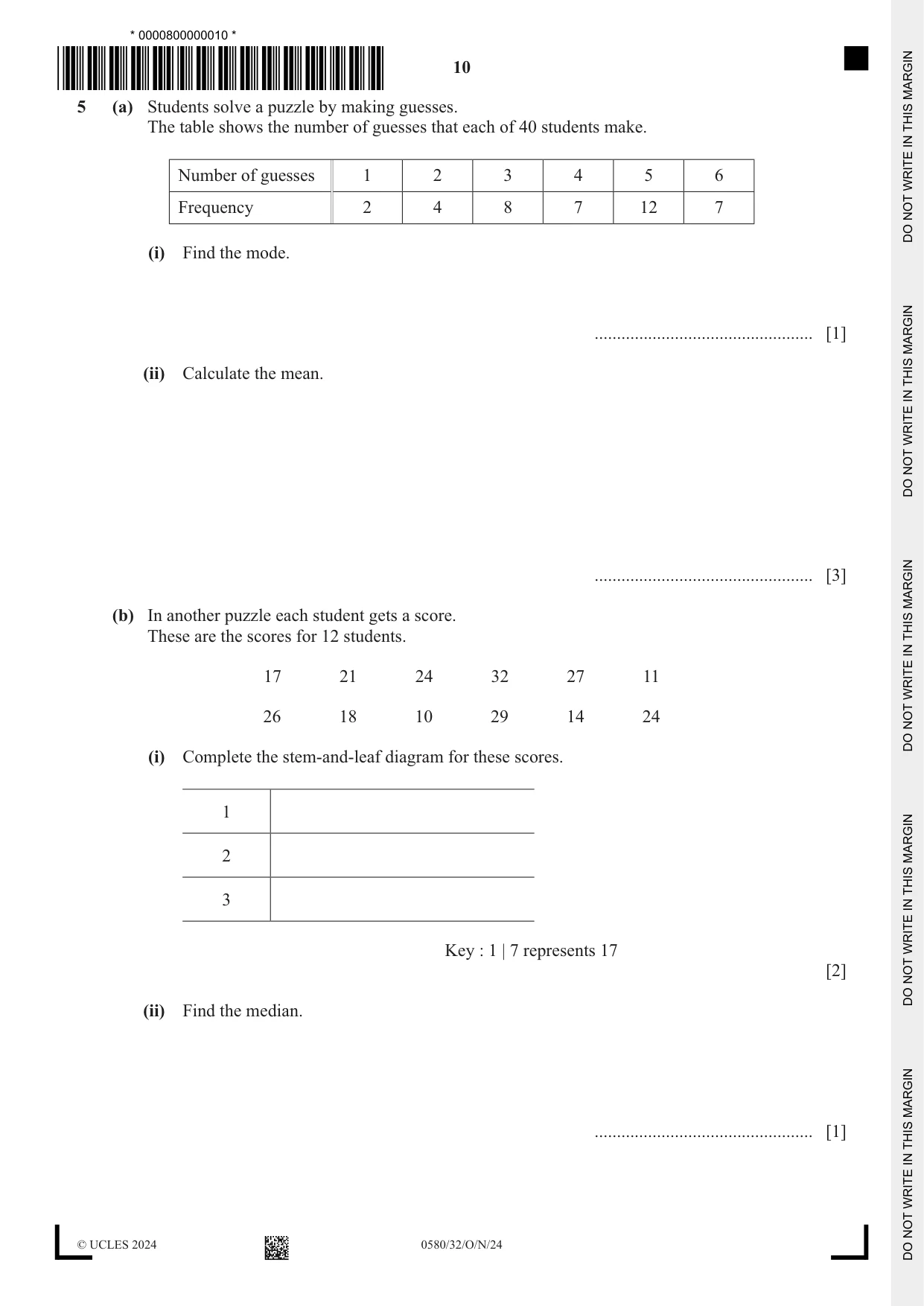
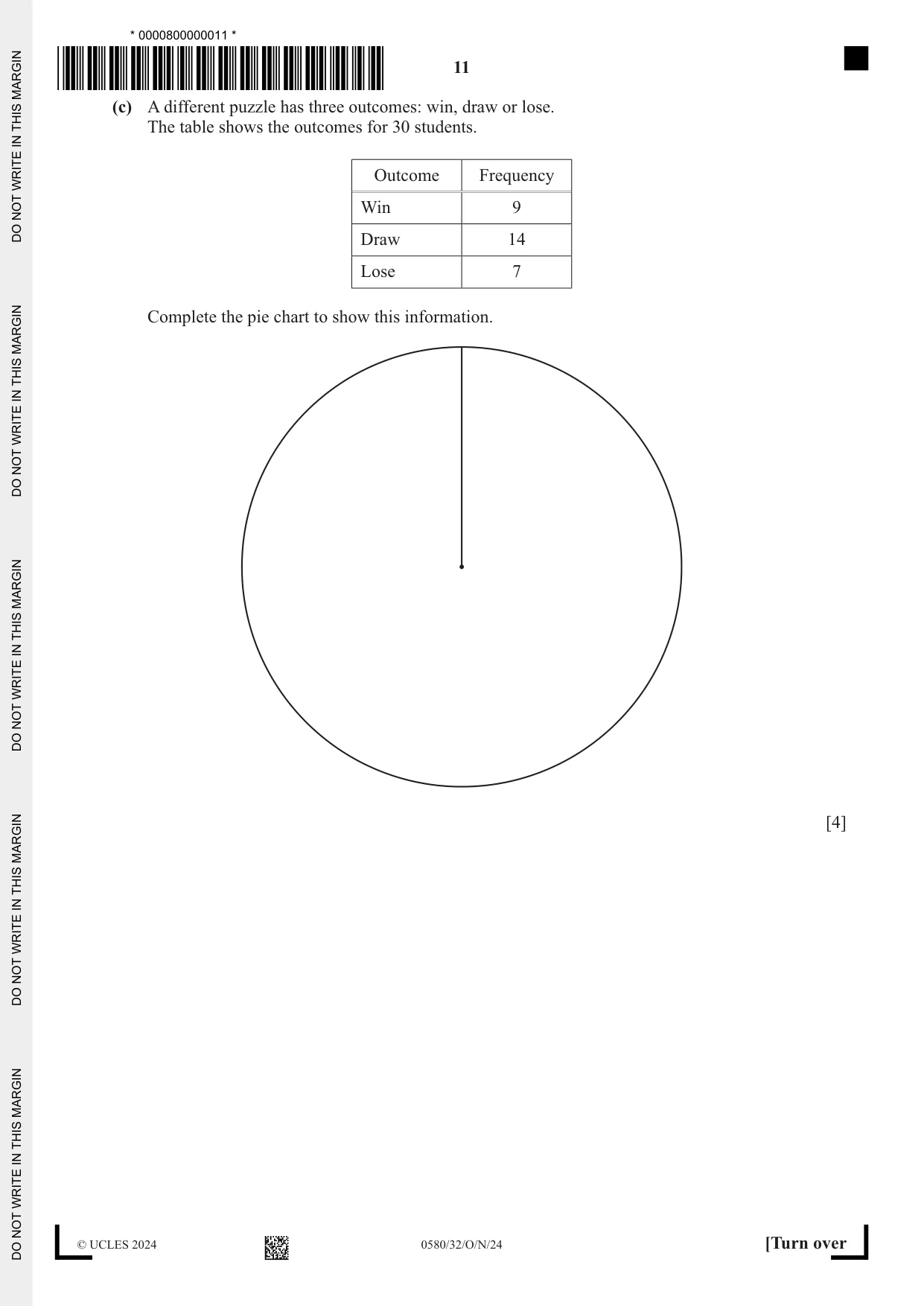
5 (a) Students solve a puzzle by making guesses. The table shows the number of guesses that each of 40 students make. Number of guesses 1 2 3 4 5 6 Frequency 2 4 8 7 12 7 (i) Find the mode. ................................................. [1] (ii) Calculate the mean. ................................................. [3] (b) In another puzzle each student gets a score. These are the scores for 12 students. 17 21 24 32 27 11 26 18 10 29 14 24 (i) Complete the stem-and-leaf diagram for these scores. 1 2 3 Key : 1 | 7 represents 17 [2] (ii) Find the median. ................................................. [1] (c) A different puzzle has three outcomes: win, draw or lose. The table shows the outcomes for 30 students. Outcome Frequency Win 9 Draw 14 Lose 7 Complete the pie chart to show this information. [4]
Mark scheme: 5(a)(i) 5 1 5(a)(ii) 4.1 3 M1 for 1×2 + 2×4 + 3×8 + 4×7 + 5×12 + 6×7 M1dep for their 164 ÷ 40 5(b)(i) 2 B1 for correct unordered diagram or for ordered diagram with one error or omission 5(b)(ii) 22.5 1 FT their (b)(i) dep. on an ordered diagram 5(c) Correct pie chart 4 B3 for 2 or 3 of 108°, 168° and 84° seen and 1 correct sector drawn or B2 for 2 or 3 of 108°, 168° and 84° seen or 1 correct sector drawn or B1 for 1 of 108°, 168° and 84° seen or M1 for 36030 [× k] ( where k = 1, 7, 9 or 14) implied by 12 If 0 scored B2FT FT their angles for correct pie chart drawn if angles add to 360 or B1FT for one correct sector drawn
Q6 · The diagram shows a cuboid
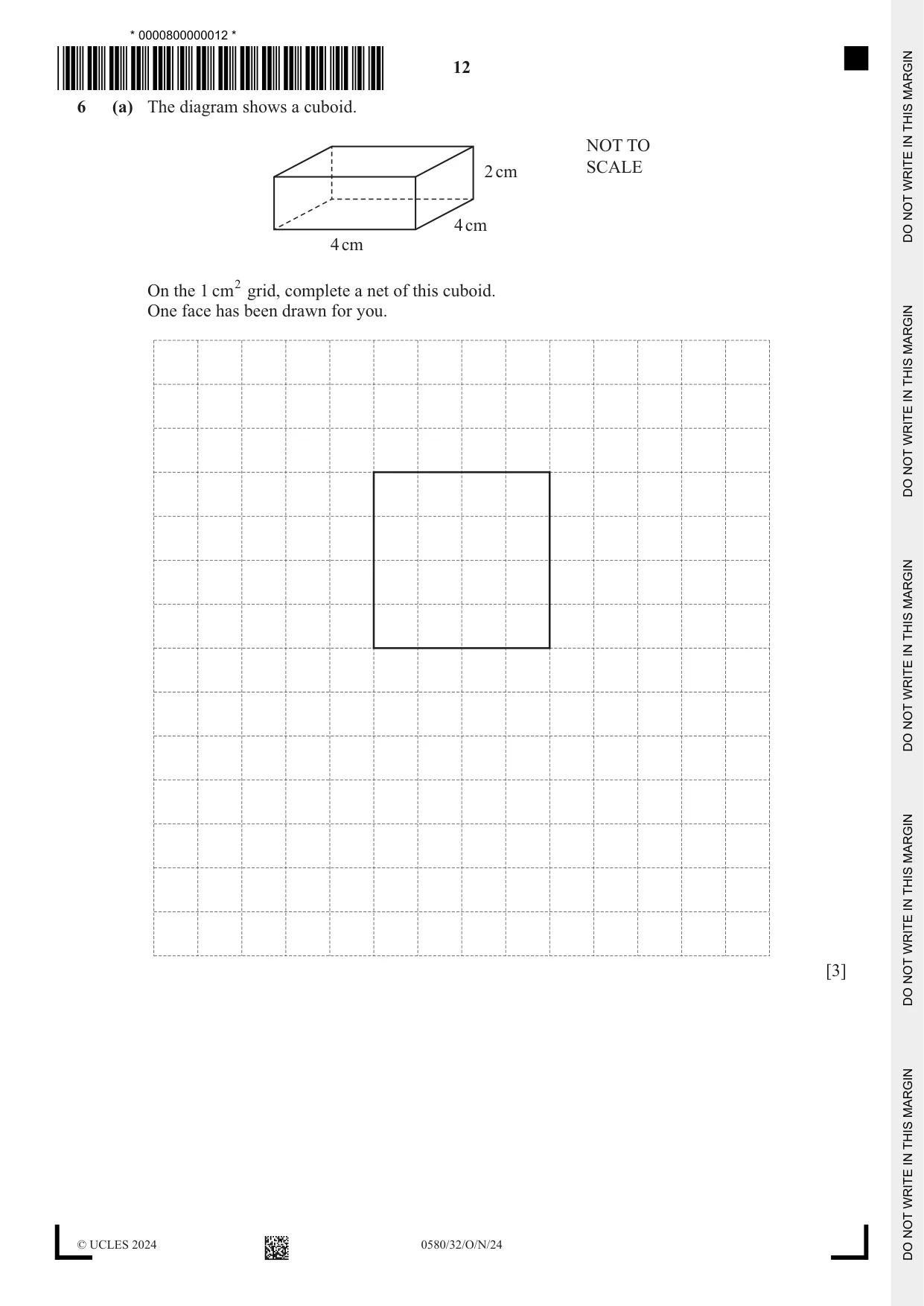
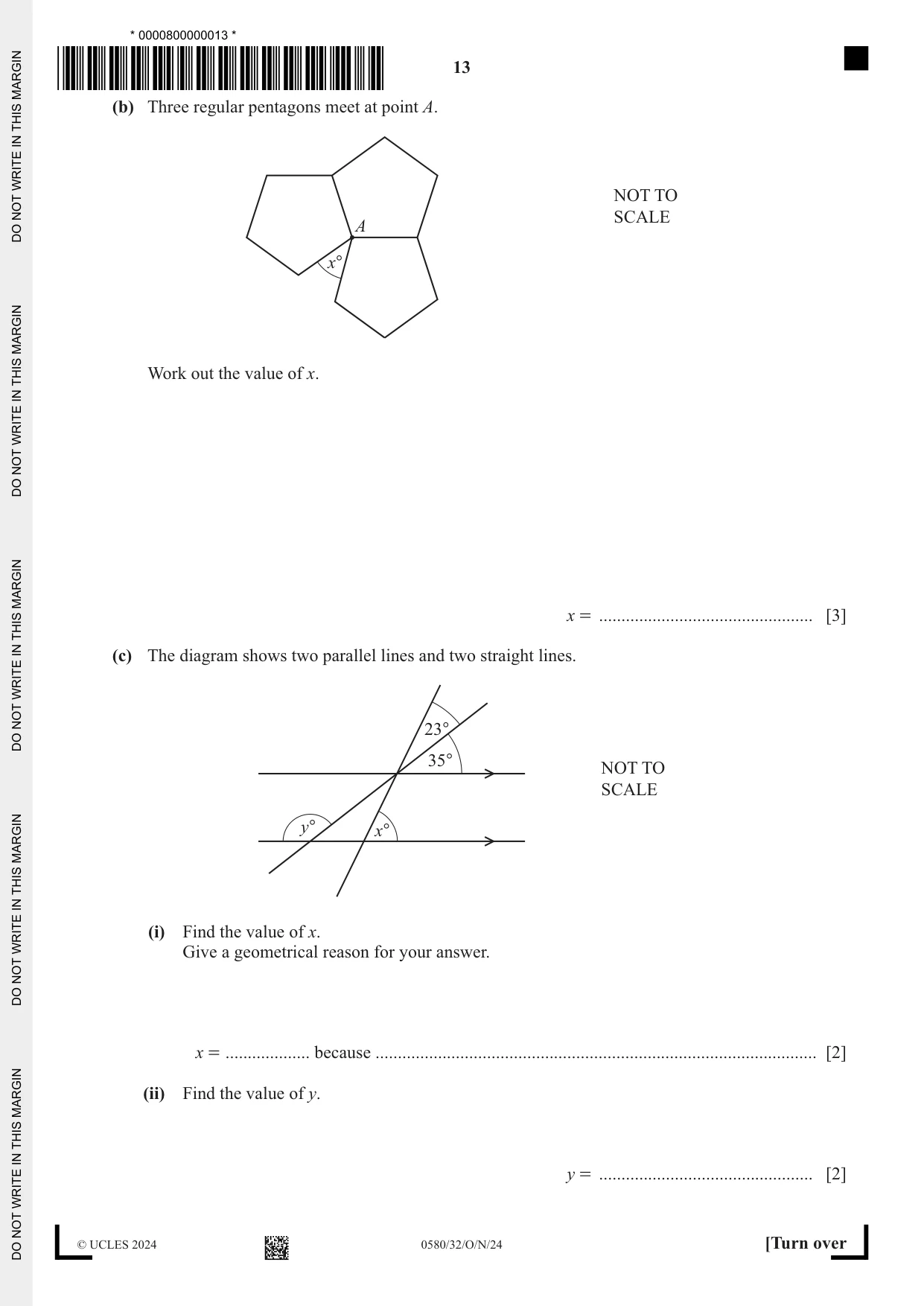
6 (a) The diagram shows a cuboid. NOT TO 2 cm SCALE 4 cm 4 cm On the 1 cm2 grid, complete a net of this cuboid. One face has been drawn for you. [3] (b) Three regular pentagons meet at point A. NOT TO SCALE A x° Work out the value of x. x = ................................................ [3] (c) The diagram shows two parallel lines and two straight lines. 23° 35° NOT TO SCALE y° x° (i) Find the value of x. Give a geometrical reason for your answer. x = ................... because ................................................................................................... [2] (ii) Find the value of y. y = ................................................ [2]
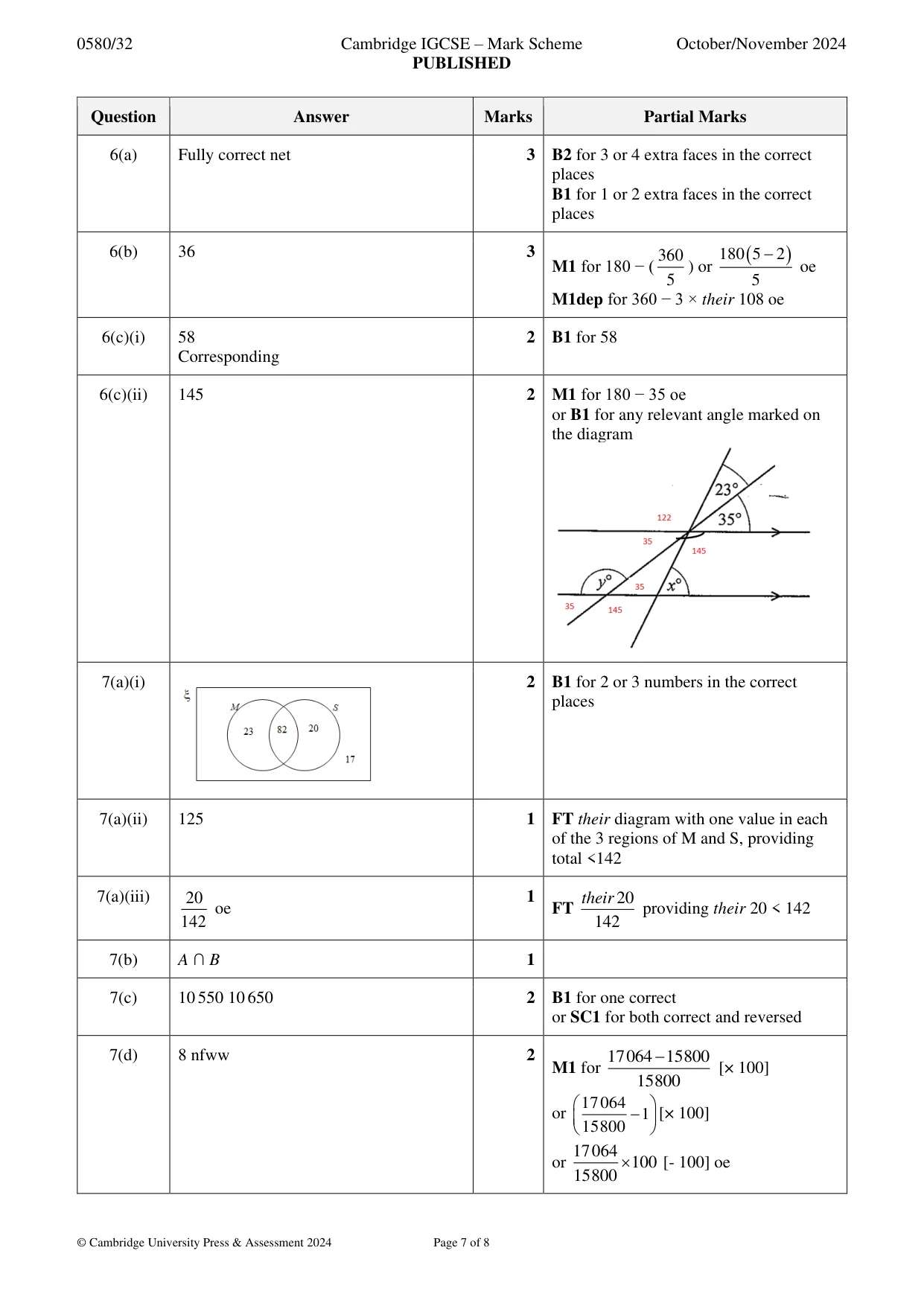
Mark scheme: 6(a) Fully correct net 3 B2 for 3 or 4 extra faces in the correct places B1 for 1 or 2 extra faces in the correct places 6(b) 36 3 360 180 ( 5 − 2 ) M1 for 180 − ( ) or oe 5 5 M1dep for 360 − 3 × their 108 oe 6(c)(i) 58 2 B1 for 58 Corresponding 6(c)(ii) 145 2 M1 for 180 − 35 oe or B1 for any relevant angle marked on the diagram
Q7 · % = {students in a group} M = {students who pass the mathematics test} S = {students who…
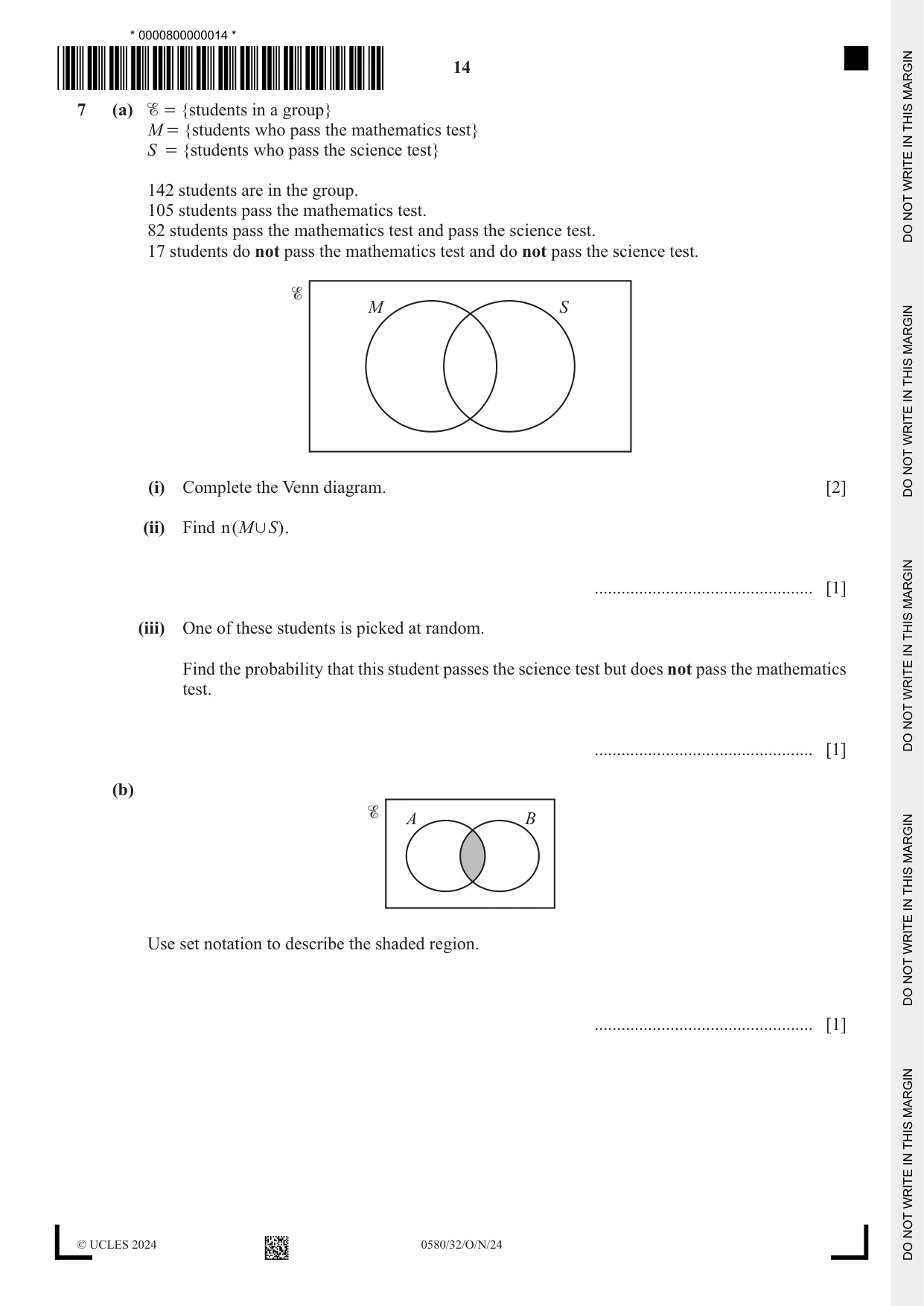
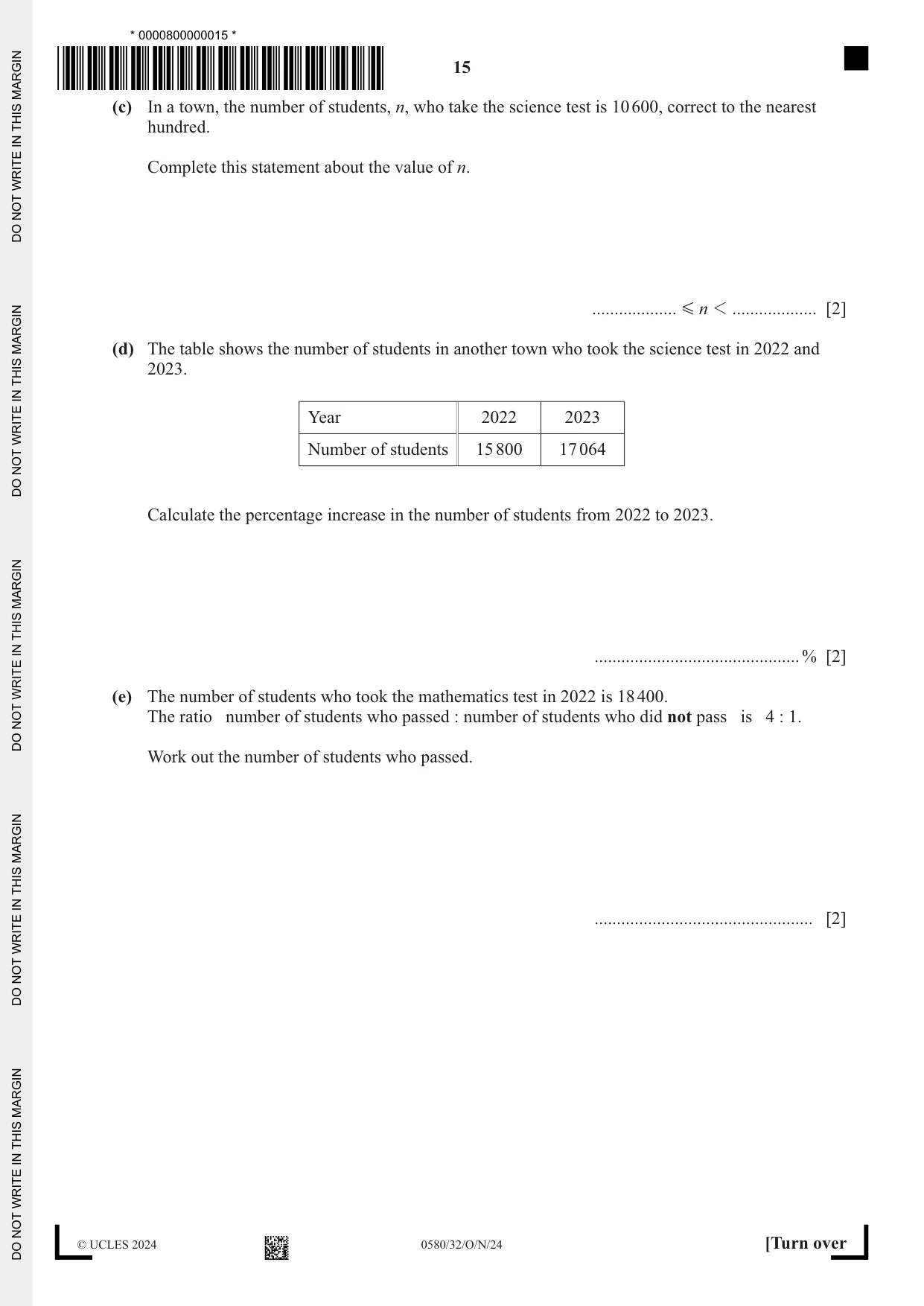
7 (a) % = {students in a group} M = {students who pass the mathematics test} S = {students who pass the science test} 142 students are in the group. 105 students pass the mathematics test. 82 students pass the mathematics test and pass the science test. 17 students do not pass the mathematics test and do not pass the science test. M S (i) Complete the Venn diagram. [2] (ii) Find n ( M , S ). ................................................. [1] (iii) One of these students is picked at random. Find the probability that this student passes the science test but does not pass the mathematics test. ................................................. [1] (b) A B Use set notation to describe the shaded region. ................................................. [1] (c) In a town, the number of students, n, who take the science test is 10 600, correct to the nearest hundred. Complete this statement about the value of n. ................... G n 1 ................... [2] (d) The table shows the number of students in another town who took the science test in 2022 and 2023. Year 2022 2023 Number of students 15 800 17 064 Calculate the percentage increase in the number of students from 2022 to 2023. ..............................................% [2] (e) The number of students who took the mathematics test in 2022 is 18 400. The ratio number of students who passed : number of students who did not pass is 4 : 1. Work out the number of students who passed. ................................................. [2]
Mark scheme: 7(a)(i) 2 B1 for 2 or 3 numbers in the correct places 7(a)(ii) 125 1 FT their diagram with one value in each of the 3 regions of M and S, providing total <142 7(a)(iii) 20 1 their 20 oe FT providing their 20 < 142 142 142 7(b) A ∩ B 1 7(c) 10 550 10 650 2 B1 for one correct or SC1 for both correct and reversed 7(d) 8 nfww 2 17 064 − 15 800 M1 for [× 100] 15 800 17 064 or − 1 [× 100] 15 800 17 064 or 100 [- 100] oe 15 800 7(e) 14 720 2 18400 M1 for [× k] (where k = 1 or 4) oe 1 + 4
Q8 · Y 8 7 L 6 5 4 3 2 1 0 x 0 1 2 3 4 5 6 7 8 (i) Find the equation of line L in the form y =…
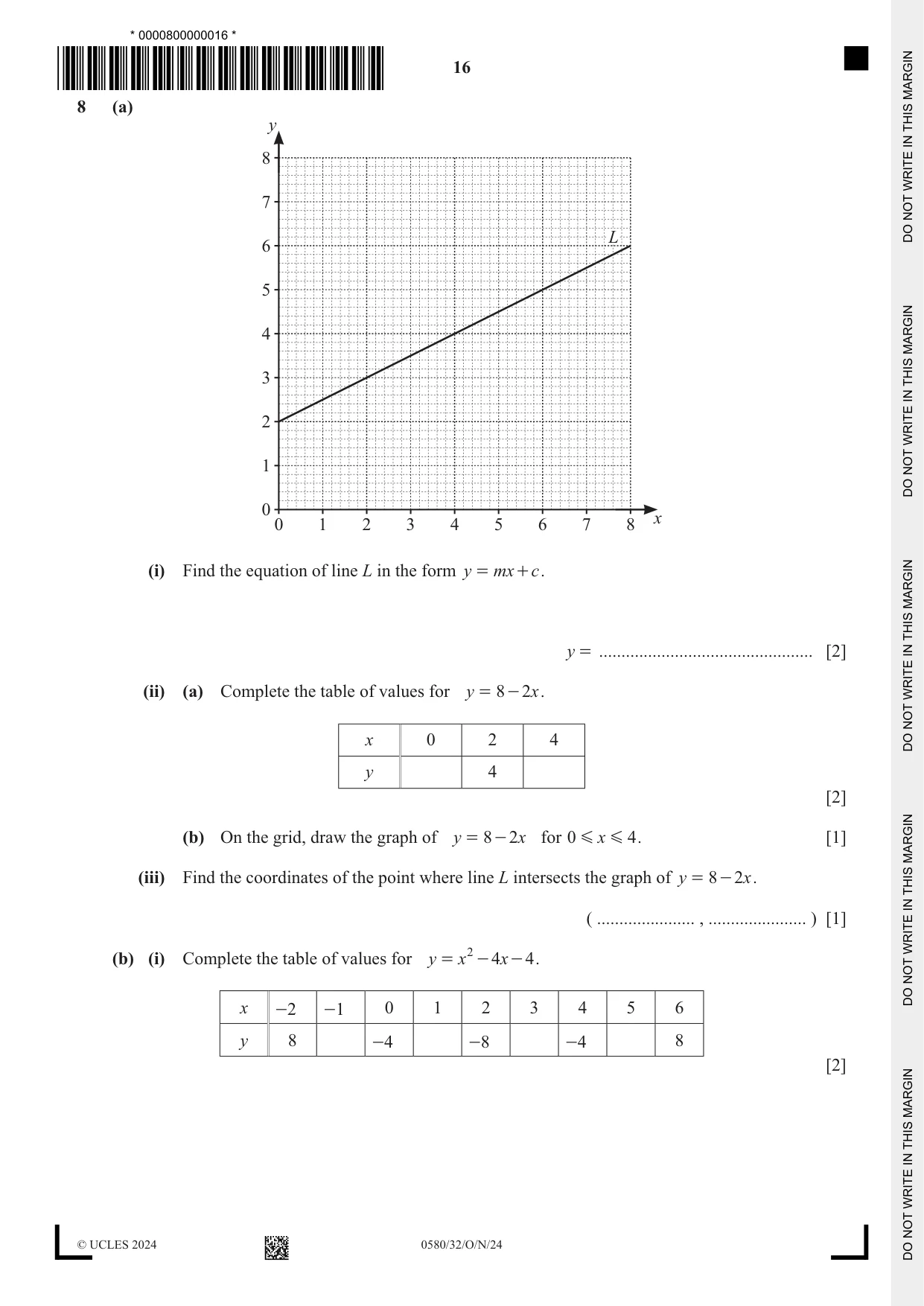
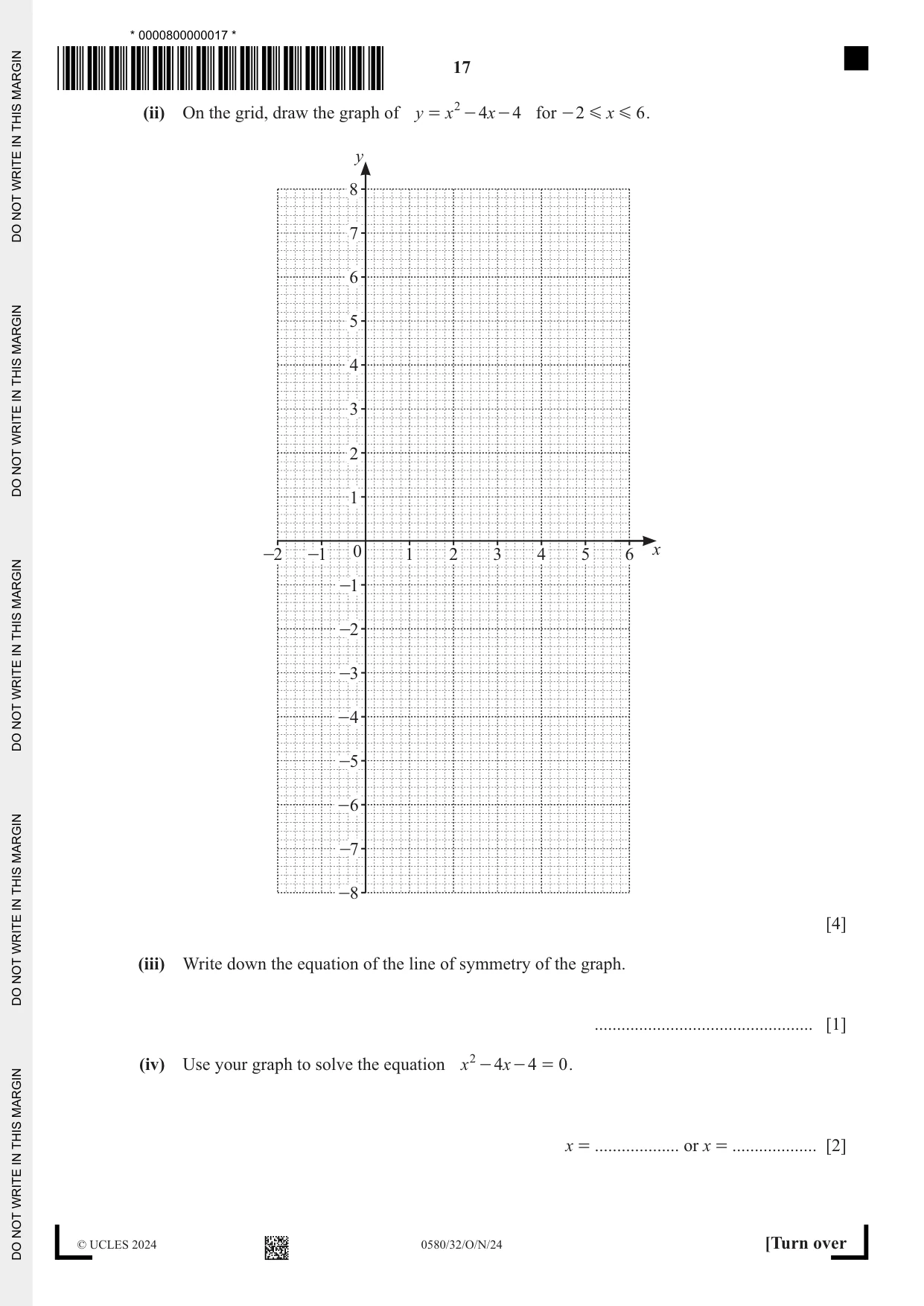
8 (a) y 8 7 L 6 5 4 3 2 1 0 x 0 1 2 3 4 5 6 7 8 (i) Find the equation of line L in the form y = mx + c . y = ................................................ [2] (ii) (a) Complete the table of values for y = 8 - 2x . x 0 2 4 y 4 [2] (b) On the grid, draw the graph of y = 8 - 2x for 0 G x G 4 . [1] (iii) Find the coordinates of the point where line L intersects the graph of y = 8 - 2x . ( ...................... , ...................... ) [1] (b) (i) Complete the table of values for y = x 2 - 4x - 4 . x -2 -1 0 1 2 3 4 5 6 y 8 -4 -8 -4 8 [2] (ii) On the grid, draw the graph of y = x 2 - 4x - 4 for - 2 G x G 6 . y 8 7 6 5 4 3 2 1 -2 -1 0 1 2 3 4 5 6 x -1 -2 -3 -4 -5 -6 -7 -8 [4] (iii) Write down the equation of the line of symmetry of the graph. ................................................. [1] (iv) Use your graph to solve the equation x 2 - 4x - 4 = 0 . x = ................... or x = ................... [2]
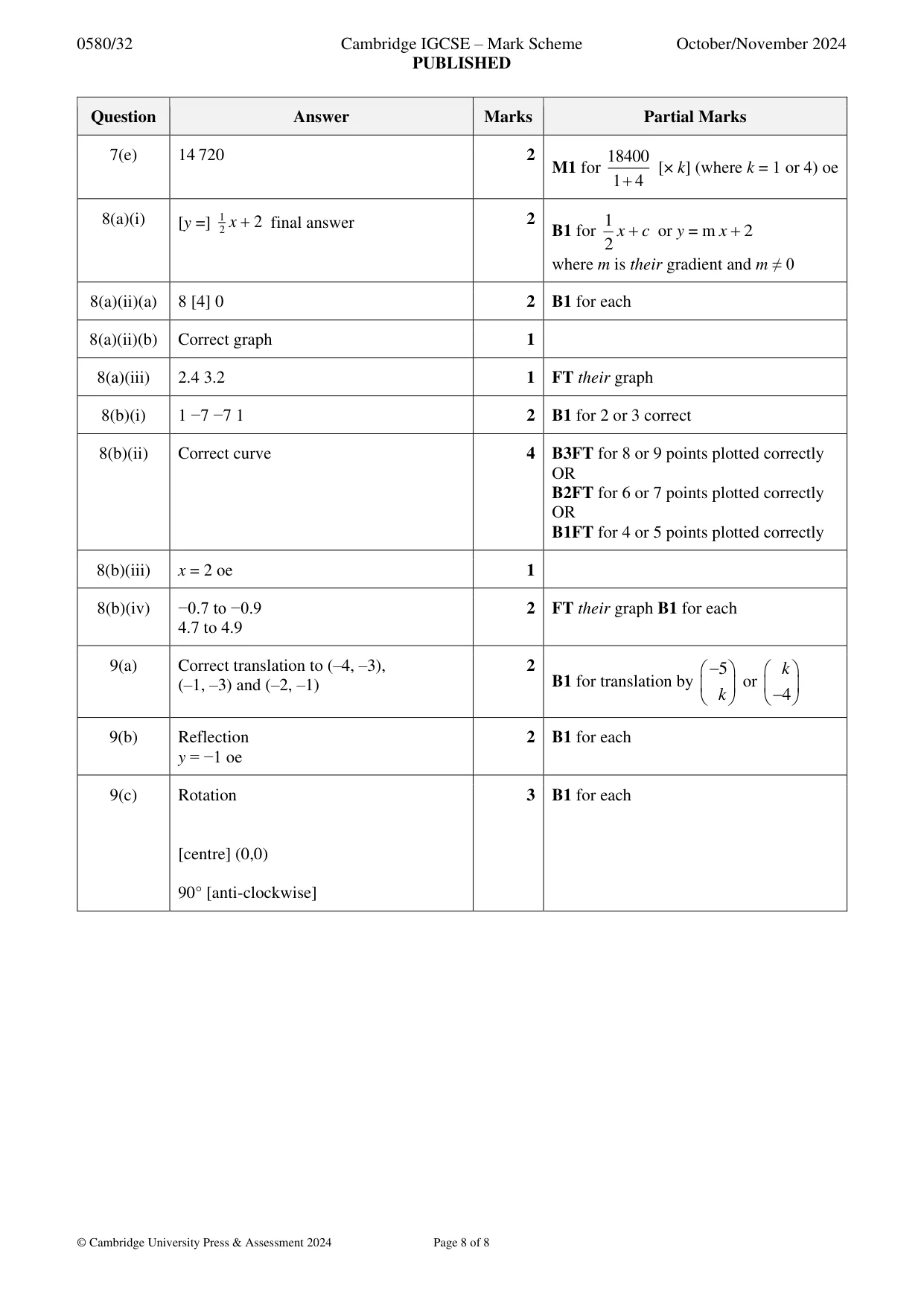
Mark scheme: 8(a)(i) [y =] 12 x + 2 final answer 2 1 B1 for x + c or y = m x + 2 2 where m is their gradient and m ≠ 0 8(a)(ii)(a) 8 [4] 0 2 B1 for each 8(a)(ii)(b) Correct graph 1 8(a)(iii) 2.4 3.2 1 FT their graph 8(b)(i) 1 −7 −7 1 2 B1 for 2 or 3 correct 8(b)(ii) Correct curve 4 B3FT for 8 or 9 points plotted correctly OR B2FT for 6 or 7 points plotted correctly OR B1FT for 4 or 5 points plotted correctly 8(b)(iii) x = 2 oe 1 8(b)(iv) −0.7 to −0.9 2 FT their graph B1 for each 4.7 to 4.9
Q9 · Y 6 5 4 3 B 2 T 1 -6 -5 -4 -3 -2 -1 0 1 2 3 4 5 6 x -1 -2 -3 A -4 -5 -6 - 5 (a) On the…
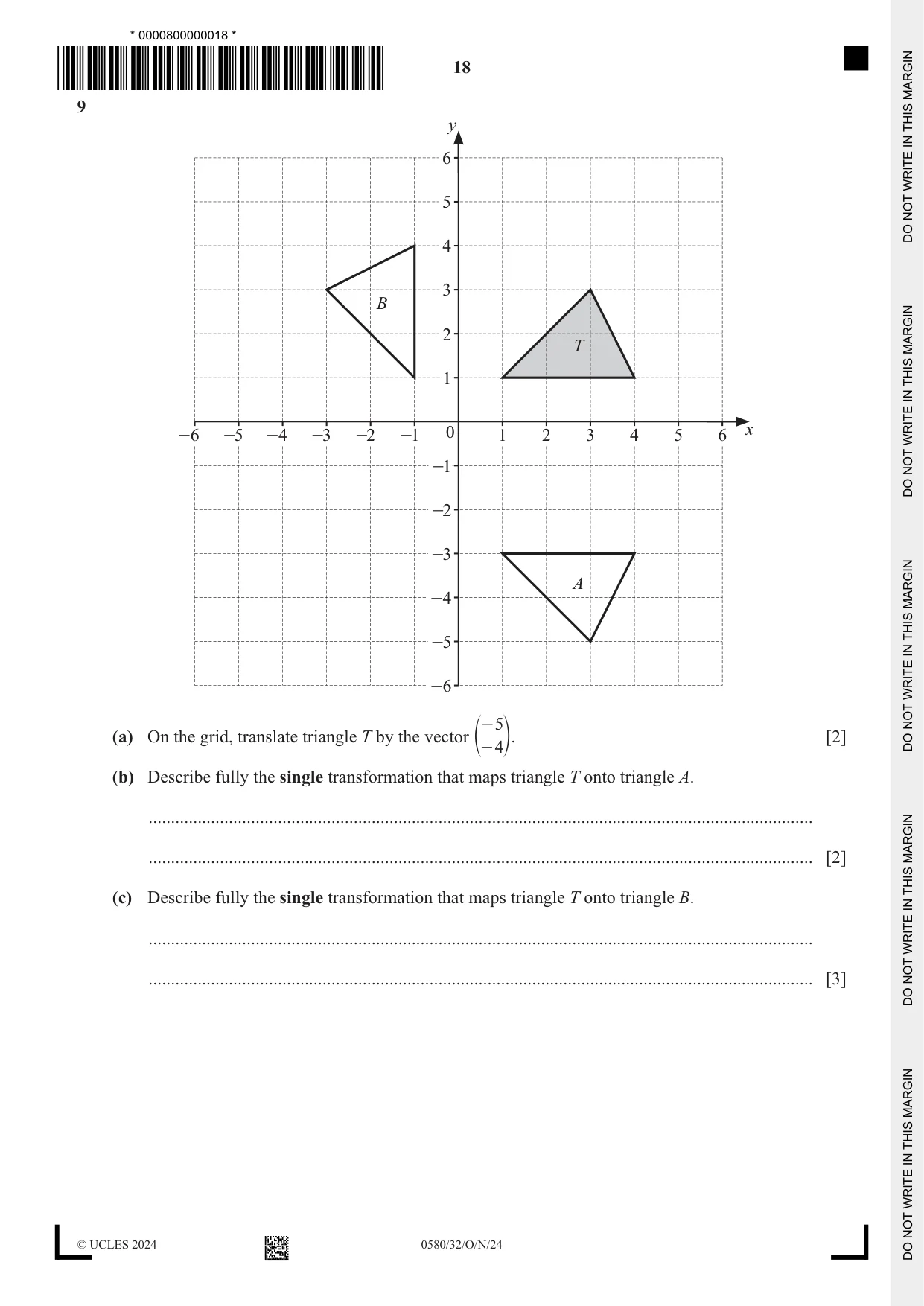
9 y 6 5 4 3 B 2 T 1 -6 -5 -4 -3 -2 -1 0 1 2 3 4 5 6 x -1 -2 -3 A -4 -5 -6 - 5 (a) On the grid, translate triangle T by the vector e o. [2] - 4 (b) Describe fully the single transformation that maps triangle T onto triangle A. ..................................................................................................................................................... ..................................................................................................................................................... [2] (c) Describe fully the single transformation that maps triangle T onto triangle B. ..................................................................................................................................................... ..................................................................................................................................................... [3]
Mark scheme: 9(a) Correct translation to (–4, –3), 2 −5 k (–1, –3) and (–2, –1) B1 for translation by or k −4 9(b) Reflection 2 B1 for each y = −1 oe 9(c) Rotation 3 B1 for each [centre] (0,0) 90° [anti-clockwise]
What was in this paper
The subtopics covered by these 9 questions, and how many questions each got. Open one in a new tab to see every Cambridge question on it.
What you needed in this session
Cambridge’s own grade thresholds for 2024 Oct/Nov, Paper 3 · Variant 2. A higher threshold means an easier paper — the bar moves with how the cohort did.