Cambridge IGCSE Mathematics 0580 — 2022 May/June Paper 3 · Variant 3
0580/33/M/J/22 · 9 questions · 104 marks · ≈117 min
The question paper and its mark scheme, free to read here and free to download. This is Cambridge’s own paper, exactly as it was sat.
Question paper20 pages
Mark scheme7 pages
Answers below. Sit the paper first if you are practising.
Questions as text
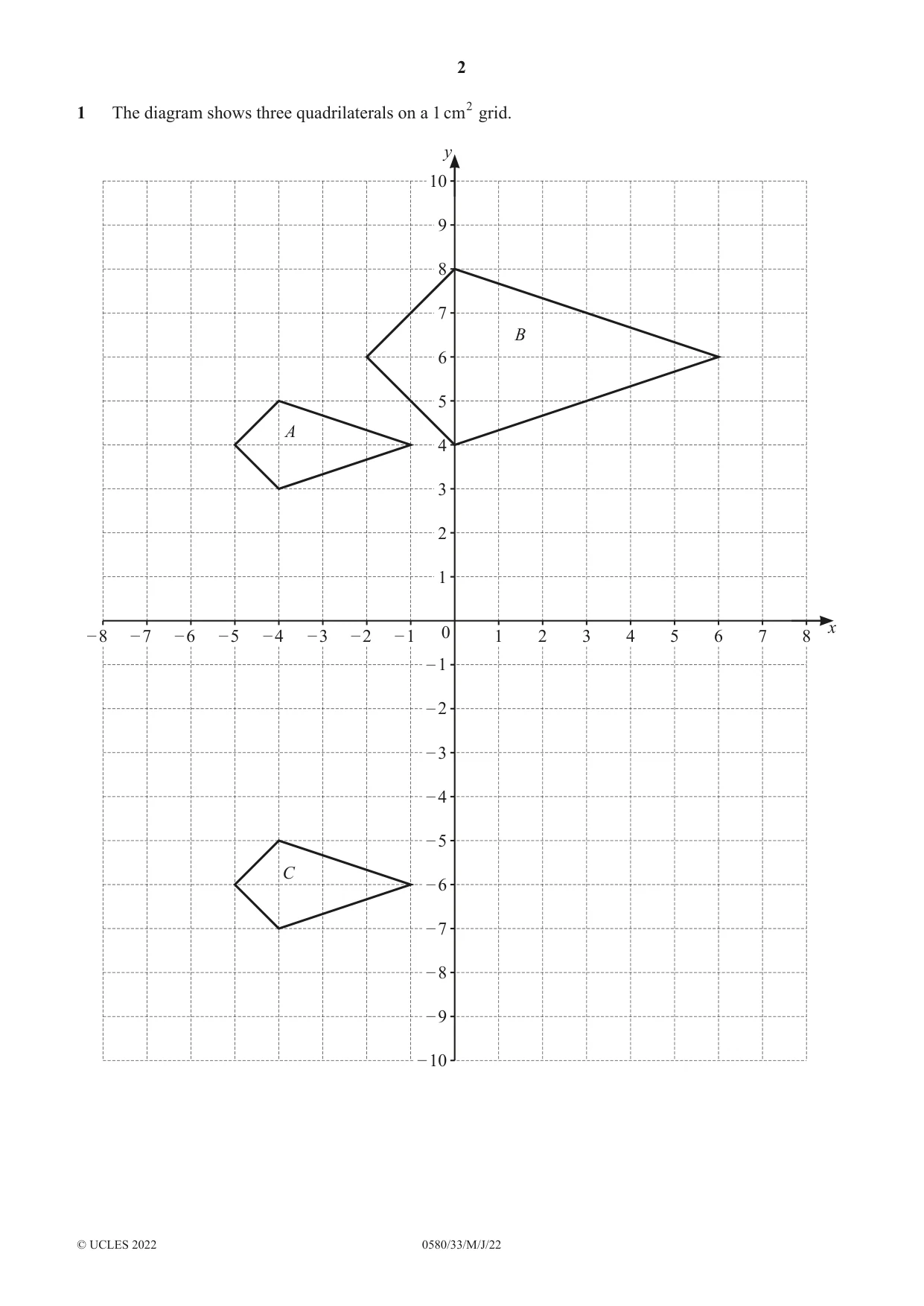
Q1 · The diagram shows three quadrilaterals on a 1 cm 2 grid
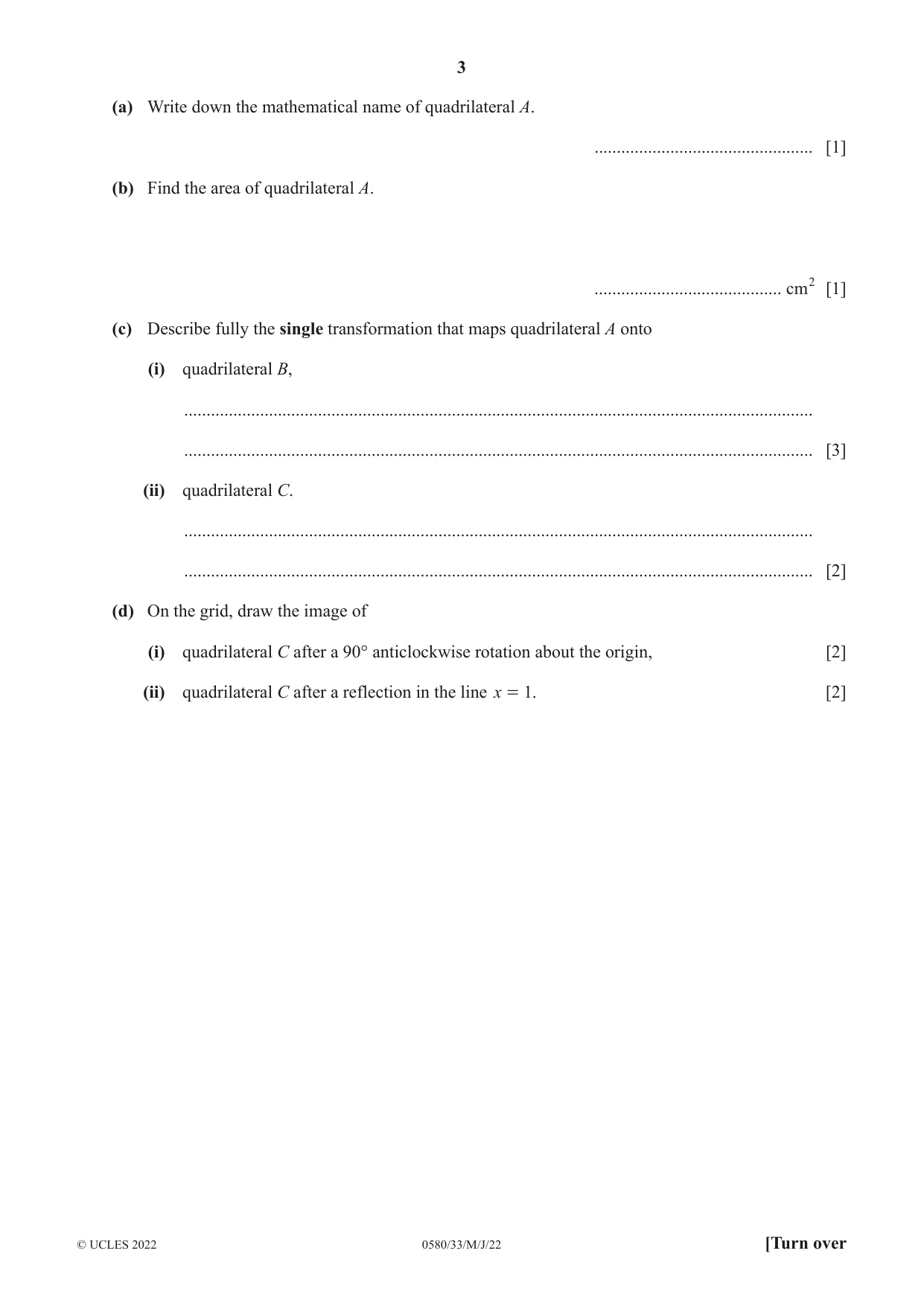
1 The diagram shows three quadrilaterals on a 1 cm 2 grid. y 10 9 8 7 B 6 5 A 4 3 2 1 x – 8 – 7 – 6 – 5 – 4 – 3 – 2 – 1 0 1 2 3 4 5 6 7 8 – 1 – 2 – 3 – 4 – 5 C – 6 – 7 – 8 – 9 – 10 (a) Write down the mathematical name of quadrilateral A. ................................................. [1] (b) Find the area of quadrilateral A. .......................................... cm2 [1] (c) Describe fully the single transformation that maps quadrilateral A onto (i) quadrilateral B, ............................................................................................................................................. ............................................................................................................................................. [3] (ii) quadrilateral C. ............................................................................................................................................. ............................................................................................................................................. [2] (d) On the grid, draw the image of (i) quadrilateral C after a 90° anticlockwise rotation about the origin, [2] (ii) quadrilateral C after a reflection in the line x = 1. [2]
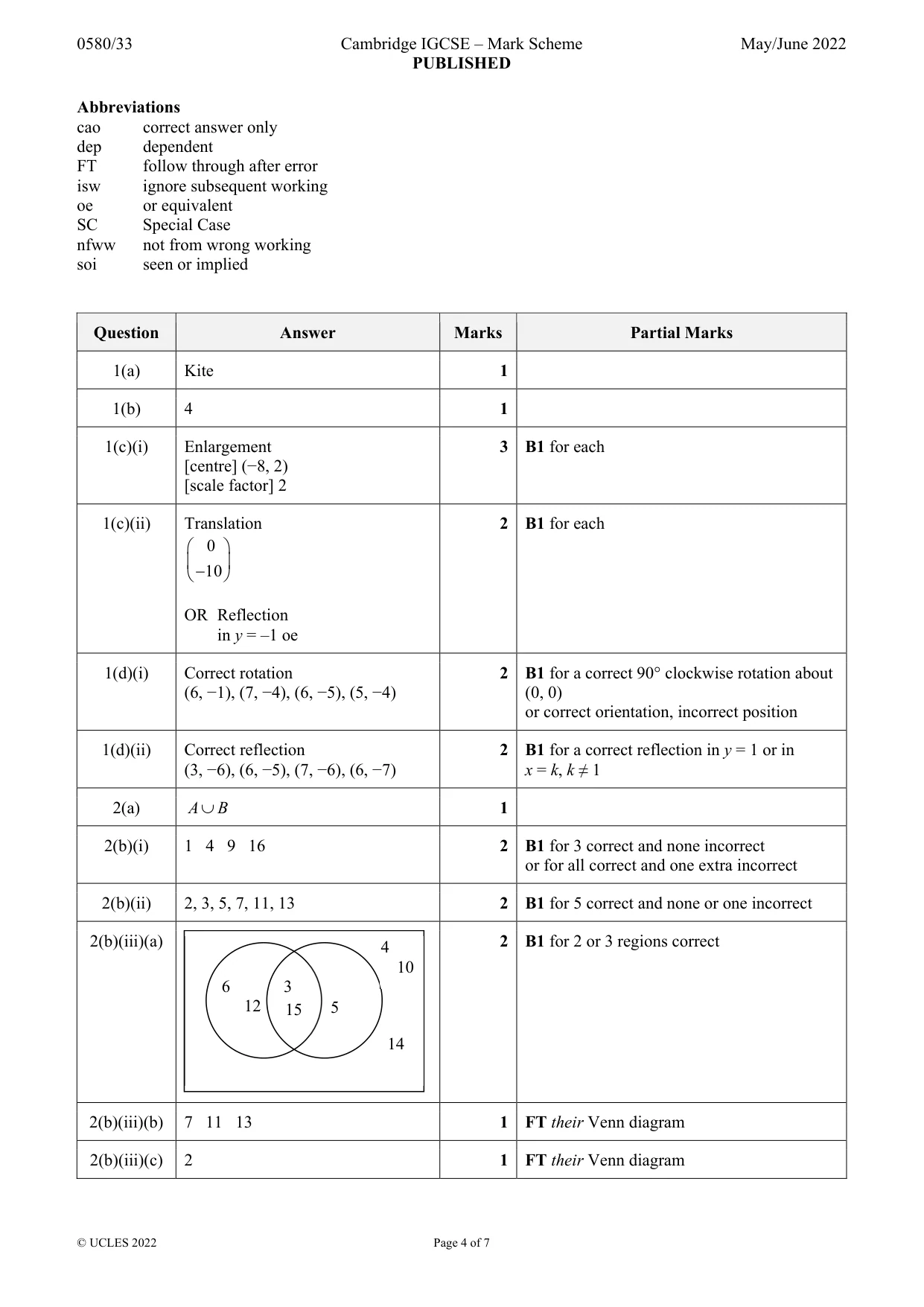
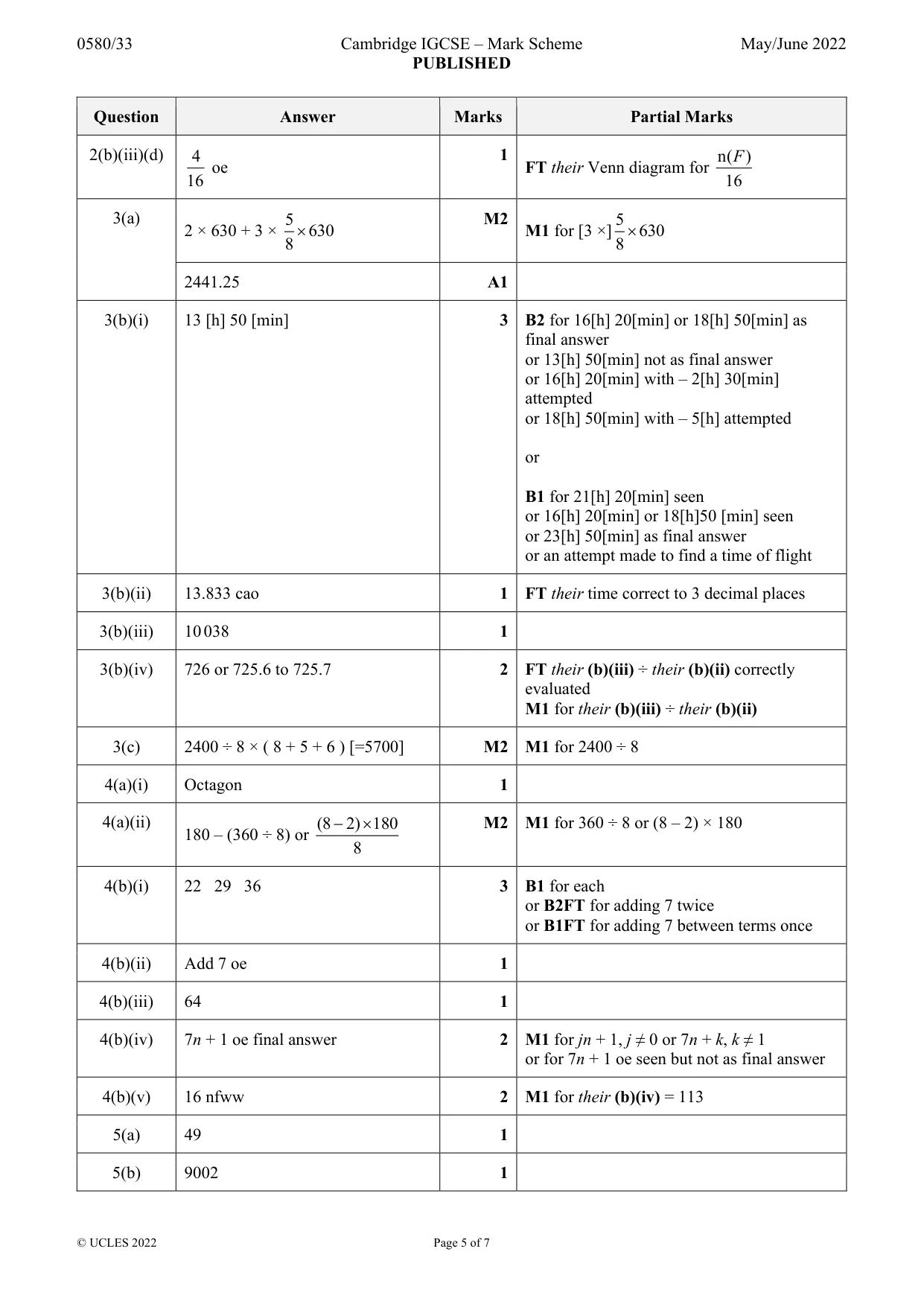
Mark scheme: Question Answer Marks Partial Marks 1(a) Kite 1 1(b) 4 1 1(c)(i) Enlargement 3 B1 for each [centre] (−8, 2) [scale factor] 2 1(c)(ii) Translation 2 B1 for each 0 10 OR Reflection in y = –1 oe 1(d)(i) Correct rotation 2 B1 for a correct 90° clockwise rotation about (6, −1), (7, −4), (6, −5), (5, −4) (0, 0) or correct orientation, incorrect position 1(d)(ii) Correct reflection 2 B1 for a correct reflection in y = 1 or in (3, −6), (6, −5), (7, −6), (6, −7) x = k, k ≠ 1
Q2 · A B Use set notation to describe the shaded region
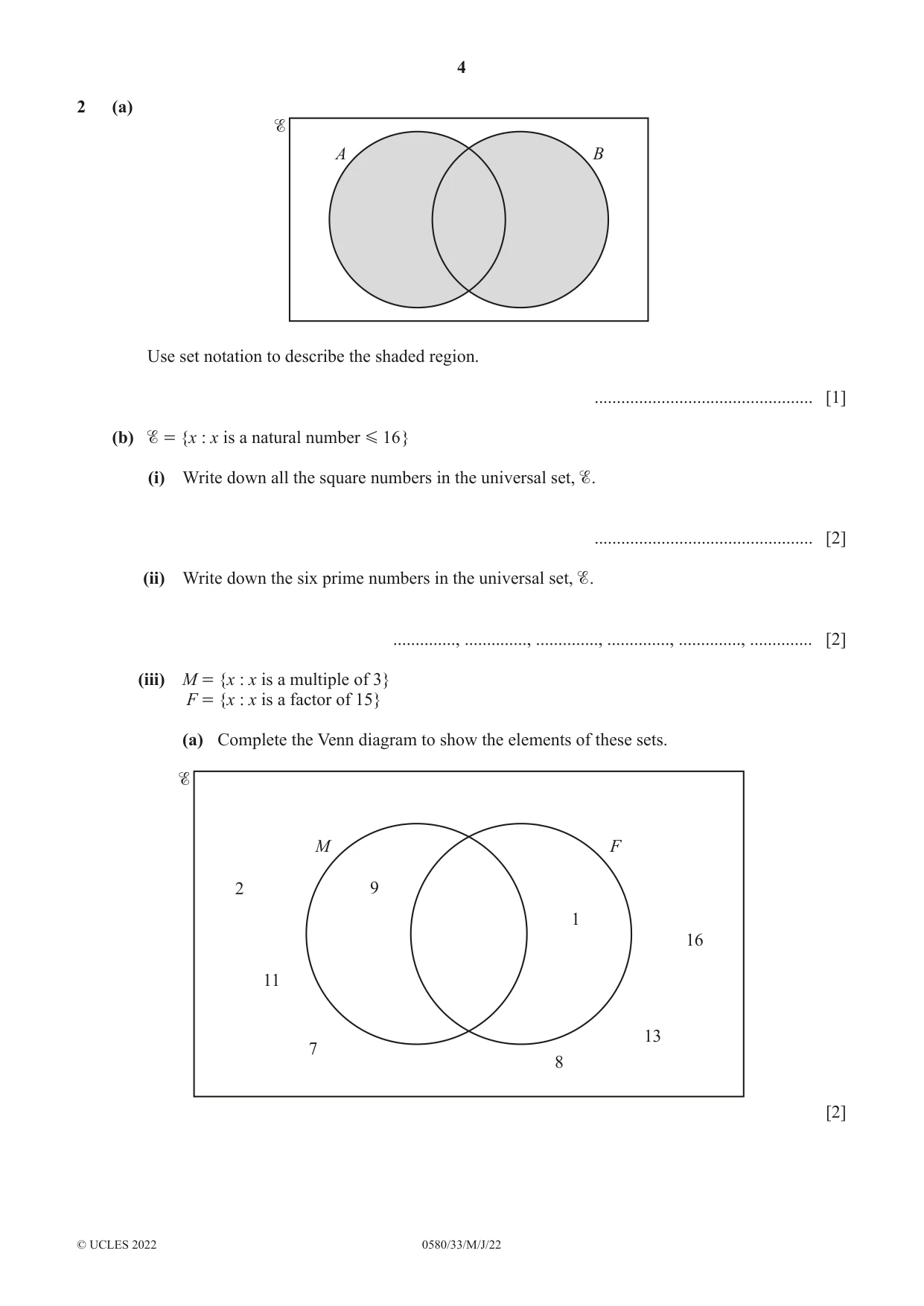
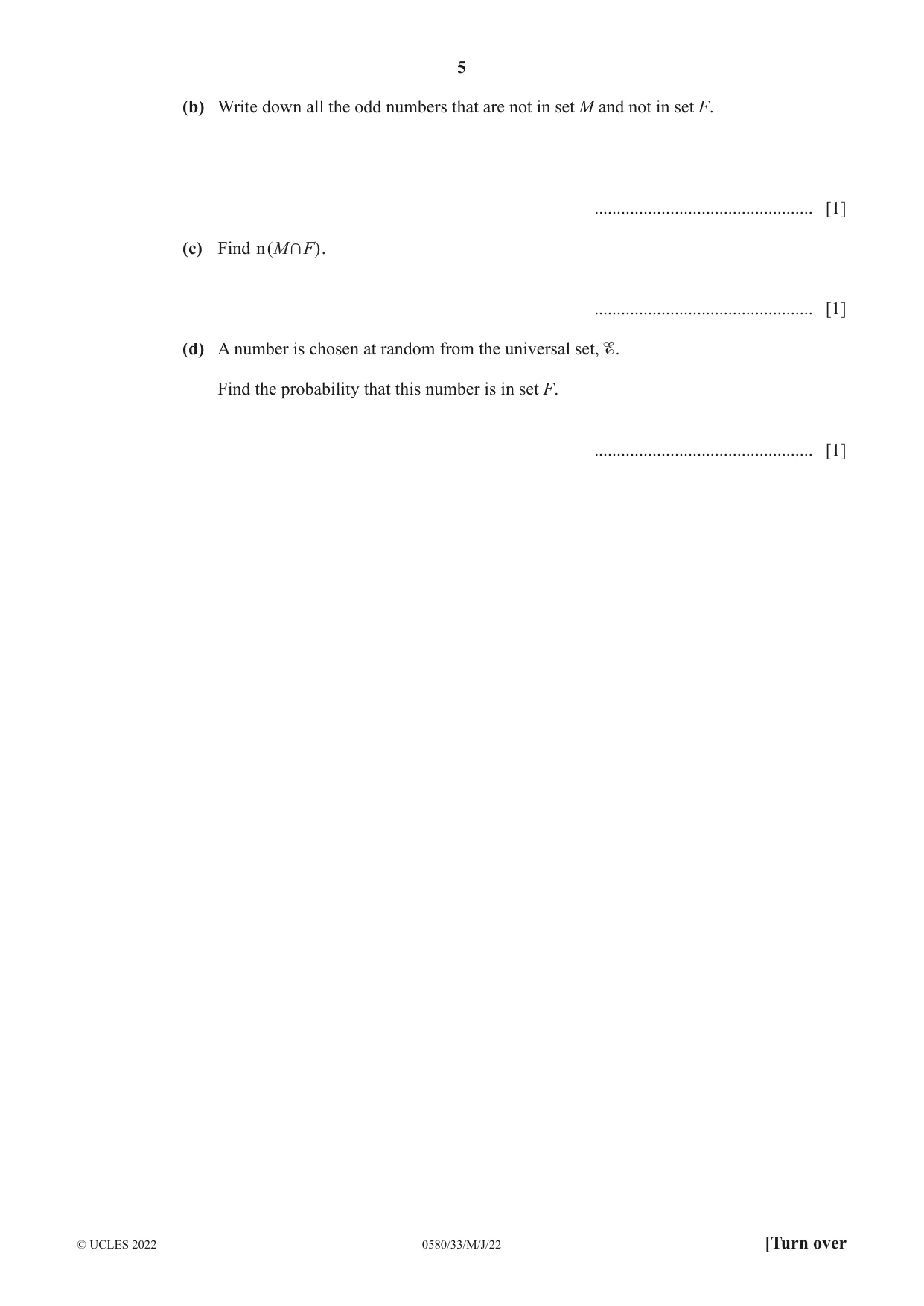
2 (a) A B Use set notation to describe the shaded region. ................................................. [1] (b) = {x : x is a natural number G 16 } (i) Write down all the square numbers in the universal set, . ................................................. [2] (ii) Write down the six prime numbers in the universal set, . .............., .............., .............., .............., .............., .............. [2] (iii) M = {x : x is a multiple of 3} F = {x : x is a factor of 15} (a) Complete the Venn diagram to show the elements of these sets. M F 2 9 1 16 11 13 7 8 [2] (b) Write down all the odd numbers that are not in set M and not in set F. ................................................. [1] (c) Find n ( M + F) . ................................................. [1] (d) A number is chosen at random from the universal set, . Find the probability that this number is in set F. ................................................. [1]
Mark scheme: 2(a) A B 1 2(b)(i) 1 4 9 16 2 B1 for 3 correct and none incorrect or for all correct and one extra incorrect 2(b)(ii) 2, 3, 5, 7, 11, 13 2 B1 for 5 correct and none or one incorrect 2(b)(iii)(a) 2 B1 for 2 or 3 regions correct 4 10 6 3 12 15 5 14 2(b)(iii)(b) 7 11 13 1 FT their Venn diagram 2(b)(iii)(c) 2 1 FT their Venn diagram 2(b)(iii)(d) 4 1 n( F ) oe FT their Venn diagram for 16 16
Q3 · Mr Zhang, his wife and three children go on a holiday from Shanghai to Auckland
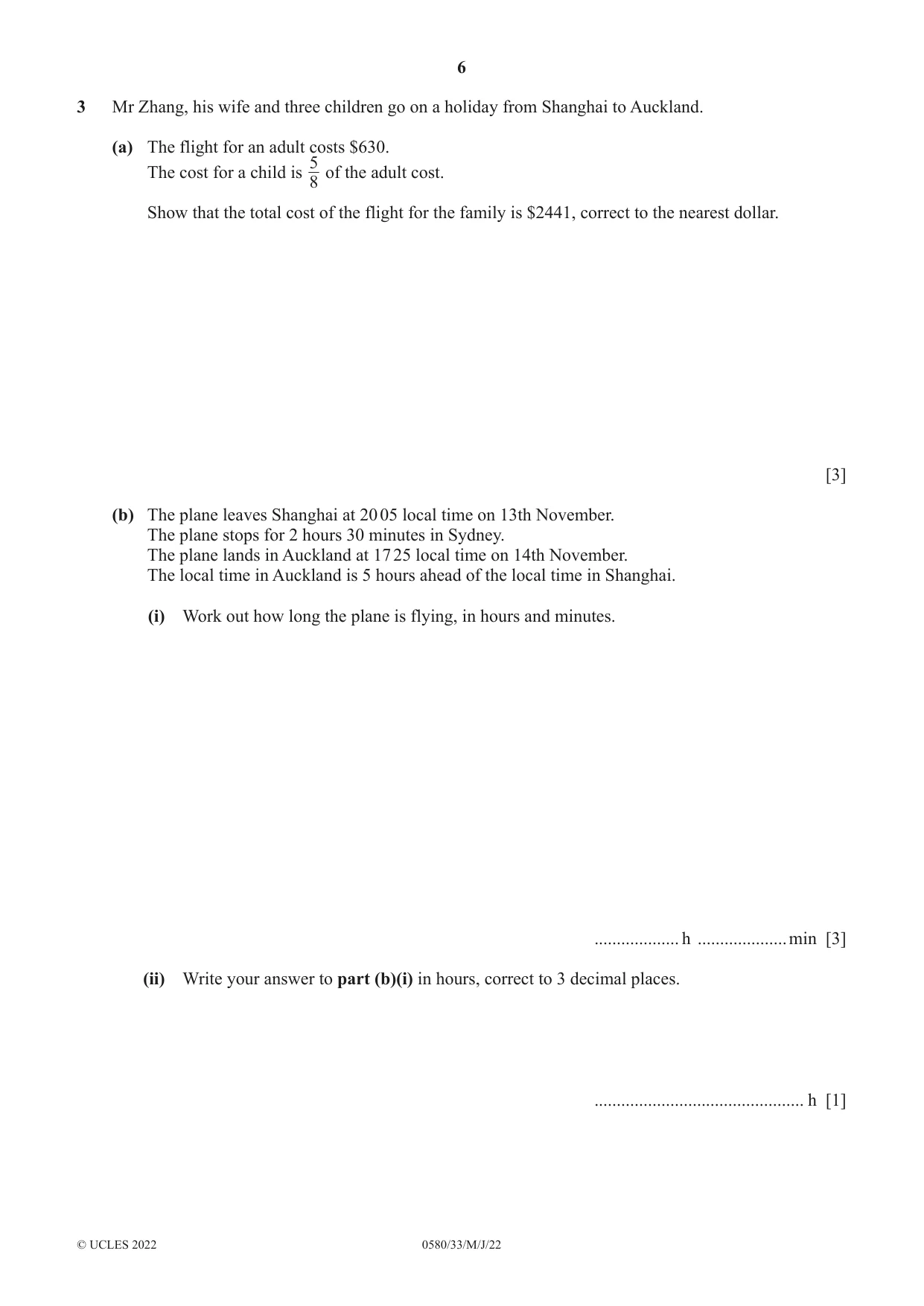
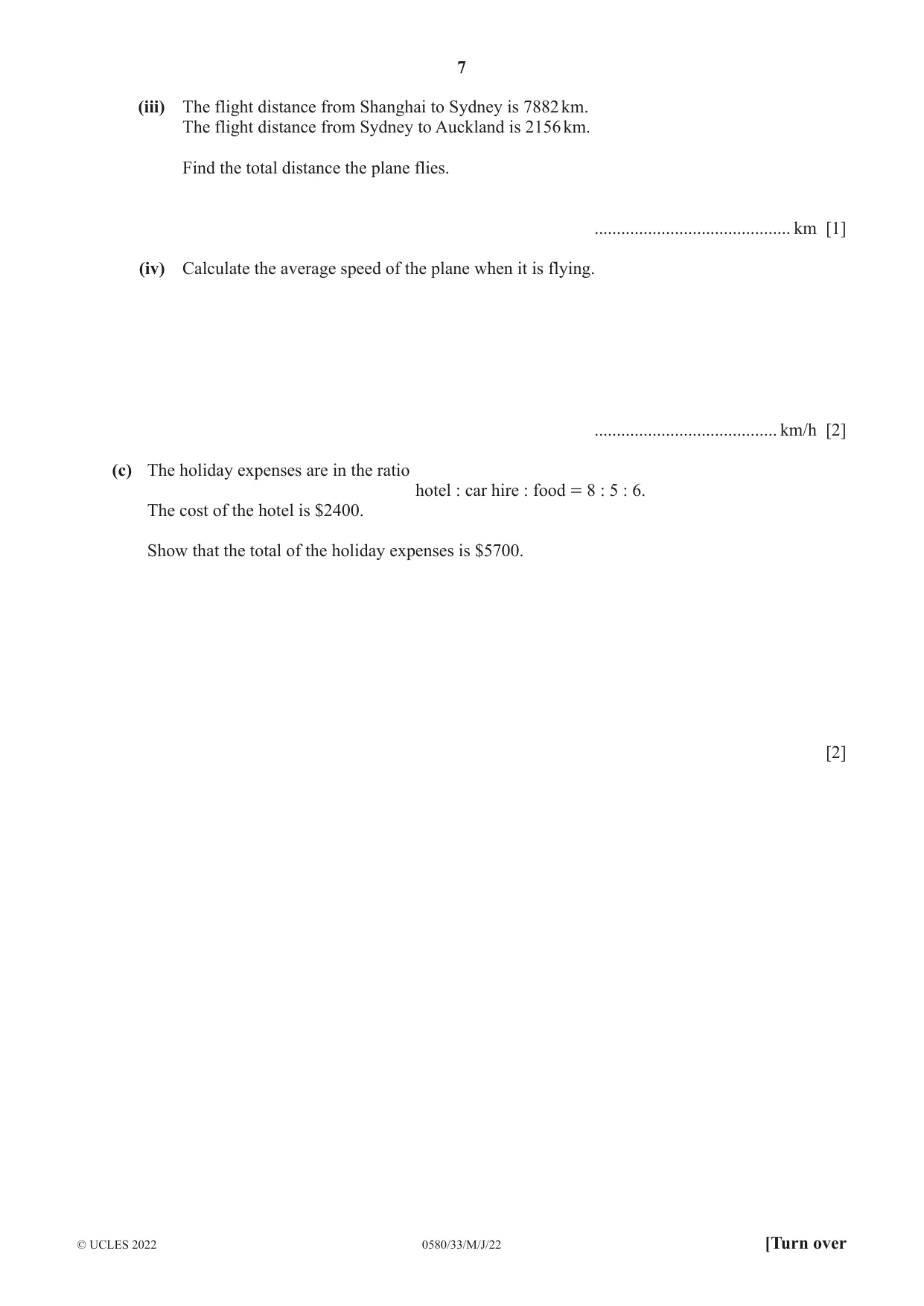
3 Mr Zhang, his wife and three children go on a holiday from Shanghai to Auckland. (a) The flight for an adult costs $630. 5 The cost for a child is of the adult cost. 8 Show that the total cost of the flight for the family is $2441, correct to the nearest dollar. [3] (b) The plane leaves Shanghai at 20 05 local time on 13th November. The plane stops for 2 hours 30 minutes in Sydney. The plane lands in Auckland at 17 25 local time on 14th November. The local time in Auckland is 5 hours ahead of the local time in Shanghai. (i) Work out how long the plane is flying, in hours and minutes. ................... h .................... min [3] (ii) Write your answer to part (b)(i) in hours, correct to 3 decimal places. ............................................... h [1] (iii) The flight distance from Shanghai to Sydney is 7882 km. The flight distance from Sydney to Auckland is 2156 km. Find the total distance the plane flies. ............................................ km [1] (iv) Calculate the average speed of the plane when it is flying. ......................................... km/h [2] (c) The holiday expenses are in the ratio hotel : car hire : food = 8 : 5 : 6. The cost of the hotel is $2400. Show that the total of the holiday expenses is $5700. [2]
Mark scheme: 3(a) 5 M2 5 2 × 630 + 3 × 630 M1 for [3 ×] 630 8 8 2441.25 A1 3(b)(i) 13 [h] 50 [min] 3 B2 for 16[h] 20[min] or 18[h] 50[min] as final answer or 13[h] 50[min] not as final answer or 16[h] 20[min] with – 2[h] 30[min] attempted or 18[h] 50[min] with – 5[h] attempted or B1 for 21[h] 20[min] seen or 16[h] 20[min] or 18[h]50 [min] seen or 23[h] 50[min] as final answer or an attempt made to find a time of flight 3(b)(ii) 13.833 cao 1 FT their time correct to 3 decimal places 3(b)(iii) 10 038 1 3(b)(iv) 726 or 725.6 to 725.7 2 FT their (b)(iii) ÷ their (b)(ii) correctly evaluated M1 for their (b)(iii) ÷ their (b)(ii) 3(c) 2400 ÷ 8 × ( 8 + 5 + 6 ) [=5700] M2 M1 for 2400 ÷ 8
Q4 · The diagram shows a regular polygon
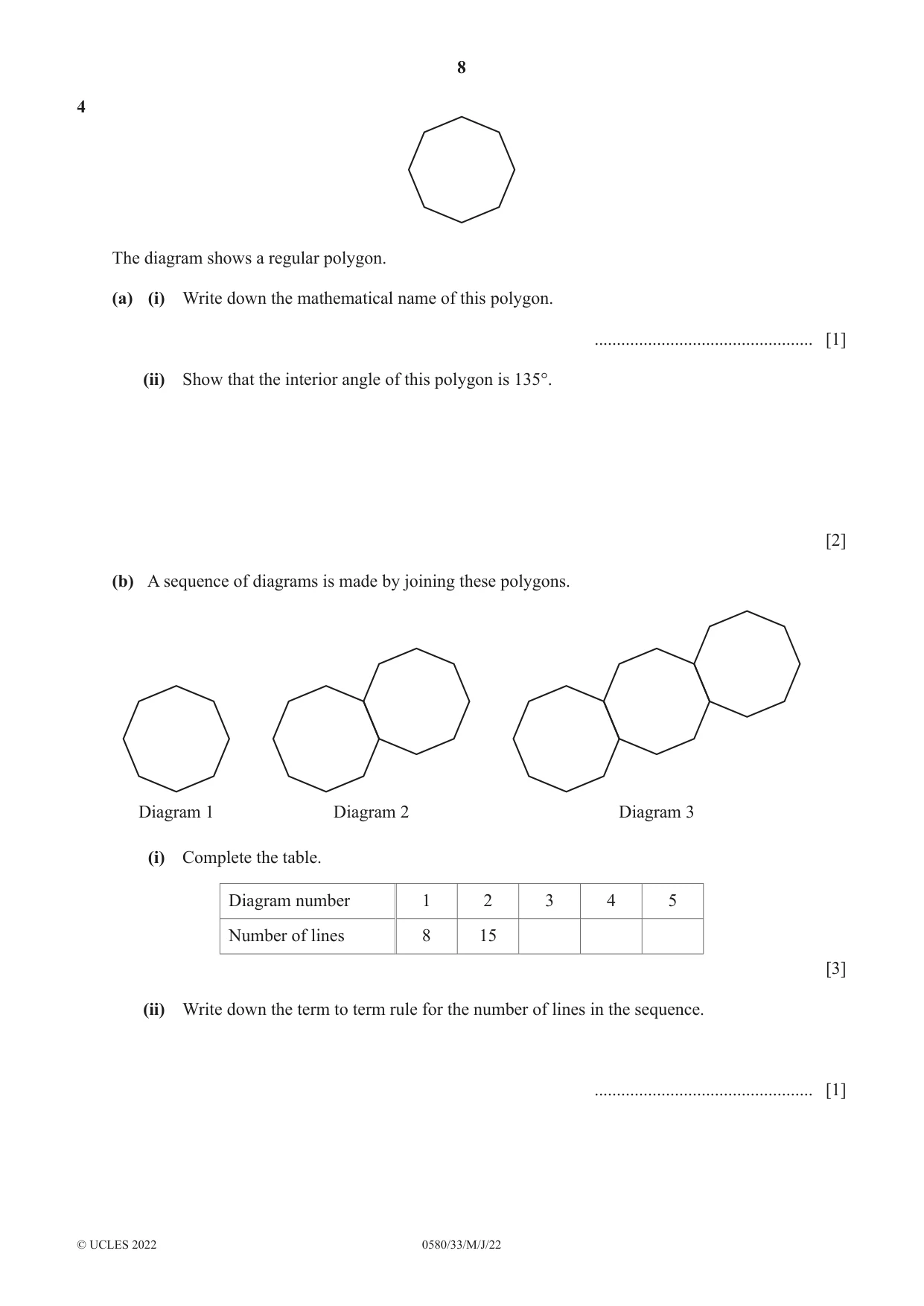
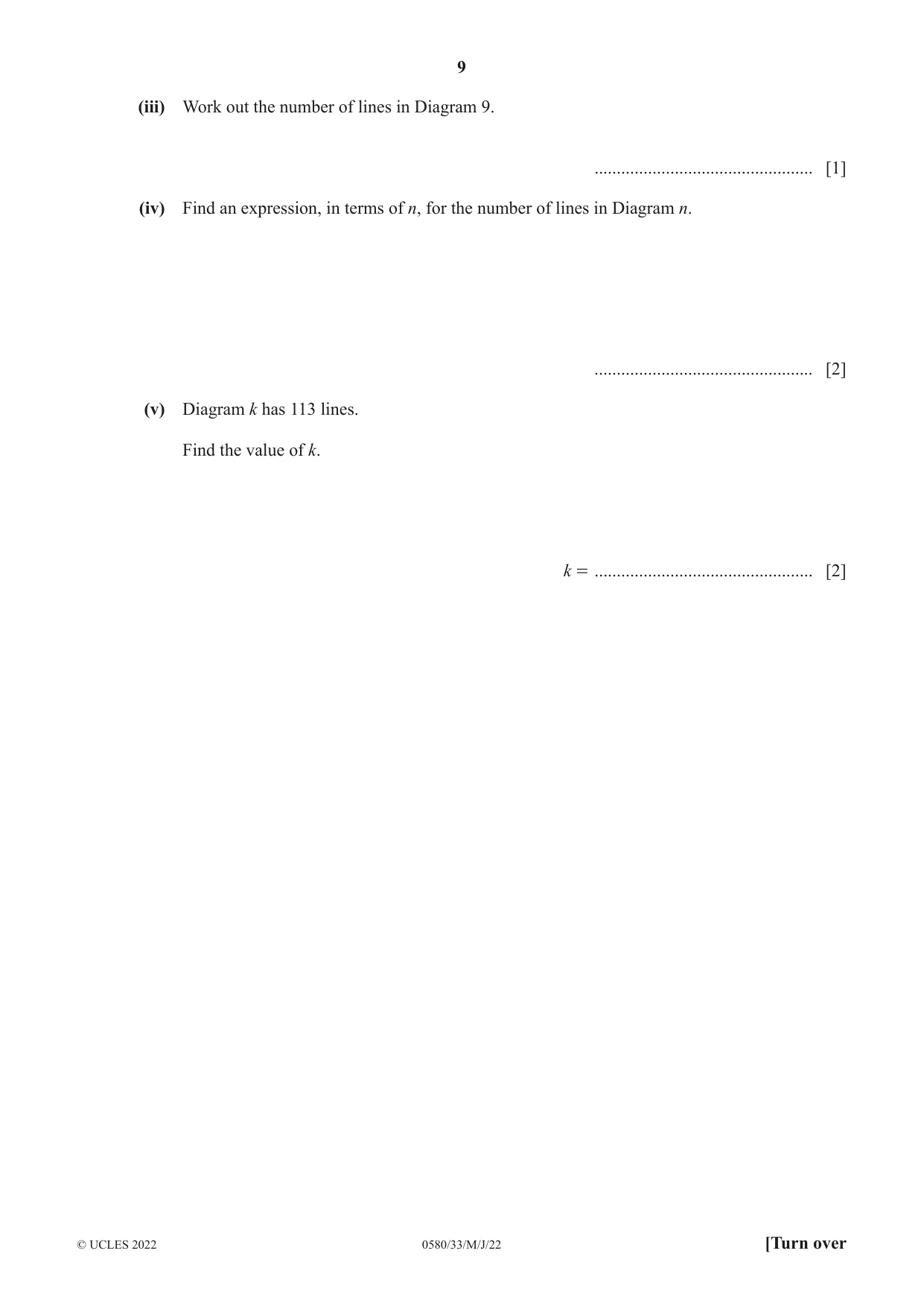
4 The diagram shows a regular polygon. (a) (i) Write down the mathematical name of this polygon. ................................................. [1] (ii) Show that the interior angle of this polygon is 135°. [2] (b) A sequence of diagrams is made by joining these polygons. Diagram 1 Diagram 2 Diagram 3 (i) Complete the table. Diagram number 1 2 3 4 5 Number of lines 8 15 [3] (ii) Write down the term to term rule for the number of lines in the sequence. ................................................. [1] (iii) Work out the number of lines in Diagram 9. ................................................. [1] (iv) Find an expression, in terms of n, for the number of lines in Diagram n. ................................................. [2] (v) Diagram k has 113 lines. Find the value of k. k = ................................................. [2]
Mark scheme: 4(a)(i) Octagon 1 4(a)(ii) (8 2) 180 M2 M1 for 360 ÷ 8 or (8 – 2) × 180 180 – (360 ÷ 8) or 8 4(b)(i) 22 29 36 3 B1 for each or B2FT for adding 7 twice or B1FT for adding 7 between terms once 4(b)(ii) Add 7 oe 1 4(b)(iii) 64 1 4(b)(iv) 7n + 1 oe final answer 2 M1 for jn + 1, j ≠ 0 or 7n + k, k ≠ 1 or for 7n + 1 oe seen but not as final answer 4(b)(v) 16 nfww 2 M1 for their (b)(iv) = 113
Q5 · Work out the number of days in seven weeks
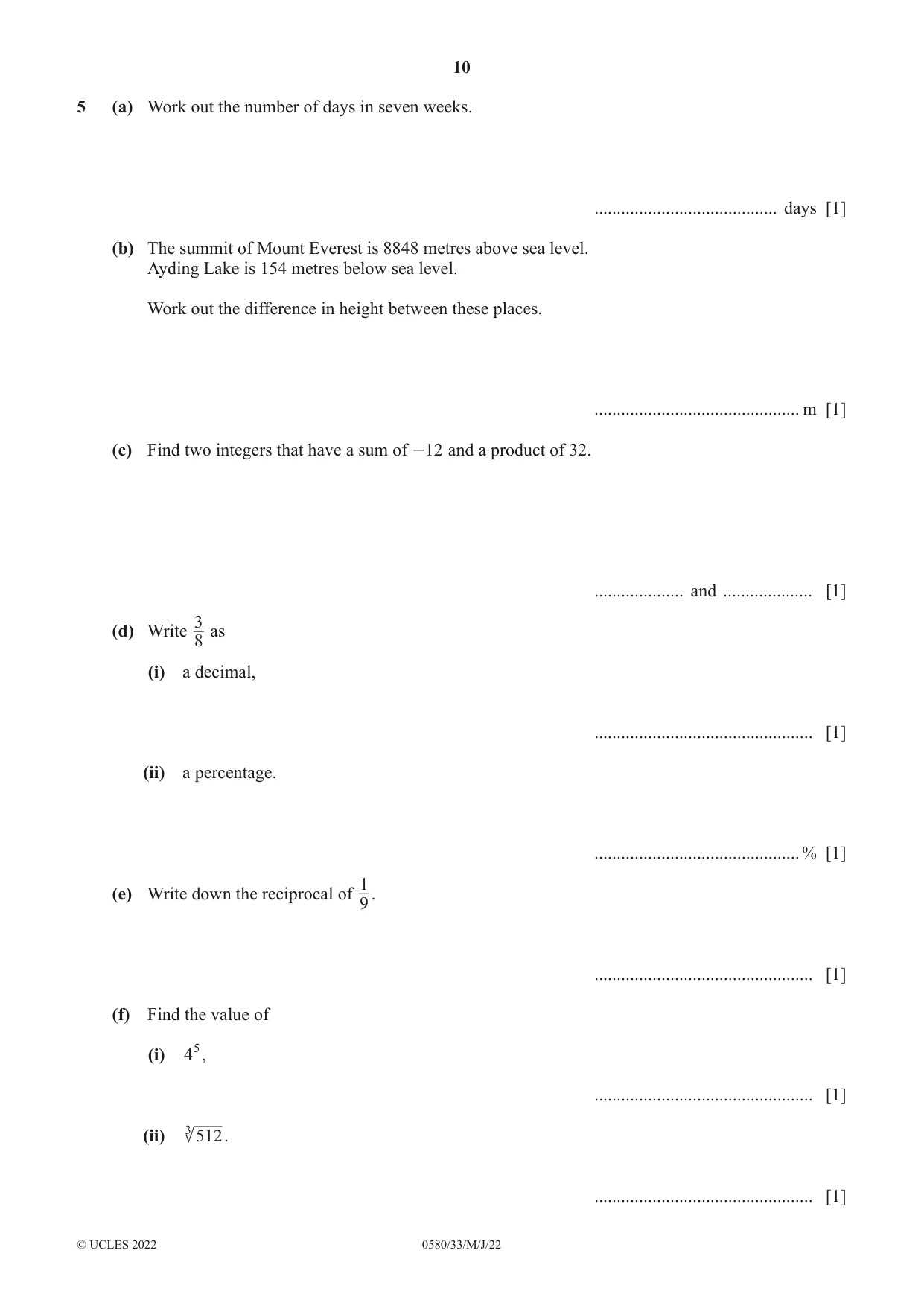
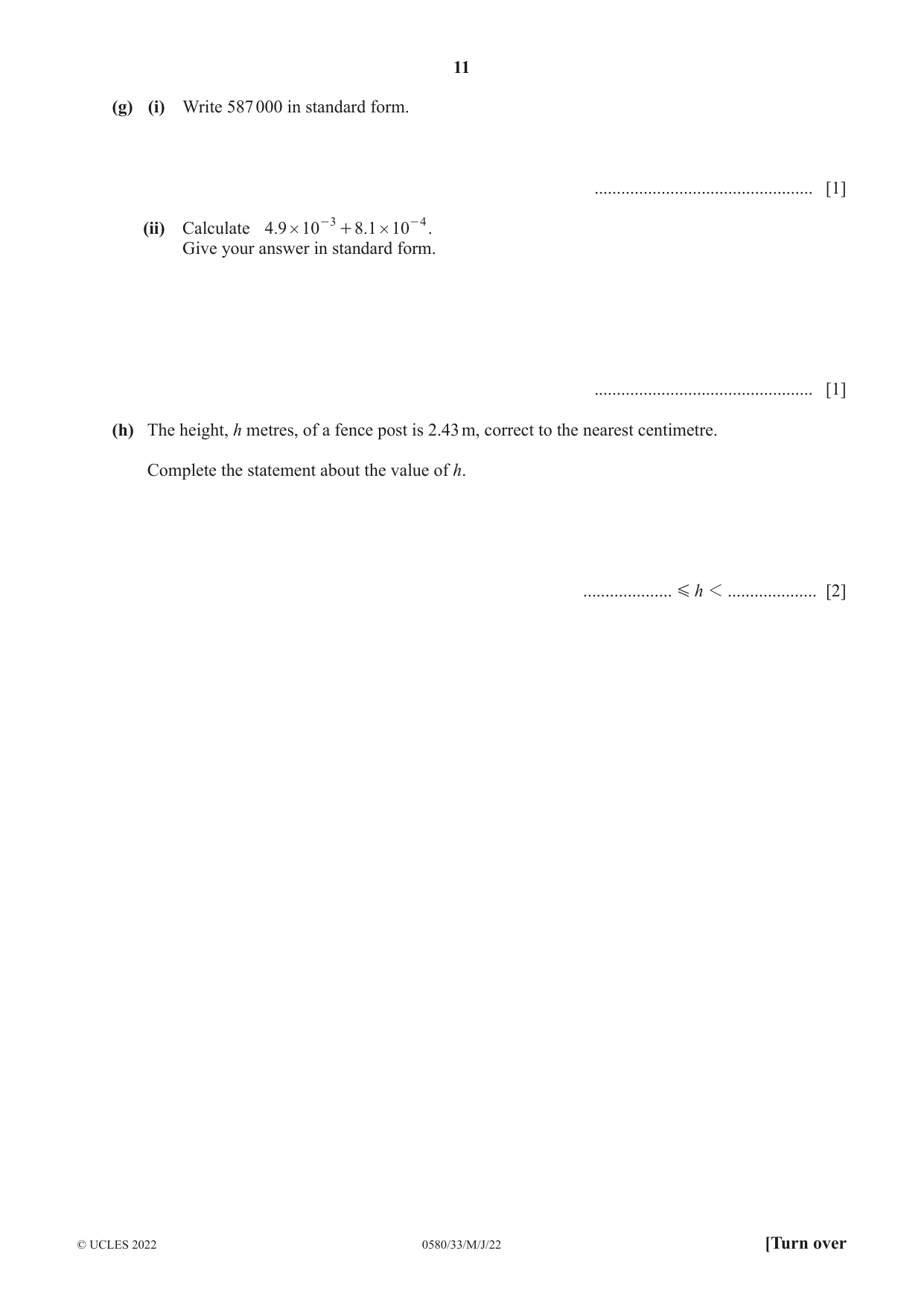
5 (a) Work out the number of days in seven weeks. ......................................... days [1] (b) The summit of Mount Everest is 8848 metres above sea level. Ayding Lake is 154 metres below sea level. Work out the difference in height between these places. .............................................. m [1] (c) Find two integers that have a sum of - 12 and a product of 32. .................... and .................... [1] 3 (d) Write as 8 (i) a decimal, ................................................. [1] (ii) a percentage. ..............................................% [1] (e) Write down the reciprocal of 1. 9 ................................................. [1] (f) Find the value of (i) 45, ................................................. [1] (ii) 3 512 . ................................................. [1] (g) (i) Write 587 000 in standard form. ................................................. [1] (ii) Calculate 4.9 # 10 - 3 + 8.1 # 10 - 4 . Give your answer in standard form. ................................................. [1] (h) The height, h metres, of a fence post is 2.43 m, correct to the nearest centimetre. Complete the statement about the value of h. .................... G h 1 .................... [2]
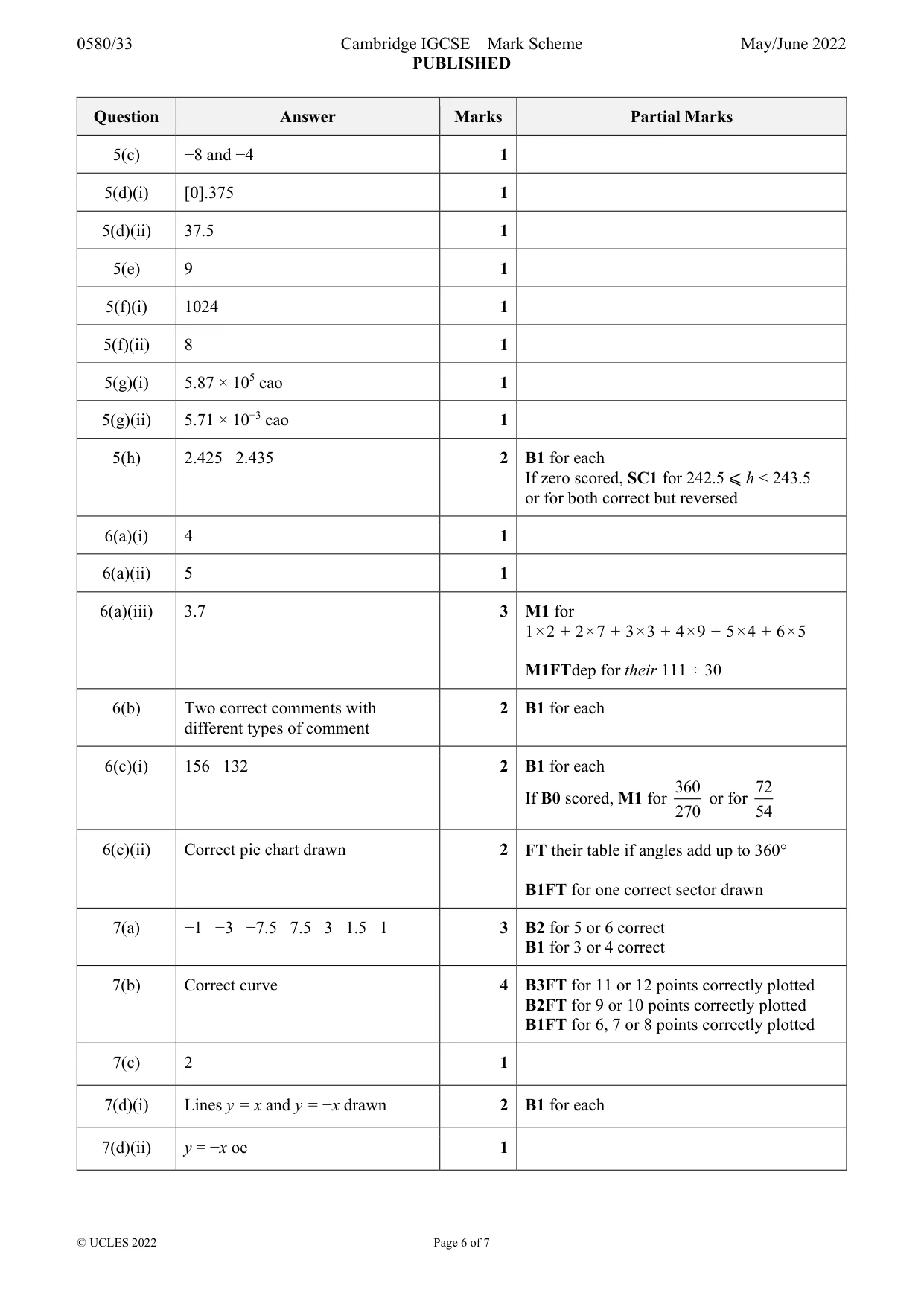
Mark scheme: 5(a) 49 1 5(b) 9002 1 5(c) −8 and −4 1 5(d)(i) [0].375 1 5(d)(ii) 37.5 1 5(e) 9 1 5(f)(i) 1024 1 5(f)(ii) 8 1 5(g)(i) 5.87 × 10⁵ cao 1 5(g)(ii) 5.71 × 10⁻³ cao 1 5(h) 2.425 2.435 2 B1 for each If zero scored, SC1 for 242.5 ⩽ h < 243.5 or for both correct but reversed
Q6 · Maria owns a restaurant with 30 tables
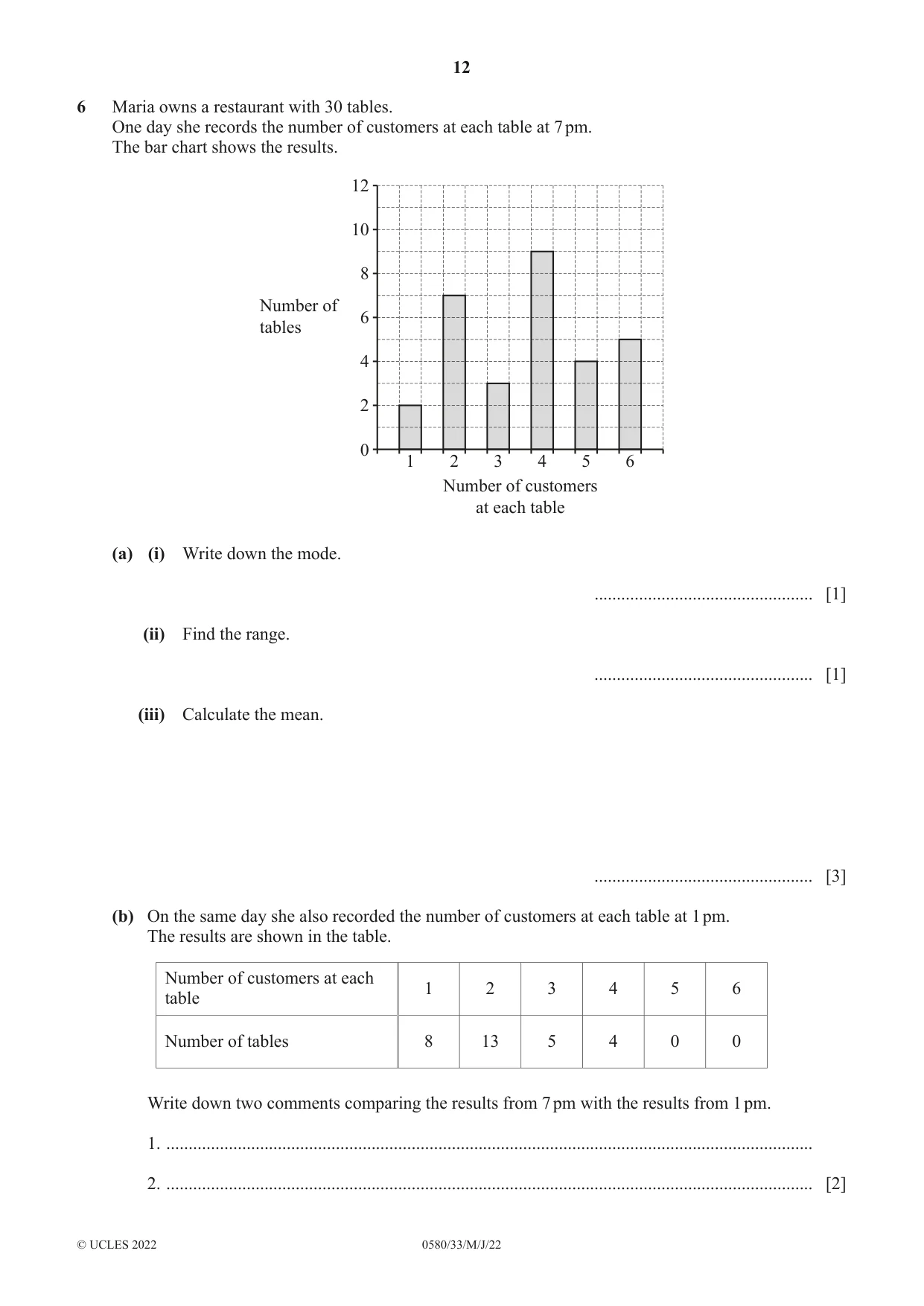
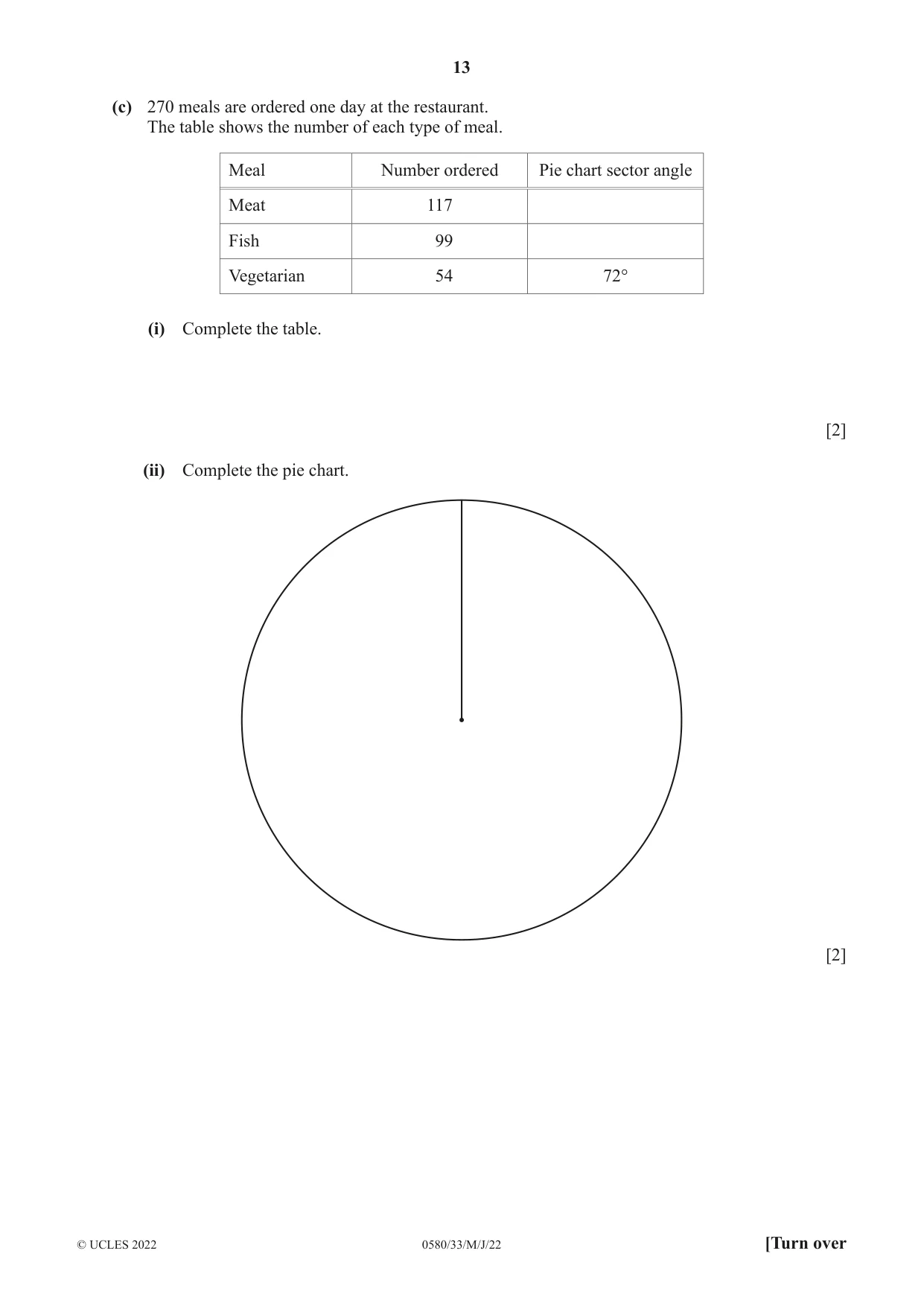
6 Maria owns a restaurant with 30 tables. One day she records the number of customers at each table at 7 pm. The bar chart shows the results. 12 10 8 Number of 6 tables 4 2 0 1 2 3 4 5 6 Number of customers at each table (a) (i) Write down the mode. ................................................. [1] (ii) Find the range. ................................................. [1] (iii) Calculate the mean. ................................................. [3] (b) On the same day she also recorded the number of customers at each table at 1 pm. The results are shown in the table. Number of customers at each 1 2 3 4 5 6 table Number of tables 8 13 5 4 0 0 Write down two comments comparing the results from 7 pm with the results from 1 pm. 1. ................................................................................................................................................. 2. ................................................................................................................................................. [2] (c) 270 meals are ordered one day at the restaurant. The table shows the number of each type of meal. Meal Number ordered Pie chart sector angle Meat 117 Fish 99 Vegetarian 54 72° (i) Complete the table. [2] (ii) Complete the pie chart. [2]
Mark scheme: 6(a)(i) 4 1 6(a)(ii) 5 1 6(a)(iii) 3.7 3 M1 for 1 × 2 + 2 × 7 + 3 × 3 + 4 × 9 + 5 × 4 + 6 × 5 M1FTdep for their 111 ÷ 30 6(b) Two correct comments with 2 B1 for each different types of comment 6(c)(i) 156 132 2 B1 for each 360 72 If B0 scored, M1 for or for 270 54 6(c)(ii) Correct pie chart drawn 2 FT their table if angles add up to 360 B1FT for one correct sector drawn
Q7 · 7 (a) Complete the table of values for y = , x ≠ 0
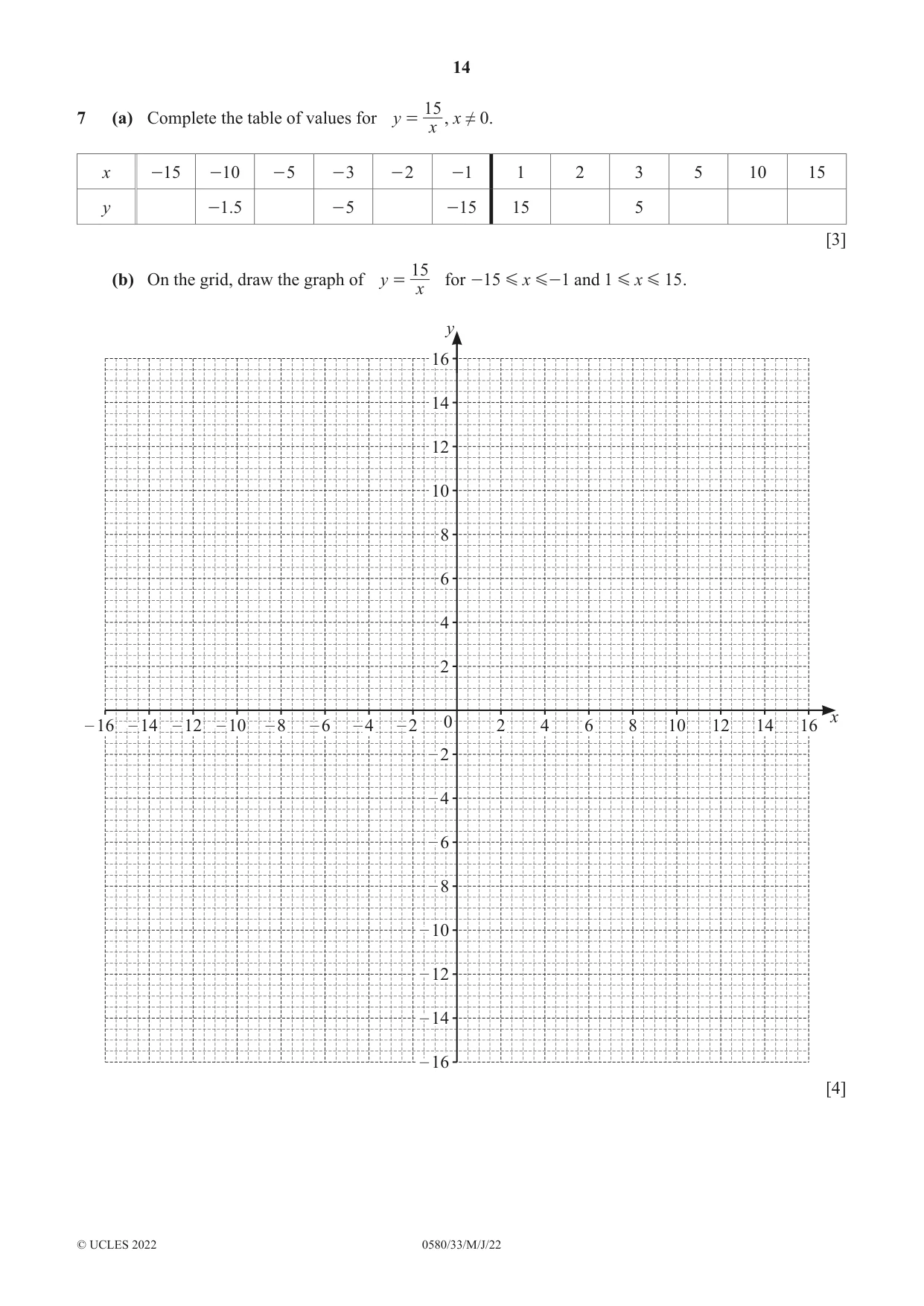
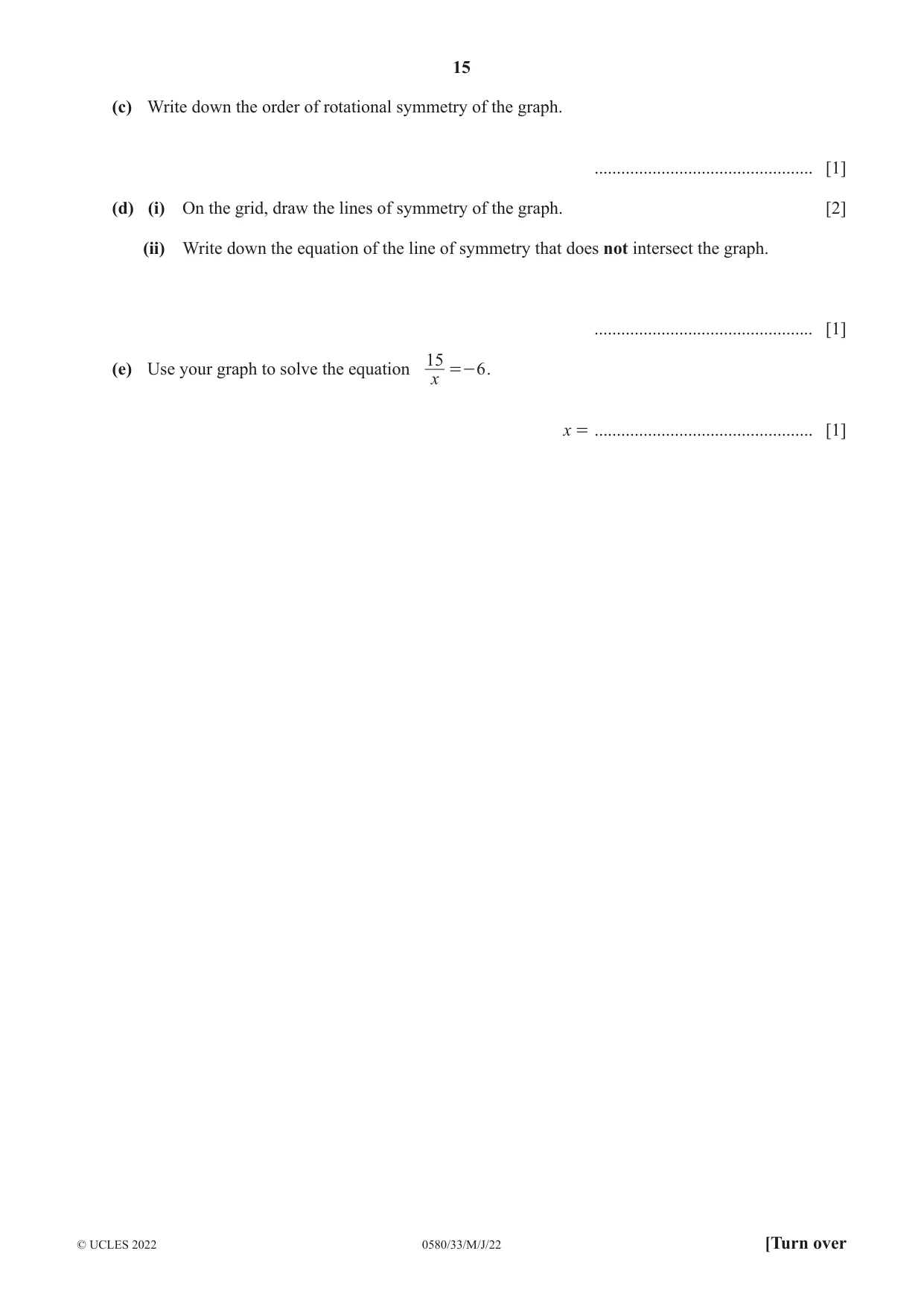
157 (a) Complete the table of values for y = , x ≠ 0. x x - 15 - 10 - 5 - 3 - 2 - 1 1 2 3 5 10 15 y - .15 - 5 - 15 15 5 [3] 15 (b) On the grid, draw the graph of y = for - 15 G x G - 1 and 1 G x G 15 . x y 16 14 12 10 8 6 4 2 x – 16 – 14 – 12 – 10 – 8 – 6 – 4 – 2 0 2 4 6 8 10 12 14 16 – 2 – 4 – 6 – 8 – 10 – 12 – 14 – 16 [4] (c) Write down the order of rotational symmetry of the graph. ................................................. [1] (d) (i) On the grid, draw the lines of symmetry of the graph. [2] (ii) Write down the equation of the line of symmetry that does not intersect the graph. ................................................. [1] 15(e) Use your graph to solve the equation =- 6 . x x = ................................................. [1]
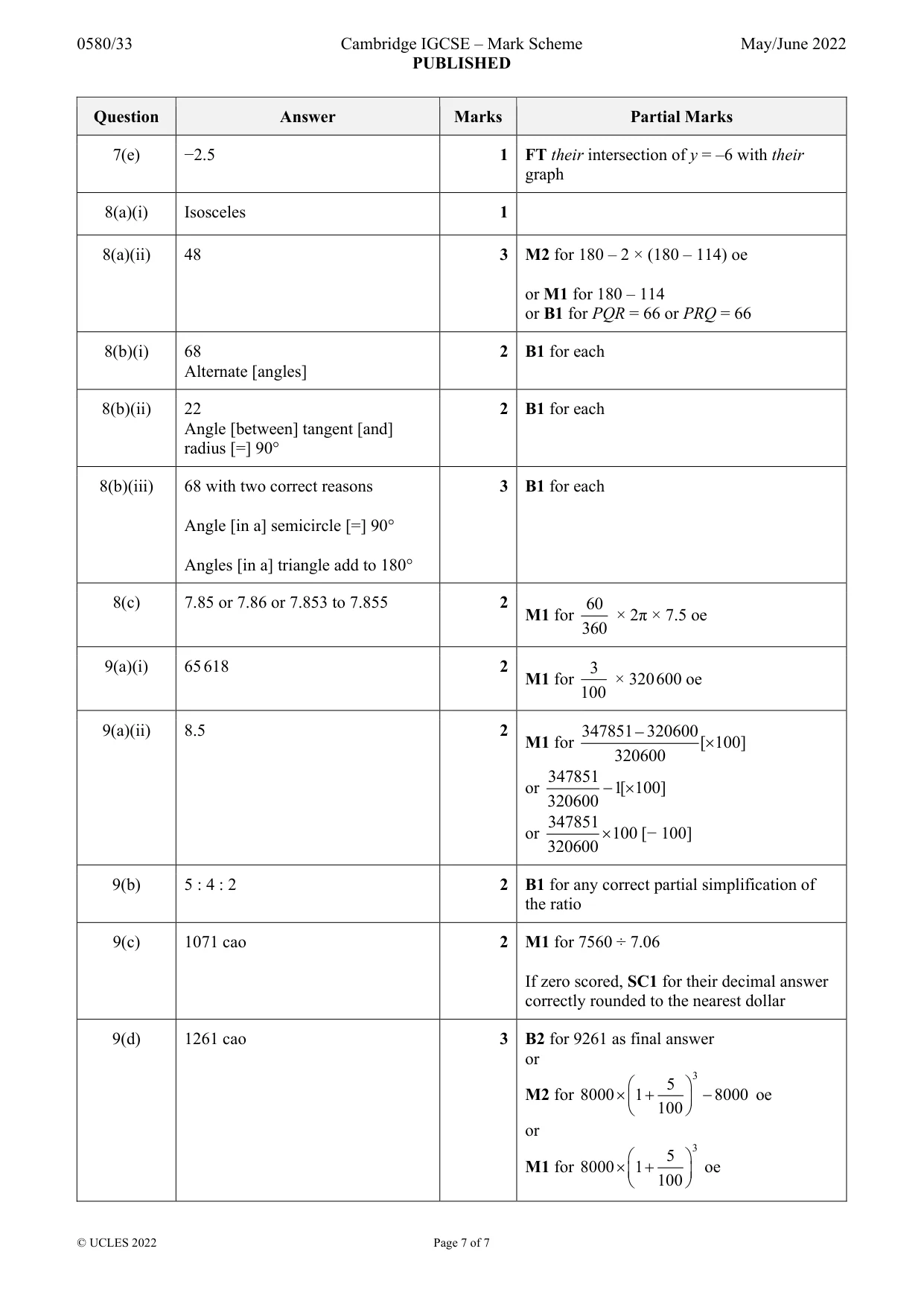
Mark scheme: 7(a) −1 −3 −7.5 7.5 3 1.5 1 3 B2 for 5 or 6 correct B1 for 3 or 4 correct 7(b) Correct curve 4 B3FT for 11 or 12 points correctly plotted B2FT for 9 or 10 points correctly plotted B1FT for 6, 7 or 8 points correctly plotted 7(c) 2 1 7(d)(i) Lines y = x and y = −x drawn 2 B1 for each 7(d)(ii) y = −x oe 1 7(e) −2.5 1 FT their intersection of y = –6 with their graph
Q8 · P NOT TO SCALE 114° Q R S In the diagram, PQ = PR and QRS is a straight line
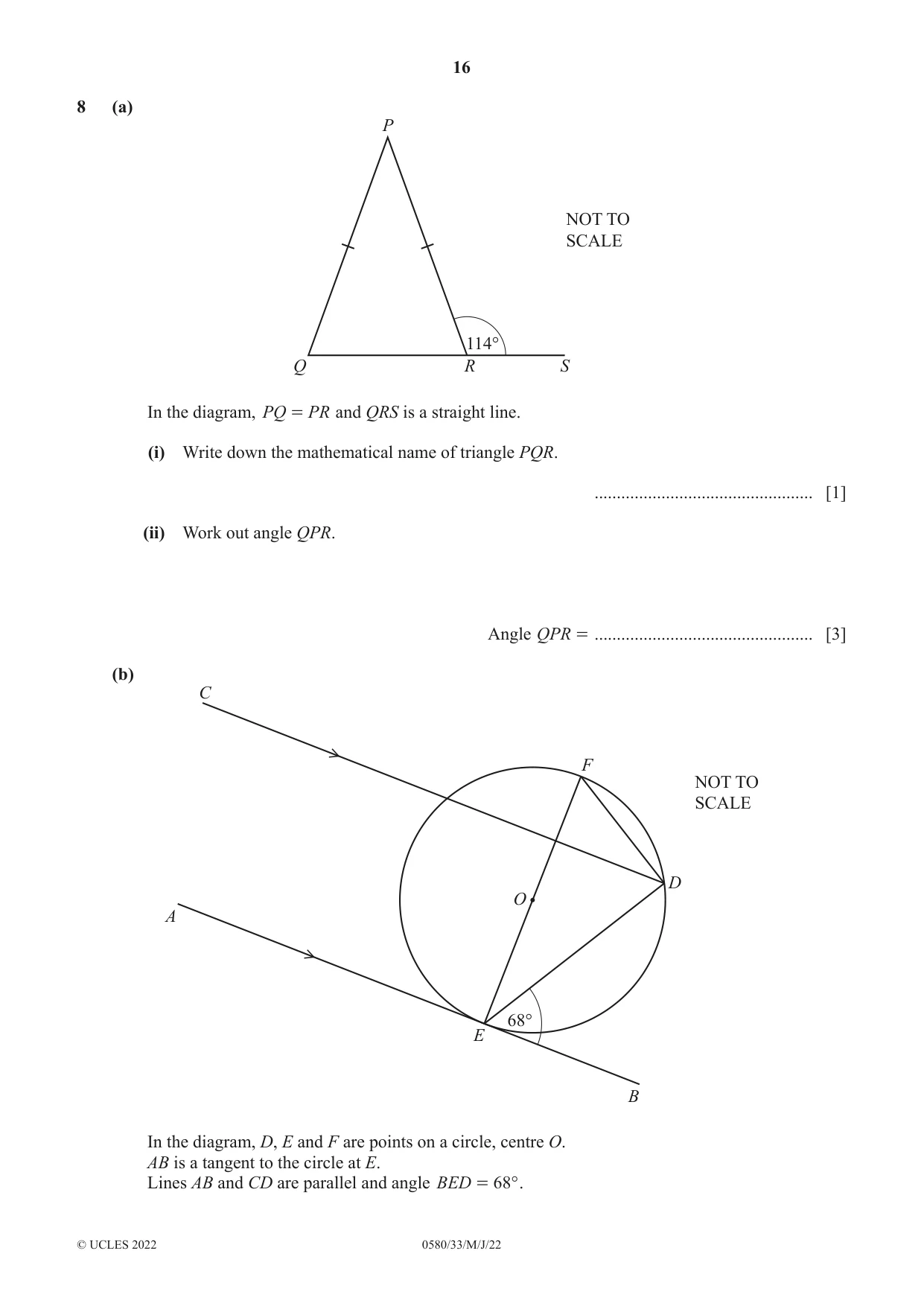
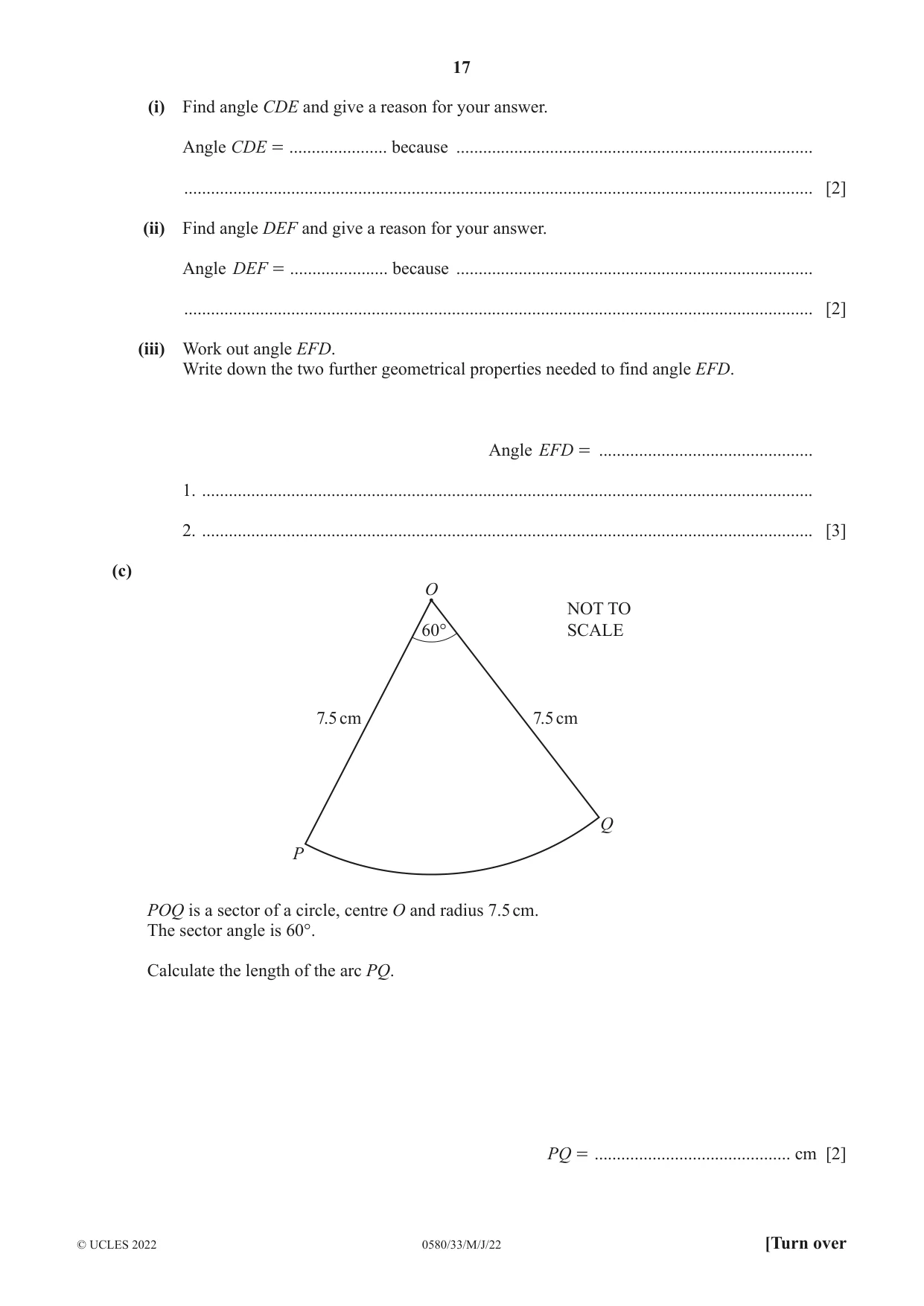
8 (a) P NOT TO SCALE 114° Q R S In the diagram, PQ = PR and QRS is a straight line. (i) Write down the mathematical name of triangle PQR. ................................................. [1] (ii) Work out angle QPR. Angle QPR = ................................................. [3] (b) C F NOT TO SCALE D O A 68° E B In the diagram, D, E and F are points on a circle, centre O. AB is a tangent to the circle at E. Lines AB and CD are parallel and angle BED = 68° . (i) Find angle CDE and give a reason for your answer. Angle CDE = ...................... because ................................................................................ ............................................................................................................................................. [2] (ii) Find angle DEF and give a reason for your answer. Angle DEF = ...................... because ................................................................................ ............................................................................................................................................. [2] (iii) Work out angle EFD. Write down the two further geometrical properties needed to find angle EFD. Angle EFD = ................................................ 1. ......................................................................................................................................... 2. ......................................................................................................................................... [3] (c) O NOT TO 60° SCALE 7.5 cm 7.5 cm Q P POQ is a sector of a circle, centre O and radius 7.5 cm. The sector angle is 60°. Calculate the length of the arc PQ. PQ = ............................................ cm [2]
Mark scheme: 8(a)(i) Isosceles 1 8(a)(ii) 48 3 M2 for 180 – 2 × (180 – 114) oe or M1 for 180 – 114 or B1 for PQR = 66 or PRQ = 66 8(b)(i) 68 2 B1 for each Alternate [angles] 8(b)(ii) 22 2 B1 for each Angle [between] tangent [and] radius [=] 90° 8(b)(iii) 68 with two correct reasons 3 B1 for each Angle [in a] semicircle [=] 90° Angles [in a] triangle add to 180° 8(c) 7.85 or 7.86 or 7.853 to 7.855 2 60 M1 for × 2π × 7.5 oe 360
Q9 · Ahmed owns a company
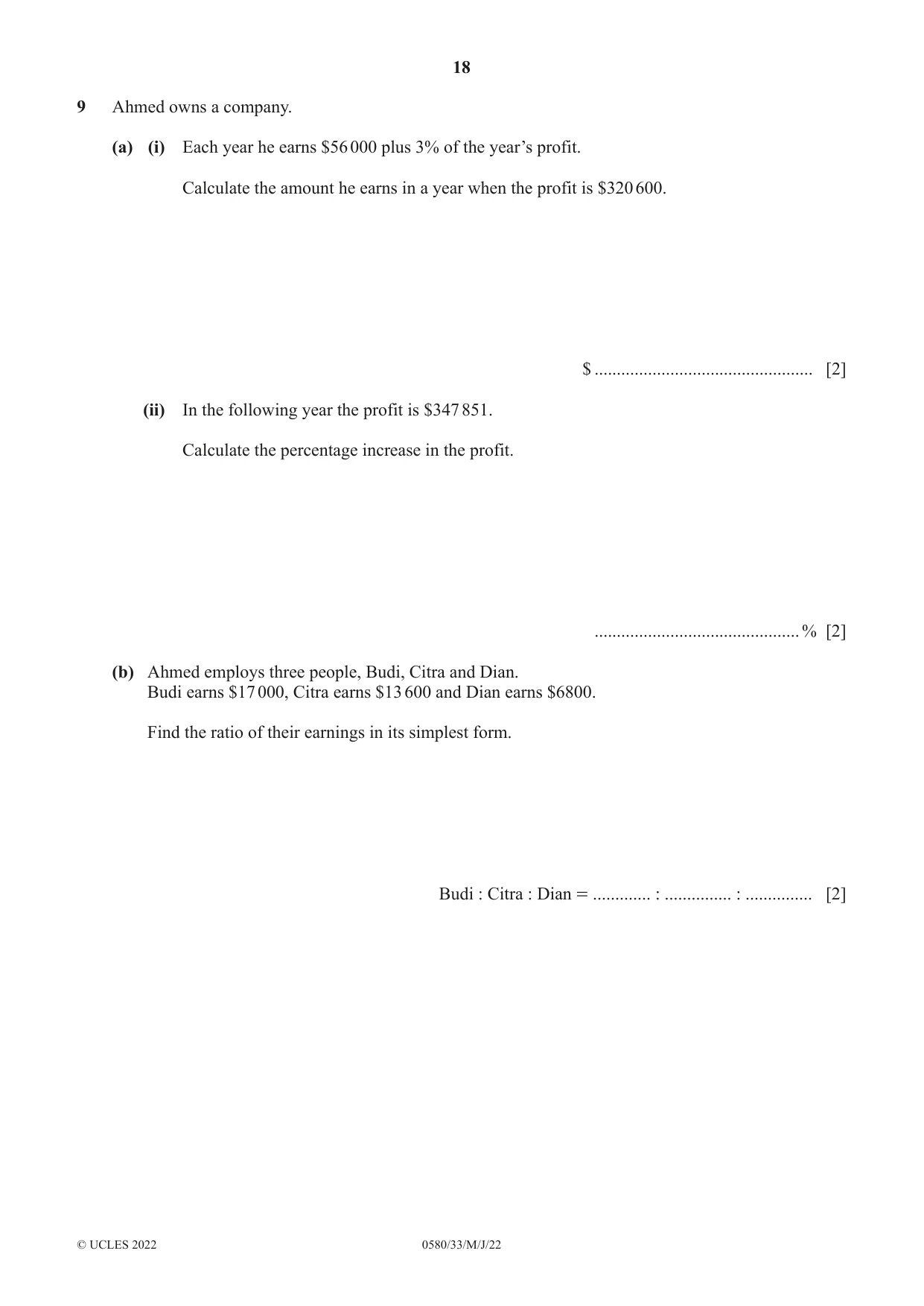
9 Ahmed owns a company. (a) (i) Each year he earns $56 000 plus 3% of the year’s profit. Calculate the amount he earns in a year when the profit is $320 600. $ ................................................. [2] (ii) In the following year the profit is $347 851. Calculate the percentage increase in the profit. ..............................................% [2] (b) Ahmed employs three people, Budi, Citra and Dian. Budi earns $17 000, Citra earns $13 600 and Dian earns $6800. Find the ratio of their earnings in its simplest form. Budi : Citra : Dian = ............. : ............... : ............... [2] (c) Ahmed buys materials from China costing 7560 yuan. Work out the cost of the materials in dollars when the exchange rate is $1 = 7.06 yuan. Give your answer correct to the nearest dollar. $ ................................................. [2] (d) Ahmed borrows $8 000 for 3 years at a rate of 5% per year compound interest. Calculate the amount of interest he will pay at the end of the 3 years. $ ................................................. [3]
Mark scheme: 9(a)(i) 65 618 2 3 M1 for × 320 600 oe 100 9(a)(ii) 8.5 2 347851 320600[ 100] M1 for 320600 347851 or 1[ 100] 320600 347851 or 100 [− 100] 320600 9(b) 5 : 4 : 2 2 B1 for any correct partial simplification of the ratio 9(c) 1071 cao 2 M1 for 7560 ÷ 7.06 If zero scored, SC1 for their decimal answer correctly rounded to the nearest dollar 9(d) 1261 cao 3 B2 for 9261 as final answer or 5 3 M2 for 8000 1 8000 oe 100 or 5 3 M1 for 8000 1 oe 100
What was in this paper
The subtopics covered by these 9 questions, and how many questions each got. Open one in a new tab to see every Cambridge question on it.
What you needed in this session
Cambridge’s own grade thresholds for 2022 May/June, Paper 3 · Variant 3. A higher threshold means an easier paper — the bar moves with how the cohort did.