Cambridge IGCSE Mathematics 0580 — 2021 Oct/Nov Paper 3 · Variant 1
0580/31/O/N/21 · 10 questions · 104 marks · ≈117 min
The question paper and its mark scheme, free to read here and free to download. This is Cambridge’s own paper, exactly as it was sat.
Question paper20 pages
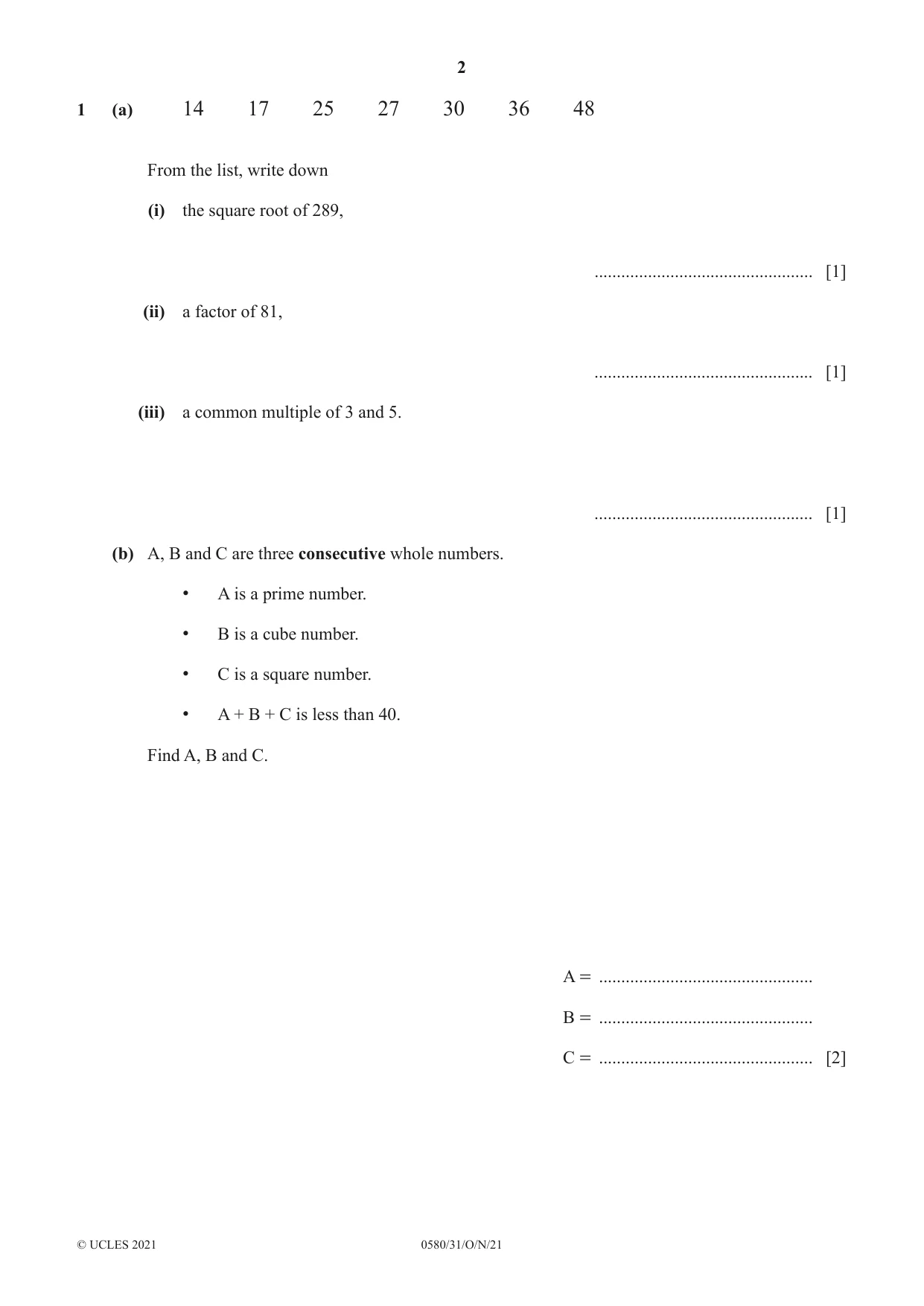
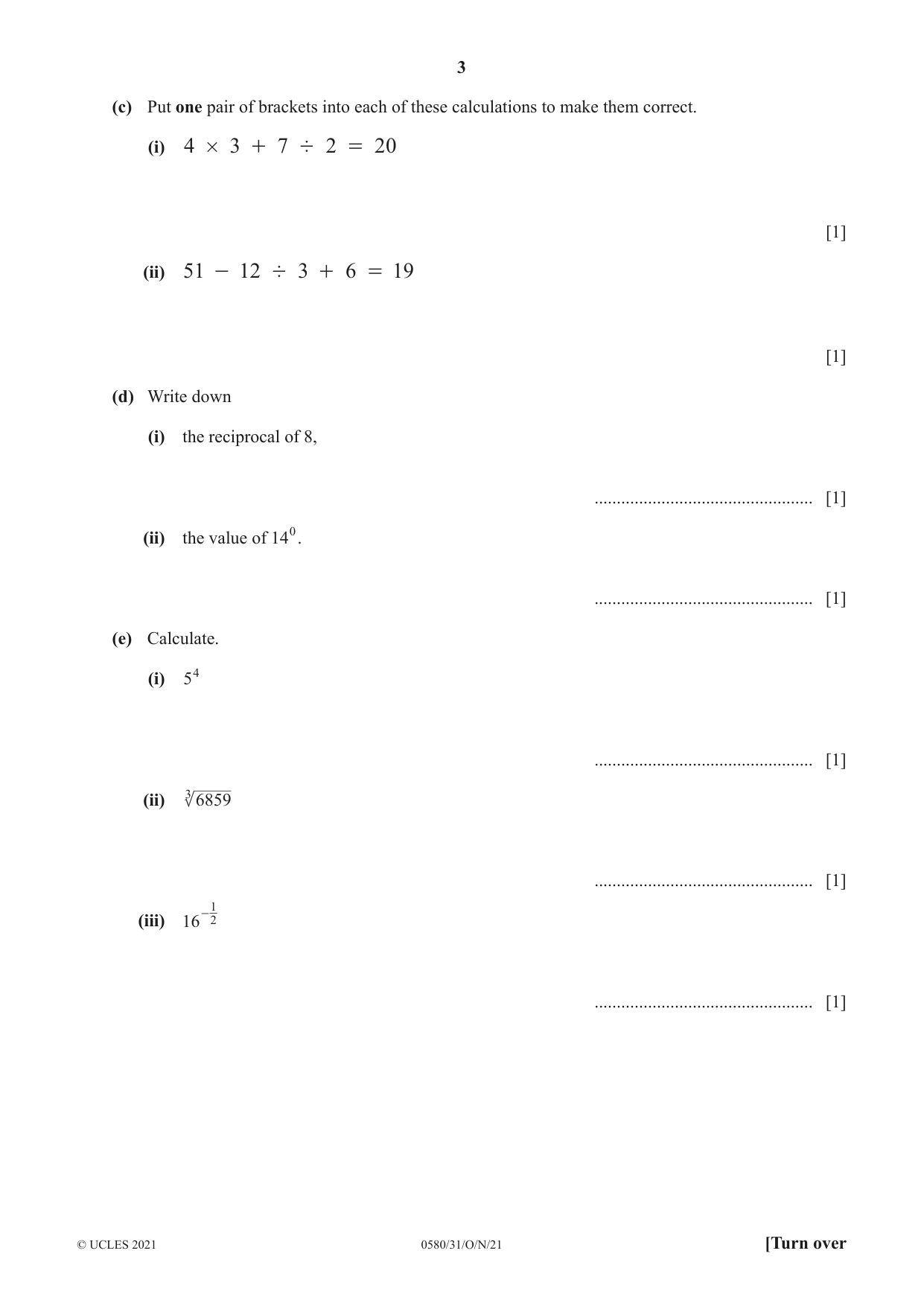
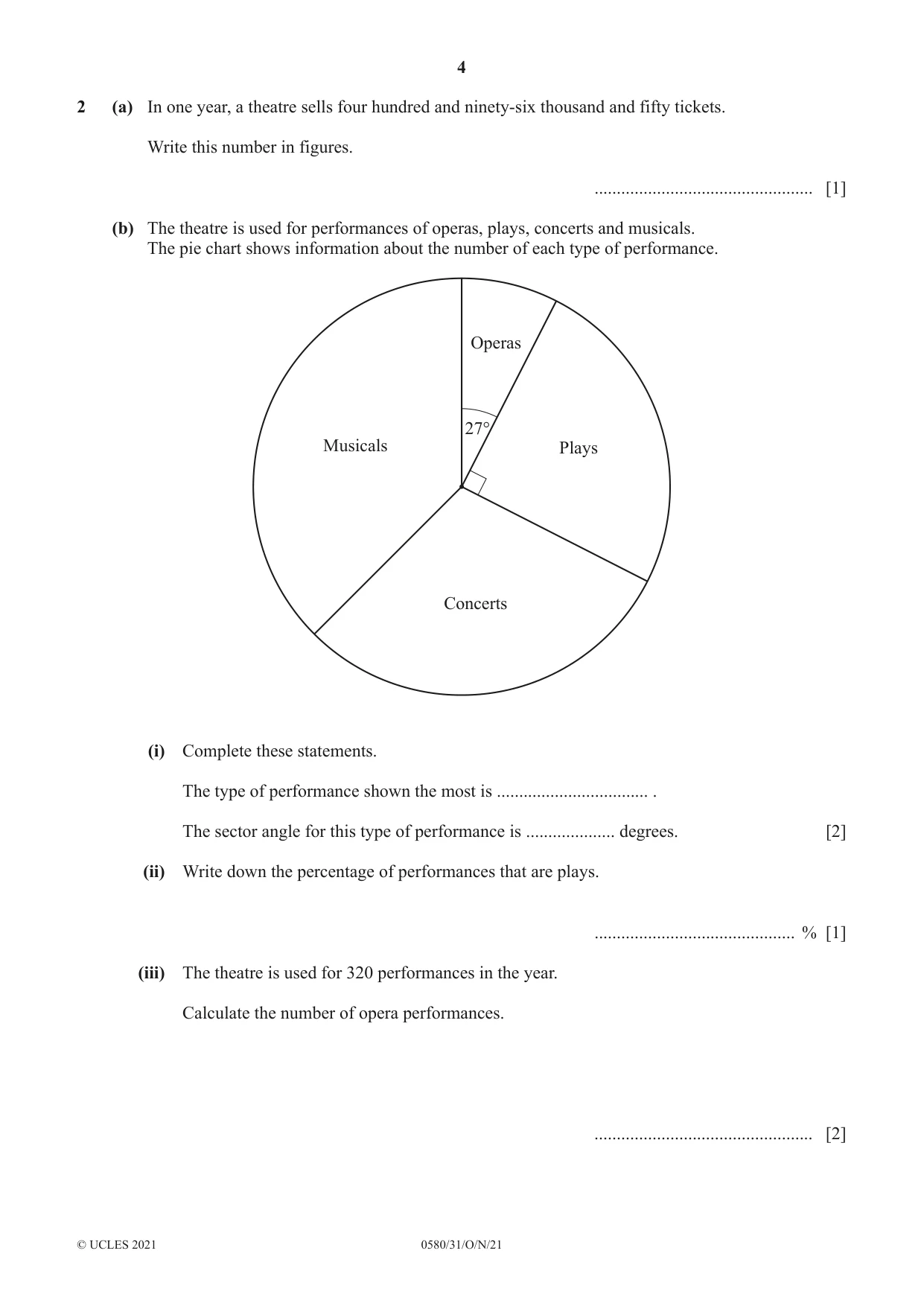
Mark scheme8 pages
Answers below. Sit the paper first if you are practising.
Questions as text
Q1 · 14 17 25 27 30 36 48 From the list, write down (i) the square root of 289…
1 (a) 14 17 25 27 30 36 48 From the list, write down (i) the square root of 289, ................................................. [1] (ii) a factor of 81, ................................................. [1] (iii) a common multiple of 3 and 5. ................................................. [1] (b) A, B and C are three consecutive whole numbers. • A is a prime number. • B is a cube number. • C is a square number. • A + B + C is less than 40. Find A, B and C. A = ................................................ B = ................................................ C = ................................................ [2] (c) Put one pair of brackets into each of these calculations to make them correct. (i) 4 # 3 + 7 ' 2 = 20 [1] (ii) 51 - 12 ' 3 + 6 = 19 [1] (d) Write down (i) the reciprocal of 8, ................................................. [1] (ii) the value of 140. ................................................. [1] (e) Calculate. (i) 54 ................................................. [1] (ii) 3 6859 ................................................. [1] 1 (iii) 16 - 2 ................................................. [1]
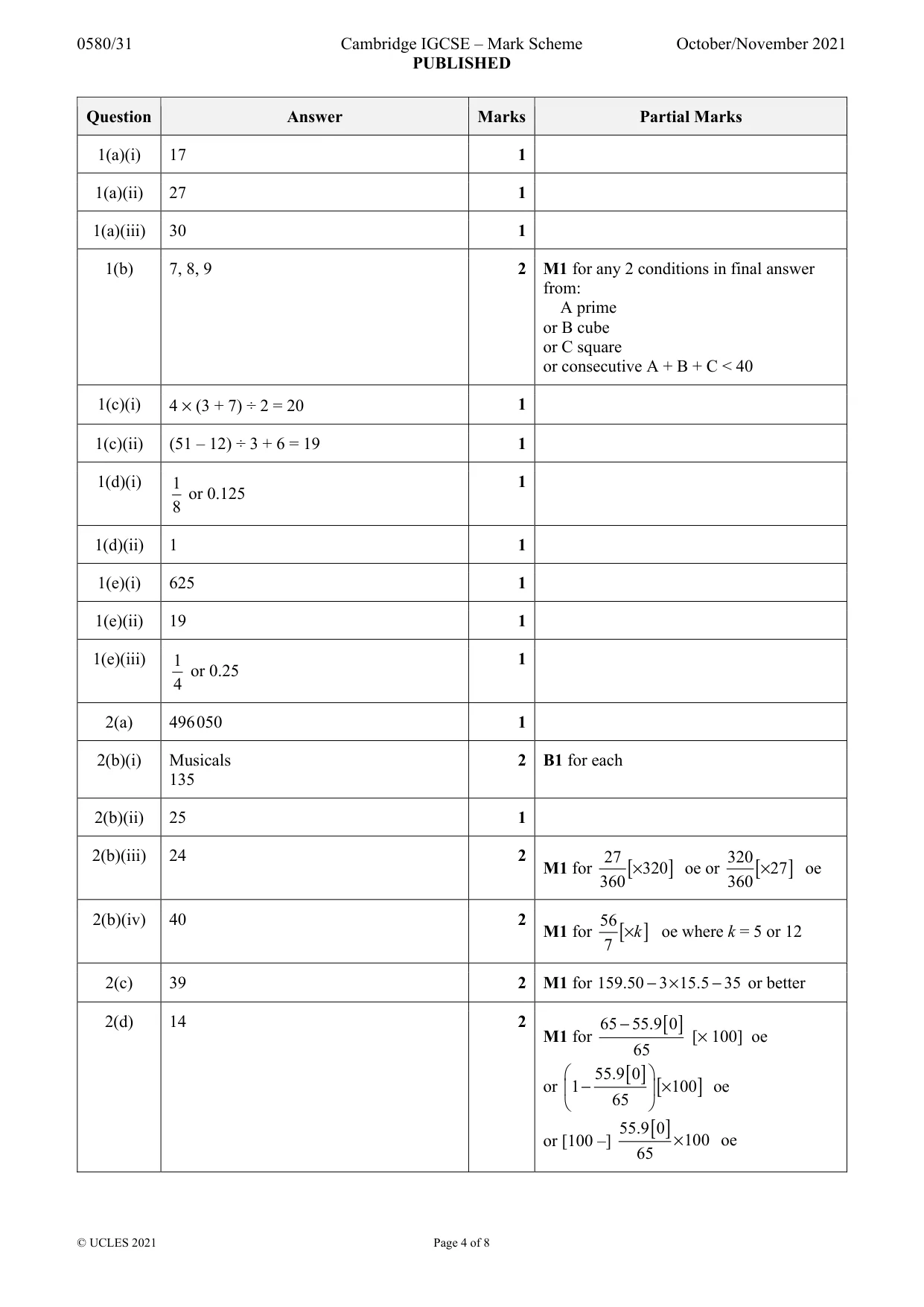
Mark scheme: Question Answer Marks Partial Marks 1(a)(i) 17 1 1(a)(ii) 27 1 1(a)(iii) 30 1 1(b) 7, 8, 9 2 M1 for any 2 conditions in final answer from: A prime or B cube or C square or consecutive A + B + C < 40 1(c)(i) 4 × (3 + 7) ÷ 2 = 20 1 1(c)(ii) (51 – 12) ÷ 3 + 6 = 19 1 1(d)(i) 1 1 or 0.125 8 1(d)(ii) 1 1 1(e)(i) 625 1 1(e)(ii) 19 1 1(e)(iii) 1 1 or 0.25 4
Q2 · In one year, a theatre sells four hundred and ninety-six thousand and fifty tickets
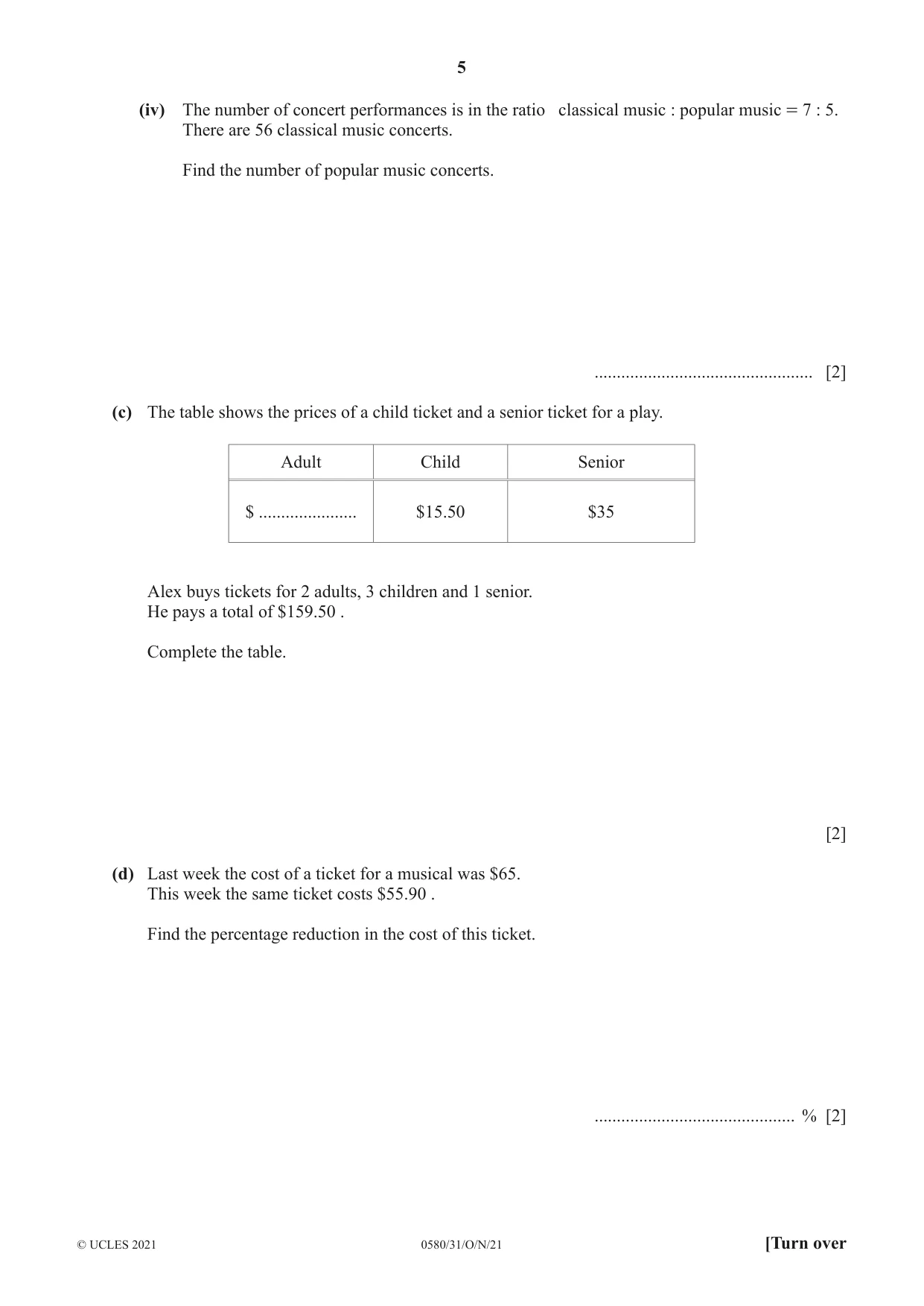
2 (a) In one year, a theatre sells four hundred and ninety-six thousand and fifty tickets. Write this number in figures. ................................................. [1] (b) The theatre is used for performances of operas, plays, concerts and musicals. The pie chart shows information about the number of each type of performance. Operas 27° Musicals Plays Concerts (i) Complete these statements. The type of performance shown the most is .................................. . The sector angle for this type of performance is .................... degrees. [2] (ii) Write down the percentage of performances that are plays. ............................................. % [1] (iii) The theatre is used for 320 performances in the year. Calculate the number of opera performances. ................................................. [2] (iv) The number of concert performances is in the ratio classical music : popular music = 7 : 5. There are 56 classical music concerts. Find the number of popular music concerts. ................................................. [2] (c) The table shows the prices of a child ticket and a senior ticket for a play. Adult Child Senior $ ...................... $15.50 $35 Alex buys tickets for 2 adults, 3 children and 1 senior. He pays a total of $159.50 . Complete the table. [2] (d) Last week the cost of a ticket for a musical was $65. This week the same ticket costs $55.90 . Find the percentage reduction in the cost of this ticket. ............................................. % [2]
Mark scheme: 2(a) 496 050 1 2(b)(i) Musicals 2 B1 for each 135 2(b)(ii) 25 1 2(b)(iii) 24 2 27 320 M1 for [× 320 ] oe or [× 27 ] oe 360 360 2(b)(iv) 40 2 56 M1 for [×k ] oe where k = 5 or 12 7 2(c) 39 2 M1 for 159.50 −×3 15.5 − 35 or better 2(d) 14 2 65 − 55.9 [ 0 ] M1 for [× 100] oe 65 55.9 [ 0 ] or 1 − [× 100 ] oe 65 55.9 [ 0 ] or [100 –] × 100 oe 65
Q3 · 360 people go on a school trip to one of four places
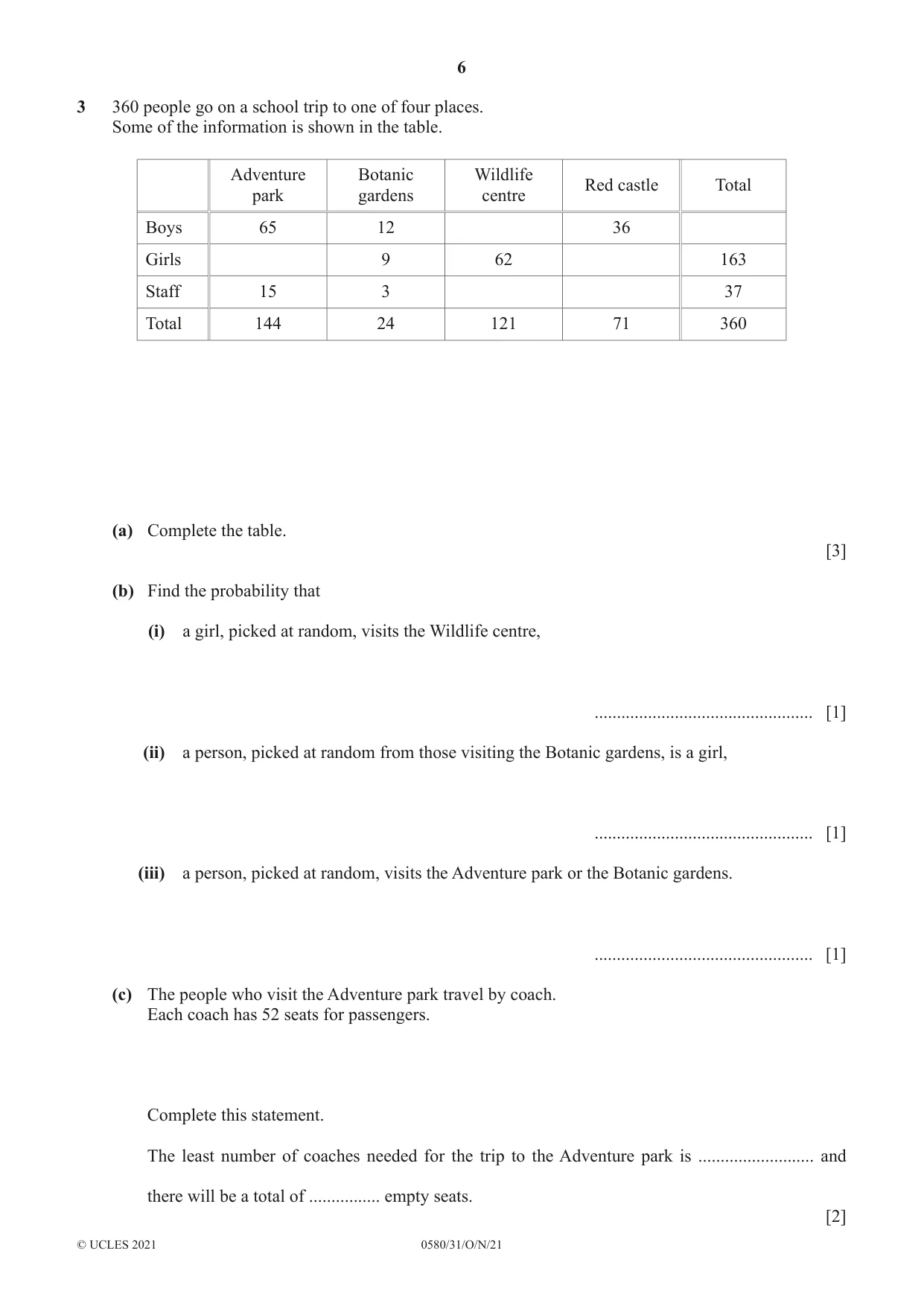
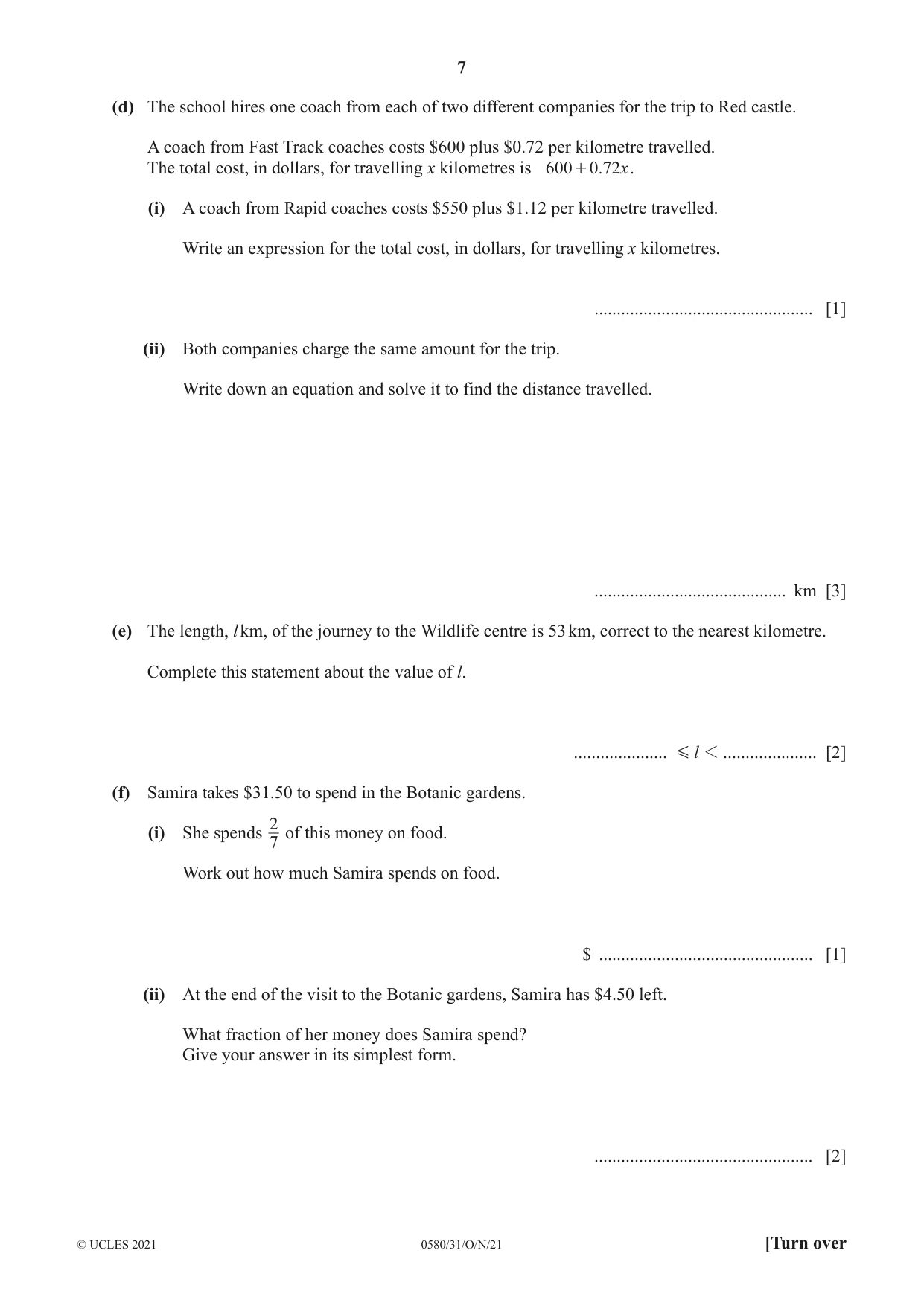
3 360 people go on a school trip to one of four places. Some of the information is shown in the table. Adventure Botanic Wildlife Red castle Total park gardens centre Boys 65 12 36 Girls 9 62 163 Staff 15 3 37 Total 144 24 121 71 360 (a) Complete the table. [3] (b) Find the probability that (i) a girl, picked at random, visits the Wildlife centre, ................................................. [1] (ii) a person, picked at random from those visiting the Botanic gardens, is a girl, ................................................. [1] (iii) a person, picked at random, visits the Adventure park or the Botanic gardens. ................................................. [1] (c) The people who visit the Adventure park travel by coach. Each coach has 52 seats for passengers. Complete this statement. The least number of coaches needed for the trip to the Adventure park is .......................... and there will be a total of ................ empty seats. [2] (d) The school hires one coach from each of two different companies for the trip to Red castle. A coach from Fast Track coaches costs $600 plus $0.72 per kilometre travelled. The total cost, in dollars, for travelling x kilometres is 600 + 0.72x . (i) A coach from Rapid coaches costs $550 plus $1.12 per kilometre travelled. Write an expression for the total cost, in dollars, for travelling x kilometres. ................................................. [1] (ii) Both companies charge the same amount for the trip. Write down an equation and solve it to find the distance travelled. ........................................... km [3] (e) The length, l km, of the journey to the Wildlife centre is 53 km, correct to the nearest kilometre. Complete this statement about the value of l. ..................... G l 1 ..................... [2] (f) Samira takes $31.50 to spend in the Botanic gardens. 2 (i) She spends of this money on food. 7 Work out how much Samira spends on food. $ ................................................ [1] (ii) At the end of the visit to the Botanic gardens, Samira has $4.50 left. What fraction of her money does Samira spend? Give your answer in its simplest form. ................................................. [2]
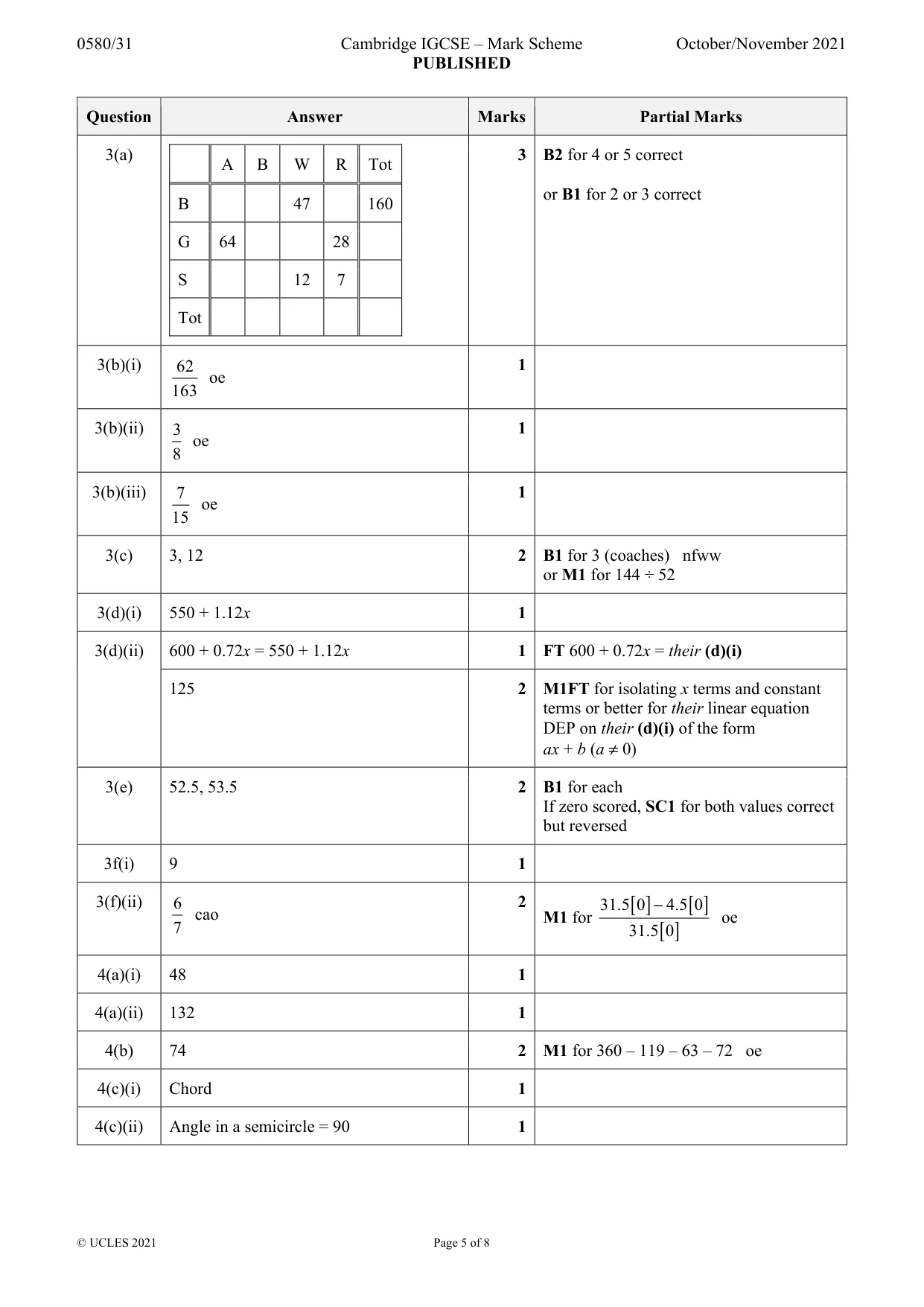
Mark scheme: 3(a) 3 B2 for 4 or 5 correct A B W R Tot or B1 for 2 or 3 correct B 47 160 G 64 28 S 12 7 Tot 3(b)(i) 62 1 oe 163 3(b)(ii) 3 1 oe 8 3(b)(iii) 7 1 oe 15 3(c) 3, 12 2 B1 for 3 (coaches) nfww or M1 for 144 ÷ 52 3(d)(i) 550 + 1.12x 1 3(d)(ii) 600 + 0.72x = 550 + 1.12x 1 FT 600 + 0.72x = their (d)(i) 125 2 M1FT for isolating x terms and constant terms or better for their linear equation DEP on their (d)(i) of the form ax + b (a ≠ 0) 3(e) 52.5, 53.5 2 B1 for each If zero scored, SC1 for both values correct but reversed 3f(i) 9 1 3(f)(ii) 6 2 31.5 [ 0 ] − 4.5 [ 0 ] cao M1 for oe 7 31.5 [ 0 ]
Q4 · A° 48° NOT TO SCALE b° The diagram shows two pairs of parallel lines
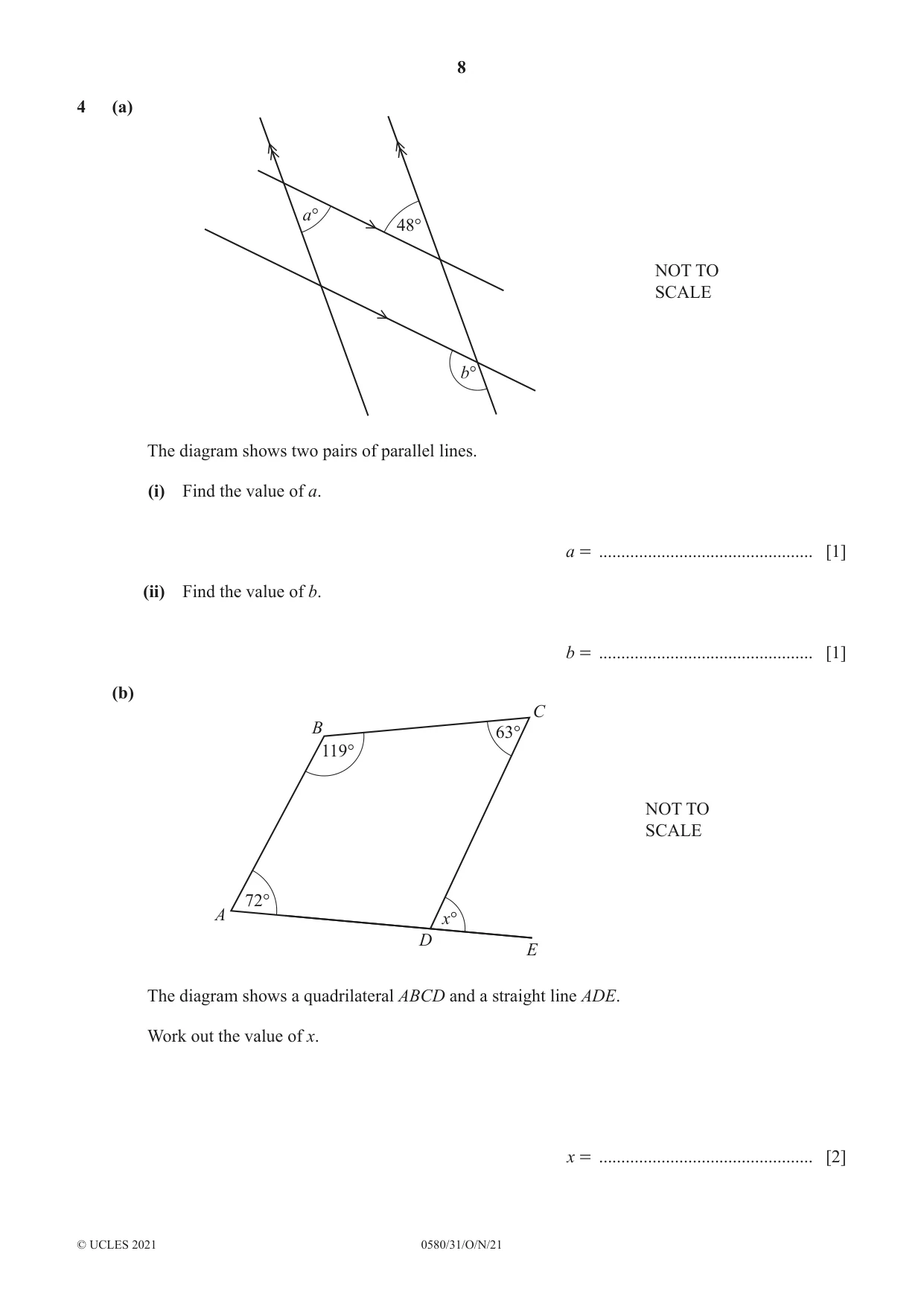
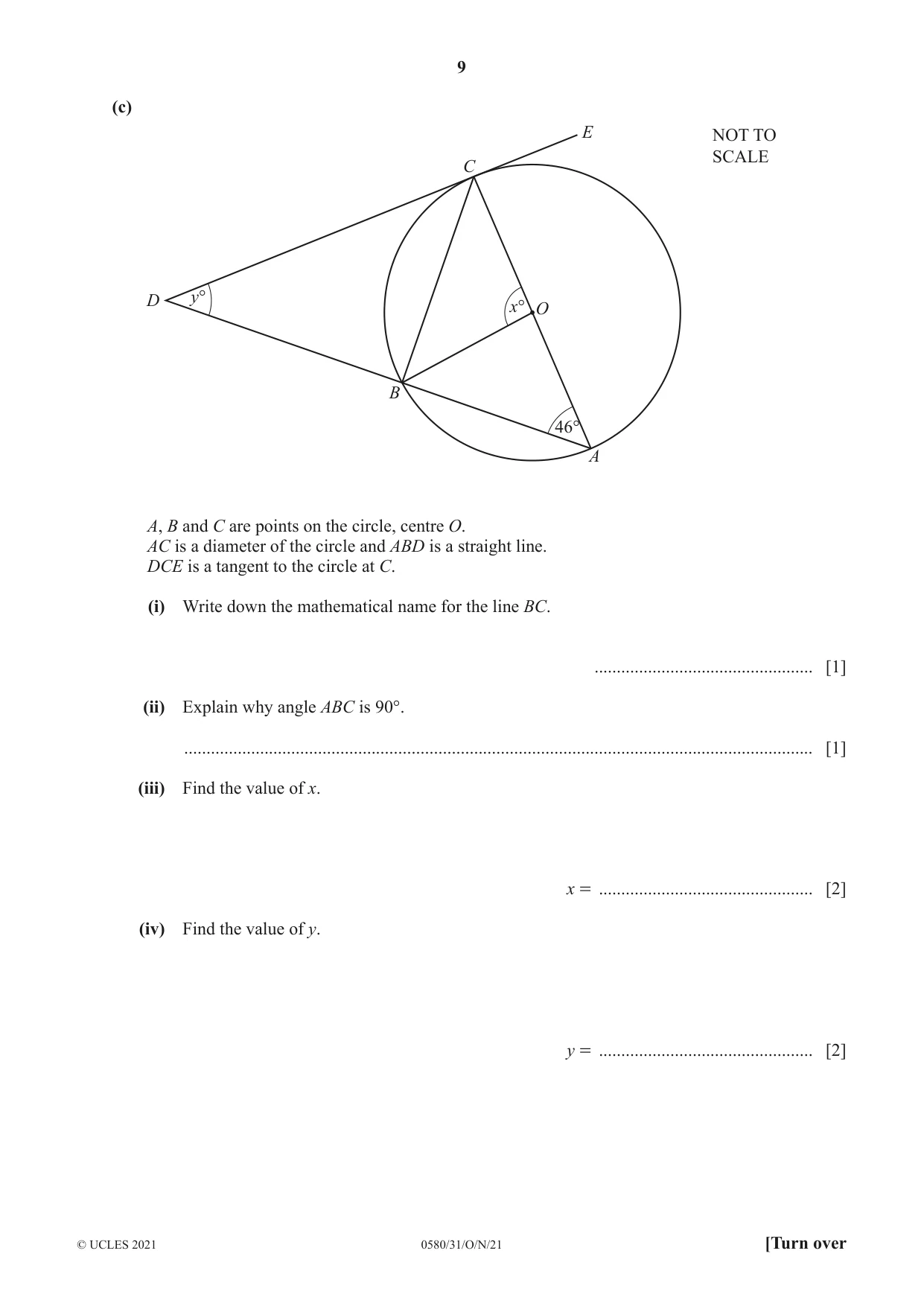
4 (a) a° 48° NOT TO SCALE b° The diagram shows two pairs of parallel lines. (i) Find the value of a. a = ................................................ [1] (ii) Find the value of b. b = ................................................ [1] (b) C B 63° 119° NOT TO SCALE 72° A x° D E The diagram shows a quadrilateral ABCD and a straight line ADE. Work out the value of x. x = ................................................ [2] (c) E NOT TO SCALE C D y° x° O B 46° A A, B and C are points on the circle, centre O. AC is a diameter of the circle and ABD is a straight line. DCE is a tangent to the circle at C. (i) Write down the mathematical name for the line BC. ................................................. [1] (ii) Explain why angle ABC is 90°. ............................................................................................................................................. [1] (iii) Find the value of x. x = ................................................ [2] (iv) Find the value of y. y = ................................................ [2]
Mark scheme: 4(a)(i) 48 1 4(a)(ii) 132 1 4(b) 74 2 M1 for 360 – 119 – 63 – 72 oe 4(c)(i) Chord 1 4(c)(ii) Angle in a semicircle = 90 1 4(c)(iii) 92 2 B1 for OBA = 46 or BOA = 88 or BCO = 44 or M1 for 180 – [180 – (46 + 46)] oe or 180 – [90 – 46] × 2 oe or 46 + 46 oe 4(c)(iv) 44 2 B1 for angle ACD = 90 soi or M1 for 180 – 90 – 46 oe
Q5 · 11 students record the time they spent on social media and watching television during one…
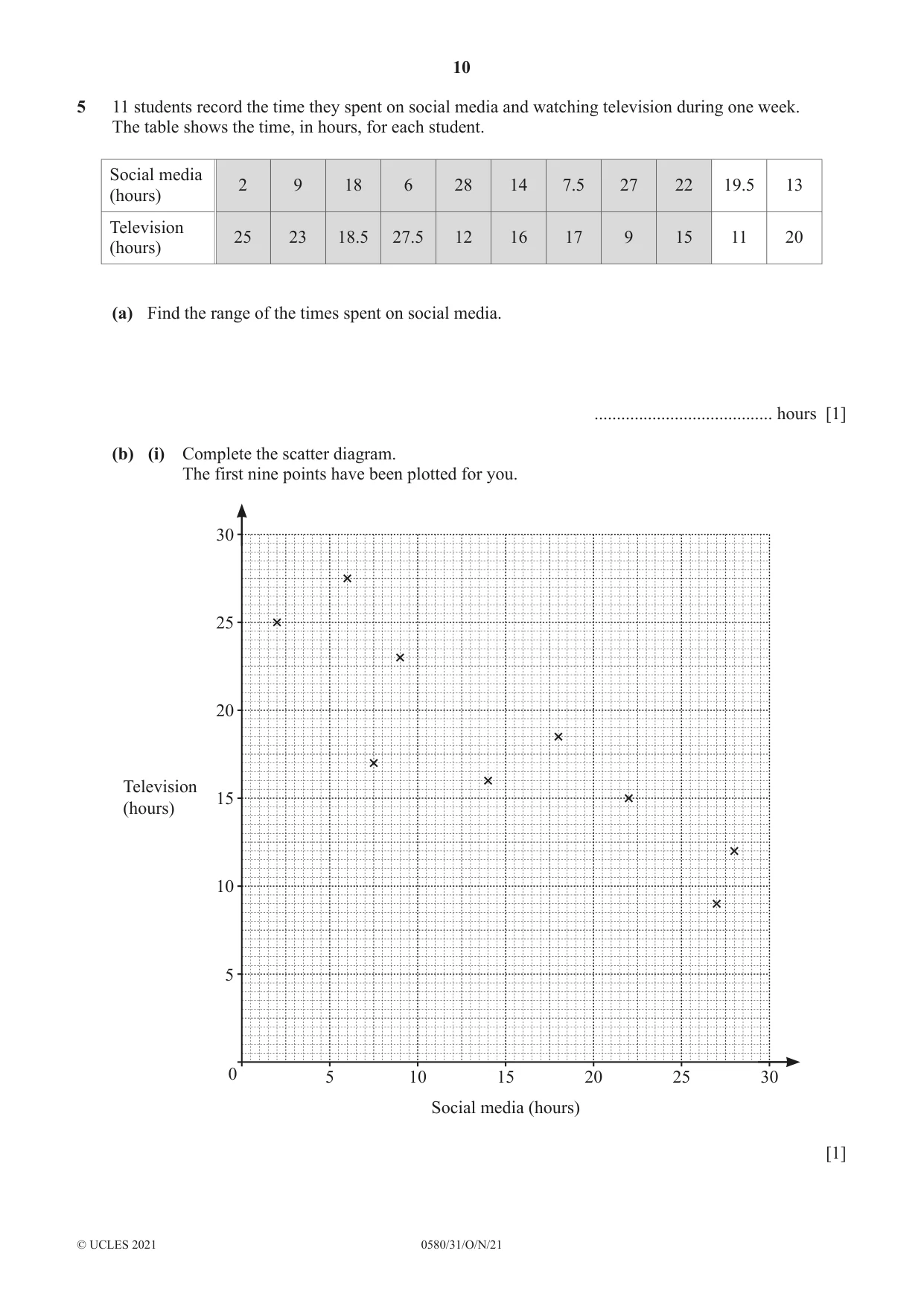
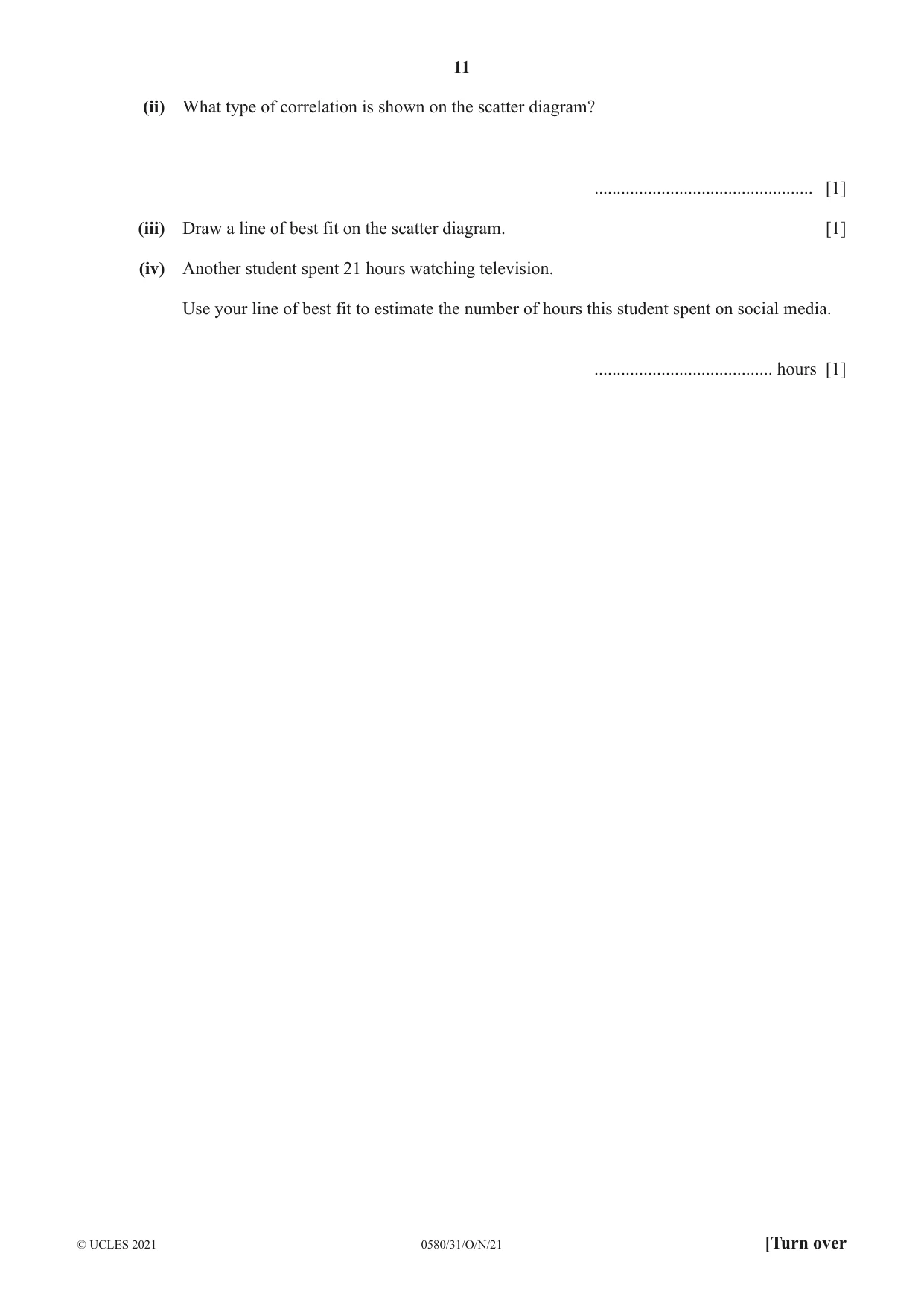
5 11 students record the time they spent on social media and watching television during one week. The table shows the time, in hours, for each student. Social media 2 9 18 6 28 14 7.5 27 22 19.5 13 (hours) Television 25 23 18.5 27.5 12 16 17 9 15 11 20 (hours) (a) Find the range of the times spent on social media. ........................................ hours [1] (b) (i) Complete the scatter diagram. The first nine points have been plotted for you. 30 25 20 Television 15 (hours) 10 5 0 5 10 15 20 25 30 Social media (hours) [1] (ii) What type of correlation is shown on the scatter diagram? ................................................. [1] (iii) Draw a line of best fit on the scatter diagram. [1] (iv) Another student spent 21 hours watching television. Use your line of best fit to estimate the number of hours this student spent on social media. ........................................ hours [1]
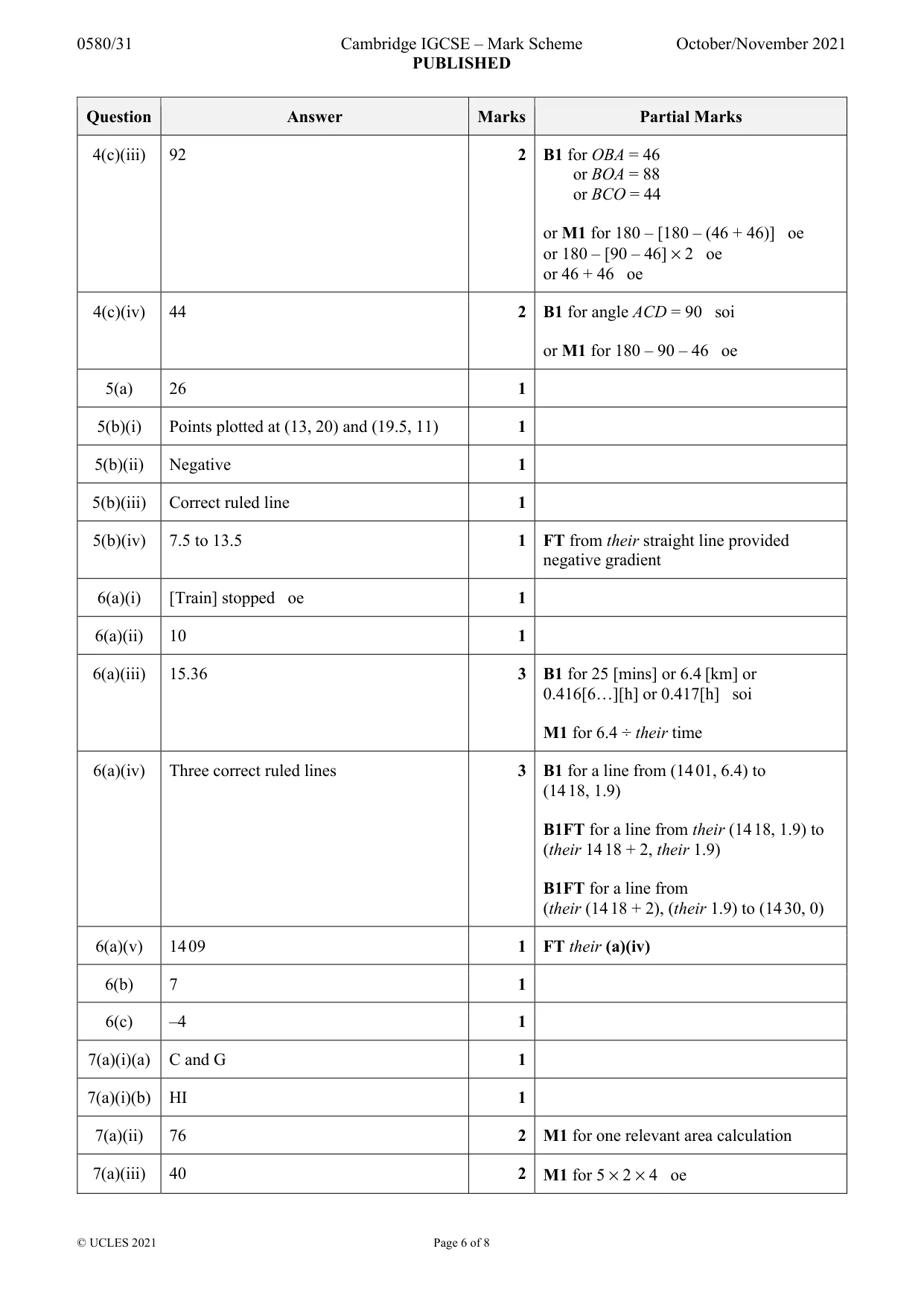
Mark scheme: 5(a) 26 1 5(b)(i) Points plotted at (13, 20) and (19.5, 11) 1 5(b)(ii) Negative 1 5(b)(iii) Correct ruled line 1 5(b)(iv) 7.5 to 13.5 1 FT from their straight line provided negative gradient
Q6 · The diagram shows the travel graph of a train journey from Wengen to Kleine Scheidegg
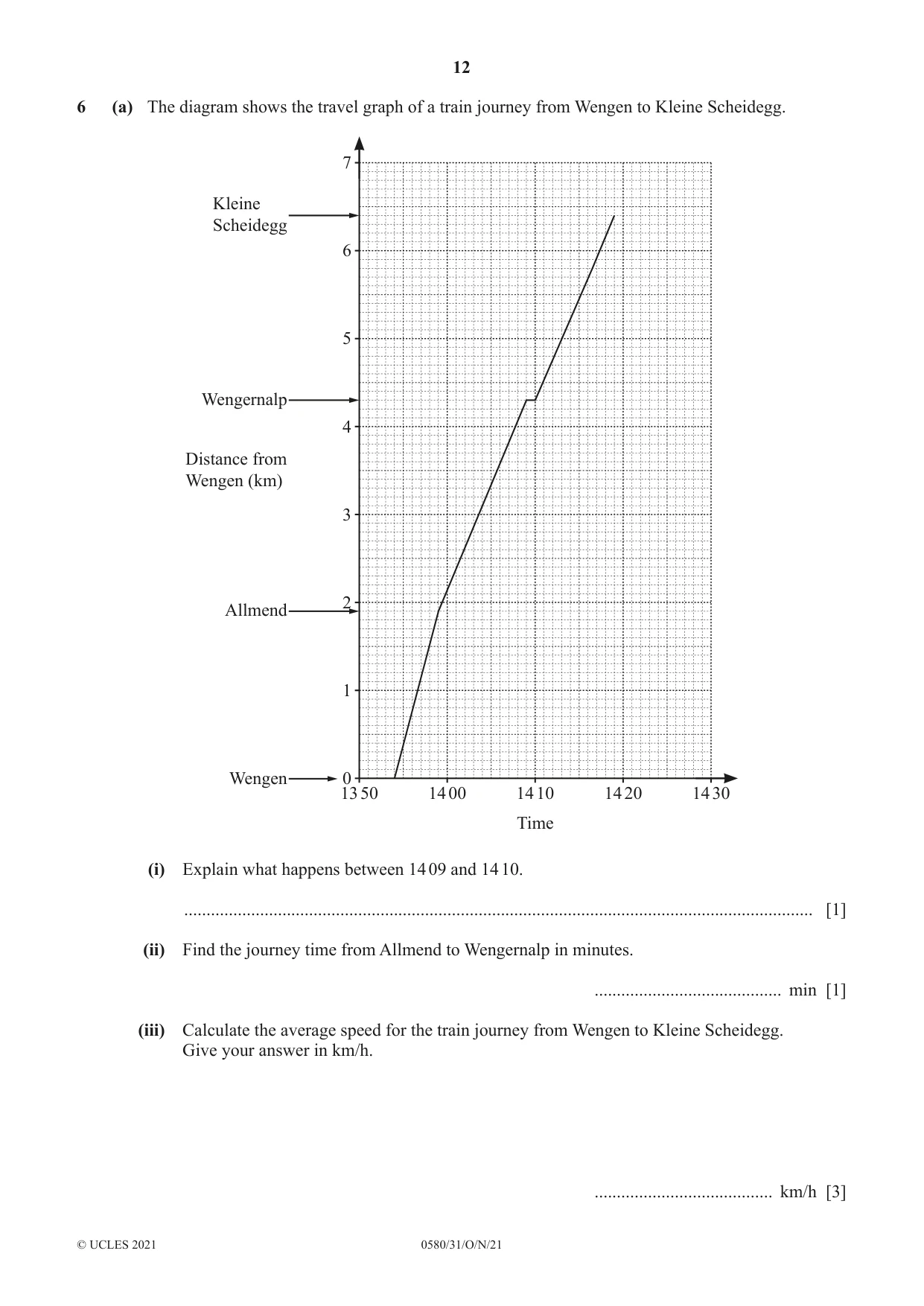
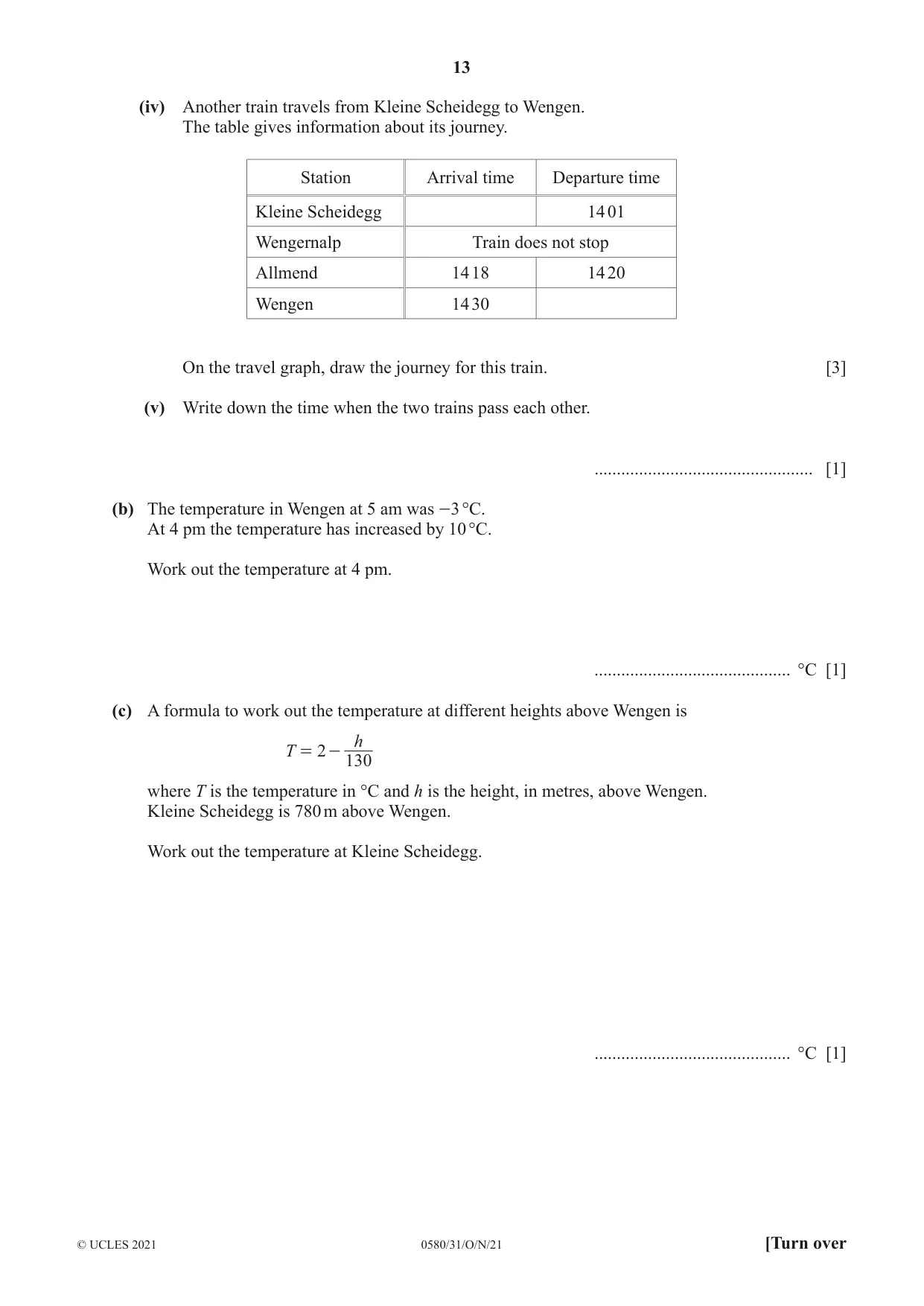
6 (a) The diagram shows the travel graph of a train journey from Wengen to Kleine Scheidegg. 7 Kleine Scheidegg 6 5 Wengernalp 4 Distance from Wengen (km) 3 2 Allmend 1 Wengen 0 13 50 14 00 14 10 14 20 14 30 Time (i) Explain what happens between 14 09 and 14 10. ............................................................................................................................................. [1] (ii) Find the journey time from Allmend to Wengernalp in minutes. .......................................... min [1] (iii) Calculate the average speed for the train journey from Wengen to Kleine Scheidegg. Give your answer in km/h. ........................................ km/h [3] (iv) Another train travels from Kleine Scheidegg to Wengen. The table gives information about its journey. Station Arrival time Departure time Kleine Scheidegg 14 01 Wengernalp Train does not stop Allmend 14 18 14 20 Wengen 14 30 On the travel graph, draw the journey for this train. [3] (v) Write down the time when the two trains pass each other. ................................................. [1] (b) The temperature in Wengen at 5 am was -3 °C. At 4 pm the temperature has increased by 10 °C. Work out the temperature at 4 pm. ............................................ °C [1] (c) A formula to work out the temperature at different heights above Wengen is h T = 2 - 130 where T is the temperature in °C and h is the height, in metres, above Wengen. Kleine Scheidegg is 780 m above Wengen. Work out the temperature at Kleine Scheidegg. ............................................ °C [1]
Mark scheme: 6(a)(i) [Train] stopped oe 1 6(a)(ii) 10 1 6(a)(iii) 15.36 3 B1 for 25 [mins] or 6.4 [km] or 0.416[6…][h] or 0.417[h] soi M1 for 6.4 ÷ their time 6(a)(iv) Three correct ruled lines 3 B1 for a line from (14 01, 6.4) to (14 18, 1.9) B1FT for a line from their (14 18, 1.9) to (their 14 18 + 2, their 1.9) B1FT for a line from (their (14 18 + 2), (their 1.9) to (14 30, 0) 6(a)(v) 14 09 1 FT their (a)(iv) 6(b) 7 1 6(c) –4 1
Q7 · The diagram shows the net of a cuboid on a 1 cm 2 grid
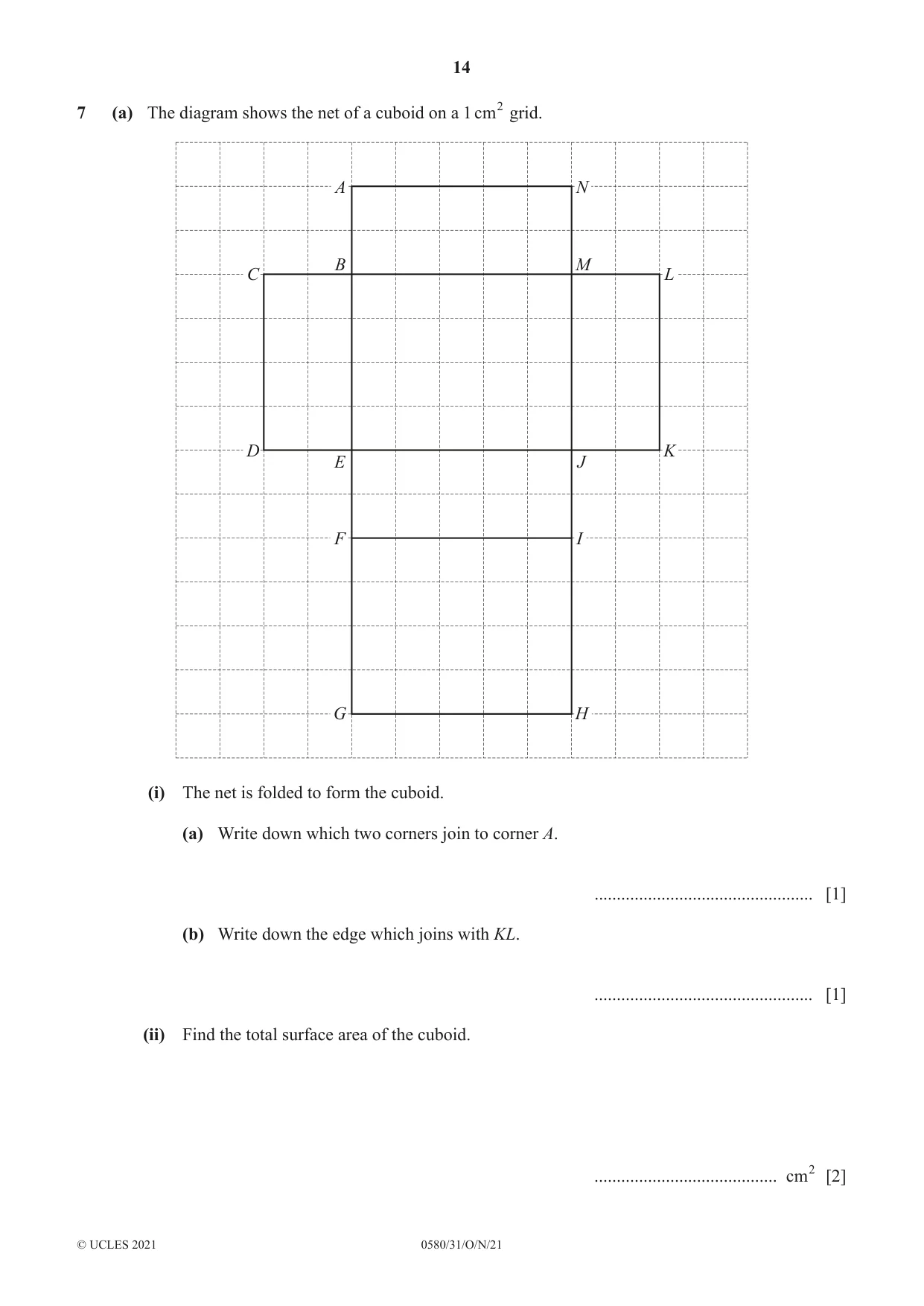
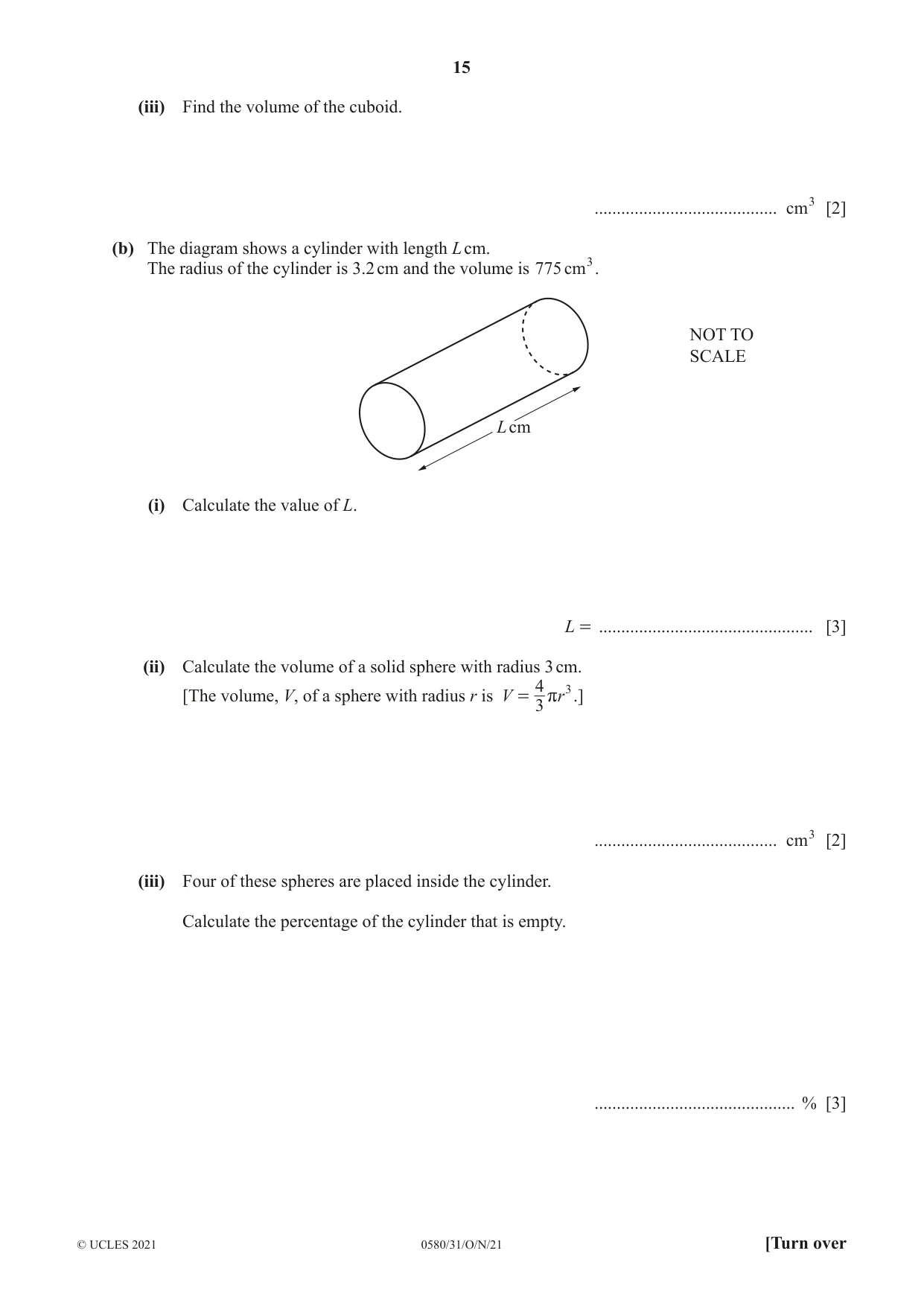
7 (a) The diagram shows the net of a cuboid on a 1 cm 2 grid. A N B M C L D K E J F I G H (i) The net is folded to form the cuboid. (a) Write down which two corners join to corner A. ................................................. [1] (b) Write down the edge which joins with KL. ................................................. [1] (ii) Find the total surface area of the cuboid. ......................................... cm2 [2] (iii) Find the volume of the cuboid. ......................................... cm3 [2] (b) The diagram shows a cylinder with length L cm. The radius of the cylinder is 3.2 cm and the volume is 775 cm 3. NOT TO SCALE L cm (i) Calculate the value of L. L = ................................................ [3] (ii) Calculate the volume of a solid sphere with radius 3 cm. 4 3 [The volume, V, of a sphere with radius r is V = rr .] 3 ......................................... cm3 [2] (iii) Four of these spheres are placed inside the cylinder. Calculate the percentage of the cylinder that is empty. ............................................. % [3]
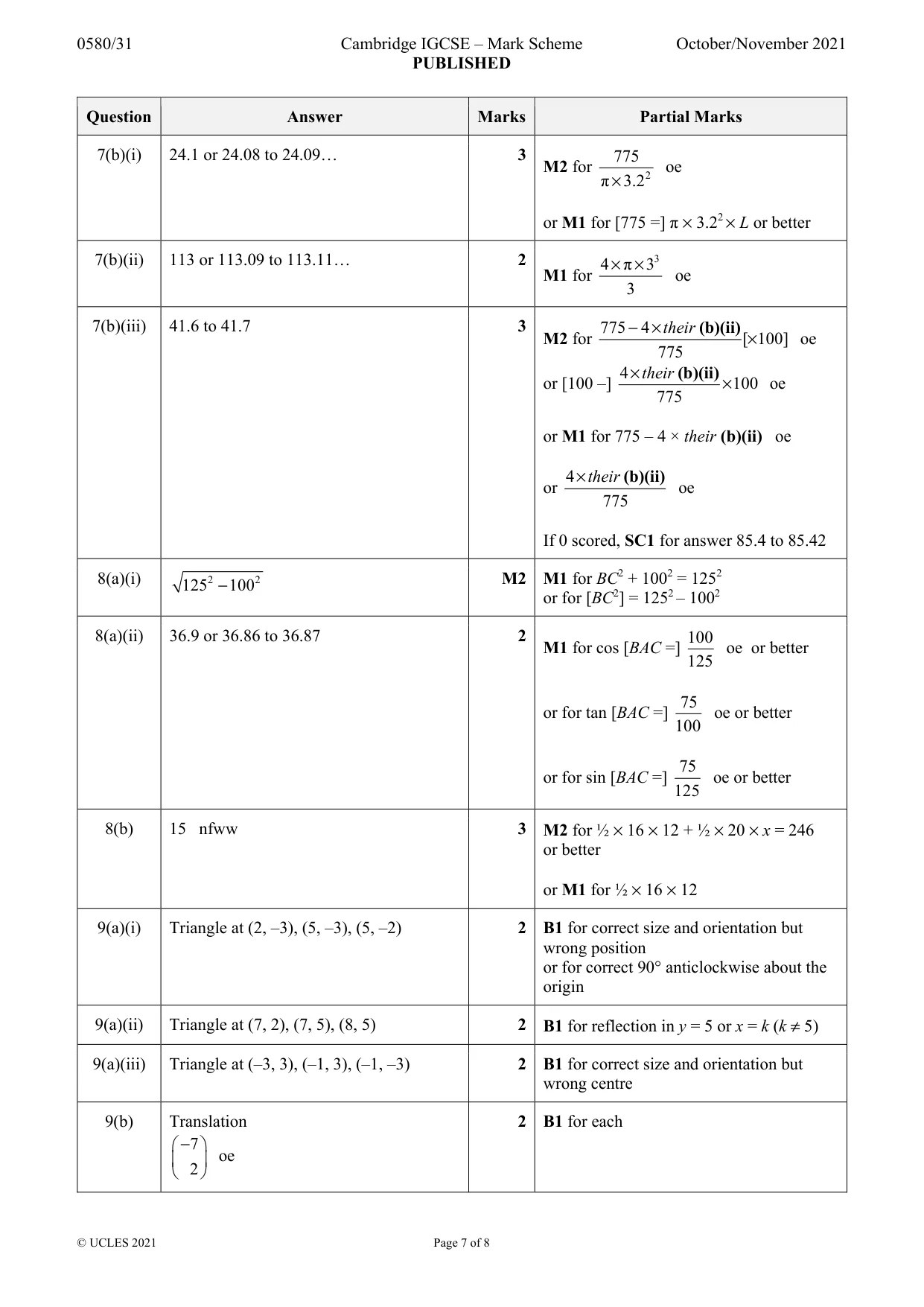
Mark scheme: 7(a)(i)(a) C and G 1 7(a)(i)(b) HI 1 7(a)(ii) 76 2 M1 for one relevant area calculation 7(a)(iii) 40 2 M1 for 5 × 2 × 4 oe 7(b)(i) 24.1 or 24.08 to 24.09… 3 775 M2 for oe π × 3.2 2 or M1 for [775 =] π × 3.22 × L or better 7(b)(ii) 113 or 113.09 to 113.11… 2 4 × π × 33 M1 for oe 3 7(b)(iii) 41.6 to 41.7 3 775 −×4 their (b)(ii) M2 for [× 100] oe 775 4 × their (b)(ii) or [100 –] × 100 oe 775 or M1 for 775 – 4 × their (b)(ii) oe 4 × their (b)(ii) or oe 775 If 0 scored, SC1 for answer 85.4 to 85.42
Q8 · B NOT TO 125 m SCALE A C 100 m The diagram shows a right-angled triangle, ABC
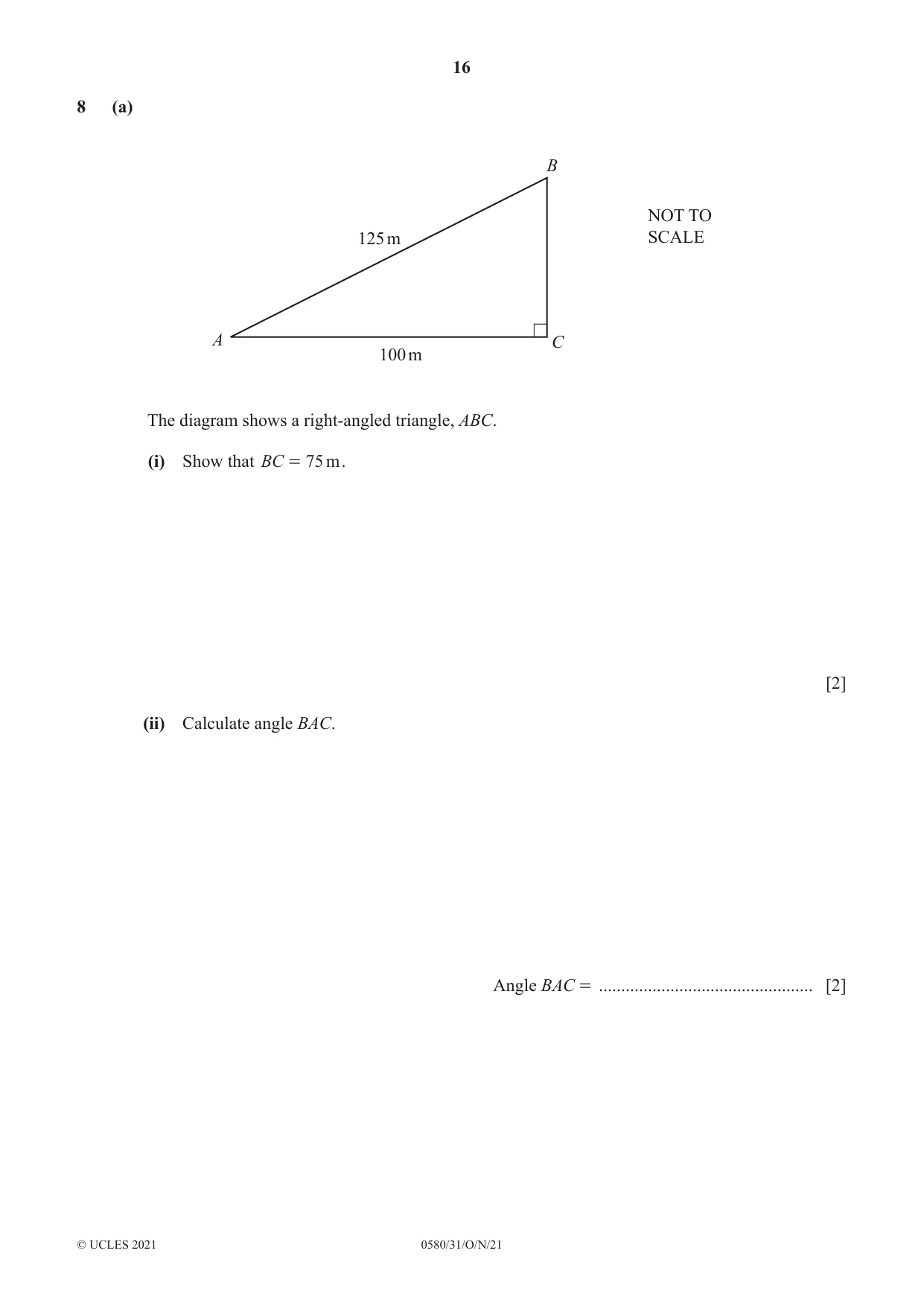
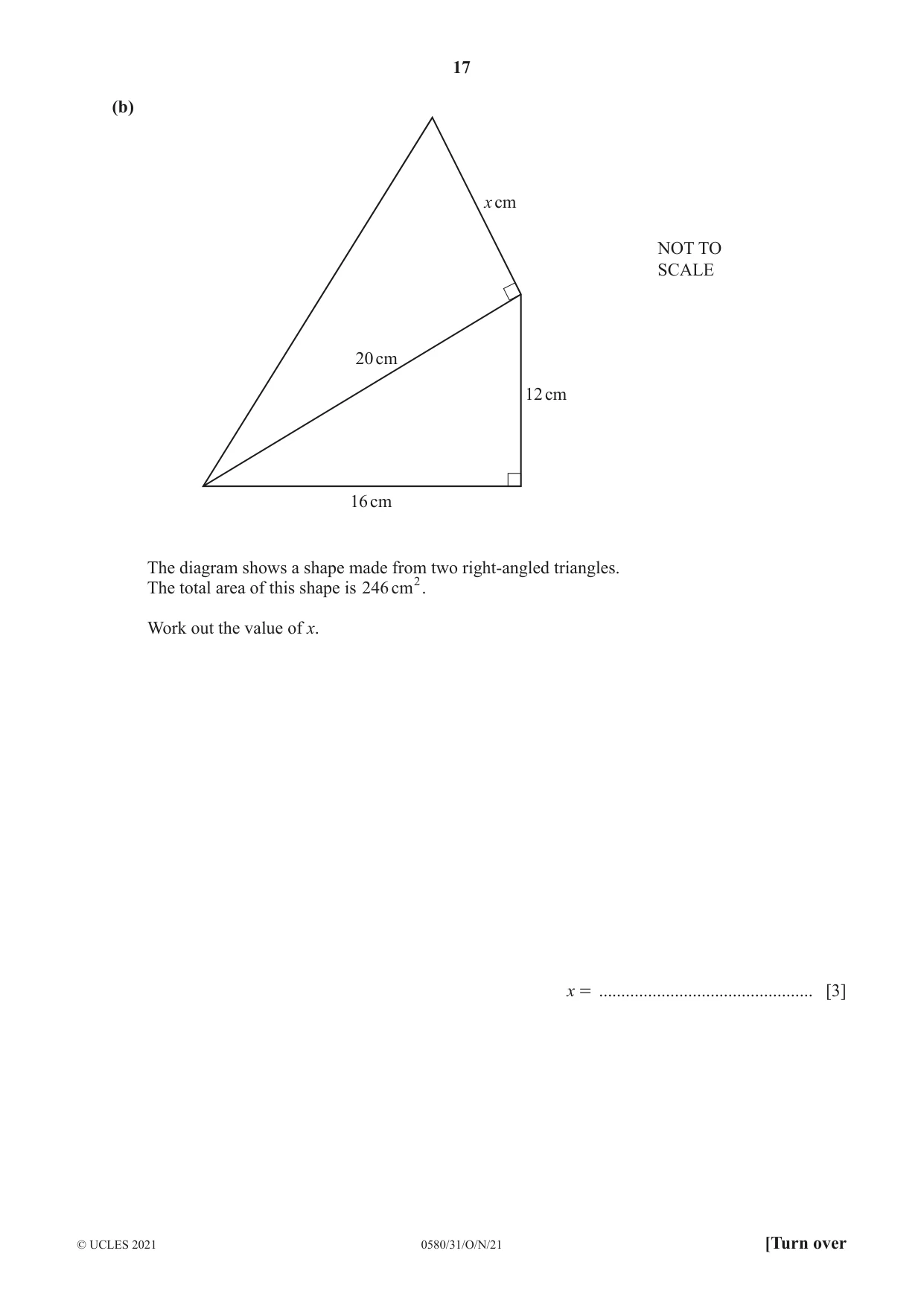
8 (a) B NOT TO 125 m SCALE A C 100 m The diagram shows a right-angled triangle, ABC. (i) Show that BC = 75 m . [2] (ii) Calculate angle BAC. Angle BAC = ................................................ [2] (b) x cm NOT TO SCALE 20 cm 12 cm 16 cm The diagram shows a shape made from two right-angled triangles. The total area of this shape is 246 cm 2. Work out the value of x. x = ................................................ [3]
Mark scheme: 8(a)(i) 2 2 M2 M1 for BC2 + 1002 = 1252 125 − 100 or for [BC2] = 1252 – 1002 8(a)(ii) 36.9 or 36.86 to 36.87 2 100 M1 for cos [BAC =] oe or better 125 75 or for tan [BAC =] oe or better 100 75 or for sin [BAC =] oe or better 125 8(b) 15 nfww 3 M2 for ½ × 16 × 12 + ½ × 20 × x = 246 or better or M1 for ½ × 16 × 12
Q9 · Y 8 7 B 6 5 A 4 3 2 1 - 6 - 5 - 4 - 3 - 2 - 1 0 1 2 3 4 5 6 7 8 9 x - 1 - 2 - 3 - 4 (a)…
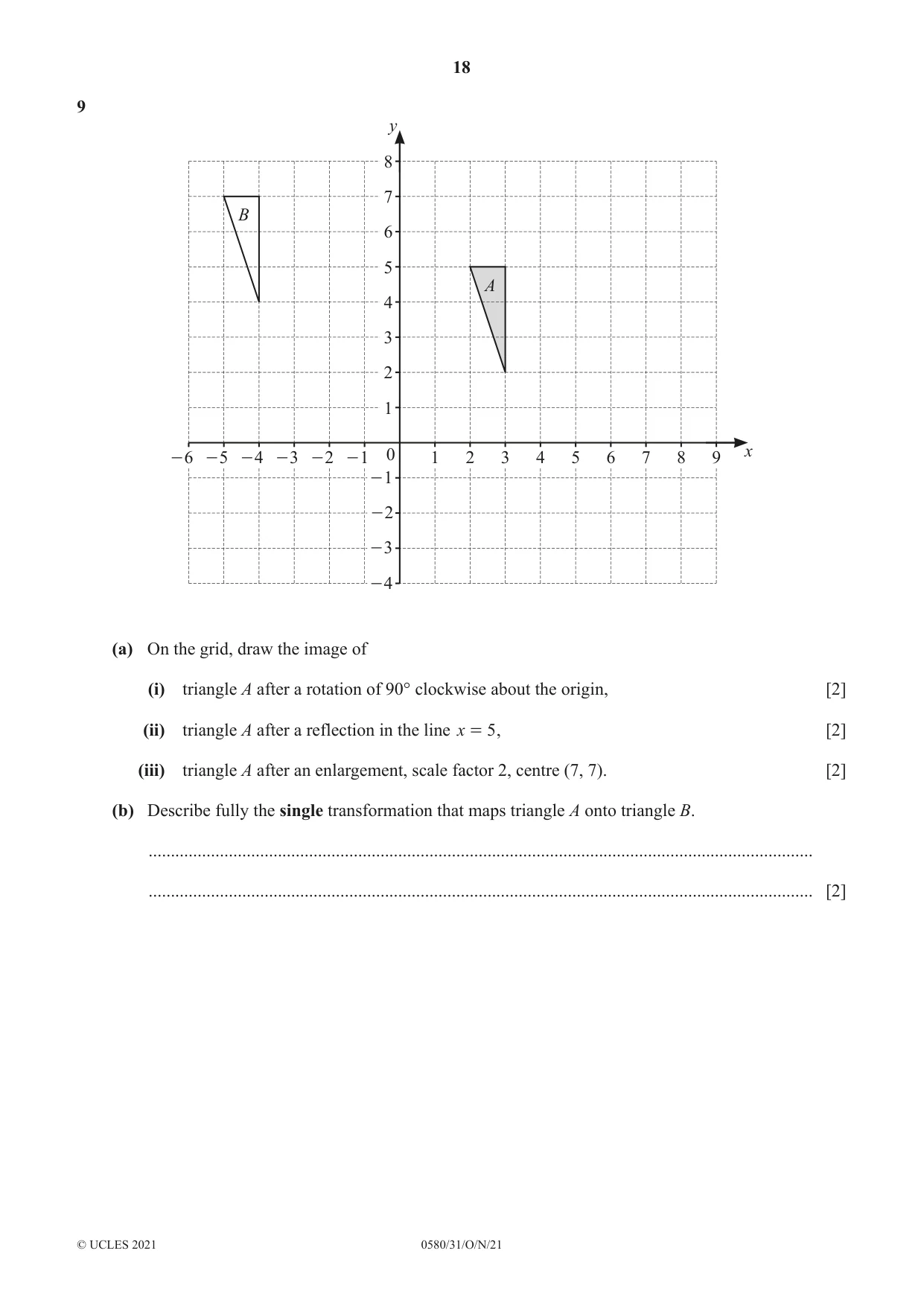
9 y 8 7 B 6 5 A 4 3 2 1 - 6 - 5 - 4 - 3 - 2 - 1 0 1 2 3 4 5 6 7 8 9 x - 1 - 2 - 3 - 4 (a) On the grid, draw the image of (i) triangle A after a rotation of 90° clockwise about the origin, [2] (ii) triangle A after a reflection in the line x = 5 , [2] (iii) triangle A after an enlargement, scale factor 2, centre (7, 7). [2] (b) Describe fully the single transformation that maps triangle A onto triangle B. ..................................................................................................................................................... ..................................................................................................................................................... [2]
Mark scheme: 9(a)(i) Triangle at (2, –3), (5, –3), (5, –2) 2 B1 for correct size and orientation but wrong position or for correct 90° anticlockwise about the origin 9(a)(ii) Triangle at (7, 2), (7, 5), (8, 5) 2 B1 for reflection in y = 5 or x = k (k ≠ 5) 9(a)(iii) Triangle at (–3, 3), (–1, 3), (–1, –3) 2 B1 for correct size and orientation but wrong centre 9(b) Translation 2 B1 for each − 7 oe 2
Q10 · Complete the table of values for y = 4 + 3 x - x 2
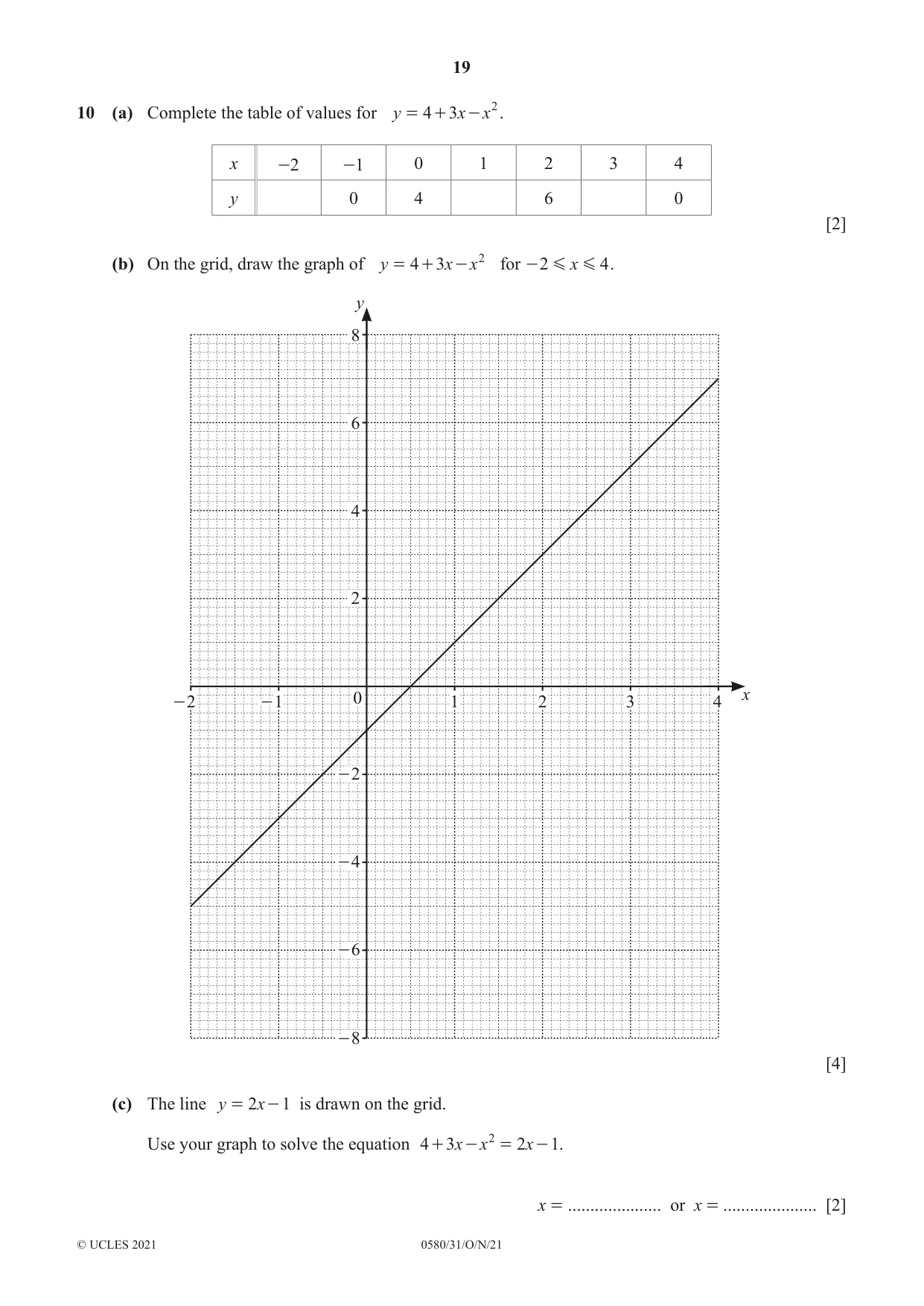
10 (a) Complete the table of values for y = 4 + 3 x - x 2 . x -2 -1 0 1 2 3 4 y 0 4 6 0 [2] (b) On the grid, draw the graph of y = 4 + 3x - x 2 for - 2 G x G 4 . y 8 6 4 2 - 2 - 1 0 1 2 3 4 x - 2 - 4 - 6 - 8 [4] (c) The line y = 2 x - 1 is drawn on the grid. Use your graph to solve the equation 4 + 3x - x 2 = 2x - 1. x = ..................... or x = ..................... [2]
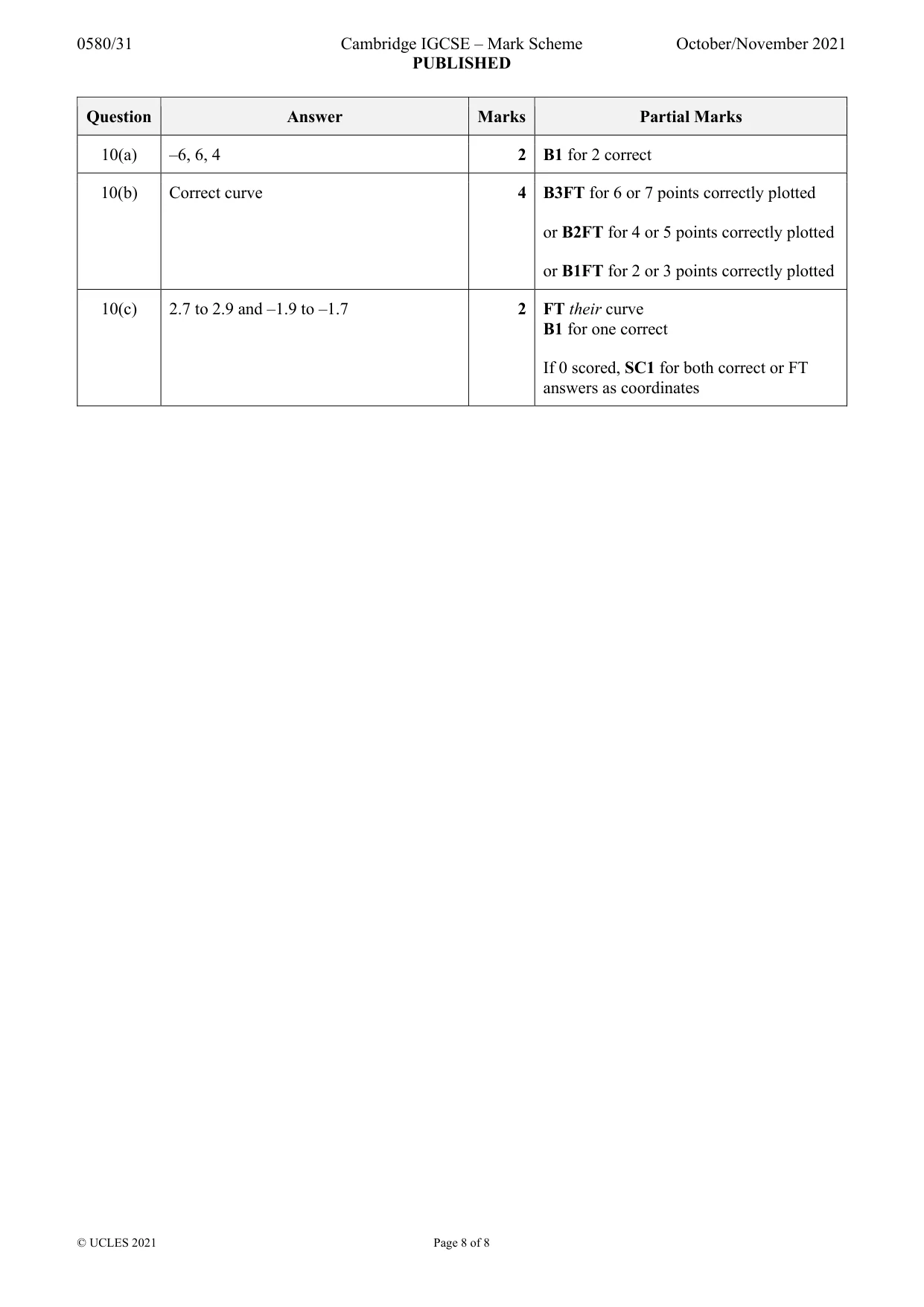
Mark scheme: 10(a) –6, 6, 4 2 B1 for 2 correct 10(b) Correct curve 4 B3FT for 6 or 7 points correctly plotted or B2FT for 4 or 5 points correctly plotted or B1FT for 2 or 3 points correctly plotted 10(c) 2.7 to 2.9 and –1.9 to –1.7 2 FT their curve B1 for one correct If 0 scored, SC1 for both correct or FT answers as coordinates
What was in this paper
The subtopics covered by these 10 questions, and how many questions each got. Open one in a new tab to see every Cambridge question on it.
What you needed in this session
Cambridge’s own grade thresholds for 2021 Oct/Nov, Paper 3 · Variant 1. A higher threshold means an easier paper — the bar moves with how the cohort did.