Cambridge IGCSE Mathematics 0580 — 2021 Oct/Nov Paper 3 · Variant 2
0580/32/O/N/21 · 10 questions · 104 marks · ≈117 min
The question paper and its mark scheme, free to read here and free to download. This is Cambridge’s own paper, exactly as it was sat.
Question paper20 pages
Mark scheme7 pages
Answers below. Sit the paper first if you are practising.
Questions as text
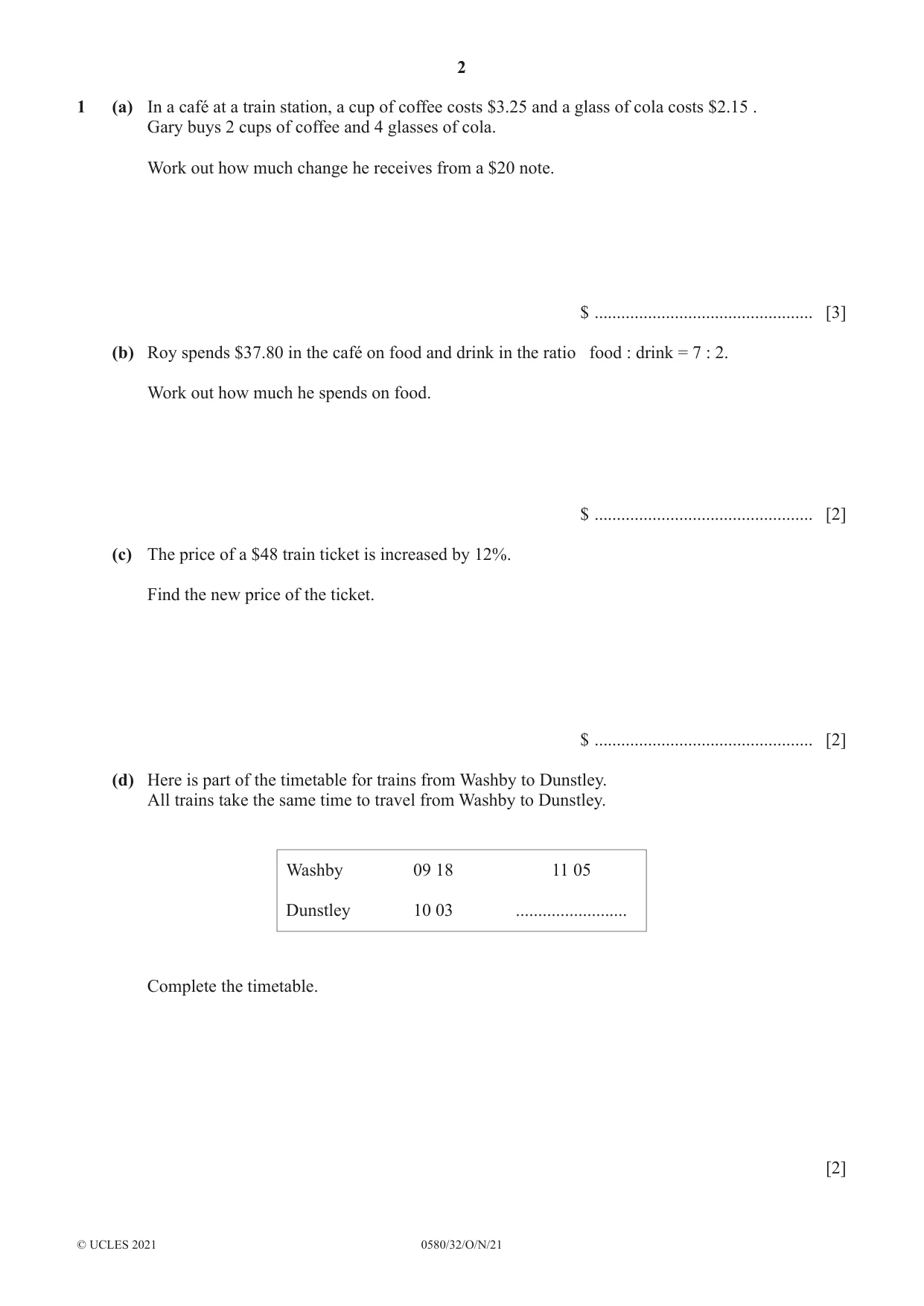
Q1 · In a café at a train station, a cup of coffee costs $3.25 and a glass of cola costs $2.15
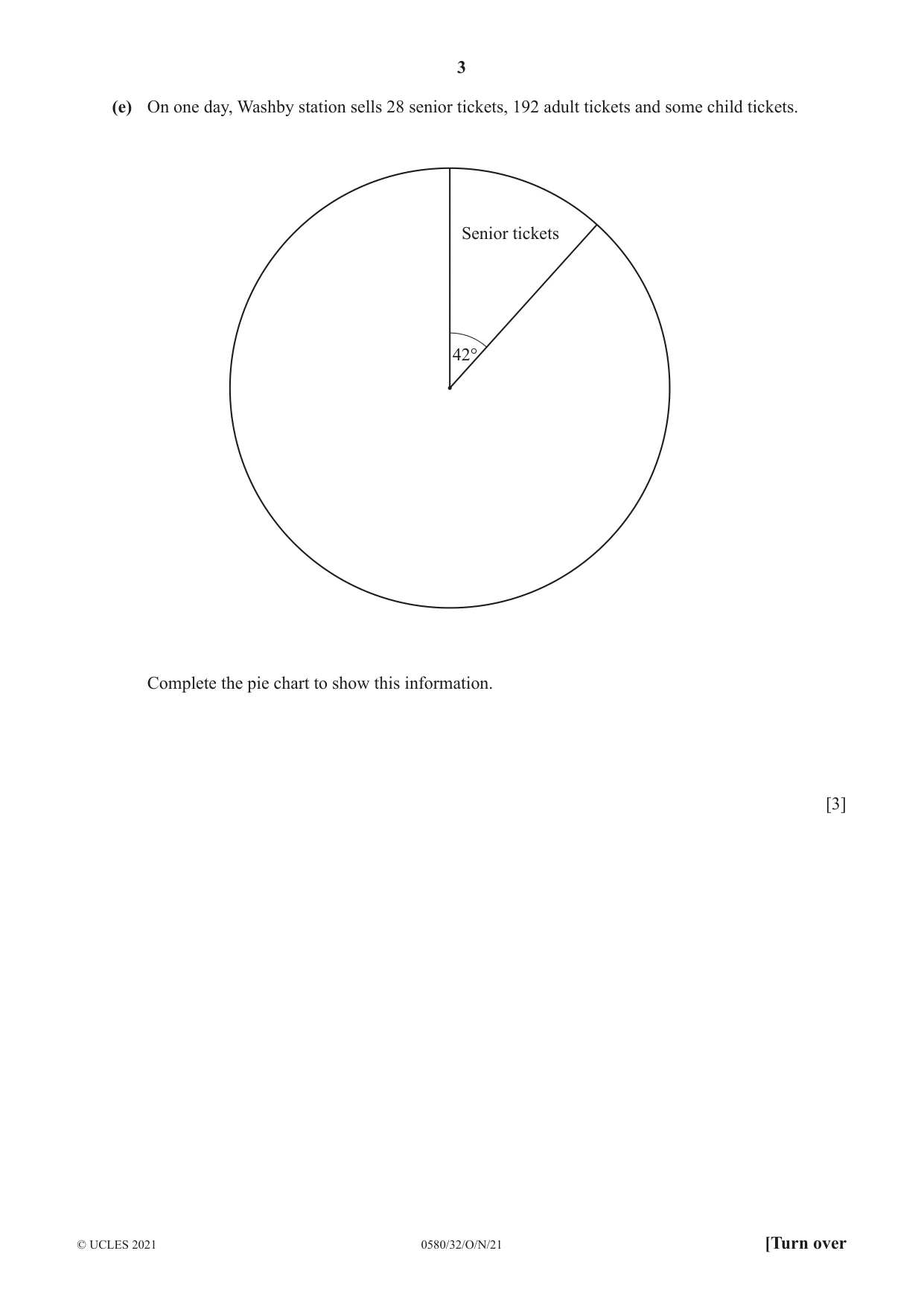
1 (a) In a café at a train station, a cup of coffee costs $3.25 and a glass of cola costs $2.15 . Gary buys 2 cups of coffee and 4 glasses of cola. Work out how much change he receives from a $20 note. $ ................................................. [3] (b) Roy spends $37.80 in the café on food and drink in the ratio food : drink = 7 : 2. Work out how much he spends on food. $ ................................................. [2] (c) The price of a $48 train ticket is increased by 12%. Find the new price of the ticket. $ ................................................. [2] (d) Here is part of the timetable for trains from Washby to Dunstley. All trains take the same time to travel from Washby to Dunstley. Washby 09 18 11 05 Dunstley 10 03 ......................... Complete the timetable. [2] (e) On one day, Washby station sells 28 senior tickets, 192 adult tickets and some child tickets. Senior tickets 42° Complete the pie chart to show this information. [3]
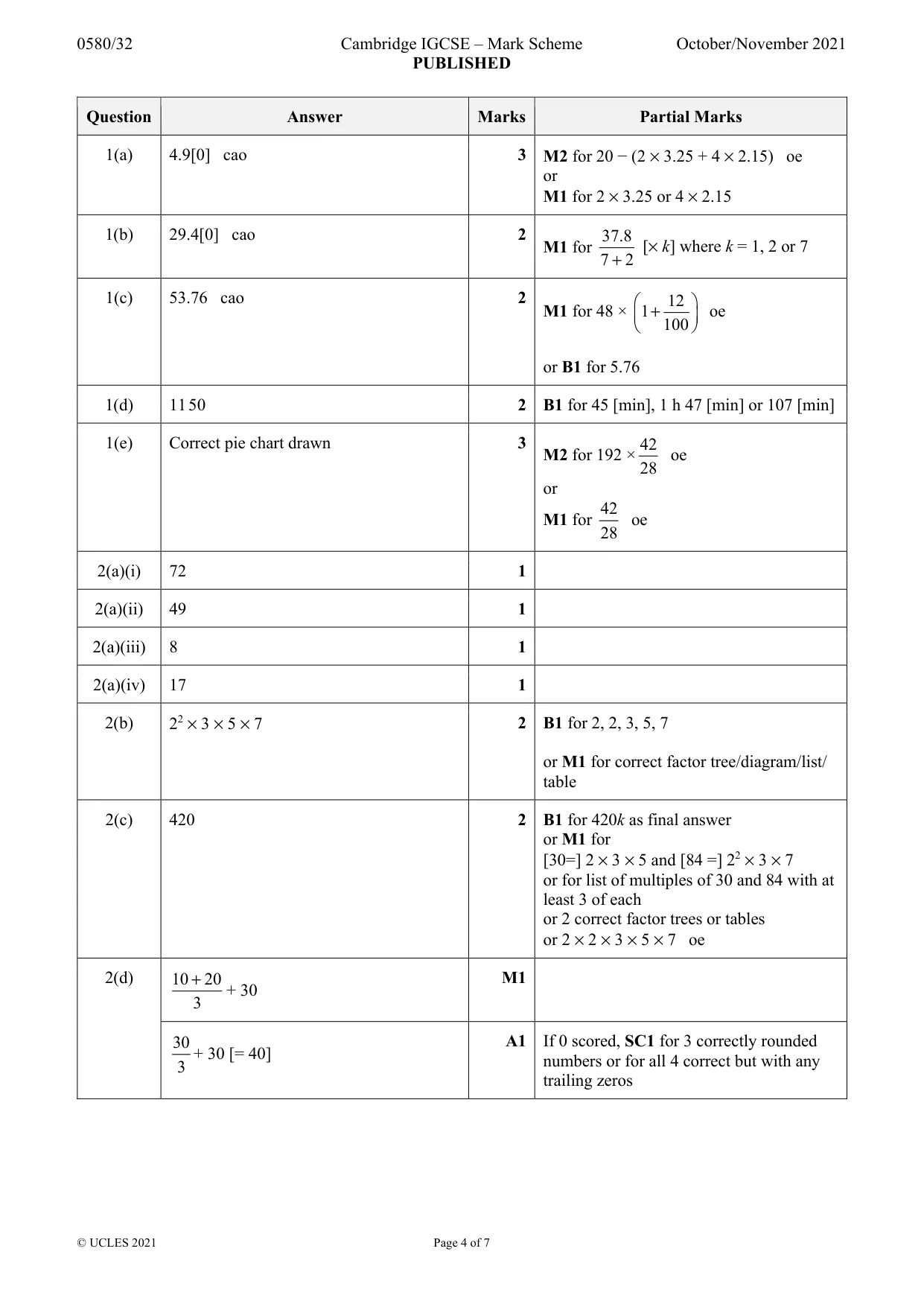
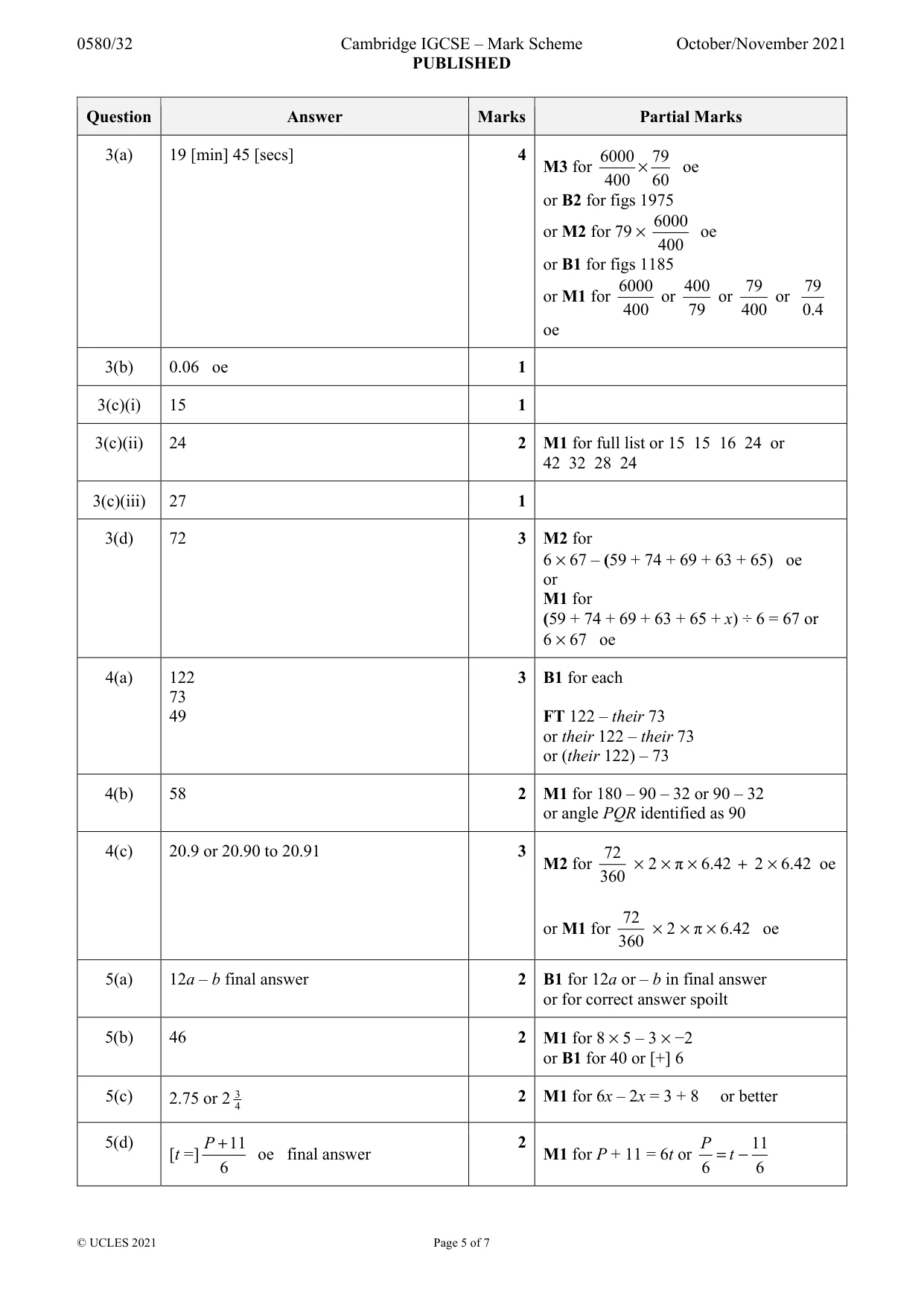
Mark scheme: Question Answer Marks Partial Marks 1(a) 4.9[0] cao 3 M2 for 20 − (2 × 3.25 + 4 × 2.15) oe or M1 for 2 × 3.25 or 4 × 2.15 1(b) 29.4[0] cao 2 37.8 M1 for [× k] where k = 1, 2 or 7 7 + 2 1(c) 53.76 cao 2 12 M1 for 48 × 1 + oe 100 or B1 for 5.76 1(d) 11 50 2 B1 for 45 [min], 1 h 47 [min] or 107 [min] 1(e) Correct pie chart drawn 3 42 M2 for 192 × oe 28 or 42 M1 for oe 28
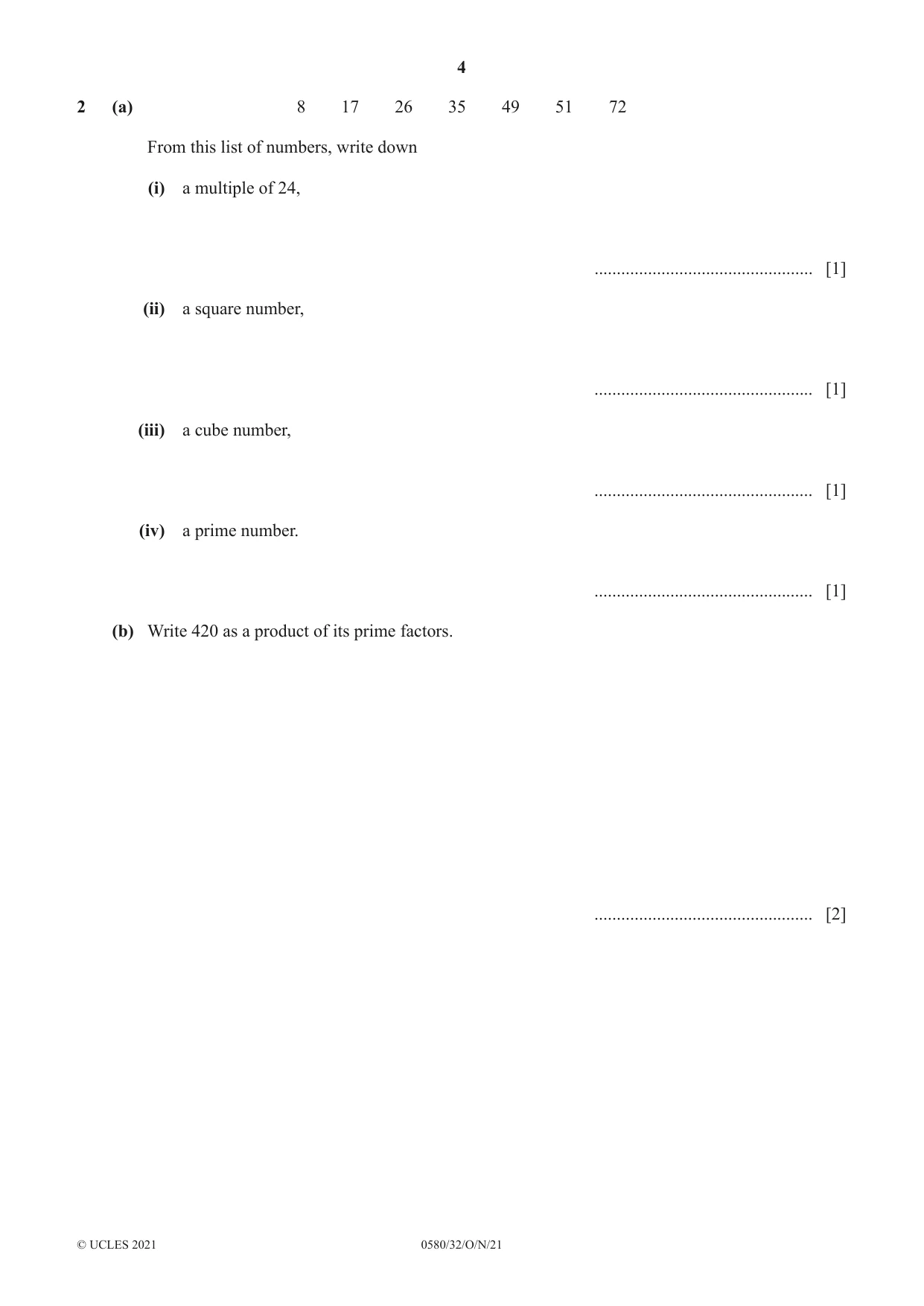
Q2 · 8 17 26 35 49 51 72 From this list of numbers, write down (i) a multiple of 24…
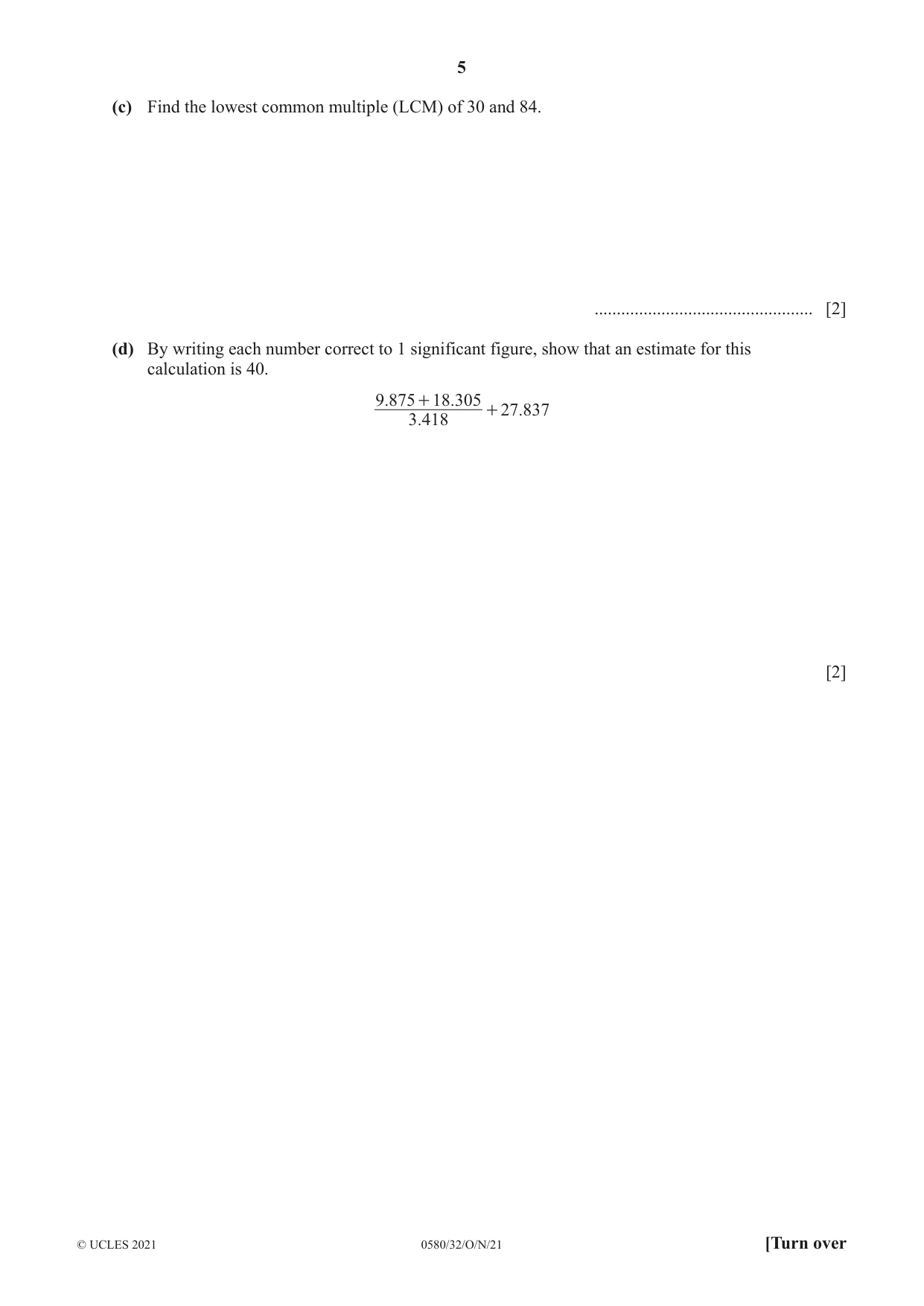
2 (a) 8 17 26 35 49 51 72 From this list of numbers, write down (i) a multiple of 24, ................................................. [1] (ii) a square number, ................................................. [1] (iii) a cube number, ................................................. [1] (iv) a prime number. ................................................. [1] (b) Write 420 as a product of its prime factors. ................................................. [2] (c) Find the lowest common multiple (LCM) of 30 and 84. ................................................. [2] (d) By writing each number correct to 1 significant figure, show that an estimate for this calculation is 40. 9.875 + 18.305 + 27 . 837 3.418 [2]
Mark scheme: 2(a)(i) 72 1 2(a)(ii) 49 1 2(a)(iii) 8 1 2(a)(iv) 17 1 2(b) 22 × 3 × 5 × 7 2 B1 for 2, 2, 3, 5, 7 or M1 for correct factor tree/diagram/list/ table 2(c) 420 2 B1 for 420k as final answer or M1 for [30=] 2 × 3 × 5 and [84 =] 22 × 3 × 7 or for list of multiples of 30 and 84 with at least 3 of each or 2 correct factor trees or tables or 2 × 2 × 3 × 5 × 7 oe 2(d) 10 + 20 M1 + 30 3 30 A1 If 0 scored, SC1 for 3 correctly rounded + 30 [= 40] numbers or for all 4 correct but with any 3 trailing zeros
Q3 · Simone completes one lap of a 400 metre running track in 79 seconds
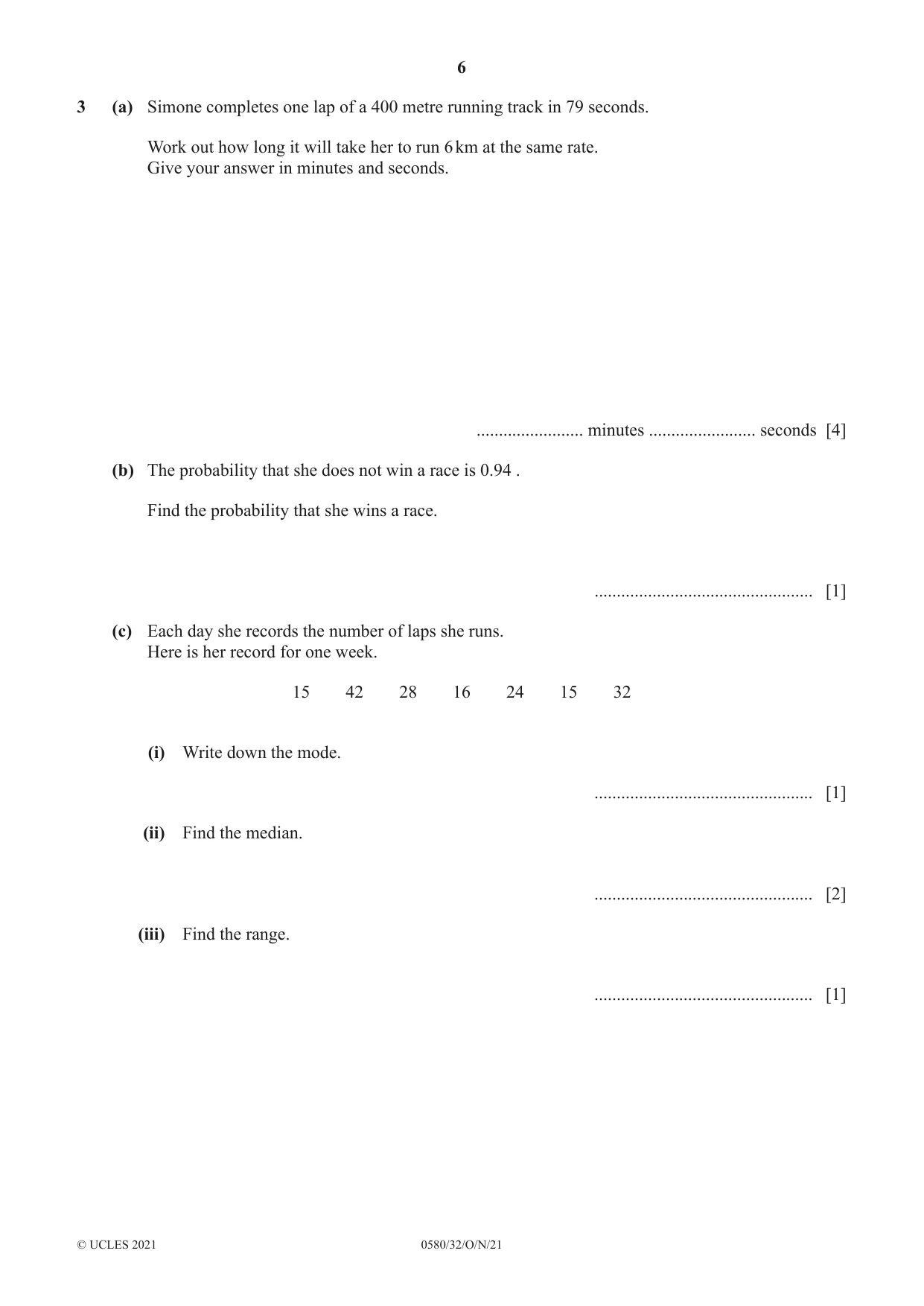
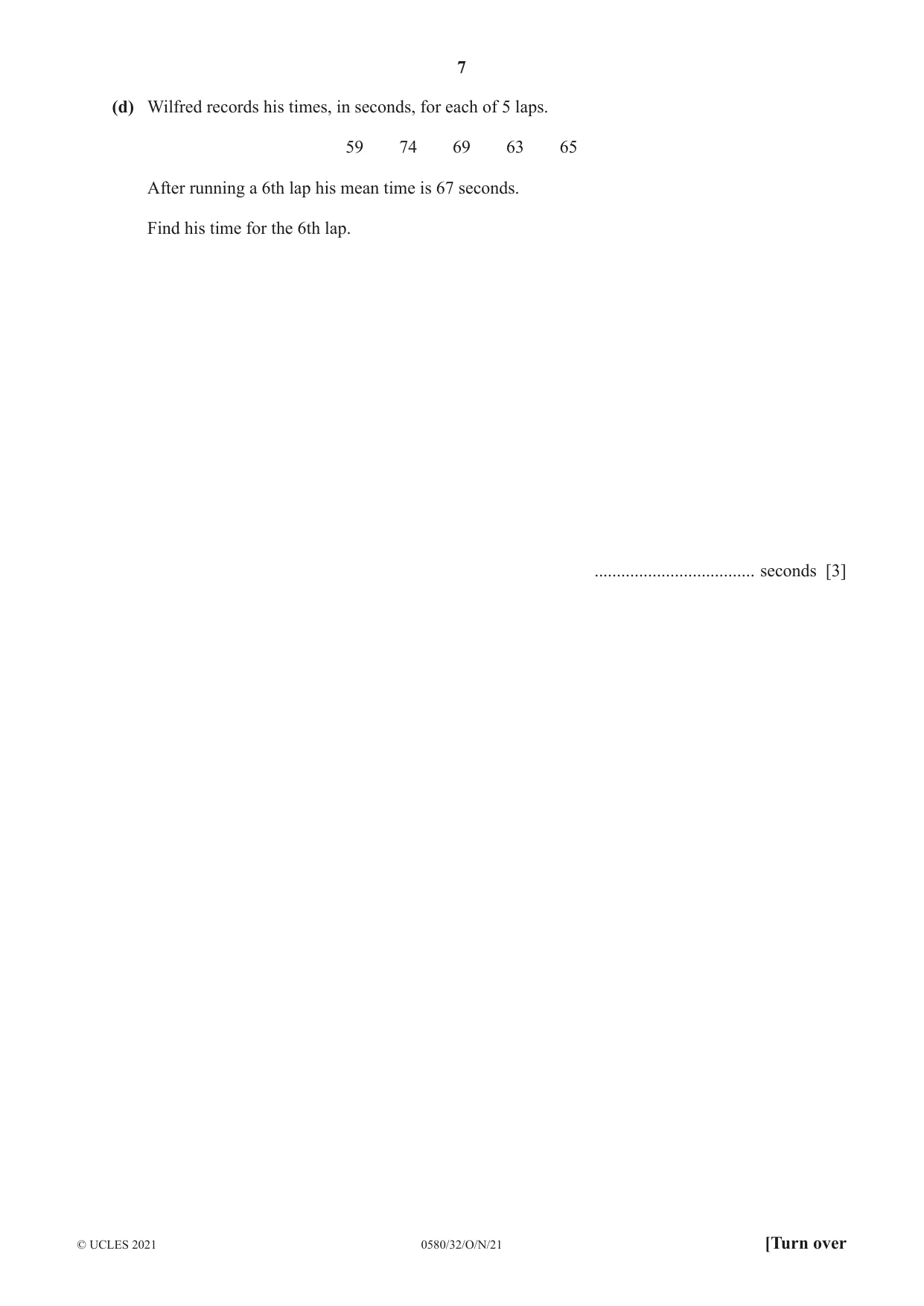
3 (a) Simone completes one lap of a 400 metre running track in 79 seconds. Work out how long it will take her to run 6 km at the same rate. Give your answer in minutes and seconds. ........................ minutes ........................ seconds [4] (b) The probability that she does not win a race is 0.94 . Find the probability that she wins a race. ................................................. [1] (c) Each day she records the number of laps she runs. Here is her record for one week. 15 42 28 16 24 15 32 (i) Write down the mode. ................................................. [1] (ii) Find the median. ................................................. [2] (iii) Find the range. ................................................. [1] (d) Wilfred records his times, in seconds, for each of 5 laps. 59 74 69 63 65 After running a 6th lap his mean time is 67 seconds. Find his time for the 6th lap. .................................... seconds [3]
Mark scheme: 3(a) 19 [min] 45 [secs] 4 6000 79 M3 for × oe 400 60 or B2 for figs 1975 6000 or M2 for 79 × oe 400 or B1 for figs 1185 6000 400 79 79 or M1 for or or or 400 79 400 0.4 oe 3(b) 0.06 oe 1 3(c)(i) 15 1 3(c)(ii) 24 2 M1 for full list or 15 15 16 24 or 42 32 28 24 3(c)(iii) 27 1 3(d) 72 3 M2 for 6 × 67 – (59 + 74 + 69 + 63 + 65) oe or M1 for (59 + 74 + 69 + 63 + 65 + x) ÷ 6 = 67 or 6 × 67 oe
Q4 · A D E 73° z° NOT TO SCALE x° 58° y° F G B C In the diagram, ABC is a triangle
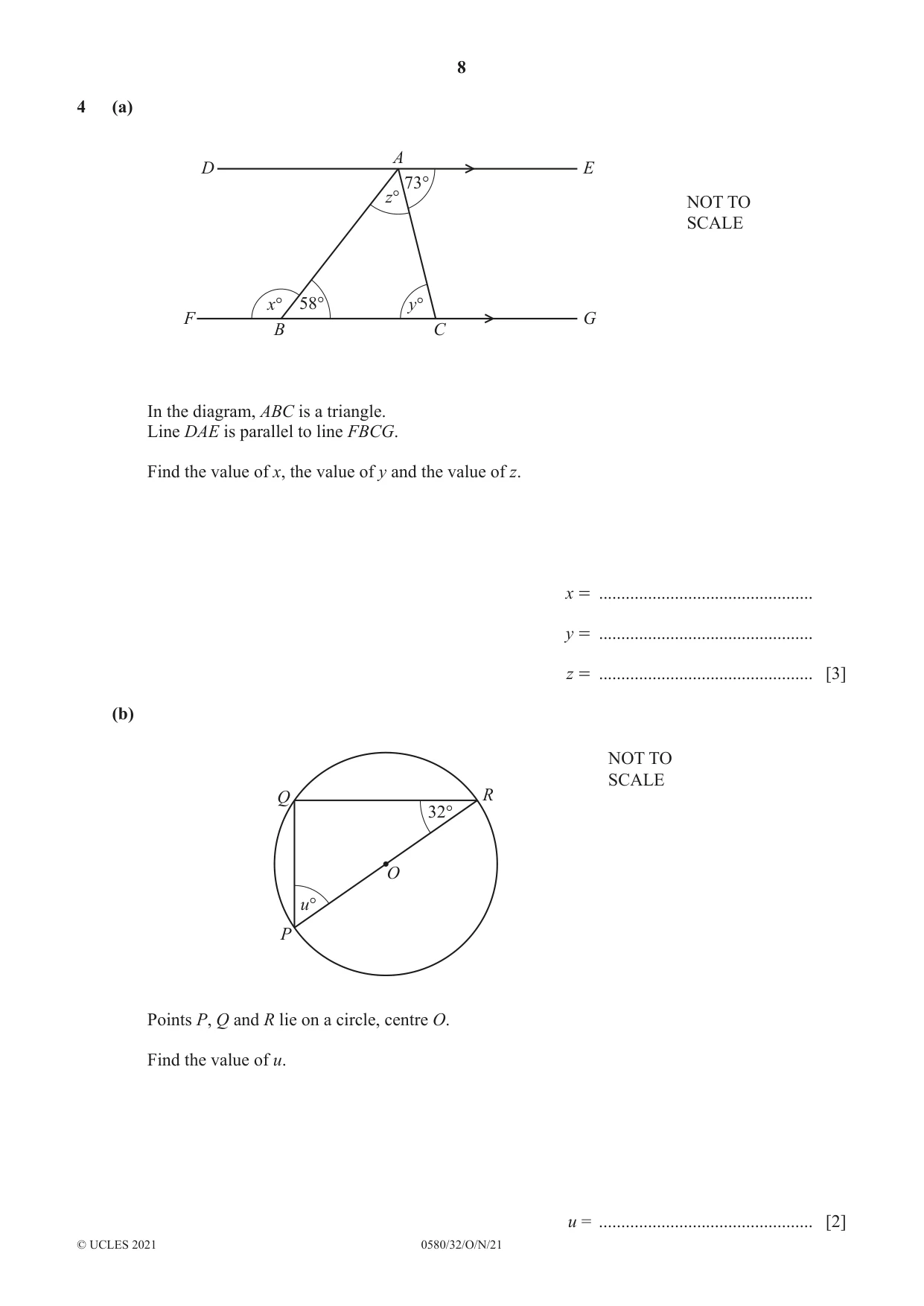
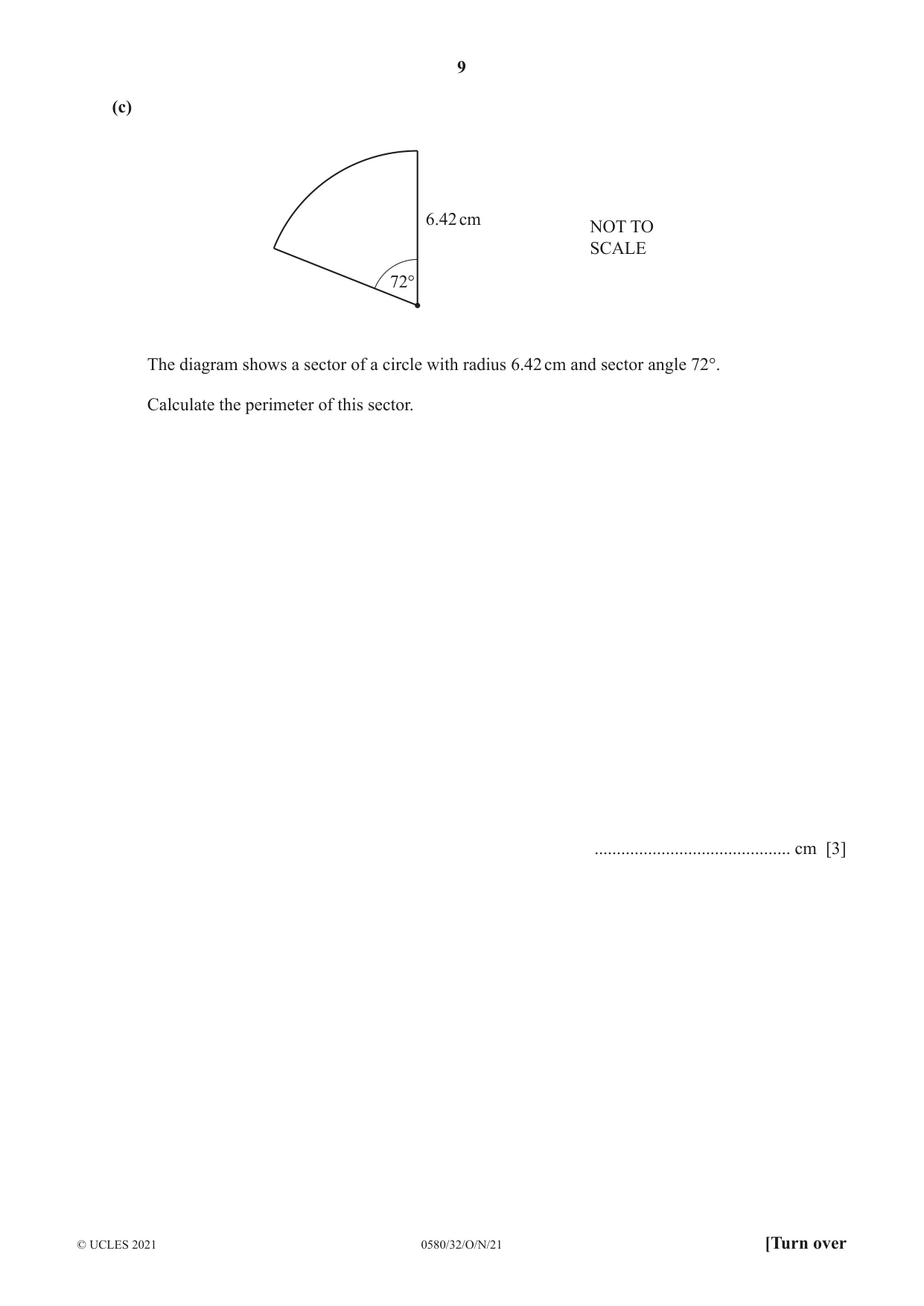
4 (a) A D E 73° z° NOT TO SCALE x° 58° y° F G B C In the diagram, ABC is a triangle. Line DAE is parallel to line FBCG. Find the value of x, the value of y and the value of z. x = ................................................ y = ................................................ z = ................................................ [3] (b) NOT TO SCALE Q R 32° O u° P Points P, Q and R lie on a circle, centre O. Find the value of u. u = ................................................ [2] (c) 6.42 cm NOT TO SCALE 72° The diagram shows a sector of a circle with radius 6.42 cm and sector angle 72°. Calculate the perimeter of this sector. ............................................ cm [3]
Mark scheme: 4(a) 122 3 B1 for each 73 49 FT 122 – their 73 or their 122 – their 73 or (their 122) – 73 4(b) 58 2 M1 for 180 – 90 – 32 or 90 – 32 or angle PQR identified as 90 4(c) 20.9 or 20.90 to 20.91 3 72 M2 for × 2 × π × 6.42 + 2 × 6.42 oe 360 72 or M1 for × 2 × π × 6.42 oe 360
Question 5
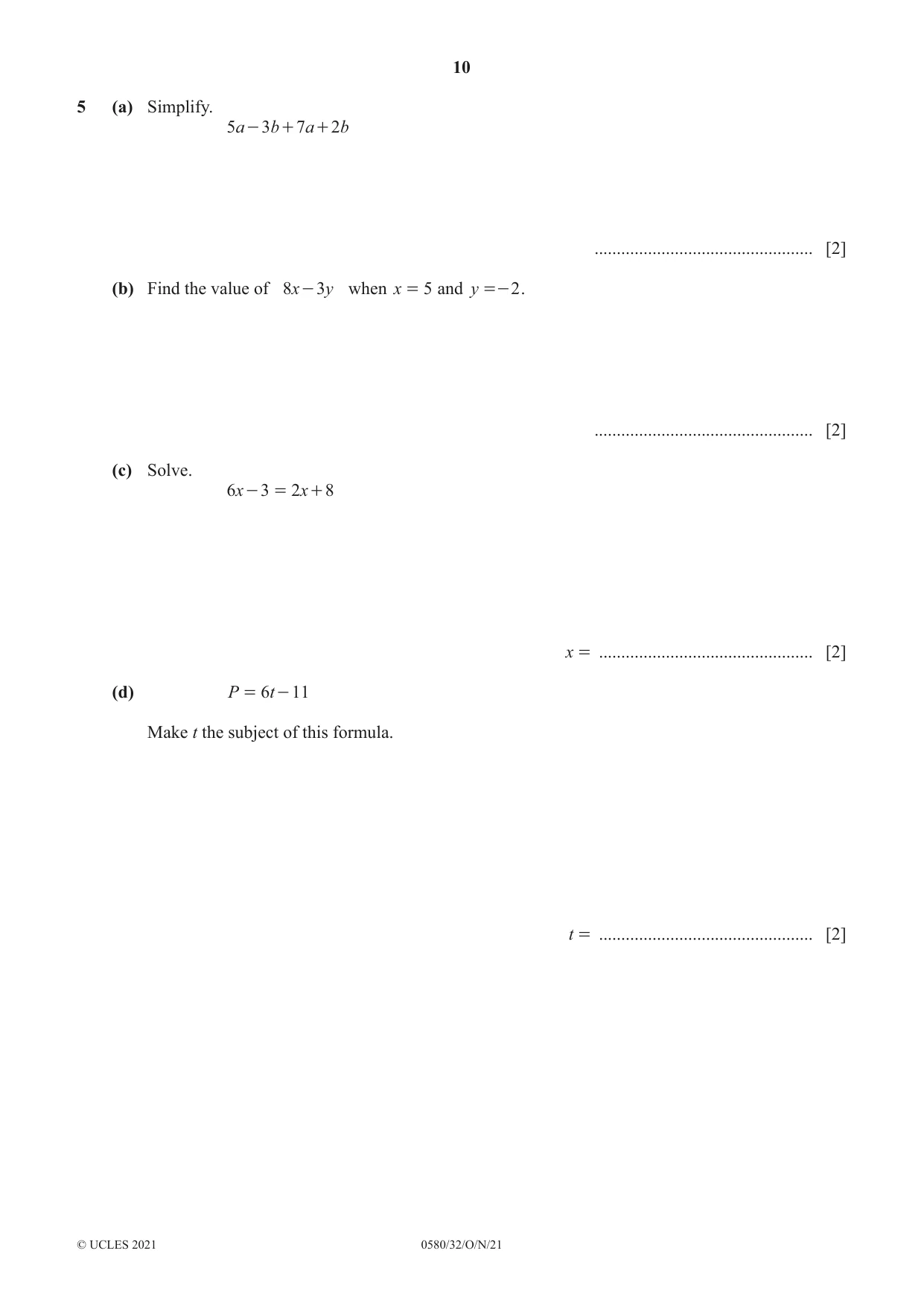
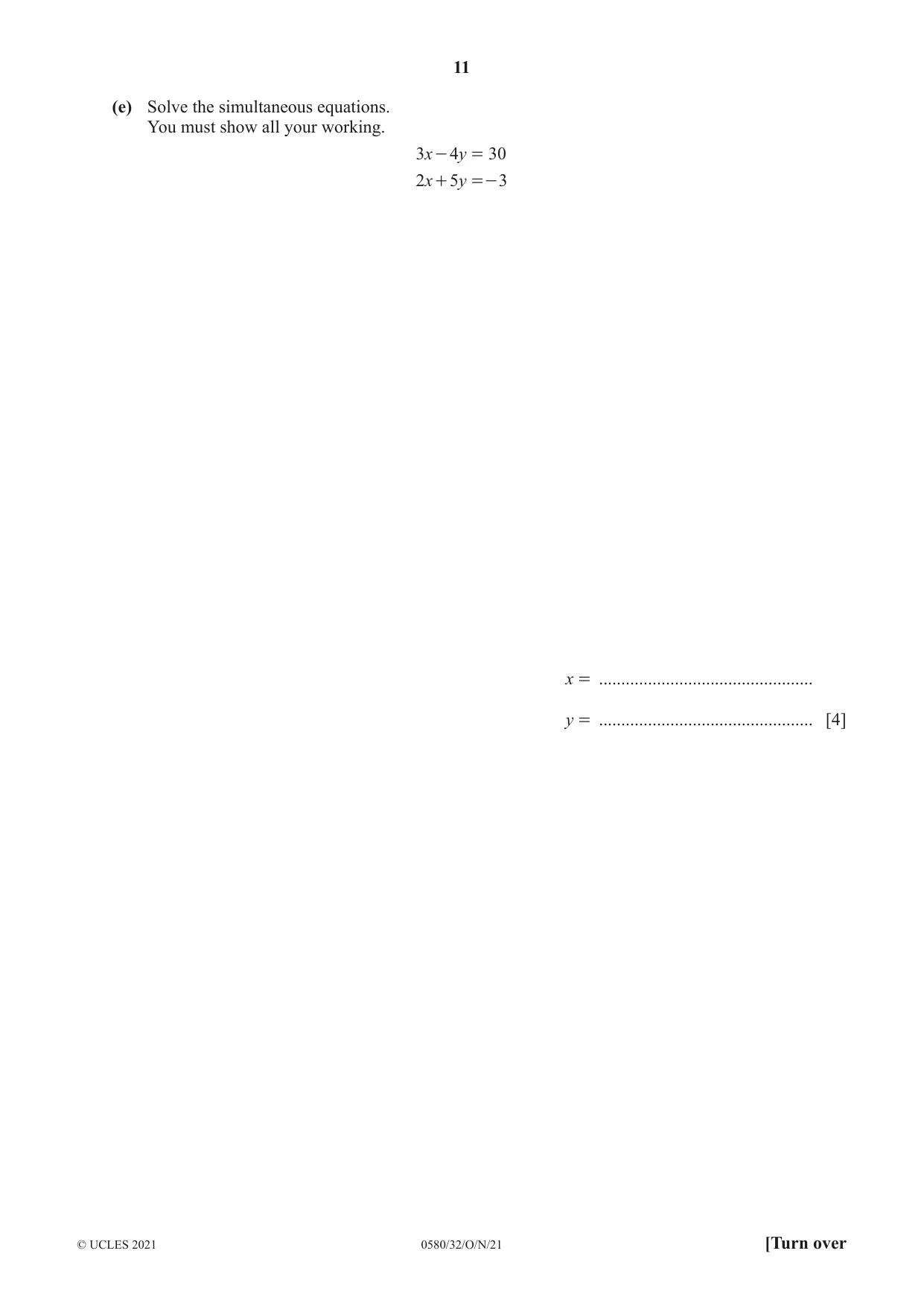
5 (a) Simplify. 5a - 3b + 7a + 2b ................................................. [2] (b) Find the value of 8x - 3y when x = 5 and y =- 2 . ................................................. [2] (c) Solve. 6x - 3 = 2x + 8 x = ................................................ [2] (d) P = t6 - 11 Make t the subject of this formula. t = ................................................ [2] (e) Solve the simultaneous equations. You must show all your working. 3x - 4y = 30 2x + 5y =- 3 x = ................................................ y = ................................................ [4]
Mark scheme: 5(a) 12a – b final answer 2 B1 for 12a or – b in final answer or for correct answer spoilt 5(b) 46 2 M1 for 8 × 5 – 3 × −2 or B1 for 40 or [+] 6 5(c) 2.75 or 2 34 2 M1 for 6x – 2x = 3 + 8 or better 5(d) P + 11 2 P 11 [t =] oe final answer M1 for P + 11 = 6t or = t − 6 6 6 5(e) Correctly equating one set of coefficients M1 Correct method to eliminate one variable M1 Dependent on the coefficients being the same for one of the variables Correct consistent use of addition or subtraction using their equations [x =] 6 A1 [y =] −3 A1 If 0 scored, SC1 for two values that satisfy one of the original equations SC1 if no working shown, but 2 correct answers given
Q6 · Write these in order, starting with the smallest
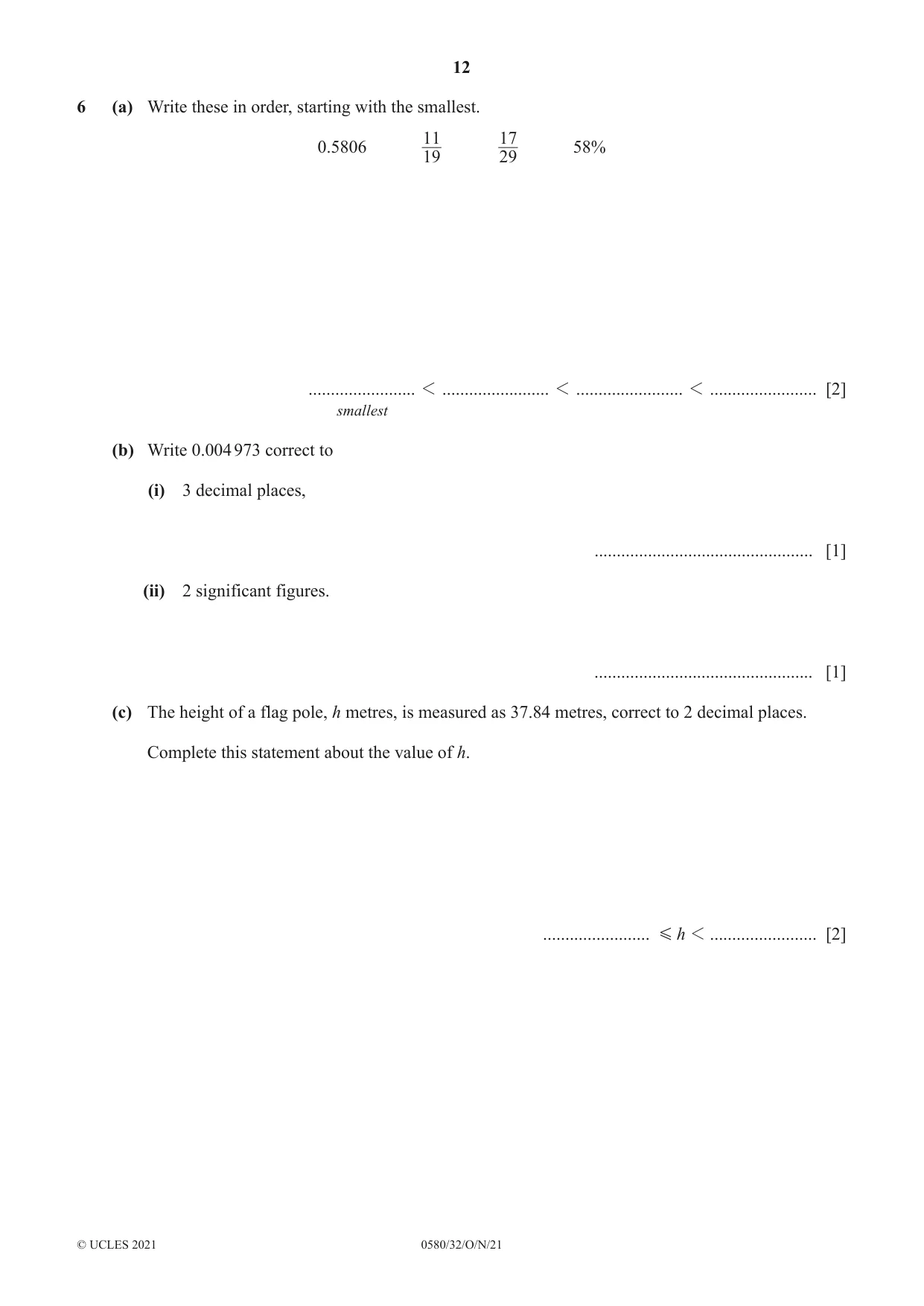
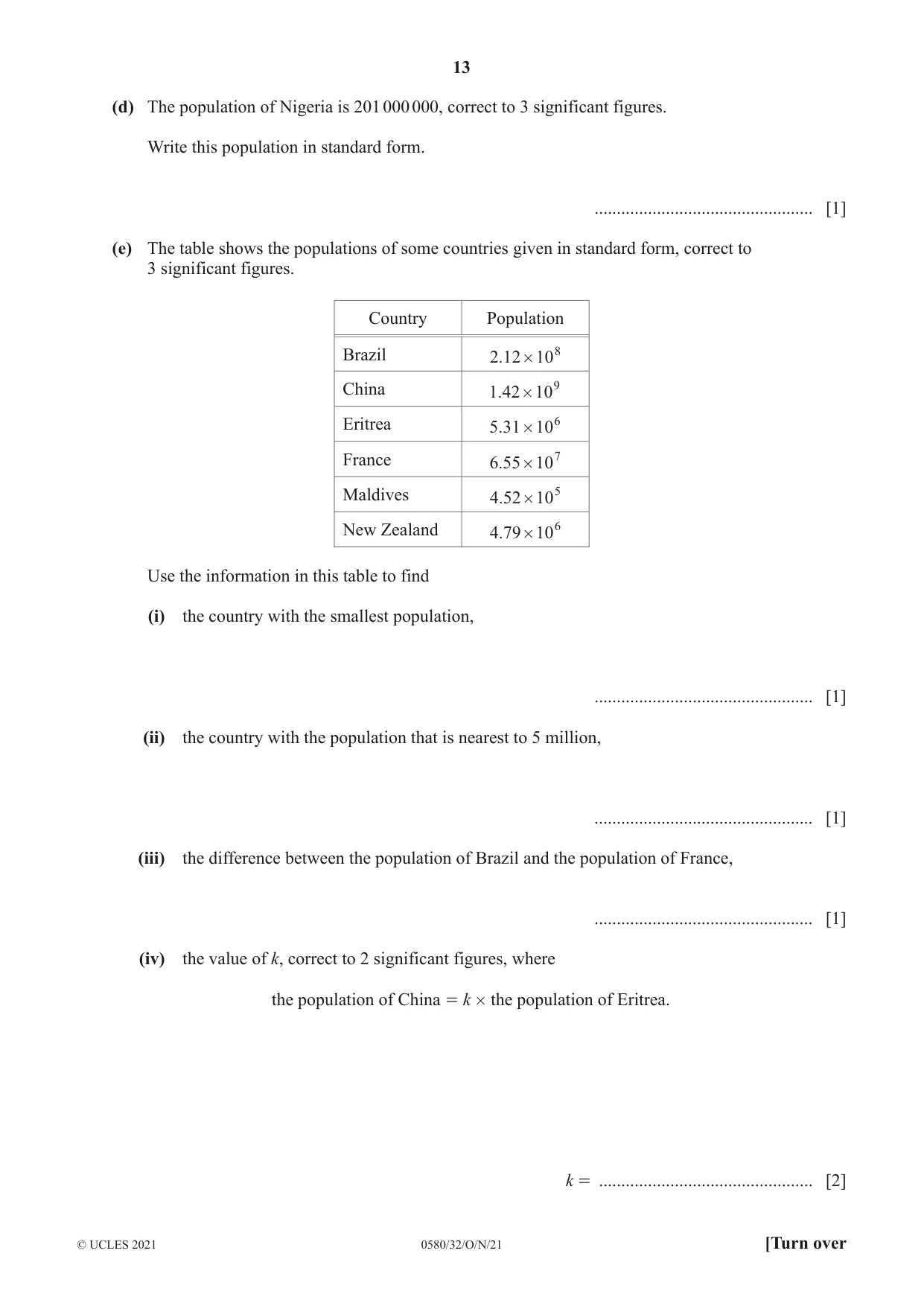
6 (a) Write these in order, starting with the smallest. 11 17 0.5806 58% 19 29 ........................ 1 ........................ 1 ........................ 1 ........................ [2] smallest (b) Write 0.004 973 correct to (i) 3 decimal places, ................................................. [1] (ii) 2 significant figures. ................................................. [1] (c) The height of a flag pole, h metres, is measured as 37.84 metres, correct to 2 decimal places. Complete this statement about the value of h. ........................ G h 1 ........................ [2] (d) The population of Nigeria is 201 000 000, correct to 3 significant figures. Write this population in standard form. ................................................. [1] (e) The table shows the populations of some countries given in standard form, correct to 3 significant figures. Country Population Brazil .212 # 108 China .142 # 109 Eritrea .531 # 106 France .655 # 107 Maldives .452 # 105 New Zealand .479 # 106 Use the information in this table to find (i) the country with the smallest population, ................................................. [1] (ii) the country with the population that is nearest to 5 million, ................................................. [1] (iii) the difference between the population of Brazil and the population of France, ................................................. [1] (iv) the value of k, correct to 2 significant figures, where the population of China = k # the population of Eritrea. k = ................................................ [2]
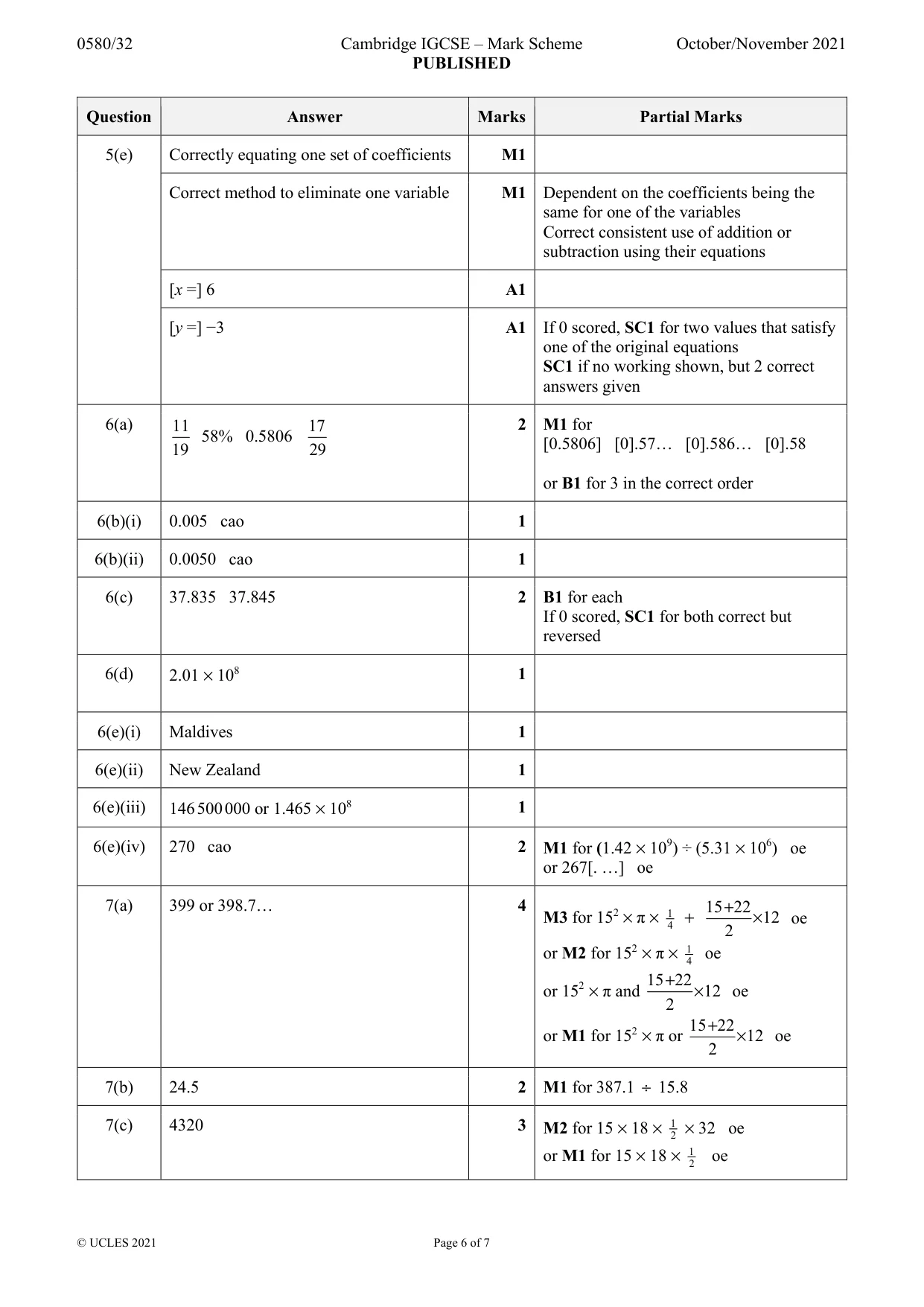
Mark scheme: 6(a) 11 17 2 M1 for 58% 0.5806 [0.5806] [0].57… [0].586… [0].58 19 29 or B1 for 3 in the correct order 6(b)(i) 0.005 cao 1 6(b)(ii) 0.0050 cao 1 6(c) 37.835 37.845 2 B1 for each If 0 scored, SC1 for both correct but reversed 6(d) 2.01 × 10⁸ 1 6(e)(i) Maldives 1 6(e)(ii) New Zealand 1 6(e)(iii) 146 500 000 or 1.465 × 10⁸ 1 6(e)(iv) 270 cao 2 M1 for (1.42 × 10⁹) ÷ (5.31 × 10⁶) oe or 267[. …] oe
Q7 · 15 m NOT TO 15 m SCALE 12 m 22 m The diagram shows a shape made from a quarter circle and…
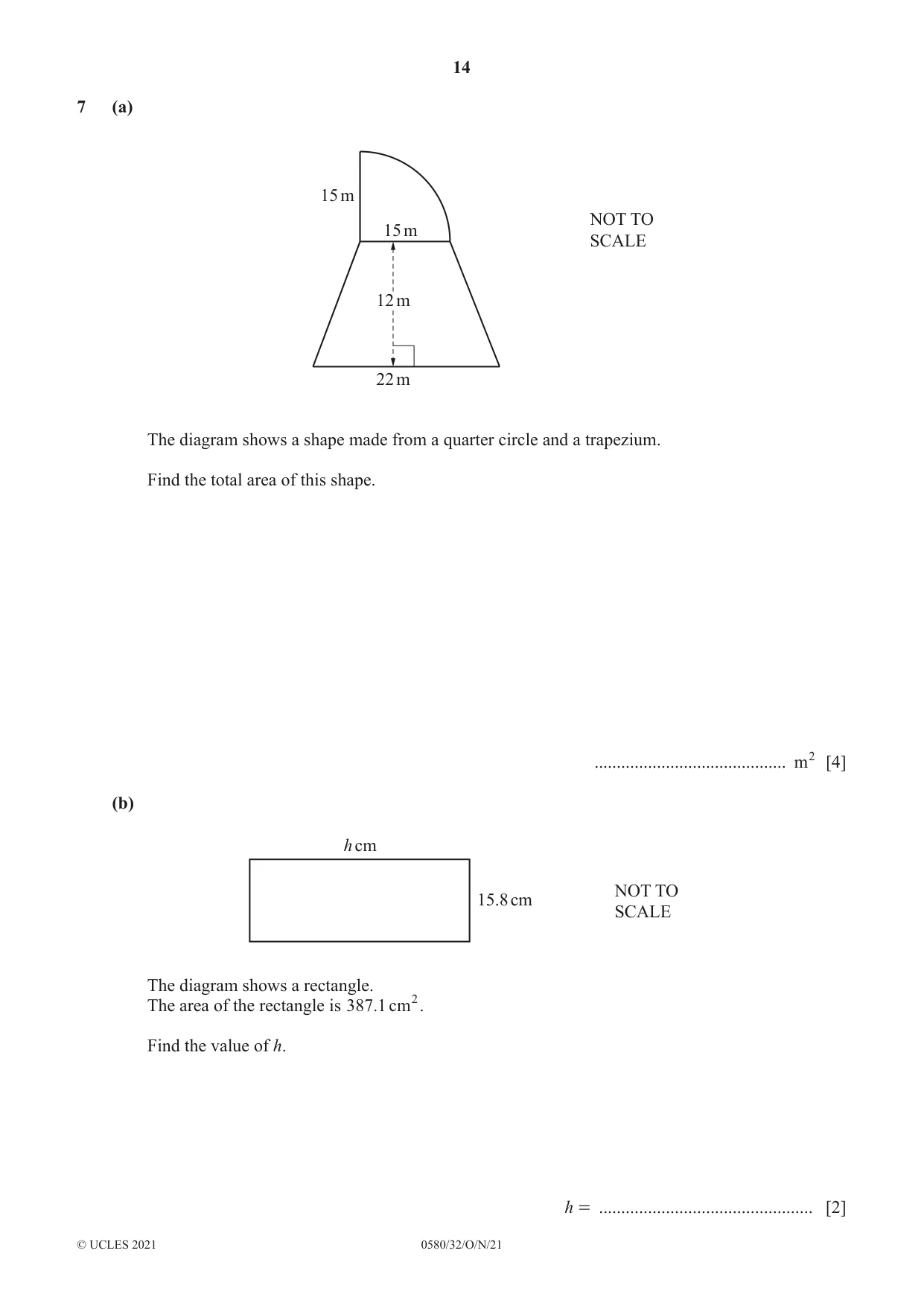
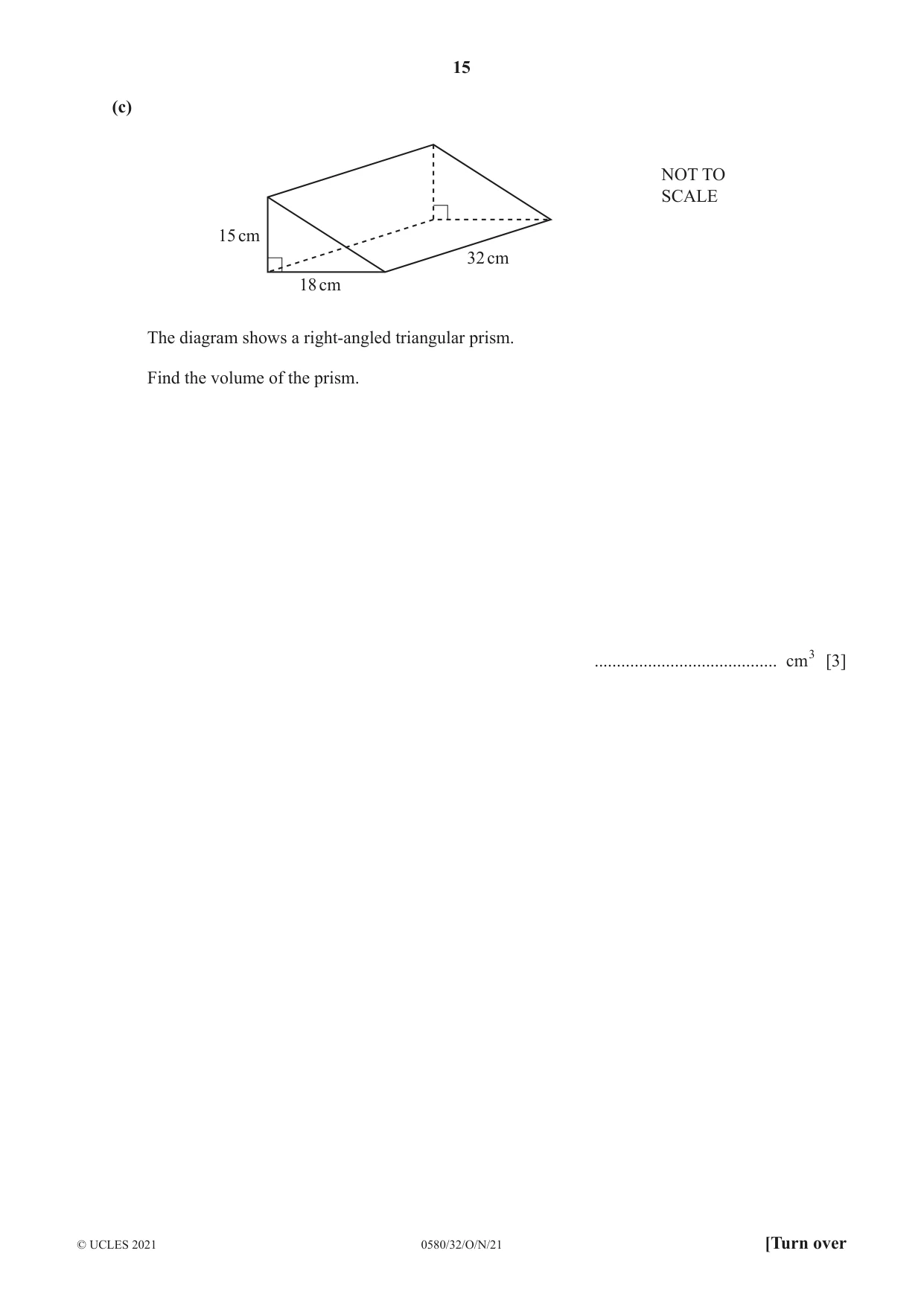
7 (a) 15 m NOT TO 15 m SCALE 12 m 22 m The diagram shows a shape made from a quarter circle and a trapezium. Find the total area of this shape. ........................................... m2 [4] (b) h cm NOT TO 15.8 cm SCALE The diagram shows a rectangle. The area of the rectangle is 387.1 cm 2. Find the value of h. h = ................................................ [2] (c) NOT TO SCALE 15 cm 32 cm 18 cm The diagram shows a right-angled triangular prism. Find the volume of the prism. ......................................... cm3 [3]
Mark scheme: 7(a) 399 or 398.7… 4 1 15 + 22 M3 for 152 × π × 4 + × 12 oe 2 or M2 for 152 × π × 14 oe 15 + 22 or 152 × π and × 12 oe 2 15 + 22 or M1 for 152 × π or × 12 oe 2 7(b) 24.5 2 M1 for 387.1 ÷ 15.8 7(c) 4320 3 M2 for 15 × 18 × 12 × 32 oe or M1 for 15 × 18 × 12 oe
Q8 · D NOT TO SCALE A 74.9 cm 21.4 cm B 14.8 cm C E F Right-angled triangles ABC and DEF are…
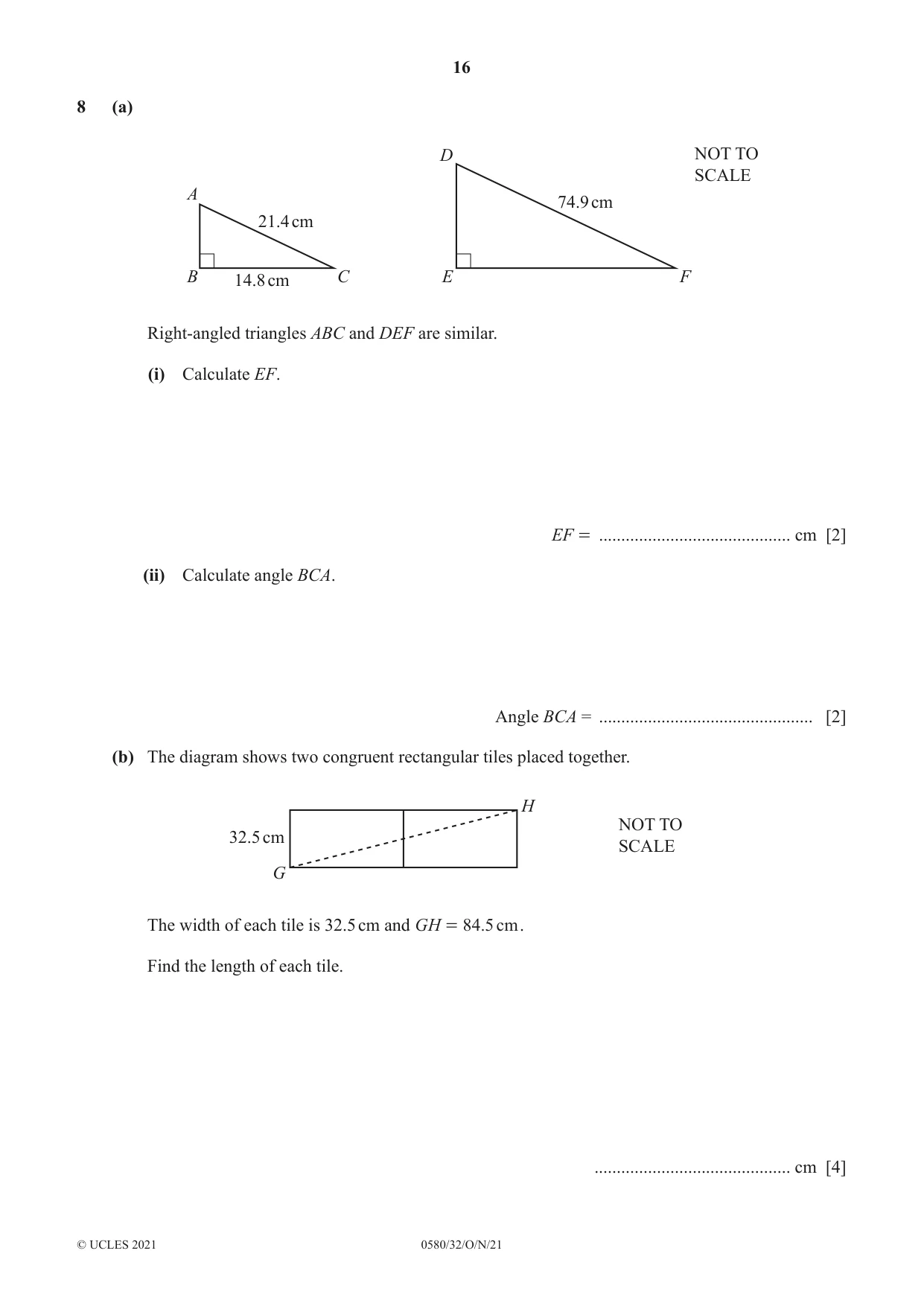
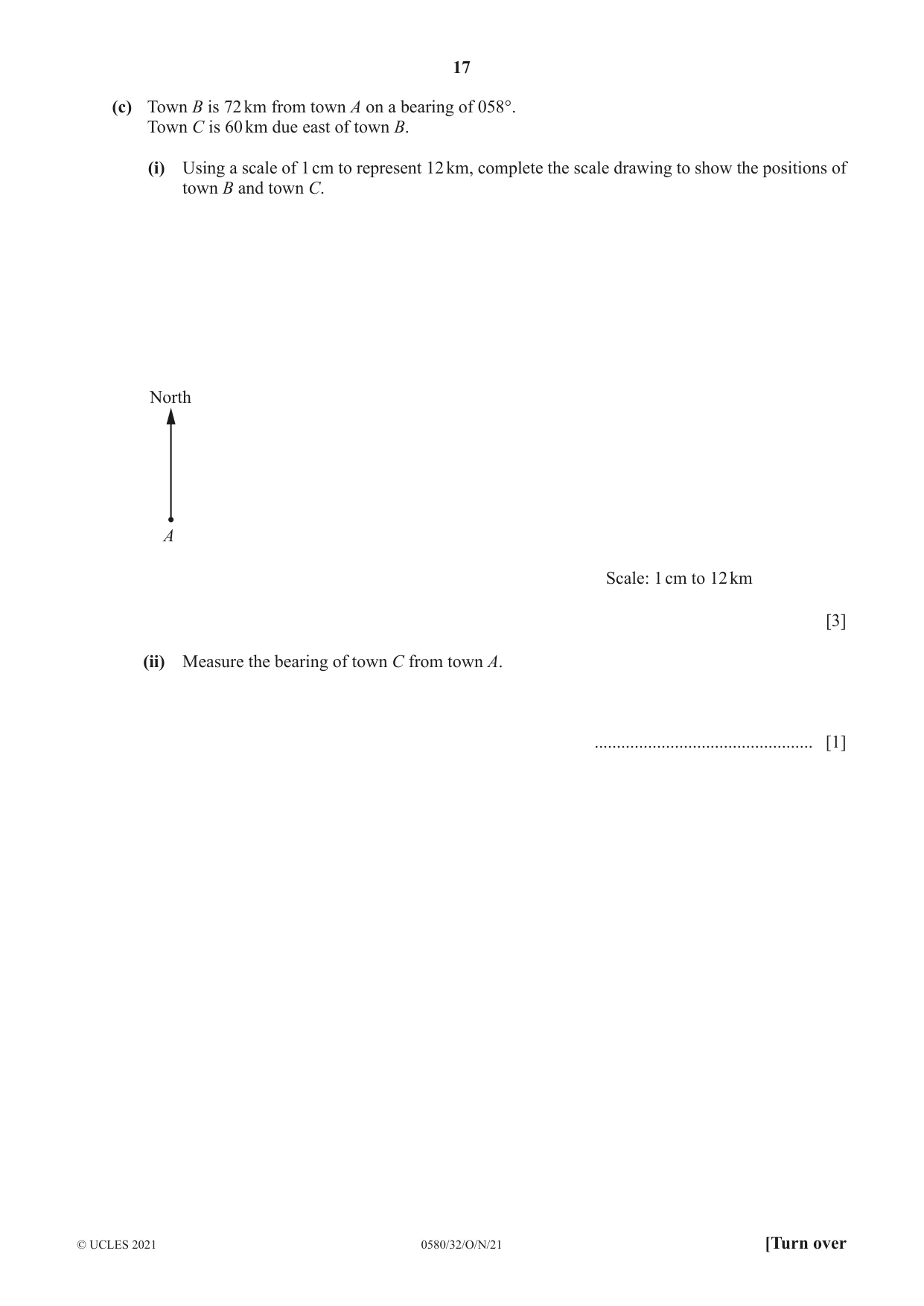
8 (a) D NOT TO SCALE A 74.9 cm 21.4 cm B 14.8 cm C E F Right-angled triangles ABC and DEF are similar. (i) Calculate EF. EF = ........................................... cm [2] (ii) Calculate angle BCA. Angle BCA = ................................................ [2] (b) The diagram shows two congruent rectangular tiles placed together. H NOT TO 32.5 cm SCALE G The width of each tile is 32.5 cm and GH = 84.5 cm . Find the length of each tile. ............................................ cm [4] (c) Town B is 72 km from town A on a bearing of 058°. Town C is 60 km due east of town B. (i) Using a scale of 1 cm to represent 12 km, complete the scale drawing to show the positions of town B and town C. North A Scale: 1 cm to 12 km [3] (ii) Measure the bearing of town C from town A. ................................................. [1]
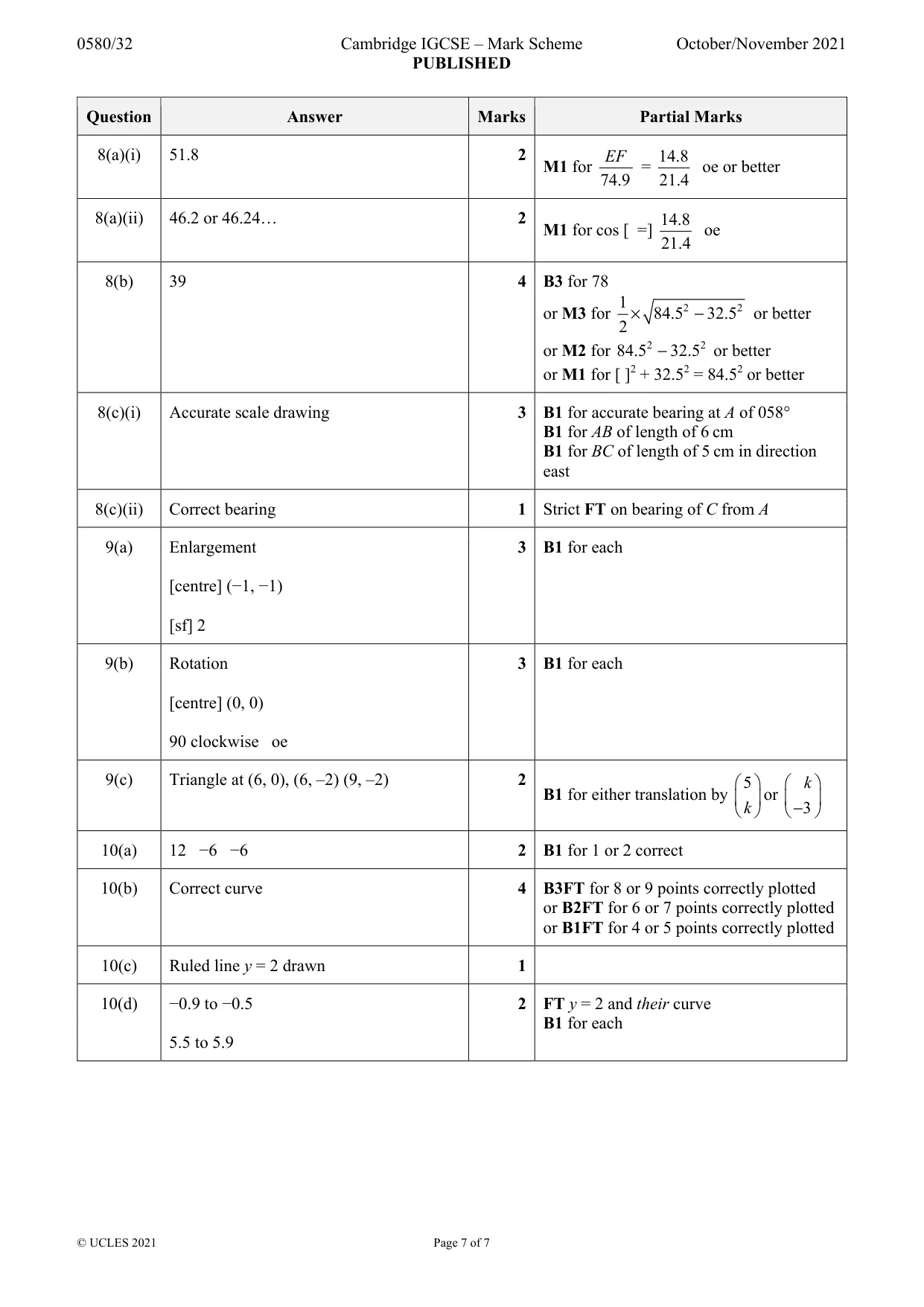
Mark scheme: 8(a)(i) 51.8 2 EF 14.8 M1 for = oe or better 74.9 21.4 8(a)(ii) 46.2 or 46.24… 2 14.8 M1 for cos [ =] oe 21.4 8(b) 39 4 B3 for 78 1 2 2 or M3 for × 84.5 − 32.5 or better 2 or M2 for 84.5 2 − 32.5 2 or better or M1 for [ ]2 + 32.52 = 84.52 or better 8(c)(i) Accurate scale drawing 3 B1 for accurate bearing at A of 058° B1 for AB of length of 6 cm B1 for BC of length of 5 cm in direction east 8(c)(ii) Correct bearing 1 Strict FT on bearing of C from A
Q9 · Triangles A, B and T are shown on the grid
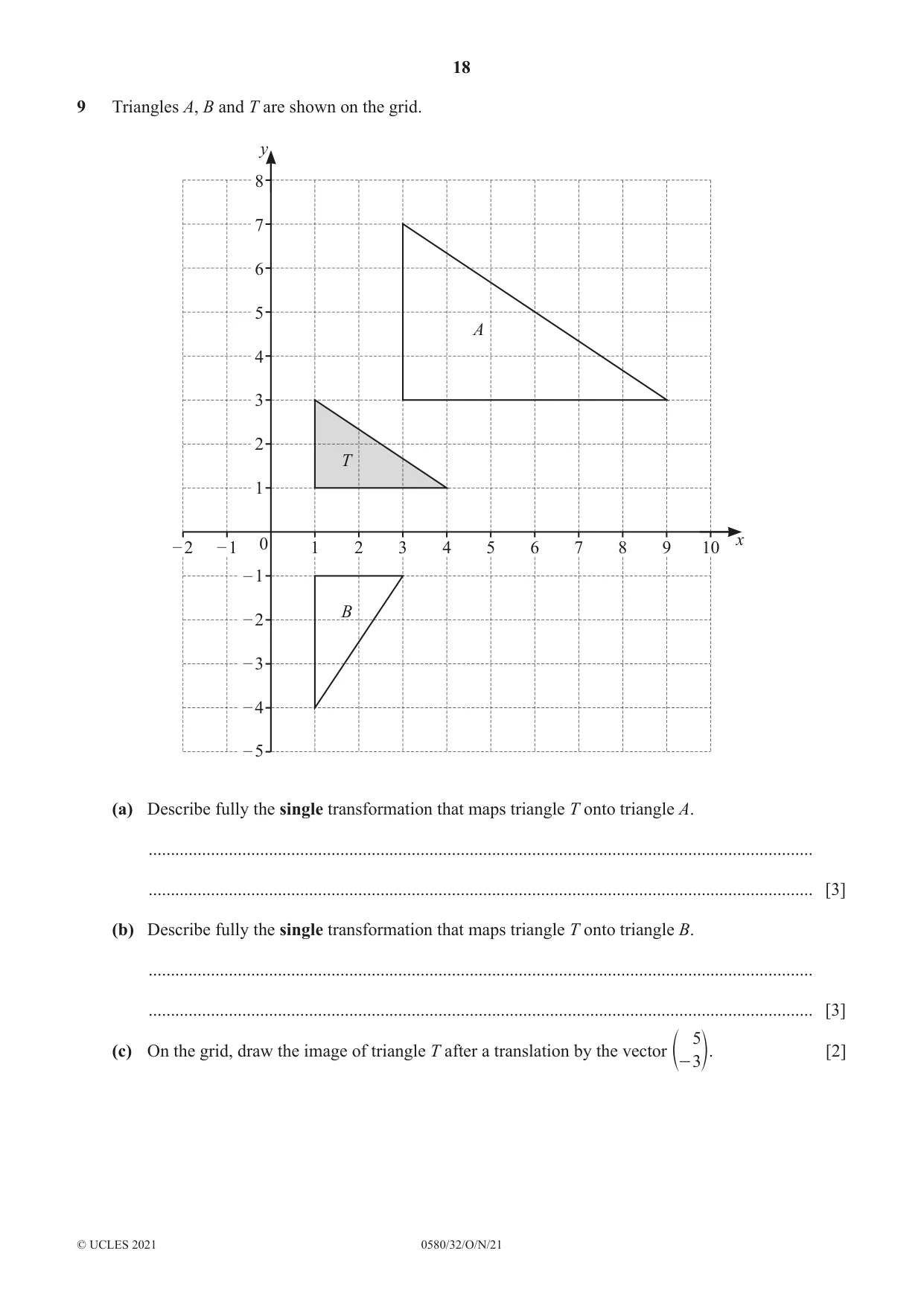
9 Triangles A, B and T are shown on the grid. y 8 7 6 5 A 4 3 2 T 1 – 2 – 1 0 1 2 3 4 5 6 7 8 9 10 x – 1 B – 2 – 3 – 4 – 5 (a) Describe fully the single transformation that maps triangle T onto triangle A. ..................................................................................................................................................... ..................................................................................................................................................... [3] (b) Describe fully the single transformation that maps triangle T onto triangle B. ..................................................................................................................................................... ..................................................................................................................................................... [3] 5 (c) On the grid, draw the image of triangle T after a translation by the vector [2] e- 3o.
Mark scheme: 9(a) Enlargement 3 B1 for each [centre] (−1, −1) [sf] 2 9(b) Rotation 3 B1 for each [centre] (0, 0) 90 clockwise oe 9(c) Triangle at (6, 0), (6, –2) (9, –2) 2 5 k B1 for either translation by or k − 3
Q10 · Complete the table of values for y = x 2 - 5x - 2
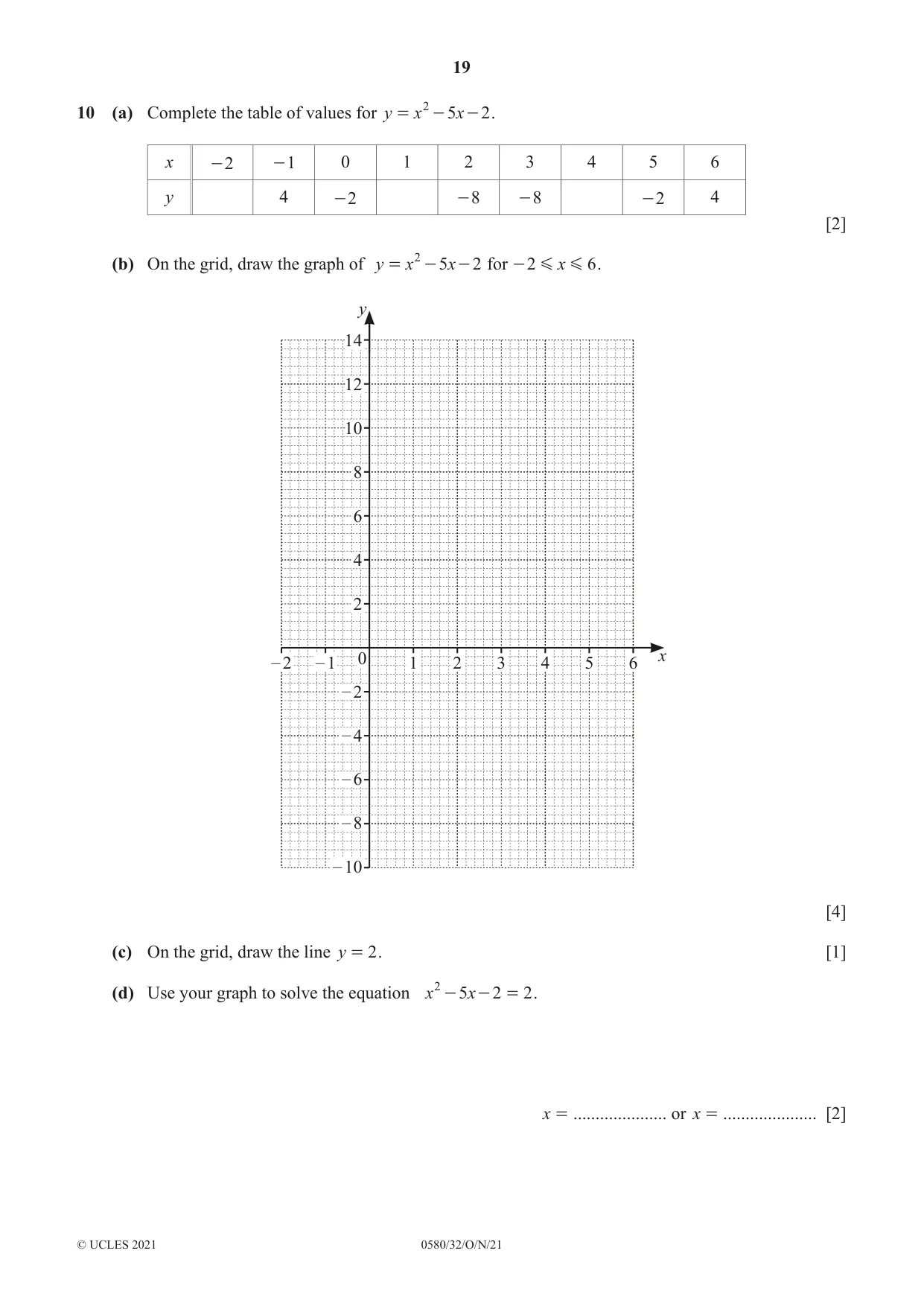
10 (a) Complete the table of values for y = x 2 - 5x - 2 . x - 2 - 1 0 1 2 3 4 5 6 y 4 - 2 - 8 - 8 - 2 4 [2] (b) On the grid, draw the graph of y = x 2 - 5x - 2 for - 2 G x G 6 . y 14 12 10 8 6 4 2 – 2 – 1 0 1 2 3 4 5 6 x – 2 – 4 – 6 – 8 – 10 [4] (c) On the grid, draw the line y = 2 . [1] (d) Use your graph to solve the equation x 2 - 5 x - 2 = 2 . x = ..................... or x = ..................... [2]
Mark scheme: 10(a) 12 −6 −6 2 B1 for 1 or 2 correct 10(b) Correct curve 4 B3FT for 8 or 9 points correctly plotted or B2FT for 6 or 7 points correctly plotted or B1FT for 4 or 5 points correctly plotted 10(c) Ruled line y = 2 drawn 1 10(d) −0.9 to −0.5 2 FT y = 2 and their curve B1 for each 5.5 to 5.9
What was in this paper
The subtopics covered by these 10 questions, and how many questions each got. Open one in a new tab to see every Cambridge question on it.
What you needed in this session
Cambridge’s own grade thresholds for 2021 Oct/Nov, Paper 3 · Variant 2. A higher threshold means an easier paper — the bar moves with how the cohort did.