Cambridge IGCSE Mathematics 0580 — 2020 May/June Paper 3 · Variant 1
0580/31/M/J/20 · 9 questions · 91 marks · ≈102 min
The question paper and its mark scheme, free to read here and free to download. This is Cambridge’s own paper, exactly as it was sat.
Question paper20 pages
Mark scheme7 pages
Answers below. Sit the paper first if you are practising.
Questions as text
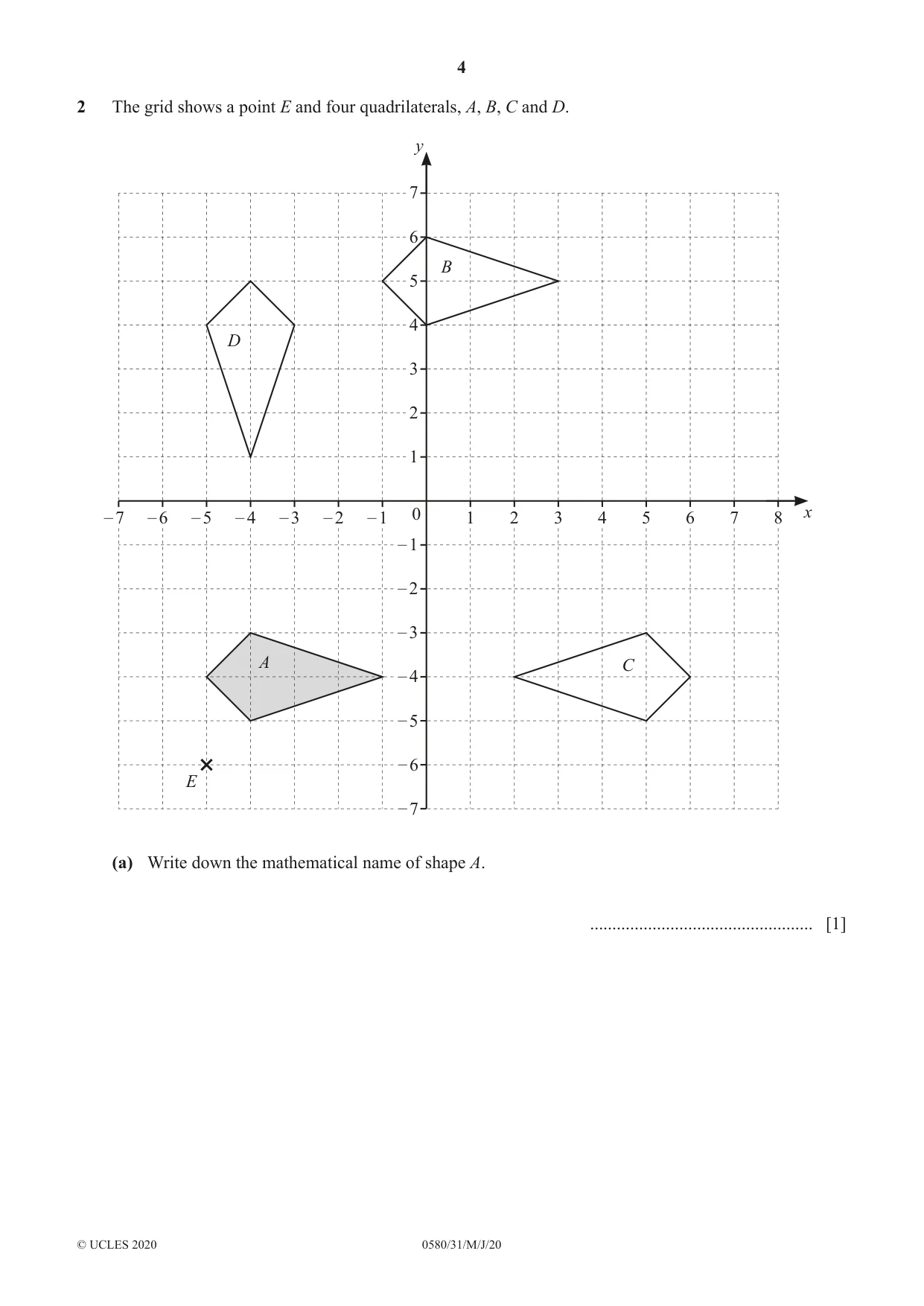
Q2 · The grid shows a point E and four quadrilaterals, A, B, C and D
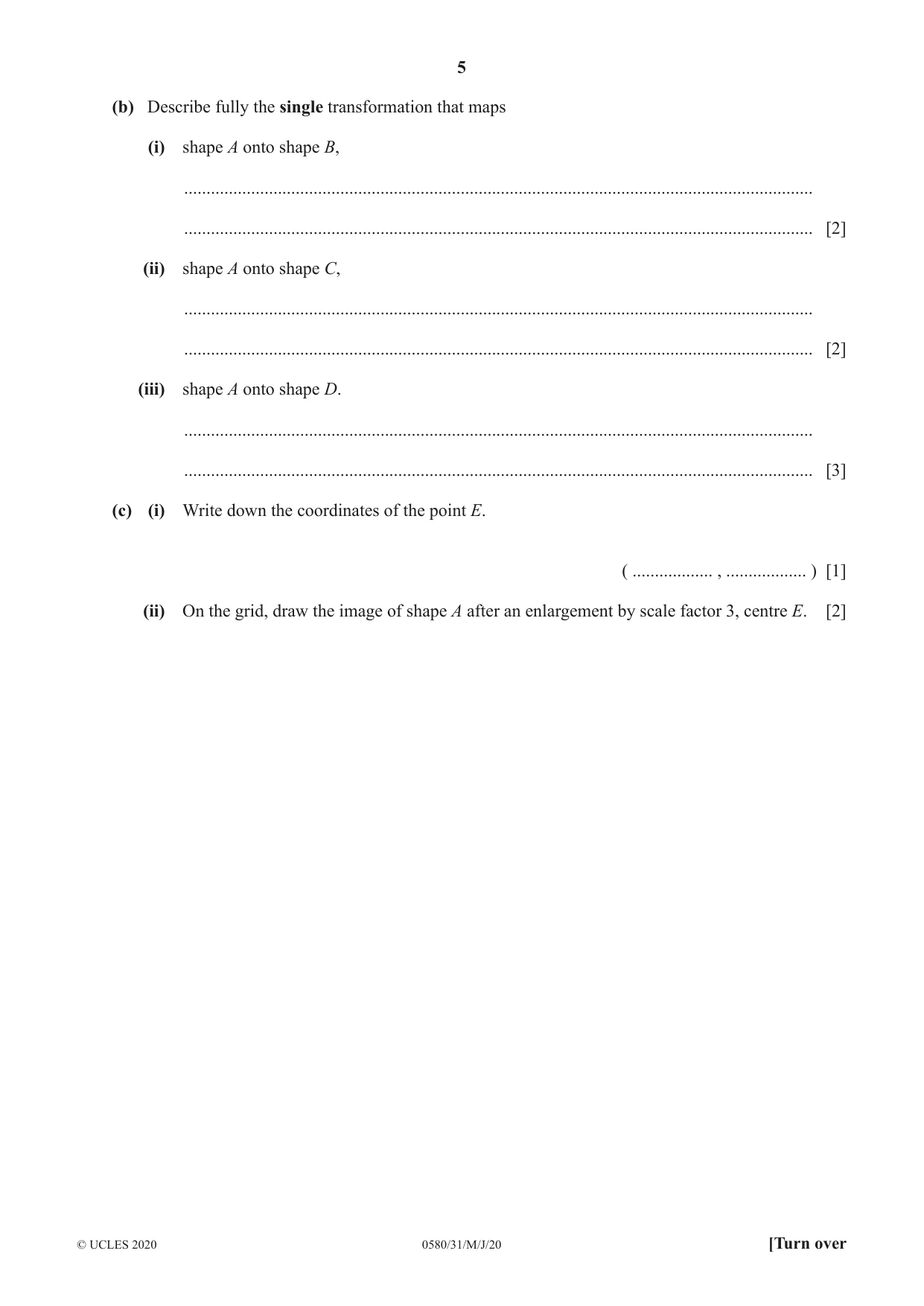
2 The grid shows a point E and four quadrilaterals, A, B, C and D. y 7 6 B 5 4 D 3 2 1 – 7 – 6 – 5 – 4 – 3 – 2 – 1 0 1 2 3 4 5 6 7 8 x – 1 – 2 – 3 A C – 4 – 5 – 6 E – 7 (a) Write down the mathematical name of shape A. .................................................. [1] (b) Describe fully the single transformation that maps (i) shape A onto shape B, ............................................................................................................................................. ............................................................................................................................................. [2] (ii) shape A onto shape C, ............................................................................................................................................. ............................................................................................................................................. [2] (iii) shape A onto shape D. ............................................................................................................................................. ............................................................................................................................................. [3] (c) (i) Write down the coordinates of the point E. ( .................. , .................. ) [1] (ii) On the grid, draw the image of shape A after an enlargement by scale factor 3, centre E. [2]
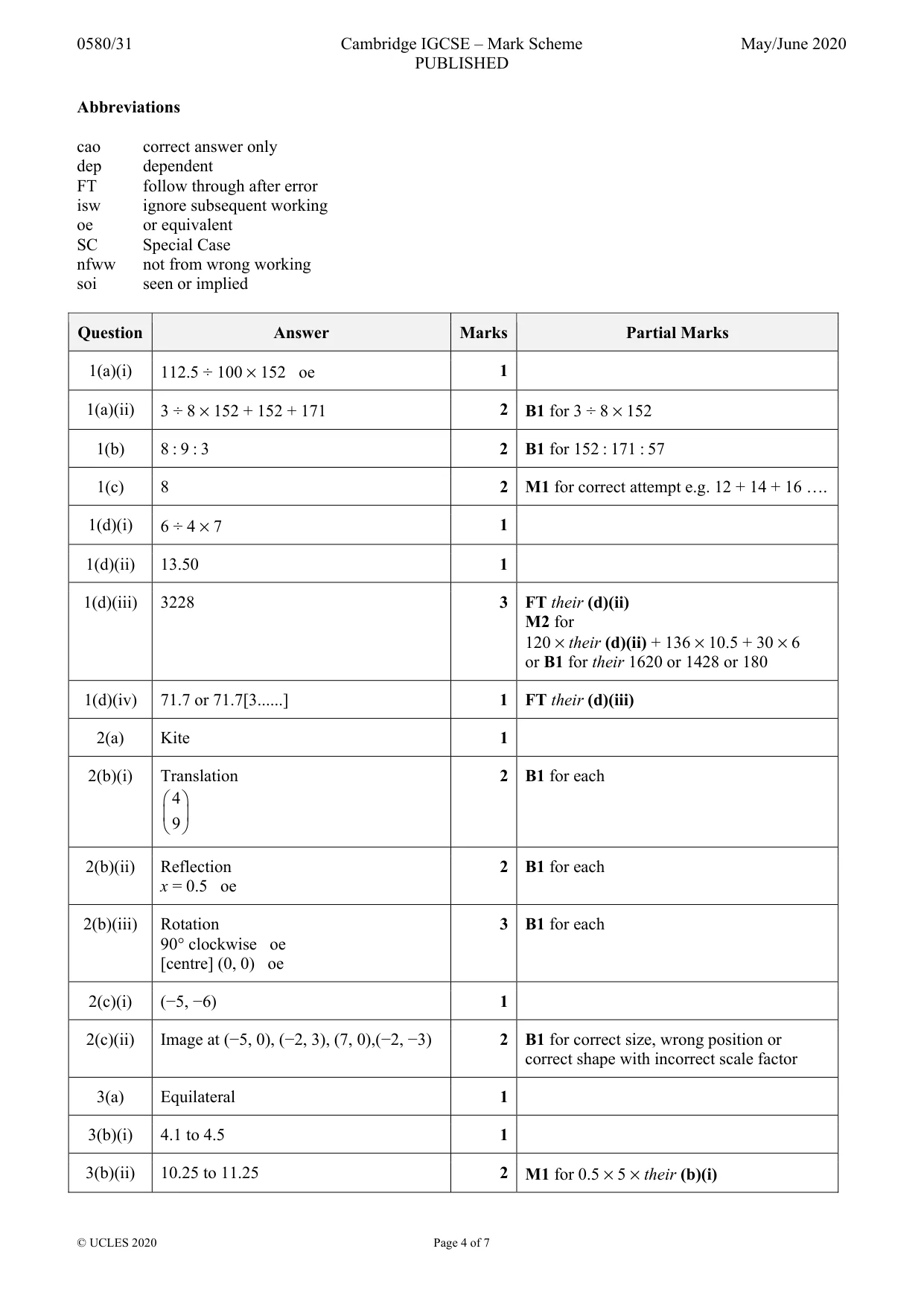
Mark scheme: 2(a) Kite 1 2(b)(i) Translation 2 B1 for each 4 9 2(b)(ii) Reflection 2 B1 for each x = 0.5 oe 2(b)(iii) Rotation 3 B1 for each 90° clockwise oe [centre] (0, 0) oe 2(c)(i) (−5, −6) 1 2(c)(ii) Image at (−5, 0), (−2, 3), (7, 0),(−2, −3) 2 B1 for correct size, wrong position or correct shape with incorrect scale factor
Q3 · The diagram shows the net of a triangular prism on a 1 cm2 grid
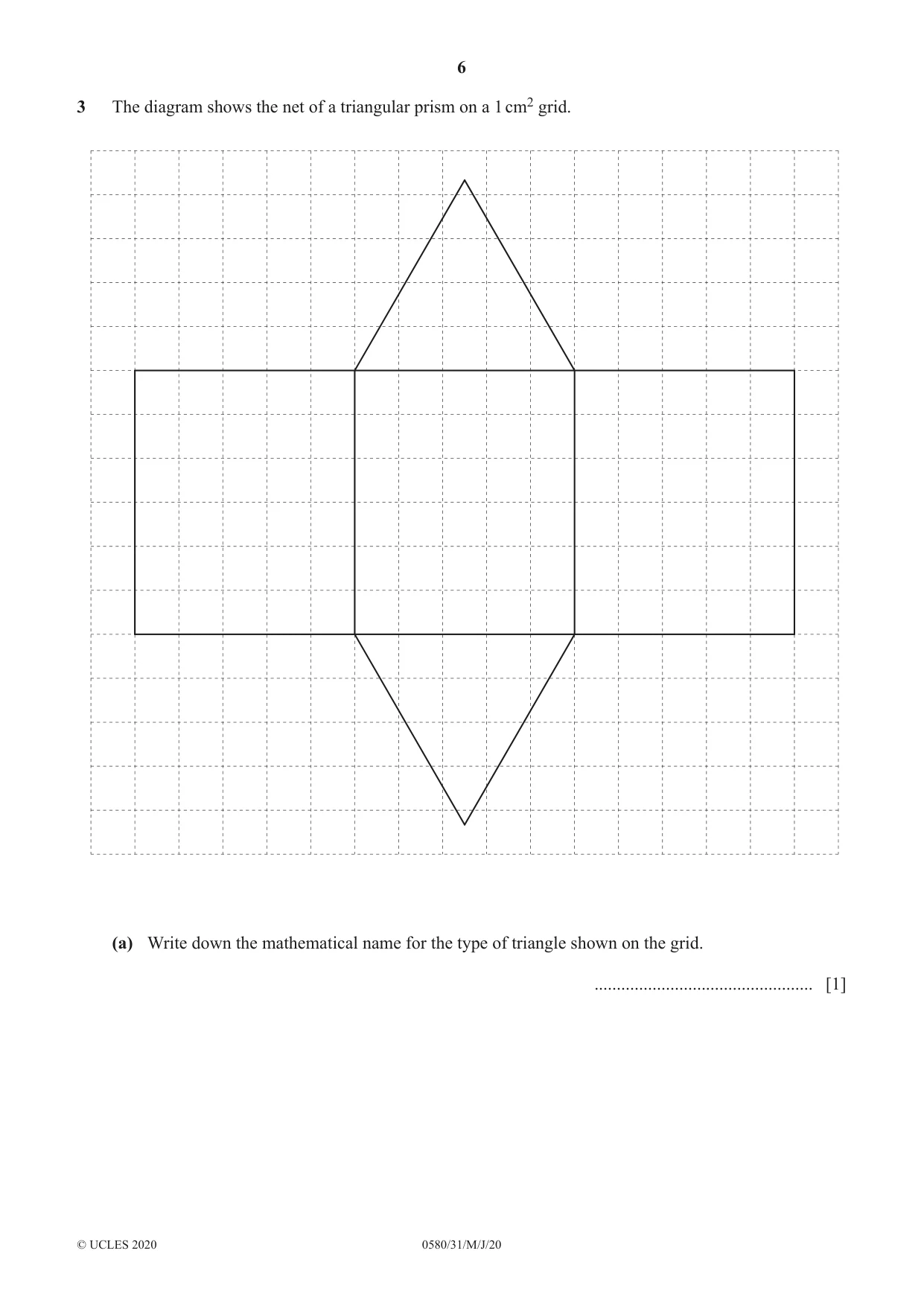
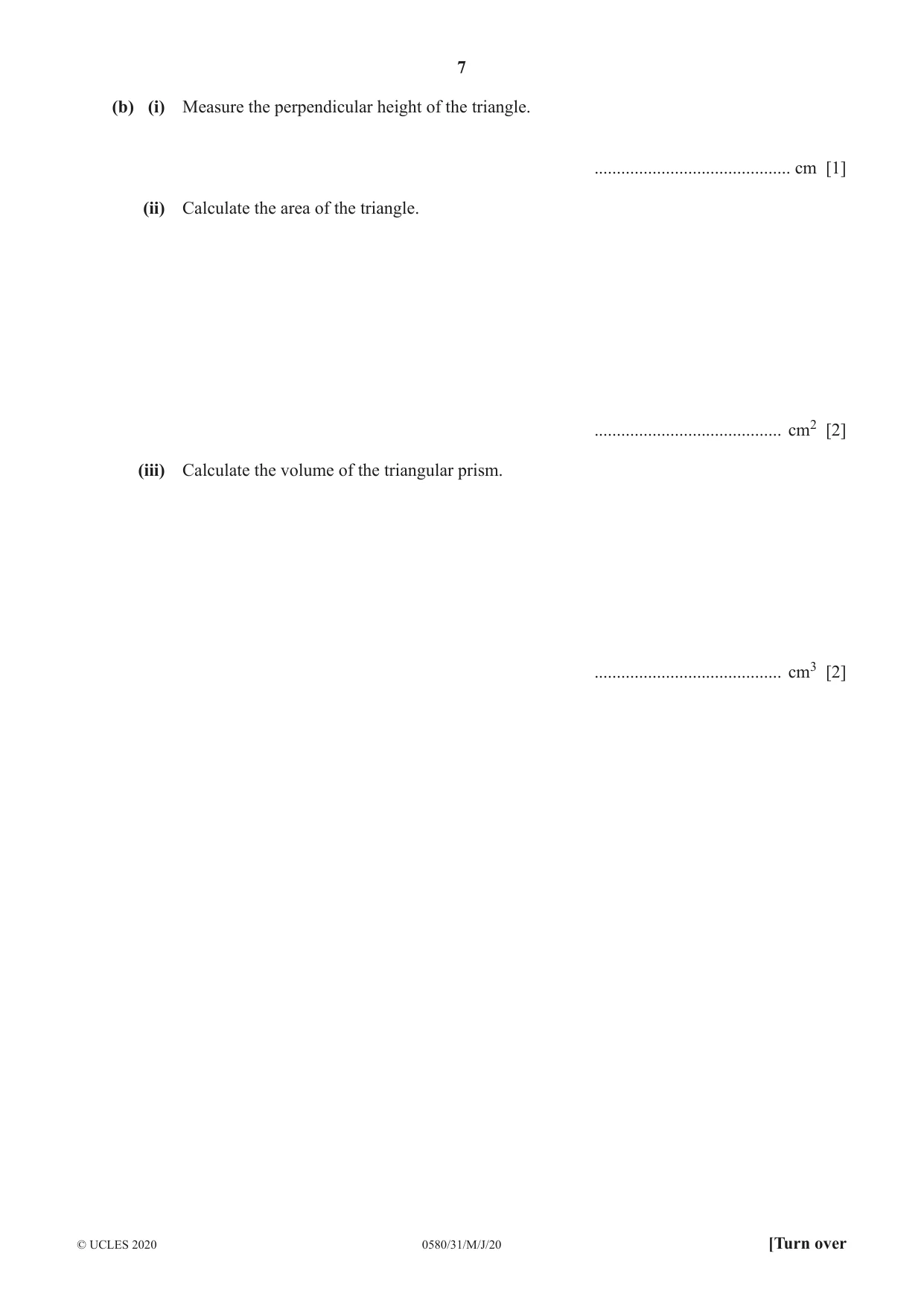
3 The diagram shows the net of a triangular prism on a 1 cm2 grid. (a) Write down the mathematical name for the type of triangle shown on the grid. ................................................. [1] (b) (i) Measure the perpendicular height of the triangle. ............................................ cm [1] (ii) Calculate the area of the triangle. .......................................... cm2 [2] (iii) Calculate the volume of the triangular prism. .......................................... cm3 [2]
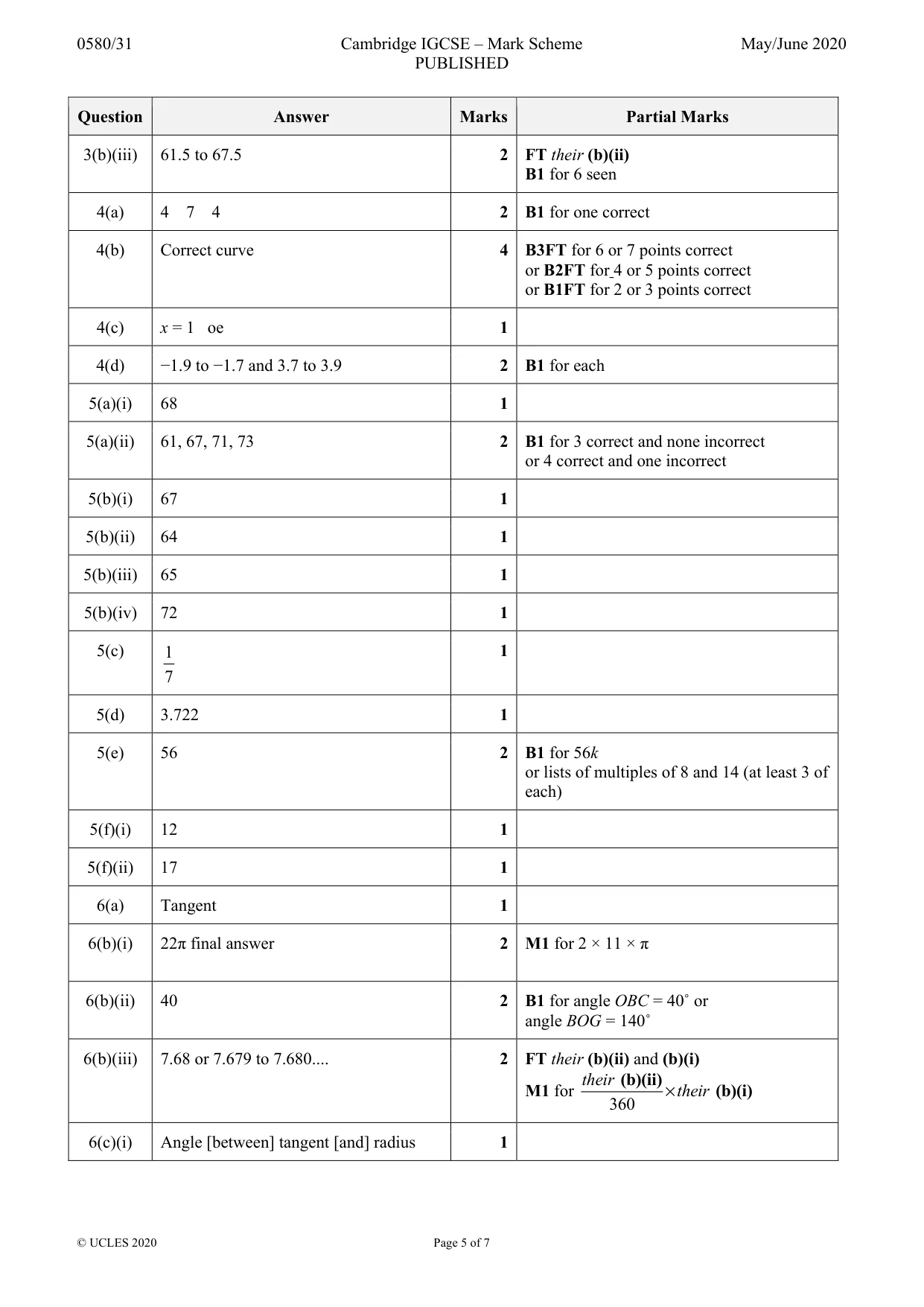
Mark scheme: 3(a) Equilateral 1 3(b)(i) 4.1 to 4.5 1 3(b)(ii) 10.25 to 11.25 2 M1 for 0.5 × 5 × their (b)(i) 3(b)(iii) 61.5 to 67.5 2 FT their (b)(ii) B1 for 6 seen
Q4 · Complete the table of values for y = 7 + 2 x - x 2
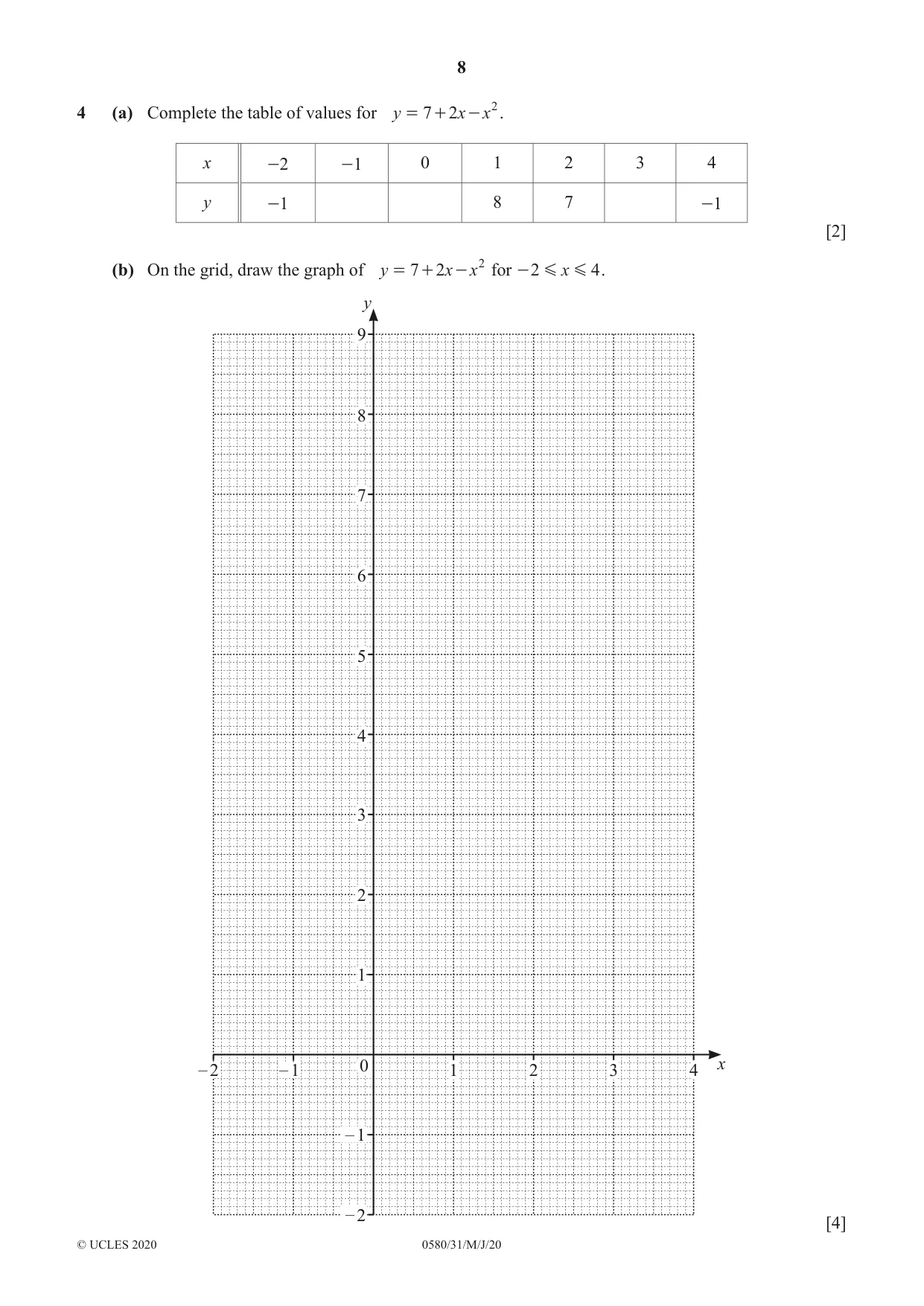
4 (a) Complete the table of values for y = 7 + 2 x - x 2 . x -2 -1 0 1 2 3 4 y -1 8 7 -1 [2] (b) On the grid, draw the graph of y = 7 + 2x - x 2 for - 2 G x G 4 . y 9 8 7 6 5 4 3 2 1 – 2 – 1 0 1 2 3 4 x – 1 – 2 [4] (c) Write down the equation of the line of symmetry of the graph. ................................................. [1] (d) Use your graph to solve the equation 7 + 2x - x 2 = 0 . x = .................... or x = .................... [2]
Mark scheme: 4(a) 4 7 4 2 B1 for one correct 4(b) Correct curve 4 B3FT for 6 or 7 points correct or B2FT for 4 or 5 points correct or B1FT for 2 or 3 points correct 4(c) x = 1 oe 1 4(d) −1.9 to −1.7 and 3.7 to 3.9 2 B1 for each
Q5 · Using the integers from 60 to 75 only, find (i) a multiple of 17…
5 (a) Using the integers from 60 to 75 only, find (i) a multiple of 17, ................................................. [1] (ii) the prime numbers. ................................................. [2] (b) Find (i) the square root of 4489, ................................................. [1] (ii) 43, ................................................. [1] (iii) 3 274 625 , ................................................. [1] (iv) 2 -3 # 24 2 . ................................................. [1] (c) Write down the reciprocal of 7. ................................................. [1] (d) Write 3.72194 correct to 3 decimal places. ................................................. [1] (e) Find the lowest common multiple (LCM) of 8 and 14. ................................................. [2] (f) The average temperature at the North Pole is -23 °C in January and -11 °C in March. (i) Find the difference between these temperatures. ............................................ °C [1] (ii) The average temperature in July is 28 °C higher than the average temperature in March. Find the average temperature in July. ............................................ °C [1]
Mark scheme: 5(a)(i) 68 1 5(a)(ii) 61, 67, 71, 73 2 B1 for 3 correct and none incorrect or 4 correct and one incorrect 5(b)(i) 67 1 5(b)(ii) 64 1 5(b)(iii) 65 1 5(b)(iv) 72 1 5(c) 1 1 7 5(d) 3.722 1 5(e) 56 2 B1 for 56k or lists of multiples of 8 and 14 (at least 3 of each) 5(f)(i) 12 1 5(f)(ii) 17 1
Q6 · NOT TO SCALE G O F 11 cm E D H C 140° B A The diagram shows a circle, centre O, radius 11…
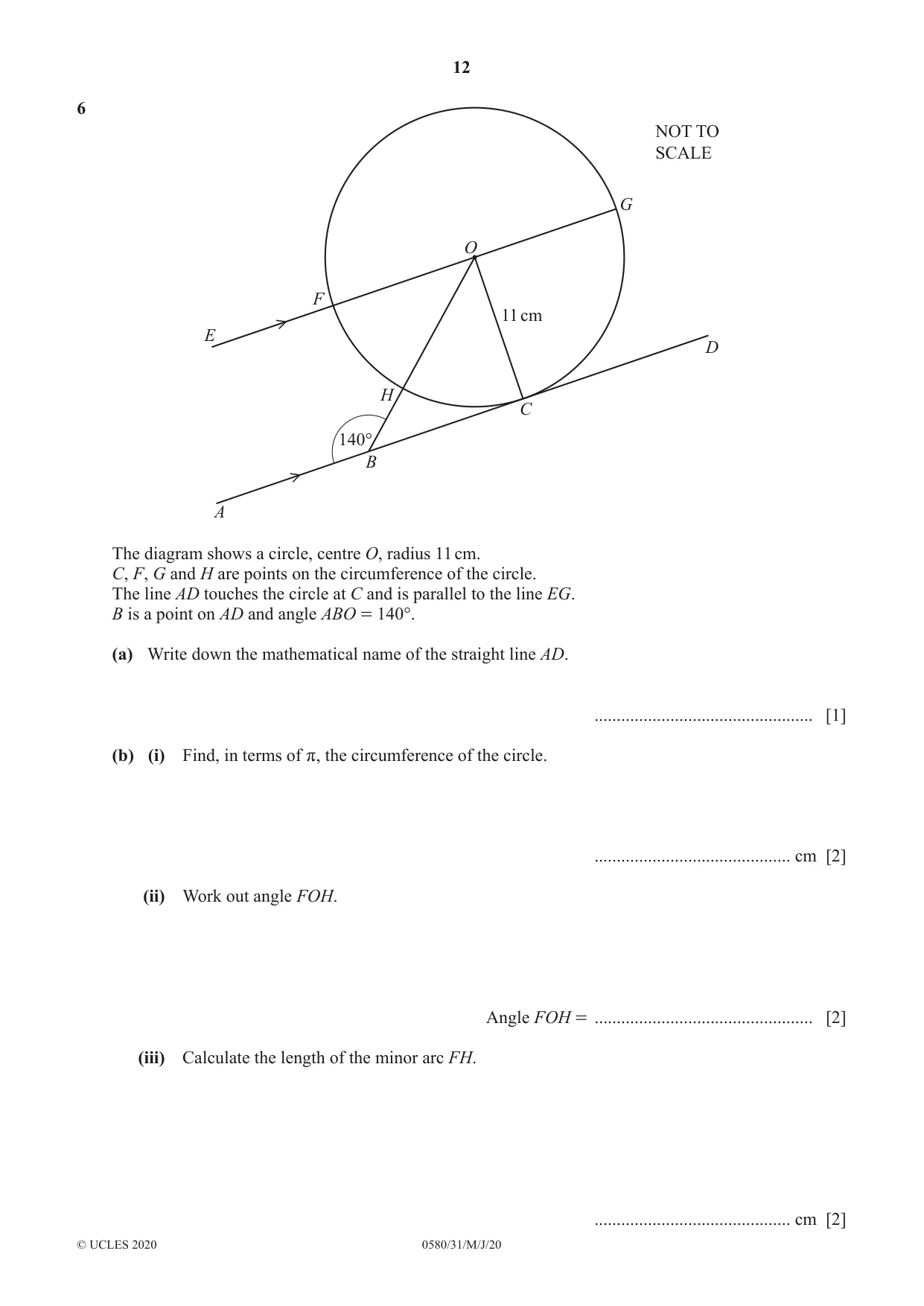
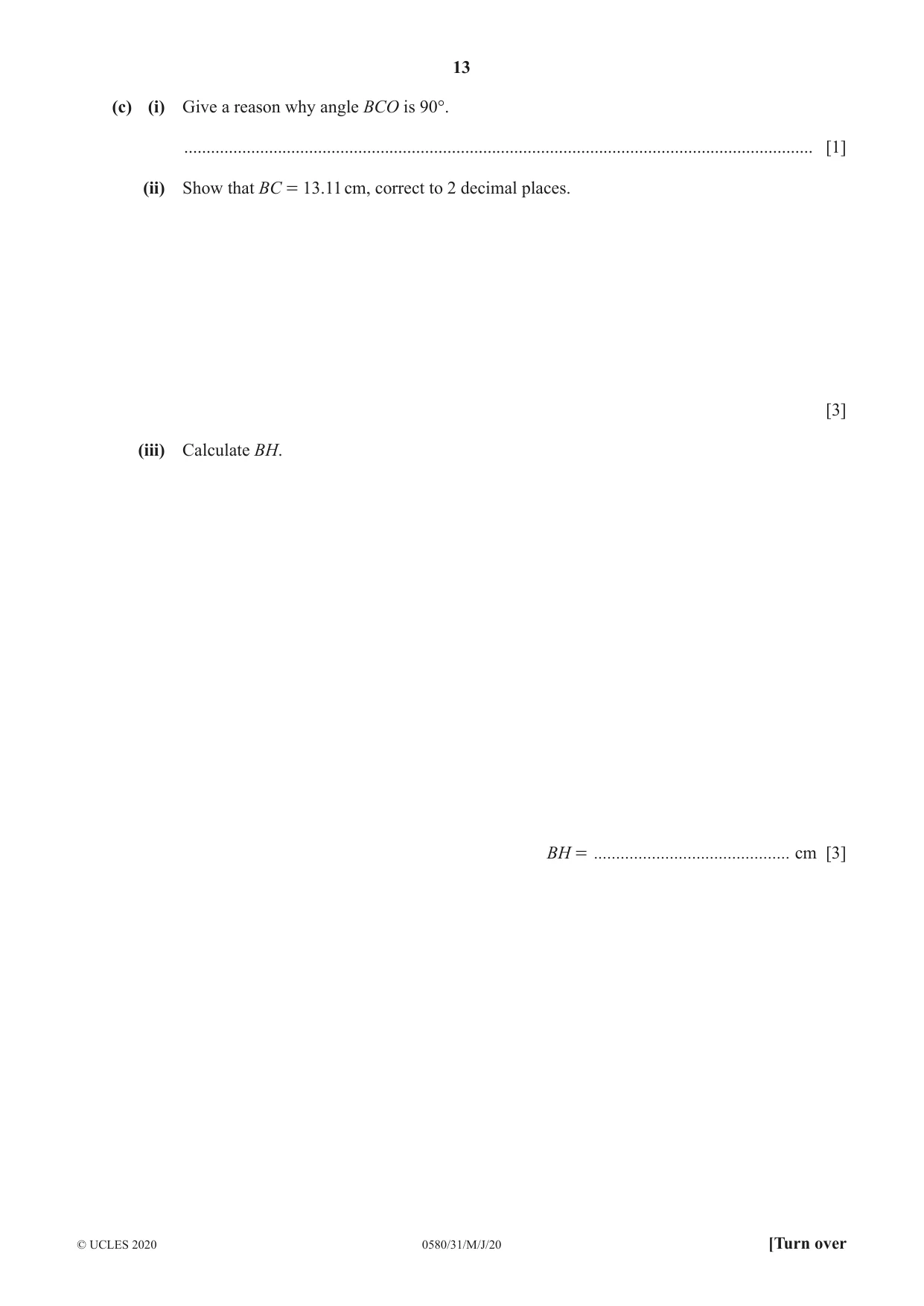
6 NOT TO SCALE G O F 11 cm E D H C 140° B A The diagram shows a circle, centre O, radius 11 cm. C, F, G and H are points on the circumference of the circle. The line AD touches the circle at C and is parallel to the line EG. B is a point on AD and angle ABO = 140°. (a) Write down the mathematical name of the straight line AD. ................................................. [1] (b) (i) Find, in terms of r, the circumference of the circle. ............................................ cm [2] (ii) Work out angle FOH. Angle FOH = ................................................. [2] (iii) Calculate the length of the minor arc FH. ............................................ cm [2] (c) (i) Give a reason why angle BCO is 90°. ............................................................................................................................................. [1] (ii) Show that BC = 13.11 cm, correct to 2 decimal places. [3] (iii) Calculate BH. BH = ............................................ cm [3]
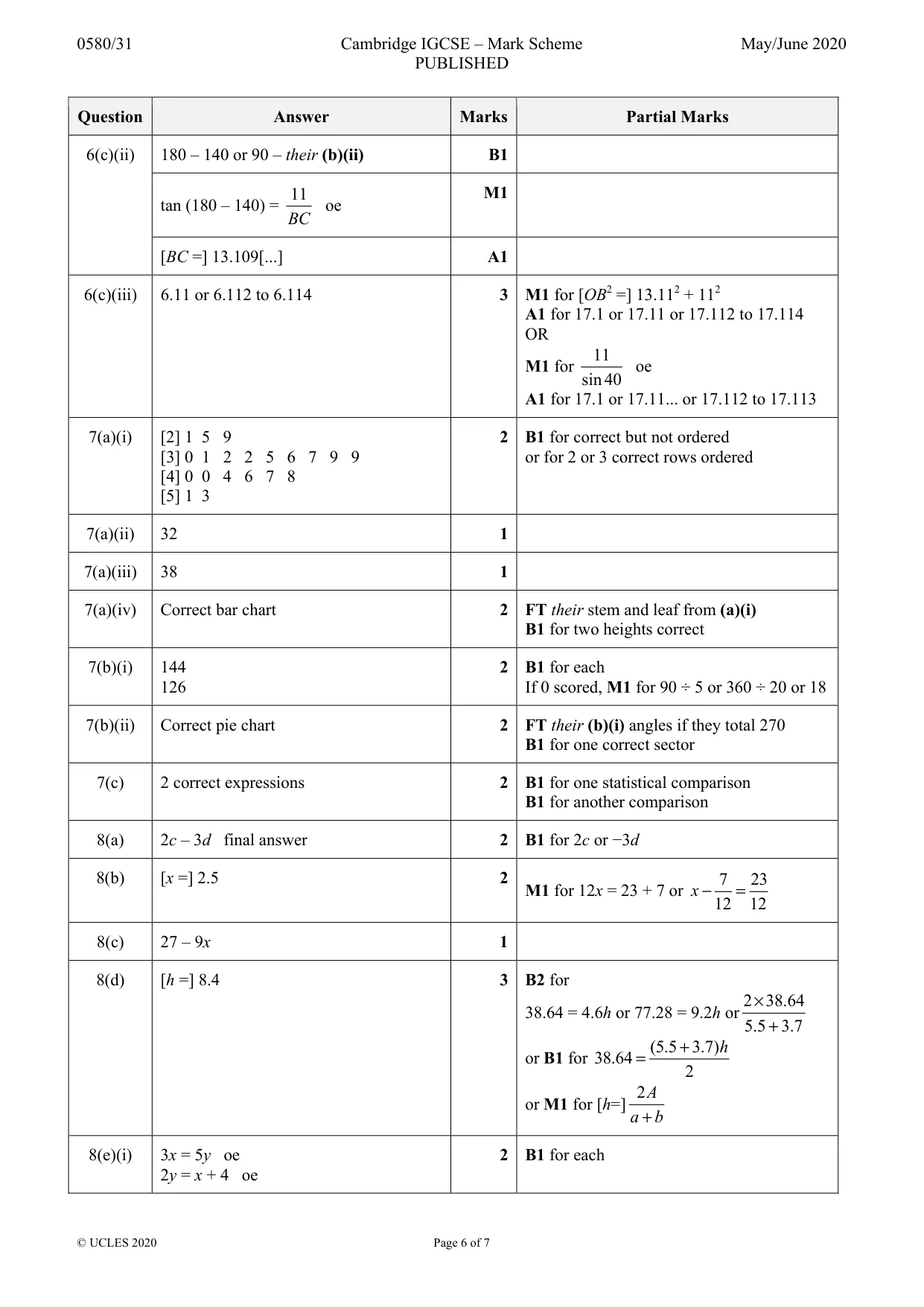
Mark scheme: 6(a) Tangent 1 6(b)(i) 22π final answer 2 M1 for 2 × 11 × π 6(b)(ii) 40 2 B1 for angle OBC = 40˚ or angle BOG = 140˚ 6(b)(iii) 7.68 or 7.679 to 7.680.... 2 FT their (b)(ii) and (b)(i) their (b)(ii) M1 for × their (b)(i) 360 6(c)(i) Angle [between] tangent [and] radius 1 6(c)(ii) 180 – 140 or 90 – their (b)(ii) B1 11 M1 tan (180 – 140) = oe BC [BC =] 13.109[...] A1 6(c)(iii) 6.11 or 6.112 to 6.114 3 M1 for [OB2 =] 13.112 + 112 A1 for 17.1 or 17.11 or 17.112 to 17.114 OR 11 M1 for oe sin40 A1 for 17.1 or 17.11... or 17.112 to 17.113
Q7 · 20 students from College A each run 5 km
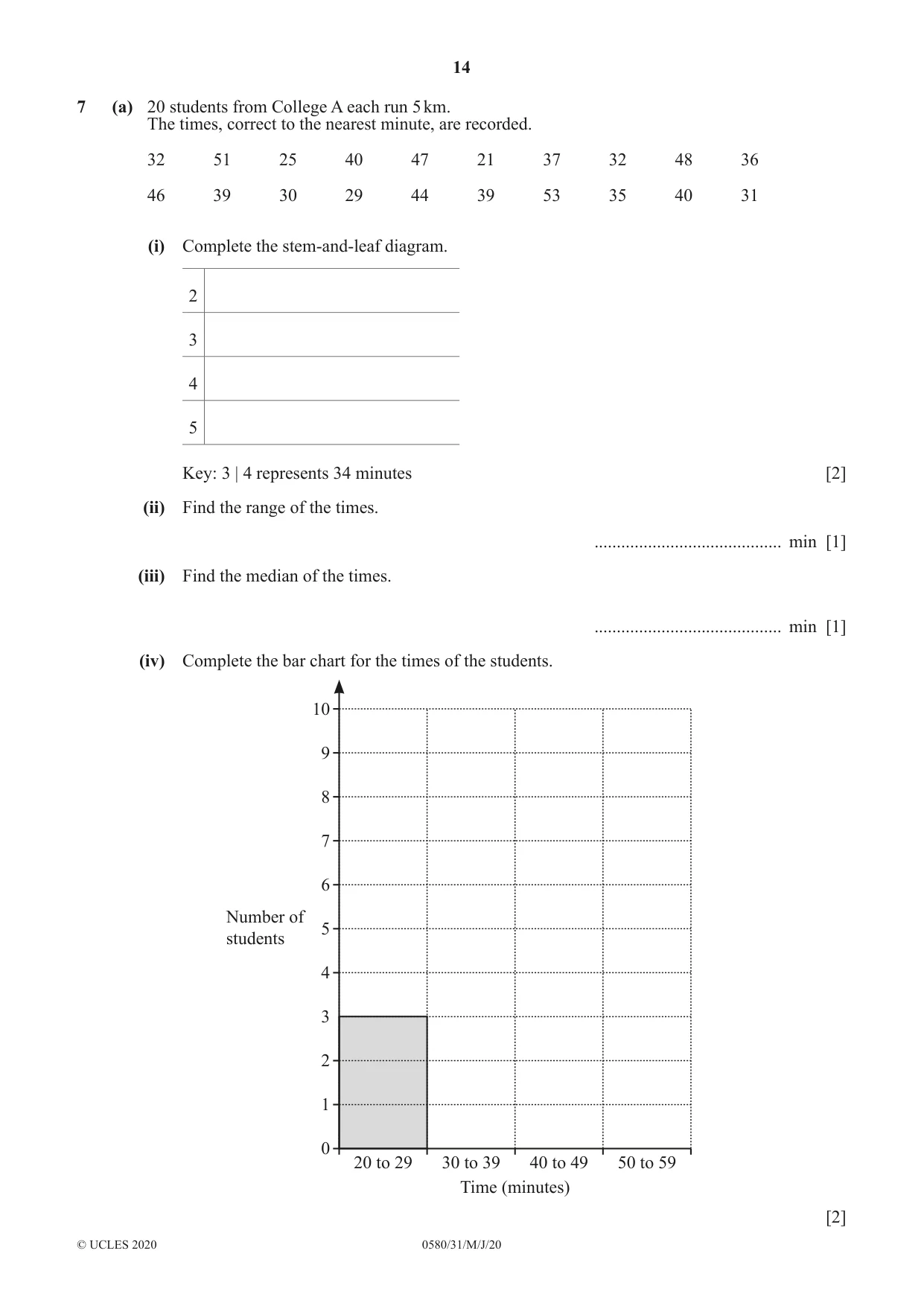
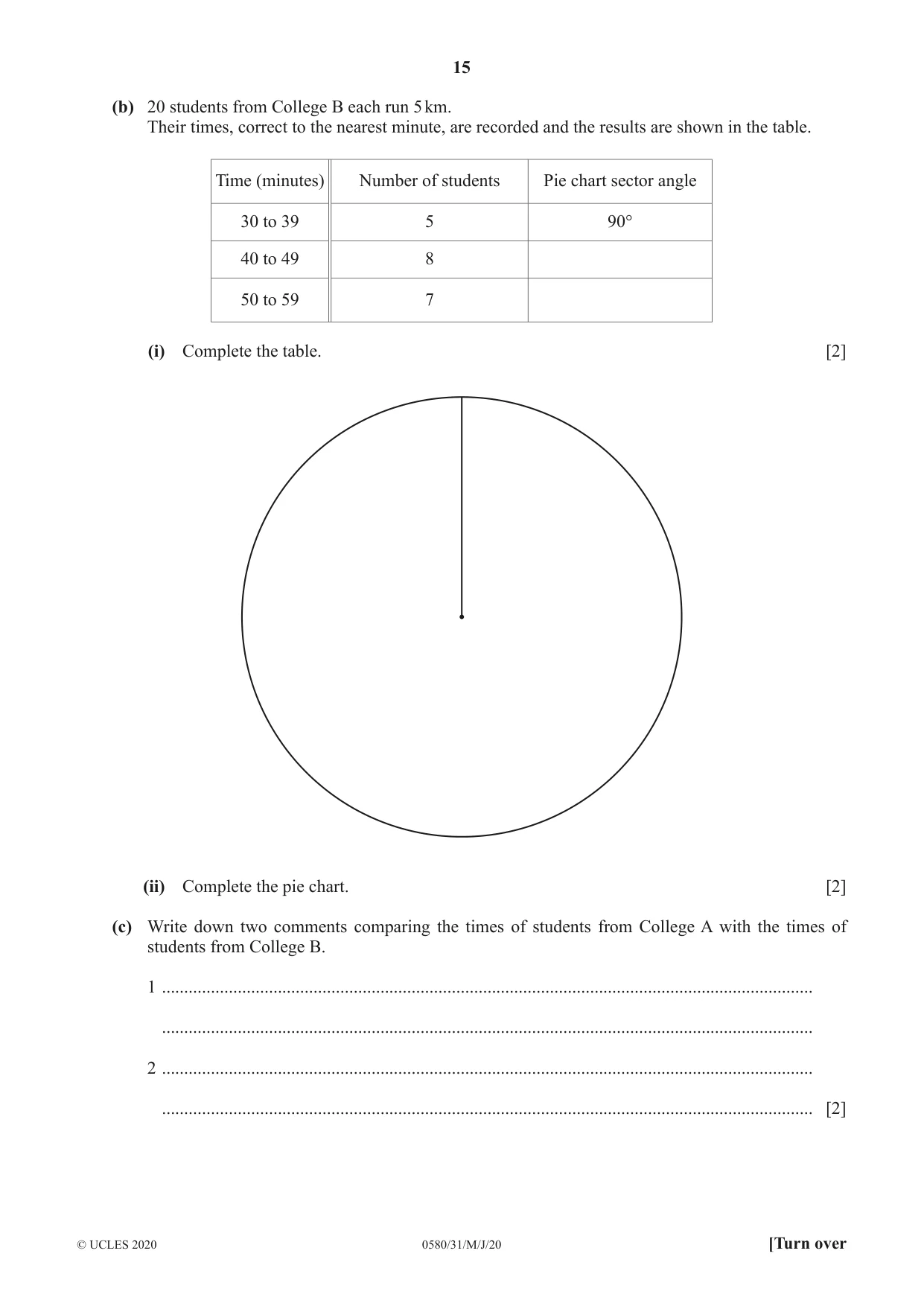
7 (a) 20 students from College A each run 5 km. The times, correct to the nearest minute, are recorded. 32 51 25 40 47 21 37 32 48 36 46 39 30 29 44 39 53 35 40 31 (i) Complete the stem-and-leaf diagram. 2 3 4 5 Key: 3 | 4 represents 34 minutes [2] (ii) Find the range of the times. .......................................... min [1] (iii) Find the median of the times. .......................................... min [1] (iv) Complete the bar chart for the times of the students. 10 9 8 7 6 Number of 5 students 4 3 2 1 0 20 to 29 30 to 39 40 to 49 50 to 59 Time (minutes) [2] (b) 20 students from College B each run 5 km. Their times, correct to the nearest minute, are recorded and the results are shown in the table. Time (minutes) Number of students Pie chart sector angle 30 to 39 5 90° 40 to 49 8 50 to 59 7 (i) Complete the table. [2] (ii) Complete the pie chart. [2] (c) Write down two comments comparing the times of students from College A with the times of students from College B. 1 .................................................................................................................................................. .................................................................................................................................................. 2 .................................................................................................................................................. .................................................................................................................................................. [2]
Mark scheme: 7(a)(i) [2] 1 5 9 2 B1 for correct but not ordered [3] 0 1 2 2 5 6 7 9 9 or for 2 or 3 correct rows ordered [4] 0 0 4 6 7 8 [5] 1 3 7(a)(ii) 32 1 7(a)(iii) 38 1 7(a)(iv) Correct bar chart 2 FT their stem and leaf from (a)(i) B1 for two heights correct 7(b)(i) 144 2 B1 for each 126 If 0 scored, M1 for 90 ÷ 5 or 360 ÷ 20 or 18 7(b)(ii) Correct pie chart 2 FT their (b)(i) angles if they total 270 B1 for one correct sector 7(c) 2 correct expressions 2 B1 for one statistical comparison B1 for another comparison
Q8 · Simplify 3c - 5d - c + 2d
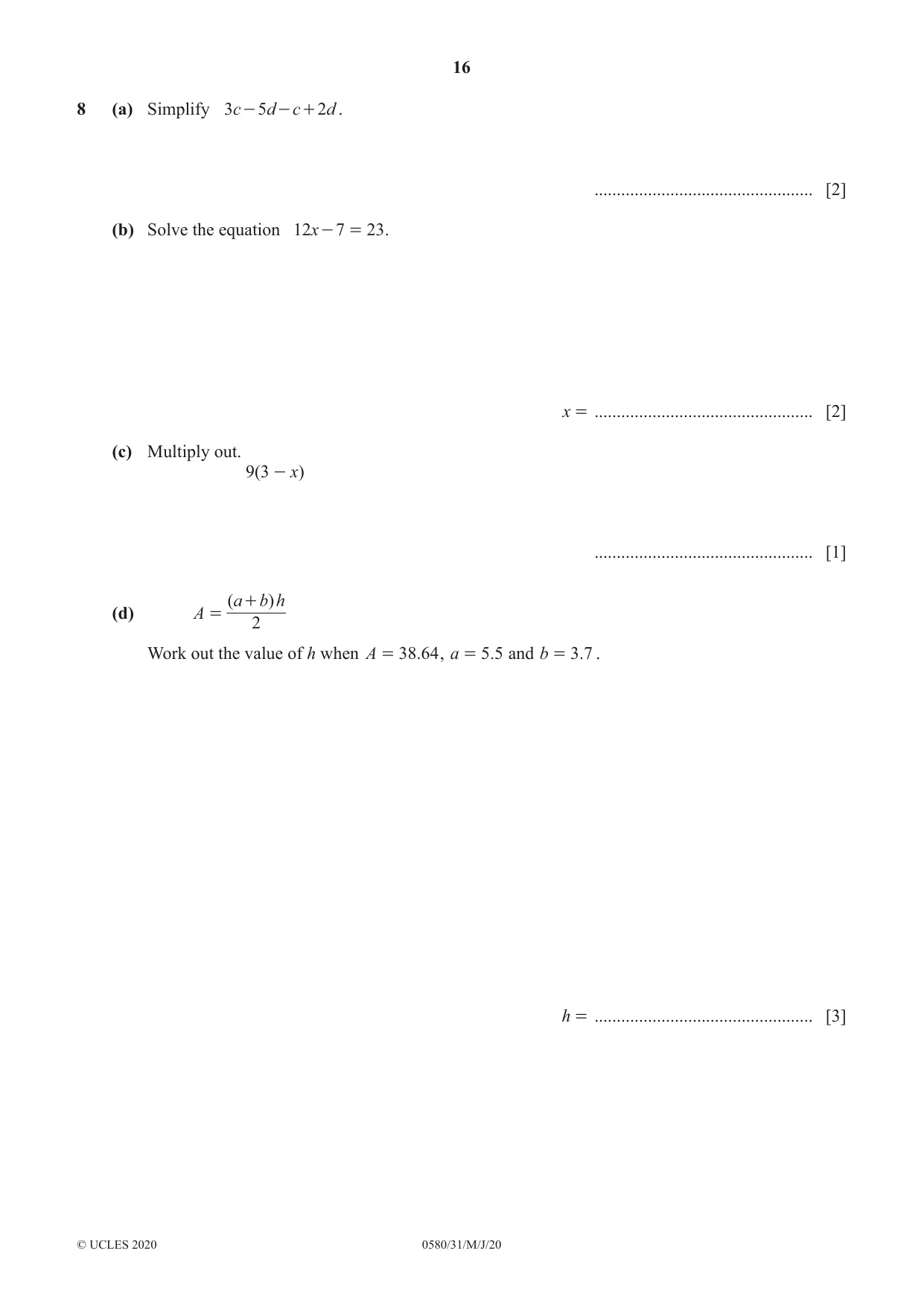
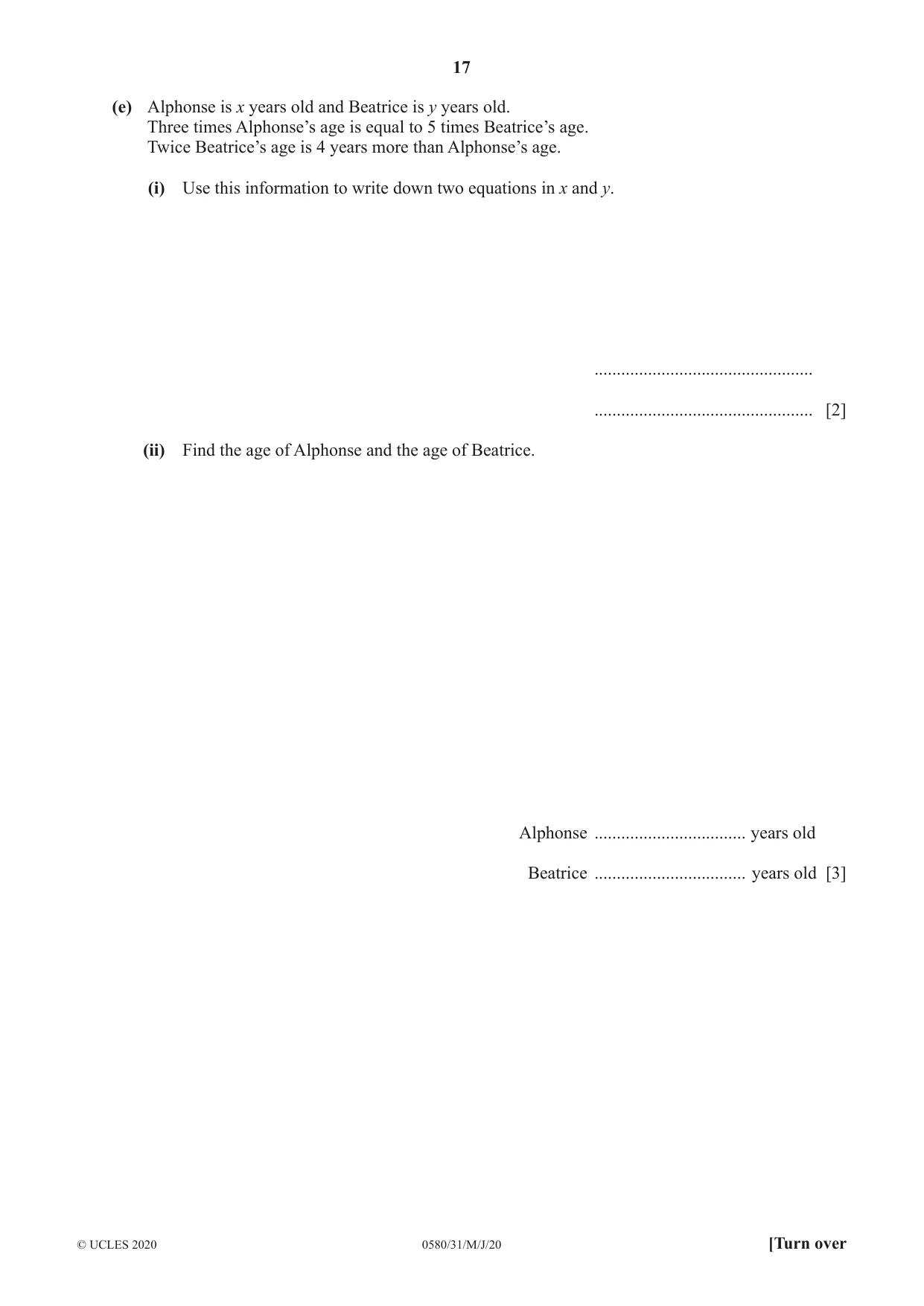
8 (a) Simplify 3c - 5d - c + 2d . ................................................. [2] (b) Solve the equation 12x - 7 = 23 . x = ................................................. [2] (c) Multiply out. 9(3 - x) ................................................. [1] ( a + b) h (d) A = 2 Work out the value of h when A = 38.64 , a = 5.5 and b = 3.7 . h = ................................................. [3] (e) Alphonse is x years old and Beatrice is y years old. Three times Alphonse’s age is equal to 5 times Beatrice’s age. Twice Beatrice’s age is 4 years more than Alphonse’s age. (i) Use this information to write down two equations in x and y. ................................................. ................................................. [2] (ii) Find the age of Alphonse and the age of Beatrice. Alphonse .................................. years old Beatrice .................................. years old [3]
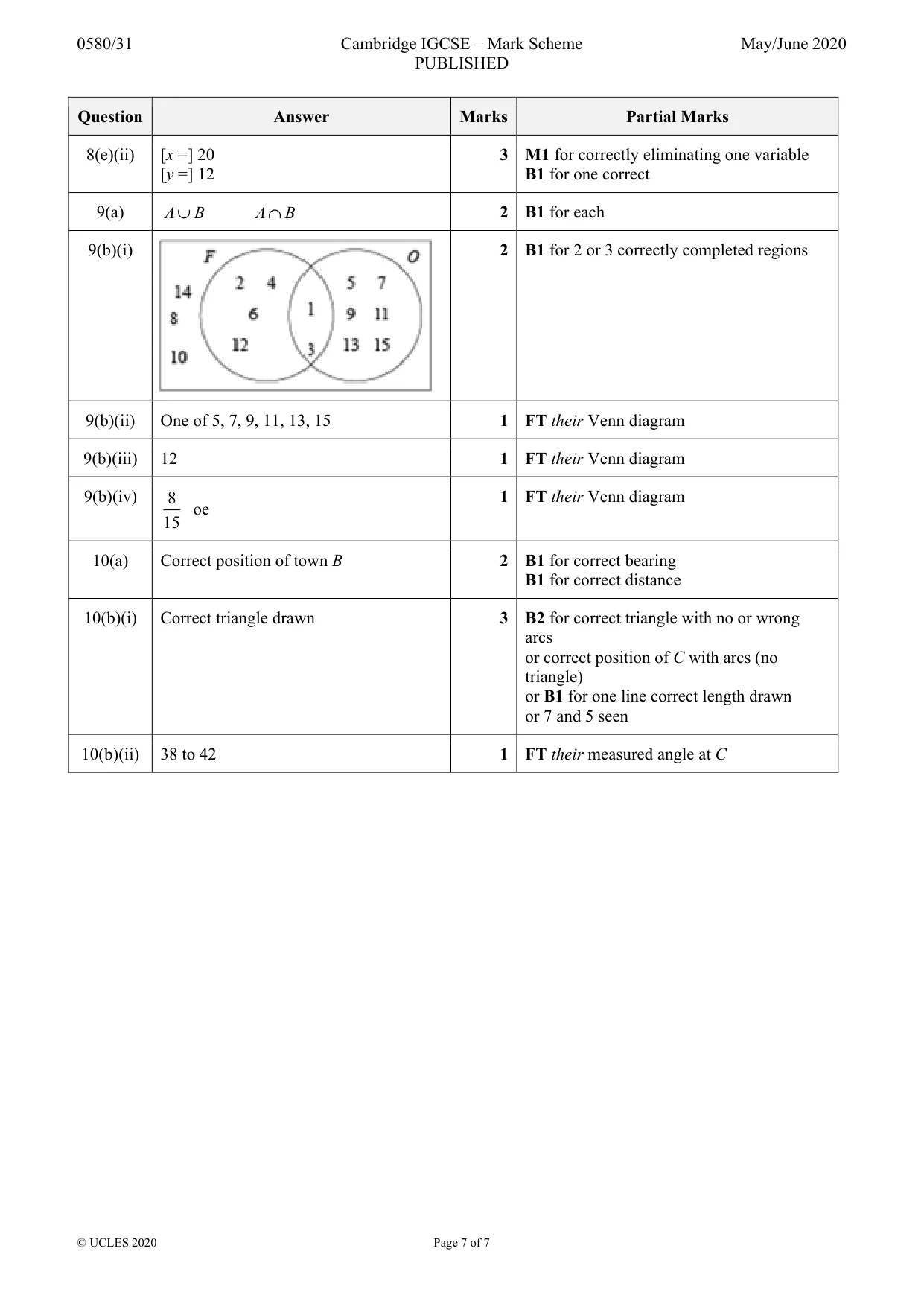
Mark scheme: 8(a) 2c – 3d final answer 2 B1 for 2c or −3d 8(b) [x =] 2.5 2 7 23 M1 for 12x = 23 + 7 or x − = 12 12 8(c) 27 – 9x 1 8(d) [h =] 8.4 3 B2 for 2 × 38.64 38.64 = 4.6h or 77.28 = 9.2h or 5.5 + 3.7 (5.5 + 3.7) h or B1 for 38.64 = 2 2A or M1 for [h=] a + b 8(e)(i) 3x = 5y oe 2 B1 for each 2y = x + 4 oe 8(e)(ii) [x =] 20 3 M1 for correctly eliminating one variable [y =] 12 B1 for one correct
Q9 · Use set notation to describe the shaded region in each Venn diagram
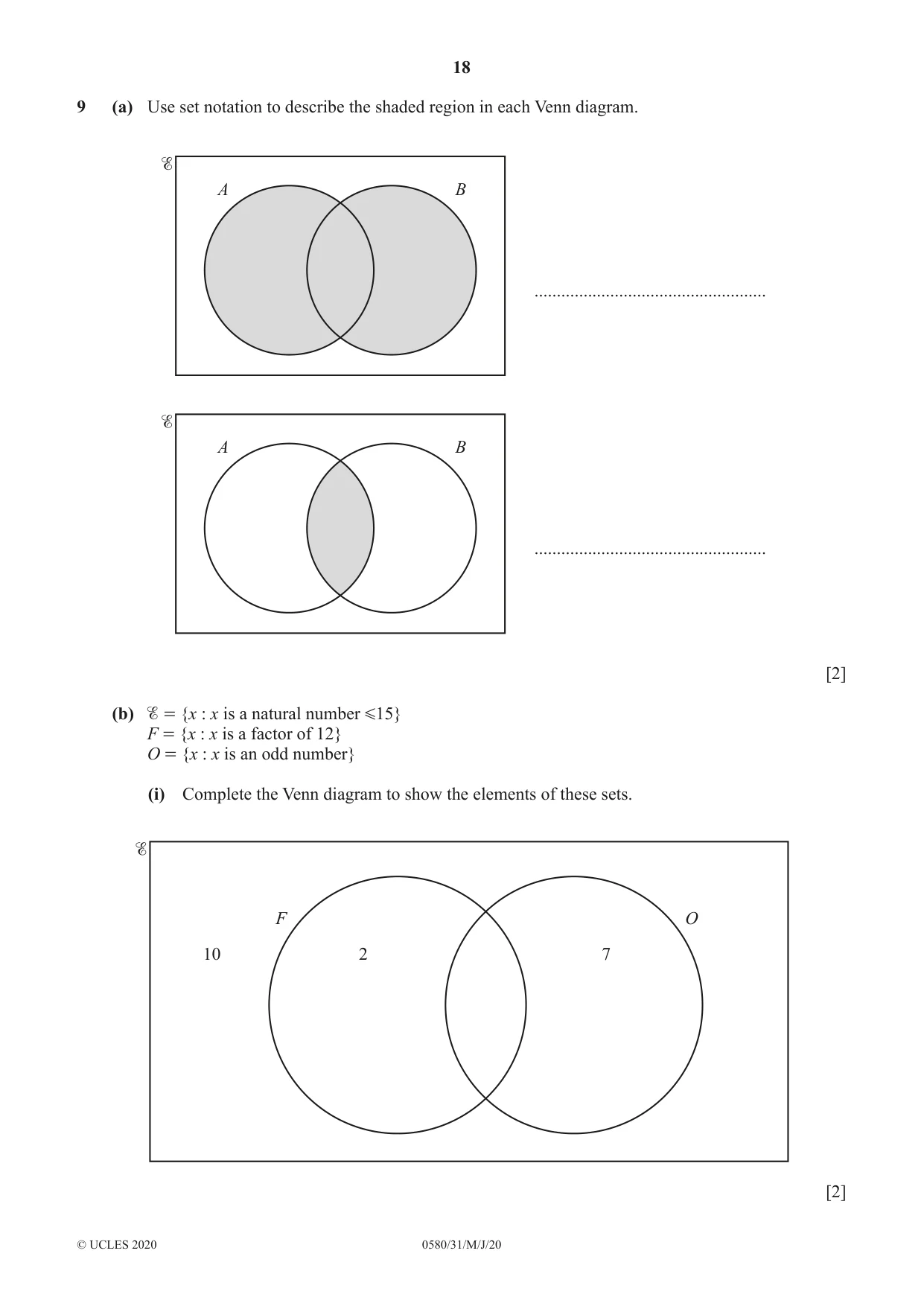
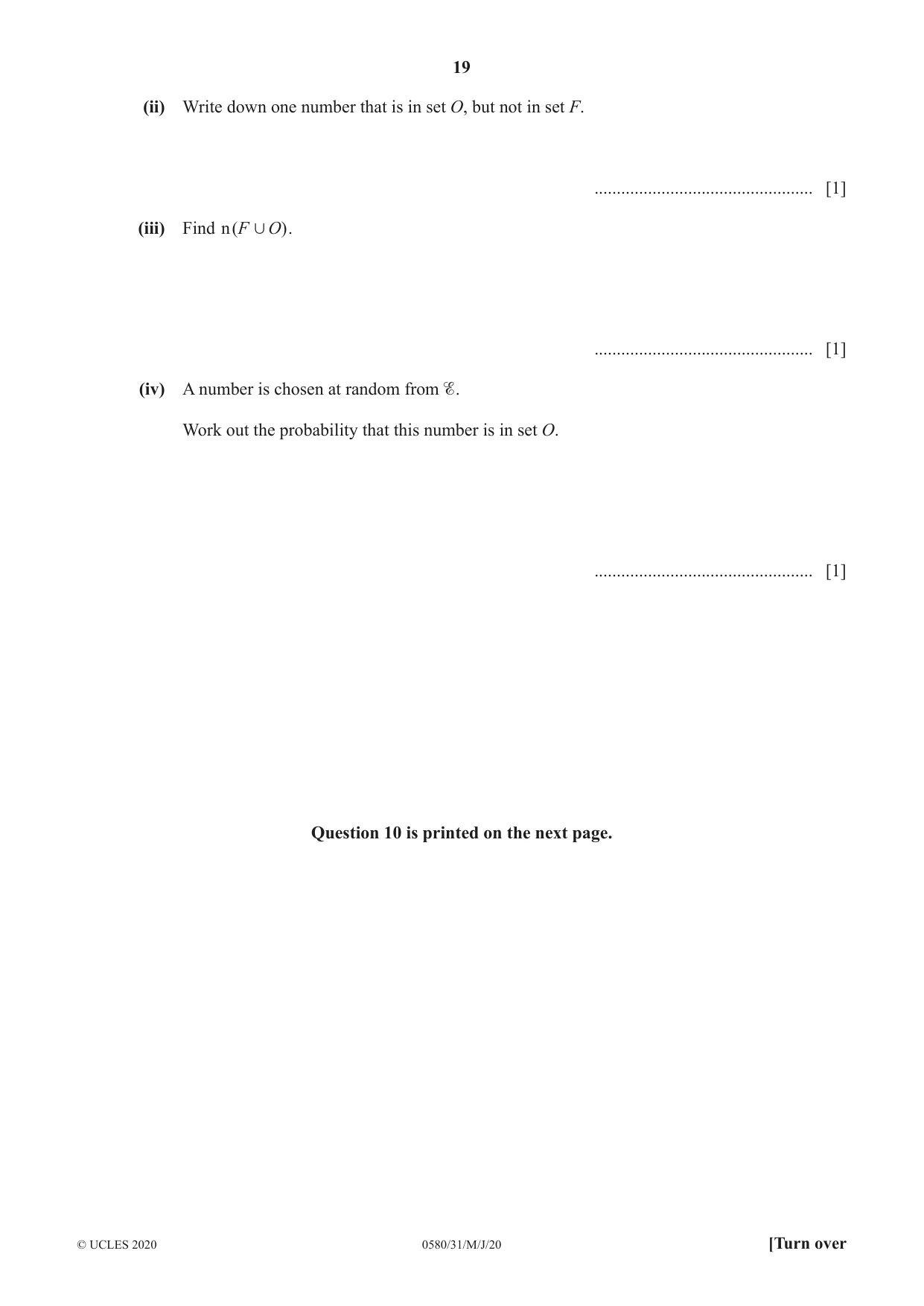
9 (a) Use set notation to describe the shaded region in each Venn diagram. A B .................................................... A B .................................................... [2] (b) = {x : x is a natural number G15} F = {x : x is a factor of 12} O = {x : x is an odd number} (i) Complete the Venn diagram to show the elements of these sets. F O 10 2 7 [2] (ii) Write down one number that is in set O, but not in set F. ................................................. [1] (iii) Find n ( F , O ) . ................................................. [1] (iv) A number is chosen at random from . Work out the probability that this number is in set O. ................................................. [1] Question 10 is printed on the next page.
Mark scheme: 9(a) A ∪ B A ∩ B 2 B1 for each 9(b)(i) 2 B1 for 2 or 3 correctly completed regions 9(b)(ii) One of 5, 7, 9, 11, 13, 15 1 FT their Venn diagram 9(b)(iii) 12 1 FT their Venn diagram 9(b)(iv) 8 1 FT their Venn diagram oe 15
Q10 · Point B is 36 km from point A on a bearing of 140°
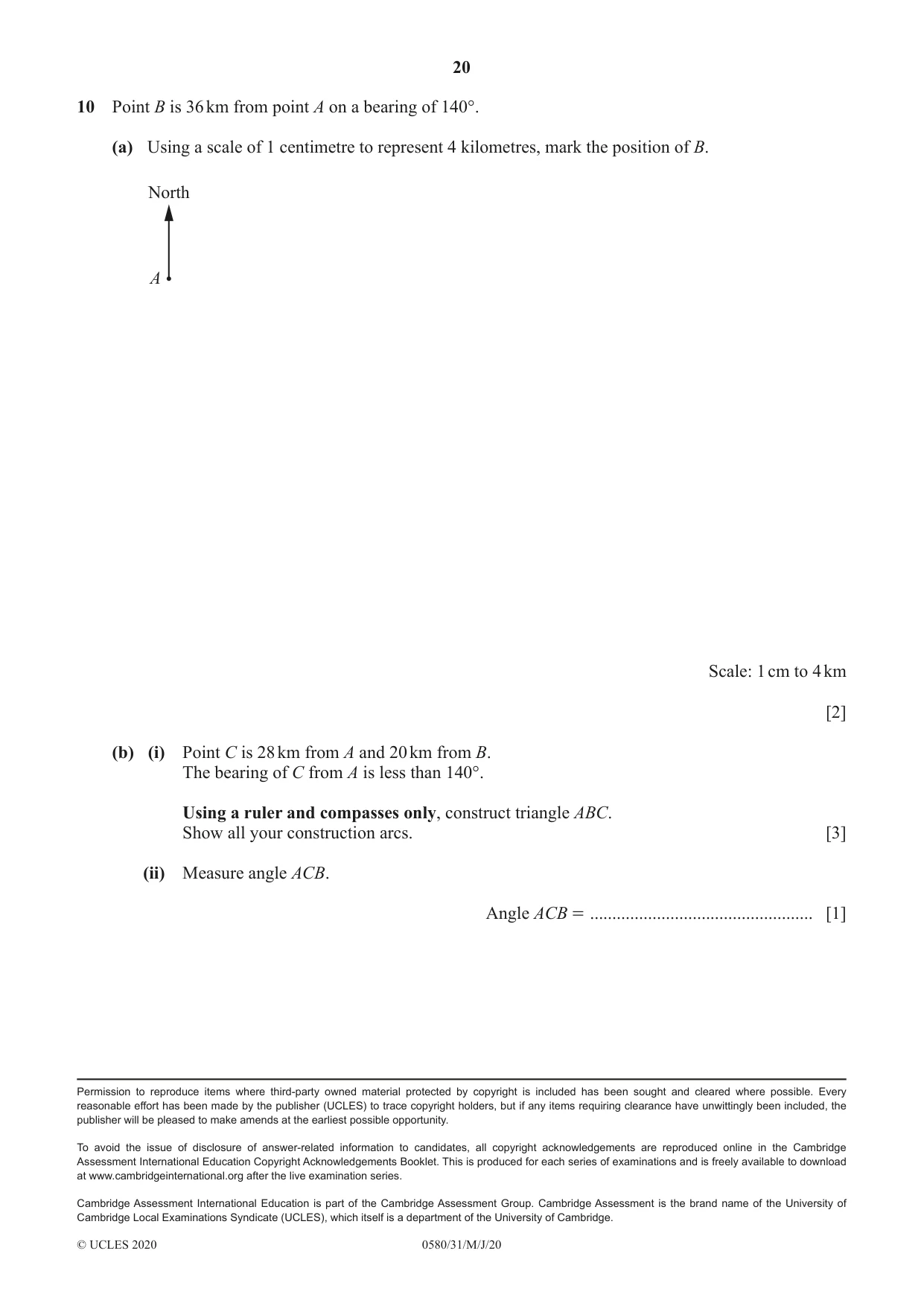
10 Point B is 36 km from point A on a bearing of 140°. (a) Using a scale of 1 centimetre to represent 4 kilometres, mark the position of B. North A Scale: 1 cm to 4 km [2] (b) (i) Point C is 28 km from A and 20 km from B. The bearing of C from A is less than 140°. Using a ruler and compasses only, construct triangle ABC. Show all your construction arcs. [3] (ii) Measure angle ACB. Angle ACB = .................................................. [1]
Mark scheme: 10(a) Correct position of town B 2 B1 for correct bearing B1 for correct distance 10(b)(i) Correct triangle drawn 3 B2 for correct triangle with no or wrong arcs or correct position of C with arcs (no triangle) or B1 for one line correct length drawn or 7 and 5 seen 10(b)(ii) 38 to 42 1 FT their measured angle at C
What was in this paper
The subtopics covered by these 9 questions, and how many questions each got. Open one in a new tab to see every Cambridge question on it.