Cambridge IGCSE Mathematics 0580 — 2020 May/June Paper 3 · Variant 3
0580/33/M/J/20 · 9 questions · 104 marks · ≈117 min
The question paper and its mark scheme, free to read here and free to download. This is Cambridge’s own paper, exactly as it was sat.
Question paper16 pages
Mark scheme7 pages
Answers below. Sit the paper first if you are practising.
Questions as text
Q1 · Write down a fraction equivalent to
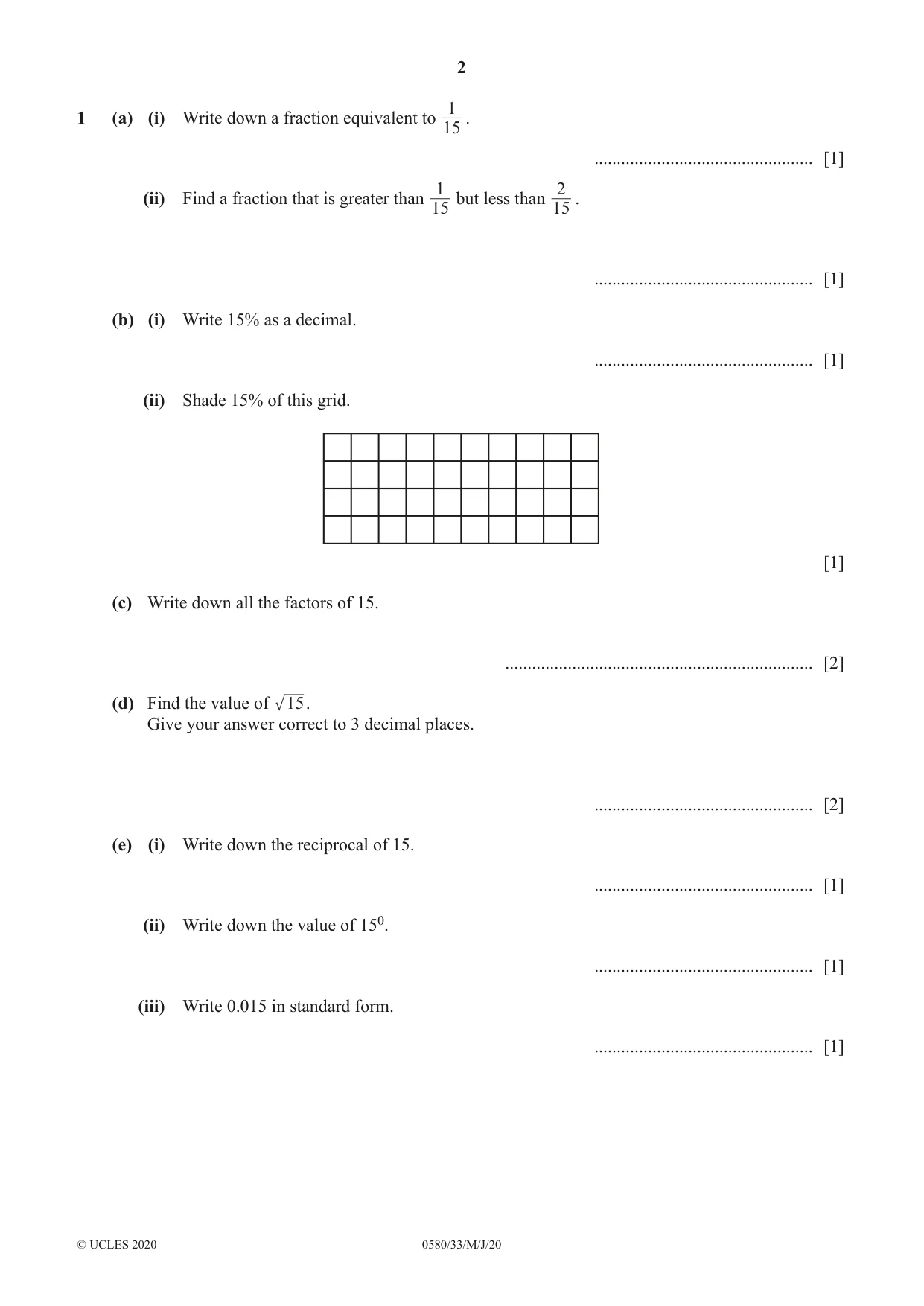
11 (a) (i) Write down a fraction equivalent to . 15 ................................................. [1] 1 2 (ii) Find a fraction that is greater than but less than . 15 15 ................................................. [1] (b) (i) Write 15% as a decimal. ................................................. [1] (ii) Shade 15% of this grid. [1] (c) Write down all the factors of 15. ..................................................................... [2] (d) Find the value of 15. Give your answer correct to 3 decimal places. ................................................. [2] (e) (i) Write down the reciprocal of 15. ................................................. [1] (ii) Write down the value of 150. ................................................. [1] (iii) Write 0.015 in standard form. ................................................. [1]
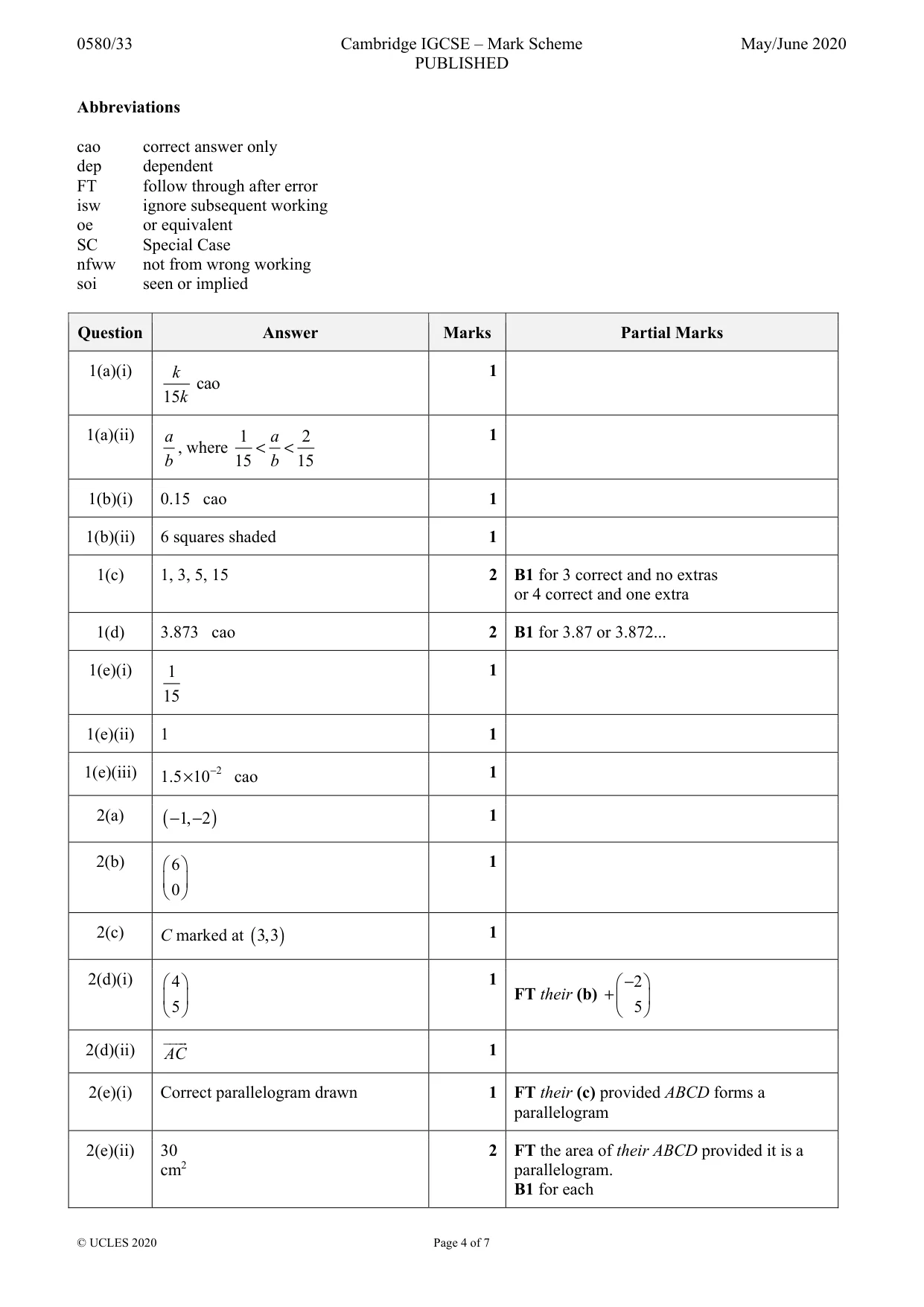
Mark scheme: Question Answer Marks Partial Marks 1(a)(i) k 1 cao 15k 1(a)(ii) a 1 a 2 1 , where < < b 15 b 15 1(b)(i) 0.15 cao 1 1(b)(ii) 6 squares shaded 1 1(c) 1, 3, 5, 15 2 B1 for 3 correct and no extras or 4 correct and one extra 1(d) 3.873 cao 2 B1 for 3.87 or 3.872... 1(e)(i) 1 1 15 1(e)(ii) 1 1 1(e)(iii) 1.5 × 10⁻² cao 1
Q2 · The diagram shows a line AB on a 1 cm2 grid
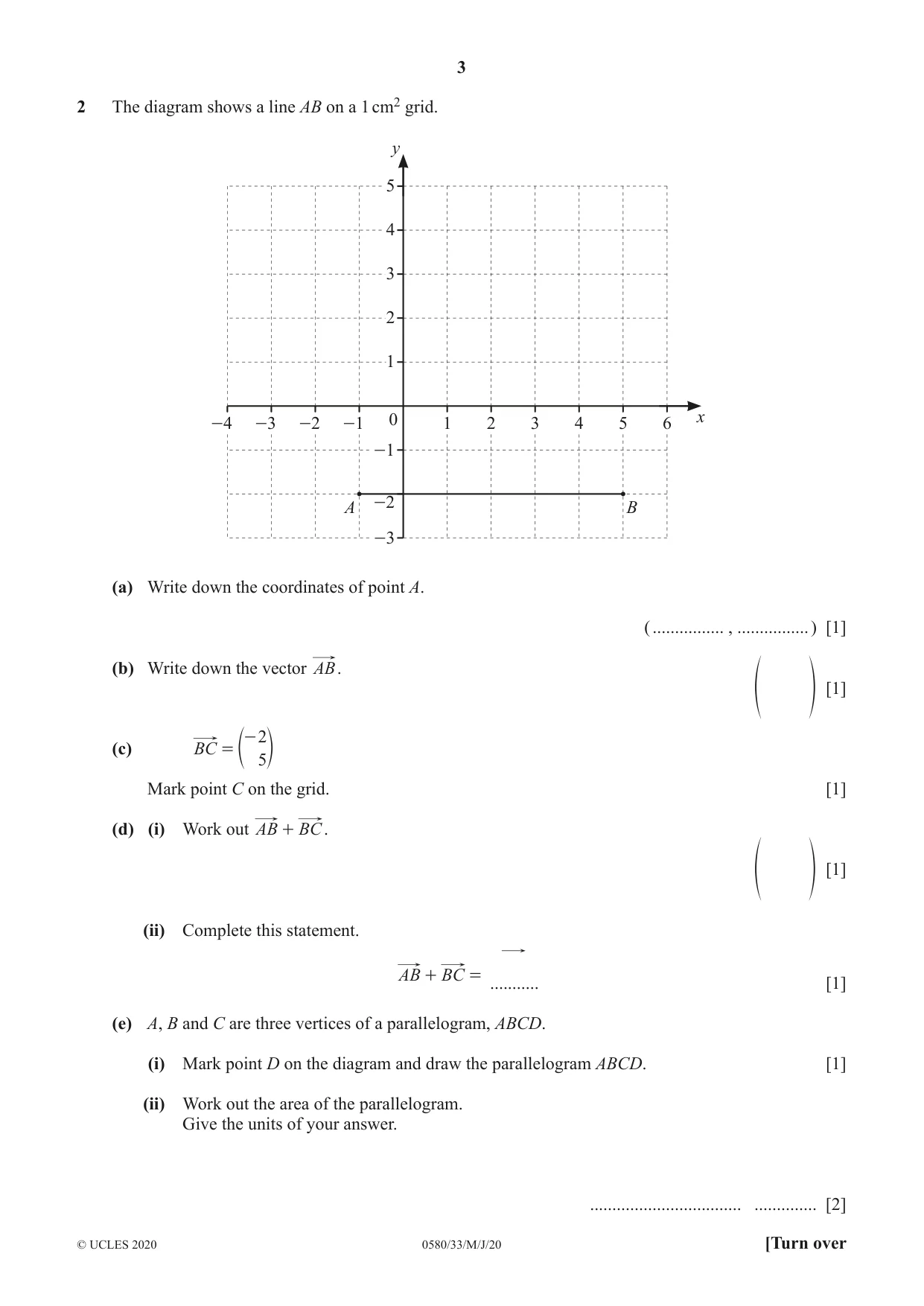
2 The diagram shows a line AB on a 1 cm2 grid. y 5 4 3 2 1 -4 -3 -2 -1 0 1 2 3 4 5 6 x -1 A -2 B -3 (a) Write down the coordinates of point A. ( ................ , ................ ) [1] (b) Write down the vector AB. [1] f p - 2 (c) BC = e 5o Mark point C on the grid. [1] (d) (i) Work out AB + BC . [1] f p (ii) Complete this statement. AB + BC = ........... [1] (e) A, B and C are three vertices of a parallelogram, ABCD. (i) Mark point D on the diagram and draw the parallelogram ABCD. [1] (ii) Work out the area of the parallelogram. Give the units of your answer. .................................. .............. [2]
Mark scheme: 2(a) ( −−1, 2 ) 1 2(b) 6 1 0 2(c) C marked at ( 3,3 ) 1 2(d)(i) 4 1 −2 FT their (b) + 5 5 2(d)(ii) AC 1 2(e)(i) Correct parallelogram drawn 1 FT their (c) provided ABCD forms a parallelogram 2(e)(ii) 30 2 FT the area of their ABCD provided it is a cm2 parallelogram. B1 for each Question Answer Marks Partial Marks
Q3 · NOT TO SCALE 6 m 8 m The diagram shows a rectangular patio with sides 6 m and 8 m
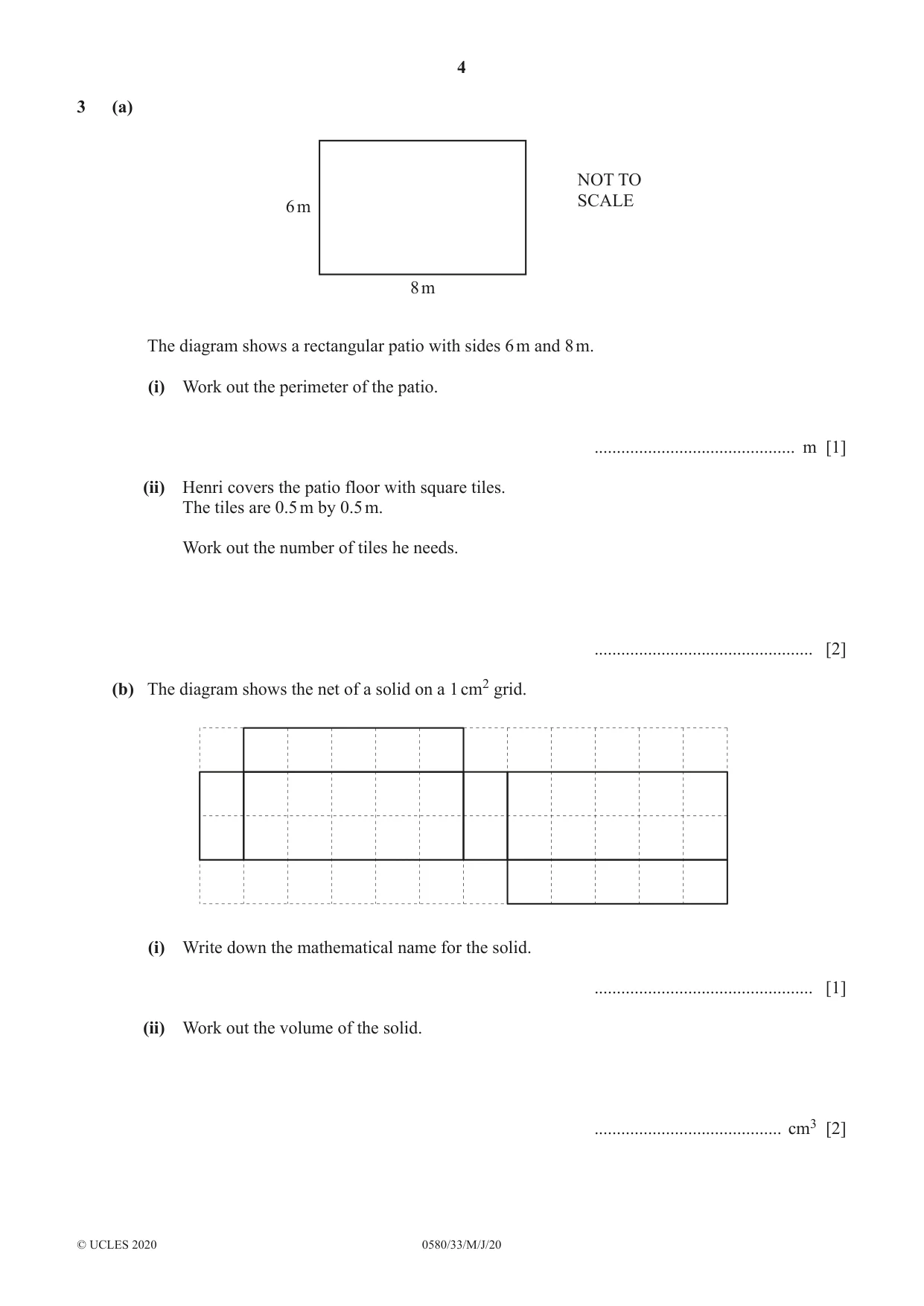
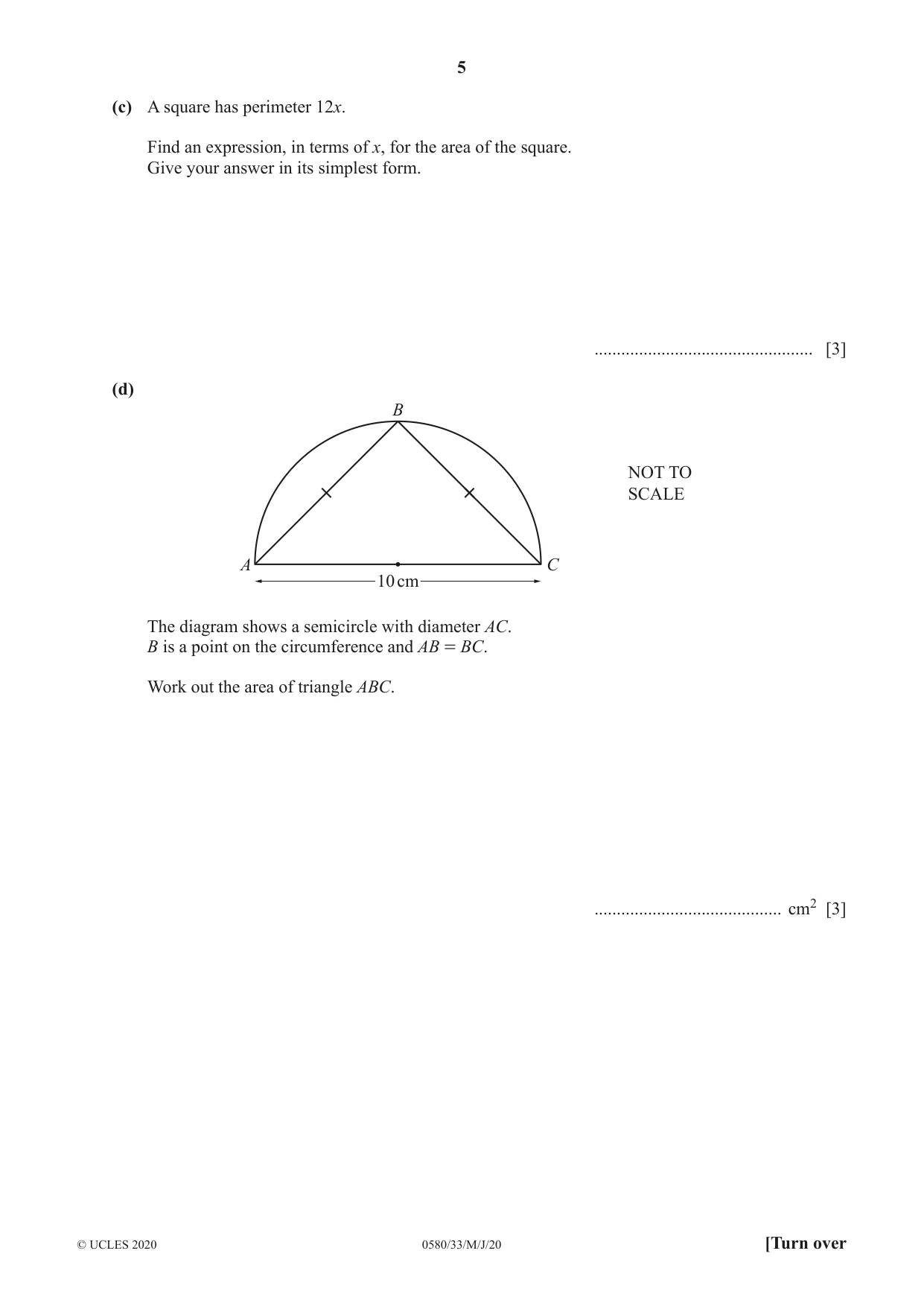
3 (a) NOT TO SCALE 6 m 8 m The diagram shows a rectangular patio with sides 6 m and 8 m. (i) Work out the perimeter of the patio. ............................................. m [1] (ii) Henri covers the patio floor with square tiles. The tiles are 0.5 m by 0.5 m. Work out the number of tiles he needs. ................................................. [2] (b) The diagram shows the net of a solid on a 1 cm2 grid. (i) Write down the mathematical name for the solid. ................................................. [1] (ii) Work out the volume of the solid. .......................................... cm3 [2] (c) A square has perimeter 12x. Find an expression, in terms of x, for the area of the square. Give your answer in its simplest form. ................................................. [3] (d) B NOT TO SCALE A C 10 cm The diagram shows a semicircle with diameter AC. B is a point on the circumference and AB = BC. Work out the area of triangle ABC. .......................................... cm2 [3]
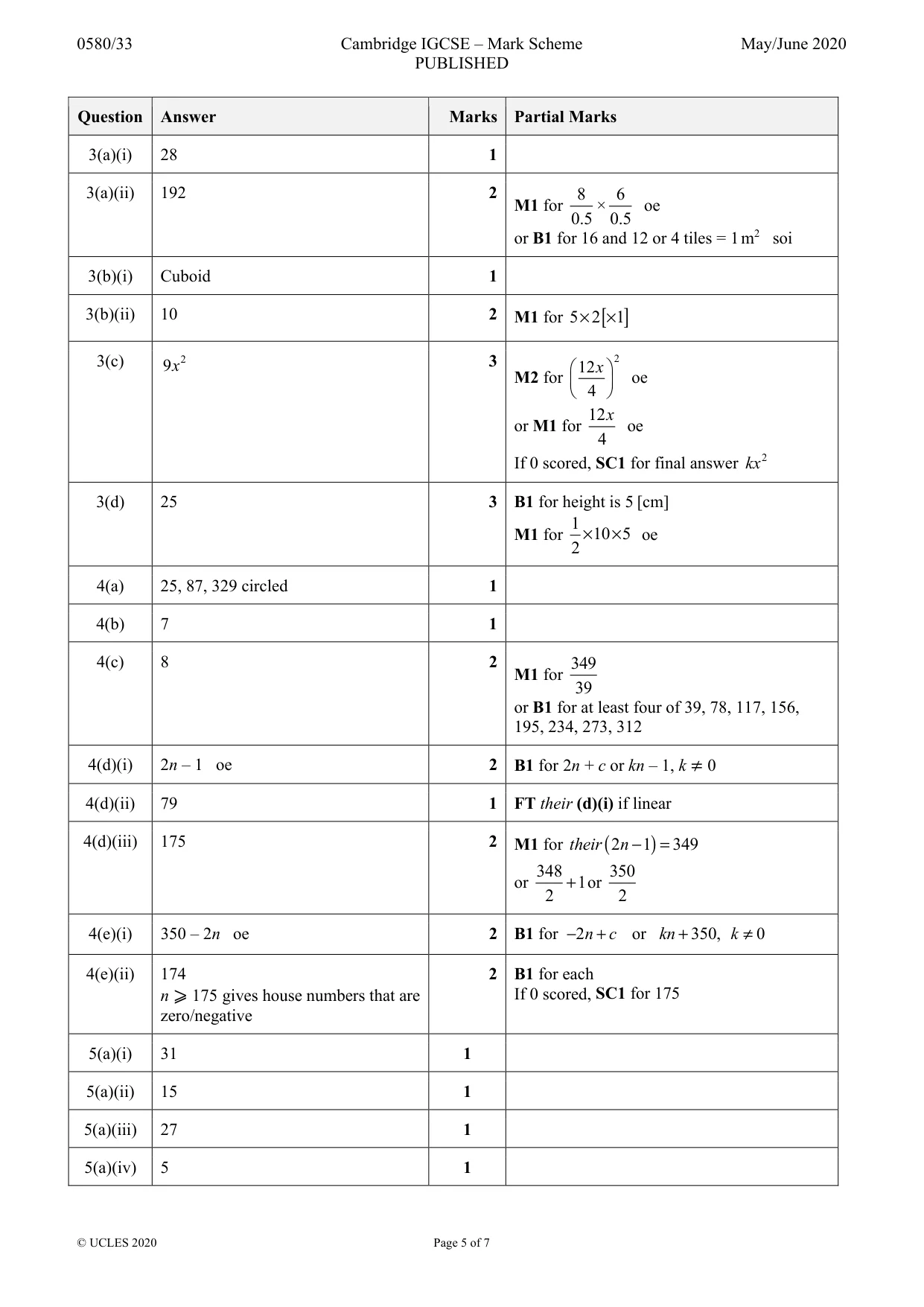
Mark scheme: 3(a)(i) 28 1 3(a)(ii) 192 2 8 6 M1 for × oe 0.5 0.5 or B1 for 16 and 12 or 4 tiles = 1 m2 soi 3(b)(i) Cuboid 1 3(b)(ii) 10 2 M1 for 5 × 2 [× 1] 3(c) 9x 2 3 12 x 2 M2 for oe 4 12 x or M1 for oe 4 If 0 scored, SC1 for final answer kx 2 3(d) 25 3 B1 for height is 5 [cm] 1 M1 for × 10 × 5 oe 2
Q4 · 349 West side East side 347 348 346 NOT TO 7 SCALE 5 6 3 4 1 2 A road has 349 houses on…
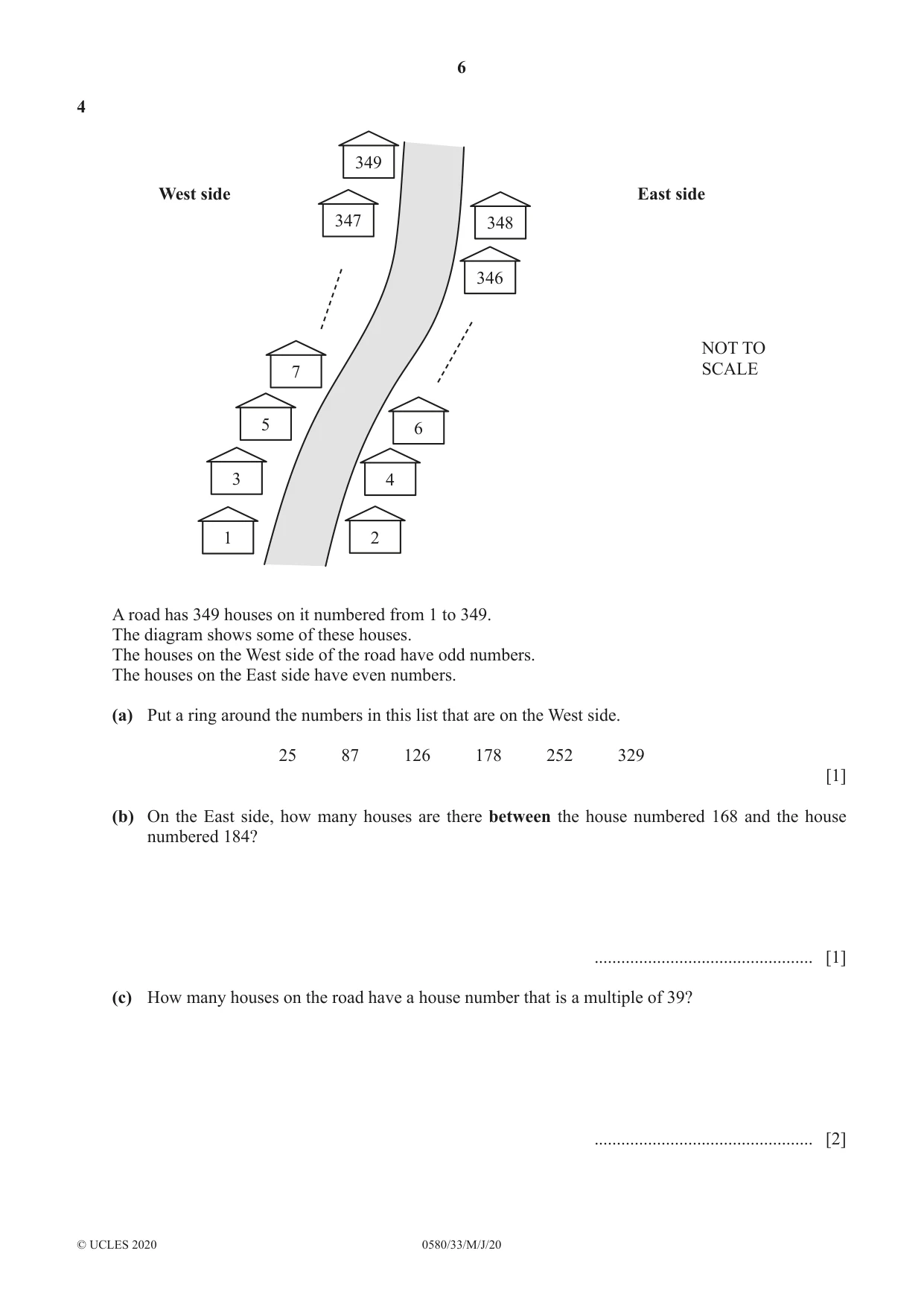
4 349 West side East side 347 348 346 NOT TO 7 SCALE 5 6 3 4 1 2 A road has 349 houses on it numbered from 1 to 349. The diagram shows some of these houses. The houses on the West side of the road have odd numbers. The houses on the East side have even numbers. (a) Put a ring around the numbers in this list that are on the West side. 25 87 126 178 252 329 [1] (b) On the East side, how many houses are there between the house numbered 168 and the house numbered 184? ................................................. [1] (c) How many houses on the road have a house number that is a multiple of 39? ................................................. [2] (d) Tomaz delivers a leaflet to every house on the West side of the road. He starts at house number 1 and then delivers to each house in order. (i) Find an expression, in terms of n, for the house number of the nth house he delivers to. ................................................. [2] (ii) Work out the house number of the 40th house he delivers to. ................................................. [1] (iii) Work out how many houses are on the West side of the road. ................................................. [2] (e) Alicia delivers a leaflet to every house on the East side of the road. She starts at house number 348 and then delivers to each house in order. (i) Find an expression, in terms of n, for the house number of the nth house she delivers to. ................................................. [2] (ii) What is the largest value of n that can be used in your expression? Give a reason for your answer. The largest value of n is .......................... because ............................................................. ............................................................................................................................................. [2]
Mark scheme: 4(a) 25, 87, 329 circled 1 4(b) 7 1 4(c) 8 2 349 M1 for 39 or B1 for at least four of 39, 78, 117, 156, 195, 234, 273, 312 4(d)(i) 2n – 1 oe 2 B1 for 2n + c or kn – 1, k ≠ 0 4(d)(ii) 79 1 FT their (d)(i) if linear 4(d)(iii) 175 2 M1 for their ( 2 n − 1) = 349 348 350 or + 1 or 2 2 4(e)(i) 350 – 2n oe 2 B1 for −2n + c or kn + 350, k ≠ 0 4(e)(ii) 174 2 B1 for each n ⩾ 175 gives house numbers that are If 0 scored, SC1 for 175 zero/negative
Q5 · The Venn diagram shows information about the number of students in a class who like…
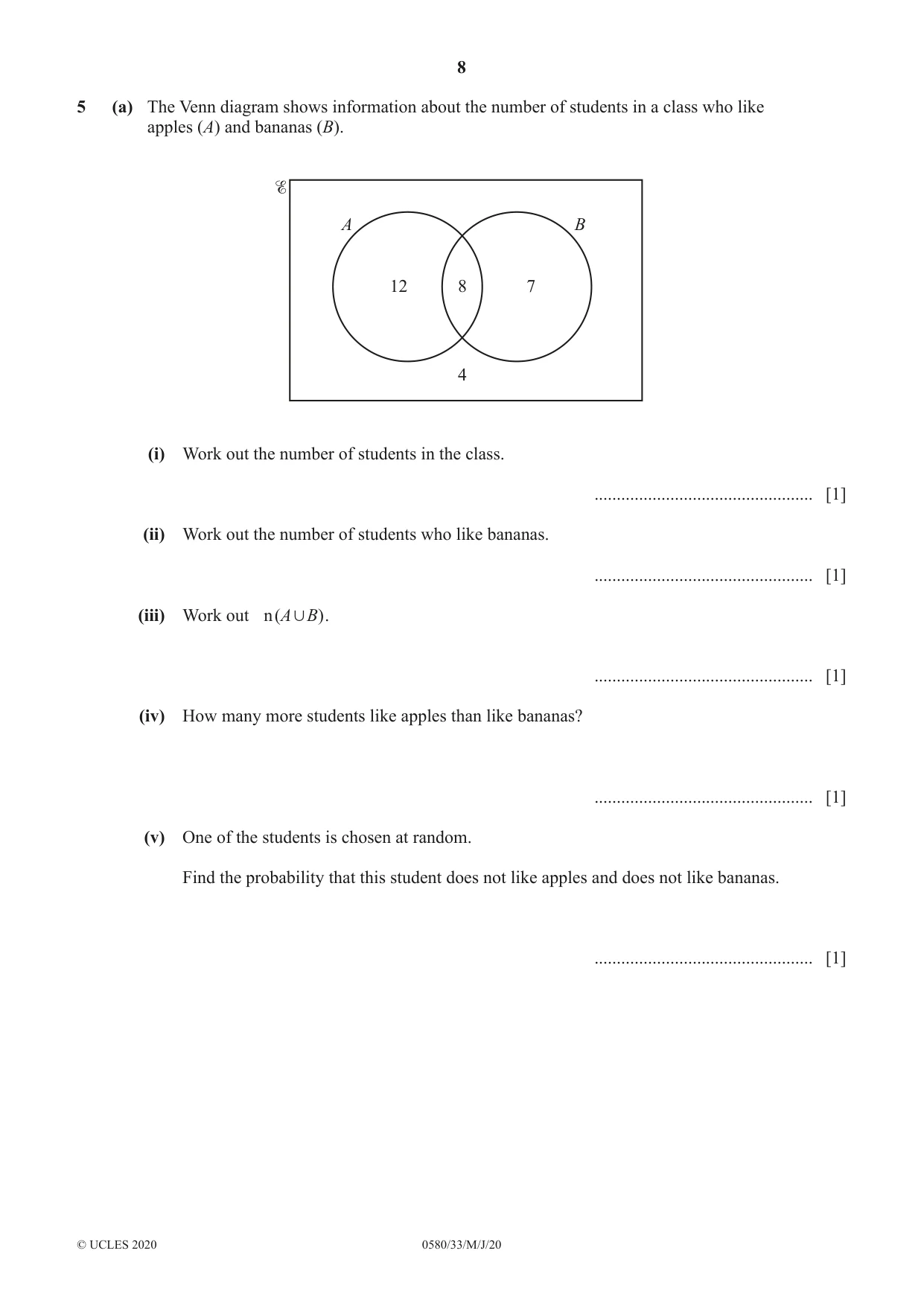
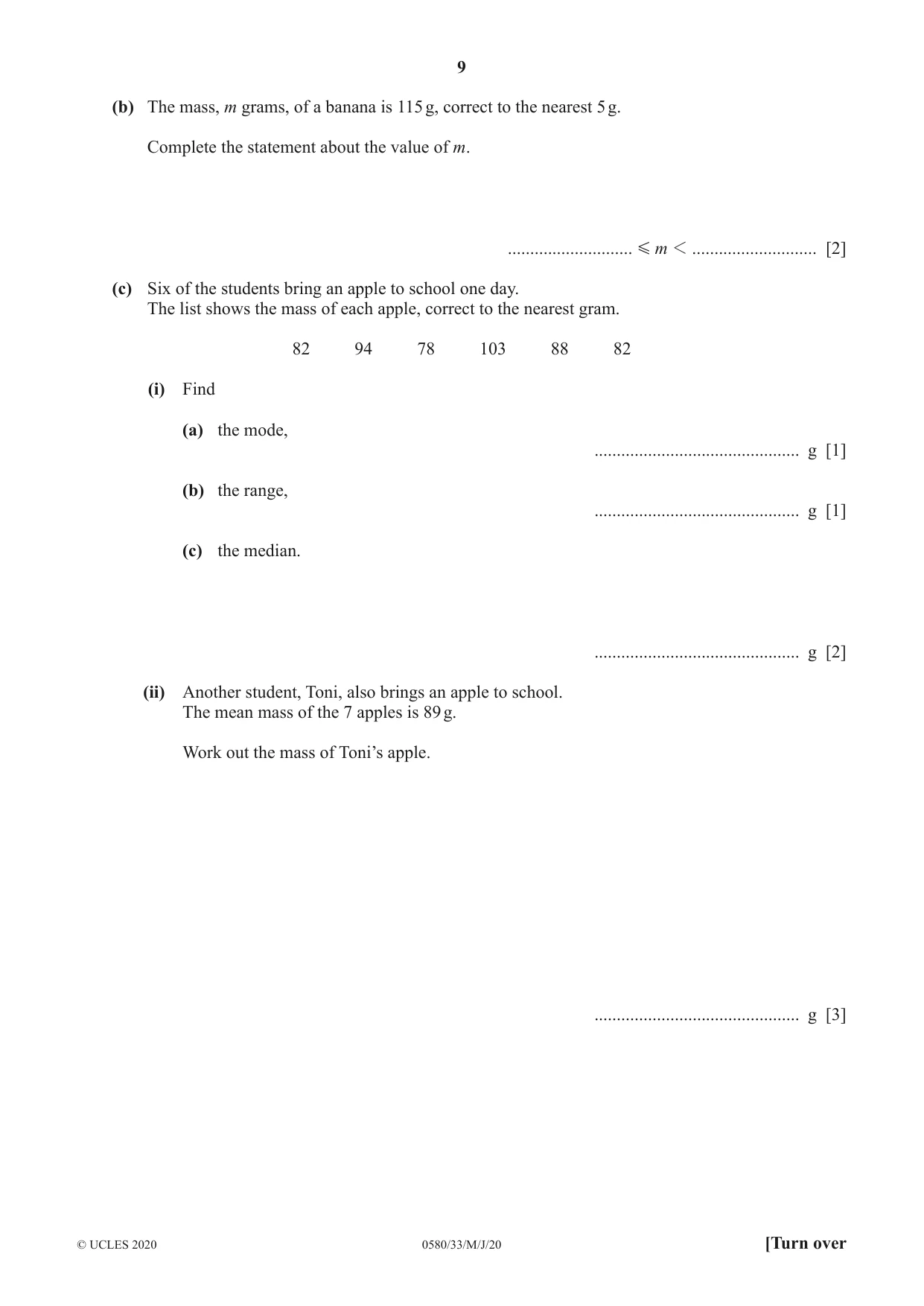
5 (a) The Venn diagram shows information about the number of students in a class who like apples (A) and bananas (B). A B 12 8 7 4 (i) Work out the number of students in the class. ................................................. [1] (ii) Work out the number of students who like bananas. ................................................. [1] (iii) Work out n ( A , B ) . ................................................. [1] (iv) How many more students like apples than like bananas? ................................................. [1] (v) One of the students is chosen at random. Find the probability that this student does not like apples and does not like bananas. ................................................. [1] (b) The mass, m grams, of a banana is 115 g, correct to the nearest 5 g. Complete the statement about the value of m. ............................ G m 1 ............................ [2] (c) Six of the students bring an apple to school one day. The list shows the mass of each apple, correct to the nearest gram. 82 94 78 103 88 82 (i) Find (a) the mode, .............................................. g [1] (b) the range, .............................................. g [1] (c) the median. .............................................. g [2] (ii) Another student, Toni, also brings an apple to school. The mean mass of the 7 apples is 89 g. Work out the mass of Toni’s apple. .............................................. g [3]
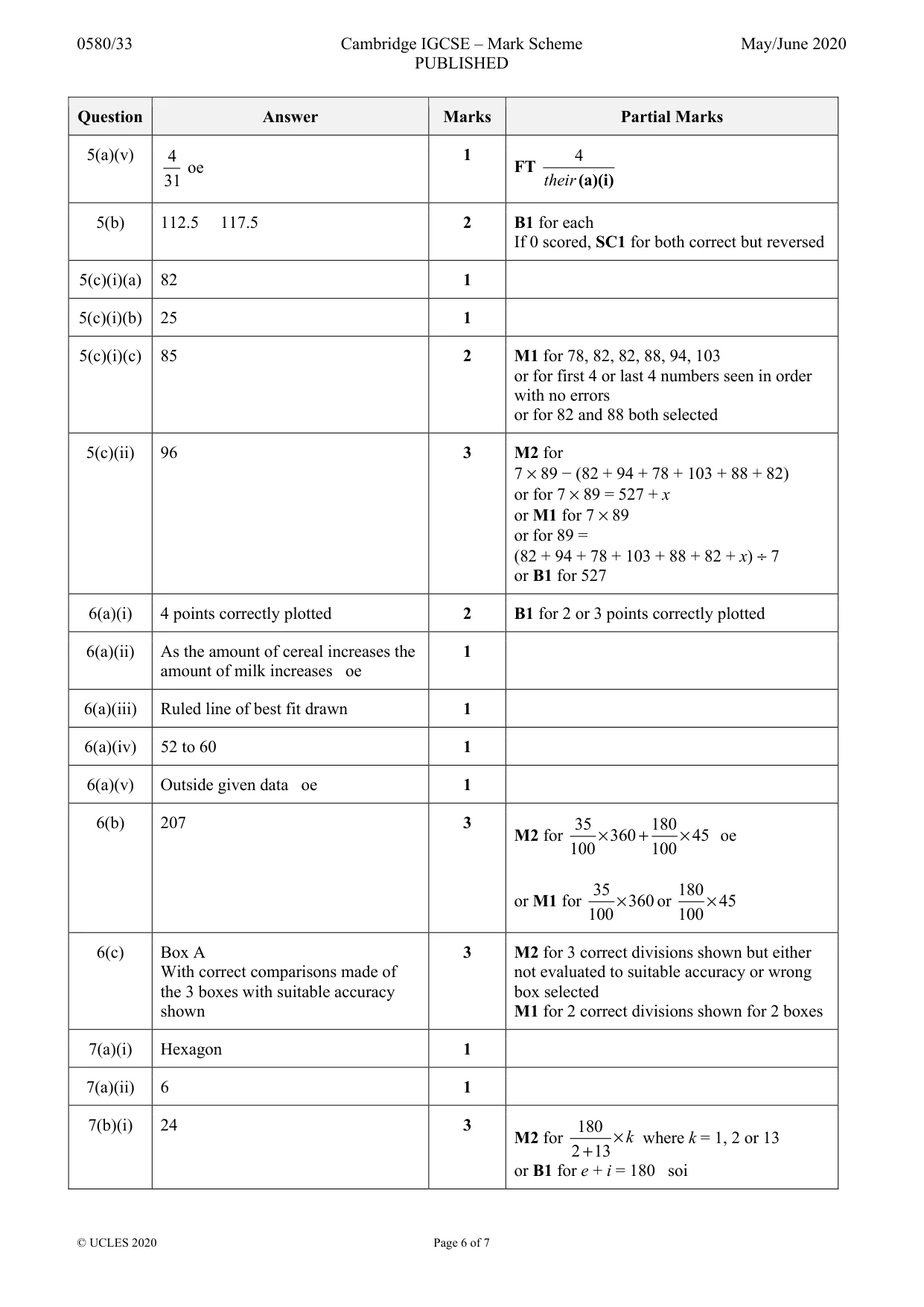
Mark scheme: 5(a)(i) 31 1 5(a)(ii) 15 1 5(a)(iii) 27 1 5(a)(iv) 5 1 5(a)(v) 4 1 4 oe FT 31 their(a)(i) 5(b) 112.5 117.5 2 B1 for each If 0 scored, SC1 for both correct but reversed 5(c)(i)(a) 82 1 5(c)(i)(b) 25 1 5(c)(i)(c) 85 2 M1 for 78, 82, 82, 88, 94, 103 or for first 4 or last 4 numbers seen in order with no errors or for 82 and 88 both selected 5(c)(ii) 96 3 M2 for 7 × 89 − (82 + 94 + 78 + 103 + 88 + 82) or for 7 × 89 = 527 + x or M1 for 7 × 89 or for 89 = (82 + 94 + 78 + 103 + 88 + 82 + x) ÷ 7 or B1 for 527
Q6 · Ten students eat cereal with milk for breakfast
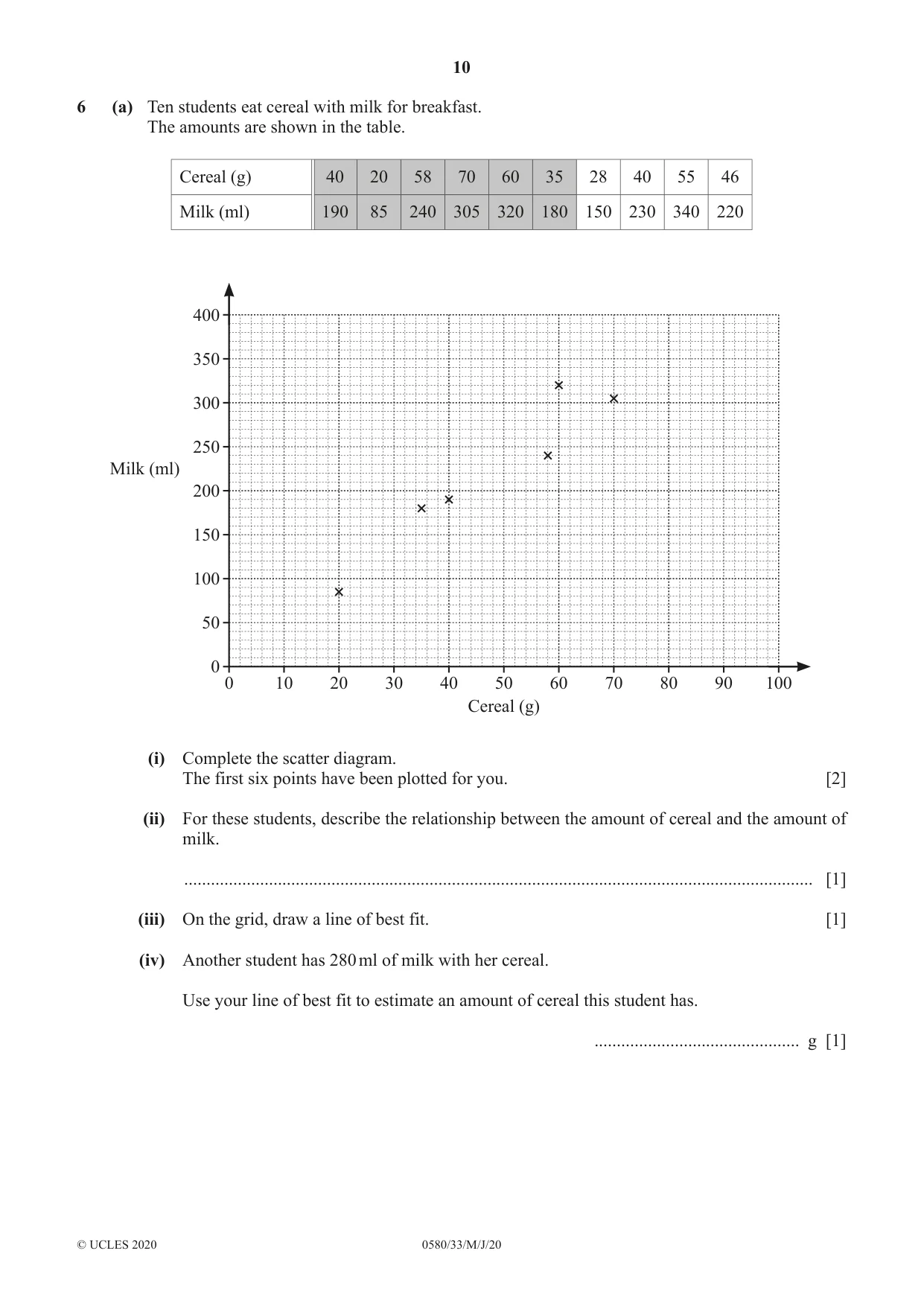
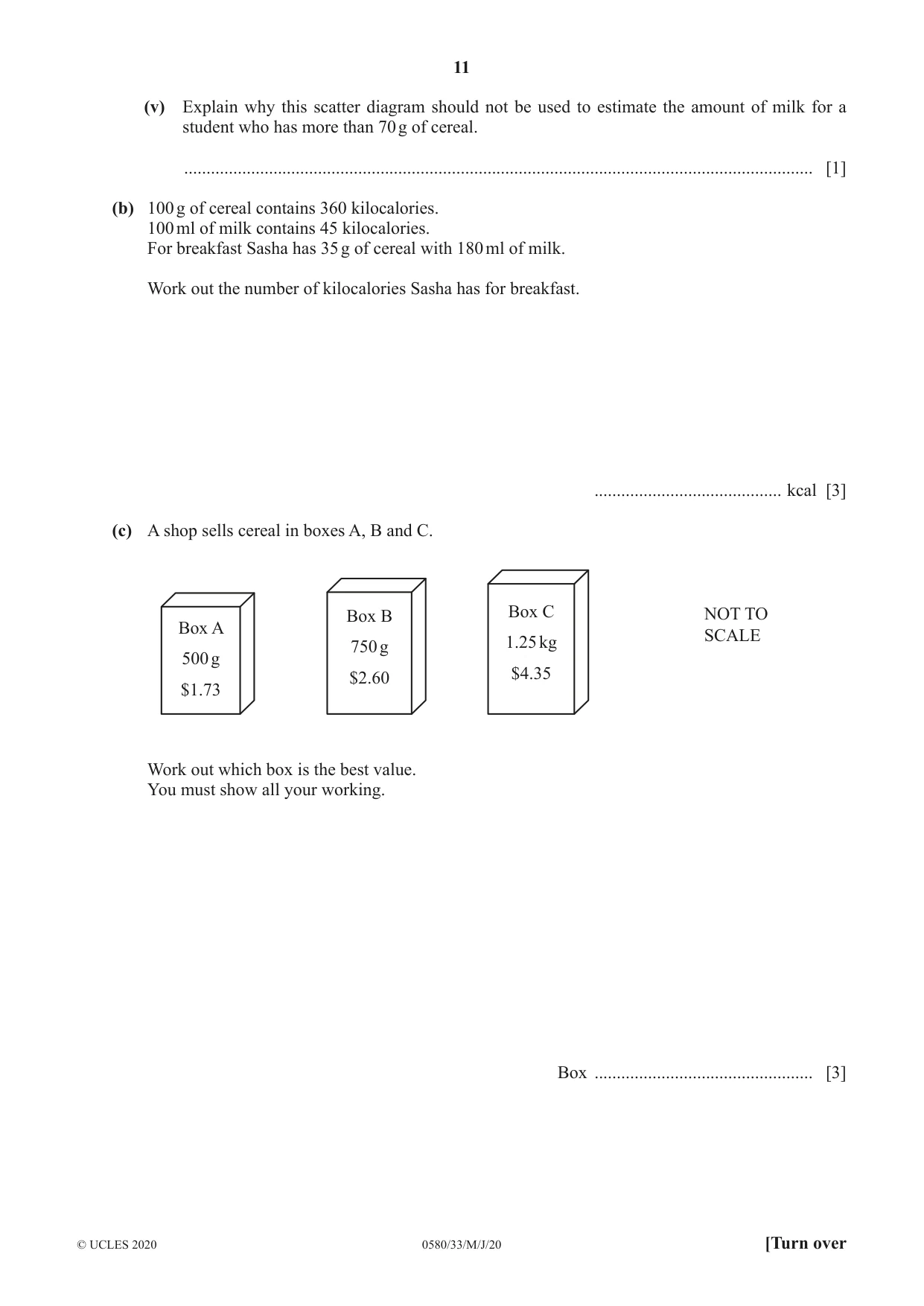
6 (a) Ten students eat cereal with milk for breakfast. The amounts are shown in the table. Cereal (g) 40 20 58 70 60 35 28 40 55 46 Milk (ml) 190 85 240 305 320 180 150 230 340 220 400 350 300 250 Milk (ml) 200 150 100 50 0 0 10 20 30 40 50 60 70 80 90 100 Cereal (g) (i) Complete the scatter diagram. The first six points have been plotted for you. [2] (ii) For these students, describe the relationship between the amount of cereal and the amount of milk. ............................................................................................................................................. [1] (iii) On the grid, draw a line of best fit. [1] (iv) Another student has 280 ml of milk with her cereal. Use your line of best fit to estimate an amount of cereal this student has. .............................................. g [1] (v) Explain why this scatter diagram should not be used to estimate the amount of milk for a student who has more than 70 g of cereal. ............................................................................................................................................. [1] (b) 100 g of cereal contains 360 kilocalories. 100 ml of milk contains 45 kilocalories. For breakfast Sasha has 35 g of cereal with 180 ml of milk. Work out the number of kilocalories Sasha has for breakfast. .......................................... kcal [3] (c) A shop sells cereal in boxes A, B and C. Box B Box C NOT TO Box A SCALE 750 g 1.25 kg 500 g $2.60 $4.35 $1.73 Work out which box is the best value. You must show all your working. Box ................................................. [3]
Mark scheme: 6(a)(i) 4 points correctly plotted 2 B1 for 2 or 3 points correctly plotted 6(a)(ii) As the amount of cereal increases the 1 amount of milk increases oe 6(a)(iii) Ruled line of best fit drawn 1 6(a)(iv) 52 to 60 1 6(a)(v) Outside given data oe 1 6(b) 207 3 35 180 M2 for × 360 + × 45 oe 100 100 35 180 or M1 for × 360 or × 45 100 100 6(c) Box A 3 M2 for 3 correct divisions shown but either With correct comparisons made of not evaluated to suitable accuracy or wrong the 3 boxes with suitable accuracy box selected shown M1 for 2 correct divisions shown for 2 boxes
Q7 · The diagram shows a regular polygon
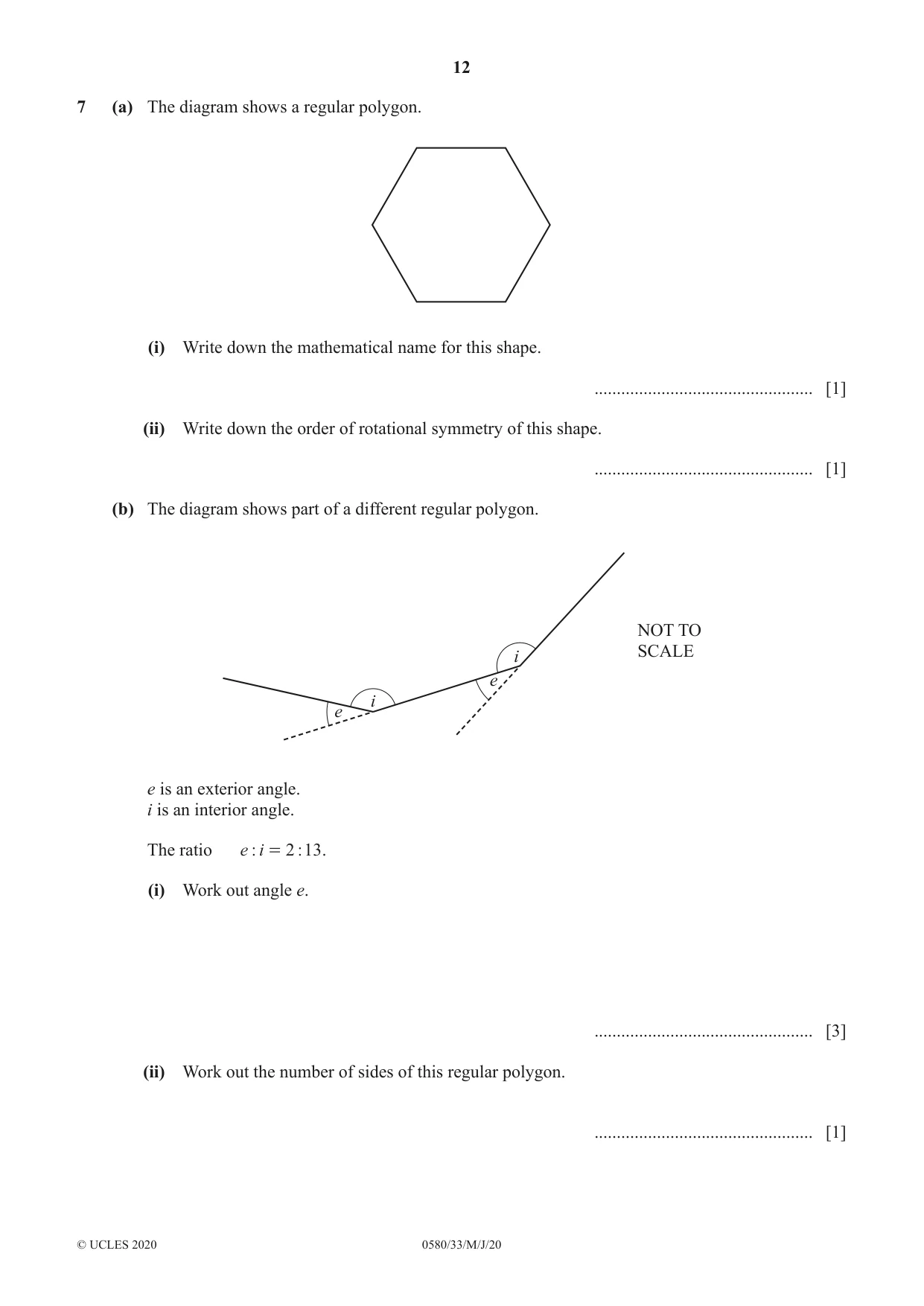
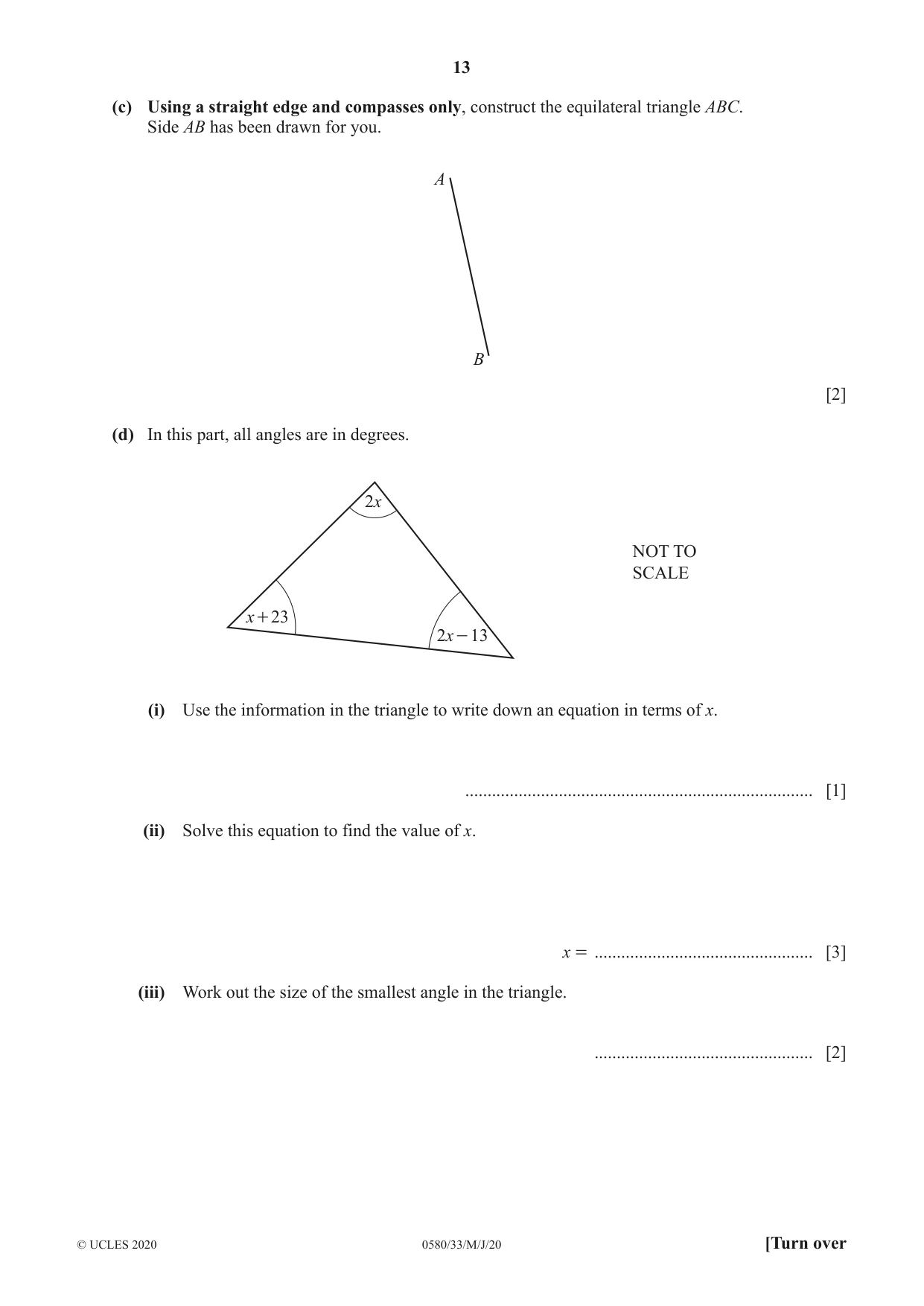
7 (a) The diagram shows a regular polygon. (i) Write down the mathematical name for this shape. ................................................. [1] (ii) Write down the order of rotational symmetry of this shape. ................................................. [1] (b) The diagram shows part of a different regular polygon. NOT TO SCALE i e i e e is an exterior angle. i is an interior angle. The ratio e : i = 2 : 13 . (i) Work out angle e. ................................................. [3] (ii) Work out the number of sides of this regular polygon. ................................................. [1] (c) Using a straight edge and compasses only, construct the equilateral triangle ABC. Side AB has been drawn for you. A B [2] (d) In this part, all angles are in degrees. 2x NOT TO SCALE x + 23 2x - 13 (i) Use the information in the triangle to write down an equation in terms of x. .............................................................................. [1] (ii) Solve this equation to find the value of x. x = ................................................. [3] (iii) Work out the size of the smallest angle in the triangle. ................................................. [2]
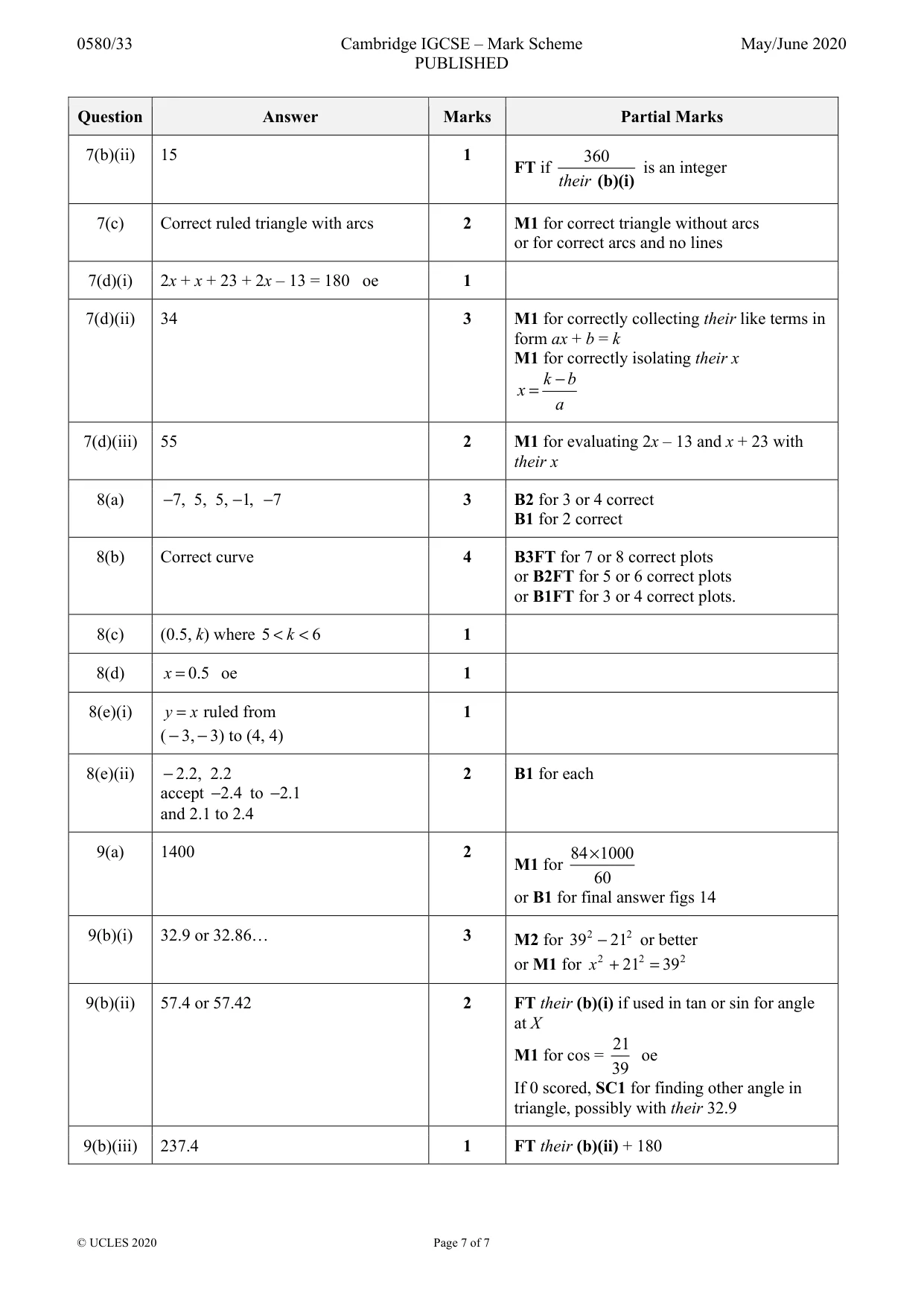
Mark scheme: 7(a)(i) Hexagon 1 7(a)(ii) 6 1 7(b)(i) 24 3 180 M2 for × k where k = 1, 2 or 13 2 + 13 or B1 for e + i = 180 soi 7(b)(ii) 15 1 360 FT if is an integer their (b)(i) 7(c) Correct ruled triangle with arcs 2 M1 for correct triangle without arcs or for correct arcs and no lines 7(d)(i) 2x + x + 23 + 2x – 13 = 180 oe 1 7(d)(ii) 34 3 M1 for correctly collecting their like terms in form ax + b = k M1 for correctly isolating their x k − b x = a 7(d)(iii) 55 2 M1 for evaluating 2x – 13 and x + 23 with their x
Q8 · Complete the table of values for y = - x 2 + x + 5
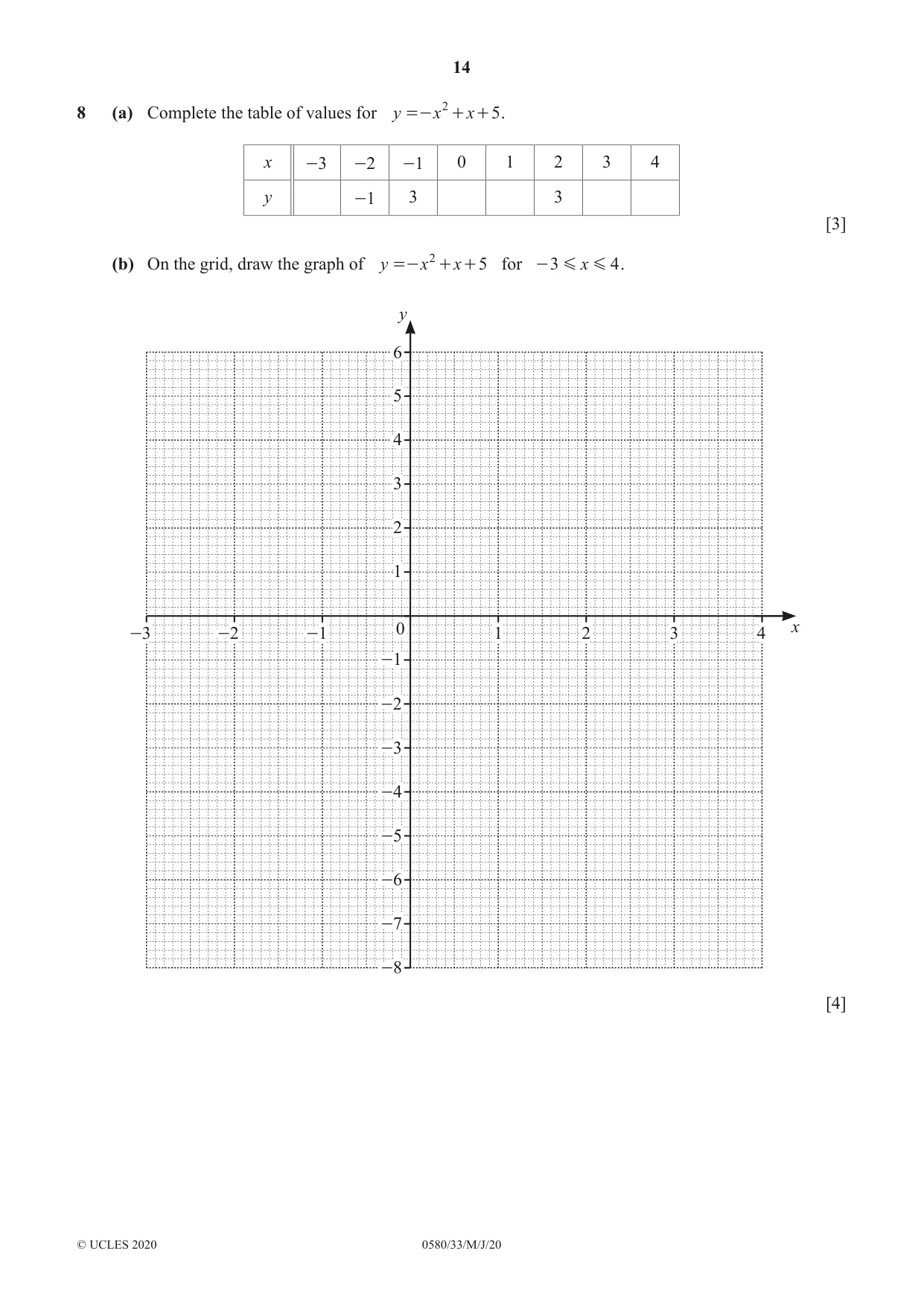
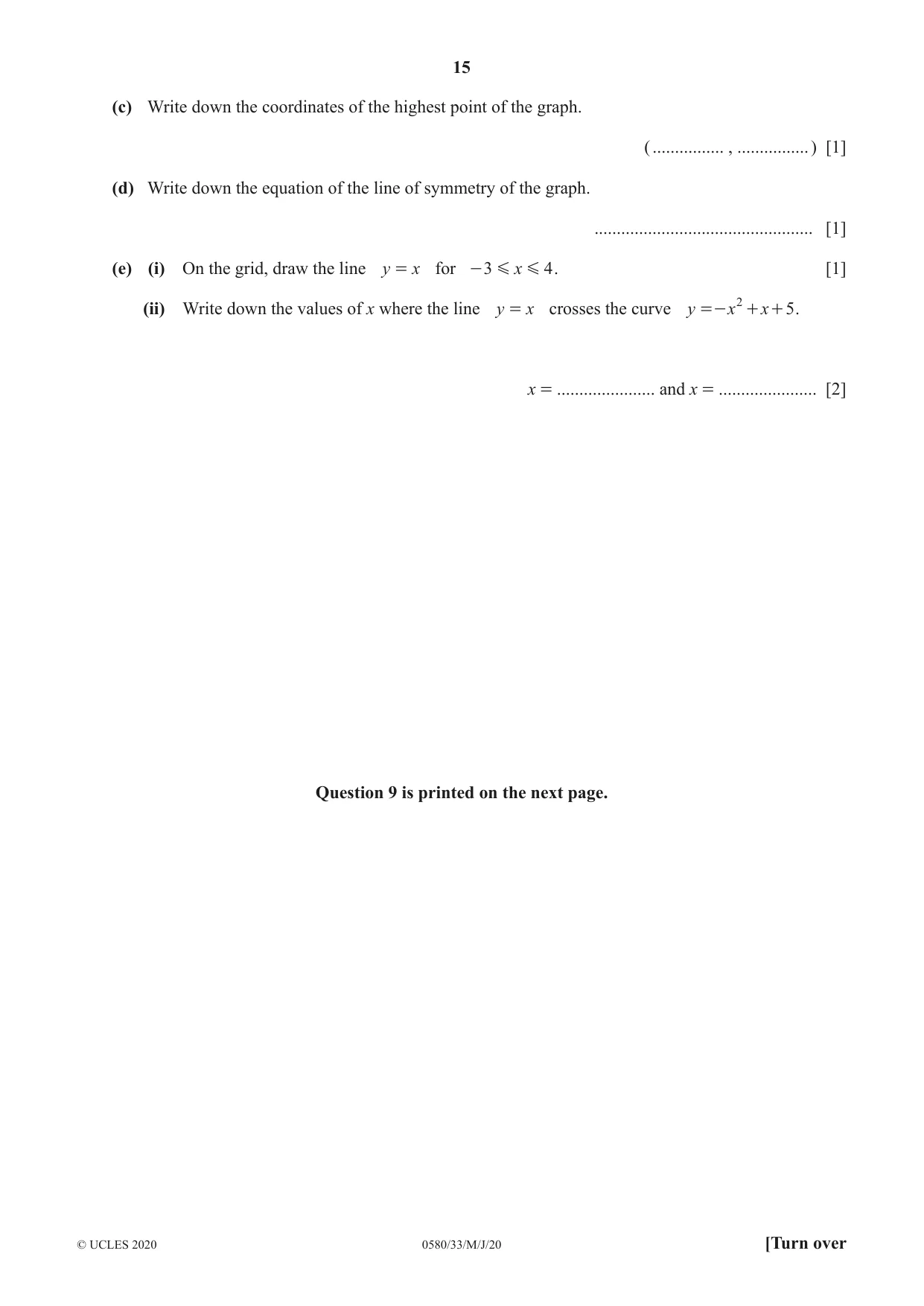
8 (a) Complete the table of values for y = - x 2 + x + 5 . x -3 -2 -1 0 1 2 3 4 y -1 3 3 [3] (b) On the grid, draw the graph of y = - x 2 + x + 5 for - 3 G x G 4 . y 6 5 4 3 2 1 -3 -2 -1 0 1 2 3 4 x -1 -2 -3 -4 -5 -6 -7 -8 [4] (c) Write down the coordinates of the highest point of the graph. ( ................ , ................ ) [1] (d) Write down the equation of the line of symmetry of the graph. ................................................. [1] (e) (i) On the grid, draw the line y = x for - 3 G x G 4 . [1] (ii) Write down the values of x where the line y = x crosses the curve y =- x 2 + x + 5 . x = ...................... and x = ...................... [2] Question 9 is printed on the next page.
Mark scheme: 8(a) −7, 5, 5, −1, −7 3 B2 for 3 or 4 correct B1 for 2 correct 8(b) Correct curve 4 B3FT for 7 or 8 correct plots or B2FT for 5 or 6 correct plots or B1FT for 3 or 4 correct plots. 8(c) (0.5, k) where 5 < k < 6 1 8(d) x = 0.5 oe 1 8(e)(i) y = x ruled from 1 ( −3, −3) to (4, 4) 8(e)(ii) −2.2, 2.2 2 B1 for each accept −2.4 to −2.1 and 2.1 to 2.4
Q9 · A speedboat travels at 84 kilometres per hour
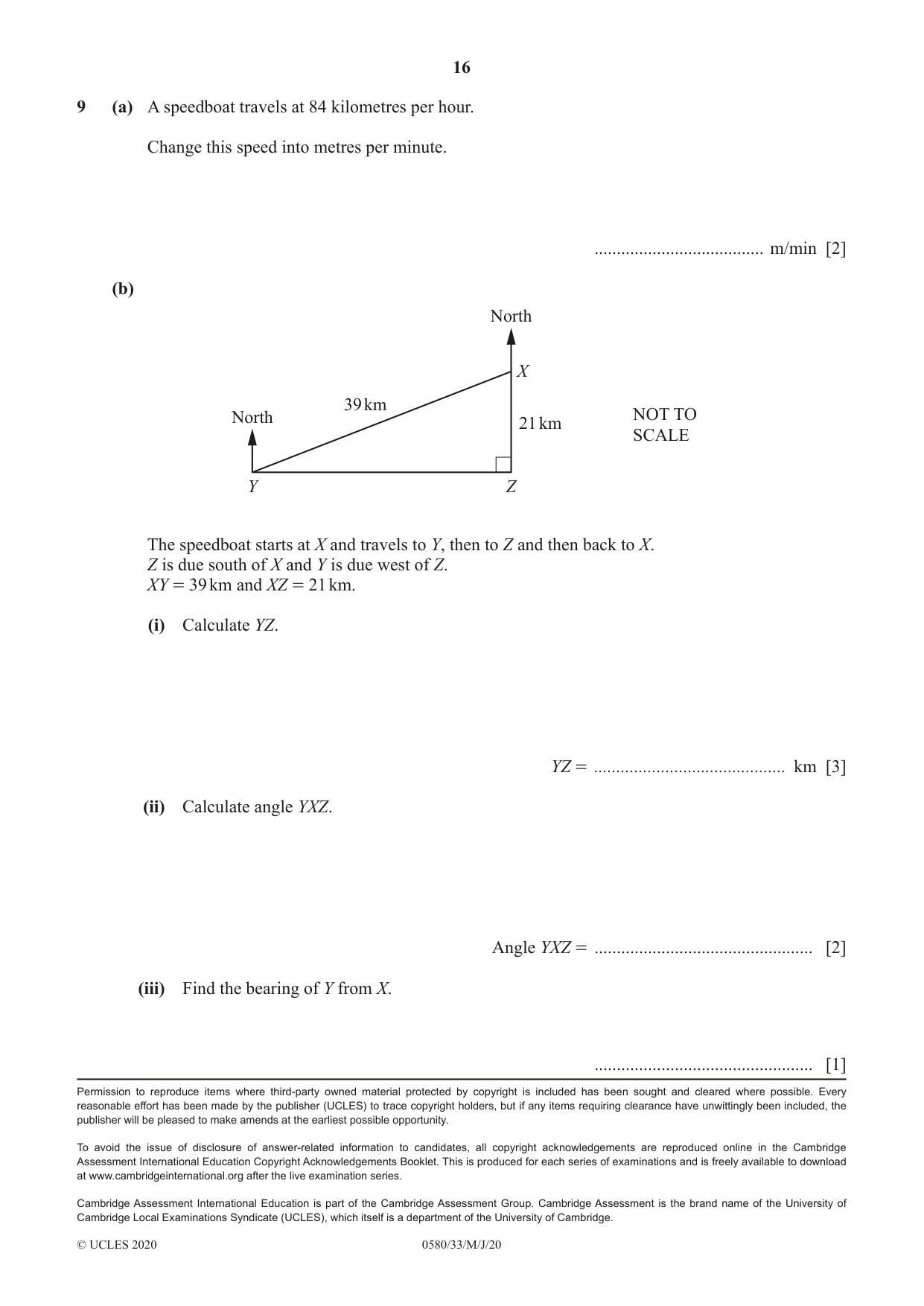
9 (a) A speedboat travels at 84 kilometres per hour. Change this speed into metres per minute. ...................................... m/min [2] (b) North X 39 km North NOT TO 21 km SCALE Y Z The speedboat starts at X and travels to Y, then to Z and then back to X. Z is due south of X and Y is due west of Z. XY = 39 km and XZ = 21 km. (i) Calculate YZ. YZ = ........................................... km [3] (ii) Calculate angle YXZ. Angle YXZ = ................................................. [2] (iii) Find the bearing of Y from X. ................................................. [1]
Mark scheme: 9(a) 1400 2 84 × 1000 M1 for 60 or B1 for final answer figs 14 9(b)(i) 32.9 or 32.86… 3 M2 for 39 2 − 212 or better or M1 for x 2 + 212 = 39 2 9(b)(ii) 57.4 or 57.42 2 FT their (b)(i) if used in tan or sin for angle at X 21 M1 for cos = oe 39 If 0 scored, SC1 for finding other angle in triangle, possibly with their 32.9 9(b)(iii) 237.4 1 FT their (b)(ii) + 180
What was in this paper
The subtopics covered by these 9 questions, and how many questions each got. Open one in a new tab to see every Cambridge question on it.