Cambridge IGCSE Mathematics 0580 — 2019 May/June Paper 3 · Variant 2
0580/32/M/J/19 · 9 questions · 104 marks · ≈117 min
The question paper and its mark scheme, free to read here and free to download. This is Cambridge’s own paper, exactly as it was sat.
Question paper16 pages
Mark scheme7 pages
Answers below. Sit the paper first if you are practising.
Questions as text
Q1 · Write 26% as a decimal
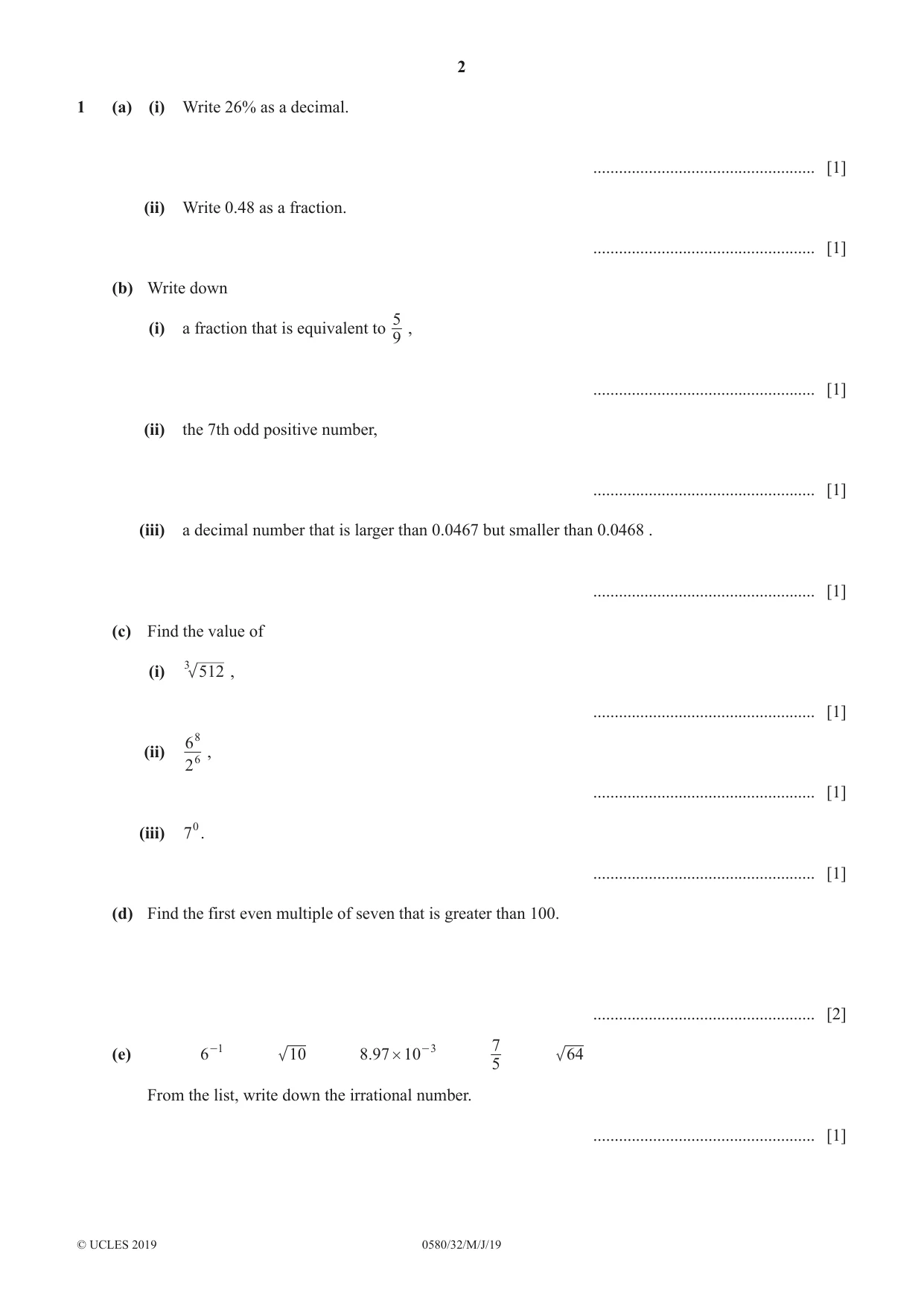
1 (a) (i) Write 26% as a decimal. .................................................... [1] (ii) Write 0.48 as a fraction. .................................................... [1] (b) Write down 5 (i) a fraction that is equivalent to , 9 .................................................... [1] (ii) the 7th odd positive number, .................................................... [1] (iii) a decimal number that is larger than 0.0467 but smaller than 0.0468 . .................................................... [1] (c) Find the value of (i) 3 512 , .................................................... [1] 6 8 (ii) 6 , 2 .................................................... [1] (iii) 70. .................................................... [1] (d) Find the first even multiple of seven that is greater than 100. .................................................... [2] - 1 - 3 7 (e) 6 10 .897 # 10 64 5 From the list, write down the irrational number. .................................................... [1]
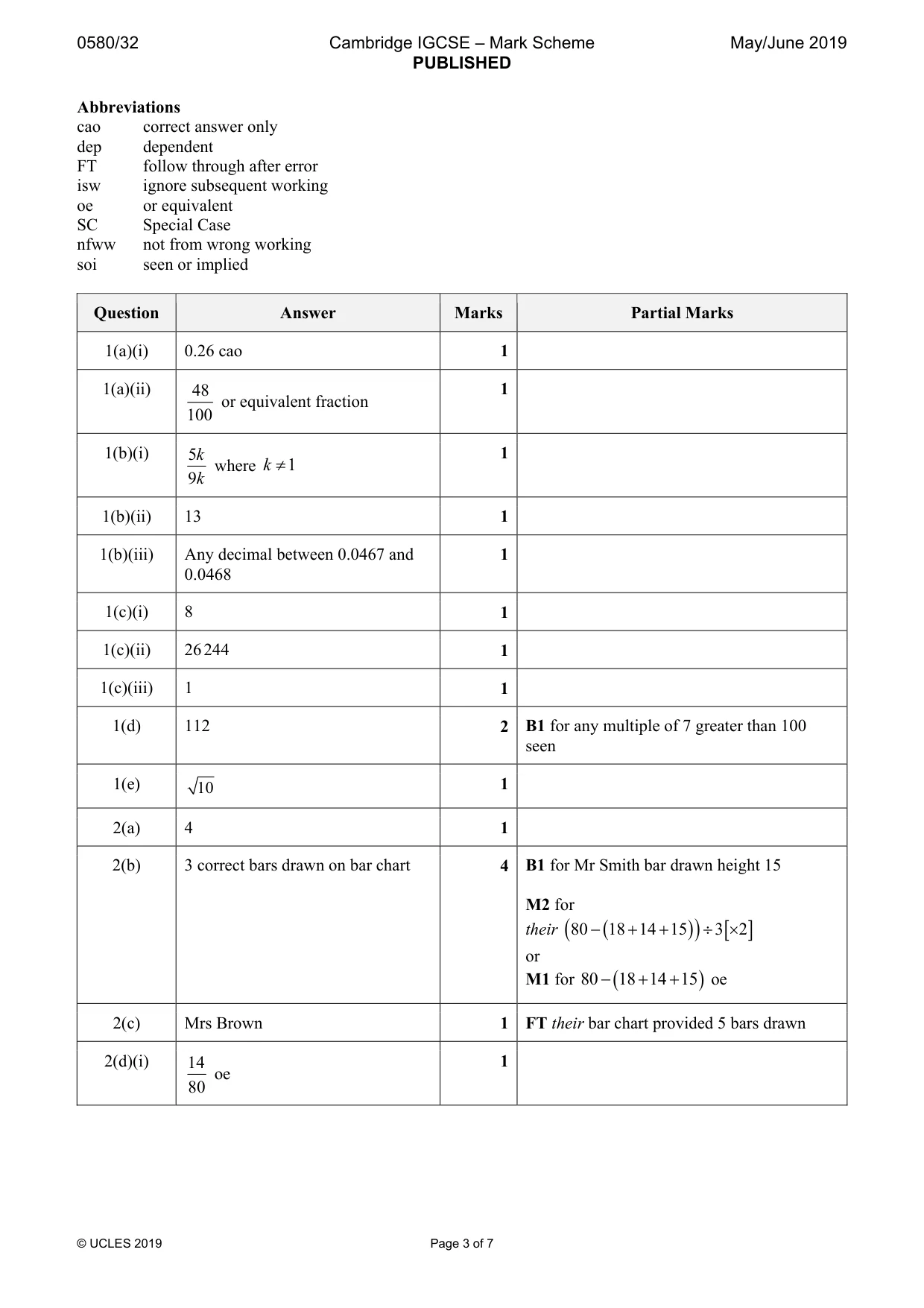
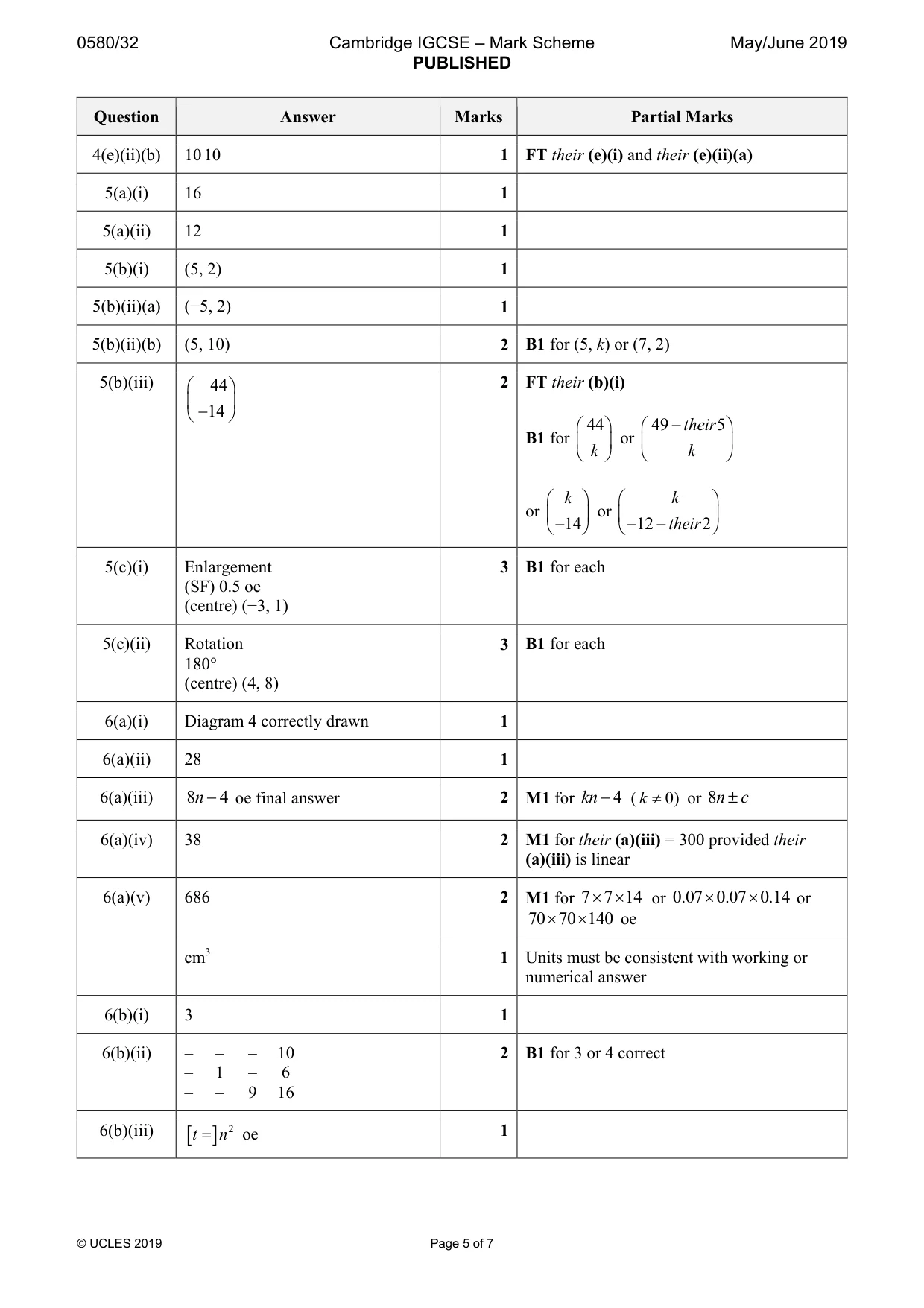
Mark scheme: Question Answer Marks Partial Marks 1(a)(i) 0.26 cao 1 1(a)(ii) 48 1 or equivalent fraction 100 1(b)(i) 5k 1 where k ≠ 1 9k 1(b)(ii) 13 1 1(b)(iii) Any decimal between 0.0467 and 1 0.0468 1(c)(i) 8 1 1(c)(ii) 26 244 1 1(c)(iii) 1 1 1(d) 112 2 B1 for any multiple of 7 greater than 100 seen 1(e) 10 1
Q2 · 80 students each record the name of their mathematics teacher
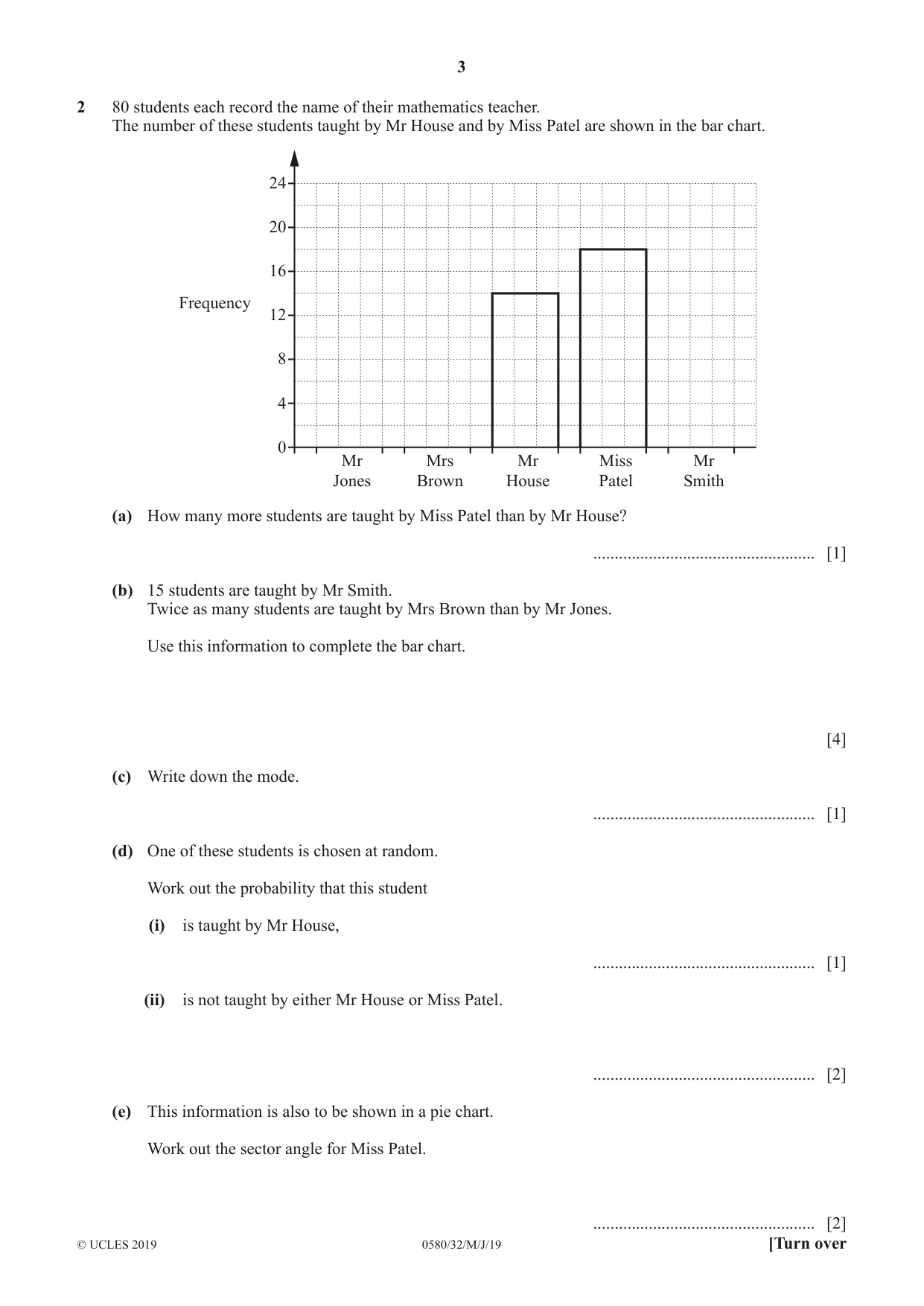
2 80 students each record the name of their mathematics teacher. The number of these students taught by Mr House and by Miss Patel are shown in the bar chart. 24 20 16 Frequency 12 8 4 0 Mr Mrs Mr Miss Mr Jones Brown House Patel Smith (a) How many more students are taught by Miss Patel than by Mr House? .................................................... [1] (b) 15 students are taught by Mr Smith. Twice as many students are taught by Mrs Brown than by Mr Jones. Use this information to complete the bar chart. [4] (c) Write down the mode. .................................................... [1] (d) One of these students is chosen at random. Work out the probability that this student (i) is taught by Mr House, .................................................... [1] (ii) is not taught by either Mr House or Miss Patel. .................................................... [2] (e) This information is also to be shown in a pie chart. Work out the sector angle for Miss Patel. .................................................... [2]
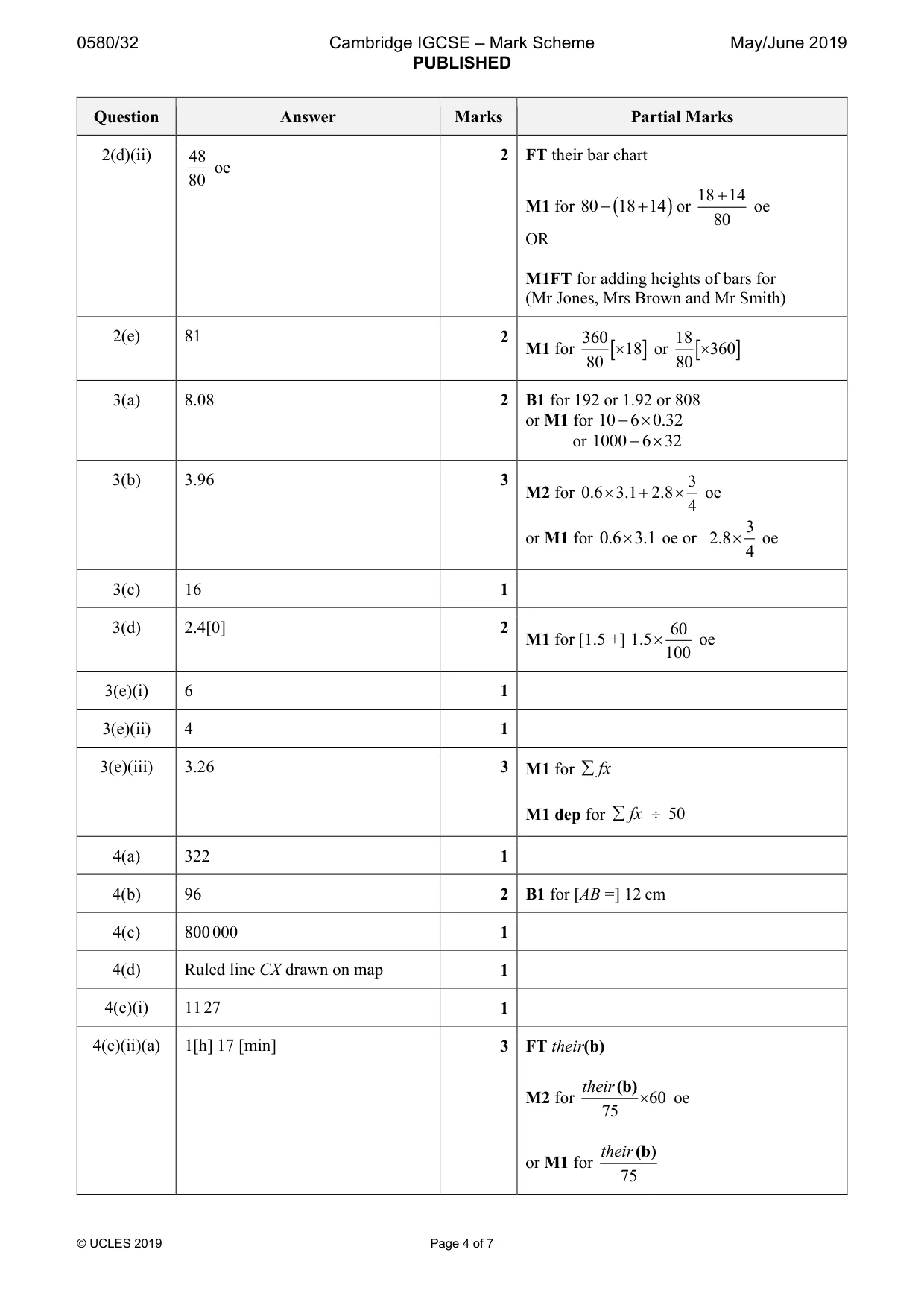
Mark scheme: 2(a) 4 1 2(b) 3 correct bars drawn on bar chart 4 B1 for Mr Smith bar drawn height 15 M2 for their ( 80 − (18 + 14 + 15 ) ) ÷ 3 [× 2 ] or M1 for 80 − (18 + 14 + 15 ) oe 2(c) Mrs Brown 1 FT their bar chart provided 5 bars drawn 2(d)(i) 14 1 oe 80 2(d)(ii) 48 2 FT their bar chart oe 80 18 + 14 M1 for 80 − (18 + 14 ) or oe 80 OR M1FT for adding heights of bars for (Mr Jones, Mrs Brown and Mr Smith) 2(e) 81 2 360 18 M1 for [× 18 ] or [× 360 ] 80 80
Q3 · Mr Lester has a fruit and vegetable shop
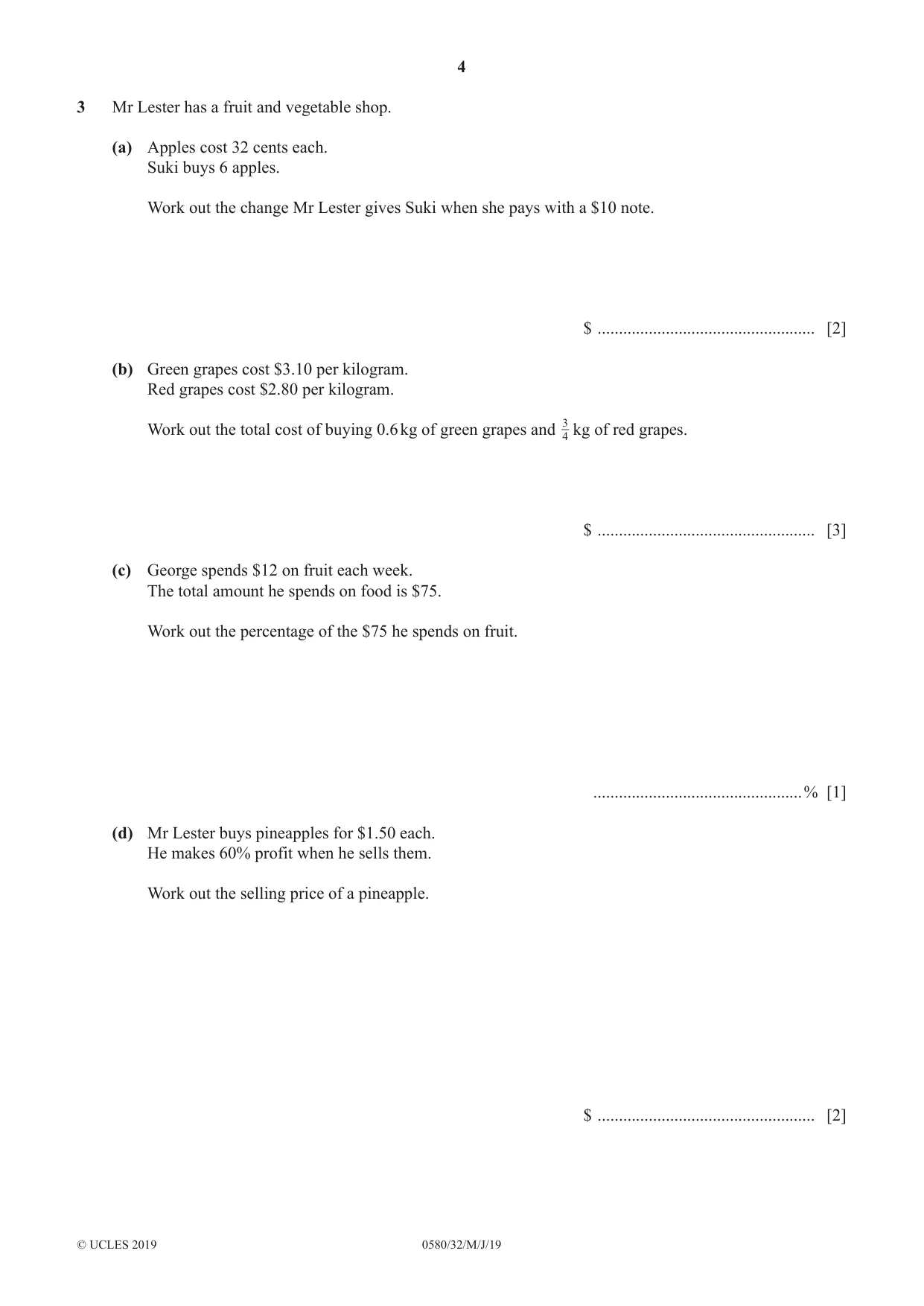
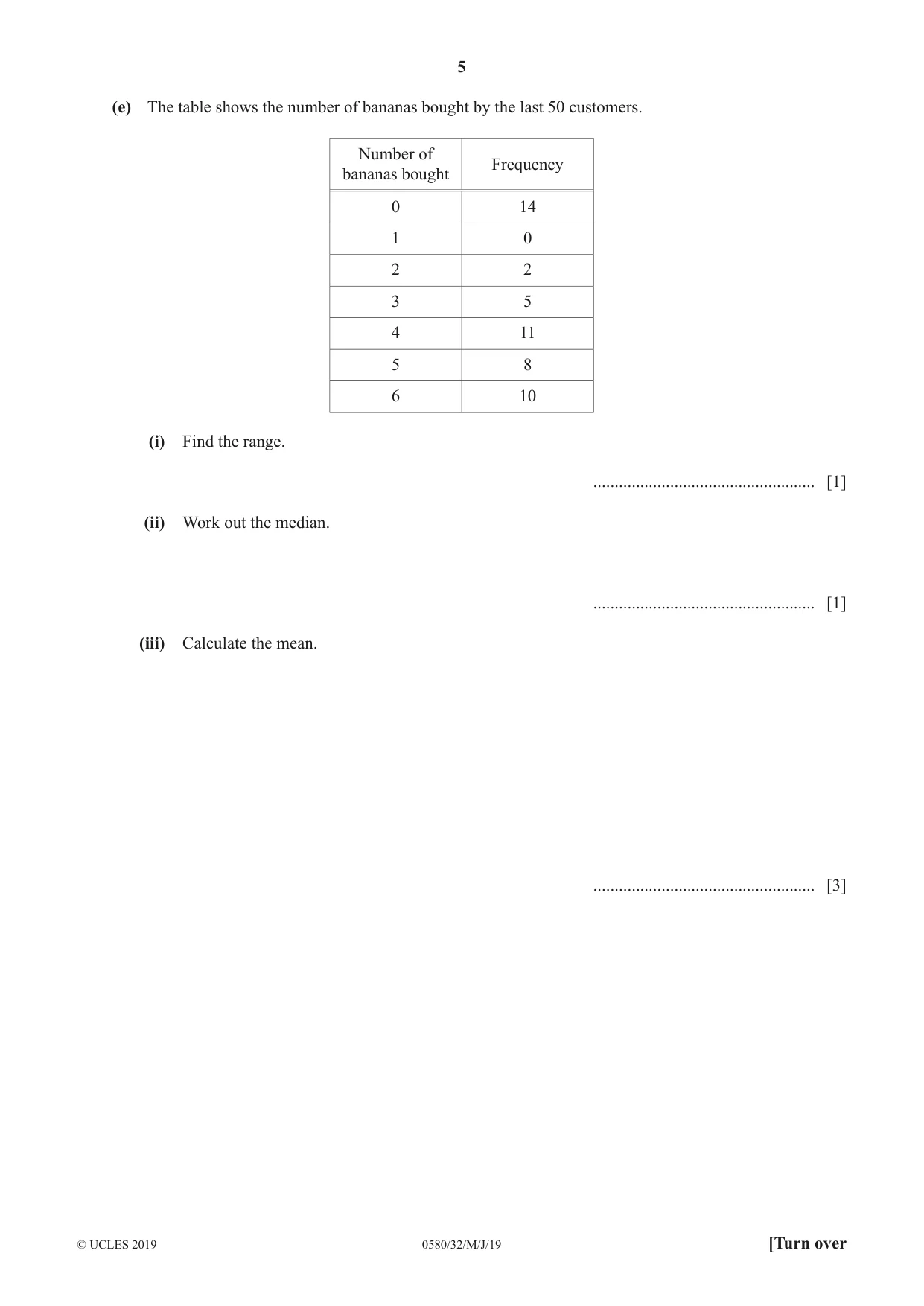
3 Mr Lester has a fruit and vegetable shop. (a) Apples cost 32 cents each. Suki buys 6 apples. Work out the change Mr Lester gives Suki when she pays with a $10 note. $ ................................................... [2] (b) Green grapes cost $3.10 per kilogram. Red grapes cost $2.80 per kilogram. Work out the total cost of buying 0.6 kg of green grapes and 34 kg of red grapes. $ ................................................... [3] (c) George spends $12 on fruit each week. The total amount he spends on food is $75. Work out the percentage of the $75 he spends on fruit. .................................................% [1] (d) Mr Lester buys pineapples for $1.50 each. He makes 60% profit when he sells them. Work out the selling price of a pineapple. $ ................................................... [2] (e) The table shows the number of bananas bought by the last 50 customers. Number of Frequency bananas bought 0 14 1 0 2 2 3 5 4 11 5 8 6 10 (i) Find the range. .................................................... [1] (ii) Work out the median. .................................................... [1] (iii) Calculate the mean. .................................................... [3]
Mark scheme: 3(a) 8.08 2 B1 for 192 or 1.92 or 808 or M1 for 10 −×6 0.32 or 1000 −×6 32 3(b) 3.96 3 3 M2 for 0.6 × 3.1 + 2.8 × oe 4 3 or M1 for 0.6 × 3.1 oe or 2.8 × oe 4 3(c) 16 1 3(d) 2.4[0] 2 60 M1 for [1.5 +] 1.5 × oe 100 3(e)(i) 6 1 3(e)(ii) 4 1 3(e)(iii) 3.26 3 M1 for ∑ fx M1 dep for ∑ fx ÷ 50
Q4 · The scale drawing shows town A, town B and town C on a map
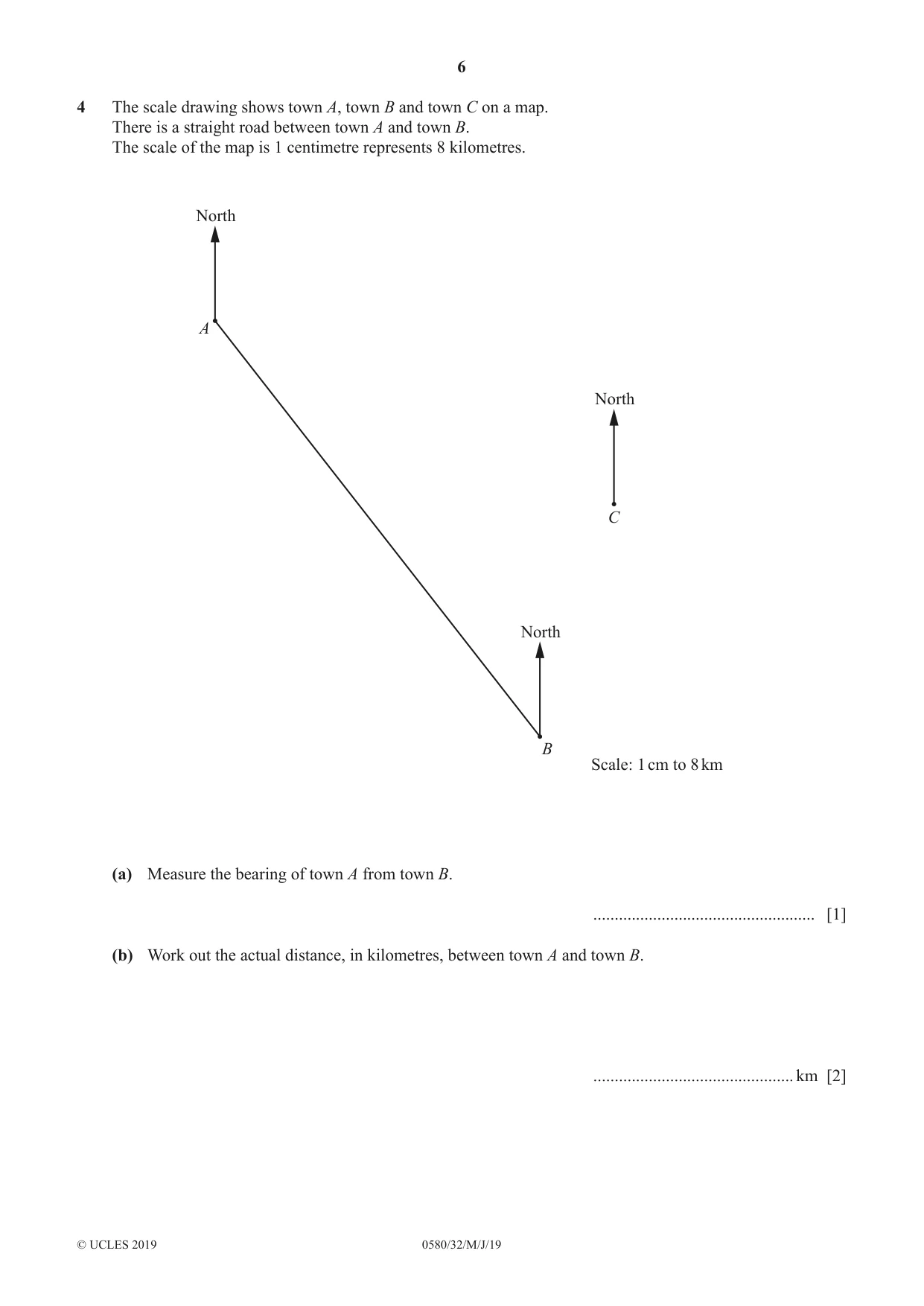
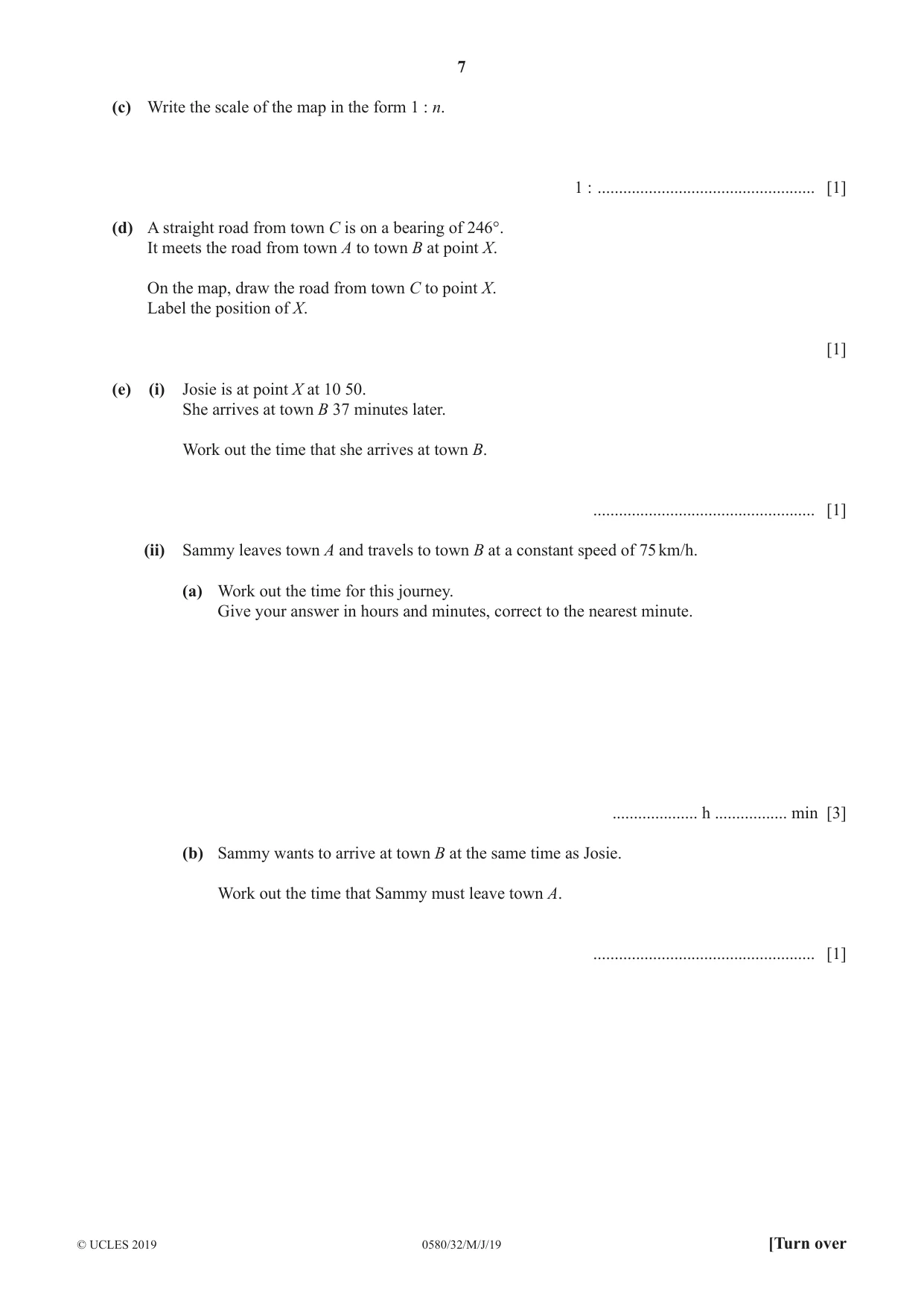
4 The scale drawing shows town A, town B and town C on a map. There is a straight road between town A and town B. The scale of the map is 1 centimetre represents 8 kilometres. North A North C North B Scale: 1 cm to 8 km (a) Measure the bearing of town A from town B. .................................................... [1] (b) Work out the actual distance, in kilometres, between town A and town B. ............................................... km [2] (c) Write the scale of the map in the form 1 : n. 1 : ................................................... [1] (d) A straight road from town C is on a bearing of 246°. It meets the road from town A to town B at point X. On the map, draw the road from town C to point X. Label the position of X. [1] (e) (i) Josie is at point X at 10 50. She arrives at town B 37 minutes later. Work out the time that she arrives at town B. .................................................... [1] (ii) Sammy leaves town A and travels to town B at a constant speed of 75 km/h. (a) Work out the time for this journey. Give your answer in hours and minutes, correct to the nearest minute. .................... h ................. min [3] (b) Sammy wants to arrive at town B at the same time as Josie. Work out the time that Sammy must leave town A. .................................................... [1]
Mark scheme: 4(a) 322 1 4(b) 96 2 B1 for [AB =] 12 cm 4(c) 800 000 1 4(d) Ruled line CX drawn on map 1 4(e)(i) 11 27 1 4(e)(ii)(a) 1[h] 17 [min] 3 FT their(b) their (b) M2 for × 60 oe 75 their(b) or M1 for 75 4(e)(ii)(b) 10 10 1 FT their (e)(i) and their (e)(ii)(a)
Q5 · The diagram shows four shapes A, B, C and D and a point P on a 1 cm2 grid
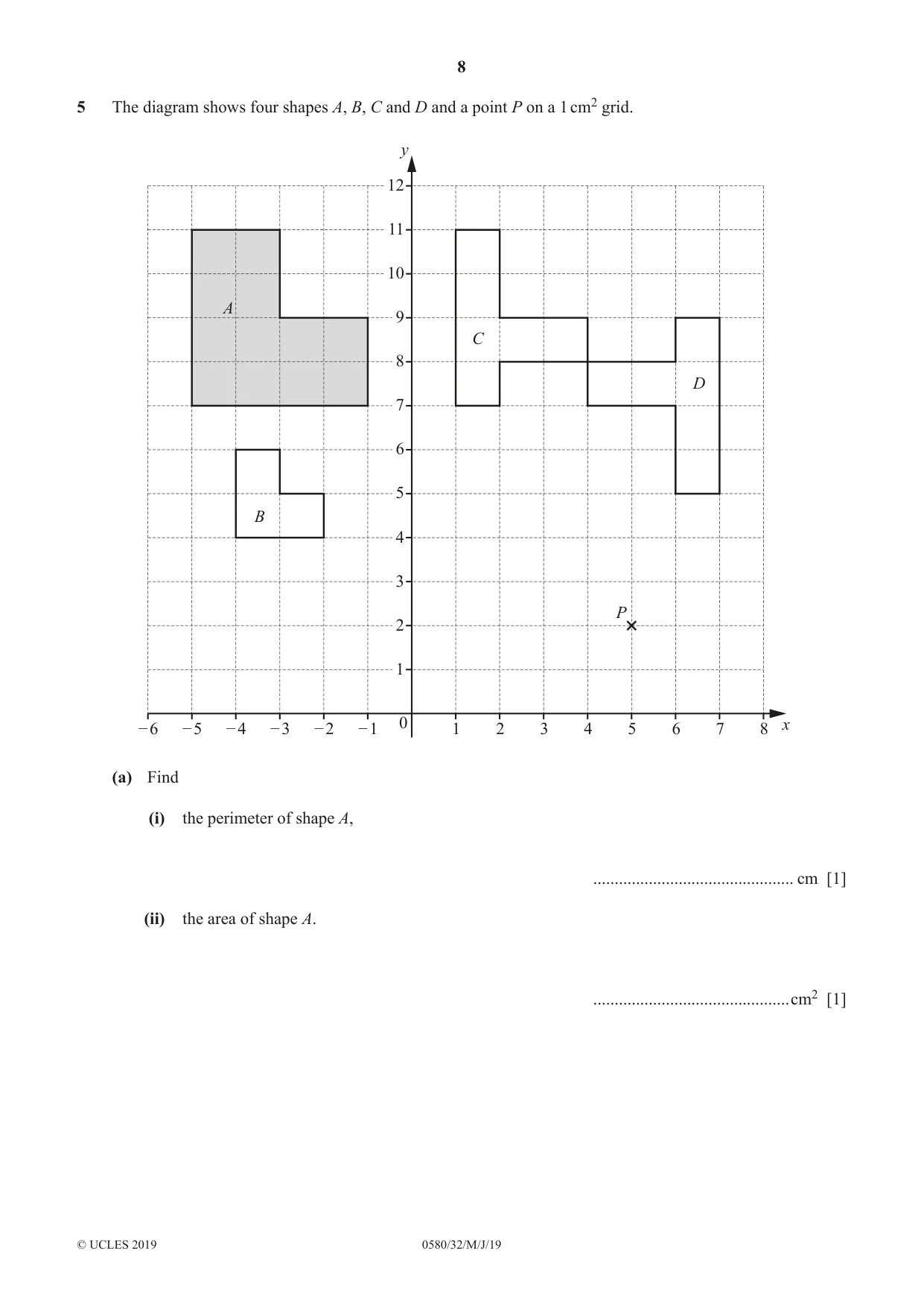
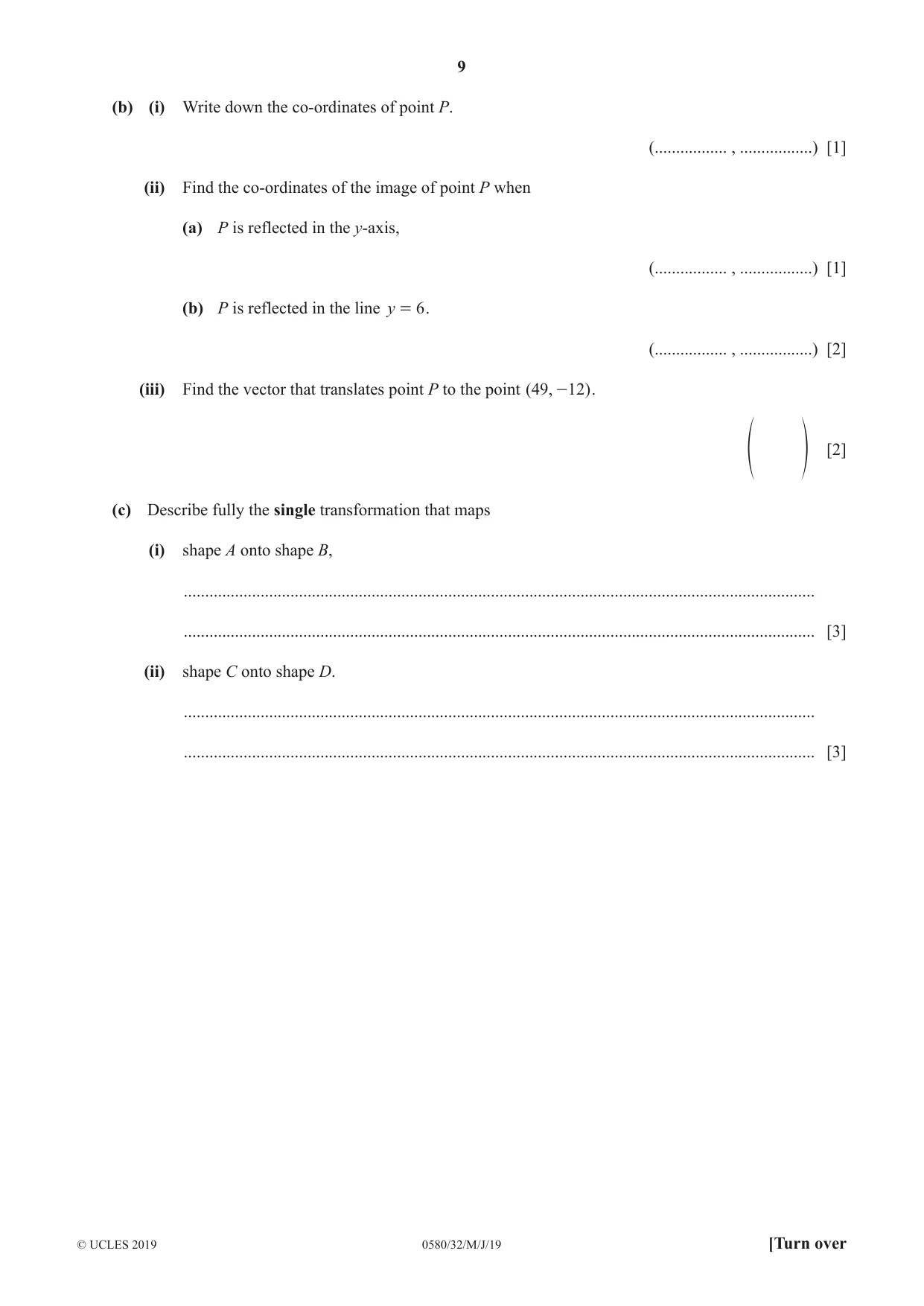
5 The diagram shows four shapes A, B, C and D and a point P on a 1 cm2 grid. y 12 11 10 A 9 C 8 D 7 6 5 B 4 3 P 2 1 0 – 6 – 5 – 4 – 3 – 2 – 1 1 2 3 4 5 6 7 8 x (a) Find (i) the perimeter of shape A, ............................................... cm [1] (ii) the area of shape A. ..............................................cm2 [1] (b) (i) Write down the co-ordinates of point P. (................. , .................) [1] (ii) Find the co-ordinates of the image of point P when (a) P is reflected in the y-axis, (................. , .................) [1] (b) P is reflected in the line y = 6 . (................. , .................) [2] (iii) Find the vector that translates point P to the point (49, - 12) . [2] f p (c) Describe fully the single transformation that maps (i) shape A onto shape B, .................................................................................................................................................... .................................................................................................................................................... [3] (ii) shape C onto shape D. .................................................................................................................................................... .................................................................................................................................................... [3]
Mark scheme: 5(a)(i) 16 1 5(a)(ii) 12 1 5(b)(i) (5, 2) 1 5(b)(ii)(a) (−5, 2) 1 5(b)(ii)(b) (5, 10) 2 B1 for (5, k) or (7, 2) 5(b)(iii) 44 2 FT their (b)(i) −14 44 49 − their 5 B1 for or k k k k or or −14 −12 − their 2 5(c)(i) Enlargement 3 B1 for each (SF) 0.5 oe (centre) (−3, 1) 5(c)(ii) Rotation 3 B1 for each 180° (centre) (4, 8)
Q6 · The grid shows the first three diagrams in a sequence
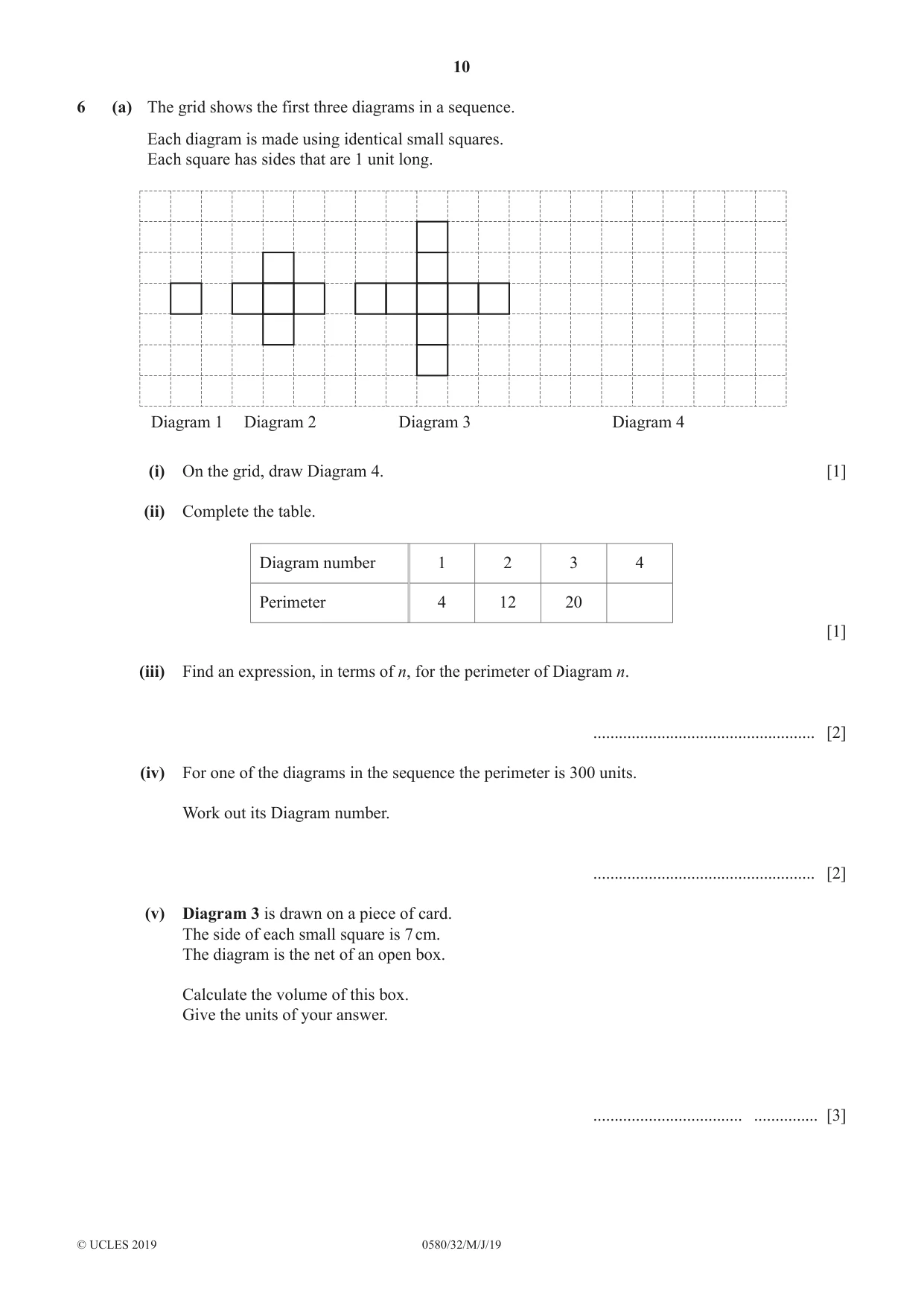
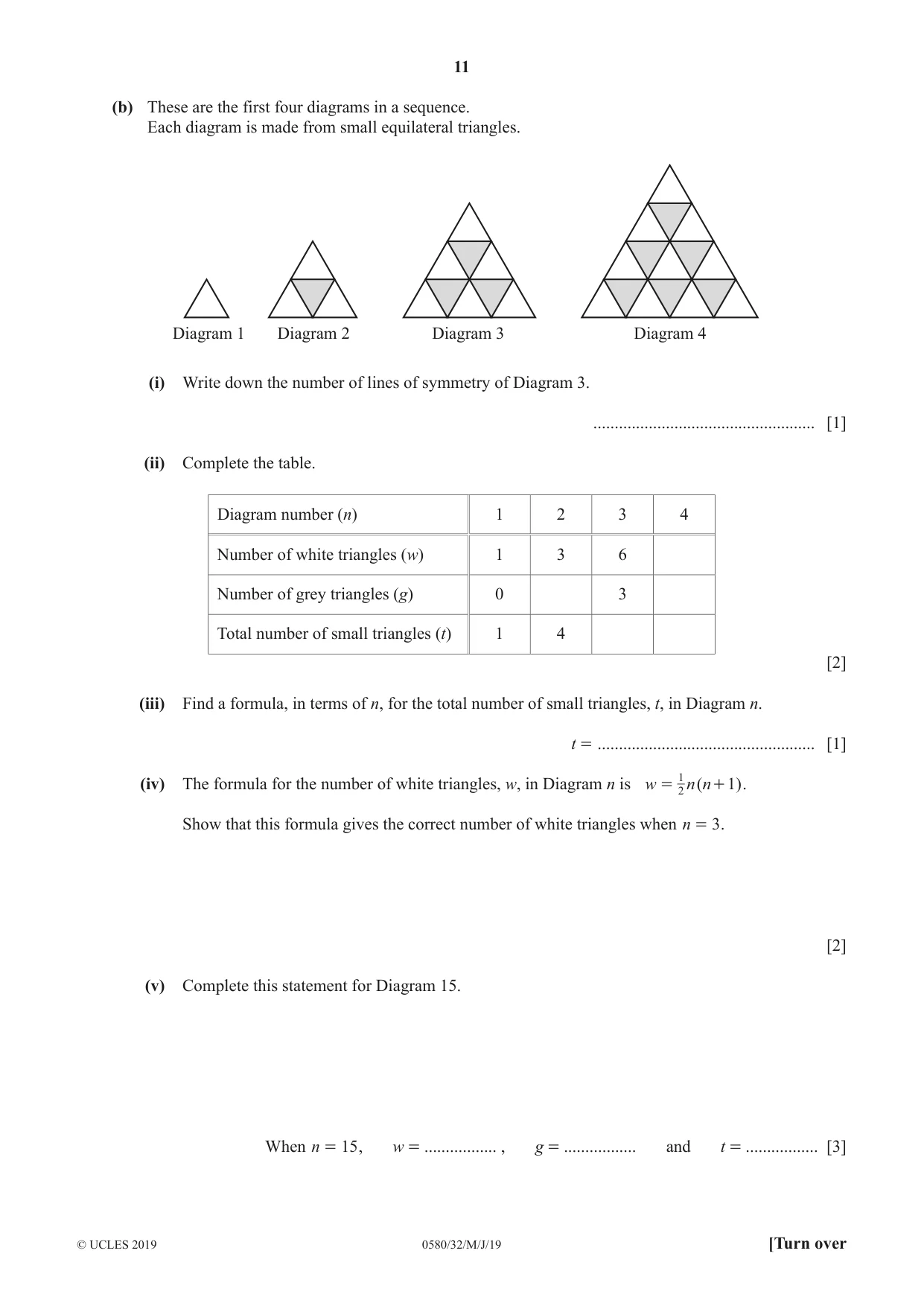
6 (a) The grid shows the first three diagrams in a sequence. Each diagram is made using identical small squares. Each square has sides that are 1 unit long. Diagram 1 Diagram 2 Diagram 3 Diagram 4 (i) On the grid, draw Diagram 4. [1] (ii) Complete the table. Diagram number 1 2 3 4 Perimeter 4 12 20 [1] (iii) Find an expression, in terms of n, for the perimeter of Diagram n. .................................................... [2] (iv) For one of the diagrams in the sequence the perimeter is 300 units. Work out its Diagram number. .................................................... [2] (v) Diagram 3 is drawn on a piece of card. The side of each small square is 7 cm. The diagram is the net of an open box. Calculate the volume of this box. Give the units of your answer. ................................... ............... [3] (b) These are the first four diagrams in a sequence. Each diagram is made from small equilateral triangles. Diagram 1 Diagram 2 Diagram 3 Diagram 4 (i) Write down the number of lines of symmetry of Diagram 3. .................................................... [1] (ii) Complete the table. Diagram number (n) 1 2 3 4 Number of white triangles (w) 1 3 6 Number of grey triangles (g) 0 3 Total number of small triangles (t) 1 4 [2] (iii) Find a formula, in terms of n, for the total number of small triangles, t, in Diagram n. t = ................................................... [1] + 1) . (iv) The formula for the number of white triangles, w, in Diagram n is w = 12 n (n Show that this formula gives the correct number of white triangles when n = 3 . [2] (v) Complete this statement for Diagram 15. When n = 15 , w = ................. , g = ................. and t = ................. [3]
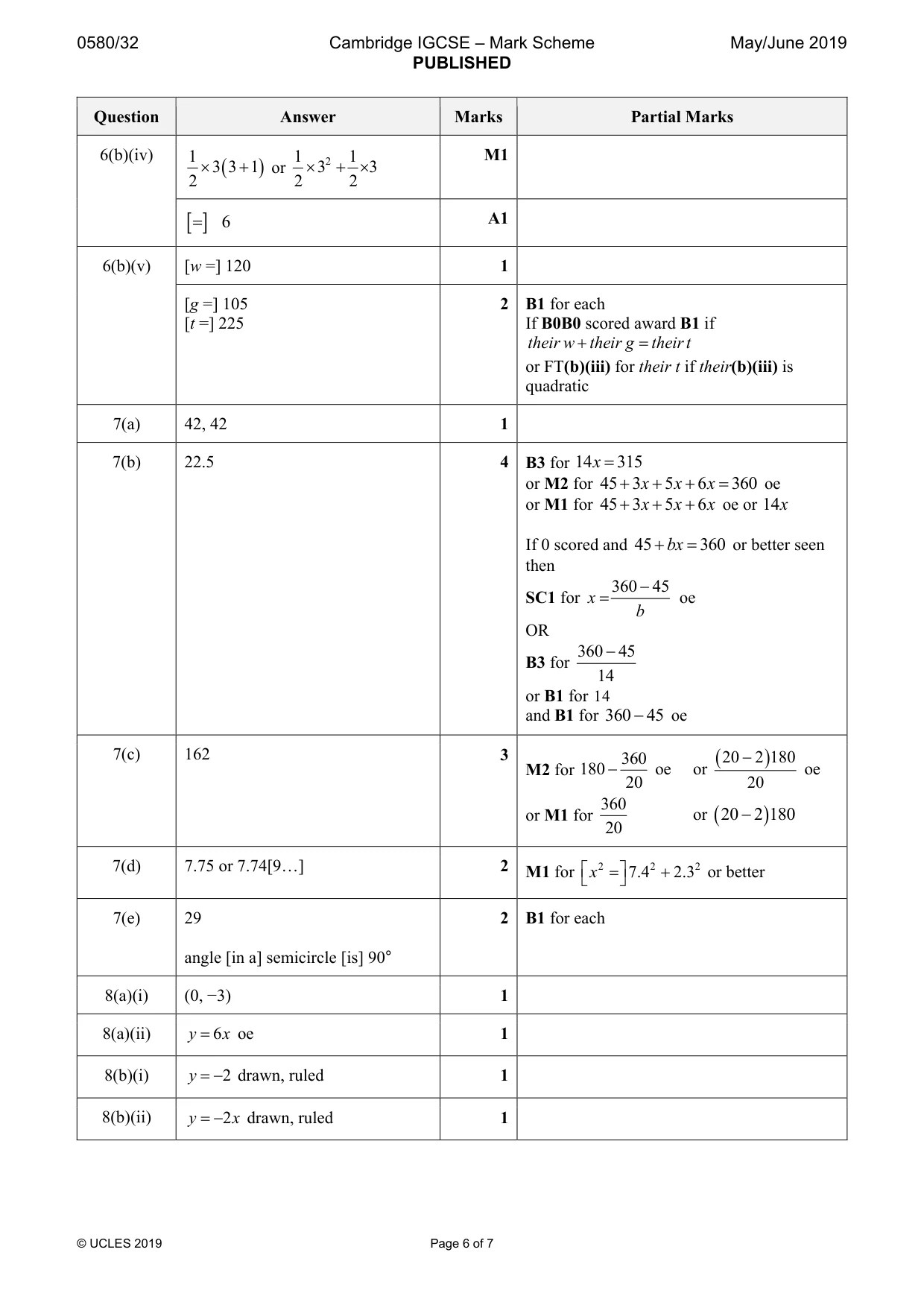
Mark scheme: 6(a)(i) Diagram 4 correctly drawn 1 6(a)(ii) 28 1 6(a)(iii) 8n − 4 oe final answer 2 M1 for kn − 4 ( k ≠ 0) or 8n ± c 6(a)(iv) 38 2 M1 for their (a)(iii) = 300 provided their (a)(iii) is linear 6(a)(v) 686 2 M1 for 7 × 7 × 14 or 0.07 × 0.07 × 0.14 or 70 × 70 × 140 oe cm3 1 Units must be consistent with working or numerical answer 6(b)(i) 3 1 6(b)(ii) – – – 10 2 B1 for 3 or 4 correct – 1 – 6 – – 9 16 6(b)(iii) [ t = ] n 2 oe 1 6(b)(iv) 1 1 2 1 M1 × 3 ( 3 + 1) or × 3 + × 3 2 2 2 [ = ] 6 A1 6(b)(v) [w =] 120 1 [g =] 105 2 B1 for each [t =] 225 If B0B0 scored award B1 if their w + their g = theirt or FT(b)(iii) for their t if their(b)(iii) is quadratic
Q7 · A triangle is isosceles
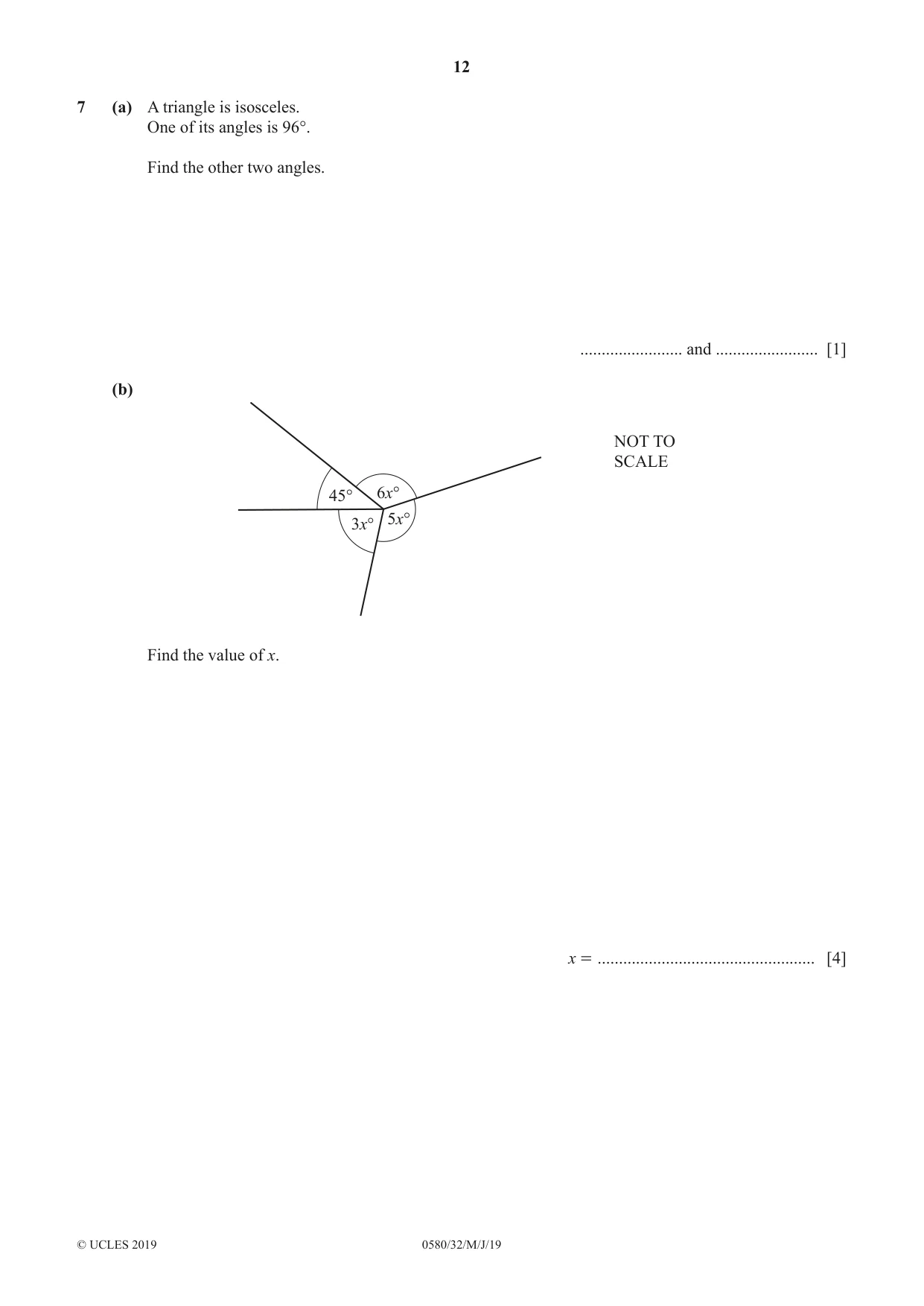
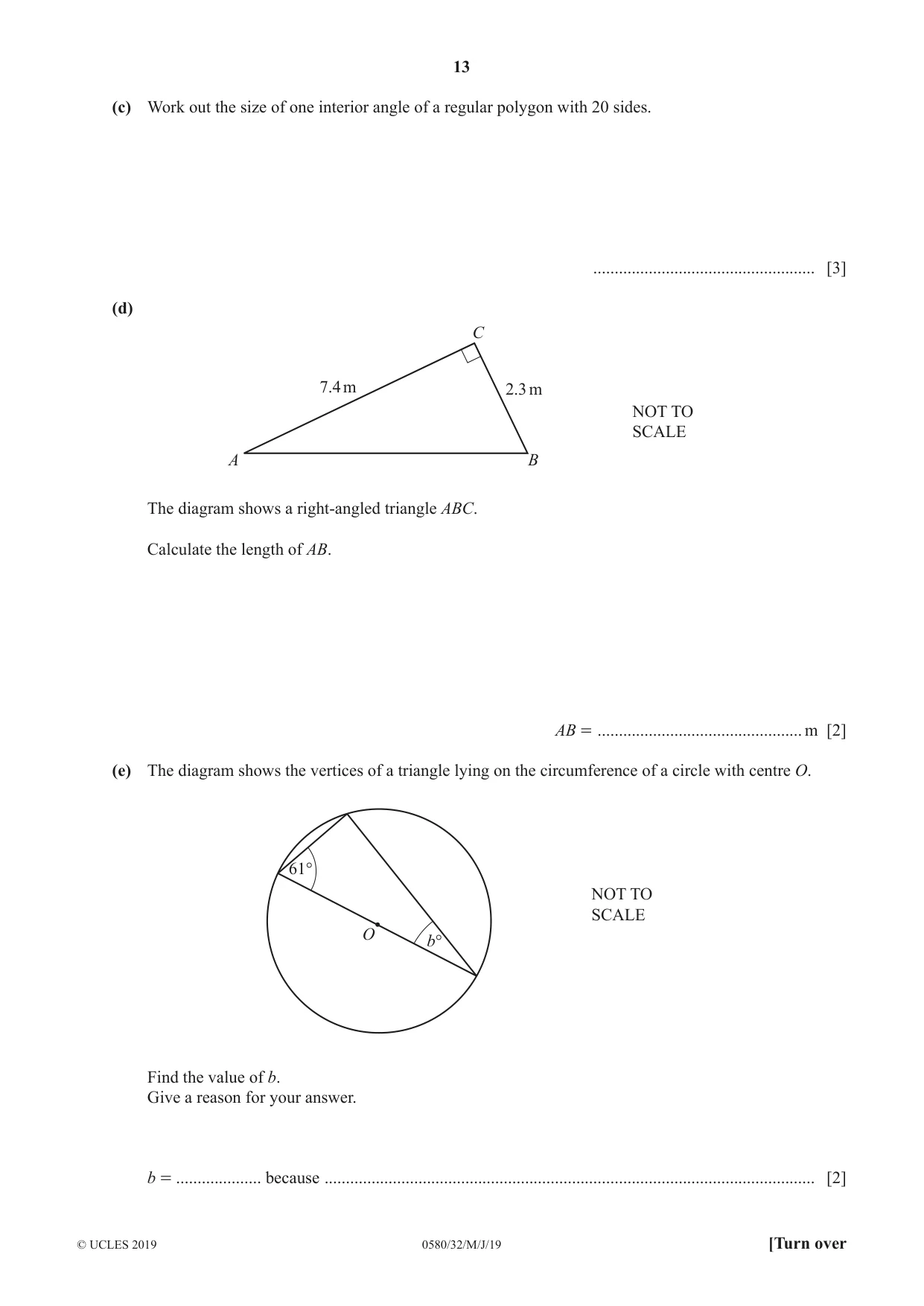
7 (a) A triangle is isosceles. One of its angles is 96°. Find the other two angles. ........................ and ........................ [1] (b) NOT TO SCALE 45° 6x° 5x° 3x° Find the value of x. x = ................................................... [4] (c) Work out the size of one interior angle of a regular polygon with 20 sides. .................................................... [3] (d) C 7.4 m 2.3 m NOT TO SCALE A B The diagram shows a right-angled triangle ABC. Calculate the length of AB. AB = ................................................ m [2] (e) The diagram shows the vertices of a triangle lying on the circumference of a circle with centre O. 61° NOT TO SCALE O b° Find the value of b. Give a reason for your answer. b = .................... because ................................................................................................................... [2]
Mark scheme: 7(a) 42, 42 1 7(b) 22.5 4 B3 for 14 x = 315 or M2 for 45 + 3 x + 5 x + 6 x = 360 oe or M1 for 45 + 3 x + 5 x + 6 x oe or 14x If 0 scored and 45 + bx = 360 or better seen then 360 − 45 SC1 for x = oe b OR 360 − 45 B3 for 14 or B1 for 14 and B1 for 360 − 45 oe 7(c) 162 3 360 ( 20 − 2 )180 M2 for 180 − oe or oe 20 20 360 or M1 for or ( 20 − 2 ) 180 20 7(d) 7.75 or 7.74[9…] 2 M1 for x 2 = 7.4 2 + 2.3 2 or better 7(e) 29 2 B1 for each angle [in a] semicircle [is] 90°
Q8 · Write down the co-ordinates of the point where the line y = 6x - 3 crosses the y-axis
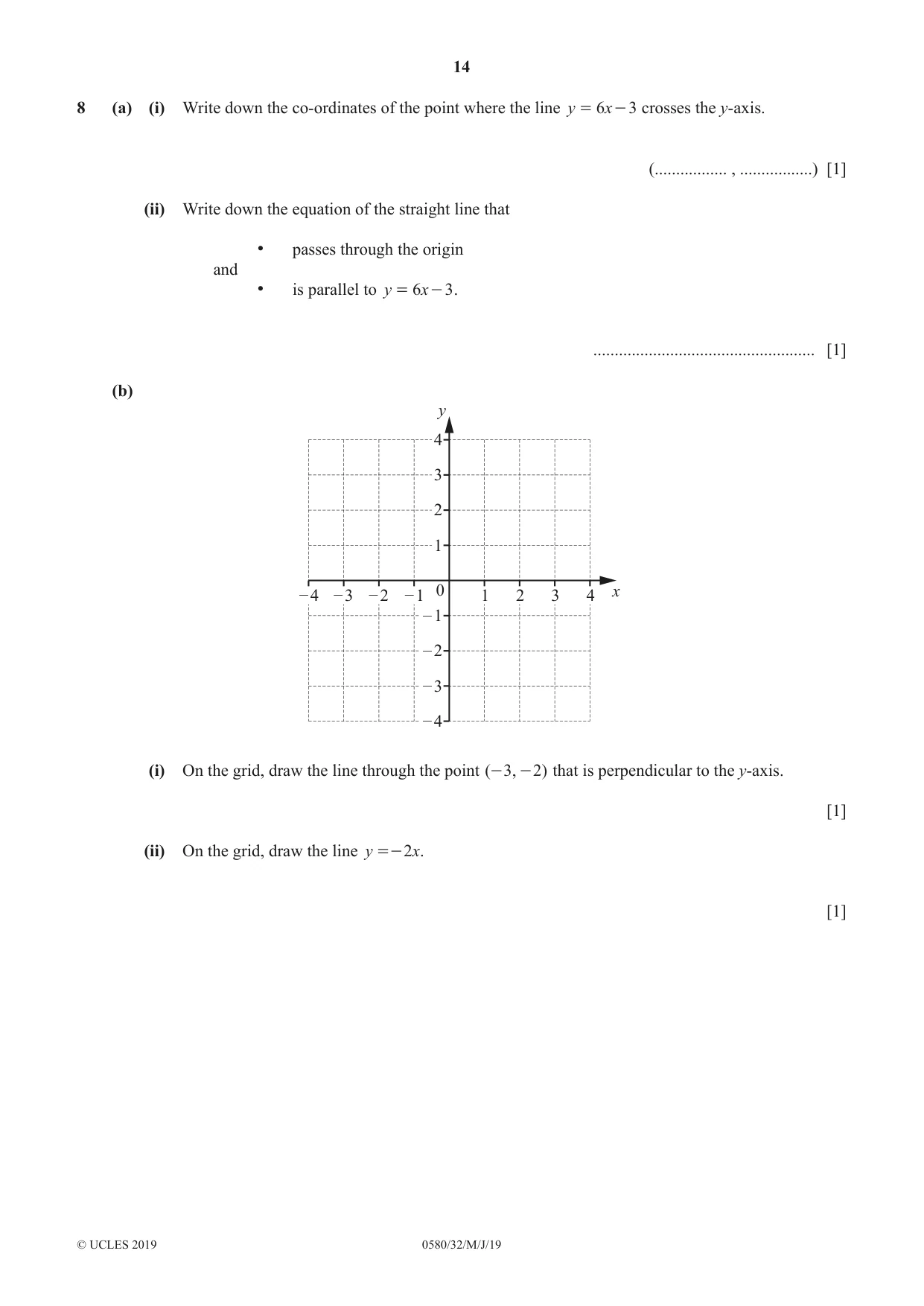
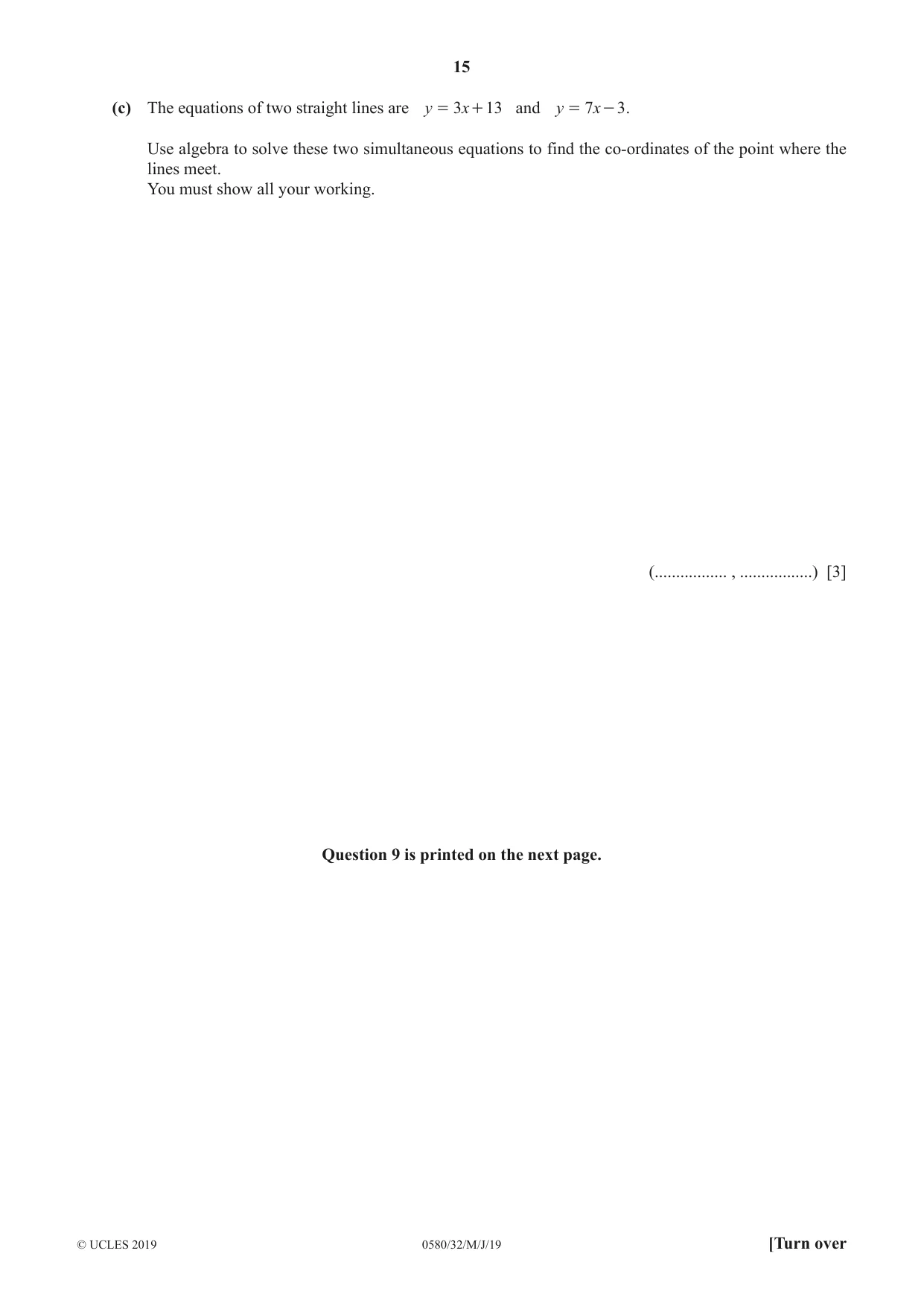
8 (a) (i) Write down the co-ordinates of the point where the line y = 6x - 3 crosses the y-axis. (................. , .................) [1] (ii) Write down the equation of the straight line that • passes through the origin and • is parallel to y = 6x - 3 . .................................................... [1] (b) y 4 3 2 1 – 4 – 3 – 2 – 1 0 1 2 3 4 x – 1 – 2 – 3 – 4 (i) On the grid, draw the line through the point (- 3, - 2) that is perpendicular to the y-axis. [1] (ii) On the grid, draw the line y =- 2x . [1] (c) The equations of two straight lines are y = 3x + 13 and y = 7x - 3 . Use algebra to solve these two simultaneous equations to find the co-ordinates of the point where the lines meet. You must show all your working. (................. , .................) [3] Question 9 is printed on the next page.
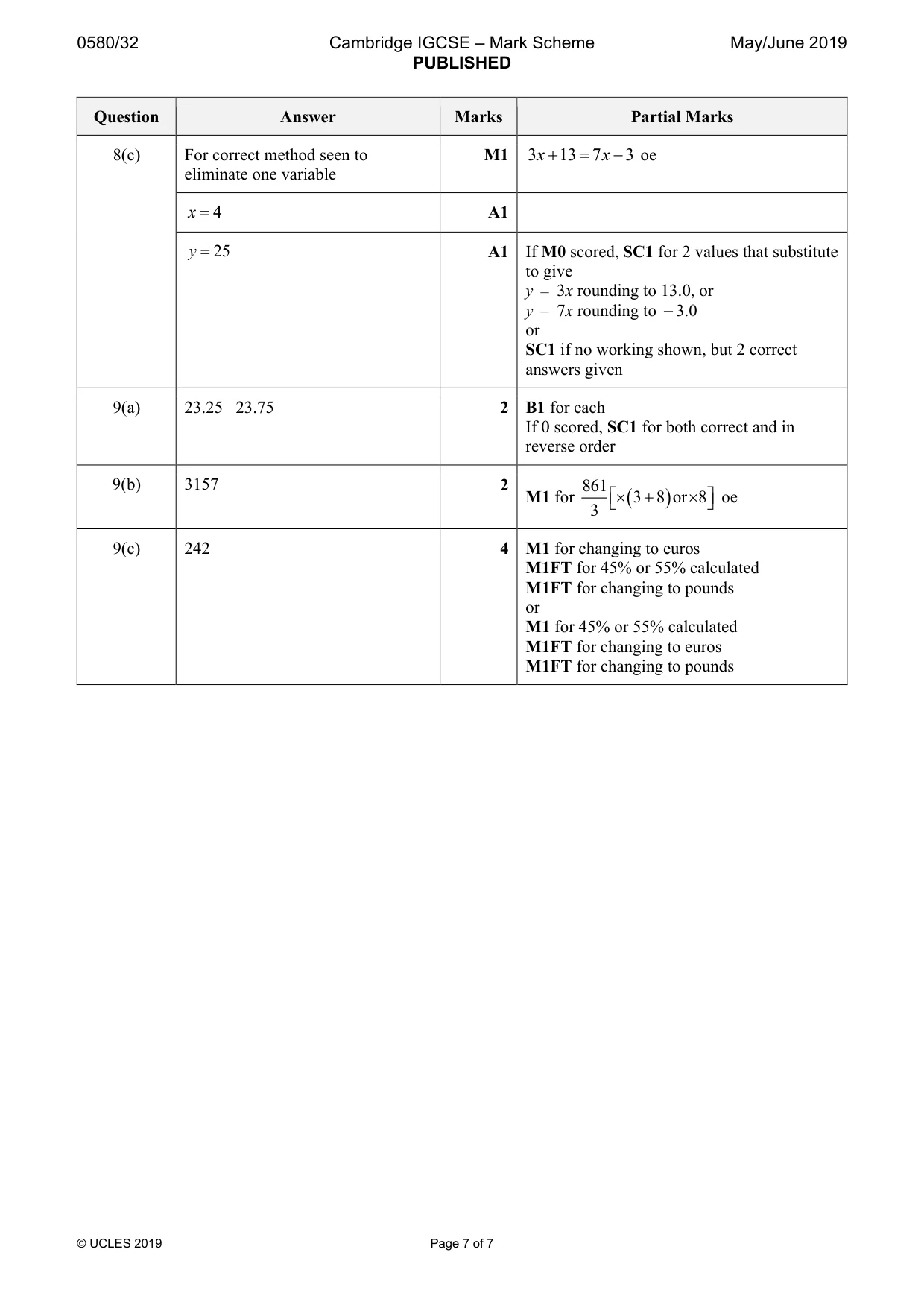
Mark scheme: 8(a)(i) (0, −3) 1 8(a)(ii) y = 6 x oe 1 8(b)(i) y = −2 drawn, ruled 1 8(b)(ii) y = −2 x drawn, ruled 1 8(c) For correct method seen to M1 3 x + 13 = 7 x − 3 oe eliminate one variable x = 4 A1 y = 25 A1 If M0 scored, SC1 for 2 values that substitute to give y – 3x rounding to 13.0, or y – 7x rounding to −3.0 or SC1 if no working shown, but 2 correct answers given
Q9 · Zach goes on holiday
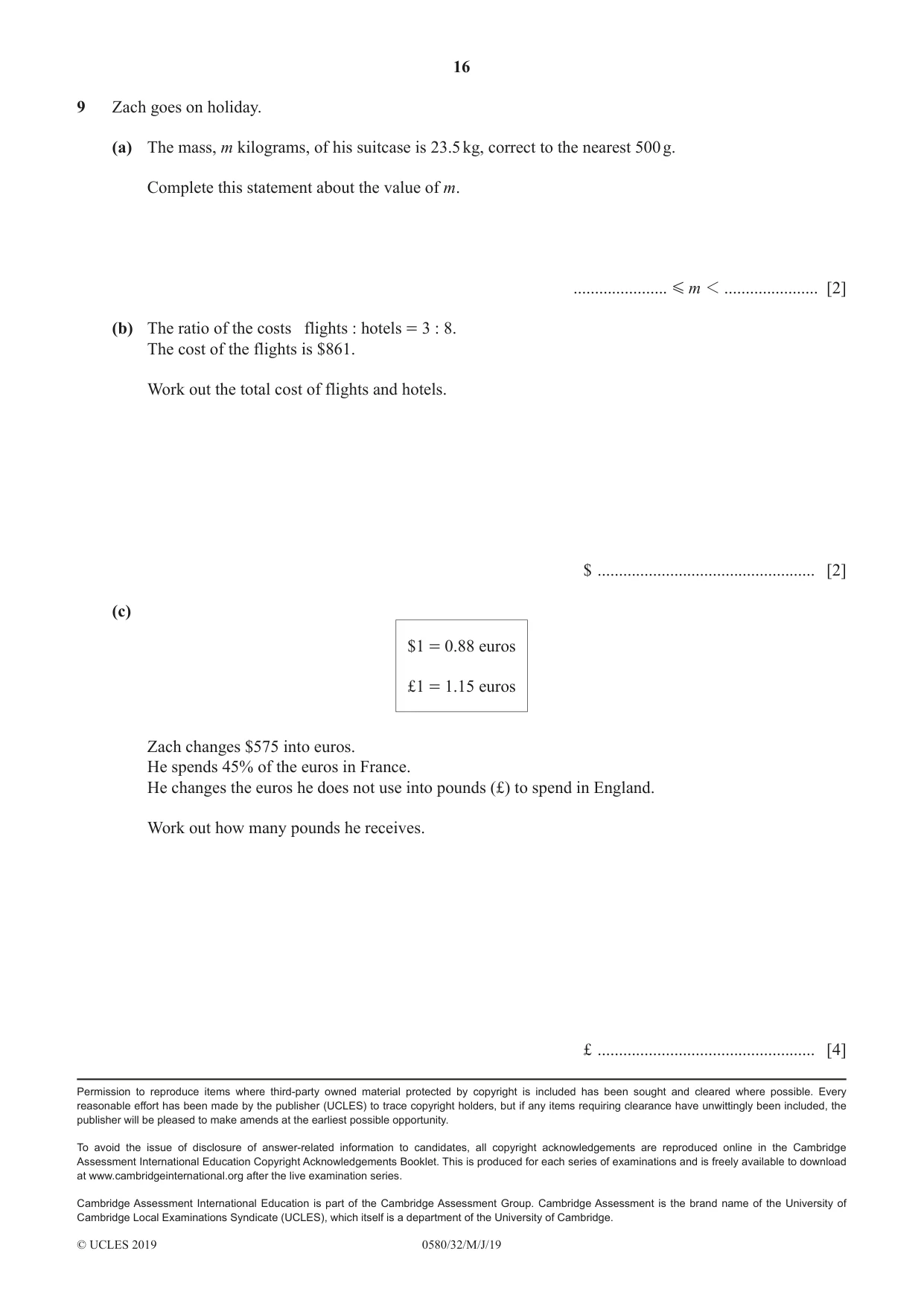
9 Zach goes on holiday. (a) The mass, m kilograms, of his suitcase is 23.5 kg, correct to the nearest 500 g. Complete this statement about the value of m. ...................... G m 1 ...................... [2] (b) The ratio of the costs flights : hotels = 3 : 8. The cost of the flights is $861. Work out the total cost of flights and hotels. $ ................................................... [2] (c) $1 = 0.88 euros £1 = 1.15 euros Zach changes $575 into euros. He spends 45% of the euros in France. He changes the euros he does not use into pounds (£) to spend in England. Work out how many pounds he receives. £ ................................................... [4]
Mark scheme: 9(a) 23.25 23.75 2 B1 for each If 0 scored, SC1 for both correct and in reverse order 9(b) 3157 2 861 M1 for × oe ( 3 + 8 ) or × 8 3 9(c) 242 4 M1 for changing to euros M1FT for 45% or 55% calculated M1FT for changing to pounds or M1 for 45% or 55% calculated M1FT for changing to euros M1FT for changing to pounds
What was in this paper
The subtopics covered by these 9 questions, and how many questions each got. Open one in a new tab to see every Cambridge question on it.
What you needed in this session
Cambridge’s own grade thresholds for 2019 May/June, Paper 3 · Variant 2. A higher threshold means an easier paper — the bar moves with how the cohort did.