Cambridge IGCSE Mathematics 0580 — 2019 May/June Paper 3 · Variant 3
0580/33/M/J/19 · 9 questions · 104 marks · ≈117 min
The question paper and its mark scheme, free to read here and free to download. This is Cambridge’s own paper, exactly as it was sat.
Question paper16 pages
Mark scheme6 pages
Answers below. Sit the paper first if you are practising.
Questions as text
Q1 · Write this number in figures
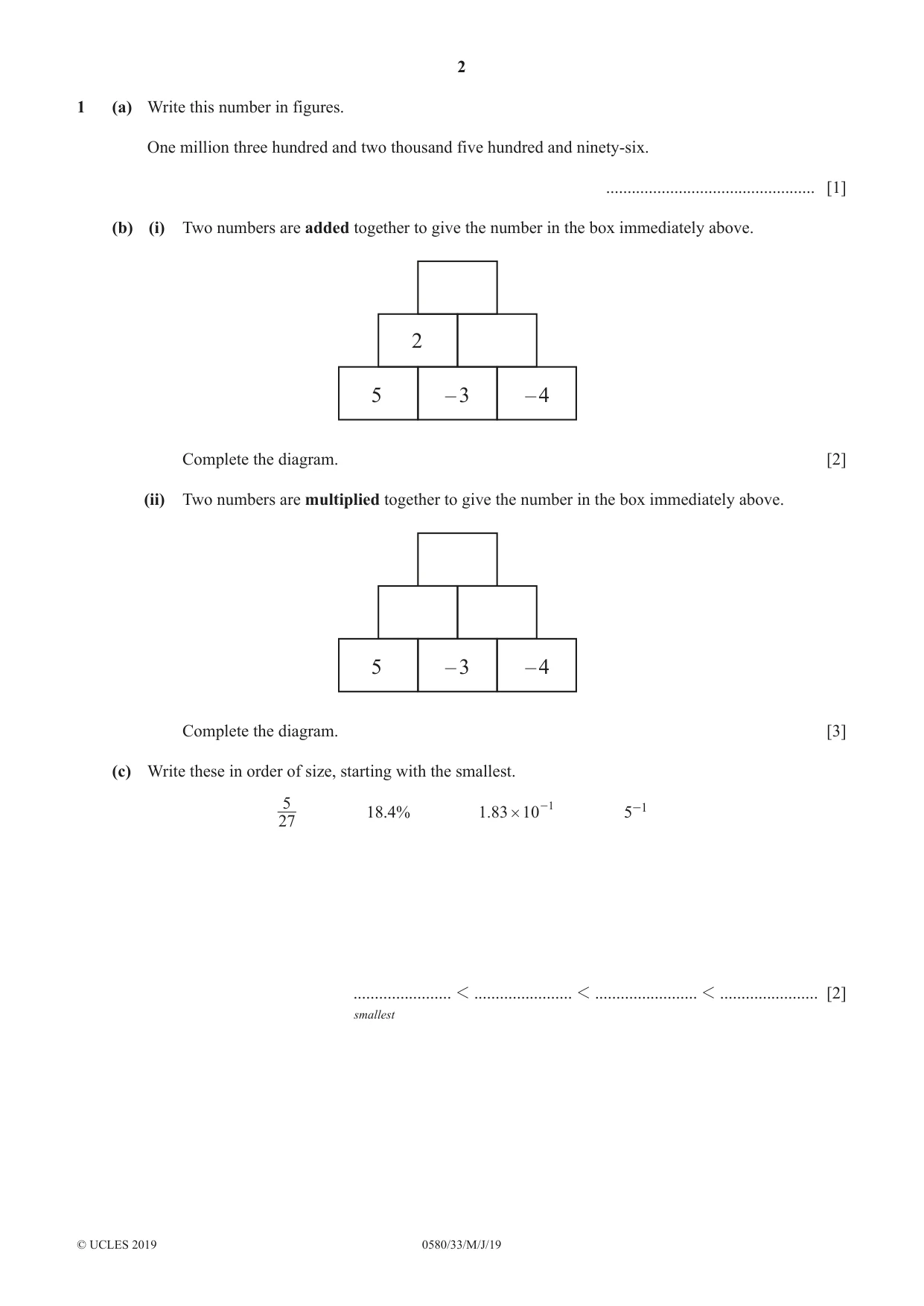
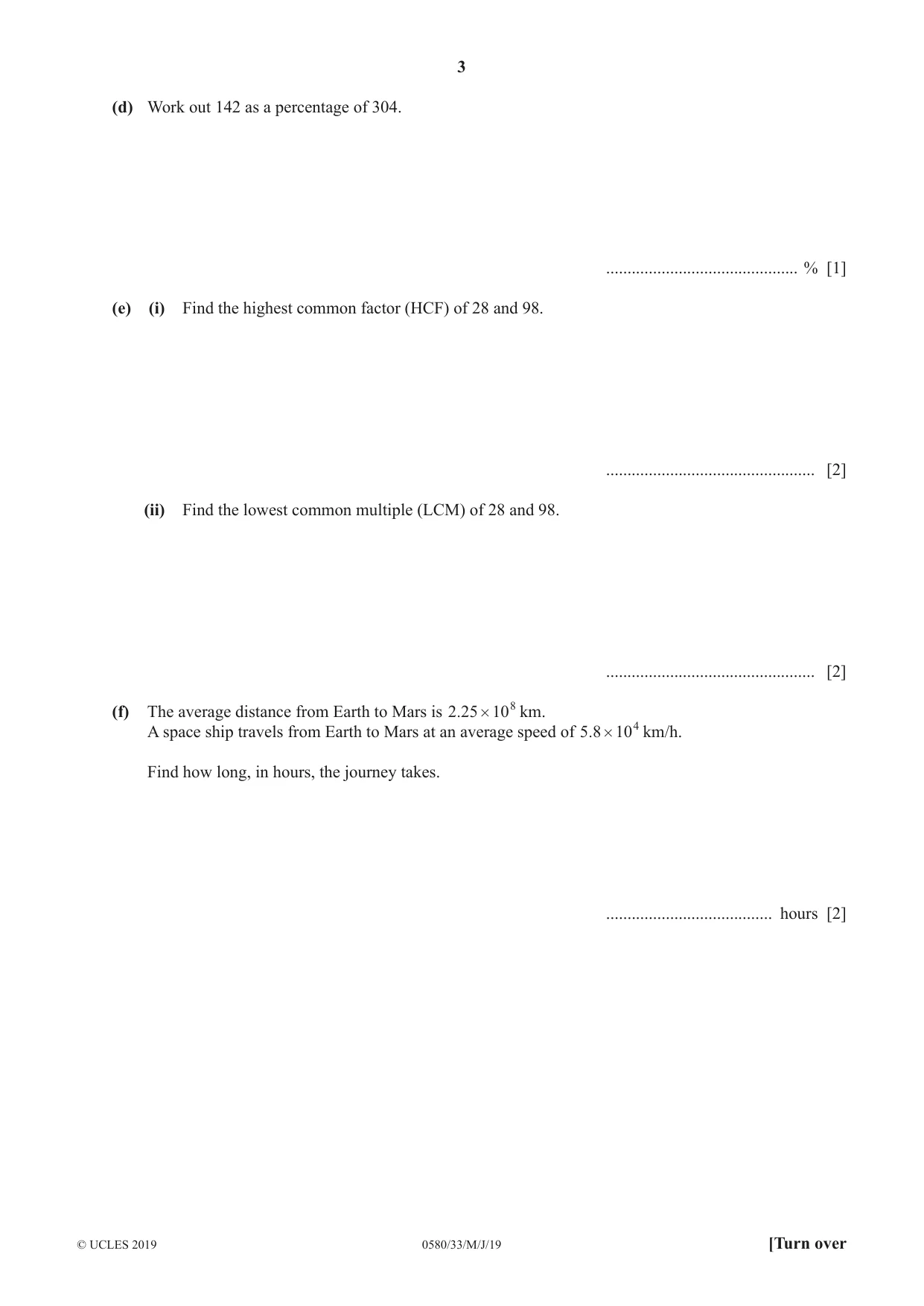
1 (a) Write this number in figures. One million three hundred and two thousand five hundred and ninety-six. ................................................. [1] (b) (i) Two numbers are added together to give the number in the box immediately above. 2 5 – 3 – 4 Complete the diagram. [2] (ii) Two numbers are multiplied together to give the number in the box immediately above. 5 – 3 – 4 Complete the diagram. [3] (c) Write these in order of size, starting with the smallest. 5 -1 18.4% .183 # 10 5-1 27 ....................... 1 ....................... 1 ........................ 1 ....................... [2] smallest (d) Work out 142 as a percentage of 304. ............................................. % [1] (e) (i) Find the highest common factor (HCF) of 28 and 98. ................................................. [2] (ii) Find the lowest common multiple (LCM) of 28 and 98. ................................................. [2] (f) The average distance from Earth to Mars is .225 # 108 km. A space ship travels from Earth to Mars at an average speed of .58 # 104 km/h. Find how long, in hours, the journey takes. ....................................... hours [2]
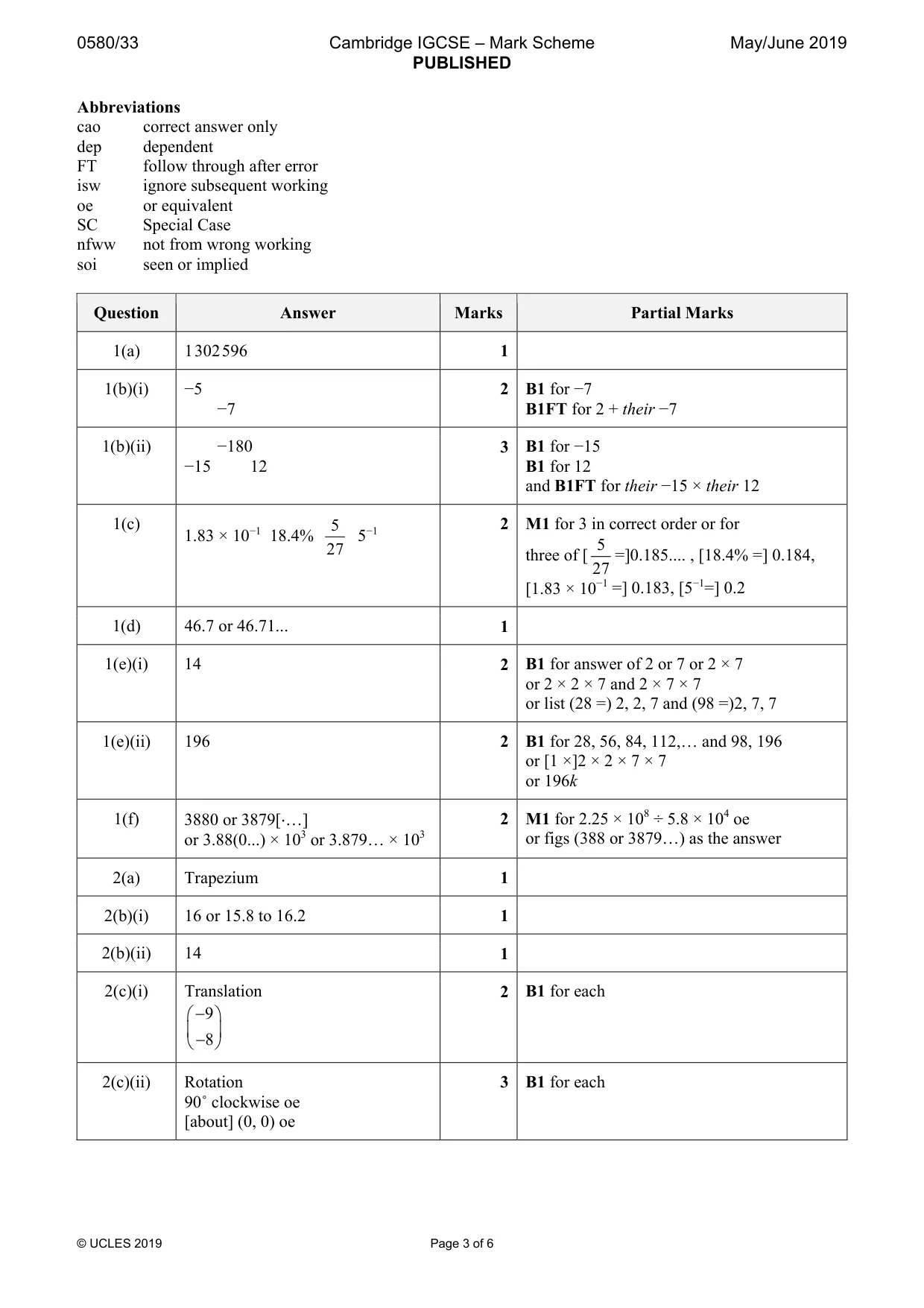
Mark scheme: Question Answer Marks Partial Marks 1(a) 1 302 596 1 1(b)(i) −5 2 B1 for −7 −7 B1FT for 2 + their −7 1(b)(ii) −180 3 B1 for −15 −15 12 B1 for 12 and B1FT for their −15 × their 12 1(c) 5 2 M1 for 3 in correct order or for 1.83 × 10⁻¹ 18.4% 5−1 27 5 three of [ =]0.185.... , [18.4% =] 0.184, 27 [1.83 × 10−1 =] 0.183, [5−1=] 0.2 1(d) 46.7 or 46.71... 1 1(e)(i) 14 2 B1 for answer of 2 or 7 or 2 × 7 or 2 × 2 × 7 and 2 × 7 × 7 or list (28 =) 2, 2, 7 and (98 =)2, 7, 7 1(e)(ii) 196 2 B1 for 28, 56, 84, 112,… and 98, 196 or [1 ×]2 × 2 × 7 × 7 or 196k 1(f) 3880 or 3879[⋅…] 2 M1 for 2.25 × 10⁸ ÷ 5.8 × 10⁴ oe or 3.88(0...) × 103 or 3.879… × 103 or figs (388 or 3879…) as the answer
Q2 · Three quadrilaterals are shown on a 1 cm2 grid
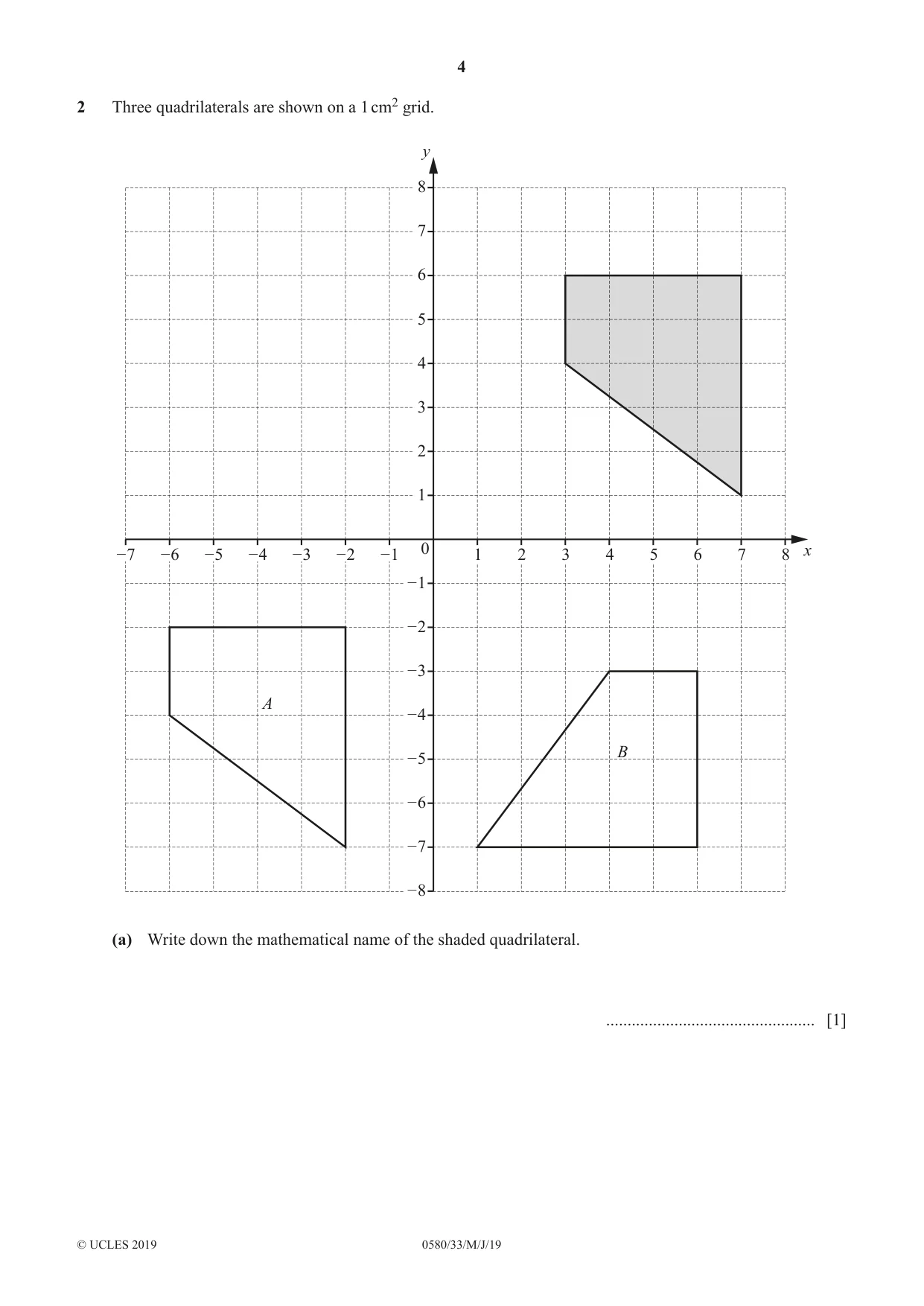
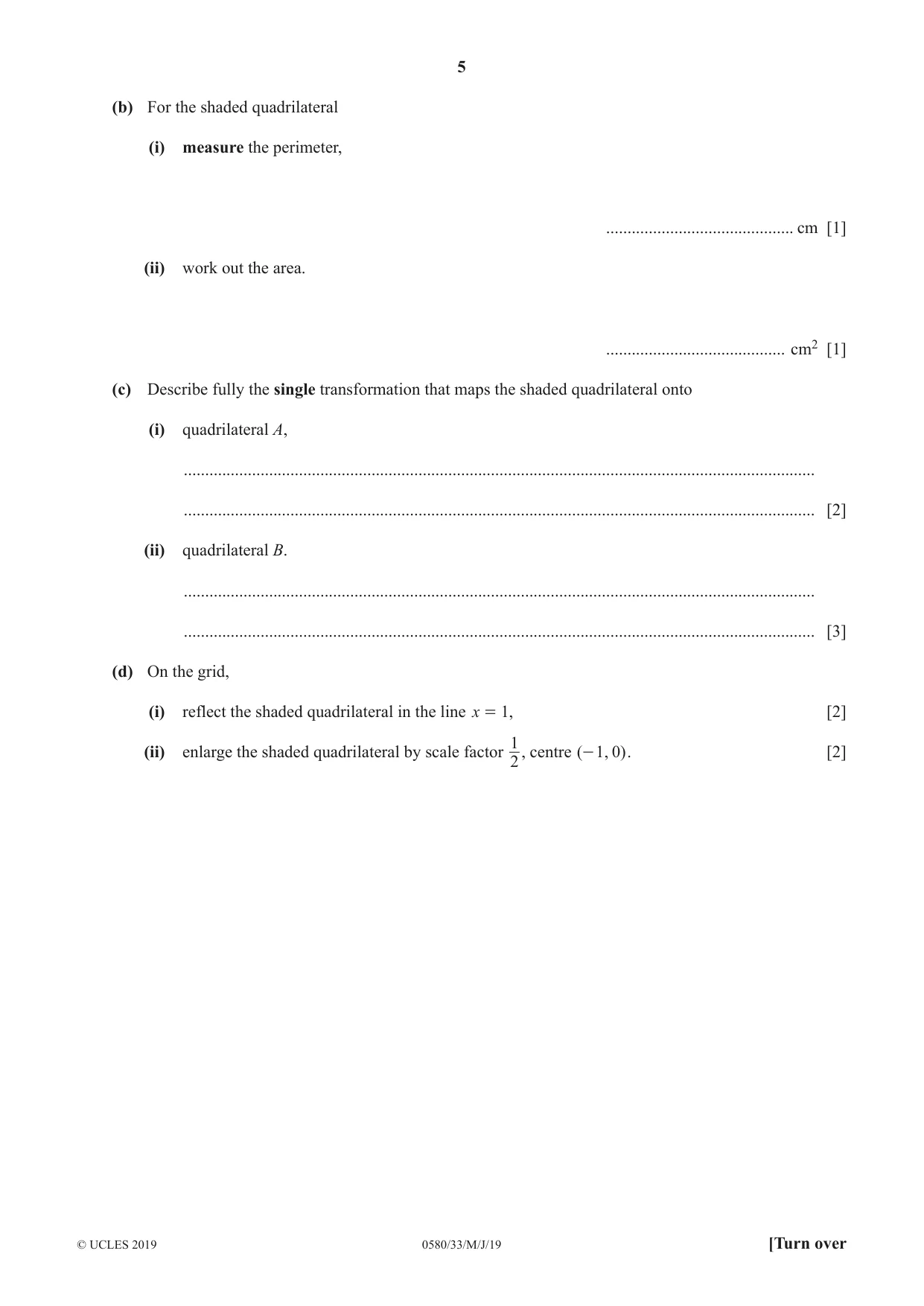
2 Three quadrilaterals are shown on a 1 cm2 grid. y 8 7 6 5 4 3 2 1 – 7 – 6 – 5 – 4 – 3 – 2 – 1 0 1 2 3 4 5 6 7 8 x – 1 – 2 – 3 A – 4 B – 5 – 6 – 7 – 8 (a) Write down the mathematical name of the shaded quadrilateral. ................................................. [1] (b) For the shaded quadrilateral (i) measure the perimeter, ............................................ cm [1] (ii) work out the area. .......................................... cm2 [1] (c) Describe fully the single transformation that maps the shaded quadrilateral onto (i) quadrilateral A, .................................................................................................................................................... .................................................................................................................................................... [2] (ii) quadrilateral B. .................................................................................................................................................... .................................................................................................................................................... [3] (d) On the grid, (i) reflect the shaded quadrilateral in the line x = 1, [2] 1 (ii) enlarge the shaded quadrilateral by scale factor , centre (- 1, 0) . [2] 2
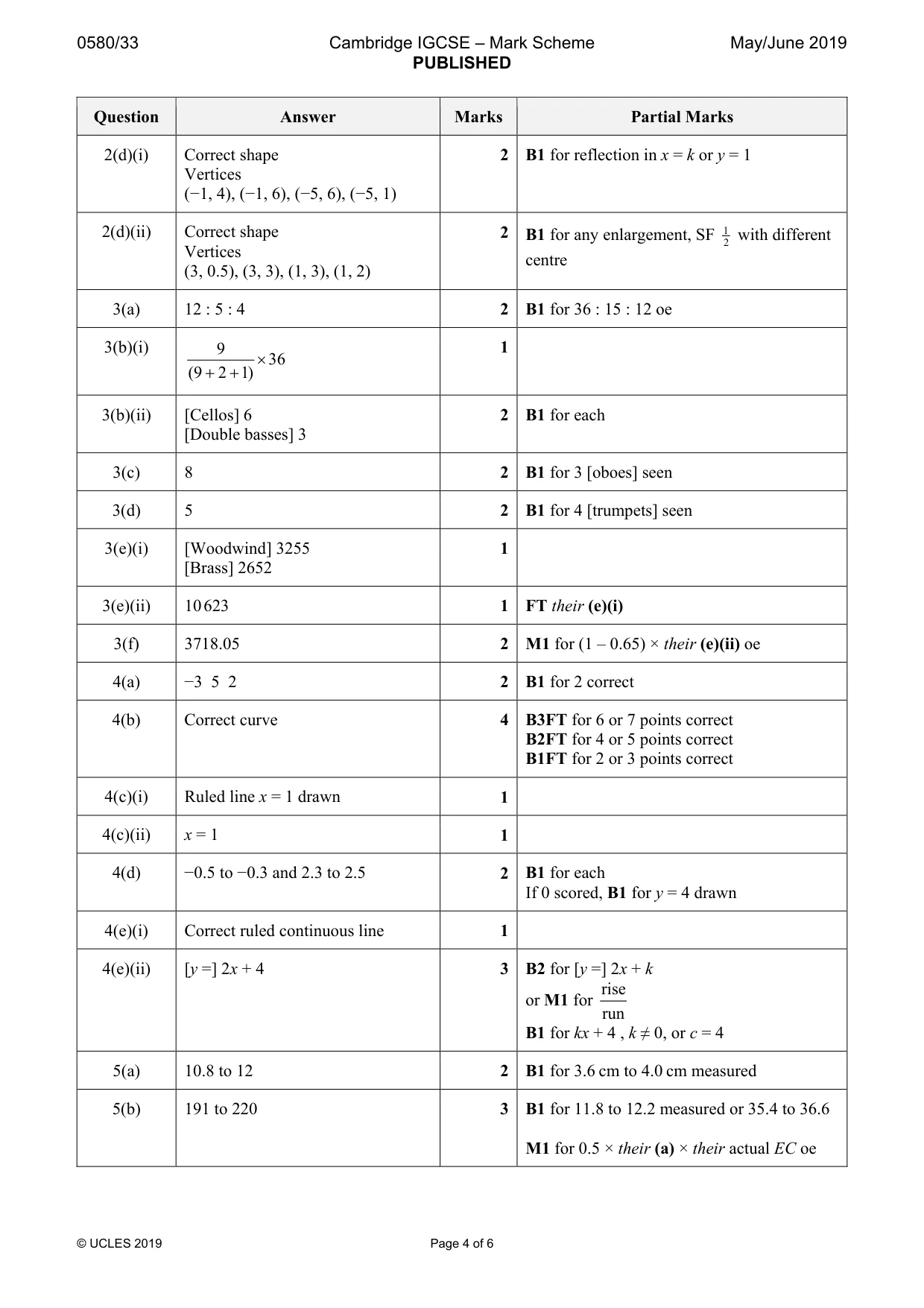
Mark scheme: 2(a) Trapezium 1 2(b)(i) 16 or 15.8 to 16.2 1 2(b)(ii) 14 1 2(c)(i) Translation 2 B1 for each −9 −8 2(c)(ii) Rotation 3 B1 for each 90˚ clockwise oe [about] (0, 0) oe 2(d)(i) Correct shape 2 B1 for reflection in x = k or y = 1 Vertices (−1, 4), (−1, 6), (−5, 6), (−5, 1) 2(d)(ii) Correct shape 2 B1 for any enlargement, SF 12 with different Vertices centre (3, 0.5), (3, 3), (1, 3), (1, 2)
Q3 · The music teacher at a school forms an orchestra
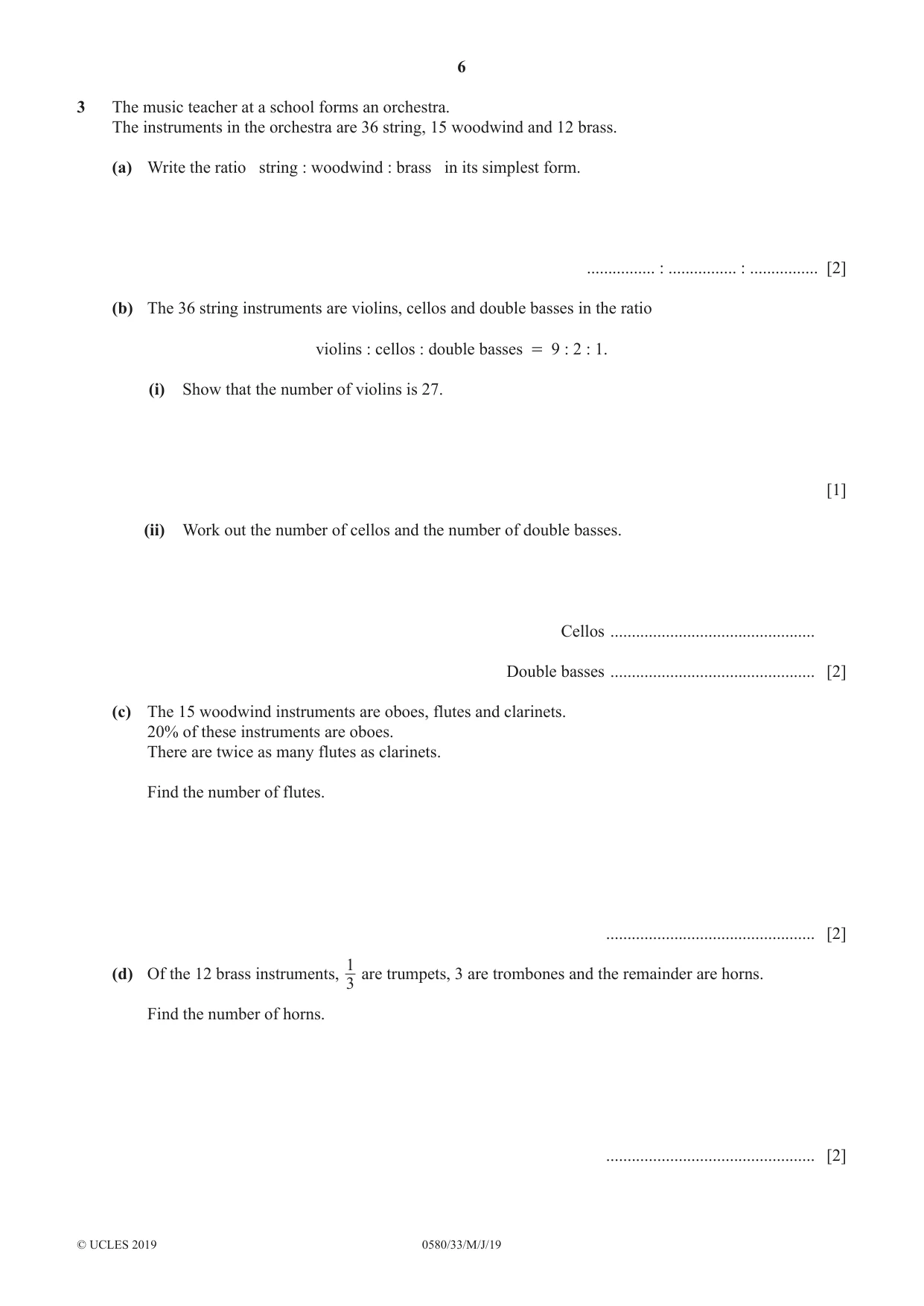
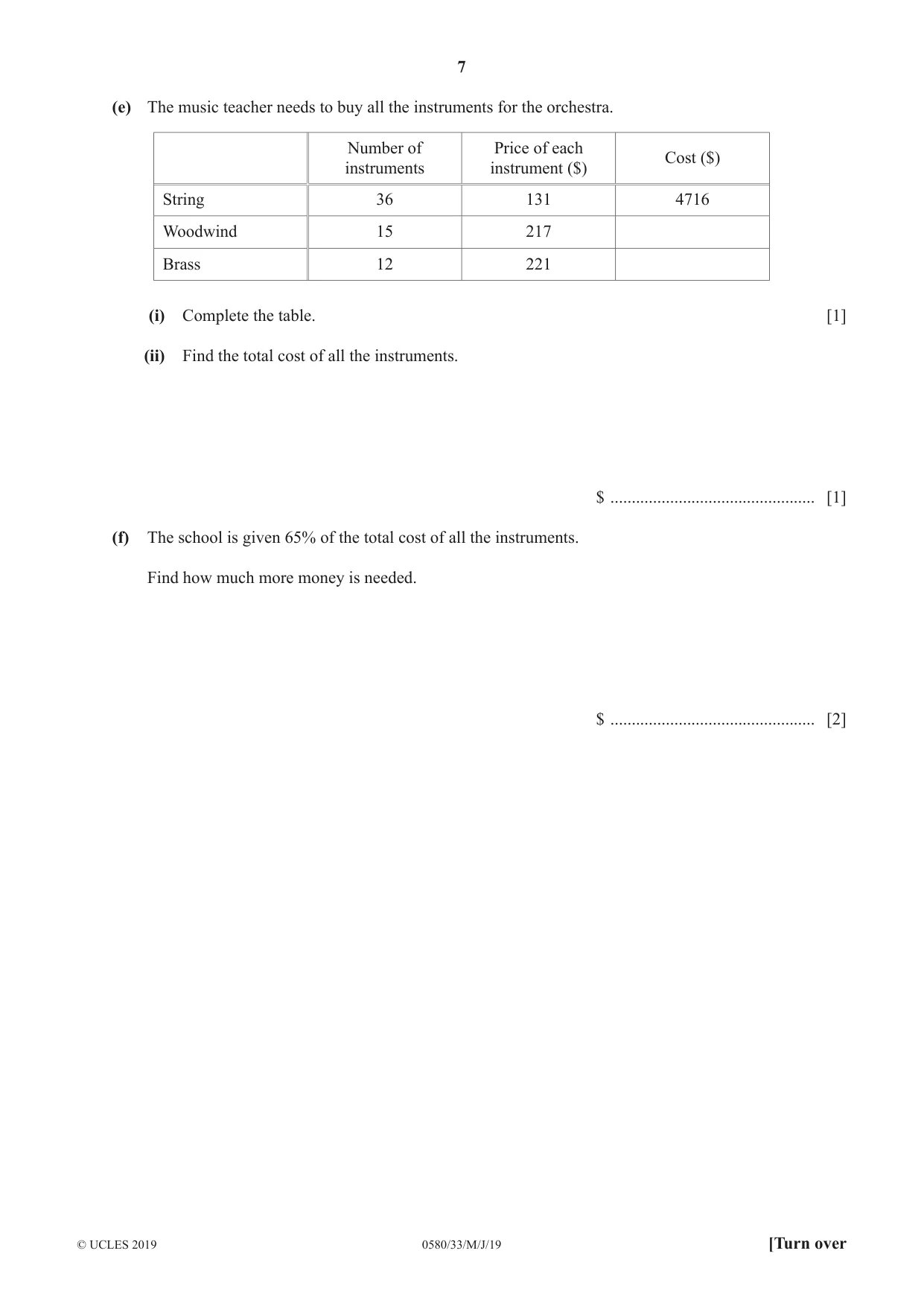
3 The music teacher at a school forms an orchestra. The instruments in the orchestra are 36 string, 15 woodwind and 12 brass. (a) Write the ratio string : woodwind : brass in its simplest form. ................ : ................ : ................ [2] (b) The 36 string instruments are violins, cellos and double basses in the ratio violins : cellos : double basses = 9 : 2 : 1. (i) Show that the number of violins is 27. [1] (ii) Work out the number of cellos and the number of double basses. Cellos ................................................ Double basses ................................................ [2] (c) The 15 woodwind instruments are oboes, flutes and clarinets. 20% of these instruments are oboes. There are twice as many flutes as clarinets. Find the number of flutes. ................................................. [2] 1 (d) Of the 12 brass instruments, are trumpets, 3 are trombones and the remainder are horns. 3 Find the number of horns. ................................................. [2] (e) The music teacher needs to buy all the instruments for the orchestra. Number of Price of each Cost ($) instruments instrument ($) String 36 131 4716 Woodwind 15 217 Brass 12 221 (i) Complete the table. [1] (ii) Find the total cost of all the instruments. $ ................................................ [1] (f) The school is given 65% of the total cost of all the instruments. Find how much more money is needed. $ ................................................ [2]
Mark scheme: 3(a) 12 : 5 : 4 2 B1 for 36 : 15 : 12 oe 3(b)(i) 9 1 × 36 (9 + 2 + 1) 3(b)(ii) [Cellos] 6 2 B1 for each [Double basses] 3 3(c) 8 2 B1 for 3 [oboes] seen 3(d) 5 2 B1 for 4 [trumpets] seen 3(e)(i) [Woodwind] 3255 1 [Brass] 2652 3(e)(ii) 10 623 1 FT their (e)(i) 3(f) 3718.05 2 M1 for (1 – 0.65) × their (e)(ii) oe
Q4 · Complete the table of values for y = 5 + 2 x - x 2
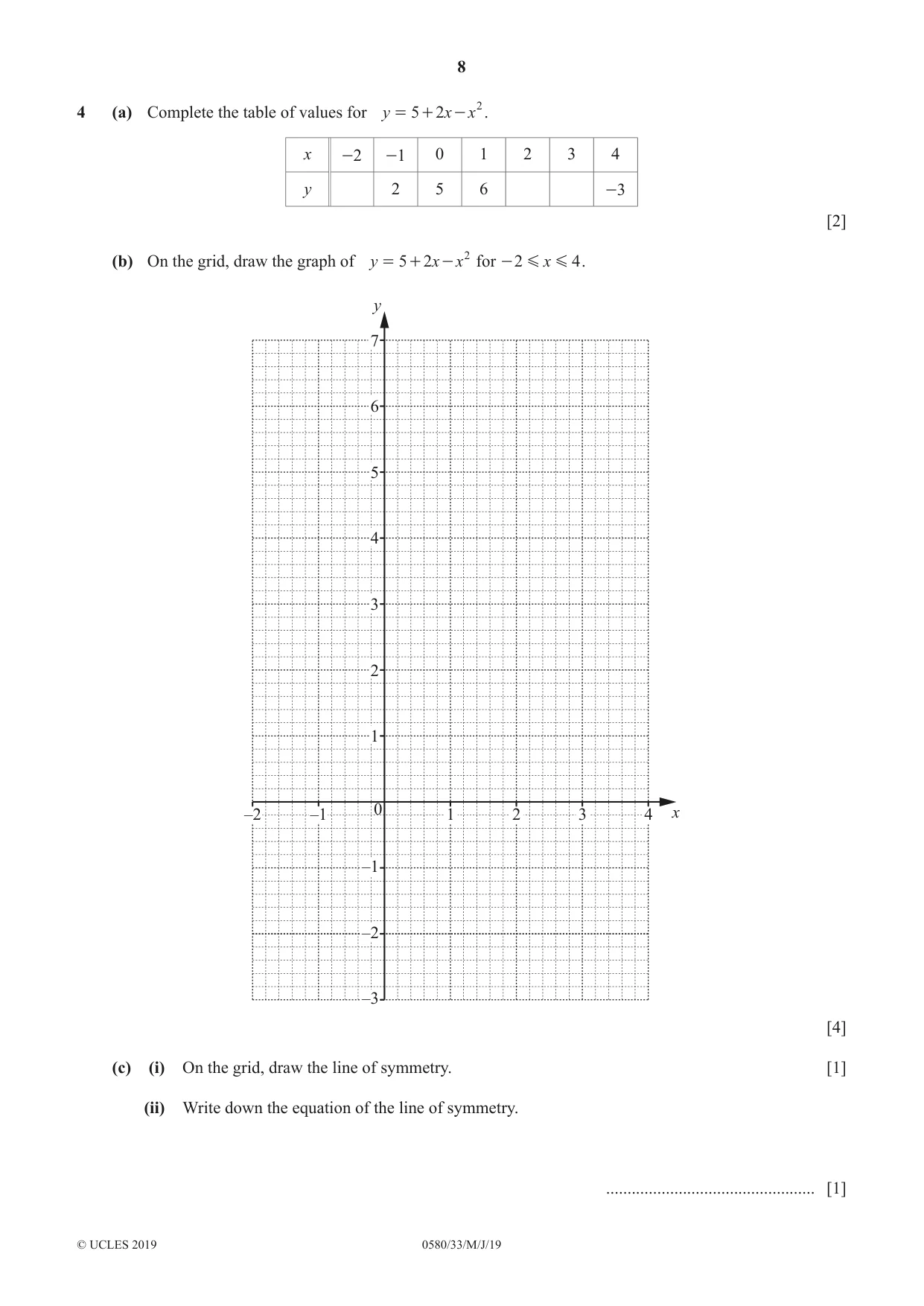
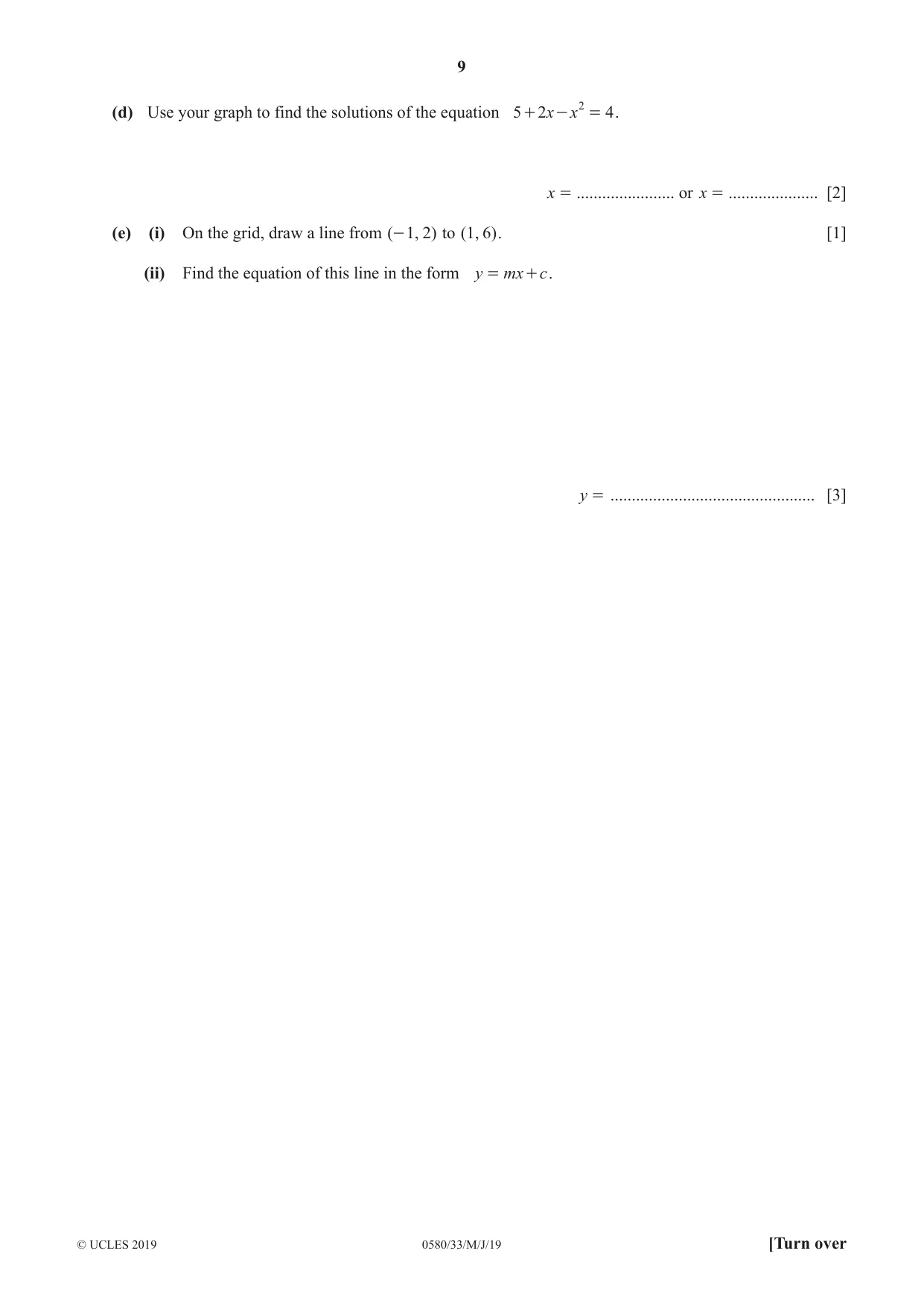
4 (a) Complete the table of values for y = 5 + 2 x - x 2 . x -2 -1 0 1 2 3 4 y 2 5 6 -3 [2] (b) On the grid, draw the graph of y = 5 + 2x - x 2 for - 2 G x G 4 . y 7 6 5 4 3 2 1 0 –2 –1 1 2 3 4 x –1 –2 –3 [4] (c) (i) On the grid, draw the line of symmetry. [1] (ii) Write down the equation of the line of symmetry. ................................................. [1] (d) Use your graph to find the solutions of the equation 5 + 2x - x 2 = 4 . x = ....................... or x = ..................... [2] (e) (i) On the grid, draw a line from (- 1, 2) to (1, 6) . [1] (ii) Find the equation of this line in the form y = mx + c . y = ................................................ [3]
Mark scheme: 4(a) −3 5 2 2 B1 for 2 correct 4(b) Correct curve 4 B3FT for 6 or 7 points correct B2FT for 4 or 5 points correct B1FT for 2 or 3 points correct 4(c)(i) Ruled line x = 1 drawn 1 4(c)(ii) x = 1 1 4(d) −0.5 to −0.3 and 2.3 to 2.5 2 B1 for each If 0 scored, B1 for y = 4 drawn 4(e)(i) Correct ruled continuous line 1 4(e)(ii) [y =] 2x + 4 3 B2 for [y =] 2x + k rise or M1 for run B1 for kx + 4 , k ≠ 0, or c = 4
Q5 · The scale drawing shows a play area, ABCDE
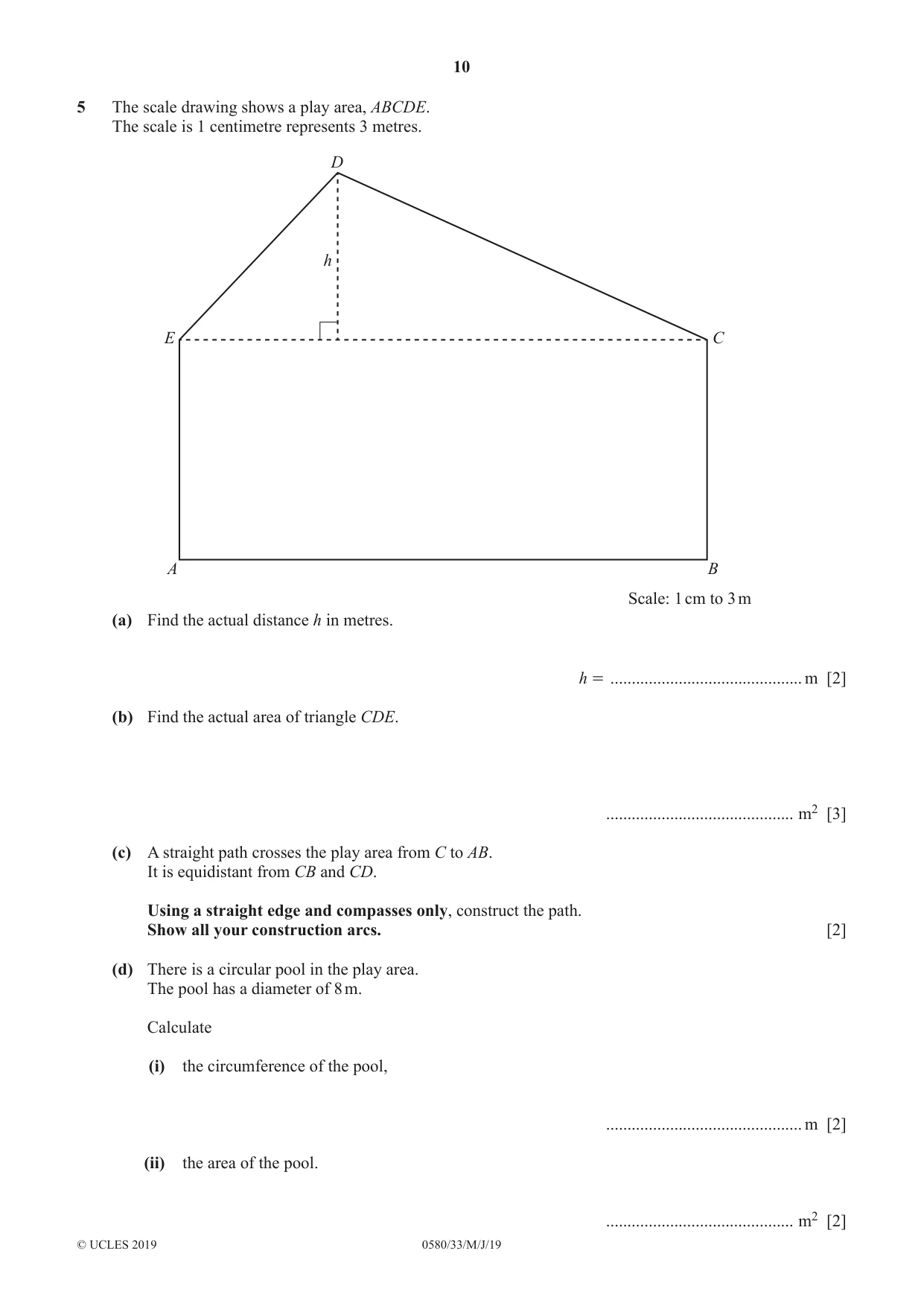
5 The scale drawing shows a play area, ABCDE. The scale is 1 centimetre represents 3 metres. D h E C A B Scale: 1 cm to 3 m (a) Find the actual distance h in metres. h = ............................................. m [2] (b) Find the actual area of triangle CDE. ............................................ m2 [3] (c) A straight path crosses the play area from C to AB. It is equidistant from CB and CD. Using a straight edge and compasses only, construct the path. Show all your construction arcs. [2] (d) There is a circular pool in the play area. The pool has a diameter of 8 m. Calculate (i) the circumference of the pool, .............................................. m [2] (ii) the area of the pool. ............................................ m2 [2]
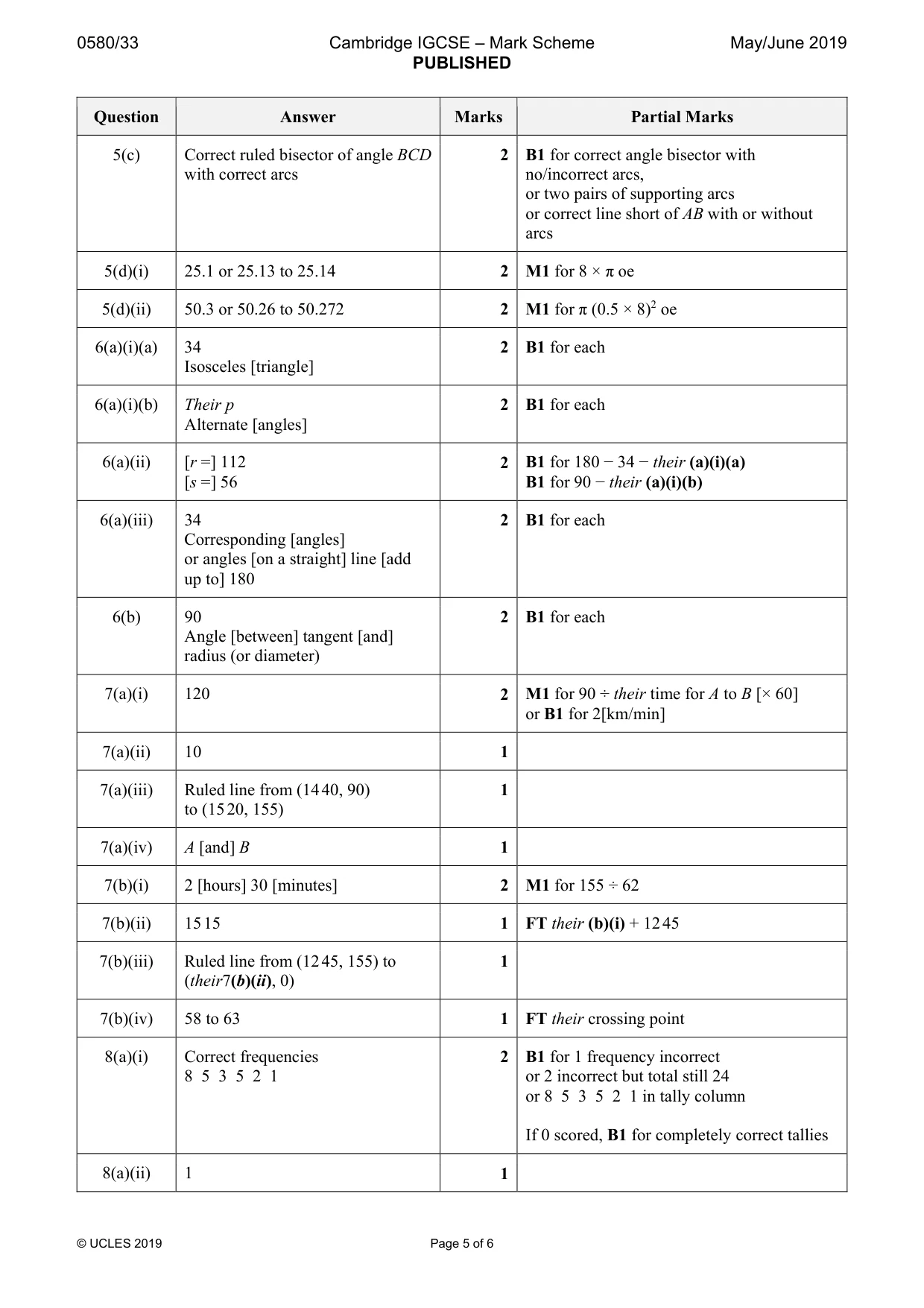
Mark scheme: 5(a) 10.8 to 12 2 B1 for 3.6 cm to 4.0 cm measured 5(b) 191 to 220 3 B1 for 11.8 to 12.2 measured or 35.4 to 36.6 M1 for 0.5 × their (a) × their actual EC oe 5(c) Correct ruled bisector of angle BCD 2 B1 for correct angle bisector with with correct arcs no/incorrect arcs, or two pairs of supporting arcs or correct line short of AB with or without arcs 5(d)(i) 25.1 or 25.13 to 25.14 2 M1 for 8 × π oe 5(d)(ii) 50.3 or 50.26 to 50.272 2 M1 for π (0.5 × 8)2 oe
Q6 · D p° s° E NOT TO SCALE q° 34° r° t° A B C In the diagram, ABC is a straight line
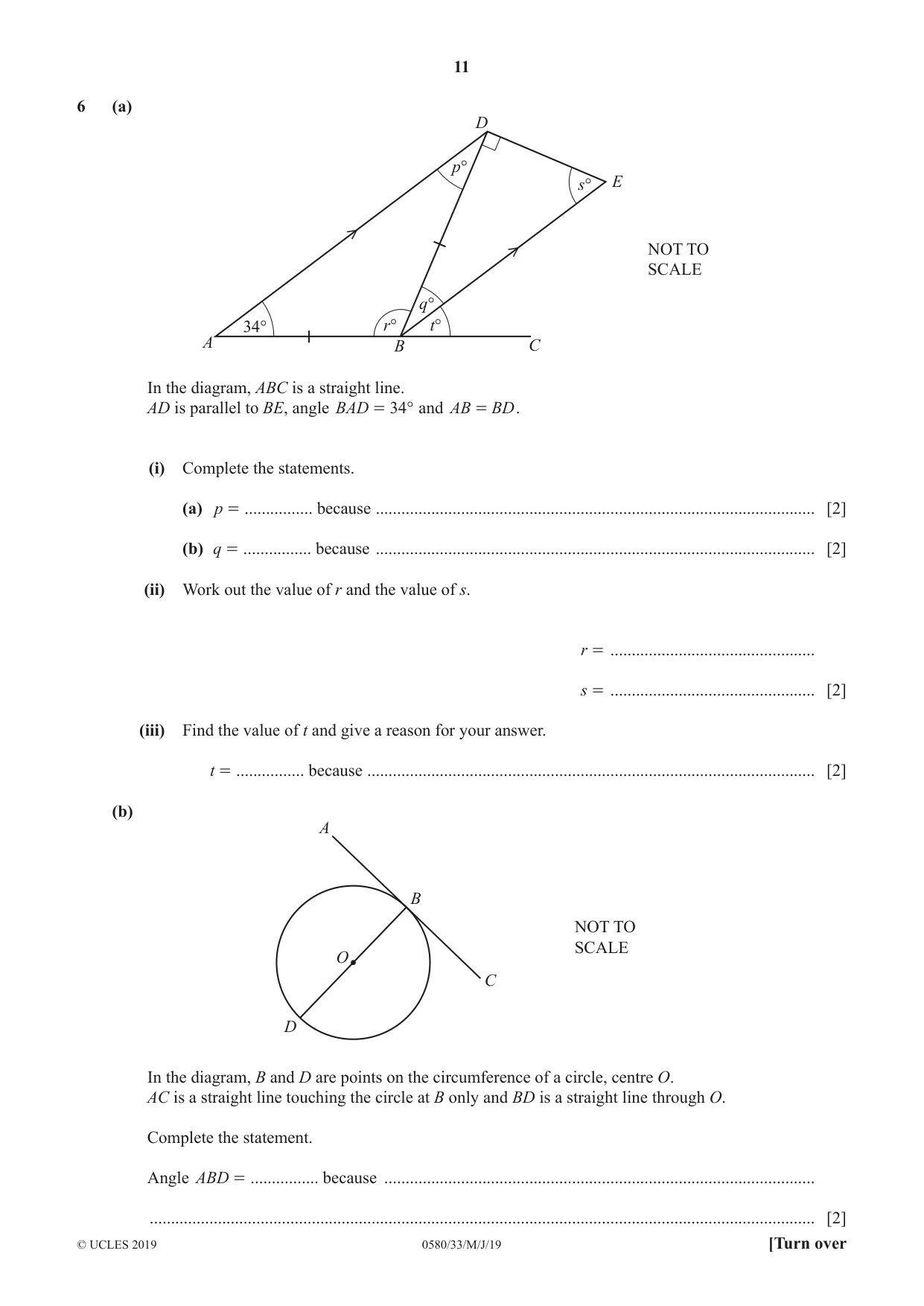
6 (a) D p° s° E NOT TO SCALE q° 34° r° t° A B C In the diagram, ABC is a straight line. AD is parallel to BE, angle BAD = 34° and AB = BD . (i) Complete the statements. (a) p = ................ because ....................................................................................................... [2] (b) q = ................ because ....................................................................................................... [2] (ii) Work out the value of r and the value of s. r = ................................................ s = ................................................ [2] (iii) Find the value of t and give a reason for your answer. t = ................ because ......................................................................................................... [2] (b) A B NOT TO SCALE O C D In the diagram, B and D are points on the circumference of a circle, centre O. AC is a straight line touching the circle at B only and BD is a straight line through O. Complete the statement. Angle ABD = ................ because ..................................................................................................... ............................................................................................................................................................ [2]
Mark scheme: 6(a)(i)(a) 34 2 B1 for each Isosceles [triangle] 6(a)(i)(b) Their p 2 B1 for each Alternate [angles] 6(a)(ii) [r =] 112 2 B1 for 180 − 34 − their (a)(i)(a) [s =] 56 B1 for 90 − their (a)(i)(b) 6(a)(iii) 34 2 B1 for each Corresponding [angles] or angles [on a straight] line [add up to] 180 6(b) 90 2 B1 for each Angle [between] tangent [and] radius (or diameter)
Q7 · The travel graph shows part of a train journey between station A and station C
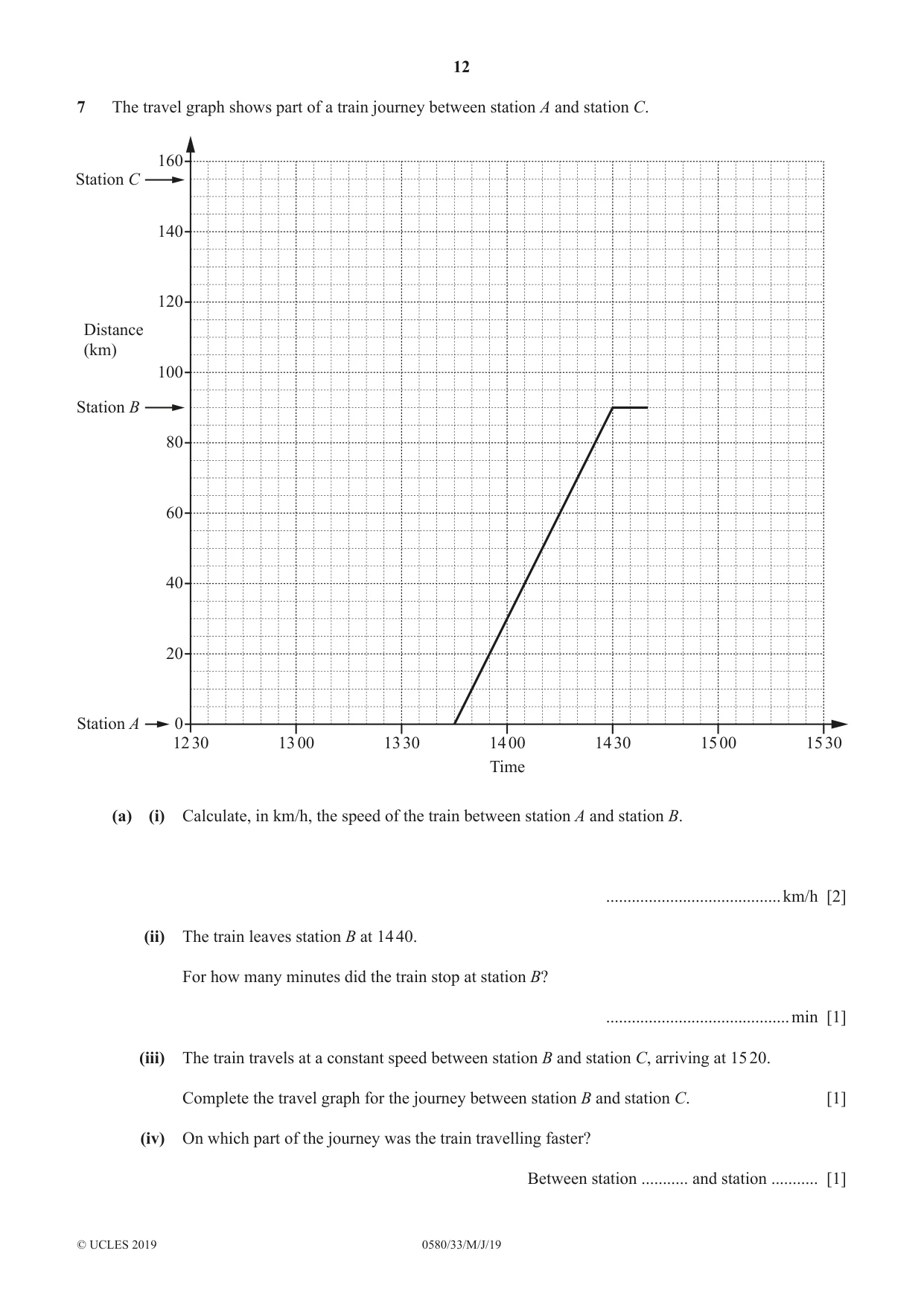
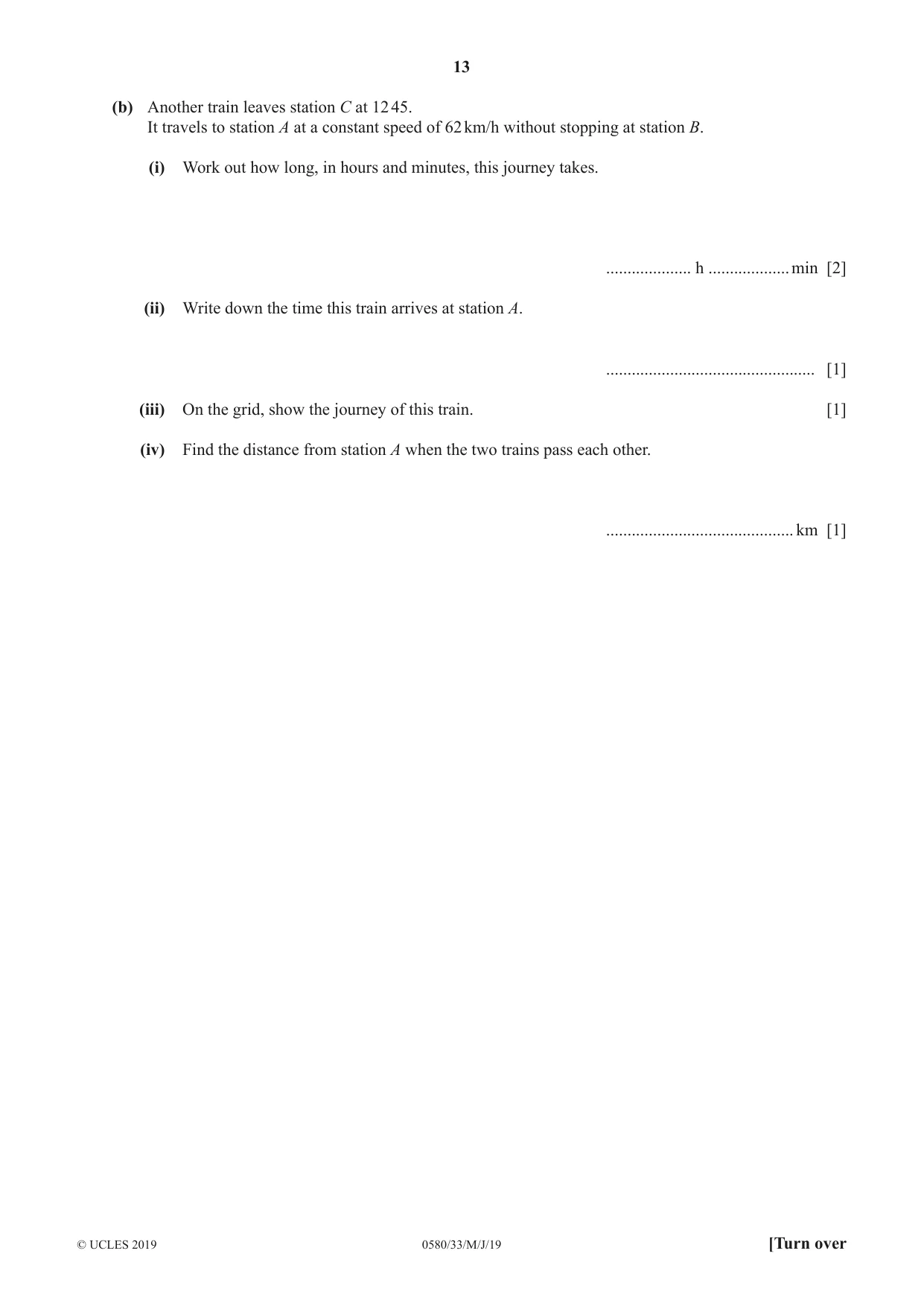
7 The travel graph shows part of a train journey between station A and station C. 160 Station C 140 120 Distance (km) 100 Station B 80 60 40 20 Station A 0 12 30 13 00 13 30 14 00 14 30 15 00 15 30 Time (a) (i) Calculate, in km/h, the speed of the train between station A and station B. ......................................... km/h [2] (ii) The train leaves station B at 14 40. For how many minutes did the train stop at station B? ........................................... min [1] (iii) The train travels at a constant speed between station B and station C, arriving at 15 20. Complete the travel graph for the journey between station B and station C. [1] (iv) On which part of the journey was the train travelling faster? Between station ........... and station ........... [1] (b) Another train leaves station C at 12 45. It travels to station A at a constant speed of 62 km/h without stopping at station B. (i) Work out how long, in hours and minutes, this journey takes. .................... h ................... min [2] (ii) Write down the time this train arrives at station A. ................................................. [1] (iii) On the grid, show the journey of this train. [1] (iv) Find the distance from station A when the two trains pass each other. ............................................ km [1]
Mark scheme: 7(a)(i) 120 2 M1 for 90 ÷ their time for A to B [× 60] or B1 for 2[km/min] 7(a)(ii) 10 1 7(a)(iii) Ruled line from (14 40, 90) 1 to (15 20, 155) 7(a)(iv) A [and] B 1 7(b)(i) 2 [hours] 30 [minutes] 2 M1 for 155 ÷ 62 7(b)(ii) 15 15 1 FT their (b)(i) + 12 45 7(b)(iii) Ruled line from (12 45, 155) to 1 (their7(b)(ii), 0) 7(b)(iv) 58 to 63 1 FT their crossing point
Q8 · Kyung records the number of people in each of 24 cars on Wednesday
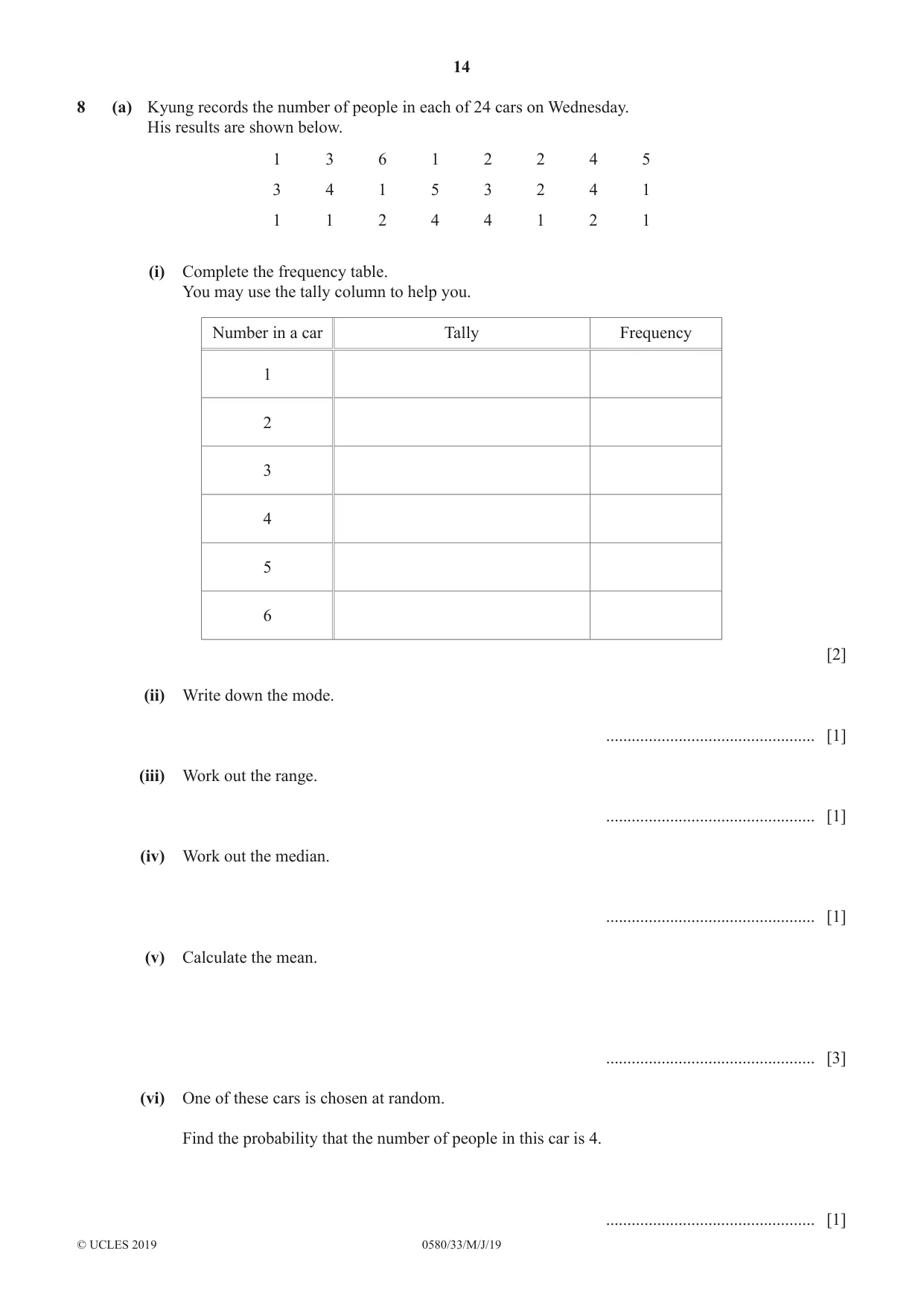
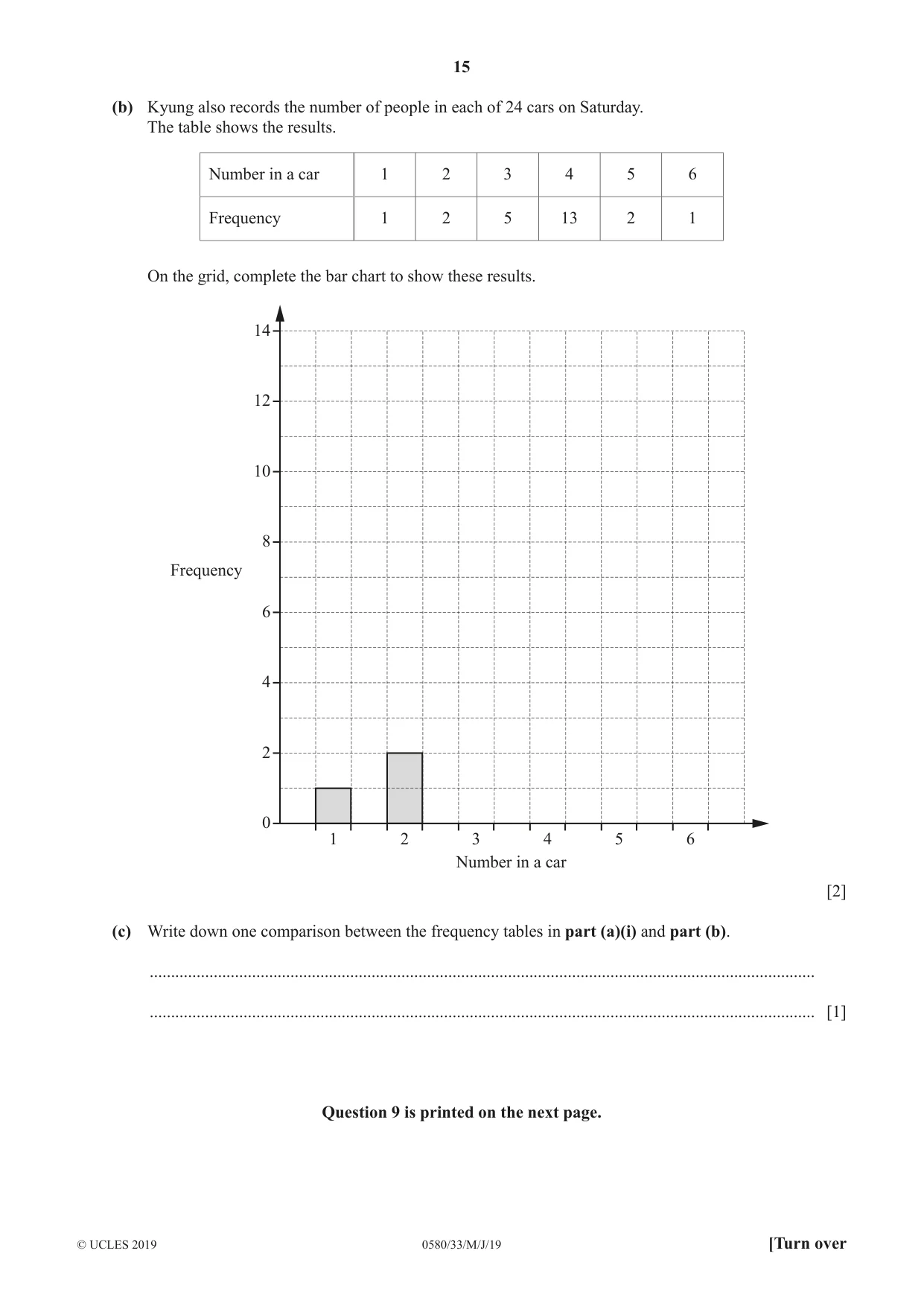
8 (a) Kyung records the number of people in each of 24 cars on Wednesday. His results are shown below. 1 3 6 1 2 2 4 5 3 4 1 5 3 2 4 1 1 1 2 4 4 1 2 1 (i) Complete the frequency table. You may use the tally column to help you. Number in a car Tally Frequency 1 2 3 4 5 6 [2] (ii) Write down the mode. ................................................. [1] (iii) Work out the range. ................................................. [1] (iv) Work out the median. ................................................. [1] (v) Calculate the mean. ................................................. [3] (vi) One of these cars is chosen at random. Find the probability that the number of people in this car is 4. ................................................. [1] (b) Kyung also records the number of people in each of 24 cars on Saturday. The table shows the results. Number in a car 1 2 3 4 5 6 Frequency 1 2 5 13 2 1 On the grid, complete the bar chart to show these results. 14 12 10 8 Frequency 6 4 2 0 1 2 3 4 5 6 Number in a car [2] (c) Write down one comparison between the frequency tables in part (a)(i) and part (b). ............................................................................................................................................................ ............................................................................................................................................................ [1] Question 9 is printed on the next page.
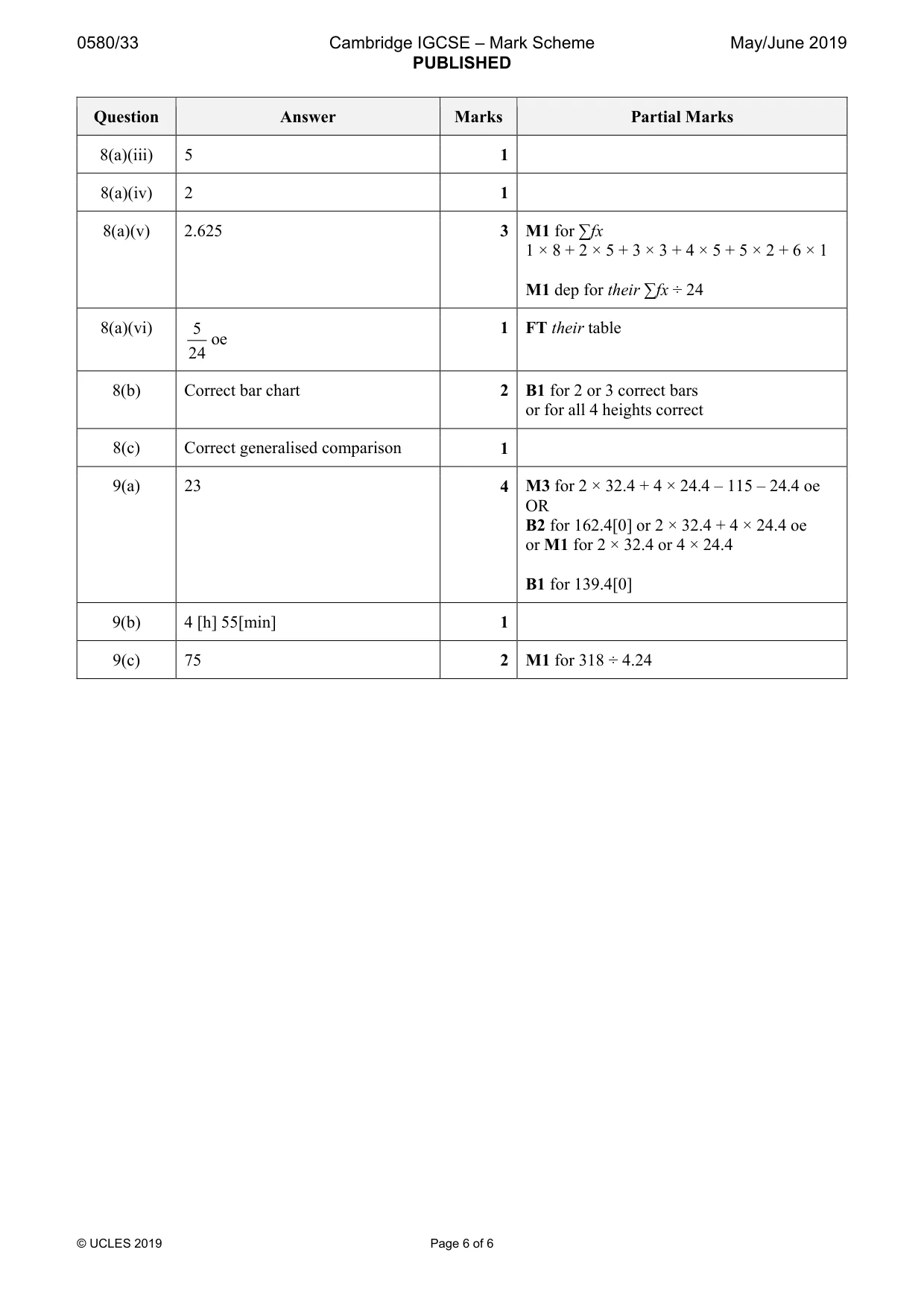
Mark scheme: 8(a)(i) Correct frequencies 2 B1 for 1 frequency incorrect 8 5 3 5 2 1 or 2 incorrect but total still 24 or 8 5 3 5 2 1 in tally column If 0 scored, B1 for completely correct tallies 8(a)(ii) 1 1 8(a)(iii) 5 1 8(a)(iv) 2 1 8(a)(v) 2.625 3 M1 for ∑fx 1 × 8 + 2 × 5 + 3 × 3 + 4 × 5 + 5 × 2 + 6 × 1 M1 dep for their ∑fx ÷ 24 8(a)(vi) 5 1 FT their table oe 24 8(b) Correct bar chart 2 B1 for 2 or 3 correct bars or for all 4 heights correct 8(c) Correct generalised comparison 1
Q9 · Mr Razif travels by bus from Singapore to Kuala Lumpur with his wife and his four children
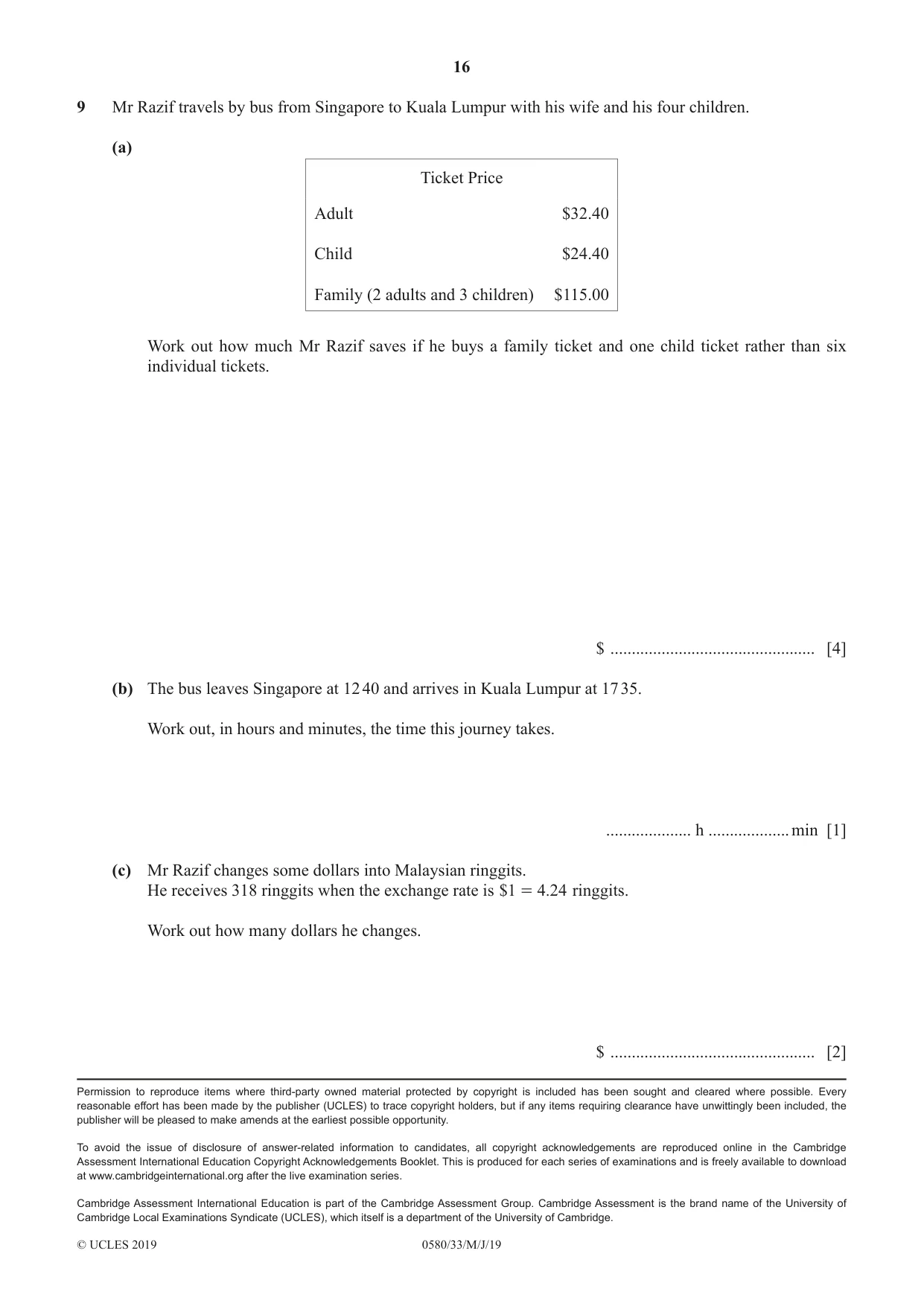
9 Mr Razif travels by bus from Singapore to Kuala Lumpur with his wife and his four children. (a) Ticket Price Adult $32.40 Child $24.40 Family (2 adults and 3 children) $115.00 Work out how much Mr Razif saves if he buys a family ticket and one child ticket rather than six individual tickets. $ ................................................ [4] (b) The bus leaves Singapore at 12 40 and arrives in Kuala Lumpur at 17 35. Work out, in hours and minutes, the time this journey takes. .................... h ................... min [1] (c) Mr Razif changes some dollars into Malaysian ringgits. He receives 318 ringgits when the exchange rate is $1 = 4.24 ringgits. Work out how many dollars he changes. $ ................................................ [2]
Mark scheme: 9(a) 23 4 M3 for 2 × 32.4 + 4 × 24.4 – 115 – 24.4 oe OR B2 for 162.4[0] or 2 × 32.4 + 4 × 24.4 oe or M1 for 2 × 32.4 or 4 × 24.4 B1 for 139.4[0] 9(b) 4 [h] 55[min] 1 9(c) 75 2 M1 for 318 ÷ 4.24
What was in this paper
The subtopics covered by these 9 questions, and how many questions each got. Open one in a new tab to see every Cambridge question on it.
What you needed in this session
Cambridge’s own grade thresholds for 2019 May/June, Paper 3 · Variant 3. A higher threshold means an easier paper — the bar moves with how the cohort did.