Cambridge IGCSE Mathematics 0580 — 2018 Oct/Nov Paper 3 · Variant 2
0580/32/O/N/18 · 9 questions · 104 marks · ≈117 min
The question paper and its mark scheme, free to read here and free to download. This is Cambridge’s own paper, exactly as it was sat.
Question paper16 pages
Mark scheme6 pages
Answers below. Sit the paper first if you are practising.
Questions as text
Q1 · Three people pick strawberries
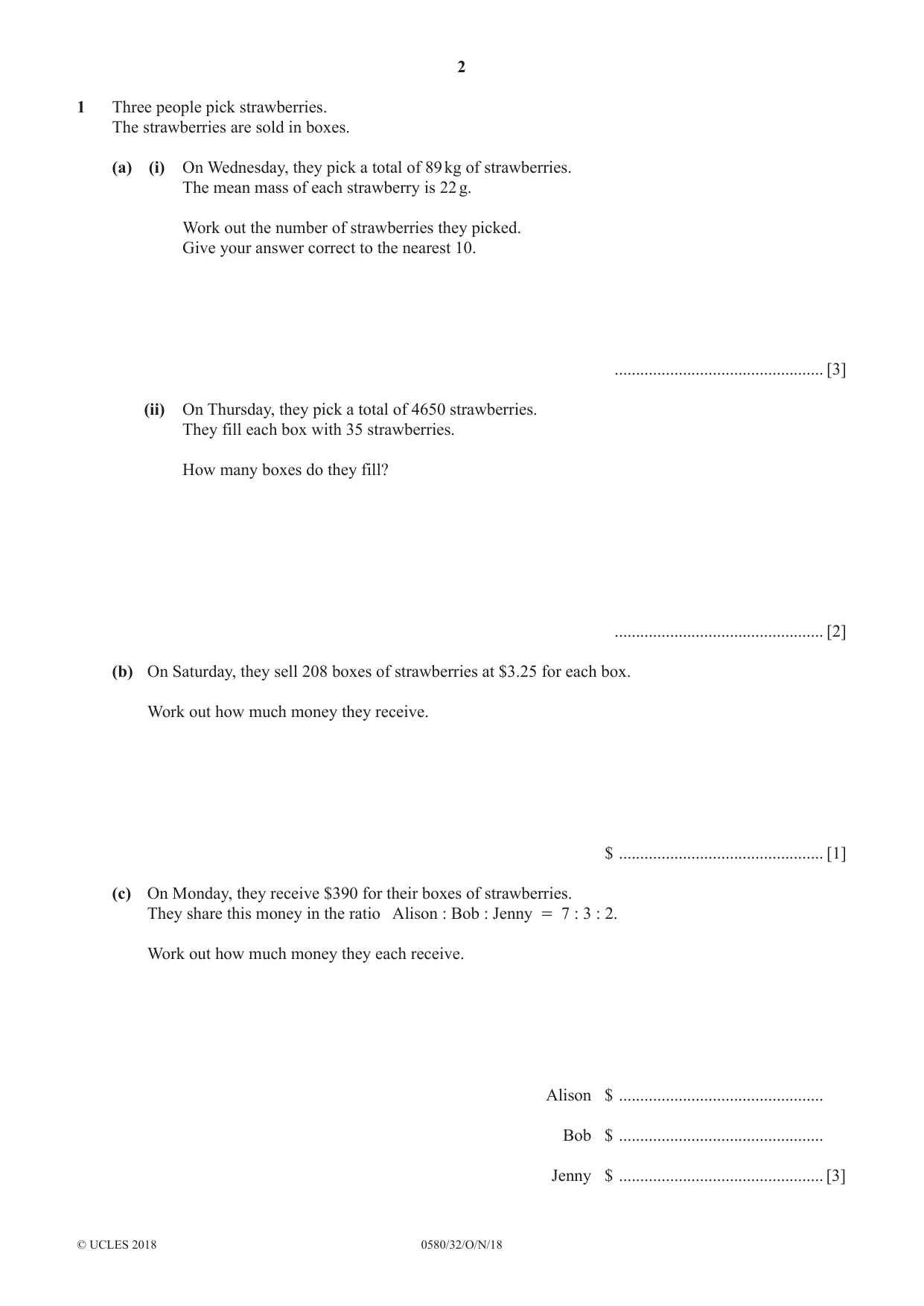
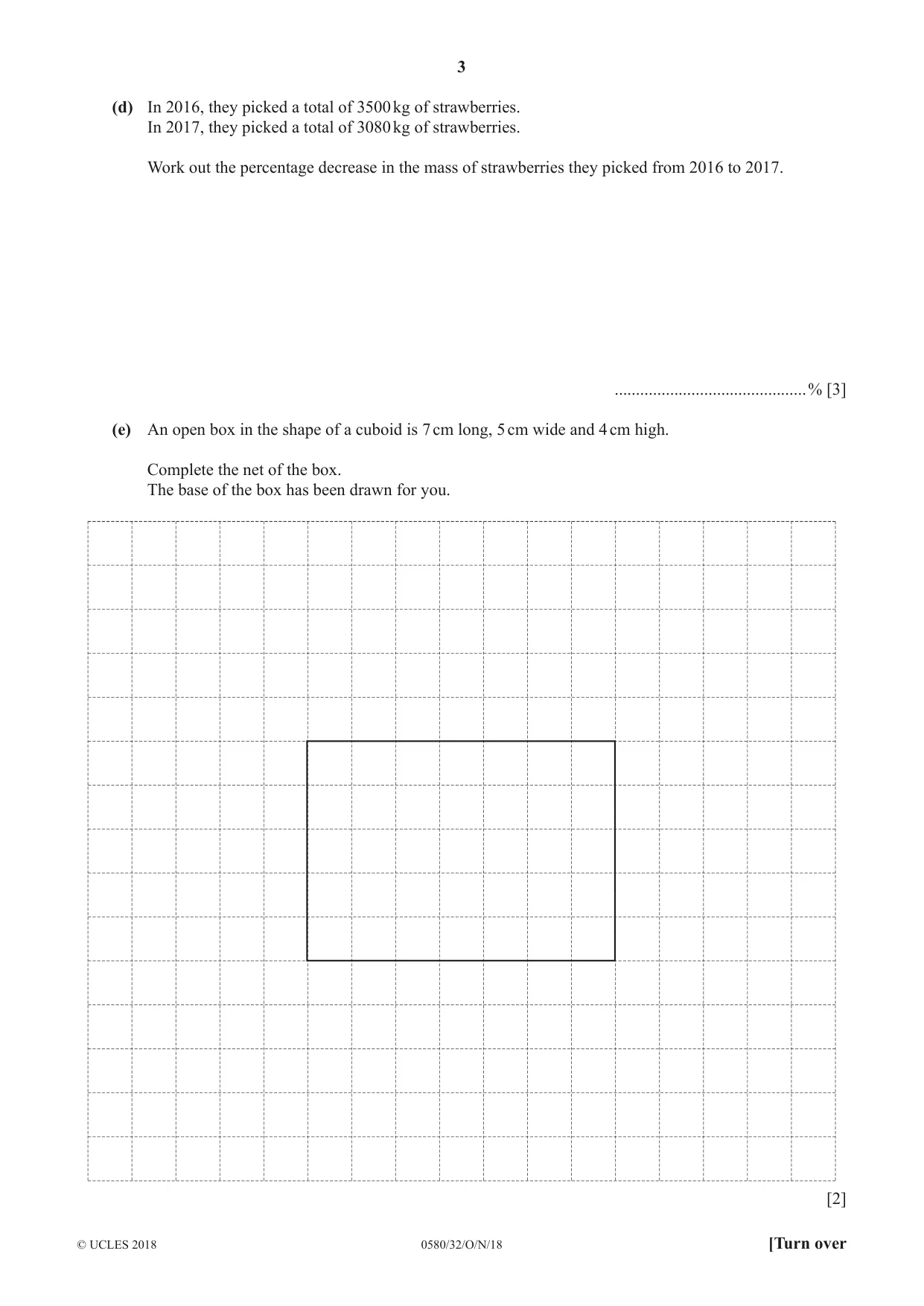
1 Three people pick strawberries. The strawberries are sold in boxes. (a) (i) On Wednesday, they pick a total of 89 kg of strawberries. The mean mass of each strawberry is 22 g. Work out the number of strawberries they picked. Give your answer correct to the nearest 10. ................................................. [3] (ii) On Thursday, they pick a total of 4650 strawberries. They fill each box with 35 strawberries. How many boxes do they fill? ................................................. [2] (b) On Saturday, they sell 208 boxes of strawberries at $3.25 for each box. Work out how much money they receive. $ ................................................ [1] (c) On Monday, they receive $390 for their boxes of strawberries. They share this money in the ratio Alison : Bob : Jenny = 7 : 3 : 2. Work out how much money they each receive. Alison $ ................................................ Bob $ ................................................ Jenny $ ................................................ [3] (d) In 2016, they picked a total of 3500 kg of strawberries. In 2017, they picked a total of 3080 kg of strawberries. Work out the percentage decrease in the mass of strawberries they picked from 2016 to 2017. .............................................% [3] (e) An open box in the shape of a cuboid is 7 cm long, 5 cm wide and 4 cm high. Complete the net of the box. The base of the box has been drawn for you. [2]
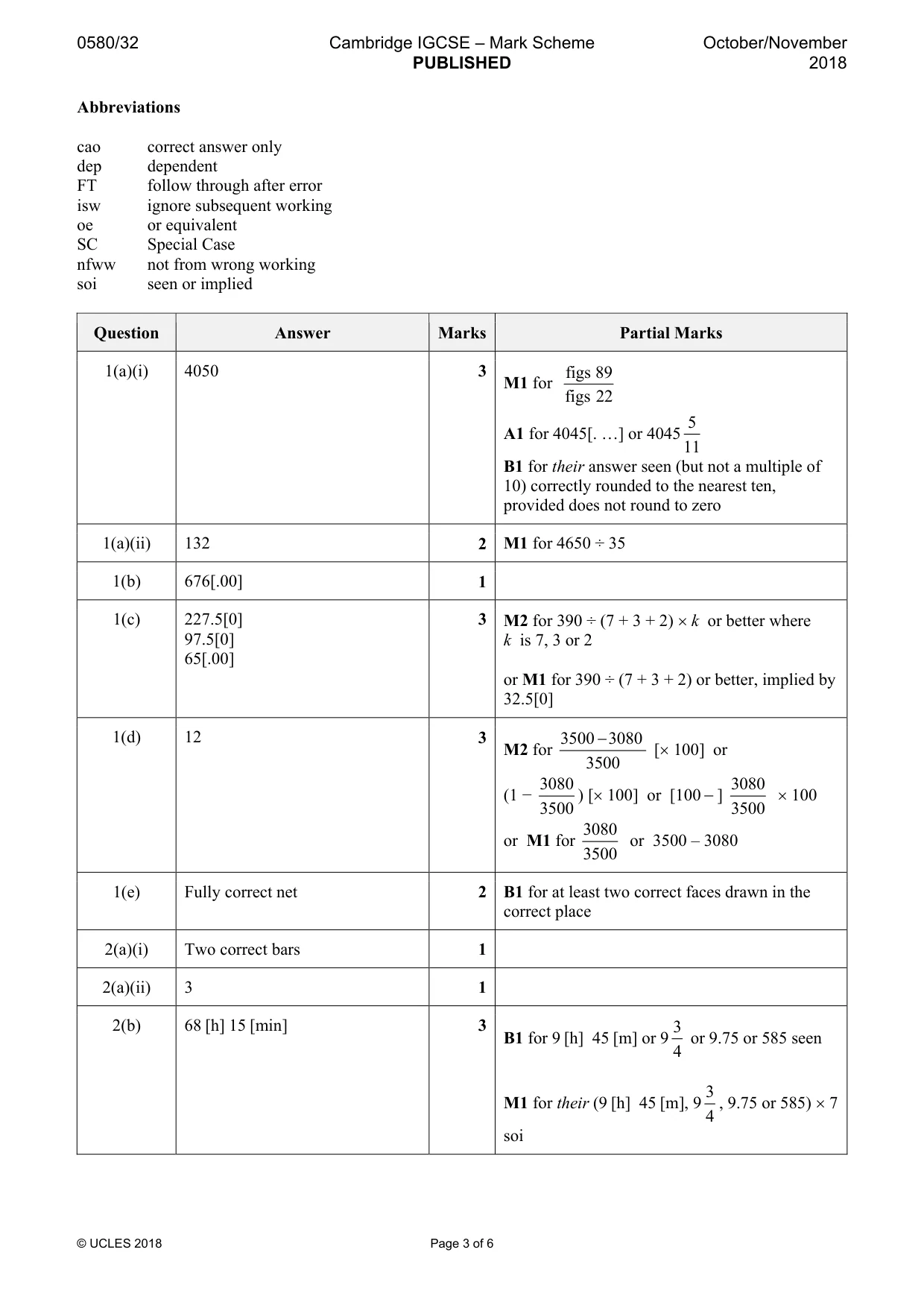
Mark scheme: Question Answer Marks Partial Marks 1(a)(i) 4050 3 figs 89 M1 for figs 22 5 A1 for 4045[. …] or 4045 11 B1 for their answer seen (but not a multiple of 10) correctly rounded to the nearest ten, provided does not round to zero 1(a)(ii) 132 2 M1 for 4650 ÷ 35 1(b) 676[.00] 1 1(c) 227.5[0] 3 M2 for 390 ÷ (7 + 3 + 2) × k or better where 97.5[0] k is 7, 3 or 2 65[.00] or M1 for 390 ÷ (7 + 3 + 2) or better, implied by 32.5[0] 1(d) 12 3 3500 − 3080 M2 for [× 100] or 3500 3080 3080 (1 − ) [× 100] or [100 −] × 100 3500 3500 3080 or M1 for or 3500 – 3080 3500 1(e) Fully correct net 2 B1 for at least two correct faces drawn in the correct place
Q2 · The bar chart shows the number of different films shown at a cinema in each of four months
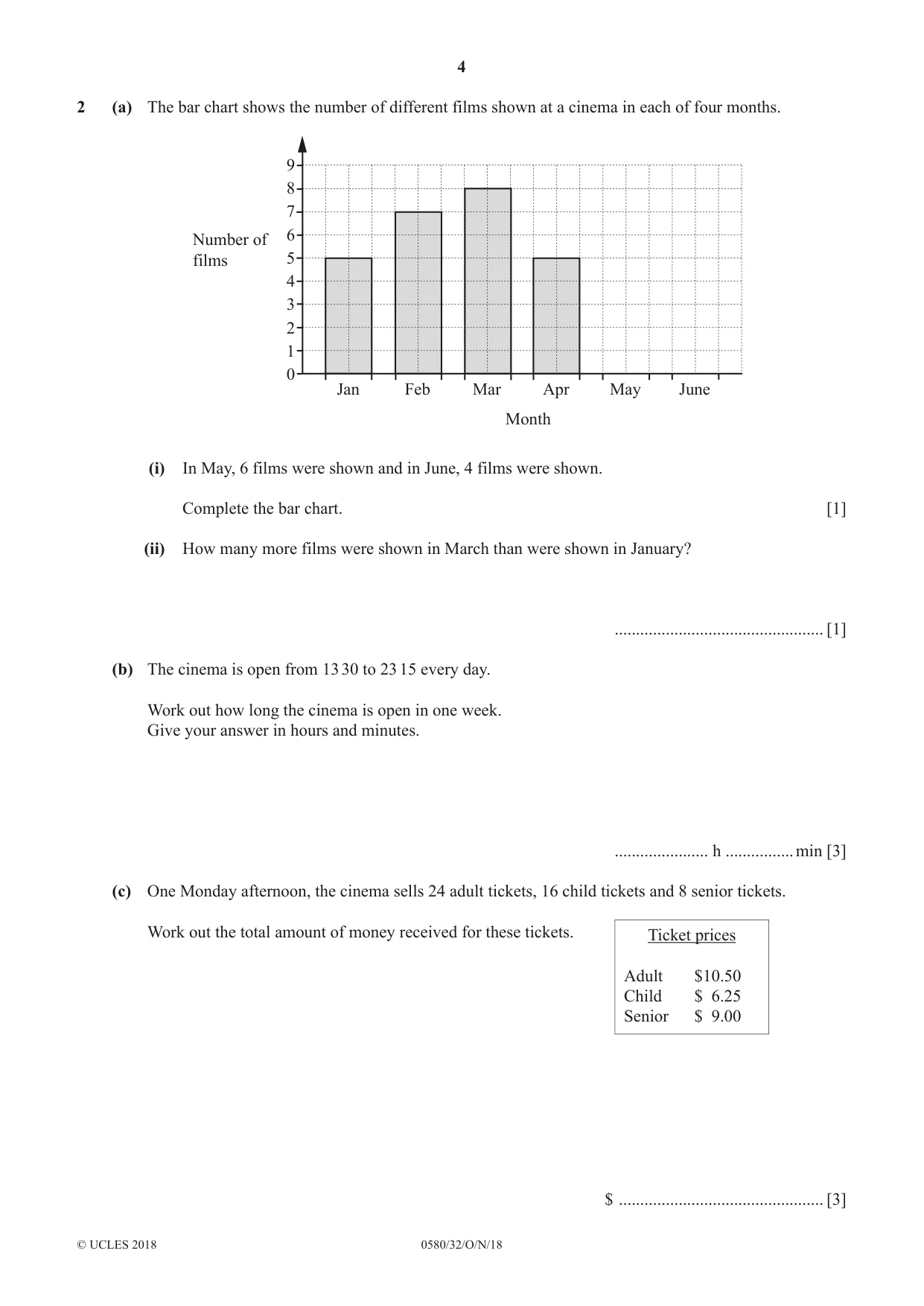
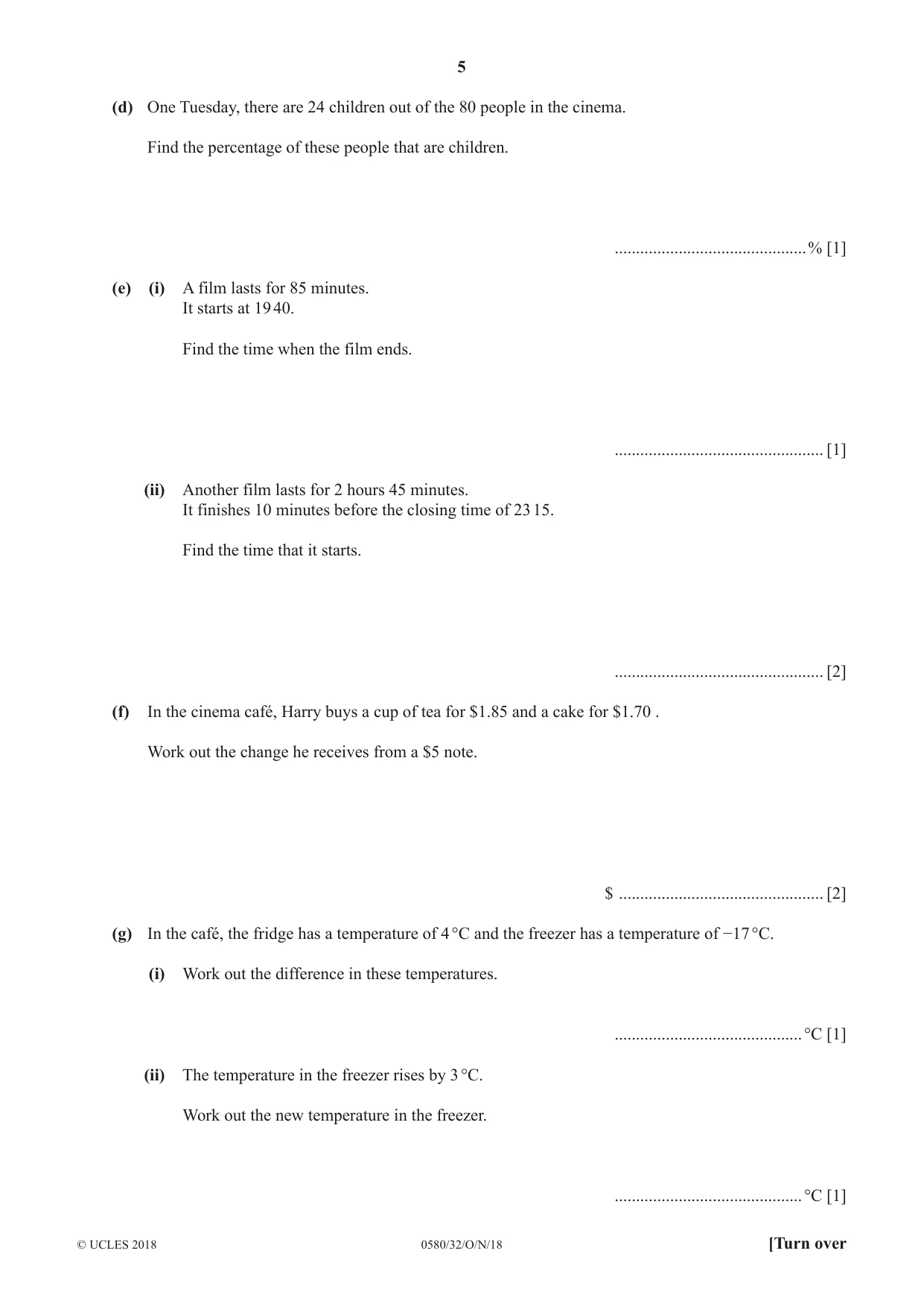
2 (a) The bar chart shows the number of different films shown at a cinema in each of four months. 9 8 7 6 Number of films 5 4 3 2 1 0 Jan Feb Mar Apr May June Month (i) In May, 6 films were shown and in June, 4 films were shown. Complete the bar chart. [1] (ii) How many more films were shown in March than were shown in January? ................................................. [1] (b) The cinema is open from 13 30 to 23 15 every day. Work out how long the cinema is open in one week. Give your answer in hours and minutes. ...................... h ................ min [3] (c) One Monday afternoon, the cinema sells 24 adult tickets, 16 child tickets and 8 senior tickets. Work out the total amount of money received for these tickets. Ticket prices Adult $10.50 Child $ 6.25 Senior $ 9.00 $ ................................................ [3] (d) One Tuesday, there are 24 children out of the 80 people in the cinema. Find the percentage of these people that are children. .............................................% [1] (e) (i) A film lasts for 85 minutes. It starts at 19 40. Find the time when the film ends. ................................................. [1] (ii) Another film lasts for 2 hours 45 minutes. It finishes 10 minutes before the closing time of 23 15. Find the time that it starts. ................................................. [2] (f) In the cinema café, Harry buys a cup of tea for $1.85 and a cake for $1.70 . Work out the change he receives from a $5 note. $ ................................................ [2] (g) In the café, the fridge has a temperature of 4 °C and the freezer has a temperature of −17 °C. (i) Work out the difference in these temperatures. ............................................°C [1] (ii) The temperature in the freezer rises by 3 °C. Work out the new temperature in the freezer. ............................................°C [1]
Mark scheme: 2(a)(i) Two correct bars 1 2(a)(ii) 3 1 2(b) 68 [h] 15 [min] 3 3 B1 for 9 [h] 45 [m] or 9 or 9.75 or 585 seen 4 3 M1 for their (9 [h] 45 [m], 9 , 9.75 or 585) × 7 4 soi 2(c) 424 3 M2 for 24 × 10.5 + 16 × 6.25 + 8 × 9 soi or M1 for two of 24 × 10.5, 16 × 6.25, 8 × 9 2(d) 30 1 2(e)(i) 21 05 or 9.05 pm 1 2(e)(ii) 20 20 or 8.20 pm 2 M1 for 23 15 [− (10 min)] − (2 h 45 m) soi by 20 30 2(f) 1.45 2 M1 for [5 −] (1.85 + 1.70) or 3.55 2(g)(i) 21 1 2(g)(ii) –14 1
Question 3
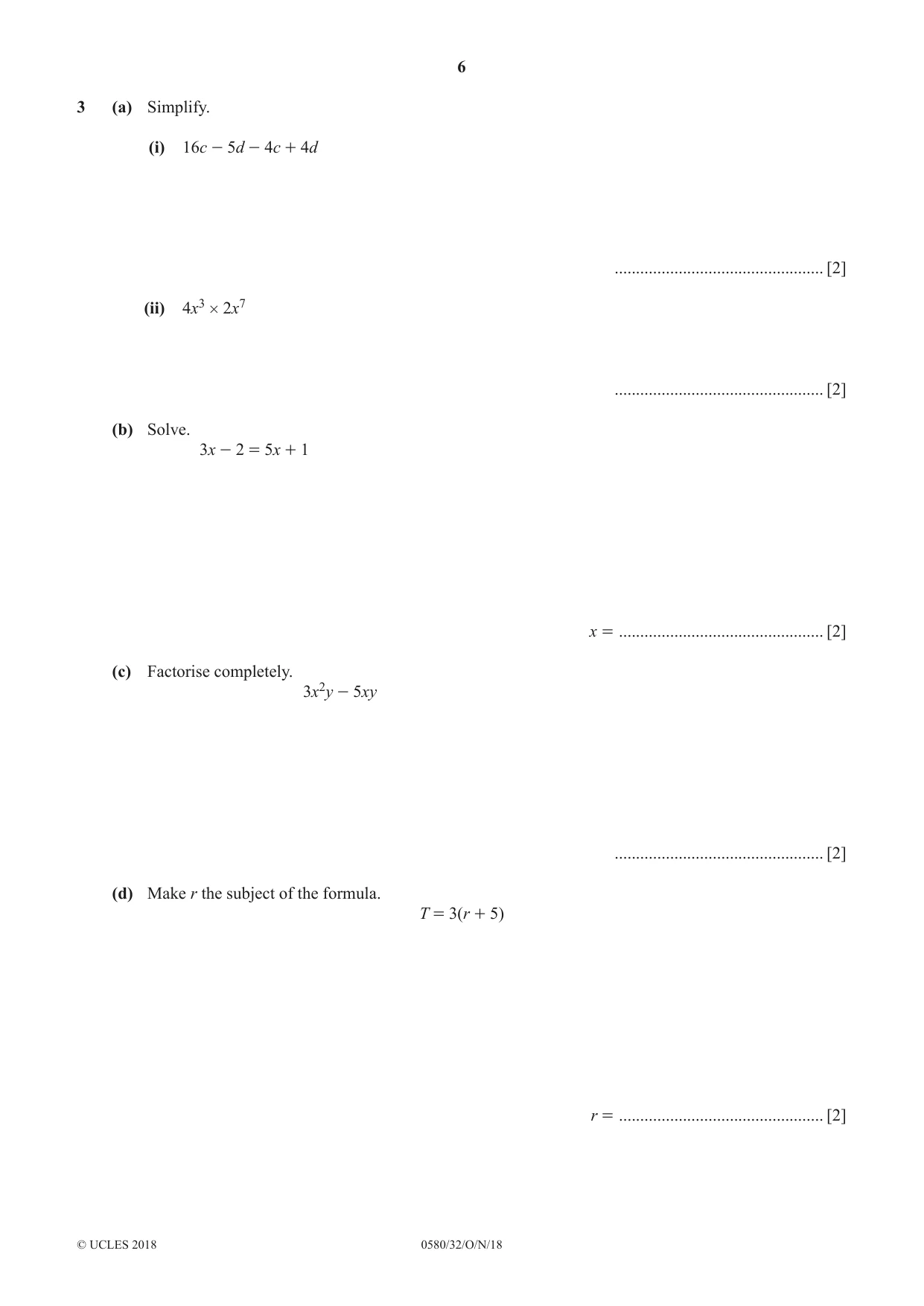
3 (a) Simplify. (i) 16c - 5d - 4c + 4d ................................................. [2] (ii) 4x3 # 2x7 ................................................. [2] (b) Solve. 3x - 2 = 5x + 1 x = ................................................ [2] (c) Factorise completely. 3x2y - 5xy ................................................. [2] (d) Make r the subject of the formula. T = 3(r + 5) r = ................................................ [2]
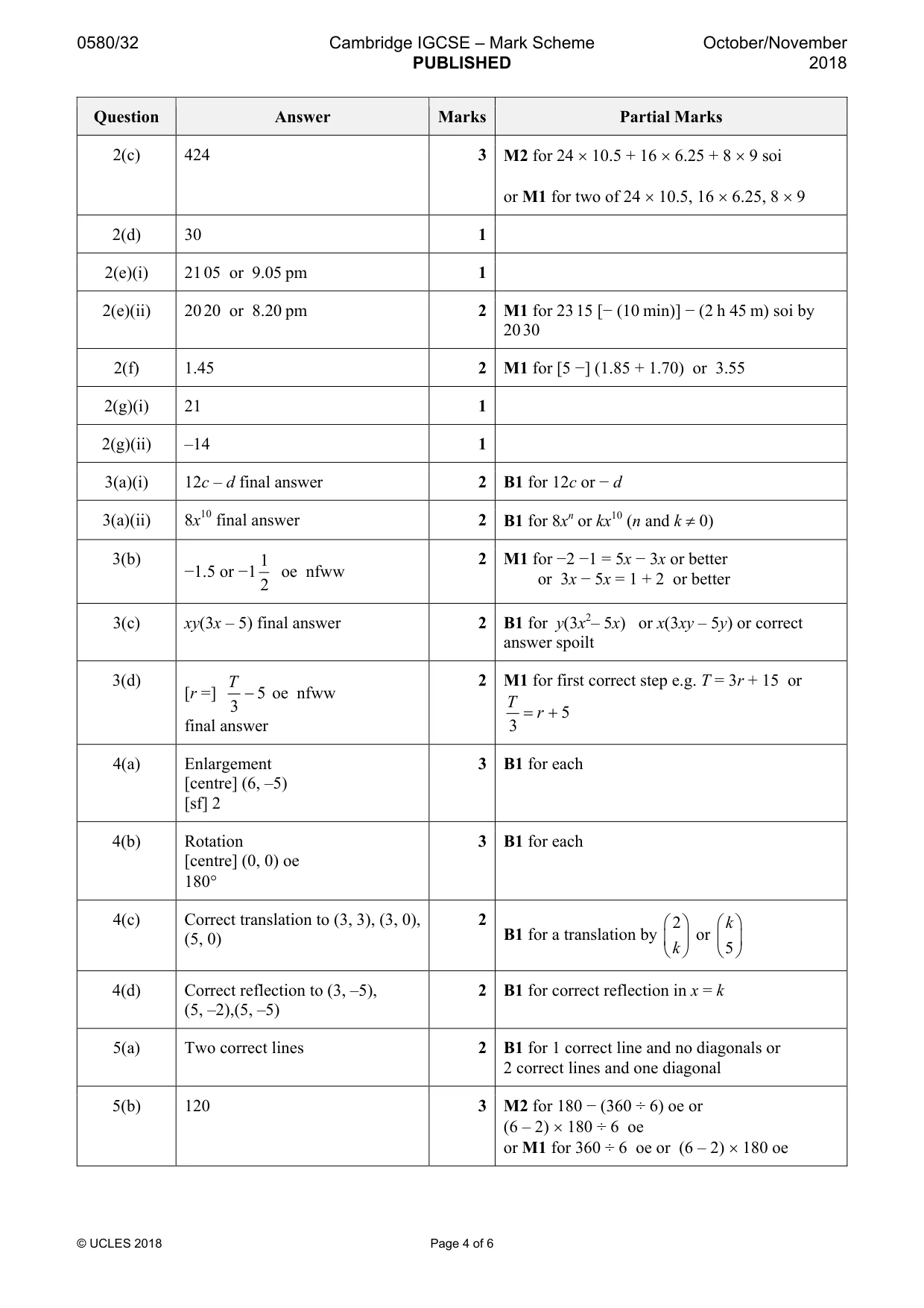
Mark scheme: 3(a)(i) 12c – d final answer 2 B1 for 12c or − d 3(a)(ii) 8x10 final answer 2 B1 for 8xn or kx10 (n and k ≠ 0) 3(b) 1 2 M1 for −2 −1 = 5x − 3x or better −1.5 or −1 oe nfww or 3x − 5x = 1 + 2 or better 2 3(c) xy(3x – 5) final answer 2 B1 for y(3x2– 5x) or x(3xy – 5y) or correct answer spoilt 3(d) T 2 M1 for first correct step e.g. T = 3r + 15 or [r =] − 5 oe nfww T 3 = r + 5 final answer 3
Q4 · Triangles A, B and C are shown on the grid
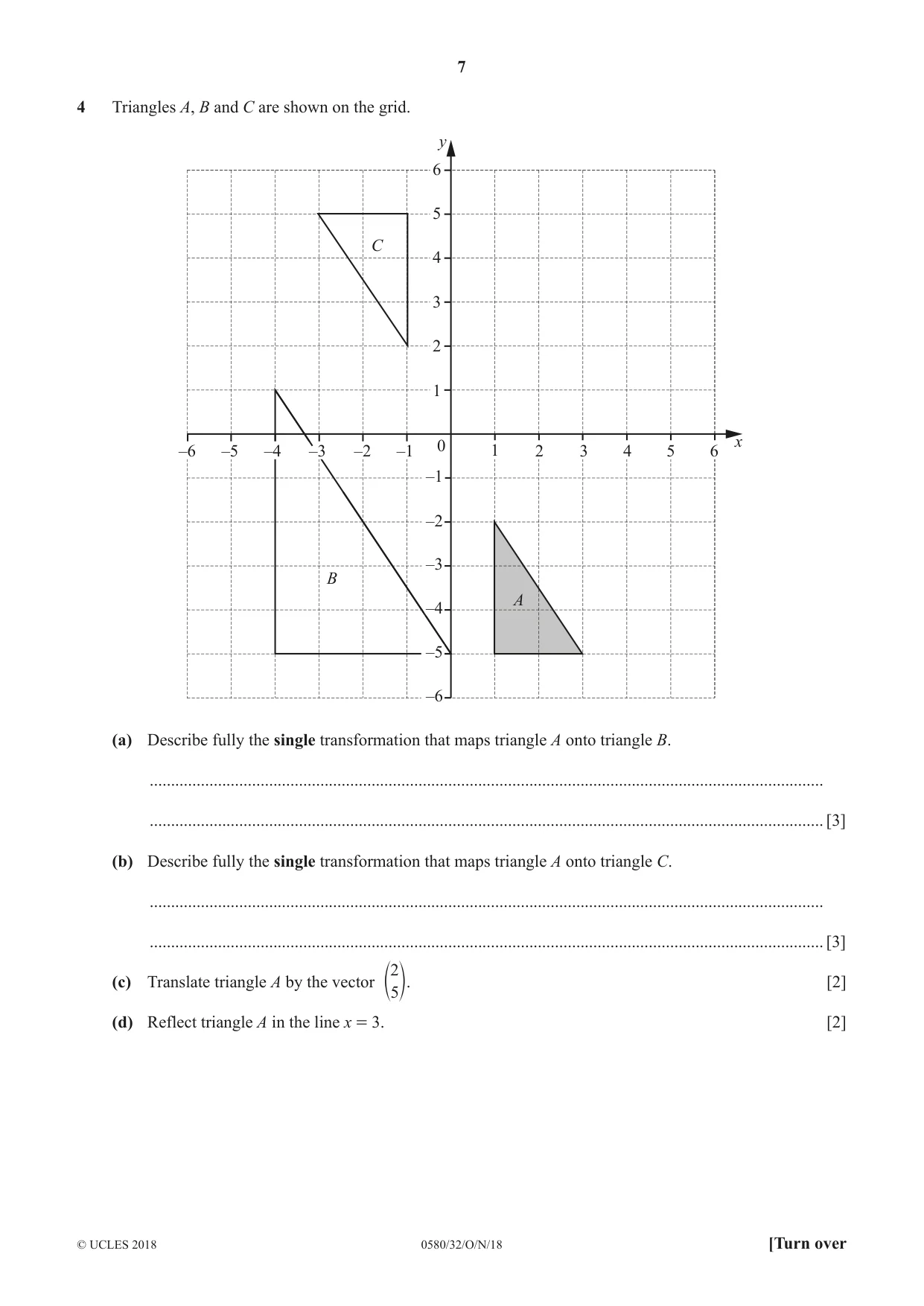
4 Triangles A, B and C are shown on the grid. y 6 5 C 4 3 2 1 x –6 –5 –4 –3 –2 –1 0 1 2 3 4 5 6 –1 –2 –3 B A –4 –5 –6 (a) Describe fully the single transformation that maps triangle A onto triangle B. .............................................................................................................................................................. .............................................................................................................................................................. [3] (b) Describe fully the single transformation that maps triangle A onto triangle C. .............................................................................................................................................................. .............................................................................................................................................................. [3] 2 (c) Translate triangle A by the vector [2] e5 o. (d) Reflect triangle A in the line x = 3. [2]
Mark scheme: 4(a) Enlargement 3 B1 for each [centre] (6, –5) [sf] 2 4(b) Rotation 3 B1 for each [centre] (0, 0) oe 180° 4(c) Correct translation to (3, 3), (3, 0), 2 2 k (5, 0) B1 for a translation by or k 5 4(d) Correct reflection to (3, –5), 2 B1 for correct reflection in x = k (5, –2),(5, –5)
Q5 · Draw all the lines of symmetry on the rectangle below
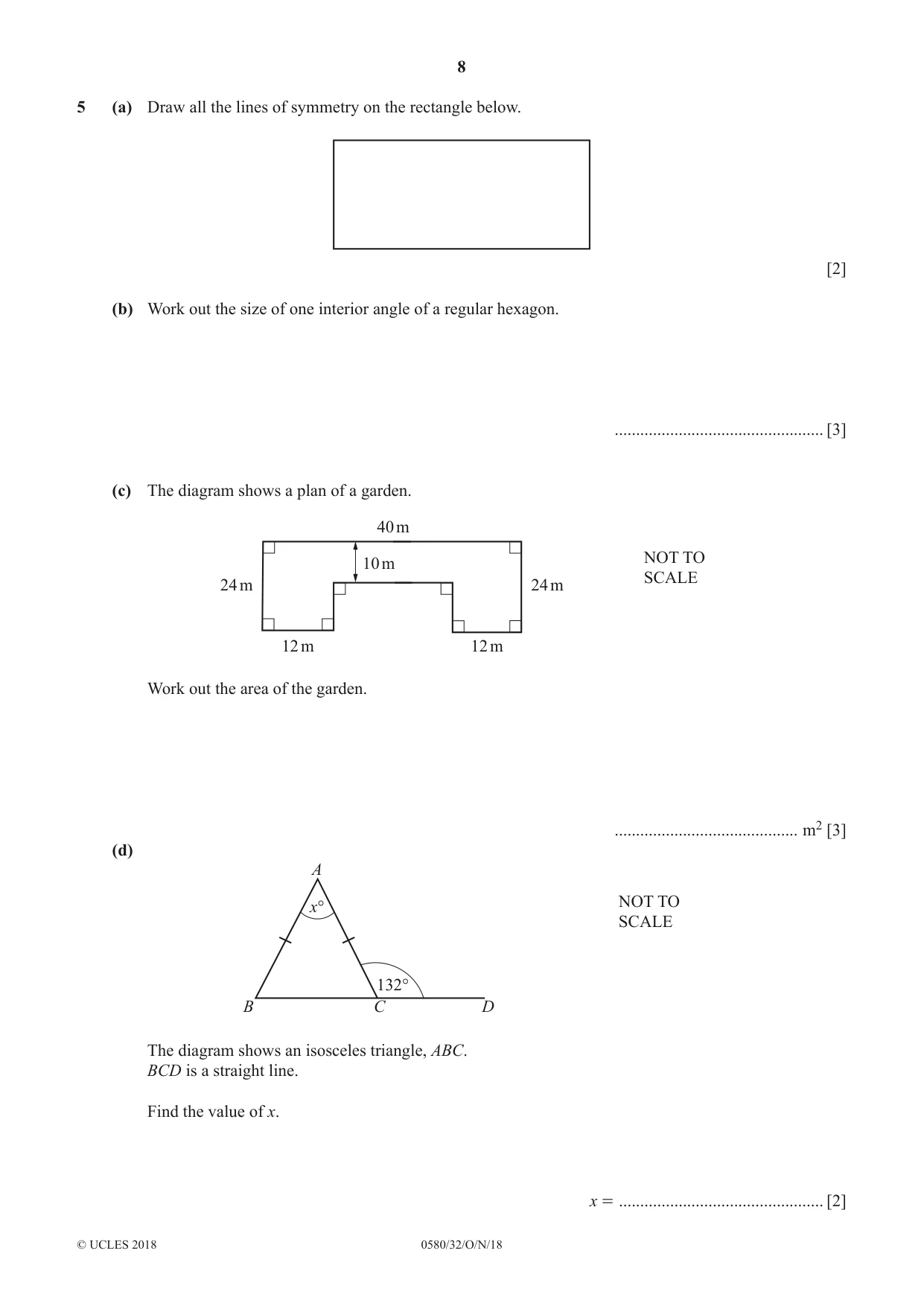
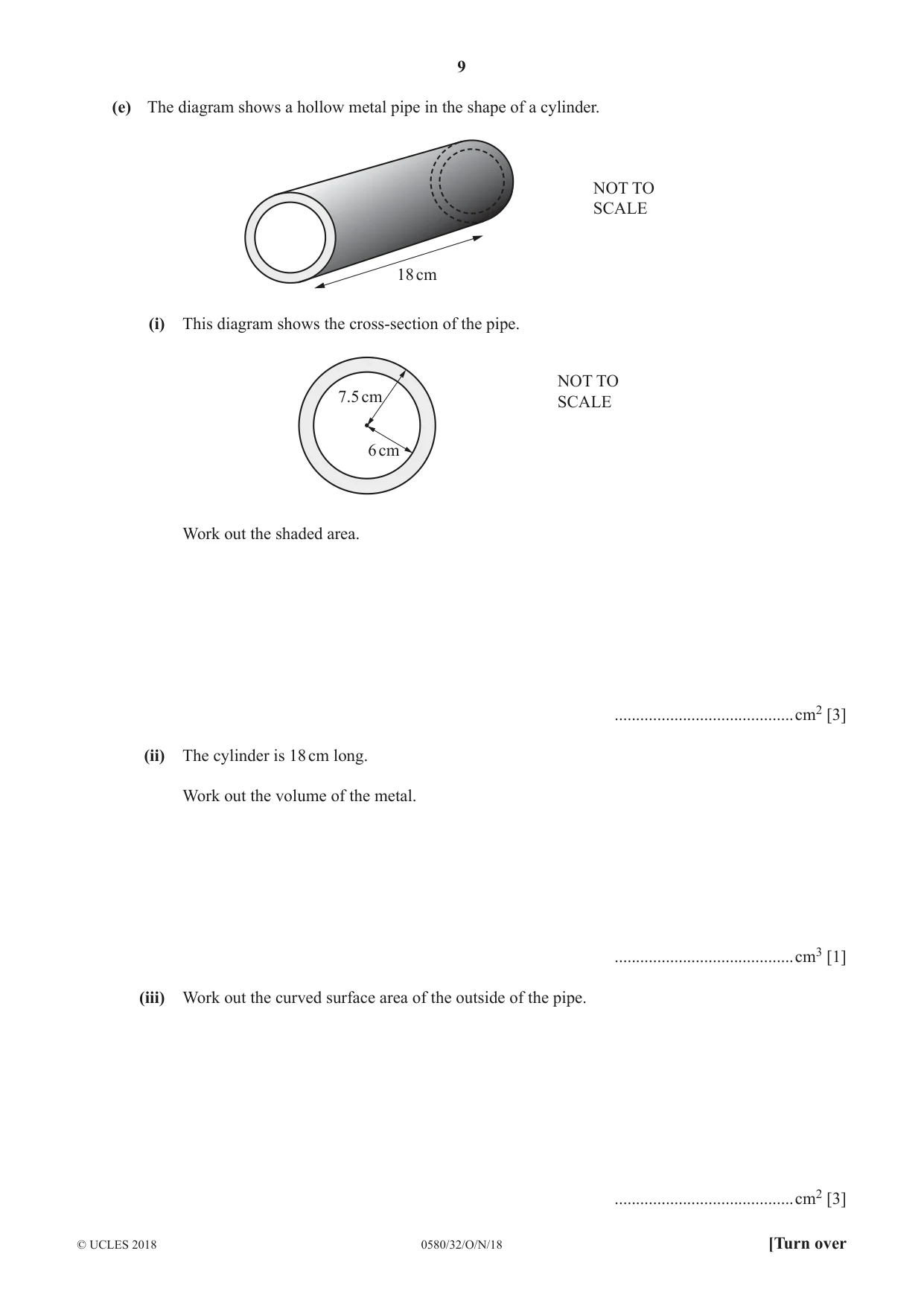
5 (a) Draw all the lines of symmetry on the rectangle below. [2] (b) Work out the size of one interior angle of a regular hexagon. ................................................. [3] (c) The diagram shows a plan of a garden. 40 m NOT TO 10 m SCALE 24 m 24 m 12 m 12 m Work out the area of the garden. ........................................... m2 [3] (d) A NOT TO x° SCALE 132° B C D The diagram shows an isosceles triangle, ABC. BCD is a straight line. Find the value of x. x = ................................................ [2] (e) The diagram shows a hollow metal pipe in the shape of a cylinder. NOT TO SCALE 18 cm (i) This diagram shows the cross-section of the pipe. NOT TO 7.5 cm SCALE 6 cm Work out the shaded area. ..........................................cm2 [3] (ii) The cylinder is 18 cm long. Work out the volume of the metal. ..........................................cm3 [1] (iii) Work out the curved surface area of the outside of the pipe. ..........................................cm2 [3]
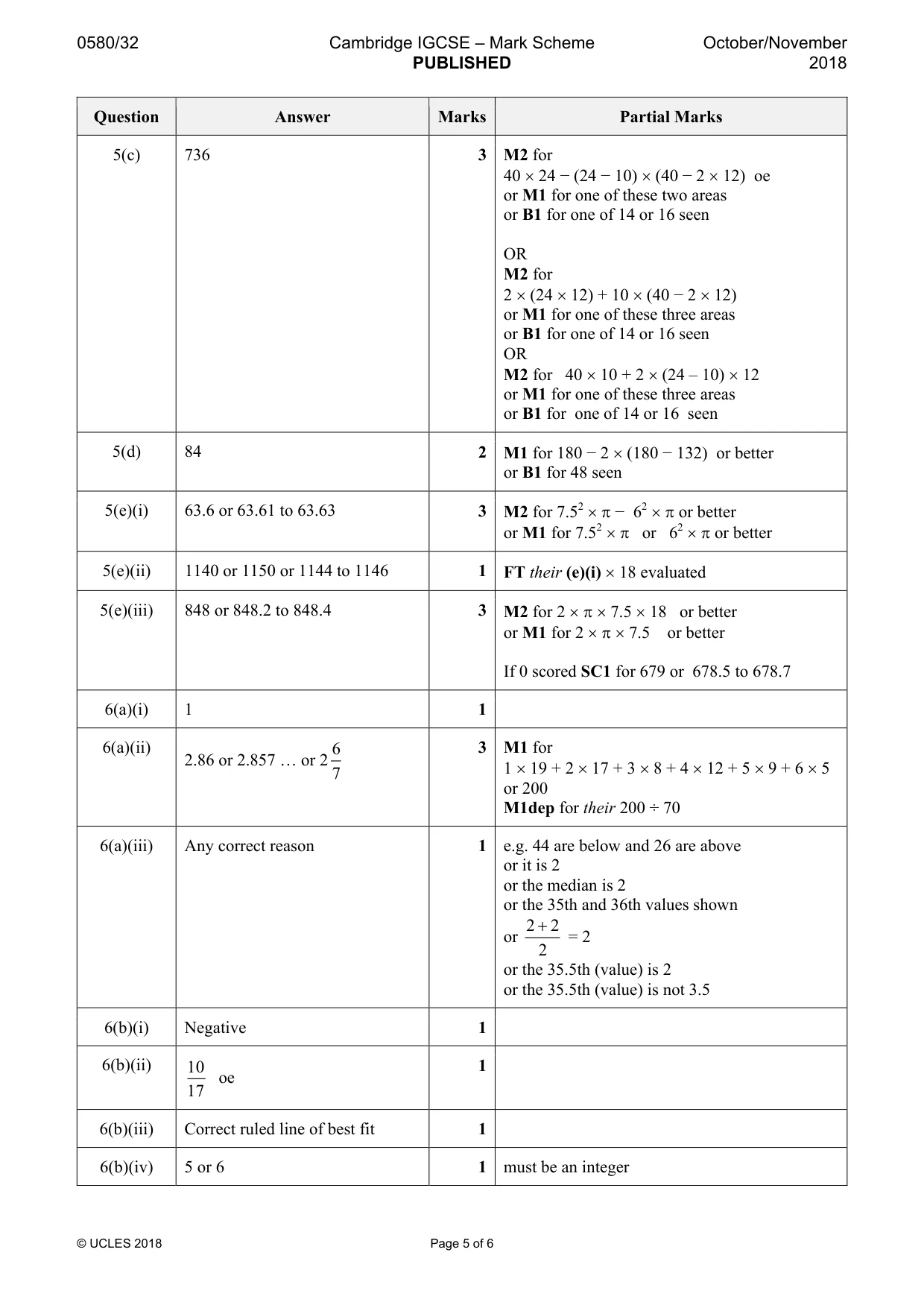
Mark scheme: 5(a) Two correct lines 2 B1 for 1 correct line and no diagonals or 2 correct lines and one diagonal 5(b) 120 3 M2 for 180 − (360 ÷ 6) oe or (6 – 2) × 180 ÷ 6 oe or M1 for 360 ÷ 6 oe or (6 – 2) × 180 oe 5(c) 736 3 M2 for 40 × 24 − (24 − 10) × (40 − 2 × 12) oe or M1 for one of these two areas or B1 for one of 14 or 16 seen OR M2 for 2 × (24 × 12) + 10 × (40 − 2 × 12) or M1 for one of these three areas or B1 for one of 14 or 16 seen OR M2 for 40 × 10 + 2 × (24 – 10) × 12 or M1 for one of these three areas or B1 for one of 14 or 16 seen 5(d) 84 2 M1 for 180 − 2 × (180 − 132) or better or B1 for 48 seen 5(e)(i) 63.6 or 63.61 to 63.63 3 M2 for 7.52 × π − 62 × π or better or M1 for 7.52 × π or 62 × π or better 5(e)(ii) 1140 or 1150 or 1144 to 1146 1 FT their (e)(i) × 18 evaluated 5(e)(iii) 848 or 848.2 to 848.4 3 M2 for 2 × π × 7.5 × 18 or better or M1 for 2 × π × 7.5 or better If 0 scored SC1 for 679 or 678.5 to 678.7
Q6 · 70 people each attempt a driving test
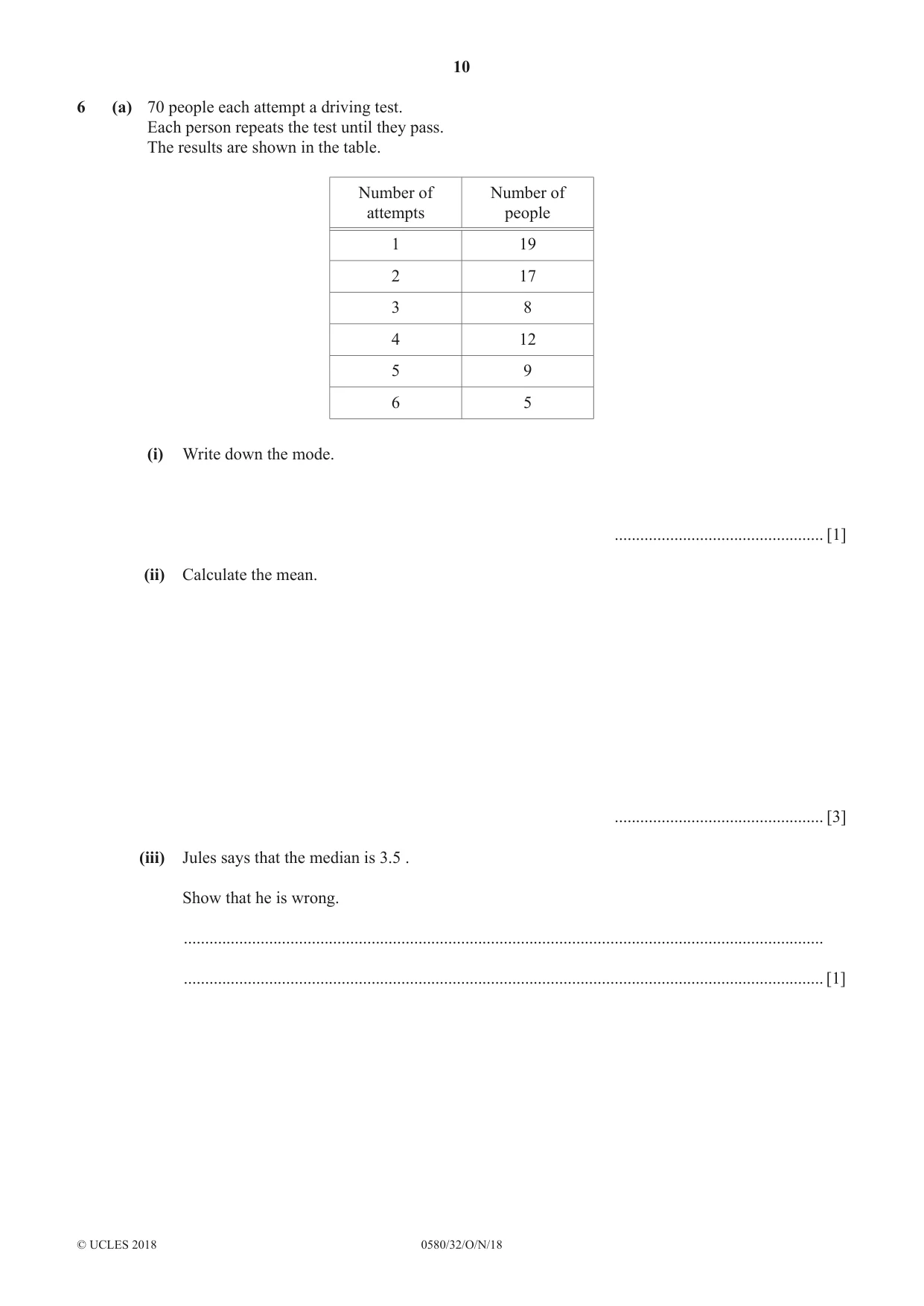
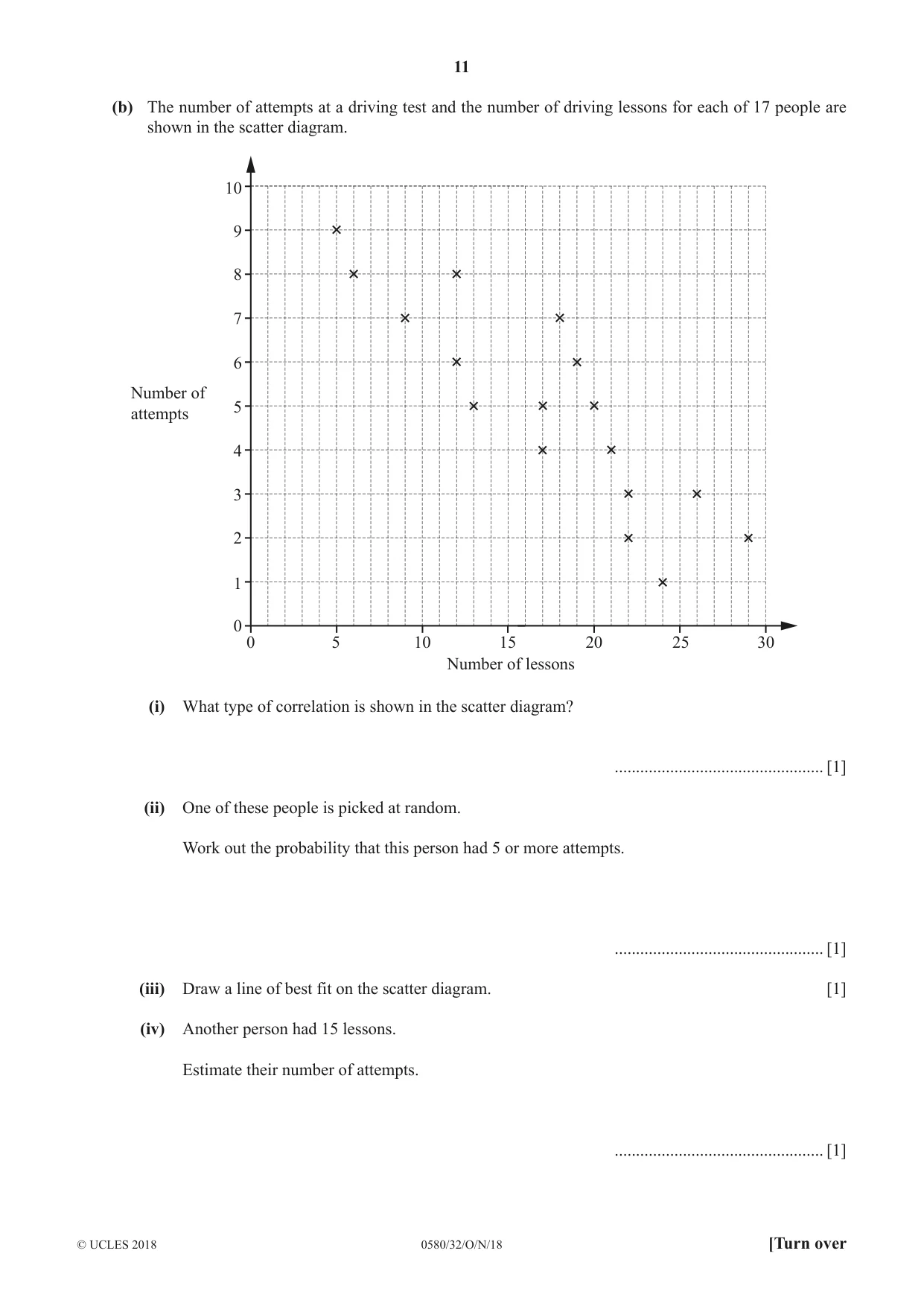
6 (a) 70 people each attempt a driving test. Each person repeats the test until they pass. The results are shown in the table. Number of Number of attempts people 1 19 2 17 3 8 4 12 5 9 6 5 (i) Write down the mode. ................................................. [1] (ii) Calculate the mean. ................................................. [3] (iii) Jules says that the median is 3.5 . Show that he is wrong. ...................................................................................................................................................... ...................................................................................................................................................... [1] (b) The number of attempts at a driving test and the number of driving lessons for each of 17 people are shown in the scatter diagram. 10 9 8 7 6 Number of 5 attempts 4 3 2 1 0 0 5 10 15 20 25 30 Number of lessons (i) What type of correlation is shown in the scatter diagram? ................................................. [1] (ii) One of these people is picked at random. Work out the probability that this person had 5 or more attempts. ................................................. [1] (iii) Draw a line of best fit on the scatter diagram. [1] (iv) Another person had 15 lessons. Estimate their number of attempts. ................................................. [1]
Mark scheme: 6(a)(i) 1 1 6(a)(ii) 6 3 M1 for 2.86 or 2.857 … or 2 1 × 19 + 2 × 17 + 3 × 8 + 4 × 12 + 5 × 9 + 6 × 5 7 or 200 M1dep for their 200 ÷ 70 6(a)(iii) Any correct reason 1 e.g. 44 are below and 26 are above or it is 2 or the median is 2 or the 35th and 36th values shown 2 + 2 or = 2 2 or the 35.5th (value) is 2 or the 35.5th (value) is not 3.5 6(b)(i) Negative 1 6(b)(ii) 10 1 oe 17 6(b)(iii) Correct ruled line of best fit 1 6(b)(iv) 5 or 6 1 must be an integer
Q7 · Write in figures the number eight million and twenty three thousand
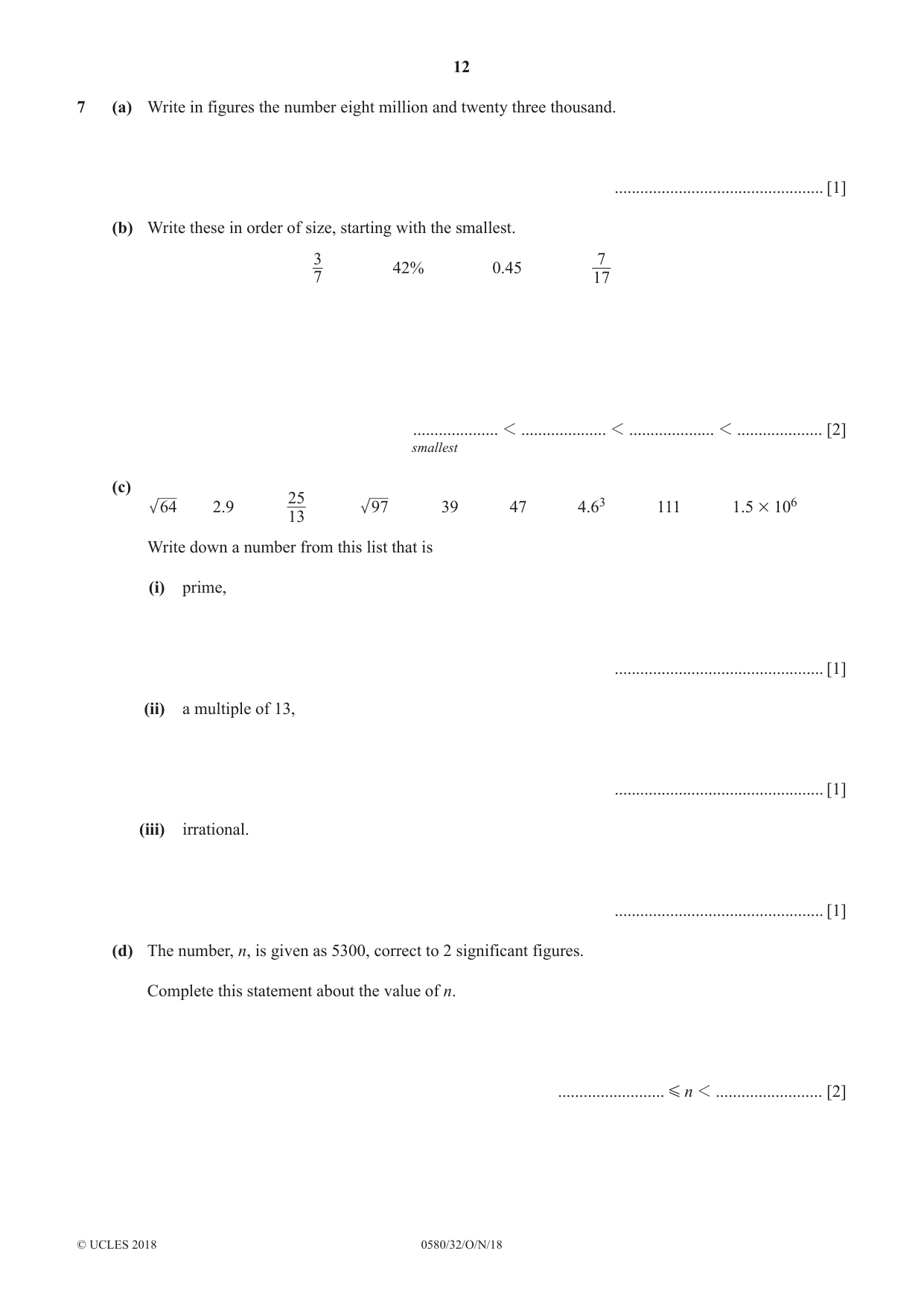
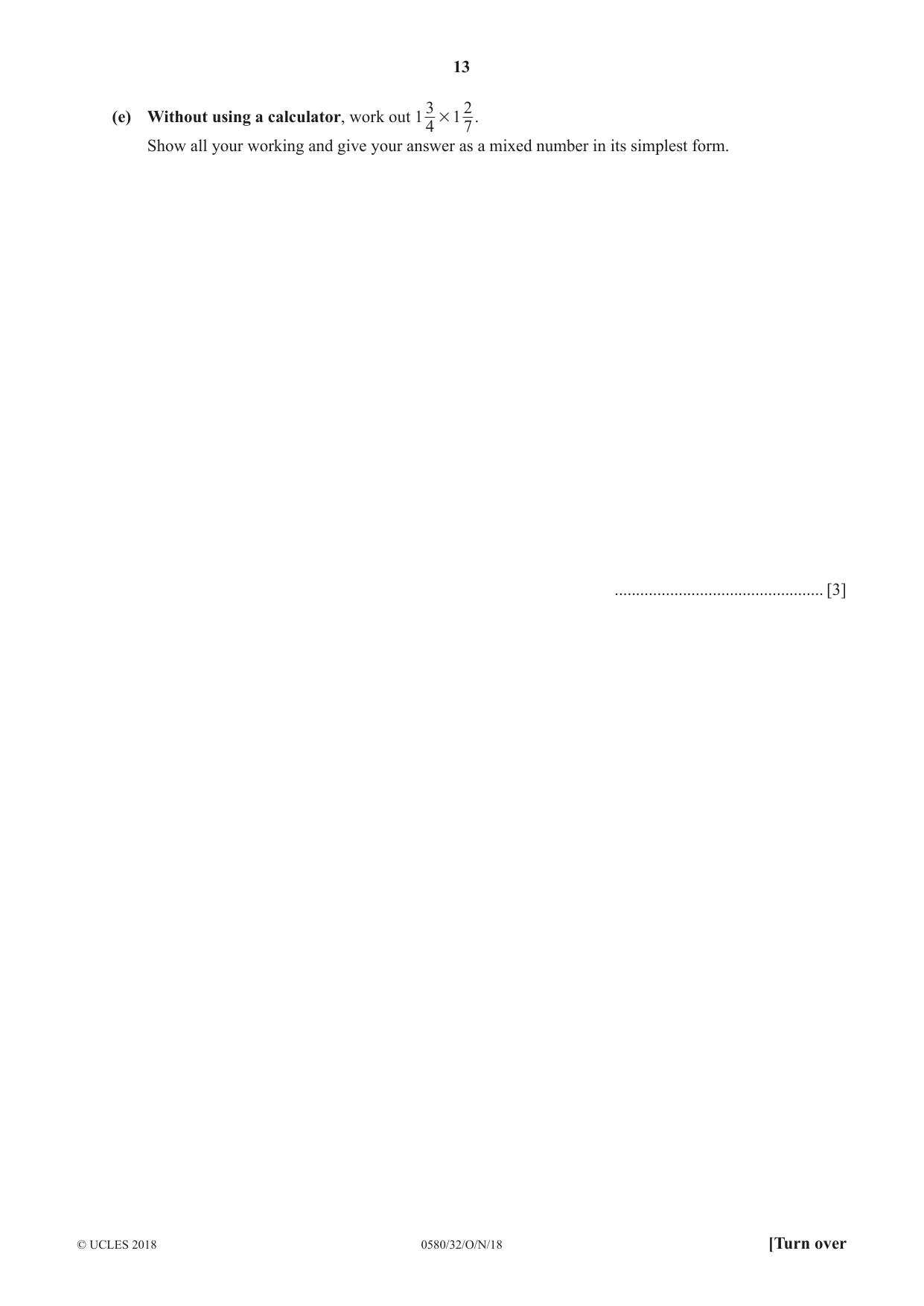
7 (a) Write in figures the number eight million and twenty three thousand. ................................................. [1] (b) Write these in order of size, starting with the smallest. 3 7 42% 0.45 7 17 .................... 1 .................... 1 .................... 1 .................... [2] smallest (c) 25 64 2.9 97 39 47 4.63 111 1.5 × 10⁶ 13 Write down a number from this list that is (i) prime, ................................................. [1] (ii) a multiple of 13, ................................................. [1] (iii) irrational. ................................................. [1] (d) The number, n, is given as 5300, correct to 2 significant figures. Complete this statement about the value of n. ......................... G n 1 ......................... [2] 3 2(e) Without using a calculator, work out 1 # 1 . 4 7 Show all your working and give your answer as a mixed number in its simplest form. ................................................. [3]
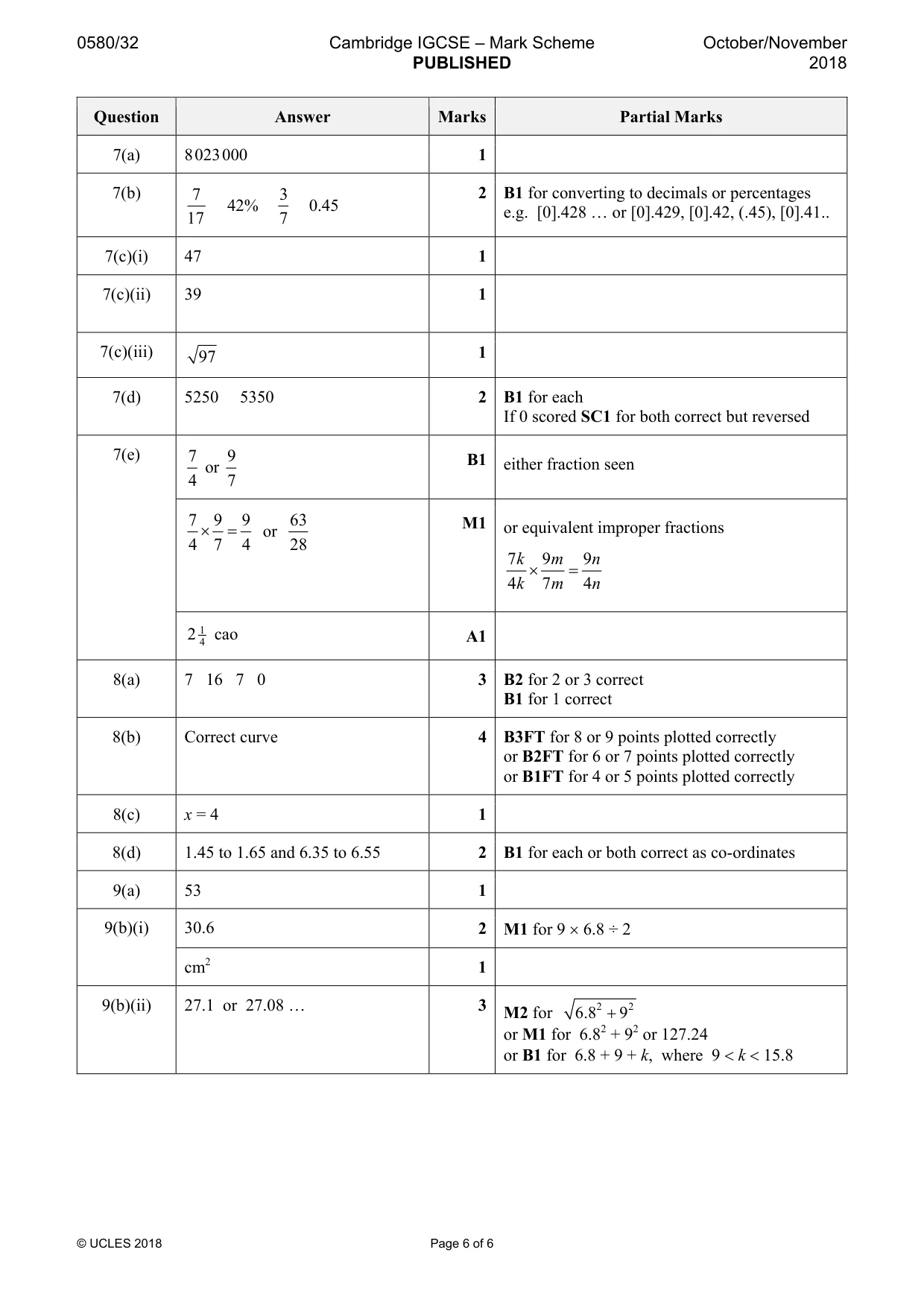
Mark scheme: 7(a) 8 023 000 1 7(b) 7 3 2 B1 for converting to decimals or percentages 42% 0.45 e.g. [0].428 … or [0].429, [0].42, (.45), [0].41.. 17 7 7(c)(i) 47 1 7(c)(ii) 39 1 7(c)(iii) 97 1 7(d) 5250 5350 2 B1 for each If 0 scored SC1 for both correct but reversed 7(e) 7 9 B1 either fraction seen or 4 7 7 9 9 63 M1 or equivalent improper fractions × = or 4 7 4 28 7 k 9 m 9 n × = 4 k 7 m 4 n 2 14 cao A1
Q8 · Complete the table of values for y = 8x - x 2
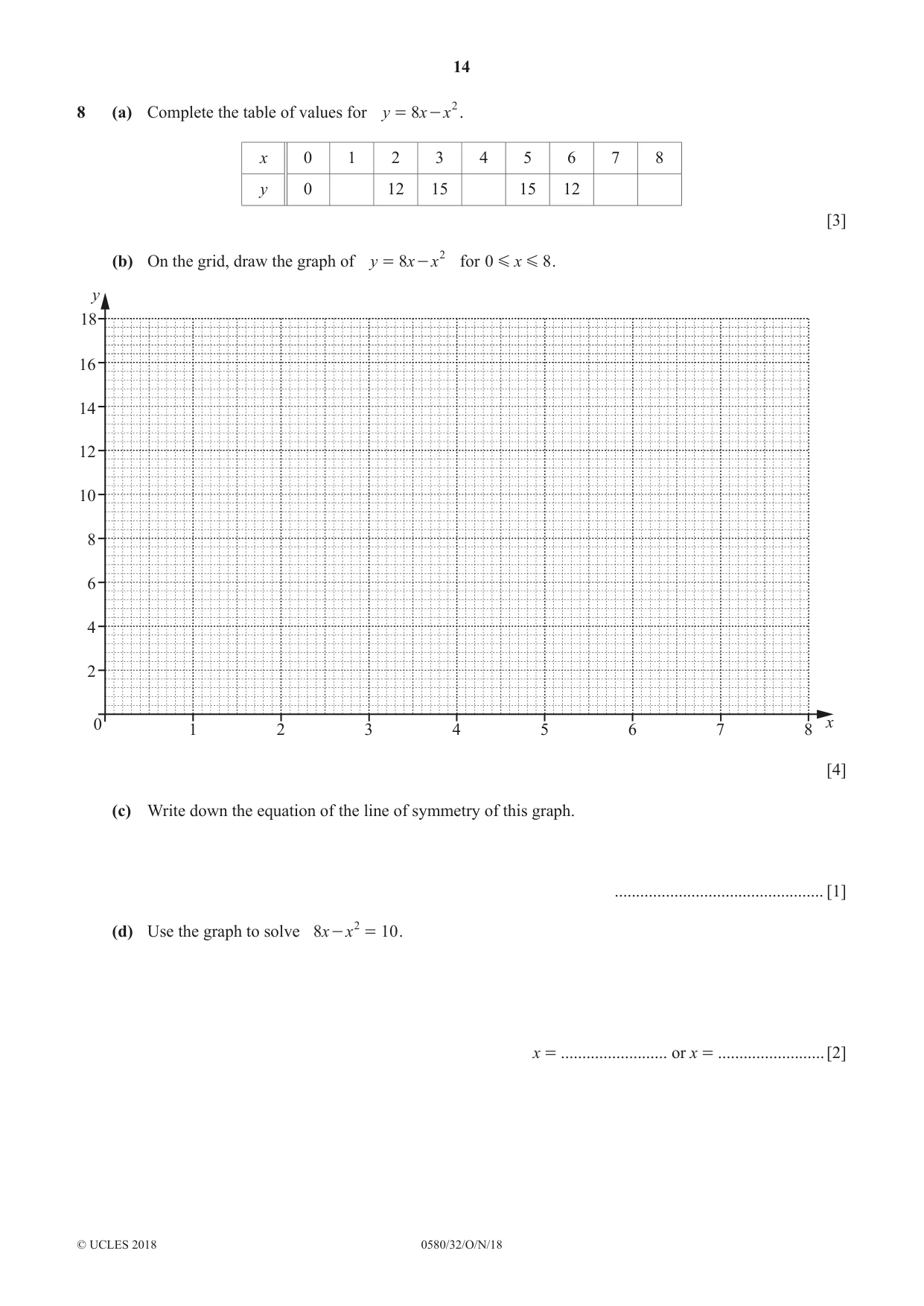
8 (a) Complete the table of values for y = 8x - x 2 . x 0 1 2 3 4 5 6 7 8 y 0 12 15 15 12 [3] (b) On the grid, draw the graph of y = 8x - x 2 for 0 G x G 8 . y 18 16 14 12 10 8 6 4 2 0 x 1 2 3 4 5 6 7 8 [4] (c) Write down the equation of the line of symmetry of this graph. ................................................. [1] (d) Use the graph to solve 8x - x 2 = 10 . x = ......................... or x = ......................... [2]
Mark scheme: 8(a) 7 16 7 0 3 B2 for 2 or 3 correct B1 for 1 correct 8(b) Correct curve 4 B3FT for 8 or 9 points plotted correctly or B2FT for 6 or 7 points plotted correctly or B1FT for 4 or 5 points plotted correctly 8(c) x = 4 1 8(d) 1.45 to 1.65 and 6.35 to 6.55 2 B1 for each or both correct as co-ordinates
Q9 · The diagram shows a right-angled triangle
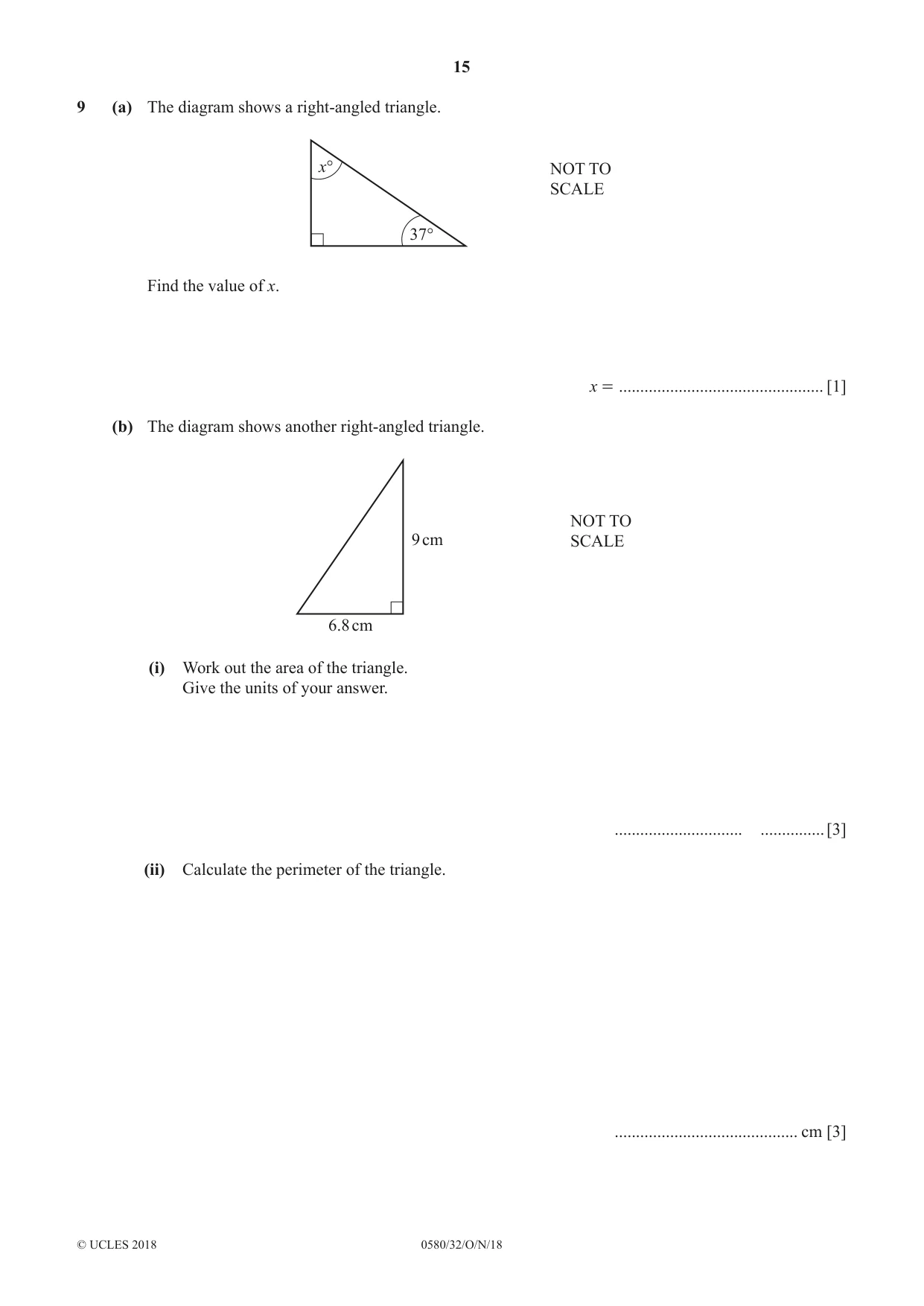
9 (a) The diagram shows a right-angled triangle. x° NOT TO SCALE 37° Find the value of x. x = ................................................ [1] (b) The diagram shows another right-angled triangle. NOT TO 9 cm SCALE 6.8 cm (i) Work out the area of the triangle. Give the units of your answer. .............................. ............... [3] (ii) Calculate the perimeter of the triangle. ........................................... cm [3]
Mark scheme: 9(a) 53 1 9(b)(i) 30.6 2 M1 for 9 × 6.8 ÷ 2 cm2 1 9(b)(ii) 27.1 or 27.08 … 3 2 2 M2 for 6.8 + 9 or M1 for 6.82 + 92 or 127.24 or B1 for 6.8 + 9 + k, where 9 < k < 15.8
What was in this paper
The subtopics covered by these 9 questions, and how many questions each got. Open one in a new tab to see every Cambridge question on it.
What you needed in this session
Cambridge’s own grade thresholds for 2018 Oct/Nov, Paper 3 · Variant 2. A higher threshold means an easier paper — the bar moves with how the cohort did.