Cambridge IGCSE Mathematics 0580 — 2018 Oct/Nov Paper 3 · Variant 3
0580/33/O/N/18 · 9 questions · 104 marks · ≈117 min
The question paper and its mark scheme, free to read here and free to download. This is Cambridge’s own paper, exactly as it was sat.
Question paper16 pages
Mark scheme6 pages
Answers below. Sit the paper first if you are practising.
Questions as text
Q1 · Some people each recorded their favourite holiday destination
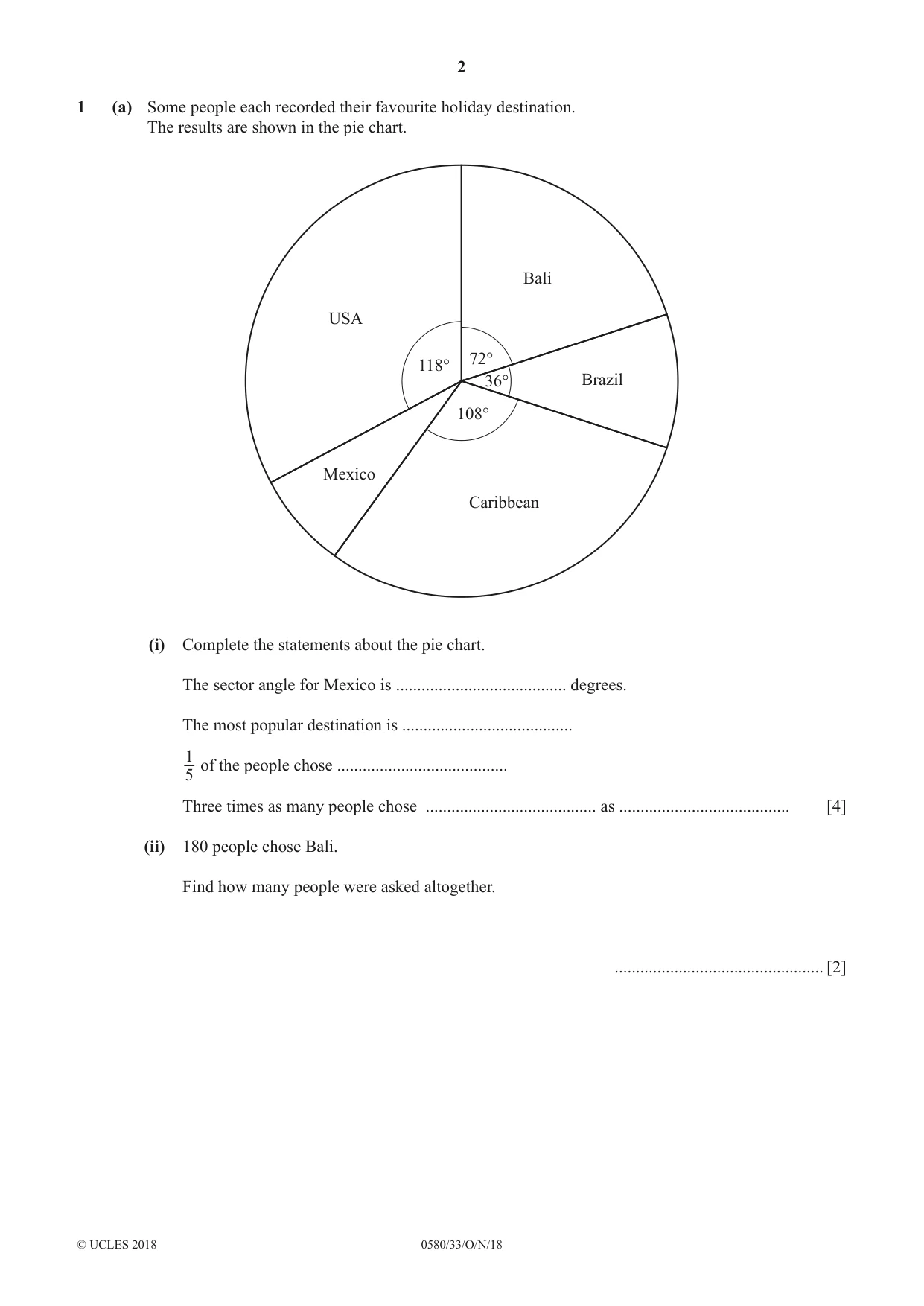
1 (a) Some people each recorded their favourite holiday destination. The results are shown in the pie chart. Bali USA 72° 118° 36° Brazil 108° Mexico Caribbean (i) Complete the statements about the pie chart. The sector angle for Mexico is ........................................ degrees. The most popular destination is ........................................ 1 of the people chose ........................................ 5 Three times as many people chose ........................................ as ........................................ [4] (ii) 180 people chose Bali. Find how many people were asked altogether. ................................................. [2] (b) Mr and Mrs Baker go on holiday with their three children. They fly from Miami to Mexico City. (i) The cost of each adult ticket is $450. The cost of each child ticket is 70% of the cost of an adult ticket. Calculate the total cost of the five tickets. $ ................................................ [3] (ii) The plane leaves Miami at 09 29. It arrives in Mexico City 2 hours 11 minutes later. The local time in Miami is 1 hour ahead of the local time in Mexico City. Work out the time in Mexico City when the plane arrives. ................................................. [2] (iii) The family travels 38 kilometres by taxi. The journey costs $3.50 plus an extra $2.15 for each kilometre travelled. Find the cost of the journey. $ ................................................ [2] (iv) At the end of the holiday Mr Baker changes 1335 pesos into dollars. The exchange rate is $1 = 17.8 pesos. Find how many dollars Mr Baker receives. $ ................................................ [2]
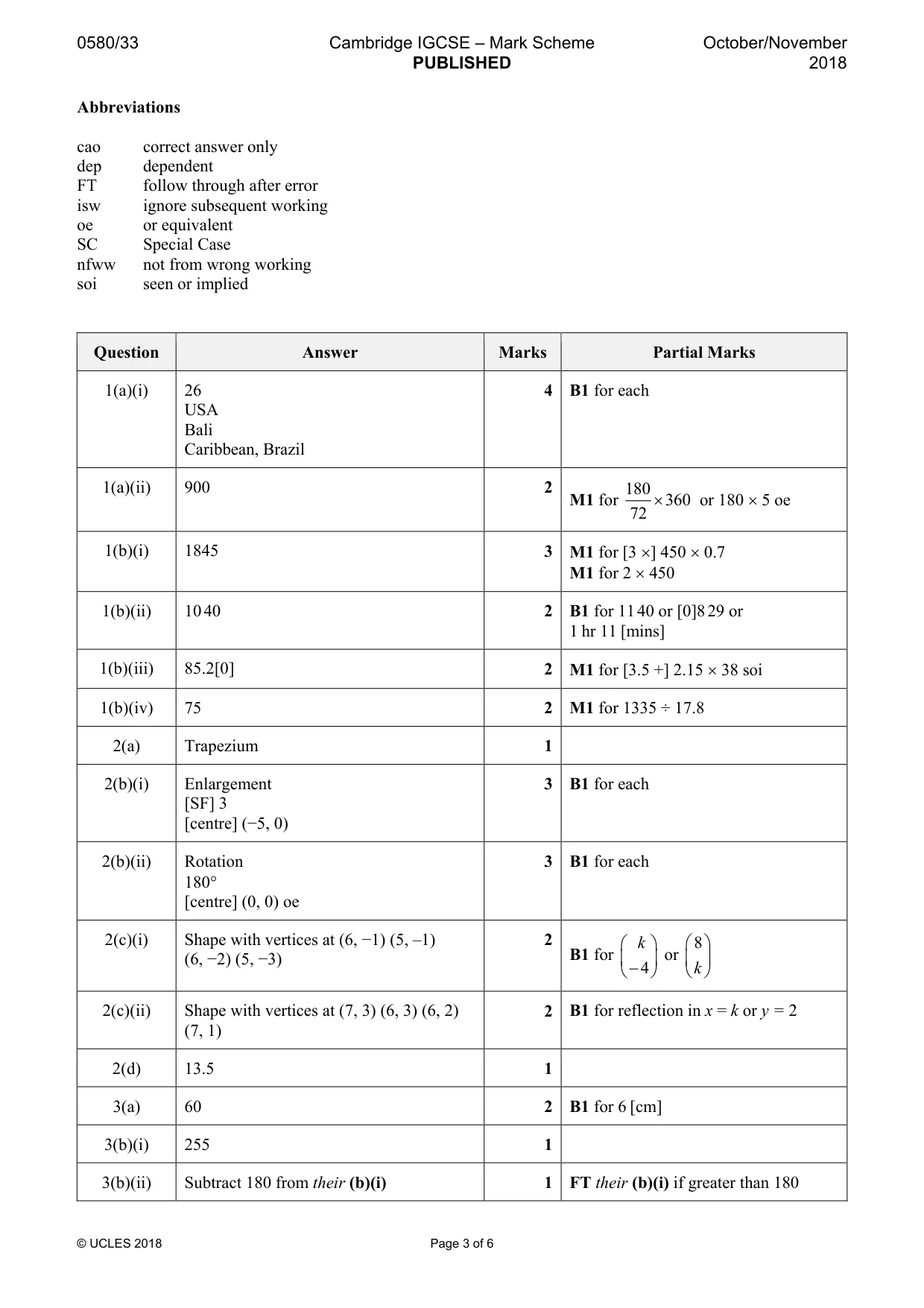
Mark scheme: Question Answer Marks Partial Marks 1(a)(i) 26 4 B1 for each USA Bali Caribbean, Brazil 1(a)(ii) 900 2 180 M1 for × 360 or 180 × 5 oe 72 1(b)(i) 1845 3 M1 for [3 ×] 450 × 0.7 M1 for 2 × 450 1(b)(ii) 10 40 2 B1 for 11 40 or [0]8 29 or 1 hr 11 [mins] 1(b)(iii) 85.2[0] 2 M1 for [3.5 +] 2.15 × 38 soi 1(b)(iv) 75 2 M1 for 1335 ÷ 17.8
Q2 · Shapes A, B and C are shown on the 1 cm2 grid
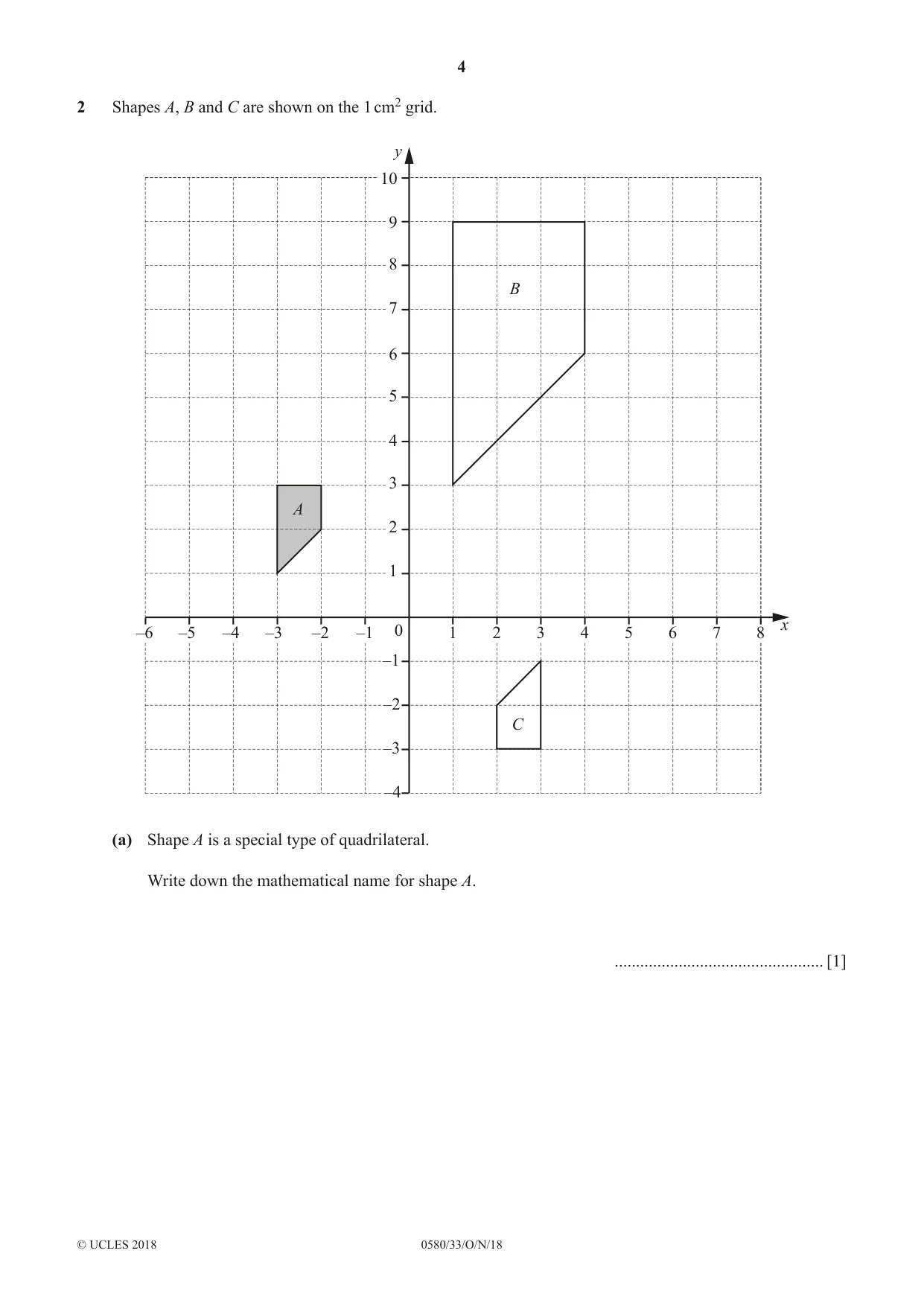
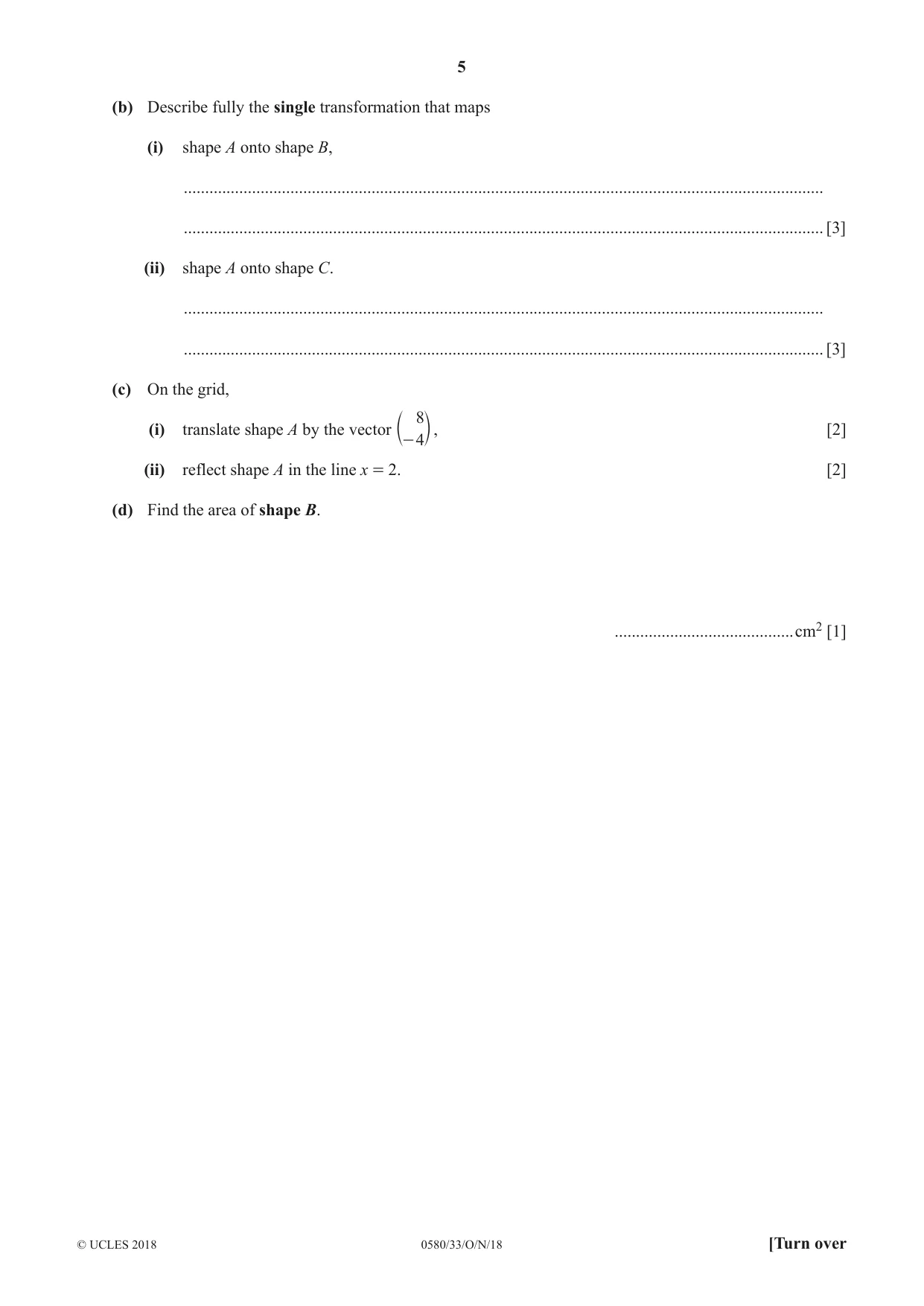
2 Shapes A, B and C are shown on the 1 cm2 grid. y 10 9 8 B 7 6 5 4 3 A 2 1 x –6 –5 –4 –3 –2 –1 0 1 2 3 4 5 6 7 8 –1 –2 C –3 –4 (a) Shape A is a special type of quadrilateral. Write down the mathematical name for shape A. ................................................. [1] (b) Describe fully the single transformation that maps (i) shape A onto shape B, ...................................................................................................................................................... ...................................................................................................................................................... [3] (ii) shape A onto shape C. ...................................................................................................................................................... ...................................................................................................................................................... [3] (c) On the grid, 8 (i) translate shape A by the vector , [2] c- 4m (ii) reflect shape A in the line x = 2. [2] (d) Find the area of shape B. ..........................................cm2 [1]
Mark scheme: 2(a) Trapezium 1 2(b)(i) Enlargement 3 B1 for each [SF] 3 [centre] (−5, 0) 2(b)(ii) Rotation 3 B1 for each 180° [centre] (0, 0) oe 2(c)(i) Shape with vertices at (6, −1) (5, –1) 2 k 8 (6, −2) (5, −3) B1 for or − 4 k 2(c)(ii) Shape with vertices at (7, 3) (6, 3) (6, 2) 2 B1 for reflection in x = k or y = 2 (7, 1) 2(d) 13.5 1
Q3 · The scale drawing shows the positions of three towns A, B and C on a map
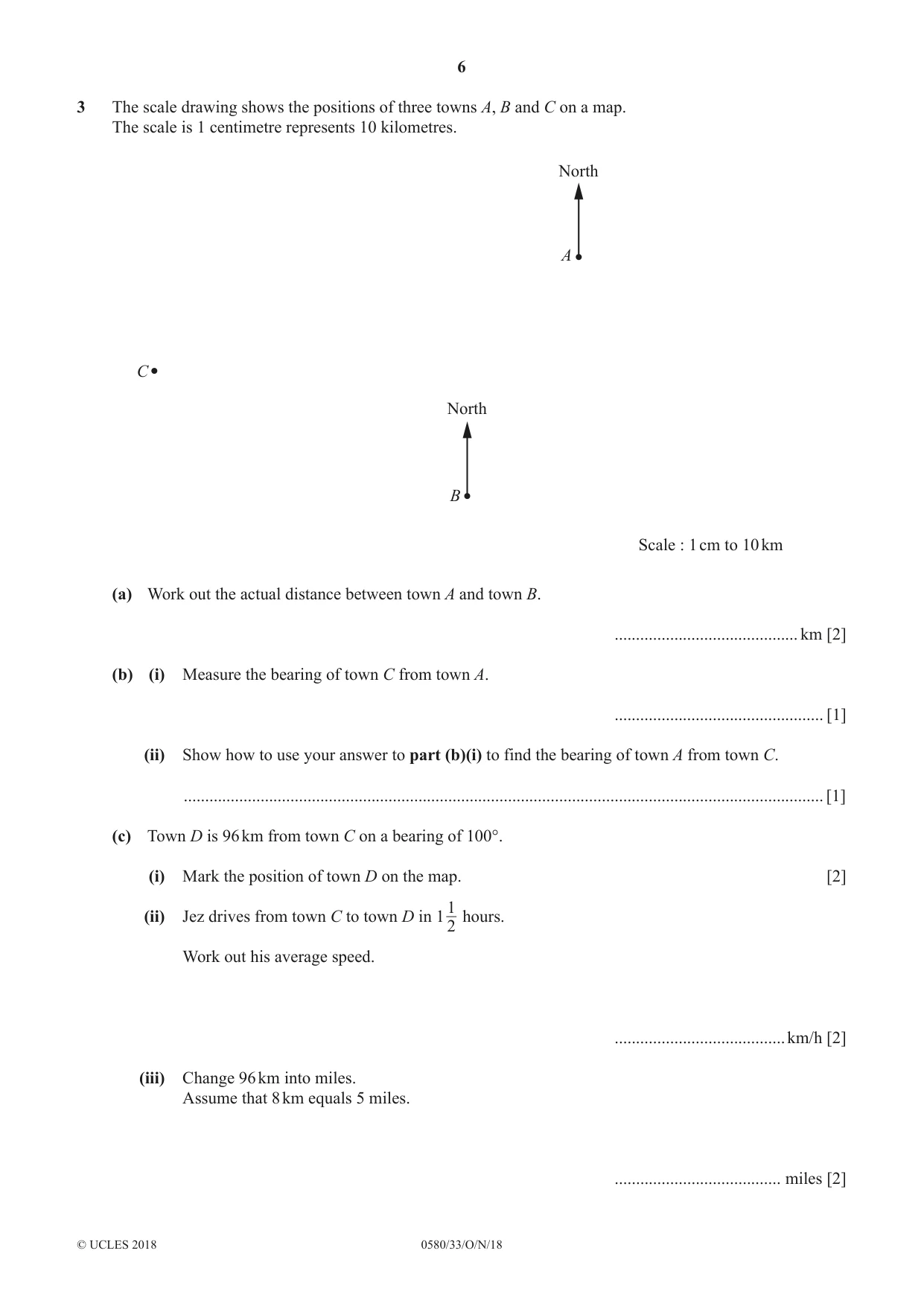
3 The scale drawing shows the positions of three towns A, B and C on a map. The scale is 1 centimetre represents 10 kilometres. North A C North B Scale : 1 cm to 10 km (a) Work out the actual distance between town A and town B. ........................................... km [2] (b) (i) Measure the bearing of town C from town A. ................................................. [1] (ii) Show how to use your answer to part (b)(i) to find the bearing of town A from town C. ...................................................................................................................................................... [1] (c) Town D is 96 km from town C on a bearing of 100°. (i) Mark the position of town D on the map. [2] 1 (ii) Jez drives from town C to town D in 1 hours. 2 Work out his average speed. ........................................km/h [2] (iii) Change 96 km into miles. Assume that 8 km equals 5 miles. ....................................... miles [2]
Mark scheme: 3(a) 60 2 B1 for 6 [cm] 3(b)(i) 255 1 3(b)(ii) Subtract 180 from their (b)(i) 1 FT their (b)(i) if greater than 180 3(c)(i) D in correct position 2 B1 for D 9.6 cm from C B1 for D 100° from C 3(c)(ii) 64 2 M1 for 96 ÷ 1.5 oe 3(c)(iii) 60 2 M1 for 96 ÷ 8 × 5 oe
Q4 · The diagram shows the first three patterns in a sequence
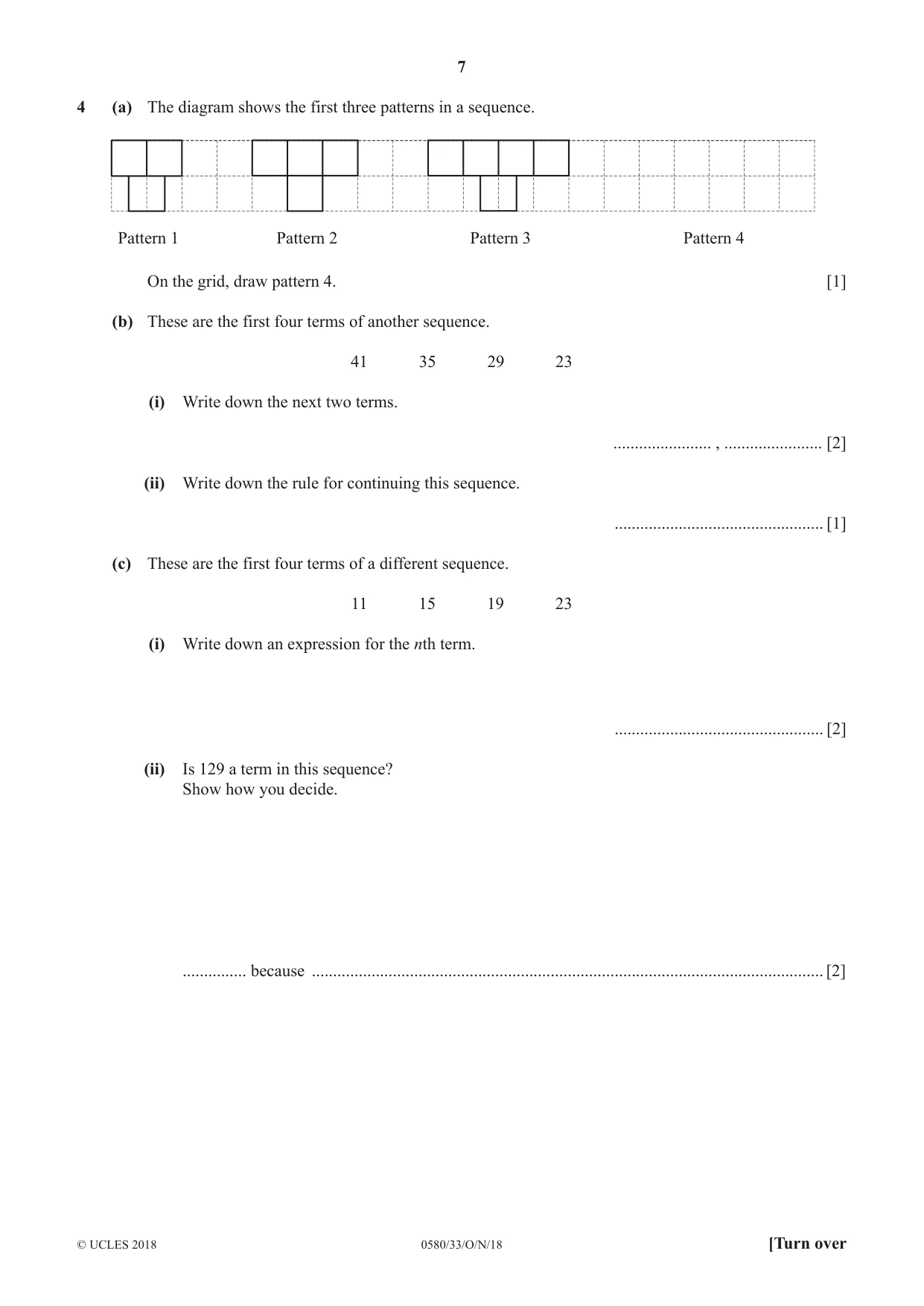
4 (a) The diagram shows the first three patterns in a sequence. Pattern 1 Pattern 2 Pattern 3 Pattern 4 On the grid, draw pattern 4. [1] (b) These are the first four terms of another sequence. 41 35 29 23 (i) Write down the next two terms. ....................... , ....................... [2] (ii) Write down the rule for continuing this sequence. ................................................. [1] (c) These are the first four terms of a different sequence. 11 15 19 23 (i) Write down an expression for the nth term. ................................................. [2] (ii) Is 129 a term in this sequence? Show how you decide. ............... because ........................................................................................................................ [2]
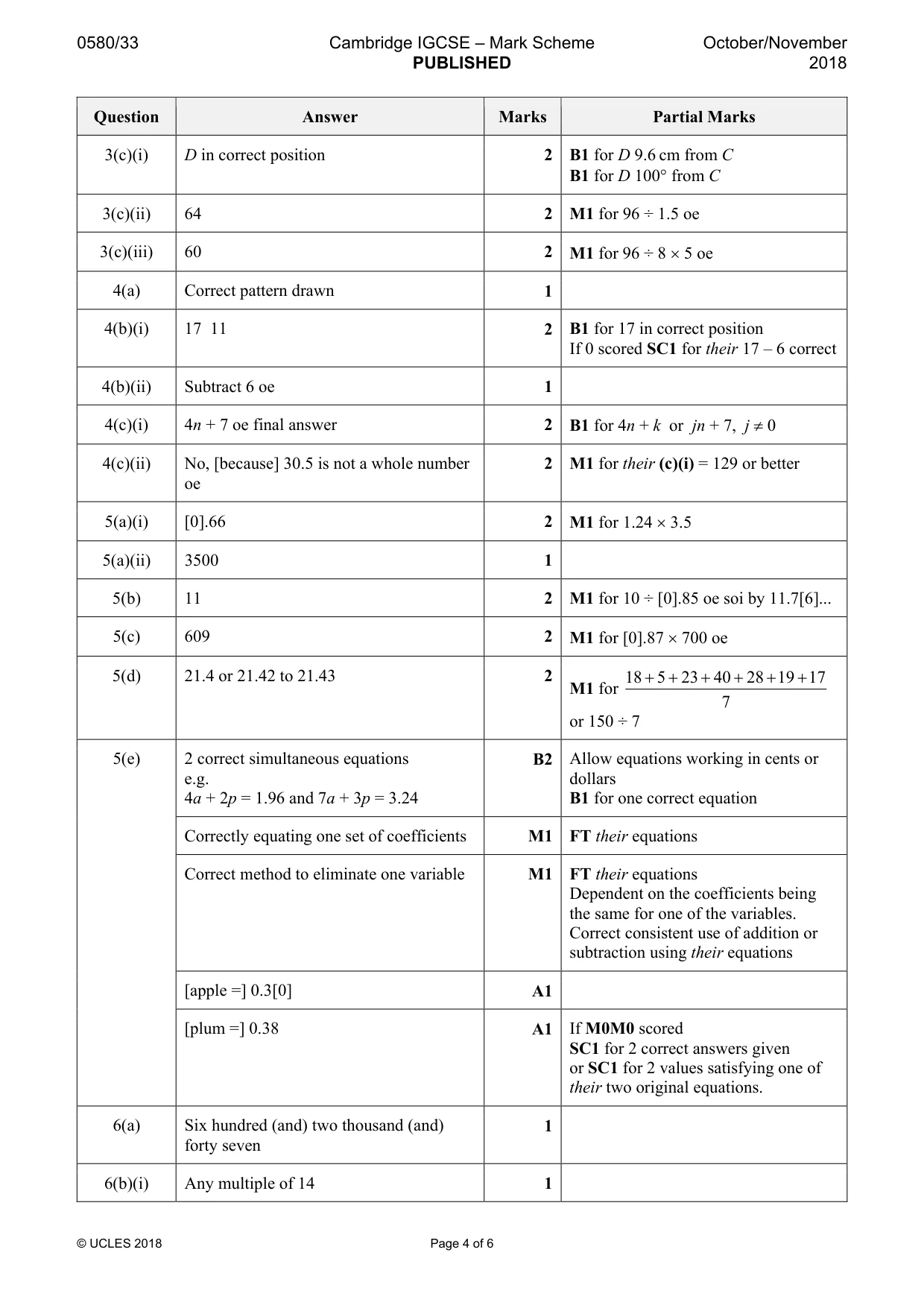
Mark scheme: 4(a) Correct pattern drawn 1 4(b)(i) 17 11 2 B1 for 17 in correct position If 0 scored SC1 for their 17 – 6 correct 4(b)(ii) Subtract 6 oe 1 4(c)(i) 4n + 7 oe final answer 2 B1 for 4n + k or jn + 7, j ≠ 0 4(c)(ii) No, [because] 30.5 is not a whole number 2 M1 for their (c)(i) = 129 or better oe
Q5 · Stef buys 3.5 kilograms of bananas
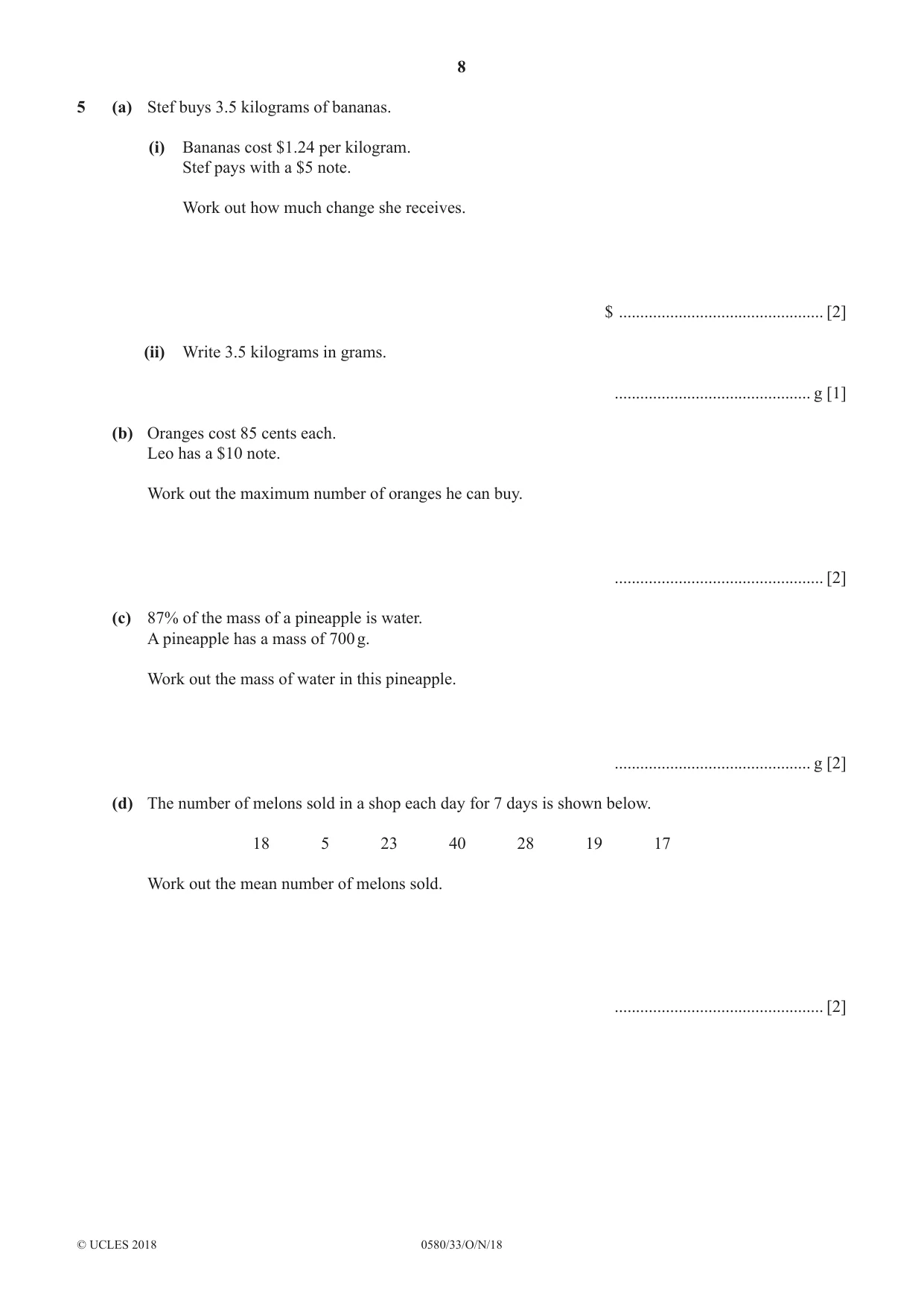
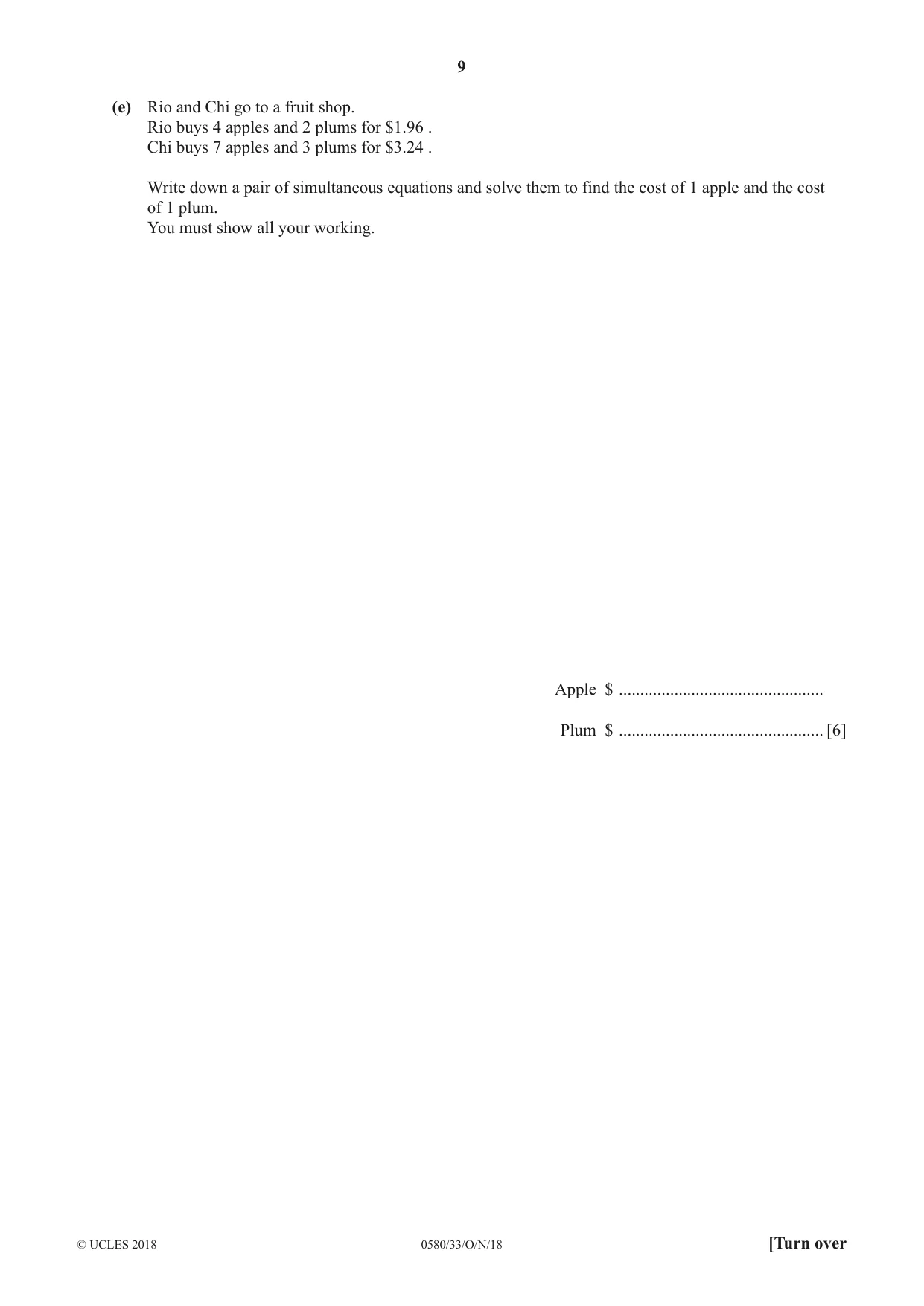
5 (a) Stef buys 3.5 kilograms of bananas. (i) Bananas cost $1.24 per kilogram. Stef pays with a $5 note. Work out how much change she receives. $ ................................................ [2] (ii) Write 3.5 kilograms in grams. .............................................. g [1] (b) Oranges cost 85 cents each. Leo has a $10 note. Work out the maximum number of oranges he can buy. ................................................. [2] (c) 87% of the mass of a pineapple is water. A pineapple has a mass of 700 g. Work out the mass of water in this pineapple. .............................................. g [2] (d) The number of melons sold in a shop each day for 7 days is shown below. 18 5 23 40 28 19 17 Work out the mean number of melons sold. ................................................. [2] (e) Rio and Chi go to a fruit shop. Rio buys 4 apples and 2 plums for $1.96 . Chi buys 7 apples and 3 plums for $3.24 . Write down a pair of simultaneous equations and solve them to find the cost of 1 apple and the cost of 1 plum. You must show all your working. Apple $ ................................................ Plum $ ................................................ [6]
Mark scheme: 5(a)(i) [0].66 2 M1 for 1.24 × 3.5 5(a)(ii) 3500 1 5(b) 11 2 M1 for 10 ÷ [0].85 oe soi by 11.7[6]... 5(c) 609 2 M1 for [0].87 × 700 oe 5(d) 21.4 or 21.42 to 21.43 2 18 + 5 + 23 + 40 + 28 + 19 + 17 M1 for 7 or 150 ÷ 7 5(e) 2 correct simultaneous equations B2 Allow equations working in cents or e.g. dollars 4a + 2p = 1.96 and 7a + 3p = 3.24 B1 for one correct equation Correctly equating one set of coefficients M1 FT their equations Correct method to eliminate one variable M1 FT their equations Dependent on the coefficients being the same for one of the variables. Correct consistent use of addition or subtraction using their equations [apple =] 0.3[0] A1 [plum =] 0.38 A1 If M0M0 scored SC1 for 2 correct answers given or SC1 for 2 values satisfying one of their two original equations.
Q6 · Write the number 602 047 in words
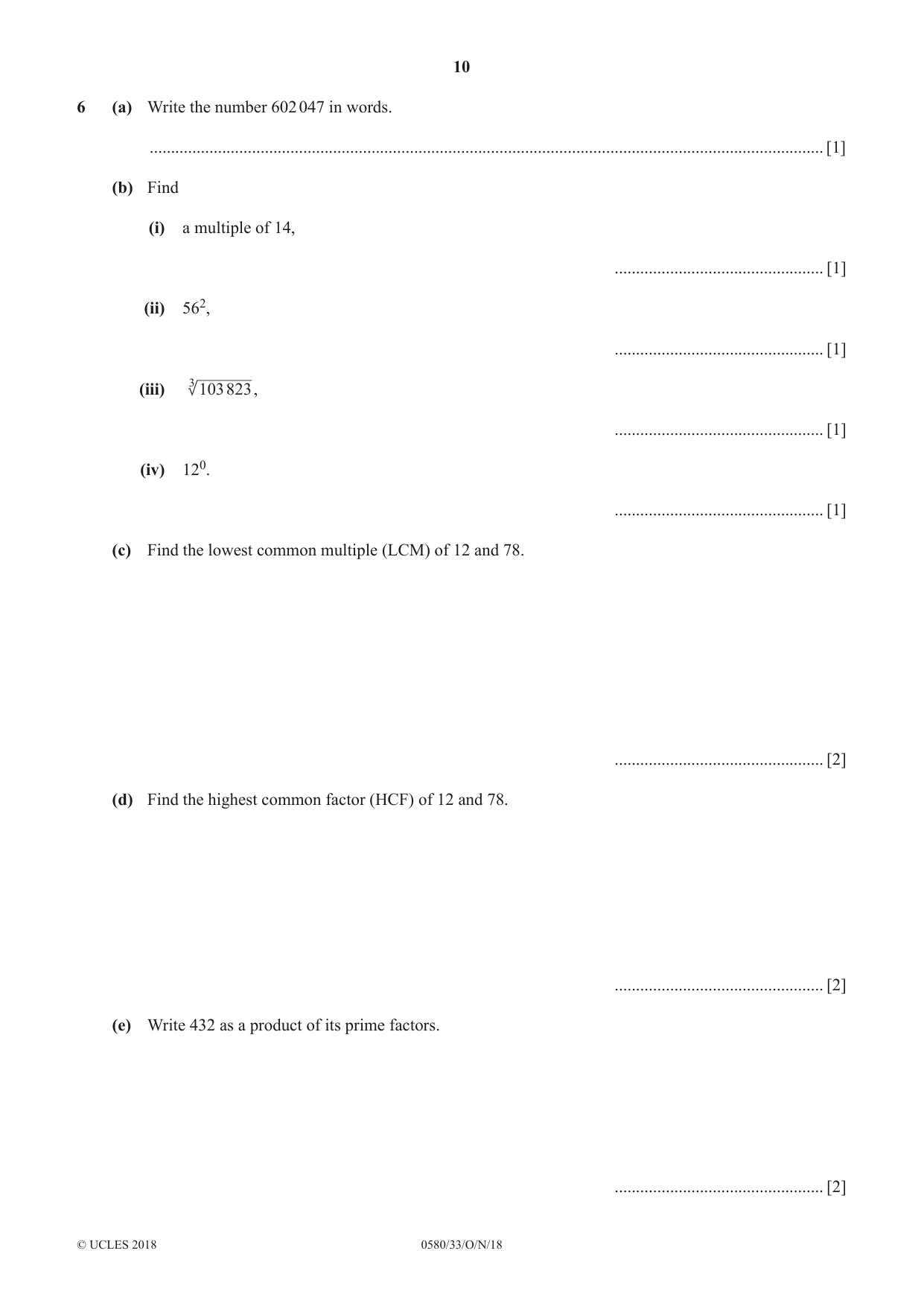
6 (a) Write the number 602 047 in words. .............................................................................................................................................................. [1] (b) Find (i) a multiple of 14, ................................................. [1] (ii) 562, ................................................. [1] (iii) 3 103823 , ................................................. [1] (iv) 120. ................................................. [1] (c) Find the lowest common multiple (LCM) of 12 and 78. ................................................. [2] (d) Find the highest common factor (HCF) of 12 and 78. ................................................. [2] (e) Write 432 as a product of its prime factors. ................................................. [2]
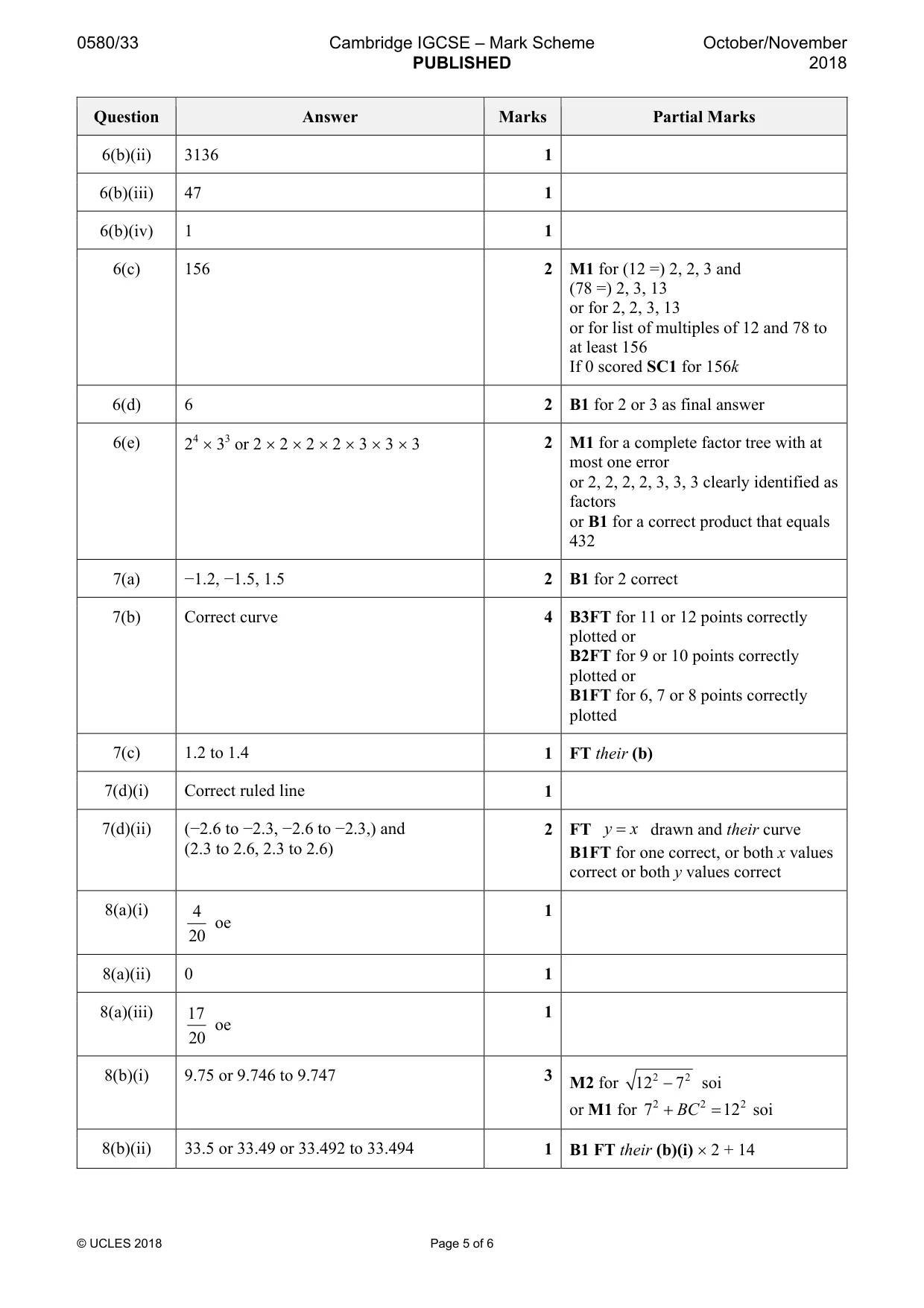
Mark scheme: 6(a) Six hundred (and) two thousand (and) 1 forty seven 6(b)(i) Any multiple of 14 1 6(b)(ii) 3136 1 6(b)(iii) 47 1 6(b)(iv) 1 1 6(c) 156 2 M1 for (12 =) 2, 2, 3 and (78 =) 2, 3, 13 or for 2, 2, 3, 13 or for list of multiples of 12 and 78 to at least 156 If 0 scored SC1 for 156k 6(d) 6 2 B1 for 2 or 3 as final answer 6(e) 24 × 33 or 2 × 2 × 2 × 2 × 3 × 3 × 3 2 M1 for a complete factor tree with at most one error or 2, 2, 2, 2, 3, 3, 3 clearly identified as factors or B1 for a correct product that equals 432
Q7 · Complete the table of values for y =
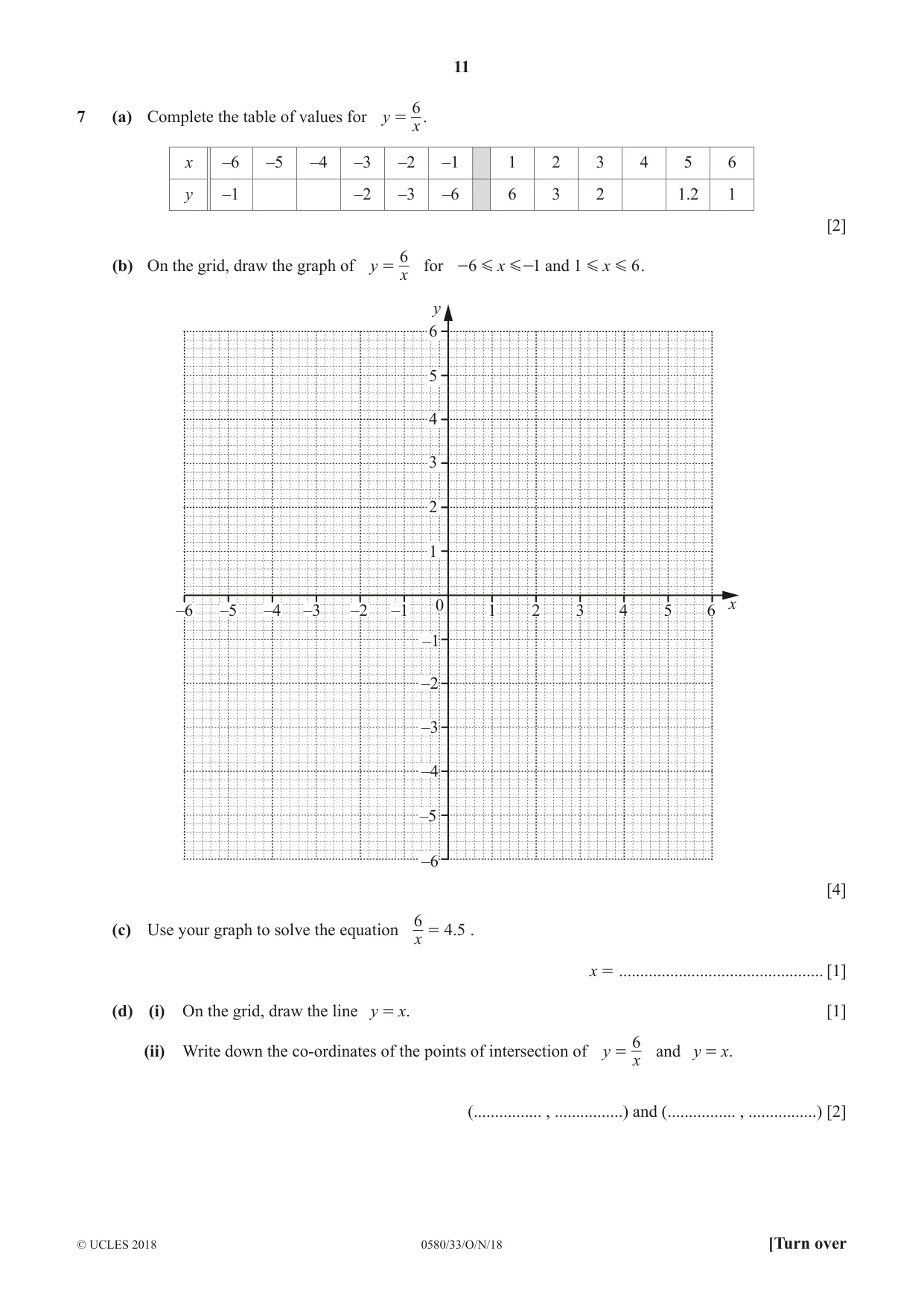
67 (a) Complete the table of values for y = . x x –6 –5 –4 –3 –2 –1 1 2 3 4 5 6 y –1 –2 –3 –6 6 3 2 1.2 1 [2] 6 (b) On the grid, draw the graph of y = for -6 G x G -1 and 1 G x G 6 . x y 6 5 4 3 2 1 0 x –6 –5 –4 –3 –2 –1 1 2 3 4 5 6 –1 –2 –3 –4 –5 –6 [4] 6 (c) Use your graph to solve the equation = 4. 5 . x x = ................................................ [1] (d) (i) On the grid, draw the line y = x. [1] 6 (ii) Write down the co-ordinates of the points of intersection of y = and y = x. x (................ , ................) and (................ , ................) [2]
Mark scheme: 7(a) −1.2, −1.5, 1.5 2 B1 for 2 correct 7(b) Correct curve 4 B3FT for 11 or 12 points correctly plotted or B2FT for 9 or 10 points correctly plotted or B1FT for 6, 7 or 8 points correctly plotted 7(c) 1.2 to 1.4 1 FT their (b) 7(d)(i) Correct ruled line 1 7(d)(ii) (−2.6 to −2.3, −2.6 to −2.3,) and 2 FT y = x drawn and their curve (2.3 to 2.6, 2.3 to 2.6) B1FT for one correct, or both x values correct or both y values correct
Q8 · A bag contains 20 bulbs
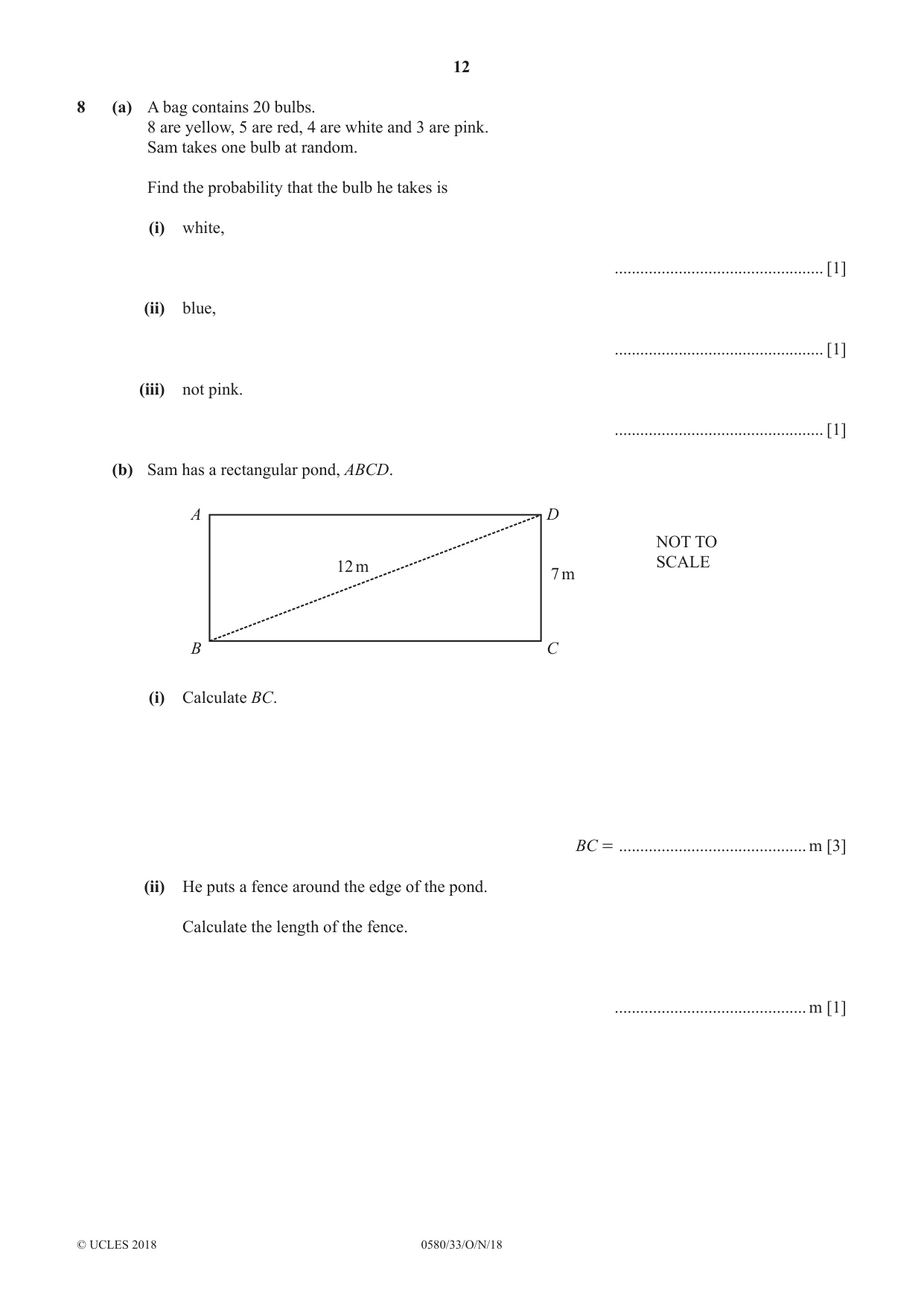
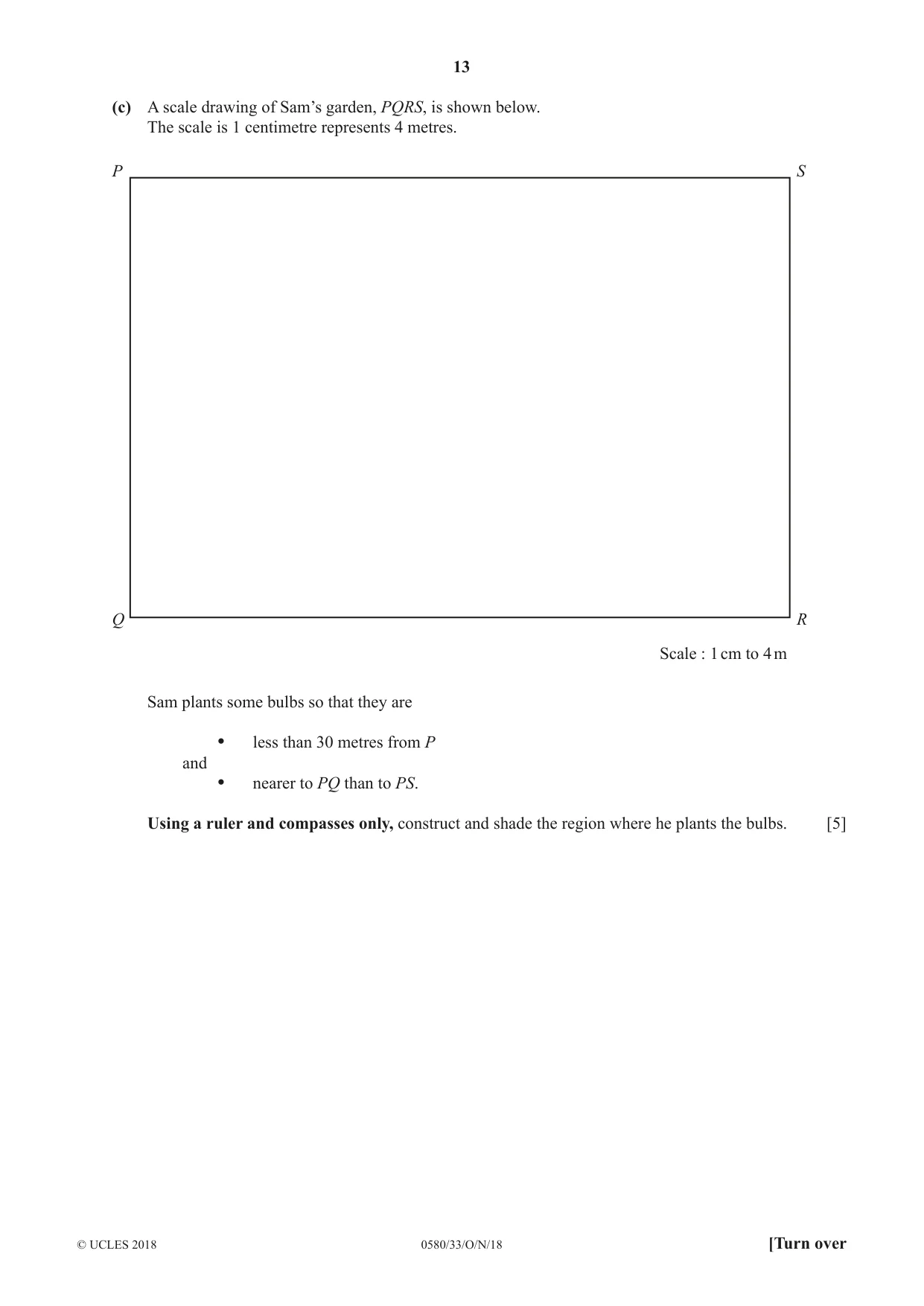
8 (a) A bag contains 20 bulbs. 8 are yellow, 5 are red, 4 are white and 3 are pink. Sam takes one bulb at random. Find the probability that the bulb he takes is (i) white, ................................................. [1] (ii) blue, ................................................. [1] (iii) not pink. ................................................. [1] (b) Sam has a rectangular pond, ABCD. A D NOT TO 12 m SCALE 7 m B C (i) Calculate BC. BC = ............................................ m [3] (ii) He puts a fence around the edge of the pond. Calculate the length of the fence. ............................................. m [1] (c) A scale drawing of Sam’s garden, PQRS, is shown below. The scale is 1 centimetre represents 4 metres. P S Q R Scale : 1 cm to 4 m Sam plants some bulbs so that they are • less than 30 metres from P and • nearer to PQ than to PS. Using a ruler and compasses only, construct and shade the region where he plants the bulbs. [5]
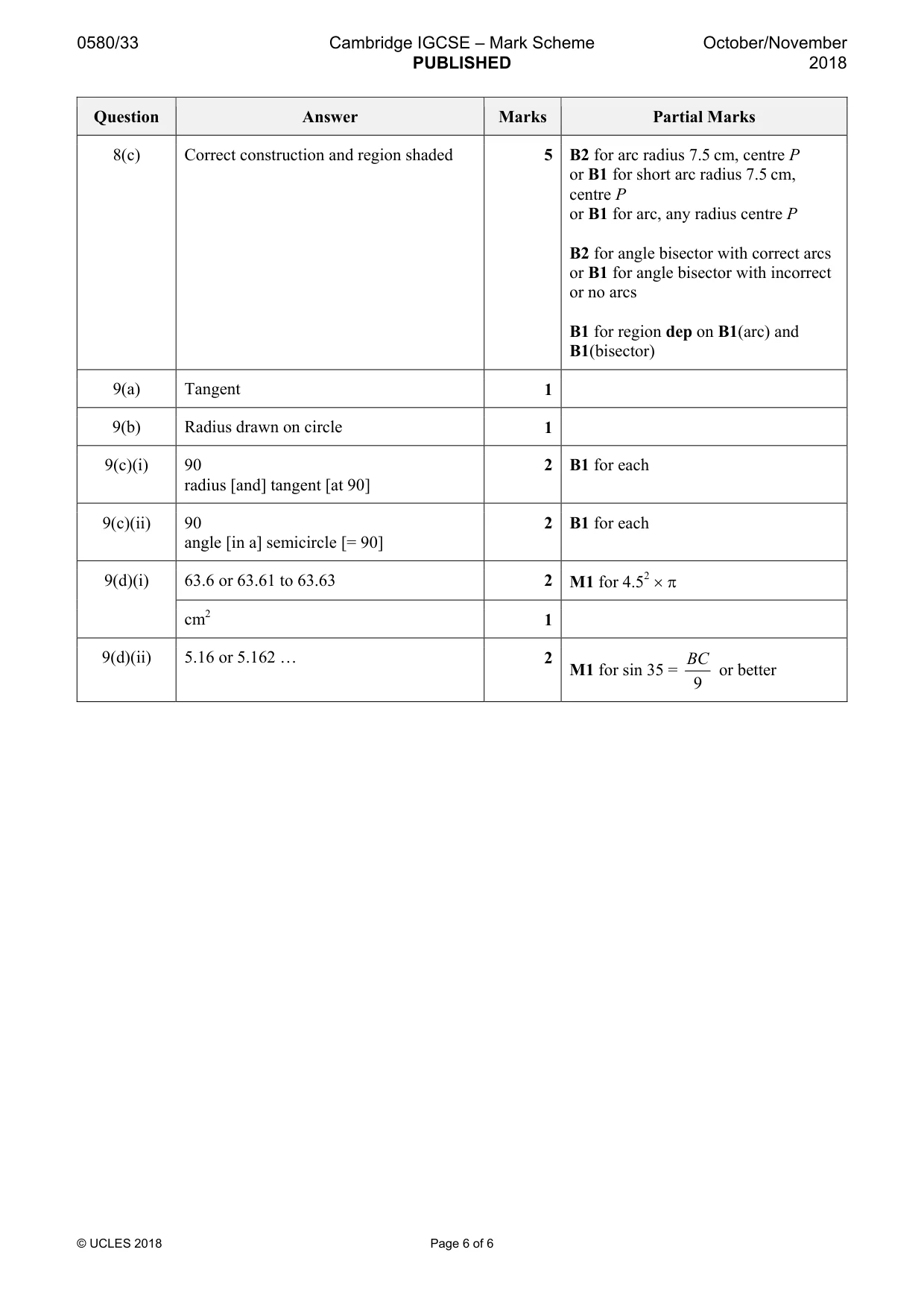
Mark scheme: 8(a)(i) 4 1 oe 20 8(a)(ii) 0 1 8(a)(iii) 17 1 oe 20 8(b)(i) 9.75 or 9.746 to 9.747 3 2 2 M2 for 12 − 7 soi or M1 for 7 2 + BC 2 = 12 2 soi 8(b)(ii) 33.5 or 33.49 or 33.492 to 33.494 1 B1 FT their (b)(i) × 2 + 14 8(c) Correct construction and region shaded 5 B2 for arc radius 7.5 cm, centre P or B1 for short arc radius 7.5 cm, centre P or B1 for arc, any radius centre P B2 for angle bisector with correct arcs or B1 for angle bisector with incorrect or no arcs B1 for region dep on B1(arc) and B1(bisector)
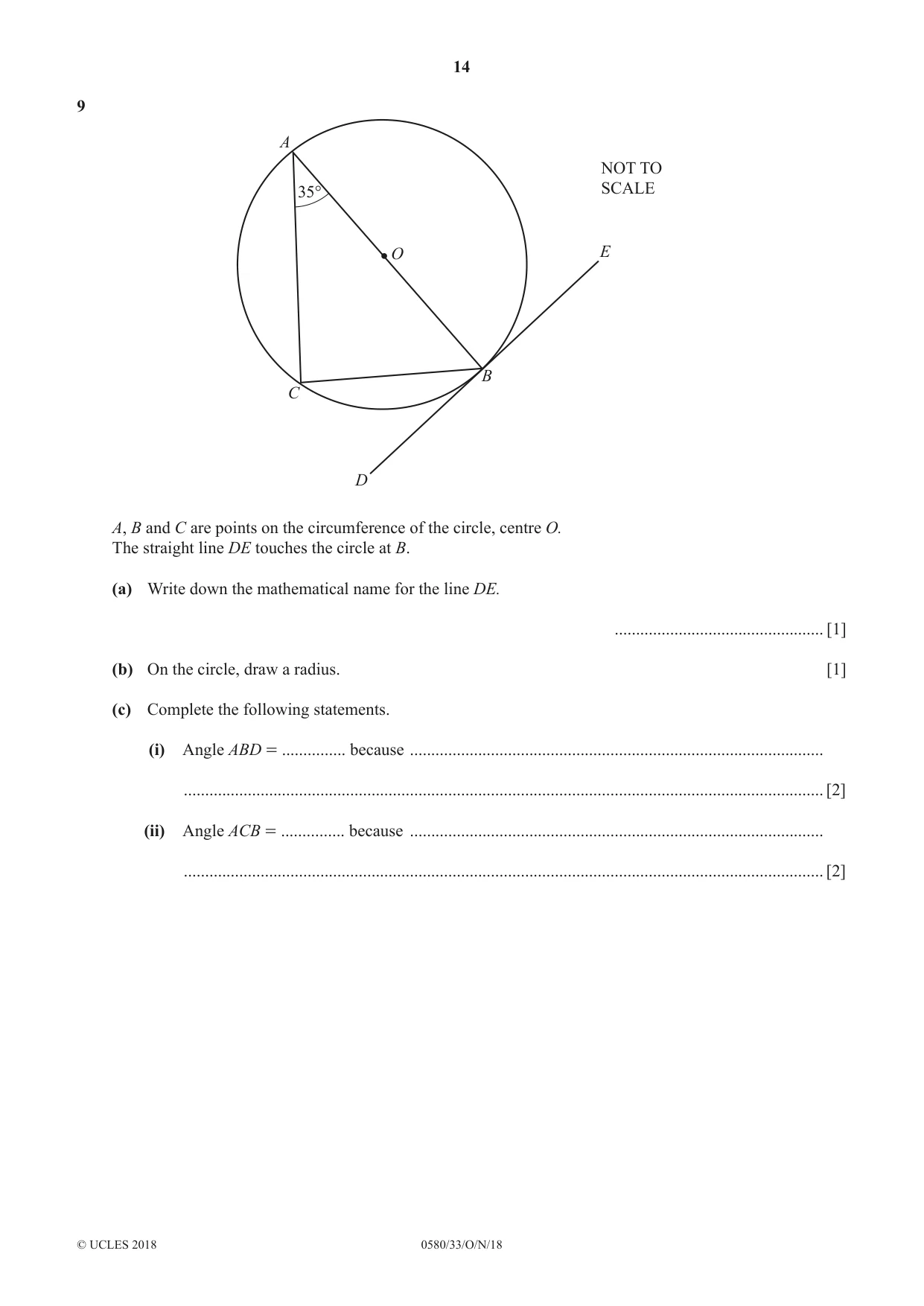
Q9 · A NOT TO 35° SCALE O E B C D A, B and C are points on the circumference of the circle…
9 A NOT TO 35° SCALE O E B C D A, B and C are points on the circumference of the circle, centre O. The straight line DE touches the circle at B. (a) Write down the mathematical name for the line DE. ................................................. [1] (b) On the circle, draw a radius. [1] (c) Complete the following statements. (i) Angle ABD = ............... because ................................................................................................. ...................................................................................................................................................... [2] (ii) Angle ACB = ............... because ................................................................................................. ...................................................................................................................................................... [2] (d) AB = 9 cm. (i) Calculate the area of the circle. Give the units of your answer. ............................ .................. [3] (ii) Calculate BC. BC = .......................................... cm [2]
Mark scheme: 9(a) Tangent 1 9(b) Radius drawn on circle 1 9(c)(i) 90 2 B1 for each radius [and] tangent [at 90] 9(c)(ii) 90 2 B1 for each angle [in a] semicircle [= 90] 9(d)(i) 63.6 or 63.61 to 63.63 2 M1 for 4.52 × π cm2 1 9(d)(ii) 5.16 or 5.162 … 2 BC M1 for sin 35 = or better 9
What was in this paper
The subtopics covered by these 9 questions, and how many questions each got. Open one in a new tab to see every Cambridge question on it.
What you needed in this session
Cambridge’s own grade thresholds for 2018 Oct/Nov, Paper 3 · Variant 3. A higher threshold means an easier paper — the bar moves with how the cohort did.