Cambridge IGCSE Mathematics 0580 — 2018 May/June Paper 3 · Variant 1
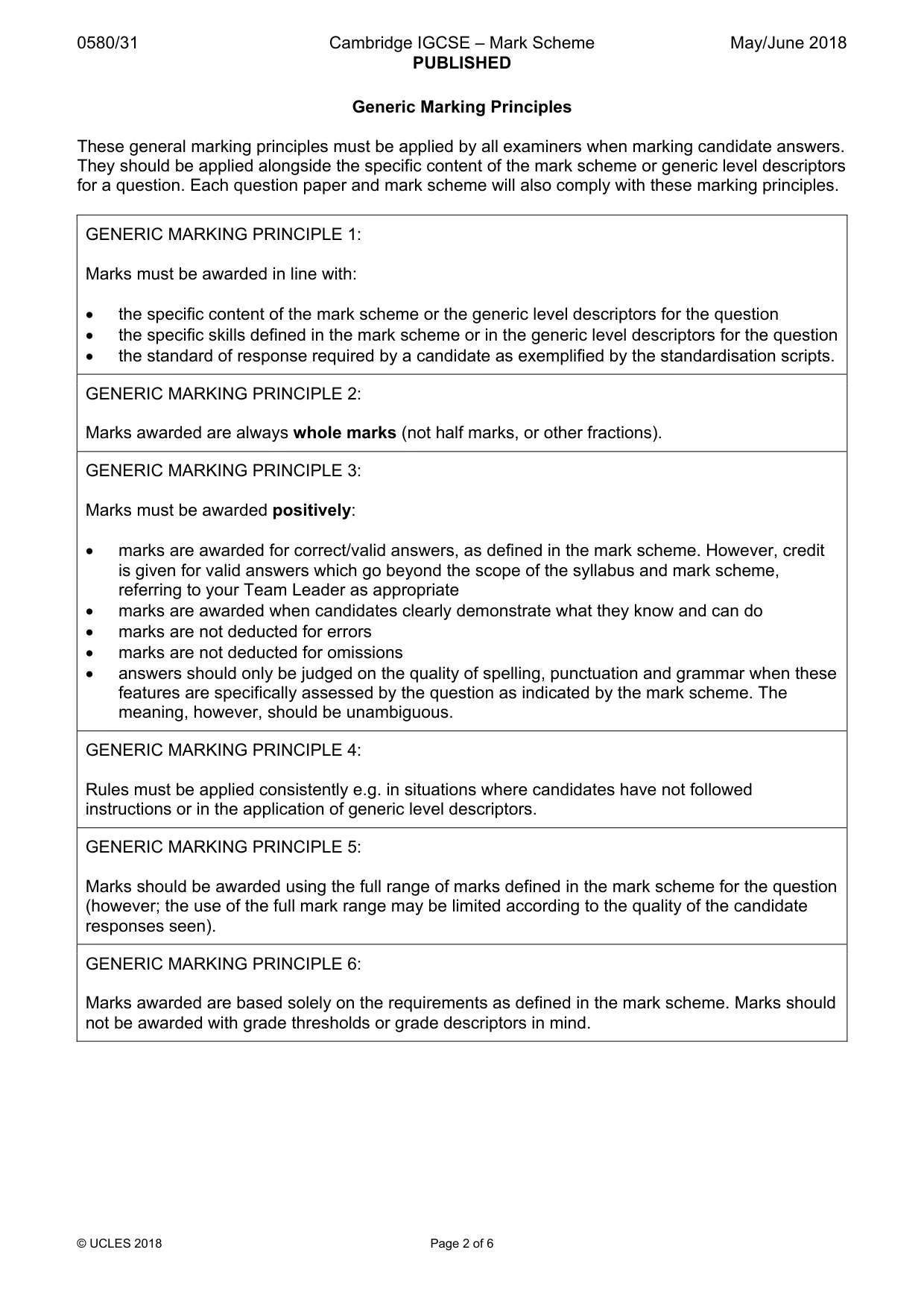
0580/31/M/J/18 · 10 questions · 104 marks · ≈117 min
The question paper and its mark scheme, free to read here and free to download. This is Cambridge’s own paper, exactly as it was sat.
Question paper20 pages

Mark scheme6 pages
Answers below. Sit the paper first if you are practising.
Questions as text
Q1 · Mr Marr asks his mathematics class to complete a statistics project about books
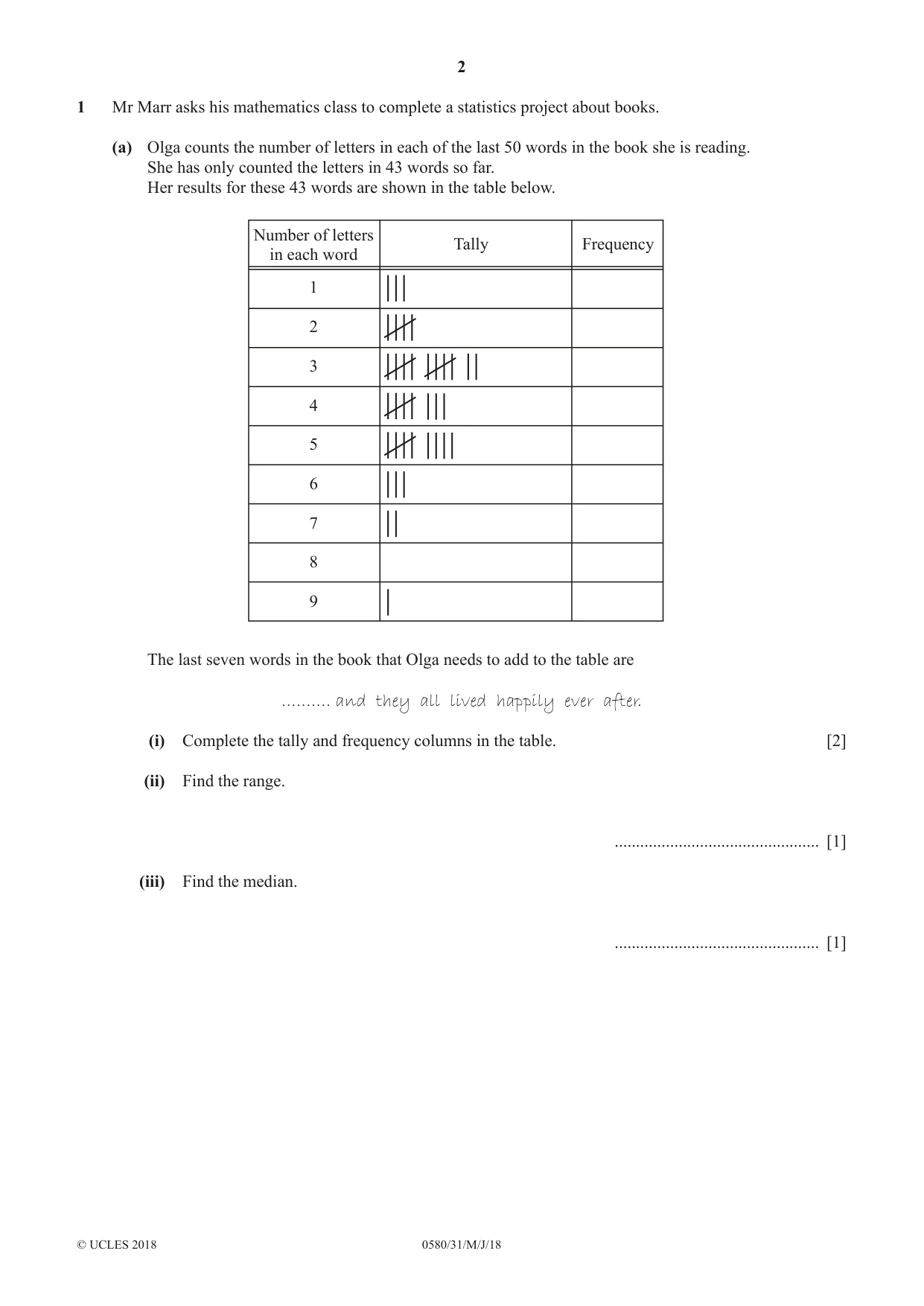
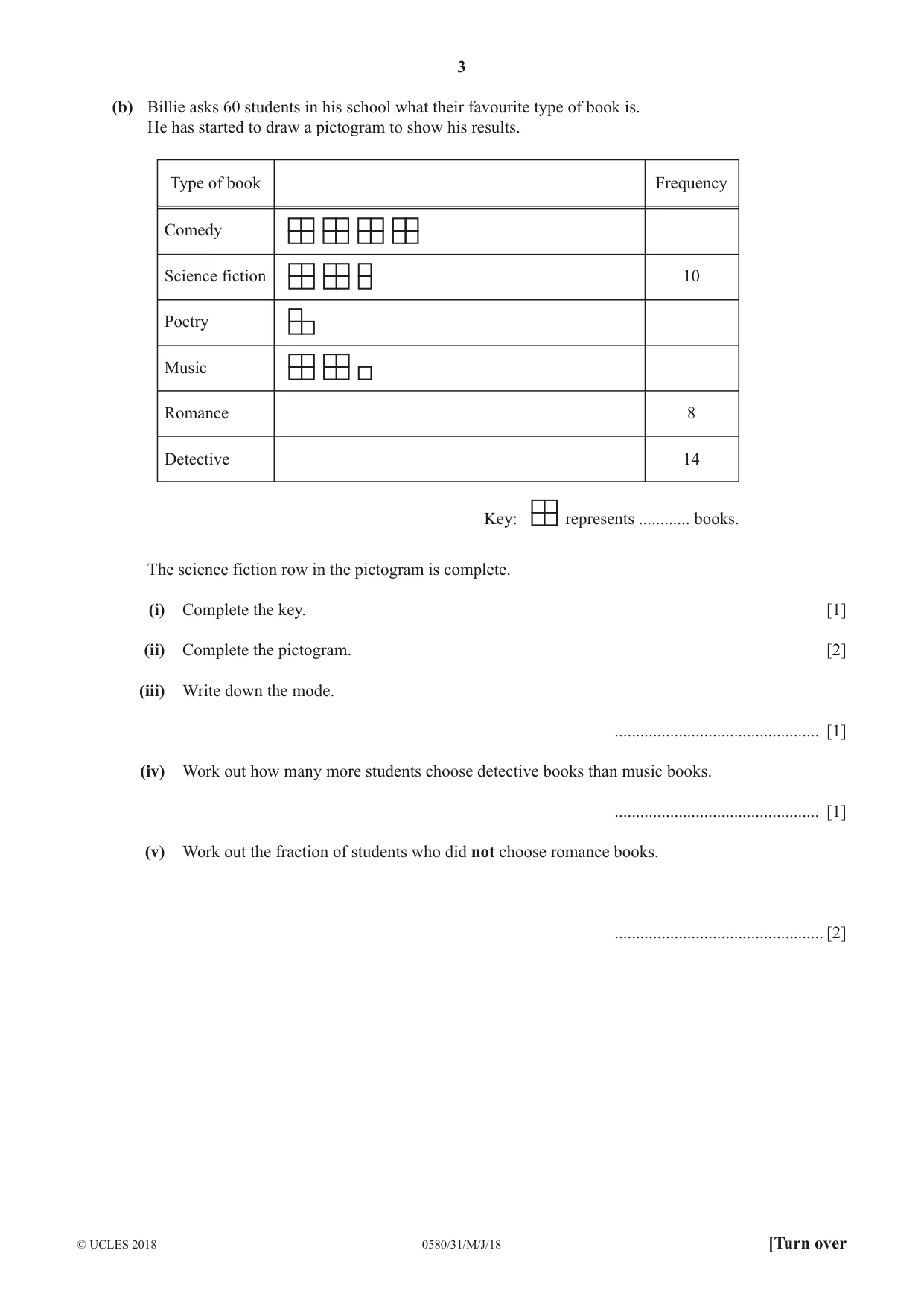
1 Mr Marr asks his mathematics class to complete a statistics project about books. (a) Olga counts the number of letters in each of the last 50 words in the book she is reading. She has only counted the letters in 43 words so far. Her results for these 43 words are shown in the table below. Number of letters Tally Frequency in each word 1 2 3 4 5 6 7 8 9 The last seven words in the book that Olga needs to add to the table are ………. and they all lived happily ever after. (i) Complete the tally and frequency columns in the table. [2] (ii) Find the range. ................................................ [1] (iii) Find the median. ................................................ [1] (b) Billie asks 60 students in his school what their favourite type of book is. He has started to draw a pictogram to show his results. Type of book Frequency Comedy Science fiction 10 Poetry Music Romance 8 Detective 14 Key: represents ............ books. The science fiction row in the pictogram is complete. (i) Complete the key. [1] (ii) Complete the pictogram. [2] (iii) Write down the mode. ................................................ [1] (iv) Work out how many more students choose detective books than music books. ................................................ [1] (v) Work out the fraction of students who did not choose romance books. ................................................. [2]
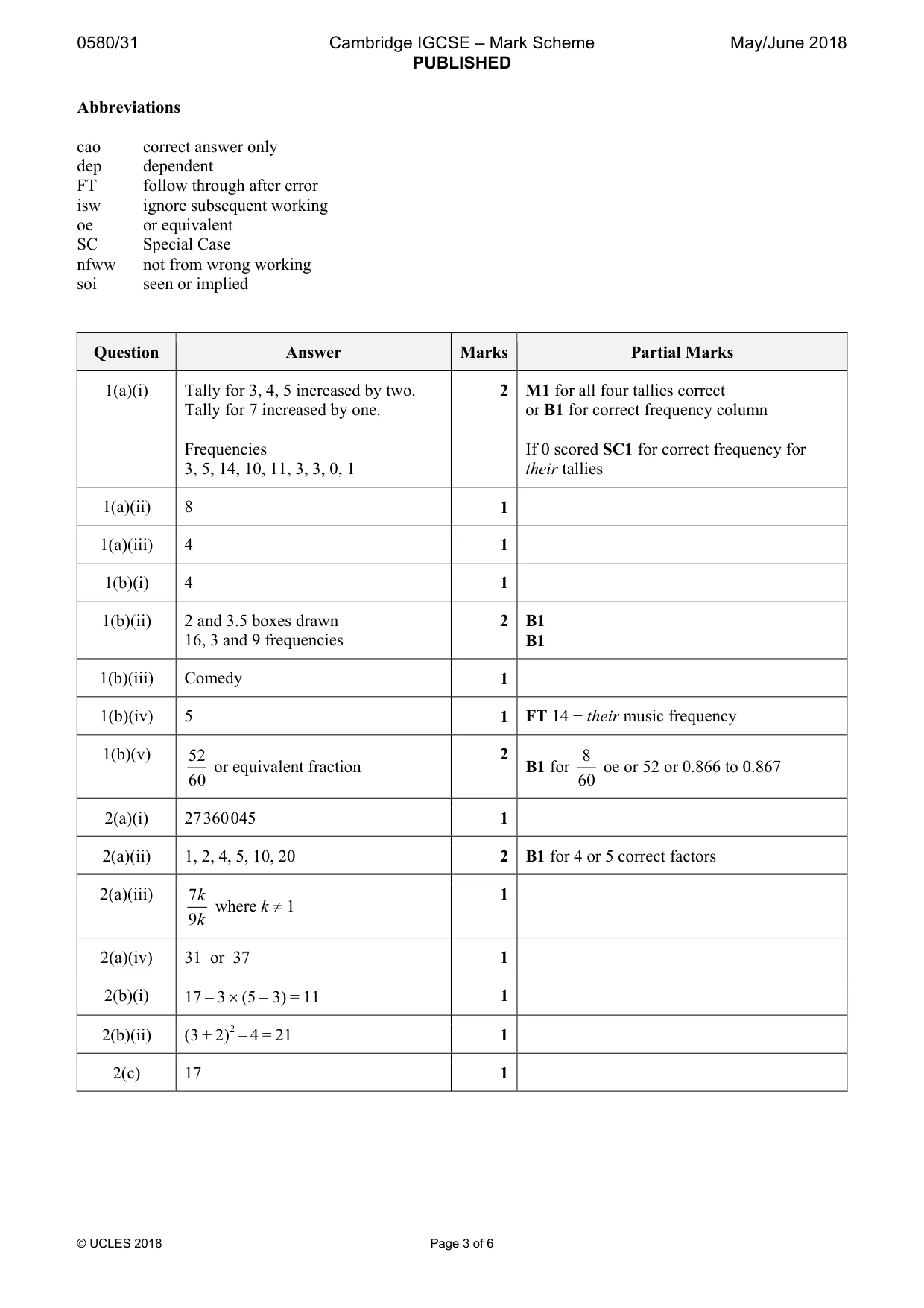
Mark scheme: Question Answer Marks Partial Marks 1(a)(i) Tally for 3, 4, 5 increased by two. 2 M1 for all four tallies correct Tally for 7 increased by one. or B1 for correct frequency column Frequencies If 0 scored SC1 for correct frequency for 3, 5, 14, 10, 11, 3, 3, 0, 1 their tallies 1(a)(ii) 8 1 1(a)(iii) 4 1 1(b)(i) 4 1 1(b)(ii) 2 and 3.5 boxes drawn 2 B1 16, 3 and 9 frequencies B1 1(b)(iii) Comedy 1 1(b)(iv) 5 1 FT 14 − their music frequency 1(b)(v) 52 2 8 or equivalent fraction B1 for oe or 52 or 0.866 to 0.867 60 60
Q2 · Write down (i) the number twenty seven million, three hundred and sixty thousand and…
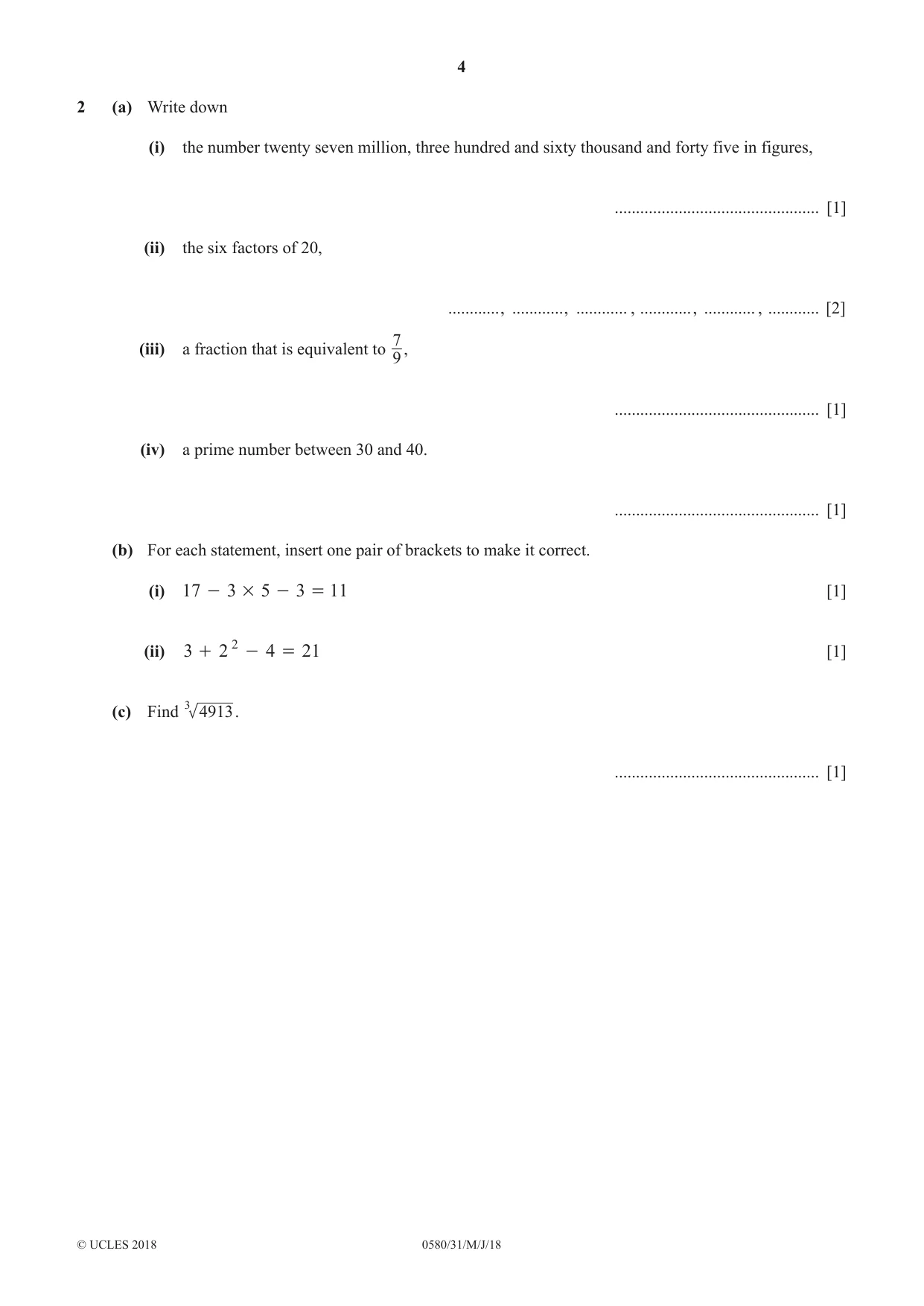
2 (a) Write down (i) the number twenty seven million, three hundred and sixty thousand and forty five in figures, ................................................ [1] (ii) the six factors of 20, ............, ............, ............ , ............, ............ , ............ [2] 7 (iii) a fraction that is equivalent to , 9 ................................................ [1] (iv) a prime number between 30 and 40. ................................................ [1] (b) For each statement, insert one pair of brackets to make it correct. (i) 17 - 3 # 5 - 3 = 11 [1] (ii) 3 + 2 2 - 4 = 21 [1] (c) Find 3 4913 . ................................................ [1]
Mark scheme: 2(a)(i) 27 360 045 1 2(a)(ii) 1, 2, 4, 5, 10, 20 2 B1 for 4 or 5 correct factors 2(a)(iii) 7 k 1 where k ≠ 1 9 k 2(a)(iv) 31 or 37 1 2(b)(i) 17 – 3 × (5 – 3) = 11 1 2(b)(ii) (3 + 2)2 – 4 = 21 1 2(c) 17 1
Q3 · Three boys each have $600
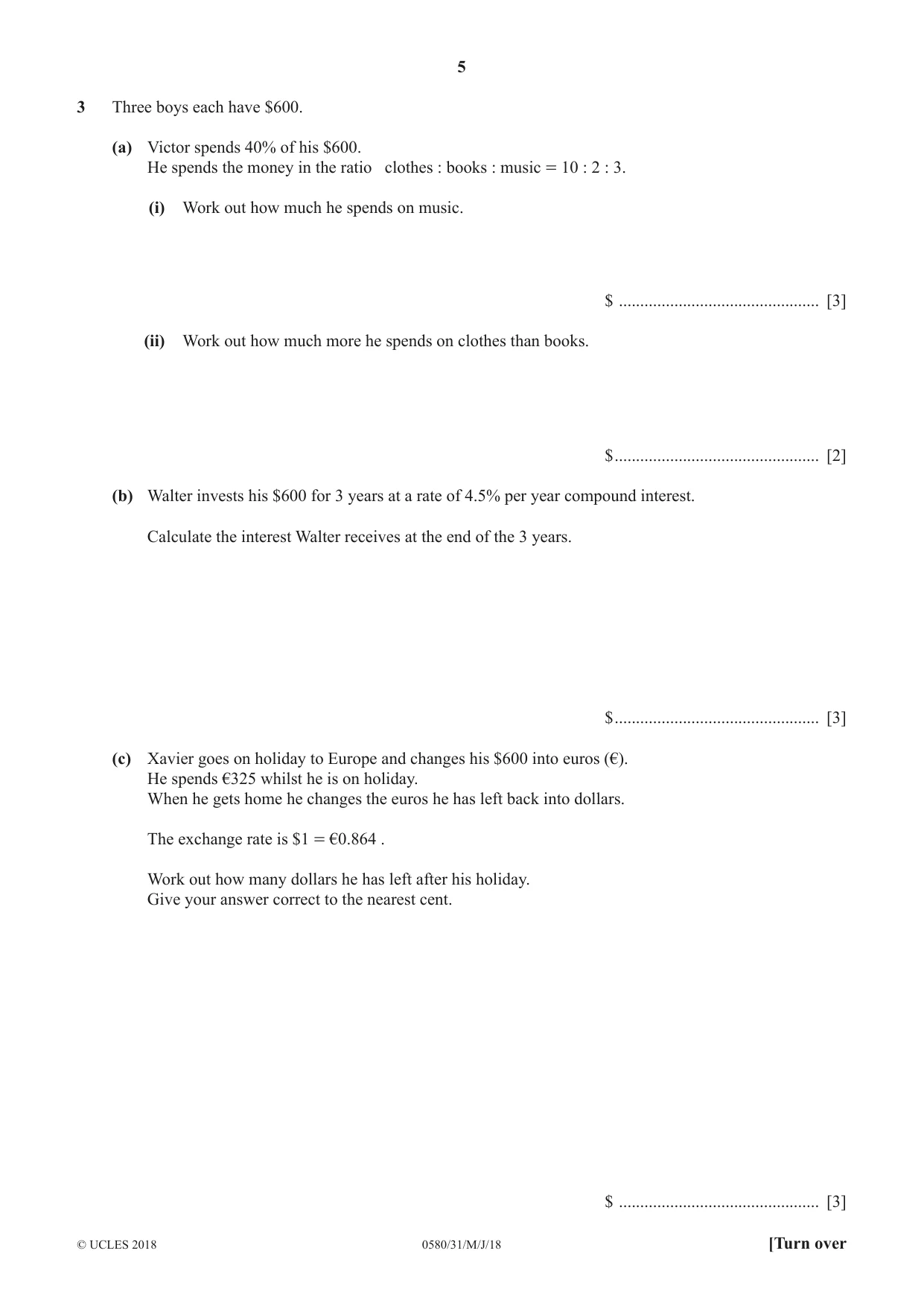
3 Three boys each have $600. (a) Victor spends 40% of his $600. He spends the money in the ratio clothes : books : music = 10 : 2 : 3. (i) Work out how much he spends on music. $ ............................................... [3] (ii) Work out how much more he spends on clothes than books. $ ................................................ [2] (b) Walter invests his $600 for 3 years at a rate of 4.5% per year compound interest. Calculate the interest Walter receives at the end of the 3 years. $ ................................................ [3] (c) Xavier goes on holiday to Europe and changes his $600 into euros (€). He spends €325 whilst he is on holiday. When he gets home he changes the euros he has left back into dollars. The exchange rate is $1 = €0.864 . Work out how many dollars he has left after his holiday. Give your answer correct to the nearest cent. $ ............................................... [3]
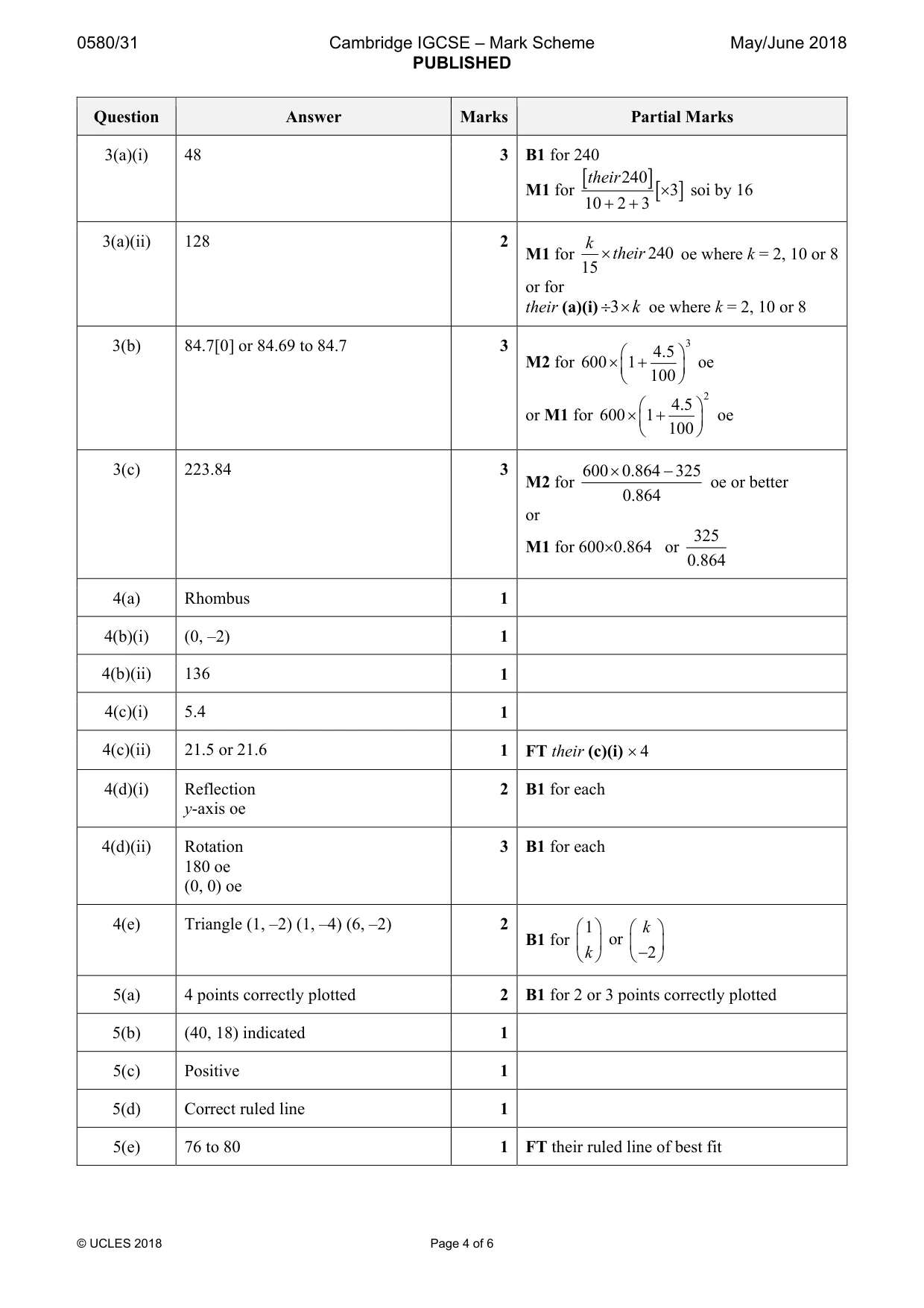
Mark scheme: 3(a)(i) 48 3 B1 for 240 [ their 240 M1 for ][× 3] soi by 16 10 + 2 + 3 3(a)(ii) 128 2 k M1 for × their 240 oe where k = 2, 10 or 8 15 or for their (a)(i) ÷3 ×k oe where k = 2, 10 or 8 3(b) 84.7[0] or 84.69 to 84.7 3 3 4.5 M2 for 600 × 1 + oe 100 4.5 2 or M1 for 600 × 1 + oe 100 3(c) 223.84 3 600 × 0.864 − 325 M2 for oe or better 0.864 or 325 M1 for 600×0.864 or 0.864
Q4 · Y 5 4 3 Q 2 1 B A R P x –7 –6 –5 –4 –3 –2 –1 0 1 2 3 4 5 6 7 C D –1 –2 S –3 –4 –5 The…
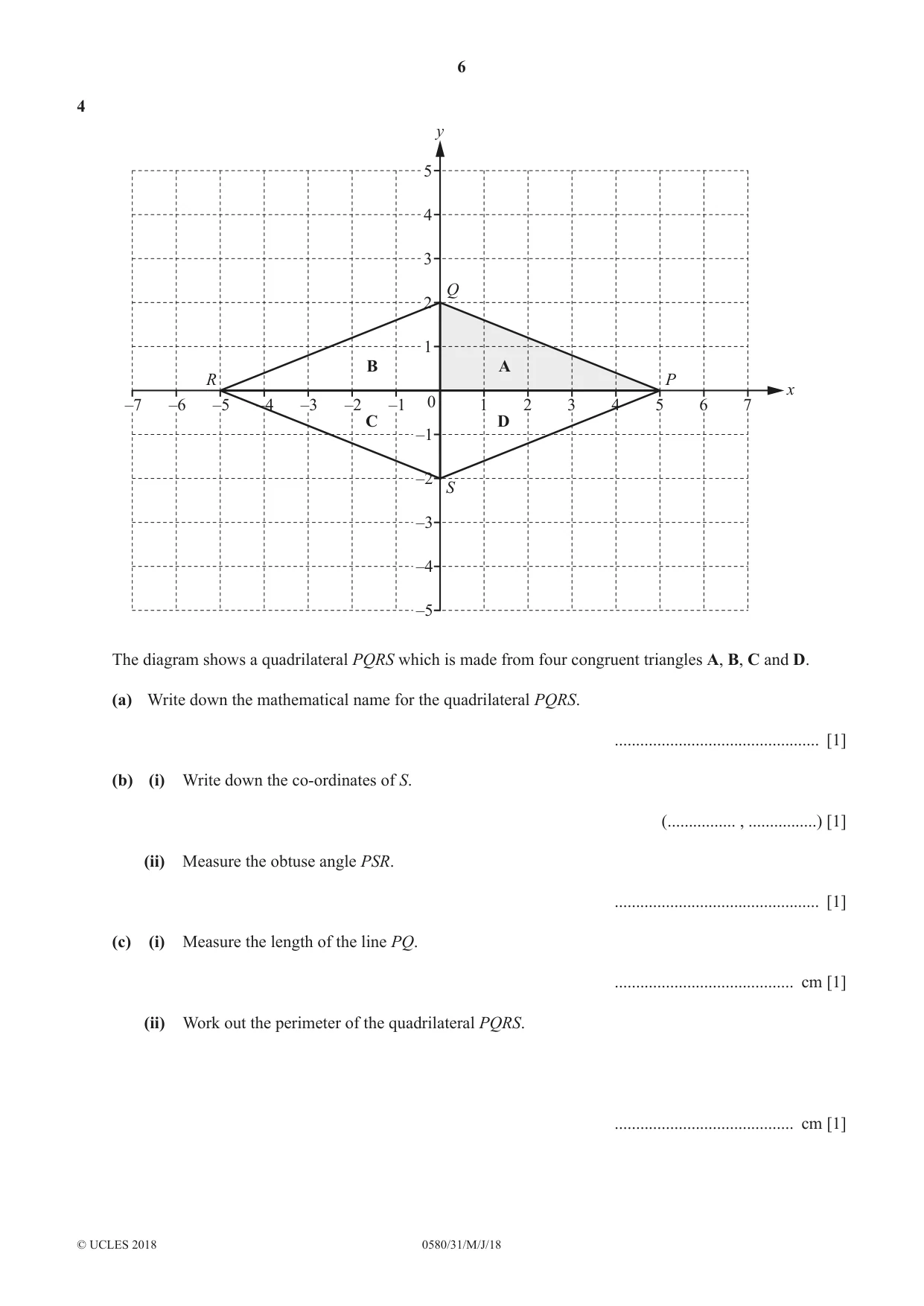
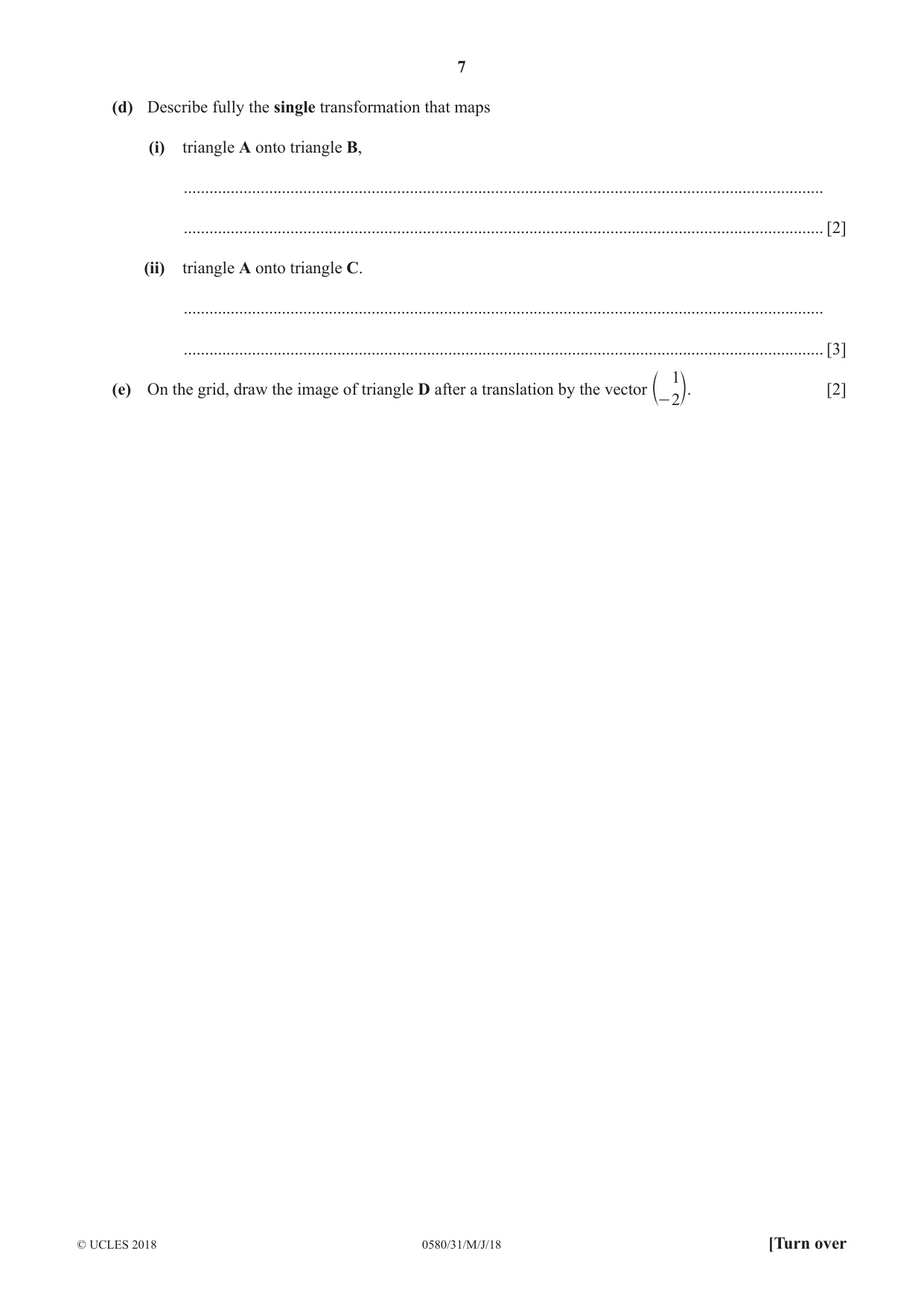
4 y 5 4 3 Q 2 1 B A R P x –7 –6 –5 –4 –3 –2 –1 0 1 2 3 4 5 6 7 C D –1 –2 S –3 –4 –5 The diagram shows a quadrilateral PQRS which is made from four congruent triangles A, B, C and D. (a) Write down the mathematical name for the quadrilateral PQRS. ................................................ [1] (b) (i) Write down the co-ordinates of S. (................ , ................) [1] (ii) Measure the obtuse angle PSR. ................................................ [1] (c) (i) Measure the length of the line PQ. .......................................... cm [1] (ii) Work out the perimeter of the quadrilateral PQRS. .......................................... cm [1] (d) Describe fully the single transformation that maps (i) triangle A onto triangle B, ...................................................................................................................................................... ...................................................................................................................................................... [2] (ii) triangle A onto triangle C. ...................................................................................................................................................... ...................................................................................................................................................... [3] 1 (e) On the grid, draw the image of triangle D after a translation by the vector [2] c- 2m.
Mark scheme: 4(a) Rhombus 1 4(b)(i) (0, –2) 1 4(b)(ii) 136 1 4(c)(i) 5.4 1 4(c)(ii) 21.5 or 21.6 1 FT their (c)(i) × 4 4(d)(i) Reflection 2 B1 for each y-axis oe 4(d)(ii) Rotation 3 B1 for each 180 oe (0, 0) oe 4(e) Triangle (1, –2) (1, –4) (6, –2) 2 1 k B1 for or k −2
Q5 · Lucy asked 12 people how many hours they each spent playing a computer game and the…
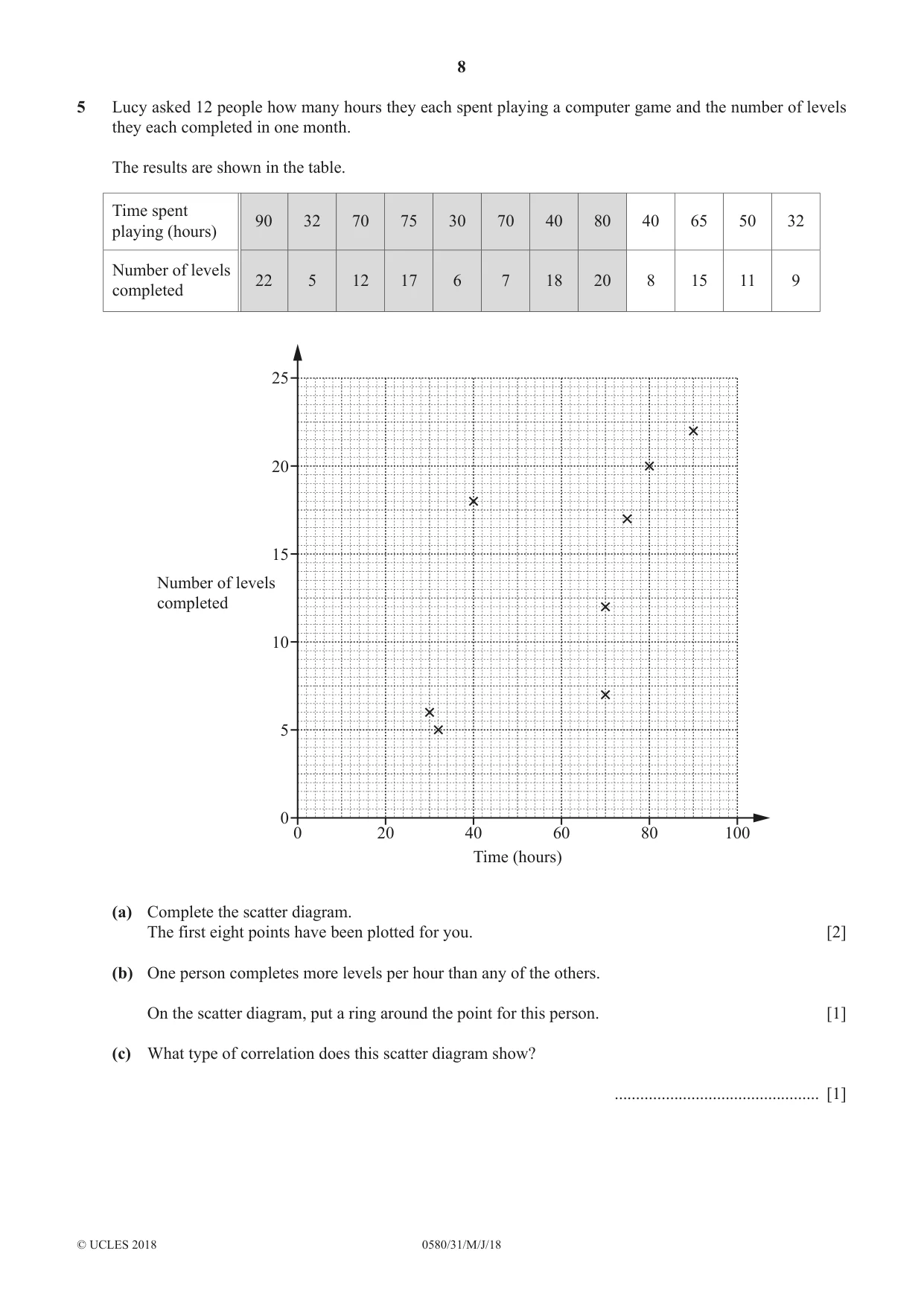
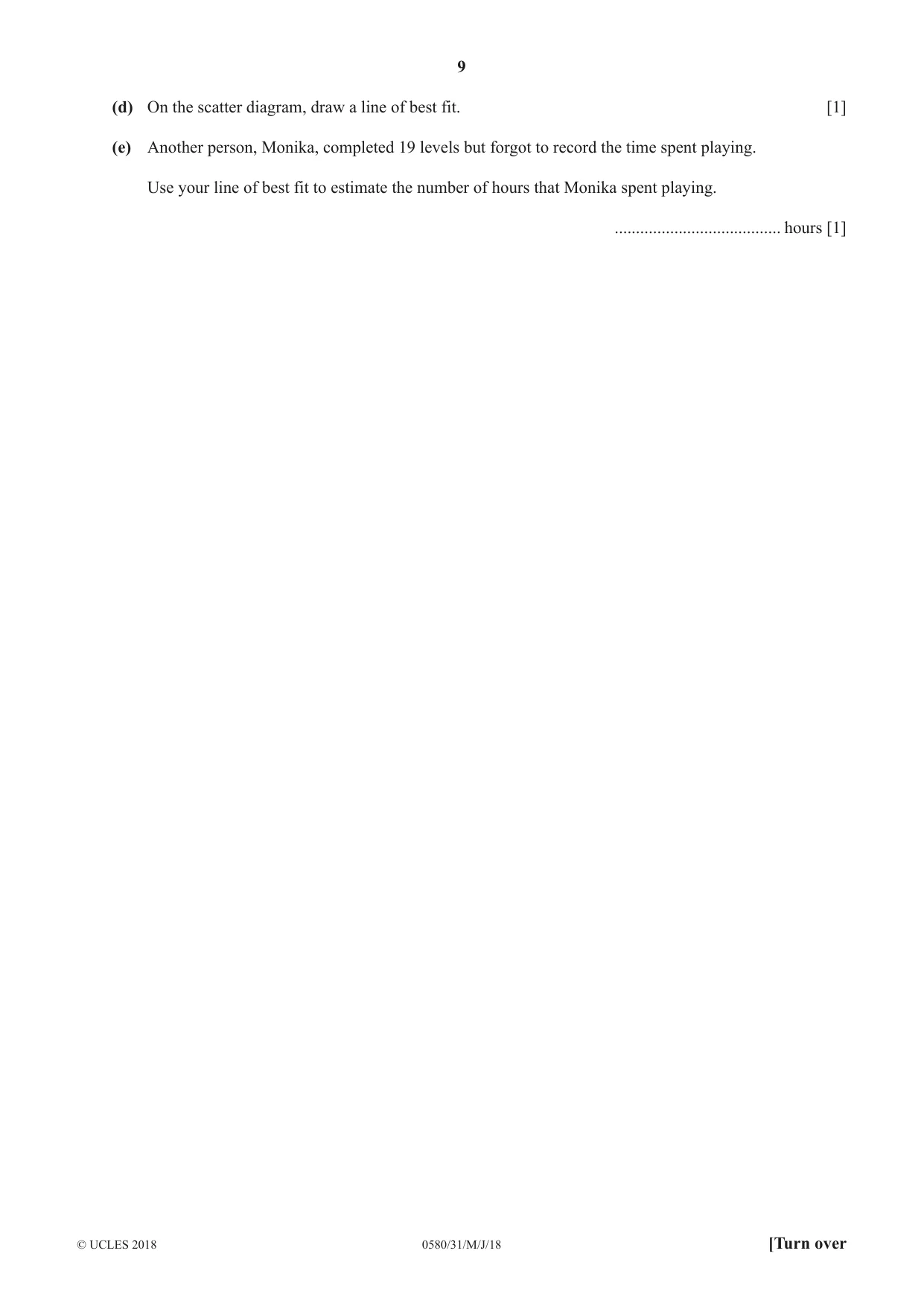
5 Lucy asked 12 people how many hours they each spent playing a computer game and the number of levels they each completed in one month. The results are shown in the table. Time spent 90 32 70 75 30 70 40 80 40 65 50 32 playing (hours) Number of levels 22 5 12 17 6 7 18 20 8 15 11 9 completed 25 20 15 Number of levels completed 10 5 0 0 20 40 60 80 100 Time (hours) (a) Complete the scatter diagram. The first eight points have been plotted for you. [2] (b) One person completes more levels per hour than any of the others. On the scatter diagram, put a ring around the point for this person. [1] (c) What type of correlation does this scatter diagram show? ................................................ [1] (d) On the scatter diagram, draw a line of best fit. [1] (e) Another person, Monika, completed 19 levels but forgot to record the time spent playing. Use your line of best fit to estimate the number of hours that Monika spent playing. ....................................... hours [1]
Mark scheme: 5(a) 4 points correctly plotted 2 B1 for 2 or 3 points correctly plotted 5(b) (40, 18) indicated 1 5(c) Positive 1 5(d) Correct ruled line 1 5(e) 76 to 80 1 FT their ruled line of best fit
Q6 · Georgiana is travelling by train from Redtown to Teignley
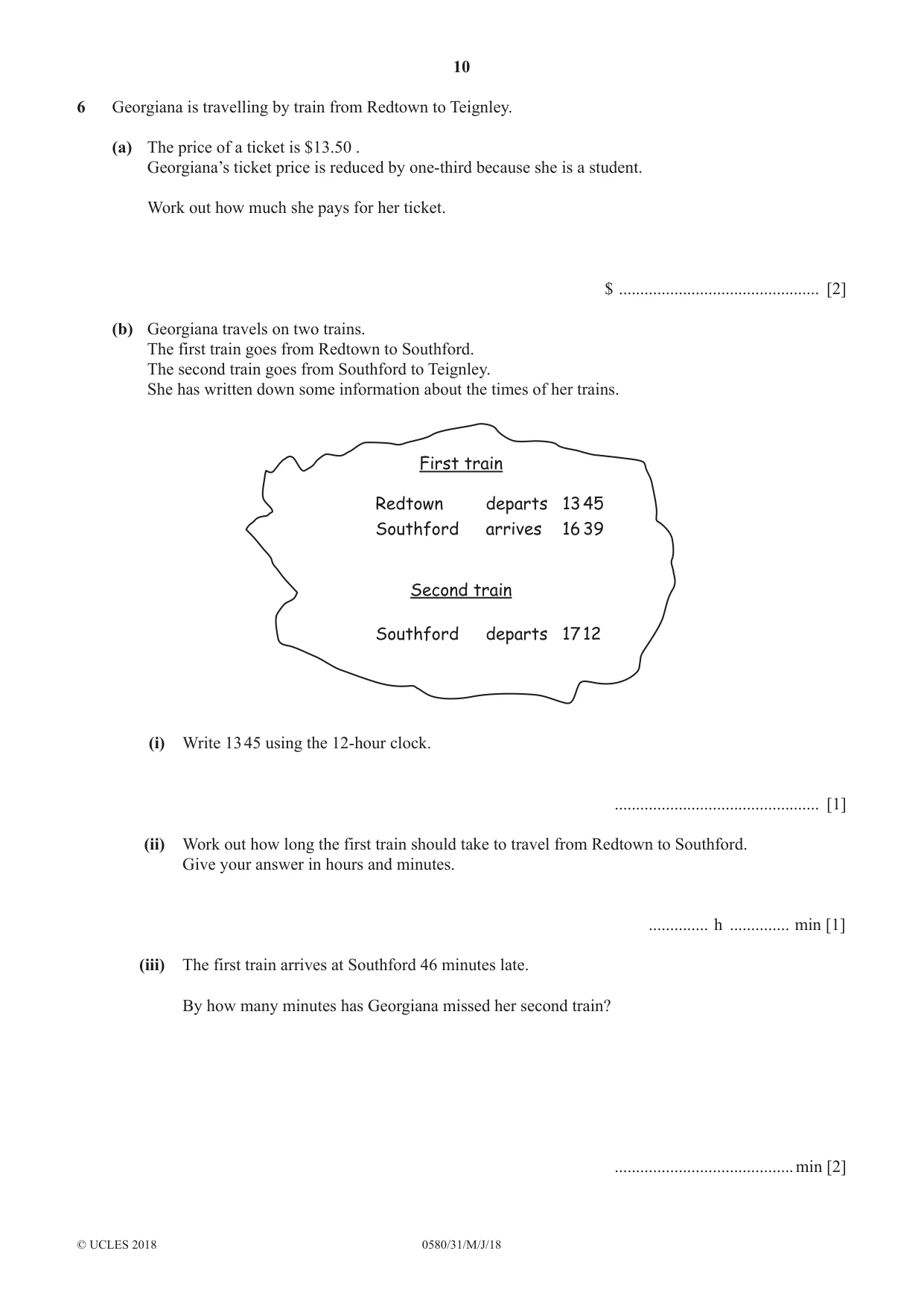
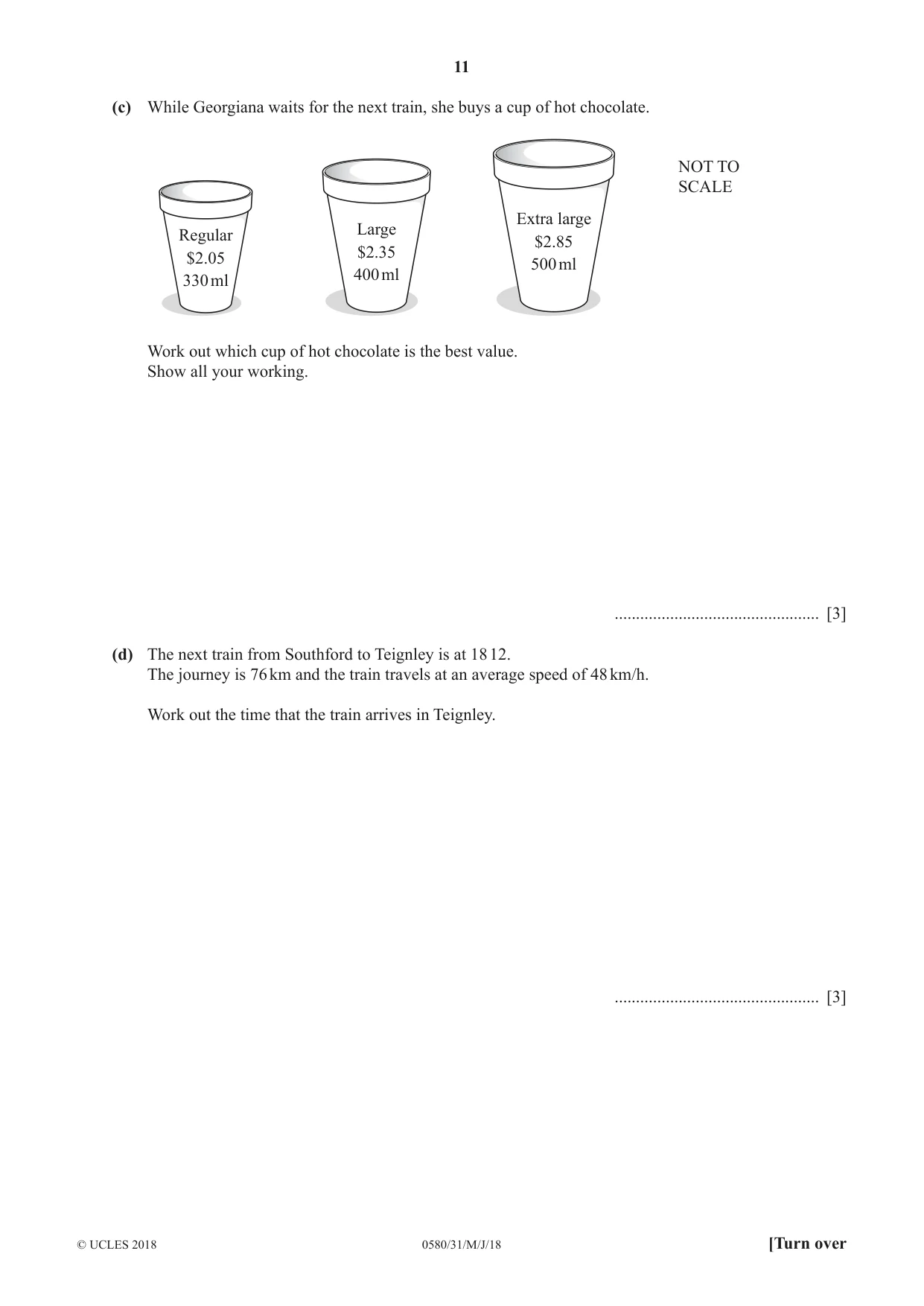
6 Georgiana is travelling by train from Redtown to Teignley. (a) The price of a ticket is $13.50 . Georgiana’s ticket price is reduced by one-third because she is a student. Work out how much she pays for her ticket. $ ............................................... [2] (b) Georgiana travels on two trains. The first train goes from Redtown to Southford. The second train goes from Southford to Teignley. She has written down some information about the times of her trains. First train Redtown departs 13 45 Southford arrives 16 39 Second train Southford departs 17 12 (i) Write 13 45 using the 12-hour clock. ................................................ [1] (ii) Work out how long the first train should take to travel from Redtown to Southford. Give your answer in hours and minutes. .............. h .............. min [1] (iii) The first train arrives at Southford 46 minutes late. By how many minutes has Georgiana missed her second train? ..........................................min [2] (c) While Georgiana waits for the next train, she buys a cup of hot chocolate. NOT TO SCALE Extra large Large Regular $2.85 $2.35 $2.05 500 ml 400 ml 330 ml Work out which cup of hot chocolate is the best value. Show all your working. ................................................ [3] (d) The next train from Southford to Teignley is at 18 12. The journey is 76 km and the train travels at an average speed of 48 km/h. Work out the time that the train arrives in Teignley. ................................................ [3]
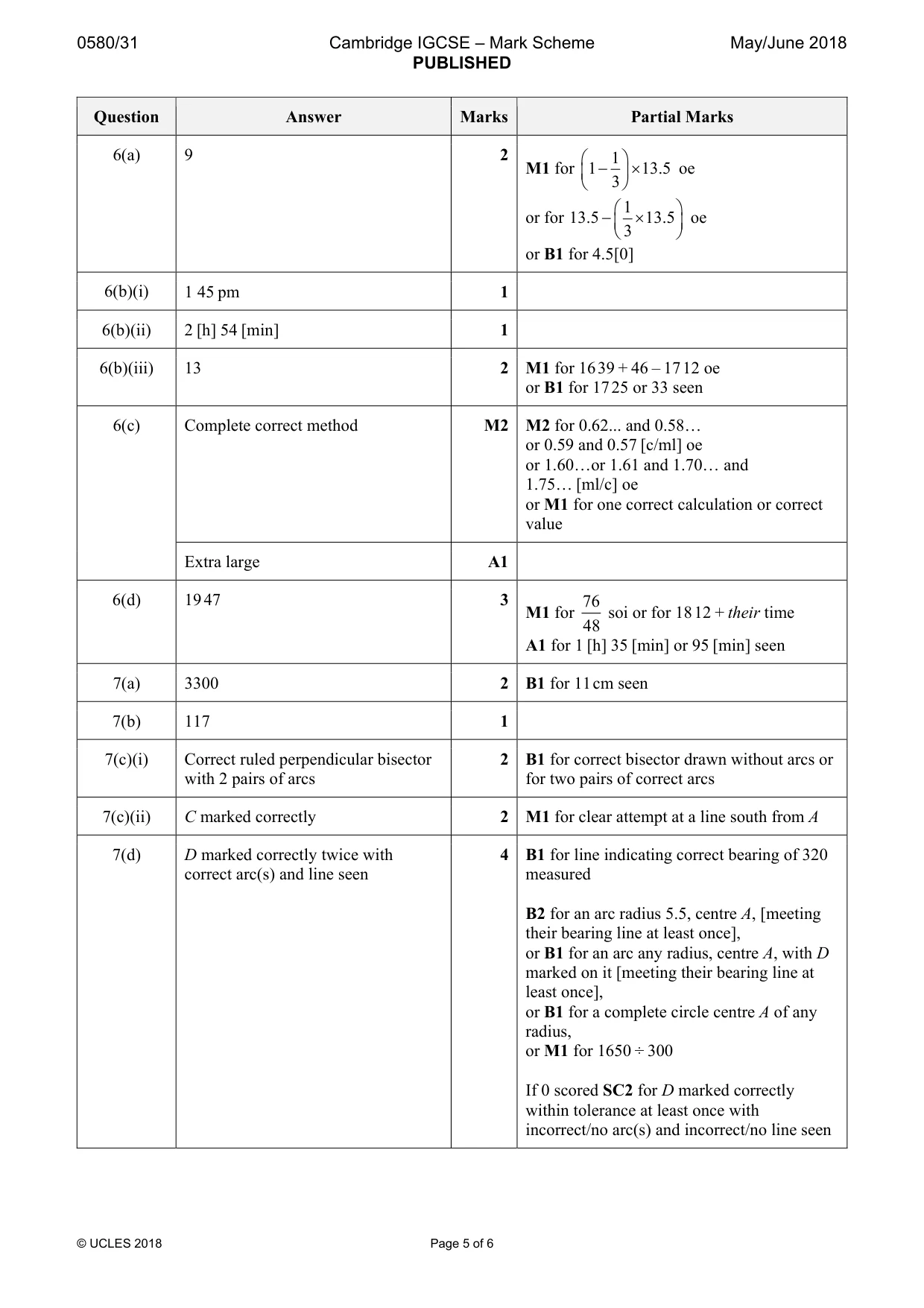
Mark scheme: 6(a) 9 2 1 M1 for 1 − × 13.5 oe 3 1 or for 13.5 − × 13.5 oe 3 or B1 for 4.5[0] 6(b)(i) 1 45 pm 1 6(b)(ii) 2 [h] 54 [min] 1 6(b)(iii) 13 2 M1 for 16 39 + 46 – 17 12 oe or B1 for 17 25 or 33 seen 6(c) Complete correct method M2 M2 for 0.62... and 0.58… or 0.59 and 0.57 [c/ml] oe or 1.60…or 1.61 and 1.70… and 1.75… [ml/c] oe or M1 for one correct calculation or correct value Extra large A1 6(d) 19 47 3 76 M1 for soi or for 18 12 + their time 48 A1 for 1 [h] 35 [min] or 95 [min] seen
Q7 · The scale drawing shows the positions of Annika’s house, A, and Bernhard’s house, B, on a…
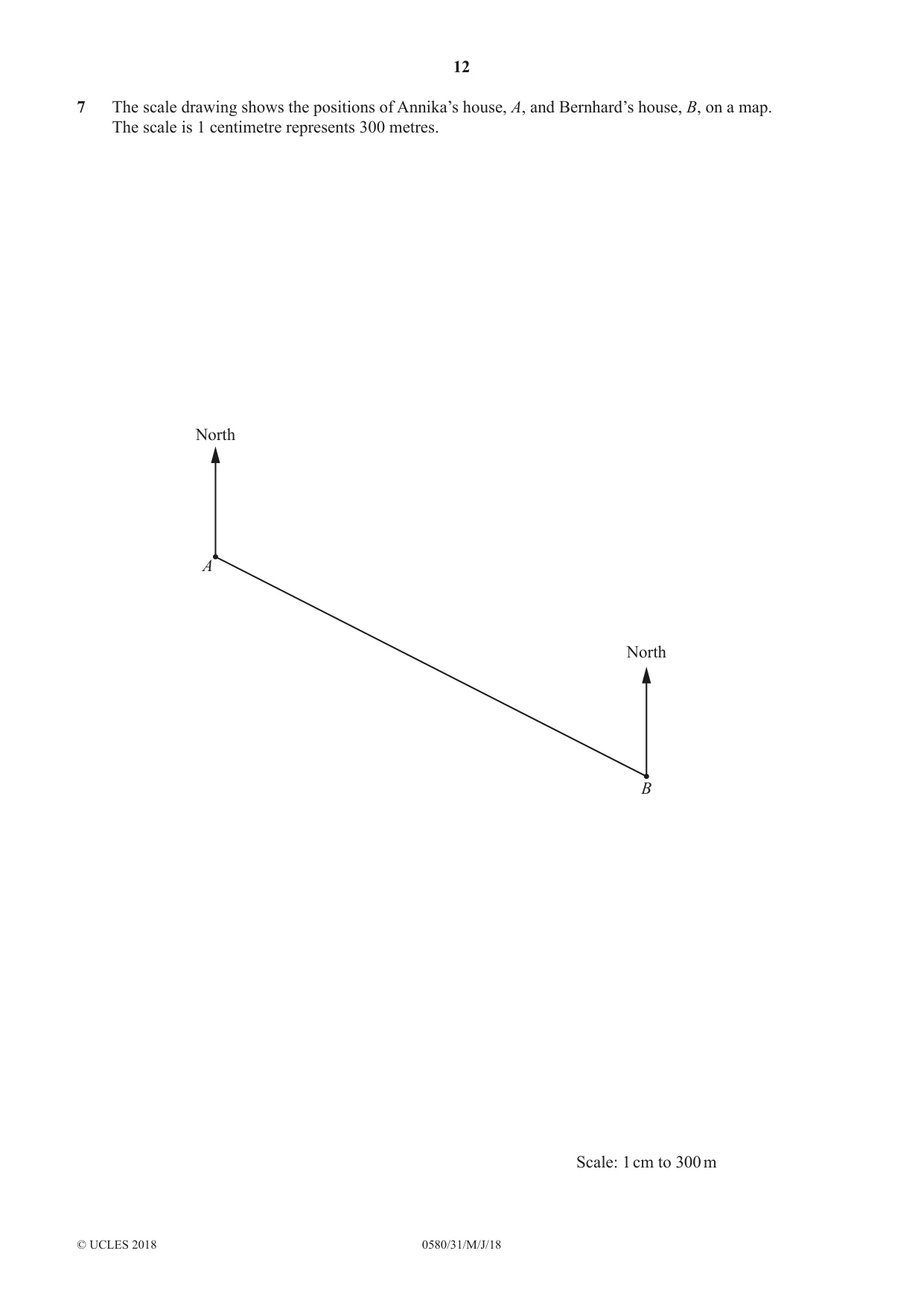
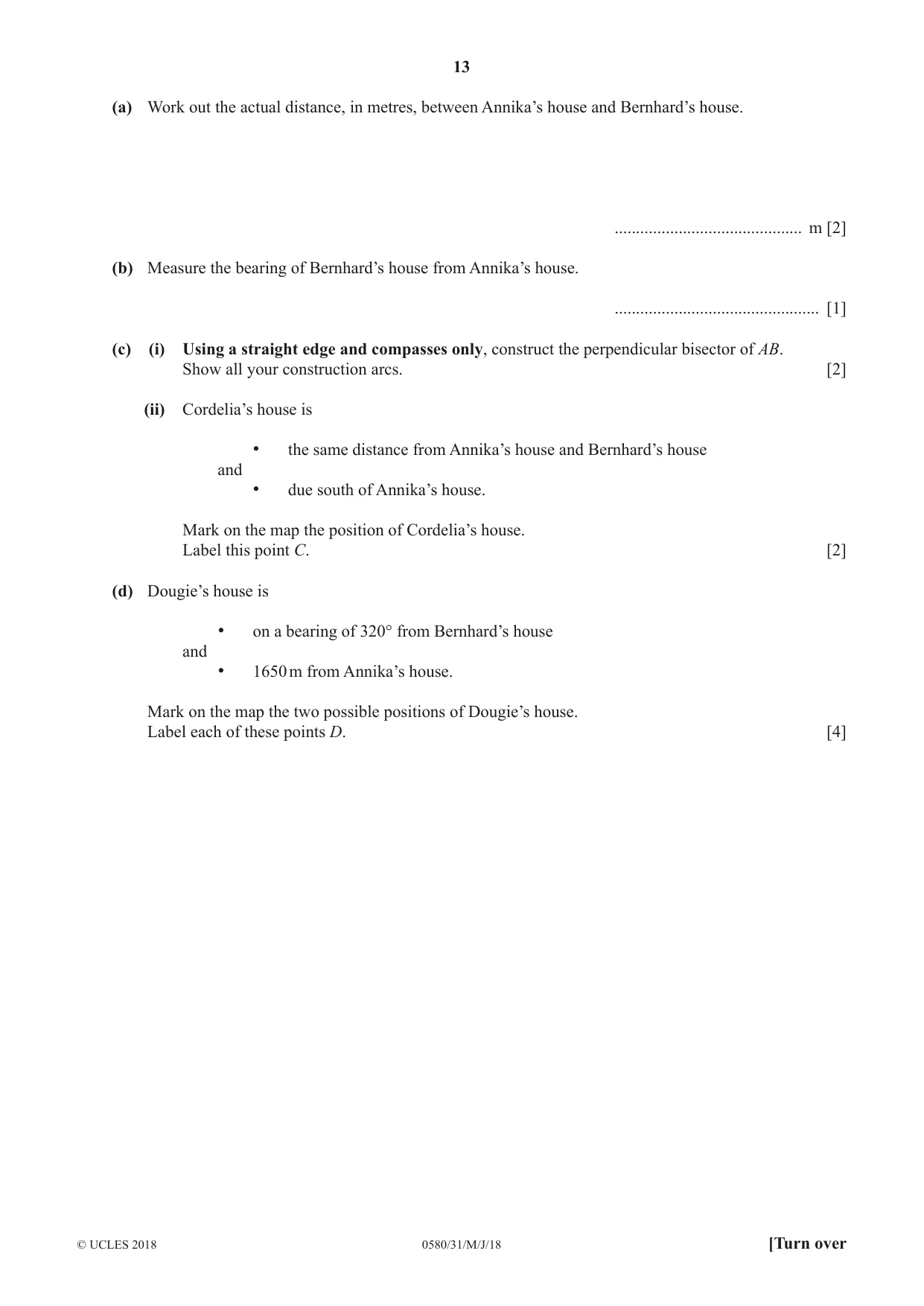
7 The scale drawing shows the positions of Annika’s house, A, and Bernhard’s house, B, on a map. The scale is 1 centimetre represents 300 metres. North A North B Scale: 1 cm to 300 m (a) Work out the actual distance, in metres, between Annika’s house and Bernhard’s house. ............................................ m [2] (b) Measure the bearing of Bernhard’s house from Annika’s house. ................................................ [1] (c) (i) Using a straight edge and compasses only, construct the perpendicular bisector of AB. Show all your construction arcs. [2] (ii) Cordelia’s house is • the same distance from Annika’s house and Bernhard’s house and • due south of Annika’s house. Mark on the map the position of Cordelia’s house. Label this point C. [2] (d) Dougie’s house is • on a bearing of 320° from Bernhard’s house and • 1650 m from Annika’s house. Mark on the map the two possible positions of Dougie’s house. Label each of these points D. [4]
Mark scheme: 7(a) 3300 2 B1 for 11 cm seen 7(b) 117 1 7(c)(i) Correct ruled perpendicular bisector 2 B1 for correct bisector drawn without arcs or with 2 pairs of arcs for two pairs of correct arcs 7(c)(ii) C marked correctly 2 M1 for clear attempt at a line south from A 7(d) D marked correctly twice with 4 B1 for line indicating correct bearing of 320 correct arc(s) and line seen measured B2 for an arc radius 5.5, centre A, [meeting their bearing line at least once], or B1 for an arc any radius, centre A, with D marked on it [meeting their bearing line at least once], or B1 for a complete circle centre A of any radius, or M1 for 1650 ÷ 300 If 0 scored SC2 for D marked correctly within tolerance at least once with incorrect/no arc(s) and incorrect/no line seen
Q8 · Three children from the same family travel from their home to the same school
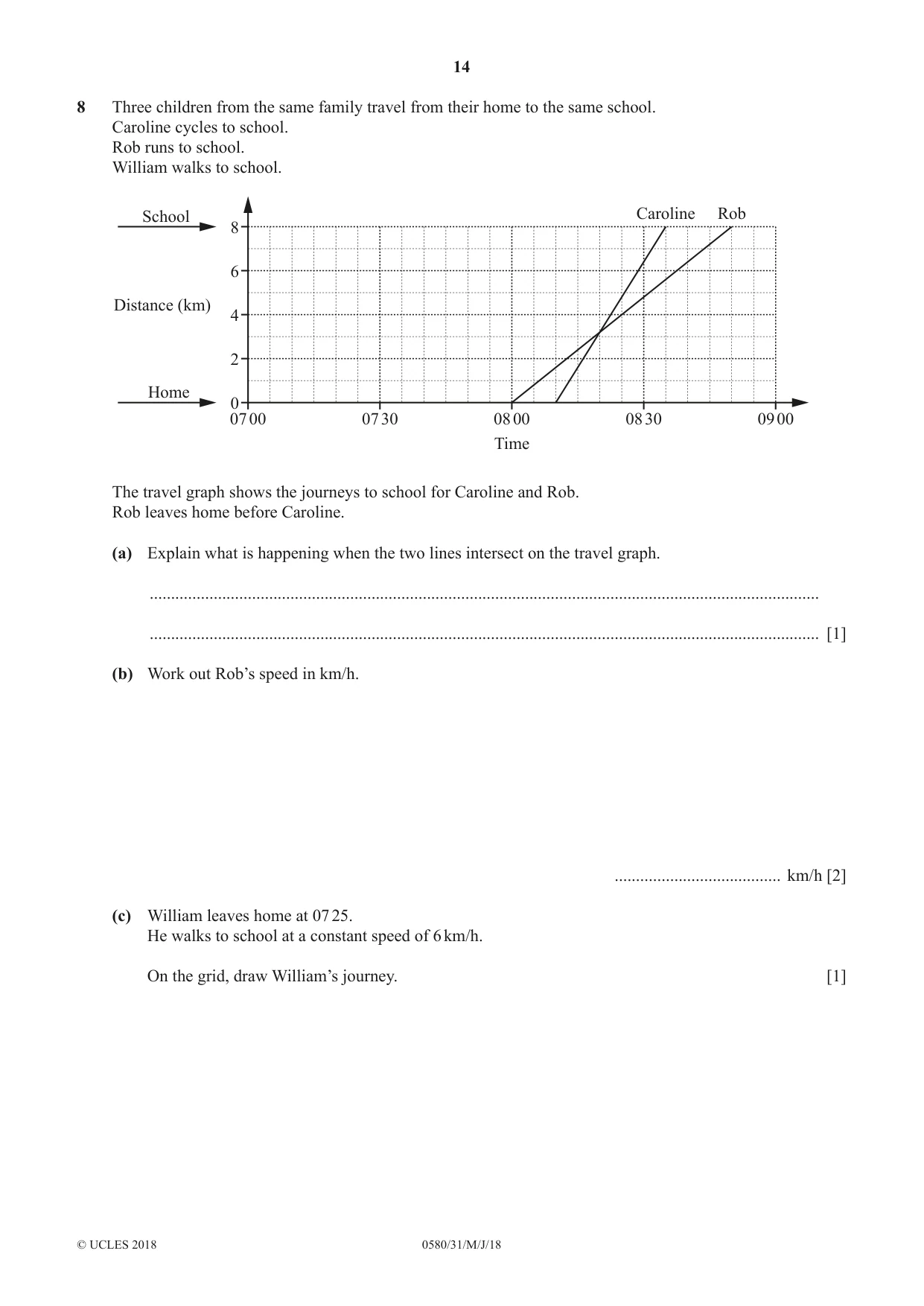
8 Three children from the same family travel from their home to the same school. Caroline cycles to school. Rob runs to school. William walks to school. School Caroline Rob 8 6 Distance (km) 4 2 Home 0 07 00 07 30 08 00 08 30 09 00 Time The travel graph shows the journeys to school for Caroline and Rob. Rob leaves home before Caroline. (a) Explain what is happening when the two lines intersect on the travel graph. ............................................................................................................................................................. ............................................................................................................................................................. [1] (b) Work out Rob’s speed in km/h. ....................................... km/h [2] (c) William leaves home at 07 25. He walks to school at a constant speed of 6 km/h. On the grid, draw William’s journey. [1] (d) At what time is the distance between Rob and William greatest? ................................................ [1] (e) Complete this list of names in the order they arrive at school. First ............................................... Second ............................................... Third ............................................... [1]
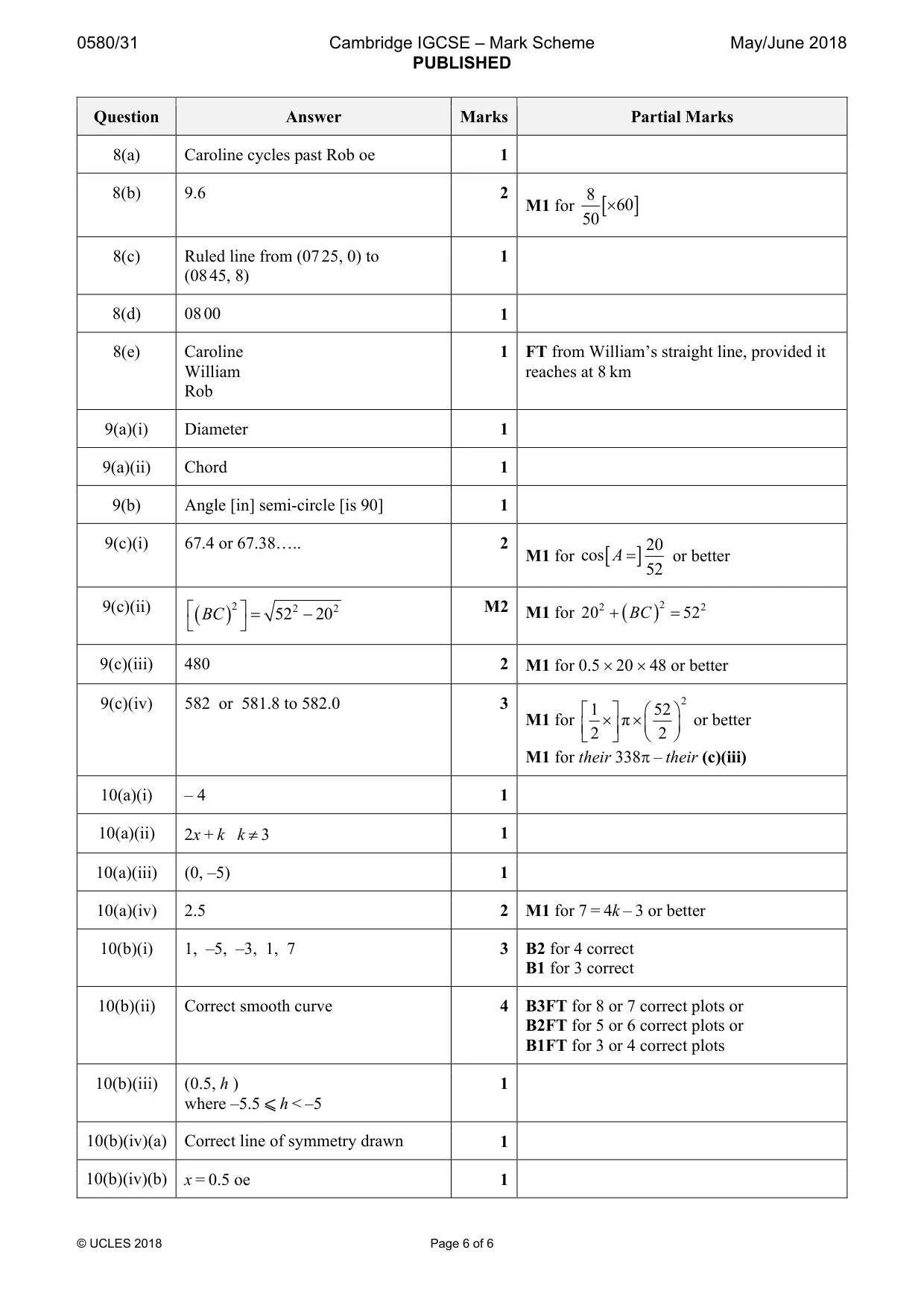
Mark scheme: 8(a) Caroline cycles past Rob oe 1 8(b) 9.6 2 8 M1 for [× 60 ] 50 8(c) Ruled line from (07 25, 0) to 1 (08 45, 8) 8(d) 08 00 1 8(e) Caroline 1 FT from William’s straight line, provided it William reaches at 8 km Rob
Q9 · B A NOT TO O SCALE C A, B and C are points on the circumference of a circle, centre O
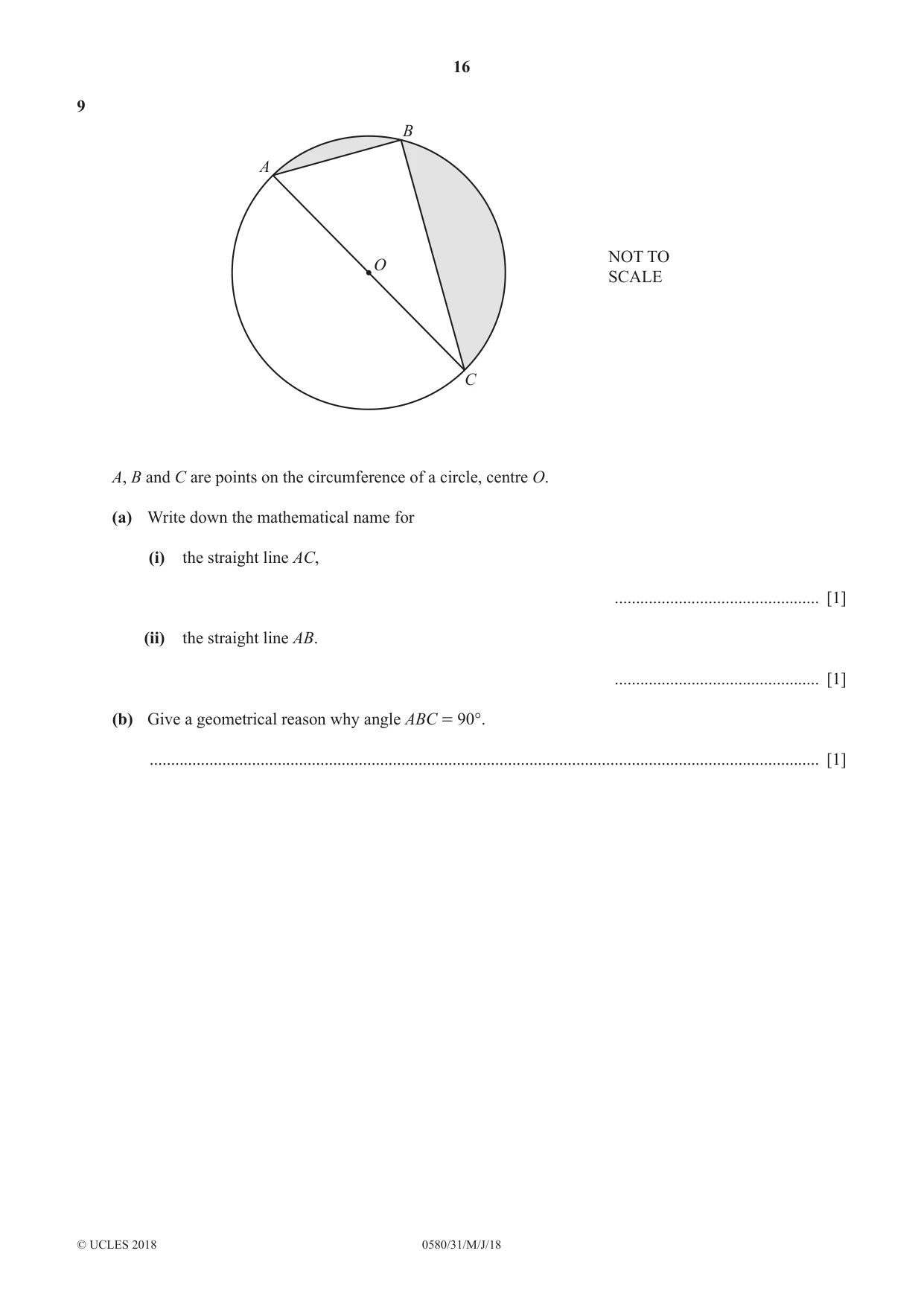
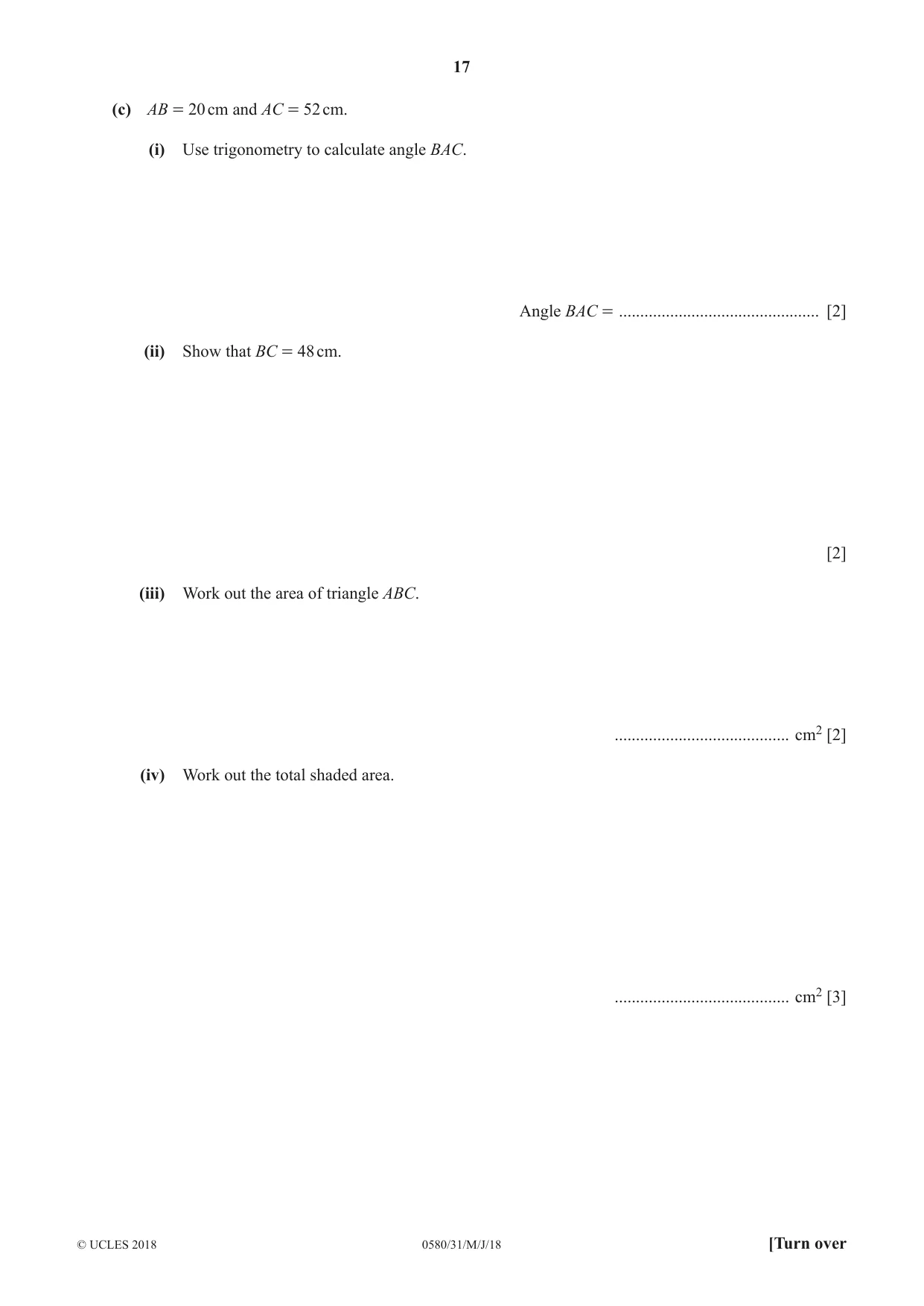
9 B A NOT TO O SCALE C A, B and C are points on the circumference of a circle, centre O. (a) Write down the mathematical name for (i) the straight line AC, ................................................ [1] (ii) the straight line AB. ................................................ [1] (b) Give a geometrical reason why angle ABC = 90°. ............................................................................................................................................................. [1] (c) AB = 20 cm and AC = 52 cm. (i) Use trigonometry to calculate angle BAC. Angle BAC = ............................................... [2] (ii) Show that BC = 48 cm. [2] (iii) Work out the area of triangle ABC. ......................................... cm2 [2] (iv) Work out the total shaded area. ......................................... cm2 [3]
Mark scheme: 9(a)(i) Diameter 1 9(a)(ii) Chord 1 9(b) Angle [in] semi-circle [is 90] 1 9(c)(i) 67.4 or 67.38….. 2 20 M1 for cos [ A = ] or better 52 M2 2 − 20 2 M1 for 20 2 + ( BC ) 2 = 52 29(c)(ii) ( BC ) 2 = 52 9(c)(iii) 480 2 M1 for 0.5 × 20 × 48 or better 9(c)(iv) 582 or 581.8 to 582.0 3 2 1 52 M1 for × π × or better 2 2 M1 for their 338π – their (c)(iii)
Q10 · Write down the gradient of the line y =- 4 x + 7
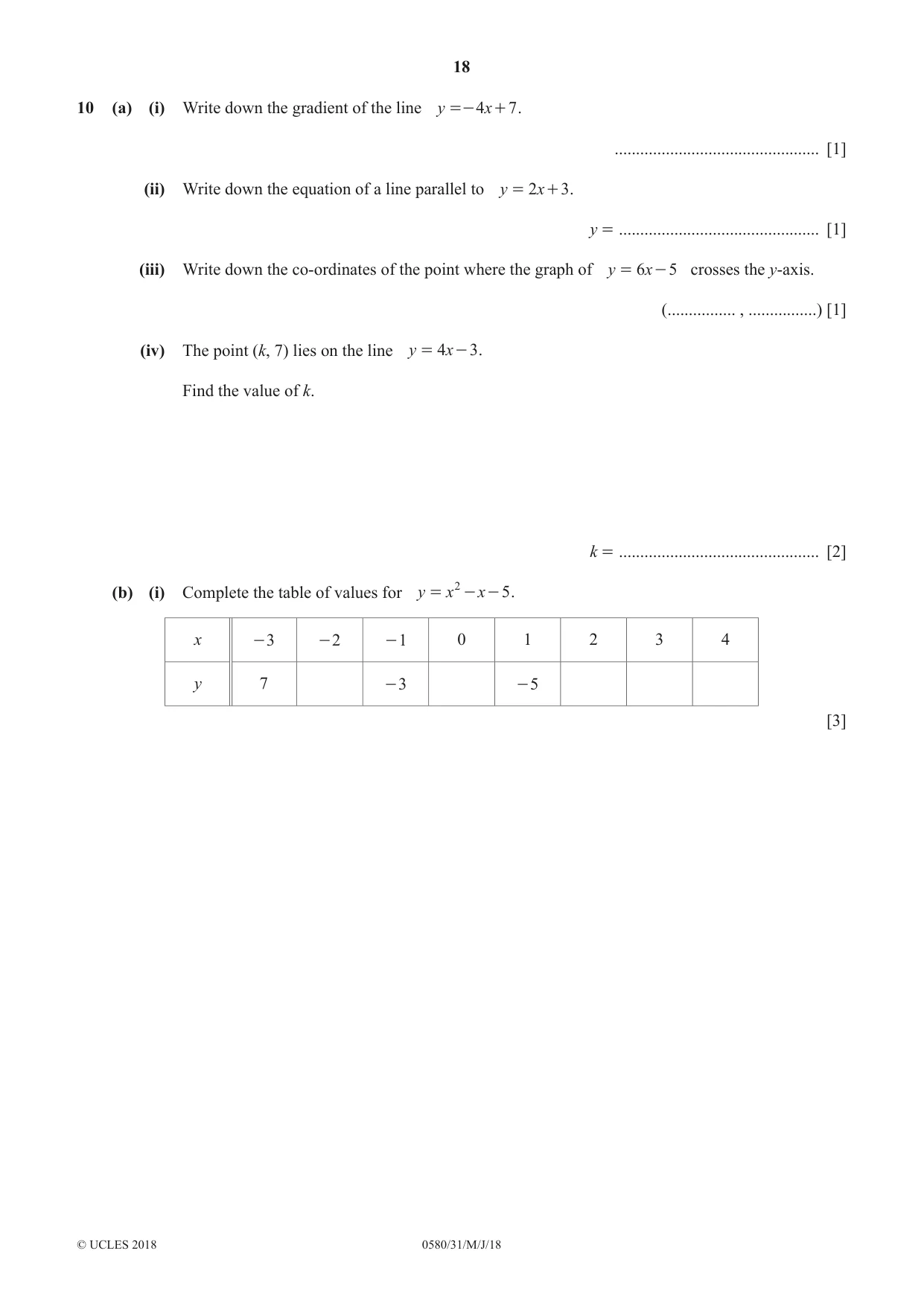
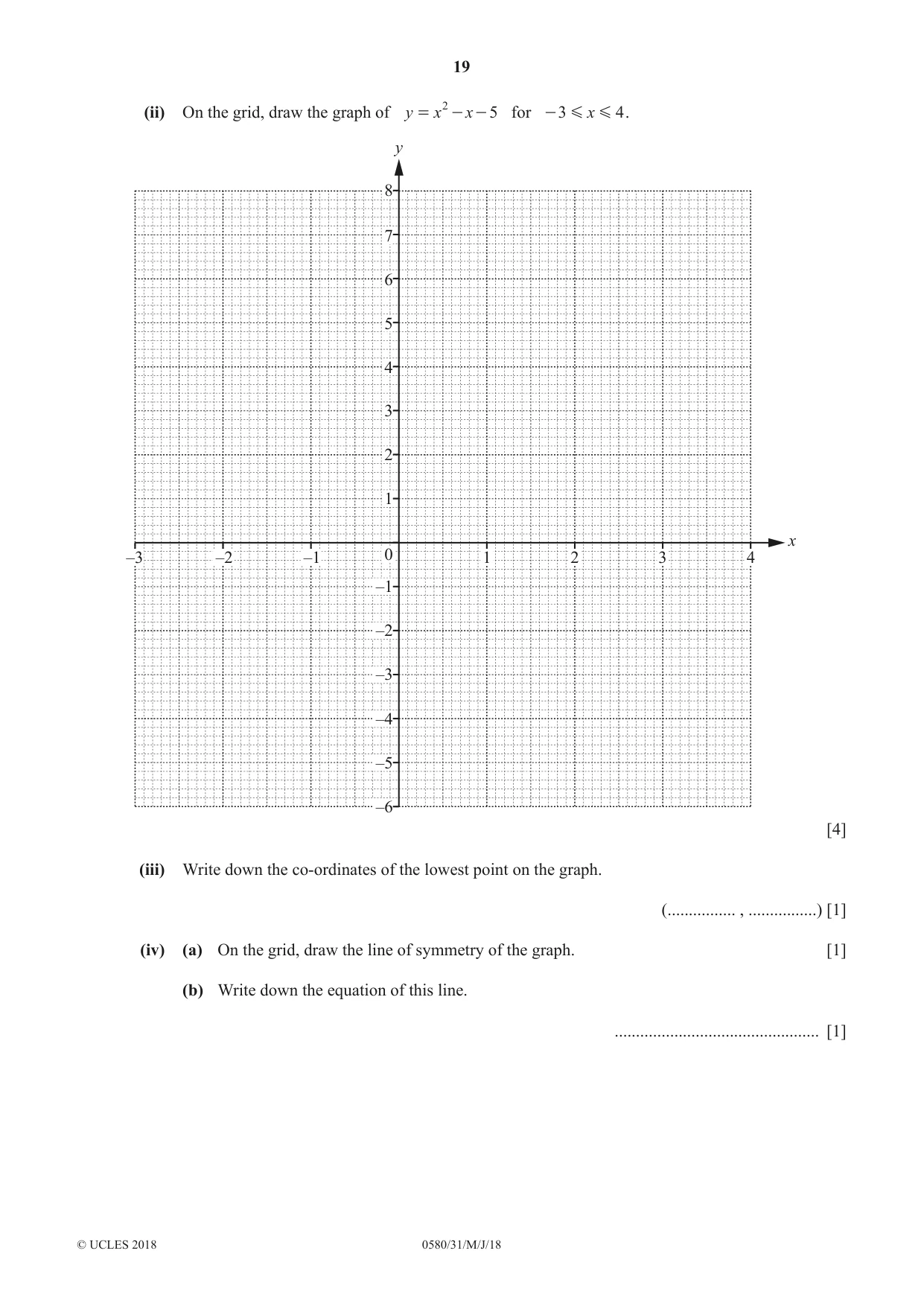
10 (a) (i) Write down the gradient of the line y =- 4 x + 7 . ................................................ [1] (ii) Write down the equation of a line parallel to y = 2x + 3 . y = ............................................... [1] (iii) Write down the co-ordinates of the point where the graph of y = 6x - 5 crosses the y-axis. (................ , ................) [1] (iv) The point (k, 7) lies on the line y = 4x - 3 . Find the value of k. k = ............................................... [2] (b) (i) Complete the table of values for y = x 2 - x - 5 . x - 3 - 2 - 1 0 1 2 3 4 y 7 - 3 - 5 [3] (ii) On the grid, draw the graph of y = x 2 - x - 5 for - 3 G x G 4 . y 8 7 6 5 4 3 2 1 x –3 –2 –1 0 1 2 3 4 –1 –2 –3 –4 –5 –6 [4] (iii) Write down the co-ordinates of the lowest point on the graph. (................ , ................) [1] (iv) (a) On the grid, draw the line of symmetry of the graph. [1] (b) Write down the equation of this line. ................................................ [1]
Mark scheme: 10(a)(i) – 4 1 10(a)(ii) 2x + k k ≠ 3 1 10(a)(iii) (0, –5) 1 10(a)(iv) 2.5 2 M1 for 7 = 4k – 3 or better 10(b)(i) 1, –5, –3, 1, 7 3 B2 for 4 correct B1 for 3 correct 10(b)(ii) Correct smooth curve 4 B3FT for 8 or 7 correct plots or B2FT for 5 or 6 correct plots or B1FT for 3 or 4 correct plots 10(b)(iii) (0.5, h ) 1 where –5.5 ⩽ h < –5 10(b)(iv)(a) Correct line of symmetry drawn 1 10(b)(iv)(b) x = 0.5 oe 1
What was in this paper
The subtopics covered by these 10 questions, and how many questions each got. Open one in a new tab to see every Cambridge question on it.
What you needed in this session
Cambridge’s own grade thresholds for 2018 May/June, Paper 3 · Variant 1. A higher threshold means an easier paper — the bar moves with how the cohort did.