Cambridge IGCSE Mathematics 0580 — 2018 May/June Paper 3 · Variant 3
0580/33/M/J/18 · 9 questions · 104 marks · ≈117 min
The question paper and its mark scheme, free to read here and free to download. This is Cambridge’s own paper, exactly as it was sat.
Question paper16 pages
Mark scheme6 pages
Answers below. Sit the paper first if you are practising.
Questions as text
Q1 · The table shows the temperature at Lexford Station at 10 00 each day for a week
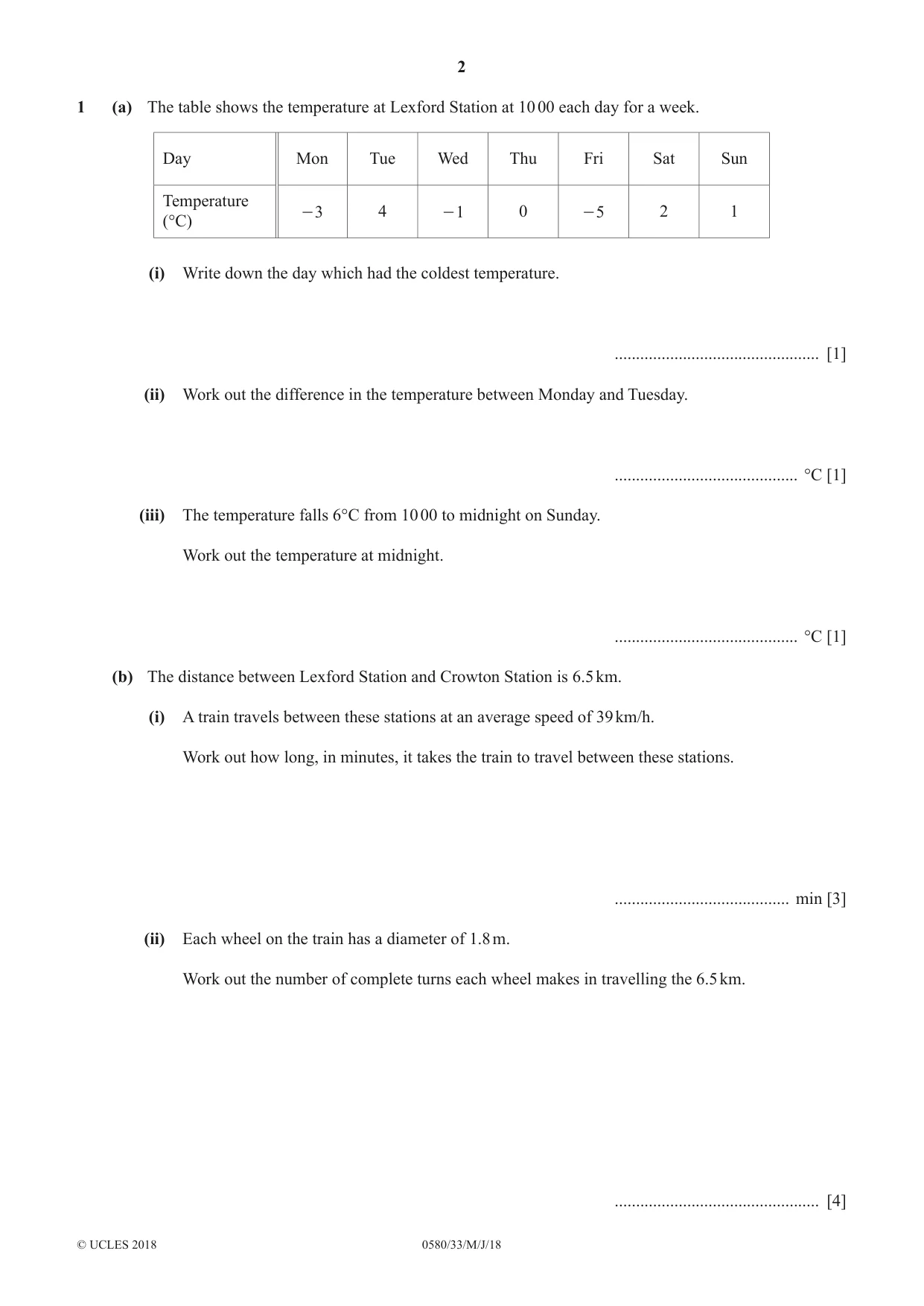
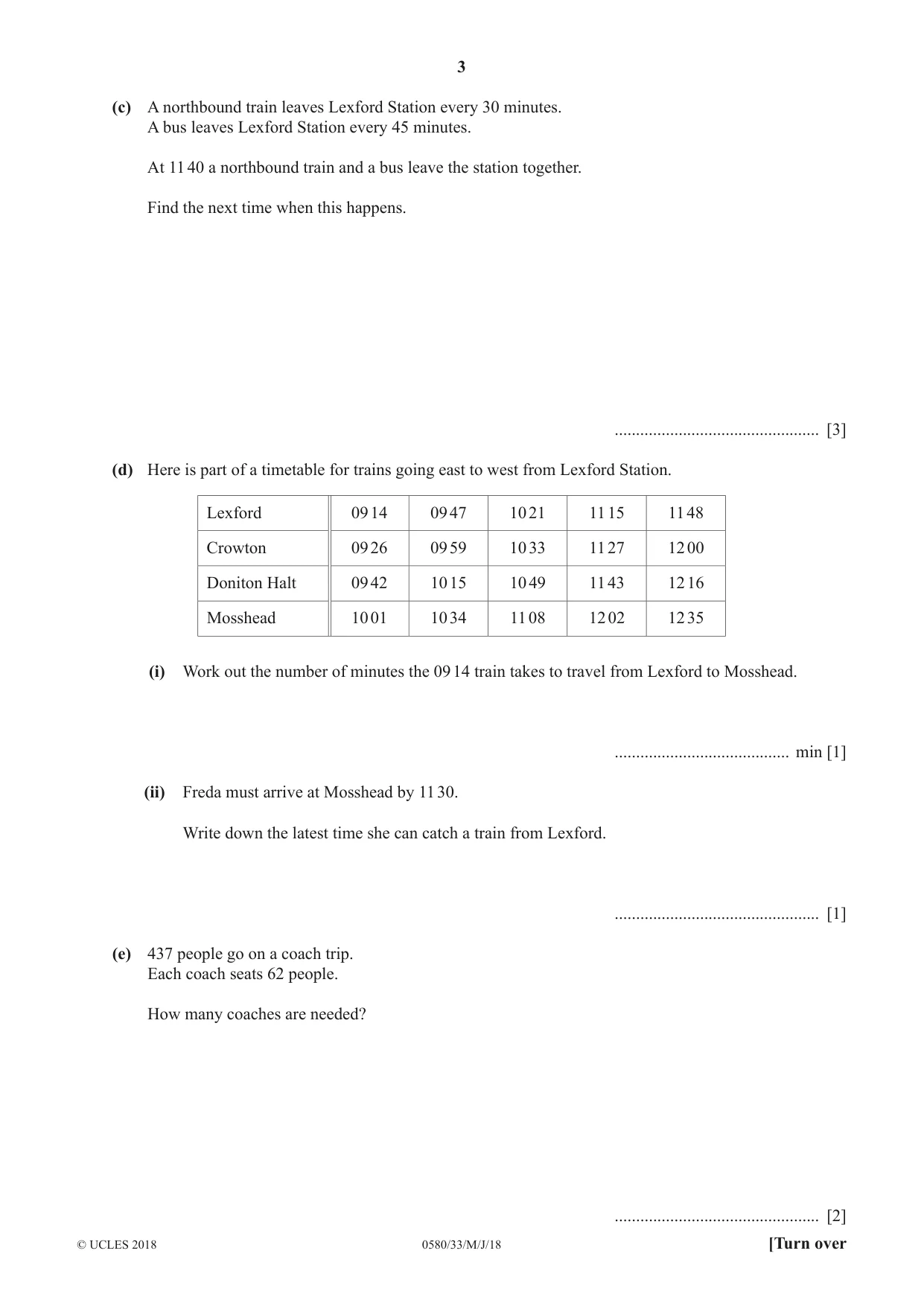
1 (a) The table shows the temperature at Lexford Station at 10 00 each day for a week. Day Mon Tue Wed Thu Fri Sat Sun Temperature - 3 4 - 1 0 - 5 2 1 (°C) (i) Write down the day which had the coldest temperature. ................................................ [1] (ii) Work out the difference in the temperature between Monday and Tuesday. ........................................... °C [1] (iii) The temperature falls 6°C from 10 00 to midnight on Sunday. Work out the temperature at midnight. ........................................... °C [1] (b) The distance between Lexford Station and Crowton Station is 6.5 km. (i) A train travels between these stations at an average speed of 39 km/h. Work out how long, in minutes, it takes the train to travel between these stations. ......................................... min [3] (ii) Each wheel on the train has a diameter of 1.8 m. Work out the number of complete turns each wheel makes in travelling the 6.5 km. ................................................ [4] (c) A northbound train leaves Lexford Station every 30 minutes. A bus leaves Lexford Station every 45 minutes. At 11 40 a northbound train and a bus leave the station together. Find the next time when this happens. ................................................ [3] (d) Here is part of a timetable for trains going east to west from Lexford Station. Lexford 09 14 09 47 10 21 11 15 11 48 Crowton 09 26 09 59 10 33 11 27 12 00 Doniton Halt 09 42 10 15 10 49 11 43 12 16 Mosshead 10 01 10 34 11 08 12 02 12 35 (i) Work out the number of minutes the 09 14 train takes to travel from Lexford to Mosshead. ......................................... min [1] (ii) Freda must arrive at Mosshead by 11 30. Write down the latest time she can catch a train from Lexford. ................................................ [1] (e) 437 people go on a coach trip. Each coach seats 62 people. How many coaches are needed? ................................................ [2]
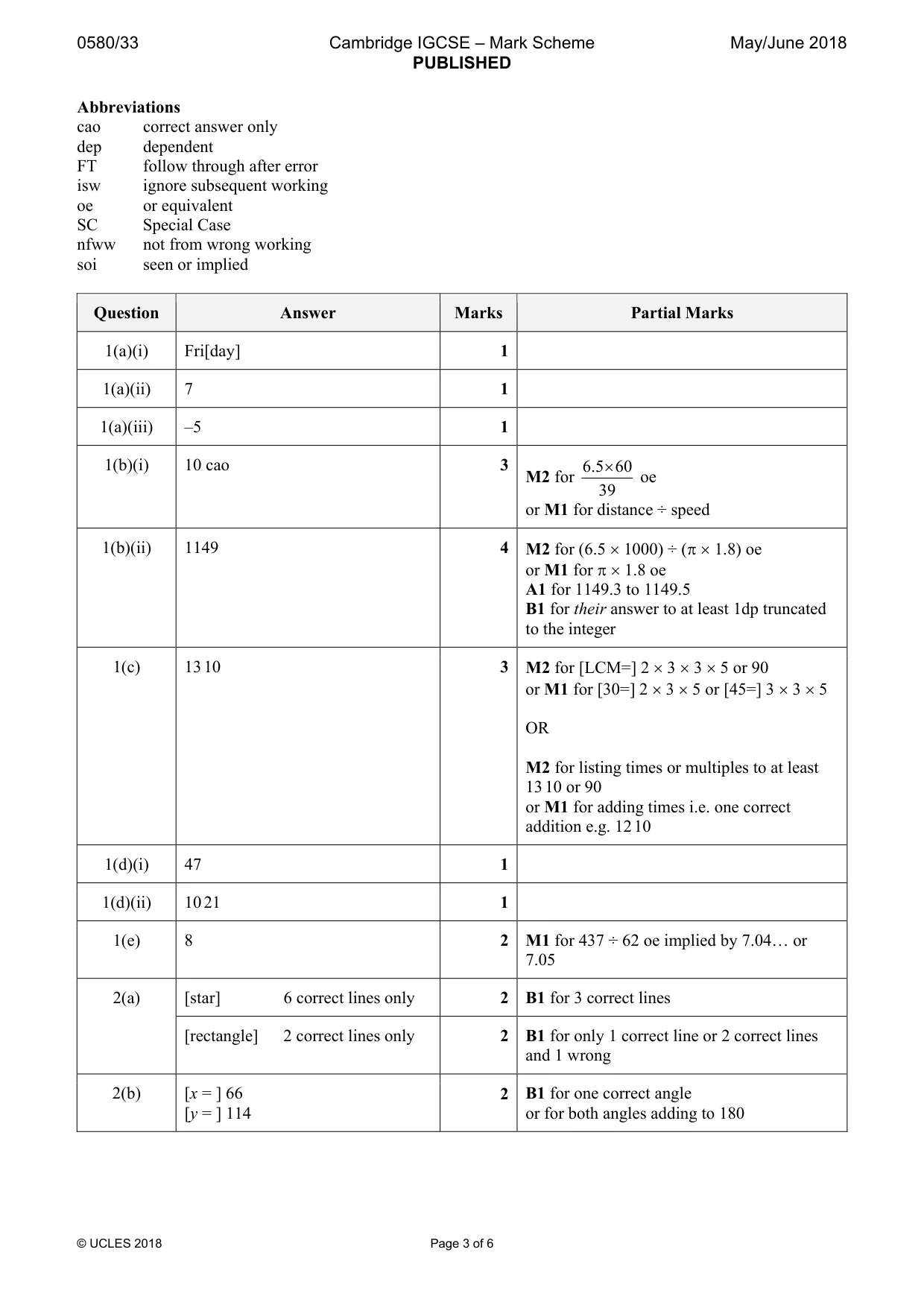
Mark scheme: Question Answer Marks Partial Marks 1(a)(i) Fri[day] 1 1(a)(ii) 7 1 1(a)(iii) –5 1 1(b)(i) 10 cao 3 6.5 × 60 M2 for oe 39 or M1 for distance ÷ speed 1(b)(ii) 1149 4 M2 for (6.5 × 1000) ÷ (π × 1.8) oe or M1 for π × 1.8 oe A1 for 1149.3 to 1149.5 B1 for their answer to at least 1dp truncated to the integer 1(c) 13 10 3 M2 for [LCM=] 2 × 3 × 3 × 5 or 90 or M1 for [30=] 2 × 3 × 5 or [45=] 3 × 3 × 5 OR M2 for listing times or multiples to at least 13 10 or 90 or M1 for adding times i.e. one correct addition e.g. 12 10 1(d)(i) 47 1 1(d)(ii) 10 21 1 1(e) 8 2 M1 for 437 ÷ 62 oe implied by 7.04… or 7.05
Q2 · Draw all the lines of symmetry on each shape
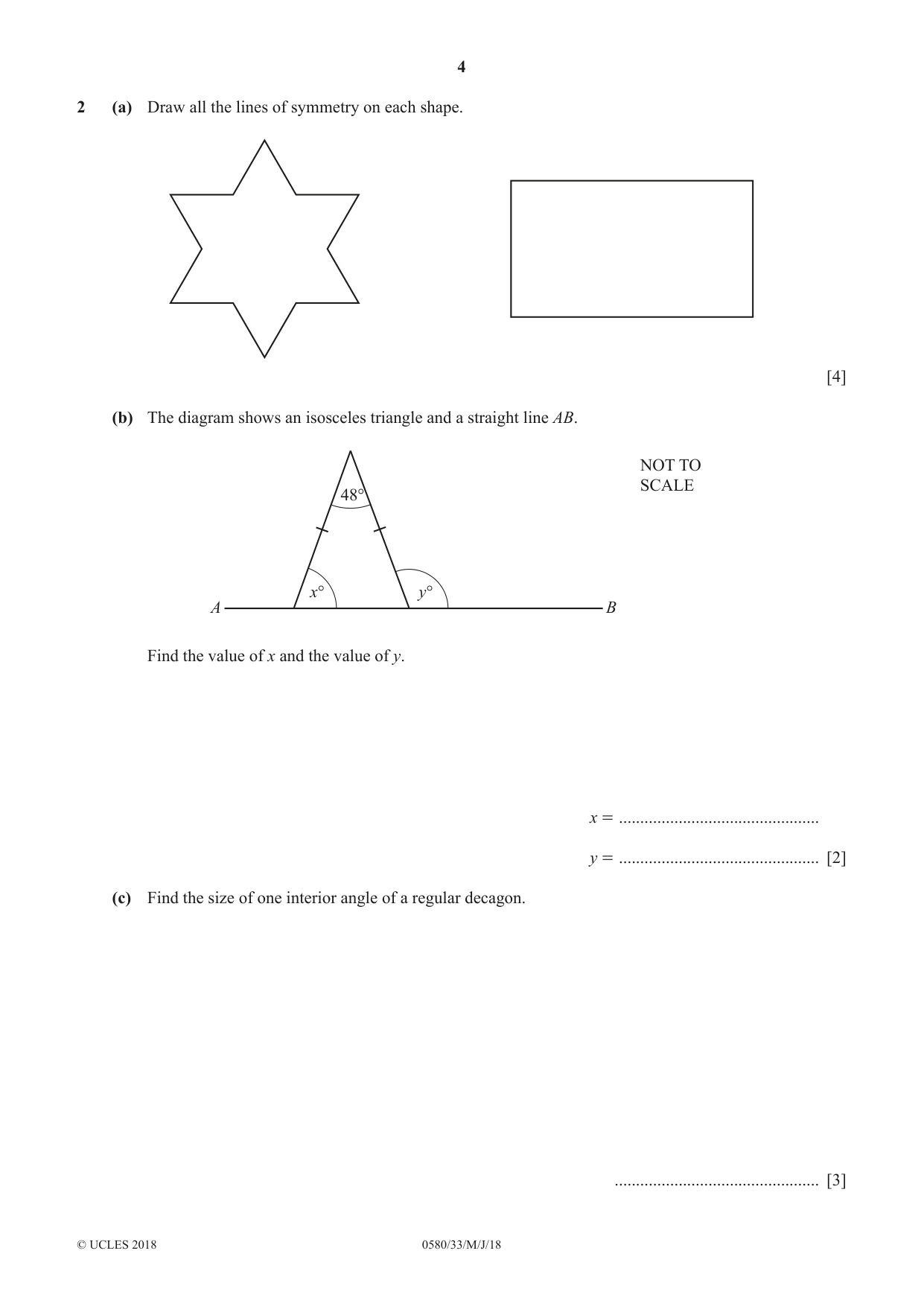
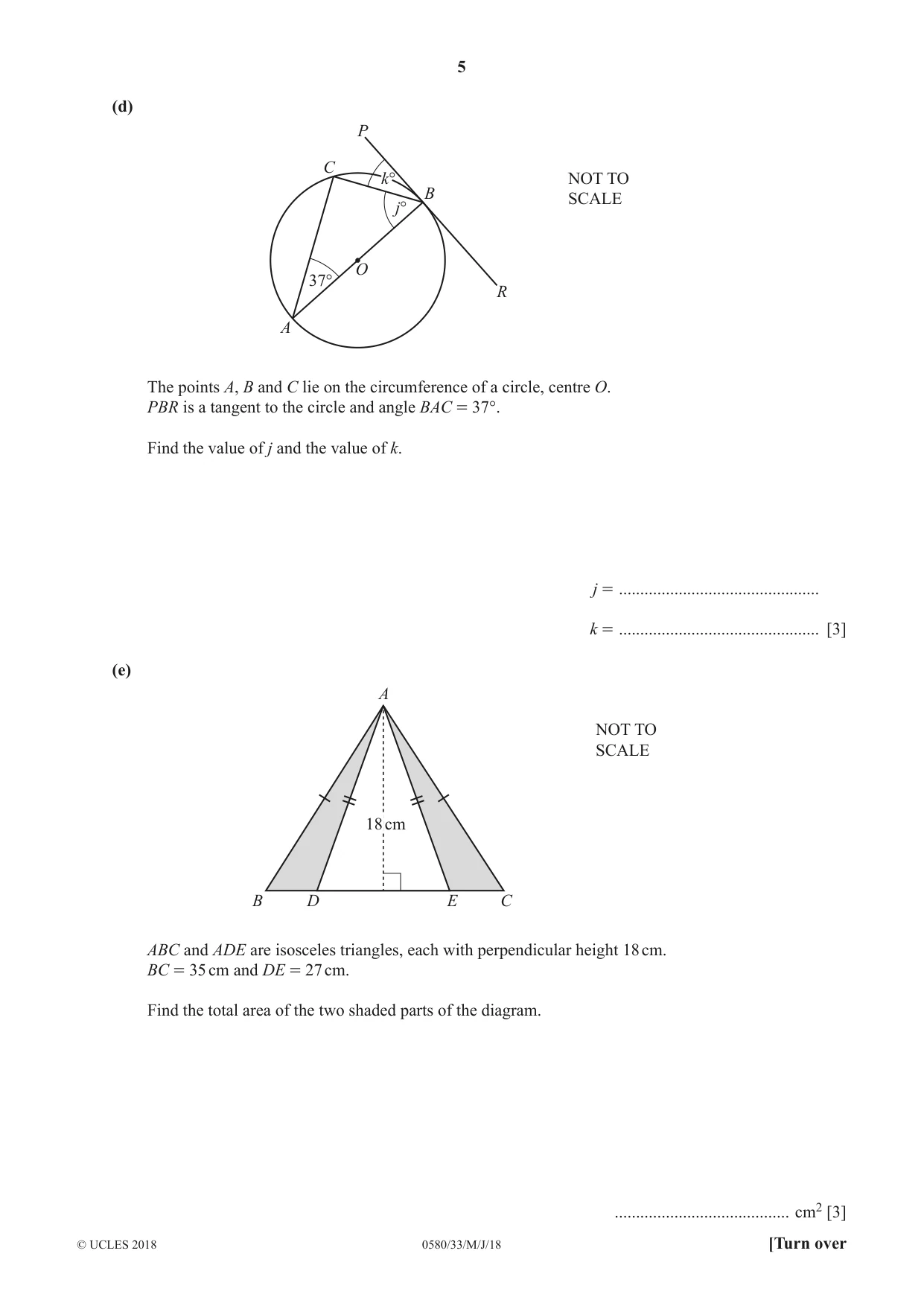
2 (a) Draw all the lines of symmetry on each shape. [4] (b) The diagram shows an isosceles triangle and a straight line AB. NOT TO SCALE 48° x° y° A B Find the value of x and the value of y. x = ............................................... y = ............................................... [2] (c) Find the size of one interior angle of a regular decagon. ................................................ [3] (d) P C k° NOT TO B SCALE j° O 37° R A The points A, B and C lie on the circumference of a circle, centre O. PBR is a tangent to the circle and angle BAC = 37°. Find the value of j and the value of k. j = ............................................... k = ............................................... [3] (e) A NOT TO SCALE 18 cm B D E C ABC and ADE are isosceles triangles, each with perpendicular height 18 cm. BC = 35 cm and DE = 27 cm. Find the total area of the two shaded parts of the diagram. ......................................... cm2 [3]
Mark scheme: 2(a) [star] 6 correct lines only 2 B1 for 3 correct lines [rectangle] 2 correct lines only 2 B1 for only 1 correct line or 2 correct lines and 1 wrong 2(b) [x = ] 66 2 B1 for one correct angle [y = ] 114 or for both angles adding to 180 2(c) 144 3 M1 for 360 ÷ 10 soi by 36 M1 for [y = ] 180 – their 36 If 0 scored SC2 for a correct interior angle of a regular polygon (greater than 90), providing not from wrong working 2(d) [j = ] 53 3 B2 for one correct angle [k = ] 37 or B1 for 90 seen, marked on drawing in the correct place or for both angles adding to 90 2(e) 72 3 M1 for (18 × 35) ÷ 2 implied by 315 M1 for (18 × 27) ÷ 2 implied by 243
Q3 · A museum’s opening times are shown in this table
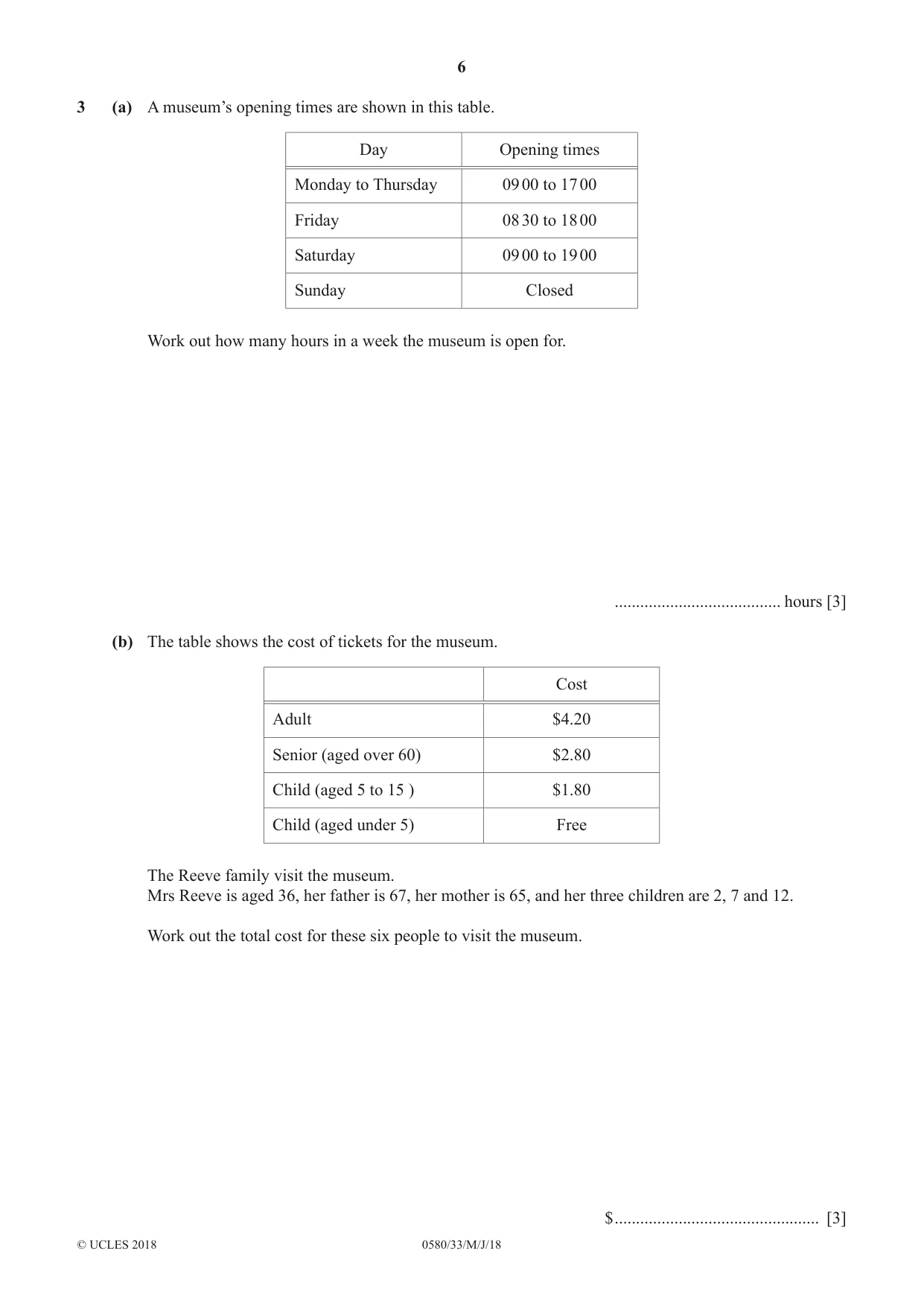
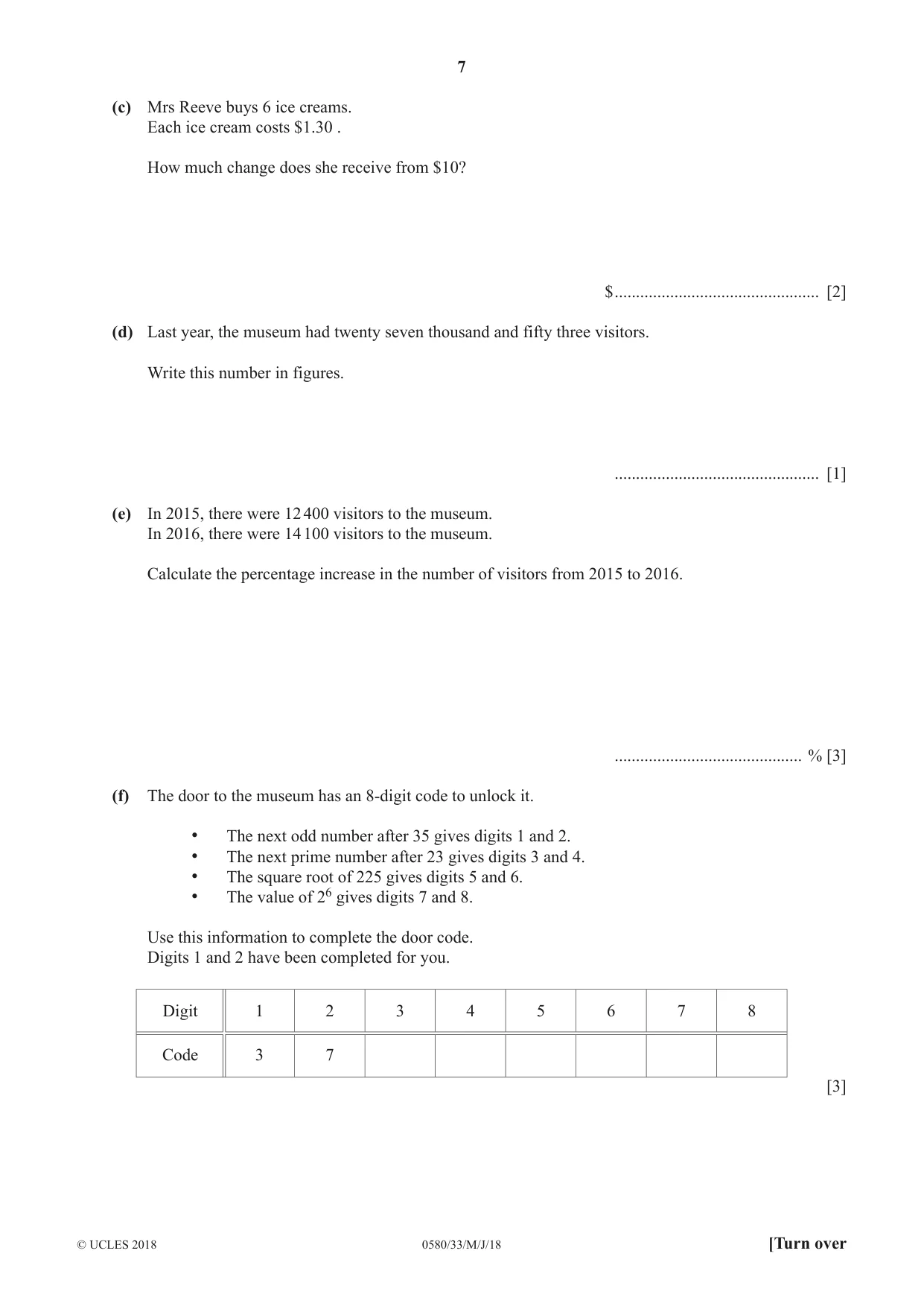
3 (a) A museum’s opening times are shown in this table. Day Opening times Monday to Thursday 09 00 to 17 00 Friday 08 30 to 18 00 Saturday 09 00 to 19 00 Sunday Closed Work out how many hours in a week the museum is open for. ....................................... hours [3] (b) The table shows the cost of tickets for the museum. Cost Adult $4.20 Senior (aged over 60) $2.80 Child (aged 5 to 15 ) $1.80 Child (aged under 5) Free The Reeve family visit the museum. Mrs Reeve is aged 36, her father is 67, her mother is 65, and her three children are 2, 7 and 12. Work out the total cost for these six people to visit the museum. $ ................................................ [3] (c) Mrs Reeve buys 6 ice creams. Each ice cream costs $1.30 . How much change does she receive from $10? $ ................................................ [2] (d) Last year, the museum had twenty seven thousand and fifty three visitors. Write this number in figures. ................................................ [1] (e) In 2015, there were 12 400 visitors to the museum. In 2016, there were 14 100 visitors to the museum. Calculate the percentage increase in the number of visitors from 2015 to 2016. ............................................ % [3] (f) The door to the museum has an 8-digit code to unlock it. • The next odd number after 35 gives digits 1 and 2. • The next prime number after 23 gives digits 3 and 4. • The square root of 225 gives digits 5 and 6. • The value of 26 gives digits 7 and 8. Use this information to complete the door code. Digits 1 and 2 have been completed for you. Digit 1 2 3 4 5 6 7 8 Code 3 7 [3]
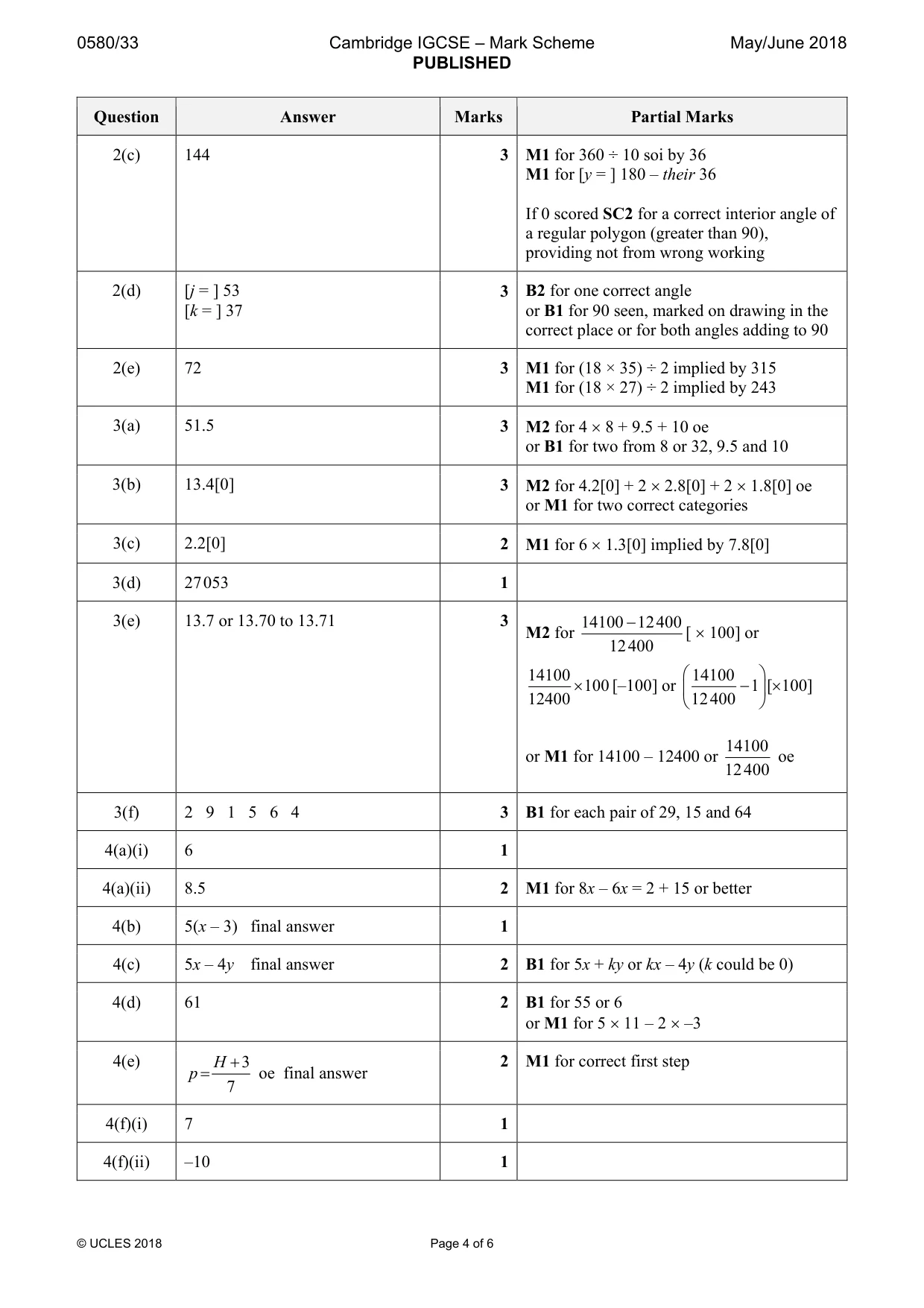
Mark scheme: 3(a) 51.5 3 M2 for 4 × 8 + 9.5 + 10 oe or B1 for two from 8 or 32, 9.5 and 10 3(b) 13.4[0] 3 M2 for 4.2[0] + 2 × 2.8[0] + 2 × 1.8[0] oe or M1 for two correct categories 3(c) 2.2[0] 2 M1 for 6 × 1.3[0] implied by 7.8[0] 3(d) 27 053 1 3(e) 13.7 or 13.70 to 13.71 3 14100 − 12400 M2 for [ × 100] or 12400 14100 14100 × 100 [–100] or − 1 [× 100] 12400 12400 14100 or M1 for 14100 – 12400 or oe 12400 3(f) 2 9 1 5 6 4 3 B1 for each pair of 29, 15 and 64
Question 4
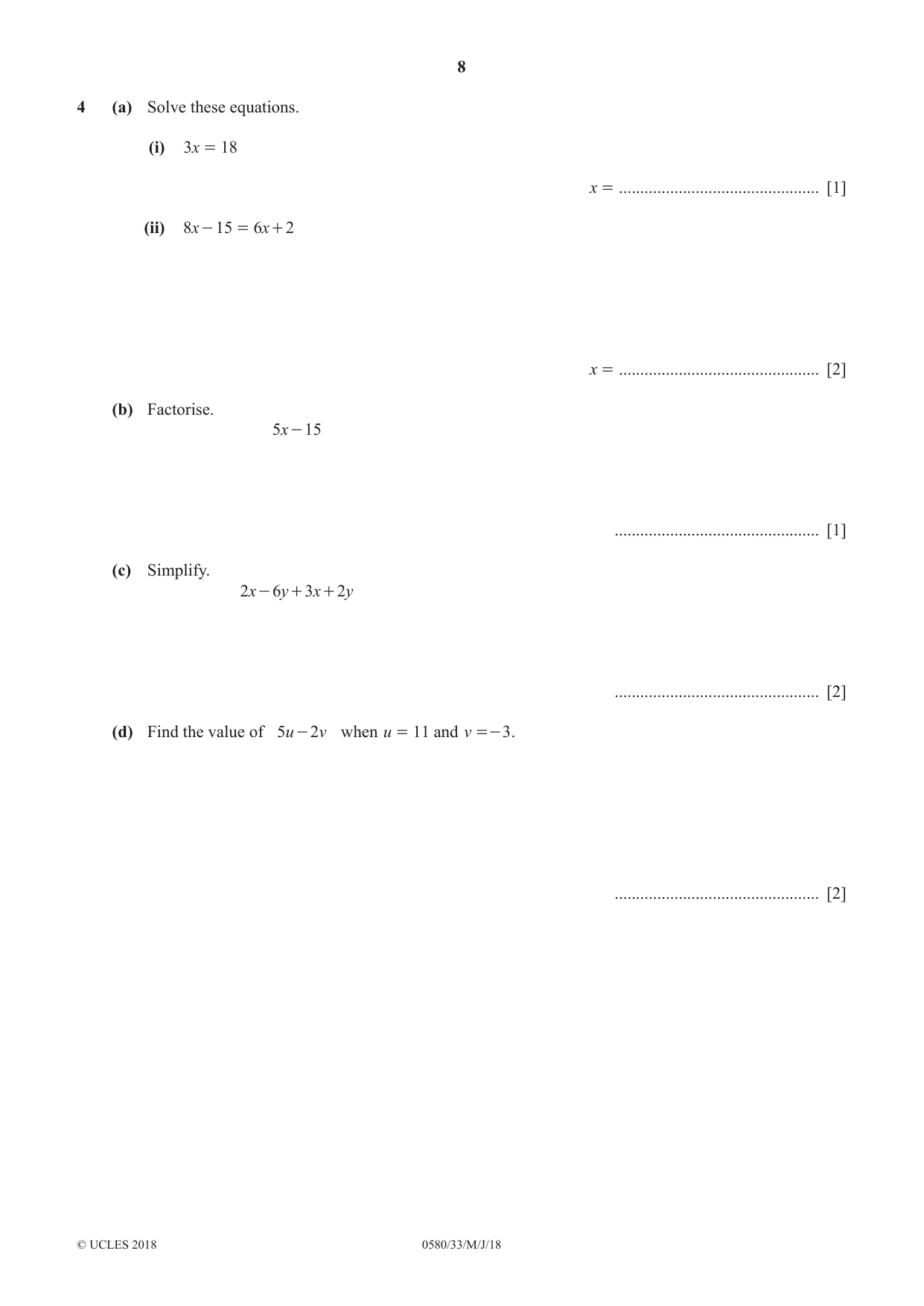
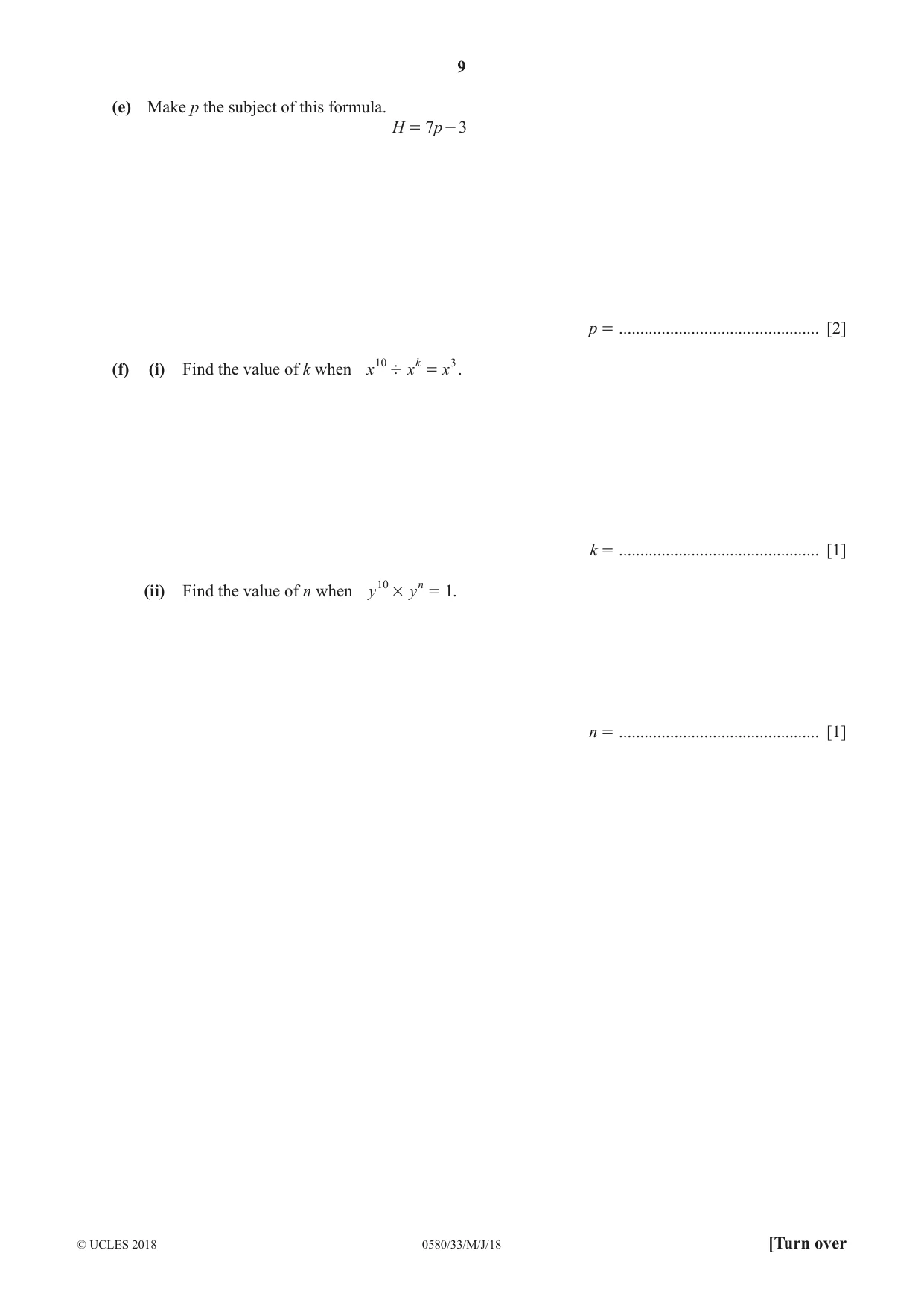
4 (a) Solve these equations. (i) 3x = 18 x = ............................................... [1] (ii) 8x - 15 = 6x + 2 x = ............................................... [2] (b) Factorise. 5x - 15 ................................................ [1] (c) Simplify. 2x - 6y + 3x + 2y ................................................ [2] (d) Find the value of 5u - 2v when u = 11 and v =- 3 . ................................................ [2] (e) Make p the subject of this formula. H = 7p - 3 p = ............................................... [2] (f) (i) Find the value of k when x 10 ' x k = x 3 . k = ............................................... [1] (ii) Find the value of n when y 10 # y n = 1. n = ............................................... [1]
Mark scheme: 4(a)(i) 6 1 4(a)(ii) 8.5 2 M1 for 8x – 6x = 2 + 15 or better 4(b) 5(x – 3) final answer 1 4(c) 5x – 4y final answer 2 B1 for 5x + ky or kx – 4y (k could be 0) 4(d) 61 2 B1 for 55 or 6 or M1 for 5 × 11 – 2 × –3 4(e) H + 3 2 M1 for correct first step p = oe final answer 7 4(f)(i) 7 1 4(f)(ii) –10 1
Q5 · Geoff keeps a record of the number of goals scored in the first eight games played by his…
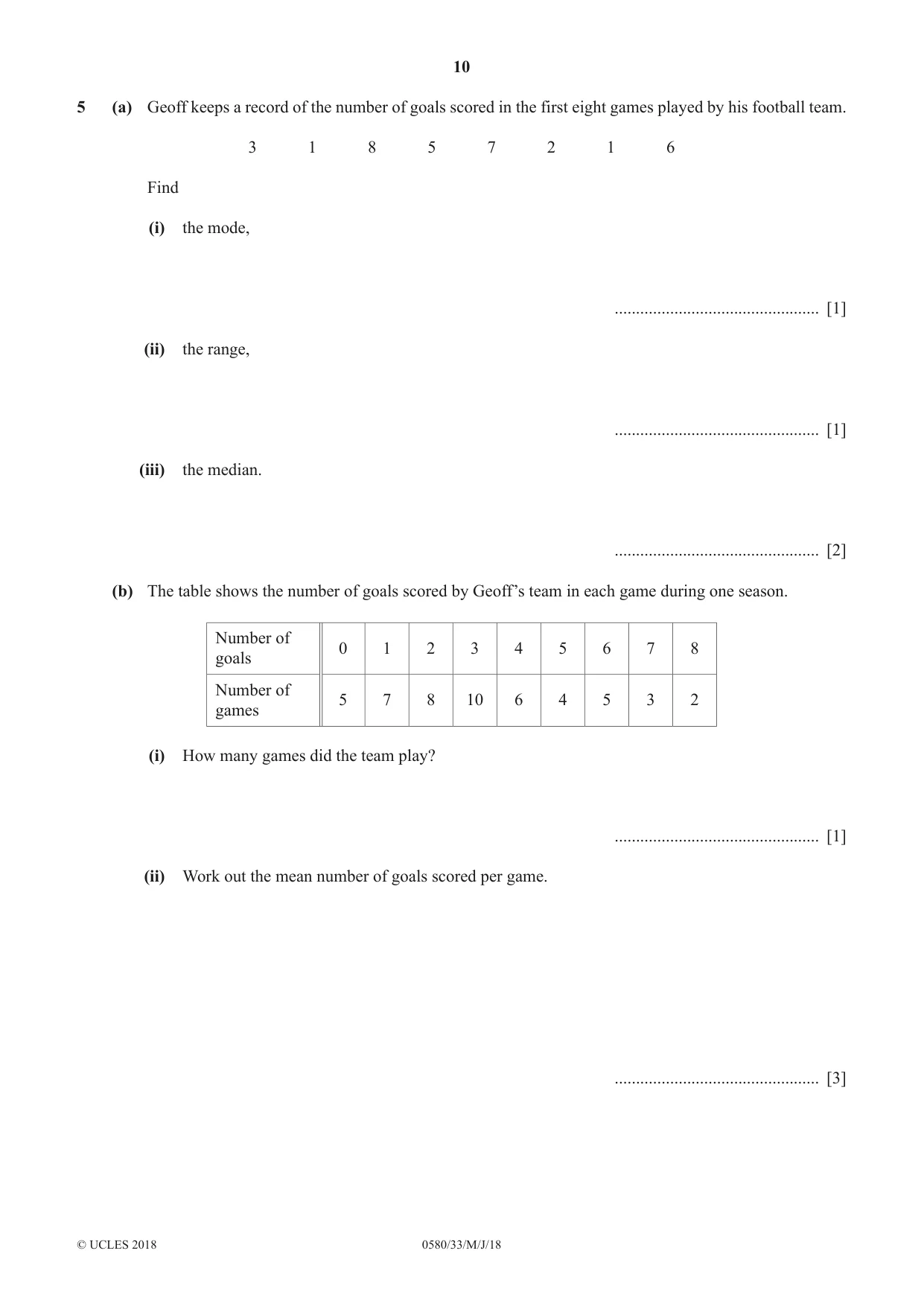
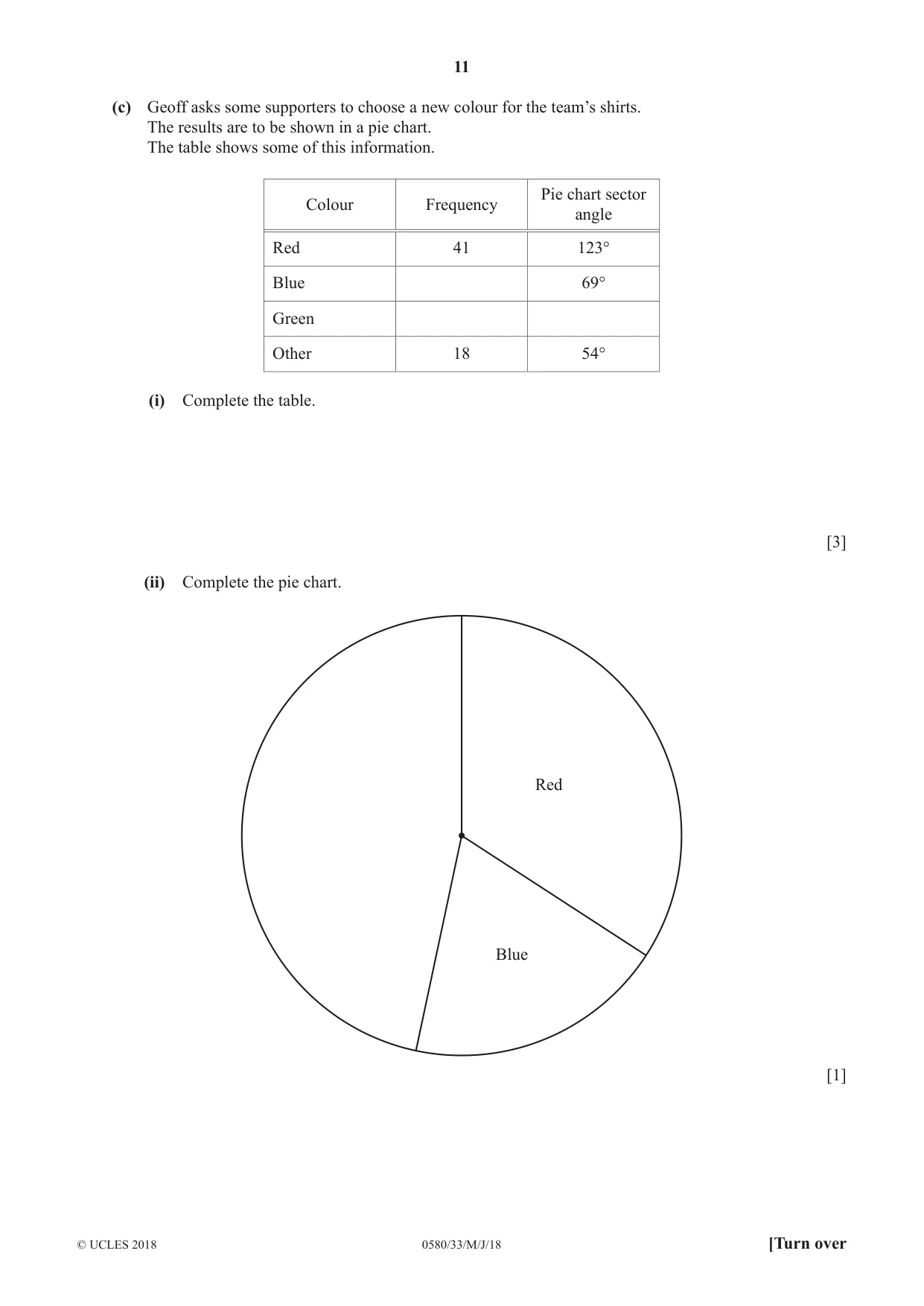
5 (a) Geoff keeps a record of the number of goals scored in the first eight games played by his football team. 3 1 8 5 7 2 1 6 Find (i) the mode, ................................................ [1] (ii) the range, ................................................ [1] (iii) the median. ................................................ [2] (b) The table shows the number of goals scored by Geoff’s team in each game during one season. Number of 0 1 2 3 4 5 6 7 8 goals Number of 5 7 8 10 6 4 5 3 2 games (i) How many games did the team play? ................................................ [1] (ii) Work out the mean number of goals scored per game. ................................................ [3] (c) Geoff asks some supporters to choose a new colour for the team’s shirts. The results are to be shown in a pie chart. The table shows some of this information. Pie chart sector Colour Frequency angle Red 41 123° Blue 69° Green Other 18 54° (i) Complete the table. [3] (ii) Complete the pie chart. Red Blue [1]
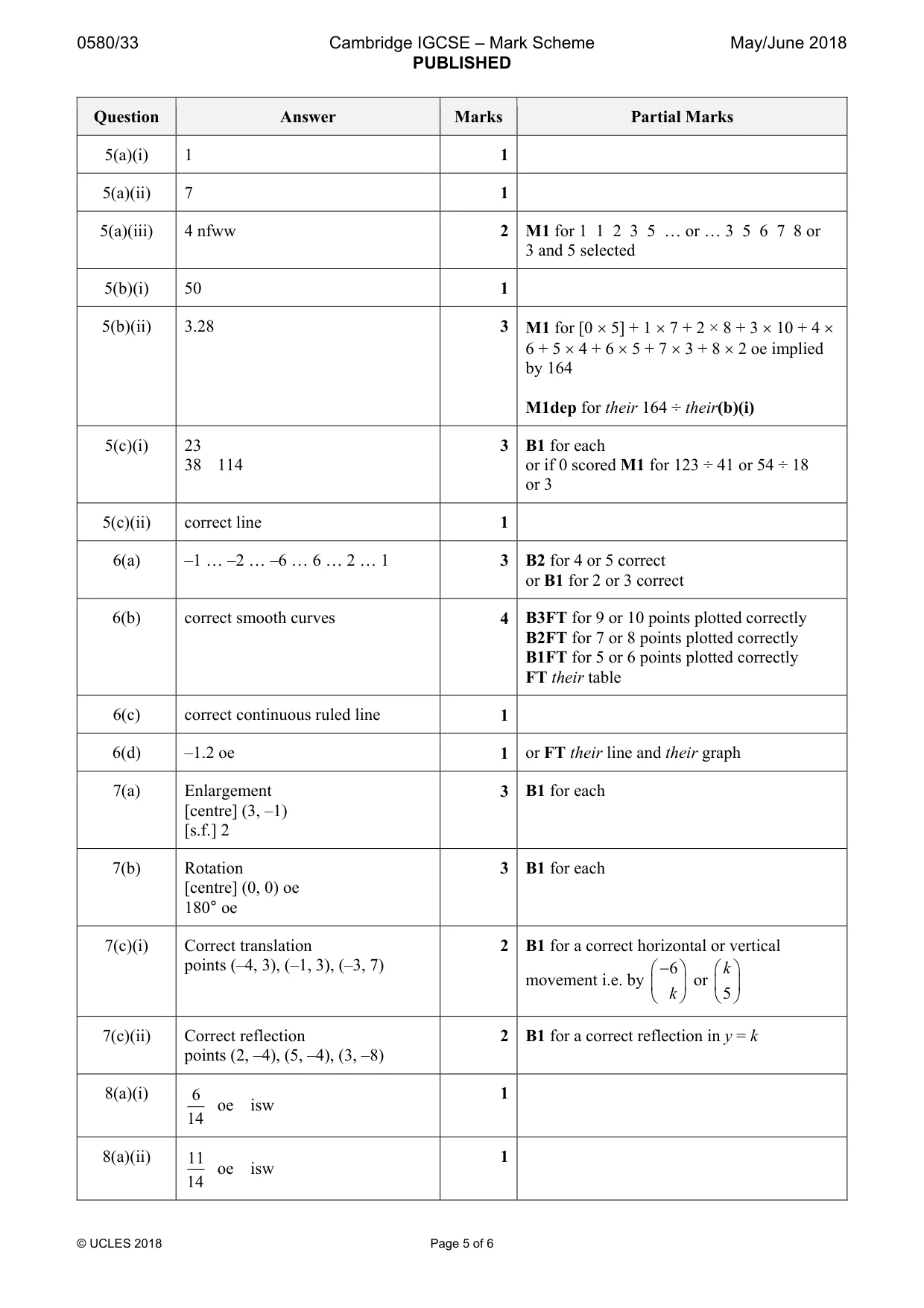
Mark scheme: 5(a)(i) 1 1 5(a)(ii) 7 1 5(a)(iii) 4 nfww 2 M1 for 1 1 2 3 5 … or … 3 5 6 7 8 or 3 and 5 selected 5(b)(i) 50 1 5(b)(ii) 3.28 3 M1 for [0 × 5] + 1 × 7 + 2 × 8 + 3 × 10 + 4 × 6 + 5 × 4 + 6 × 5 + 7 × 3 + 8 × 2 oe implied by 164 M1dep for their 164 ÷ their(b)(i) 5(c)(i) 23 3 B1 for each 38 114 or if 0 scored M1 for 123 ÷ 41 or 54 ÷ 18 or 3 5(c)(ii) correct line 1
Q6 · Complete the table of values for y = , x =Y 0
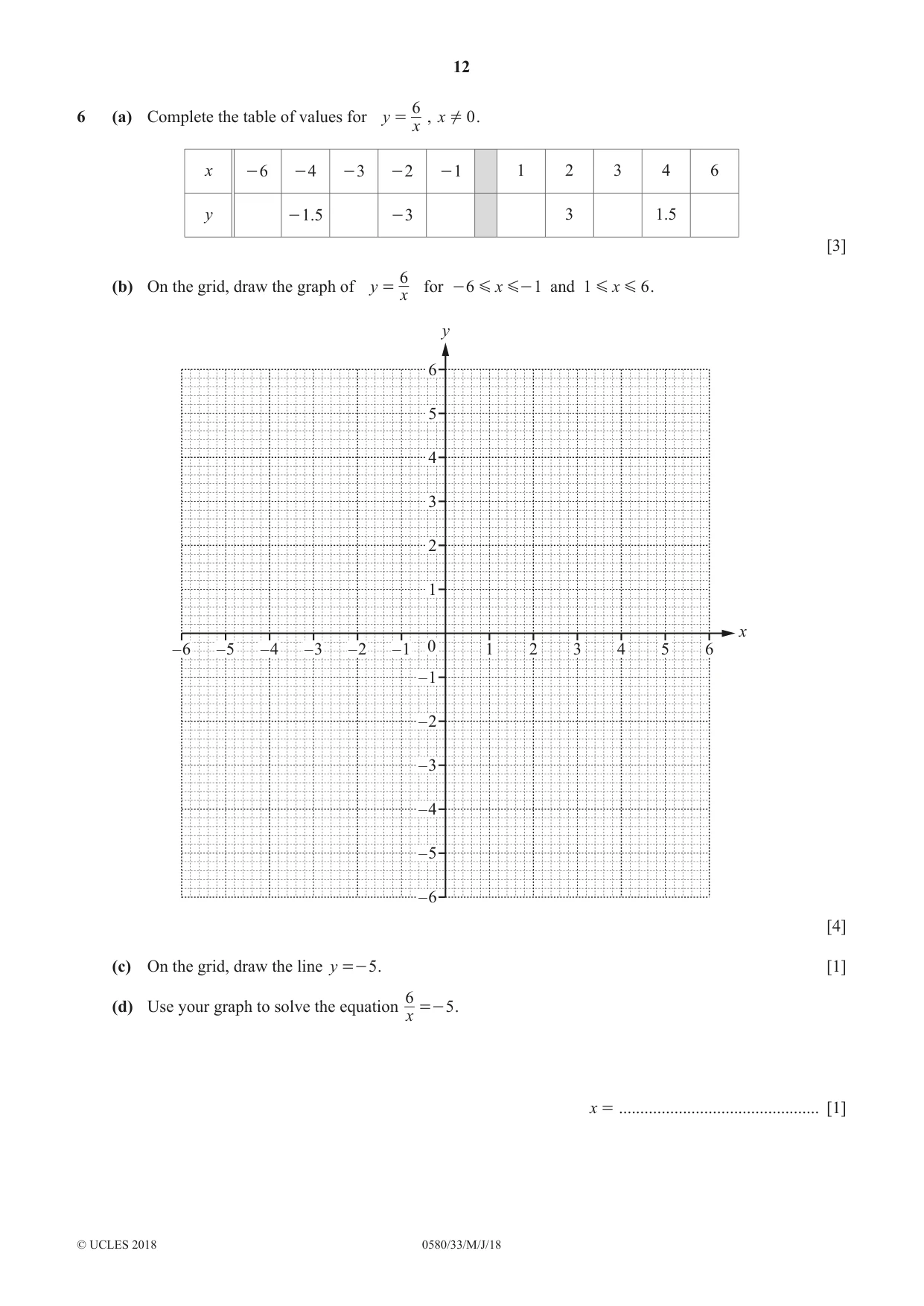
66 (a) Complete the table of values for y = , x =Y 0 . x x - 6 - 4 - 3 - 2 - 1 1 2 3 4 6 y - .15 - 3 3 1.5 [3] 6 (b) On the grid, draw the graph of y = for - 6 G x G - 1 and 1 G x G 6 . x y 6 5 4 3 2 1 x – 6 – 5 – 4 – 3 – 2 – 1 0 1 2 3 4 5 6 – 1 – 2 – 3 – 4 – 5 – 6 [4] (c) On the grid, draw the line y =- 5 . [1] 6 (d) Use your graph to solve the equation =- 5 . x x = ............................................... [1]
Mark scheme: 6(a) –1 … –2 … –6 … 6 … 2 … 1 3 B2 for 4 or 5 correct or B1 for 2 or 3 correct 6(b) correct smooth curves 4 B3FT for 9 or 10 points plotted correctly B2FT for 7 or 8 points plotted correctly B1FT for 5 or 6 points plotted correctly FT their table 6(c) correct continuous ruled line 1 6(d) –1.2 oe 1 or FT their line and their graph
Q7 · The diagram shows three triangles A, B and C
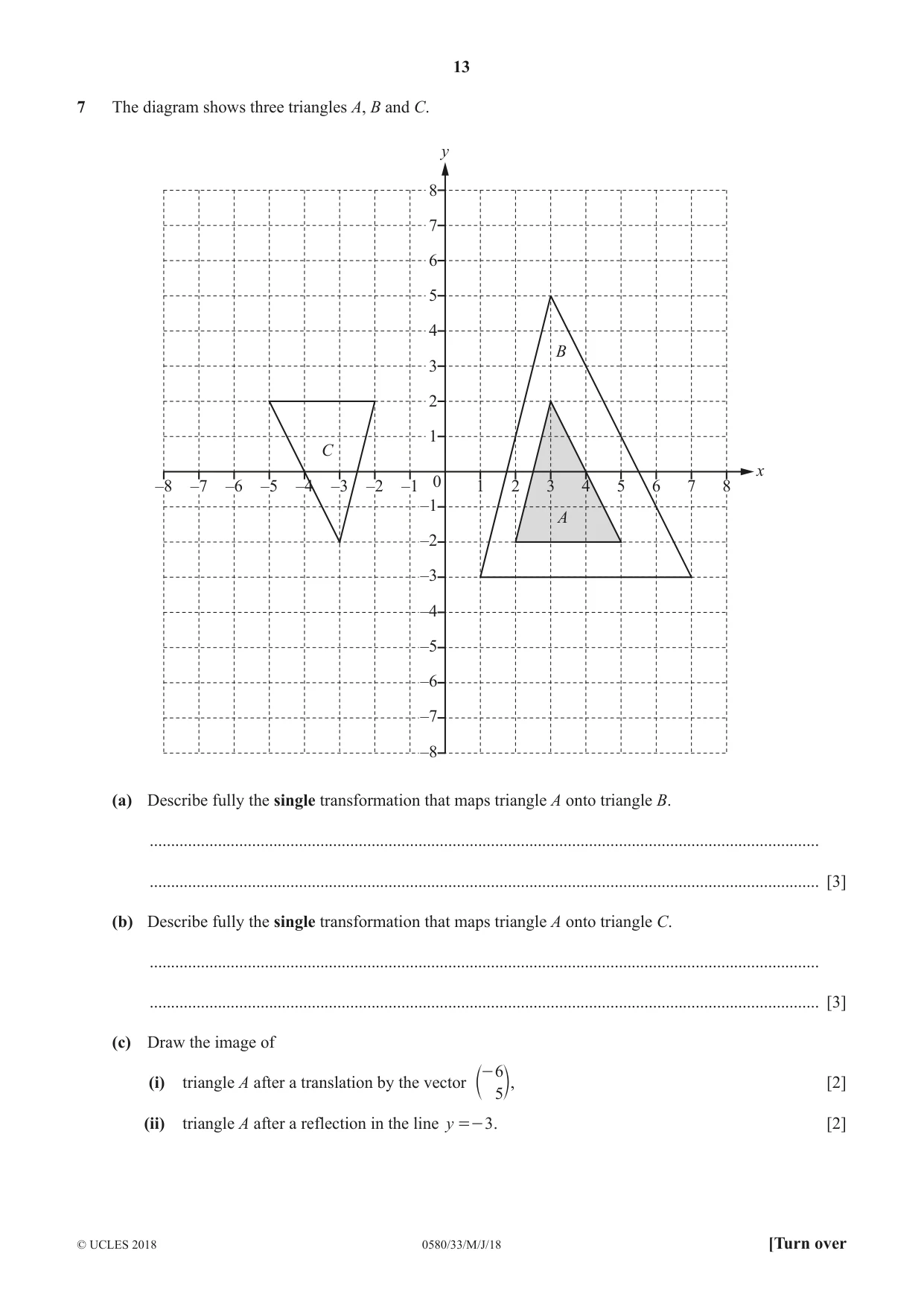
7 The diagram shows three triangles A, B and C. y 8 7 6 5 4 B 3 2 1 C x 0 –8 –7 –6 –5 –4 –3 –2 –1 1 2 3 4 5 6 7 8 –1 A –2 –3 –4 –5 –6 –7 –8 (a) Describe fully the single transformation that maps triangle A onto triangle B. ............................................................................................................................................................. ............................................................................................................................................................. [3] (b) Describe fully the single transformation that maps triangle A onto triangle C. ............................................................................................................................................................. ............................................................................................................................................................. [3] (c) Draw the image of - 6 (i) triangle A after a translation by the vector [2] c 5m, (ii) triangle A after a reflection in the line y =- 3 . [2]
Mark scheme: 7(a) Enlargement 3 B1 for each [centre] (3, –1) [s.f.] 2 7(b) Rotation 3 B1 for each [centre] (0, 0) oe 180° oe 7(c)(i) Correct translation 2 B1 for a correct horizontal or vertical points (–4, 3), (–1, 3), (–3, 7) − 6 k movement i.e. by or k 5 7(c)(ii) Correct reflection 2 B1 for a correct reflection in y = k points (2, –4), (5, –4), (3, –8)
Q8 · A bag contains 6 green balls, 5 red balls and 3 blue balls only
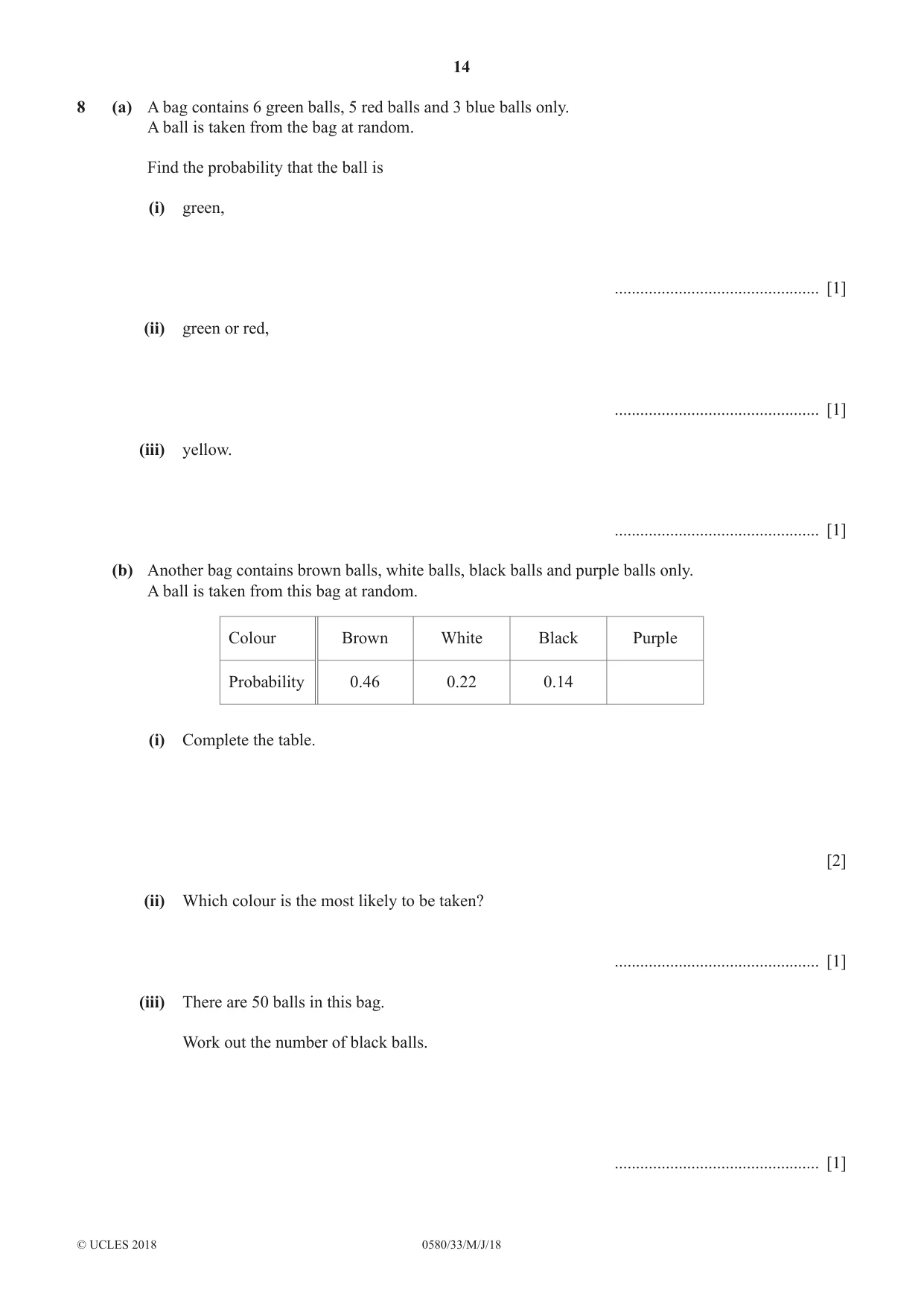
8 (a) A bag contains 6 green balls, 5 red balls and 3 blue balls only. A ball is taken from the bag at random. Find the probability that the ball is (i) green, ................................................ [1] (ii) green or red, ................................................ [1] (iii) yellow. ................................................ [1] (b) Another bag contains brown balls, white balls, black balls and purple balls only. A ball is taken from this bag at random. Colour Brown White Black Purple Probability 0.46 0.22 0.14 (i) Complete the table. [2] (ii) Which colour is the most likely to be taken? ................................................ [1] (iii) There are 50 balls in this bag. Work out the number of black balls. ................................................ [1]
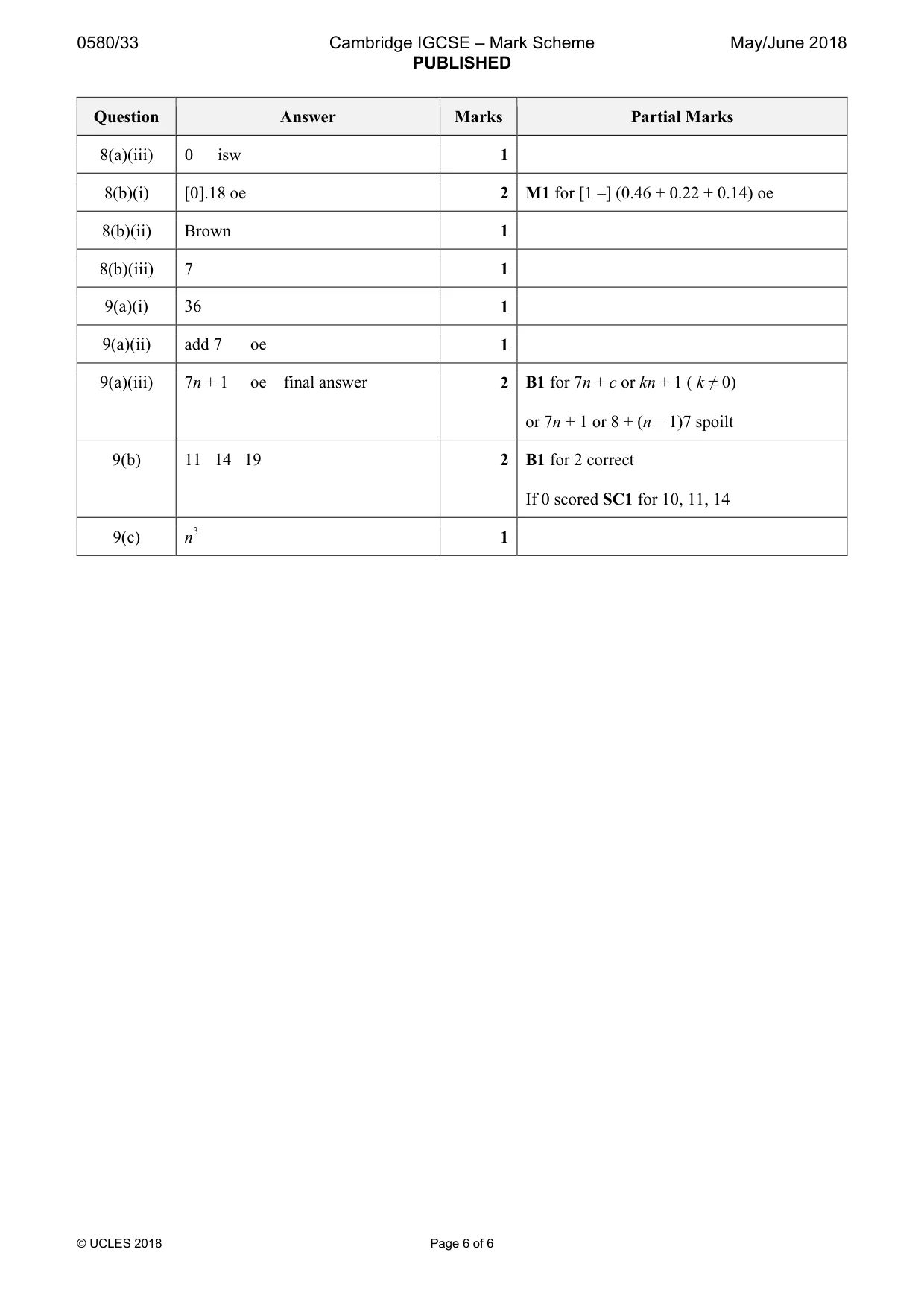
Mark scheme: 8(a)(i) 6 1 oe isw 14 8(a)(ii) 11 1 oe isw 14 8(a)(iii) 0 isw 1 8(b)(i) [0].18 oe 2 M1 for [1 –] (0.46 + 0.22 + 0.14) oe 8(b)(ii) Brown 1 8(b)(iii) 7 1
Q9 · These are the first four terms of a sequence
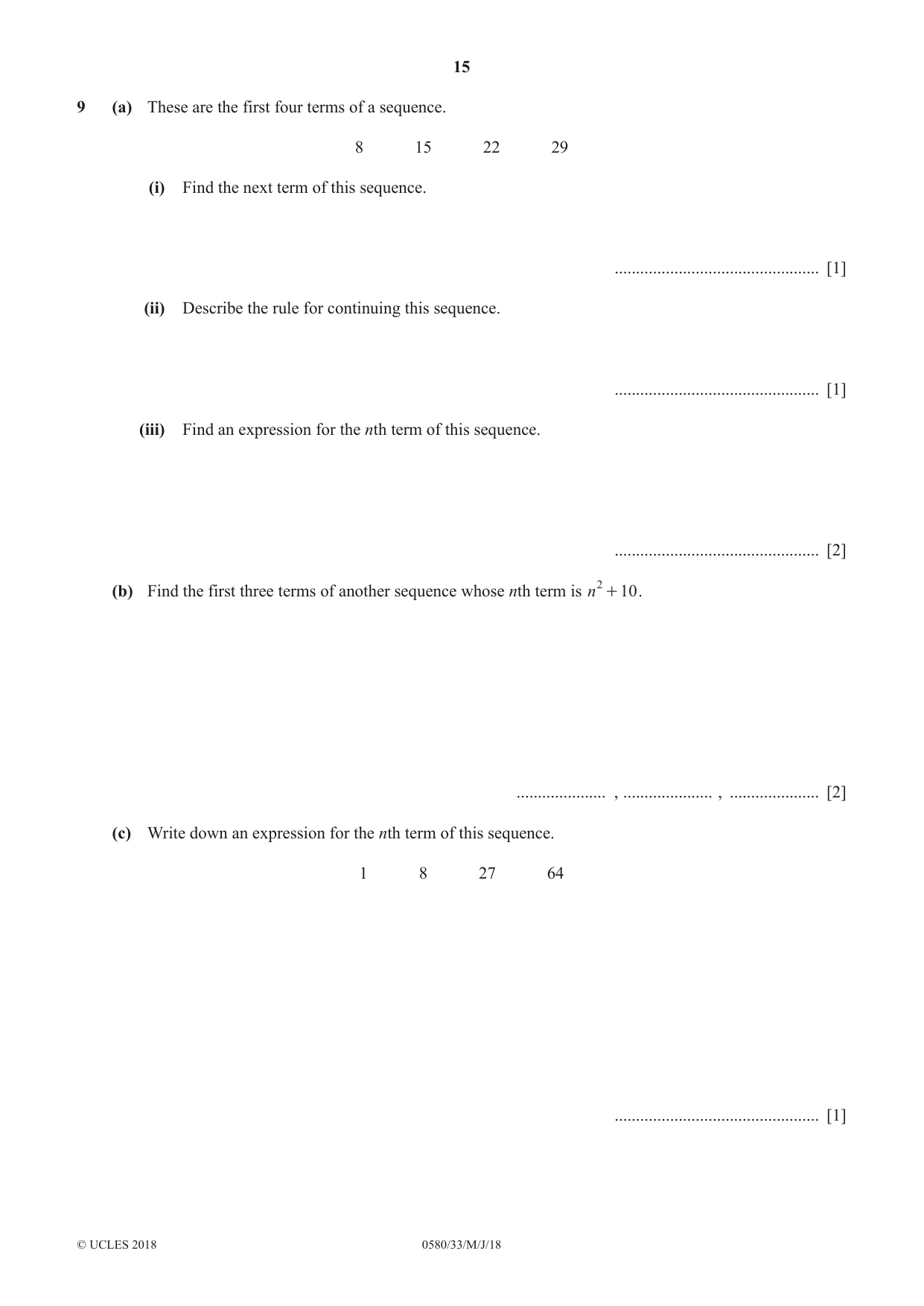
9 (a) These are the first four terms of a sequence. 8 15 22 29 (i) Find the next term of this sequence. ................................................ [1] (ii) Describe the rule for continuing this sequence. ................................................ [1] (iii) Find an expression for the nth term of this sequence. ................................................ [2] (b) Find the first three terms of another sequence whose nth term is n 2 + 10 . ..................... , ..................... , ..................... [2] (c) Write down an expression for the nth term of this sequence. 1 8 27 64 ................................................ [1]
Mark scheme: 9(a)(i) 36 1 9(a)(ii) add 7 oe 1 9(a)(iii) 7n + 1 oe final answer 2 B1 for 7n + c or kn + 1 ( k ≠ 0) or 7n + 1 or 8 + (n – 1)7 spoilt 9(b) 11 14 19 2 B1 for 2 correct If 0 scored SC1 for 10, 11, 14 9(c) n3 1
What was in this paper
The subtopics covered by these 9 questions, and how many questions each got. Open one in a new tab to see every Cambridge question on it.
What you needed in this session
Cambridge’s own grade thresholds for 2018 May/June, Paper 3 · Variant 3. A higher threshold means an easier paper — the bar moves with how the cohort did.