Cambridge IGCSE Mathematics 0580 — 2015 May/June Paper 3 · Variant 1
0580/31/M/J/15 · 9 questions · 104 marks · ≈117 min
The question paper and its mark scheme, free to read here and free to download. This is Cambridge’s own paper, exactly as it was sat.
Question paper16 pages
Mark scheme6 pages
Answers below. Sit the paper first if you are practising.
Questions as text
Q1 · Write down (i) two factors of 12, Answer(a)(i)…
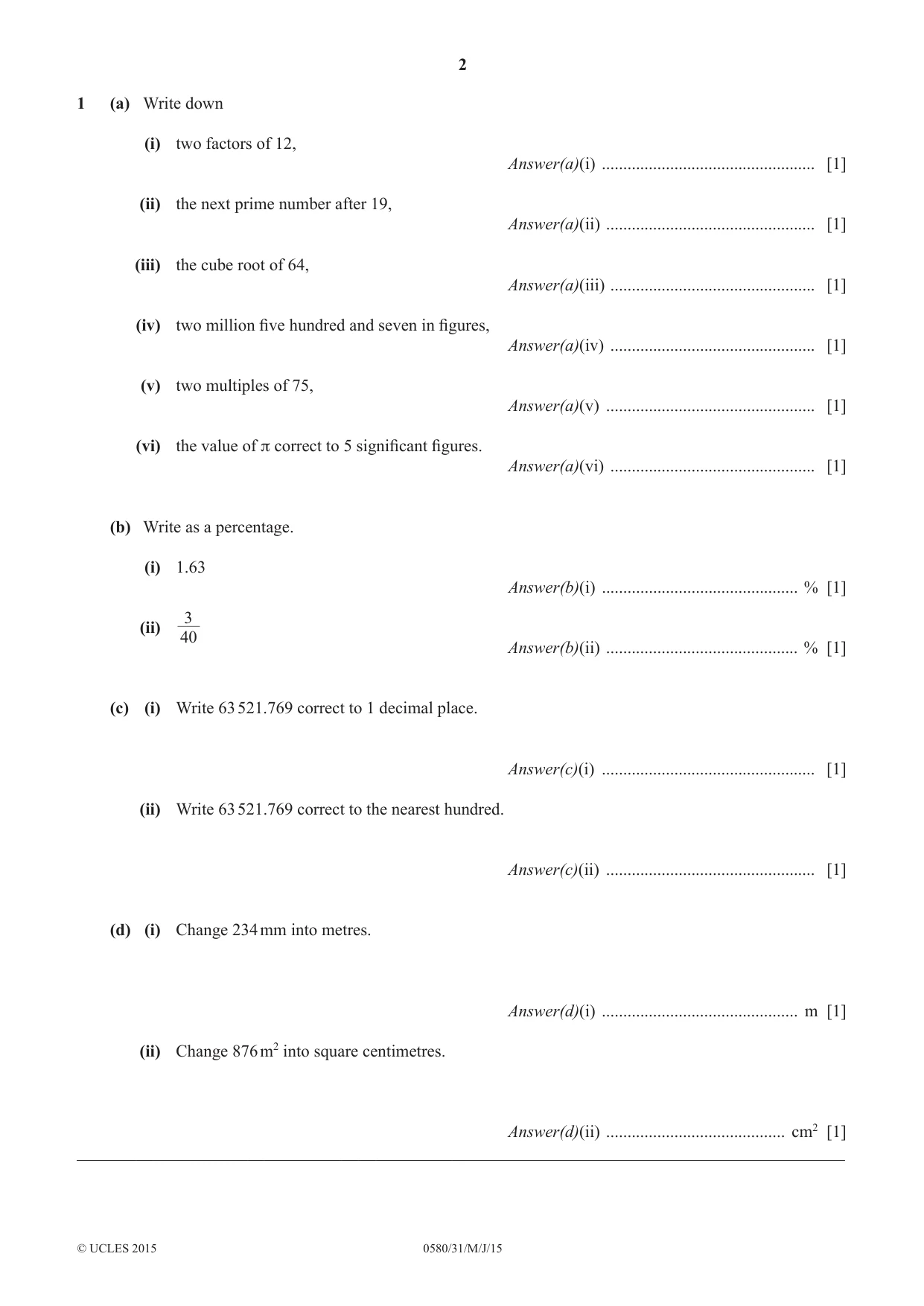
1 (a) Write down (i) two factors of 12, Answer(a)(i) .................................................. [1] (ii) the next prime number after 19, Answer(a)(ii) ................................................. [1] (iii) the cube root of 64, Answer(a)(iii) ................................................ [1] (iv) two million five hundred and seven in figures, Answer(a)(iv) ................................................ [1] (v) two multiples of 75, Answer(a)(v) ................................................. [1] (vi) the value of π correct to 5 significant figures. Answer(a)(vi) ................................................ [1] (b) Write as a percentage. (i) 1.63 Answer(b)(i) .............................................. % [1] 3 (ii) 40 Answer(b)(ii) ............................................. % [1] (c) (i) Write 63 521.769 correct to 1 decimal place. Answer(c)(i) .................................................. [1] (ii) Write 63 521.769 correct to the nearest hundred. Answer(c)(ii) ................................................. [1] (d) (i) Change 234 mm into metres. Answer(d)(i) .............................................. m [1] (ii) Change 876 m2 into square centimetres. Answer(d)(ii) .......................................... cm2 [1] __________________________________________________________________________________________
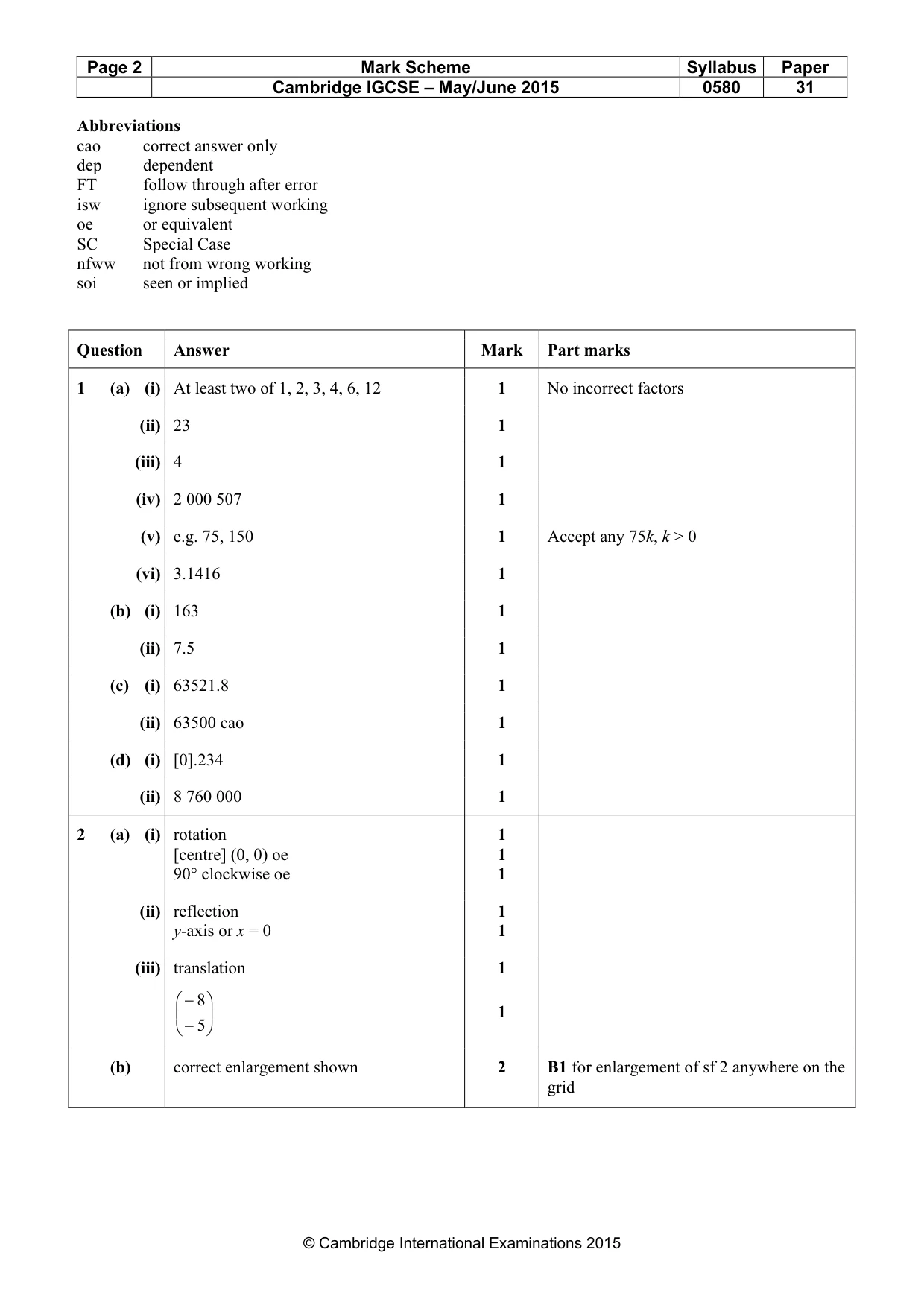
Mark scheme: Question Answer Mark Part marks 1 (a) (i) At least two of 1, 2, 3, 4, 6, 12 1 No incorrect factors (ii) 23 1 (iii) 4 1 (iv) 2 000 507 1 (v) e.g. 75, 150 1 Accept any 75k, k > 0 (vi) 3.1416 1 (b) (i) 163 1 (ii) 7.5 1 (c) (i) 63521.8 1 (ii) 63500 cao 1 (d) (i) [0].234 1 (ii) 8 760 000 1
Q2 · Y 6 5 4 3 C A 2 1 x –6 –5 –4 –3 –2 –1 0 1 2 3 4 5 6 7 8 9 10 –1 –2 D –3 B –4 –5 The…
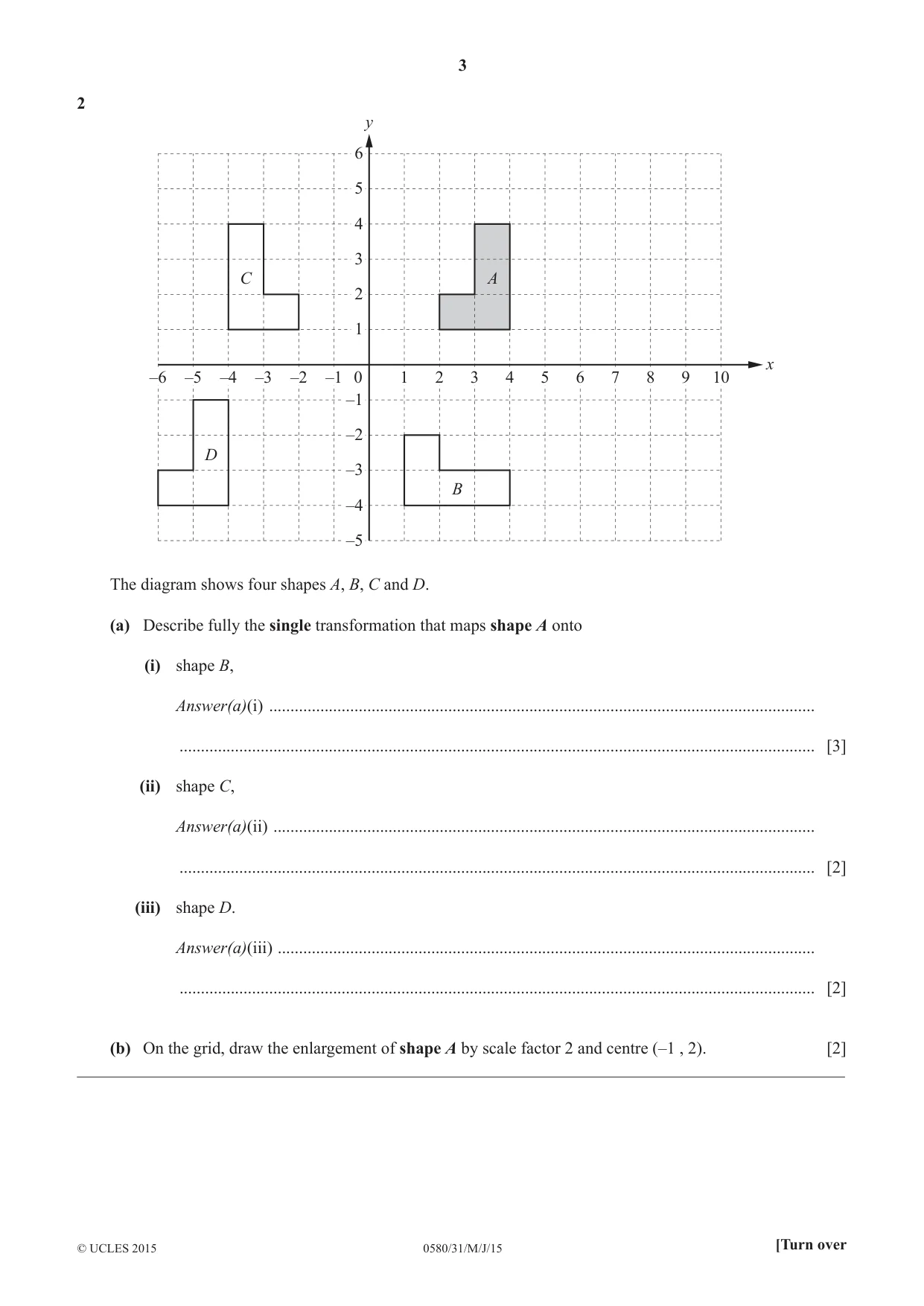
2 y 6 5 4 3 C A 2 1 x –6 –5 –4 –3 –2 –1 0 1 2 3 4 5 6 7 8 9 10 –1 –2 D –3 B –4 –5 The diagram shows four shapes A, B, C and D. (a) Describe fully the single transformation that maps shape A onto (i) shape B, Answer(a)(i) ................................................................................................................................ ..................................................................................................................................................... [3] (ii) shape C, Answer(a)(ii) ............................................................................................................................... ..................................................................................................................................................... [2] (iii) shape D. Answer(a)(iii) .............................................................................................................................. ..................................................................................................................................................... [2] (b) On the grid, draw the enlargement of shape A by scale factor 2 and centre (–1 , 2). [2] __________________________________________________________________________________________
Mark scheme: 2 (a) (i) rotation 1 [centre] (0, 0) oe 1 90° clockwise oe 1 (ii) reflection 1 y-axis or x = 0 1 (iii) translation 1 − 8 1 − 5 (b) correct enlargement shown 2 B1 for enlargement of sf 2 anywhere on the grid
Q3 · Sonia works in a toy shop
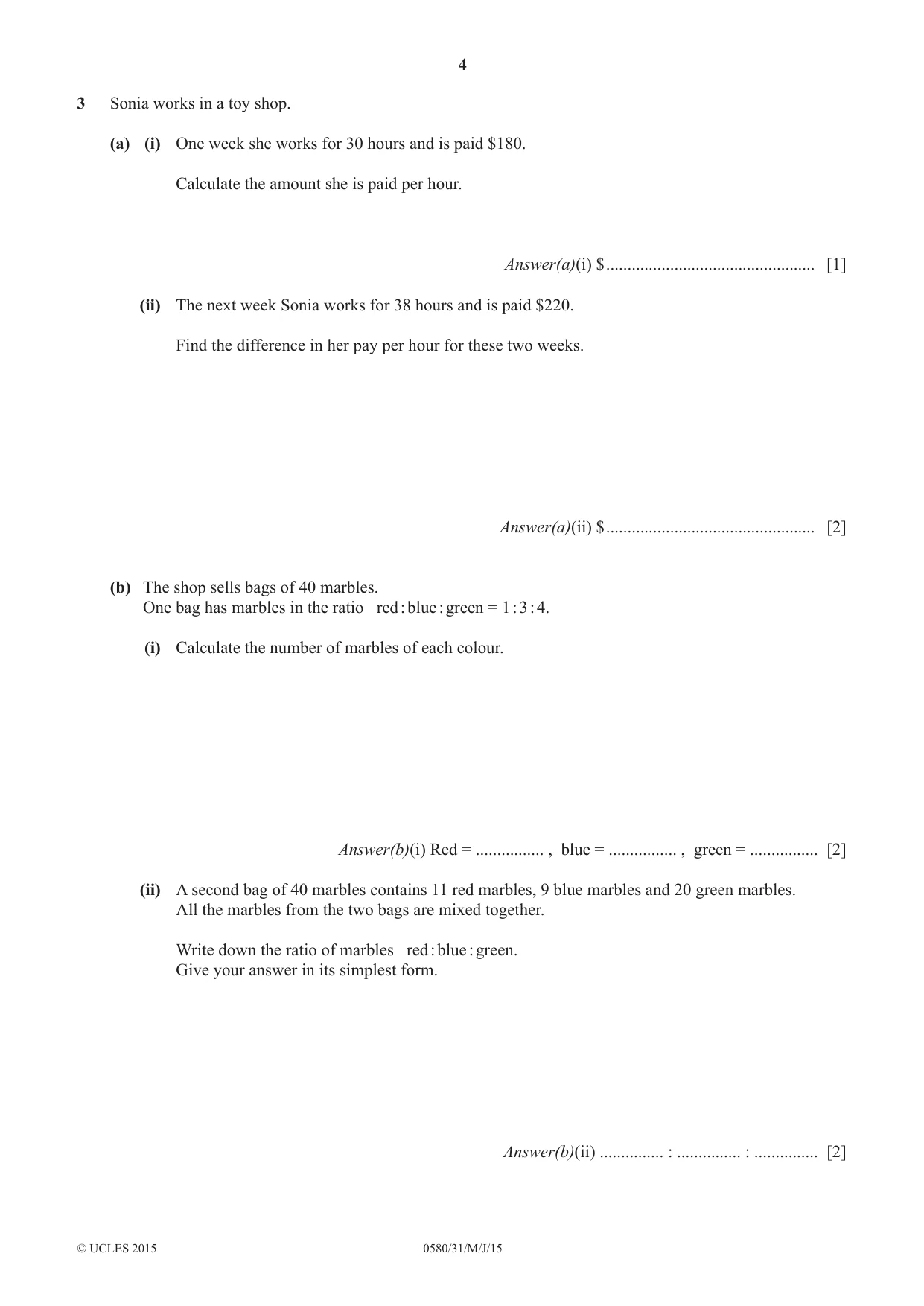
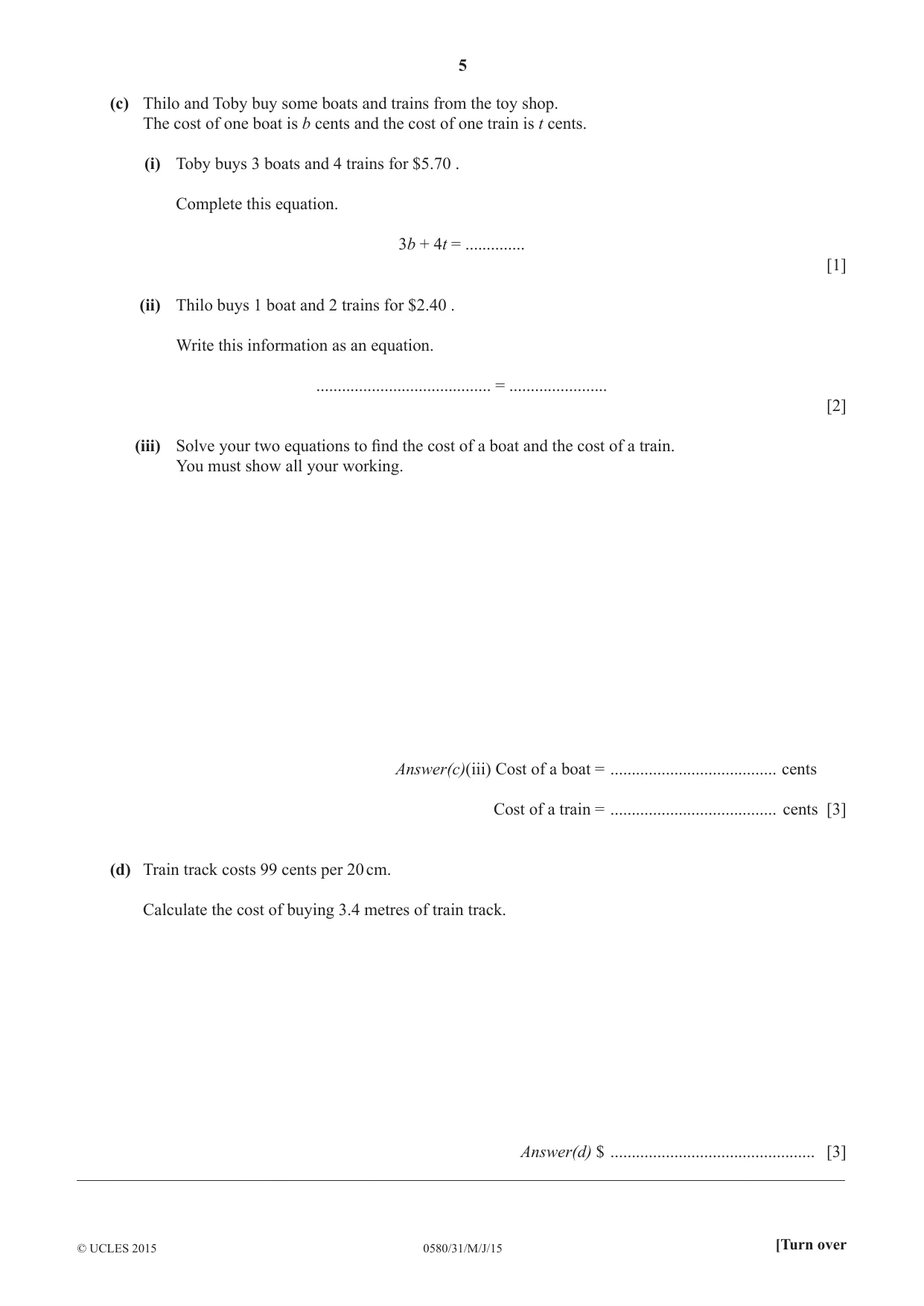
3 Sonia works in a toy shop. (a) (i) One week she works for 30 hours and is paid $180. Calculate the amount she is paid per hour. Answer(a)(i) $ ................................................. [1] (ii) The next week Sonia works for 38 hours and is paid $220. Find the difference in her pay per hour for these two weeks. Answer(a)(ii) $ ................................................. [2] (b) The shop sells bags of 40 marbles. One bag has marbles in the ratio red : blue : green = 1 : 3 : 4. (i) Calculate the number of marbles of each colour. Answer(b)(i) Red = ................ , blue = ................ , green = ................ [2] (ii) A second bag of 40 marbles contains 11 red marbles, 9 blue marbles and 20 green marbles. All the marbles from the two bags are mixed together. Write down the ratio of marbles red : blue : green. Give your answer in its simplest form. Answer(b)(ii) ............... : ............... : ............... [2] (c) Thilo and Toby buy some boats and trains from the toy shop. The cost of one boat is b cents and the cost of one train is t cents. (i) Toby buys 3 boats and 4 trains for $5.70 . Complete this equation. 3b + 4t = .............. [1] (ii) Thilo buys 1 boat and 2 trains for $2.40 . Write this information as an equation. ......................................... = ....................... [2] (iii) Solve your two equations to find the cost of a boat and the cost of a train. You must show all your working. Answer(c)(iii) Cost of a boat = ....................................... cents Cost of a train = ....................................... cents [3] (d) Train track costs 99 cents per 20 cm. Calculate the cost of buying 3.4 metres of train track. Answer(d) $ ................................................ [3] __________________________________________________________________________________________
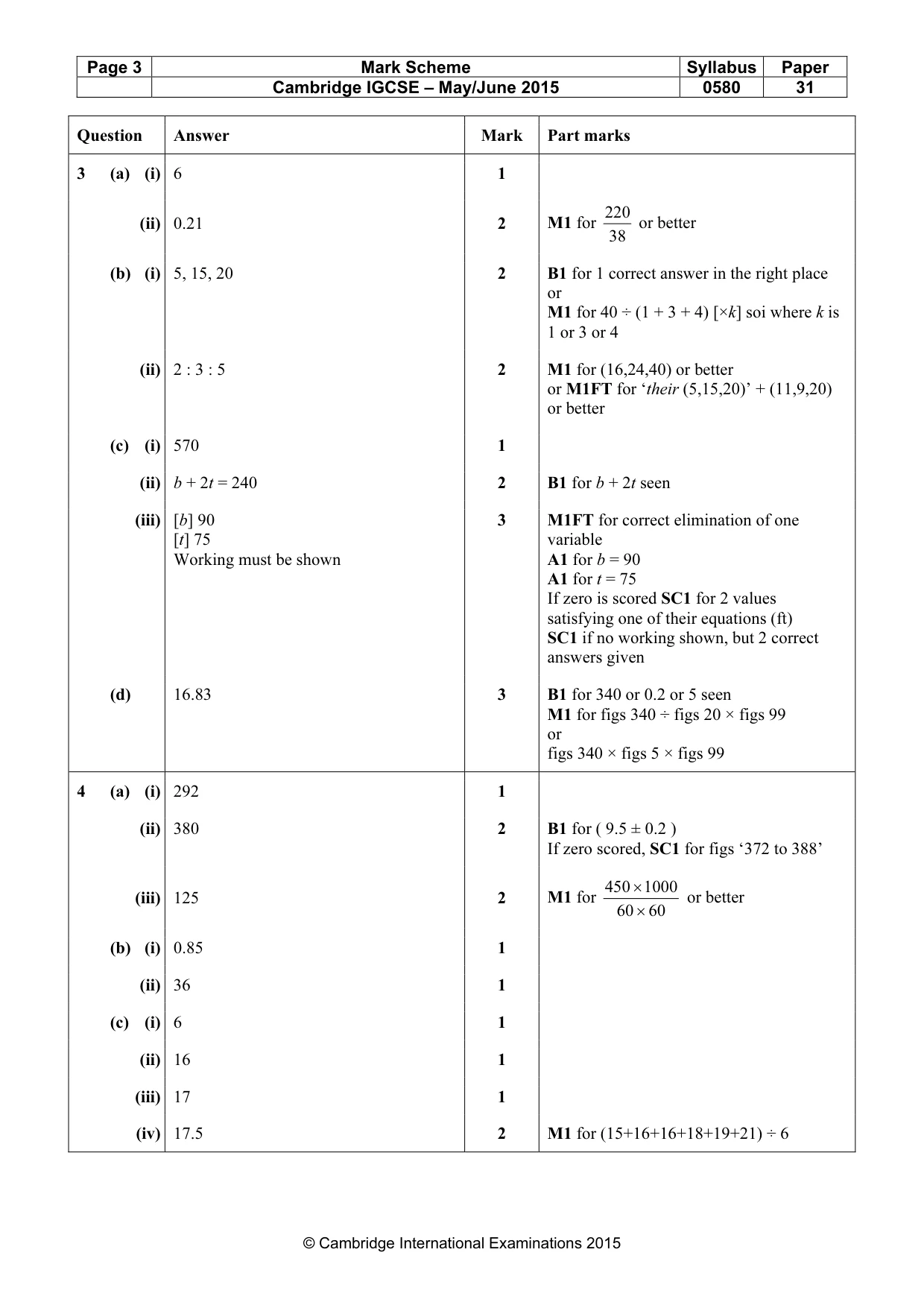
Mark scheme: 3 (a) (i) 6 1 220 (ii) 0.21 2 M1 for or better 38 (b) (i) 5, 15, 20 2 B1 for 1 correct answer in the right place or M1 for 40 ÷ (1 + 3 + 4) [×k] soi where k is 1 or 3 or 4 (ii) 2 : 3 : 5 2 M1 for (16,24,40) or better or M1FT for ‘their (5,15,20)’ + (11,9,20) or better (c) (i) 570 1 (ii) b + 2t = 240 2 B1 for b + 2t seen (iii) [b] 90 3 M1FT for correct elimination of one [t] 75 variable Working must be shown A1 for b = 90 A1 for t = 75 If zero is scored SC1 for 2 values satisfying one of their equations (ft) SC1 if no working shown, but 2 correct answers given (d) 16.83 3 B1 for 340 or 0.2 or 5 seen M1 for figs 340 ÷ figs 20 × figs 99 or figs 340 × figs 5 × figs 99
Q4 · The Patel family flies from their home town, H, to Kiruna, K, in Lapland
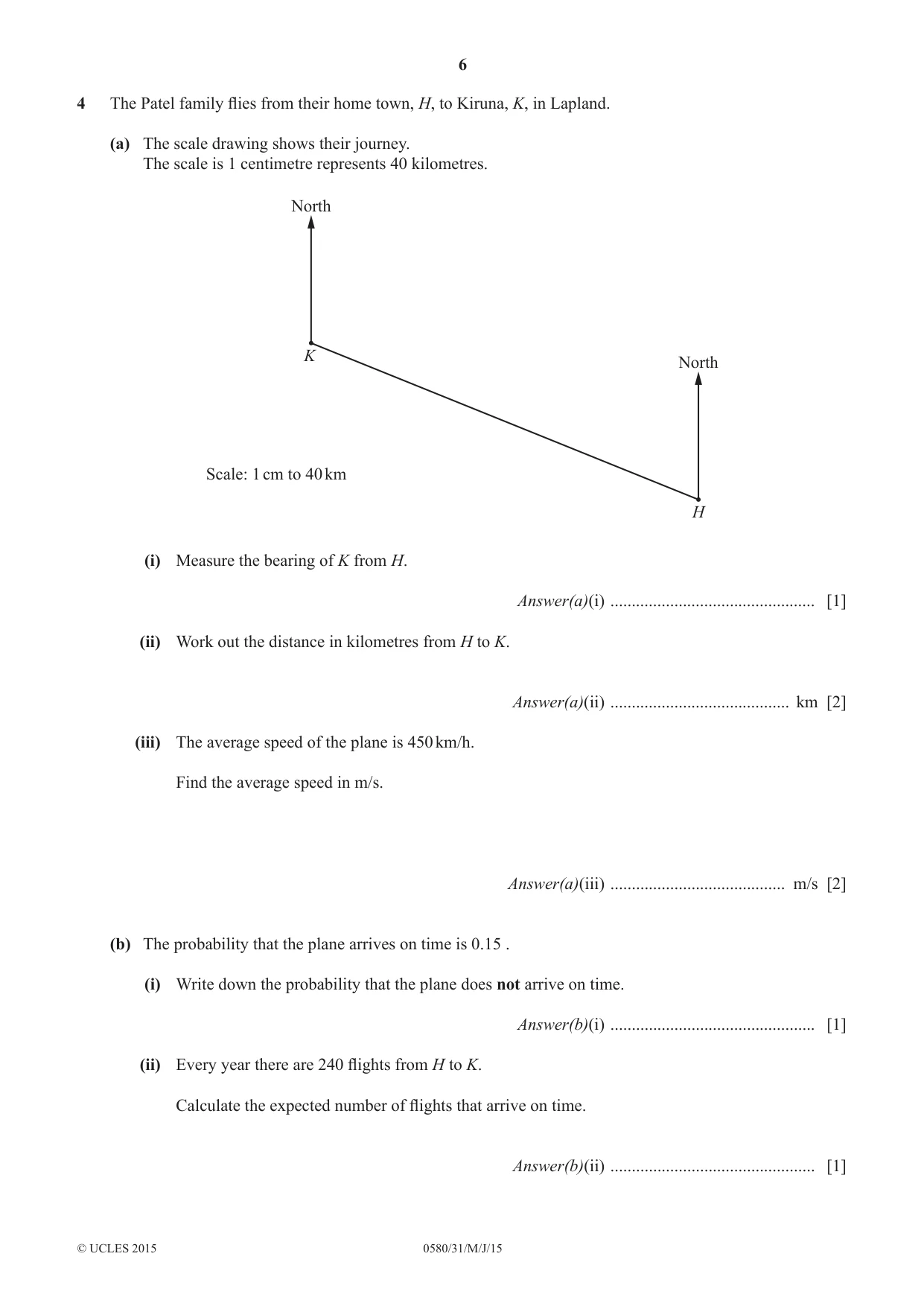
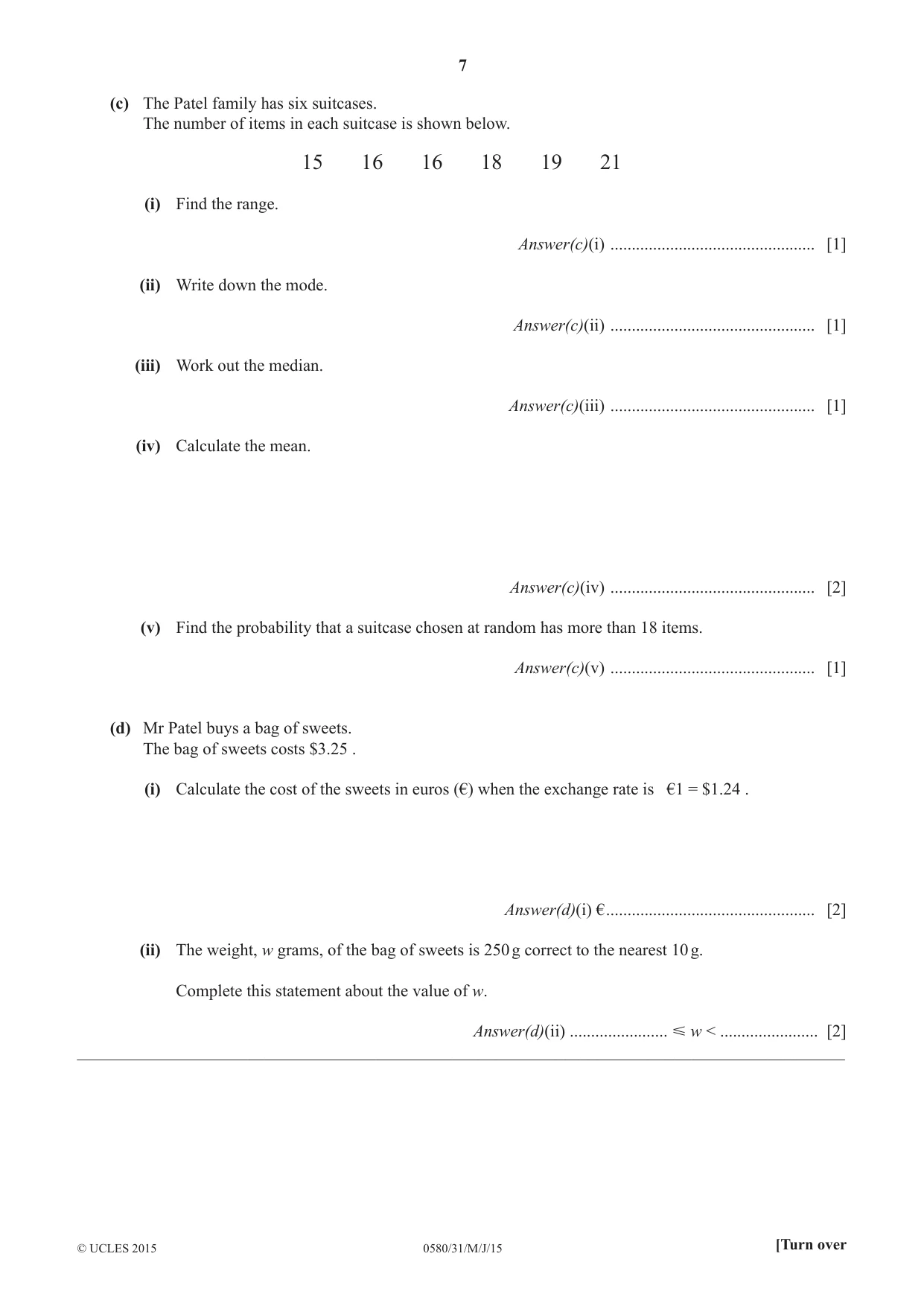
4 The Patel family flies from their home town, H, to Kiruna, K, in Lapland. (a) The scale drawing shows their journey. The scale is 1 centimetre represents 40 kilometres. North K North Scale: 1 cm to 40 km H (i) Measure the bearing of K from H. Answer(a)(i) ................................................ [1] (ii) Work out the distance in kilometres from H to K. Answer(a)(ii) .......................................... km [2] (iii) The average speed of the plane is 450 km/h. Find the average speed in m/s. Answer(a)(iii) ......................................... m/s [2] (b) The probability that the plane arrives on time is 0.15 . (i) Write down the probability that the plane does not arrive on time. Answer(b)(i) ................................................ [1] (ii) Every year there are 240 flights from H to K. Calculate the expected number of flights that arrive on time. Answer(b)(ii) ................................................ [1] (c) The Patel family has six suitcases. The number of items in each suitcase is shown below. 15 16 16 18 19 21 (i) Find the range. Answer(c)(i) ................................................ [1] (ii) Write down the mode. Answer(c)(ii) ................................................ [1] (iii) Work out the median. Answer(c)(iii) ................................................ [1] (iv) Calculate the mean. Answer(c)(iv) ................................................ [2] (v) Find the probability that a suitcase chosen at random has more than 18 items. Answer(c)(v) ................................................ [1] (d) Mr Patel buys a bag of sweets. The bag of sweets costs $3.25 . (i) Calculate the cost of the sweets in euros (€) when the exchange rate is €1 = $1.24 . Answer(d)(i) € ................................................. [2] (ii) The weight, w grams, of the bag of sweets is 250 g correct to the nearest 10 g. Complete this statement about the value of w. Answer(d)(ii) ....................... w < ....................... [2] __________________________________________________________________________________________
Mark scheme: 4 (a) (i) 292 1 (ii) 380 2 B1 for ( 9.5 ± 0.2 ) If zero scored, SC1 for figs ‘372 to 388’ 450 × 1000 (iii) 125 2 M1 for or better 60 × 60 (b) (i) 0.85 1 (ii) 36 1 (c) (i) 6 1 (ii) 16 1 (iii) 17 1 (iv) 17.5 2 M1 for (15+16+16+18+19+21) ÷ 6
Q5 · All the children in a school are asked to choose their favourite colour
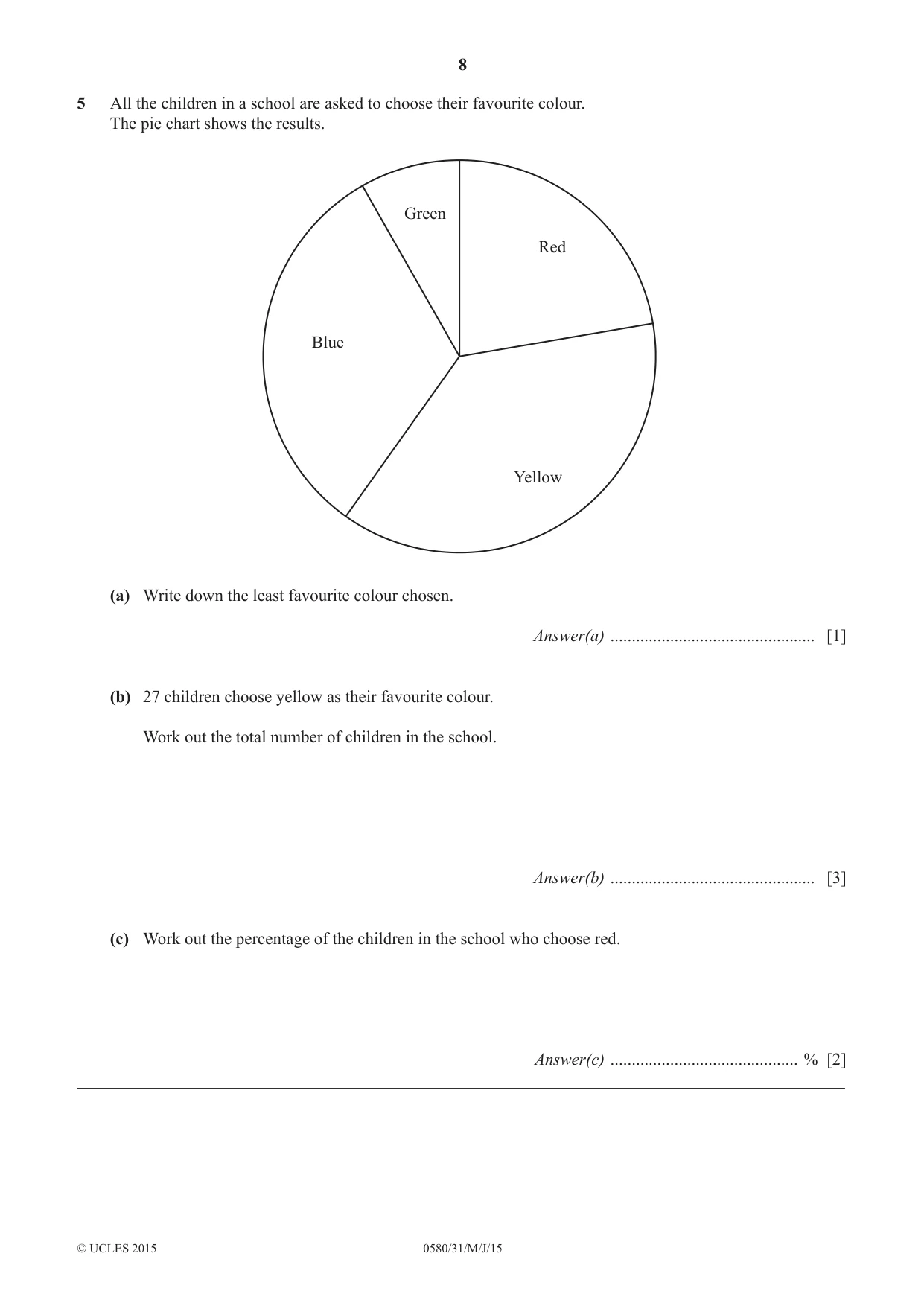
5 All the children in a school are asked to choose their favourite colour. The pie chart shows the results. Green Red Blue Yellow (a) Write down the least favourite colour chosen. Answer(a) ................................................ [1] (b) 27 children choose yellow as their favourite colour. Work out the total number of children in the school. Answer(b) ................................................ [3] (c) Work out the percentage of the children in the school who choose red. Answer(c) ............................................ % [2] __________________________________________________________________________________________
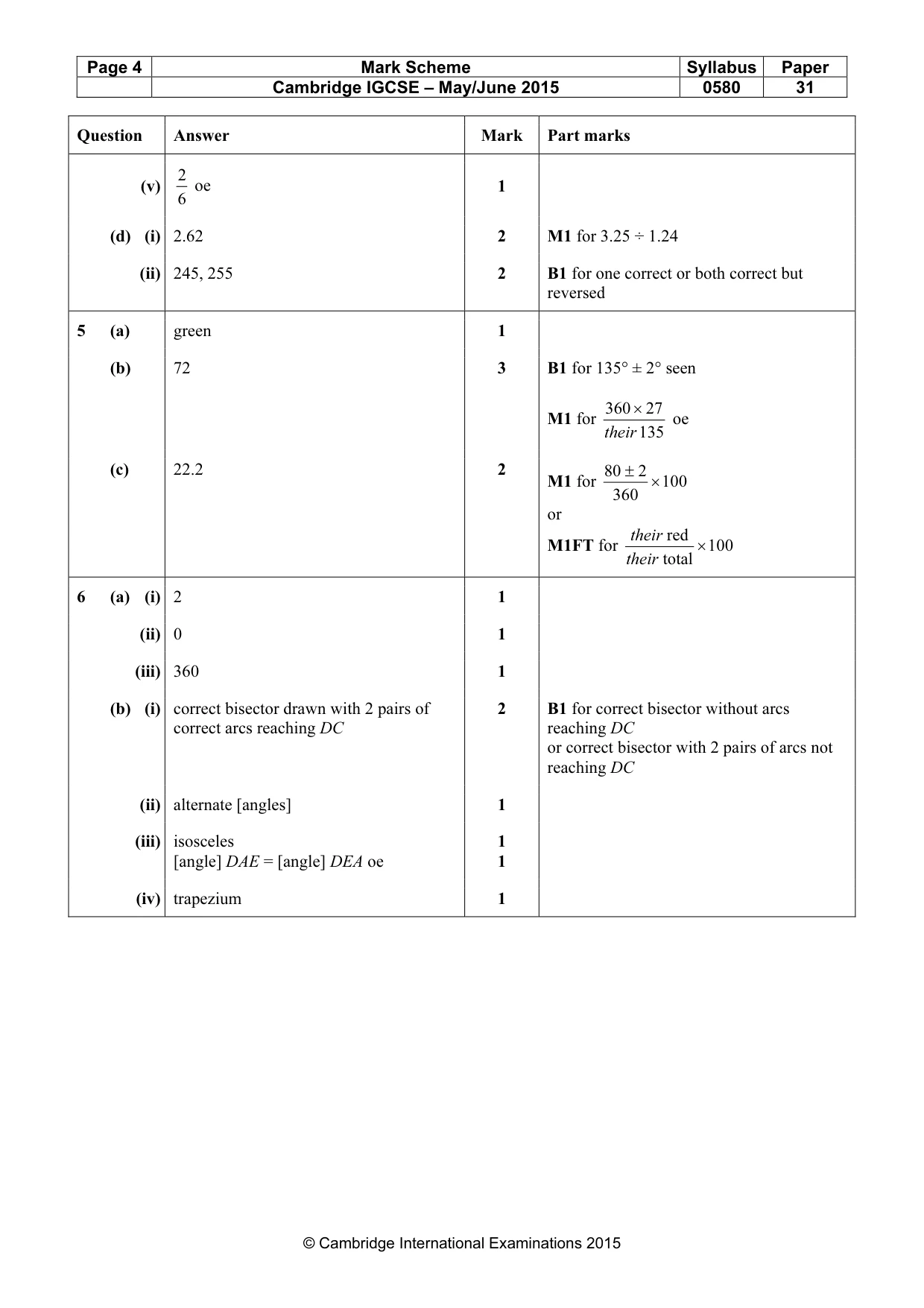
Mark scheme: 5 (a) green 1 (b) 72 3 B1 for 135° ± 2° seen 360 × 27 M1 for oe their 135 (c) 22.2 2 80 ± 2 M1 for × 100 360 or their red M1FT for × 100 their total
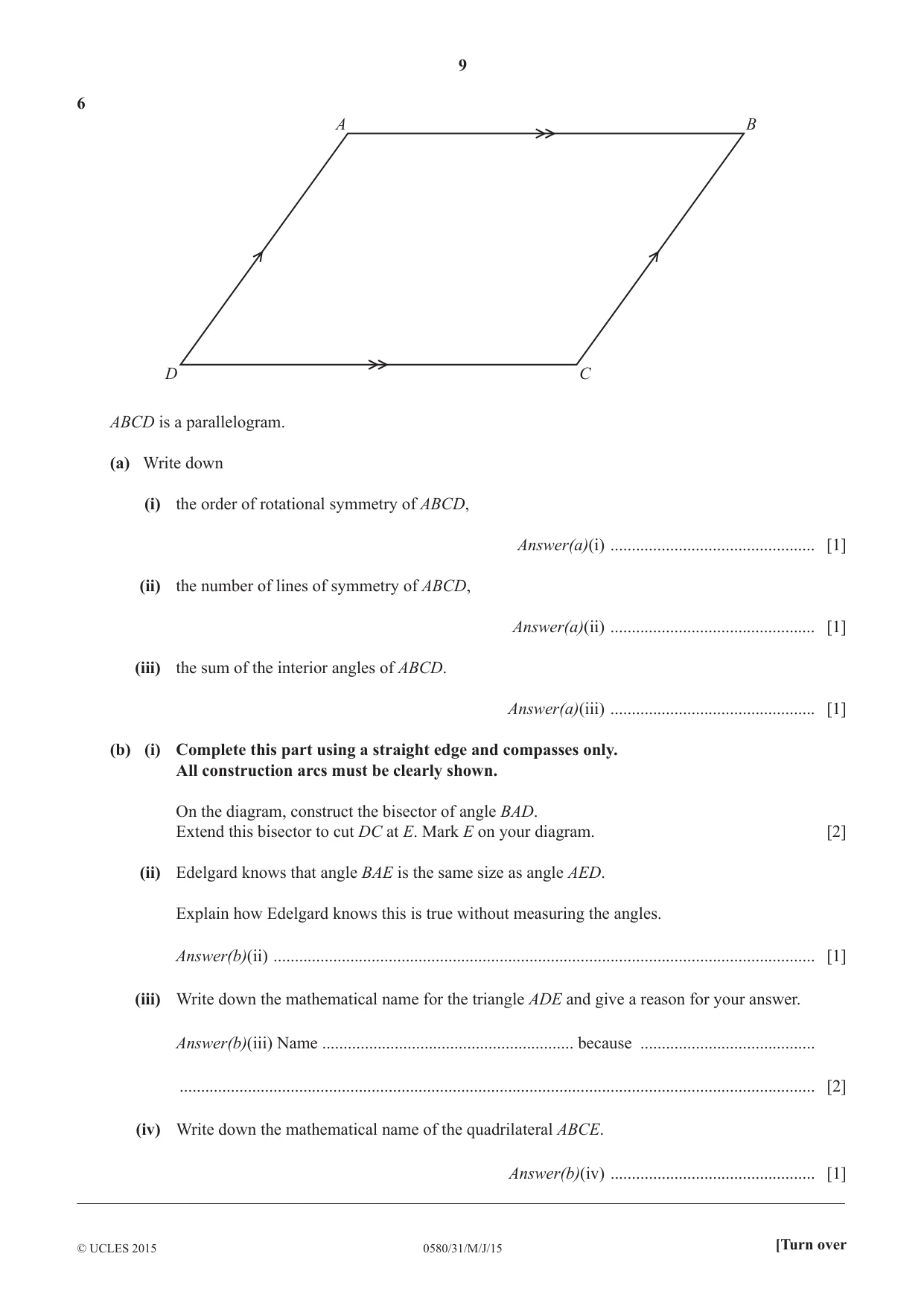
Q6 · A B D C ABCD is a parallelogram
6 A B D C ABCD is a parallelogram. (a) Write down (i) the order of rotational symmetry of ABCD, Answer(a)(i) ................................................ [1] (ii) the number of lines of symmetry of ABCD, Answer(a)(ii) ................................................ [1] (iii) the sum of the interior angles of ABCD. Answer(a)(iii) ................................................ [1] (b) (i) Complete this part using a straight edge and compasses only. All construction arcs must be clearly shown. On the diagram, construct the bisector of angle BAD. Extend this bisector to cut DC at E. Mark E on your diagram. [2] (ii) Edelgard knows that angle BAE is the same size as angle AED. Explain how Edelgard knows this is true without measuring the angles. Answer(b)(ii) ............................................................................................................................... [1] (iii) Write down the mathematical name for the triangle ADE and give a reason for your answer. Answer(b)(iii) Name ........................................................... because ......................................... ..................................................................................................................................................... [2] (iv) Write down the mathematical name of the quadrilateral ABCE. Answer(b)(iv) ................................................ [1] __________________________________________________________________________________________
Mark scheme: 6 (a) (i) 2 1 (ii) 0 1 (iii) 360 1 (b) (i) correct bisector drawn with 2 pairs of 2 B1 for correct bisector without arcs correct arcs reaching DC reaching DC or correct bisector with 2 pairs of arcs not reaching DC (ii) alternate [angles] 1 (iii) isosceles 1 [angle] DAE = [angle] DEA oe 1 (iv) trapezium 1
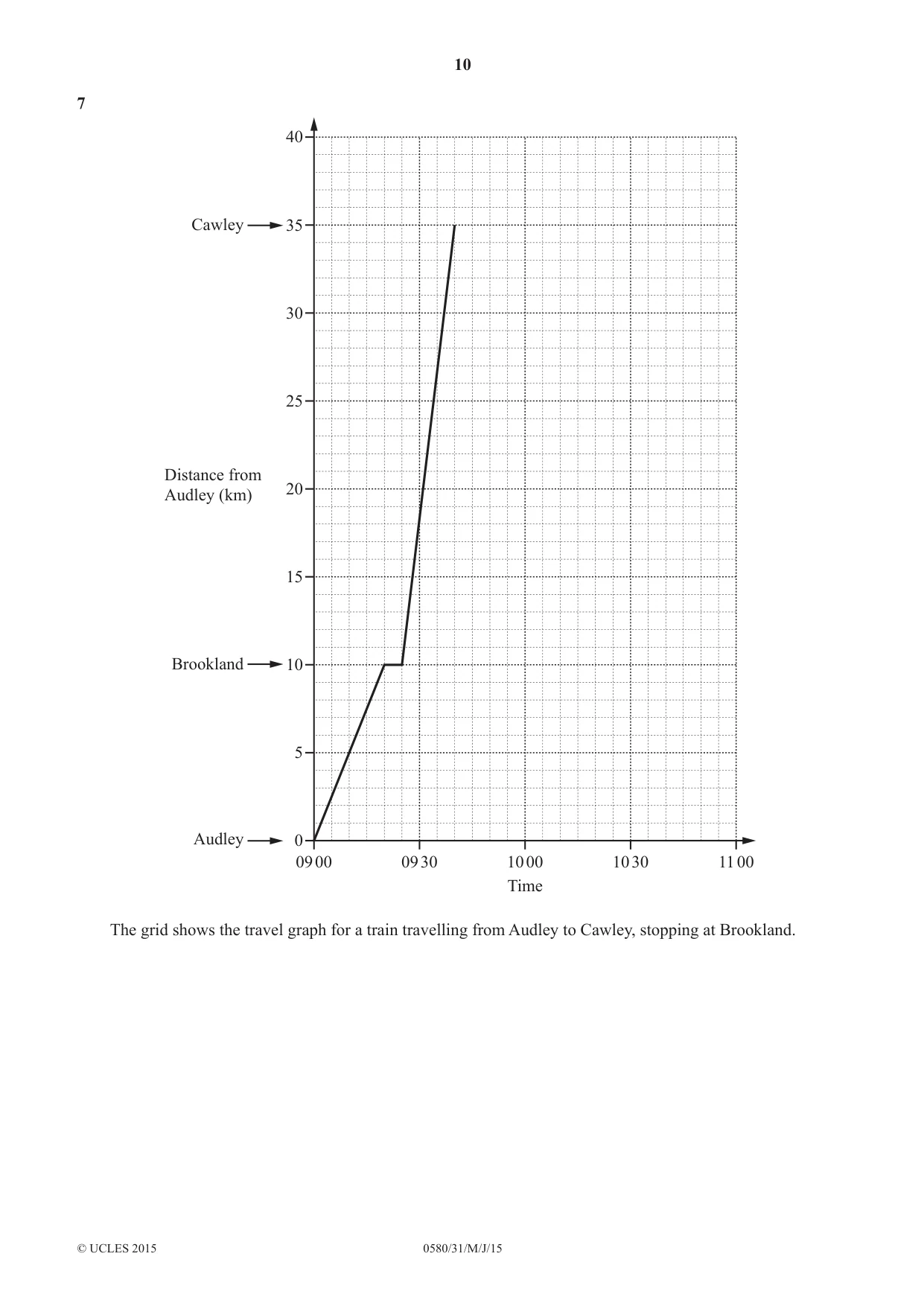
Q7 · 40 Cawley 35 30 25 Distance from 20 Audley (km) 15 Brookland 10 5 Audley 0 09 00 09 30 10…
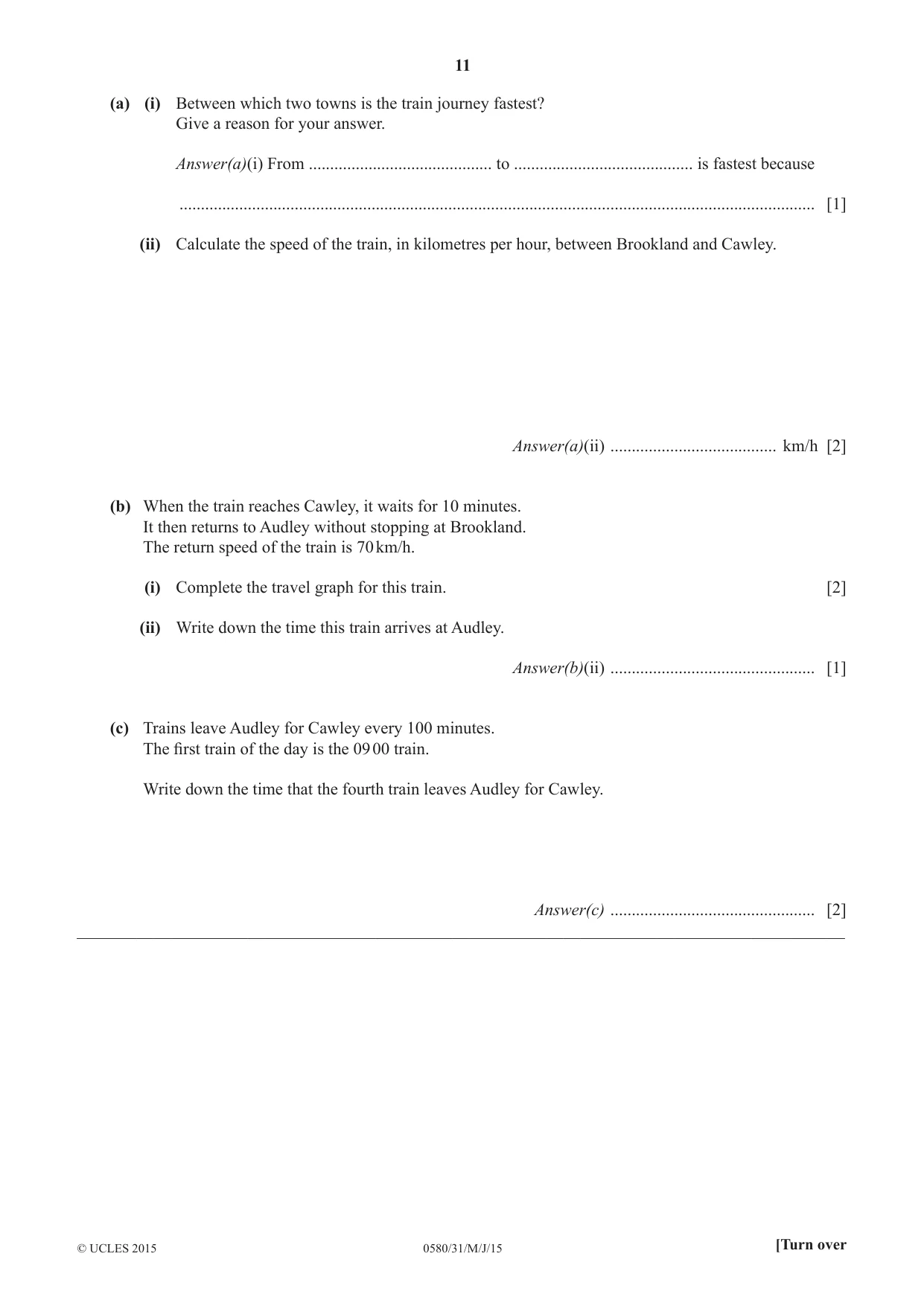
7 40 Cawley 35 30 25 Distance from 20 Audley (km) 15 Brookland 10 5 Audley 0 09 00 09 30 10 00 10 30 11 00 Time The grid shows the travel graph for a train travelling from Audley to Cawley, stopping at Brookland. (a) (i) Between which two towns is the train journey fastest? Give a reason for your answer. Answer(a)(i) From ........................................... to .......................................... is fastest because ..................................................................................................................................................... [1] (ii) Calculate the speed of the train, in kilometres per hour, between Brookland and Cawley. Answer(a)(ii) ....................................... km/h [2] (b) When the train reaches Cawley, it waits for 10 minutes. It then returns to Audley without stopping at Brookland. The return speed of the train is 70 km/h. (i) Complete the travel graph for this train. [2] (ii) Write down the time this train arrives at Audley. Answer(b)(ii) ................................................ [1] (c) Trains leave Audley for Cawley every 100 minutes. The first train of the day is the 09 00 train. Write down the time that the fourth train leaves Audley for Cawley. Answer(c) ................................................ [2] __________________________________________________________________________________________
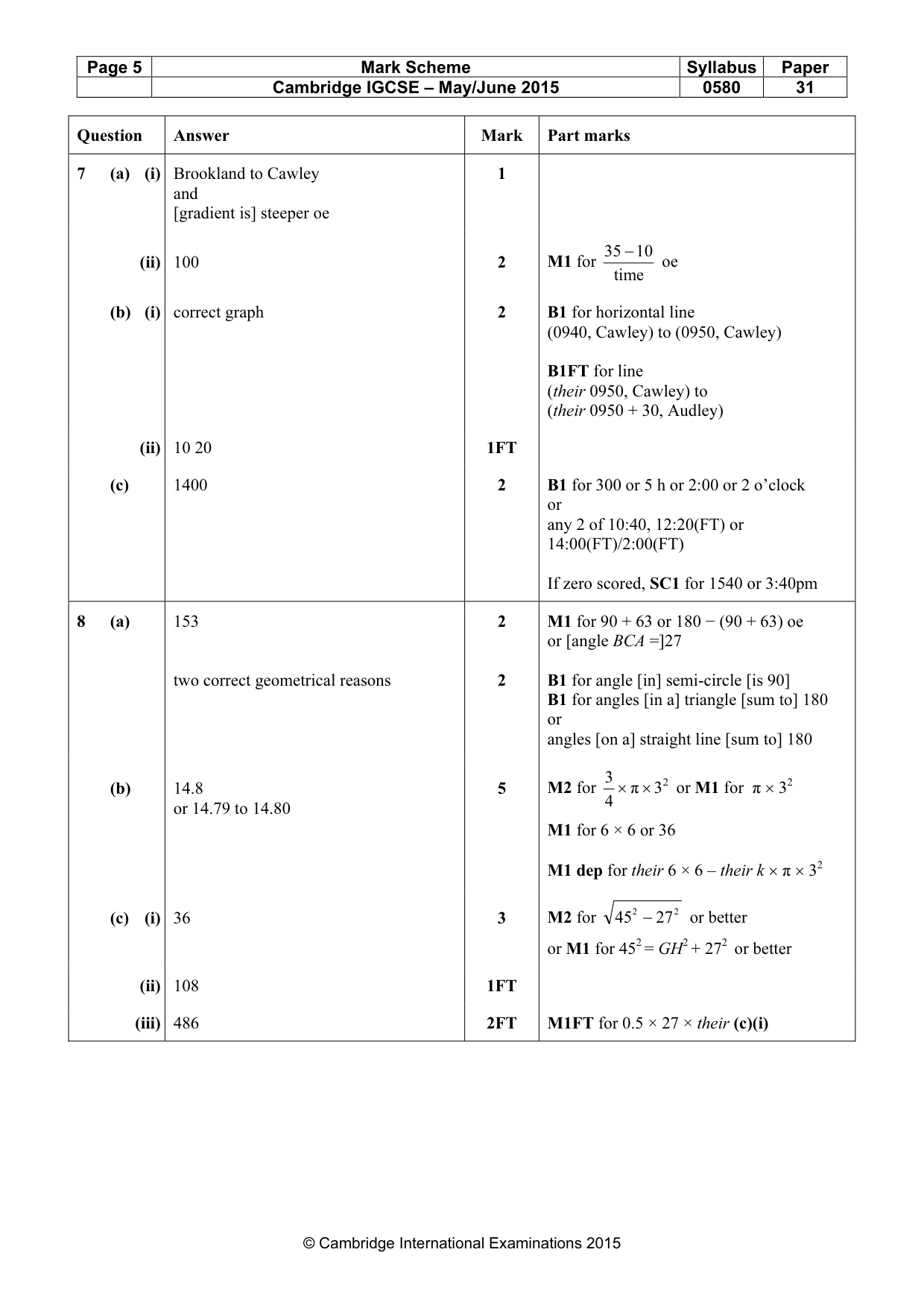
Mark scheme: 7 (a) (i) Brookland to Cawley 1 and [gradient is] steeper oe 35 − 10 (ii) 100 2 M1 for oe time (b) (i) correct graph 2 B1 for horizontal line (0940, Cawley) to (0950, Cawley) B1FT for line (their 0950, Cawley) to (their 0950 + 30, Audley) (ii) 10 20 1FT (c) 1400 2 B1 for 300 or 5 h or 2:00 or 2 o’clock or any 2 of 10:40, 12:20(FT) or 14:00(FT)/2:00(FT) If zero scored, SC1 for 1540 or 3:40pm
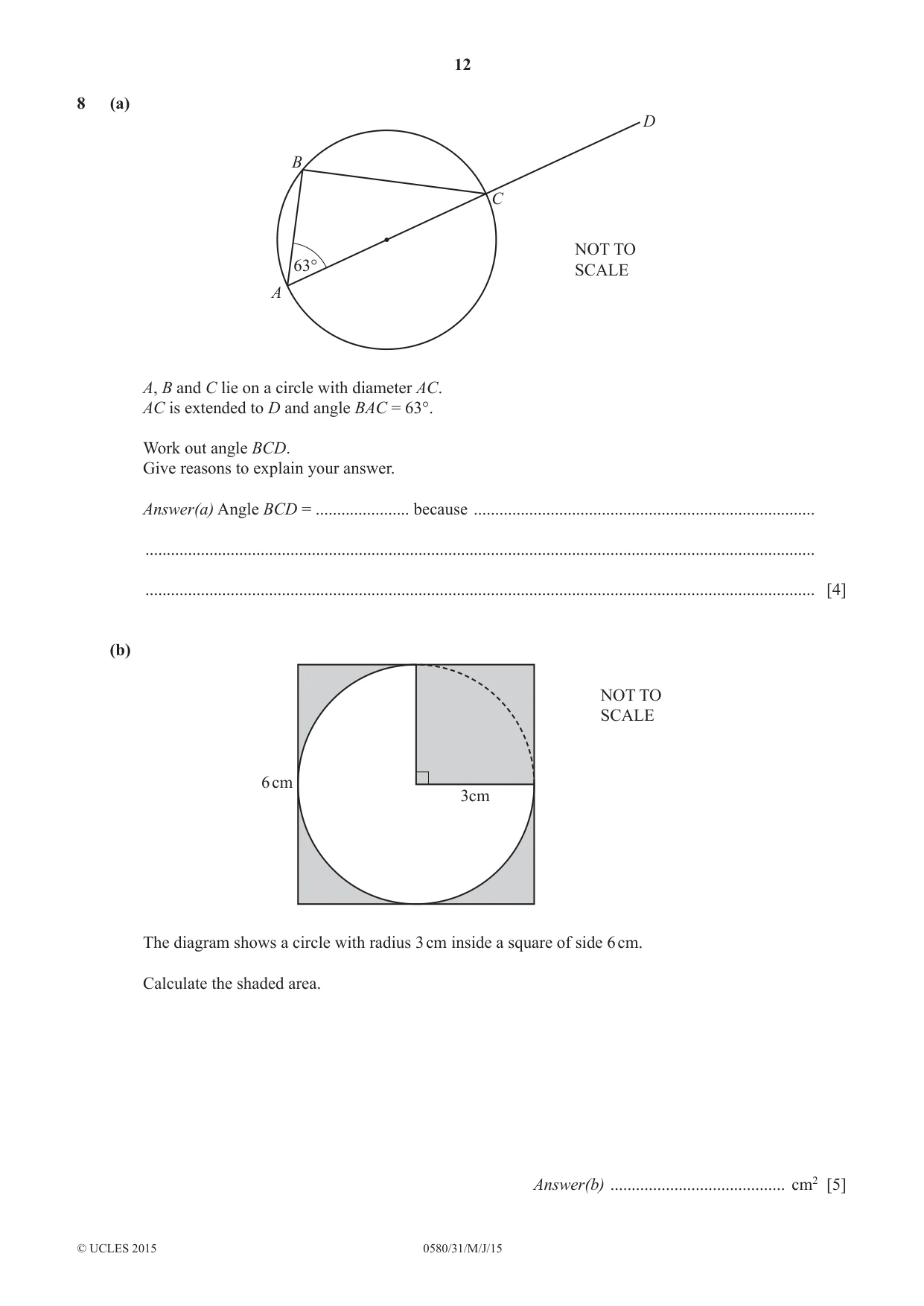
Q8 · D B C NOT TO 63° SCALE A A, B and C lie on a circle with diameter AC
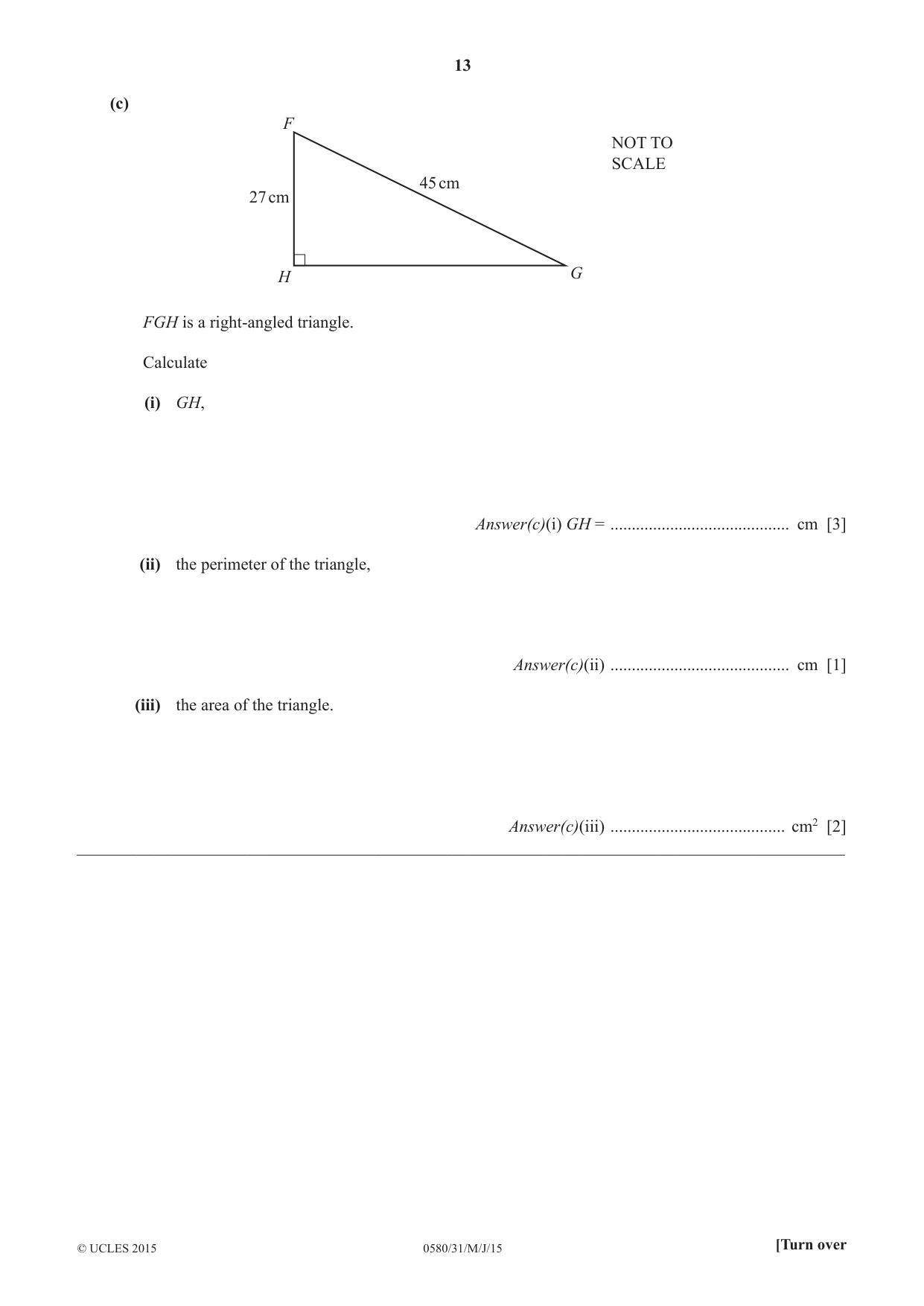
8 (a) D B C NOT TO 63° SCALE A A, B and C lie on a circle with diameter AC. AC is extended to D and angle BAC = 63°. Work out angle BCD. Give reasons to explain your answer. Answer(a) Angle BCD = ...................... because ................................................................................ ............................................................................................................................................................. ............................................................................................................................................................. [4] (b) NOT TO SCALE 6 cm 3cm The diagram shows a circle with radius 3 cm inside a square of side 6 cm. Calculate the shaded area. Answer(b) ......................................... cm2 [5] (c) F NOT TO SCALE 45 cm 27 cm H G FGH is a right-angled triangle. Calculate (i) GH, Answer(c)(i) GH = .......................................... cm [3] (ii) the perimeter of the triangle, Answer(c)(ii) .......................................... cm [1] (iii) the area of the triangle. Answer(c)(iii) ......................................... cm2 [2] __________________________________________________________________________________________
Mark scheme: 8 (a) 153 2 M1 for 90 + 63 or 180 − (90 + 63) oe or [angle BCA =]27 two correct geometrical reasons 2 B1 for angle [in] semi-circle [is 90] B1 for angles [in a] triangle [sum to] 180 or angles [on a] straight line [sum to] 180 3 2 (b) 14.8 5 M2 for × π × 3 or M1 for π × 32 4 or 14.79 to 14.80 M1 for 6 × 6 or 36 M1 dep for their 6 × 6 – their k × π × 32 (c) (i) 36 3 M2 for 45 2 − 27 2 or better or M1 for 452 = GH2 + 272 or better (ii) 108 1FT (iii) 486 2FT M1FT for 0.5 × 27 × their (c)(i)
Q9 · Complete the table of values for y = –x2 + 5x
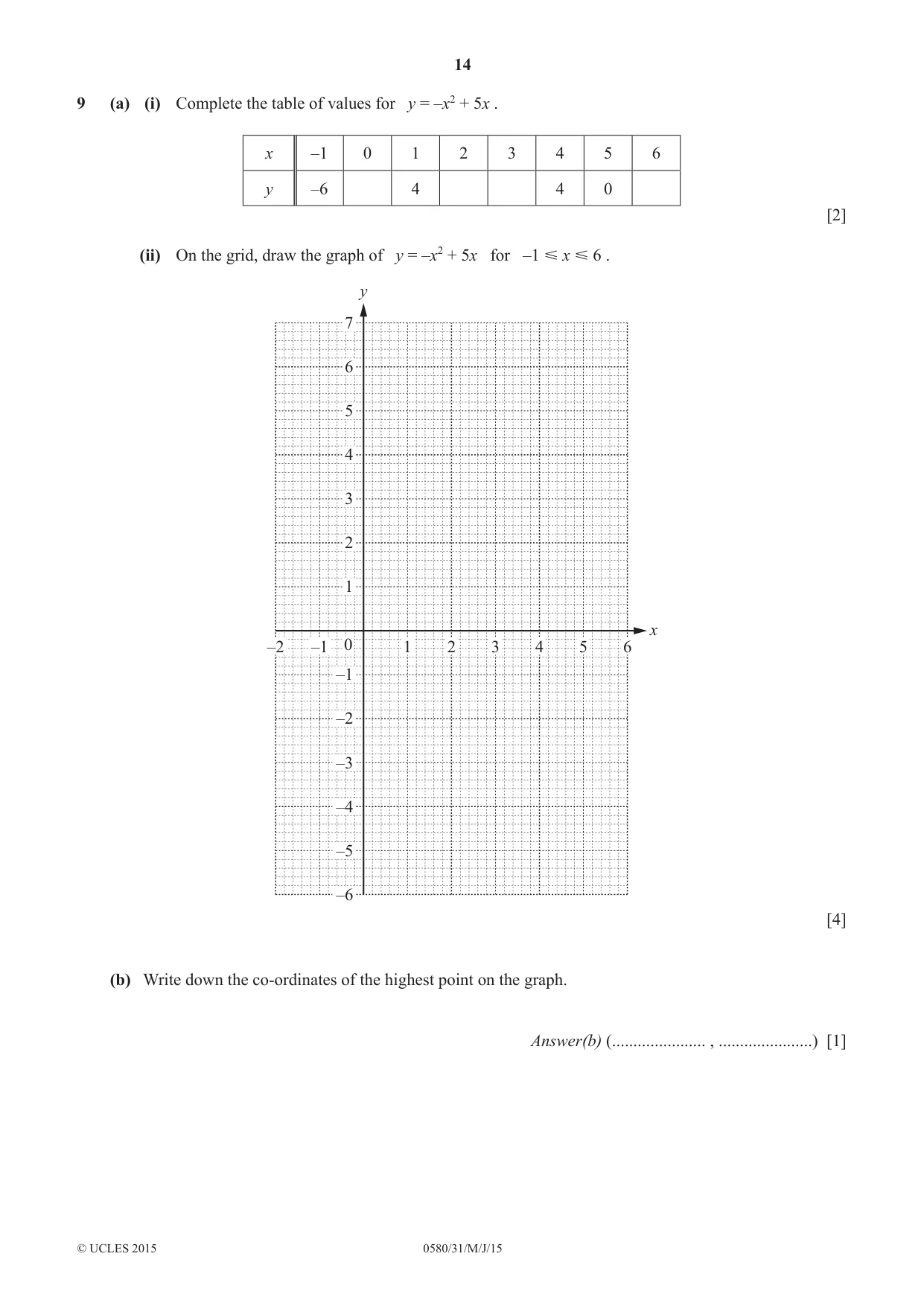
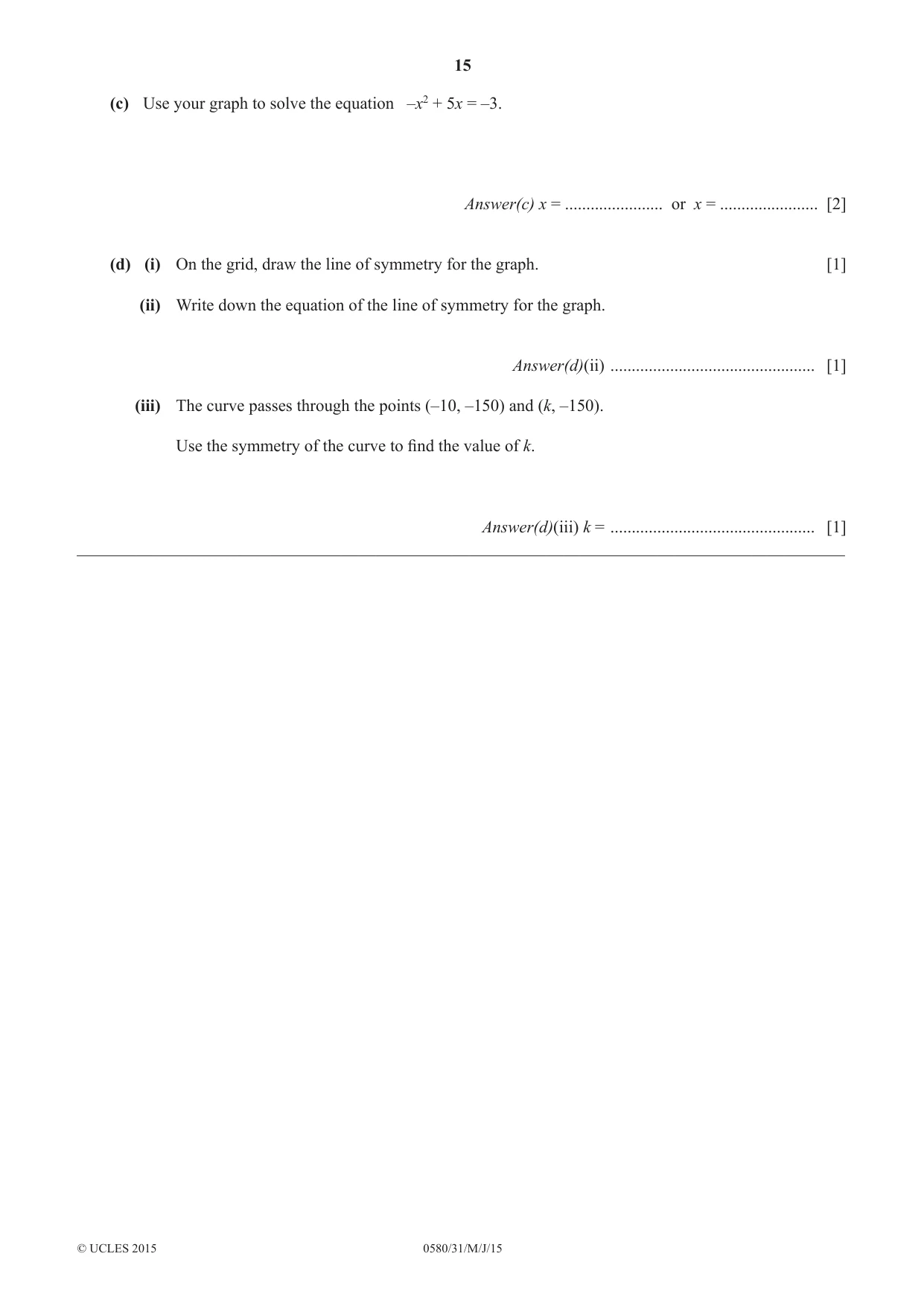
9 (a) (i) Complete the table of values for y = –x2 + 5x . x –1 0 1 2 3 4 5 6 y –6 4 4 0 [2] (ii) On the grid, draw the graph of y = –x2 + 5x for –1 x 6 . y 7 6 5 4 3 2 1 x –2 –1 0 1 2 3 4 5 6 –1 –2 –3 –4 –5 –6 [4] (b) Write down the co-ordinates of the highest point on the graph. Answer(b) (...................... , ......................) [1] (c) Use your graph to solve the equation –x2 + 5x = –3. Answer(c) x = ....................... or x = ....................... [2] (d) (i) On the grid, draw the line of symmetry for the graph. [1] (ii) Write down the equation of the line of symmetry for the graph. Answer(d)(ii) ................................................ [1] (iii) The curve passes through the points (–10, –150) and (k, –150). Use the symmetry of the curve to find the value of k. Answer(d)(iii) k = ................................................ [1] __________________________________________________________________________________________
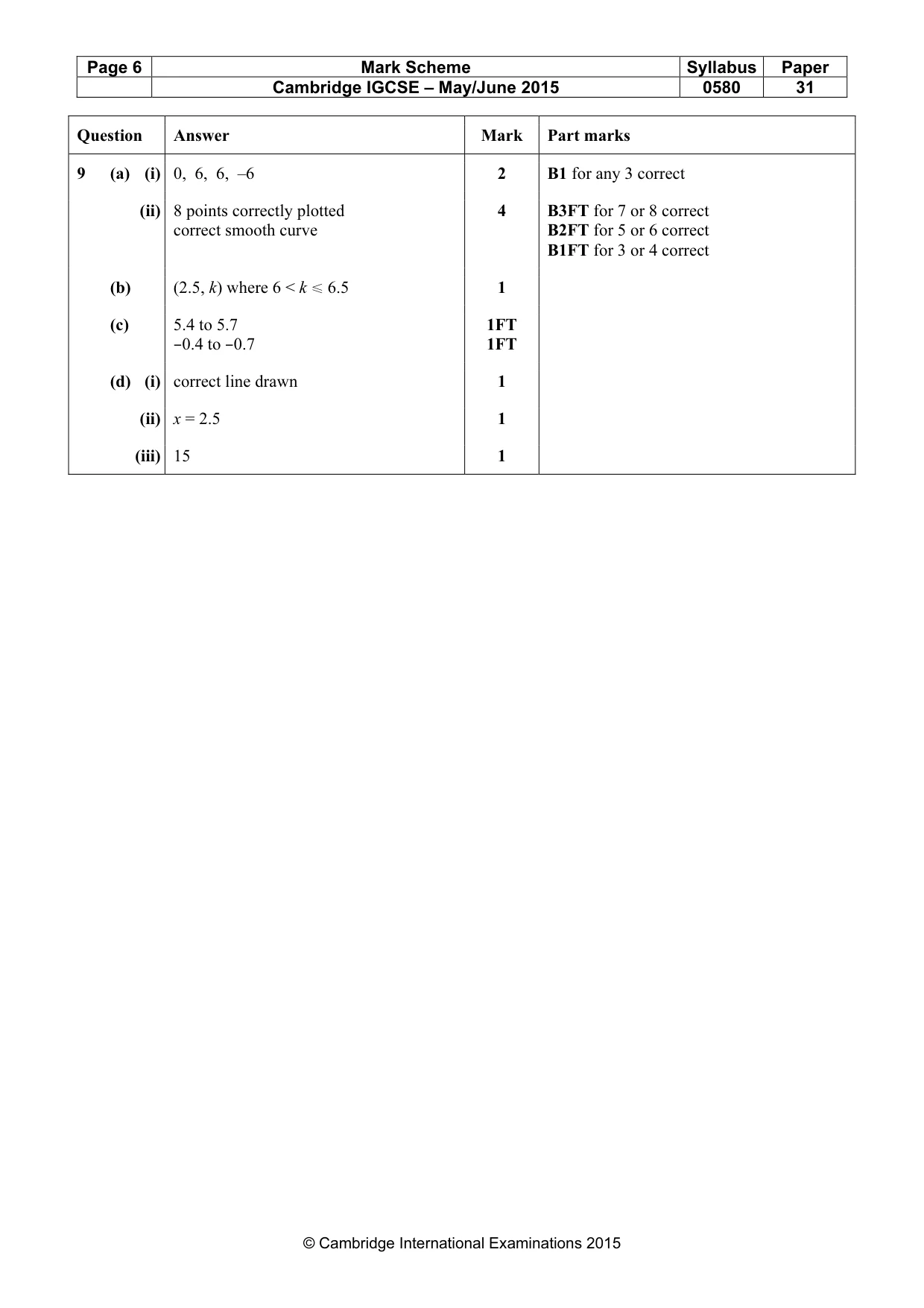
Mark scheme: 9 (a) (i) 0, 6, 6, –6 2 B1 for any 3 correct (ii) 8 points correctly plotted 4 B3FT for 7 or 8 correct correct smooth curve B2FT for 5 or 6 correct B1FT for 3 or 4 correct (b) (2.5, k) where 6 < k ≤ 6.5 1 (c) 5.4 to 5.7 1FT –0.4 to –0.7 1FT (d) (i) correct line drawn 1 (ii) x = 2.5 1 (iii) 15 1
What was in this paper
The subtopics covered by these 9 questions, and how many questions each got. Open one in a new tab to see every Cambridge question on it.
What you needed in this session
Cambridge’s own grade thresholds for 2015 May/June, Paper 3 · Variant 1. A higher threshold means an easier paper — the bar moves with how the cohort did.