Cambridge IGCSE Mathematics 0580 — 2015 May/June Paper 3 · Variant 3
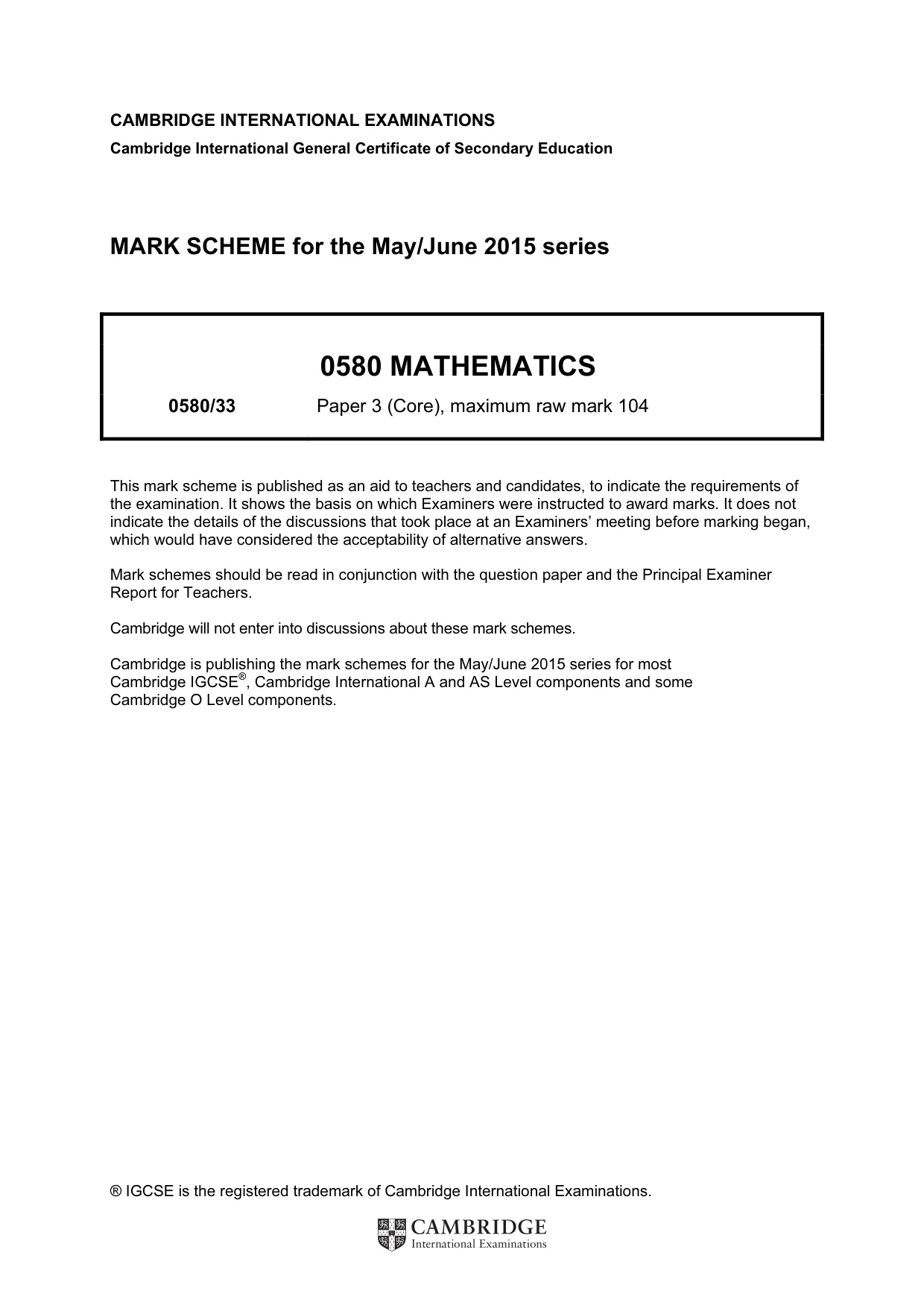
0580/33/M/J/15 · 11 questions · 104 marks · ≈117 min
The question paper and its mark scheme, free to read here and free to download. This is Cambridge’s own paper, exactly as it was sat.
Question paper16 pages
Mark scheme5 pages
Answers below. Sit the paper first if you are practising.
Questions as text
Q1 · The number of trains stopping each day, for 20 days, at Pherlak Station is recorded below
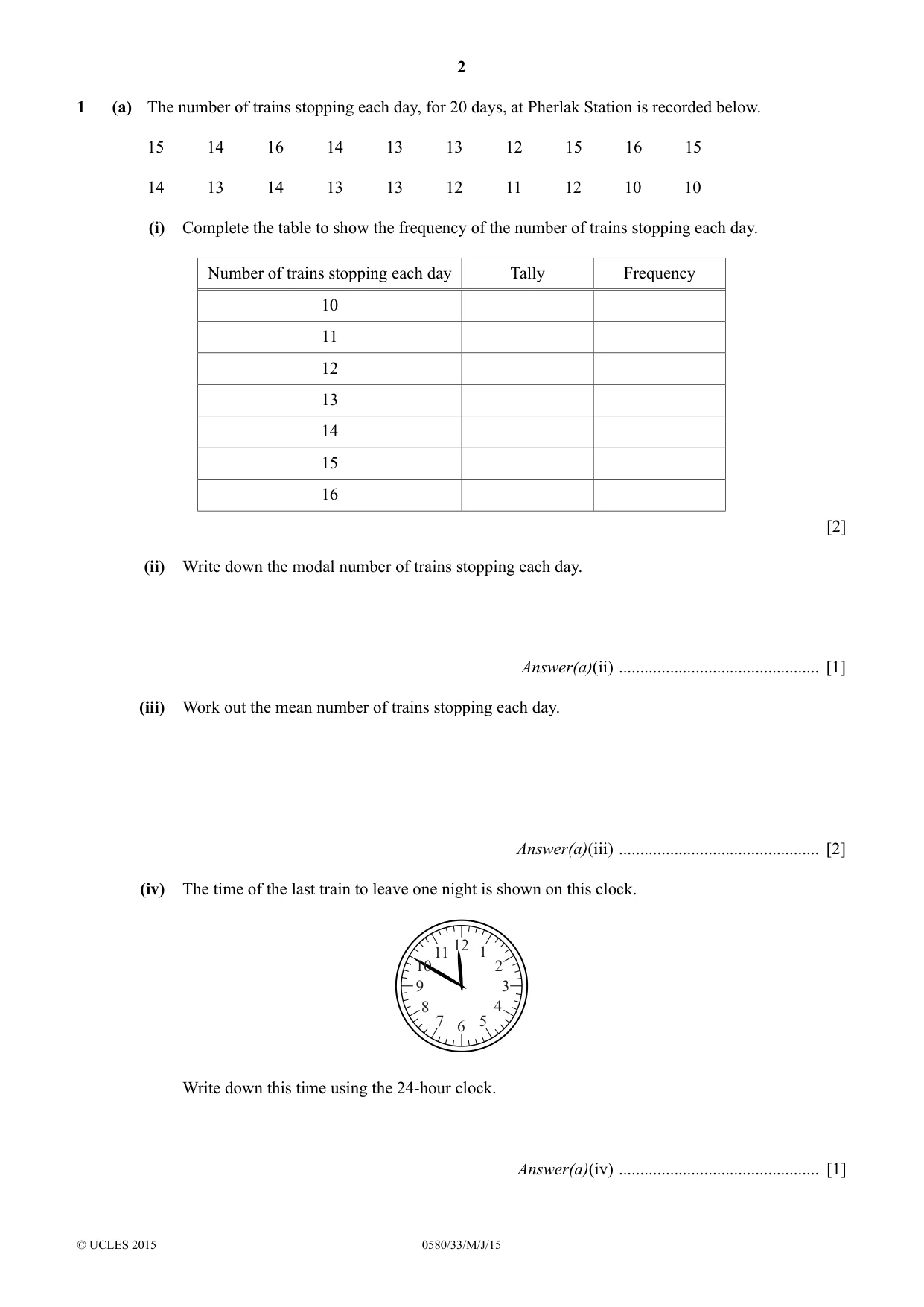
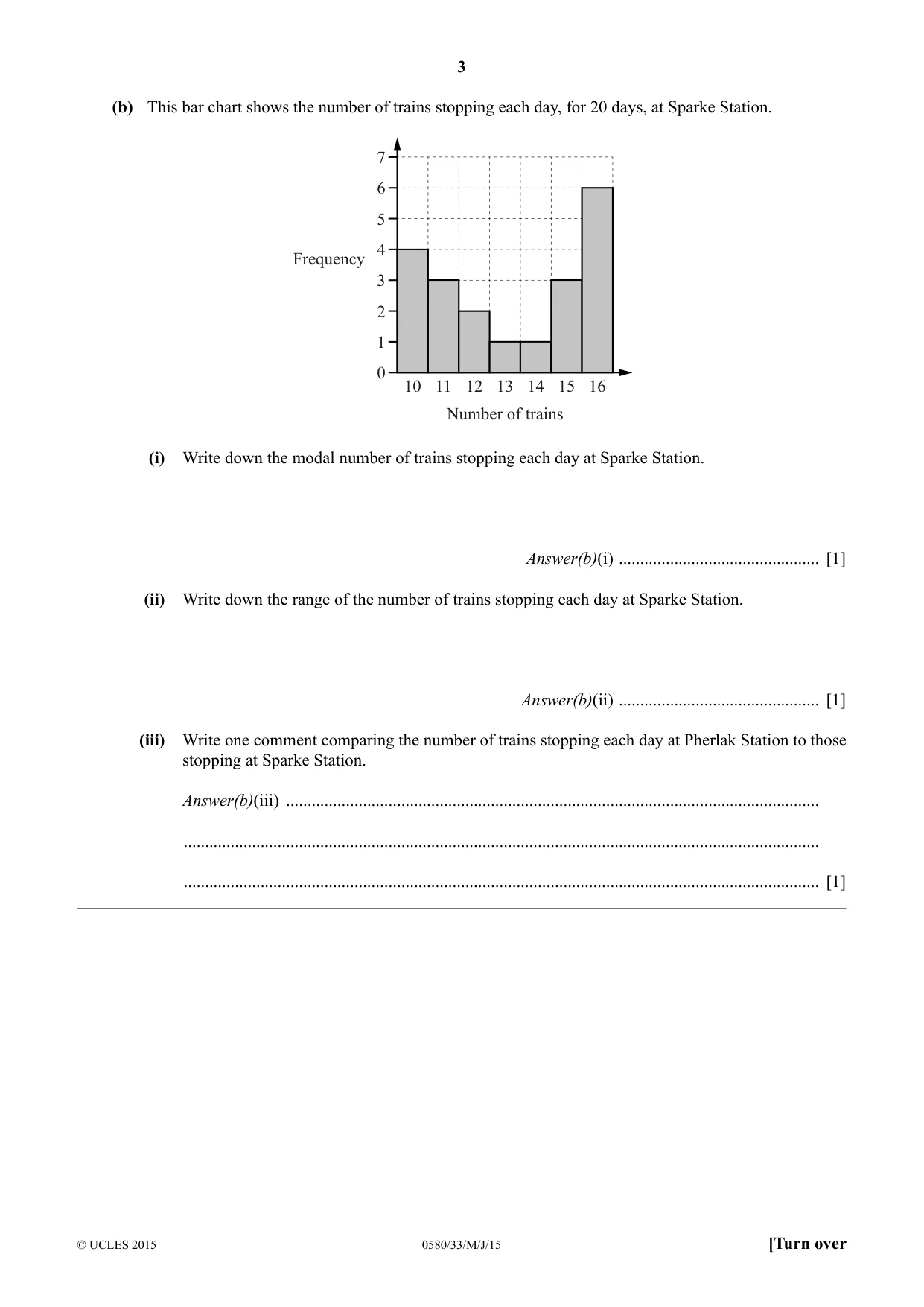
1 (a) The number of trains stopping each day, for 20 days, at Pherlak Station is recorded below. 15 14 16 14 13 13 12 15 16 15 14 13 14 13 13 12 11 12 10 10 (i) Complete the table to show the frequency of the number of trains stopping each day. Number of trains stopping each day Tally Frequency 10 11 12 13 14 15 16 [2] (ii) Write down the modal number of trains stopping each day. Answer(a)(ii) ............................................... [1] (iii) Work out the mean number of trains stopping each day. Answer(a)(iii) ............................................... [2] (iv) The time of the last train to leave one night is shown on this clock. 12 11 1 10 2 9 3 8 4 7 5 6 Write down this time using the 24-hour clock. Answer(a)(iv) ............................................... [1] (b) This bar chart shows the number of trains stopping each day, for 20 days, at Sparke Station. 7 6 5 4 Frequency 3 2 1 0 10 11 12 13 14 15 16 Number of trains (i) Write down the modal number of trains stopping each day at Sparke Station. Answer(b)(i) ............................................... [1] (ii) Write down the range of the number of trains stopping each day at Sparke Station. Answer(b)(ii) ............................................... [1] (iii) Write one comment comparing the number of trains stopping each day at Pherlak Station to those stopping at Sparke Station. Answer(b)(iii) ............................................................................................................................. ..................................................................................................................................................... ..................................................................................................................................................... [1]
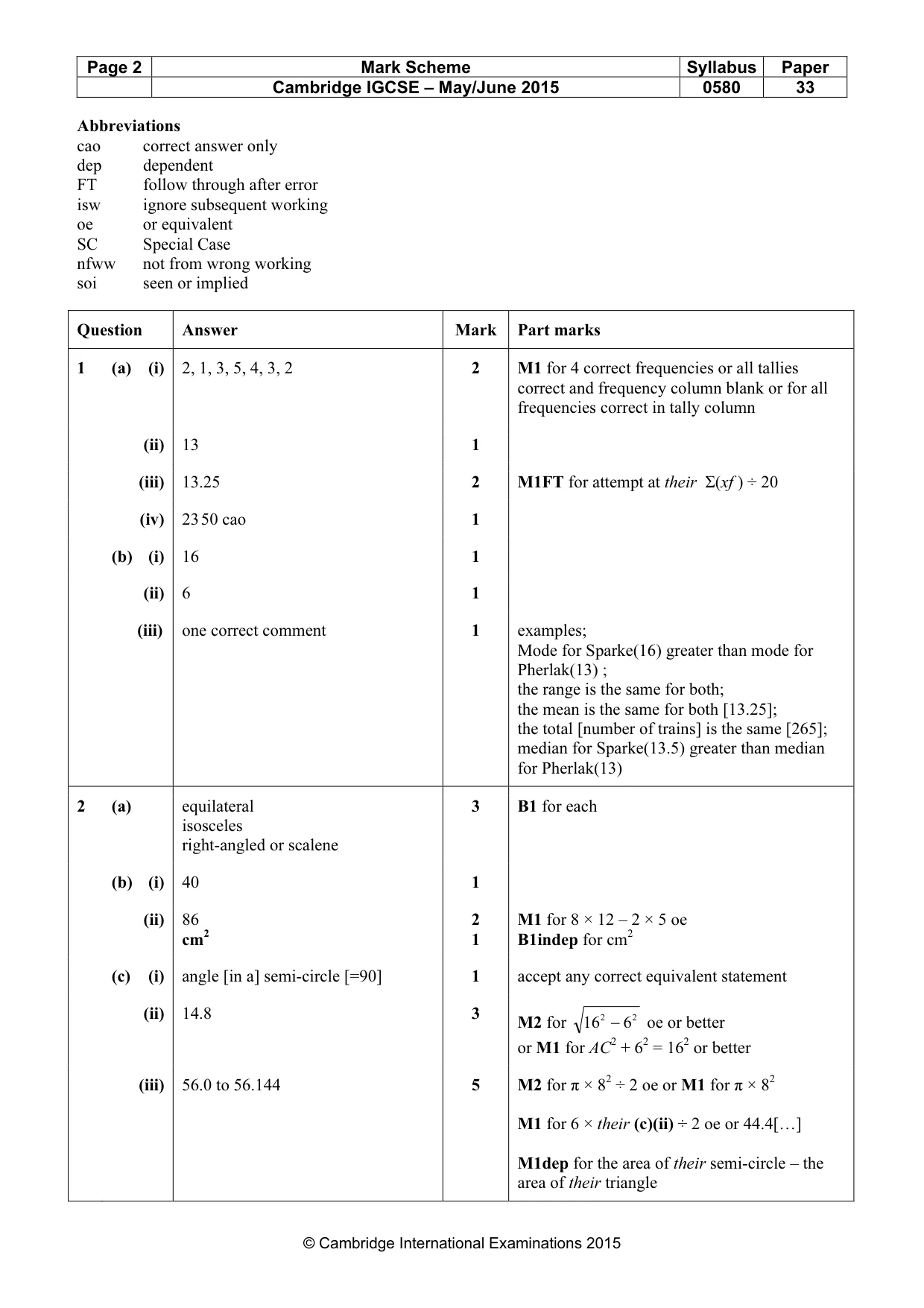
Mark scheme: Question Answer Mark Part marks 1 (a) (i) 2, 1, 3, 5, 4, 3, 2 2 M1 for 4 correct frequencies or all tallies correct and frequency column blank or for all frequencies correct in tally column (ii) 13 1 (iii) 13.25 2 M1FT for attempt at their Σ(xf ) ÷ 20 (iv) 23 50 cao 1 (b) (i) 16 1 (ii) 6 1 (iii) one correct comment 1 examples; Mode for Sparke(16) greater than mode for Pherlak(13) ; the range is the same for both; the mean is the same for both [13.25]; the total [number of trains] is the same [265]; median for Sparke(13.5) greater than median for Pherlak(13)
Q2 · Write the mathematical name under each of these triangles
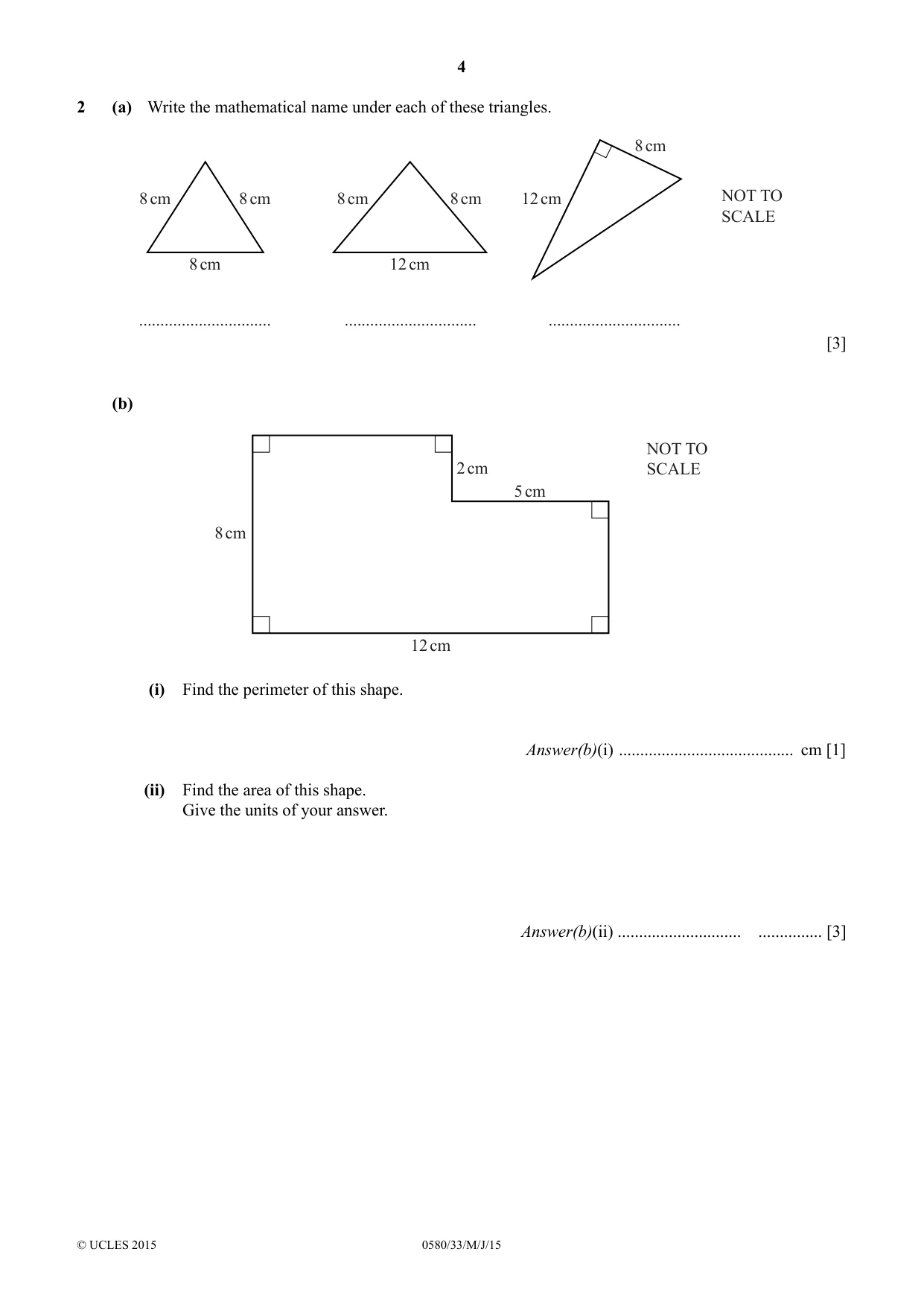
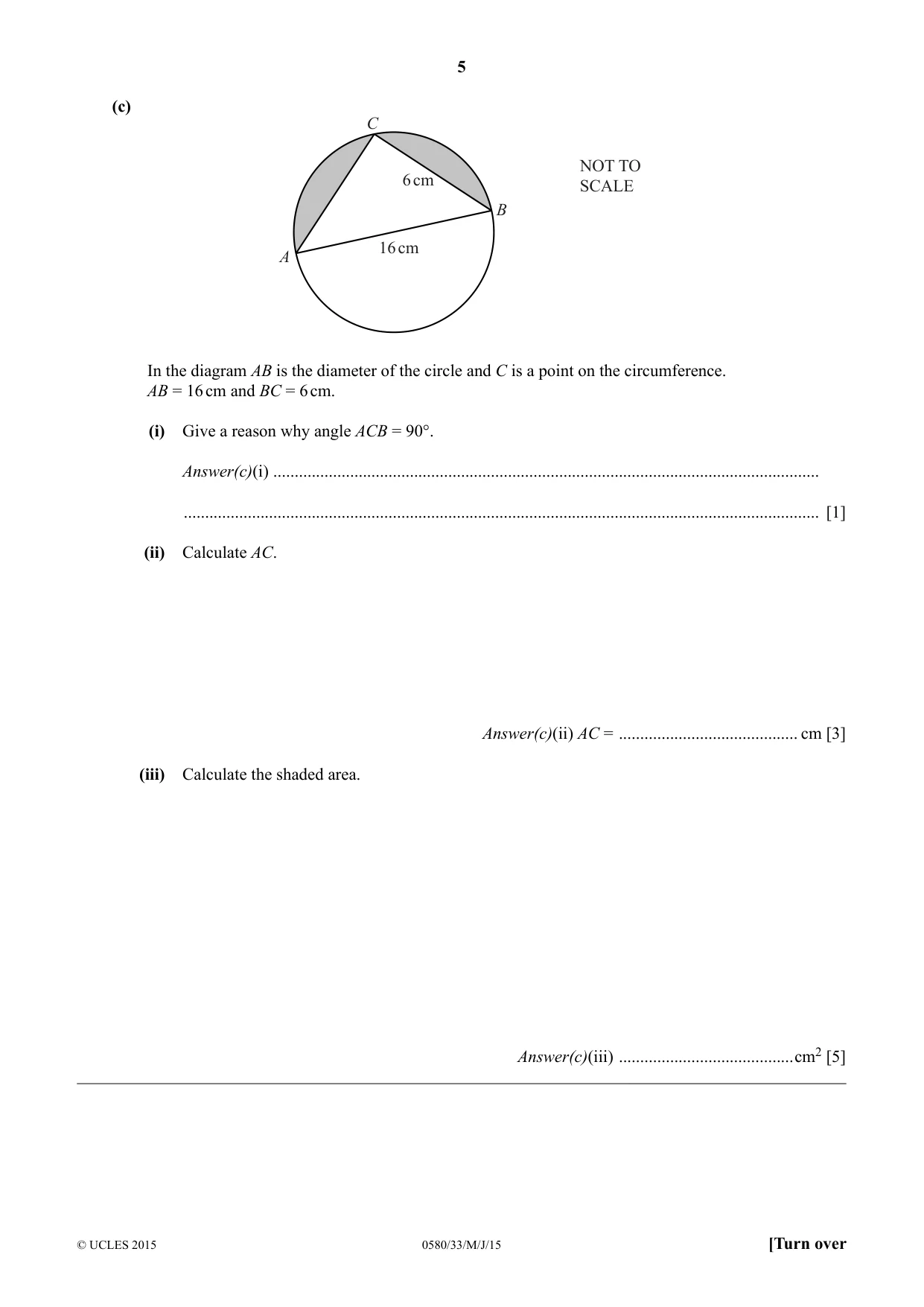
2 (a) Write the mathematical name under each of these triangles. 8 cm 8 cm 8 cm 8 cm 8 cm 12 cm NOT TO SCALE 8 cm 12 cm ............................... ............................... ............................... [3] (b) NOT TO 2 cm SCALE 5 cm 8 cm 12 cm (i) Find the perimeter of this shape. Answer(b)(i) ......................................... cm [1] (ii) Find the area of this shape. Give the units of your answer. Answer(b)(ii) ............................. ............... [3] (c) C NOT TO 6 cm SCALE B 16 cm A In the diagram AB is the diameter of the circle and C is a point on the circumference. AB = 16 cm and BC = 6 cm. (i) Give a reason why angle ACB = 90°. Answer(c)(i) ................................................................................................................................ ..................................................................................................................................................... [1] (ii) Calculate AC. Answer(c)(ii) AC = .......................................... cm [3] (iii) Calculate the shaded area. Answer(c)(iii) .........................................cm2 [5]
Mark scheme: 2 (a) equilateral 3 B1 for each isosceles right-angled or scalene (b) (i) 40 1 (ii) 86 2 M1 for 8 × 12 – 2 × 5 oe cm2 1 B1indep for cm2 (c) (i) angle [in a] semi-circle [=90] 1 accept any correct equivalent statement 2 − 6 2 oe or better (ii) 14.8 3 M2 for 16 or M1 for AC2 + 62 = 162 or better (iii) 56.0 to 56.144 5 M2 for π × 82 ÷ 2 oe or M1 for π × 82 M1 for 6 × their (c)(ii) ÷ 2 oe or 44.4[…] M1dep for the area of their semi-circle – the area of their triangle
Q3 · One day Raphael asked 90 people at a station the reason for their train journey
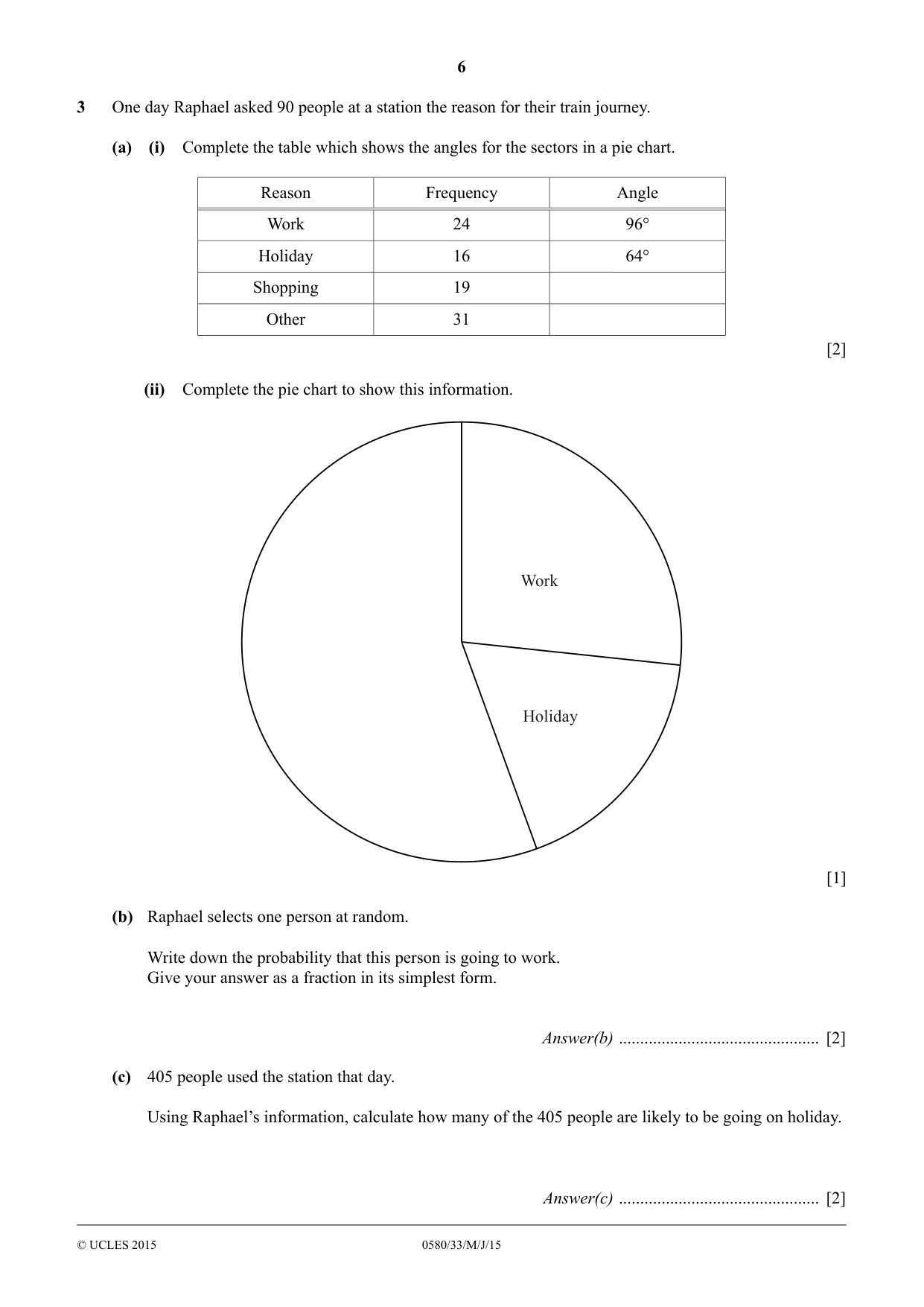
3 One day Raphael asked 90 people at a station the reason for their train journey. (a) (i) Complete the table which shows the angles for the sectors in a pie chart. Reason Frequency Angle Work 24 96° Holiday 16 64° Shopping 19 Other 31 [2] (ii) Complete the pie chart to show this information. Work Holiday [1] (b) Raphael selects one person at random. Write down the probability that this person is going to work. Give your answer as a fraction in its simplest form. Answer(b) ............................................... [2] (c) 405 people used the station that day. Using Raphael’s information, calculate how many of the 405 people are likely to be going on holiday. Answer(c) ............................................... [2]
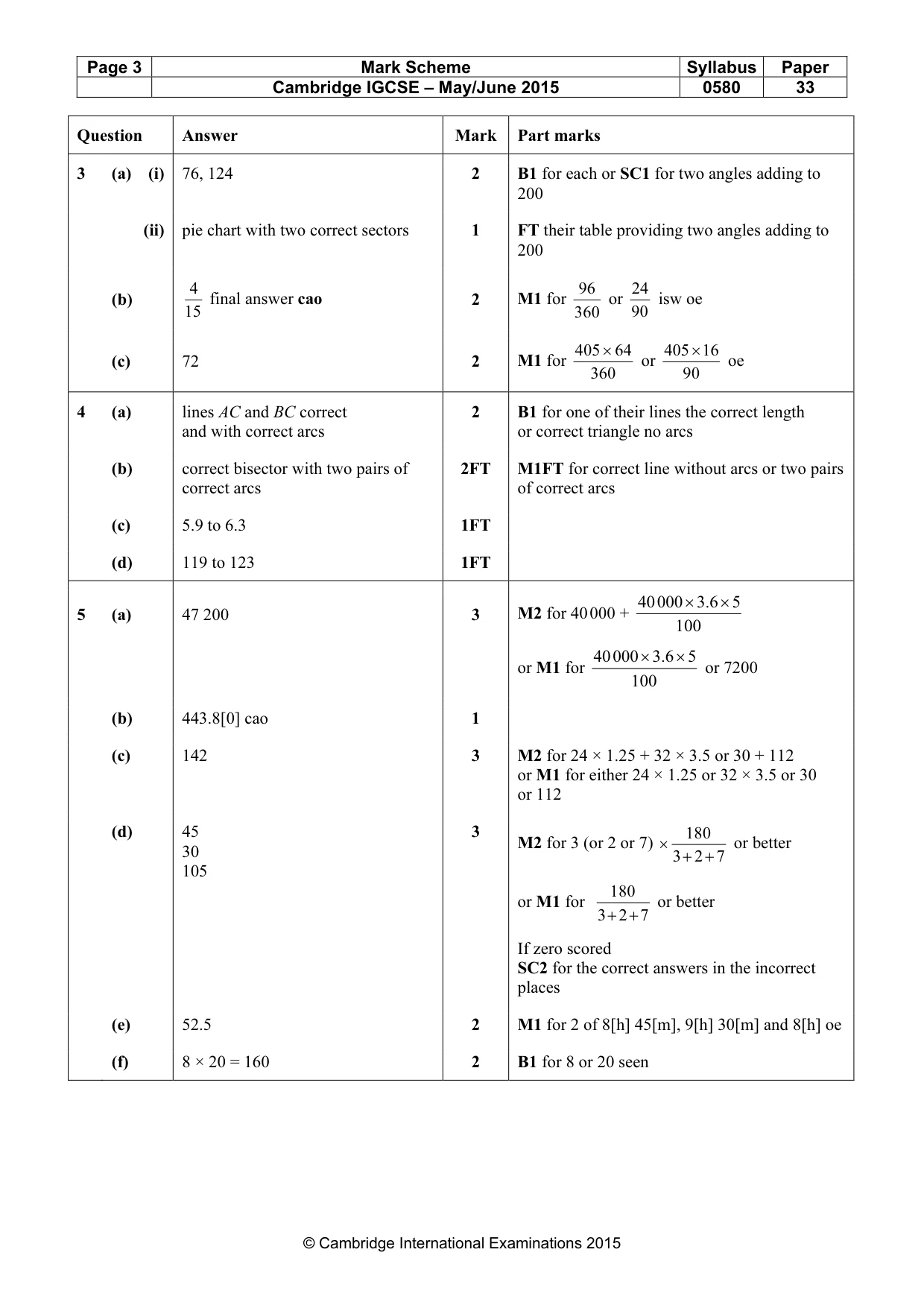
Mark scheme: 3 (a) (i) 76, 124 2 B1 for each or SC1 for two angles adding to 200 (ii) pie chart with two correct sectors 1 FT their table providing two angles adding to 200 4 96 24 (b) final answer cao 2 M1 for or isw oe 15 360 90 405× 64 405× 16 (c) 72 2 M1 for or oe 360 90
Q4 · In triangle ABC, AC = 10 cm and BC = 9 cm
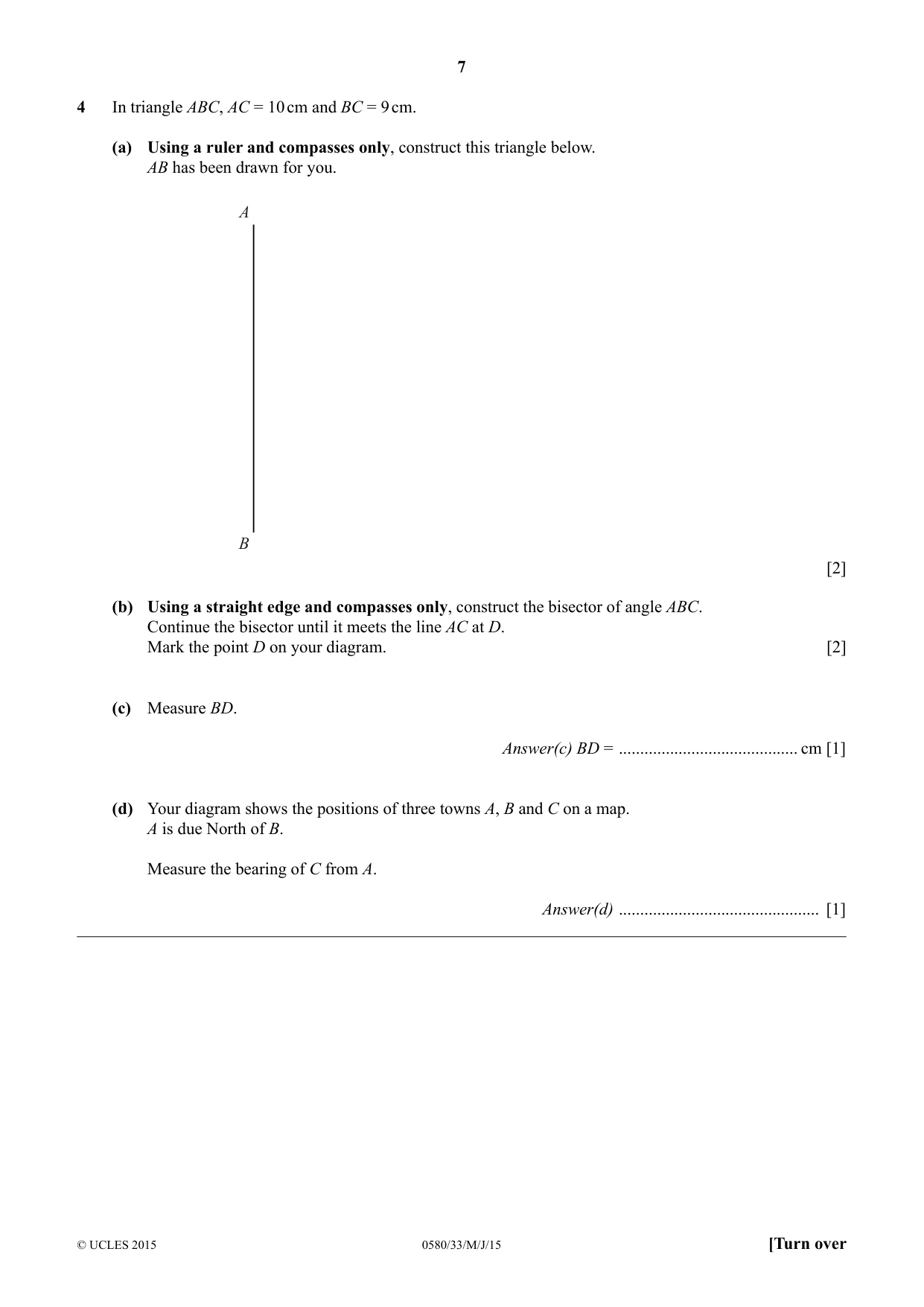
4 In triangle ABC, AC = 10 cm and BC = 9 cm. (a) Using a ruler and compasses only, construct this triangle below. AB has been drawn for you. A B [2] (b) Using a straight edge and compasses only, construct the bisector of angle ABC. Continue the bisector until it meets the line AC at D. Mark the point D on your diagram. [2] (c) Measure BD. Answer(c) BD = .......................................... cm [1] (d) Your diagram shows the positions of three towns A, B and C on a map. A is due North of B. Measure the bearing of C from A. Answer(d) ............................................... [1]
Mark scheme: 4 (a) lines AC and BC correct 2 B1 for one of their lines the correct length and with correct arcs or correct triangle no arcs (b) correct bisector with two pairs of 2FT M1FT for correct line without arcs or two pairs correct arcs of correct arcs (c) 5.9 to 6.3 1FT (d) 119 to 123 1FT 40 000 × 3 6 × 5
Q5 · Indira makes a playground for children
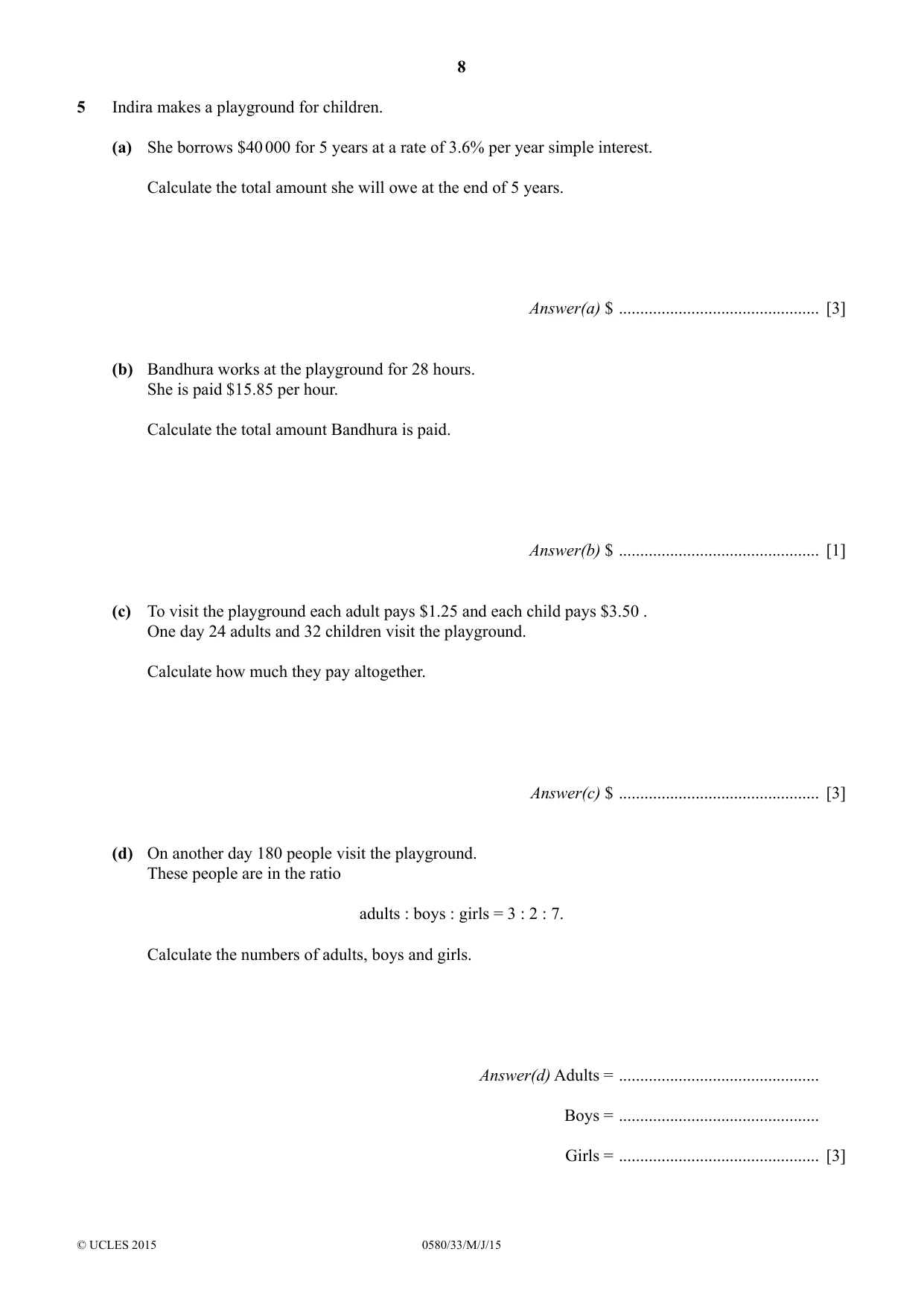
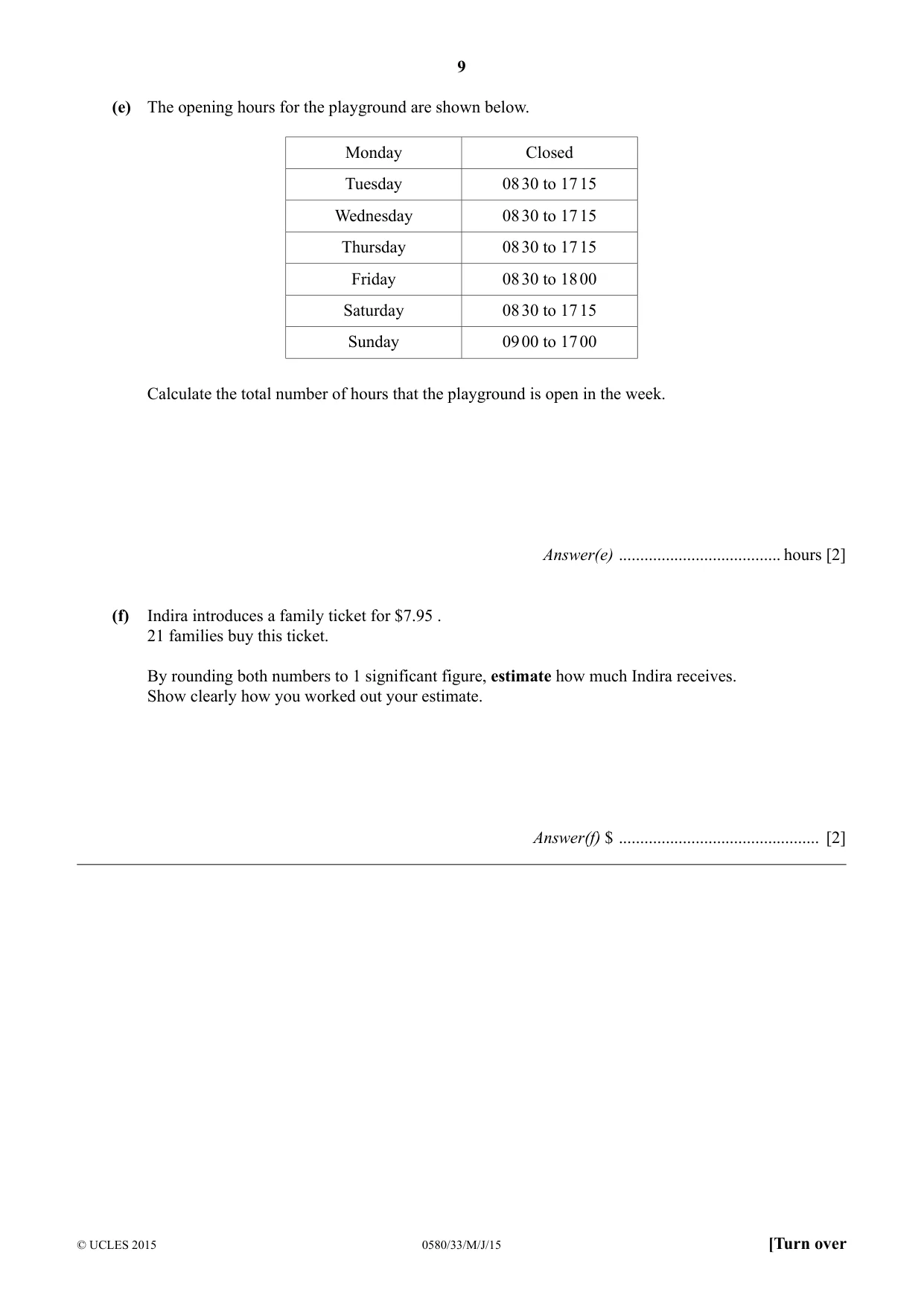
5 Indira makes a playground for children. (a) She borrows $40 000 for 5 years at a rate of 3.6% per year simple interest. Calculate the total amount she will owe at the end of 5 years. Answer(a) $ ............................................... [3] (b) Bandhura works at the playground for 28 hours. She is paid $15.85 per hour. Calculate the total amount Bandhura is paid. Answer(b) $ ............................................... [1] (c) To visit the playground each adult pays $1.25 and each child pays $3.50 . One day 24 adults and 32 children visit the playground. Calculate how much they pay altogether. Answer(c) $ ............................................... [3] (d) On another day 180 people visit the playground. These people are in the ratio adults : boys : girls = 3 : 2 : 7. Calculate the numbers of adults, boys and girls. Answer(d) Adults = ............................................... Boys = ............................................... Girls = ............................................... [3] (e) The opening hours for the playground are shown below. Monday Closed Tuesday 08 30 to 17 15 Wednesday 08 30 to 17 15 Thursday 08 30 to 17 15 Friday 08 30 to 18 00 Saturday 08 30 to 17 15 Sunday 09 00 to 17 00 Calculate the total number of hours that the playground is open in the week. Answer(e) ...................................... hours [2] (f) Indira introduces a family ticket for $7.95 . 21 families buy this ticket. By rounding both numbers to 1 significant figure, estimate how much Indira receives. Show clearly how you worked out your estimate. Answer(f) $ ............................................... [2]
Mark scheme: 40 000 × 6.3 × 5 5 (a) 47 200 3 M2 for 40 000 + 100 40 000 × 6.3 × 5 or M1 for or 7200 100 (b) 443.8[0] cao 1 (c) 142 3 M2 for 24 × 1.25 + 32 × 3.5 or 30 + 112 or M1 for either 24 × 1.25 or 32 × 3.5 or 30 or 112 (d) 45 3 180 M2 for 3 (or 2 or 7) × or better 30 3 + 2 + 7 105 180 or M1 for or better 3 + 2 + 7 If zero scored SC2 for the correct answers in the incorrect places (e) 52.5 2 M1 for 2 of 8[h] 45[m], 9[h] 30[m] and 8[h] oe (f) 8 × 20 = 160 2 B1 for 8 or 20 seen
Q6 · The travel graph shows a journey of a train from A to C, stopping at B
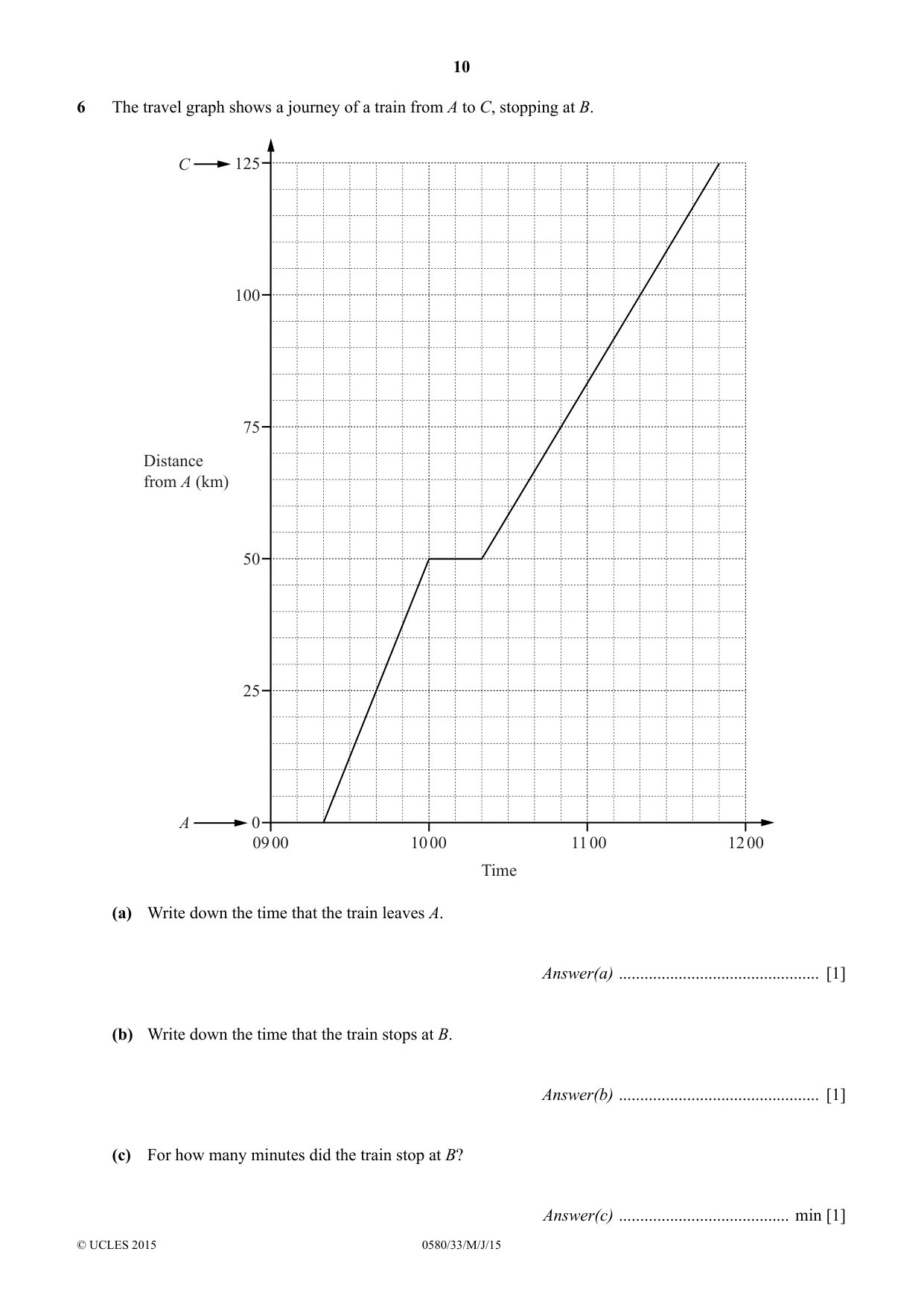
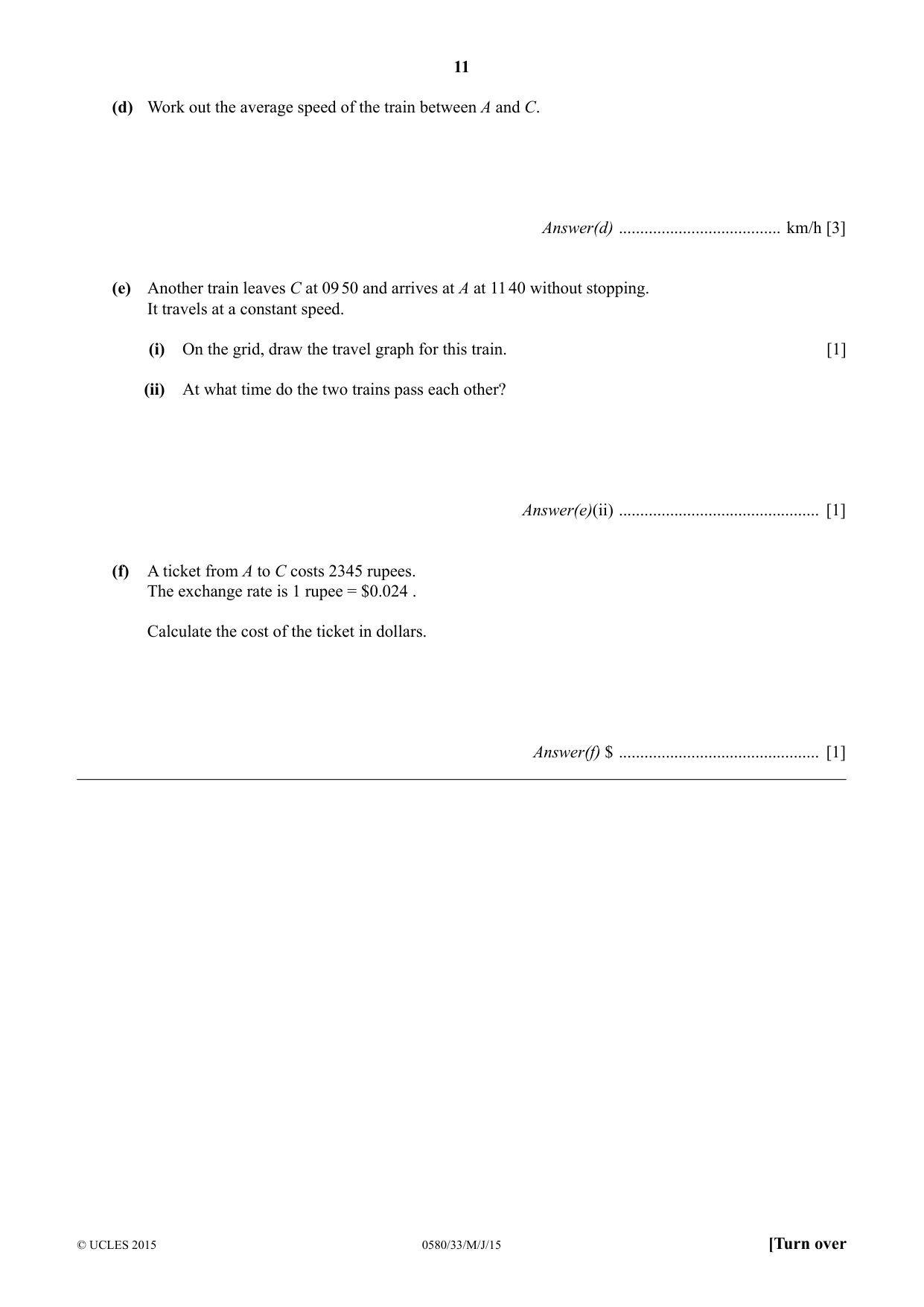
6 The travel graph shows a journey of a train from A to C, stopping at B. C 125 100 75 Distance from A (km) 50 25 A 0 09 00 10 00 11 00 12 00 Time (a) Write down the time that the train leaves A. Answer(a) ............................................... [1] (b) Write down the time that the train stops at B. Answer(b) ............................................... [1] (c) For how many minutes did the train stop at B? Answer(c) ........................................ min [1] (d) Work out the average speed of the train between A and C. Answer(d) ...................................... km/h [3] (e) Another train leaves C at 09 50 and arrives at A at 11 40 without stopping. It travels at a constant speed. (i) On the grid, draw the travel graph for this train. [1] (ii) At what time do the two trains pass each other? Answer(e)(ii) ............................................... [1] (f) A ticket from A to C costs 2345 rupees. The exchange rate is 1 rupee = $0.024 . Calculate the cost of the ticket in dollars. Answer(f) $ ............................................... [1]
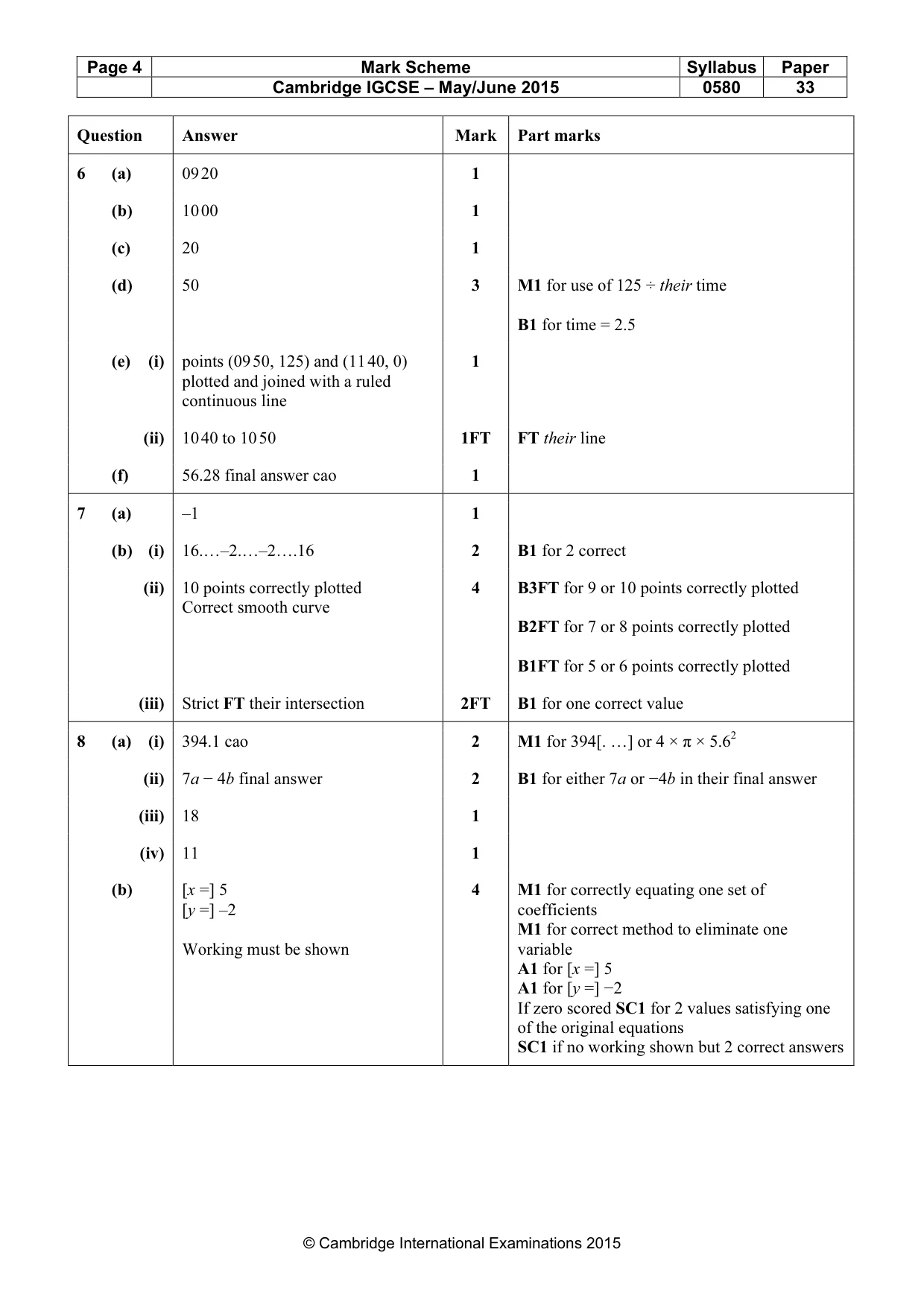
Mark scheme: 6 (a) 09 20 1 (b) 10 00 1 (c) 20 1 (d) 50 3 M1 for use of 125 ÷ their time B1 for time = 2.5 (e) (i) points (09 50, 125) and (11 40, 0) 1 plotted and joined with a ruled continuous line (ii) 10 40 to 10 50 1FT FT their line (f) 56.28 final answer cao 1
Q7 · The grid below shows the straight line L
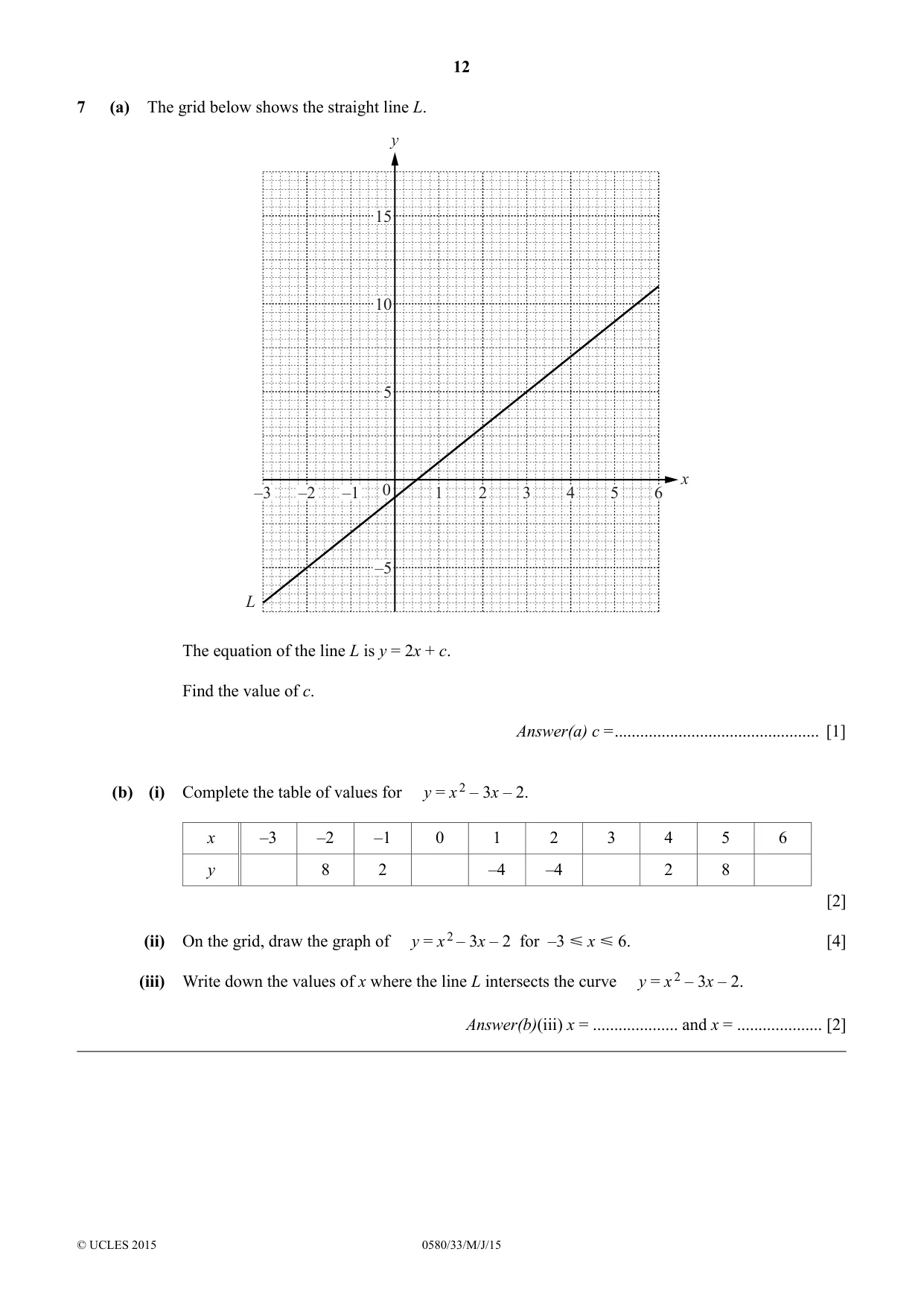
7 (a) The grid below shows the straight line L. y 15 10 5 x –3 –2 –1 0 1 2 3 4 5 6 –5 L The equation of the line L is y = 2x + c. Find the value of c. Answer(a) c = ................................................ [1] (b) (i) Complete the table of values for y = x 2 – 3x – 2. x –3 –2 –1 0 1 2 3 4 5 6 y 8 2 –4 –4 2 8 [2] (ii) On the grid, draw the graph of y = x 2 – 3x – 2 for –3 x 6. [4] (iii) Write down the values of x where the line L intersects the curve y = x 2 – 3x – 2. Answer(b)(iii) x = .................... and x = .................... [2]
Mark scheme: 7 (a) –1 1 (b) (i) 16.…–2.…–2….16 2 B1 for 2 correct (ii) 10 points correctly plotted 4 B3FT for 9 or 10 points correctly plotted Correct smooth curve B2FT for 7 or 8 points correctly plotted B1FT for 5 or 6 points correctly plotted (iii) Strict FT their intersection 2FT B1 for one correct value
Q8 · A = 4πr2 Work out the value of A when r = 5.6
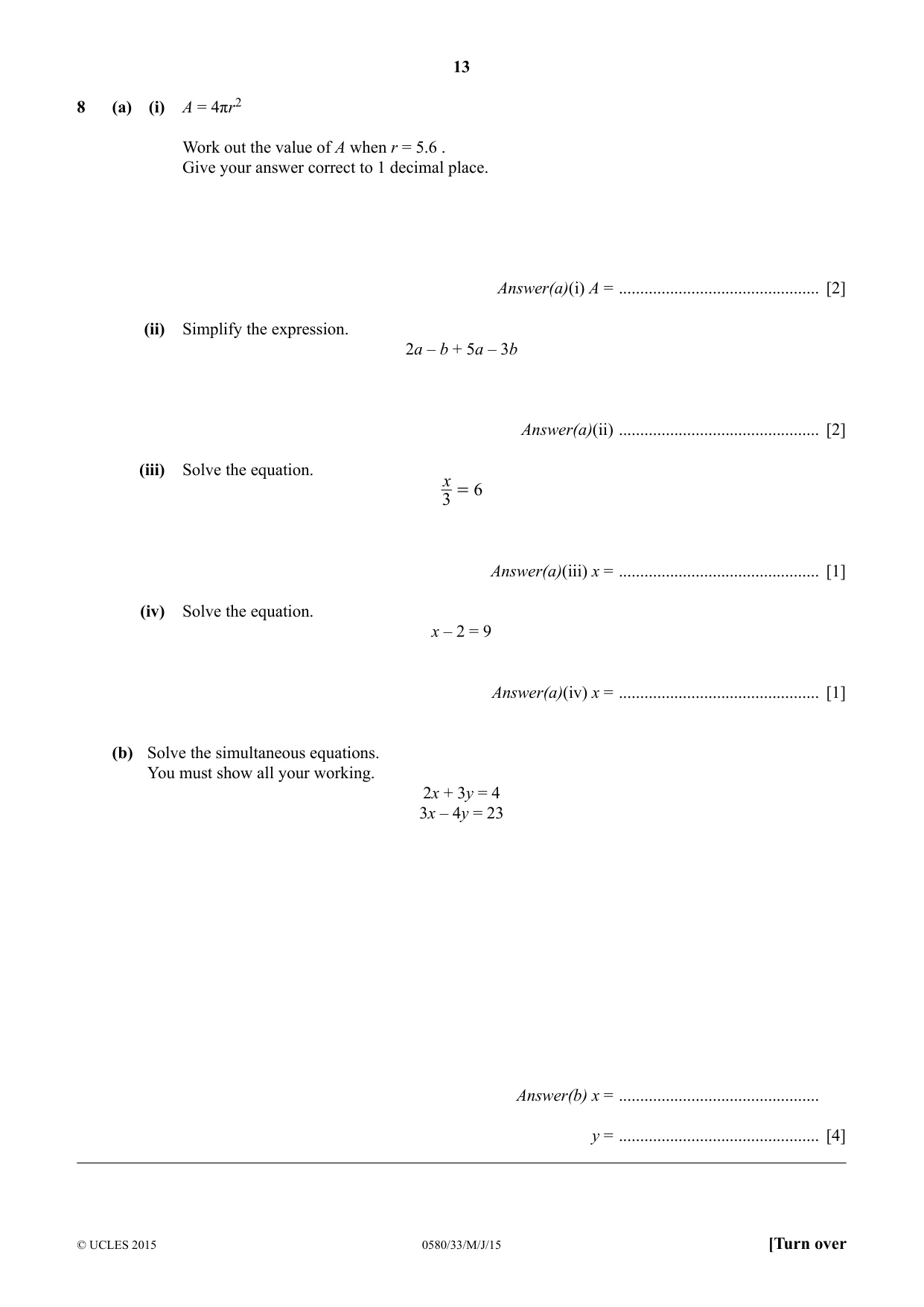
8 (a) (i) A = 4πr2 Work out the value of A when r = 5.6 . Give your answer correct to 1 decimal place. Answer(a)(i) A = ............................................... [2] (ii) Simplify the expression. 2a – b + 5a – 3b Answer(a)(ii) ............................................... [2] (iii) Solve the equation. x = 6 3 Answer(a)(iii) x = ............................................... [1] (iv) Solve the equation. x – 2 = 9 Answer(a)(iv) x = ............................................... [1] (b) Solve the simultaneous equations. You must show all your working. 2x + 3y = 4 3x – 4y = 23 Answer(b) x = ............................................... y = ............................................... [4]
Mark scheme: 8 (a) (i) 394.1 cao 2 M1 for 394[. …] or 4 × π × 5.62 (ii) 7a − 4b final answer 2 B1 for either 7a or −4b in their final answer (iii) 18 1 (iv) 11 1 (b) [x =] 5 4 M1 for correctly equating one set of [y =] –2 coefficients M1 for correct method to eliminate one Working must be shown variable A1 for [x =] 5 A1 for [y =] −2 If zero scored SC1 for 2 values satisfying one of the original equations SC1 if no working shown but 2 correct answers
Q9 · Here are the first four terms of a sequence
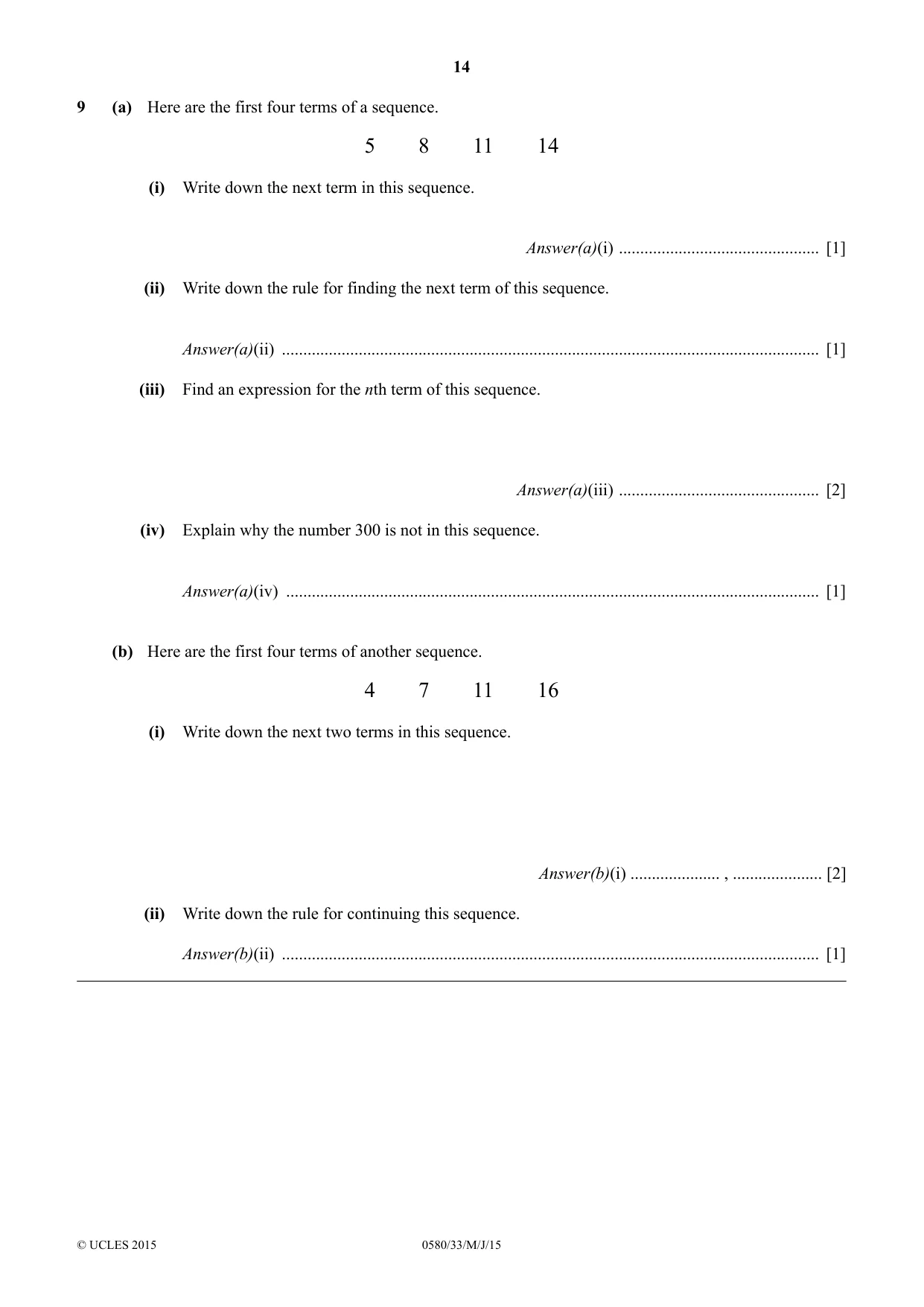
9 (a) Here are the first four terms of a sequence. 5 8 11 14 (i) Write down the next term in this sequence. Answer(a)(i) ............................................... [1] (ii) Write down the rule for finding the next term of this sequence. Answer(a)(ii) .............................................................................................................................. [1] (iii) Find an expression for the nth term of this sequence. Answer(a)(iii) ............................................... [2] (iv) Explain why the number 300 is not in this sequence. Answer(a)(iv) ............................................................................................................................. [1] (b) Here are the first four terms of another sequence. 4 7 11 16 (i) Write down the next two terms in this sequence. Answer(b)(i) ..................... , ..................... [2] (ii) Write down the rule for continuing this sequence. Answer(b)(ii) .............................................................................................................................. [1]
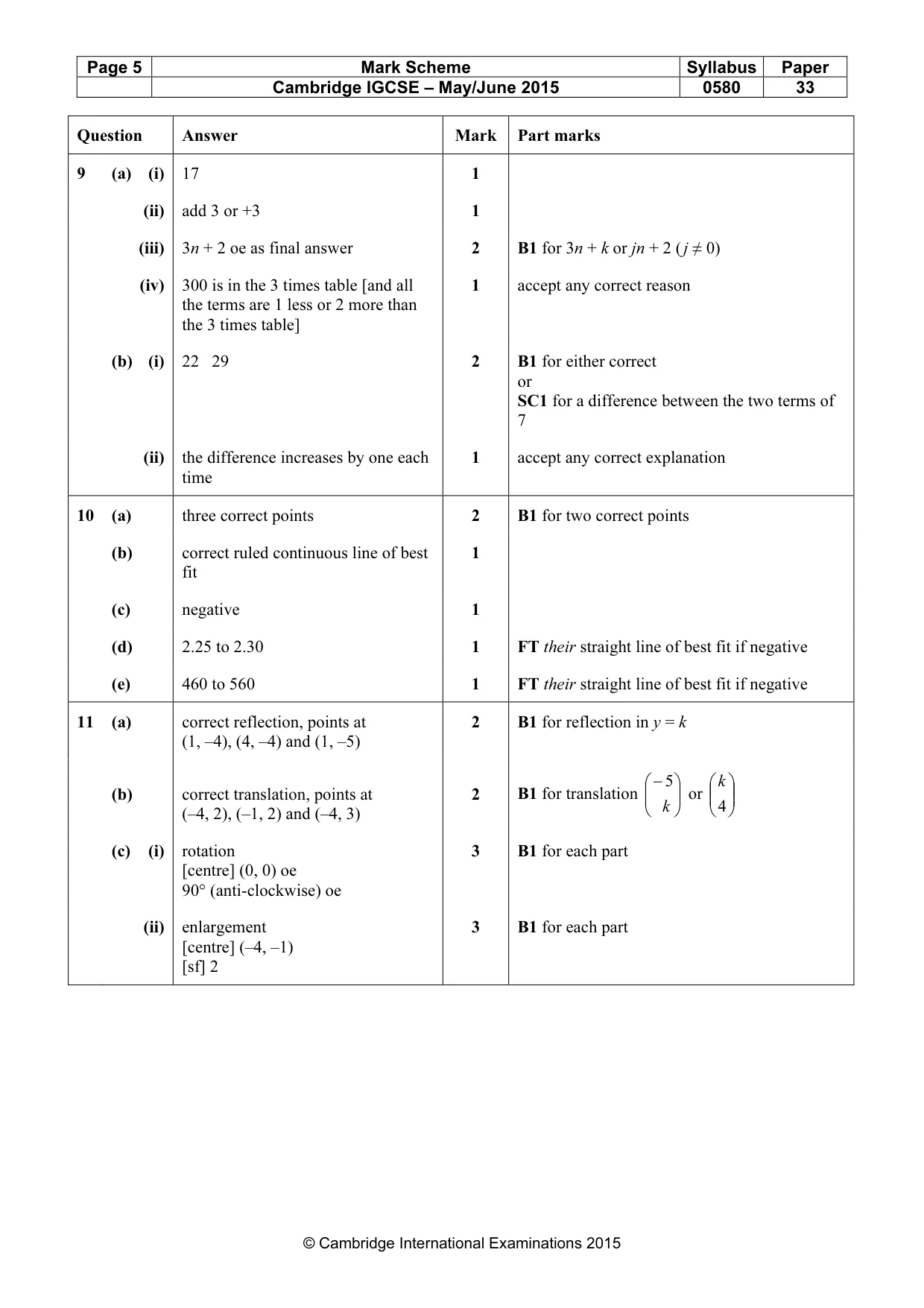
Mark scheme: 9 (a) (i) 17 1 (ii) add 3 or +3 1 (iii) 3n + 2 oe as final answer 2 B1 for 3n + k or jn + 2 ( j ≠ 0) (iv) 300 is in the 3 times table [and all 1 accept any correct reason the terms are 1 less or 2 more than the 3 times table] (b) (i) 22 29 2 B1 for either correct or SC1 for a difference between the two terms of 7 (ii) the difference increases by one each 1 accept any correct explanation time
Q10 · A manufacturer makes rods
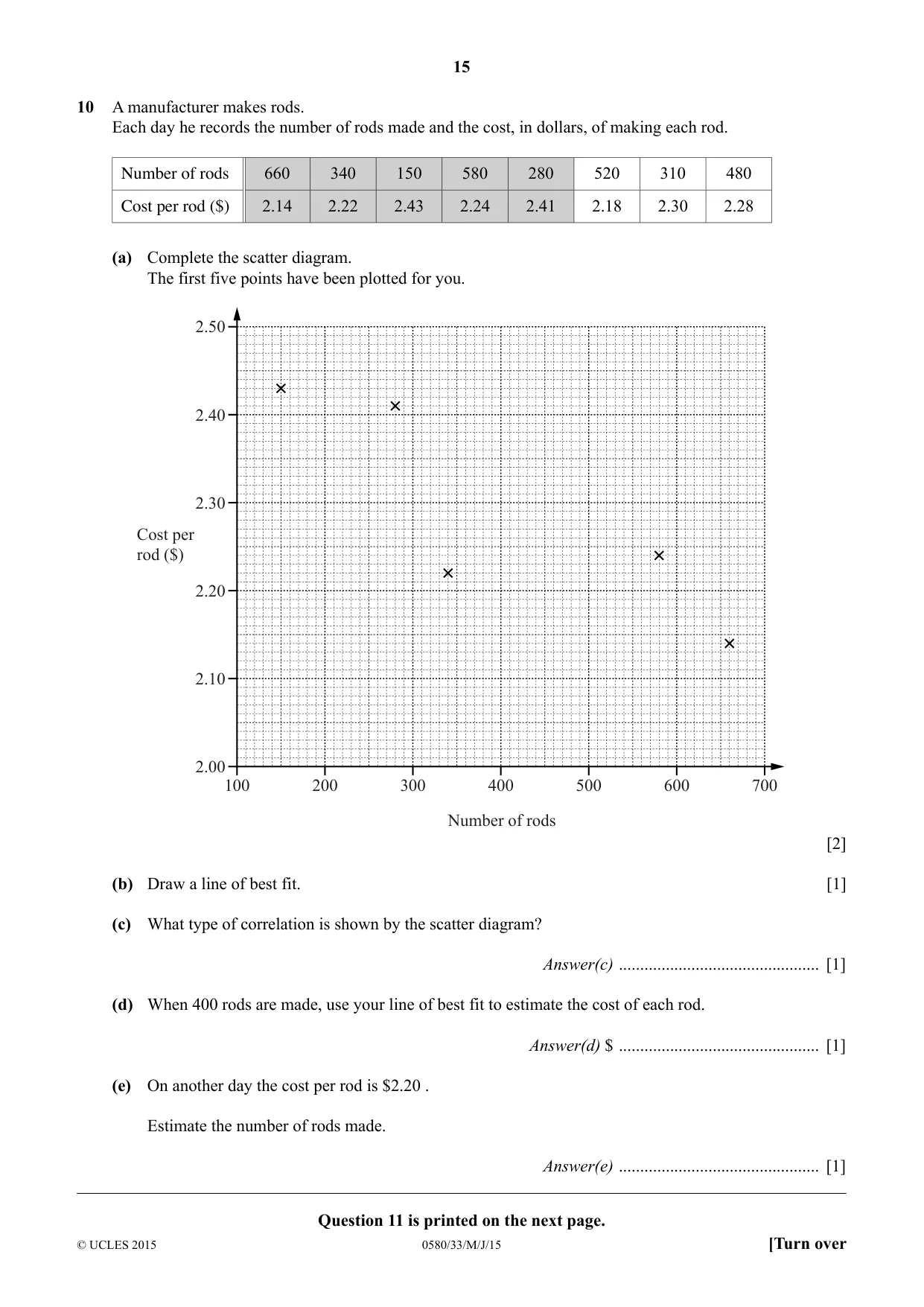
10 A manufacturer makes rods. Each day he records the number of rods made and the cost, in dollars, of making each rod. Number of rods 660 340 150 580 280 520 310 480 Cost per rod ($) 2.14 2.22 2.43 2.24 2.41 2.18 2.30 2.28 (a) Complete the scatter diagram. The first five points have been plotted for you. 2.50 2.40 2.30 Cost per rod ($) 2.20 2.10 2.00 100 200 300 400 500 600 700 Number of rods [2] (b) Draw a line of best fit. [1] (c) What type of correlation is shown by the scatter diagram? Answer(c) ............................................... [1] (d) When 400 rods are made, use your line of best fit to estimate the cost of each rod. Answer(d) $ ............................................... [1] (e) On another day the cost per rod is $2.20 . Estimate the number of rods made. Answer(e) ............................................... [1] Question 11 is printed on the next page.
Mark scheme: 10 (a) three correct points 2 B1 for two correct points (b) correct ruled continuous line of best 1 fit (c) negative 1 (d) 2.25 to 2.30 1 FT their straight line of best fit if negative (e) 460 to 560 1 FT their straight line of best fit if negative
Q11 · Y 6 5 4 3 2 B 1 C x –6 –5 –4 –3 –2 –1 0 1 2 3 4 5 6 –1 A –2 –3 –4 –5 –6 (a) Reflect…
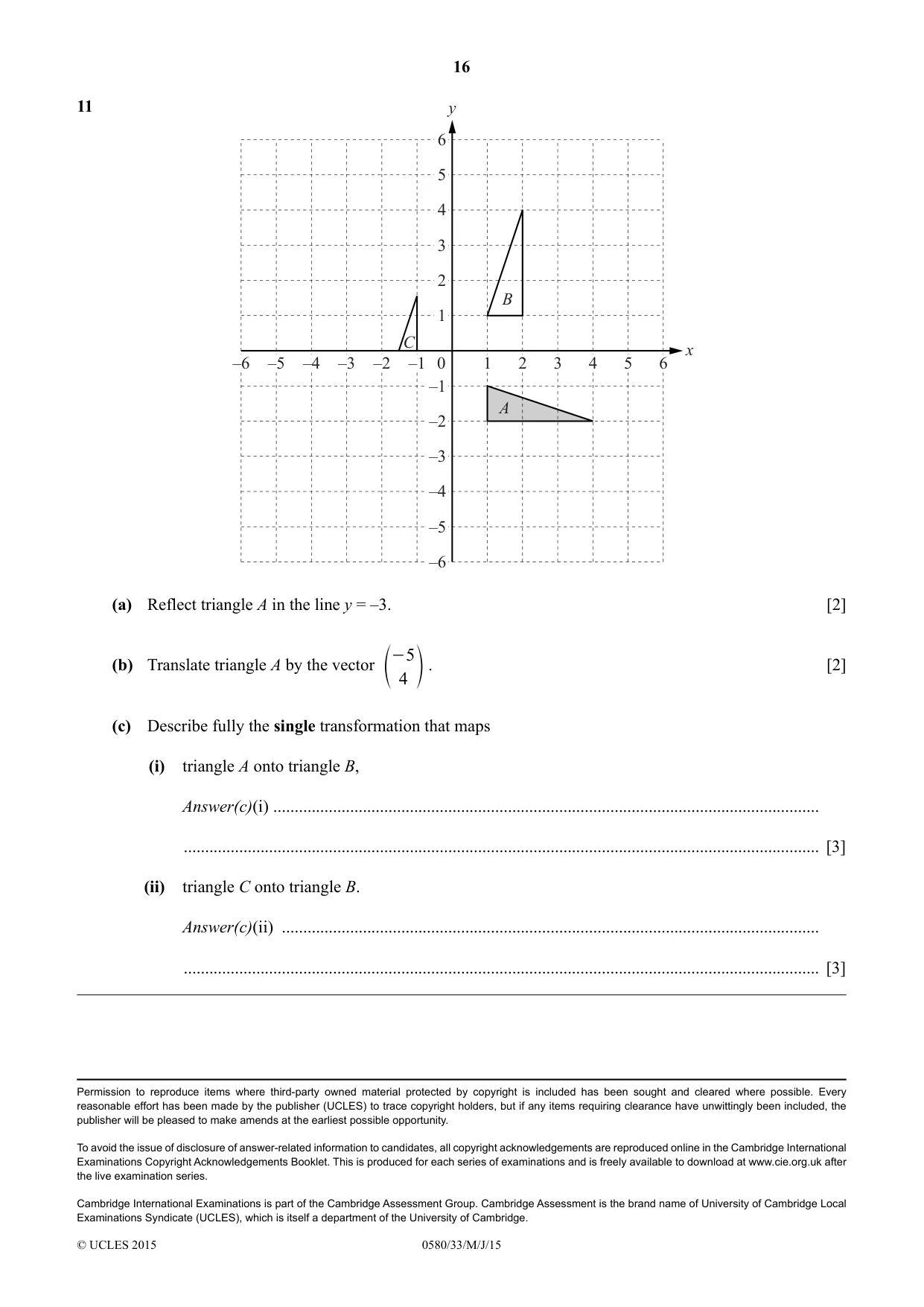
11 y 6 5 4 3 2 B 1 C x –6 –5 –4 –3 –2 –1 0 1 2 3 4 5 6 –1 A –2 –3 –4 –5 –6 (a) Reflect triangle A in the line y = –3. [2] - 5 (b) Translate triangle A by the vector e o . [2] 4 (c) Describe fully the single transformation that maps (i) triangle A onto triangle B, Answer(c)(i) ................................................................................................................................ ..................................................................................................................................................... [3] (ii) triangle C onto triangle B. Answer(c)(ii) .............................................................................................................................. ..................................................................................................................................................... [3]
Mark scheme: 11 (a) correct reflection, points at 2 B1 for reflection in y = k (1, –4), (4, –4) and (1, –5) − 5 k (b) correct translation, points at 2 B1 for translation or (–4, 2), (–1, 2) and (–4, 3) k 4 (c) (i) rotation 3 B1 for each part [centre] (0, 0) oe 90° (anti-clockwise) oe (ii) enlargement 3 B1 for each part [centre] (–4, –1) [sf] 2
What was in this paper
The subtopics covered by these 11 questions, and how many questions each got. Open one in a new tab to see every Cambridge question on it.
What you needed in this session
Cambridge’s own grade thresholds for 2015 May/June, Paper 3 · Variant 3. A higher threshold means an easier paper — the bar moves with how the cohort did.