Cambridge IGCSE Mathematics 0580 — 2015 May/June Paper 2 · Variant 3
0580/23/M/J/15 · 20 questions · 70 marks · ≈79 min
The question paper and its mark scheme, free to read here and free to download. This is Cambridge’s own paper, exactly as it was sat.
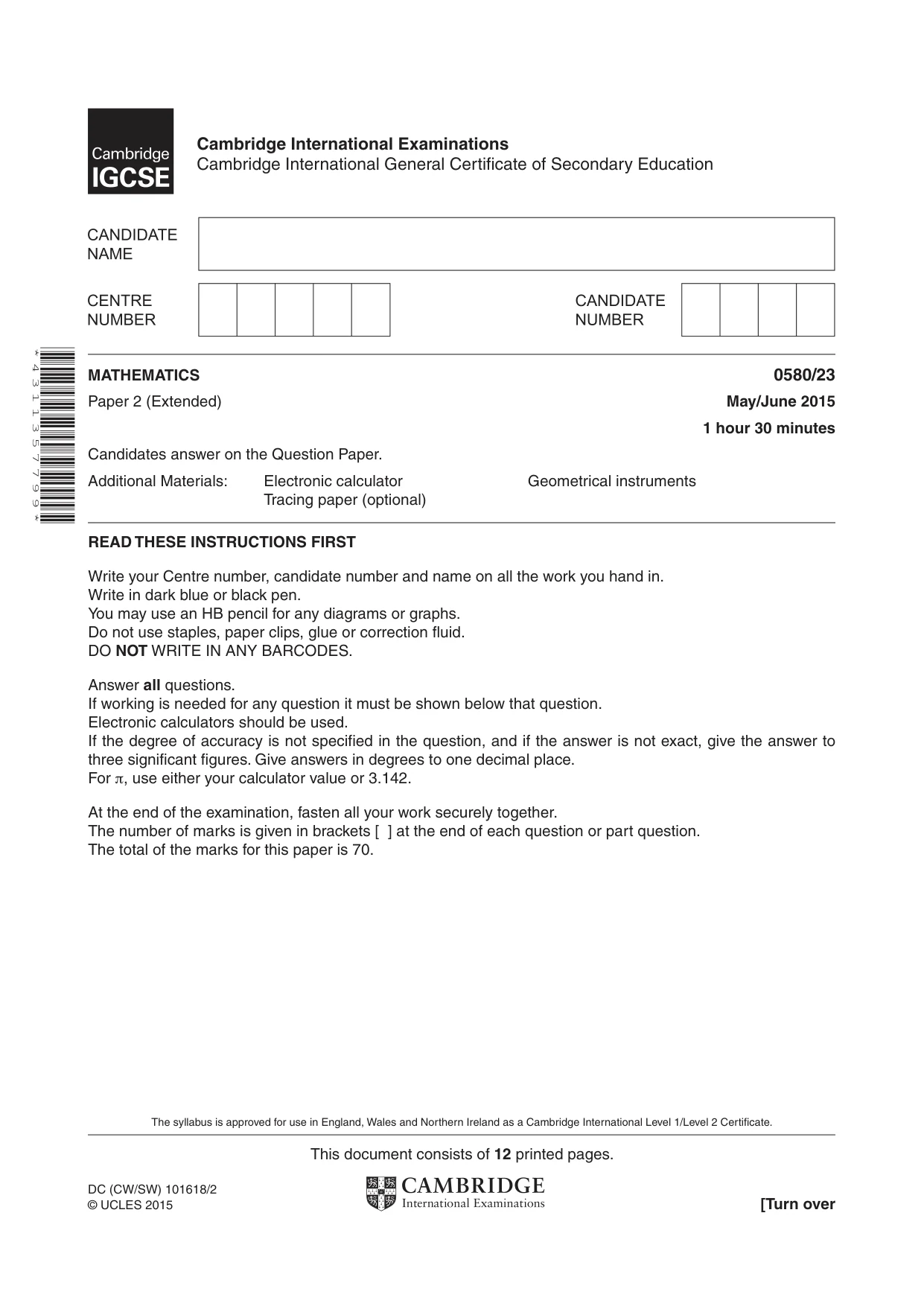
Question paper12 pages
Mark scheme5 pages
Answers below. Sit the paper first if you are practising.
Questions as text
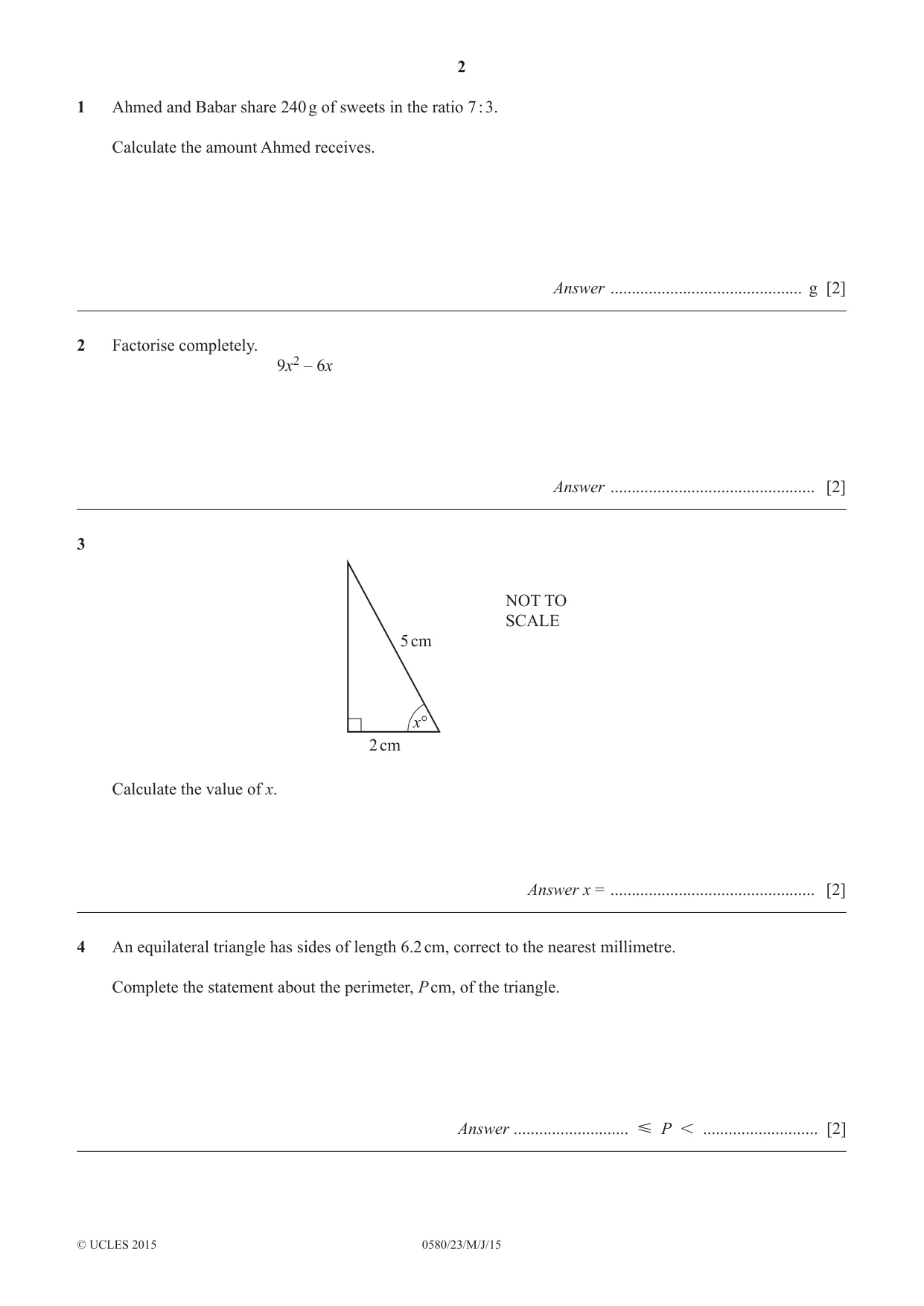
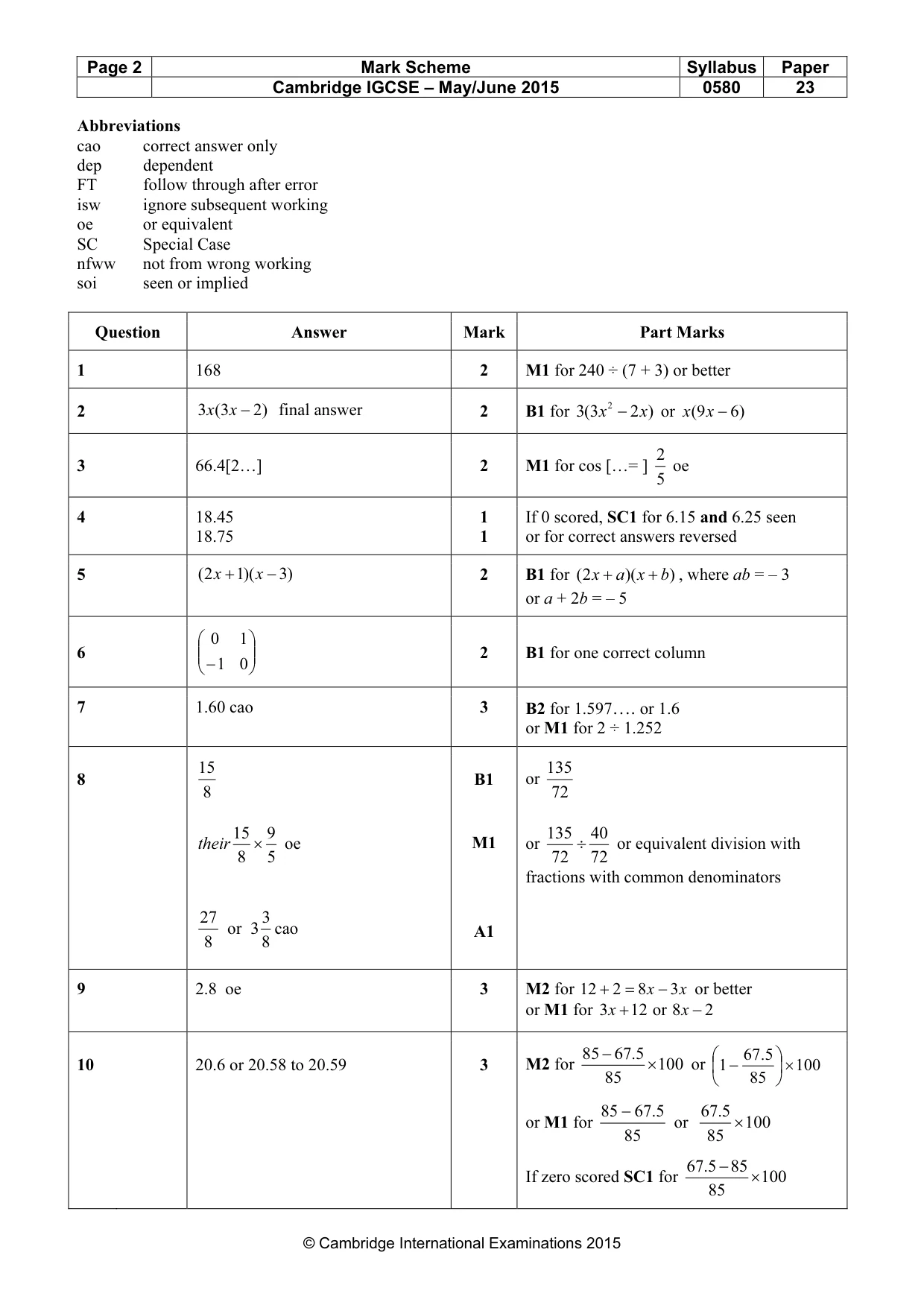
Q1 · Ahmed and Babar share 240 g of sweets in the ratio 7 : 3
1 Ahmed and Babar share 240 g of sweets in the ratio 7 : 3. Calculate the amount Ahmed receives. Answer ............................................. g [2]
Mark scheme: Question Answer Mark Part Marks 1 168 2 M1 for 240 ÷ (7 + 3) or better
Question 2
2 Factorise completely. 9x2 – 6x Answer ................................................ [2]
Mark scheme: 2 3 x (3 x − 2 ) final answer 2 B1 for (33 x 2 − 2 x ) or x (9 x − 6 ) 2
Q3 · NOT TO SCALE 5 cm x° 2 cm Calculate the value of x
3 NOT TO SCALE 5 cm x° 2 cm Calculate the value of x. Answer x = ................................................ [2]
Mark scheme: 2 3 66.4[2…] 2 M1 for cos […= ] oe 5
Q4 · An equilateral triangle has sides of length 6.2 cm, correct to the nearest millimetre
4 An equilateral triangle has sides of length 6.2 cm, correct to the nearest millimetre. Complete the statement about the perimeter, P cm, of the triangle. Answer ........................... P ........................... [2]
Mark scheme: 4 18.45 1 If 0 scored, SC1 for 6.15 and 6.25 seen 18.75 1 or for correct answers reversed
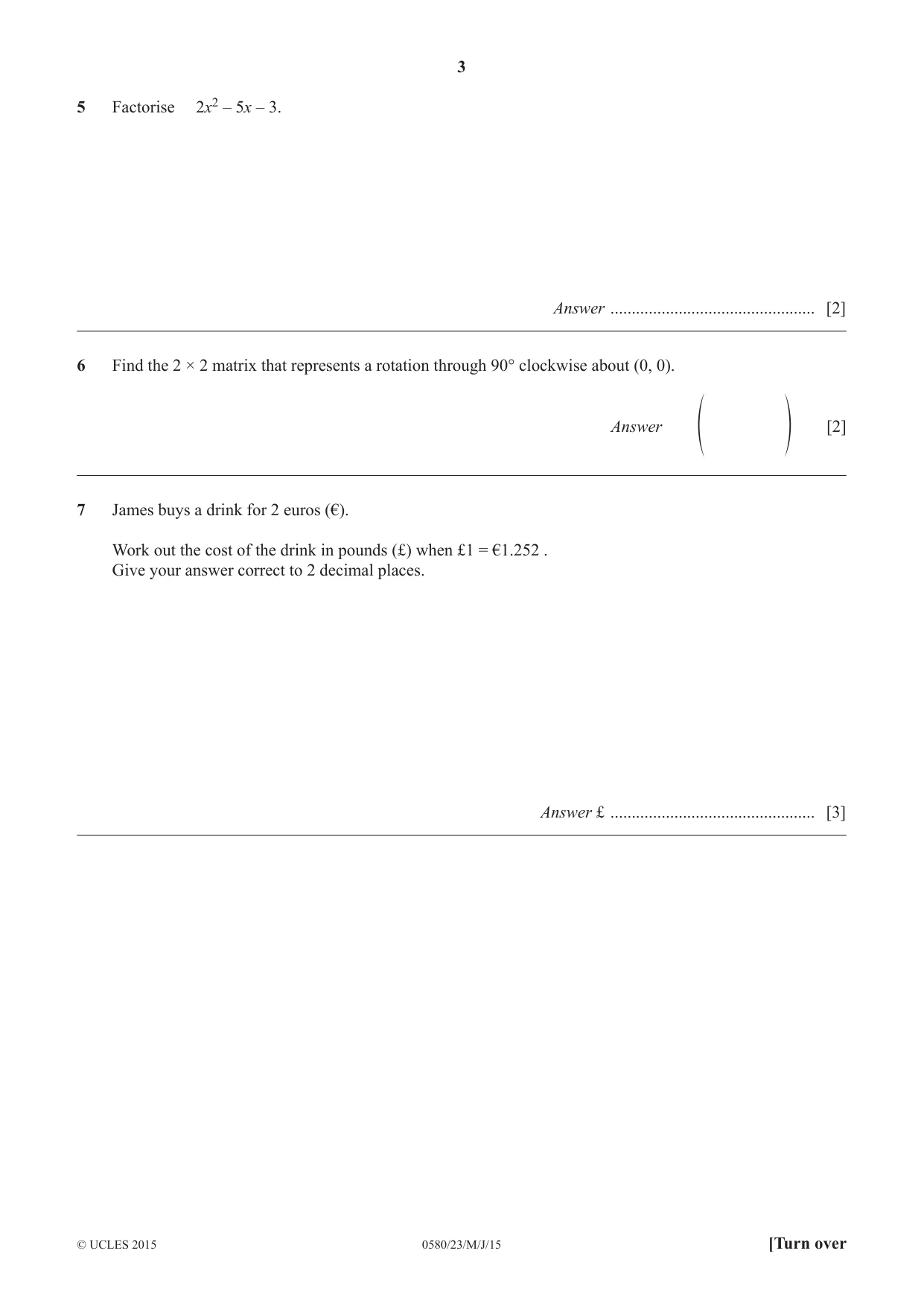
Q5 · Factorise 2x2 – 5x – 3
5 Factorise 2x2 – 5x – 3. Answer ................................................ [2]
Mark scheme: 5 ( 2 x + 1)( x − 3) 2 B1 for ( 2 x + a )( x + b ) , where ab = – 3 or a + 2b = – 5 0 1
Q6 · Find the 2 × 2 matrix that represents a rotation through 90° clockwise about (0, 0)
6 Find the 2 × 2 matrix that represents a rotation through 90° clockwise about (0, 0). Answer [2] f p
Mark scheme: 0 1 6 2 B1 for one correct column − 1 0
Q7 · James buys a drink for 2 euros (€)
7 James buys a drink for 2 euros (€). Work out the cost of the drink in pounds (£) when £1 = €1.252 . Give your answer correct to 2 decimal places. Answer £ ................................................ [3]
Mark scheme: 7 1.60 cao 3 B2 for 1.597…. or 1.6 or M1 for 2 ÷ 1.252 15 135
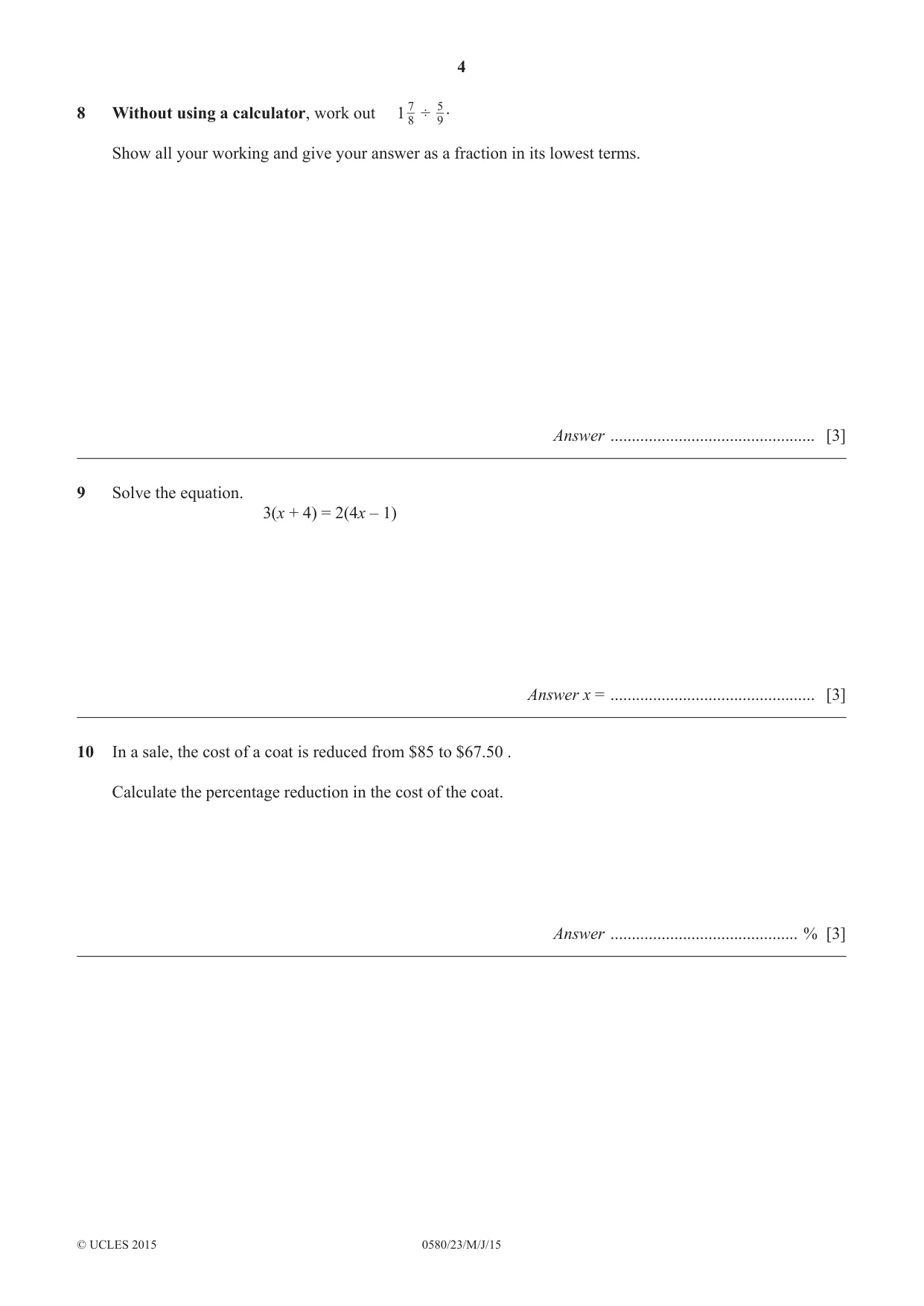
Q8 · Without using a calculator, work out 1 78 ÷ 59
8 Without using a calculator, work out 1 78 ÷ 59 . Show all your working and give your answer as a fraction in its lowest terms. Answer ................................................ [3]
Mark scheme: 15 135 8 B1 or 8 72 15 9 135 40 their × oe M1 or ÷ or equivalent division with 8 5 72 72 fractions with common denominators 27 3 or 3 cao A1 8 8
Question 9
9 Solve the equation. 3(x + 4) = 2(4x – 1) Answer x = ................................................ [3]
Mark scheme: 9 2.8 oe 3 M2 for 12 + 2 = 8 x − 3 x or better or M1 for 3 x + 12 or 8 x − 2 85 67 5 67 5
Q10 · In a sale, the cost of a coat is reduced from $85 to $67.50
10 In a sale, the cost of a coat is reduced from $85 to $67.50 . Calculate the percentage reduction in the cost of the coat. Answer ............................................ % [3]
Mark scheme: 85 − 675. 67 5. 10 20.6 or 20.58 to 20.59 3 M2 for × 100 or − 1 × 100 85 85 85 − 67 5. 675. or M1 for or × 100 85 85 675. − 85 If zero scored SC1 for × 100 85
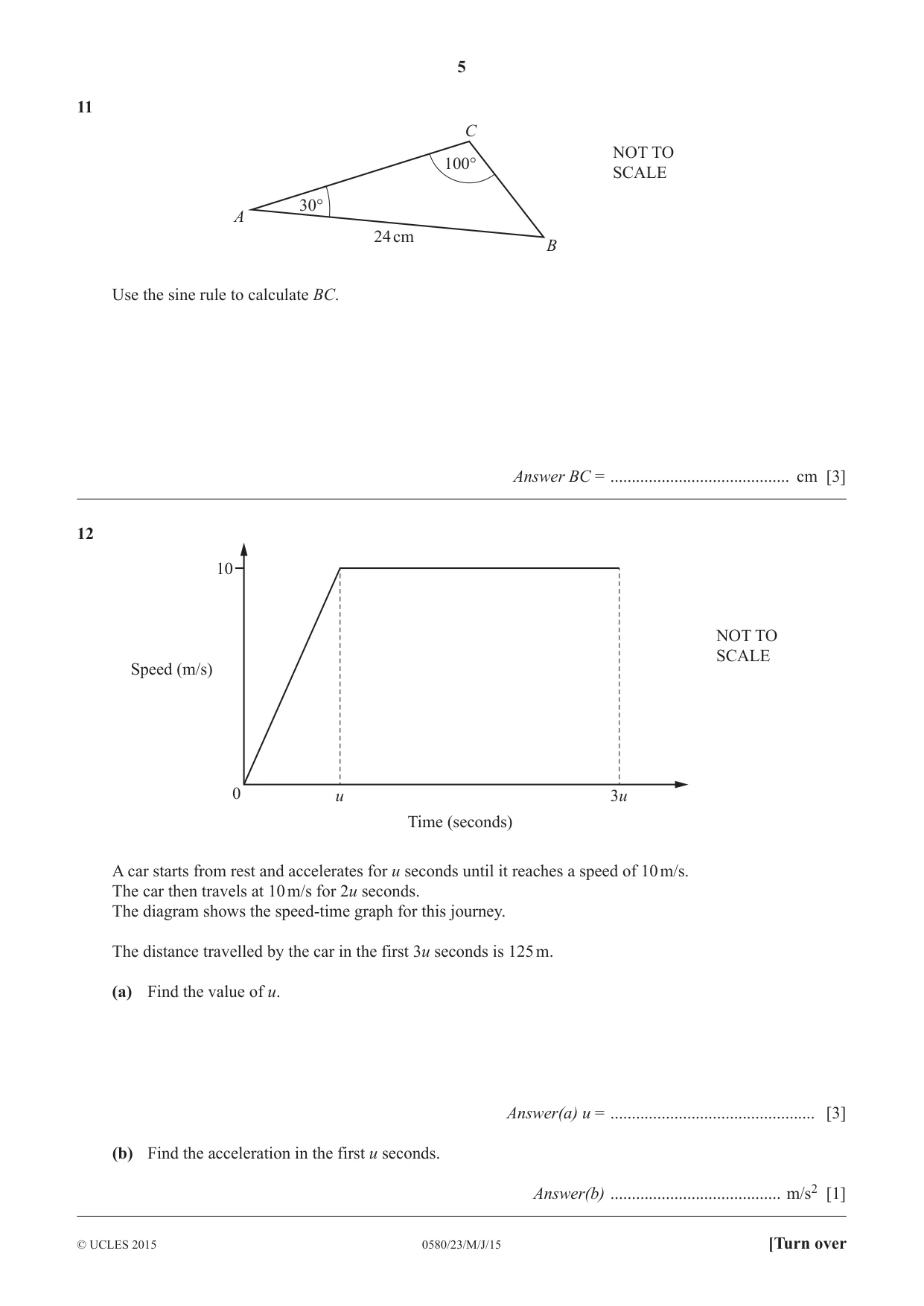
Q11 · C NOT TO 100° SCALE 30° A 24 cm B Use the sine rule to calculate BC
11 C NOT TO 100° SCALE 30° A 24 cm B Use the sine rule to calculate BC. Answer BC = .......................................... cm [3]
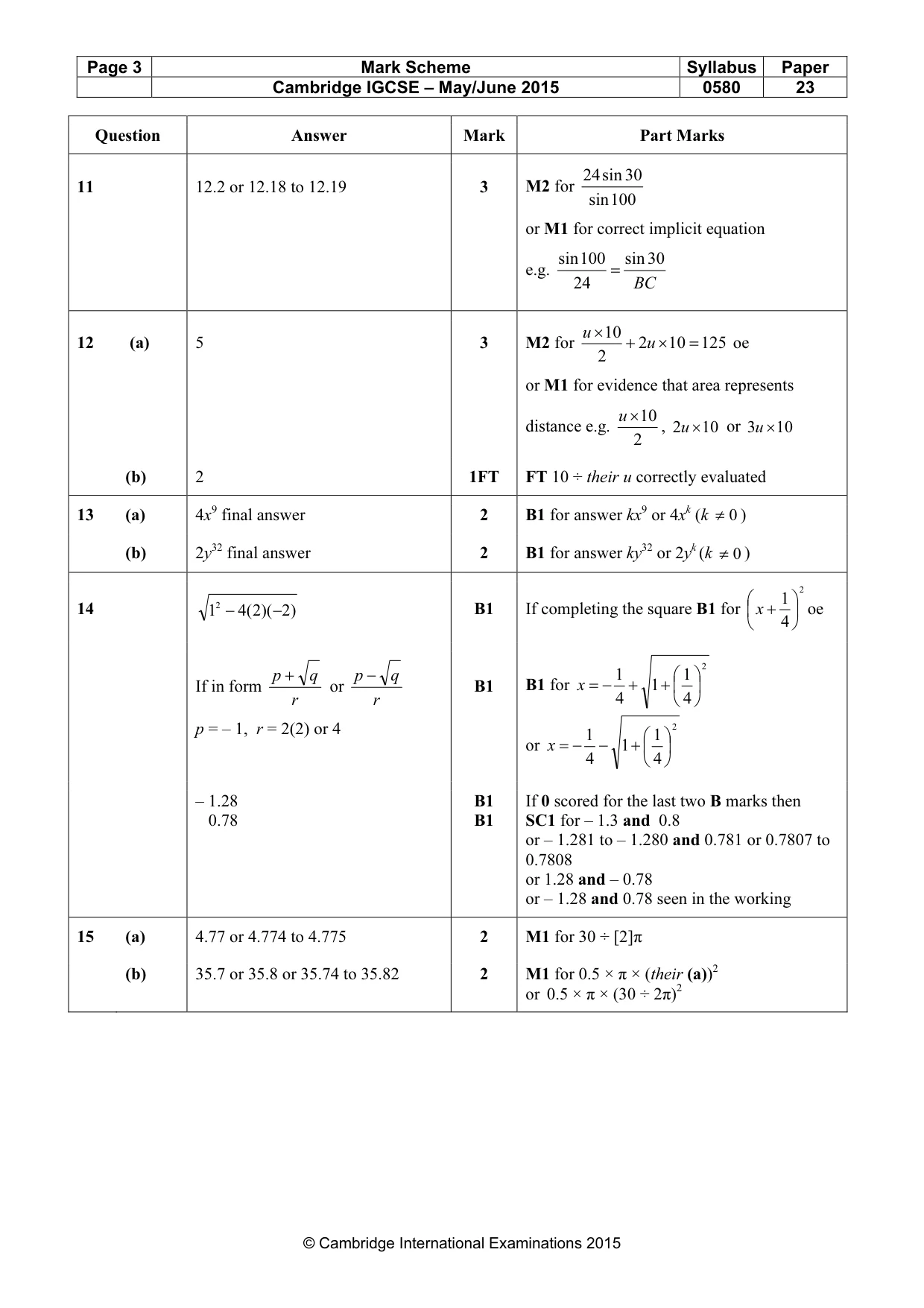
Mark scheme: 24 sin 30 11 12.2 or 12.18 to 12.19 3 M2 for sin 100 or M1 for correct implicit equation sin 100 sin 30 e.g. = 24 BC u × 10
Q12 · 10 NOT TO SCALE Speed (m/s) 0 u 3u Time (seconds) A car starts from rest and accelerates…
12 10 NOT TO SCALE Speed (m/s) 0 u 3u Time (seconds) A car starts from rest and accelerates for u seconds until it reaches a speed of 10 m/s. The car then travels at 10 m/s for 2u seconds. The diagram shows the speed-time graph for this journey. The distance travelled by the car in the first 3u seconds is 125 m. (a) Find the value of u. Answer(a) u = ................................................ [3] (b) Find the acceleration in the first u seconds. Answer(b) ........................................ m/s2 [1]
Mark scheme: u × 10 12 (a) 5 3 M2 for + 2u × 10 = 125 oe 2 or M1 for evidence that area represents u × 10 distance e.g. , 2u × 10 or 3u × 10 2 (b) 2 1FT FT 10 ÷ their u correctly evaluated
Question 13
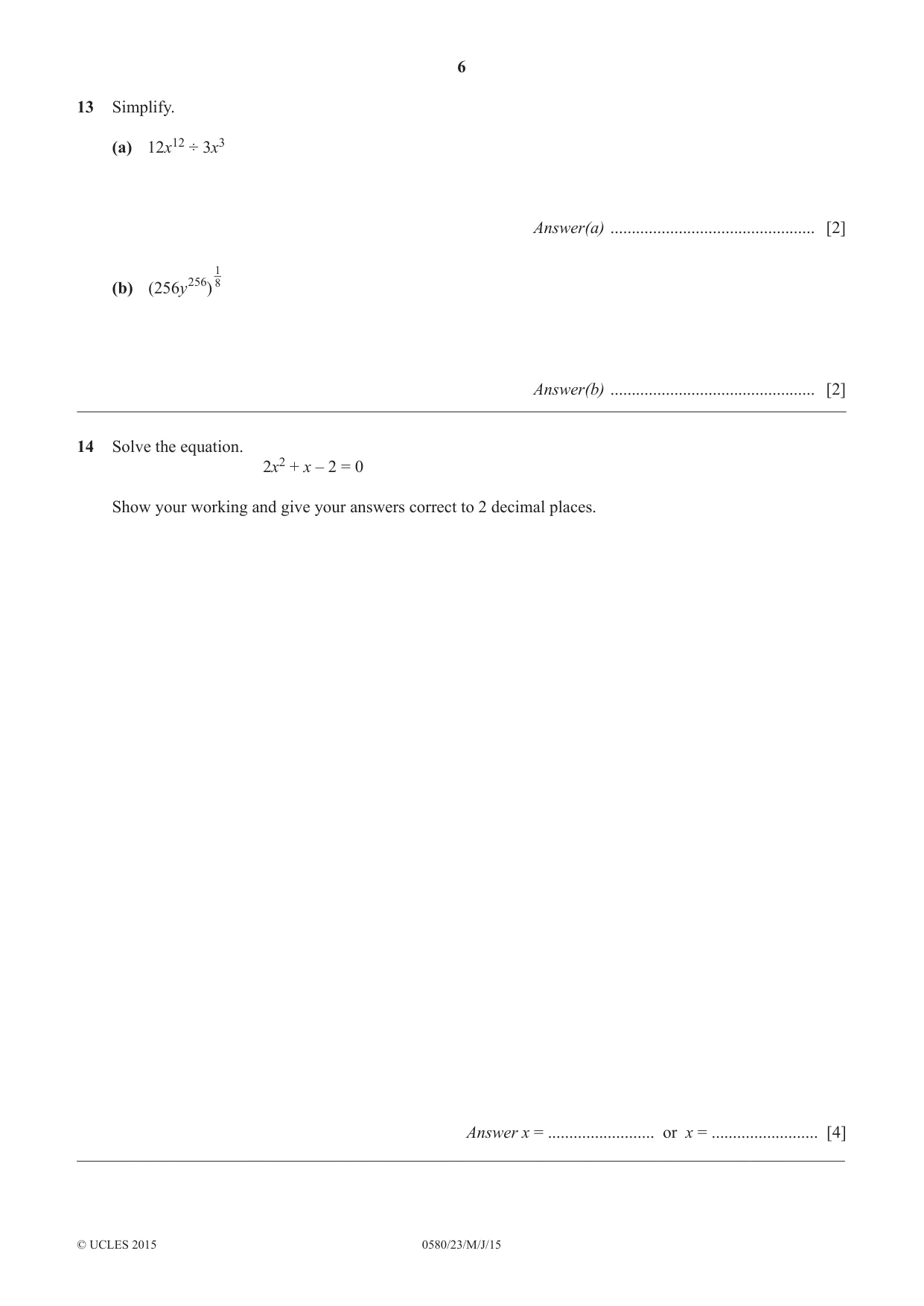
13 Simplify. (a) 12x12 ÷ 3x3 Answer(a) ................................................ [2] 1 (b) (256y 256 ) 8 Answer(b) ................................................ [2]
Mark scheme: 13 (a) 4x9 final answer 2 B1 for answer kx9 or 4xk (k ≠ 0 ) (b) 2y32 final answer 2 B1 for answer ky32 or 2yk (k ≠ 0 ) 1 2
Question 14
14 Solve the equation. 2x2 + x – 2 = 0 Show your working and give your answers correct to 2 decimal places. Answer x = ......................... or x = ......................... [4] __________________________________________________________________________________________
Mark scheme: 14 12 − 4 ( 2 )( −2 ) B1 If completing the square B1 for + x 1 oe 4 p + q p − q 1 1 2 If in form or B1 B1 for x = − + 1 + r r 4 4 p = – 1, r = 2(2) or 4 2 1 1 or x = − − 1 + 4 4 – 1.28 B1 If 0 scored for the last two B marks then 0.78 B1 SC1 for – 1.3 and 0.8 or – 1.281 to – 1.280 and 0.781 or 0.7807 to 0.7808 or 1.28 and – 0.78 or – 1.28 and 0.78 seen in the working
Q15 · The circumference of a circle is 30 cm
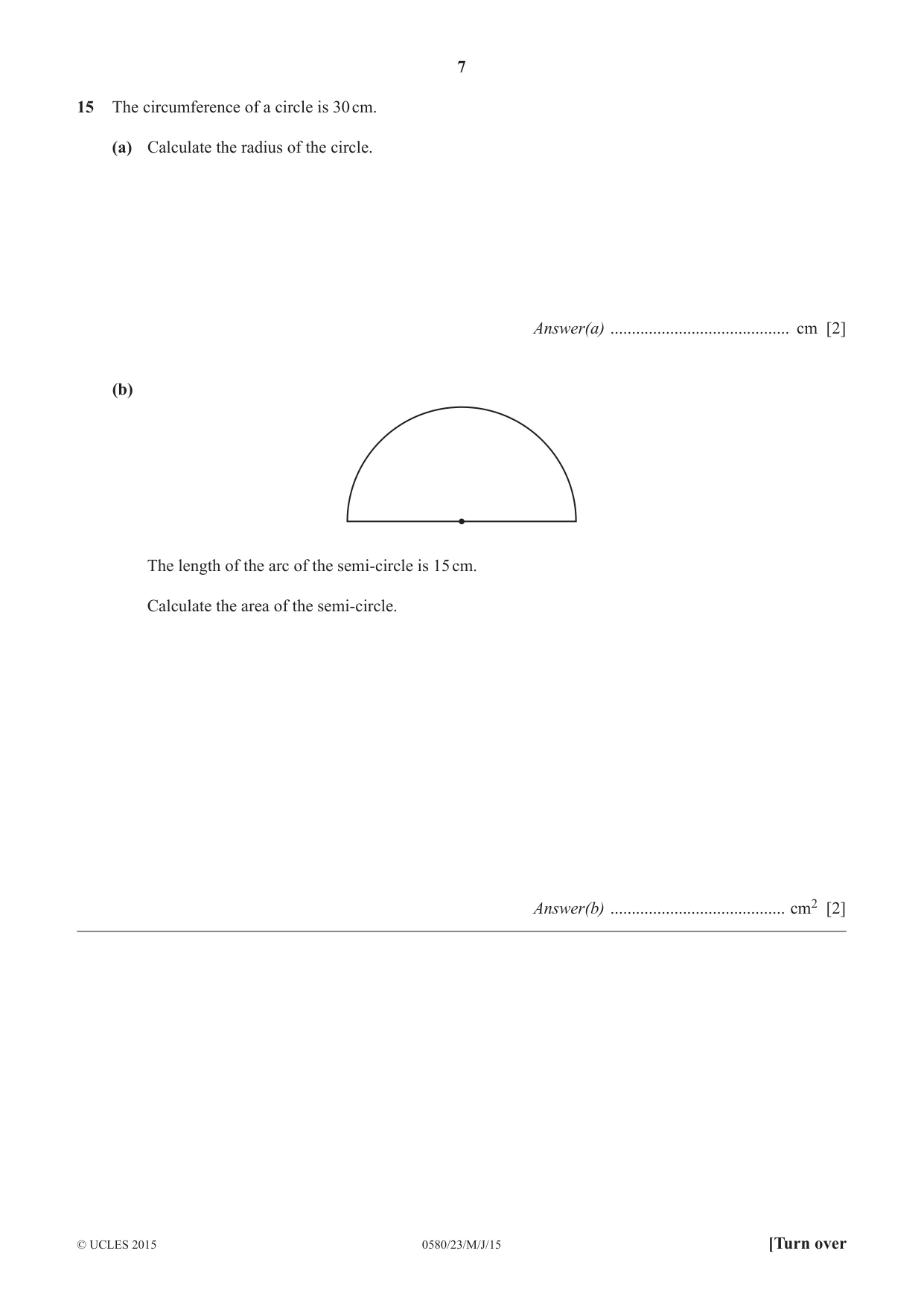
15 The circumference of a circle is 30 cm. (a) Calculate the radius of the circle. Answer(a) .......................................... cm [2] (b) The length of the arc of the semi-circle is 15 cm. Calculate the area of the semi-circle. Answer(b) ......................................... cm2 [2]
Mark scheme: 15 (a) 4.77 or 4.774 to 4.775 2 M1 for 30 ÷ [2]π (b) 35.7 or 35.8 or 35.74 to 35.82 2 M1 for 0.5 × π × (their (a))2 or 0.5 × π × (30 ÷ 2π)2
Q16 · In this part, you may use this Venn diagram to help you answer the questions
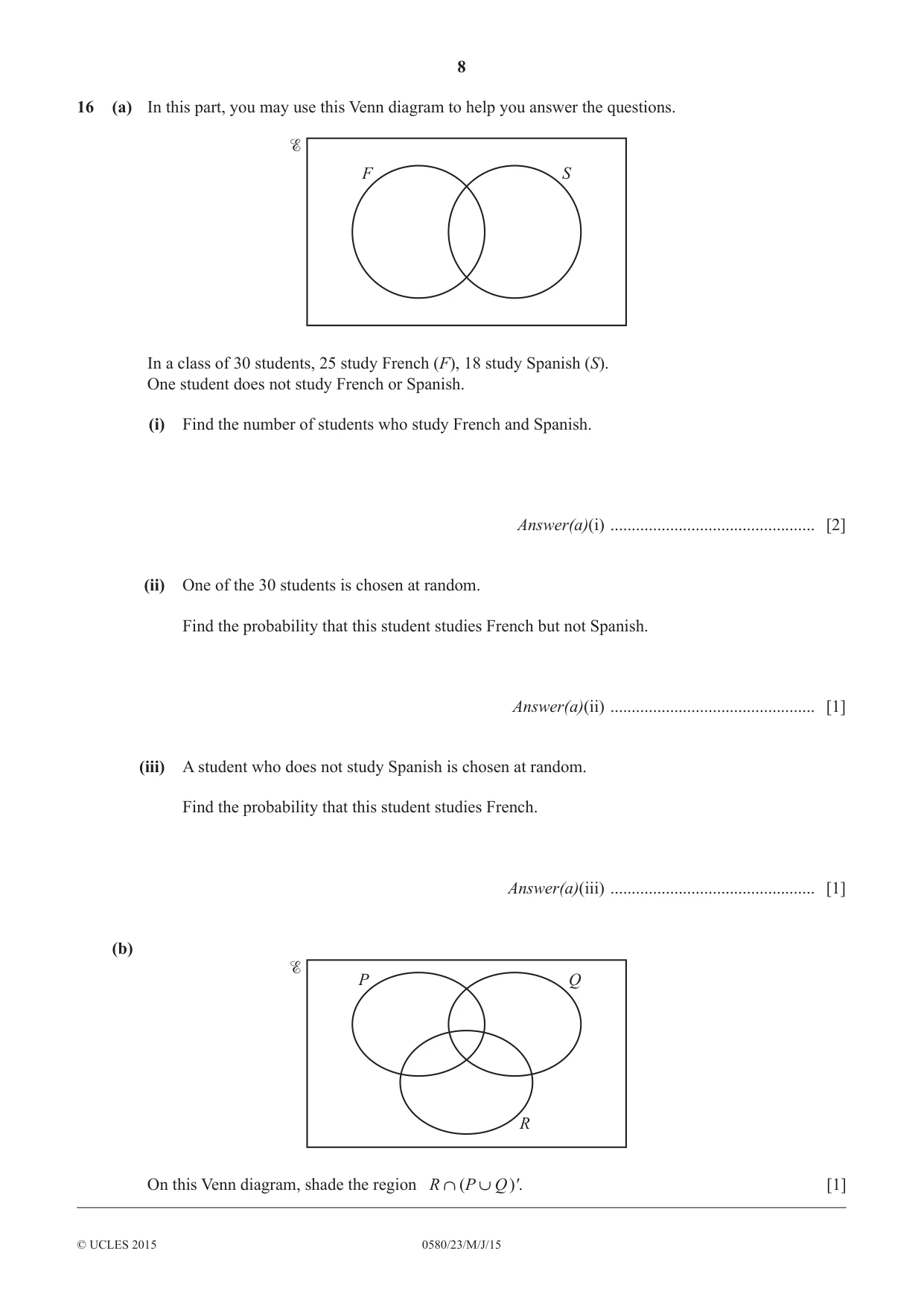
16 (a) In this part, you may use this Venn diagram to help you answer the questions. F S In a class of 30 students, 25 study French (F), 18 study Spanish (S). One student does not study French or Spanish. (i) Find the number of students who study French and Spanish. Answer(a)(i) ................................................ [2] (ii) One of the 30 students is chosen at random. Find the probability that this student studies French but not Spanish. Answer(a)(ii) ................................................ [1] (iii) A student who does not study Spanish is chosen at random. Find the probability that this student studies French. Answer(a)(iii) ................................................ [1] (b) P Q R On this Venn diagram, shade the region R (P Q )′. [1]
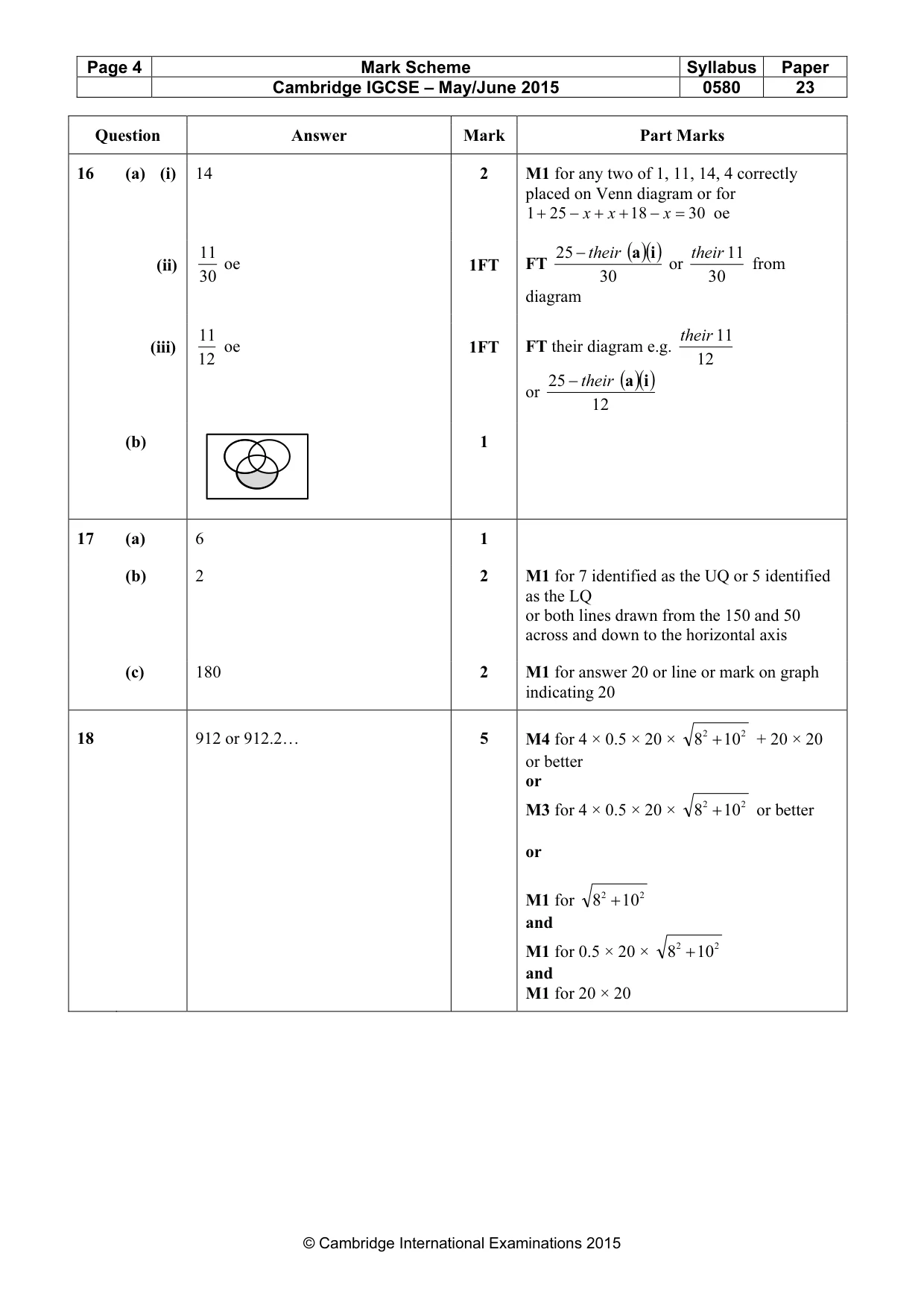
Mark scheme: 16 (a) (i) 14 2 M1 for any two of 1, 11, 14, 4 correctly placed on Venn diagram or for 1 + 25 − x + x + 18 − x = 30 oe 11 25 − their (a )(i ) their 11 (ii) oe 1FT FT or from 30 30 30 diagram 11 their 11 (iii) oe 1FT FT their diagram e.g. 12 12 25 − their (a )(i ) or 12 (b) 1
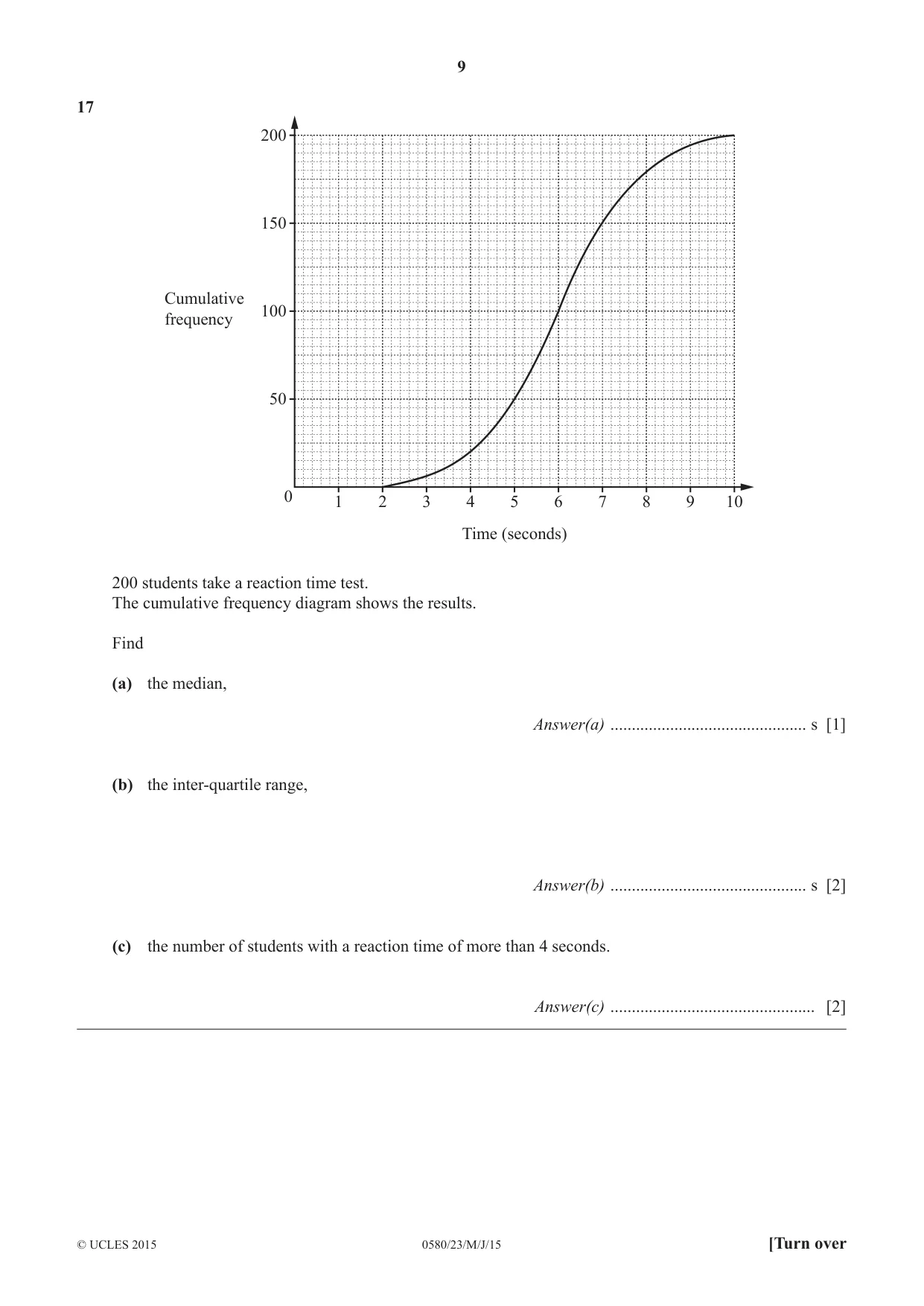
Q17 · 200 150 Cumulative 100 frequency 50 0 1 2 3 4 5 6 7 8 9 10 Time (seconds) 200 students…
17 200 150 Cumulative 100 frequency 50 0 1 2 3 4 5 6 7 8 9 10 Time (seconds) 200 students take a reaction time test. The cumulative frequency diagram shows the results. Find (a) the median, Answer(a) .............................................. s [1] (b) the inter-quartile range, Answer(b) .............................................. s [2] (c) the number of students with a reaction time of more than 4 seconds. Answer(c) ................................................ [2]
Mark scheme: 17 (a) 6 1 (b) 2 2 M1 for 7 identified as the UQ or 5 identified as the LQ or both lines drawn from the 150 and 50 across and down to the horizontal axis (c) 180 2 M1 for answer 20 or line or mark on graph indicating 20
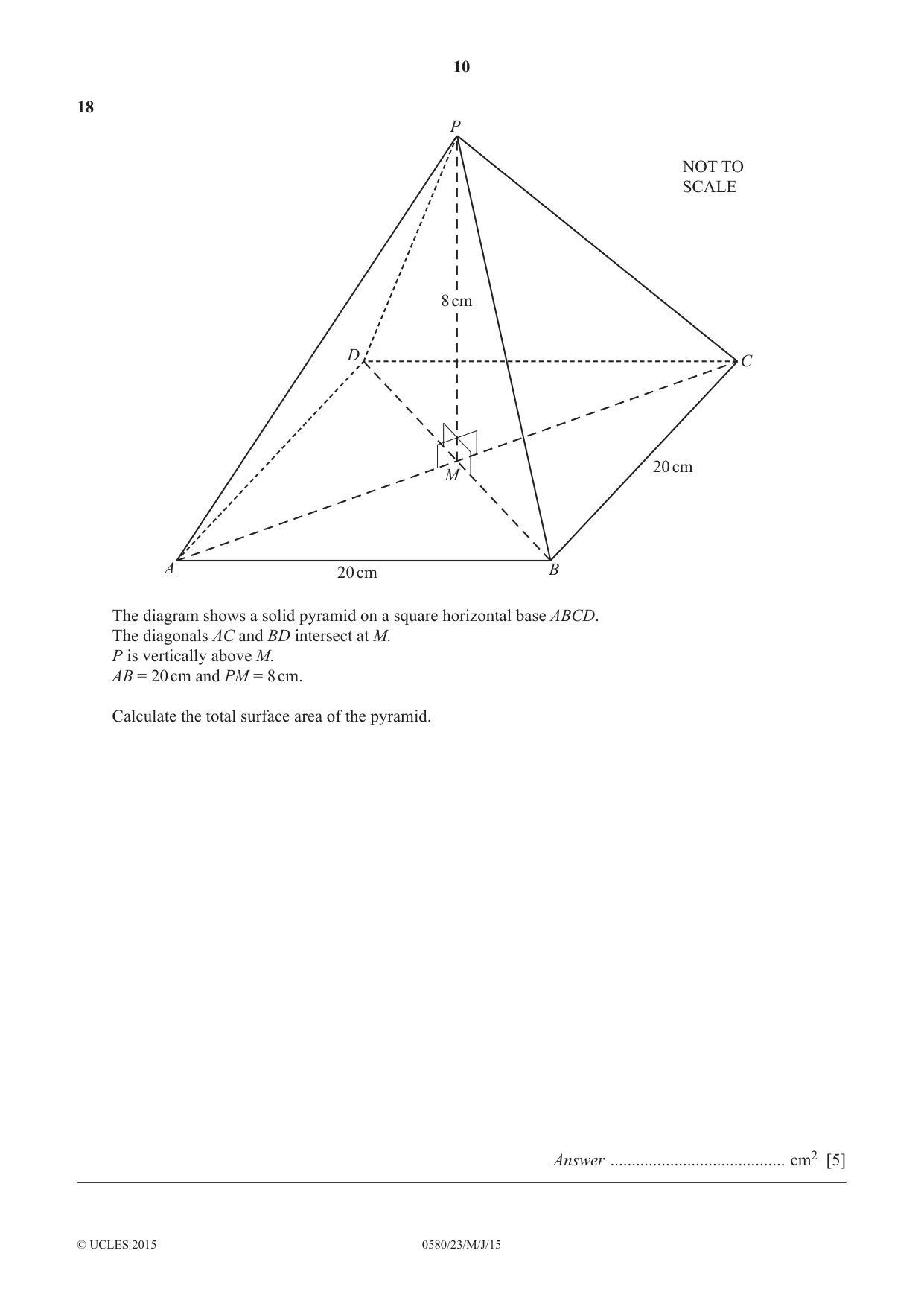
Q18 · P NOT TO SCALE 8 cm D C 20 cm M A 20 cm B The diagram shows a solid pyramid on a square…
18 P NOT TO SCALE 8 cm D C 20 cm M A 20 cm B The diagram shows a solid pyramid on a square horizontal base ABCD. The diagonals AC and BD intersect at M. P is vertically above M. AB = 20 cm and PM = 8 cm. Calculate the total surface area of the pyramid. Answer ......................................... cm2 [5]
Mark scheme: 18 912 or 912.2… 5 M4 for 4 × 0.5 × 20 × 8 2 + 10 2 + 20 × 20 or better or M3 for 4 × 0.5 × 20 × 8 2 + 10 2 or better or M1 for 8 2 + 10 2 and M1 for 0.5 × 20 × 8 2 + 10 2 and M1 for 20 × 20
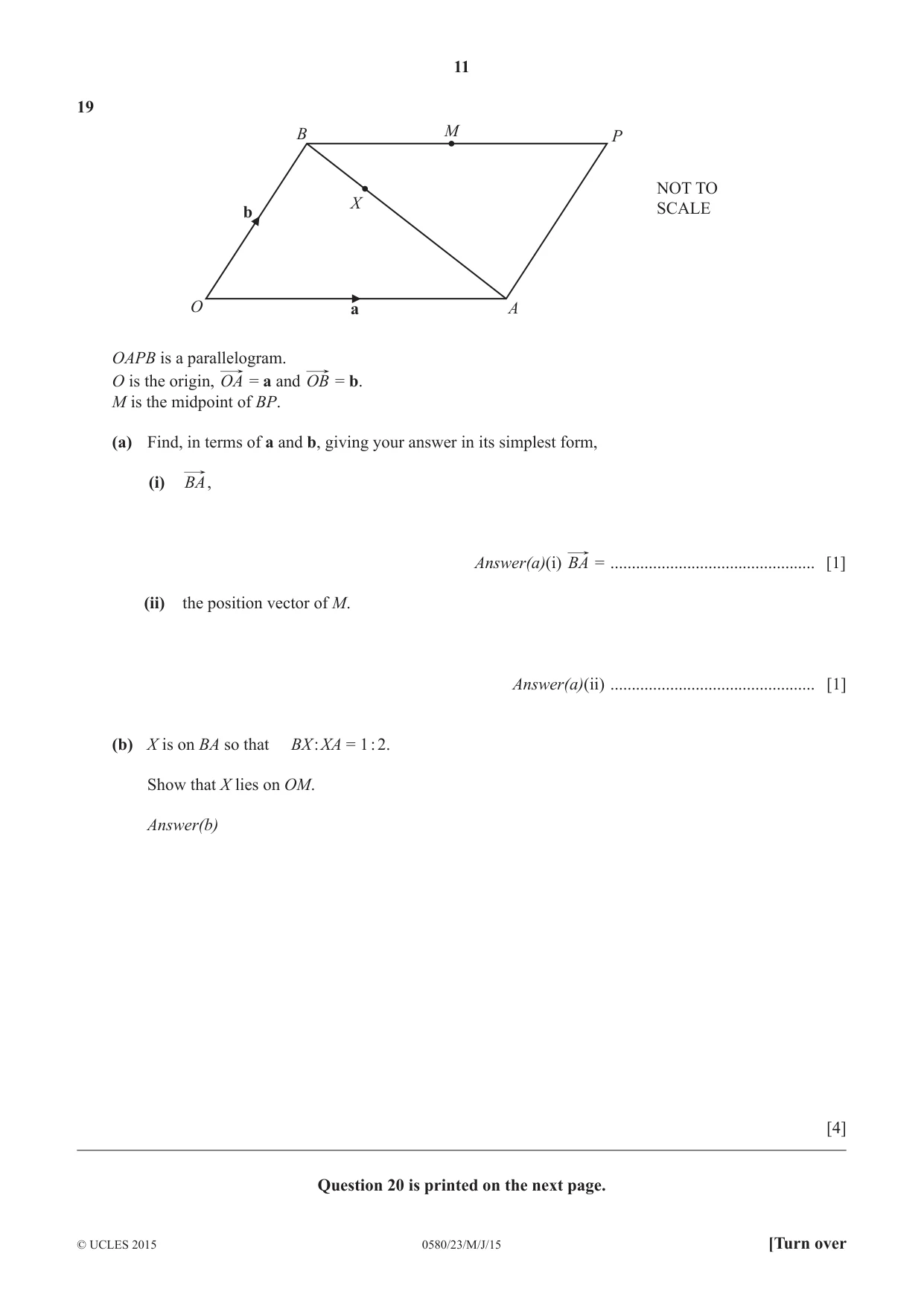
Q19 · B M P NOT TO X b SCALE O a A OAPB is a parallelogram
19 B M P NOT TO X b SCALE O a A OAPB is a parallelogram. O is the origin, OA = a and OB = b. M is the midpoint of BP. (a) Find, in terms of a and b, giving your answer in its simplest form, (i) BA, Answer(a)(i) BA = ................................................ [1] (ii) the position vector of M. Answer(a)(ii) ................................................ [1] (b) X is on BA so that BX : XA = 1 : 2. Show that X lies on OM. Answer(b) [4] Question 20 is printed on the next page.
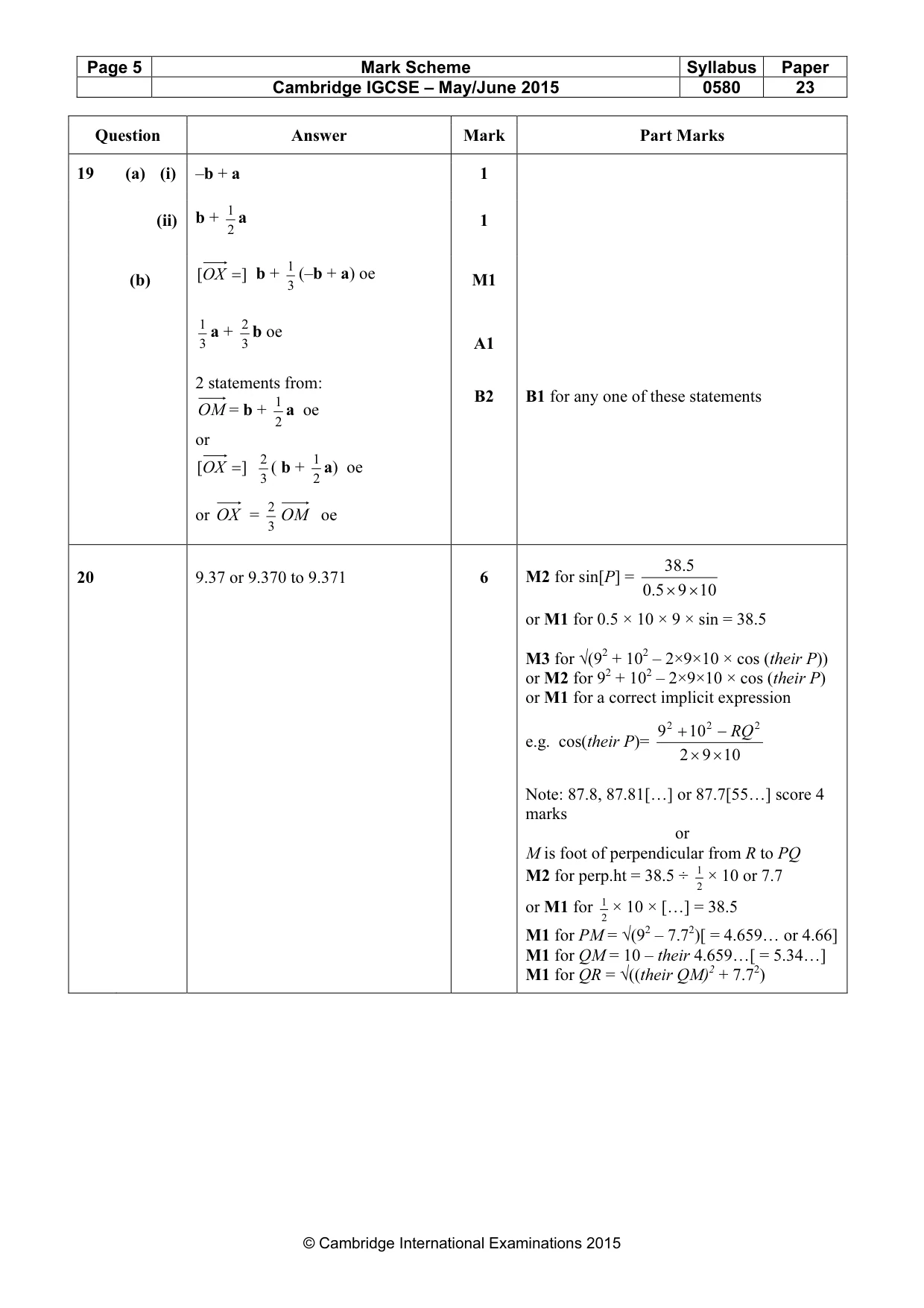
Mark scheme: 19 (a) (i) –b + a 1 (ii) b + 1 a 1 2 (b) [ OX = ] b + 1 (–b + a) oe M1 3 1 a + 2 b oe 3 3 A1 2 statements from: B2 B1 for any one of these statements 1 OM = b + a oe 2 or 2 [ OX = ] ( b + 1 a) oe 3 2 2 or OX = OM oe 3 38 5
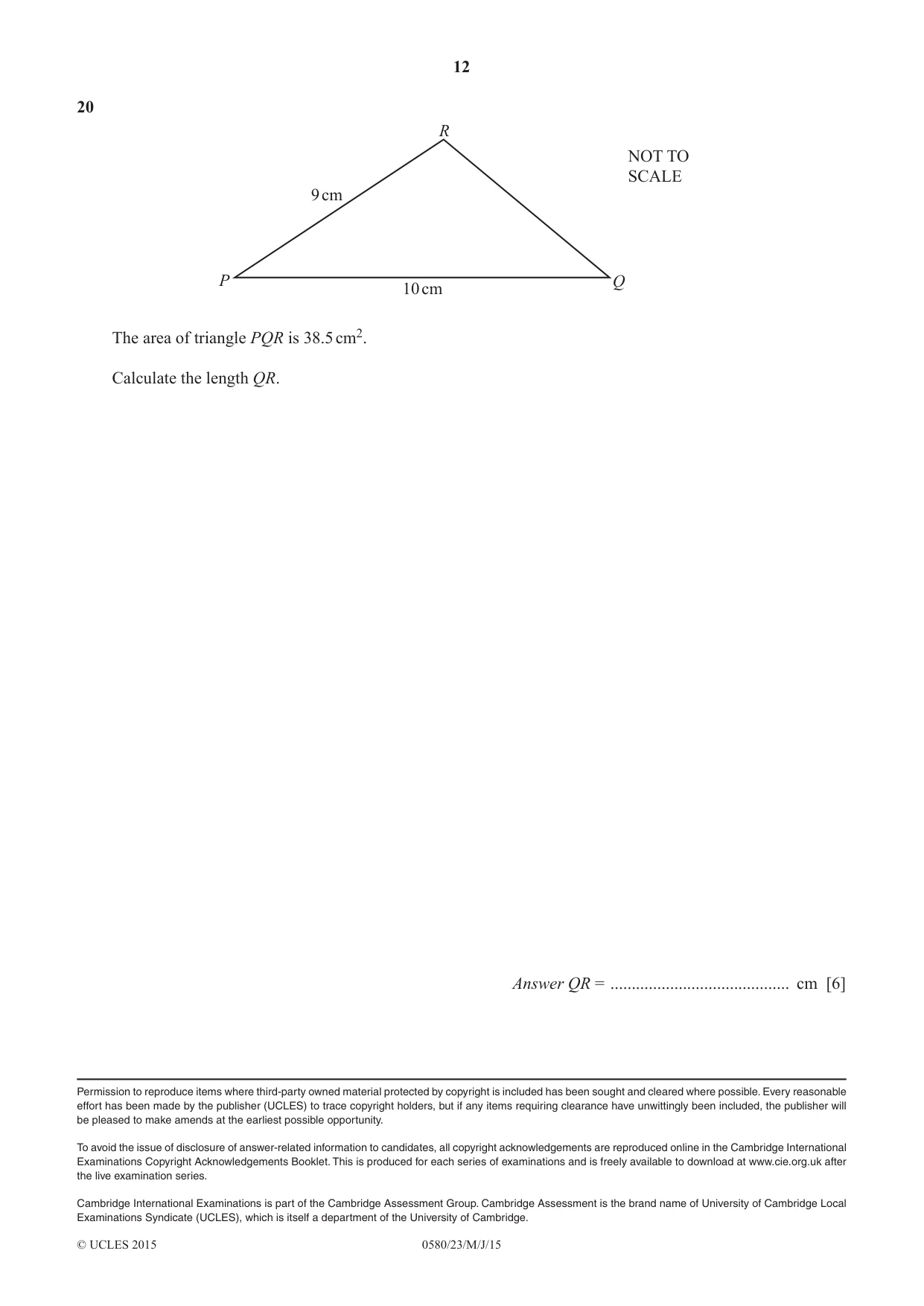
Q20 · R NOT TO SCALE 9 cm P Q 10 cm The area of triangle PQR is 38.5 cm2
20 R NOT TO SCALE 9 cm P Q 10 cm The area of triangle PQR is 38.5 cm2. Calculate the length QR. Answer QR = .......................................... cm [6]
Mark scheme: 385. 20 9.37 or 9.370 to 9.371 6 M2 for sin[P] = 5.0 × 9 × 10 or M1 for 0.5 × 10 × 9 × sin = 38.5 M3 for √(92 + 102 – 2×9×10 × cos (their P)) or M2 for 92 + 102 – 2×9×10 × cos (their P) or M1 for a correct implicit expression 9 2 + 10 2 − RQ 2 e.g. cos(their P)= 2 × 9 × 10 Note: 87.8, 87.81[…] or 87.7[55…] score 4 marks or M is foot of perpendicular from R to PQ M2 for perp.ht = 38.5 ÷ 1 × 10 or 7.7 2 or M1 for 1 × 10 × […] = 38.5 2 M1 for PM = √(92 – 7.72)[ = 4.659… or 4.66] M1 for QM = 10 – their 4.659…[ = 5.34…] M1 for QR = √((their QM)2 + 7.72)
What was in this paper
The subtopics covered by these 20 questions, and how many questions each got. Open one in a new tab to see every Cambridge question on it.
2Area and perimeter2Equations2Ratio and proportion2Circles, arcs and sectors1Fractions, decimals and percentages1Indices II1Interpreting statistical data1Introduction to probability1Limits of accuracy1Non-right-angled triangles1Percentages1Rates1Right-angled triangles1Transformations1Vectors in two dimensions1What you needed in this session
Cambridge’s own grade thresholds for 2015 May/June, Paper 2 · Variant 3. A higher threshold means an easier paper — the bar moves with how the cohort did.