Cambridge IGCSE Mathematics 0580 — 2014 May/June Paper 3 · Variant 1
0580/31/M/J/14 · 9 questions · 104 marks · ≈117 min
The question paper and its mark scheme, free to read here and free to download. This is Cambridge’s own paper, exactly as it was sat.
Question paper16 pages
Mark scheme6 pages
Answers below. Sit the paper first if you are practising.
Questions as text
Q1 · The angles in a triangle are in the ratio 3 : 4 : 8
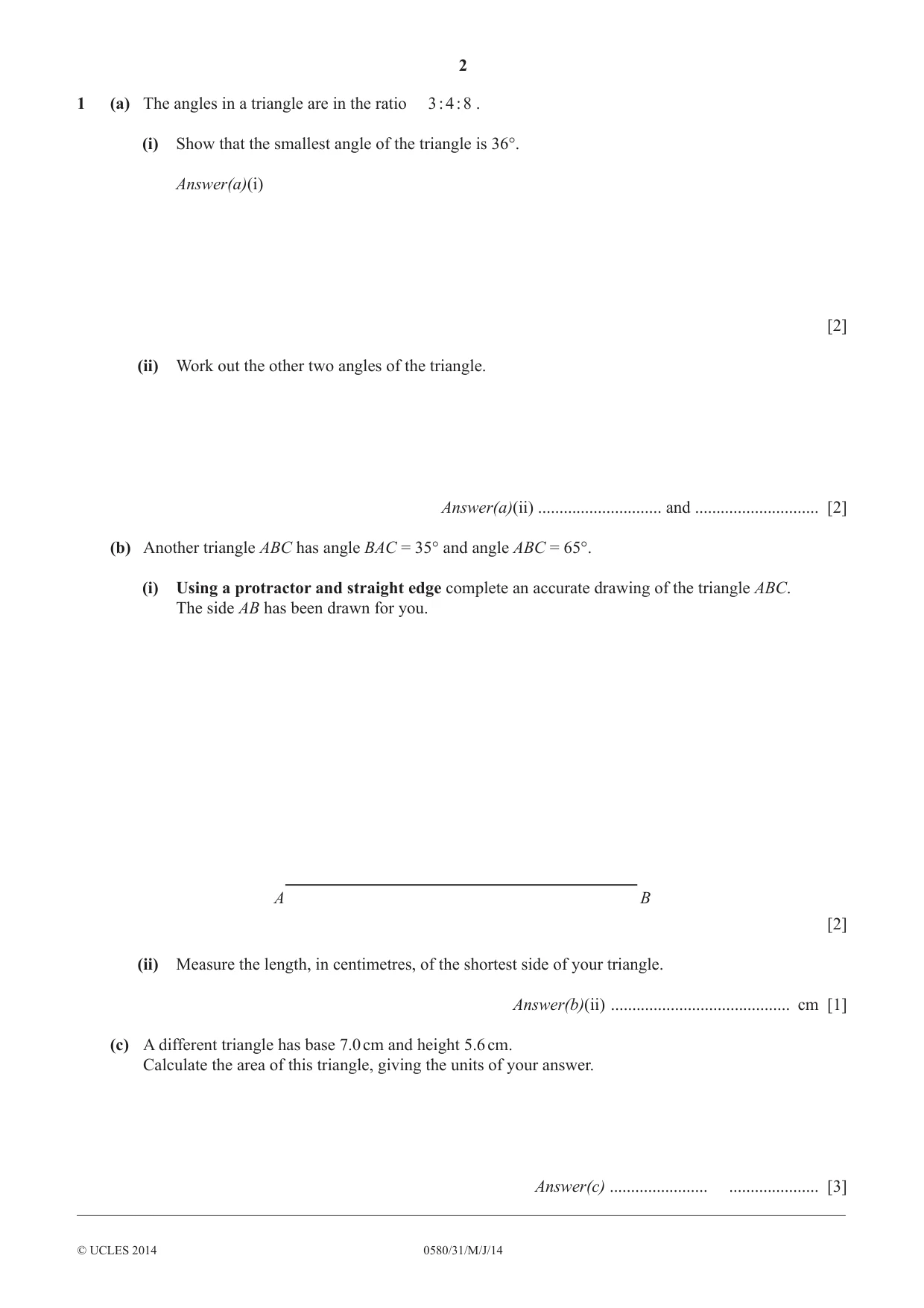
1 (a) The angles in a triangle are in the ratio 3 : 4 : 8 . (i) Show that the smallest angle of the triangle is 36°. Answer(a)(i) [2] (ii) Work out the other two angles of the triangle. Answer(a)(ii) ............................. and ............................. [2] (b) Another triangle ABC has angle BAC = 35° and angle ABC = 65°. (i) Using a protractor and straight edge complete an accurate drawing of the triangle ABC. The side AB has been drawn for you. A B [2] (ii) Measure the length, in centimetres, of the shortest side of your triangle. Answer(b)(ii) .......................................... cm [1] (c) A different triangle has base 7.0 cm and height 5.6 cm. Calculate the area of this triangle, giving the units of your answer. Answer(c) ....................... ..................... [3] __________________________________________________________________________________________
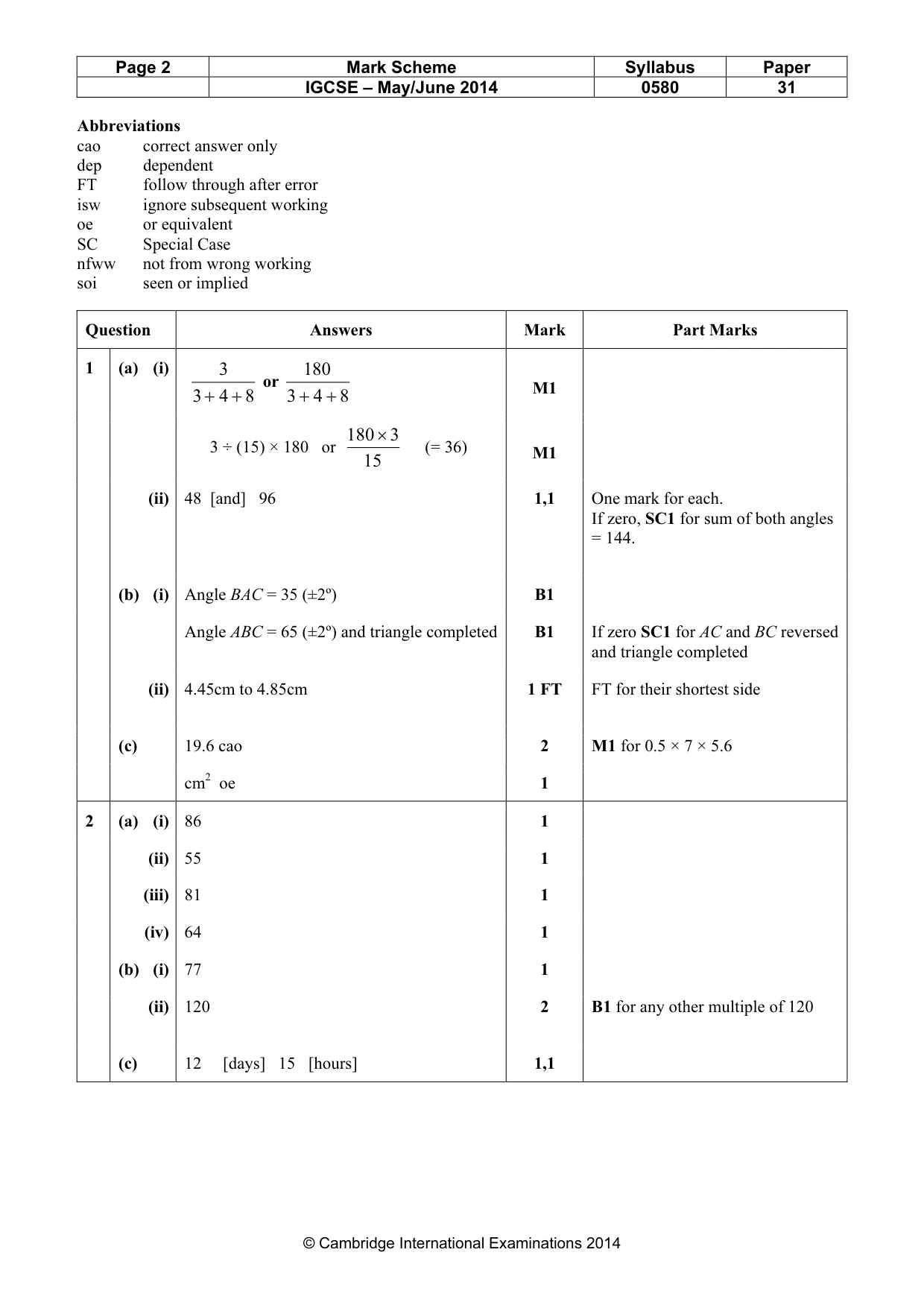
Mark scheme: Question Answers Mark Part Marks 1 (a) (i) 3 180 or M1 3 + 4 + 8 3 + 4 + 8 180 × 3 3 ÷ (15) × 180 or (= 36) M1 15 (ii) 48 [and] 96 1,1 One mark for each. If zero, SC1 for sum of both angles = 144. (b) (i) Angle BAC = 35 (±2º) B1 Angle ABC = 65 (±2º) and triangle completed B1 If zero SC1 for AC and BC reversed and triangle completed (ii) 4.45cm to 4.85cm 1 FT FT for their shortest side (c) 19.6 cao 2 M1 for 0.5 × 7 × 5.6 cm2 oe 1
Q2 · From the integers 50 to 100, fi nd (i) a multiple of 43, Answer(a)(i)…
2 (a) From the integers 50 to 100, fi nd (i) a multiple of 43, Answer(a)(i) ................................................ [1] (ii) a factor of 165, Answer(a)(ii) ................................................ [1] (iii) an odd number that is also a square number, Answer(a)(iii) ................................................ [1] (iv) a number which is a square number and also a cube number. Answer(a)(iv) ................................................. [1] (b) (i) Find the square root of 5929. Answer(b)(i) ................................................ [1] (ii) Find the lowest common multiple of 24 and 30. Answer(b)(ii) ................................................ [2] (c) Elena goes on a journey to the North Pole. She leaves home at 7 am on 15 July and arrives at the North Pole at 10 pm on 27 July. How long, in days and hours, did her journey take? Answer(c) ....................... days ....................... hours [2] __________________________________________________________________________________________
Mark scheme: 2 (a) (i) 86 1 (ii) 55 1 (iii) 81 1 (iv) 64 1 (b) (i) 77 1 (ii) 120 2 B1 for any other multiple of 120 (c) 12 [days] 15 [hours] 1,1 IGCSE – May/June 2014 0580 31
Q3 · Y 10 9 8 7 6 5 4 S 3 2 1 P x –8 –7 –6 –5 –4 –3 –2 –1 0 1 2 3 4 5 6 7 8 –1 –2 T –3 –4 –5…
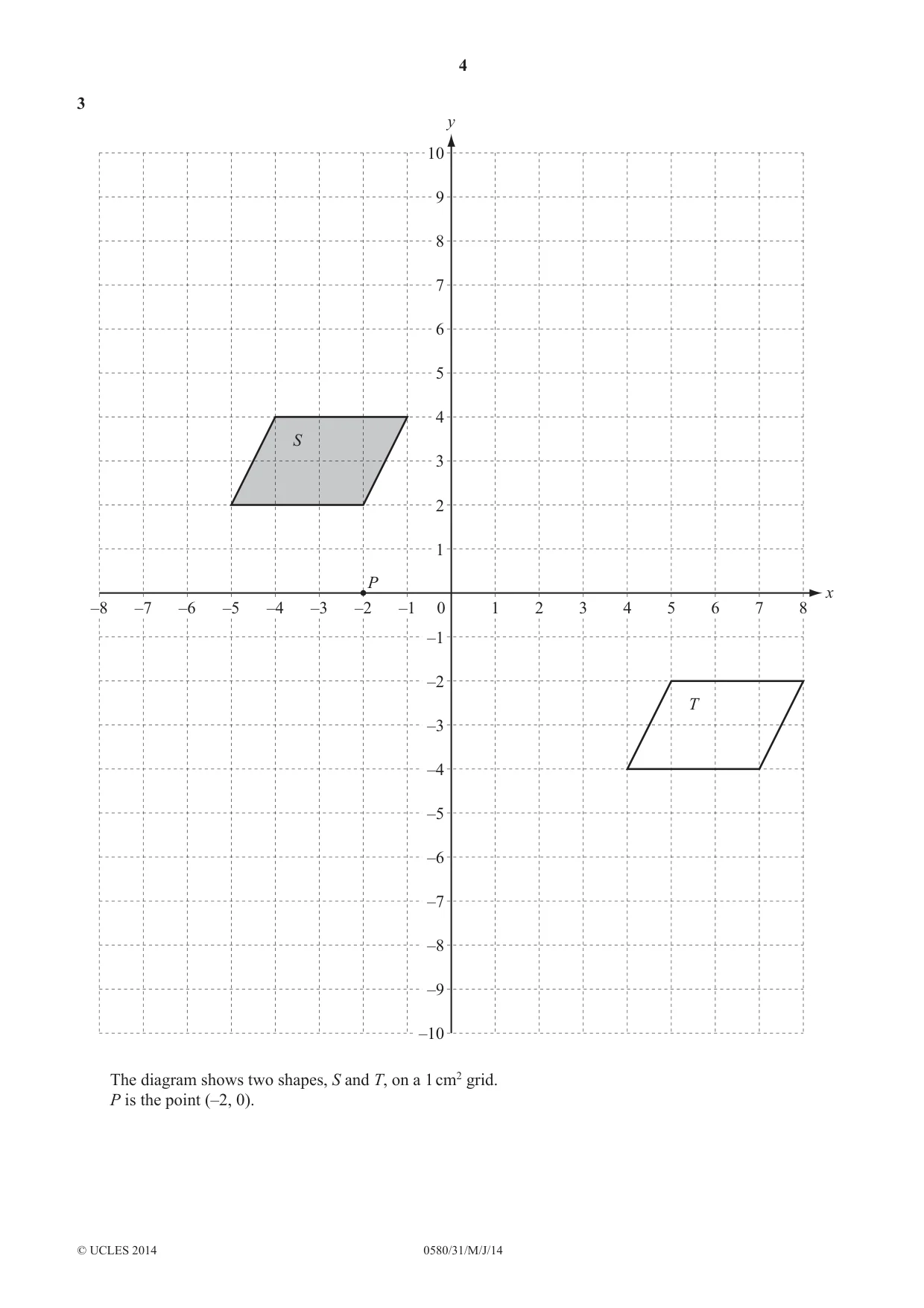
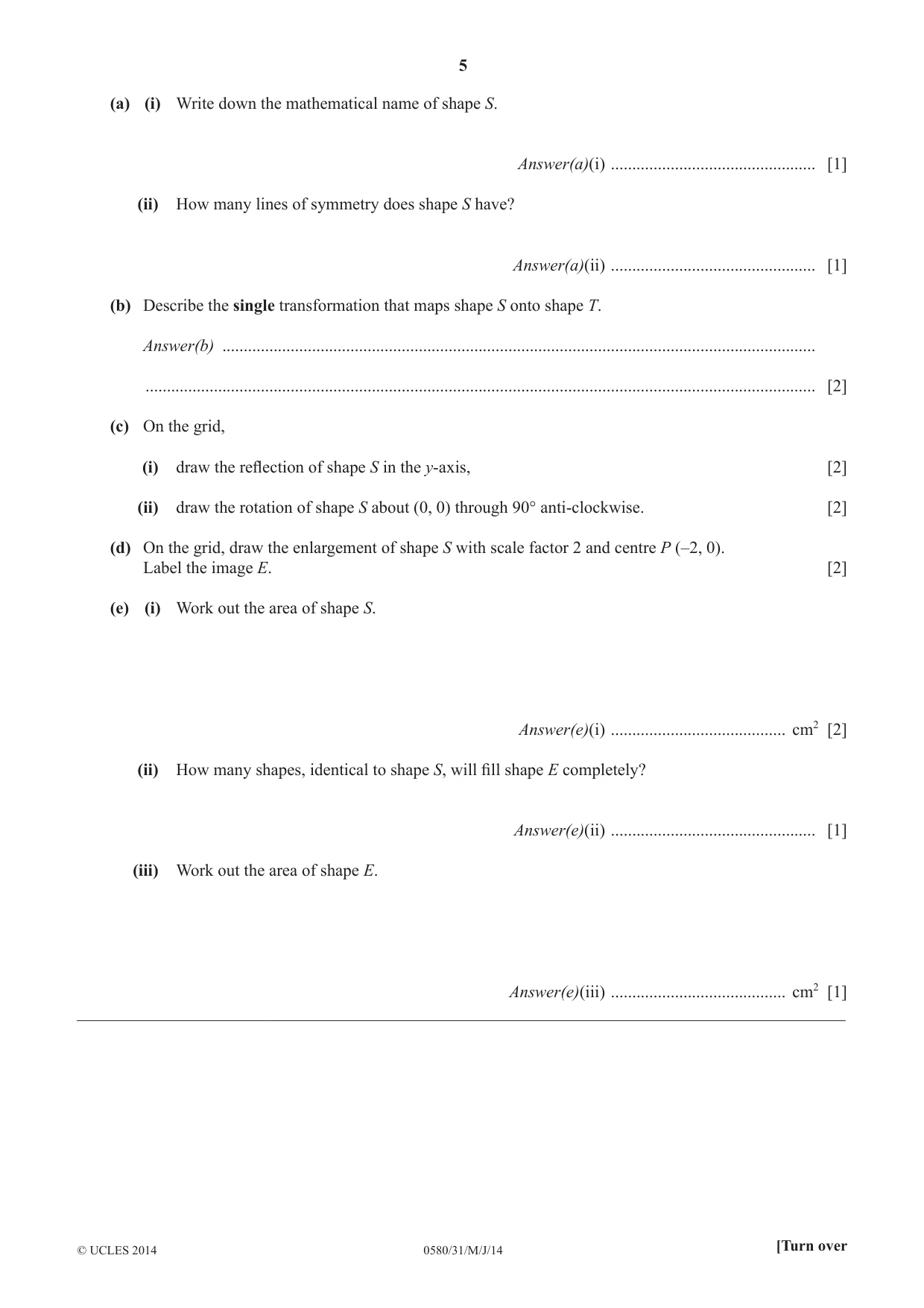
3 y 10 9 8 7 6 5 4 S 3 2 1 P x –8 –7 –6 –5 –4 –3 –2 –1 0 1 2 3 4 5 6 7 8 –1 –2 T –3 –4 –5 –6 –7 –8 –9 –10 The diagram shows two shapes, S and T, on a 1 cm2 grid. P is the point (–2, 0). (a) (i) Write down the mathematical name of shape S. Answer(a)(i) ................................................ [1] (ii) How many lines of symmetry does shape S have? Answer(a)(ii) ................................................ [1] (b) Describe the single transformation that maps shape S onto shape T. Answer(b) ........................................................................................................................................... ............................................................................................................................................................. [2] (c) On the grid, (i) draw the refl ection of shape S in the y-axis, [2] (ii) draw the rotation of shape S about (0, 0) through 90° anti-clockwise. [2] (d) On the grid, draw the enlargement of shape S with scale factor 2 and centre P (–2, 0). Label the image E. [2] (e) (i) Work out the area of shape S. Answer(e)(i) ......................................... cm2 [2] (ii) How many shapes, identical to shape S, will fi ll shape E completely? Answer(e)(ii) ................................................ [1] (iii) Work out the area of shape E. Answer(e)(iii) ......................................... cm2 [1] __________________________________________________________________________________________
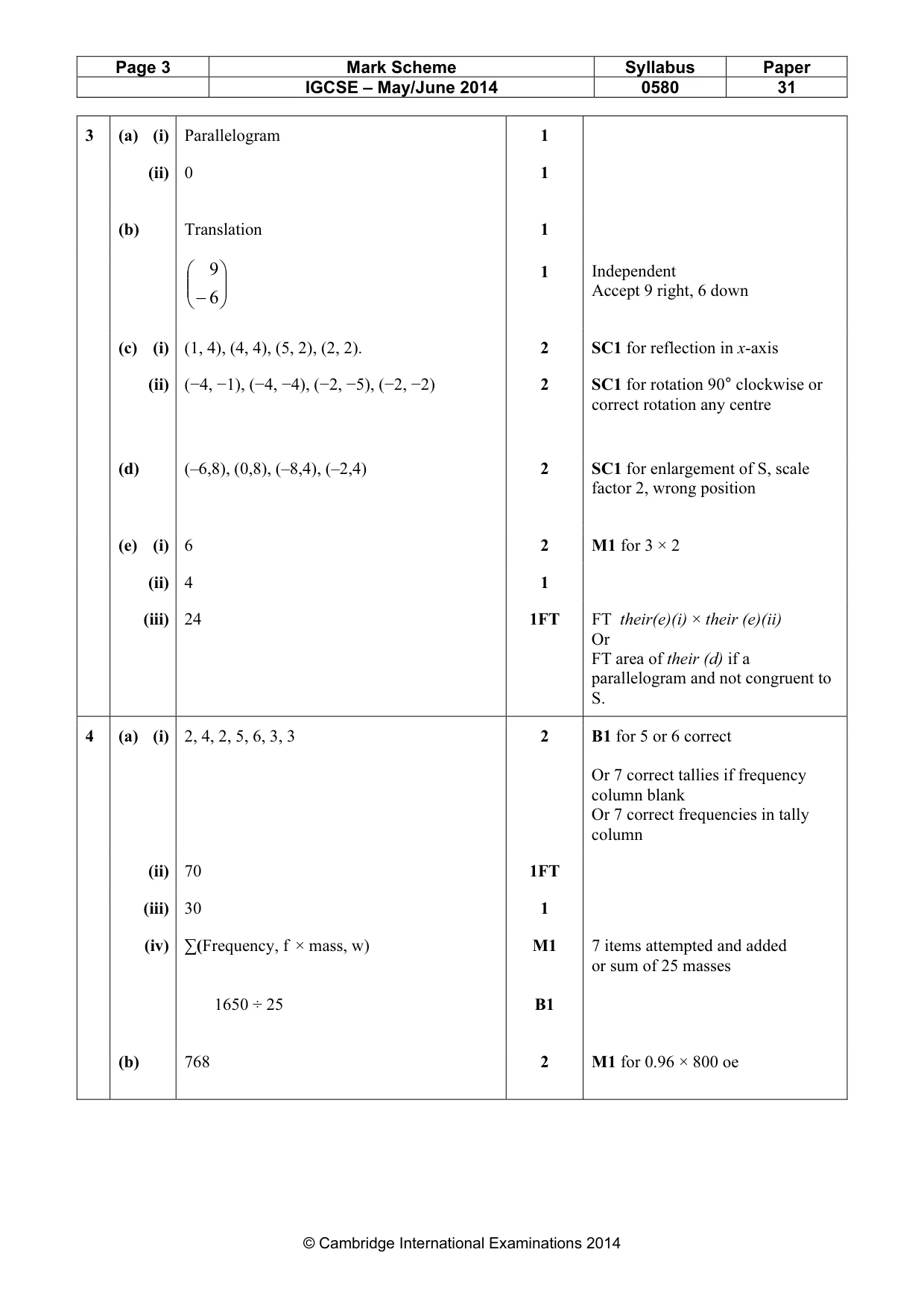
Mark scheme: 3 (a) (i) Parallelogram 1 (ii) 0 1 (b) Translation 1 9 1 Independent Accept 9 right, 6 down −6 (c) (i) (1, 4), (4, 4), (5, 2), (2, 2). 2 SC1 for reflection in x-axis (ii) (−4, −1), (−4, −4), (−2, −5), (−2, −2) 2 SC1 for rotation 90° clockwise or correct rotation any centre (d) (–6,8), (0,8), (–8,4), (–2,4) 2 SC1 for enlargement of S, scale factor 2, wrong position (e) (i) 6 2 M1 for 3 × 2 (ii) 4 1 (iii) 24 1FT FT their(e)(i) × their (e)(ii) Or FT area of their (d) if a parallelogram and not congruent to S.
Question 4
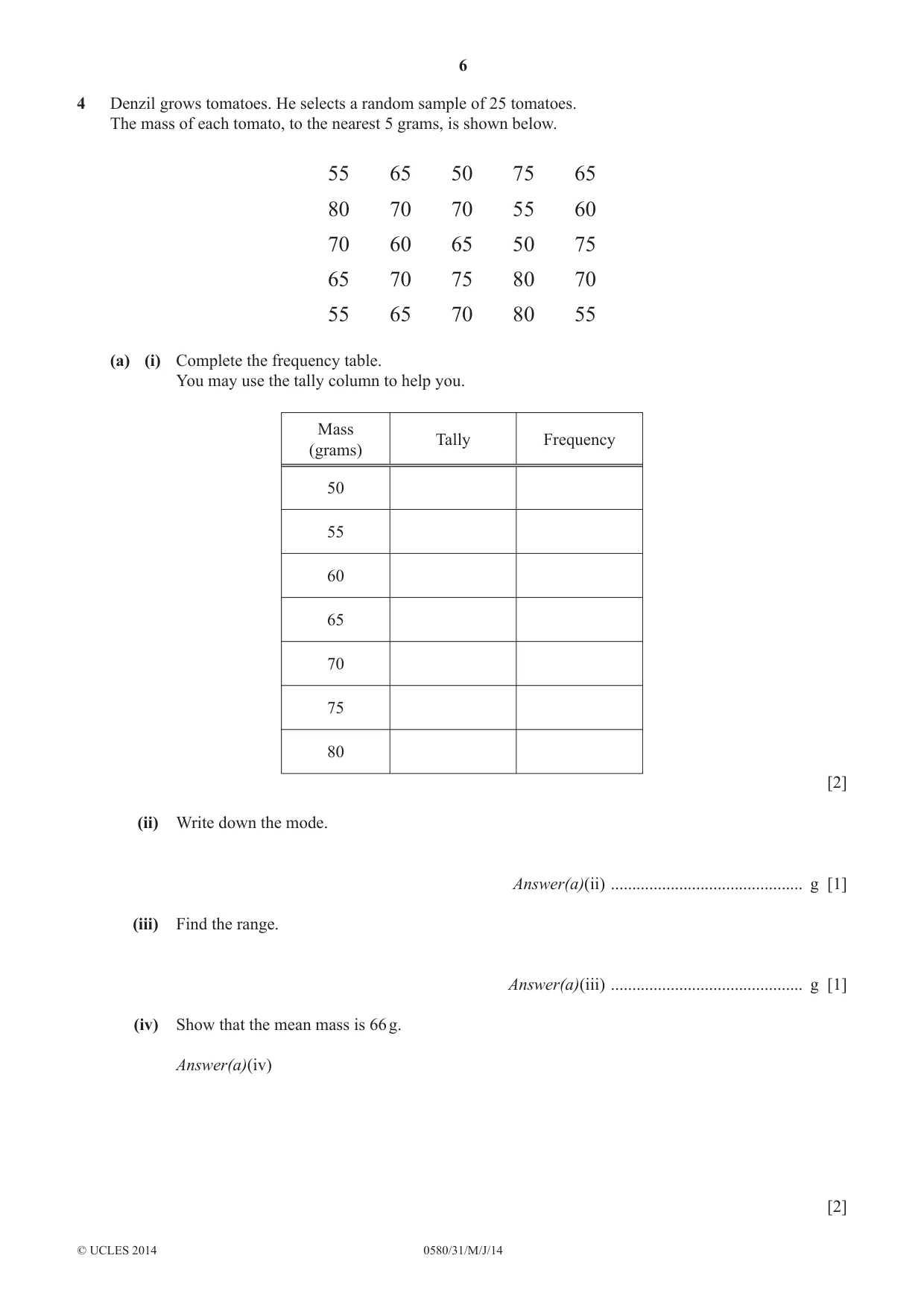
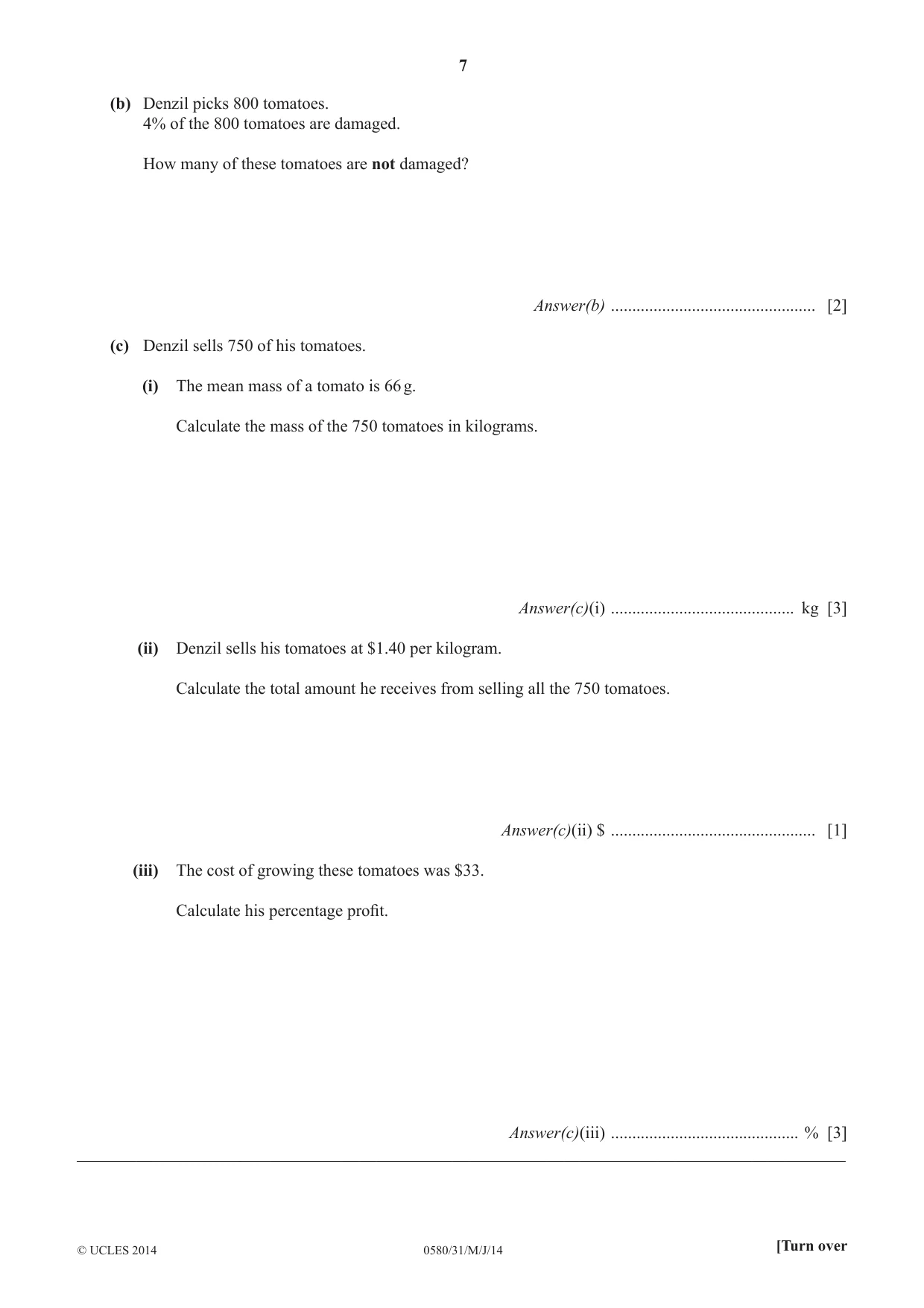
4 Denzil grows tomatoes. He selects a random sample of 25 tomatoes. The mass of each tomato, to the nearest 5 grams, is shown below. 55 65 50 75 65 80 70 70 55 60 70 60 65 50 75 65 70 75 80 70 55 65 70 80 55 (a) (i) Complete the frequency table. You may use the tally column to help you. Mass Tally Frequency (grams) 50 55 60 65 70 75 80 [2] (ii) Write down the mode. Answer(a)(ii) ............................................. g [1] (iii) Find the range. Answer(a)(iii) ............................................. g [1] (iv) Show that the mean mass is 66 g. Answer(a)(iv) [2] (b) Denzil picks 800 tomatoes. 4% of the 800 tomatoes are damaged. How many of these tomatoes are not damaged? Answer(b) ................................................ [2] (c) Denzil sells 750 of his tomatoes. (i) The mean mass of a tomato is 66 g. Calculate the mass of the 750 tomatoes in kilograms. Answer(c)(i) ........................................... kg [3] (ii) Denzil sells his tomatoes at $1.40 per kilogram. Calculate the total amount he receives from selling all the 750 tomatoes. Answer(c)(ii) $ ................................................ [1] (iii) The cost of growing these tomatoes was $33. Calculate his percentage profi t. Answer(c)(iii) ............................................ % [3] __________________________________________________________________________________________
Mark scheme: 4 (a) (i) 2, 4, 2, 5, 6, 3, 3 2 B1 for 5 or 6 correct Or 7 correct tallies if frequency column blank Or 7 correct frequencies in tally column (ii) 70 1FT (iii) 30 1 (iv) ∑(Frequency, f × mass, w) M1 7 items attempted and added or sum of 25 masses 1650 ÷ 25 B1 (b) 768 2 M1 for 0.96 × 800 oe IGCSE – May/June 2014 0580 31 (c) (i) 49.5 cao 3 M1 for figs 66 × 750 soi M1 for ÷ 1000 (ii) 69.3[0] 1 FT Their (c)(i) × 1.40 (iii) 110 3 their ( c )(ii ) − 33 M2 for × 100 33 or M1 for their (c)(ii) − 33 Alternative method their ( c )(ii ) M2 for × 100 – 100 33 their ( c )(ii ) Or M1 for 33
Q5 · Use a ruler and compasses only in parts (a), (c) and (d) of this question
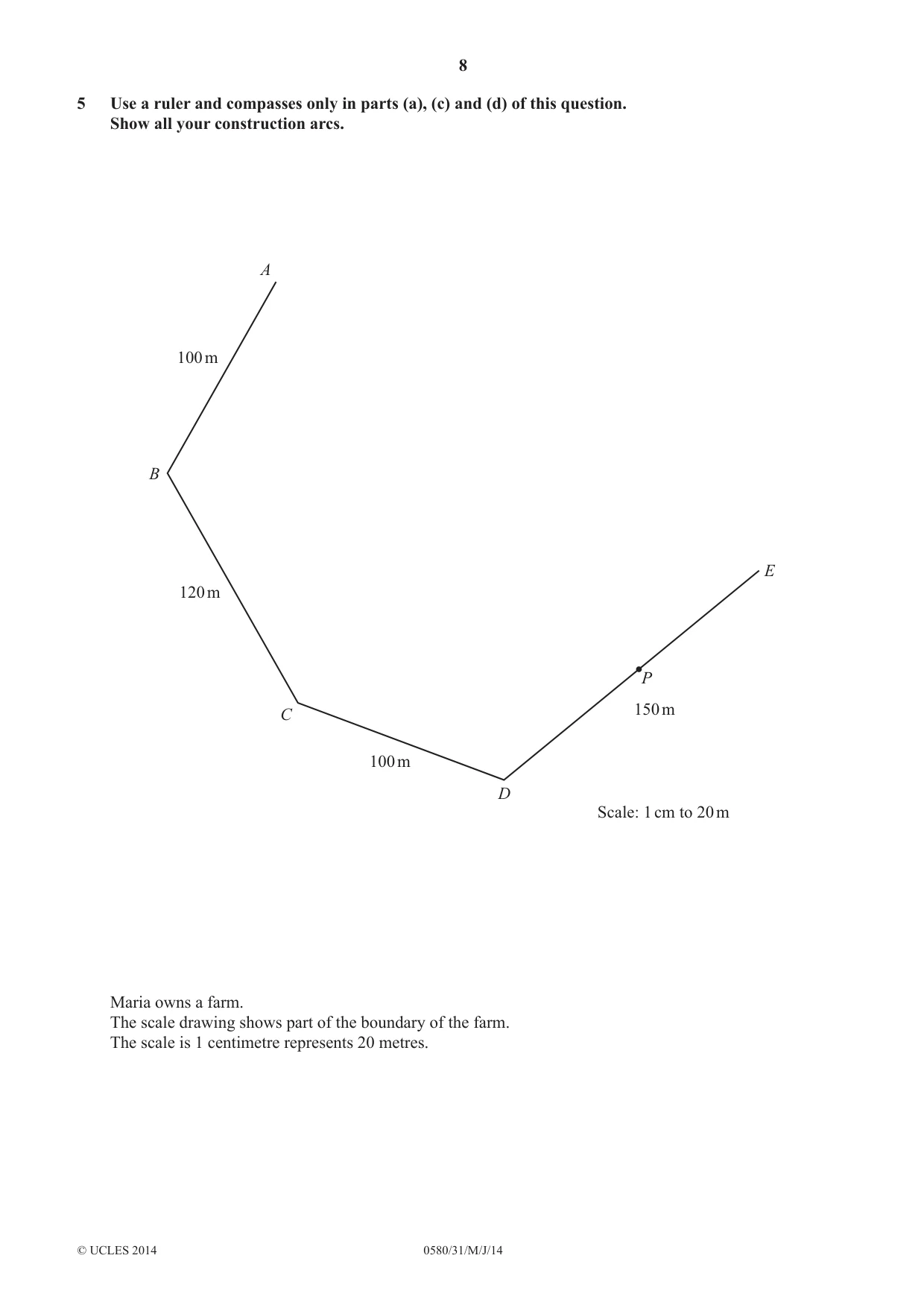
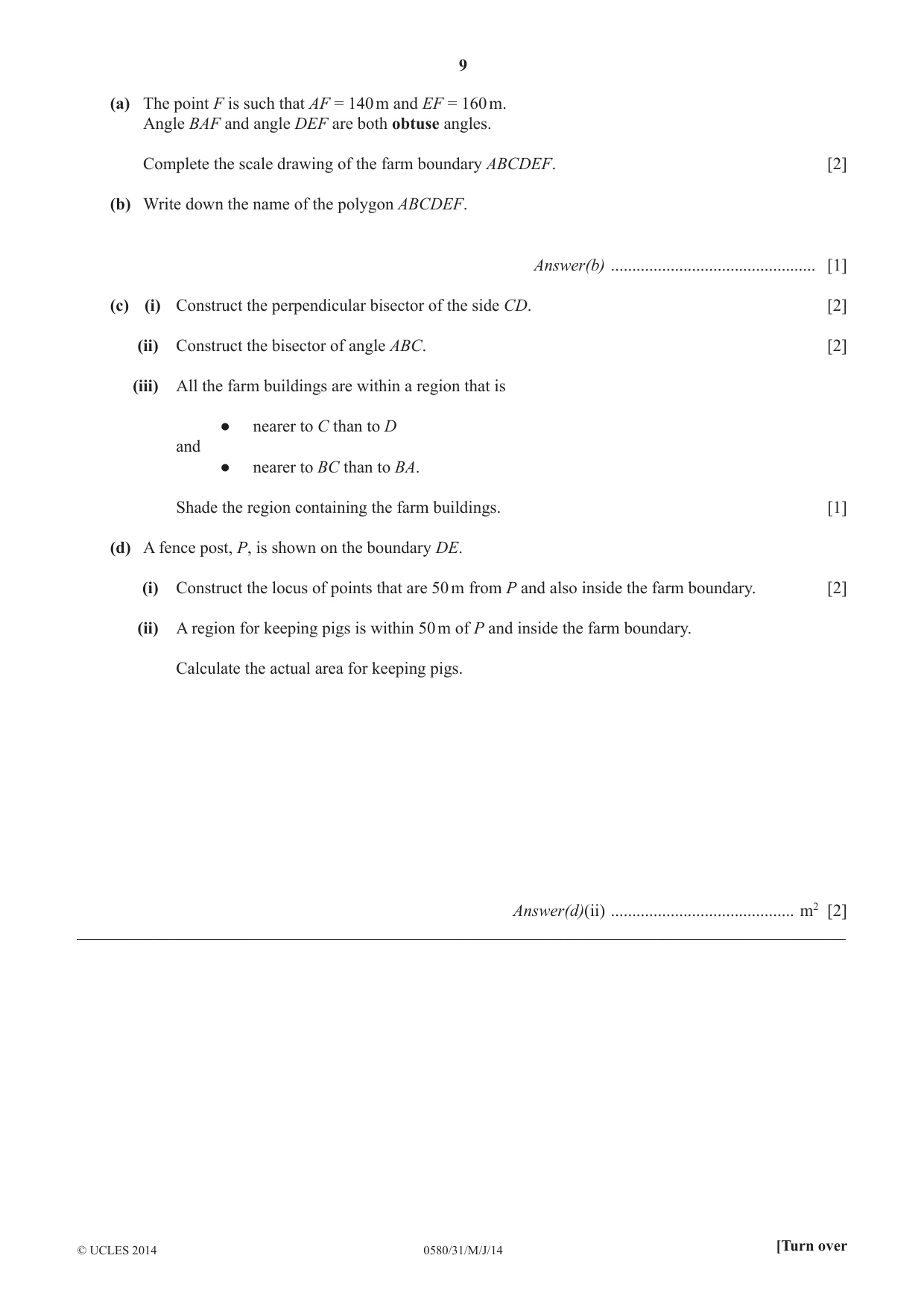
5 Use a ruler and compasses only in parts (a), (c) and (d) of this question. Show all your construction arcs. A 100 m B E 120 m P 150 m C 100 m D Scale: 1 cm to 20 m Maria owns a farm. The scale drawing shows part of the boundary of the farm. The scale is 1 centimetre represents 20 metres. (a) The point F is such that AF = 140 m and EF = 160 m. Angle BAF and angle DEF are both obtuse angles. Complete the scale drawing of the farm boundary ABCDEF. [2] (b) Write down the name of the polygon ABCDEF. Answer(b) ................................................ [1] (c) (i) Construct the perpendicular bisector of the side CD. [2] (ii) Construct the bisector of angle ABC. [2] (iii) All the farm buildings are within a region that is ● nearer to C than to D and ● nearer to BC than to BA. Shade the region containing the farm buildings. [1] (d) A fence post, P, is shown on the boundary DE. (i) Construct the locus of points that are 50 m from P and also inside the farm boundary. [2] (ii) A region for keeping pigs is within 50 m of P and inside the farm boundary. Calculate the actual area for keeping pigs. Answer(d)(ii) ........................................... m2 [2] __________________________________________________________________________________________
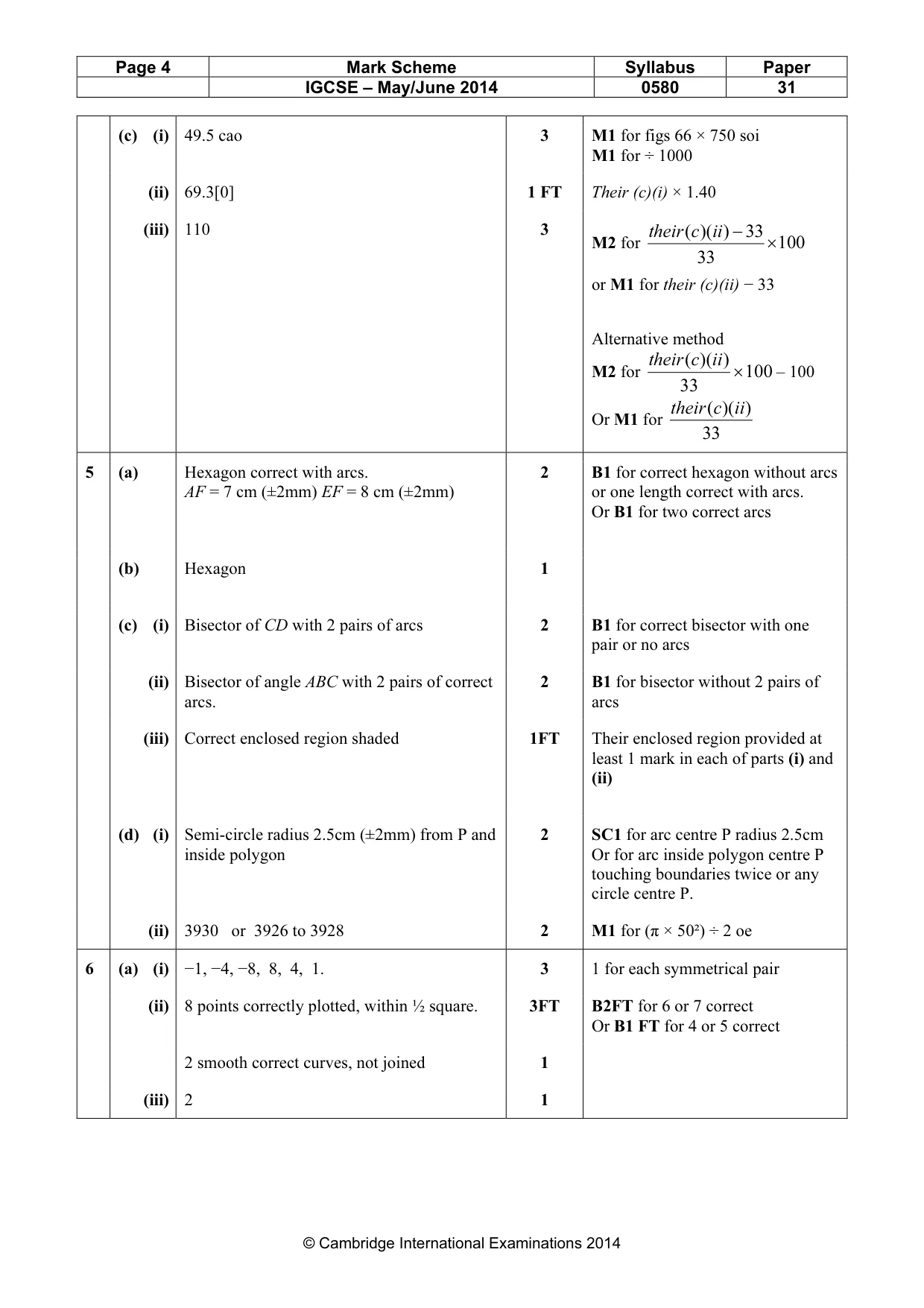
Mark scheme: 5 (a) Hexagon correct with arcs. 2 B1 for correct hexagon without arcs AF = 7 cm (±2mm) EF = 8 cm (±2mm) or one length correct with arcs. Or B1 for two correct arcs (b) Hexagon 1 (c) (i) Bisector of CD with 2 pairs of arcs 2 B1 for correct bisector with one pair or no arcs (ii) Bisector of angle ABC with 2 pairs of correct 2 B1 for bisector without 2 pairs of arcs. arcs (iii) Correct enclosed region shaded 1FT Their enclosed region provided at least 1 mark in each of parts (i) and (ii) (d) (i) Semi-circle radius 2.5cm (±2mm) from P and 2 SC1 for arc centre P radius 2.5cm inside polygon Or for arc inside polygon centre P touching boundaries twice or any circle centre P. (ii) 3930 or 3926 to 3928 2 M1 for (π × 50²) ÷ 2 oe
Q6 · Complete the table of values for y = , x ≠ 0
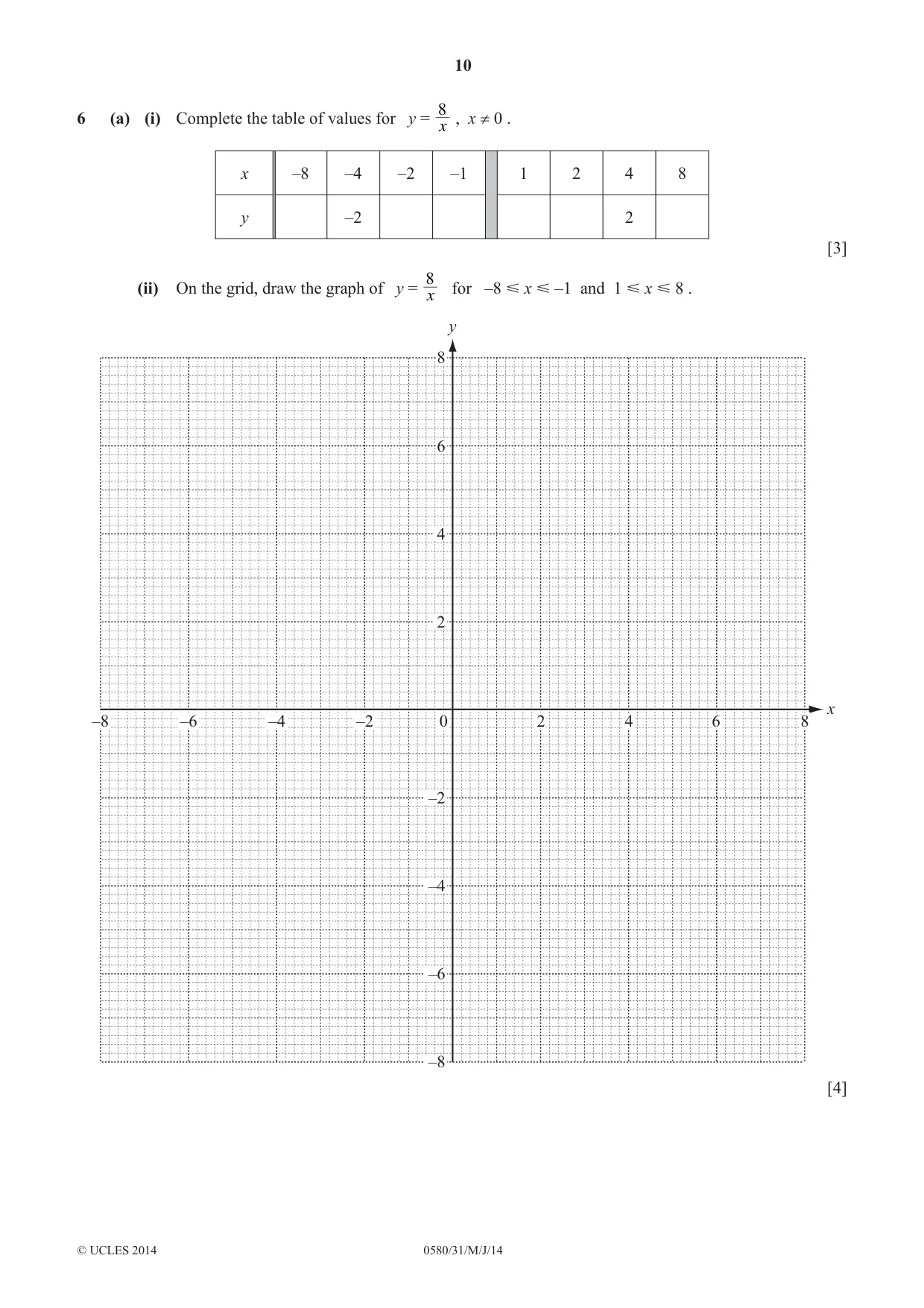
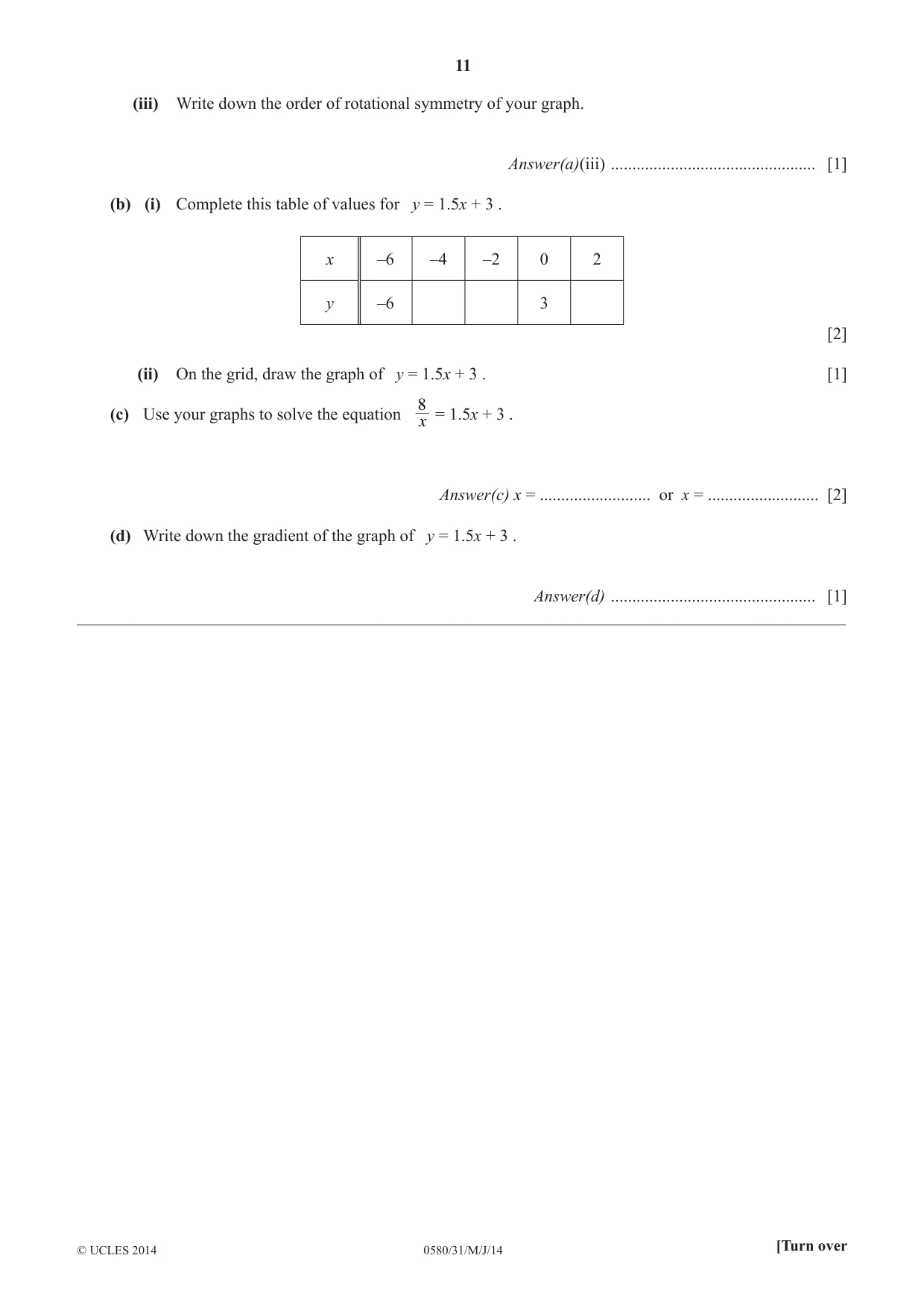
86 (a) (i) Complete the table of values for y = , x ≠ 0 . x x –8 –4 –2 –1 1 2 4 8 y –2 2 [3] 8 (ii) On the grid, draw the graph of y = for –8 Ğ x Ğ –1 and 1 Ğ x Ğ 8 . x y 8 6 4 2 x –8 –6 –4 –2 0 2 4 6 8 –2 –4 –6 –8 [4] (iii) Write down the order of rotational symmetry of your graph. Answer(a)(iii) ................................................ [1] (b) (i) Complete this table of values for y = 1.5x + 3 . x –6 –4 –2 0 2 y –6 3 [2] (ii) On the grid, draw the graph of y = 1.5x + 3 . [1] 8 (c) Use your graphs to solve the equation = 1.5x + 3 . x Answer(c) x = .......................... or x = .......................... [2] (d) Write down the gradient of the graph of y = 1.5x + 3 . Answer(d) ................................................ [1] __________________________________________________________________________________________
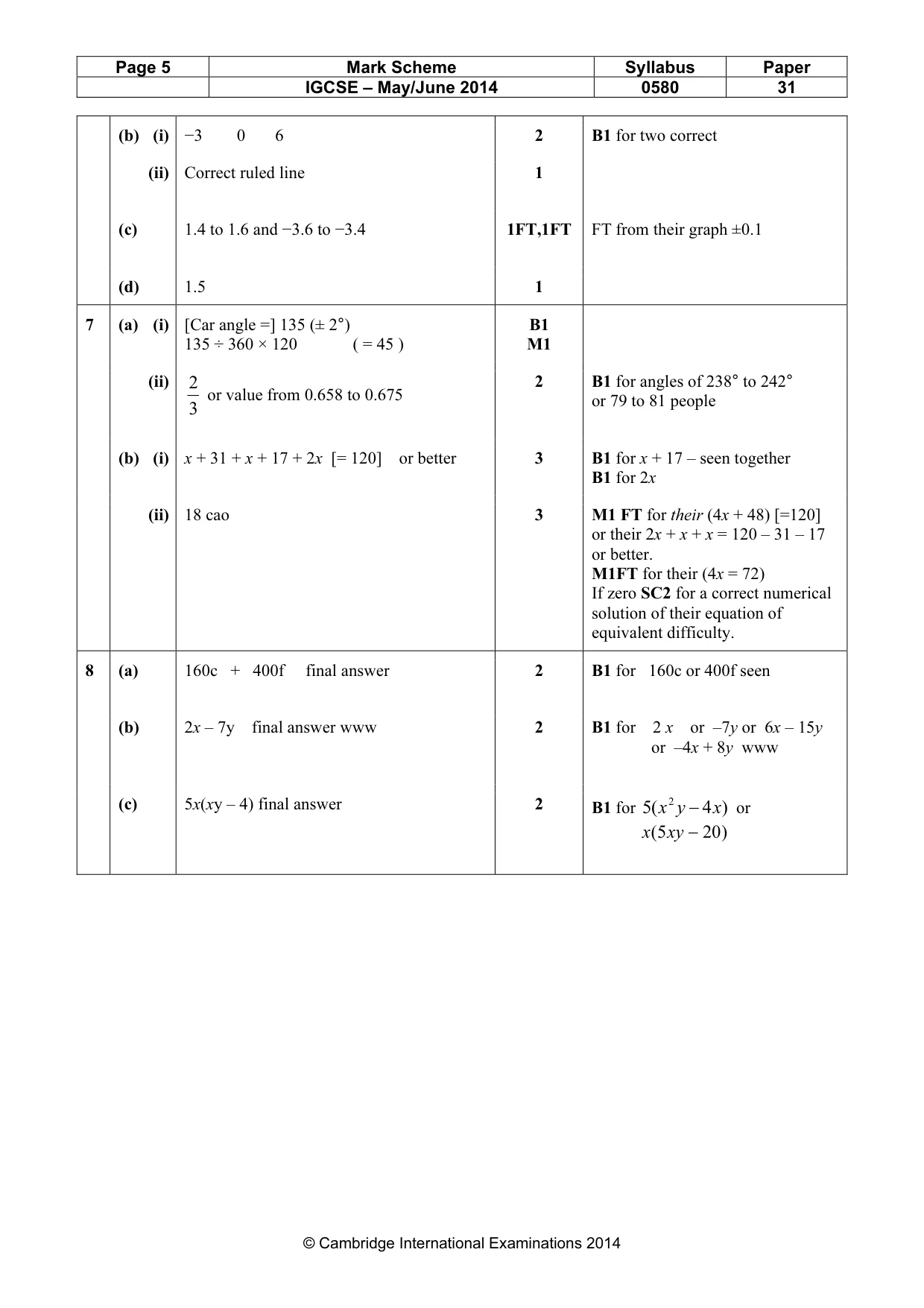
Mark scheme: 6 (a) (i) −1, −4, −8, 8, 4, 1. 3 1 for each symmetrical pair (ii) 8 points correctly plotted, within ½ square. 3FT B2FT for 6 or 7 correct Or B1 FT for 4 or 5 correct 2 smooth correct curves, not joined 1 (iii) 2 1 IGCSE – May/June 2014 0580 31 (b) (i) −3 0 6 2 B1 for two correct (ii) Correct ruled line 1 (c) 1.4 to 1.6 and −3.6 to −3.4 1FT,1FT FT from their graph ±0.1 (d) 1.5 1
Q7 · 120 people are asked how they travel to work
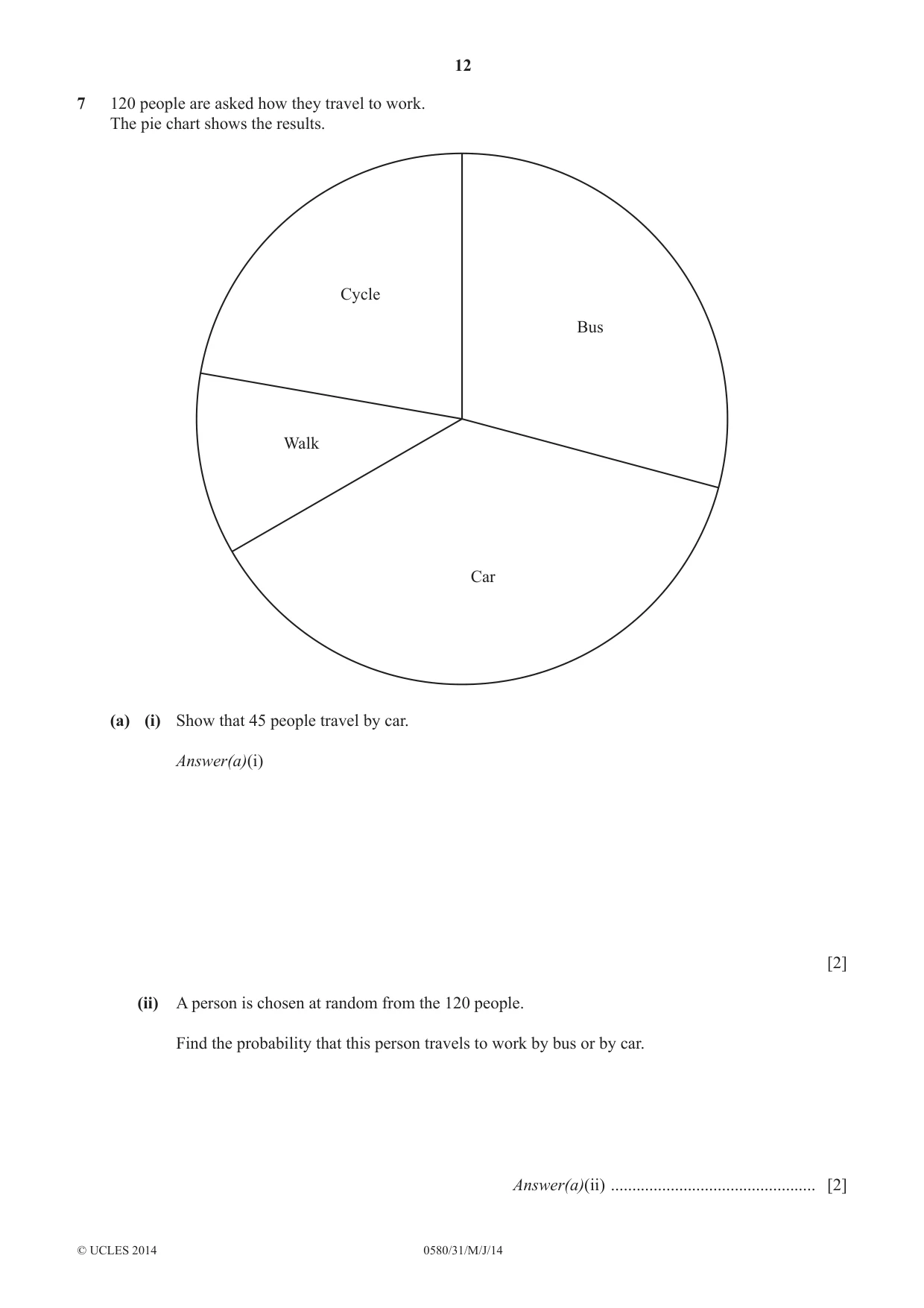
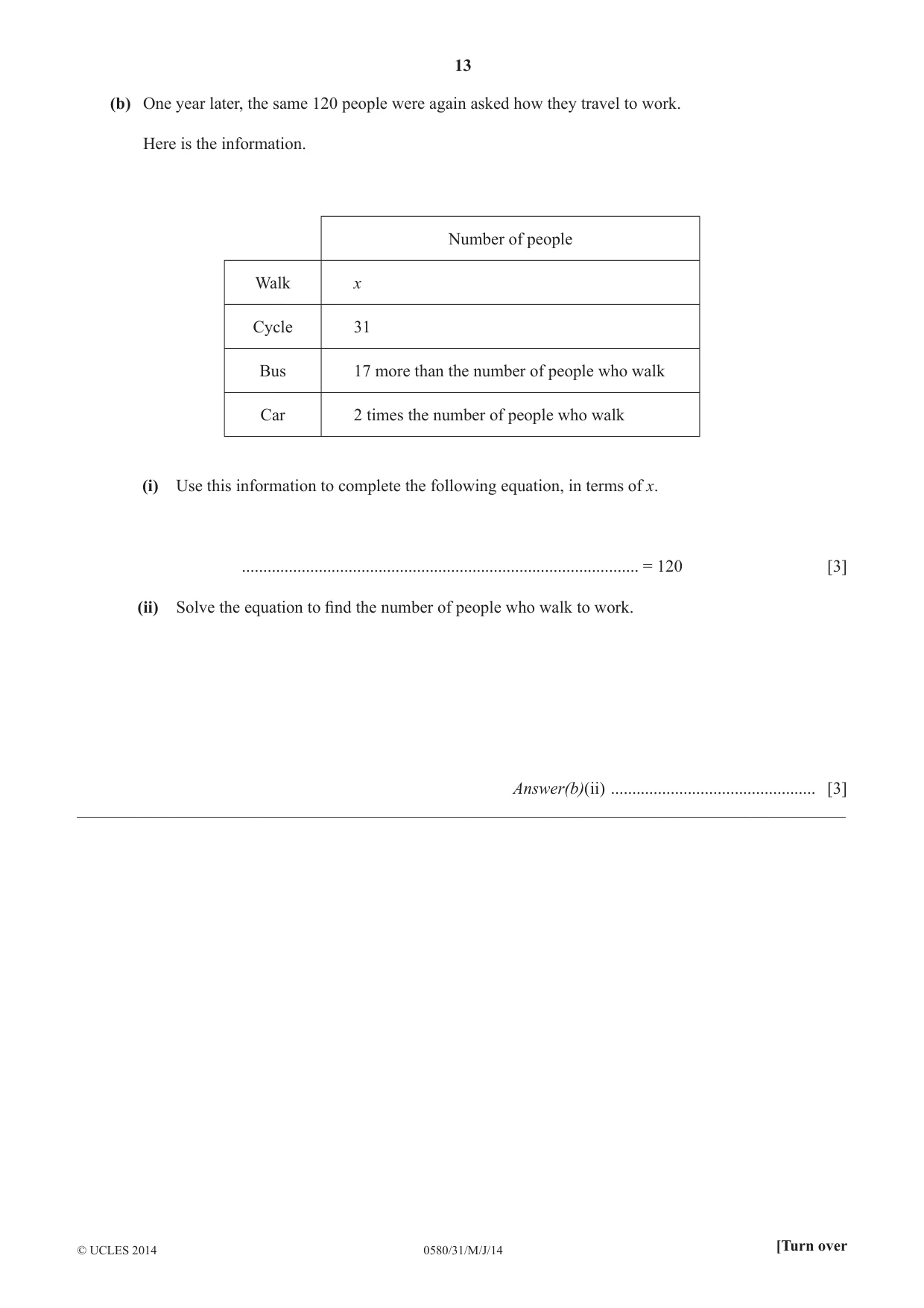
7 120 people are asked how they travel to work. The pie chart shows the results. Cycle Bus Walk Car (a) (i) Show that 45 people travel by car. Answer(a)(i) [2] (ii) A person is chosen at random from the 120 people. Find the probability that this person travels to work by bus or by car. Answer(a)(ii) ................................................ [2] (b) One year later, the same 120 people were again asked how they travel to work. Here is the information. Number of people Walk x Cycle 31 Bus 17 more than the number of people who walk Car 2 times the number of people who walk (i) Use this information to complete the following equation, in terms of x. ............................................................................................. = 120 [3] (ii) Solve the equation to fi nd the number of people who walk to work. Answer(b)(ii) ................................................ [3] __________________________________________________________________________________________
Mark scheme: 7 (a) (i) [Car angle =] 135 (± 2°) B1 135 ÷ 360 × 120 ( = 45 ) M1 (ii) 2 2 B1 for angles of 238° to 242° or value from 0.658 to 0.675 or 79 to 81 people 3 (b) (i) x + 31 + x + 17 + 2x [= 120] or better 3 B1 for x + 17 – seen together B1 for 2x (ii) 18 cao 3 M1 FT for their (4x + 48) [=120] or their 2x + x + x = 120 – 31 – 17 or better. M1FT for their (4x = 72) If zero SC2 for a correct numerical solution of their equation of equivalent difficulty.
Q8 · Write down an expression for the total mass of c cricket balls, each weighing 160 grams…
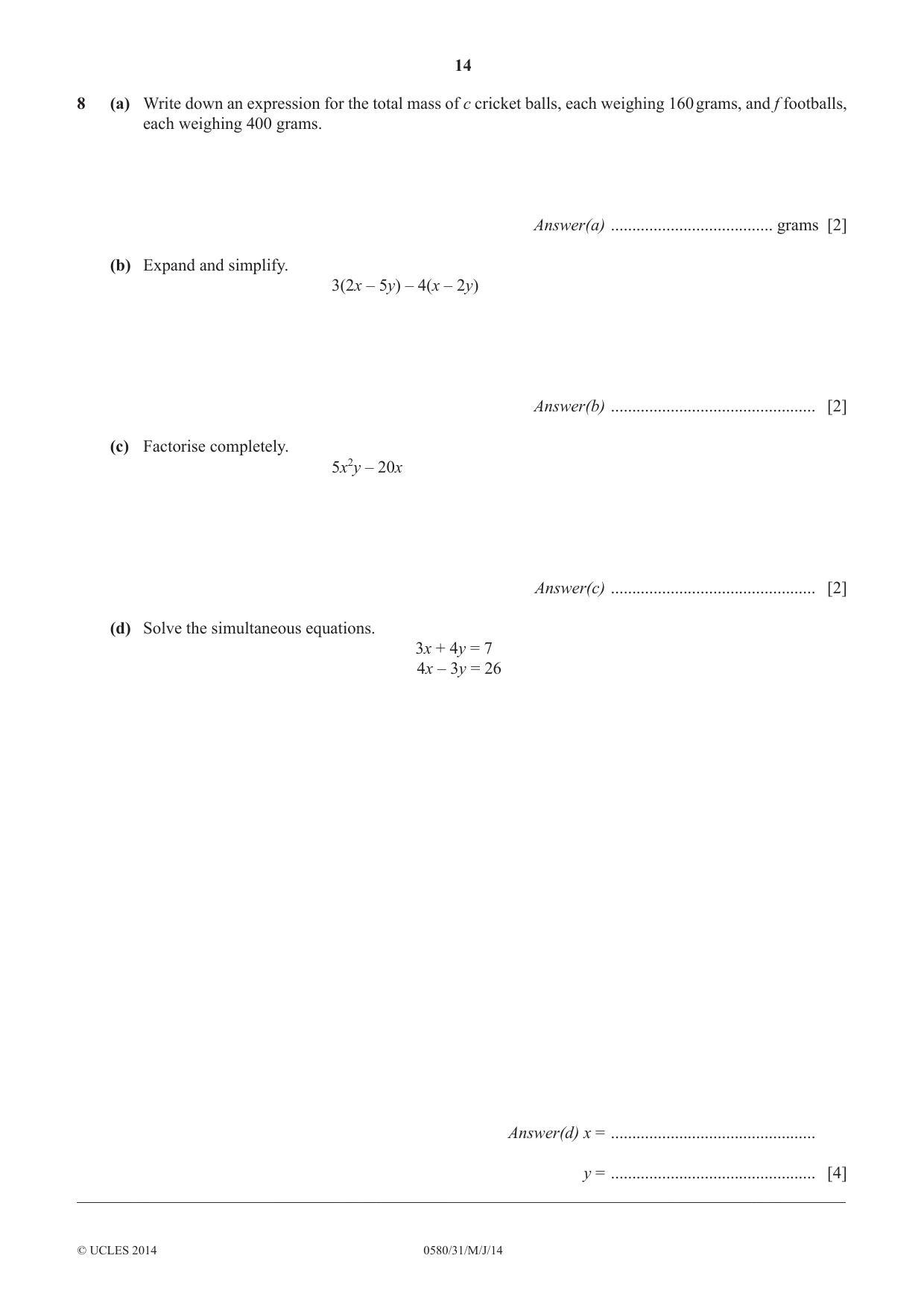
8 (a) Write down an expression for the total mass of c cricket balls, each weighing 160 grams, and f footballs, each weighing 400 grams. Answer(a) ...................................... grams [2] (b) Expand and simplify. 3(2x – 5y) – 4(x – 2y) Answer(b) ................................................ [2] (c) Factorise completely. 5x2y – 20x Answer(c) ................................................ [2] (d) Solve the simultaneous equations. 3x + 4y = 7 4x – 3y = 26 Answer(d) x = ................................................ y = ................................................ [4] __________________________________________________________________________________________
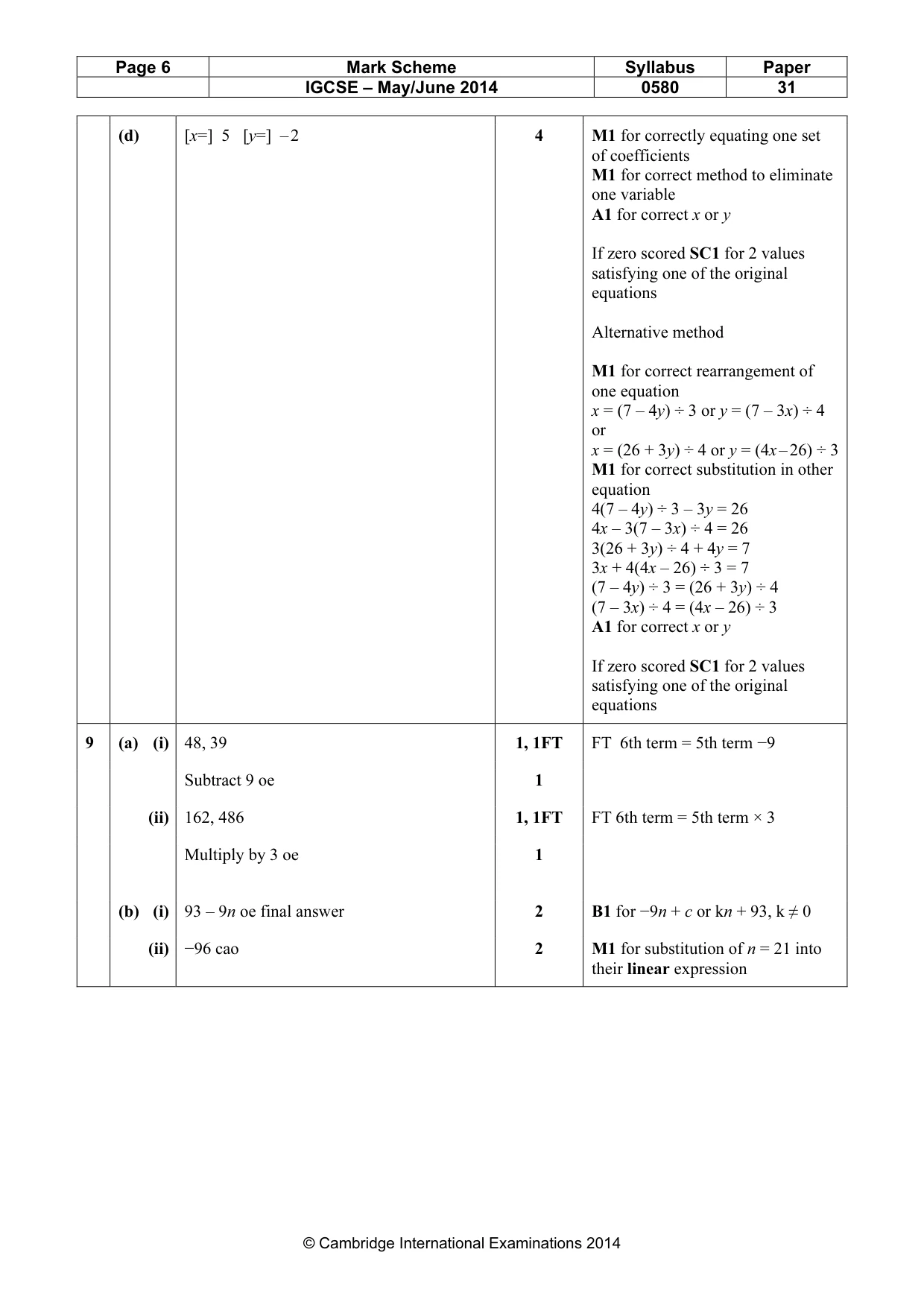
Mark scheme: 8 (a) 160c + 400f final answer 2 B1 for 160c or 400f seen (b) 2x – 7y final answer www 2 B1 for 2 x or –7y or 6x – 15y or –4x + 8y www (c) 5x(xy – 4) final answer 2 B1 for 5( x 2 y − 4 x ) or x ( 5 xy − 20 ) IGCSE – May/June 2014 0580 31 (d) [x=] 5 [y=] – 2 4 M1 for correctly equating one set of coefficients M1 for correct method to eliminate one variable A1 for correct x or y If zero scored SC1 for 2 values satisfying one of the original equations Alternative method M1 for correct rearrangement of one equation x = (7 – 4y) ÷ 3 or y = (7 – 3x) ÷ 4 or x = (26 + 3y) ÷ 4 or y = (4x – 26) ÷ 3 M1 for correct substitution in other equation 4(7 – 4y) ÷ 3 – 3y = 26 4x – 3(7 – 3x) ÷ 4 = 26 3(26 + 3y) ÷ 4 + 4y = 7 3x + 4(4x – 26) ÷ 3 = 7 (7 – 4y) ÷ 3 = (26 + 3y) ÷ 4 (7 – 3x) ÷ 4 = (4x – 26) ÷ 3 A1 for correct x or y If zero scored SC1 for 2 values satisfying one of the original equations
Q9 · For these sequences, write down the next two terms and the rule for fi nding the next term
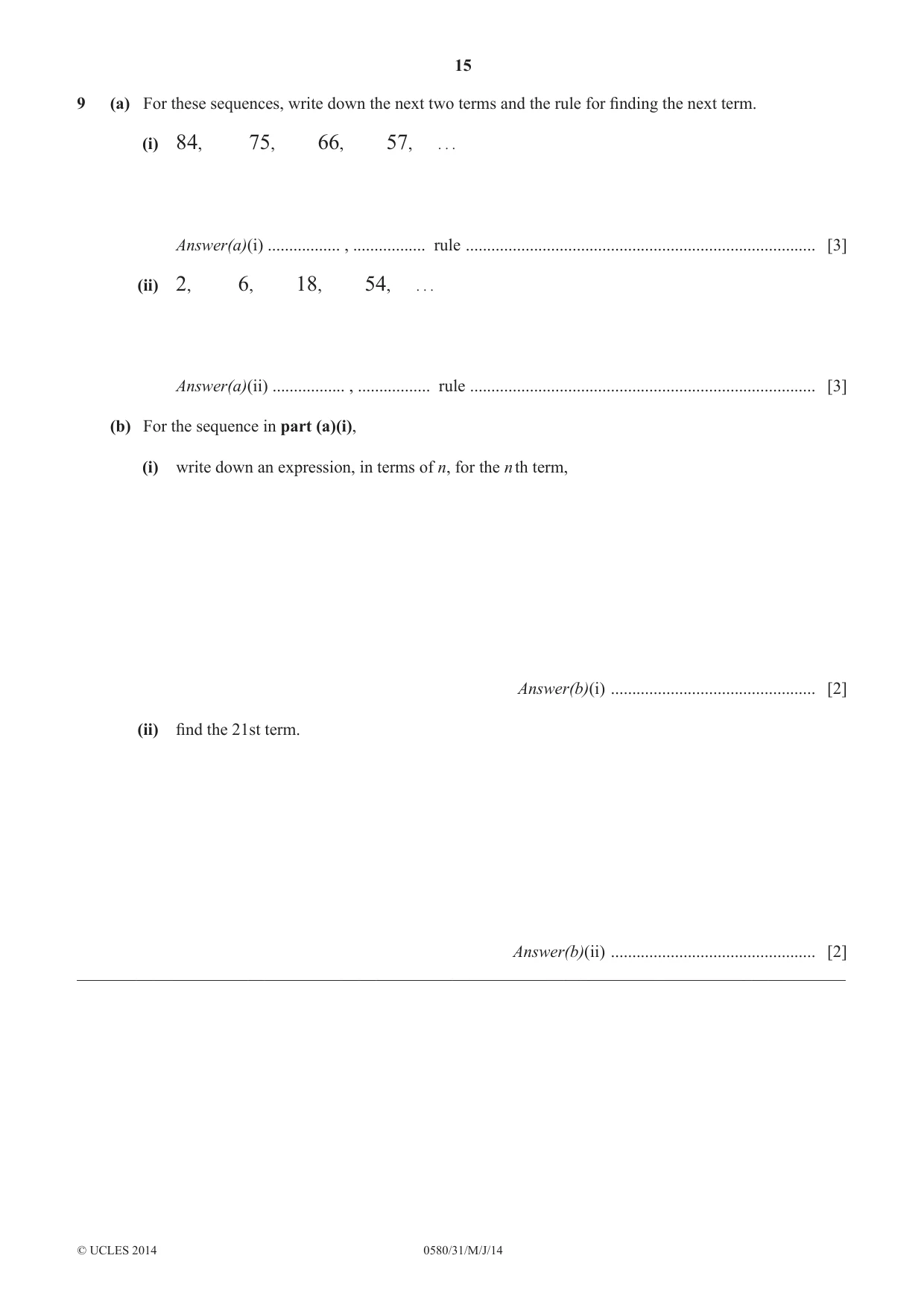
9 (a) For these sequences, write down the next two terms and the rule for fi nding the next term. (i) 84, 75, 66, 57, . . . Answer(a)(i) ................. , ................. rule .................................................................................. [3] (ii) 2, 6, 18, 54, . . . Answer(a)(ii) ................. , ................. rule ................................................................................. [3] (b) For the sequence in part (a)(i), (i) write down an expression, in terms of n, for the n th term, Answer(b)(i) ................................................ [2] (ii) fi nd the 21st term. Answer(b)(ii) ................................................ [2] __________________________________________________________________________________________
Mark scheme: 9 (a) (i) 48, 39 1, 1FT FT 6th term = 5th term −9 Subtract 9 oe 1 (ii) 162, 486 1, 1FT FT 6th term = 5th term × 3 Multiply by 3 oe 1 (b) (i) 93 – 9n oe final answer 2 B1 for −9n + c or kn + 93, k ≠ 0 (ii) −96 cao 2 M1 for substitution of n = 21 into their linear expression
What was in this paper
The subtopics covered by these 9 questions, and how many questions each got. Open one in a new tab to see every Cambridge question on it.
What you needed in this session
Cambridge’s own grade thresholds for 2014 May/June, Paper 3 · Variant 1. A higher threshold means an easier paper — the bar moves with how the cohort did.