Cambridge IGCSE Mathematics 0580 — 2014 May/June Paper 3 · Variant 2
0580/32/M/J/14 · 9 questions · 104 marks · ≈117 min
The question paper and its mark scheme, free to read here and free to download. This is Cambridge’s own paper, exactly as it was sat.
Question paper16 pages
Mark scheme5 pages
Answers below. Sit the paper first if you are practising.
Questions as text
Q1 · Here is a list of numbers
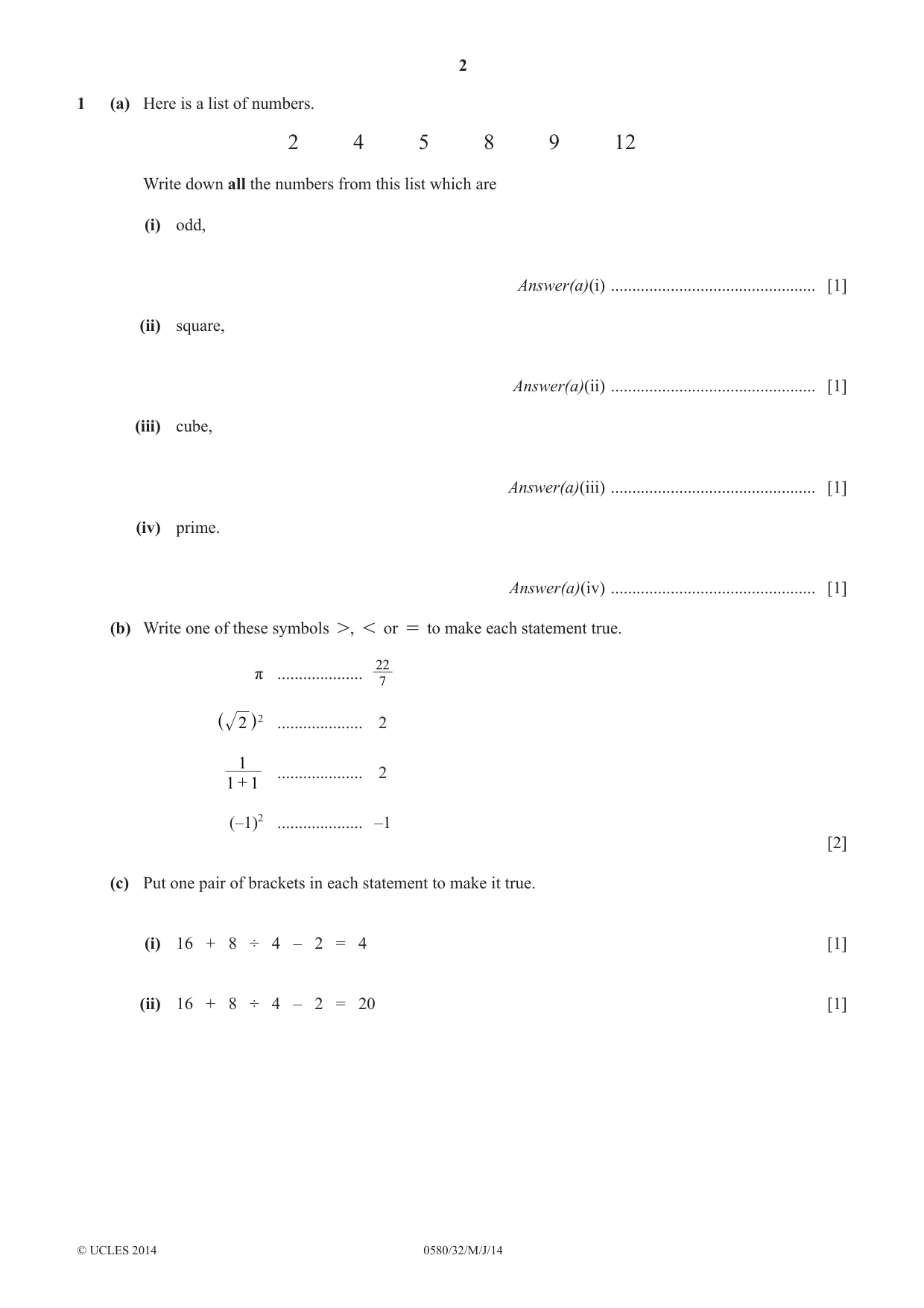
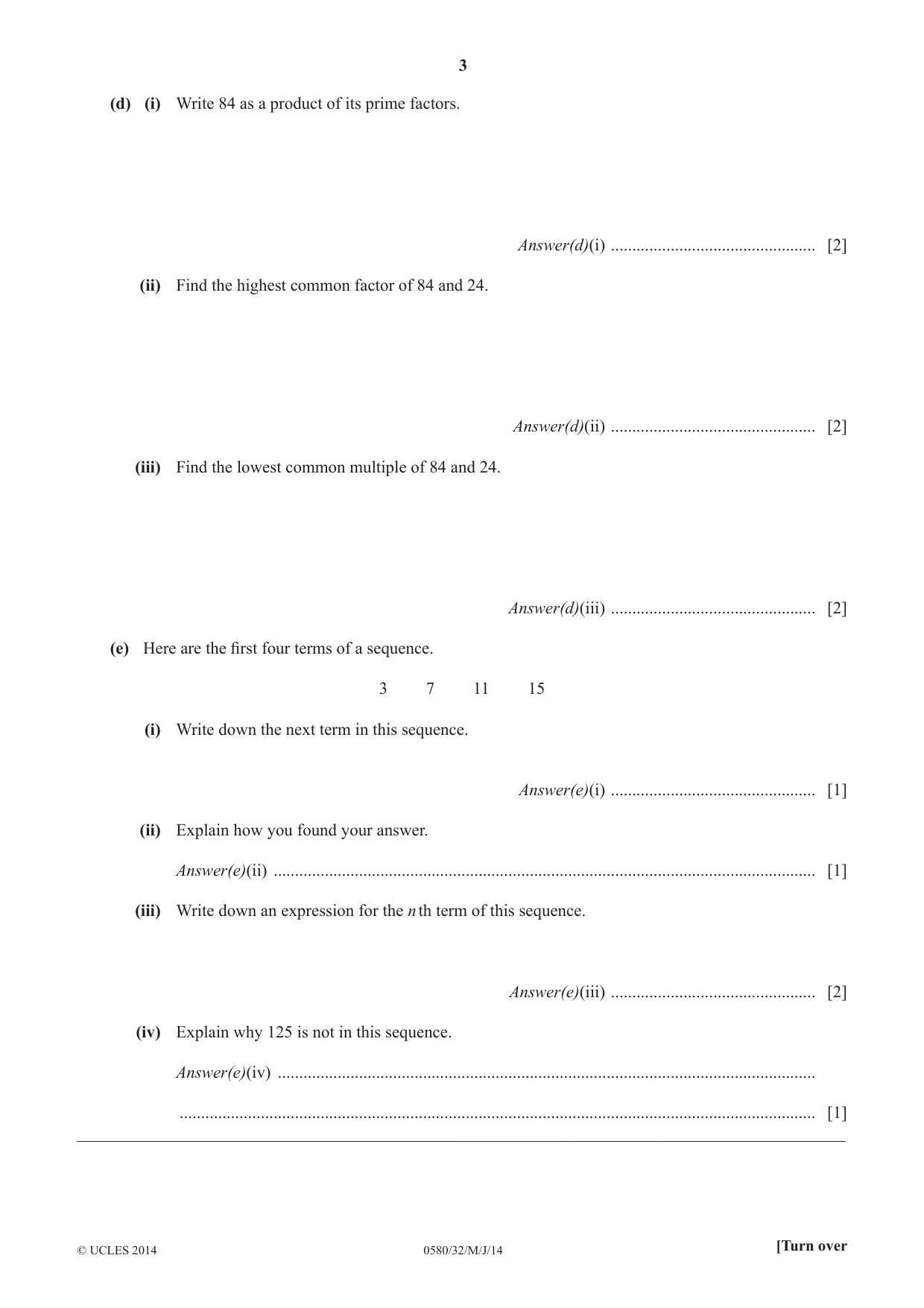
1 (a) Here is a list of numbers. 2 4 5 8 9 12 Write down all the numbers from this list which are (i) odd, Answer(a)(i) ................................................ [1] (ii) square, Answer(a)(ii) ................................................ [1] (iii) cube, Answer(a)(iii) ................................................ [1] (iv) prime. Answer(a)(iv) ................................................ [1] (b) Write one of these symbols >, < or = to make each statement true. 22 π .................... 7 2 .................... 2 ^ h2 1 .................... 2 1 + 1 (–1)2 .................... –1 [2] (c) Put one pair of brackets in each statement to make it true. (i) 16 + 8 ÷ 4 – 2 = 4 [1] (ii) 16 + 8 ÷ 4 – 2 = 20 [1] (d) (i) Write 84 as a product of its prime factors. Answer(d)(i) ................................................ [2] (ii) Find the highest common factor of 84 and 24. Answer(d)(ii) ................................................ [2] (iii) Find the lowest common multiple of 84 and 24. Answer(d)(iii) ................................................ [2] (e) Here are the fi rst four terms of a sequence. 3 7 11 15 (i) Write down the next term in this sequence. Answer(e)(i) ................................................ [1] (ii) Explain how you found your answer. Answer(e)(ii) ............................................................................................................................... [1] (iii) Write down an expression for the n th term of this sequence. Answer(e)(iii) ................................................ [2] (iv) Explain why 125 is not in this sequence. Answer(e)(iv) .............................................................................................................................. ..................................................................................................................................................... [1] __________________________________________________________________________________________
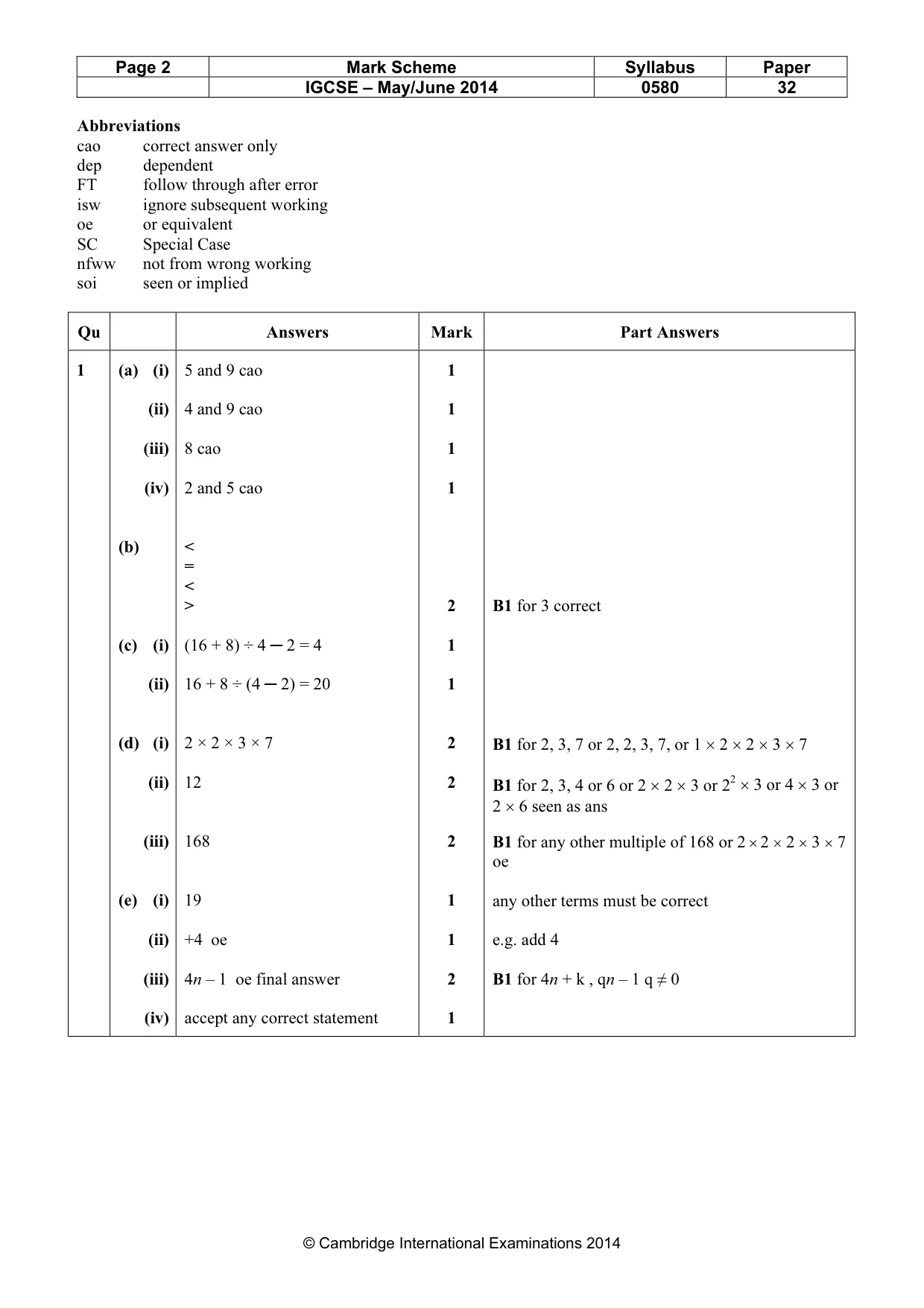
Mark scheme: Qu Answers Mark Part Answers 1 (a) (i) 5 and 9 cao 1 (ii) 4 and 9 cao 1 (iii) 8 cao 1 (iv) 2 and 5 cao 1 (b) < = < > 2 B1 for 3 correct (c) (i) (16 + 8) ÷ 4 ─ 2 = 4 1 (ii) 16 + 8 ÷ (4 ─ 2) = 20 1 (d) (i) 2 × 2 × 3 × 7 2 B1 for 2, 3, 7 or 2, 2, 3, 7, or 1 × 2 × 2 × 3 × 7 (ii) 12 2 B1 for 2, 3, 4 or 6 or 2 × 2 × 3 or 22 × 3 or 4 × 3 or 2 × 6 seen as ans (iii) 168 2 B1 for any other multiple of 168 or 2 × 2 × 2 × 3 × 7 oe (e) (i) 19 1 any other terms must be correct (ii) +4 oe 1 e.g. add 4 (iii) 4n – 1 oe final answer 2 B1 for 4n + k , qn – 1 q ≠ 0 (iv) accept any correct statement 1 IGCSE – May/June 2014 0580 32
Q2 · B A NOT TO SCALE 240 cm 180 cm D C 120 cm The diagram shows the cross section ABCD of a…
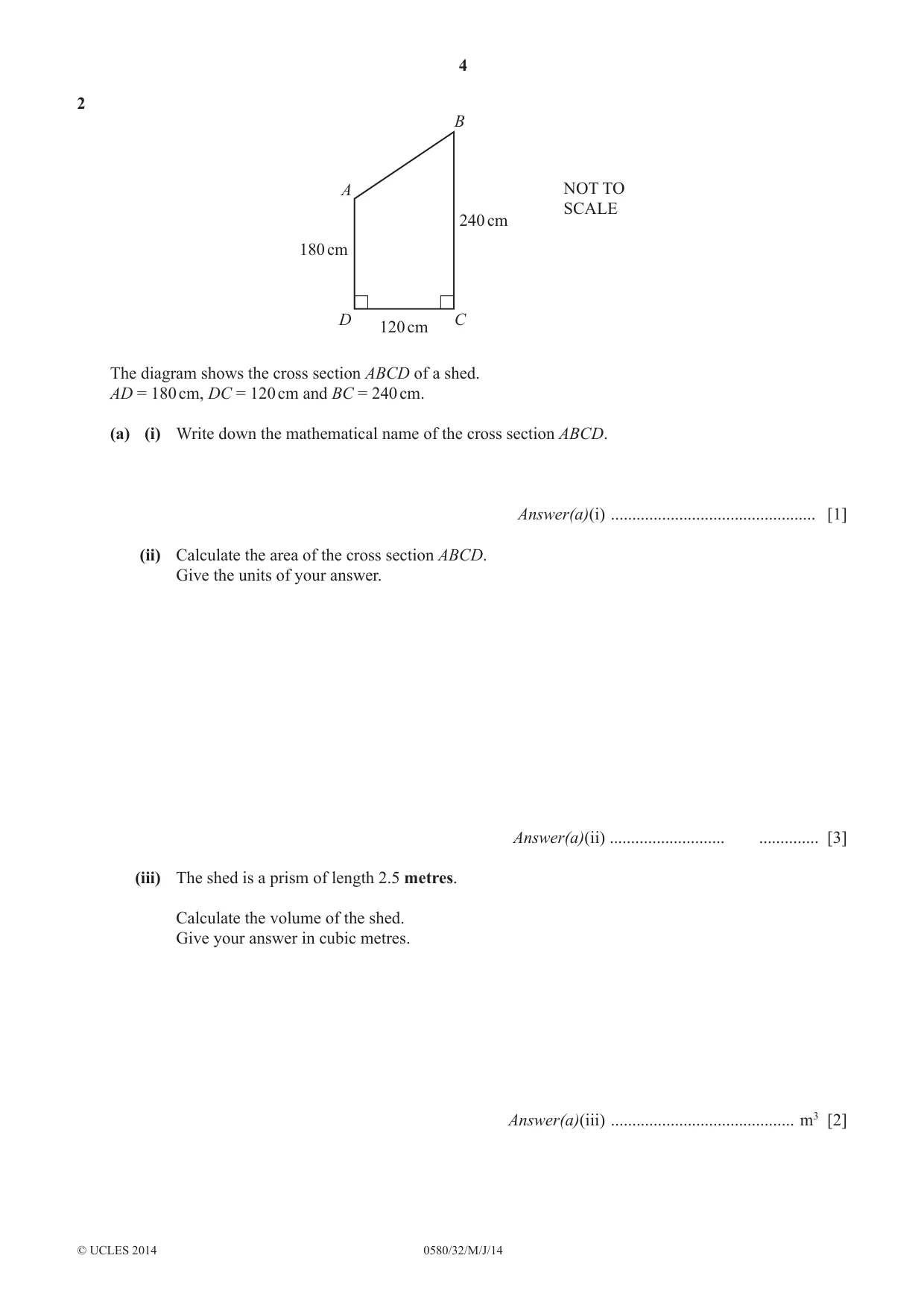
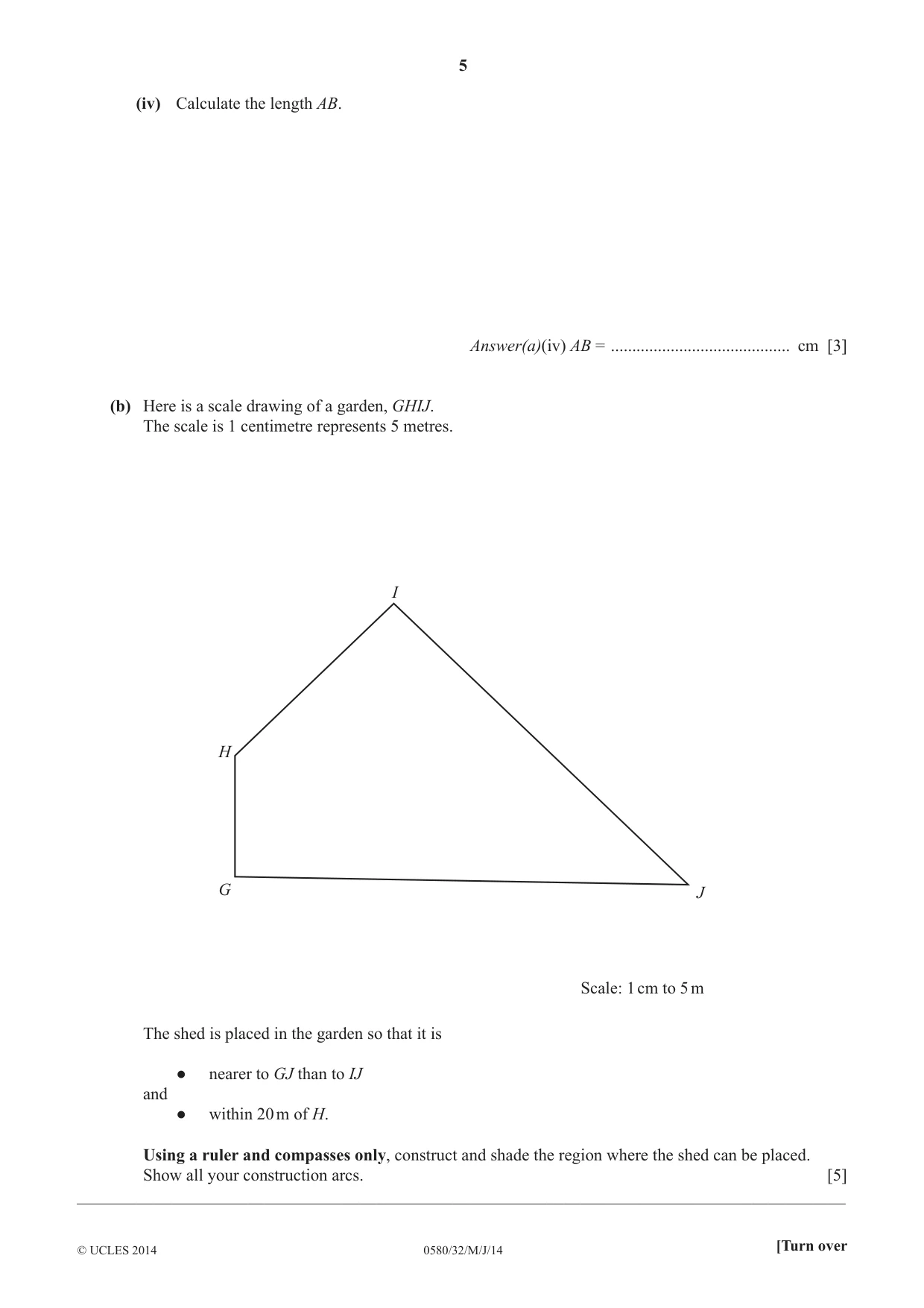
2 B A NOT TO SCALE 240 cm 180 cm D C 120 cm The diagram shows the cross section ABCD of a shed. AD = 180 cm, DC = 120 cm and BC = 240 cm. (a) (i) Write down the mathematical name of the cross section ABCD. Answer(a)(i) ................................................ [1] (ii) Calculate the area of the cross section ABCD. Give the units of your answer. Answer(a)(ii) ........................... .............. [3] (iii) The shed is a prism of length 2.5 metres. Calculate the volume of the shed. Give your answer in cubic metres. Answer(a)(iii) ........................................... m3 [2] (iv) Calculate the length AB. Answer(a)(iv) AB = .......................................... cm [3] (b) Here is a scale drawing of a garden, GHIJ. The scale is 1 centimetre represents 5 metres. I H G J Scale: 1 cm to 5 m The shed is placed in the garden so that it is ● nearer to GJ than to IJ and ● within 20 m of H. Using a ruler and compasses only, construct and shade the region where the shed can be placed. Show all your construction arcs. [5] __________________________________________________________________________________________
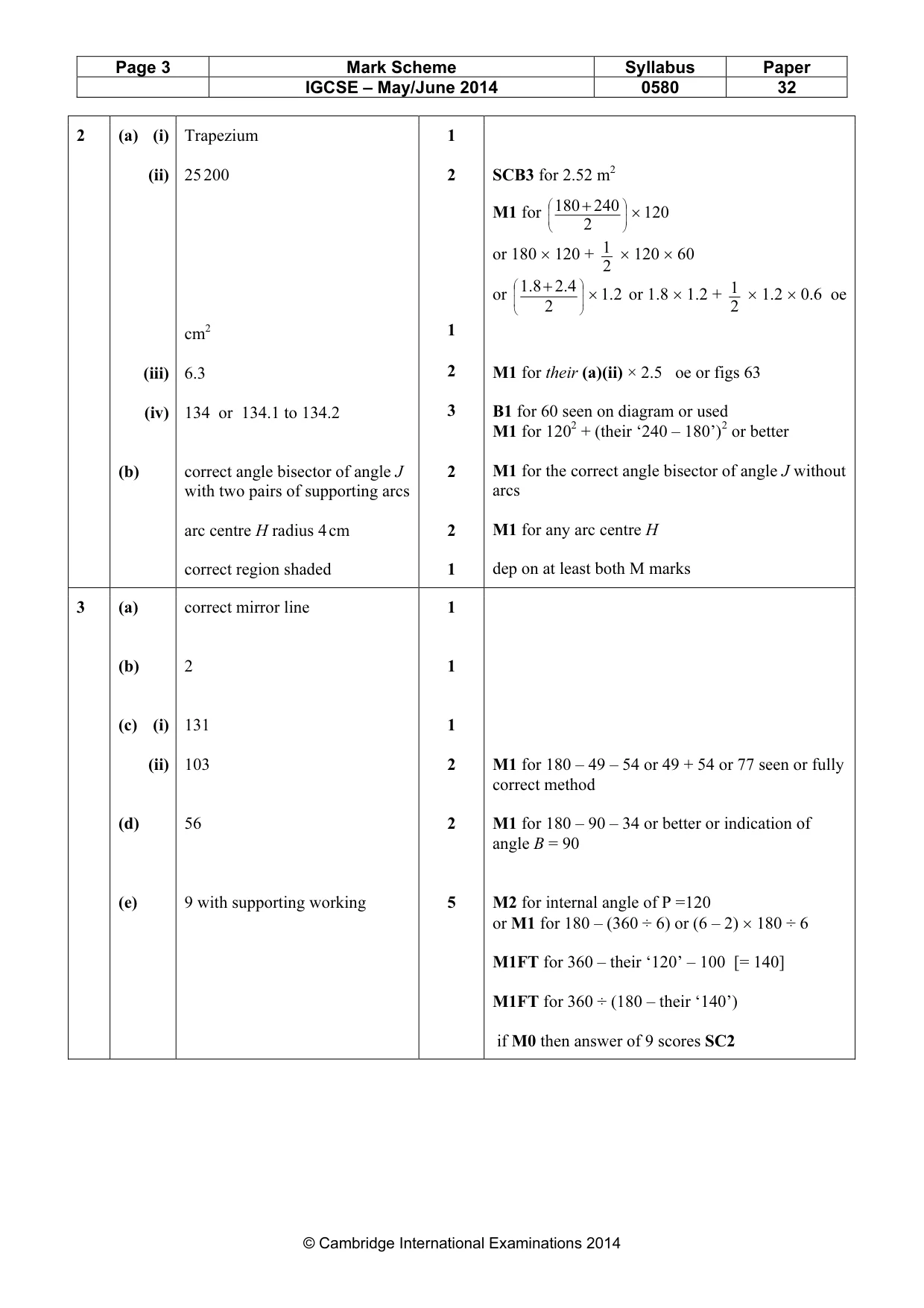
Mark scheme: 2 (a) (i) Trapezium 1 (ii) 25 200 2 SCB3 for 2.52 m2 180 + 240 × 120 M1 for 2 1 or 180 × 120 + × 120 × 60 2 8.1 + 4.2 1 or × 2.1 or 1.8 × 1.2 + × 1.2 × 0.6 oe 2 2 cm2 1 (iii) 6.3 2 M1 for their (a)(ii) × 2.5 oe or figs 63 (iv) 134 or 134.1 to 134.2 3 B1 for 60 seen on diagram or used M1 for 1202 + (their ‘240 – 180’) 2 or better (b) correct angle bisector of angle J 2 M1 for the correct angle bisector of angle J without with two pairs of supporting arcs arcs arc centre H radius 4 cm 2 M1 for any arc centre H correct region shaded 1 dep on at least both M marks
Q3 · Draw the line of symmetry on the shape below
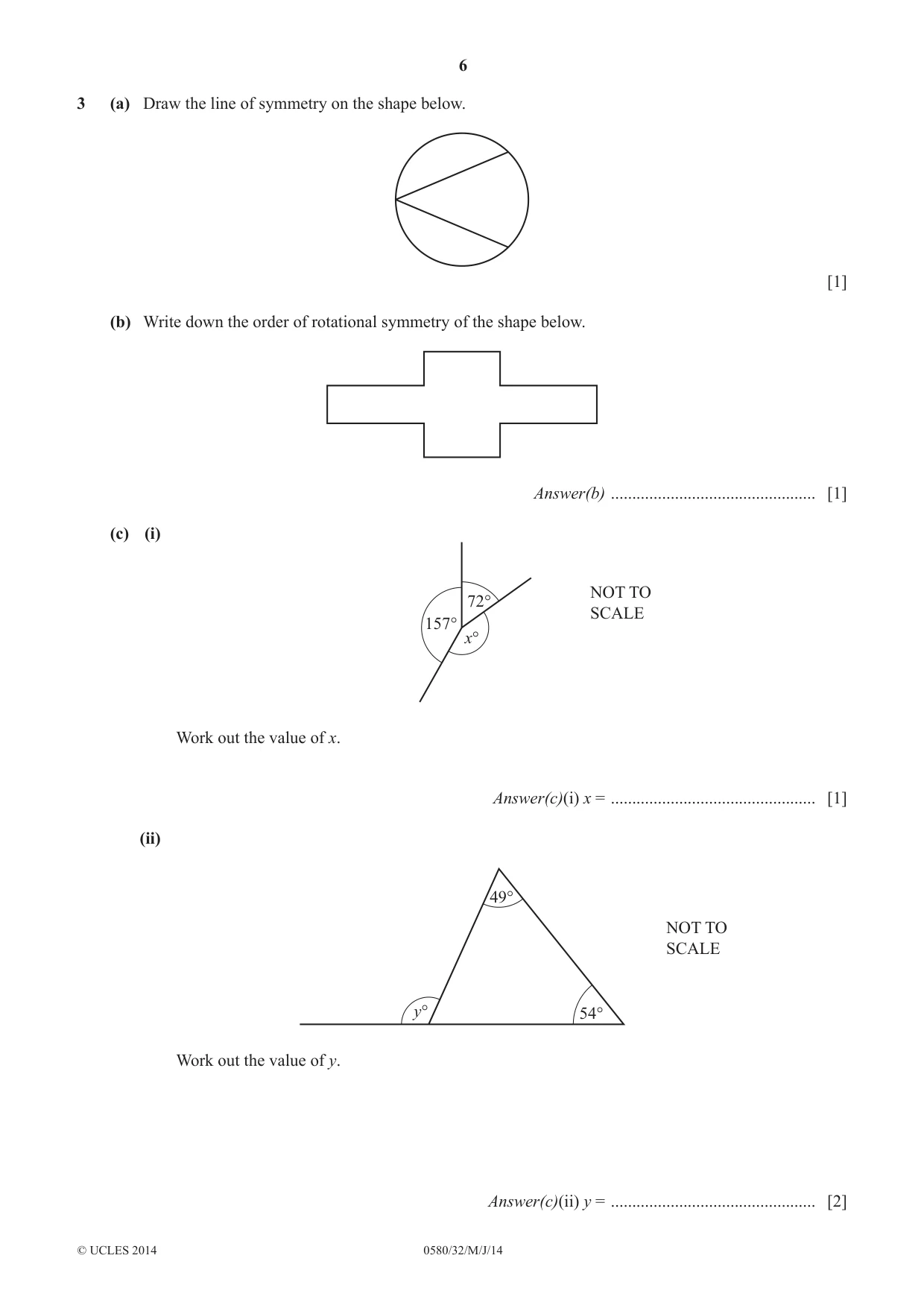
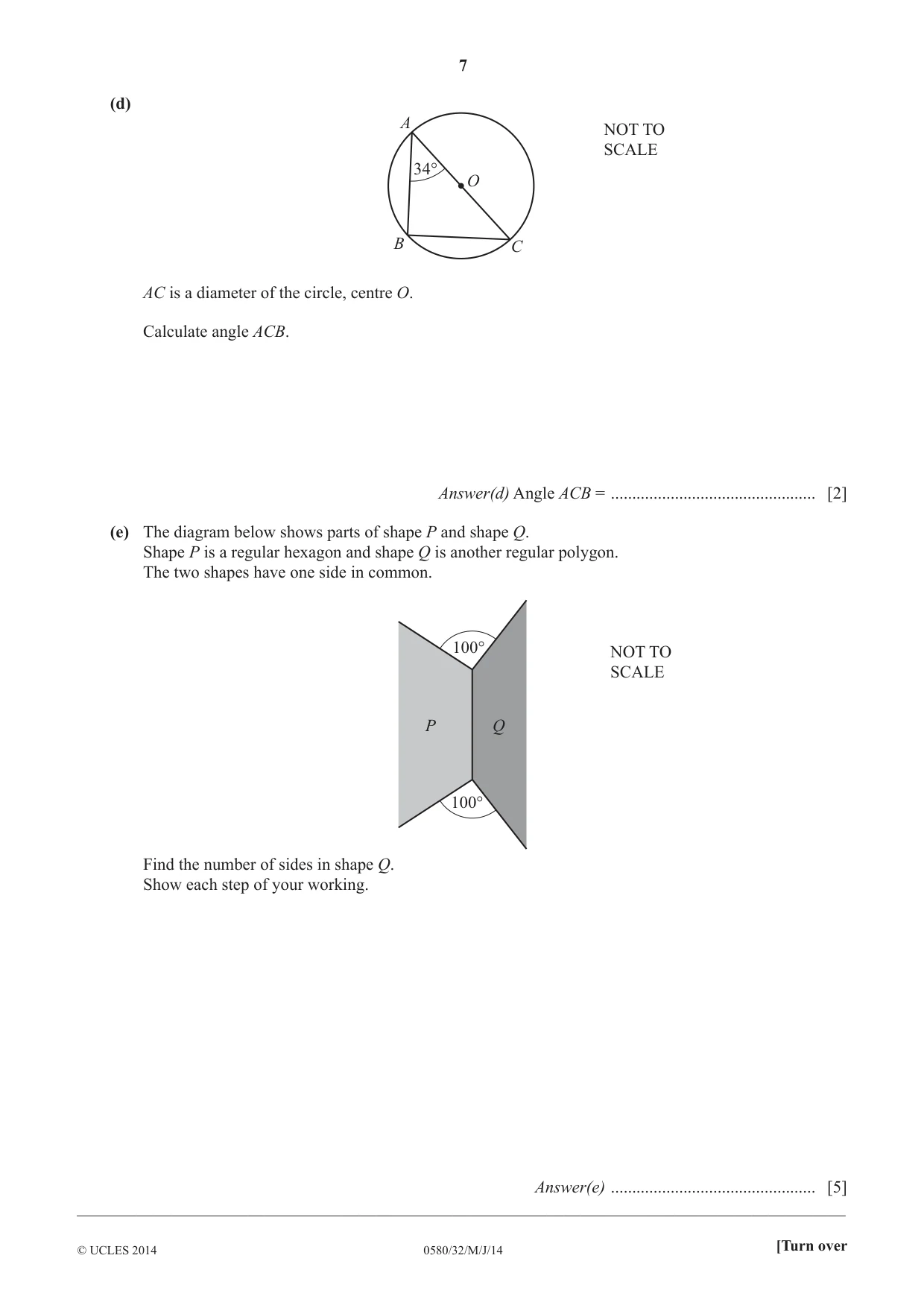
3 (a) Draw the line of symmetry on the shape below. [1] (b) Write down the order of rotational symmetry of the shape below. Answer(b) ................................................ [1] (c) (i) NOT TO 72° SCALE 157° x° Work out the value of x. Answer(c)(i) x = ................................................ [1] (ii) 49° NOT TO SCALE y° 54° Work out the value of y. Answer(c)(ii) y = ................................................ [2] (d) A NOT TO SCALE 34° O B C AC is a diameter of the circle, centre O. Calculate angle ACB. Answer(d) Angle ACB = ................................................ [2] (e) The diagram below shows parts of shape P and shape Q. Shape P is a regular hexagon and shape Q is another regular polygon. The two shapes have one side in common. 100° NOT TO SCALE P Q 100° Find the number of sides in shape Q. Show each step of your working. Answer(e) ................................................ [5] __________________________________________________________________________________________
Mark scheme: 3 (a) correct mirror line 1 (b) 2 1 (c) (i) 131 1 (ii) 103 2 M1 for 180 – 49 – 54 or 49 + 54 or 77 seen or fully correct method (d) 56 2 M1 for 180 – 90 – 34 or better or indication of angle B = 90 (e) 9 with supporting working 5 M2 for internal angle of P =120 or M1 for 180 – (360 ÷ 6) or (6 – 2) × 180 ÷ 6 M1FT for 360 – their ‘120’ – 100 [= 140] M1FT for 360 ÷ (180 – their ‘140’) if M0 then answer of 9 scores SC2 IGCSE – May/June 2014 0580 32
Q4 · Paolo’s football team played 46 games
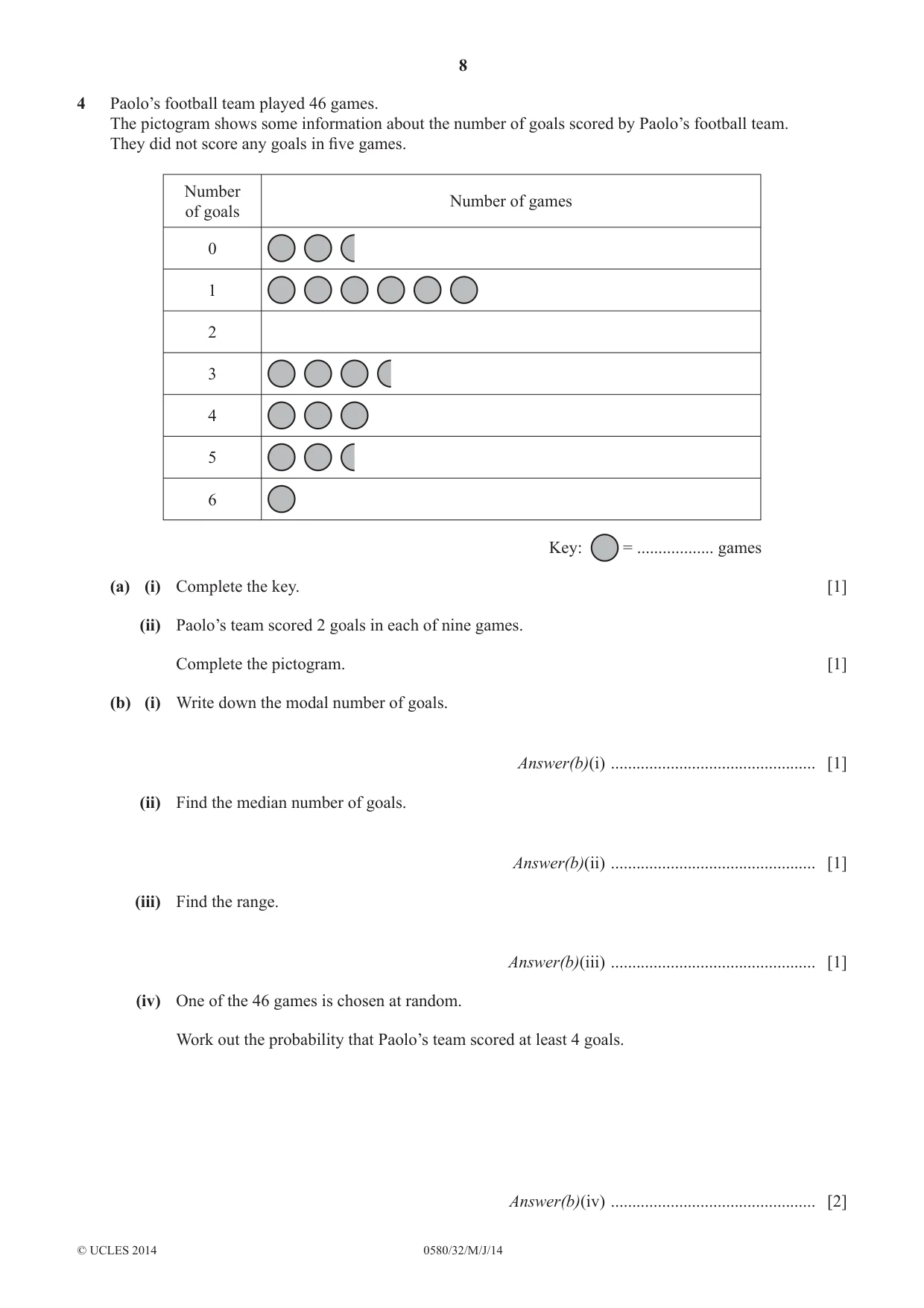
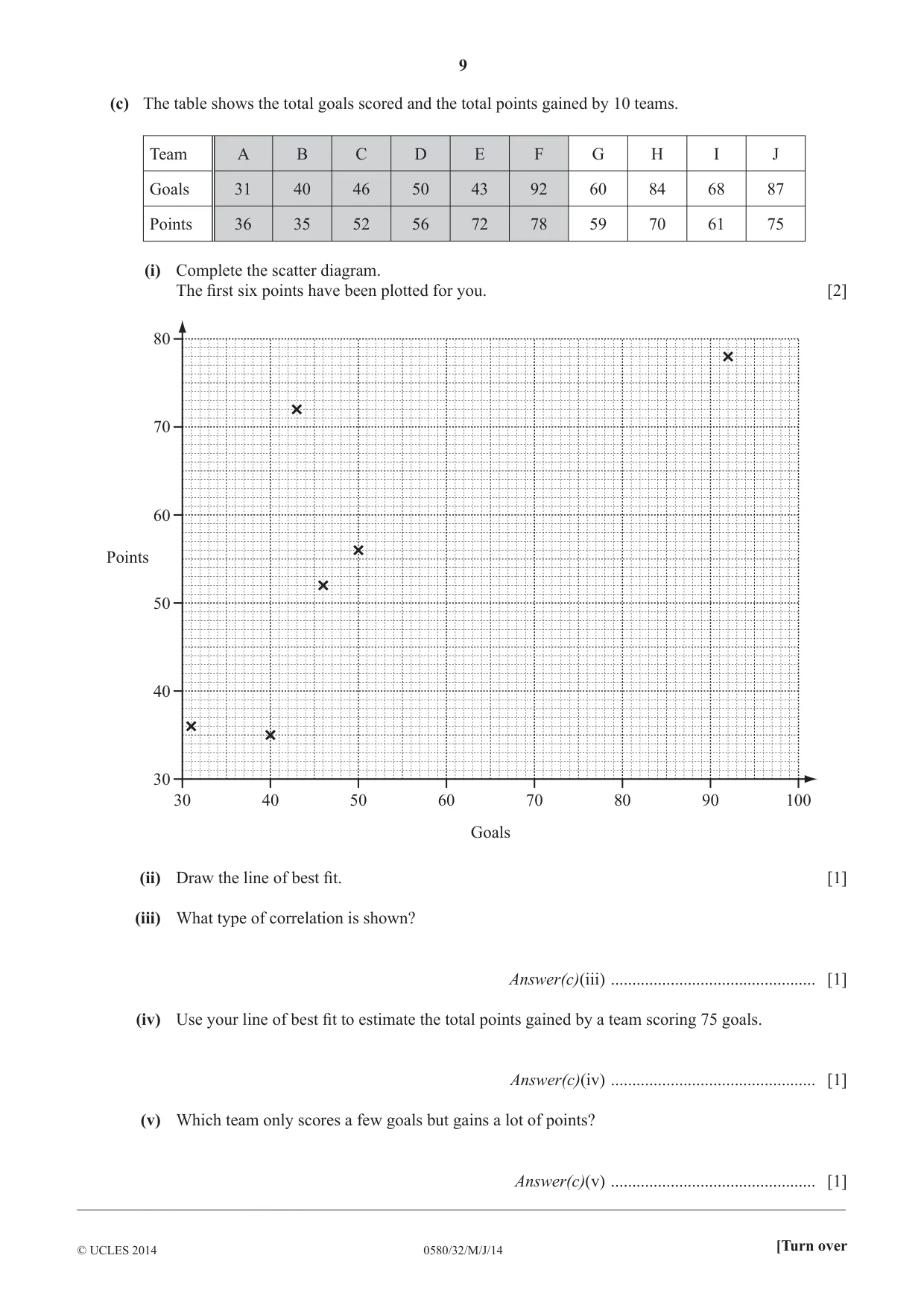
4 Paolo’s football team played 46 games. The pictogram shows some information about the number of goals scored by Paolo’s football team. They did not score any goals in fi ve games. Number Number of games of goals 0 1 2 3 4 5 6 Key: = .................. games (a) (i) Complete the key. [1] (ii) Paolo’s team scored 2 goals in each of nine games. Complete the pictogram. [1] (b) (i) Write down the modal number of goals. Answer(b)(i) ................................................ [1] (ii) Find the median number of goals. Answer(b)(ii) ................................................ [1] (iii) Find the range. Answer(b)(iii) ................................................ [1] (iv) One of the 46 games is chosen at random. Work out the probability that Paolo’s team scored at least 4 goals. Answer(b)(iv) ................................................ [2] (c) The table shows the total goals scored and the total points gained by 10 teams. Team A B C D E F G H I J Goals 31 40 46 50 43 92 60 84 68 87 Points 36 35 52 56 72 78 59 70 61 75 (i) Complete the scatter diagram. The fi rst six points have been plotted for you. [2] 80 70 60 Points 50 40 30 30 40 50 60 70 80 90 100 Goals (ii) Draw the line of best fi t. [1] (iii) What type of correlation is shown? Answer(c)(iii) ................................................ [1] (iv) Use your line of best fi t to estimate the total points gained by a team scoring 75 goals. Answer(c)(iv) ................................................ [1] (v) Which team only scores a few goals but gains a lot of points? Answer(c)(v) ................................................ [1] __________________________________________________________________________________________
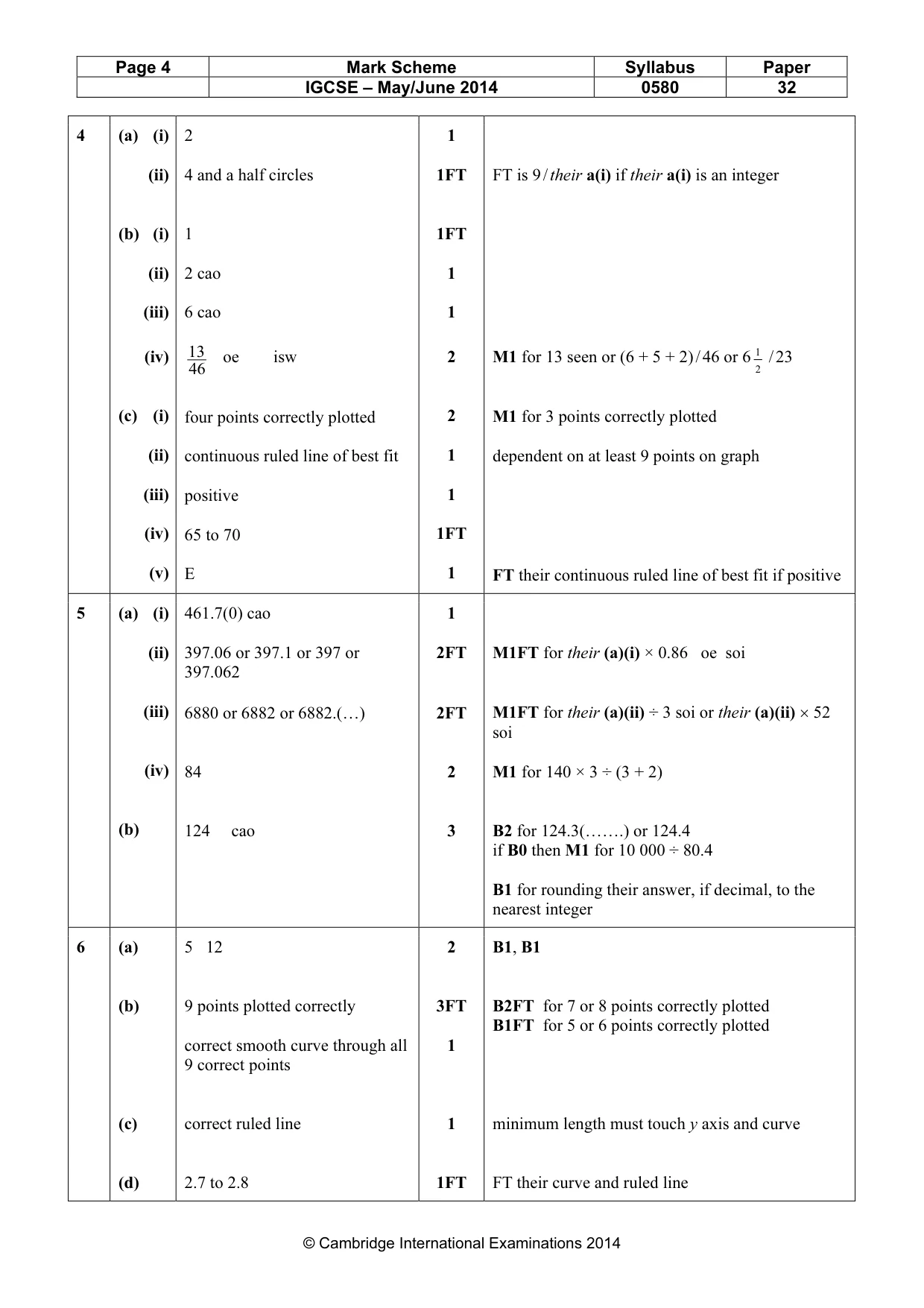
Mark scheme: 4 (a) (i) 2 1 (ii) 4 and a half circles 1FT FT is 9 / their a(i) if their a(i) is an integer (b) (i) 1 1FT (ii) 2 cao 1 (iii) 6 cao 1 (iv) 13 oe isw 2 M1 for 13 seen or (6 + 5 + 2) / 46 or 6 1 / 23 46 2 (c) (i) 2 M1 for 3 points correctly plotted four points correctly plotted (ii) 1 dependent on at least 9 points on graph continuous ruled line of best fit (iii) 1 positive (iv) 1FT 65 to 70 (v) E 1 FT their continuous ruled line of best fit if positive
Q5 · Jasmine works for 38 hours each week and she earns $12.15 each hour
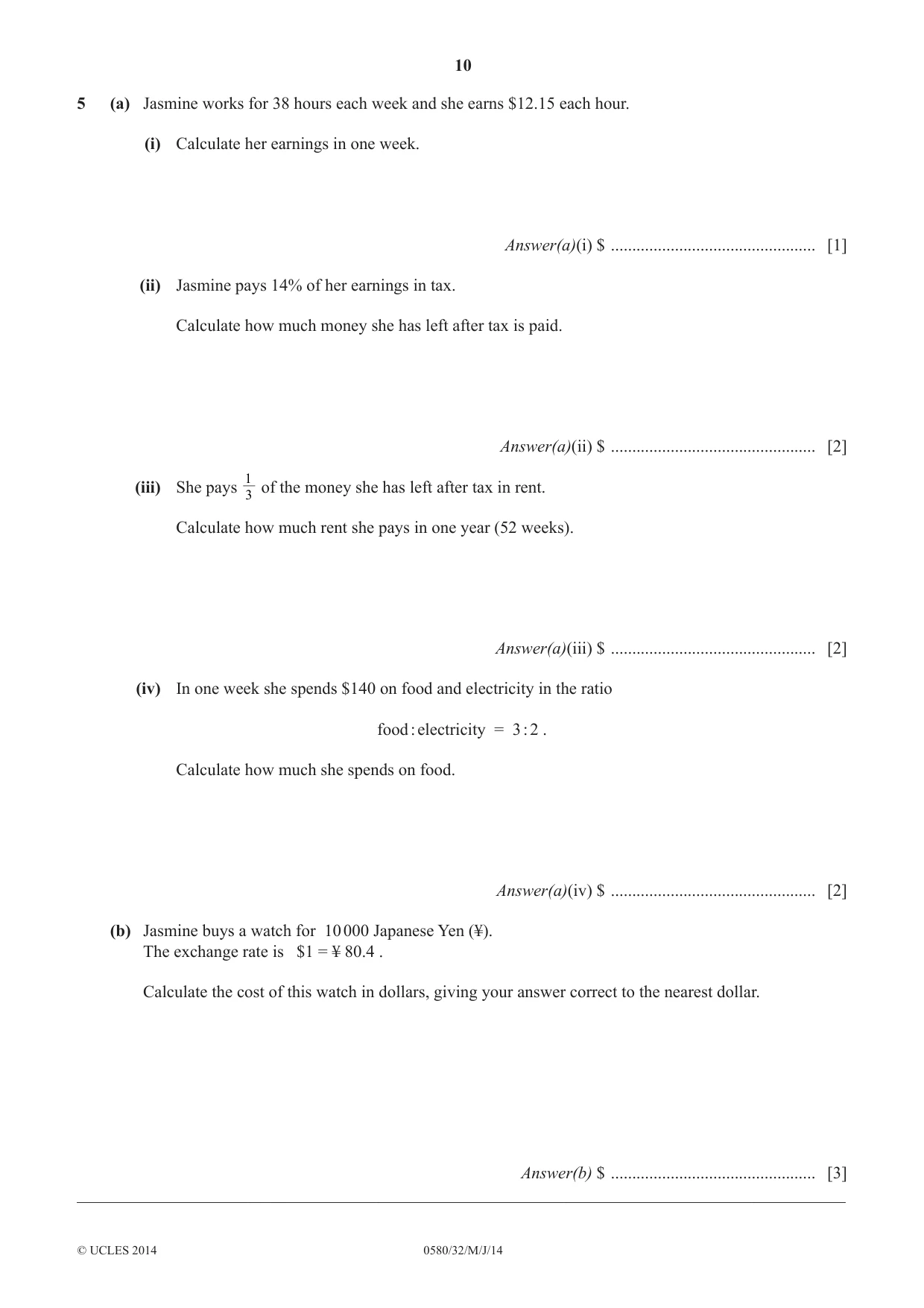
5 (a) Jasmine works for 38 hours each week and she earns $12.15 each hour. (i) Calculate her earnings in one week. Answer(a)(i) $ ................................................ [1] (ii) Jasmine pays 14% of her earnings in tax. Calculate how much money she has left after tax is paid. Answer(a)(ii) $ ................................................ [2] 1 (iii) She pays of the money she has left after tax in rent. 3 Calculate how much rent she pays in one year (52 weeks). Answer(a)(iii) $ ................................................ [2] (iv) In one week she spends $140 on food and electricity in the ratio food : electricity = 3 : 2 . Calculate how much she spends on food. Answer(a)(iv) $ ................................................ [2] (b) Jasmine buys a watch for 10 000 Japanese Yen (¥). The exchange rate is $1 = ¥ 80.4 . Calculate the cost of this watch in dollars, giving your answer correct to the nearest dollar. Answer(b) $ ................................................ [3] __________________________________________________________________________________________
Mark scheme: 5 (a) (i) 461.7(0) cao 1 (ii) 397.06 or 397.1 or 397 or 2FT M1FT for their (a)(i) × 0.86 oe soi 397.062 (iii) 6880 or 6882 or 6882.(…) 2FT M1FT for their (a)(ii) ÷ 3 soi or their (a)(ii) × 52 soi (iv) 84 2 M1 for 140 × 3 ÷ (3 + 2) (b) 124 cao 3 B2 for 124.3(…….) or 124.4 if B0 then M1 for 10 000 ÷ 80.4 B1 for rounding their answer, if decimal, to the nearest integer
Q6 · Complete the table of values for y = x2 + 2x – 3
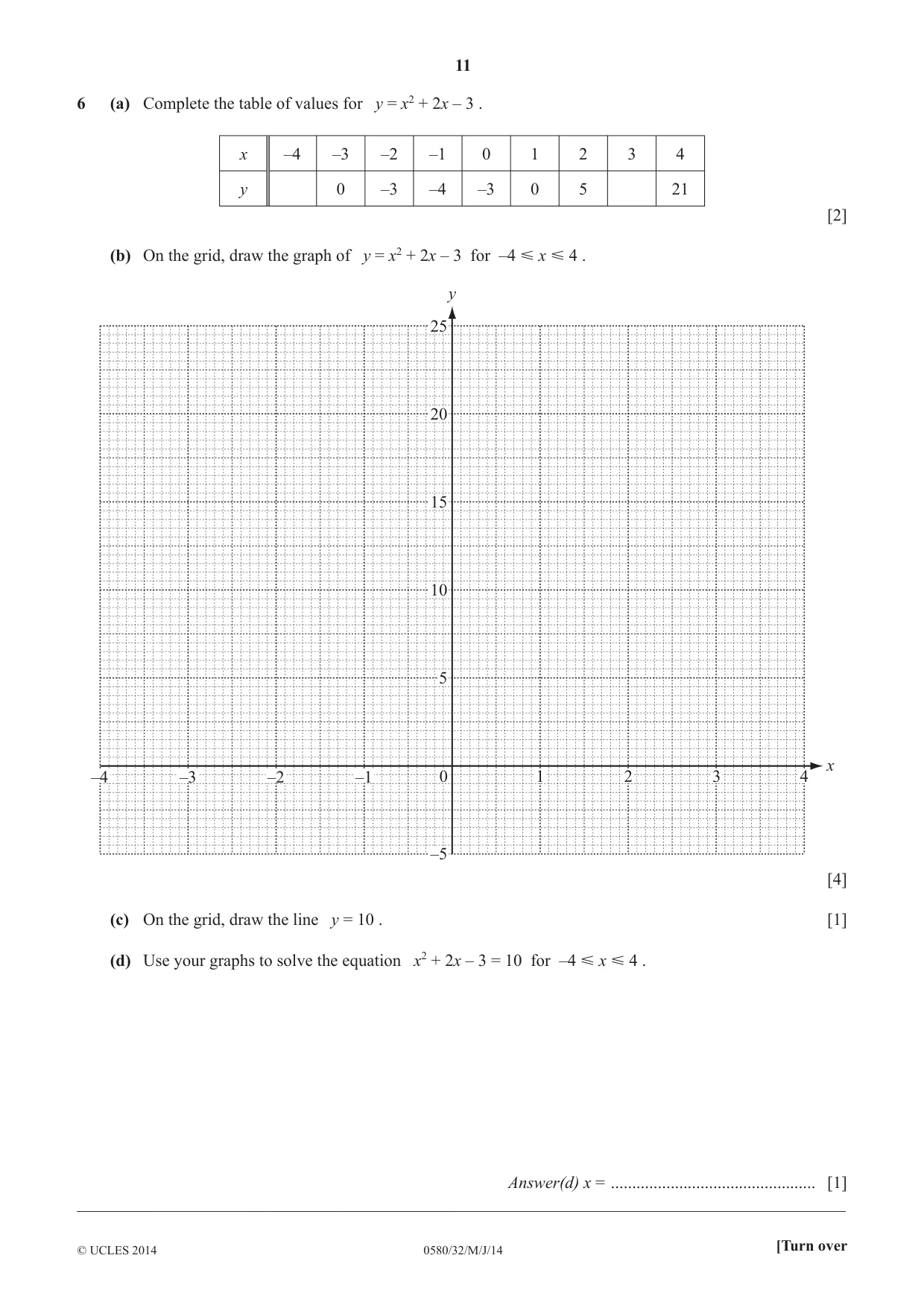
6 (a) Complete the table of values for y = x2 + 2x – 3 . x –4 –3 –2 –1 0 1 2 3 4 y 0 –3 –4 –3 0 5 21 [2] (b) On the grid, draw the graph of y = x2 + 2x – 3 for –4 Ğ x Ğ 4 . y 25 20 15 10 5 x –4 –3 –2 –1 0 1 2 3 4 –5 [4] (c) On the grid, draw the line y = 10 . [1] (d) Use your graphs to solve the equation x2 + 2x – 3 = 10 for –4 Y x Y 4 . Answer(d) x = ................................................ [1] __________________________________________________________________________________________
Mark scheme: 6 (a) 5 12 2 B1, B1 (b) 9 points plotted correctly 3FT B2FT for 7 or 8 points correctly plotted B1FT for 5 or 6 points correctly plotted correct smooth curve through all 1 9 correct points (c) correct ruled line 1 minimum length must touch y axis and curve (d) 2.7 to 2.8 1FT FT their curve and ruled line IGCSE – May/June 2014 0580 32
Q7 · NOT TO 5p + 3r 7p – 6r SCALE p + 2r Write an expression for the perimeter of this triangle
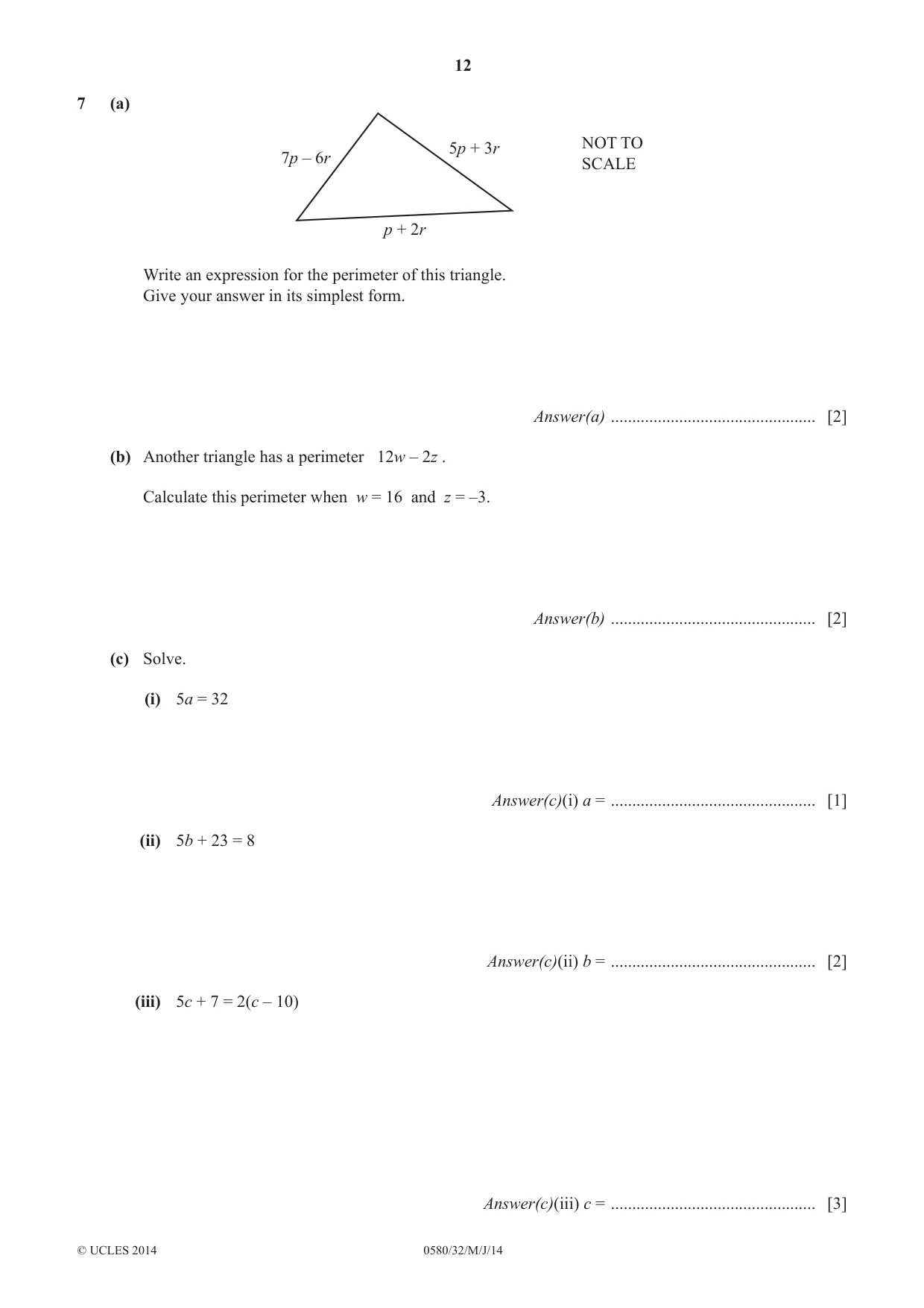
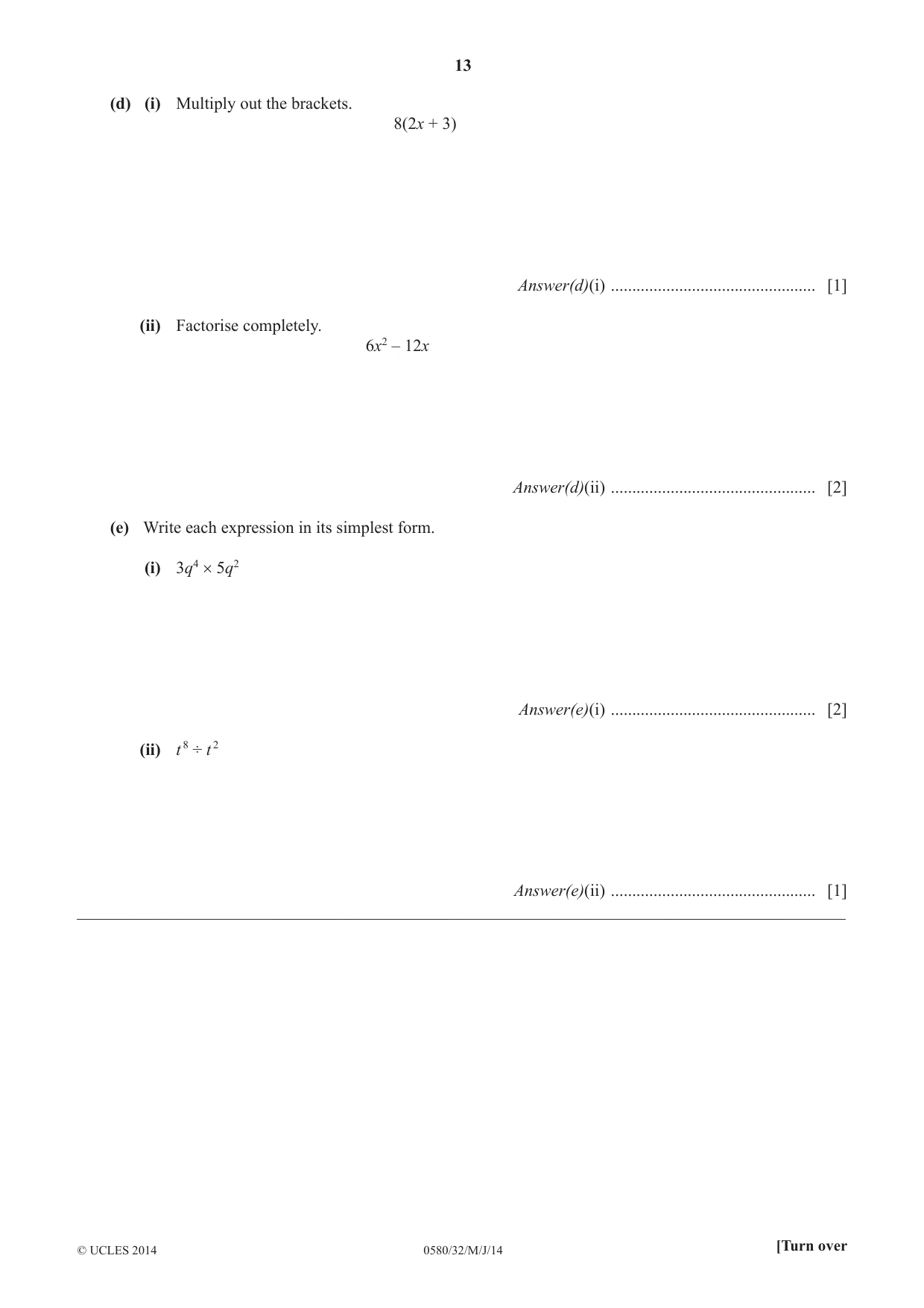
7 (a) NOT TO 5p + 3r 7p – 6r SCALE p + 2r Write an expression for the perimeter of this triangle. Give your answer in its simplest form. Answer(a) ................................................ [2] (b) Another triangle has a perimeter 12w – 2z . Calculate this perimeter when w = 16 and z = –3. Answer(b) ................................................ [2] (c) Solve. (i) 5a = 32 Answer(c)(i) a = ................................................ [1] (ii) 5b + 23 = 8 Answer(c)(ii) b = ................................................ [2] (iii) 5c + 7 = 2(c – 10) Answer(c)(iii) c = ................................................ [3] (d) (i) Multiply out the brackets. 8(2x + 3) Answer(d)(i) ................................................ [1] (ii) Factorise completely. 6x2 – 12x Answer(d)(ii) ................................................ [2] (e) Write each expression in its simplest form. (i) 3q4 × 5q2 Answer(e)(i) ................................................ [2] (ii) t 8 ÷ t 2 Answer(e)(ii) ................................................ [1] __________________________________________________________________________________________
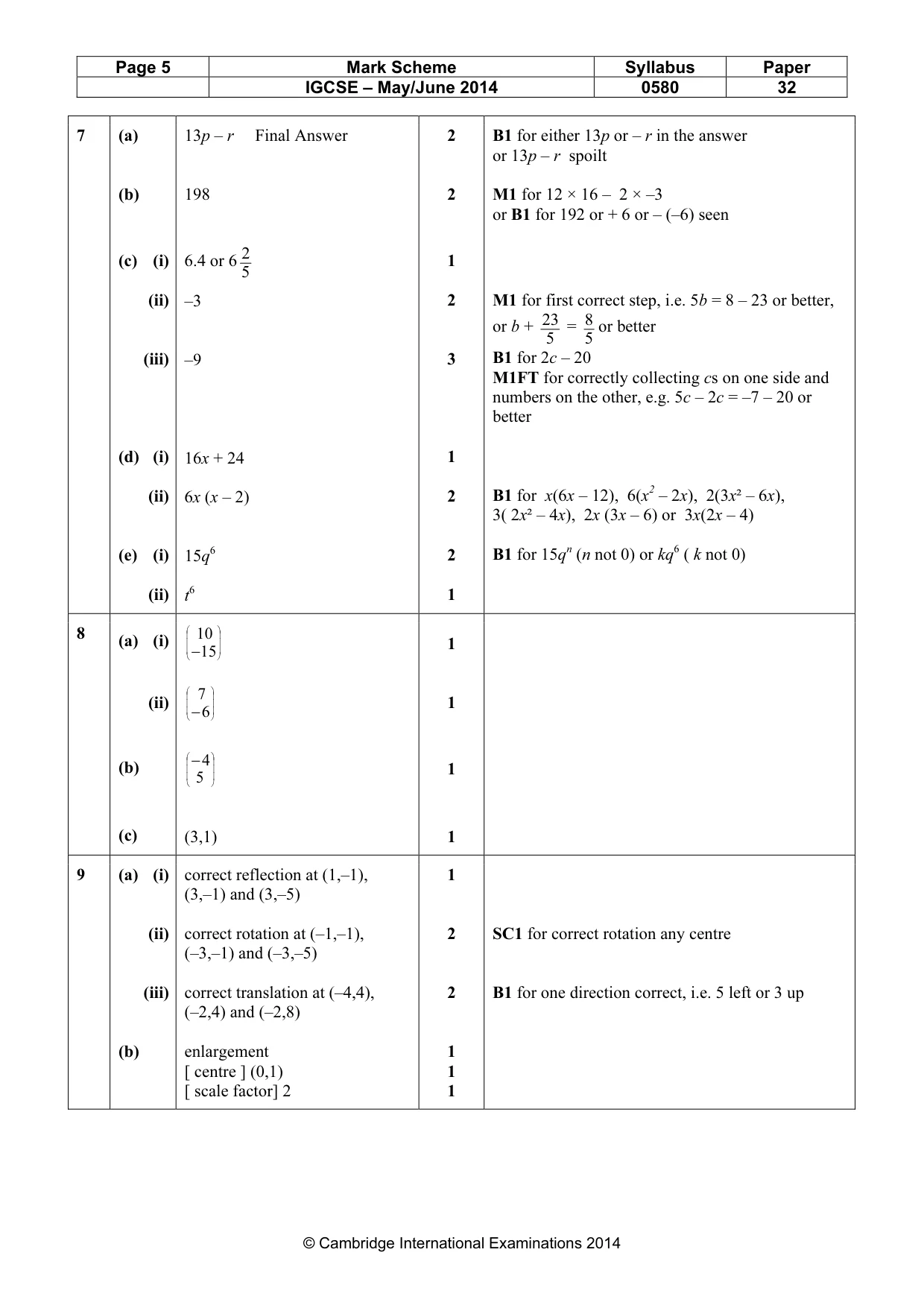
Mark scheme: 7 (a) 13p – r Final Answer 2 B1 for either 13p or – r in the answer or 13p – r spoilt (b) 198 2 M1 for 12 × 16 – 2 × –3 or B1 for 192 or + 6 or – (–6) seen (c) (i) 6.4 or 6 2 1 5 (ii) 2 M1 for first correct step, i.e. 5b = 8 – 23 or better, –3 23 8 or b + = or better 5 5 (iii) 3 B1 for 2c – 20 –9 M1FT for correctly collecting cs on one side and numbers on the other, e.g. 5c – 2c = –7 – 20 or better (d) (i) 16x + 24 1 (ii) 6x (x – 2) 2 B1 for x(6x – 12), 6(x2 – 2x), 2(3x² – 6x), 3( 2x² – 4x), 2x (3x – 6) or 3x(2x – 4) (e) (i) 15q6 2 B1 for 15qn (n not 0) or kq6 ( k not 0) (ii) t6 1
Question 8
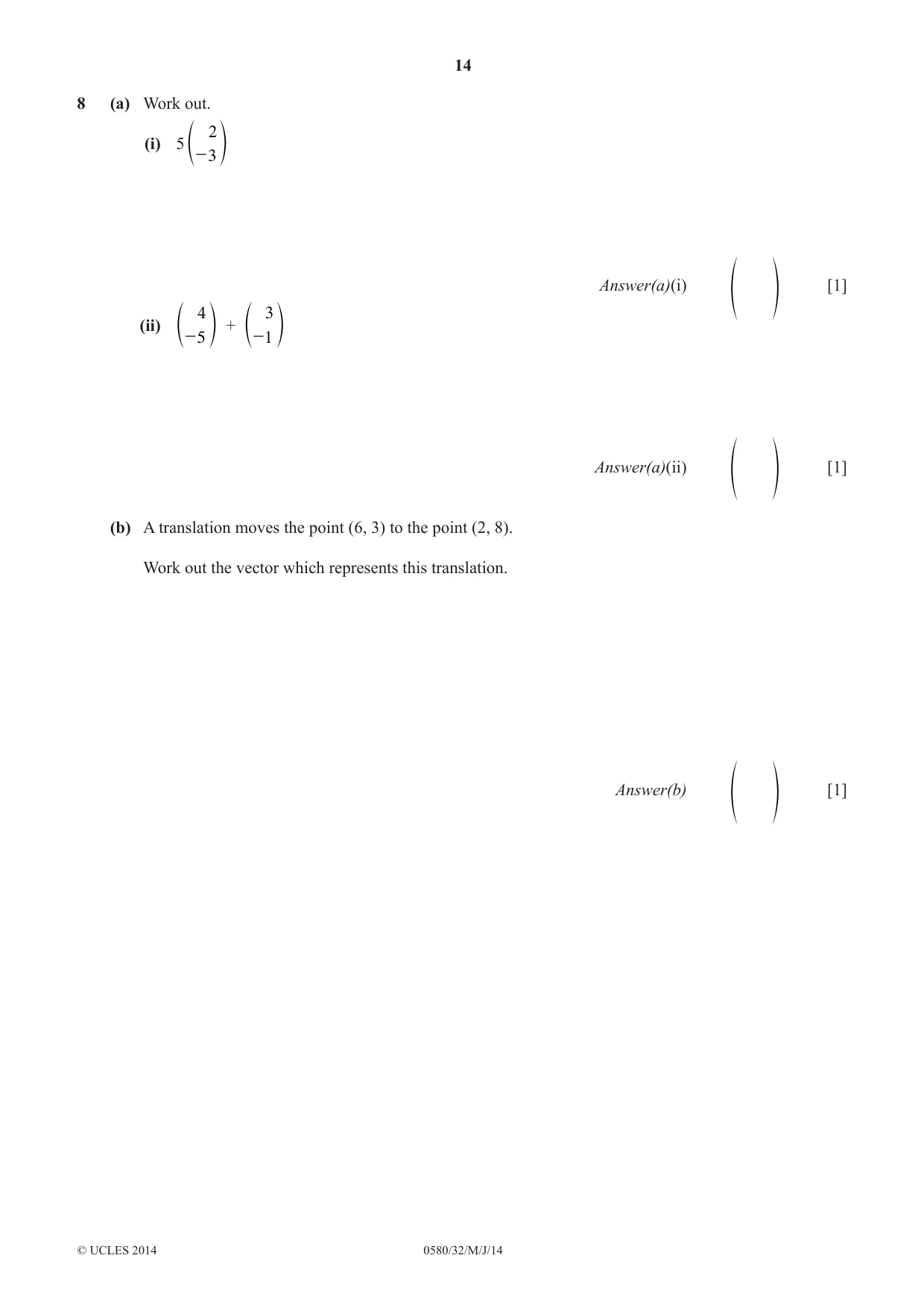
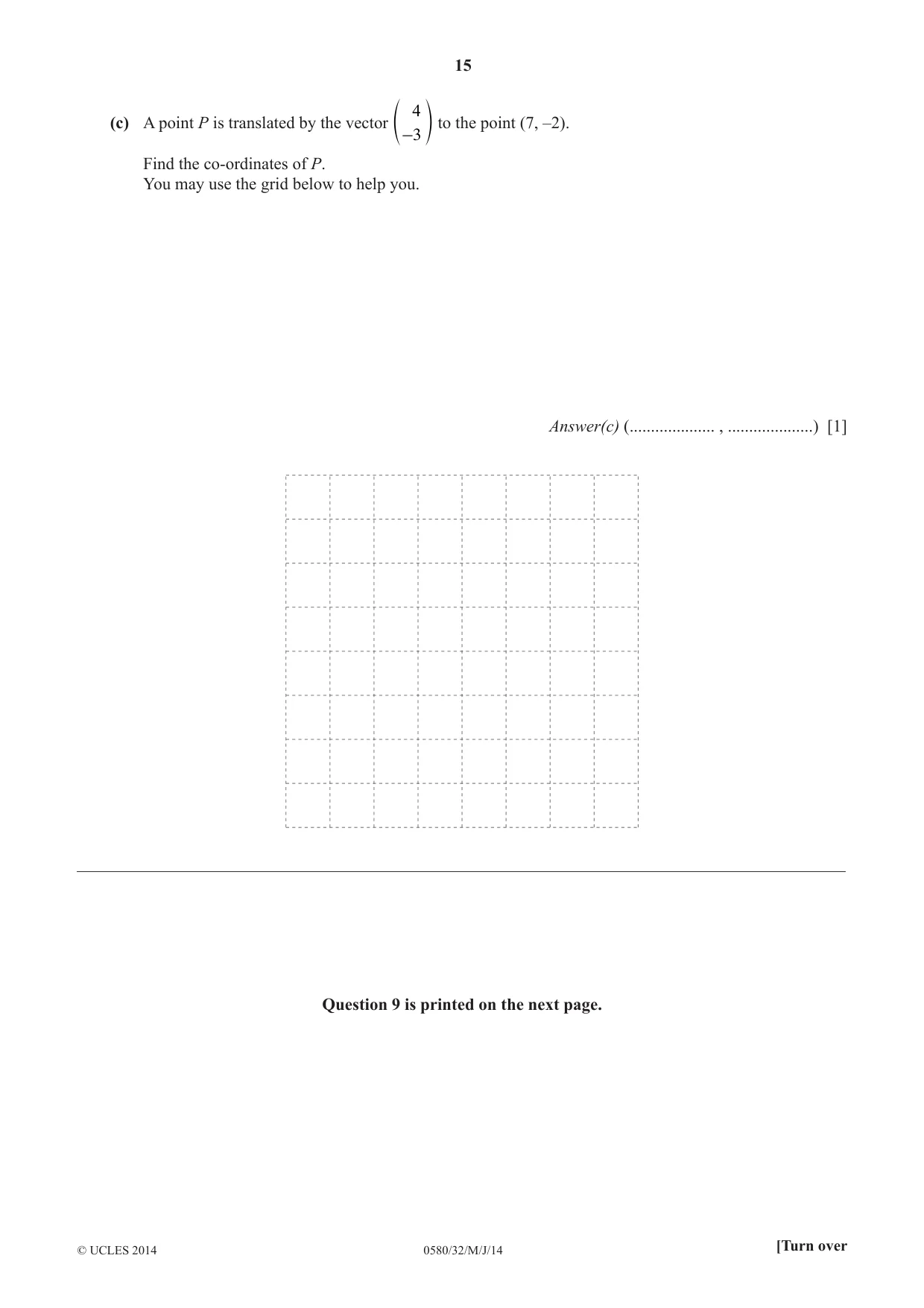
8 (a) Work out. 2 (i) 5 e-3 o Answer(a)(i) [1] 4 3 f p (ii) + e-5 o e-1 o Answer(a)(ii) [1] f p (b) A translation moves the point (6, 3) to the point (2, 8). Work out the vector which represents this translation. Answer(b) [1] f p 4 (c) A point P is translated by the vector to the point (7, –2). e-3 o Find the co-ordinates of P. You may use the grid below to help you. Answer(c) (.................... , ....................) [1] __________________________________________________________________________________________ Question 9 is printed on the next page.
Mark scheme: 8 10 (a) (i) 1 −15 7 (ii) 1 −6 − 4 (b) 1 5 (c) (3,1) 1
Q9 · Y 10 9 8 7 6 5 4 B 3 2 A 1 x –7 –6 –5 –4 –3 –2 –1 0 1 2 3 4 5 6 7 –1 –2 –3 –4 –5 (a) On…
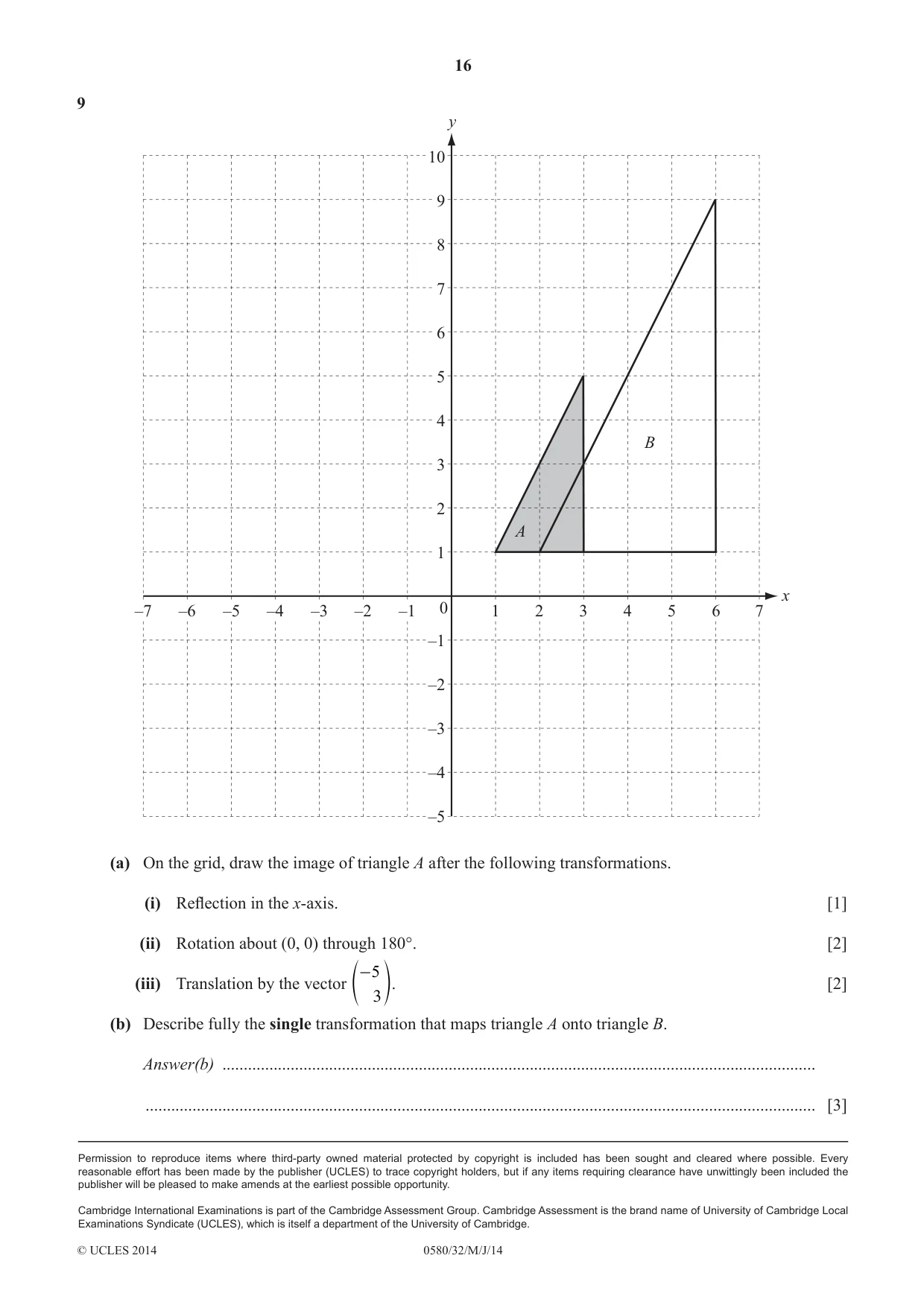
9 y 10 9 8 7 6 5 4 B 3 2 A 1 x –7 –6 –5 –4 –3 –2 –1 0 1 2 3 4 5 6 7 –1 –2 –3 –4 –5 (a) On the grid, draw the image of triangle A after the following transformations. (i) Refl ection in the x-axis. [1] (ii) Rotation about (0, 0) through 180°. [2] -5 (iii) Translation by the vector [2] e 3 o. (b) Describe fully the single transformation that maps triangle A onto triangle B. Answer(b) ........................................................................................................................................... ............................................................................................................................................................. [3]
Mark scheme: 9 (a) (i) correct reflection at (1,–1), 1 (3,–1) and (3,–5) (ii) correct rotation at (–1,–1), 2 SC1 for correct rotation any centre (–3,–1) and (–3,–5) (iii) correct translation at (–4,4), 2 B1 for one direction correct, i.e. 5 left or 3 up (–2,4) and (–2,8) (b) enlargement 1 [ centre ] (0,1) 1 [ scale factor] 2 1
What was in this paper
The subtopics covered by these 9 questions, and how many questions each got. Open one in a new tab to see every Cambridge question on it.
What you needed in this session
Cambridge’s own grade thresholds for 2014 May/June, Paper 3 · Variant 2. A higher threshold means an easier paper — the bar moves with how the cohort did.