Cambridge IGCSE Mathematics 0580 — 2014 May/June Paper 2 · Variant 2
0580/22/M/J/14 · 7 questions · 70 marks · ≈79 min
The question paper and its mark scheme, free to read here and free to download. This is Cambridge’s own paper, exactly as it was sat.
Question paper12 pages
Mark scheme5 pages
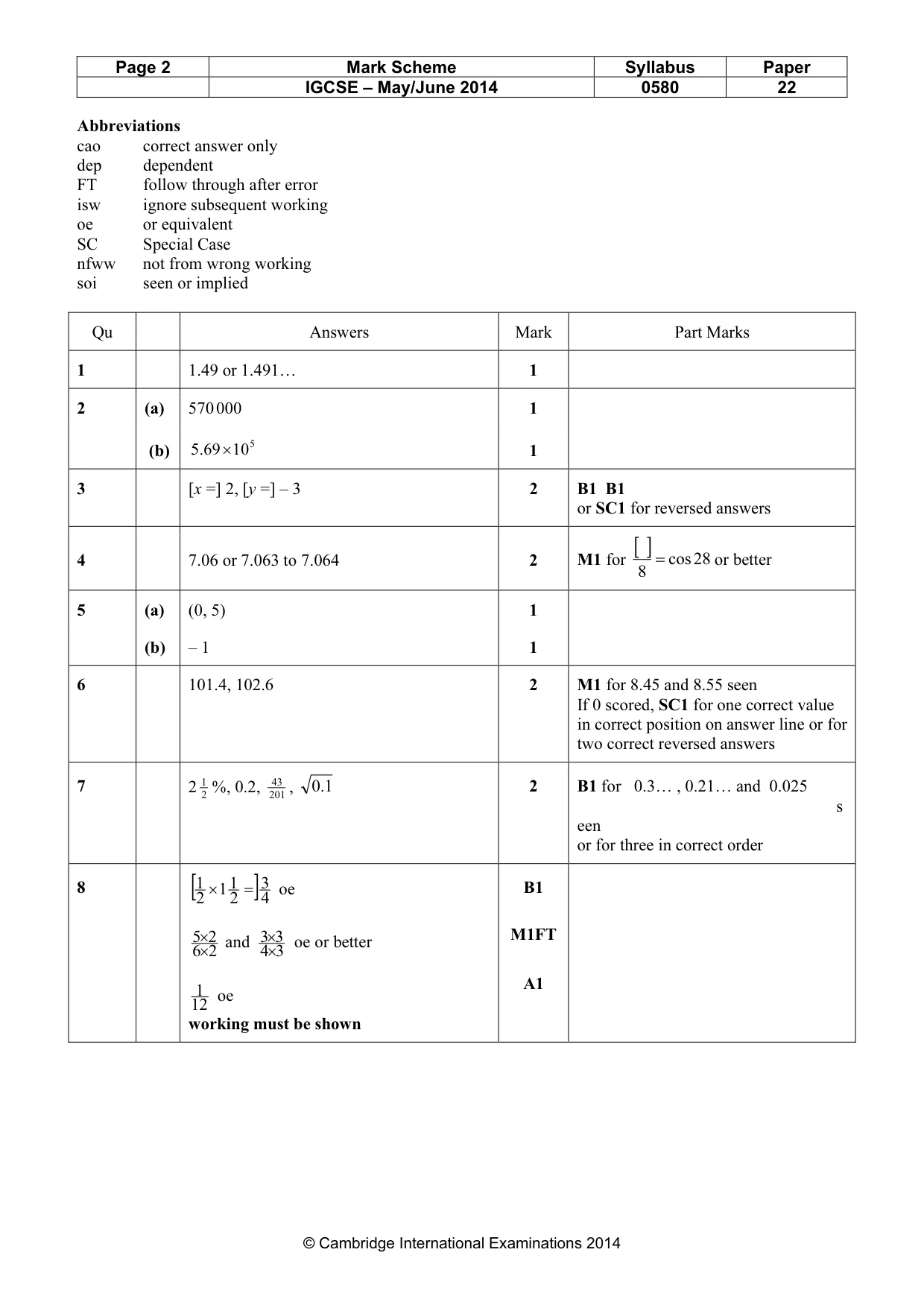
Answers below. Sit the paper first if you are practising.
Questions as text
Question 16
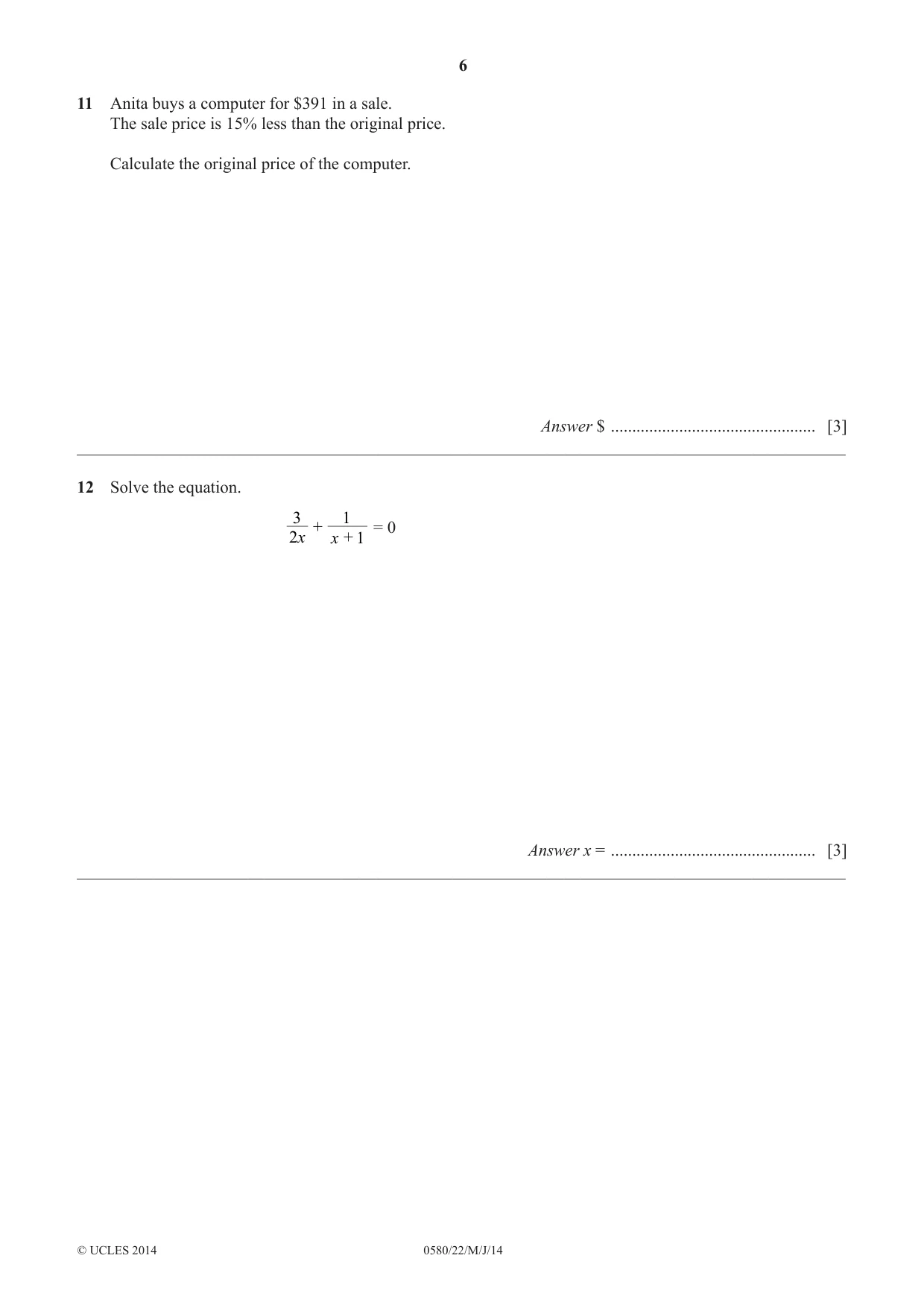
16 Factorise completely. (a) 4p2q – 6pq2 Answer(a) ................................................ [2] (b) u + 4t + ux + 4tx Answer(b) ................................................ [2] __________________________________________________________________________________________
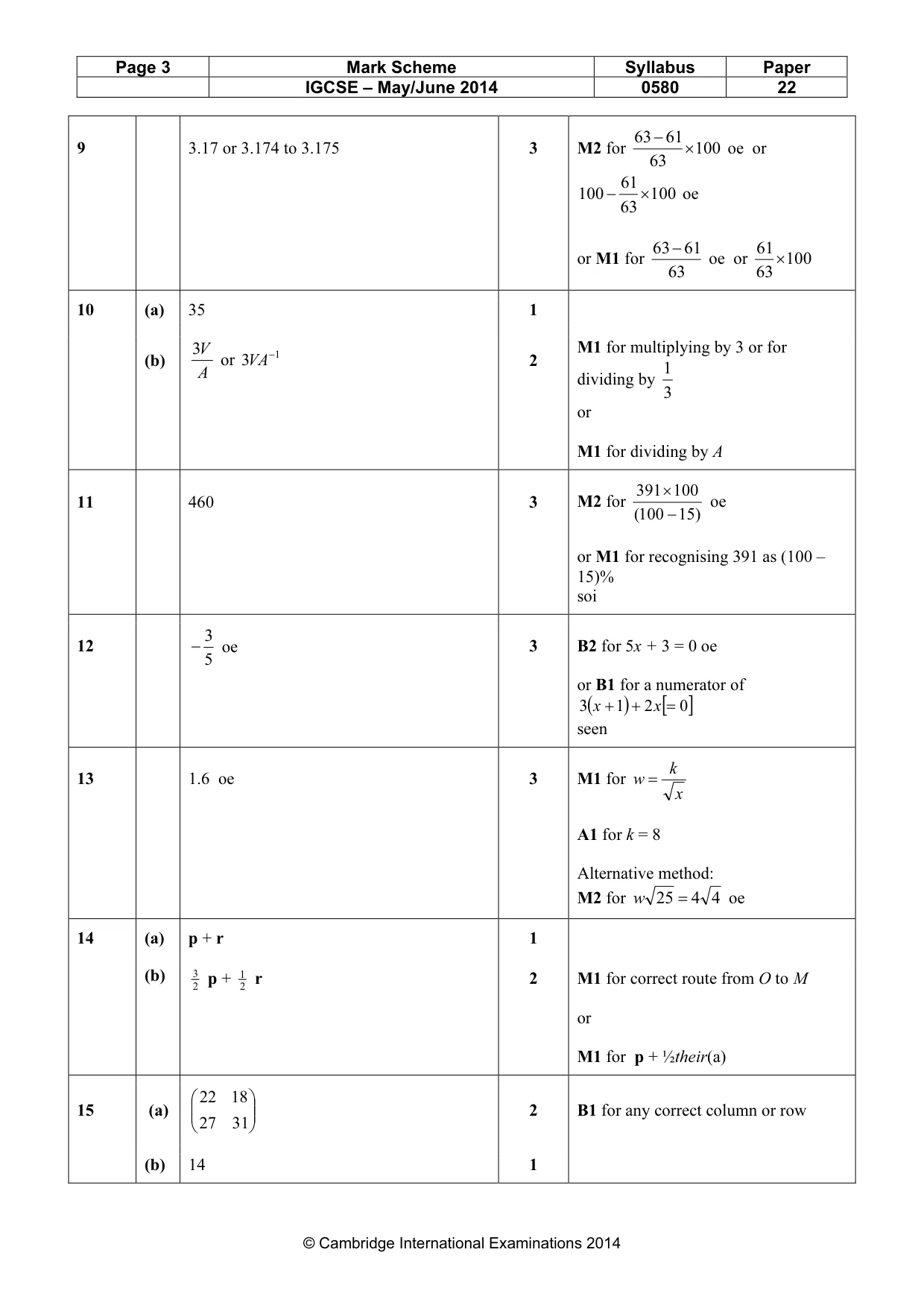
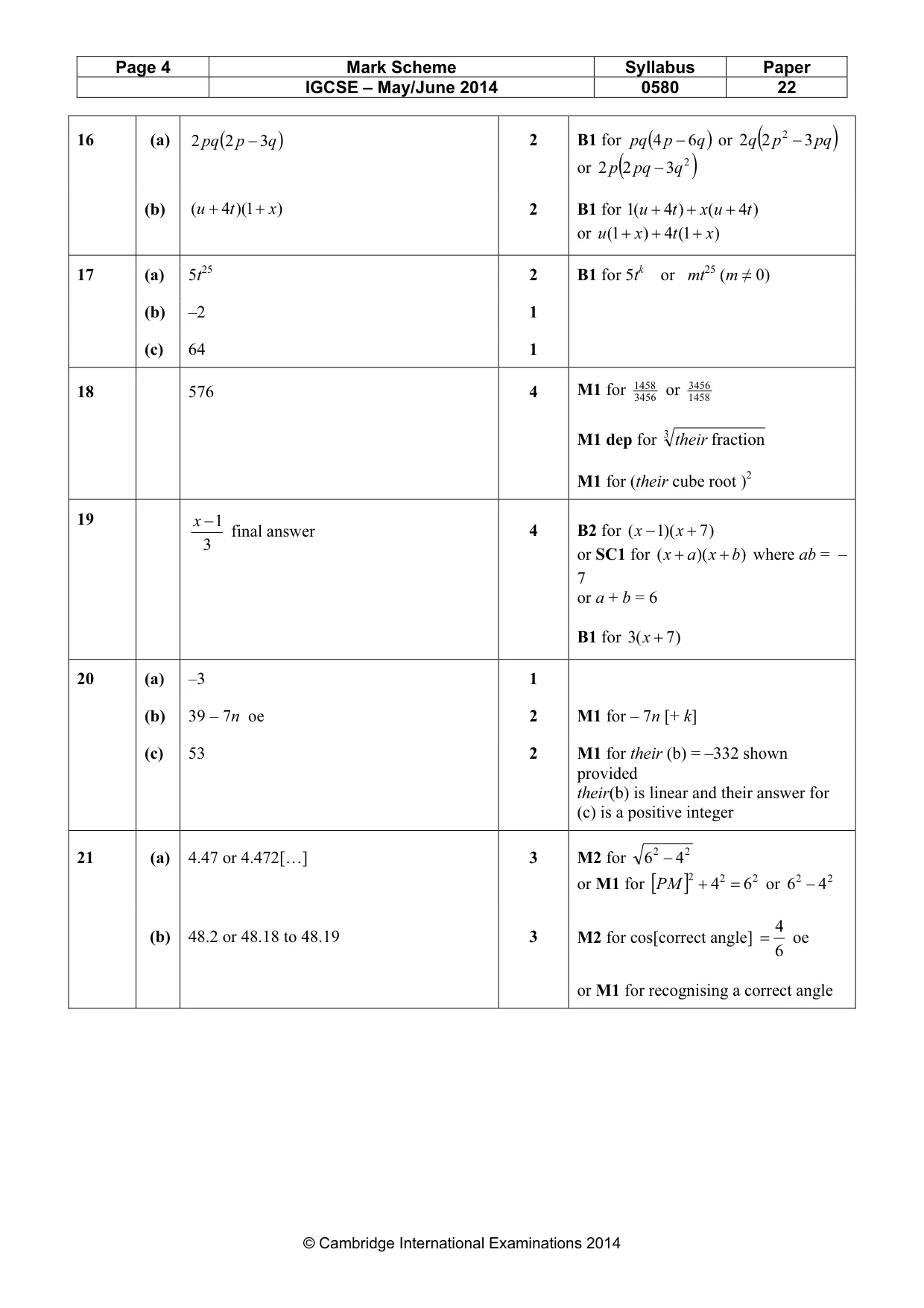
Mark scheme: 16 (a) 2 pq (2 p − 3q ) 2 B1 for pq (4 p − 6 q ) or 2 q (2 p 2 − 3 pq ) 2 or 2 p (2 pq − 3q ) (b) (u + 4t )(1 + x ) 2 B1 for (1u + 4t ) + x (u + 4t ) or u 1( + x ) + 4t 1( + x ) 25 k 25
Q17 · Simplify (3125t 125) 5
17 (a) Simplify (3125t 125) 5. Answer(a) ................................................ [2] p 1 (b) Find the value of p when 3 = . 9 Answer(b) p = ................................................ [1] (c) Find the value of w when x72 ÷ xw = x8. Answer(c) w = ................................................ [1] __________________________________________________________________________________________
Mark scheme: 17 (a) 5t25 2 B1 for 5tk or mt25 (m ≠ 0) (b) –2 1 (c) 64 1 M1 f 1458 3456
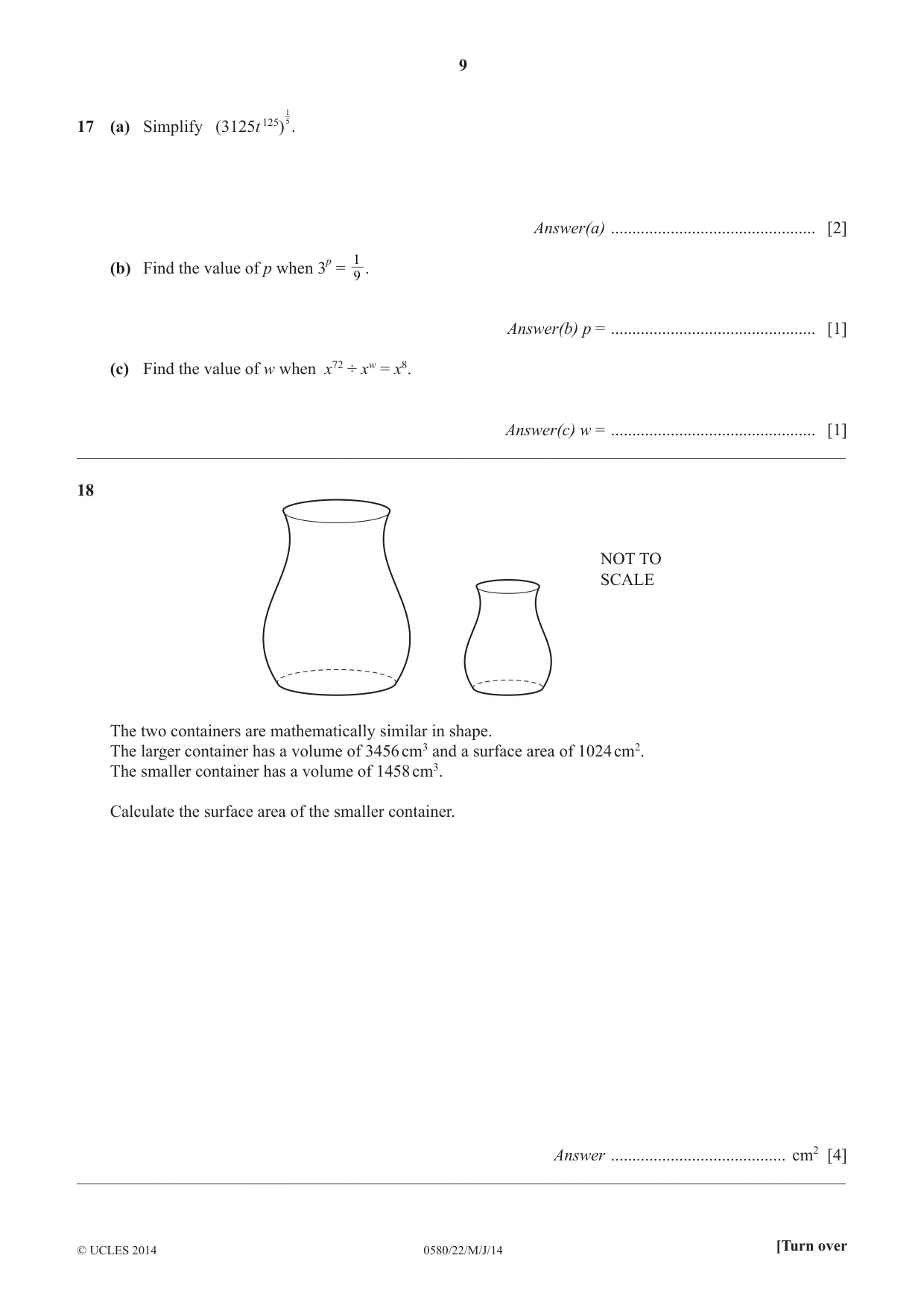
Q18 · NOT TO SCALE The two containers are mathematically similar in shape
18 NOT TO SCALE The two containers are mathematically similar in shape. The larger container has a volume of 3456 cm3 and a surface area of 1024 cm2. The smaller container has a volume of 1458 cm3. Calculate the surface area of the smaller container. Answer ......................................... cm2 [4] __________________________________________________________________________________________
Mark scheme: 18 576 4 M1 for 14583456 or 14583456 M1 dep for 3 their fraction M1 for (their cube root )2
Question 19
19 Simplify. x2 + 6 x - 7 3x + 21 Answer ................................................ [4] __________________________________________________________________________________________
Mark scheme: 19 x − 1 final answer 4 B2 for ( x − 1)( x + 7 ) 3 or SC1 for ( x + a )( x + b ) where ab = – 7 or a + b = 6 B1 for 3( x + 7 )
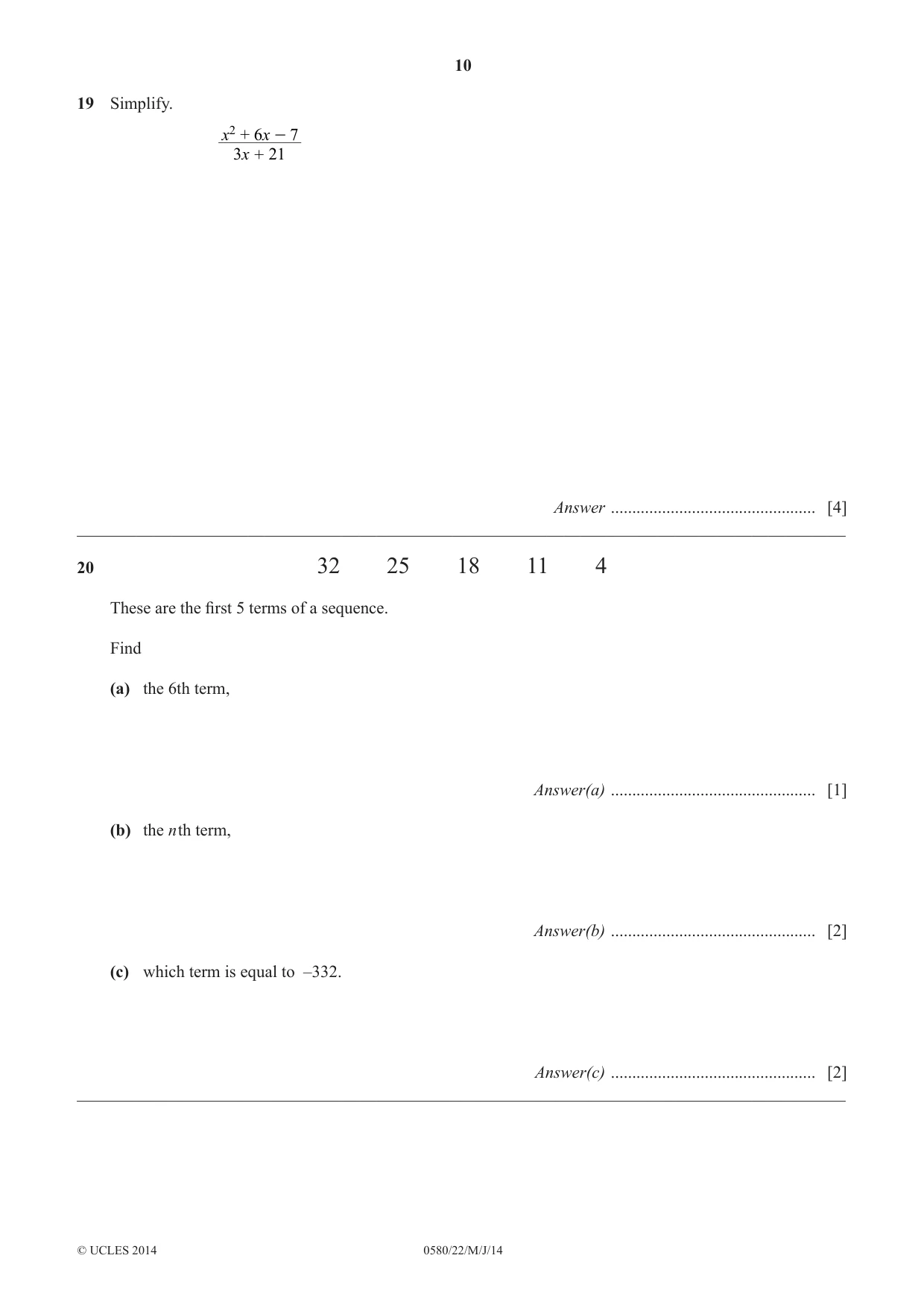
Q20 · 32 25 18 11 4 These are the fi rst 5 terms of a sequence
20 32 25 18 11 4 These are the fi rst 5 terms of a sequence. Find (a) the 6th term, Answer(a) ................................................ [1] (b) the n th term, Answer(b) ................................................ [2] (c) which term is equal to –332. Answer(c) ................................................ [2] __________________________________________________________________________________________
Mark scheme: 20 (a) –3 1 (b) 39 – 7n oe 2 M1 for – 7n [+ k] (c) 53 2 M1 for their (b) = –332 shown provided their(b) is linear and their answer for (c) is a positive integer 2 2
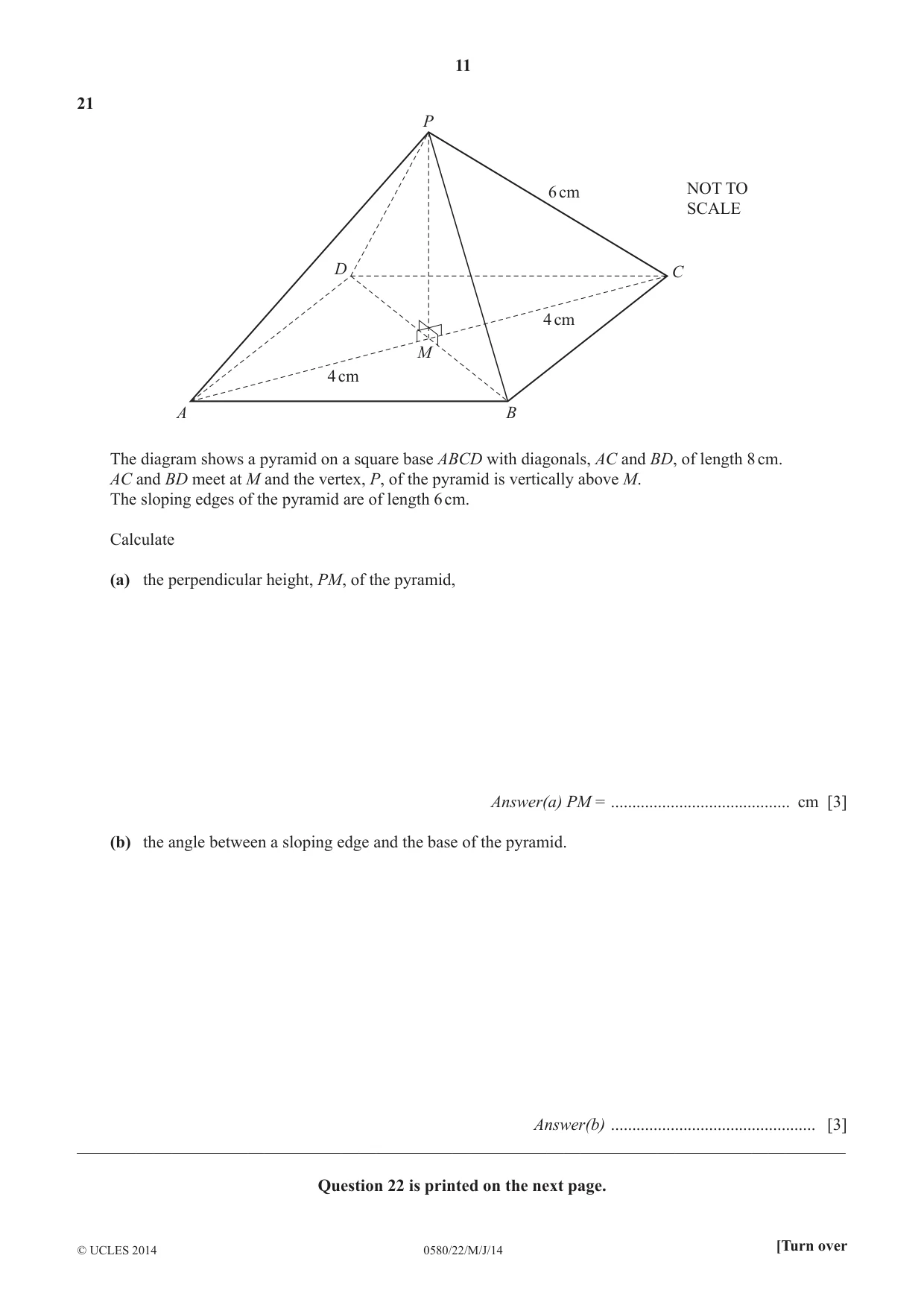
Q21 · P 6 cm NOT TO SCALE D C 4 cm M 4 cm A B The diagram shows a pyramid on a square base ABCD…
21 P 6 cm NOT TO SCALE D C 4 cm M 4 cm A B The diagram shows a pyramid on a square base ABCD with diagonals, AC and BD, of length 8 cm. AC and BD meet at M and the vertex, P, of the pyramid is vertically above M. The sloping edges of the pyramid are of length 6 cm. Calculate (a) the perpendicular height, PM, of the pyramid, Answer(a) PM = .......................................... cm [3] (b) the angle between a sloping edge and the base of the pyramid. Answer(b) ................................................ [3] __________________________________________________________________________________________ Question 22 is printed on the next page.
Mark scheme: 21 (a) 4.47 or 4.472[…] 3 M2 for 6 2 − 4 2 or M1 for [PM ]2 + 4 2 = 6 2 or 6 2 − 4 2 4 (b) 48.2 or 48.18 to 48.19 3 M2 for cos[correct angle] = oe 6 or M1 for recognising a correct angle Page 5 MMarrk SSccheemee Sylllabbuss Papeer IGC SEE – M ay//Juunee 2014 055800 222
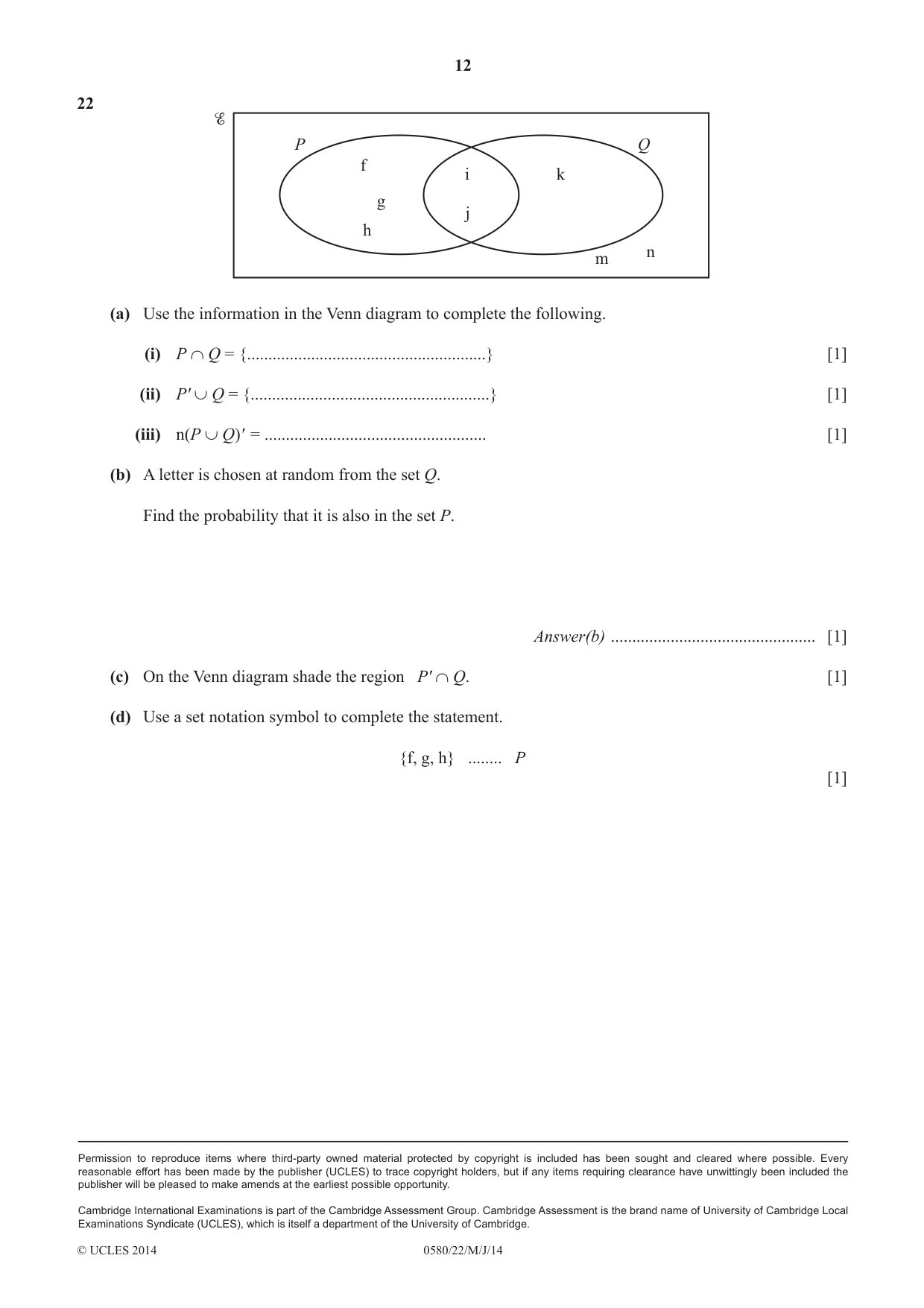
Q22 · P Q f i k g j h n m (a) Use the information in the Venn diagram to complete the following
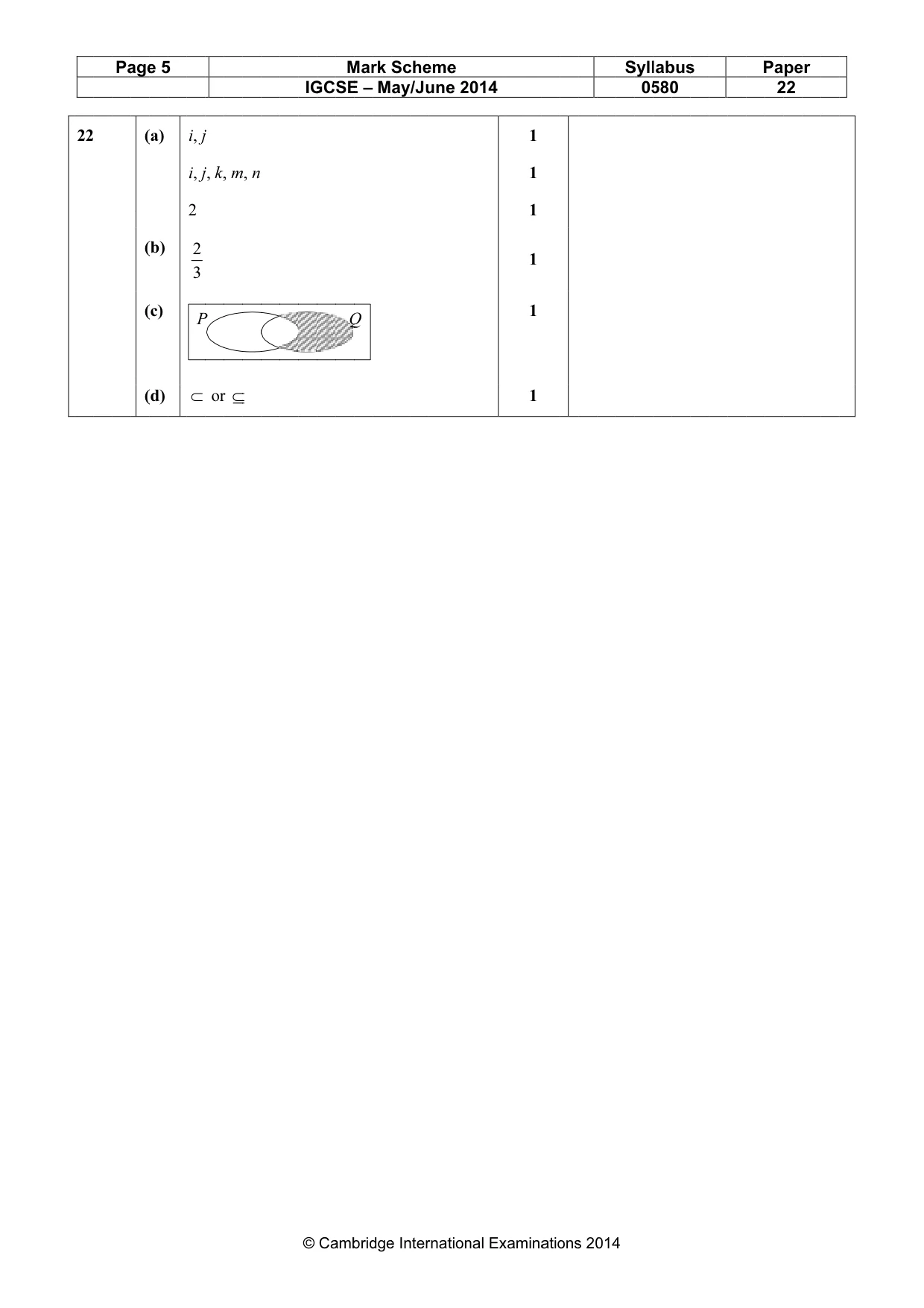
22 P Q f i k g j h n m (a) Use the information in the Venn diagram to complete the following. (i) P ∩ Q = {........................................................} [1] (ii) P' ∪ Q = {........................................................} [1] (iii) n(P ∪ Q)' = .................................................... [1] (b) A letter is chosen at random from the set Q. Find the probability that it is also in the set P. Answer(b) ................................................ [1] (c) On the Venn diagram shade the region P' ∩ Q. [1] (d) Use a set notation symbol to complete the statement. {f, g, h} ........ P [1]
Mark scheme: 22 ((a) i, jj 1 i, jj, k,, mm, n 1 ( 2 1 ((b) 2 1 3 ((c) 1 PP Q ((d) ⊂ orr ⊆⊆ 1
What was in this paper
The subtopics covered by these 7 questions, and how many questions each got. Open one in a new tab to see every Cambridge question on it.
What you needed in this session
Cambridge’s own grade thresholds for 2014 May/June, Paper 2 · Variant 2. A higher threshold means an easier paper — the bar moves with how the cohort did.