Cambridge IGCSE Mathematics 0580 — 2013 May/June Paper 3 · Variant 1
0580/31/M/J/13 · 11 questions · 104 marks · ≈117 min
The question paper and its mark scheme, free to read here and free to download. This is Cambridge’s own paper, exactly as it was sat.
Question paper20 pages
Mark scheme5 pages
Answers below. Sit the paper first if you are practising.
Questions as text
Q1 · On a map, the height of Hillibar Station is 1047 m and the height of Sular Junction is…
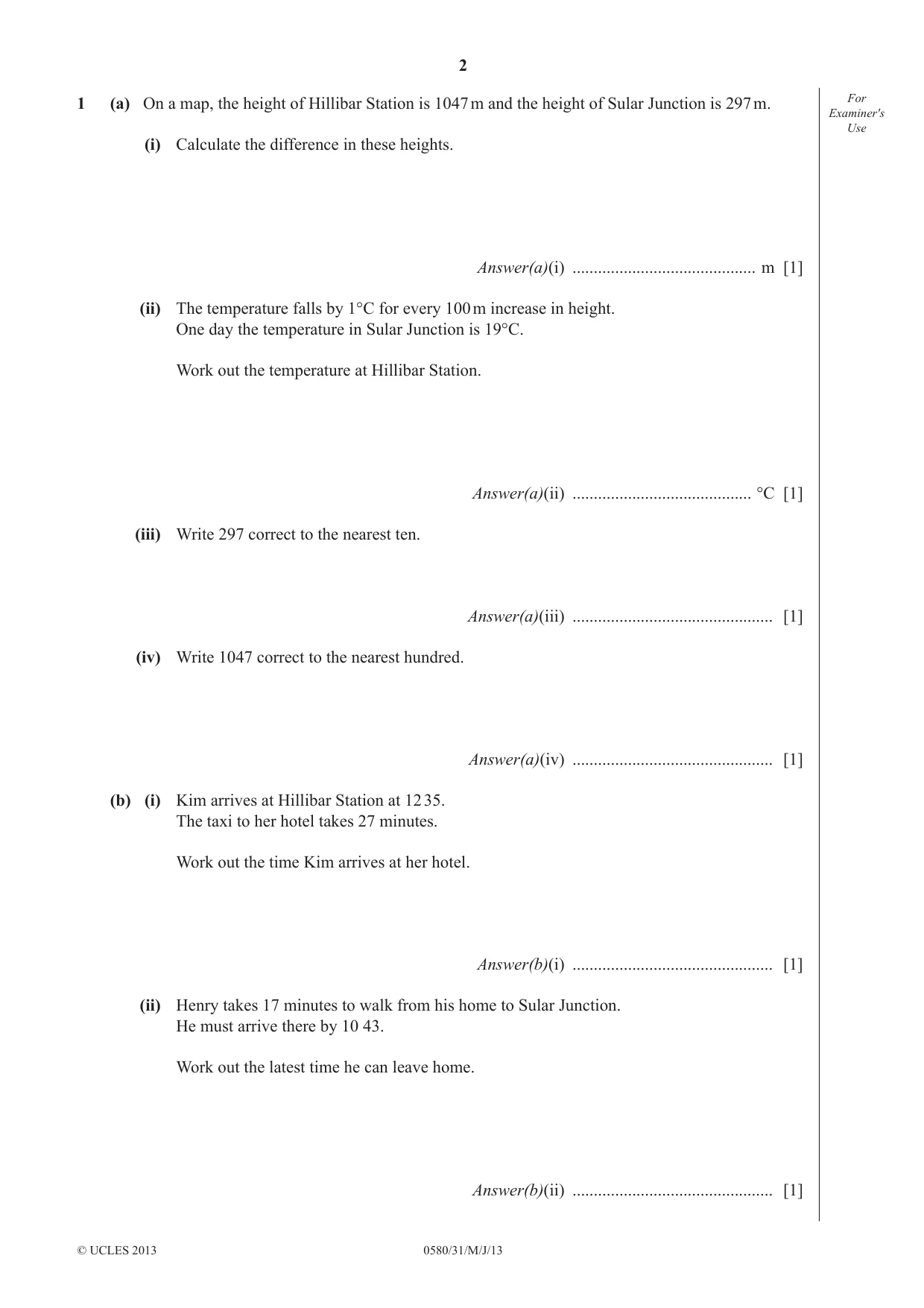
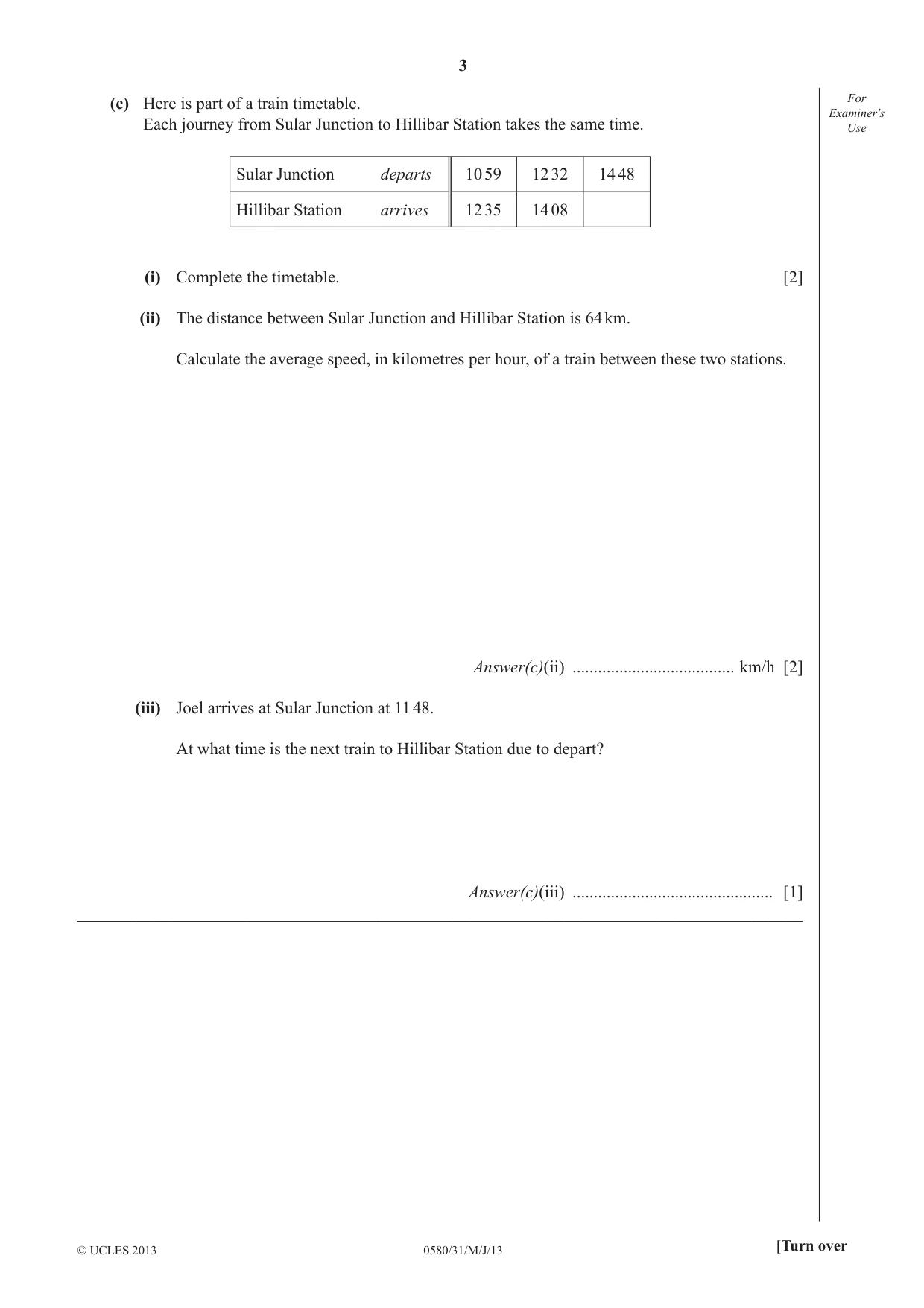
1 (a) On a map, the height of Hillibar Station is 1047 m and the height of Sular Junction is 297 m. For Examiner′s Use (i) Calculate the difference in these heights. Answer(a)(i) ........................................... m [1] (ii) The temperature falls by 1°C for every 100 m increase in height. One day the temperature in Sular Junction is 19°C. Work out the temperature at Hillibar Station. Answer(a)(ii) .......................................... °C [1] (iii) Write 297 correct to the nearest ten. Answer(a)(iii) ............................................... [1] (iv) Write 1047 correct to the nearest hundred. Answer(a)(iv) ............................................... [1] (b) (i) Kim arrives at Hillibar Station at 12 35. The taxi to her hotel takes 27 minutes. Work out the time Kim arrives at her hotel. Answer(b)(i) ............................................... [1] (ii) Henry takes 17 minutes to walk from his home to Sular Junction. He must arrive there by 10 43. Work out the latest time he can leave home. Answer(b)(ii) ............................................... [1] (c) Here is part of a train timetable. For Examiner′s Each journey from Sular Junction to Hillibar Station takes the same time. Use Sular Junction departs 10 59 12 32 14 48 Hillibar Station arrives 12 35 14 08 (i) Complete the timetable. [2] (ii) The distance between Sular Junction and Hillibar Station is 64 km. Calculate the average speed, in kilometres per hour, of a train between these two stations. Answer(c)(ii) ...................................... km/h [2] (iii) Joel arrives at Sular Junction at 11 48. At what time is the next train to Hillibar Station due to depart? Answer(c)(iii) ............................................... [1] _____________________________________________________________________________________
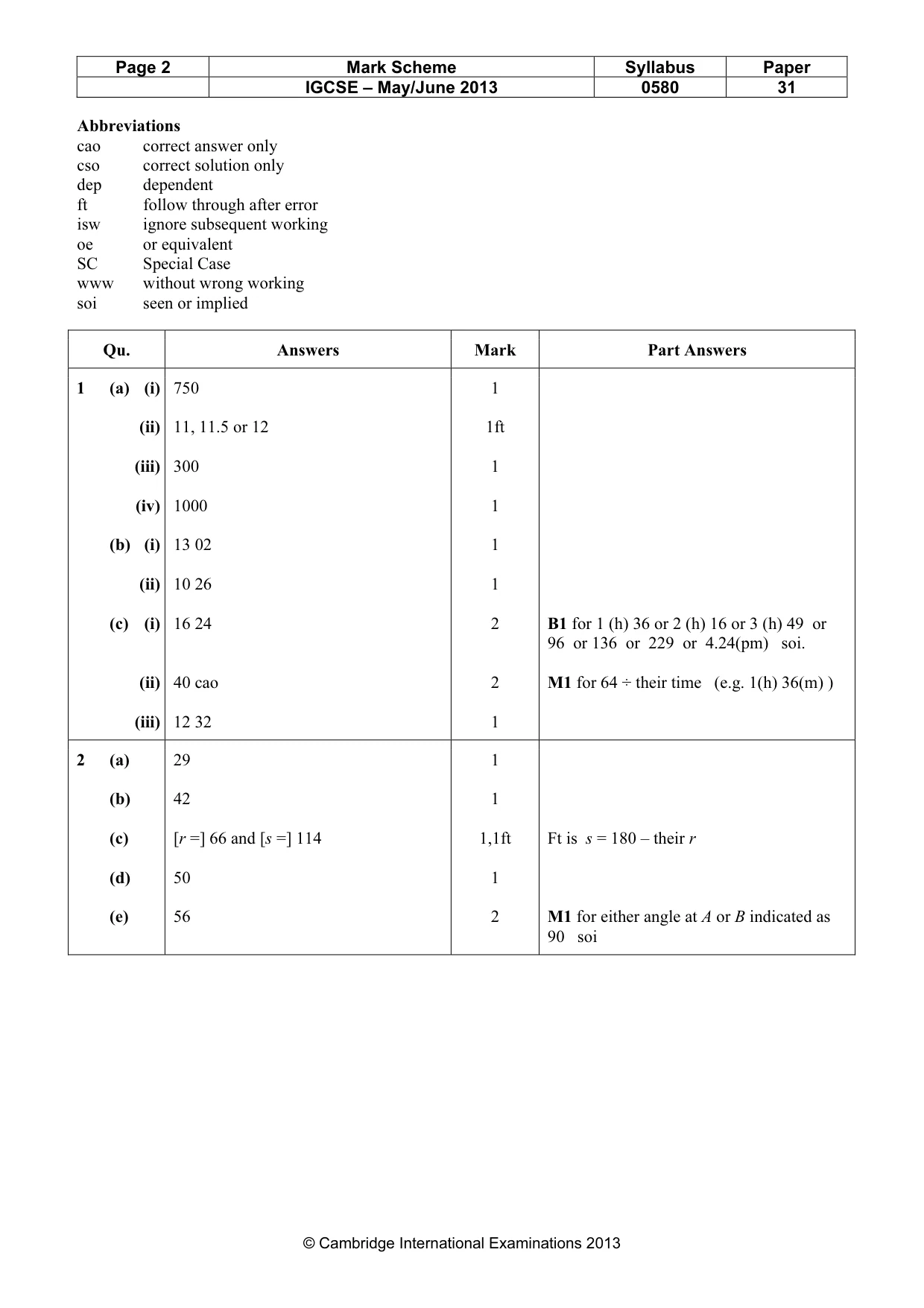
Mark scheme: Qu. Answers Mark Part Answers 1 (a) (i) 750 1 (ii) 11, 11.5 or 12 1ft (iii) 300 1 (iv) 1000 1 (b) (i) 13 02 1 (ii) 10 26 1 (c) (i) 16 24 2 B1 for 1 (h) 36 or 2 (h) 16 or 3 (h) 49 or 96 or 136 or 229 or 4.24(pm) soi. (ii) 40 cao 2 M1 for 64 ÷ their time (e.g. 1(h) 36(m) ) (iii) 12 32 1
Q2 · For Examiner′s NOT TO Use SCALE 108° 43° p° A B AB is a straight line
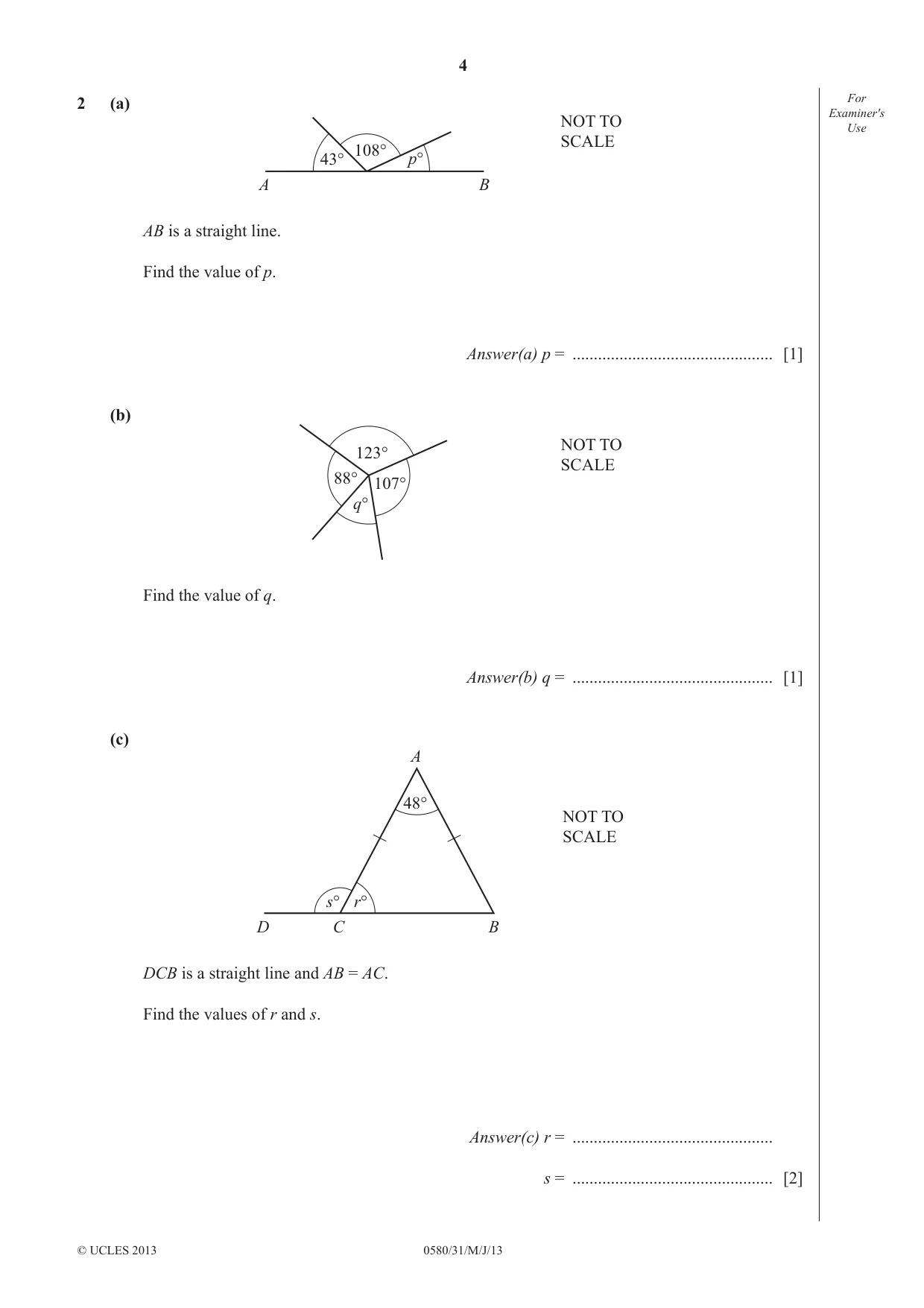
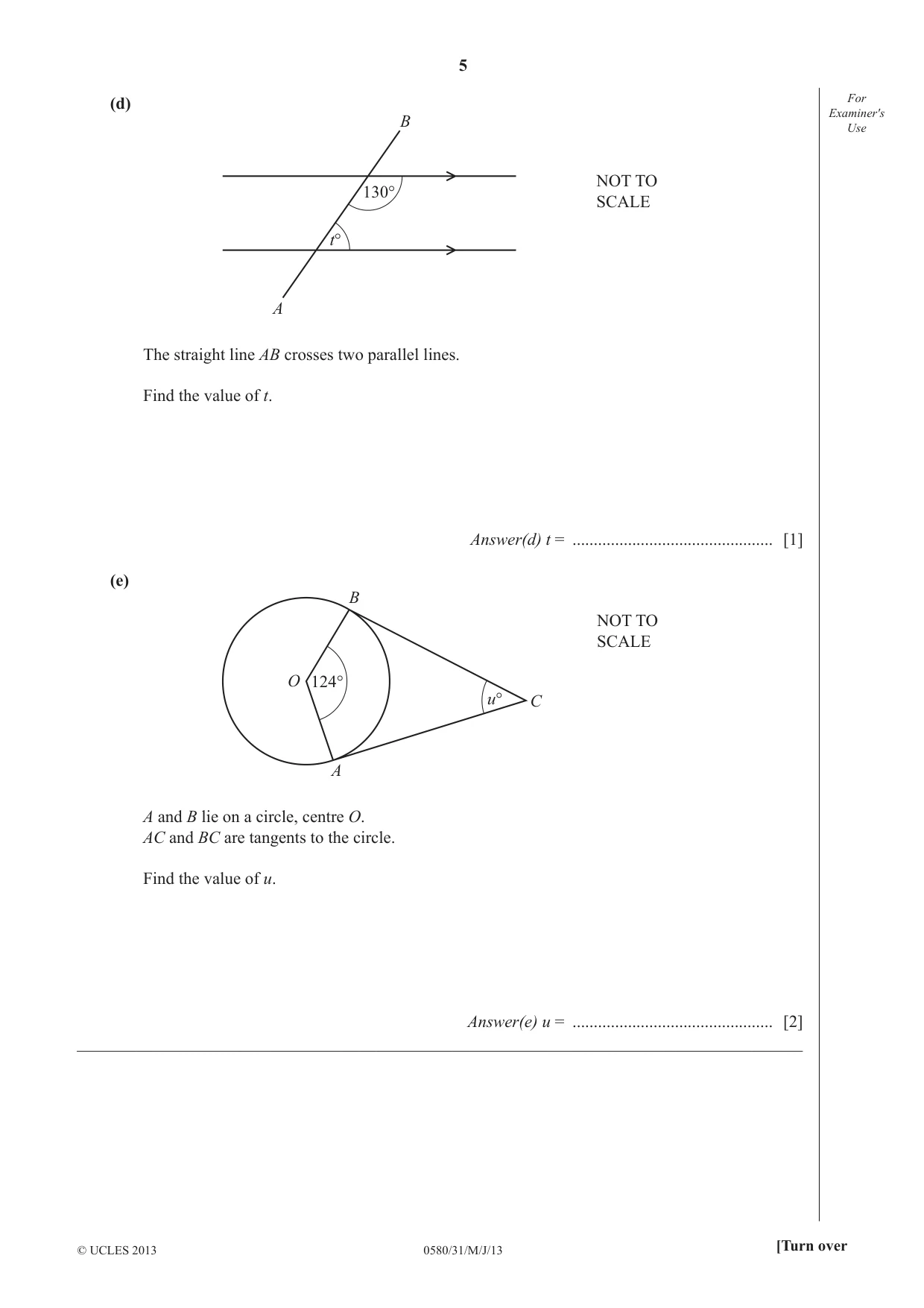
2 (a) For Examiner′s NOT TO Use SCALE 108° 43° p° A B AB is a straight line. Find the value of p. Answer(a) p = ............................................... [1] (b) NOT TO 123° SCALE 88° 107° q° Find the value of q. Answer(b) q = ............................................... [1] (c) A 48° NOT TO SCALE s° r° D C B DCB is a straight line and AB = AC. Find the values of r and s. Answer(c) r = ............................................... s = ............................................... [2] (d) For Examiner′s B Use NOT TO 130° SCALE t° A The straight line AB crosses two parallel lines. Find the value of t. Answer(d) t = ............................................... [1] (e) B NOT TO SCALE O 124° u° C A A and B lie on a circle, centre O. AC and BC are tangents to the circle. Find the value of u. Answer(e) u = ............................................... [2] _____________________________________________________________________________________
Mark scheme: 2 (a) 29 1 (b) 42 1 (c) [r =] 66 and [s =] 114 1,1ft Ft is s = 180 – their r (d) 50 1 (e) 56 2 M1 for either angle at A or B indicated as 90 soi IGCSE – May/June 2013 0580 31
Q3 · On each of the following shapes draw any lines of symmetry
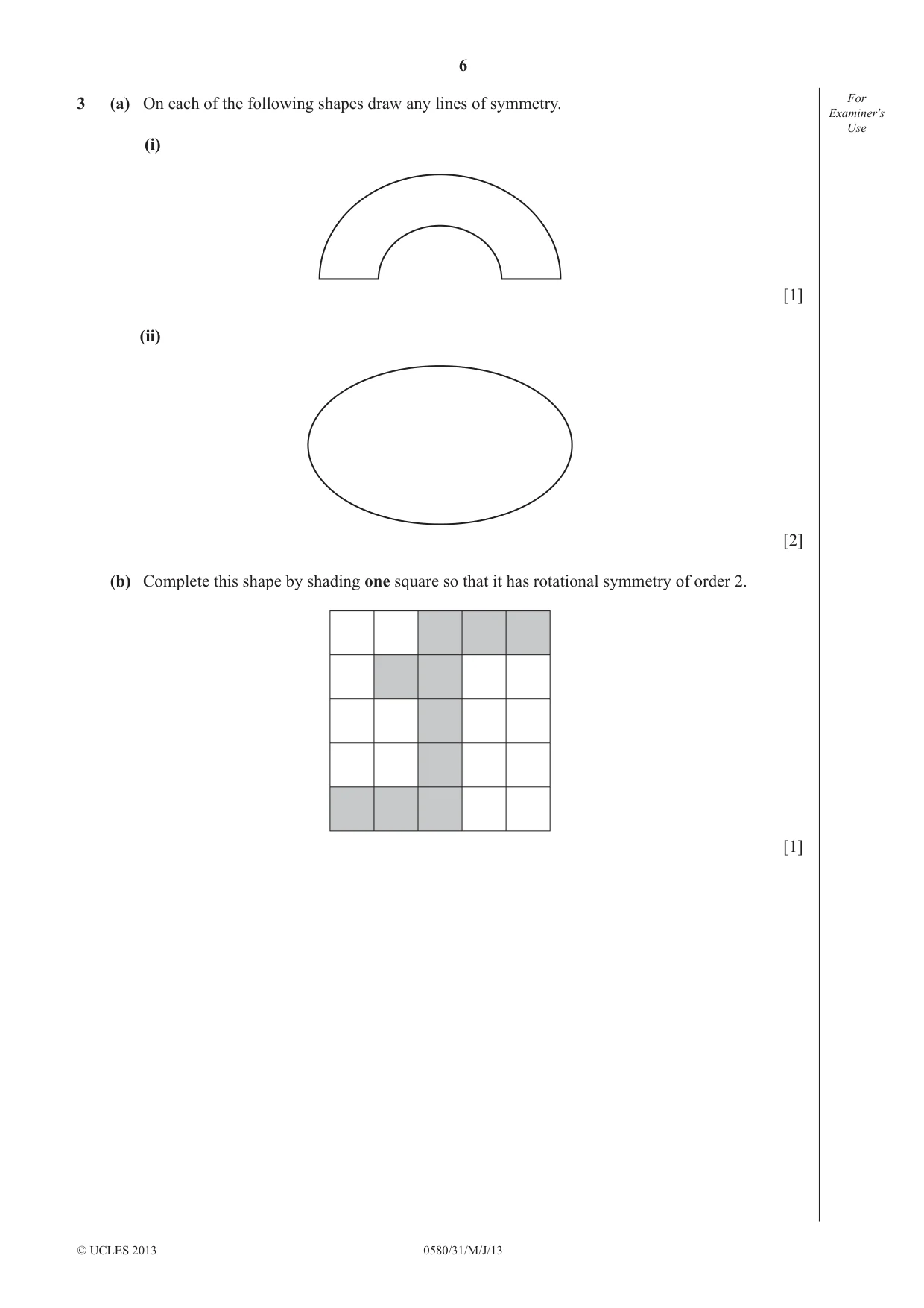
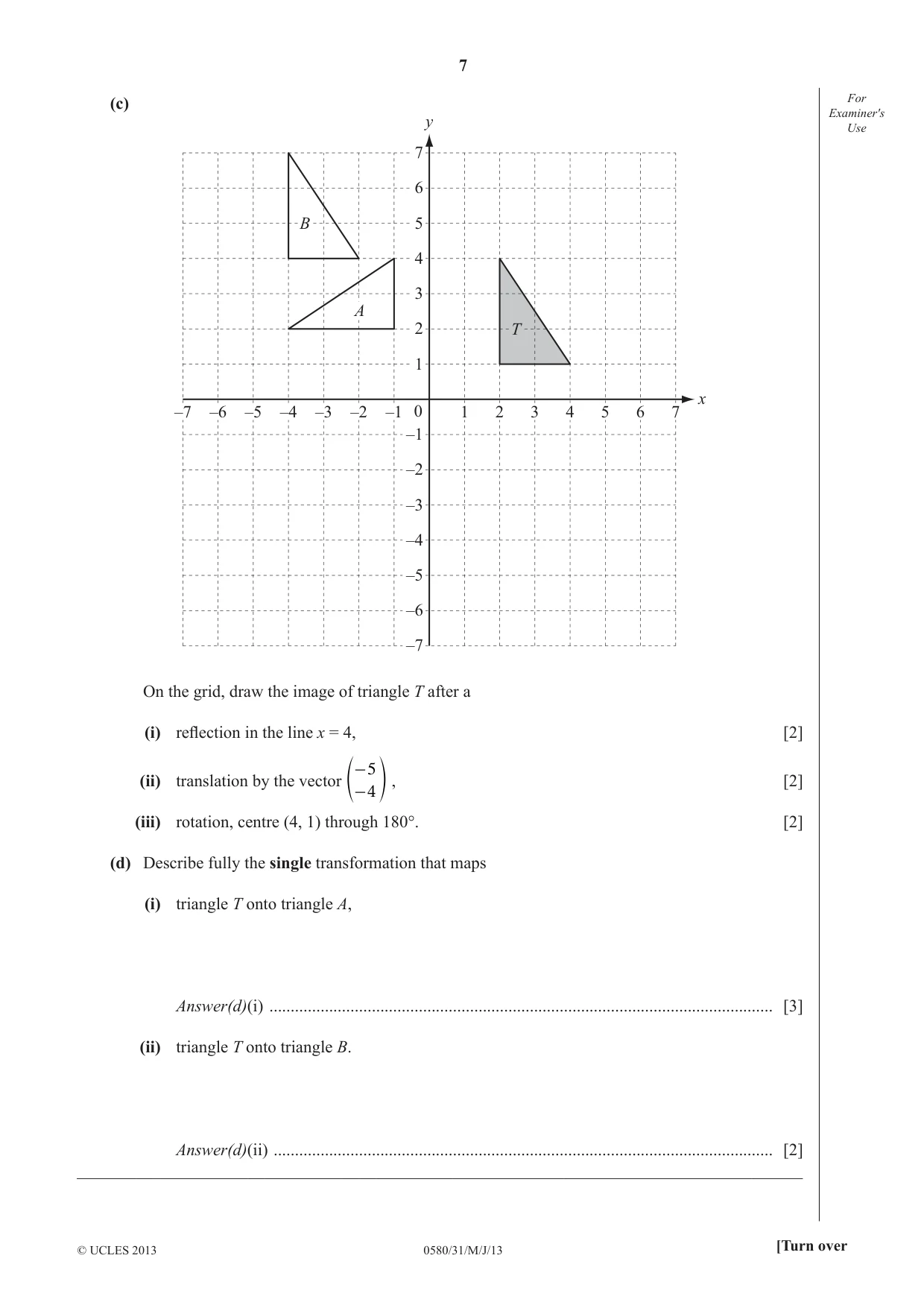
3 (a) On each of the following shapes draw any lines of symmetry. For Examiner′s Use (i) [1] (ii) [2] (b) Complete this shape by shading one square so that it has rotational symmetry of order 2. [1] (c) For Examiner′s y Use 7 6 B 5 4 3 A 2 T 1 x –7 –6 –5 –4 –3 –2 –1 0 1 2 3 4 5 6 7 –1 –2 –3 –4 –5 –6 –7 On the grid, draw the image of triangle T after a (i) refl ection in the line x = 4, [2] -5 (ii) translation by the vector , [2] -4 e o (iii) rotation, centre (4, 1) through 180°. [2] (d) Describe fully the single transformation that maps (i) triangle T onto triangle A, Answer(d)(i) ...................................................................................................................... [3] (ii) triangle T onto triangle B. Answer(d)(ii) ..................................................................................................................... [2] _____________________________________________________________________________________
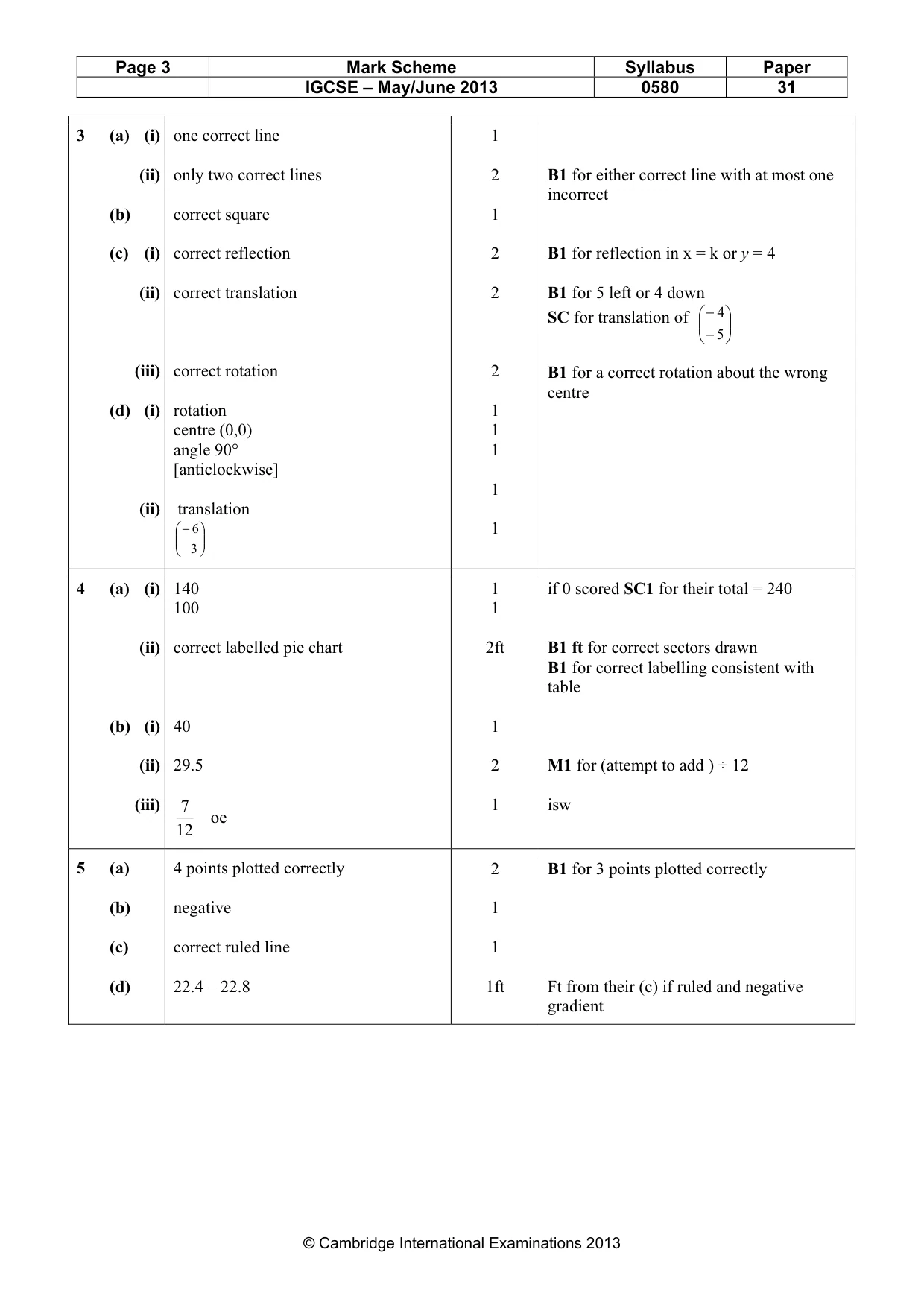
Mark scheme: 3 (a) (i) one correct line 1 (ii) only two correct lines 2 B1 for either correct line with at most one incorrect (b) correct square 1 (c) (i) correct reflection 2 B1 for reflection in x = k or y = 4 (ii) correct translation 2 B1 for 5 left or 4 down − 4 SC for translation of − 5 (iii) correct rotation 2 B1 for a correct rotation about the wrong centre (d) (i) rotation 1 centre (0,0) 1 angle 90° 1 [anticlockwise] 1 (ii) translation − 6 1 3
Q4 · The table shows a summary of the types of employment for 90 people
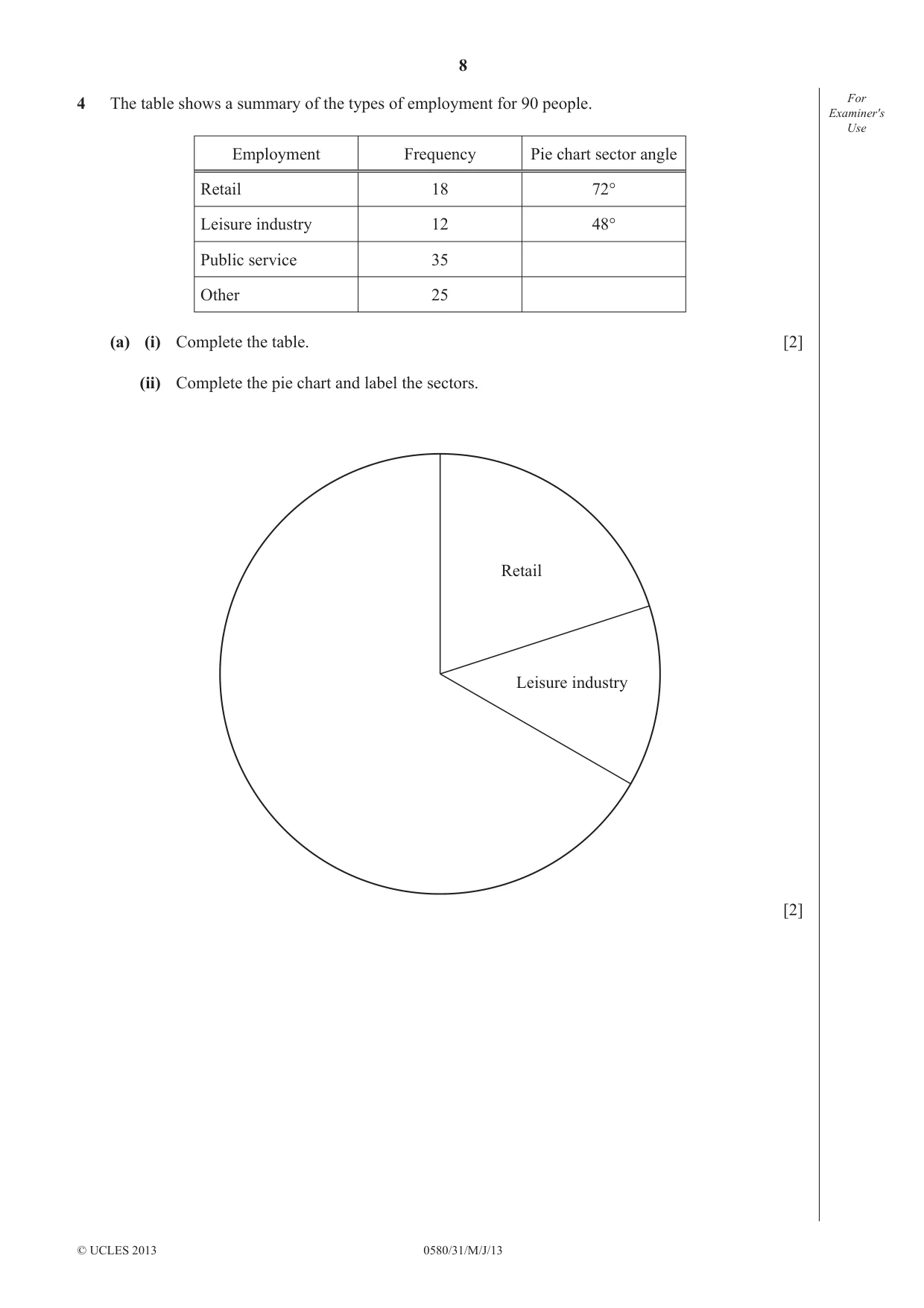
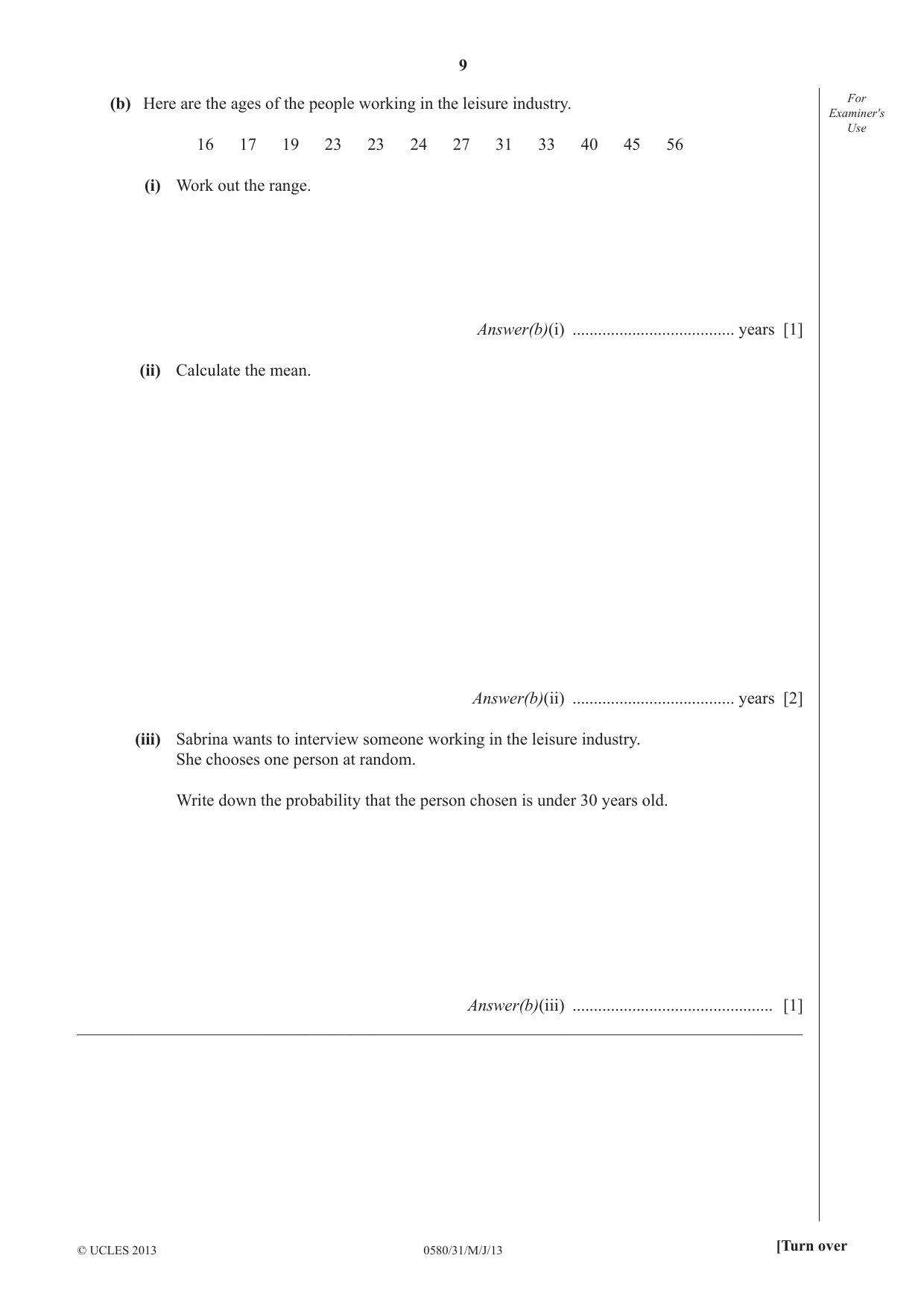
4 The table shows a summary of the types of employment for 90 people. For Examiner′s Use Employment Frequency Pie chart sector angle Retail 18 72° Leisure industry 12 48° Public service 35 Other 25 (a) (i) Complete the table. [2] (ii) Complete the pie chart and label the sectors. Retail Leisure industry [2] (b) Here are the ages of the people working in the leisure industry. For Examiner′s Use 16 17 19 23 23 24 27 31 33 40 45 56 (i) Work out the range. Answer(b)(i) ...................................... years [1] (ii) Calculate the mean. Answer(b)(ii) ...................................... years [2] (iii) Sabrina wants to interview someone working in the leisure industry. She chooses one person at random. Write down the probability that the person chosen is under 30 years old. Answer(b)(iii) ............................................... [1] _____________________________________________________________________________________
Mark scheme: 4 (a) (i) 140 1 if 0 scored SC1 for their total = 240 100 1 (ii) correct labelled pie chart 2ft B1 ft for correct sectors drawn B1 for correct labelling consistent with table (b) (i) 40 1 (ii) 29.5 2 M1 for (attempt to add ) ÷ 12 (iii) 7 1 isw oe 12
Q5 · The table shows the height, in metres, above sea-level and the temperature, in °C, at…
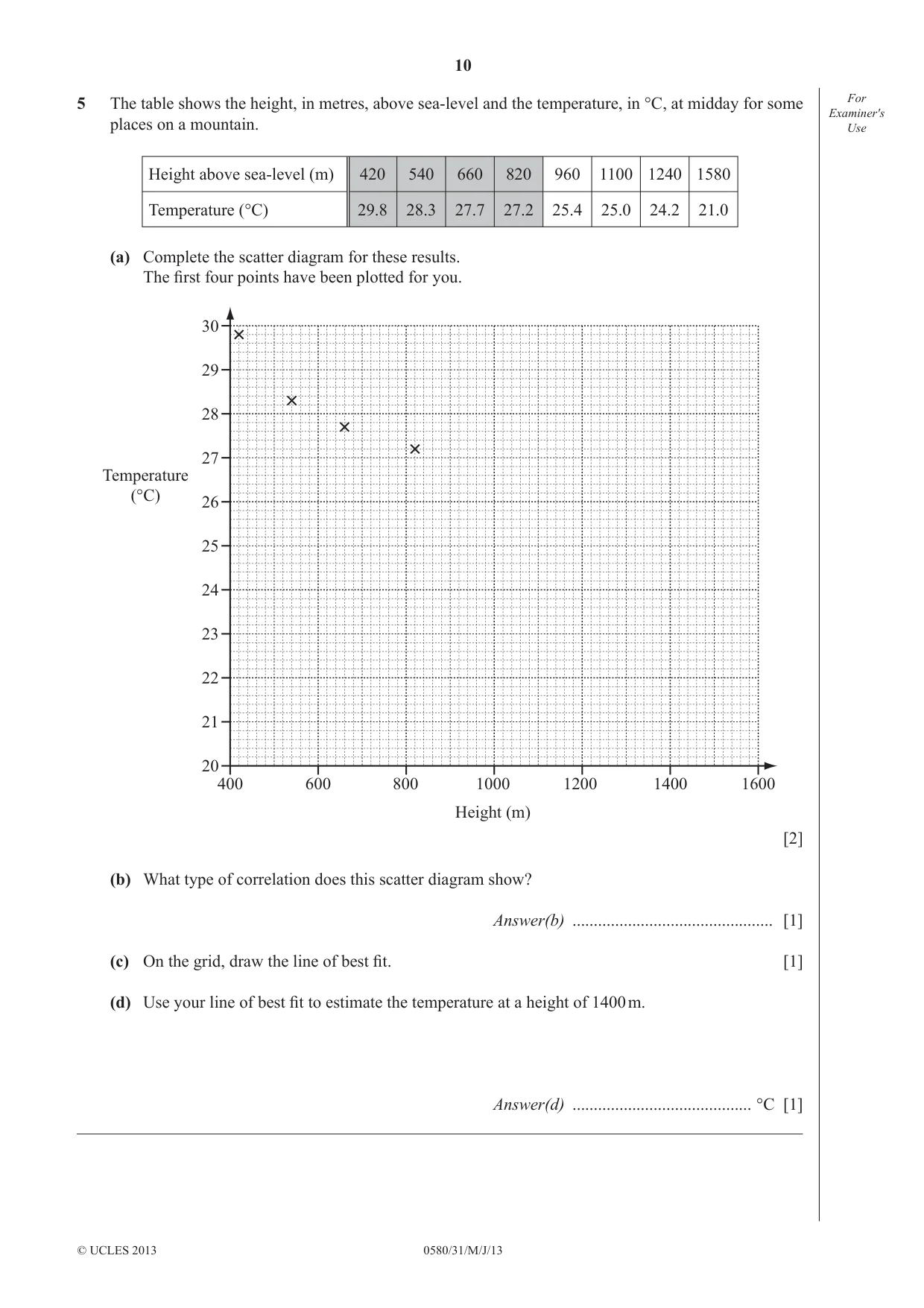
5 The table shows the height, in metres, above sea-level and the temperature, in °C, at midday for some For Examiner′s places on a mountain. Use Height above sea-level (m) 420 540 660 820 960 1100 1240 1580 Temperature (°C) 29.8 28.3 27.7 27.2 25.4 25.0 24.2 21.0 (a) Complete the scatter diagram for these results. The fi rst four points have been plotted for you. 30 29 28 27 Temperature (°C) 26 25 24 23 22 21 20 400 600 800 1000 1200 1400 1600 Height (m) [2] (b) What type of correlation does this scatter diagram show? Answer(b) ............................................... [1] (c) On the grid, draw the line of best fi t. [1] (d) Use your line of best fi t to estimate the temperature at a height of 1400 m. Answer(d) .......................................... °C [1] _____________________________________________________________________________________
Mark scheme: 5 (a) 4 points plotted correctly 2 B1 for 3 points plotted correctly (b) negative 1 (c) correct ruled line 1 (d) 22.4 – 22.8 1ft Ft from their (c) if ruled and negative gradient IGCSE – May/June 2013 0580 31
Q6 · Write down all the factors of 22
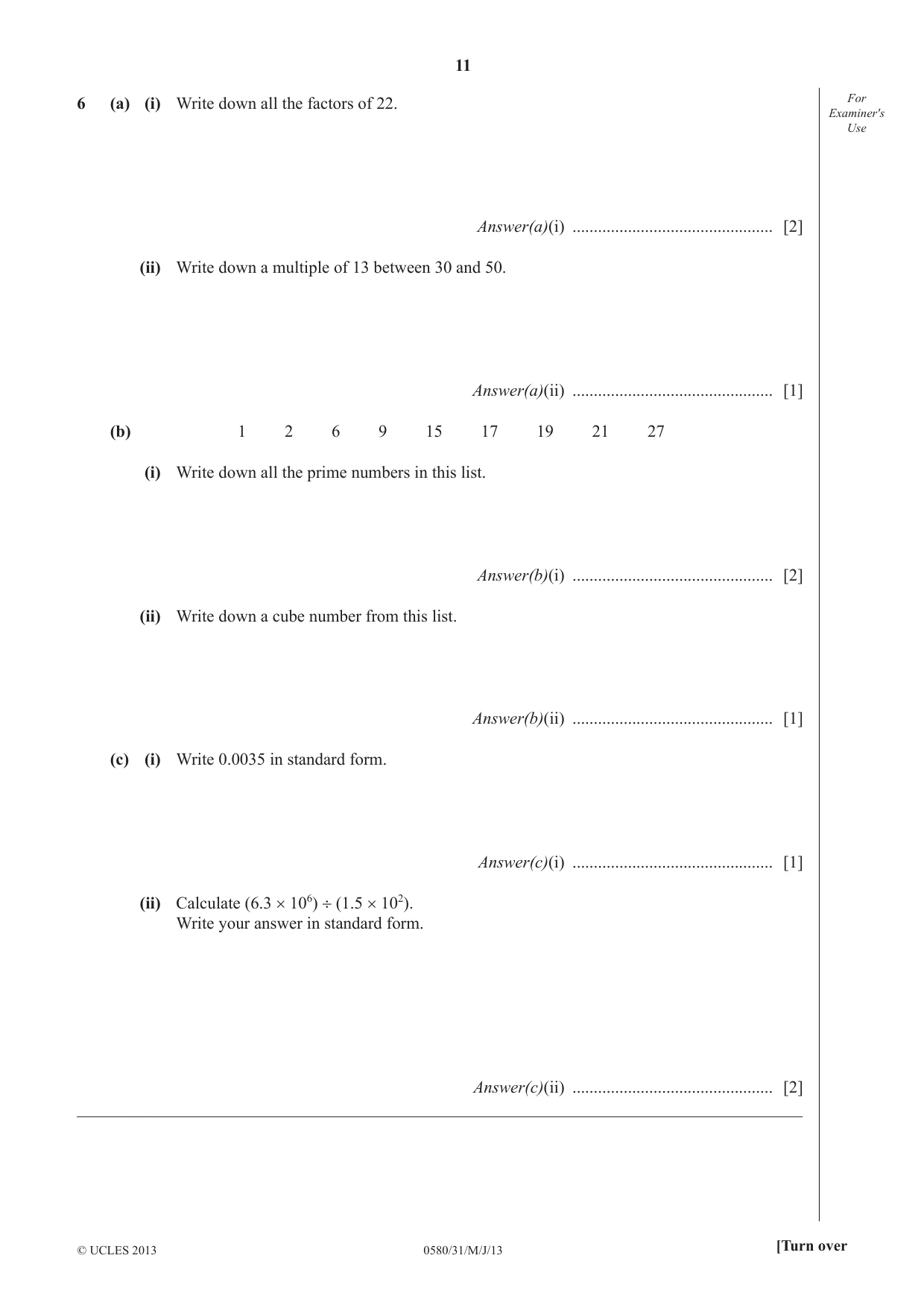
6 (a) (i) Write down all the factors of 22. For Examiner′s Use Answer(a)(i) ............................................... [2] (ii) Write down a multiple of 13 between 30 and 50. Answer(a)(ii) ............................................... [1] (b) 1 2 6 9 15 17 19 21 27 (i) Write down all the prime numbers in this list. Answer(b)(i) ............................................... [2] (ii) Write down a cube number from this list. Answer(b)(ii) ............................................... [1] (c) (i) Write 0.0035 in standard form. Answer(c)(i) ............................................... [1] (ii) Calculate (6.3 × 10⁶) ÷ (1.5 × 10²). Write your answer in standard form. Answer(c)(ii) ............................................... [2] _____________________________________________________________________________________
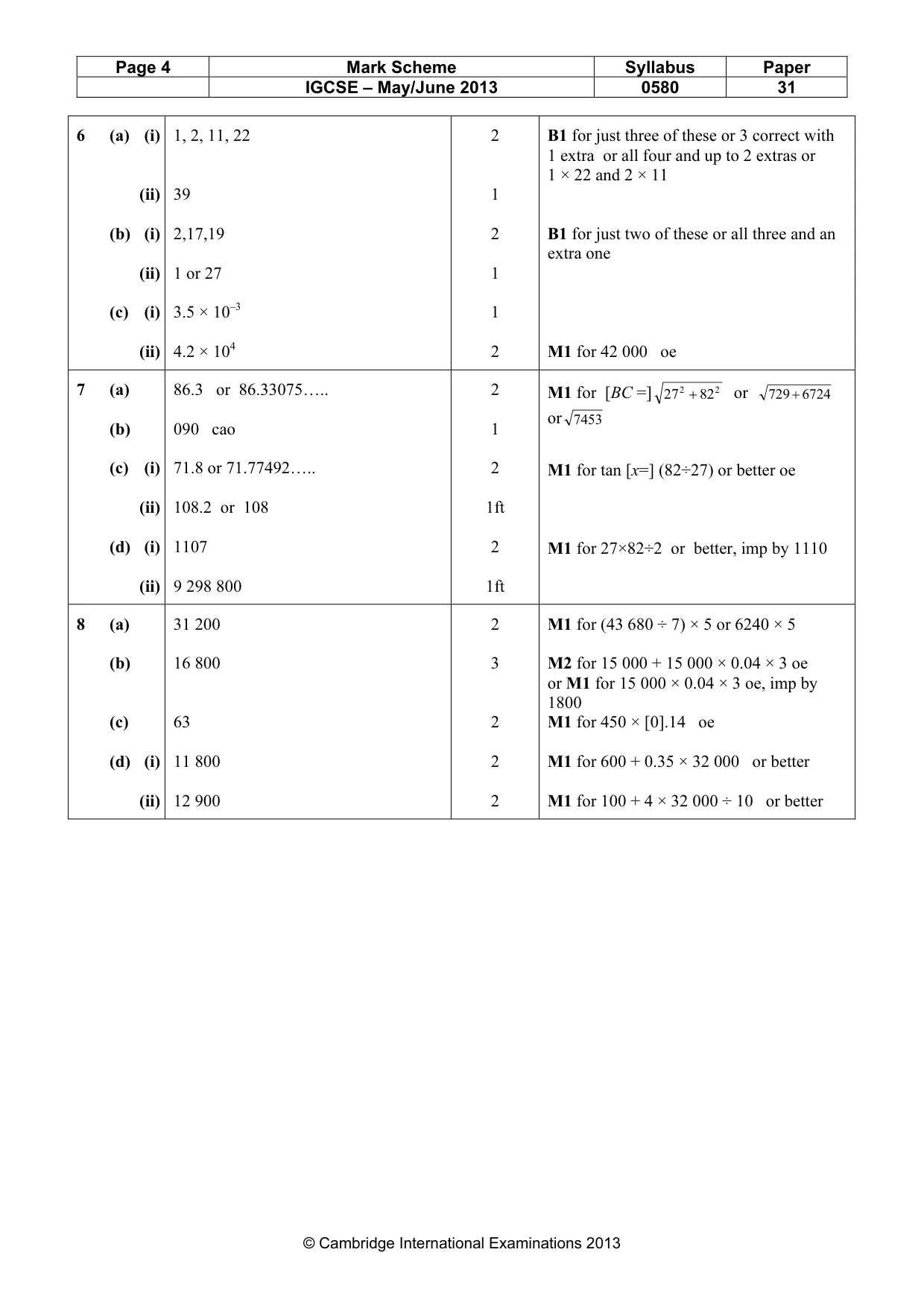
Mark scheme: 6 (a) (i) 1, 2, 11, 22 2 B1 for just three of these or 3 correct with 1 extra or all four and up to 2 extras or 1 × 22 and 2 × 11 (ii) 39 1 (b) (i) 2,17,19 2 B1 for just two of these or all three and an extra one (ii) 1 or 27 1 (c) (i) 3.5 × 10⁻³ 1 (ii) 4.2 × 10⁴ 2 M1 for 42 000 oe
Q7 · For Examiner′s North Use B NOT TO SCALE 27 km A 82 km C The diagram shows the positions…
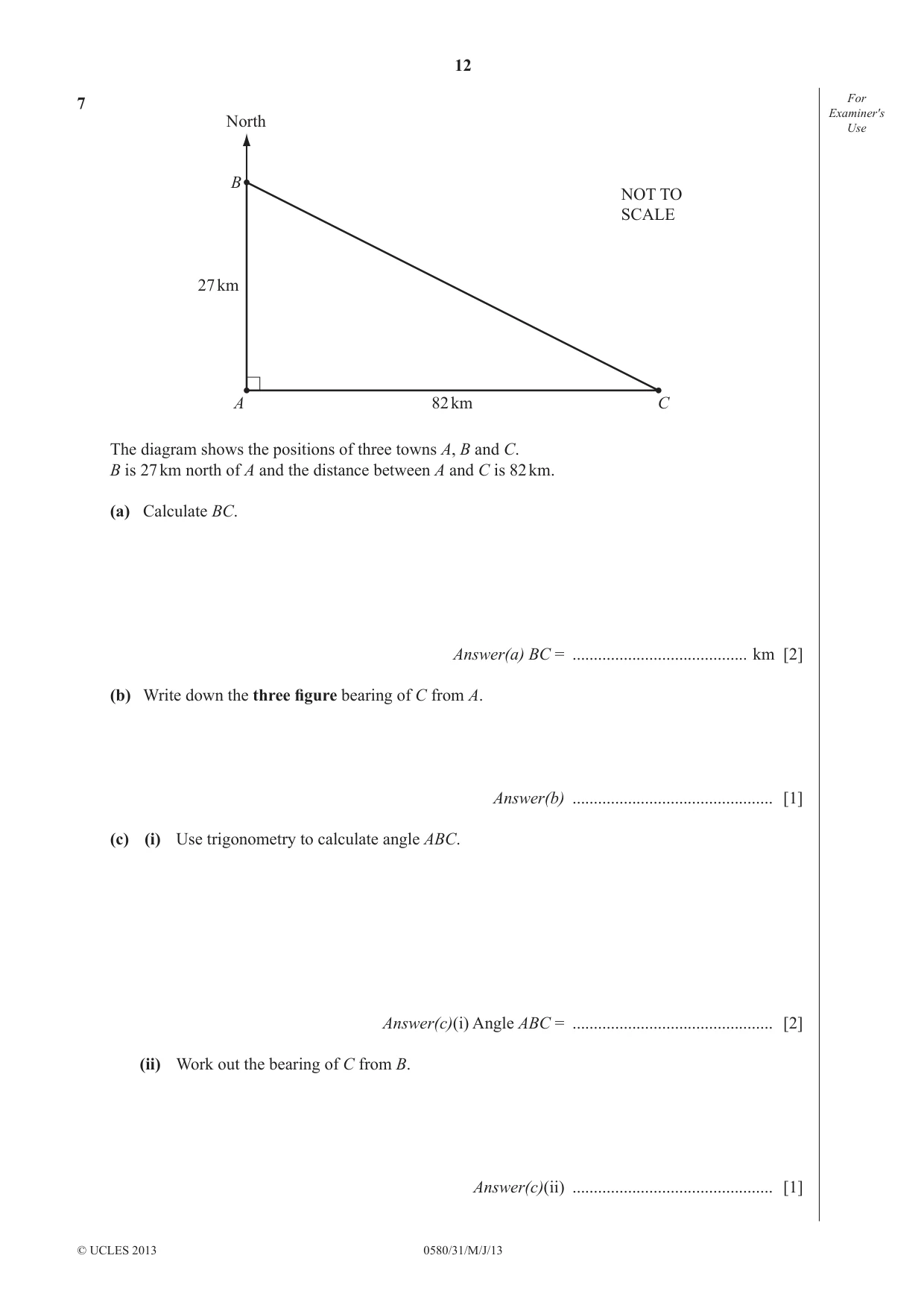
7 For Examiner′s North Use B NOT TO SCALE 27 km A 82 km C The diagram shows the positions of three towns A, B and C. B is 27 km north of A and the distance between A and C is 82 km. (a) Calculate BC. Answer(a) BC = ......................................... km [2] (b) Write down the three fi gure bearing of C from A. Answer(b) ............................................... [1] (c) (i) Use trigonometry to calculate angle ABC. Answer(c)(i) Angle ABC = ............................................... [2] (ii) Work out the bearing of C from B. Answer(c)(ii) ............................................... [1] (d) (i) Calculate the area of triangle ABC. For Examiner′s Use Answer(d)(i) ........................................ km2 [2] (ii) The land forming the triangle ABC is valued at $8400 for each square kilometre. Calculate the value of this land. Answer(d)(ii) $ ................................................ [1] _____________________________________________________________________________________
Mark scheme: 7 (a) 86.3 or 86.33075….. 2 M1 for [BC =] 27 2 + 82 2 or 729+ 6724 or 7453 (b) 090 cao 1 (c) (i) 71.8 or 71.77492….. 2 M1 for tan [x=] (82÷27) or better oe (ii) 108.2 or 108 1ft (d) (i) 1107 2 M1 for 27×82÷2 or better, imp by 1110 (ii) 9 298 800 1ft
Q8 · Ben and Ruth own a company
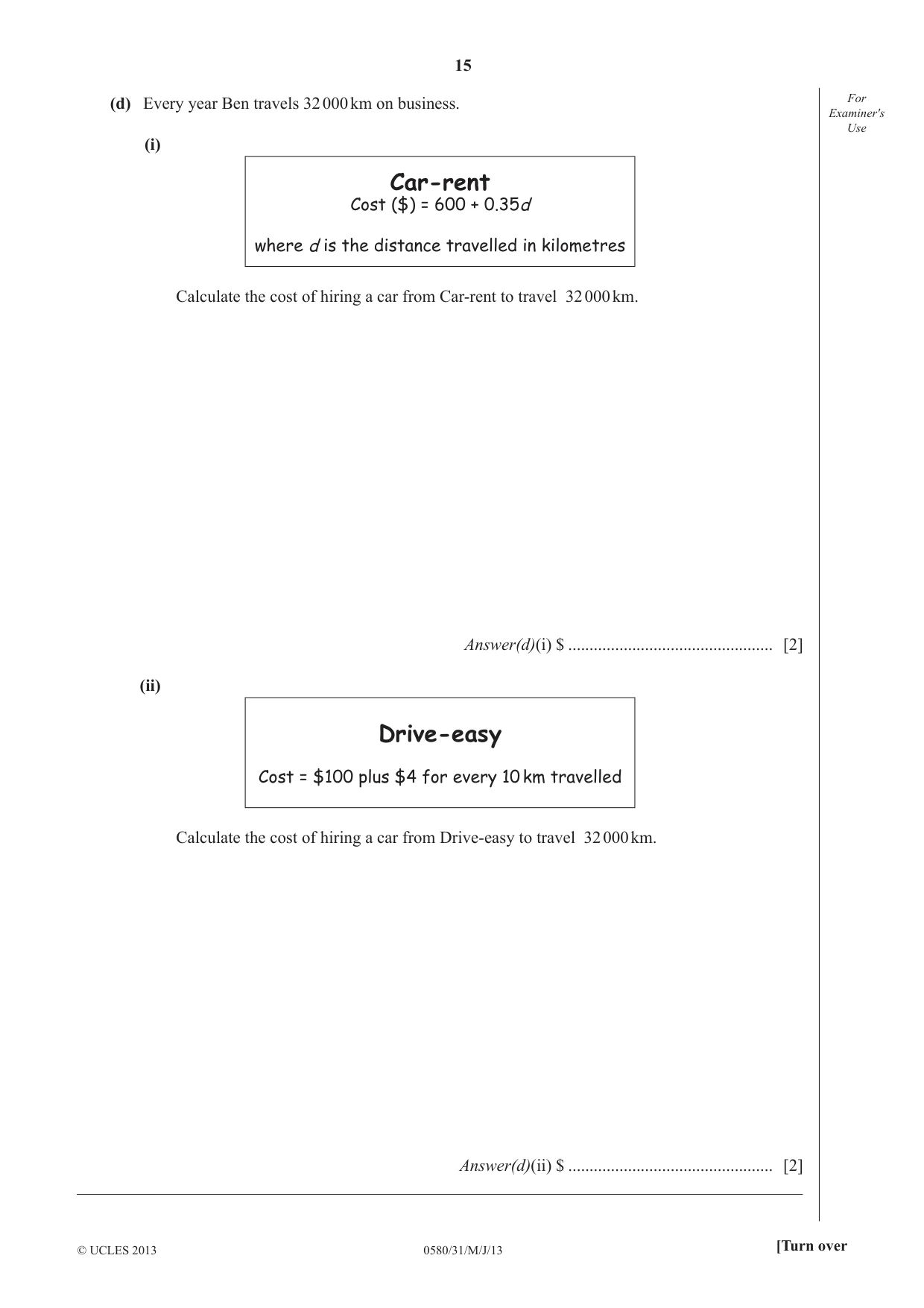
8 Ben and Ruth own a company. For Examiner′s Use (a) The company’s profi ts of $43 680 are shared in the ratio Ben : Ruth = 2 : 5 . Calculate Ruth’s share of the profi ts. Answer(a) $ ................................................ [2] (b) Ruth invests $15 000 at a rate of 4% per year simple interest. Calculate how much her investment is worth at the end of 3 years. Answer(b) $ ................................................ [3] (c) The company employs 450 people. 14% of these people work in sales. Calculate the number of people who work in sales. Answer(c) ............................................... [2] (d) Every year Ben travels 32 000 km on business. For Examiner′s Use (i) Car-rent Cost ($) = 600 + 0.35d where d is the distance travelled in kilometres Calculate the cost of hiring a car from Car-rent to travel 32 000 km. Answer(d)(i) $ ................................................ [2] (ii) Drive-easy Cost = $100 plus $4 for every 10 km travelled Calculate the cost of hiring a car from Drive-easy to travel 32 000 km. Answer(d)(ii) $ ................................................ [2] _____________________________________________________________________________________
Mark scheme: 8 (a) 31 200 2 M1 for (43 680 ÷ 7) × 5 or 6240 × 5 (b) 16 800 3 M2 for 15 000 + 15 000 × 0.04 × 3 oe or M1 for 15 000 × 0.04 × 3 oe, imp by 1800 (c) 63 2 M1 for 450 × [0].14 oe (d) (i) 11 800 2 M1 for 600 + 0.35 × 32 000 or better (ii) 12 900 2 M1 for 100 + 4 × 32 000 ÷ 10 or better IGCSE – May/June 2013 0580 31
Q9 · Complete the table of values for y = x2 + x
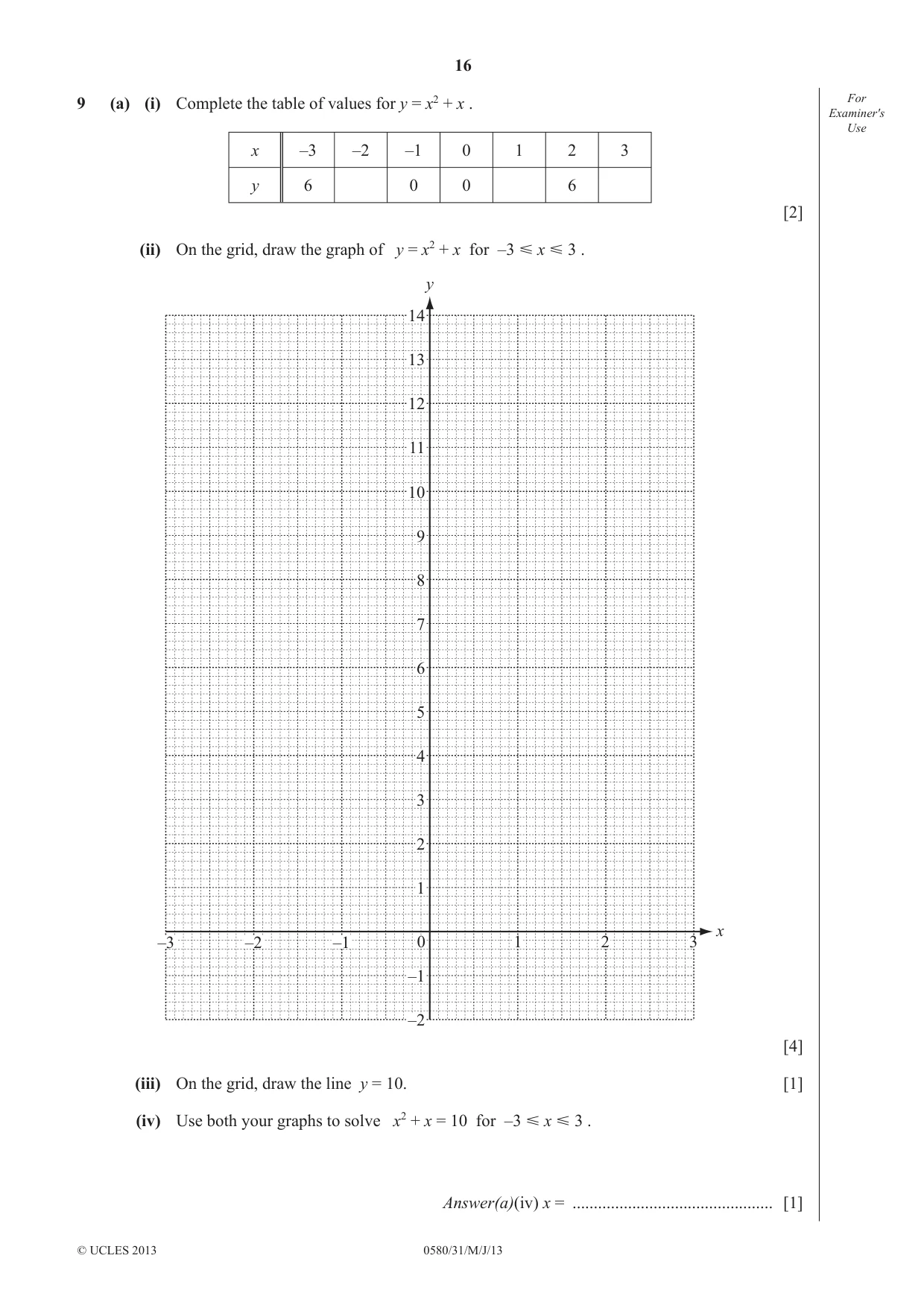
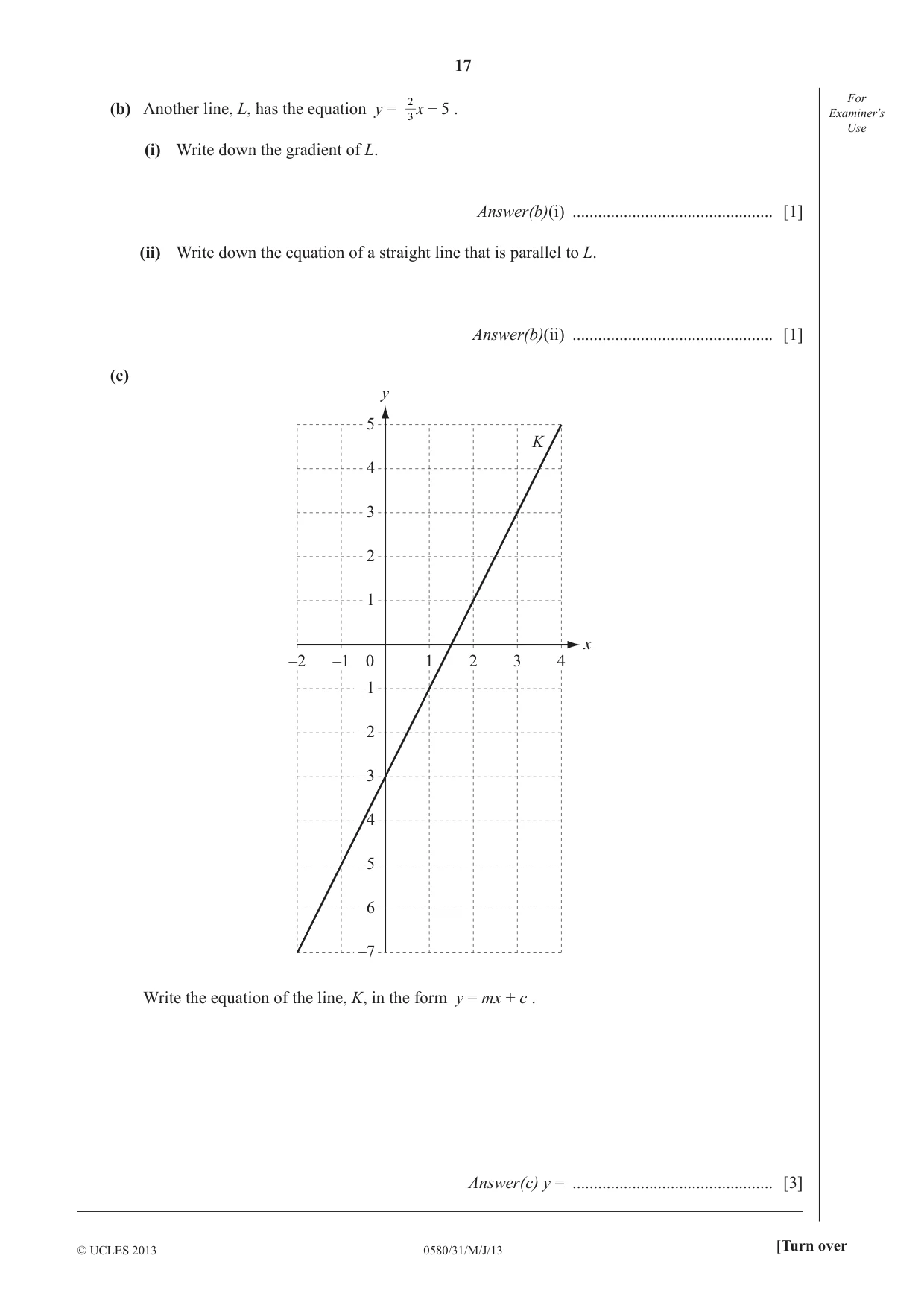
9 (a) (i) Complete the table of values for y = x2 + x . For Examiner′s Use x –3 –2 –1 0 1 2 3 y 6 0 0 6 [2] (ii) On the grid, draw the graph of y = x2 + x for –3 Ğ x Ğ 3 . y 14 13 12 11 10 9 8 7 6 5 4 3 2 1 x –3 –2 –1 0 1 2 3 –1 –2 [4] (iii) On the grid, draw the line y = 10. [1] (iv) Use both your graphs to solve x2 + x = 10 for –3 Ğ x Ğ 3 . Answer(a)(iv) x = ............................................... [1] 2 For (b) Another line, L, has the equation y = 3 x – 5 . Examiner′s Use (i) Write down the gradient of L. Answer(b)(i) ............................................... [1] (ii) Write down the equation of a straight line that is parallel to L. Answer(b)(ii) ............................................... [1] (c) y 5 K 4 3 2 1 x –2 –1 0 1 2 3 4 –1 –2 –3 –4 –5 –6 –7 Write the equation of the line, K, in the form y = mx + c . Answer(c) y = ............................................... [3] _____________________________________________________________________________________
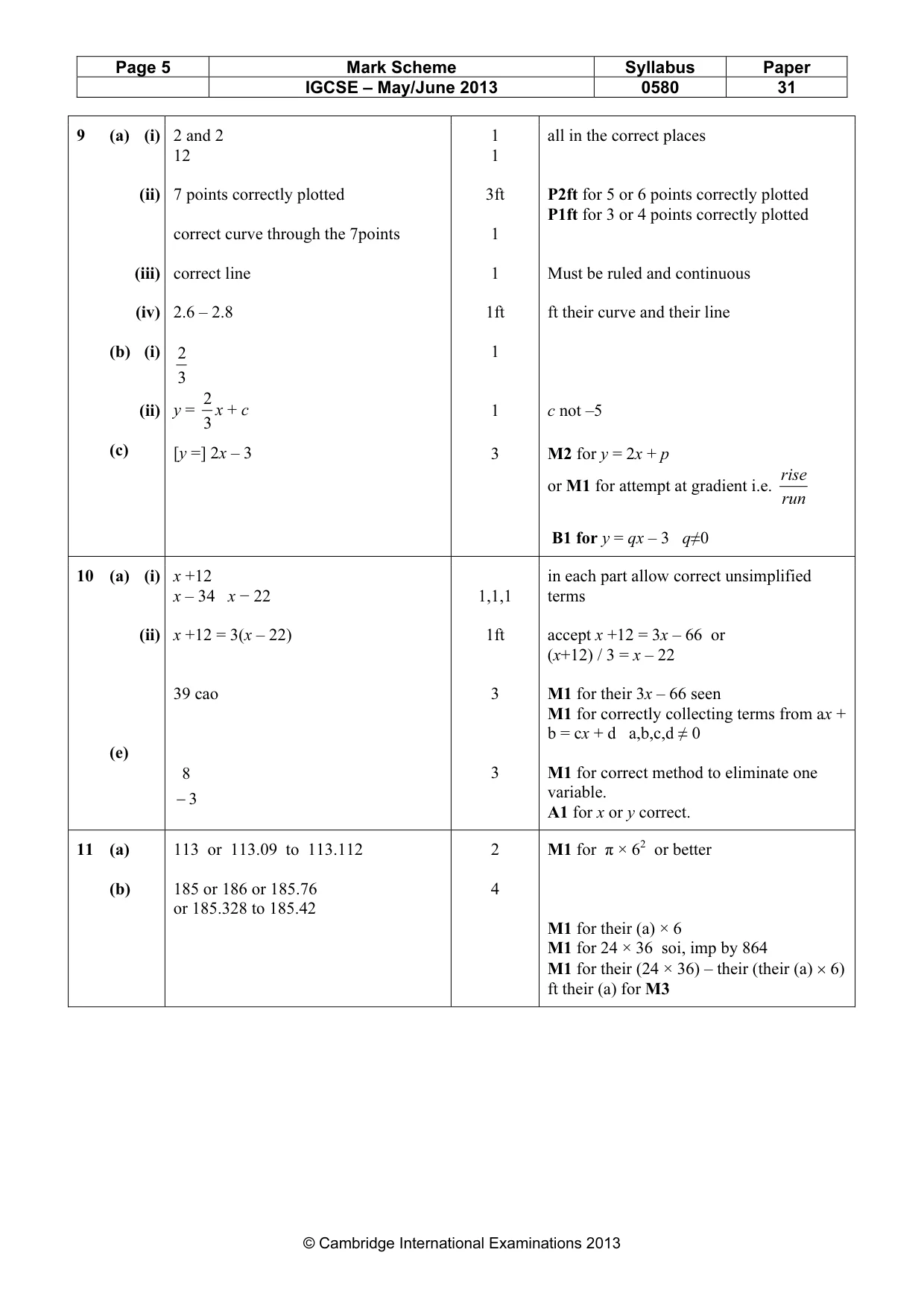
Mark scheme: 9 (a) (i) 2 and 2 1 all in the correct places 12 1 (ii) 7 points correctly plotted 3ft P2ft for 5 or 6 points correctly plotted P1ft for 3 or 4 points correctly plotted correct curve through the 7points 1 (iii) correct line 1 Must be ruled and continuous (iv) 2.6 – 2.8 1ft ft their curve and their line (b) (i) 2 1 3 2 (ii) y = x + c 1 c not –5 3 (c) [y =] 2x – 3 3 M2 for y = 2x + p rise or M1 for attempt at gradient i.e. run B1 for y = qx – 3 q≠0
Q10 · In 2001 Arnold was x years old
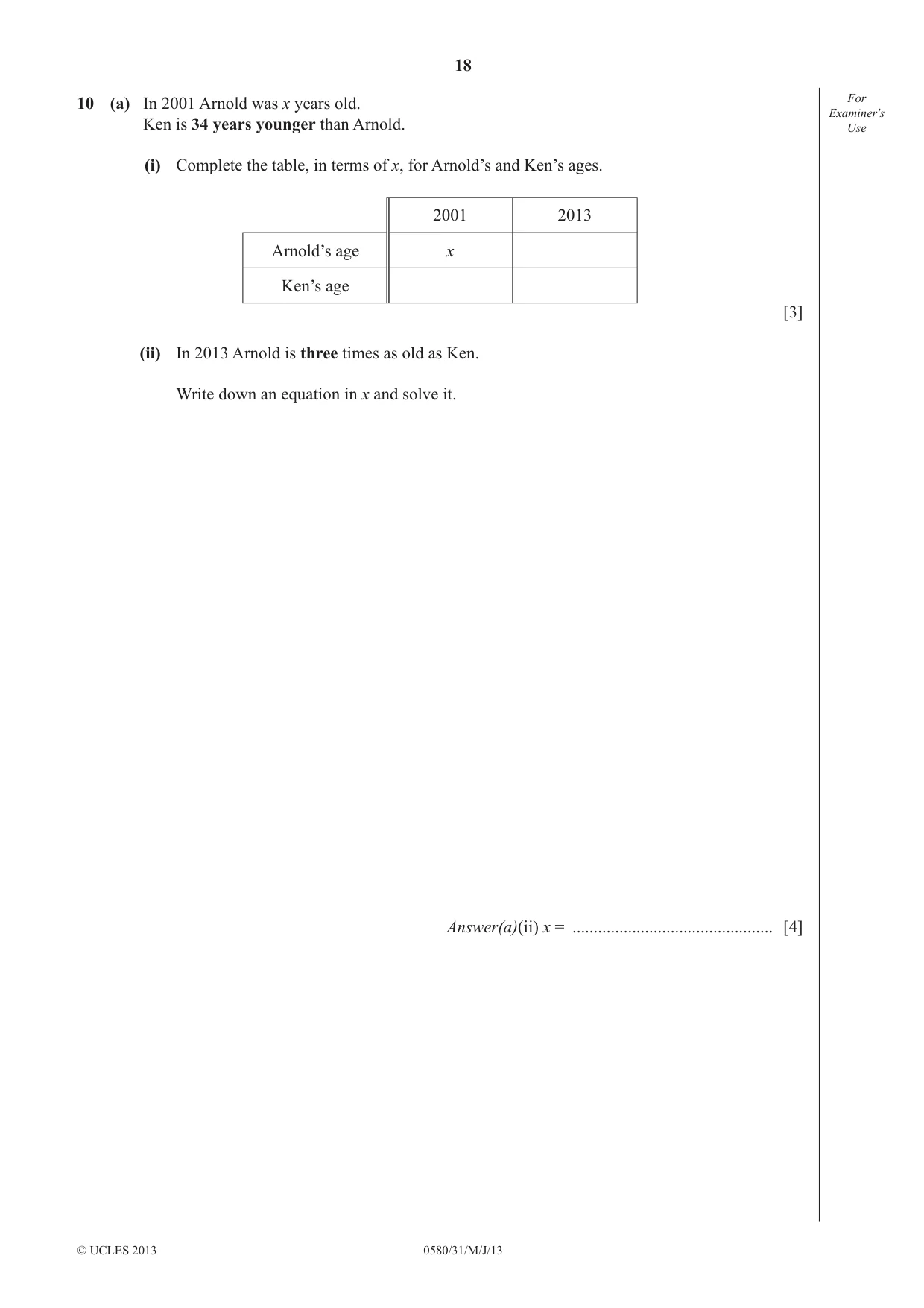
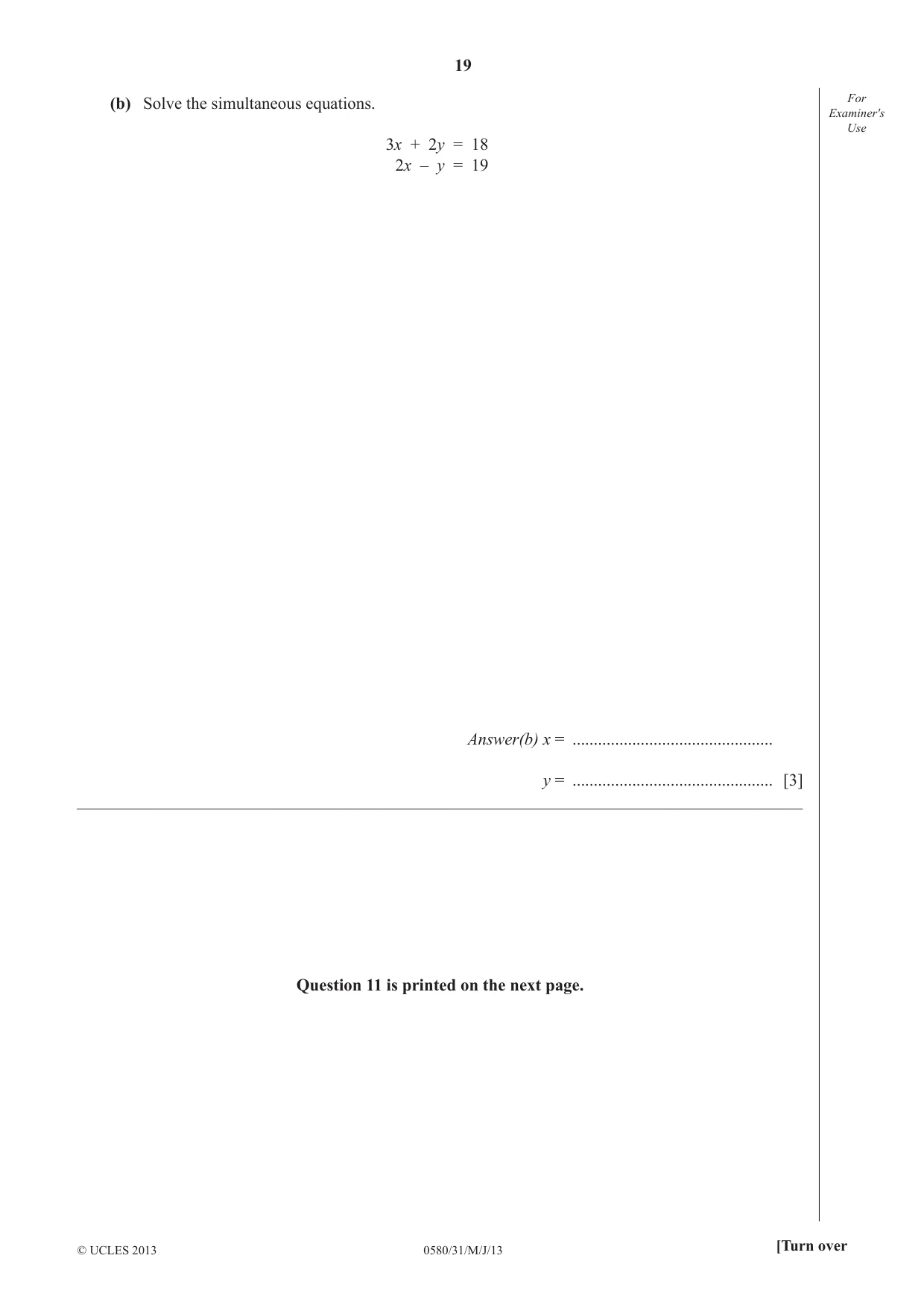
10 (a) In 2001 Arnold was x years old. For Examiner′s Ken is 34 years younger than Arnold. Use (i) Complete the table, in terms of x, for Arnold’s and Ken’s ages. 2001 2013 Arnold’s age x Ken’s age [3] (ii) In 2013 Arnold is three times as old as Ken. Write down an equation in x and solve it. Answer(a)(ii) x = ............................................... [4] (b) Solve the simultaneous equations. For Examiner′s Use 3x + 2y = 18 2x – y = 19 Answer(b) x = ............................................... y = ............................................... [3] _____________________________________________________________________________________ Question 11 is printed on the next page.
Mark scheme: 10 (a) (i) x +12 in each part allow correct unsimplified x – 34 x − 22 1,1,1 terms (ii) x +12 = 3(x – 22) 1ft accept x +12 = 3x – 66 or (x+12) / 3 = x – 22 39 cao 3 M1 for their 3x – 66 seen M1 for correctly collecting terms from ax + b = cx + d a,b,c,d ≠ 0 (e) 8 3 M1 for correct method to eliminate one − 3 variable. A1 for x or y correct. 2
Q11 · Calculate the area of a circle of radius 6 cm
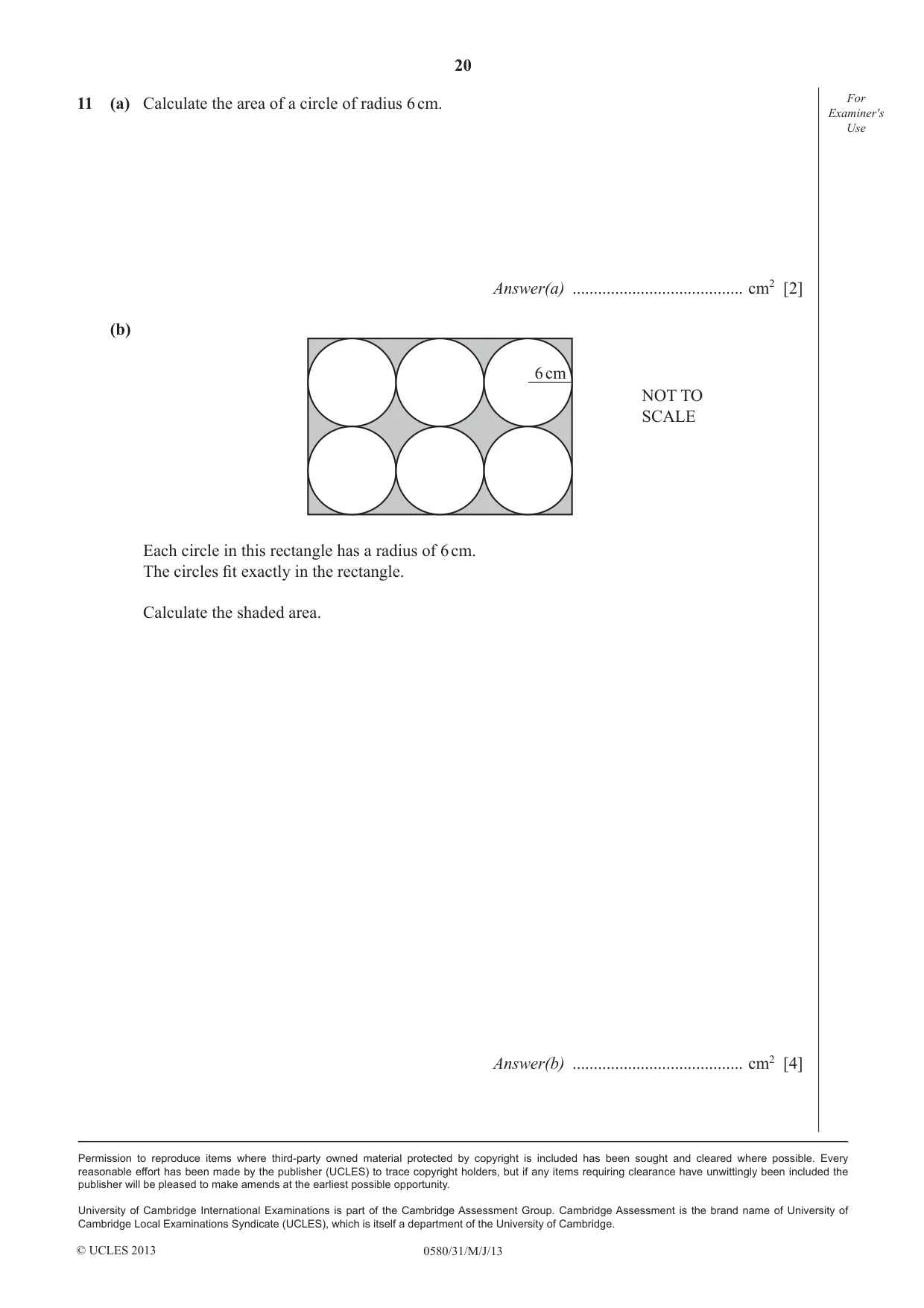
11 (a) Calculate the area of a circle of radius 6 cm. For Examiner′s Use Answer(a) ........................................ cm2 [2] (b) 6 cm NOT TO SCALE Each circle in this rectangle has a radius of 6 cm. The circles fi t exactly in the rectangle. Calculate the shaded area. Answer(b) ........................................ cm2 [4]
Mark scheme: 11 (a) 113 or 113.09 to 113.112 2 M1 for π × 62 or better (b) 185 or 186 or 185.76 4 or 185.328 to 185.42 M1 for their (a) × 6 M1 for 24 × 36 soi, imp by 864 M1 for their (24 × 36) – their (their (a) × 6) ft their (a) for M3
What was in this paper
The subtopics covered by these 11 questions, and how many questions each got. Open one in a new tab to see every Cambridge question on it.
What you needed in this session
Cambridge’s own grade thresholds for 2013 May/June, Paper 3 · Variant 1. A higher threshold means an easier paper — the bar moves with how the cohort did.