Cambridge IGCSE Mathematics 0580 — 2013 May/June Paper 3 · Variant 2
0580/32/M/J/13 · 10 questions · 104 marks · ≈117 min
The question paper and its mark scheme, free to read here and free to download. This is Cambridge’s own paper, exactly as it was sat.
Question paper16 pages
Mark scheme6 pages
Answers below. Sit the paper first if you are practising.
Questions as text
Q1 · For Examiner′s 3 5 8 10 10 Use For the numbers above, fi nd (i) the mean, Answer(a)(i)…
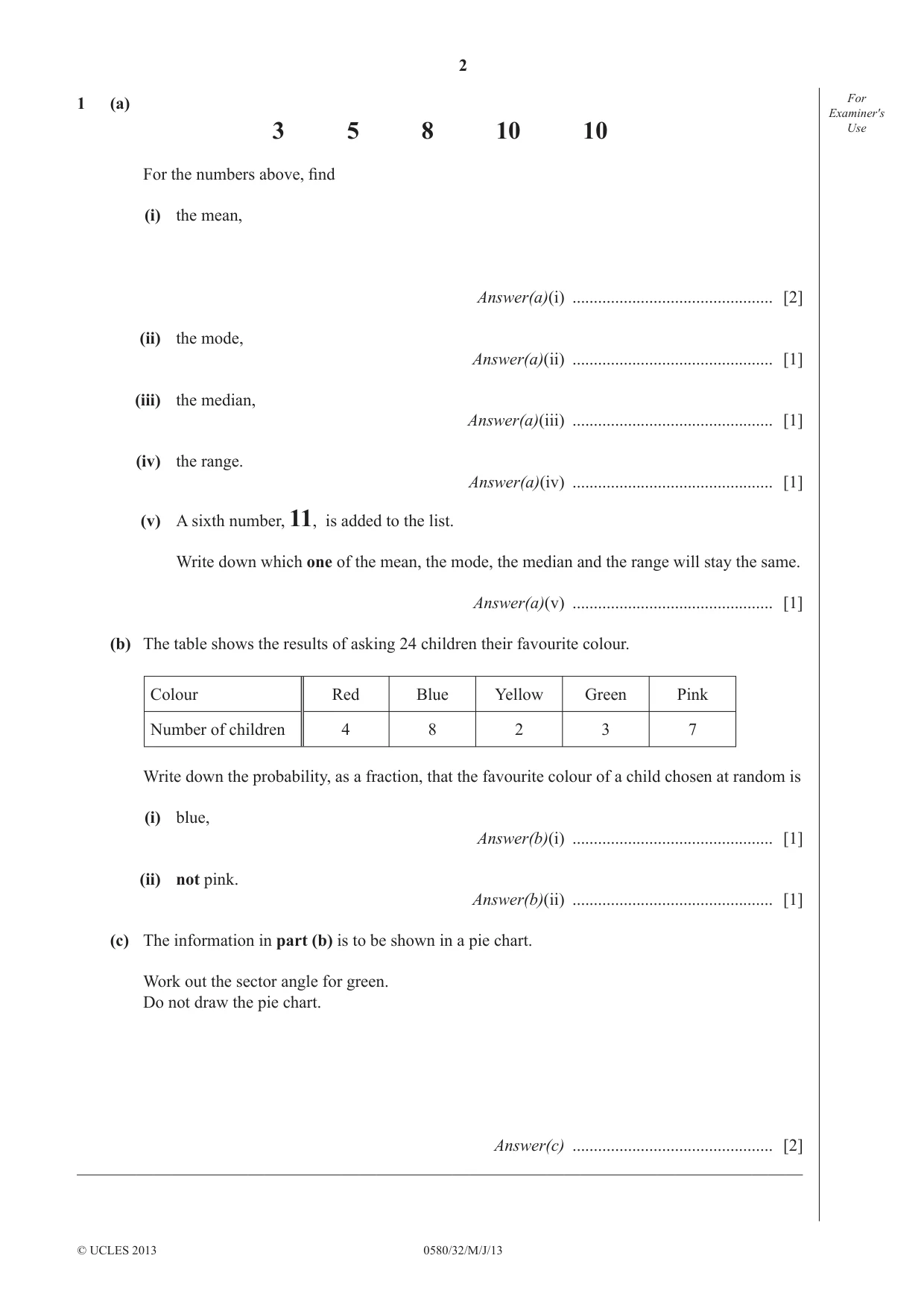
1 (a) For Examiner′s 3 5 8 10 10 Use For the numbers above, fi nd (i) the mean, Answer(a)(i) ............................................... [2] (ii) the mode, Answer(a)(ii) ............................................... [1] (iii) the median, Answer(a)(iii) ............................................... [1] (iv) the range. Answer(a)(iv) ............................................... [1] (v) A sixth number, 11, is added to the list. Write down which one of the mean, the mode, the median and the range will stay the same. Answer(a)(v) ............................................... [1] (b) The table shows the results of asking 24 children their favourite colour. Colour Red Blue Yellow Green Pink Number of children 4 8 2 3 7 Write down the probability, as a fraction, that the favourite colour of a child chosen at random is (i) blue, Answer(b)(i) ............................................... [1] (ii) not pink. Answer(b)(ii) ............................................... [1] (c) The information in part (b) is to be shown in a pie chart. Work out the sector angle for green. Do not draw the pie chart. Answer(c) ............................................... [2] _____________________________________________________________________________________
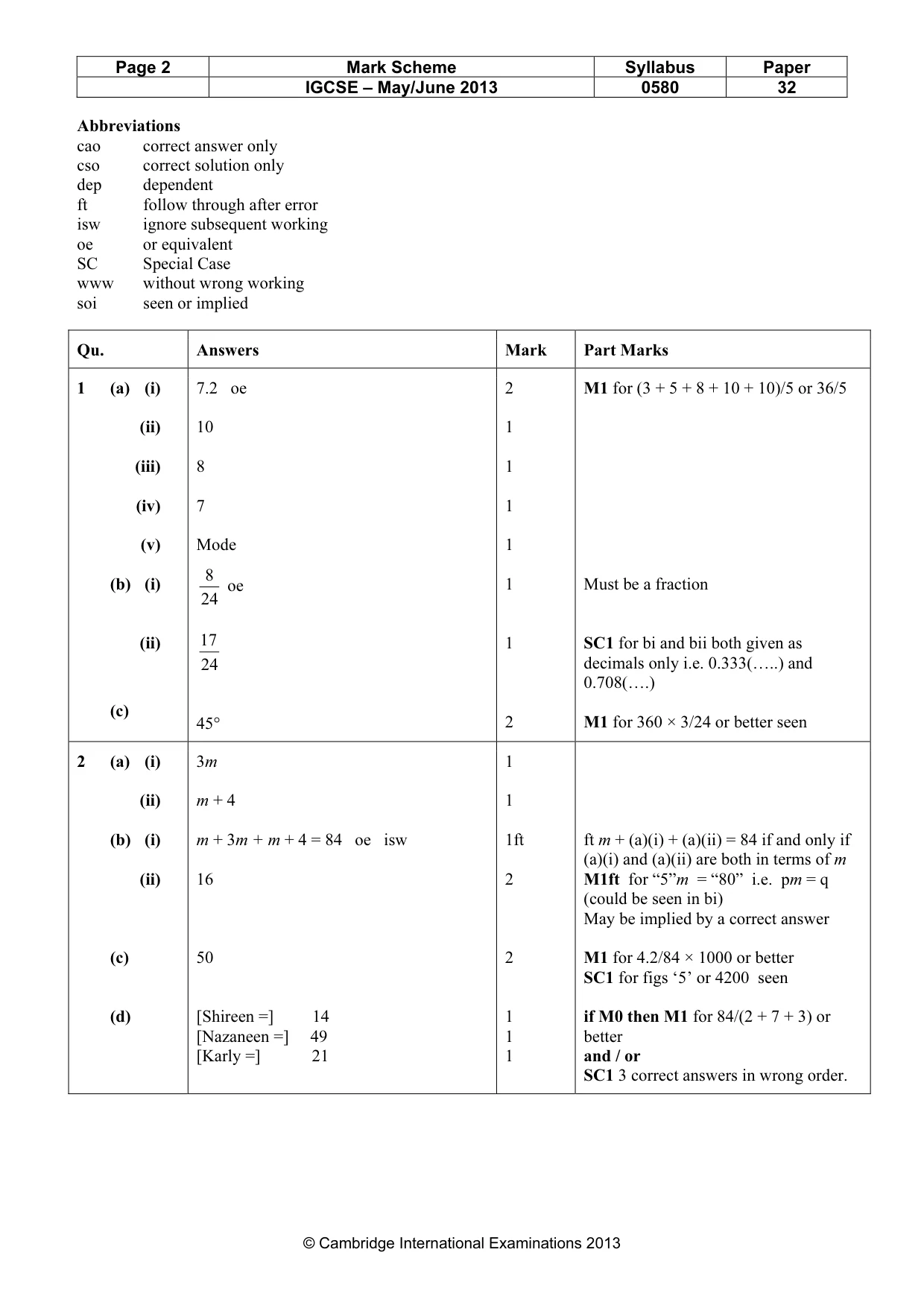
Mark scheme: Qu. Answers Mark Part Marks 1 (a) (i) 7.2 oe 2 M1 for (3 + 5 + 8 + 10 + 10)/5 or 36/5 (ii) 10 1 (iii) 8 1 (iv) 7 1 (v) Mode 1 8 (b) (i) oe 1 Must be a fraction 24 (ii) 17 1 SC1 for bi and bii both given as 24 decimals only i.e. 0.333(…..) and 0.708(….) (c) 45° 2 M1 for 360 × 3/24 or better seen
Q2 · Three children have some marbles
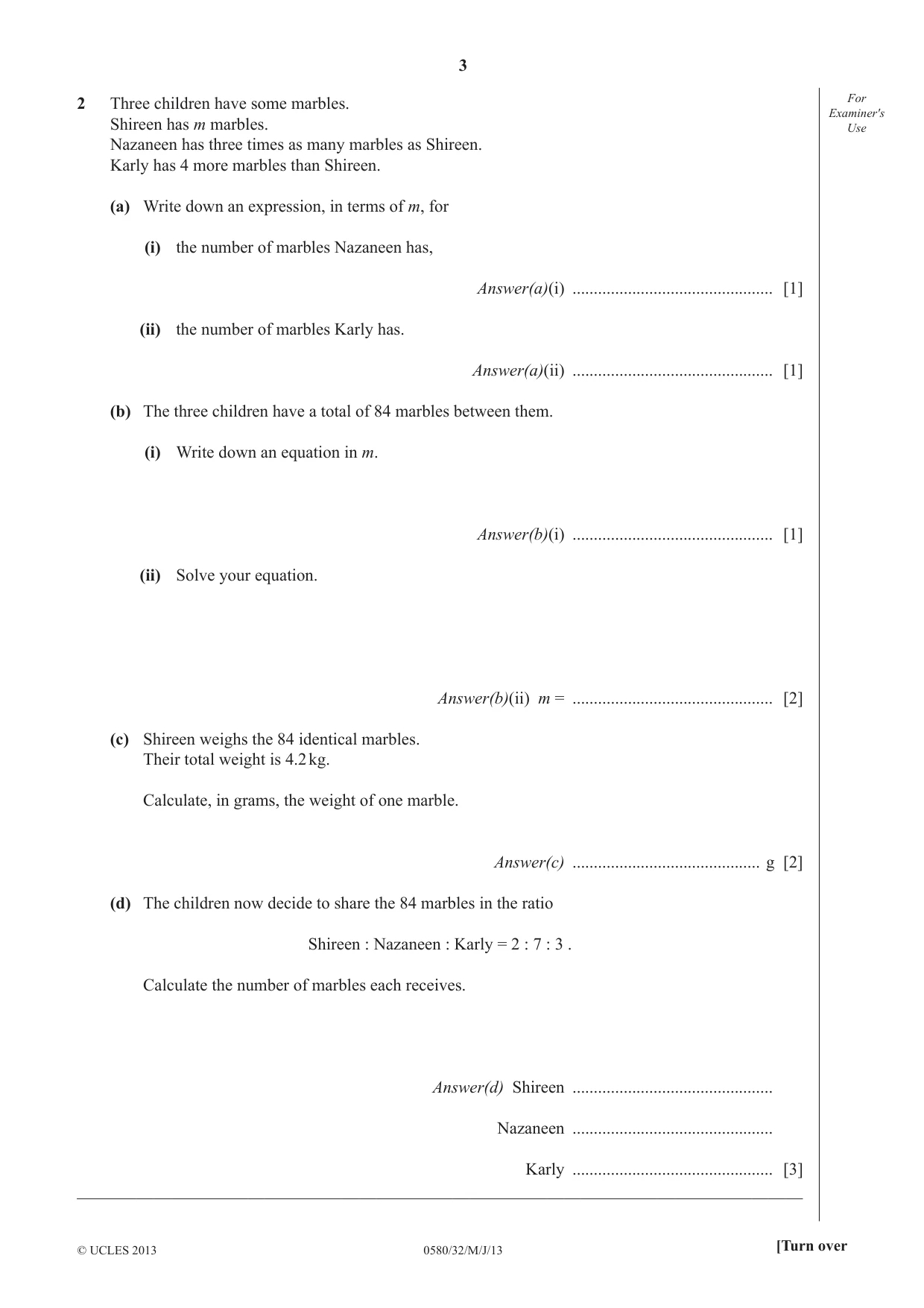
2 Three children have some marbles. For Examiner′s Shireen has m marbles. Use Nazaneen has three times as many marbles as Shireen. Karly has 4 more marbles than Shireen. (a) Write down an expression, in terms of m, for (i) the number of marbles Nazaneen has, Answer(a)(i) ............................................... [1] (ii) the number of marbles Karly has. Answer(a)(ii) ............................................... [1] (b) The three children have a total of 84 marbles between them. (i) Write down an equation in m. Answer(b)(i) ............................................... [1] (ii) Solve your equation. Answer(b)(ii) m = ............................................... [2] (c) Shireen weighs the 84 identical marbles. Their total weight is 4.2 kg. Calculate, in grams, the weight of one marble. Answer(c) ............................................ g [2] (d) The children now decide to share the 84 marbles in the ratio Shireen : Nazaneen : Karly = 2 : 7 : 3 . Calculate the number of marbles each receives. Answer(d) Shireen ............................................... Nazaneen ............................................... Karly ............................................... [3] _____________________________________________________________________________________
Mark scheme: 2 (a) (i) 3m 1 (ii) m + 4 1 (b) (i) m + 3m + m + 4 = 84 oe isw 1ft ft m + (a)(i) + (a)(ii) = 84 if and only if (a)(i) and (a)(ii) are both in terms of m (ii) 16 2 M1ft for “5”m = “80” i.e. pm = q (could be seen in bi) May be implied by a correct answer (c) 50 2 M1 for 4.2/84 × 1000 or better SC1 for figs ‘5’ or 4200 seen (d) [Shireen =] 14 1 if M0 then M1 for 84/(2 + 7 + 3) or [Nazaneen =] 49 1 better [Karly =] 21 1 and / or SC1 3 correct answers in wrong order. IGCSE – May/June 2013 0580 32
Q3 · A shop has maps arranged in bookcases
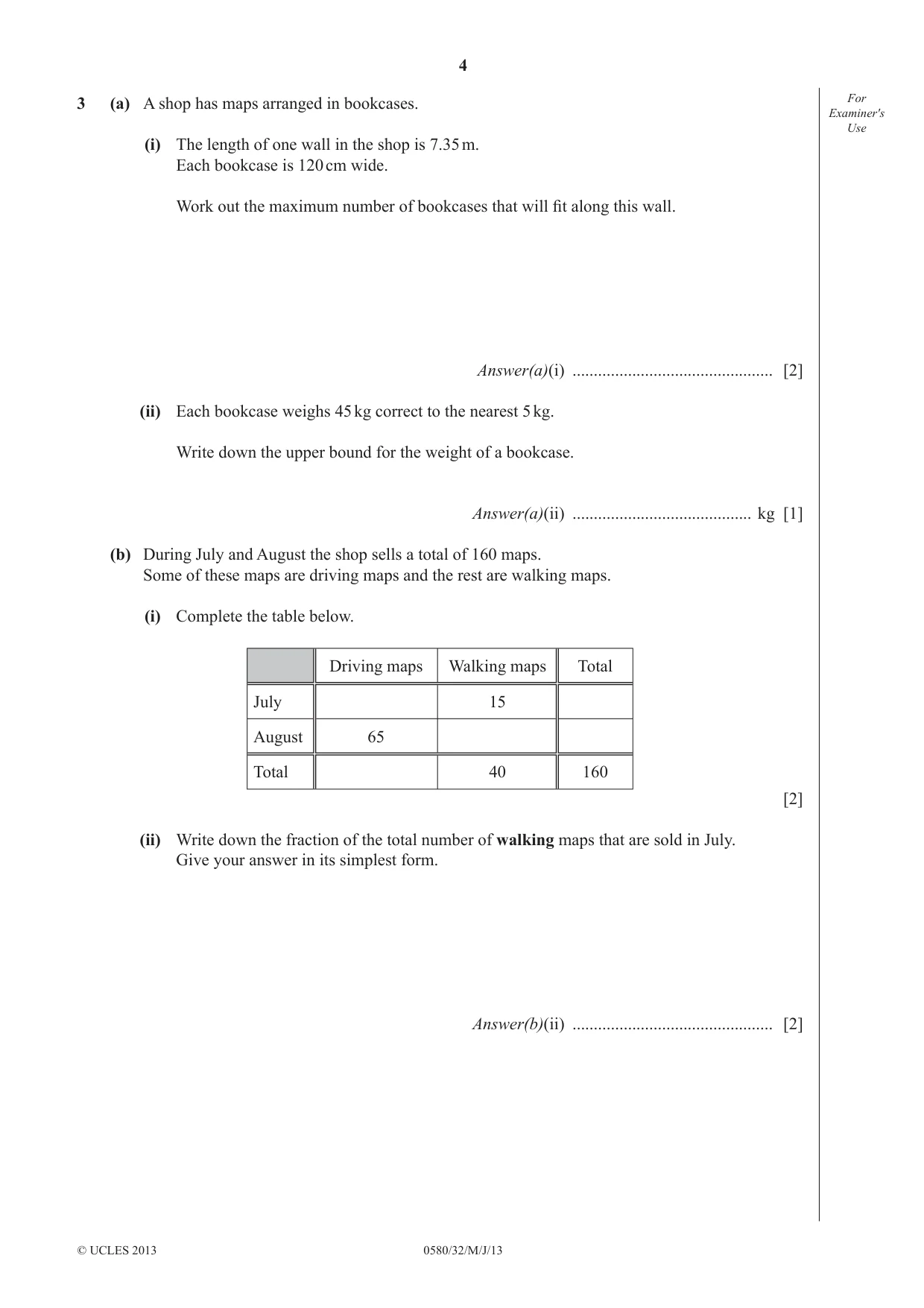
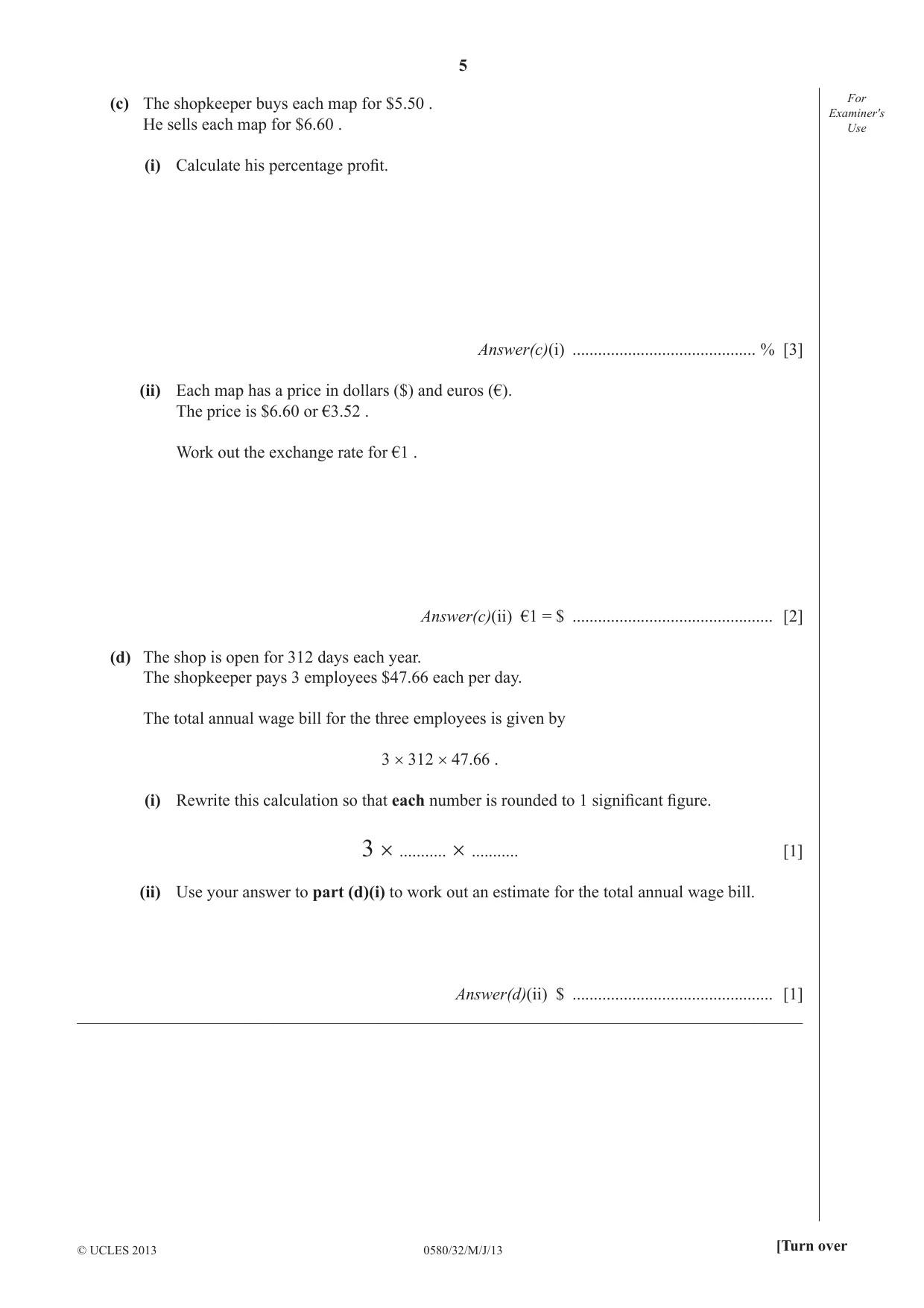
3 (a) A shop has maps arranged in bookcases. For Examiner′s Use (i) The length of one wall in the shop is 7.35 m. Each bookcase is 120 cm wide. Work out the maximum number of bookcases that will fi t along this wall. Answer(a)(i) ............................................... [2] (ii) Each bookcase weighs 45 kg correct to the nearest 5 kg. Write down the upper bound for the weight of a bookcase. Answer(a)(ii) .......................................... kg [1] (b) During July and August the shop sells a total of 160 maps. Some of these maps are driving maps and the rest are walking maps. (i) Complete the table below. Driving maps Walking maps Total July 15 August 65 Total 40 160 [2] (ii) Write down the fraction of the total number of walking maps that are sold in July. Give your answer in its simplest form. Answer(b)(ii) ............................................... [2] (c) The shopkeeper buys each map for $5.50 . For Examiner′s He sells each map for $6.60 . Use (i) Calculate his percentage profi t. Answer(c)(i) ........................................... % [3] (ii) Each map has a price in dollars ($) and euros (€). The price is $6.60 or €3.52 . Work out the exchange rate for €1 . Answer(c)(ii) €1 = $ ............................................... [2] (d) The shop is open for 312 days each year. The shopkeeper pays 3 employees $47.66 each per day. The total annual wage bill for the three employees is given by 3 × 312 × 47.66 . (i) Rewrite this calculation so that each number is rounded to 1 signifi cant fi gure. 3 × ........... × ........... [1] (ii) Use your answer to part (d)(i) to work out an estimate for the total annual wage bill. Answer(d)(ii) $ ............................................... [1] _____________________________________________________________________________________
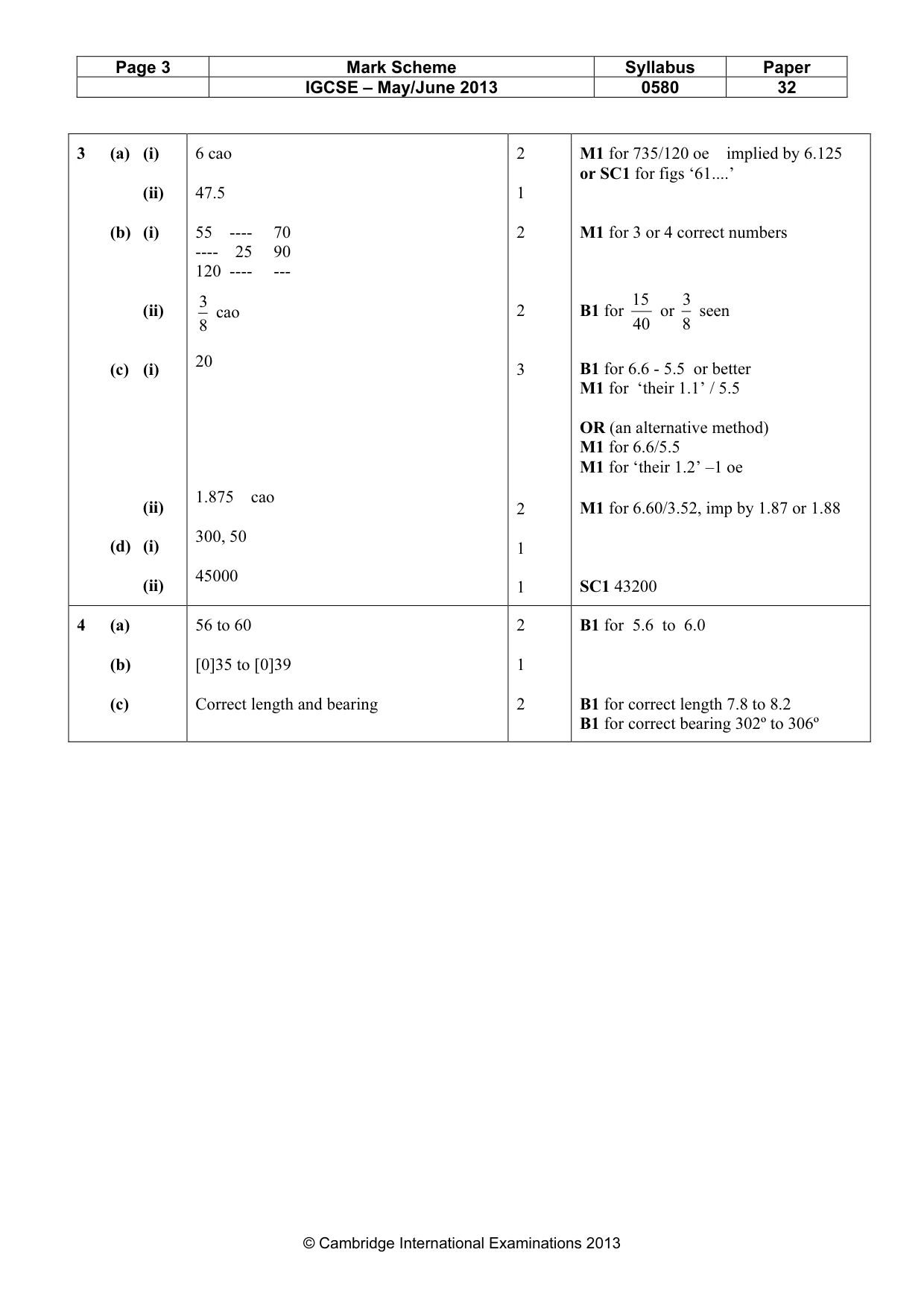
Mark scheme: 3 (a) (i) 6 cao 2 M1 for 735/120 oe implied by 6.125 or SC1 for figs ‘61....’ (ii) 47.5 1 (b) (i) 55 ---- 70 2 M1 for 3 or 4 correct numbers ---- 25 90 120 ---- --- 3 15 3 (ii) cao 2 B1 for or seen 8 40 8 20 (c) (i) 3 B1 for 6.6 - 5.5 or better M1 for ‘their 1.1’ / 5.5 OR (an alternative method) M1 for 6.6/5.5 M1 for ‘their 1.2’ –1 oe 1.875 cao (ii) 2 M1 for 6.60/3.52, imp by 1.87 or 1.88 300, 50 (d) (i) 1 45000 (ii) 1 SC1 43200
Q4 · The diagram is part of a map showing the position of two towns Anderro, A, and Bratena, B
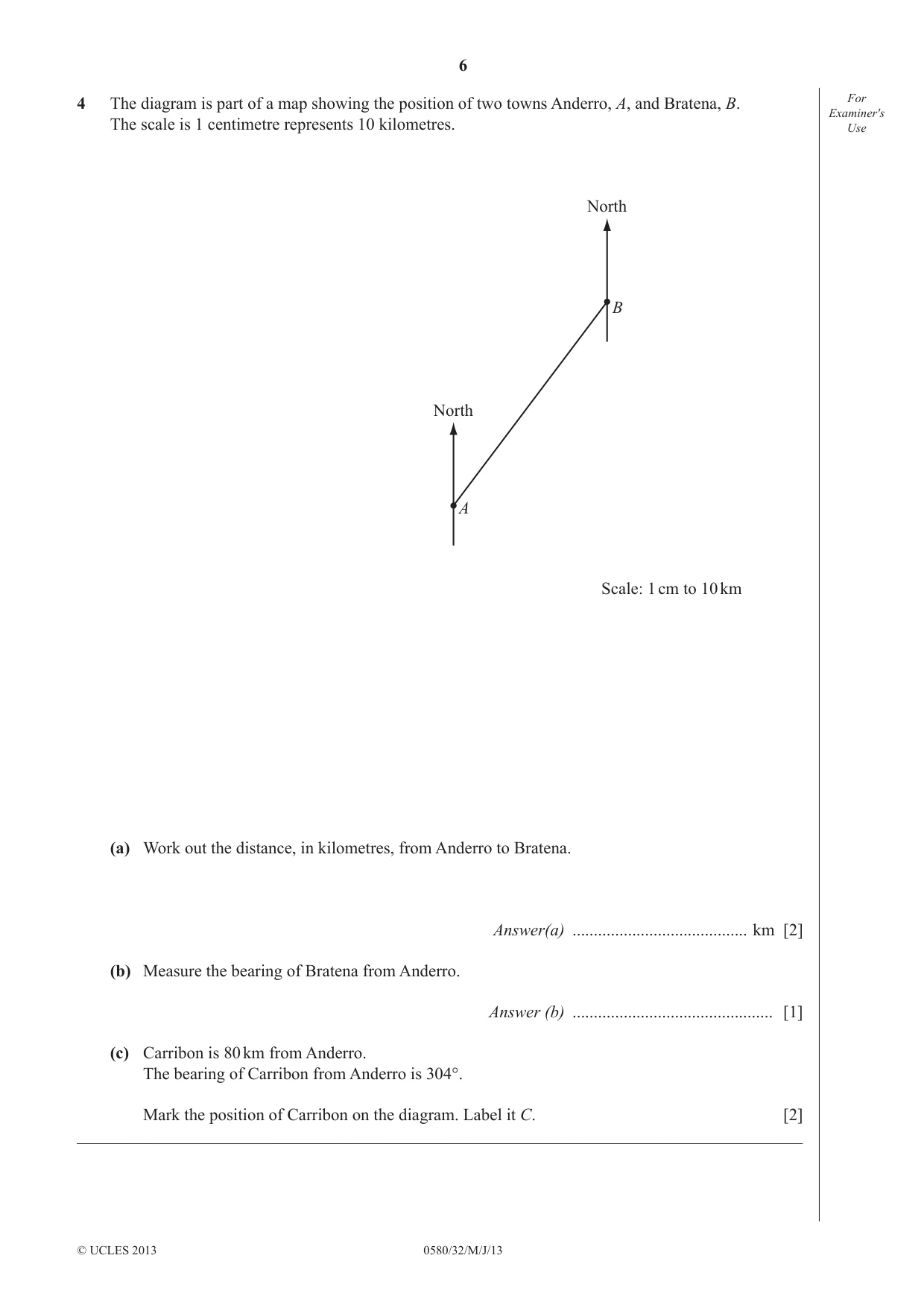
4 The diagram is part of a map showing the position of two towns Anderro, A, and Bratena, B. For Examiner′s The scale is 1 centimetre represents 10 kilometres. Use North B North A Scale: 1 cm to 10 km (a) Work out the distance, in kilometres, from Anderro to Bratena. Answer(a) ......................................... km [2] (b) Measure the bearing of Bratena from Anderro. Answer (b) ............................................... [1] (c) Carribon is 80 km from Anderro. The bearing of Carribon from Anderro is 304°. Mark the position of Carribon on the diagram. Label it C. [2] _____________________________________________________________________________________
Mark scheme: 4 (a) 56 to 60 2 B1 for 5.6 to 6.0 (b) [0]35 to [0]39 1 (c) Correct length and bearing 2 B1 for correct length 7.8 to 8.2 B1 for correct bearing 302º to 306º IGCSE – May/June 2013 0580 32
Q5 · For Examiner′s Use A E B C D (a) In this part, all constructions must be completed using…
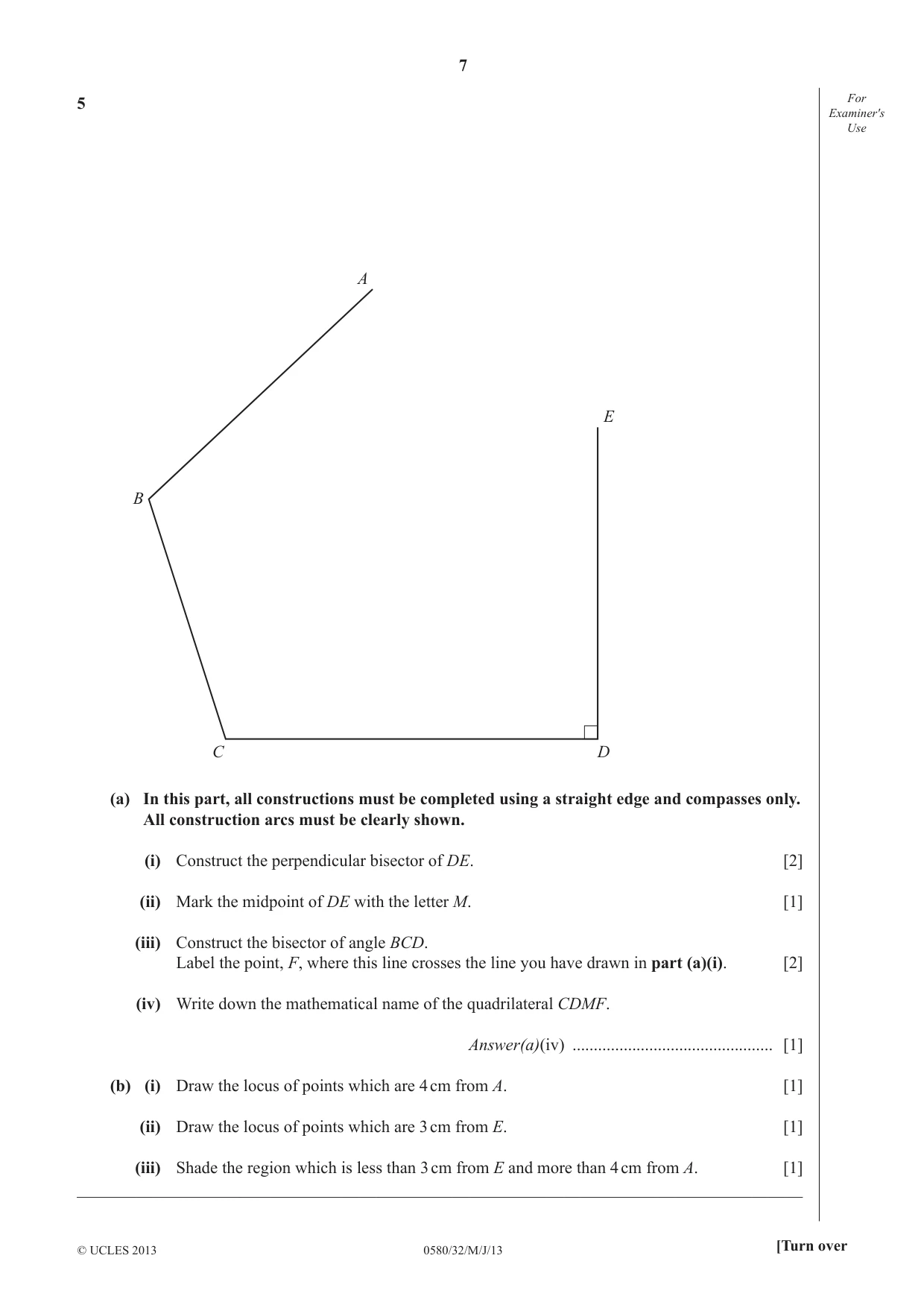
5 For Examiner′s Use A E B C D (a) In this part, all constructions must be completed using a straight edge and compasses only. All construction arcs must be clearly shown. (i) Construct the perpendicular bisector of DE. [2] (ii) Mark the midpoint of DE with the letter M. [1] (iii) Construct the bisector of angle BCD. Label the point, F, where this line crosses the line you have drawn in part (a)(i). [2] (iv) Write down the mathematical name of the quadrilateral CDMF. Answer(a)(iv) ............................................... [1] (b) (i) Draw the locus of points which are 4 cm from A. [1] (ii) Draw the locus of points which are 3 cm from E. [1] (iii) Shade the region which is less than 3 cm from E and more than 4 cm from A. [1] _____________________________________________________________________________________
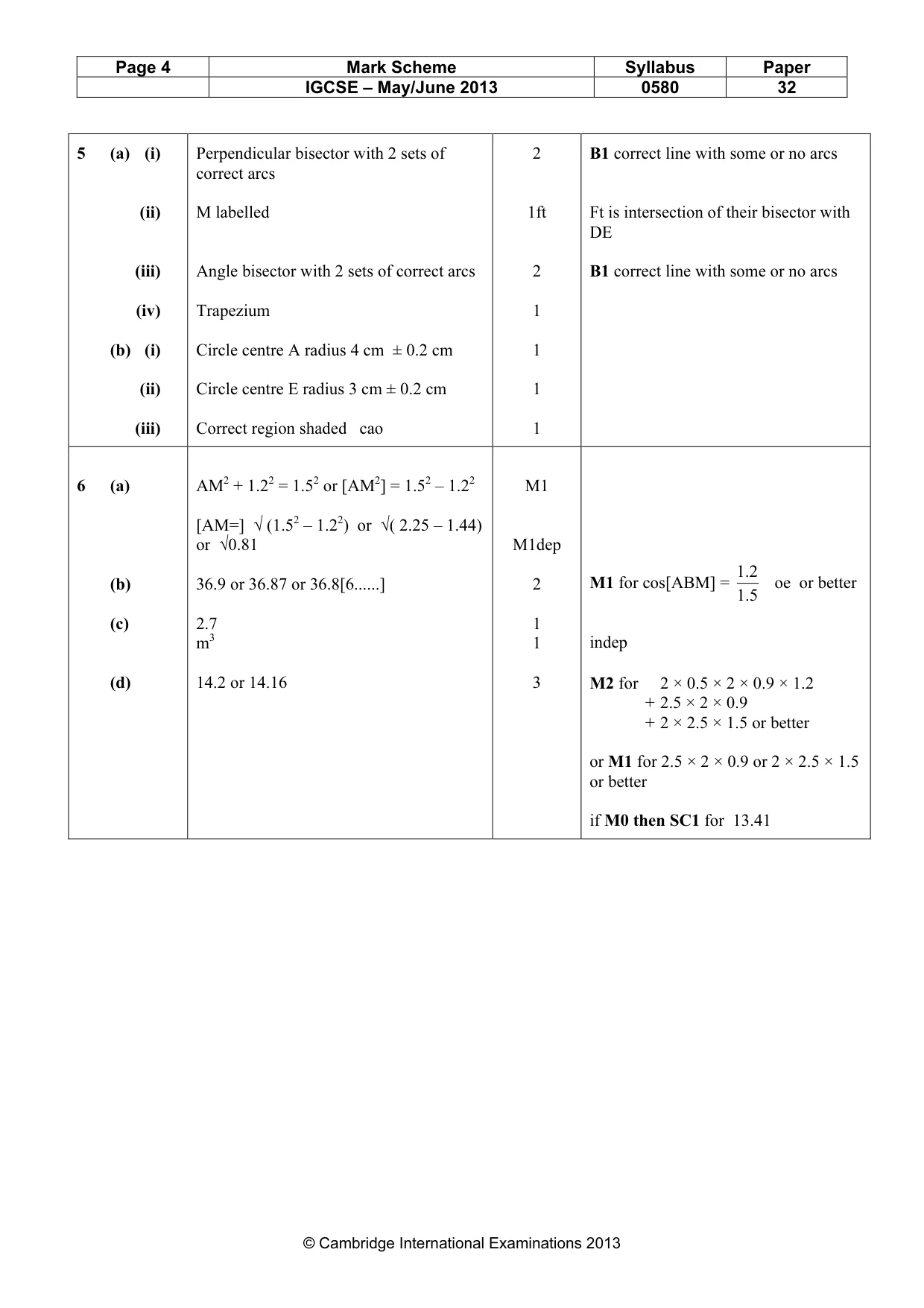
Mark scheme: 5 (a) (i) Perpendicular bisector with 2 sets of 2 B1 correct line with some or no arcs correct arcs (ii) M labelled 1ft Ft is intersection of their bisector with DE (iii) Angle bisector with 2 sets of correct arcs 2 B1 correct line with some or no arcs (iv) Trapezium 1 (b) (i) Circle centre A radius 4 cm ± 0.2 cm 1 (ii) Circle centre E radius 3 cm ± 0.2 cm 1 (iii) Correct region shaded cao 1 2 2 2 2 2 2
Q6 · Finn is going camping
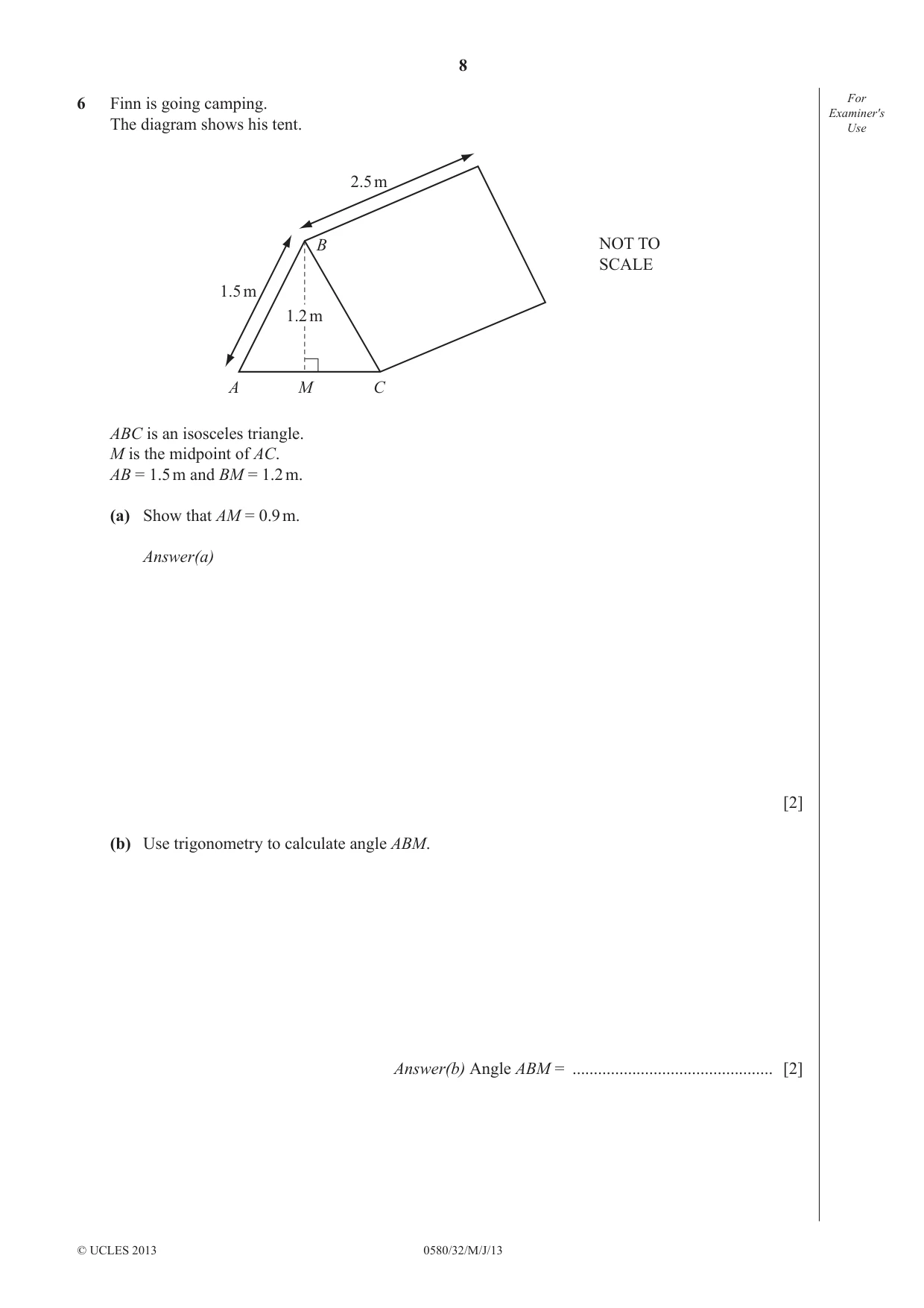
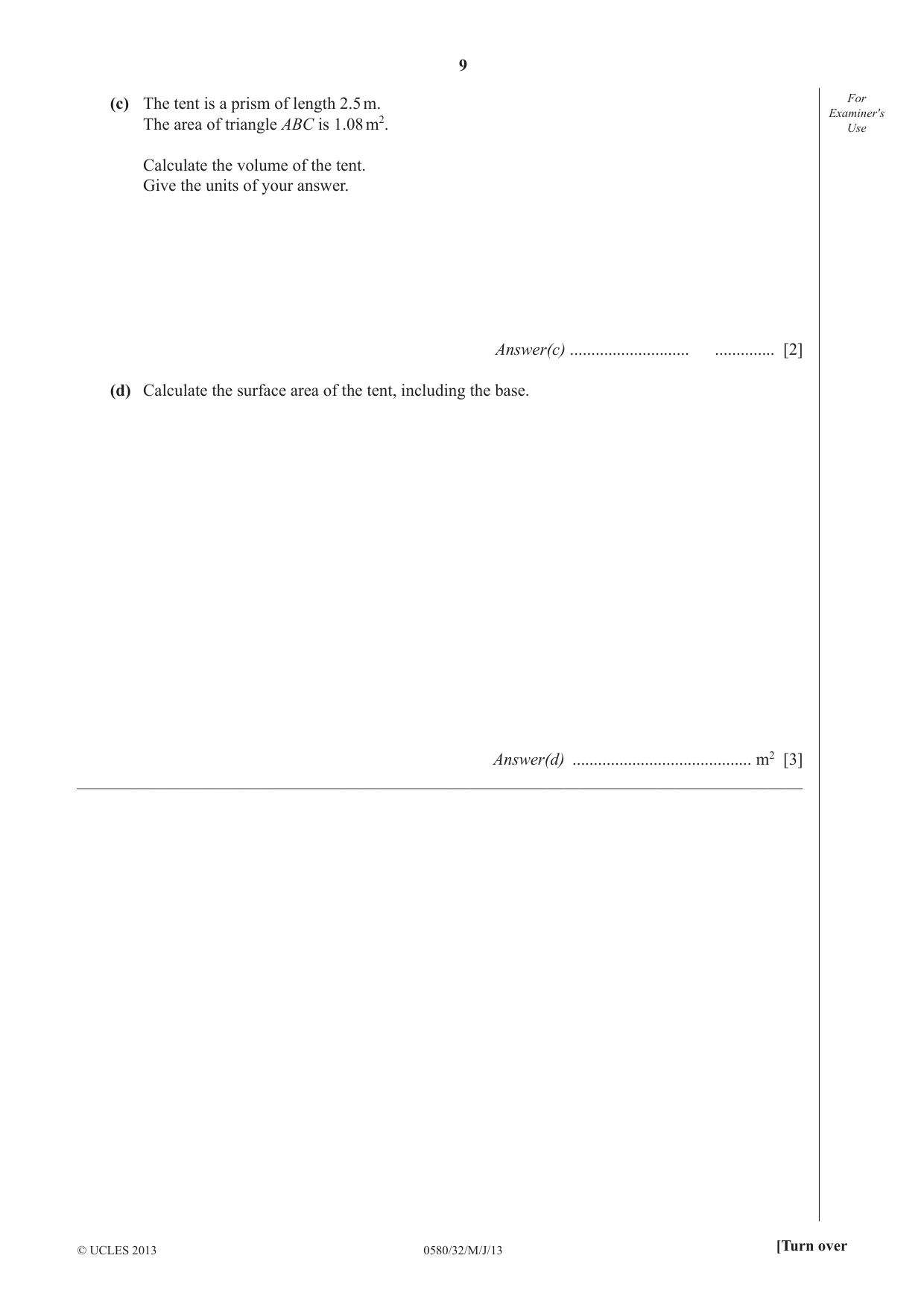
6 Finn is going camping. For Examiner′s The diagram shows his tent. Use 2.5 m B NOT TO SCALE 1.5 m 1.2 m A M C ABC is an isosceles triangle. M is the midpoint of AC. AB = 1.5 m and BM = 1.2 m. (a) Show that AM = 0.9 m. Answer(a) [2] (b) Use trigonometry to calculate angle ABM. Answer(b) Angle ABM = ............................................... [2] (c) The tent is a prism of length 2.5 m. For Examiner′s The area of triangle ABC is 1.08 m2. Use Calculate the volume of the tent. Give the units of your answer. Answer(c) ............................ .............. [2] (d) Calculate the surface area of the tent, including the base. Answer(d) .......................................... m2 [3] _____________________________________________________________________________________
Mark scheme: 6 (a) AM2 + 1.22 = 1.52 or [AM2] = 1.52 – 1.22 M1 [AM=] √ (1.52 – 1.22) or √( 2.25 – 1.44) or √0.81 M1dep 2.1 (b) 36.9 or 36.87 or 36.8[6......] 2 M1 for cos[ABM] = oe or better 5.1 (c) 2.7 1 m3 1 indep (d) 14.2 or 14.16 3 M2 for 2 × 0.5 × 2 × 0.9 × 1.2 + 2.5 × 2 × 0.9 + 2 × 2.5 × 1.5 or better or M1 for 2.5 × 2 × 0.9 or 2 × 2.5 × 1.5 or better if M0 then SC1 for 13.41 IGCSE – May/June 2013 0580 32
Q7 · Complete the table of values for the function y = x2 – 5x + 2
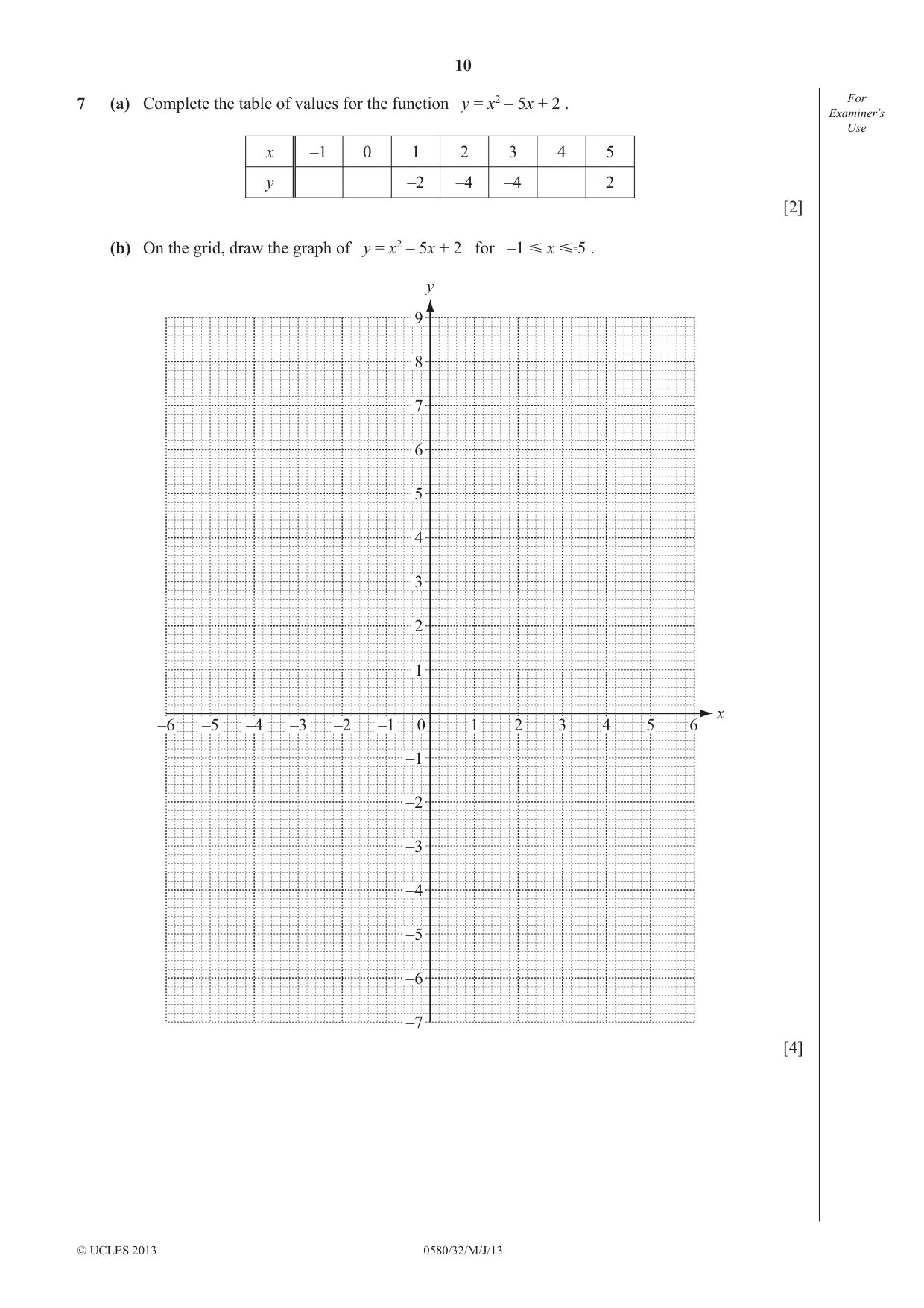
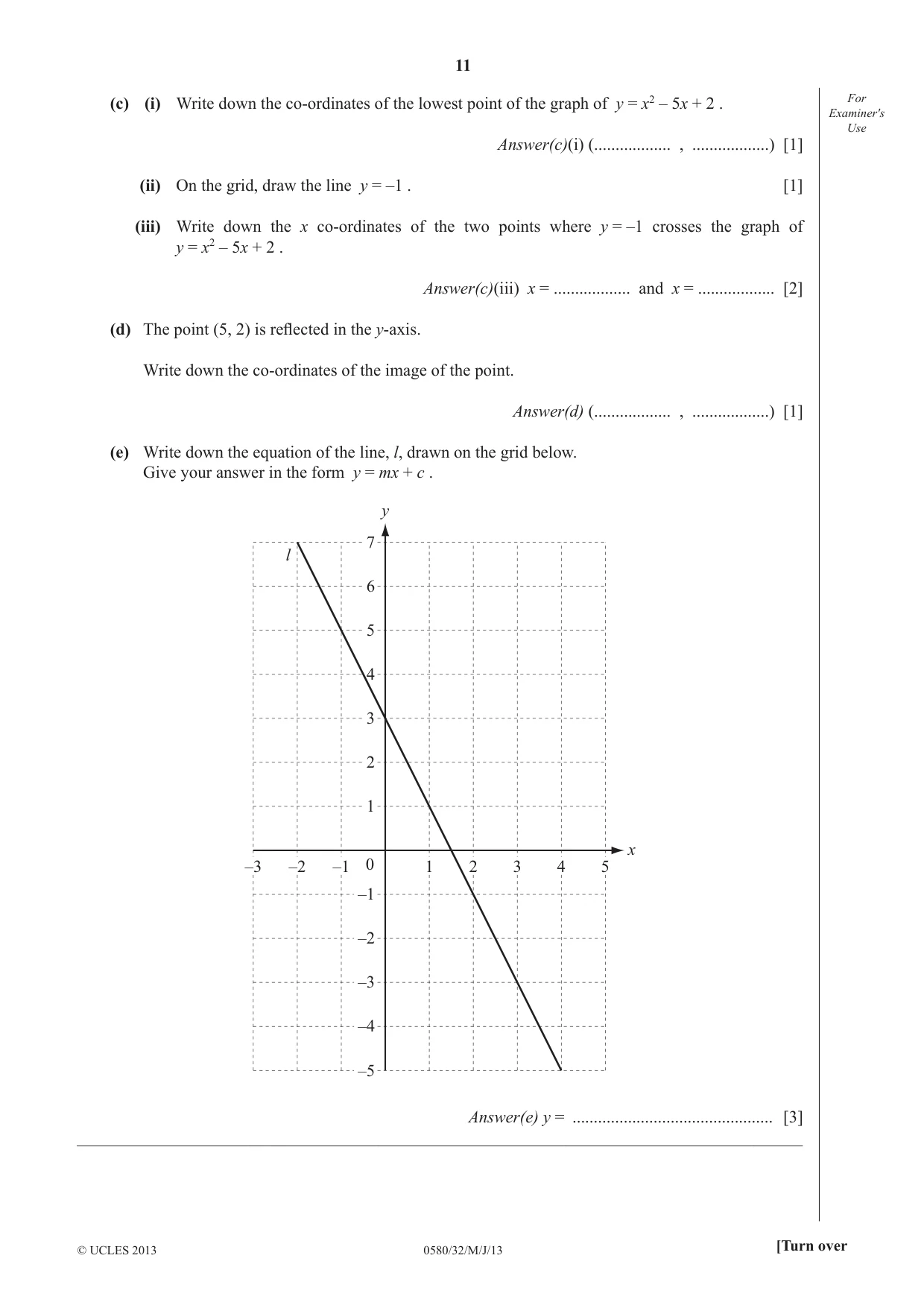
7 (a) Complete the table of values for the function y = x2 – 5x + 2 . For Examiner′s Use x –1 0 1 2 3 4 5 y –2 –4 –4 2 [2] (b) On the grid, draw the graph of y = x2 – 5x + 2 for –1 Ğ x Ğ=5 . y 9 8 7 6 5 4 3 2 1 x –6 –5 –4 –3 –2 –1 0 1 2 3 4 5 6 –1 –2 –3 –4 –5 –6 –7 [4] (c) (i) Write down the co-ordinates of the lowest point of the graph of y = x2 – 5x + 2 . For Examiner′s Use Answer(c)(i) (.................. , ..................) [1] (ii) On the grid, draw the line y = –1 . [1] (iii) Write down the x co-ordinates of the two points where y = –1 crosses the graph of y = x2 – 5x + 2 . Answer(c)(iii) x = .................. and x = .................. [2] (d) The point (5, 2) is refl ected in the y-axis. Write down the co-ordinates of the image of the point. Answer(d) (.................. , ..................) [1] (e) Write down the equation of the line, l, drawn on the grid below. Give your answer in the form y = mx + c . y 7 l 6 5 4 3 2 1 x –3 –2 –1 0 1 2 3 4 5 –1 –2 –3 –4 –5 Answer(e) y = ............................................... [3] _____________________________________________________________________________________
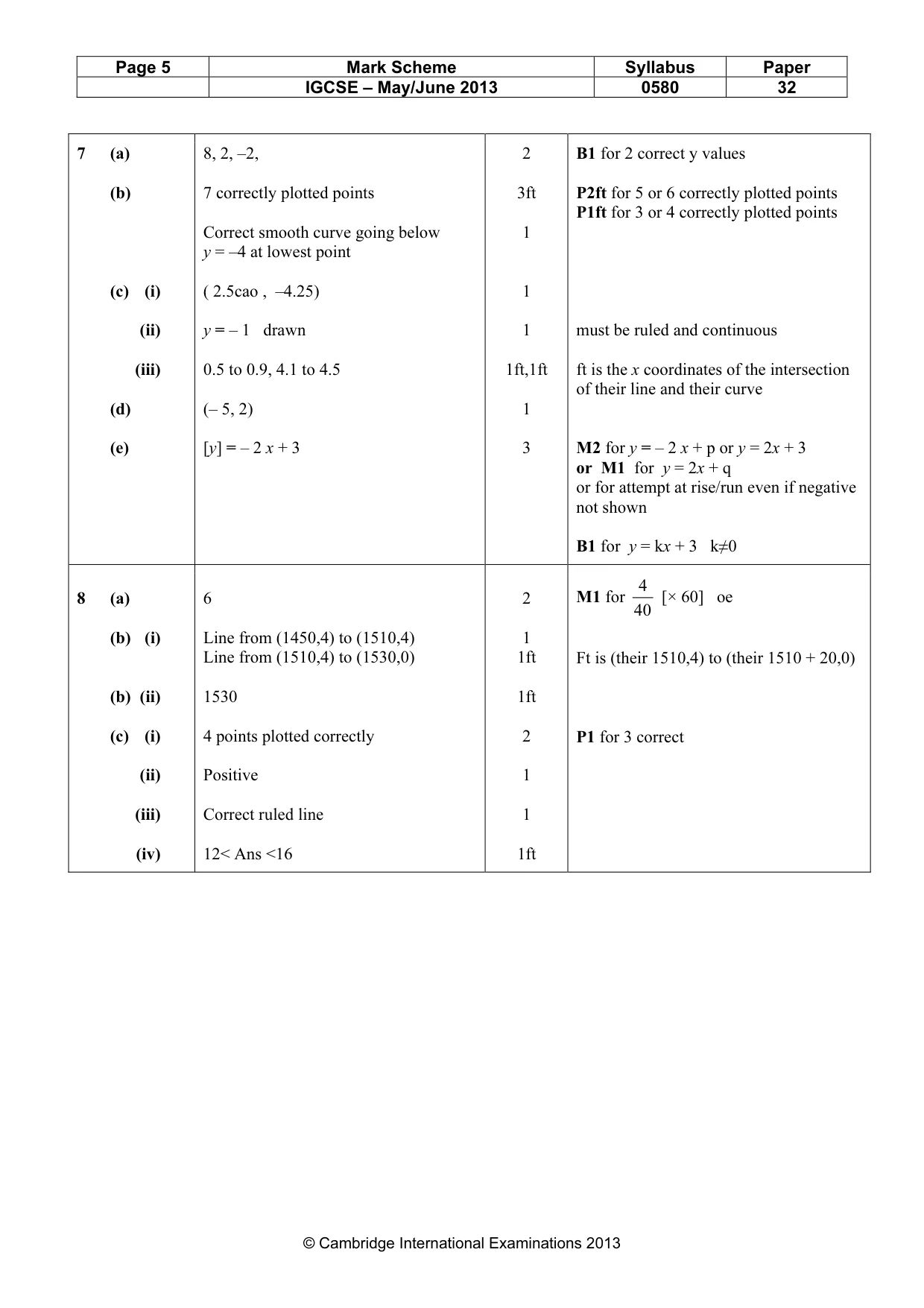
Mark scheme: 7 (a) 8, 2, –2, 2 B1 for 2 correct y values (b) 7 correctly plotted points 3ft P2ft for 5 or 6 correctly plotted points P1ft for 3 or 4 correctly plotted points Correct smooth curve going below 1 y = –4 at lowest point (c) (i) ( 2.5cao , –4.25) 1 (ii) y = – 1 drawn 1 must be ruled and continuous (iii) 0.5 to 0.9, 4.1 to 4.5 1ft,1ft ft is the x coordinates of the intersection of their line and their curve (d) (– 5, 2) 1 (e) [y] = – 2 x + 3 3 M2 for y = – 2 x + p or y = 2x + 3 or M1 for y = 2x + q or for attempt at rise/run even if negative not shown B1 for y = kx + 3 k≠0 4 M1 f [ 60]
Q8 · For Examiner′s Use 5 Sweet 4 shop 3 Distance (km) 2 1 Home 0 14 10 14 20 14 30 14 40 14…
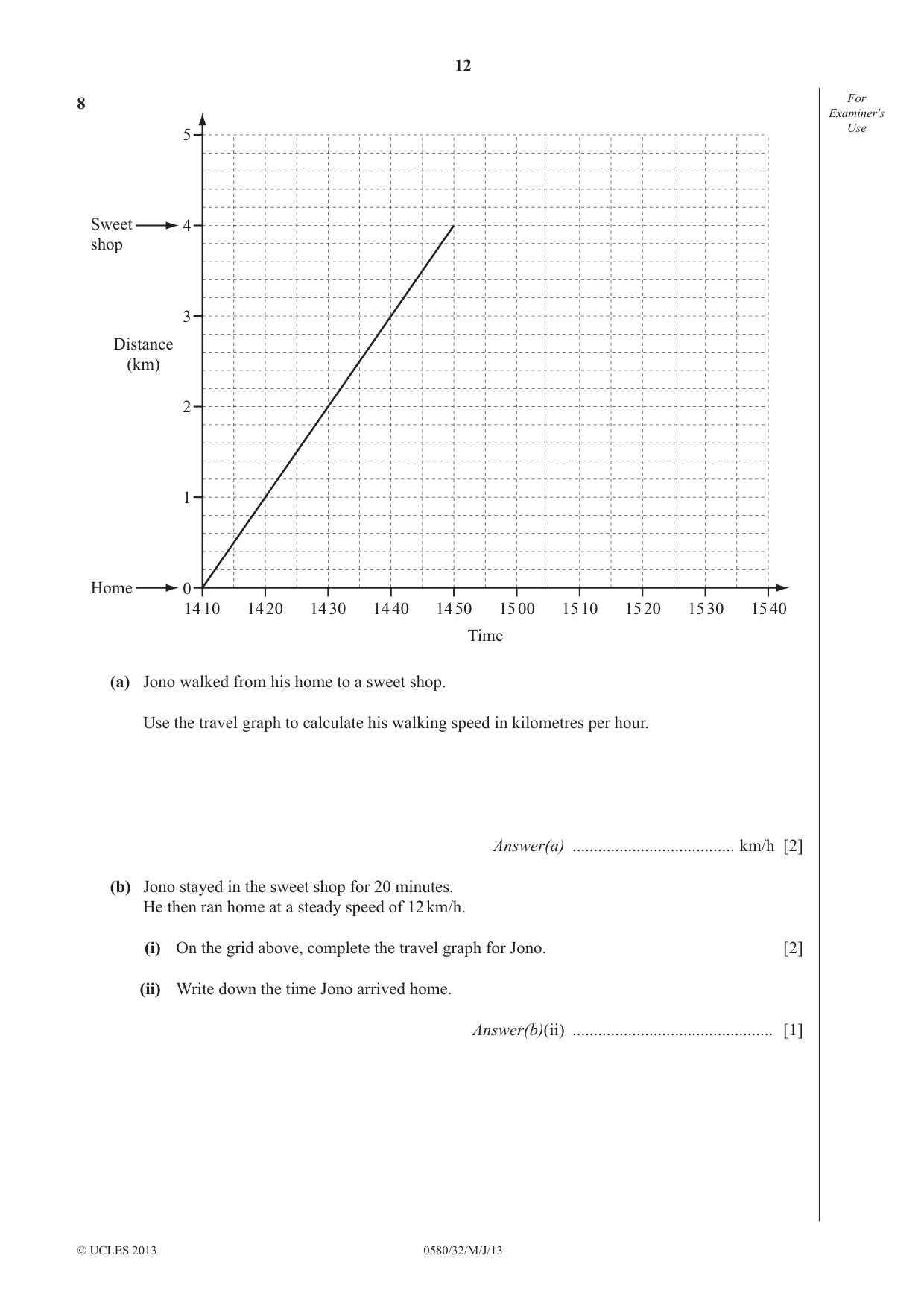
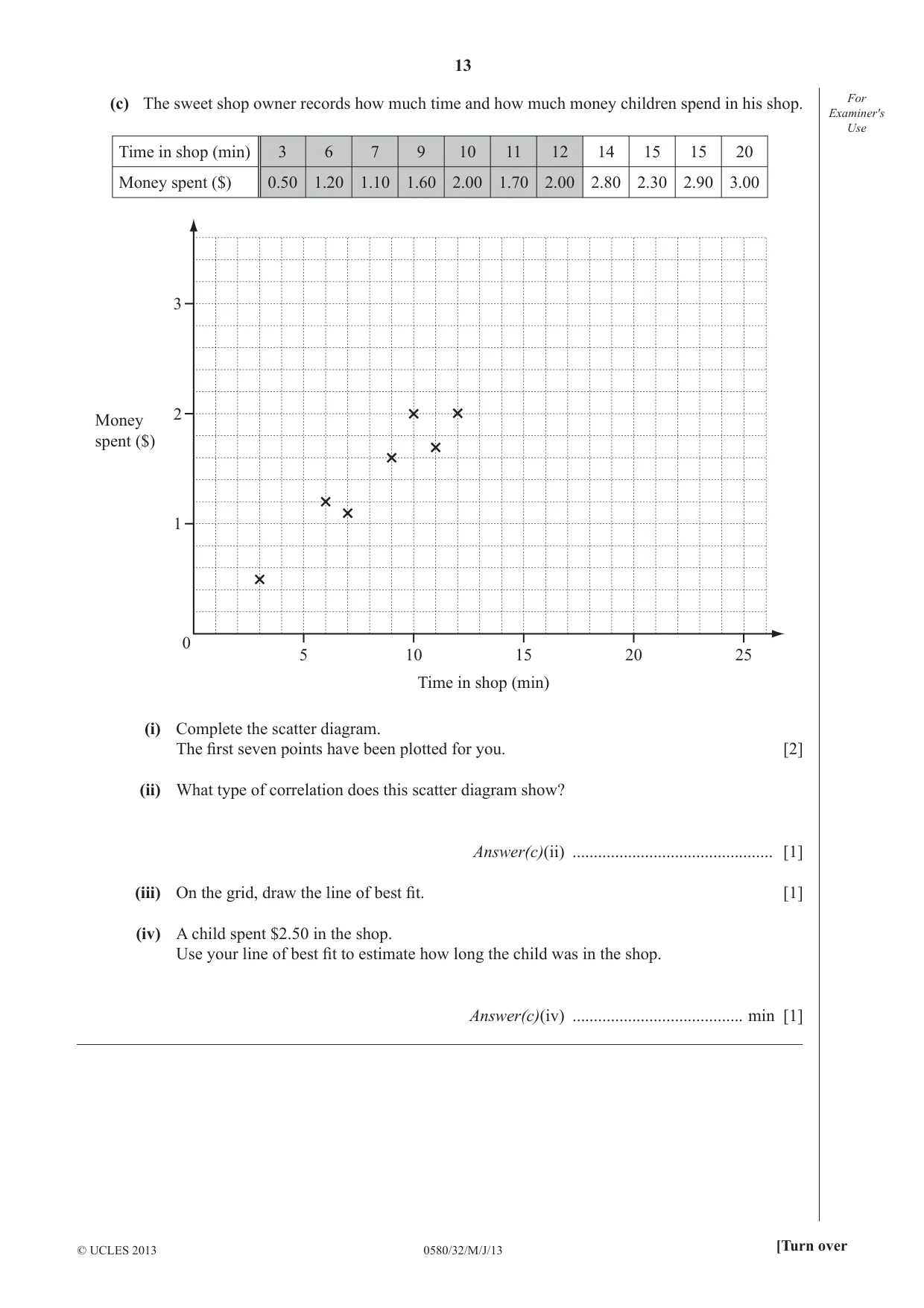
8 For Examiner′s Use 5 Sweet 4 shop 3 Distance (km) 2 1 Home 0 14 10 14 20 14 30 14 40 14 50 15 00 15 10 15 20 15 30 15 40 Time (a) Jono walked from his home to a sweet shop. Use the travel graph to calculate his walking speed in kilometres per hour. Answer(a) ...................................... km/h [2] (b) Jono stayed in the sweet shop for 20 minutes. He then ran home at a steady speed of 12 km/h. (i) On the grid above, complete the travel graph for Jono. [2] (ii) Write down the time Jono arrived home. Answer(b)(ii) ............................................... [1] (c) The sweet shop owner records how much time and how much money children spend in his shop. For Examiner′s Use Time in shop (min) 3 6 7 9 10 11 12 14 15 15 20 Money spent ($) 0.50 1.20 1.10 1.60 2.00 1.70 2.00 2.80 2.30 2.90 3.00 3 2 Money spent ($) 1 0 5 10 15 20 25 Time in shop (min) (i) Complete the scatter diagram. The fi rst seven points have been plotted for you. [2] (ii) What type of correlation does this scatter diagram show? Answer(c)(ii) ............................................... [1] (iii) On the grid, draw the line of best fi t. [1] (iv) A child spent $2.50 in the shop. Use your line of best fi t to estimate how long the child was in the shop. Answer(c)(iv) ........................................ min [1] _____________________________________________________________________________________
Mark scheme: 4 8 (a) 6 2 M1 for [× 60] oe 40 (b) (i) Line from (1450,4) to (1510,4) 1 Line from (1510,4) to (1530,0) 1ft Ft is (their 1510,4) to (their 1510 + 20,0) (b) (ii) 1530 1ft (c) (i) 4 points plotted correctly 2 P1 for 3 correct (ii) Positive 1 (iii) Correct ruled line 1 (iv) 12< Ans <16 1ft IGCSE – May/June 2013 0580 32
Q9 · A family of 2 adults and 3 children are on holiday
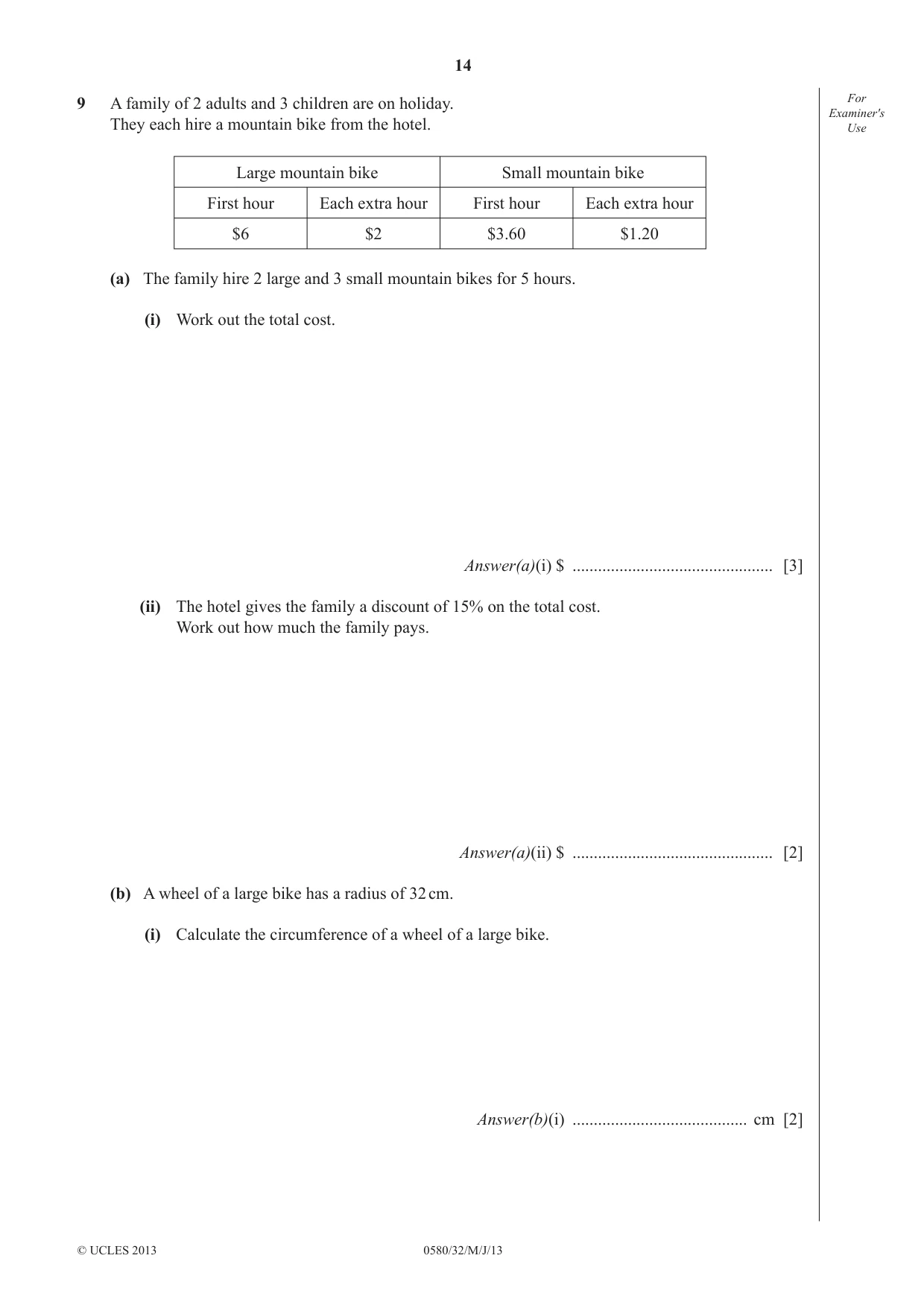
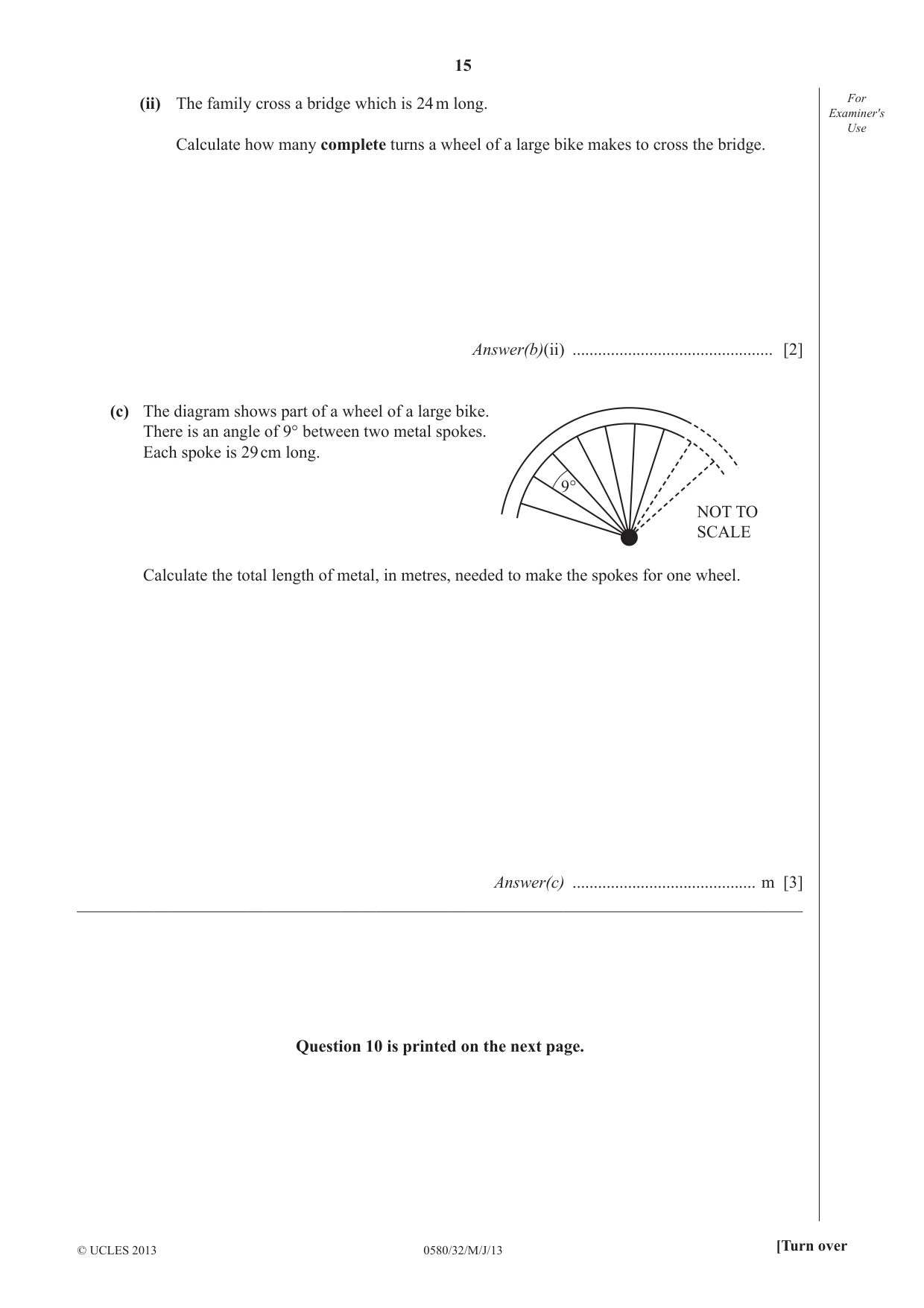
9 A family of 2 adults and 3 children are on holiday. For Examiner′s They each hire a mountain bike from the hotel. Use Large mountain bike Small mountain bike First hour Each extra hour First hour Each extra hour $6 $2 $3.60 $1.20 (a) The family hire 2 large and 3 small mountain bikes for 5 hours. (i) Work out the total cost. Answer(a)(i) $ ............................................... [3] (ii) The hotel gives the family a discount of 15% on the total cost. Work out how much the family pays. Answer(a)(ii) $ ............................................... [2] (b) A wheel of a large bike has a radius of 32 cm. (i) Calculate the circumference of a wheel of a large bike. Answer(b)(i) ......................................... cm [2] (ii) The family cross a bridge which is 24 m long. For Examiner′s Use Calculate how many complete turns a wheel of a large bike makes to cross the bridge. Answer(b)(ii) ............................................... [2] (c) The diagram shows part of a wheel of a large bike. There is an angle of 9° between two metal spokes. Each spoke is 29 cm long. 9° NOT TO SCALE Calculate the total length of metal, in metres, needed to make the spokes for one wheel. Answer(c) ........................................... m [3] _____________________________________________________________________________________ Question 10 is printed on the next page.
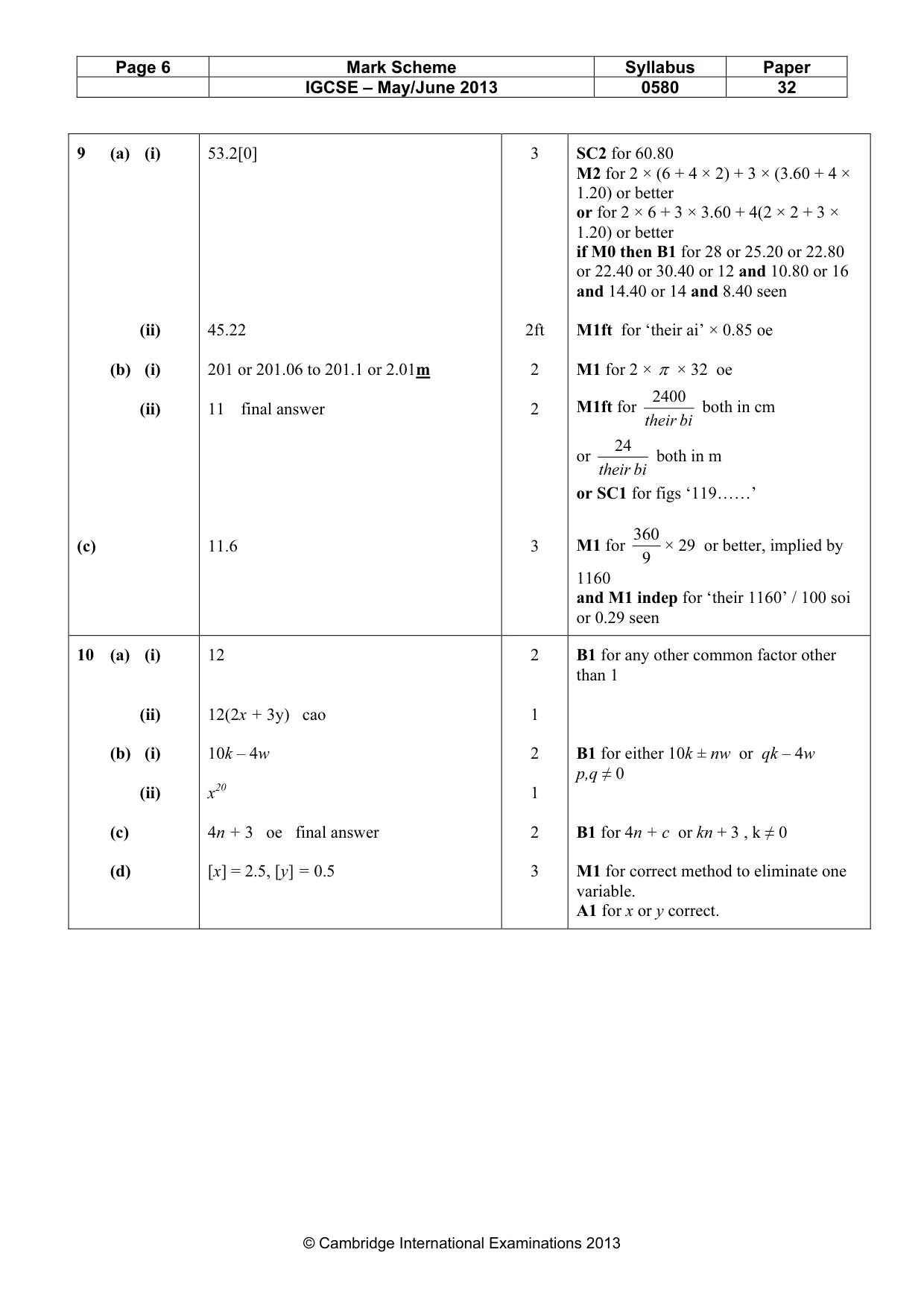
Mark scheme: 9 (a) (i) 53.2[0] 3 SC2 for 60.80 M2 for 2 × (6 + 4 × 2) + 3 × (3.60 + 4 × 1.20) or better or for 2 × 6 + 3 × 3.60 + 4(2 × 2 + 3 × 1.20) or better if M0 then B1 for 28 or 25.20 or 22.80 or 22.40 or 30.40 or 12 and 10.80 or 16 and 14.40 or 14 and 8.40 seen (ii) 45.22 2ft M1ft for ‘their ai’ × 0.85 oe (b) (i) 201 or 201.06 to 201.1 or 2.01m 2 M1 for 2 × π × 32 oe 2400 (ii) 11 final answer 2 M1ft for both in cm their bi 24 or both in m their bi or SC1 for figs ‘119……’ 360 (c) 11.6 3 M1 for × 29 or better, implied by 9 1160 and M1 indep for ‘their 1160’ / 100 soi or 0.29 seen
Q10 · Find the highest common factor (HCF) of 24 and 36
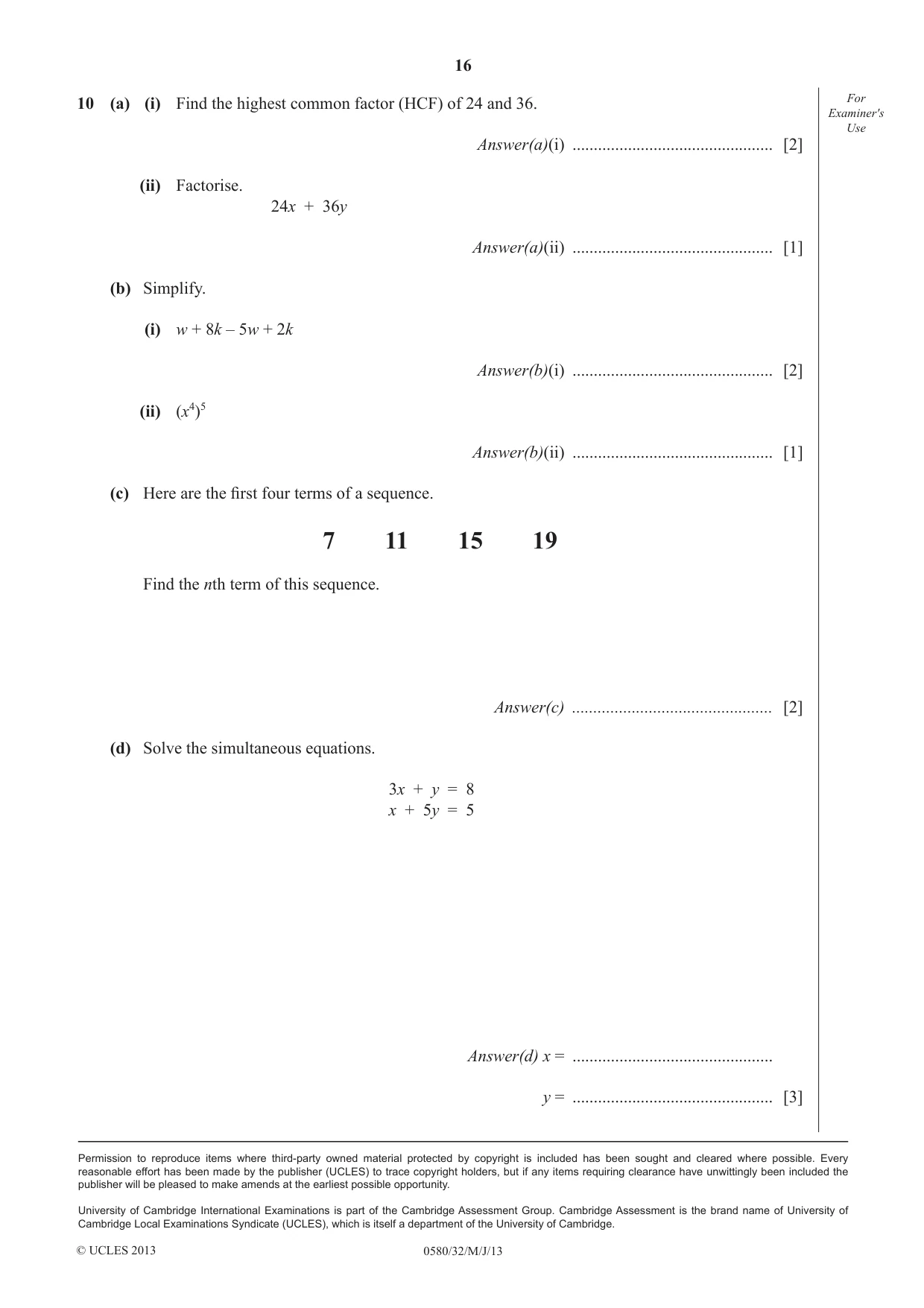
10 (a) (i) Find the highest common factor (HCF) of 24 and 36. For Examiner′s Use Answer(a)(i) ............................................... [2] (ii) Factorise. 24x + 36y Answer(a)(ii) ............................................... [1] (b) Simplify. (i) w + 8k – 5w + 2k Answer(b)(i) ............................................... [2] (ii) (x4)5 Answer(b)(ii) ............................................... [1] (c) Here are the fi rst four terms of a sequence. 7 11 15 19 Find the nth term of this sequence. Answer(c) ............................................... [2] (d) Solve the simultaneous equations. 3x + y = 8 x + 5y = 5 Answer(d) x = ............................................... y = ............................................... [3]
Mark scheme: 10 (a) (i) 12 2 B1 for any other common factor other than 1 (ii) 12(2x + 3y) cao 1 (b) (i) 10k – 4w 2 B1 for either 10k ± nw or qk – 4w p,q ≠ 0 (ii) x20 1 (c) 4n + 3 oe final answer 2 B1 for 4n + c or kn + 3 , k ≠ 0 (d) [x] = 2.5, [y] = 0.5 3 M1 for correct method to eliminate one variable. A1 for x or y correct.
What was in this paper
The subtopics covered by these 10 questions, and how many questions each got. Open one in a new tab to see every Cambridge question on it.
What you needed in this session
Cambridge’s own grade thresholds for 2013 May/June, Paper 3 · Variant 2. A higher threshold means an easier paper — the bar moves with how the cohort did.