Cambridge IGCSE Mathematics 0580 — 2012 Oct/Nov Paper 3 · Variant 1
0580/31/O/N/12 · 10 questions · 104 marks · ≈117 min
The question paper and its mark scheme, free to read here and free to download. This is Cambridge’s own paper, exactly as it was sat.
Question paper16 pages
Mark scheme6 pages
Answers below. Sit the paper first if you are practising.
Questions as text
Q1 · Write down two numbers that are multiples of 10
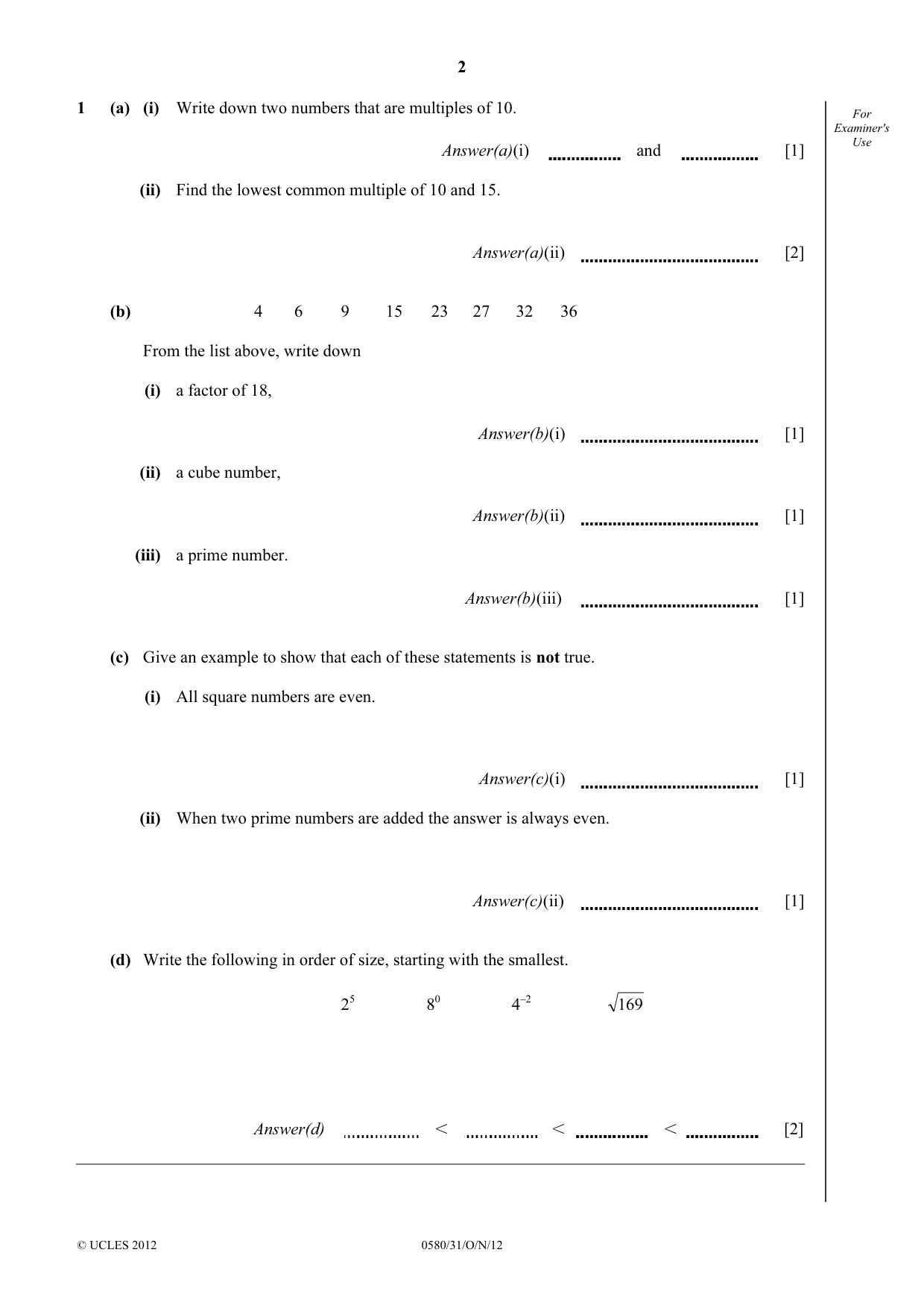
1 (a) (i) Write down two numbers that are multiples of 10. For Examiner's Use Answer(a)(i) and [1] (ii) Find the lowest common multiple of 10 and 15. Answer(a)(ii) [2] (b) 4 6 9 15 23 27 32 36 From the list above, write down (i) a factor of 18, Answer(b)(i) [1] (ii) a cube number, Answer(b)(ii) [1] (iii) a prime number. Answer(b)(iii) [1] (c) Give an example to show that each of these statements is not true. (i) All square numbers are even. Answer(c)(i) [1] (ii) When two prime numbers are added the answer is always even. Answer(c)(ii) [1] (d) Write the following in order of size, starting with the smallest. 25 80 4–2 169 Answer(d) I I I [2]
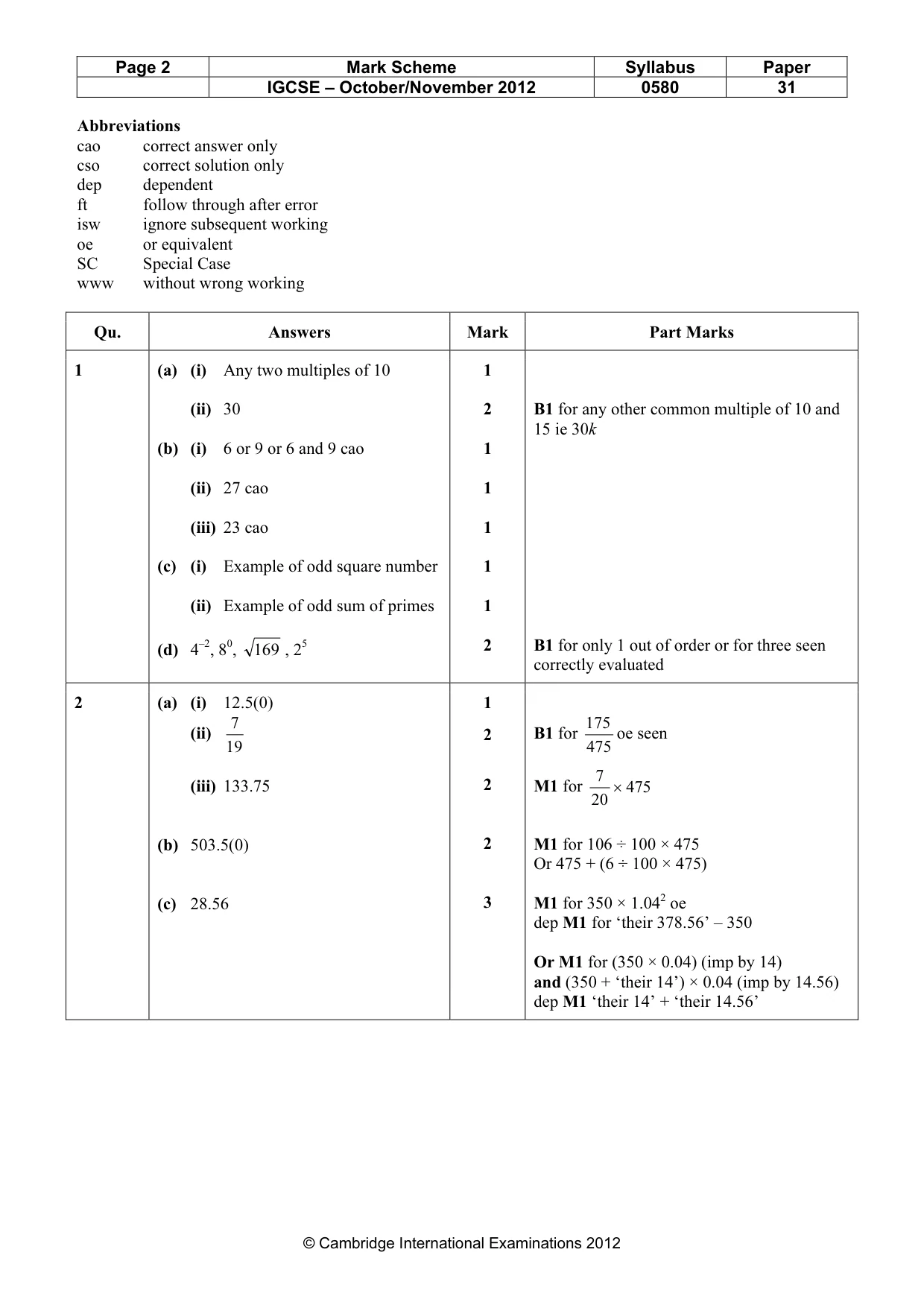
Mark scheme: Qu. Answers Mark Part Marks 1 (a) (i) Any two multiples of 10 1 (ii) 30 2 B1 for any other common multiple of 10 and 15 ie 30k (b) (i) 6 or 9 or 6 and 9 cao 1 (ii) 27 cao 1 (iii) 23 cao 1 (c) (i) Example of odd square number 1 (ii) Example of odd sum of primes 1 (d) 4–2, 80, 169 , 25 2 B1 for only 1 out of order or for three seen correctly evaluated
Q2 · Luka earns $475 each week
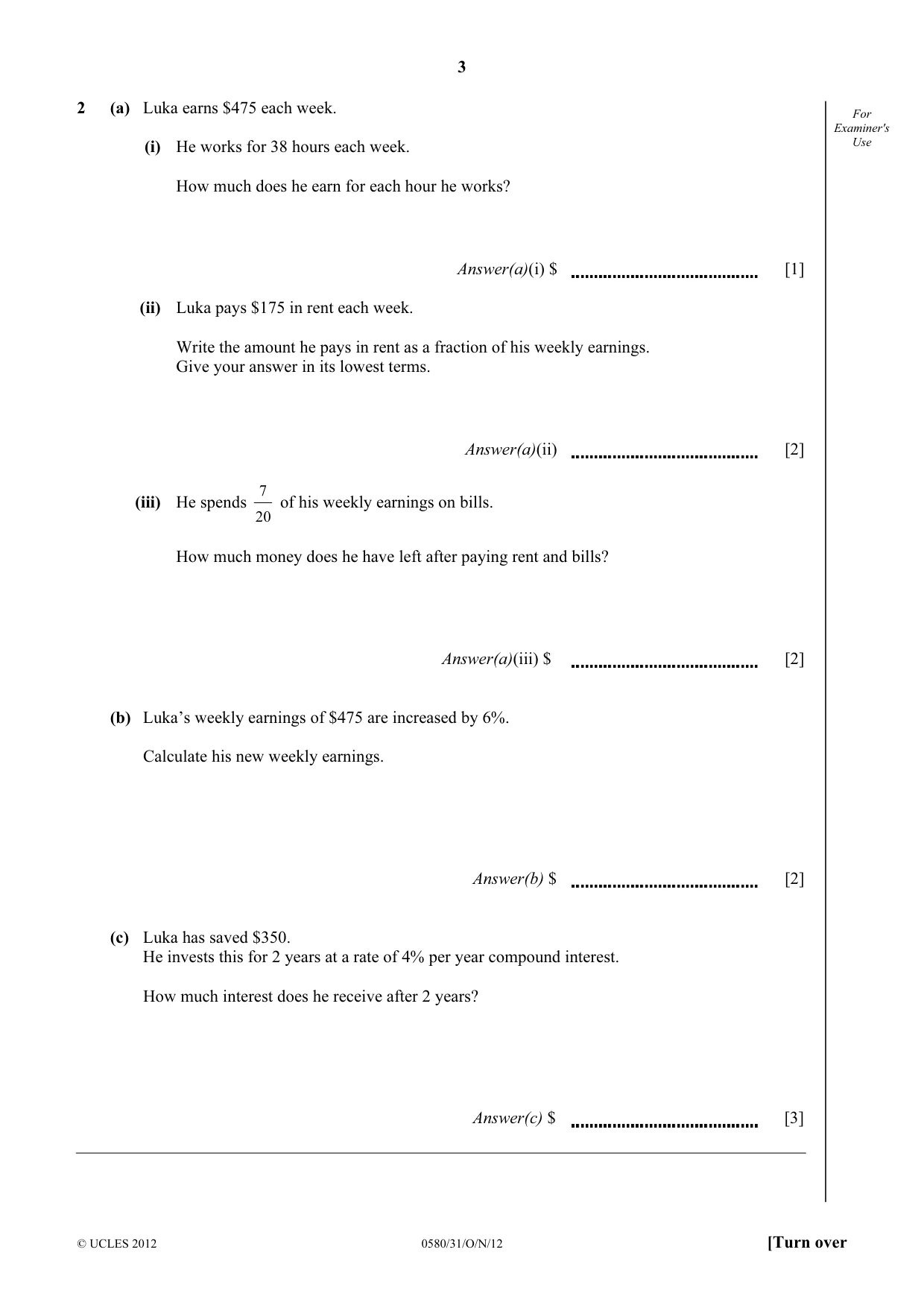
2 (a) Luka earns $475 each week. For Examiner's Use (i) He works for 38 hours each week. How much does he earn for each hour he works? Answer(a)(i) $ [1] (ii) Luka pays $175 in rent each week. Write the amount he pays in rent as a fraction of his weekly earnings. Give your answer in its lowest terms. Answer(a)(ii) [2] 7 (iii) He spends of his weekly earnings on bills. 20 How much money does he have left after paying rent and bills? Answer(a)(iii) $ [2] (b) Luka’s weekly earnings of $475 are increased by 6%. Calculate his new weekly earnings. Answer(b) $ [2] (c) Luka has saved $350. He invests this for 2 years at a rate of 4% per year compound interest. How much interest does he receive after 2 years? Answer(c) $ [3]
Mark scheme: 2 (a) (i) 12.5(0) 1 7 175 (ii) 2 B1 for oe seen 19 475 7 (iii) 133.75 2 M1 for × 475 20 (b) 503.5(0) 2 M1 for 106 ÷ 100 × 475 Or 475 + (6 ÷ 100 × 475) (c) 28.56 3 M1 for 350 × 1.042 oe dep M1 for ‘their 378.56’ – 350 Or M1 for (350 × 0.04) (imp by 14) and (350 + ‘their 14’) × 0.04 (imp by 14.56) dep M1 ‘their 14’ + ‘their 14.56’ IGCSE – October/November 2012 0580 31
Q3 · Amir asked 15 friends how many hours they spent playing sport last weekend
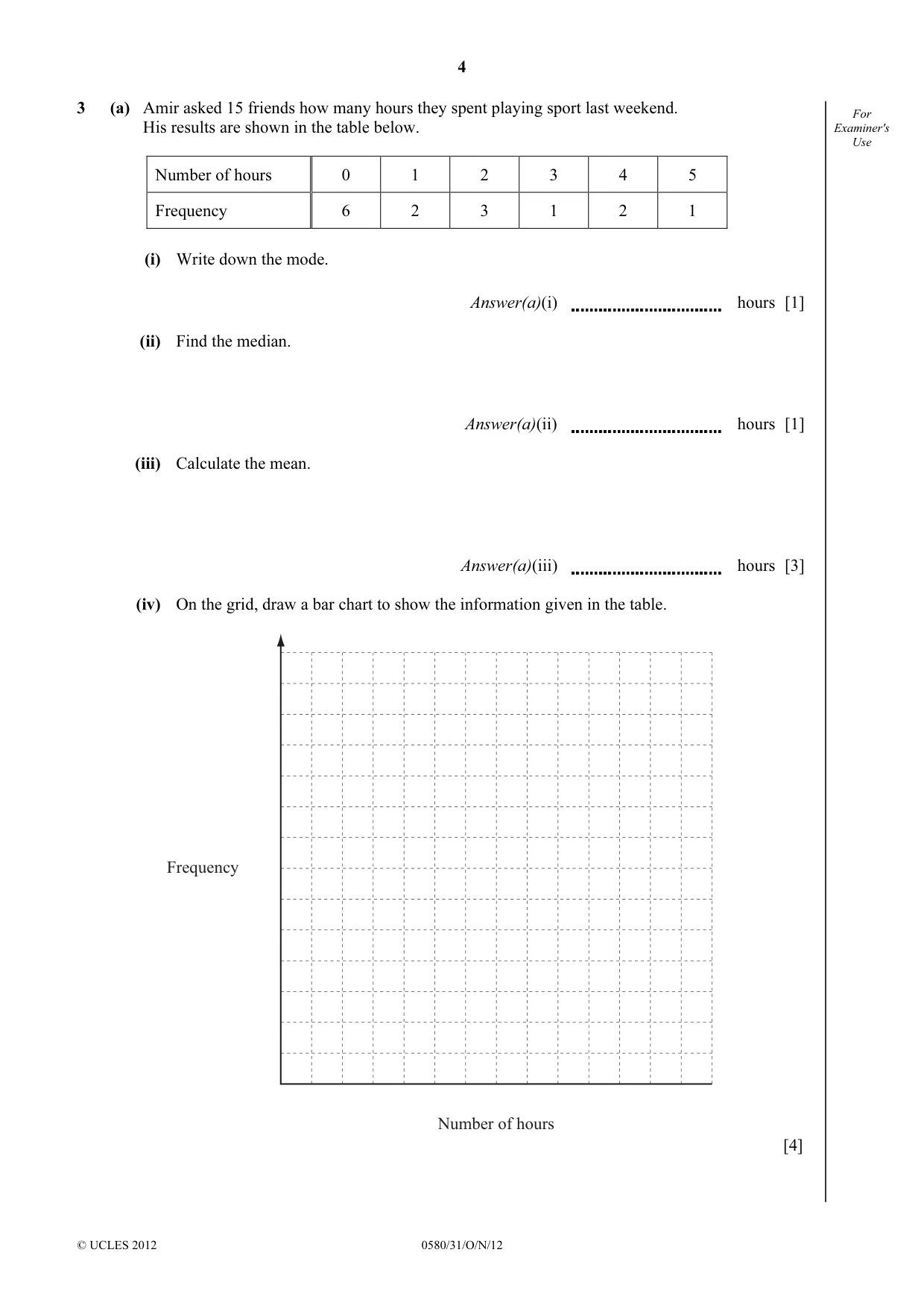
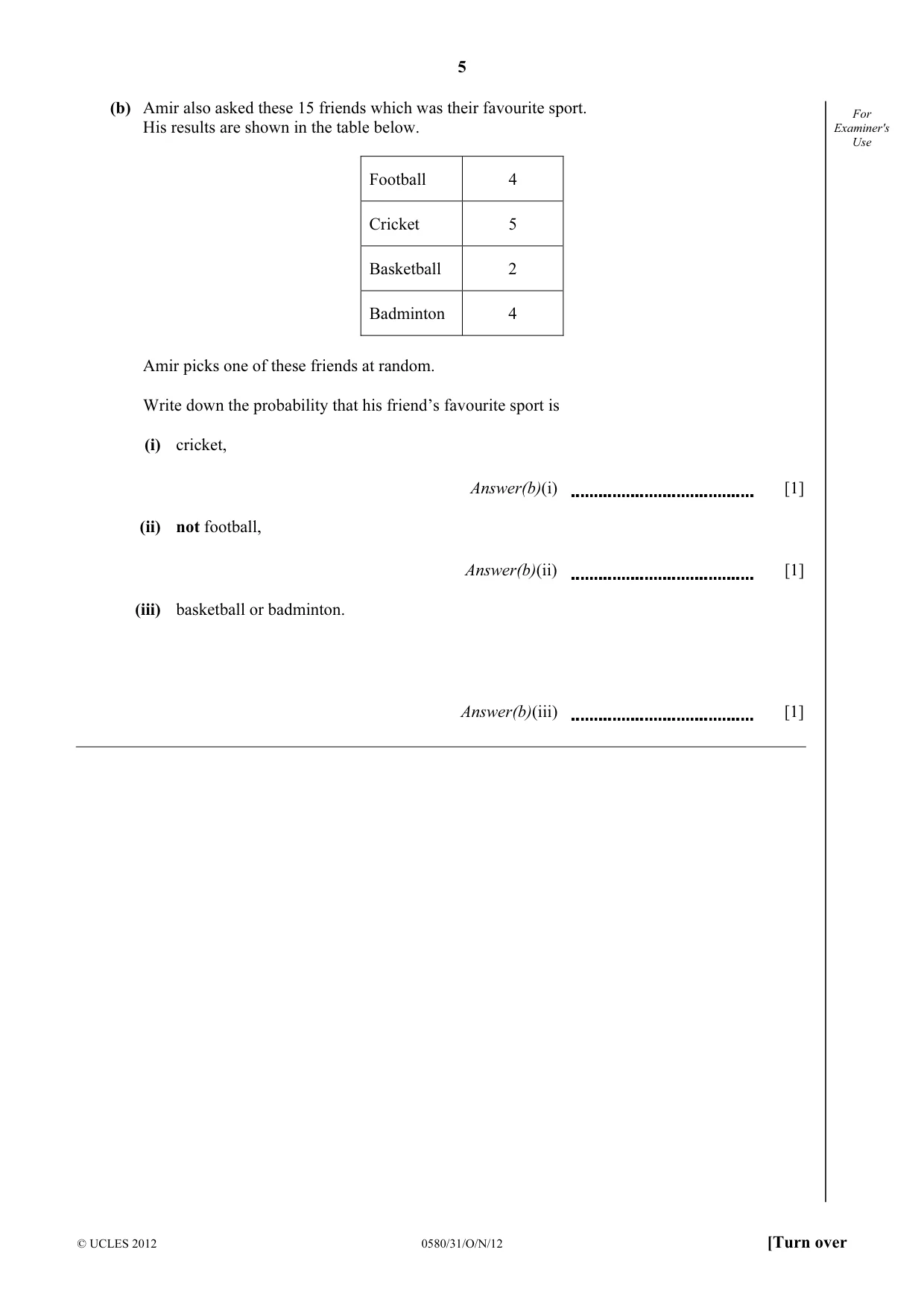
3 (a) Amir asked 15 friends how many hours they spent playing sport last weekend. For His results are shown in the table below. Examiner's Use Number of hours 0 1 2 3 4 5 Frequency 6 2 3 1 2 1 (i) Write down the mode. Answer(a)(i) hours [1] (ii) Find the median. Answer(a)(ii) hours [1] (iii) Calculate the mean. Answer(a)(iii) hours [3] (iv) On the grid, draw a bar chart to show the information given in the table. Frequency Number of hours [4] (b) Amir also asked these 15 friends which was their favourite sport. For His results are shown in the table below. Examiner's Use Football 4 Cricket 5 Basketball 2 Badminton 4 Amir picks one of these friends at random. Write down the probability that his friend’s favourite sport is (i) cricket, Answer(b)(i) [1] (ii) not football, Answer(b)(ii) [1] (iii) basketball or badminton. Answer(b)(iii) [1]
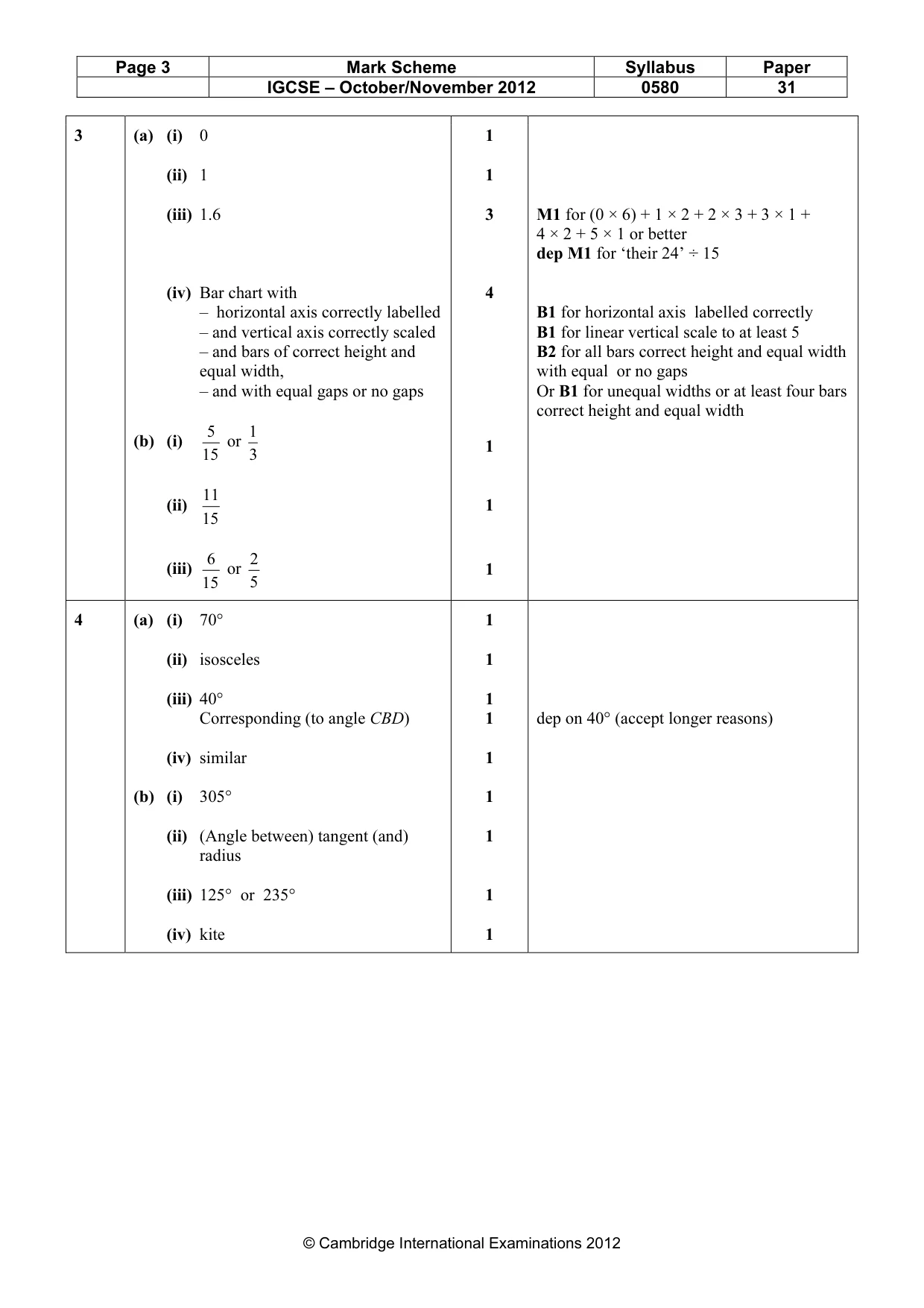
Mark scheme: 3 (a) (i) 0 1 (ii) 1 1 (iii) 1.6 3 M1 for (0 × 6) + 1 × 2 + 2 × 3 + 3 × 1 + 4 × 2 + 5 × 1 or better dep M1 for ‘their 24’ ÷ 15 (iv) Bar chart with 4 – horizontal axis correctly labelled B1 for horizontal axis labelled correctly – and vertical axis correctly scaled B1 for linear vertical scale to at least 5 – and bars of correct height and B2 for all bars correct height and equal width equal width, with equal or no gaps – and with equal gaps or no gaps Or B1 for unequal widths or at least four bars correct height and equal width 5 1 (b) (i) or 15 3 1 11 (ii) 1 15 6 2 (iii) or 1 15 5
Q4 · For C Examiner's Use 70° NOT TO SCALE D 40° B E A In the diagram, ACE is a triangle
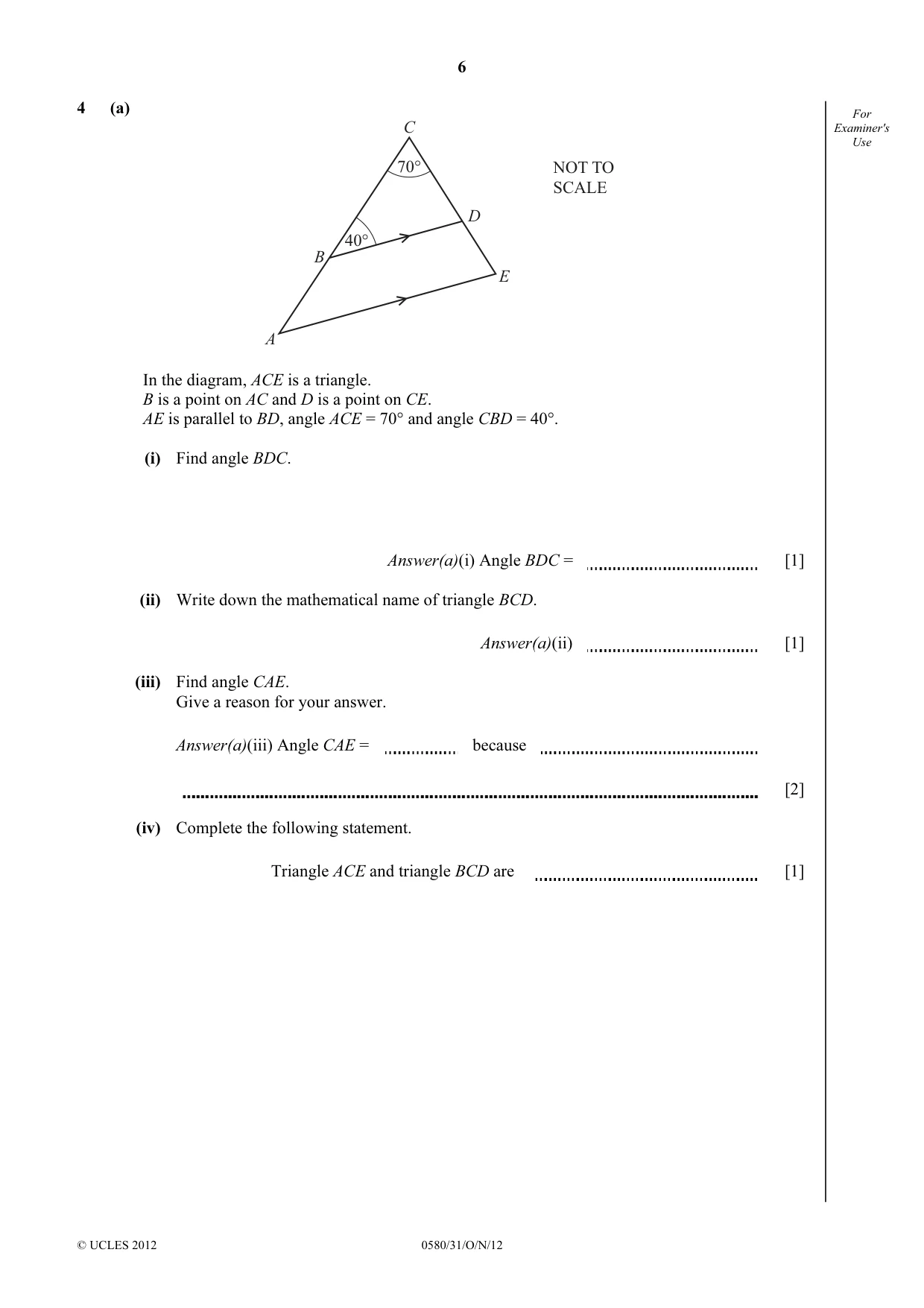
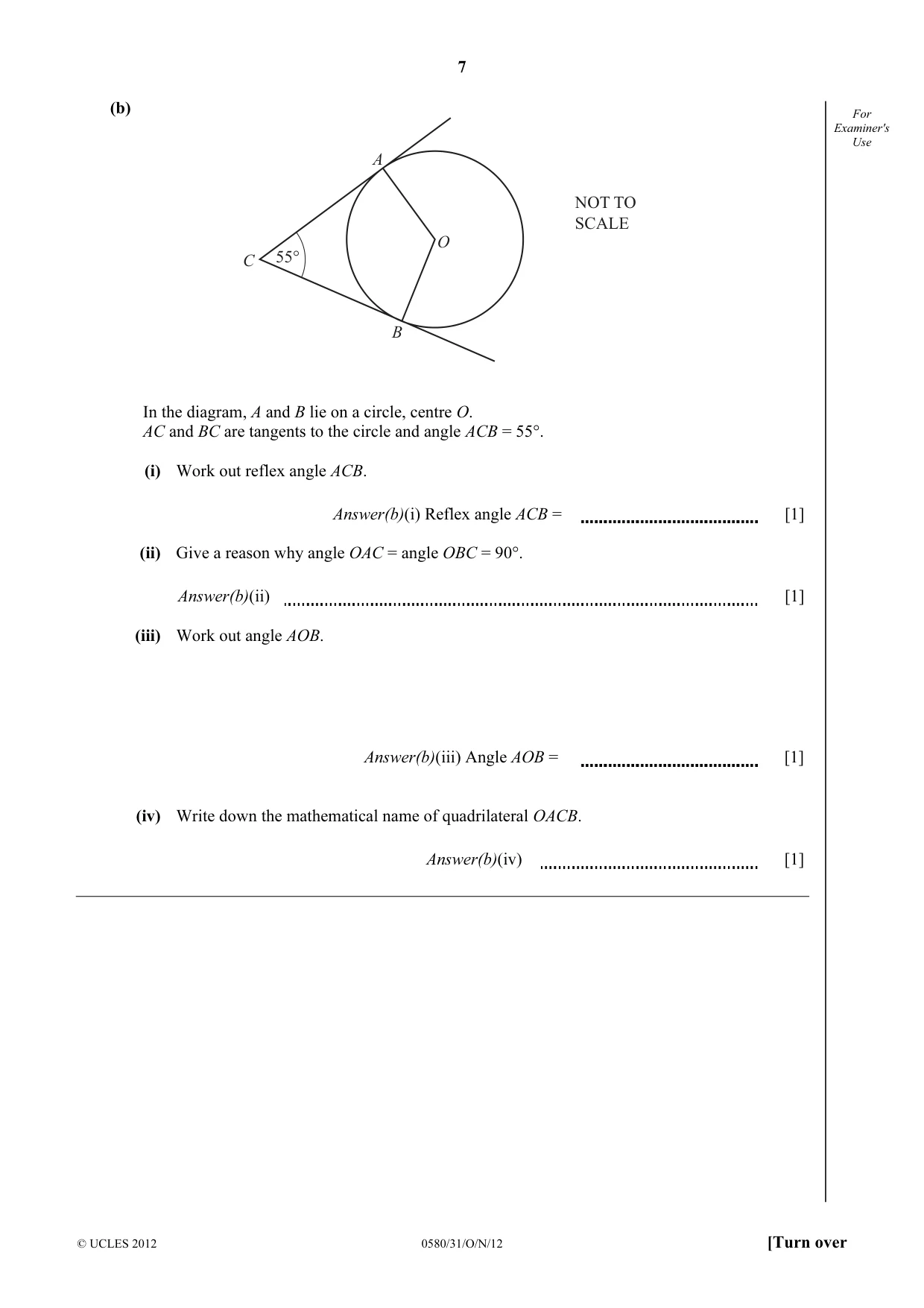
4 (a) For C Examiner's Use 70° NOT TO SCALE D 40° B E A In the diagram, ACE is a triangle. B is a point on AC and D is a point on CE. AE is parallel to BD, angle ACE = 70° and angle CBD = 40°. (i) Find angle BDC. Answer(a)(i) Angle BDC = [1] (ii) Write down the mathematical name of triangle BCD. Answer(a)(ii) [1] (iii) Find angle CAE. Give a reason for your answer. Answer(a)(iii) Angle CAE = because [2] (iv) Complete the following statement. Triangle ACE and triangle BCD are [1] (b) For Examiner's Use A NOT TO SCALE O C 55° B In the diagram, A and B lie on a circle, centre O. AC and BC are tangents to the circle and angle ACB = 55°. (i) Work out reflex angle ACB. Answer(b)(i) Reflex angle ACB = [1] (ii) Give a reason why angle OAC = angle OBC = 90°. Answer(b)(ii) [1] (iii) Work out angle AOB. Answer(b)(iii) Angle AOB = [1] (iv) Write down the mathematical name of quadrilateral OACB. Answer(b)(iv) [1]
Mark scheme: 4 (a) (i) 70° 1 (ii) isosceles 1 (iii) 40° 1 Corresponding (to angle CBD) 1 dep on 40° (accept longer reasons) (iv) similar 1 (b) (i) 305° 1 (ii) (Angle between) tangent (and) 1 radius (iii) 125° or 235° 1 (iv) kite 1 IGCSE – October/November 2012 0580 31 2 2 2
Q5 · For B 20 m C Examiner's Use NOT TO SCALE 15 m A 32 m D The diagram shows a plot of land…
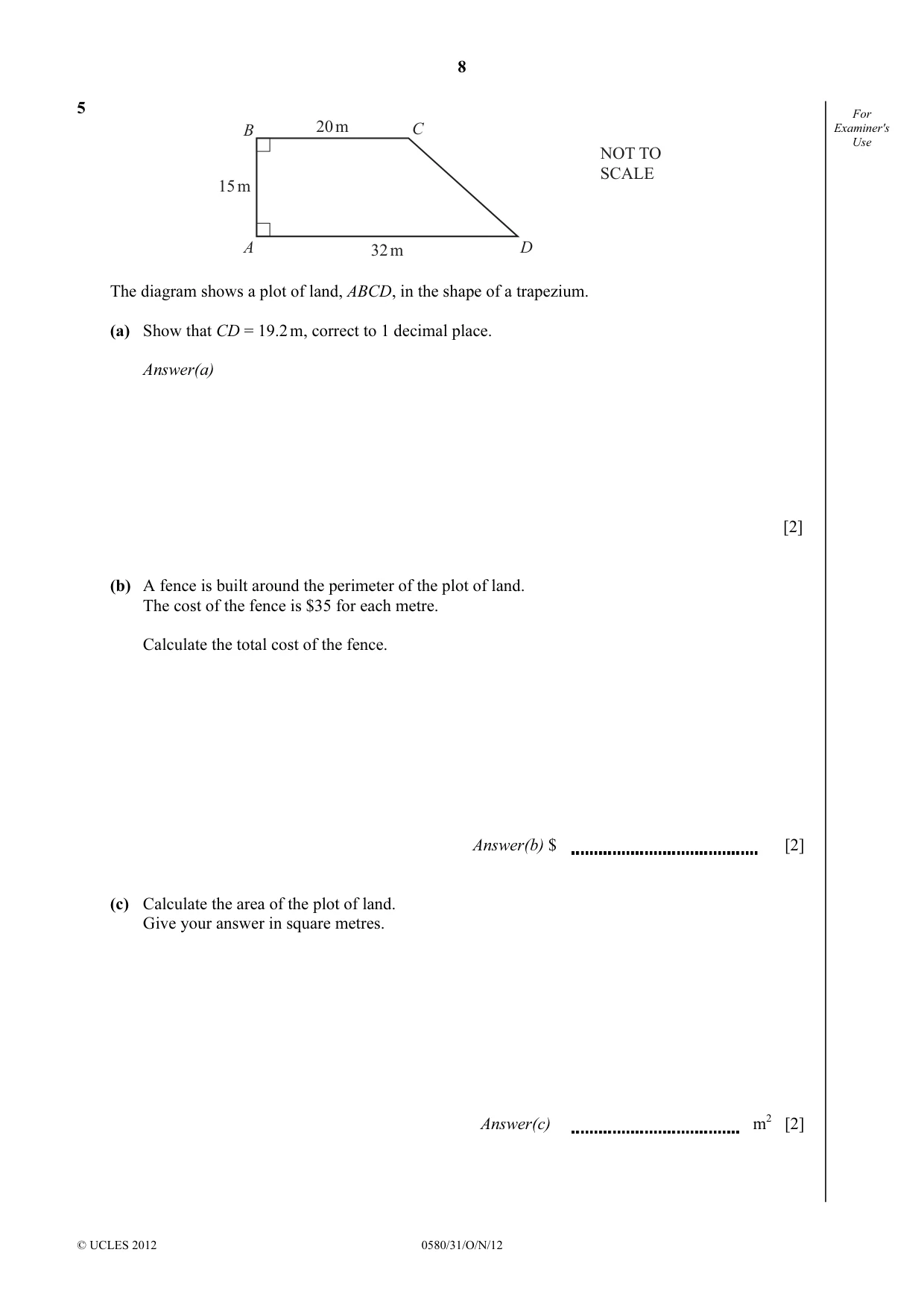
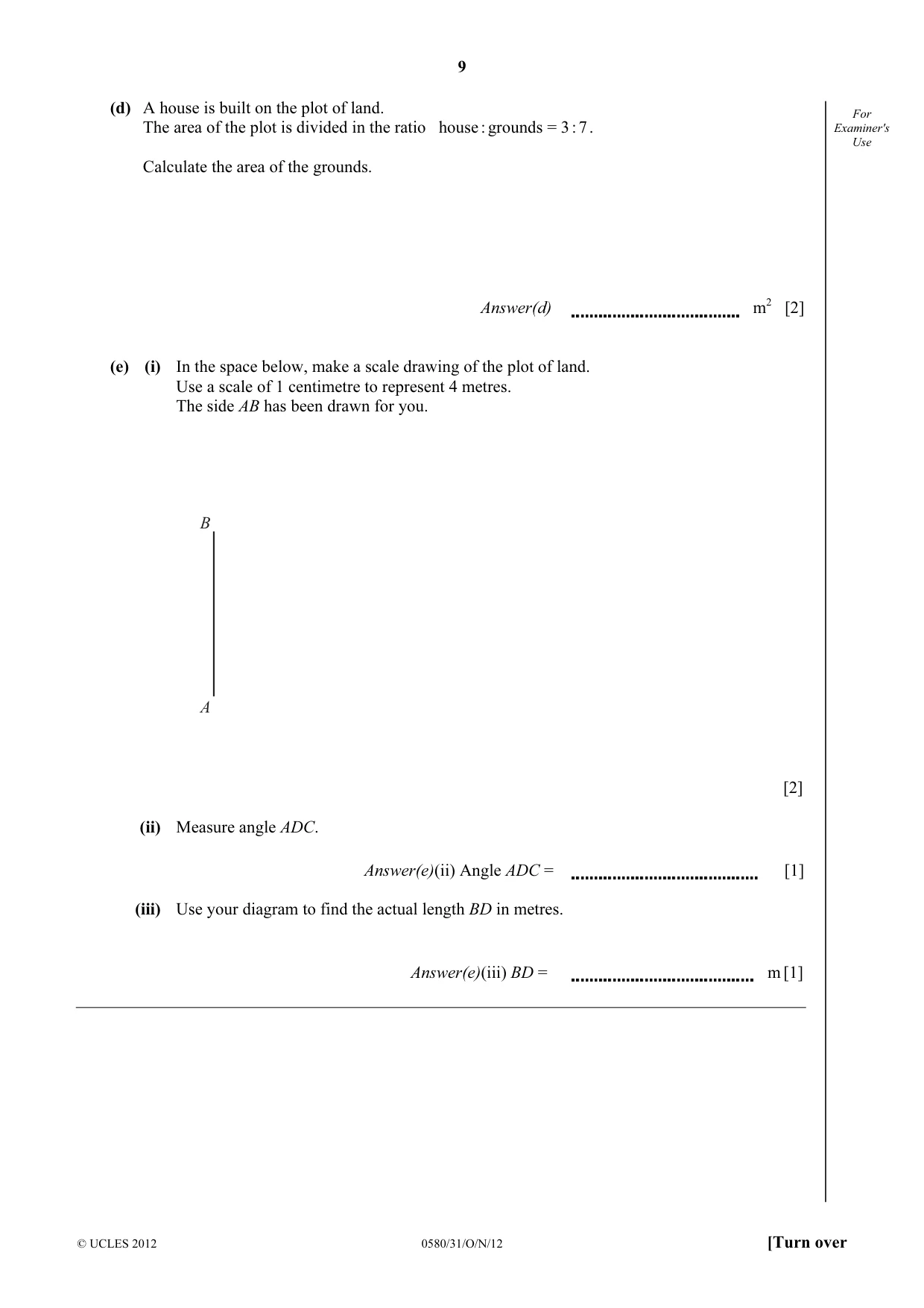
5 For B 20 m C Examiner's Use NOT TO SCALE 15 m A 32 m D The diagram shows a plot of land, ABCD, in the shape of a trapezium. (a) Show that CD = 19.2 m, correct to 1 decimal place. Answer(a) [2] (b) A fence is built around the perimeter of the plot of land. The cost of the fence is $35 for each metre. Calculate the total cost of the fence. Answer(b) $ [2] (c) Calculate the area of the plot of land. Give your answer in square metres. Answer(c) m2 [2] (d) A house is built on the plot of land. For The area of the plot is divided in the ratio house : grounds = 3 : 7 . Examiner's Use Calculate the area of the grounds. Answer(d) m2 [2] (e) (i) In the space below, make a scale drawing of the plot of land. Use a scale of 1 centimetre to represent 4 metres. The side AB has been drawn for you. B A [2] (ii) Measure angle ADC. Answer(e)(ii) Angle ADC = [1] (iii) Use your diagram to find the actual length BD in metres. Answer(e)(iii) BD = m [1]
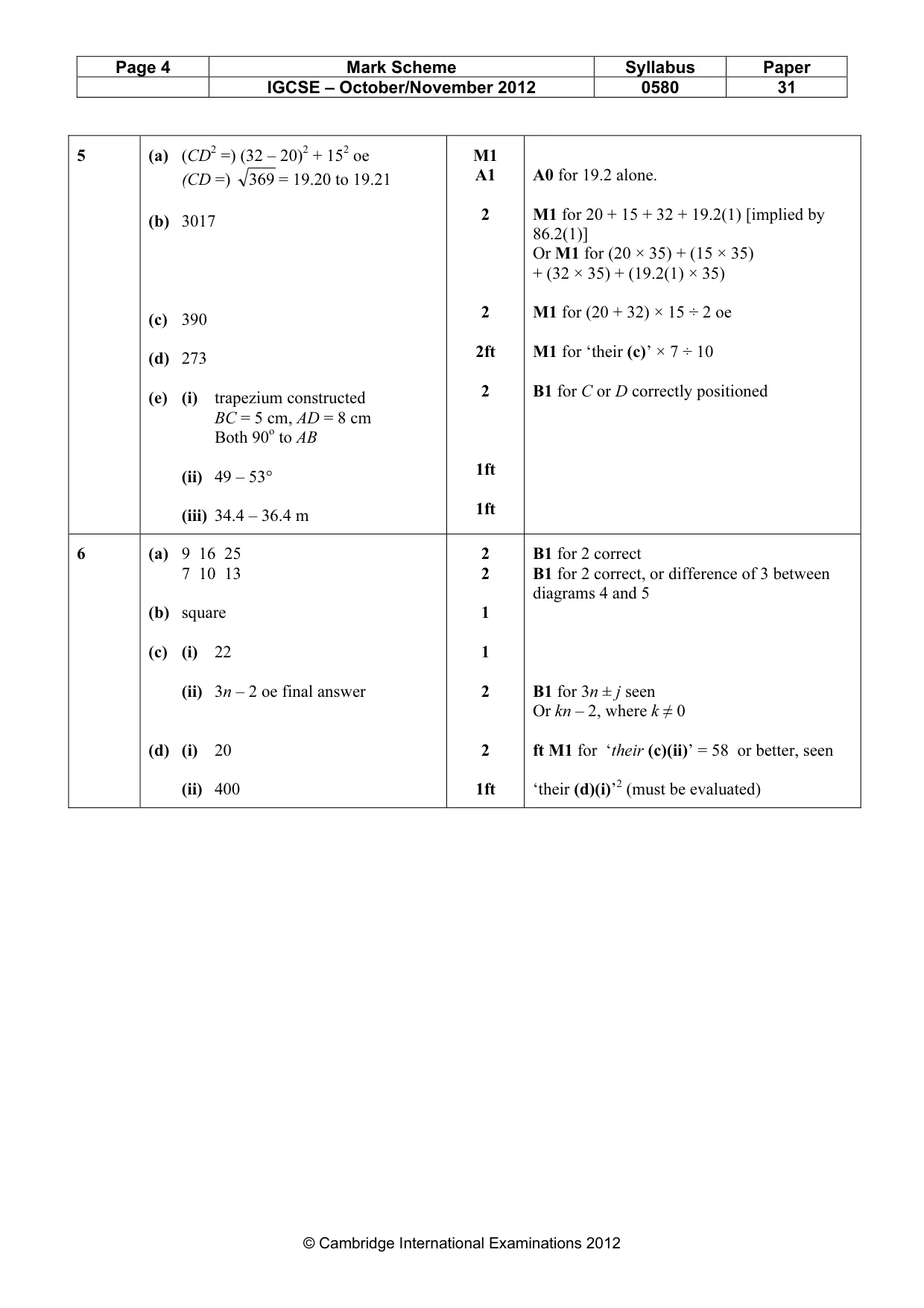
Mark scheme: 5 (a) (CD2 =) (32 – 20)2 + 152 oe M1 (CD =) 369 = 19.20 to 19.21 A1 A0 for 19.2 alone. 2 M1 for 20 + 15 + 32 + 19.2(1) [implied by (b) 3017 86.2(1)] Or M1 for (20 × 35) + (15 × 35) + (32 × 35) + (19.2(1) × 35) 2 M1 for (20 + 32) × 15 ÷ 2 oe (c) 390 2ft M1 for ‘their (c)’ × 7 ÷ 10 (d) 273 2 B1 for C or D correctly positioned (e) (i) trapezium constructed BC = 5 cm, AD = 8 cm Both 90o to AB 1ft (ii) 49 – 53° 1ft (iii) 34.4 – 36.4 m
Q6 · For Examiner's Use Diagram 1 Diagram 2 Diagram 3 Diagram 4 A sequence of diagrams is made…
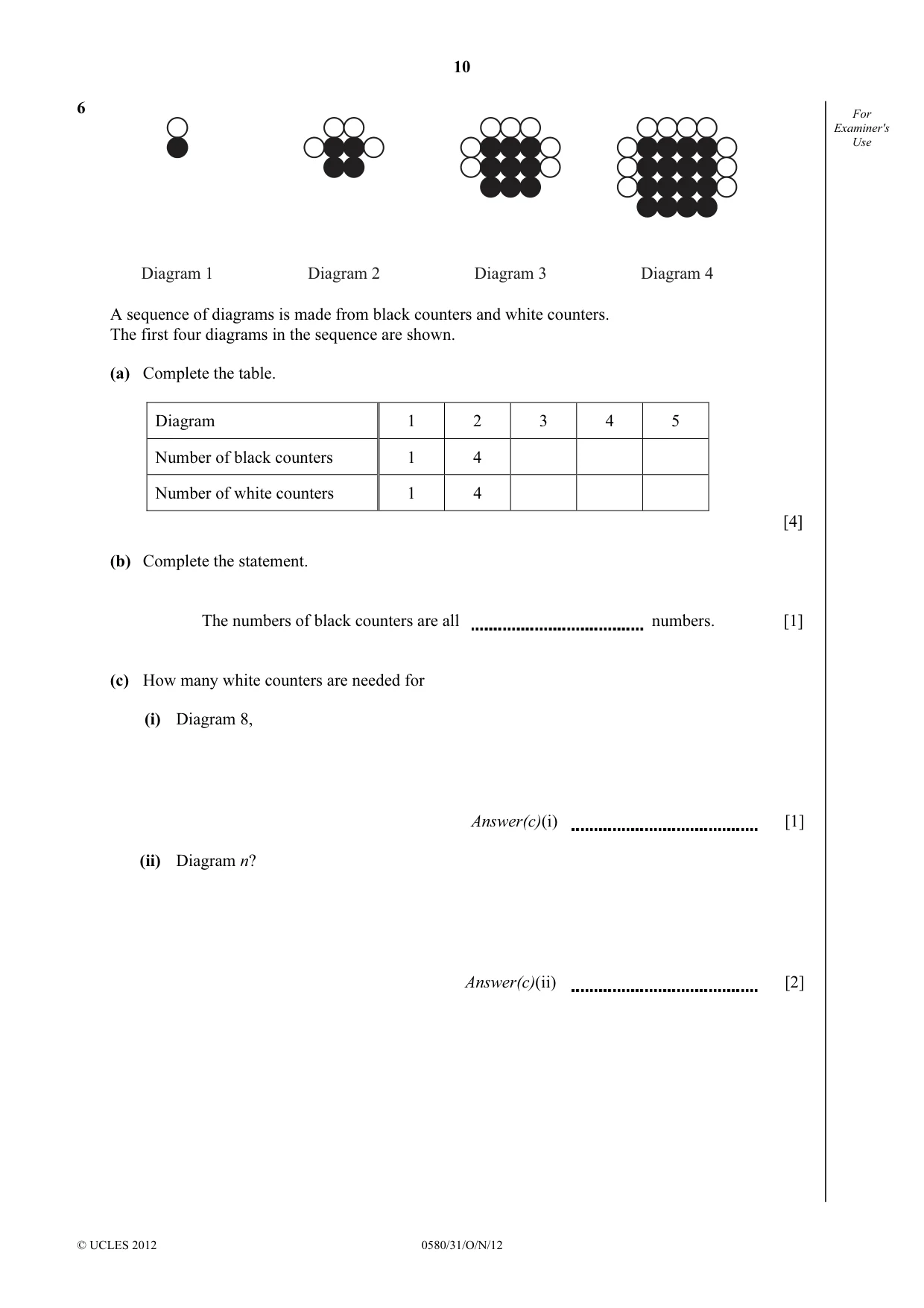
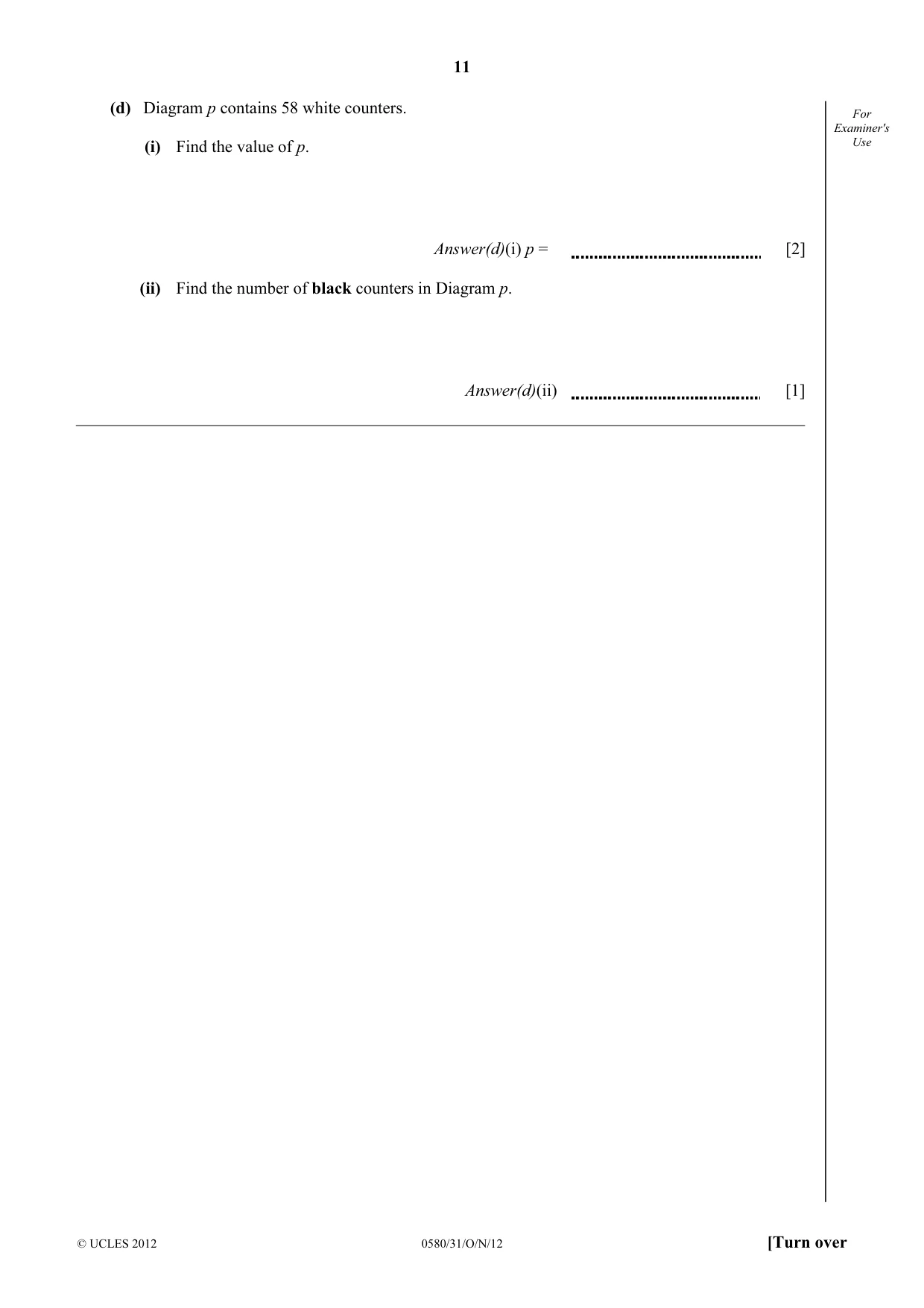
6 For Examiner's Use Diagram 1 Diagram 2 Diagram 3 Diagram 4 A sequence of diagrams is made from black counters and white counters. The first four diagrams in the sequence are shown. (a) Complete the table. Diagram 1 2 3 4 5 Number of black counters 1 4 Number of white counters 1 4 [4] (b) Complete the statement. The numbers of black counters are all numbers. [1] (c) How many white counters are needed for (i) Diagram 8, Answer(c)(i) [1] (ii) Diagram n? Answer(c)(ii) [2] (d) Diagram p contains 58 white counters. For Examiner's Use (i) Find the value of p. Answer(d)(i) p = [2] (ii) Find the number of black counters in Diagram p. Answer(d)(ii) [1]
Mark scheme: 6 (a) 9 16 25 2 B1 for 2 correct 7 10 13 2 B1 for 2 correct, or difference of 3 between diagrams 4 and 5 (b) square 1 (c) (i) 22 1 (ii) 3n – 2 oe final answer 2 B1 for 3n ± j seen Or kn – 2, where k ≠ 0 (d) (i) 20 2 ft M1 for ‘their (c)(ii)’ = 58 or better, seen (ii) 400 1ft ‘their (d)(i)’2 (must be evaluated) IGCSE – October/November 2012 0580 31
Q7 · The cost, $C, of hiring a meeting room for n people is calculated using the formula For…
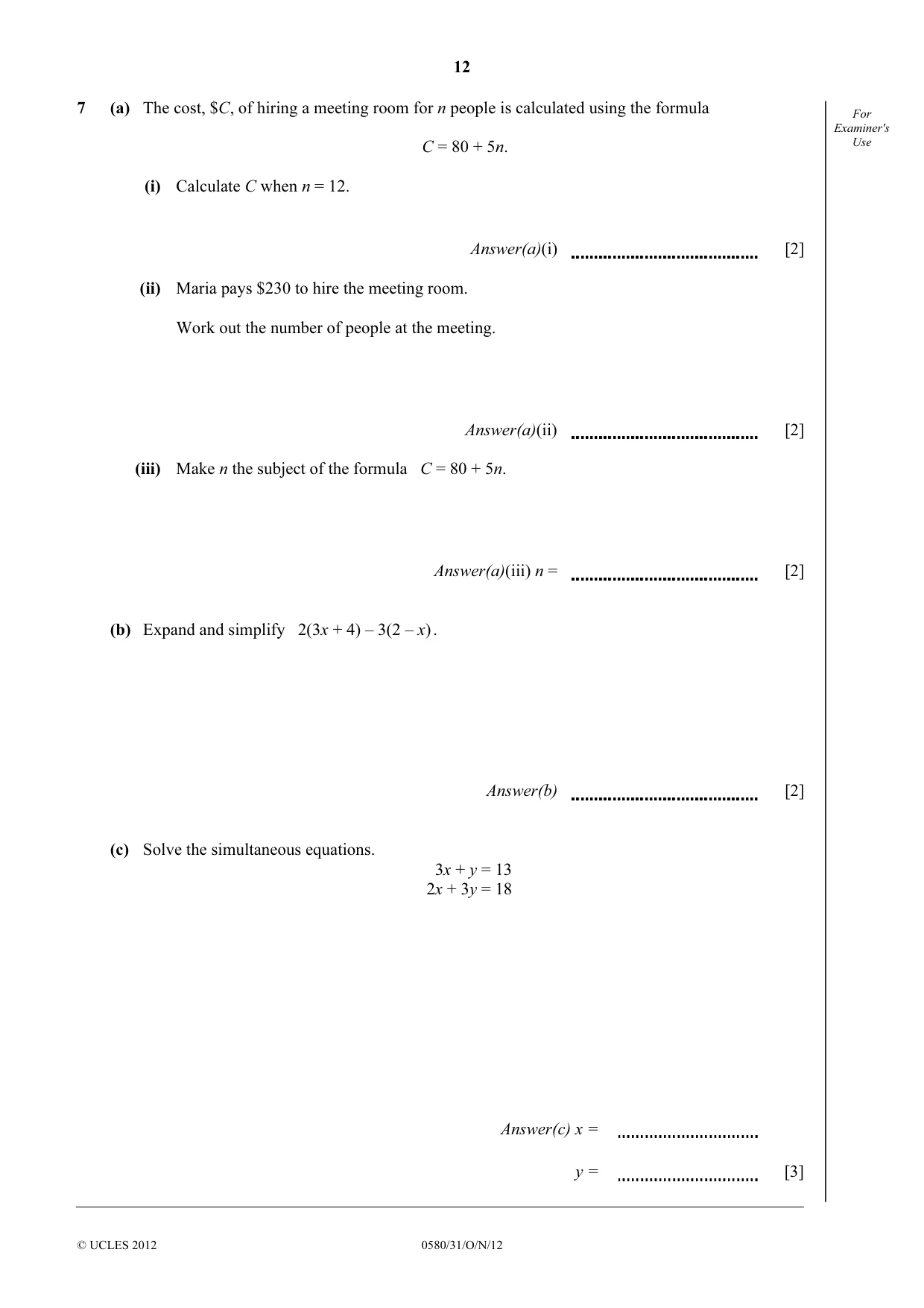
7 (a) The cost, $C, of hiring a meeting room for n people is calculated using the formula For Examiner's Use C = 80 + 5n. (i) Calculate C when n = 12. Answer(a)(i) [2] (ii) Maria pays $230 to hire the meeting room. Work out the number of people at the meeting. Answer(a)(ii) [2] (iii) Make n the subject of the formula C = 80 + 5n. Answer(a)(iii) n = [2] (b) Expand and simplify 2(3x + 4) – 3(2 – x) . Answer(b) [2] (c) Solve the simultaneous equations. 3x + y = 13 2x + 3y = 18 Answer(c) x = y = [3]
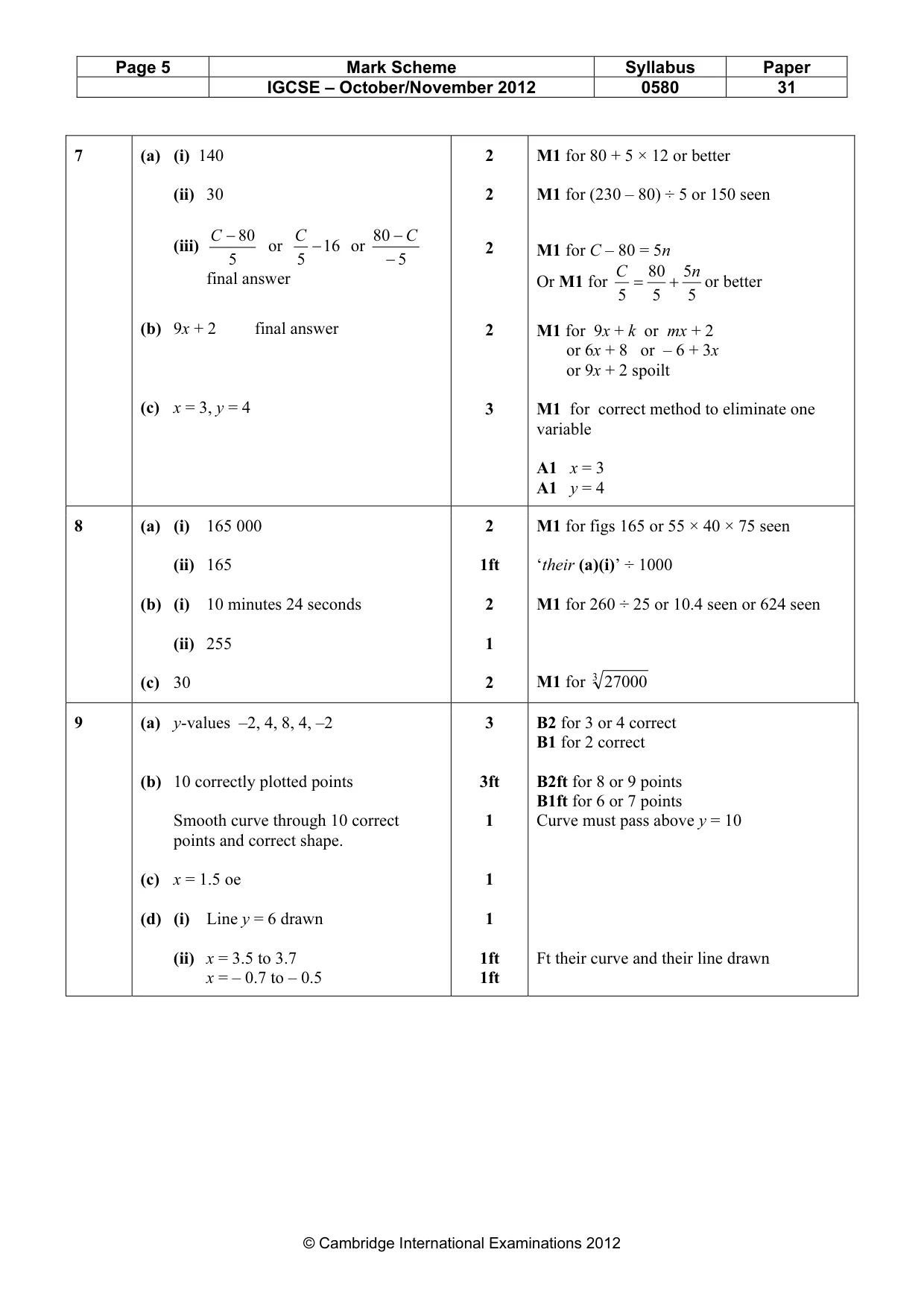
Mark scheme: 7 (a) (i) 140 2 M1 for 80 + 5 × 12 or better (ii) 30 2 M1 for (230 – 80) ÷ 5 or 150 seen C − 80 C 80 −C (iii) or − 16 or 2 M1 for C – 80 = 5n 5 5 − 5 C 80 5n final answer Or M1 for = + or better 5 5 5 (b) 9x + 2 final answer 2 M1 for 9x + k or mx + 2 or 6x + 8 or – 6 + 3x or 9x + 2 spoilt (c) x = 3, y = 4 3 M1 for correct method to eliminate one variable A1 x = 3 A1 y = 4
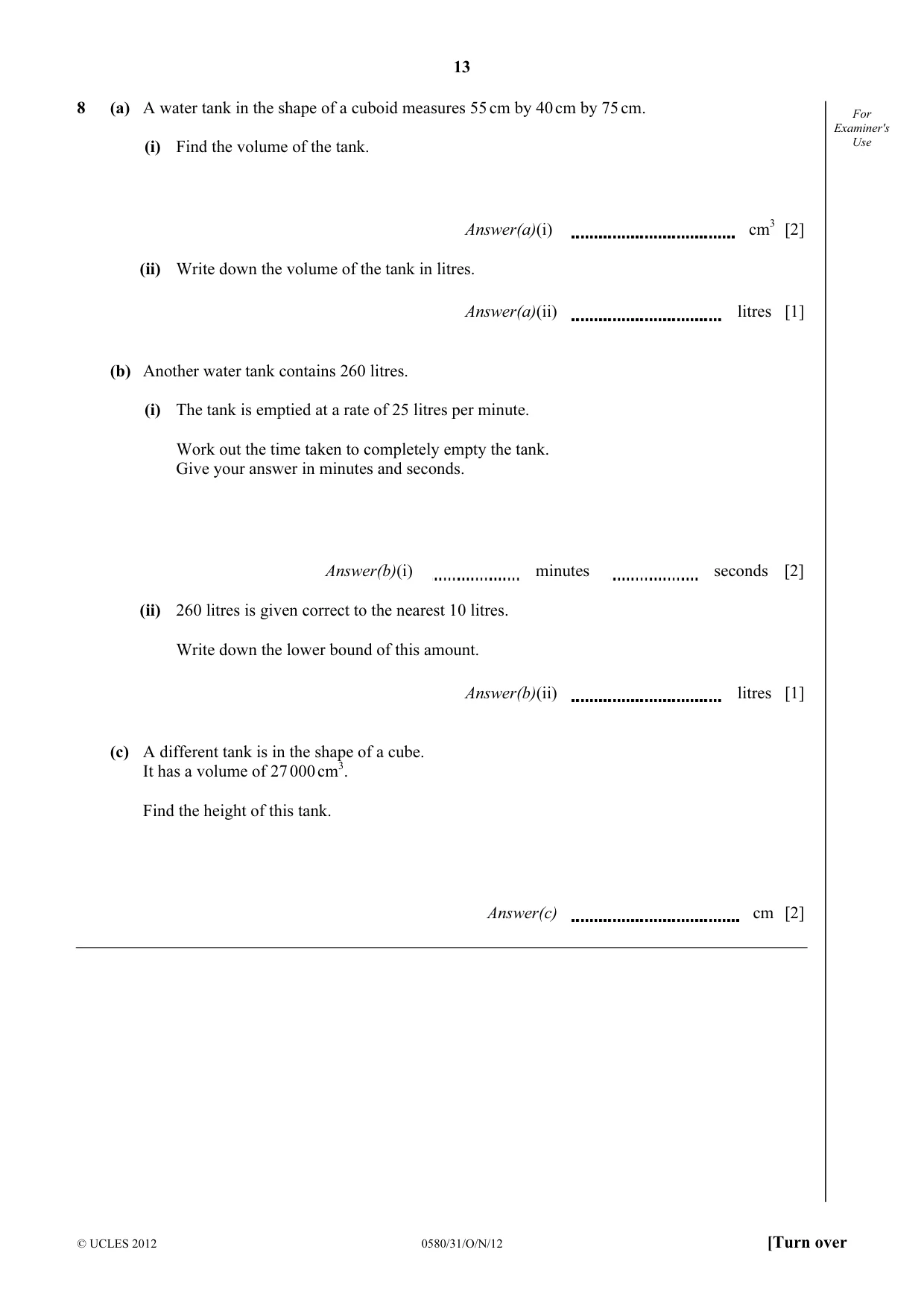
Q8 · A water tank in the shape of a cuboid measures 55 cm by 40 cm by 75 cm
8 (a) A water tank in the shape of a cuboid measures 55 cm by 40 cm by 75 cm. For Examiner's Use (i) Find the volume of the tank. Answer(a)(i) cm3 [2] (ii) Write down the volume of the tank in litres. Answer(a)(ii) litres [1] (b) Another water tank contains 260 litres. (i) The tank is emptied at a rate of 25 litres per minute. Work out the time taken to completely empty the tank. Give your answer in minutes and seconds. Answer(b)(i) minutes seconds [2] (ii) 260 litres is given correct to the nearest 10 litres. Write down the lower bound of this amount. Answer(b)(ii) litres [1] (c) A different tank is in the shape of a cube. It has a volume of 27 000 cm3. Find the height of this tank. Answer(c) cm [2]
Mark scheme: 8 (a) (i) 165 000 2 M1 for figs 165 or 55 × 40 × 75 seen (ii) 165 1ft ‘their (a)(i)’ ÷ 1000 (b) (i) 10 minutes 24 seconds 2 M1 for 260 ÷ 25 or 10.4 seen or 624 seen (ii) 255 1 3 27000 (c) 30 2 M1 for
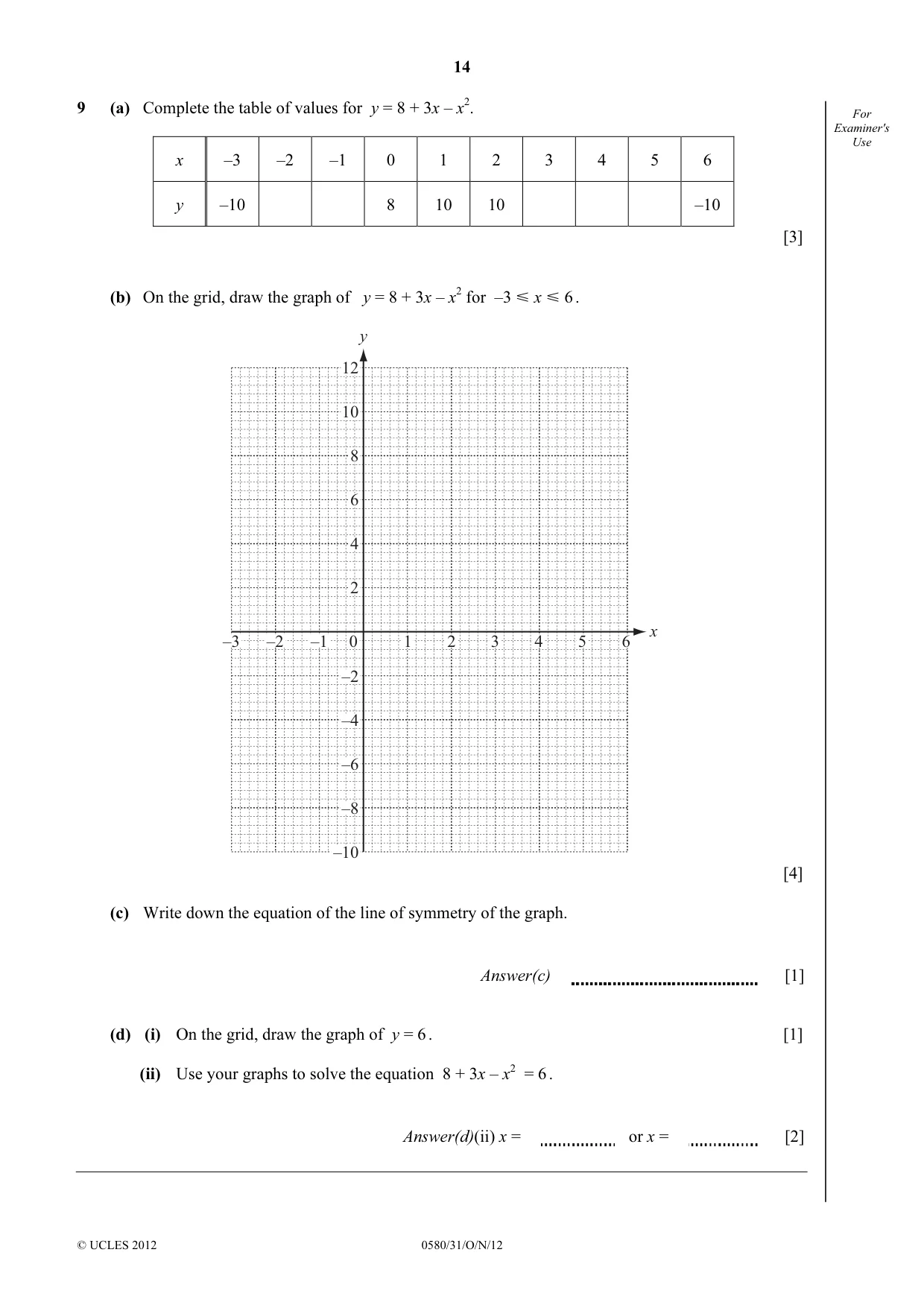
Q9 · Complete the table of values for y = 8 + 3x – x2
9 (a) Complete the table of values for y = 8 + 3x – x2. For Examiner's Use x –3 –2 –1 0 1 2 3 4 5 6 y –10 8 10 10 –10 [3] (b) On the grid, draw the graph of y = 8 + 3x – x2 for –3 Y x Y 6 . y 12 10 8 6 4 2 x –3 –2 –1 0 1 2 3 4 5 6 –2 –4 –6 –8 –10 [4] (c) Write down the equation of the line of symmetry of the graph. Answer(c) [1] (d) (i) On the grid, draw the graph of y = 6 . [1] (ii) Use your graphs to solve the equation 8 + 3x – x2 = 6 . Answer(d)(ii) x = or x = [2]
Mark scheme: 9 (a) y-values –2, 4, 8, 4, –2 3 B2 for 3 or 4 correct B1 for 2 correct (b) 10 correctly plotted points 3ft B2ft for 8 or 9 points B1ft for 6 or 7 points Smooth curve through 10 correct 1 Curve must pass above y = 10 points and correct shape. (c) x = 1.5 oe 1 (d) (i) Line y = 6 drawn 1 (ii) x = 3.5 to 3.7 1ft Ft their curve and their line drawn x = – 0.7 to – 0.5 1ft IGCSE – October/November 2012 0580 31
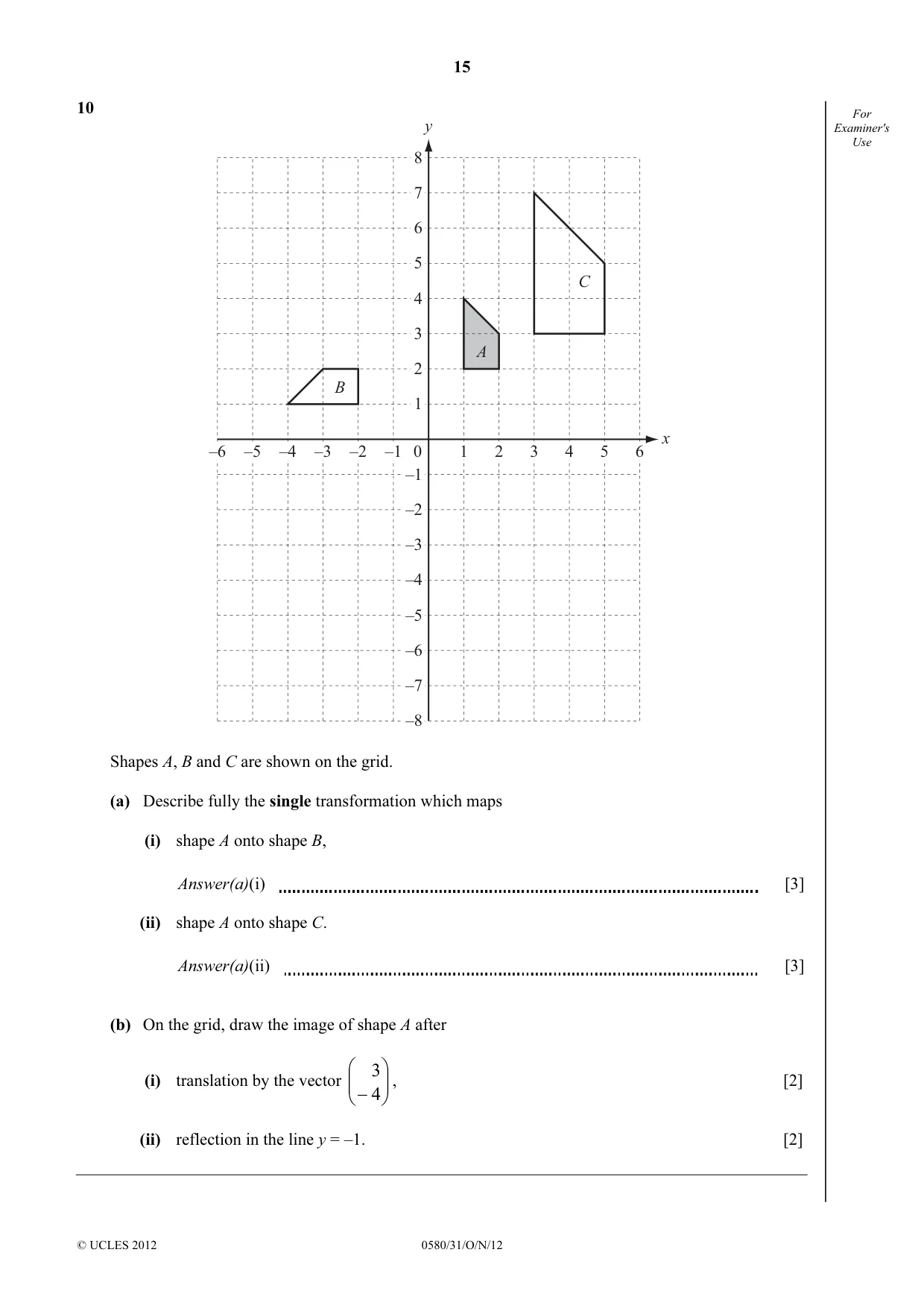
Q10 · For y Examiner's Use 8 7 6 5 C 4 3 A 2 B 1 x –6 –5 –4 –3 –2 –1 0 1 2 3 4 5 6 –1 –2 –3 –4…
10 For y Examiner's Use 8 7 6 5 C 4 3 A 2 B 1 x –6 –5 –4 –3 –2 –1 0 1 2 3 4 5 6 –1 –2 –3 –4 –5 –6 –7 –8 Shapes A, B and C are shown on the grid. (a) Describe fully the single transformation which maps (i) shape A onto shape B, Answer(a)(i) [3] (ii) shape A onto shape C. Answer(a)(ii) [3] (b) On the grid, draw the image of shape A after 3 (i) translation by the vector , [2] −4 (ii) reflection in the line y = –1. [2]
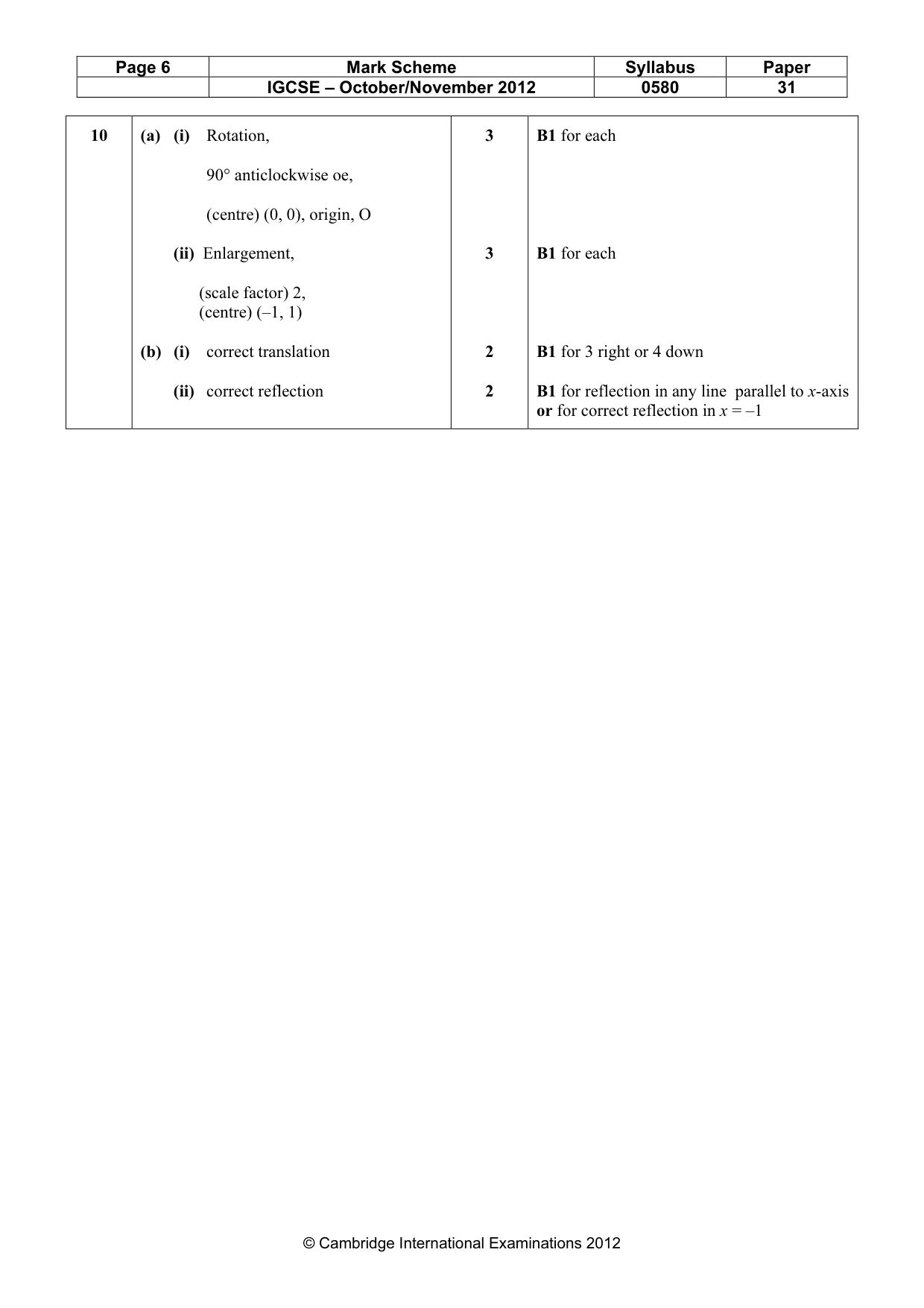
Mark scheme: 10 (a) (i) Rotation, 3 B1 for each 90° anticlockwise oe, (centre) (0, 0), origin, O (ii) Enlargement, 3 B1 for each (scale factor) 2, (centre) (–1, 1) (b) (i) correct translation 2 B1 for 3 right or 4 down (ii) correct reflection 2 B1 for reflection in any line parallel to x-axis or for correct reflection in x = –1
What was in this paper
The subtopics covered by these 10 questions, and how many questions each got. Open one in a new tab to see every Cambridge question on it.