Cambridge IGCSE Mathematics 0580 — 2012 May/June Paper 4 · Variant 3
0580/43/M/J/12 · 3 questions · 130 marks · ≈146 min
The question paper and its mark scheme, free to read here and free to download. This is Cambridge’s own paper, exactly as it was sat.
Question paper20 pages
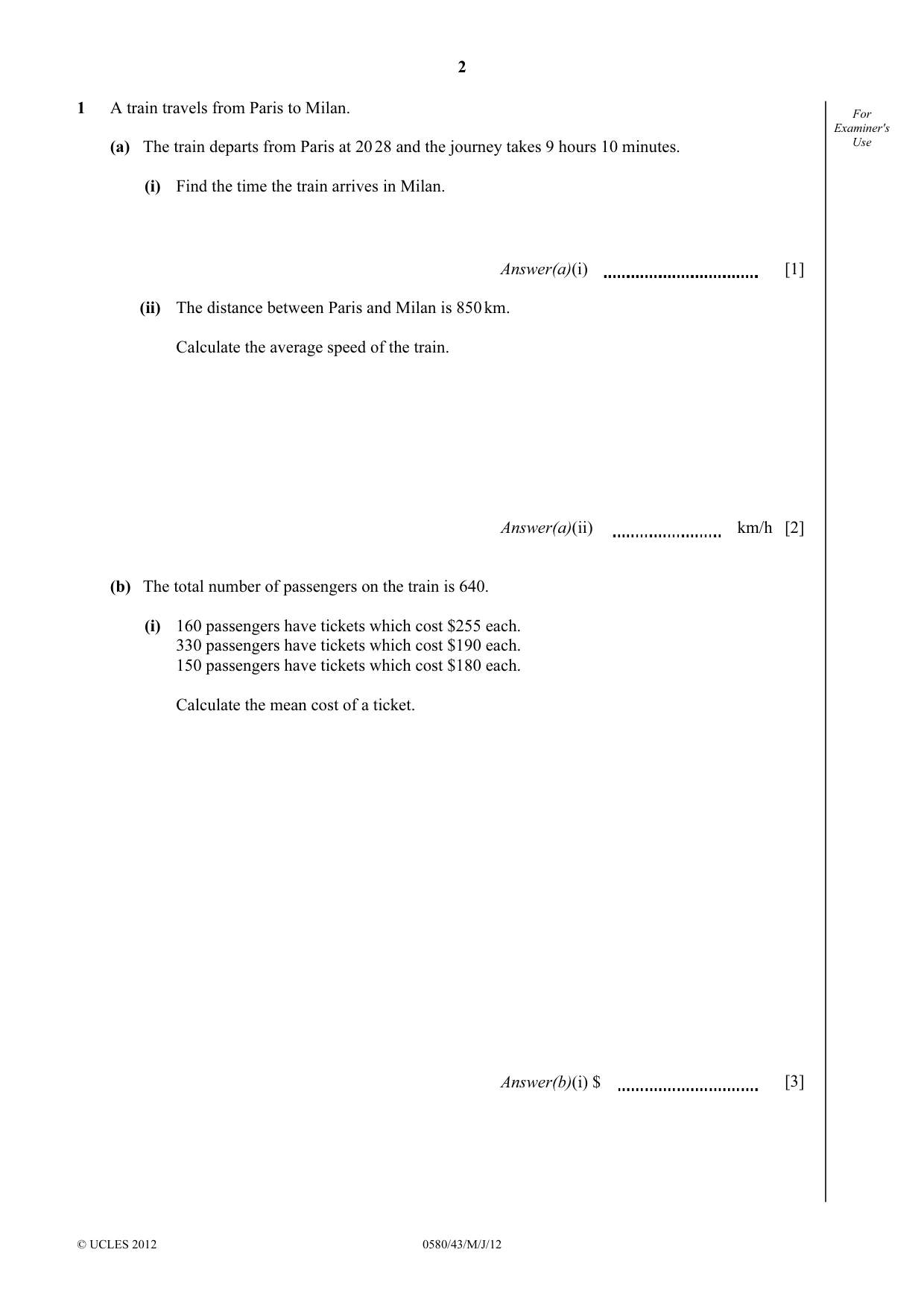
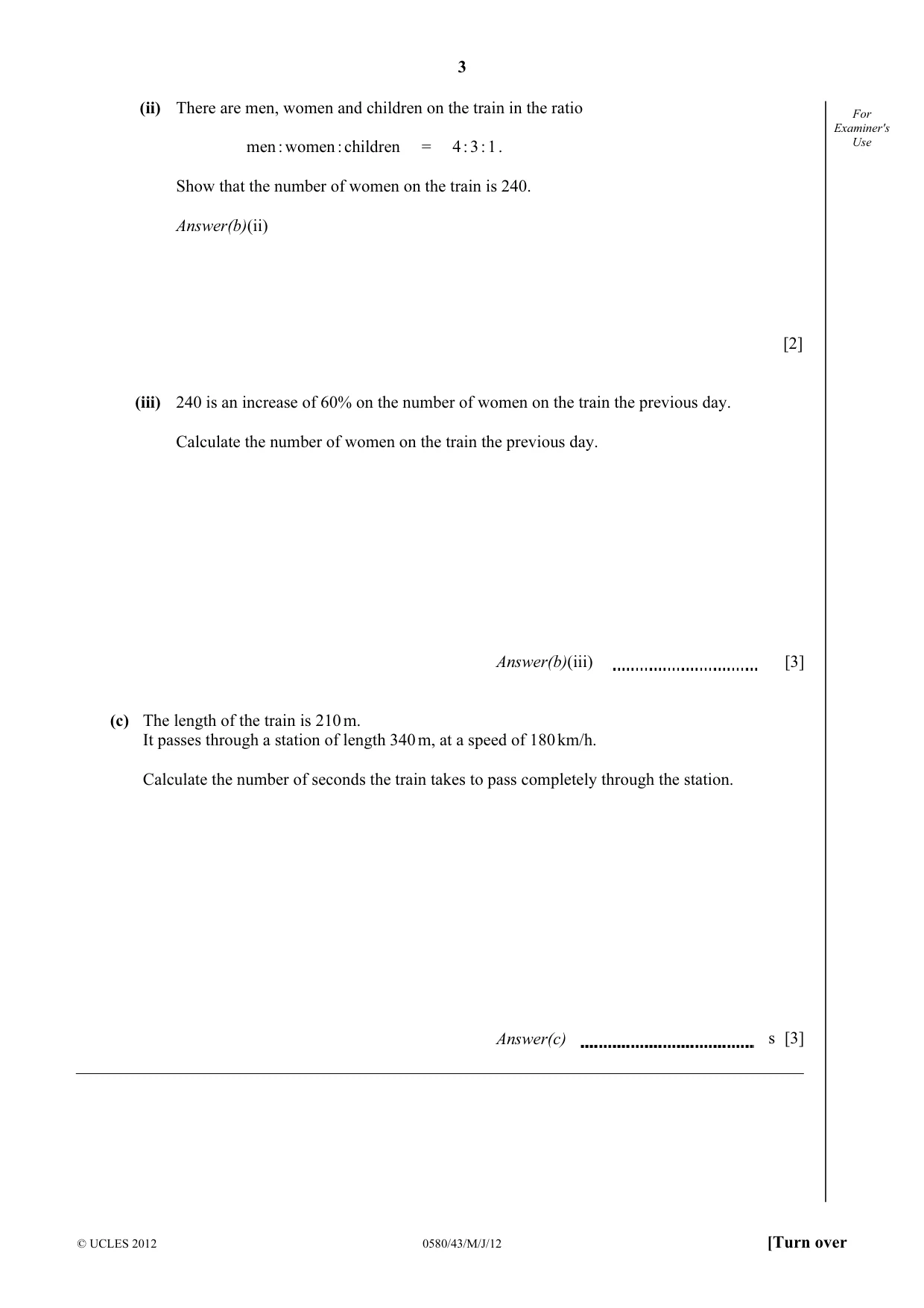
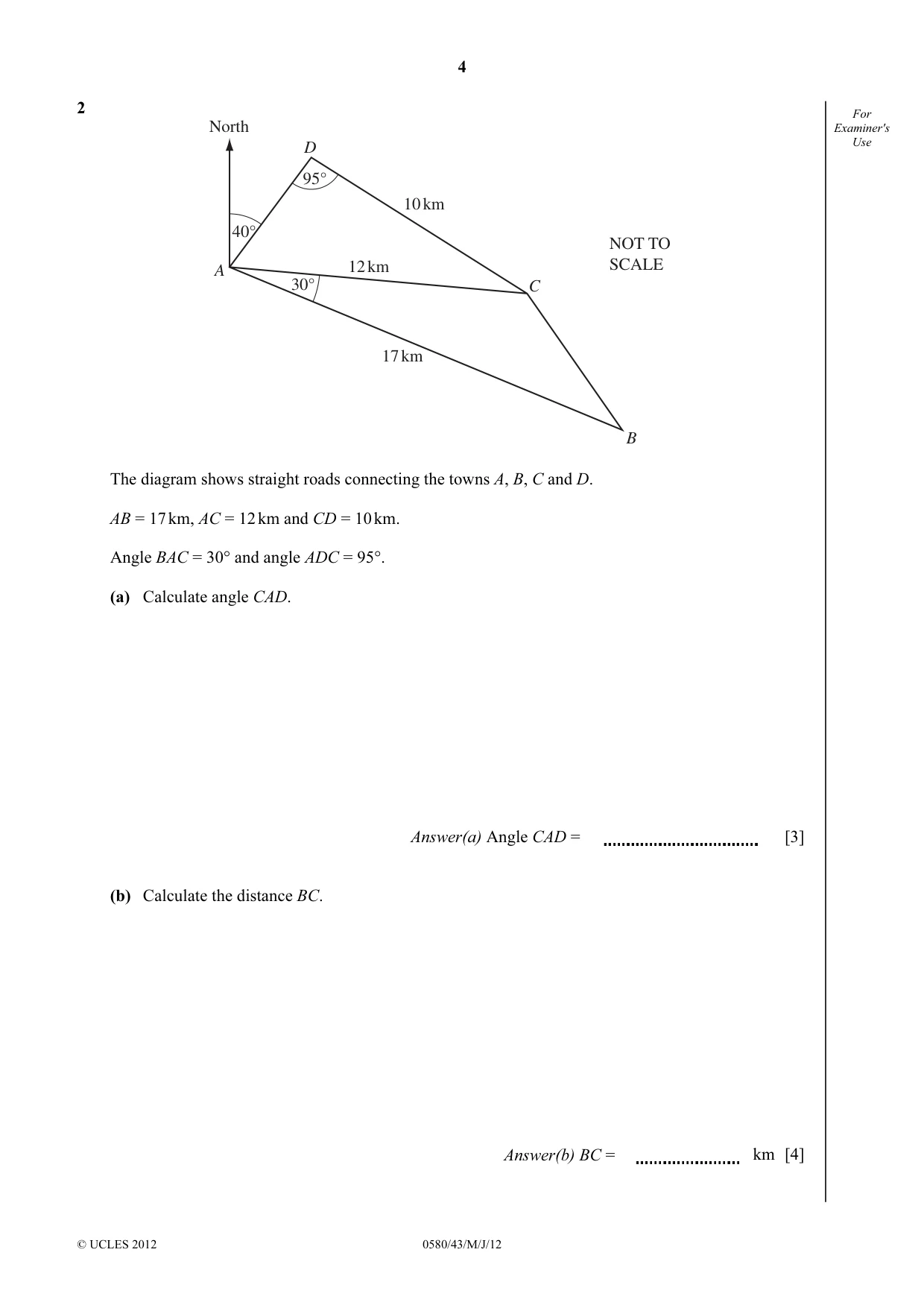
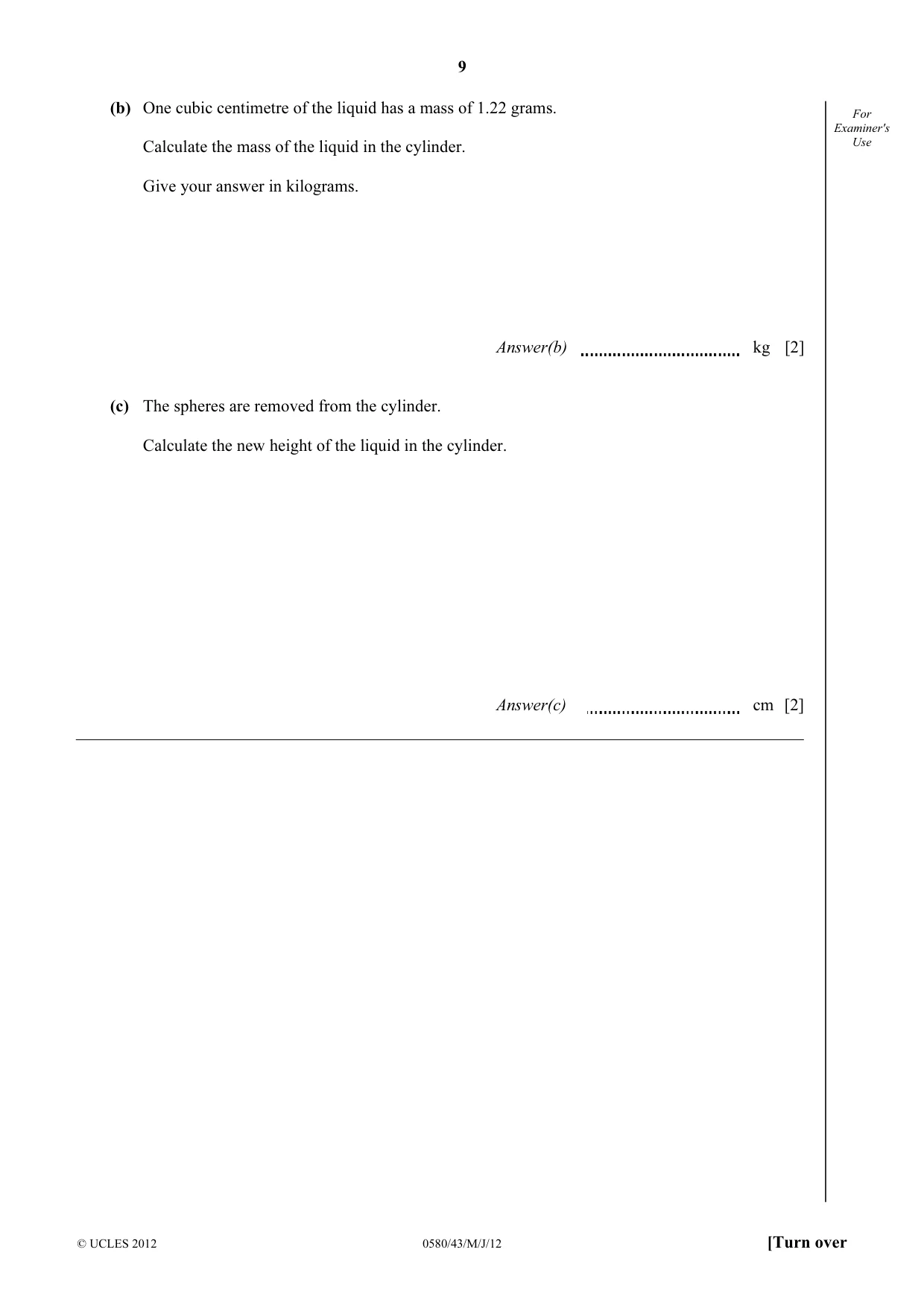
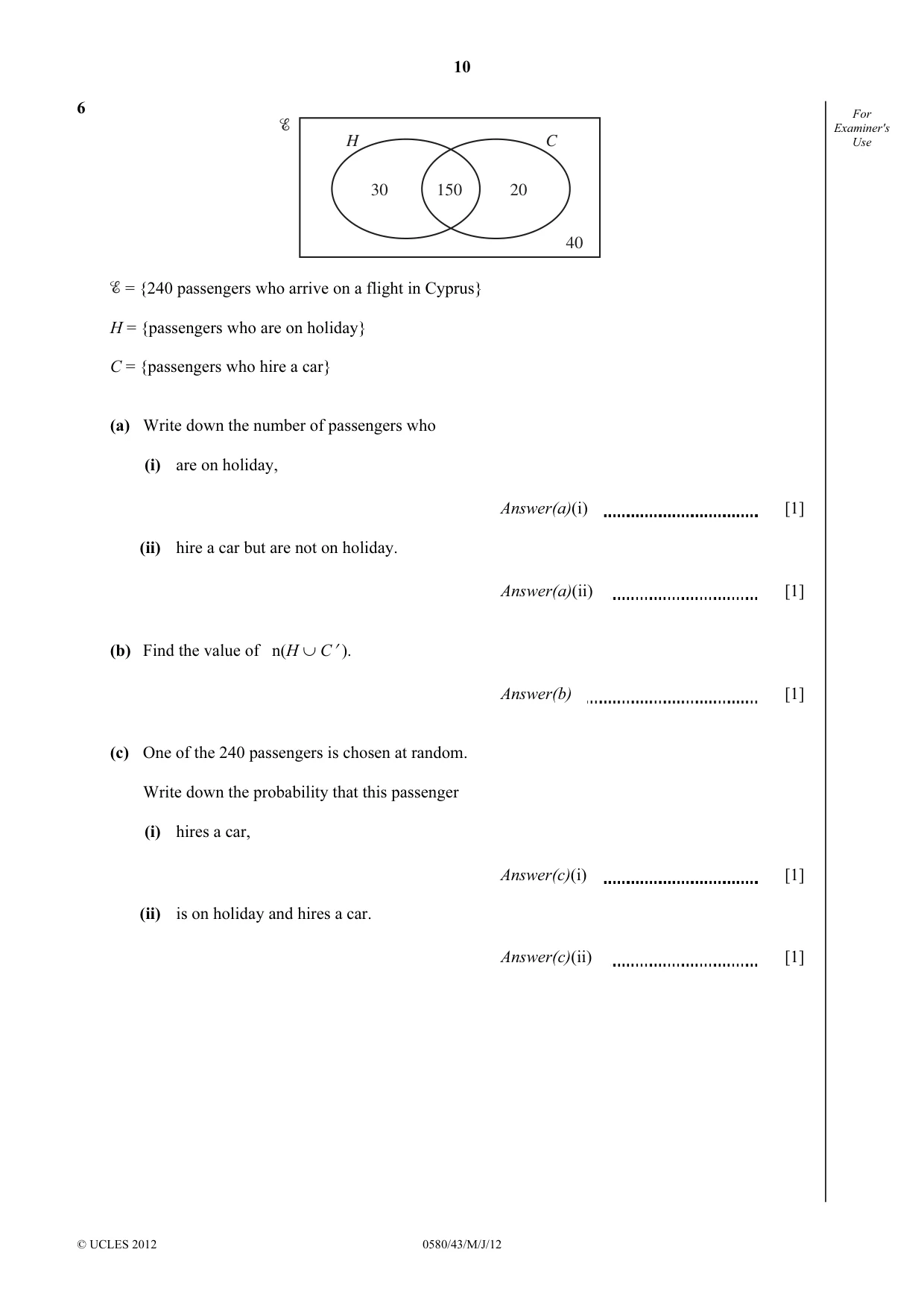
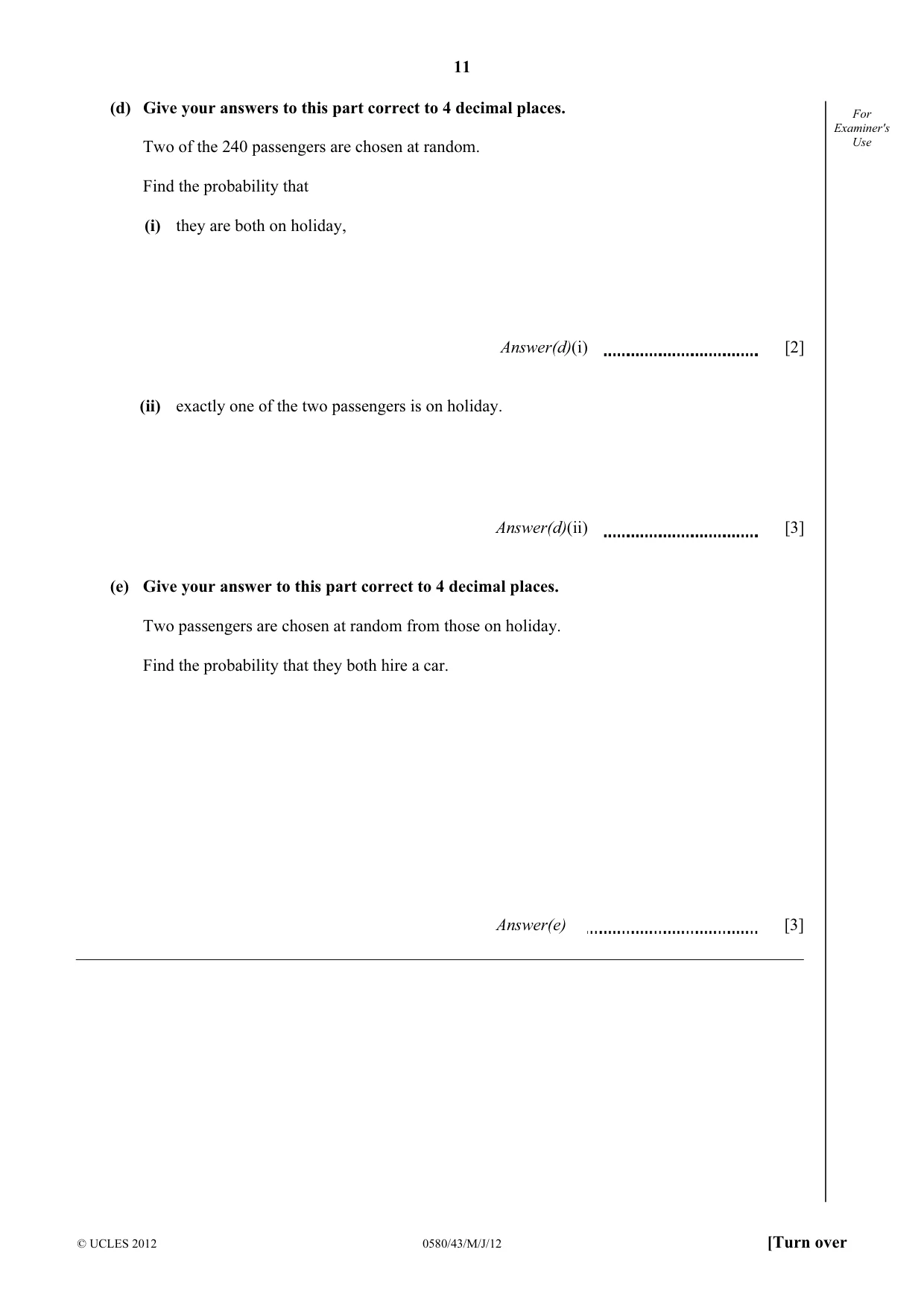
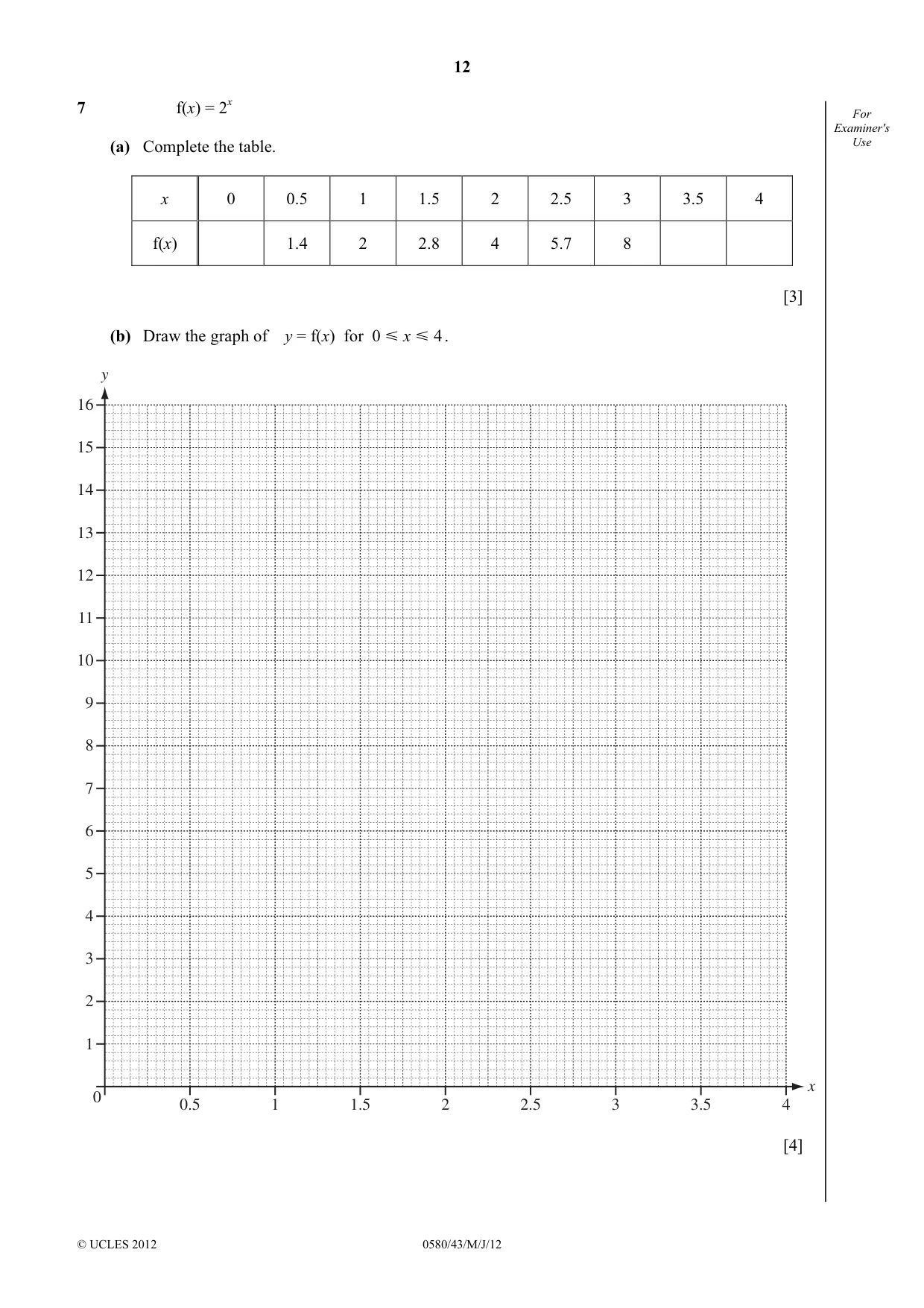
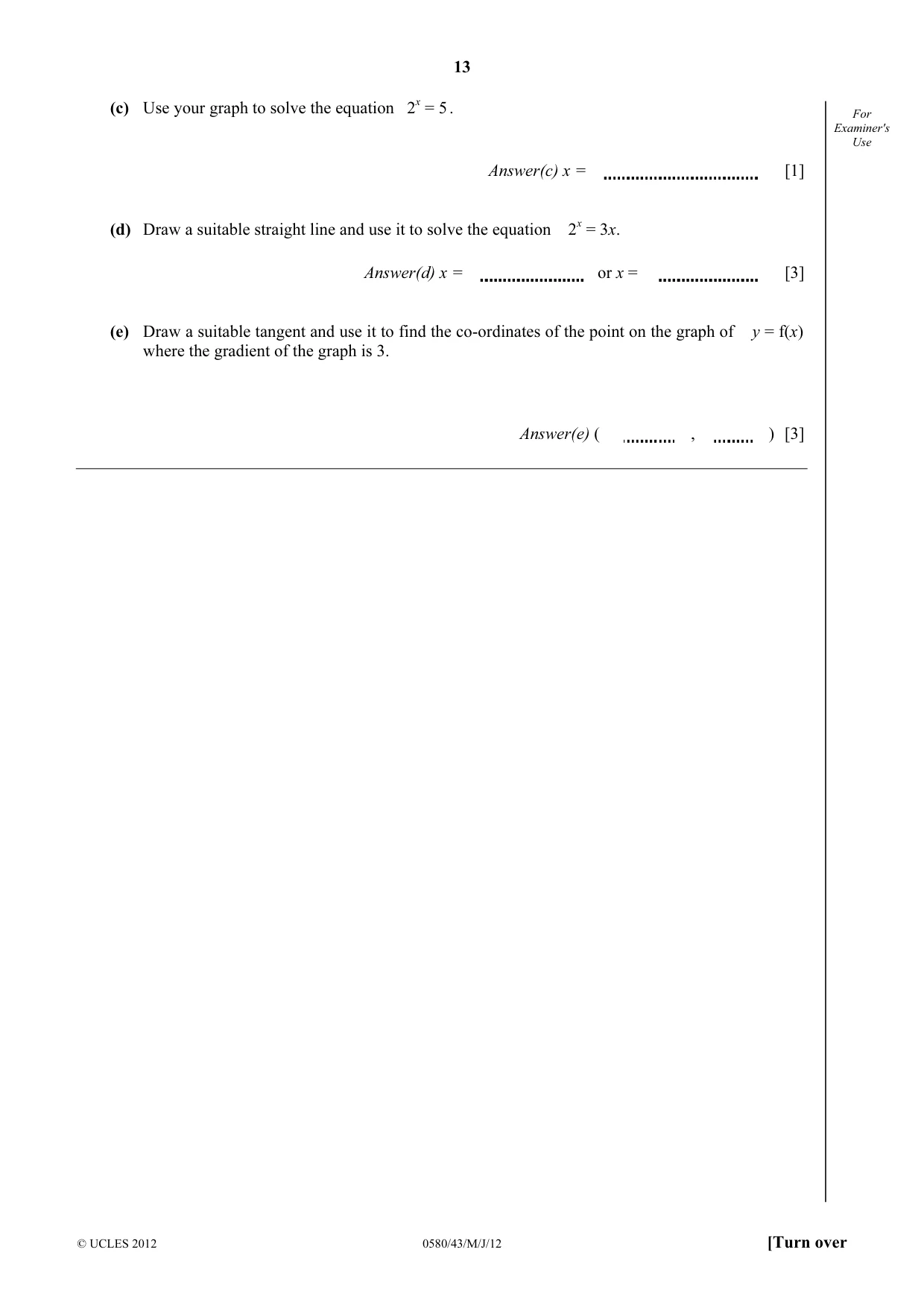
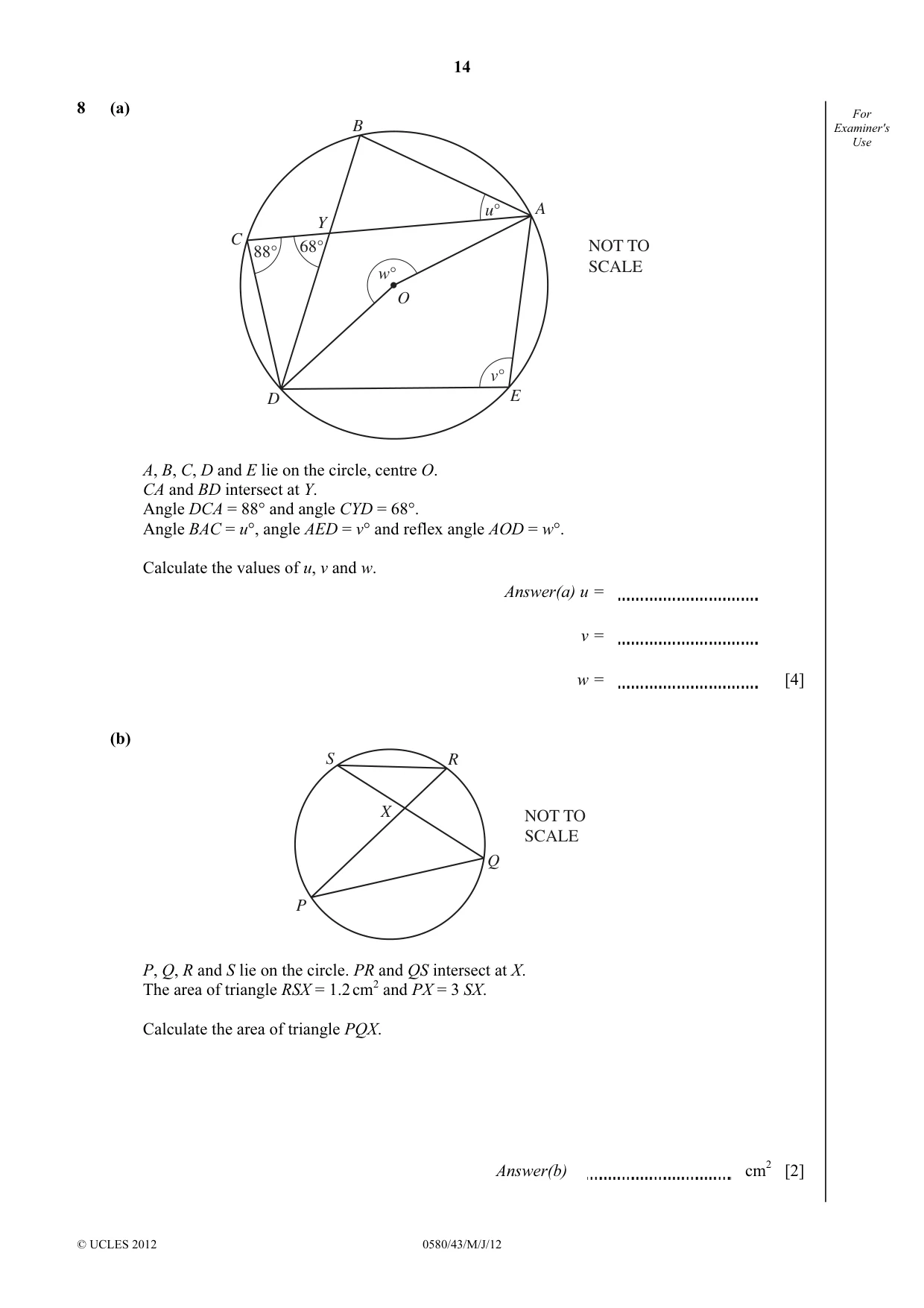
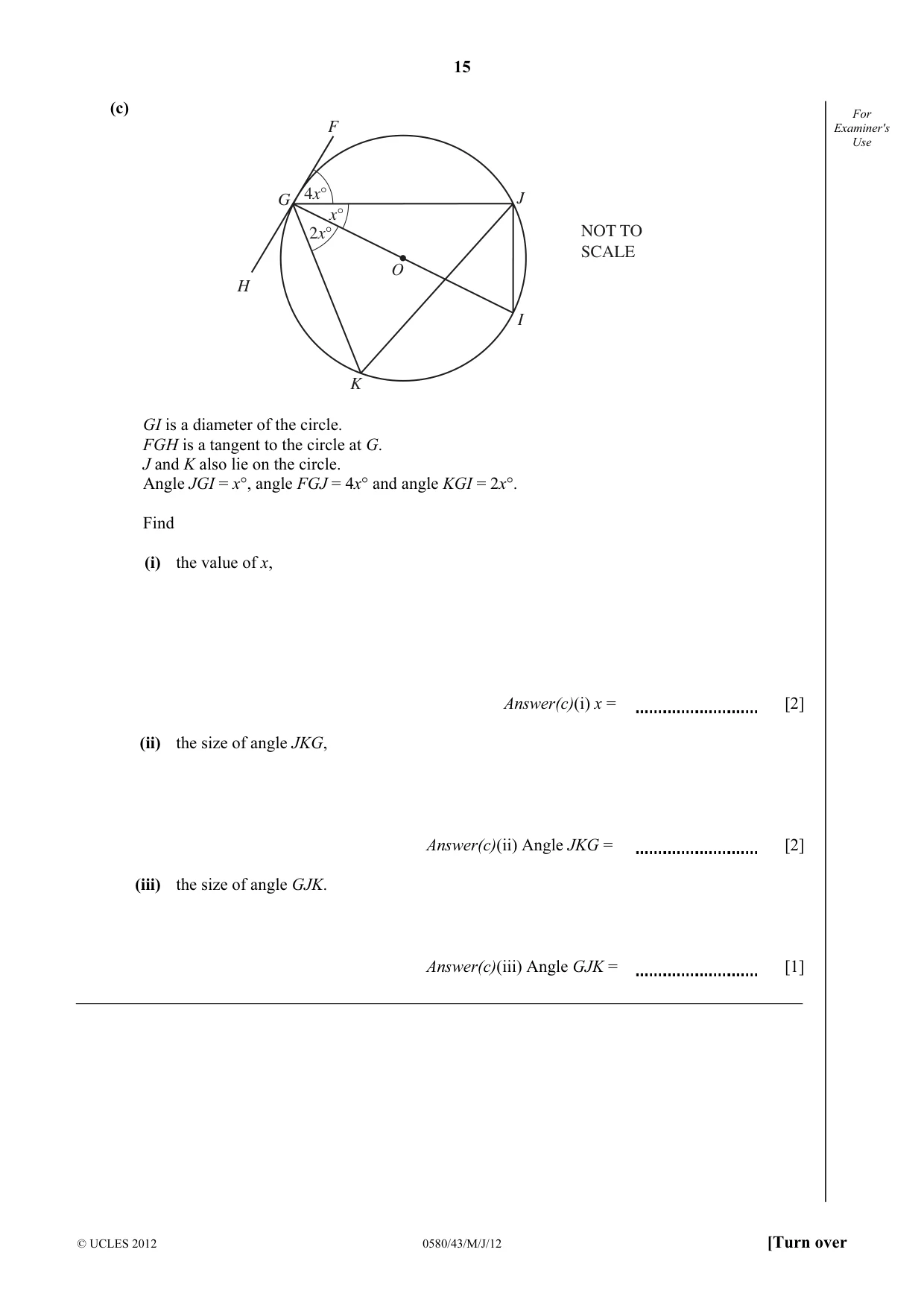
Mark scheme8 pages
Answers below. Sit the paper first if you are practising.
Questions as text
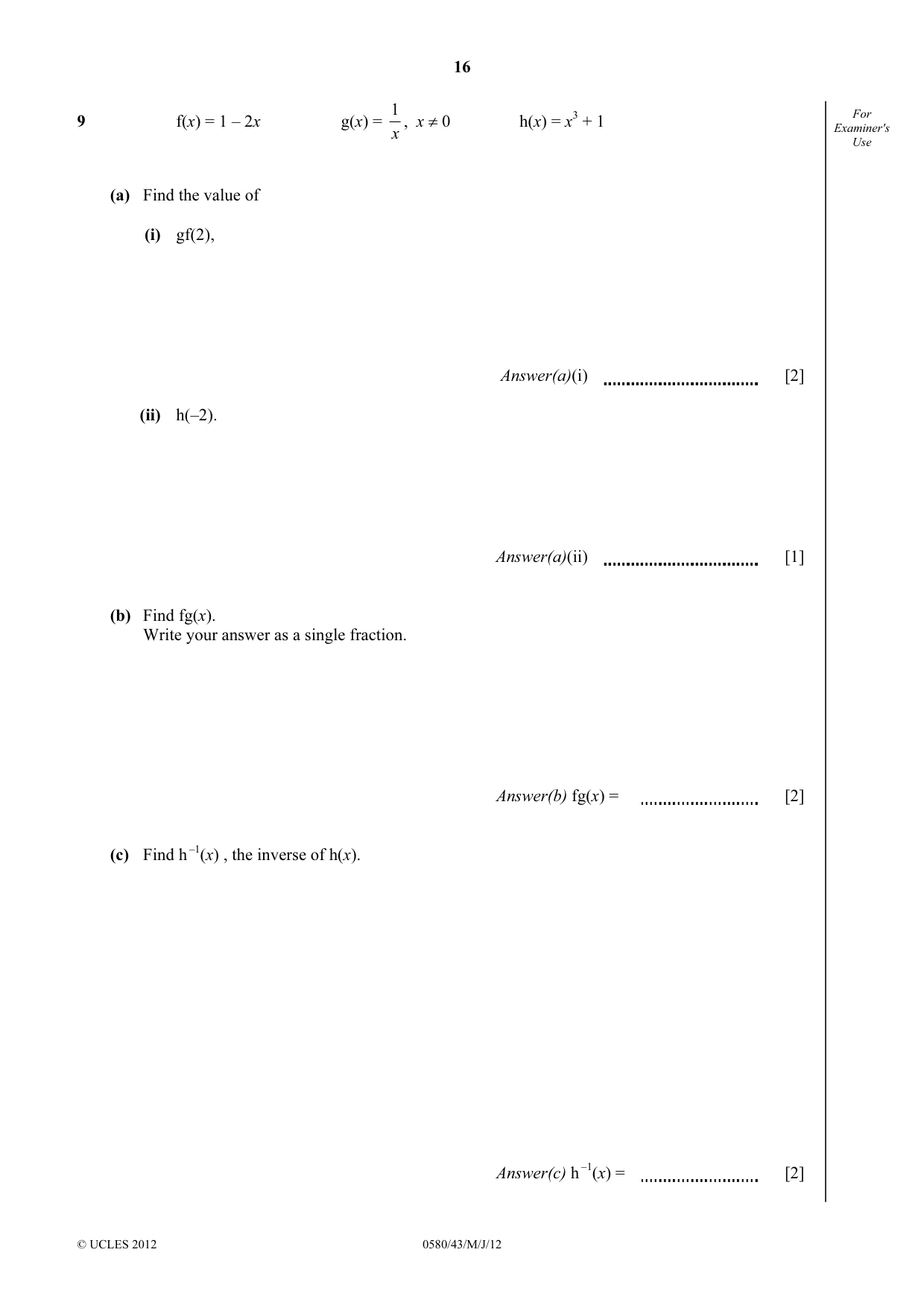
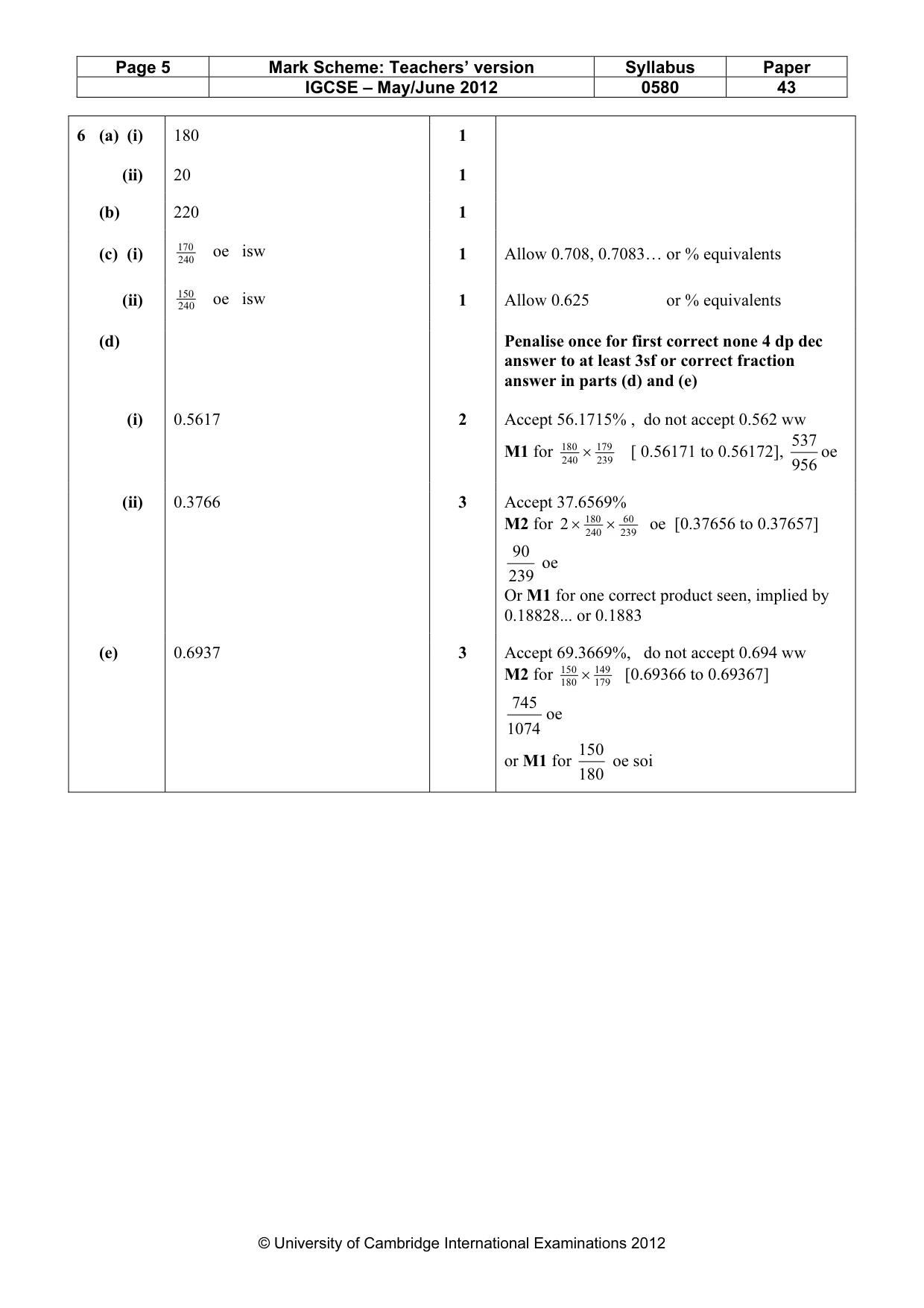
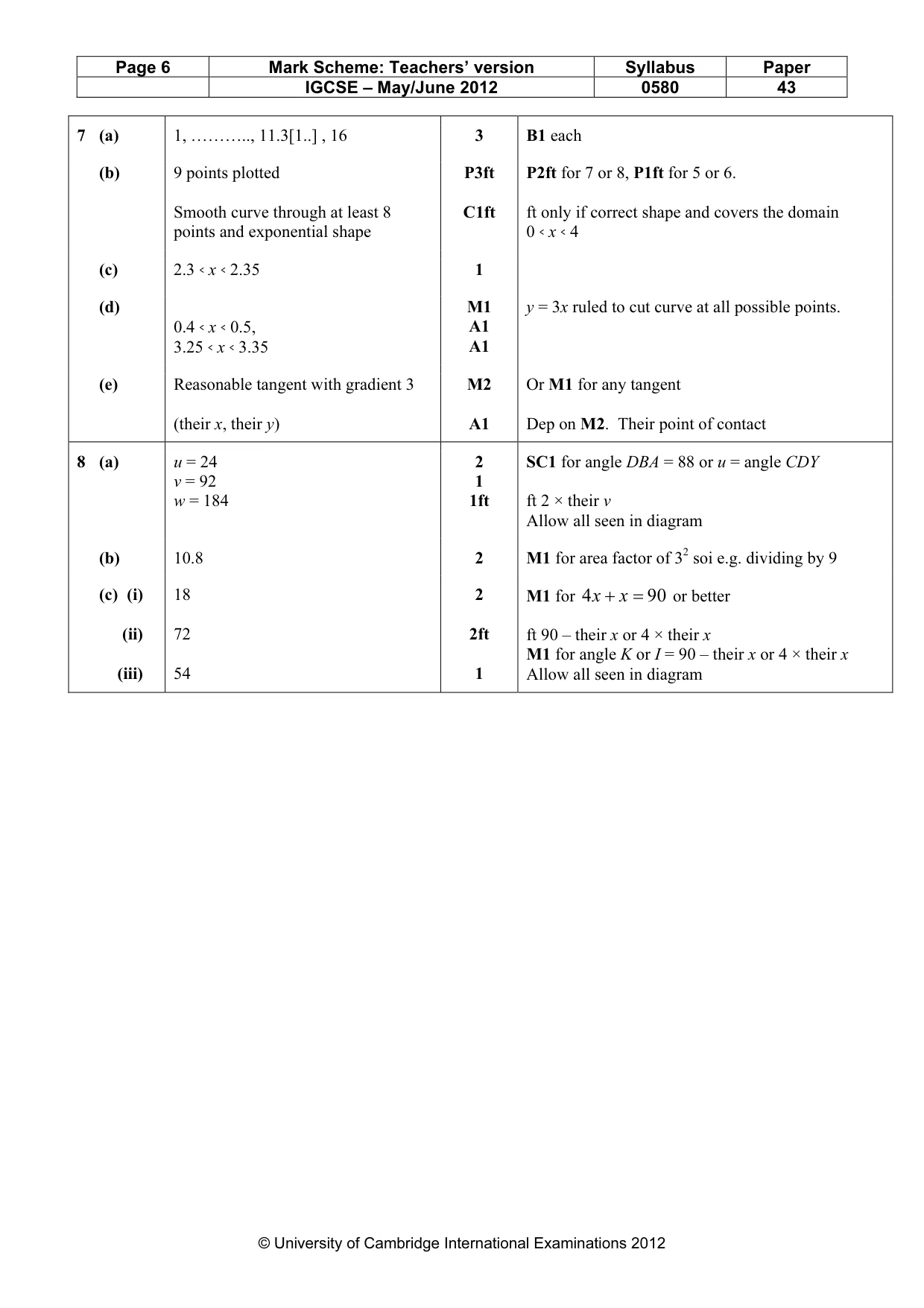
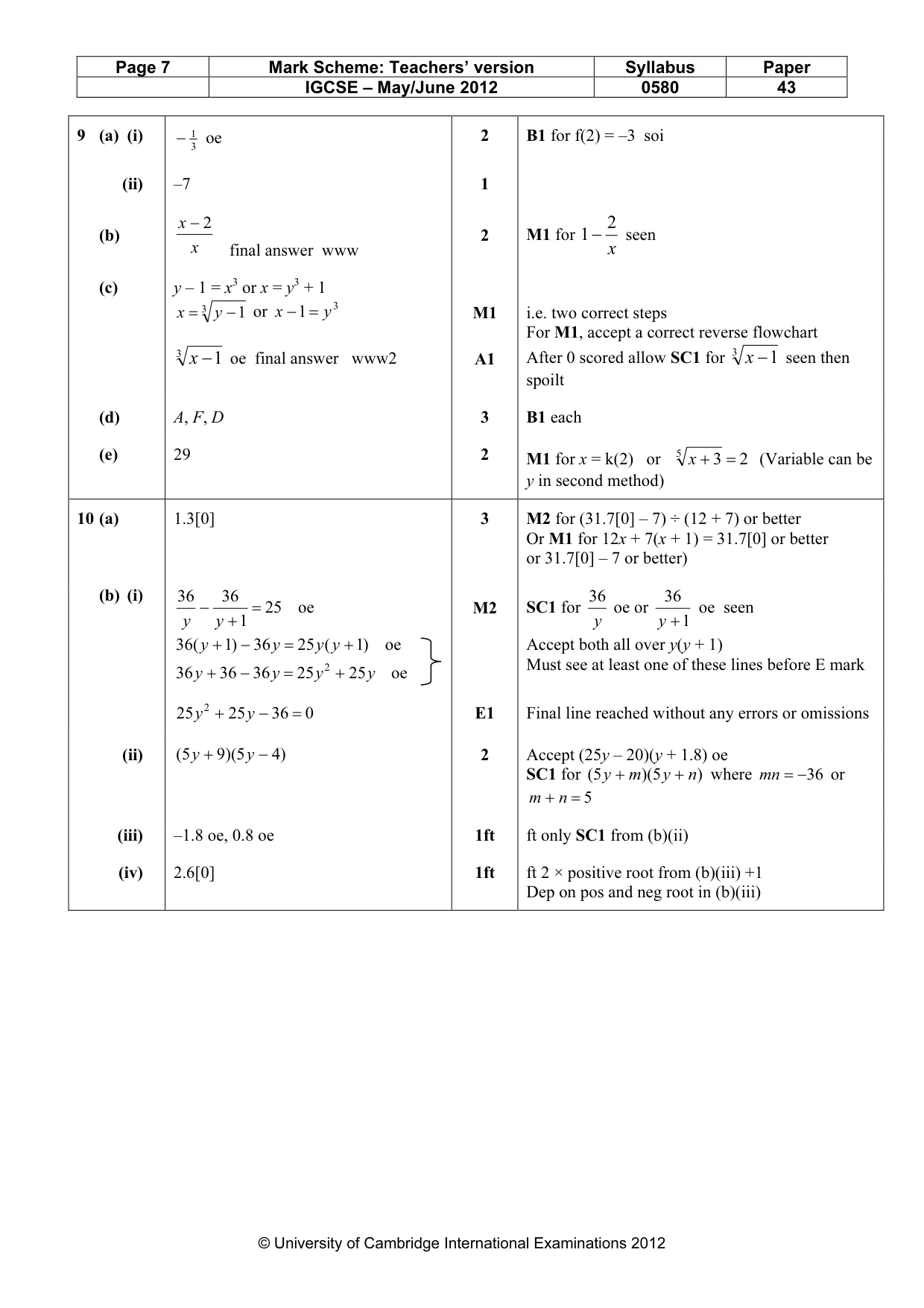
Q9 · For 9 f(x) = 1 – 2x g(x) = , x ≠ 0 h(x) = x3 + 1 Examiner's x Use (a) Find the value of…
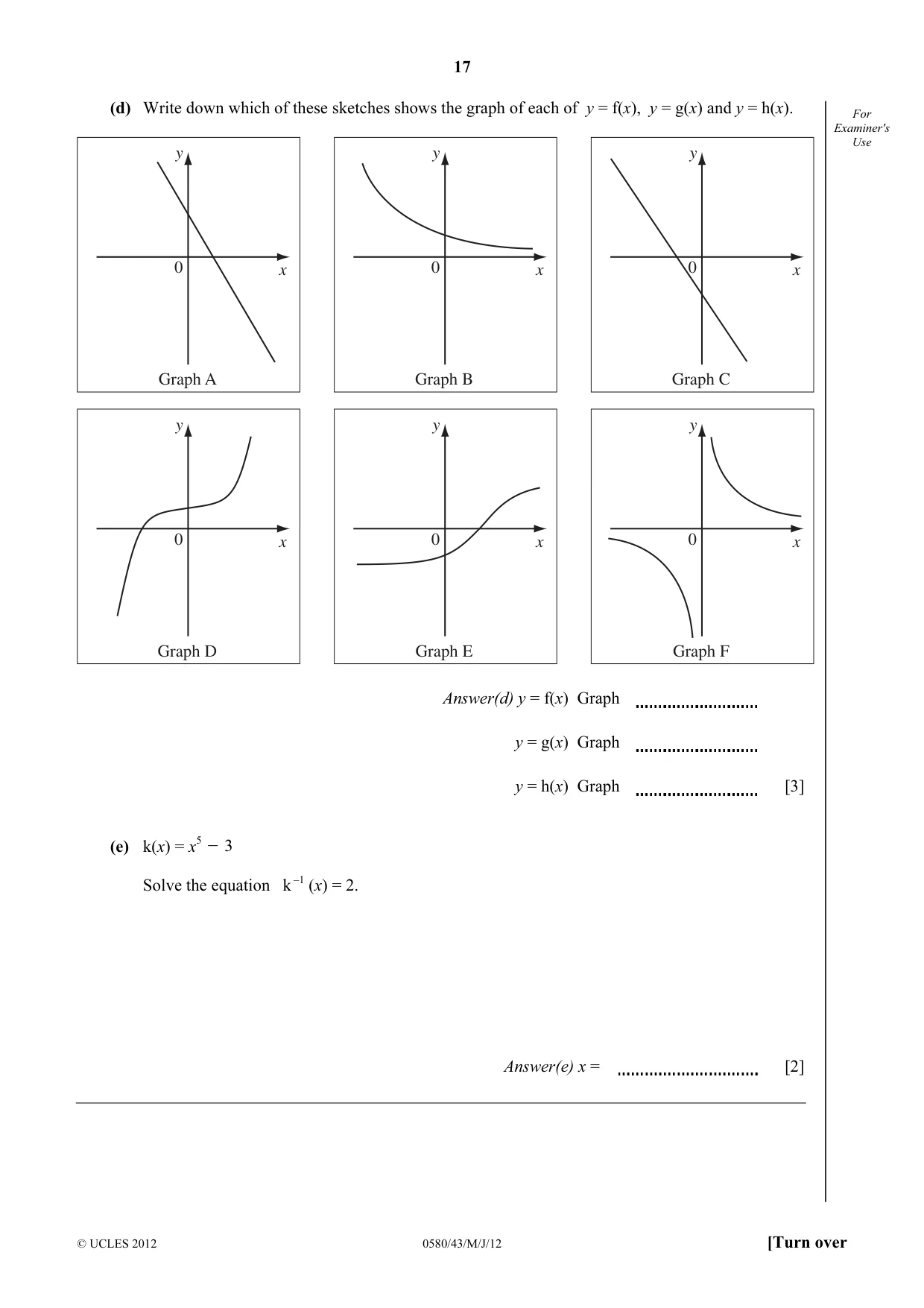
1 For 9 f(x) = 1 – 2x g(x) = , x ≠ 0 h(x) = x3 + 1 Examiner's x Use (a) Find the value of (i) gf(2), Answer(a)(i) [2] (ii) h(–2). Answer(a)(ii) [1] (b) Find fg(x). Write your answer as a single fraction. Answer(b) fg(x) = [2] (c) Find h –1(x) , the inverse of h(x). Answer(c) h –1(x) = [2] (d) Write down which of these sketches shows the graph of each of y = f(x), y = g(x) and y = h(x). For Examiner's Use y y y 0 x 0 x 0 x Graph A Graph B Graph C y y y 0 x 0 x 0 x Graph D Graph E Graph F Answer(d) y = f(x) Graph y = g(x) Graph y = h(x) Graph [3] (e) k(x) = x5 O=3 Solve the equation k –1 (x) = 2. Answer(e) x = [2]
Mark scheme: 9 (a) (i) 2 B1 for f(2) = –3 soi − 1 3 oe (ii) –7 1 x − 2 2 (b) 2 M1 for 1− seen x final answer www x (c) y – 1 = x3 or x = y3 + 1 x = 3 y − 1 or x − 1 = y 3 M1 i.e. two correct steps For M1, accept a correct reverse flowchart 3 x − 1 oe final answer www2 A1 After 0 scored allow SC1 for 3 x − 1 seen then spoilt (d) A, F, D 3 B1 each 5 x + 3 = 2 (Variable can be (e) 29 2 M1 for x = k(2) or y in second method)
Q10 · Rice costs $x per kilogram
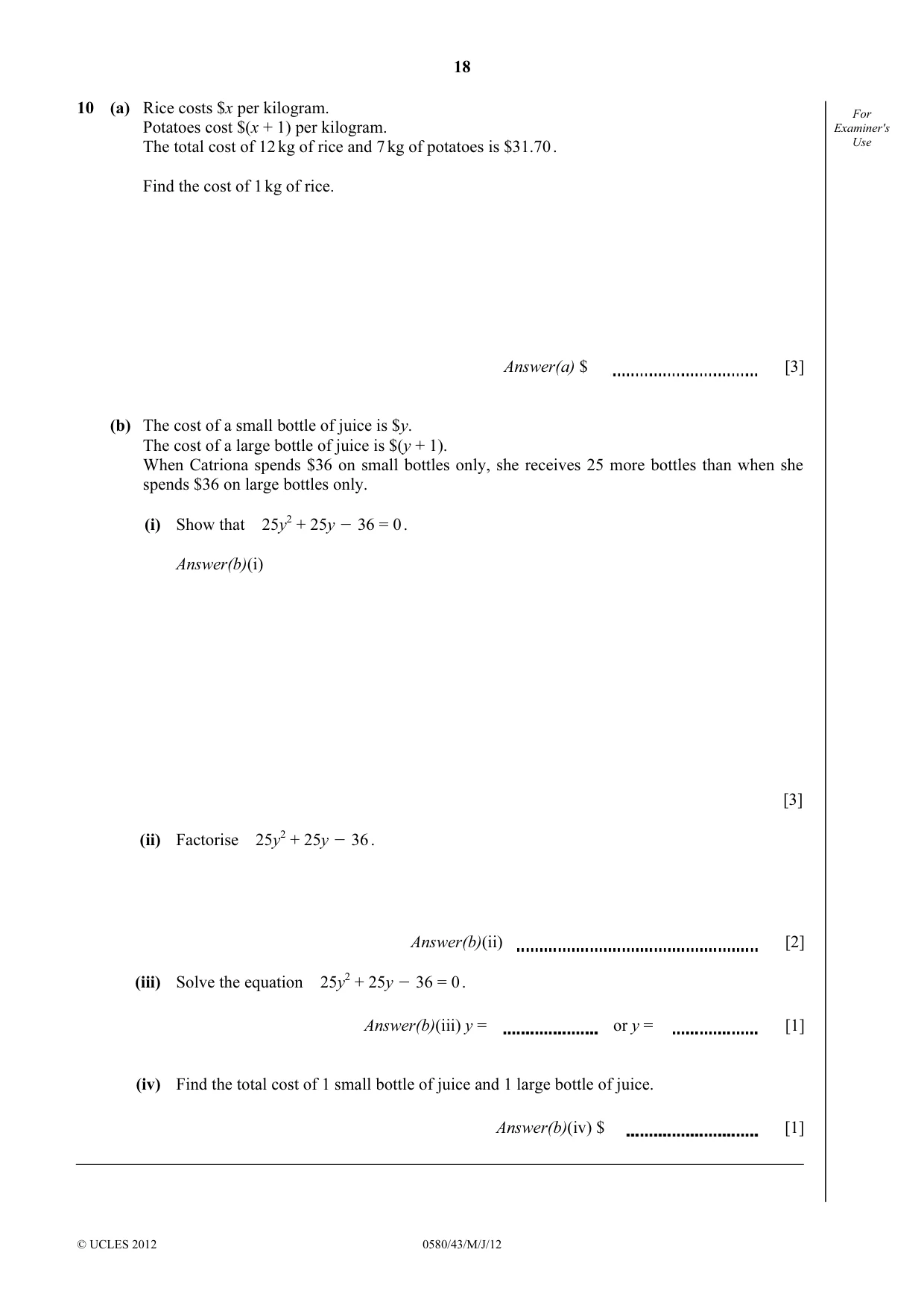
10 (a) Rice costs $x per kilogram. For Potatoes cost $(x + 1) per kilogram. Examiner's The total cost of 12 kg of rice and 7 kg of potatoes is $31.70 . Use Find the cost of 1 kg of rice. Answer(a) $ [3] (b) The cost of a small bottle of juice is $y. The cost of a large bottle of juice is $(y + 1). When Catriona spends $36 on small bottles only, she receives 25 more bottles than when she spends $36 on large bottles only. (i) Show that 25y2 + 25y O 36 = 0 . Answer(b)(i) [3] (ii) Factorise 25y2 + 25y O 36 . Answer(b)(ii) [2] (iii) Solve the equation 25y2 + 25y O 36 = 0 . Answer(b)(iii) y = or y = [1] (iv) Find the total cost of 1 small bottle of juice and 1 large bottle of juice. Answer(b)(iv) $ [1]
Mark scheme: 10 (a) 1.3[0] 3 M2 for (31.7[0] – 7) ÷ (12 + 7) or better Or M1 for 12x + 7(x + 1) = 31.7[0] or better or 31.7[0] – 7 or better) (b) (i) 36 36 36 36 = 25 oe M2 SC1 for oe or oe seen y −y + 1 y y + 1 36 ( y + )1 − 36 y = 25 y ( y + )1 oe Accept both all over y(y + 1) 2 Must see at least one of these lines before E mark 36 y + 36 − 36 y = 25 y + 25 y oe 25 y 2 + 25 y − 36 = 0 E1 Final line reached without any errors or omissions (ii) (5 y + 9 )(5 y − 4 ) 2 Accept (25y – 20)(y + 1.8) oe SC1 for (5 y + m )(5 y + n ) where mn = − 36 or m + n = 5 (iii) –1.8 oe, 0.8 oe 1ft ft only SC1 from (b)(ii) (iv) 2.6[0] 1ft ft 2 × positive root from (b)(iii) +1 Dep on pos and neg root in (b)(iii) IGCSE – May/June 2012 0580 43
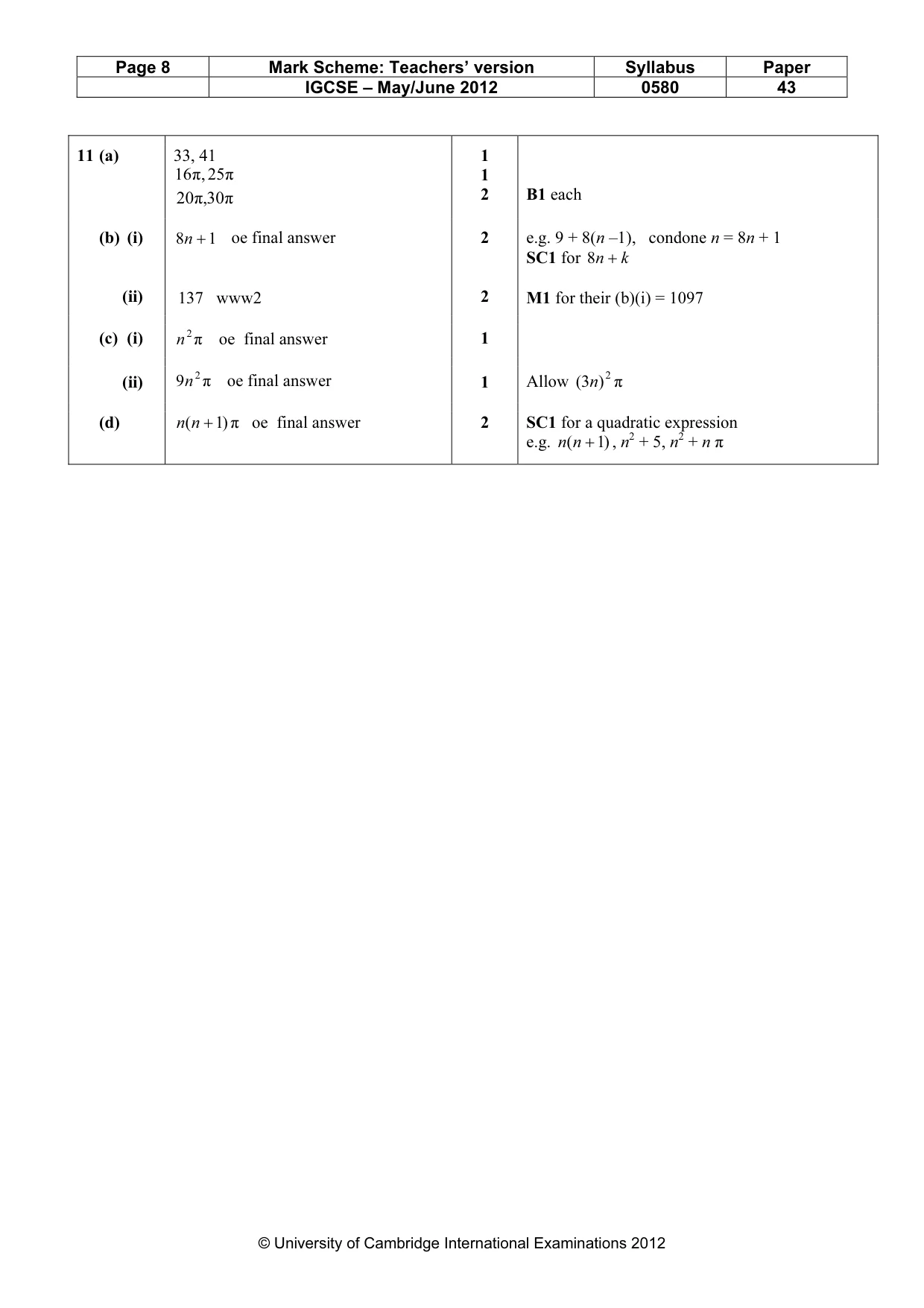
Q11 · For Examiner's Use Diagram 1 Diagram 2 Diagram 3 The diagrams show a sequence of dots and…
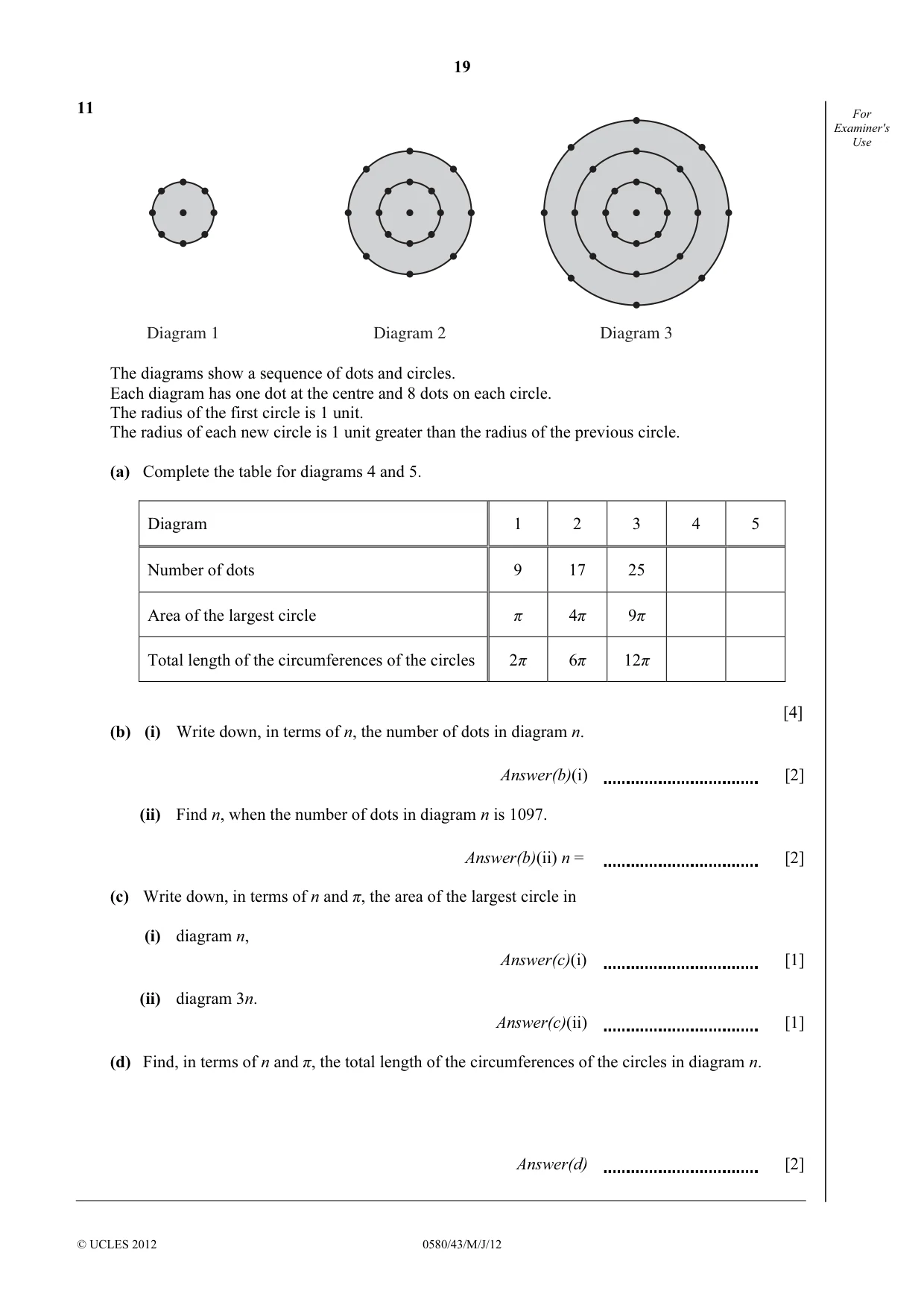
11 For Examiner's Use Diagram 1 Diagram 2 Diagram 3 The diagrams show a sequence of dots and circles. Each diagram has one dot at the centre and 8 dots on each circle. The radius of the first circle is 1 unit. The radius of each new circle is 1 unit greater than the radius of the previous circle. (a) Complete the table for diagrams 4 and 5. Diagram 1 2 3 4 5 Number of dots 9 17 25 Area of the largest circle π 4π 9π Total length of the circumferences of the circles 2π 6π 12π [4] (b) (i) Write down, in terms of n, the number of dots in diagram n. Answer(b)(i) [2] (ii) Find n, when the number of dots in diagram n is 1097. Answer(b)(ii) n = [2] (c) Write down, in terms of n and π, the area of the largest circle in (i) diagram n, Answer(c)(i) [1] (ii) diagram 3n. Answer(c)(ii) [1] (d) Find, in terms of n and π, the total length of the circumferences of the circles in diagram n. Answer(d) [2]
Mark scheme: 11 (a) 33, 41 1 16 ,π 25 π 1 2 B1 each 20 ,π30 π (b) (i) 8 n + 1 oe final answer 2 e.g. 9 + 8(n –1), condone n = 8n + 1 SC1 for 8 n + k (ii) 137 www2 2 M1 for their (b)(i) = 1097 (c) (i) n 2 π oe final answer 1 (ii) 9 n 2 π oe final answer 1 Allow (3n ) 2 π (d) n ( n + )1 π oe final answer 2 SC1 for a quadratic expression e.g. n ( n + )1 , n2 + 5, n2 + n π
What was in this paper
The subtopics covered by these 3 questions, and how many questions each got. Open one in a new tab to see every Cambridge question on it.
What you needed in this session
Cambridge’s own grade thresholds for 2012 May/June, Paper 4 · Variant 3. A higher threshold means an easier paper — the bar moves with how the cohort did.