Cambridge IGCSE Mathematics 0580 — 2012 May/June Paper 3 · Variant 1
0580/31/M/J/12 · 6 questions · 104 marks · ≈117 min
The question paper and its mark scheme, free to read here and free to download. This is Cambridge’s own paper, exactly as it was sat.
Question paper16 pages
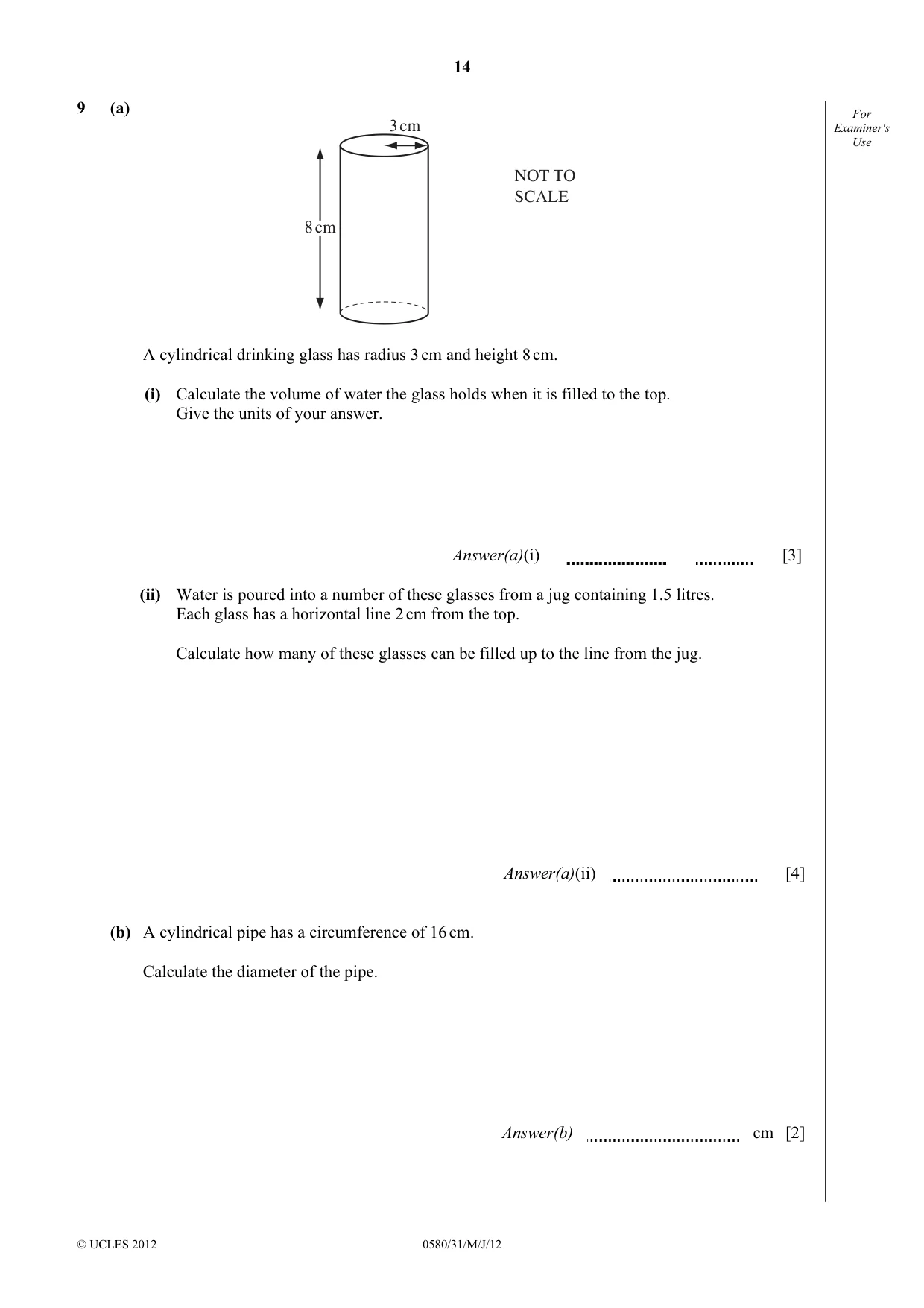
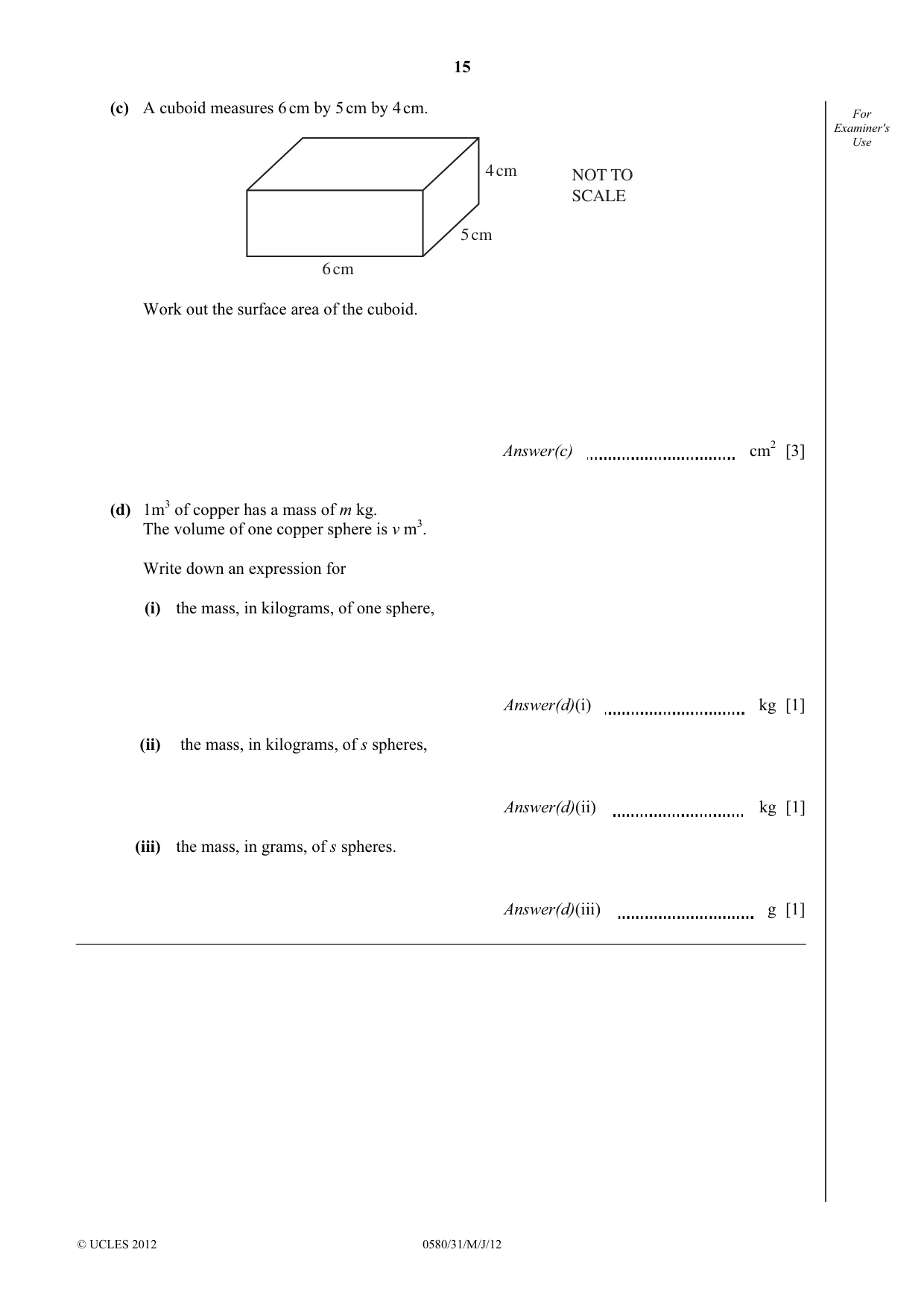
Mark scheme5 pages
Answers below. Sit the paper first if you are practising.
Questions as text
Q1 · Vince and Wendy share $2000 in the ratio Vince : Wendy = 19 : 21
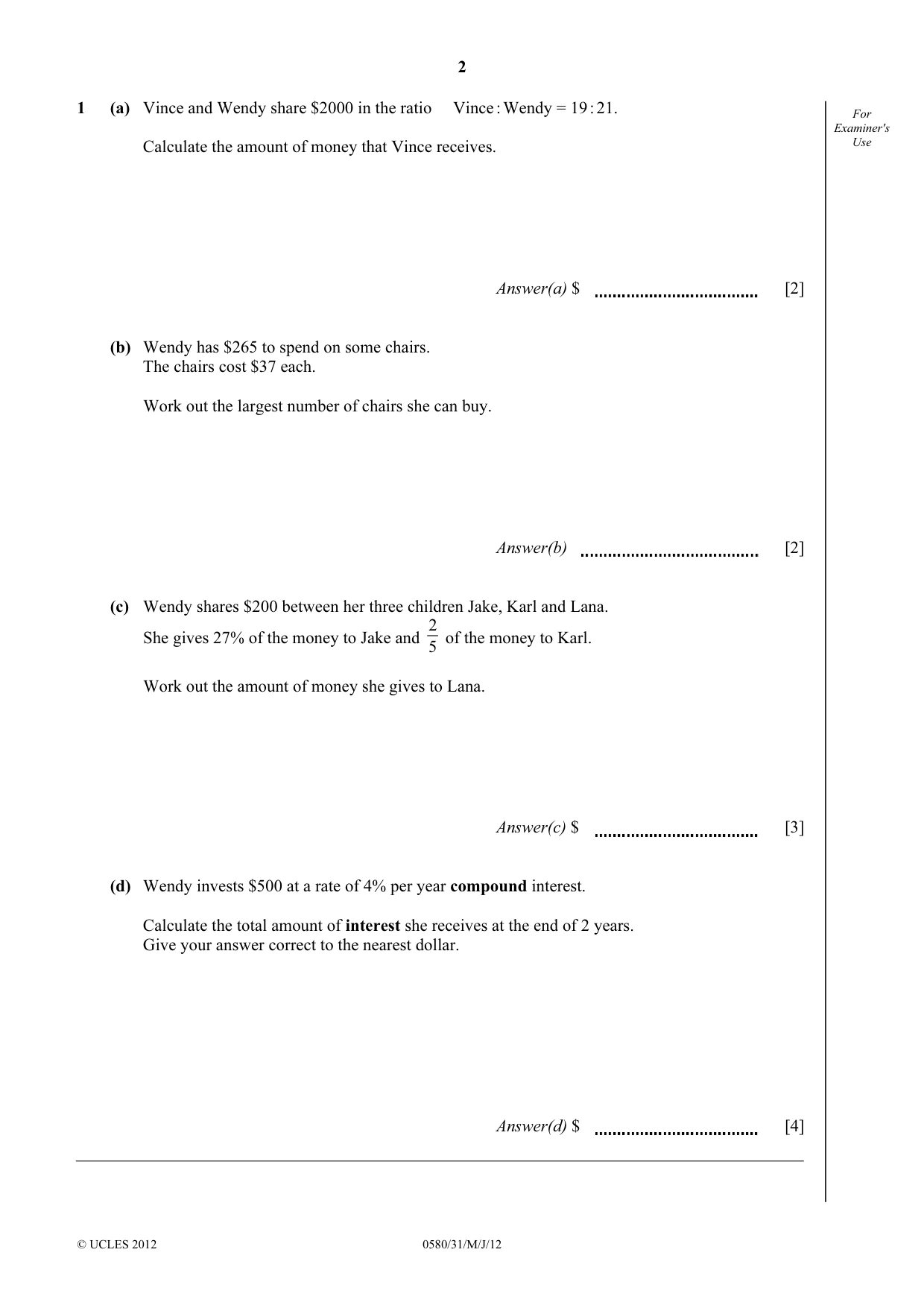
1 (a) Vince and Wendy share $2000 in the ratio Vince : Wendy = 19 : 21. For Examiner's Calculate the amount of money that Vince receives. Use Answer(a) $ [2] (b) Wendy has $265 to spend on some chairs. The chairs cost $37 each. Work out the largest number of chairs she can buy. Answer(b) [2] (c) Wendy shares $200 between her three children Jake, Karl and Lana. 2 She gives 27% of the money to Jake and of the money to Karl. 5 Work out the amount of money she gives to Lana. Answer(c) $ [3] (d) Wendy invests $500 at a rate of 4% per year compound interest. Calculate the total amount of interest she receives at the end of 2 years. Give your answer correct to the nearest dollar. Answer(d) $ [4]
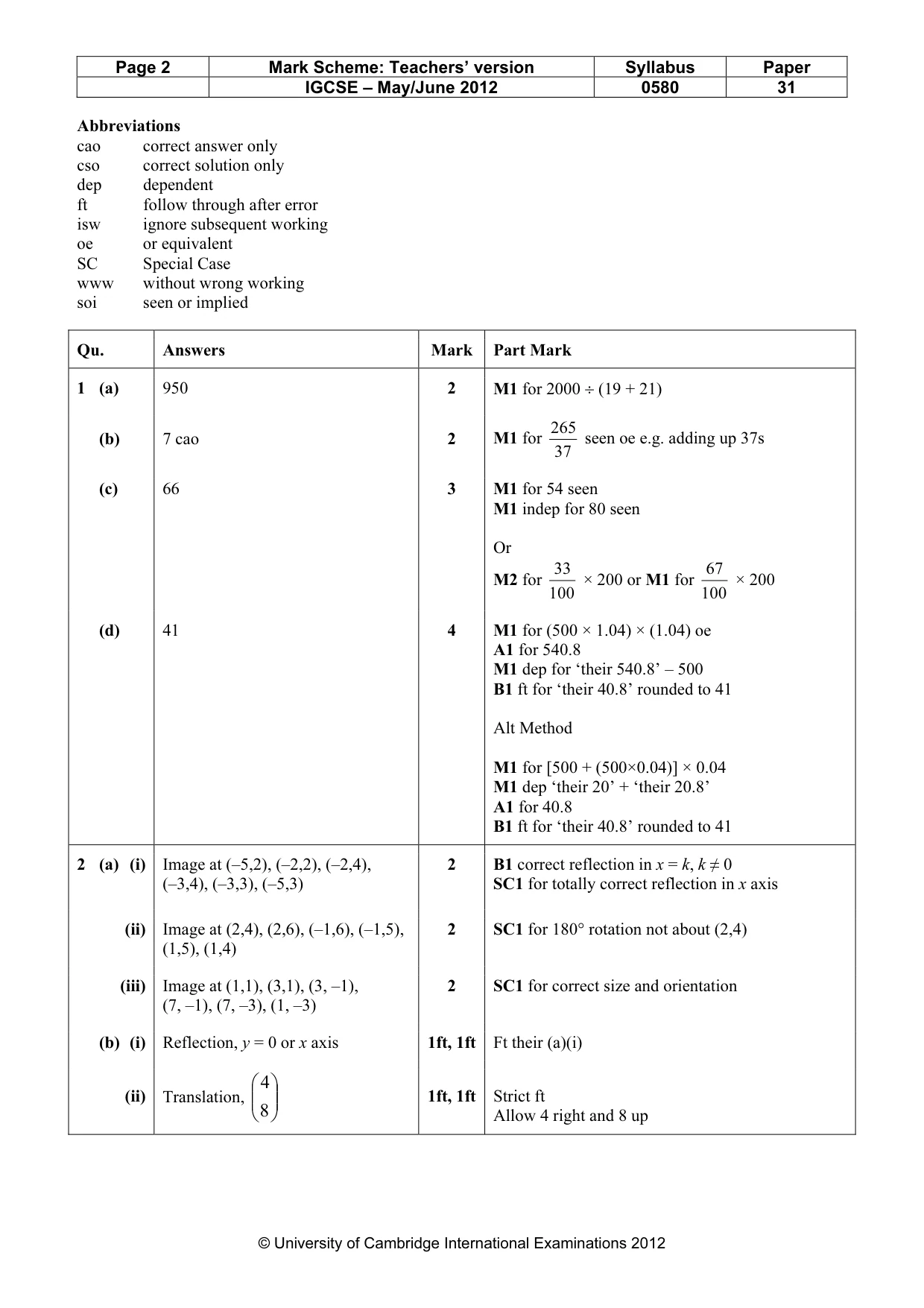
Mark scheme: Qu. Answers Mark Part Mark 1 (a) 950 2 M1 for 2000 ÷ (19 + 21) 265 (b) 7 cao 2 M1 for seen oe e.g. adding up 37s 37 (c) 66 3 M1 for 54 seen M1 indep for 80 seen Or 33 67 M2 for × 200 or M1 for × 200 100 100 (d) 41 4 M1 for (500 × 1.04) × (1.04) oe A1 for 540.8 M1 dep for ‘their 540.8’ – 500 B1 ft for ‘their 40.8’ rounded to 41 Alt Method M1 for [500 + (500×0.04)] × 0.04 M1 dep ‘their 20’ + ‘their 20.8’ A1 for 40.8 B1 ft for ‘their 40.8’ rounded to 41
Q2 · For y Examiner's Use 8 6 4 A 2 x –6 –4 –2 0 2 4 6 8 –2 D –4 –6 –8 Two shapes A and D are…
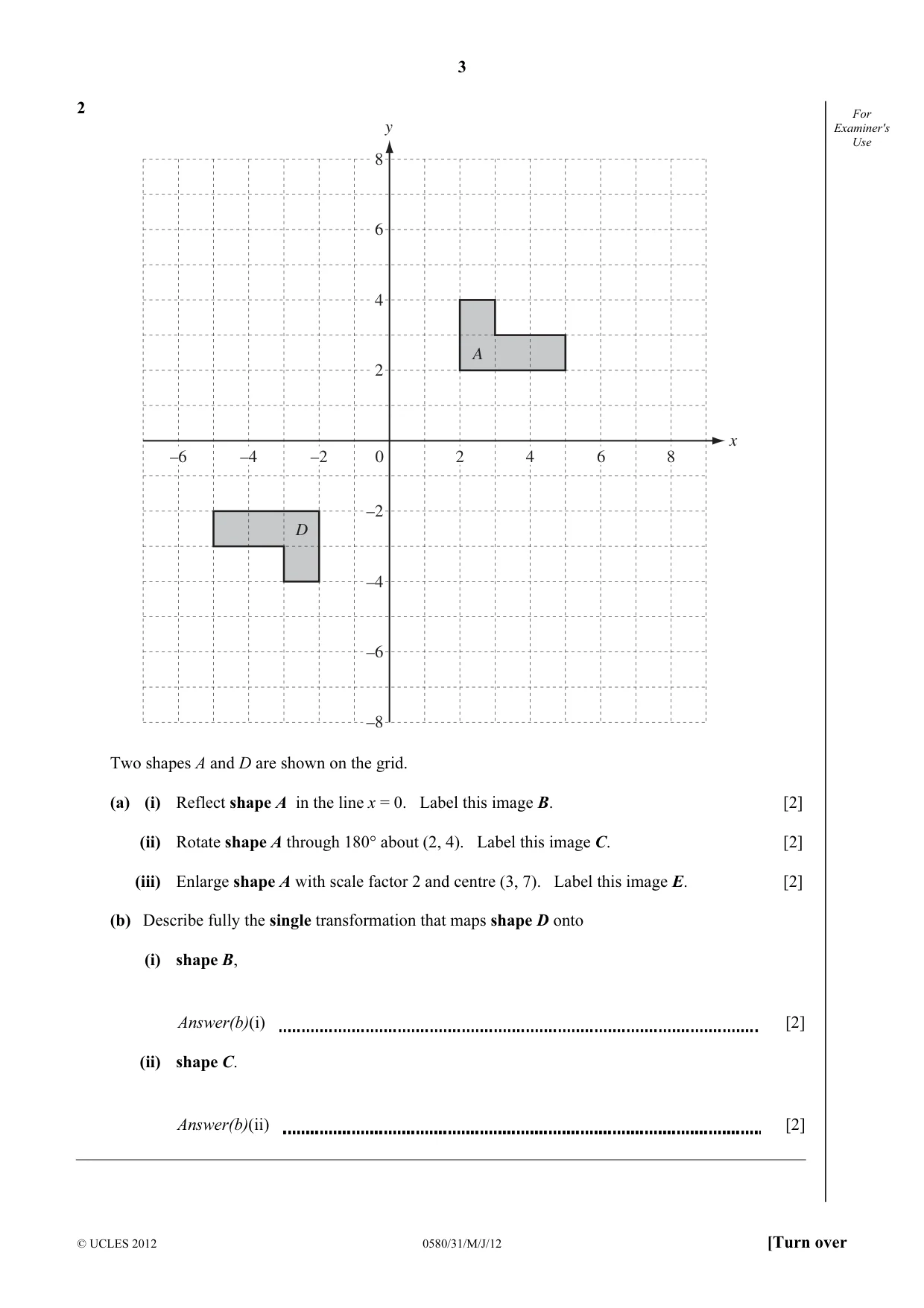
2 For y Examiner's Use 8 6 4 A 2 x –6 –4 –2 0 2 4 6 8 –2 D –4 –6 –8 Two shapes A and D are shown on the grid. (a) (i) Reflect shape A in the line x = 0. Label this image B. [2] (ii) Rotate shape A through 180° about (2, 4). Label this image C. [2] (iii) Enlarge shape A with scale factor 2 and centre (3, 7). Label this image E. [2] (b) Describe fully the single transformation that maps shape D onto (i) shape B, Answer(b)(i) [2] (ii) shape C. Answer(b)(ii) [2]
Mark scheme: 2 (a) (i) Image at (–5,2), (–2,2), (–2,4), 2 B1 correct reflection in x = k, k ≠ 0 (–3,4), (–3,3), (–5,3) SC1 for totally correct reflection in x axis (ii) Image at (2,4), (2,6), (–1,6), (–1,5), 2 SC1 for 180° rotation not about (2,4) (1,5), (1,4) (iii) Image at (1,1), (3,1), (3, –1), 2 SC1 for correct size and orientation (7, –1), (7, –3), (1, –3) (b) (i) Reflection, y = 0 or x axis 1ft, 1ft Ft their (a)(i) 4 (ii) Translation, 1ft, 1ft Strict ft 8 Allow 4 right and 8 up IGCSE – May/June 2012 0580 31 1
Q3 · Jon spins this 6-sided spinner
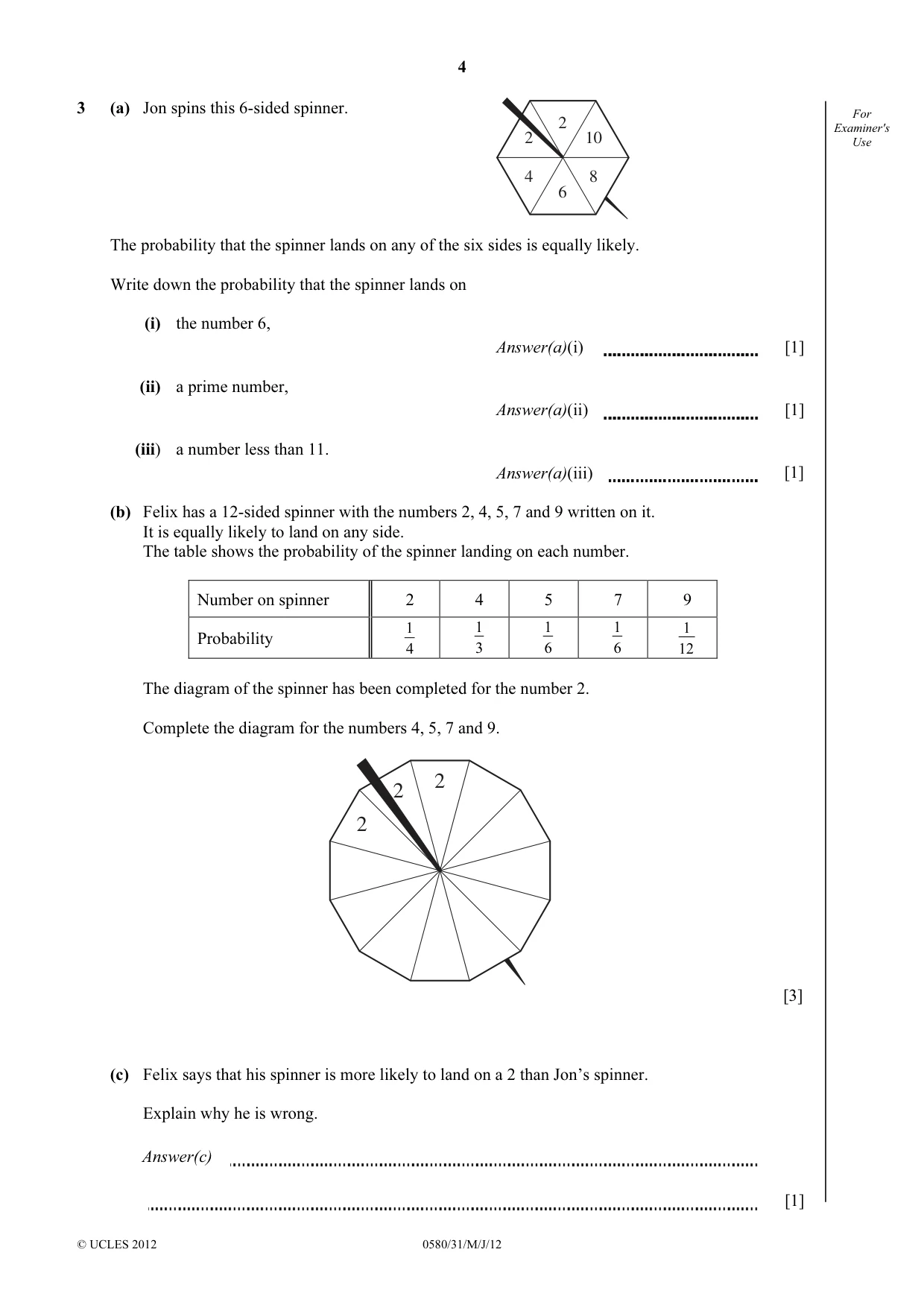
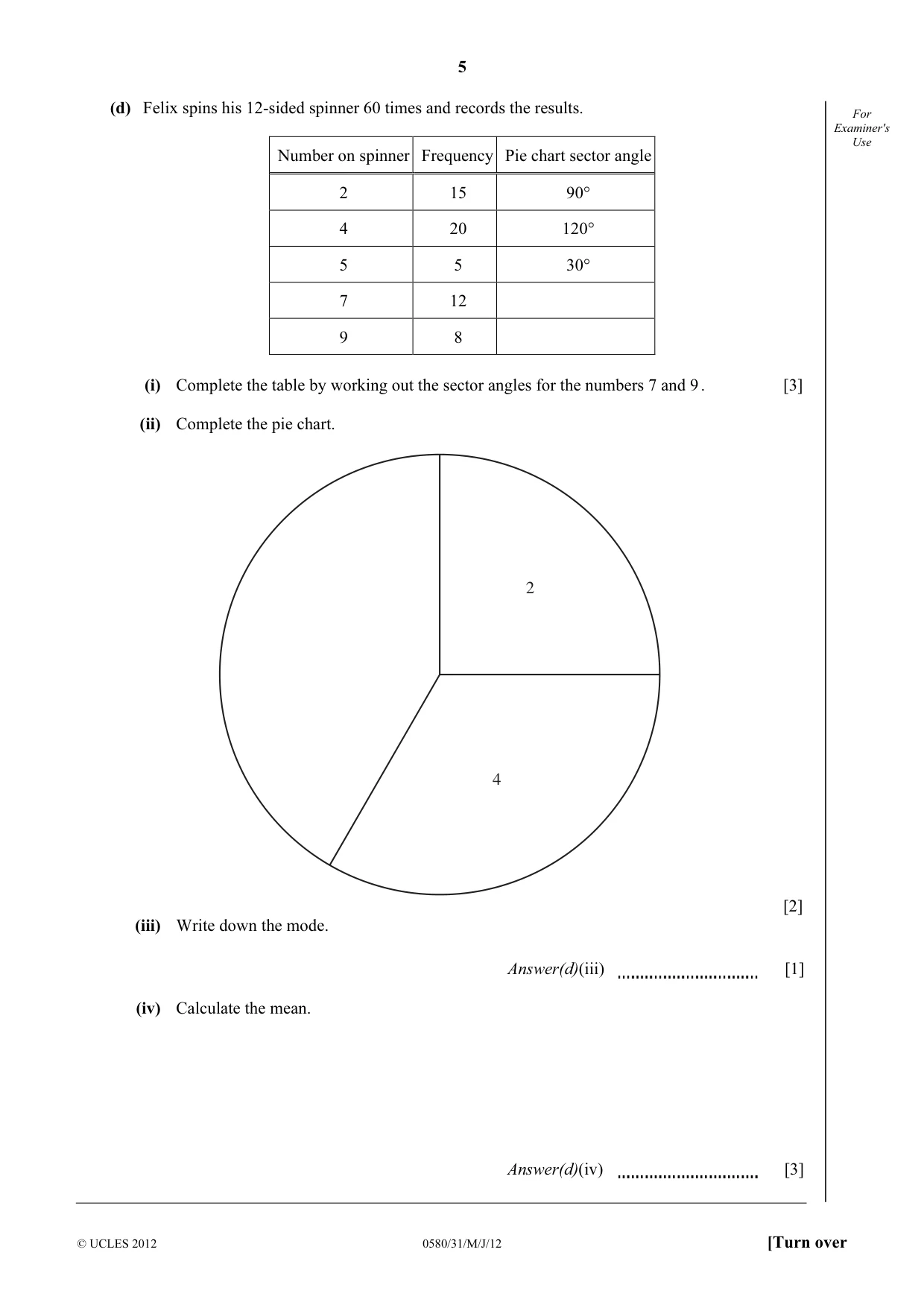
3 (a) Jon spins this 6-sided spinner. For 2 Examiner's 2 10 Use 4 8 6 The probability that the spinner lands on any of the six sides is equally likely. Write down the probability that the spinner lands on (i) the number 6, Answer(a)(i) [1] (ii) a prime number, Answer(a)(ii) [1] (iii) a number less than 11. Answer(a)(iii) [1] (b) Felix has a 12-sided spinner with the numbers 2, 4, 5, 7 and 9 written on it. It is equally likely to land on any side. The table shows the probability of the spinner landing on each number. Number on spinner 2 4 5 7 9 1 1 1 1 1 Probability 4 3 6 6 12 The diagram of the spinner has been completed for the number 2. Complete the diagram for the numbers 4, 5, 7 and 9. 2 2 2 [3] (c) Felix says that his spinner is more likely to land on a 2 than Jon’s spinner. Explain why he is wrong. Answer(c) [1] (d) Felix spins his 12-sided spinner 60 times and records the results. For Examiner's Use Number on spinner Frequency Pie chart sector angle 2 15 90° 4 20 120° 5 5 30° 7 12 9 8 (i) Complete the table by working out the sector angles for the numbers 7 and 9 . [3] (ii) Complete the pie chart. 2 4 [2] (iii) Write down the mode. Answer(d)(iii) [1] (iv) Calculate the mean. Answer(d)(iv) [3]
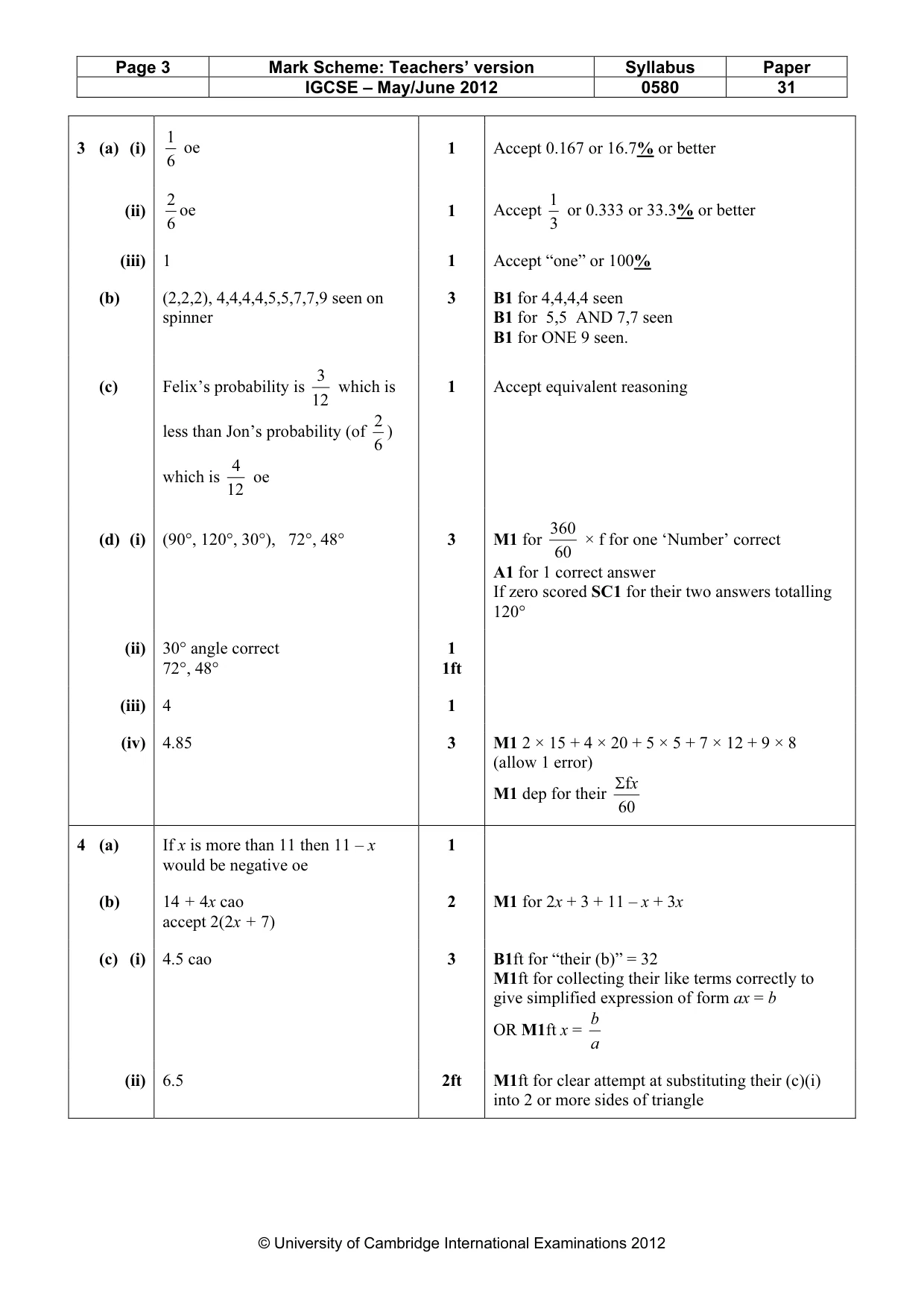
Mark scheme: 1 3 (a) (i) oe 1 Accept 0.167 or 16.7% or better 6 2 1 (ii) oe 1 Accept or 0.333 or 33.3% or better 6 3 (iii) 1 1 Accept “one” or 100% (b) (2,2,2), 4,4,4,4,5,5,7,7,9 seen on 3 B1 for 4,4,4,4 seen spinner B1 for 5,5 AND 7,7 seen B1 for ONE 9 seen. 3 (c) Felix’s probability is which is 1 Accept equivalent reasoning 12 2 less than Jon’s probability (of ) 6 4 which is oe 12 360 (d) (i) (90°, 120°, 30°), 72°, 48° 3 M1 for × f for one ‘Number’ correct 60 A1 for 1 correct answer If zero scored SC1 for their two answers totalling 120° (ii) 30° angle correct 1 72°, 48° 1ft (iii) 4 1 (iv) 4.85 3 M1 2 × 15 + 4 × 20 + 5 × 5 + 7 × 12 + 9 × 8 (allow 1 error) Σfx M1 dep for their 60
Q4 · In this question all the measurements are in centimetres
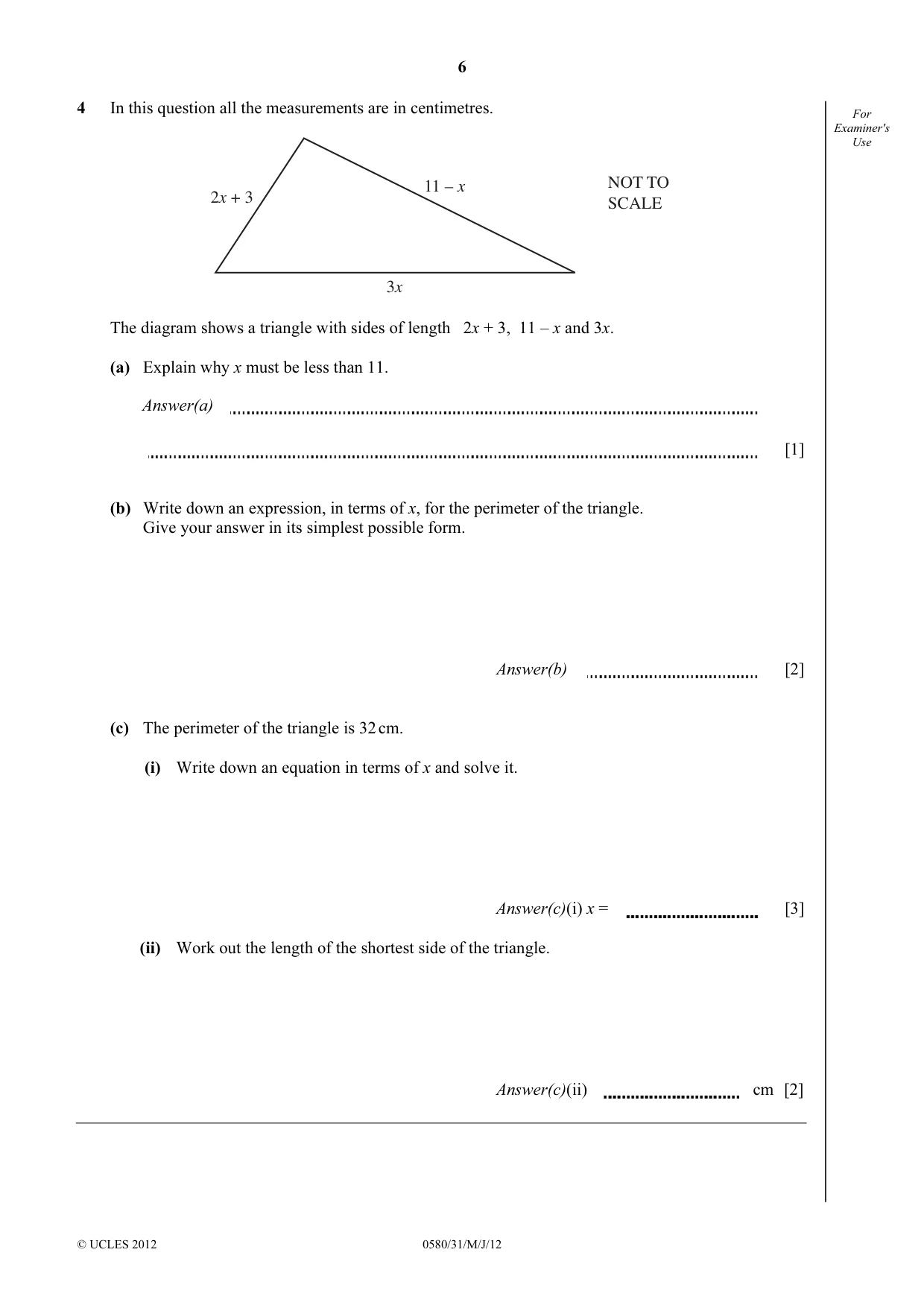
4 In this question all the measurements are in centimetres. For Examiner's Use 11 – x NOT TO 2x + 3 SCALE 3x The diagram shows a triangle with sides of length 2x + 3, 11 – x and 3x. (a) Explain why x must be less than 11. Answer(a) [1] (b) Write down an expression, in terms of x, for the perimeter of the triangle. Give your answer in its simplest possible form. Answer(b) [2] (c) The perimeter of the triangle is 32 cm. (i) Write down an equation in terms of x and solve it. Answer(c)(i) x = [3] (ii) Work out the length of the shortest side of the triangle. Answer(c)(ii) cm [2]
Mark scheme: 4 (a) If x is more than 11 then 11 – x 1 would be negative oe (b) 14 + 4x cao 2 M1 for 2x + 3 + 11 – x + 3x accept 2(2x + 7) (c) (i) 4.5 cao 3 B1ft for “their (b)” = 32 M1ft for collecting their like terms correctly to give simplified expression of form ax = b b OR M1ft x = a (ii) 6.5 2ft M1ft for clear attempt at substituting their (c)(i) into 2 or more sides of triangle IGCSE – May/June 2012 0580 31 5 (a) Correct diagram: 4 rows & 6 1 columns
Q5 · For Examiner's Use Diagram 1 Diagram 2 Diagram 3 Diagram 4 The number of crosses in each…
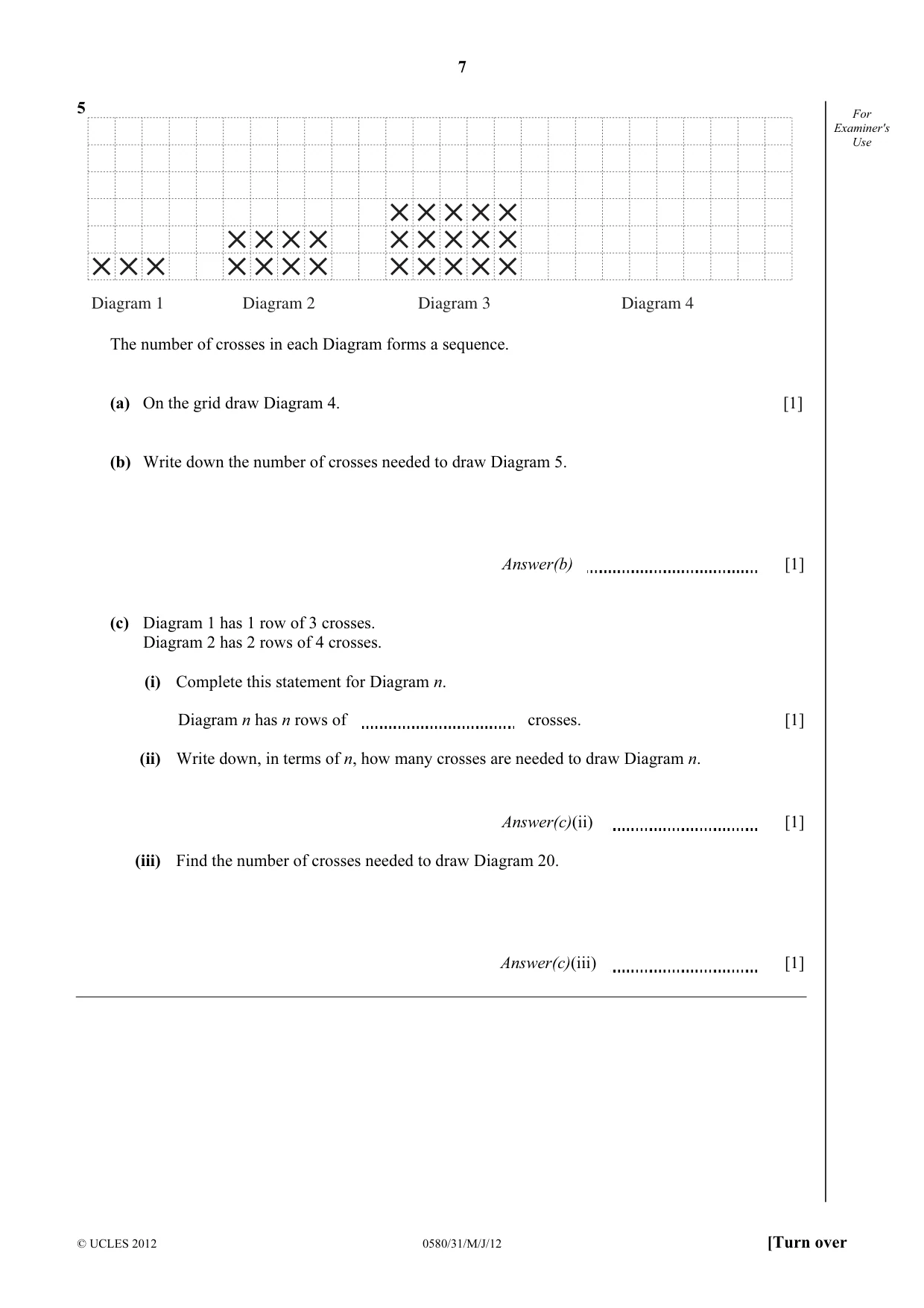
5 For Examiner's Use Diagram 1 Diagram 2 Diagram 3 Diagram 4 The number of crosses in each Diagram forms a sequence. (a) On the grid draw Diagram 4. [1] (b) Write down the number of crosses needed to draw Diagram 5. Answer(b) [1] (c) Diagram 1 has 1 row of 3 crosses. Diagram 2 has 2 rows of 4 crosses. (i) Complete this statement for Diagram n. Diagram n has n rows of crosses. [1] (ii) Write down, in terms of n, how many crosses are needed to draw Diagram n. Answer(c)(ii) [1] (iii) Find the number of crosses needed to draw Diagram 20. Answer(c)(iii) [1]
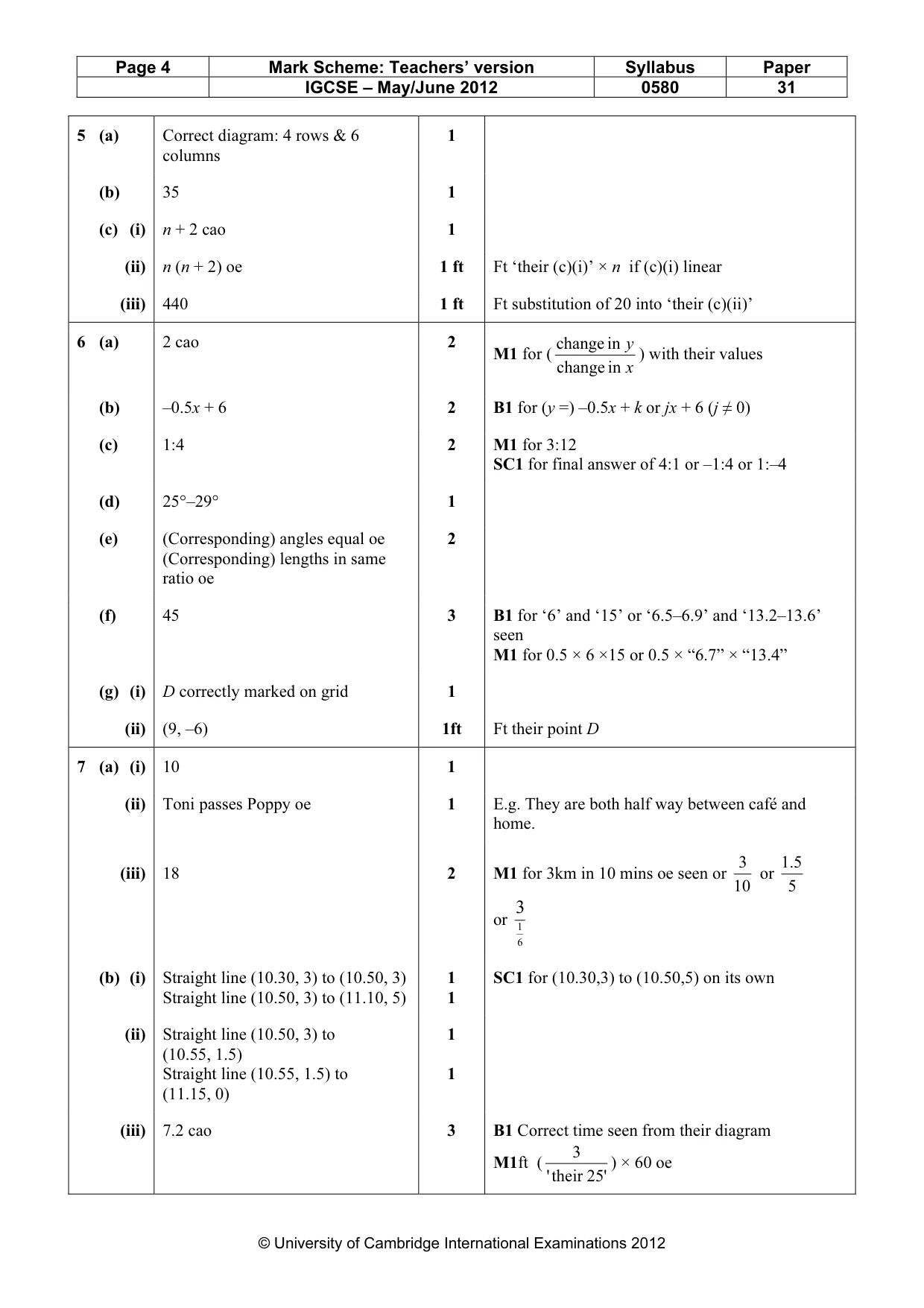
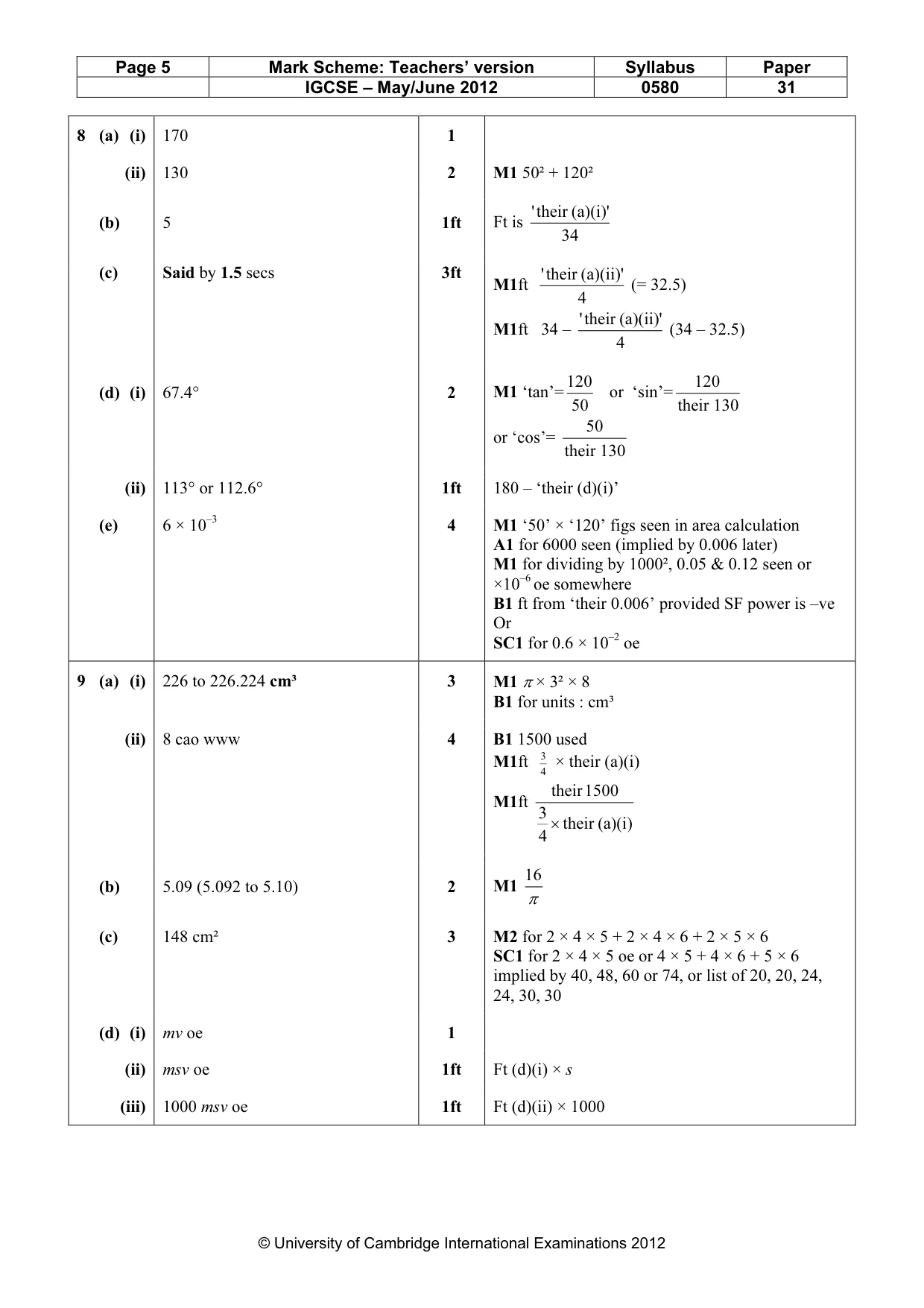
Mark scheme: their (a)(i) (b) 5 1ft Ft is 34 (c) Said by 1.5 secs 3ft ' their (a)(ii)' M1ft (= 32.5) 4 ' their (a)(ii)' M1ft 34 – (34 – 32.5) 4 120 120 (d) (i) 67.4° 2 M1 ‘tan’= or ‘sin’= 50 their 130 50 or ‘cos’= their 130 (ii) 113° or 112.6° 1ft 180 – ‘their (d)(i)’
Q6 · For y Examiner's Use B 6 4 2 A E C x –4 –2 0 2 4 6 8 10 12 –2 –4 –6 Triangle ABC is drawn…
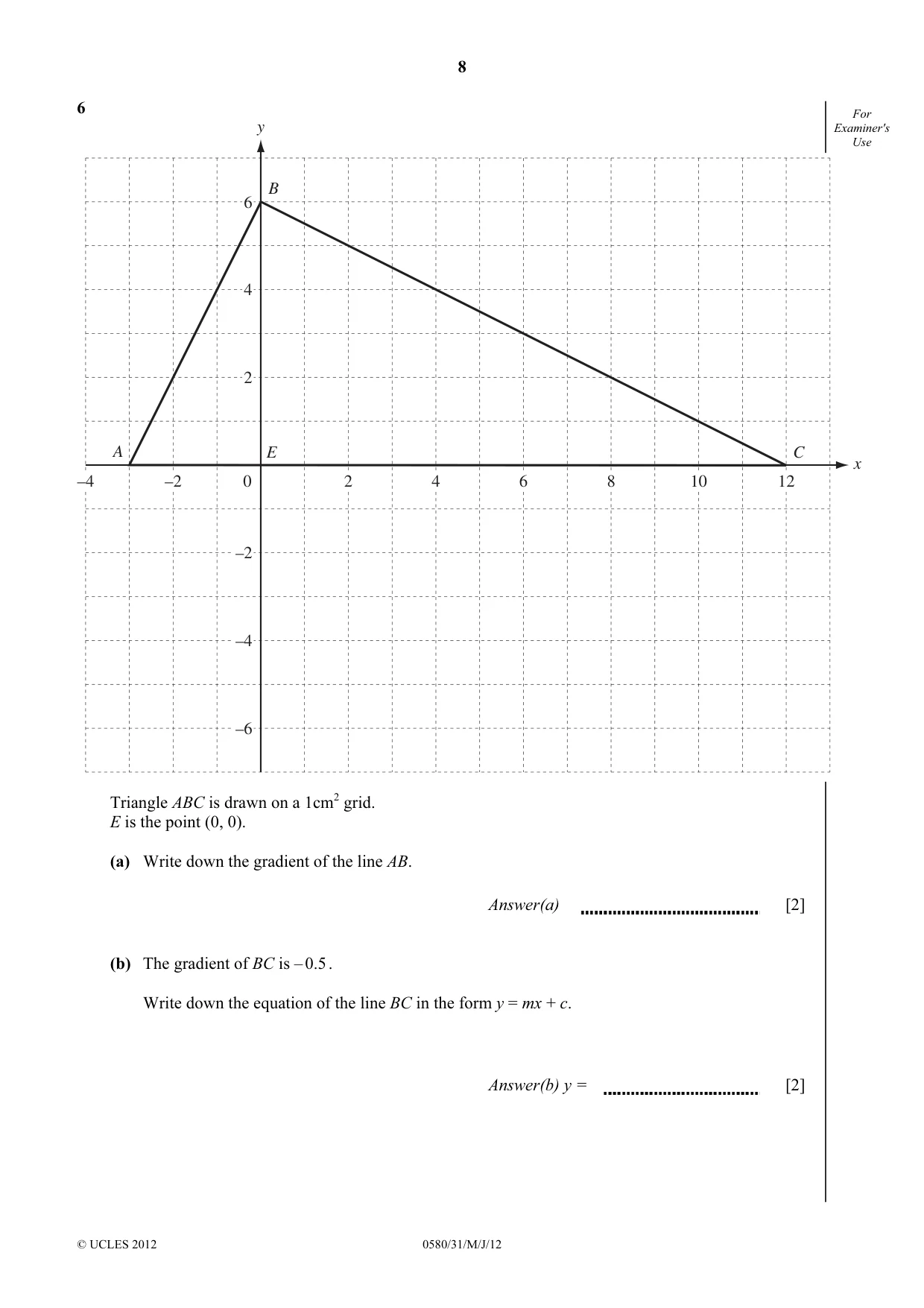
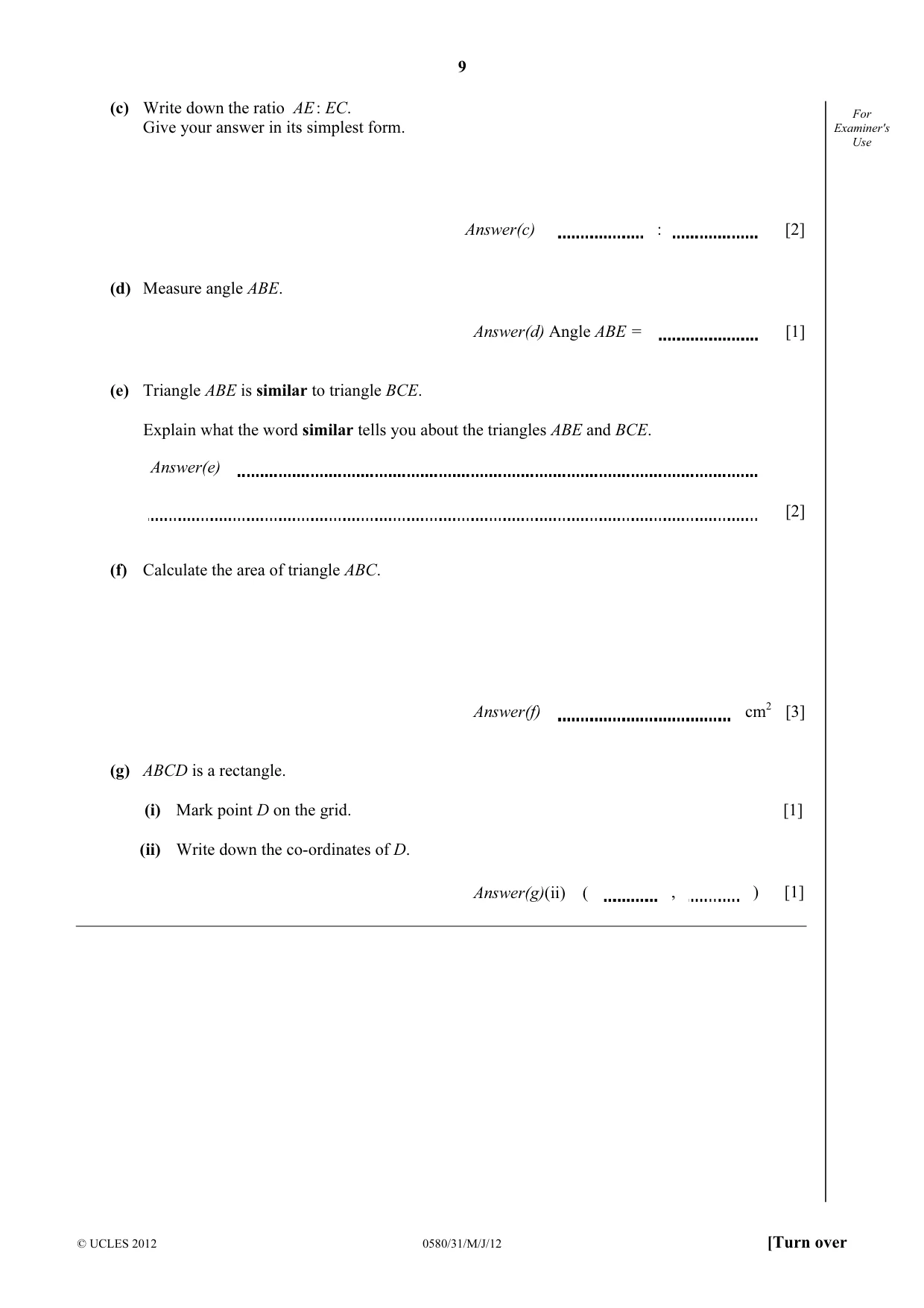
6 For y Examiner's Use B 6 4 2 A E C x –4 –2 0 2 4 6 8 10 12 –2 –4 –6 Triangle ABC is drawn on a 1cm2 grid. E is the point (0, 0). (a) Write down the gradient of the line AB. Answer(a) [2] (b) The gradient of BC is – 0.5 . Write down the equation of the line BC in the form y = mx + c. Answer(b) y = [2] (c) Write down the ratio AE : EC. For Give your answer in its simplest form. Examiner's Use Answer(c) : [2] (d) Measure angle ABE. Answer(d) Angle ABE = [1] (e) Triangle ABE is similar to triangle BCE. Explain what the word similar tells you about the triangles ABE and BCE. Answer(e) [2] (f) Calculate the area of triangle ABC. Answer(f) cm2 [3] (g) ABCD is a rectangle. (i) Mark point D on the grid. [1] (ii) Write down the co-ordinates of D. Answer(g)(ii) ( , ) [1]
Mark scheme: (e) 6 × 10⁻³ 4 M1 ‘50’ × ‘120’ figs seen in area calculation A1 for 6000 seen (implied by 0.006 later) M1 for dividing by 1000², 0.05 & 0.12 seen or ×10–6 oe somewhere B1 ft from ‘their 0.006’ provided SF power is –ve Or SC1 for 0.6 × 10⁻² oe 9 (a) (i) 226 to 226.224 cm³ 3 M1 π × 3² × 8 B1 for units : cm³ (ii) 8 cao www 4 B1 1500 used M1ft 3 × their (a)(i) 4 their 1500 M1ft 3 × their (a)(i) 4 16 (b) 5.09 (5.092 to 5.10) 2 M1 π (c) 148 cm² 3 M2 for 2 × 4 × 5 + 2 × 4 × 6 + 2 × 5 × 6 SC1 for 2 × 4 × 5 oe or 4 × 5 + 4 × 6 + 5 × 6 implied by 40, 48, 60 or 74, or list of 20, 20, 24, 24, 30, 30 (d) (i) mv oe 1 (ii) msv oe 1ft Ft (d)(i) × s (iii) 1000 msv oe 1ft Ft (d)(ii) × 1000
What was in this paper
The subtopics covered by these 6 questions, and how many questions each got. Open one in a new tab to see every Cambridge question on it.
What you needed in this session
Cambridge’s own grade thresholds for 2012 May/June, Paper 3 · Variant 1. A higher threshold means an easier paper — the bar moves with how the cohort did.