Cambridge IGCSE Mathematics 0580 — 2012 May/June Paper 3 · Variant 2
0580/32/M/J/12 · 6 questions · 104 marks · ≈117 min
The question paper and its mark scheme, free to read here and free to download. This is Cambridge’s own paper, exactly as it was sat.
Question paper16 pages
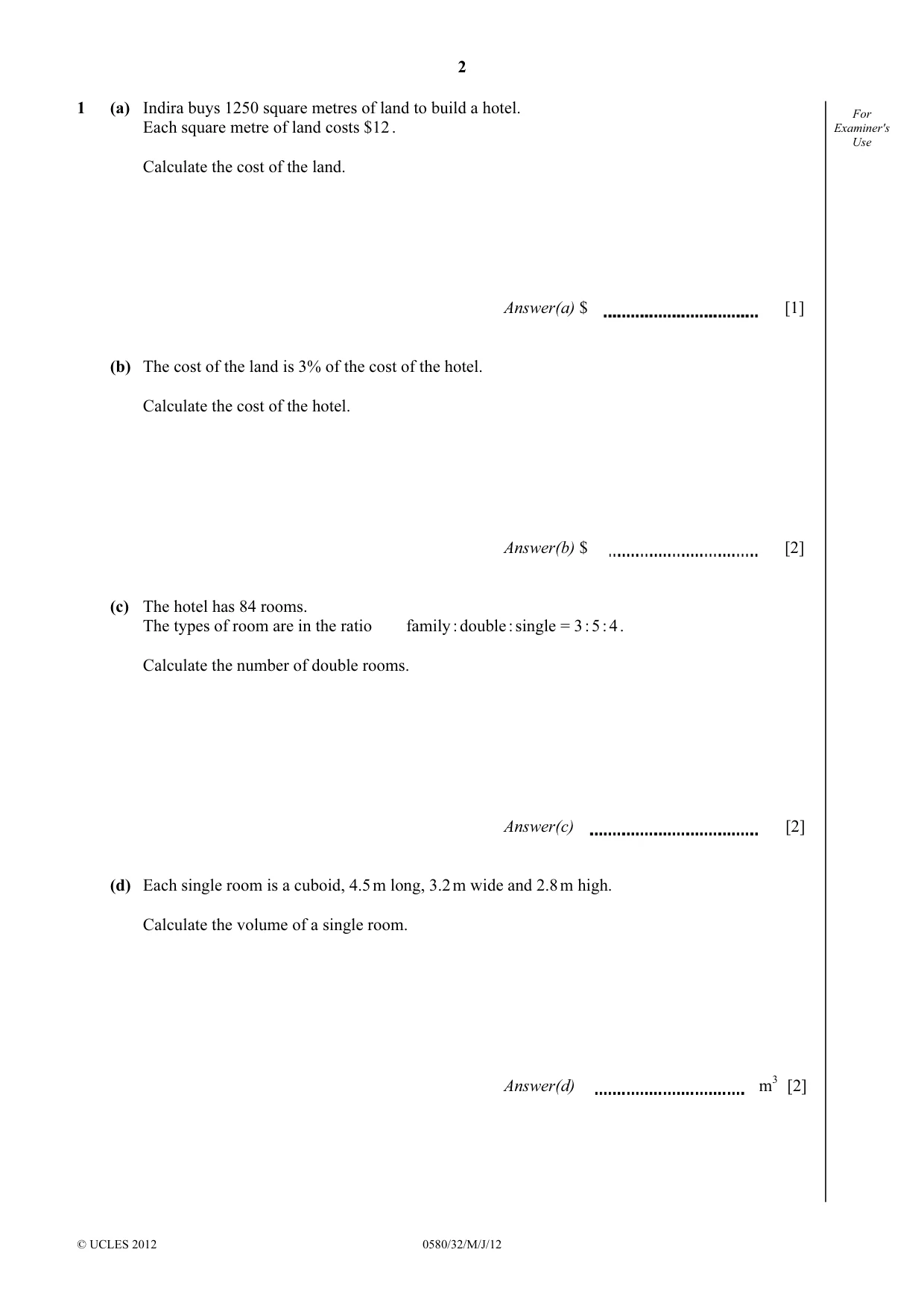
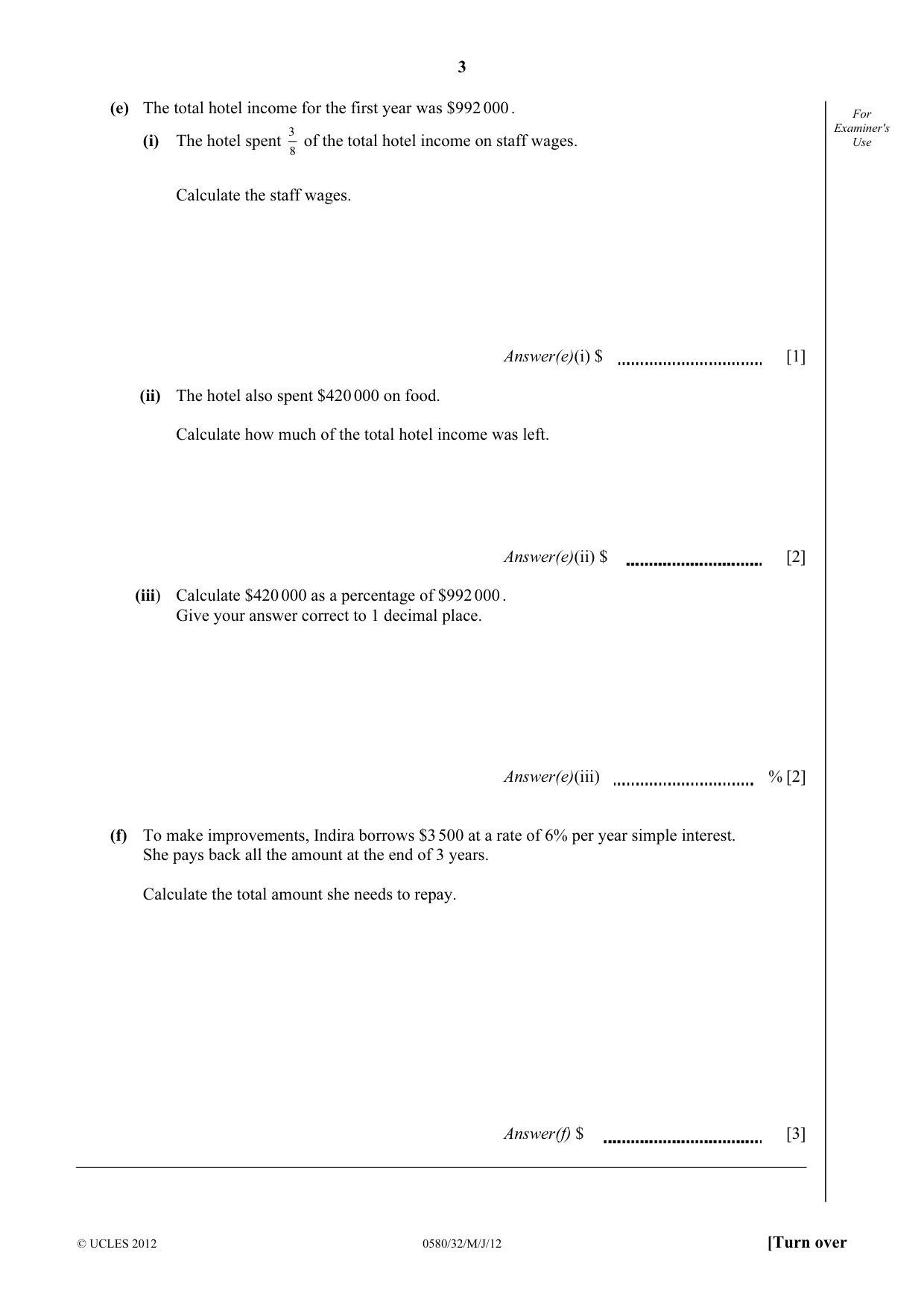
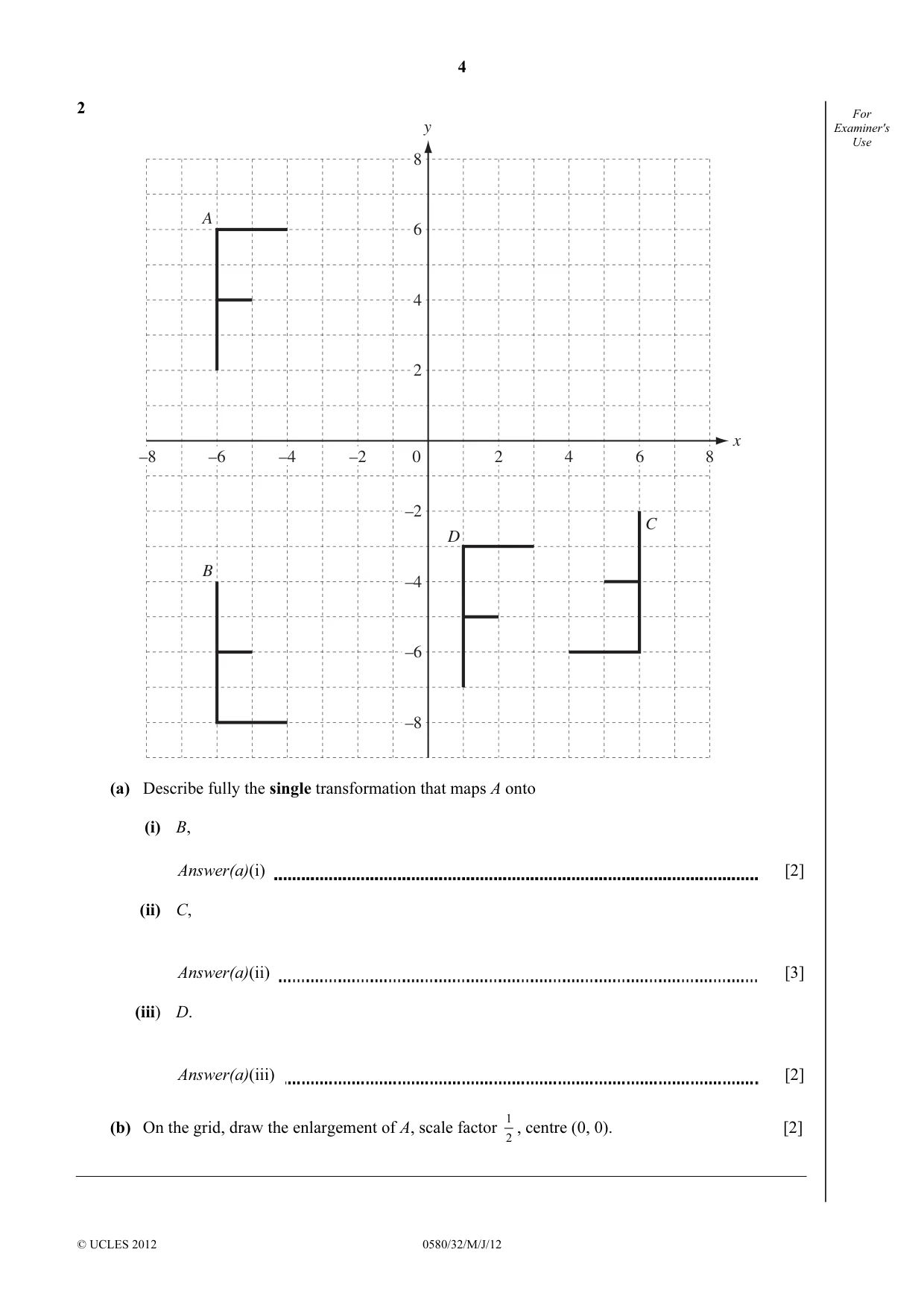
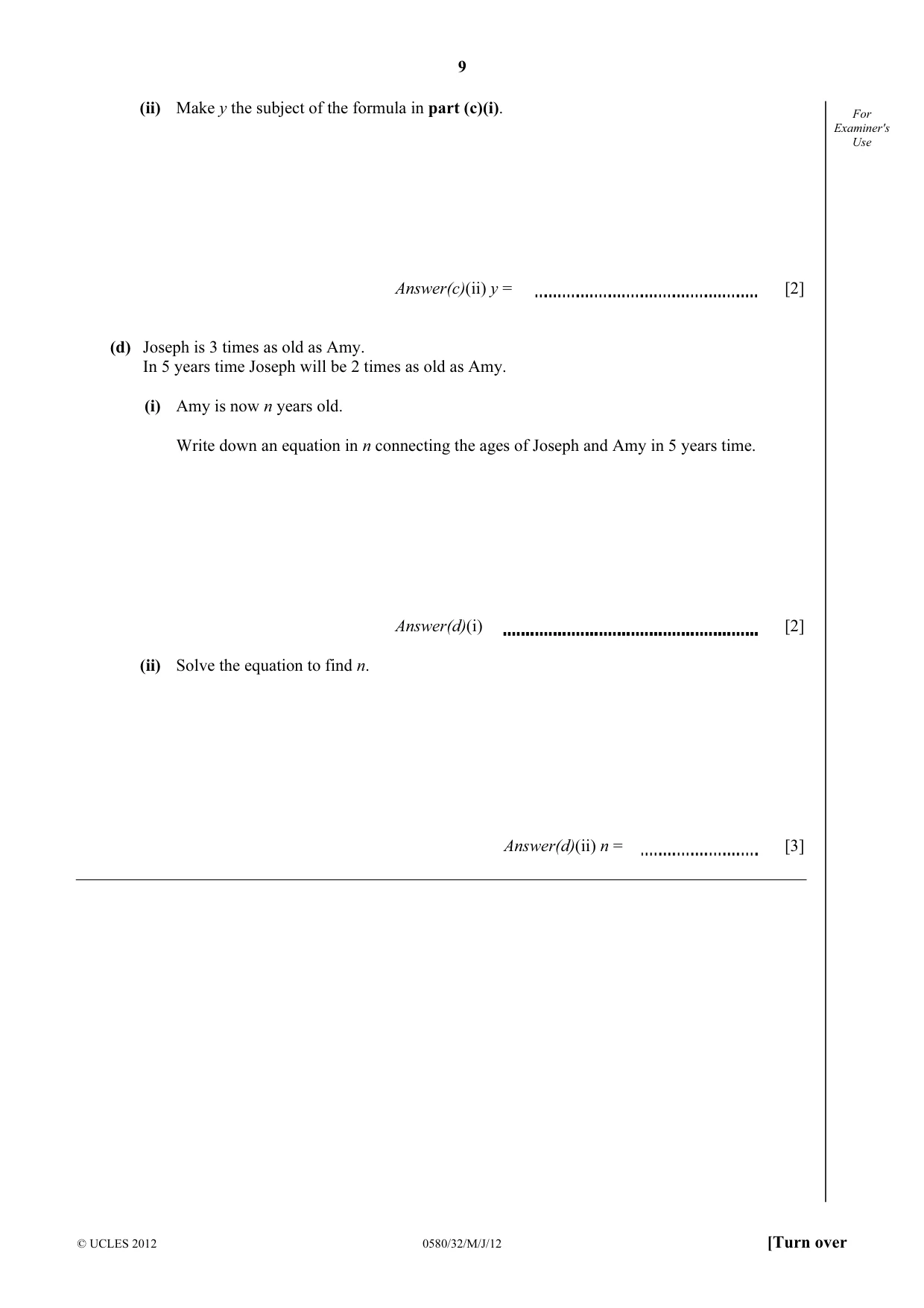
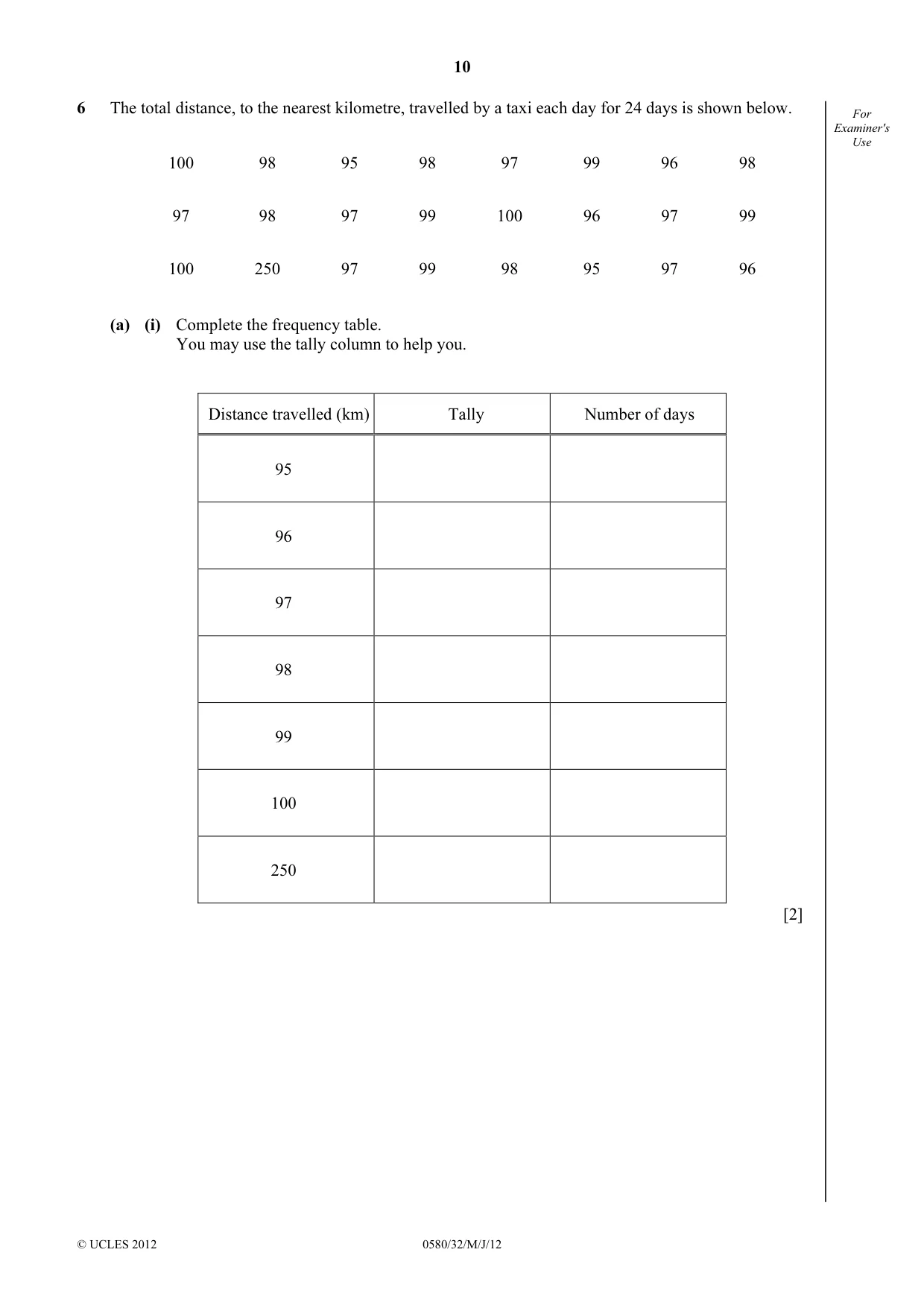
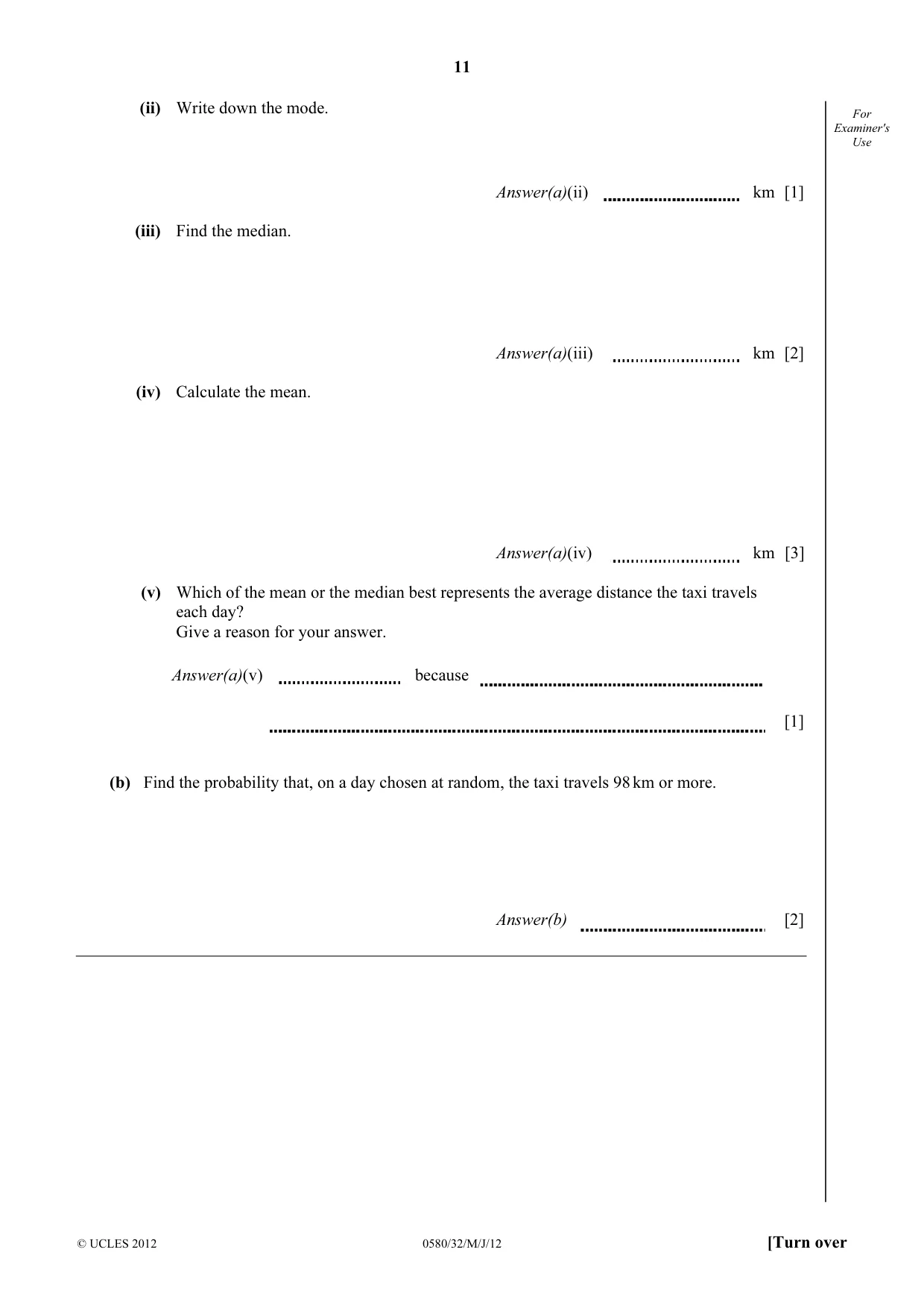
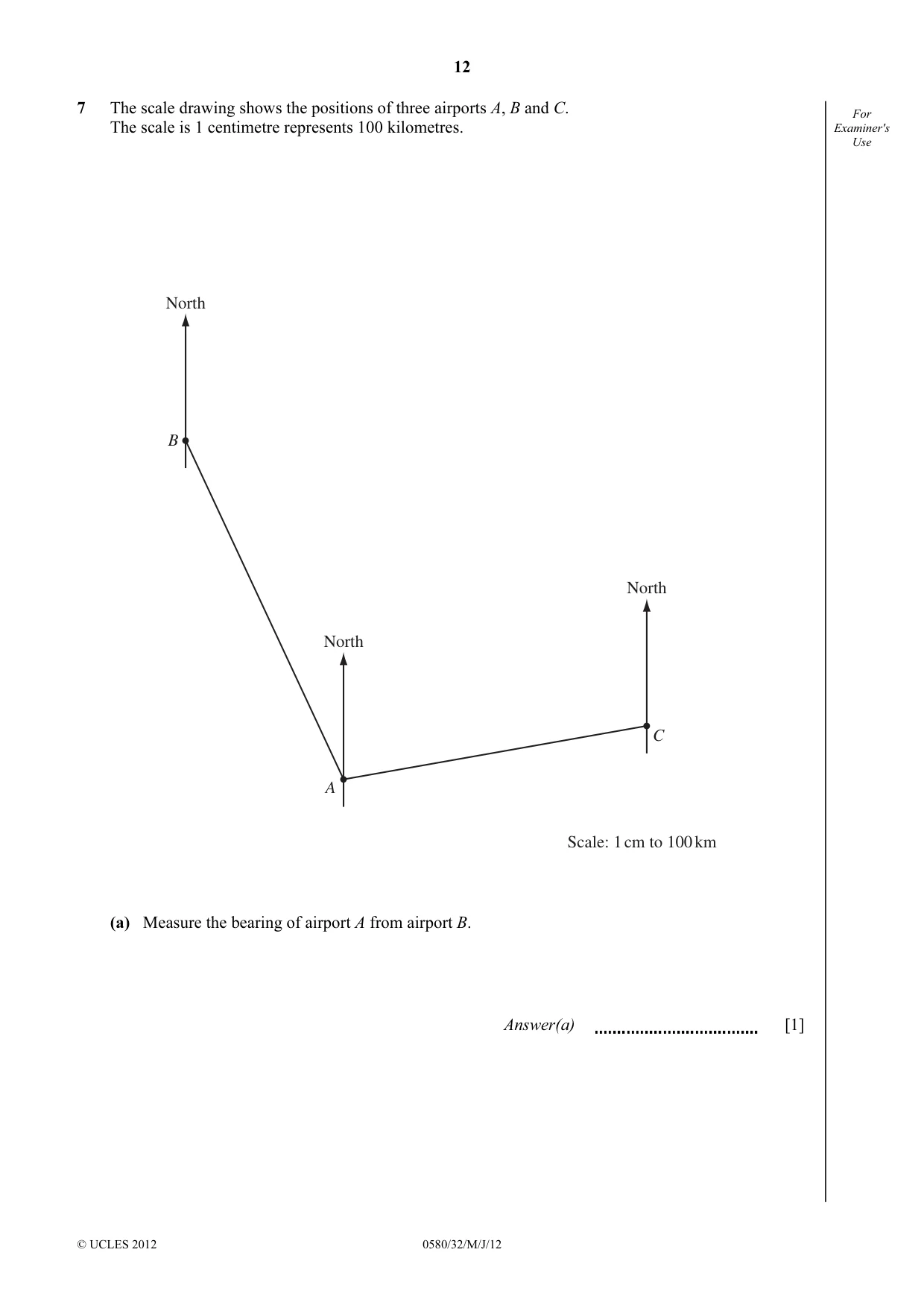
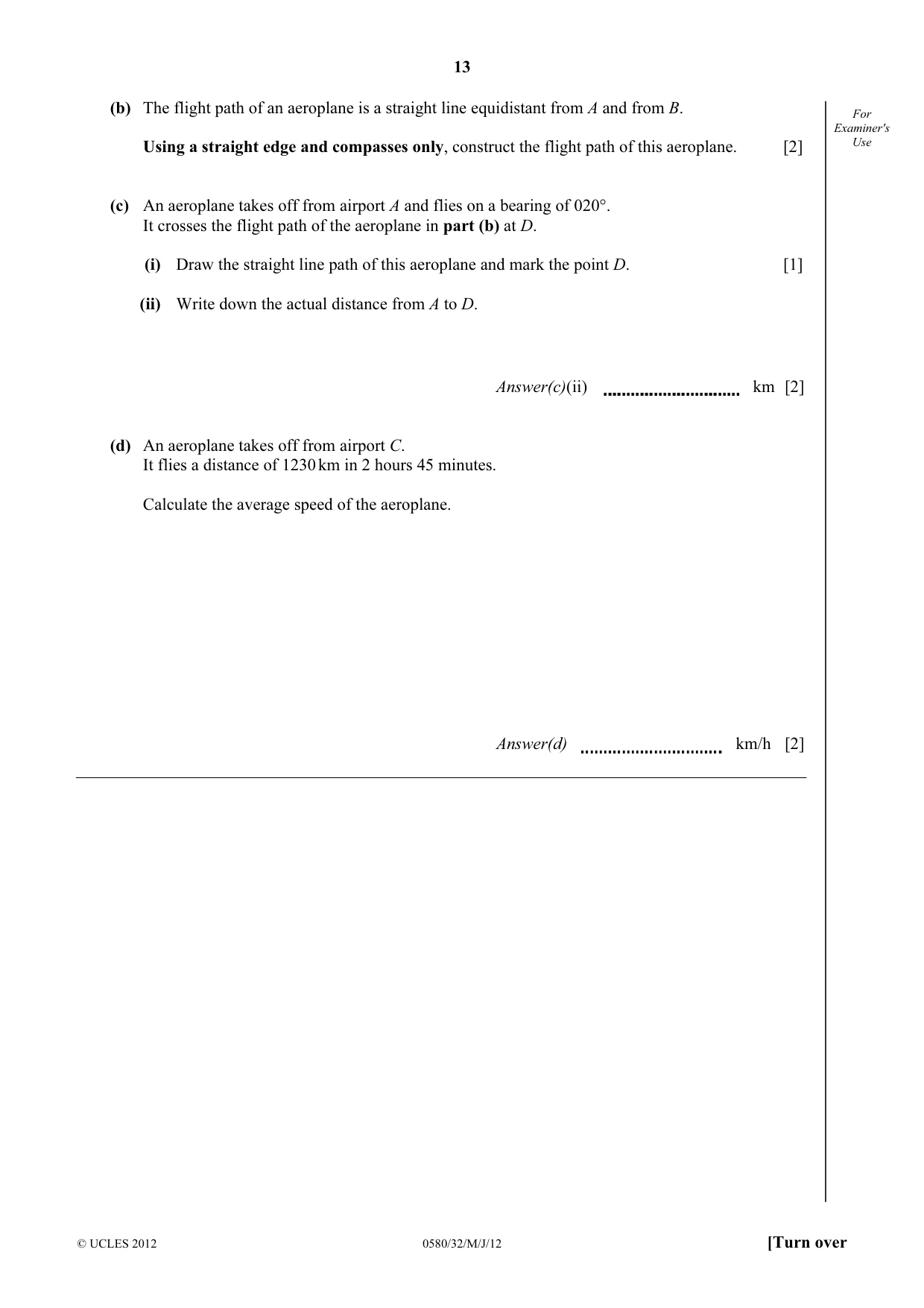
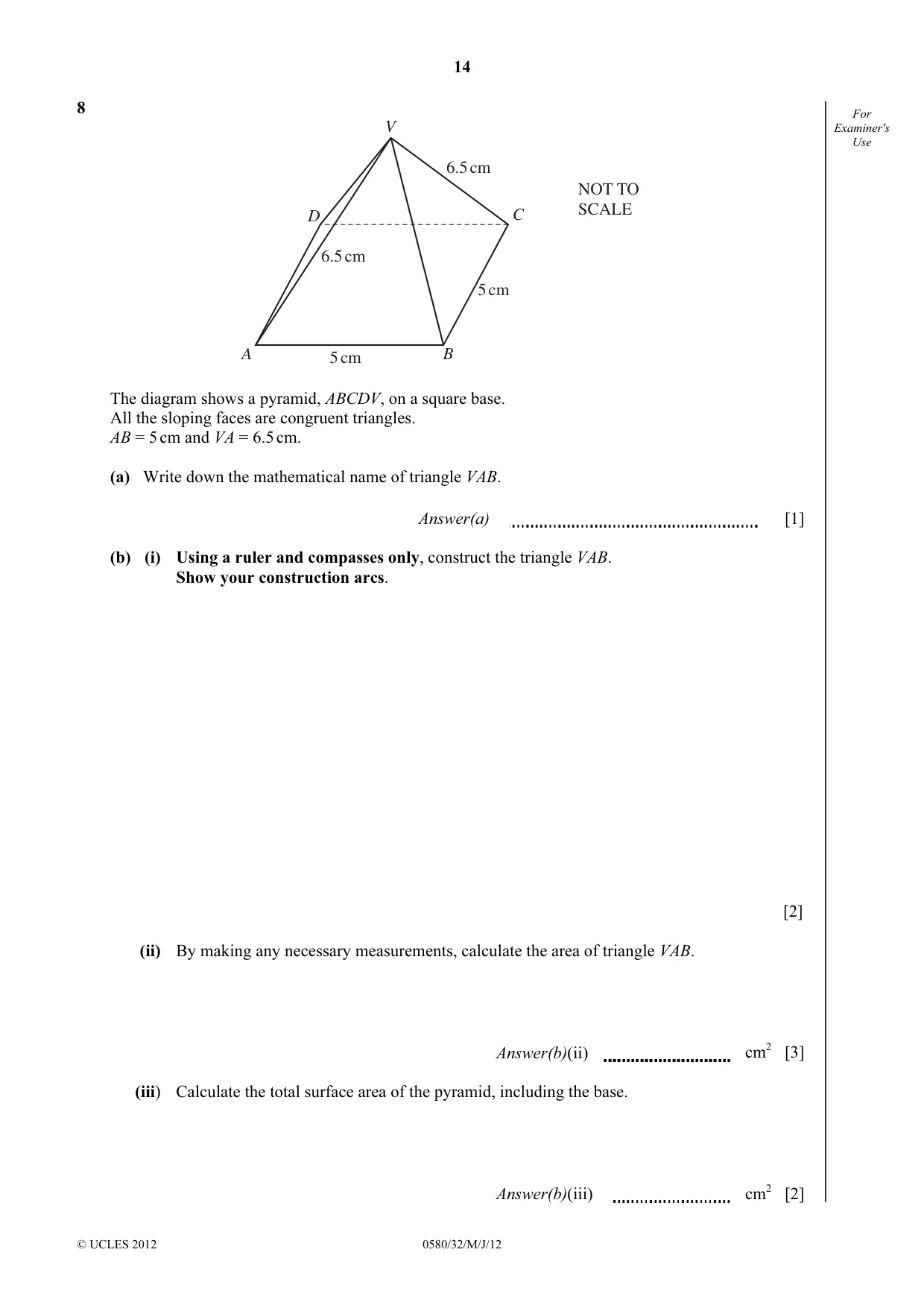
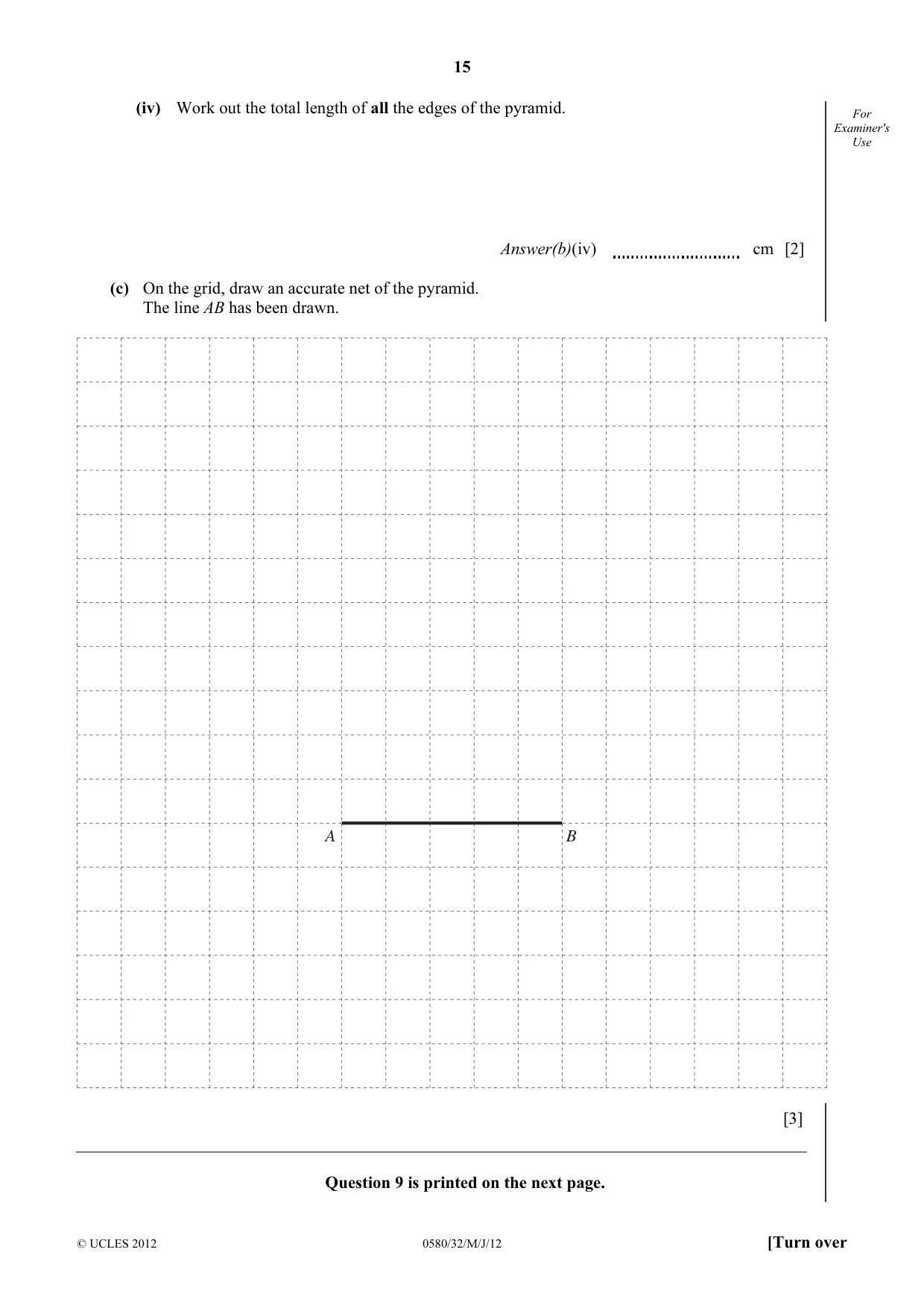
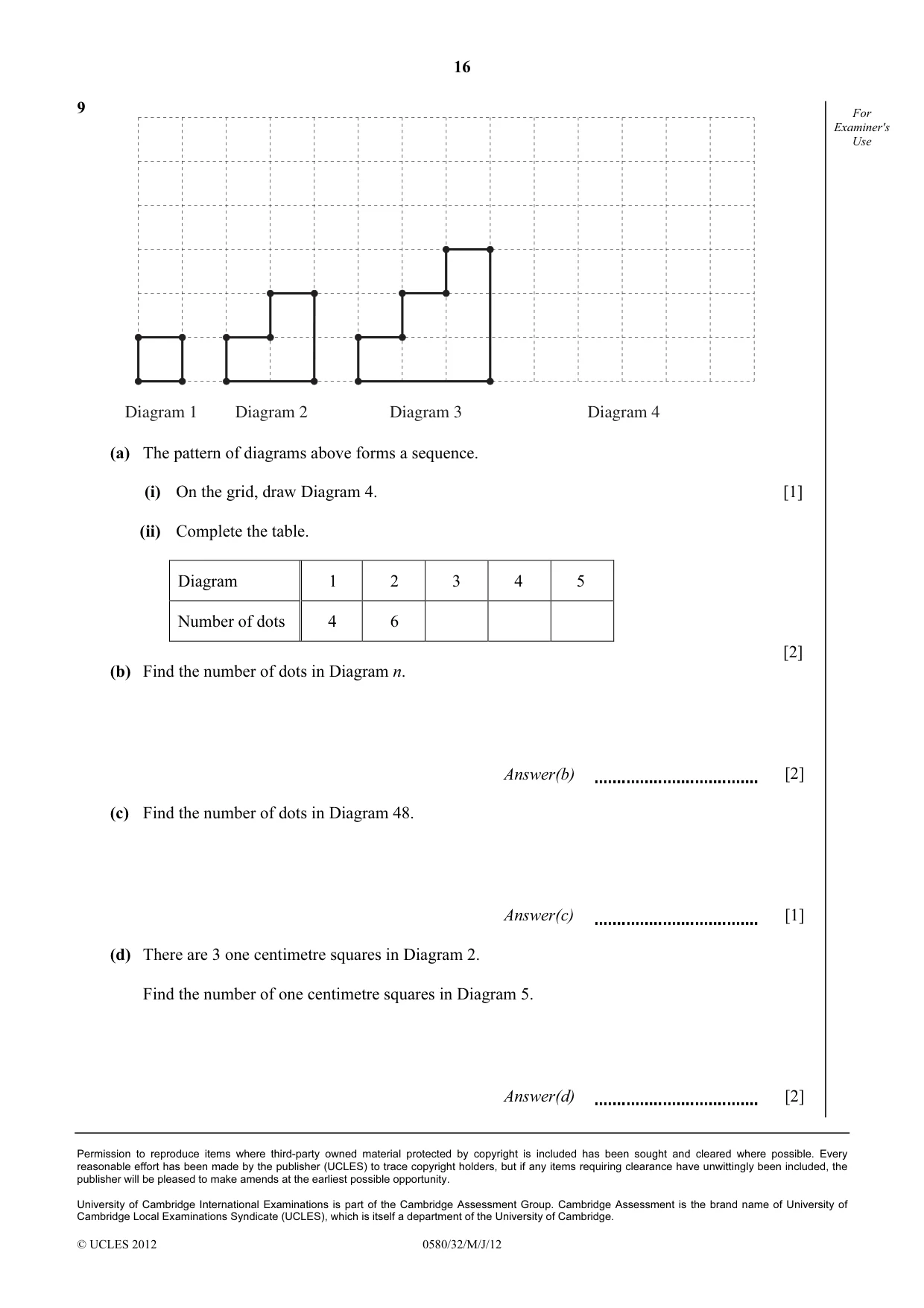
Mark scheme4 pages
Answers below. Sit the paper first if you are practising.
Questions as text
Q1 · Indira buys 1250 square metres of land to build a hotel
1 (a) Indira buys 1250 square metres of land to build a hotel. For Each square metre of land costs $12 . Examiner's Use Calculate the cost of the land. Answer(a) $ [1] (b) The cost of the land is 3% of the cost of the hotel. Calculate the cost of the hotel. Answer(b) $ [2] (c) The hotel has 84 rooms. The types of room are in the ratio family : double : single = 3 : 5 : 4 . Calculate the number of double rooms. Answer(c) [2] (d) Each single room is a cuboid, 4.5 m long, 3.2 m wide and 2.8 m high. Calculate the volume of a single room. Answer(d) m3 [2] (e) The total hotel income for the first year was $992 000 . For 3 Examiner's (i) The hotel spent of the total hotel income on staff wages. Use 8 Calculate the staff wages. Answer(e)(i) $ [1] (ii) The hotel also spent $420 000 on food. Calculate how much of the total hotel income was left. Answer(e)(ii) $ [2] (iii) Calculate $420 000 as a percentage of $992 000 . Give your answer correct to 1 decimal place. Answer(e)(iii) % [2] (f) To make improvements, Indira borrows $3 500 at a rate of 6% per year simple interest. She pays back all the amount at the end of 3 years. Calculate the total amount she needs to repay. Answer(f) $ [3]
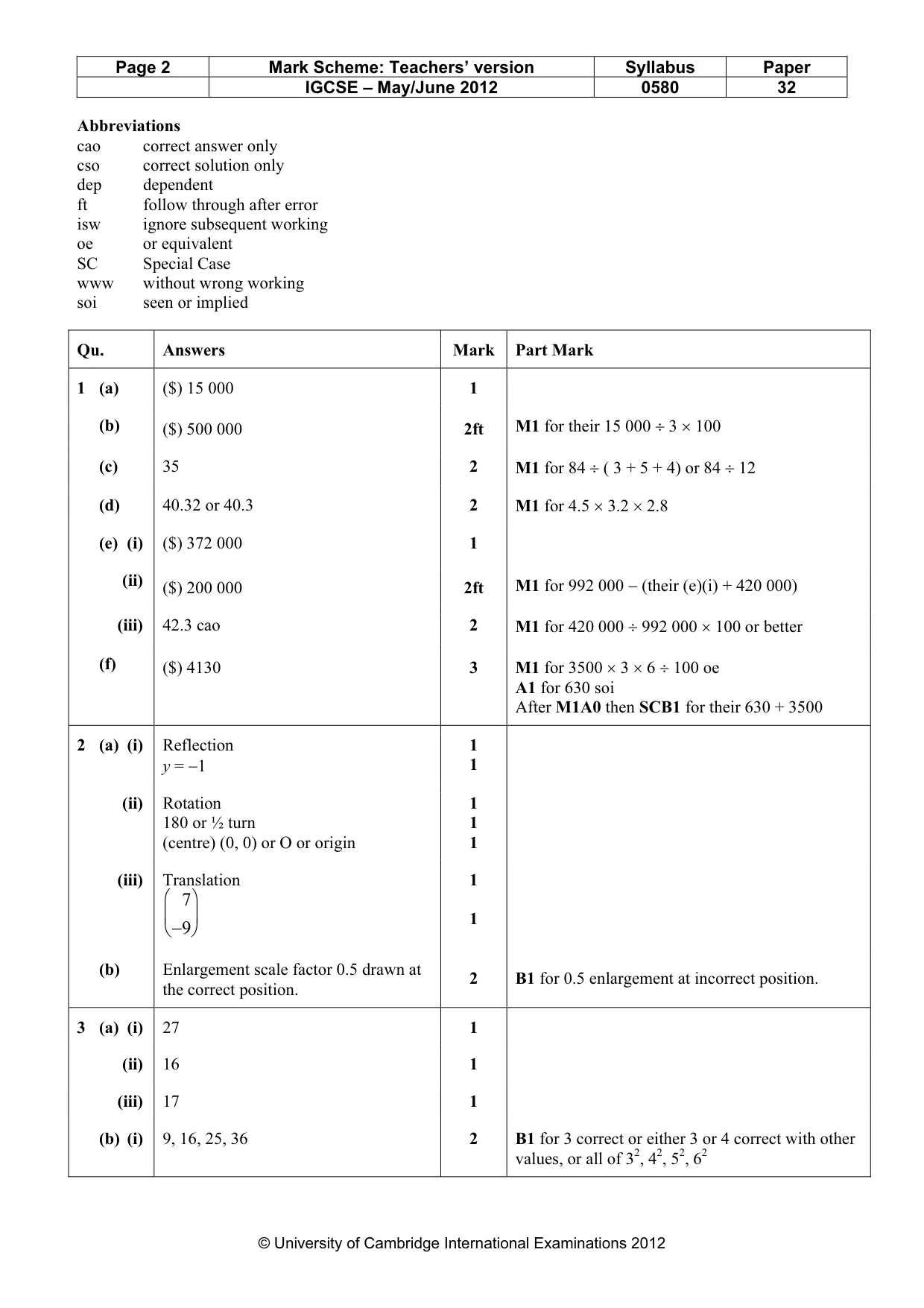
Mark scheme: Qu. Answers Mark Part Mark 1 (a) ($) 15 000 1 (b) ($) 500 000 2ft M1 for their 15 000 ÷ 3 × 100 (c) 35 2 M1 for 84 ÷ ( 3 + 5 + 4) or 84 ÷ 12 (d) 40.32 or 40.3 2 M1 for 4.5 × 3.2 × 2.8 (e) (i) ($) 372 000 1 (ii) ($) 200 000 2ft M1 for 992 000 − (their (e)(i) + 420 000) (iii) 42.3 cao 2 M1 for 420 000 ÷ 992 000 × 100 or better (f) ($) 4130 3 M1 for 3500 × 3 × 6 ÷ 100 oe A1 for 630 soi After M1A0 then SCB1 for their 630 + 3500
Q2 · For y Examiner's Use 8 A 6 4 2 x –8 –6 –4 –2 0 2 4 6 8 –2 C D B –4 –6 –8 (a) Describe…
2 For y Examiner's Use 8 A 6 4 2 x –8 –6 –4 –2 0 2 4 6 8 –2 C D B –4 –6 –8 (a) Describe fully the single transformation that maps A onto (i) B, Answer(a)(i) [2] (ii) C, Answer(a)(ii) [3] (iii) D. Answer(a)(iii) [2] 1 (b) On the grid, draw the enlargement of A, scale factor , centre (0, 0). [2] 2
Mark scheme: 2 (a) (i) Reflection 1 1 y = −1 (ii) Rotation 1 180 or ½ turn 1 (centre) (0, 0) or O or origin 1 (iii) Translation 1 7 1 −9 (b) Enlargement scale factor 0.5 drawn at 2 B1 for 0.5 enlargement at incorrect position. the correct position.
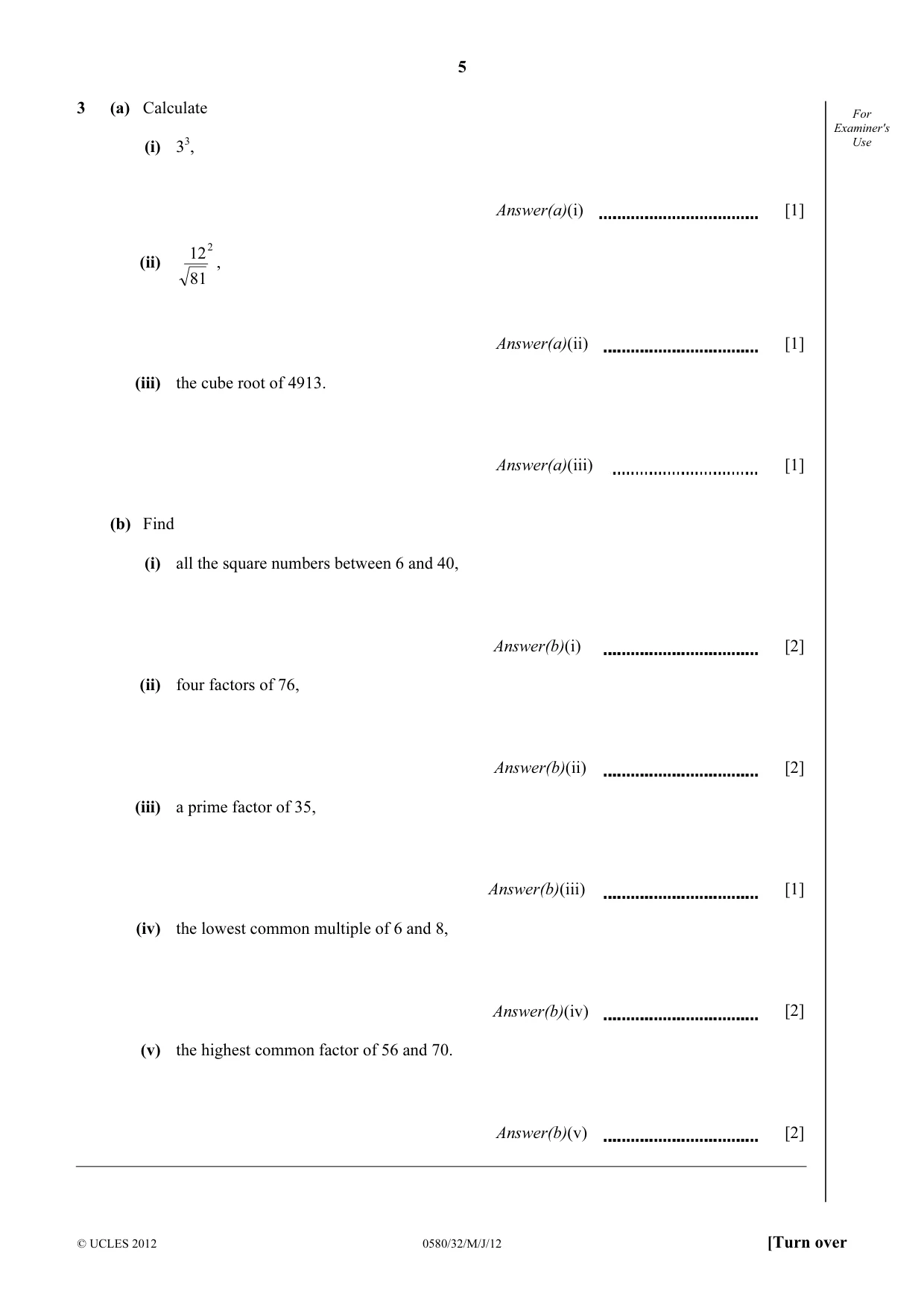
Q3 · Calculate For Examiner's (i) 33, Use Answer(a)(i) [1] 12 2 (ii) , 81 Answer(a)(ii) [1]…
3 (a) Calculate For Examiner's (i) 33, Use Answer(a)(i) [1] 12 2 (ii) , 81 Answer(a)(ii) [1] (iii) the cube root of 4913. Answer(a)(iii) [1] (b) Find (i) all the square numbers between 6 and 40, Answer(b)(i) [2] (ii) four factors of 76, Answer(b)(ii) [2] (iii) a prime factor of 35, Answer(b)(iii) [1] (iv) the lowest common multiple of 6 and 8, Answer(b)(iv) [2] (v) the highest common factor of 56 and 70. Answer(b)(v) [2]
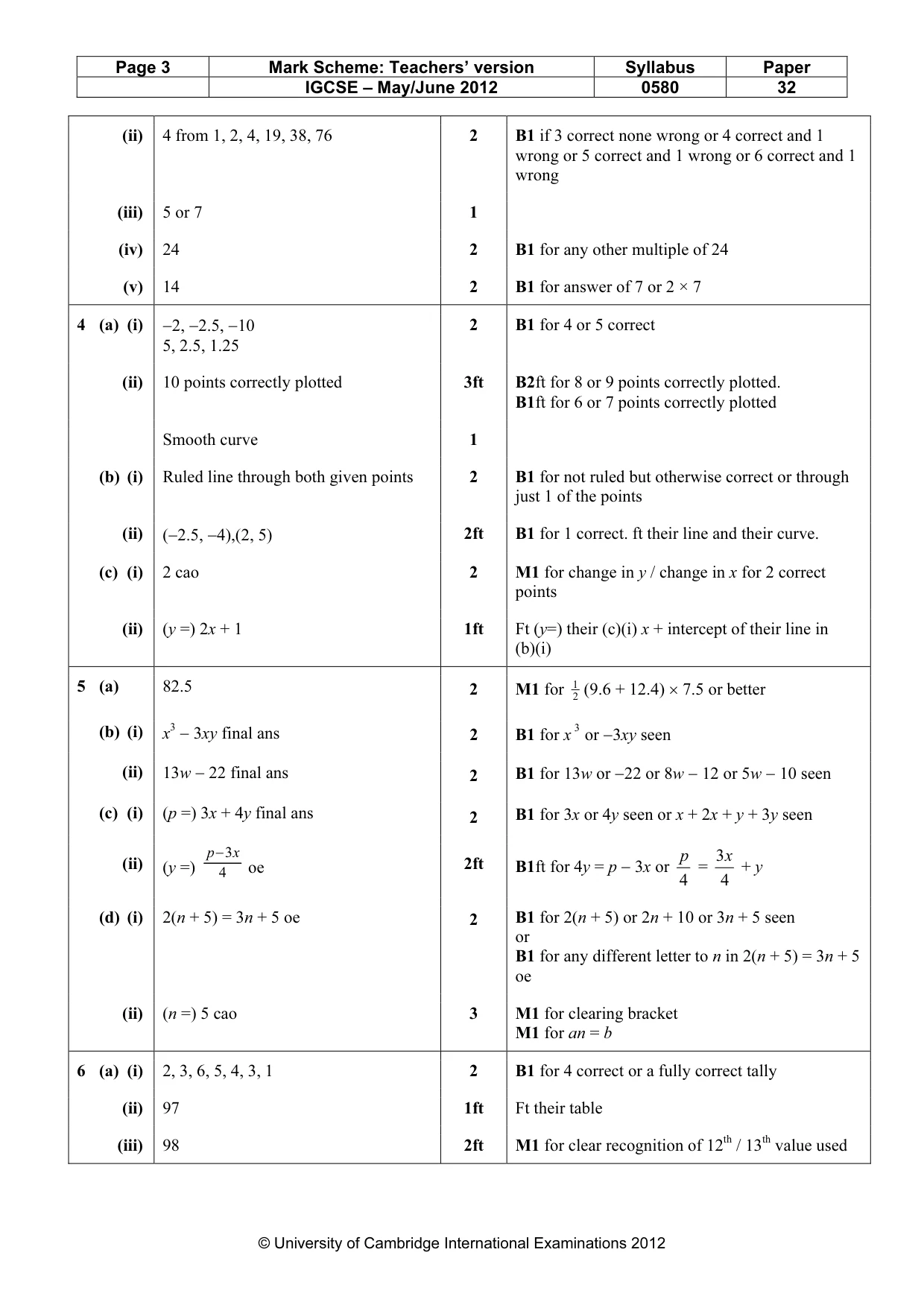
Mark scheme: 3 (a) (i) 27 1 (ii) 16 1 (iii) 17 1 (b) (i) 9, 16, 25, 36 2 B1 for 3 correct or either 3 or 4 correct with other values, or all of 32, 42, 52, 62 IGCSE – May/June 2012 0580 32 (ii) 4 from 1, 2, 4, 19, 38, 76 2 B1 if 3 correct none wrong or 4 correct and 1 wrong or 5 correct and 1 wrong or 6 correct and 1 wrong (iii) 5 or 7 1 (iv) 24 2 B1 for any other multiple of 24 (v) 14 2 B1 for answer of 7 or 2 × 7
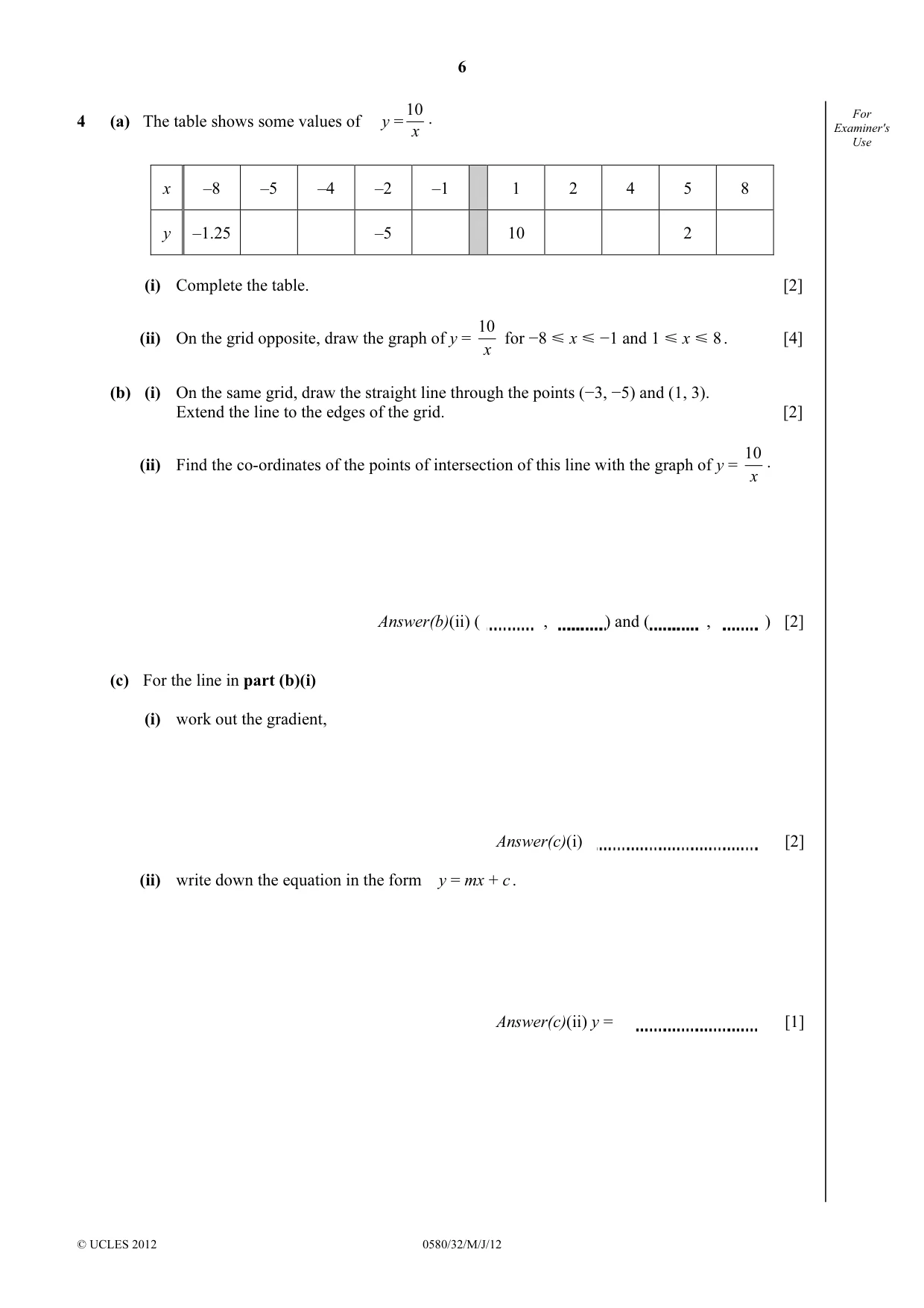
Q4 · For 4 (a) The table shows some values of y =
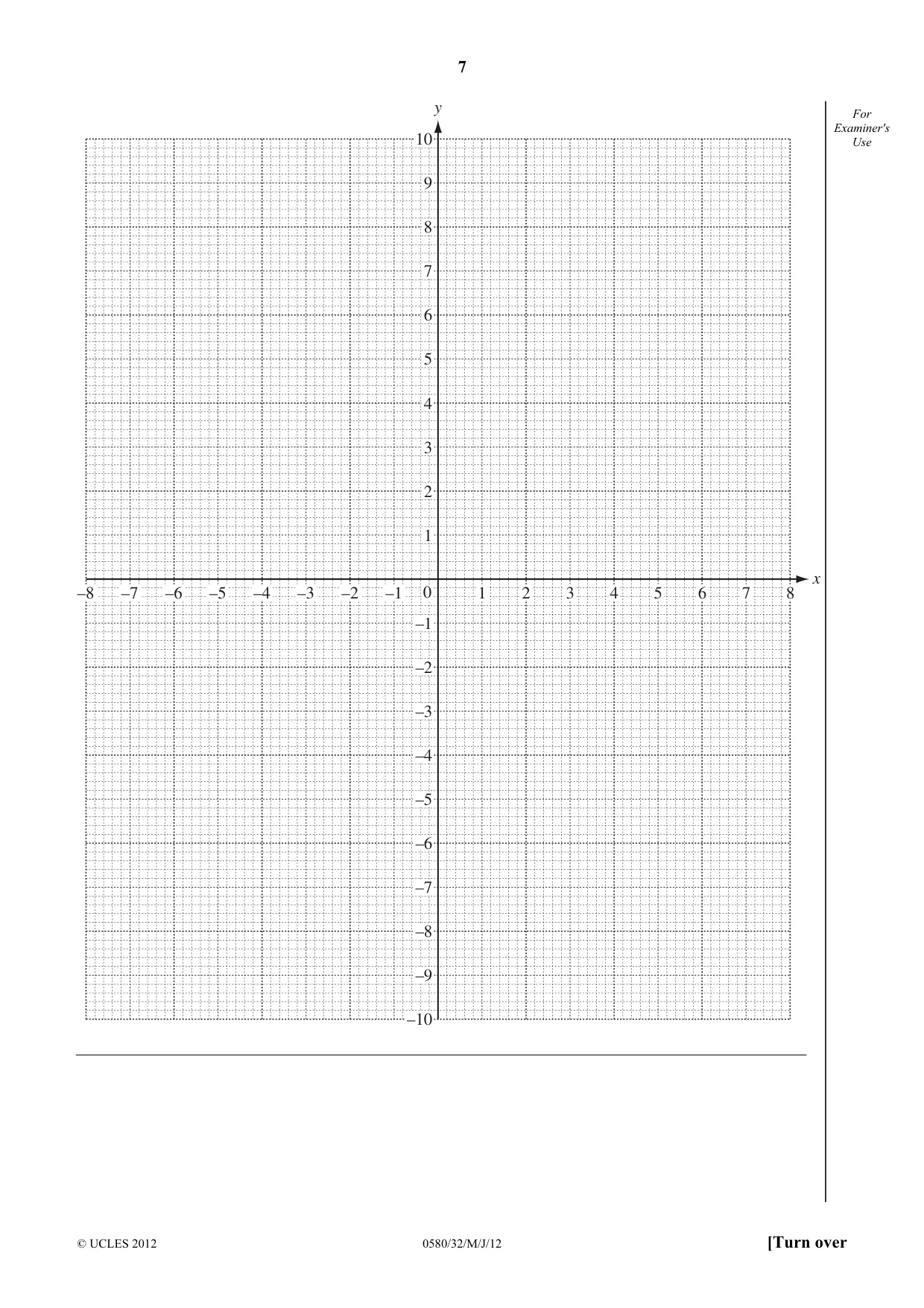
10 For 4 (a) The table shows some values of y = . Examiner's x Use x –8 –5 –4 –2 –1 1 2 4 5 8 y –1.25 –5 10 2 (i) Complete the table. [2] 10 (ii) On the grid opposite, draw the graph of y = for −8 Y x Y −1 and 1 Y x Y=8 . [4] x (b) (i) On the same grid, draw the straight line through the points (−3, −5) and (1, 3). Extend the line to the edges of the grid. [2] 10 (ii) Find the co-ordinates of the points of intersection of this line with the graph of y = . x Answer(b)(ii) ( , ) and ( , ) [2] (c) For the line in part (b)(i) (i) work out the gradient, Answer(c)(i) [2] (ii) write down the equation in the form y = mx + c . Answer(c)(ii) y = [1] y For Examiner's 10 Use 9 8 7 6 5 4 3 2 1 x –8 –7 –6 –5 –4 –3 –2 –1 0 1 2 3 4 5 6 7 8 –1 –2 –3 –4 –5 –6 –7 –8 –9 –10
Mark scheme: 4 (a) (i) −2, −2.5, −10 2 B1 for 4 or 5 correct 5, 2.5, 1.25 (ii) 10 points correctly plotted 3ft B2ft for 8 or 9 points correctly plotted. B1ft for 6 or 7 points correctly plotted Smooth curve 1 (b) (i) Ruled line through both given points 2 B1 for not ruled but otherwise correct or through just 1 of the points (ii) (−2.5, −4),(2, 5) 2ft B1 for 1 correct. ft their line and their curve. (c) (i) 2 cao 2 M1 for change in y / change in x for 2 correct points (ii) (y =) 2x + 1 1ft Ft (y=) their (c)(i) x + intercept of their line in (b)(i)
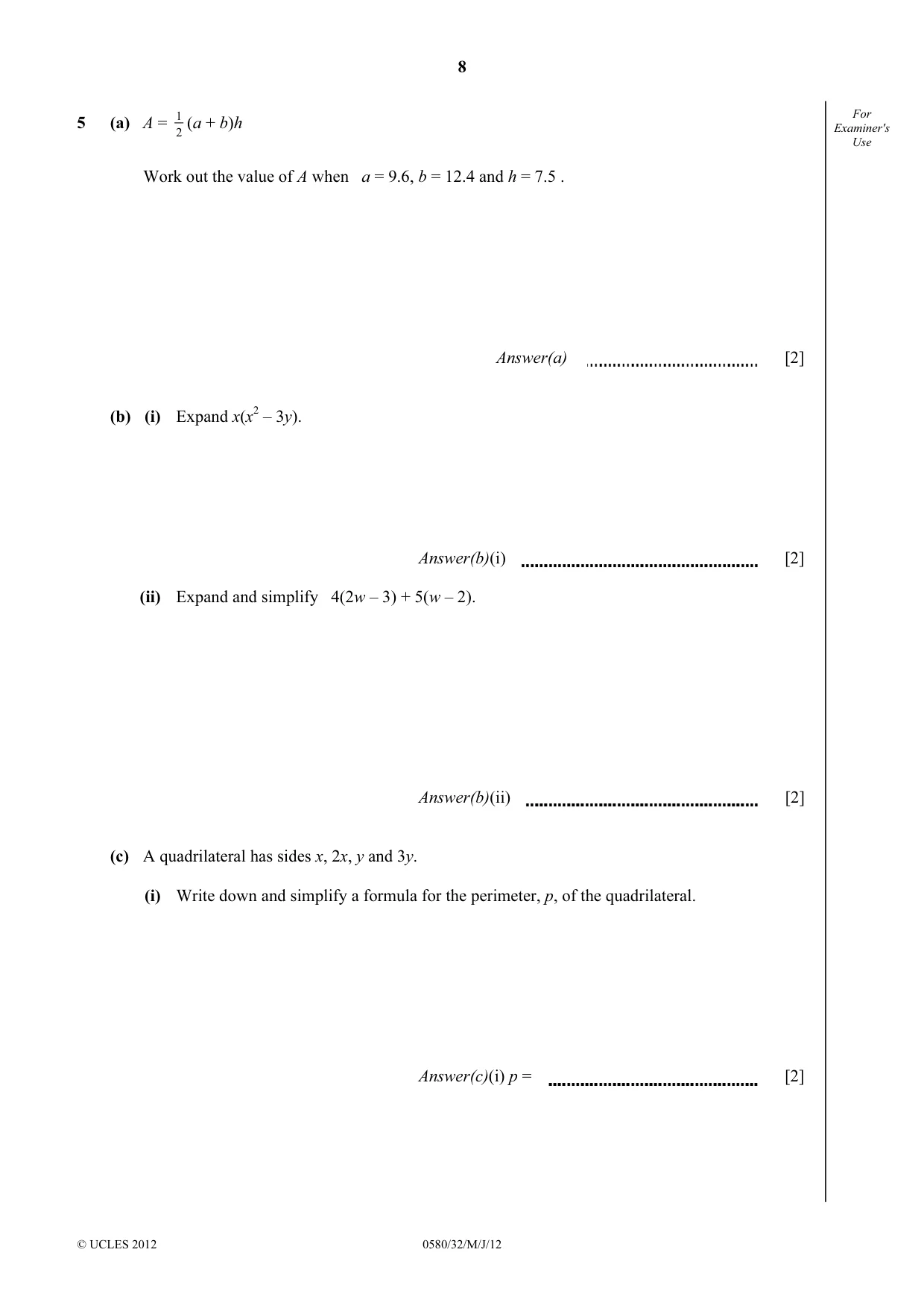
Q5 · A = 1 (a + b)h Examiner'sFor 2 Use Work out the value of A when a = 9.6, b = 12.4 and h =…
5 (a) A = 1 (a + b)h Examiner'sFor 2 Use Work out the value of A when a = 9.6, b = 12.4 and h = 7.5 . Answer(a) [2] (b) (i) Expand x(x2 – 3y). Answer(b)(i) [2] (ii) Expand and simplify 4(2w – 3) + 5(w – 2). Answer(b)(ii) [2] (c) A quadrilateral has sides x, 2x, y and 3y. (i) Write down and simplify a formula for the perimeter, p, of the quadrilateral. Answer(c)(i) p = [2] (ii) Make y the subject of the formula in part (c)(i). For Examiner's Use Answer(c)(ii) y = [2] (d) Joseph is 3 times as old as Amy. In 5 years time Joseph will be 2 times as old as Amy. (i) Amy is now n years old. Write down an equation in n connecting the ages of Joseph and Amy in 5 years time. Answer(d)(i) [2] (ii) Solve the equation to find n. Answer(d)(ii) n = [3]
Mark scheme: 15 (a) 82.5 2 M1 for 2 (9.6 + 12.4) × 7.5 or better (b) (i) x3 − 3xy final ans 2 B1 for x 3 or −3xy seen (ii) 13w − 22 final ans 2 B1 for 13w or −22 or 8w − 12 or 5w − 10 seen (c) (i) (p =) 3x + 4y final ans 2 B1 for 3x or 4y seen or x + 2x + y + 3y seen p−3x 2ft p 3 x (ii) (y =) 4 oe B1ft for 4y = p − 3x or = + y 4 4 (d) (i) 2(n + 5) = 3n + 5 oe 2 B1 for 2(n + 5) or 2n + 10 or 3n + 5 seen or B1 for any different letter to n in 2(n + 5) = 3n + 5 oe (ii) (n =) 5 cao 3 M1 for clearing bracket M1 for an = b
Q6 · The total distance, to the nearest kilometre, travelled by a taxi each day for 24 days is…
6 The total distance, to the nearest kilometre, travelled by a taxi each day for 24 days is shown below. For Examiner's Use 100 98 95 98 97 99 96 98 97 98 97 99 100 96 97 99 100 250 97 99 98 95 97 96 (a) (i) Complete the frequency table. You may use the tally column to help you. Distance travelled (km) Tally Number of days 95 96 97 98 99 100 250 [2] (ii) Write down the mode. For Examiner's Use Answer(a)(ii) km [1] (iii) Find the median. Answer(a)(iii) km [2] (iv) Calculate the mean. Answer(a)(iv) km [3] (v) Which of the mean or the median best represents the average distance the taxi travels each day? Give a reason for your answer. Answer(a)(v) because [1] (b) Find the probability that, on a day chosen at random, the taxi travels 98 km or more. Answer(b) [2]
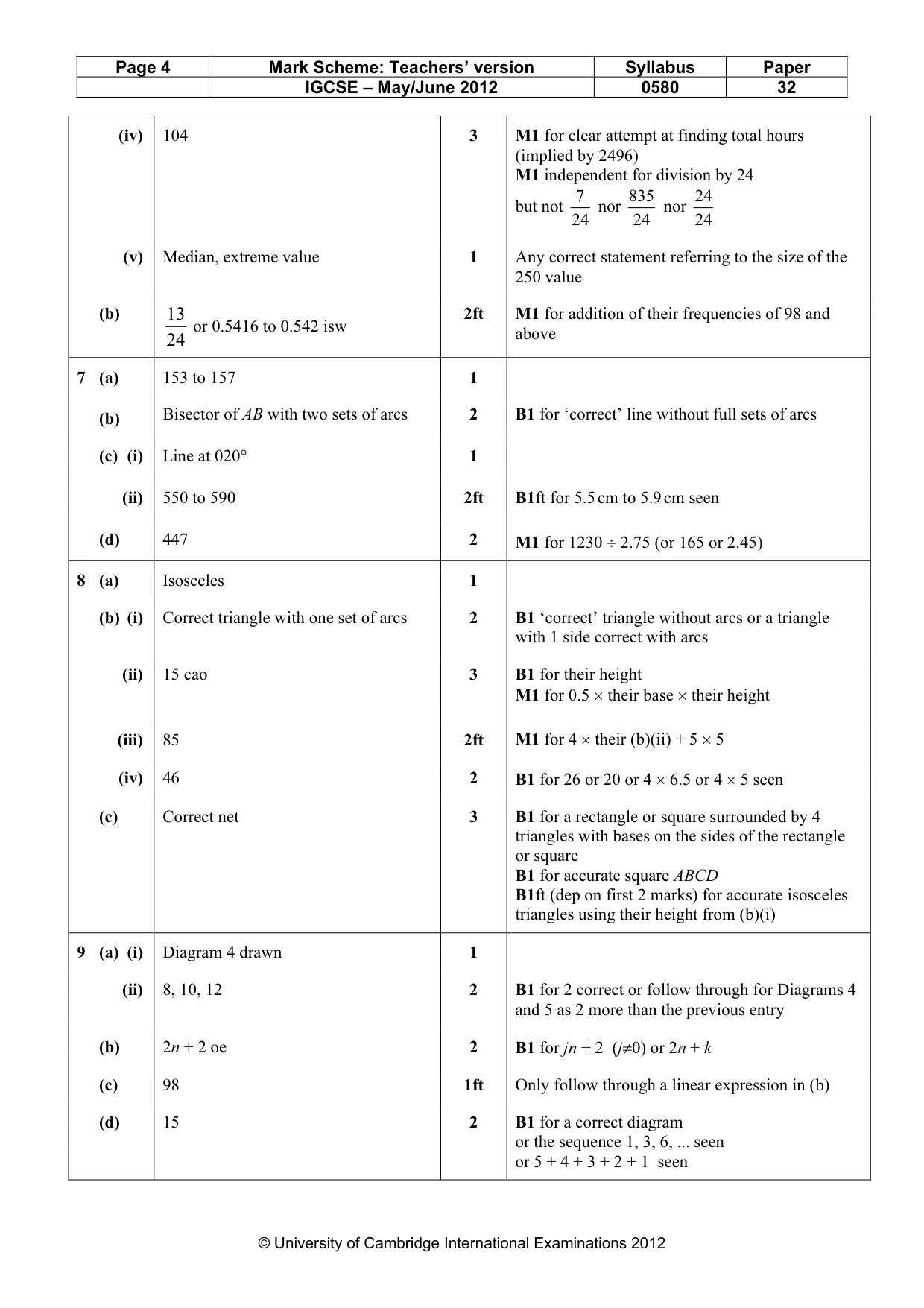
Mark scheme: 6 (a) (i) 2, 3, 6, 5, 4, 3, 1 2 B1 for 4 correct or a fully correct tally (ii) 97 1ft Ft their table (iii) 98 2ft M1 for clear recognition of 12th / 13th value used IGCSE – May/June 2012 0580 32 (iv) 104 3 M1 for clear attempt at finding total hours (implied by 2496) M1 independent for division by 24 7 835 24 but not nor nor 24 24 24 (v) Median, extreme value 1 Any correct statement referring to the size of the 250 value
What was in this paper
The subtopics covered by these 6 questions, and how many questions each got. Open one in a new tab to see every Cambridge question on it.
What you needed in this session
Cambridge’s own grade thresholds for 2012 May/June, Paper 3 · Variant 2. A higher threshold means an easier paper — the bar moves with how the cohort did.