Cambridge IGCSE Mathematics 0580 — 2011 Oct/Nov Paper 4 · Variant 1
0580/41/O/N/11 · 9 questions · 130 marks · ≈146 min
The question paper and its mark scheme, free to read here and free to download. This is Cambridge’s own paper, exactly as it was sat.
Question paper16 pages
Mark scheme7 pages
Answers below. Sit the paper first if you are practising.
Questions as text
Q1 · Abdullah and Jasmine bought a car for $9000
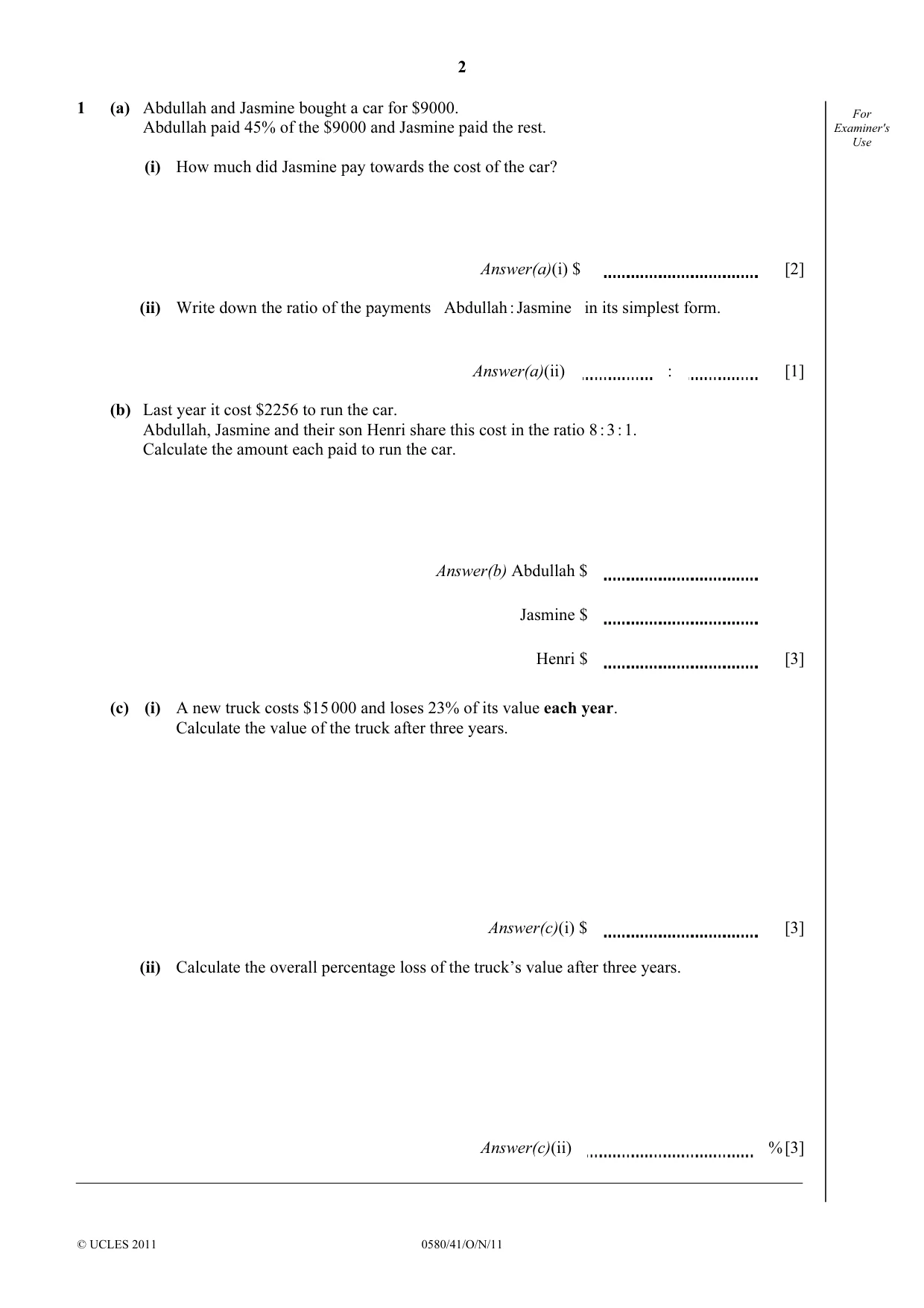
1 (a) Abdullah and Jasmine bought a car for $9000. For Abdullah paid 45% of the $9000 and Jasmine paid the rest. Examiner's Use (i) How much did Jasmine pay towards the cost of the car? Answer(a)(i) $ [2] (ii) Write down the ratio of the payments Abdullah : Jasmine in its simplest form. Answer(a)(ii) : [1] (b) Last year it cost $2256 to run the car. Abdullah, Jasmine and their son Henri share this cost in the ratio 8 : 3 : 1. Calculate the amount each paid to run the car. Answer(b) Abdullah $ Jasmine $ Henri $ [3] (c) (i) A new truck costs $15 000 and loses 23% of its value each year. Calculate the value of the truck after three years. Answer(c)(i) $ [3] (ii) Calculate the overall percentage loss of the truck’s value after three years. Answer(c)(ii) %[3]
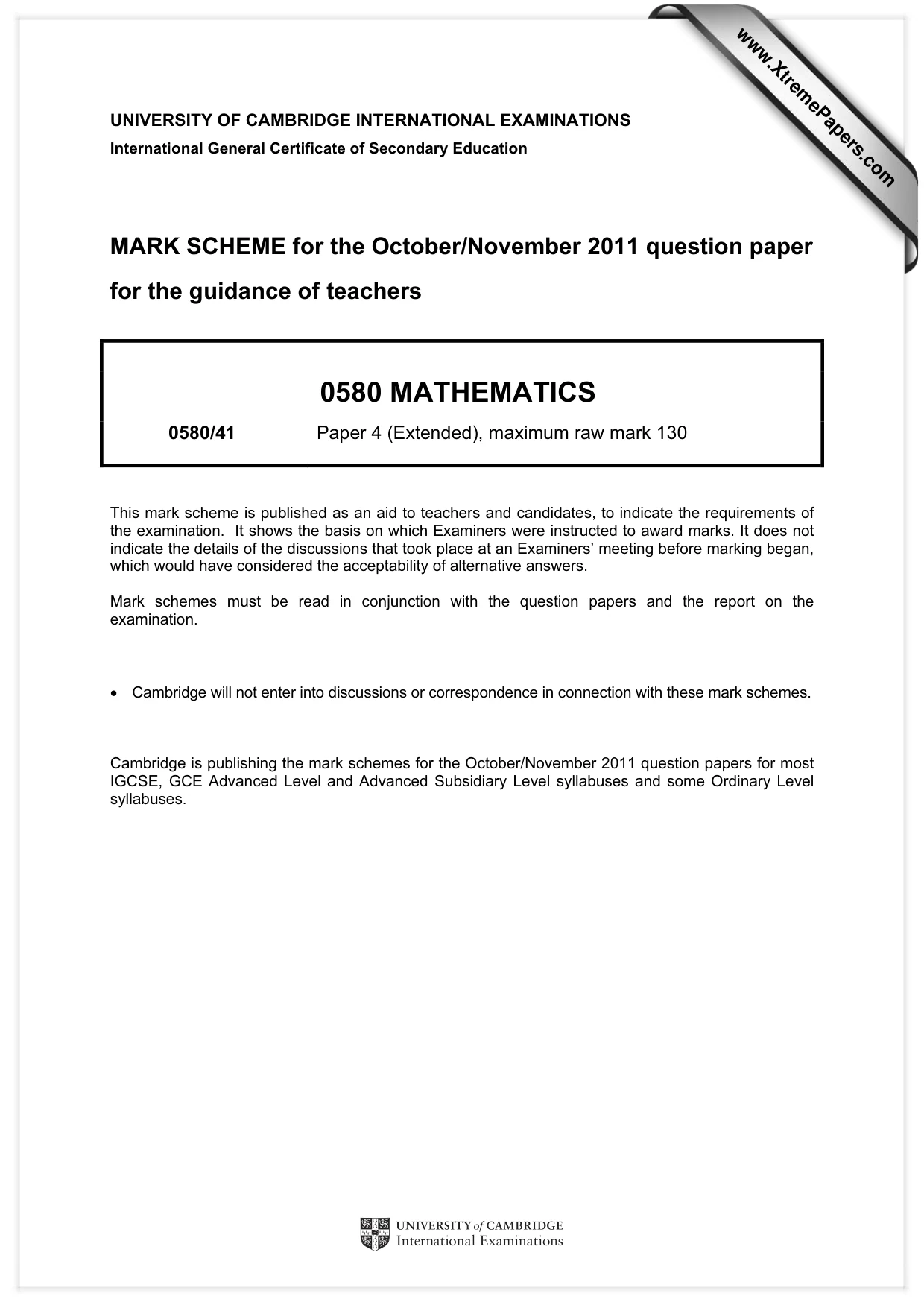
Mark scheme: Qu. Answers Mark Part Marks 1 (a) (i) 4950 2 M1 for 9000 × 0.55 oe (ii) 9 : 11 1 Accept 1 : 1.22 or 0.818 : 1 After 4050 in (a)(i) allow SC1 for 11 : 9 etc (b) 1504 1 564 1 188 1 After 0 scored M1 for 2256 ÷ (8 + 3 + 1) soi (c) (i) 6847.99 or 6848 or 6850 3 M2 for 15000 × 0.77³ oe (6847. (..)ww imp M2) or M1 for 15000 × 0.77² oe soi (8893.5) After 0 scored SC1 for art 27913 or 27910 or 27900 (ii) 54.3 (54.33 to 54.35) 3ft ft their (15000 – their (c)(i))/15000 × 100 to 3sf or better but not for negative answer or from 4650 in (c)(i) leading to 69% M2 for 1 – 0.77³ (0.543..) or their (15000 – their (c)(i))/15000 (× 100) or SC2ft their (c)(i)/15000 × 100 correctly evaluated (45.65 to 45.67 or 45.7) or M1 for 0.77³ (0.4565..) or their (c)(i)/15000 IGCSE – October/November 2011 0580 41
Q2 · Find the integer values for x which satisfy the inequality –3 I 2x –1 Y 6
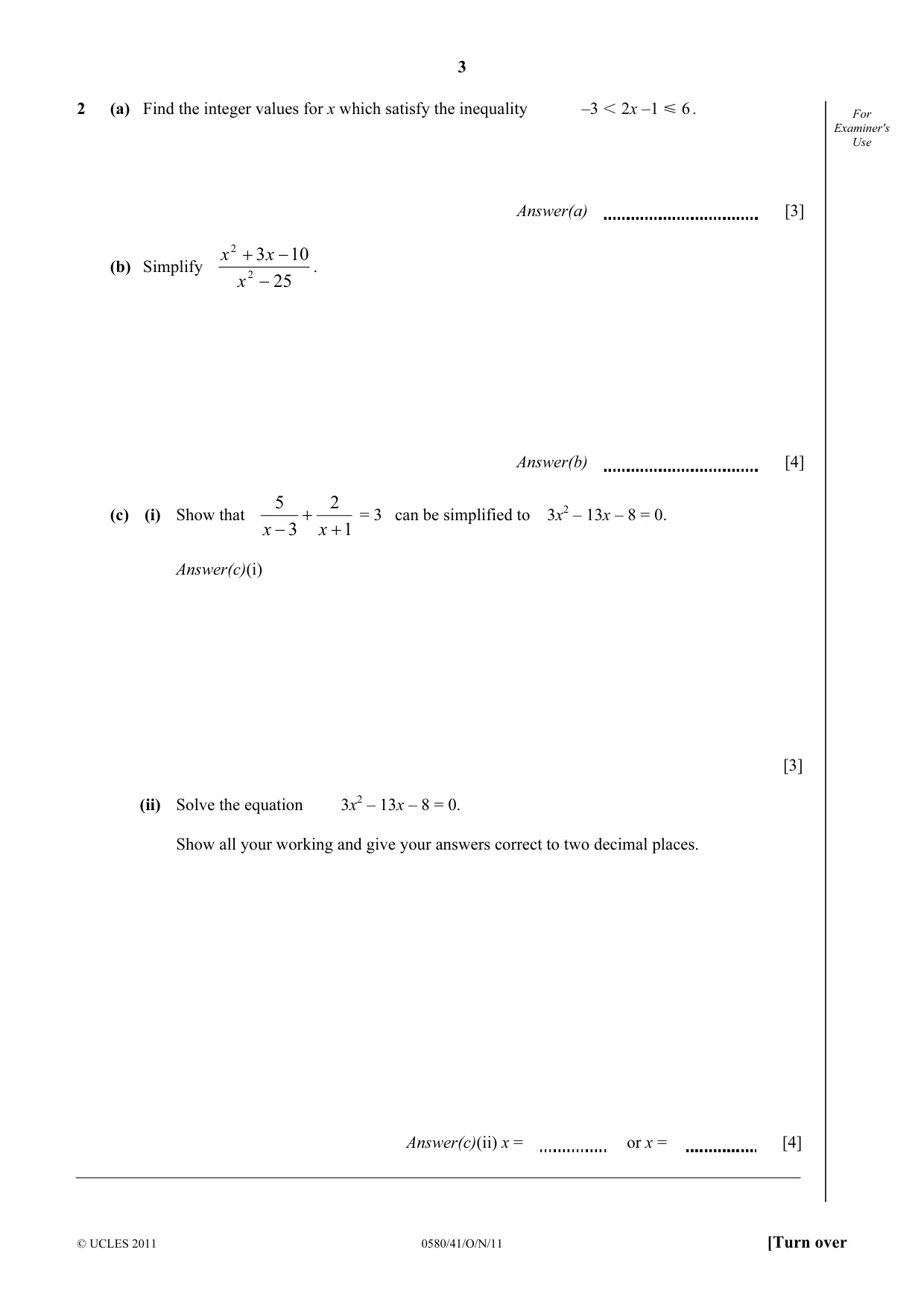
2 (a) Find the integer values for x which satisfy the inequality –3 I 2x –1 Y 6 . For Examiner's Use Answer(a) [3] x 2 + 3 x − 10 (b) Simplify 2 . x − 25 Answer(b) [4] 5 2 (c) (i) Show that + = 3 can be simplified to 3x2 – 13x – 8 = 0. x − 3 x + 1 Answer(c)(i) [3] (ii) Solve the equation 3x2 – 13x – 8 = 0. Show all your working and give your answers correct to two decimal places. Answer(c)(ii) x = or x = [4]
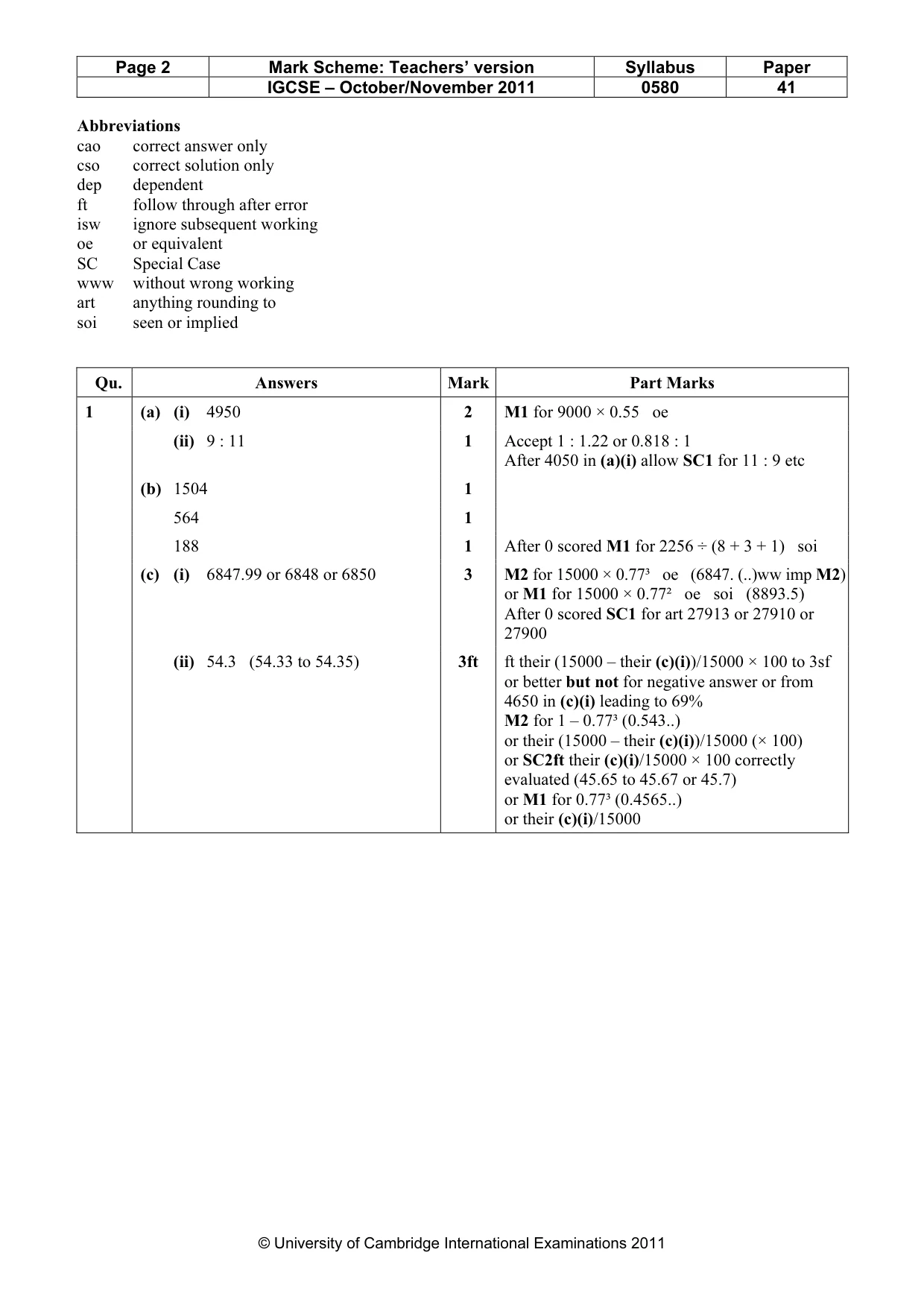
Mark scheme: 2 (a) 0, 1, 2, 3 3 Additional values count as errors B2 for one error/omission or B1 for two errors/ omissions After B0, M2 for –1 < x ≤ 3.5 seen, allow 7/2 for 3.5 or M1 for –1 < x or x ≤ 3.5 or x = –1 and x = 3.5 Allow M2 for 0 ≤ x < 4 or M1 for x ≥ 0 or x < 4 x − 2 ( x + 5)( x − 2) (b) www final answer 4 M3 for x − 5 ( x + 5)( x − 5) or M2 for (x + 5)(x – 2) seen or M1 for (x + a)(x + b) where ab = –10 or a + b = 3 and M1 for (x + 5)(x – 5) seen (c) (i) 5(x + 1) + 2(x – 3) = 3(x + 1)(x – 3) M1 Allow if still over common denominator oe x² – 3x + x – 3 or better seen B1 Allow x² – 2x – 3 seen or 3x² – 9x + 3x – 9 or better seen 3x² – 13x – 8 = 0 E1 With no errors seen and brackets correctly expanded on both sides − ( −13) ± ( −13) 2 − 4(3)( −8) (ii) B1 In square root B1 for (–13)2 – 4(3)(–8) or better 2(3) B1 (265) p + q p − q If in form or , r r B1 for – (–13) and 2(3) or better 4.88 and –0.55 cao B1B1 SC1 for 4.88 and – 0.55 seen or – 0.5 and 4.9 or – 0.546… and 4.879 to 4.880 IGCSE – October/November 2011 0580 41
Q3 · The table shows information about the heights of 120 girls in a swimming club
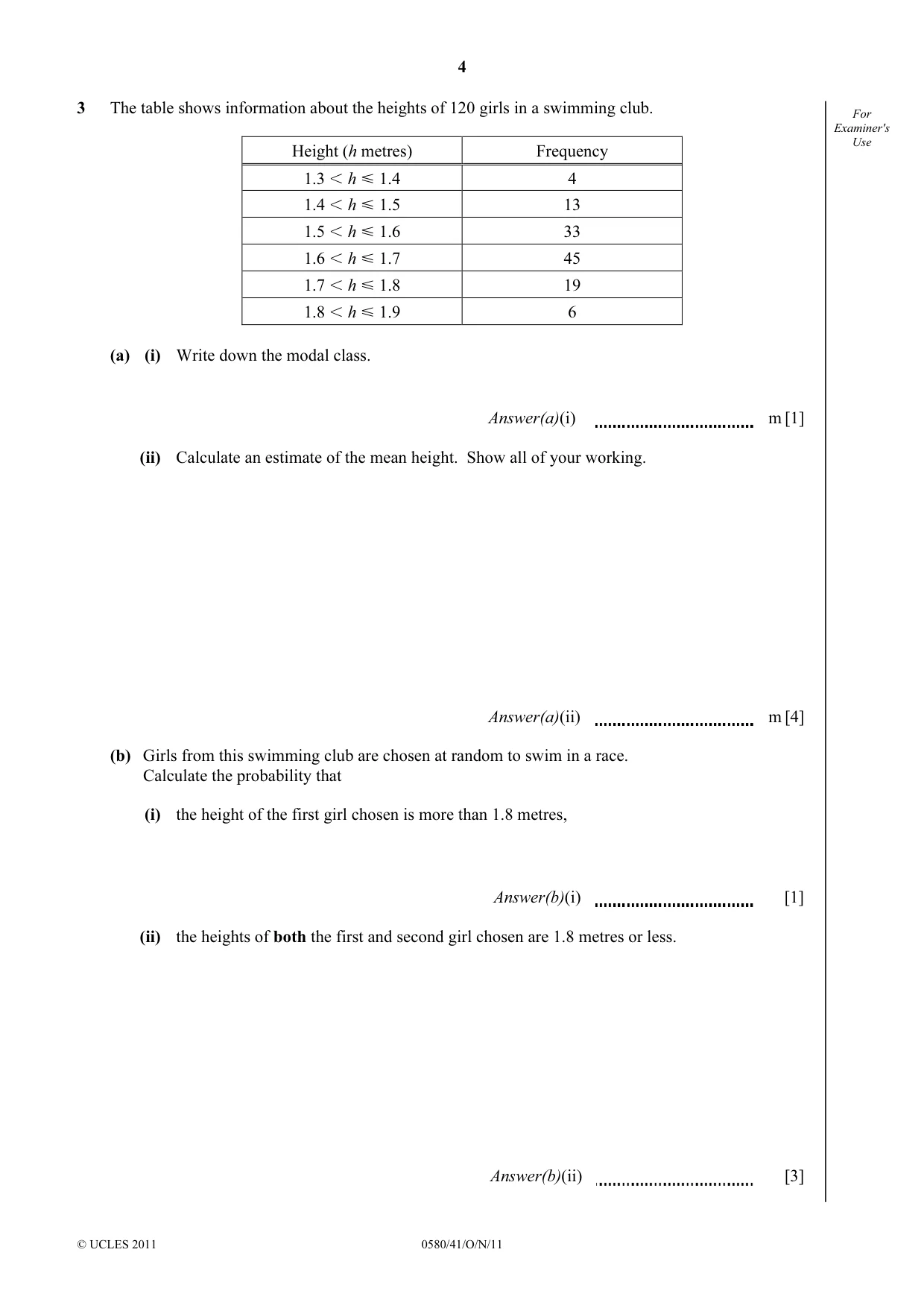
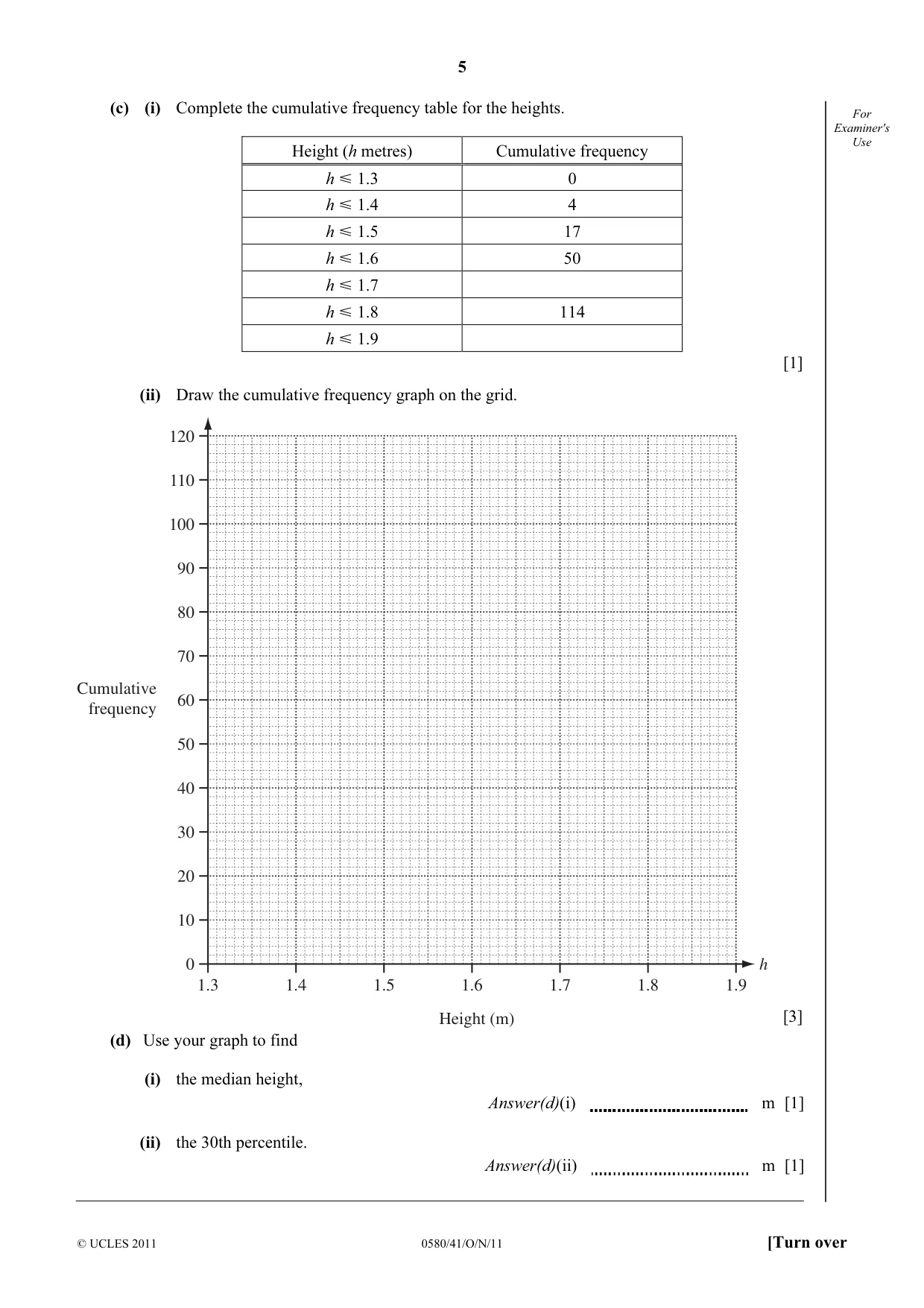
3 The table shows information about the heights of 120 girls in a swimming club. For Examiner's Use Height (h metres) Frequency 1.3 I h Y 1.4 4 1.4 I h Y 1.5 13 1.5 I h Y 1.6 33 1.6 I h Y 1.7 45 1.7 I h Y 1.8 19 1.8 I h Y 1.9 6 (a) (i) Write down the modal class. Answer(a)(i) m [1] (ii) Calculate an estimate of the mean height. Show all of your working. Answer(a)(ii) m [4] (b) Girls from this swimming club are chosen at random to swim in a race. Calculate the probability that (i) the height of the first girl chosen is more than 1.8 metres, Answer(b)(i) [1] (ii) the heights of both the first and second girl chosen are 1.8 metres or less. Answer(b)(ii) [3] (c) (i) Complete the cumulative frequency table for the heights. For Examiner's Use Height (h metres) Cumulative frequency h Y 1.3 0 h Y 1.4 4 h Y 1.5 17 h Y 1.6 50 h Y 1.7 h Y 1.8 114 h Y 1.9 [1] (ii) Draw the cumulative frequency graph on the grid. 120 110 100 90 80 70 Cumulative 60 frequency 50 40 30 20 10 0 h 1.3 1.4 1.5 1.6 1.7 1.8 1.9 Height (m) [3] (d) Use your graph to find (i) the median height, Answer(d)(i) m [1] (ii) the 30th percentile. Answer(d)(ii) m [1]
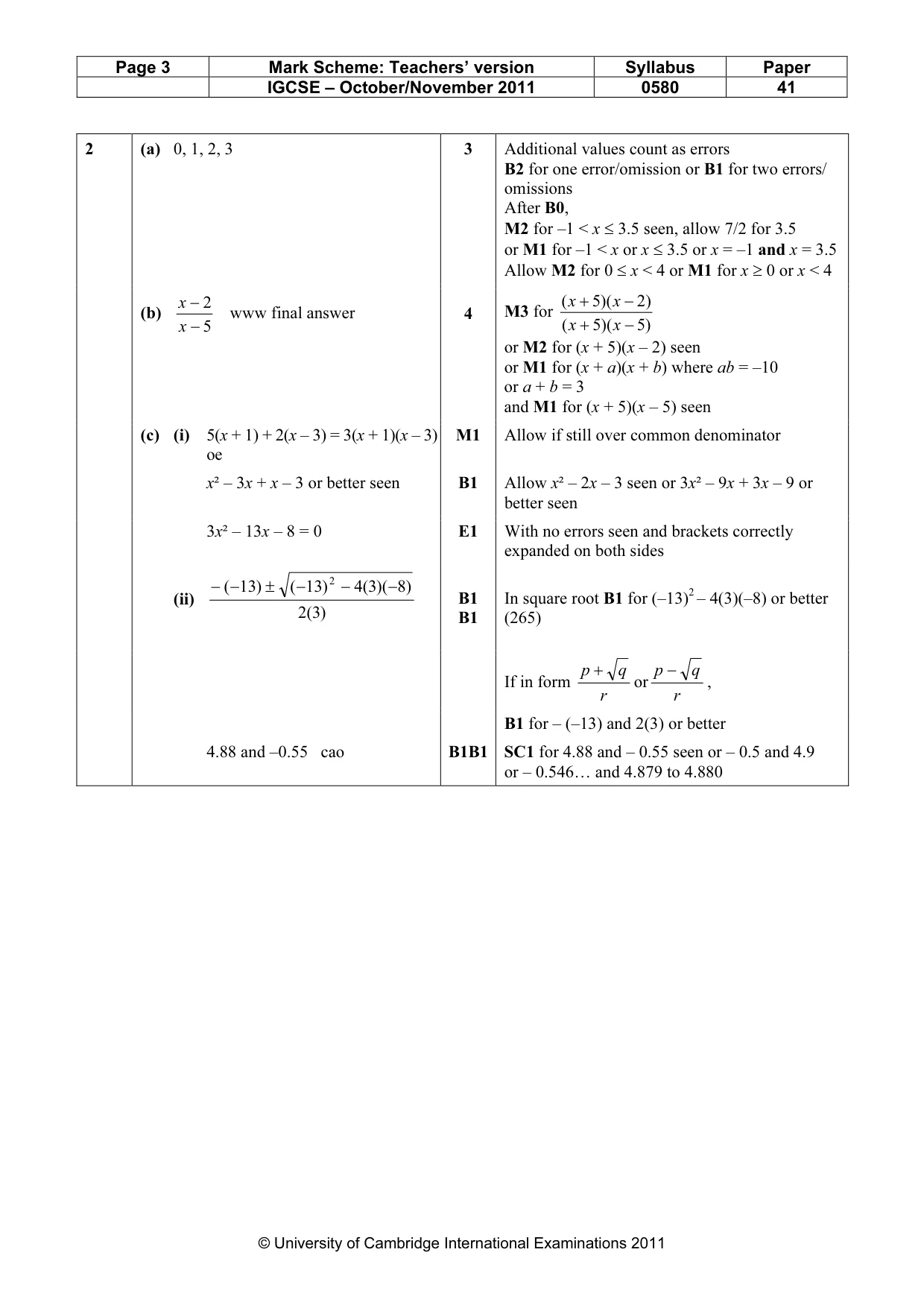
Mark scheme: 3 (a) (i) 1.6 < h ≤ 1.7 1 Condone alt. notation used for class (ii) {1.35 × 4 + 1.45 ×13 + 1.55 ×33 M3 (194/120) + 1.65 × 45 + 1.75 × 19 + 1.85 M1 for mid-values soi (allow one slip) × 6}÷ 120 and M1 for use of ∑fx with x in correct interval (allow one more slip) and M1 depend on 2nd M for dividing by 120 1.62 or 1.616 to 1.617 A1 www4 6 Accept dec/% to 3 sf or better but not ratio (b) (i) oe 1 120 isw cancelling/conversion (also for (ii)) 2147 k k − 1 k (ii) oe (0.902(1..)) 3 M2 for × where is 1 – their (b)(i) 2380 120 119 120 or if k = 114 or M1 for 1 – their (b)(i) or for 114/120 seen After 0 scored SC2 for ans 1/476 oe or SC1 for 6/120 × 5/119 (c) (i) 95, 120 1 (ii) Plots 7 points correctly P2ft P1ft for 5 or 6 correct plots exact or in correct square Curve or lines through 7 points C1ft ft their increasing curve within 1 mm of points (d) (i) 1.61 to 1.63 1ft ft their 60th reading on inc. curve to nearest 0.01 (ii) 1.555 to 1.57 1ft ft their 36th reading on inc. curve 20
Q4 · For r Examiner's Use NOT TO 8 cm s SCALE 2.7 cm 20 cm The diagram shows a plastic cup in…
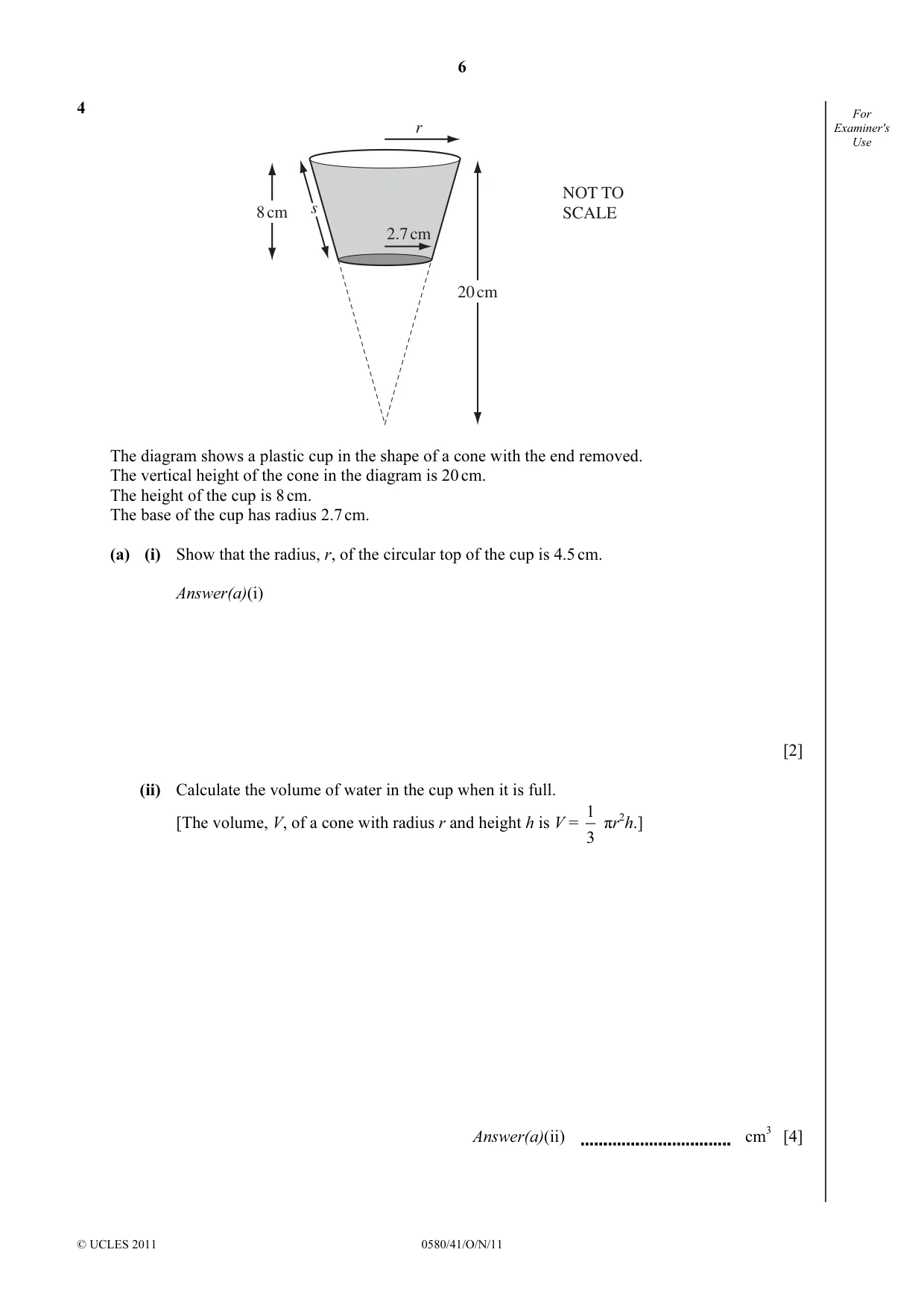
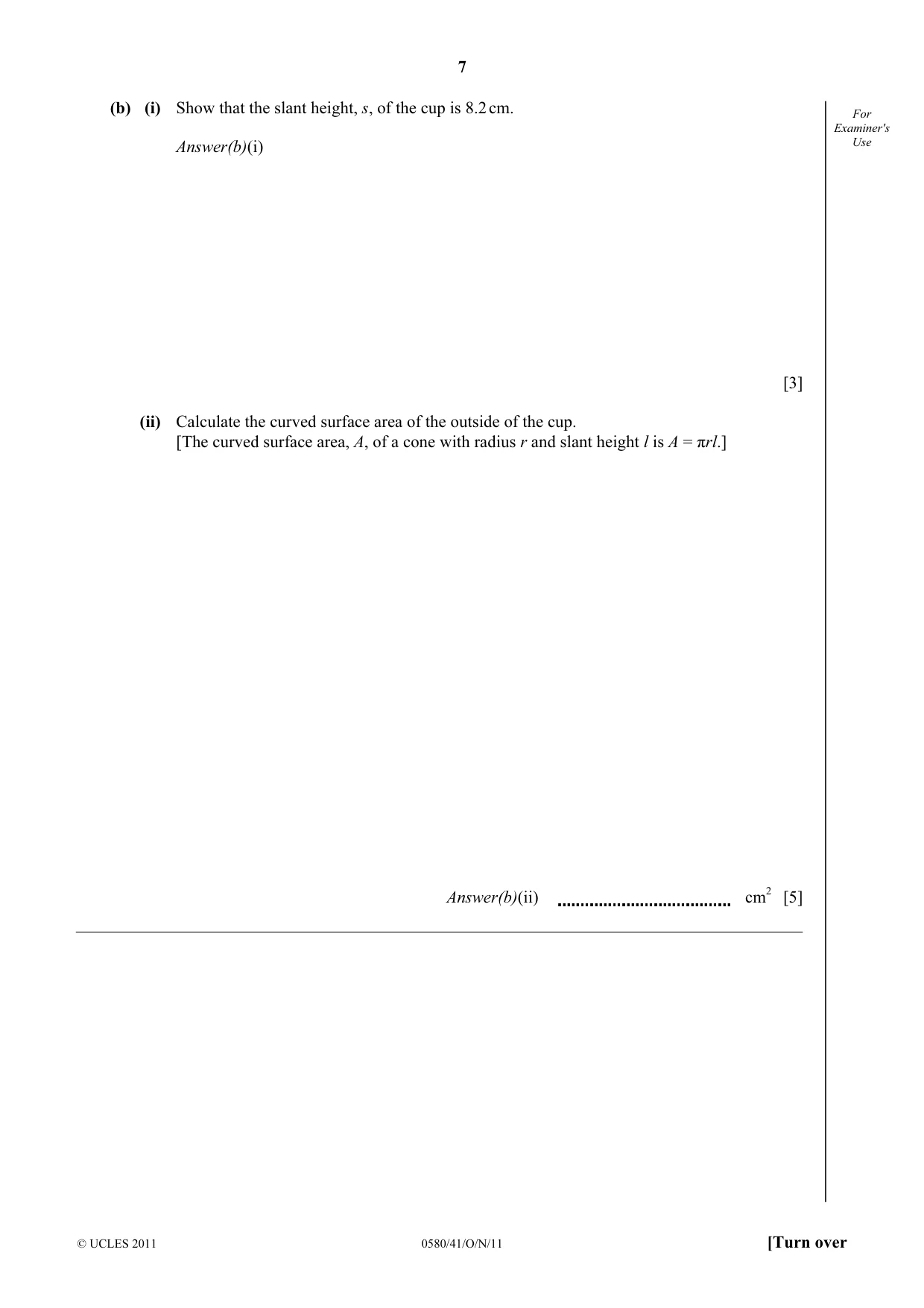
4 For r Examiner's Use NOT TO 8 cm s SCALE 2.7 cm 20 cm The diagram shows a plastic cup in the shape of a cone with the end removed. The vertical height of the cone in the diagram is 20 cm. The height of the cup is 8 cm. The base of the cup has radius 2.7 cm. (a) (i) Show that the radius, r, of the circular top of the cup is 4.5 cm. Answer(a)(i) [2] (ii) Calculate the volume of water in the cup when it is full. 1 [The volume, V, of a cone with radius r and height h is V = πr2h.] 3 Answer(a)(ii) cm3 [4] (b) (i) Show that the slant height, s, of the cup is 8.2 cm. For Examiner's Answer(b)(i) Use [3] (ii) Calculate the curved surface area of the outside of the cup. [The curved surface area, A, of a cone with radius r and slant height l is A = πrl.] Answer(b)(ii) cm2 [5]
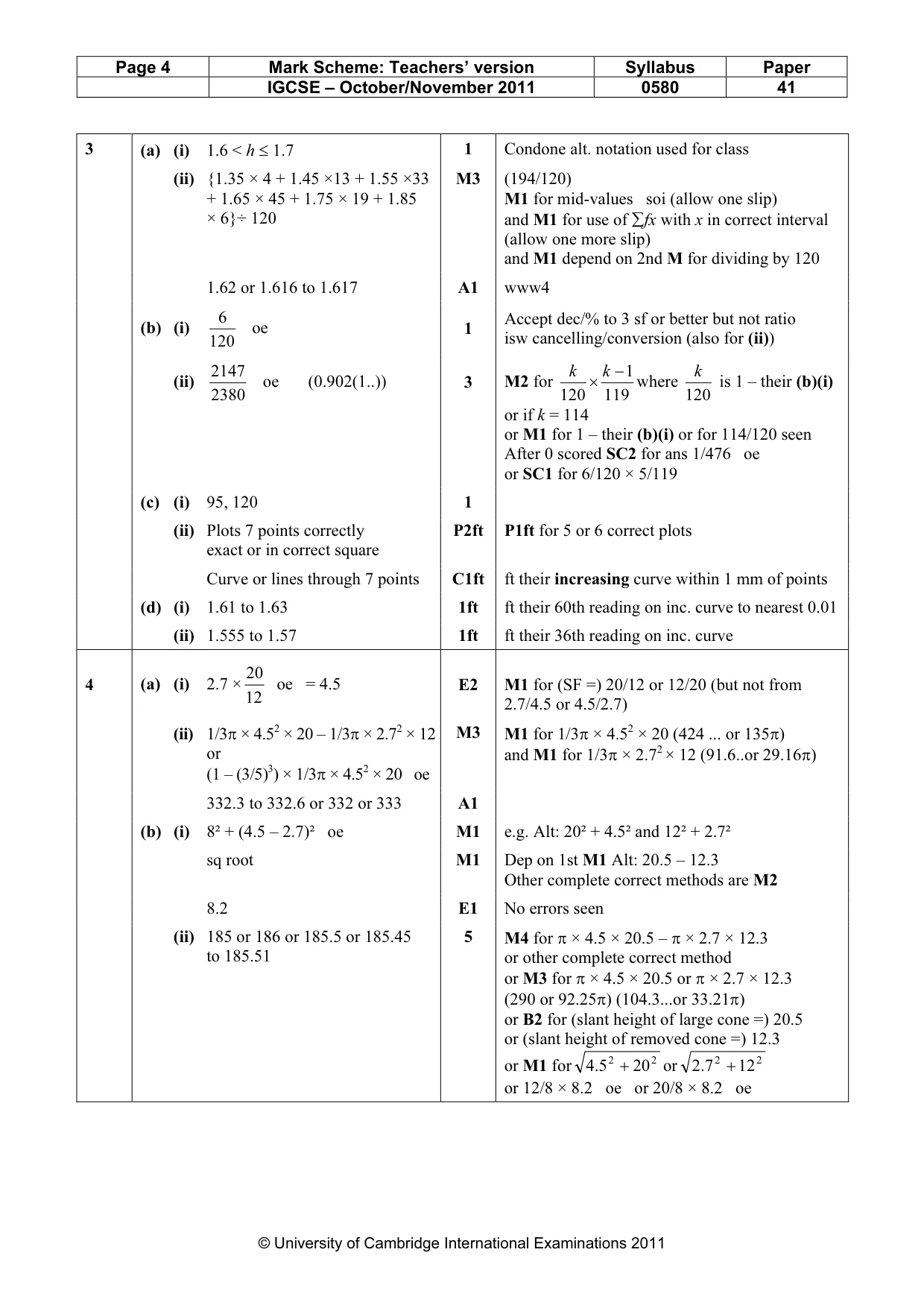
Mark scheme: 20 4 (a) (i) 2.7 × oe = 4.5 E2 M1 for (SF =) 20/12 or 12/20 (but not from 12 2.7/4.5 or 4.5/2.7) (ii) 1/3π × 4.52 × 20 – 1/3π × 2.72 × 12 M3 M1 for 1/3π × 4.52 × 20 (424 ... or 135π) or and M1 for 1/3π × 2.72 × 12 (91.6..or 29.16π) (1 – (3/5)3) × 1/3π × 4.52 × 20 oe 332.3 to 332.6 or 332 or 333 A1 (b) (i) 8² + (4.5 – 2.7)² oe M1 e.g. Alt: 20² + 4.5² and 12² + 2.7² sq root M1 Dep on 1st M1 Alt: 20.5 – 12.3 Other complete correct methods are M2 8.2 E1 No errors seen (ii) 185 or 186 or 185.5 or 185.45 5 M4 for π × 4.5 × 20.5 – π × 2.7 × 12.3 to 185.51 or other complete correct method or M3 for π × 4.5 × 20.5 or π × 2.7 × 12.3 (290 or 92.25π) (104.3...or 33.21π) or B2 for (slant height of large cone =) 20.5 or (slant height of removed cone =) 12.3 or M1 for 5.4 2 + 20 2 or 2.7 2 + 12 2 or 12/8 × 8.2 oe or 20/8 × 8.2 oe IGCSE – October/November 2011 0580 41
Q5 · X For 5 (a) Complete the table for the function f(x) = −x3 − 1
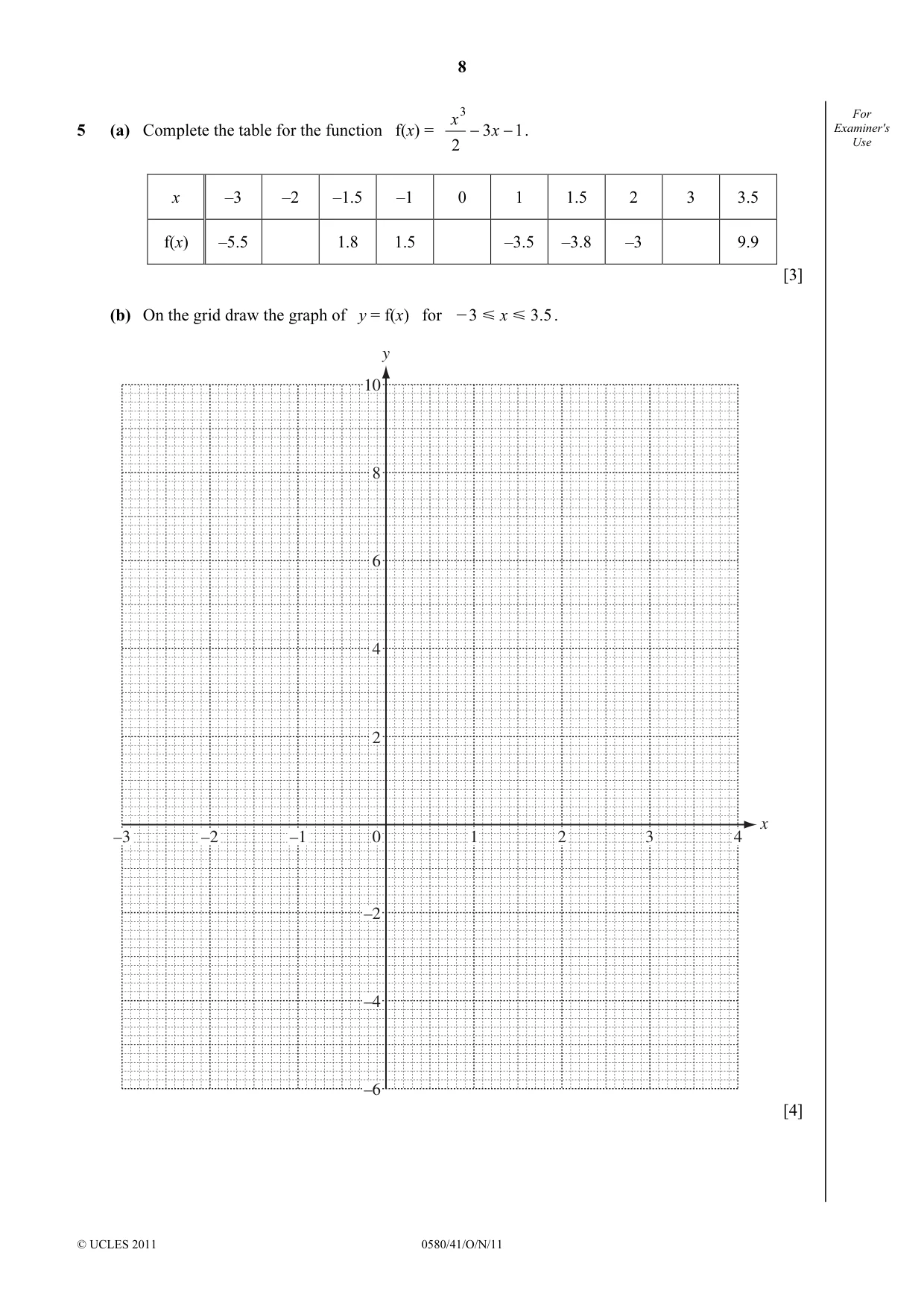
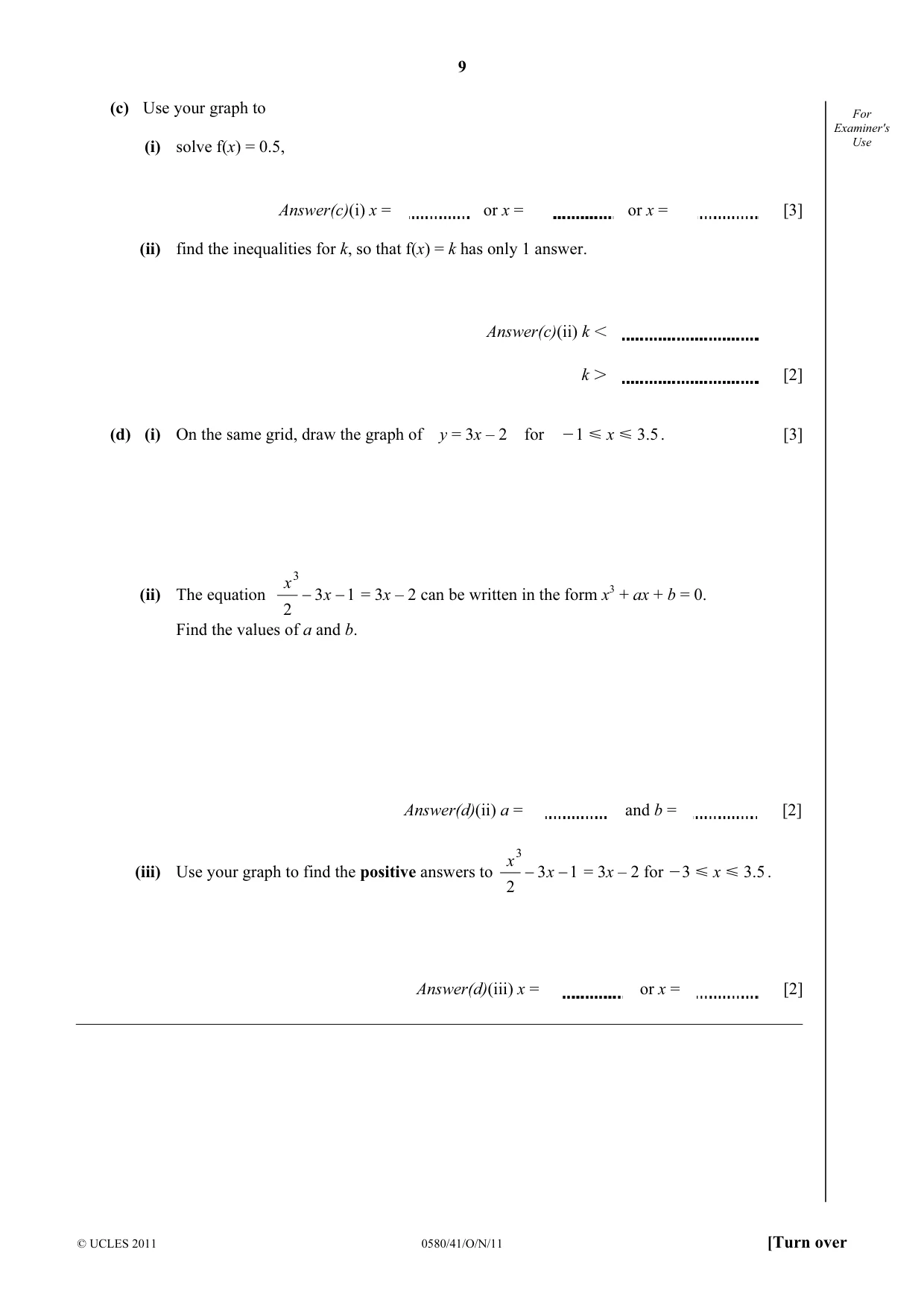
x For 5 (a) Complete the table for the function f(x) = −x3 − 1 . Examiner's 2 Use x –3 –2 –1.5 –1 0 1 1.5 2 3 3.5 f(x) –5.5 1.8 1.5 –3.5 –3.8 –3 9.9 [3] (b) On the grid draw the graph of y = f(x) for O3 Y x Y 3.5 . y 10 8 6 4 2 x –3 –2 –1 0 1 2 3 4 –2 –4 –6 [4] (c) Use your graph to For Examiner's (i) solve f(x) = 0.5, Use Answer(c)(i) x = or x = or x = [3] (ii) find the inequalities for k, so that f(x) = k has only 1 answer. Answer(c)(ii) k I k K [2] (d) (i) On the same grid, draw the graph of y = 3x – 2 for O1 Y x Y 3.5 . [3] x 3 (ii) The equation −x3 − 1 = 3x – 2 can be written in the form x3 + ax + b = 0. 2 Find the values of a and b. Answer(d)(ii) a = and b = [2] x 3 (iii) Use your graph to find the positive answers to −x3 − 1 = 3x – 2 for O3 Y x Y 3.5 . 2 Answer(d)(iii) x = or x = [2]
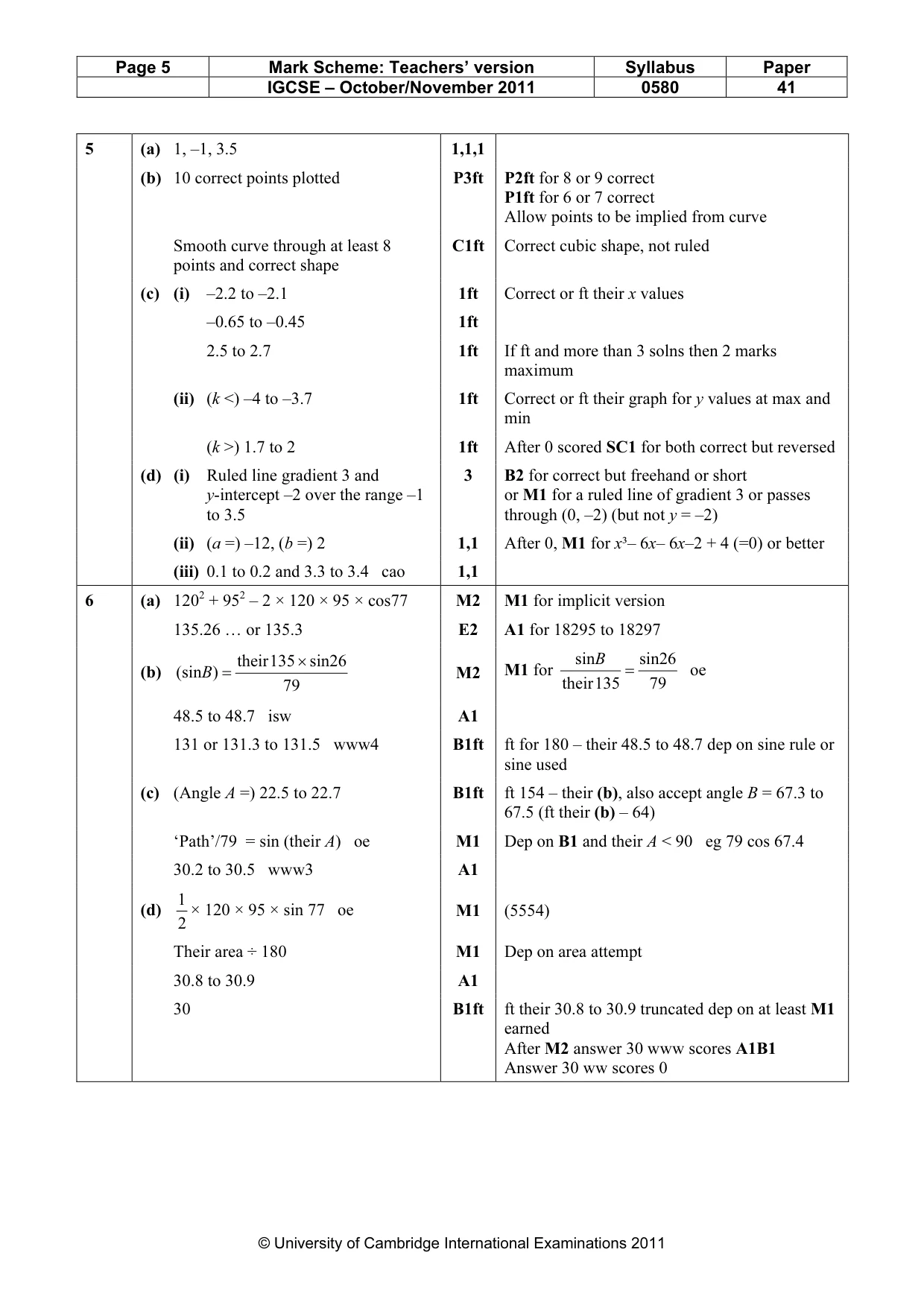
Mark scheme: 5 (a) 1, –1, 3.5 1,1,1 (b) 10 correct points plotted P3ft P2ft for 8 or 9 correct P1ft for 6 or 7 correct Allow points to be implied from curve Smooth curve through at least 8 C1ft Correct cubic shape, not ruled points and correct shape (c) (i) –2.2 to –2.1 1ft Correct or ft their x values –0.65 to –0.45 1ft 2.5 to 2.7 1ft If ft and more than 3 solns then 2 marks maximum (ii) (k <) –4 to –3.7 1ft Correct or ft their graph for y values at max and min (k >) 1.7 to 2 1ft After 0 scored SC1 for both correct but reversed (d) (i) Ruled line gradient 3 and 3 B2 for correct but freehand or short y-intercept –2 over the range –1 or M1 for a ruled line of gradient 3 or passes to 3.5 through (0, –2) (but not y = –2) (ii) (a =) –12, (b =) 2 1,1 After 0, M1 for x³– 6x– 6x–2 + 4 (=0) or better (iii) 0.1 to 0.2 and 3.3 to 3.4 cao 1,1 2 2
Q6 · For C Examiner's Use B 26° NOT TO SCALE 79 m 95 m 77° A 120 m D The quadrilateral ABCD…
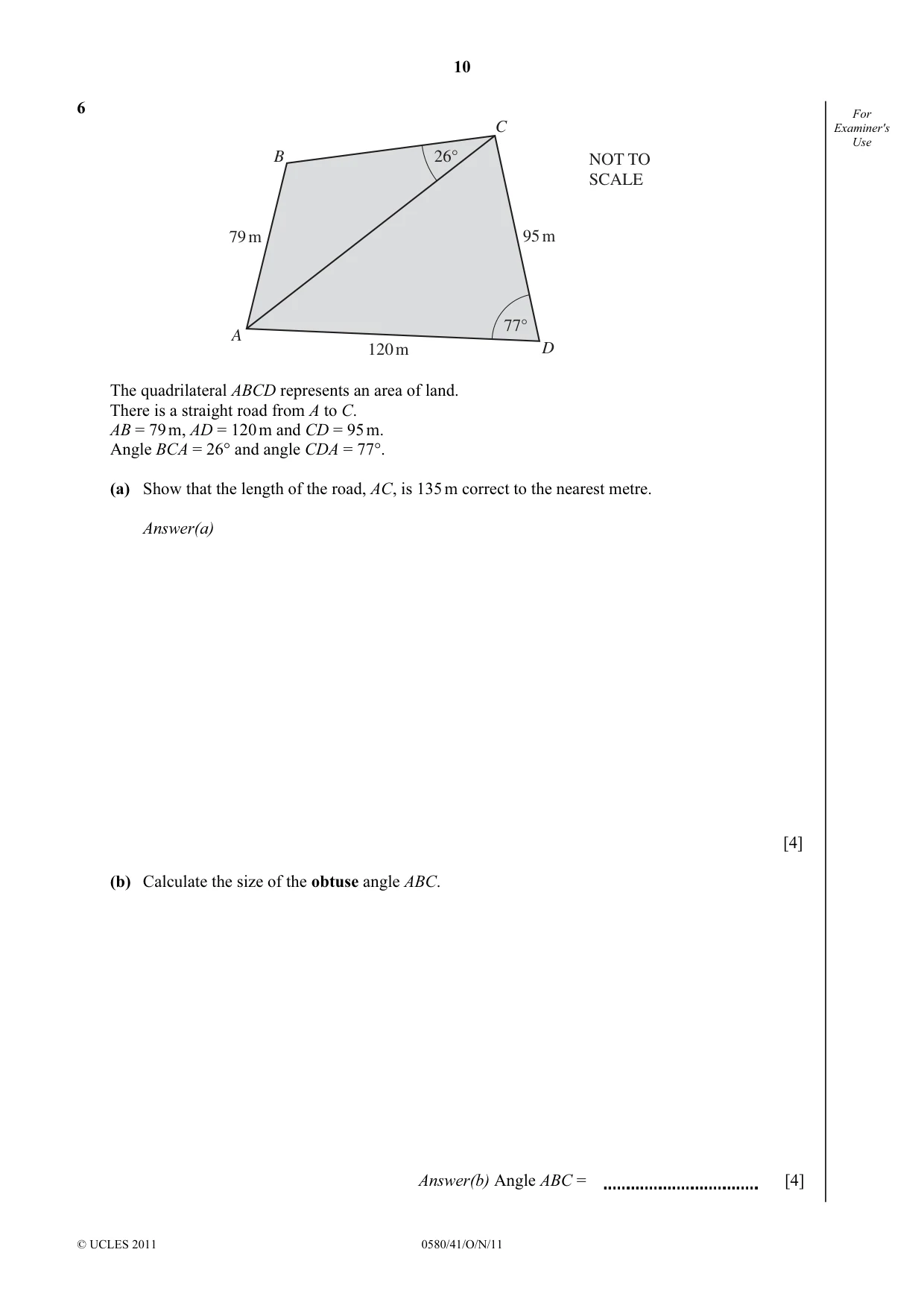
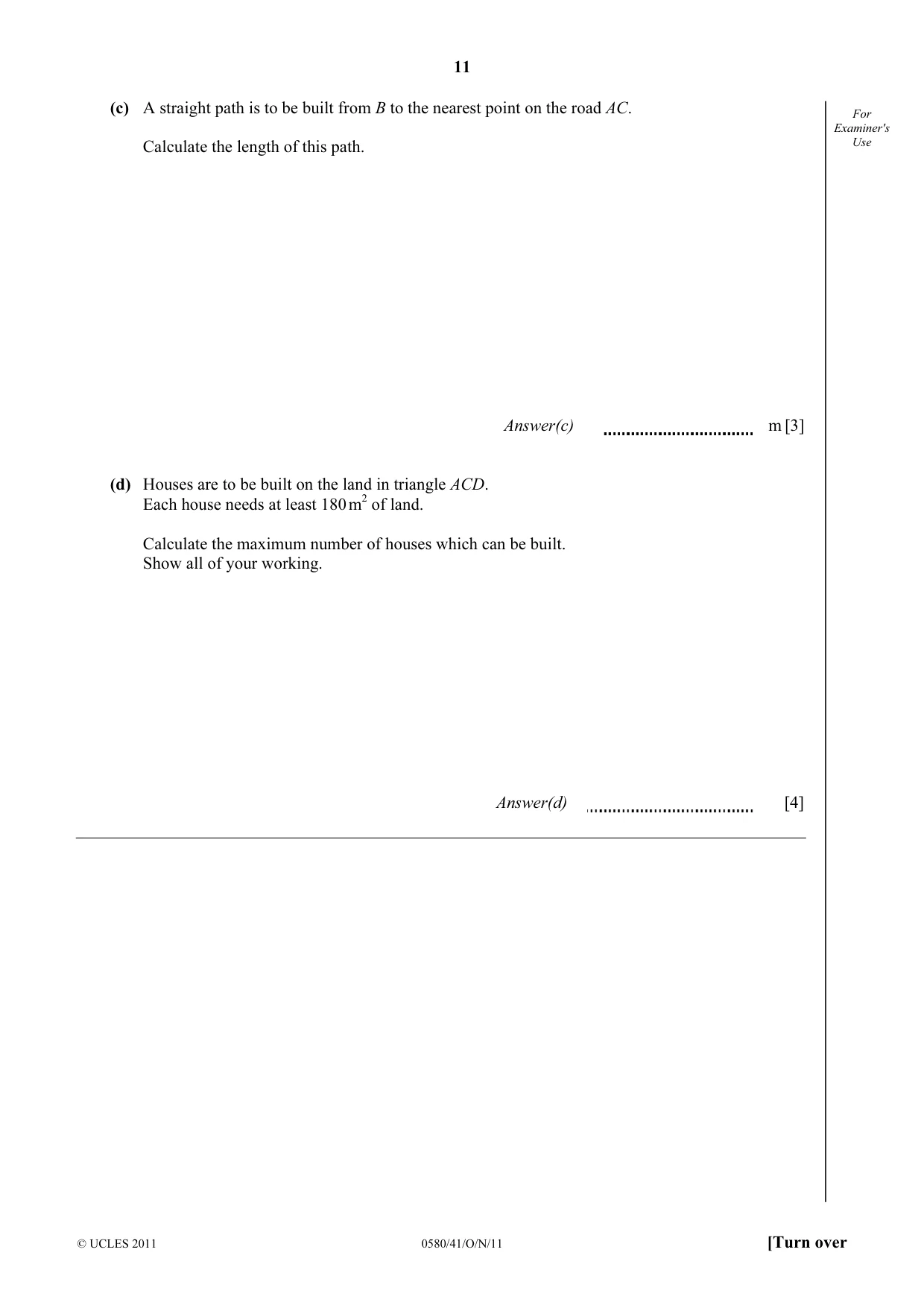
6 For C Examiner's Use B 26° NOT TO SCALE 79 m 95 m 77° A 120 m D The quadrilateral ABCD represents an area of land. There is a straight road from A to C. AB = 79 m, AD = 120 m and CD = 95 m. Angle BCA = 26° and angle CDA = 77°. (a) Show that the length of the road, AC, is 135 m correct to the nearest metre. Answer(a) [4] (b) Calculate the size of the obtuse angle ABC. Answer(b) Angle ABC = [4] (c) A straight path is to be built from B to the nearest point on the road AC. For Examiner's Calculate the length of this path. Use Answer(c) m [3] (d) Houses are to be built on the land in triangle ACD. Each house needs at least 180 m2 of land. Calculate the maximum number of houses which can be built. Show all of your working. Answer(d) [4]
Mark scheme: 6 (a) 1202 + 952 – 2 × 120 × 95 × cos77 M2 M1 for implicit version 135.26 … or 135.3 E2 A1 for 18295 to 18297 their 135 × sin26 sin B sin26 (b) (sinB ) = M2 M1 for = oe 79 their 135 79 48.5 to 48.7 isw A1 131 or 131.3 to 131.5 www4 B1ft ft for 180 – their 48.5 to 48.7 dep on sine rule or sine used (c) (Angle A =) 22.5 to 22.7 B1ft ft 154 – their (b), also accept angle B = 67.3 to 67.5 (ft their (b) – 64) ‘Path’/79 = sin (their A) oe M1 Dep on B1 and their A < 90 eg 79 cos 67.4 30.2 to 30.5 www3 A1 1 (d) × 120 × 95 × sin 77 oe M1 (5554) 2 Their area ÷ 180 M1 Dep on area attempt 30.8 to 30.9 A1 30 B1ft ft their 30.8 to 30.9 truncated dep on at least M1 earned After M2 answer 30 www scores A1B1 Answer 30 ww scores 0 IGCSE – October/November 2011 0580 41
Q7 · For y Examiner's Use 8 6 4 B 2 x –8 –6 –4 –2 0 2 4 6 8 C –2 –4 D –6 A –8 (a) Describe…
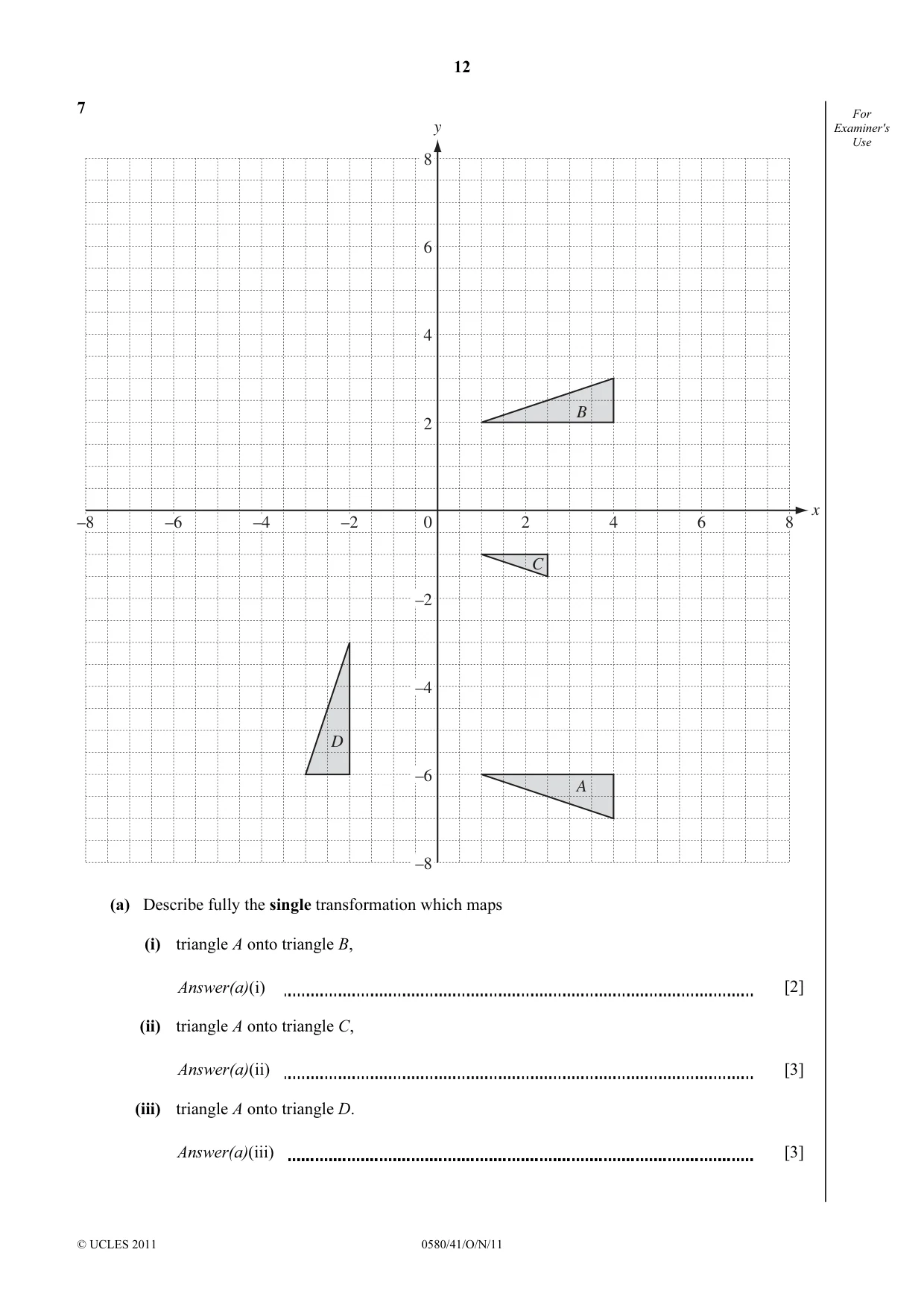
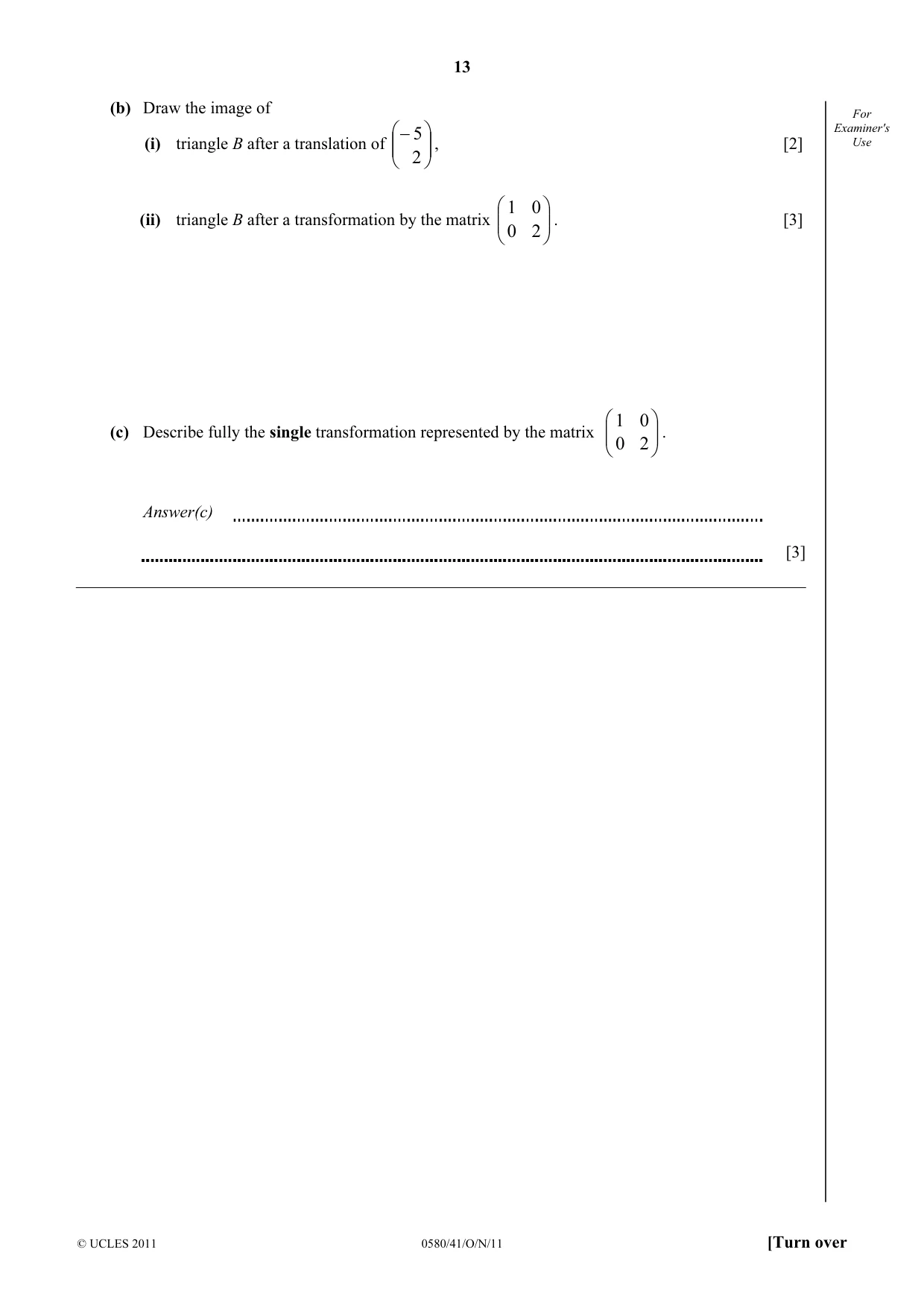
7 For y Examiner's Use 8 6 4 B 2 x –8 –6 –4 –2 0 2 4 6 8 C –2 –4 D –6 A –8 (a) Describe fully the single transformation which maps (i) triangle A onto triangle B, Answer(a)(i) [2] (ii) triangle A onto triangle C, Answer(a)(ii) [3] (iii) triangle A onto triangle D. Answer(a)(iii) [3] (b) Draw the image of For − 5 Examiner's (i) triangle B after a translation of , [2] Use 2 1 0 (ii) triangle B after a transformation by the matrix . [3] 0 2 1 0 (c) Describe fully the single transformation represented by the matrix . 0 2 Answer(c) [3]
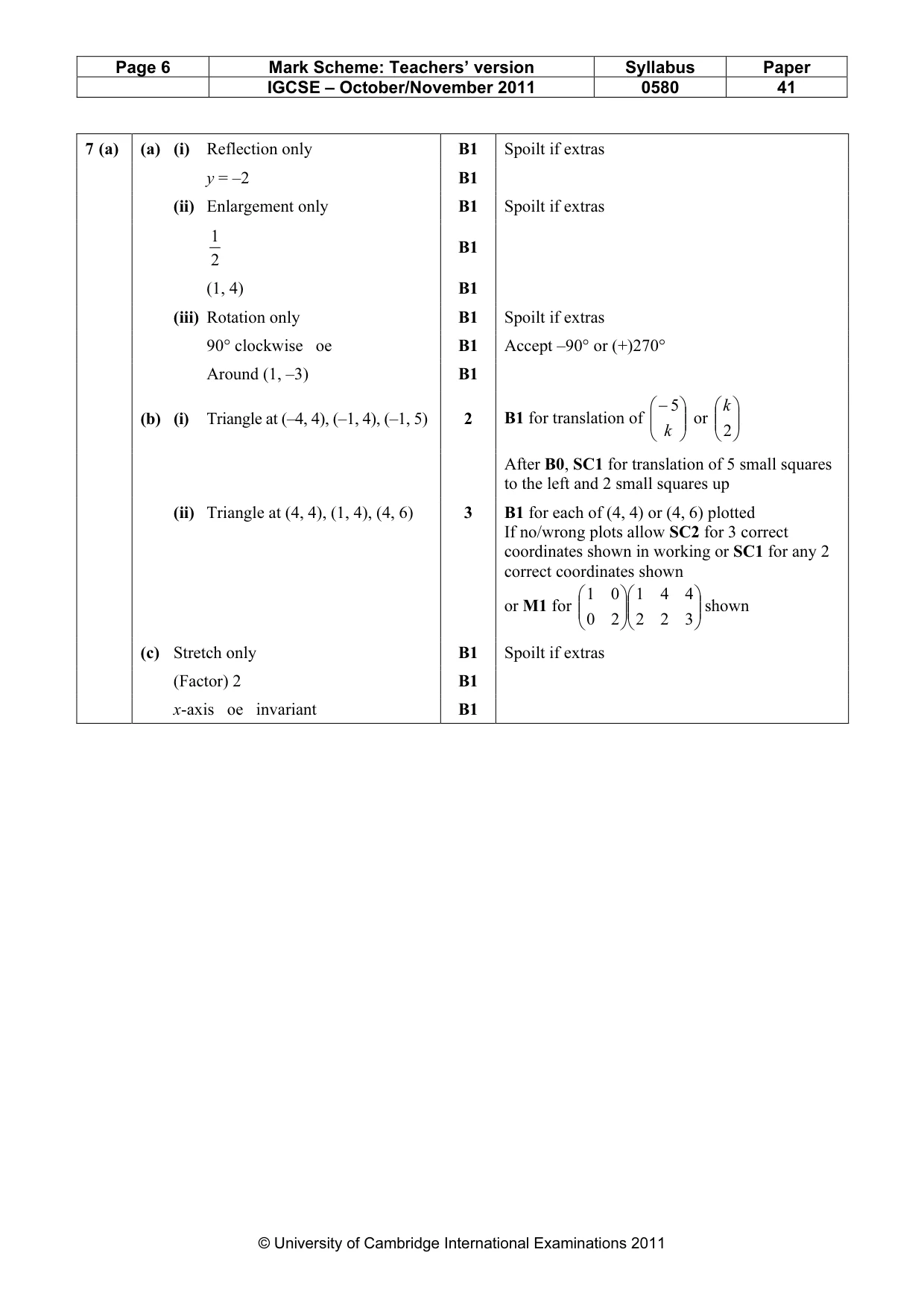
Mark scheme: 7 (a) (a) (i) Reflection only B1 Spoilt if extras y = –2 B1 (ii) Enlargement only B1 Spoilt if extras 1 B1 2 (1, 4) B1 (iii) Rotation only B1 Spoilt if extras 90° clockwise oe B1 Accept –90° or (+)270° Around (1, –3) B1 − 5 k (b) (i) Triangle at (–4, 4), (–1, 4), (–1, 5) 2 B1 for translation of or k 2 After B0, SC1 for translation of 5 small squares to the left and 2 small squares up (ii) Triangle at (4, 4), (1, 4), (4, 6) 3 B1 for each of (4, 4) or (4, 6) plotted If no/wrong plots allow SC2 for 3 correct coordinates shown in working or SC1 for any 2 correct coordinates shown 1 0 1 4 4 or M1 for shown 0 2 2 2 3 (c) Stretch only B1 Spoilt if extras (Factor) 2 B1 x-axis oe invariant B1 IGCSE – October/November 2011 0580 41
Q8 · Mr Chang hires x large coaches and y small coaches to take 300 students on a school trip
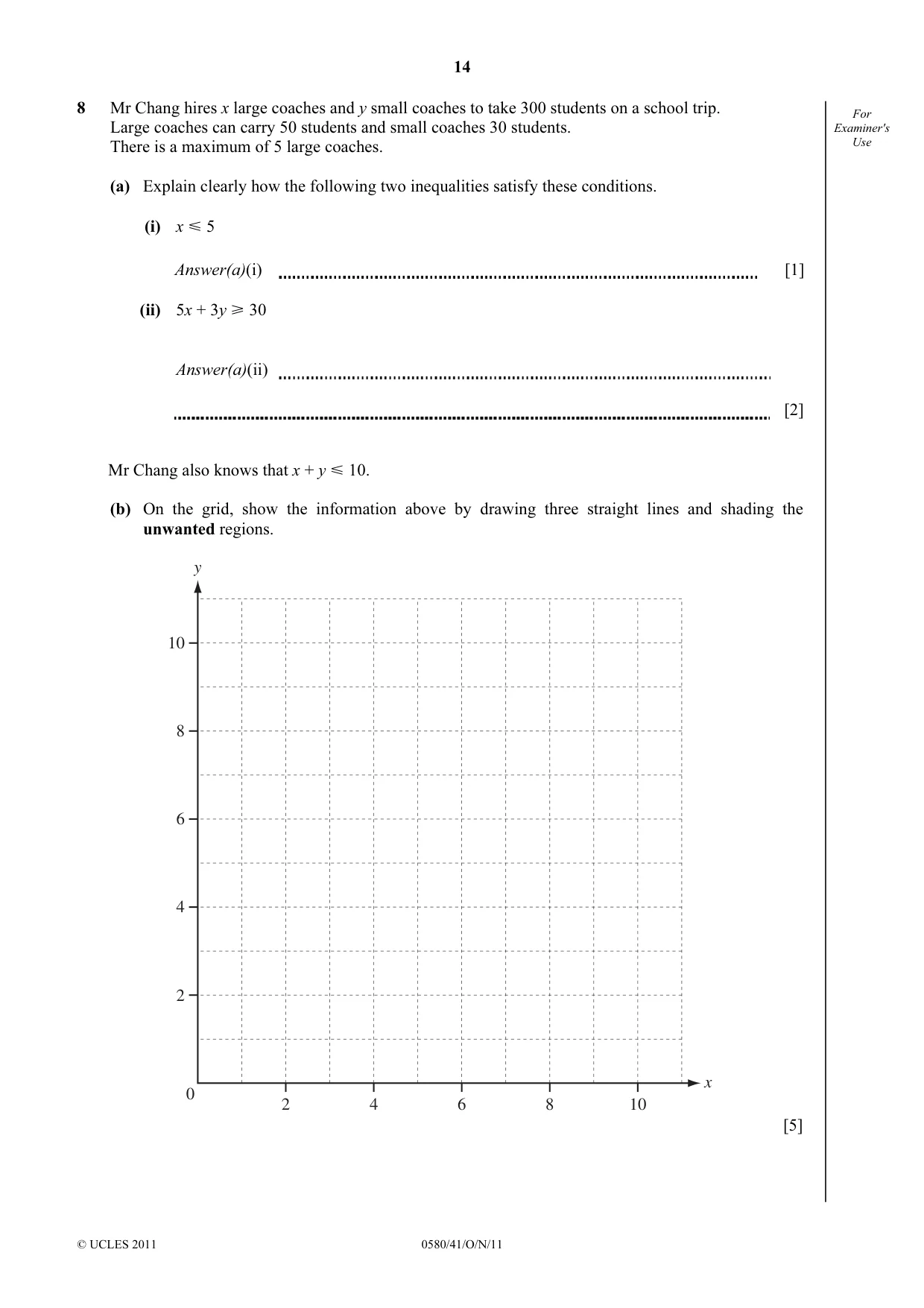
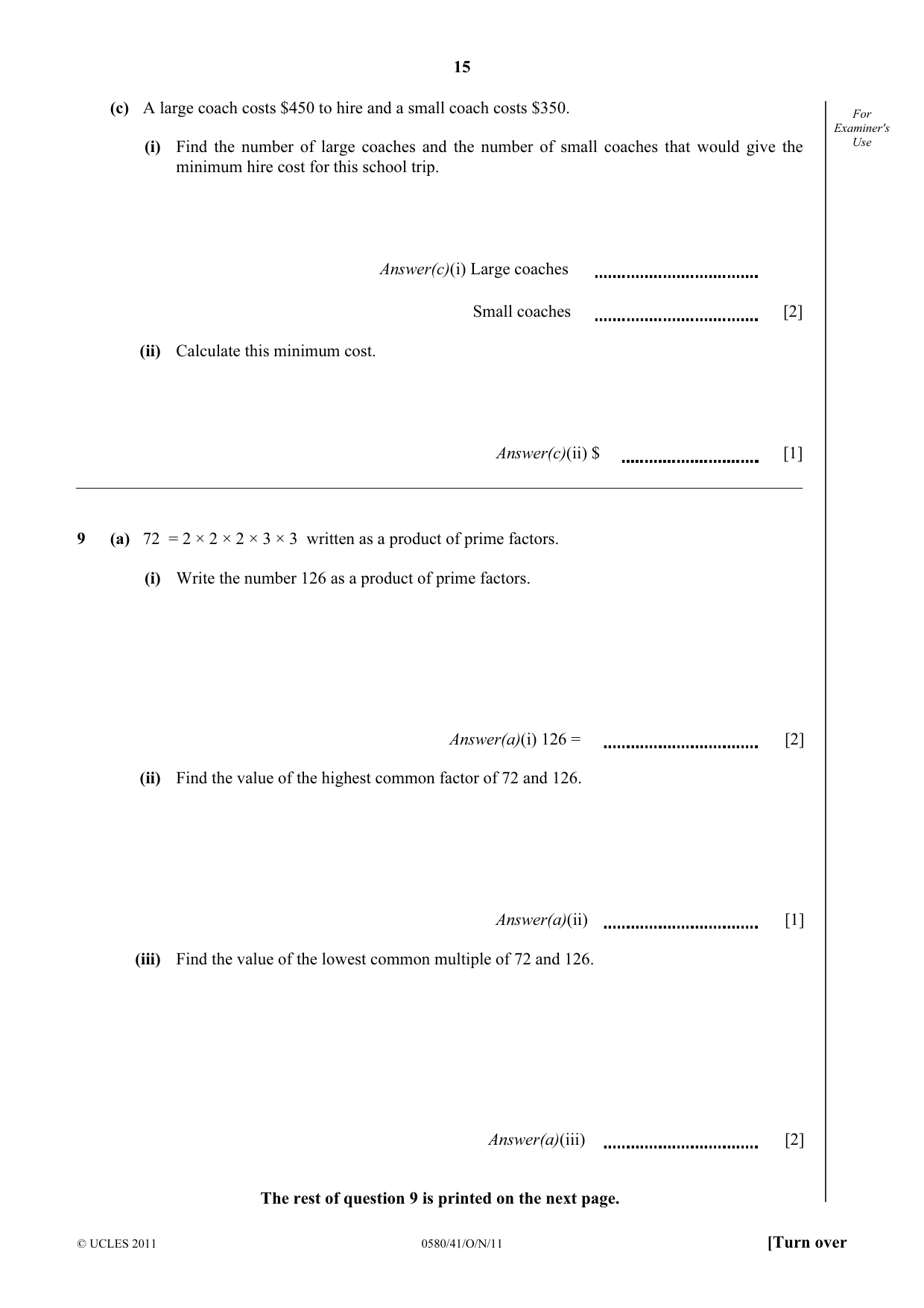
8 Mr Chang hires x large coaches and y small coaches to take 300 students on a school trip. For Large coaches can carry 50 students and small coaches 30 students. Examiner's There is a maximum of 5 large coaches. Use (a) Explain clearly how the following two inequalities satisfy these conditions. (i) x Y 5 Answer(a)(i) [1] (ii) 5x + 3y [ 30 Answer(a)(ii) [2] Mr Chang also knows that x + y Y 10. (b) On the grid, show the information above by drawing three straight lines and shading the unwanted regions. y 10 8 6 4 2 x 0 2 4 6 8 10 [5] (c) A large coach costs $450 to hire and a small coach costs $350. For Examiner's (i) Find the number of large coaches and the number of small coaches that would give the Use minimum hire cost for this school trip. Answer(c)(i) Large coaches Small coaches [2] (ii) Calculate this minimum cost. Answer(c)(ii) $ [1]
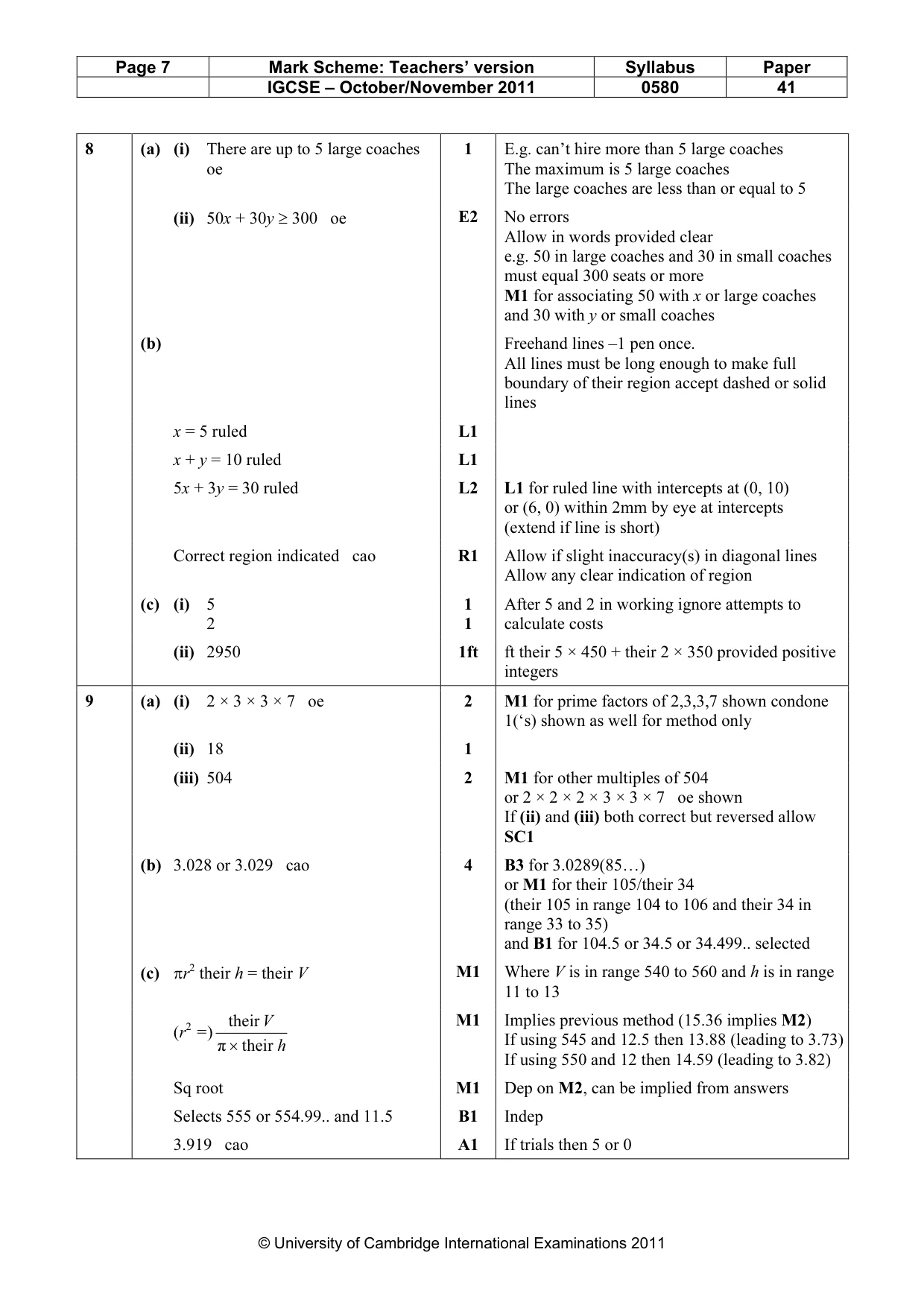
Mark scheme: 8 (a) (i) There are up to 5 large coaches 1 E.g. can’t hire more than 5 large coaches oe The maximum is 5 large coaches The large coaches are less than or equal to 5 (ii) 50x + 30y ≥ 300 oe E2 No errors Allow in words provided clear e.g. 50 in large coaches and 30 in small coaches must equal 300 seats or more M1 for associating 50 with x or large coaches and 30 with y or small coaches (b) Freehand lines –1 pen once. All lines must be long enough to make full boundary of their region accept dashed or solid lines x = 5 ruled L1 x + y = 10 ruled L1 5x + 3y = 30 ruled L2 L1 for ruled line with intercepts at (0, 10) or (6, 0) within 2mm by eye at intercepts (extend if line is short) Correct region indicated cao R1 Allow if slight inaccuracy(s) in diagonal lines Allow any clear indication of region (c) (i) 5 1 After 5 and 2 in working ignore attempts to 2 1 calculate costs (ii) 2950 1ft ft their 5 × 450 + their 2 × 350 provided positive integers
Q9 · 72 = 2 × 2 × 2 × 3 × 3 written as a product of prime factors
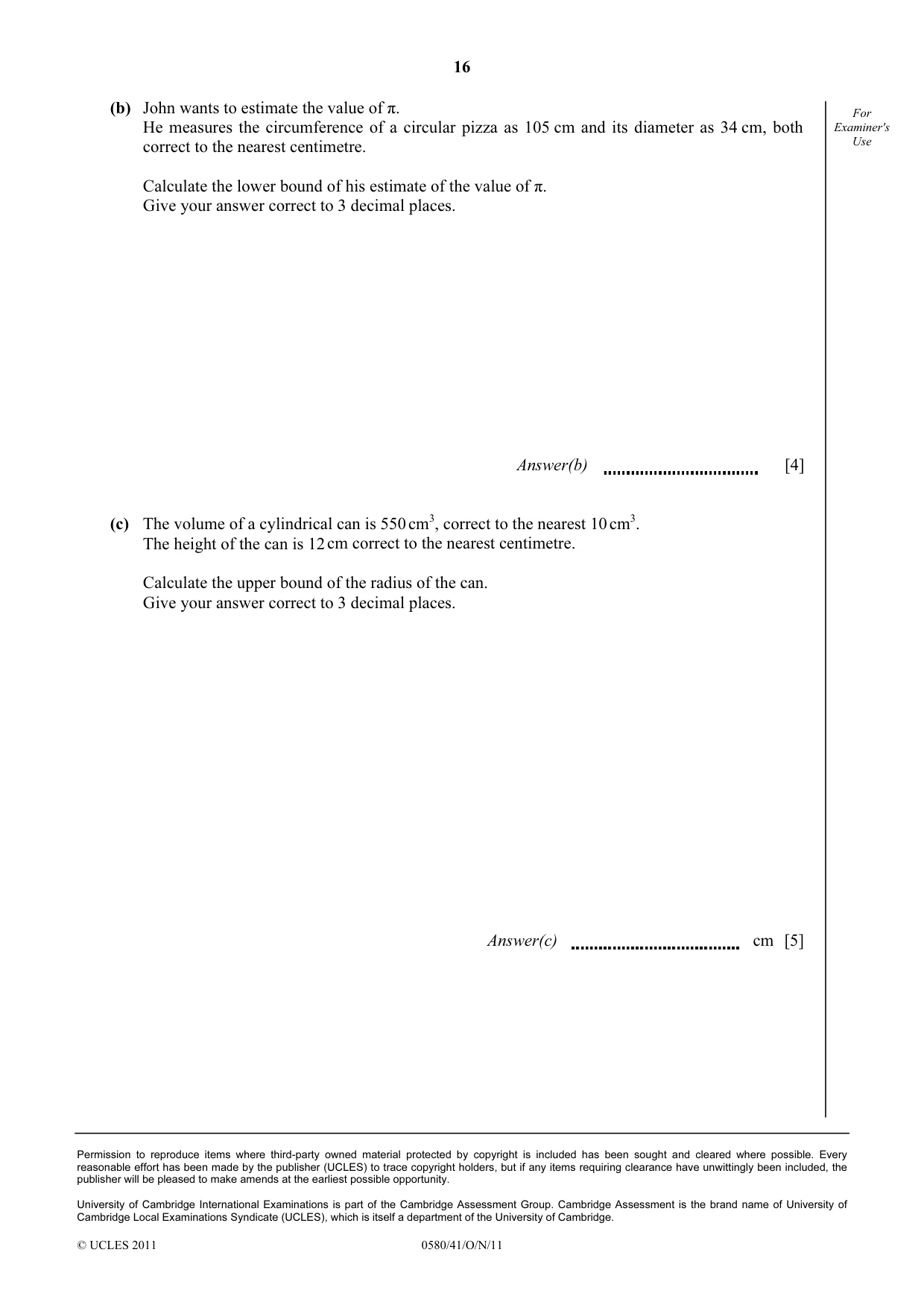
9 (a) 72 = 2 × 2 × 2 × 3 × 3 written as a product of prime factors. (i) Write the number 126 as a product of prime factors. Answer(a)(i) 126 = [2] (ii) Find the value of the highest common factor of 72 and 126. Answer(a)(ii) [1] (iii) Find the value of the lowest common multiple of 72 and 126. Answer(a)(iii) [2] The rest of question 9 is printed on the next page. (b) John wants to estimate the value of π. For He measures the circumference of a circular pizza as 105 cm and its diameter as 34 cm, both Examiner's correct to the nearest centimetre. Use Calculate the lower bound of his estimate of the value of π. Give your answer correct to 3 decimal places. Answer(b) [4] (c) The volume of a cylindrical can is 550 cm3, correct to the nearest 10 cm3. The height of the can is 12 cm correct to the nearest centimetre. Calculate the upper bound of the radius of the can. Give your answer correct to 3 decimal places. Answer(c) cm [5]
Mark scheme: 9 (a) (i) 2 × 3 × 3 × 7 oe 2 M1 for prime factors of 2,3,3,7 shown condone 1(‘s) shown as well for method only (ii) 18 1 (iii) 504 2 M1 for other multiples of 504 or 2 × 2 × 2 × 3 × 3 × 7 oe shown If (ii) and (iii) both correct but reversed allow SC1 (b) 3.028 or 3.029 cao 4 B3 for 3.0289(85…) or M1 for their 105/their 34 (their 105 in range 104 to 106 and their 34 in range 33 to 35) and B1 for 104.5 or 34.5 or 34.499.. selected (c) πr2 their h = their V M1 Where V is in range 540 to 560 and h is in range 11 to 13 their V M1 Implies previous method (15.36 implies M2) (r2 =) If using 545 and 12.5 then 13.88 (leading to 3.73) π × their h If using 550 and 12 then 14.59 (leading to 3.82) Sq root M1 Dep on M2, can be implied from answers Selects 555 or 554.99.. and 11.5 B1 Indep 3.919 cao A1 If trials then 5 or 0
What was in this paper
The subtopics covered by these 9 questions, and how many questions each got. Open one in a new tab to see every Cambridge question on it.
What you needed in this session
Cambridge’s own grade thresholds for 2011 Oct/Nov, Paper 4 · Variant 1. A higher threshold means an easier paper — the bar moves with how the cohort did.