Cambridge IGCSE Malay - Foreign Language 0546 — 2018 May/June Paper 2 · Variant 2
0546/22/M/J/18 · 45 marks · ≈51 min
The question paper and its mark scheme, free to read here and free to download. This is Cambridge’s own paper, exactly as it was sat.
Question paper16 pages

Mark scheme14 pages
Answers below. Sit the paper first if you are practising.
Paper as text
Question paper, page 1
This document consists of 14 printed pages and 2 blank pages. DC (LEG/FC) 143231/2 © UCLES 2018 [Turn over Cambridge International Examinations Cambridge International General Certificate of Secondary Education * 8 5 8 2 8 1 5 1 7 5 * MALAY 0546/22 Paper 2 Reading May/June 2018 1 hour Candidates answer on the Question Paper. No Additional Materials are required. READ THESE INSTRUCTIONS FIRST Write your Centre number, candidate number and name in the spaces at the top of this page. Write in dark blue or black pen. Do not use staples, paper clips, glue or correction fluid. DO NOT WRITE IN ANY BARCODES. Answer all questions. The number of marks is given in brackets [ ] at the end of each question or part question.
Question paper, page 2
2 0546/22/M/J/18 © UCLES 2018 BLANK PAGE
Question paper, page 3
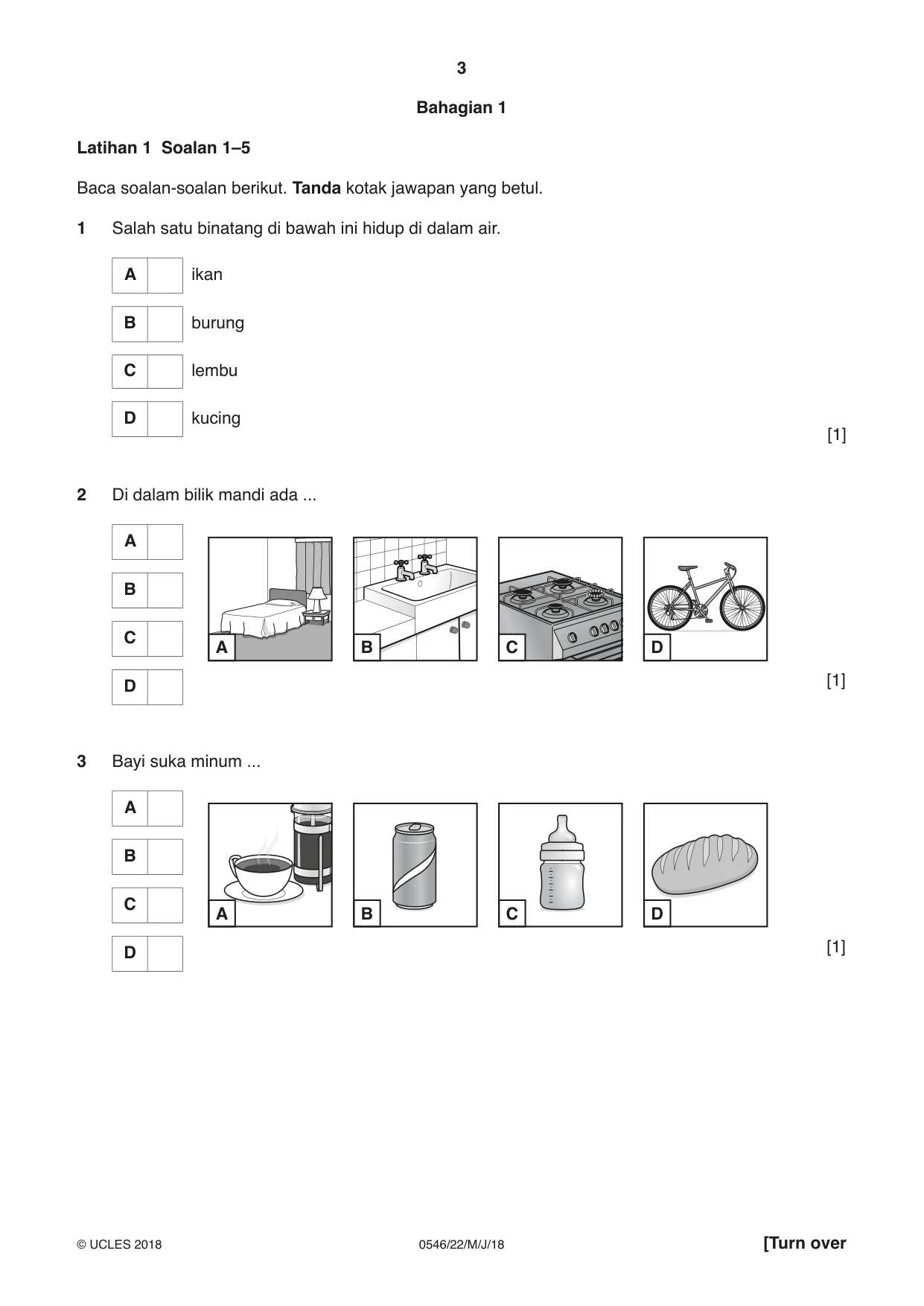
3 0546/22/M/J/18 © UCLES 2018 [Turn over Bahagian 1 Latihan 1 Soalan 1–5 Baca soalan-soalan berikut. Tanda kotak jawapan yang betul. 1 Salah satu binatang di bawah ini hidup di dalam air. A ikan B burung C lembu D kucing [1] 2 Di dalam bilik mandi ada ... A A B C D [1] B C D 3 Bayi suka minum ... A A B C D [1] B C D
Question paper, page 4
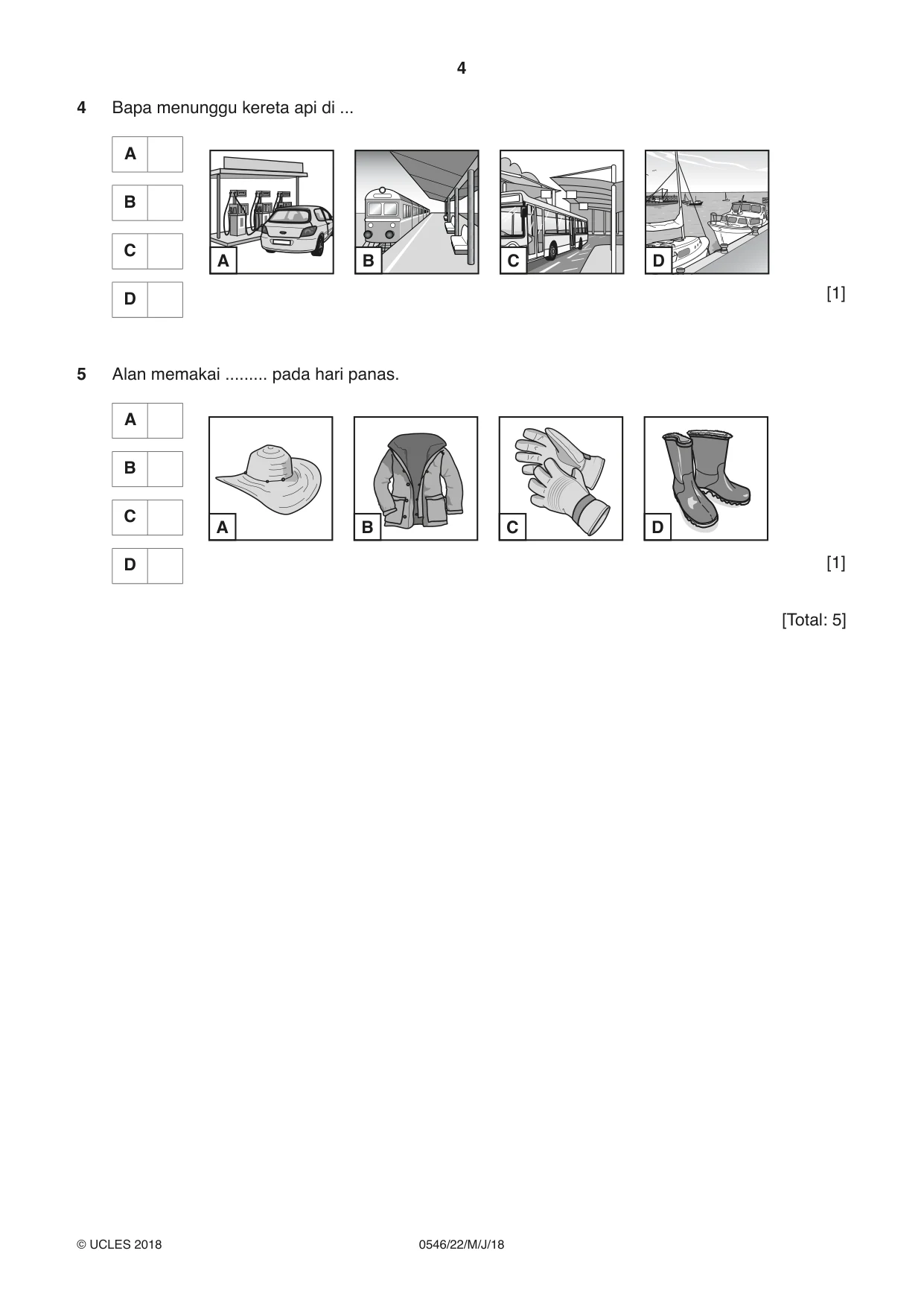
4 0546/22/M/J/18 © UCLES 2018 4 Bapa menunggu kereta api di ... A A B C D [1] B C D 5 Alan memakai … pada hari panas. A A B C D [1] B C D [Total: 5]
Question paper, page 5
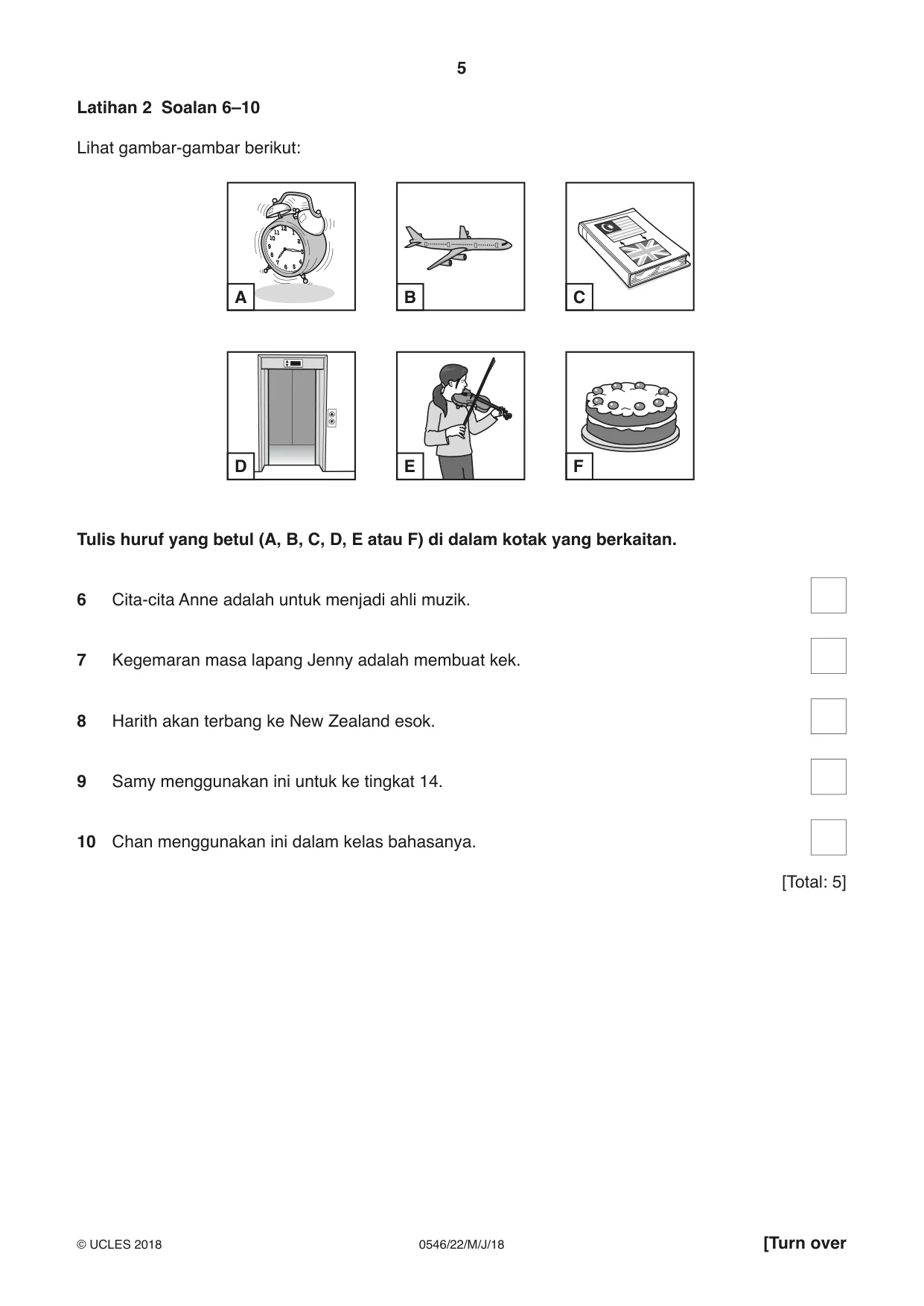
5 0546/22/M/J/18 © UCLES 2018 [Turn over Latihan 2 Soalan 6–10 Lihat gambar-gambar berikut: A B C D E F Tulis huruf yang betul (A, B, C, D, E atau F) di dalam kotak yang berkaitan. 6 Cita-cita Anne adalah untuk menjadi ahli muzik. 7 Kegemaran masa lapang Jenny adalah membuat kek. 8 Harith akan terbang ke New Zealand esok. 9 Samy menggunakan ini untuk ke tingkat 14. 10 Chan menggunakan ini dalam kelas bahasanya. [Total: 5]
Question paper, page 6
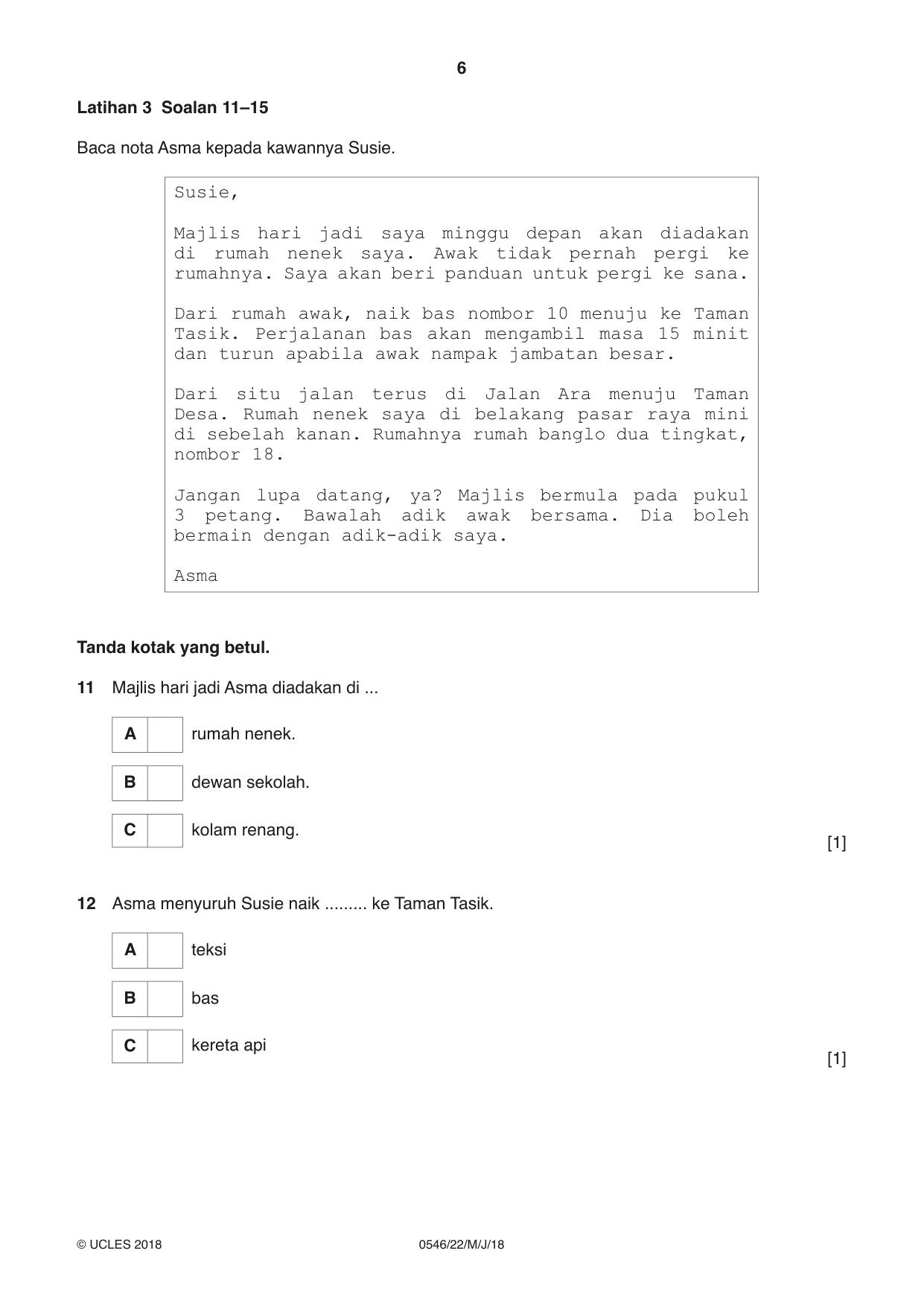
6 0546/22/M/J/18 © UCLES 2018 Latihan 3 Soalan 11–15 Baca nota Asma kepada kawannya Susie. Susie, Majlis hari jadi saya minggu depan akan diadakan di rumah nenek saya. Awak tidak pernah pergi ke rumahnya. Saya akan beri panduan untuk pergi ke sana. Dari rumah awak, naik bas nombor 10 menuju ke Taman Tasik. Perjalanan bas akan mengambil masa 15 minit dan turun apabila awak nampak jambatan besar. Dari situ jalan terus di Jalan Ara menuju Taman Desa. Rumah nenek saya di belakang pasar raya mini di sebelah kanan. Rumahnya rumah banglo dua tingkat, nombor 18. Jangan lupa datang, ya? Majlis bermula pada pukul 3 petang. Bawalah adik awak bersama. Dia boleh bermain dengan adik-adik saya. Asma Tanda kotak yang betul. 11 Majlis hari jadi Asma diadakan di ... A rumah nenek. B dewan sekolah. C kolam renang. [1] 12 Asma menyuruh Susie naik … ke Taman Tasik. A teksi B bas C kereta api [1]
Question paper, page 7
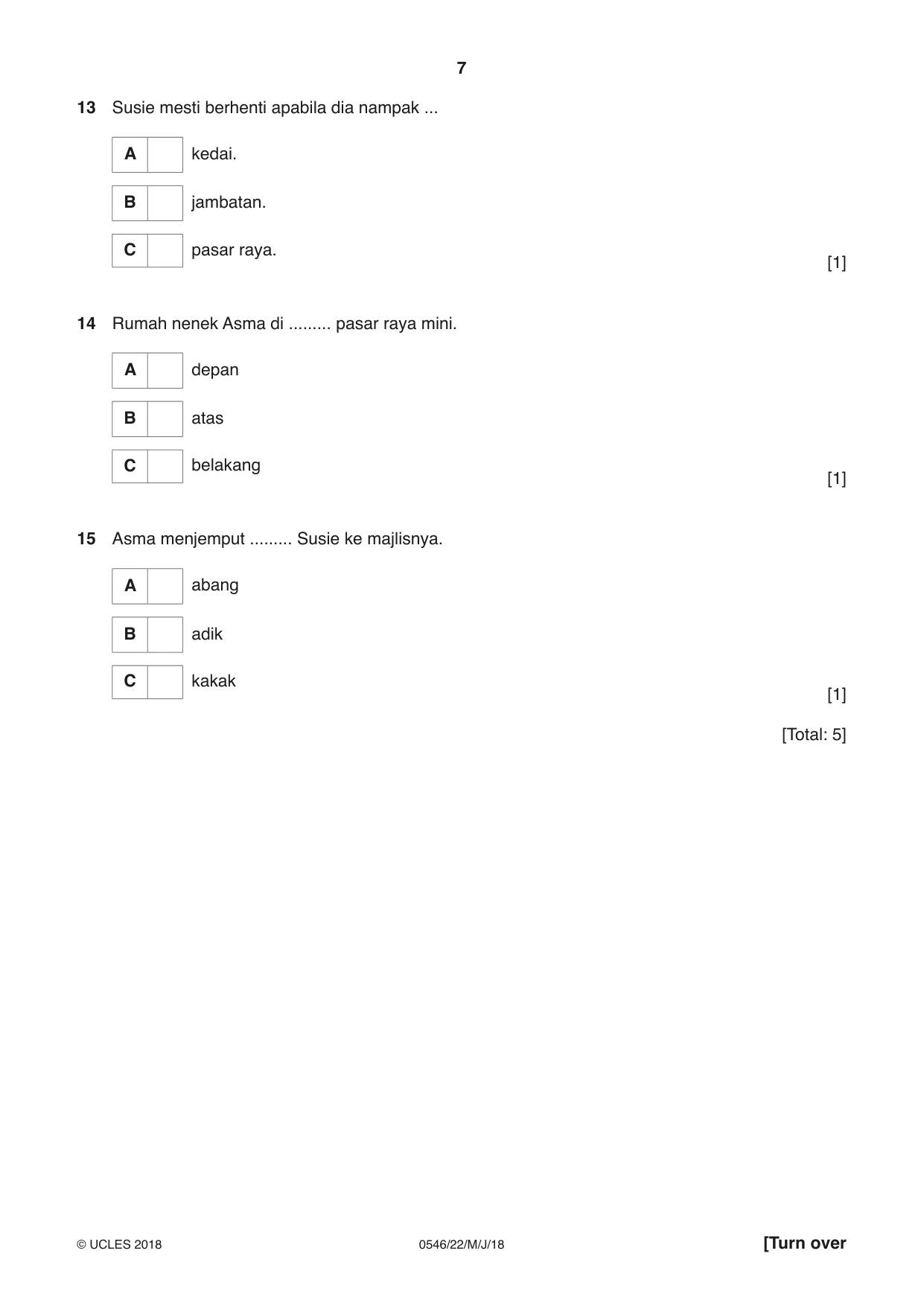
7 0546/22/M/J/18 © UCLES 2018 [Turn over 13 Susie mesti berhenti apabila dia nampak ... A kedai. B jambatan. C pasar raya. [1] 14 Rumah nenek Asma di … pasar raya mini. A depan B atas C belakang [1] 15 Asma menjemput … Susie ke majlisnya. A abang B adik C kakak [1] [Total: 5]
Question paper, page 8
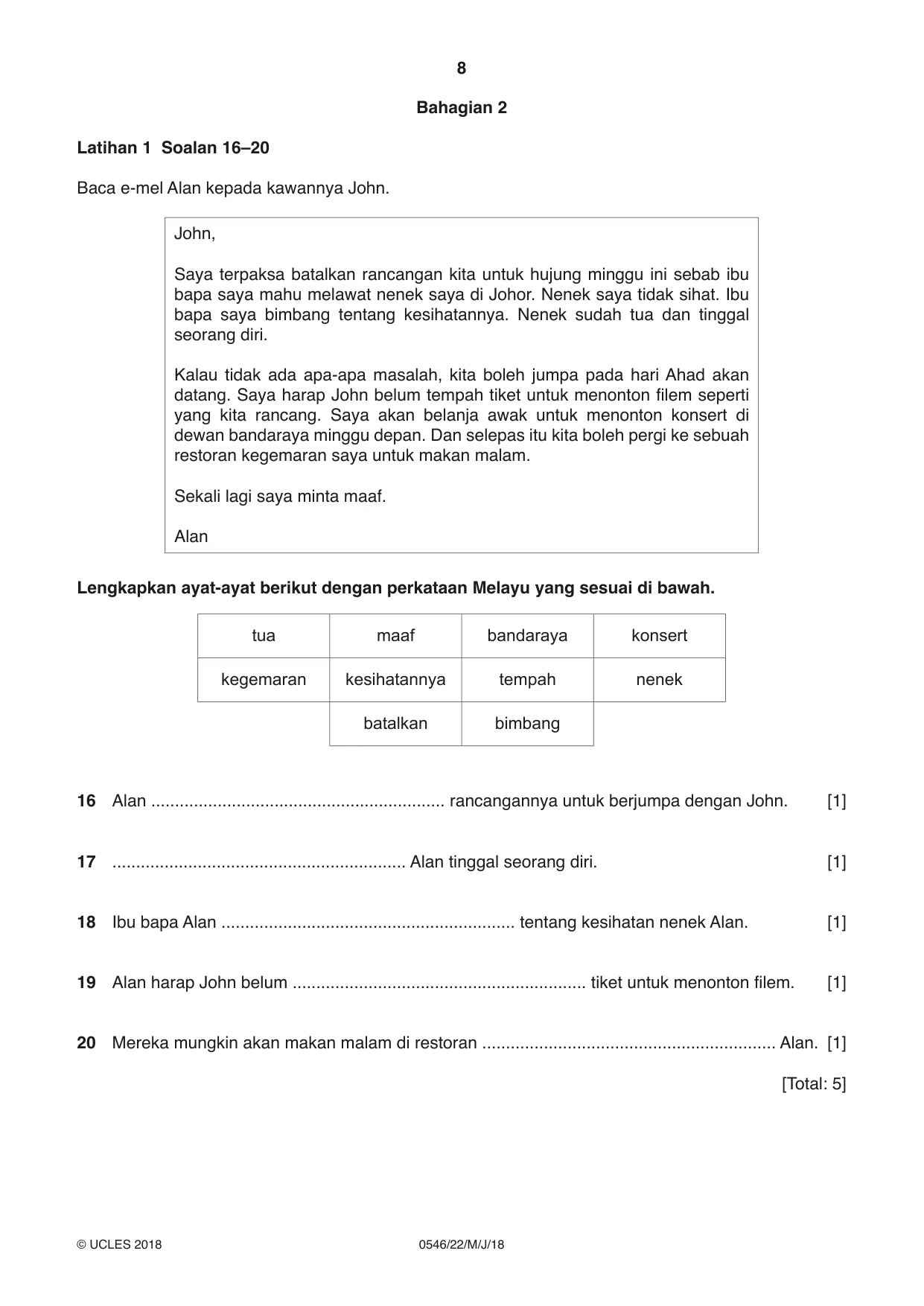
8 0546/22/M/J/18 © UCLES 2018 Bahagian 2 Latihan 1 Soalan 16–20 Baca e-mel Alan kepada kawannya John. John, Saya terpaksa batalkan rancangan kita untuk hujung minggu ini sebab ibu bapa saya mahu melawat nenek saya di Johor. Nenek saya tidak sihat. Ibu bapa saya bimbang tentang kesihatannya. Nenek sudah tua dan tinggal seorang diri. Kalau tidak ada apa-apa masalah, kita boleh jumpa pada hari Ahad akan datang. Saya harap John belum tempah tiket untuk menonton filem seperti yang kita rancang. Saya akan belanja awak untuk menonton konsert di dewan bandaraya minggu depan. Dan selepas itu kita boleh pergi ke sebuah restoran kegemaran saya untuk makan malam. Sekali lagi saya minta maaf. Alan Lengkapkan ayat-ayat berikut dengan perkataan Melayu yang sesuai di bawah. tua maaf bandaraya konsert kegemaran kesihatannya tempah nenek batalkan bimbang 16 Alan … rancangannya untuk berjumpa dengan John. [1] 17 … Alan tinggal seorang diri. [1] 18 Ibu bapa Alan … tentang kesihatan nenek Alan. [1] 19 Alan harap John belum … tiket untuk menonton filem. [1] 20 Mereka mungkin akan makan malam di restoran … Alan. [1] [Total: 5]
Question paper, page 9
9 0546/22/M/J/18 © UCLES 2018 [Turn over Sila buka halaman untuk Latihan 2.
Question paper, page 10
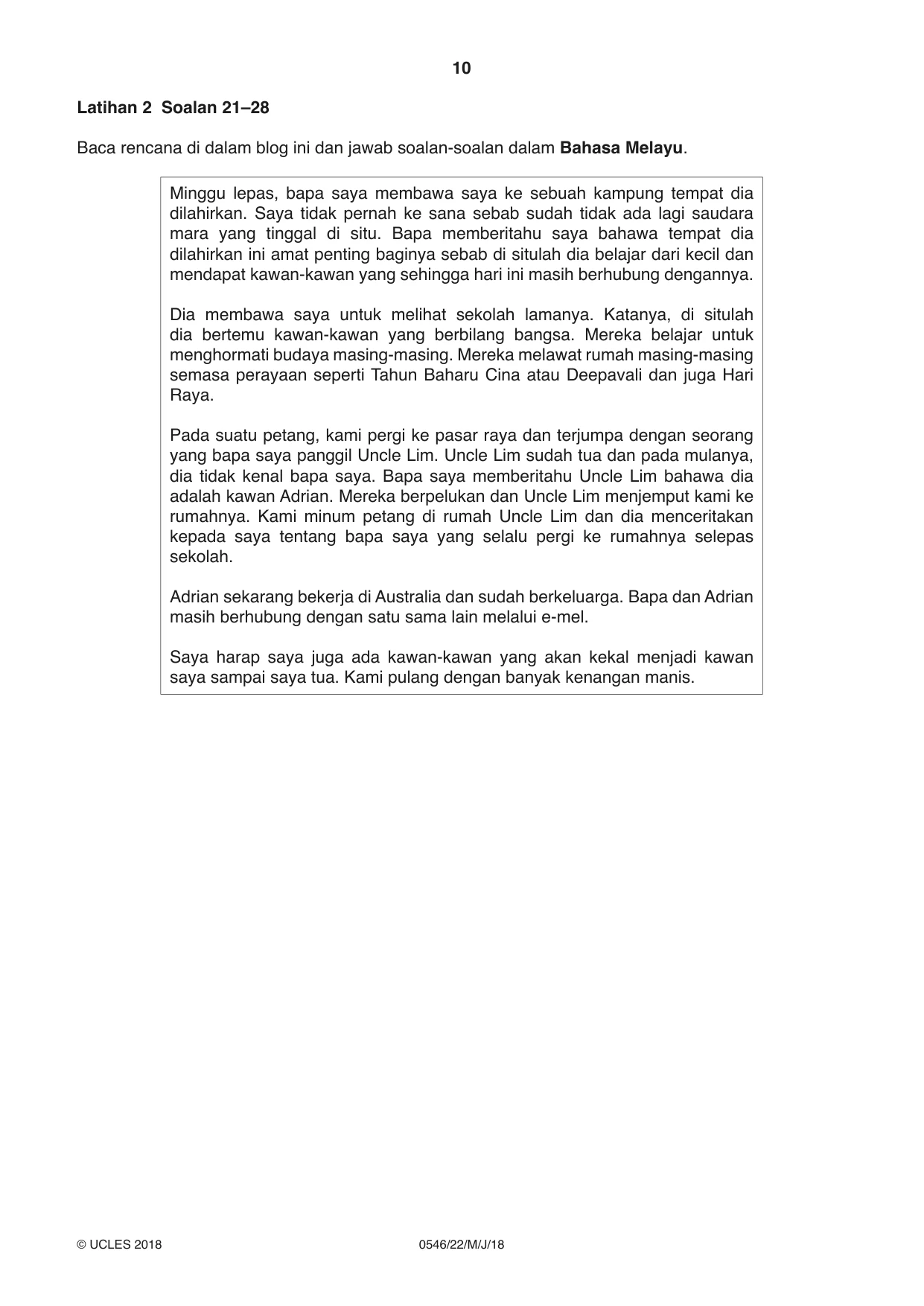
10 0546/22/M/J/18 © UCLES 2018 Latihan 2 Soalan 21–28 Baca rencana di dalam blog ini dan jawab soalan-soalan dalam Bahasa Melayu. Minggu lepas, bapa saya membawa saya ke sebuah kampung tempat dia dilahirkan. Saya tidak pernah ke sana sebab sudah tidak ada lagi saudara mara yang tinggal di situ. Bapa memberitahu saya bahawa tempat dia dilahirkan ini amat penting baginya sebab di situlah dia belajar dari kecil dan mendapat kawan-kawan yang sehingga hari ini masih berhubung dengannya. Dia membawa saya untuk melihat sekolah lamanya. Katanya, di situlah dia bertemu kawan-kawan yang berbilang bangsa. Mereka belajar untuk menghormati budaya masing-masing. Mereka melawat rumah masing-masing semasa perayaan seperti Tahun Baharu Cina atau Deepavali dan juga Hari Raya. Pada suatu petang, kami pergi ke pasar raya dan terjumpa dengan seorang yang bapa saya panggil Uncle Lim. Uncle Lim sudah tua dan pada mulanya, dia tidak kenal bapa saya. Bapa saya memberitahu Uncle Lim bahawa dia adalah kawan Adrian. Mereka berpelukan dan Uncle Lim menjemput kami ke rumahnya. Kami minum petang di rumah Uncle Lim dan dia menceritakan kepada saya tentang bapa saya yang selalu pergi ke rumahnya selepas sekolah. Adrian sekarang bekerja di Australia dan sudah berkeluarga. Bapa dan Adrian masih berhubung dengan satu sama lain melalui e-mel. Saya harap saya juga ada kawan-kawan yang akan kekal menjadi kawan saya sampai saya tua. Kami pulang dengan banyak kenangan manis.
Question paper, page 11
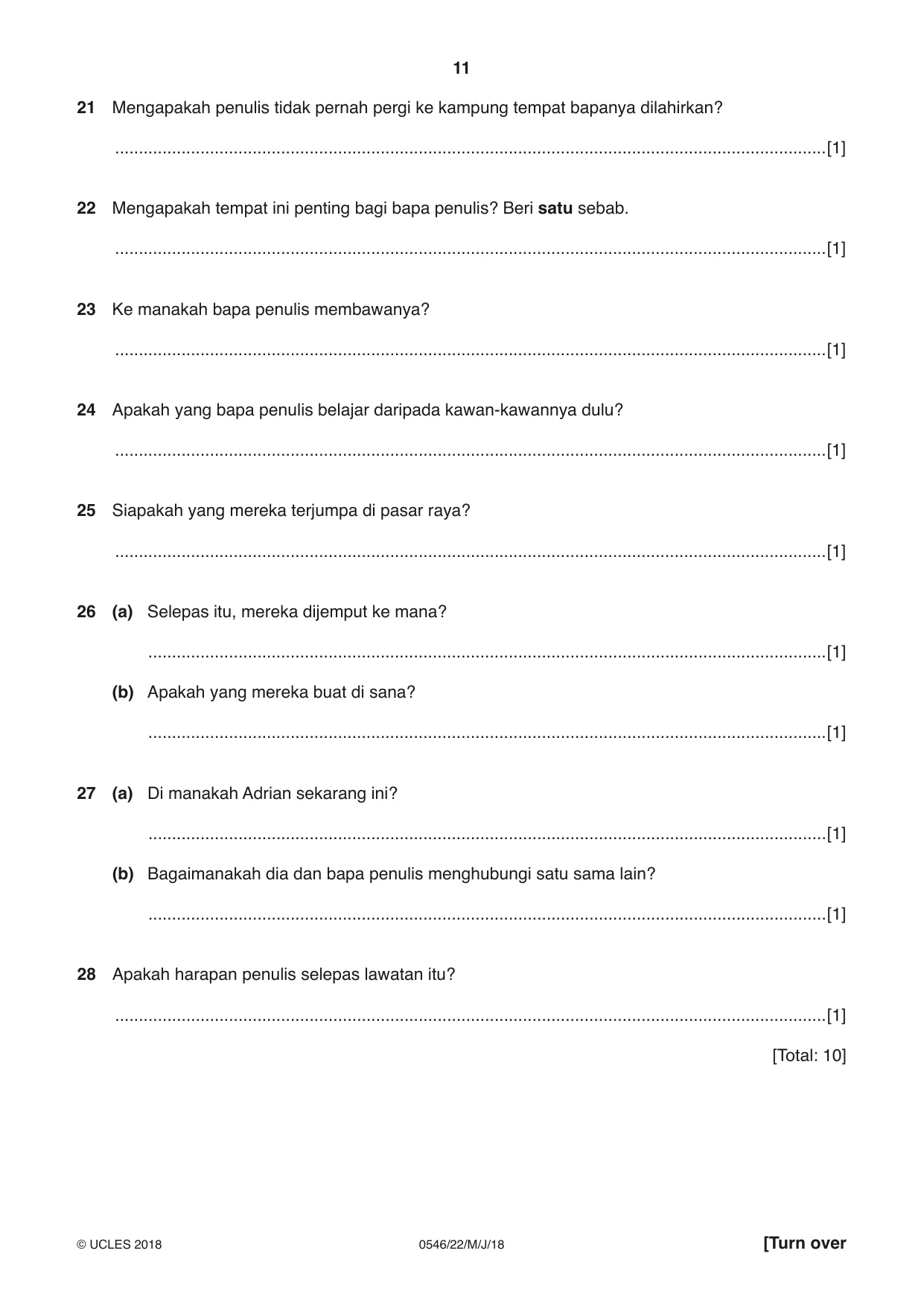
11 0546/22/M/J/18 © UCLES 2018 [Turn over 21 Mengapakah penulis tidak pernah pergi ke kampung tempat bapanya dilahirkan? …[1] 22 Mengapakah tempat ini penting bagi bapa penulis? Beri satu sebab. …[1] 23 Ke manakah bapa penulis membawanya? …[1] 24 Apakah yang bapa penulis belajar daripada kawan-kawannya dulu? …[1] 25 Siapakah yang mereka terjumpa di pasar raya? …[1] 26 (a) Selepas itu, mereka dijemput ke mana? …[1] (b) Apakah yang mereka buat di sana? …[1] 27 (a) Di manakah Adrian sekarang ini? …[1] (b) Bagaimanakah dia dan bapa penulis menghubungi satu sama lain? …[1] 28 Apakah harapan penulis selepas lawatan itu? …[1] [Total: 10]
Question paper, page 12
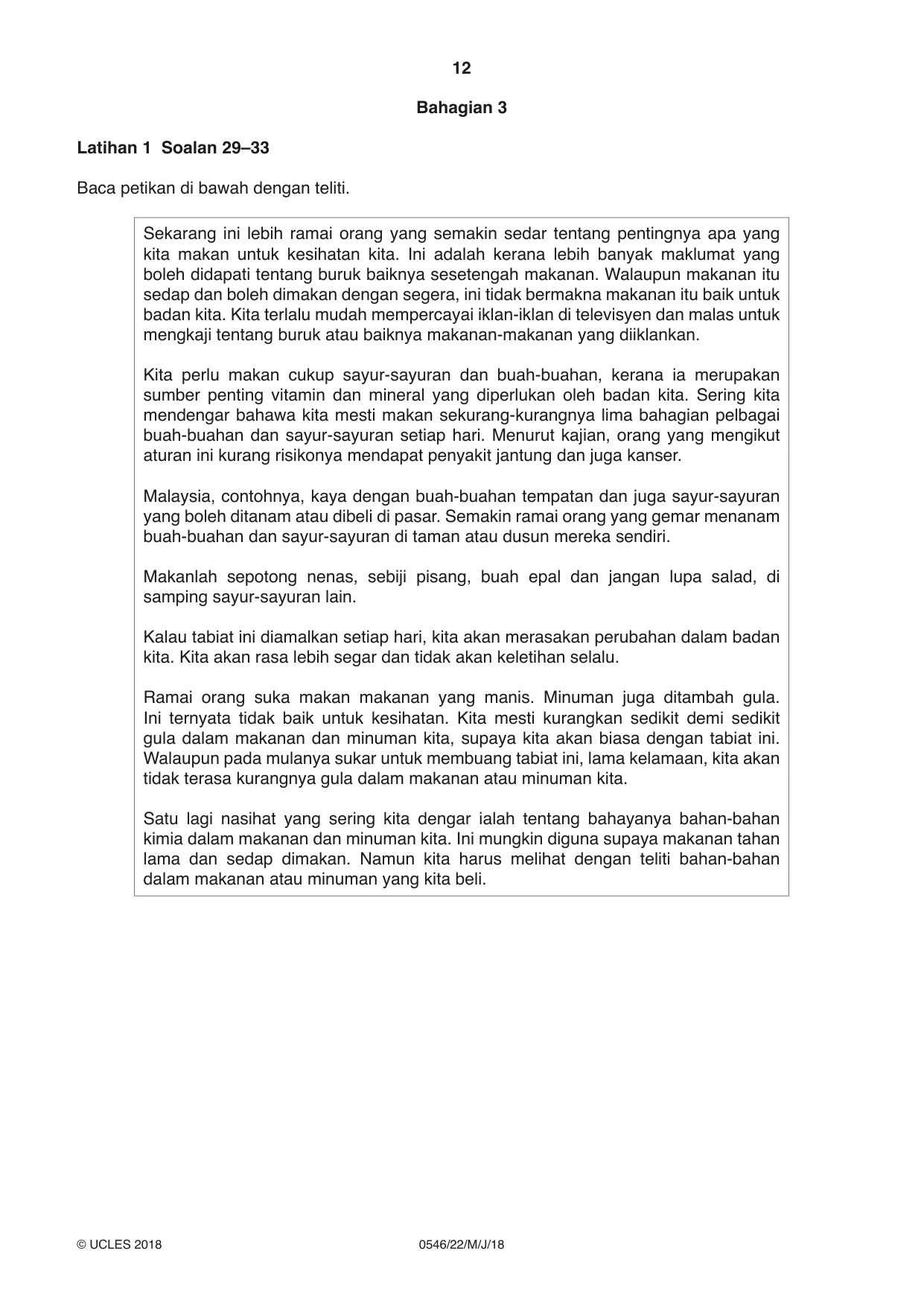
12 0546/22/M/J/18 © UCLES 2018 Bahagian 3 Latihan 1 Soalan 29–33 Baca petikan di bawah dengan teliti. Sekarang ini lebih ramai orang yang semakin sedar tentang pentingnya apa yang kita makan untuk kesihatan kita. Ini adalah kerana lebih banyak maklumat yang boleh didapati tentang buruk baiknya sesetengah makanan. Walaupun makanan itu sedap dan boleh dimakan dengan segera, ini tidak bermakna makanan itu baik untuk badan kita. Kita terlalu mudah mempercayai iklan-iklan di televisyen dan malas untuk mengkaji tentang buruk atau baiknya makanan-makanan yang diiklankan. Kita perlu makan cukup sayur-sayuran dan buah-buahan, kerana ia merupakan sumber penting vitamin dan mineral yang diperlukan oleh badan kita. Sering kita mendengar bahawa kita mesti makan sekurang-kurangnya lima bahagian pelbagai buah-buahan dan sayur-sayuran setiap hari. Menurut kajian, orang yang mengikut aturan ini kurang risikonya mendapat penyakit jantung dan juga kanser. Malaysia, contohnya, kaya dengan buah-buahan tempatan dan juga sayur-sayuran yang boleh ditanam atau dibeli di pasar. Semakin ramai orang yang gemar menanam buah-buahan dan sayur-sayuran di taman atau dusun mereka sendiri. Makanlah sepotong nenas, sebiji pisang, buah epal dan jangan lupa salad, di samping sayur-sayuran lain. Kalau tabiat ini diamalkan setiap hari, kita akan merasakan perubahan dalam badan kita. Kita akan rasa lebih segar dan tidak akan keletihan selalu. Ramai orang suka makan makanan yang manis. Minuman juga ditambah gula. Ini ternyata tidak baik untuk kesihatan. Kita mesti kurangkan sedikit demi sedikit gula dalam makanan dan minuman kita, supaya kita akan biasa dengan tabiat ini. Walaupun pada mulanya sukar untuk membuang tabiat ini, lama kelamaan, kita akan tidak terasa kurangnya gula dalam makanan atau minuman kita. Satu lagi nasihat yang sering kita dengar ialah tentang bahayanya bahan-bahan kimia dalam makanan dan minuman kita. Ini mungkin diguna supaya makanan tahan lama dan sedap dimakan. Namun kita harus melihat dengan teliti bahan-bahan dalam makanan atau minuman yang kita beli.
Question paper, page 13
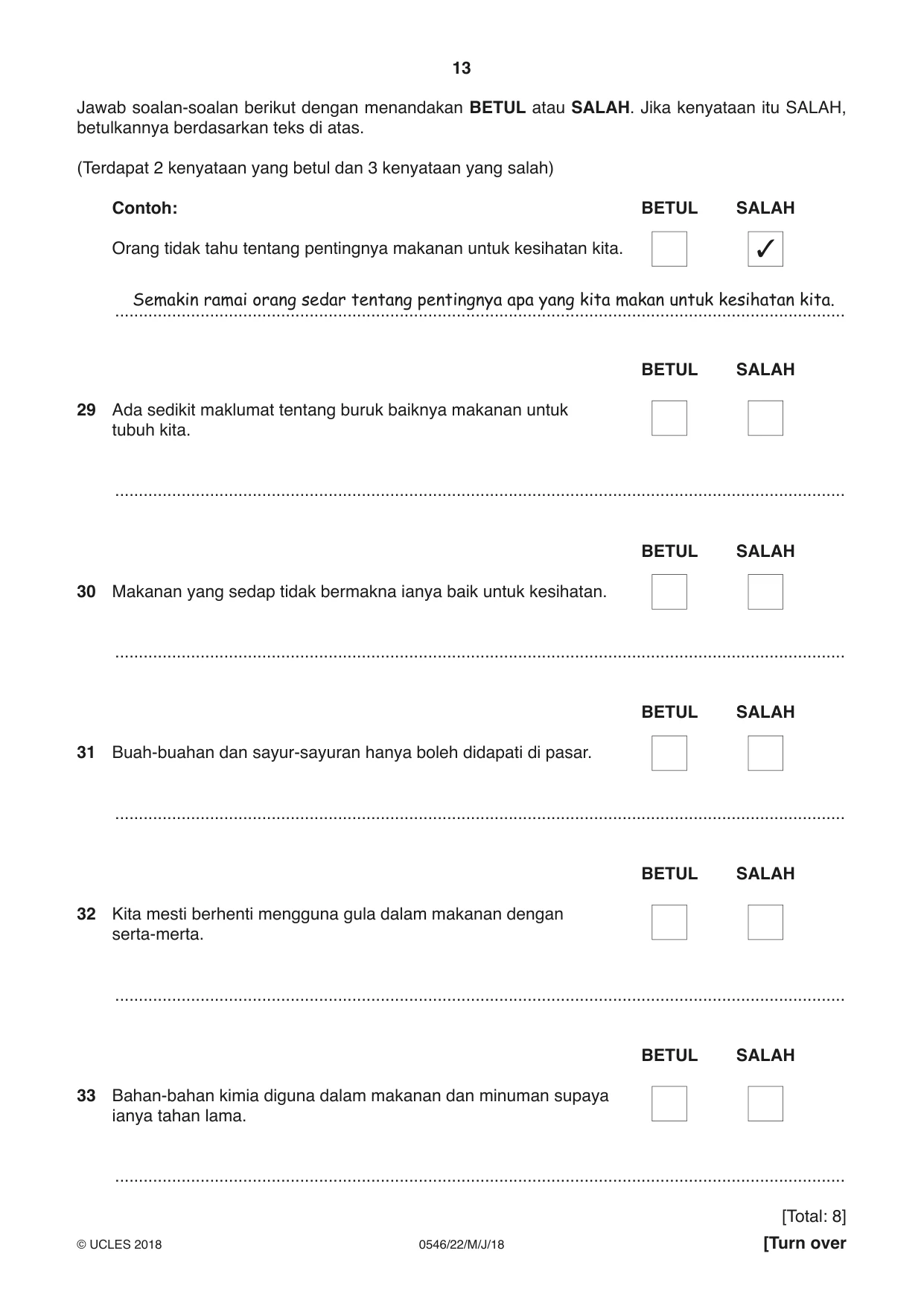
13 0546/22/M/J/18 © UCLES 2018 [Turn over Jawab soalan-soalan berikut dengan menandakan BETUL atau SALAH. Jika kenyataan itu SALAH, betulkannya berdasarkan teks di atas. (Terdapat 2 kenyataan yang betul dan 3 kenyataan yang salah) Contoh: BETUL SALAH Orang tidak tahu tentang pentingnya makanan untuk kesihatan kita. 3 Semakin ramai orang sedar tentang pentingnya apa yang kita makan untuk kesihatan kita. … BETUL SALAH 29 Ada sedikit maklumat tentang buruk baiknya makanan untuk tubuh kita. … BETUL SALAH 30 Makanan yang sedap tidak bermakna ianya baik untuk kesihatan. … BETUL SALAH 31 Buah-buahan dan sayur-sayuran hanya boleh didapati di pasar. … BETUL SALAH 32 Kita mesti berhenti mengguna gula dalam makanan dengan serta-merta. … BETUL SALAH 33 Bahan-bahan kimia diguna dalam makanan dan minuman supaya ianya tahan lama. … [Total: 8]
Question paper, page 14
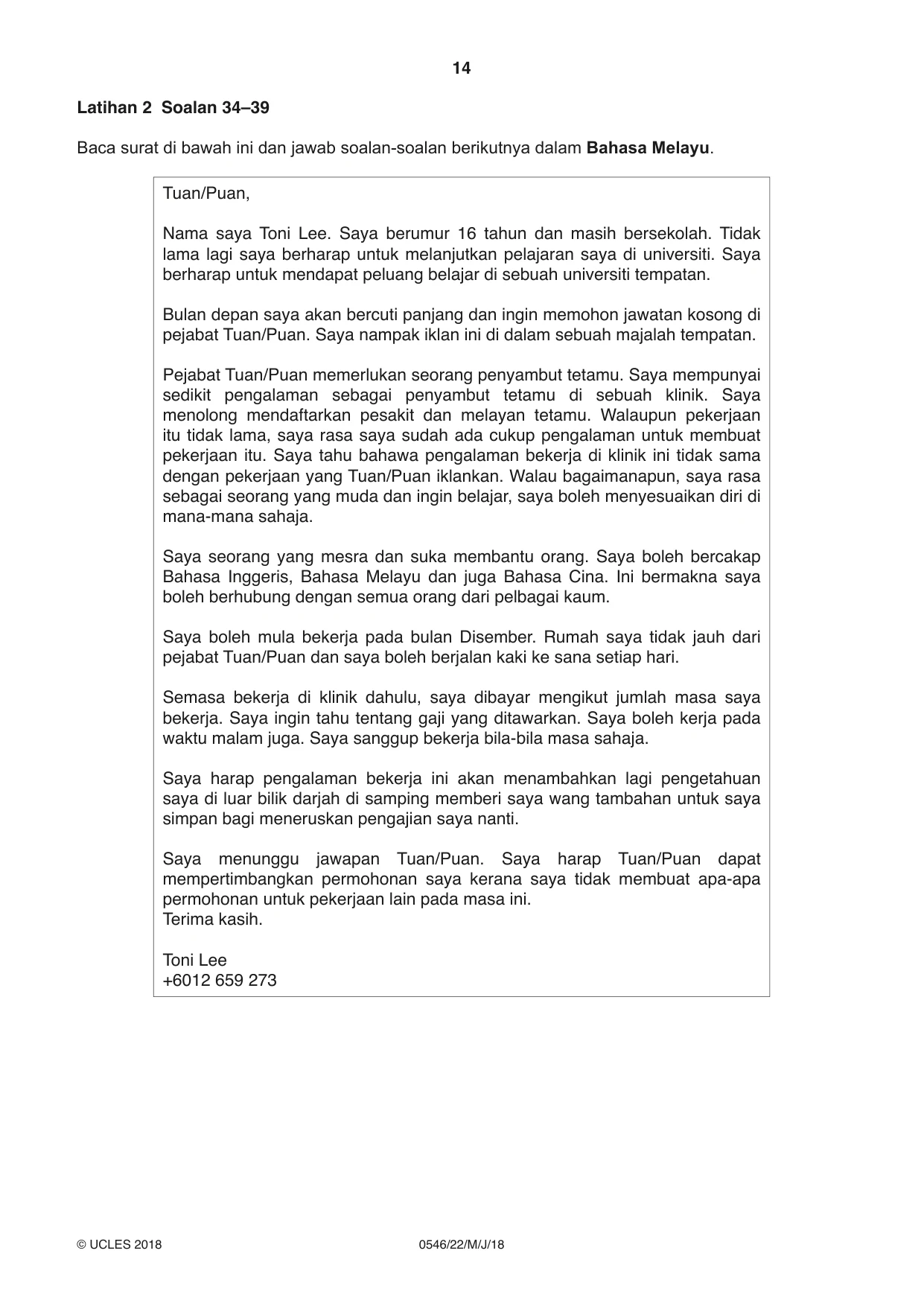
14 0546/22/M/J/18 © UCLES 2018 Latihan 2 Soalan 34–39 Baca surat di bawah ini dan jawab soalan-soalan berikutnya dalam Bahasa Melayu. Tuan/Puan, Nama saya Toni Lee. Saya berumur 16 tahun dan masih bersekolah. Tidak lama lagi saya berharap untuk melanjutkan pelajaran saya di universiti. Saya berharap untuk mendapat peluang belajar di sebuah universiti tempatan. Bulan depan saya akan bercuti panjang dan ingin memohon jawatan kosong di pejabat Tuan/Puan. Saya nampak iklan ini di dalam sebuah majalah tempatan. Pejabat Tuan/Puan memerlukan seorang penyambut tetamu. Saya mempunyai sedikit pengalaman sebagai penyambut tetamu di sebuah klinik. Saya menolong mendaftarkan pesakit dan melayan tetamu. Walaupun pekerjaan itu tidak lama, saya rasa saya sudah ada cukup pengalaman untuk membuat pekerjaan itu. Saya tahu bahawa pengalaman bekerja di klinik ini tidak sama dengan pekerjaan yang Tuan/Puan iklankan. Walau bagaimanapun, saya rasa sebagai seorang yang muda dan ingin belajar, saya boleh menyesuaikan diri di mana-mana sahaja. Saya seorang yang mesra dan suka membantu orang. Saya boleh bercakap Bahasa Inggeris, Bahasa Melayu dan juga Bahasa Cina. Ini bermakna saya boleh berhubung dengan semua orang dari pelbagai kaum. Saya boleh mula bekerja pada bulan Disember. Rumah saya tidak jauh dari pejabat Tuan/Puan dan saya boleh berjalan kaki ke sana setiap hari. Semasa bekerja di klinik dahulu, saya dibayar mengikut jumlah masa saya bekerja. Saya ingin tahu tentang gaji yang ditawarkan. Saya boleh kerja pada waktu malam juga. Saya sanggup bekerja bila-bila masa sahaja. Saya harap pengalaman bekerja ini akan menambahkan lagi pengetahuan saya di luar bilik darjah di samping memberi saya wang tambahan untuk saya simpan bagi meneruskan pengajian saya nanti. Saya menunggu jawapan Tuan/Puan. Saya harap Tuan/Puan dapat mempertimbangkan permohonan saya kerana saya tidak membuat apa-apa permohonan untuk pekerjaan lain pada masa ini. Terima kasih. Toni Lee +6012 659 273
Question paper, page 15
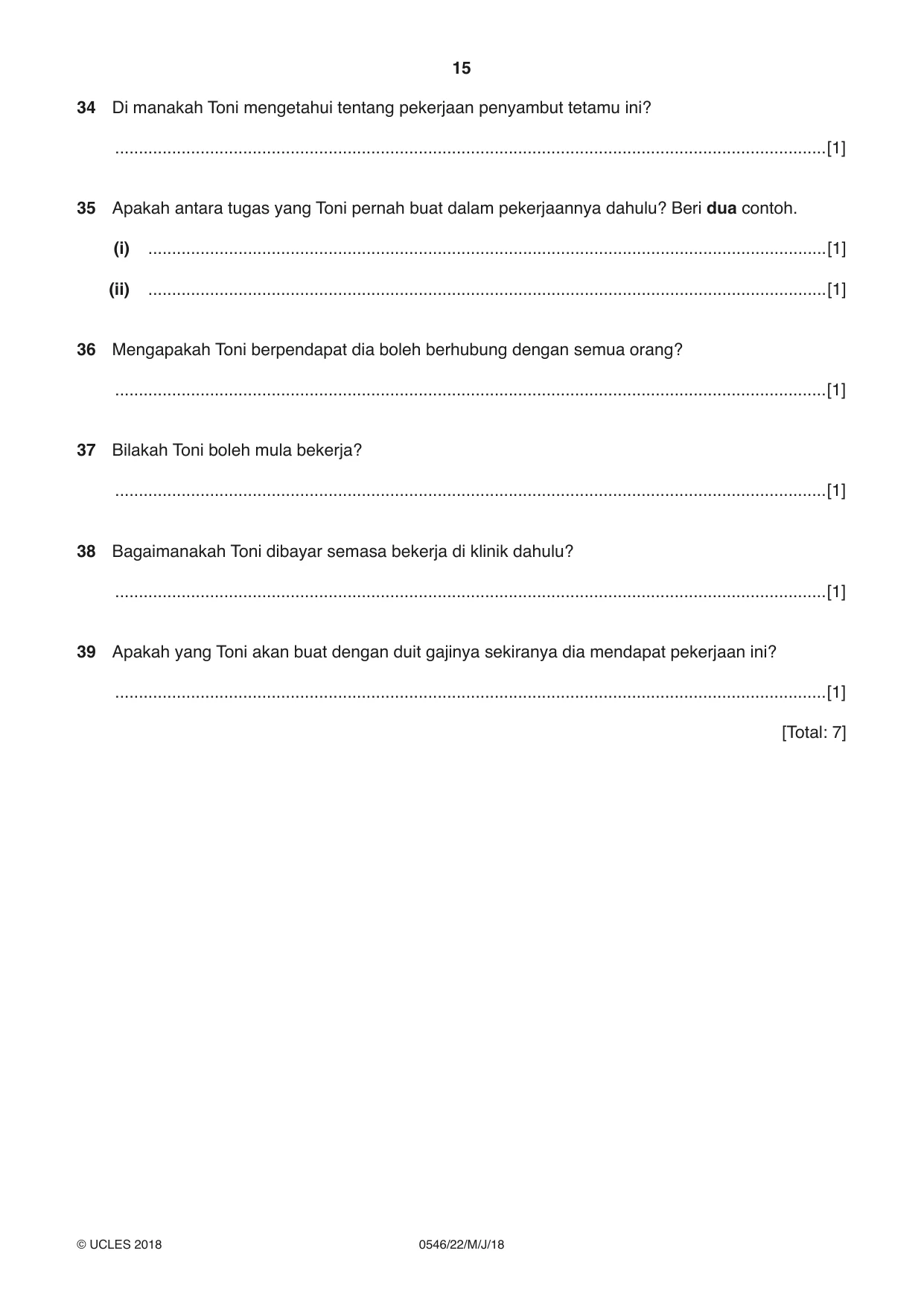
15 0546/22/M/J/18 © UCLES 2018 34 Di manakah Toni mengetahui tentang pekerjaan penyambut tetamu ini? …[1] 35 Apakah antara tugas yang Toni pernah buat dalam pekerjaannya dahulu? Beri dua contoh. (i) …[1] (ii) …[1] 36 Mengapakah Toni berpendapat dia boleh berhubung dengan semua orang? …[1] 37 Bilakah Toni boleh mula bekerja? …[1] 38 Bagaimanakah Toni dibayar semasa bekerja di klinik dahulu? …[1] 39 Apakah yang Toni akan buat dengan duit gajinya sekiranya dia mendapat pekerjaan ini? …[1] [Total: 7]
Question paper, page 16
16 0546/22/M/J/18 © UCLES 2018 Permission to reproduce items where third-party owned material protected by copyright is included has been sought and cleared where possible. Every reasonable effort has been made by the publisher (UCLES) to trace copyright holders, but if any items requiring clearance have unwittingly been included, the publisher will be pleased to make amends at the earliest possible opportunity. To avoid the issue of disclosure of answer-related information to candidates, all copyright acknowledgements are reproduced online in the Cambridge International Examinations Copyright Acknowledgements Booklet. This is produced for each series of examinations and is freely available to download at www.cie.org.uk after the live examination series. Cambridge International Examinations is part of the Cambridge Assessment Group. Cambridge Assessment is the brand name of University of Cambridge Local Examinations Syndicate (UCLES), which is itself a department of the University of Cambridge. BLANK PAGE
Mark scheme, page 1
IGCSE™ is a registered trademark. This document consists of 14 printed pages. © UCLES 2018 [Turn over Cambridge Assessment International Education Cambridge International General Certificate of Secondary Education MALAY 0546/22 Paper 2 Reading May/June 2018 MARK SCHEME Maximum Mark: 45 Published This mark scheme is published as an aid to teachers and candidates, to indicate the requirements of the examination. It shows the basis on which Examiners were instructed to award marks. It does not indicate the details of the discussions that took place at an Examiners’ meeting before marking began, which would have considered the acceptability of alternative answers. Mark schemes should be read in conjunction with the question paper and the Principal Examiner Report for Teachers. Cambridge International will not enter into discussions about these mark schemes. Cambridge International is publishing the mark schemes for the May/June 2018 series for most Cambridge IGCSE™, Cambridge International A and AS Level and Cambridge Pre-U components, and some Cambridge O Level components.
Mark scheme, page 2
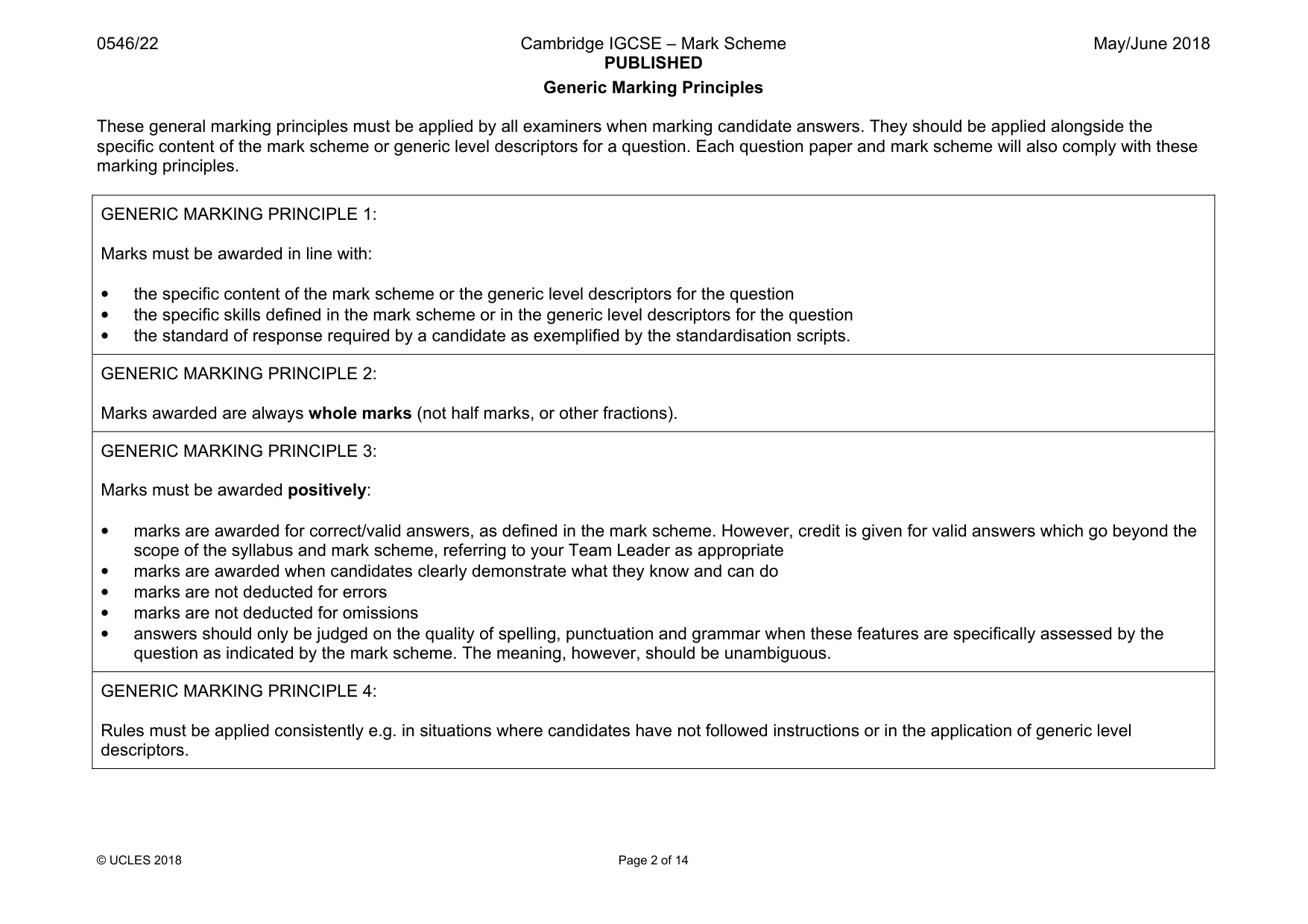
0546/22 Cambridge IGCSE – Mark Scheme PUBLISHED May/June 2018 © UCLES 2018 Page 2 of 14 Generic Marking Principles These general marking principles must be applied by all examiners when marking candidate answers. They should be applied alongside the specific content of the mark scheme or generic level descriptors for a question. Each question paper and mark scheme will also comply with these marking principles. GENERIC MARKING PRINCIPLE 1: Marks must be awarded in line with: • the specific content of the mark scheme or the generic level descriptors for the question • the specific skills defined in the mark scheme or in the generic level descriptors for the question • the standard of response required by a candidate as exemplified by the standardisation scripts. GENERIC MARKING PRINCIPLE 2: Marks awarded are always whole marks (not half marks, or other fractions). GENERIC MARKING PRINCIPLE 3: Marks must be awarded positively: • marks are awarded for correct/valid answers, as defined in the mark scheme. However, credit is given for valid answers which go beyond the scope of the syllabus and mark scheme, referring to your Team Leader as appropriate • marks are awarded when candidates clearly demonstrate what they know and can do • marks are not deducted for errors • marks are not deducted for omissions • answers should only be judged on the quality of spelling, punctuation and grammar when these features are specifically assessed by the question as indicated by the mark scheme. The meaning, however, should be unambiguous. GENERIC MARKING PRINCIPLE 4: Rules must be applied consistently e.g. in situations where candidates have not followed instructions or in the application of generic level descriptors.
Mark scheme, page 3
0546/22 Cambridge IGCSE – Mark Scheme PUBLISHED May/June 2018 © UCLES 2018 Page 3 of 14 GENERIC MARKING PRINCIPLE 5: Marks should be awarded using the full range of marks defined in the mark scheme for the question (however; the use of the full mark range may be limited according to the quality of the candidate responses seen). GENERIC MARKING PRINCIPLE 6: Marks awarded are based solely on the requirements as defined in the mark scheme. Marks should not be awarded with grade thresholds or grade descriptors in mind.
Mark scheme, page 4
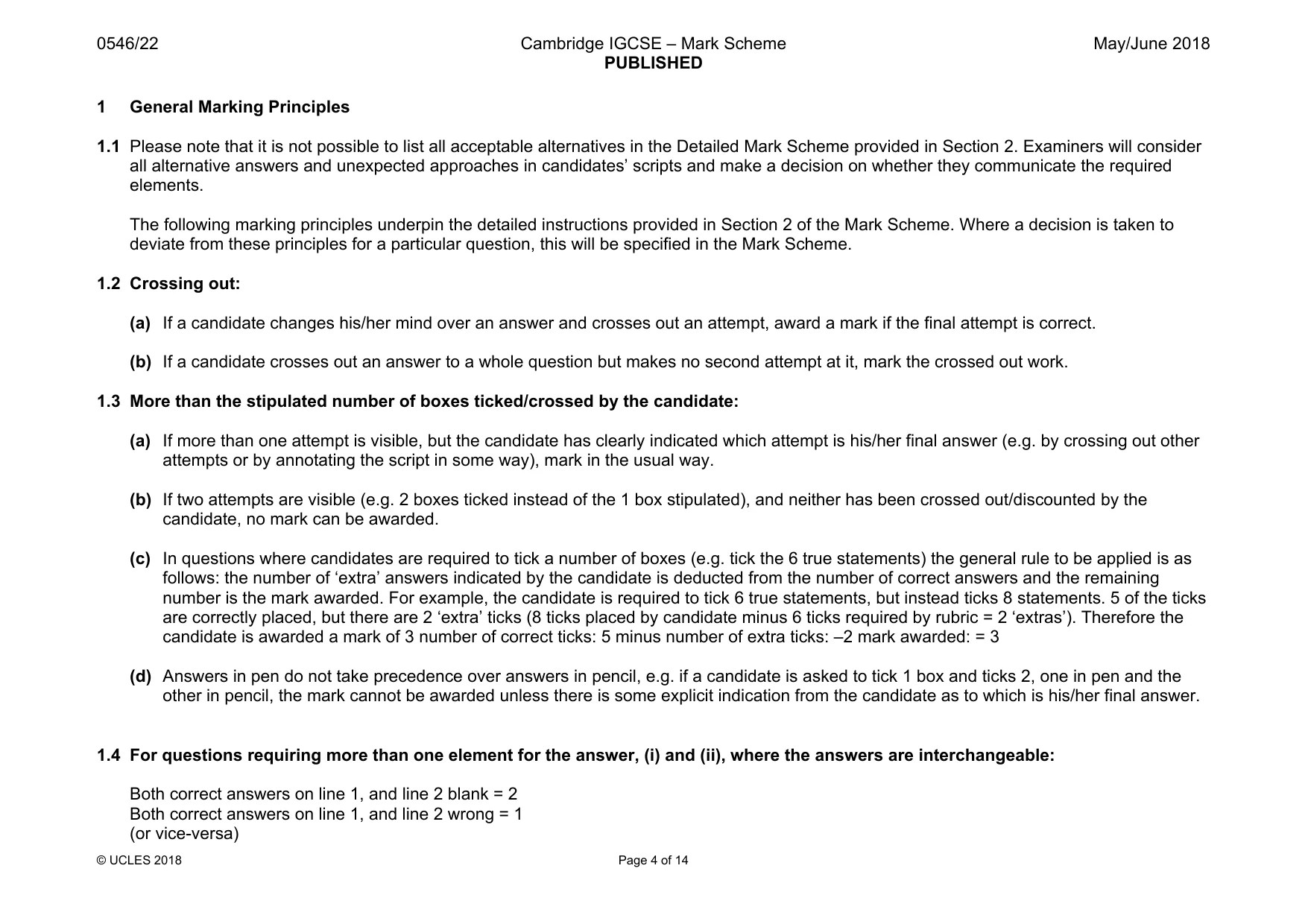
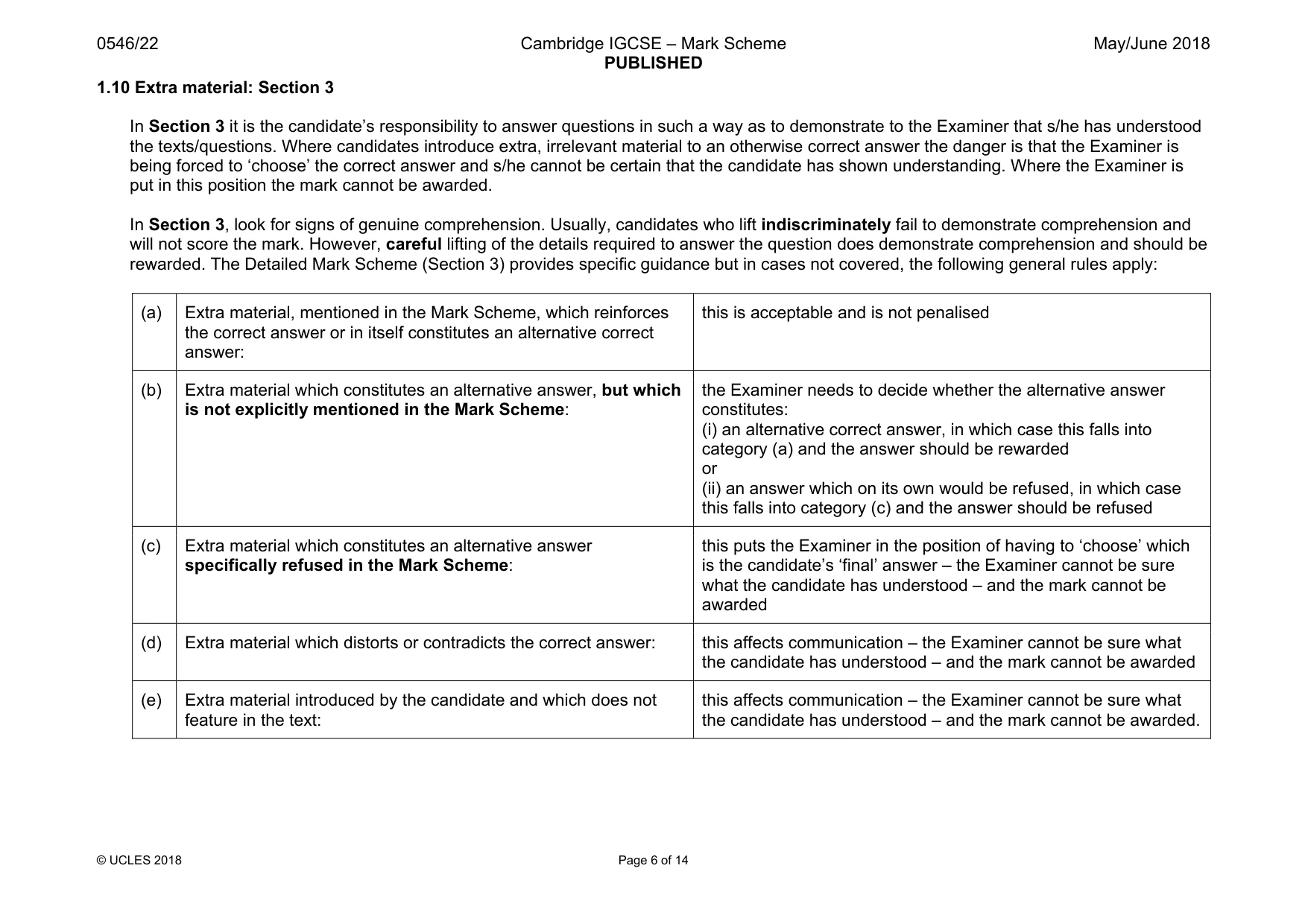
0546/22 Cambridge IGCSE – Mark Scheme PUBLISHED May/June 2018 © UCLES 2018 Page 4 of 14 1 General Marking Principles 1.1 Please note that it is not possible to list all acceptable alternatives in the Detailed Mark Scheme provided in Section 2. Examiners will consider all alternative answers and unexpected approaches in candidates’ scripts and make a decision on whether they communicate the required elements. The following marking principles underpin the detailed instructions provided in Section 2 of the Mark Scheme. Where a decision is taken to deviate from these principles for a particular question, this will be specified in the Mark Scheme. 1.2 Crossing out: (a) If a candidate changes his/her mind over an answer and crosses out an attempt, award a mark if the final attempt is correct. (b) If a candidate crosses out an answer to a whole question but makes no second attempt at it, mark the crossed out work. 1.3 More than the stipulated number of boxes ticked/crossed by the candidate: (a) If more than one attempt is visible, but the candidate has clearly indicated which attempt is his/her final answer (e.g. by crossing out other attempts or by annotating the script in some way), mark in the usual way. (b) If two attempts are visible (e.g. 2 boxes ticked instead of the 1 box stipulated), and neither has been crossed out/discounted by the candidate, no mark can be awarded. (c) In questions where candidates are required to tick a number of boxes (e.g. tick the 6 true statements) the general rule to be applied is as follows: the number of ‘extra’ answers indicated by the candidate is deducted from the number of correct answers and the remaining number is the mark awarded. For example, the candidate is required to tick 6 true statements, but instead ticks 8 statements. 5 of the ticks are correctly placed, but there are 2 ‘extra’ ticks (8 ticks placed by candidate minus 6 ticks required by rubric = 2 ‘extras’). Therefore the candidate is awarded a mark of 3 number of correct ticks: 5 minus number of extra ticks: –2 mark awarded: = 3 (d) Answers in pen do not take precedence over answers in pencil, e.g. if a candidate is asked to tick 1 box and ticks 2, one in pen and the other in pencil, the mark cannot be awarded unless there is some explicit indication from the candidate as to which is his/her final answer. 1.4 For questions requiring more than one element for the answer, (i) and (ii), where the answers are interchangeable: Both correct answers on line 1, and line 2 blank = 2 Both correct answers on line 1, and line 2 wrong = 1 (or vice-versa)
Mark scheme, page 5
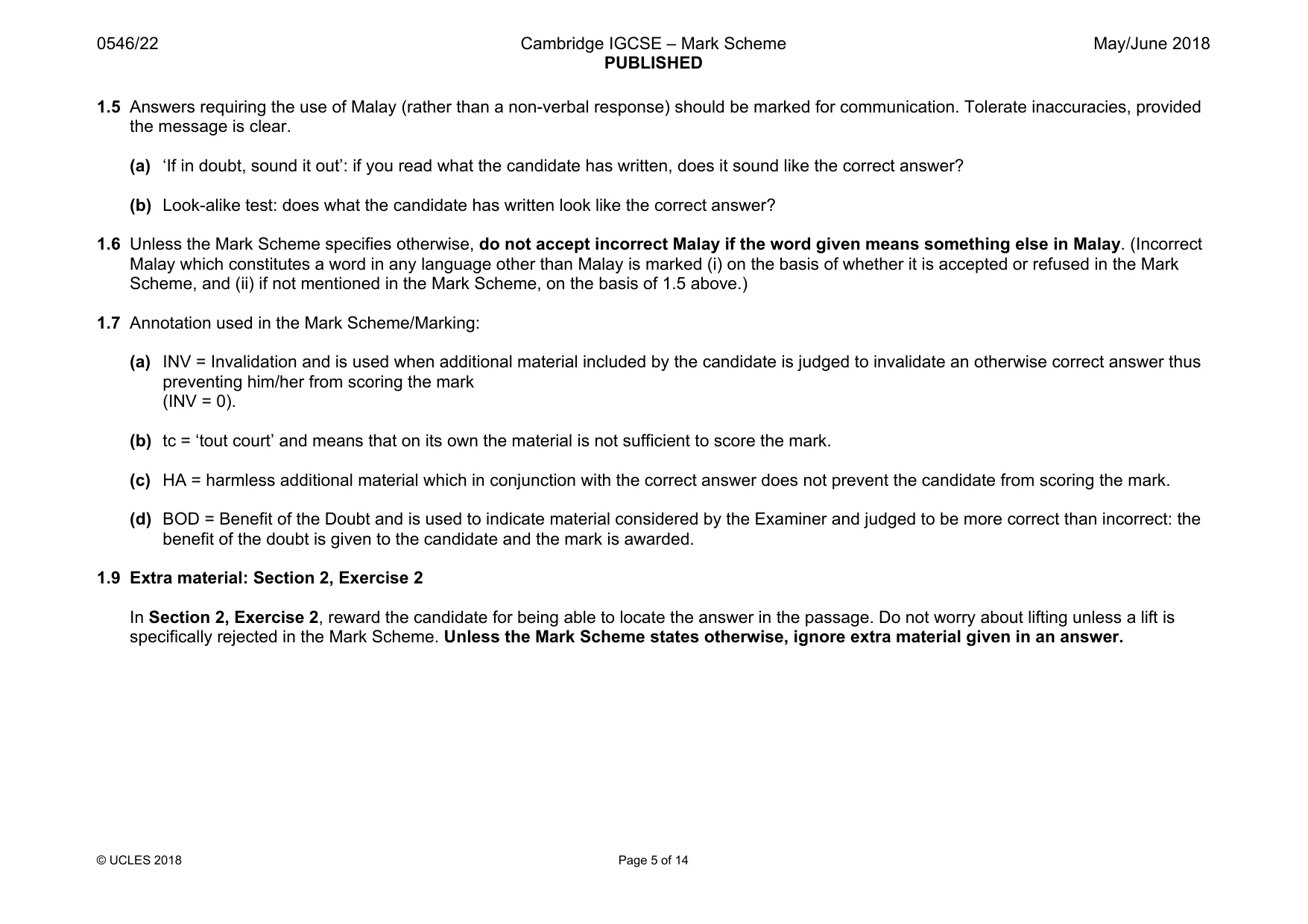
0546/22 Cambridge IGCSE – Mark Scheme PUBLISHED May/June 2018 © UCLES 2018 Page 5 of 14 1.5 Answers requiring the use of Malay (rather than a non-verbal response) should be marked for communication. Tolerate inaccuracies, provided the message is clear. (a) ‘If in doubt, sound it out’: if you read what the candidate has written, does it sound like the correct answer? (b) Look-alike test: does what the candidate has written look like the correct answer? 1.6 Unless the Mark Scheme specifies otherwise, do not accept incorrect Malay if the word given means something else in Malay. (Incorrect Malay which constitutes a word in any language other than Malay is marked (i) on the basis of whether it is accepted or refused in the Mark Scheme, and (ii) if not mentioned in the Mark Scheme, on the basis of 1.5 above.) 1.7 Annotation used in the Mark Scheme/Marking: (a) INV = Invalidation and is used when additional material included by the candidate is judged to invalidate an otherwise correct answer thus preventing him/her from scoring the mark (INV = 0). (b) tc = ‘tout court’ and means that on its own the material is not sufficient to score the mark. (c) HA = harmless additional material which in conjunction with the correct answer does not prevent the candidate from scoring the mark. (d) BOD = Benefit of the Doubt and is used to indicate material considered by the Examiner and judged to be more correct than incorrect: the benefit of the doubt is given to the candidate and the mark is awarded. 1.9 Extra material: Section 2, Exercise 2 In Section 2, Exercise 2, reward the candidate for being able to locate the answer in the passage. Do not worry about lifting unless a lift is specifically rejected in the Mark Scheme. Unless the Mark Scheme states otherwise, ignore extra material given in an answer.
Mark scheme, page 6
0546/22 Cambridge IGCSE – Mark Scheme PUBLISHED May/June 2018 © UCLES 2018 Page 6 of 14 1.10 Extra material: Section 3 In Section 3 it is the candidate’s responsibility to answer questions in such a way as to demonstrate to the Examiner that s/he has understood the texts/questions. Where candidates introduce extra, irrelevant material to an otherwise correct answer the danger is that the Examiner is being forced to ‘choose’ the correct answer and s/he cannot be certain that the candidate has shown understanding. Where the Examiner is put in this position the mark cannot be awarded. In Section 3, look for signs of genuine comprehension. Usually, candidates who lift indiscriminately fail to demonstrate comprehension and will not score the mark. However, careful lifting of the details required to answer the question does demonstrate comprehension and should be rewarded. The Detailed Mark Scheme (Section 3) provides specific guidance but in cases not covered, the following general rules apply: (a) Extra material, mentioned in the Mark Scheme, which reinforces the correct answer or in itself constitutes an alternative correct answer: this is acceptable and is not penalised (b) Extra material which constitutes an alternative answer, but which is not explicitly mentioned in the Mark Scheme: the Examiner needs to decide whether the alternative answer constitutes: (i) an alternative correct answer, in which case this falls into category (a) and the answer should be rewarded or (ii) an answer which on its own would be refused, in which case this falls into category (c) and the answer should be refused (c) Extra material which constitutes an alternative answer specifically refused in the Mark Scheme: this puts the Examiner in the position of having to ‘choose’ which is the candidate’s ‘final’ answer – the Examiner cannot be sure what the candidate has understood – and the mark cannot be awarded (d) Extra material which distorts or contradicts the correct answer: this affects communication – the Examiner cannot be sure what the candidate has understood – and the mark cannot be awarded (e) Extra material introduced by the candidate and which does not feature in the text: this affects communication – the Examiner cannot be sure what the candidate has understood – and the mark cannot be awarded.
Mark scheme, page 7
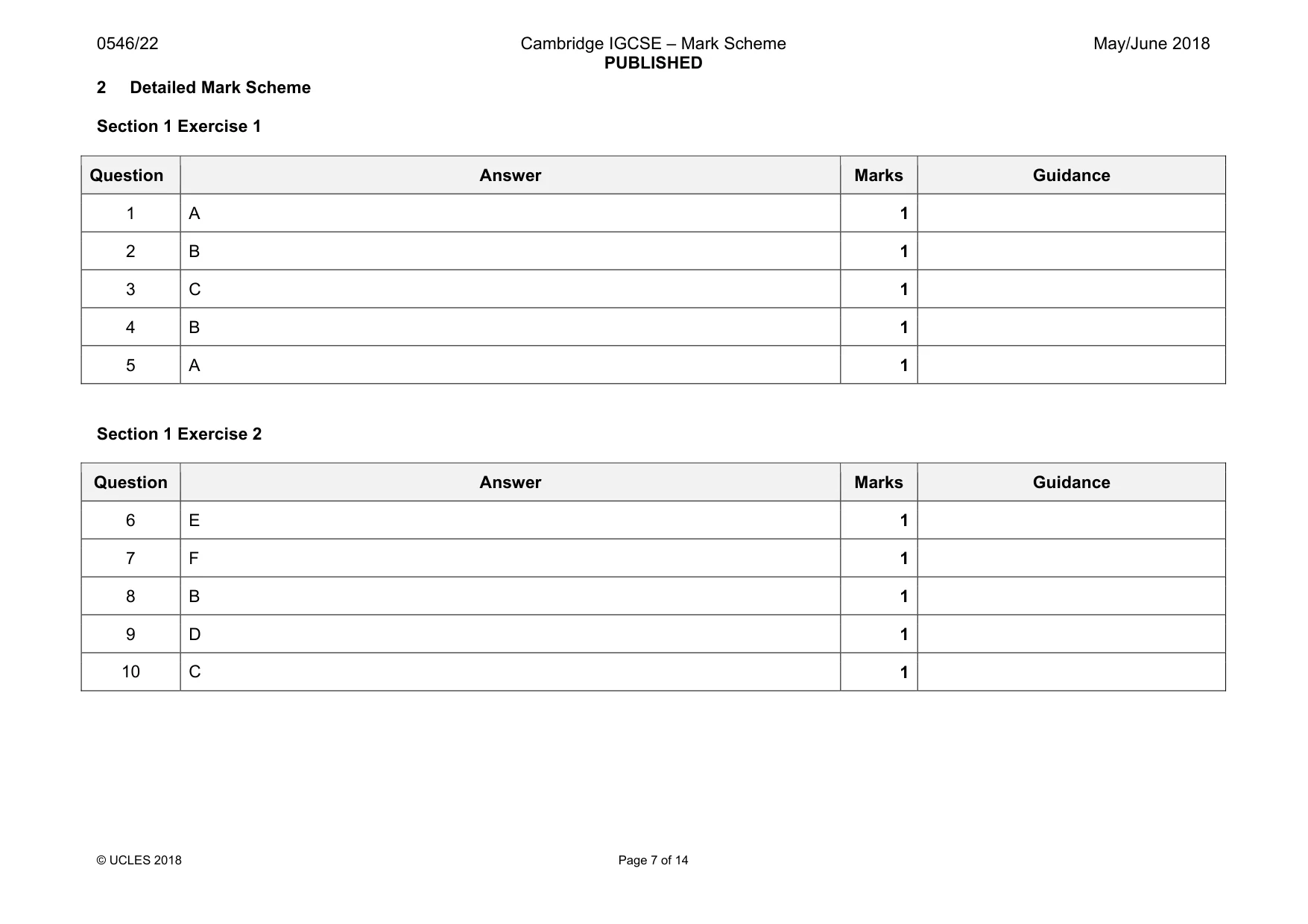
0546/22 Cambridge IGCSE – Mark Scheme PUBLISHED May/June 2018 © UCLES 2018 Page 7 of 14 2 Detailed Mark Scheme Section 1 Exercise 1 Question Answer Marks Guidance 1 A 1 2 B 1 3 C 1 4 B 1 5 A 1 Section 1 Exercise 2 Question Answer Marks Guidance 6 E 1 7 F 1 8 B 1 9 D 1 10 C 1
Mark scheme, page 8
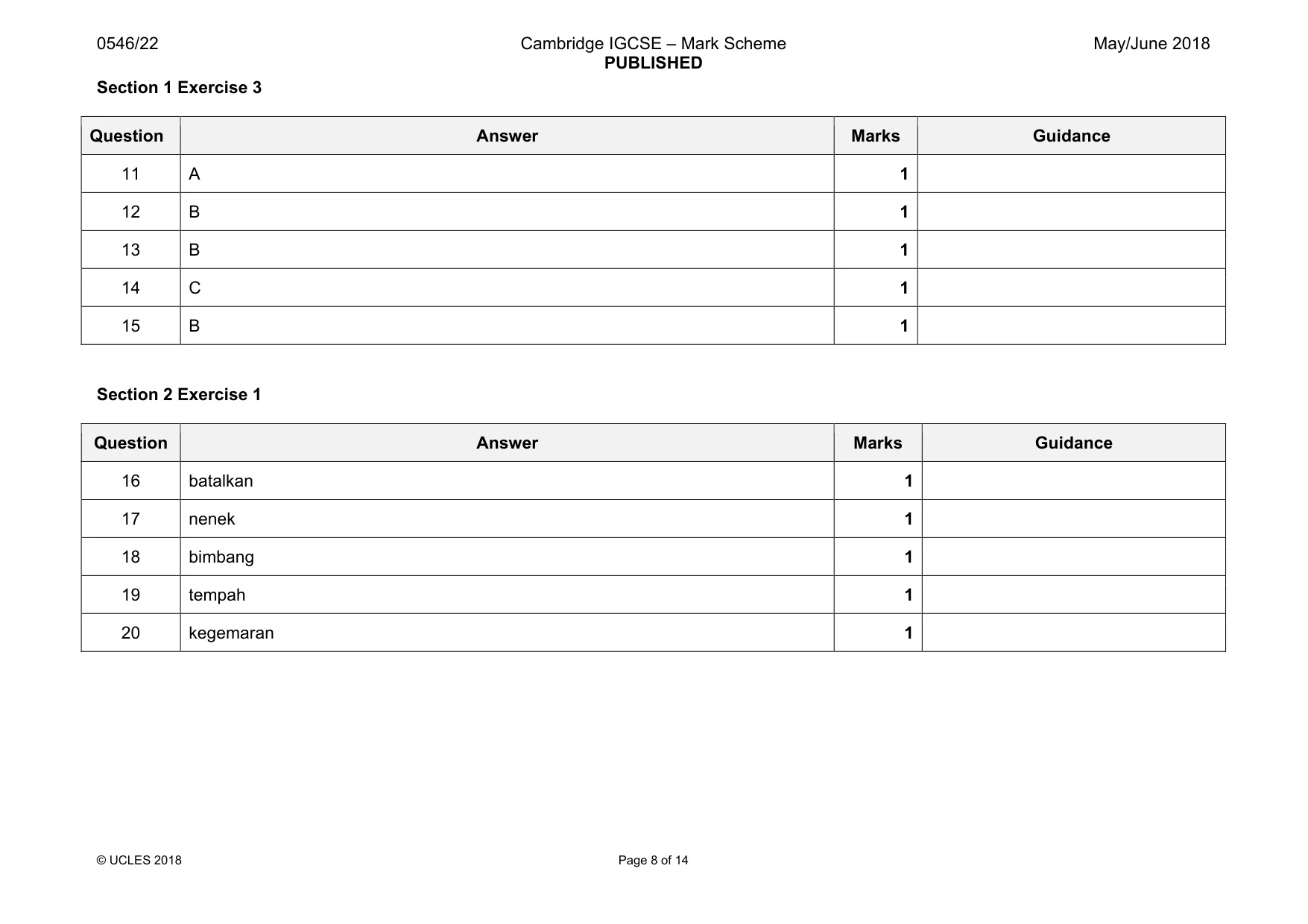
0546/22 Cambridge IGCSE – Mark Scheme PUBLISHED May/June 2018 © UCLES 2018 Page 8 of 14 Section 1 Exercise 3 Question Answer Marks Guidance 11 A 1 12 B 1 13 B 1 14 C 1 15 B 1 Section 2 Exercise 1 Question Answer Marks Guidance 16 batalkan 1 17 nenek 1 18 bimbang 1 19 tempah 1 20 kegemaran 1
Mark scheme, page 9
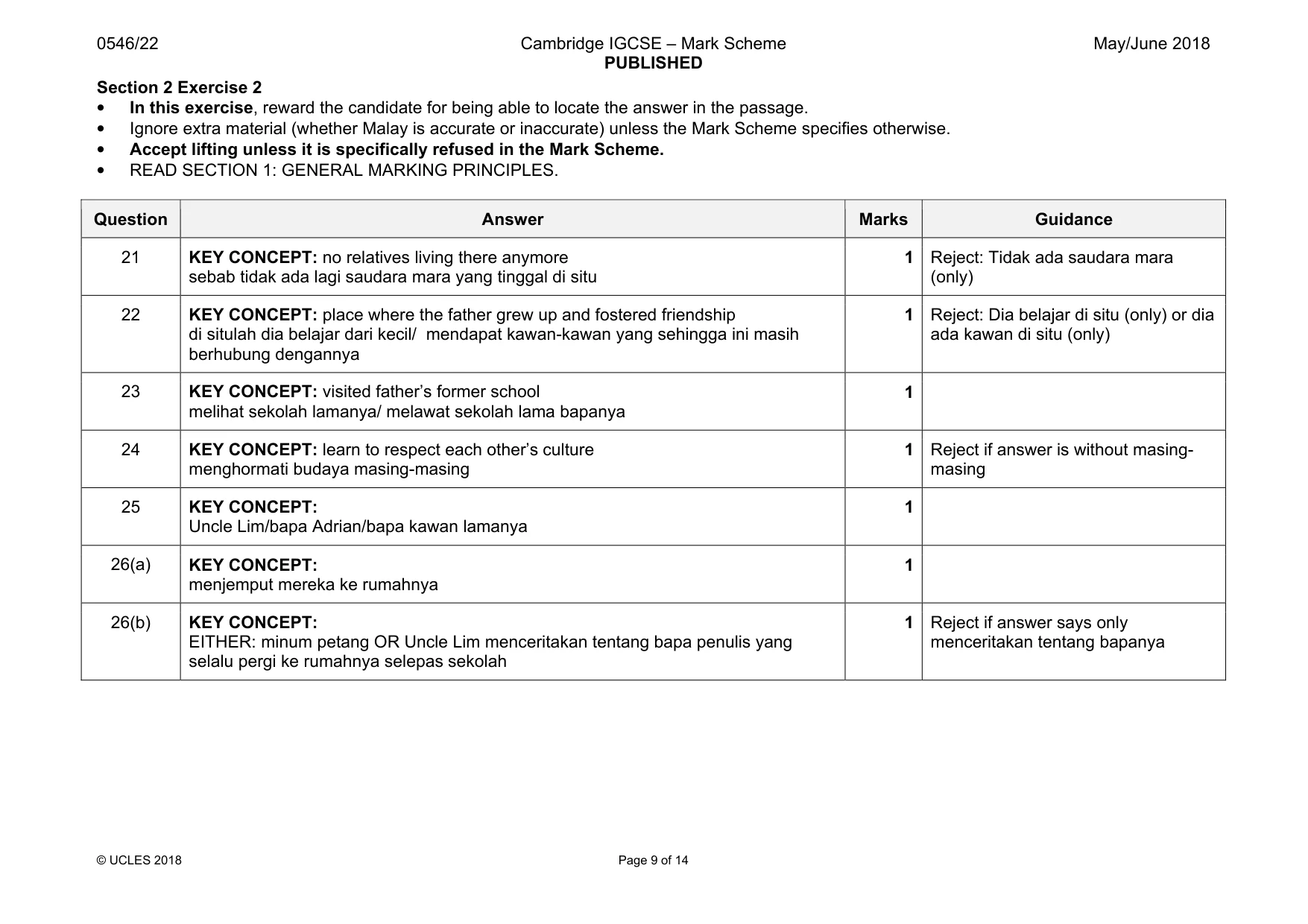
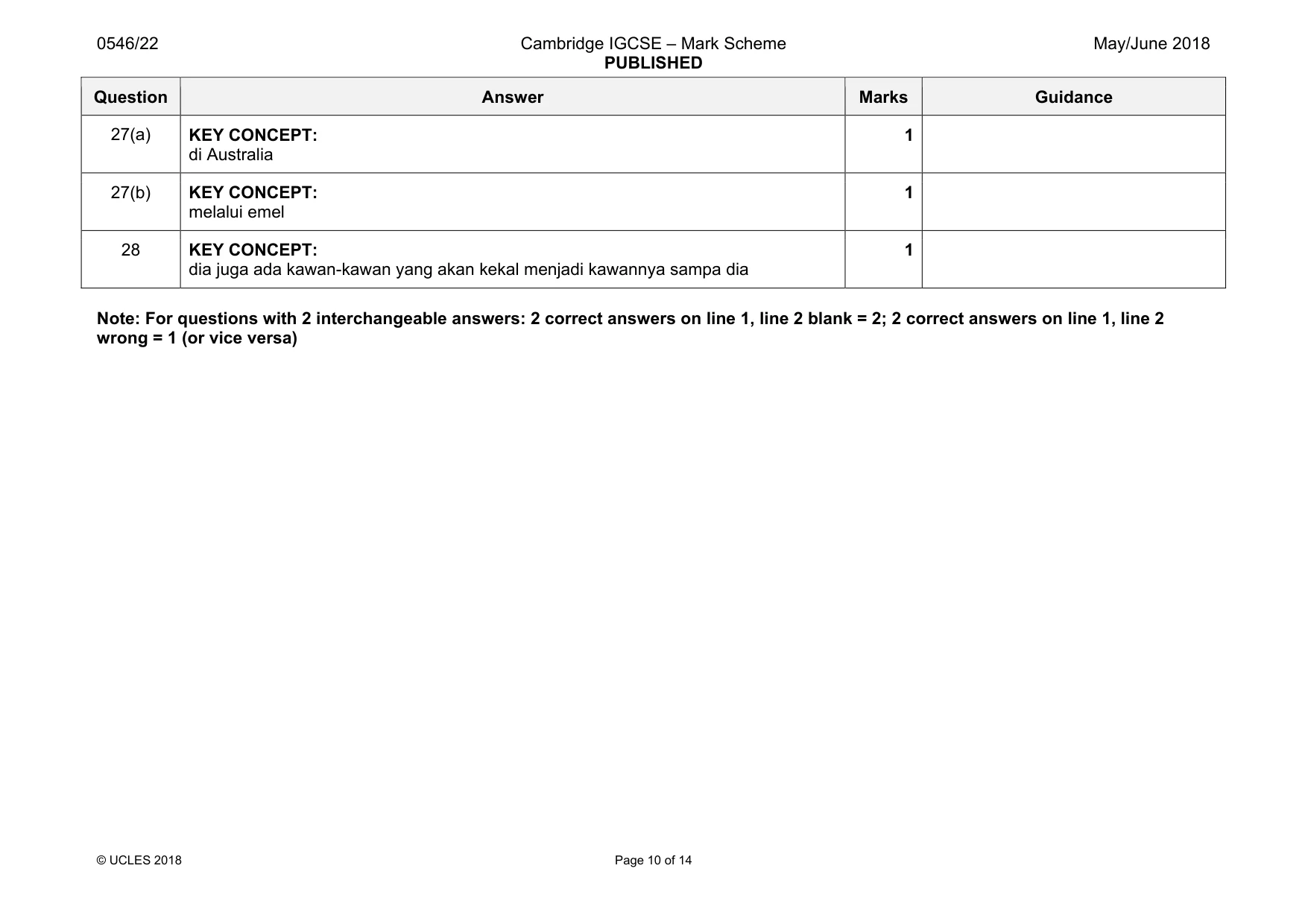
0546/22 Cambridge IGCSE – Mark Scheme PUBLISHED May/June 2018 © UCLES 2018 Page 9 of 14 Section 2 Exercise 2 • In this exercise, reward the candidate for being able to locate the answer in the passage. • Ignore extra material (whether Malay is accurate or inaccurate) unless the Mark Scheme specifies otherwise. • Accept lifting unless it is specifically refused in the Mark Scheme. • READ SECTION 1: GENERAL MARKING PRINCIPLES. Question Answer Marks Guidance 21 KEY CONCEPT: no relatives living there anymore sebab tidak ada lagi saudara mara yang tinggal di situ 1 Reject: Tidak ada saudara mara (only) 22 KEY CONCEPT: place where the father grew up and fostered friendship di situlah dia belajar dari kecil/ mendapat kawan-kawan yang sehingga ini masih berhubung dengannya 1 Reject: Dia belajar di situ (only) or dia ada kawan di situ (only) 23 KEY CONCEPT: visited father’s former school melihat sekolah lamanya/ melawat sekolah lama bapanya 1 24 KEY CONCEPT: learn to respect each other’s culture menghormati budaya masing-masing 1 Reject if answer is without masing- masing 25 KEY CONCEPT: Uncle Lim/bapa Adrian/bapa kawan lamanya 1 26(a) KEY CONCEPT: menjemput mereka ke rumahnya 1 26(b) KEY CONCEPT: EITHER: minum petang OR Uncle Lim menceritakan tentang bapa penulis yang selalu pergi ke rumahnya selepas sekolah 1 Reject if answer says only menceritakan tentang bapanya
Mark scheme, page 10
0546/22 Cambridge IGCSE – Mark Scheme PUBLISHED May/June 2018 © UCLES 2018 Page 10 of 14 Question Answer Marks Guidance 27(a) KEY CONCEPT: di Australia 1 27(b) KEY CONCEPT: melalui emel 1 28 KEY CONCEPT: dia juga ada kawan-kawan yang akan kekal menjadi kawannya sampa dia 1 Note: For questions with 2 interchangeable answers: 2 correct answers on line 1, line 2 blank = 2; 2 correct answers on line 1, line 2 wrong = 1 (or vice versa)
Mark scheme, page 11
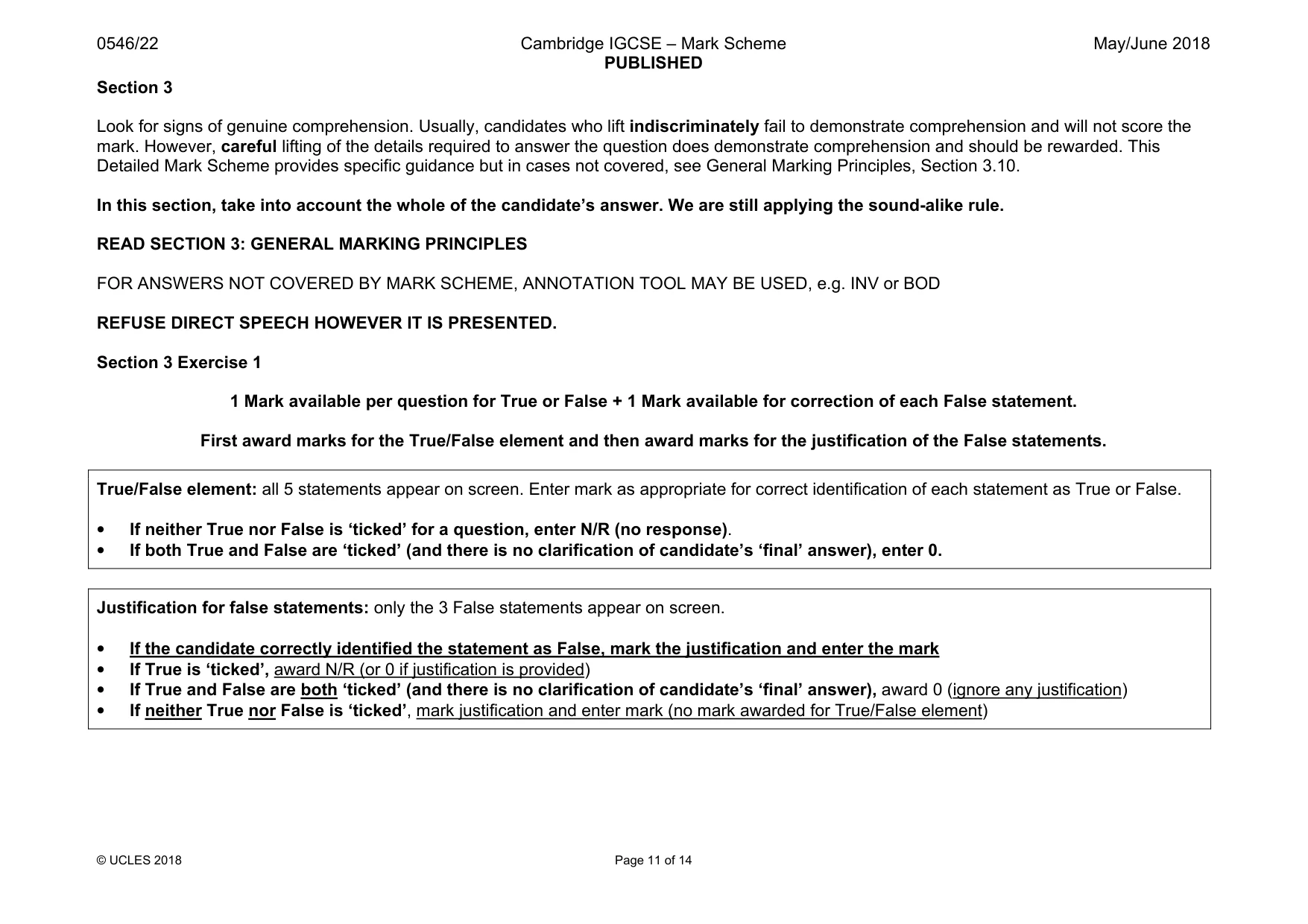
0546/22 Cambridge IGCSE – Mark Scheme PUBLISHED May/June 2018 © UCLES 2018 Page 11 of 14 Section 3 Look for signs of genuine comprehension. Usually, candidates who lift indiscriminately fail to demonstrate comprehension and will not score the mark. However, careful lifting of the details required to answer the question does demonstrate comprehension and should be rewarded. This Detailed Mark Scheme provides specific guidance but in cases not covered, see General Marking Principles, Section 3.10. In this section, take into account the whole of the candidate’s answer. We are still applying the sound-alike rule. READ SECTION 3: GENERAL MARKING PRINCIPLES FOR ANSWERS NOT COVERED BY MARK SCHEME, ANNOTATION TOOL MAY BE USED, e.g. INV or BOD REFUSE DIRECT SPEECH HOWEVER IT IS PRESENTED. Section 3 Exercise 1 1 Mark available per question for True or False + 1 Mark available for correction of each False statement. First award marks for the True/False element and then award marks for the justification of the False statements. True/False element: all 5 statements appear on screen. Enter mark as appropriate for correct identification of each statement as True or False. • If neither True nor False is ‘ticked’ for a question, enter N/R (no response). • If both True and False are ‘ticked’ (and there is no clarification of candidate’s ‘final’ answer), enter 0. Justification for false statements: only the 3 False statements appear on screen. • If the candidate correctly identified the statement as False, mark the justification and enter the mark • If True is ‘ticked’, award N/R (or 0 if justification is provided) • If True and False are both ‘ticked’ (and there is no clarification of candidate’s ‘final’ answer), award 0 (ignore any justification) • If neither True nor False is ‘ticked’, mark justification and enter mark (no mark awarded for True/False element)
Mark scheme, page 12
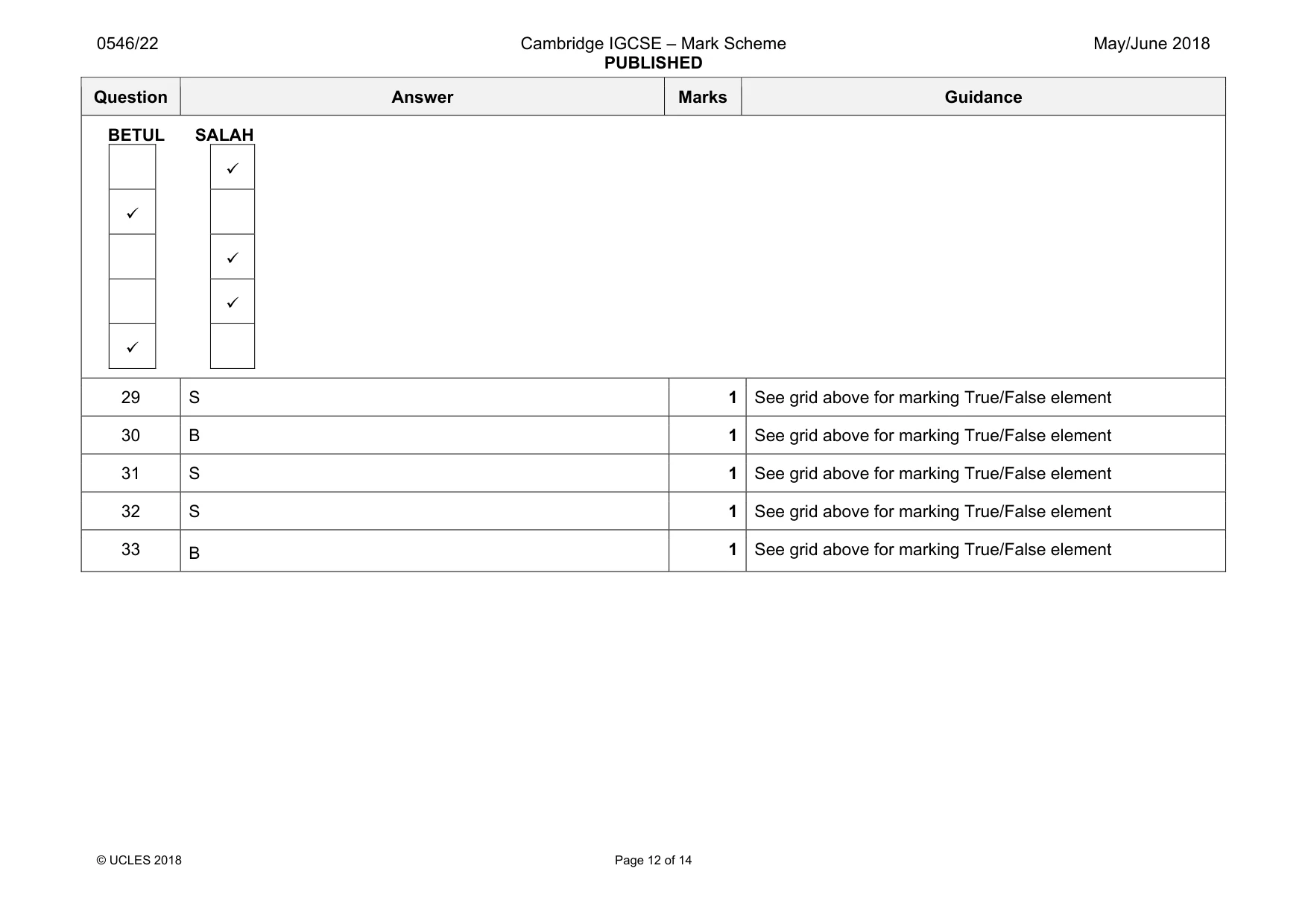
0546/22 Cambridge IGCSE – Mark Scheme PUBLISHED May/June 2018 © UCLES 2018 Page 12 of 14 Question Answer Marks Guidance BETUL SALAH 9 9 9 9 9 29 S 1 See grid above for marking True/False element 30 B 1 See grid above for marking True/False element 31 S 1 See grid above for marking True/False element 32 S 1 See grid above for marking True/False element 33 B 1 See grid above for marking True/False element
Mark scheme, page 13
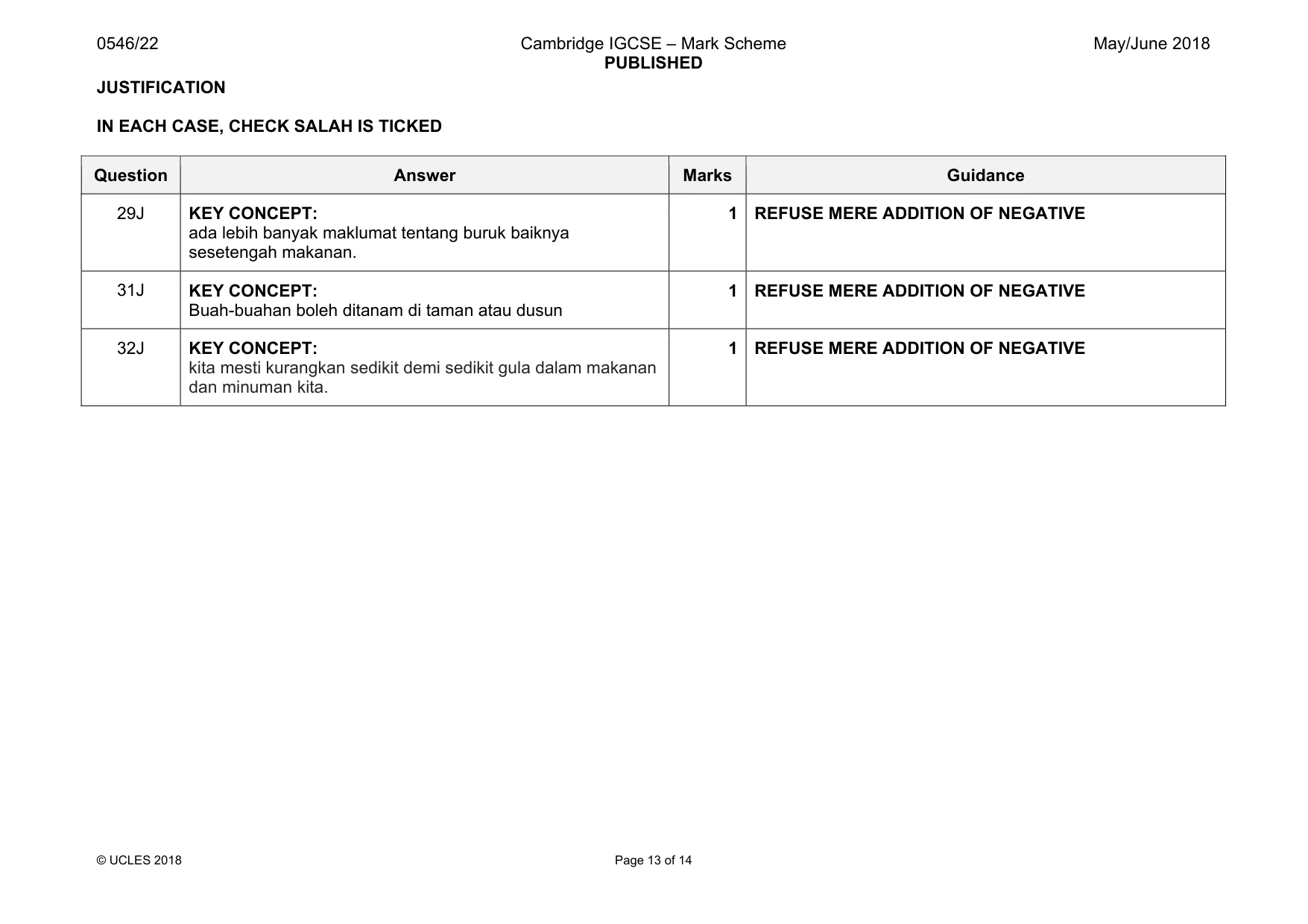
0546/22 Cambridge IGCSE – Mark Scheme PUBLISHED May/June 2018 © UCLES 2018 Page 13 of 14 JUSTIFICATION IN EACH CASE, CHECK SALAH IS TICKED Question Answer Marks Guidance 29J KEY CONCEPT: ada lebih banyak maklumat tentang buruk baiknya sesetengah makanan. 1 REFUSE MERE ADDITION OF NEGATIVE 31J KEY CONCEPT: Buah-buahan boleh ditanam di taman atau dusun 1 REFUSE MERE ADDITION OF NEGATIVE 32J KEY CONCEPT: kita mesti kurangkan sedikit demi sedikit gula dalam makanan dan minuman kita. 1 REFUSE MERE ADDITION OF NEGATIVE
Mark scheme, page 14
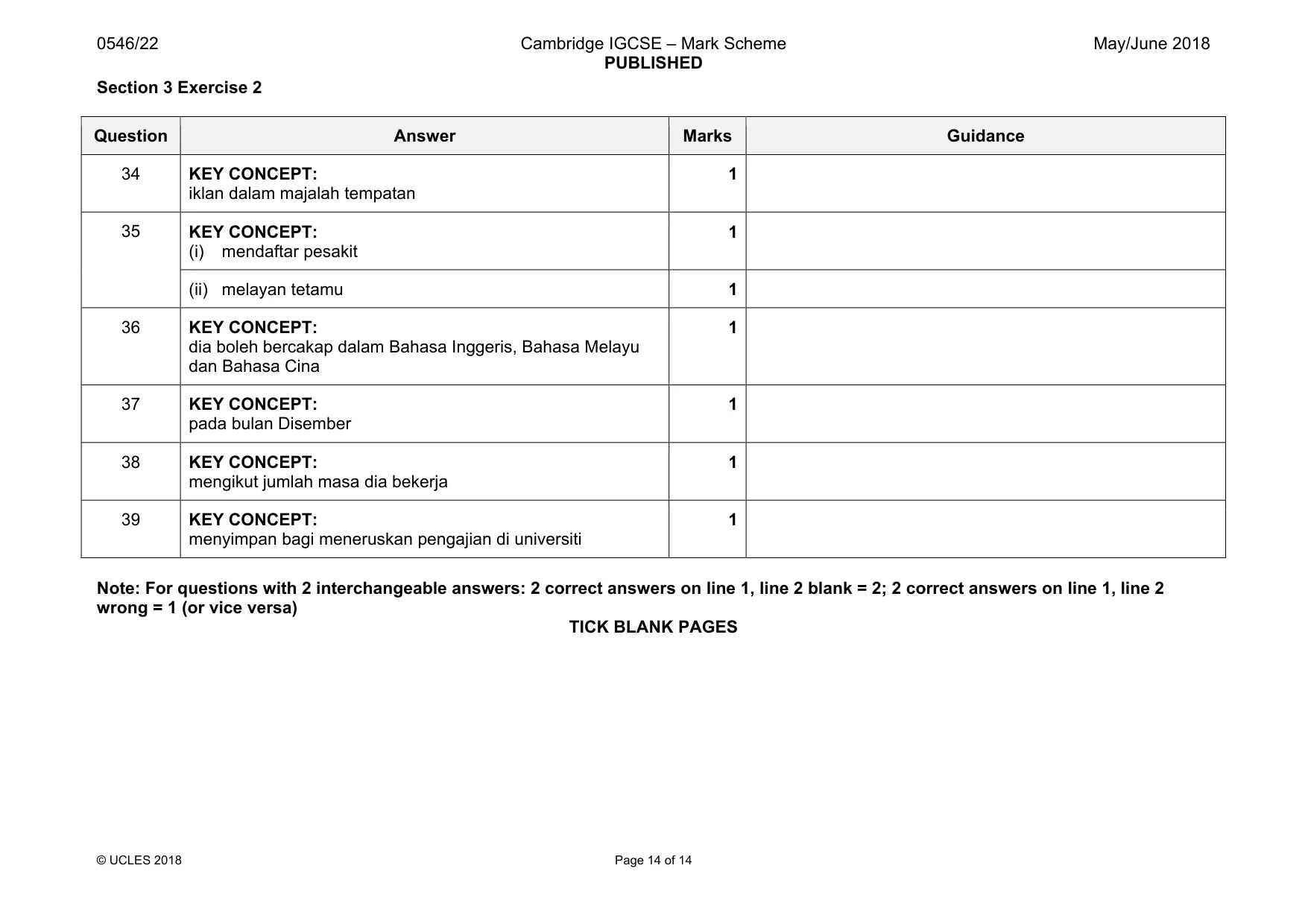
0546/22 Cambridge IGCSE – Mark Scheme PUBLISHED May/June 2018 © UCLES 2018 Page 14 of 14 Section 3 Exercise 2 Question Answer Marks Guidance 34 KEY CONCEPT: iklan dalam majalah tempatan 1 35 KEY CONCEPT: (i) mendaftar pesakit 1 (ii) melayan tetamu 1 36 KEY CONCEPT: dia boleh bercakap dalam Bahasa Inggeris, Bahasa Melayu dan Bahasa Cina 1 37 KEY CONCEPT: pada bulan Disember 1 38 KEY CONCEPT: mengikut jumlah masa dia bekerja 1 39 KEY CONCEPT: menyimpan bagi meneruskan pengajian di universiti 1 Note: For questions with 2 interchangeable answers: 2 correct answers on line 1, line 2 blank = 2; 2 correct answers on line 1, line 2 wrong = 1 (or vice versa) TICK BLANK PAGES
What you needed in this session
Cambridge’s own grade thresholds for 2018 May/June, Paper 2 · Variant 2. A higher threshold means an easier paper — the bar moves with how the cohort did.