Cambridge IGCSE Latin 0480 — 2025 May/June Paper 1 · Variant 3
0480/13/M/J/25 · 160 marks · ≈180 min
The question paper and its mark scheme, free to read here and free to download. This is Cambridge’s own paper, exactly as it was sat.
Question paper8 pages


Mark scheme6 pages
Answers below. Sit the paper first if you are practising.
Paper as text
Question paper, page 1
This document has 8 pages. Any blank pages are indicated. [Turn over Cambridge IGCSE™ LATIN 0480/13 Paper 1 Language May/June 2025 1 hour 30 minutes You must answer on the answer booklet/paper. You will need: Answer booklet/paper INSTRUCTIONS ● Answer all questions. ● If you have been given an answer booklet, follow the instructions on the front cover of the answer booklet. ● Use a black or dark blue pen. ● Write your name, centre number and candidate number on all the work you hand in. ● Do not use an erasable pen or correction fluid. ● At the end of the examination, fasten all your work together. Do not use staples, paper clips or glue. INFORMATION ● The total mark for this paper is 160. ● The number of marks for each question or part question is shown in brackets [ ]. * 7 8 5 4 7 5 4 3 1 0 * DC (CJ) 346049/3 © UCLES 2025
Question paper, page 2
2 0480/13/M/J/25 © UCLES 2025 BLANK PAGE
Question paper, page 3
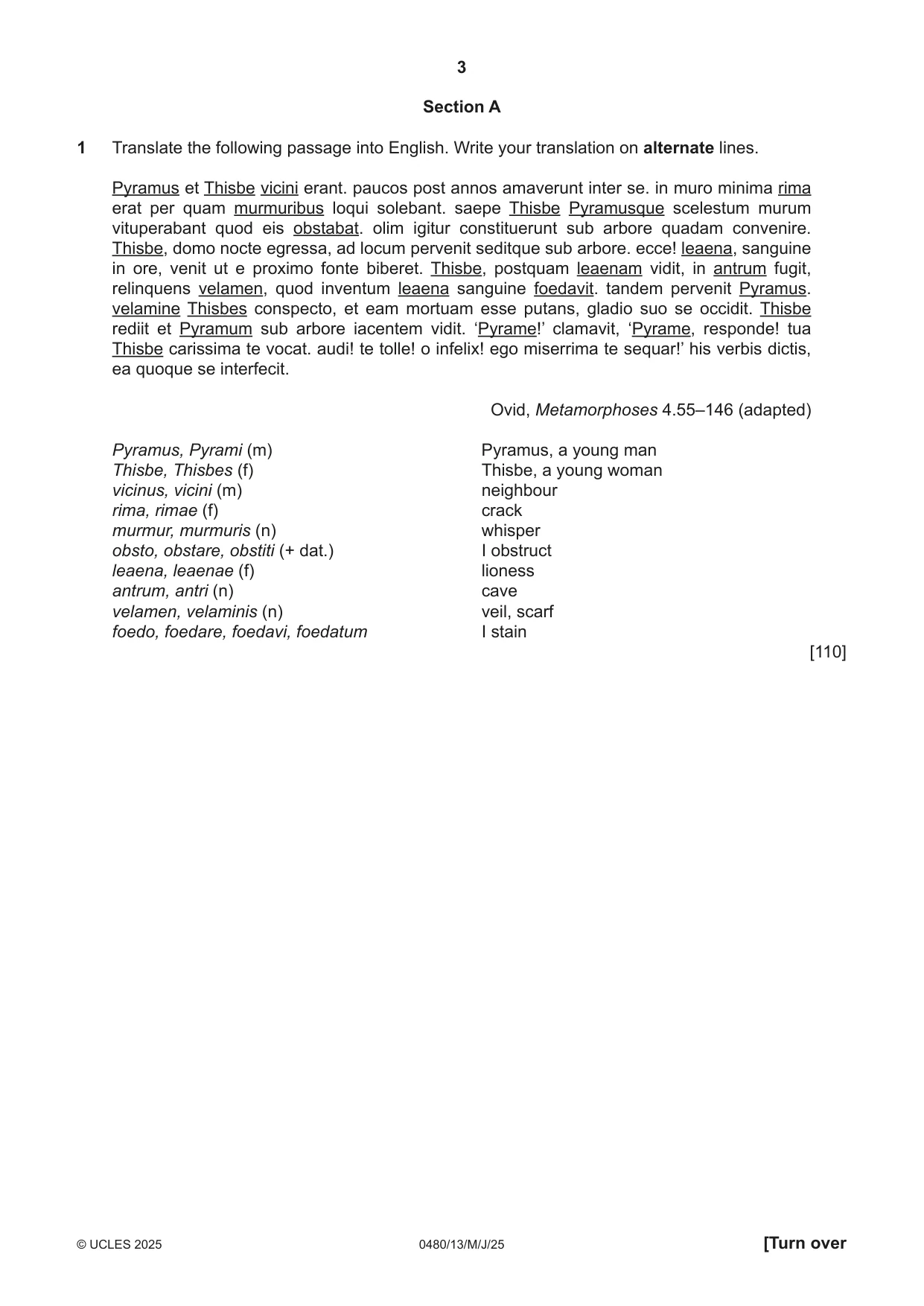
3 0480/13/M/J/25 © UCLES 2025 [Turn over Section A 1 Translate the following passage into English. Write your translation on alternate lines. Pyramus et Thisbe vicini erant. paucos post annos amaverunt inter se. in muro minima rima erat per quam murmuribus loqui solebant. saepe Thisbe Pyramusque scelestum murum vituperabant quod eis obstabat. olim igitur constituerunt sub arbore quadam convenire. Thisbe, domo nocte egressa, ad locum pervenit seditque sub arbore. ecce! leaena, sanguine in ore, venit ut e proximo fonte biberet. Thisbe, postquam leaenam vidit, in antrum fugit, relinquens velamen, quod inventum leaena sanguine foedavit. tandem pervenit Pyramus. velamine Thisbes conspecto, et eam mortuam esse putans, gladio suo se occidit. Thisbe rediit et Pyramum sub arbore iacentem vidit. ‘Pyrame!’ clamavit, ‘Pyrame, responde! tua Thisbe carissima te vocat. audi! te tolle! o infelix! ego miserrima te sequar!’ his verbis dictis, ea quoque se interfecit. Ovid, Metamorphoses 4.55–146 (adapted) Pyramus, Pyrami (m) Pyramus, a young man Thisbe, Thisbes (f) Thisbe, a young woman vicinus, vicini (m) neighbour rima, rimae (f) crack murmur, murmuris (n) whisper obsto, obstare, obstiti (+ dat.) I obstruct leaena, leaenae (f) lioness antrum, antri (n) cave velamen, velaminis (n) veil, scarf foedo, foedare, foedavi, foedatum I stain [110]
Question paper, page 4
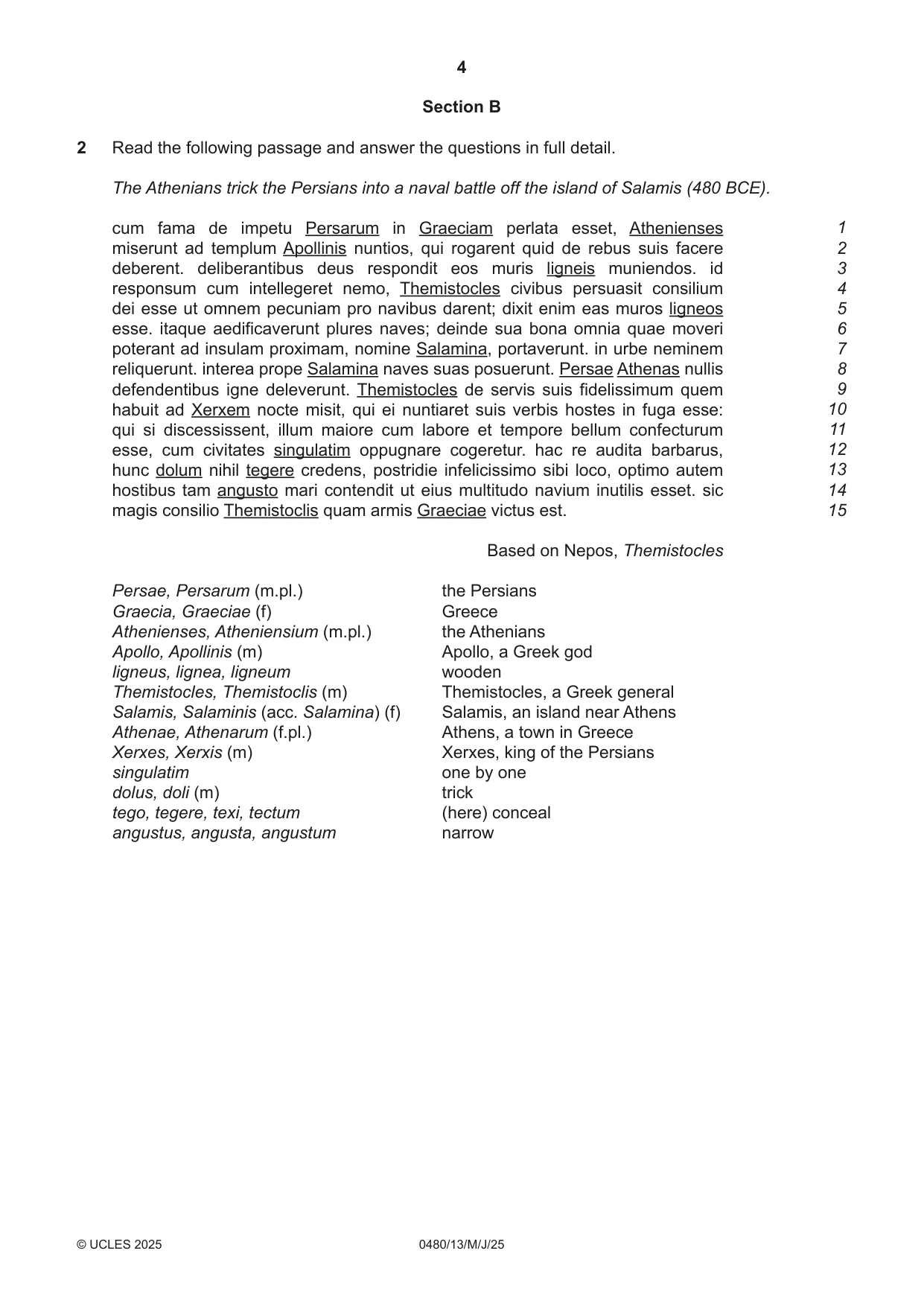
4 0480/13/M/J/25 © UCLES 2025 Section B 2 Read the following passage and answer the questions in full detail. The Athenians trick the Persians into a naval battle off the island of Salamis (480 BCE). cum fama de impetu Persarum in Graeciam perlata esset, Athenienses miserunt ad templum Apollinis nuntios, qui rogarent quid de rebus suis facere deberent. deliberantibus deus respondit eos muris ligneis muniendos. id responsum cum intellegeret nemo, Themistocles civibus persuasit consilium dei esse ut omnem pecuniam pro navibus darent; dixit enim eas muros ligneos esse. itaque aedificaverunt plures naves; deinde sua bona omnia quae moveri poterant ad insulam proximam, nomine Salamina, portaverunt. in urbe neminem reliquerunt. interea prope Salamina naves suas posuerunt. Persae Athenas nullis defendentibus igne deleverunt. Themistocles de servis suis fidelissimum quem habuit ad Xerxem nocte misit, qui ei nuntiaret suis verbis hostes in fuga esse: qui si discessissent, illum maiore cum labore et tempore bellum confecturum esse, cum civitates singulatim oppugnare cogeretur. hac re audita barbarus, hunc dolum nihil tegere credens, postridie infelicissimo sibi loco, optimo autem hostibus tam angusto mari contendit ut eius multitudo navium inutilis esset. sic magis consilio Themistoclis quam armis Graeciae victus est. Based on Nepos, Themistocles Persae, Persarum (m.pl.) the Persians Graecia, Graeciae (f) Greece Athenienses, Atheniensium (m.pl.) the Athenians Apollo, Apollinis (m) Apollo, a Greek god ligneus, lignea, ligneum wooden Themistocles, Themistoclis (m) Themistocles, a Greek general Salamis, Salaminis (acc. Salamina) (f) Salamis, an island near Athens Athenae, Athenarum (f.pl.) Athens, a town in Greece Xerxes, Xerxis (m) Xerxes, king of the Persians singulatim one by one dolus, doli (m) trick tego, tegere, texi, tectum (here) conceal angustus, angusta, angustum narrow 1 2 3 4 5 6 7 8 9 10 11 12 13 14 15
Question paper, page 5
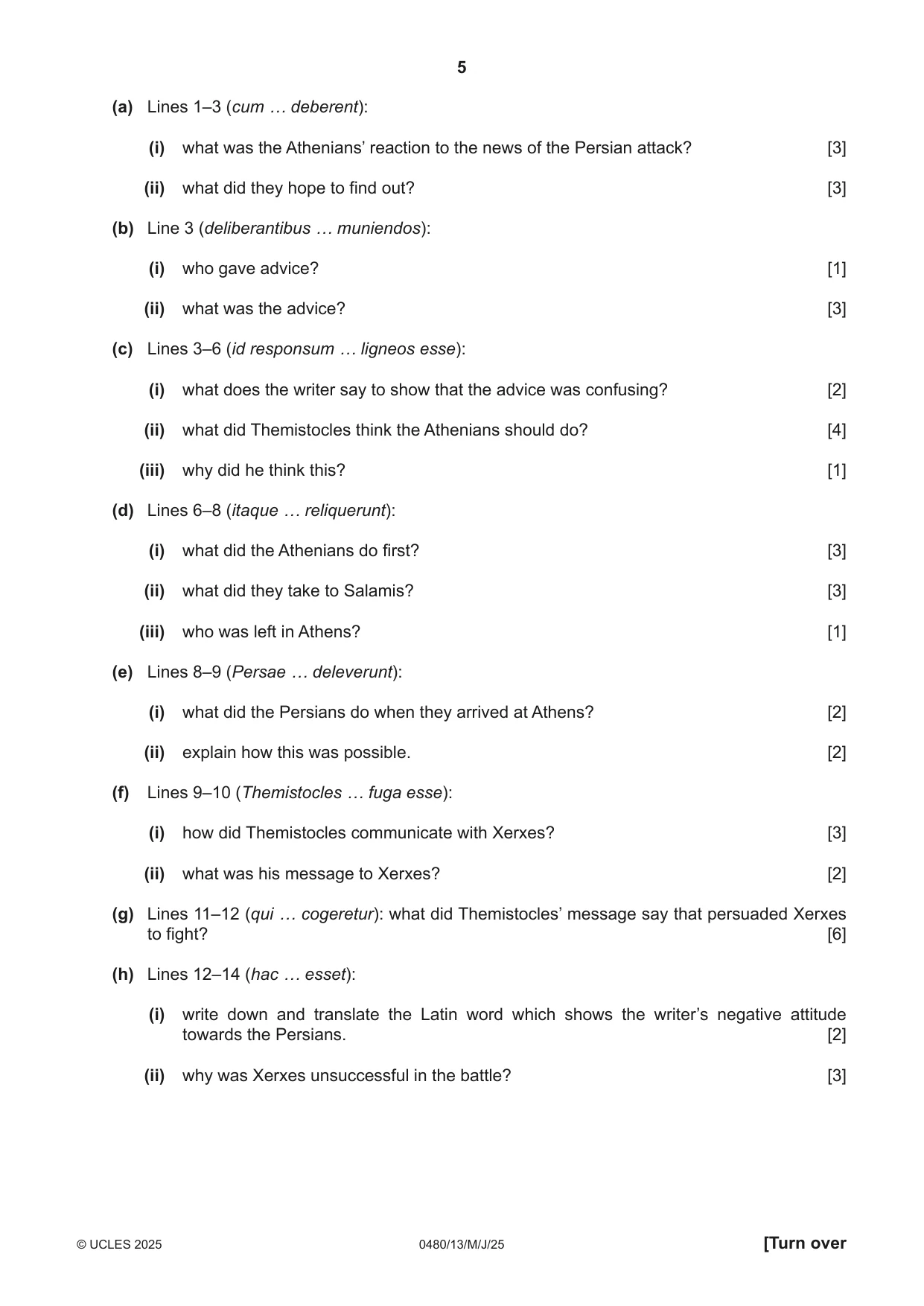
5 0480/13/M/J/25 © UCLES 2025 [Turn over (a) Lines 1–3 (cum … deberent): (i) what was the Athenians’ reaction to the news of the Persian attack? [3] (ii) what did they hope to find out? [3] (b) Line 3 (deliberantibus … muniendos): (i) who gave advice? [1] (ii) what was the advice? [3] (c) Lines 3–6 (id responsum … ligneos esse): (i) what does the writer say to show that the advice was confusing? [2] (ii) what did Themistocles think the Athenians should do? [4] (iii) why did he think this? [1] (d) Lines 6–8 (itaque … reliquerunt): (i) what did the Athenians do first? [3] (ii) what did they take to Salamis? [3] (iii) who was left in Athens? [1] (e) Lines 8–9 (Persae … deleverunt): (i) what did the Persians do when they arrived at Athens? [2] (ii) explain how this was possible. [2] (f) Lines 9–10 (Themistocles … fuga esse): (i) how did Themistocles communicate with Xerxes? [3] (ii) what was his message to Xerxes? [2] (g) Lines 11–12 (qui … cogeretur): what did Themistocles’ message say that persuaded Xerxes to fight? [6] (h) Lines 12–14 (hac … esset): (i) write down and translate the Latin word which shows the writer’s negative attitude towards the Persians. [2] (ii) why was Xerxes unsuccessful in the battle? [3]
Question paper, page 6
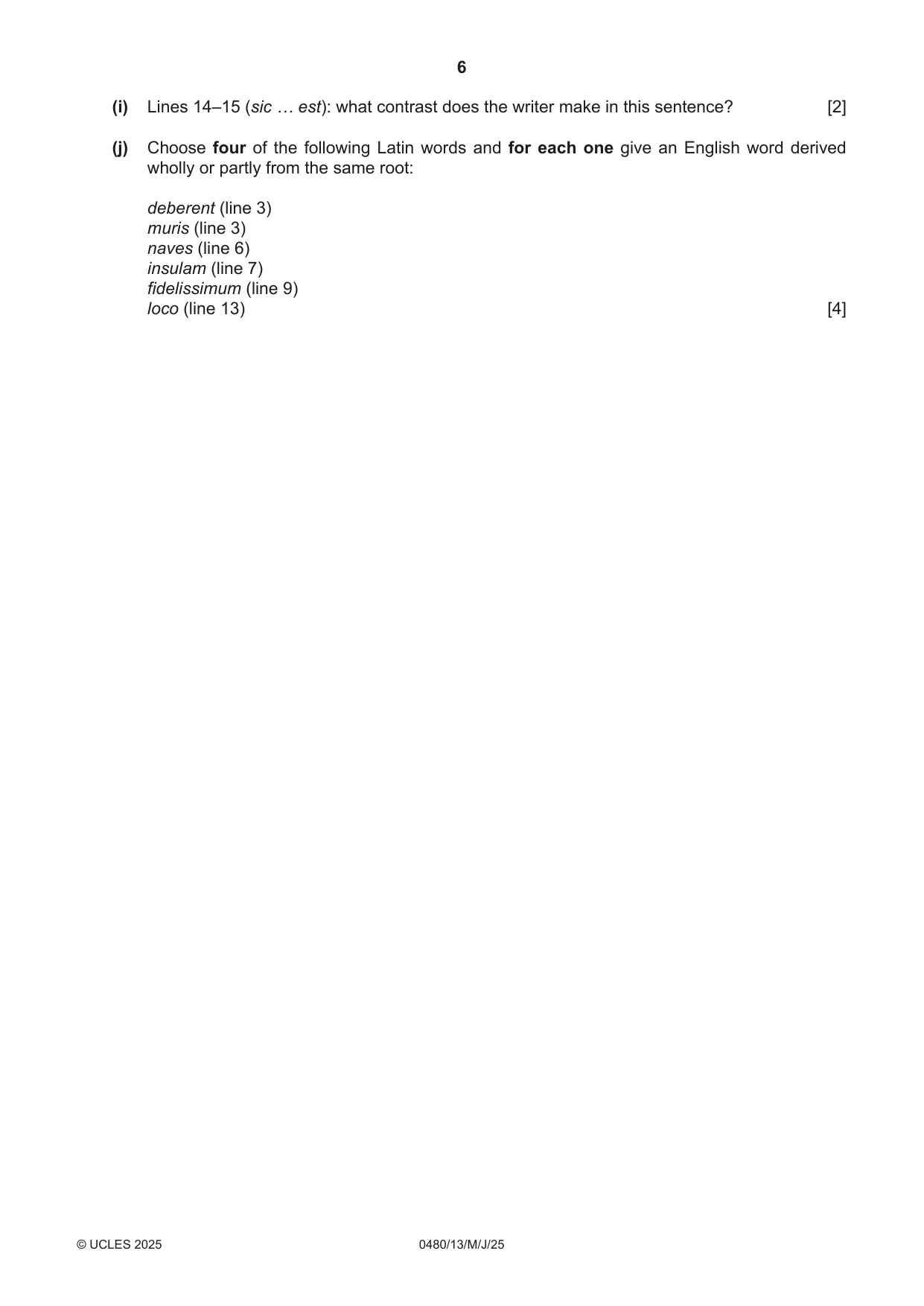
6 0480/13/M/J/25 © UCLES 2025 (i) Lines 14–15 (sic … est): what contrast does the writer make in this sentence? [2] (j) Choose four of the following Latin words and for each one give an English word derived wholly or partly from the same root: deberent (line 3) muris (line 3) naves (line 6) insulam (line 7) fidelissimum (line 9) loco (line 13) [4]
Question paper, page 7
7 0480/13/M/J/25 © UCLES 2025 BLANK PAGE
Question paper, page 8
8 0480/13/M/J/25 © UCLES 2025 Permission to reproduce items where third-party owned material protected by copyright is included has been sought and cleared where possible. Every reasonable effort has been made by the publisher (UCLES) to trace copyright holders, but if any items requiring clearance have unwittingly been included, the publisher will be pleased to make amends at the earliest possible opportunity. To avoid the issue of disclosure of answer-related information to candidates, all copyright acknowledgements are reproduced online in the Cambridge Assessment International Education Copyright Acknowledgements Booklet. This is produced for each series of examinations and is freely available to download at www.cambridgeinternational.org after the live examination series. Cambridge Assessment International Education is part of Cambridge Assessment. Cambridge Assessment is the brand name of the University of Cambridge Local Examinations Syndicate (UCLES), which is a department of the University of Cambridge. BLANK PAGE
Mark scheme, page 1
This document consists of 6 printed pages. © Cambridge University Press & Assessment 2025 [Turn over Cambridge IGCSE™ LATIN 0480/13 Paper 1 Language May/June 2025 MARK SCHEME Maximum Mark: 160 Published This mark scheme is published as an aid to teachers and candidates, to indicate the requirements of the examination. It shows the basis on which Examiners were instructed to award marks. It does not indicate the details of the discussions that took place at an Examiners’ meeting before marking began, which would have considered the acceptability of alternative answers. Mark schemes should be read in conjunction with the question paper and the Principal Examiner Report for Teachers. Cambridge International will not enter into discussions about these mark schemes. Cambridge International is publishing the mark schemes for the May/June 2025 series for most Cambridge IGCSE, Cambridge International A and AS Level components, and some Cambridge O Level components.
Mark scheme, page 2
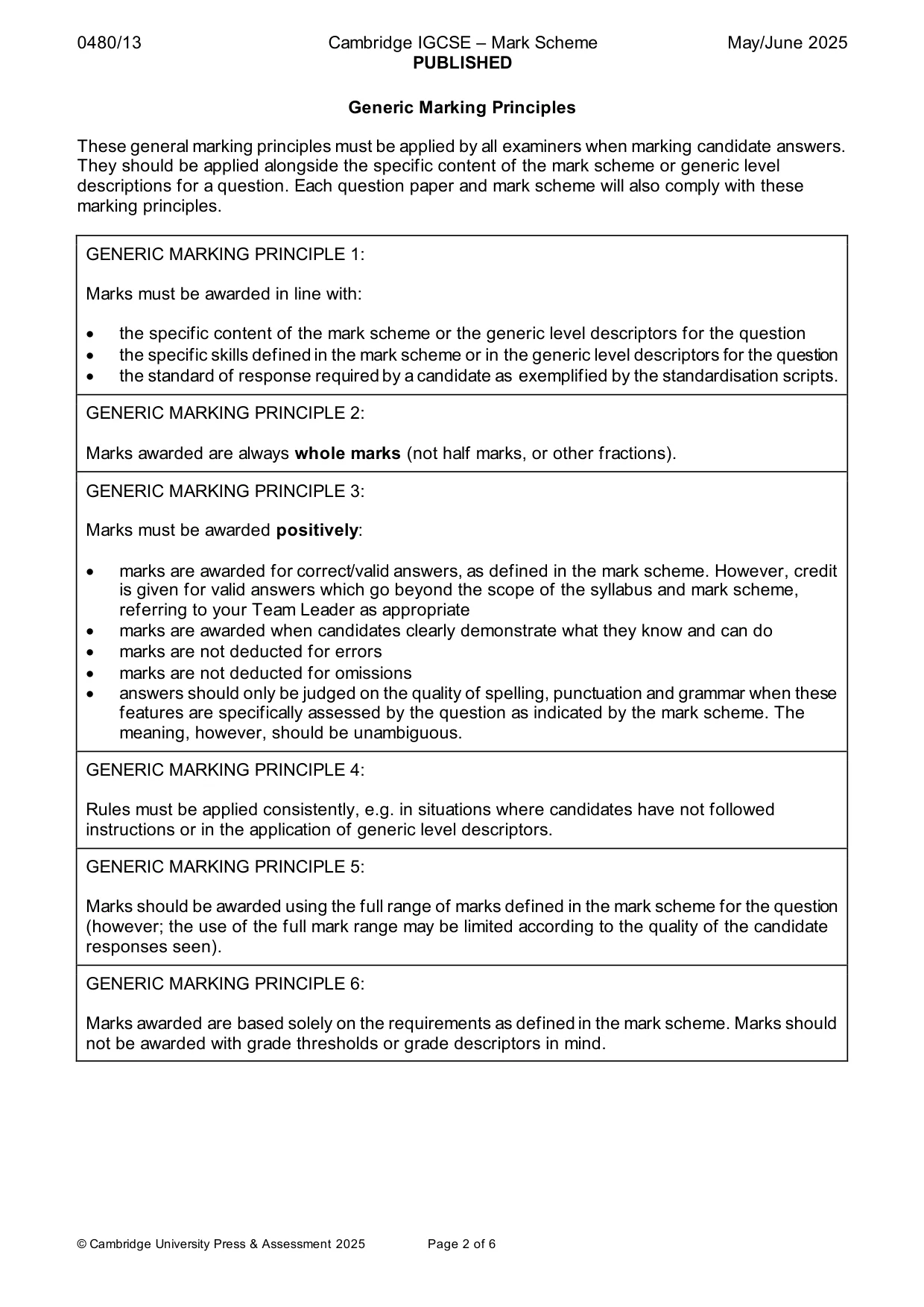
0480/13 Cambridge IGCSE – Mark Scheme PUBLISHED May/June 2025 © Cambridge University Press & Assessment 2025 Page 2 of 6 Generic Marking Principles These general marking principles must be applied by all examiners when marking candidate answers. They should be applied alongside the specific content of the mark scheme or generic level descriptions for a question. Each question paper and mark scheme will also comply with these marking principles. GENERIC MARKING PRINCIPLE 1: Marks must be awarded in line with: • the specific content of the mark scheme or the generic level descriptors for the question • the specific skills defined in the mark scheme or in the generic level descriptors for the question • the standard of response required by a candidate as exemplified by the standardisation scripts. GENERIC MARKING PRINCIPLE 2: Marks awarded are always whole marks (not half marks, or other fractions). GENERIC MARKING PRINCIPLE 3: Marks must be awarded positively: • marks are awarded for correct/valid answers, as defined in the mark scheme. However, credit is given for valid answers which go beyond the scope of the syllabus and mark scheme, referring to your Team Leader as appropriate • marks are awarded when candidates clearly demonstrate what they know and can do • marks are not deducted for errors • marks are not deducted for omissions • answers should only be judged on the quality of spelling, punctuation and grammar when these features are specifically assessed by the question as indicated by the mark scheme. The meaning, however, should be unambiguous. GENERIC MARKING PRINCIPLE 4: Rules must be applied consistently, e.g. in situations where candidates have not followed instructions or in the application of generic level descriptors. GENERIC MARKING PRINCIPLE 5: Marks should be awarded using the full range of marks defined in the mark scheme for the question (however; the use of the full mark range may be limited according to the quality of the candidate responses seen). GENERIC MARKING PRINCIPLE 6: Marks awarded are based solely on the requirements as defined in the mark scheme. Marks should not be awarded with grade thresholds or grade descriptors in mind.
Mark scheme, page 3
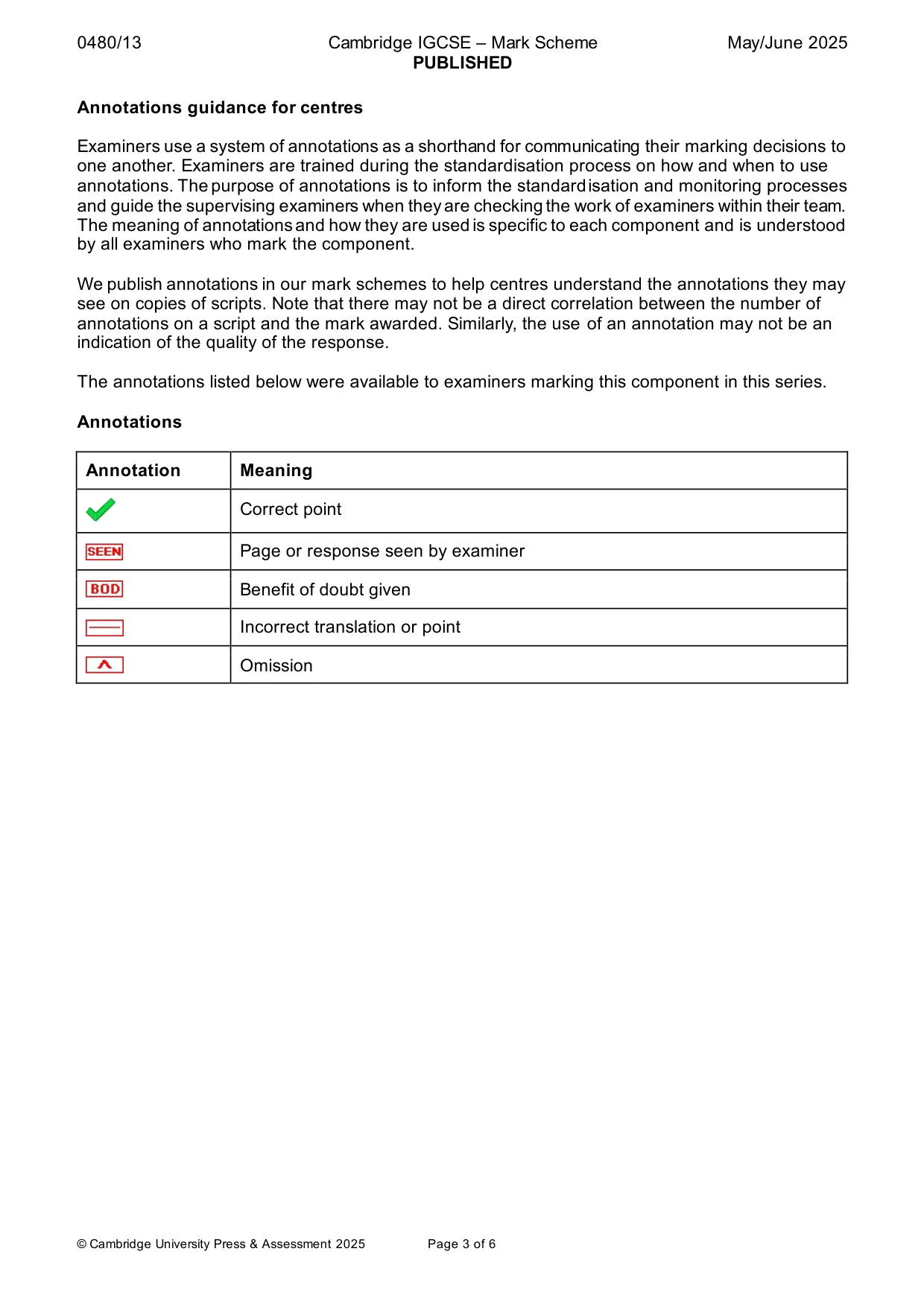
0480/13 Cambridge IGCSE – Mark Scheme PUBLISHED May/June 2025 © Cambridge University Press & Assessment 2025 Page 3 of 6 Annotations guidance for centres Examiners use a system of annotations as a shorthand for communicating their marking decisions to one another. Examiners are trained during the standardisation process on how and when to use annotations. The purpose of annotations is to inform the standardisation and monitoring processes and guide the supervising examiners when they are checking the work of examiners within their team. The meaning of annotations and how they are used is specific to each component and is understood by all examiners who mark the component. We publish annotations in our mark schemes to help centres understand the annotations they may see on copies of scripts. Note that there may not be a direct correlation between the number of annotations on a script and the mark awarded. Similarly, the use of an annotation may not be an indication of the quality of the response. The annotations listed below were available to examiners marking this component in this series. Annotations Annotation Meaning Correct point Page or response seen by examiner Benefit of doubt given Incorrect translation or point Omission
Mark scheme, page 4
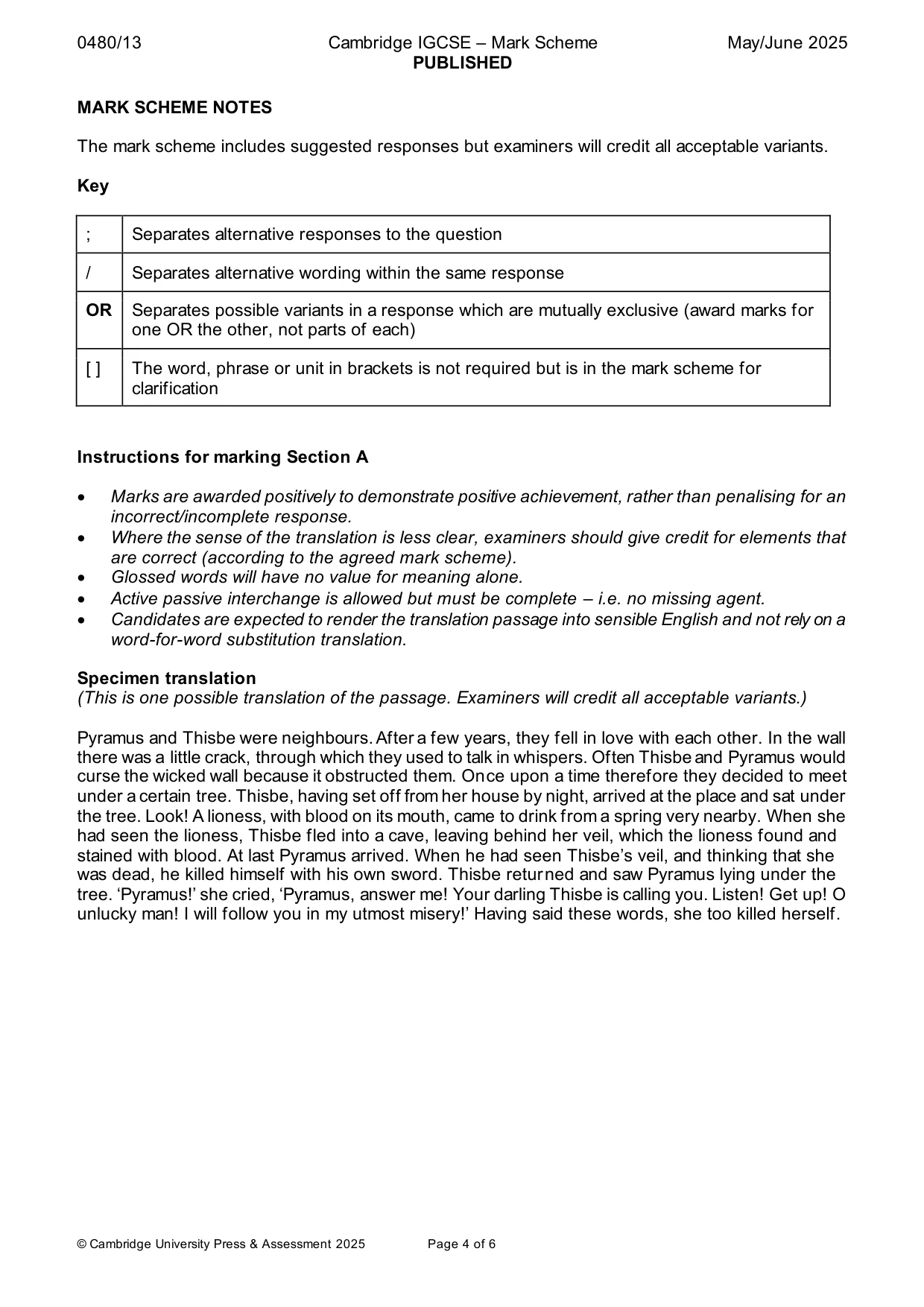
0480/13 Cambridge IGCSE – Mark Scheme PUBLISHED May/June 2025 © Cambridge University Press & Assessment 2025 Page 4 of 6 MARK SCHEME NOTES The mark scheme includes suggested responses but examiners will credit all acceptable variants. Key ; Separates alternative responses to the question / Separates alternative wording within the same response OR Separates possible variants in a response which are mutually exclusive (award marks for one OR the other, not parts of each) [ ] The word, phrase or unit in brackets is not required but is in the mark scheme for clarification Instructions for marking Section A • Marks are awarded positively to demonstrate positive achievement, rather than penalising for an incorrect/incomplete response. • Where the sense of the translation is less clear, examiners should give credit for elements that are correct (according to the agreed mark scheme). • Glossed words will have no value for meaning alone. • Active passive interchange is allowed but must be complete – i.e. no missing agent. • Candidates are expected to render the translation passage into sensible English and not rely on a word-for-word substitution translation. Specimen translation (This is one possible translation of the passage. Examiners will credit all acceptable variants.) Pyramus and Thisbe were neighbours. After a few years, they fell in love with each other. In the wall there was a little crack, through which they used to talk in whispers. Often Thisbe and Pyramus would curse the wicked wall because it obstructed them. Once upon a time therefore they decided to meet under a certain tree. Thisbe, having set off from her house by night, arrived at the place and sat under the tree. Look! A lioness, with blood on its mouth, came to drink from a spring very nearby. When she had seen the lioness, Thisbe fled into a cave, leaving behind her veil, which the lioness found and stained with blood. At last Pyramus arrived. When he had seen Thisbe’s veil, and thinking that she was dead, he killed himself with his own sword. Thisbe returned and saw Pyramus lying under the tree. ‘Pyramus!’ she cried, ‘Pyramus, answer me! Your darling Thisbe is calling you. Listen! Get up! O unlucky man! I will follow you in my utmost misery!’ Having said these words, she too killed herself.
Mark scheme, page 5
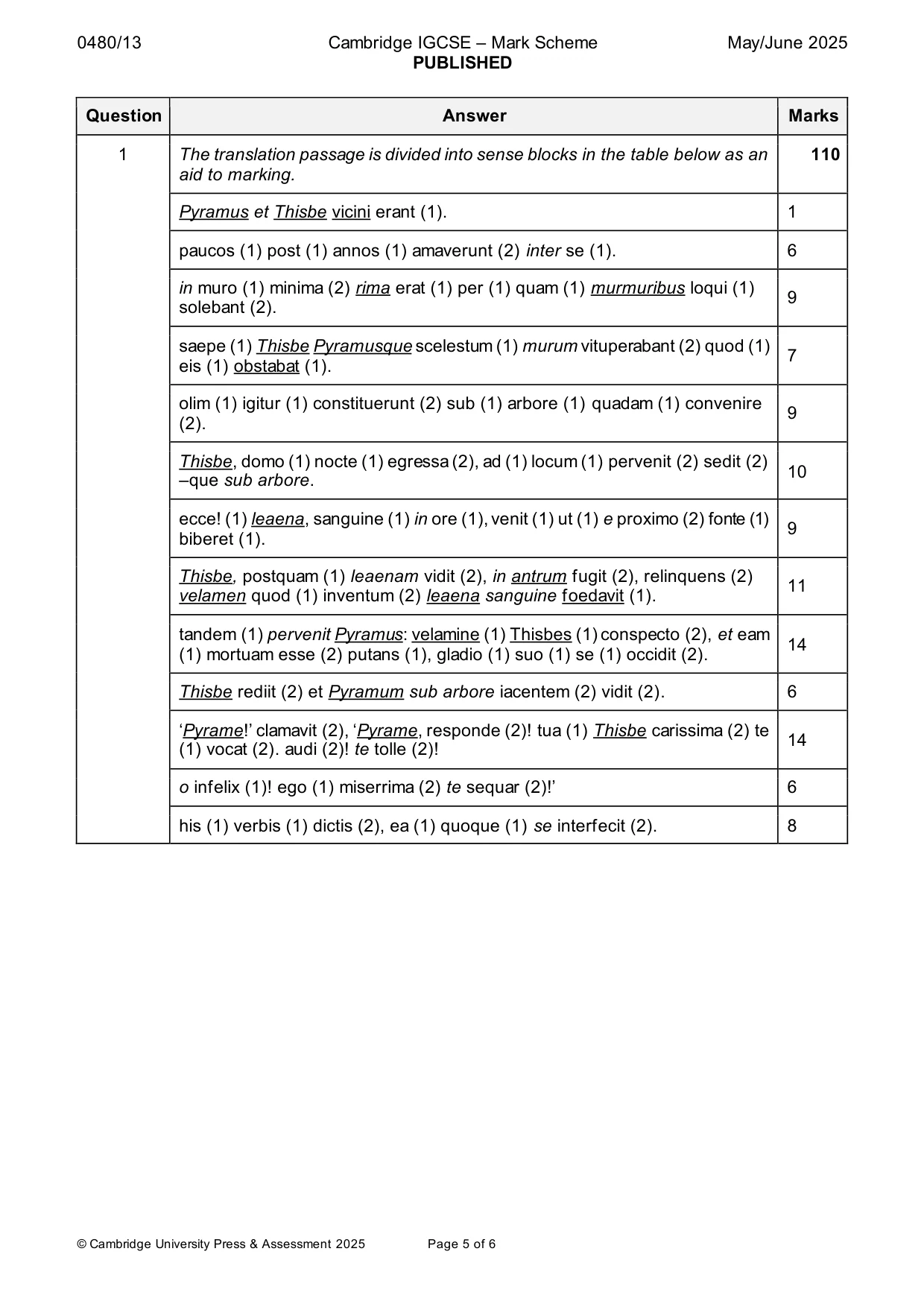
0480/13 Cambridge IGCSE – Mark Scheme PUBLISHED May/June 2025 © Cambridge University Press & Assessment 2025 Page 5 of 6 Question Answer Marks 1 The translation passage is divided into sense blocks in the table below as an aid to marking. 110 Pyramus et Thisbe vicini erant (1). 1 paucos (1) post (1) annos (1) amaverunt (2) inter se (1). 6 in muro (1) minima (2) rima erat (1) per (1) quam (1) murmuribus loqui (1) solebant (2). 9 saepe (1) Thisbe Pyramusque scelestum (1) murum vituperabant (2) quod (1) eis (1) obstabat (1). 7 olim (1) igitur (1) constituerunt (2) sub (1) arbore (1) quadam (1) convenire (2). 9 Thisbe, domo (1) nocte (1) egressa (2), ad (1) locum (1) pervenit (2) sedit (2) –que sub arbore. 10 ecce! (1) leaena, sanguine (1) in ore (1), venit (1) ut (1) e proximo (2) fonte (1) biberet (1). 9 Thisbe, postquam (1) leaenam vidit (2), in antrum fugit (2), relinquens (2) velamen quod (1) inventum (2) leaena sanguine foedavit (1). 11 tandem (1) pervenit Pyramus: velamine (1) Thisbes (1) conspecto (2), et eam (1) mortuam esse (2) putans (1), gladio (1) suo (1) se (1) occidit (2). 14 Thisbe rediit (2) et Pyramum sub arbore iacentem (2) vidit (2). 6 ‘Pyrame!’ clamavit (2), ‘Pyrame, responde (2)! tua (1) Thisbe carissima (2) te (1) vocat (2). audi (2)! te tolle (2)! 14 o infelix (1)! ego (1) miserrima (2) te sequar (2)!’ 6 his (1) verbis (1) dictis (2), ea (1) quoque (1) se interfecit (2). 8
Mark scheme, page 6
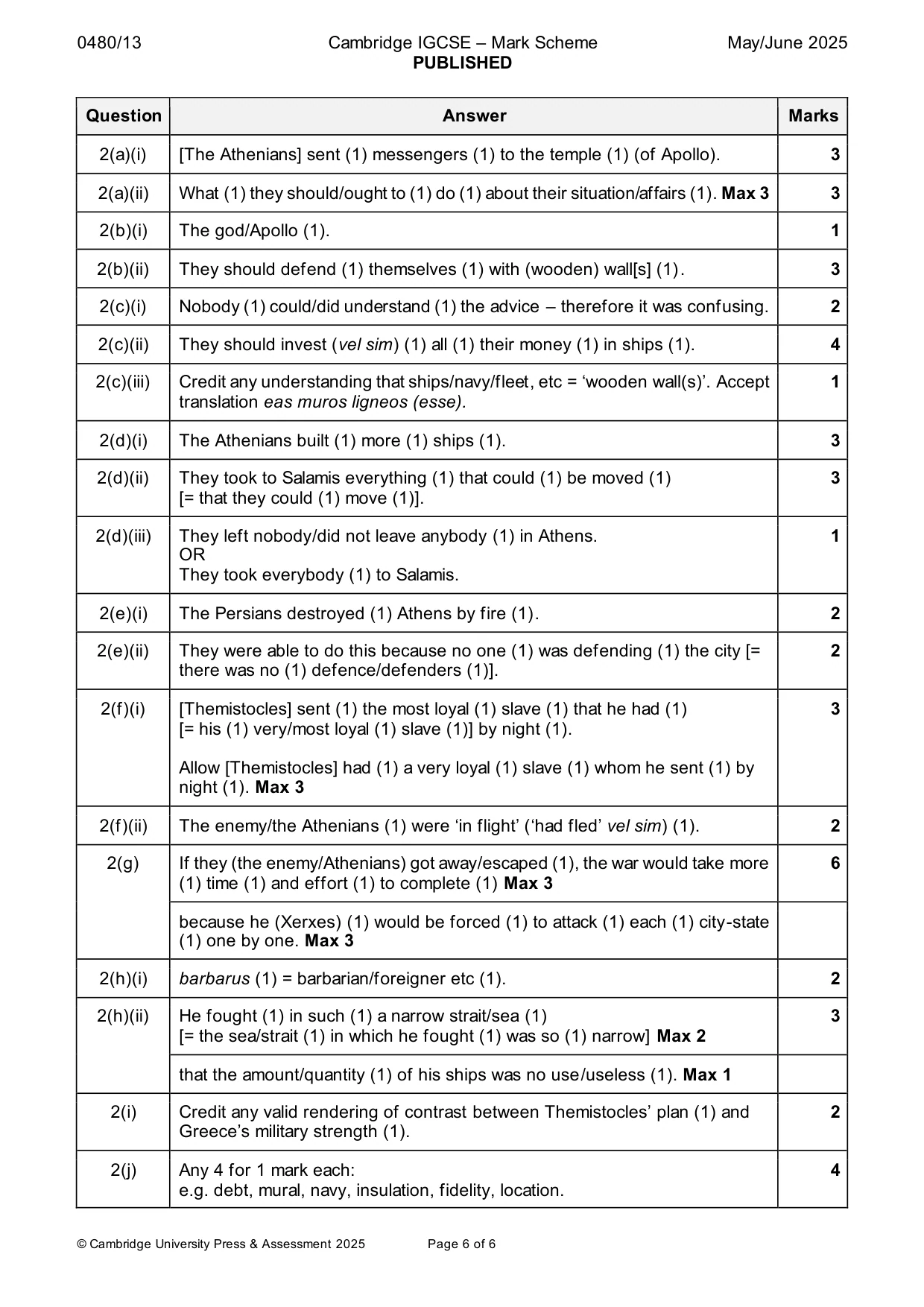
0480/13 Cambridge IGCSE – Mark Scheme PUBLISHED May/June 2025 © Cambridge University Press & Assessment 2025 Page 6 of 6 Question Answer Marks 2(a)(i) [The Athenians] sent (1) messengers (1) to the temple (1) (of Apollo). 3 2(a)(ii) What (1) they should/ought to (1) do (1) about their situation/affairs (1). Max 3 3 2(b)(i) The god/Apollo (1). 1 2(b)(ii) They should defend (1) themselves (1) with (wooden) wall[s] (1). 3 2(c)(i) Nobody (1) could/did understand (1) the advice – therefore it was confusing. 2 2(c)(ii) They should invest (vel sim) (1) all (1) their money (1) in ships (1). 4 2(c)(iii) Credit any understanding that ships/navy/fleet, etc = ‘wooden wall(s)’. Accept translation eas muros ligneos (esse). 1 2(d)(i) The Athenians built (1) more (1) ships (1). 3 2(d)(ii) They took to Salamis everything (1) that could (1) be moved (1) [= that they could (1) move (1)]. 3 2(d)(iii) They left nobody/did not leave anybody (1) in Athens. OR They took everybody (1) to Salamis. 1 2(e)(i) The Persians destroyed (1) Athens by fire (1). 2 2(e)(ii) They were able to do this because no one (1) was defending (1) the city [= there was no (1) defence/defenders (1)]. 2 2(f)(i) [Themistocles] sent (1) the most loyal (1) slave (1) that he had (1) [= his (1) very/most loyal (1) slave (1)] by night (1). Allow [Themistocles] had (1) a very loyal (1) slave (1) whom he sent (1) by night (1). Max 3 3 2(f)(ii) The enemy/the Athenians (1) were ‘in flight’ (‘had fled’ vel sim) (1). 2 2(g) If they (the enemy/Athenians) got away/escaped (1), the war would take more (1) time (1) and effort (1) to complete (1) Max 3 6 because he (Xerxes) (1) would be forced (1) to attack (1) each (1) city-state (1) one by one. Max 3 2(h)(i) barbarus (1) = barbarian/foreigner etc (1). 2 2(h)(ii) He fought (1) in such (1) a narrow strait/sea (1) [= the sea/strait (1) in which he fought (1) was so (1) narrow] Max 2 3 that the amount/quantity (1) of his ships was no use/useless (1). Max 1 2(i) Credit any valid rendering of contrast between Themistocles’ plan (1) and Greece’s military strength (1). 2 2(j) Any 4 for 1 mark each: e.g. debt, mural, navy, insulation, fidelity, location. 4
What you needed in this session
Cambridge’s own grade thresholds for 2025 May/June, Paper 1 · Variant 3. A higher threshold means an easier paper — the bar moves with how the cohort did.