Cambridge IGCSE Latin 0480 — 2020 May/June Paper 1 · Variant 3
0480/13/M/J/20
The question paper and its mark scheme, free to read here and free to download. This is Cambridge’s own paper, exactly as it was sat.
Question paper8 pages






Mark scheme5 pages
Answers below. Sit the paper first if you are practising.
Paper as text
Question paper, page 1
Cambridge IGCSE™ This document has 8 pages. Blank pages are indicated. DC (MB) 199883 © UCLES 2020 [Turn over LATIN 0480/13 Paper 1 Language May/June 2020 1 hour 30 minutes You must answer on the answer booklet/paper. You will need: Answer booklet/paper INSTRUCTIONS ● Answer all questions. ● If you have been given an answer booklet, follow the instructions on the front cover of the answer booklet. ● Use a black or dark blue pen. ● Write your name, centre number and candidate number on all the work you hand in. ● Do not use an erasable pen or correction fluid. ● At the end of the examination, fasten all your work together. Do not use staples, paper clips or glue. INFORMATION ● The total mark for this paper is 160. ● The number of marks for each question or part question is shown in brackets [ ]. * 1 3 3 3 7 4 7 1 8 3 *
Question paper, page 2
2 0480/13/M/J/20 © UCLES 2020 BLANK PAGE
Question paper, page 3
3 0480/13/M/J/20 © UCLES 2020 [Turn over Section A 1 Translate the following passage into English. Write your translation on alternate lines. Agesilaus leads a strike against the Persians but is halted by an unexpected request for a truce. Agesilaus, simulatque imperii potitus est, Lacedaemoniis persuasit ut exercitum emitterent in Asiam et bellum contra Artaxerxen, regem Persarum, gererent. credidit enim melius esse in Asia quam in Europa pugnare quod fama exierat Artaxerxen naves militesque parare, quos in Graeciam mitteret. Agesilaus tam celeriter hoc peregit ut in Asiam cum copiis suis pervenerit priusquam legati Persarum scirent eum profectum esse. Agesilaus hoc fecit ut omnes hostes de improviso oppugnaret. ubi Tissaphernes, qui summum imperium inter praefectos tum habebat, id cognovit, indutias ab Agesilao petivit. nam hic simulavit se regem oraturum esse ut cum Lacedaemoniis conveniret, sed vero indutiis ad copias comparandas usus est. uterque iuravit se sine dolo indutias servaturum esse. in qua re Agesilaus tota fide manebat sed Tissaphernes nihil aliud quam bellum paravit. Nepos, Agesilaus 2 adapted Agesilaus, Agesilai (m) Agesilaus, a leader of Sparta, a city in Greece potior, potiri, potitus sum (+gen.) I gain, I obtain Lacedaemonii, Lacedaemoniorum (m pl) Spartans Asia, Asiae (f) Asia Artaxerxes, Artaxerxis (Artaxerxen accusative) (m) Artaxerxes, a Persian Persae, Persarum (m pl) Persians Europa, Europae (f) Europe Graecia, Graeciae (f) Greece perago, peragere, peregi, peractum I complete de improviso unexpectedly Tissaphernes, Tissaphernis (m) Tissaphernes, a Persian indutiae, indutiarum (f pl) a truce uterque, utraque, utrumque each one, both dolus, doli (m) trickery [110]
Question paper, page 4
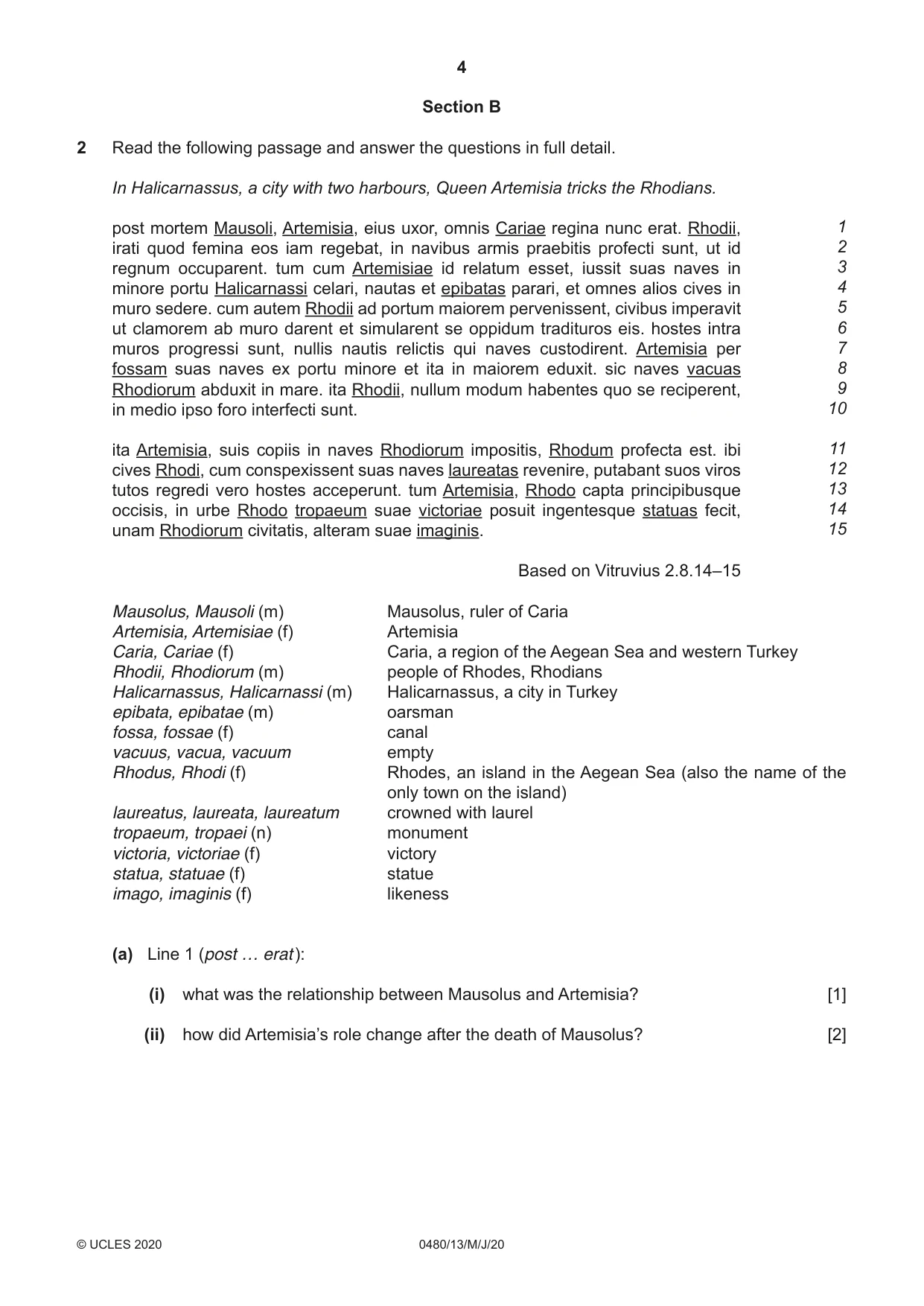
4 0480/13/M/J/20 © UCLES 2020 Section B 2 Read the following passage and answer the questions in full detail. In Halicarnassus, a city with two harbours, Queen Artemisia tricks the Rhodians. post mortem Mausoli, Artemisia, eius uxor, omnis Cariae regina nunc erat. Rhodii, irati quod femina eos iam regebat, in navibus armis praebitis profecti sunt, ut id regnum occuparent. tum cum Artemisiae id relatum esset, iussit suas naves in minore portu Halicarnassi celari, nautas et epibatas parari, et omnes alios cives in muro sedere. cum autem Rhodii ad portum maiorem pervenissent, civibus imperavit ut clamorem ab muro darent et simularent se oppidum tradituros eis. hostes intra muros progressi sunt, nullis nautis relictis qui naves custodirent. Artemisia per fossam suas naves ex portu minore et ita in maiorem eduxit. sic naves vacuas Rhodiorum abduxit in mare. ita Rhodii, nullum modum habentes quo se reciperent, in medio ipso foro interfecti sunt. ita Artemisia, suis copiis in naves Rhodiorum impositis, Rhodum profecta est. ibi cives Rhodi, cum conspexissent suas naves laureatas revenire, putabant suos viros tutos regredi vero hostes acceperunt. tum Artemisia, Rhodo capta principibusque occisis, in urbe Rhodo tropaeum suae victoriae posuit ingentesque statuas fecit, unam Rhodiorum civitatis, alteram suae imaginis. Based on Vitruvius 2.8.14–15 Mausolus, Mausoli (m) Mausolus, ruler of Caria Artemisia, Artemisiae (f) Artemisia Caria, Cariae (f) Caria, a region of the Aegean Sea and western Turkey Rhodii, Rhodiorum (m) people of Rhodes, Rhodians Halicarnassus, Halicarnassi (m) Halicarnassus, a city in Turkey epibata, epibatae (m) oarsman fossa, fossae (f) canal vacuus, vacua, vacuum empty Rhodus, Rhodi (f) Rhodes, an island in the Aegean Sea (also the name of the only town on the island) laureatus, laureata, laureatum crowned with laurel tropaeum, tropaei (n) monument victoria, victoriae (f) victory statua, statuae (f) statue imago, imaginis (f) likeness (a) Line 1 (post … erat ): (i) what was the relationship between Mausolus and Artemisia? [1] (ii) how did Artemisia’s role change after the death of Mausolus? [2] 1 2 3 4 5 6 7 8 9 10 11 12 13 14 15
Question paper, page 5
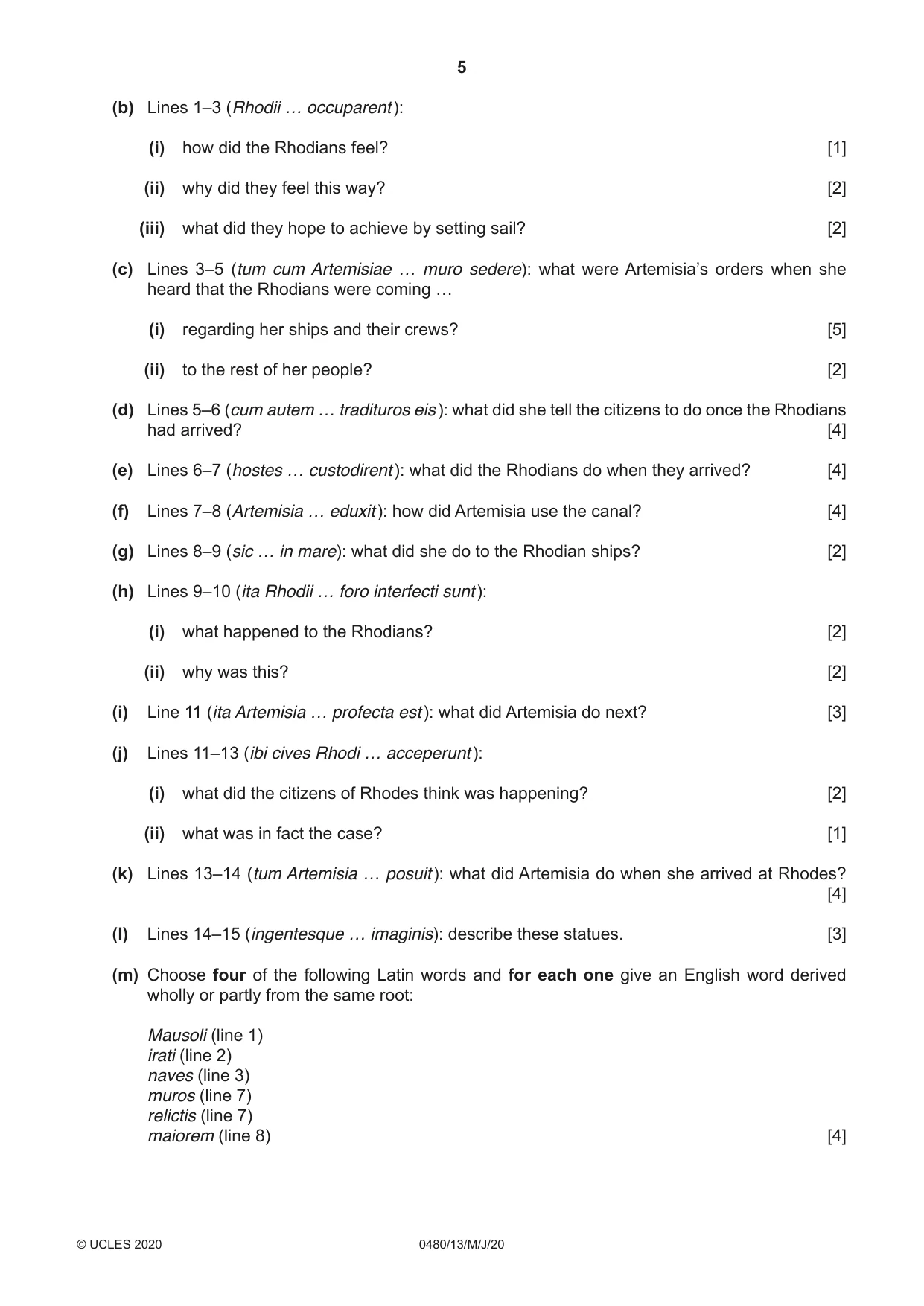
5 0480/13/M/J/20 © UCLES 2020 (b) Lines 1–3 (Rhodii … occuparent ): (i) how did the Rhodians feel? [1] (ii) why did they feel this way? [2] (iii) what did they hope to achieve by setting sail? [2] (c) Lines 3–5 (tum cum Artemisiae … muro sedere): what were Artemisia’s orders when she heard that the Rhodians were coming … (i) regarding her ships and their crews? [5] (ii) to the rest of her people? [2] (d) Lines 5–6 (cum autem … tradituros eis ): what did she tell the citizens to do once the Rhodians had arrived? [4] (e) Lines 6–7 (hostes … custodirent ): what did the Rhodians do when they arrived? [4] (f) Lines 7–8 (Artemisia … eduxit ): how did Artemisia use the canal? [4] (g) Lines 8–9 (sic … in mare): what did she do to the Rhodian ships? [2] (h) Lines 9–10 (ita Rhodii … foro interfecti sunt ): (i) what happened to the Rhodians? [2] (ii) why was this? [2] (i) Line 11 (ita Artemisia … profecta est ): what did Artemisia do next? [3] (j) Lines 11–13 (ibi cives Rhodi … acceperunt ): (i) what did the citizens of Rhodes think was happening? [2] (ii) what was in fact the case? [1] (k) Lines 13–14 (tum Artemisia … posuit ): what did Artemisia do when she arrived at Rhodes? [4] (l) Lines 14–15 (ingentesque … imaginis): describe these statues. [3] (m) Choose four of the following Latin words and for each one give an English word derived wholly or partly from the same root: Mausoli (line 1) irati (line 2) naves (line 3) muros (line 7) relictis (line 7) maiorem (line 8) [4]
Question paper, page 6
6 0480/13/M/J/20 © UCLES 2020 BLANK PAGE
Question paper, page 7
7 0480/13/M/J/20 © UCLES 2020 BLANK PAGE
Question paper, page 8
8 0480/13/M/J/20 © UCLES 2020 Permission to reproduce items where third-party owned material protected by copyright is included has been sought and cleared where possible. Every reasonable effort has been made by the publisher (UCLES) to trace copyright holders, but if any items requiring clearance have unwittingly been included, the publisher will be pleased to make amends at the earliest possible opportunity. To avoid the issue of disclosure of answer-related information to candidates, all copyright acknowledgements are reproduced online in the Cambridge Assessment International Education Copyright Acknowledgements Booklet. This is produced for each series of examinations and is freely available to download at www.cambridgeinternational.org after the live examination series. Cambridge Assessment International Education is part of the Cambridge Assessment Group. Cambridge Assessment is the brand name of the University of Cambridge Local Examinations Syndicate (UCLES), which itself is a department of the University of Cambridge. BLANK PAGE
Mark scheme, page 1
This document consists of 5 printed pages. © UCLES 2020 [Turn over Cambridge IGCSE™ LATIN 0480/13 Paper 1 Language May/June 2020 MARK SCHEME Maximum Mark: 160 Published Students did not sit exam papers in the June 2020 series due to the Covid-19 global pandemic. This mark scheme is published to support teachers and students and should be read together with the question paper. It shows the requirements of the exam. The answer column of the mark scheme shows the proposed basis on which Examiners would award marks for this exam. Where appropriate, this column also provides the most likely acceptable alternative responses expected from students. Examiners usually review the mark scheme after they have seen student responses and update the mark scheme if appropriate. In the June series, Examiners were unable to consider the acceptability of alternative responses, as there were no student responses to consider. Mark schemes should usually be read together with the Principal Examiner Report for Teachers. However, because students did not sit exam papers, there is no Principal Examiner Report for Teachers for the June 2020 series. Cambridge International will not enter into discussions about these mark schemes. Cambridge International is publishing the mark schemes for the June 2020 series for most Cambridge IGCSE™ and Cambridge International A & AS Level components, and some Cambridge O Level components.
Mark scheme, page 2
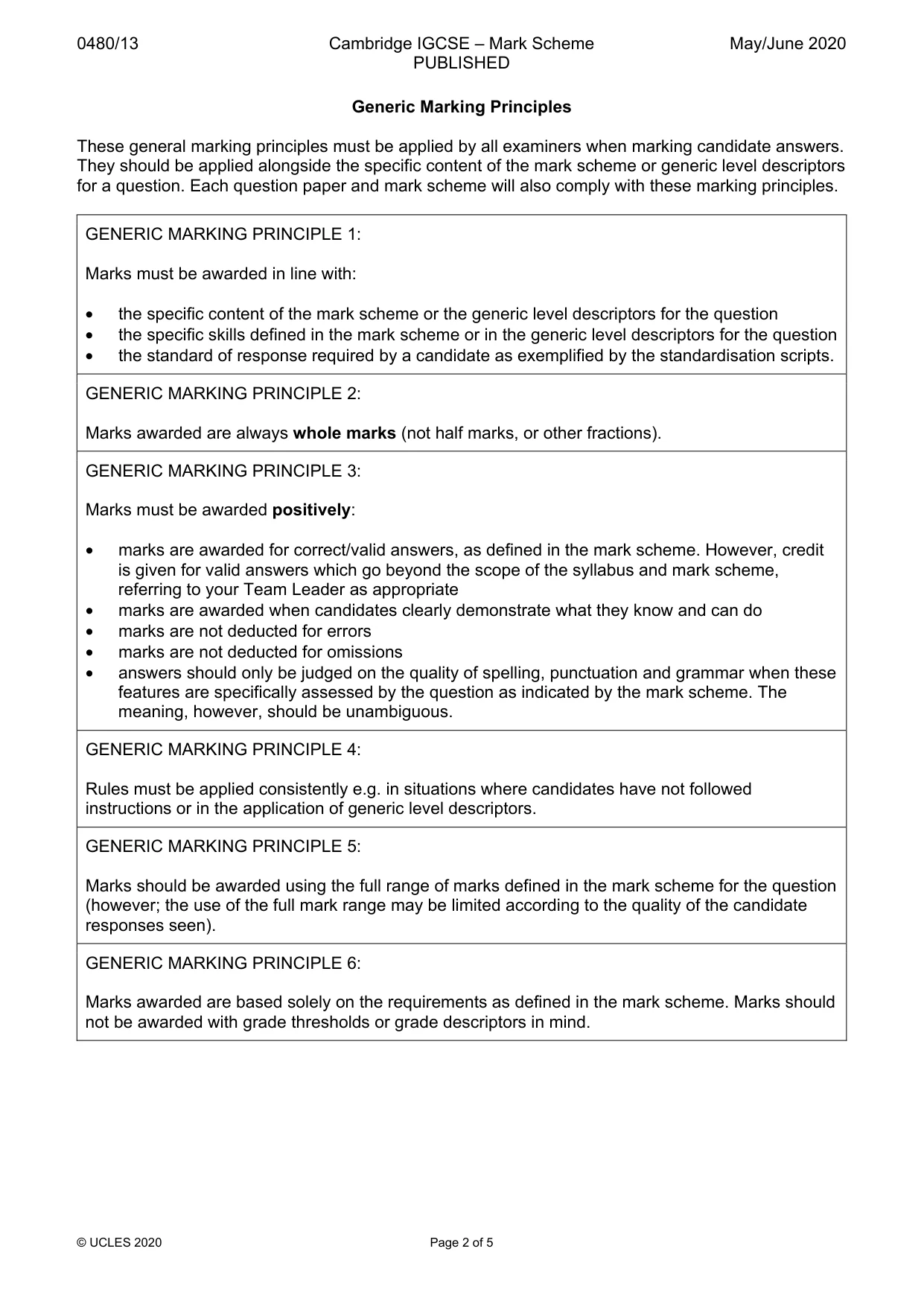
0480/13 Cambridge IGCSE – Mark Scheme PUBLISHED May/June 2020 © UCLES 2020 Page 2 of 5 Generic Marking Principles These general marking principles must be applied by all examiners when marking candidate answers. They should be applied alongside the specific content of the mark scheme or generic level descriptors for a question. Each question paper and mark scheme will also comply with these marking principles. GENERIC MARKING PRINCIPLE 1: Marks must be awarded in line with: • the specific content of the mark scheme or the generic level descriptors for the question • the specific skills defined in the mark scheme or in the generic level descriptors for the question • the standard of response required by a candidate as exemplified by the standardisation scripts. GENERIC MARKING PRINCIPLE 2: Marks awarded are always whole marks (not half marks, or other fractions). GENERIC MARKING PRINCIPLE 3: Marks must be awarded positively: • marks are awarded for correct/valid answers, as defined in the mark scheme. However, credit is given for valid answers which go beyond the scope of the syllabus and mark scheme, referring to your Team Leader as appropriate • marks are awarded when candidates clearly demonstrate what they know and can do • marks are not deducted for errors • marks are not deducted for omissions • answers should only be judged on the quality of spelling, punctuation and grammar when these features are specifically assessed by the question as indicated by the mark scheme. The meaning, however, should be unambiguous. GENERIC MARKING PRINCIPLE 4: Rules must be applied consistently e.g. in situations where candidates have not followed instructions or in the application of generic level descriptors. GENERIC MARKING PRINCIPLE 5: Marks should be awarded using the full range of marks defined in the mark scheme for the question (however; the use of the full mark range may be limited according to the quality of the candidate responses seen). GENERIC MARKING PRINCIPLE 6: Marks awarded are based solely on the requirements as defined in the mark scheme. Marks should not be awarded with grade thresholds or grade descriptors in mind.
Mark scheme, page 3
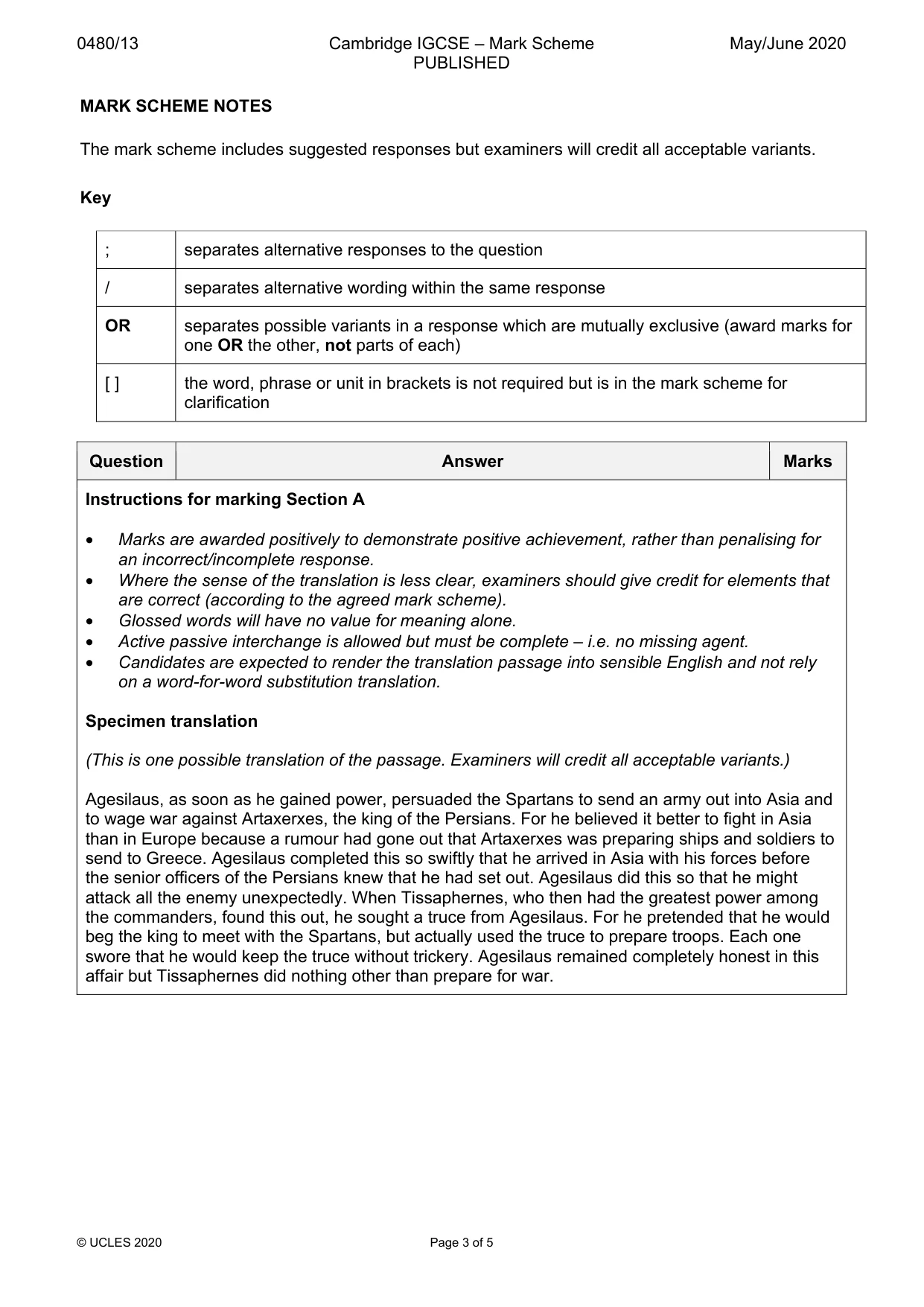
0480/13 Cambridge IGCSE – Mark Scheme PUBLISHED May/June 2020 © UCLES 2020 Page 3 of 5 MARK SCHEME NOTES The mark scheme includes suggested responses but examiners will credit all acceptable variants. Key ; separates alternative responses to the question / separates alternative wording within the same response OR separates possible variants in a response which are mutually exclusive (award marks for one OR the other, not parts of each) [ ] the word, phrase or unit in brackets is not required but is in the mark scheme for clarification Question Answer Marks Instructions for marking Section A • Marks are awarded positively to demonstrate positive achievement, rather than penalising for an incorrect/incomplete response. • Where the sense of the translation is less clear, examiners should give credit for elements that are correct (according to the agreed mark scheme). • Glossed words will have no value for meaning alone. • Active passive interchange is allowed but must be complete – i.e. no missing agent. • Candidates are expected to render the translation passage into sensible English and not rely on a word-for-word substitution translation. Specimen translation (This is one possible translation of the passage. Examiners will credit all acceptable variants.) Agesilaus, as soon as he gained power, persuaded the Spartans to send an army out into Asia and to wage war against Artaxerxes, the king of the Persians. For he believed it better to fight in Asia than in Europe because a rumour had gone out that Artaxerxes was preparing ships and soldiers to send to Greece. Agesilaus completed this so swiftly that he arrived in Asia with his forces before the senior officers of the Persians knew that he had set out. Agesilaus did this so that he might attack all the enemy unexpectedly. When Tissaphernes, who then had the greatest power among the commanders, found this out, he sought a truce from Agesilaus. For he pretended that he would beg the king to meet with the Spartans, but actually used the truce to prepare troops. Each one swore that he would keep the truce without trickery. Agesilaus remained completely honest in this affair but Tissaphernes did nothing other than prepare for war.
Mark scheme, page 4
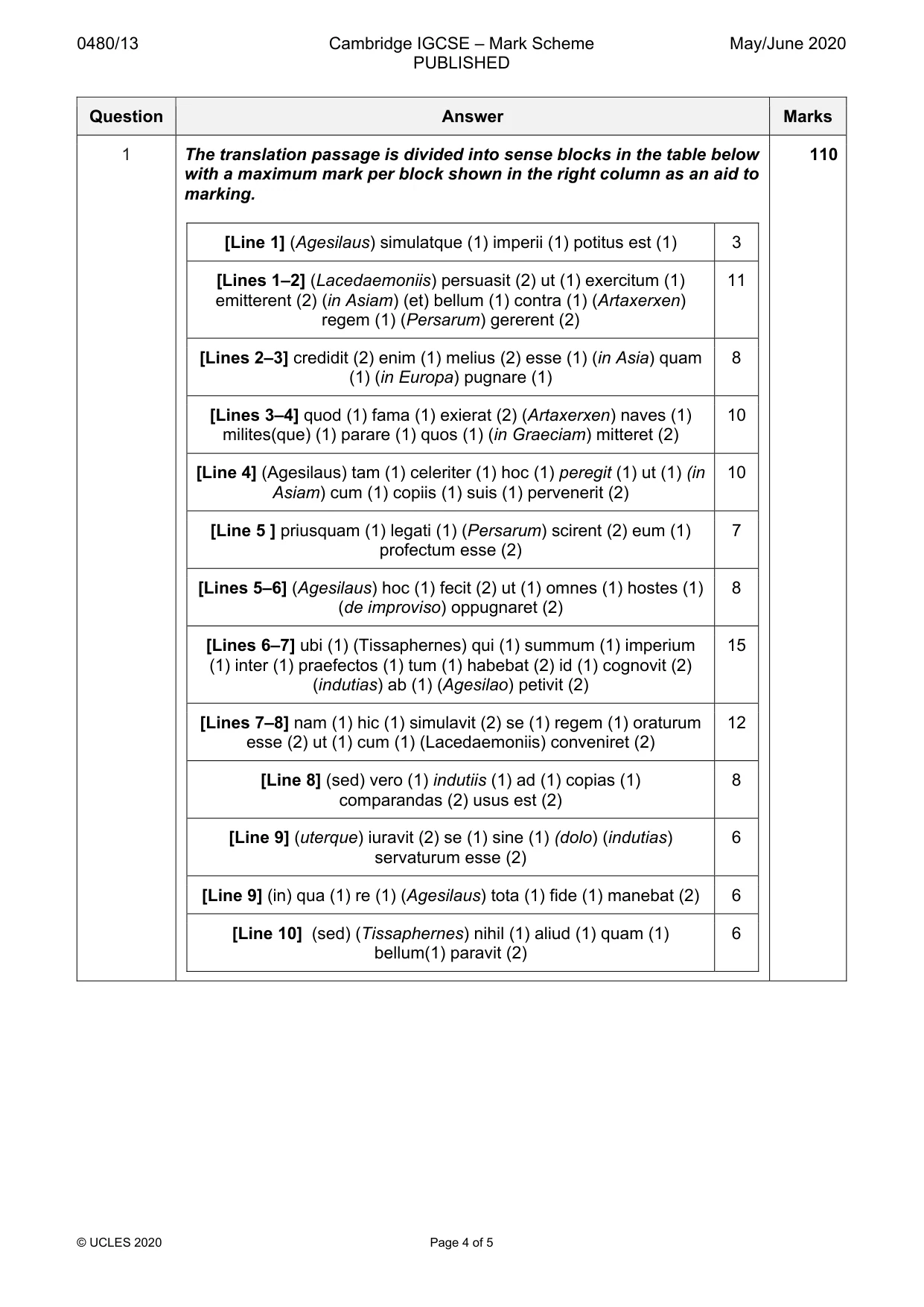
0480/13 Cambridge IGCSE – Mark Scheme PUBLISHED May/June 2020 © UCLES 2020 Page 4 of 5 Question Answer Marks 1 The translation passage is divided into sense blocks in the table below with a maximum mark per block shown in the right column as an aid to marking. [Line 1] (Agesilaus) simulatque (1) imperii (1) potitus est (1) 3 [Lines 1–2] (Lacedaemoniis) persuasit (2) ut (1) exercitum (1) emitterent (2) (in Asiam) (et) bellum (1) contra (1) (Artaxerxen) regem (1) (Persarum) gererent (2) 11 [Lines 2–3] credidit (2) enim (1) melius (2) esse (1) (in Asia) quam (1) (in Europa) pugnare (1) 8 [Lines 3–4] quod (1) fama (1) exierat (2) (Artaxerxen) naves (1) milites(que) (1) parare (1) quos (1) (in Graeciam) mitteret (2) 10 [Line 4] (Agesilaus) tam (1) celeriter (1) hoc (1) peregit (1) ut (1) (in Asiam) cum (1) copiis (1) suis (1) pervenerit (2) 10 [Line 5 ] priusquam (1) legati (1) (Persarum) scirent (2) eum (1) profectum esse (2) 7 [Lines 5–6] (Agesilaus) hoc (1) fecit (2) ut (1) omnes (1) hostes (1) (de improviso) oppugnaret (2) 8 [Lines 6–7] ubi (1) (Tissaphernes) qui (1) summum (1) imperium (1) inter (1) praefectos (1) tum (1) habebat (2) id (1) cognovit (2) (indutias) ab (1) (Agesilao) petivit (2) 15 [Lines 7–8] nam (1) hic (1) simulavit (2) se (1) regem (1) oraturum esse (2) ut (1) cum (1) (Lacedaemoniis) conveniret (2) 12 [Line 8] (sed) vero (1) indutiis (1) ad (1) copias (1) comparandas (2) usus est (2) 8 [Line 9] (uterque) iuravit (2) se (1) sine (1) (dolo) (indutias) servaturum esse (2) 6 [Line 9] (in) qua (1) re (1) (Agesilaus) tota (1) fide (1) manebat (2) 6 [Line 10] (sed) (Tissaphernes) nihil (1) aliud (1) quam (1) bellum(1) paravit (2) 6 110
Mark scheme, page 5
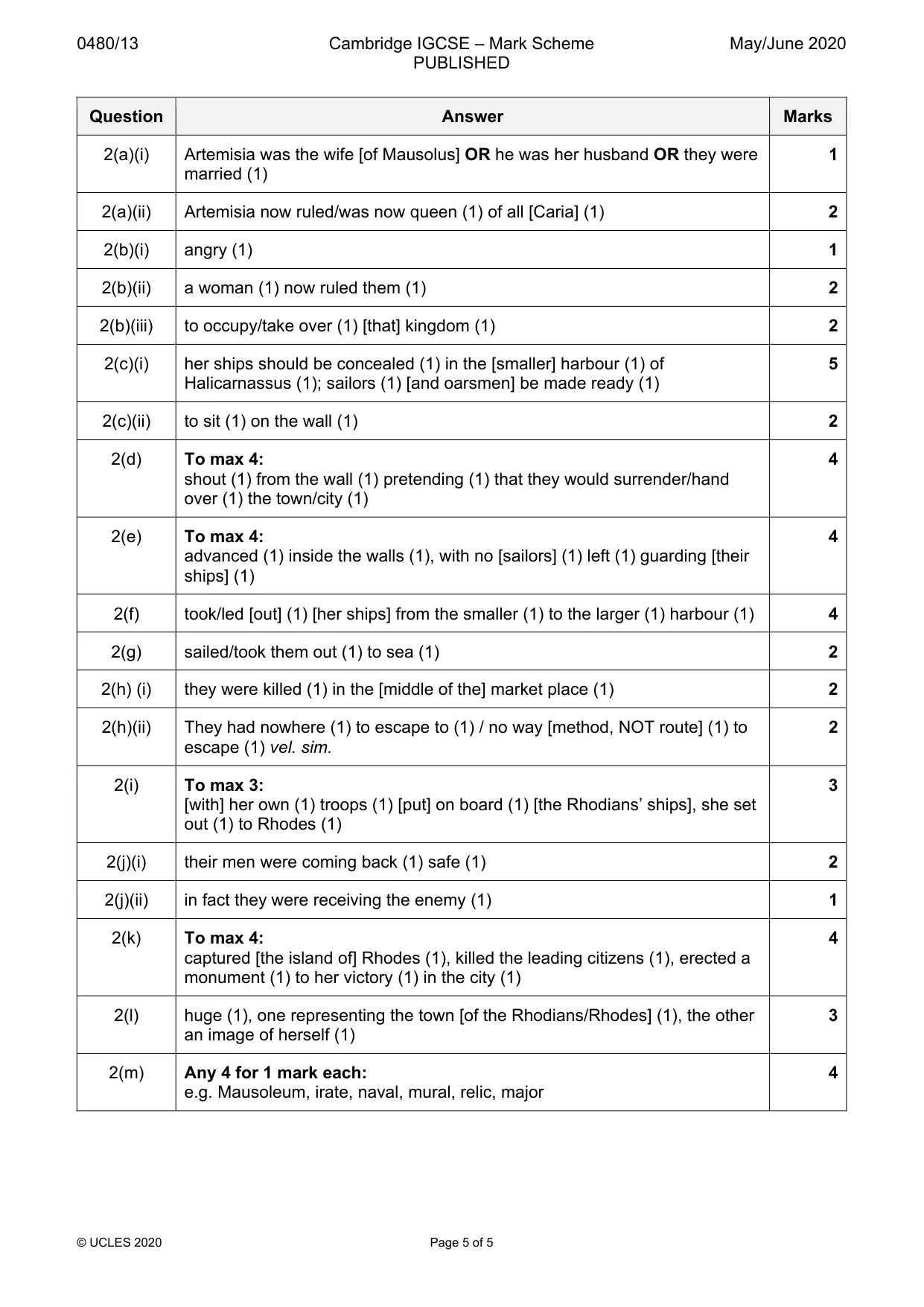
0480/13 Cambridge IGCSE – Mark Scheme PUBLISHED May/June 2020 © UCLES 2020 Page 5 of 5 Question Answer Marks 2(a)(i) Artemisia was the wife [of Mausolus] OR he was her husband OR they were married (1) 1 2(a)(ii) Artemisia now ruled/was now queen (1) of all [Caria] (1) 2 2(b)(i) angry (1) 1 2(b)(ii) a woman (1) now ruled them (1) 2 2(b)(iii) to occupy/take over (1) [that] kingdom (1) 2 2(c)(i) her ships should be concealed (1) in the [smaller] harbour (1) of Halicarnassus (1); sailors (1) [and oarsmen] be made ready (1) 5 2(c)(ii) to sit (1) on the wall (1) 2 2(d) To max 4: shout (1) from the wall (1) pretending (1) that they would surrender/hand over (1) the town/city (1) 4 2(e) To max 4: advanced (1) inside the walls (1), with no [sailors] (1) left (1) guarding [their ships] (1) 4 2(f) took/led [out] (1) [her ships] from the smaller (1) to the larger (1) harbour (1) 4 2(g) sailed/took them out (1) to sea (1) 2 2(h) (i) they were killed (1) in the [middle of the] market place (1) 2 2(h)(ii) They had nowhere (1) to escape to (1) / no way [method, NOT route] (1) to escape (1) vel. sim. 2 2(i) To max 3: [with] her own (1) troops (1) [put] on board (1) [the Rhodians’ ships], she set out (1) to Rhodes (1) 3 2(j)(i) their men were coming back (1) safe (1) 2 2(j)(ii) in fact they were receiving the enemy (1) 1 2(k) To max 4: captured [the island of] Rhodes (1), killed the leading citizens (1), erected a monument (1) to her victory (1) in the city (1) 4 2(l) huge (1), one representing the town [of the Rhodians/Rhodes] (1), the other an image of herself (1) 3 2(m) Any 4 for 1 mark each: e.g. Mausoleum, irate, naval, mural, relic, major 4