Cambridge IGCSE Latin 0480 — 2021 May/June Paper 1 · Variant 3
0480/13/M/J/21 · 160 marks · ≈180 min
The question paper and its mark scheme, free to read here and free to download. This is Cambridge’s own paper, exactly as it was sat.
Question paper8 pages



Mark scheme5 pages
Answers below. Sit the paper first if you are practising.
Paper as text
Question paper, page 1
This document has 8 pages. Any blank pages are indicated. Cambridge IGCSE™ DC (DH) 202259/3 © UCLES 2021 [Turn over * 9 7 7 0 9 2 4 5 1 2 * LATIN 0480/13 Paper 1 Language May/June 2021 1 hour 30 minutes You must answer on the answer booklet/paper. You will need: Answer booklet/paper INSTRUCTIONS ● Answer all questions. ● If you have been given an answer booklet, follow the instructions on the front cover of the answer booklet. ● Use a black or dark blue pen. ● Write your name, centre number and candidate number on all the work you hand in. ● Do not use an erasable pen or correction fluid. ● At the end of the examination, fasten all your work together. Do not use staples, paper clips or glue. INFORMATION ● The total mark for this paper is 160. ● The number of marks for each question or part question is shown in brackets [ ].
Question paper, page 2
2 0480/13/M/J/21 © UCLES 2021 BLANK PAGE
Question paper, page 3
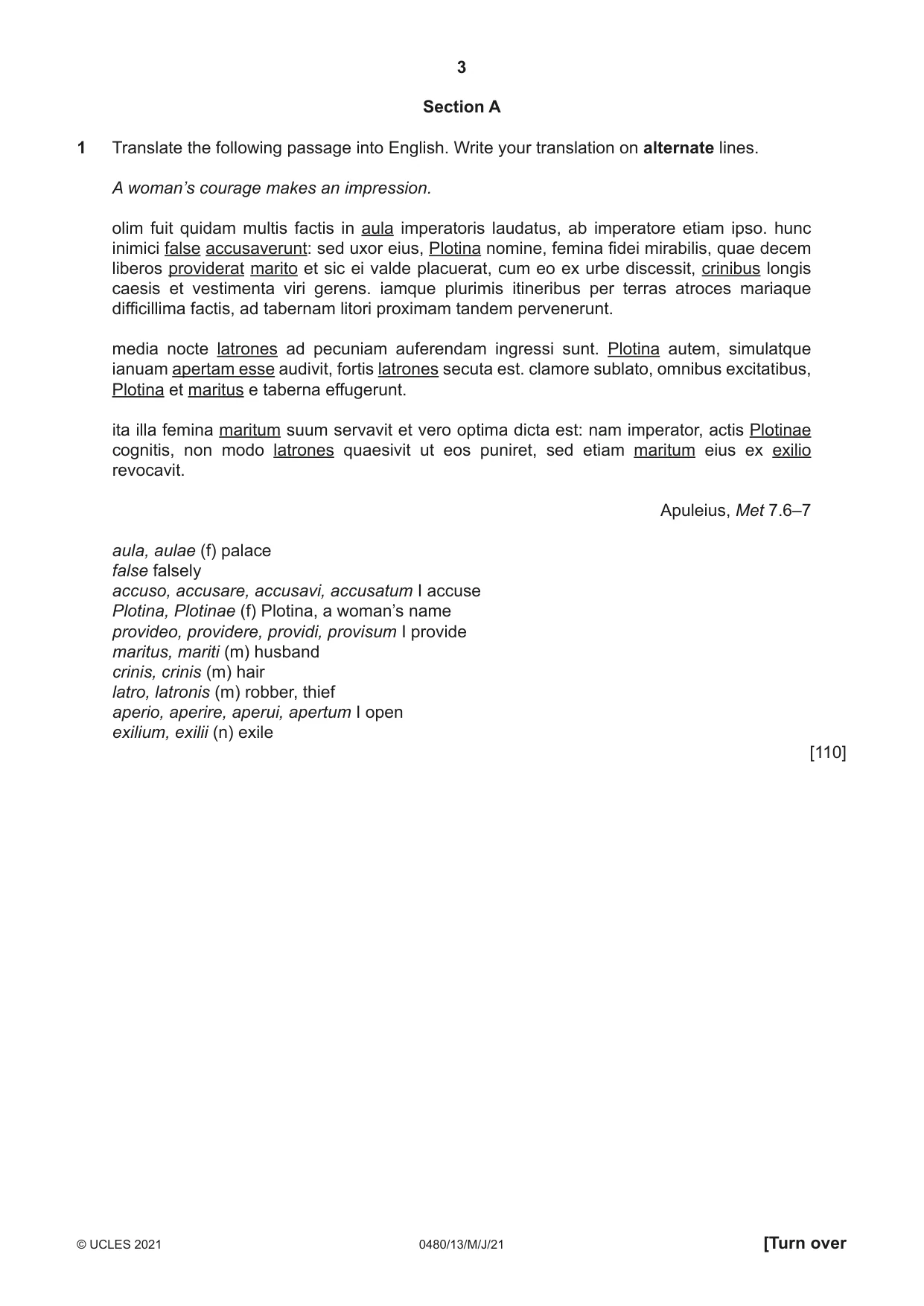
3 0480/13/M/J/21 © UCLES 2021 [Turn over Section A 1 Translate the following passage into English. Write your translation on alternate lines. A woman’s courage makes an impression. olim fuit quidam multis factis in aula imperatoris laudatus, ab imperatore etiam ipso. hunc inimici false accusaverunt: sed uxor eius, Plotina nomine, femina fidei mirabilis, quae decem liberos providerat marito et sic ei valde placuerat, cum eo ex urbe discessit, crinibus longis caesis et vestimenta viri gerens. iamque plurimis itineribus per terras atroces mariaque difficillima factis, ad tabernam litori proximam tandem pervenerunt. media nocte latrones ad pecuniam auferendam ingressi sunt. Plotina autem, simulatque ianuam apertam esse audivit, fortis latrones secuta est. clamore sublato, omnibus excitatibus, Plotina et maritus e taberna effugerunt. ita illa femina maritum suum servavit et vero optima dicta est: nam imperator, actis Plotinae cognitis, non modo latrones quaesivit ut eos puniret, sed etiam maritum eius ex exilio revocavit. Apuleius, Met 7.6–7 aula, aulae (f) palace false falsely accuso, accusare, accusavi, accusatum I accuse Plotina, Plotinae (f) Plotina, a woman’s name provideo, providere, providi, provisum I provide maritus, mariti (m) husband crinis, crinis (m) hair latro, latronis (m) robber, thief aperio, aperire, aperui, apertum I open exilium, exilii (n) exile [110]
Question paper, page 4
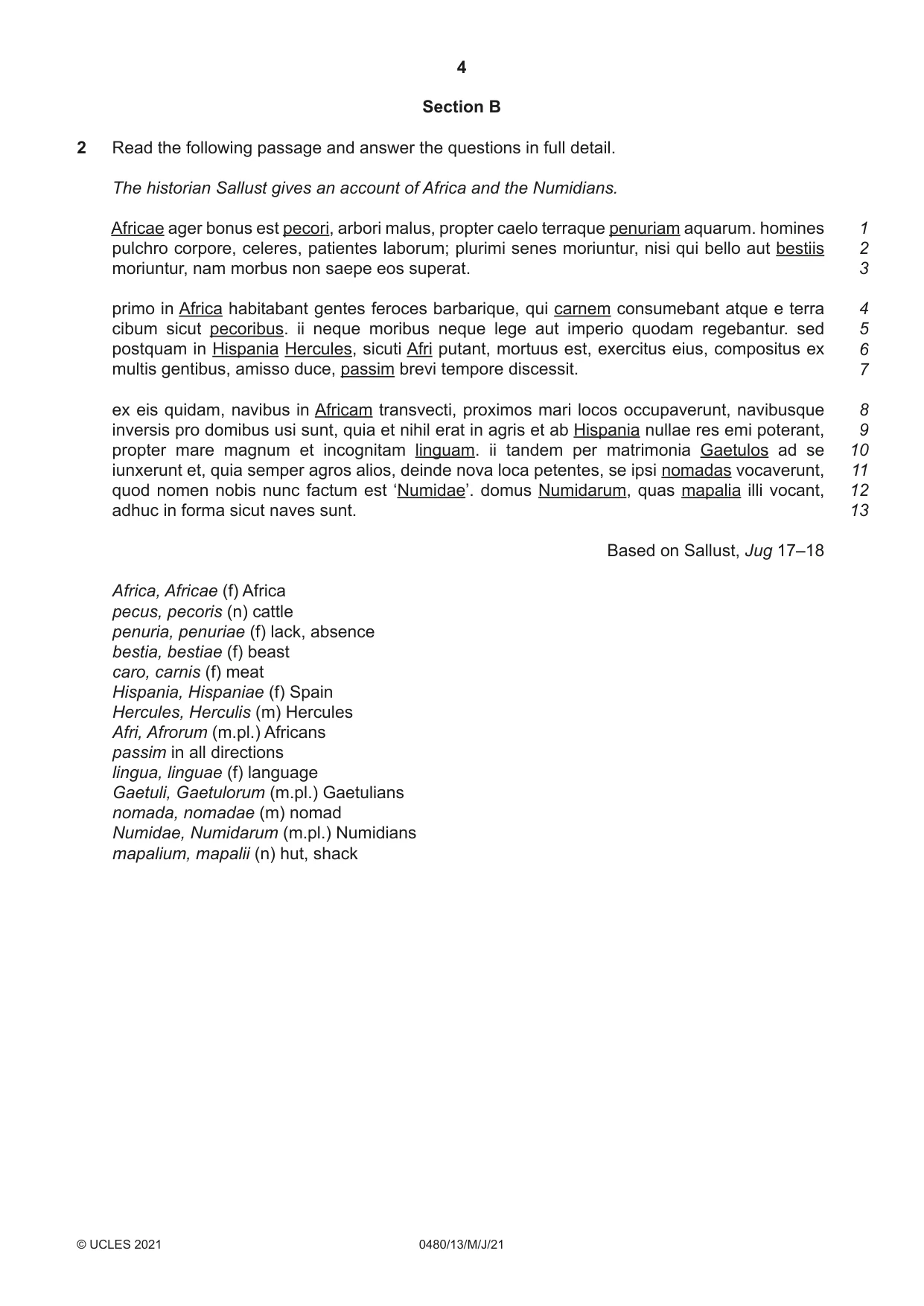
4 0480/13/M/J/21 © UCLES 2021 Section B 2 Read the following passage and answer the questions in full detail. The historian Sallust gives an account of Africa and the Numidians. Africae ager bonus est pecori, arbori malus, propter caelo terraque penuriam aquarum. homines pulchro corpore, celeres, patientes laborum; plurimi senes moriuntur, nisi qui bello aut bestiis moriuntur, nam morbus non saepe eos superat. primo in Africa habitabant gentes feroces barbarique, qui carnem consumebant atque e terra cibum sicut pecoribus. ii neque moribus neque lege aut imperio quodam regebantur. sed postquam in Hispania Hercules, sicuti Afri putant, mortuus est, exercitus eius, compositus ex multis gentibus, amisso duce, passim brevi tempore discessit. ex eis quidam, navibus in Africam transvecti, proximos mari locos occupaverunt, navibusque inversis pro domibus usi sunt, quia et nihil erat in agris et ab Hispania nullae res emi poterant, propter mare magnum et incognitam linguam. ii tandem per matrimonia Gaetulos ad se iunxerunt et, quia semper agros alios, deinde nova loca petentes, se ipsi nomadas vocaverunt, quod nomen nobis nunc factum est ‘Numidae’. domus Numidarum, quas mapalia illi vocant, adhuc in forma sicut naves sunt. Based on Sallust, Jug 17–18 Africa, Africae (f) Africa pecus, pecoris (n) cattle penuria, penuriae (f) lack, absence bestia, bestiae (f) beast caro, carnis (f) meat Hispania, Hispaniae (f) Spain Hercules, Herculis (m) Hercules Afri, Afrorum (m.pl.) Africans passim in all directions lingua, linguae (f) language Gaetuli, Gaetulorum (m.pl.) Gaetulians nomada, nomadae (m) nomad Numidae, Numidarum (m.pl.) Numidians mapalium, mapalii (n) hut, shack 1 2 3 4 5 6 7 8 9 10 11 12 13
Question paper, page 5
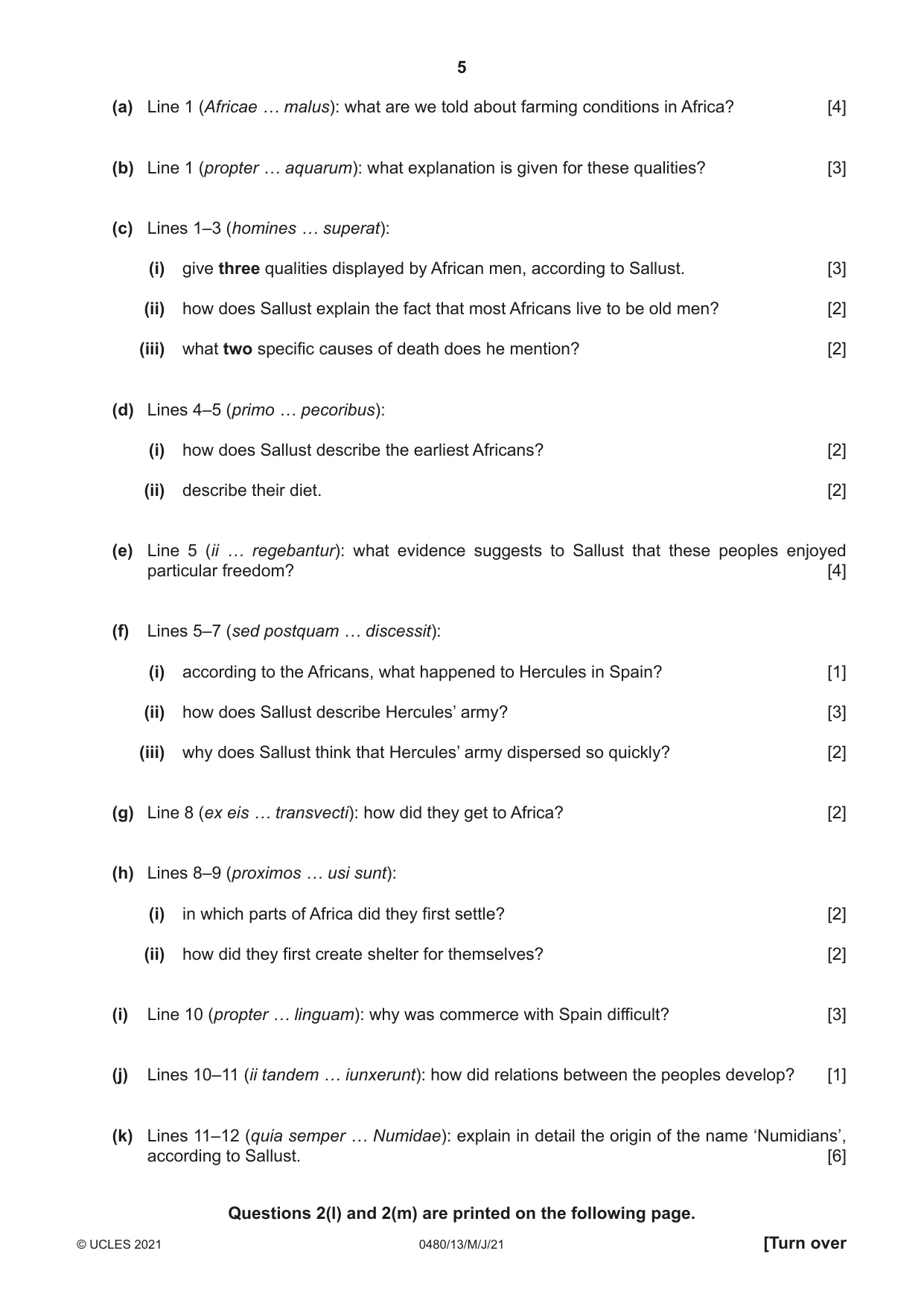
5 0480/13/M/J/21 © UCLES 2021 [Turn over (a) Line 1 (Africae … malus): what are we told about farming conditions in Africa? [4] (b) Line 1 (propter … aquarum): what explanation is given for these qualities? [3] (c) Lines 1–3 (homines … superat): (i) give three qualities displayed by African men, according to Sallust. [3] (ii) how does Sallust explain the fact that most Africans live to be old men? [2] (iii) what two specific causes of death does he mention? [2] (d) Lines 4–5 (primo … pecoribus): (i) how does Sallust describe the earliest Africans? [2] (ii) describe their diet. [2] (e) Line 5 (ii … regebantur): what evidence suggests to Sallust that these peoples enjoyed particular freedom? [4] (f) Lines 5–7 (sed postquam … discessit): (i) according to the Africans, what happened to Hercules in Spain? [1] (ii) how does Sallust describe Hercules’ army? [3] (iii) why does Sallust think that Hercules’ army dispersed so quickly? [2] (g) Line 8 (ex eis … transvecti): how did they get to Africa? [2] (h) Lines 8–9 (proximos … usi sunt): (i) in which parts of Africa did they first settle? [2] (ii) how did they first create shelter for themselves? [2] (i) Line 10 (propter … linguam): why was commerce with Spain difficult? [3] (j) Lines 10–11 (ii tandem … iunxerunt): how did relations between the peoples develop? [1] (k) Lines 11–12 (quia semper … Numidae): explain in detail the origin of the name ‘Numidians’, according to Sallust. [6] Questions 2(l) and 2(m) are printed on the following page.
Question paper, page 6
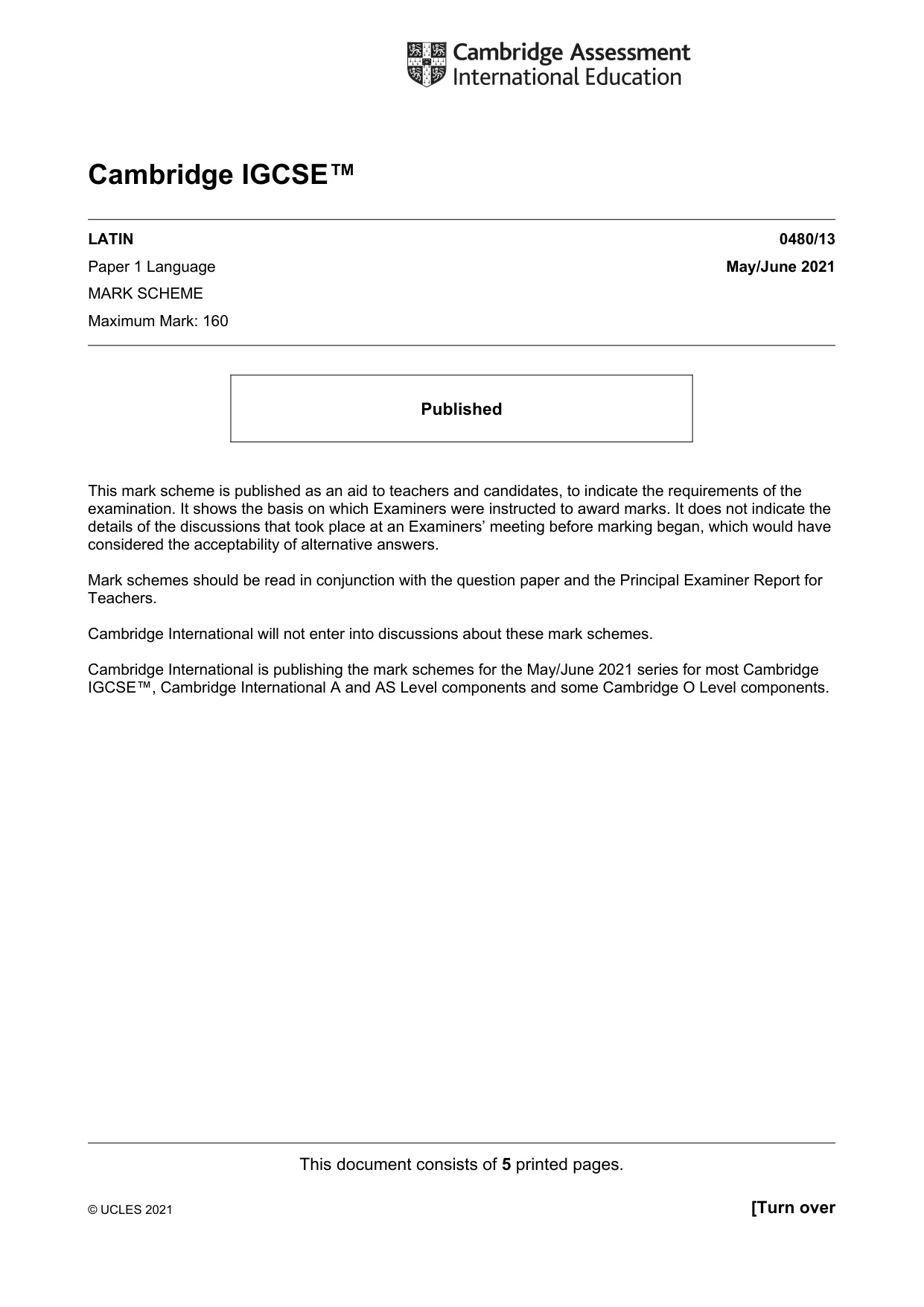
6 0480/13/M/J/21 © UCLES 2021 (l) Lines 12–13 (domus … sunt): describe the appearance of Numidian architecture. [2] (m) Choose four of the following Latin words and for each one give an English word derived wholly or partly from the same root: penuriam (line 1) morbus (line 3) lege (line 5) compositus (line 6) proximos (line 8) domus (line 12) [4]
Question paper, page 7
7 0480/13/M/J/21 © UCLES 2021 BLANK PAGE
Question paper, page 8
8 0480/13/M/J/21 © UCLES 2021 Permission to reproduce items where third-party owned material protected by copyright is included has been sought and cleared where possible. Every reasonable effort has been made by the publisher (UCLES) to trace copyright holders, but if any items requiring clearance have unwittingly been included, the publisher will be pleased to make amends at the earliest possible opportunity. To avoid the issue of disclosure of answer-related information to candidates, all copyright acknowledgements are reproduced online in the Cambridge Assessment International Education Copyright Acknowledgements Booklet. This is produced for each series of examinations and is freely available to download at www.cambridgeinternational.org after the live examination series. Cambridge Assessment International Education is part of the Cambridge Assessment Group. Cambridge Assessment is the brand name of the University of Cambridge Local Examinations Syndicate (UCLES), which itself is a department of the University of Cambridge. BLANK PAGE
Mark scheme, page 1
This document consists of 5 printed pages. © UCLES 2021 [Turn over Cambridge IGCSE™ LATIN 0480/13 Paper 1 Language May/June 2021 MARK SCHEME Maximum Mark: 160 Published This mark scheme is published as an aid to teachers and candidates, to indicate the requirements of the examination. It shows the basis on which Examiners were instructed to award marks. It does not indicate the details of the discussions that took place at an Examiners’ meeting before marking began, which would have considered the acceptability of alternative answers. Mark schemes should be read in conjunction with the question paper and the Principal Examiner Report for Teachers. Cambridge International will not enter into discussions about these mark schemes. Cambridge International is publishing the mark schemes for the May/June 2021 series for most Cambridge IGCSE™, Cambridge International A and AS Level components and some Cambridge O Level components.
Mark scheme, page 2
0480/13 Cambridge IGCSE – Mark Scheme PUBLISHED May/June 2021 © UCLES 2021 Page 2 of 5 Generic Marking Principles These general marking principles must be applied by all examiners when marking candidate answers. They should be applied alongside the specific content of the mark scheme or generic level descriptors for a question. Each question paper and mark scheme will also comply with these marking principles. GENERIC MARKING PRINCIPLE 1: Marks must be awarded in line with: • the specific content of the mark scheme or the generic level descriptors for the question • the specific skills defined in the mark scheme or in the generic level descriptors for the question • the standard of response required by a candidate as exemplified by the standardisation scripts. GENERIC MARKING PRINCIPLE 2: Marks awarded are always whole marks (not half marks, or other fractions). GENERIC MARKING PRINCIPLE 3: Marks must be awarded positively: • marks are awarded for correct/valid answers, as defined in the mark scheme. However, credit is given for valid answers which go beyond the scope of the syllabus and mark scheme, referring to your Team Leader as appropriate • marks are awarded when candidates clearly demonstrate what they know and can do • marks are not deducted for errors • marks are not deducted for omissions • answers should only be judged on the quality of spelling, punctuation and grammar when these features are specifically assessed by the question as indicated by the mark scheme. The meaning, however, should be unambiguous. GENERIC MARKING PRINCIPLE 4: Rules must be applied consistently, e.g. in situations where candidates have not followed instructions or in the application of generic level descriptors. GENERIC MARKING PRINCIPLE 5: Marks should be awarded using the full range of marks defined in the mark scheme for the question (however; the use of the full mark range may be limited according to the quality of the candidate responses seen). GENERIC MARKING PRINCIPLE 6: Marks awarded are based solely on the requirements as defined in the mark scheme. Marks should not be awarded with grade thresholds or grade descriptors in mind.
Mark scheme, page 3
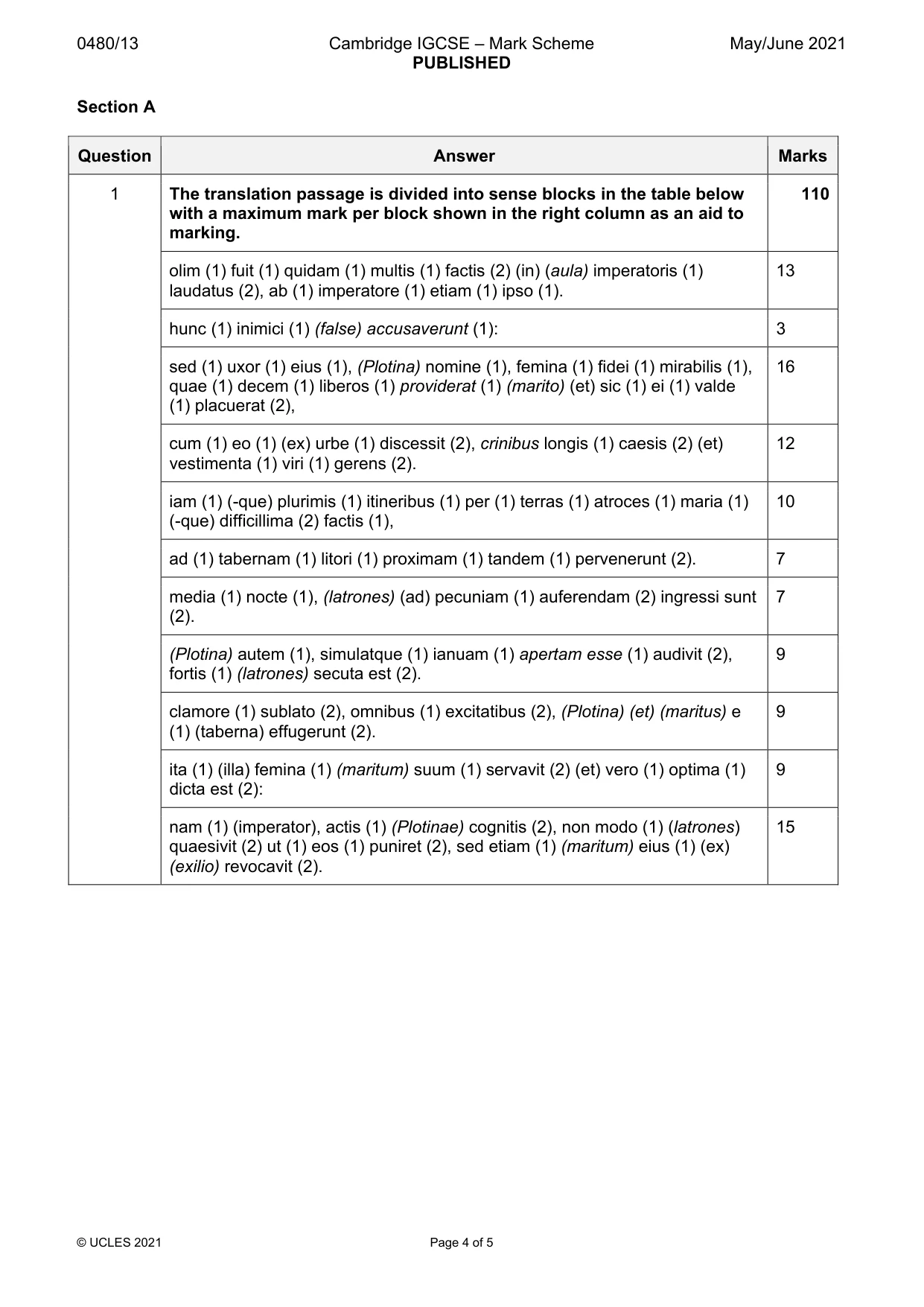
0480/13 Cambridge IGCSE – Mark Scheme PUBLISHED May/June 2021 © UCLES 2021 Page 3 of 5 MARK SCHEME NOTES The mark scheme includes suggested responses but examiners will credit all acceptable variants. Key ; Separates alternative responses to the question / Separates alternative wording within the same response OR Separates possible variants in a response which are mutually exclusive (award marks for one OR the other, not parts of each) [ ] The word, phrase or unit in brackets is not required but is in the mark scheme for clarification Instructions for marking Section A • Marks are awarded positively to demonstrate positive achievement, rather than penalising for an incorrect/incomplete response. • Where the sense of the translation is less clear, examiners should give credit for elements that are correct (according to the agreed mark scheme). • Glossed words will have no value for meaning alone. • Active passive interchange is allowed but must be complete – i.e. no missing agent. • Candidates are expected to render the translation passage into sensible English and not rely on a word-for-word substitution translation. Specimen translation (This is one possible translation of the passage. Examiners will credit all acceptable variants.) There was once a certain man, praised for many deeds in the Emperor’s palace, even by the Emperor himself. His enemies falsely accused this man: but his wife, whose name was Plotina, a woman of remarkable loyalty, who had provided her husband with ten children and had thus pleased him greatly, left the city with him, her long hair cut and wearing a man’s clothing. And now when they had made many passages through horrific lands and most difficult seas, they at last arrived at an inn right on the seashore. In the middle of the night, thieves came in to steal their money. But Plotina, as soon as she heard that the door had been opened, bravely followed the thieves. Having raised a shout, and having woken everyone up, Plotina and her husband escaped from the inn. Thus that excellent woman saved her husband and was truly called ‘excellent’: for the Emperor, Plotina’s deeds having been made known to him, not only sought out the thieves to punish them; but also recalled her husband from exile.
Mark scheme, page 4
0480/13 Cambridge IGCSE – Mark Scheme PUBLISHED May/June 2021 © UCLES 2021 Page 4 of 5 Section A Question Answer Marks 1 The translation passage is divided into sense blocks in the table below with a maximum mark per block shown in the right column as an aid to marking. 110 olim (1) fuit (1) quidam (1) multis (1) factis (2) (in) (aula) imperatoris (1) laudatus (2), ab (1) imperatore (1) etiam (1) ipso (1). 13 hunc (1) inimici (1) (false) accusaverunt (1): 3 sed (1) uxor (1) eius (1), (Plotina) nomine (1), femina (1) fidei (1) mirabilis (1), quae (1) decem (1) liberos (1) providerat (1) (marito) (et) sic (1) ei (1) valde (1) placuerat (2), 16 cum (1) eo (1) (ex) urbe (1) discessit (2), crinibus longis (1) caesis (2) (et) vestimenta (1) viri (1) gerens (2). 12 iam (1) (-que) plurimis (1) itineribus (1) per (1) terras (1) atroces (1) maria (1) (-que) difficillima (2) factis (1), 10 ad (1) tabernam (1) litori (1) proximam (1) tandem (1) pervenerunt (2). 7 media (1) nocte (1), (latrones) (ad) pecuniam (1) auferendam (2) ingressi sunt (2). 7 (Plotina) autem (1), simulatque (1) ianuam (1) apertam esse (1) audivit (2), fortis (1) (latrones) secuta est (2). 9 clamore (1) sublato (2), omnibus (1) excitatibus (2), (Plotina) (et) (maritus) e (1) (taberna) effugerunt (2). 9 ita (1) (illa) femina (1) (maritum) suum (1) servavit (2) (et) vero (1) optima (1) dicta est (2): 9 nam (1) (imperator), actis (1) (Plotinae) cognitis (2), non modo (1) (latrones) quaesivit (2) ut (1) eos (1) puniret (2), sed etiam (1) (maritum) eius (1) (ex) (exilio) revocavit (2). 15
Mark scheme, page 5
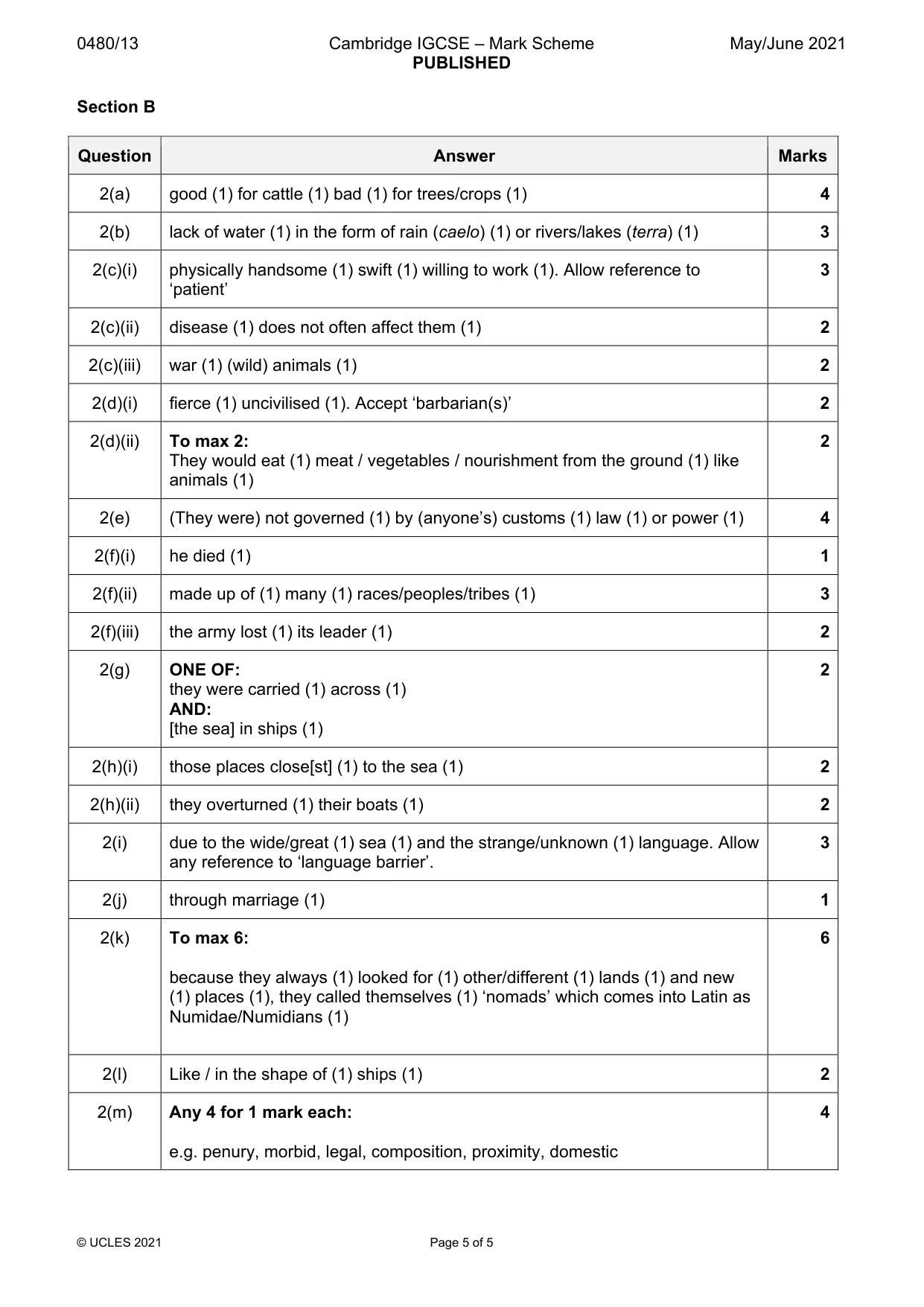
0480/13 Cambridge IGCSE – Mark Scheme PUBLISHED May/June 2021 © UCLES 2021 Page 5 of 5 Section B Question Answer Marks 2(a) good (1) for cattle (1) bad (1) for trees/crops (1) 4 2(b) lack of water (1) in the form of rain (caelo) (1) or rivers/lakes (terra) (1) 3 2(c)(i) physically handsome (1) swift (1) willing to work (1). Allow reference to ‘patient’ 3 2(c)(ii) disease (1) does not often affect them (1) 2 2(c)(iii) war (1) (wild) animals (1) 2 2(d)(i) fierce (1) uncivilised (1). Accept ‘barbarian(s)’ 2 2(d)(ii) To max 2: They would eat (1) meat / vegetables / nourishment from the ground (1) like animals (1) 2 2(e) (They were) not governed (1) by (anyone’s) customs (1) law (1) or power (1) 4 2(f)(i) he died (1) 1 2(f)(ii) made up of (1) many (1) races/peoples/tribes (1) 3 2(f)(iii) the army lost (1) its leader (1) 2 2(g) ONE OF: they were carried (1) across (1) AND: [the sea] in ships (1) 2 2(h)(i) those places close[st] (1) to the sea (1) 2 2(h)(ii) they overturned (1) their boats (1) 2 2(i) due to the wide/great (1) sea (1) and the strange/unknown (1) language. Allow any reference to ‘language barrier’. 3 2(j) through marriage (1) 1 2(k) To max 6: because they always (1) looked for (1) other/different (1) lands (1) and new (1) places (1), they called themselves (1) ‘nomads’ which comes into Latin as Numidae/Numidians (1) 6 2(l) Like / in the shape of (1) ships (1) 2 2(m) Any 4 for 1 mark each: e.g. penury, morbid, legal, composition, proximity, domestic 4
What you needed in this session
Cambridge’s own grade thresholds for 2021 May/June, Paper 1 · Variant 3. A higher threshold means an easier paper — the bar moves with how the cohort did.