Cambridge IGCSE Latin 0480 — 2022 May/June Paper 1 · Variant 3
0480/13/M/J/22 · 160 marks · ≈180 min
The question paper and its mark scheme, free to read here and free to download. This is Cambridge’s own paper, exactly as it was sat.
Question paper8 pages




Mark scheme5 pages
Answers below. Sit the paper first if you are practising.
Paper as text
Question paper, page 1
This document has 8 pages. Any blank pages are indicated. [Turn over Cambridge IGCSE™ DC (EF) 322566/1 © UCLES 2022 LATIN 0480/13 Paper 1 Language May/June 2022 1 hour 30 minutes You must answer on the answer booklet/paper. You will need: Answer booklet/paper INSTRUCTIONS ● Answer all questions. ● If you have been given an answer booklet, follow the instructions on the front cover of the answer booklet. ● Use a black or dark blue pen. ● Write your name, centre number and candidate number on all the work you hand in. ● Do not use an erasable pen or correction fluid. ● At the end of the examination, fasten all your work together. Do not use staples, paper clips or glue. INFORMATION ● The total mark for this paper is 160. ● The number of marks for each question or part question is shown in brackets [ ]. * 5 3 2 3 1 7 7 4 0 4 *
Question paper, page 2
2 0480/13/M/J/22 © UCLES 2022 BLANK PAGE
Question paper, page 3
3 0480/13/M/J/22 © UCLES 2022 [Turn over Section A 1 Translate the following passage into English. Write your translation on alternate lines. A friendly dolphin. est in Africa urbs quaedam mari proxima. ibi omnes natandi atque pisces capiendi studium habent, maxime pueri, qui otium ludumque amant. inter hos ille vincit, qui quam longissime litus reliquit. olim puer audacior ceteris a terra contendebat. ei delphinus forte occurrit. fugit puer cum amicis. delphinus tamen eum invitare et revocare videbatur, et circum eum saepius natabat. tandem turba comitum, clamore facto, etiam delphinum tangebat. nunc fortis puer ad delphinum natat, tergum ascendit, ut huc illuc feretur; hic non timet, ille non timetur; huius fides, mansuetudo illius augetur. simul adcurrebant alii iuvenes hortantes monentesque. mirabile dictu, delphinus etiam se in terram extraxit, deinde sole siccatus se in aquam remisit. Pliny Ep, 9.33 Africa, Africae (f) Africa nato, natare, natavi, natatum I swim piscis, piscis (m) fish delphinus, delphini (m) dolphin tergum, tergi (n) back mansuetudo, mansuetudinis (f) gentleness augeo, augere, auxi, auctum I increase sicco, siccare, siccavi, siccatum I make dry [110]
Question paper, page 4
4 0480/13/M/J/22 © UCLES 2022 Section B 2 Read the following passage and answer the questions in full detail. The story of Gyges and the ring. haec fabula a Platone narrata est: olim unus e servis regis, Gyges nomine, cum terra cessisset magnis quibusdam imbribus, descendit in illum hiatum ingentemque equum aeneum conspexit, cuius in lateribus ianuae essent; quibus apertis, corpus hominis mortui vidit, anulum in digito gerentis. quem ut detraxit, ipse gessit, tum in concilium servorum processit. ibi, cum anulum ad palmam eius converteret, tum a nullo videbatur, ipse autem omnia videbat; sed cum anulum in locum primum reverterat, Gyges iterum videbatur. itaque hoc modo et regem, dominum suum, interfecit, et omnes quos sibi obstare putabat. etiam reginam in matrimonium duxit, nec in his rebus scelestis quisquam potuit eum videre. sic celeriter ipse propter anulum rex factus est. haec est vis huius anuli et huius fabulae: si nemo sciret, cum aliquid pecuniae aut potestatis causa feceris, si id diis hominibusque esset semper celatum, faceresne? etiam si sapiens hunc anulum haberet, nonne bonum, non malum faceret? nec enim potestas nec divitiae, sed bonum a bonis viris quaeritur. Based on Cicero, de Off 3.38 Plato, Platonis (m) Plato, a Greek philosopher Gyges, Gygis (m) Gyges, a man’s name imber, imbris (m) rain hiatus, hiatus (m) hole aeneus, -a, -um made of bronze aperio, aperire, aperui, apertum I open anulus, anuli (m) ring digitus, digiti (m) finger concilium, concilii (n) meeting palma, palmae (f) palm (of one’s hand) obsto, obstare, obstiti, obstitum (+ dat) I obstruct divitiae, divitiarum (f.pl.) riches 1 2 3 4 5 6 7 8 9 10 11 12 13 14
Question paper, page 5
5 0480/13/M/J/22 © UCLES 2022 (a) Line 1 (haec … nomine): (i) who first told this story? [1] (ii) who was Gyges? [2] (b) Lines 2–3 (cum … conspexit): how had it come about that Gyges was able to find the horse? [4] (c) Line 3 (ingentemque … essent): describe the bronze horse. Give three details. [3] (d) Lines 3–4 (quibus … gerentis): what did Gyges find inside the horse? [4] (e) Lines 4–5 (quem … processit): (i) what did Gyges do with what he found? [2] (ii) what did he do next? [3] (f) Lines 5–7 (ibi cum … iterum videbatur): what did Gyges discover about the ring? [5] (g) Lines 7–8 (itaque … putabat): how did Gyges use the ring? [5] (h) Lines 8–9 (etiam … duxit): what did Gyges do next? [2] (i) Line 9 (nec … videre): who saw him do these things? [1] (j) Lines 9–10 (sic … est): what was the result of Gyges’ actions? [2] (k) Lines 11–13 (si nemo … faceresne): what question does the writer ask here? [6] (l) Lines 13–14 (etiam … faceret): how does the writer suggest that a wise man might behave with this ring? [3] (m) Line 14 (nec enim … quaeritur): why would good men behave in this way, according to the writer? [3] (n) Choose four of the following Latin words and for each one give an English word derived wholly or partly from the same root: descendit (line 2) lateribus (line 3) detraxit (line 4) dominum (line 8) fabulae (line 11) potestas (line 14) [4]
Question paper, page 6
6 0480/13/M/J/22 © UCLES 2022 BLANK PAGE
Question paper, page 7
7 0480/13/M/J/22 © UCLES 2022 BLANK PAGE
Question paper, page 8
8 0480/13/M/J/22 © UCLES 2022 Permission to reproduce items where third-party owned material protected by copyright is included has been sought and cleared where possible. Every reasonable effort has been made by the publisher (UCLES) to trace copyright holders, but if any items requiring clearance have unwittingly been included, the publisher will be pleased to make amends at the earliest possible opportunity. To avoid the issue of disclosure of answer-related information to candidates, all copyright acknowledgements are reproduced online in the Cambridge Assessment International Education Copyright Acknowledgements Booklet. This is produced for each series of examinations and is freely available to download at www.cambridgeinternational.org after the live examination series. Cambridge Assessment International Education is part of Cambridge Assessment. Cambridge Assessment is the brand name of the University of Cambridge Local Examinations Syndicate (UCLES), which is a department of the University of Cambridge. BLANK PAGE
Mark scheme, page 1
This document consists of 5 printed pages. © UCLES 2022 [Turn over Cambridge IGCSE™ LATIN 0480/13 Paper 1 Language May/June 2022 MARK SCHEME Maximum Mark: 160 Published This mark scheme is published as an aid to teachers and candidates, to indicate the requirements of the examination. It shows the basis on which Examiners were instructed to award marks. It does not indicate the details of the discussions that took place at an Examiners’ meeting before marking began, which would have considered the acceptability of alternative answers. Mark schemes should be read in conjunction with the question paper and the Principal Examiner Report for Teachers. Cambridge International will not enter into discussions about these mark schemes. Cambridge International is publishing the mark schemes for the May/June 2022 series for most Cambridge IGCSE, Cambridge International A and AS Level and Cambridge Pre-U components, and some Cambridge O Level components.
Mark scheme, page 2
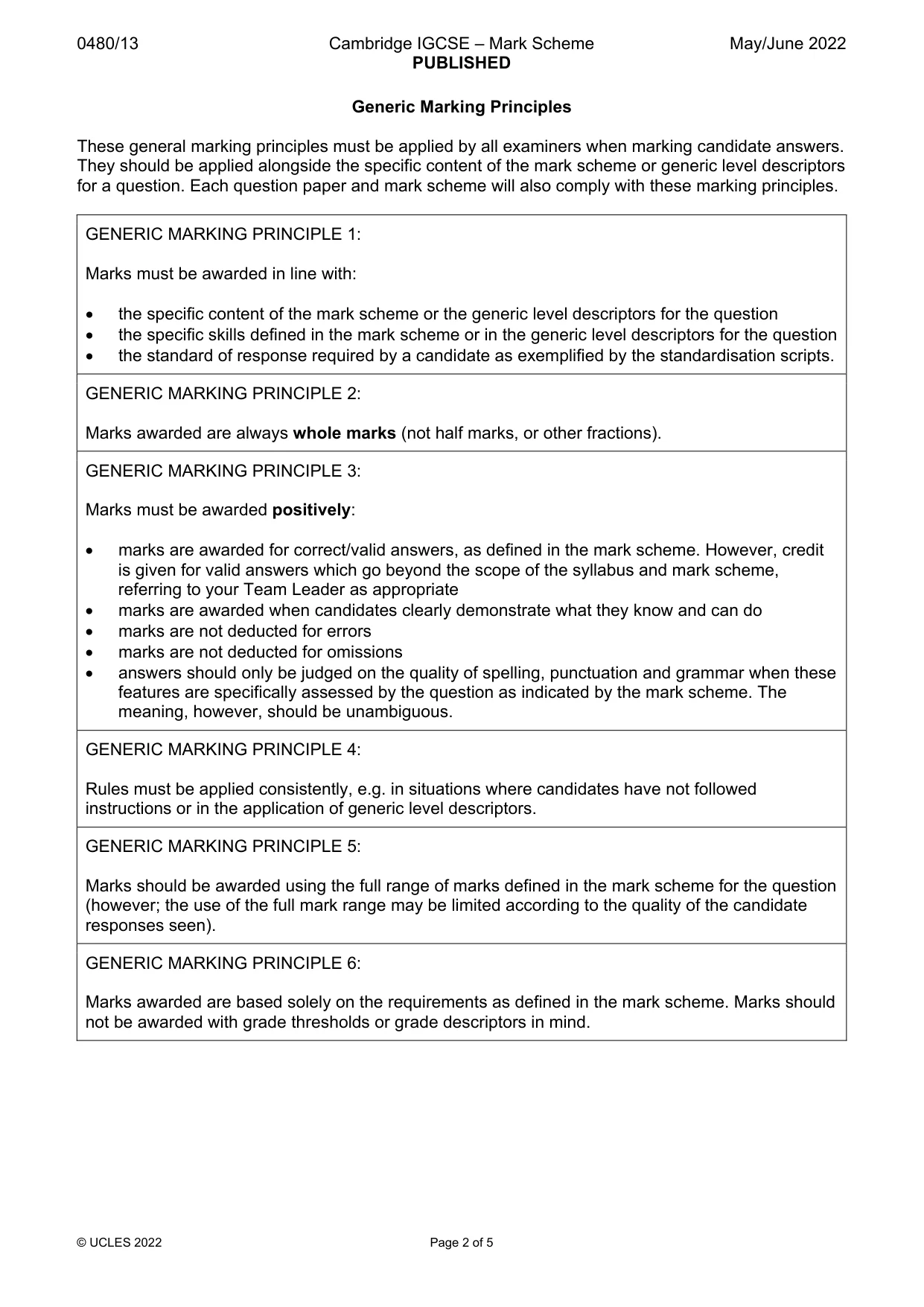
0480/13 Cambridge IGCSE – Mark Scheme PUBLISHED May/June 2022 © UCLES 2022 Page 2 of 5 Generic Marking Principles These general marking principles must be applied by all examiners when marking candidate answers. They should be applied alongside the specific content of the mark scheme or generic level descriptors for a question. Each question paper and mark scheme will also comply with these marking principles. GENERIC MARKING PRINCIPLE 1: Marks must be awarded in line with: the specific content of the mark scheme or the generic level descriptors for the question the specific skills defined in the mark scheme or in the generic level descriptors for the question the standard of response required by a candidate as exemplified by the standardisation scripts. GENERIC MARKING PRINCIPLE 2: Marks awarded are always whole marks (not half marks, or other fractions). GENERIC MARKING PRINCIPLE 3: Marks must be awarded positively: marks are awarded for correct/valid answers, as defined in the mark scheme. However, credit is given for valid answers which go beyond the scope of the syllabus and mark scheme, referring to your Team Leader as appropriate marks are awarded when candidates clearly demonstrate what they know and can do marks are not deducted for errors marks are not deducted for omissions answers should only be judged on the quality of spelling, punctuation and grammar when these features are specifically assessed by the question as indicated by the mark scheme. The meaning, however, should be unambiguous. GENERIC MARKING PRINCIPLE 4: Rules must be applied consistently, e.g. in situations where candidates have not followed instructions or in the application of generic level descriptors. GENERIC MARKING PRINCIPLE 5: Marks should be awarded using the full range of marks defined in the mark scheme for the question (however; the use of the full mark range may be limited according to the quality of the candidate responses seen). GENERIC MARKING PRINCIPLE 6: Marks awarded are based solely on the requirements as defined in the mark scheme. Marks should not be awarded with grade thresholds or grade descriptors in mind.
Mark scheme, page 3
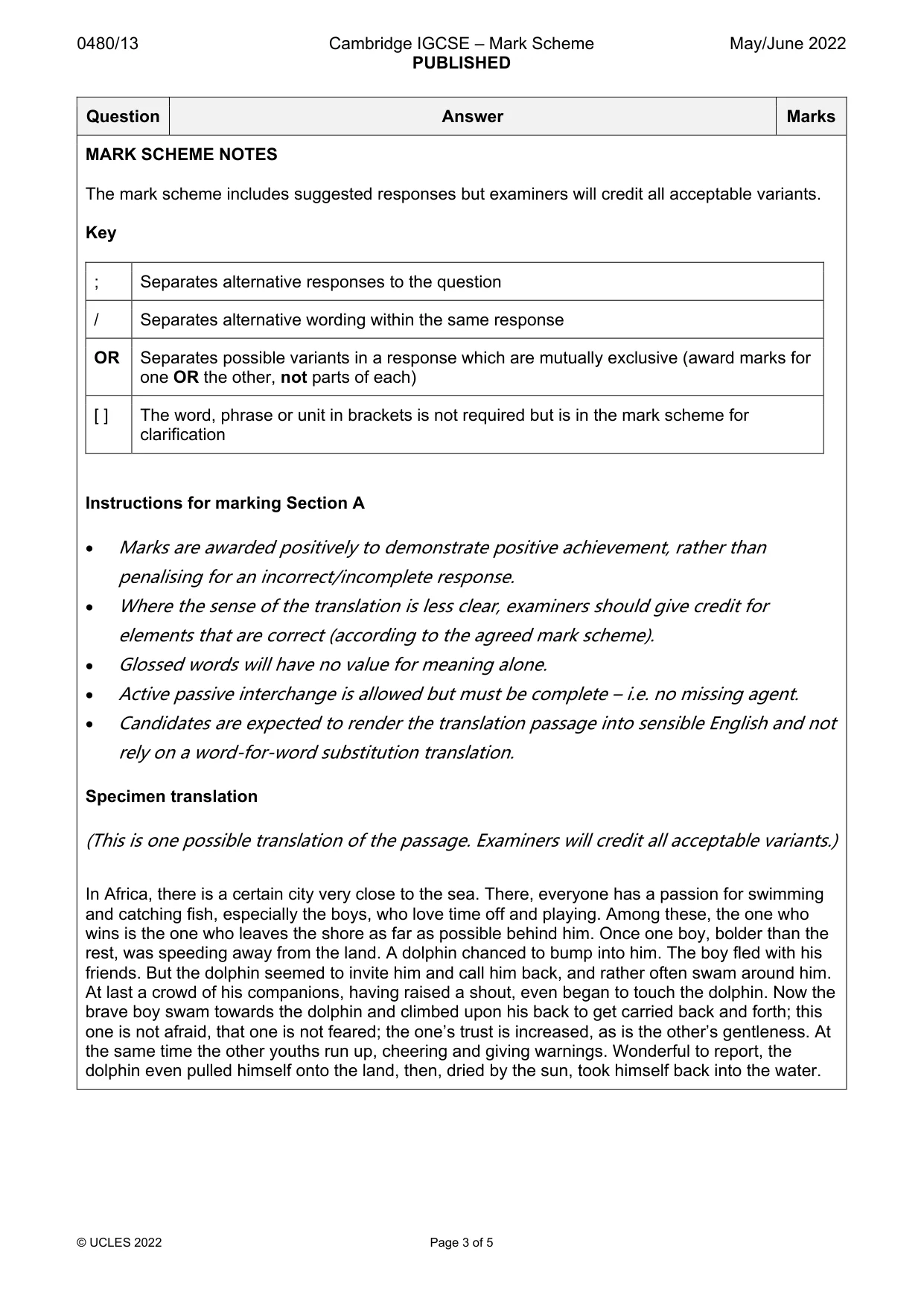
0480/13 Cambridge IGCSE – Mark Scheme PUBLISHED May/June 2022 © UCLES 2022 Page 3 of 5 Question Answer Marks MARK SCHEME NOTES The mark scheme includes suggested responses but examiners will credit all acceptable variants. Key ; Separates alternative responses to the question / Separates alternative wording within the same response OR Separates possible variants in a response which are mutually exclusive (award marks for one OR the other, not parts of each) [ ] The word, phrase or unit in brackets is not required but is in the mark scheme for clarification Instructions for marking Section A Marks are awarded positively to demonstrate positive achievement, rather than penalising for an incorrect/incomplete response. Where the sense of the translation is less clear, examiners should give credit for elements that are correct (according to the agreed mark scheme). Glossed words will have no value for meaning alone. Active passive interchange is allowed but must be complete – i.e. no missing agent. Candidates are expected to render the translation passage into sensible English and not rely on a word-for-word substitution translation. Specimen translation (This is one possible translation of the passage. Examiners will credit all acceptable variants.) In Africa, there is a certain city very close to the sea. There, everyone has a passion for swimming and catching fish, especially the boys, who love time off and playing. Among these, the one who wins is the one who leaves the shore as far as possible behind him. Once one boy, bolder than the rest, was speeding away from the land. A dolphin chanced to bump into him. The boy fled with his friends. But the dolphin seemed to invite him and call him back, and rather often swam around him. At last a crowd of his companions, having raised a shout, even began to touch the dolphin. Now the brave boy swam towards the dolphin and climbed upon his back to get carried back and forth; this one is not afraid, that one is not feared; the one’s trust is increased, as is the other’s gentleness. At the same time the other youths run up, cheering and giving warnings. Wonderful to report, the dolphin even pulled himself onto the land, then, dried by the sun, took himself back into the water.
Mark scheme, page 4
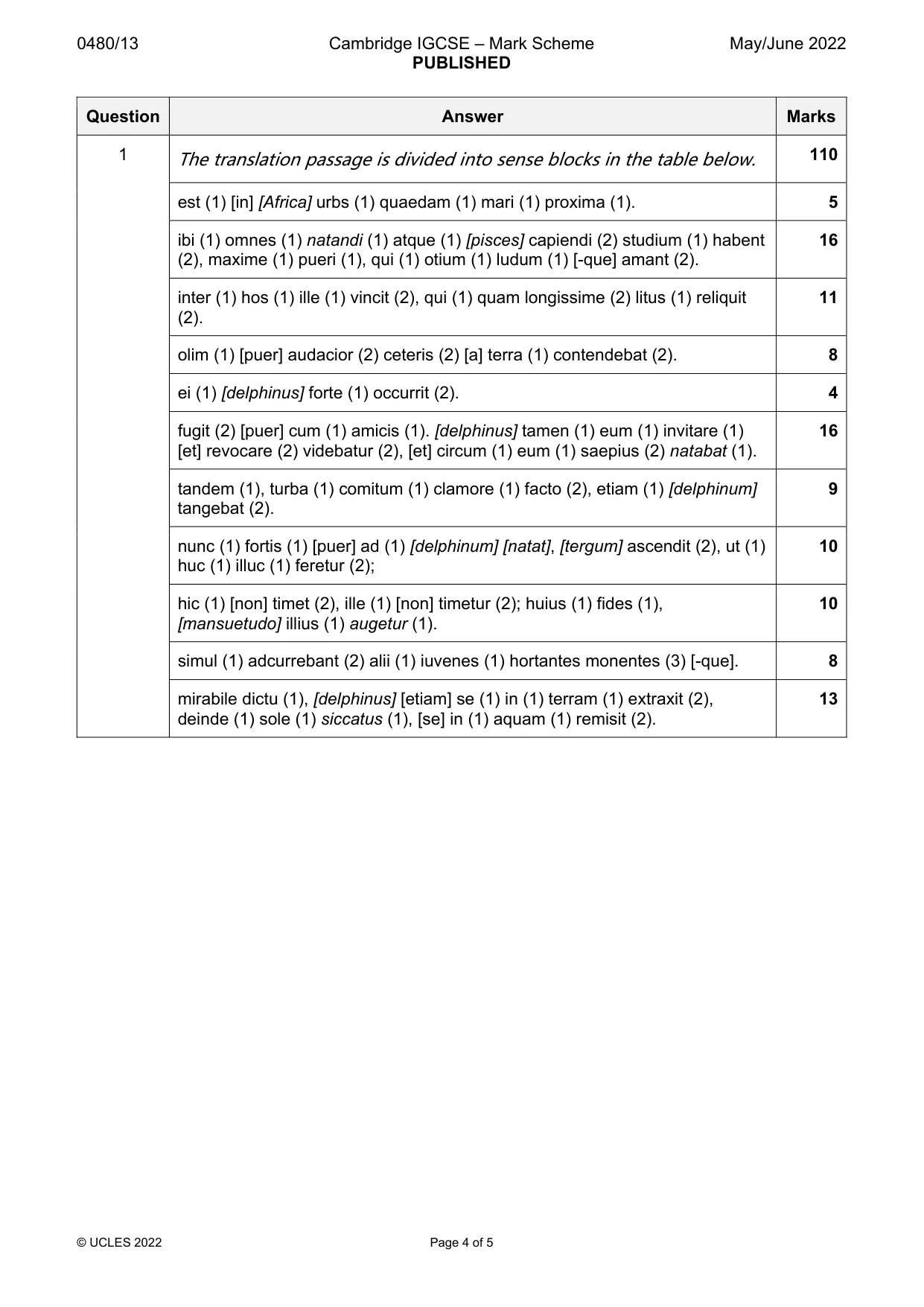
0480/13 Cambridge IGCSE – Mark Scheme PUBLISHED May/June 2022 © UCLES 2022 Page 4 of 5 Question Answer Marks 1 The translation passage is divided into sense blocks in the table below. 110 est (1) [in] [Africa] urbs (1) quaedam (1) mari (1) proxima (1). 5 ibi (1) omnes (1) natandi (1) atque (1) [pisces] capiendi (2) studium (1) habent (2), maxime (1) pueri (1), qui (1) otium (1) ludum (1) [-que] amant (2). 16 inter (1) hos (1) ille (1) vincit (2), qui (1) quam longissime (2) litus (1) reliquit (2). 11 olim (1) [puer] audacior (2) ceteris (2) [a] terra (1) contendebat (2). 8 ei (1) [delphinus] forte (1) occurrit (2). 4 fugit (2) [puer] cum (1) amicis (1). [delphinus] tamen (1) eum (1) invitare (1) [et] revocare (2) videbatur (2), [et] circum (1) eum (1) saepius (2) natabat (1). 16 tandem (1), turba (1) comitum (1) clamore (1) facto (2), etiam (1) [delphinum] tangebat (2). 9 nunc (1) fortis (1) [puer] ad (1) [delphinum] [natat], [tergum] ascendit (2), ut (1) huc (1) illuc (1) feretur (2); 10 hic (1) [non] timet (2), ille (1) [non] timetur (2); huius (1) fides (1), [mansuetudo] illius (1) augetur (1). 10 simul (1) adcurrebant (2) alii (1) iuvenes (1) hortantes monentes (3) [-que]. 8 mirabile dictu (1), [delphinus] [etiam] se (1) in (1) terram (1) extraxit (2), deinde (1) sole (1) siccatus (1), [se] in (1) aquam (1) remisit (2). 13
Mark scheme, page 5
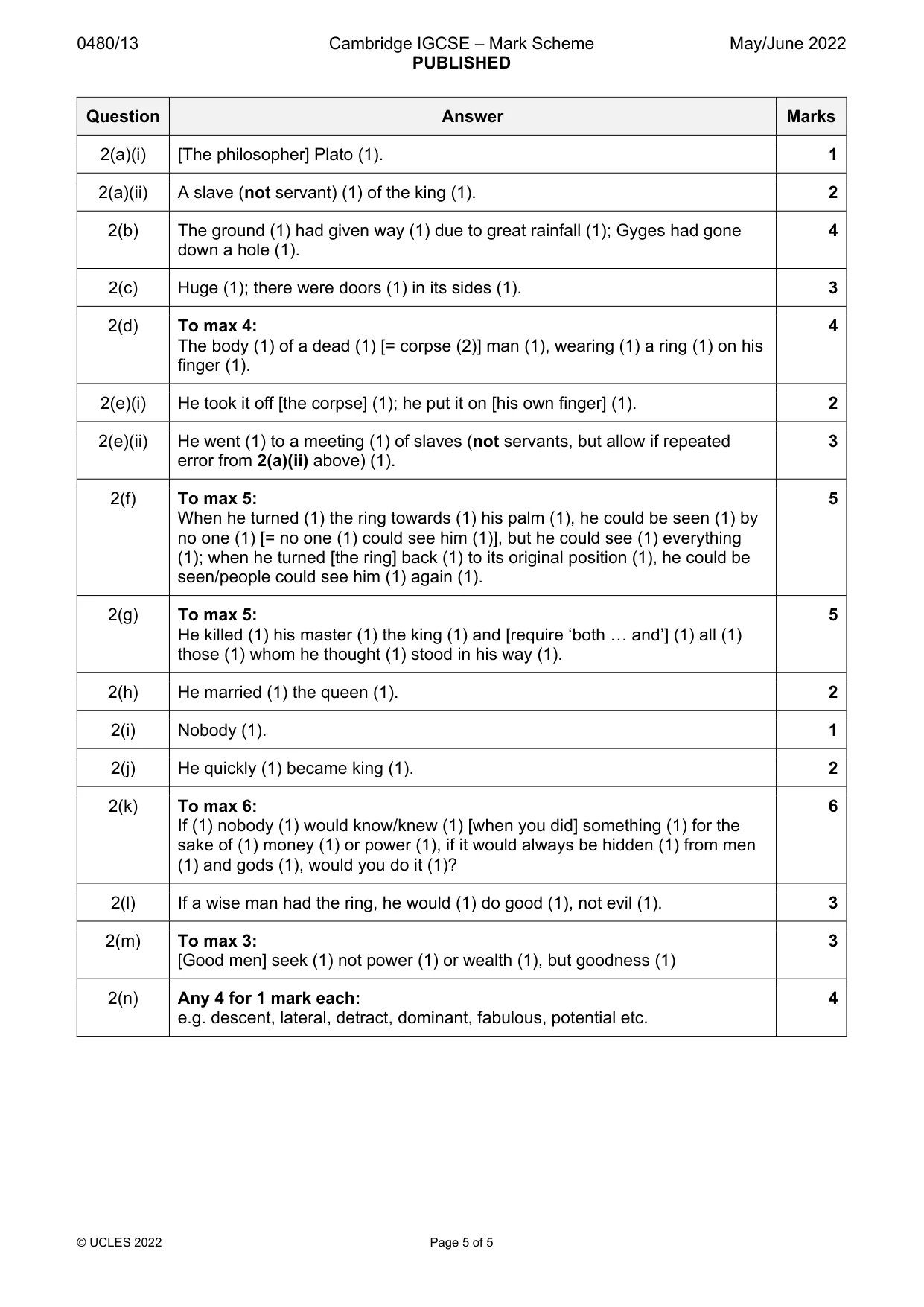
0480/13 Cambridge IGCSE – Mark Scheme PUBLISHED May/June 2022 © UCLES 2022 Page 5 of 5 Question Answer Marks 2(a)(i) [The philosopher] Plato (1). 1 2(a)(ii) A slave (not servant) (1) of the king (1). 2 2(b) The ground (1) had given way (1) due to great rainfall (1); Gyges had gone down a hole (1). 4 2(c) Huge (1); there were doors (1) in its sides (1). 3 2(d) To max 4: The body (1) of a dead (1) [= corpse (2)] man (1), wearing (1) a ring (1) on his finger (1). 4 2(e)(i) He took it off [the corpse] (1); he put it on [his own finger] (1). 2 2(e)(ii) He went (1) to a meeting (1) of slaves (not servants, but allow if repeated error from 2(a)(ii) above) (1). 3 2(f) To max 5: When he turned (1) the ring towards (1) his palm (1), he could be seen (1) by no one (1) [= no one (1) could see him (1)], but he could see (1) everything (1); when he turned [the ring] back (1) to its original position (1), he could be seen/people could see him (1) again (1). 5 2(g) To max 5: He killed (1) his master (1) the king (1) and [require ‘both … and’] (1) all (1) those (1) whom he thought (1) stood in his way (1). 5 2(h) He married (1) the queen (1). 2 2(i) Nobody (1). 1 2(j) He quickly (1) became king (1). 2 2(k) To max 6: If (1) nobody (1) would know/knew (1) [when you did] something (1) for the sake of (1) money (1) or power (1), if it would always be hidden (1) from men (1) and gods (1), would you do it (1)? 6 2(l) If a wise man had the ring, he would (1) do good (1), not evil (1). 3 2(m) To max 3: [Good men] seek (1) not power (1) or wealth (1), but goodness (1) 3 2(n) Any 4 for 1 mark each: e.g. descent, lateral, detract, dominant, fabulous, potential etc. 4
What you needed in this session
Cambridge’s own grade thresholds for 2022 May/June, Paper 1 · Variant 3. A higher threshold means an easier paper — the bar moves with how the cohort did.