Cambridge IGCSE Latin 0480 — 2025 May/June Paper 1 · Variant 2
0480/12/M/J/25 · 160 marks · ≈180 min
The question paper and its mark scheme, free to read here and free to download. This is Cambridge’s own paper, exactly as it was sat.
Question paper8 pages




Mark scheme7 pages
Answers below. Sit the paper first if you are practising.
Paper as text
Question paper, page 1
This document has 8 pages. Any blank pages are indicated. [Turn over Cambridge IGCSE™ * 5 0 5 6 7 8 5 8 0 1 * DC (CJ) 346048/4 © UCLES 2025 LATIN 0480/12 Paper 1 Language May/June 2025 1 hour 30 minutes You must answer on the answer booklet/paper. You will need: Answer booklet/paper INSTRUCTIONS ● Answer all questions. ● If you have been given an answer booklet, follow the instructions on the front cover of the answer booklet. ● Use a black or dark blue pen. ● Write your name, centre number and candidate number on all the work you hand in. ● Do not use an erasable pen or correction fluid. ● At the end of the examination, fasten all your work together. Do not use staples, paper clips or glue. INFORMATION ● The total mark for this paper is 160. ● The number of marks for each question or part question is shown in brackets [ ].
Question paper, page 2
2 0480/12/M/J/25 © UCLES 2025 BLANK PAGE
Question paper, page 3
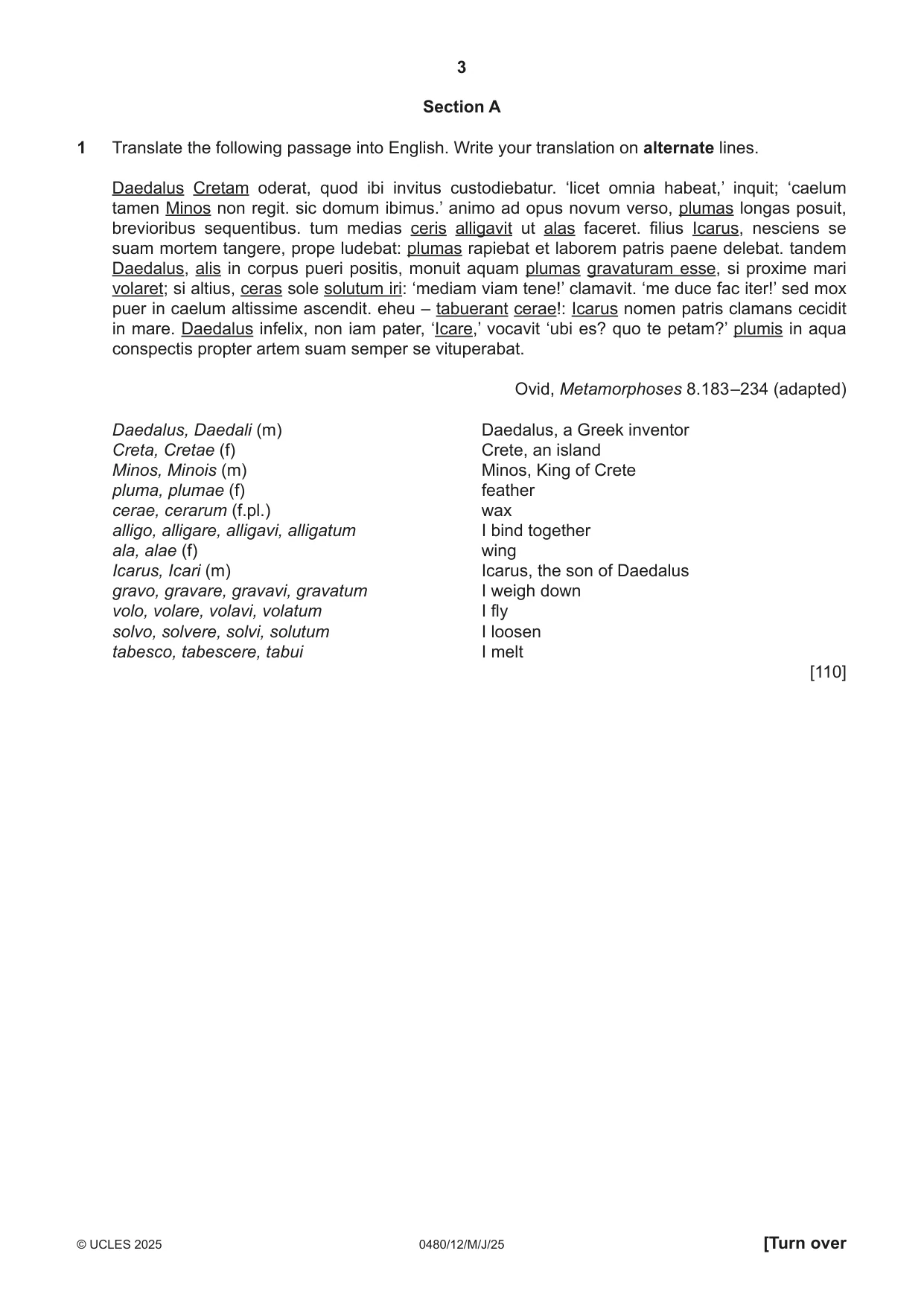
3 0480/12/M/J/25 © UCLES 2025 [Turn over Section A 1 Translate the following passage into English. Write your translation on alternate lines. Daedalus Cretam oderat, quod ibi invitus custodiebatur. ‘licet omnia habeat,’ inquit; ‘caelum tamen Minos non regit. sic domum ibimus.’ animo ad opus novum verso, plumas longas posuit, brevioribus sequentibus. tum medias ceris alligavit ut alas faceret. filius Icarus, nesciens se suam mortem tangere, prope ludebat: plumas rapiebat et laborem patris paene delebat. tandem Daedalus, alis in corpus pueri positis, monuit aquam plumas gravaturam esse, si proxime mari volaret; si altius, ceras sole solutum iri: ‘mediam viam tene!’ clamavit. ‘me duce fac iter!’ sed mox puer in caelum altissime ascendit. eheu – tabuerant cerae!: Icarus nomen patris clamans cecidit in mare. Daedalus infelix, non iam pater, ‘Icare,’ vocavit ‘ubi es? quo te petam?’ plumis in aqua conspectis propter artem suam semper se vituperabat. Ovid, Metamorphoses 8.183 –234 (adapted) Daedalus, Daedali (m) Daedalus, a Greek inventor Creta, Cretae (f) Crete, an island Minos, Minois (m) Minos, King of Crete pluma, plumae (f) feather cerae, cerarum (f.pl.) wax alligo, alligare, alligavi, alligatum I bind together ala, alae (f) wing Icarus, Icari (m) Icarus, the son of Daedalus gravo, gravare, gravavi, gravatum I weigh down volo, volare, volavi, volatum I fly solvo, solvere, solvi, solutum I loosen tabesco, tabescere, tabui I melt [110]
Question paper, page 4
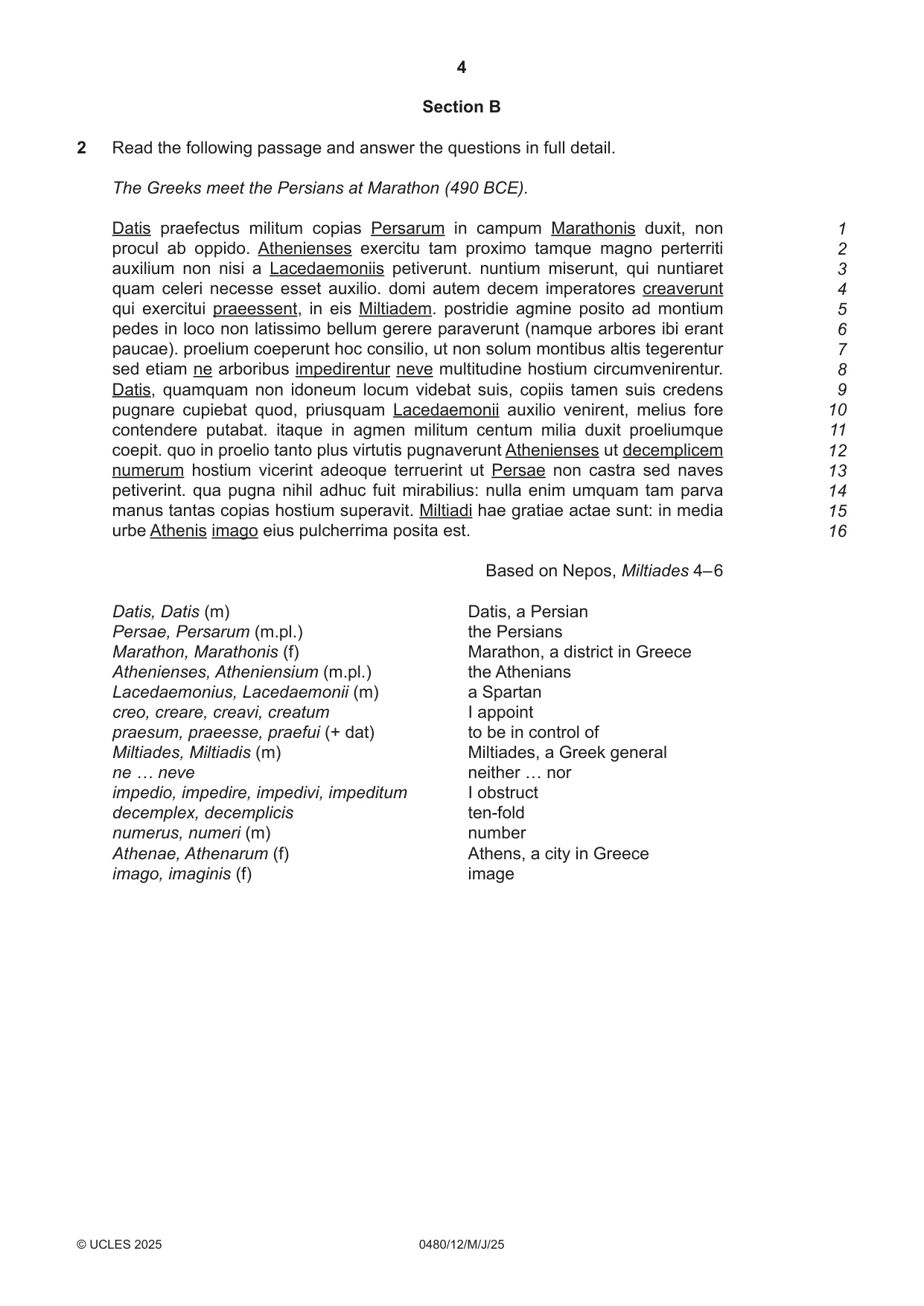
4 0480/12/M/J/25 © UCLES 2025 Section B 2 Read the following passage and answer the questions in full detail. The Greeks meet the Persians at Marathon (490 BCE). Datis praefectus militum copias Persarum in campum Marathonis duxit, non procul ab oppido. Athenienses exercitu tam proximo tamque magno perterriti auxilium non nisi a Lacedaemoniis petiverunt. nuntium miserunt, qui nuntiaret quam celeri necesse esset auxilio. domi autem decem imperatores creaverunt qui exercitui praeessent, in eis Miltiadem. postridie agmine posito ad montium pedes in loco non latissimo bellum gerere paraverunt (namque arbores ibi erant paucae). proelium coeperunt hoc consilio, ut non solum montibus altis tegerentur sed etiam ne arboribus impedirentur neve multitudine hostium circumvenirentur. Datis, quamquam non idoneum locum videbat suis, copiis tamen suis credens pugnare cupiebat quod, priusquam Lacedaemonii auxilio venirent, melius fore contendere putabat. itaque in agmen militum centum milia duxit proeliumque coepit. quo in proelio tanto plus virtutis pugnaverunt Athenienses ut decemplicem numerum hostium vicerint adeoque terruerint ut Persae non castra sed naves petiverint. qua pugna nihil adhuc fuit mirabilius: nulla enim umquam tam parva manus tantas copias hostium superavit. Miltiadi hae gratiae actae sunt: in media urbe Athenis imago eius pulcherrima posita est. Based on Nepos, Miltiades 4– 6 Datis, Datis (m) Datis, a Persian Persae, Persarum (m.pl.) the Persians Marathon, Marathonis (f) Marathon, a district in Greece Athenienses, Atheniensium (m.pl.) the Athenians Lacedaemonius, Lacedaemonii (m) a Spartan creo, creare, creavi, creatum I appoint praesum, praeesse, praefui (+ dat) to be in control of Miltiades, Miltiadis (m) Miltiades, a Greek general ne … neve neither … nor impedio, impedire, impedivi, impeditum I obstruct decemplex, decemplicis ten-fold numerus, numeri (m) number Athenae, Athenarum (f) Athens, a city in Greece imago, imaginis (f) image 1 2 3 4 5 6 7 8 9 10 11 12 13 14 15 16
Question paper, page 5
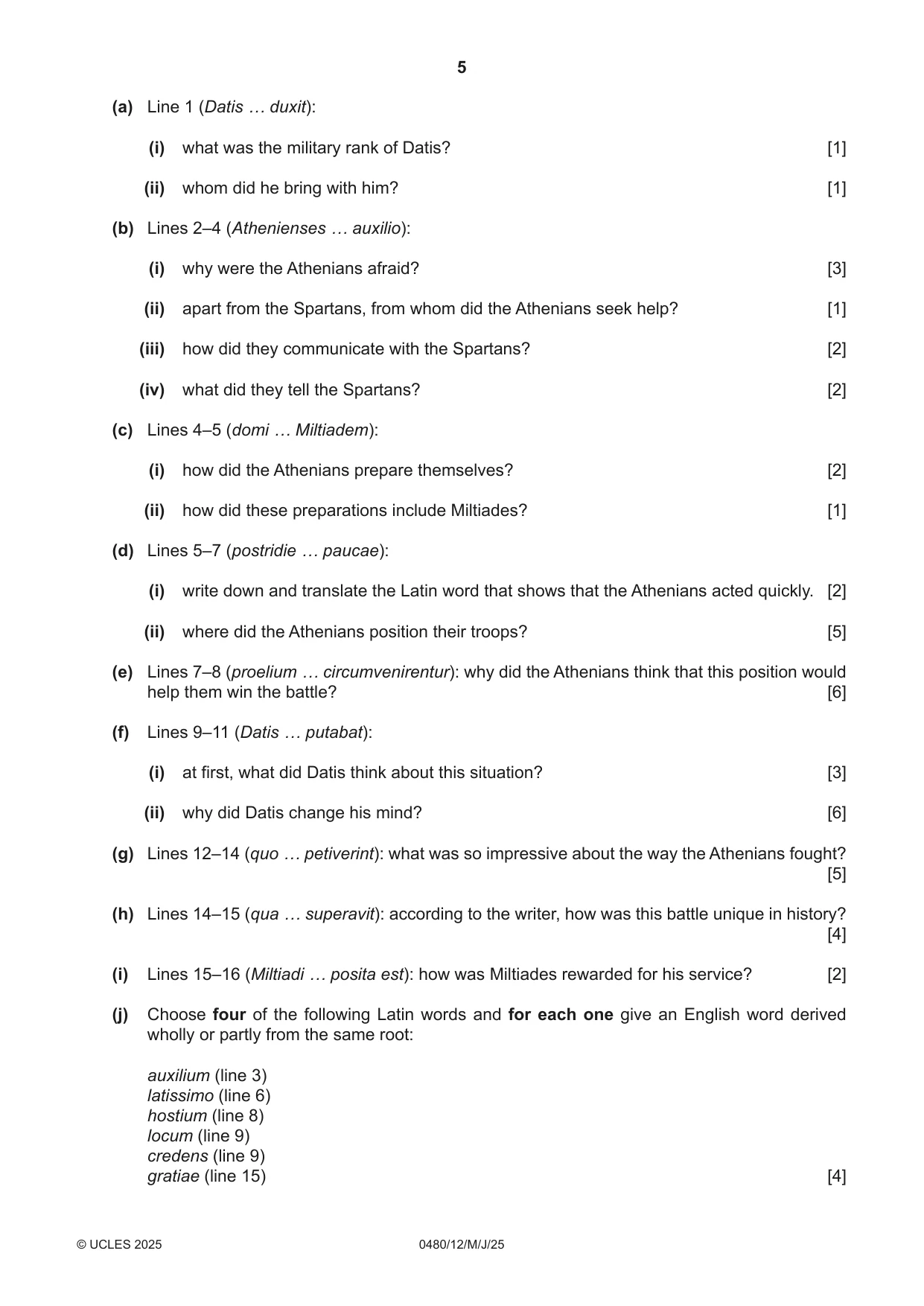
5 0480/12/M/J/25 © UCLES 2025 (a) Line 1 (Datis … duxit): (i) what was the military rank of Datis? [1] (ii) whom did he bring with him? [1] (b) Lines 2–4 (Athenienses … auxilio): (i) why were the Athenians afraid? [3] (ii) apart from the Spartans, from whom did the Athenians seek help? [1] (iii) how did they communicate with the Spartans? [2] (iv) what did they tell the Spartans? [2] (c) Lines 4–5 (domi … Miltiadem): (i) how did the Athenians prepare themselves? [2] (ii) how did these preparations include Miltiades? [1] (d) Lines 5–7 (postridie … paucae): (i) write down and translate the Latin word that shows that the Athenians acted quickly. [2] (ii) where did the Athenians position their troops? [5] (e) Lines 7–8 (proelium … circumvenirentur): why did the Athenians think that this position would help them win the battle? [6] (f) Lines 9–11 (Datis … putabat): (i) at first, what did Datis think about this situation? [3] (ii) why did Datis change his mind? [6] (g) Lines 12–14 (quo … petiverint): what was so impressive about the way the Athenians fought? [5] (h) Lines 14–15 (qua … superavit): according to the writer, how was this battle unique in history? [4] (i) Lines 15–16 (Miltiadi … posita est): how was Miltiades rewarded for his service? [2] (j) Choose four of the following Latin words and for each one give an English word derived wholly or partly from the same root: auxilium (line 3) latissimo (line 6) hostium (line 8) locum (line 9) credens (line 9) gratiae (line 15) [4]
Question paper, page 6
6 0480/12/M/J/25 © UCLES 2025 BLANK PAGE
Question paper, page 7
7 0480/12/M/J/25 © UCLES 2025 BLANK PAGE
Question paper, page 8
8 0480/12/M/J/25 © UCLES 2025 Permission to reproduce items where third-party owned material protected by copyright is included has been sought and cleared where possible. Every reasonable effort has been made by the publisher (UCLES) to trace copyright holders, but if any items requiring clearance have unwittingly been included, the publisher will be pleased to make amends at the earliest possible opportunity. To avoid the issue of disclosure of answer-related information to candidates, all copyright acknowledgements are reproduced online in the Cambridge Assessment International Education Copyright Acknowledgements Booklet. This is produced for each series of examinations and is freely available to download at www.cambridgeinternational.org after the live examination series. Cambridge Assessment International Education is part of Cambridge Assessment. Cambridge Assessment is the brand name of the University of Cambridge Local Examinations Syndicate (UCLES), which is a department of the University of Cambridge. BLANK PAGE
Mark scheme, page 1
This document consists of 7 printed pages. © Cambridge University Press & Assessment 2025 [Turn over Cambridge IGCSE™ LATIN 0480/12 Paper 1 Language May/June 2025 MARK SCHEME Maximum Mark: 160 Published This mark scheme is published as an aid to teachers and candidates, to indicate the requirements of the examination. It shows the basis on which Examiners were instructed to award marks. It does not indicate the details of the discussions that took place at an Examiners’ meeting before marking began, which would have considered the acceptability of alternative answers. Mark schemes should be read in conjunction with the question paper and the Principal Examiner Report for Teachers. Cambridge International will not enter into discussions about these mark schemes. Cambridge International is publishing the mark schemes for the May/June 2025 series for most Cambridge IGCSE, Cambridge International A and AS Level components, and some Cambridge O Level components.
Mark scheme, page 2
0480/12 Cambridge IGCSE – Mark Scheme PUBLISHED May/June 2025 © Cambridge University Press & Assessment 2025 Page 2 of 7 Generic Marking Principles These general marking principles must be applied by all examiners when marking candidate answers. They should be applied alongside the specific content of the mark scheme or generic level descriptions for a question. Each question paper and mark scheme will also comply with these marking principles. GENERIC MARKING PRINCIPLE 1: Marks must be awarded in line with: • the specific content of the mark scheme or the generic level descriptors for the question • the specific skills defined in the mark scheme or in the generic level descriptors for the question • the standard of response required by a candidate as exemplified by the standardisation scripts. GENERIC MARKING PRINCIPLE 2: Marks awarded are always whole marks (not half marks, or other fractions). GENERIC MARKING PRINCIPLE 3: Marks must be awarded positively: • marks are awarded for correct/valid answers, as defined in the mark scheme. However, credit is given for valid answers which go beyond the scope of the syllabus and mark scheme, referring to your Team Leader as appropriate • marks are awarded when candidates clearly demonstrate what they know and can do • marks are not deducted for errors • marks are not deducted for omissions • answers should only be judged on the quality of spelling, punctuation and grammar when these features are specifically assessed by the question as indicated by the mark scheme. The meaning, however, should be unambiguous. GENERIC MARKING PRINCIPLE 4: Rules must be applied consistently, e.g. in situations where candidates have not followed instructions or in the application of generic level descriptors. GENERIC MARKING PRINCIPLE 5: Marks should be awarded using the full range of marks defined in the mark scheme for the question (however; the use of the full mark range may be limited according to the quality of the candidate responses seen). GENERIC MARKING PRINCIPLE 6: Marks awarded are based solely on the requirements as defined in the mark scheme. Marks should not be awarded with grade thresholds or grade descriptors in mind.
Mark scheme, page 3
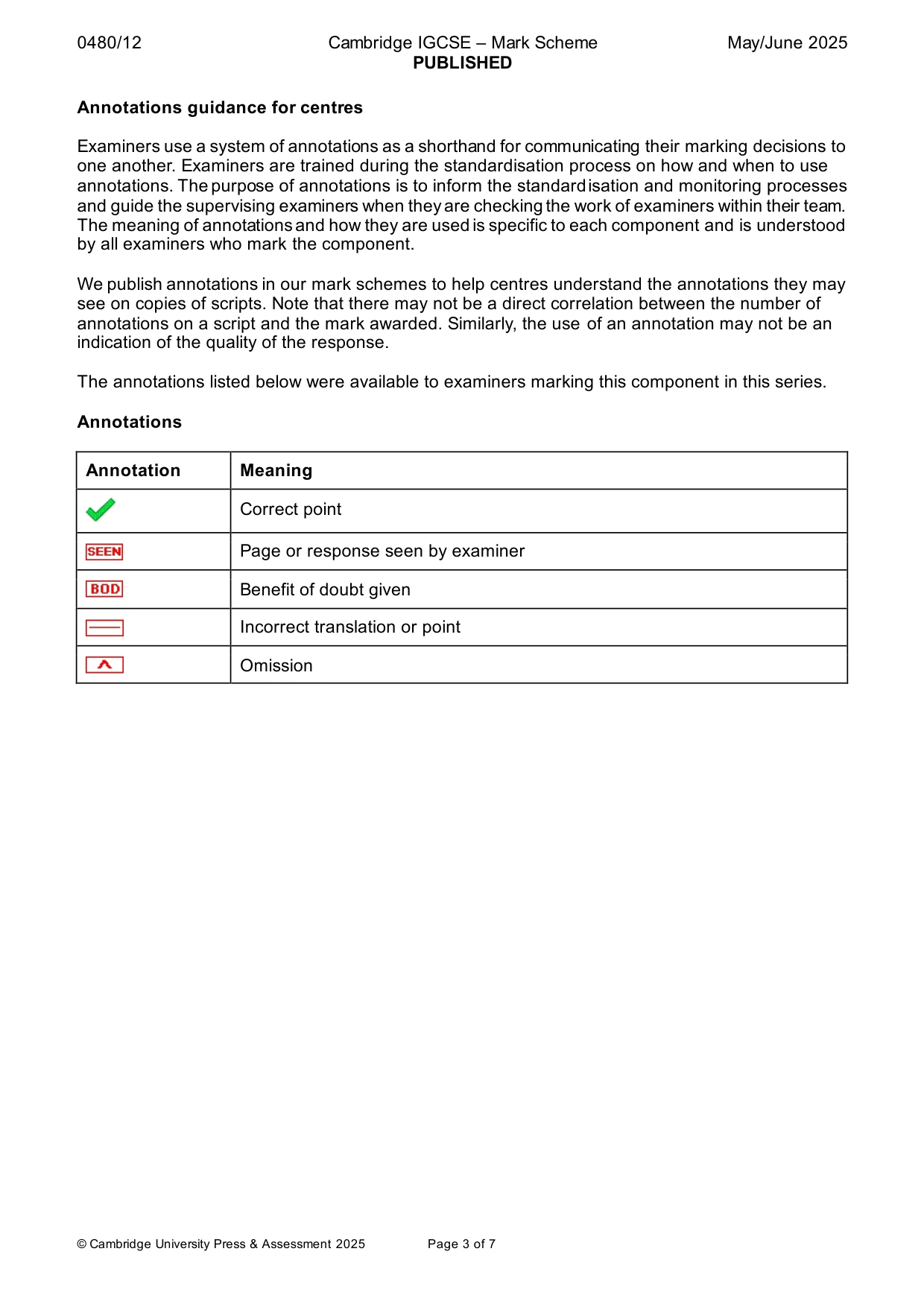
0480/12 Cambridge IGCSE – Mark Scheme PUBLISHED May/June 2025 © Cambridge University Press & Assessment 2025 Page 3 of 7 Annotations guidance for centres Examiners use a system of annotations as a shorthand for communicating their marking decisions to one another. Examiners are trained during the standardisation process on how and when to use annotations. The purpose of annotations is to inform the standardisation and monitoring processes and guide the supervising examiners when they are checking the work of examiners within their team. The meaning of annotations and how they are used is specific to each component and is understood by all examiners who mark the component. We publish annotations in our mark schemes to help centres understand the annotations they may see on copies of scripts. Note that there may not be a direct correlation between the number of annotations on a script and the mark awarded. Similarly, the use of an annotation may not be an indication of the quality of the response. The annotations listed below were available to examiners marking this component in this series. Annotations Annotation Meaning Correct point Page or response seen by examiner Benefit of doubt given Incorrect translation or point Omission
Mark scheme, page 4
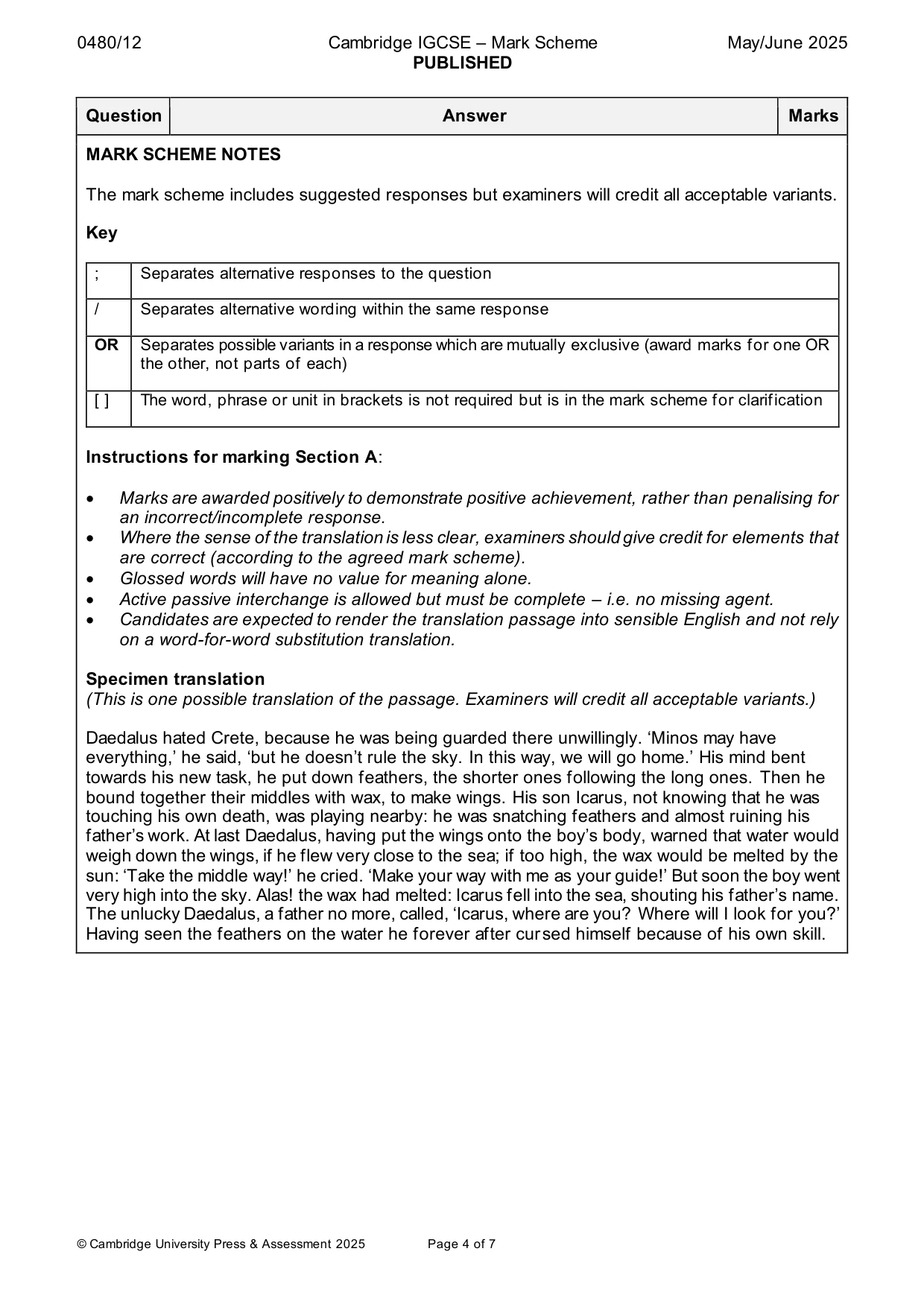
0480/12 Cambridge IGCSE – Mark Scheme PUBLISHED May/June 2025 © Cambridge University Press & Assessment 2025 Page 4 of 7 Question Answer Marks MARK SCHEME NOTES The mark scheme includes suggested responses but examiners will credit all acceptable variants. Key ; Separates alternative responses to the question / Separates alternative wording within the same response OR Separates possible variants in a response which are mutually exclusive (award marks for one OR the other, not parts of each) [ ] The word, phrase or unit in brackets is not required but is in the mark scheme for clarification Instructions for marking Section A: • Marks are awarded positively to demonstrate positive achievement, rather than penalising for an incorrect/incomplete response. • Where the sense of the translation is less clear, examiners should give credit for elements that are correct (according to the agreed mark scheme). • Glossed words will have no value for meaning alone. • Active passive interchange is allowed but must be complete – i.e. no missing agent. • Candidates are expected to render the translation passage into sensible English and not rely on a word-for-word substitution translation. Specimen translation (This is one possible translation of the passage. Examiners will credit all acceptable variants.) Daedalus hated Crete, because he was being guarded there unwillingly. ‘Minos may have everything,’ he said, ‘but he doesn’t rule the sky. In this way, we will go home.’ His mind bent towards his new task, he put down feathers, the shorter ones following the long ones. Then he bound together their middles with wax, to make wings. His son Icarus, not knowing that he was touching his own death, was playing nearby: he was snatching feathers and almost ruining his father’s work. At last Daedalus, having put the wings onto the boy’s body, warned that water would weigh down the wings, if he flew very close to the sea; if too high, the wax would be melted by the sun: ‘Take the middle way!’ he cried. ‘Make your way with me as your guide!’ But soon the boy went very high into the sky. Alas! the wax had melted: Icarus fell into the sea, shouting his father’s name. The unlucky Daedalus, a father no more, called, ‘Icarus, where are you? Where will I look for you?’ Having seen the feathers on the water he forever after cursed himself because of his own skill.
Mark scheme, page 5
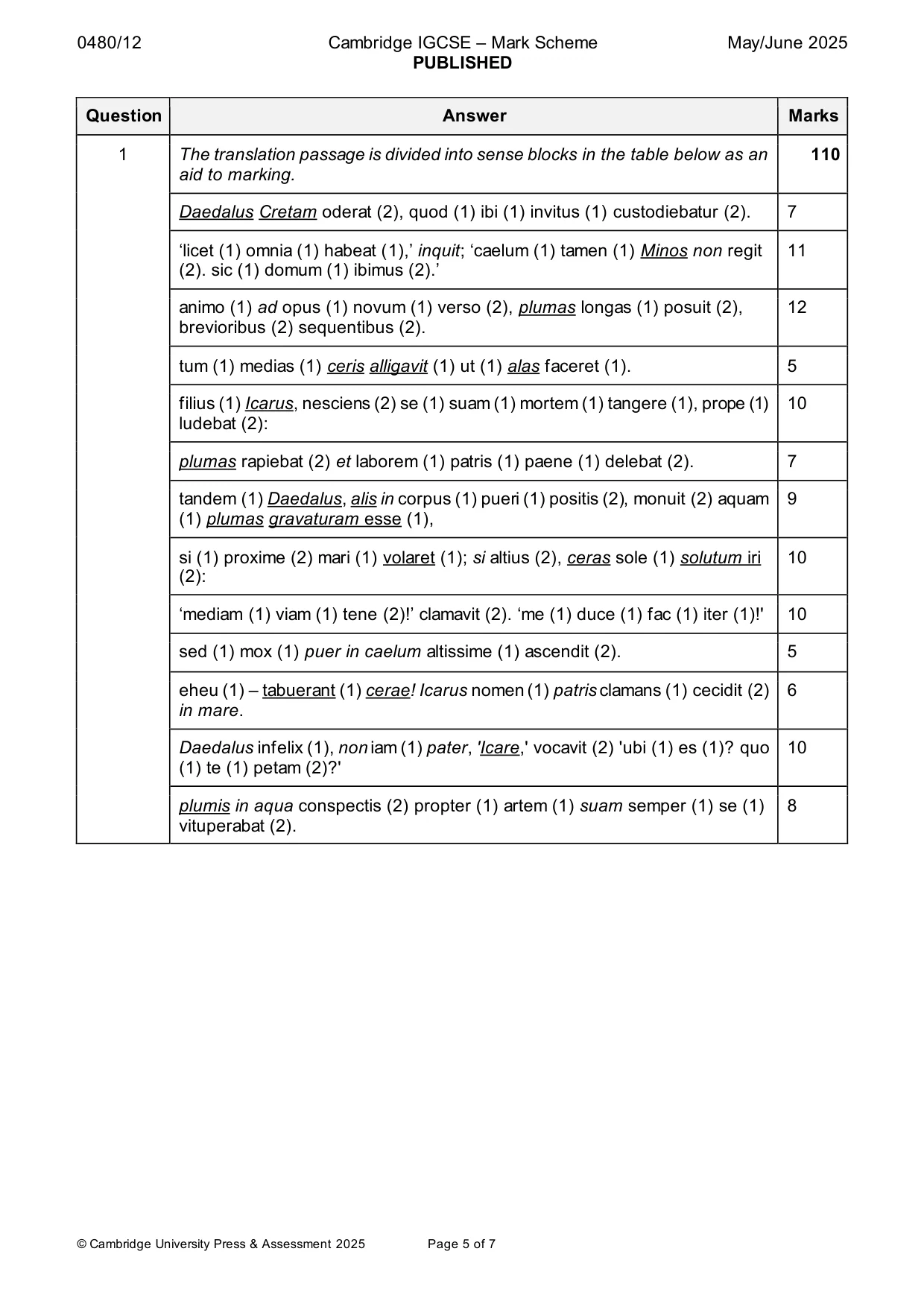
0480/12 Cambridge IGCSE – Mark Scheme PUBLISHED May/June 2025 © Cambridge University Press & Assessment 2025 Page 5 of 7 Question Answer Marks 1 The translation passage is divided into sense blocks in the table below as an aid to marking. 110 Daedalus Cretam oderat (2), quod (1) ibi (1) invitus (1) custodiebatur (2). 7 ‘licet (1) omnia (1) habeat (1),’ inquit; ‘caelum (1) tamen (1) Minos non regit (2). sic (1) domum (1) ibimus (2).’ 11 animo (1) ad opus (1) novum (1) verso (2), plumas longas (1) posuit (2), brevioribus (2) sequentibus (2). 12 tum (1) medias (1) ceris alligavit (1) ut (1) alas faceret (1). 5 filius (1) Icarus, nesciens (2) se (1) suam (1) mortem (1) tangere (1), prope (1) ludebat (2): 10 plumas rapiebat (2) et laborem (1) patris (1) paene (1) delebat (2). 7 tandem (1) Daedalus, alis in corpus (1) pueri (1) positis (2), monuit (2) aquam (1) plumas gravaturam esse (1), 9 si (1) proxime (2) mari (1) volaret (1); si altius (2), ceras sole (1) solutum iri (2): 10 ‘mediam (1) viam (1) tene (2)!’ clamavit (2). ‘me (1) duce (1) fac (1) iter (1)!' 10 sed (1) mox (1) puer in caelum altissime (1) ascendit (2). 5 eheu (1) – tabuerant (1) cerae! Icarus nomen (1) patris clamans (1) cecidit (2) in mare. 6 Daedalus infelix (1), non iam (1) pater, 'Icare,' vocavit (2) 'ubi (1) es (1)? quo (1) te (1) petam (2)?' 10 plumis in aqua conspectis (2) propter (1) artem (1) suam semper (1) se (1) vituperabat (2). 8
Mark scheme, page 6
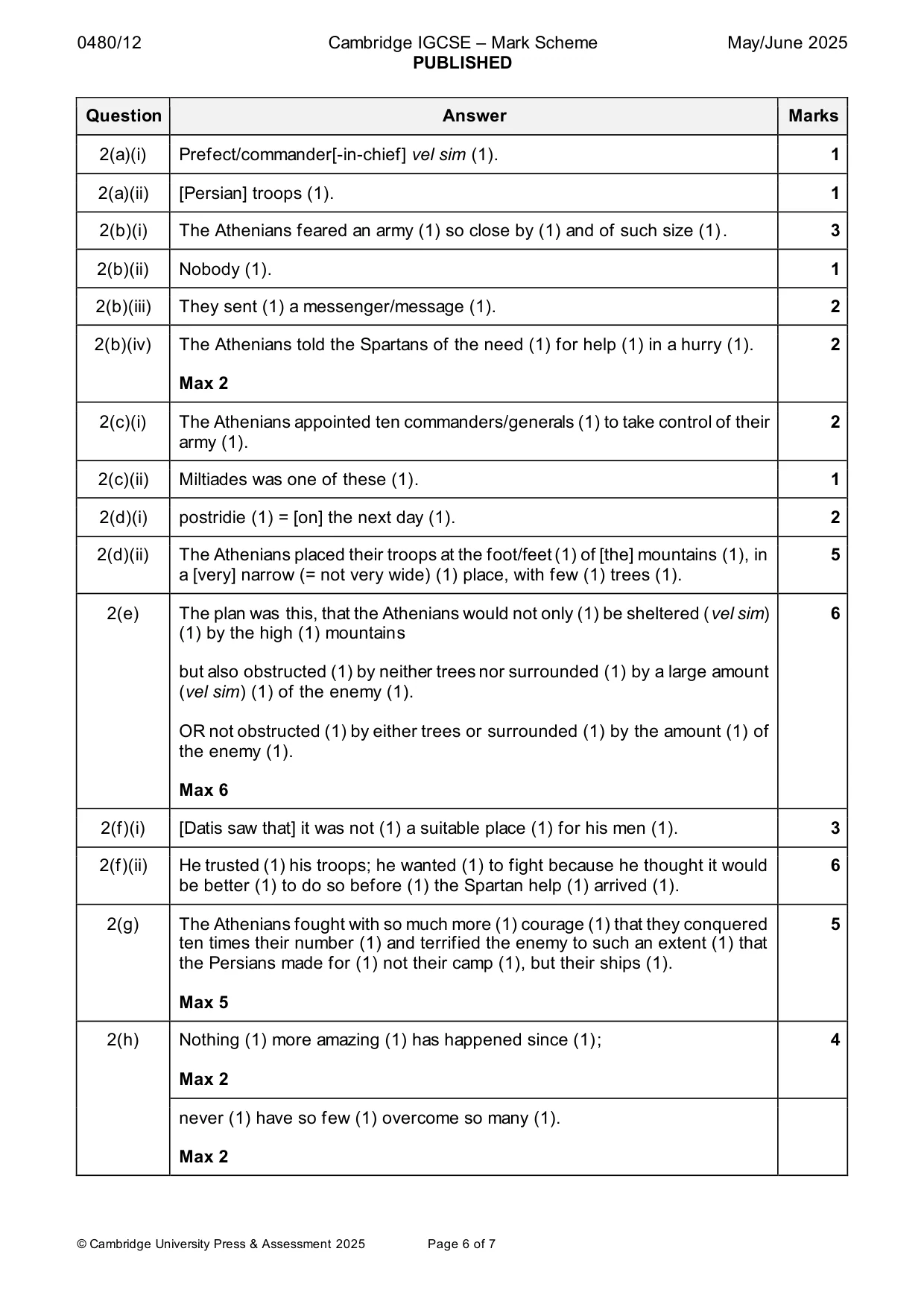
0480/12 Cambridge IGCSE – Mark Scheme PUBLISHED May/June 2025 © Cambridge University Press & Assessment 2025 Page 6 of 7 Question Answer Marks 2(a)(i) Prefect/commander[-in-chief] vel sim (1). 1 2(a)(ii) [Persian] troops (1). 1 2(b)(i) The Athenians feared an army (1) so close by (1) and of such size (1). 3 2(b)(ii) Nobody (1). 1 2(b)(iii) They sent (1) a messenger/message (1). 2 2(b)(iv) The Athenians told the Spartans of the need (1) for help (1) in a hurry (1). Max 2 2 2(c)(i) The Athenians appointed ten commanders/generals (1) to take control of their army (1). 2 2(c)(ii) Miltiades was one of these (1). 1 2(d)(i) postridie (1) = [on] the next day (1). 2 2(d)(ii) The Athenians placed their troops at the foot/feet (1) of [the] mountains (1), in a [very] narrow (= not very wide) (1) place, with few (1) trees (1). 5 2(e) The plan was this, that the Athenians would not only (1) be sheltered (vel sim) (1) by the high (1) mountains but also obstructed (1) by neither trees nor surrounded (1) by a large amount (vel sim) (1) of the enemy (1). OR not obstructed (1) by either trees or surrounded (1) by the amount (1) of the enemy (1). Max 6 6 2(f)(i) [Datis saw that] it was not (1) a suitable place (1) for his men (1). 3 2(f)(ii) He trusted (1) his troops; he wanted (1) to fight because he thought it would be better (1) to do so before (1) the Spartan help (1) arrived (1). 6 2(g) The Athenians fought with so much more (1) courage (1) that they conquered ten times their number (1) and terrified the enemy to such an extent (1) that the Persians made for (1) not their camp (1), but their ships (1). Max 5 5 2(h) Nothing (1) more amazing (1) has happened since (1); Max 2 4 never (1) have so few (1) overcome so many (1). Max 2
Mark scheme, page 7
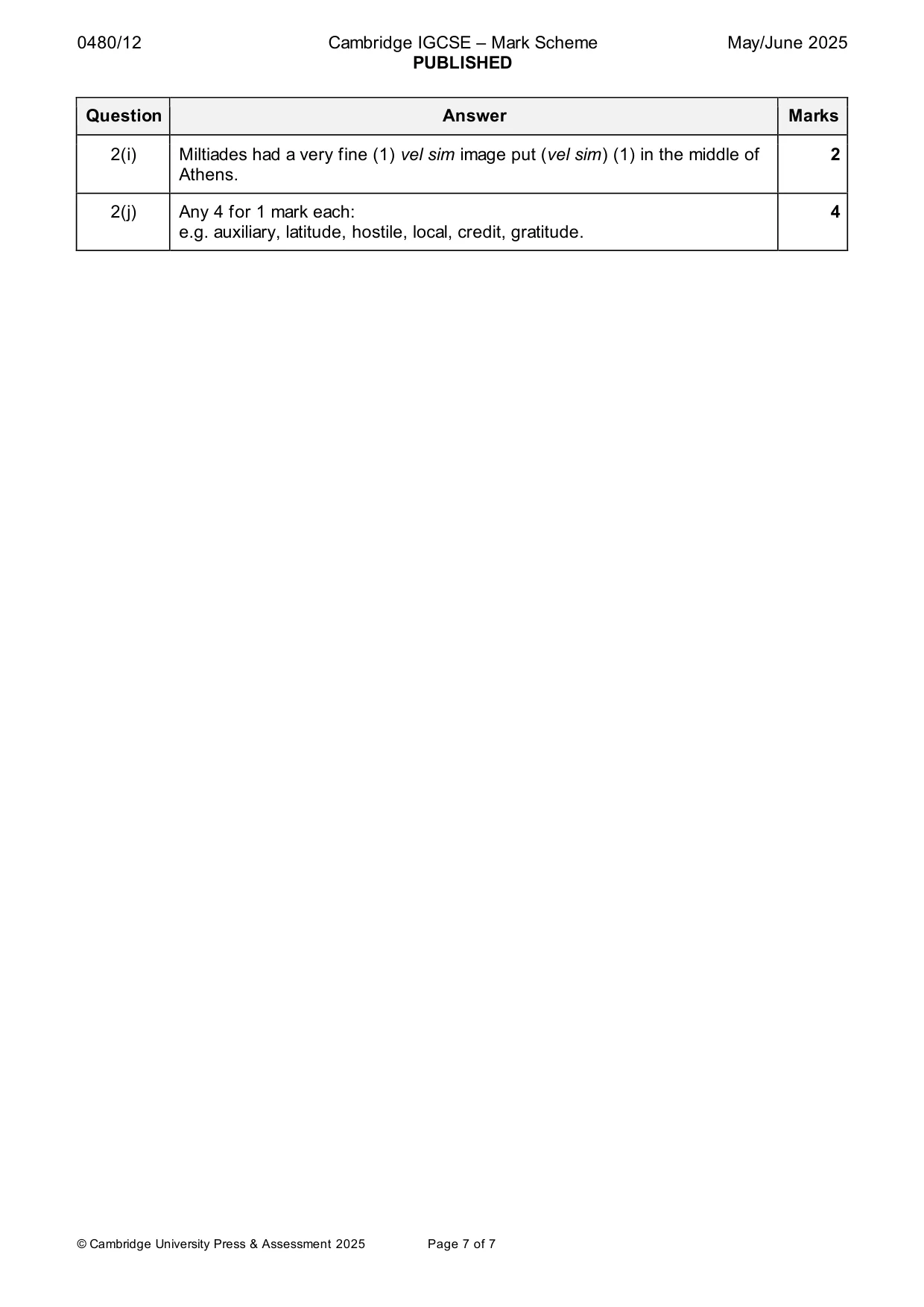
0480/12 Cambridge IGCSE – Mark Scheme PUBLISHED May/June 2025 © Cambridge University Press & Assessment 2025 Page 7 of 7 Question Answer Marks 2(i) Miltiades had a very fine (1) vel sim image put (vel sim) (1) in the middle of Athens. 2 2(j) Any 4 for 1 mark each: e.g. auxiliary, latitude, hostile, local, credit, gratitude. 4
What you needed in this session
Cambridge’s own grade thresholds for 2025 May/June, Paper 1 · Variant 2. A higher threshold means an easier paper — the bar moves with how the cohort did.