Cambridge IGCSE Latin 0480 — 2021 May/June Paper 1 · Variant 2
0480/12/M/J/21 · 160 marks · ≈180 min
The question paper and its mark scheme, free to read here and free to download. This is Cambridge’s own paper, exactly as it was sat.
Question paper8 pages



Mark scheme5 pages
Answers below. Sit the paper first if you are practising.
Paper as text
Question paper, page 1
* 5 8 4 8 2 1 9 3 3 2 * DC (NF) 202260/2 © UCLES 2021 [Turn over This document has 8 pages. Any blank pages are indicated. LATIN 0480/12 Paper 1 Language May/June 2021 1 hour 30 minutes You must answer on the answer booklet/paper. You will need: Answer booklet/paper INSTRUCTIONS ● Answer all questions. ● If you have been given an answer booklet, follow the instructions on the front cover of the answer booklet. ● Use a black or dark blue pen. ● Write your name, centre number and candidate number on all the work you hand in. ● Do not use an erasable pen or correction fluid. ● At the end of the examination, fasten all your work together. Do not use staples, paper clips or glue. INFORMATION ● The total mark for this paper is 160. ● The number of marks for each question or part question is shown in brackets [ ]. Cambridge IGCSE™
Question paper, page 2
2 0480/12/M/J/21 © UCLES 2021 BLANK PAGE
Question paper, page 3
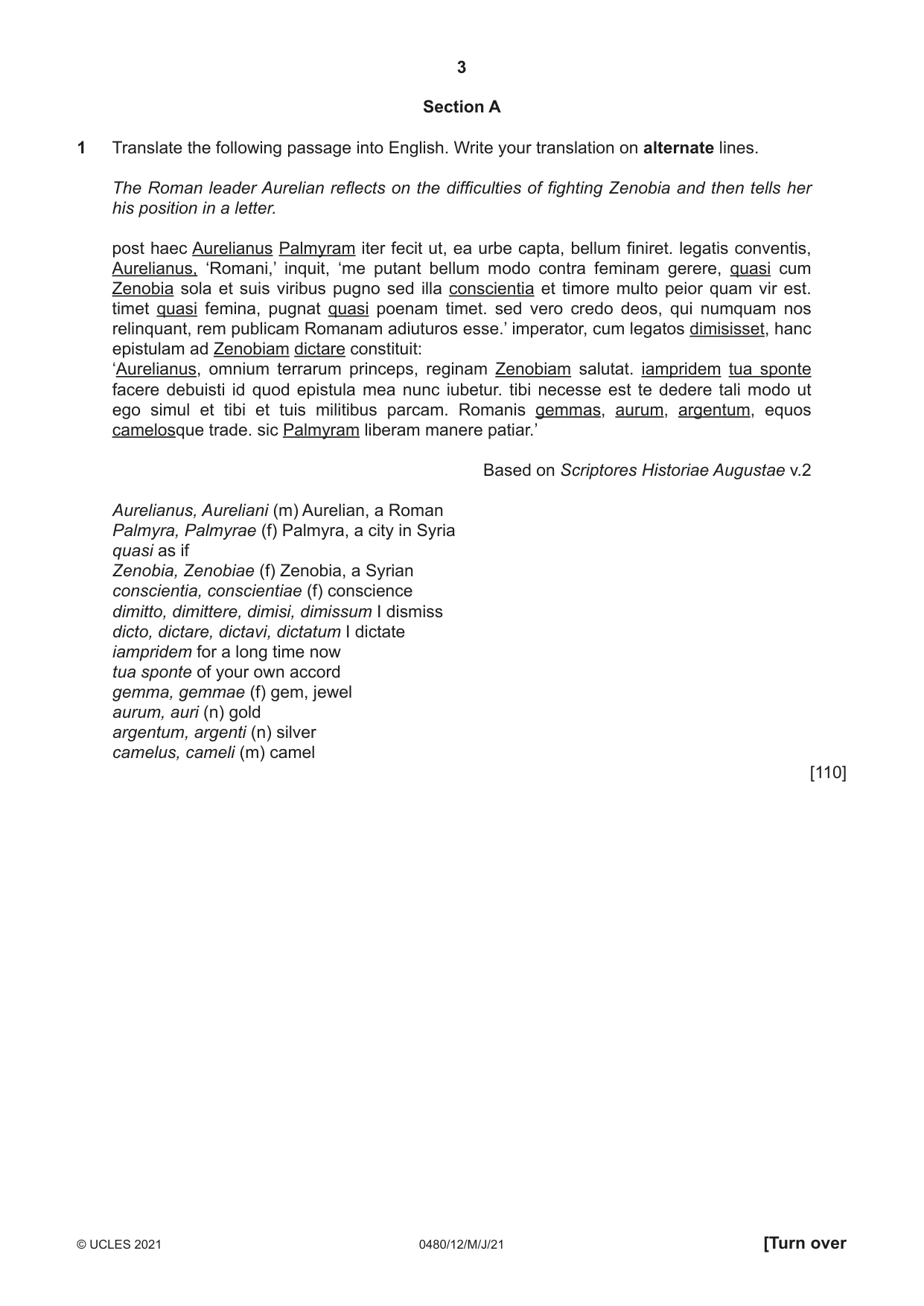
3 0480/12/M/J/21 © UCLES 2021 [Turn over Section A 1 Translate the following passage into English. Write your translation on alternate lines. The Roman leader Aurelian reflects on the difficulties of fighting Zenobia and then tells her his position in a letter. post haec Aurelianus Palmyram iter fecit ut, ea urbe capta, bellum finiret. legatis conventis, Aurelianus, ‘Romani,’ inquit, ‘me putant bellum modo contra feminam gerere, quasi cum Zenobia sola et suis viribus pugno sed illa conscientia et timore multo peior quam vir est. timet quasi femina, pugnat quasi poenam timet. sed vero credo deos, qui numquam nos relinquant, rem publicam Romanam adiuturos esse.’ imperator, cum legatos dimisisset, hanc epistulam ad Zenobiam dictare constituit: ‘Aurelianus, omnium terrarum princeps, reginam Zenobiam salutat. iampridem tua sponte facere debuisti id quod epistula mea nunc iubetur. tibi necesse est te dedere tali modo ut ego simul et tibi et tuis militibus parcam. Romanis gemmas, aurum, argentum, equos camelosque trade. sic Palmyram liberam manere patiar.’ Based on Scriptores Historiae Augustae v.2 Aurelianus, Aureliani (m) Aurelian, a Roman Palmyra, Palmyrae (f) Palmyra, a city in Syria quasi as if Zenobia, Zenobiae (f) Zenobia, a Syrian conscientia, conscientiae (f) conscience dimitto, dimittere, dimisi, dimissum I dismiss dicto, dictare, dictavi, dictatum I dictate iampridem for a long time now tua sponte of your own accord gemma, gemmae (f) gem, jewel aurum, auri (n) gold argentum, argenti (n) silver camelus, cameli (m) camel [110]
Question paper, page 4
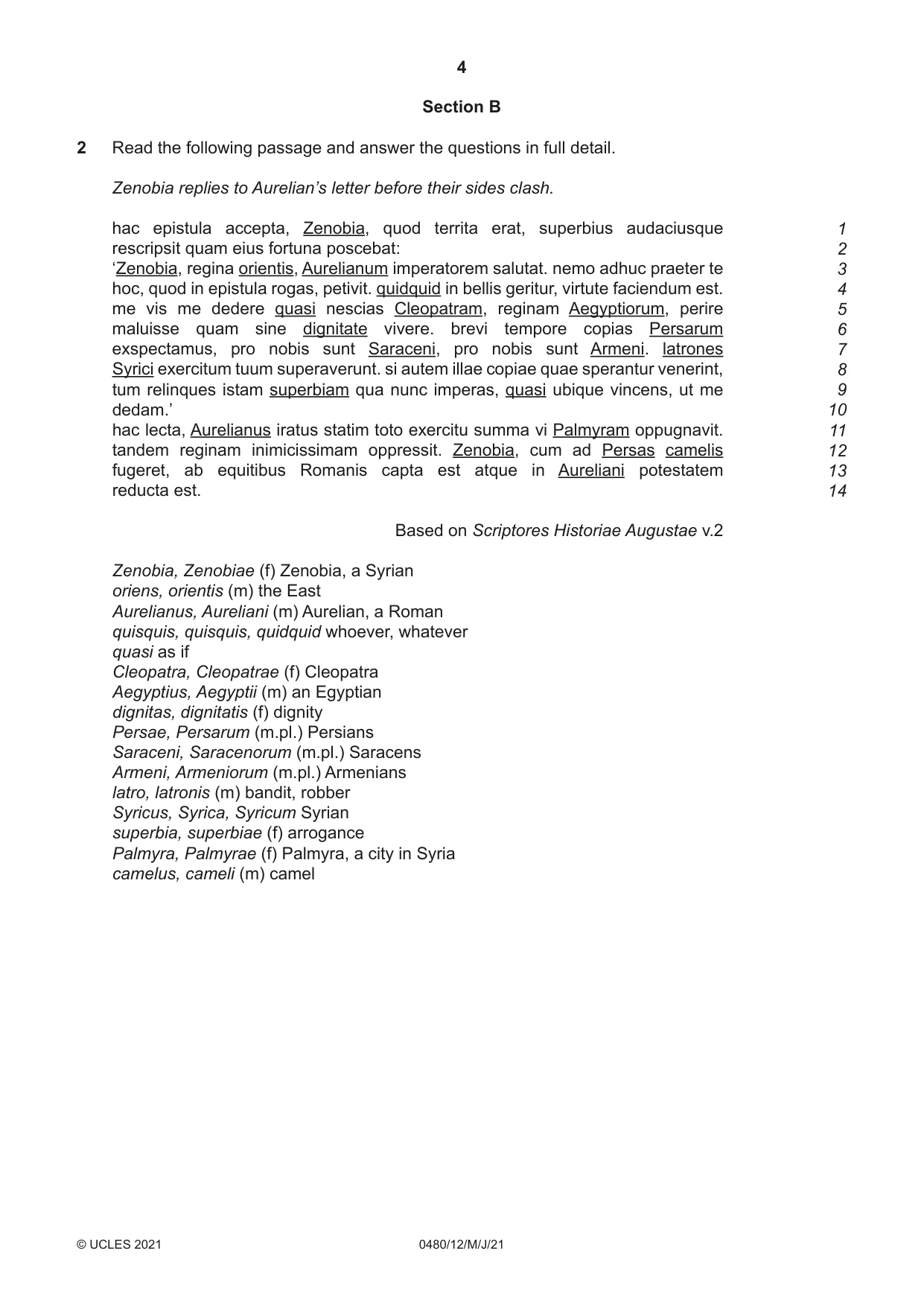
4 0480/12/M/J/21 © UCLES 2021 Section B 2 Read the following passage and answer the questions in full detail. Zenobia replies to Aurelian’s letter before their sides clash. hac epistula accepta, Zenobia, quod territa erat, superbius audaciusque rescripsit quam eius fortuna poscebat: ‘Zenobia, regina orientis, Aurelianum imperatorem salutat. nemo adhuc praeter te hoc, quod in epistula rogas, petivit. quidquid in bellis geritur, virtute faciendum est. me vis me dedere quasi nescias Cleopatram, reginam Aegyptiorum, perire maluisse quam sine dignitate vivere. brevi tempore copias Persarum exspectamus, pro nobis sunt Saraceni, pro nobis sunt Armeni. latrones Syrici exercitum tuum superaverunt. si autem illae copiae quae sperantur venerint, tum relinques istam superbiam qua nunc imperas, quasi ubique vincens, ut me dedam.’ hac lecta, Aurelianus iratus statim toto exercitu summa vi Palmyram oppugnavit. tandem reginam inimicissimam oppressit. Zenobia, cum ad Persas camelis fugeret, ab equitibus Romanis capta est atque in Aureliani potestatem reducta est. Based on Scriptores Historiae Augustae v.2 Zenobia, Zenobiae (f) Zenobia, a Syrian oriens, orientis (m) the East Aurelianus, Aureliani (m) Aurelian, a Roman quisquis, quisquis, quidquid whoever, whatever quasi as if Cleopatra, Cleopatrae (f) Cleopatra Aegyptius, Aegyptii (m) an Egyptian dignitas, dignitatis (f) dignity Persae, Persarum (m.pl.) Persians Saraceni, Saracenorum (m.pl.) Saracens Armeni, Armeniorum (m.pl.) Armenians latro, latronis (m) bandit, robber Syricus, Syrica, Syricum Syrian superbia, superbiae (f) arrogance Palmyra, Palmyrae (f) Palmyra, a city in Syria camelus, cameli (m) camel 1 2 3 4 5 6 7 8 9 10 11 12 13 14
Question paper, page 5
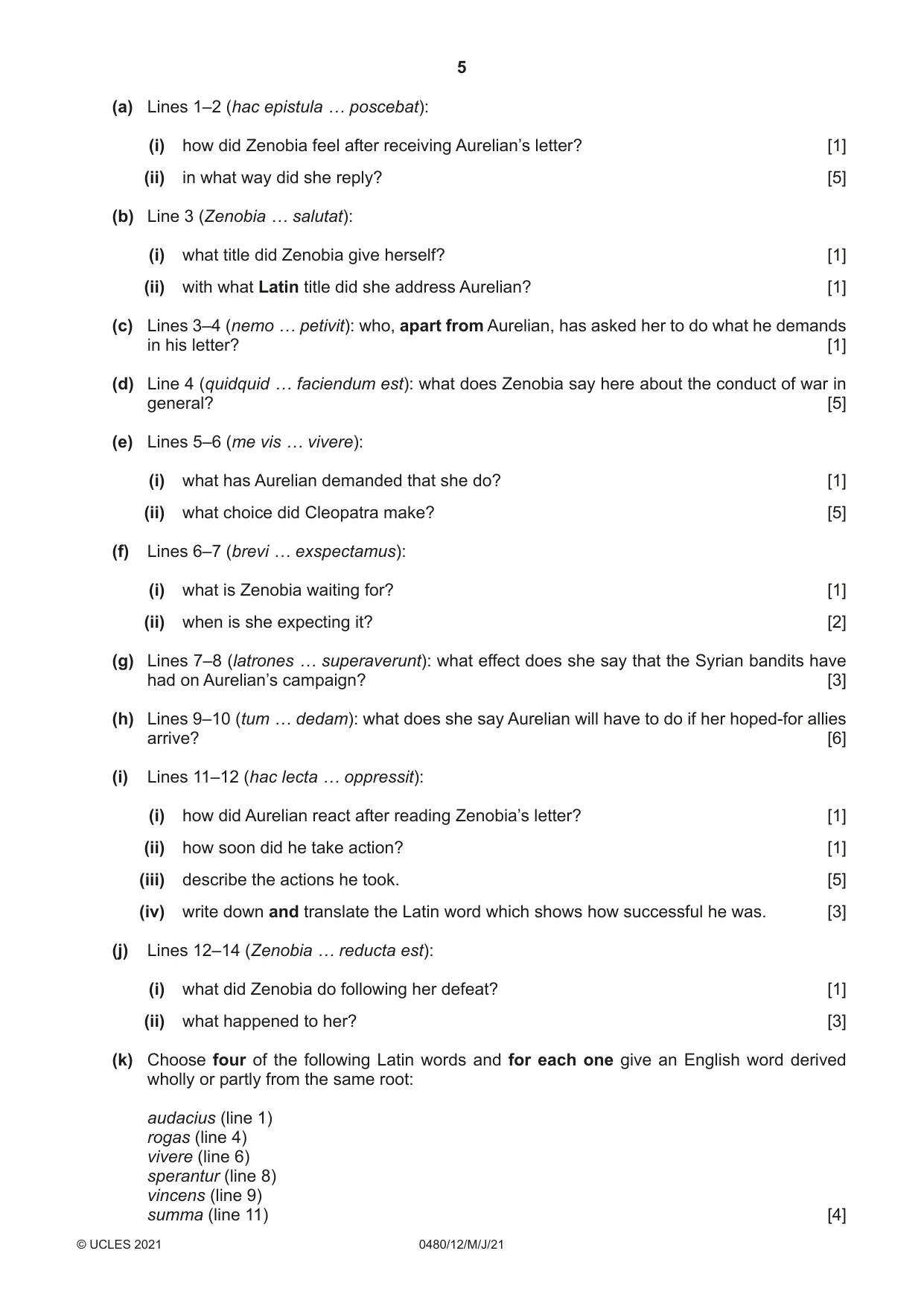
5 0480/12/M/J/21 © UCLES 2021 (a) Lines 1–2 (hac epistula … poscebat): (i) how did Zenobia feel after receiving Aurelian’s letter? [1] (ii) in what way did she reply? [5] (b) Line 3 (Zenobia … salutat): (i) what title did Zenobia give herself? [1] (ii) with what Latin title did she address Aurelian? [1] (c) Lines 3–4 (nemo … petivit): who, apart from Aurelian, has asked her to do what he demands in his letter? [1] (d) Line 4 (quidquid … faciendum est): what does Zenobia say here about the conduct of war in general? [5] (e) Lines 5–6 (me vis … vivere): (i) what has Aurelian demanded that she do? [1] (ii) what choice did Cleopatra make? [5] (f) Lines 6–7 (brevi … exspectamus): (i) what is Zenobia waiting for? [1] (ii) when is she expecting it? [2] (g) Lines 7–8 (latrones … superaverunt): what effect does she say that the Syrian bandits have had on Aurelian’s campaign? [3] (h) Lines 9–10 (tum … dedam): what does she say Aurelian will have to do if her hoped-for allies arrive? [6] (i) Lines 11–12 (hac lecta … oppressit): (i) how did Aurelian react after reading Zenobia’s letter? [1] (ii) how soon did he take action? [1] (iii) describe the actions he took. [5] (iv) write down and translate the Latin word which shows how successful he was. [3] (j) Lines 12–14 (Zenobia … reducta est): (i) what did Zenobia do following her defeat? [1] (ii) what happened to her? [3] (k) Choose four of the following Latin words and for each one give an English word derived wholly or partly from the same root: audacius (line 1) rogas (line 4) vivere (line 6) sperantur (line 8) vincens (line 9) summa (line 11) [4]
Question paper, page 6
6 0480/12/M/J/21 © UCLES 2021 BLANK PAGE
Question paper, page 7
7 0480/12/M/J/21 © UCLES 2021 BLANK PAGE
Question paper, page 8
8 0480/12/M/J/21 © UCLES 2021 Permission to reproduce items where third-party owned material protected by copyright is included has been sought and cleared where possible. Every reasonable effort has been made by the publisher (UCLES) to trace copyright holders, but if any items requiring clearance have unwittingly been included, the publisher will be pleased to make amends at the earliest possible opportunity. To avoid the issue of disclosure of answer-related information to candidates, all copyright acknowledgements are reproduced online in the Cambridge Assessment International Education Copyright Acknowledgements Booklet. This is produced for each series of examinations and is freely available to download at www.cambridgeinternational.org after the live examination series. Cambridge Assessment International Education is part of the Cambridge Assessment Group. Cambridge Assessment is the brand name of the University of Cambridge Local Examinations Syndicate (UCLES), which itself is a department of the University of Cambridge. BLANK PAGE
Mark scheme, page 1
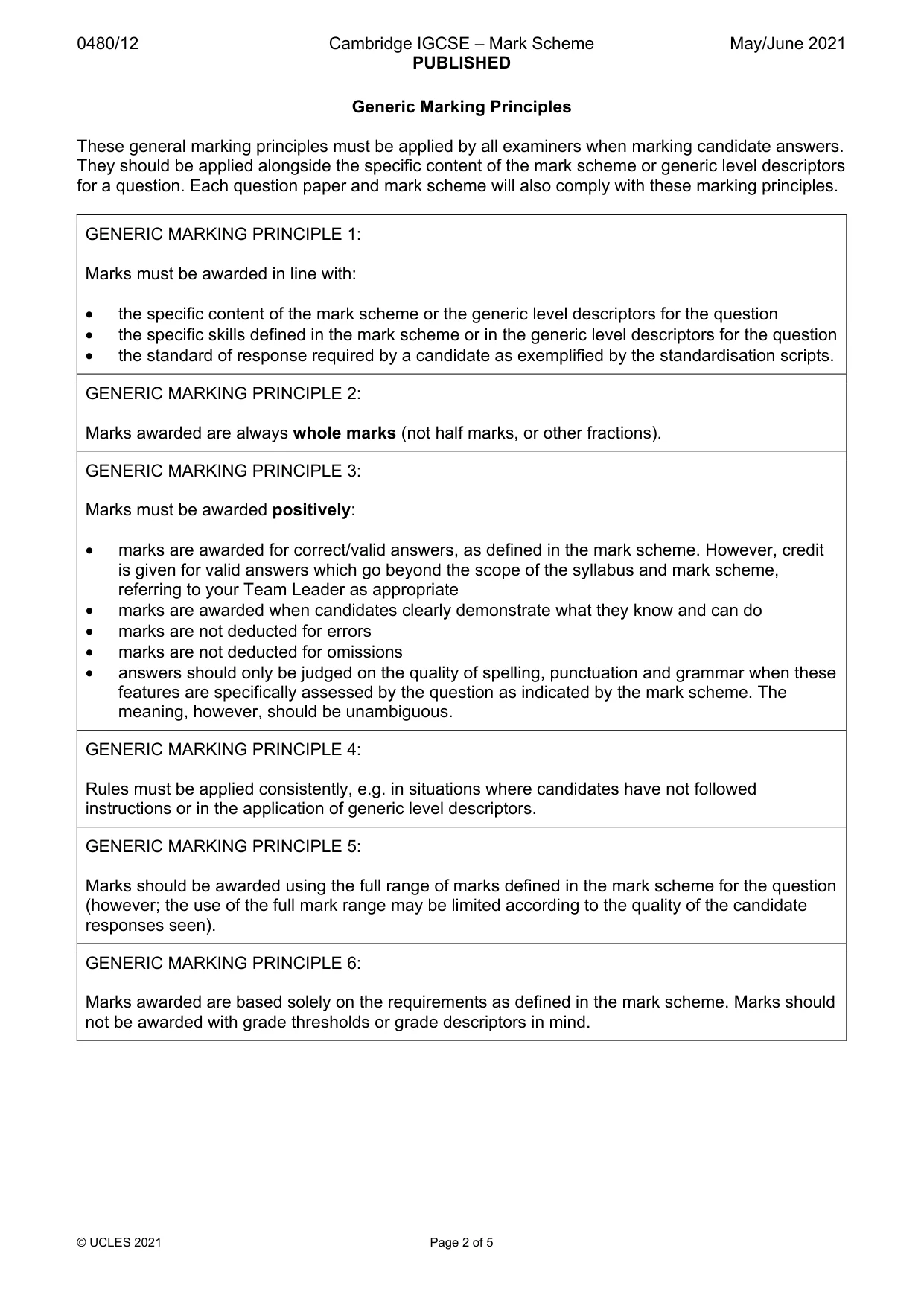
This document consists of 5 printed pages. © UCLES 2021 [Turn over Cambridge IGCSE™ LATIN 0480/12 Paper 1 Language May/June 2021 MARK SCHEME Maximum Mark: 160 Published This mark scheme is published as an aid to teachers and candidates, to indicate the requirements of the examination. It shows the basis on which Examiners were instructed to award marks. It does not indicate the details of the discussions that took place at an Examiners’ meeting before marking began, which would have considered the acceptability of alternative answers. Mark schemes should be read in conjunction with the question paper and the Principal Examiner Report for Teachers. Cambridge International will not enter into discussions about these mark schemes. Cambridge International is publishing the mark schemes for the May/June 2021 series for most Cambridge IGCSE™, Cambridge International A and AS Level components and some Cambridge O Level components.
Mark scheme, page 2
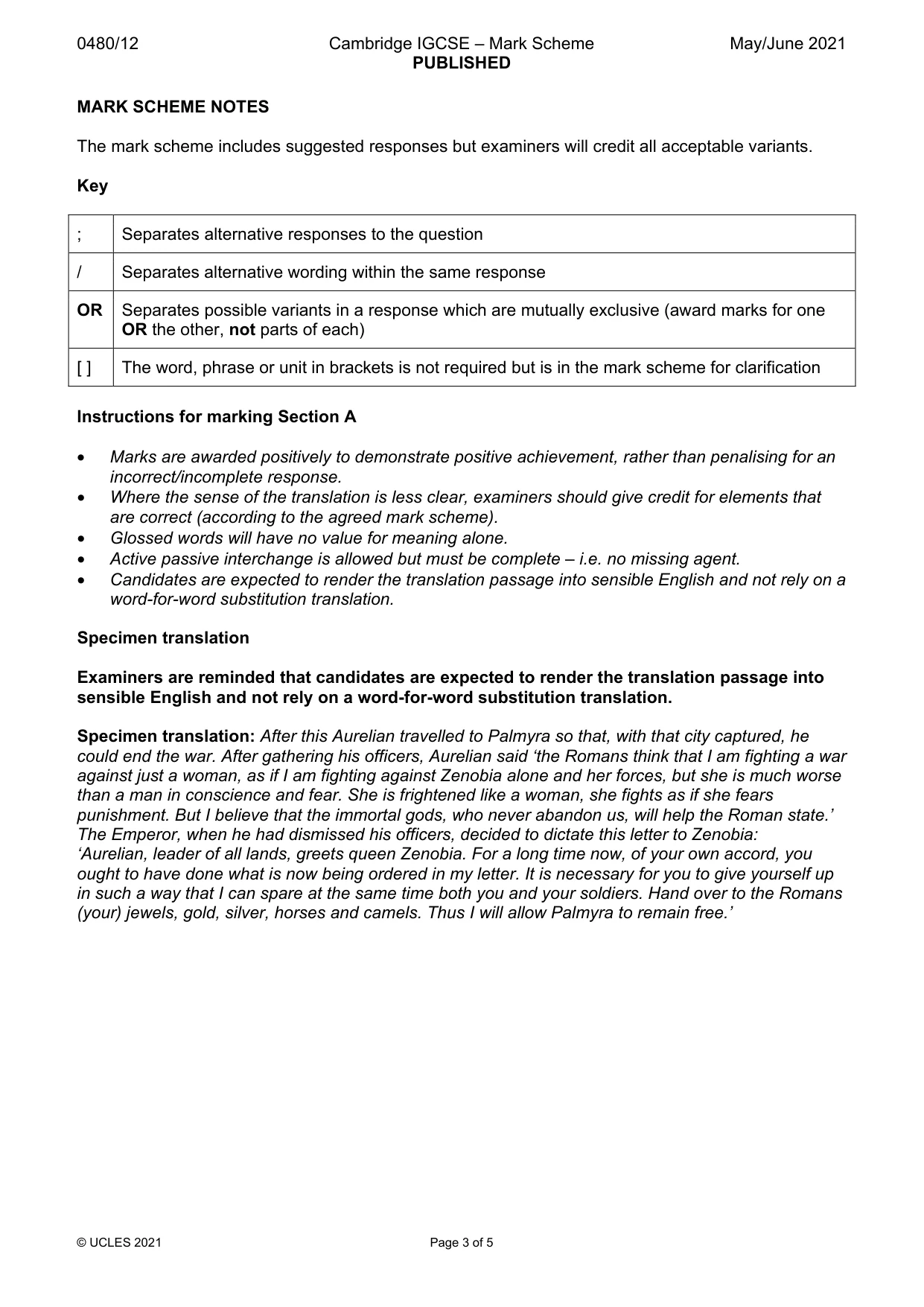
0480/12 Cambridge IGCSE – Mark Scheme PUBLISHED May/June 2021 © UCLES 2021 Page 2 of 5 Generic Marking Principles These general marking principles must be applied by all examiners when marking candidate answers. They should be applied alongside the specific content of the mark scheme or generic level descriptors for a question. Each question paper and mark scheme will also comply with these marking principles. GENERIC MARKING PRINCIPLE 1: Marks must be awarded in line with: • the specific content of the mark scheme or the generic level descriptors for the question • the specific skills defined in the mark scheme or in the generic level descriptors for the question • the standard of response required by a candidate as exemplified by the standardisation scripts. GENERIC MARKING PRINCIPLE 2: Marks awarded are always whole marks (not half marks, or other fractions). GENERIC MARKING PRINCIPLE 3: Marks must be awarded positively: • marks are awarded for correct/valid answers, as defined in the mark scheme. However, credit is given for valid answers which go beyond the scope of the syllabus and mark scheme, referring to your Team Leader as appropriate • marks are awarded when candidates clearly demonstrate what they know and can do • marks are not deducted for errors • marks are not deducted for omissions • answers should only be judged on the quality of spelling, punctuation and grammar when these features are specifically assessed by the question as indicated by the mark scheme. The meaning, however, should be unambiguous. GENERIC MARKING PRINCIPLE 4: Rules must be applied consistently, e.g. in situations where candidates have not followed instructions or in the application of generic level descriptors. GENERIC MARKING PRINCIPLE 5: Marks should be awarded using the full range of marks defined in the mark scheme for the question (however; the use of the full mark range may be limited according to the quality of the candidate responses seen). GENERIC MARKING PRINCIPLE 6: Marks awarded are based solely on the requirements as defined in the mark scheme. Marks should not be awarded with grade thresholds or grade descriptors in mind.
Mark scheme, page 3
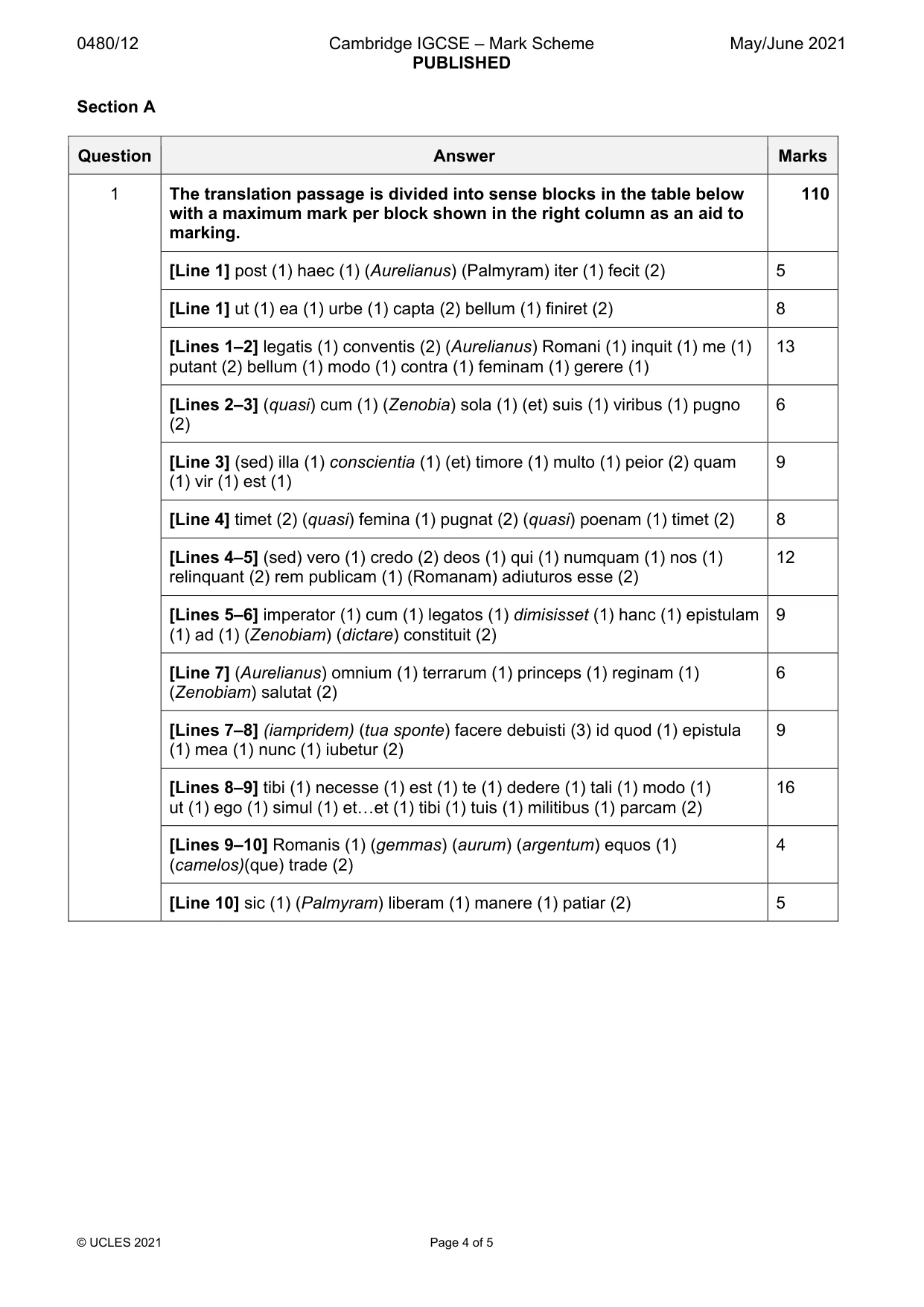
0480/12 Cambridge IGCSE – Mark Scheme PUBLISHED May/June 2021 © UCLES 2021 Page 3 of 5 MARK SCHEME NOTES The mark scheme includes suggested responses but examiners will credit all acceptable variants. Key ; Separates alternative responses to the question / Separates alternative wording within the same response OR Separates possible variants in a response which are mutually exclusive (award marks for one OR the other, not parts of each) [ ] The word, phrase or unit in brackets is not required but is in the mark scheme for clarification Instructions for marking Section A • Marks are awarded positively to demonstrate positive achievement, rather than penalising for an incorrect/incomplete response. • Where the sense of the translation is less clear, examiners should give credit for elements that are correct (according to the agreed mark scheme). • Glossed words will have no value for meaning alone. • Active passive interchange is allowed but must be complete – i.e. no missing agent. • Candidates are expected to render the translation passage into sensible English and not rely on a word-for-word substitution translation. Specimen translation Examiners are reminded that candidates are expected to render the translation passage into sensible English and not rely on a word-for-word substitution translation. Specimen translation: After this Aurelian travelled to Palmyra so that, with that city captured, he could end the war. After gathering his officers, Aurelian said ‘the Romans think that I am fighting a war against just a woman, as if I am fighting against Zenobia alone and her forces, but she is much worse than a man in conscience and fear. She is frightened like a woman, she fights as if she fears punishment. But I believe that the immortal gods, who never abandon us, will help the Roman state.’ The Emperor, when he had dismissed his officers, decided to dictate this letter to Zenobia: ‘Aurelian, leader of all lands, greets queen Zenobia. For a long time now, of your own accord, you ought to have done what is now being ordered in my letter. It is necessary for you to give yourself up in such a way that I can spare at the same time both you and your soldiers. Hand over to the Romans (your) jewels, gold, silver, horses and camels. Thus I will allow Palmyra to remain free.’
Mark scheme, page 4
0480/12 Cambridge IGCSE – Mark Scheme PUBLISHED May/June 2021 © UCLES 2021 Page 4 of 5 Section A Question Answer Marks 1 The translation passage is divided into sense blocks in the table below with a maximum mark per block shown in the right column as an aid to marking. 110 [Line 1] post (1) haec (1) (Aurelianus) (Palmyram) iter (1) fecit (2) 5 [Line 1] ut (1) ea (1) urbe (1) capta (2) bellum (1) finiret (2) 8 [Lines 1–2] legatis (1) conventis (2) (Aurelianus) Romani (1) inquit (1) me (1) putant (2) bellum (1) modo (1) contra (1) feminam (1) gerere (1) 13 [Lines 2–3] (quasi) cum (1) (Zenobia) sola (1) (et) suis (1) viribus (1) pugno (2) 6 [Line 3] (sed) illa (1) conscientia (1) (et) timore (1) multo (1) peior (2) quam (1) vir (1) est (1) 9 [Line 4] timet (2) (quasi) femina (1) pugnat (2) (quasi) poenam (1) timet (2) 8 [Lines 4–5] (sed) vero (1) credo (2) deos (1) qui (1) numquam (1) nos (1) relinquant (2) rem publicam (1) (Romanam) adiuturos esse (2) 12 [Lines 5–6] imperator (1) cum (1) legatos (1) dimisisset (1) hanc (1) epistulam (1) ad (1) (Zenobiam) (dictare) constituit (2) 9 [Line 7] (Aurelianus) omnium (1) terrarum (1) princeps (1) reginam (1) (Zenobiam) salutat (2) 6 [Lines 7–8] (iampridem) (tua sponte) facere debuisti (3) id quod (1) epistula (1) mea (1) nunc (1) iubetur (2) 9 [Lines 8–9] tibi (1) necesse (1) est (1) te (1) dedere (1) tali (1) modo (1) ut (1) ego (1) simul (1) et…et (1) tibi (1) tuis (1) militibus (1) parcam (2) 16 [Lines 9–10] Romanis (1) (gemmas) (aurum) (argentum) equos (1) (camelos)(que) trade (2) 4 [Line 10] sic (1) (Palmyram) liberam (1) manere (1) patiar (2) 5
Mark scheme, page 5
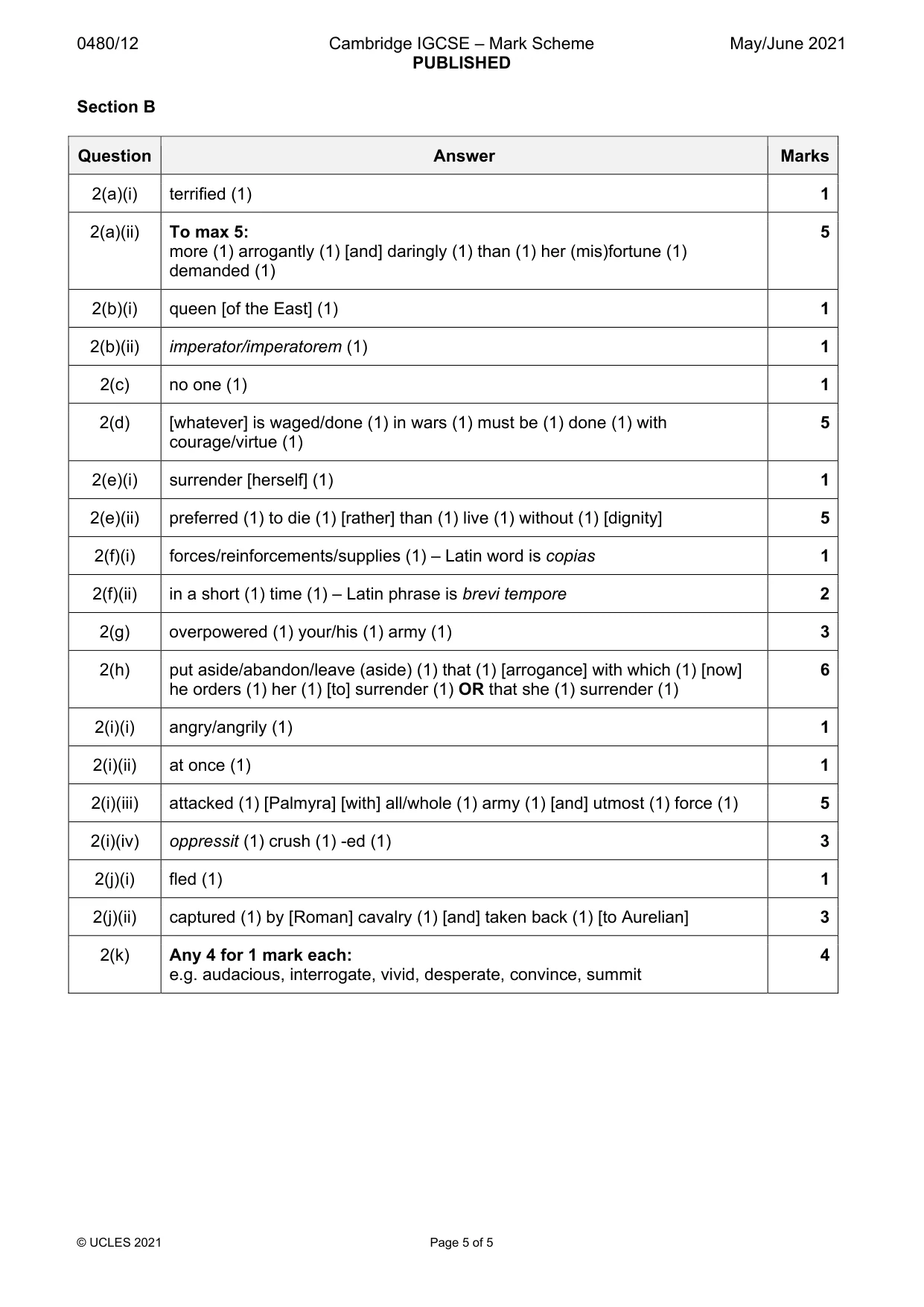
0480/12 Cambridge IGCSE – Mark Scheme PUBLISHED May/June 2021 © UCLES 2021 Page 5 of 5 Section B Question Answer Marks 2(a)(i) terrified (1) 1 2(a)(ii) To max 5: more (1) arrogantly (1) [and] daringly (1) than (1) her (mis)fortune (1) demanded (1) 5 2(b)(i) queen [of the East] (1) 1 2(b)(ii) imperator/imperatorem (1) 1 2(c) no one (1) 1 2(d) [whatever] is waged/done (1) in wars (1) must be (1) done (1) with courage/virtue (1) 5 2(e)(i) surrender [herself] (1) 1 2(e)(ii) preferred (1) to die (1) [rather] than (1) live (1) without (1) [dignity] 5 2(f)(i) forces/reinforcements/supplies (1) – Latin word is copias 1 2(f)(ii) in a short (1) time (1) – Latin phrase is brevi tempore 2 2(g) overpowered (1) your/his (1) army (1) 3 2(h) put aside/abandon/leave (aside) (1) that (1) [arrogance] with which (1) [now] he orders (1) her (1) [to] surrender (1) OR that she (1) surrender (1) 6 2(i)(i) angry/angrily (1) 1 2(i)(ii) at once (1) 1 2(i)(iii) attacked (1) [Palmyra] [with] all/whole (1) army (1) [and] utmost (1) force (1) 5 2(i)(iv) oppressit (1) crush (1) -ed (1) 3 2(j)(i) fled (1) 1 2(j)(ii) captured (1) by [Roman] cavalry (1) [and] taken back (1) [to Aurelian] 3 2(k) Any 4 for 1 mark each: e.g. audacious, interrogate, vivid, desperate, convince, summit 4
What you needed in this session
Cambridge’s own grade thresholds for 2021 May/June, Paper 1 · Variant 2. A higher threshold means an easier paper — the bar moves with how the cohort did.