Cambridge IGCSE Latin 0480 — 2017 May/June Paper 2 · Variant 1
0480/21/M/J/17 · 6 questions · 80 marks · ≈90 min
The question paper and its mark scheme, free to read here and free to download. This is Cambridge’s own paper, exactly as it was sat.
Question paper8 pages

Mark scheme8 pages
Answers below. Sit the paper first if you are practising.
Questions as text
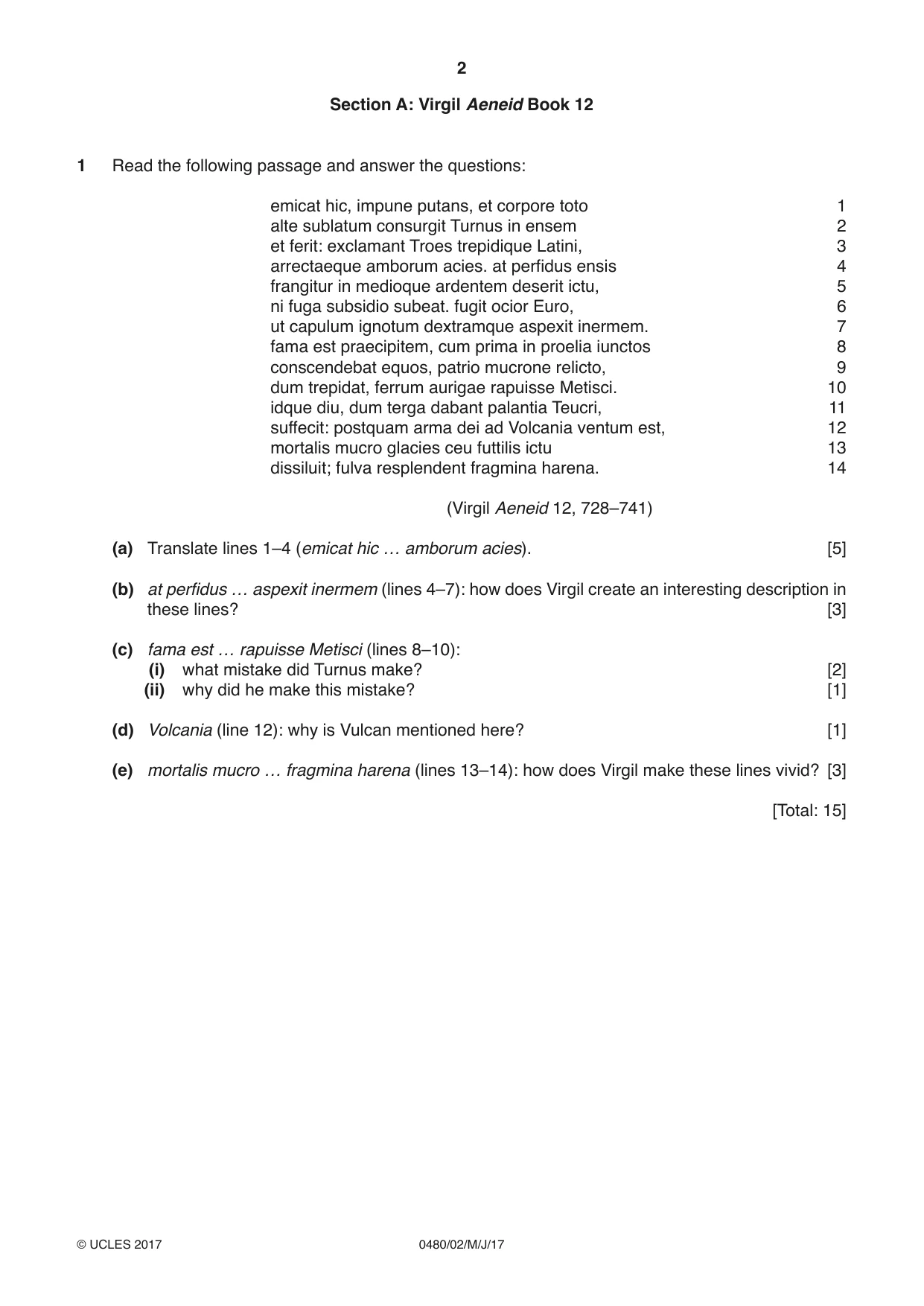
Q1 · Read the following passage and answer the questions: emicat hic, impune putans, et…
1 Read the following passage and answer the questions: emicat hic, impune putans, et corpore toto 1 alte sublatum consurgit Turnus in ensem 2 et ferit: exclamant Troes trepidique Latini, 3 arrectaeque amborum acies. at perfidus ensis 4 frangitur in medioque ardentem deserit ictu, 5 ni fuga subsidio subeat. fugit ocior Euro, 6 ut capulum ignotum dextramque aspexit inermem. 7 fama est praecipitem, cum prima in proelia iunctos 8 conscendebat equos, patrio mucrone relicto, 9 dum trepidat, ferrum aurigae rapuisse Metisci. 10 idque diu, dum terga dabant palantia Teucri, 11 suffecit: postquam arma dei ad Volcania ventum est, 12 mortalis mucro glacies ceu futtilis ictu 13 dissiluit; fulva resplendent fragmina harena. 14 (Virgil Aeneid 12, 728–741) (a) Translate lines 1–4 (emicat hic … amborum acies). [5] (b) at perfidus … aspexit inermem (lines 4–7): how does Virgil create an interesting description in these lines? [3] (c) fama est … rapuisse Metisci (lines 8–10): (i) what mistake did Turnus make? [2] (ii) why did he make this mistake? [1] (d) Volcania (line 12): why is Vulcan mentioned here? [1] (e) mortalis mucro … fragmina harena (lines 13–14): how does Virgil make these lines vivid? [3] [Total: 15]
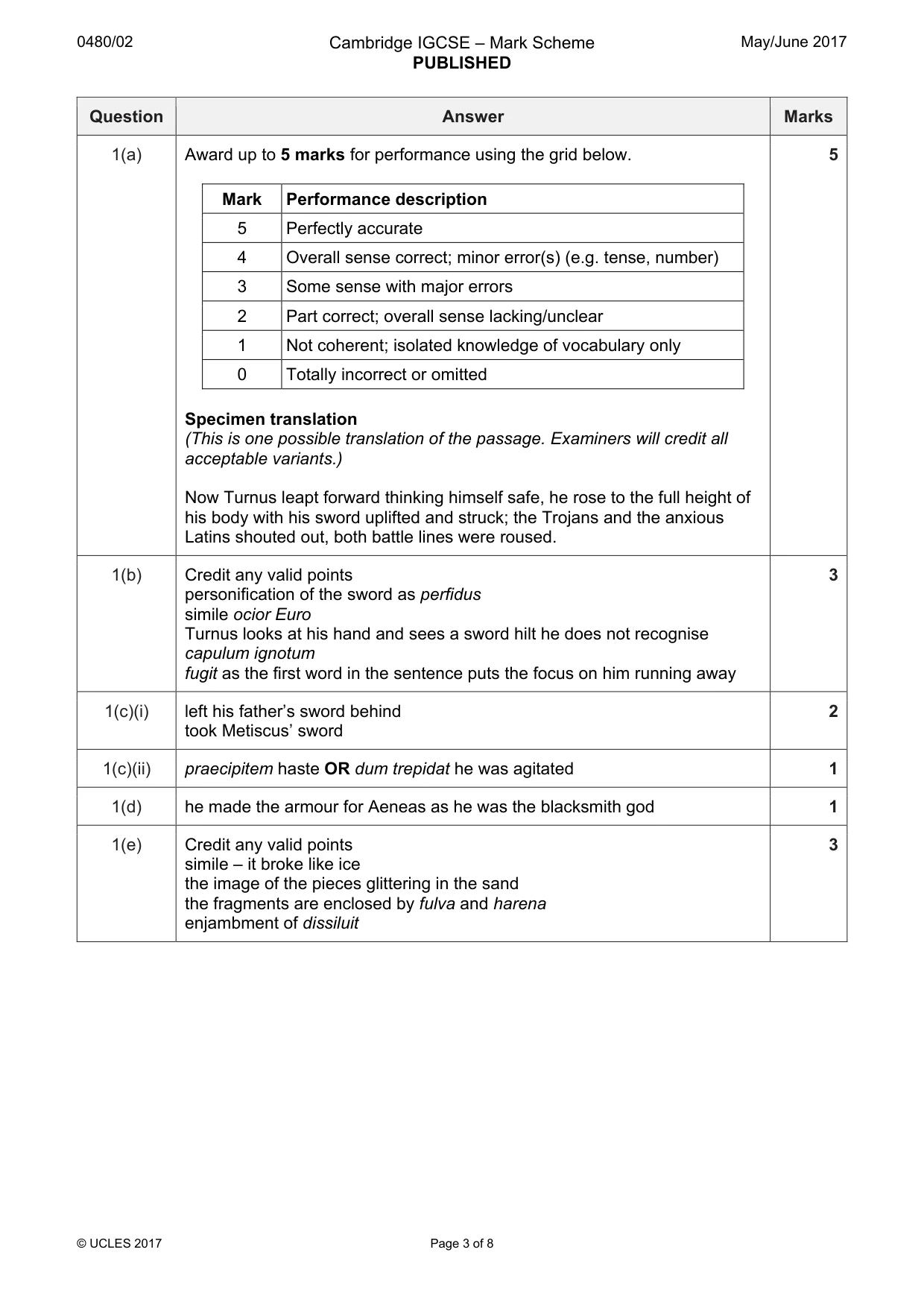
Mark scheme: Question Answer Marks 1(a) Award up to 5 marks for performance using the grid below. 5 Mark Performance description 5 Perfectly accurate 4 Overall sense correct; minor error(s) (e.g. tense, number) 3 Some sense with major errors 2 Part correct; overall sense lacking/unclear 1 Not coherent; isolated knowledge of vocabulary only 0 Totally incorrect or omitted Specimen translation (This is one possible translation of the passage. Examiners will credit all acceptable variants.) Now Turnus leapt forward thinking himself safe, he rose to the full height of his body with his sword uplifted and struck; the Trojans and the anxious Latins shouted out, both battle lines were roused. 1(b) Credit any valid points 3 personification of the sword as perfidus simile ocior Euro Turnus looks at his hand and sees a sword hilt he does not recognise capulum ignotum fugit as the first word in the sentence puts the focus on him running away 1(c)(i) left his father’s sword behind 2 took Metiscus’ sword 1(c)(ii) praecipitem haste OR dum trepidat he was agitated 1 1(d) he made the armour for Aeneas as he was the blacksmith god 1 1(e) Credit any valid points 3 simile – it broke like ice the image of the pieces glittering in the sand the fragments are enclosed by fulva and harena enjambment of dissiluit
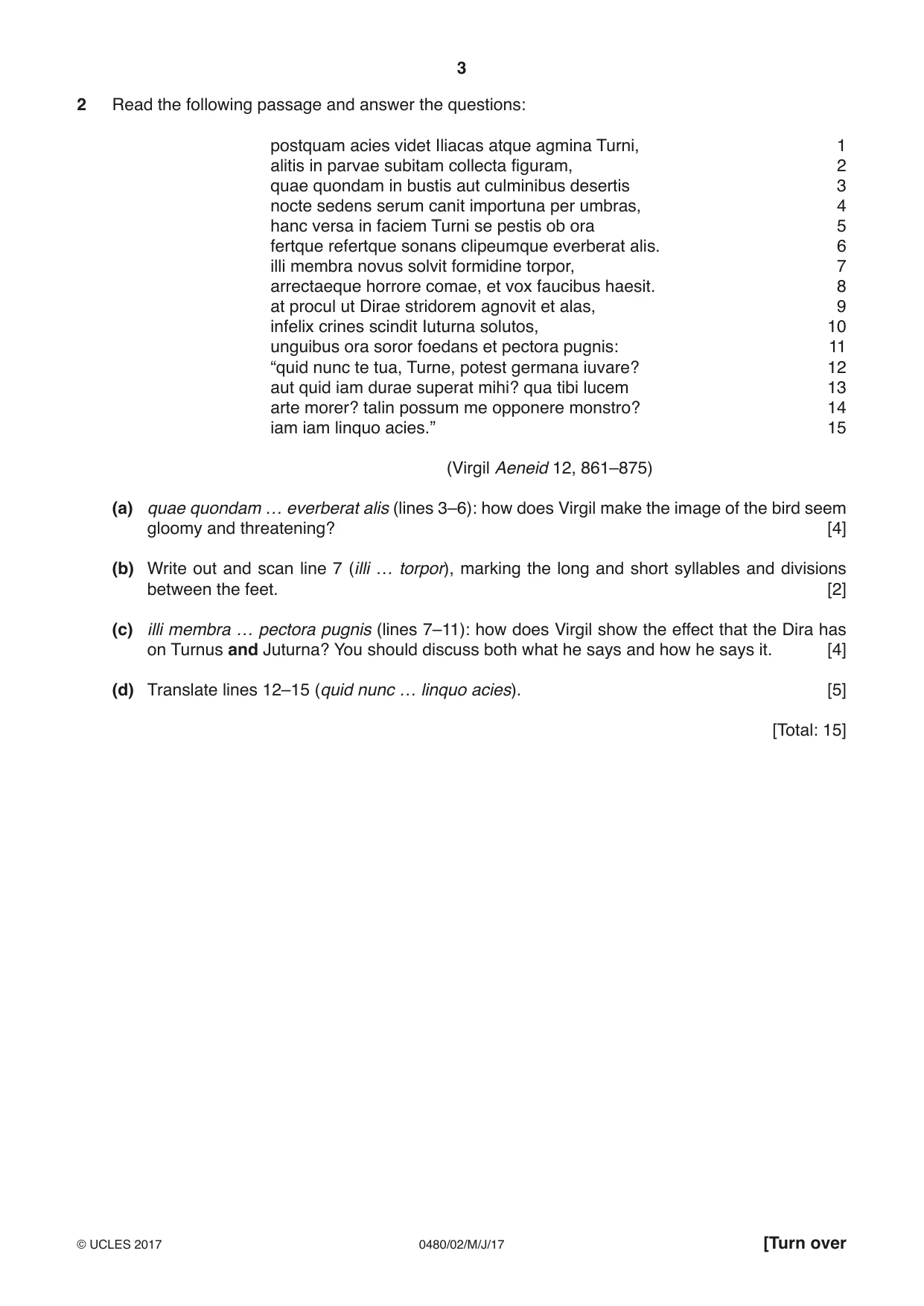
Q2 · Read the following passage and answer the questions: postquam acies videt Iliacas atque…
2 Read the following passage and answer the questions: postquam acies videt Iliacas atque agmina Turni, 1 alitis in parvae subitam collecta figuram, 2 quae quondam in bustis aut culminibus desertis 3 nocte sedens serum canit importuna per umbras, 4 hanc versa in faciem Turni se pestis ob ora 5 fertque refertque sonans clipeumque everberat alis. 6 illi membra novus solvit formidine torpor, 7 arrectaeque horrore comae, et vox faucibus haesit. 8 at procul ut Dirae stridorem agnovit et alas, 9 infelix crines scindit Iuturna solutos, 10 unguibus ora soror foedans et pectora pugnis: 11 “quid nunc te tua, Turne, potest germana iuvare? 12 aut quid iam durae superat mihi? qua tibi lucem 13 arte morer? talin possum me opponere monstro? 14 iam iam linquo acies.” 15 (Virgil Aeneid 12, 861–875) (a) quae quondam … everberat alis (lines 3–6): how does Virgil make the image of the bird seem gloomy and threatening? [4] (b) Write out and scan line 7 (illi … torpor), marking the long and short syllables and divisions between the feet. [2] (c) illi membra … pectora pugnis (lines 7–11): how does Virgil show the effect that the Dira has on Turnus and Juturna? You should discuss both what he says and how he says it. [4] (d) Translate lines 12–15 (quid nunc … linquo acies). [5] [Total: 15]
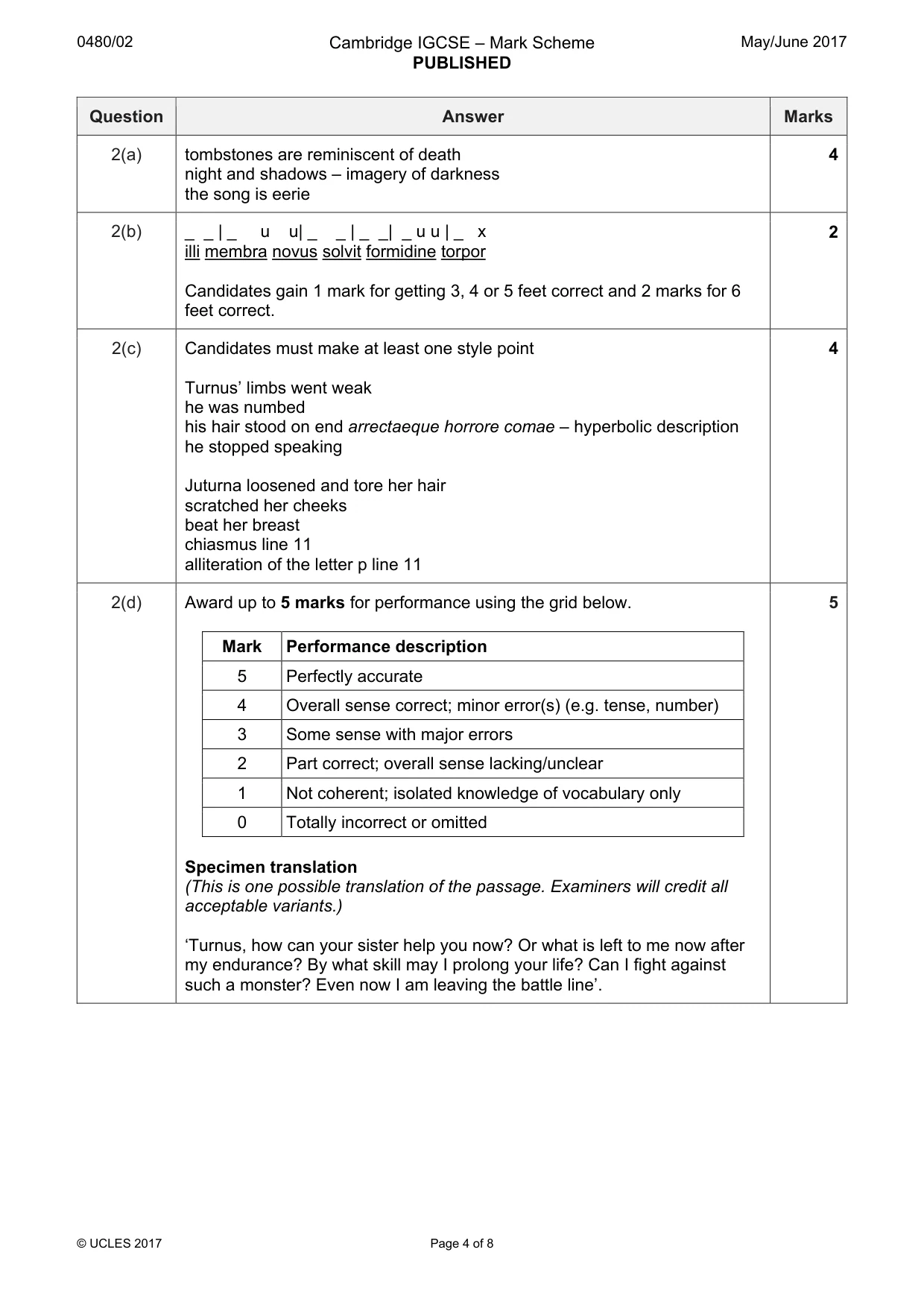
Mark scheme: 2(a) tombstones are reminiscent of death 4 night and shadows – imagery of darkness the song is eerie 2(b) _ _ | _ u u| _ _ | _ _| _ u u | _ x 2 illi membra novus solvit formidine torpor Candidates gain 1 mark for getting 3, 4 or 5 feet correct and 2 marks for 6 feet correct. 2(c) Candidates must make at least one style point 4 Turnus’ limbs went weak he was numbed his hair stood on end arrectaeque horrore comae – hyperbolic description he stopped speaking Juturna loosened and tore her hair scratched her cheeks beat her breast chiasmus line 11 alliteration of the letter p line 11 2(d) Award up to 5 marks for performance using the grid below. 5 Mark Performance description 5 Perfectly accurate 4 Overall sense correct; minor error(s) (e.g. tense, number) 3 Some sense with major errors 2 Part correct; overall sense lacking/unclear 1 Not coherent; isolated knowledge of vocabulary only 0 Totally incorrect or omitted Specimen translation (This is one possible translation of the passage. Examiners will credit all acceptable variants.) ‘Turnus, how can your sister help you now? Or what is left to me now after my endurance? By what skill may I prolong your life? Can I fight against such a monster? Even now I am leaving the battle line’.
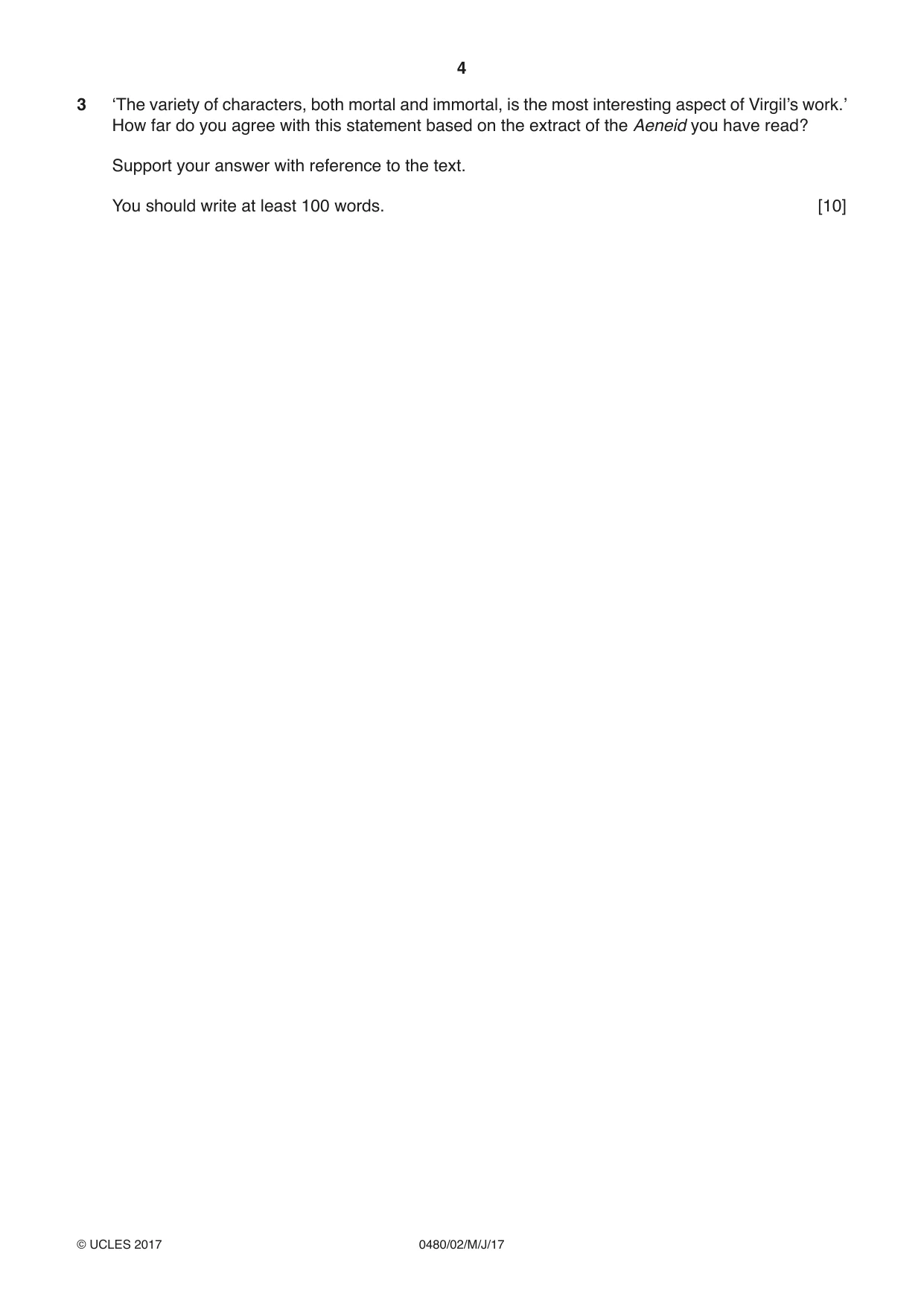
Q3 · ‘The variety of characters, both mortal and immortal, is the most interesting aspect of…
3 ‘The variety of characters, both mortal and immortal, is the most interesting aspect of Virgil’s work.’ How far do you agree with this statement based on the extract of the Aeneid you have read? Support your answer with reference to the text. You should write at least 100 words. [10]
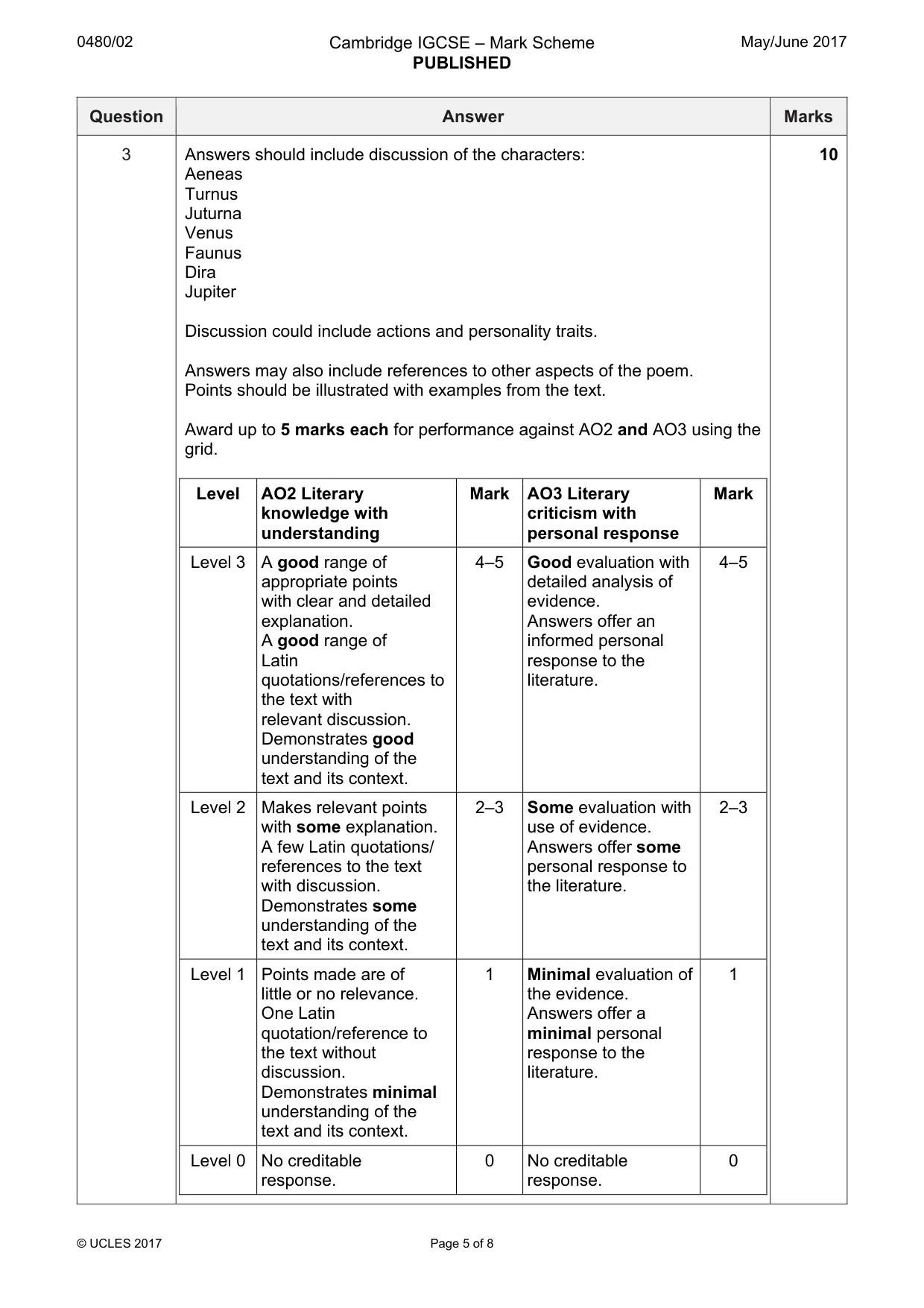
Mark scheme: 3 Answers should include discussion of the characters: 10 Aeneas Turnus Juturna Venus Faunus Dira Jupiter Discussion could include actions and personality traits. Answers may also include references to other aspects of the poem. Points should be illustrated with examples from the text. Award up to 5 marks each for performance against AO2 and AO3 using the grid. Level AO2 Literary Mark AO3 Literary Mark knowledge with criticism with understanding personal response Level 3 A good range of 4–5 Good evaluation with 4–5 appropriate points detailed analysis of with clear and detailed evidence. explanation. Answers offer an A good range of informed personal Latin response to the quotations/references to literature. the text with relevant discussion. Demonstrates good understanding of the text and its context. Level 2 Makes relevant points 2–3 Some evaluation with 2–3 with some explanation. use of evidence. A few Latin quotations/ Answers offer some references to the text personal response to with discussion. the literature. Demonstrates some understanding of the text and its context. Level 1 Points made are of 1 Minimal evaluation of 1 little or no relevance. the evidence. One Latin Answers offer a quotation/reference to minimal personal the text without response to the discussion. literature. Demonstrates minimal understanding of the text and its context. Level 0 No creditable 0 No creditable 0 response. response.
Q4 · Read the following passage and answer the questions: ‘ille vero’, inquit Antipater.‘quid…
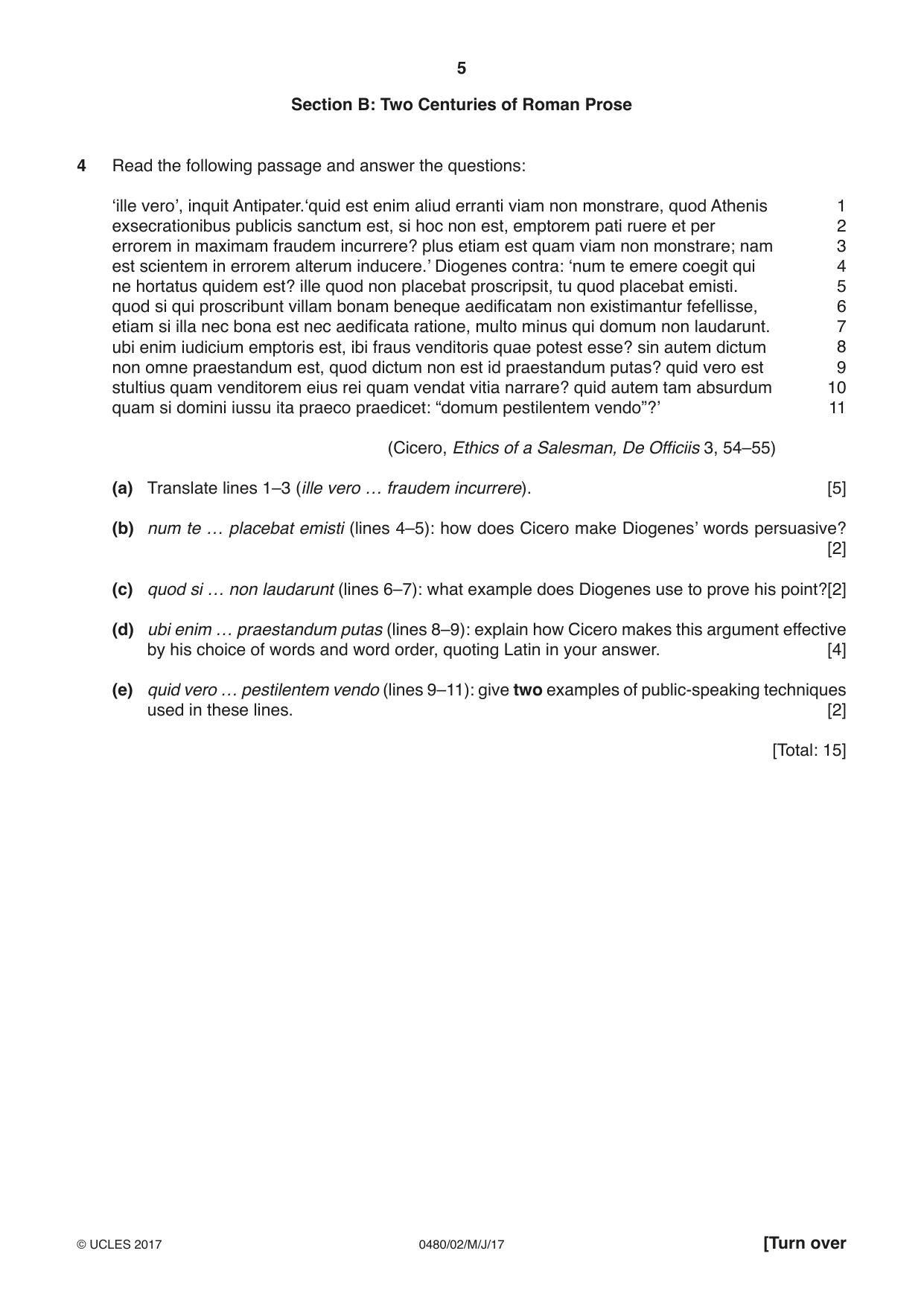
4 Read the following passage and answer the questions: ‘ille vero’, inquit Antipater.‘quid est enim aliud erranti viam non monstrare, quod Athenis 1 exsecrationibus publicis sanctum est, si hoc non est, emptorem pati ruere et per 2 errorem in maximam fraudem incurrere? plus etiam est quam viam non monstrare; nam 3 est scientem in errorem alterum inducere.’ Diogenes contra: ‘num te emere coegit qui 4 ne hortatus quidem est? ille quod non placebat proscripsit, tu quod placebat emisti. 5 quod si qui proscribunt villam bonam beneque aedificatam non existimantur fefellisse, 6 etiam si illa nec bona est nec aedificata ratione, multo minus qui domum non laudarunt. 7 ubi enim iudicium emptoris est, ibi fraus venditoris quae potest esse? sin autem dictum 8 non omne praestandum est, quod dictum non est id praestandum putas? quid vero est 9 stultius quam venditorem eius rei quam vendat vitia narrare? quid autem tam absurdum 10 quam si domini iussu ita praeco praedicet: “domum pestilentem vendo”?’ 11 (Cicero, Ethics of a Salesman, De Officiis 3, 54–55) (a) Translate lines 1–3 (ille vero … fraudem incurrere). [5] (b) num te … placebat emisti (lines 4–5): how does Cicero make Diogenes’ words persuasive? [2] (c) quod si … non laudarunt (lines 6–7): what example does Diogenes use to prove his point? [2] (d) ubi enim … praestandum putas (lines 8–9): explain how Cicero makes this argument effective by his choice of words and word order, quoting Latin in your answer. [4] (e) quid vero … pestilentem vendo (lines 9–11): give two examples of public-speaking techniques used in these lines. [2] [Total: 15]
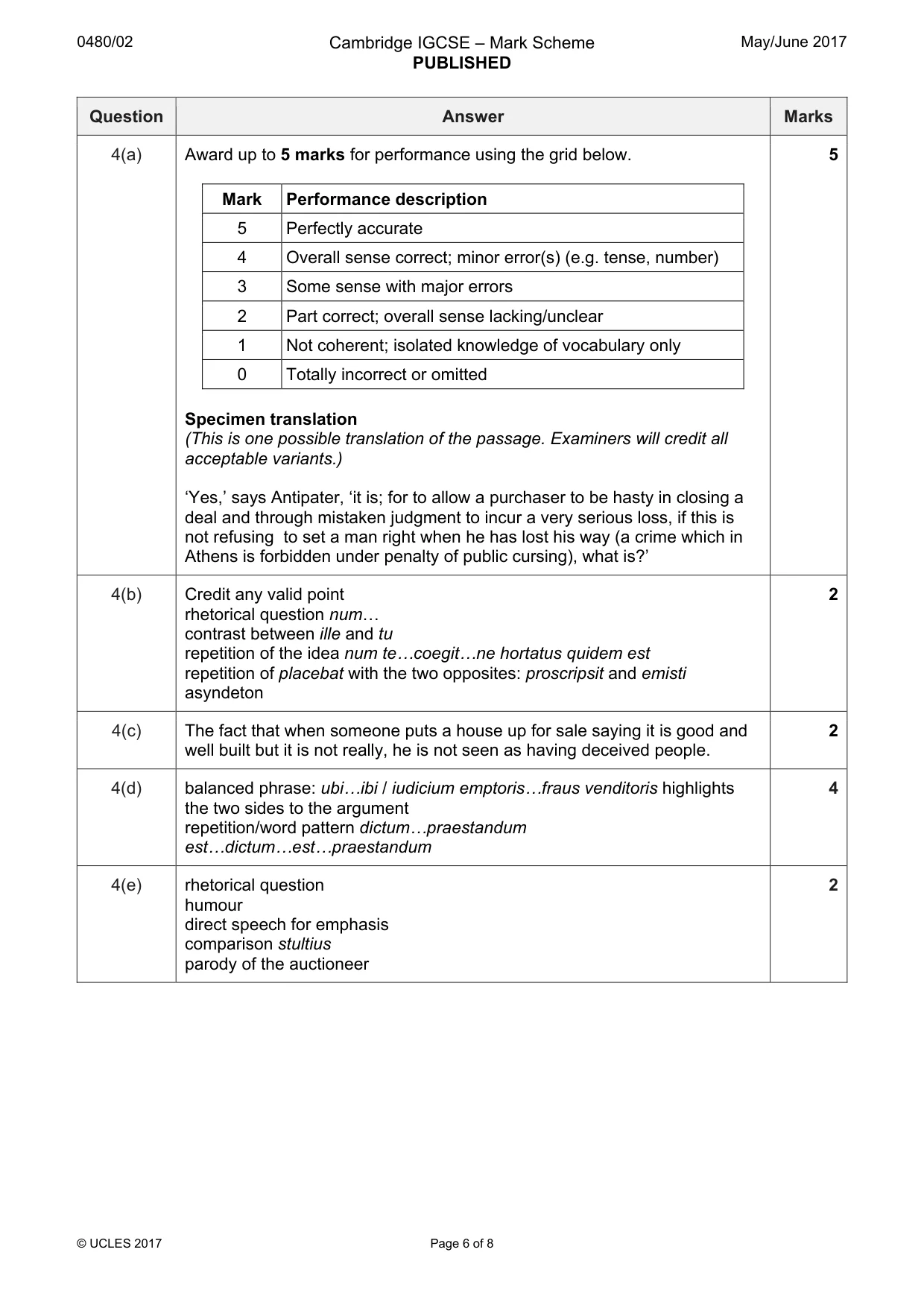
Mark scheme: 4(a) Award up to 5 marks for performance using the grid below. 5 Mark Performance description 5 Perfectly accurate 4 Overall sense correct; minor error(s) (e.g. tense, number) 3 Some sense with major errors 2 Part correct; overall sense lacking/unclear 1 Not coherent; isolated knowledge of vocabulary only 0 Totally incorrect or omitted Specimen translation (This is one possible translation of the passage. Examiners will credit all acceptable variants.) ‘Yes,’ says Antipater, ‘it is; for to allow a purchaser to be hasty in closing a deal and through mistaken judgment to incur a very serious loss, if this is not refusing to set a man right when he has lost his way (a crime which in Athens is forbidden under penalty of public cursing), what is?’ 4(b) Credit any valid point 2 rhetorical question num« contrast between ille and tu repetition of the idea num te«coegit«ne hortatus quidem est repetition of placebat with the two opposites: proscripsit and emisti asyndeton 4(c) The fact that when someone puts a house up for sale saying it is good and 2 well built but it is not really, he is not seen as having deceived people. 4(d) balanced phrase: ubi«ibi / iudicium emptoris«fraus venditoris highlights 4 the two sides to the argument repetition/word pattern dictum«praestandum est«dictum«est«praestandum 4(e) rhetorical question 2 humour direct speech for emphasis comparison stultius parody of the auctioneer
Q5 · Read the following passage and answer the questions: Nunc neglegentiam meam cognosce
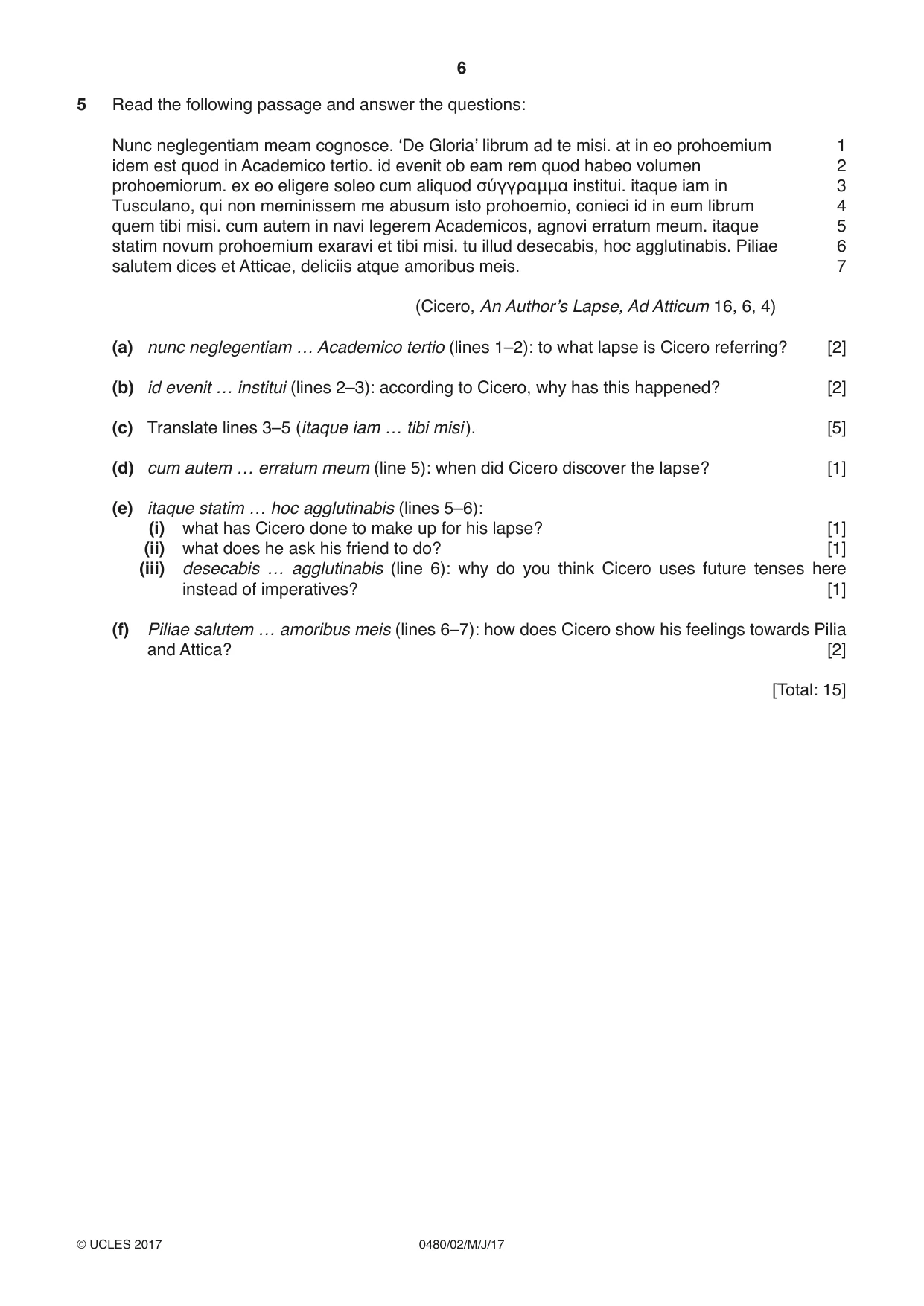
5 Read the following passage and answer the questions: Nunc neglegentiam meam cognosce. ‘De Gloria’ librum ad te misi. at in eo prohoemium 1 idem est quod in Academico tertio. id evenit ob eam rem quod habeo volumen 2 prohoemiorum. ex eo eligere soleo cum aliquod σύγγραμμα institui. itaque iam in 3 Tusculano, qui non meminissem me abusum isto prohoemio, conieci id in eum librum 4 quem tibi misi. cum autem in navi legerem Academicos, agnovi erratum meum. itaque 5 statim novum prohoemium exaravi et tibi misi. tu illud desecabis, hoc agglutinabis. Piliae 6 salutem dices et Atticae, deliciis atque amoribus meis. 7 (Cicero, An Author’s Lapse, Ad Atticum 16, 6, 4) (a) nunc neglegentiam … Academico tertio (lines 1–2): to what lapse is Cicero referring? [2] (b) id evenit … institui (lines 2–3): according to Cicero, why has this happened? [2] (c) Translate lines 3–5 (itaque iam … tibi misi ). [5] (d) cum autem … erratum meum (line 5): when did Cicero discover the lapse? [1] (e) itaque statim … hoc agglutinabis (lines 5–6): (i) what has Cicero done to make up for his lapse? [1] (ii) what does he ask his friend to do? [1] (iii) desecabis … agglutinabis (line 6): why do you think Cicero uses future tenses here instead of imperatives? [1] (f) Piliae salutem … amoribus meis (lines 6–7): how does Cicero show his feelings towards Pilia and Attica? [2] [Total: 15]
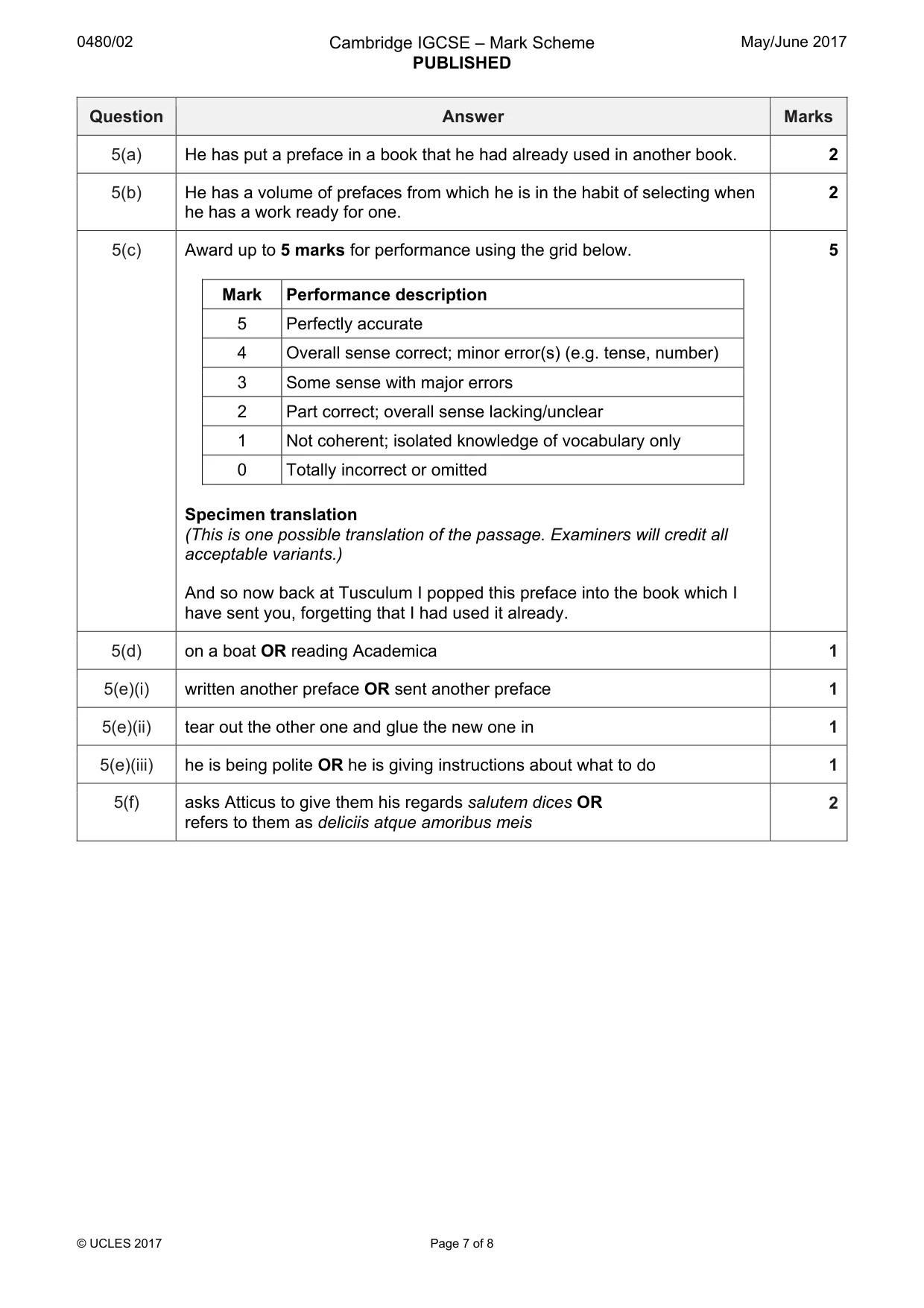
Mark scheme: 5(a) He has put a preface in a book that he had already used in another book. 2 5(b) He has a volume of prefaces from which he is in the habit of selecting when 2 he has a work ready for one. 5(c) Award up to 5 marks for performance using the grid below. 5 Mark Performance description 5 Perfectly accurate 4 Overall sense correct; minor error(s) (e.g. tense, number) 3 Some sense with major errors 2 Part correct; overall sense lacking/unclear 1 Not coherent; isolated knowledge of vocabulary only 0 Totally incorrect or omitted Specimen translation (This is one possible translation of the passage. Examiners will credit all acceptable variants.) And so now back at Tusculum I popped this preface into the book which I have sent you, forgetting that I had used it already. 5(d) on a boat OR reading Academica 1 5(e)(i) written another preface OR sent another preface 1 5(e)(ii) tear out the other one and glue the new one in 1 5(e)(iii) he is being polite OR he is giving instructions about what to do 1 5(f) asks Atticus to give them his regards salutem dices OR 2 refers to them as deliciis atque amoribus meis
Q6 · ‘Cicero is thoughtful and shows a flair for estate management.’ How far do you agree with…
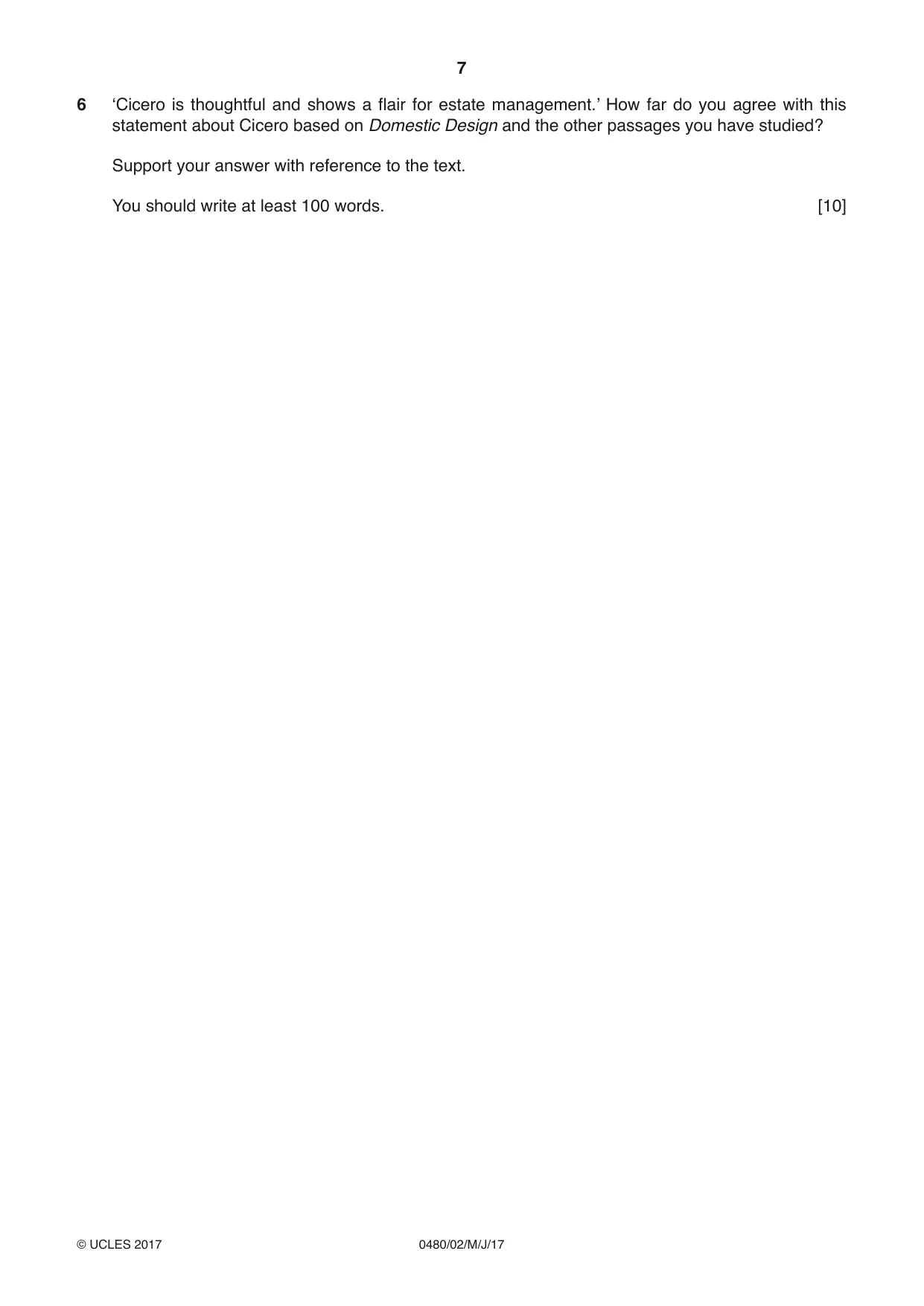
6 ‘Cicero is thoughtful and shows a flair for estate management.’ How far do you agree with this statement about Cicero based on Domestic Design and the other passages you have studied? Support your answer with reference to the text. You should write at least 100 words. [10]
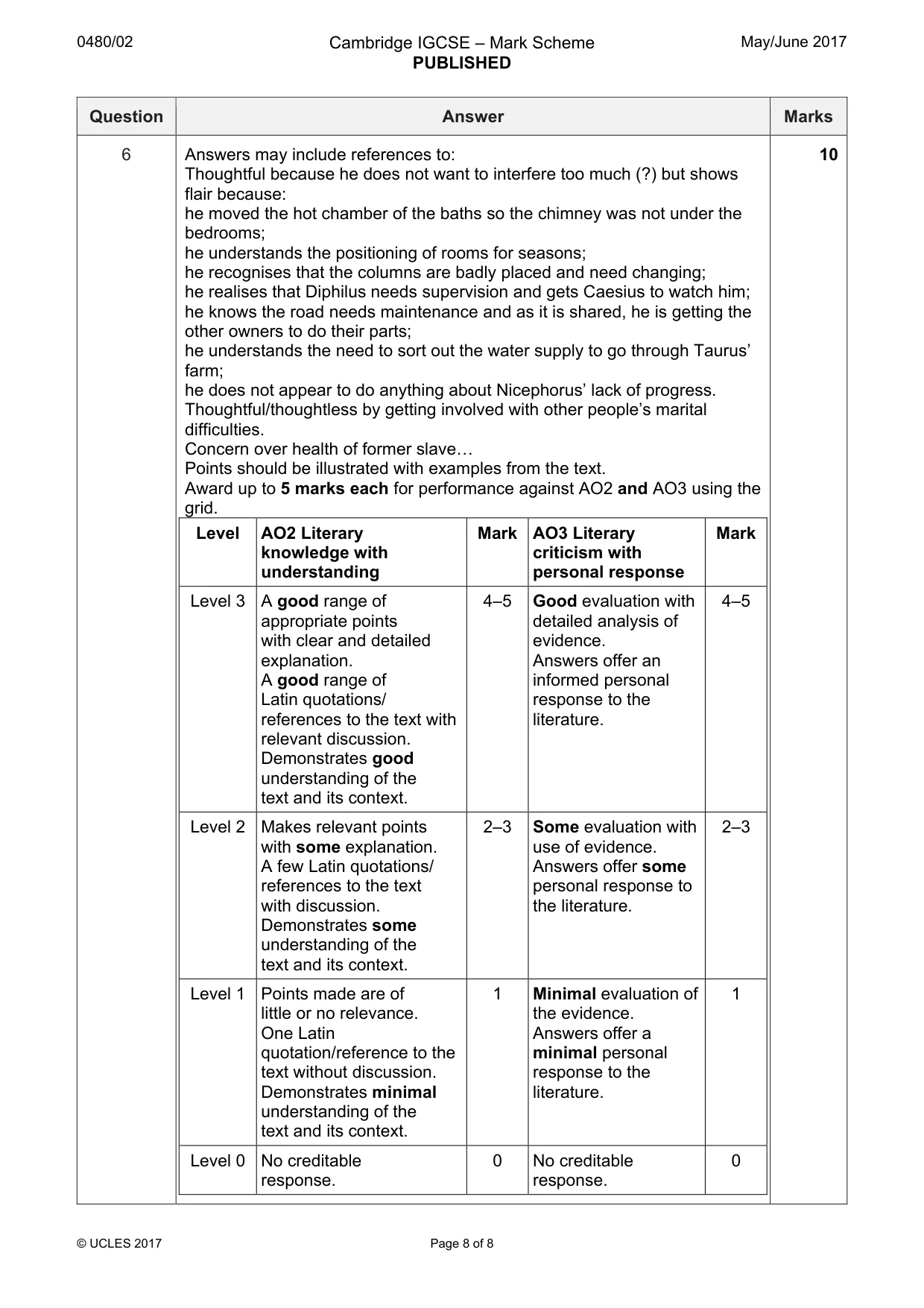
Mark scheme: 6 Answers may include references to: 10 Thoughtful because he does not want to interfere too much (?) but shows flair because: he moved the hot chamber of the baths so the chimney was not under the bedrooms; he understands the positioning of rooms for seasons; he recognises that the columns are badly placed and need changing; he realises that Diphilus needs supervision and gets Caesius to watch him; he knows the road needs maintenance and as it is shared, he is getting the other owners to do their parts; he understands the need to sort out the water supply to go through Taurus’ farm; he does not appear to do anything about Nicephorus’ lack of progress. Thoughtful/thoughtless by getting involved with other people’s marital difficulties. Concern over health of former slave« Points should be illustrated with examples from the text. Award up to 5 marks each for performance against AO2 and AO3 using the grid. Level AO2 Literary Mark AO3 Literary Mark knowledge with criticism with understanding personal response Level 3 A good range of 4–5 Good evaluation with 4–5 appropriate points detailed analysis of with clear and detailed evidence. explanation. Answers offer an A good range of informed personal Latin quotations/ response to the references to the text with literature. relevant discussion. Demonstrates good understanding of the text and its context. Level 2 Makes relevant points 2–3 Some evaluation with 2–3 with some explanation. use of evidence. A few Latin quotations/ Answers offer some references to the text personal response to with discussion. the literature. Demonstrates some understanding of the text and its context. Level 1 Points made are of 1 Minimal evaluation of 1 little or no relevance. the evidence. One Latin Answers offer a quotation/reference to the minimal personal text without discussion. response to the Demonstrates minimal literature. understanding of the text and its context. Level 0 No creditable 0 No creditable 0 response. response.
What you needed in this session
Cambridge’s own grade thresholds for 2017 May/June, Paper 2 · Variant 1. A higher threshold means an easier paper — the bar moves with how the cohort did.