Cambridge IGCSE Latin 0480 — 2011 May/June Paper 2 · Variant 1
0480/21/M/J/11 · 80 marks · ≈90 min
The question paper and its mark scheme, free to read here and free to download. This is Cambridge’s own paper, exactly as it was sat.
Question paper8 pages

Mark scheme5 pages
Answers below. Sit the paper first if you are practising.
Paper as text
Question paper, page 1
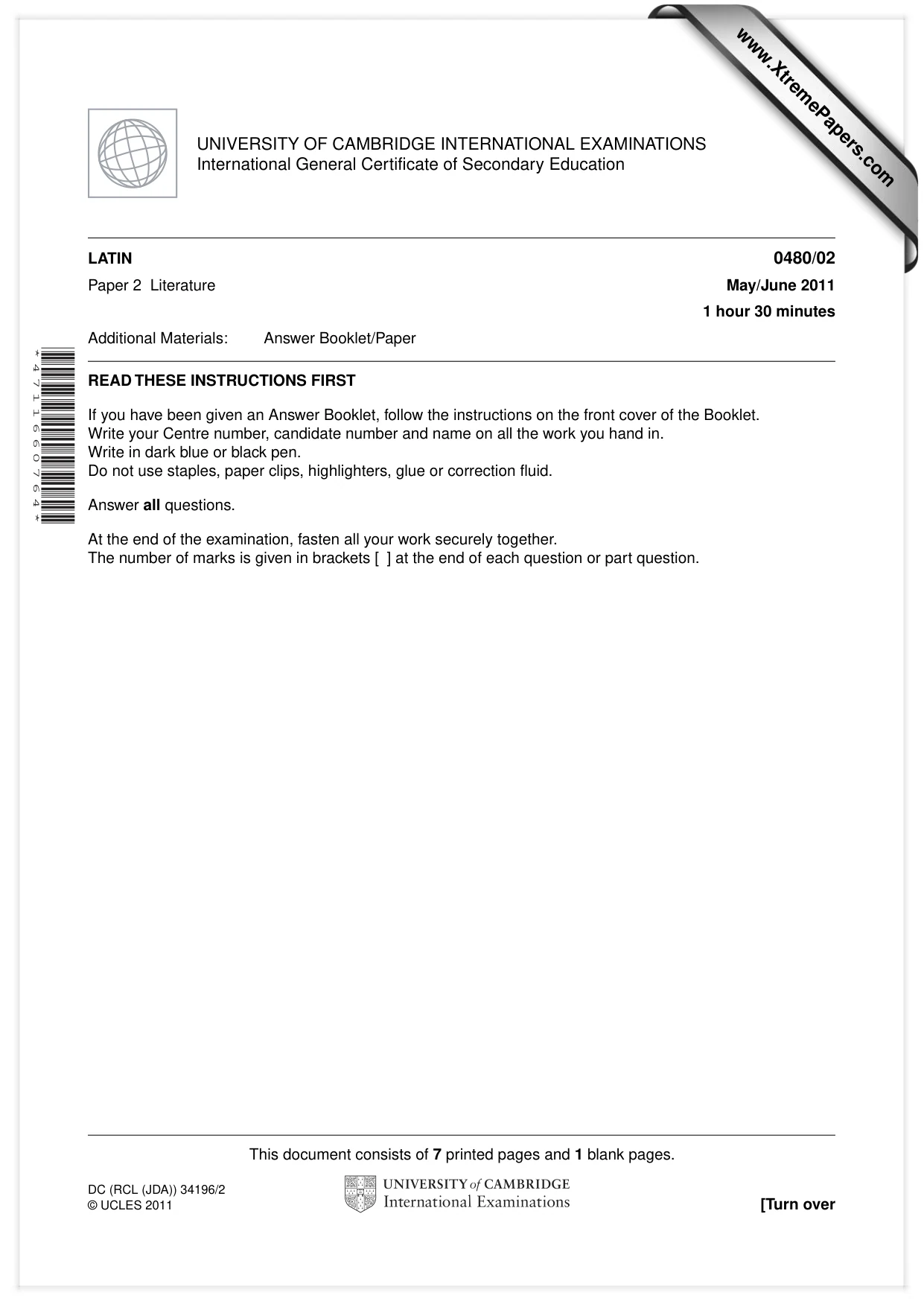
This document consists of 7 printed pages and 1 blank pages. DC (RCL (JDA)) 34196/2 © UCLES 2011 [Turn over UNIVERSITY OF CAMBRIDGE INTERNATIONAL EXAMINATIONS International General Certificate of Secondary Education * 4 7 1 1 6 6 0 7 6 4 * LATIN 0480/02 Paper 2 Literature May/June 2011 1 hour 30 minutes Additional Materials: Answer Booklet/Paper READ THESE INSTRUCTIONS FIRST If you have been given an Answer Booklet, follow the instructions on the front cover of the Booklet. Write your Centre number, candidate number and name on all the work you hand in. Write in dark blue or black pen. Do not use staples, paper clips, highlighters, glue or correction fluid. Answer all questions. At the end of the examination, fasten all your work securely together. The number of marks is given in brackets [ ] at the end of each question or part question. www.XtremePapers.com
Question paper, page 2
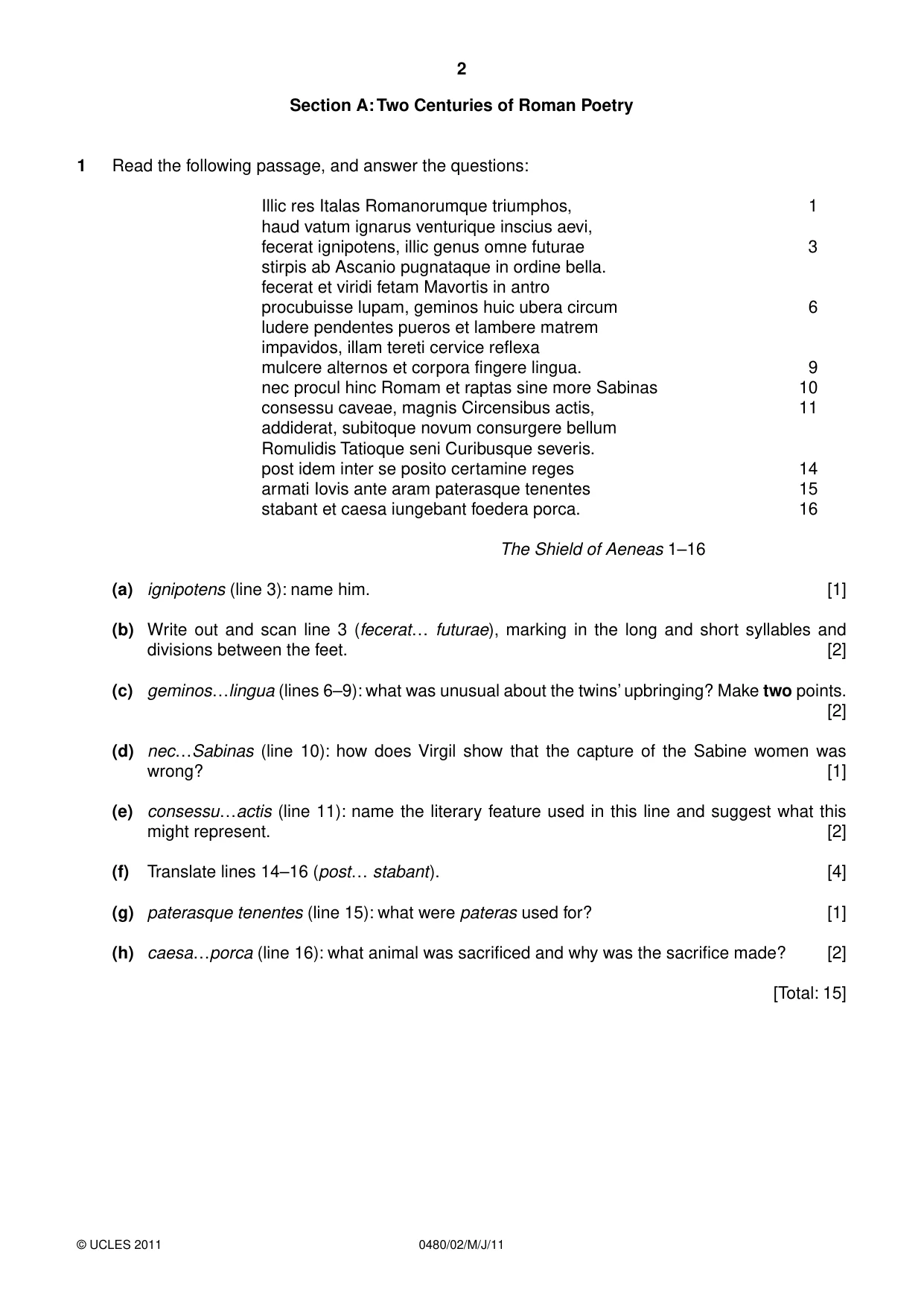
2 0480/02/M/J/11 © UCLES 2011 Section A: Two Centuries of Roman Poetry 1 Read the following passage, and answer the questions: Illic res Italas Romanorumque triumphos, 1 haud vatum ignarus venturique inscius aevi, fecerat ignipotens, illic genus omne futurae 3 stirpis ab Ascanio pugnataque in ordine bella. fecerat et viridi fetam Mavortis in antro procubuisse lupam, geminos huic ubera circum 6 ludere pendentes pueros et lambere matrem impavidos, illam tereti cervice reflexa mulcere alternos et corpora fingere lingua. 9 nec procul hinc Romam et raptas sine more Sabinas 10 consessu caveae, magnis Circensibus actis, 11 addiderat, subitoque novum consurgere bellum Romulidis Tatioque seni Curibusque severis. post idem inter se posito certamine reges 14 armati Iovis ante aram paterasque tenentes 15 stabant et caesa iungebant foedera porca. 16 The Shield of Aeneas 1–16 (a) ignipotens (line 3): name him. [1] (b) Write out and scan line 3 (fecerat… futurae), marking in the long and short syllables and divisions between the feet. [2] (c) geminos…lingua (lines 6–9): what was unusual about the twins’ upbringing? Make two points. [2] (d) nec…Sabinas (line 10): how does Virgil show that the capture of the Sabine women was wrong? [1] (e) consessu…actis (line 11): name the literary feature used in this line and suggest what this might represent. [2] (f) Translate lines 14–16 (post… stabant ). [4] (g) paterasque tenentes (line 15): what were pateras used for? [1] (h) caesa…porca (line 16): what animal was sacrificed and why was the sacrifice made? [2] [Total: 15]
Question paper, page 3
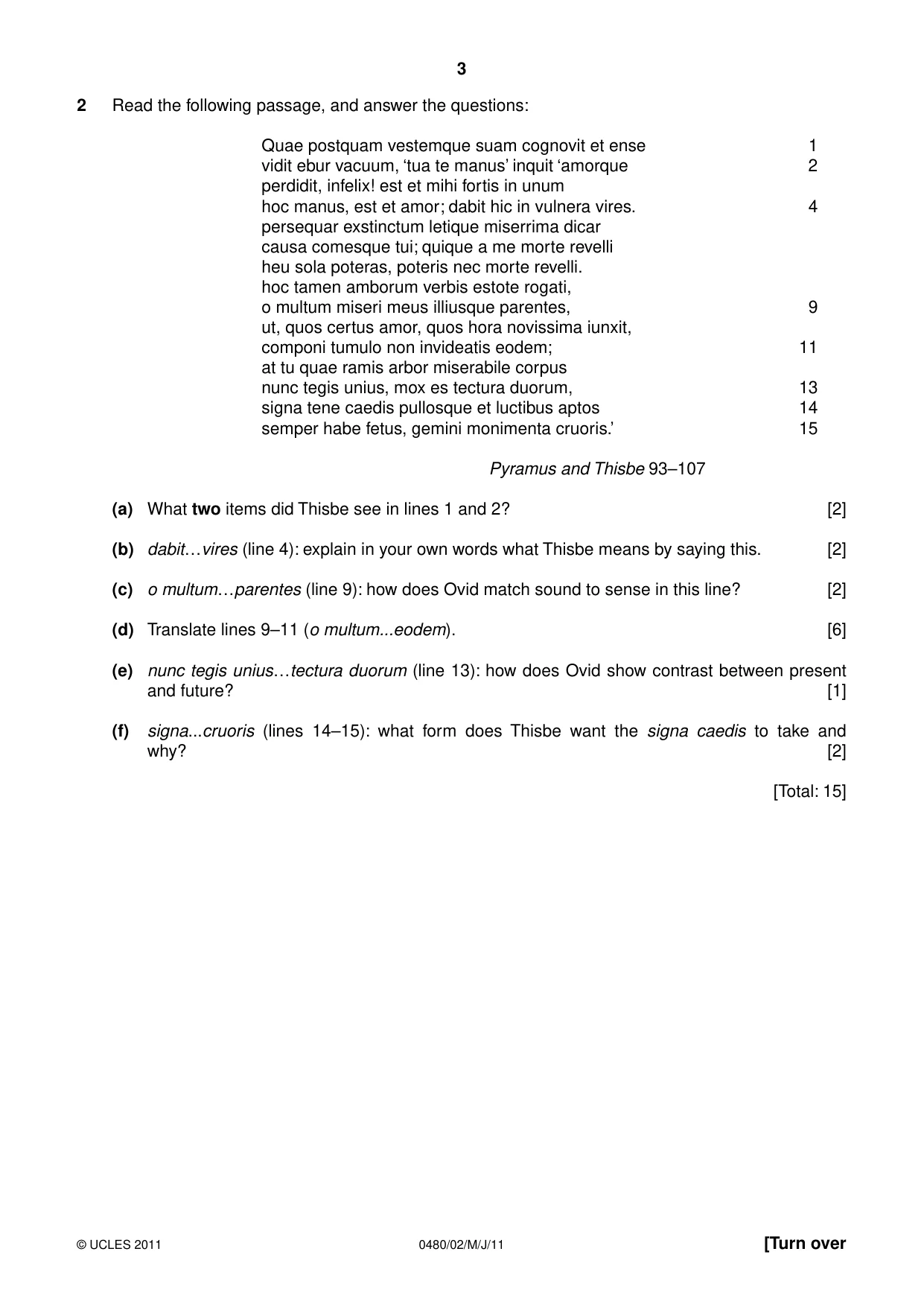
3 0480/02/M/J/11 © UCLES 2011 [Turn over 2 Read the following passage, and answer the questions: Quae postquam vestemque suam cognovit et ense 1 vidit ebur vacuum, ‘tua te manus’ inquit ‘amorque 2 perdidit, infelix! est et mihi fortis in unum hoc manus, est et amor; dabit hic in vulnera vires. 4 persequar exstinctum letique miserrima dicar causa comesque tui; quique a me morte revelli heu sola poteras, poteris nec morte revelli. hoc tamen amborum verbis estote rogati, o multum miseri meus illiusque parentes, 9 ut, quos certus amor, quos hora novissima iunxit, componi tumulo non invideatis eodem; 11 at tu quae ramis arbor miserabile corpus nunc tegis unius, mox es tectura duorum, 13 signa tene caedis pullosque et luctibus aptos 14 semper habe fetus, gemini monimenta cruoris.’ 15 Pyramus and Thisbe 93–107 (a) What two items did Thisbe see in lines 1 and 2? [2] (b) dabit…vires (line 4): explain in your own words what Thisbe means by saying this. [2] (c) o multum…parentes (line 9): how does Ovid match sound to sense in this line? [2] (d) Translate lines 9–11 (o multum...eodem). [6] (e) nunc tegis unius…tectura duorum (line 13): how does Ovid show contrast between present and future? [1] (f) signa...cruoris (lines 14–15): what form does Thisbe want the signa caedis to take and why? [2] [Total: 15]
Question paper, page 4
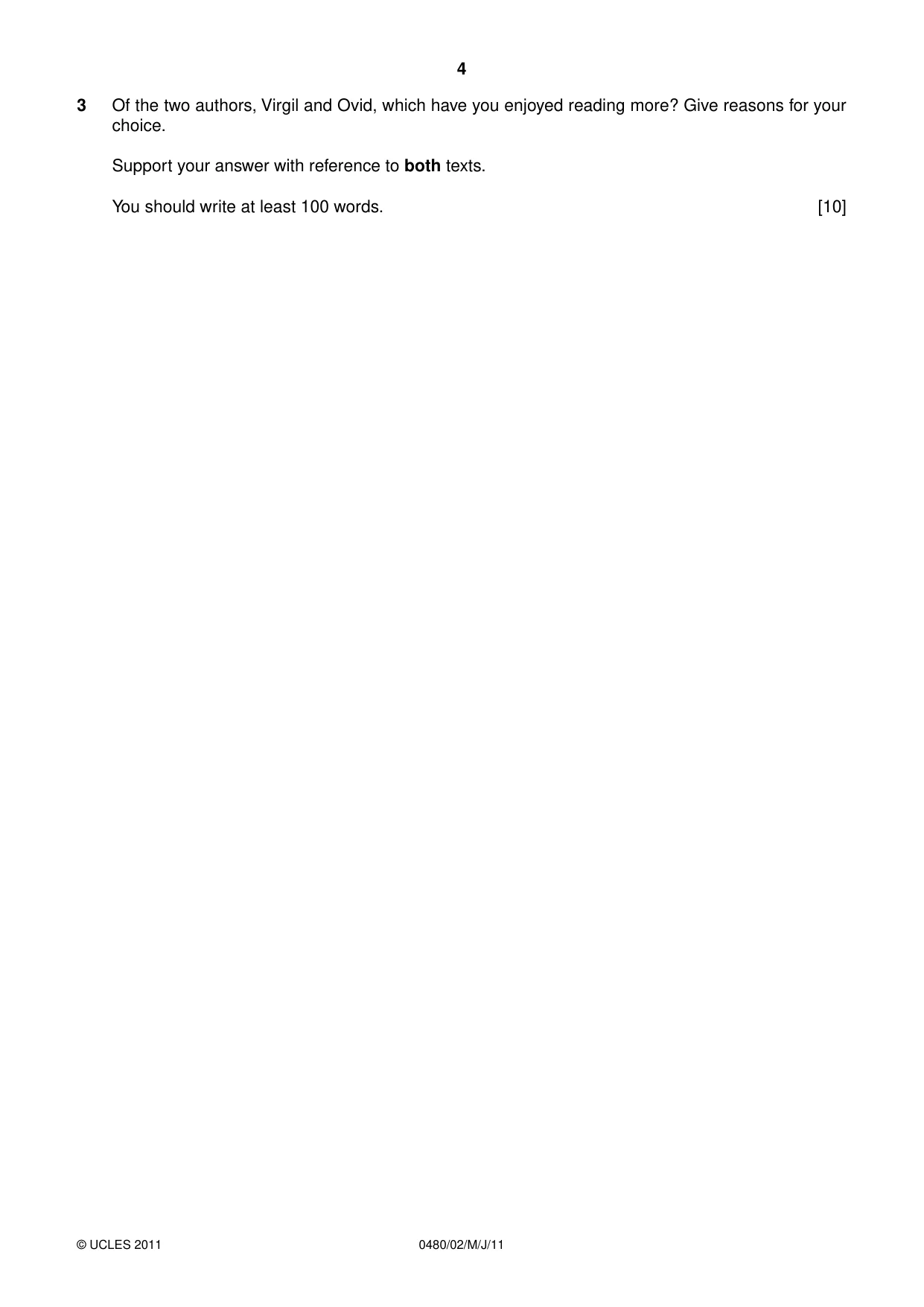
4 0480/02/M/J/11 © UCLES 2011 3 Of the two authors, Virgil and Ovid, which have you enjoyed reading more? Give reasons for your choice. Support your answer with reference to both texts. You should write at least 100 words. [10]
Question paper, page 5
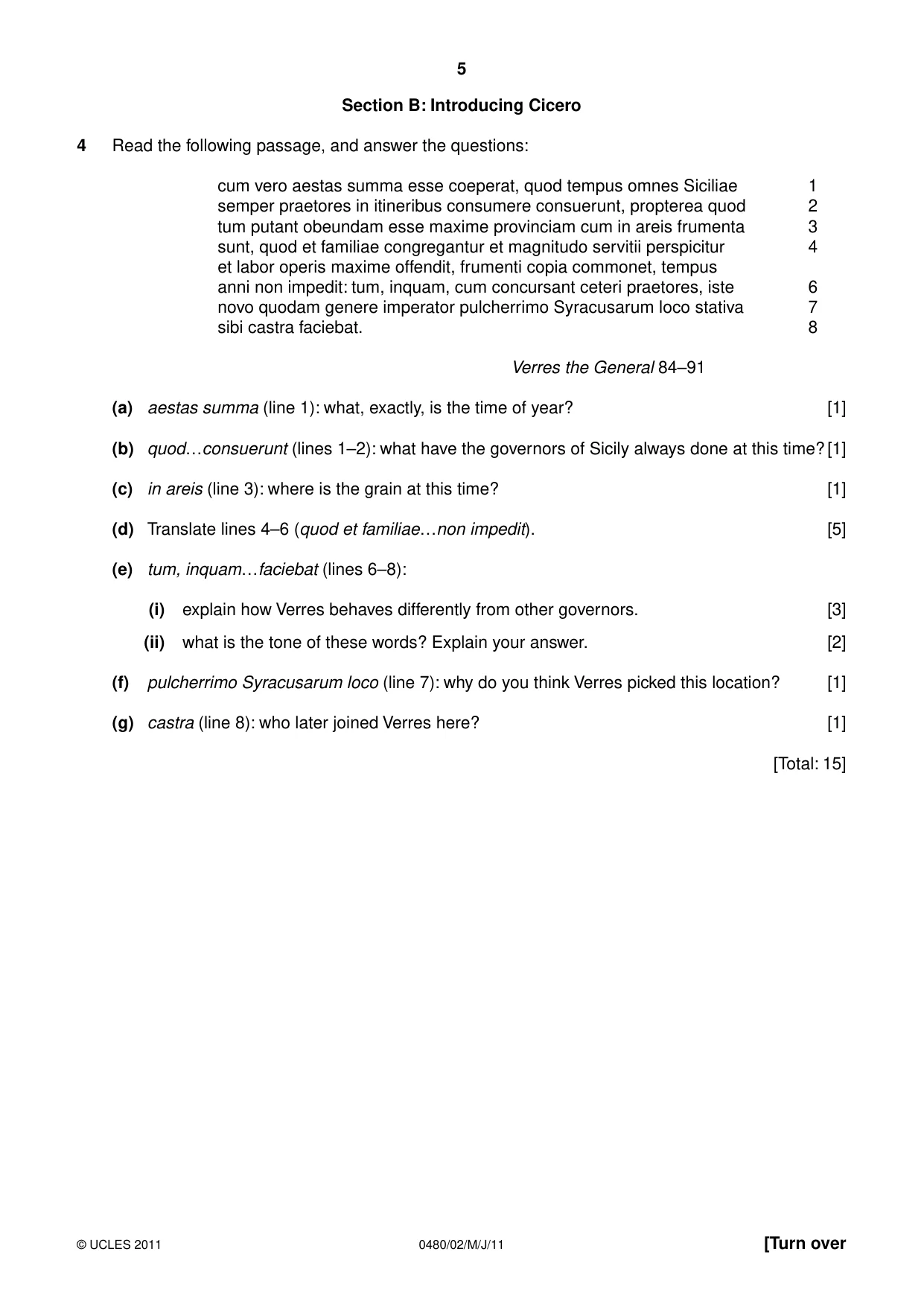
5 0480/02/M/J/11 © UCLES 2011 [Turn over Section B: Introducing Cicero 4 Read the following passage, and answer the questions: cum vero aestas summa esse coeperat, quod tempus omnes Siciliae 1 semper praetores in itineribus consumere consuerunt, propterea quod 2 tum putant obeundam esse maxime provinciam cum in areis frumenta 3 sunt, quod et familiae congregantur et magnitudo servitii perspicitur 4 et labor operis maxime offendit, frumenti copia commonet, tempus anni non impedit: tum, inquam, cum concursant ceteri praetores, iste 6 novo quodam genere imperator pulcherrimo Syracusarum loco stativa 7 sibi castra faciebat. 8 Verres the General 84–91 (a) aestas summa (line 1): what, exactly, is the time of year? [1] (b) quod…consuerunt (lines 1–2): what have the governors of Sicily always done at this time? [1] (c) in areis (line 3): where is the grain at this time? [1] (d) Translate lines 4–6 (quod et familiae…non impedit). [5] (e) tum, inquam…faciebat (lines 6–8): (i) explain how Verres behaves differently from other governors. [3] (ii) what is the tone of these words? Explain your answer. [2] (f) pulcherrimo Syracusarum loco (line 7): why do you think Verres picked this location? [1] (g) castra (line 8): who later joined Verres here? [1] [Total: 15]
Question paper, page 6
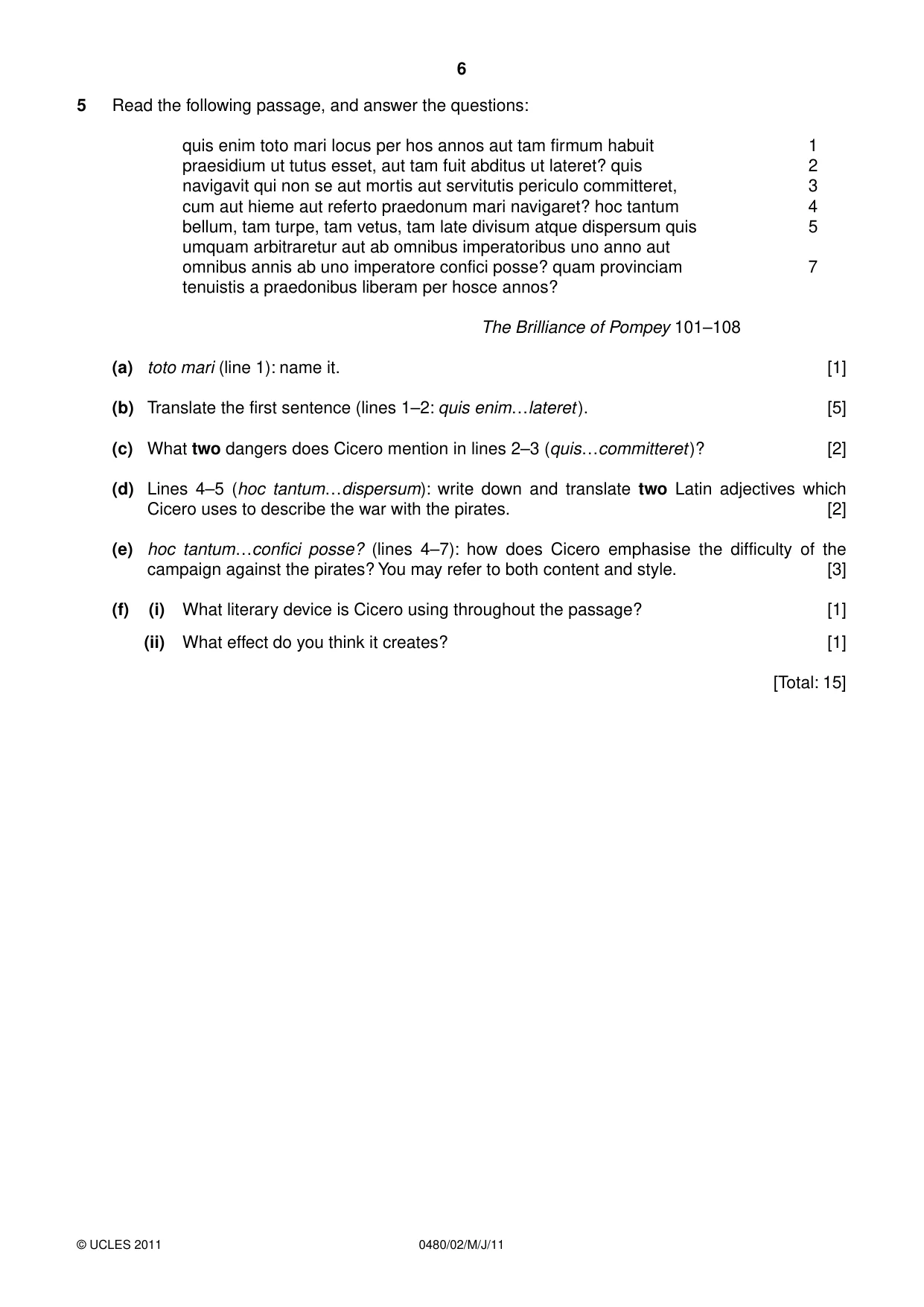
6 0480/02/M/J/11 © UCLES 2011 5 Read the following passage, and answer the questions: quis enim toto mari locus per hos annos aut tam firmum habuit 1 praesidium ut tutus esset, aut tam fuit abditus ut lateret? quis 2 navigavit qui non se aut mortis aut servitutis periculo committeret, 3 cum aut hieme aut referto praedonum mari navigaret? hoc tantum 4 bellum, tam turpe, tam vetus, tam late divisum atque dispersum quis 5 umquam arbitraretur aut ab omnibus imperatoribus uno anno aut omnibus annis ab uno imperatore confici posse? quam provinciam 7 tenuistis a praedonibus liberam per hosce annos? The Brilliance of Pompey 101–108 (a) toto mari (line 1): name it. [1] (b) Translate the first sentence (lines 1–2: quis enim…lateret ). [5] (c) What two dangers does Cicero mention in lines 2–3 (quis…committeret )? [2] (d) Lines 4–5 (hoc tantum…dispersum): write down and translate two Latin adjectives which Cicero uses to describe the war with the pirates. [2] (e) hoc tantum…confici posse? (lines 4–7): how does Cicero emphasise the difficulty of the campaign against the pirates? You may refer to both content and style. [3] (f) (i) What literary device is Cicero using throughout the passage? [1] (ii) What effect do you think it creates? [1] [Total: 15]
Question paper, page 7
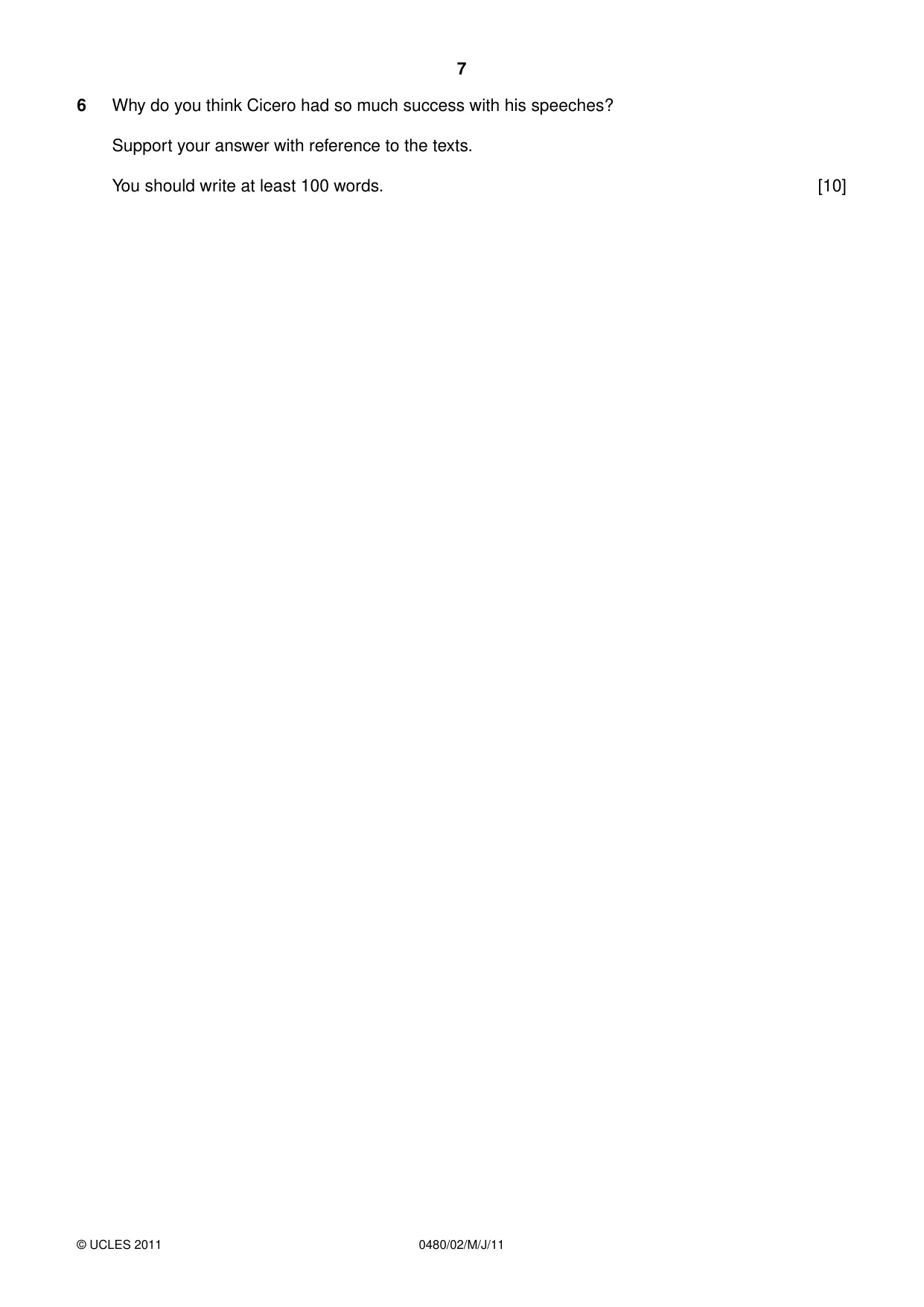
7 0480/02/M/J/11 © UCLES 2011 6 Why do you think Cicero had so much success with his speeches? Support your answer with reference to the texts. You should write at least 100 words. [10]
Question paper, page 8
8 0480/02/M/J/11 © UCLES 2011 Permission to reproduce items where third-party owned material protected by copyright is included has been sought and cleared where possible. Every reasonable effort has been made by the publisher (UCLES) to trace copyright holders, but if any items requiring clearance have unwittingly been included, the publisher will be pleased to make amends at the earliest possible opportunity. University of Cambridge International Examinations is part of the Cambridge Assessment Group. Cambridge Assessment is the brand name of University of Cambridge Local Examinations Syndicate (UCLES), which is itself a department of the University of Cambridge. BLANK PAGE
Mark scheme, page 1
UNIVERSITY OF CAMBRIDGE INTERNATIONAL EXAMINATIONS International General Certificate of Secondary Education MARK SCHEME for the May/June 2011 question paper for the guidance of teachers 0480 LATIN 0480/02 Paper 2 (Literature), maximum raw mark 80 This mark scheme is published as an aid to teachers and candidates, to indicate the requirements of the examination. It shows the basis on which Examiners were instructed to award marks. It does not indicate the details of the discussions that took place at an Examiners’ meeting before marking began, which would have considered the acceptability of alternative answers. Mark schemes must be read in conjunction with the question papers and the report on the examination. • Cambridge will not enter into discussions or correspondence in connection with these mark schemes. Cambridge is publishing the mark schemes for the May/June 2011 question papers for most IGCSE, GCE Advanced Level and Advanced Subsidiary Level syllabuses and some Ordinary Level syllabuses. www.XtremePapers.com
Mark scheme, page 2
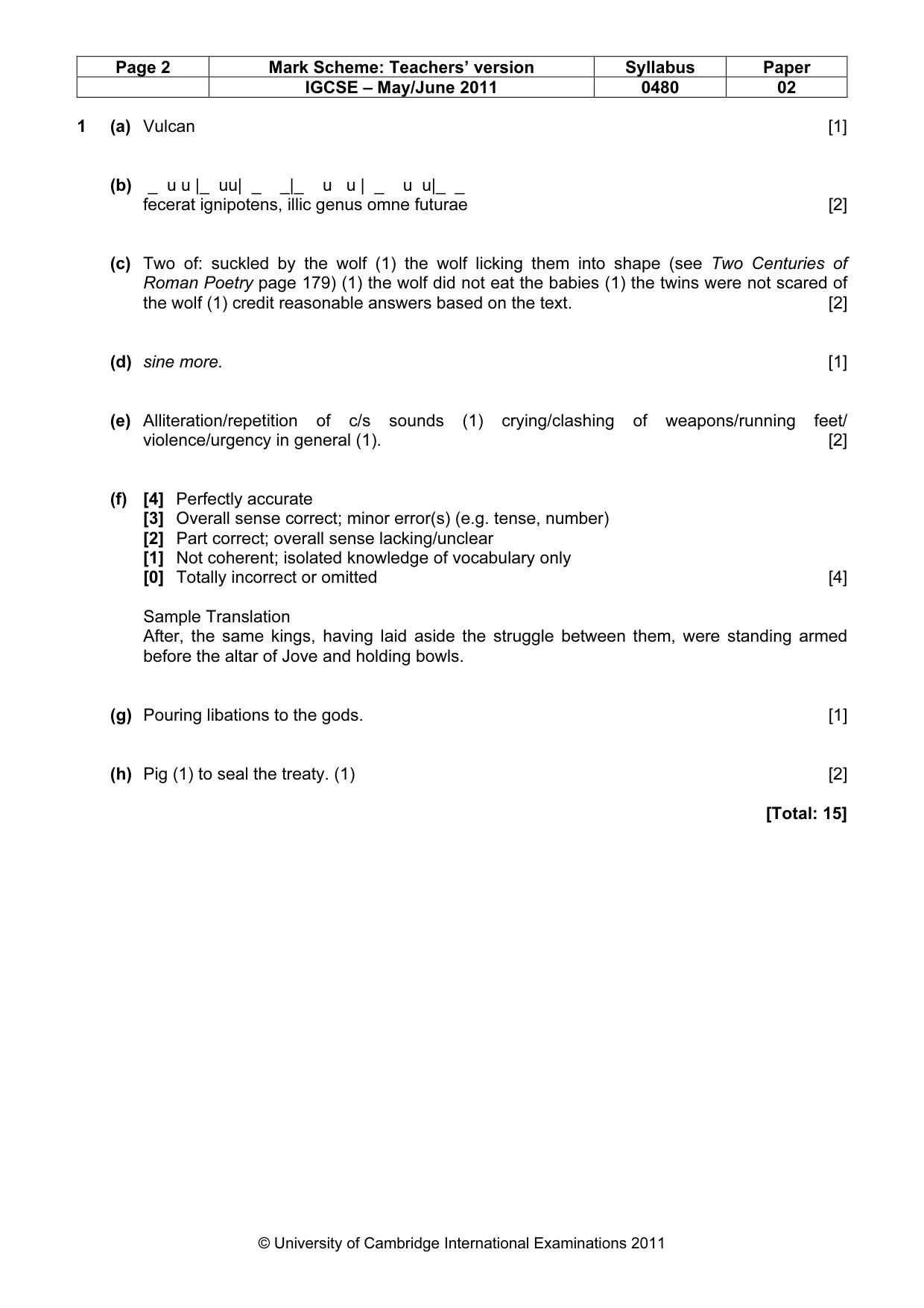
Page 2 Mark Scheme: Teachers’ version Syllabus Paper IGCSE – May/June 2011 0480 02 © University of Cambridge International Examinations 2011 1 (a) Vulcan [1] (b) _ u u |_ uu| _ _|_ u u | _ u u|_ _ fecerat ignipotens, illic genus omne futurae [2] (c) Two of: suckled by the wolf (1) the wolf licking them into shape (see Two Centuries of Roman Poetry page 179) (1) the wolf did not eat the babies (1) the twins were not scared of the wolf (1) credit reasonable answers based on the text. [2] (d) sine more. [1] (e) Alliteration/repetition of c/s sounds (1) crying/clashing of weapons/running feet/ violence/urgency in general (1). [2] (f) [4] Perfectly accurate [3] Overall sense correct; minor error(s) (e.g. tense, number) [2] Part correct; overall sense lacking/unclear [1] Not coherent; isolated knowledge of vocabulary only [0] Totally incorrect or omitted [4] Sample Translation After, the same kings, having laid aside the struggle between them, were standing armed before the altar of Jove and holding bowls. (g) Pouring libations to the gods. [1] (h) Pig (1) to seal the treaty. (1) [2] [Total: 15]
Mark scheme, page 3
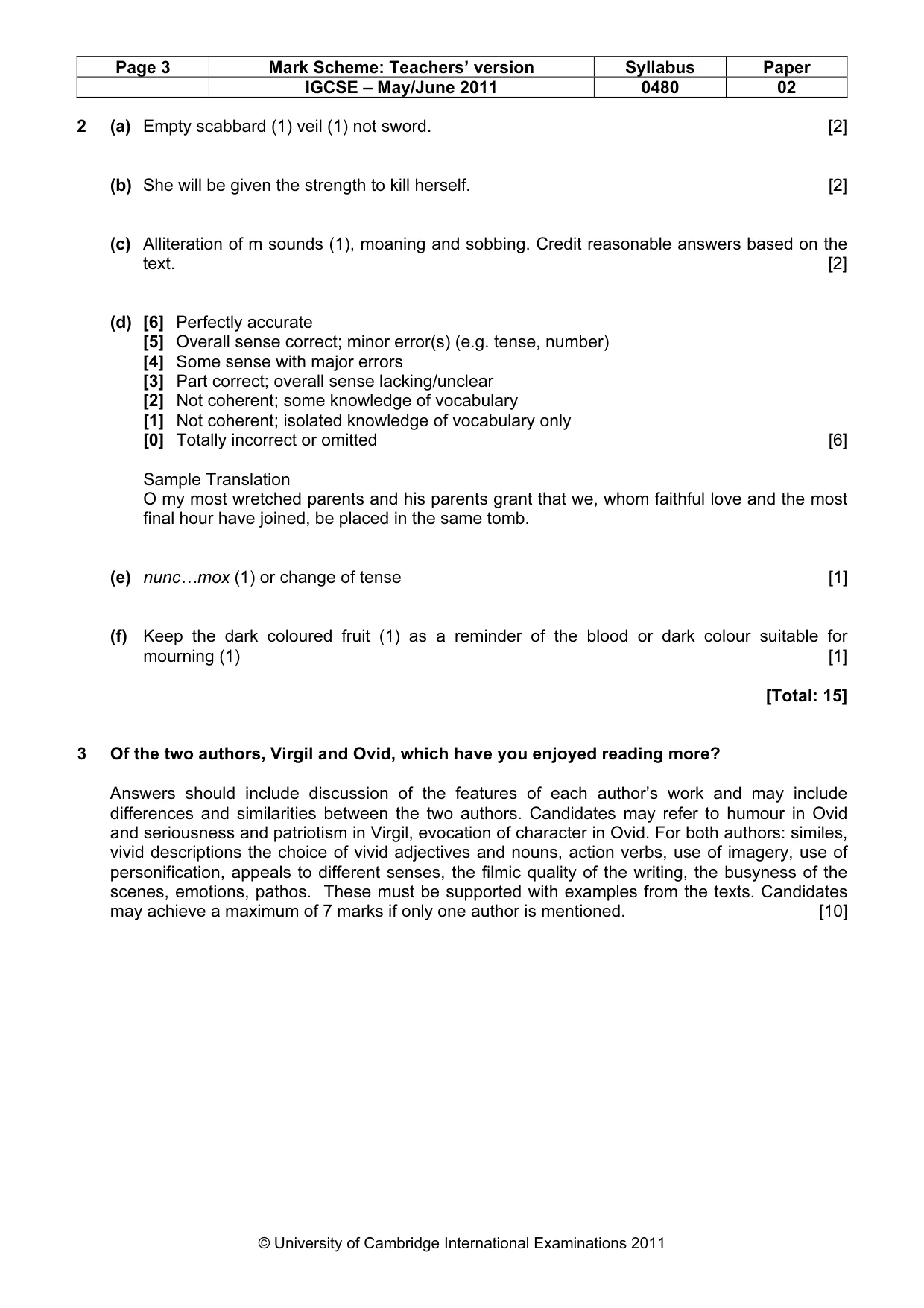
Page 3 Mark Scheme: Teachers’ version Syllabus Paper IGCSE – May/June 2011 0480 02 © University of Cambridge International Examinations 2011 2 (a) Empty scabbard (1) veil (1) not sword. [2] (b) She will be given the strength to kill herself. [2] (c) Alliteration of m sounds (1), moaning and sobbing. Credit reasonable answers based on the text. [2] (d) [6] Perfectly accurate [5] Overall sense correct; minor error(s) (e.g. tense, number) [4] Some sense with major errors [3] Part correct; overall sense lacking/unclear [2] Not coherent; some knowledge of vocabulary [1] Not coherent; isolated knowledge of vocabulary only [0] Totally incorrect or omitted [6] Sample Translation O my most wretched parents and his parents grant that we, whom faithful love and the most final hour have joined, be placed in the same tomb. (e) nunc…mox (1) or change of tense [1] (f) Keep the dark coloured fruit (1) as a reminder of the blood or dark colour suitable for mourning (1) [1] [Total: 15] 3 Of the two authors, Virgil and Ovid, which have you enjoyed reading more? Answers should include discussion of the features of each author’s work and may include differences and similarities between the two authors. Candidates may refer to humour in Ovid and seriousness and patriotism in Virgil, evocation of character in Ovid. For both authors: similes, vivid descriptions the choice of vivid adjectives and nouns, action verbs, use of imagery, use of personification, appeals to different senses, the filmic quality of the writing, the busyness of the scenes, emotions, pathos. These must be supported with examples from the texts. Candidates may achieve a maximum of 7 marks if only one author is mentioned. [10]
Mark scheme, page 4
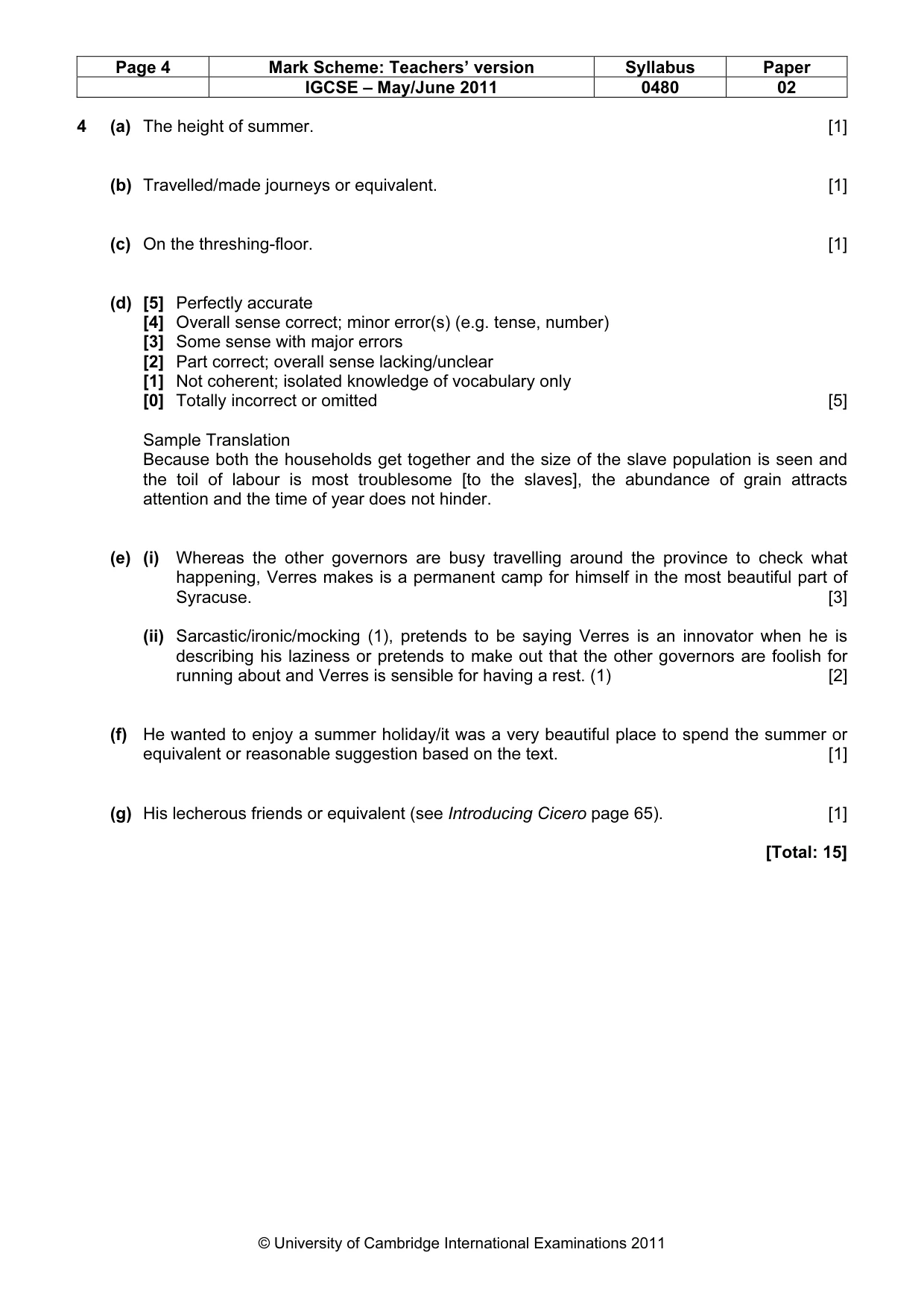
Page 4 Mark Scheme: Teachers’ version Syllabus Paper IGCSE – May/June 2011 0480 02 © University of Cambridge International Examinations 2011 4 (a) The height of summer. [1] (b) Travelled/made journeys or equivalent. [1] (c) On the threshing-floor. [1] (d) [5] Perfectly accurate [4] Overall sense correct; minor error(s) (e.g. tense, number) [3] Some sense with major errors [2] Part correct; overall sense lacking/unclear [1] Not coherent; isolated knowledge of vocabulary only [0] Totally incorrect or omitted [5] Sample Translation Because both the households get together and the size of the slave population is seen and the toil of labour is most troublesome [to the slaves], the abundance of grain attracts attention and the time of year does not hinder. (e) (i) Whereas the other governors are busy travelling around the province to check what happening, Verres makes is a permanent camp for himself in the most beautiful part of Syracuse. [3] (ii) Sarcastic/ironic/mocking (1), pretends to be saying Verres is an innovator when he is describing his laziness or pretends to make out that the other governors are foolish for running about and Verres is sensible for having a rest. (1) [2] (f) He wanted to enjoy a summer holiday/it was a very beautiful place to spend the summer or equivalent or reasonable suggestion based on the text. [1] (g) His lecherous friends or equivalent (see Introducing Cicero page 65). [1] [Total: 15]
Mark scheme, page 5
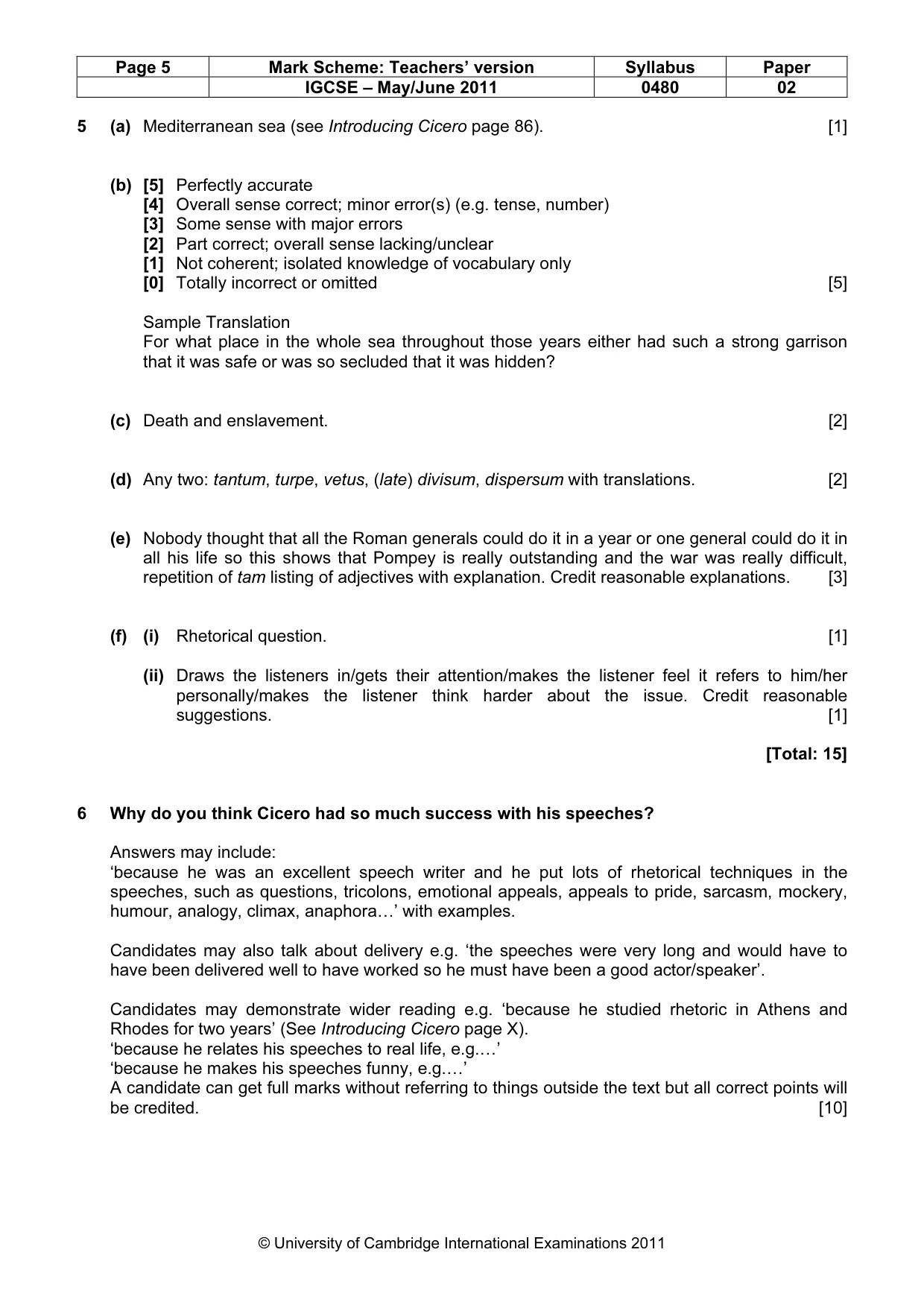
Page 5 Mark Scheme: Teachers’ version Syllabus Paper IGCSE – May/June 2011 0480 02 © University of Cambridge International Examinations 2011 5 (a) Mediterranean sea (see Introducing Cicero page 86). [1] (b) [5] Perfectly accurate [4] Overall sense correct; minor error(s) (e.g. tense, number) [3] Some sense with major errors [2] Part correct; overall sense lacking/unclear [1] Not coherent; isolated knowledge of vocabulary only [0] Totally incorrect or omitted [5] Sample Translation For what place in the whole sea throughout those years either had such a strong garrison that it was safe or was so secluded that it was hidden? (c) Death and enslavement. [2] (d) Any two: tantum, turpe, vetus, (late) divisum, dispersum with translations. [2] (e) Nobody thought that all the Roman generals could do it in a year or one general could do it in all his life so this shows that Pompey is really outstanding and the war was really difficult, repetition of tam listing of adjectives with explanation. Credit reasonable explanations. [3] (f) (i) Rhetorical question. [1] (ii) Draws the listeners in/gets their attention/makes the listener feel it refers to him/her personally/makes the listener think harder about the issue. Credit reasonable suggestions. [1] [Total: 15] 6 Why do you think Cicero had so much success with his speeches? Answers may include: ‘because he was an excellent speech writer and he put lots of rhetorical techniques in the speeches, such as questions, tricolons, emotional appeals, appeals to pride, sarcasm, mockery, humour, analogy, climax, anaphora…’ with examples. Candidates may also talk about delivery e.g. ‘the speeches were very long and would have to have been delivered well to have worked so he must have been a good actor/speaker’. Candidates may demonstrate wider reading e.g. ‘because he studied rhetoric in Athens and Rhodes for two years’ (See Introducing Cicero page X). ‘because he relates his speeches to real life, e.g.…’ ‘because he makes his speeches funny, e.g.…’ A candidate can get full marks without referring to things outside the text but all correct points will be credited. [10]
What you needed in this session
Cambridge’s own grade thresholds for 2011 May/June, Paper 2 · Variant 1. A higher threshold means an easier paper — the bar moves with how the cohort did.