Cambridge IGCSE Latin 0480 — 2015 May/June Paper 2 · Variant 1
0480/21/M/J/15 · 80 marks · ≈90 min
The question paper and its mark scheme, free to read here and free to download. This is Cambridge’s own paper, exactly as it was sat.
Question paper8 pages
Mark scheme4 pages
Answers below. Sit the paper first if you are practising.
Paper as text
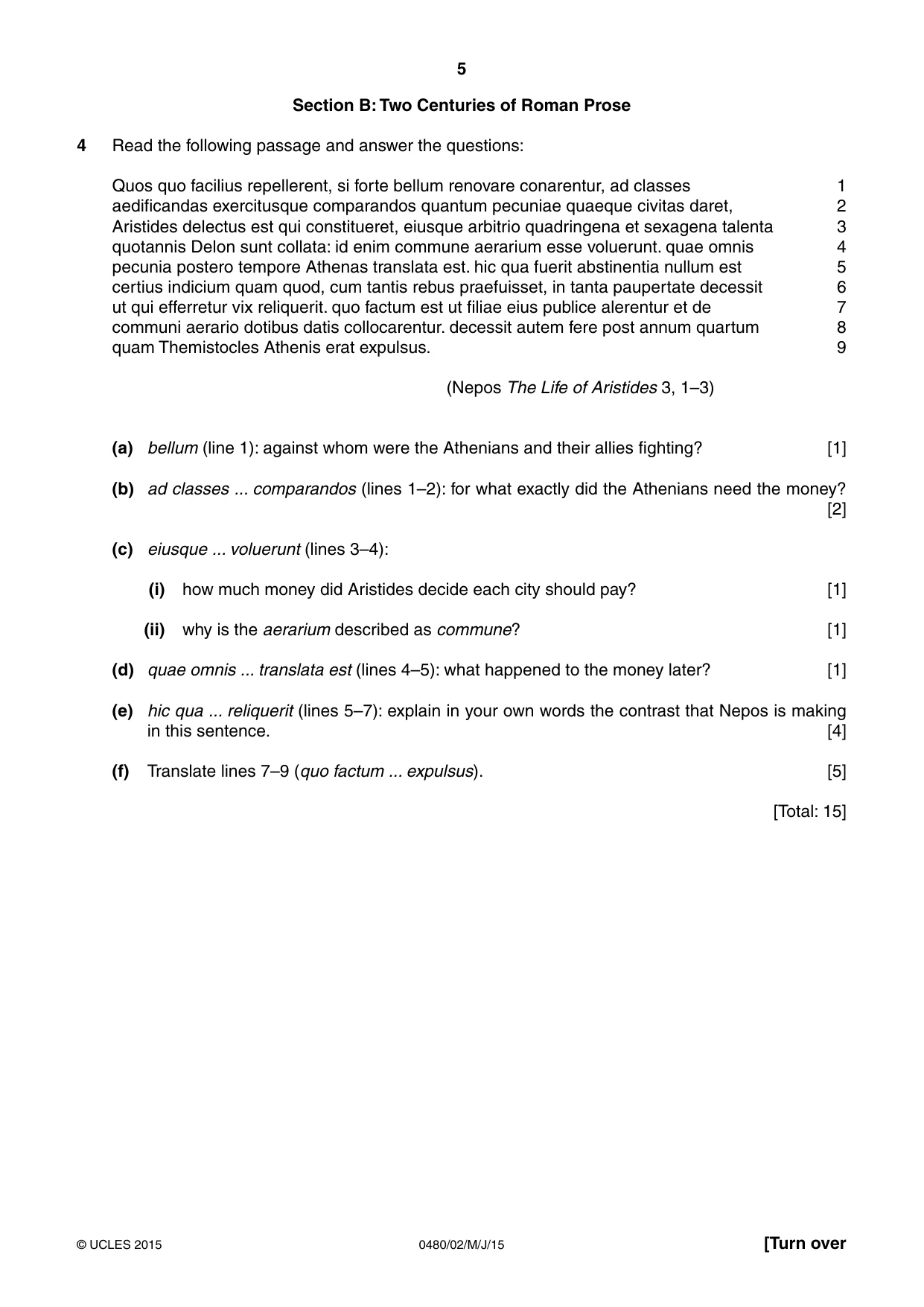
Question paper, page 1
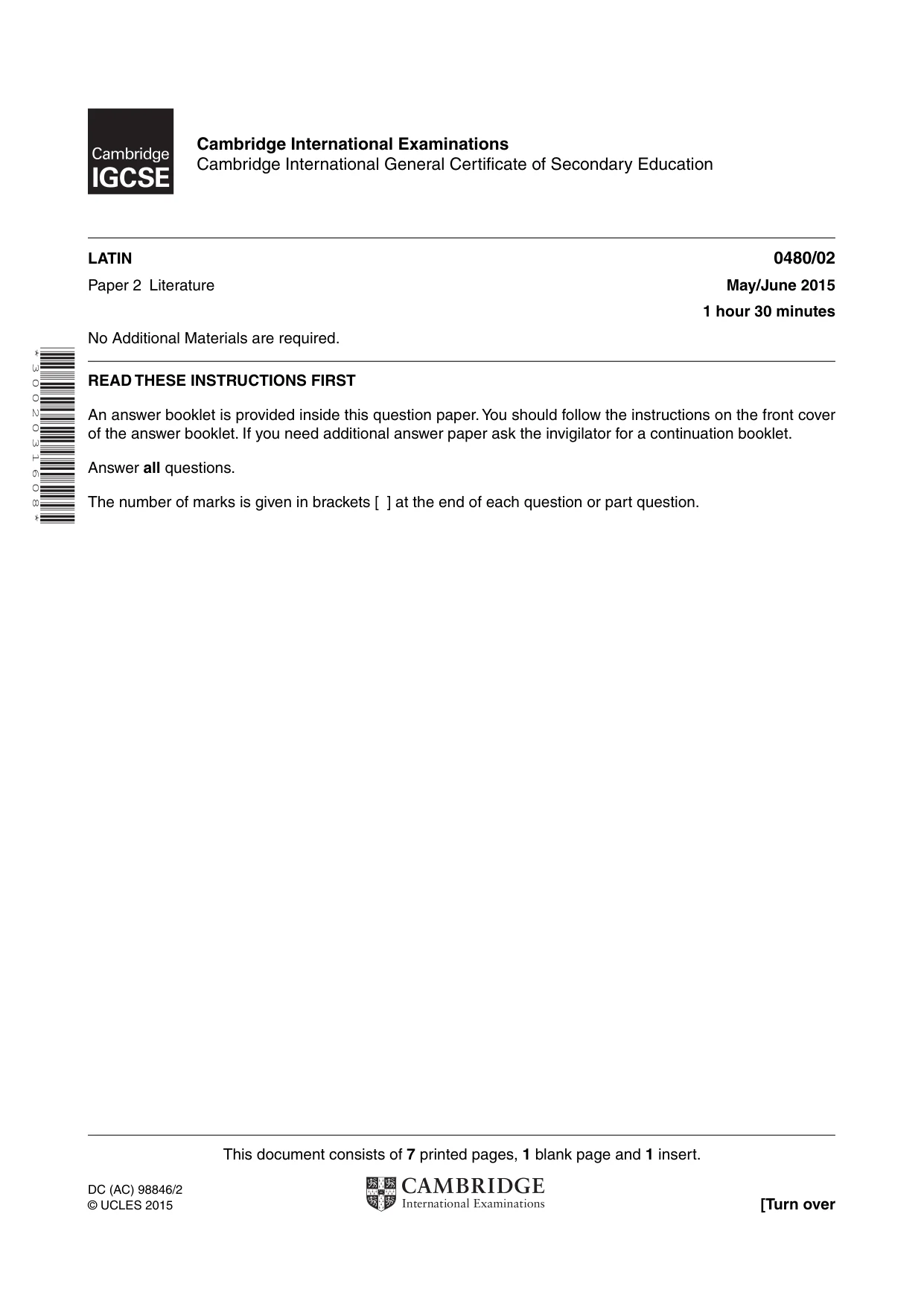
This document consists of 7 printed pages, 1 blank page and 1 insert. DC (AC) 98846/2 © UCLES 2015 [Turn over Cambridge International Examinations Cambridge International General Certificate of Secondary Education * 3 0 0 2 0 3 1 6 0 8 * LATIN 0480/02 Paper 2 Literature May/June 2015 1 hour 30 minutes No Additional Materials are required. READ THESE INSTRUCTIONS FIRST An answer booklet is provided inside this question paper. You should follow the instructions on the front cover of the answer booklet. If you need additional answer paper ask the invigilator for a continuation booklet. Answer all questions. The number of marks is given in brackets [ ] at the end of each question or part question.
Question paper, page 2
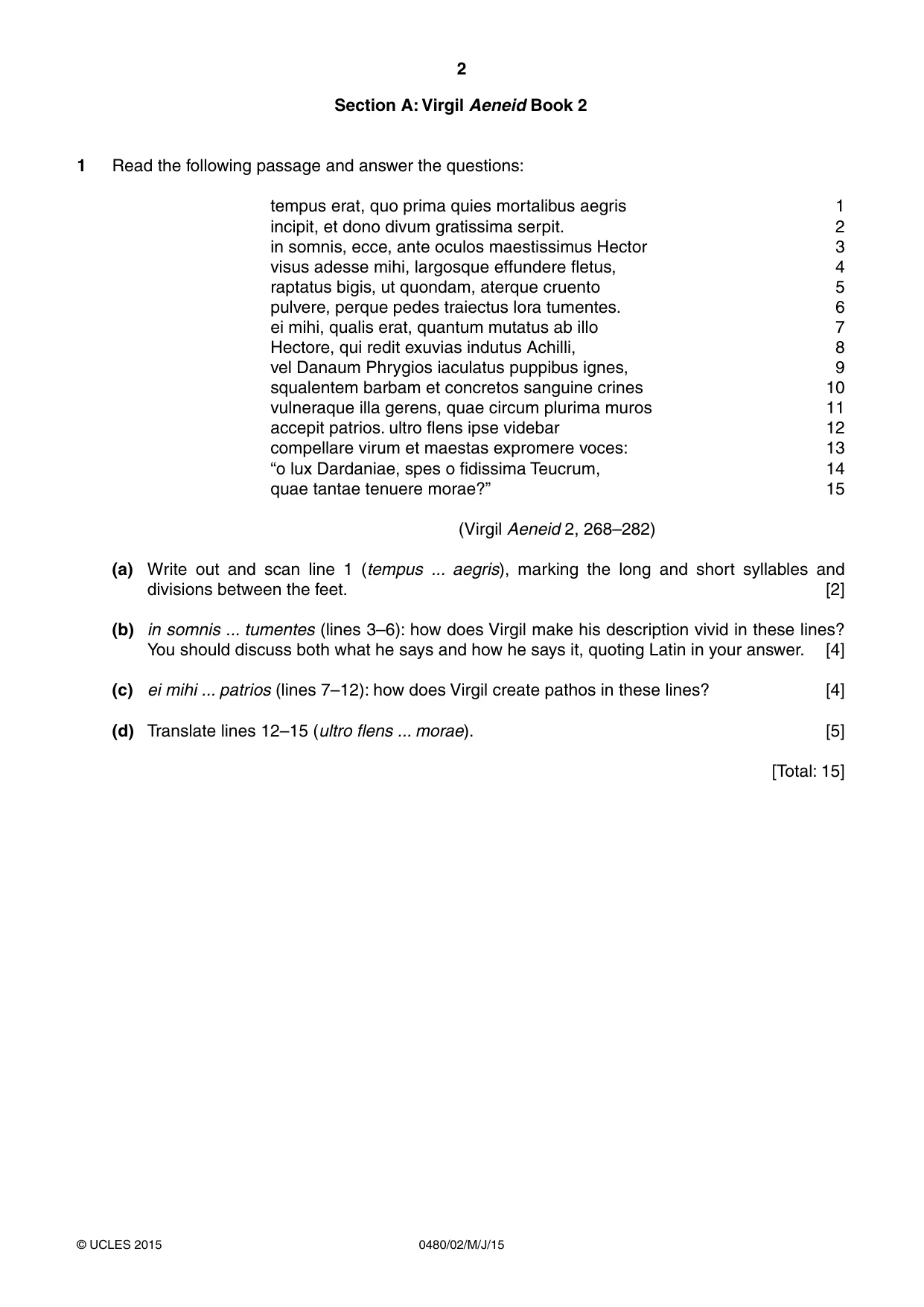
2 0480/02/M/J/15 © UCLES 2015 Section A: Virgil Aeneid Book 2 1 Read the following passage and answer the questions: tempus erat, quo prima quies mortalibus aegris 1 incipit, et dono divum gratissima serpit. 2 in somnis, ecce, ante oculos maestissimus Hector 3 visus adesse mihi, largosque effundere fletus, 4 raptatus bigis, ut quondam, aterque cruento 5 pulvere, perque pedes traiectus lora tumentes. 6 ei mihi, qualis erat, quantum mutatus ab illo 7 Hectore, qui redit exuvias indutus Achilli, 8 vel Danaum Phrygios iaculatus puppibus ignes, 9 squalentem barbam et concretos sanguine crines 10 vulneraque illa gerens, quae circum plurima muros 11 accepit patrios. ultro flens ipse videbar 12 compellare virum et maestas expromere voces: 13 “o lux Dardaniae, spes o fidissima Teucrum, 14 quae tantae tenuere morae?” 15 (Virgil Aeneid 2, 268–282) (a) Write out and scan line 1 (tempus ... aegris), marking the long and short syllables and divisions between the feet. [2] (b) in somnis ... tumentes (lines 3–6): how does Virgil make his description vivid in these lines? You should discuss both what he says and how he says it, quoting Latin in your answer. [4] (c) ei mihi ... patrios (lines 7–12): how does Virgil create pathos in these lines? [4] (d) Translate lines 12–15 (ultro flens ... morae). [5] [Total: 15]
Question paper, page 3
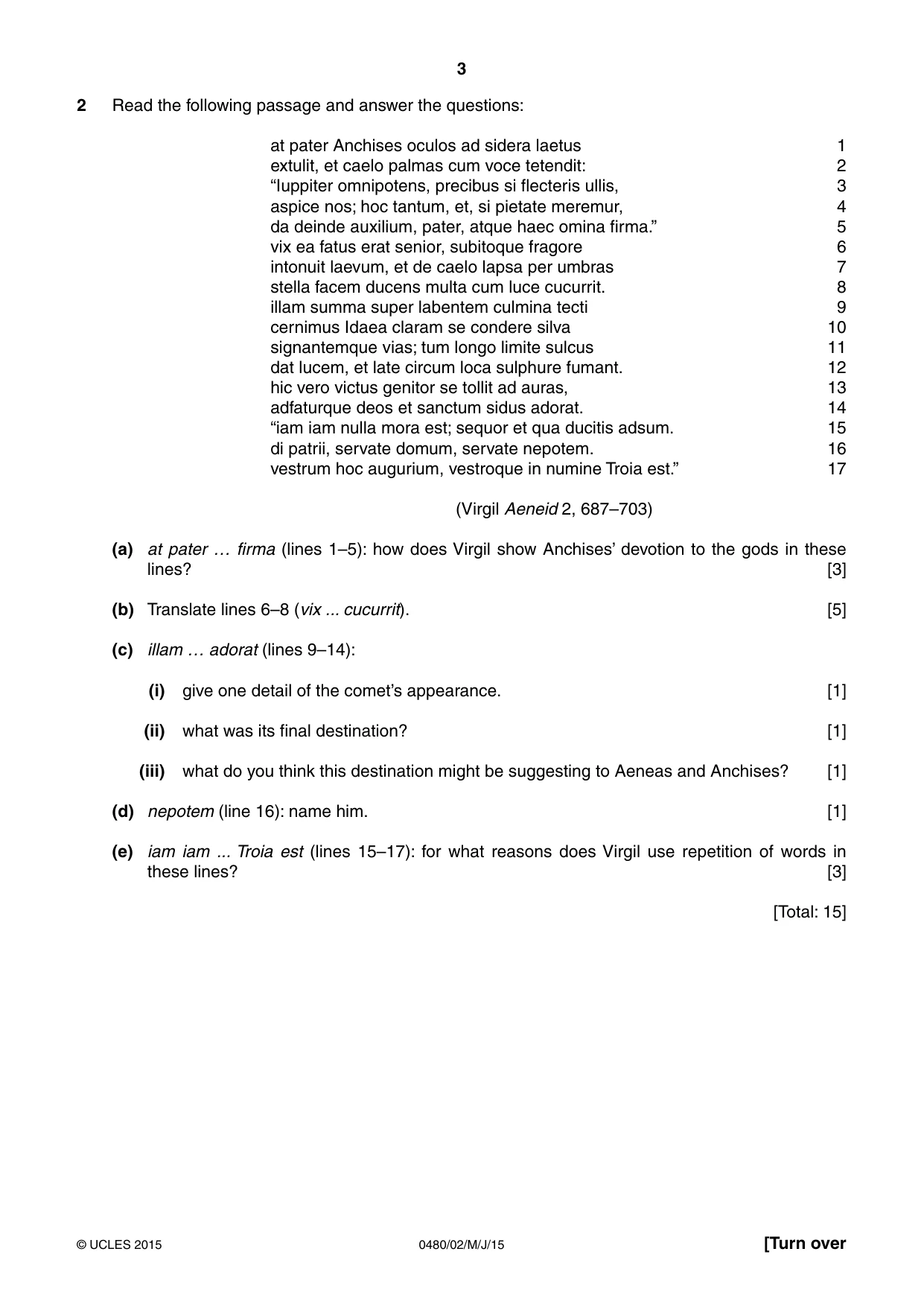
3 0480/02/M/J/15 © UCLES 2015 [Turn over 2 Read the following passage and answer the questions: at pater Anchises oculos ad sidera laetus 1 extulit, et caelo palmas cum voce tetendit: 2 “Iuppiter omnipotens, precibus si flecteris ullis, 3 aspice nos; hoc tantum, et, si pietate meremur, 4 da deinde auxilium, pater, atque haec omina firma.” 5 vix ea fatus erat senior, subitoque fragore 6 intonuit laevum, et de caelo lapsa per umbras 7 stella facem ducens multa cum luce cucurrit. 8 illam summa super labentem culmina tecti 9 cernimus Idaea claram se condere silva 10 signantemque vias; tum longo limite sulcus 11 dat lucem, et late circum loca sulphure fumant. 12 hic vero victus genitor se tollit ad auras, 13 adfaturque deos et sanctum sidus adorat. 14 “iam iam nulla mora est; sequor et qua ducitis adsum. 15 di patrii, servate domum, servate nepotem. 16 vestrum hoc augurium, vestroque in numine Troia est.” 17 (Virgil Aeneid 2, 687–703) (a) at pater … firma (lines 1–5): how does Virgil show Anchises’ devotion to the gods in these lines? [3] (b) Translate lines 6–8 (vix ... cucurrit). [5] (c) illam … adorat (lines 9–14): (i) give one detail of the comet’s appearance. [1] (ii) what was its final destination? [1] (iii) what do you think this destination might be suggesting to Aeneas and Anchises? [1] (d) nepotem (line 16): name him. [1] (e) iam iam ... Troia est (lines 15–17): for what reasons does Virgil use repetition of words in these lines? [3] [Total: 15]
Question paper, page 4
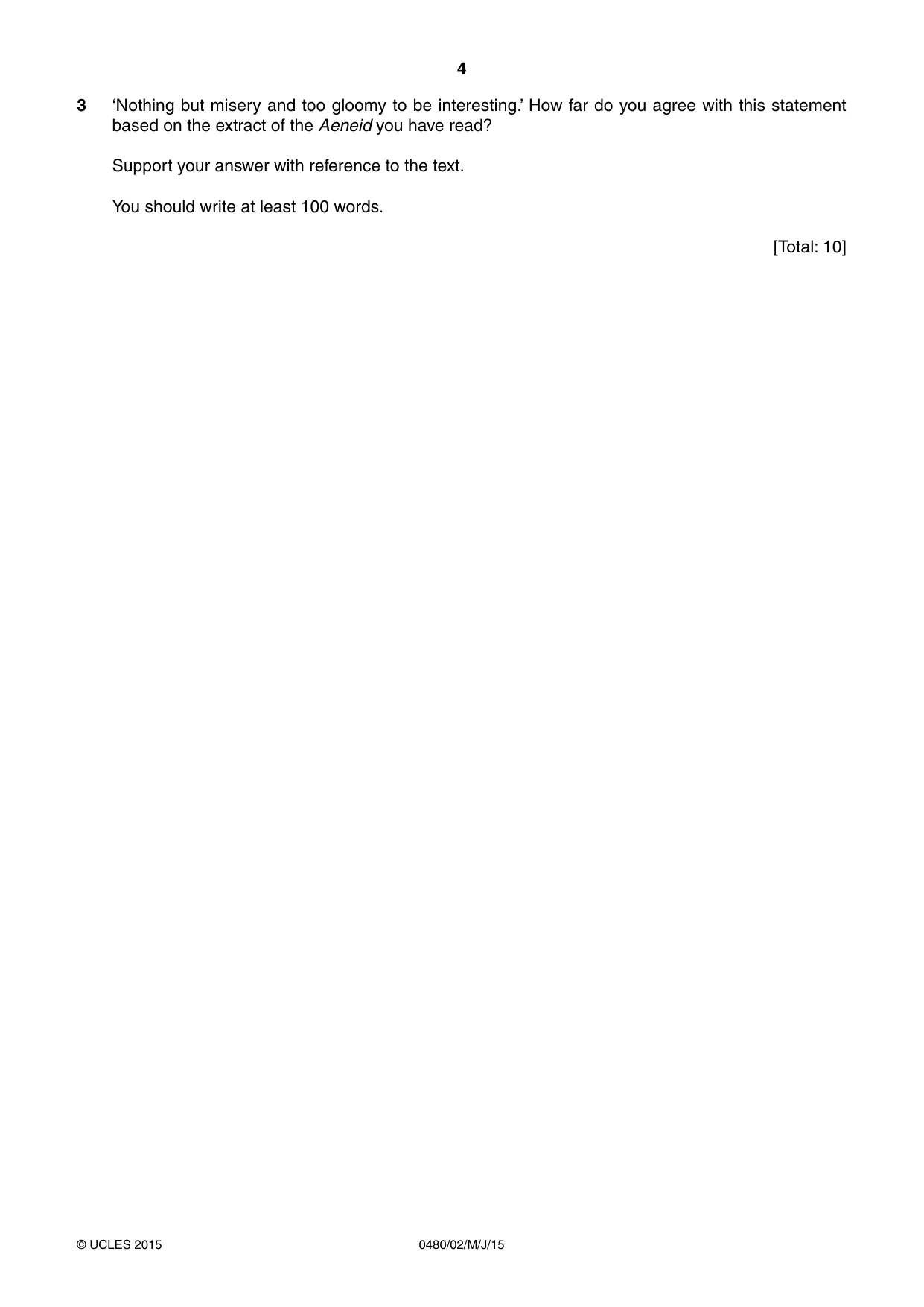
4 0480/02/M/J/15 © UCLES 2015 3 ‘Nothing but misery and too gloomy to be interesting.’ How far do you agree with this statement based on the extract of the Aeneid you have read? Support your answer with reference to the text. You should write at least 100 words. [Total: 10]
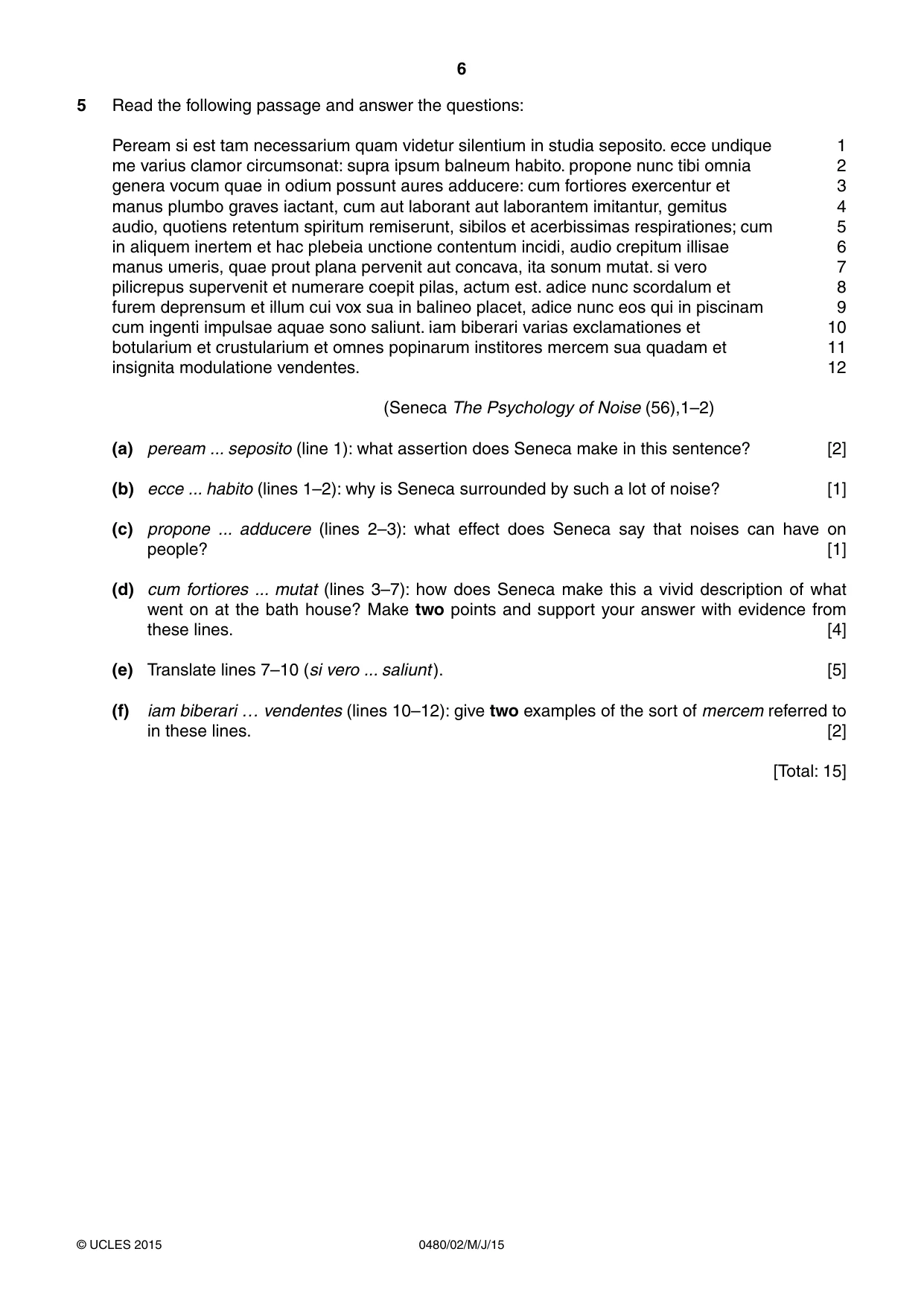
Question paper, page 5
5 0480/02/M/J/15 © UCLES 2015 [Turn over Section B: Two Centuries of Roman Prose 4 Read the following passage and answer the questions: Quos quo facilius repellerent, si forte bellum renovare conarentur, ad classes 1 aedificandas exercitusque comparandos quantum pecuniae quaeque civitas daret, 2 Aristides delectus est qui constitueret, eiusque arbitrio quadringena et sexagena talenta 3 quotannis Delon sunt collata: id enim commune aerarium esse voluerunt. quae omnis 4 pecunia postero tempore Athenas translata est. hic qua fuerit abstinentia nullum est 5 certius indicium quam quod, cum tantis rebus praefuisset, in tanta paupertate decessit 6 ut qui efferretur vix reliquerit. quo factum est ut filiae eius publice alerentur et de 7 communi aerario dotibus datis collocarentur. decessit autem fere post annum quartum 8 quam Themistocles Athenis erat expulsus. 9 (Nepos The Life of Aristides 3, 1–3) (a) bellum (line 1): against whom were the Athenians and their allies fighting? [1] (b) ad classes ... comparandos (lines 1–2): for what exactly did the Athenians need the money? [2] (c) eiusque ... voluerunt (lines 3–4): (i) how much money did Aristides decide each city should pay? [1] (ii) why is the aerarium described as commune? [1] (d) quae omnis ... translata est (lines 4–5): what happened to the money later? [1] (e) hic qua ... reliquerit (lines 5–7): explain in your own words the contrast that Nepos is making in this sentence. [4] (f) Translate lines 7–9 (quo factum ... expulsus). [5] [Total: 15]
Question paper, page 6
6 0480/02/M/J/15 © UCLES 2015 5 Read the following passage and answer the questions: Peream si est tam necessarium quam videtur silentium in studia seposito. ecce undique 1 me varius clamor circumsonat: supra ipsum balneum habito. propone nunc tibi omnia 2 genera vocum quae in odium possunt aures adducere: cum fortiores exercentur et 3 manus plumbo graves iactant, cum aut laborant aut laborantem imitantur, gemitus 4 audio, quotiens retentum spiritum remiserunt, sibilos et acerbissimas respirationes; cum 5 in aliquem inertem et hac plebeia unctione contentum incidi, audio crepitum illisae 6 manus umeris, quae prout plana pervenit aut concava, ita sonum mutat. si vero 7 pilicrepus supervenit et numerare coepit pilas, actum est. adice nunc scordalum et 8 furem deprensum et illum cui vox sua in balineo placet, adice nunc eos qui in piscinam 9 cum ingenti impulsae aquae sono saliunt. iam biberari varias exclamationes et 10 botularium et crustularium et omnes popinarum institores mercem sua quadam et 11 insignita modulatione vendentes. 12 (Seneca The Psychology of Noise (56),1–2) (a) peream ... seposito (line 1): what assertion does Seneca make in this sentence? [2] (b) ecce ... habito (lines 1–2): why is Seneca surrounded by such a lot of noise? [1] (c) propone ... adducere (lines 2–3): what effect does Seneca say that noises can have on people? [1] (d) cum fortiores ... mutat (lines 3–7): how does Seneca make this a vivid description of what went on at the bath house? Make two points and support your answer with evidence from these lines. [4] (e) Translate lines 7–10 (si vero ... saliunt ). [5] (f) iam biberari … vendentes (lines 10–12): give two examples of the sort of mercem referred to in these lines. [2] [Total: 15]
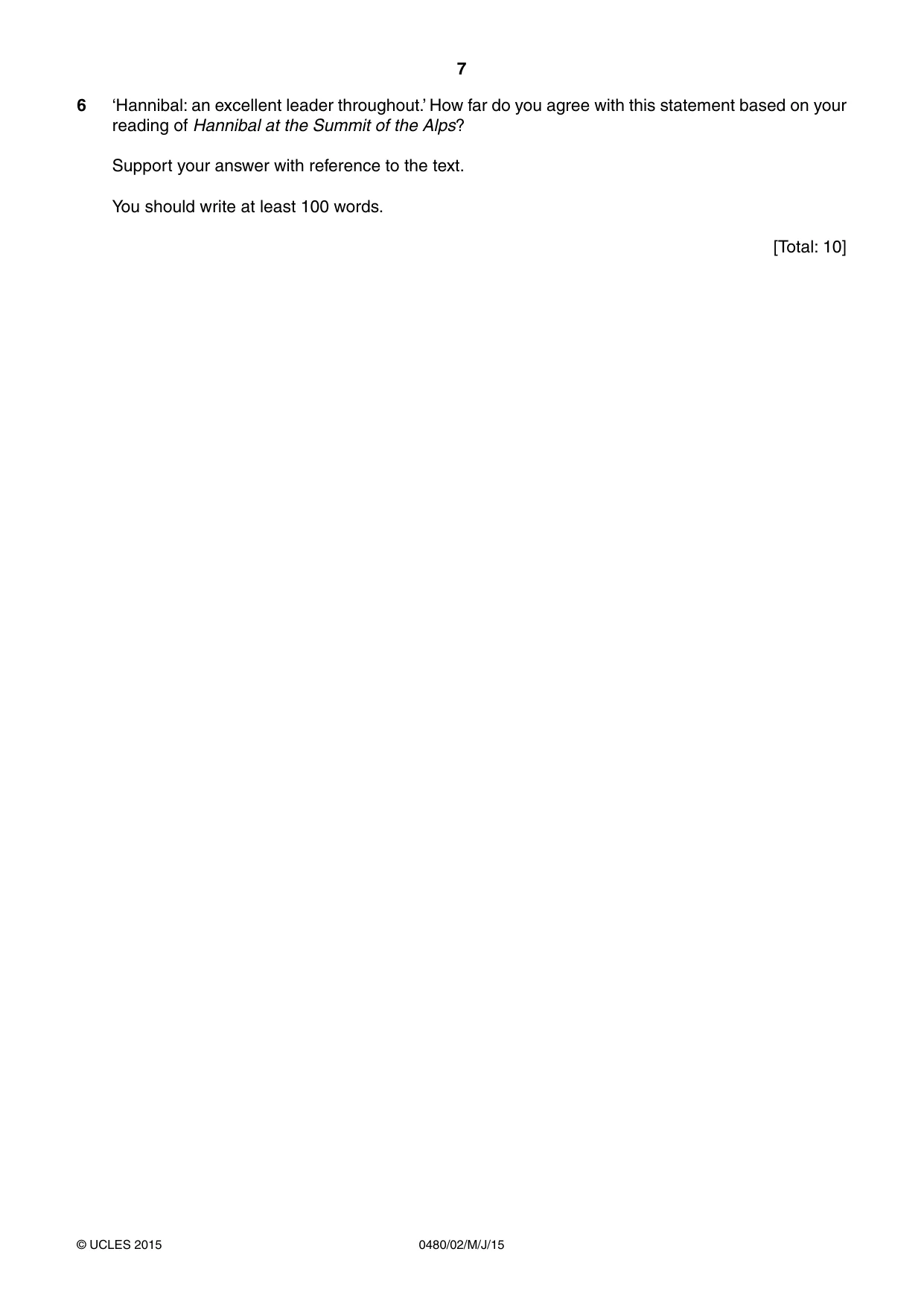
Question paper, page 7
7 0480/02/M/J/15 © UCLES 2015 6 ‘ Hannibal: an excellent leader throughout.’ How far do you agree with this statement based on your reading of Hannibal at the Summit of the Alps? Support your answer with reference to the text. You should write at least 100 words. [Total: 10]
Question paper, page 8
8 0480/02/M/J/15 © UCLES 2015 BLANK PAGE Permission to reproduce items where third-party owned material protected by copyright is included has been sought and cleared where possible. Every reasonable effort has been made by the publisher (UCLES) to trace copyright holders, but if any items requiring clearance have unwittingly been included, the publisher will be pleased to make amends at the earliest possible opportunity. To avoid the issue of disclosure of answer-related information to candidates, all copyright acknowledgements are reproduced online in the Cambridge International Examinations Copyright Acknowledgements Booklet. This is produced for each series of examinations and is freely available to download at www.cie.org.uk after the live examination series. Cambridge International Examinations is part of the Cambridge Assessment Group. Cambridge Assessment is the brand name of University of Cambridge Local Examinations Syndicate (UCLES), which is itself a department of the University of Cambridge.
Mark scheme, page 1
® IGCSE is the registered trademark of Cambridge International Examinations. CAMBRIDGE INTERNATIONAL EXAMINATIONS Cambridge International General Certificate of Secondary Education MARK SCHEME for the May/June 2015 series 0480 LATIN 0480/02 Paper 2 (Literature), maximum raw mark 80 This mark scheme is published as an aid to teachers and candidates, to indicate the requirements of the examination. It shows the basis on which Examiners were instructed to award marks. It does not indicate the details of the discussions that took place at an Examiners’ meeting before marking began, which would have considered the acceptability of alternative answers. Mark schemes should be read in conjunction with the question paper and the Principal Examiner Report for Teachers. Cambridge will not enter into discussions about these mark schemes. Cambridge is publishing the mark schemes for the May/June 2015 series for most Cambridge IGCSE®, Cambridge International A and AS Level components and some Cambridge O Level components.
Mark scheme, page 2
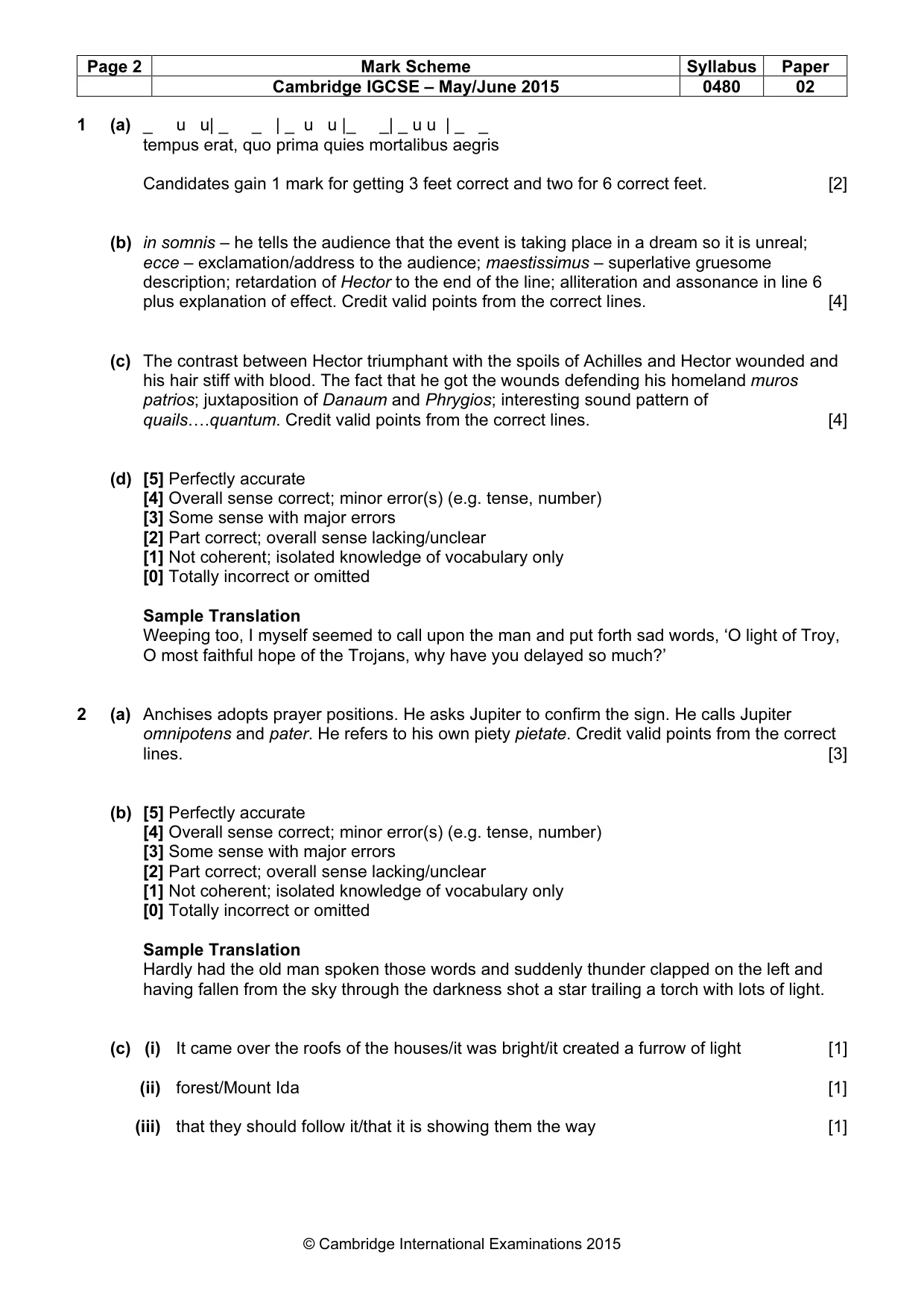
Page 2 Mark Scheme Syllabus Paper Cambridge IGCSE – May/June 2015 0480 02 © Cambridge International Examinations 2015 1 (a) _ u u| _ _ | _ u u |_ _| _ u u | _ _ tempus erat, quo prima quies mortalibus aegris Candidates gain 1 mark for getting 3 feet correct and two for 6 correct feet. [2] (b) in somnis – he tells the audience that the event is taking place in a dream so it is unreal; ecce – exclamation/address to the audience; maestissimus – superlative gruesome description; retardation of Hector to the end of the line; alliteration and assonance in line 6 plus explanation of effect. Credit valid points from the correct lines. [4] (c) The contrast between Hector triumphant with the spoils of Achilles and Hector wounded and his hair stiff with blood. The fact that he got the wounds defending his homeland muros patrios; juxtaposition of Danaum and Phrygios; interesting sound pattern of quails….quantum. Credit valid points from the correct lines. [4] (d) [5] Perfectly accurate [4] Overall sense correct; minor error(s) (e.g. tense, number) [3] Some sense with major errors [2] Part correct; overall sense lacking/unclear [1] Not coherent; isolated knowledge of vocabulary only [0] Totally incorrect or omitted Sample Translation Weeping too, I myself seemed to call upon the man and put forth sad words, ‘O light of Troy, O most faithful hope of the Trojans, why have you delayed so much?’ 2 (a) Anchises adopts prayer positions. He asks Jupiter to confirm the sign. He calls Jupiter omnipotens and pater. He refers to his own piety pietate. Credit valid points from the correct lines. [3] (b) [5] Perfectly accurate [4] Overall sense correct; minor error(s) (e.g. tense, number) [3] Some sense with major errors [2] Part correct; overall sense lacking/unclear [1] Not coherent; isolated knowledge of vocabulary only [0] Totally incorrect or omitted Sample Translation Hardly had the old man spoken those words and suddenly thunder clapped on the left and having fallen from the sky through the darkness shot a star trailing a torch with lots of light. (c) (i) It came over the roofs of the houses/it was bright/it created a furrow of light [1] (ii) forest/Mount Ida [1] (iii) that they should follow it/that it is showing them the way [1]
Mark scheme, page 3
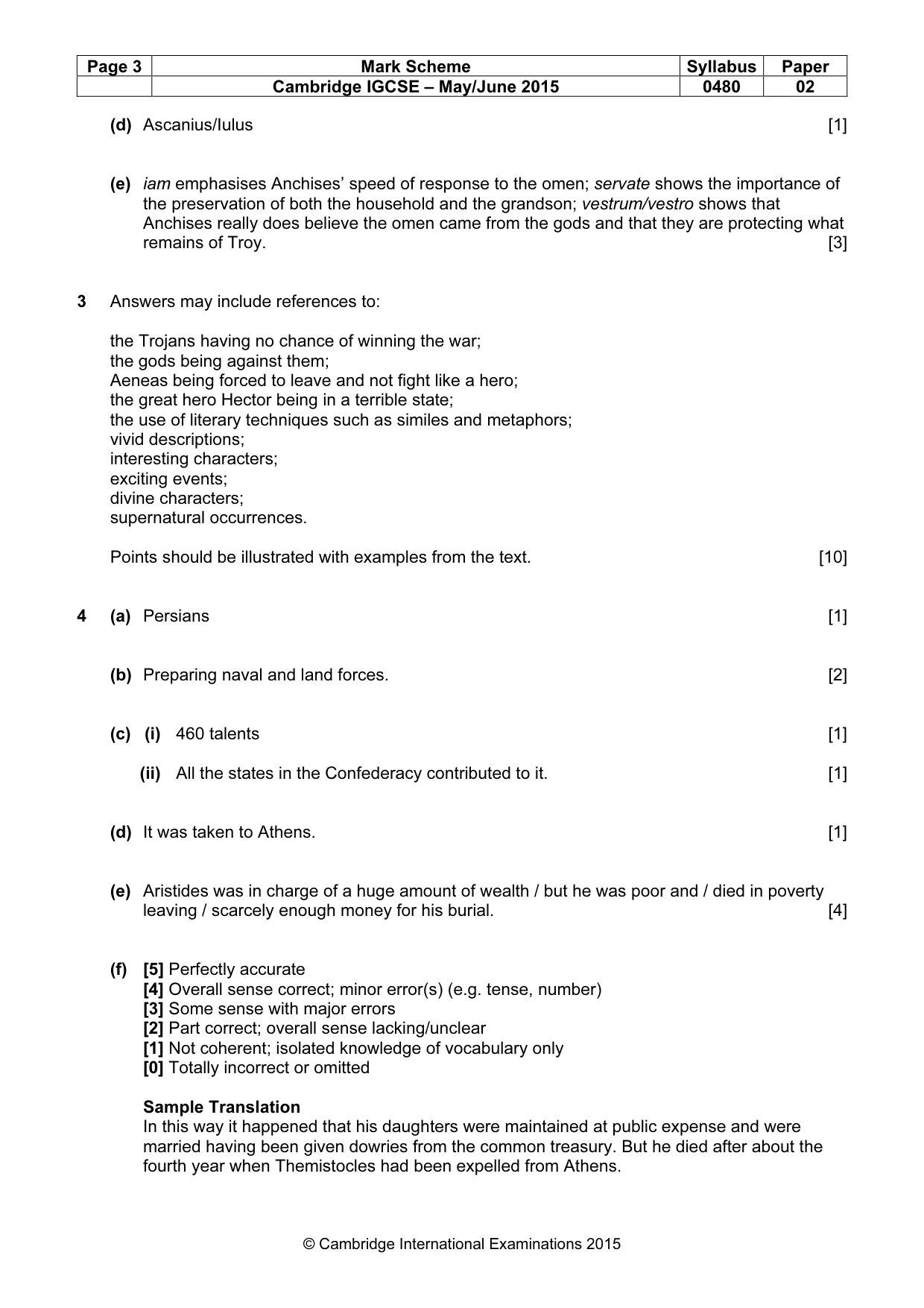
Page 3 Mark Scheme Syllabus Paper Cambridge IGCSE – May/June 2015 0480 02 © Cambridge International Examinations 2015 (d) Ascanius/Iulus [1] (e) iam emphasises Anchises’ speed of response to the omen; servate shows the importance of the preservation of both the household and the grandson; vestrum/vestro shows that Anchises really does believe the omen came from the gods and that they are protecting what remains of Troy. [3] 3 Answers may include references to: the Trojans having no chance of winning the war; the gods being against them; Aeneas being forced to leave and not fight like a hero; the great hero Hector being in a terrible state; the use of literary techniques such as similes and metaphors; vivid descriptions; interesting characters; exciting events; divine characters; supernatural occurrences. Points should be illustrated with examples from the text. [10] 4 (a) Persians [1] (b) Preparing naval and land forces. [2] (c) (i) 460 talents [1] (ii) All the states in the Confederacy contributed to it. [1] (d) It was taken to Athens. [1] (e) Aristides was in charge of a huge amount of wealth / but he was poor and / died in poverty leaving / scarcely enough money for his burial. [4] (f) [5] Perfectly accurate [4] Overall sense correct; minor error(s) (e.g. tense, number) [3] Some sense with major errors [2] Part correct; overall sense lacking/unclear [1] Not coherent; isolated knowledge of vocabulary only [0] Totally incorrect or omitted Sample Translation In this way it happened that his daughters were maintained at public expense and were married having been given dowries from the common treasury. But he died after about the fourth year when Themistocles had been expelled from Athens.
Mark scheme, page 4
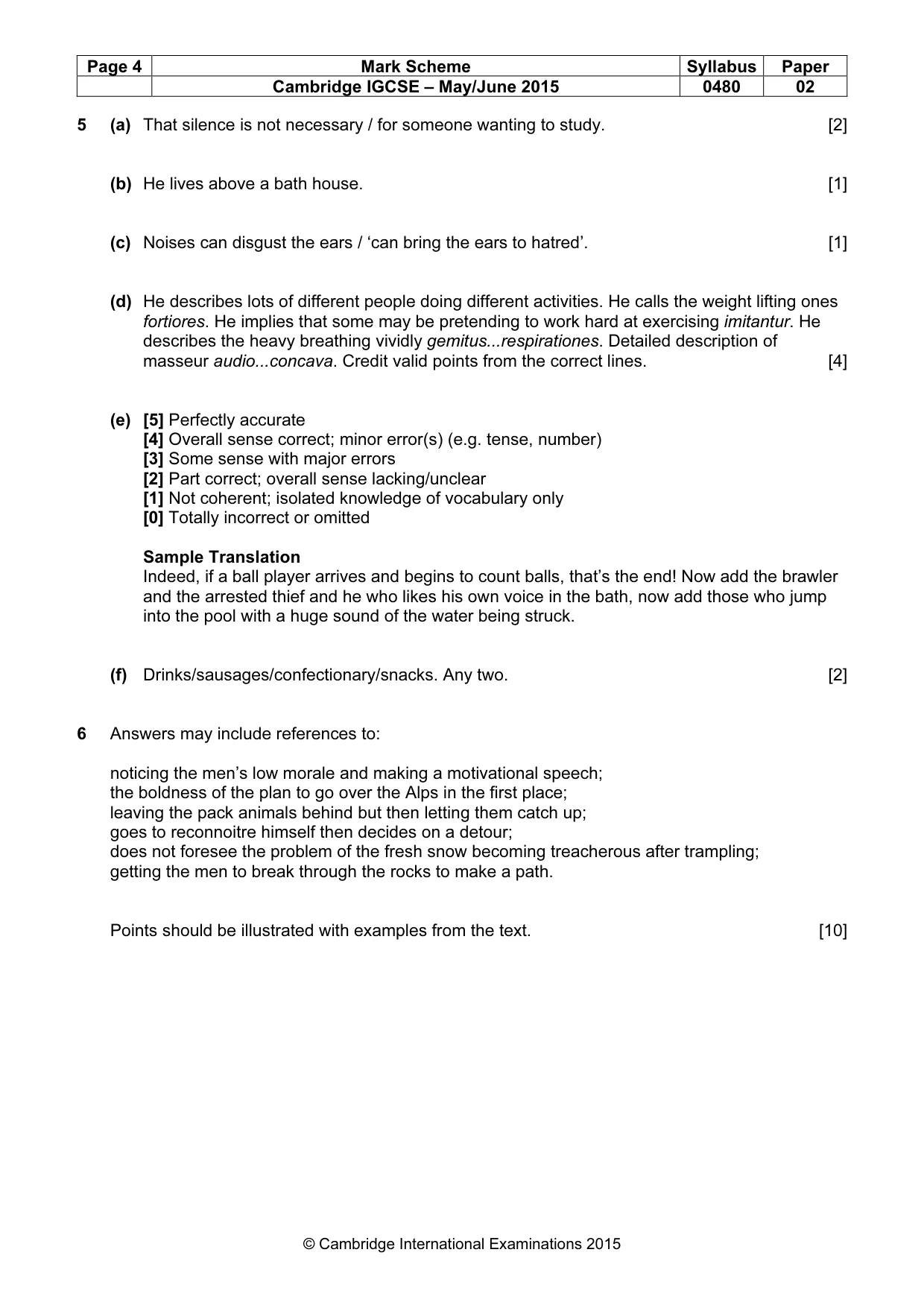
Page 4 Mark Scheme Syllabus Paper Cambridge IGCSE – May/June 2015 0480 02 © Cambridge International Examinations 2015 5 (a) That silence is not necessary / for someone wanting to study. [2] (b) He lives above a bath house. [1] (c) Noises can disgust the ears / ‘can bring the ears to hatred’. [1] (d) He describes lots of different people doing different activities. He calls the weight lifting ones fortiores. He implies that some may be pretending to work hard at exercising imitantur. He describes the heavy breathing vividly gemitus...respirationes. Detailed description of masseur audio...concava. Credit valid points from the correct lines. [4] (e) [5] Perfectly accurate [4] Overall sense correct; minor error(s) (e.g. tense, number) [3] Some sense with major errors [2] Part correct; overall sense lacking/unclear [1] Not coherent; isolated knowledge of vocabulary only [0] Totally incorrect or omitted Sample Translation Indeed, if a ball player arrives and begins to count balls, that’s the end! Now add the brawler and the arrested thief and he who likes his own voice in the bath, now add those who jump into the pool with a huge sound of the water being struck. (f) Drinks/sausages/confectionary/snacks. Any two. [2] 6 Answers may include references to: noticing the men’s low morale and making a motivational speech; the boldness of the plan to go over the Alps in the first place; leaving the pack animals behind but then letting them catch up; goes to reconnoitre himself then decides on a detour; does not foresee the problem of the fresh snow becoming treacherous after trampling; getting the men to break through the rocks to make a path. Points should be illustrated with examples from the text. [10]
What you needed in this session
Cambridge’s own grade thresholds for 2015 May/June, Paper 2 · Variant 1. A higher threshold means an easier paper — the bar moves with how the cohort did.