Cambridge IGCSE Latin 0480 — 2013 May/June Paper 2 · Variant 1
0480/21/M/J/13 · 80 marks · ≈90 min
The question paper and its mark scheme, free to read here and free to download. This is Cambridge’s own paper, exactly as it was sat.
Question paper8 pages


Mark scheme4 pages
Answers below. Sit the paper first if you are practising.
Paper as text
Question paper, page 1
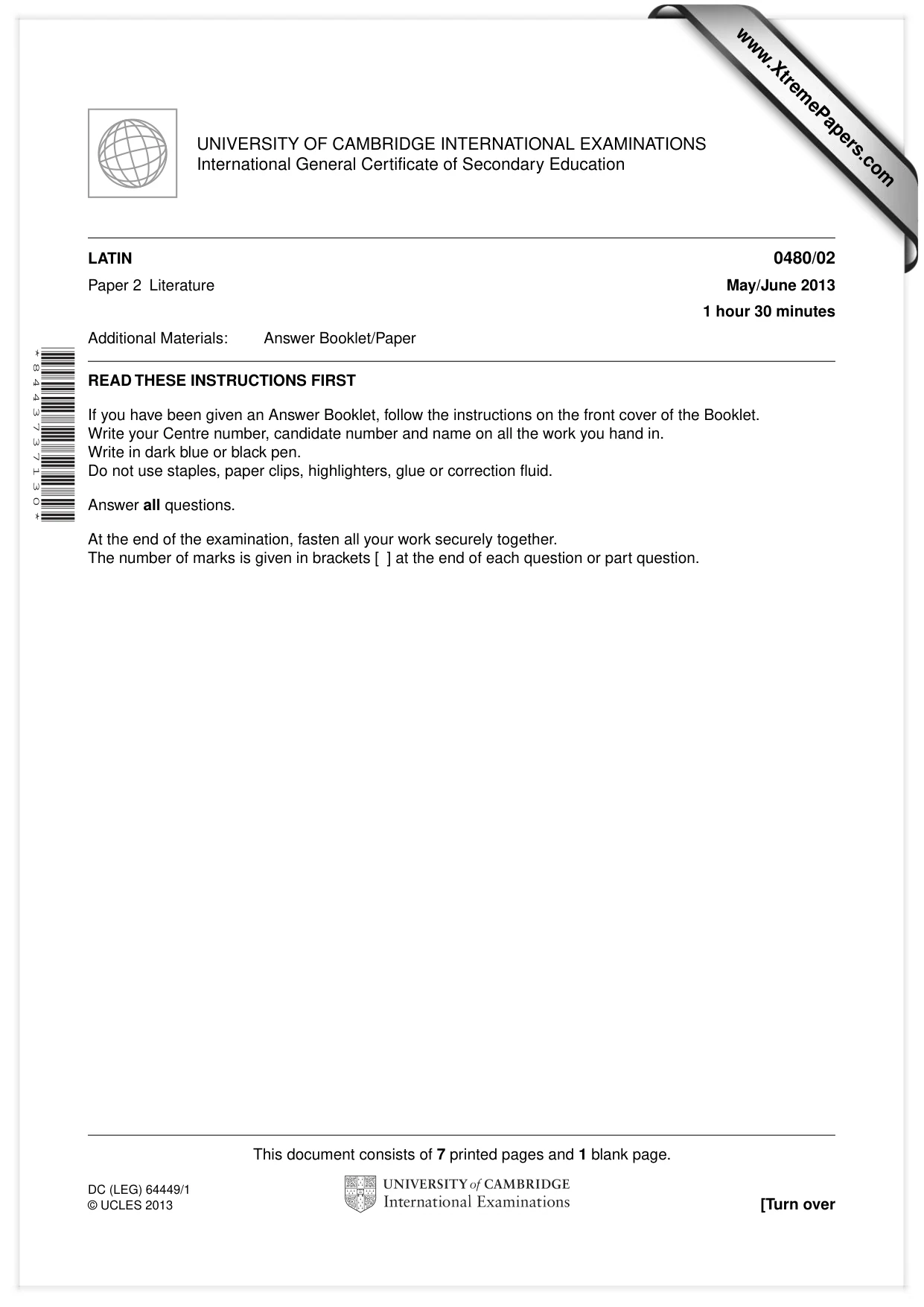
This document consists of 7 printed pages and 1 blank page. DC (LEG) 64449/1 © UCLES 2013 [Turn over UNIVERSITY OF CAMBRIDGE INTERNATIONAL EXAMINATIONS International General Certificate of Secondary Education * 8 4 4 3 7 3 7 1 3 0 * LATIN 0480/02 Paper 2 Literature May/June 2013 1 hour 30 minutes Additional Materials: Answer Booklet/Paper READ THESE INSTRUCTIONS FIRST If you have been given an Answer Booklet, follow the instructions on the front cover of the Booklet. Write your Centre number, candidate number and name on all the work you hand in. Write in dark blue or black pen. Do not use staples, paper clips, highlighters, glue or correction fluid. Answer all questions. At the end of the examination, fasten all your work securely together. The number of marks is given in brackets [ ] at the end of each question or part question. www.XtremePapers.com
Question paper, page 2
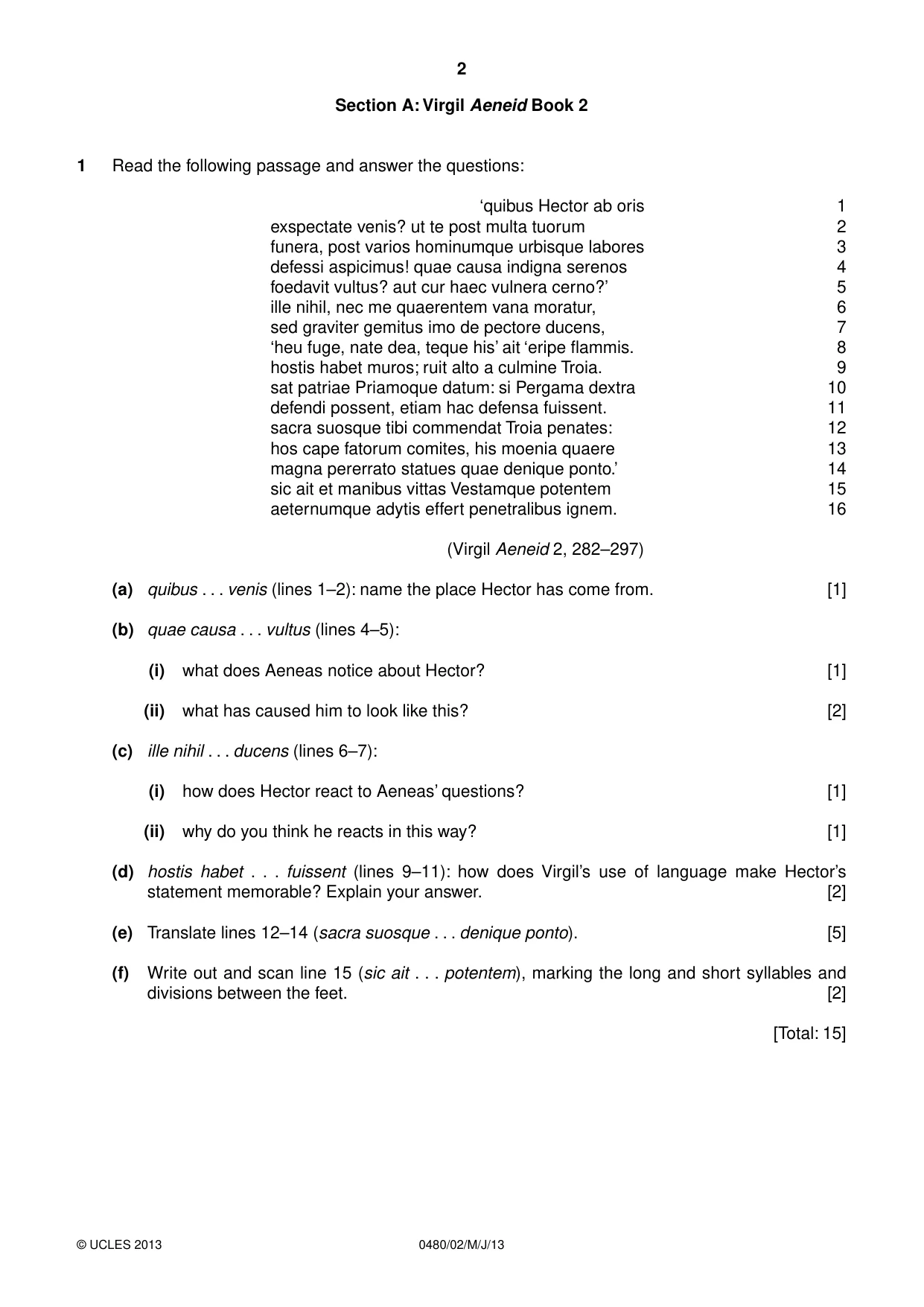
2 0480/02/M/J/13 © UCLES 2013 Section A: Virgil Aeneid Book 2 1 Read the following passage and answer the questions: ‘quibus Hector ab oris 1 exspectate venis? ut te post multa tuorum 2 funera, post varios hominumque urbisque labores 3 defessi aspicimus! quae causa indigna serenos 4 foedavit vultus? aut cur haec vulnera cerno?’ 5 ille nihil, nec me quaerentem vana moratur, 6 sed graviter gemitus imo de pectore ducens, 7 ‘heu fuge, nate dea, teque his’ ait ‘eripe flammis. 8 hostis habet muros; ruit alto a culmine Troia. 9 sat patriae Priamoque datum: si Pergama dextra 10 defendi possent, etiam hac defensa fuissent. 11 sacra suosque tibi commendat Troia penates: 12 hos cape fatorum comites, his moenia quaere 13 magna pererrato statues quae denique ponto.’ 14 sic ait et manibus vittas Vestamque potentem 15 aeternumque adytis effert penetralibus ignem. 16 (Virgil Aeneid 2, 282–297) (a) quibus . . . venis (lines 1–2): name the place Hector has come from. [1] (b) quae causa . . . vultus (lines 4–5): (i) what does Aeneas notice about Hector? [1] (ii) what has caused him to look like this? [2] (c) ille nihil . . . ducens (lines 6–7): (i) how does Hector react to Aeneas’ questions? [1] (ii) why do you think he reacts in this way? [1] (d) hostis habet . . . fuissent (lines 9–11): how does Virgil’s use of language make Hector’s statement memorable? Explain your answer. [2] (e) Translate lines 12–14 (sacra suosque . . . denique ponto). [5] (f) Write out and scan line 15 (sic ait . . . potentem), marking the long and short syllables and divisions between the feet. [2] [Total: 15]
Question paper, page 3
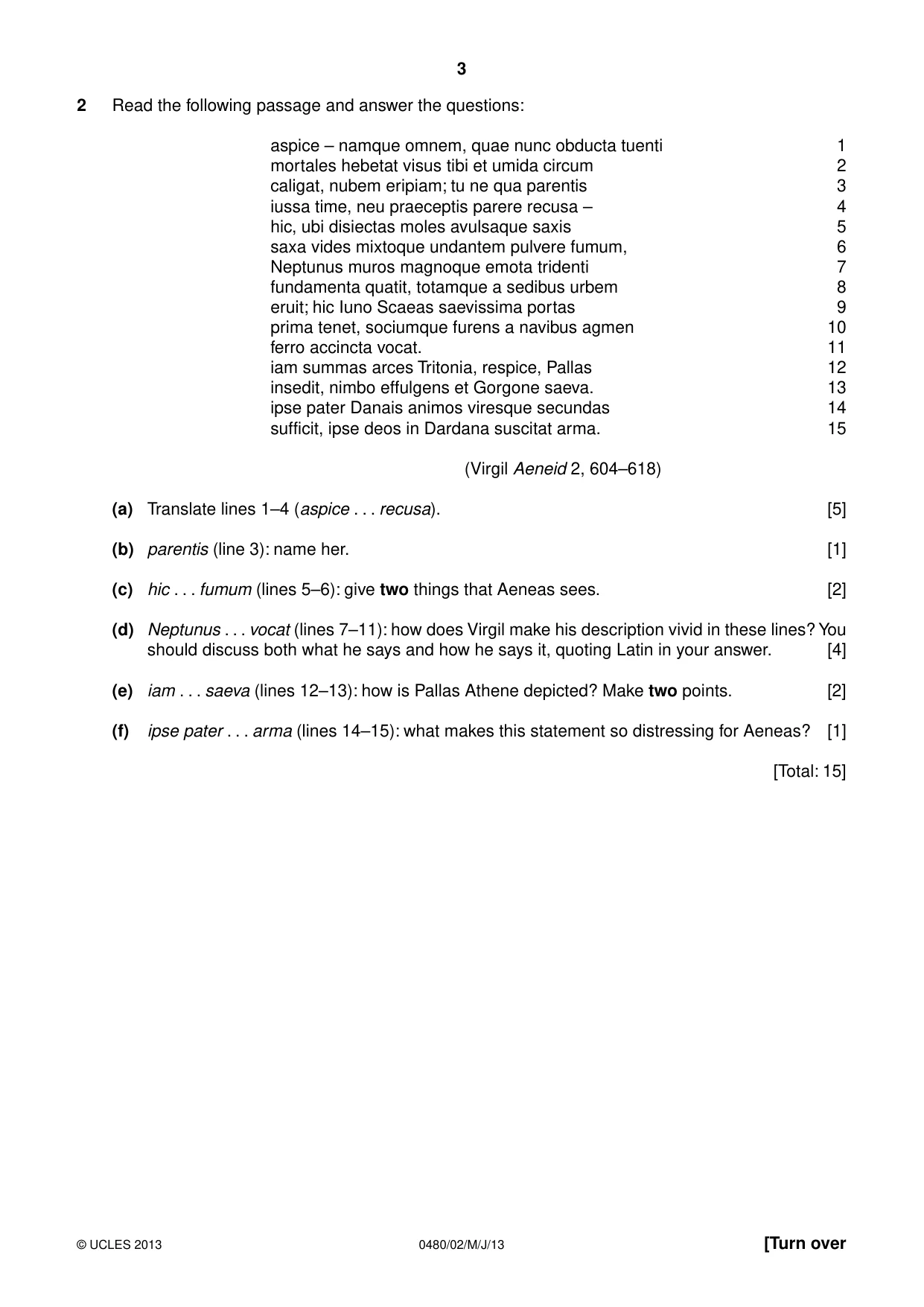
3 0480/02/M/J/13 © UCLES 2013 [Turn over 2 Read the following passage and answer the questions: aspice – namque omnem, quae nunc obducta tuenti 1 mortales hebetat visus tibi et umida circum 2 caligat, nubem eripiam; tu ne qua parentis 3 iussa time, neu praeceptis parere recusa – 4 hic, ubi disiectas moles avulsaque saxis 5 saxa vides mixtoque undantem pulvere fumum, 6 Neptunus muros magnoque emota tridenti 7 fundamenta quatit, totamque a sedibus urbem 8 eruit; hic Iuno Scaeas saevissima portas 9 prima tenet, sociumque furens a navibus agmen 10 ferro accincta vocat. 11 iam summas arces Tritonia, respice, Pallas 12 insedit, nimbo effulgens et Gorgone saeva. 13 ipse pater Danais animos viresque secundas 14 sufficit, ipse deos in Dardana suscitat arma. 15 (Virgil Aeneid 2, 604–618) (a) Translate lines 1–4 (aspice . . . recusa). [5] (b) parentis (line 3): name her. [1] (c) hic . . . fumum (lines 5–6): give two things that Aeneas sees. [2] (d) Neptunus . . . vocat (lines 7–11): how does Virgil make his description vivid in these lines? You should discuss both what he says and how he says it, quoting Latin in your answer. [4] (e) iam . . . saeva (lines 12–13): how is Pallas Athene depicted? Make two points. [2] (f) ipse pater . . . arma (lines 14–15): what makes this statement so distressing for Aeneas? [1] [Total: 15]
Question paper, page 4
4 0480/02/M/J/13 © UCLES 2013 3 ‘The main characters in the Aeneid are very different from one another.’ How far do you agree with this statement based on the extract of the Aeneid you have read? Support your answer with reference to the text. You should write at least 100 words. [Total: 10]
Question paper, page 5
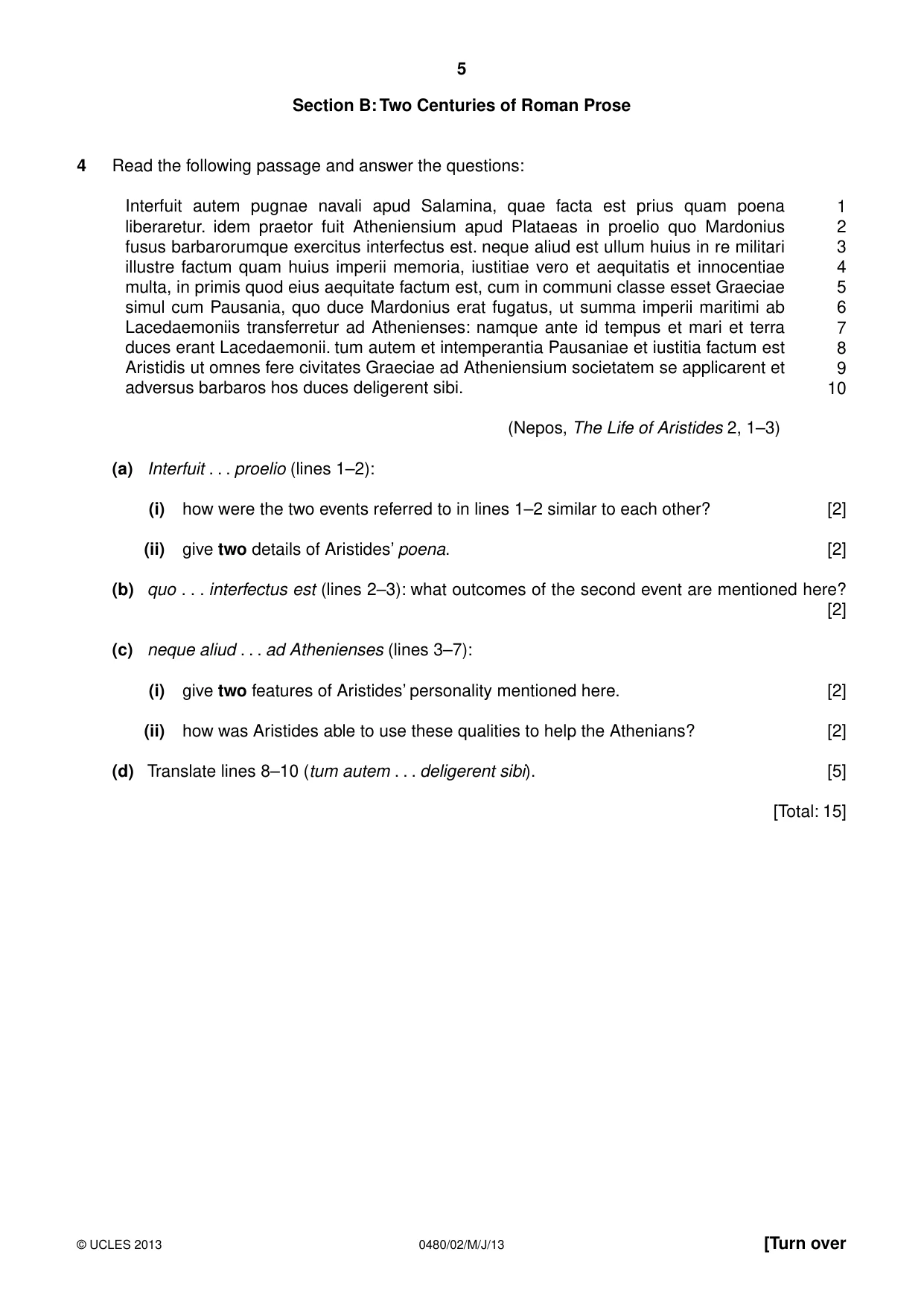
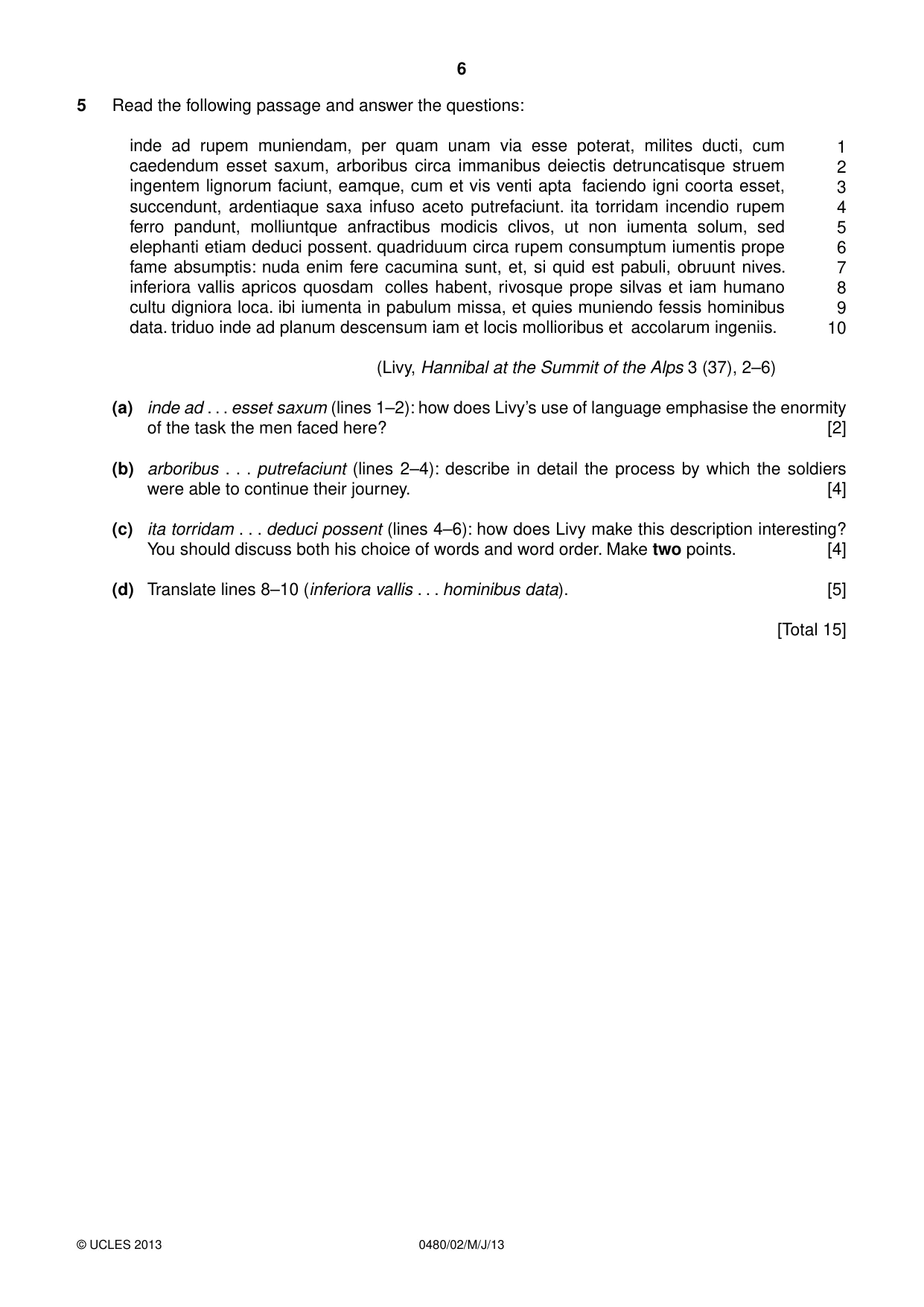
5 0480/02/M/J/13 © UCLES 2013 [Turn over Section B: Two Centuries of Roman Prose 4 Read the following passage and answer the questions: Interfuit autem pugnae navali apud Salamina, quae facta est prius quam poena liberaretur. idem praetor fuit Atheniensium apud Plataeas in proelio quo Mardonius fusus barbarorumque exercitus interfectus est. neque aliud est ullum huius in re militari illustre factum quam huius imperii memoria, iustitiae vero et aequitatis et innocentiae multa, in primis quod eius aequitate factum est, cum in communi classe esset Graeciae simul cum Pausania, quo duce Mardonius erat fugatus, ut summa imperii maritimi ab Lacedaemoniis transferretur ad Athenienses: namque ante id tempus et mari et terra duces erant Lacedaemonii. tum autem et intemperantia Pausaniae et iustitia factum est Aristidis ut omnes fere civitates Graeciae ad Atheniensium societatem se applicarent et adversus barbaros hos duces deligerent sibi. (Nepos, The Life of Aristides 2, 1–3) (a) Interfuit . . . proelio (lines 1–2): (i) how were the two events referred to in lines 1–2 similar to each other? [2] (ii) give two details of Aristides’ poena. [2] (b) quo . . . interfectus est (lines 2–3): what outcomes of the second event are mentioned here? [2] (c) neque aliud . . . ad Athenienses (lines 3–7): (i) give two features of Aristides’ personality mentioned here. [2] (ii) how was Aristides able to use these qualities to help the Athenians? [2] (d) Translate lines 8–10 (tum autem . . . deligerent sibi). [5] [Total: 15] 1 2 3 4 5 6 7 8 9 10
Question paper, page 6
6 0480/02/M/J/13 © UCLES 2013 5 Read the following passage and answer the questions: inde ad rupem muniendam, per quam unam via esse poterat, milites ducti, cum caedendum esset saxum, arboribus circa immanibus deiectis detruncatisque struem ingentem lignorum faciunt, eamque, cum et vis venti apta faciendo igni coorta esset, succendunt, ardentiaque saxa infuso aceto putrefaciunt. ita torridam incendio rupem ferro pandunt, molliuntque anfractibus modicis clivos, ut non iumenta solum, sed elephanti etiam deduci possent. quadriduum circa rupem consumptum iumentis prope fame absumptis: nuda enim fere cacumina sunt, et, si quid est pabuli, obruunt nives. inferiora vallis apricos quosdam colles habent, rivosque prope silvas et iam humano cultu digniora loca. ibi iumenta in pabulum missa, et quies muniendo fessis hominibus data. triduo inde ad planum descensum iam et locis mollioribus et accolarum ingeniis. (Livy, Hannibal at the Summit of the Alps 3 (37), 2–6) (a) inde ad . . . esset saxum (lines 1–2): how does Livy’s use of language emphasise the enormity of the task the men faced here? [2] (b) arboribus . . . putrefaciunt (lines 2–4): describe in detail the process by which the soldiers were able to continue their journey. [4] (c) ita torridam . . . deduci possent (lines 4–6): how does Livy make this description interesting? You should discuss both his choice of words and word order. Make two points. [4] (d) Translate lines 8–10 (inferiora vallis . . . hominibus data). [5] [Total 15] 1 2 3 4 5 6 7 8 9 10
Question paper, page 7
7 0480/02/M/J/13 © UCLES 2013 6 What can we learn about Roman society from Seneca’s discussion of the psychology of noise? Support your answer with reference to the text. You should write at least 100 words. [Total: 10]
Question paper, page 8
8 0480/02/M/J/13 © UCLES 2013 Permission to reproduce items where third-party owned material protected by copyright is included has been sought and cleared where possible. Every reasonable effort has been made by the publisher (UCLES) to trace copyright holders, but if any items requiring clearance have unwittingly been included, the publisher will be pleased to make amends at the earliest possible opportunity. University of Cambridge International Examinations is part of the Cambridge Assessment Group. Cambridge Assessment is the brand name of University of Cambridge Local Examinations Syndicate (UCLES), which is itself a department of the University of Cambridge. BLANK PAGE
Mark scheme, page 1
CAMBRIDGE INTERNATIONAL EXAMINATIONS International General Certificate of Secondary Education MARK SCHEME for the May/June 2013 series 0480 LATIN 0480/02 Paper 2 (Literature), maximum raw mark 80 This mark scheme is published as an aid to teachers and candidates, to indicate the requirements of the examination. It shows the basis on which Examiners were instructed to award marks. It does not indicate the details of the discussions that took place at an Examiners’ meeting before marking began, which would have considered the acceptability of alternative answers. Mark schemes should be read in conjunction with the question paper and the Principal Examiner Report for Teachers. Cambridge will not enter into discussions about these mark schemes. Cambridge is publishing the mark schemes for the May/June 2013 series for most IGCSE, GCE Advanced Level and Advanced Subsidiary Level components and some Ordinary Level components. www.XtremePapers.com
Mark scheme, page 2
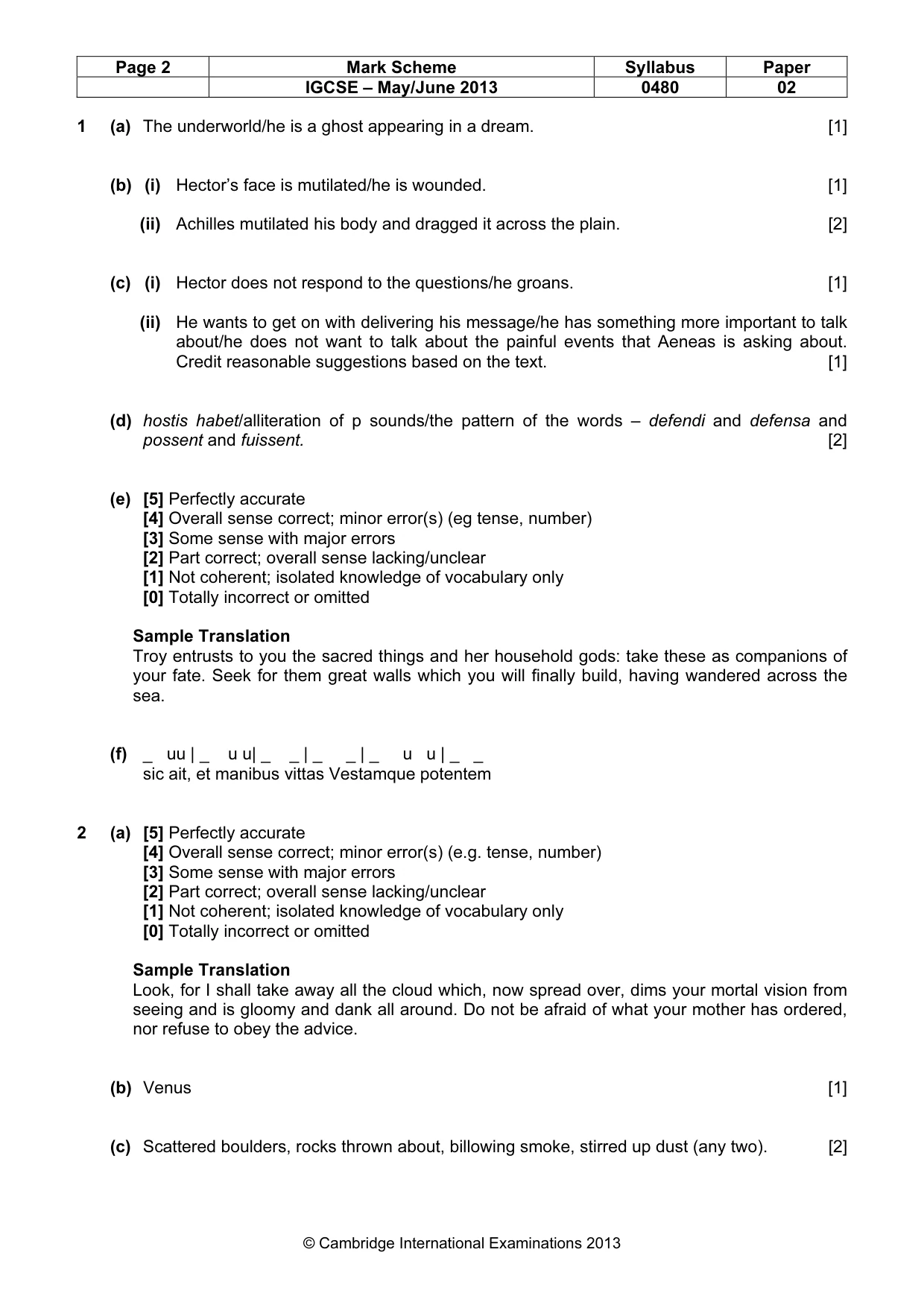
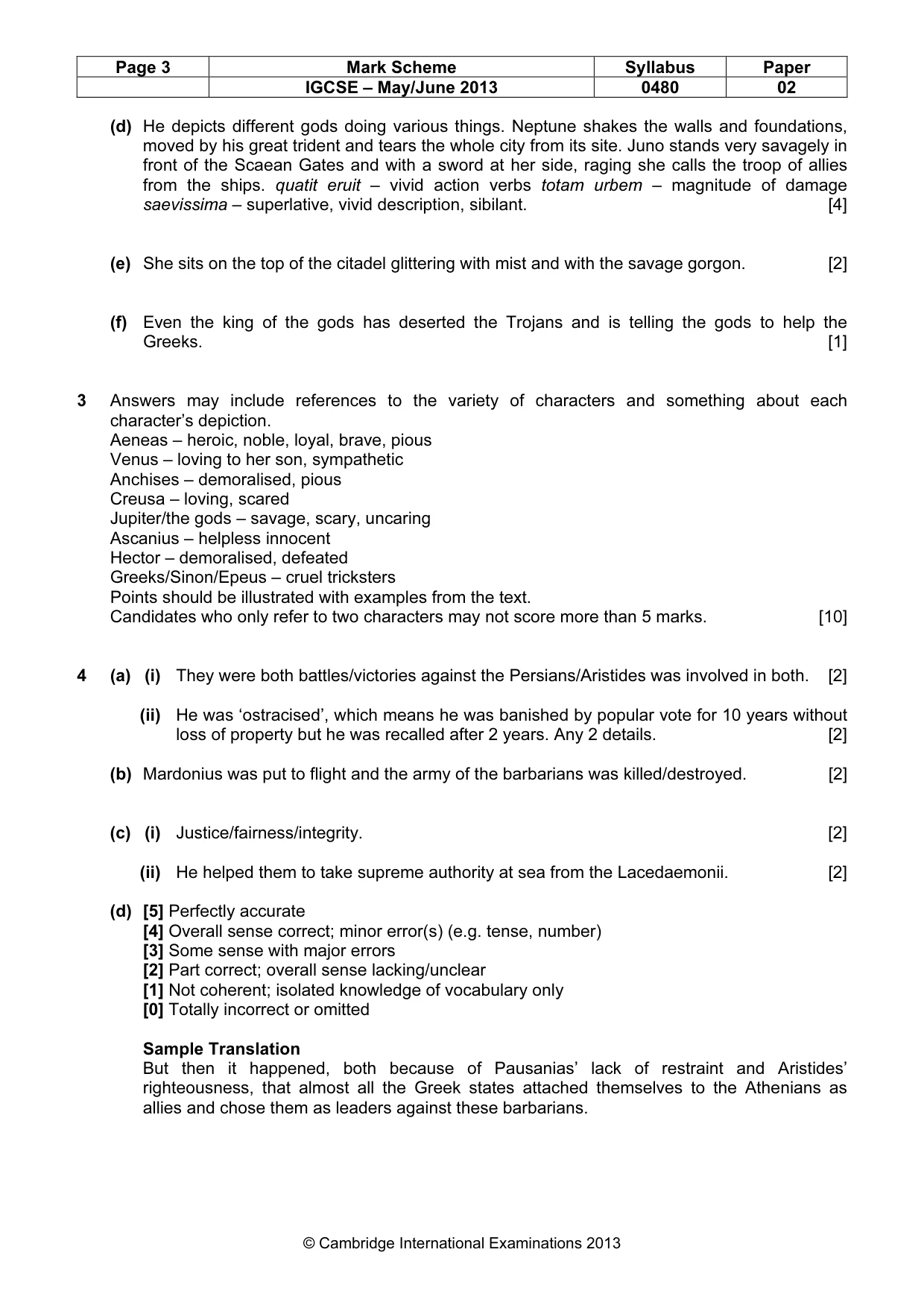
Page 2 Mark Scheme Syllabus Paper IGCSE – May/June 2013 0480 02 © Cambridge International Examinations 2013 1 (a) The underworld/he is a ghost appearing in a dream. [1] (b) (i) Hector’s face is mutilated/he is wounded. [1] (ii) Achilles mutilated his body and dragged it across the plain. [2] (c) (i) Hector does not respond to the questions/he groans. [1] (ii) He wants to get on with delivering his message/he has something more important to talk about/he does not want to talk about the painful events that Aeneas is asking about. Credit reasonable suggestions based on the text. [1] (d) hostis habet/alliteration of p sounds/the pattern of the words – defendi and defensa and possent and fuissent. [2] (e) [5] Perfectly accurate [4] Overall sense correct; minor error(s) (eg tense, number) [3] Some sense with major errors [2] Part correct; overall sense lacking/unclear [1] Not coherent; isolated knowledge of vocabulary only [0] Totally incorrect or omitted Sample Translation Troy entrusts to you the sacred things and her household gods: take these as companions of your fate. Seek for them great walls which you will finally build, having wandered across the sea. (f) _ uu | _ u u| _ _ | _ _ | _ u u | _ _ sic ait, et manibus vittas Vestamque potentem 2 (a) [5] Perfectly accurate [4] Overall sense correct; minor error(s) (e.g. tense, number) [3] Some sense with major errors [2] Part correct; overall sense lacking/unclear [1] Not coherent; isolated knowledge of vocabulary only [0] Totally incorrect or omitted Sample Translation Look, for I shall take away all the cloud which, now spread over, dims your mortal vision from seeing and is gloomy and dank all around. Do not be afraid of what your mother has ordered, nor refuse to obey the advice. (b) Venus [1] (c) Scattered boulders, rocks thrown about, billowing smoke, stirred up dust (any two). [2]
Mark scheme, page 3
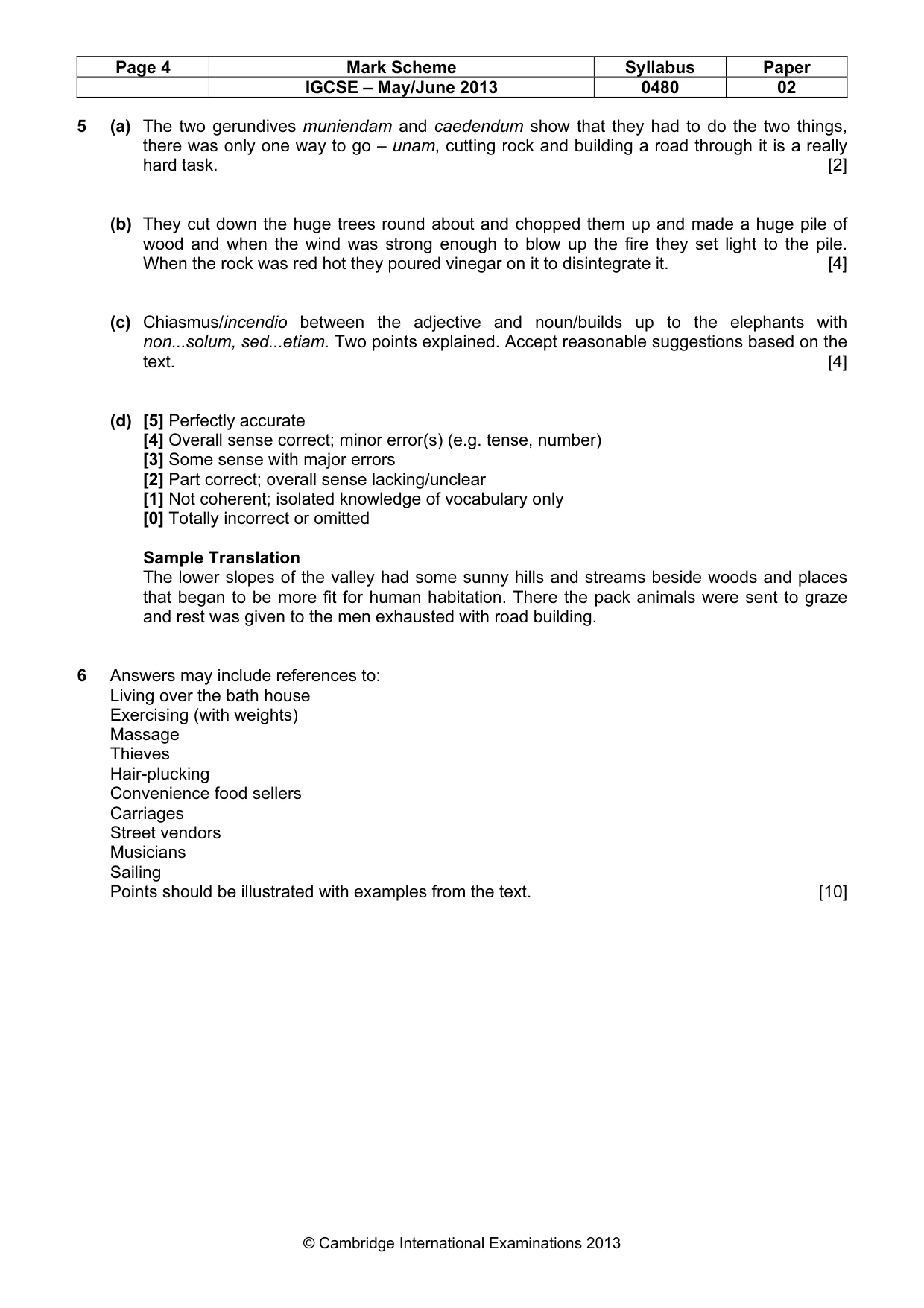
Page 3 Mark Scheme Syllabus Paper IGCSE – May/June 2013 0480 02 © Cambridge International Examinations 2013 (d) He depicts different gods doing various things. Neptune shakes the walls and foundations, moved by his great trident and tears the whole city from its site. Juno stands very savagely in front of the Scaean Gates and with a sword at her side, raging she calls the troop of allies from the ships. quatit eruit – vivid action verbs totam urbem – magnitude of damage saevissima – superlative, vivid description, sibilant. [4] (e) She sits on the top of the citadel glittering with mist and with the savage gorgon. [2] (f) Even the king of the gods has deserted the Trojans and is telling the gods to help the Greeks. [1] 3 Answers may include references to the variety of characters and something about each character’s depiction. Aeneas – heroic, noble, loyal, brave, pious Venus – loving to her son, sympathetic Anchises – demoralised, pious Creusa – loving, scared Jupiter/the gods – savage, scary, uncaring Ascanius – helpless innocent Hector – demoralised, defeated Greeks/Sinon/Epeus – cruel tricksters Points should be illustrated with examples from the text. Candidates who only refer to two characters may not score more than 5 marks. [10] 4 (a) (i) They were both battles/victories against the Persians/Aristides was involved in both. [2] (ii) He was ‘ostracised’, which means he was banished by popular vote for 10 years without loss of property but he was recalled after 2 years. Any 2 details. [2] (b) Mardonius was put to flight and the army of the barbarians was killed/destroyed. [2] (c) (i) Justice/fairness/integrity. [2] (ii) He helped them to take supreme authority at sea from the Lacedaemonii. [2] (d) [5] Perfectly accurate [4] Overall sense correct; minor error(s) (e.g. tense, number) [3] Some sense with major errors [2] Part correct; overall sense lacking/unclear [1] Not coherent; isolated knowledge of vocabulary only [0] Totally incorrect or omitted Sample Translation But then it happened, both because of Pausanias’ lack of restraint and Aristides’ righteousness, that almost all the Greek states attached themselves to the Athenians as allies and chose them as leaders against these barbarians.
Mark scheme, page 4
Page 4 Mark Scheme Syllabus Paper IGCSE – May/June 2013 0480 02 © Cambridge International Examinations 2013 5 (a) The two gerundives muniendam and caedendum show that they had to do the two things, there was only one way to go – unam, cutting rock and building a road through it is a really hard task. [2] (b) They cut down the huge trees round about and chopped them up and made a huge pile of wood and when the wind was strong enough to blow up the fire they set light to the pile. When the rock was red hot they poured vinegar on it to disintegrate it. [4] (c) Chiasmus/incendio between the adjective and noun/builds up to the elephants with non...solum, sed...etiam. Two points explained. Accept reasonable suggestions based on the text. [4] (d) [5] Perfectly accurate [4] Overall sense correct; minor error(s) (e.g. tense, number) [3] Some sense with major errors [2] Part correct; overall sense lacking/unclear [1] Not coherent; isolated knowledge of vocabulary only [0] Totally incorrect or omitted Sample Translation The lower slopes of the valley had some sunny hills and streams beside woods and places that began to be more fit for human habitation. There the pack animals were sent to graze and rest was given to the men exhausted with road building. 6 Answers may include references to: Living over the bath house Exercising (with weights) Massage Thieves Hair-plucking Convenience food sellers Carriages Street vendors Musicians Sailing Points should be illustrated with examples from the text. [10]
What you needed in this session
Cambridge’s own grade thresholds for 2013 May/June, Paper 2 · Variant 1. A higher threshold means an easier paper — the bar moves with how the cohort did.