Cambridge IGCSE Latin 0480 — 2010 May/June Paper 2 · Variant 1
0480/21/M/J/10 · 80 marks · ≈90 min
The question paper and its mark scheme, free to read here and free to download. This is Cambridge’s own paper, exactly as it was sat.
Question paper8 pages

Mark scheme7 pages
Answers below. Sit the paper first if you are practising.
Paper as text
Question paper, page 1
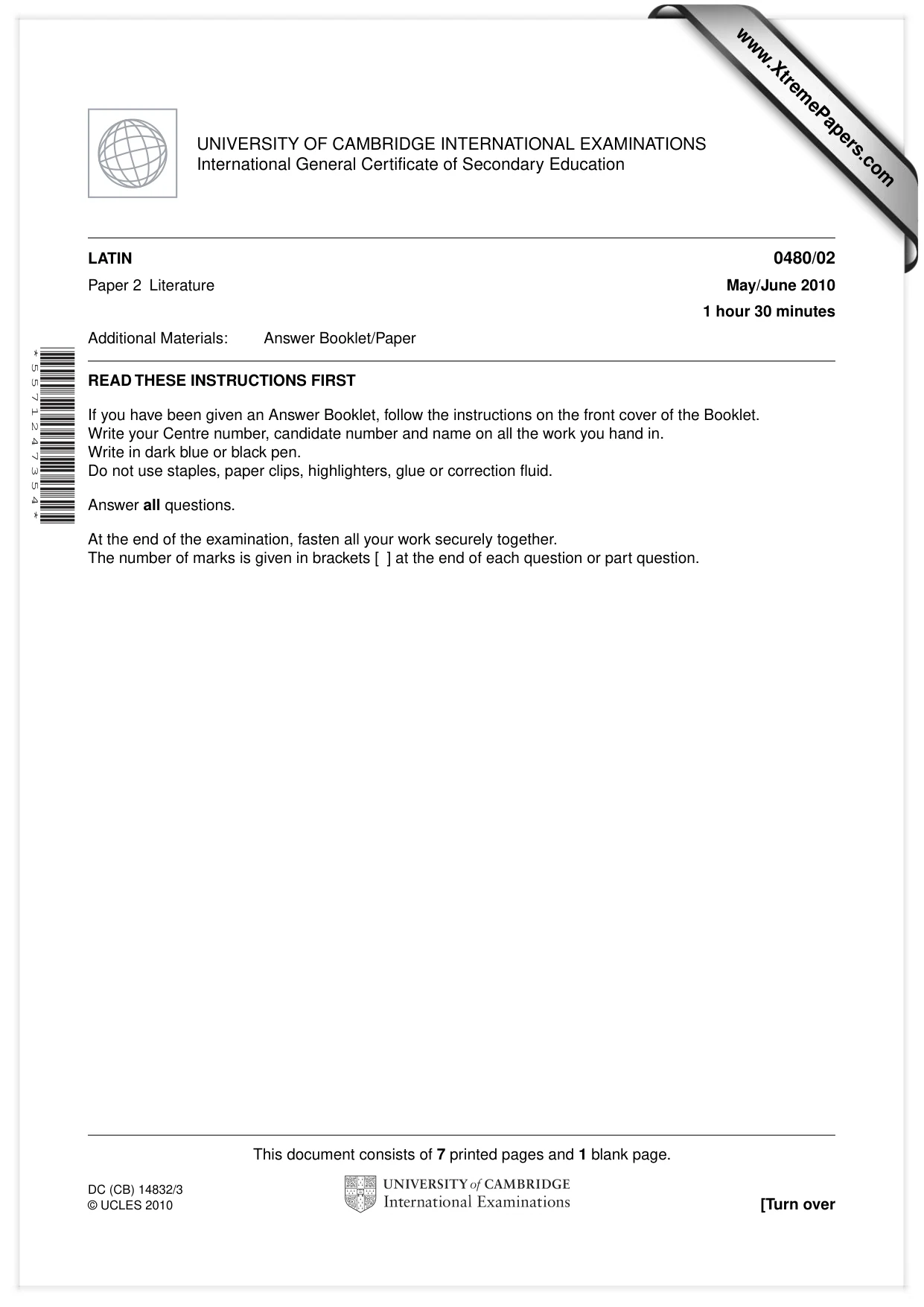
This document consists of 7 printed pages and 1 blank page. DC (CB) 14832/3 © UCLES 2010 [Turn over UNIVERSITY OF CAMBRIDGE INTERNATIONAL EXAMINATIONS International General Certificate of Secondary Education READ THESE INSTRUCTIONS FIRST If you have been given an Answer Booklet, follow the instructions on the front cover of the Booklet. Write your Centre number, candidate number and name on all the work you hand in. Write in dark blue or black pen. Do not use staples, paper clips, highlighters, glue or correction fluid. Answer all questions. At the end of the examination, fasten all your work securely together. The number of marks is given in brackets [ ] at the end of each question or part question. * 5 5 7 1 2 4 7 3 5 4 * LATIN 0480/02 Paper 2 Literature May/June 2010 1 hour 30 minutes Additional Materials: Answer Booklet/Paper www.XtremePapers.com
Question paper, page 2
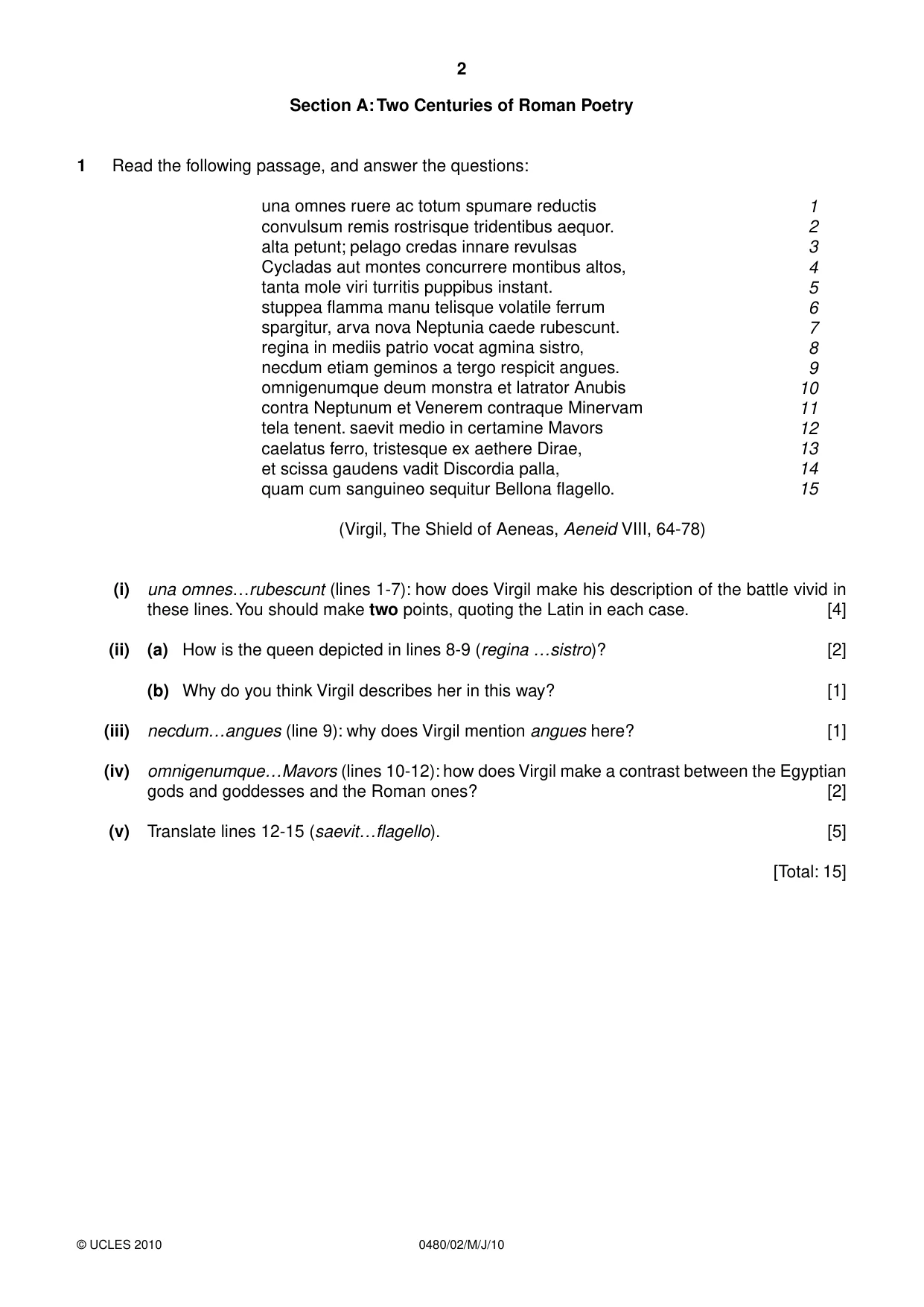
2 0480/02/M/J/10 © UCLES 2010 Section A: Two Centuries of Roman Poetry 1 Read the following passage, and answer the questions: una omnes ruere ac totum spumare reductis convulsum remis rostrisque tridentibus aequor. alta petunt; pelago credas innare revulsas Cycladas aut montes concurrere montibus altos, tanta mole viri turritis puppibus instant. stuppea flamma manu telisque volatile ferrum spargitur, arva nova Neptunia caede rubescunt. regina in mediis patrio vocat agmina sistro, necdum etiam geminos a tergo respicit angues. omnigenumque deum monstra et latrator Anubis contra Neptunum et Venerem contraque Minervam tela tenent. saevit medio in certamine Mavors caelatus ferro, tristesque ex aethere Dirae, et scissa gaudens vadit Discordia palla, quam cum sanguineo sequitur Bellona flagello. (Virgil, The Shield of Aeneas, Aeneid VIII, 64-78) (i) una omnes…rubescunt (lines 1-7): how does Virgil make his description of the battle vivid in these lines. You should make two points, quoting the Latin in each case. [4] (ii) (a) How is the queen depicted in lines 8-9 (regina …sistro)? [2] (b) Why do you think Virgil describes her in this way? [1] (iii) necdum…angues (line 9): why does Virgil mention angues here? [1] (iv) omnigenumque…Mavors (lines 10-12): how does Virgil make a contrast between the Egyptian gods and goddesses and the Roman ones? [2] (v) Translate lines 12-15 (saevit…flagello). [5] [Total: 15] 1 2 3 4 5 6 7 8 9 10 11 12 13 14 15
Question paper, page 3
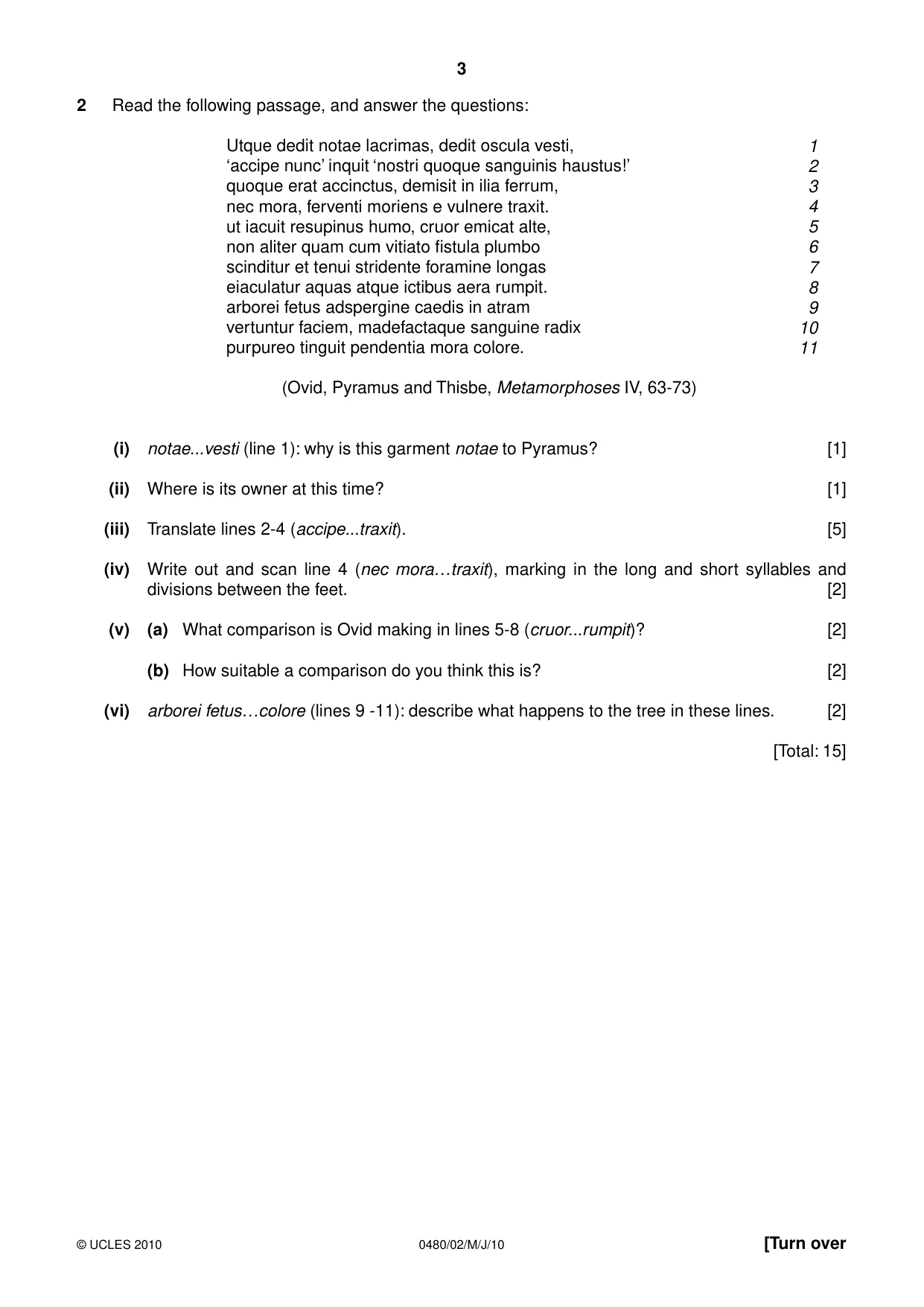
3 0480/02/M/J/10 © UCLES 2010 [Turn over 2 Read the following passage, and answer the questions: Utque dedit notae lacrimas, dedit oscula vesti, ‘accipe nunc’ inquit ‘nostri quoque sanguinis haustus!’ quoque erat accinctus, demisit in ilia ferrum, nec mora, ferventi moriens e vulnere traxit. ut iacuit resupinus humo, cruor emicat alte, non aliter quam cum vitiato fistula plumbo scinditur et tenui stridente foramine longas eiaculatur aquas atque ictibus aera rumpit. arborei fetus adspergine caedis in atram vertuntur faciem, madefactaque sanguine radix purpureo tinguit pendentia mora colore. (Ovid, Pyramus and Thisbe, Metamorphoses IV, 63-73) (i) notae...vesti (line 1): why is this garment notae to Pyramus? [1] (ii) Where is its owner at this time? [1] (iii) Translate lines 2-4 (accipe...traxit). [5] (iv) Write out and scan line 4 (nec mora…traxit), marking in the long and short syllables and divisions between the feet. [2] (v) (a) What comparison is Ovid making in lines 5-8 (cruor...rumpit)? [2] (b) How suitable a comparison do you think this is? [2] (vi) arborei fetus…colore (lines 9 -11): describe what happens to the tree in these lines. [2] [Total: 15] 1 2 3 4 5 6 7 8 9 10 11
Question paper, page 4
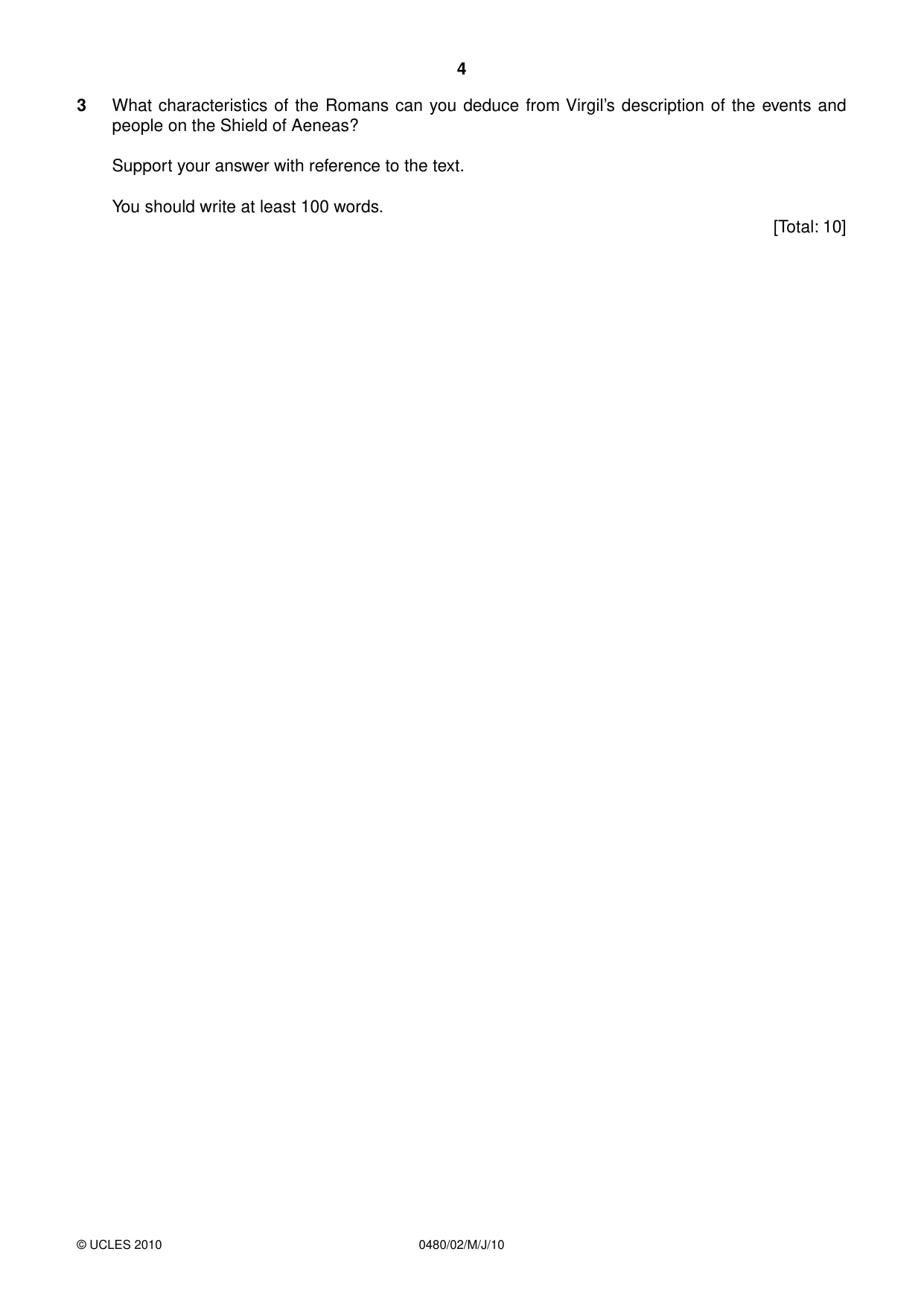
4 0480/02/M/J/10 © UCLES 2010 3 What characteristics of the Romans can you deduce from Virgil’s description of the events and people on the Shield of Aeneas? Support your answer with reference to the text. You should write at least 100 words. [Total: 10]
Question paper, page 5
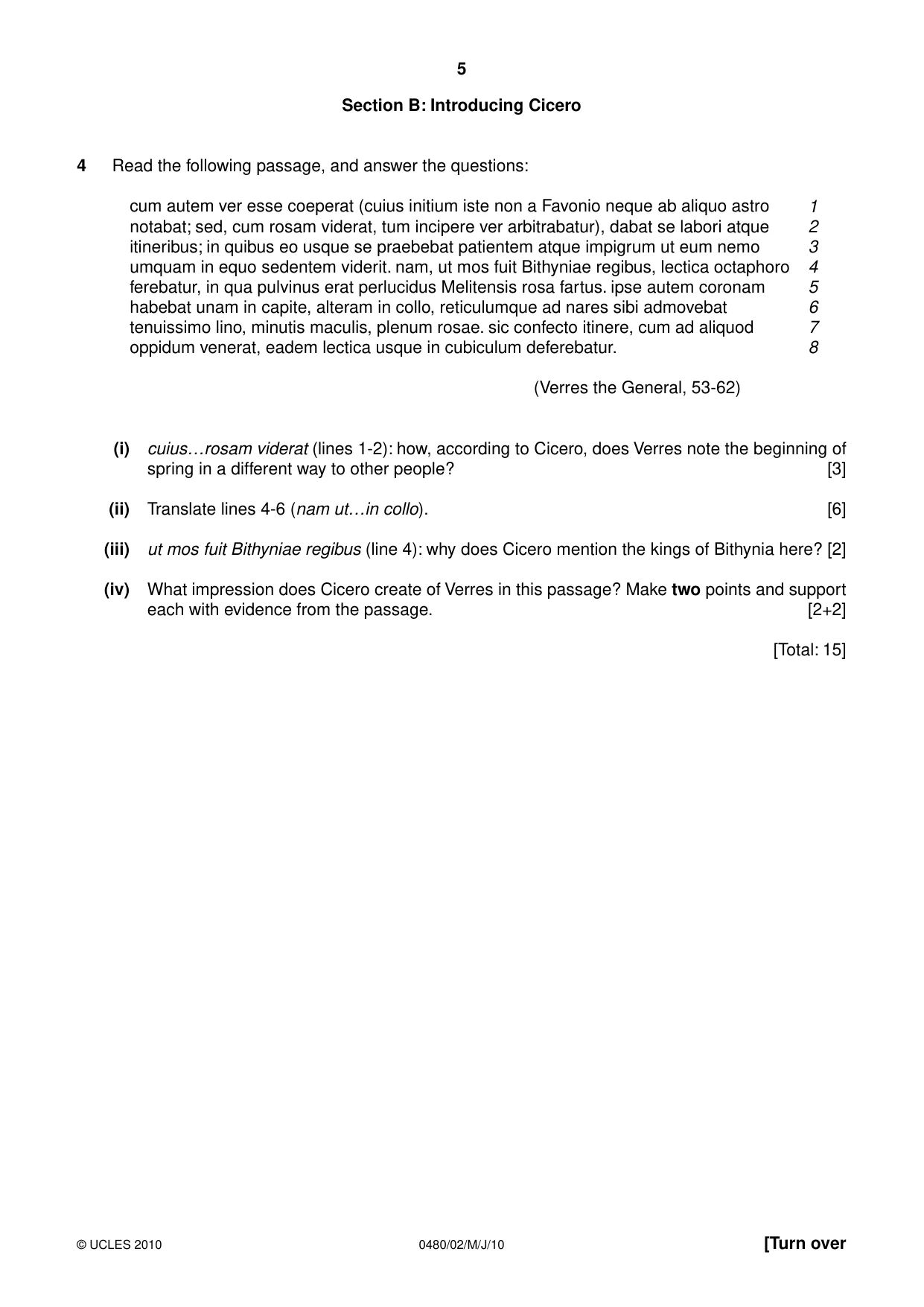
5 0480/02/M/J/10 © UCLES 2010 [Turn over Section B: Introducing Cicero 4 Read the following passage, and answer the questions: cum autem ver esse coeperat (cuius initium iste non a Favonio neque ab aliquo astro notabat; sed, cum rosam viderat, tum incipere ver arbitrabatur), dabat se labori atque itineribus; in quibus eo usque se praebebat patientem atque impigrum ut eum nemo umquam in equo sedentem viderit. nam, ut mos fuit Bithyniae regibus, lectica octaphoro ferebatur, in qua pulvinus erat perlucidus Melitensis rosa fartus. ipse autem coronam habebat unam in capite, alteram in collo, reticulumque ad nares sibi admovebat tenuissimo lino, minutis maculis, plenum rosae. sic confecto itinere, cum ad aliquod oppidum venerat, eadem lectica usque in cubiculum deferebatur. (Verres the General, 53-62) (i) cuius…rosam viderat (lines 1-2): how, according to Cicero, does Verres note the beginning of spring in a different way to other people? [3] (ii) Translate lines 4-6 (nam ut…in collo). [6] (iii) ut mos fuit Bithyniae regibus (line 4): why does Cicero mention the kings of Bithynia here? [2] (iv) What impression does Cicero create of Verres in this passage? Make two points and support each with evidence from the passage. [2+2] [Total: 15] 1 2 3 4 5 6 7 8
Question paper, page 6
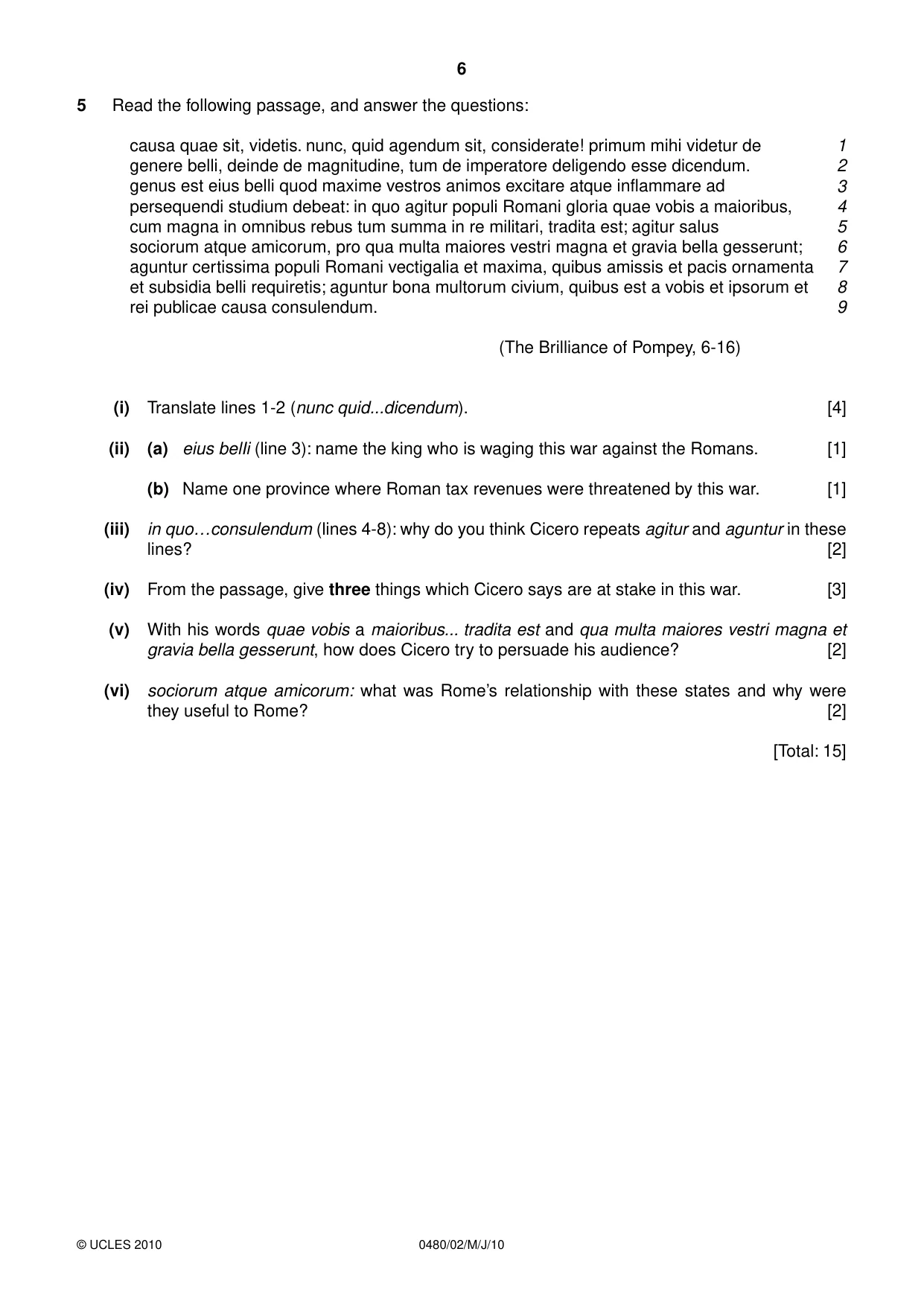
6 0480/02/M/J/10 © UCLES 2010 5 Read the following passage, and answer the questions: causa quae sit, videtis. nunc, quid agendum sit, considerate! primum mihi videtur de genere belli, deinde de magnitudine, tum de imperatore deligendo esse dicendum. genus est eius belli quod maxime vestros animos excitare atque inflammare ad persequendi studium debeat: in quo agitur populi Romani gloria quae vobis a maioribus, cum magna in omnibus rebus tum summa in re militari, tradita est; agitur salus sociorum atque amicorum, pro qua multa maiores vestri magna et gravia bella gesserunt; aguntur certissima populi Romani vectigalia et maxima, quibus amissis et pacis ornamenta et subsidia belli requiretis; aguntur bona multorum civium, quibus est a vobis et ipsorum et rei publicae causa consulendum. (The Brilliance of Pompey, 6-16) (i) Translate lines 1-2 (nunc quid...dicendum). [4] (ii) (a) eius belIi (line 3): name the king who is waging this war against the Romans. [1] (b) Name one province where Roman tax revenues were threatened by this war. [1] (iii) in quo…consulendum (lines 4-8): why do you think Cicero repeats agitur and aguntur in these lines? [2] (iv) From the passage, give three things which Cicero says are at stake in this war. [3] (v) With his words quae vobis a maioribus... tradita est and qua multa maiores vestri magna et gravia bella gesserunt, how does Cicero try to persuade his audience? [2] (vi) sociorum atque amicorum: what was Rome’s relationship with these states and why were they useful to Rome? [2] [Total: 15] 1 2 3 4 5 6 7 8 9
Question paper, page 7
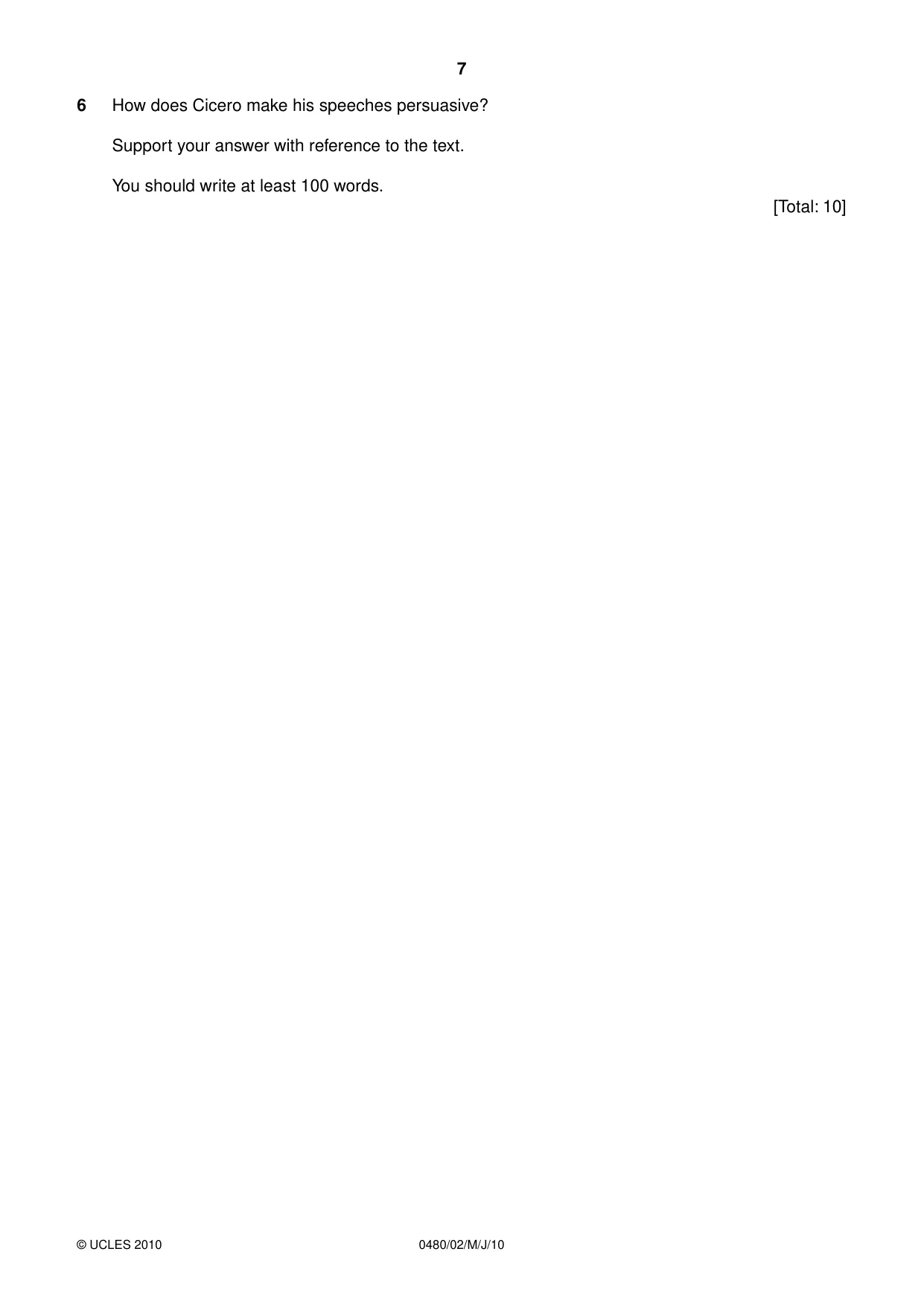
7 0480/02/M/J/10 © UCLES 2010 6 How does Cicero make his speeches persuasive? Support your answer with reference to the text. You should write at least 100 words. [Total: 10]
Question paper, page 8
8 0480/02/M/J/10 © UCLES 2010 BLANK PAGE Permission to reproduce items where third-party owned material protected by copyright is included has been sought and cleared where possible. Every reasonable effort has been made by the publisher (UCLES) to trace copyright holders, but if any items requiring clearance have unwittingly been included, the publisher will be pleased to make amends at the earliest possible opportunity. University of Cambridge International Examinations is part of the Cambridge Assessment Group. Cambridge Assessment is the brand name of University of Cambridge Local Examinations Syndicate (UCLES), which is itself a department of the University of Cambridge.
Mark scheme, page 1
UNIVERSITY OF CAMBRIDGE INTERNATIONAL EXAMINATIONS International General Certificate of Secondary Education MARK SCHEME for the May/June 2010 question paper for the guidance of teachers 0480 LATIN 0480/02 Paper 2 (Literature), maximum raw mark 80 This mark scheme is published as an aid to teachers and candidates, to indicate the requirements of the examination. It shows the basis on which Examiners were instructed to award marks. It does not indicate the details of the discussions that took place at an Examiners’ meeting before marking began, which would have considered the acceptability of alternative answers. Mark schemes must be read in conjunction with the question papers and the report on the examination. • CIE will not enter into discussions or correspondence in connection with these mark schemes. CIE is publishing the mark schemes for the May/June 2010 question papers for most IGCSE, GCE Advanced Level and Advanced Subsidiary Level syllabuses and some Ordinary Level syllabuses. www.XtremePapers.com
Mark scheme, page 2
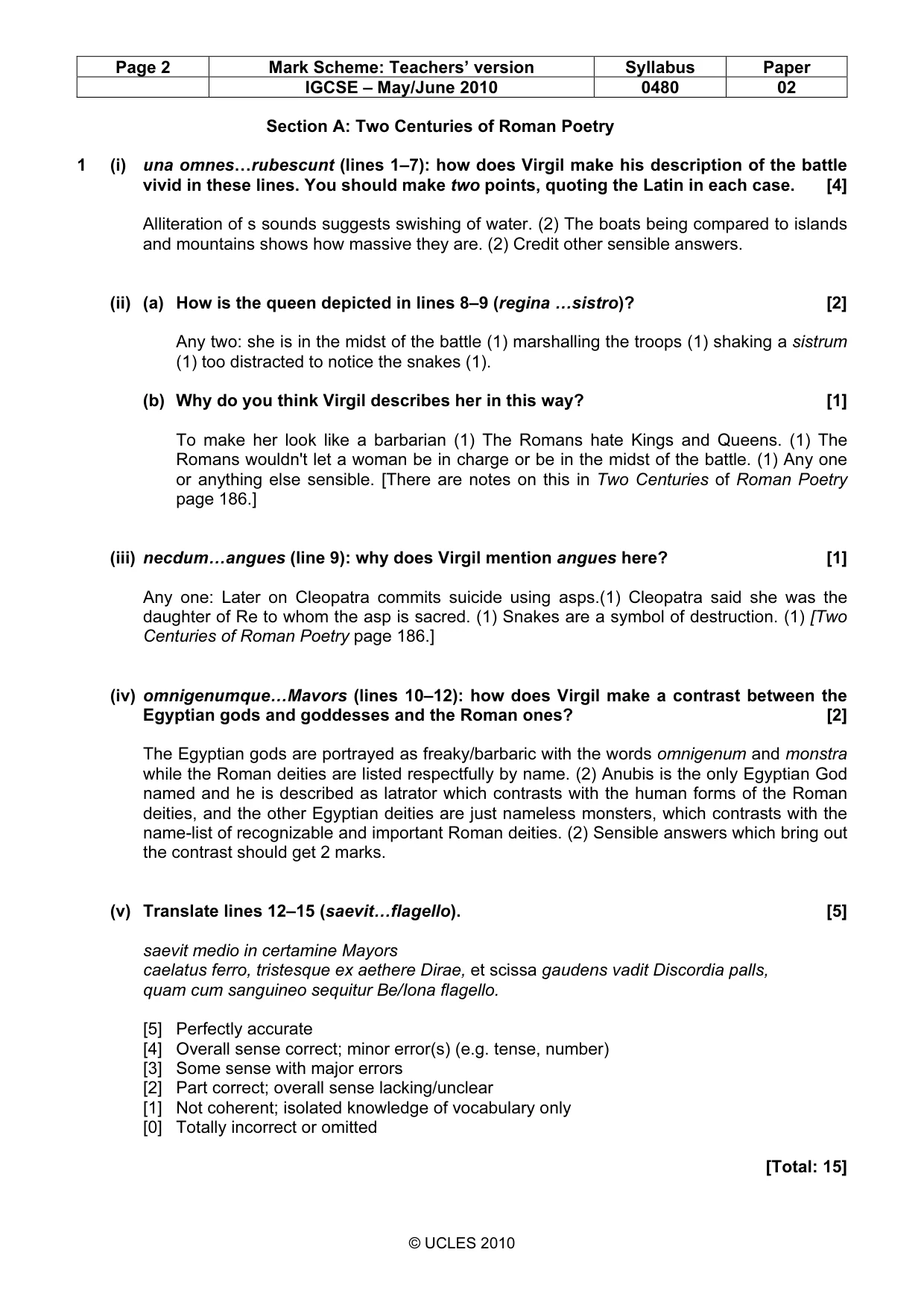
Page 2 Mark Scheme: Teachers’ version Syllabus Paper IGCSE – May/June 2010 0480 02 © UCLES 2010 Section A: Two Centuries of Roman Poetry 1 (i) una omnes…rubescunt (lines 1–7): how does Virgil make his description of the battle vivid in these lines. You should make two points, quoting the Latin in each case. [4] Alliteration of s sounds suggests swishing of water. (2) The boats being compared to islands and mountains shows how massive they are. (2) Credit other sensible answers. (ii) (a) How is the queen depicted in lines 8–9 (regina …sistro)? [2] Any two: she is in the midst of the battle (1) marshalling the troops (1) shaking a sistrum (1) too distracted to notice the snakes (1). (b) Why do you think Virgil describes her in this way? [1] To make her look like a barbarian (1) The Romans hate Kings and Queens. (1) The Romans wouldn't let a woman be in charge or be in the midst of the battle. (1) Any one or anything else sensible. [There are notes on this in Two Centuries of Roman Poetry page 186.] (iii) necdum…angues (line 9): why does Virgil mention angues here? [1] Any one: Later on Cleopatra commits suicide using asps.(1) Cleopatra said she was the daughter of Re to whom the asp is sacred. (1) Snakes are a symbol of destruction. (1) [Two Centuries of Roman Poetry page 186.] (iv) omnigenumque…Mavors (lines 10–12): how does Virgil make a contrast between the Egyptian gods and goddesses and the Roman ones? [2] The Egyptian gods are portrayed as freaky/barbaric with the words omnigenum and monstra while the Roman deities are listed respectfully by name. (2) Anubis is the only Egyptian God named and he is described as latrator which contrasts with the human forms of the Roman deities, and the other Egyptian deities are just nameless monsters, which contrasts with the name-list of recognizable and important Roman deities. (2) Sensible answers which bring out the contrast should get 2 marks. (v) Translate lines 12–15 (saevit…flagello). [5] saevit medio in certamine Mayors caelatus ferro, tristesque ex aethere Dirae, et scissa gaudens vadit Discordia palls, quam cum sanguineo sequitur Be/Iona flagello. [5] Perfectly accurate [4] Overall sense correct; minor error(s) (e.g. tense, number) [3] Some sense with major errors [2] Part correct; overall sense lacking/unclear [1] Not coherent; isolated knowledge of vocabulary only [0] Totally incorrect or omitted [Total: 15]
Mark scheme, page 3
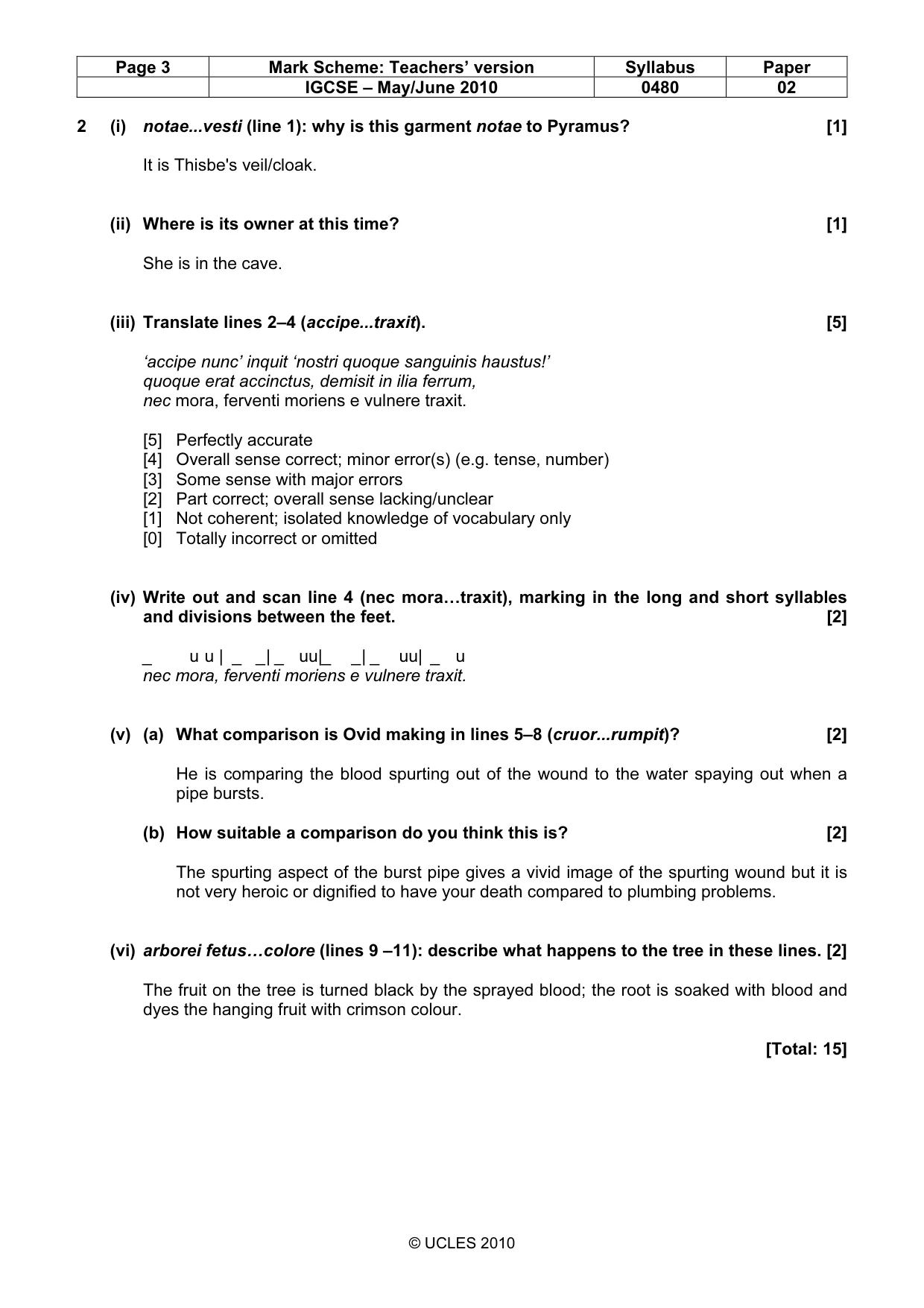
Page 3 Mark Scheme: Teachers’ version Syllabus Paper IGCSE – May/June 2010 0480 02 © UCLES 2010 2 (i) notae...vesti (line 1): why is this garment notae to Pyramus? [1] It is Thisbe's veil/cloak. (ii) Where is its owner at this time? [1] She is in the cave. (iii) Translate lines 2–4 (accipe...traxit). [5] ‘accipe nunc’ inquit ‘nostri quoque sanguinis haustus!’ quoque erat accinctus, demisit in ilia ferrum, nec mora, ferventi moriens e vulnere traxit. [5] Perfectly accurate [4] Overall sense correct; minor error(s) (e.g. tense, number) [3] Some sense with major errors [2] Part correct; overall sense lacking/unclear [1] Not coherent; isolated knowledge of vocabulary only [0] Totally incorrect or omitted (iv) Write out and scan line 4 (nec mora…traxit), marking in the long and short syllables and divisions between the feet. [2] _ec muru,|f _rv_|t_muu|_ie _| _e vuu|l _eru nec mora, ferventi moriens e vulnere traxit. (v) (a) What comparison is Ovid making in lines 5–8 (cruor...rumpit)? [2] He is comparing the blood spurting out of the wound to the water spaying out when a pipe bursts. (b) How suitable a comparison do you think this is? [2] The spurting aspect of the burst pipe gives a vivid image of the spurting wound but it is not very heroic or dignified to have your death compared to plumbing problems. (vi) arborei fetus…colore (lines 9 –11): describe what happens to the tree in these lines. [2] The fruit on the tree is turned black by the sprayed blood; the root is soaked with blood and dyes the hanging fruit with crimson colour. [Total: 15]
Mark scheme, page 4
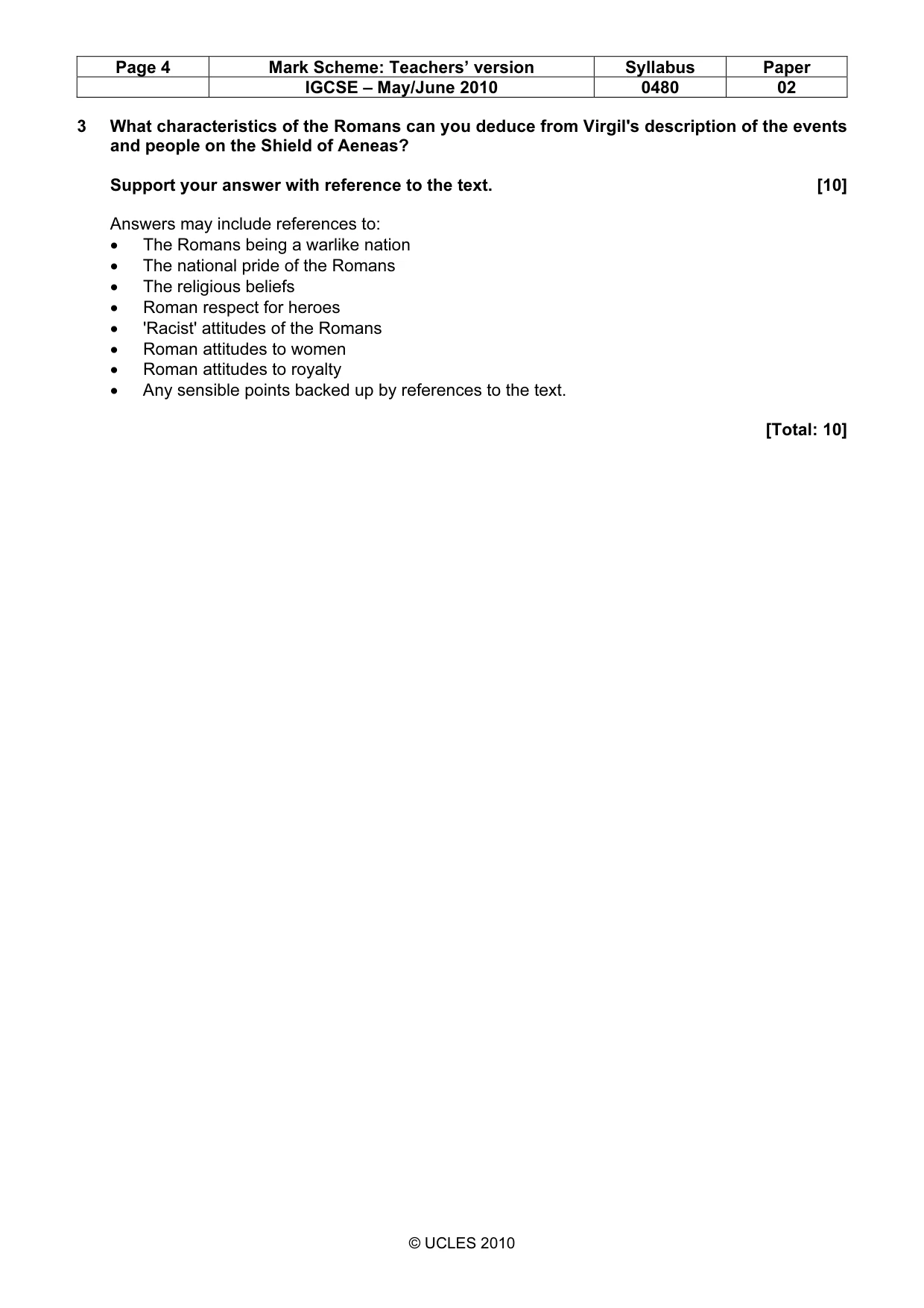
Page 4 Mark Scheme: Teachers’ version Syllabus Paper IGCSE – May/June 2010 0480 02 © UCLES 2010 3 What characteristics of the Romans can you deduce from Virgil's description of the events and people on the Shield of Aeneas? Support your answer with reference to the text. [10] Answers may include references to: • The Romans being a warlike nation • The national pride of the Romans • The religious beliefs • Roman respect for heroes • 'Racist' attitudes of the Romans • Roman attitudes to women • Roman attitudes to royalty • Any sensible points backed up by references to the text. [Total: 10]
Mark scheme, page 5
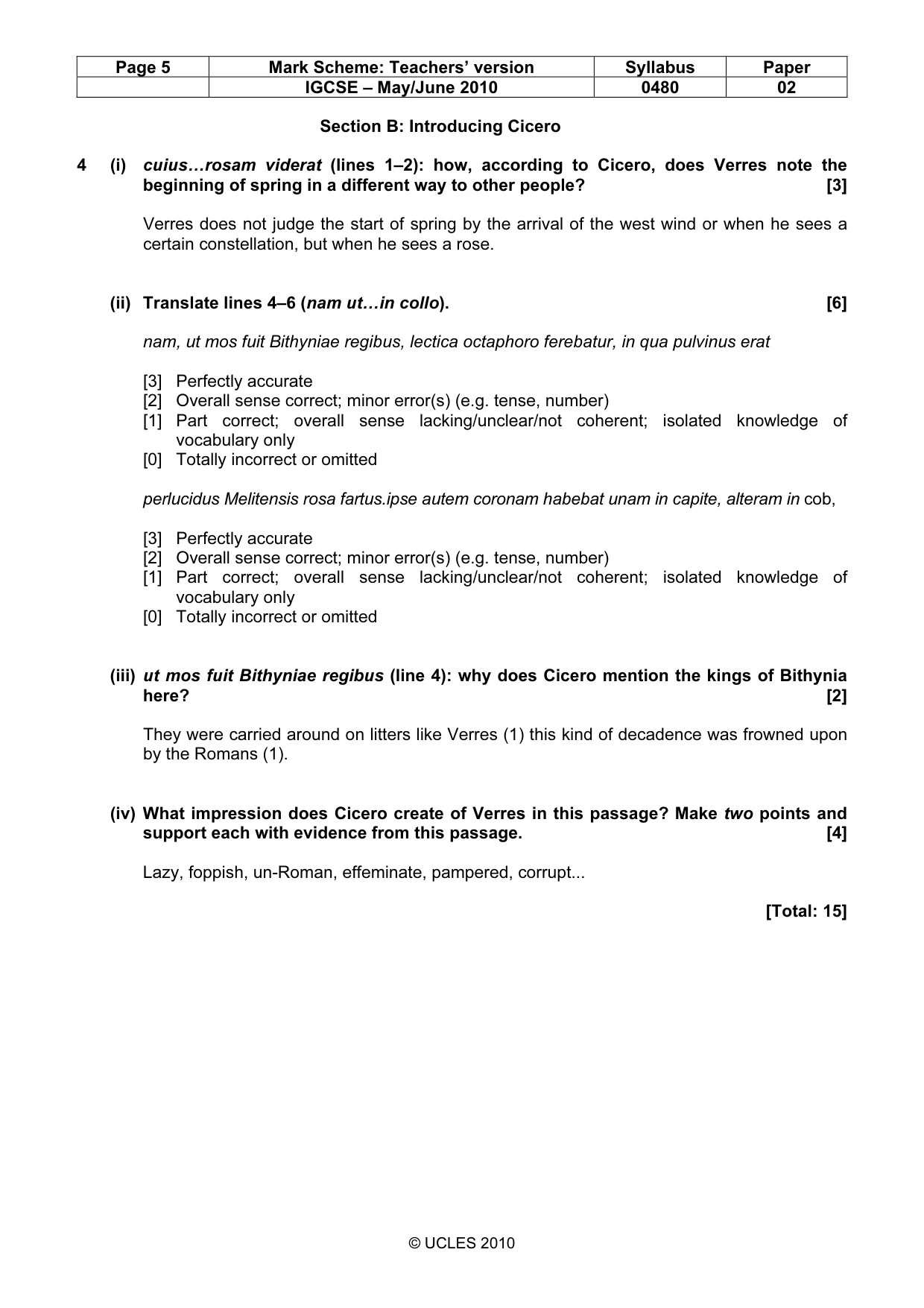
Page 5 Mark Scheme: Teachers’ version Syllabus Paper IGCSE – May/June 2010 0480 02 © UCLES 2010 Section B: Introducing Cicero 4 (i) cuius…rosam viderat (lines 1–2): how, according to Cicero, does Verres note the beginning of spring in a different way to other people? [3] Verres does not judge the start of spring by the arrival of the west wind or when he sees a certain constellation, but when he sees a rose. (ii) Translate lines 4–6 (nam ut…in collo). [6] nam, ut mos fuit Bithyniae regibus, lectica octaphoro ferebatur, in qua pulvinus erat [3] Perfectly accurate [2] Overall sense correct; minor error(s) (e.g. tense, number) [1] Part correct; overall sense lacking/unclear/not coherent; isolated knowledge of vocabulary only [0] Totally incorrect or omitted perlucidus Melitensis rosa fartus.ipse autem coronam habebat unam in capite, alteram in cob, [3] Perfectly accurate [2] Overall sense correct; minor error(s) (e.g. tense, number) [1] Part correct; overall sense lacking/unclear/not coherent; isolated knowledge of vocabulary only [0] Totally incorrect or omitted (iii) ut mos fuit Bithyniae regibus (line 4): why does Cicero mention the kings of Bithynia here? [2] They were carried around on litters like Verres (1) this kind of decadence was frowned upon by the Romans (1). (iv) What impression does Cicero create of Verres in this passage? Make two points and support each with evidence from this passage. [4] Lazy, foppish, un-Roman, effeminate, pampered, corrupt... [Total: 15]
Mark scheme, page 6
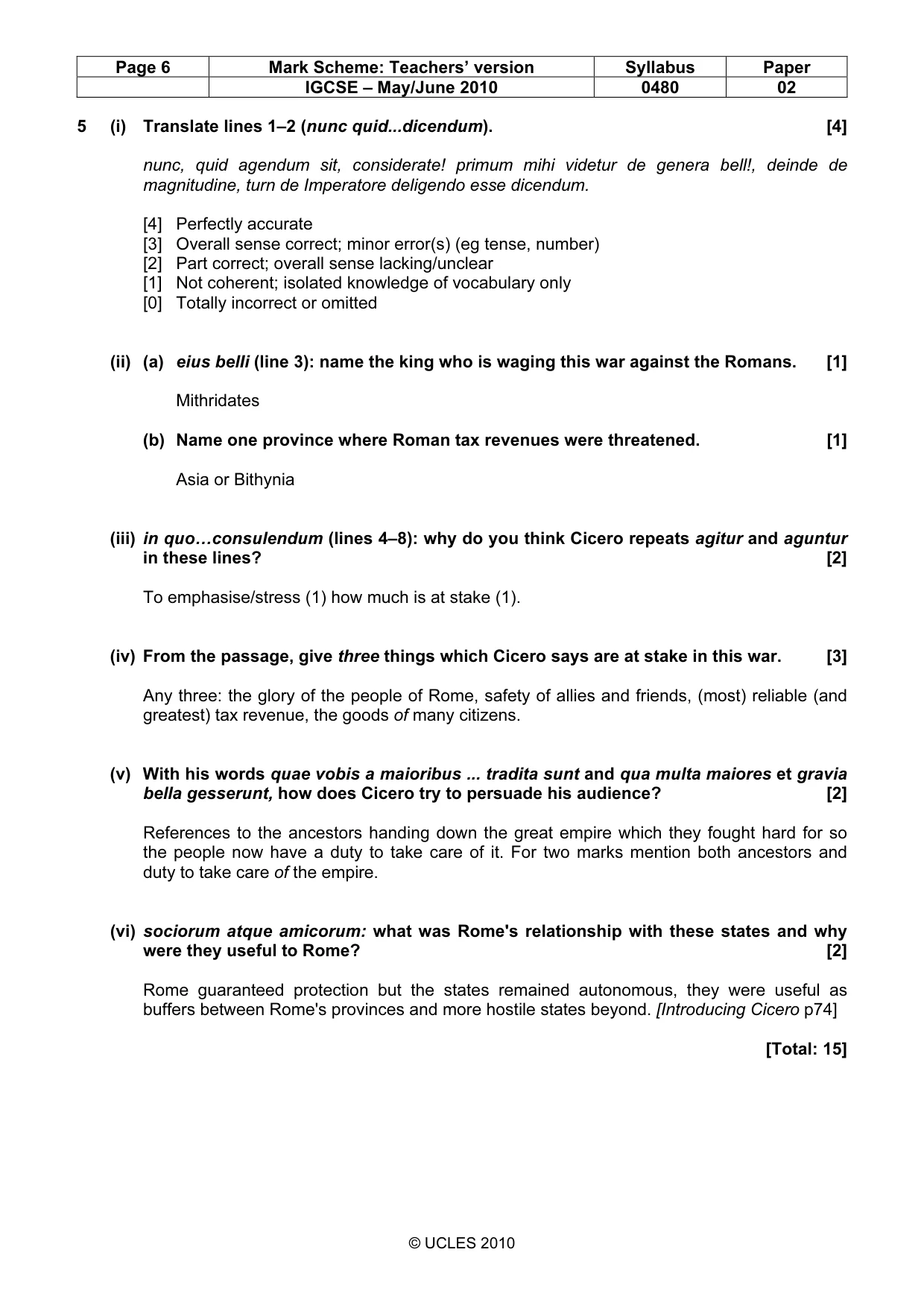
Page 6 Mark Scheme: Teachers’ version Syllabus Paper IGCSE – May/June 2010 0480 02 © UCLES 2010 5 (i) Translate lines 1–2 (nunc quid...dicendum). [4] nunc, quid agendum sit, considerate! primum mihi videtur de genera bell!, deinde de magnitudine, turn de Imperatore deligendo esse dicendum. [4] Perfectly accurate [3] Overall sense correct; minor error(s) (eg tense, number) [2] Part correct; overall sense lacking/unclear [1] Not coherent; isolated knowledge of vocabulary only [0] Totally incorrect or omitted (ii) (a) eius belIi (line 3): name the king who is waging this war against the Romans. [1] Mithridates (b) Name one province where Roman tax revenues were threatened. [1] Asia or Bithynia (iii) in quo…consulendum (lines 4–8): why do you think Cicero repeats agitur and aguntur in these lines? [2] To emphasise/stress (1) how much is at stake (1). (iv) From the passage, give three things which Cicero says are at stake in this war. [3] Any three: the glory of the people of Rome, safety of allies and friends, (most) reliable (and greatest) tax revenue, the goods of many citizens. (v) With his words quae vobis a maioribus ... tradita sunt and qua multa maiores et gravia bella gesserunt, how does Cicero try to persuade his audience? [2] References to the ancestors handing down the great empire which they fought hard for so the people now have a duty to take care of it. For two marks mention both ancestors and duty to take care of the empire. (vi) sociorum atque amicorum: what was Rome's relationship with these states and why were they useful to Rome? [2] Rome guaranteed protection but the states remained autonomous, they were useful as buffers between Rome's provinces and more hostile states beyond. [Introducing Cicero p74] [Total: 15]
Mark scheme, page 7
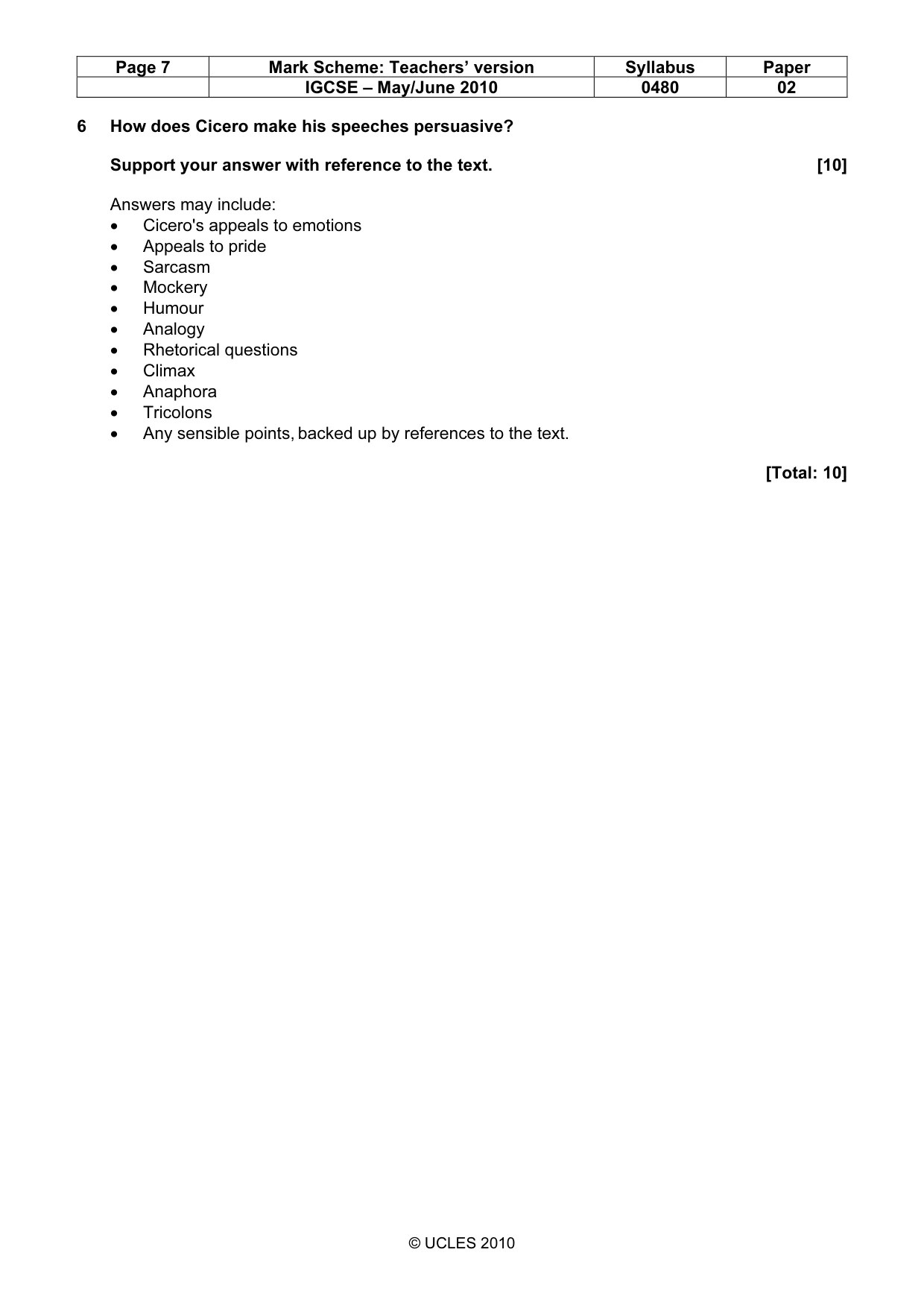
Page 7 Mark Scheme: Teachers’ version Syllabus Paper IGCSE – May/June 2010 0480 02 © UCLES 2010 6 How does Cicero make his speeches persuasive? Support your answer with reference to the text. [10] Answers may include: • Cicero's appeals to emotions • Appeals to pride • Sarcasm • Mockery • Humour • Analogy • Rhetorical questions • Climax • Anaphora • Tricolons • Any sensible points, backed up by references to the text. [Total: 10]
What you needed in this session
Cambridge’s own grade thresholds for 2010 May/June, Paper 2 · Variant 1. A higher threshold means an easier paper — the bar moves with how the cohort did.