Cambridge IGCSE Latin 0480 — 2008 May/June Paper 2 · Variant 1
0480/21/M/J/08 · 80 marks · ≈90 min
The question paper and its mark scheme, free to read here and free to download. This is Cambridge’s own paper, exactly as it was sat.
Question paper8 pages


Mark scheme3 pages
Answers below. Sit the paper first if you are practising.
Paper as text
Question paper, page 1
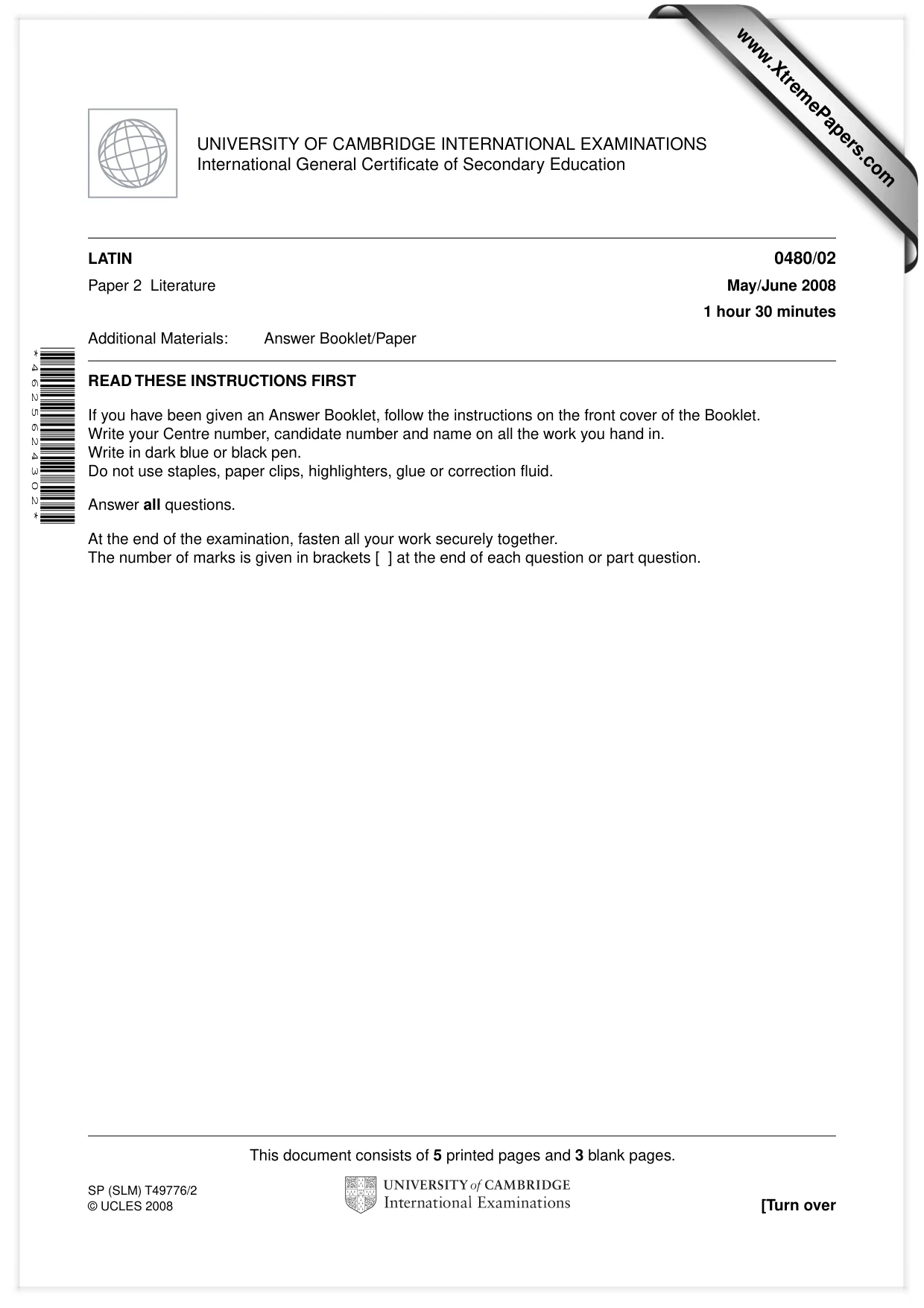
This document consists of 5 printed pages and 3 blank pages. SP (SLM) T49776/2 © UCLES 2008 [Turn over UNIVERSITY OF CAMBRIDGE INTERNATIONAL EXAMINATIONS International General Certificate of Secondary Education READ THESE INSTRUCTIONS FIRST If you have been given an Answer Booklet, follow the instructions on the front cover of the Booklet. Write your Centre number, candidate number and name on all the work you hand in. Write in dark blue or black pen. Do not use staples, paper clips, highlighters, glue or correction fluid. Answer all questions. At the end of the examination, fasten all your work securely together. The number of marks is given in brackets [ ] at the end of each question or part question. * 4 6 2 5 6 2 4 3 0 2 * LATIN 0480/02 Paper 2 Literature May/June 2008 1 hour 30 minutes Additional Materials: Answer Booklet/Paper www.XtremePapers.com
Question paper, page 2
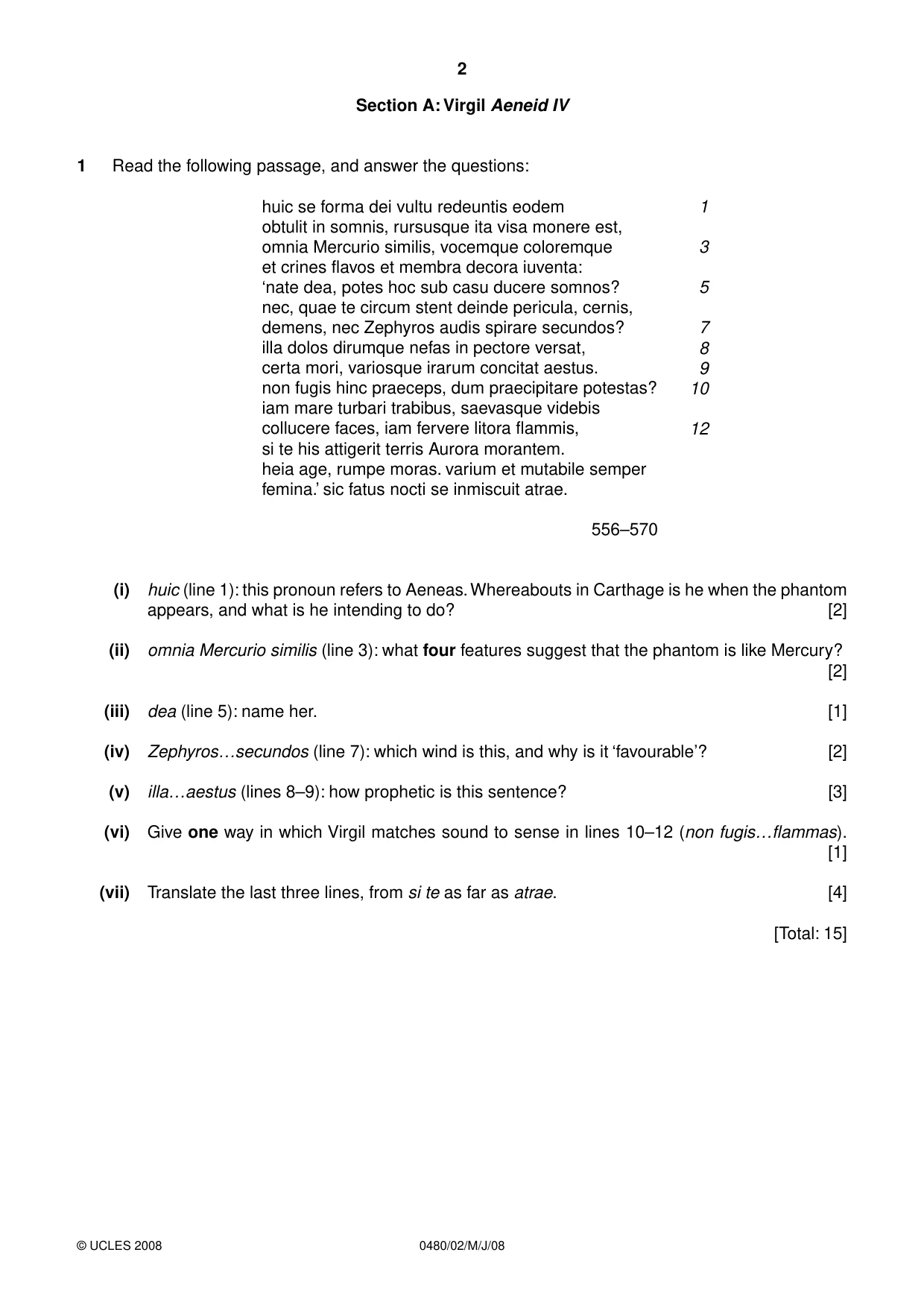
2 0480/02/M/J/08 © UCLES 2008 Section A: Virgil Aeneid IV 1 Read the following passage, and answer the questions: huic se forma dei vultu redeuntis eodem obtulit in somnis, rursusque ita visa monere est, omnia Mercurio similis, vocemque coloremque et crines flavos et membra decora iuventa: ‘nate dea, potes hoc sub casu ducere somnos? nec, quae te circum stent deinde pericula, cernis, demens, nec Zephyros audis spirare secundos? illa dolos dirumque nefas in pectore versat, certa mori, variosque irarum concitat aestus. non fugis hinc praeceps, dum praecipitare potestas? iam mare turbari trabibus, saevasque videbis collucere faces, iam fervere litora flammis, si te his attigerit terris Aurora morantem. heia age, rumpe moras. varium et mutabile semper femina.’ sic fatus nocti se inmiscuit atrae. 556–570 (i) huic (line 1): this pronoun refers to Aeneas. Whereabouts in Carthage is he when the phantom appears, and what is he intending to do? [2] (ii) omnia Mercurio similis (line 3): what four features suggest that the phantom is like Mercury? [2] (iii) dea (line 5): name her. [1] (iv) Zephyros…secundos (line 7): which wind is this, and why is it ‘favourable’? [2] (v) illa…aestus (lines 8–9): how prophetic is this sentence? [3] (vi) Give one way in which Virgil matches sound to sense in lines 10–12 (non fugis…flammas). [1] (vii) Translate the last three lines, from si te as far as atrae. [4] [Total: 15] 1 3 5 7 8 9 10 12
Question paper, page 3
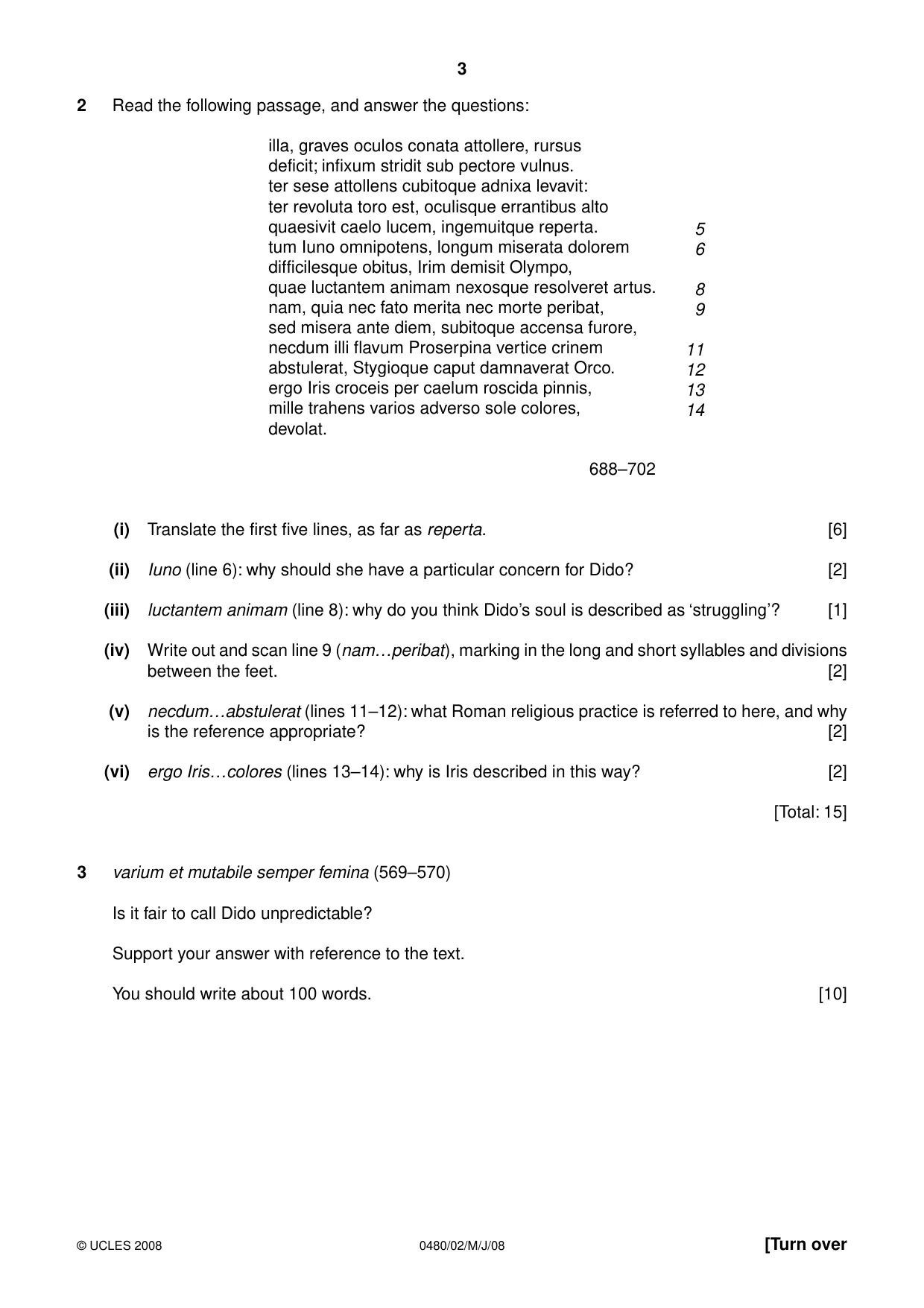
3 0480/02/M/J/08 © UCLES 2008 [Turn over 2 Read the following passage, and answer the questions: illa, graves oculos conata attollere, rursus deficit; infixum stridit sub pectore vulnus. ter sese attollens cubitoque adnixa levavit: ter revoluta toro est, oculisque errantibus alto quaesivit caelo lucem, ingemuitque reperta. tum Iuno omnipotens, longum miserata dolorem difficilesque obitus, Irim demisit Olympo, quae luctantem animam nexosque resolveret artus. nam, quia nec fato merita nec morte peribat, sed misera ante diem, subitoque accensa furore, necdum illi flavum Proserpina vertice crinem abstulerat, Stygioque caput damnaverat Orco. ergo Iris croceis per caelum roscida pinnis, mille trahens varios adverso sole colores, devolat. 688–702 (i) Translate the first five lines, as far as reperta. [6] (ii) Iuno (line 6): why should she have a particular concern for Dido? [2] (iii) luctantem animam (line 8): why do you think Dido’s soul is described as ‘struggling’? [1] (iv) Write out and scan line 9 (nam…peribat ), marking in the long and short syllables and divisions between the feet. [2] (v) necdum…abstulerat (lines 11–12): what Roman religious practice is referred to here, and why is the reference appropriate? [2] (vi) ergo Iris…colores (lines 13–14): why is Iris described in this way? [2] [Total: 15] 3 varium et mutabile semper femina (569–570) Is it fair to call Dido unpredictable? Support your answer with reference to the text. You should write about 100 words. [10] 5 6 8 9 11 12 13 14
Question paper, page 4
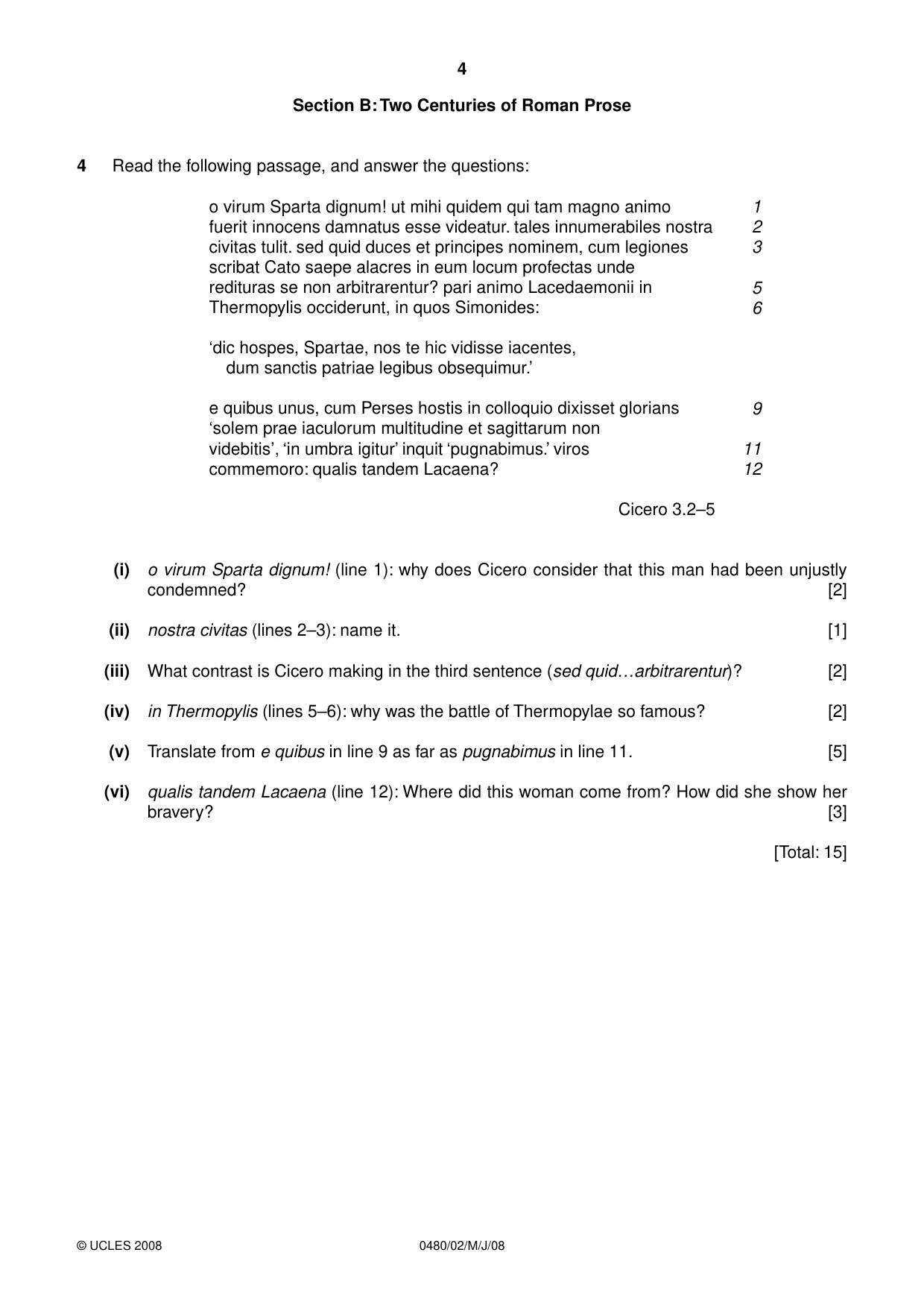
4 0480/02/M/J/08 © UCLES 2008 Section B: Two Centuries of Roman Prose 4 Read the following passage, and answer the questions: o virum Sparta dignum! ut mihi quidem qui tam magno animo fuerit innocens damnatus esse videatur. tales innumerabiles nostra civitas tulit. sed quid duces et principes nominem, cum legiones scribat Cato saepe alacres in eum locum profectas unde redituras se non arbitrarentur? pari animo Lacedaemonii in Thermopylis occiderunt, in quos Simonides: ‘dic hospes, Spartae, nos te hic vidisse iacentes, dum sanctis patriae legibus obsequimur.’ e quibus unus, cum Perses hostis in colloquio dixisset glorians ‘solem prae iaculorum multitudine et sagittarum non videbitis’, ‘in umbra igitur’ inquit ‘pugnabimus.’ viros commemoro: qualis tandem Lacaena? Cicero 3.2–5 (i) o virum Sparta dignum! (line 1): why does Cicero consider that this man had been unjustly condemned? [2] (ii) nostra civitas (lines 2–3): name it. [1] (iii) What contrast is Cicero making in the third sentence (sed quid…arbitrarentur)? [2] (iv) in Thermopylis (lines 5–6): why was the battle of Thermopylae so famous? [2] (v) Translate from e quibus in line 9 as far as pugnabimus in line 11. [5] (vi) qualis tandem Lacaena (line 12): Where did this woman come from? How did she show her bravery? [3] [Total: 15] 1 2 3 5 6 9 11 12
Question paper, page 5
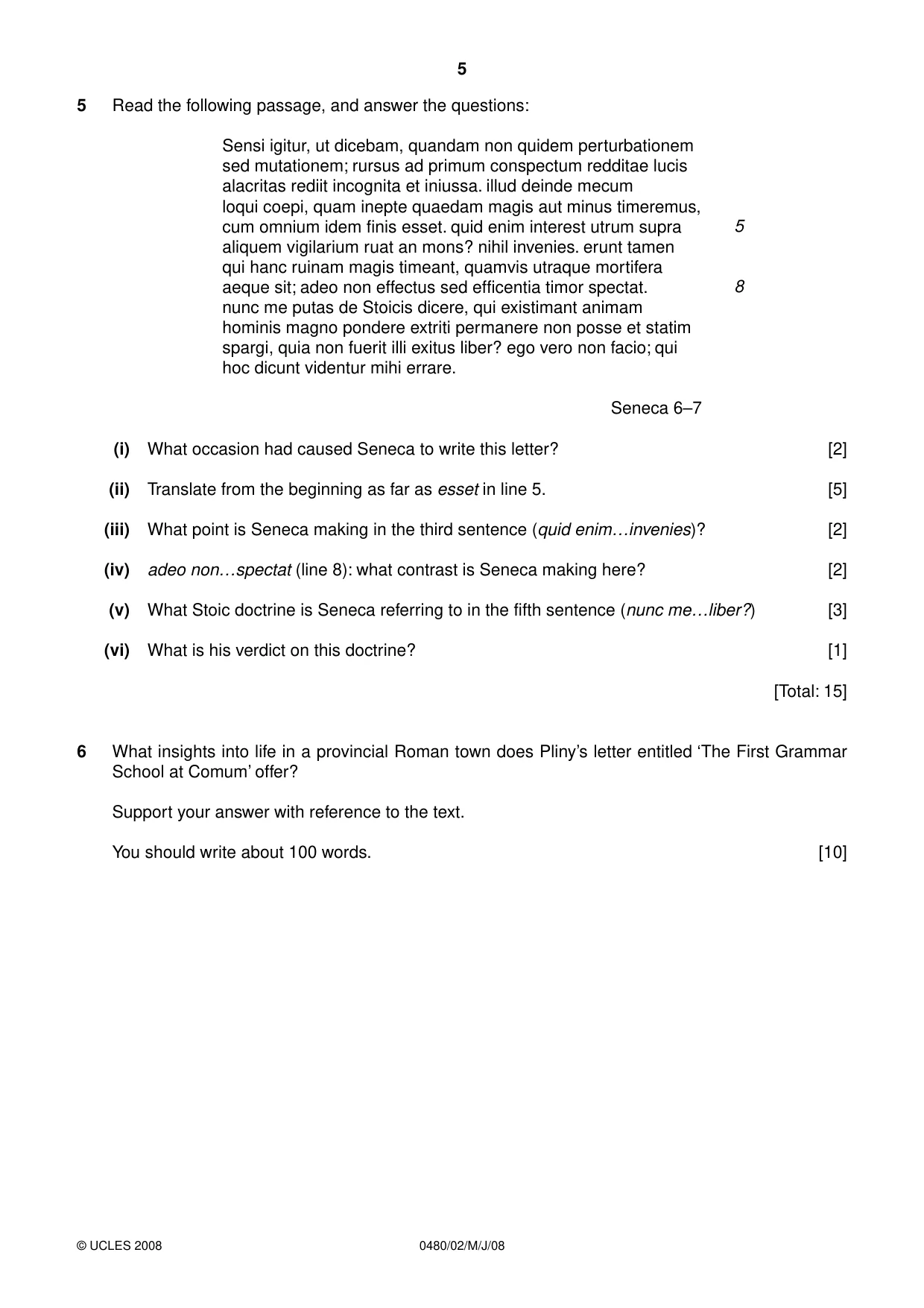
5 0480/02/M/J/08 © UCLES 2008 5 Read the following passage, and answer the questions: Sensi igitur, ut dicebam, quandam non quidem perturbationem sed mutationem; rursus ad primum conspectum redditae lucis alacritas rediit incognita et iniussa. illud deinde mecum loqui coepi, quam inepte quaedam magis aut minus timeremus, cum omnium idem finis esset. quid enim interest utrum supra aliquem vigilarium ruat an mons? nihil invenies. erunt tamen qui hanc ruinam magis timeant, quamvis utraque mortifera aeque sit; adeo non effectus sed efficentia timor spectat. nunc me putas de Stoicis dicere, qui existimant animam hominis magno pondere extriti permanere non posse et statim spargi, quia non fuerit illi exitus liber? ego vero non facio; qui hoc dicunt videntur mihi errare. Seneca 6–7 (i) What occasion had caused Seneca to write this letter? [2] (ii) Translate from the beginning as far as esset in line 5. [5] (iii) What point is Seneca making in the third sentence (quid enim…invenies)? [2] (iv) adeo non…spectat (line 8): what contrast is Seneca making here? [2] (v) What Stoic doctrine is Seneca referring to in the fifth sentence (nunc me…liber?) [3] (vi) What is his verdict on this doctrine? [1] [Total: 15] 6 What insights into life in a provincial Roman town does Pliny’s letter entitled ‘The First Grammar School at Comum’ offer? Support your answer with reference to the text. You should write about 100 words. [10] 5 8
Question paper, page 8
8 0480/02/M/J/08 BLANK PAGE Permission to reproduce items where third-party owned material protected by copyright is included has been sought and cleared where possible. Every reasonable effort has been made by the publisher (UCLES) to trace copyright holders, but if any items requiring clearance have unwittingly been included, the publisher will be pleased to make amends at the earliest possible opportunity. University of Cambridge International Examinations is part of the Cambridge Assessment Group. Cambridge Assessment is the brand name of University of Cambridge Local Examinations Syndicate (UCLES), which is itself a department of the University of Cambridge.
Mark scheme, page 1
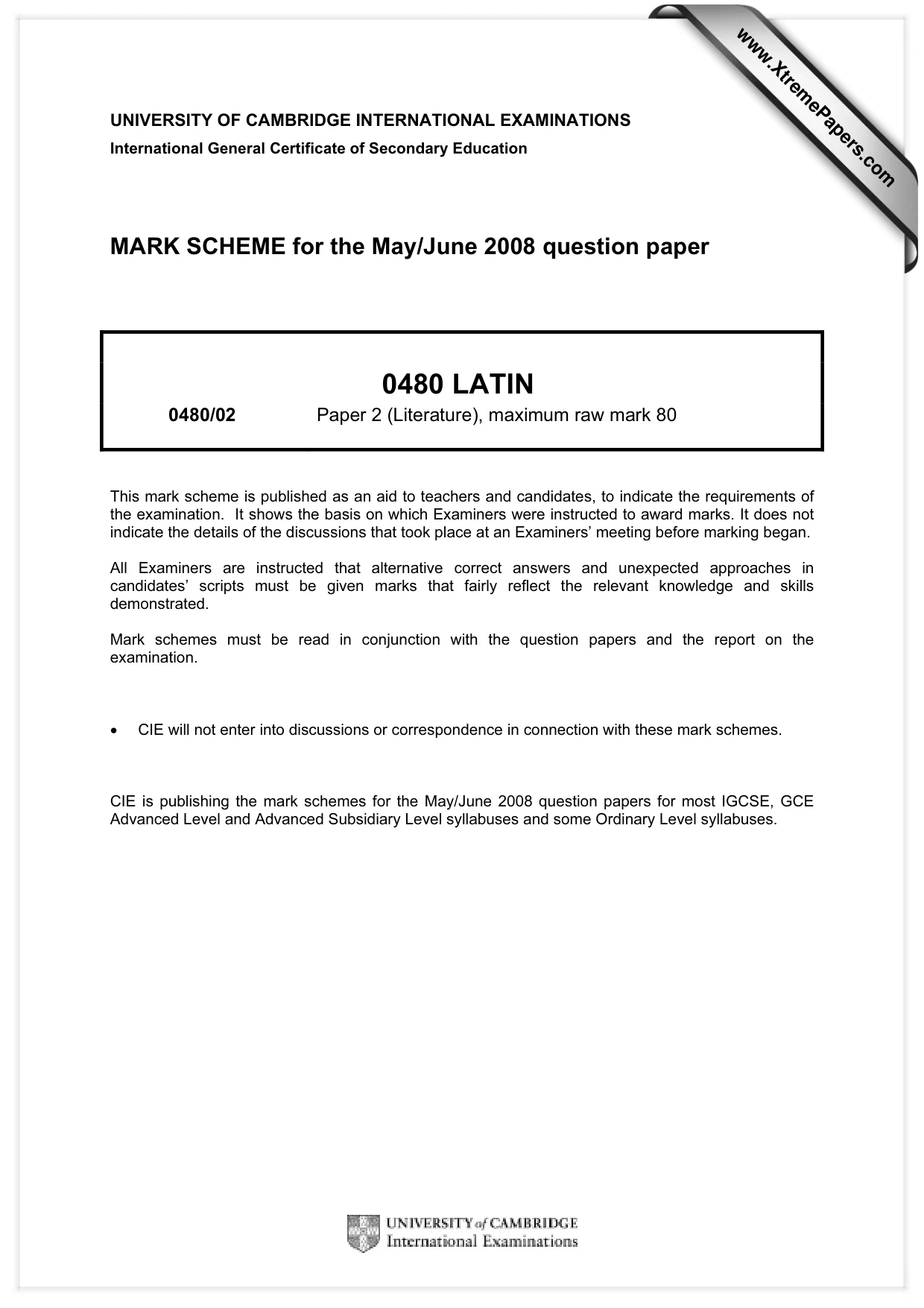
UNIVERSITY OF CAMBRIDGE INTERNATIONAL EXAMINATIONS International General Certificate of Secondary Education MARK SCHEME for the May/June 2008 question paper 0480 LATIN 0480/02 Paper 2 (Literature), maximum raw mark 80 This mark scheme is published as an aid to teachers and candidates, to indicate the requirements of the examination. It shows the basis on which Examiners were instructed to award marks. It does not indicate the details of the discussions that took place at an Examiners’ meeting before marking began. All Examiners are instructed that alternative correct answers and unexpected approaches in candidates’ scripts must be given marks that fairly reflect the relevant knowledge and skills demonstrated. Mark schemes must be read in conjunction with the question papers and the report on the examination. • CIE will not enter into discussions or correspondence in connection with these mark schemes. CIE is publishing the mark schemes for the May/June 2008 question papers for most IGCSE, GCE Advanced Level and Advanced Subsidiary Level syllabuses and some Ordinary Level syllabuses. www.XtremePapers.com
Mark scheme, page 2
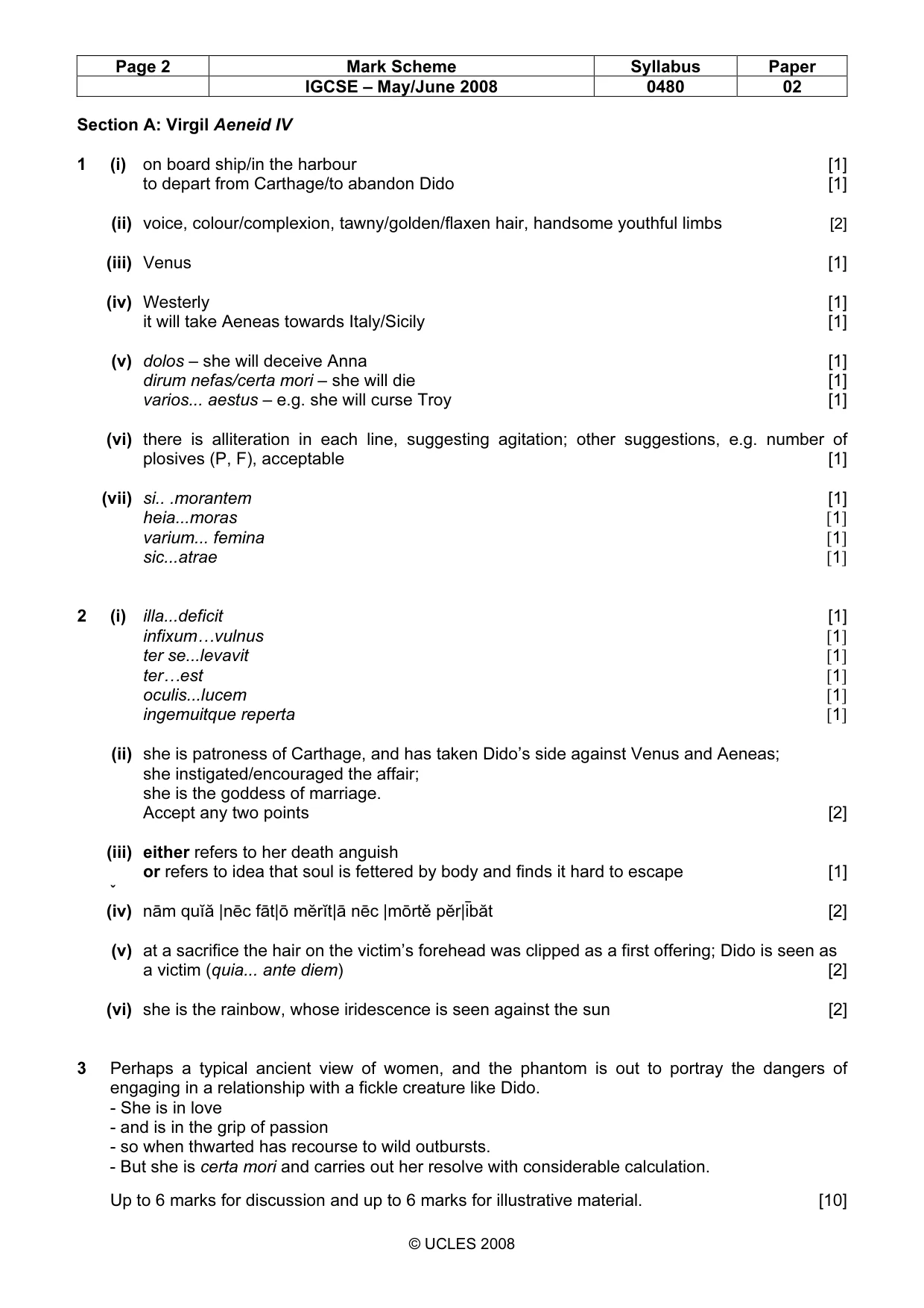
Page 2 Mark Scheme Syllabus Paper IGCSE – May/June 2008 0480 02 © UCLES 2008 Section A: Virgil Aeneid IV 1 (i) on board ship/in the harbour [1] to depart from Carthage/to abandon Dido [1] (ii) voice, colour/complexion, tawny/golden/flaxen hair, handsome youthful limbs [2] (iii) Venus [1] (iv) Westerly [1] it will take Aeneas towards Italy/Sicily [1] (v) dolos – she will deceive Anna [1] dirum nefas/certa mori – she will die [1] varios... aestus – e.g. she will curse Troy [1] (vi) there is alliteration in each line, suggesting agitation; other suggestions, e.g. number of plosives (P, F), acceptable [1] (vii) si.. .morantem [1] heia...moras [1] varium... femina [1] sic...atrae [1] 2 (i) illa...deficit [1] infixum…vulnus [1] ter se...levavit [1] ter…est [1] oculis...lucem [1] ingemuitque reperta [1] (ii) she is patroness of Carthage, and has taken Dido’s side against Venus and Aeneas; she instigated/encouraged the affair; she is the goddess of marriage. Accept any two points [2] (iii) either refers to her death anguish or refers to idea that soul is fettered by body and finds it hard to escape [1] ˇ (iv) nām quĭă |nēc fāt|ō mĕrĭt|ā nēc |mōrtě pĕr|ibăt [2] (v) at a sacrifice the hair on the victim’s forehead was clipped as a first offering; Dido is seen as a victim (quia... ante diem) [2] (vi) she is the rainbow, whose iridescence is seen against the sun [2] 3 Perhaps a typical ancient view of women, and the phantom is out to portray the dangers of engaging in a relationship with a fickle creature like Dido. - She is in love - and is in the grip of passion - so when thwarted has recourse to wild outbursts. - But she is certa mori and carries out her resolve with considerable calculation. Up to 6 marks for discussion and up to 6 marks for illustrative material. [10]
Mark scheme, page 3
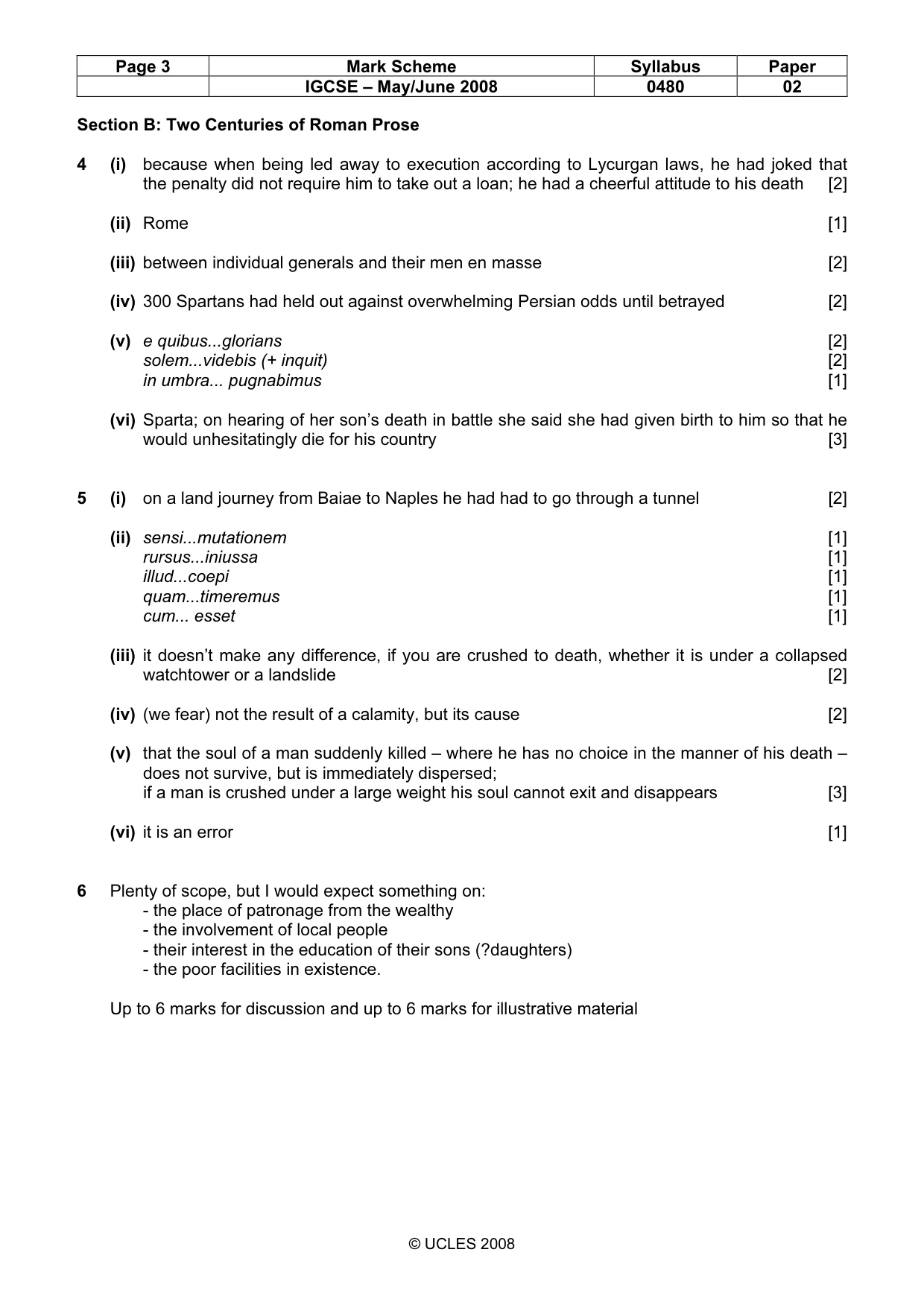
Page 3 Mark Scheme Syllabus Paper IGCSE – May/June 2008 0480 02 © UCLES 2008 Section B: Two Centuries of Roman Prose 4 (i) because when being led away to execution according to Lycurgan laws, he had joked that the penalty did not require him to take out a loan; he had a cheerful attitude to his death [2] (ii) Rome [1] (iii) between individual generals and their men en masse [2] (iv) 300 Spartans had held out against overwhelming Persian odds until betrayed [2] (v) e quibus...glorians [2] solem...videbis (+ inquit) [2] in umbra... pugnabimus [1] (vi) Sparta; on hearing of her son’s death in battle she said she had given birth to him so that he would unhesitatingly die for his country [3] 5 (i) on a land journey from Baiae to Naples he had had to go through a tunnel [2] (ii) sensi...mutationem [1] rursus...iniussa [1] illud...coepi [1] quam...timeremus [1] cum... esset [1] (iii) it doesn’t make any difference, if you are crushed to death, whether it is under a collapsed watchtower or a landslide [2] (iv) (we fear) not the result of a calamity, but its cause [2] (v) that the soul of a man suddenly killed – where he has no choice in the manner of his death – does not survive, but is immediately dispersed; if a man is crushed under a large weight his soul cannot exit and disappears [3] (vi) it is an error [1] 6 Plenty of scope, but I would expect something on: - the place of patronage from the wealthy - the involvement of local people - their interest in the education of their sons (?daughters) - the poor facilities in existence. Up to 6 marks for discussion and up to 6 marks for illustrative material
What you needed in this session
Cambridge’s own grade thresholds for 2008 May/June, Paper 2 · Variant 1. A higher threshold means an easier paper — the bar moves with how the cohort did.