Cambridge IGCSE Latin 0480 — 2008 May/June Paper 1 · Variant 1
0480/11/M/J/08 · 65 marks · ≈73 min
The question paper and its mark scheme, free to read here and free to download. This is Cambridge’s own paper, exactly as it was sat.
Question paper8 pages




Mark scheme3 pages
Answers below. Sit the paper first if you are practising.
Paper as text
Question paper, page 1
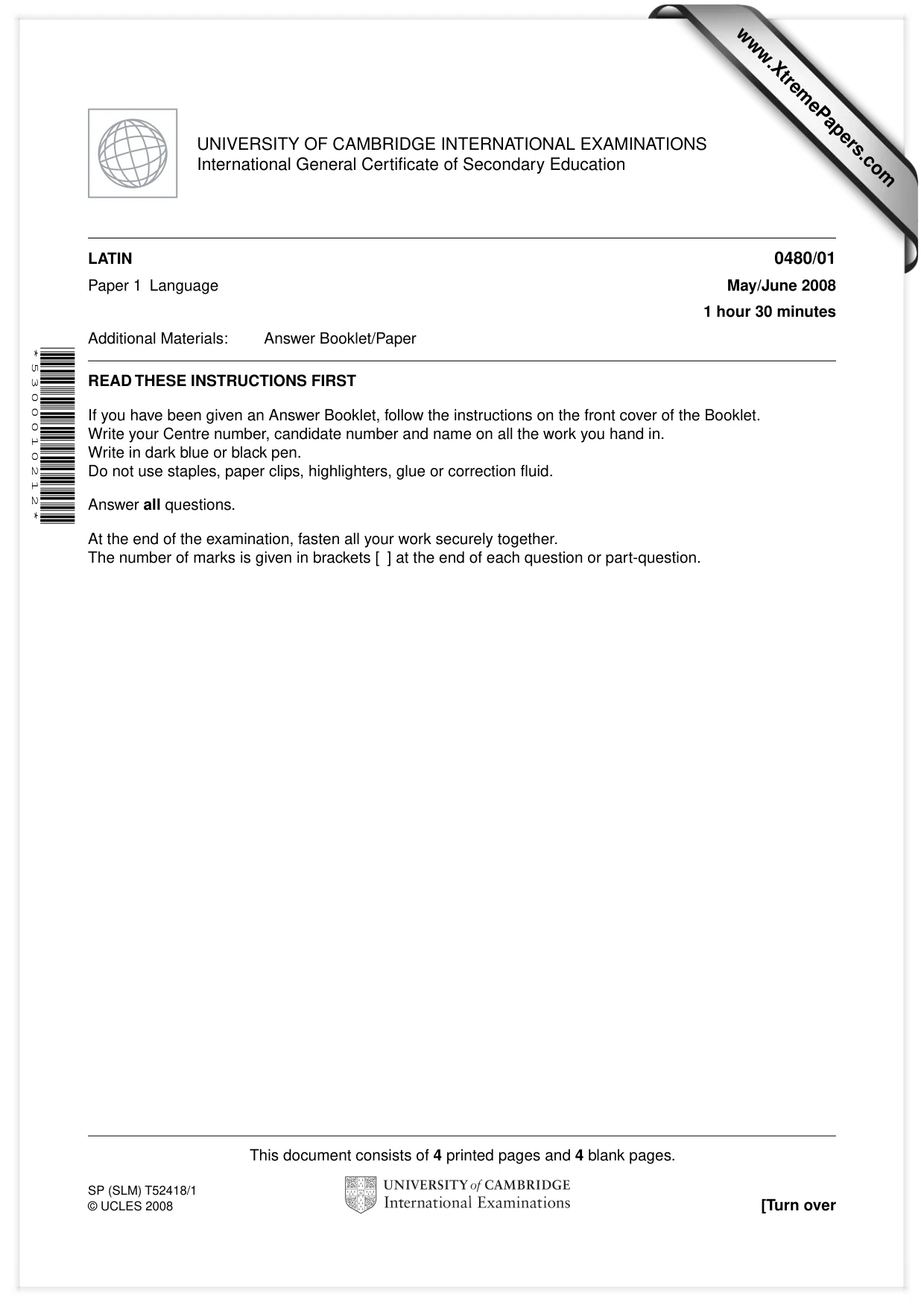
This document consists of 4 printed pages and 4 blank pages. SP (SLM) T52418/1 © UCLES 2008 [Turn over UNIVERSITY OF CAMBRIDGE INTERNATIONAL EXAMINATIONS International General Certificate of Secondary Education READ THESE INSTRUCTIONS FIRST If you have been given an Answer Booklet, follow the instructions on the front cover of the Booklet. Write your Centre number, candidate number and name on all the work you hand in. Write in dark blue or black pen. Do not use staples, paper clips, highlighters, glue or correction fluid. Answer all questions. At the end of the examination, fasten all your work securely together. The number of marks is given in brackets [ ] at the end of each question or part-question. * 5 3 0 0 0 1 0 2 1 2 * LATIN 0480/01 Paper 1 Language May/June 2008 1 hour 30 minutes Additional Materials: Answer Booklet/Paper www.XtremePapers.com
Question paper, page 2
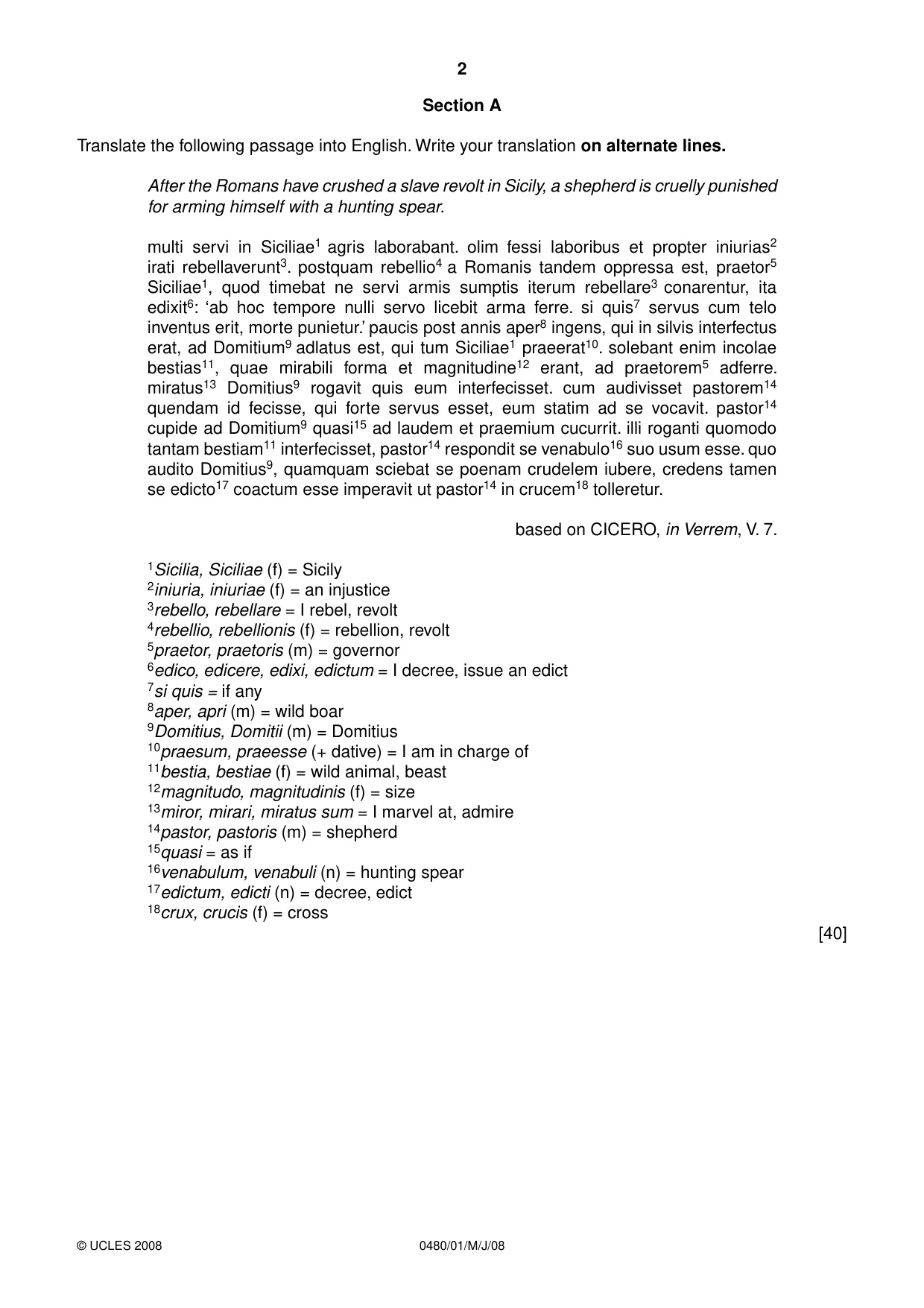
2 0480/01/M/J/08 © UCLES 2008 Section A Translate the following passage into English. Write your translation on alternate lines. After the Romans have crushed a slave revolt in Sicily, a shepherd is cruelly punished for arming himself with a hunting spear. multi servi in Siciliae1 agris laborabant. olim fessi laboribus et propter iniurias2 irati rebellaverunt3. postquam rebellio4 a Romanis tandem oppressa est, praetor5 Siciliae1, quod timebat ne servi armis sumptis iterum rebellare3 conarentur, ita edixit6: ‘ab hoc tempore nulli servo licebit arma ferre. si quis7 servus cum telo inventus erit, morte punietur.’ paucis post annis aper8 ingens, qui in silvis interfectus erat, ad Domitium9 adlatus est, qui tum Siciliae1 praeerat10. solebant enim incolae bestias11, quae mirabili forma et magnitudine12 erant, ad praetorem5 adferre. miratus13 Domitius9 rogavit quis eum interfecisset. cum audivisset pastorem14 quendam id fecisse, qui forte servus esset, eum statim ad se vocavit. pastor14 cupide ad Domitium9 quasi15 ad laudem et praemium cucurrit. illi roganti quomodo tantam bestiam11 interfecisset, pastor14 respondit se venabulo16 suo usum esse. quo audito Domitius9, quamquam sciebat se poenam crudelem iubere, credens tamen se edicto17 coactum esse imperavit ut pastor14 in crucem18 tolleretur. based on CICERO, in Verrem, V. 7. 1Sicilia, Siciliae (f) = Sicily 2iniuria, iniuriae (f) = an injustice 3rebello, rebellare = I rebel, revolt 4rebellio, rebellionis (f) = rebellion, revolt 5praetor, praetoris (m) = governor 6edico, edicere, edixi, edictum = I decree, issue an edict 7si quis = if any 8aper, apri (m) = wild boar 9Domitius, Domitii (m) = Domitius 10praesum, praeesse (+ dative) = I am in charge of 11bestia, bestiae (f) = wild animal, beast 12magnitudo, magnitudinis (f) = size 13miror, mirari, miratus sum = I marvel at, admire 14pastor, pastoris (m) = shepherd 15quasi = as if 16venabulum, venabuli (n) = hunting spear 17edictum, edicti (n) = decree, edict 18crux, crucis (f) = cross [40]
Question paper, page 3
3 0480/01/M/J/08 [Turn over BLANK PAGE SECTION B CONTINUES ON NEXT PAGE
Question paper, page 4
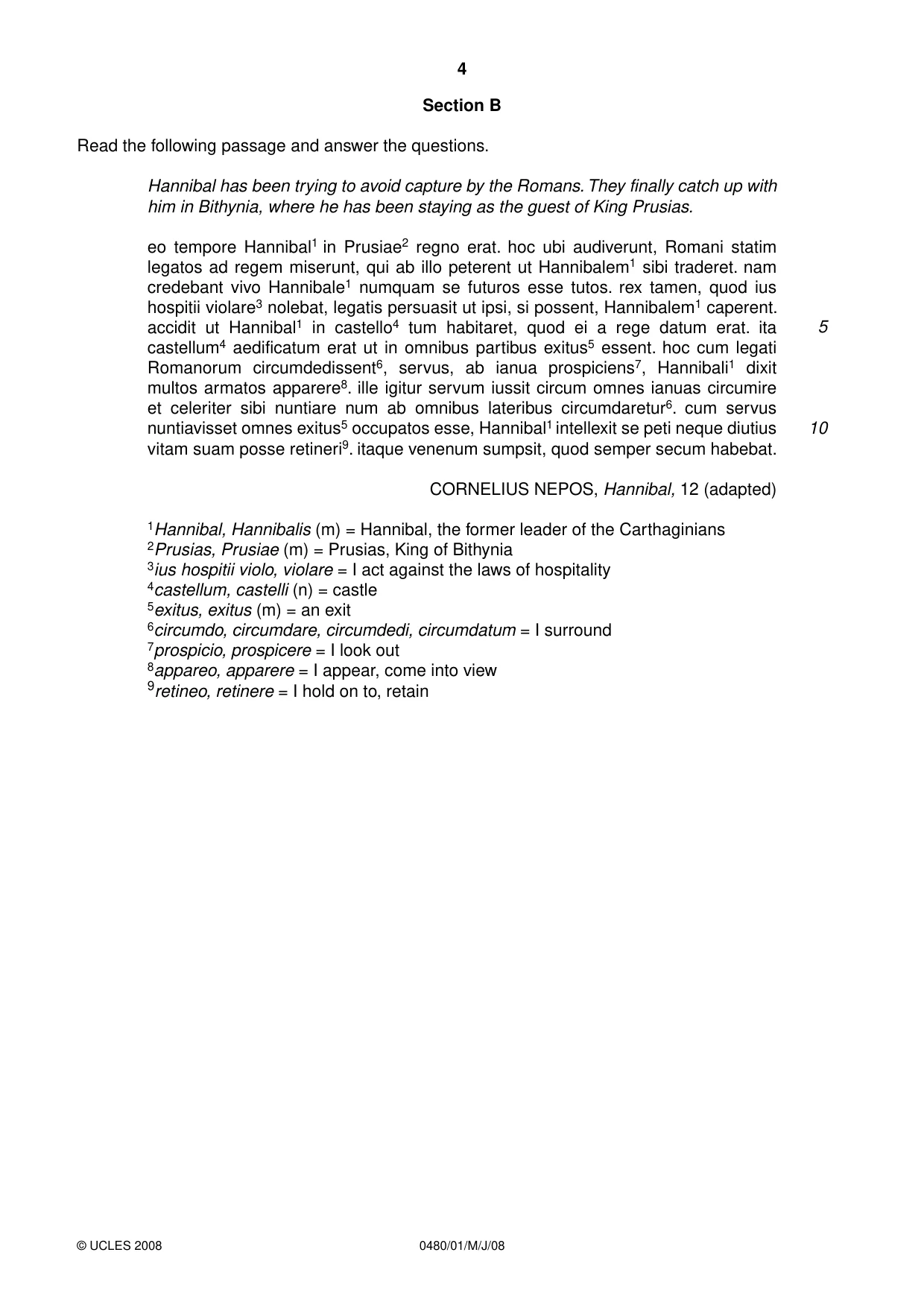
4 0480/01/M/J/08 © UCLES 2008 Section B Read the following passage and answer the questions. Hannibal has been trying to avoid capture by the Romans. They finally catch up with him in Bithynia, where he has been staying as the guest of King Prusias. eo tempore Hannibal1 in Prusiae2 regno erat. hoc ubi audiverunt, Romani statim legatos ad regem miserunt, qui ab illo peterent ut Hannibalem1 sibi traderet. nam credebant vivo Hannibale1 numquam se futuros esse tutos. rex tamen, quod ius hospitii violare3 nolebat, legatis persuasit ut ipsi, si possent, Hannibalem1 caperent. accidit ut Hannibal1 in castello4 tum habitaret, quod ei a rege datum erat. ita castellum4 aedificatum erat ut in omnibus partibus exitus5 essent. hoc cum legati Romanorum circumdedissent6, servus, ab ianua prospiciens7, Hannibali1 dixit multos armatos apparere8. ille igitur servum iussit circum omnes ianuas circumire et celeriter sibi nuntiare num ab omnibus lateribus circumdaretur6. cum servus nuntiavisset omnes exitus5 occupatos esse, Hannibal1 intellexit se peti neque diutius vitam suam posse retineri9. itaque venenum sumpsit, quod semper secum habebat. CORNELIUS NEPOS, Hannibal, 12 (adapted) 1Hannibal, Hannibalis (m) = Hannibal, the former leader of the Carthaginians 2Prusias, Prusiae (m) = Prusias, King of Bithynia 3ius hospitii violo, violare = I act against the laws of hospitality 4castellum, castelli (n) = castle 5exitus, exitus (m) = an exit 6circumdo, circumdare, circumdedi, circumdatum = I surround 7prospicio, prospicere = I look out 8appareo, apparere = I appear, come into view 9retineo, retinere = I hold on to, retain 5 10
Question paper, page 5
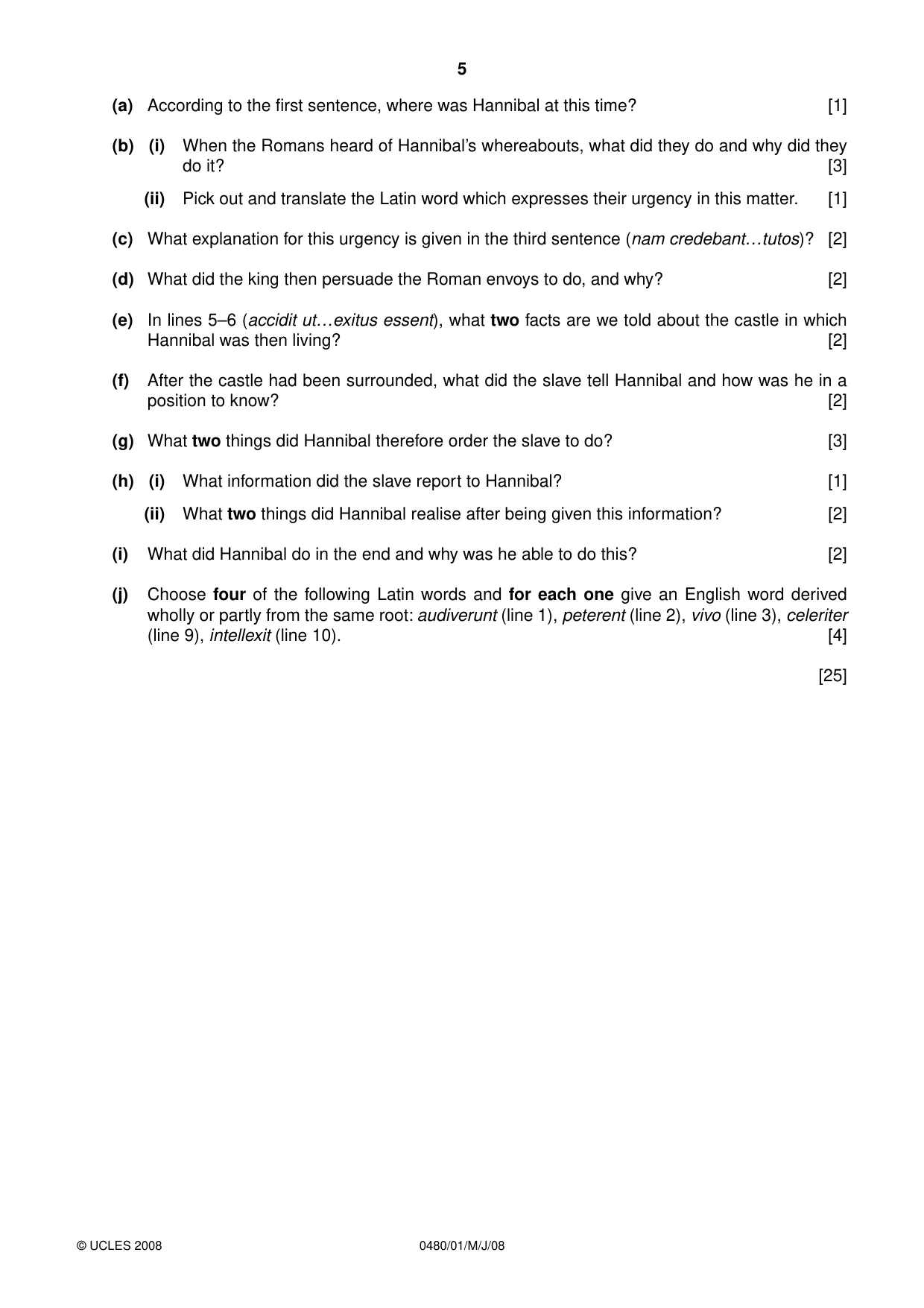
5 0480/01/M/J/08 © UCLES 2008 (a) According to the first sentence, where was Hannibal at this time? [1] (b) (i) When the Romans heard of Hannibal’s whereabouts, what did they do and why did they do it? [3] (ii) Pick out and translate the Latin word which expresses their urgency in this matter. [1] (c) What explanation for this urgency is given in the third sentence (nam credebant…tutos)? [2] (d) What did the king then persuade the Roman envoys to do, and why? [2] (e) In lines 5–6 (accidit ut…exitus essent), what two facts are we told about the castle in which Hannibal was then living? [2] (f) After the castle had been surrounded, what did the slave tell Hannibal and how was he in a position to know? [2] (g) What two things did Hannibal therefore order the slave to do? [3] (h) (i) What information did the slave report to Hannibal? [1] (ii) What two things did Hannibal realise after being given this information? [2] (i) What did Hannibal do in the end and why was he able to do this? [2] (j) Choose four of the following Latin words and for each one give an English word derived wholly or partly from the same root: audiverunt (line 1), peterent (line 2), vivo (line 3), celeriter (line 9), intellexit (line 10). [4] [25]
Question paper, page 8
8 0480/01/M/J/08 BLANK PAGE Permission to reproduce items where third-party owned material protected by copyright is included has been sought and cleared where possible. Every reasonable effort has been made by the publisher (UCLES) to trace copyright holders, but if any items requiring clearance have unwittingly been included, the publisher will be pleased to make amends at the earliest possible opportunity. University of Cambridge International Examinations is part of the Cambridge Assessment Group. Cambridge Assessment is the brand name of University of Cambridge Local Examinations Syndicate (UCLES), which is itself a department of the University of Cambridge.
Mark scheme, page 1
UNIVERSITY OF CAMBRIDGE INTERNATIONAL EXAMINATIONS International General Certificate of Secondary Education MARK SCHEME for the May/June 2008 question paper 0480 LATIN 0480/01 Paper 1 (Language), maximum raw mark 65 This mark scheme is published as an aid to teachers and candidates, to indicate the requirements of the examination. It shows the basis on which Examiners were instructed to award marks. It does not indicate the details of the discussions that took place at an Examiners’ meeting before marking began. All Examiners are instructed that alternative correct answers and unexpected approaches in candidates’ scripts must be given marks that fairly reflect the relevant knowledge and skills demonstrated. Mark schemes must be read in conjunction with the question papers and the report on the examination. • CIE will not enter into discussions or correspondence in connection with these mark schemes. CIE is publishing the mark schemes for the May/June 2008 question papers for most IGCSE, GCE Advanced Level and Advanced Subsidiary Level syllabuses and some Ordinary Level syllabuses. www.XtremePapers.com
Mark scheme, page 2
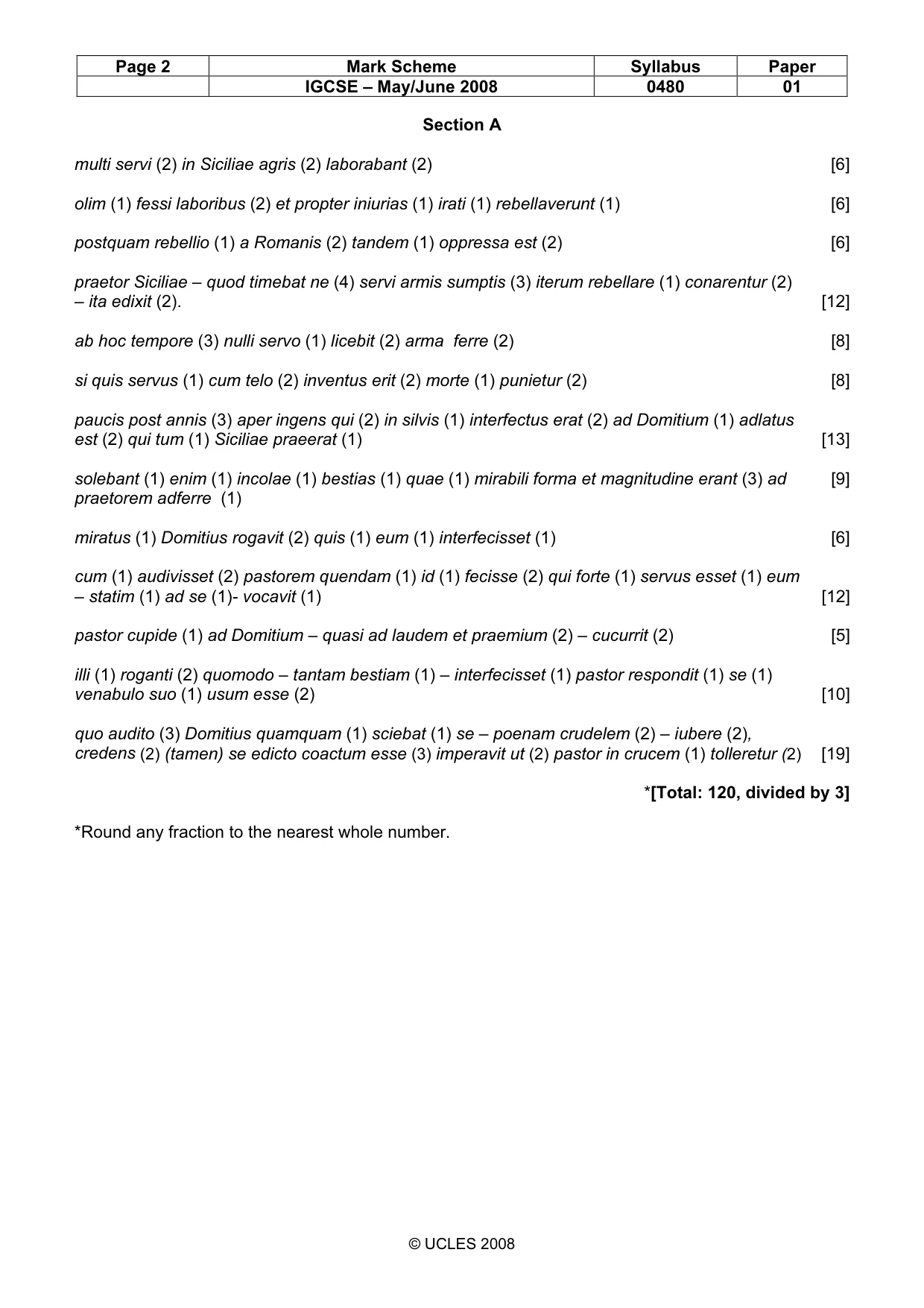
Page 2 Mark Scheme Syllabus Paper IGCSE – May/June 2008 0480 01 © UCLES 2008 Section A multi servi (2) in Siciliae agris (2) laborabant (2) [6] olim (1) fessi laboribus (2) et propter iniurias (1) irati (1) rebellaverunt (1) [6] postquam rebellio (1) a Romanis (2) tandem (1) oppressa est (2) [6] praetor Siciliae – quod timebat ne (4) servi armis sumptis (3) iterum rebellare (1) conarentur (2) – ita edixit (2). [12] ab hoc tempore (3) nulli servo (1) licebit (2) arma ferre (2) [8] si quis servus (1) cum telo (2) inventus erit (2) morte (1) punietur (2) [8] paucis post annis (3) aper ingens qui (2) in silvis (1) interfectus erat (2) ad Domitium (1) adlatus est (2) qui tum (1) Siciliae praeerat (1) [13] solebant (1) enim (1) incolae (1) bestias (1) quae (1) mirabili forma et magnitudine erant (3) ad praetorem adferre (1) [9] miratus (1) Domitius rogavit (2) quis (1) eum (1) interfecisset (1) [6] cum (1) audivisset (2) pastorem quendam (1) id (1) fecisse (2) qui forte (1) servus esset (1) eum – statim (1) ad se (1)- vocavit (1) [12] pastor cupide (1) ad Domitium – quasi ad laudem et praemium (2) – cucurrit (2) [5] illi (1) roganti (2) quomodo – tantam bestiam (1) – interfecisset (1) pastor respondit (1) se (1) venabulo suo (1) usum esse (2) [10] quo audito (3) Domitius quamquam (1) sciebat (1) se – poenam crudelem (2) – iubere (2), credens (2) (tamen) se edicto coactum esse (3) imperavit ut (2) pastor in crucem (1) tolleretur (2) [19] *[Total: 120, divided by 3] *Round any fraction to the nearest whole number.
Mark scheme, page 3
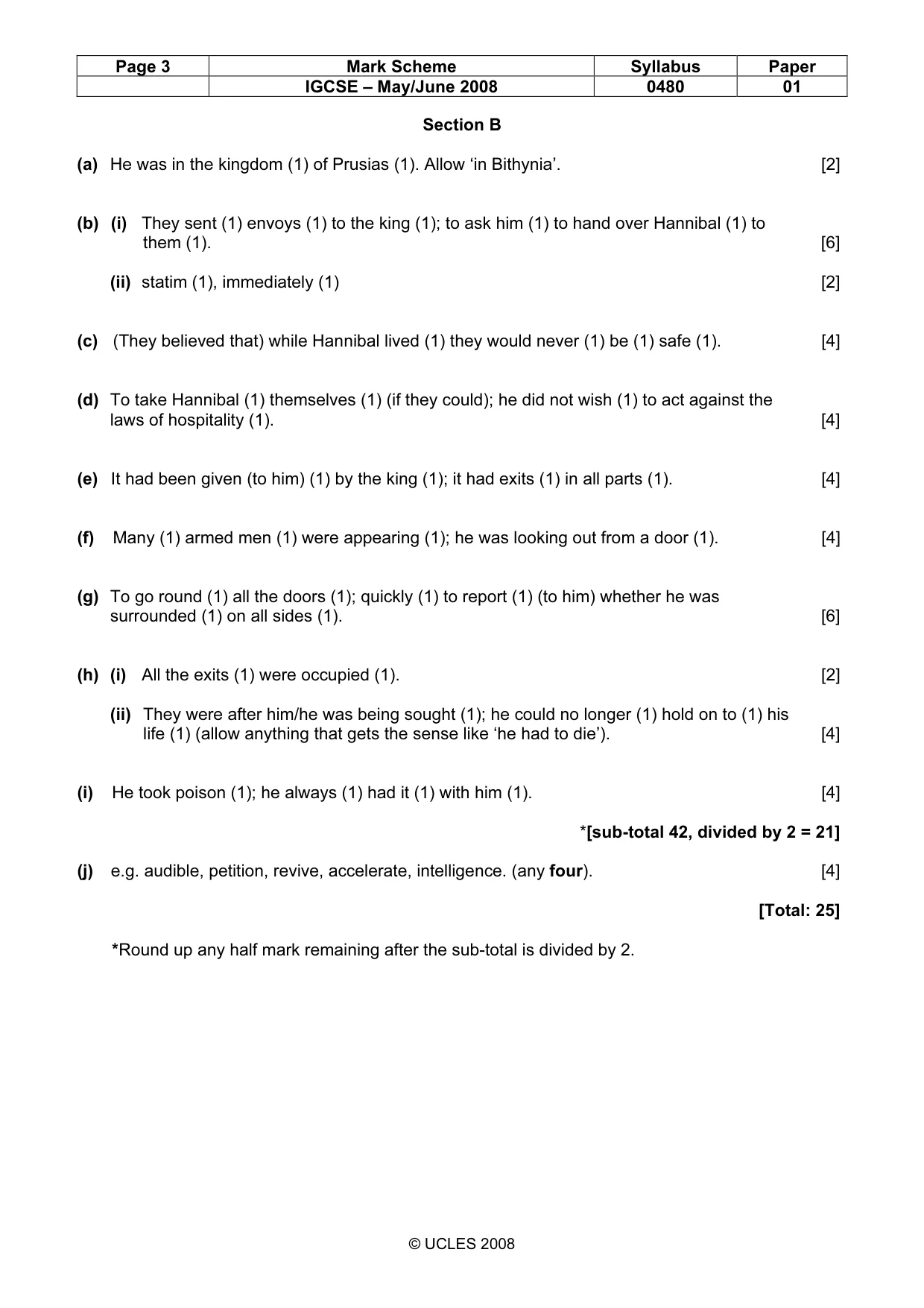
Page 3 Mark Scheme Syllabus Paper IGCSE – May/June 2008 0480 01 © UCLES 2008 Section B (a) He was in the kingdom (1) of Prusias (1). Allow ‘in Bithynia’. [2] (b) (i) They sent (1) envoys (1) to the king (1); to ask him (1) to hand over Hannibal (1) to them (1). [6] (ii) statim (1), immediately (1) [2] (c) (They believed that) while Hannibal lived (1) they would never (1) be (1) safe (1). [4] (d) To take Hannibal (1) themselves (1) (if they could); he did not wish (1) to act against the laws of hospitality (1). [4] (e) It had been given (to him) (1) by the king (1); it had exits (1) in all parts (1). [4] (f) Many (1) armed men (1) were appearing (1); he was looking out from a door (1). [4] (g) To go round (1) all the doors (1); quickly (1) to report (1) (to him) whether he was surrounded (1) on all sides (1). [6] (h) (i) All the exits (1) were occupied (1). [2] (ii) They were after him/he was being sought (1); he could no longer (1) hold on to (1) his life (1) (allow anything that gets the sense like ‘he had to die’). [4] (i) He took poison (1); he always (1) had it (1) with him (1). [4] *[sub-total 42, divided by 2 = 21] (j) e.g. audible, petition, revive, accelerate, intelligence. (any four). [4] [Total: 25] *Round up any half mark remaining after the sub-total is divided by 2.
What you needed in this session
Cambridge’s own grade thresholds for 2008 May/June, Paper 1 · Variant 1. A higher threshold means an easier paper — the bar moves with how the cohort did.