Cambridge IGCSE Latin 0480 — 2007 May/June Paper 2 · Variant 1
0480/21/M/J/07 · 80 marks · ≈90 min
The question paper and its mark scheme, free to read here and free to download. This is Cambridge’s own paper, exactly as it was sat.
Question paper8 pages



Mark scheme3 pages
Answers below. Sit the paper first if you are practising.
Paper as text
Question paper, page 1
This document consists of 5 printed pages and 3 blank pages. SP (CW) T16772/3 © UCLES 2007 [Turn over UNIVERSITY OF CAMBRIDGE INTERNATIONAL EXAMINATIONS International General Certificate of Secondary Education READ THESE INSTRUCTIONS FIRST If you have been given an Answer Booklet, follow the instructions on the front cover of the Booklet. Write your Centre number, candidate number and name on all the work you hand in. Write in dark blue or black pen. Do not use staples, paper clips, highlighters, glue or correction fluid. Answer all questions. At the end of the examination, fasten all your work securely together. The number of marks is given in brackets [ ] at the end of each question or part question. * 9 2 5 0 6 1 0 2 3 1 * LATIN 0480/02 Paper 2 Literature May/June 2007 1 hour 30 minutes Additional Materials: Answer Booklet/Paper www.XtremePapers.com
Question paper, page 2
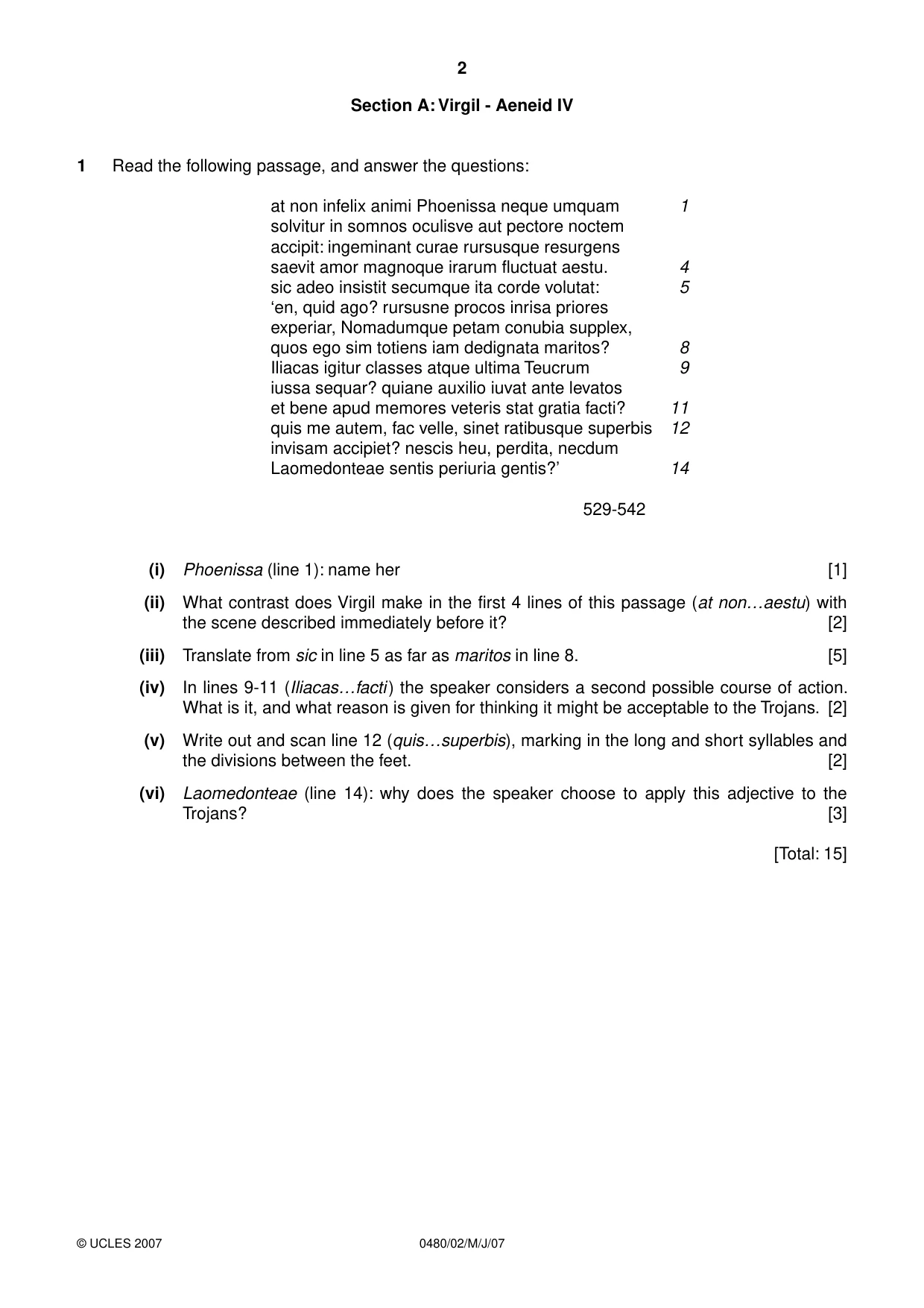
2 0480/02/M/J/07 © UCLES 2007 Section A: Virgil - Aeneid IV 1 Read the following passage, and answer the questions: at non infelix animi Phoenissa neque umquam 1 solvitur in somnos oculisve aut pectore noctem accipit: ingeminant curae rursusque resurgens saevit amor magnoque irarum fluctuat aestu. 4 sic adeo insistit secumque ita corde volutat: 5 ‘en, quid ago? rursusne procos inrisa priores experiar, Nomadumque petam conubia supplex, quos ego sim totiens iam dedignata maritos? 8 Iliacas igitur classes atque ultima Teucrum 9 iussa sequar? quiane auxilio iuvat ante levatos et bene apud memores veteris stat gratia facti? 11 quis me autem, fac velle, sinet ratibusque superbis 12 invisam accipiet? nescis heu, perdita, necdum Laomedonteae sentis periuria gentis?’ 14 529-542 (i) Phoenissa (line 1): name her [1] (ii) What contrast does Virgil make in the first 4 lines of this passage (at non…aestu) with the scene described immediately before it? [2] (iii) Translate from sic in line 5 as far as maritos in line 8. [5] (iv) In lines 9-11 (Iliacas…facti ) the speaker considers a second possible course of action. What is it, and what reason is given for thinking it might be acceptable to the Trojans. [2] (v) Write out and scan line 12 (quis…superbis), marking in the long and short syllables and the divisions between the feet. [2] (vi) Laomedonteae (line 14): why does the speaker choose to apply this adjective to the Trojans? [3] [Total: 15]
Question paper, page 3
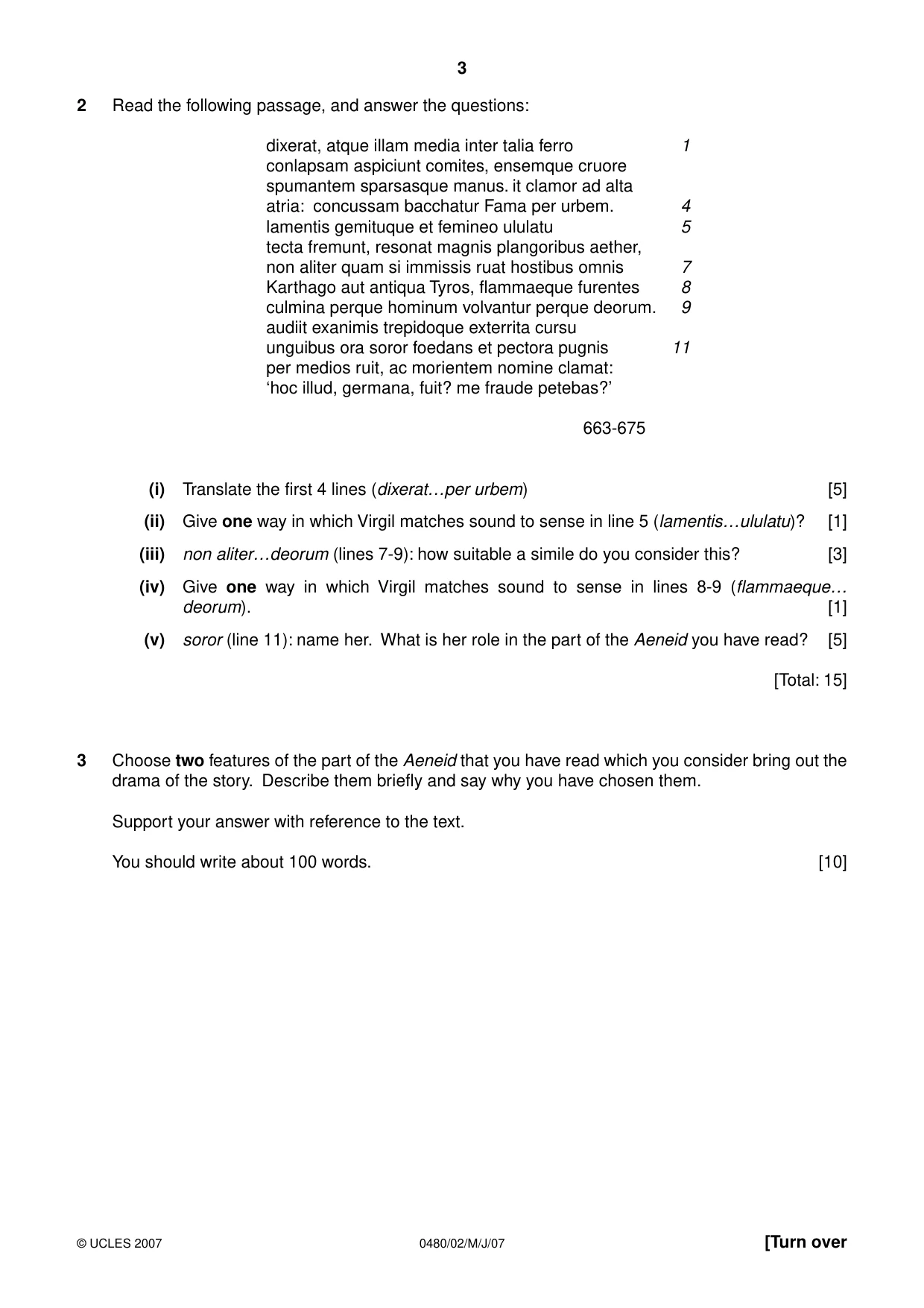
3 0480/02/M/J/07 © UCLES 2007 [Turn over 2 Read the following passage, and answer the questions: dixerat, atque illam media inter talia ferro 1 conlapsam aspiciunt comites, ensemque cruore spumantem sparsasque manus. it clamor ad alta atria: concussam bacchatur Fama per urbem. 4 lamentis gemituque et femineo ululatu 5 tecta fremunt, resonat magnis plangoribus aether, non aliter quam si immissis ruat hostibus omnis 7 Karthago aut antiqua Tyros, flammaeque furentes 8 culmina perque hominum volvantur perque deorum. 9 audiit exanimis trepidoque exterrita cursu unguibus ora soror foedans et pectora pugnis 11 per medios ruit, ac morientem nomine clamat: ‘hoc illud, germana, fuit? me fraude petebas?’ 663-675 (i) Translate the first 4 lines (dixerat…per urbem) [5] (ii) Give one way in which Virgil matches sound to sense in line 5 (lamentis…ululatu)? [1] (iii) non aliter…deorum (lines 7-9): how suitable a simile do you consider this? [3] (iv) Give one way in which Virgil matches sound to sense in lines 8-9 (flammaeque… deorum). [1] (v) soror (line 11): name her. What is her role in the part of the Aeneid you have read? [5] [Total: 15] 3 Choose two features of the part of the Aeneid that you have read which you consider bring out the drama of the story. Describe them briefly and say why you have chosen them. Support your answer with reference to the text. You should write about 100 words. [10]
Question paper, page 4
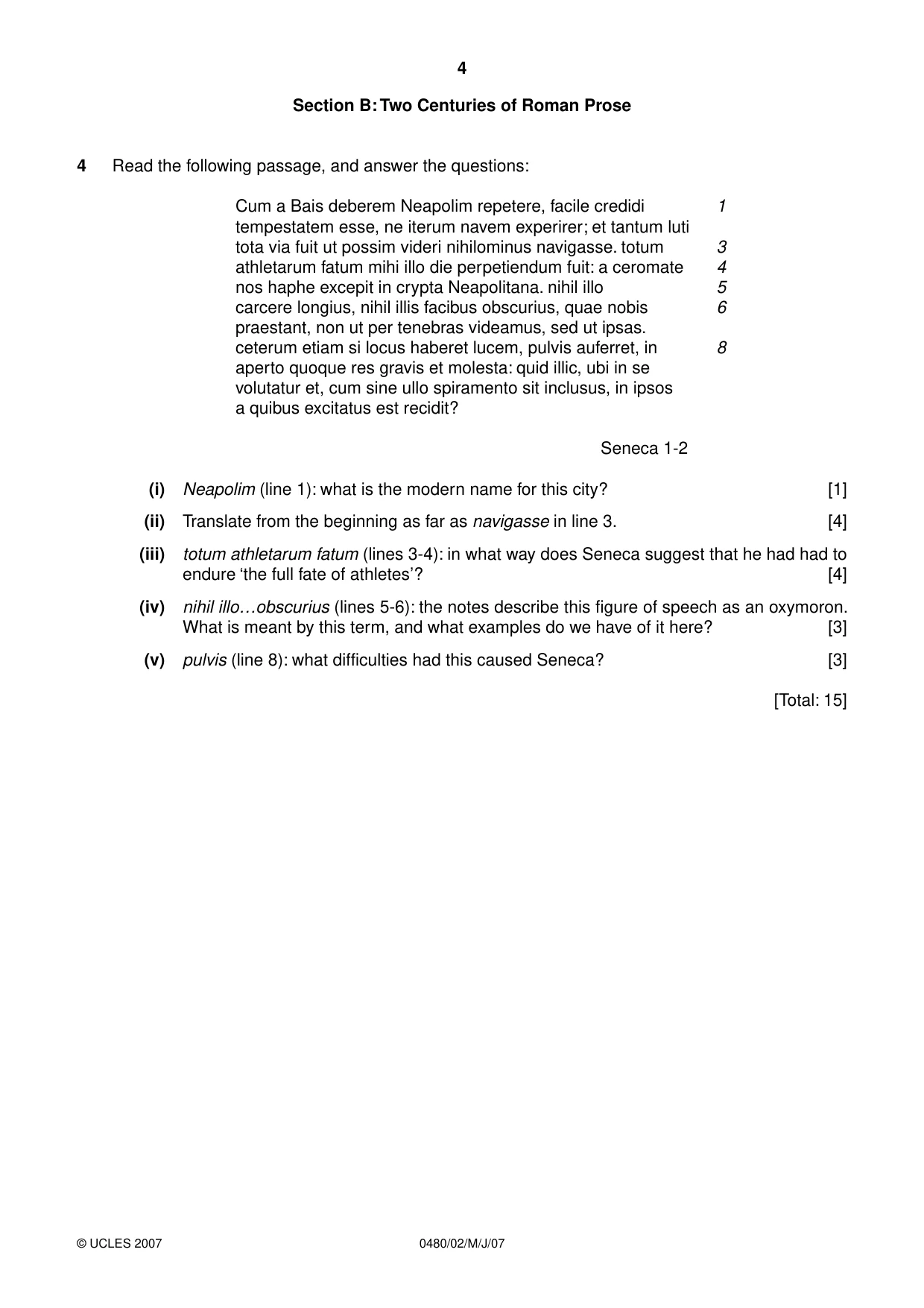
4 0480/02/M/J/07 © UCLES 2007 Section B: Two Centuries of Roman Prose 4 Read the following passage, and answer the questions: Cum a Bais deberem Neapolim repetere, facile credidi 1 tempestatem esse, ne iterum navem experirer; et tantum luti tota via fuit ut possim videri nihilominus navigasse. totum 3 athletarum fatum mihi illo die perpetiendum fuit: a ceromate 4 nos haphe excepit in crypta Neapolitana. nihil illo 5 carcere longius, nihil illis facibus obscurius, quae nobis 6 praestant, non ut per tenebras videamus, sed ut ipsas. ceterum etiam si locus haberet lucem, pulvis auferret, in 8 aperto quoque res gravis et molesta: quid illic, ubi in se volutatur et, cum sine ullo spiramento sit inclusus, in ipsos a quibus excitatus est recidit? Seneca 1-2 (i) Neapolim (line 1): what is the modern name for this city? [1] (ii) Translate from the beginning as far as navigasse in line 3. [4] (iii) totum athletarum fatum (lines 3-4): in what way does Seneca suggest that he had had to endure ‘the full fate of athletes’? [4] (iv) nihil illo…obscurius (lines 5-6): the notes describe this figure of speech as an oxymoron. What is meant by this term, and what examples do we have of it here? [3] (v) pulvis (line 8): what difficulties had this caused Seneca? [3] [Total: 15]
Question paper, page 5
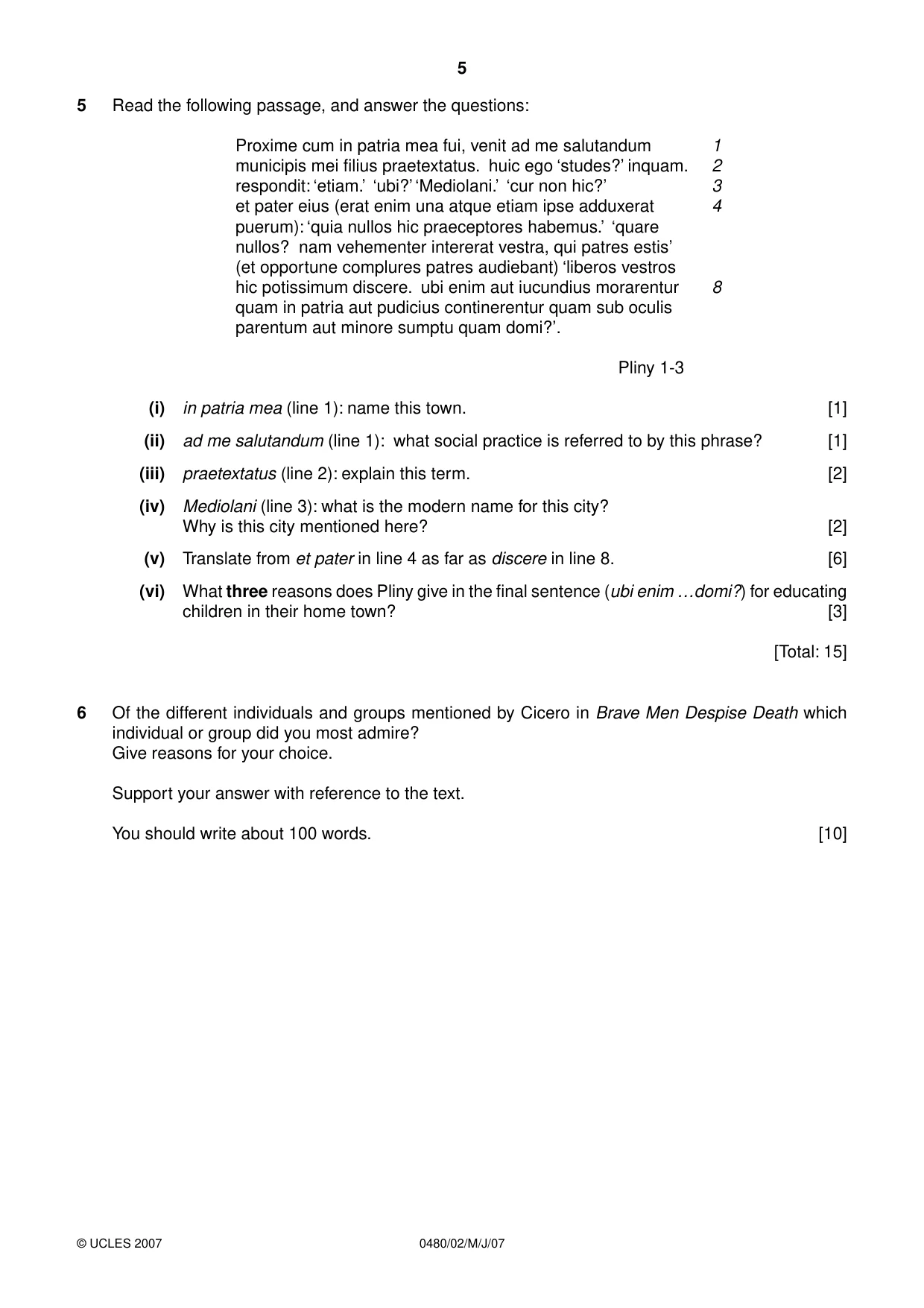
5 0480/02/M/J/07 © UCLES 2007 5 Read the following passage, and answer the questions: Proxime cum in patria mea fui, venit ad me salutandum 1 municipis mei filius praetextatus. huic ego ‘studes?’ inquam. 2 respondit: ‘etiam.’ ‘ubi?’ ‘Mediolani.’ ‘cur non hic?’ 3 et pater eius (erat enim una atque etiam ipse adduxerat 4 puerum): ‘quia nullos hic praeceptores habemus.’ ‘quare nullos? nam vehementer intererat vestra, qui patres estis’ (et opportune complures patres audiebant) ‘liberos vestros hic potissimum discere. ubi enim aut iucundius morarentur 8 quam in patria aut pudicius continerentur quam sub oculis parentum aut minore sumptu quam domi?’. Pliny 1-3 (i) in patria mea (line 1): name this town. [1] (ii) ad me salutandum (line 1): what social practice is referred to by this phrase? [1] (iii) praetextatus (line 2): explain this term. [2] (iv) Mediolani (line 3): what is the modern name for this city? Why is this city mentioned here? [2] (v) Translate from et pater in line 4 as far as discere in line 8. [6] (vi) What three reasons does Pliny give in the final sentence (ubi enim …domi?) for educating children in their home town? [3] [Total: 15] 6 Of the different individuals and groups mentioned by Cicero in Brave Men Despise Death which individual or group did you most admire? Give reasons for your choice. Support your answer with reference to the text. You should write about 100 words. [10]
Question paper, page 8
8 0480/02/M/J/07 BLANK PAGE Permission to reproduce items where third-party owned material protected by copyright is included has been sought and cleared where possible. Every reasonable effort has been made by the publisher (UCLES) to trace copyright holders, but if any items requiring clearance have unwittingly been included, the publisher will be pleased to make amends at the earliest possible opportunity. University of Cambridge International Examinations is part of the Cambridge Assessment Group. Cambridge Assessment is the brand name of University of Cambridge Local Examinations Syndicate (UCLES), which is itself a department of the University of Cambridge.
Mark scheme, page 1
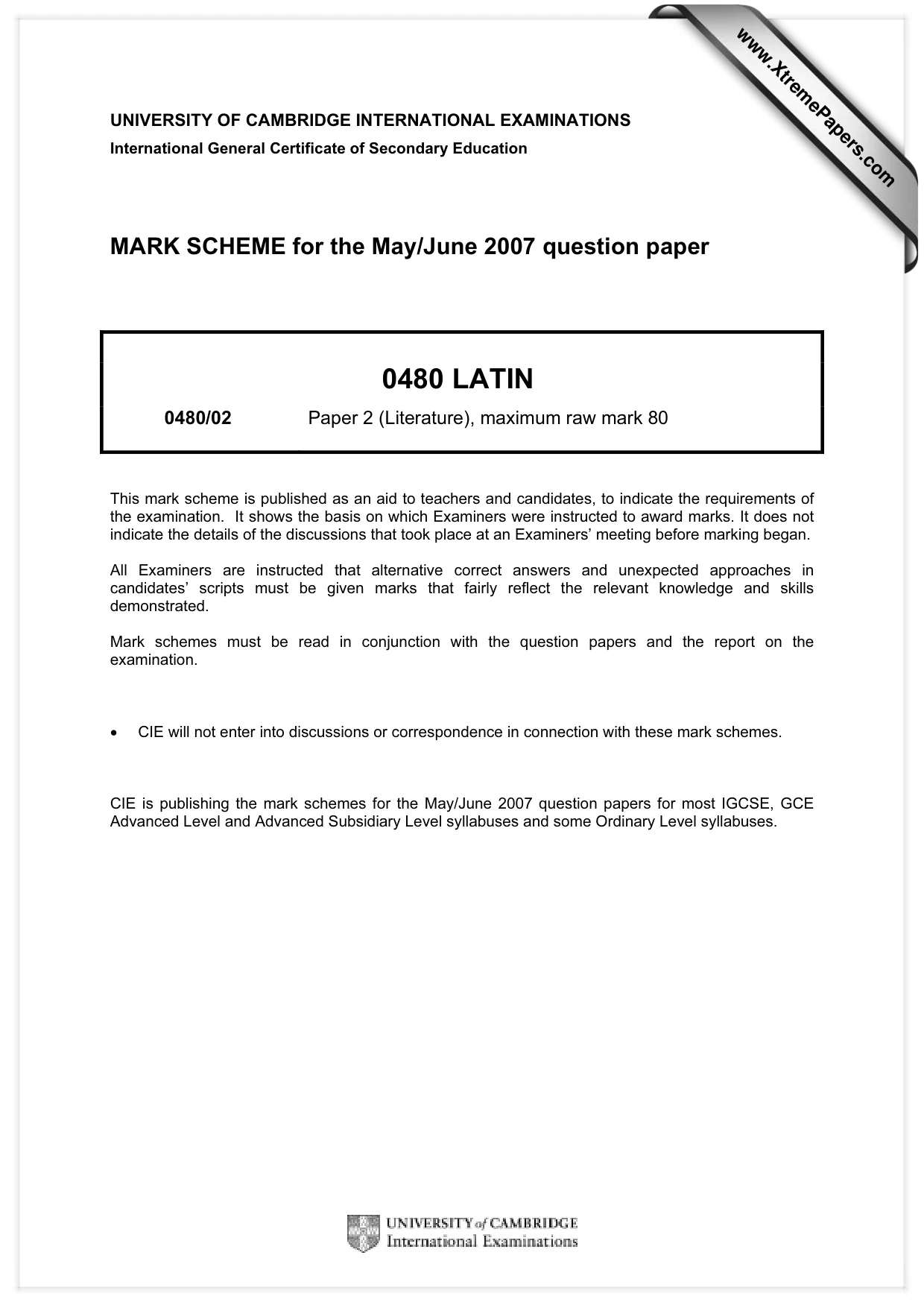
UNIVERSITY OF CAMBRIDGE INTERNATIONAL EXAMINATIONS International General Certificate of Secondary Education MARK SCHEME for the May/June 2007 question paper 0480 LATIN 0480/02 Paper 2 (Literature), maximum raw mark 80 This mark scheme is published as an aid to teachers and candidates, to indicate the requirements of the examination. It shows the basis on which Examiners were instructed to award marks. It does not indicate the details of the discussions that took place at an Examiners’ meeting before marking began. All Examiners are instructed that alternative correct answers and unexpected approaches in candidates’ scripts must be given marks that fairly reflect the relevant knowledge and skills demonstrated. Mark schemes must be read in conjunction with the question papers and the report on the examination. • CIE will not enter into discussions or correspondence in connection with these mark schemes. CIE is publishing the mark schemes for the May/June 2007 question papers for most IGCSE, GCE Advanced Level and Advanced Subsidiary Level syllabuses and some Ordinary Level syllabuses. www.XtremePapers.com
Mark scheme, page 2
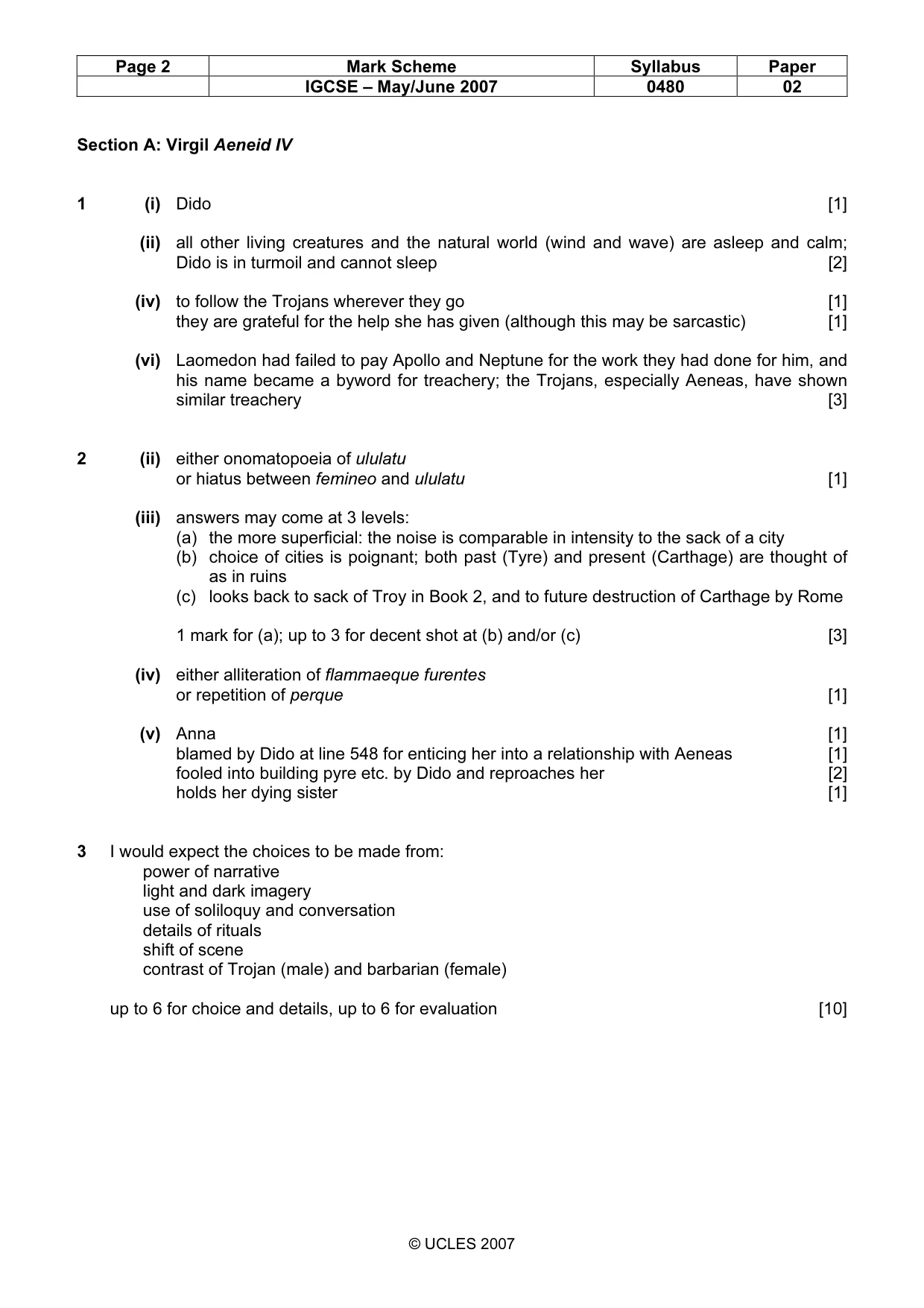
Page 2 Mark Scheme Syllabus Paper IGCSE – May/June 2007 0480 02 © UCLES 2007 Section A: Virgil Aeneid IV 1 (i) Dido [1] (ii) all other living creatures and the natural world (wind and wave) are asleep and calm; Dido is in turmoil and cannot sleep [2] (iv) to follow the Trojans wherever they go [1] they are grateful for the help she has given (although this may be sarcastic) [1] (vi) Laomedon had failed to pay Apollo and Neptune for the work they had done for him, and his name became a byword for treachery; the Trojans, especially Aeneas, have shown similar treachery [3] 2 (ii) either onomatopoeia of ululatu or hiatus between femineo and ululatu [1] (iii) answers may come at 3 levels: (a) the more superficial: the noise is comparable in intensity to the sack of a city (b) choice of cities is poignant; both past (Tyre) and present (Carthage) are thought of as in ruins (c) looks back to sack of Troy in Book 2, and to future destruction of Carthage by Rome 1 mark for (a); up to 3 for decent shot at (b) and/or (c) [3] (iv) either alliteration of flammaeque furentes or repetition of perque [1] (v) Anna [1] blamed by Dido at line 548 for enticing her into a relationship with Aeneas [1] fooled into building pyre etc. by Dido and reproaches her [2] holds her dying sister [1] 3 I would expect the choices to be made from: power of narrative light and dark imagery use of soliloquy and conversation details of rituals shift of scene contrast of Trojan (male) and barbarian (female) up to 6 for choice and details, up to 6 for evaluation [10]
Mark scheme, page 3
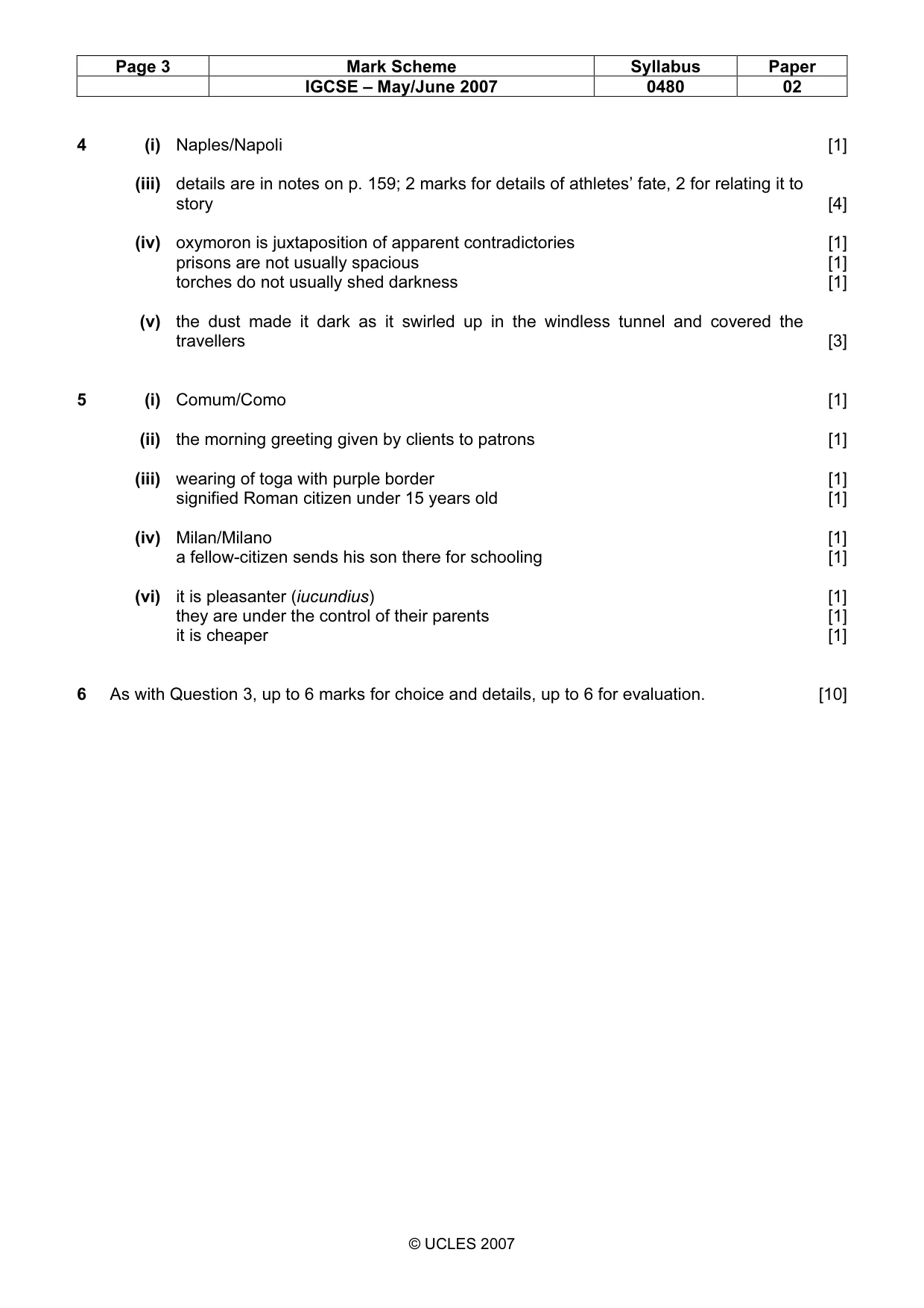
Page 3 Mark Scheme Syllabus Paper IGCSE – May/June 2007 0480 02 © UCLES 2007 4 (i) Naples/Napoli [1] (iii) details are in notes on p. 159; 2 marks for details of athletes’ fate, 2 for relating it to story [4] (iv) oxymoron is juxtaposition of apparent contradictories [1] prisons are not usually spacious [1] torches do not usually shed darkness [1] (v) the dust made it dark as it swirled up in the windless tunnel and covered the travellers [3] 5 (i) Comum/Como [1] (ii) the morning greeting given by clients to patrons [1] (iii) wearing of toga with purple border [1] signified Roman citizen under 15 years old [1] (iv) Milan/Milano [1] a fellow-citizen sends his son there for schooling [1] (vi) it is pleasanter (iucundius) [1] they are under the control of their parents [1] it is cheaper [1] 6 As with Question 3, up to 6 marks for choice and details, up to 6 for evaluation. [10]
What you needed in this session
Cambridge’s own grade thresholds for 2007 May/June, Paper 2 · Variant 1. A higher threshold means an easier paper — the bar moves with how the cohort did.