Cambridge IGCSE Latin 0480 — 2006 May/June Paper 1 · Variant 1
0480/11/M/J/06 · 65 marks · ≈73 min
The question paper and its mark scheme, free to read here and free to download. This is Cambridge’s own paper, exactly as it was sat.
Question paper8 pages




Mark scheme2 pages
Answers below. Sit the paper first if you are practising.
Paper as text
Question paper, page 1
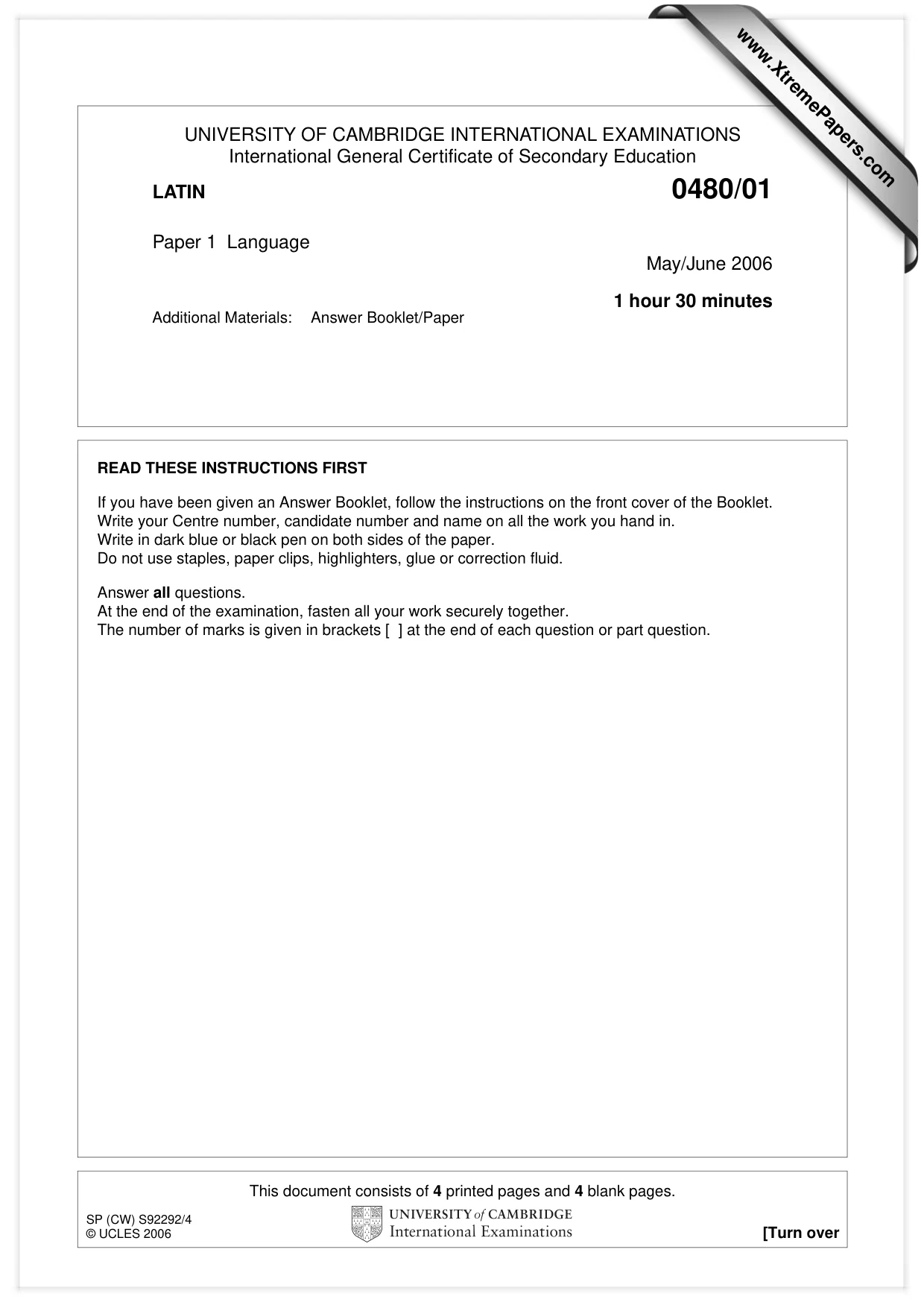
This document consists of 4 printed pages and 4 blank pages. SP (CW) S92292/4 © UCLES 2006 [Turn over UNIVERSITY OF CAMBRIDGE INTERNATIONAL EXAMINATIONS International General Certificate of Secondary Education LATIN 0480/01 Paper 1 Language May/June 2006 1 hour 30 minutes Additional Materials: Answer Booklet/Paper READ THESE INSTRUCTIONS FIRST If you have been given an Answer Booklet, follow the instructions on the front cover of the Booklet. Write your Centre number, candidate number and name on all the work you hand in. Write in dark blue or black pen on both sides of the paper. Do not use staples, paper clips, highlighters, glue or correction fluid. Answer all questions. At the end of the examination, fasten all your work securely together. The number of marks is given in brackets [ ] at the end of each question or part question. www.XtremePapers.com
Question paper, page 2
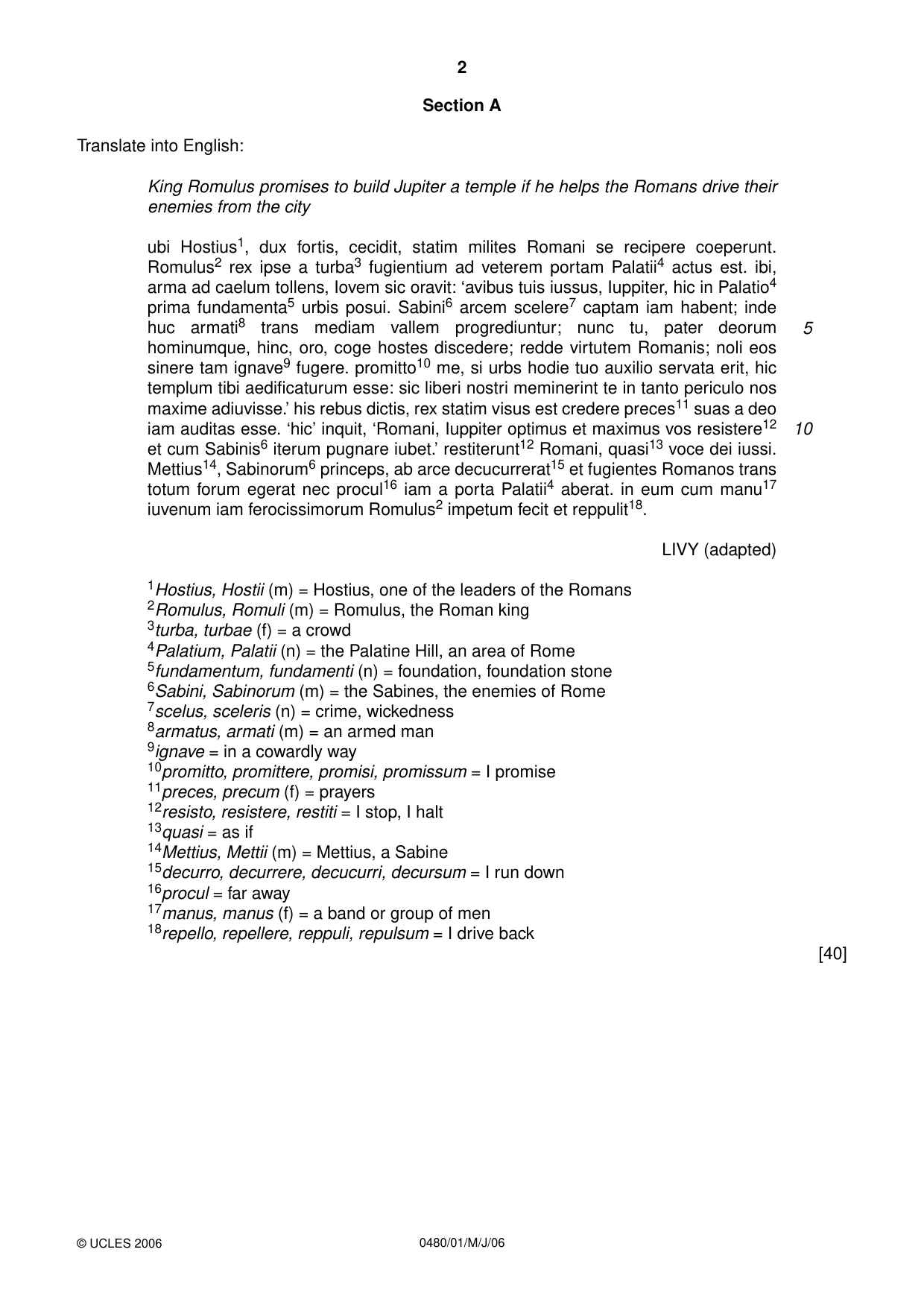
2 0480/01/M/J/06 Section A Translate into English: King Romulus promises to build Jupiter a temple if he helps the Romans drive their enemies from the city ubi Hostius1, dux fortis, cecidit, statim milites Romani se recipere coeperunt. Romulus2 rex ipse a turba3 fugientium ad veterem portam Palatii4 actus est. ibi, arma ad caelum tollens, Iovem sic oravit: ‘avibus tuis iussus, Iuppiter, hic in Palatio4 prima fundamenta5 urbis posui. Sabini6 arcem scelere7 captam iam habent; inde huc armati8 trans mediam vallem progrediuntur; nunc tu, pater deorum hominumque, hinc, oro, coge hostes discedere; redde virtutem Romanis; noli eos sinere tam ignave9 fugere. promitto10 me, si urbs hodie tuo auxilio servata erit, hic templum tibi aedificaturum esse: sic liberi nostri meminerint te in tanto periculo nos maxime adiuvisse.’ his rebus dictis, rex statim visus est credere preces11 suas a deo iam auditas esse. ‘hic’ inquit, ‘Romani, Iuppiter optimus et maximus vos resistere12 et cum Sabinis6 iterum pugnare iubet.’ restiterunt12 Romani, quasi13 voce dei iussi. Mettius14, Sabinorum6 princeps, ab arce decucurrerat15 et fugientes Romanos trans totum forum egerat nec procul16 iam a porta Palatii4 aberat. in eum cum manu17 iuvenum iam ferocissimorum Romulus2 impetum fecit et reppulit18. LIVY (adapted) 1Hostius, Hostii (m) = Hostius, one of the leaders of the Romans 2Romulus, Romuli (m) = Romulus, the Roman king 3turba, turbae (f) = a crowd 4Palatium, Palatii (n) = the Palatine Hill, an area of Rome 5fundamentum, fundamenti (n) = foundation, foundation stone 6Sabini, Sabinorum (m) = the Sabines, the enemies of Rome 7scelus, sceleris (n) = crime, wickedness 8armatus, armati (m) = an armed man 9ignave = in a cowardly way 10promitto, promittere, promisi, promissum = I promise 11preces, precum (f) = prayers 12resisto, resistere, restiti = I stop, I halt 13quasi = as if 14Mettius, Mettii (m) = Mettius, a Sabine 15decurro, decurrere, decucurri, decursum = I run down 16procul = far away 17manus, manus (f) = a band or group of men 18repello, repellere, reppuli, repulsum = I drive back [40] © UCLES 2006 5 10
Question paper, page 3
3 0480/01/M/J/06 BLANK PAGE SECTION B CONTINUES ON NEXT PAGE [Turn over
Question paper, page 4
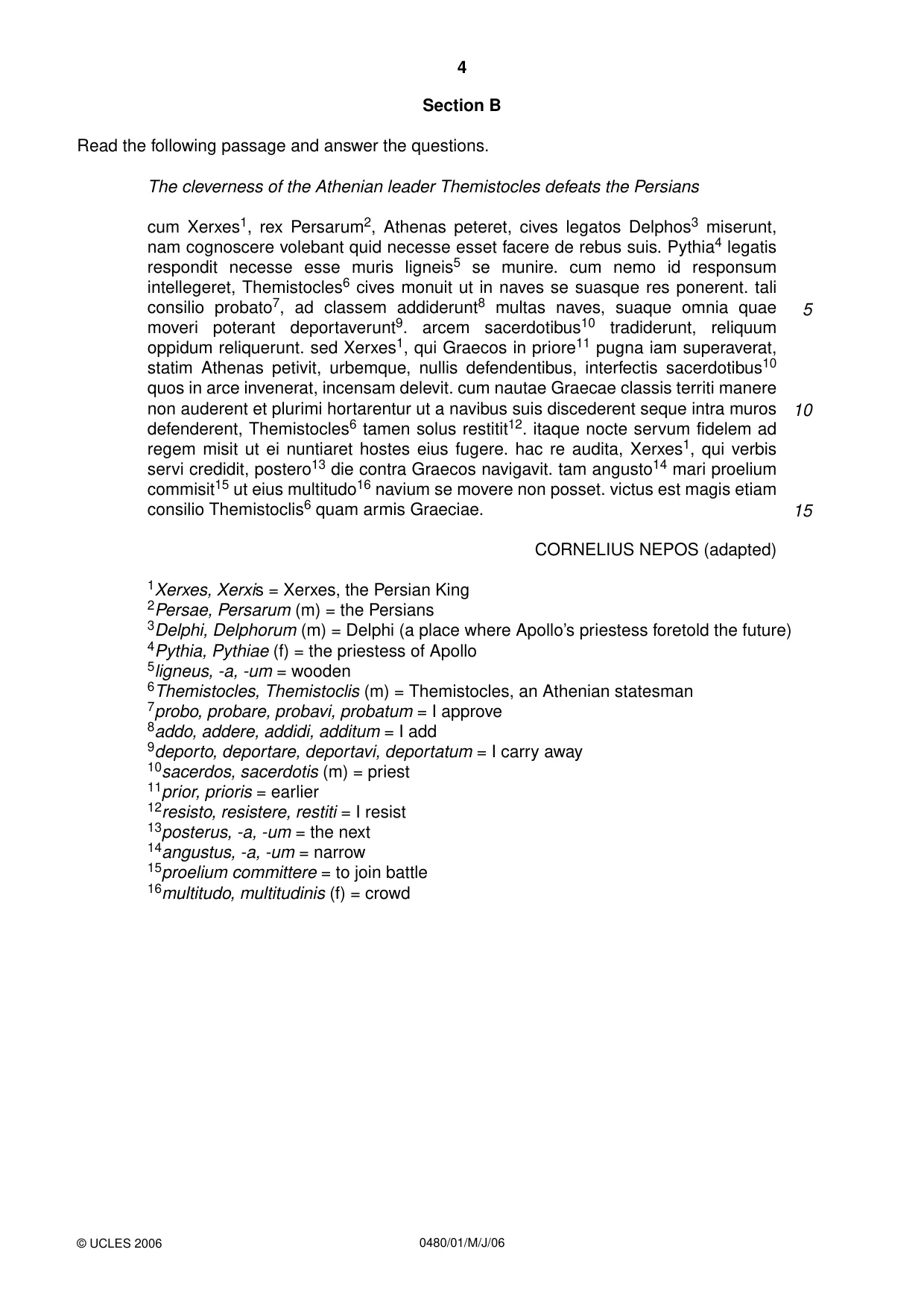
4 0480/01/M/J/06 Section B Read the following passage and answer the questions. The cleverness of the Athenian leader Themistocles defeats the Persians cum Xerxes1, rex Persarum2, Athenas peteret, cives legatos Delphos3 miserunt, nam cognoscere volebant quid necesse esset facere de rebus suis. Pythia4 legatis respondit necesse esse muris ligneis5 se munire. cum nemo id responsum intellegeret, Themistocles6 cives monuit ut in naves se suasque res ponerent. tali consilio probato7, ad classem addiderunt8 multas naves, suaque omnia quae moveri poterant deportaverunt9. arcem sacerdotibus10 tradiderunt, reliquum oppidum reliquerunt. sed Xerxes1, qui Graecos in priore11 pugna iam superaverat, statim Athenas petivit, urbemque, nullis defendentibus, interfectis sacerdotibus10 quos in arce invenerat, incensam delevit. cum nautae Graecae classis territi manere non auderent et plurimi hortarentur ut a navibus suis discederent seque intra muros defenderent, Themistocles6 tamen solus restitit12. itaque nocte servum fidelem ad regem misit ut ei nuntiaret hostes eius fugere. hac re audita, Xerxes1, qui verbis servi credidit, postero13 die contra Graecos navigavit. tam angusto14 mari proelium commisit15 ut eius multitudo16 navium se movere non posset. victus est magis etiam consilio Themistoclis6 quam armis Graeciae. CORNELIUS NEPOS (adapted) 1Xerxes, Xerxis = Xerxes, the Persian King 2Persae, Persarum (m) = the Persians 3Delphi, Delphorum (m) = Delphi (a place where Apollo’s priestess foretold the future) 4Pythia, Pythiae (f) = the priestess of Apollo 5ligneus, -a, -um = wooden 6Themistocles, Themistoclis (m) = Themistocles, an Athenian statesman 7probo, probare, probavi, probatum = I approve 8addo, addere, addidi, additum = I add 9deporto, deportare, deportavi, deportatum = I carry away 10sacerdos, sacerdotis (m) = priest 11prior, prioris = earlier 12resisto, resistere, restiti = I resist 13posterus, -a, -um = the next 14angustus, -a, -um = narrow 15proelium committere = to join battle 16multitudo, multitudinis (f) = crowd © UCLES 2006 5 10 15
Question paper, page 5
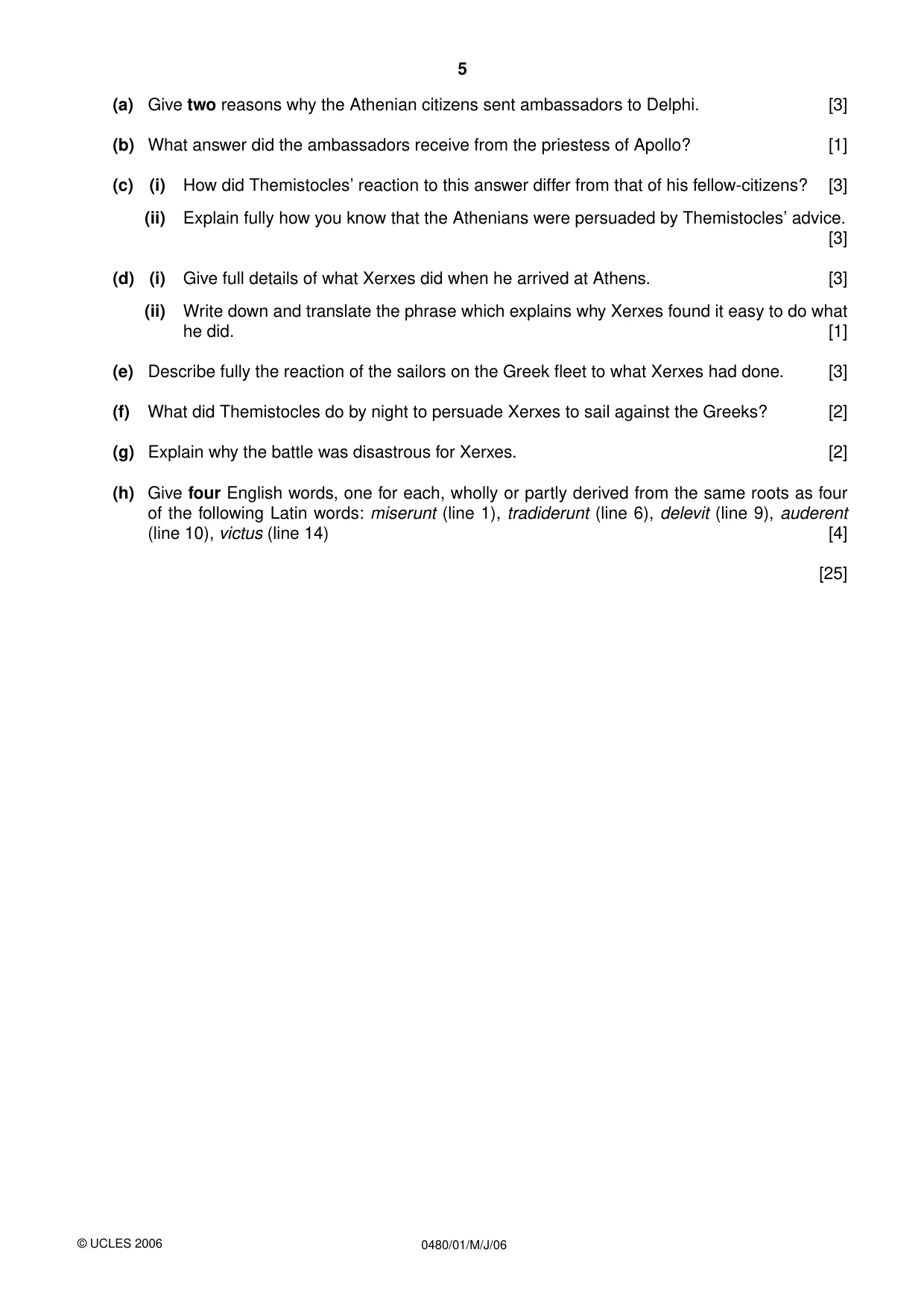
5 0480/01/M/J/06 (a) Give two reasons why the Athenian citizens sent ambassadors to Delphi. [3] (b) What answer did the ambassadors receive from the priestess of Apollo? [1] (c) (i) How did Themistocles’ reaction to this answer differ from that of his fellow-citizens? [3] (ii) Explain fully how you know that the Athenians were persuaded by Themistocles’ advice. [3] (d) (i) Give full details of what Xerxes did when he arrived at Athens. [3] (ii) Write down and translate the phrase which explains why Xerxes found it easy to do what he did. [1] (e) Describe fully the reaction of the sailors on the Greek fleet to what Xerxes had done. [3] (f) What did Themistocles do by night to persuade Xerxes to sail against the Greeks? [2] (g) Explain why the battle was disastrous for Xerxes. [2] (h) Give four English words, one for each, wholly or partly derived from the same roots as four of the following Latin words: miserunt (line 1), tradiderunt (line 6), delevit (line 9), auderent (line 10), victus (line 14) [4] [25] © UCLES 2006
Question paper, page 8
8 0480/01/M/J/06 BLANK PAGE Permission to reproduce items where third-party owned material protected by copyright is included has been sought and cleared where possible. Every reasonable effort has been made by the publisher (UCLES) to trace copyright holders, but if any items requiring clearance have unwittingly been included, the publisher will be pleased to make amends at the earliest possible opportunity. University of Cambridge International Examinations is part of the University of Cambridge Local Examinations Syndicate (UCLES), which is itself a department of the University of Cambridge.
Mark scheme, page 1
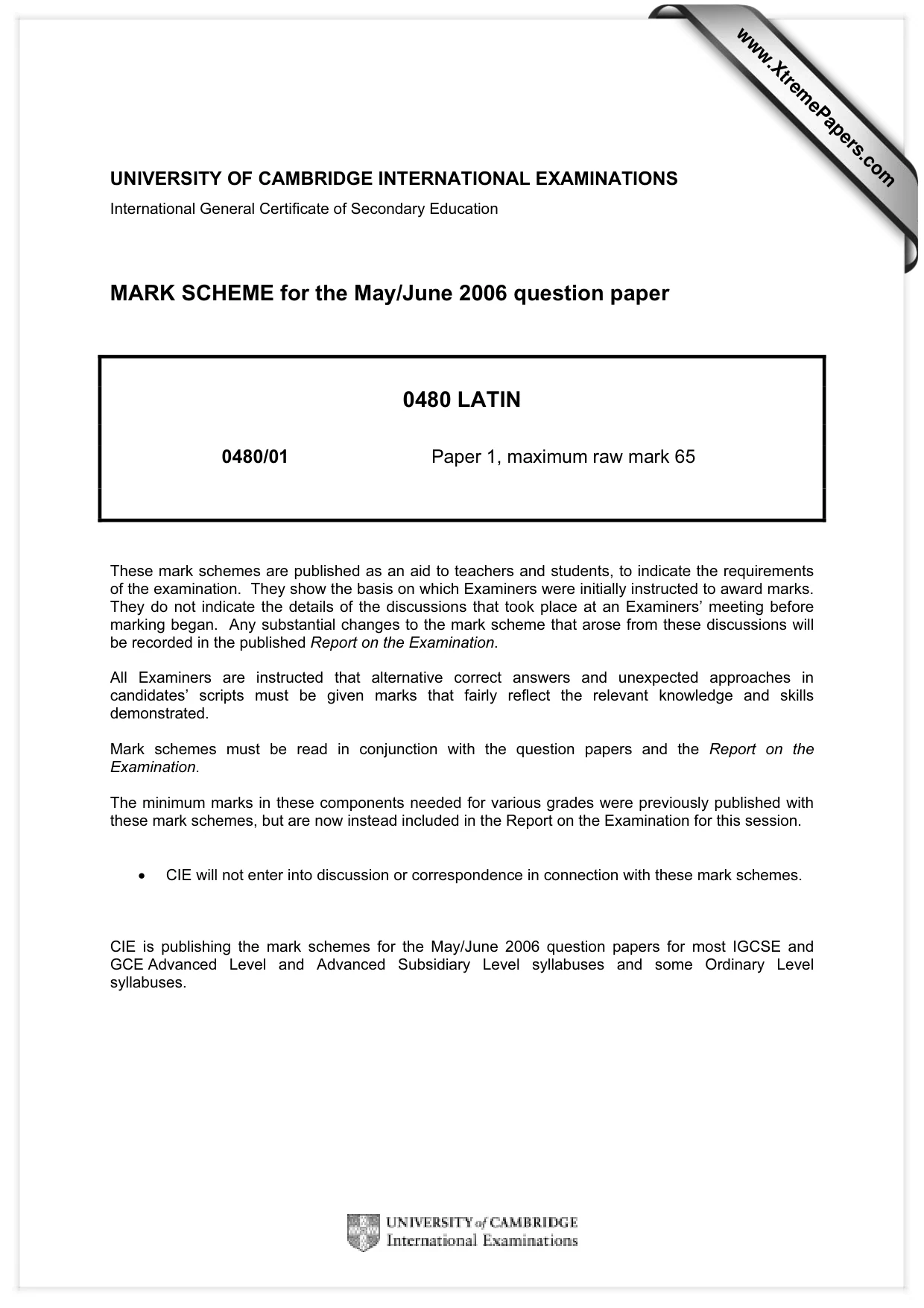
UNIVERSITY OF CAMBRIDGE INTERNATIONAL EXAMINATIONS International General Certificate of Secondary Education MARK SCHEME for the May/June 2006 question paper 0480 LATIN 0480/01 Paper 1, maximum raw mark 65 These mark schemes are published as an aid to teachers and students, to indicate the requirements of the examination. They show the basis on which Examiners were initially instructed to award marks. They do not indicate the details of the discussions that took place at an Examiners’ meeting before marking began. Any substantial changes to the mark scheme that arose from these discussions will be recorded in the published Report on the Examination. All Examiners are instructed that alternative correct answers and unexpected approaches in candidates’ scripts must be given marks that fairly reflect the relevant knowledge and skills demonstrated. Mark schemes must be read in conjunction with the question papers and the Report on the Examination. The minimum marks in these components needed for various grades were previously published with these mark schemes, but are now instead included in the Report on the Examination for this session. • CIE will not enter into discussion or correspondence in connection with these mark schemes. CIE is publishing the mark schemes for the May/June 2006 question papers for most IGCSE and GCE Advanced Level and Advanced Subsidiary Level syllabuses and some Ordinary Level syllabuses. www.XtremePapers.com
Mark scheme, page 2
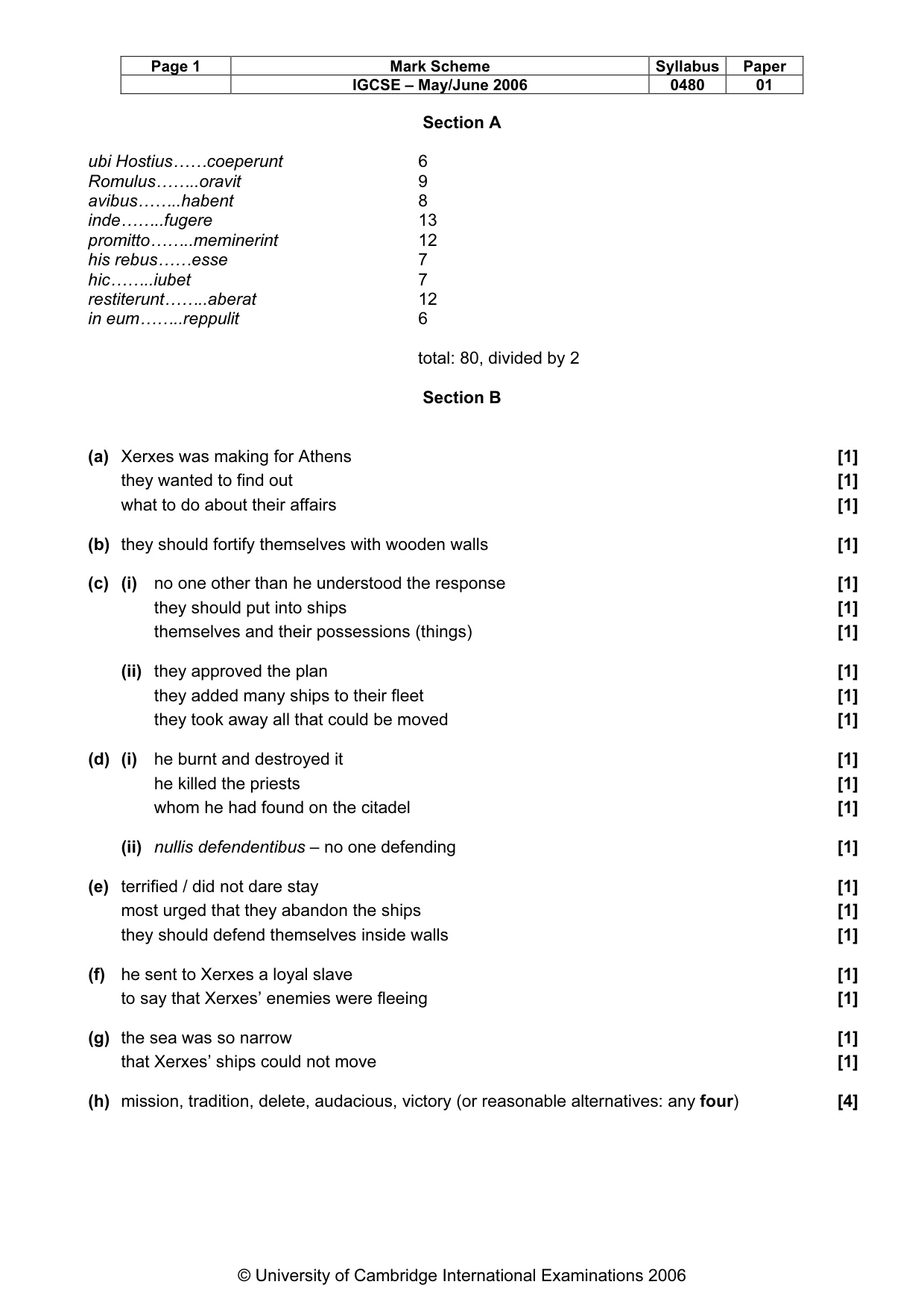
Page 1 Mark Scheme Syllabus Paper IGCSE – May/June 2006 0480 01 © University of Cambridge International Examinations 2006 Section A ubi Hostius……coeperunt 6 Romulus……..oravit 9 avibus……..habent 8 inde……..fugere 13 promitto……..meminerint 12 his rebus……esse 7 hic……..iubet 7 restiterunt……..aberat 12 in eum……..reppulit 6 total: 80, divided by 2 Section B (a) Xerxes was making for Athens [1] they wanted to find out [1] what to do about their affairs [1] (b) they should fortify themselves with wooden walls [1] (c) (i) no one other than he understood the response [1] they should put into ships [1] themselves and their possessions (things) [1] (ii) they approved the plan [1] they added many ships to their fleet [1] they took away all that could be moved [1] (d) (i) he burnt and destroyed it [1] he killed the priests [1] whom he had found on the citadel [1] (ii) nullis defendentibus – no one defending [1] (e) terrified / did not dare stay [1] most urged that they abandon the ships [1] they should defend themselves inside walls [1] (f) he sent to Xerxes a loyal slave [1] to say that Xerxes’ enemies were fleeing [1] (g) the sea was so narrow [1] that Xerxes’ ships could not move [1] (h) mission, tradition, delete, audacious, victory (or reasonable alternatives: any four) [4]
What you needed in this session
Cambridge’s own grade thresholds for 2006 May/June, Paper 1 · Variant 1. A higher threshold means an easier paper — the bar moves with how the cohort did.