Cambridge IGCSE Italian - Foreign Language 0535 — 2024 May/June Paper 2 · Variant 2
0535/22/M/J/24 · 45 marks · ≈51 min
The question paper and its mark scheme, free to read here and free to download. This is Cambridge’s own paper, exactly as it was sat.
Question paper12 pages

Mark scheme10 pages
Answers below. Sit the paper first if you are practising.
Paper as text
Question paper, page 1
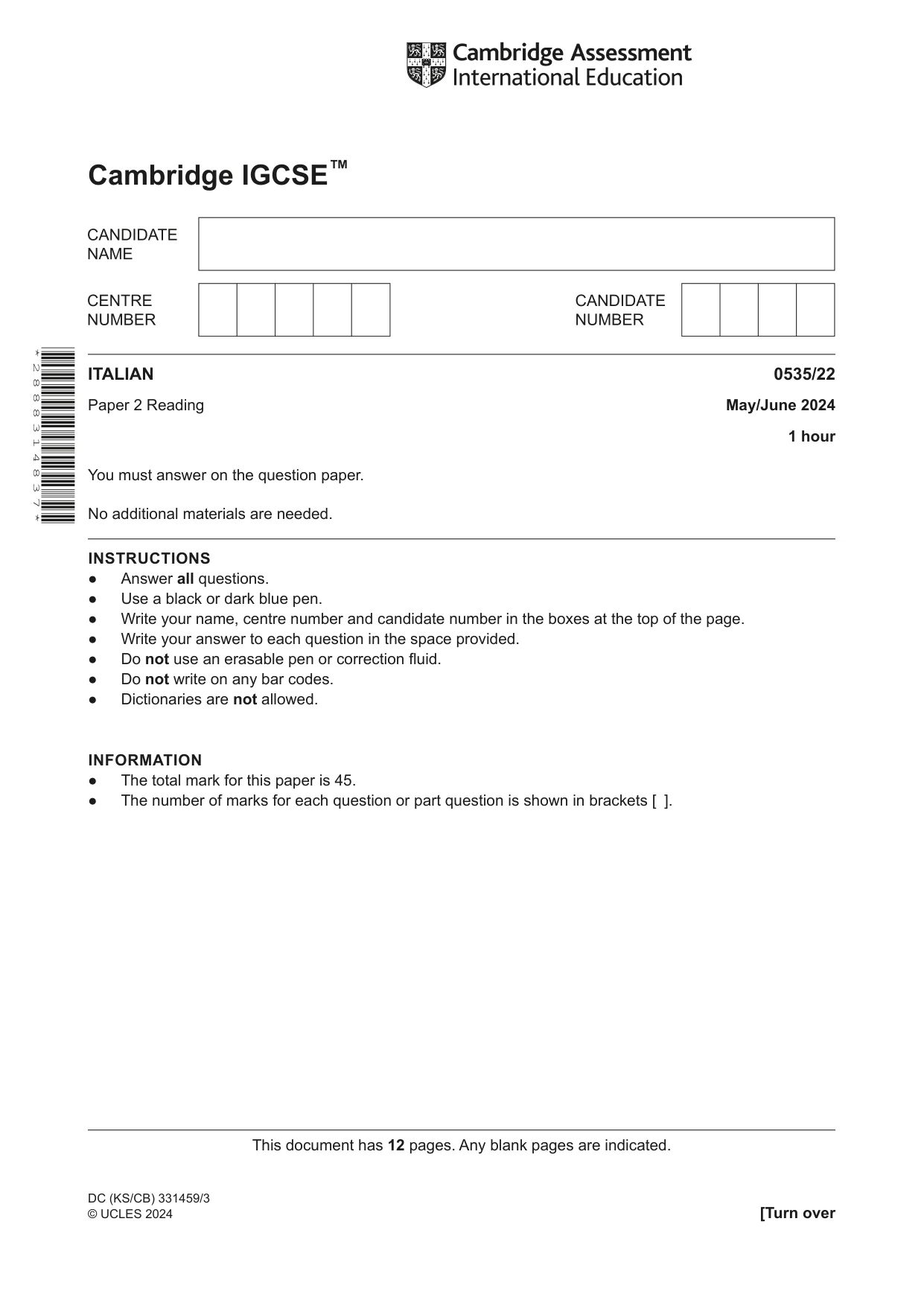
This document has 12 pages. Any blank pages are indicated. [Turn over Cambridge IGCSE™ * 2 8 8 8 3 1 4 8 3 7 * ITALIAN 0535/22 Paper 2 Reading May/June 2024 1 hour You must answer on the question paper. No additional materials are needed. INSTRUCTIONS ● Answer all questions. ● Use a black or dark blue pen. ● Write your name, centre number and candidate number in the boxes at the top of the page. ● Write your answer to each question in the space provided. ● Do not use an erasable pen or correction fluid. ● Do not write on any bar codes. ● Dictionaries are not allowed. INFORMATION ● The total mark for this paper is 45. ● The number of marks for each question or part question is shown in brackets [ ]. DC (KS/CB) 331459/3 © UCLES 2024
Question paper, page 2
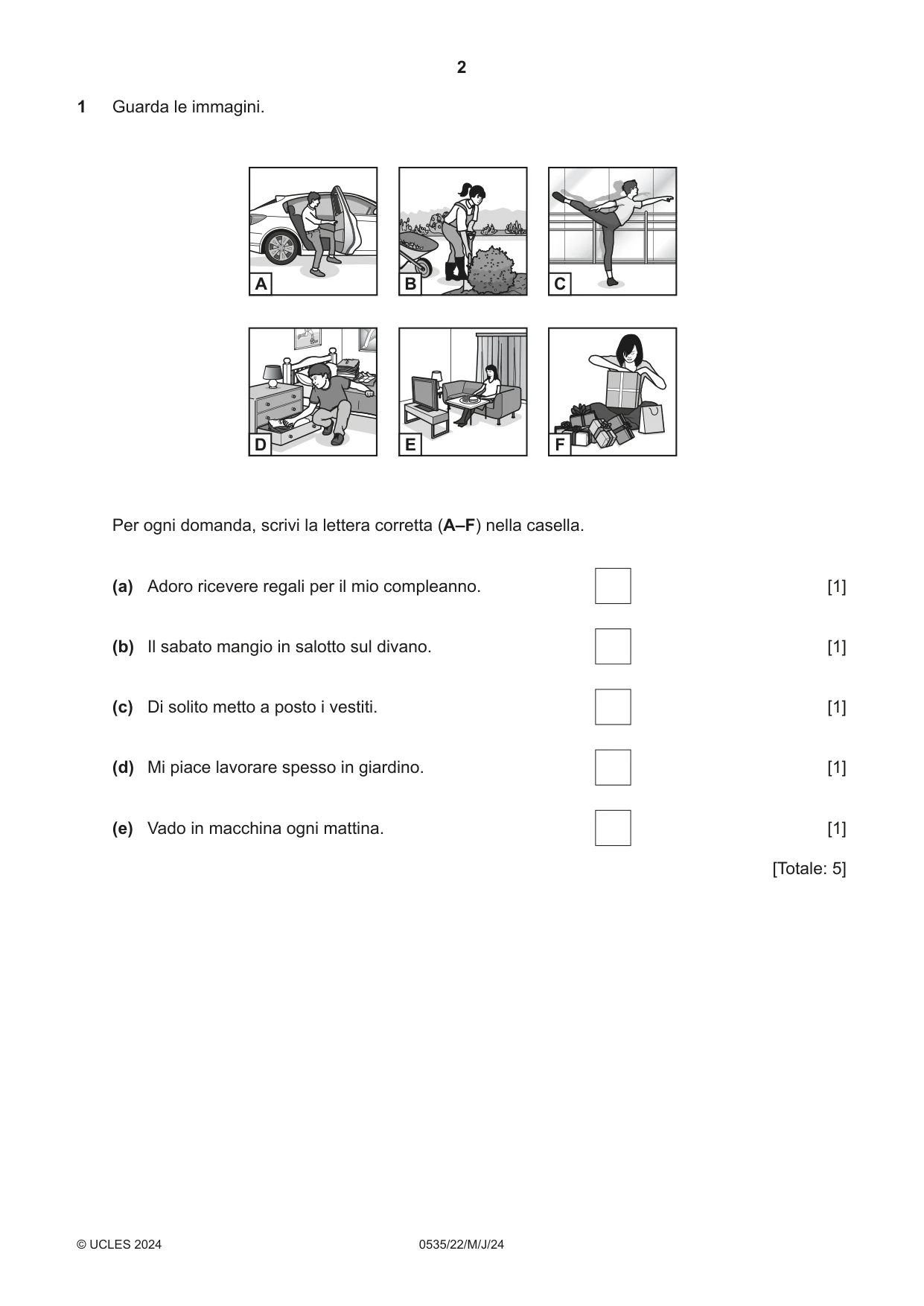
2 0535/22/ M/J/24 © UCLES 2024 1 Guarda le immagini. B C E F A D Per ogni domanda, scrivi la lettera corretta (A–F) nella casella. (a) Adoro ricevere regali per il mio compleanno. [1] (b) Il sabato mangio in salotto sul divano. [1] (c) Di solito metto a posto i vestiti. [1] (d) Mi piace lavorare spesso in giardino. [1] (e) Vado in macchina ogni mattina. [1] [Totale: 5]
Question paper, page 3
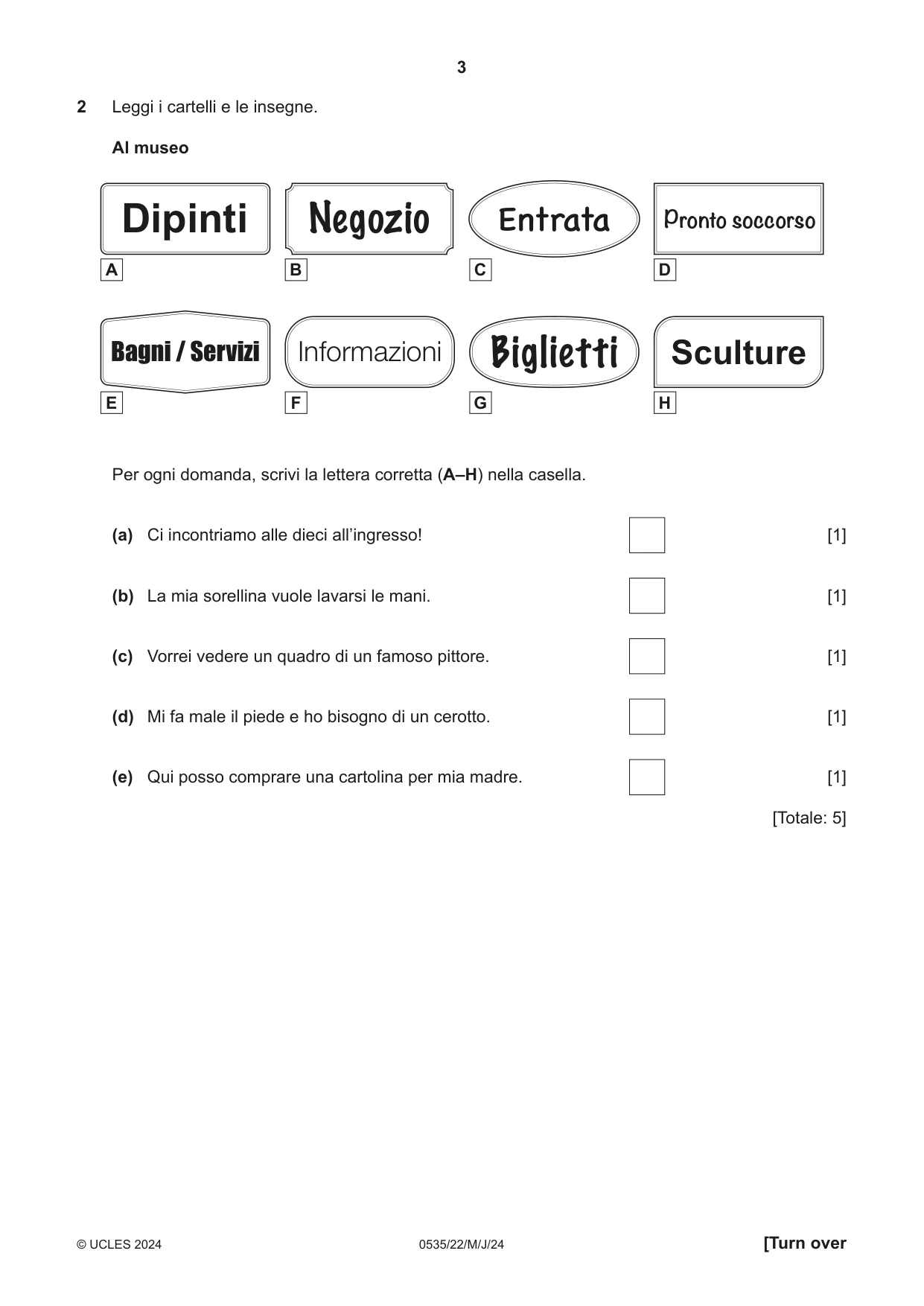
3 0535/22/M/J/24 © UCLES 2024 [Turn over 2 Leggi i cartelli e le insegne. Al museo A B C D E F G H Dipinti Sculture Entrata Pronto soccorso Biglietti Informazioni Negozio Bagni / Servizi Per ogni domanda, scrivi la lettera corretta (A–H) nella casella. (a) Ci incontriamo alle dieci all’ingresso! [1] (b) La mia sorellina vuole lavarsi le mani. [1] (c) Vorrei vedere un quadro di un famoso pittore. [1] (d) Mi fa male il piede e ho bisogno di un cerotto. [1] (e) Qui posso comprare una cartolina per mia madre. [1] [Totale: 5]
Question paper, page 4
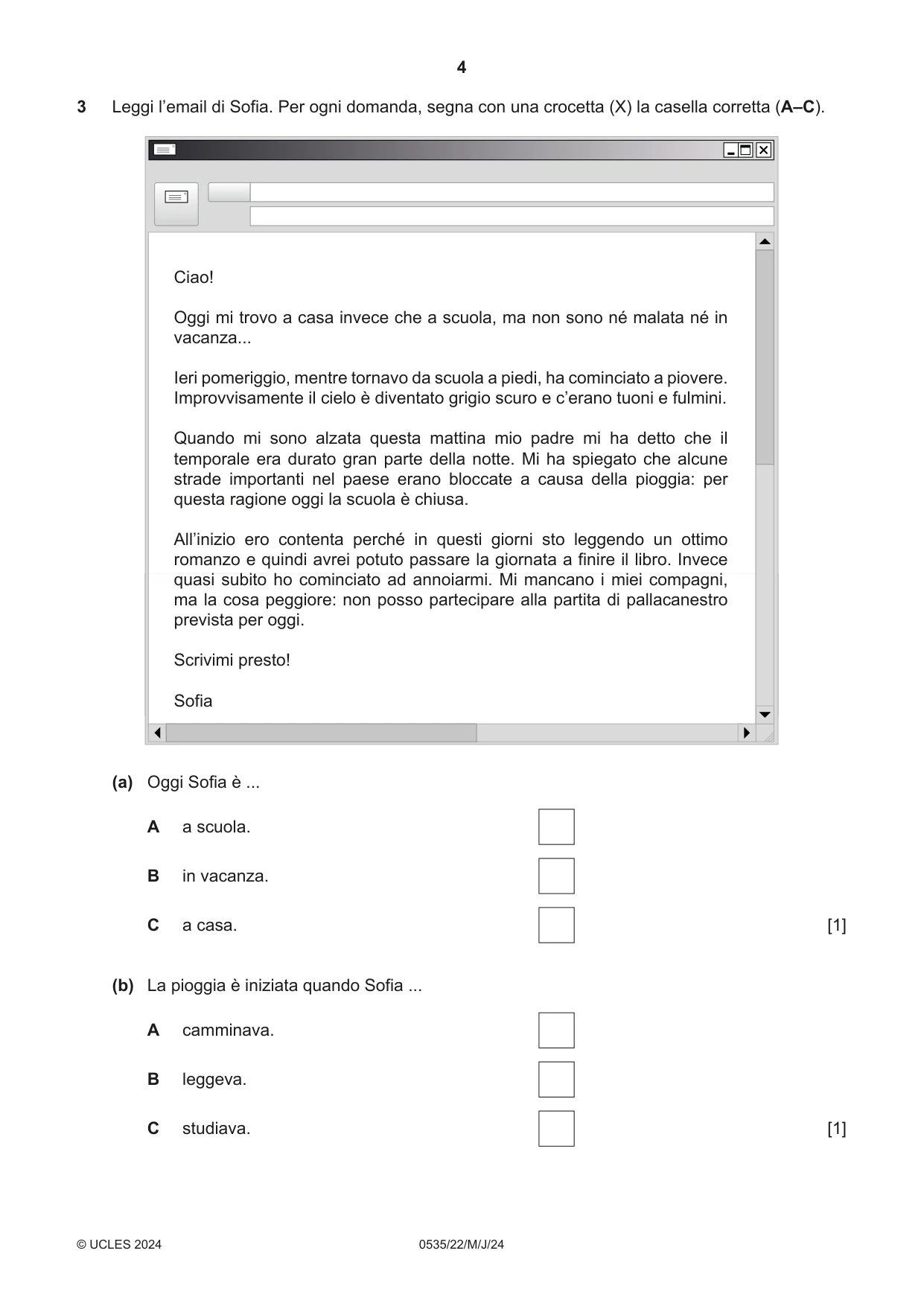
4 0535/22/M/J/24 © UCLES 2024 3 Leggi l’email di Sofia. Per ogni domanda, segna con una crocetta (X) la casella corretta (A–C). Ciao! Oggi mi trovo a casa invece che a scuola, ma non sono né malata né in vacanza... Ieri pomeriggio, mentre tornavo da scuola a piedi, ha cominciato a piovere. Improvvisamente il cielo è diventato grigio scuro e c’erano tuoni e fulmini. Quando mi sono alzata questa mattina mio padre mi ha detto che il temporale era durato gran parte della notte. Mi ha spiegato che alcune strade importanti nel paese erano bloccate a causa della pioggia: per questa ragione oggi la scuola è chiusa. All’inizio ero contenta perché in questi giorni sto leggendo un ottimo romanzo e quindi avrei potuto passare la giornata a finire il libro. Invece quasi subito ho cominciato ad annoiarmi. Mi mancano i miei compagni, ma la cosa peggiore: non posso partecipare alla partita di pallacanestro prevista per oggi. Scrivimi presto! Sofia (a) Oggi Sofia è ... A a scuola. B in vacanza. C a casa. [1] (b) La pioggia è iniziata quando Sofia ... A camminava. B leggeva. C studiava. [1]
Question paper, page 5
5 0535/22/M/J/24 © UCLES 2024 [Turn over (c) Sofia dice che, subito dopo la pioggia, è arrivata ... A la neve. B la nebbia. C la tempesta. [1] (d) Il padre di Sofia ha parlato ... A della partita di tennis. B delle conseguenze del maltempo. C del film che stava guardando. [1] (e) Come si sentiva Sofia inizialmente? A felice B arrabbiata C curiosa [1] (f) Quale sentimento ha provato dopo un po’? A l’allegria B la paura C la noia [1] (g) A Sofia mancano ... A i professori. B gli amici. C le sorelle. [1] [Totale: 7]
Question paper, page 6
6 0535/22/M/J/24 © UCLES 2024 4 Leggi l’email di Aaden e rispondi alle domande in italiano. Ciao! Ieri ho passato una giornata molto piacevole con un vecchio amico, Daniele. La settimana scorsa mi aveva mandato un sms per suggerire di trascorrere sabato insieme, cosa che avevamo voluto fare da molto tempo. Tutto il mese scorso avevo esami, quindi non ho trovato il tempo fino a ieri! Abbiamo deciso di incontrarci alle nove davanti al teatro perché ci vogliono solamente dieci minuti per andarci dalle nostre case. Quando siamo arrivati al teatro abbiamo trovato un uomo che suonava il violino accanto all’ingresso. Suonava canzoni famose, e la gente per strada si fermava per ascoltare e per applaudire. La dolce musica mi ha ricordato un concerto a cui ho assistito con mia cugina. Dopo un’ora siamo partiti per andare al centro commerciale. Daniele voleva comprare un regalo per il compleanno di sua madre, così siamo andati in una gioielleria. La commessa lo ha aiutato a scegliere un bell’orologio che sua madre adorerà! Poi abbiamo mangiato una pizza nell’area ristorazione, prima di prendere l’autobus per andare in spiaggia. Adoriamo nuotare in mare quando fa caldo, così il pomeriggio abbiamo nuotato e preso il sole. Mentre stavamo prendendo il sole parlavamo dei nostri sogni per l’avvenire. Io vorrei viaggiare in India, e a Daniele piacerebbe scrivere un giallo. Dopo, siamo tornati a casa di Daniele per cenare con i suoi genitori. Prima di tornare a casa mia ho guardato un film animato con lui. Ho fatto molto tardi! La giornata con Daniele mi è piaciuta moltissimo. Spero di ripeterla presto! Aaden (a) Chi è Daniele? … [1] (b) Che giorno della settimana ha suggerito Daniele ad Aaden? … [1] (c) Perché Aaden non aveva molto tempo libero recentemente? … [1]
Question paper, page 7
7 0535/22/M/J/24 © UCLES 2024 [Turn over (d) Quanto tempo ci vuole per arrivare al teatro dalla casa di Aaden? … [1] (e) Dove stava il violinista? … [1] (f) Per quali due ragioni smettevano di camminare le persone in strada? 1. …[1] 2. … [1] (g) Con chi era andato al concerto Aaden? … [1] (h) Chi ha dato consigli a Daniele per il regalo? … [1] (i) Che cosa gli piace fare quando la temperatura è alta? … [1] (j) Che cosa stavano facendo mentre discutevano i loro desideri futuri? … [1] (k) Per quale ragione sono ritornati da Daniele? … [1] [Totale: 12]
Question paper, page 8
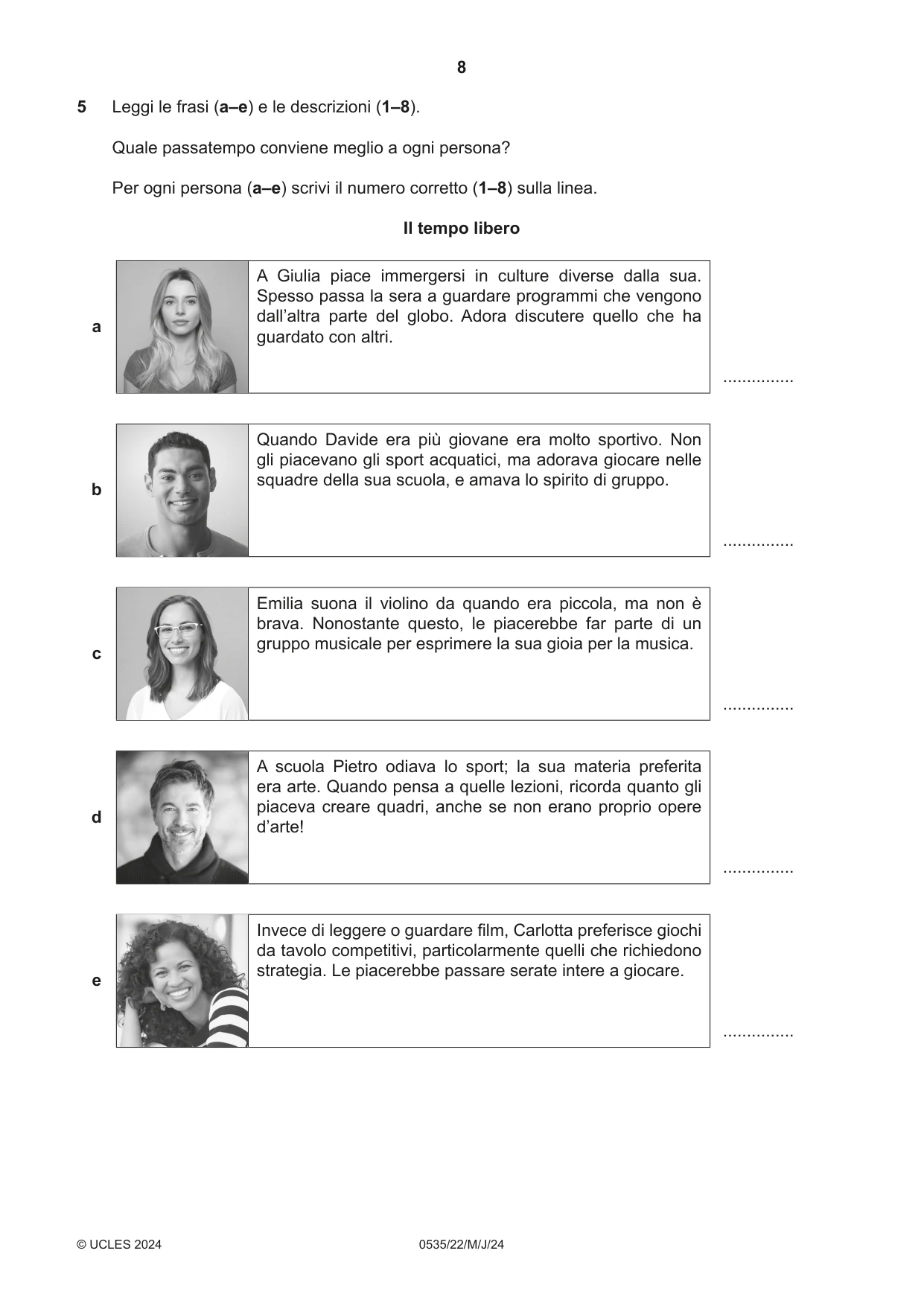
8 0535/22/M/J/24 © UCLES 2024 5 Leggi le frasi (a–e) e le descrizioni (1–8). Quale passatempo conviene meglio a ogni persona? Per ogni persona (a–e) scrivi il numero corretto (1–8) sulla linea. Il tempo libero a A Giulia piace immergersi in culture diverse dalla sua. Spesso passa la sera a guardare programmi che vengono dall’altra parte del globo. Adora discutere quello che ha guardato con altri. … b Quando Davide era più giovane era molto sportivo. Non gli piacevano gli sport acquatici, ma adorava giocare nelle squadre della sua scuola, e amava lo spirito di gruppo. … c Emilia suona il violino da quando era piccola, ma non è brava. Nonostante questo, le piacerebbe far parte di un gruppo musicale per esprimere la sua gioia per la musica. … d A scuola Pietro odiava lo sport; la sua materia preferita era arte. Quando pensa a quelle lezioni, ricorda quanto gli piaceva creare quadri, anche se non erano proprio opere d’arte! … e Invece di leggere o guardare film, Carlotta preferisce giochi da tavolo competitivi, particolarmente quelli che richiedono strategia. Le piacerebbe passare serate intere a giocare. …
Question paper, page 9
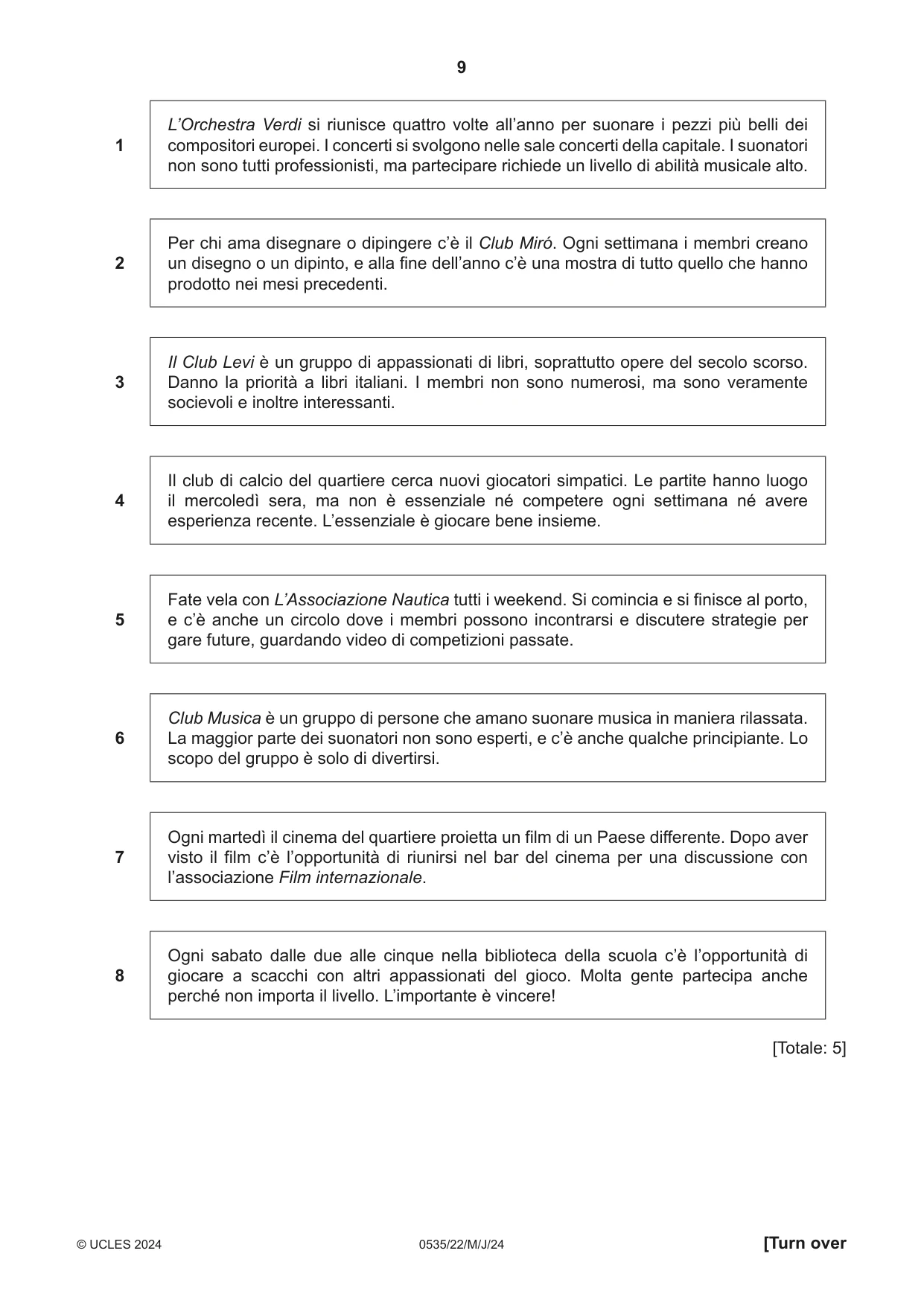
9 0535/22/M/J/24 © UCLES 2024 [Turn over 1 L’Orchestra Verdi si riunisce quattro volte all’anno per suonare i pezzi più belli dei compositori europei. I concerti si svolgono nelle sale concerti della capitale. I suonatori non sono tutti professionisti, ma partecipare richiede un livello di abilità musicale alto. 2 Per chi ama disegnare o dipingere c’è il Club Miró. Ogni settimana i membri creano un disegno o un dipinto, e alla fine dell’anno c’è una mostra di tutto quello che hanno prodotto nei mesi precedenti. 3 Il Club Levi è un gruppo di appassionati di libri, soprattutto opere del secolo scorso. Danno la priorità a libri italiani. I membri non sono numerosi, ma sono veramente socievoli e inoltre interessanti. 4 Il club di calcio del quartiere cerca nuovi giocatori simpatici. Le partite hanno luogo il mercoledì sera, ma non è essenziale né competere ogni settimana né avere esperienza recente. L’essenziale è giocare bene insieme. 5 Fate vela con L’Associazione Nautica tutti i weekend. Si comincia e si finisce al porto, e c’è anche un circolo dove i membri possono incontrarsi e discutere strategie per gare future, guardando video di competizioni passate. 6 Club Musica è un gruppo di persone che amano suonare musica in maniera rilassata. La maggior parte dei suonatori non sono esperti, e c’è anche qualche principiante. Lo scopo del gruppo è solo di divertirsi. 7 Ogni martedì il cinema del quartiere proietta un film di un Paese differente. Dopo aver visto il film c’è l’opportunità di riunirsi nel bar del cinema per una discussione con l’associazione Film internazionale. 8 Ogni sabato dalle due alle cinque nella biblioteca della scuola c’è l’opportunità di giocare a scacchi con altri appassionati del gioco. Molta gente partecipa anche perché non importa il livello. L’importante è vincere! [Totale: 5]
Question paper, page 10
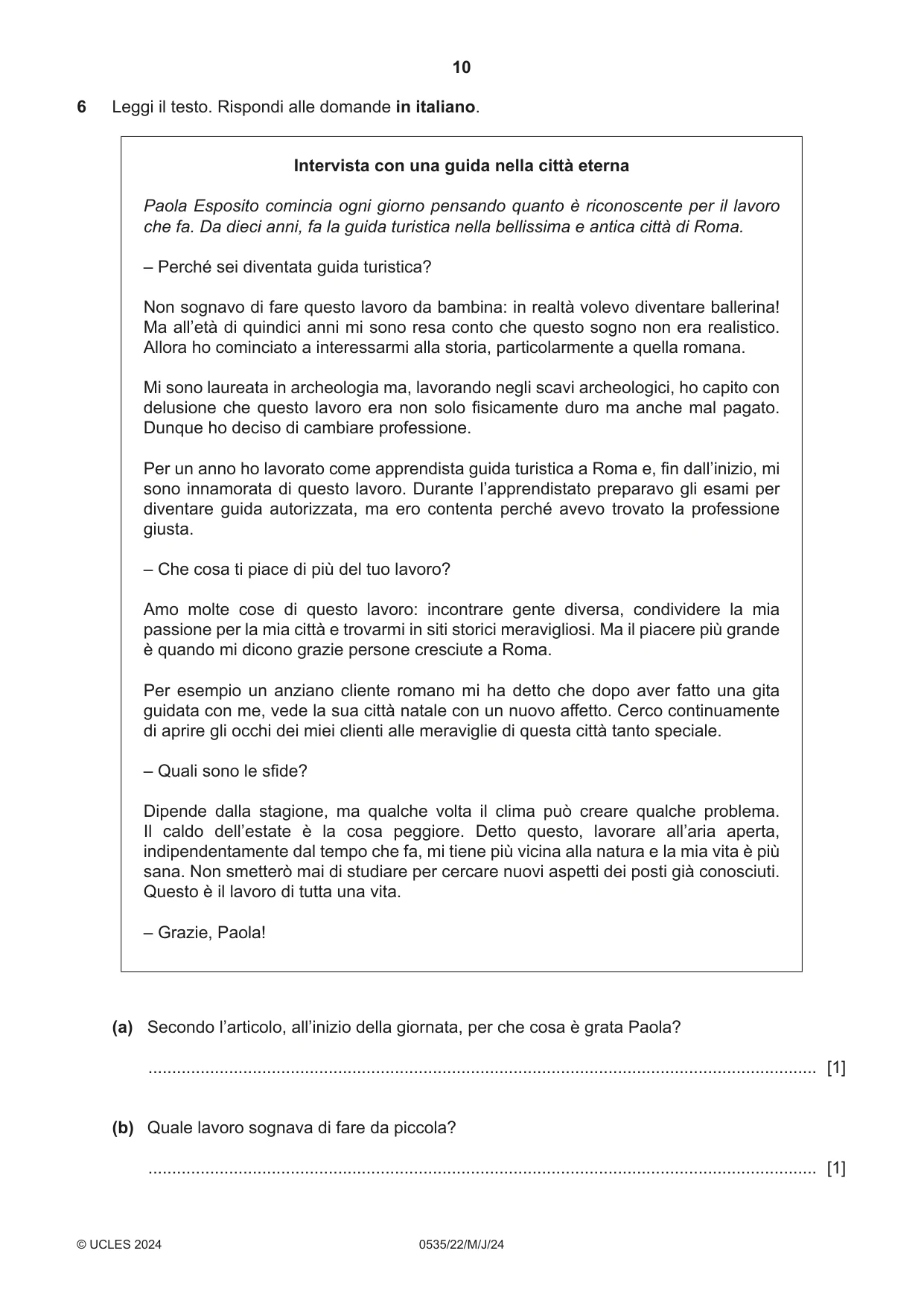
10 0535/22/M/J/24 © UCLES 2024 6 Leggi il testo. Rispondi alle domande in italiano. Intervista con una guida nella città eterna Paola Esposito comincia ogni giorno pensando quanto è riconoscente per il lavoro che fa. Da dieci anni, fa la guida turistica nella bellissima e antica città di Roma. – Perché sei diventata guida turistica? Non sognavo di fare questo lavoro da bambina: in realtà volevo diventare ballerina! Ma all’età di quindici anni mi sono resa conto che questo sogno non era realistico. Allora ho cominciato a interessarmi alla storia, particolarmente a quella romana. Mi sono laureata in archeologia ma, lavorando negli scavi archeologici, ho capito con delusione che questo lavoro era non solo fisicamente duro ma anche mal pagato. Dunque ho deciso di cambiare professione. Per un anno ho lavorato come apprendista guida turistica a Roma e, fin dall’inizio, mi sono innamorata di questo lavoro. Durante l’apprendistato preparavo gli esami per diventare guida autorizzata, ma ero contenta perché avevo trovato la professione giusta. – Che cosa ti piace di più del tuo lavoro? Amo molte cose di questo lavoro: incontrare gente diversa, condividere la mia passione per la mia città e trovarmi in siti storici meravigliosi. Ma il piacere più grande è quando mi dicono grazie persone cresciute a Roma. Per esempio un anziano cliente romano mi ha detto che dopo aver fatto una gita guidata con me, vede la sua città natale con un nuovo affetto. Cerco continuamente di aprire gli occhi dei miei clienti alle meraviglie di questa città tanto speciale. – Quali sono le sfide? Dipende dalla stagione, ma qualche volta il clima può creare qualche problema. Il caldo dell’estate è la cosa peggiore. Detto questo, lavorare all’aria aperta, indipendentamente dal tempo che fa, mi tiene più vicina alla natura e la mia vita è più sana. Non smetterò mai di studiare per cercare nuovi aspetti dei posti già conosciuti. Questo è il lavoro di tutta una vita. – Grazie, Paola! (a) Secondo l’articolo, all’inizio della giornata, per che cosa è grata Paola? … [1] (b) Quale lavoro sognava di fare da piccola? … [1]
Question paper, page 11
11 0535/22/M/J/24 © UCLES 2024 (c) Che cosa ha realizzato Paola quando aveva quindici anni? … [1] (d) Per Paola quali erano i due aspetti negativi del lavoro negli scavi archeologici? 1. … [1] 2. … [1] (e) Cos’è successo quando ha cominciato l’esperienza lavorativa come guida? … [1] (f) Perché si sentiva felice mentre studiava per l’autorizzazione? … [1] (g) Da chi ama di più essere ringraziata Paola? … [1] (h) Che cosa tenta di fare sempre Paola? … [1] (i) Secondo Paola, quali sono le due conseguenze di stare all’aperto? 1. … [1] 2. … [1] [Totale: 11]
Question paper, page 12
12 0535/22/M/J/24 © UCLES 2024 Permission to reproduce items where third-party owned material protected by copyright is included has been sought and cleared where possible. Every reasonable effort has been made by the publisher (UCLES) to trace copyright holders, but if any items requiring clearance have unwittingly been included, the publisher will be pleased to make amends at the earliest possible opportunity. To avoid the issue of disclosure of answer-related information to candidates, all copyright acknowledgements are reproduced online in the Cambridge Assessment International Education Copyright Acknowledgements Booklet. This is produced for each series of examinations and is freely available to download at www.cambridgeinternational.org after the live examination series. Cambridge Assessment International Education is part of Cambridge Assessment. Cambridge Assessment is the brand name of the University of Cambridge Local Examinations Syndicate (UCLES), which is a department of the University of Cambridge. BLANK PAGE
Mark scheme, page 1
This document consists of 10 printed pages. © Cambridge University Press & Assessment 2024 [Turn over Cambridge IGCSE™ ITALIAN 0535/22 Paper 2 Reading May/June 2024 MARK SCHEME Maximum Mark: 45 Published This mark scheme is published as an aid to teachers and candidates, to indicate the requirements of the examination. It shows the basis on which Examiners were instructed to award marks. It does not indicate the details of the discussions that took place at an Examiners’ meeting before marking began, which would have considered the acceptability of alternative answers. Mark schemes should be read in conjunction with the question paper and the Principal Examiner Report for Teachers. Cambridge International will not enter into discussions about these mark schemes. Cambridge International is publishing the mark schemes for the May/June 2024 series for most Cambridge IGCSE, Cambridge International A and AS Level and Cambridge Pre-U components, and some Cambridge O Level components.
Mark scheme, page 2
0535/22 Cambridge IGCSE – Mark Scheme PUBLISHED May/June 2024 © Cambridge University Press & Assessment 2024 Page 2 of 10 Generic Marking Principles These general marking principles must be applied by all examiners when marking candidate answers. They should be applied alongside the specific content of the mark scheme or generic level descriptions for a question. Each question paper and mark scheme will also comply with these marking principles. GENERIC MARKING PRINCIPLE 1: Marks must be awarded in line with: the specific content of the mark scheme or the generic level descriptors for the question the specific skills defined in the mark scheme or in the generic level descriptors for the question the standard of response required by a candidate as exemplified by the standardisation scripts. GENERIC MARKING PRINCIPLE 2: Marks awarded are always whole marks (not half marks, or other fractions). GENERIC MARKING PRINCIPLE 3: Marks must be awarded positively: marks are awarded for correct/valid answers, as defined in the mark scheme. However, credit is given for valid answers which go beyond the scope of the syllabus and mark scheme, referring to your Team Leader as appropriate marks are awarded when candidates clearly demonstrate what they know and can do marks are not deducted for errors marks are not deducted for omissions answers should only be judged on the quality of spelling, punctuation and grammar when these features are specifically assessed by the question as indicated by the mark scheme. The meaning, however, should be unambiguous. GENERIC MARKING PRINCIPLE 4: Rules must be applied consistently, e.g. in situations where candidates have not followed instructions or in the application of generic level descriptors.
Mark scheme, page 3
0535/22 Cambridge IGCSE – Mark Scheme PUBLISHED May/June 2024 © Cambridge University Press & Assessment 2024 Page 3 of 10 GENERIC MARKING PRINCIPLE 5: Marks should be awarded using the full range of marks defined in the mark scheme for the question (however; the use of the full mark range may be limited according to the quality of the candidate responses seen). GENERIC MARKING PRINCIPLE 6: Marks awarded are based solely on the requirements as defined in the mark scheme. Marks should not be awarded with grade thresholds or grade descriptors in mind.
Mark scheme, page 4
0535/22 Cambridge IGCSE – Mark Scheme PUBLISHED May/June 2024 © Cambridge University Press & Assessment 2024 Page 4 of 10 Additional Guidance The following guidance underpins the detailed instructions provided in the mark scheme. Where a decision is taken to deviate from this guidance for a particular question, this will be specified in the mark scheme. Often the additional guidance points will have to be weighed up against each other, e.g. the answer might look or sound like the intended word/phrase in Spanish, but if what the candidate has written means something different in Italian from what is expected, the mark cannot be awarded. It is not possible to list all acceptable alternatives in the mark scheme. If you encounter an answer which is not covered by the mark scheme, you will need to make a decision about whether it communicates the required elements (in consultation with your Team Leader if necessary, or with your Product Manager if you are a single examiner), and award marks accordingly. Crossing out: (a) If a candidate changes his/her mind about an answer and crosses out an attempt, award a mark if the final attempt is correct. (b) If a candidate crosses out an answer to a whole question but makes no second attempt at it, mark the crossed-out work. More than the stipulated number of boxes ticked/crossed by the candidate: (a) If more than one attempt is visible but the candidate has clearly indicated which attempt is his/her final answer (e.g. by crossing out other attempts or by annotating the script in some way), mark in the usual way. (b) If two attempts are visible (e.g. two boxes ticked instead of the one box stipulated), and neither has been crossed out/discounted by the candidate, no mark can be awarded. For questions requiring more than one element for the answer, 1 and 2, where the answers are interchangeable: (a) Both of the correct answers are on line 1 and line 2 blank (or vice versa) = 2 marks (b) Both correct answers on line 1 and line 2 contains a wrong answer (or vice versa) = 1 mark
Mark scheme, page 5
0535/22 Cambridge IGCSE – Mark Scheme PUBLISHED May/June 2024 © Cambridge University Press & Assessment 2024 Page 5 of 10 Mark for communication: Answers requiring the use of Italian (rather than a non-verbal response) should be marked for communication. Tolerate inaccuracies provided that the message is clear. However, do not accept incorrect Italian if the word written by the candidate means something else in Italian (unless the mark scheme specifies otherwise). (a) If you read aloud what the candidate has written, does it sound like the correct answer? Would a native speaker of Italian understand it? (b) Does what the candidate has written look like the correct answer, e.g. one letter missing but no other word created? Would a native speaker of Italian understand it? (c) The subject needs to be unambiguous. Possessives and personal pronouns need to be used in such a way as to make the answer unambiguous. Annotations used in the mark scheme: (a) INV = invalidation. This is used when the additional material included by the candidate is judged to invalidate an otherwise correct answer and therefore prevents him/her from scoring the mark. (INV = 0) (b) tc = ‘tout court’. This means that, on its own, the material is not sufficient to score the mark. (c) HA = harmless addition. This means that the candidate has included additional material which, in conjunction with the correct answer, does not prevent him/her from scoring the mark. No response and ‘0’ marks: (a) Award NR (no response): If there is nothing written at all in the answer space or If there is only a comment which does not in any way relate to the question being asked (e.g. ‘can’t do’ or ‘don’t know’) or If there is only a mark which isn’t an attempt at the question (e.g. a dash, a question mark). (b) Award 0: If there is any attempt that earns no credit, e.g. the candidate has copied out part or all of the question.
Mark scheme, page 6
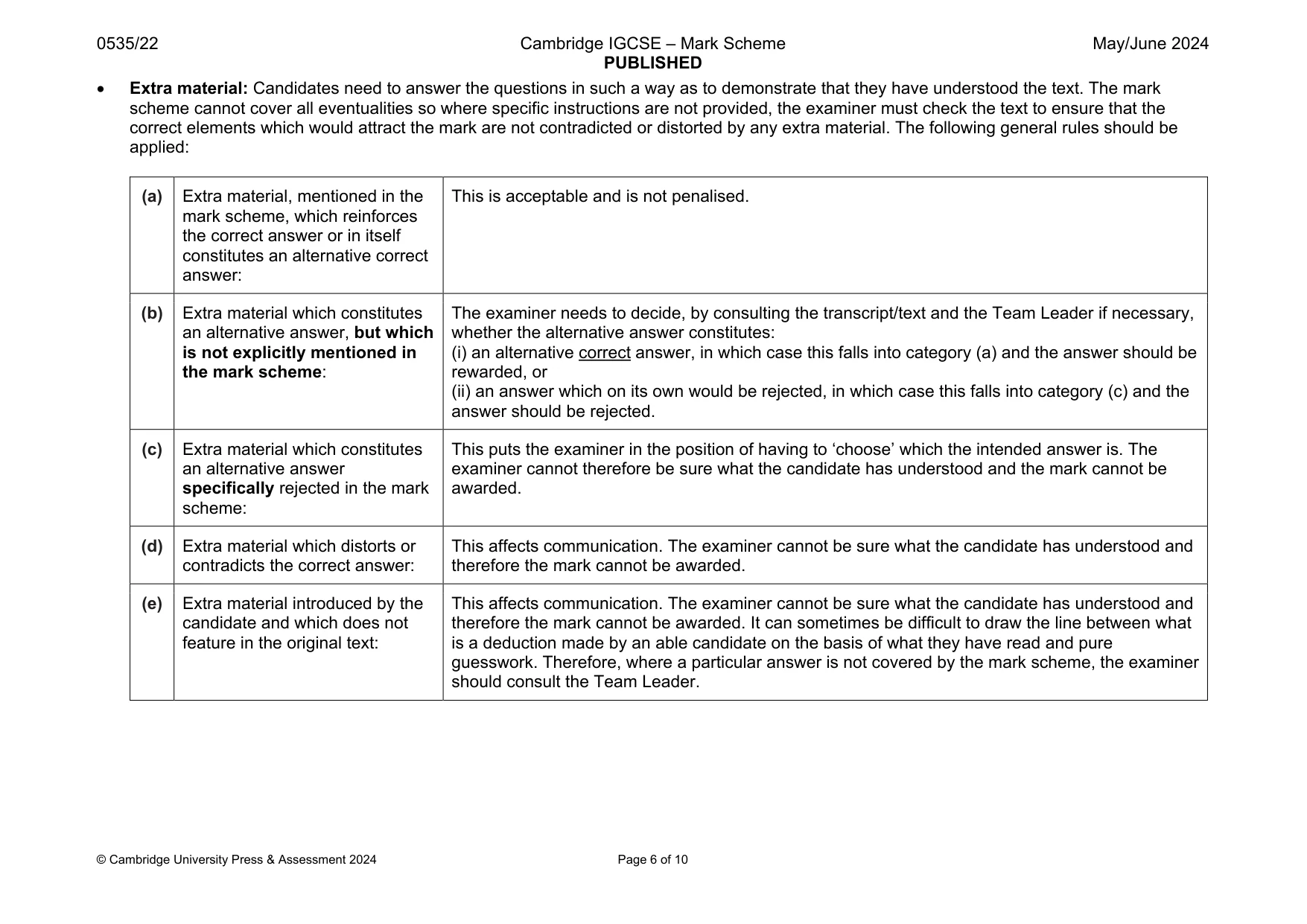
0535/22 Cambridge IGCSE – Mark Scheme PUBLISHED May/June 2024 © Cambridge University Press & Assessment 2024 Page 6 of 10 Extra material: Candidates need to answer the questions in such a way as to demonstrate that they have understood the text. The mark scheme cannot cover all eventualities so where specific instructions are not provided, the examiner must check the text to ensure that the correct elements which would attract the mark are not contradicted or distorted by any extra material. The following general rules should be applied: (a) Extra material, mentioned in the mark scheme, which reinforces the correct answer or in itself constitutes an alternative correct answer: This is acceptable and is not penalised. (b) Extra material which constitutes an alternative answer, but which is not explicitly mentioned in the mark scheme: The examiner needs to decide, by consulting the transcript/text and the Team Leader if necessary, whether the alternative answer constitutes: (i) an alternative correct answer, in which case this falls into category (a) and the answer should be rewarded, or (ii) an answer which on its own would be rejected, in which case this falls into category (c) and the answer should be rejected. (c) Extra material which constitutes an alternative answer specifically rejected in the mark scheme: This puts the examiner in the position of having to ‘choose’ which the intended answer is. The examiner cannot therefore be sure what the candidate has understood and the mark cannot be awarded. (d) Extra material which distorts or contradicts the correct answer: This affects communication. The examiner cannot be sure what the candidate has understood and therefore the mark cannot be awarded. (e) Extra material introduced by the candidate and which does not feature in the original text: This affects communication. The examiner cannot be sure what the candidate has understood and therefore the mark cannot be awarded. It can sometimes be difficult to draw the line between what is a deduction made by an able candidate on the basis of what they have read and pure guesswork. Therefore, where a particular answer is not covered by the mark scheme, the examiner should consult the Team Leader.
Mark scheme, page 7
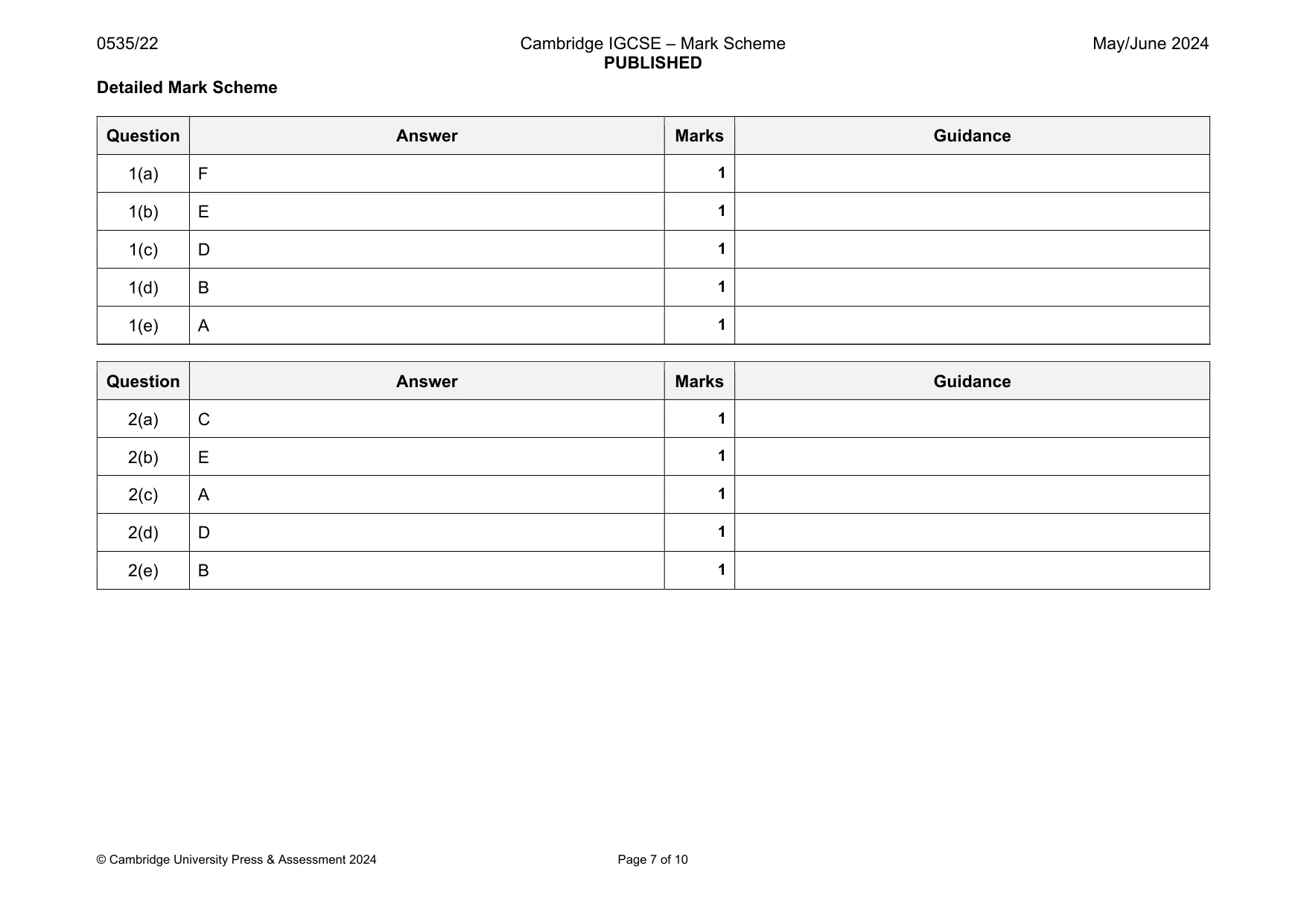
0535/22 Cambridge IGCSE – Mark Scheme PUBLISHED May/June 2024 © Cambridge University Press & Assessment 2024 Page 7 of 10 Detailed Mark Scheme Question Answer Marks Guidance 1(a) F 1 1(b) E 1 1(c) D 1 1(d) B 1 1(e) A 1 Question Answer Marks Guidance 2(a) C 1 2(b) E 1 2(c) A 1 2(d) D 1 2(e) B 1
Mark scheme, page 8
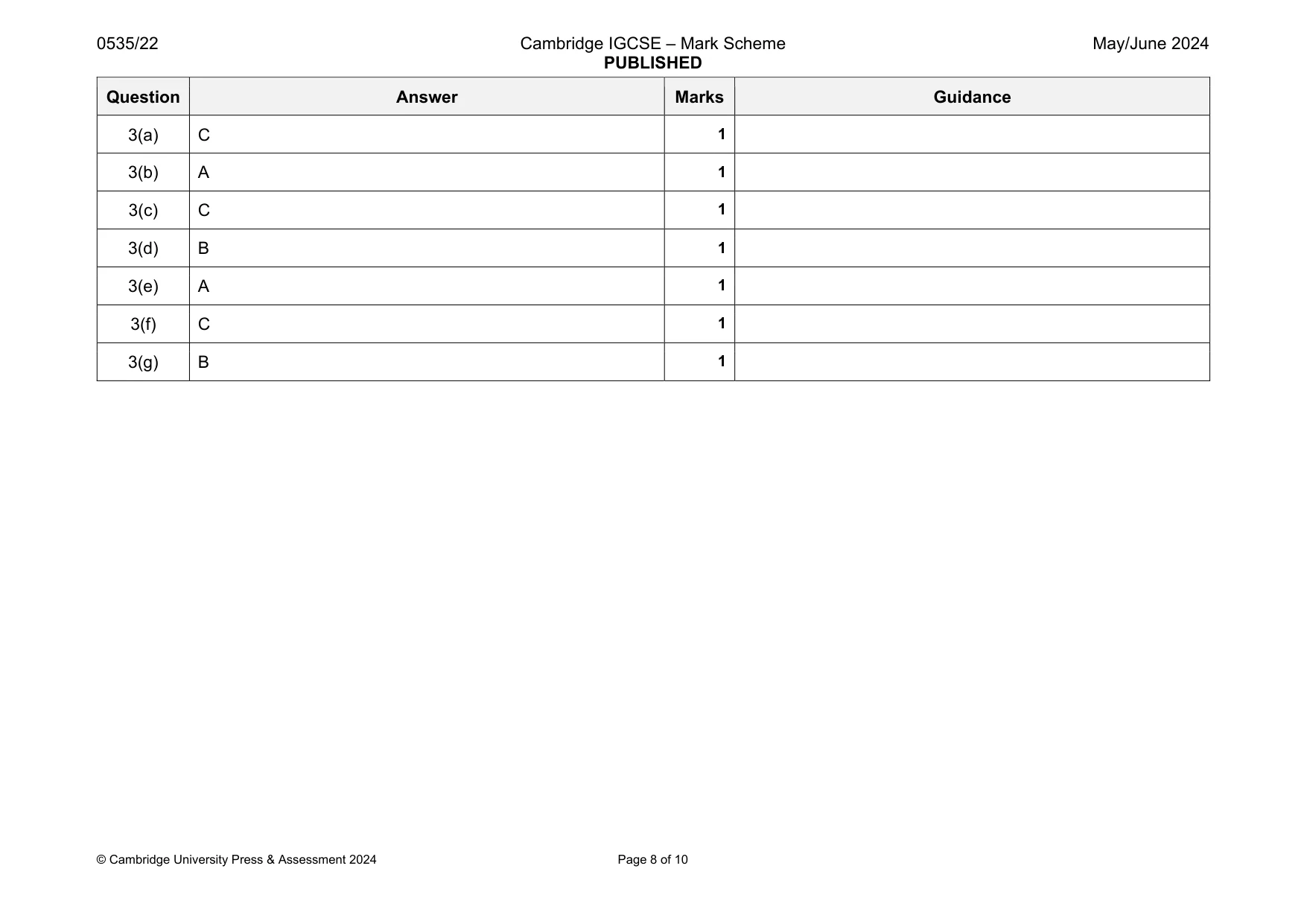
0535/22 Cambridge IGCSE – Mark Scheme PUBLISHED May/June 2024 © Cambridge University Press & Assessment 2024 Page 8 of 10 Question Answer Marks Guidance 3(a) C 1 3(b) A 1 3(c) C 1 3(d) B 1 3(e) A 1 3(f) C 1 3(g) B 1
Mark scheme, page 9
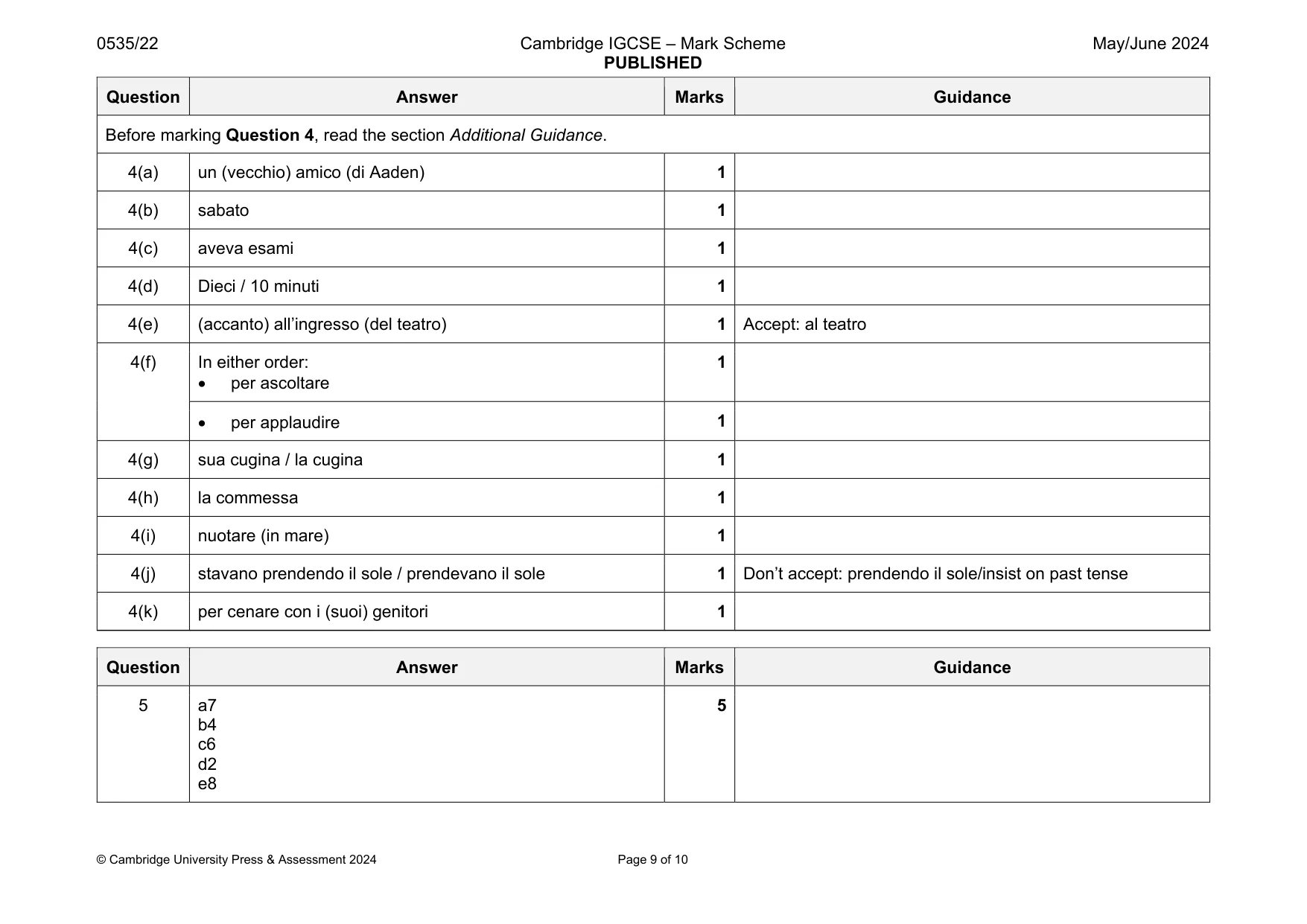
0535/22 Cambridge IGCSE – Mark Scheme PUBLISHED May/June 2024 © Cambridge University Press & Assessment 2024 Page 9 of 10 Question Answer Marks Guidance Before marking Question 4, read the section Additional Guidance. 4(a) un (vecchio) amico (di Aaden) 1 4(b) sabato 1 4(c) aveva esami 1 4(d) Dieci / 10 minuti 1 4(e) (accanto) all’ingresso (del teatro) 1 Accept: al teatro 4(f) In either order: per ascoltare 1 per applaudire 1 4(g) sua cugina / la cugina 1 4(h) la commessa 1 4(i) nuotare (in mare) 1 4(j) stavano prendendo il sole / prendevano il sole 1 Don’t accept: prendendo il sole/insist on past tense 4(k) per cenare con i (suoi) genitori 1 Question Answer Marks Guidance 5 a7 b4 c6 d2 e8 5
Mark scheme, page 10
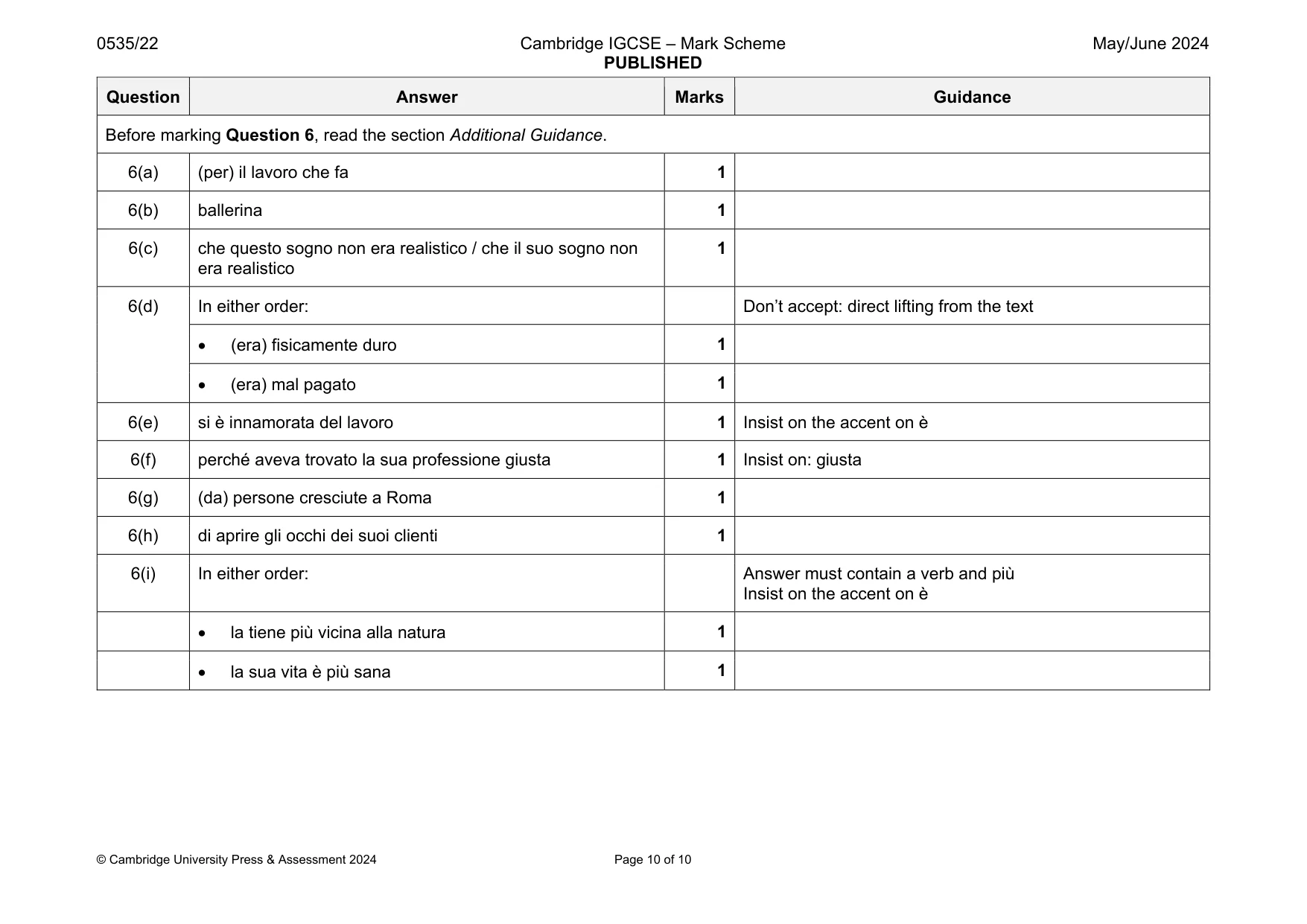
0535/22 Cambridge IGCSE – Mark Scheme PUBLISHED May/June 2024 © Cambridge University Press & Assessment 2024 Page 10 of 10 Question Answer Marks Guidance Before marking Question 6, read the section Additional Guidance. 6(a) (per) il lavoro che fa 1 6(b) ballerina 1 6(c) che questo sogno non era realistico / che il suo sogno non era realistico 1 6(d) In either order: Don’t accept: direct lifting from the text (era) fisicamente duro 1 (era) mal pagato 1 6(e) si è innamorata del lavoro 1 Insist on the accent on è 6(f) perché aveva trovato la sua professione giusta 1 Insist on: giusta 6(g) (da) persone cresciute a Roma 1 6(h) di aprire gli occhi dei suoi clienti 1 6(i) In either order: Answer must contain a verb and più Insist on the accent on è la tiene più vicina alla natura 1 la sua vita è più sana 1
What you needed in this session
Cambridge’s own grade thresholds for 2024 May/June, Paper 2 · Variant 2. A higher threshold means an easier paper — the bar moves with how the cohort did.