Cambridge IGCSE Italian - Foreign Language 0535 — 2024 May/June Paper 2 · Variant 3
0535/23/M/J/24 · 45 marks · ≈51 min
The question paper and its mark scheme, free to read here and free to download. This is Cambridge’s own paper, exactly as it was sat.
Question paper12 pages

Mark scheme10 pages
Answers below. Sit the paper first if you are practising.
Paper as text
Question paper, page 1
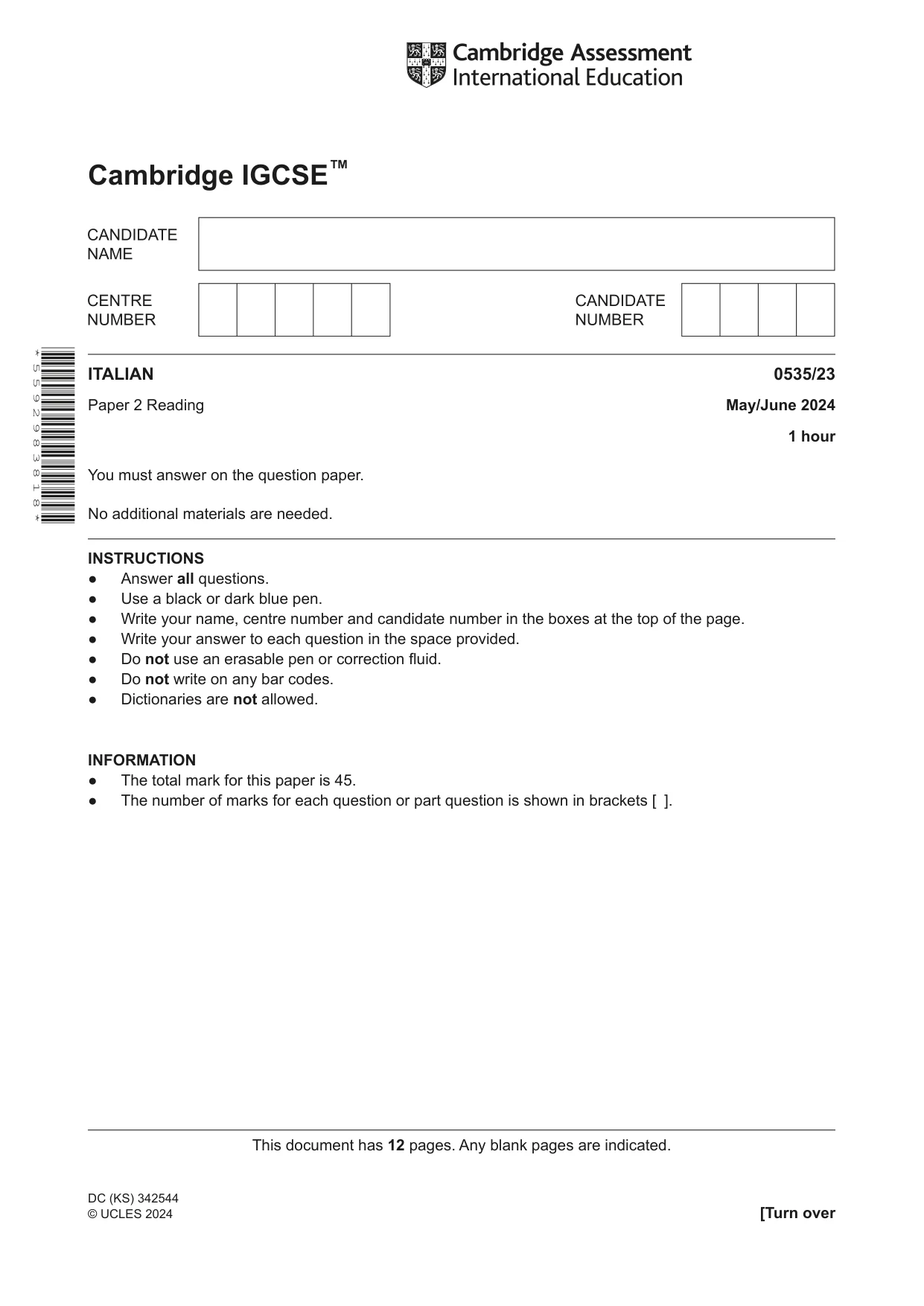
This document has 12 pages. Any blank pages are indicated. [Turn over Cambridge IGCSE™ DC (KS) 342544 © UCLES 2024 ITALIAN 0535/23 Paper 2 Reading May/June 2024 1 hour You must answer on the question paper. No additional materials are needed. INSTRUCTIONS ● Answer all questions. ● Use a black or dark blue pen. ● Write your name, centre number and candidate number in the boxes at the top of the page. ● Write your answer to each question in the space provided. ● Do not use an erasable pen or correction fluid. ● Do not write on any bar codes. ● Dictionaries are not allowed. INFORMATION ● The total mark for this paper is 45. ● The number of marks for each question or part question is shown in brackets [ ]. * 5 5 9 2 9 8 3 8 1 8 *
Question paper, page 2
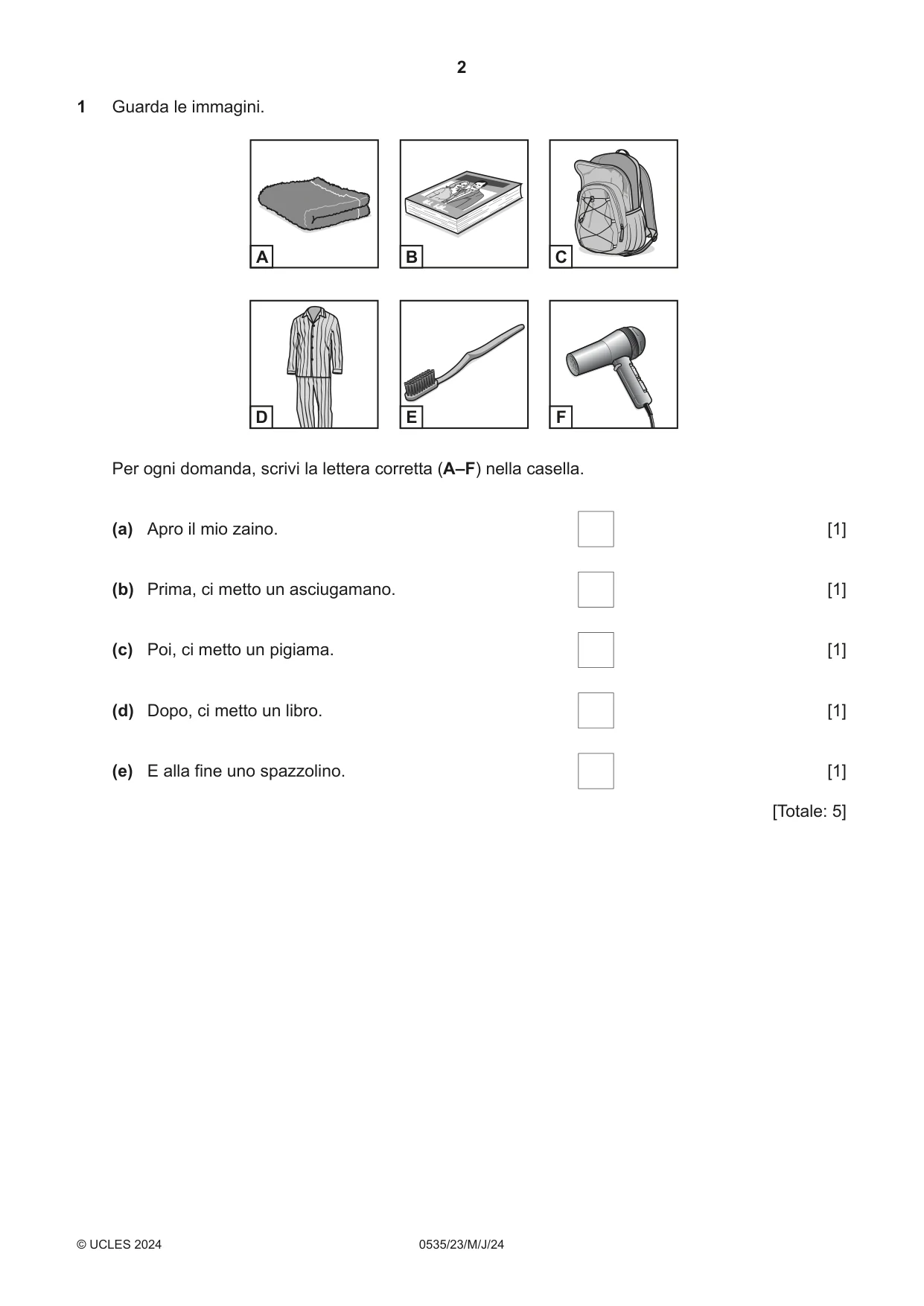
2 0535/23/M/J/24 © UCLES 2024 1 Guarda le immagini. B C E F A D Per ogni domanda, scrivi la lettera corretta (A–F) nella casella. (a) Apro il mio zaino. [1] (b) Prima, ci metto un asciugamano. [1] (c) Poi, ci metto un pigiama. [1] (d) Dopo, ci metto un libro. [1] (e) E alla fine uno spazzolino. [1] [Totale: 5]
Question paper, page 3
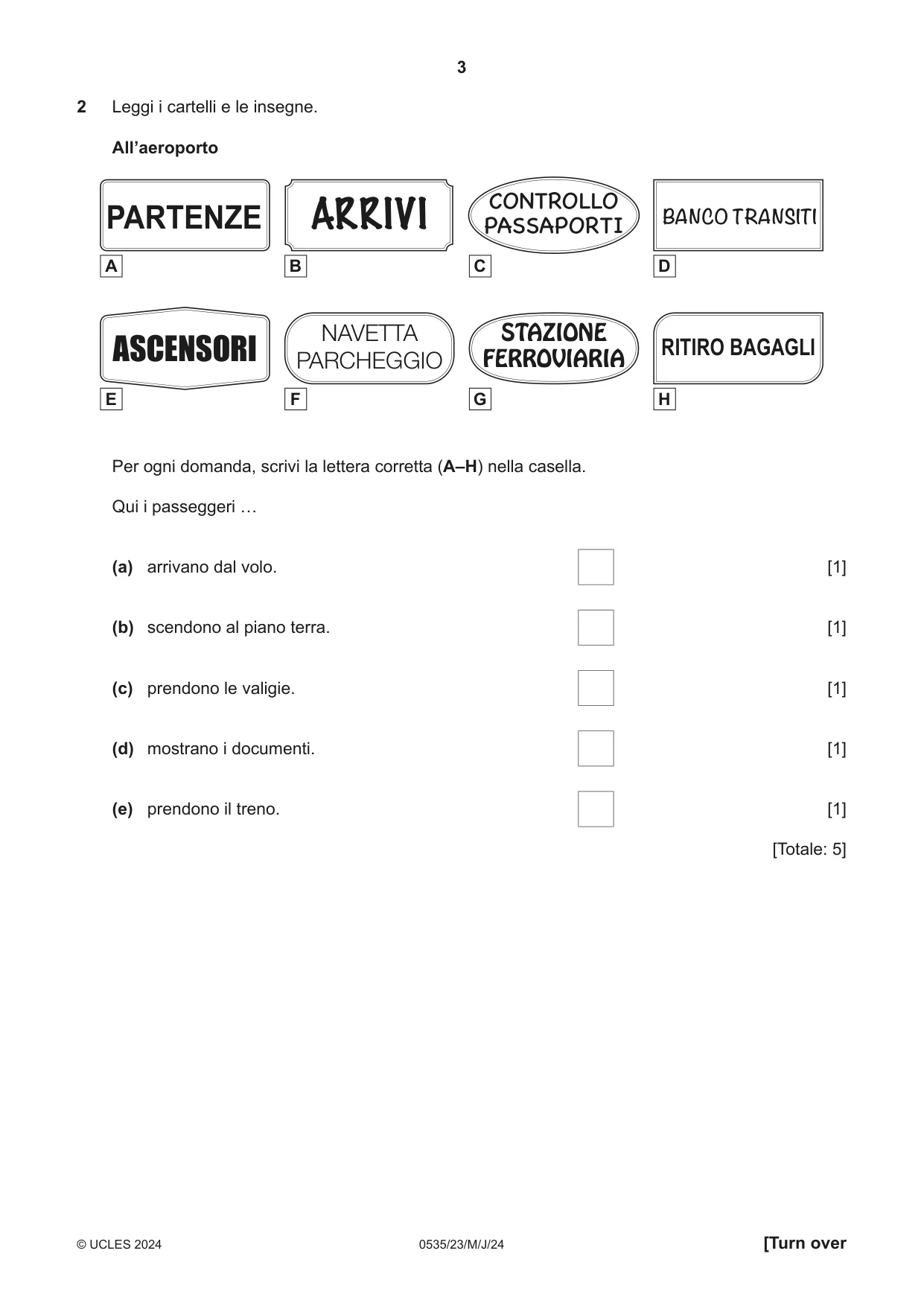
3 0535/23/M/J/24 © UCLES 2024 [Turn over 2 Leggi i cartelli e le insegne. All’aeroporto A B C D E F G H PARTENZE RITIRO BAGAGLI CONTROLLO PASSAPORTI BANCO TRANSITI STAZIONE FERROVIARIA NAVETTA PARCHEGGIO ARRIVI ASCENSORI Per ogni domanda, scrivi la lettera corretta (A–H) nella casella. Qui i passeggeri … (a) arrivano dal volo. [1] (b) scendono al piano terra. [1] (c) prendono le valigie. [1] (d) mostrano i documenti. [1] (e) prendono il treno. [1] [Totale: 5]
Question paper, page 4
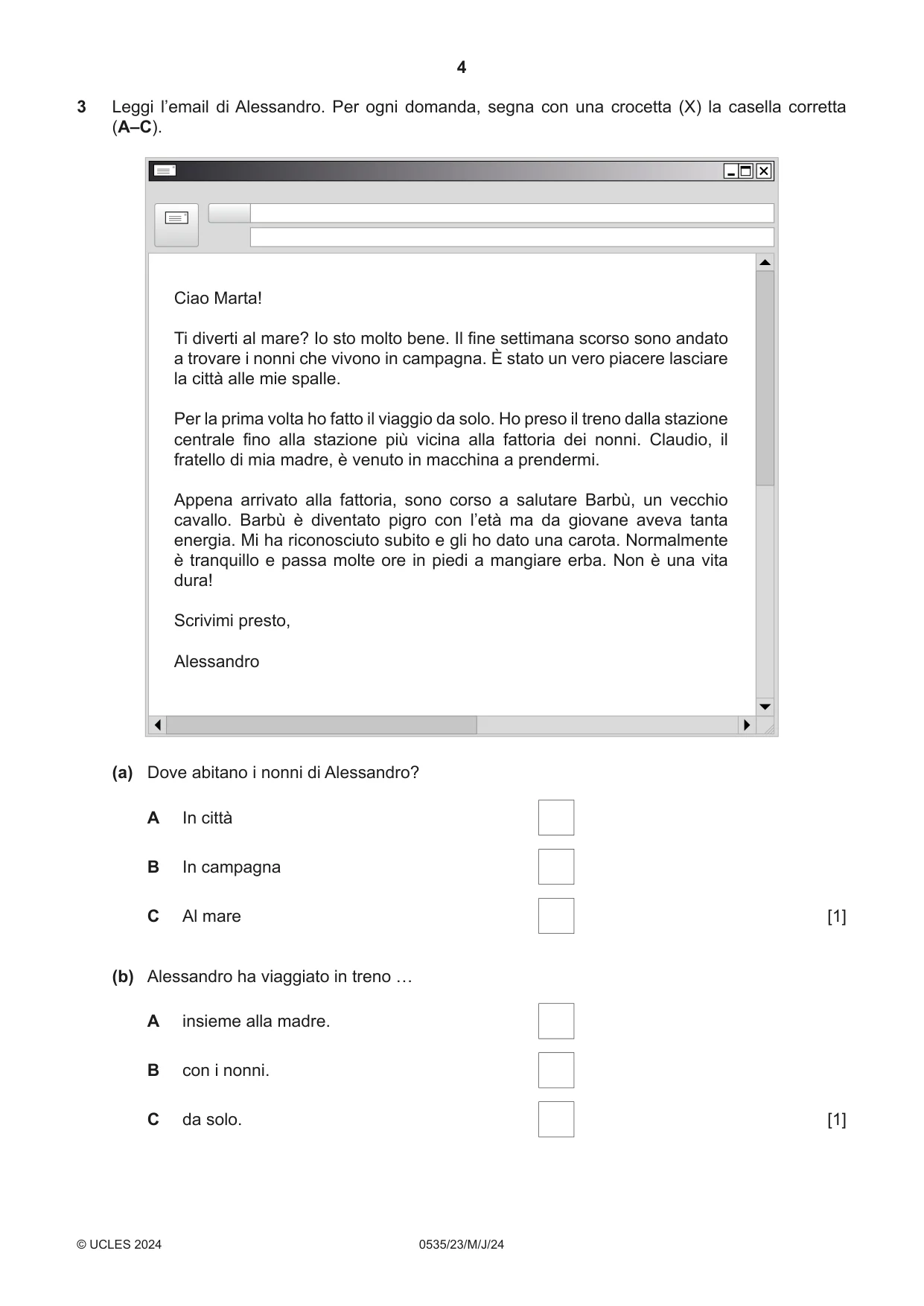
4 0535/23/M/J/24 © UCLES 2024 3 Leggi l’email di Alessandro. Per ogni domanda, segna con una crocetta (X) la casella corretta (A–C). (a) Dove abitano i nonni di Alessandro? A In città B In campagna C Al mare [1] (b) Alessandro ha viaggiato in treno … A insieme alla madre. B con i nonni. C da solo. [1] Ciao Marta! Ti diverti al mare? Io sto molto bene. Il fine settimana scorso sono andato a trovare i nonni che vivono in campagna. È stato un vero piacere lasciare la città alle mie spalle. Per la prima volta ho fatto il viaggio da solo. Ho preso il treno dalla stazione centrale fino alla stazione più vicina alla fattoria dei nonni. Claudio, il fratello di mia madre, è venuto in macchina a prendermi. Appena arrivato alla fattoria, sono corso a salutare Barbù, un vecchio cavallo. Barbù è diventato pigro con l’età ma da giovane aveva tanta energia. Mi ha riconosciuto subito e gli ho dato una carota. Normalmente è tranquillo e passa molte ore in piedi a mangiare erba. Non è una vita dura! Scrivimi presto, Alessandro
Question paper, page 5
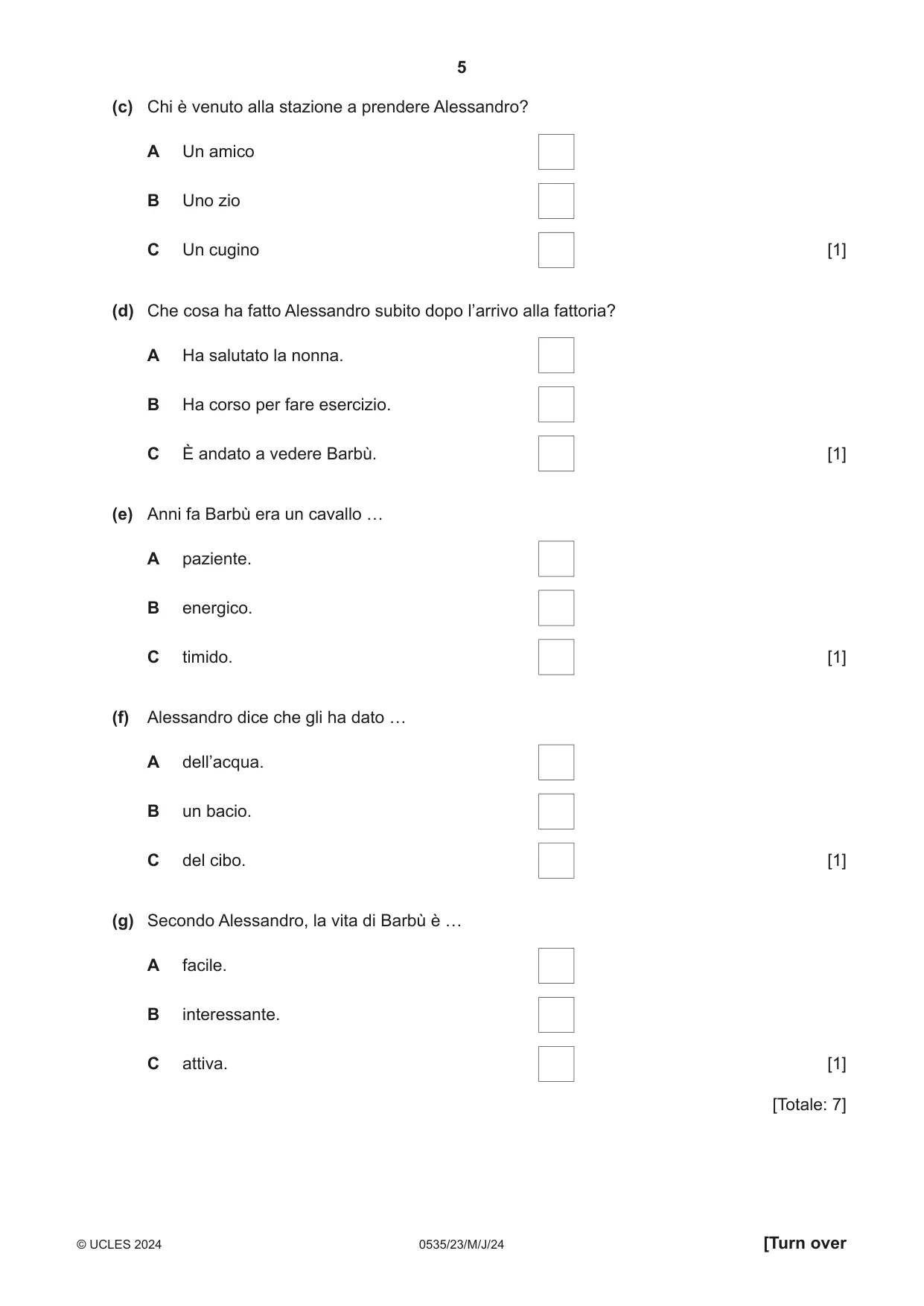
5 0535/23/M/J/24 © UCLES 2024 [Turn over (c) Chi è venuto alla stazione a prendere Alessandro? A Un amico B Uno zio C Un cugino [1] (d) Che cosa ha fatto Alessandro subito dopo l’arrivo alla fattoria? A Ha salutato la nonna. B Ha corso per fare esercizio. C È andato a vedere Barbù. [1] (e) Anni fa Barbù era un cavallo … A paziente. B energico. C timido. [1] (f) Alessandro dice che gli ha dato … A dell’acqua. B un bacio. C del cibo. [1] (g) Secondo Alessandro, la vita di Barbù è … A facile. B interessante. C attiva. [1] [Totale: 7]
Question paper, page 6
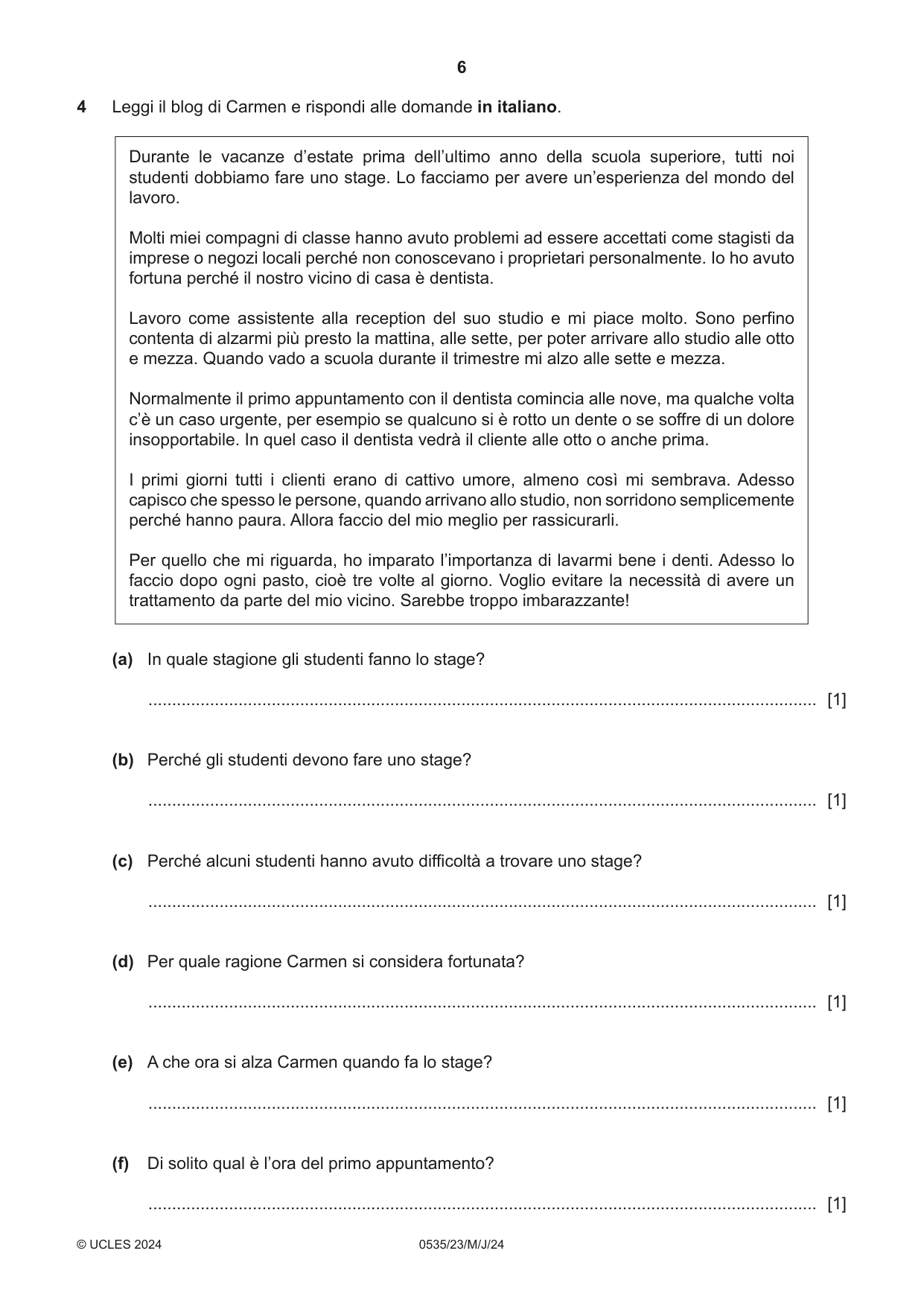
6 0535/23/M/J/24 © UCLES 2024 4 Leggi il blog di Carmen e rispondi alle domande in italiano. Durante le vacanze d’estate prima dell’ultimo anno della scuola superiore, tutti noi studenti dobbiamo fare uno stage. Lo facciamo per avere un’esperienza del mondo del lavoro. Molti miei compagni di classe hanno avuto problemi ad essere accettati come stagisti da imprese o negozi locali perché non conoscevano i proprietari personalmente. Io ho avuto fortuna perché il nostro vicino di casa è dentista. Lavoro come assistente alla reception del suo studio e mi piace molto. Sono perfino contenta di alzarmi più presto la mattina, alle sette, per poter arrivare allo studio alle otto e mezza. Quando vado a scuola durante il trimestre mi alzo alle sette e mezza. Normalmente il primo appuntamento con il dentista comincia alle nove, ma qualche volta c’è un caso urgente, per esempio se qualcuno si è rotto un dente o se soffre di un dolore insopportabile. In quel caso il dentista vedrà il cliente alle otto o anche prima. I primi giorni tutti i clienti erano di cattivo umore, almeno così mi sembrava. Adesso capisco che spesso le persone, quando arrivano allo studio, non sorridono semplicemente perché hanno paura. Allora faccio del mio meglio per rassicurarli. Per quello che mi riguarda, ho imparato l’importanza di lavarmi bene i denti. Adesso lo faccio dopo ogni pasto, cioè tre volte al giorno. Voglio evitare la necessità di avere un trattamento da parte del mio vicino. Sarebbe troppo imbarazzante! (a) In quale stagione gli studenti fanno lo stage? … [1] (b) Perché gli studenti devono fare uno stage? … [1] (c) Perché alcuni studenti hanno avuto difficoltà a trovare uno stage? … [1] (d) Per quale ragione Carmen si considera fortunata? … [1] (e) A che ora si alza Carmen quando fa lo stage? … [1] (f) Di solito qual è l’ora del primo appuntamento? … [1]
Question paper, page 7
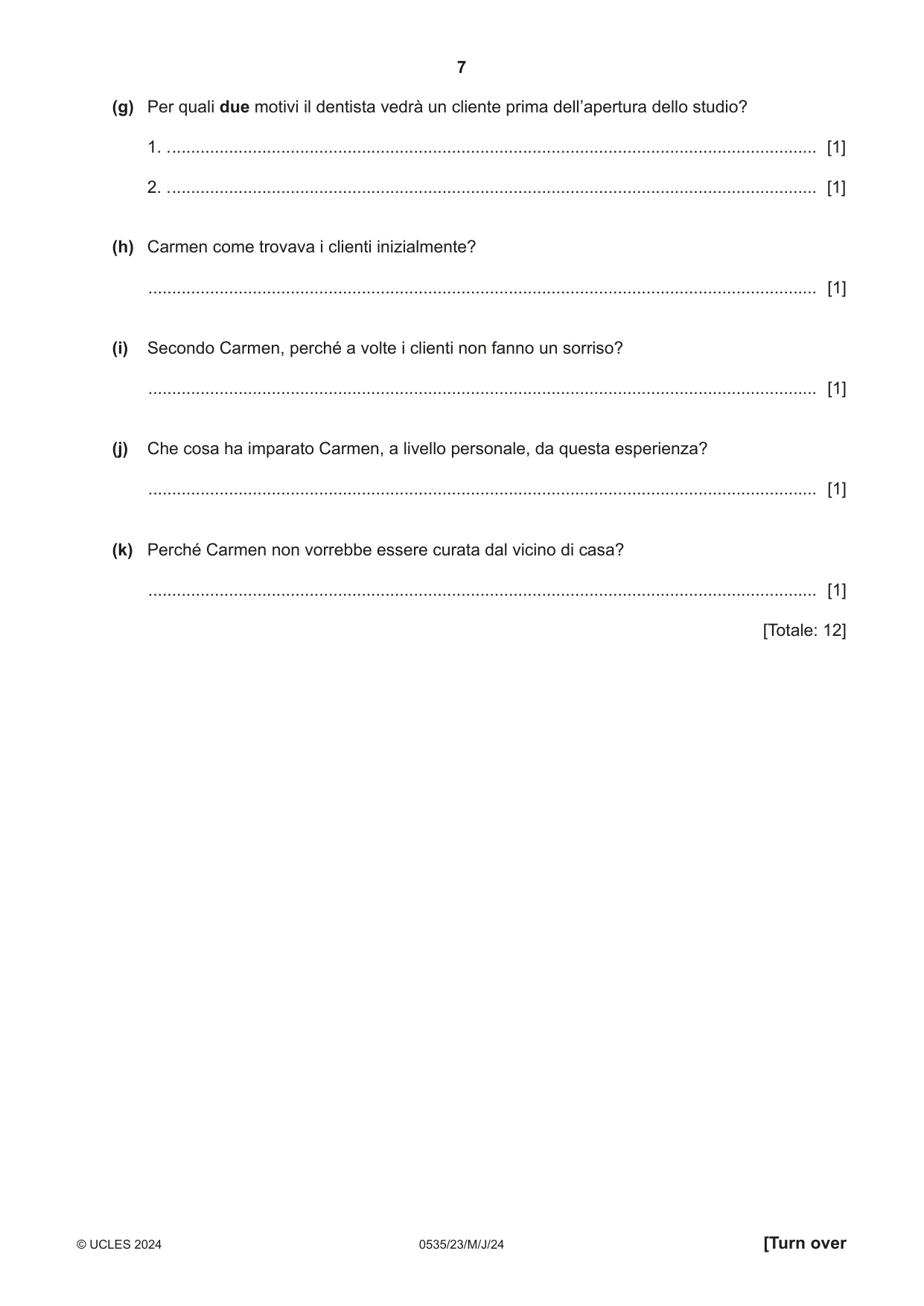
7 0535/23/M/J/24 © UCLES 2024 [Turn over (g) Per quali due motivi il dentista vedrà un cliente prima dell’apertura dello studio? 1. . … [1] 2. . … [1] (h) Carmen come trovava i clienti inizialmente? … [1] (i) Secondo Carmen, perché a volte i clienti non fanno un sorriso? … [1] (j) Che cosa ha imparato Carmen, a livello personale, da questa esperienza? … [1] (k) Perché Carmen non vorrebbe essere curata dal vicino di casa? … [1] [Totale: 12]
Question paper, page 8
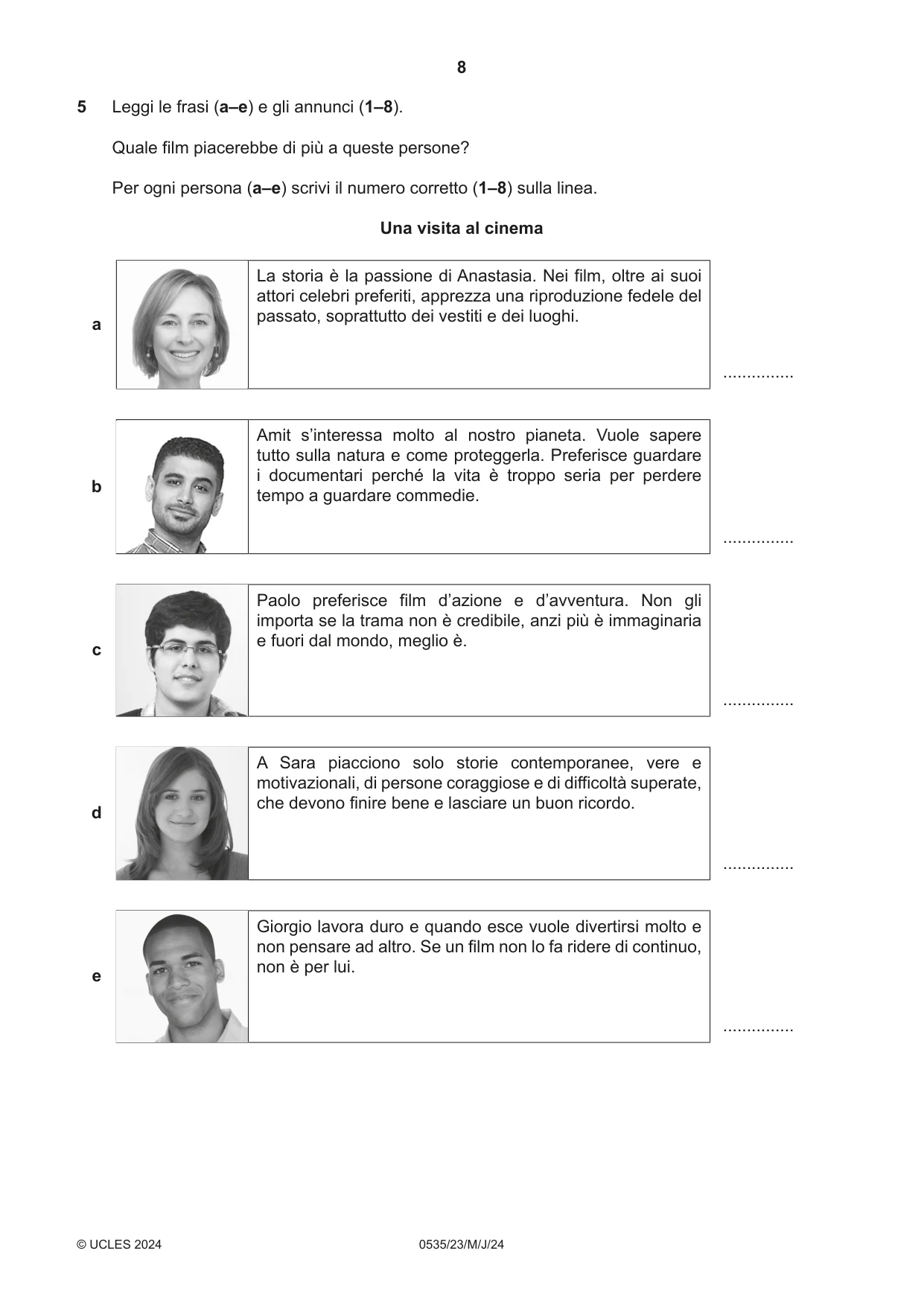
8 0535/23/M/J/24 © UCLES 2024 5 Leggi le frasi (a–e) e gli annunci (1–8). Quale film piacerebbe di più a queste persone? Per ogni persona (a–e) scrivi il numero corretto (1–8) sulla linea. Una visita al cinema a La storia è la passione di Anastasia. Nei film, oltre ai suoi attori celebri preferiti, apprezza una riproduzione fedele del passato, soprattutto dei vestiti e dei luoghi. … b Amit s’interessa molto al nostro pianeta. Vuole sapere tutto sulla natura e come proteggerla. Preferisce guardare i documentari perché la vita è troppo seria per perdere tempo a guardare commedie. … c Paolo preferisce film d’azione e d’avventura. Non gli importa se la trama non è credibile, anzi più è immaginaria e fuori dal mondo, meglio è. … d A Sara piacciono solo storie contemporanee, vere e motivazionali, di persone coraggiose e di difficoltà superate, che devono finire bene e lasciare un buon ricordo. … e Giorgio lavora duro e quando esce vuole divertirsi molto e non pensare ad altro. Se un film non lo fa ridere di continuo, non è per lui. …
Question paper, page 9
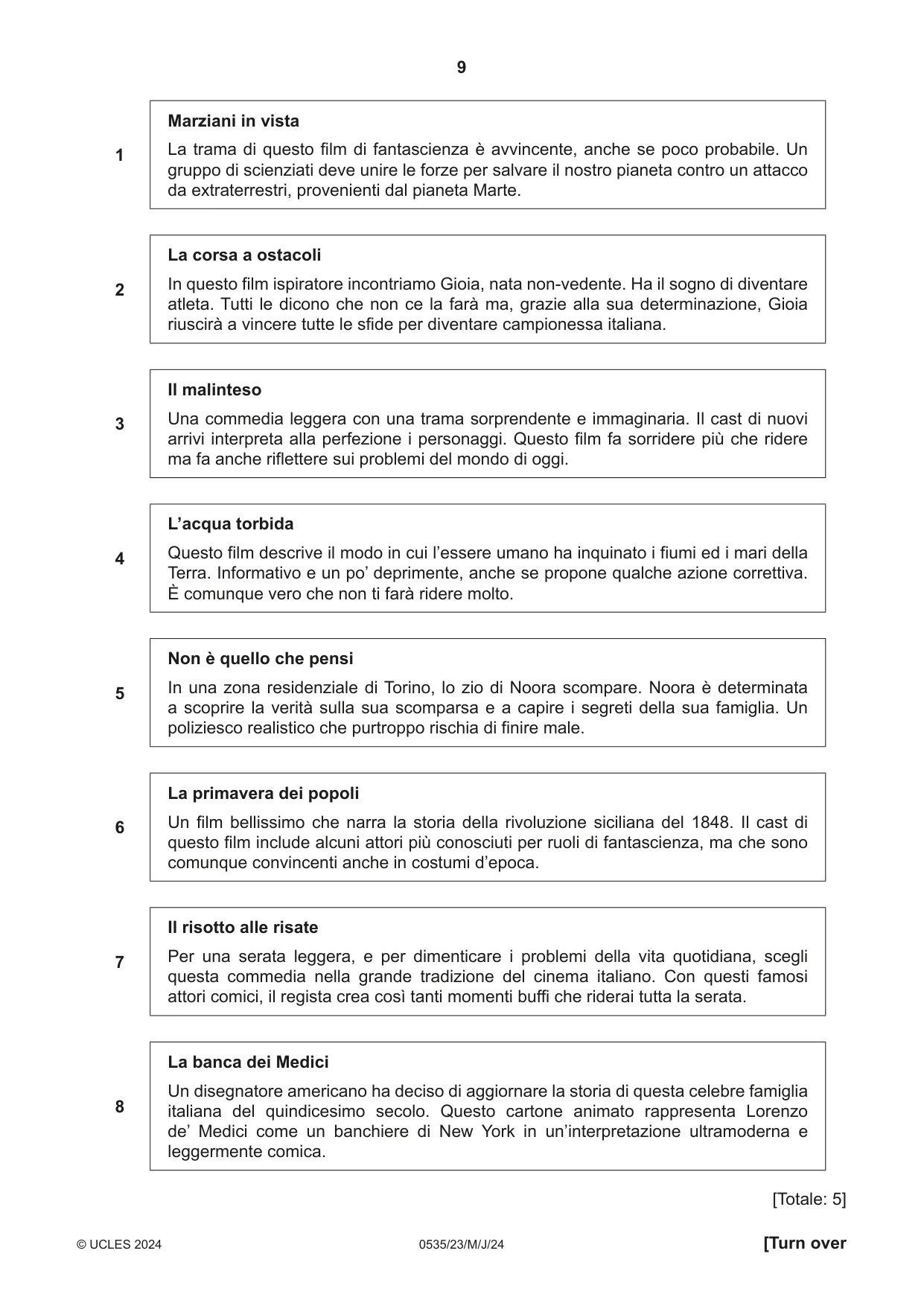
9 0535/23/M/J/24 © UCLES 2024 [Turn over 1 Marziani in vista La trama di questo film di fantascienza è avvincente, anche se poco probabile. Un gruppo di scienziati deve unire le forze per salvare il nostro pianeta contro un attacco da extraterrestri, provenienti dal pianeta Marte. 2 La corsa a ostacoli In questo film ispiratore incontriamo Gioia, nata non-vedente. Ha il sogno di diventare atleta. Tutti le dicono che non ce la farà ma, grazie alla sua determinazione, Gioia riuscirà a vincere tutte le sfide per diventare campionessa italiana. 3 Il malinteso Una commedia leggera con una trama sorprendente e immaginaria. Il cast di nuovi arrivi interpreta alla perfezione i personaggi. Questo film fa sorridere più che ridere ma fa anche riflettere sui problemi del mondo di oggi. 4 L’acqua torbida Questo film descrive il modo in cui l’essere umano ha inquinato i fiumi ed i mari della Terra. Informativo e un po’ deprimente, anche se propone qualche azione correttiva. È comunque vero che non ti farà ridere molto. 5 Non è quello che pensi In una zona residenziale di Torino, lo zio di Noora scompare. Noora è determinata a scoprire la verità sulla sua scomparsa e a capire i segreti della sua famiglia. Un poliziesco realistico che purtroppo rischia di finire male. 6 La primavera dei popoli Un film bellissimo che narra la storia della rivoluzione siciliana del 1848. Il cast di questo film include alcuni attori più conosciuti per ruoli di fantascienza, ma che sono comunque convincenti anche in costumi d’epoca. 7 Il risotto alle risate Per una serata leggera, e per dimenticare i problemi della vita quotidiana, scegli questa commedia nella grande tradizione del cinema italiano. Con questi famosi attori comici, il regista crea così tanti momenti buffi che riderai tutta la serata. 8 La banca dei Medici Un disegnatore americano ha deciso di aggiornare la storia di questa celebre famiglia italiana del quindicesimo secolo. Questo cartone animato rappresenta Lorenzo de’ Medici come un banchiere di New York in un’interpretazione ultramoderna e leggermente comica. [Totale: 5]
Question paper, page 10
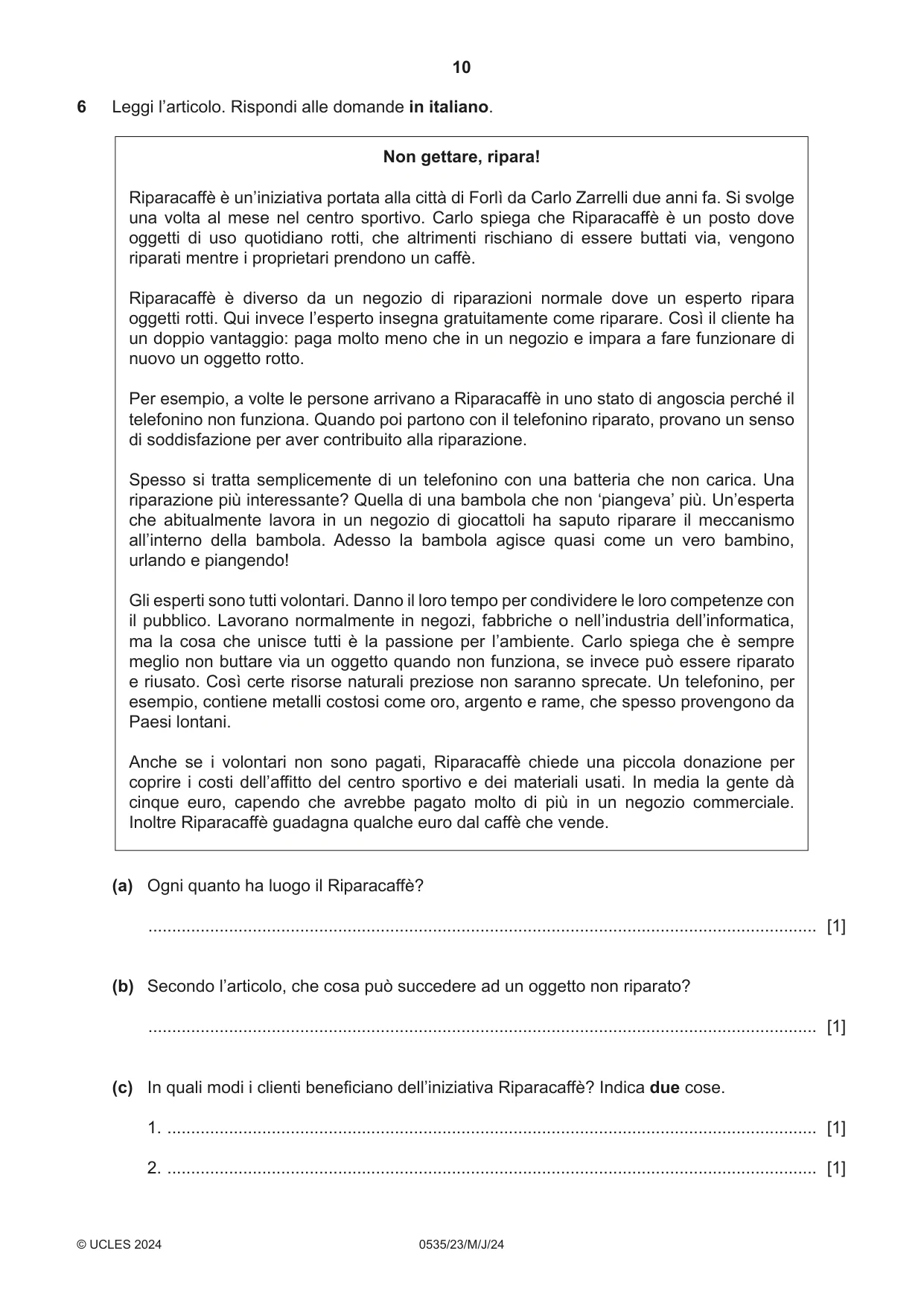
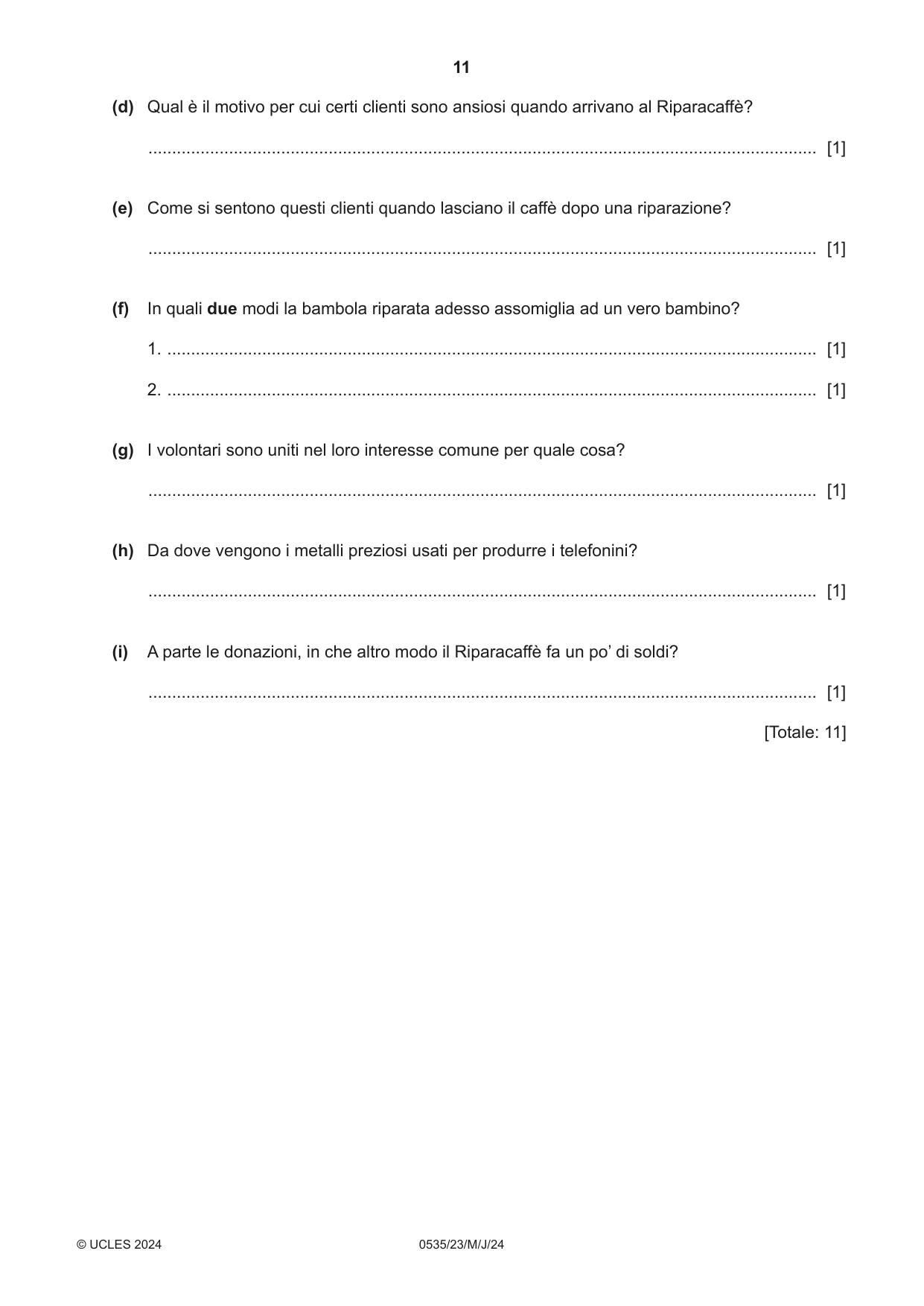
10 0535/23/M/J/24 © UCLES 2024 6 Leggi l’articolo. Rispondi alle domande in italiano. Non gettare, ripara! Riparacaffè è un’iniziativa portata alla città di Forlì da Carlo Zarrelli due anni fa. Si svolge una volta al mese nel centro sportivo. Carlo spiega che Riparacaffè è un posto dove oggetti di uso quotidiano rotti, che altrimenti rischiano di essere buttati via, vengono riparati mentre i proprietari prendono un caffè. Riparacaffè è diverso da un negozio di riparazioni normale dove un esperto ripara oggetti rotti. Qui invece l’esperto insegna gratuitamente come riparare. Così il cliente ha un doppio vantaggio: paga molto meno che in un negozio e impara a fare funzionare di nuovo un oggetto rotto. Per esempio, a volte le persone arrivano a Riparacaffè in uno stato di angoscia perché il telefonino non funziona. Quando poi partono con il telefonino riparato, provano un senso di soddisfazione per aver contribuito alla riparazione. Spesso si tratta semplicemente di un telefonino con una batteria che non carica. Una riparazione più interessante? Quella di una bambola che non ‘piangeva’ più. Un’esperta che abitualmente lavora in un negozio di giocattoli ha saputo riparare il meccanismo all’interno della bambola. Adesso la bambola agisce quasi come un vero bambino, urlando e piangendo! Gli esperti sono tutti volontari. Danno il loro tempo per condividere le loro competenze con il pubblico. Lavorano normalmente in negozi, fabbriche o nell’industria dell’informatica, ma la cosa che unisce tutti è la passione per l’ambiente. Carlo spiega che è sempre meglio non buttare via un oggetto quando non funziona, se invece può essere riparato e riusato. Così certe risorse naturali preziose non saranno sprecate. Un telefonino, per esempio, contiene metalli costosi come oro, argento e rame, che spesso provengono da Paesi lontani. Anche se i volontari non sono pagati, Riparacaffè chiede una piccola donazione per coprire i costi dell’affitto del centro sportivo e dei materiali usati. In media la gente dà cinque euro, capendo che avrebbe pagato molto di più in un negozio commerciale. Inoltre Riparacaffè guadagna qualche euro dal caffè che vende. (a) Ogni quanto ha luogo il Riparacaffè? … [1] (b) Secondo l’articolo, che cosa può succedere ad un oggetto non riparato? … [1] (c) In quali modi i clienti beneficiano dell’iniziativa Riparacaffè? Indica due cose. 1. … [1] 2. … [1]
Question paper, page 11
11 0535/23/M/J/24 © UCLES 2024 (d) Qual è il motivo per cui certi clienti sono ansiosi quando arrivano al Riparacaffè? … [1] (e) Come si sentono questi clienti quando lasciano il caffè dopo una riparazione? … [1] (f) In quali due modi la bambola riparata adesso assomiglia ad un vero bambino? 1. … [1] 2. … [1] (g) I volontari sono uniti nel loro interesse comune per quale cosa? … [1] (h) Da dove vengono i metalli preziosi usati per produrre i telefonini? … [1] (i) A parte le donazioni, in che altro modo il Riparacaffè fa un po’ di soldi? … [1] [Totale: 11]
Question paper, page 12
12 0535/23/M/J/24 © UCLES 2024 Permission to reproduce items where third-party owned material protected by copyright is included has been sought and cleared where possible. Every reasonable effort has been made by the publisher (UCLES) to trace copyright holders, but if any items requiring clearance have unwittingly been included, the publisher will be pleased to make amends at the earliest possible opportunity. To avoid the issue of disclosure of answer-related information to candidates, all copyright acknowledgements are reproduced online in the Cambridge Assessment International Education Copyright Acknowledgements Booklet. This is produced for each series of examinations and is freely available to download at www.cambridgeinternational.org after the live examination series. Cambridge Assessment International Education is part of Cambridge Assessment. Cambridge Assessment is the brand name of the University of Cambridge Local Examinations Syndicate (UCLES), which is a department of the University of Cambridge. BLANK PAGE
Mark scheme, page 1
This document consists of 10 printed pages. © Cambridge University Press & Assessment 2024 [Turn over Cambridge IGCSE™ ITALIAN 0535/23 Paper 2 Reading May/June 2024 MARK SCHEME Maximum Mark: 45 Published This mark scheme is published as an aid to teachers and candidates, to indicate the requirements of the examination. It shows the basis on which Examiners were instructed to award marks. It does not indicate the details of the discussions that took place at an Examiners’ meeting before marking began, which would have considered the acceptability of alternative answers. Mark schemes should be read in conjunction with the question paper and the Principal Examiner Report for Teachers. Cambridge International will not enter into discussions about these mark schemes. Cambridge International is publishing the mark schemes for the May/June 2024 series for most Cambridge IGCSE, Cambridge International A and AS Level and Cambridge Pre-U components, and some Cambridge O Level components.
Mark scheme, page 2
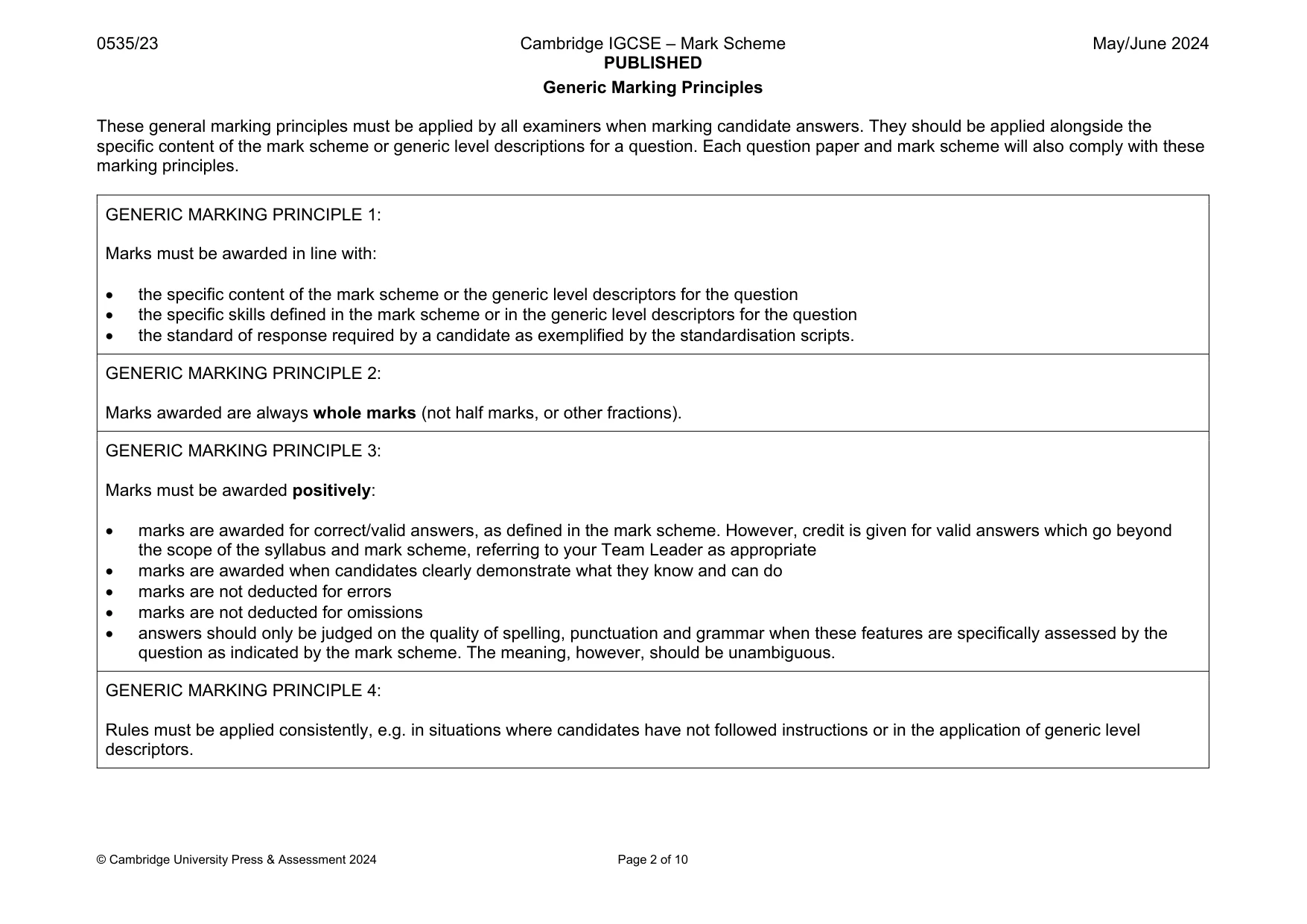
0535/23 Cambridge IGCSE – Mark Scheme PUBLISHED May/June 2024 © Cambridge University Press & Assessment 2024 Page 2 of 10 Generic Marking Principles These general marking principles must be applied by all examiners when marking candidate answers. They should be applied alongside the specific content of the mark scheme or generic level descriptions for a question. Each question paper and mark scheme will also comply with these marking principles. GENERIC MARKING PRINCIPLE 1: Marks must be awarded in line with: the specific content of the mark scheme or the generic level descriptors for the question the specific skills defined in the mark scheme or in the generic level descriptors for the question the standard of response required by a candidate as exemplified by the standardisation scripts. GENERIC MARKING PRINCIPLE 2: Marks awarded are always whole marks (not half marks, or other fractions). GENERIC MARKING PRINCIPLE 3: Marks must be awarded positively: marks are awarded for correct/valid answers, as defined in the mark scheme. However, credit is given for valid answers which go beyond the scope of the syllabus and mark scheme, referring to your Team Leader as appropriate marks are awarded when candidates clearly demonstrate what they know and can do marks are not deducted for errors marks are not deducted for omissions answers should only be judged on the quality of spelling, punctuation and grammar when these features are specifically assessed by the question as indicated by the mark scheme. The meaning, however, should be unambiguous. GENERIC MARKING PRINCIPLE 4: Rules must be applied consistently, e.g. in situations where candidates have not followed instructions or in the application of generic level descriptors.
Mark scheme, page 3
0535/23 Cambridge IGCSE – Mark Scheme PUBLISHED May/June 2024 © Cambridge University Press & Assessment 2024 Page 3 of 10 GENERIC MARKING PRINCIPLE 5: Marks should be awarded using the full range of marks defined in the mark scheme for the question (however; the use of the full mark range may be limited according to the quality of the candidate responses seen). GENERIC MARKING PRINCIPLE 6: Marks awarded are based solely on the requirements as defined in the mark scheme. Marks should not be awarded with grade thresholds or grade descriptors in mind.
Mark scheme, page 4
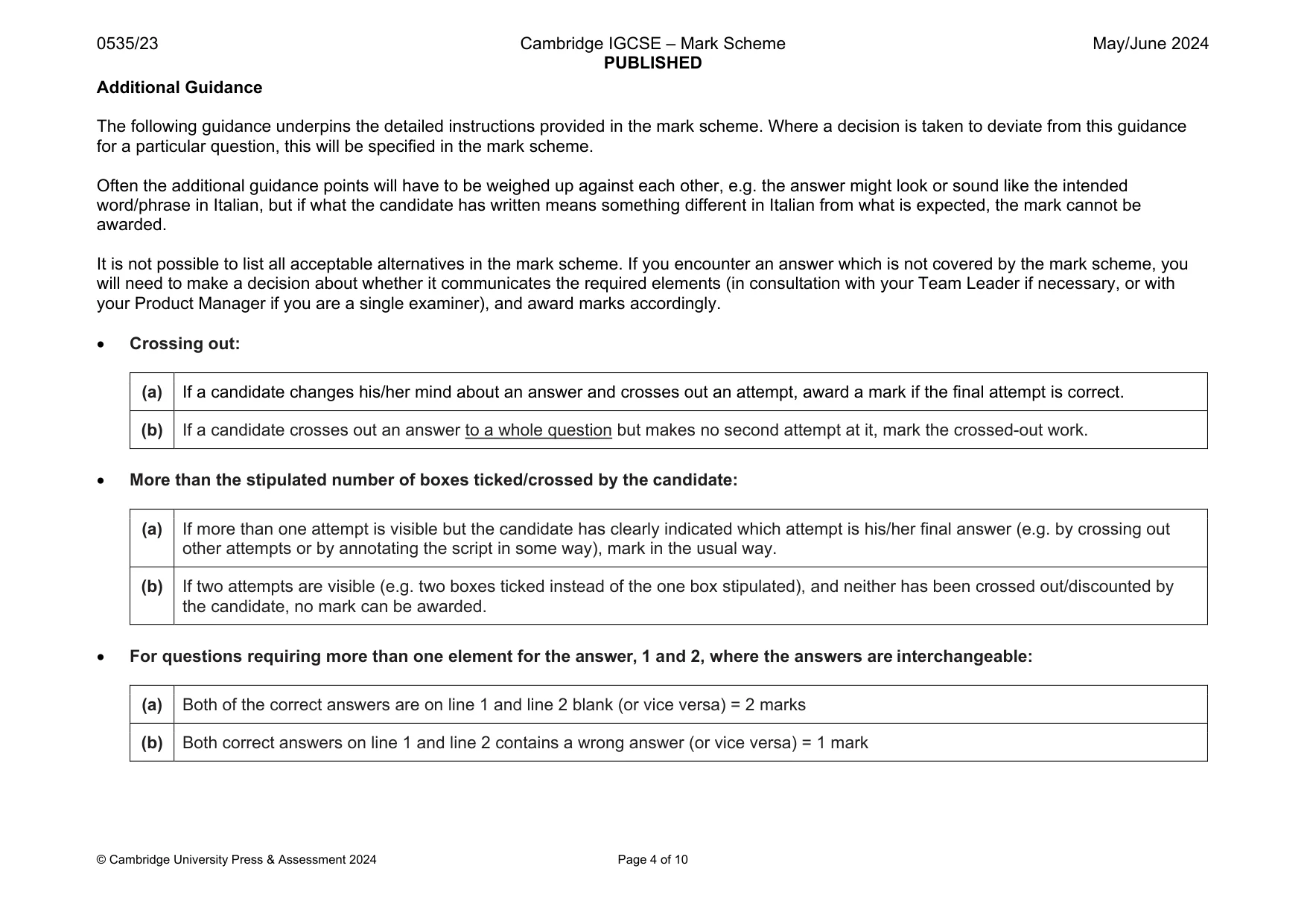
0535/23 Cambridge IGCSE – Mark Scheme PUBLISHED May/June 2024 © Cambridge University Press & Assessment 2024 Page 4 of 10 Additional Guidance The following guidance underpins the detailed instructions provided in the mark scheme. Where a decision is taken to deviate from this guidance for a particular question, this will be specified in the mark scheme. Often the additional guidance points will have to be weighed up against each other, e.g. the answer might look or sound like the intended word/phrase in Italian, but if what the candidate has written means something different in Italian from what is expected, the mark cannot be awarded. It is not possible to list all acceptable alternatives in the mark scheme. If you encounter an answer which is not covered by the mark scheme, you will need to make a decision about whether it communicates the required elements (in consultation with your Team Leader if necessary, or with your Product Manager if you are a single examiner), and award marks accordingly. Crossing out: (a) If a candidate changes his/her mind about an answer and crosses out an attempt, award a mark if the final attempt is correct. (b) If a candidate crosses out an answer to a whole question but makes no second attempt at it, mark the crossed-out work. More than the stipulated number of boxes ticked/crossed by the candidate: (a) If more than one attempt is visible but the candidate has clearly indicated which attempt is his/her final answer (e.g. by crossing out other attempts or by annotating the script in some way), mark in the usual way. (b) If two attempts are visible (e.g. two boxes ticked instead of the one box stipulated), and neither has been crossed out/discounted by the candidate, no mark can be awarded. For questions requiring more than one element for the answer, 1 and 2, where the answers are interchangeable: (a) Both of the correct answers are on line 1 and line 2 blank (or vice versa) = 2 marks (b) Both correct answers on line 1 and line 2 contains a wrong answer (or vice versa) = 1 mark
Mark scheme, page 5
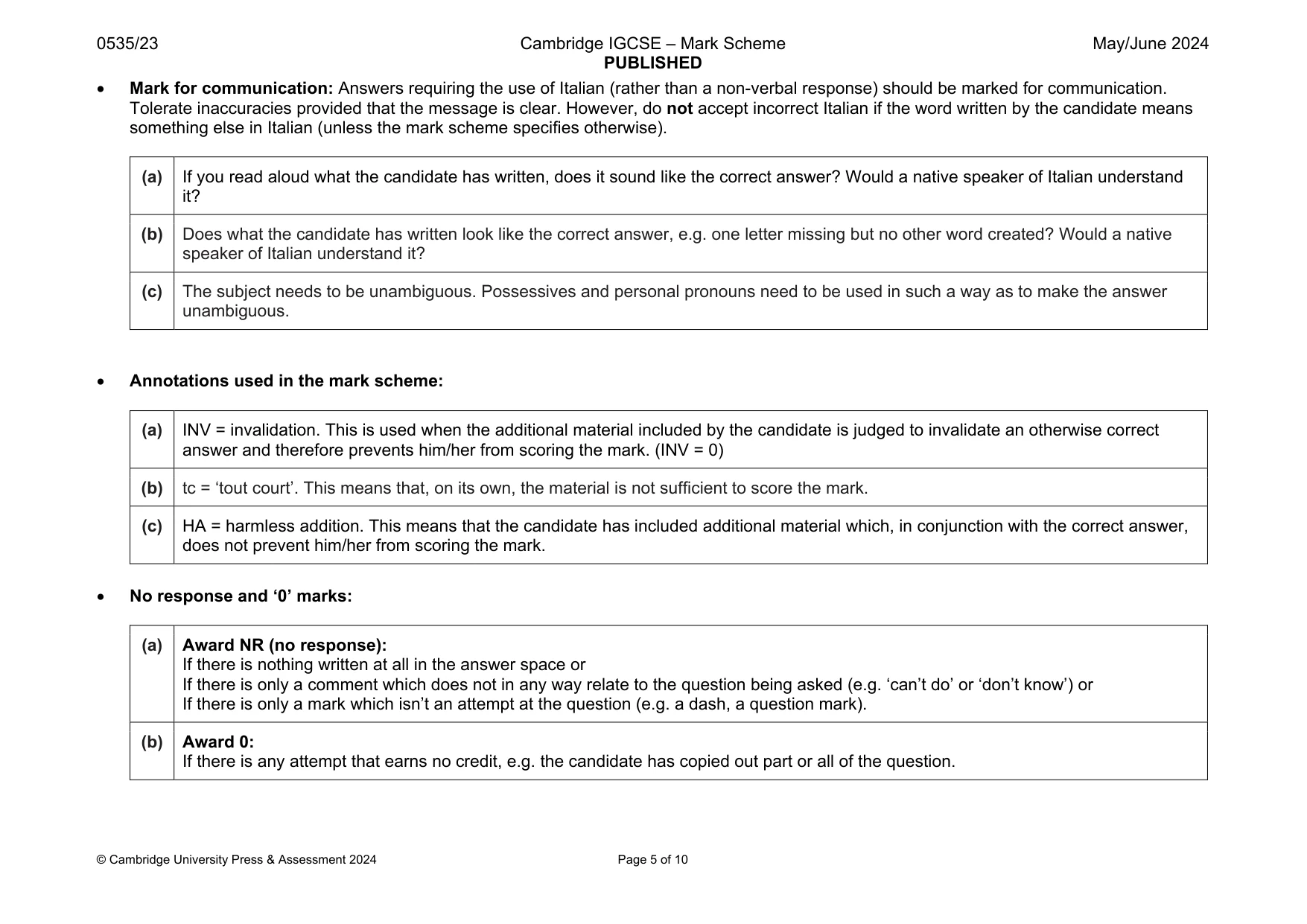
0535/23 Cambridge IGCSE – Mark Scheme PUBLISHED May/June 2024 © Cambridge University Press & Assessment 2024 Page 5 of 10 Mark for communication: Answers requiring the use of Italian (rather than a non-verbal response) should be marked for communication. Tolerate inaccuracies provided that the message is clear. However, do not accept incorrect Italian if the word written by the candidate means something else in Italian (unless the mark scheme specifies otherwise). (a) If you read aloud what the candidate has written, does it sound like the correct answer? Would a native speaker of Italian understand it? (b) Does what the candidate has written look like the correct answer, e.g. one letter missing but no other word created? Would a native speaker of Italian understand it? (c) The subject needs to be unambiguous. Possessives and personal pronouns need to be used in such a way as to make the answer unambiguous. Annotations used in the mark scheme: (a) INV = invalidation. This is used when the additional material included by the candidate is judged to invalidate an otherwise correct answer and therefore prevents him/her from scoring the mark. (INV = 0) (b) tc = ‘tout court’. This means that, on its own, the material is not sufficient to score the mark. (c) HA = harmless addition. This means that the candidate has included additional material which, in conjunction with the correct answer, does not prevent him/her from scoring the mark. No response and ‘0’ marks: (a) Award NR (no response): If there is nothing written at all in the answer space or If there is only a comment which does not in any way relate to the question being asked (e.g. ‘can’t do’ or ‘don’t know’) or If there is only a mark which isn’t an attempt at the question (e.g. a dash, a question mark). (b) Award 0: If there is any attempt that earns no credit, e.g. the candidate has copied out part or all of the question.
Mark scheme, page 6
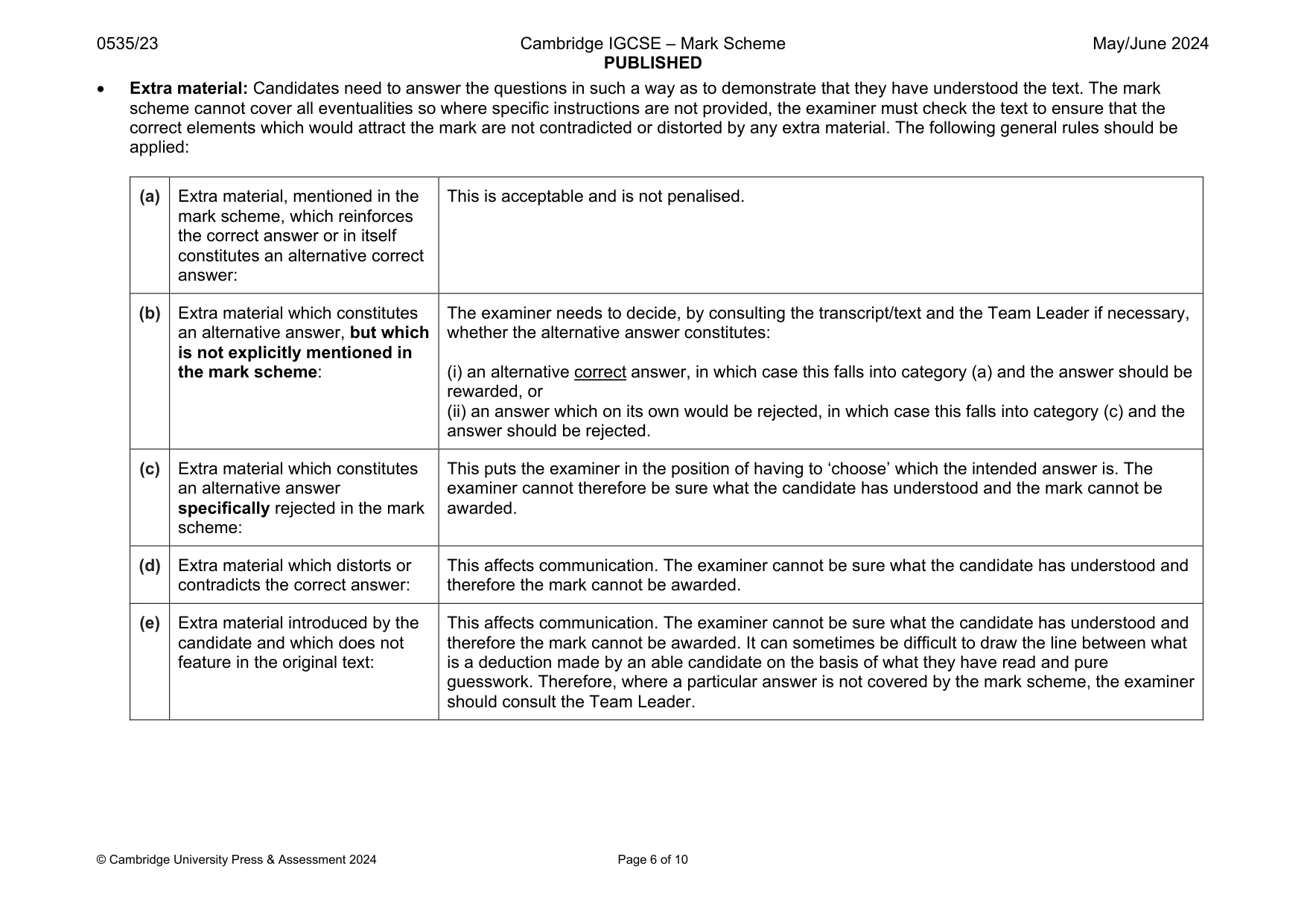
0535/23 Cambridge IGCSE – Mark Scheme PUBLISHED May/June 2024 © Cambridge University Press & Assessment 2024 Page 6 of 10 Extra material: Candidates need to answer the questions in such a way as to demonstrate that they have understood the text. The mark scheme cannot cover all eventualities so where specific instructions are not provided, the examiner must check the text to ensure that the correct elements which would attract the mark are not contradicted or distorted by any extra material. The following general rules should be applied: (a) Extra material, mentioned in the mark scheme, which reinforces the correct answer or in itself constitutes an alternative correct answer: This is acceptable and is not penalised. (b) Extra material which constitutes an alternative answer, but which is not explicitly mentioned in the mark scheme: The examiner needs to decide, by consulting the transcript/text and the Team Leader if necessary, whether the alternative answer constitutes: (i) an alternative correct answer, in which case this falls into category (a) and the answer should be rewarded, or (ii) an answer which on its own would be rejected, in which case this falls into category (c) and the answer should be rejected. (c) Extra material which constitutes an alternative answer specifically rejected in the mark scheme: This puts the examiner in the position of having to ‘choose’ which the intended answer is. The examiner cannot therefore be sure what the candidate has understood and the mark cannot be awarded. (d) Extra material which distorts or contradicts the correct answer: This affects communication. The examiner cannot be sure what the candidate has understood and therefore the mark cannot be awarded. (e) Extra material introduced by the candidate and which does not feature in the original text: This affects communication. The examiner cannot be sure what the candidate has understood and therefore the mark cannot be awarded. It can sometimes be difficult to draw the line between what is a deduction made by an able candidate on the basis of what they have read and pure guesswork. Therefore, where a particular answer is not covered by the mark scheme, the examiner should consult the Team Leader.
Mark scheme, page 7
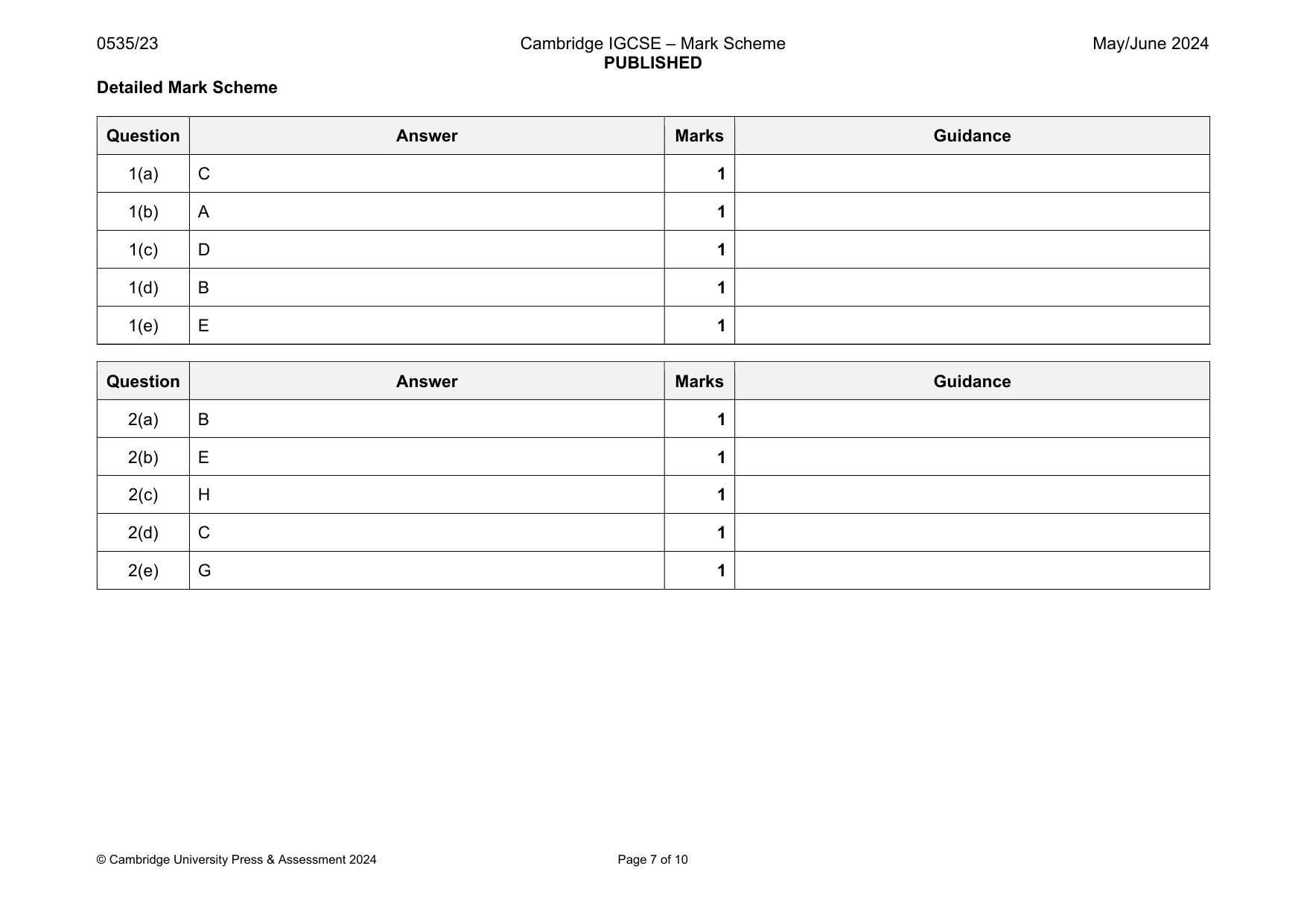
0535/23 Cambridge IGCSE – Mark Scheme PUBLISHED May/June 2024 © Cambridge University Press & Assessment 2024 Page 7 of 10 Detailed Mark Scheme Question Answer Marks Guidance 1(a) C 1 1(b) A 1 1(c) D 1 1(d) B 1 1(e) E 1 Question Answer Marks Guidance 2(a) B 1 2(b) E 1 2(c) H 1 2(d) C 1 2(e) G 1
Mark scheme, page 8
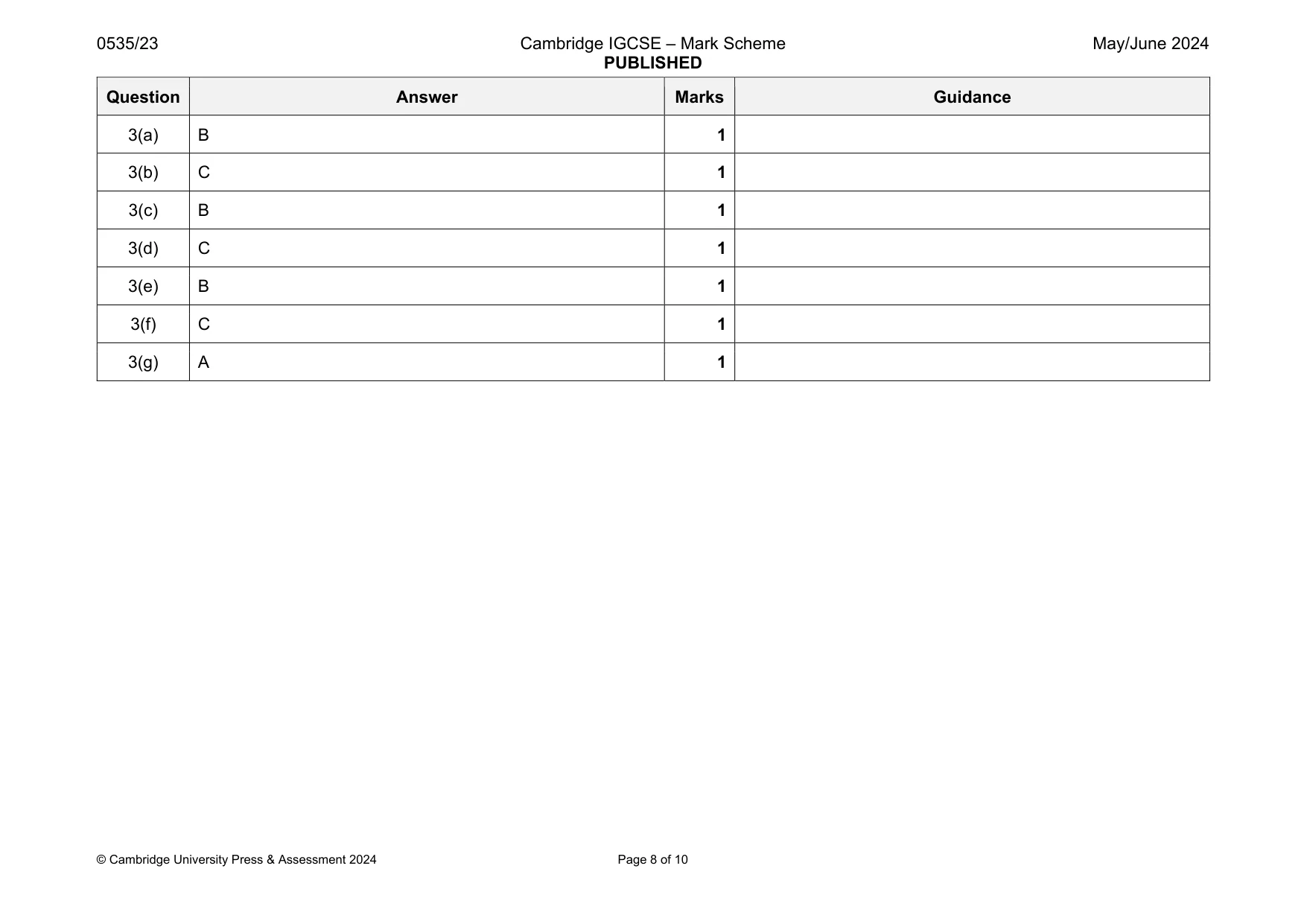
0535/23 Cambridge IGCSE – Mark Scheme PUBLISHED May/June 2024 © Cambridge University Press & Assessment 2024 Page 8 of 10 Question Answer Marks Guidance 3(a) B 1 3(b) C 1 3(c) B 1 3(d) C 1 3(e) B 1 3(f) C 1 3(g) A 1
Mark scheme, page 9
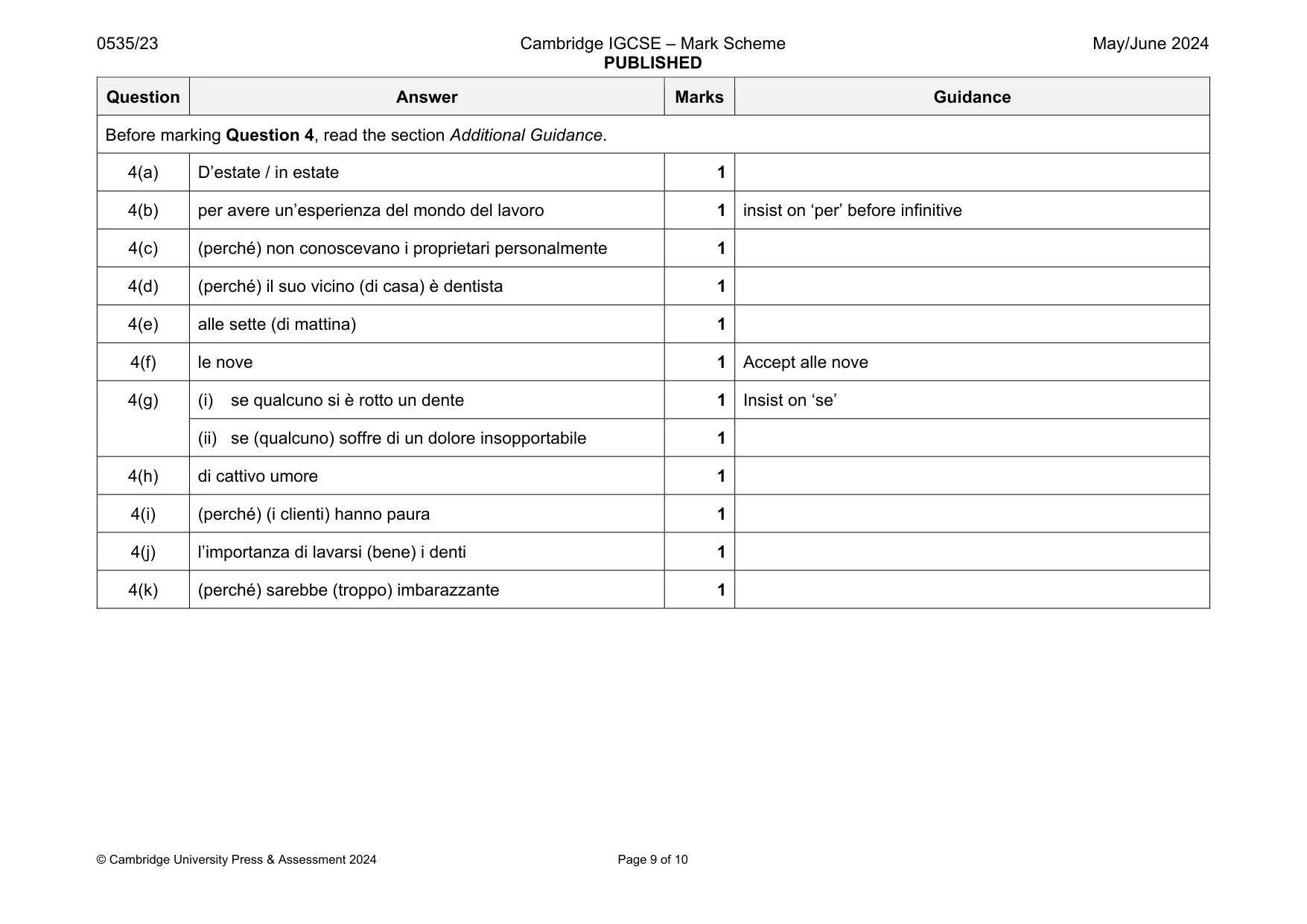
0535/23 Cambridge IGCSE – Mark Scheme PUBLISHED May/June 2024 © Cambridge University Press & Assessment 2024 Page 9 of 10 Question Answer Marks Guidance Before marking Question 4, read the section Additional Guidance. 4(a) D’estate / in estate 1 4(b) per avere un’esperienza del mondo del lavoro 1 insist on ‘per’ before infinitive 4(c) (perché) non conoscevano i proprietari personalmente 1 4(d) (perché) il suo vicino (di casa) è dentista 1 4(e) alle sette (di mattina) 1 4(f) le nove 1 Accept alle nove 4(g) (i) se qualcuno si è rotto un dente 1 Insist on ‘se’ (ii) se (qualcuno) soffre di un dolore insopportabile 1 4(h) di cattivo umore 1 4(i) (perché) (i clienti) hanno paura 1 4(j) l’importanza di lavarsi (bene) i denti 1 4(k) (perché) sarebbe (troppo) imbarazzante 1
Mark scheme, page 10
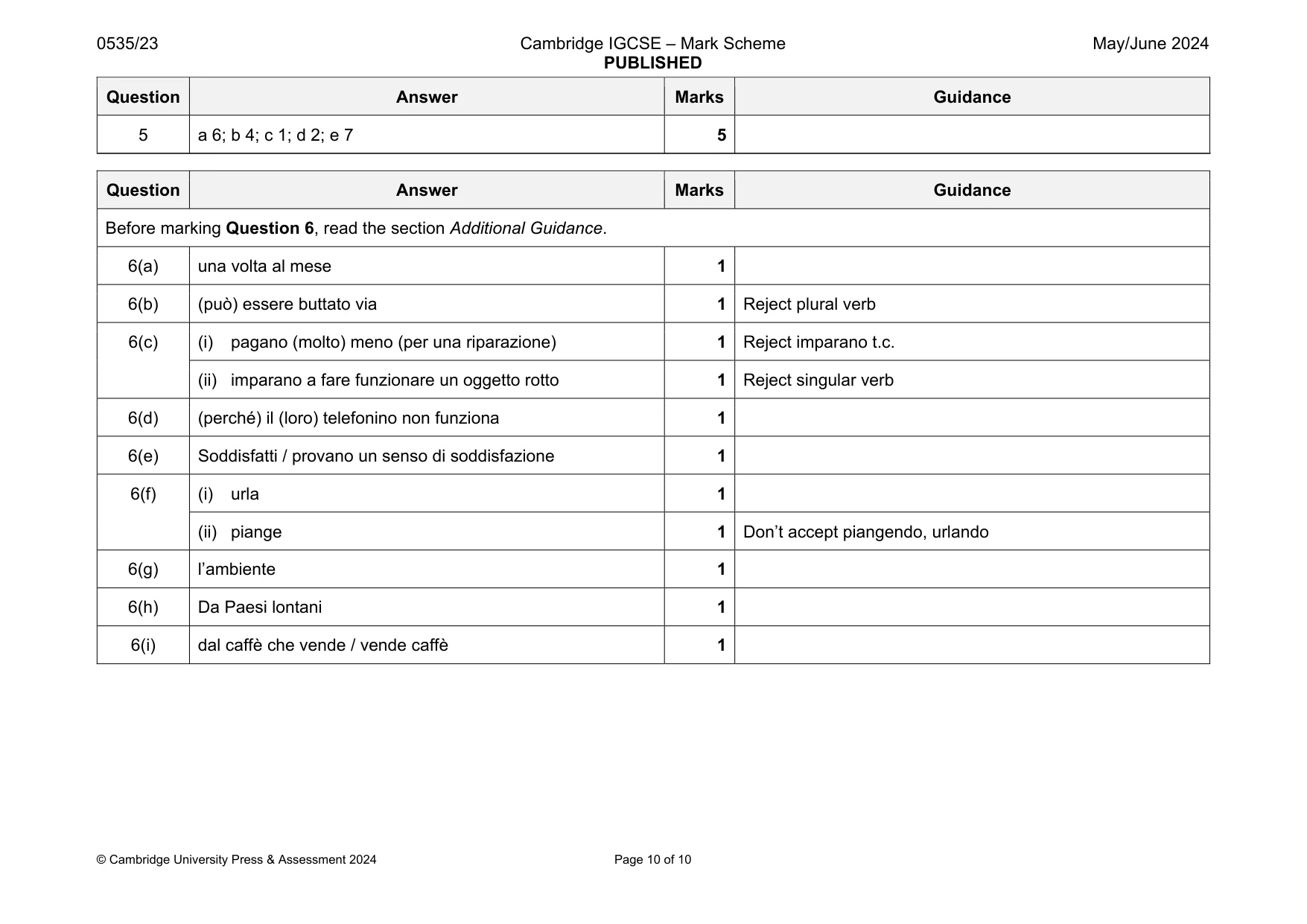
0535/23 Cambridge IGCSE – Mark Scheme PUBLISHED May/June 2024 © Cambridge University Press & Assessment 2024 Page 10 of 10 Question Answer Marks Guidance 5 a 6; b 4; c 1; d 2; e 7 5 Question Answer Marks Guidance Before marking Question 6, read the section Additional Guidance. 6(a) una volta al mese 1 6(b) (può) essere buttato via 1 Reject plural verb 6(c) (i) pagano (molto) meno (per una riparazione) 1 Reject imparano t.c. (ii) imparano a fare funzionare un oggetto rotto 1 Reject singular verb 6(d) (perché) il (loro) telefonino non funziona 1 6(e) Soddisfatti / provano un senso di soddisfazione 1 6(f) (i) urla 1 (ii) piange 1 Don’t accept piangendo, urlando 6(g) l’ambiente 1 6(h) Da Paesi lontani 1 6(i) dal caffè che vende / vende caffè 1
What you needed in this session
Cambridge’s own grade thresholds for 2024 May/June, Paper 2 · Variant 3. A higher threshold means an easier paper — the bar moves with how the cohort did.