Cambridge IGCSE Italian - Foreign Language 0535 — 2021 May/June Paper 2 · Variant 2
0535/22/M/J/21 · 45 marks · ≈51 min
The question paper and its mark scheme, free to read here and free to download. This is Cambridge’s own paper, exactly as it was sat.
Question paper12 pages

Mark scheme10 pages
Answers below. Sit the paper first if you are practising.
Paper as text
Question paper, page 1
This document has 12 pages. Any blank pages are indicated. Cambridge IGCSE™ ITALIAN 0535/22 Paper 2 Reading May/June 2021 1 hour You must answer on the question paper. No additional materials are needed. INSTRUCTIONS ● Answer all questions. ● Use a black or dark blue pen. ● Write your name, centre number and candidate number in the boxes at the top of the page. ● Write your answer to each question in the space provided. ● Do not use an erasable pen or correction fluid. ● Do not write on any bar codes. ● Dictionaries are not allowed. INFORMATION ● The total mark for this paper is 45. ● The number of marks for each question or part question is shown in brackets [ ]. * 8 0 1 5 5 2 2 6 4 0 * DC (LK/CB) 200684/2 © UCLES 2021 [Turn over
Question paper, page 2
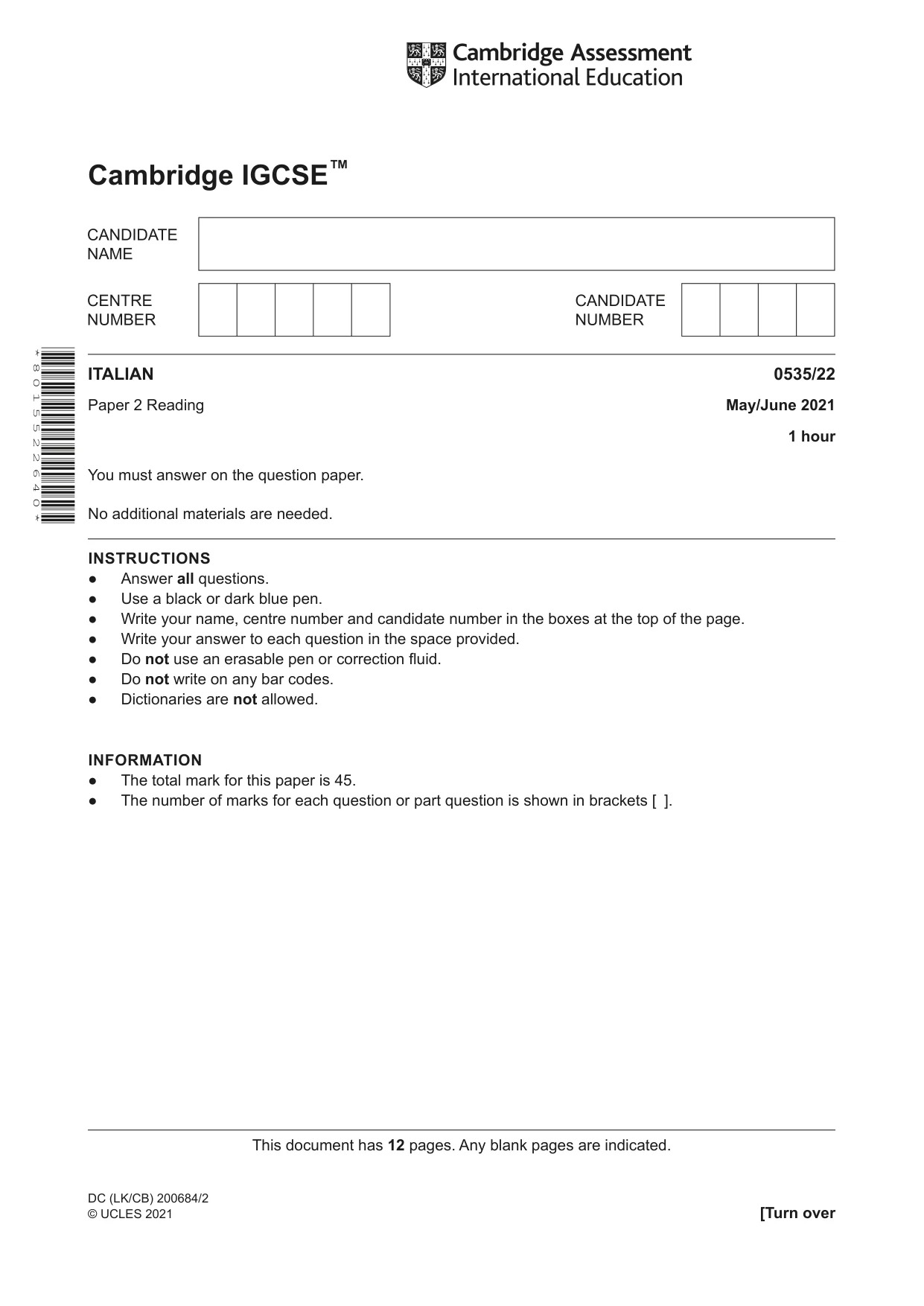
2 0535/22/ M / J /21 © UCLES 2021 1 Guarda le immagini. B C E F A D Per ogni domanda, scrivi la lettera corretta (A–F) nella casella. (a) Marco si alza alle sette ogni mattina. [1] (b) Va in bagno e si fa la doccia. [1] (c) Fa colazione nella sala da pranzo. [1] (d) Esce di casa con lo zaino di scuola. [1] (e) Arriva a scuola alle otto. [1] [Totale: 5]
Question paper, page 3
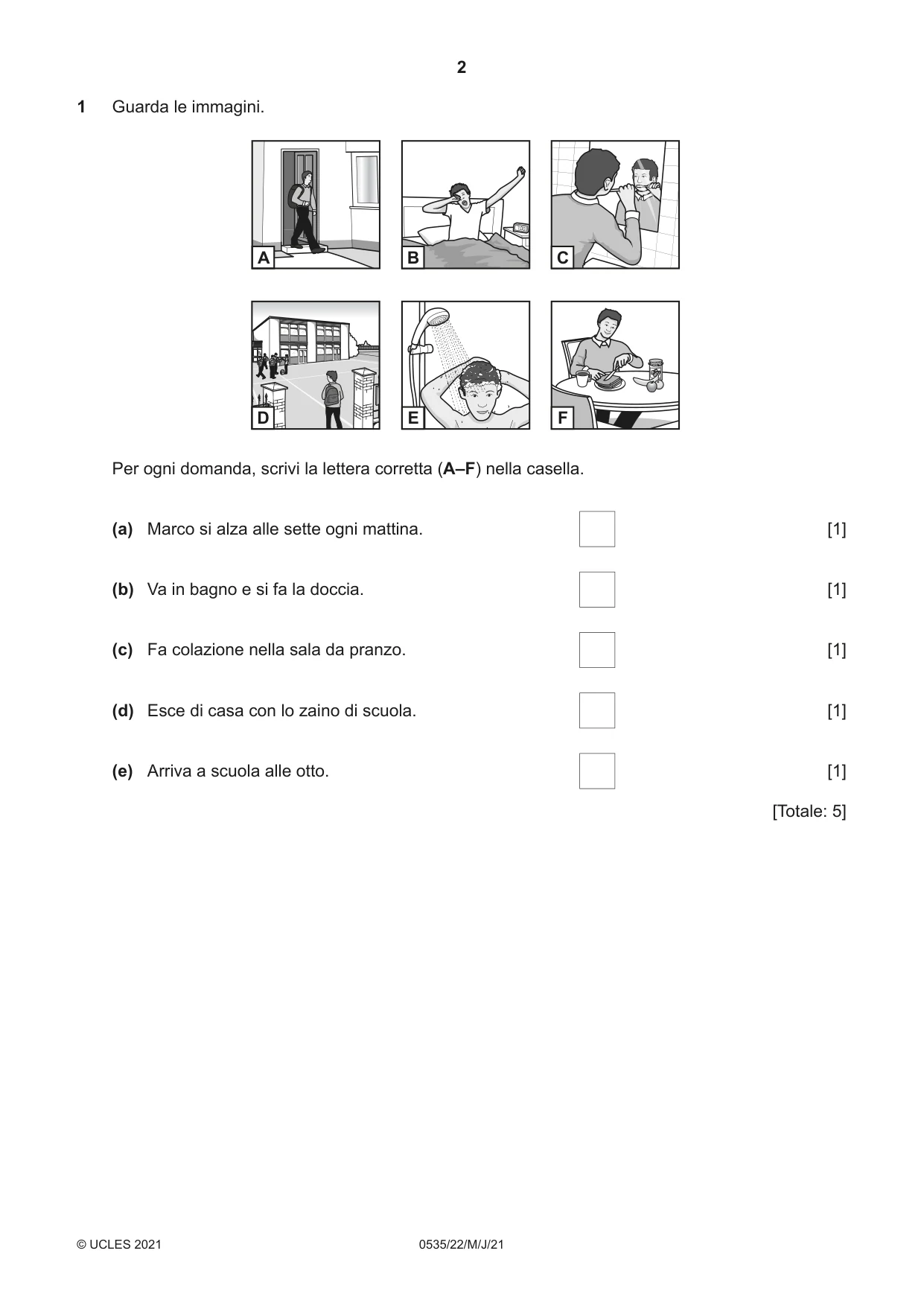
3 0535/22/M/J/21 © UCLES 2021 [Turn over 2 Leggi i cartelli e le insegne. In città A Biblioteca Ospedale Chiesa Ristorante Stadio Piscina Cinema Albergo B C D E F G H Per ogni domanda, scrivi la lettera corretta (A–H) nella casella. (a) Qui mangiamo la pizza con la famiglia. [1] (b) Qui leggiamo dei libri. [1] (c) Qui nuotiamo ogni sabato. [1] (d) Qui guardiamo dei film. [1] (e) Qui guardiamo le partite di calcio. [1] [Totale: 5]
Question paper, page 4
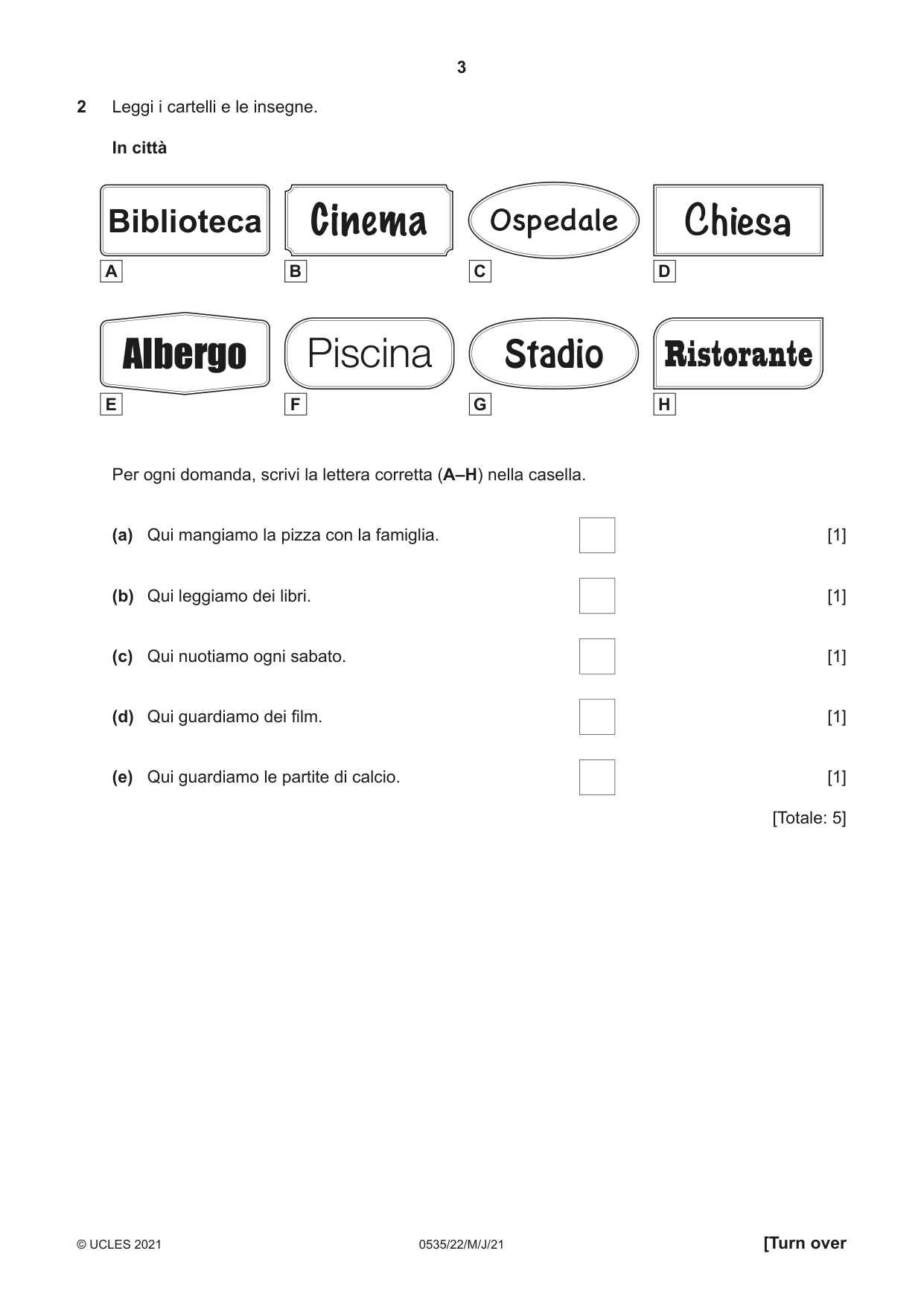
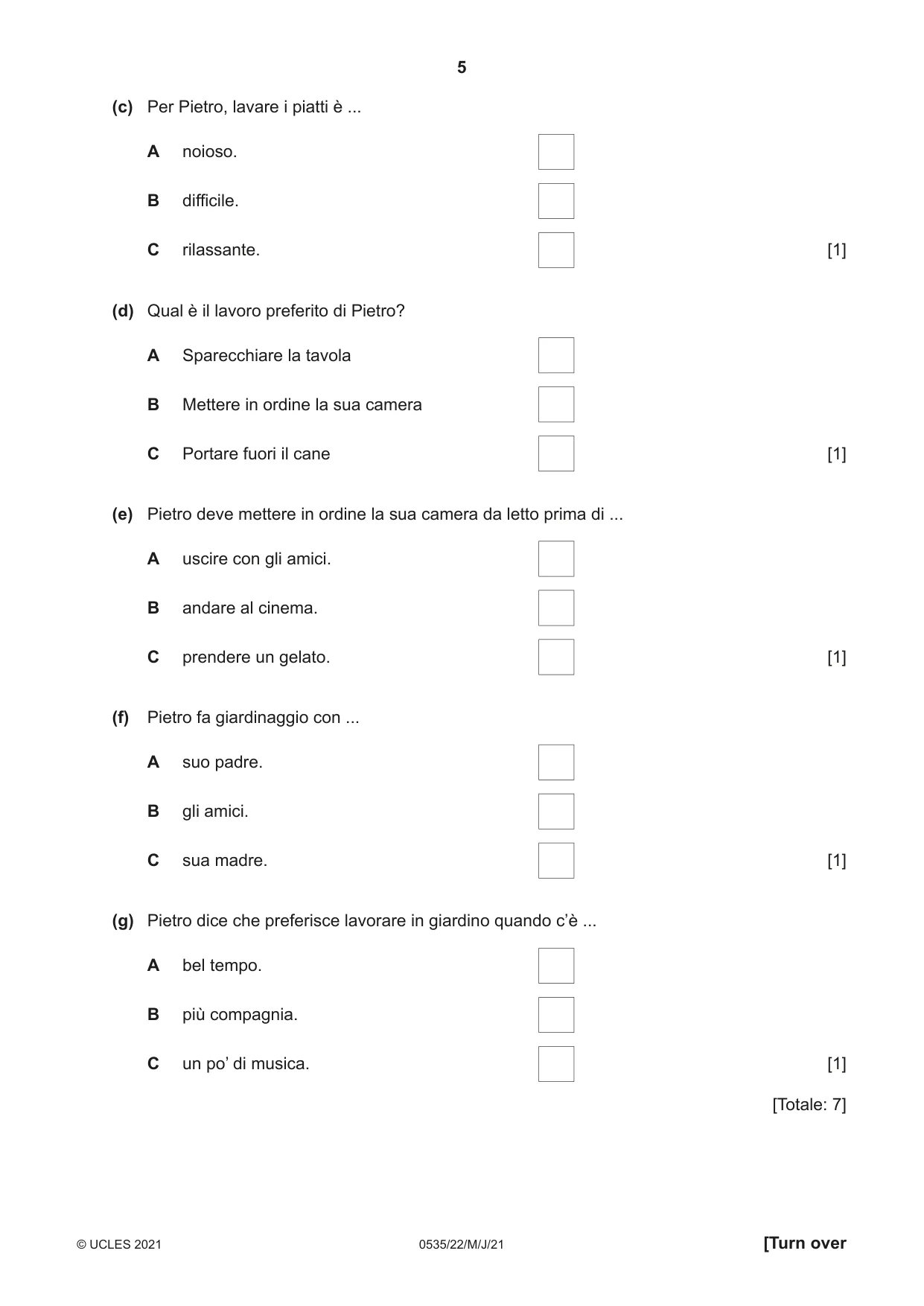
4 0535/22/M/J/21 © UCLES 2021 3 Leggi l’email. Per ogni domanda, segna con una crocetta (X) la casella corretta (A–C). Ciao Giorgio, Grazie per la tua email. Mi hai domandato che cosa faccio per aiutare i miei genitori, allora ti racconto un po’. La sera, dopo aver mangiato, normalmente studio, ma il fine settimana sparecchio e lavo i piatti. Mi piace lavare i piatti perché posso ascoltare la radio allo stesso tempo. Mi rilassa molto. Venerdì sera porto fuori il cane. Questo è il lavoro che mi piace di più. Sabato mattina metto in ordine la mia camera da letto. Lo trovo noioso, ma mio padre dice che devo farlo prima di andare al parco con i miei compagni. La domenica pomeriggio aiuto la mamma in giardino. Sono più contento quando vengono anche i miei cugini così ci divertiamo. E tu? Che cosa fai per aiutare a casa? Pietro (a) Pietro descrive cosa fa ... A a scuola. B a casa. C in vacanza. [1] (b) Cosa fa Pietro di solito dopo cena? A Mette in ordine la sua camera. B Fa i suoi compiti. C Esce con gli amici. [1]
Question paper, page 5
5 0535/22/M/J/21 © UCLES 2021 [Turn over (c) Per Pietro, lavare i piatti è ... A noioso. B difficile. C rilassante. [1] (d) Qual è il lavoro preferito di Pietro? A Sparecchiare la tavola B Mettere in ordine la sua camera C Portare fuori il cane [1] (e) Pietro deve mettere in ordine la sua camera da letto prima di ... A uscire con gli amici. B andare al cinema. C prendere un gelato. [1] (f) Pietro fa giardinaggio con ... A suo padre. B gli amici. C sua madre. [1] (g) Pietro dice che preferisce lavorare in giardino quando c’è ... A bel tempo. B più compagnia. C un po’ di musica. [1] [Totale: 7]
Question paper, page 6
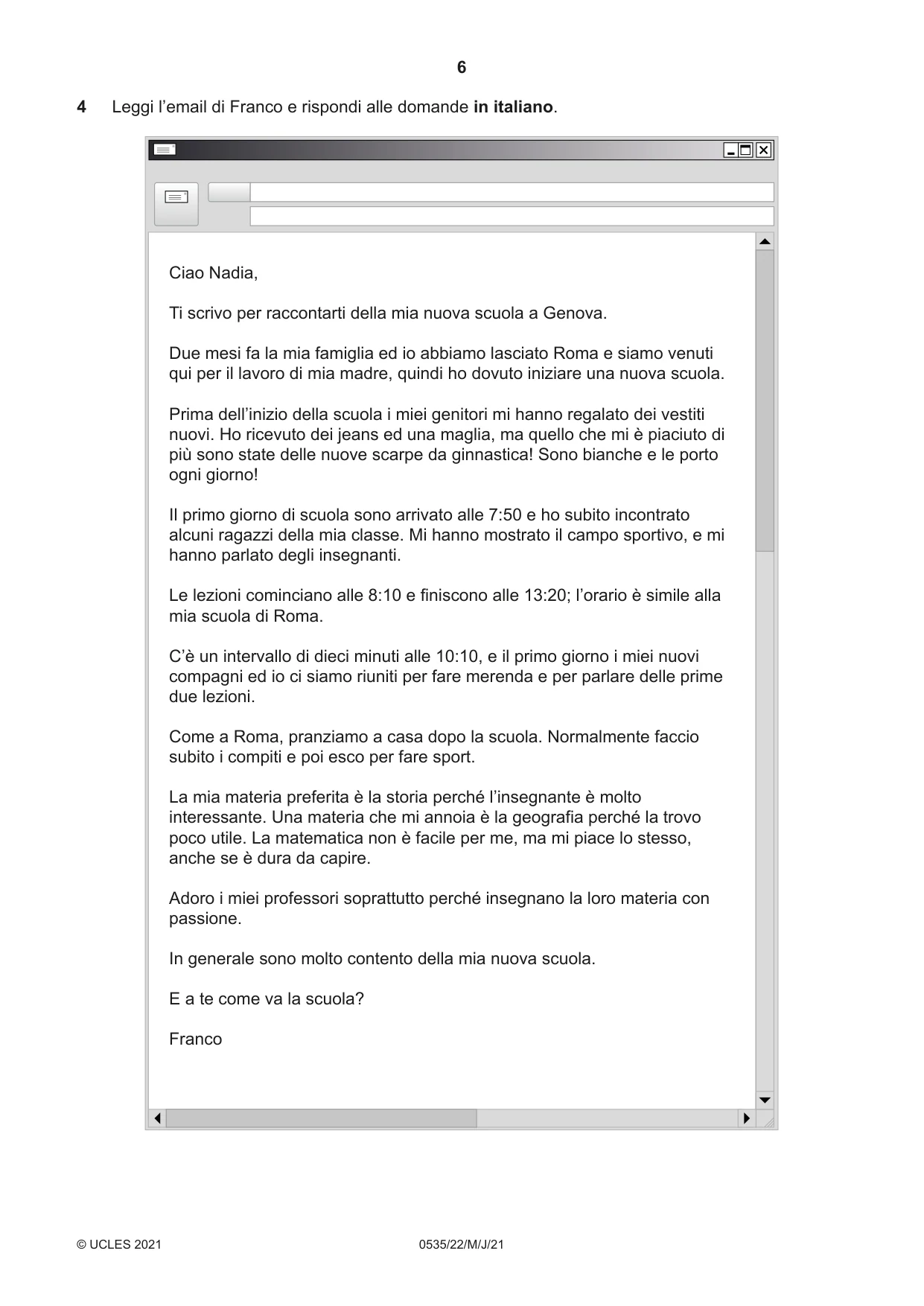
6 0535/22/M/J/21 © UCLES 2021 4 Leggi l’email di Franco e rispondi alle domande in italiano. Ciao Nadia, Ti scrivo per raccontarti della mia nuova scuola a Genova. Due mesi fa la mia famiglia ed io abbiamo lasciato Roma e siamo venuti qui per il lavoro di mia madre, quindi ho dovuto iniziare una nuova scuola. Prima dell’inizio della scuola i miei genitori mi hanno regalato dei vestiti nuovi. Ho ricevuto dei jeans ed una maglia, ma quello che mi è piaciuto di più sono state delle nuove scarpe da ginnastica! Sono bianche e le porto ogni giorno! Il primo giorno di scuola sono arrivato alle 7:50 e ho subito incontrato alcuni ragazzi della mia classe. Mi hanno mostrato il campo sportivo, e mi hanno parlato degli insegnanti. Le lezioni cominciano alle 8:10 e finiscono alle 13:20; l’orario è simile alla mia scuola di Roma. C’è un intervallo di dieci minuti alle 10:10, e il primo giorno i miei nuovi compagni ed io ci siamo riuniti per fare merenda e per parlare delle prime due lezioni. Come a Roma, pranziamo a casa dopo la scuola. Normalmente faccio subito i compiti e poi esco per fare sport. La mia materia preferita è la storia perché l’insegnante è molto interessante. Una materia che mi annoia è la geografia perché la trovo poco utile. La matematica non è facile per me, ma mi piace lo stesso, anche se è dura da capire. Adoro i miei professori soprattutto perché insegnano la loro materia con passione. In generale sono molto contento della mia nuova scuola. E a te come va la scuola? Franco
Question paper, page 7
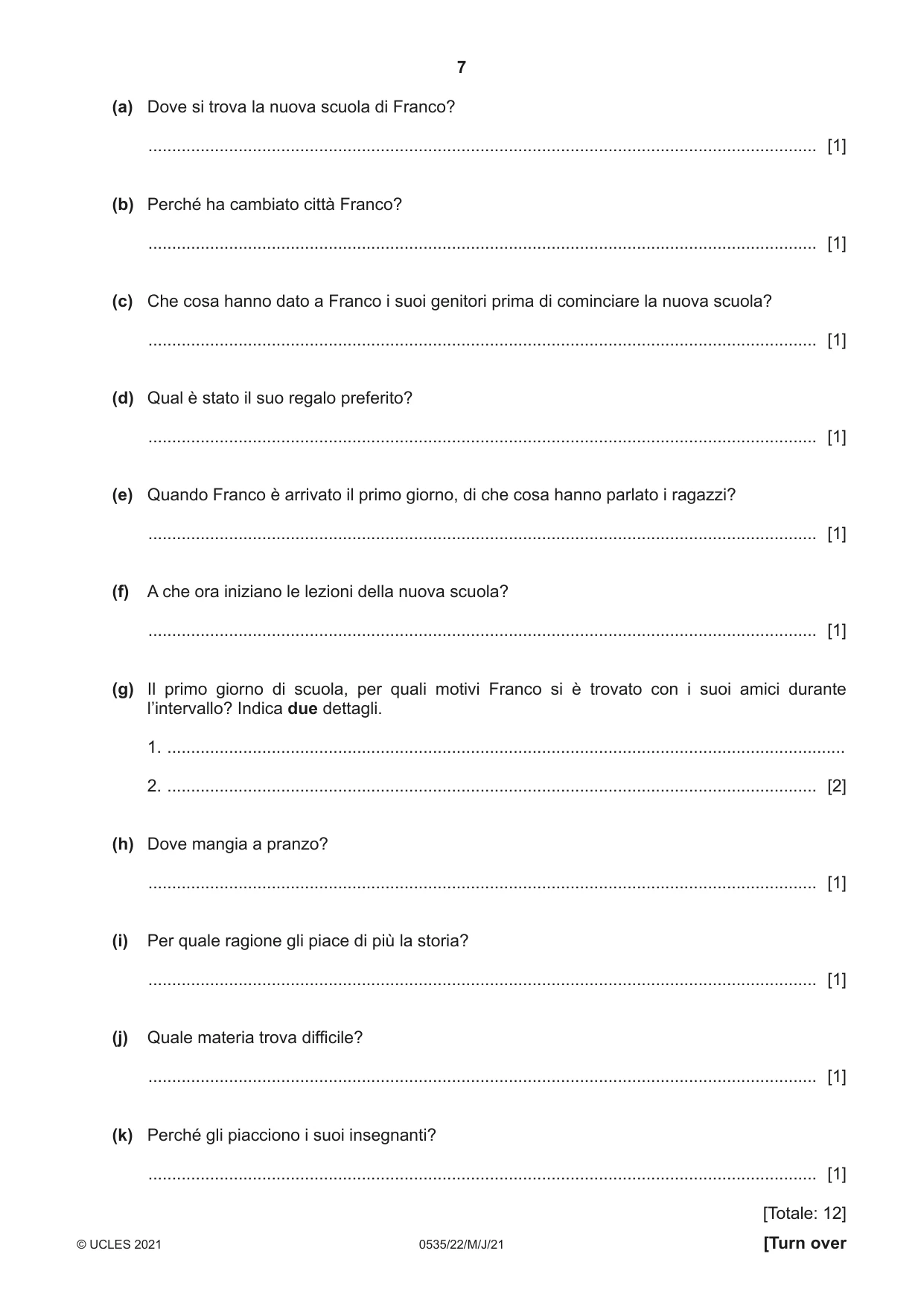
7 0535/22/M/J/21 © UCLES 2021 [Turn over (a) Dove si trova la nuova scuola di Franco? … [1] (b) Perché ha cambiato città Franco? … [1] (c) Che cosa hanno dato a Franco i suoi genitori prima di cominciare la nuova scuola? … [1] (d) Qual è stato il suo regalo preferito? … [1] (e) Quando Franco è arrivato il primo giorno, di che cosa hanno parlato i ragazzi? … [1] (f) A che ora iniziano le lezioni della nuova scuola? … [1] (g) Il primo giorno di scuola, per quali motivi Franco si è trovato con i suoi amici durante l’intervallo? Indica due dettagli. 1. … 2. … [2] (h) Dove mangia a pranzo? … [1] (i) Per quale ragione gli piace di più la storia? … [1] (j) Quale materia trova difficile? … [1] (k) Perché gli piacciono i suoi insegnanti? … [1] [Totale: 12]
Question paper, page 8
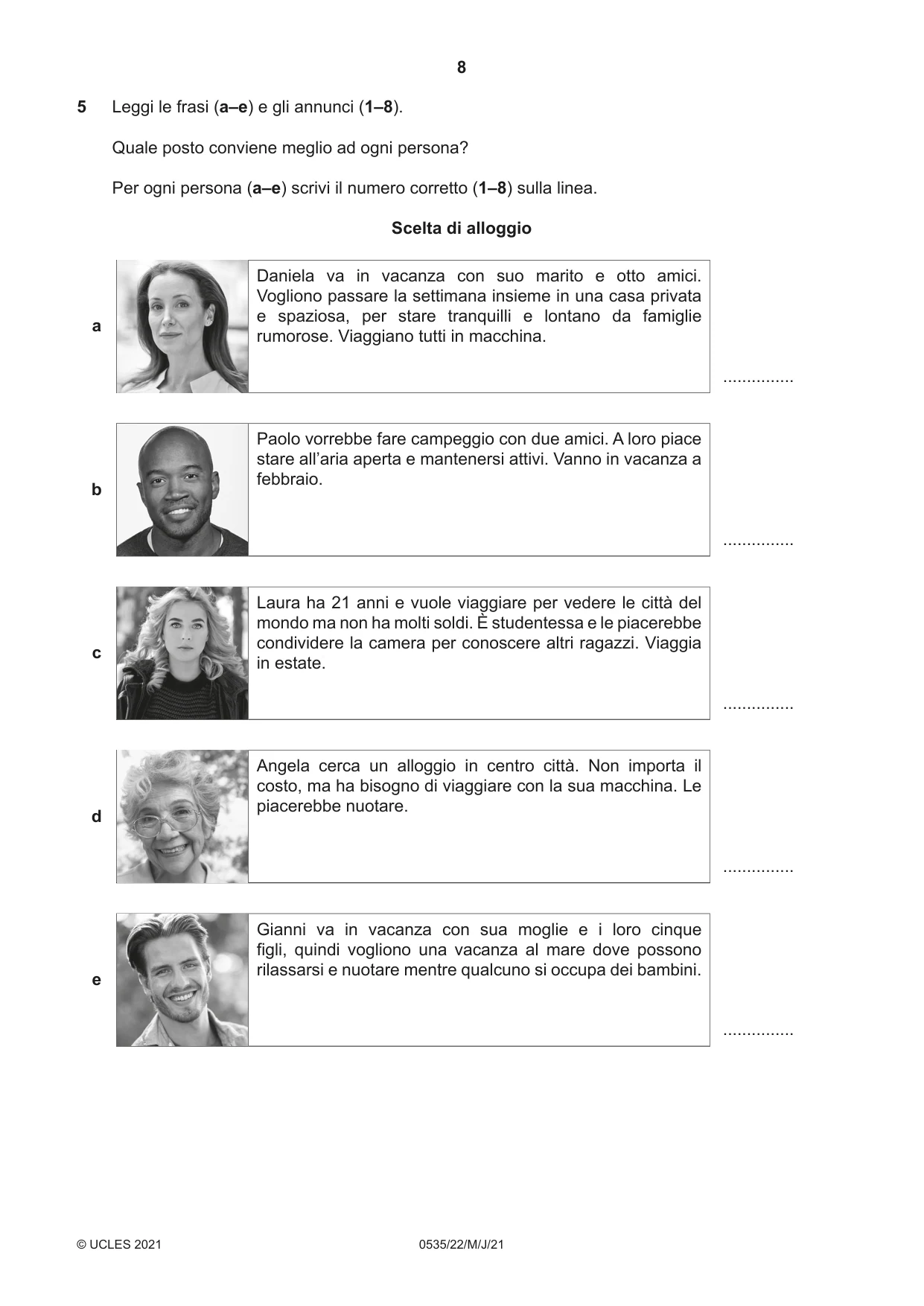
8 0535/22/M/J/21 © UCLES 2021 5 Leggi le frasi (a–e) e gli annunci (1–8). Quale posto conviene meglio ad ogni persona? Per ogni persona (a–e) scrivi il numero corretto (1–8) sulla linea. Scelta di alloggio a Daniela va in vacanza con suo marito e otto amici. Vogliono passare la settimana insieme in una casa privata e spaziosa, per stare tranquilli e lontano da famiglie rumorose. Viaggiano tutti in macchina. … b Paolo vorrebbe fare campeggio con due amici. A loro piace stare all’aria aperta e mantenersi attivi. Vanno in vacanza a febbraio. … c Laura ha 21 anni e vuole viaggiare per vedere le città del mondo ma non ha molti soldi. È studentessa e le piacerebbe condividere la camera per conoscere altri ragazzi. Viaggia in estate. … d Angela cerca un alloggio in centro città. Non importa il costo, ma ha bisogno di viaggiare con la sua macchina. Le piacerebbe nuotare. … e Gianni va in vacanza con sua moglie e i loro cinque figli, quindi vogliono una vacanza al mare dove possono rilassarsi e nuotare mentre qualcuno si occupa dei bambini. …
Question paper, page 9
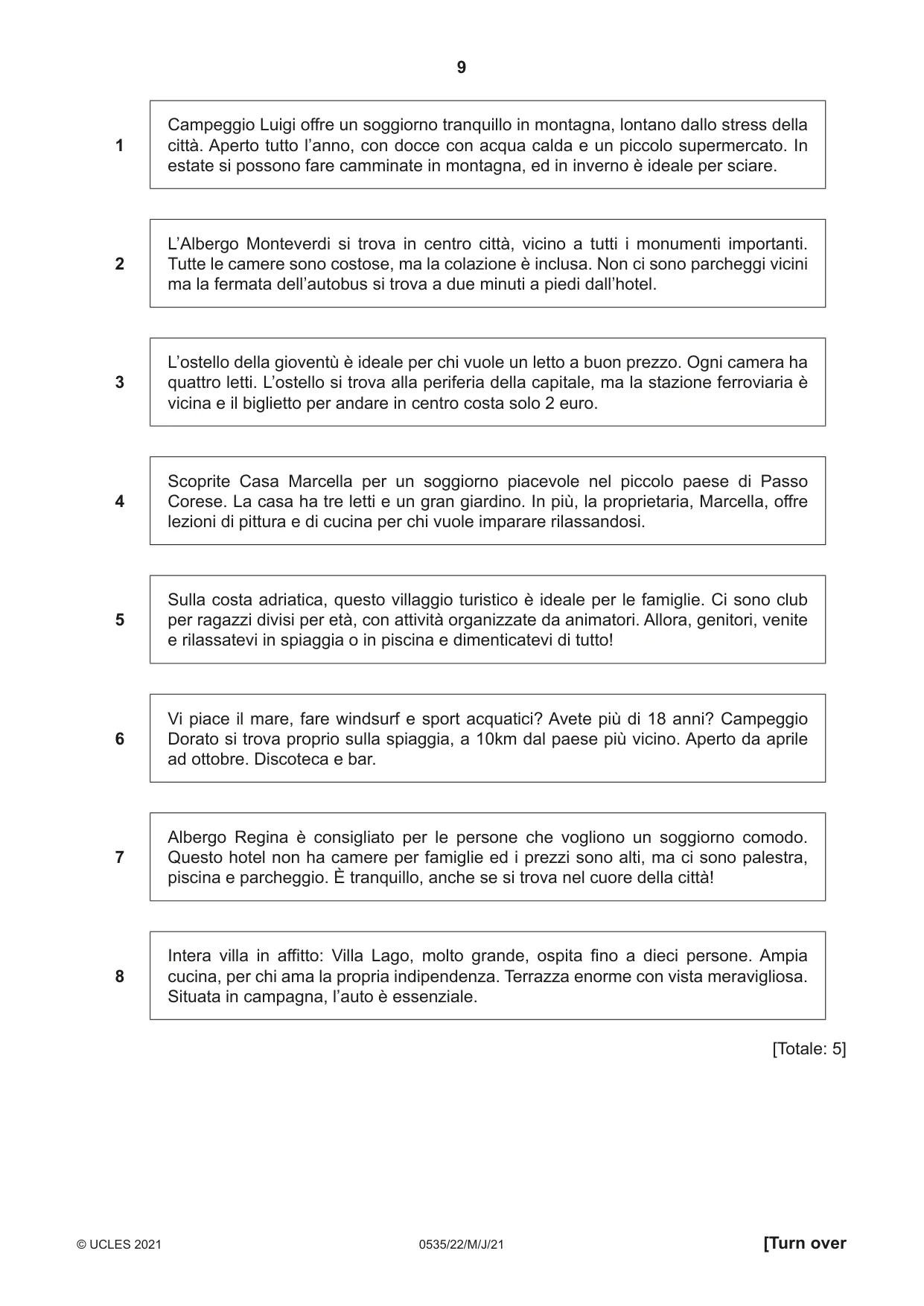
9 0535/22/M/J/21 © UCLES 2021 [Turn over 1 Campeggio Luigi offre un soggiorno tranquillo in montagna, lontano dallo stress della città. Aperto tutto l’anno, con docce con acqua calda e un piccolo supermercato. In estate si possono fare camminate in montagna, ed in inverno è ideale per sciare. 2 L’Albergo Monteverdi si trova in centro città, vicino a tutti i monumenti importanti. Tutte le camere sono costose, ma la colazione è inclusa. Non ci sono parcheggi vicini ma la fermata dell’autobus si trova a due minuti a piedi dall’hotel. 3 L’ostello della gioventù è ideale per chi vuole un letto a buon prezzo. Ogni camera ha quattro letti. L’ostello si trova alla periferia della capitale, ma la stazione ferroviaria è vicina e il biglietto per andare in centro costa solo 2 euro. 4 Scoprite Casa Marcella per un soggiorno piacevole nel piccolo paese di Passo Corese. La casa ha tre letti e un gran giardino. In più, la proprietaria, Marcella, offre lezioni di pittura e di cucina per chi vuole imparare rilassandosi. 5 Sulla costa adriatica, questo villaggio turistico è ideale per le famiglie. Ci sono club per ragazzi divisi per età, con attività organizzate da animatori. Allora, genitori, venite e rilassatevi in spiaggia o in piscina e dimenticatevi di tutto! 6 Vi piace il mare, fare windsurf e sport acquatici? Avete più di 18 anni? Campeggio Dorato si trova proprio sulla spiaggia, a 10km dal paese più vicino. Aperto da aprile ad ottobre. Discoteca e bar. 7 Albergo Regina è consigliato per le persone che vogliono un soggiorno comodo. Questo hotel non ha camere per famiglie ed i prezzi sono alti, ma ci sono palestra, piscina e parcheggio. È tranquillo, anche se si trova nel cuore della città! 8 Intera villa in affitto: Villa Lago, molto grande, ospita fino a dieci persone. Ampia cucina, per chi ama la propria indipendenza. Terrazza enorme con vista meravigliosa. Situata in campagna, l’auto è essenziale. [Totale: 5]
Question paper, page 10
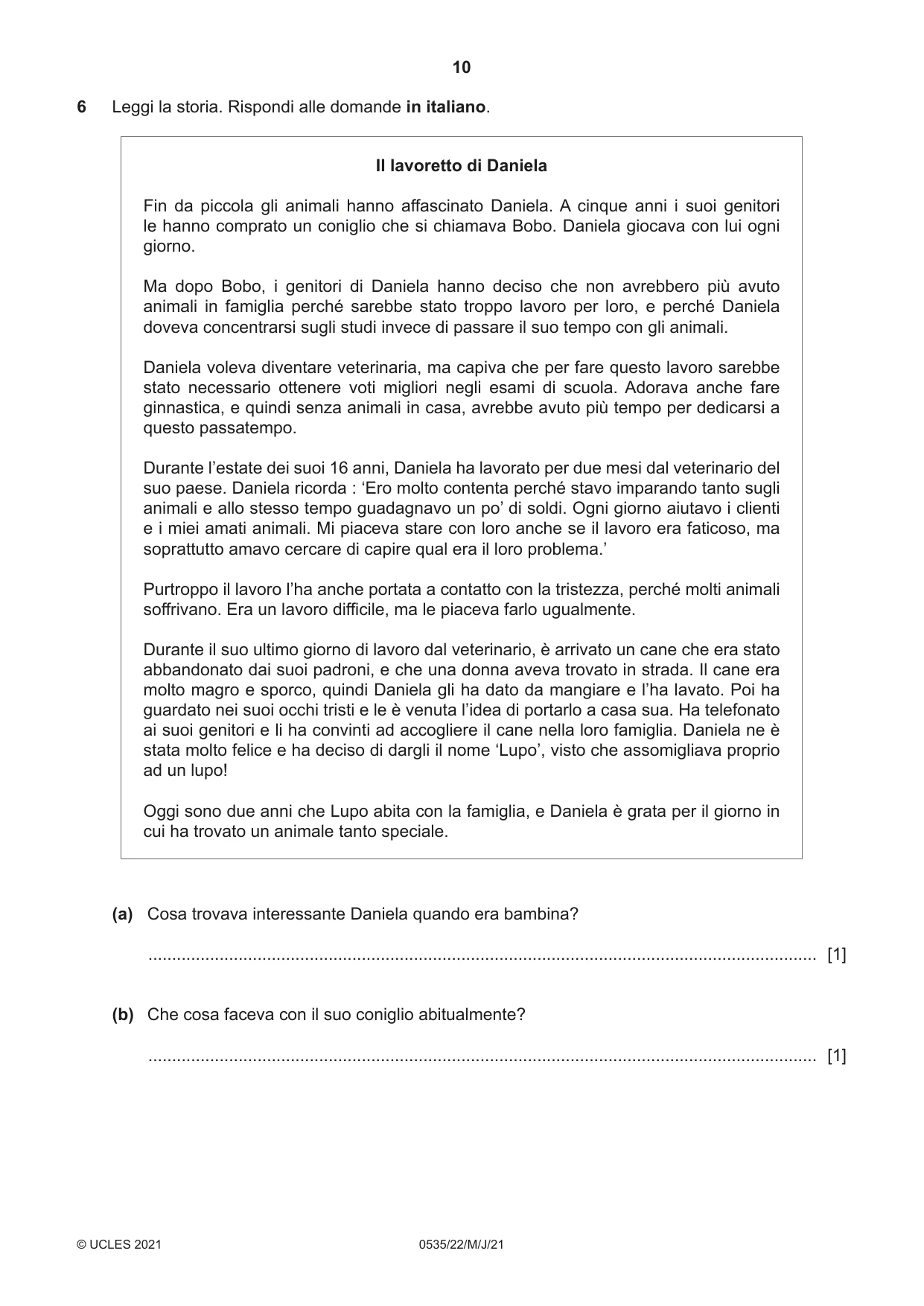
10 0535/22/M/J/21 © UCLES 2021 6 Leggi la storia. Rispondi alle domande in italiano. Il lavoretto di Daniela Fin da piccola gli animali hanno affascinato Daniela. A cinque anni i suoi genitori le hanno comprato un coniglio che si chiamava Bobo. Daniela giocava con lui ogni giorno. Ma dopo Bobo, i genitori di Daniela hanno deciso che non avrebbero più avuto animali in famiglia perché sarebbe stato troppo lavoro per loro, e perché Daniela doveva concentrarsi sugli studi invece di passare il suo tempo con gli animali. Daniela voleva diventare veterinaria, ma capiva che per fare questo lavoro sarebbe stato necessario ottenere voti migliori negli esami di scuola. Adorava anche fare ginnastica, e quindi senza animali in casa, avrebbe avuto più tempo per dedicarsi a questo passatempo. Durante l’estate dei suoi 16 anni, Daniela ha lavorato per due mesi dal veterinario del suo paese. Daniela ricorda : ‘Ero molto contenta perché stavo imparando tanto sugli animali e allo stesso tempo guadagnavo un po’ di soldi. Ogni giorno aiutavo i clienti e i miei amati animali. Mi piaceva stare con loro anche se il lavoro era faticoso, ma soprattutto amavo cercare di capire qual era il loro problema.’ Purtroppo il lavoro l’ha anche portata a contatto con la tristezza, perché molti animali soffrivano. Era un lavoro difficile, ma le piaceva farlo ugualmente. Durante il suo ultimo giorno di lavoro dal veterinario, è arrivato un cane che era stato abbandonato dai suoi padroni, e che una donna aveva trovato in strada. Il cane era molto magro e sporco, quindi Daniela gli ha dato da mangiare e l’ha lavato. Poi ha guardato nei suoi occhi tristi e le è venuta l’idea di portarlo a casa sua. Ha telefonato ai suoi genitori e li ha convinti ad accogliere il cane nella loro famiglia. Daniela ne è stata molto felice e ha deciso di dargli il nome ‘Lupo’, visto che assomigliava proprio ad un lupo! Oggi sono due anni che Lupo abita con la famiglia, e Daniela è grata per il giorno in cui ha trovato un animale tanto speciale. (a) Cosa trovava interessante Daniela quando era bambina? … [1] (b) Che cosa faceva con il suo coniglio abitualmente? … [1]
Question paper, page 11
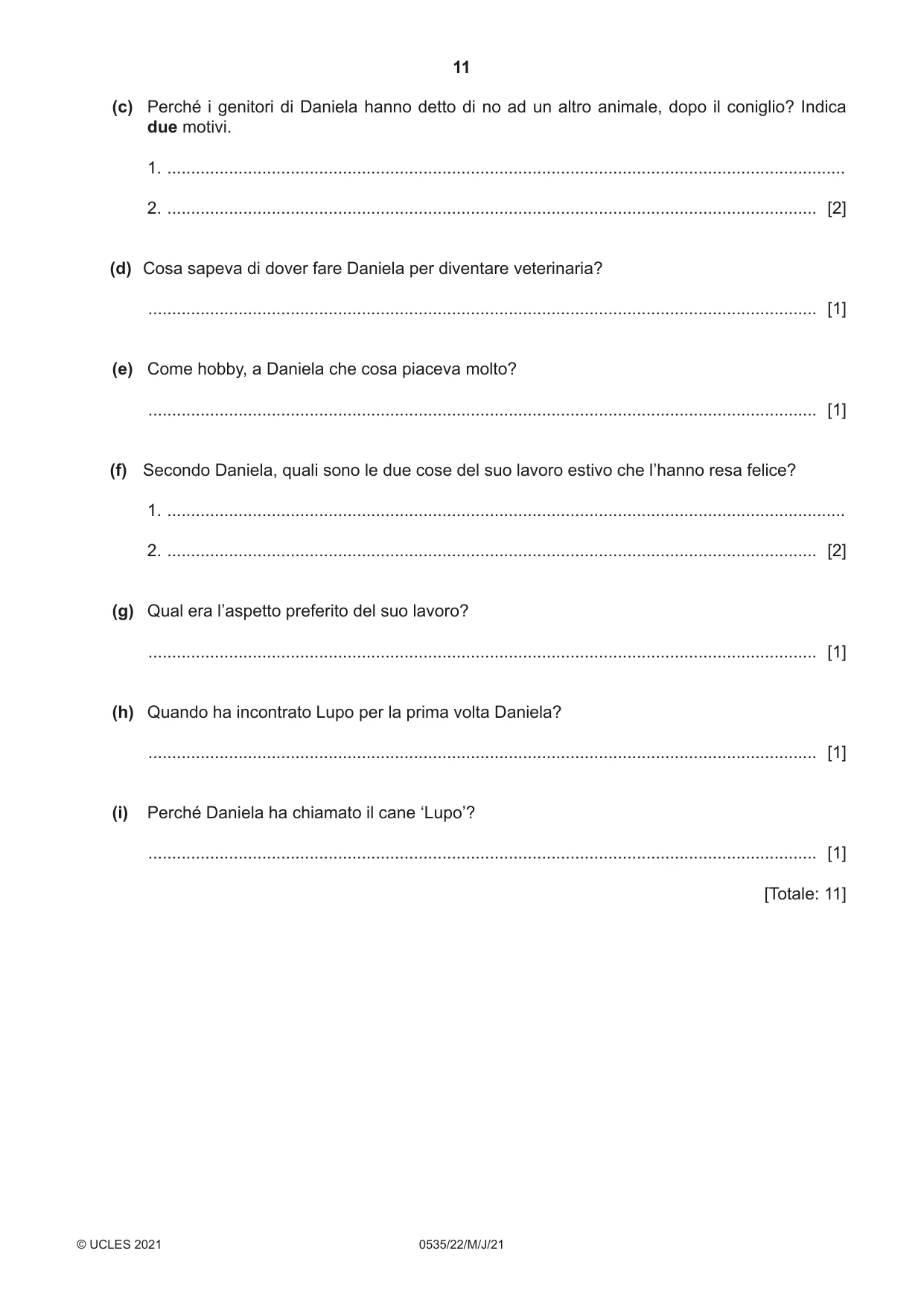
11 0535/22/M/J/21 © UCLES 2021 (c) Perché i genitori di Daniela hanno detto di no ad un altro animale, dopo il coniglio? Indica due motivi. 1. … 2. … [2] (d) Cosa sapeva di dover fare Daniela per diventare veterinaria? … [1] (e) Come hobby, a Daniela che cosa piaceva molto? … [1] (f) Secondo Daniela, quali sono le due cose del suo lavoro estivo che l’hanno resa felice? 1. … 2. … [2] (g) Qual era l’aspetto preferito del suo lavoro? … [1] (h) Quando ha incontrato Lupo per la prima volta Daniela? … [1] (i) Perché Daniela ha chiamato il cane ‘Lupo’? … [1] [Totale: 11]
Question paper, page 12
12 0535/22/M/J/21 © UCLES 2021 Permission to reproduce items where third-party owned material protected by copyright is included has been sought and cleared where possible. Every reasonable effort has been made by the publisher (UCLES) to trace copyright holders, but if any items requiring clearance have unwittingly been included, the publisher will be pleased to make amends at the earliest possible opportunity. To avoid the issue of disclosure of answer-related information to candidates, all copyright acknowledgements are reproduced online in the Cambridge Assessment International Education Copyright Acknowledgements Booklet. This is produced for each series of examinations and is freely available to download at www.cambridgeinternational.org after the live examination series. Cambridge Assessment International Education is part of the Cambridge Assessment Group. Cambridge Assessment is the brand name of the University of Cambridge Local Examinations Syndicate (UCLES), which itself is a department of the University of Cambridge. BLANK PAGE
Mark scheme, page 1
This document consists of 10 printed pages. © UCLES 2021 [Turn over Cambridge IGCSE™ ITALIAN 0535/22 Paper 2 Reading May/June 2021 MARK SCHEME Maximum Mark: 45 Published This mark scheme is published as an aid to teachers and candidates, to indicate the requirements of the examination. It shows the basis on which Examiners were instructed to award marks. It does not indicate the details of the discussions that took place at an Examiners’ meeting before marking began, which would have considered the acceptability of alternative answers. Mark schemes should be read in conjunction with the question paper and the Principal Examiner Report for Teachers. Cambridge International will not enter into discussions about these mark schemes. Cambridge International is publishing the mark schemes for the May/June 2021 series for most Cambridge IGCSE™, Cambridge International A and AS Level components and some Cambridge O Level components.
Mark scheme, page 2
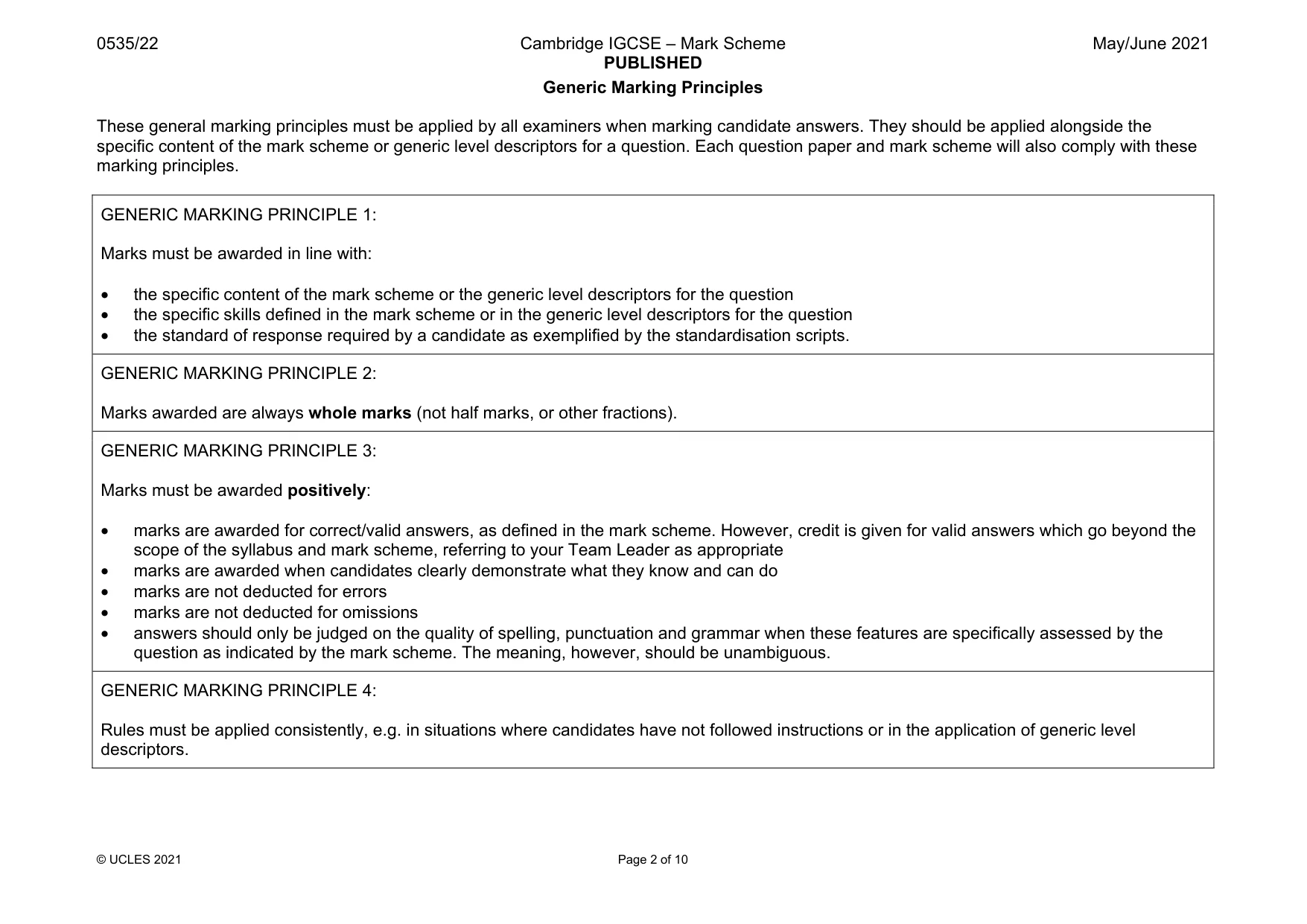
0535/22 Cambridge IGCSE – Mark Scheme PUBLISHED May/June 2021 © UCLES 2021 Page 2 of 10 Generic Marking Principles These general marking principles must be applied by all examiners when marking candidate answers. They should be applied alongside the specific content of the mark scheme or generic level descriptors for a question. Each question paper and mark scheme will also comply with these marking principles. GENERIC MARKING PRINCIPLE 1: Marks must be awarded in line with: • the specific content of the mark scheme or the generic level descriptors for the question • the specific skills defined in the mark scheme or in the generic level descriptors for the question • the standard of response required by a candidate as exemplified by the standardisation scripts. GENERIC MARKING PRINCIPLE 2: Marks awarded are always whole marks (not half marks, or other fractions). GENERIC MARKING PRINCIPLE 3: Marks must be awarded positively: • marks are awarded for correct/valid answers, as defined in the mark scheme. However, credit is given for valid answers which go beyond the scope of the syllabus and mark scheme, referring to your Team Leader as appropriate • marks are awarded when candidates clearly demonstrate what they know and can do • marks are not deducted for errors • marks are not deducted for omissions • answers should only be judged on the quality of spelling, punctuation and grammar when these features are specifically assessed by the question as indicated by the mark scheme. The meaning, however, should be unambiguous. GENERIC MARKING PRINCIPLE 4: Rules must be applied consistently, e.g. in situations where candidates have not followed instructions or in the application of generic level descriptors.
Mark scheme, page 3
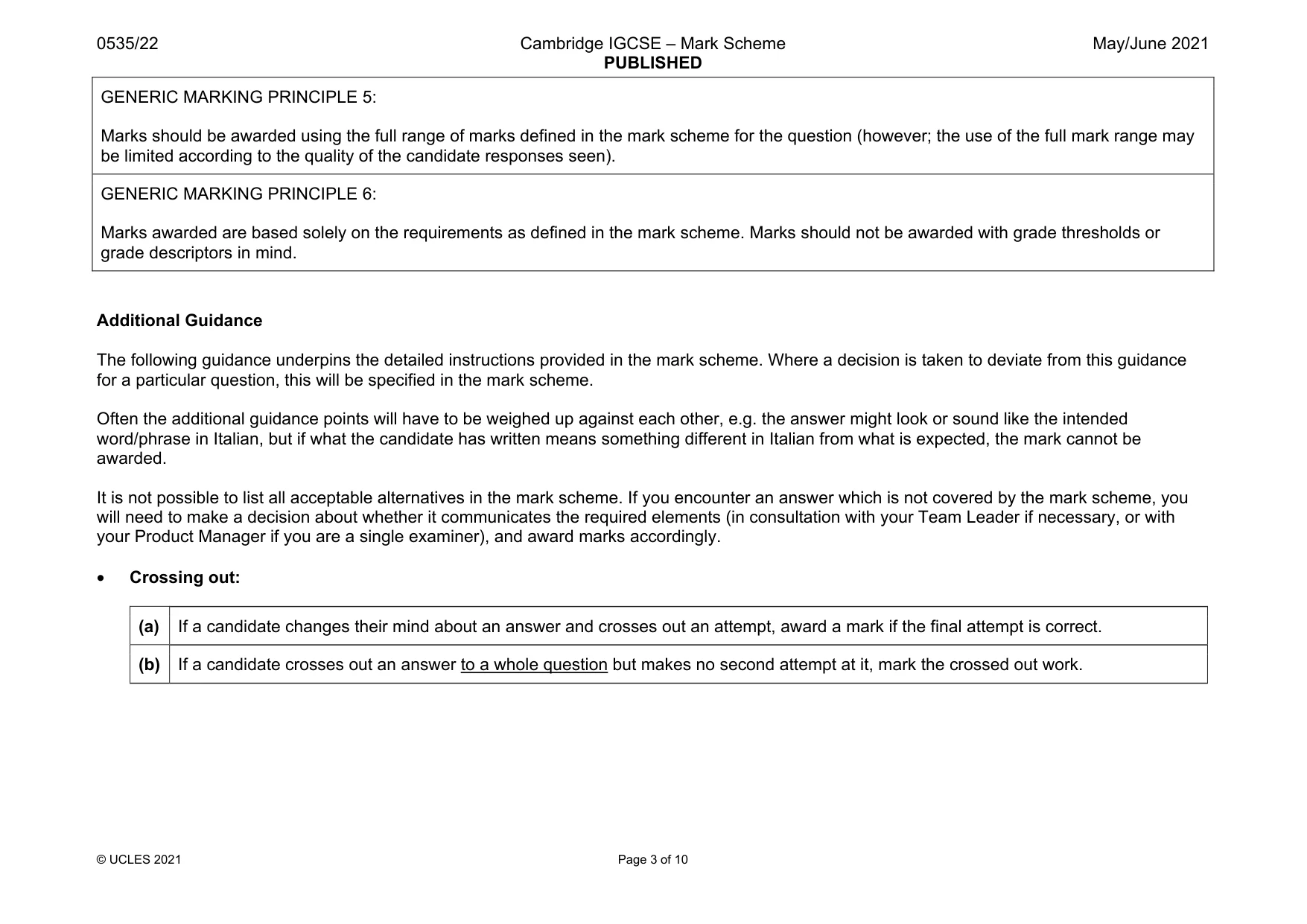
0535/22 Cambridge IGCSE – Mark Scheme PUBLISHED May/June 2021 © UCLES 2021 Page 3 of 10 GENERIC MARKING PRINCIPLE 5: Marks should be awarded using the full range of marks defined in the mark scheme for the question (however; the use of the full mark range may be limited according to the quality of the candidate responses seen). GENERIC MARKING PRINCIPLE 6: Marks awarded are based solely on the requirements as defined in the mark scheme. Marks should not be awarded with grade thresholds or grade descriptors in mind. Additional Guidance The following guidance underpins the detailed instructions provided in the mark scheme. Where a decision is taken to deviate from this guidance for a particular question, this will be specified in the mark scheme. Often the additional guidance points will have to be weighed up against each other, e.g. the answer might look or sound like the intended word/phrase in Italian, but if what the candidate has written means something different in Italian from what is expected, the mark cannot be awarded. It is not possible to list all acceptable alternatives in the mark scheme. If you encounter an answer which is not covered by the mark scheme, you will need to make a decision about whether it communicates the required elements (in consultation with your Team Leader if necessary, or with your Product Manager if you are a single examiner), and award marks accordingly. • Crossing out: (a) If a candidate changes their mind about an answer and crosses out an attempt, award a mark if the final attempt is correct. (b) If a candidate crosses out an answer to a whole question but makes no second attempt at it, mark the crossed out work.
Mark scheme, page 4
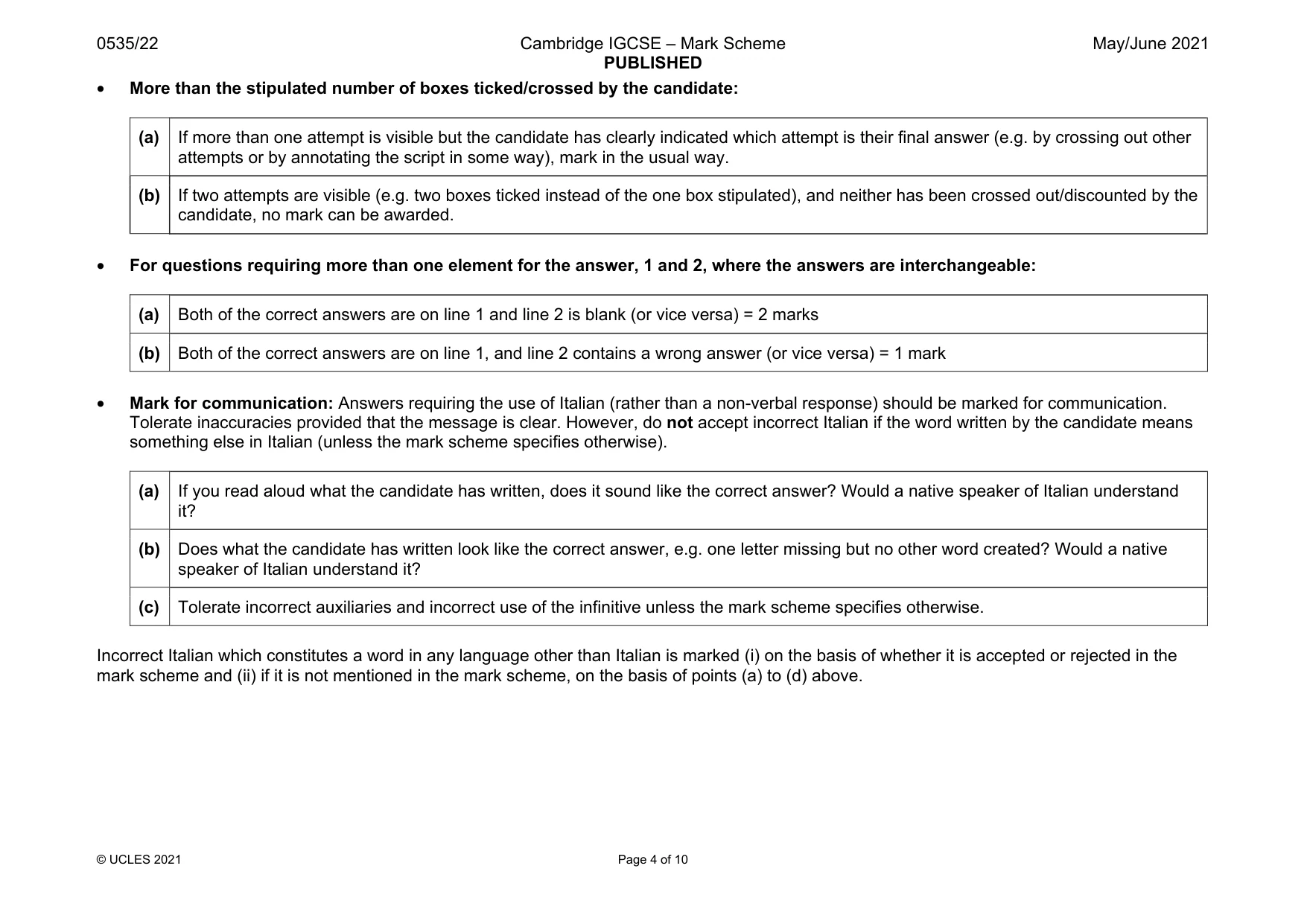
0535/22 Cambridge IGCSE – Mark Scheme PUBLISHED May/June 2021 © UCLES 2021 Page 4 of 10 • More than the stipulated number of boxes ticked/crossed by the candidate: (a) If more than one attempt is visible but the candidate has clearly indicated which attempt is their final answer (e.g. by crossing out other attempts or by annotating the script in some way), mark in the usual way. (b) If two attempts are visible (e.g. two boxes ticked instead of the one box stipulated), and neither has been crossed out/discounted by the candidate, no mark can be awarded. • For questions requiring more than one element for the answer, 1 and 2, where the answers are interchangeable: (a) Both of the correct answers are on line 1 and line 2 is blank (or vice versa) = 2 marks (b) Both of the correct answers are on line 1, and line 2 contains a wrong answer (or vice versa) = 1 mark • Mark for communication: Answers requiring the use of Italian (rather than a non-verbal response) should be marked for communication. Tolerate inaccuracies provided that the message is clear. However, do not accept incorrect Italian if the word written by the candidate means something else in Italian (unless the mark scheme specifies otherwise). (a) If you read aloud what the candidate has written, does it sound like the correct answer? Would a native speaker of Italian understand it? (b) Does what the candidate has written look like the correct answer, e.g. one letter missing but no other word created? Would a native speaker of Italian understand it? (c) Tolerate incorrect auxiliaries and incorrect use of the infinitive unless the mark scheme specifies otherwise. Incorrect Italian which constitutes a word in any language other than Italian is marked (i) on the basis of whether it is accepted or rejected in the mark scheme and (ii) if it is not mentioned in the mark scheme, on the basis of points (a) to (d) above.
Mark scheme, page 5
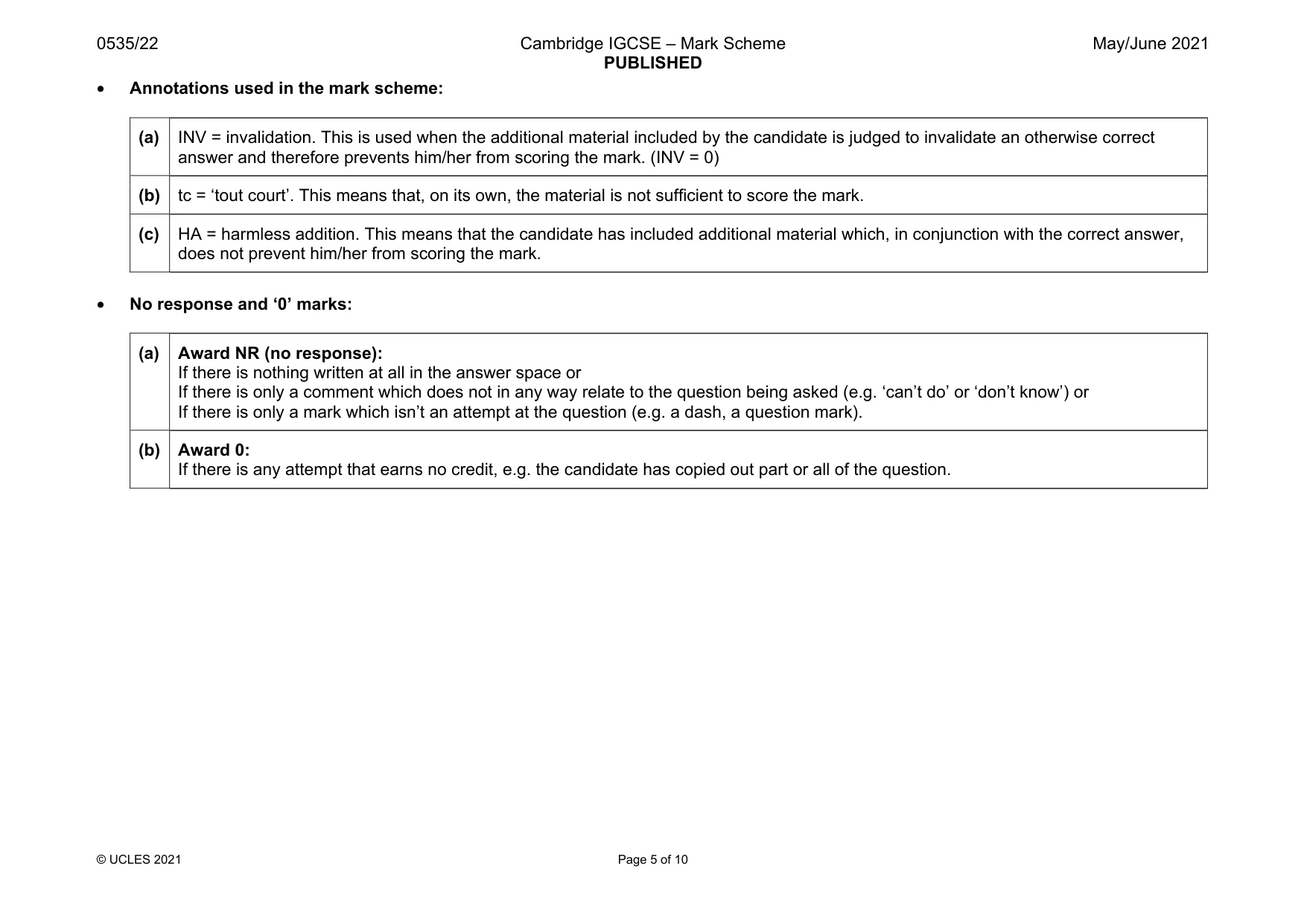
0535/22 Cambridge IGCSE – Mark Scheme PUBLISHED May/June 2021 © UCLES 2021 Page 5 of 10 • Annotations used in the mark scheme: (a) INV = invalidation. This is used when the additional material included by the candidate is judged to invalidate an otherwise correct answer and therefore prevents him/her from scoring the mark. (INV = 0) (b) tc = ‘tout court’. This means that, on its own, the material is not sufficient to score the mark. (c) HA = harmless addition. This means that the candidate has included additional material which, in conjunction with the correct answer, does not prevent him/her from scoring the mark. • No response and ‘0’ marks: (a) Award NR (no response): If there is nothing written at all in the answer space or If there is only a comment which does not in any way relate to the question being asked (e.g. ‘can’t do’ or ‘don’t know’) or If there is only a mark which isn’t an attempt at the question (e.g. a dash, a question mark). (b) Award 0: If there is any attempt that earns no credit, e.g. the candidate has copied out part or all of the question.
Mark scheme, page 6
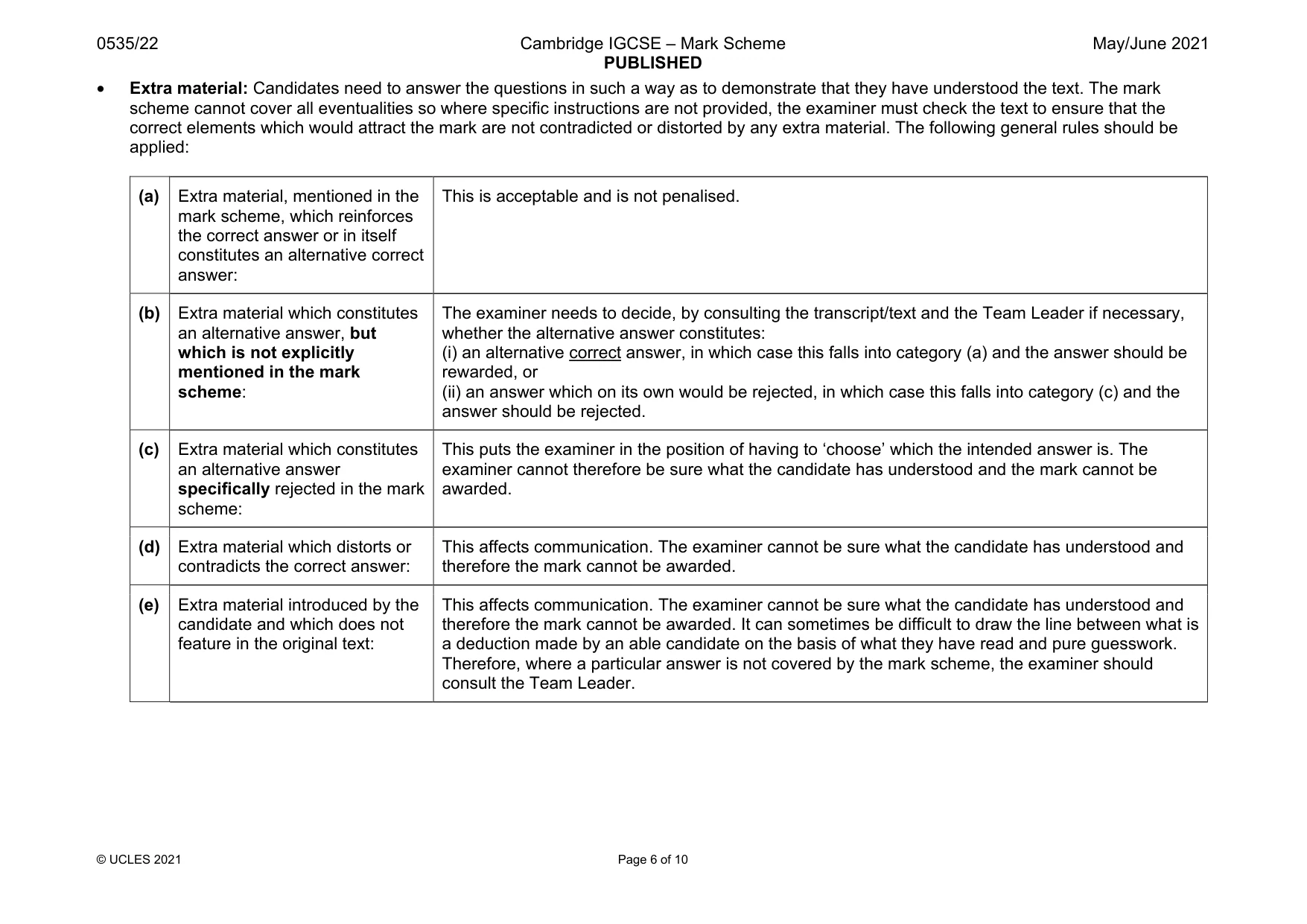
0535/22 Cambridge IGCSE – Mark Scheme PUBLISHED May/June 2021 © UCLES 2021 Page 6 of 10 • Extra material: Candidates need to answer the questions in such a way as to demonstrate that they have understood the text. The mark scheme cannot cover all eventualities so where specific instructions are not provided, the examiner must check the text to ensure that the correct elements which would attract the mark are not contradicted or distorted by any extra material. The following general rules should be applied: (a) Extra material, mentioned in the mark scheme, which reinforces the correct answer or in itself constitutes an alternative correct answer: This is acceptable and is not penalised. (b) Extra material which constitutes an alternative answer, but which is not explicitly mentioned in the mark scheme: The examiner needs to decide, by consulting the transcript/text and the Team Leader if necessary, whether the alternative answer constitutes: (i) an alternative correct answer, in which case this falls into category (a) and the answer should be rewarded, or (ii) an answer which on its own would be rejected, in which case this falls into category (c) and the answer should be rejected. (c) Extra material which constitutes an alternative answer specifically rejected in the mark scheme: This puts the examiner in the position of having to ‘choose’ which the intended answer is. The examiner cannot therefore be sure what the candidate has understood and the mark cannot be awarded. (d) Extra material which distorts or contradicts the correct answer: This affects communication. The examiner cannot be sure what the candidate has understood and therefore the mark cannot be awarded. (e) Extra material introduced by the candidate and which does not feature in the original text: This affects communication. The examiner cannot be sure what the candidate has understood and therefore the mark cannot be awarded. It can sometimes be difficult to draw the line between what is a deduction made by an able candidate on the basis of what they have read and pure guesswork. Therefore, where a particular answer is not covered by the mark scheme, the examiner should consult the Team Leader.
Mark scheme, page 7
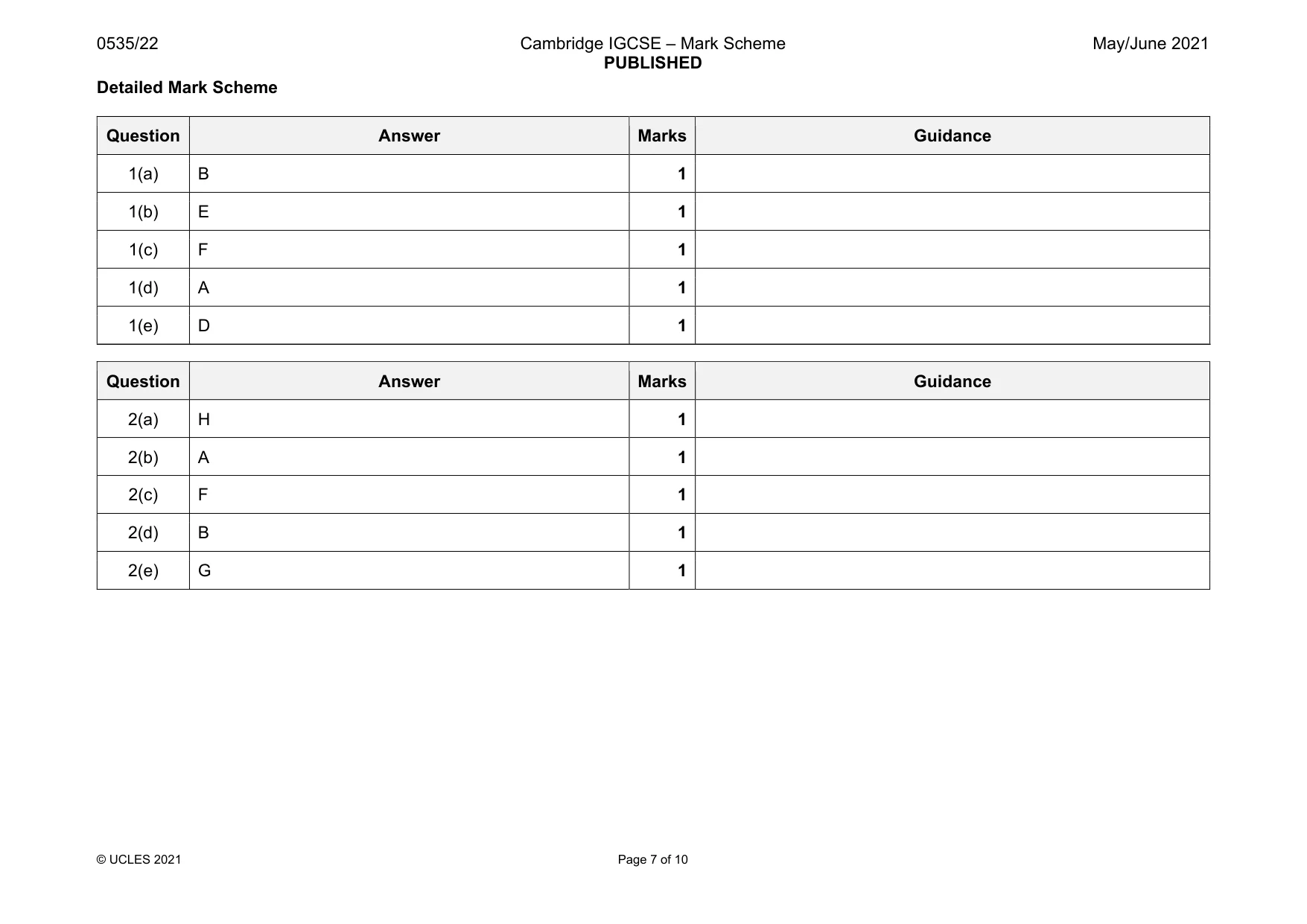
0535/22 Cambridge IGCSE – Mark Scheme PUBLISHED May/June 2021 © UCLES 2021 Page 7 of 10 Detailed Mark Scheme Question Answer Marks Guidance 1(a) B 1 1(b) E 1 1(c) F 1 1(d) A 1 1(e) D 1 Question Answer Marks Guidance 2(a) H 1 2(b) A 1 2(c) F 1 2(d) B 1 2(e) G 1
Mark scheme, page 8
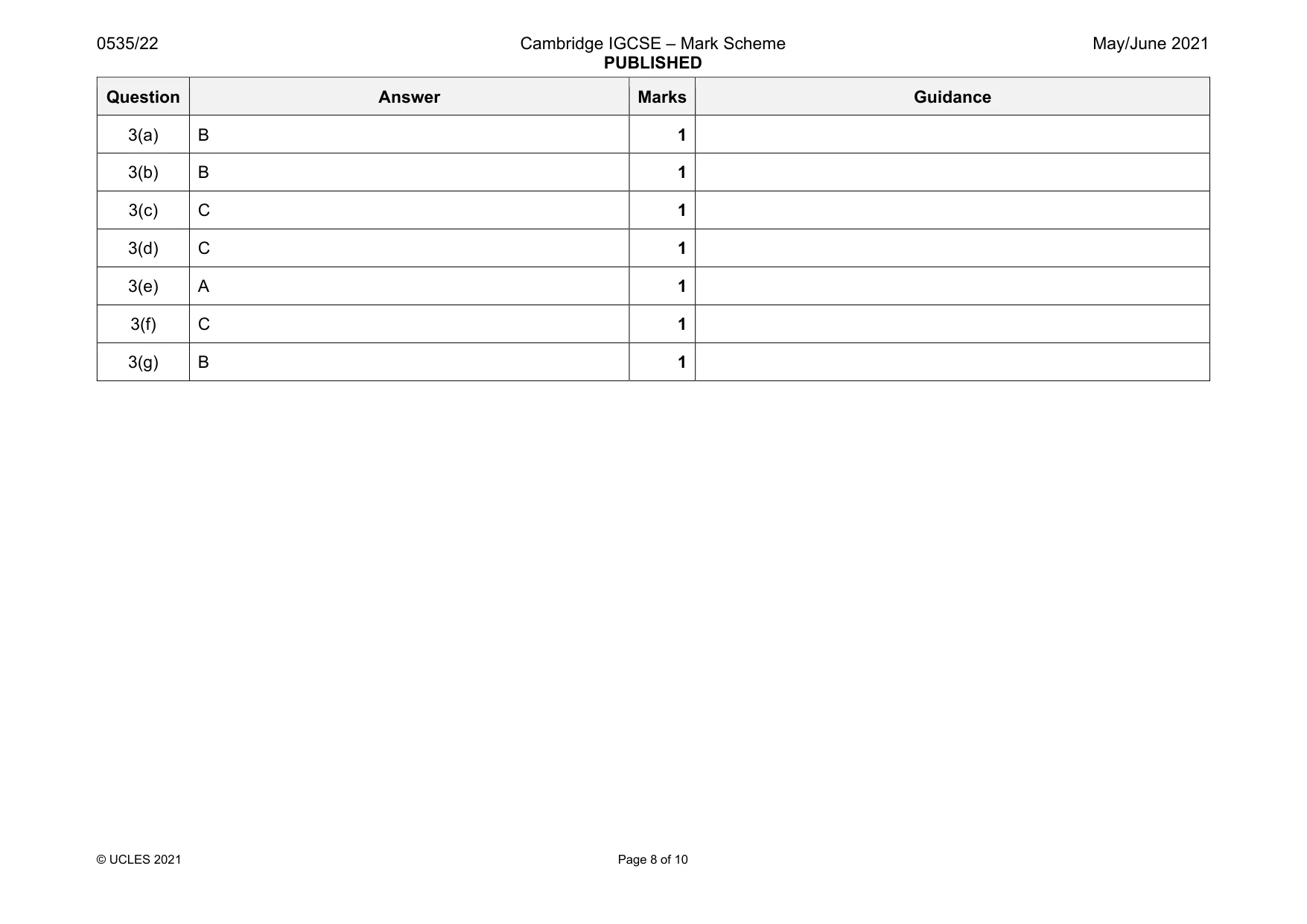
0535/22 Cambridge IGCSE – Mark Scheme PUBLISHED May/June 2021 © UCLES 2021 Page 8 of 10 Question Answer Marks Guidance 3(a) B 1 3(b) B 1 3(c) C 1 3(d) C 1 3(e) A 1 3(f) C 1 3(g) B 1
Mark scheme, page 9
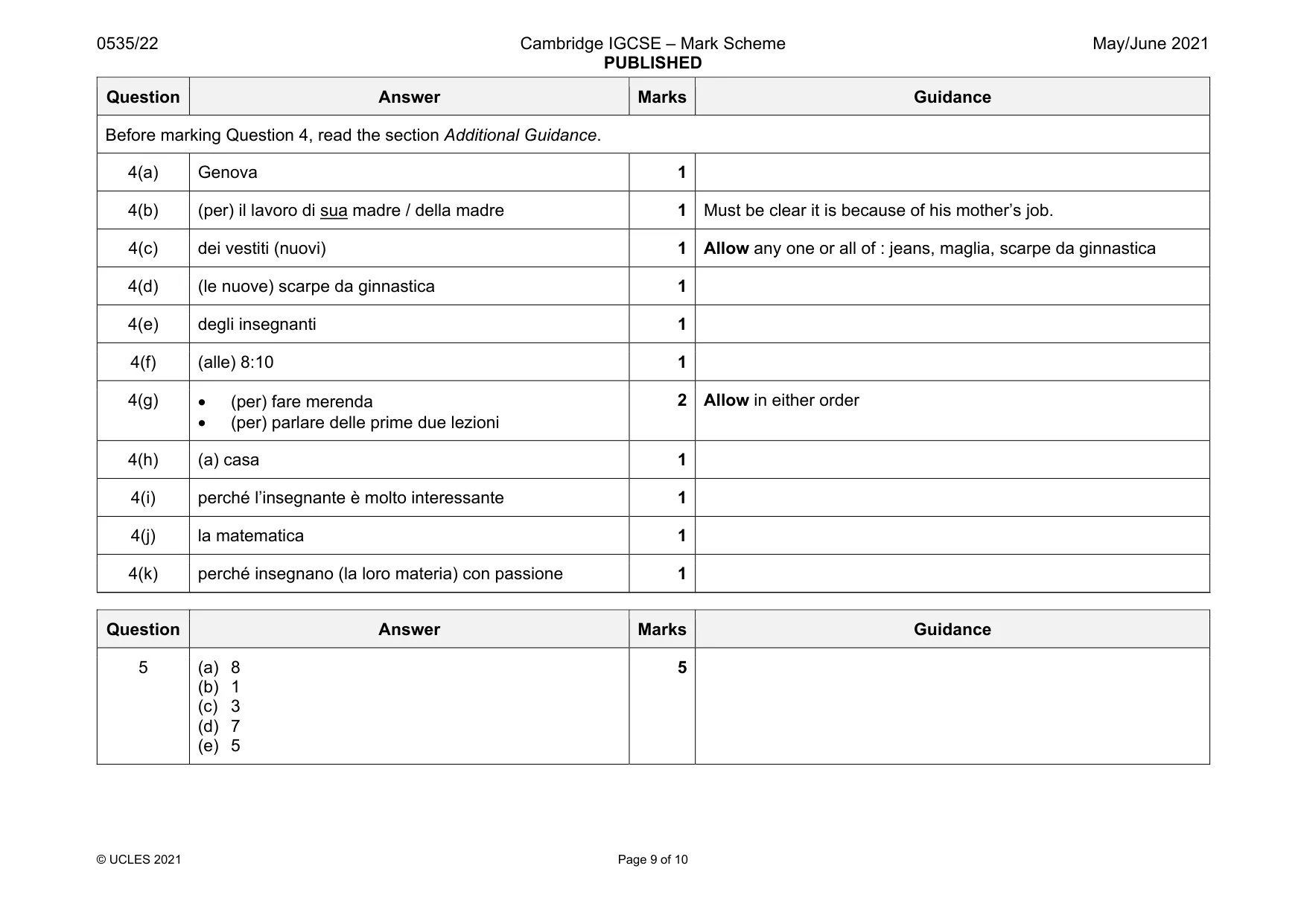
0535/22 Cambridge IGCSE – Mark Scheme PUBLISHED May/June 2021 © UCLES 2021 Page 9 of 10 Question Answer Marks Guidance Before marking Question 4, read the section Additional Guidance. 4(a) Genova 1 4(b) (per) il lavoro di sua madre / della madre 1 Must be clear it is because of his mother’s job. 4(c) dei vestiti (nuovi) 1 Allow any one or all of : jeans, maglia, scarpe da ginnastica 4(d) (le nuove) scarpe da ginnastica 1 4(e) degli insegnanti 1 4(f) (alle) 8:10 1 4(g) • (per) fare merenda • (per) parlare delle prime due lezioni 2 Allow in either order 4(h) (a) casa 1 4(i) perché l’insegnante è molto interessante 1 4(j) la matematica 1 4(k) perché insegnano (la loro materia) con passione 1 Question Answer Marks Guidance 5 (a) 8 (b) 1 (c) 3 (d) 7 (e) 5 5
Mark scheme, page 10
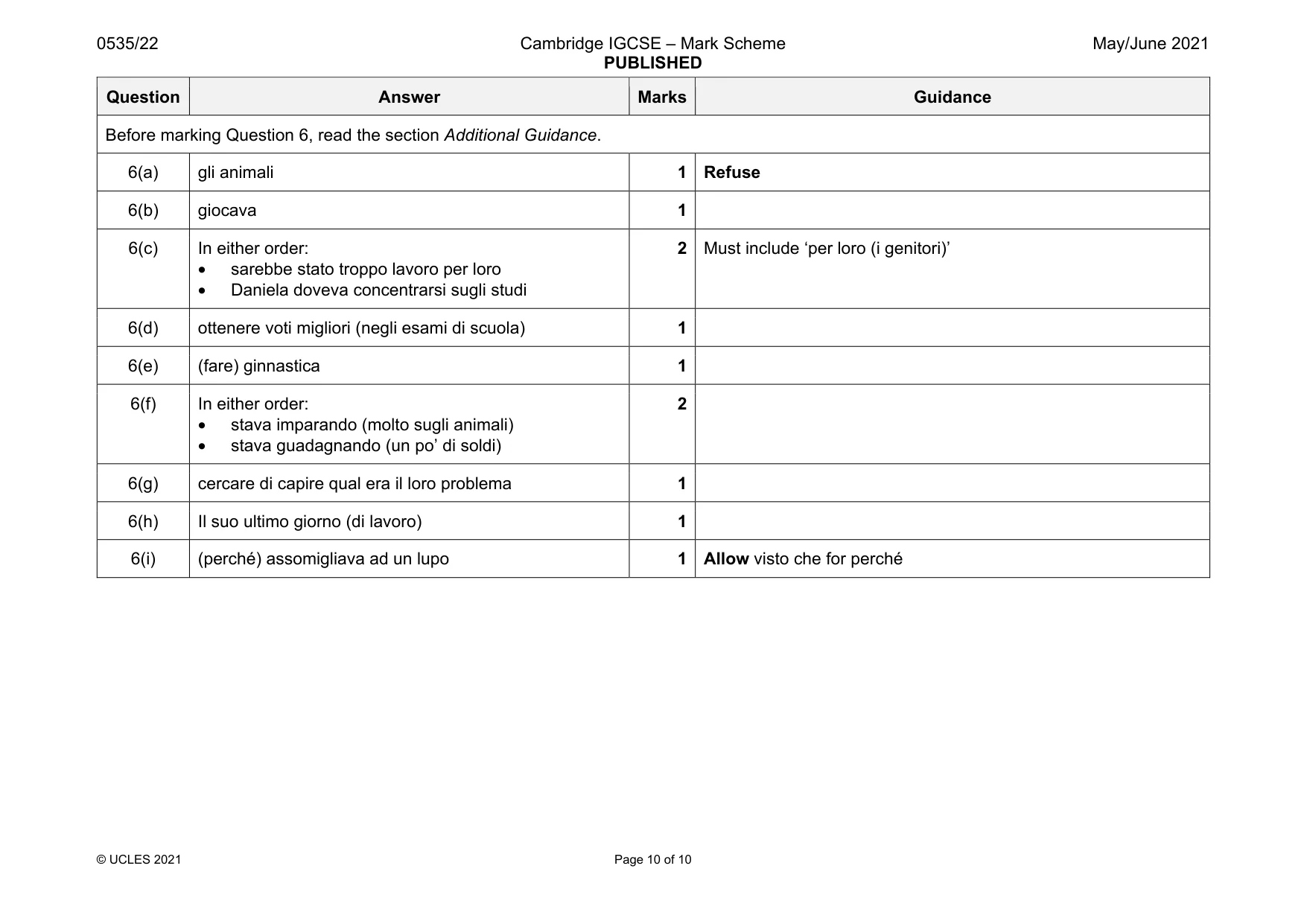
0535/22 Cambridge IGCSE – Mark Scheme PUBLISHED May/June 2021 © UCLES 2021 Page 10 of 10 Question Answer Marks Guidance Before marking Question 6, read the section Additional Guidance. 6(a) gli animali 1 Refuse 6(b) giocava 1 6(c) In either order: • sarebbe stato troppo lavoro per loro • Daniela doveva concentrarsi sugli studi 2 Must include ‘per loro (i genitori)’ 6(d) ottenere voti migliori (negli esami di scuola) 1 6(e) (fare) ginnastica 1 6(f) In either order: • stava imparando (molto sugli animali) • stava guadagnando (un po’ di soldi) 2 6(g) cercare di capire qual era il loro problema 1 6(h) Il suo ultimo giorno (di lavoro) 1 6(i) (perché) assomigliava ad un lupo 1 Allow visto che for perché
What you needed in this session
Cambridge’s own grade thresholds for 2021 May/June, Paper 2 · Variant 2. A higher threshold means an easier paper — the bar moves with how the cohort did.