Cambridge IGCSE Italian - Foreign Language 0535 — 2022 May/June Paper 2 · Variant 2
0535/22/M/J/22 · 45 marks · ≈51 min
The question paper and its mark scheme, free to read here and free to download. This is Cambridge’s own paper, exactly as it was sat.
Question paper12 pages

Mark scheme10 pages
Answers below. Sit the paper first if you are practising.
Paper as text
Question paper, page 1
This document has 12 pages. Any blank pages are indicated. [Turn over Cambridge IGCSE™ DC (CE/SG) 302781/1 © UCLES 2022 ITALIAN 0535/22 Paper 2 Reading May/June 2022 1 hour You must answer on the question paper. No additional materials are needed. INSTRUCTIONS ● Answer all questions. ● Use a black or dark blue pen. ● Write your name, centre number and candidate number in the boxes at the top of the page. ● Write your answer to each question in the space provided. ● Do not use an erasable pen or correction fluid. ● Do not write on any bar codes. ● Dictionaries are not allowed. INFORMATION ● The total mark for this paper is 45. ● The number of marks for each question or part question is shown in brackets [ ]. * 8 8 5 2 7 9 0 1 9 1 *
Question paper, page 2
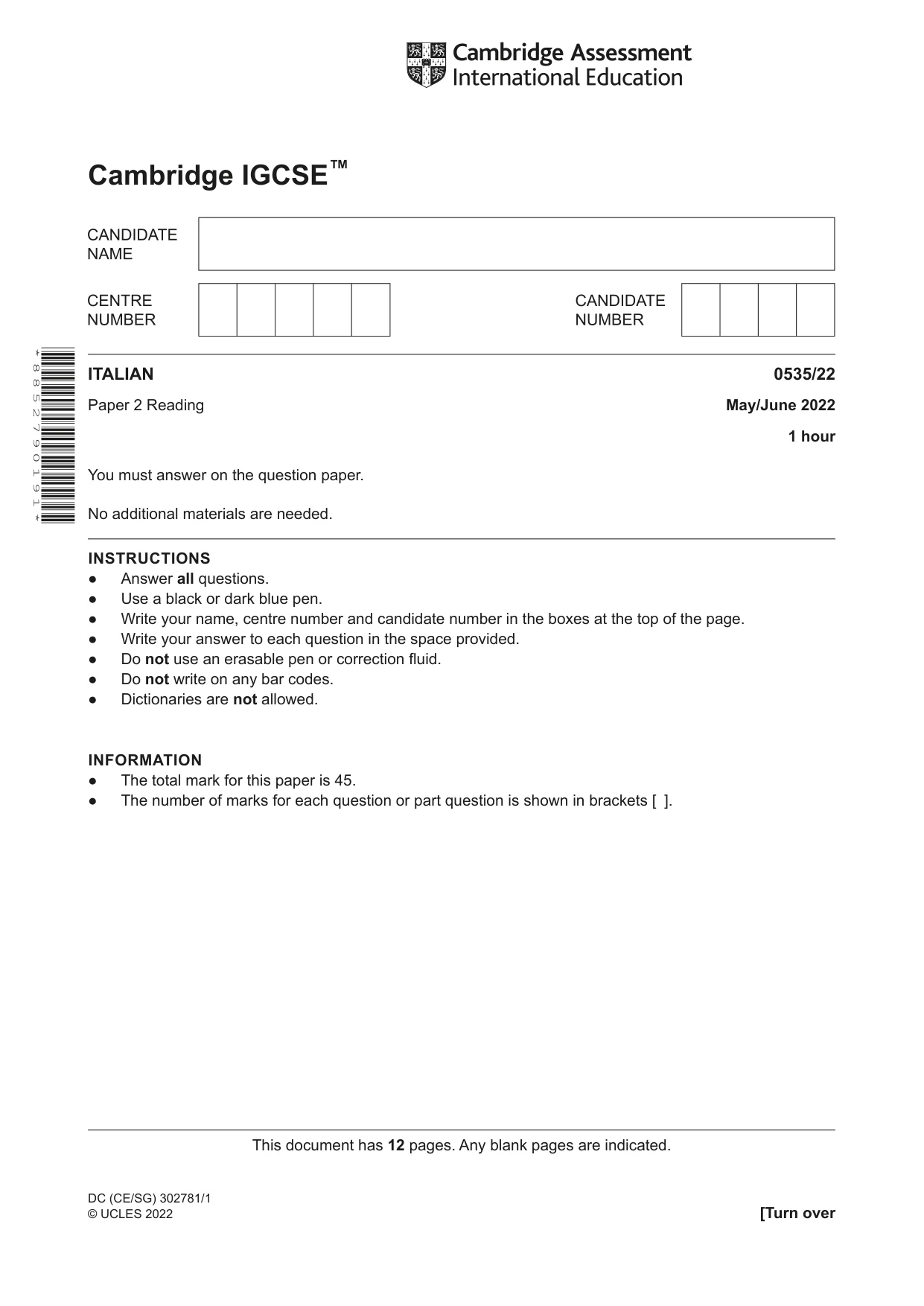
2 0535/22/ M / J /22 © UCLES 2022 1 Guarda le immagini. B C E F A D Per ogni domanda, scrivi la lettera corretta (A–F) nella casella. (a) Mi piace giocare a calcio. [1] (b) Di solito vado in palestra. [1] (c) Ogni sabato gioco a pallacanestro. [1] (d) Preferisco andare a cavallo. [1] (e) Il fine settimana nuoto al mare. [1] [Totale: 5]
Question paper, page 3
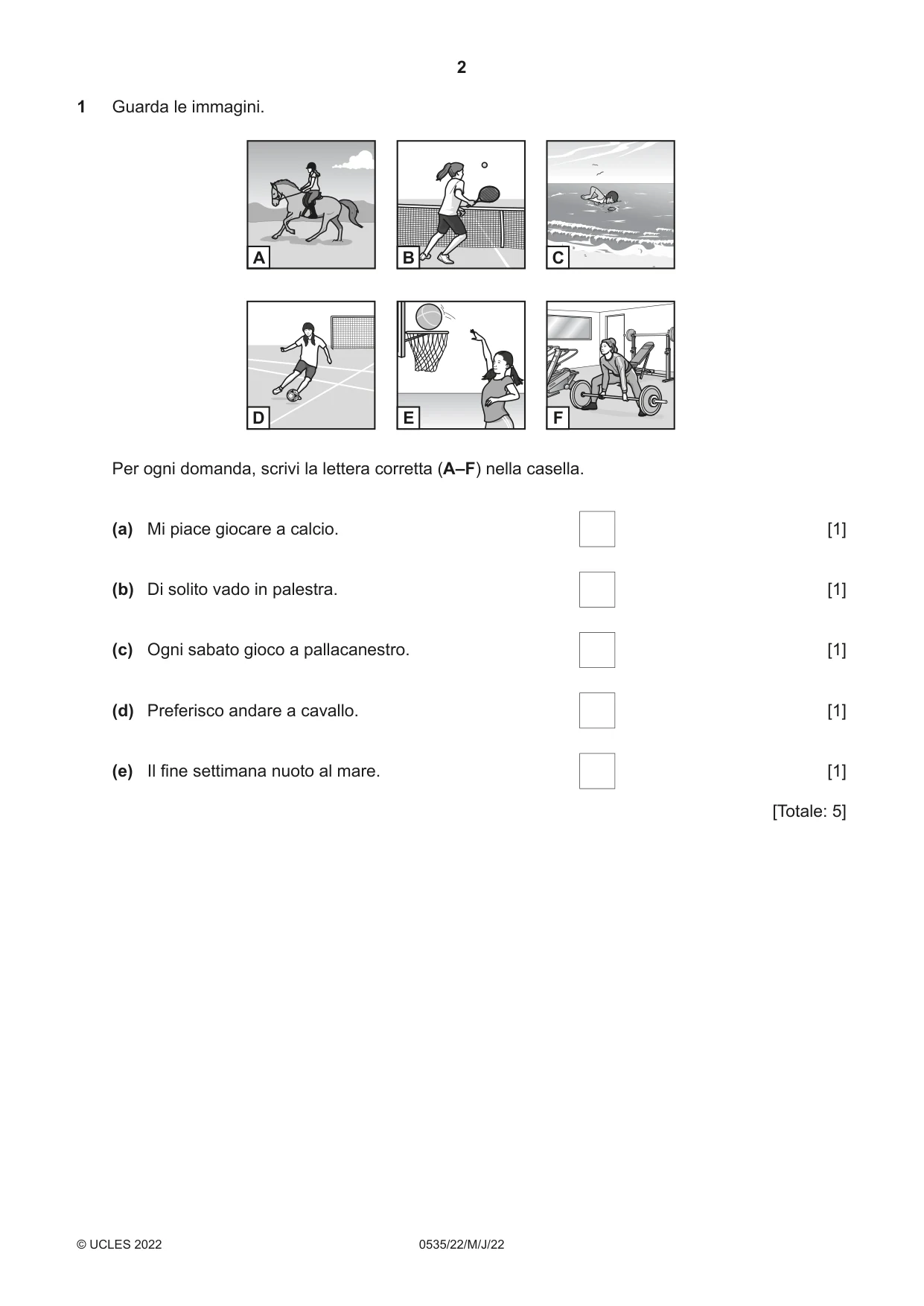
3 0535/22/M/J/22 © UCLES 2022 [Turn over 2 Leggi i cartelli e le insegne. A scuola A Laboratorio di chimica Bagni Campo di basket Segreteria Aula d’informatica Mensa Ingresso Uscita B C D E F G H Per ogni domanda, scrivi la lettera corretta (A–H) nella casella. (a) Qui laviamo le mani prima di mangiare. [1] (b) Qui entriamo a scuola alle otto. [1] (c) Qui usiamo i computer per lo studio. [1] (d) Qui facciamo esperimenti scientifici. [1] (e) Qui pranziamo a mezzogiorno. [1] [Totale: 5]
Question paper, page 4
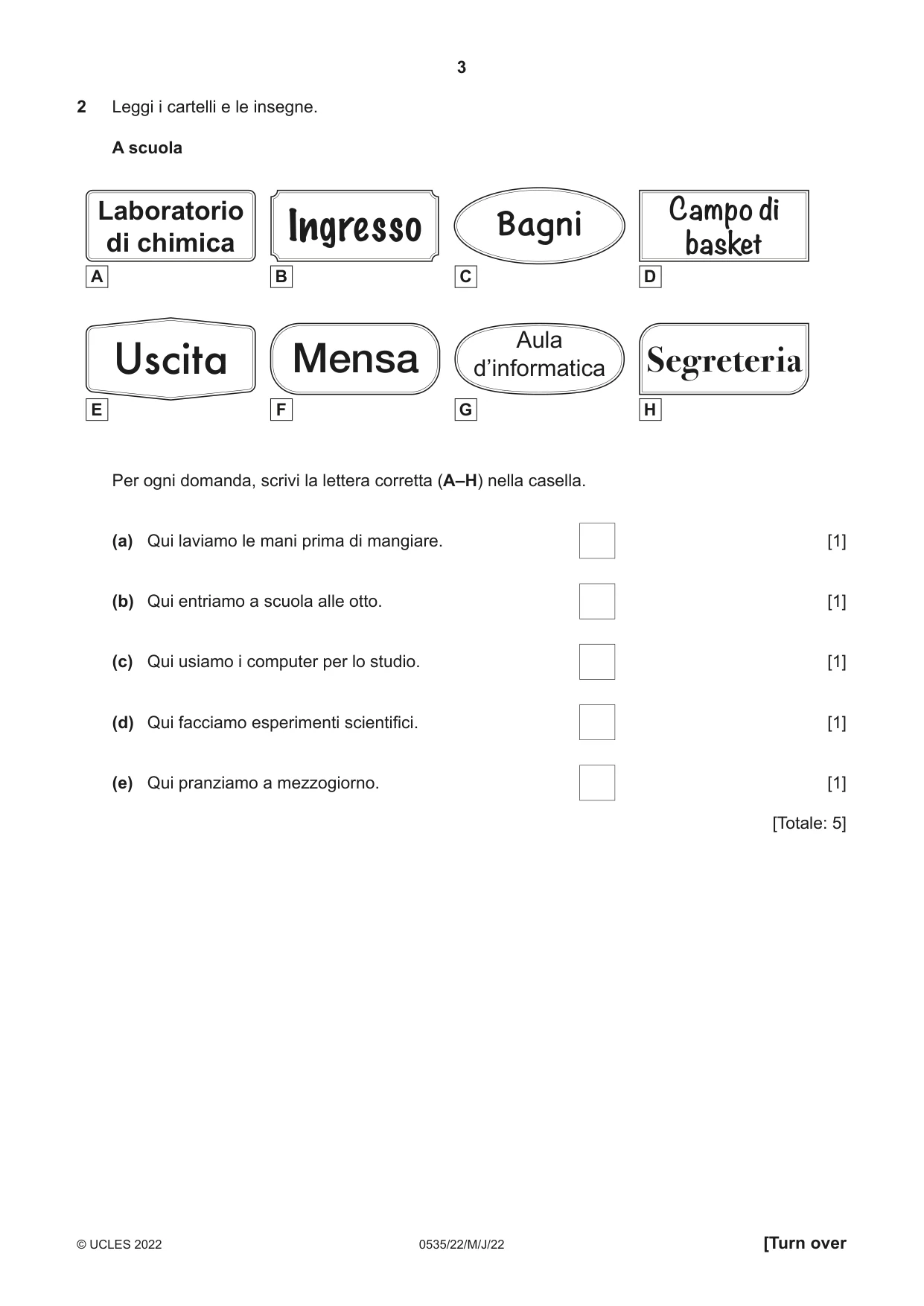
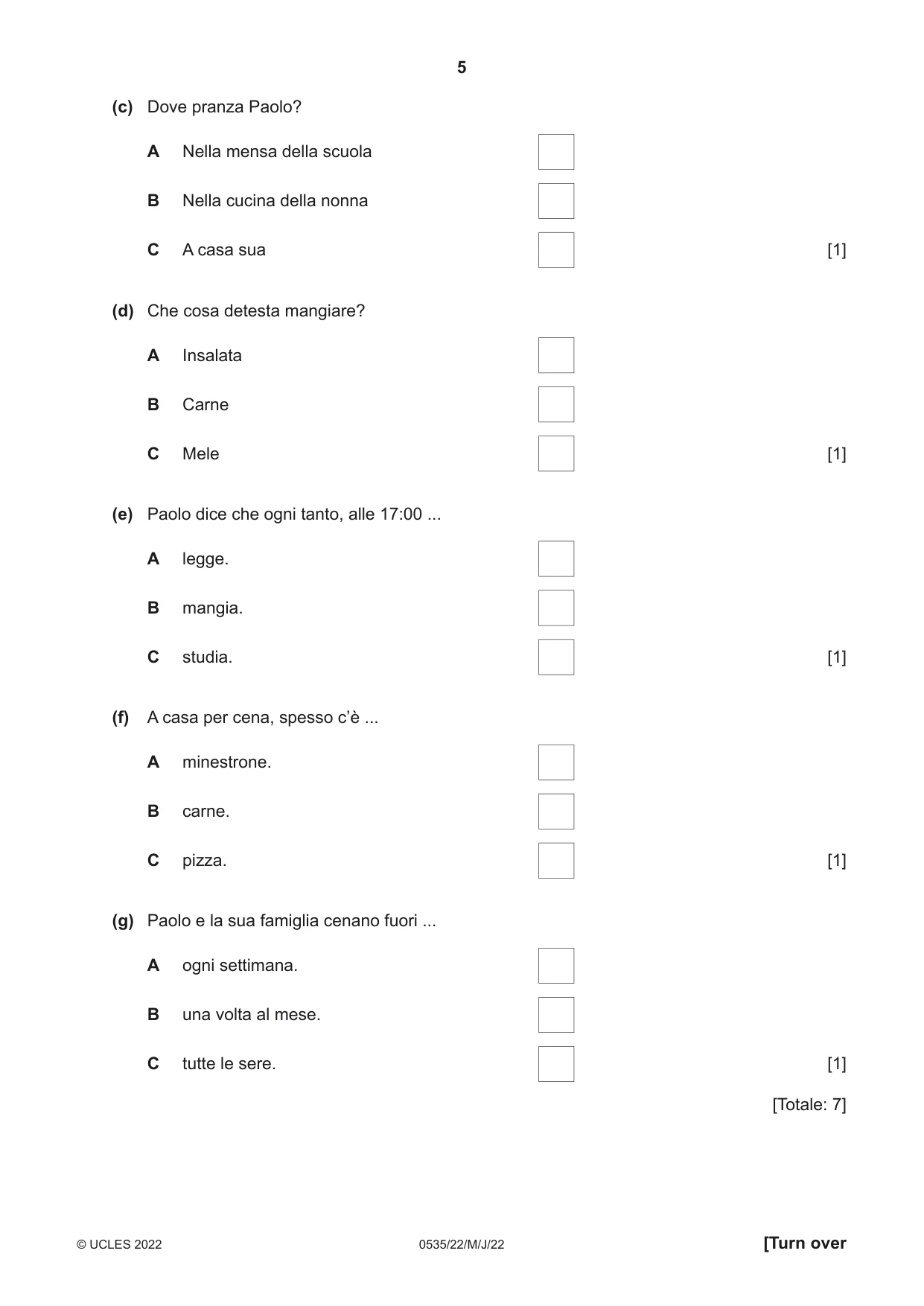
4 0535/22/M/J/22 © UCLES 2022 3 Leggi l’email. Per ogni domanda, segna con una crocetta (X) la casella corretta (A–C). Ciao! La mattina, prima di andare a scuola, spesso non mangio niente. Invece di fare colazione, faccio uno spuntino a scuola, alle 11:00: di solito mangio pane e salame. Il fine settimana, invece, a colazione mangio una fetta di torta e bevo un succo di frutta. Esco da scuola alle 13:30 e vado da mia nonna. Pranziamo nella sua cucina. Normalmente mangiamo un piatto di pasta, pesce o carne con l’insalata, e poi la frutta. Adoro le arance, però le mele non mi piacciono proprio! Qualche volta, alle 17:00, faccio una merenda leggera: generalmente biscotti. Ceno alle 19:00 con la mia famiglia, cioè con i miei genitori e mia sorella. A casa la sera spesso mangiamo una minestra di verdura, ma ci piace uscire almeno una volta alla settimana per mangiare una pizza nella pizzeria all’angolo! Paolo (a) Paolo scrive ... A della sua alimentazione. B dei suoi passatempi. C delle sue vacanze. [1] (b) La mattina a scuola, cosa mangia Paolo? A Una fetta di torta B Frutta fresca C Un panino [1]
Question paper, page 5
5 0535/22/M/J/22 © UCLES 2022 [Turn over (c) Dove pranza Paolo? A Nella mensa della scuola B Nella cucina della nonna C A casa sua [1] (d) Che cosa detesta mangiare? A Insalata B Carne C Mele [1] (e) Paolo dice che ogni tanto, alle 17:00 ... A legge. B mangia. C studia. [1] (f) A casa per cena, spesso c’è ... A minestrone. B carne. C pizza. [1] (g) Paolo e la sua famiglia cenano fuori ... A ogni settimana. B una volta al mese. C tutte le sere. [1] [Totale: 7]
Question paper, page 6
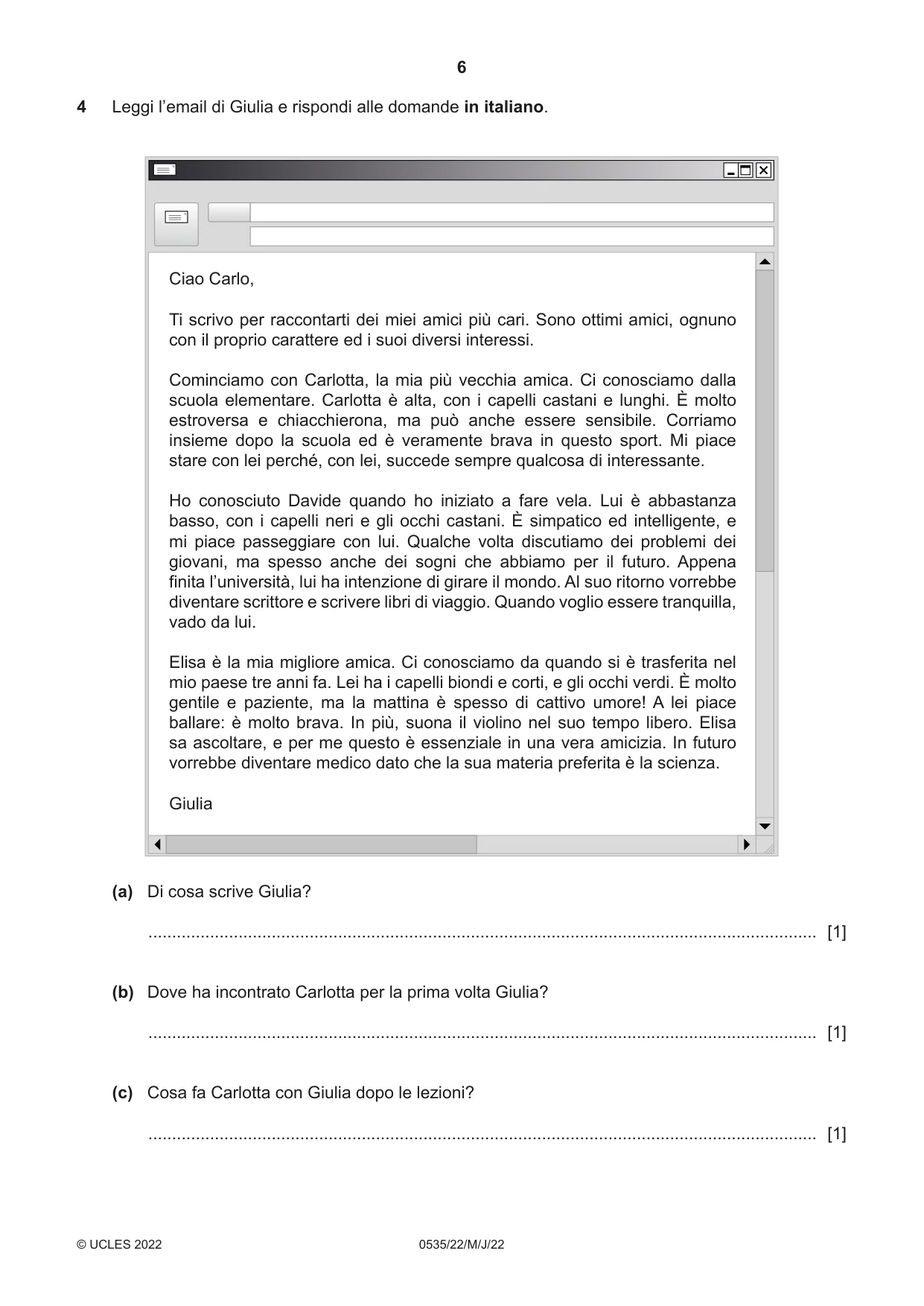
6 0535/22/M/J/22 © UCLES 2022 4 Leggi l’email di Giulia e rispondi alle domande in italiano. Ciao Carlo, Ti scrivo per raccontarti dei miei amici più cari. Sono ottimi amici, ognuno con il proprio carattere ed i suoi diversi interessi. Cominciamo con Carlotta, la mia più vecchia amica. Ci conosciamo dalla scuola elementare. Carlotta è alta, con i capelli castani e lunghi. È molto estroversa e chiacchierona, ma può anche essere sensibile. Corriamo insieme dopo la scuola ed è veramente brava in questo sport. Mi piace stare con lei perché, con lei, succede sempre qualcosa di interessante. Ho conosciuto Davide quando ho iniziato a fare vela. Lui è abbastanza basso, con i capelli neri e gli occhi castani. È simpatico ed intelligente, e mi piace passeggiare con lui. Qualche volta discutiamo dei problemi dei giovani, ma spesso anche dei sogni che abbiamo per il futuro. Appena finita l’università, lui ha intenzione di girare il mondo. Al suo ritorno vorrebbe diventare scrittore e scrivere libri di viaggio. Quando voglio essere tranquilla, vado da lui. Elisa è la mia migliore amica. Ci conosciamo da quando si è trasferita nel mio paese tre anni fa. Lei ha i capelli biondi e corti, e gli occhi verdi. È molto gentile e paziente, ma la mattina è spesso di cattivo umore! A lei piace ballare: è molto brava. In più, suona il violino nel suo tempo libero. Elisa sa ascoltare, e per me questo è essenziale in una vera amicizia. In futuro vorrebbe diventare medico dato che la sua materia preferita è la scienza. Giulia (a) Di cosa scrive Giulia? … [1] (b) Dove ha incontrato Carlotta per la prima volta Giulia? … [1] (c) Cosa fa Carlotta con Giulia dopo le lezioni? … [1]
Question paper, page 7
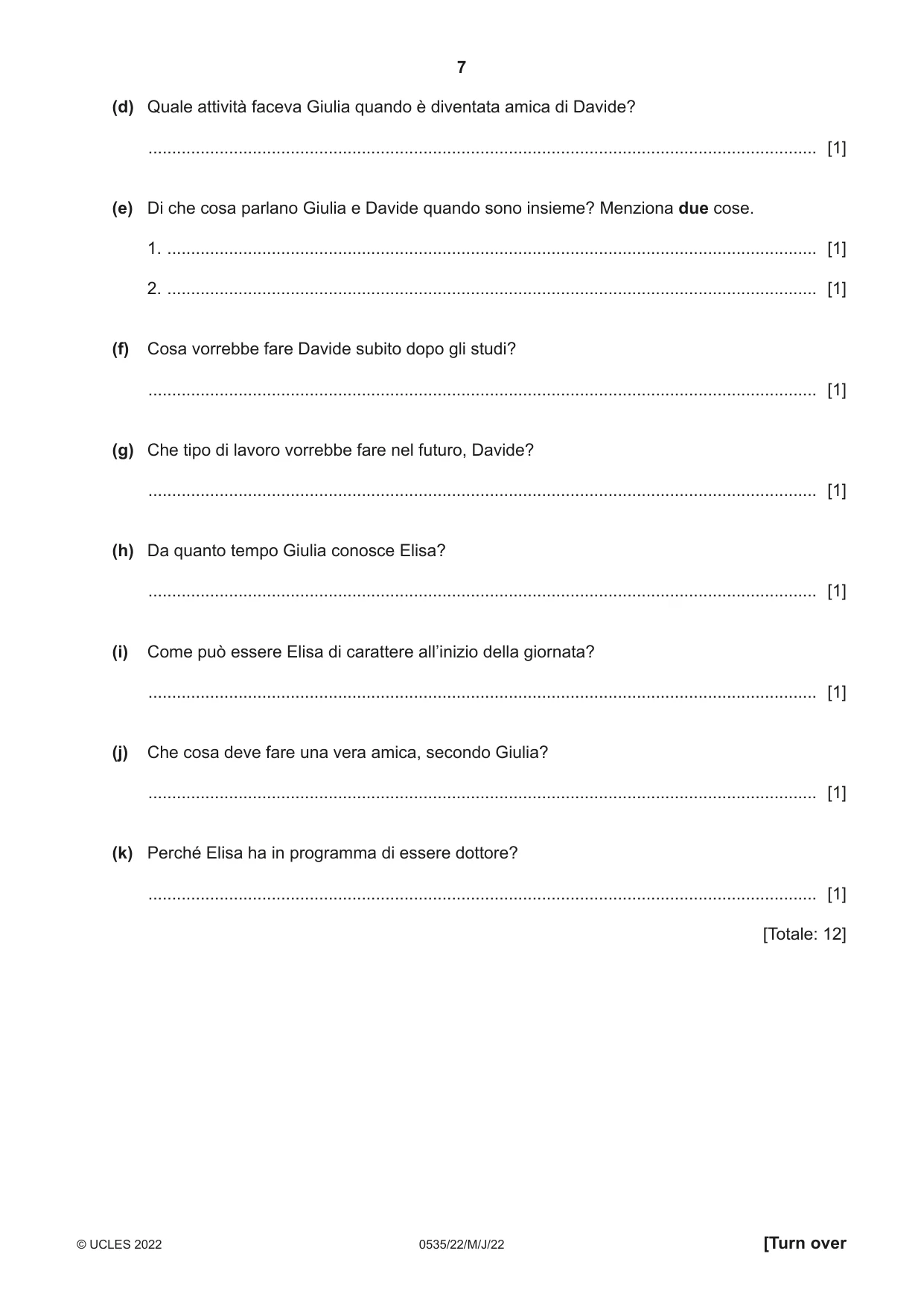
7 0535/22/M/J/22 © UCLES 2022 [Turn over (d) Quale attività faceva Giulia quando è diventata amica di Davide? … [1] (e) Di che cosa parlano Giulia e Davide quando sono insieme? Menziona due cose. 1. … [1] 2. … [1] (f) Cosa vorrebbe fare Davide subito dopo gli studi? … [1] (g) Che tipo di lavoro vorrebbe fare nel futuro, Davide? … [1] (h) Da quanto tempo Giulia conosce Elisa? … [1] (i) Come può essere Elisa di carattere all’inizio della giornata? … [1] (j) Che cosa deve fare una vera amica, secondo Giulia? … [1] (k) Perché Elisa ha in programma di essere dottore? … [1] [Totale: 12]
Question paper, page 8
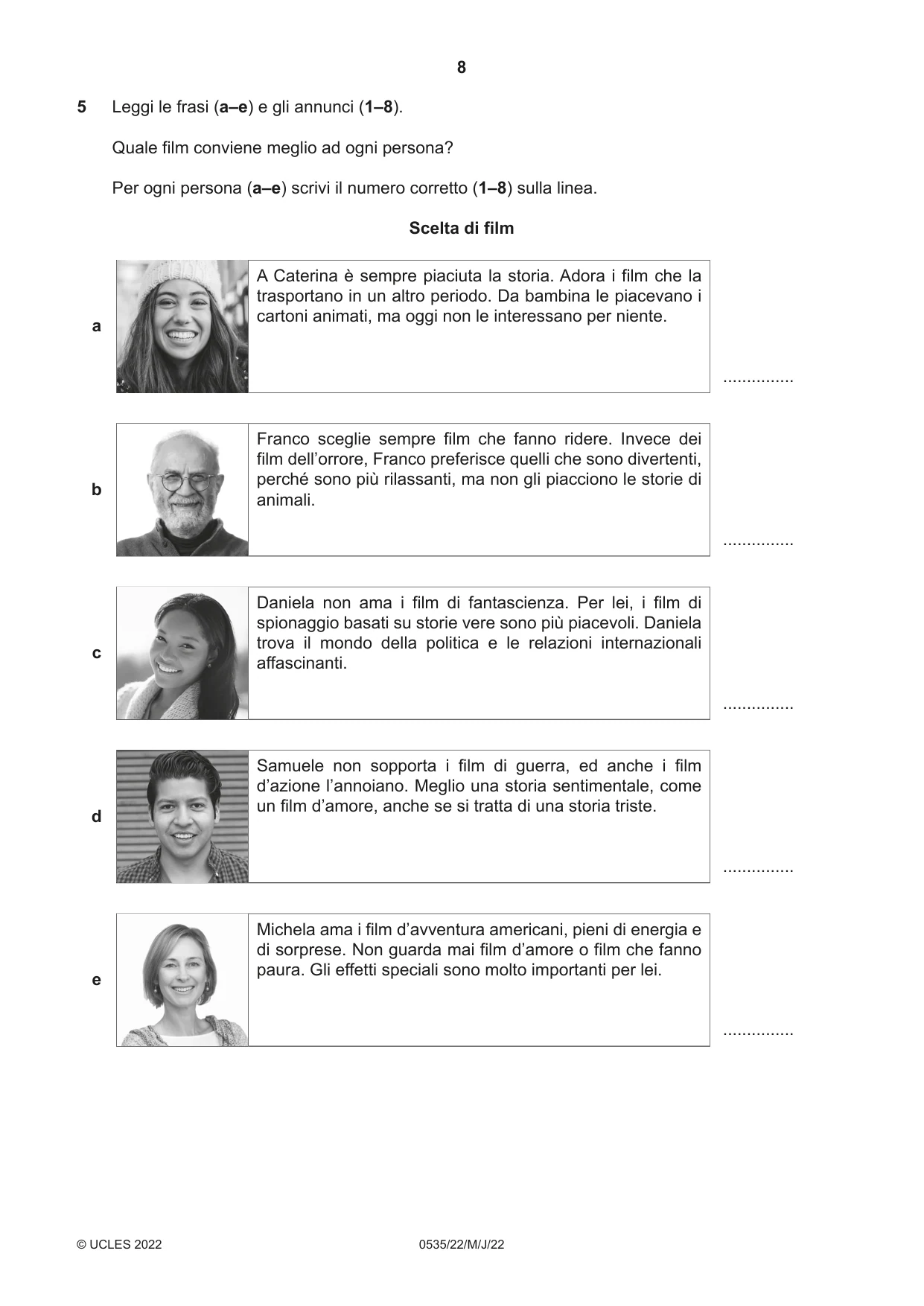
8 0535/22/M/J/22 © UCLES 2022 5 Leggi le frasi (a–e) e gli annunci (1–8). Quale film conviene meglio ad ogni persona? Per ogni persona (a–e) scrivi il numero corretto (1–8) sulla linea. Scelta di film a A Caterina è sempre piaciuta la storia. Adora i film che la trasportano in un altro periodo. Da bambina le piacevano i cartoni animati, ma oggi non le interessano per niente. … b Franco sceglie sempre film che fanno ridere. Invece dei film dell’orrore, Franco preferisce quelli che sono divertenti, perché sono più rilassanti, ma non gli piacciono le storie di animali. … c Daniela non ama i film di fantascienza. Per lei, i film di spionaggio basati su storie vere sono più piacevoli. Daniela trova il mondo della politica e le relazioni internazionali affascinanti. … d Samuele non sopporta i film di guerra, ed anche i film d’azione l’annoiano. Meglio una storia sentimentale, come un film d’amore, anche se si tratta di una storia triste. … e Michela ama i film d’avventura americani, pieni di energia e di sorprese. Non guarda mai film d’amore o film che fanno paura. Gli effetti speciali sono molto importanti per lei. …
Question paper, page 9
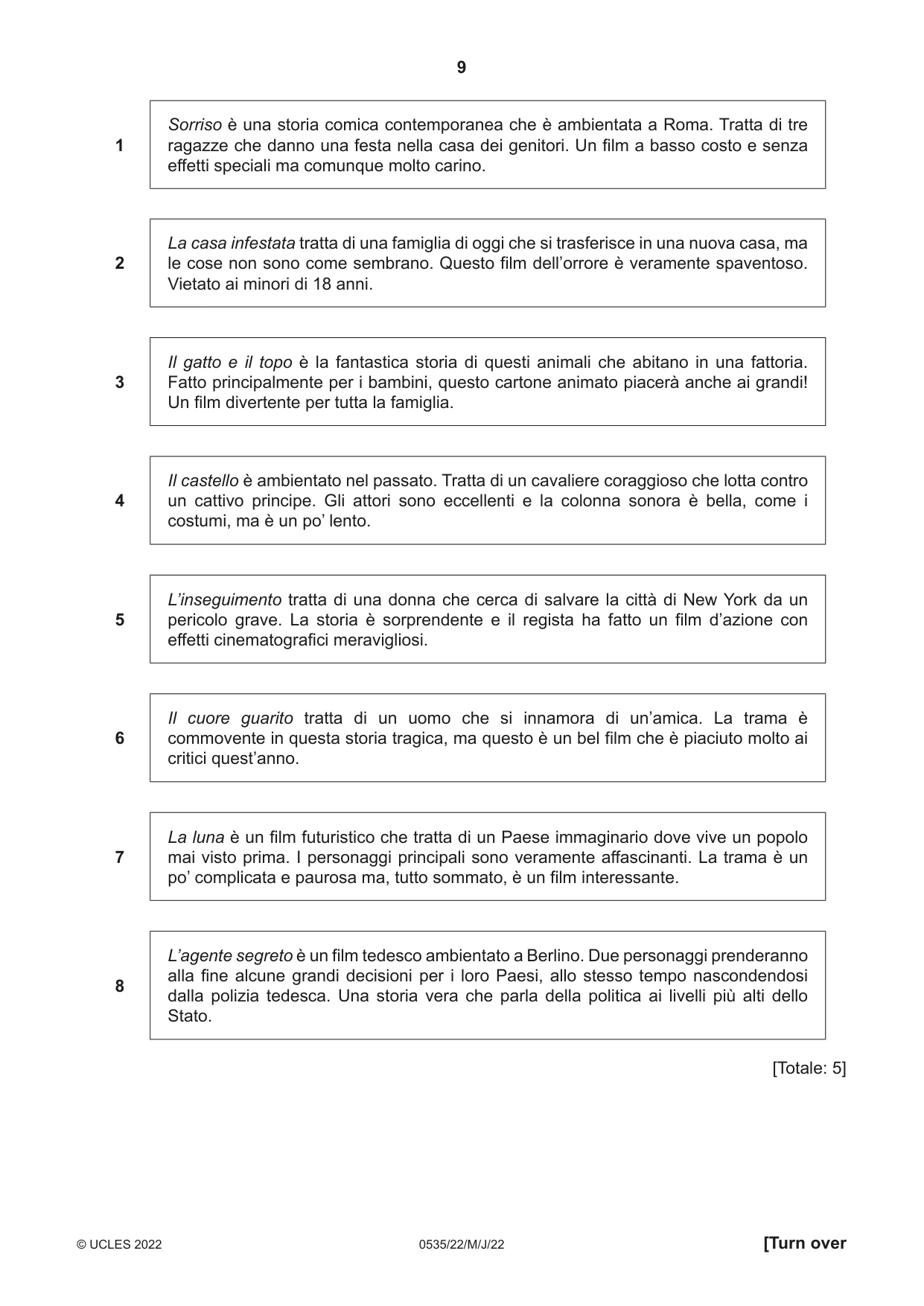
9 0535/22/M/J/22 © UCLES 2022 [Turn over 1 Sorriso è una storia comica contemporanea che è ambientata a Roma. Tratta di tre ragazze che danno una festa nella casa dei genitori. Un film a basso costo e senza effetti speciali ma comunque molto carino. 2 La casa infestata tratta di una famiglia di oggi che si trasferisce in una nuova casa, ma le cose non sono come sembrano. Questo film dell’orrore è veramente spaventoso. Vietato ai minori di 18 anni. 3 Il gatto e il topo è la fantastica storia di questi animali che abitano in una fattoria. Fatto principalmente per i bambini, questo cartone animato piacerà anche ai grandi! Un film divertente per tutta la famiglia. 4 Il castello è ambientato nel passato. Tratta di un cavaliere coraggioso che lotta contro un cattivo principe. Gli attori sono eccellenti e la colonna sonora è bella, come i costumi, ma è un po’ lento. 5 L’inseguimento tratta di una donna che cerca di salvare la città di New York da un pericolo grave. La storia è sorprendente e il regista ha fatto un film d’azione con effetti cinematografici meravigliosi. 6 Il cuore guarito tratta di un uomo che si innamora di un’amica. La trama è commovente in questa storia tragica, ma questo è un bel film che è piaciuto molto ai critici quest’anno. 7 La luna è un film futuristico che tratta di un Paese immaginario dove vive un popolo mai visto prima. I personaggi principali sono veramente affascinanti. La trama è un po’ complicata e paurosa ma, tutto sommato, è un film interessante. 8 L’agente segreto è un film tedesco ambientato a Berlino. Due personaggi prenderanno alla fine alcune grandi decisioni per i loro Paesi, allo stesso tempo nascondendosi dalla polizia tedesca. Una storia vera che parla della politica ai livelli più alti dello Stato. [Totale: 5]
Question paper, page 10
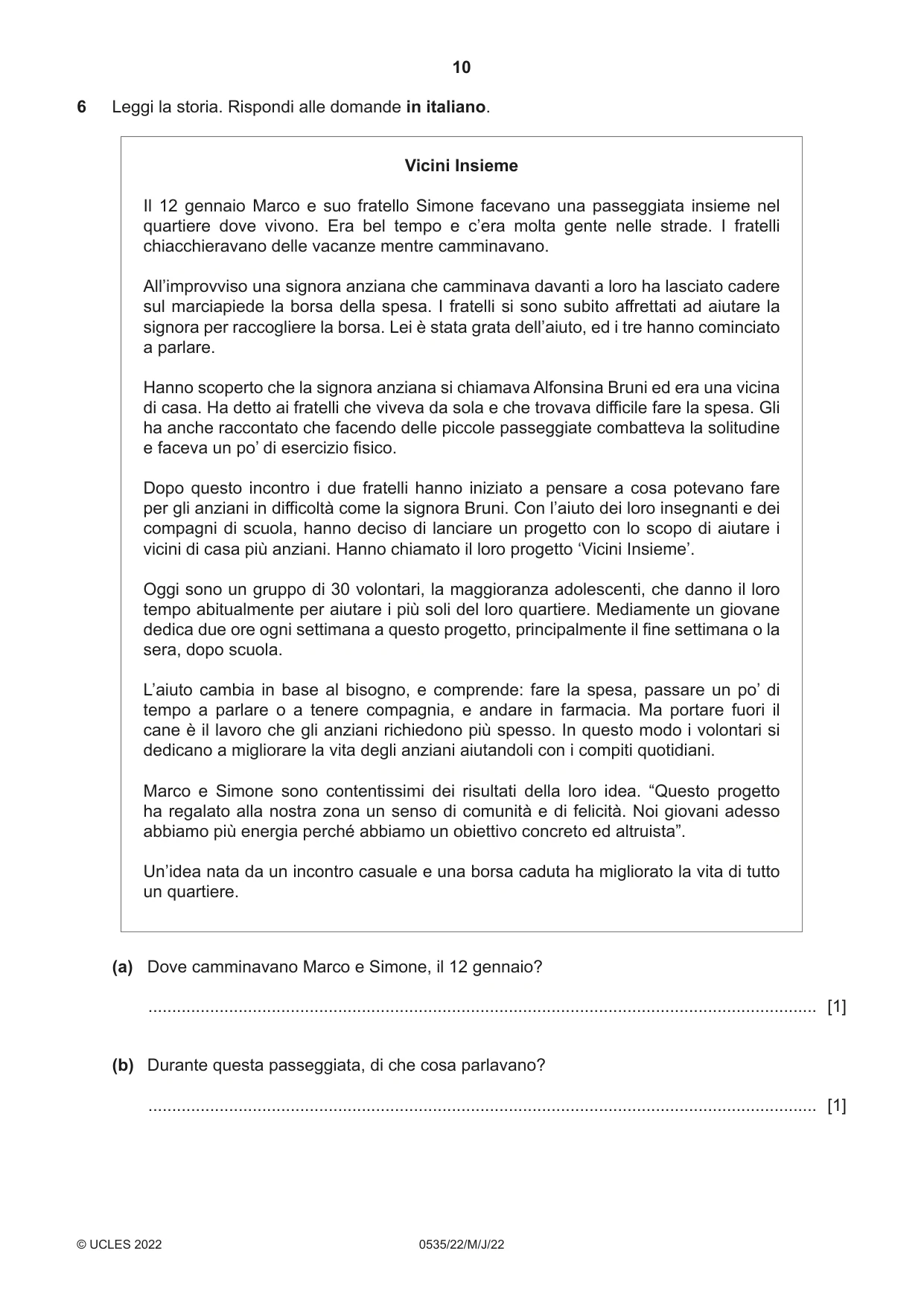
10 0535/22/M/J/22 © UCLES 2022 6 Leggi la storia. Rispondi alle domande in italiano. Vicini Insieme Il 12 gennaio Marco e suo fratello Simone facevano una passeggiata insieme nel quartiere dove vivono. Era bel tempo e c’era molta gente nelle strade. I fratelli chiacchieravano delle vacanze mentre camminavano. All’improvviso una signora anziana che camminava davanti a loro ha lasciato cadere sul marciapiede la borsa della spesa. I fratelli si sono subito affrettati ad aiutare la signora per raccogliere la borsa. Lei è stata grata dell’aiuto, ed i tre hanno cominciato a parlare. Hanno scoperto che la signora anziana si chiamava Alfonsina Bruni ed era una vicina di casa. Ha detto ai fratelli che viveva da sola e che trovava difficile fare la spesa. Gli ha anche raccontato che facendo delle piccole passeggiate combatteva la solitudine e faceva un po’ di esercizio fisico. Dopo questo incontro i due fratelli hanno iniziato a pensare a cosa potevano fare per gli anziani in difficoltà come la signora Bruni. Con l’aiuto dei loro insegnanti e dei compagni di scuola, hanno deciso di lanciare un progetto con lo scopo di aiutare i vicini di casa più anziani. Hanno chiamato il loro progetto ‘Vicini Insieme’. Oggi sono un gruppo di 30 volontari, la maggioranza adolescenti, che danno il loro tempo abitualmente per aiutare i più soli del loro quartiere. Mediamente un giovane dedica due ore ogni settimana a questo progetto, principalmente il fine settimana o la sera, dopo scuola. L’aiuto cambia in base al bisogno, e comprende: fare la spesa, passare un po’ di tempo a parlare o a tenere compagnia, e andare in farmacia. Ma portare fuori il cane è il lavoro che gli anziani richiedono più spesso. In questo modo i volontari si dedicano a migliorare la vita degli anziani aiutandoli con i compiti quotidiani. Marco e Simone sono contentissimi dei risultati della loro idea. “Questo progetto ha regalato alla nostra zona un senso di comunità e di felicità. Noi giovani adesso abbiamo più energia perché abbiamo un obiettivo concreto ed altruista”. Un’idea nata da un incontro casuale e una borsa caduta ha migliorato la vita di tutto un quartiere. (a) Dove camminavano Marco e Simone, il 12 gennaio? … [1] (b) Durante questa passeggiata, di che cosa parlavano? … [1]
Question paper, page 11
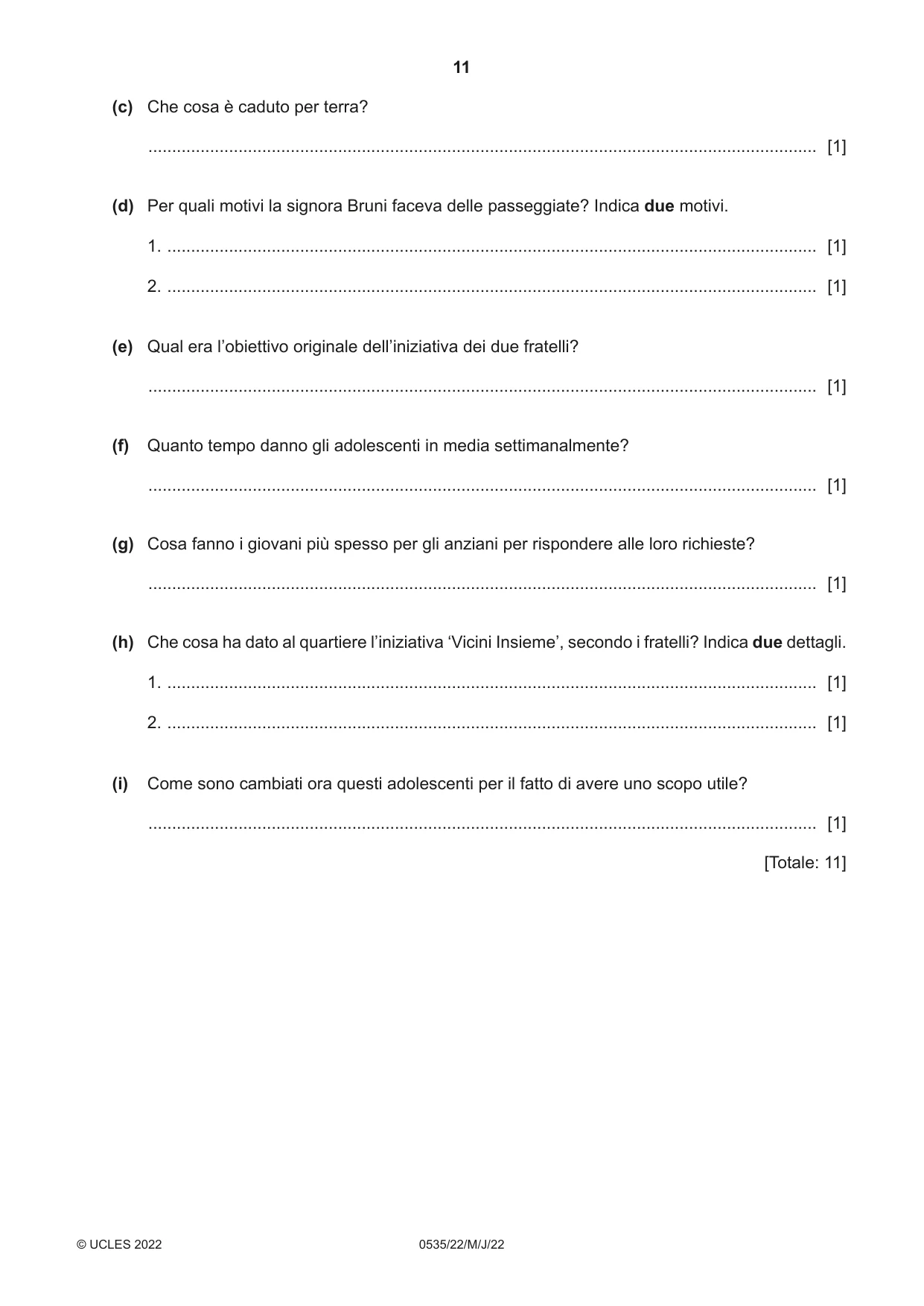
11 0535/22/M/J/22 © UCLES 2022 (c) Che cosa è caduto per terra? … [1] (d) Per quali motivi la signora Bruni faceva delle passeggiate? Indica due motivi. 1. … [1] 2. … [1] (e) Qual era l’obiettivo originale dell’iniziativa dei due fratelli? … [1] (f) Quanto tempo danno gli adolescenti in media settimanalmente? … [1] (g) Cosa fanno i giovani più spesso per gli anziani per rispondere alle loro richieste? … [1] (h) Che cosa ha dato al quartiere l’iniziativa ‘Vicini Insieme’, secondo i fratelli? Indica due dettagli. 1. … [1] 2. … [1] (i) Come sono cambiati ora questi adolescenti per il fatto di avere uno scopo utile? … [1] [Totale: 11]
Question paper, page 12
12 0535/22/M/J/22 © UCLES 2022 Permission to reproduce items where third-party owned material protected by copyright is included has been sought and cleared where possible. Every reasonable effort has been made by the publisher (UCLES) to trace copyright holders, but if any items requiring clearance have unwittingly been included, the publisher will be pleased to make amends at the earliest possible opportunity. To avoid the issue of disclosure of answer-related information to candidates, all copyright acknowledgements are reproduced online in the Cambridge Assessment International Education Copyright Acknowledgements Booklet. This is produced for each series of examinations and is freely available to download at www.cambridgeinternational.org after the live examination series. Cambridge Assessment International Education is part of Cambridge Assessment. Cambridge Assessment is the brand name of the University of Cambridge Local Examinations Syndicate (UCLES), which is a department of the University of Cambridge. BLANK PAGE
Mark scheme, page 1
This document consists of 10 printed pages. © UCLES 2022 [Turn over Cambridge IGCSE™ ITALIAN 0535/22 Paper 2 Reading May/June 2022 MARK SCHEME Maximum Mark: 45 Published This mark scheme is published as an aid to teachers and candidates, to indicate the requirements of the examination. It shows the basis on which Examiners were instructed to award marks. It does not indicate the details of the discussions that took place at an Examiners’ meeting before marking began, which would have considered the acceptability of alternative answers. Mark schemes should be read in conjunction with the question paper and the Principal Examiner Report for Teachers. Cambridge International will not enter into discussions about these mark schemes. Cambridge International is publishing the mark schemes for the May/June 2022 series for most Cambridge IGCSE, Cambridge International A and AS Level and Cambridge Pre-U components, and some Cambridge O Level components.
Mark scheme, page 2
0535/22 Cambridge IGCSE – Mark Scheme PUBLISHED May/June 2022 © UCLES 2022 Page 2 of 10 Generic Marking Principles These general marking principles must be applied by all examiners when marking candidate answers. They should be applied alongside the specific content of the mark scheme or generic level descriptors for a question. Each question paper and mark scheme will also comply with these marking principles. GENERIC MARKING PRINCIPLE 1: Marks must be awarded in line with: the specific content of the mark scheme or the generic level descriptors for the question the specific skills defined in the mark scheme or in the generic level descriptors for the question the standard of response required by a candidate as exemplified by the standardisation scripts. GENERIC MARKING PRINCIPLE 2: Marks awarded are always whole marks (not half marks, or other fractions). GENERIC MARKING PRINCIPLE 3: Marks must be awarded positively: marks are awarded for correct/valid answers, as defined in the mark scheme. However, credit is given for valid answers which go beyond the scope of the syllabus and mark scheme, referring to your Team Leader as appropriate marks are awarded when candidates clearly demonstrate what they know and can do marks are not deducted for errors marks are not deducted for omissions answers should only be judged on the quality of spelling, punctuation and grammar when these features are specifically assessed by the question as indicated by the mark scheme. The meaning, however, should be unambiguous. GENERIC MARKING PRINCIPLE 4: Rules must be applied consistently, e.g. in situations where candidates have not followed instructions or in the application of generic level descriptors.
Mark scheme, page 3
0535/22 Cambridge IGCSE – Mark Scheme PUBLISHED May/June 2022 © UCLES 2022 Page 3 of 10 GENERIC MARKING PRINCIPLE 5: Marks should be awarded using the full range of marks defined in the mark scheme for the question (however; the use of the full mark range may be limited according to the quality of the candidate responses seen). GENERIC MARKING PRINCIPLE 6: Marks awarded are based solely on the requirements as defined in the mark scheme. Marks should not be awarded with grade thresholds or grade descriptors in mind.
Mark scheme, page 4
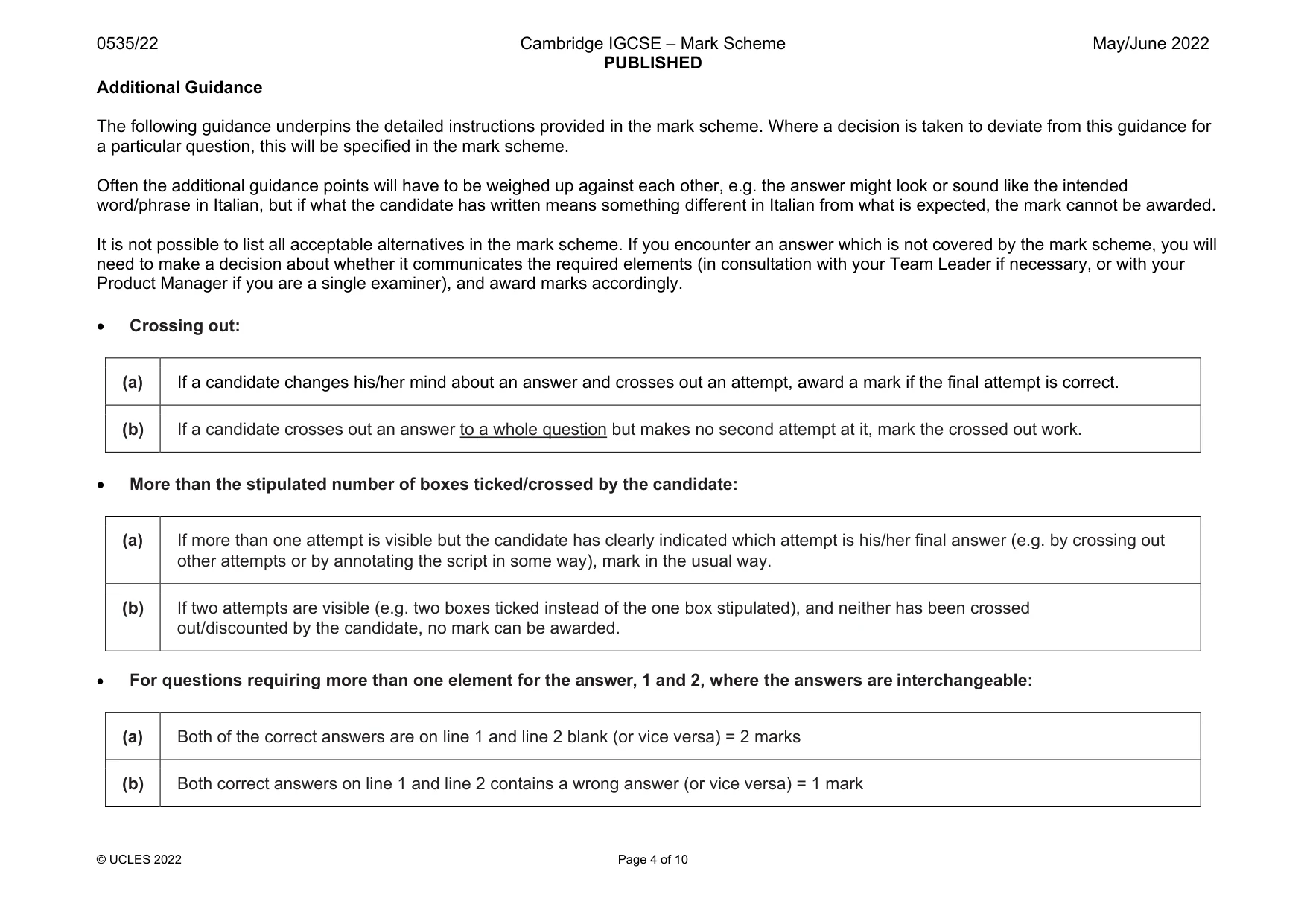
0535/22 Cambridge IGCSE – Mark Scheme PUBLISHED May/June 2022 © UCLES 2022 Page 4 of 10 Additional Guidance The following guidance underpins the detailed instructions provided in the mark scheme. Where a decision is taken to deviate from this guidance for a particular question, this will be specified in the mark scheme. Often the additional guidance points will have to be weighed up against each other, e.g. the answer might look or sound like the intended word/phrase in Italian, but if what the candidate has written means something different in Italian from what is expected, the mark cannot be awarded. It is not possible to list all acceptable alternatives in the mark scheme. If you encounter an answer which is not covered by the mark scheme, you will need to make a decision about whether it communicates the required elements (in consultation with your Team Leader if necessary, or with your Product Manager if you are a single examiner), and award marks accordingly. Crossing out: (a) If a candidate changes his/her mind about an answer and crosses out an attempt, award a mark if the final attempt is correct. (b) If a candidate crosses out an answer to a whole question but makes no second attempt at it, mark the crossed out work. More than the stipulated number of boxes ticked/crossed by the candidate: (a) If more than one attempt is visible but the candidate has clearly indicated which attempt is his/her final answer (e.g. by crossing out other attempts or by annotating the script in some way), mark in the usual way. (b) If two attempts are visible (e.g. two boxes ticked instead of the one box stipulated), and neither has been crossed out/discounted by the candidate, no mark can be awarded. For questions requiring more than one element for the answer, 1 and 2, where the answers are interchangeable: (a) Both of the correct answers are on line 1 and line 2 blank (or vice versa) = 2 marks (b) Both correct answers on line 1 and line 2 contains a wrong answer (or vice versa) = 1 mark
Mark scheme, page 5
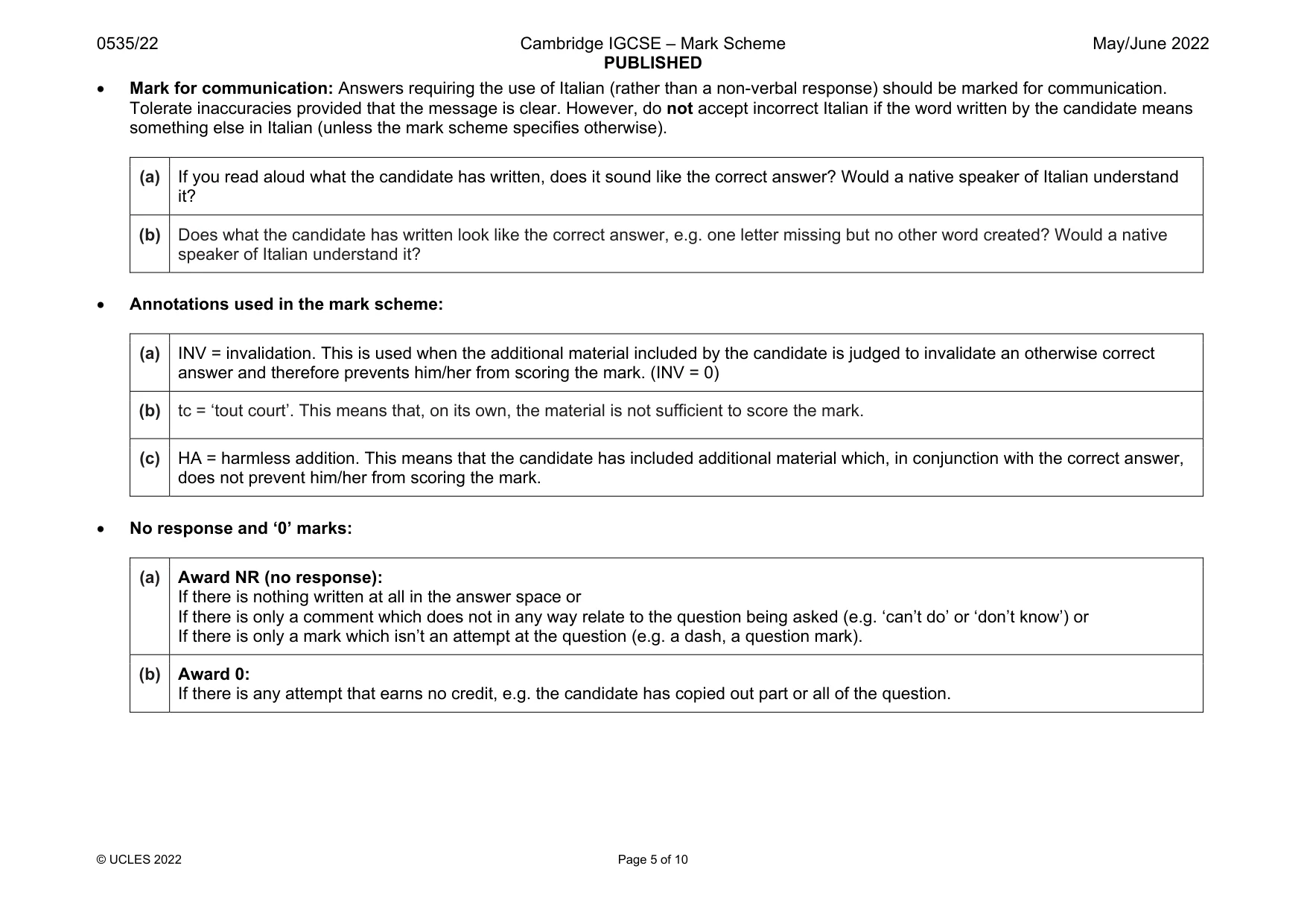
0535/22 Cambridge IGCSE – Mark Scheme PUBLISHED May/June 2022 © UCLES 2022 Page 5 of 10 Mark for communication: Answers requiring the use of Italian (rather than a non-verbal response) should be marked for communication. Tolerate inaccuracies provided that the message is clear. However, do not accept incorrect Italian if the word written by the candidate means something else in Italian (unless the mark scheme specifies otherwise). (a) If you read aloud what the candidate has written, does it sound like the correct answer? Would a native speaker of Italian understand it? (b) Does what the candidate has written look like the correct answer, e.g. one letter missing but no other word created? Would a native speaker of Italian understand it? Annotations used in the mark scheme: (a) INV = invalidation. This is used when the additional material included by the candidate is judged to invalidate an otherwise correct answer and therefore prevents him/her from scoring the mark. (INV = 0) (b) tc = ‘tout court’. This means that, on its own, the material is not sufficient to score the mark. (c) HA = harmless addition. This means that the candidate has included additional material which, in conjunction with the correct answer, does not prevent him/her from scoring the mark. No response and ‘0’ marks: (a) Award NR (no response): If there is nothing written at all in the answer space or If there is only a comment which does not in any way relate to the question being asked (e.g. ‘can’t do’ or ‘don’t know’) or If there is only a mark which isn’t an attempt at the question (e.g. a dash, a question mark). (b) Award 0: If there is any attempt that earns no credit, e.g. the candidate has copied out part or all of the question.
Mark scheme, page 6
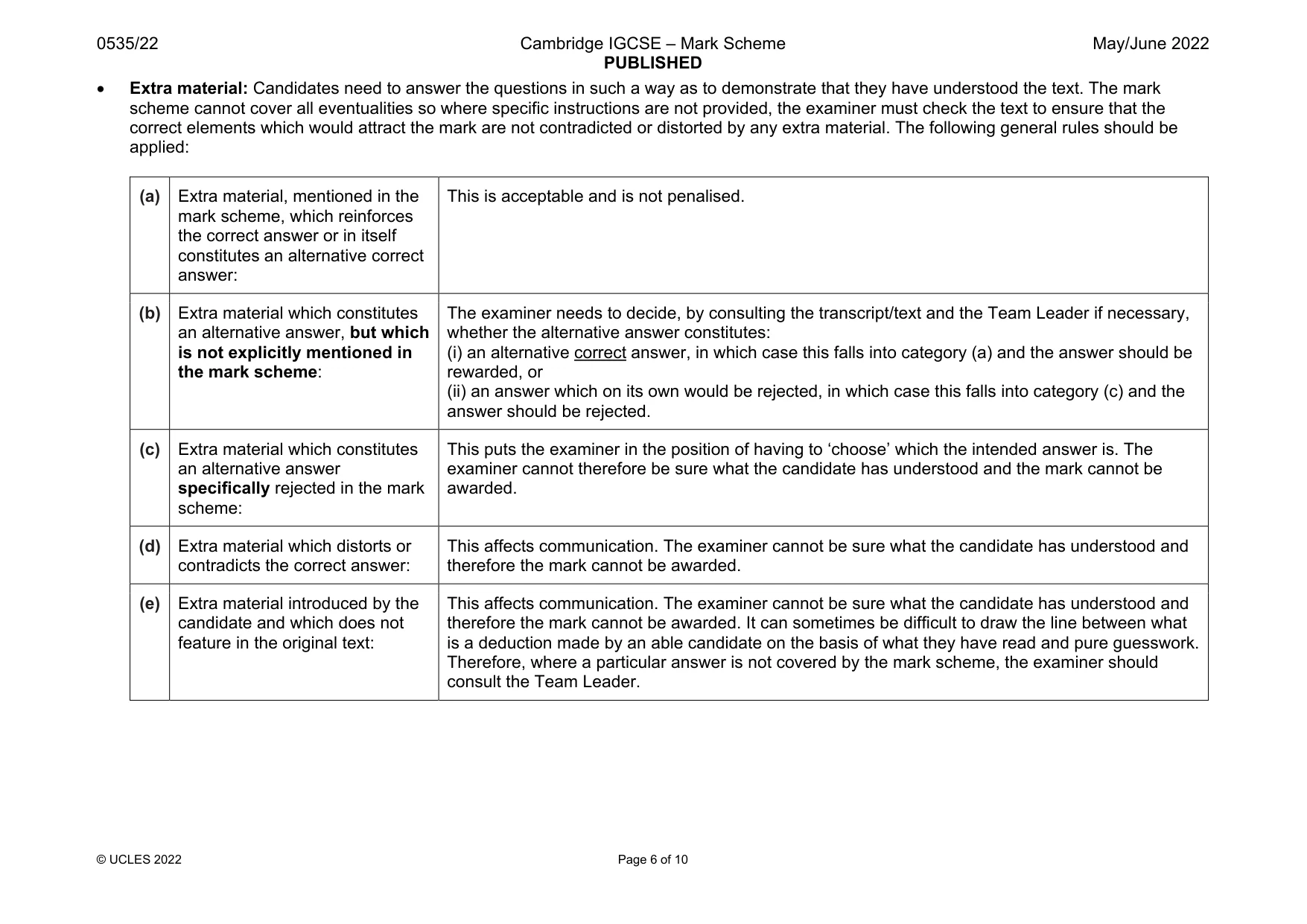
0535/22 Cambridge IGCSE – Mark Scheme PUBLISHED May/June 2022 © UCLES 2022 Page 6 of 10 Extra material: Candidates need to answer the questions in such a way as to demonstrate that they have understood the text. The mark scheme cannot cover all eventualities so where specific instructions are not provided, the examiner must check the text to ensure that the correct elements which would attract the mark are not contradicted or distorted by any extra material. The following general rules should be applied: (a) Extra material, mentioned in the mark scheme, which reinforces the correct answer or in itself constitutes an alternative correct answer: This is acceptable and is not penalised. (b) Extra material which constitutes an alternative answer, but which is not explicitly mentioned in the mark scheme: The examiner needs to decide, by consulting the transcript/text and the Team Leader if necessary, whether the alternative answer constitutes: (i) an alternative correct answer, in which case this falls into category (a) and the answer should be rewarded, or (ii) an answer which on its own would be rejected, in which case this falls into category (c) and the answer should be rejected. (c) Extra material which constitutes an alternative answer specifically rejected in the mark scheme: This puts the examiner in the position of having to ‘choose’ which the intended answer is. The examiner cannot therefore be sure what the candidate has understood and the mark cannot be awarded. (d) Extra material which distorts or contradicts the correct answer: This affects communication. The examiner cannot be sure what the candidate has understood and therefore the mark cannot be awarded. (e) Extra material introduced by the candidate and which does not feature in the original text: This affects communication. The examiner cannot be sure what the candidate has understood and therefore the mark cannot be awarded. It can sometimes be difficult to draw the line between what is a deduction made by an able candidate on the basis of what they have read and pure guesswork. Therefore, where a particular answer is not covered by the mark scheme, the examiner should consult the Team Leader.
Mark scheme, page 7
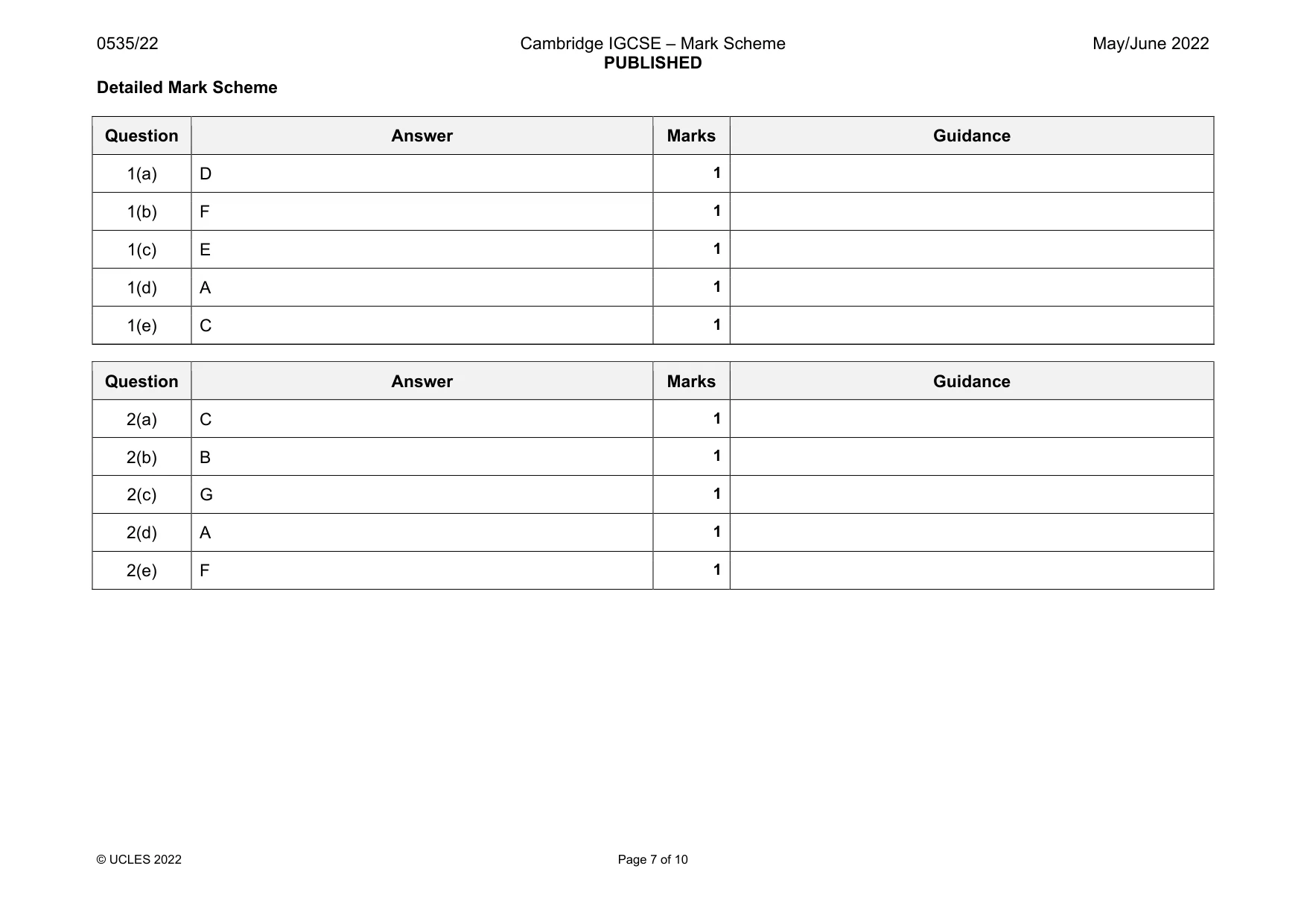
0535/22 Cambridge IGCSE – Mark Scheme PUBLISHED May/June 2022 © UCLES 2022 Page 7 of 10 Detailed Mark Scheme Question Answer Marks Guidance 1(a) D 1 1(b) F 1 1(c) E 1 1(d) A 1 1(e) C 1 Question Answer Marks Guidance 2(a) C 1 2(b) B 1 2(c) G 1 2(d) A 1 2(e) F 1
Mark scheme, page 8
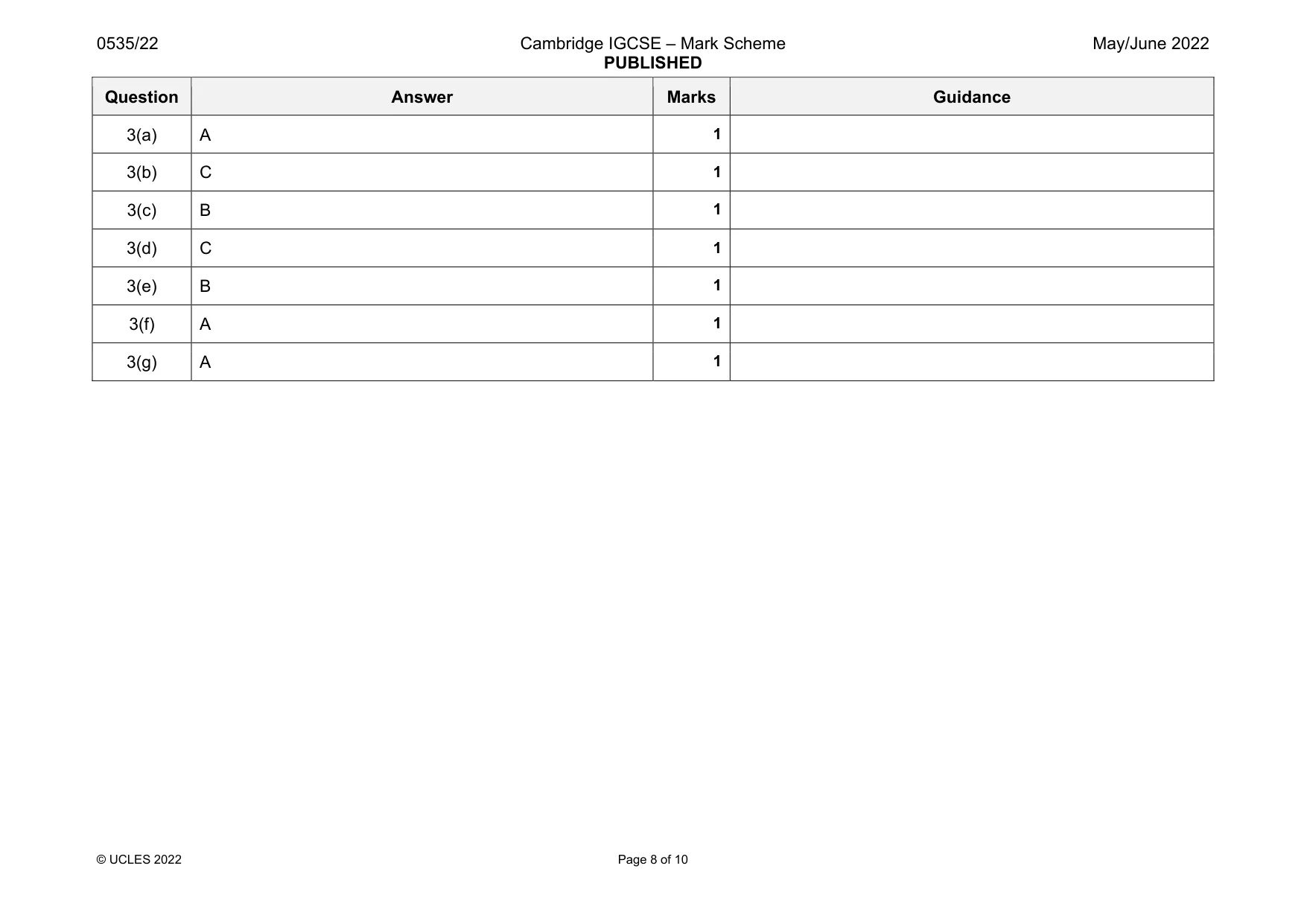
0535/22 Cambridge IGCSE – Mark Scheme PUBLISHED May/June 2022 © UCLES 2022 Page 8 of 10 Question Answer Marks Guidance 3(a) A 1 3(b) C 1 3(c) B 1 3(d) C 1 3(e) B 1 3(f) A 1 3(g) A 1
Mark scheme, page 9
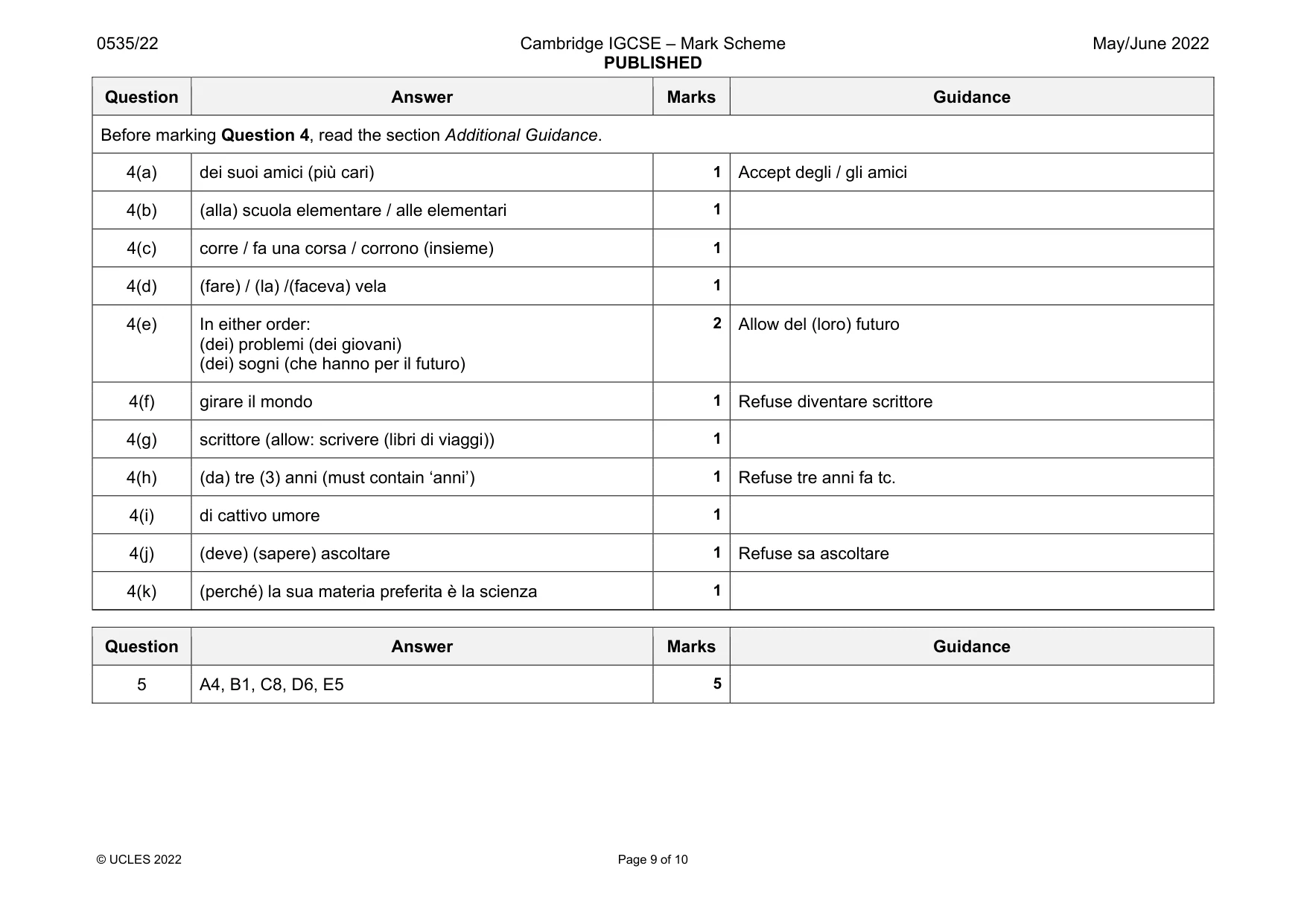
0535/22 Cambridge IGCSE – Mark Scheme PUBLISHED May/June 2022 © UCLES 2022 Page 9 of 10 Question Answer Marks Guidance Before marking Question 4, read the section Additional Guidance. 4(a) dei suoi amici (più cari) 1 Accept degli / gli amici 4(b) (alla) scuola elementare / alle elementari 1 4(c) corre / fa una corsa / corrono (insieme) 1 4(d) (fare) / (la) /(faceva) vela 1 4(e) In either order: (dei) problemi (dei giovani) (dei) sogni (che hanno per il futuro) 2 Allow del (loro) futuro 4(f) girare il mondo 1 Refuse diventare scrittore 4(g) scrittore (allow: scrivere (libri di viaggi)) 1 4(h) (da) tre (3) anni (must contain ‘anni’) 1 Refuse tre anni fa tc. 4(i) di cattivo umore 1 4(j) (deve) (sapere) ascoltare 1 Refuse sa ascoltare 4(k) (perché) la sua materia preferita è la scienza 1 Question Answer Marks Guidance 5 A4, B1, C8, D6, E5 5
Mark scheme, page 10
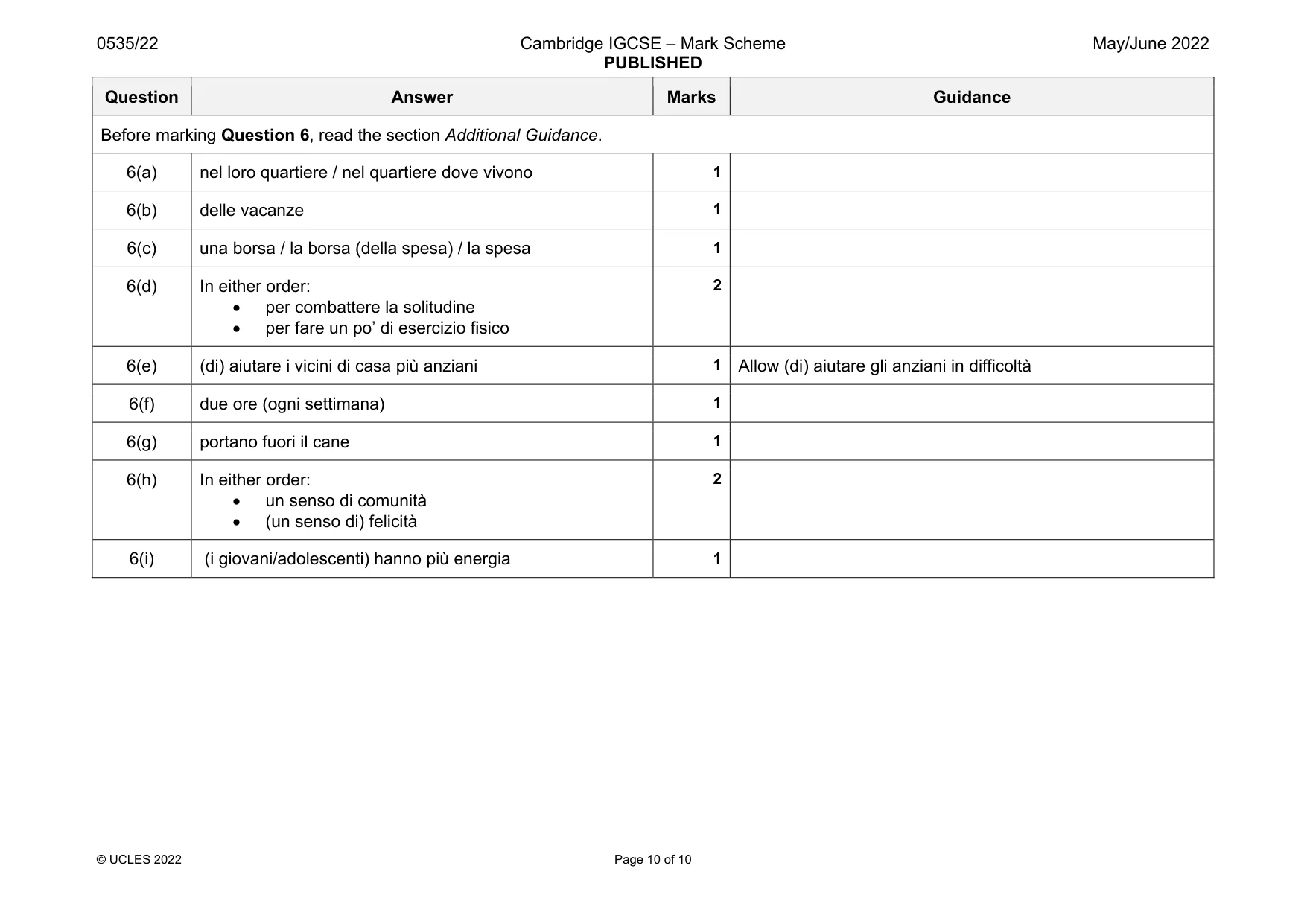
0535/22 Cambridge IGCSE – Mark Scheme PUBLISHED May/June 2022 © UCLES 2022 Page 10 of 10 Question Answer Marks Guidance Before marking Question 6, read the section Additional Guidance. 6(a) nel loro quartiere / nel quartiere dove vivono 1 6(b) delle vacanze 1 6(c) una borsa / la borsa (della spesa) / la spesa 1 6(d) In either order: per combattere la solitudine per fare un po’ di esercizio fisico 2 6(e) (di) aiutare i vicini di casa più anziani 1 Allow (di) aiutare gli anziani in difficoltà 6(f) due ore (ogni settimana) 1 6(g) portano fuori il cane 1 6(h) In either order: un senso di comunità (un senso di) felicità 2 6(i) (i giovani/adolescenti) hanno più energia 1
What you needed in this session
Cambridge’s own grade thresholds for 2022 May/June, Paper 2 · Variant 2. A higher threshold means an easier paper — the bar moves with how the cohort did.