Cambridge IGCSE Italian - Foreign Language 0535 — 2023 May/June Paper 2 · Variant 2
0535/22/M/J/23 · 45 marks · ≈51 min
The question paper and its mark scheme, free to read here and free to download. This is Cambridge’s own paper, exactly as it was sat.
Question paper12 pages

Mark scheme10 pages
Answers below. Sit the paper first if you are practising.
Paper as text
Question paper, page 1
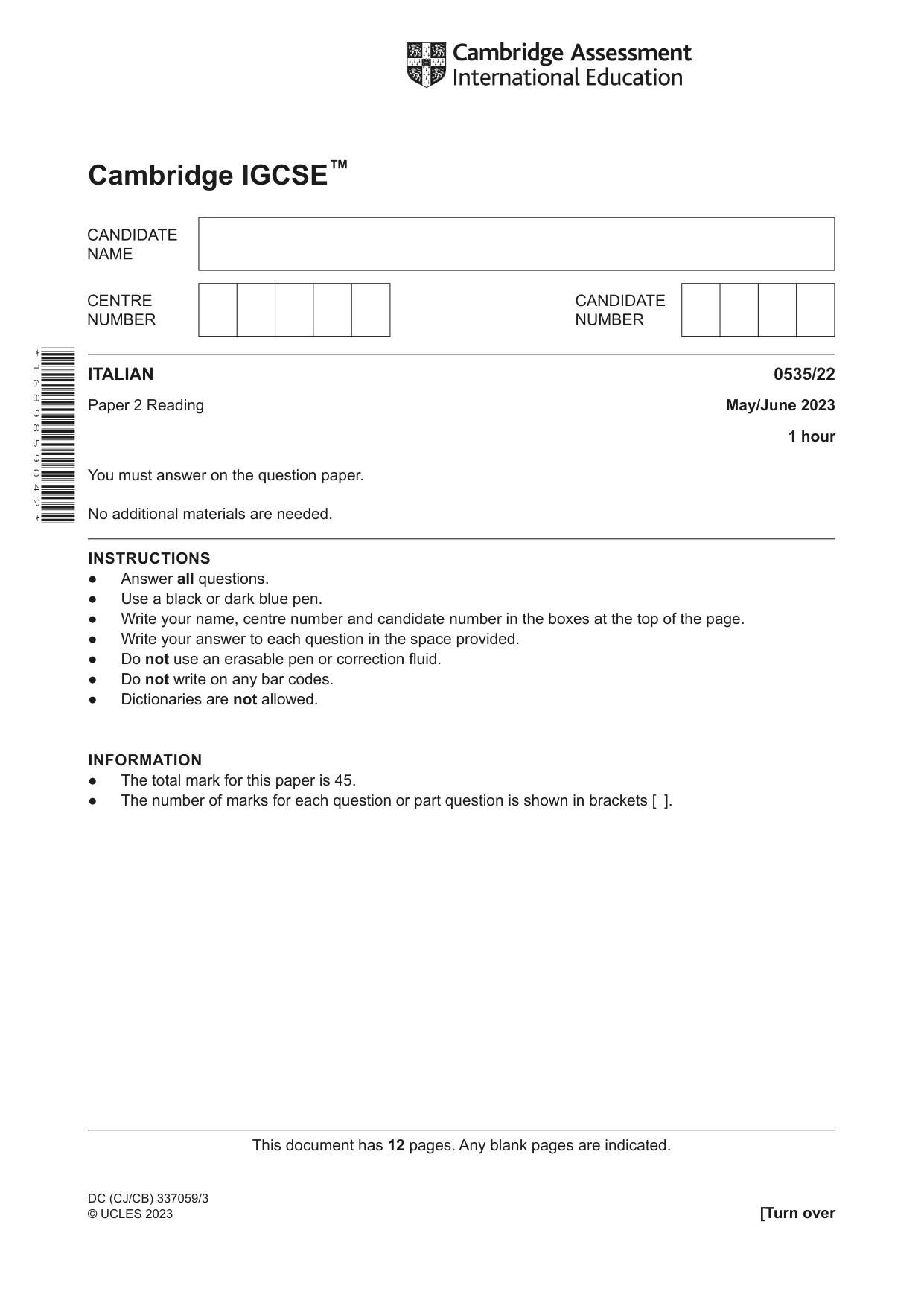
This document has 12 pages. Any blank pages are indicated. [Turn over Cambridge IGCSE™ * 1 6 8 9 8 5 9 0 4 2 * ITALIAN 0535/22 Paper 2 Reading May/June 2023 1 hour You must answer on the question paper. No additional materials are needed. INSTRUCTIONS ● Answer all questions. ● Use a black or dark blue pen. ● Write your name, centre number and candidate number in the boxes at the top of the page. ● Write your answer to each question in the space provided. ● Do not use an erasable pen or correction fluid. ● Do not write on any bar codes. ● Dictionaries are not allowed. INFORMATION ● The total mark for this paper is 45. ● The number of marks for each question or part question is shown in brackets [ ]. DC (CJ/CB) 337059/3 © UCLES 2023
Question paper, page 2
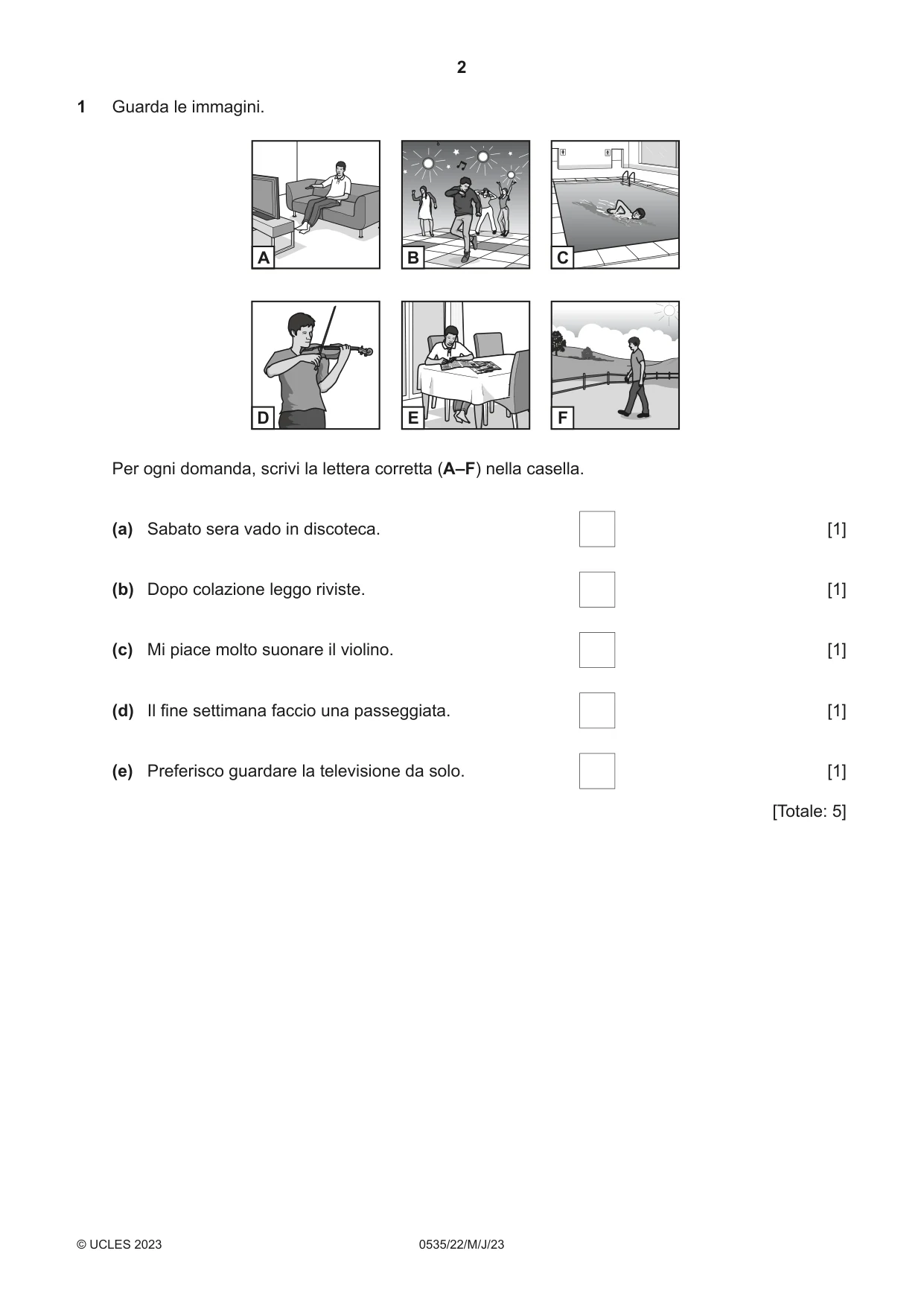
2 0535/22/ M / J /23 © UCLES 2023 1 Guarda le immagini. B C E F A D Per ogni domanda, scrivi la lettera corretta (A–F) nella casella. (a) Sabato sera vado in discoteca. [1] (b) Dopo colazione leggo riviste. [1] (c) Mi piace molto suonare il violino. [1] (d) Il fine settimana faccio una passeggiata. [1] (e) Preferisco guardare la televisione da solo. [1] [Totale: 5]
Question paper, page 3
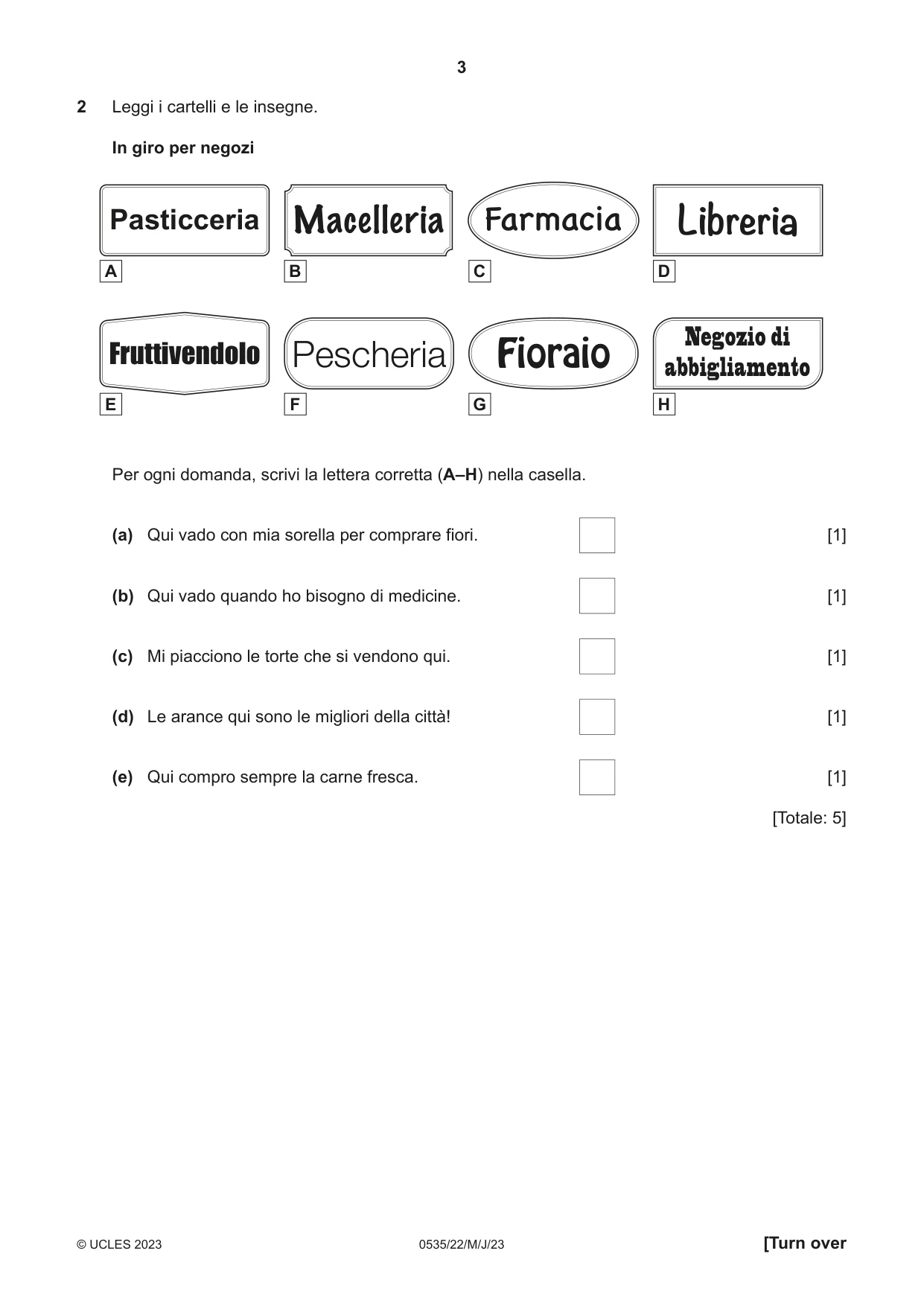
3 0535/22/M/J/23 © UCLES 2023 [Turn over 2 Leggi i cartelli e le insegne. In giro per negozi A B C D E F G H Pasticceria Farmacia Libreria Negozio di abbigliamento Fioraio Pescheria Macelleria Fruttivendolo Per ogni domanda, scrivi la lettera corretta (A–H) nella casella. (a) Qui vado con mia sorella per comprare fiori. [1] (b) Qui vado quando ho bisogno di medicine. [1] (c) Mi piacciono le torte che si vendono qui. [1] (d) Le arance qui sono le migliori della città! [1] (e) Qui compro sempre la carne fresca. [1] [Totale: 5]
Question paper, page 4
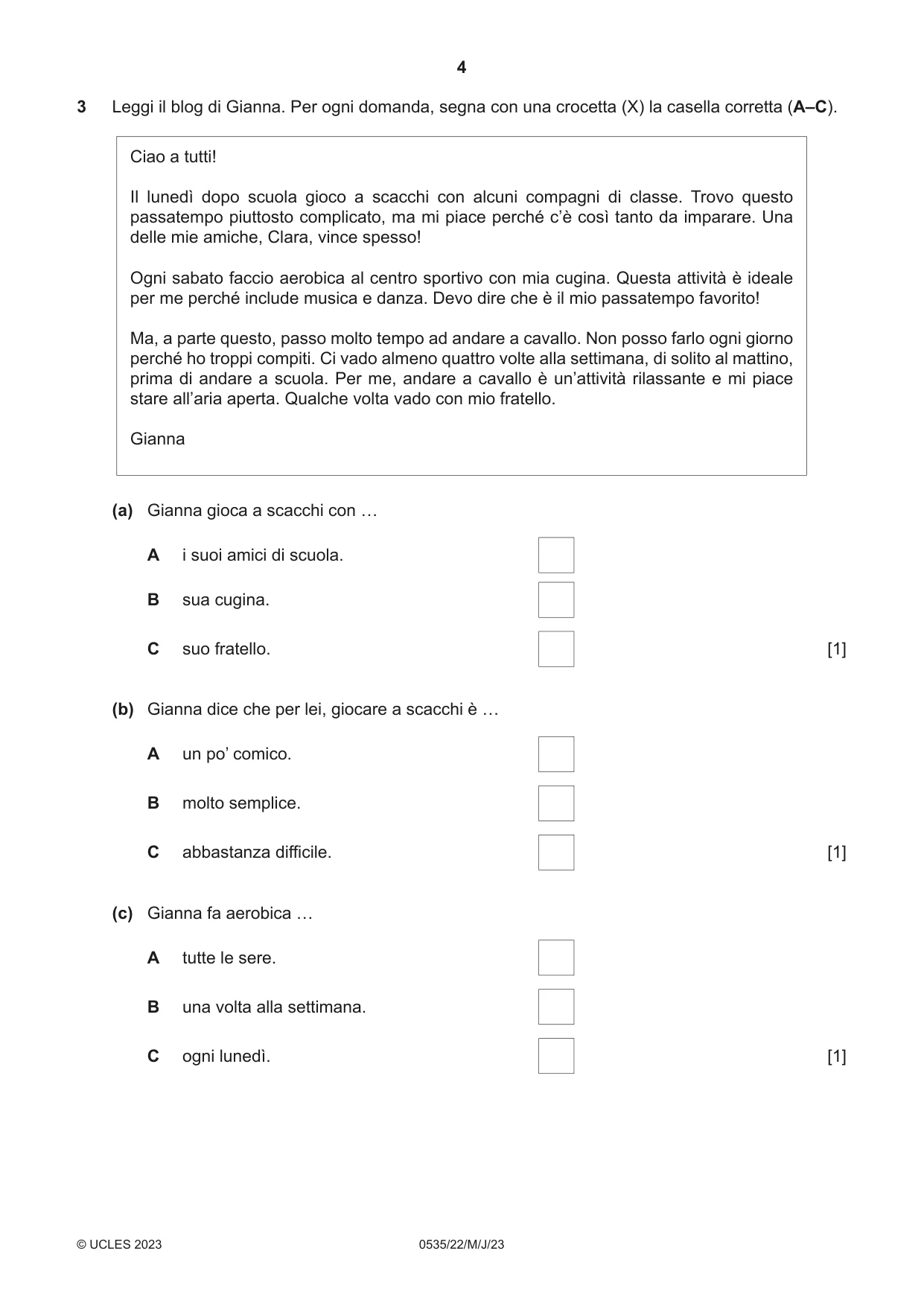
4 0535/22/M/J/23 © UCLES 2023 3 Leggi il blog di Gianna. Per ogni domanda, segna con una crocetta (X) la casella corretta (A–C). Ciao a tutti! Il lunedì dopo scuola gioco a scacchi con alcuni compagni di classe. Trovo questo passatempo piuttosto complicato, ma mi piace perché c’è così tanto da imparare. Una delle mie amiche, Clara, vince spesso! Ogni sabato faccio aerobica al centro sportivo con mia cugina. Questa attività è ideale per me perché include musica e danza. Devo dire che è il mio passatempo favorito! Ma, a parte questo, passo molto tempo ad andare a cavallo. Non posso farlo ogni giorno perché ho troppi compiti. Ci vado almeno quattro volte alla settimana, di solito al mattino, prima di andare a scuola. Per me, andare a cavallo è un’attività rilassante e mi piace stare all’aria aperta. Qualche volta vado con mio fratello. Gianna (a) Gianna gioca a scacchi con … A i suoi amici di scuola. B sua cugina. C suo fratello. [1] (b) Gianna dice che per lei, giocare a scacchi è … A un po’ comico. B molto semplice. C abbastanza difficile. [1] (c) Gianna fa aerobica … A tutte le sere. B una volta alla settimana. C ogni lunedì. [1]
Question paper, page 5
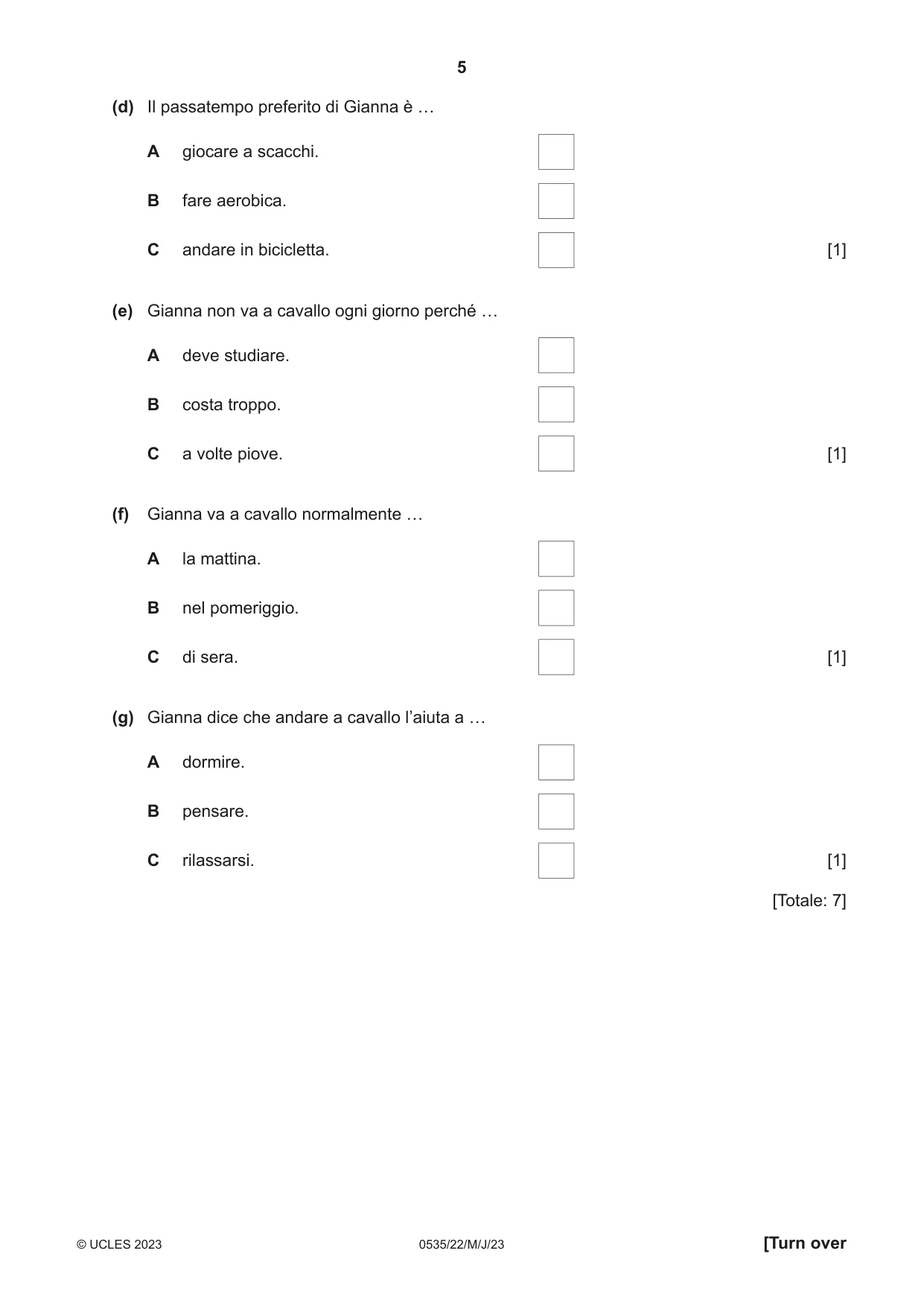
5 0535/22/M/J/23 © UCLES 2023 [Turn over (d) Il passatempo preferito di Gianna è … A giocare a scacchi. B fare aerobica. C andare in bicicletta. [1] (e) Gianna non va a cavallo ogni giorno perché … A deve studiare. B costa troppo. C a volte piove. [1] (f) Gianna va a cavallo normalmente … A la mattina. B nel pomeriggio. C di sera. [1] (g) Gianna dice che andare a cavallo l’aiuta a … A dormire. B pensare. C rilassarsi. [1] [Totale: 7]
Question paper, page 6
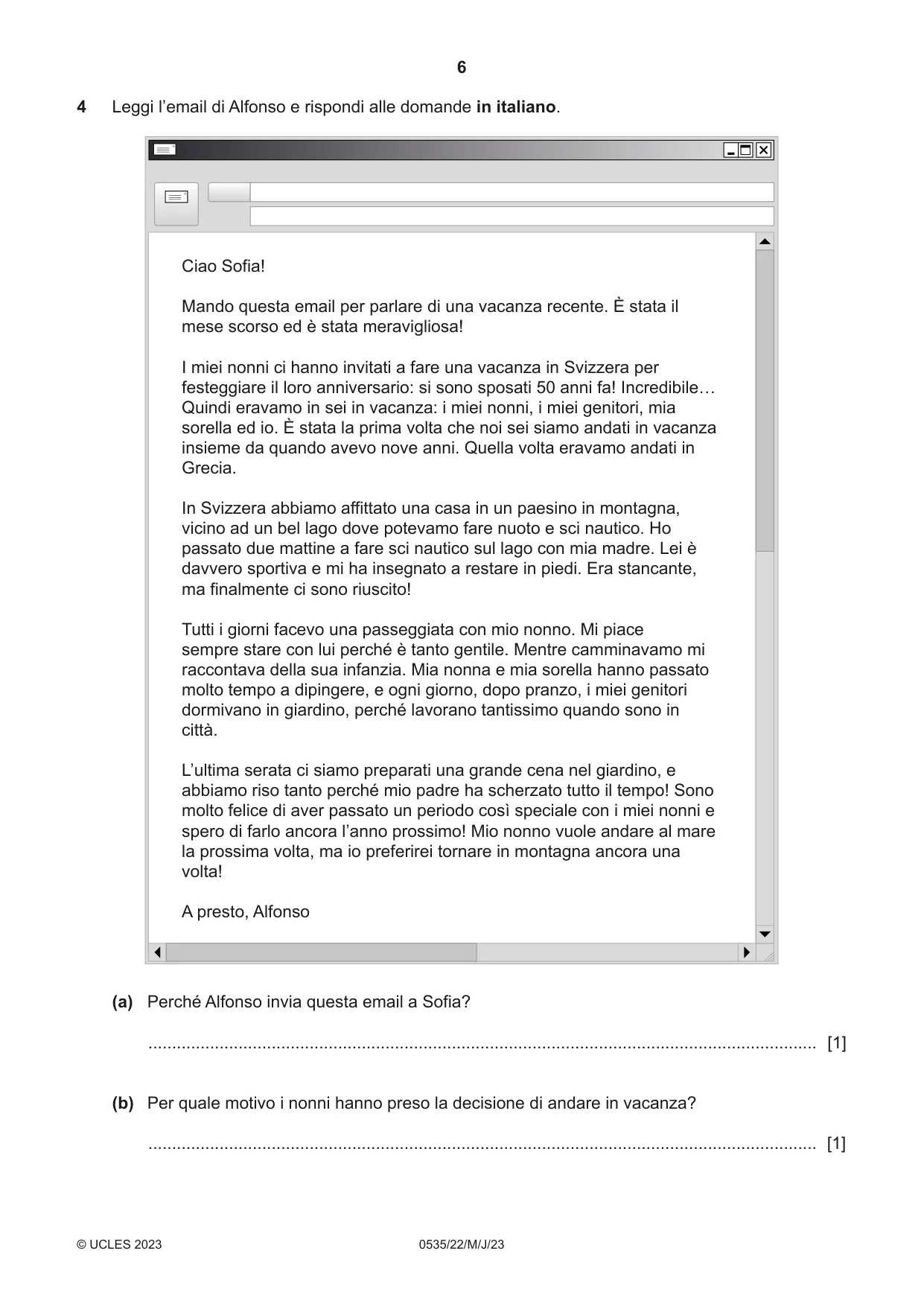
6 0535/22/M/J/23 © UCLES 2023 4 Leggi l’email di Alfonso e rispondi alle domande in italiano. (a) Perché Alfonso invia questa email a Sofia? … [1] (b) Per quale motivo i nonni hanno preso la decisione di andare in vacanza? … [1] Ciao Sofia! Mando questa email per parlare di una vacanza recente. È stata il mese scorso ed è stata meravigliosa! I miei nonni ci hanno invitati a fare una vacanza in Svizzera per festeggiare il loro anniversario: si sono sposati 50 anni fa! Incredibile… Quindi eravamo in sei in vacanza: i miei nonni, i miei genitori, mia sorella ed io. È stata la prima volta che noi sei siamo andati in vacanza insieme da quando avevo nove anni. Quella volta eravamo andati in Grecia. In Svizzera abbiamo affittato una casa in un paesino in montagna, vicino ad un bel lago dove potevamo fare nuoto e sci nautico. Ho passato due mattine a fare sci nautico sul lago con mia madre. Lei è davvero sportiva e mi ha insegnato a restare in piedi. Era stancante, ma finalmente ci sono riuscito! Tutti i giorni facevo una passeggiata con mio nonno. Mi piace sempre stare con lui perché è tanto gentile. Mentre camminavamo mi raccontava della sua infanzia. Mia nonna e mia sorella hanno passato molto tempo a dipingere, e ogni giorno, dopo pranzo, i miei genitori dormivano in giardino, perché lavorano tantissimo quando sono in città. L’ultima serata ci siamo preparati una grande cena nel giardino, e abbiamo riso tanto perché mio padre ha scherzato tutto il tempo! Sono molto felice di aver passato un periodo così speciale con i miei nonni e spero di farlo ancora l’anno prossimo! Mio nonno vuole andare al mare la prossima volta, ma io preferirei tornare in montagna ancora una volta! A presto, Alfonso
Question paper, page 7
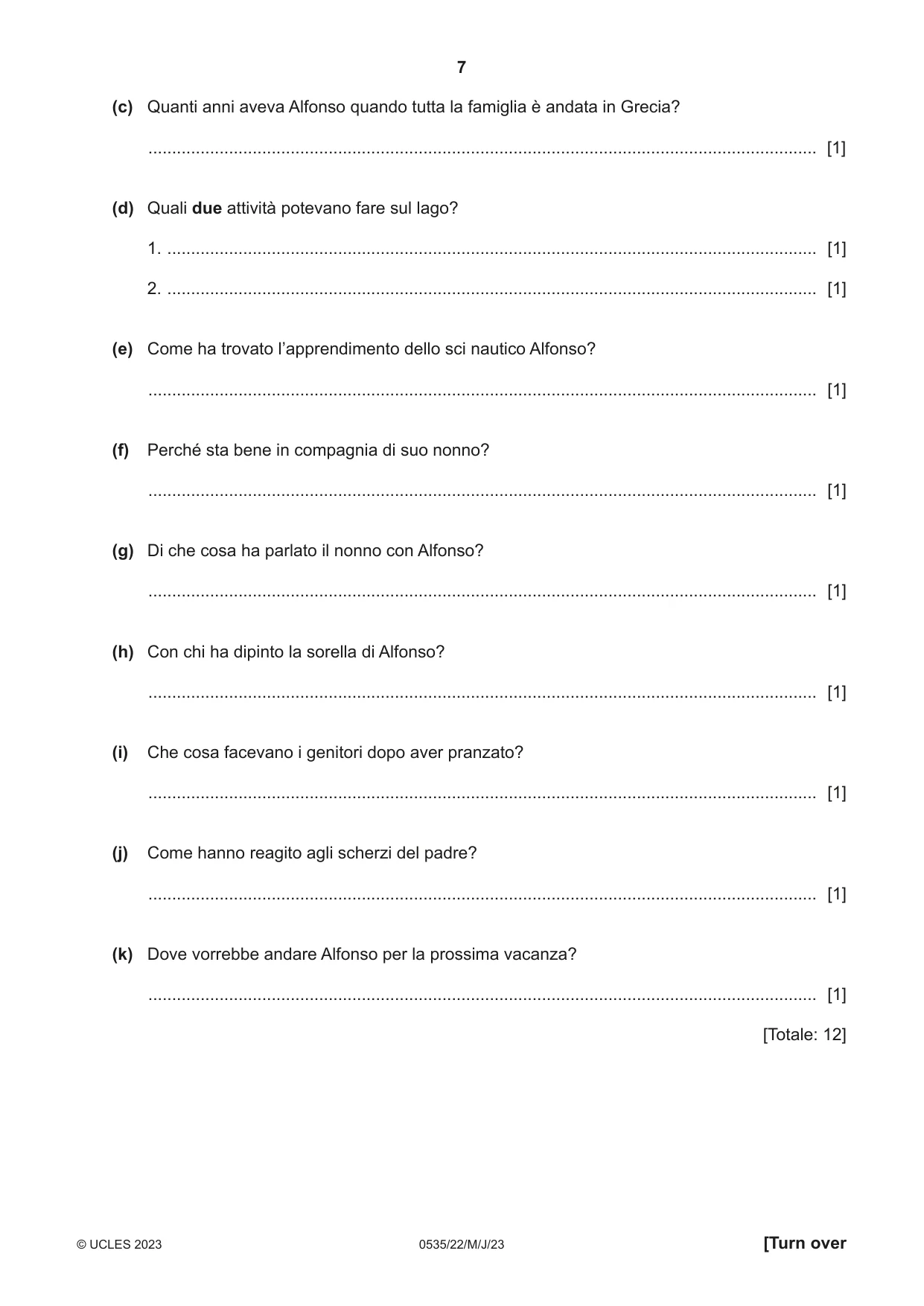
7 0535/22/M/J/23 © UCLES 2023 [Turn over (c) Quanti anni aveva Alfonso quando tutta la famiglia è andata in Grecia? … [1] (d) Quali due attività potevano fare sul lago? 1. … [1] 2. … [1] (e) Come ha trovato l’apprendimento dello sci nautico Alfonso? … [1] (f) Perché sta bene in compagnia di suo nonno? … [1] (g) Di che cosa ha parlato il nonno con Alfonso? … [1] (h) Con chi ha dipinto la sorella di Alfonso? … [1] (i) Che cosa facevano i genitori dopo aver pranzato? … [1] (j) Come hanno reagito agli scherzi del padre? … [1] (k) Dove vorrebbe andare Alfonso per la prossima vacanza? … [1] [Totale: 12]
Question paper, page 8
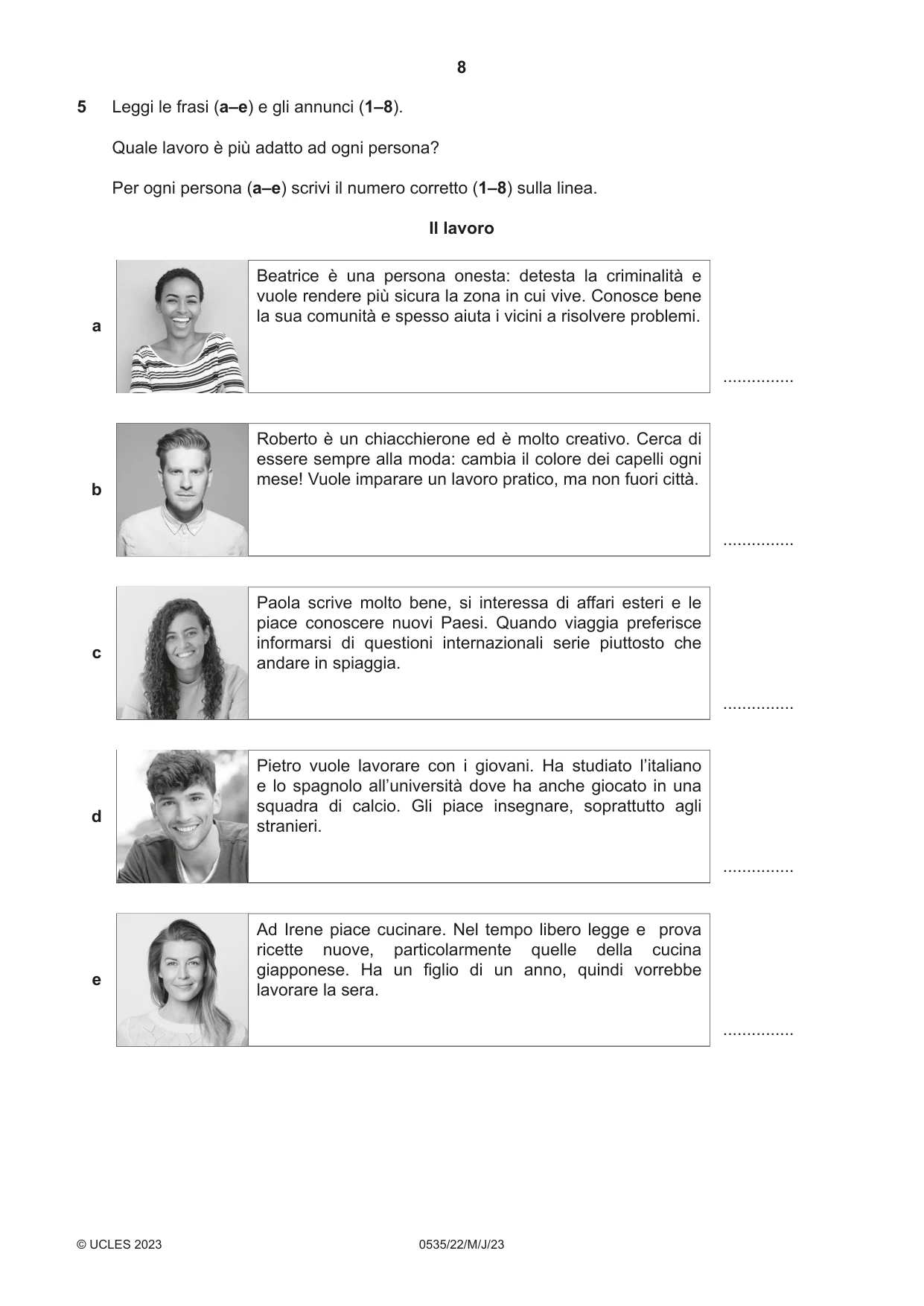
8 0535/22/M/J/23 © UCLES 2023 5 Leggi le frasi (a–e) e gli annunci (1–8). Quale lavoro è più adatto ad ogni persona? Per ogni persona (a–e) scrivi il numero corretto (1–8) sulla linea. Il lavoro a Beatrice è una persona onesta: detesta la criminalità e vuole rendere più sicura la zona in cui vive. Conosce bene la sua comunità e spesso aiuta i vicini a risolvere problemi. … b Roberto è un chiacchierone ed è molto creativo. Cerca di essere sempre alla moda: cambia il colore dei capelli ogni mese! Vuole imparare un lavoro pratico, ma non fuori città. … c Paola scrive molto bene, si interessa di affari esteri e le piace conoscere nuovi Paesi. Quando viaggia preferisce informarsi di questioni internazionali serie piuttosto che andare in spiaggia. … d Pietro vuole lavorare con i giovani. Ha studiato l’italiano e lo spagnolo all’università dove ha anche giocato in una squadra di calcio. Gli piace insegnare, soprattutto agli stranieri. … e Ad Irene piace cucinare. Nel tempo libero legge e prova ricette nuove, particolarmente quelle della cucina giapponese. Ha un figlio di un anno, quindi vorrebbe lavorare la sera. …
Question paper, page 9
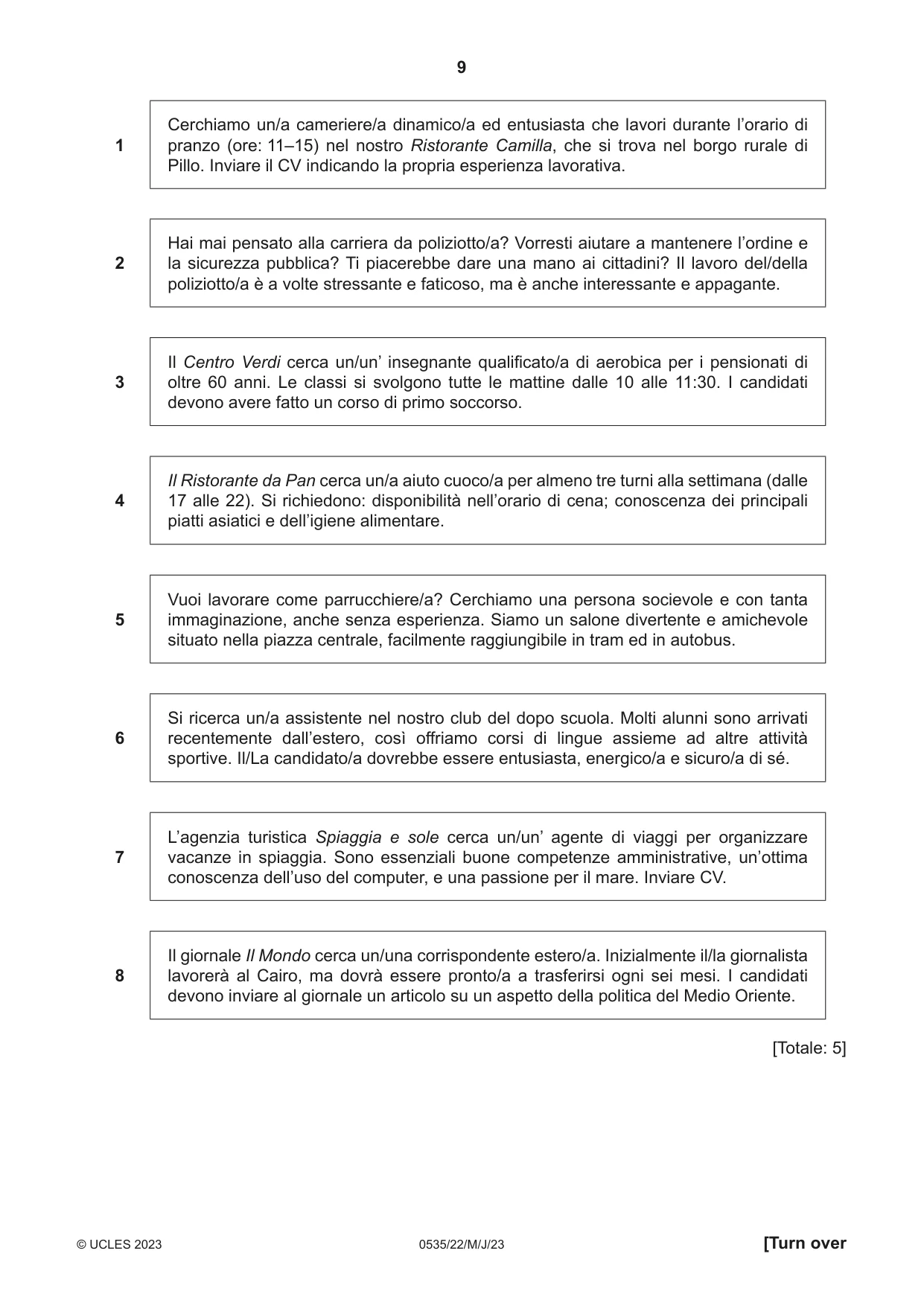
9 0535/22/M/J/23 © UCLES 2023 [Turn over 1 Cerchiamo un/a cameriere/a dinamico/a ed entusiasta che lavori durante l’orario di pranzo (ore: 11–15) nel nostro Ristorante Camilla, che si trova nel borgo rurale di Pillo. Inviare il CV indicando la propria esperienza lavorativa. 2 Hai mai pensato alla carriera da poliziotto/a? Vorresti aiutare a mantenere l’ordine e la sicurezza pubblica? Ti piacerebbe dare una mano ai cittadini? Il lavoro del/della poliziotto/a è a volte stressante e faticoso, ma è anche interessante e appagante. 3 Il Centro Verdi cerca un/un’ insegnante qualificato/a di aerobica per i pensionati di oltre 60 anni. Le classi si svolgono tutte le mattine dalle 10 alle 11:30. I candidati devono avere fatto un corso di primo soccorso. 4 Il Ristorante da Pan cerca un/a aiuto cuoco/a per almeno tre turni alla settimana (dalle 17 alle 22). Si richiedono: disponibilità nell’orario di cena; conoscenza dei principali piatti asiatici e dell’igiene alimentare. 5 Vuoi lavorare come parrucchiere/a? Cerchiamo una persona socievole e con tanta immaginazione, anche senza esperienza. Siamo un salone divertente e amichevole situato nella piazza centrale, facilmente raggiungibile in tram ed in autobus. 6 Si ricerca un/a assistente nel nostro club del dopo scuola. Molti alunni sono arrivati recentemente dall’estero, così offriamo corsi di lingue assieme ad altre attività sportive. Il/La candidato/a dovrebbe essere entusiasta, energico/a e sicuro/a di sé. 7 L’agenzia turistica Spiaggia e sole cerca un/un’ agente di viaggi per organizzare vacanze in spiaggia. Sono essenziali buone competenze amministrative, un’ottima conoscenza dell’uso del computer, e una passione per il mare. Inviare CV. 8 Il giornale Il Mondo cerca un/una corrispondente estero/a. Inizialmente il/la giornalista lavorerà al Cairo, ma dovrà essere pronto/a a trasferirsi ogni sei mesi. I candidati devono inviare al giornale un articolo su un aspetto della politica del Medio Oriente. [Totale: 5]
Question paper, page 10
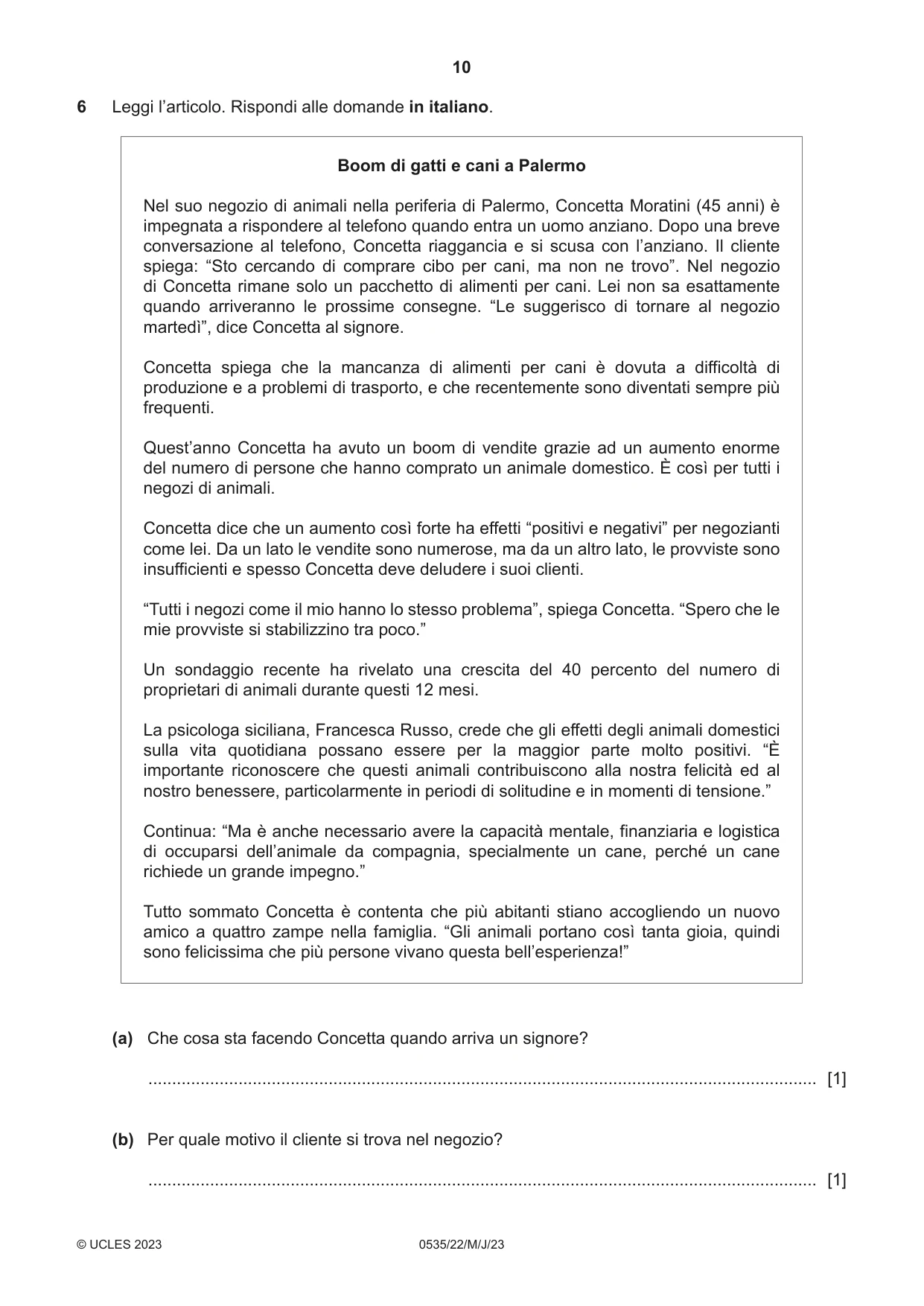
10 0535/22/M/J/23 © UCLES 2023 6 Leggi l’articolo. Rispondi alle domande in italiano. Boom di gatti e cani a Palermo Nel suo negozio di animali nella periferia di Palermo, Concetta Moratini (45 anni) è impegnata a rispondere al telefono quando entra un uomo anziano. Dopo una breve conversazione al telefono, Concetta riaggancia e si scusa con l’anziano. Il cliente spiega: “Sto cercando di comprare cibo per cani, ma non ne trovo”. Nel negozio di Concetta rimane solo un pacchetto di alimenti per cani. Lei non sa esattamente quando arriveranno le prossime consegne. “Le suggerisco di tornare al negozio martedì”, dice Concetta al signore. Concetta spiega che la mancanza di alimenti per cani è dovuta a difficoltà di produzione e a problemi di trasporto, e che recentemente sono diventati sempre più frequenti. Quest’anno Concetta ha avuto un boom di vendite grazie ad un aumento enorme del numero di persone che hanno comprato un animale domestico. È così per tutti i negozi di animali. Concetta dice che un aumento così forte ha effetti “positivi e negativi” per negozianti come lei. Da un lato le vendite sono numerose, ma da un altro lato, le provviste sono insufficienti e spesso Concetta deve deludere i suoi clienti. “Tutti i negozi come il mio hanno lo stesso problema”, spiega Concetta. “Spero che le mie provviste si stabilizzino tra poco.” Un sondaggio recente ha rivelato una crescita del 40 percento del numero di proprietari di animali durante questi 12 mesi. La psicologa siciliana, Francesca Russo, crede che gli effetti degli animali domestici sulla vita quotidiana possano essere per la maggior parte molto positivi. “È importante riconoscere che questi animali contribuiscono alla nostra felicità ed al nostro benessere, particolarmente in periodi di solitudine e in momenti di tensione.” Continua: “Ma è anche necessario avere la capacità mentale, finanziaria e logistica di occuparsi dell’animale da compagnia, specialmente un cane, perché un cane richiede un grande impegno.” Tutto sommato Concetta è contenta che più abitanti stiano accogliendo un nuovo amico a quattro zampe nella famiglia. “Gli animali portano così tanta gioia, quindi sono felicissima che più persone vivano questa bell’esperienza!” (a) Che cosa sta facendo Concetta quando arriva un signore? … [1] (b) Per quale motivo il cliente si trova nel negozio? … [1]
Question paper, page 11
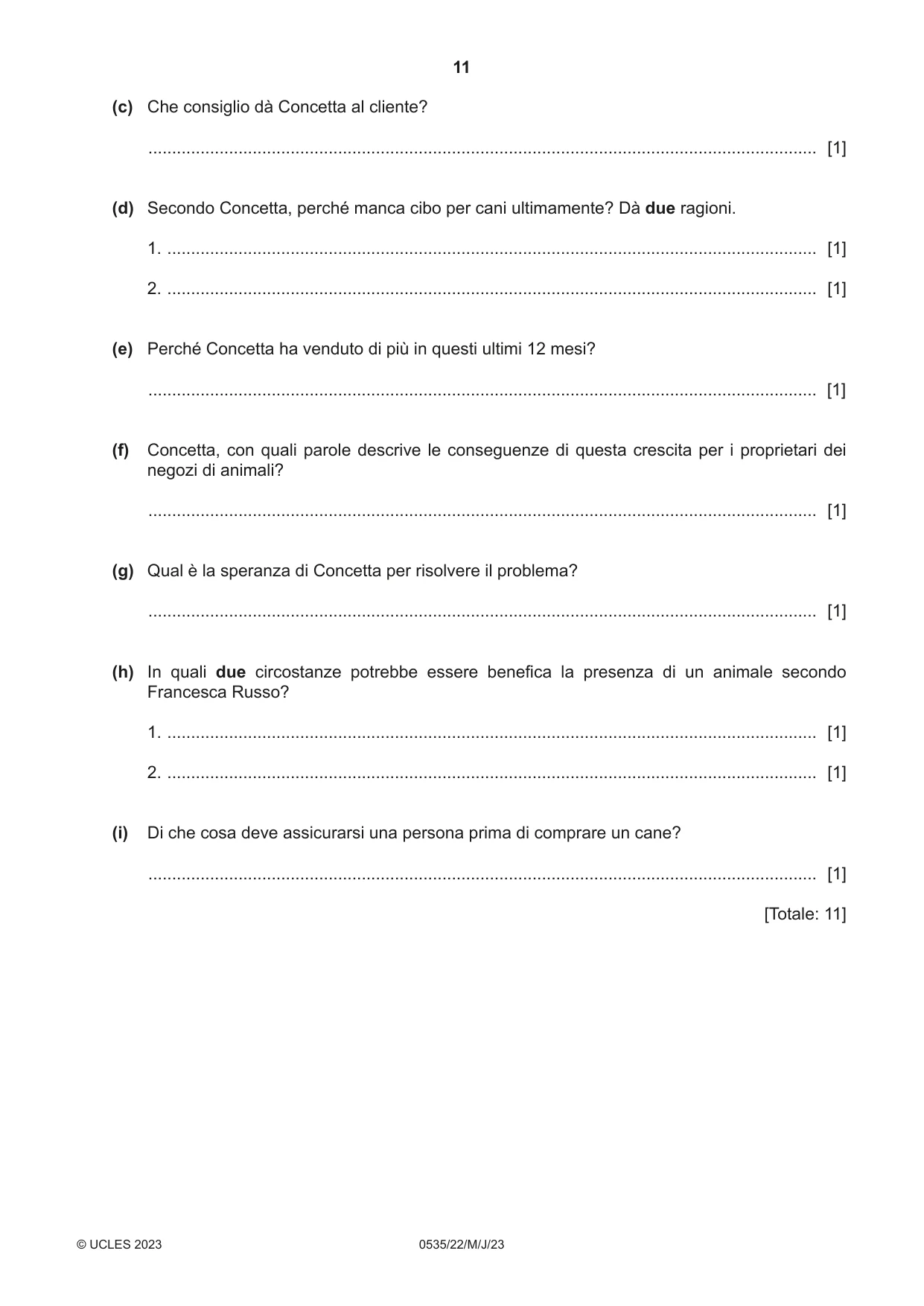
11 0535/22/M/J/23 © UCLES 2023 (c) Che consiglio dà Concetta al cliente? … [1] (d) Secondo Concetta, perché manca cibo per cani ultimamente? Dà due ragioni. 1. … [1] 2. … [1] (e) Perché Concetta ha venduto di più in questi ultimi 12 mesi? … [1] (f) Concetta, con quali parole descrive le conseguenze di questa crescita per i proprietari dei negozi di animali? … [1] (g) Qual è la speranza di Concetta per risolvere il problema? … [1] (h) In quali due circostanze potrebbe essere benefica la presenza di un animale secondo Francesca Russo? 1. … [1] 2. … [1] (i) Di che cosa deve assicurarsi una persona prima di comprare un cane? … [1] [Totale: 11]
Question paper, page 12
12 0535/22/M/J/23 © UCLES 2023 Permission to reproduce items where third-party owned material protected by copyright is included has been sought and cleared where possible. Every reasonable effort has been made by the publisher (UCLES) to trace copyright holders, but if any items requiring clearance have unwittingly been included, the publisher will be pleased to make amends at the earliest possible opportunity. To avoid the issue of disclosure of answer-related information to candidates, all copyright acknowledgements are reproduced online in the Cambridge Assessment International Education Copyright Acknowledgements Booklet. This is produced for each series of examinations and is freely available to download at www.cambridgeinternational.org after the live examination series. Cambridge Assessment International Education is part of Cambridge Assessment. Cambridge Assessment is the brand name of the University of Cambridge Local Examinations Syndicate (UCLES), which is a department of the University of Cambridge. BLANK PAGE
Mark scheme, page 1
This document consists of 10 printed pages. © UCLES 2023 [Turn over Cambridge IGCSE™ ITALIAN 0535/22 Paper 2 Reading May/June 2023 MARK SCHEME Maximum Mark: 45 Published This mark scheme is published as an aid to teachers and candidates, to indicate the requirements of the examination. It shows the basis on which Examiners were instructed to award marks. It does not indicate the details of the discussions that took place at an Examiners’ meeting before marking began, which would have considered the acceptability of alternative answers. Mark schemes should be read in conjunction with the question paper and the Principal Examiner Report for Teachers. Cambridge International will not enter into discussions about these mark schemes. Cambridge International is publishing the mark schemes for the May/June 2023 series for most Cambridge IGCSE, Cambridge International A and AS Level and Cambridge Pre-U components, and some Cambridge O Level components.
Mark scheme, page 2
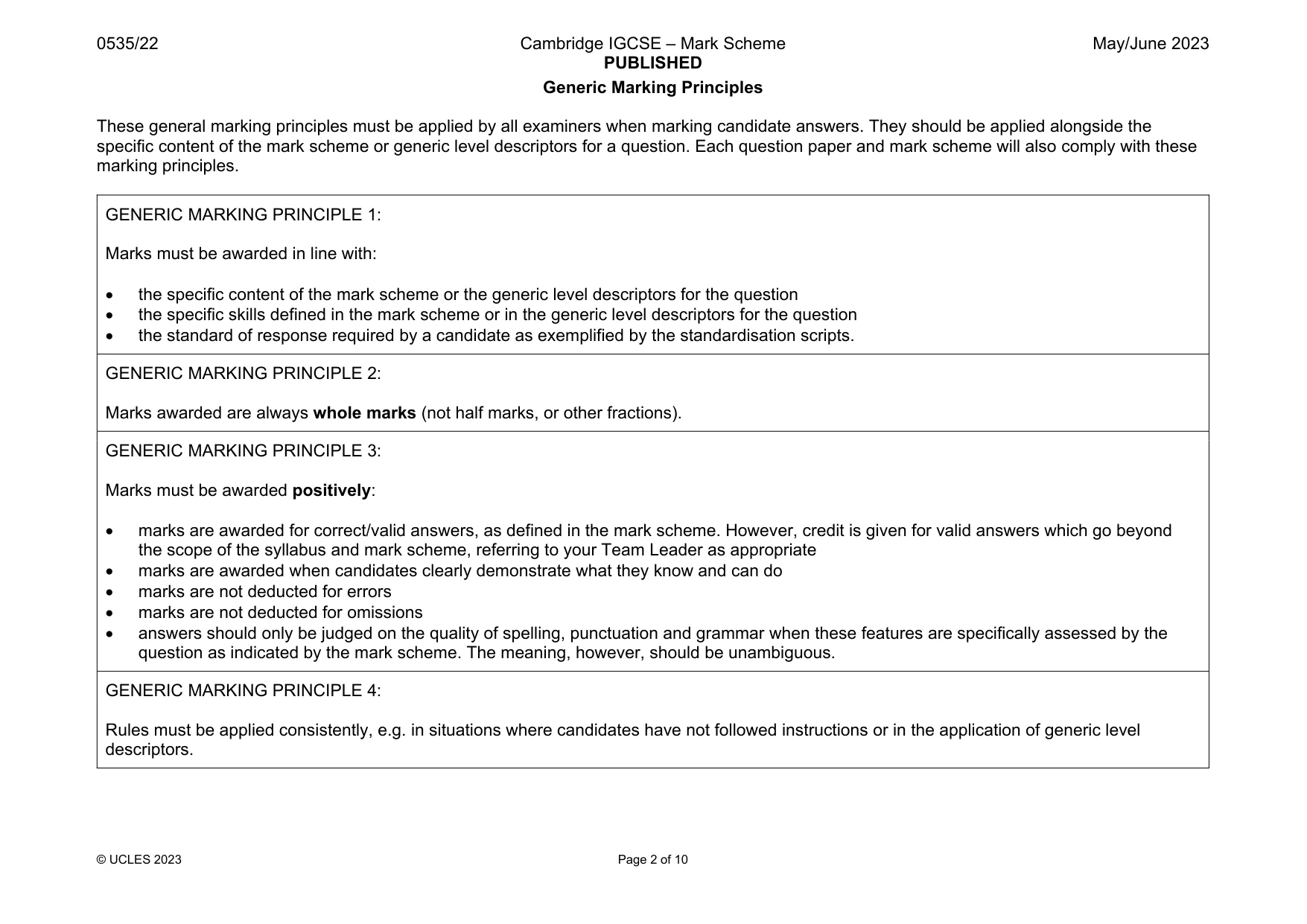
0535/22 Cambridge IGCSE – Mark Scheme PUBLISHED May/June 2023 © UCLES 2023 Page 2 of 10 Generic Marking Principles These general marking principles must be applied by all examiners when marking candidate answers. They should be applied alongside the specific content of the mark scheme or generic level descriptors for a question. Each question paper and mark scheme will also comply with these marking principles. GENERIC MARKING PRINCIPLE 1: Marks must be awarded in line with: the specific content of the mark scheme or the generic level descriptors for the question the specific skills defined in the mark scheme or in the generic level descriptors for the question the standard of response required by a candidate as exemplified by the standardisation scripts. GENERIC MARKING PRINCIPLE 2: Marks awarded are always whole marks (not half marks, or other fractions). GENERIC MARKING PRINCIPLE 3: Marks must be awarded positively: marks are awarded for correct/valid answers, as defined in the mark scheme. However, credit is given for valid answers which go beyond the scope of the syllabus and mark scheme, referring to your Team Leader as appropriate marks are awarded when candidates clearly demonstrate what they know and can do marks are not deducted for errors marks are not deducted for omissions answers should only be judged on the quality of spelling, punctuation and grammar when these features are specifically assessed by the question as indicated by the mark scheme. The meaning, however, should be unambiguous. GENERIC MARKING PRINCIPLE 4: Rules must be applied consistently, e.g. in situations where candidates have not followed instructions or in the application of generic level descriptors.
Mark scheme, page 3
0535/22 Cambridge IGCSE – Mark Scheme PUBLISHED May/June 2023 © UCLES 2023 Page 3 of 10 GENERIC MARKING PRINCIPLE 5: Marks should be awarded using the full range of marks defined in the mark scheme for the question (however; the use of the full mark range may be limited according to the quality of the candidate responses seen). GENERIC MARKING PRINCIPLE 6: Marks awarded are based solely on the requirements as defined in the mark scheme. Marks should not be awarded with grade thresholds or grade descriptors in mind.
Mark scheme, page 4
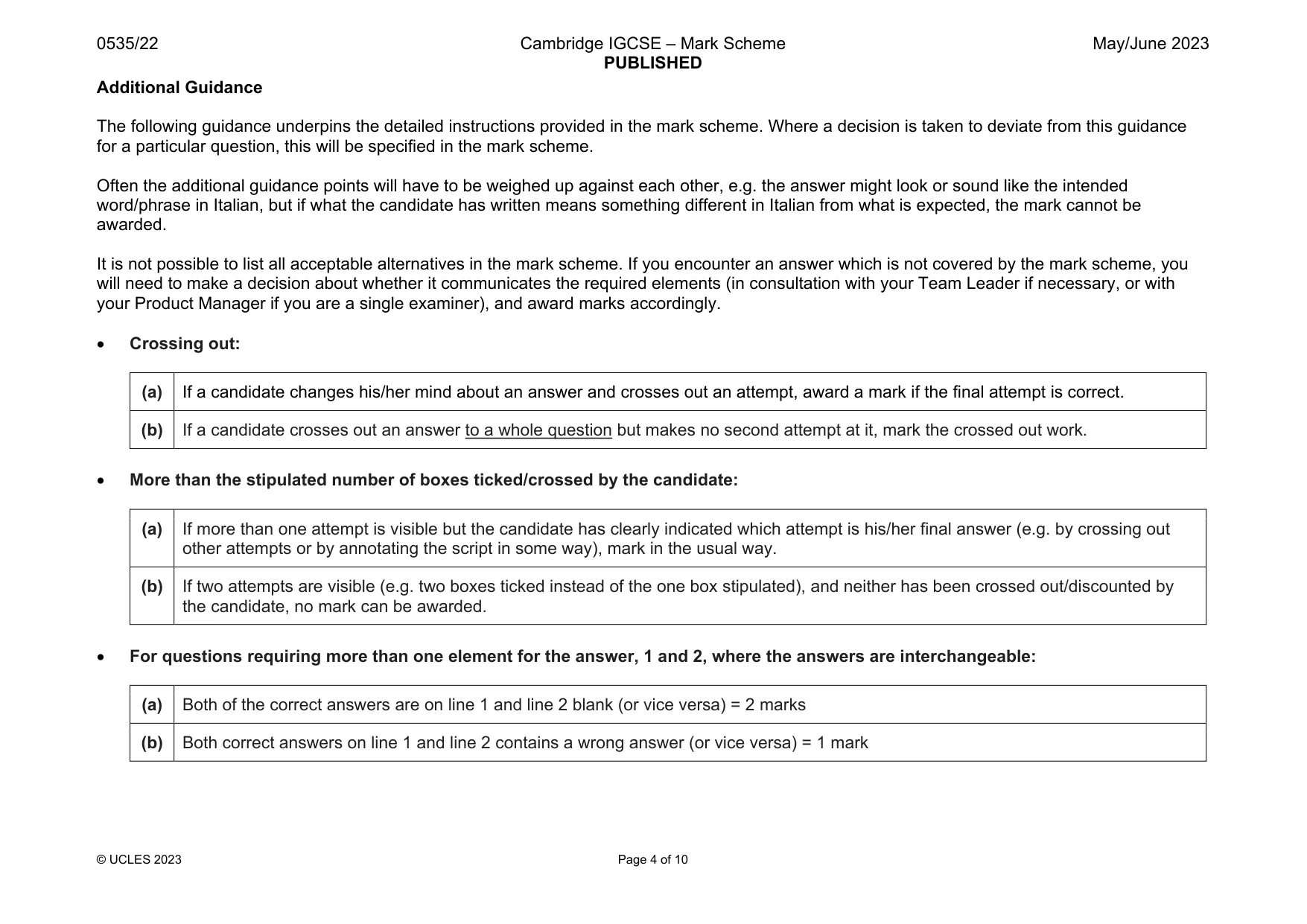
0535/22 Cambridge IGCSE – Mark Scheme PUBLISHED May/June 2023 © UCLES 2023 Page 4 of 10 Additional Guidance The following guidance underpins the detailed instructions provided in the mark scheme. Where a decision is taken to deviate from this guidance for a particular question, this will be specified in the mark scheme. Often the additional guidance points will have to be weighed up against each other, e.g. the answer might look or sound like the intended word/phrase in Italian, but if what the candidate has written means something different in Italian from what is expected, the mark cannot be awarded. It is not possible to list all acceptable alternatives in the mark scheme. If you encounter an answer which is not covered by the mark scheme, you will need to make a decision about whether it communicates the required elements (in consultation with your Team Leader if necessary, or with your Product Manager if you are a single examiner), and award marks accordingly. Crossing out: (a) If a candidate changes his/her mind about an answer and crosses out an attempt, award a mark if the final attempt is correct. (b) If a candidate crosses out an answer to a whole question but makes no second attempt at it, mark the crossed out work. More than the stipulated number of boxes ticked/crossed by the candidate: (a) If more than one attempt is visible but the candidate has clearly indicated which attempt is his/her final answer (e.g. by crossing out other attempts or by annotating the script in some way), mark in the usual way. (b) If two attempts are visible (e.g. two boxes ticked instead of the one box stipulated), and neither has been crossed out/discounted by the candidate, no mark can be awarded. For questions requiring more than one element for the answer, 1 and 2, where the answers are interchangeable: (a) Both of the correct answers are on line 1 and line 2 blank (or vice versa) = 2 marks (b) Both correct answers on line 1 and line 2 contains a wrong answer (or vice versa) = 1 mark
Mark scheme, page 5
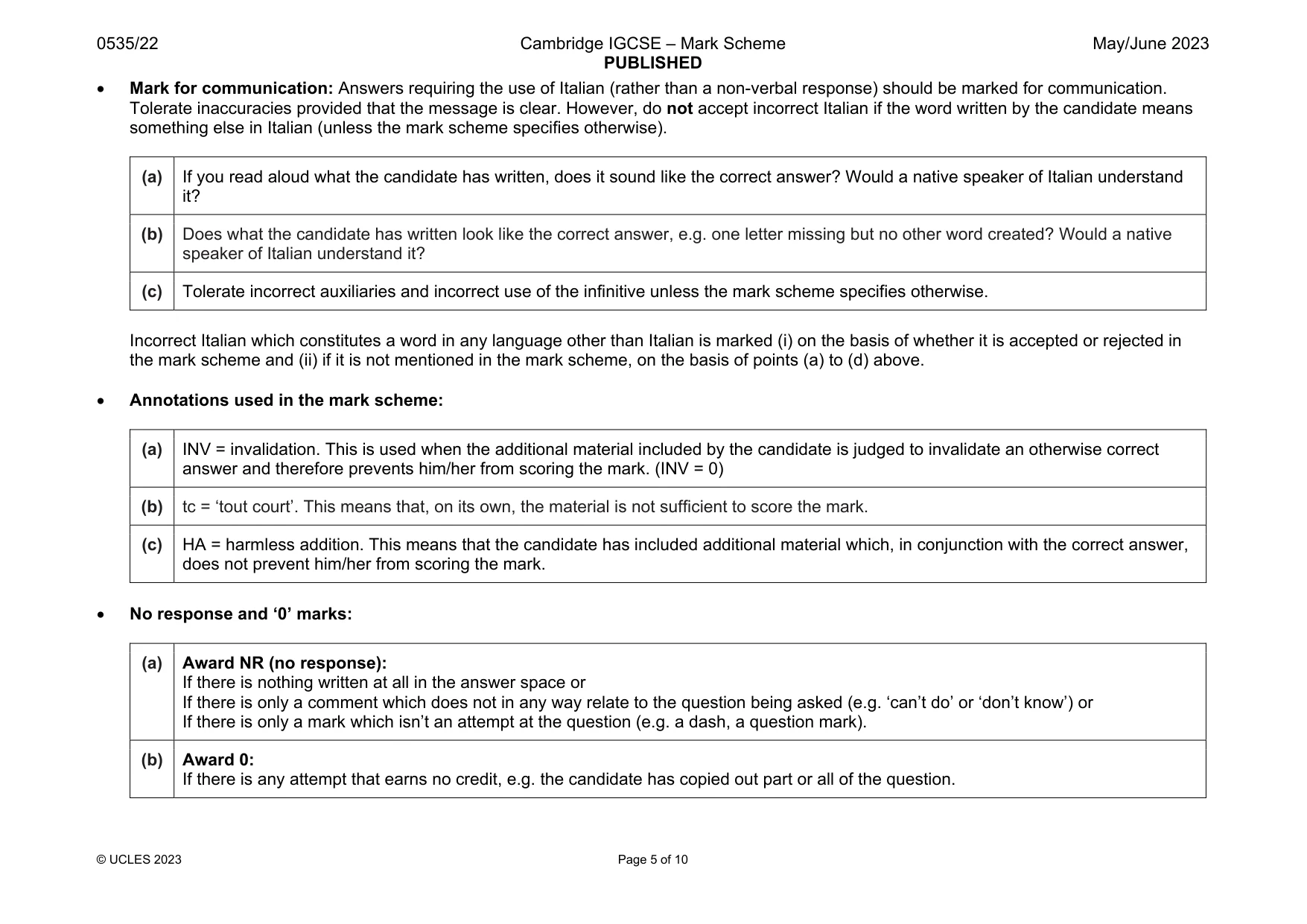
0535/22 Cambridge IGCSE – Mark Scheme PUBLISHED May/June 2023 © UCLES 2023 Page 5 of 10 Mark for communication: Answers requiring the use of Italian (rather than a non-verbal response) should be marked for communication. Tolerate inaccuracies provided that the message is clear. However, do not accept incorrect Italian if the word written by the candidate means something else in Italian (unless the mark scheme specifies otherwise). (a) If you read aloud what the candidate has written, does it sound like the correct answer? Would a native speaker of Italian understand it? (b) Does what the candidate has written look like the correct answer, e.g. one letter missing but no other word created? Would a native speaker of Italian understand it? (c) Tolerate incorrect auxiliaries and incorrect use of the infinitive unless the mark scheme specifies otherwise. Incorrect Italian which constitutes a word in any language other than Italian is marked (i) on the basis of whether it is accepted or rejected in the mark scheme and (ii) if it is not mentioned in the mark scheme, on the basis of points (a) to (d) above. Annotations used in the mark scheme: (a) INV = invalidation. This is used when the additional material included by the candidate is judged to invalidate an otherwise correct answer and therefore prevents him/her from scoring the mark. (INV = 0) (b) tc = ‘tout court’. This means that, on its own, the material is not sufficient to score the mark. (c) HA = harmless addition. This means that the candidate has included additional material which, in conjunction with the correct answer, does not prevent him/her from scoring the mark. No response and ‘0’ marks: (a) Award NR (no response): If there is nothing written at all in the answer space or If there is only a comment which does not in any way relate to the question being asked (e.g. ‘can’t do’ or ‘don’t know’) or If there is only a mark which isn’t an attempt at the question (e.g. a dash, a question mark). (b) Award 0: If there is any attempt that earns no credit, e.g. the candidate has copied out part or all of the question.
Mark scheme, page 6
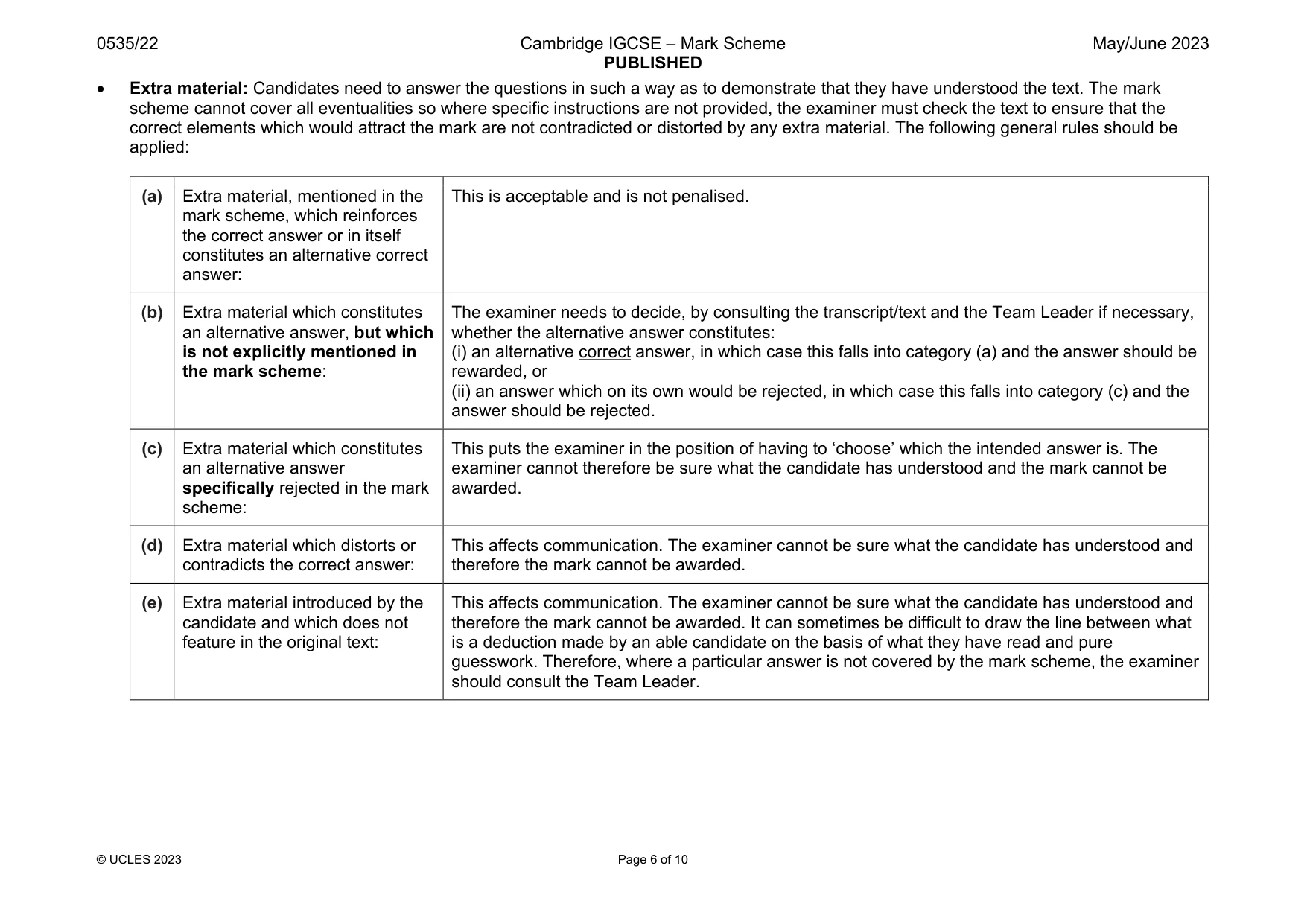
0535/22 Cambridge IGCSE – Mark Scheme PUBLISHED May/June 2023 © UCLES 2023 Page 6 of 10 Extra material: Candidates need to answer the questions in such a way as to demonstrate that they have understood the text. The mark scheme cannot cover all eventualities so where specific instructions are not provided, the examiner must check the text to ensure that the correct elements which would attract the mark are not contradicted or distorted by any extra material. The following general rules should be applied: (a) Extra material, mentioned in the mark scheme, which reinforces the correct answer or in itself constitutes an alternative correct answer: This is acceptable and is not penalised. (b) Extra material which constitutes an alternative answer, but which is not explicitly mentioned in the mark scheme: The examiner needs to decide, by consulting the transcript/text and the Team Leader if necessary, whether the alternative answer constitutes: (i) an alternative correct answer, in which case this falls into category (a) and the answer should be rewarded, or (ii) an answer which on its own would be rejected, in which case this falls into category (c) and the answer should be rejected. (c) Extra material which constitutes an alternative answer specifically rejected in the mark scheme: This puts the examiner in the position of having to ‘choose’ which the intended answer is. The examiner cannot therefore be sure what the candidate has understood and the mark cannot be awarded. (d) Extra material which distorts or contradicts the correct answer: This affects communication. The examiner cannot be sure what the candidate has understood and therefore the mark cannot be awarded. (e) Extra material introduced by the candidate and which does not feature in the original text: This affects communication. The examiner cannot be sure what the candidate has understood and therefore the mark cannot be awarded. It can sometimes be difficult to draw the line between what is a deduction made by an able candidate on the basis of what they have read and pure guesswork. Therefore, where a particular answer is not covered by the mark scheme, the examiner should consult the Team Leader.
Mark scheme, page 7
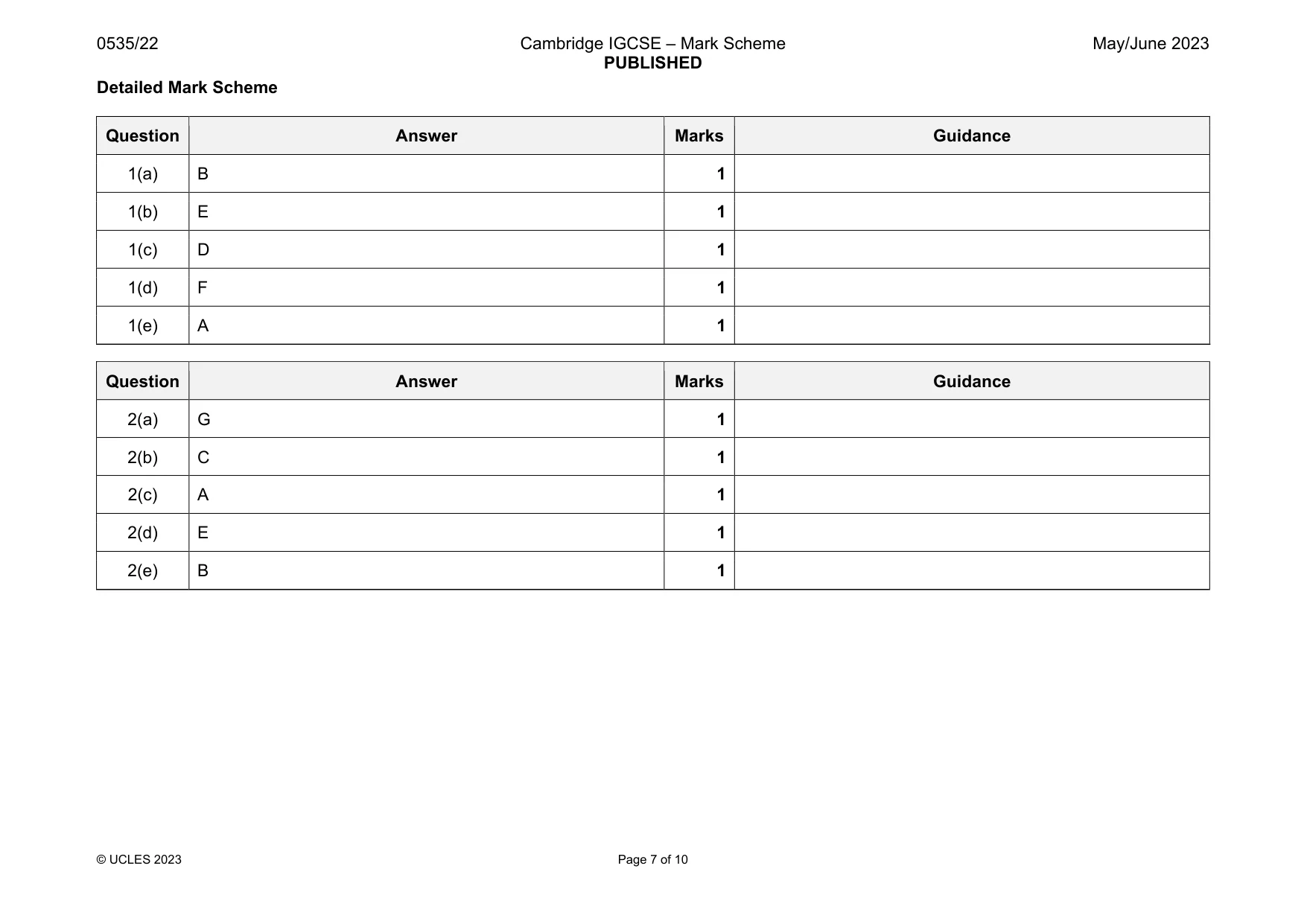
0535/22 Cambridge IGCSE – Mark Scheme PUBLISHED May/June 2023 © UCLES 2023 Page 7 of 10 Detailed Mark Scheme Question Answer Marks Guidance 1(a) B 1 1(b) E 1 1(c) D 1 1(d) F 1 1(e) A 1 Question Answer Marks Guidance 2(a) G 1 2(b) C 1 2(c) A 1 2(d) E 1 2(e) B 1
Mark scheme, page 8
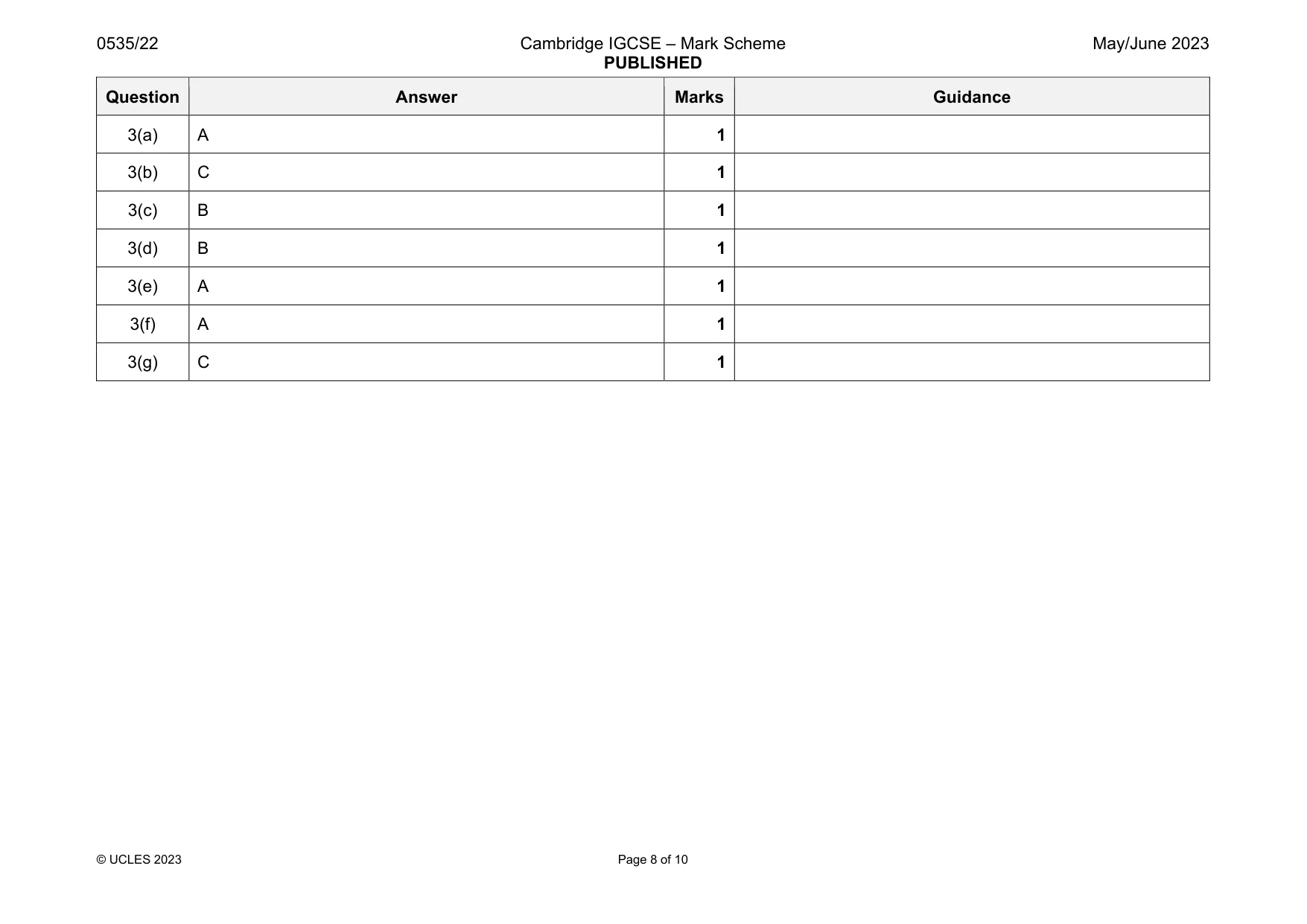
0535/22 Cambridge IGCSE – Mark Scheme PUBLISHED May/June 2023 © UCLES 2023 Page 8 of 10 Question Answer Marks Guidance 3(a) A 1 3(b) C 1 3(c) B 1 3(d) B 1 3(e) A 1 3(f) A 1 3(g) C 1
Mark scheme, page 9
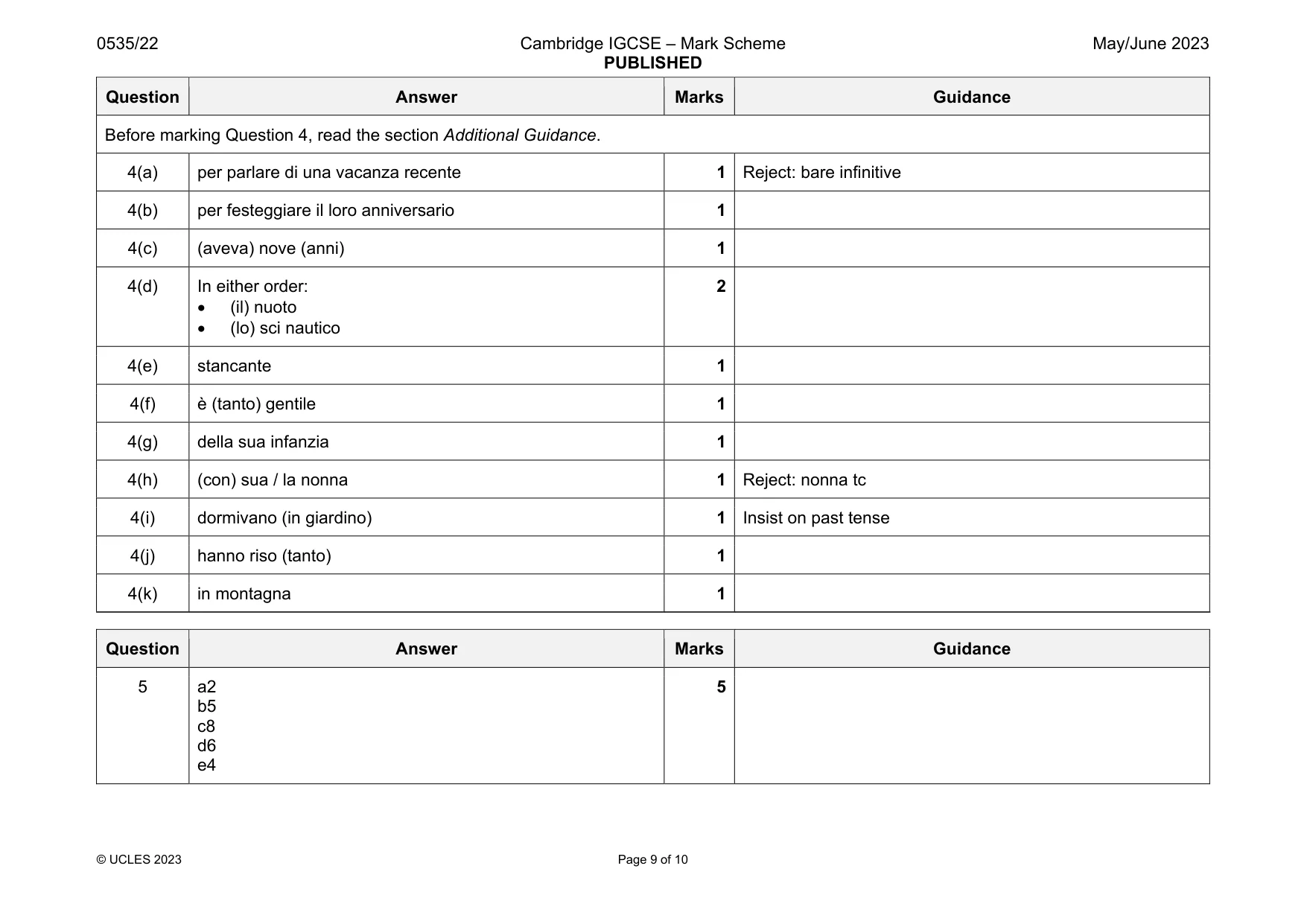
0535/22 Cambridge IGCSE – Mark Scheme PUBLISHED May/June 2023 © UCLES 2023 Page 9 of 10 Question Answer Marks Guidance Before marking Question 4, read the section Additional Guidance. 4(a) per parlare di una vacanza recente 1 Reject: bare infinitive 4(b) per festeggiare il loro anniversario 1 4(c) (aveva) nove (anni) 1 4(d) In either order: (il) nuoto (lo) sci nautico 2 4(e) stancante 1 4(f) è (tanto) gentile 1 4(g) della sua infanzia 1 4(h) (con) sua / la nonna 1 Reject: nonna tc 4(i) dormivano (in giardino) 1 Insist on past tense 4(j) hanno riso (tanto) 1 4(k) in montagna 1 Question Answer Marks Guidance 5 a2 b5 c8 d6 e4 5
Mark scheme, page 10
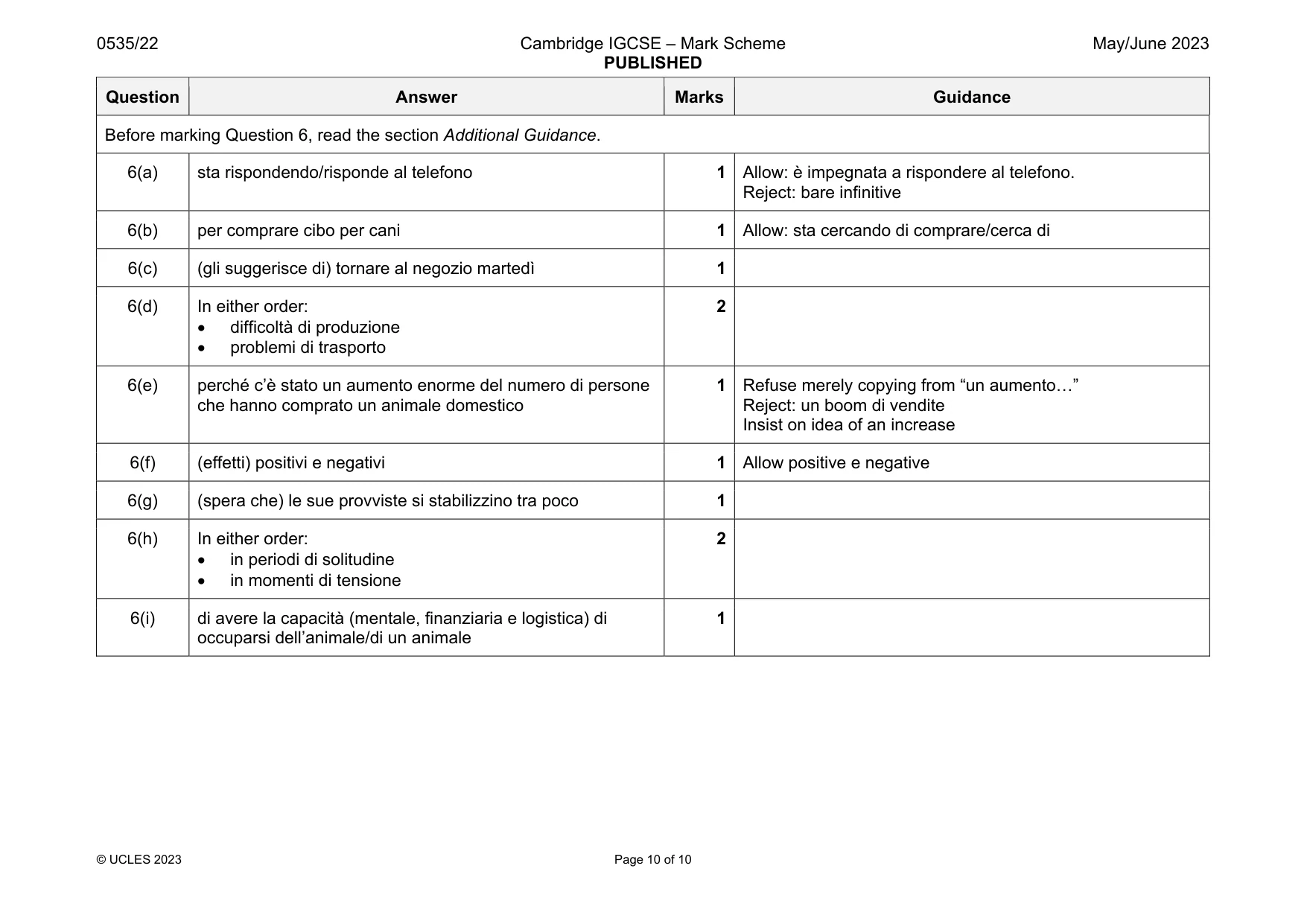
0535/22 Cambridge IGCSE – Mark Scheme PUBLISHED May/June 2023 © UCLES 2023 Page 10 of 10 Question Answer Marks Guidance Before marking Question 6, read the section Additional Guidance. 6(a) sta rispondendo/risponde al telefono 1 Allow: è impegnata a rispondere al telefono. Reject: bare infinitive 6(b) per comprare cibo per cani 1 Allow: sta cercando di comprare/cerca di 6(c) (gli suggerisce di) tornare al negozio martedì 1 6(d) In either order: difficoltà di produzione problemi di trasporto 2 6(e) perché c’è stato un aumento enorme del numero di persone che hanno comprato un animale domestico 1 Refuse merely copying from “un aumento…” Reject: un boom di vendite Insist on idea of an increase 6(f) (effetti) positivi e negativi 1 Allow positive e negative 6(g) (spera che) le sue provviste si stabilizzino tra poco 1 6(h) In either order: in periodi di solitudine in momenti di tensione 2 6(i) di avere la capacità (mentale, finanziaria e logistica) di occuparsi dell’animale/di un animale 1
What you needed in this session
Cambridge’s own grade thresholds for 2023 May/June, Paper 2 · Variant 2. A higher threshold means an easier paper — the bar moves with how the cohort did.