Cambridge IGCSE Italian - Foreign Language 0535 — 2023 May/June Paper 2 · Variant 1
0535/21/M/J/23 · 45 marks · ≈51 min
The question paper and its mark scheme, free to read here and free to download. This is Cambridge’s own paper, exactly as it was sat.
Question paper12 pages
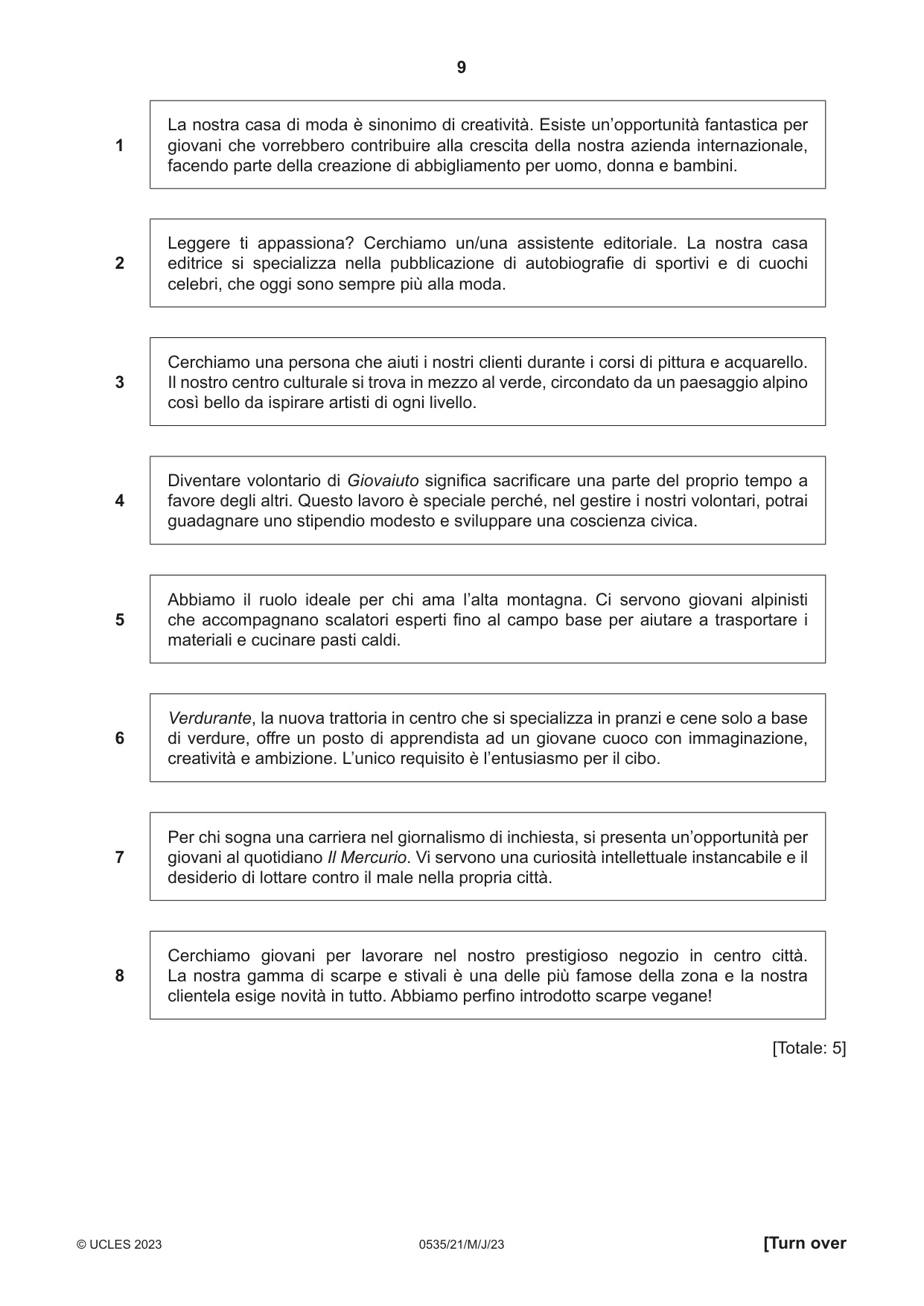
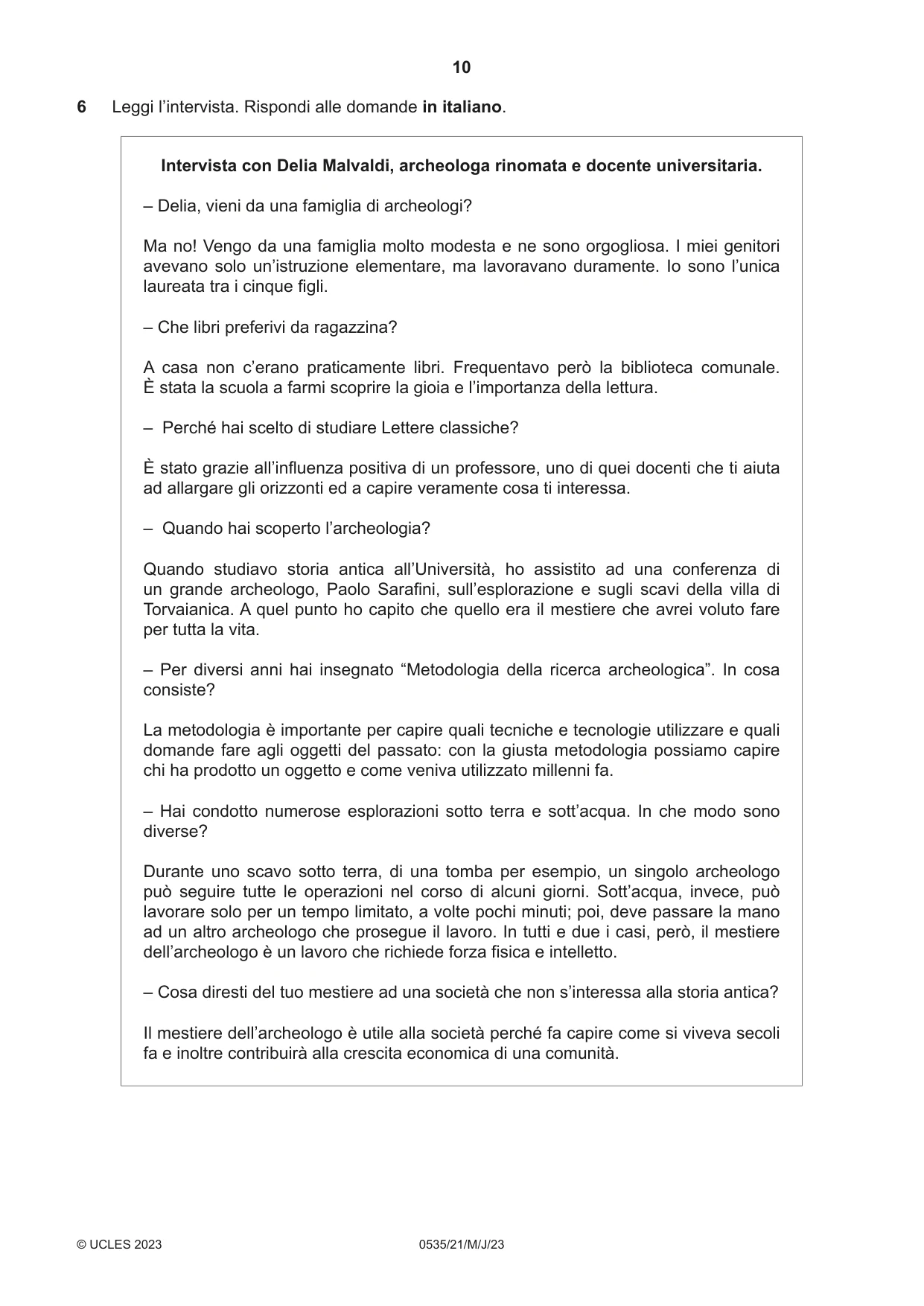
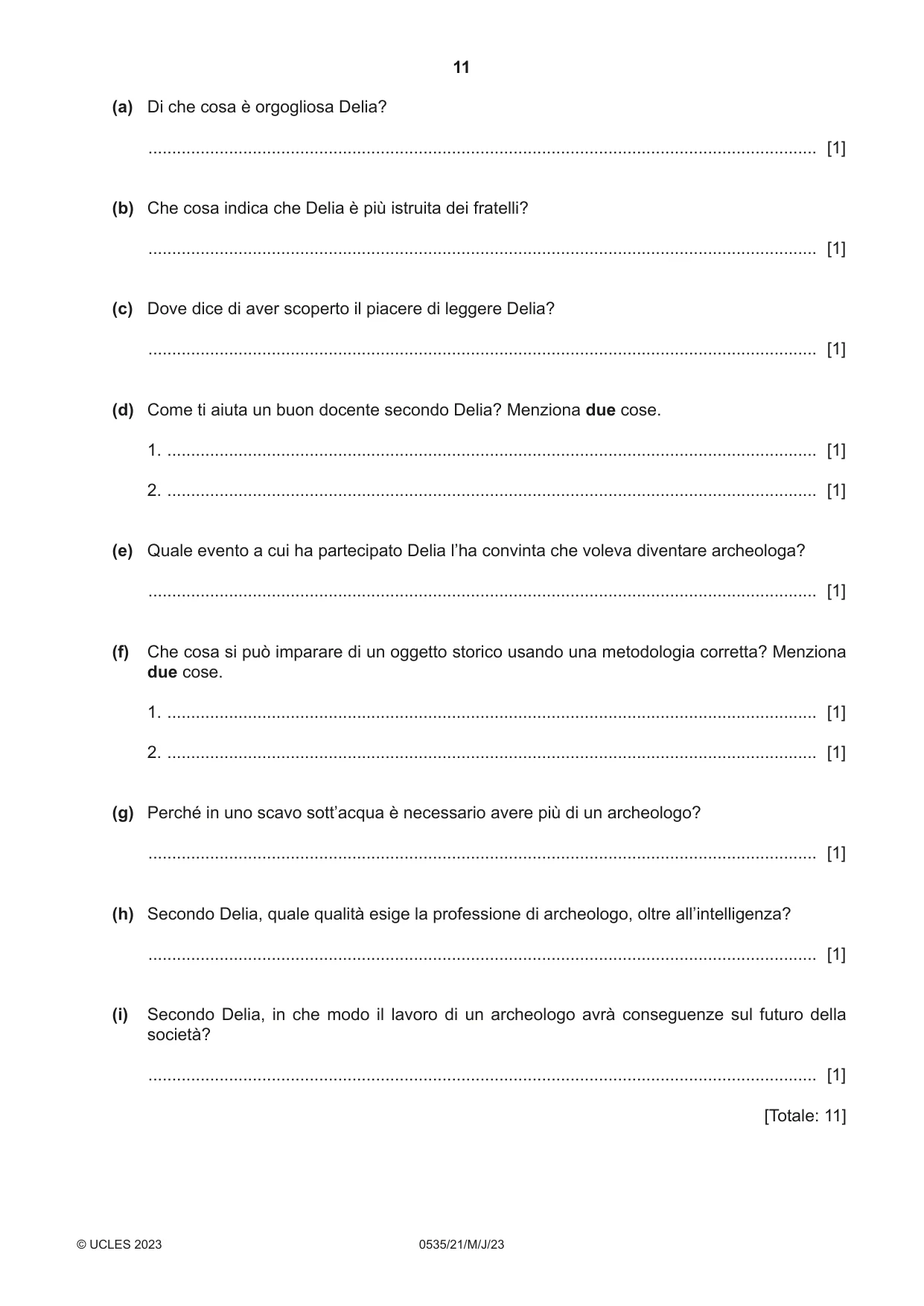

Mark scheme10 pages
Answers below. Sit the paper first if you are practising.
Paper as text
Question paper, page 1
This document has 12 pages. Any blank pages are indicated. [Turn over Cambridge IGCSE™ ITALIAN 0535/21 Paper 2 Reading May/June 2023 1 hour You must answer on the question paper. No additional materials are needed. INSTRUCTIONS ● Answer all questions. ● Use a black or dark blue pen. ● Write your name, centre number and candidate number in the boxes at the top of the page. ● Write your answer to each question in the space provided. ● Do not use an erasable pen or correction fluid. ● Do not write on any bar codes. ● Dictionaries are not allowed. INFORMATION ● The total mark for this paper is 45. ● The number of marks for each question or part question is shown in brackets [ ]. * 1 9 3 8 5 0 7 7 6 1 * DC (CJ/SG) 336737/2 © UCLES 2023
Question paper, page 2
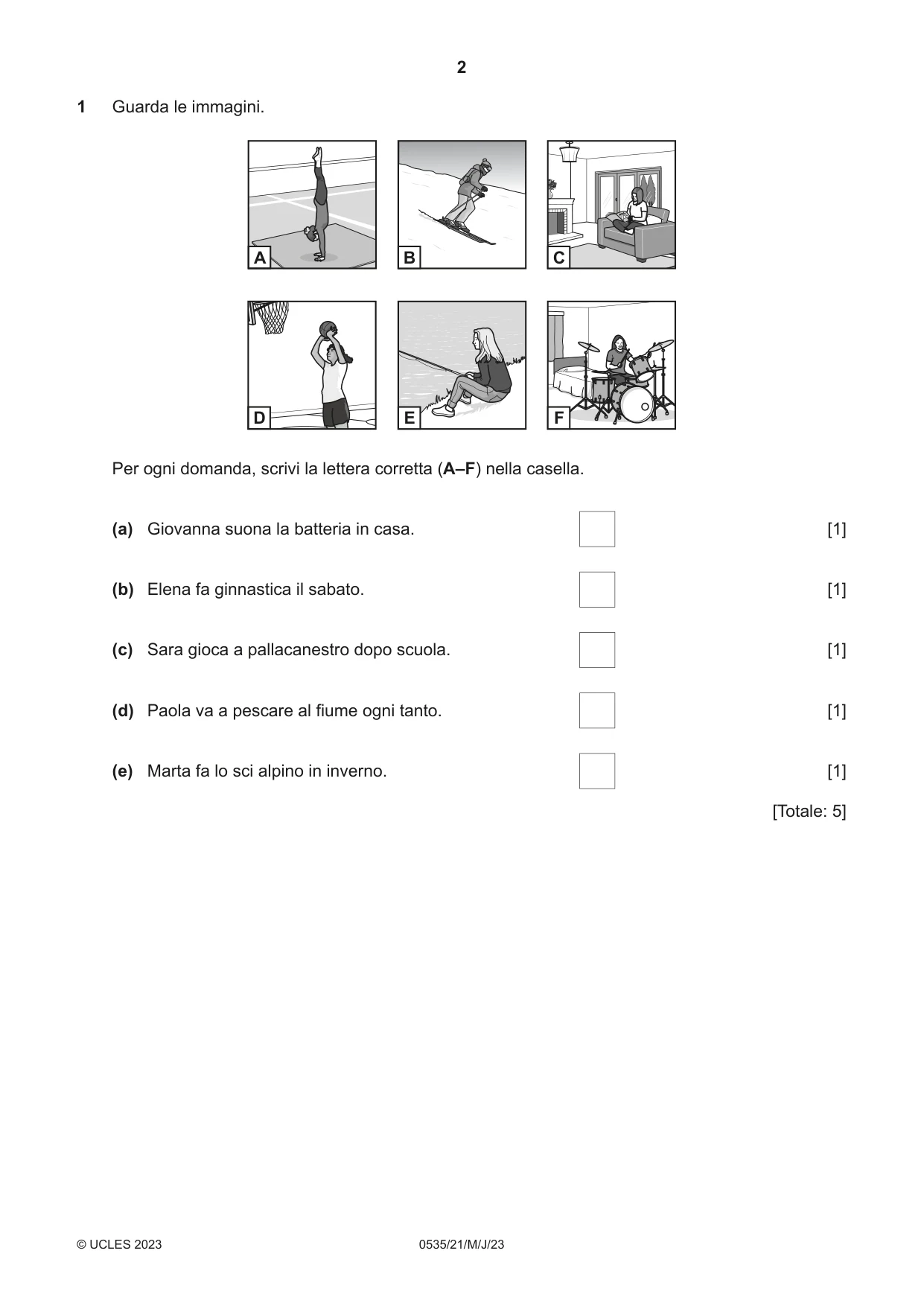
2 0535/21/M/J/23 © UCLES 2023 1 Guarda le immagini. B C E F A D Per ogni domanda, scrivi la lettera corretta (A–F) nella casella. (a) Giovanna suona la batteria in casa. [1] (b) Elena fa ginnastica il sabato. [1] (c) Sara gioca a pallacanestro dopo scuola. [1] (d) Paola va a pescare al fiume ogni tanto. [1] (e) Marta fa lo sci alpino in inverno. [1] [Totale: 5]
Question paper, page 3
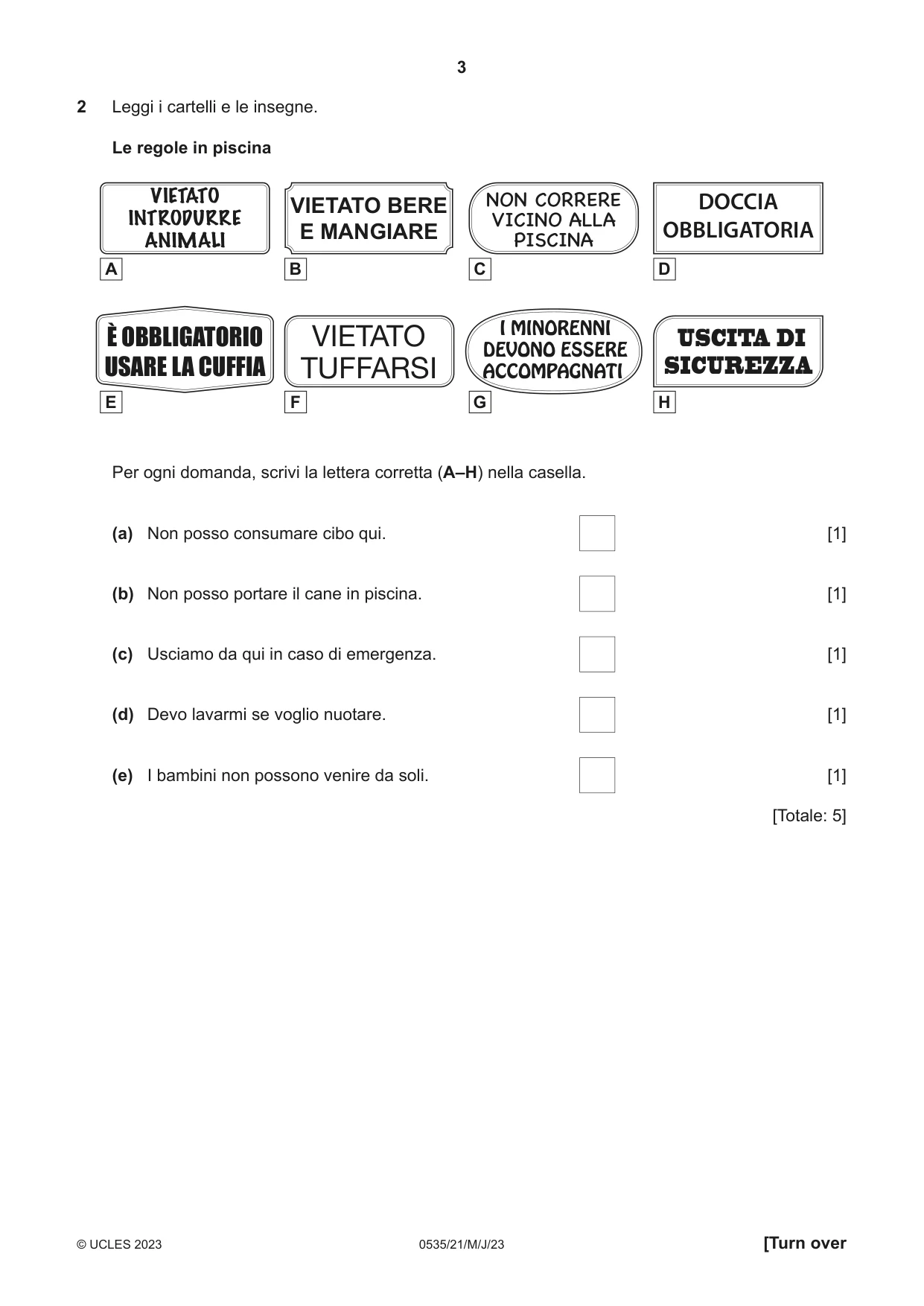
3 0535/21/M/J/23 © UCLES 2023 [Turn over 2 Leggi i cartelli e le insegne. Le regole in piscina A VIETATO BERE E MANGIARE B C D E F G H VIETATO INTRODURRE ANIMALI NON CORRERE VICINO ALLA PISCINA DOCCIA OBBLIGATORIA È OBBLIGATORIO USARE LA CUFFIA VIETATO TUFFARSI I MINORENNI DEVONO ESSERE ACCOMPAGNATI USCITA DI SICUREZZA Per ogni domanda, scrivi la lettera corretta (A–H) nella casella. (a) Non posso consumare cibo qui. [1] (b) Non posso portare il cane in piscina. [1] (c) Usciamo da qui in caso di emergenza. [1] (d) Devo lavarmi se voglio nuotare. [1] (e) I bambini non possono venire da soli. [1] [Totale: 5]
Question paper, page 4
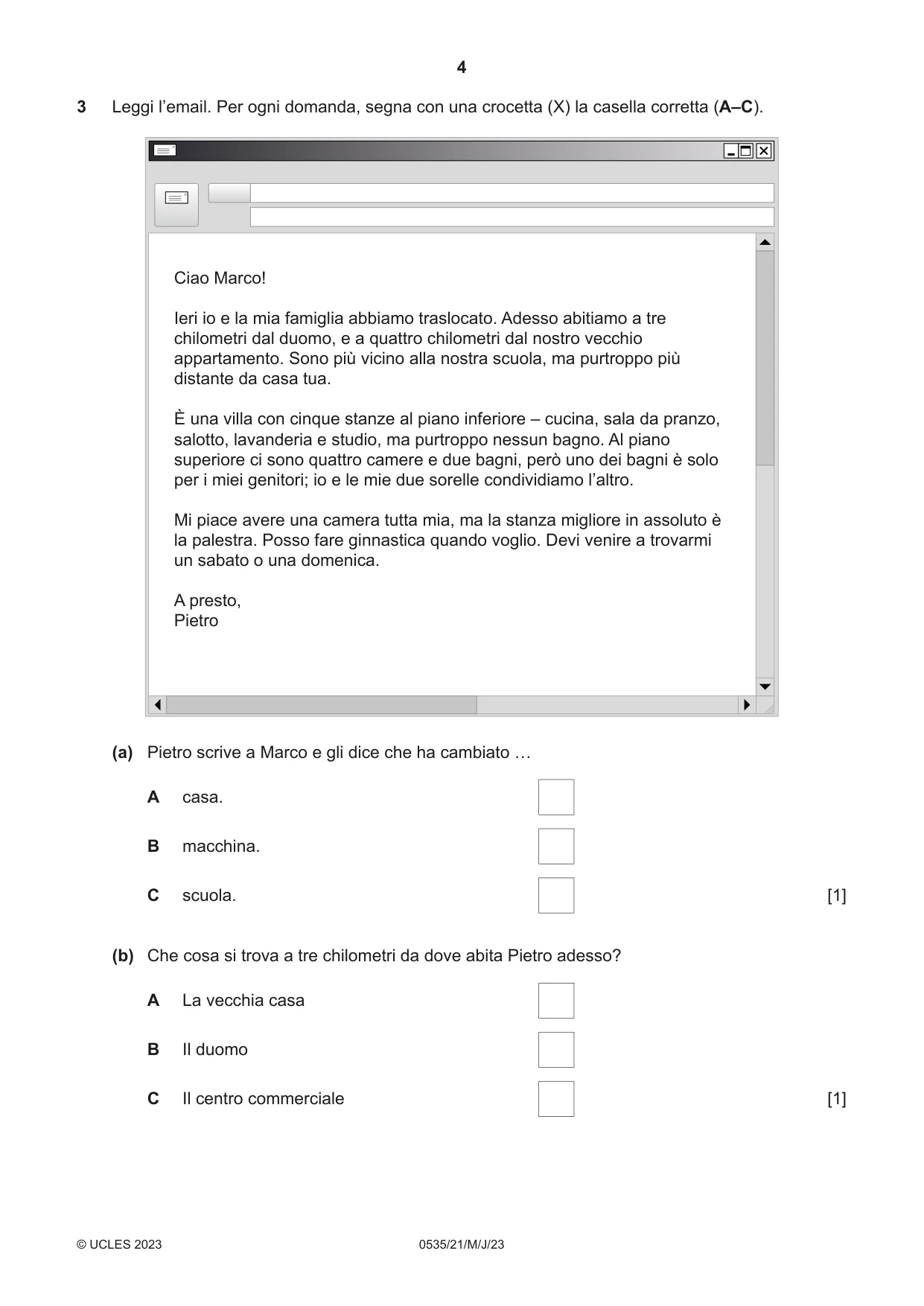
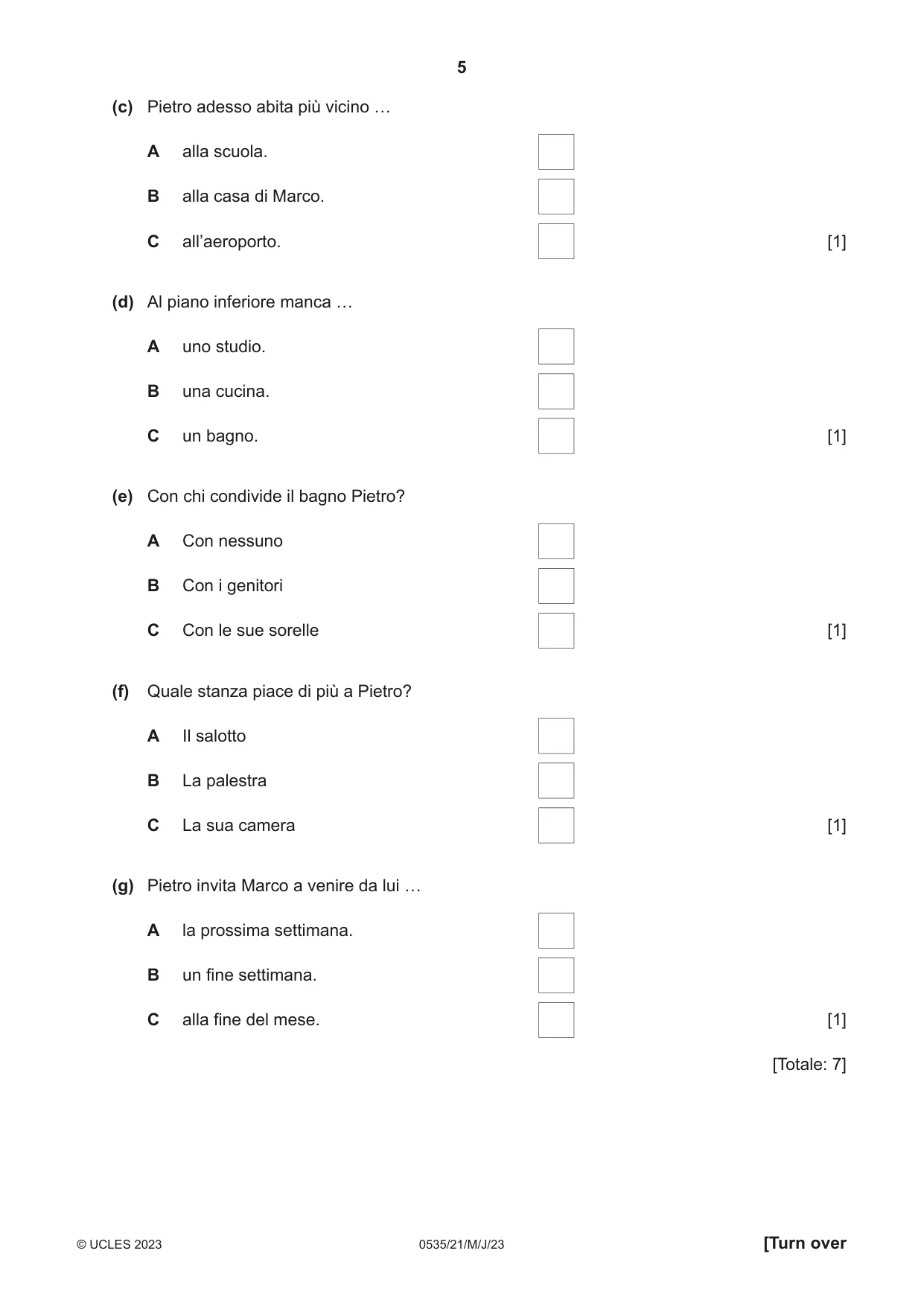
4 0535/21/M/J/23 © UCLES 2023 3 Leggi l’email. Per ogni domanda, segna con una crocetta (X) la casella corretta (A–C). (a) Pietro scrive a Marco e gli dice che ha cambiato … A casa. B macchina. C scuola. [1] (b) Che cosa si trova a tre chilometri da dove abita Pietro adesso? A La vecchia casa B Il duomo C Il centro commerciale [1] Ciao Marco! Ieri io e la mia famiglia abbiamo traslocato. Adesso abitiamo a tre chilometri dal duomo, e a quattro chilometri dal nostro vecchio appartamento. Sono più vicino alla nostra scuola, ma purtroppo più distante da casa tua. È una villa con cinque stanze al piano inferiore – cucina, sala da pranzo, salotto, lavanderia e studio, ma purtroppo nessun bagno. Al piano superiore ci sono quattro camere e due bagni, però uno dei bagni è solo per i miei genitori; io e le mie due sorelle condividiamo l’altro. Mi piace avere una camera tutta mia, ma la stanza migliore in assoluto è la palestra. Posso fare ginnastica quando voglio. Devi venire a trovarmi un sabato o una domenica. A presto, Pietro
Question paper, page 5
5 0535/21/M/J/23 © UCLES 2023 [Turn over (c) Pietro adesso abita più vicino … A alla scuola. B alla casa di Marco. C all’aeroporto. [1] (d) Al piano inferiore manca … A uno studio. B una cucina. C un bagno. [1] (e) Con chi condivide il bagno Pietro? A Con nessuno B Con i genitori C Con le sue sorelle [1] (f) Quale stanza piace di più a Pietro? A Il salotto B La palestra C La sua camera [1] (g) Pietro invita Marco a venire da lui … A la prossima settimana. B un fine settimana. C alla fine del mese. [1] [Totale: 7]
Question paper, page 6
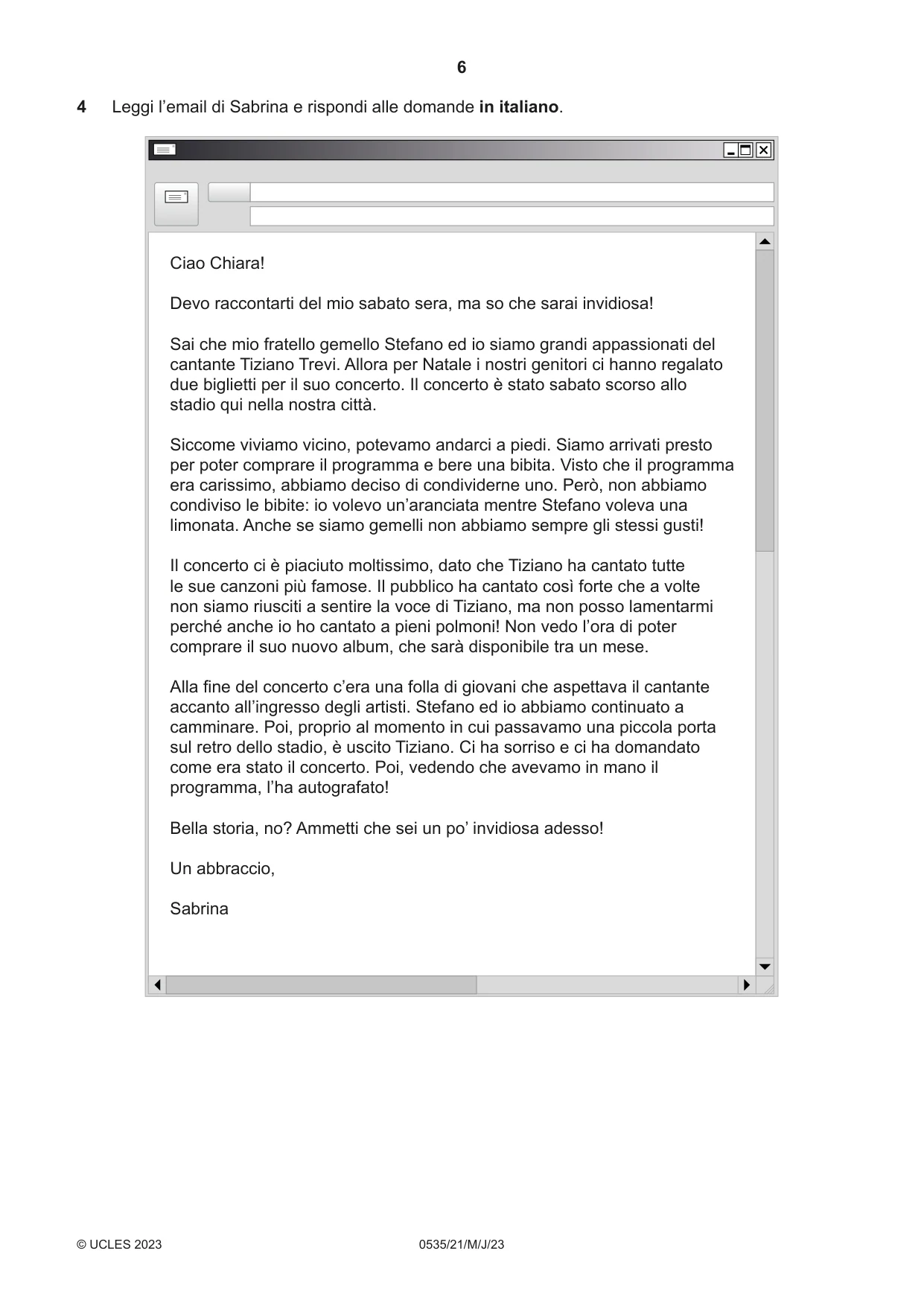
6 0535/21/M/J/23 © UCLES 2023 4 Leggi l’email di Sabrina e rispondi alle domande in italiano. Ciao Chiara! Devo raccontarti del mio sabato sera, ma so che sarai invidiosa! Sai che mio fratello gemello Stefano ed io siamo grandi appassionati del cantante Tiziano Trevi. Allora per Natale i nostri genitori ci hanno regalato due biglietti per il suo concerto. Il concerto è stato sabato scorso allo stadio qui nella nostra città. Siccome viviamo vicino, potevamo andarci a piedi. Siamo arrivati presto per poter comprare il programma e bere una bibita. Visto che il programma era carissimo, abbiamo deciso di condividerne uno. Però, non abbiamo condiviso le bibite: io volevo un’aranciata mentre Stefano voleva una limonata. Anche se siamo gemelli non abbiamo sempre gli stessi gusti! Il concerto ci è piaciuto moltissimo, dato che Tiziano ha cantato tutte le sue canzoni più famose. Il pubblico ha cantato così forte che a volte non siamo riusciti a sentire la voce di Tiziano, ma non posso lamentarmi perché anche io ho cantato a pieni polmoni! Non vedo l’ora di poter comprare il suo nuovo album, che sarà disponibile tra un mese. Alla fine del concerto c’era una folla di giovani che aspettava il cantante accanto all’ingresso degli artisti. Stefano ed io abbiamo continuato a camminare. Poi, proprio al momento in cui passavamo una piccola porta sul retro dello stadio, è uscito Tiziano. Ci ha sorriso e ci ha domandato come era stato il concerto. Poi, vedendo che avevamo in mano il programma, l’ha autografato! Bella storia, no? Ammetti che sei un po’ invidiosa adesso! Un abbraccio, Sabrina
Question paper, page 7
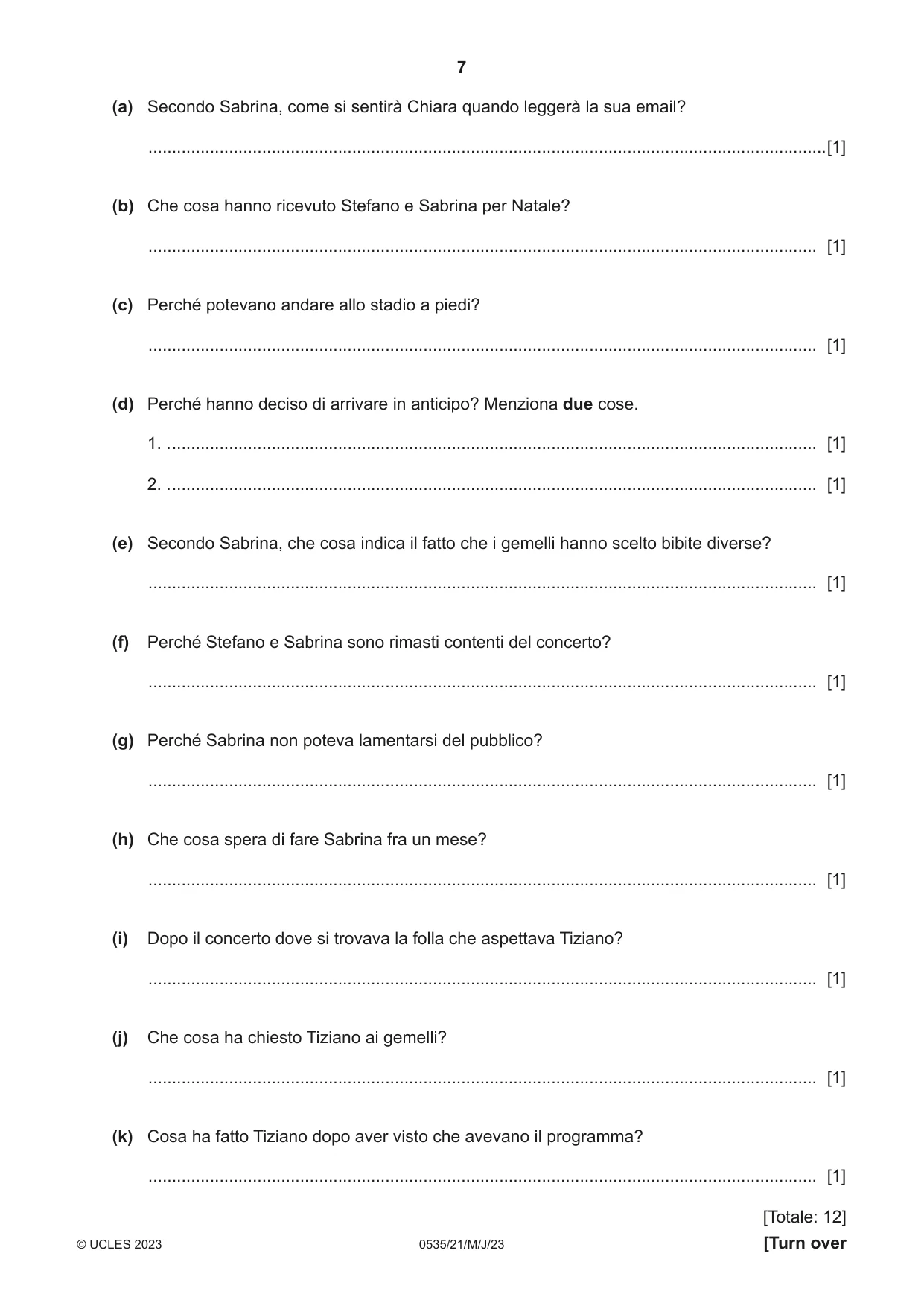
7 0535/21/M/J/23 © UCLES 2023 [Turn over (a) Secondo Sabrina, come si sentirà Chiara quando leggerà la sua email? …[1] (b) Che cosa hanno ricevuto Stefano e Sabrina per Natale? … [1] (c) Perché potevano andare allo stadio a piedi? … [1] (d) Perché hanno deciso di arrivare in anticipo? Menziona due cose. 1. . … [1] 2. . … [1] (e) Secondo Sabrina, che cosa indica il fatto che i gemelli hanno scelto bibite diverse? … [1] (f) Perché Stefano e Sabrina sono rimasti contenti del concerto? … [1] (g) Perché Sabrina non poteva lamentarsi del pubblico? … [1] (h) Che cosa spera di fare Sabrina fra un mese? … [1] (i) Dopo il concerto dove si trovava la folla che aspettava Tiziano? … [1] (j) Che cosa ha chiesto Tiziano ai gemelli? … [1] (k) Cosa ha fatto Tiziano dopo aver visto che avevano il programma? … [1] [Totale: 12]
Question paper, page 8
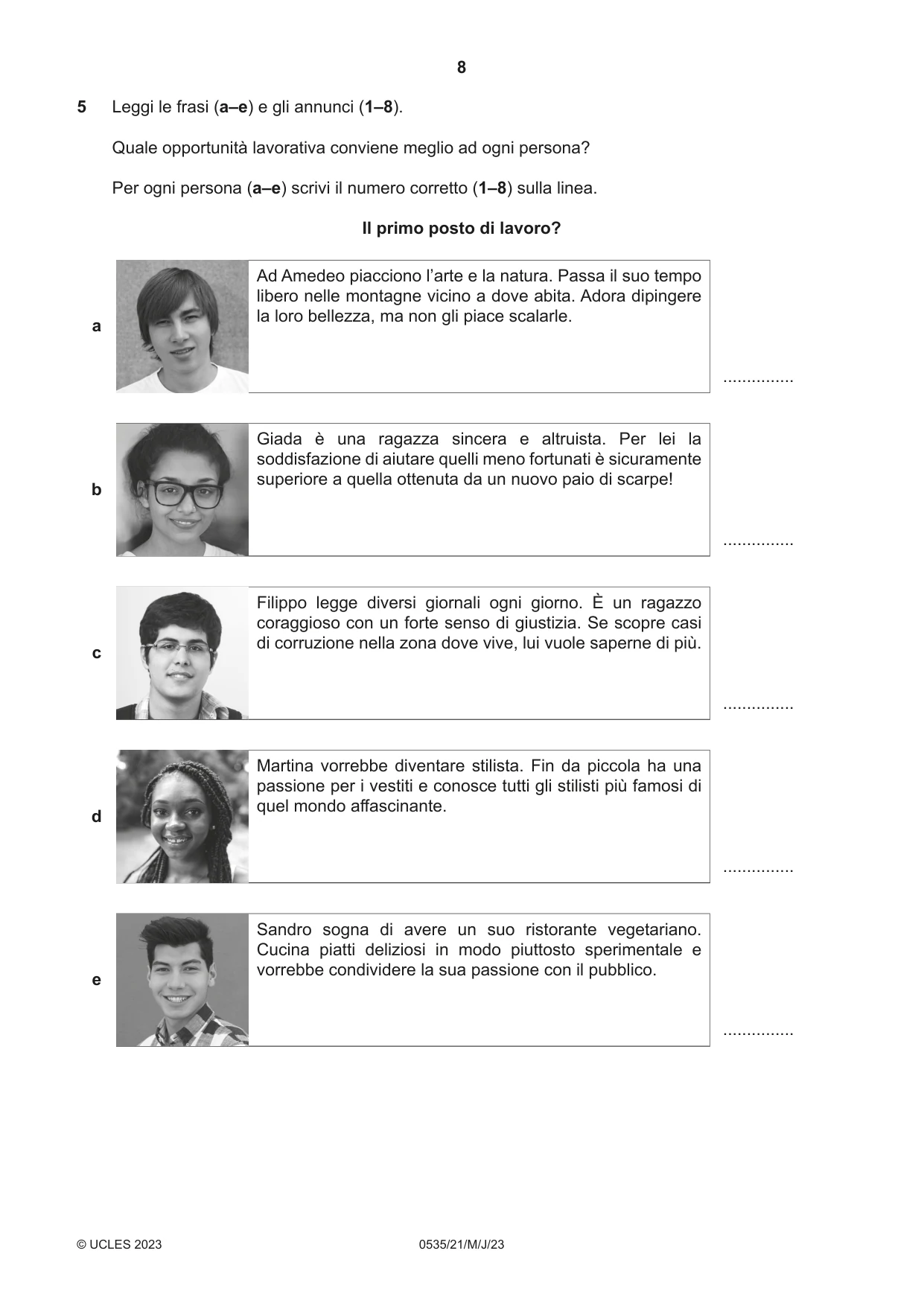
8 0535/21/M/J/23 © UCLES 2023 5 Leggi le frasi (a–e) e gli annunci (1–8). Quale opportunità lavorativa conviene meglio ad ogni persona? Per ogni persona (a–e) scrivi il numero corretto (1–8) sulla linea. Il primo posto di lavoro? a Ad Amedeo piacciono l’arte e la natura. Passa il suo tempo libero nelle montagne vicino a dove abita. Adora dipingere la loro bellezza, ma non gli piace scalarle. … b Giada è una ragazza sincera e altruista. Per lei la soddisfazione di aiutare quelli meno fortunati è sicuramente superiore a quella ottenuta da un nuovo paio di scarpe! … c Filippo legge diversi giornali ogni giorno. È un ragazzo coraggioso con un forte senso di giustizia. Se scopre casi di corruzione nella zona dove vive, lui vuole saperne di più. … d Martina vorrebbe diventare stilista. Fin da piccola ha una passione per i vestiti e conosce tutti gli stilisti più famosi di quel mondo affascinante. … e Sandro sogna di avere un suo ristorante vegetariano. Cucina piatti deliziosi in modo piuttosto sperimentale e vorrebbe condividere la sua passione con il pubblico. …
Question paper, page 9
9 0535/21/M/J/23 © UCLES 2023 [Turn over 1 La nostra casa di moda è sinonimo di creatività. Esiste un’opportunità fantastica per giovani che vorrebbero contribuire alla crescita della nostra azienda internazionale, facendo parte della creazione di abbigliamento per uomo, donna e bambini. 2 Leggere ti appassiona? Cerchiamo un/una assistente editoriale. La nostra casa editrice si specializza nella pubblicazione di autobiografie di sportivi e di cuochi celebri, che oggi sono sempre più alla moda. 3 Cerchiamo una persona che aiuti i nostri clienti durante i corsi di pittura e acquarello. Il nostro centro culturale si trova in mezzo al verde, circondato da un paesaggio alpino così bello da ispirare artisti di ogni livello. 4 Diventare volontario di Giovaiuto significa sacrificare una parte del proprio tempo a favore degli altri. Questo lavoro è speciale perché, nel gestire i nostri volontari, potrai guadagnare uno stipendio modesto e sviluppare una coscienza civica. 5 Abbiamo il ruolo ideale per chi ama l’alta montagna. Ci servono giovani alpinisti che accompagnano scalatori esperti fino al campo base per aiutare a trasportare i materiali e cucinare pasti caldi. 6 Verdurante, la nuova trattoria in centro che si specializza in pranzi e cene solo a base di verdure, offre un posto di apprendista ad un giovane cuoco con immaginazione, creatività e ambizione. L’unico requisito è l’entusiasmo per il cibo. 7 Per chi sogna una carriera nel giornalismo di inchiesta, si presenta un’opportunità per giovani al quotidiano Il Mercurio. Vi servono una curiosità intellettuale instancabile e il desiderio di lottare contro il male nella propria città. 8 Cerchiamo giovani per lavorare nel nostro prestigioso negozio in centro città. La nostra gamma di scarpe e stivali è una delle più famose della zona e la nostra clientela esige novità in tutto. Abbiamo perfino introdotto scarpe vegane! [Totale: 5]
Question paper, page 10
10 0535/21/M/J/23 © UCLES 2023 6 Leggi l’intervista. Rispondi alle domande in italiano. Intervista con Delia Malvaldi, archeologa rinomata e docente universitaria. – Delia, vieni da una famiglia di archeologi? Ma no! Vengo da una famiglia molto modesta e ne sono orgogliosa. I miei genitori avevano solo un’istruzione elementare, ma lavoravano duramente. Io sono l’unica laureata tra i cinque figli. – Che libri preferivi da ragazzina? A casa non c’erano praticamente libri. Frequentavo però la biblioteca comunale. È stata la scuola a farmi scoprire la gioia e l’importanza della lettura. – Perché hai scelto di studiare Lettere classiche? È stato grazie all’influenza positiva di un professore, uno di quei docenti che ti aiuta ad allargare gli orizzonti ed a capire veramente cosa ti interessa. – Quando hai scoperto l’archeologia? Quando studiavo storia antica all’Università, ho assistito ad una conferenza di un grande archeologo, Paolo Sarafini, sull’esplorazione e sugli scavi della villa di Torvaianica. A quel punto ho capito che quello era il mestiere che avrei voluto fare per tutta la vita. – Per diversi anni hai insegnato “Metodologia della ricerca archeologica”. In cosa consiste? La metodologia è importante per capire quali tecniche e tecnologie utilizzare e quali domande fare agli oggetti del passato: con la giusta metodologia possiamo capire chi ha prodotto un oggetto e come veniva utilizzato millenni fa. – Hai condotto numerose esplorazioni sotto terra e sott’acqua. In che modo sono diverse? Durante uno scavo sotto terra, di una tomba per esempio, un singolo archeologo può seguire tutte le operazioni nel corso di alcuni giorni. Sott’acqua, invece, può lavorare solo per un tempo limitato, a volte pochi minuti; poi, deve passare la mano ad un altro archeologo che prosegue il lavoro. In tutti e due i casi, però, il mestiere dell’archeologo è un lavoro che richiede forza fisica e intelletto. – Cosa diresti del tuo mestiere ad una società che non s’interessa alla storia antica? Il mestiere dell’archeologo è utile alla società perché fa capire come si viveva secoli fa e inoltre contribuirà alla crescita economica di una comunità.
Question paper, page 11
11 0535/21/M/J/23 © UCLES 2023 (a) Di che cosa è orgogliosa Delia? … [1] (b) Che cosa indica che Delia è più istruita dei fratelli? … [1] (c) Dove dice di aver scoperto il piacere di leggere Delia? … [1] (d) Come ti aiuta un buon docente secondo Delia? Menziona due cose. 1. … [1] 2. … [1] (e) Quale evento a cui ha partecipato Delia l’ha convinta che voleva diventare archeologa? … [1] (f) Che cosa si può imparare di un oggetto storico usando una metodologia corretta? Menziona due cose. 1. … [1] 2. … [1] (g) Perché in uno scavo sott’acqua è necessario avere più di un archeologo? … [1] (h) Secondo Delia, quale qualità esige la professione di archeologo, oltre all’intelligenza? … [1] (i) Secondo Delia, in che modo il lavoro di un archeologo avrà conseguenze sul futuro della società? … [1] [Totale: 11]
Question paper, page 12
12 0535/21/M/J/23 © UCLES 2023 Permission to reproduce items where third-party owned material protected by copyright is included has been sought and cleared where possible. Every reasonable effort has been made by the publisher (UCLES) to trace copyright holders, but if any items requiring clearance have unwittingly been included, the publisher will be pleased to make amends at the earliest possible opportunity. To avoid the issue of disclosure of answer-related information to candidates, all copyright acknowledgements are reproduced online in the Cambridge Assessment International Education Copyright Acknowledgements Booklet. This is produced for each series of examinations and is freely available to download at www.cambridgeinternational.org after the live examination series. Cambridge Assessment International Education is part of Cambridge Assessment. Cambridge Assessment is the brand name of the University of Cambridge Local Examinations Syndicate (UCLES), which is a department of the University of Cambridge. BLANK PAGE
Mark scheme, page 1
This document consists of 10 printed pages. © UCLES 2023 [Turn over Cambridge IGCSE™ ITALIAN 0535/21 Paper 2 Reading May/June 2023 MARK SCHEME Maximum Mark: 45 Published This mark scheme is published as an aid to teachers and candidates, to indicate the requirements of the examination. It shows the basis on which Examiners were instructed to award marks. It does not indicate the details of the discussions that took place at an Examiners’ meeting before marking began, which would have considered the acceptability of alternative answers. Mark schemes should be read in conjunction with the question paper and the Principal Examiner Report for Teachers. Cambridge International will not enter into discussions about these mark schemes. Cambridge International is publishing the mark schemes for the May/June 2023 series for most Cambridge IGCSE, Cambridge International A and AS Level and Cambridge Pre-U components, and some Cambridge O Level components.
Mark scheme, page 2
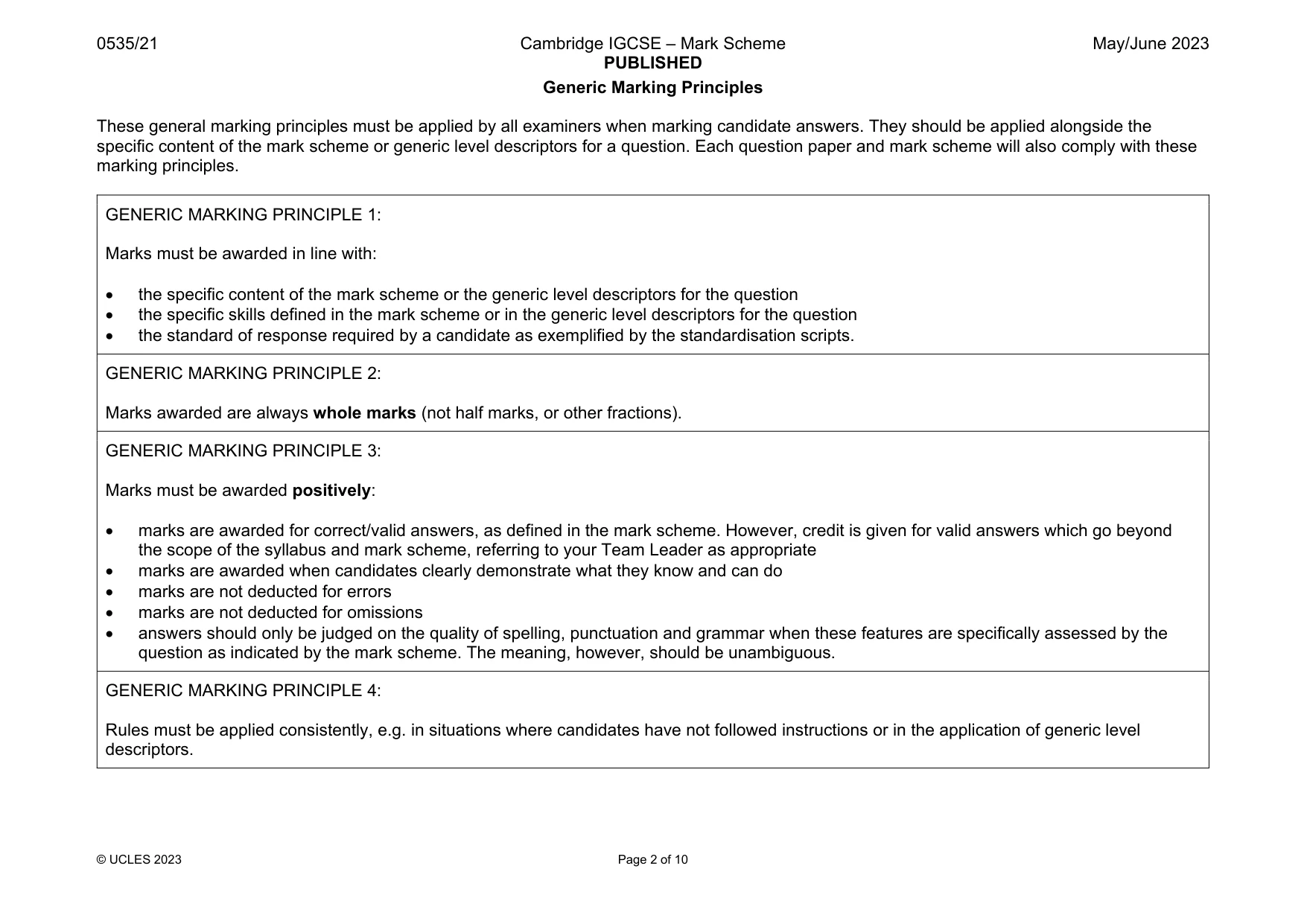
0535/21 Cambridge IGCSE – Mark Scheme PUBLISHED May/June 2023 © UCLES 2023 Page 2 of 10 Generic Marking Principles These general marking principles must be applied by all examiners when marking candidate answers. They should be applied alongside the specific content of the mark scheme or generic level descriptors for a question. Each question paper and mark scheme will also comply with these marking principles. GENERIC MARKING PRINCIPLE 1: Marks must be awarded in line with: the specific content of the mark scheme or the generic level descriptors for the question the specific skills defined in the mark scheme or in the generic level descriptors for the question the standard of response required by a candidate as exemplified by the standardisation scripts. GENERIC MARKING PRINCIPLE 2: Marks awarded are always whole marks (not half marks, or other fractions). GENERIC MARKING PRINCIPLE 3: Marks must be awarded positively: marks are awarded for correct/valid answers, as defined in the mark scheme. However, credit is given for valid answers which go beyond the scope of the syllabus and mark scheme, referring to your Team Leader as appropriate marks are awarded when candidates clearly demonstrate what they know and can do marks are not deducted for errors marks are not deducted for omissions answers should only be judged on the quality of spelling, punctuation and grammar when these features are specifically assessed by the question as indicated by the mark scheme. The meaning, however, should be unambiguous. GENERIC MARKING PRINCIPLE 4: Rules must be applied consistently, e.g. in situations where candidates have not followed instructions or in the application of generic level descriptors.
Mark scheme, page 3
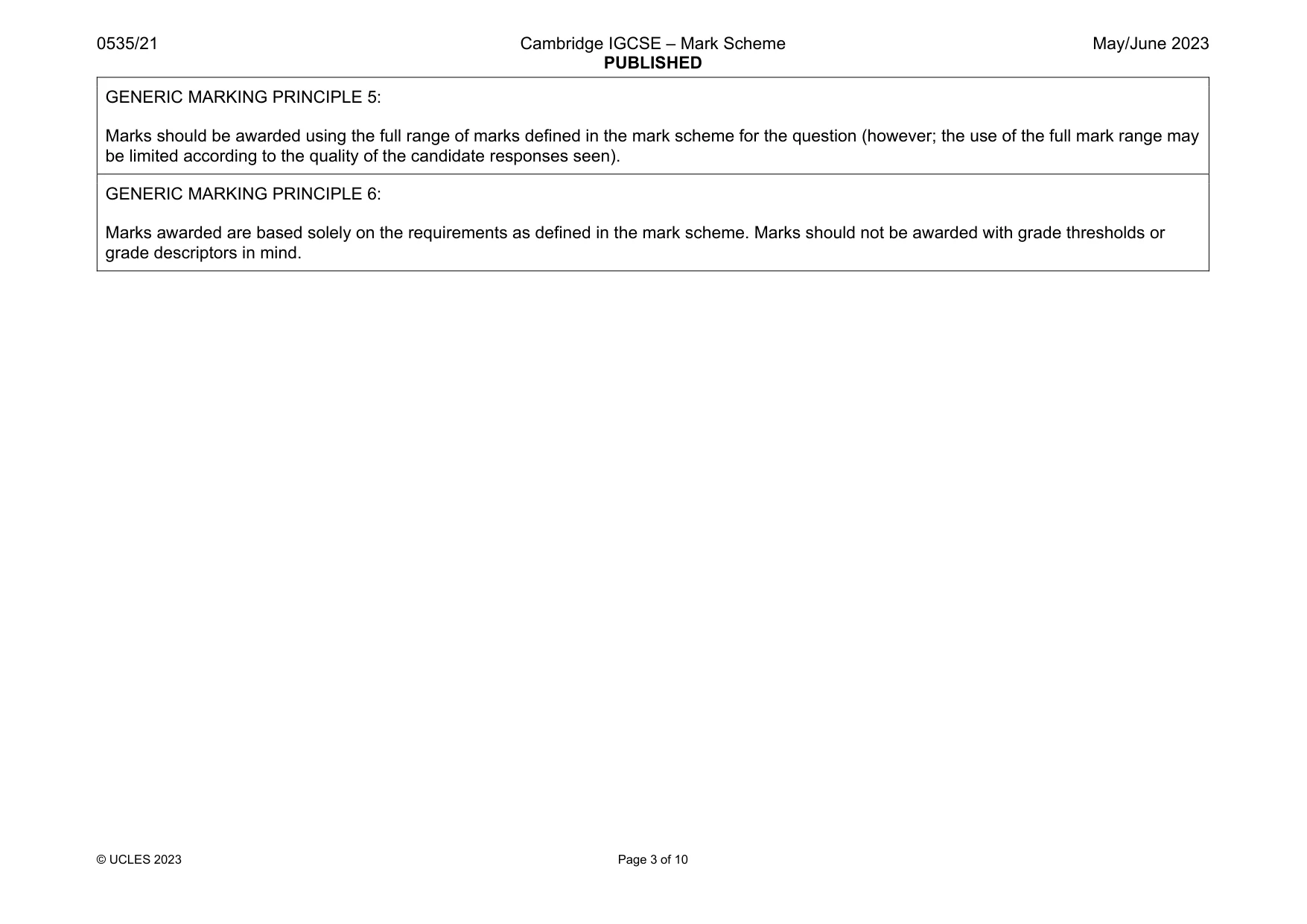
0535/21 Cambridge IGCSE – Mark Scheme PUBLISHED May/June 2023 © UCLES 2023 Page 3 of 10 GENERIC MARKING PRINCIPLE 5: Marks should be awarded using the full range of marks defined in the mark scheme for the question (however; the use of the full mark range may be limited according to the quality of the candidate responses seen). GENERIC MARKING PRINCIPLE 6: Marks awarded are based solely on the requirements as defined in the mark scheme. Marks should not be awarded with grade thresholds or grade descriptors in mind.
Mark scheme, page 4
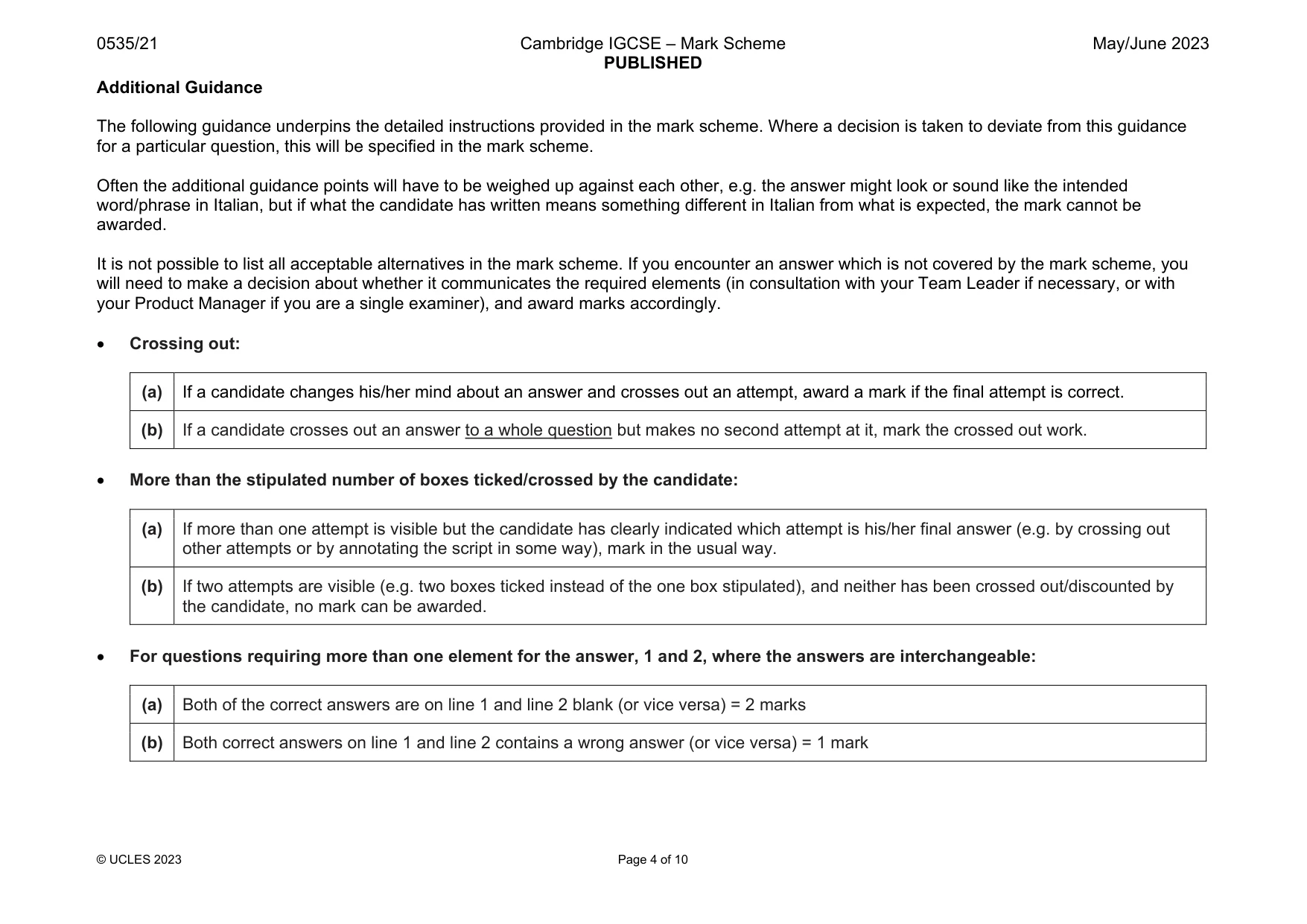
0535/21 Cambridge IGCSE – Mark Scheme PUBLISHED May/June 2023 © UCLES 2023 Page 4 of 10 Additional Guidance The following guidance underpins the detailed instructions provided in the mark scheme. Where a decision is taken to deviate from this guidance for a particular question, this will be specified in the mark scheme. Often the additional guidance points will have to be weighed up against each other, e.g. the answer might look or sound like the intended word/phrase in Italian, but if what the candidate has written means something different in Italian from what is expected, the mark cannot be awarded. It is not possible to list all acceptable alternatives in the mark scheme. If you encounter an answer which is not covered by the mark scheme, you will need to make a decision about whether it communicates the required elements (in consultation with your Team Leader if necessary, or with your Product Manager if you are a single examiner), and award marks accordingly. Crossing out: (a) If a candidate changes his/her mind about an answer and crosses out an attempt, award a mark if the final attempt is correct. (b) If a candidate crosses out an answer to a whole question but makes no second attempt at it, mark the crossed out work. More than the stipulated number of boxes ticked/crossed by the candidate: (a) If more than one attempt is visible but the candidate has clearly indicated which attempt is his/her final answer (e.g. by crossing out other attempts or by annotating the script in some way), mark in the usual way. (b) If two attempts are visible (e.g. two boxes ticked instead of the one box stipulated), and neither has been crossed out/discounted by the candidate, no mark can be awarded. For questions requiring more than one element for the answer, 1 and 2, where the answers are interchangeable: (a) Both of the correct answers are on line 1 and line 2 blank (or vice versa) = 2 marks (b) Both correct answers on line 1 and line 2 contains a wrong answer (or vice versa) = 1 mark
Mark scheme, page 5
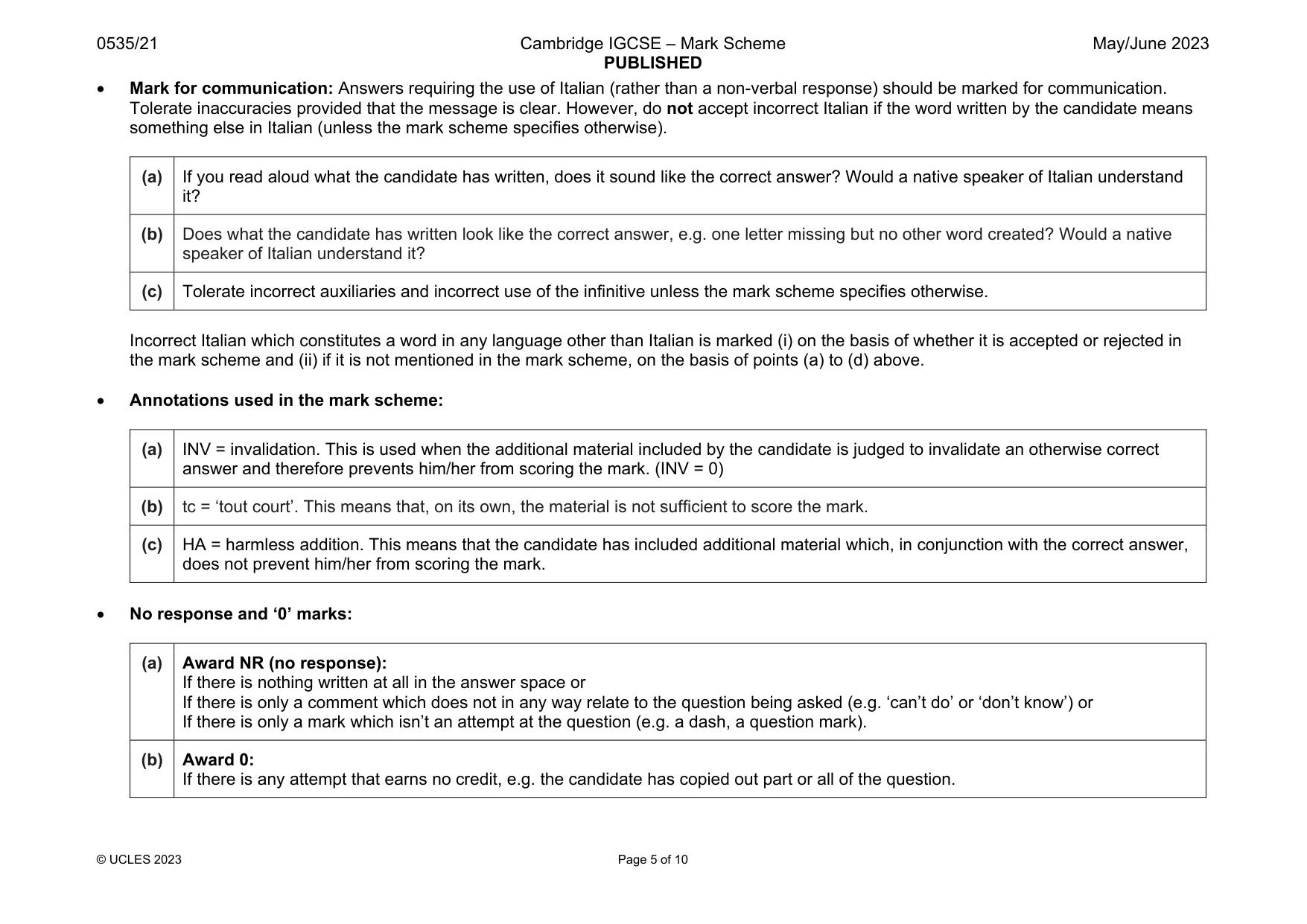
0535/21 Cambridge IGCSE – Mark Scheme PUBLISHED May/June 2023 © UCLES 2023 Page 5 of 10 Mark for communication: Answers requiring the use of Italian (rather than a non-verbal response) should be marked for communication. Tolerate inaccuracies provided that the message is clear. However, do not accept incorrect Italian if the word written by the candidate means something else in Italian (unless the mark scheme specifies otherwise). (a) If you read aloud what the candidate has written, does it sound like the correct answer? Would a native speaker of Italian understand it? (b) Does what the candidate has written look like the correct answer, e.g. one letter missing but no other word created? Would a native speaker of Italian understand it? (c) Tolerate incorrect auxiliaries and incorrect use of the infinitive unless the mark scheme specifies otherwise. Incorrect Italian which constitutes a word in any language other than Italian is marked (i) on the basis of whether it is accepted or rejected in the mark scheme and (ii) if it is not mentioned in the mark scheme, on the basis of points (a) to (d) above. Annotations used in the mark scheme: (a) INV = invalidation. This is used when the additional material included by the candidate is judged to invalidate an otherwise correct answer and therefore prevents him/her from scoring the mark. (INV = 0) (b) tc = ‘tout court’. This means that, on its own, the material is not sufficient to score the mark. (c) HA = harmless addition. This means that the candidate has included additional material which, in conjunction with the correct answer, does not prevent him/her from scoring the mark. No response and ‘0’ marks: (a) Award NR (no response): If there is nothing written at all in the answer space or If there is only a comment which does not in any way relate to the question being asked (e.g. ‘can’t do’ or ‘don’t know’) or If there is only a mark which isn’t an attempt at the question (e.g. a dash, a question mark). (b) Award 0: If there is any attempt that earns no credit, e.g. the candidate has copied out part or all of the question.
Mark scheme, page 6
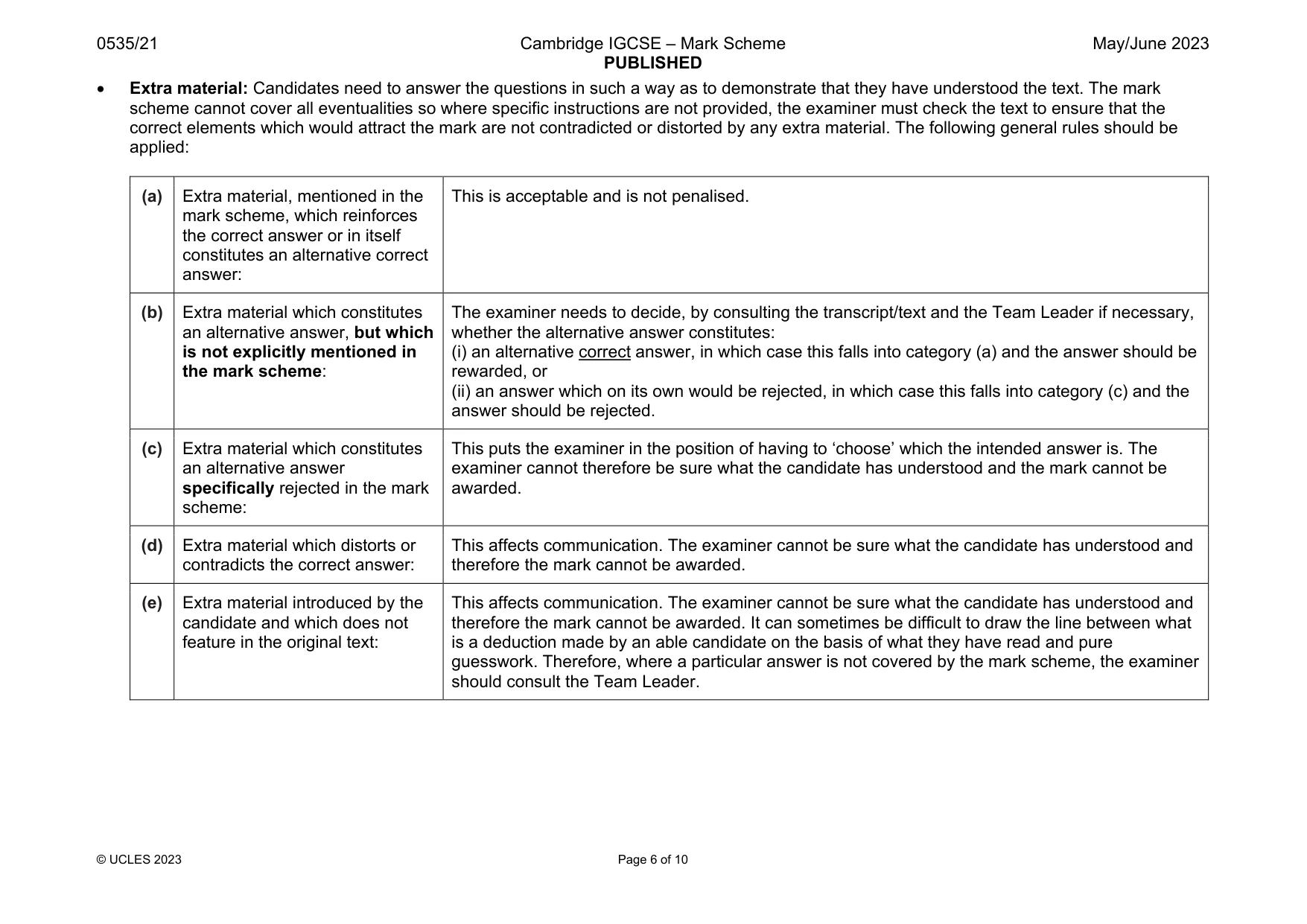
0535/21 Cambridge IGCSE – Mark Scheme PUBLISHED May/June 2023 © UCLES 2023 Page 6 of 10 Extra material: Candidates need to answer the questions in such a way as to demonstrate that they have understood the text. The mark scheme cannot cover all eventualities so where specific instructions are not provided, the examiner must check the text to ensure that the correct elements which would attract the mark are not contradicted or distorted by any extra material. The following general rules should be applied: (a) Extra material, mentioned in the mark scheme, which reinforces the correct answer or in itself constitutes an alternative correct answer: This is acceptable and is not penalised. (b) Extra material which constitutes an alternative answer, but which is not explicitly mentioned in the mark scheme: The examiner needs to decide, by consulting the transcript/text and the Team Leader if necessary, whether the alternative answer constitutes: (i) an alternative correct answer, in which case this falls into category (a) and the answer should be rewarded, or (ii) an answer which on its own would be rejected, in which case this falls into category (c) and the answer should be rejected. (c) Extra material which constitutes an alternative answer specifically rejected in the mark scheme: This puts the examiner in the position of having to ‘choose’ which the intended answer is. The examiner cannot therefore be sure what the candidate has understood and the mark cannot be awarded. (d) Extra material which distorts or contradicts the correct answer: This affects communication. The examiner cannot be sure what the candidate has understood and therefore the mark cannot be awarded. (e) Extra material introduced by the candidate and which does not feature in the original text: This affects communication. The examiner cannot be sure what the candidate has understood and therefore the mark cannot be awarded. It can sometimes be difficult to draw the line between what is a deduction made by an able candidate on the basis of what they have read and pure guesswork. Therefore, where a particular answer is not covered by the mark scheme, the examiner should consult the Team Leader.
Mark scheme, page 7
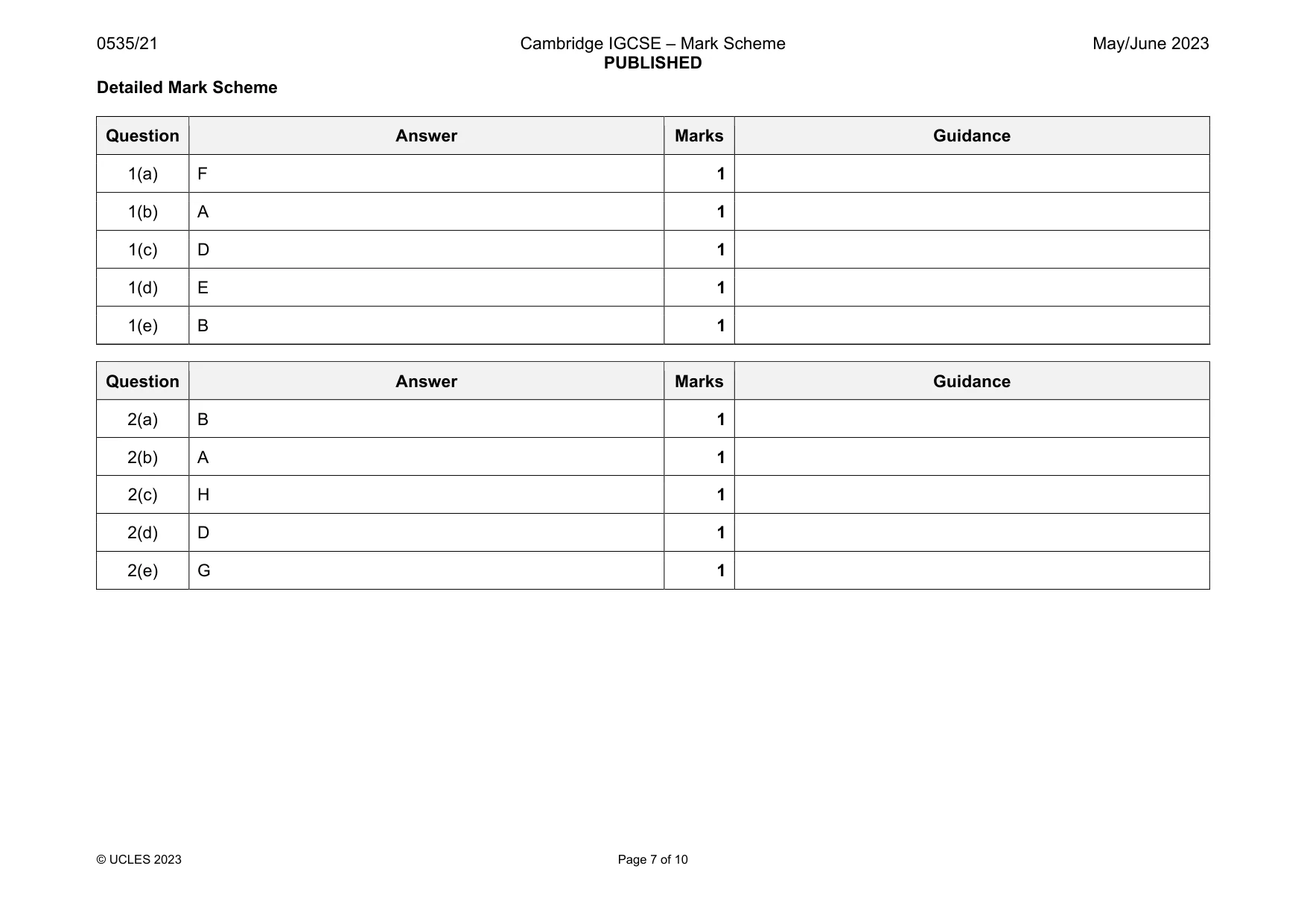
0535/21 Cambridge IGCSE – Mark Scheme PUBLISHED May/June 2023 © UCLES 2023 Page 7 of 10 Detailed Mark Scheme Question Answer Marks Guidance 1(a) F 1 1(b) A 1 1(c) D 1 1(d) E 1 1(e) B 1 Question Answer Marks Guidance 2(a) B 1 2(b) A 1 2(c) H 1 2(d) D 1 2(e) G 1
Mark scheme, page 8
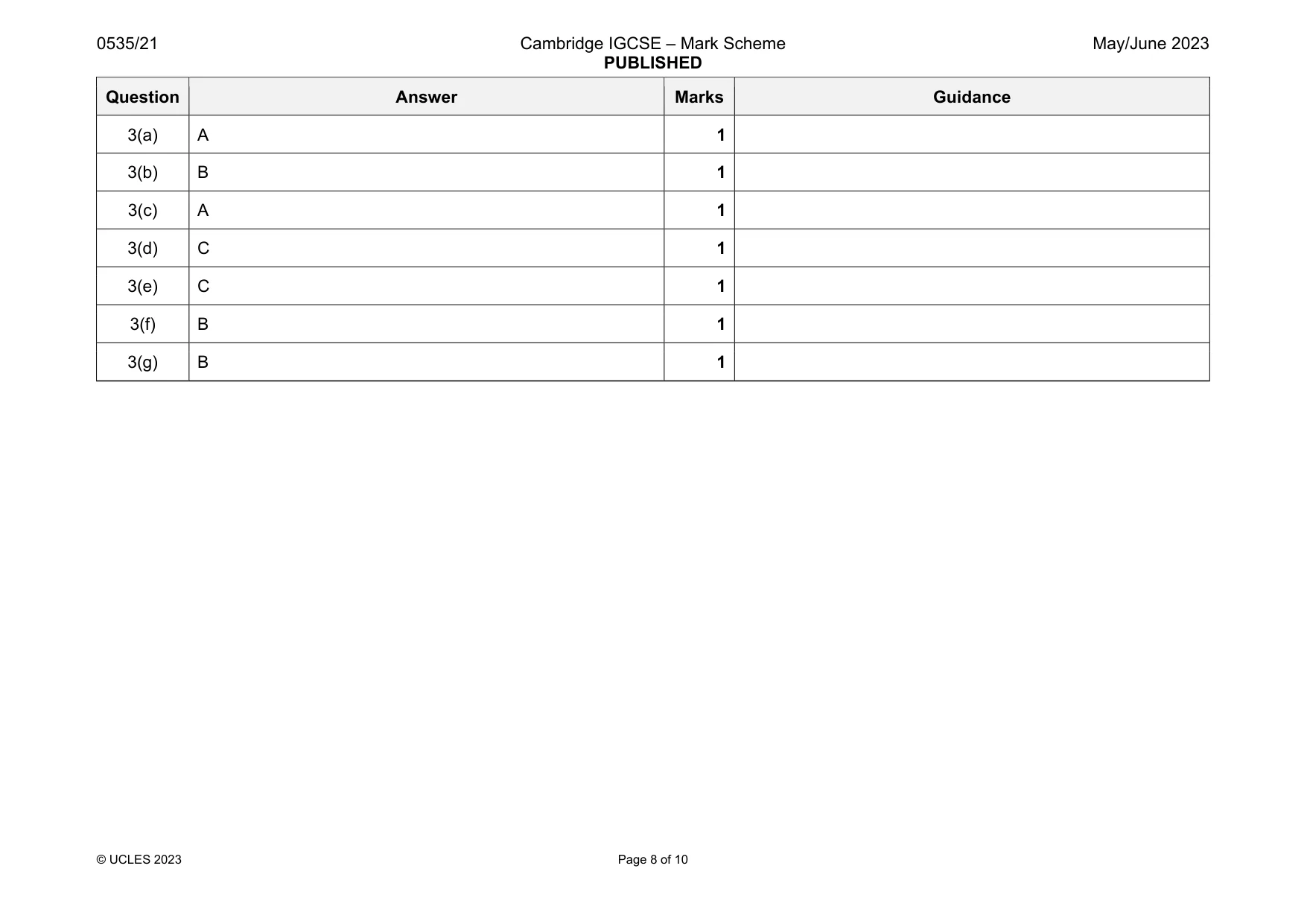
0535/21 Cambridge IGCSE – Mark Scheme PUBLISHED May/June 2023 © UCLES 2023 Page 8 of 10 Question Answer Marks Guidance 3(a) A 1 3(b) B 1 3(c) A 1 3(d) C 1 3(e) C 1 3(f) B 1 3(g) B 1
Mark scheme, page 9
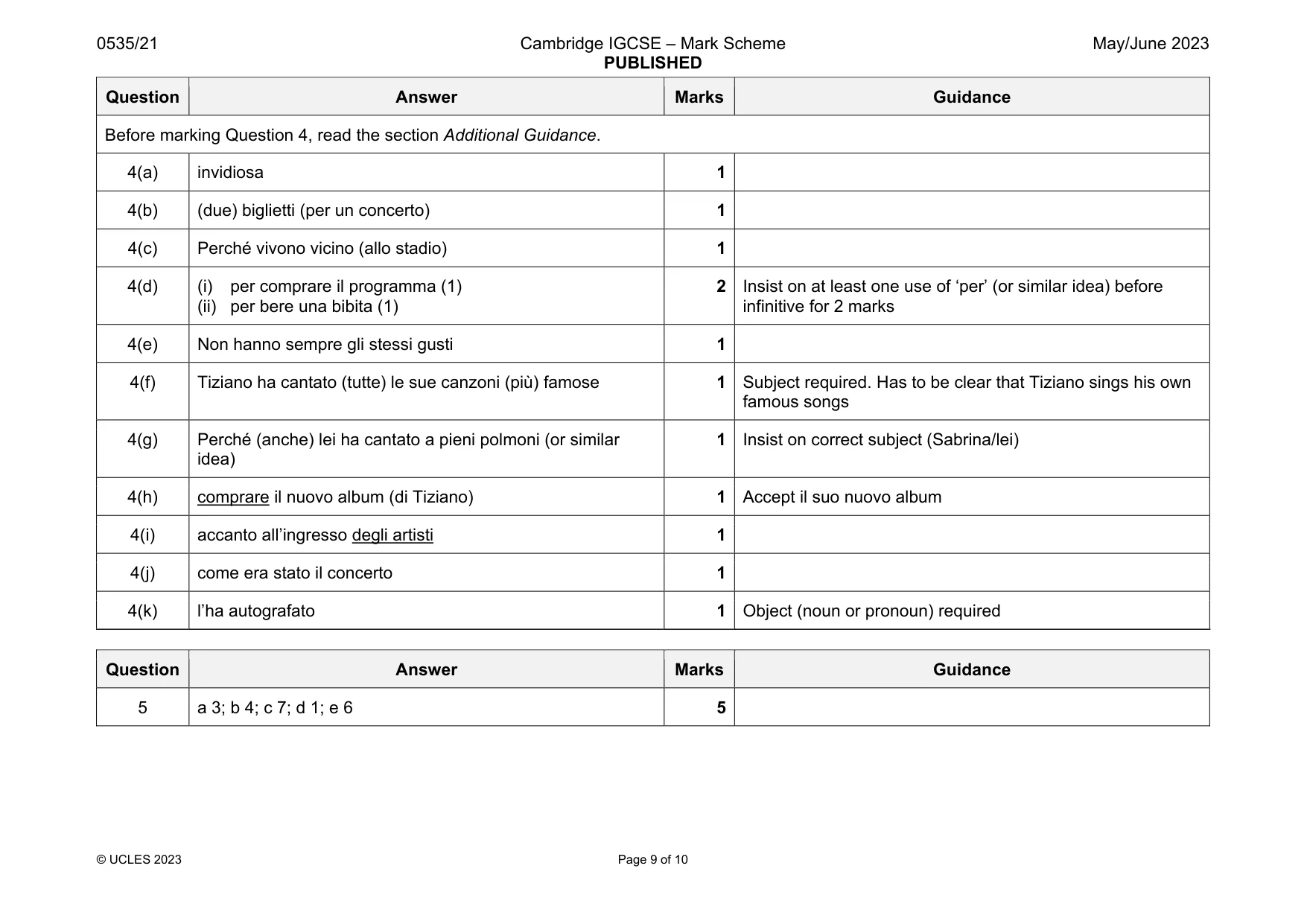
0535/21 Cambridge IGCSE – Mark Scheme PUBLISHED May/June 2023 © UCLES 2023 Page 9 of 10 Question Answer Marks Guidance Before marking Question 4, read the section Additional Guidance. 4(a) invidiosa 1 4(b) (due) biglietti (per un concerto) 1 4(c) Perché vivono vicino (allo stadio) 1 4(d) (i) per comprare il programma (1) (ii) per bere una bibita (1) 2 Insist on at least one use of ‘per’ (or similar idea) before infinitive for 2 marks 4(e) Non hanno sempre gli stessi gusti 1 4(f) Tiziano ha cantato (tutte) le sue canzoni (più) famose 1 Subject required. Has to be clear that Tiziano sings his own famous songs 4(g) Perché (anche) lei ha cantato a pieni polmoni (or similar idea) 1 Insist on correct subject (Sabrina/lei) 4(h) comprare il nuovo album (di Tiziano) 1 Accept il suo nuovo album 4(i) accanto all’ingresso degli artisti 1 4(j) come era stato il concerto 1 4(k) l’ha autografato 1 Object (noun or pronoun) required Question Answer Marks Guidance 5 a 3; b 4; c 7; d 1; e 6 5
Mark scheme, page 10
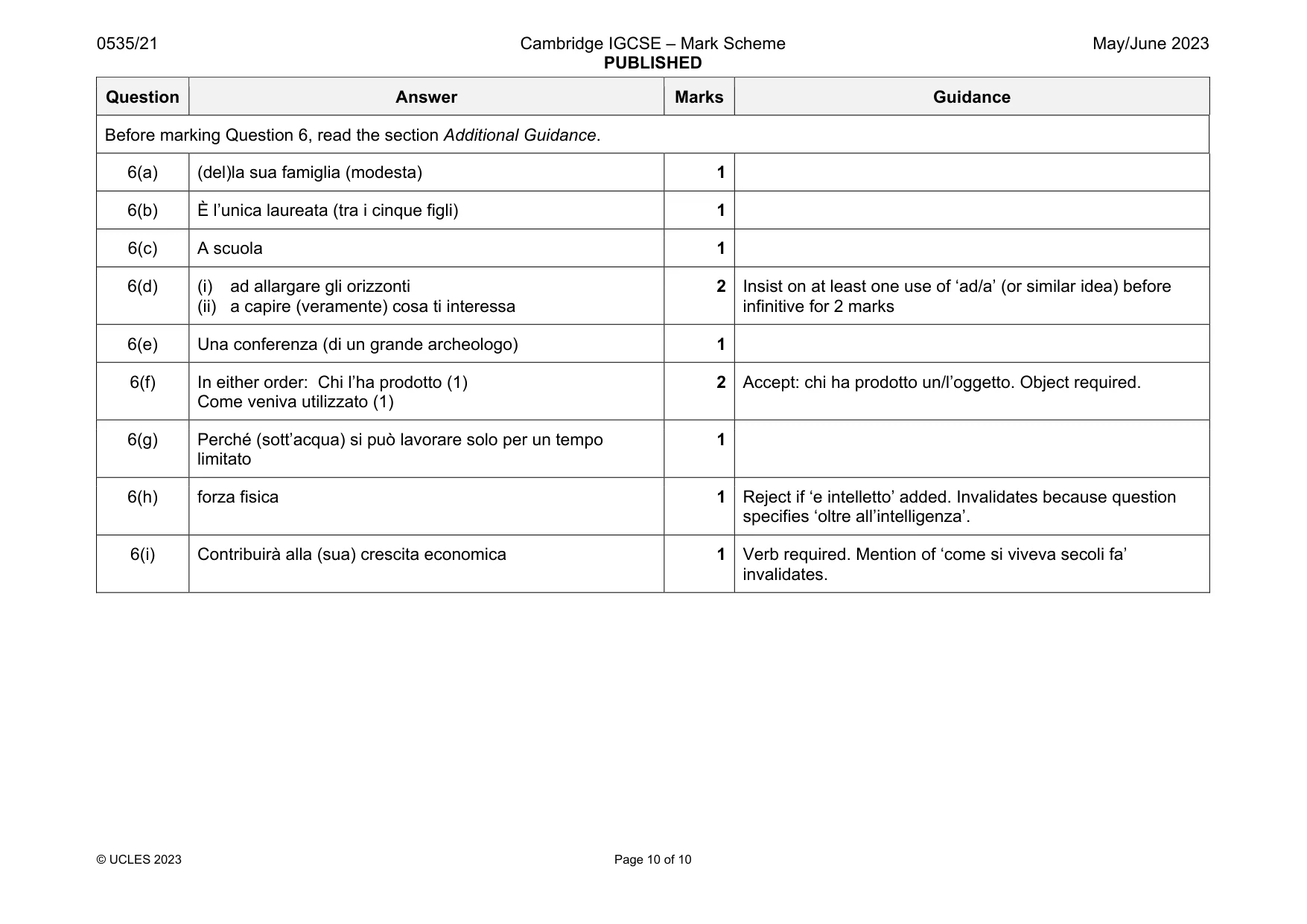
0535/21 Cambridge IGCSE – Mark Scheme PUBLISHED May/June 2023 © UCLES 2023 Page 10 of 10 Question Answer Marks Guidance Before marking Question 6, read the section Additional Guidance. 6(a) (del)la sua famiglia (modesta) 1 6(b) È l’unica laureata (tra i cinque figli) 1 6(c) A scuola 1 6(d) (i) ad allargare gli orizzonti (ii) a capire (veramente) cosa ti interessa 2 Insist on at least one use of ‘ad/a’ (or similar idea) before infinitive for 2 marks 6(e) Una conferenza (di un grande archeologo) 1 6(f) In either order: Chi l’ha prodotto (1) Come veniva utilizzato (1) 2 Accept: chi ha prodotto un/l’oggetto. Object required. 6(g) Perché (sott’acqua) si può lavorare solo per un tempo limitato 1 6(h) forza fisica 1 Reject if ‘e intelletto’ added. Invalidates because question specifies ‘oltre all’intelligenza’. 6(i) Contribuirà alla (sua) crescita economica 1 Verb required. Mention of ‘come si viveva secoli fa’ invalidates.
What you needed in this session
Cambridge’s own grade thresholds for 2023 May/June, Paper 2 · Variant 1. A higher threshold means an easier paper — the bar moves with how the cohort did.