Cambridge IGCSE Italian - Foreign Language 0535 — 2019 May/June Paper 2 · Variant 1
0535/21/M/J/19 · 45 marks · ≈51 min
The question paper and its mark scheme, free to read here and free to download. This is Cambridge’s own paper, exactly as it was sat.
Question paper16 pages


Mark scheme15 pages
Answers below. Sit the paper first if you are practising.
Paper as text
Question paper, page 1
This document consists of 14 printed pages and 2 blank pages. DC (SC/SW) 166626/2 © UCLES 2019 [Turn over * 5 0 7 5 0 4 0 2 3 8 * ITALIAN 0535/02 Paper 2 Reading May/June 2019 1 hour Candidates answer on the Question Paper. No Additional Materials are required. READ THESE INSTRUCTIONS FIRST Write your centre number, candidate number and name in the spaces at the top of this page. Write in dark blue or black pen. Do not use staples, paper clips, glue or correction fluid. DO NOT WRITE IN ANY BARCODES. Answer all questions. The number of marks is given in brackets [ ] at the end of each question or part question. Cambridge Assessment International Education Cambridge International General Certificate of Secondary Education This syllabus is regulated for use in England, Wales and Northern Ireland as a Cambridge International Level 1/Level 2 Certificate.
Question paper, page 2
2 0535/02/M/J/19 © UCLES 2019 BLANK PAGE
Question paper, page 3
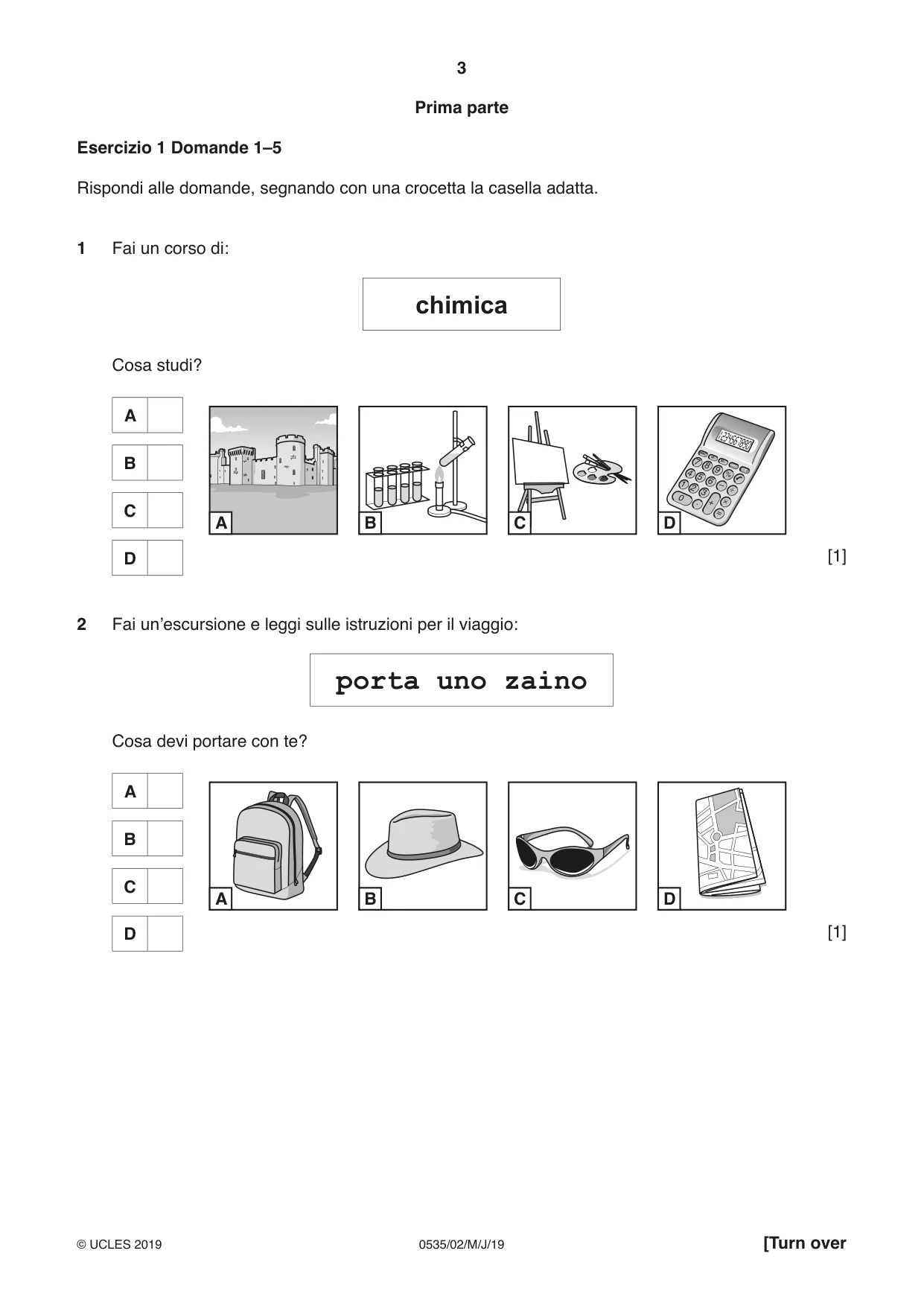
3 0535/02/M/J/19 © UCLES 2019 [Turn over Prima parte Esercizio 1 Domande 1–5 Rispondi alle domande, segnando con una crocetta la casella adatta. 1 Fai un corso di: chimica Cosa studi? A A B C D [1] B C D 2 Fai un’escursione e leggi sulle istruzioni per il viaggio: porta uno zaino Cosa devi portare con te? A A B C D [1] B C D
Question paper, page 4
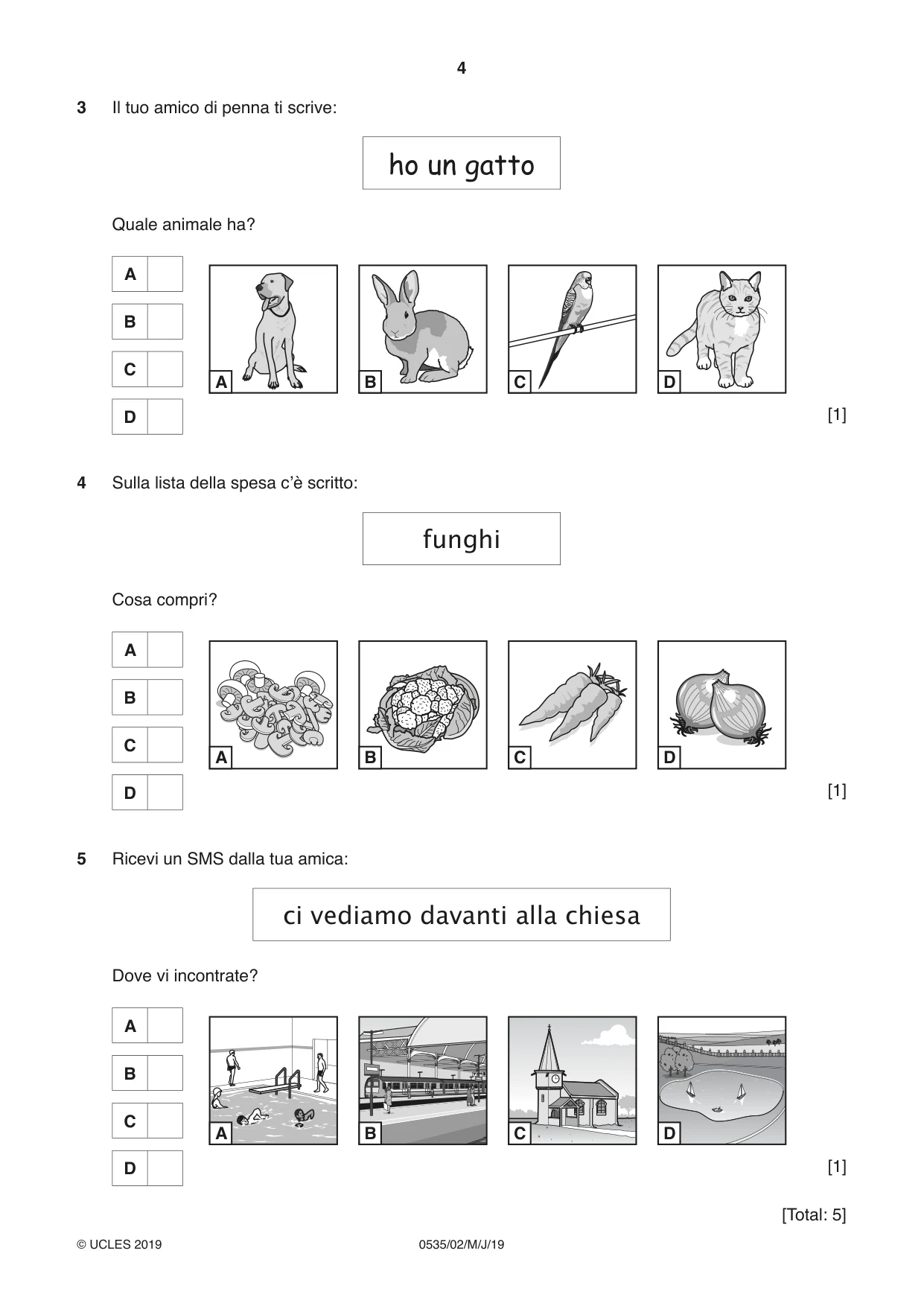
4 0535/02/M/J/19 © UCLES 2019 3 Il tuo amico di penna ti scrive: ho un gatto Quale animale ha? A A B C D [1] B C D 4 Sulla lista della spesa c’è scritto: funghi Cosa compri? A A B C D [1] B C D 5 Ricevi un SMS dalla tua amica: ci vediamo davanti alla chiesa Dove vi incontrate? A A B C D [1] B C D [Total: 5]
Question paper, page 5
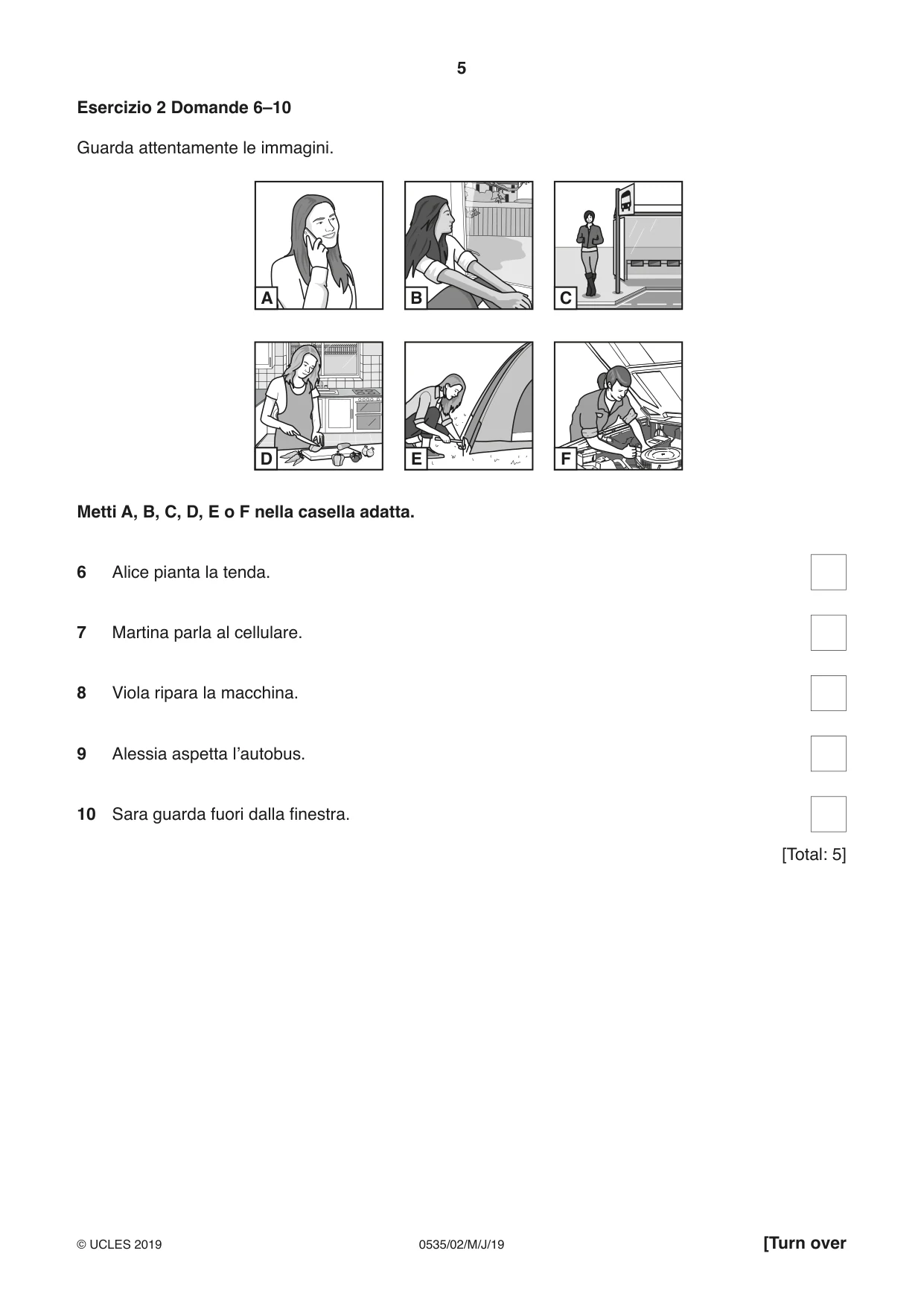
5 0535/02/M/J/19 © UCLES 2019 [Turn over Esercizio 2 Domande 6–10 Guarda attentamente le immagini. B C E F A D Metti A, B, C, D, E o F nella casella adatta. 6 Alice pianta la tenda. 7 Martina parla al cellulare. 8 Viola ripara la macchina. 9 Alessia aspetta l’autobus. 10 Sara guarda fuori dalla finestra. [Total: 5]
Question paper, page 6
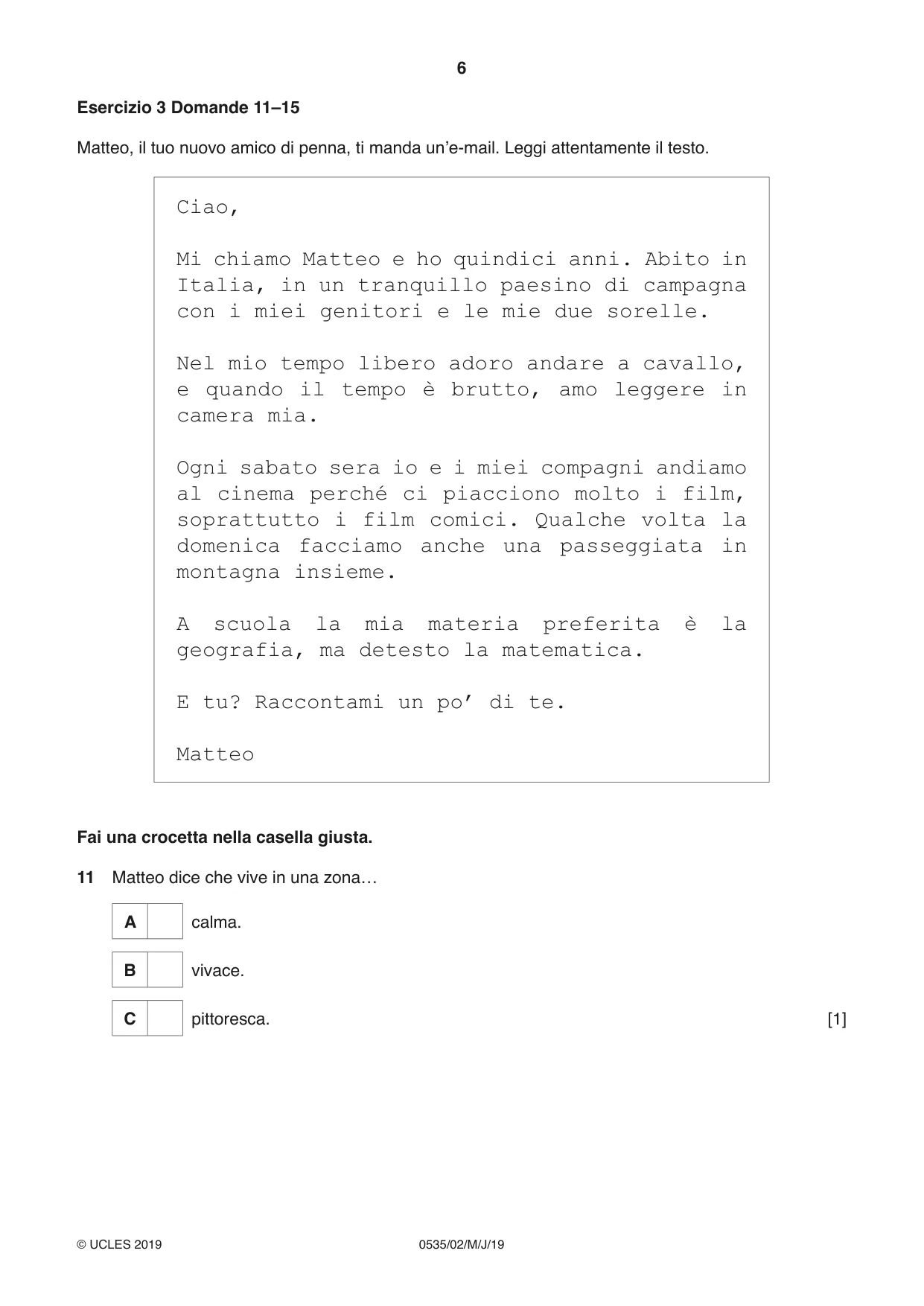
6 0535/02/M/J/19 © UCLES 2019 Esercizio 3 Domande 11–15 Matteo, il tuo nuovo amico di penna, ti manda un’e-mail. Leggi attentamente il testo. Ciao, Mi chiamo Matteo e ho quindici anni. Abito in Italia, in un tranquillo paesino di campagna con i miei genitori e le mie due sorelle. Nel mio tempo libero adoro andare a cavallo, e quando il tempo è brutto, amo leggere in camera mia. Ogni sabato sera io e i miei compagni andiamo al cinema perché ci piacciono molto i film, soprattutto i film comici. Qualche volta la domenica facciamo anche una passeggiata in montagna insieme. A scuola la mia materia preferita è la geografia, ma detesto la matematica. E tu? Raccontami un po’ di te. Matteo Fai una crocetta nella casella giusta. 11 Matteo dice che vive in una zona… A calma. B vivace. C pittoresca. [1]
Question paper, page 7
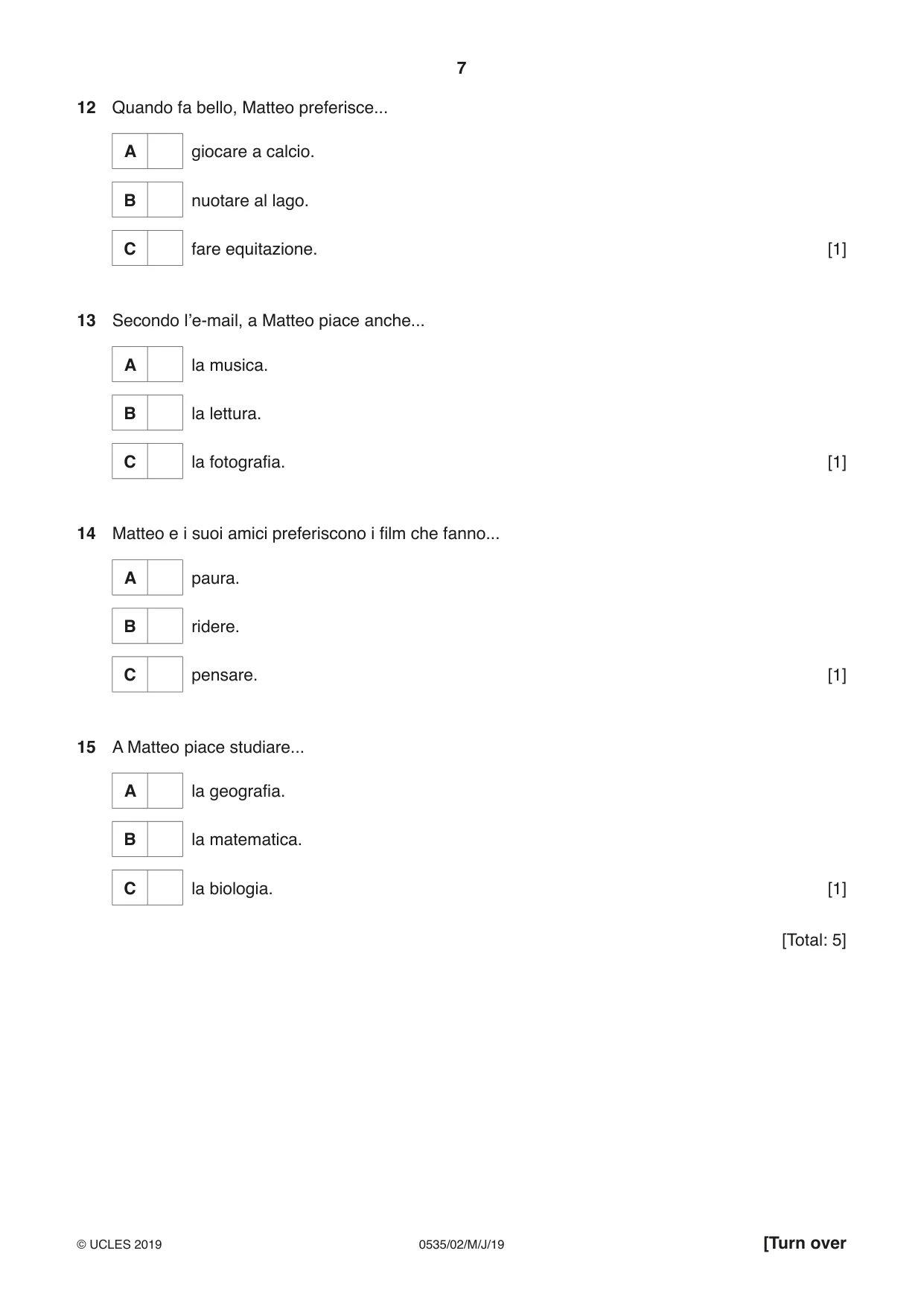
7 0535/02/M/J/19 © UCLES 2019 [Turn over 12 Quando fa bello, Matteo preferisce... A giocare a calcio. B nuotare al lago. C fare equitazione. [1] 13 Secondo l’e-mail, a Matteo piace anche... A la musica. B la lettura. C la fotografia. [1] 14 Matteo e i suoi amici preferiscono i film che fanno... A paura. B ridere. C pensare. [1] 15 A Matteo piace studiare... A la geografia. B la matematica. C la biologia. [1] [Total: 5]
Question paper, page 8
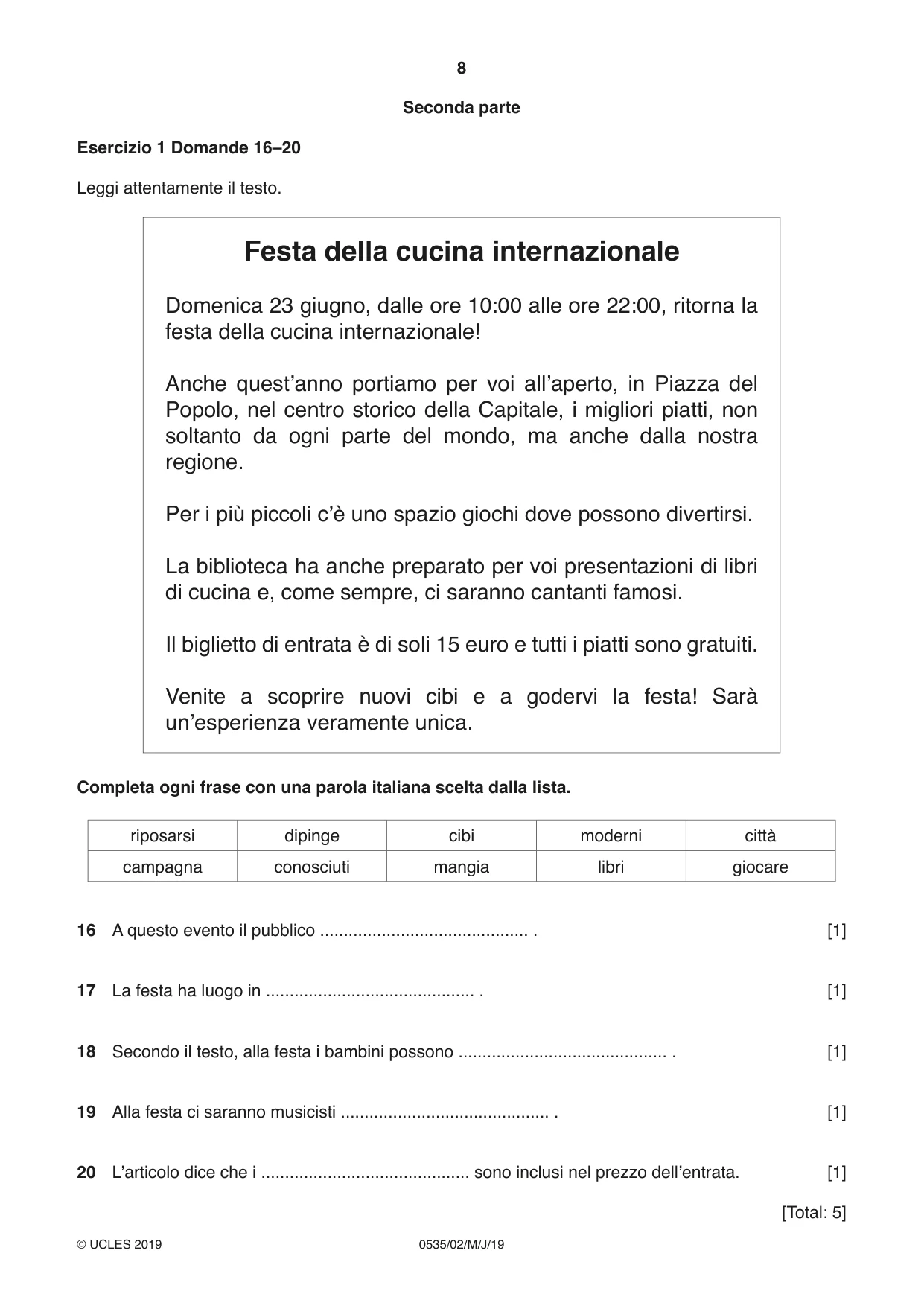
8 0535/02/M/J/19 © UCLES 2019 Seconda parte Esercizio 1 Domande 16–20 Leggi attentamente il testo. Festa della cucina internazionale Domenica 23 giugno, dalle ore 10:00 alle ore 22:00, ritorna la festa della cucina internazionale! Anche quest’anno portiamo per voi all’aperto, in Piazza del Popolo, nel centro storico della Capitale, i migliori piatti, non soltanto da ogni parte del mondo, ma anche dalla nostra regione. Per i più piccoli c’è uno spazio giochi dove possono divertirsi. La biblioteca ha anche preparato per voi presentazioni di libri di cucina e, come sempre, ci saranno cantanti famosi. Il biglietto di entrata è di soli 15 euro e tutti i piatti sono gratuiti. Venite a scoprire nuovi cibi e a godervi la festa! Sarà un’esperienza veramente unica. Completa ogni frase con una parola italiana scelta dalla lista. riposarsi dipinge cibi moderni città campagna conosciuti mangia libri giocare 16 A questo evento il pubblico … . [1] 17 La festa ha luogo in … . [1] 18 Secondo il testo, alla festa i bambini possono … . [1] 19 Alla festa ci saranno musicisti … . [1] 20 L’articolo dice che i … sono inclusi nel prezzo dell’entrata. [1] [Total: 5]
Question paper, page 9
9 0535/02/M/J/19 © UCLES 2019 [Turn over Voltare la pagina per l’Esercizio 2.
Question paper, page 10
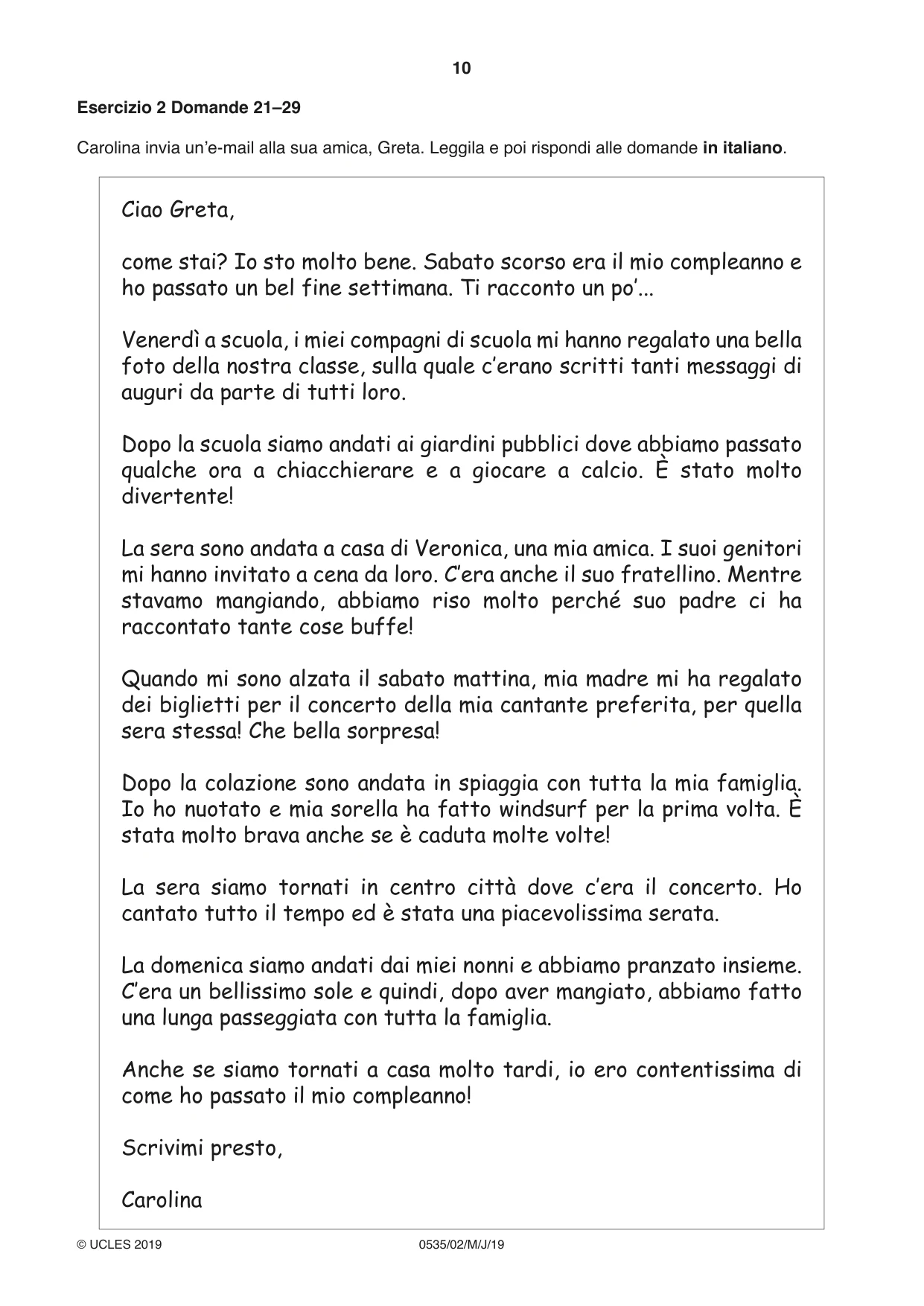
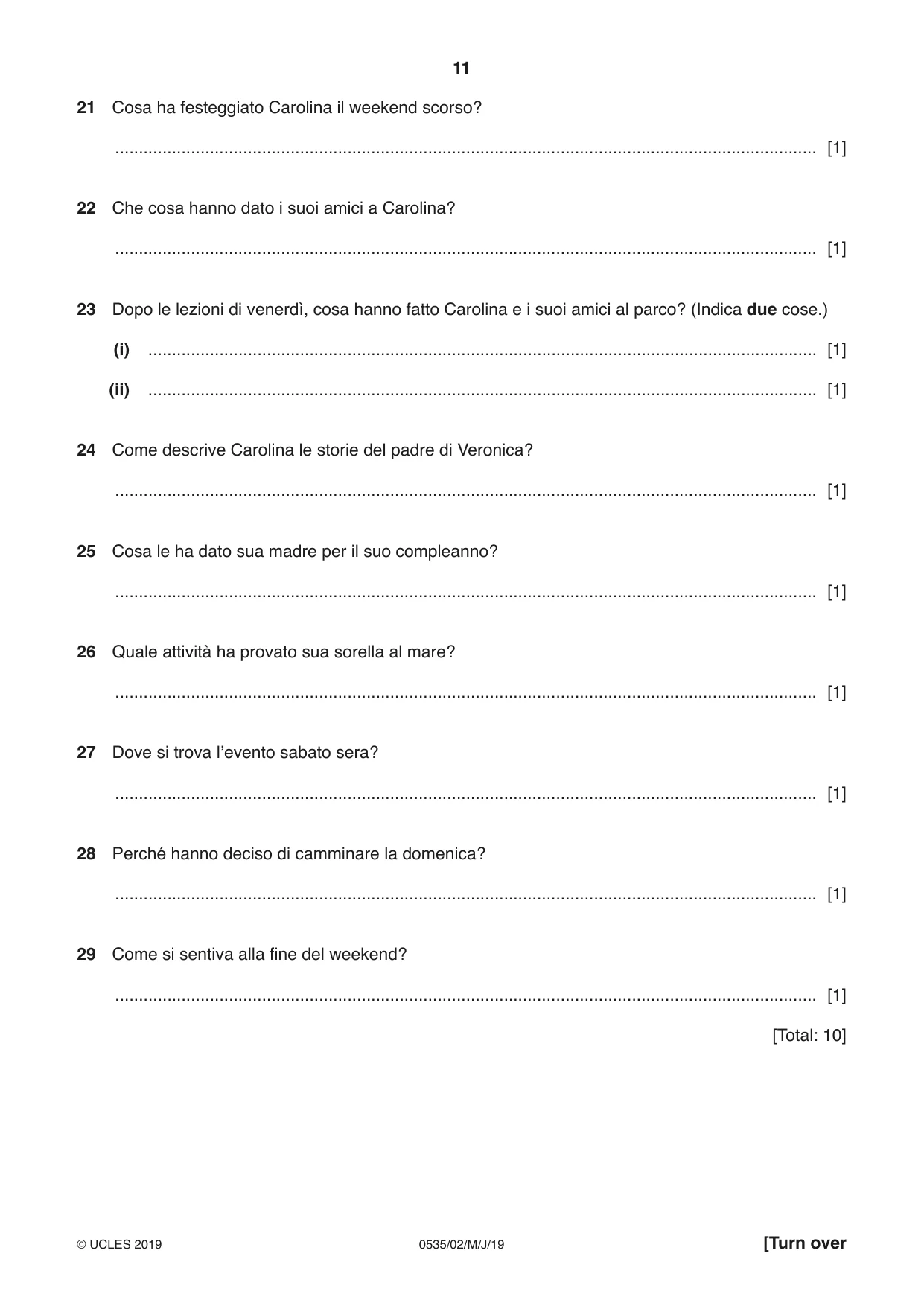
10 0535/02/M/J/19 © UCLES 2019 Esercizio 2 Domande 21–29 Carolina invia un’e-mail alla sua amica, Greta. Leggila e poi rispondi alle domande in italiano. Ciao Greta, come stai? Io sto molto bene. Sabato scorso era il mio compleanno e ho passato un bel fine settimana. Ti racconto un po’... Venerdì a scuola, i miei compagni di scuola mi hanno regalato una bella foto della nostra classe, sulla quale c’erano scritti tanti messaggi di auguri da parte di tutti loro. Dopo la scuola siamo andati ai giardini pubblici dove abbiamo passato qualche ora a chiacchierare e a giocare a calcio. È stato molto divertente! La sera sono andata a casa di Veronica, una mia amica. I suoi genitori mi hanno invitato a cena da loro. C’era anche il suo fratellino. Mentre stavamo mangiando, abbiamo riso molto perché suo padre ci ha raccontato tante cose buffe! Quando mi sono alzata il sabato mattina, mia madre mi ha regalato dei biglietti per il concerto della mia cantante preferita, per quella sera stessa! Che bella sorpresa! Dopo la colazione sono andata in spiaggia con tutta la mia famiglia. Io ho nuotato e mia sorella ha fatto windsurf per la prima volta. È stata molto brava anche se è caduta molte volte! La sera siamo tornati in centro città dove c’era il concerto. Ho cantato tutto il tempo ed è stata una piacevolissima serata. La domenica siamo andati dai miei nonni e abbiamo pranzato insieme. C’era un bellissimo sole e quindi, dopo aver mangiato, abbiamo fatto una lunga passeggiata con tutta la famiglia. Anche se siamo tornati a casa molto tardi, io ero contentissima di come ho passato il mio compleanno! Scrivimi presto, Carolina
Question paper, page 11
11 0535/02/M/J/19 © UCLES 2019 [Turn over 21 Cosa ha festeggiato Carolina il weekend scorso? … [1] 22 Che cosa hanno dato i suoi amici a Carolina? … [1] 23 Dopo le lezioni di venerdì, cosa hanno fatto Carolina e i suoi amici al parco? (Indica due cose.) (i) … [1] (ii) … [1] 24 Come descrive Carolina le storie del padre di Veronica? … [1] 25 Cosa le ha dato sua madre per il suo compleanno? … [1] 26 Quale attività ha provato sua sorella al mare? … [1] 27 Dove si trova l’evento sabato sera? … [1] 28 Perché hanno deciso di camminare la domenica? … [1] 29 Come si sentiva alla fine del weekend? … [1] [Total: 10]
Question paper, page 12
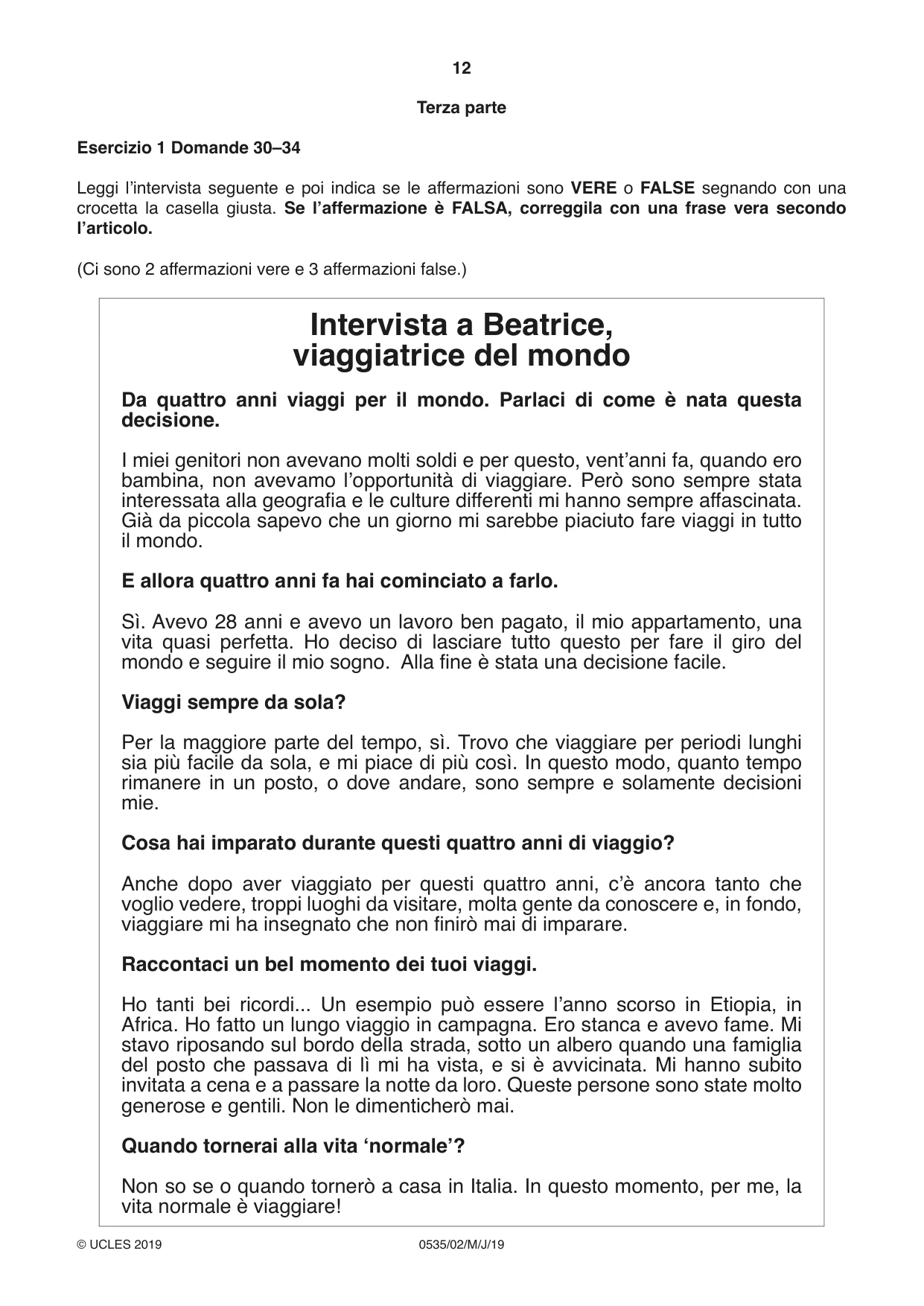
12 0535/02/M/J/19 © UCLES 2019 Terza parte Esercizio 1 Domande 30–34 Leggi l’intervista seguente e poi indica se le affermazioni sono VERE o FALSE segnando con una crocetta la casella giusta. Se l’affermazione è FALSA, correggila con una frase vera secondo l’articolo. (Ci sono 2 affermazioni vere e 3 affermazioni false.) Intervista a Beatrice, viaggiatrice del mondo Da quattro anni viaggi per il mondo. Parlaci di come è nata questa decisione. I miei genitori non avevano molti soldi e per questo, vent’anni fa, quando ero bambina, non avevamo l’opportunità di viaggiare. Però sono sempre stata interessata alla geografia e le culture differenti mi hanno sempre affascinata. Già da piccola sapevo che un giorno mi sarebbe piaciuto fare viaggi in tutto il mondo. E allora quattro anni fa hai cominciato a farlo. Sì. Avevo 28 anni e avevo un lavoro ben pagato, il mio appartamento, una vita quasi perfetta. Ho deciso di lasciare tutto questo per fare il giro del mondo e seguire il mio sogno. Alla fine è stata una decisione facile. Viaggi sempre da sola? Per la maggiore parte del tempo, sì. Trovo che viaggiare per periodi lunghi sia più facile da sola, e mi piace di più così. In questo modo, quanto tempo rimanere in un posto, o dove andare, sono sempre e solamente decisioni mie. Cosa hai imparato durante questi quattro anni di viaggio? Anche dopo aver viaggiato per questi quattro anni, c’è ancora tanto che voglio vedere, troppi luoghi da visitare, molta gente da conoscere e, in fondo, viaggiare mi ha insegnato che non finirò mai di imparare. Raccontaci un bel momento dei tuoi viaggi. Ho tanti bei ricordi... Un esempio può essere l’anno scorso in Etiopia, in Africa. Ho fatto un lungo viaggio in campagna. Ero stanca e avevo fame. Mi stavo riposando sul bordo della strada, sotto un albero quando una famiglia del posto che passava di lì mi ha vista, e si è avvicinata. Mi hanno subito invitata a cena e a passare la notte da loro. Queste persone sono state molto generose e gentili. Non le dimenticherò mai. Quando tornerai alla vita ‘normale’? Non so se o quando tornerò a casa in Italia. In questo momento, per me, la vita normale è viaggiare!
Question paper, page 13
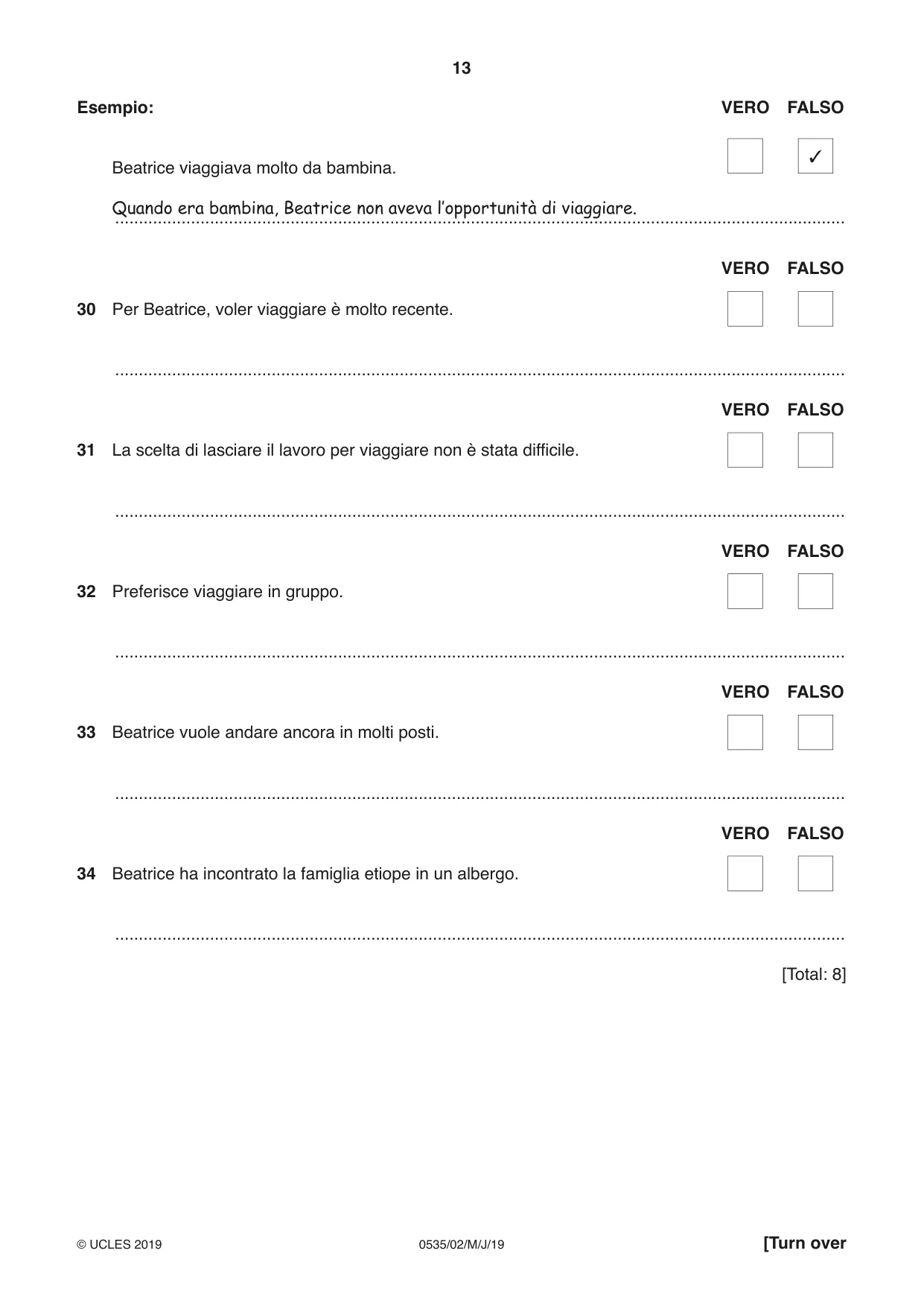
13 0535/02/M/J/19 © UCLES 2019 [Turn over Esempio: VERO FALSO Beatrice viaggiava molto da bambina. 3 Quando era bambina, Beatrice non aveva l’opportunità di viaggiare. … VERO FALSO 30 Per Beatrice, voler viaggiare è molto recente. … VERO FALSO 31 La scelta di lasciare il lavoro per viaggiare non è stata difficile. … VERO FALSO 32 Preferisce viaggiare in gruppo. … VERO FALSO 33 Beatrice vuole andare ancora in molti posti. … VERO FALSO 34 Beatrice ha incontrato la famiglia etiope in un albergo. … [Total: 8]
Question paper, page 14
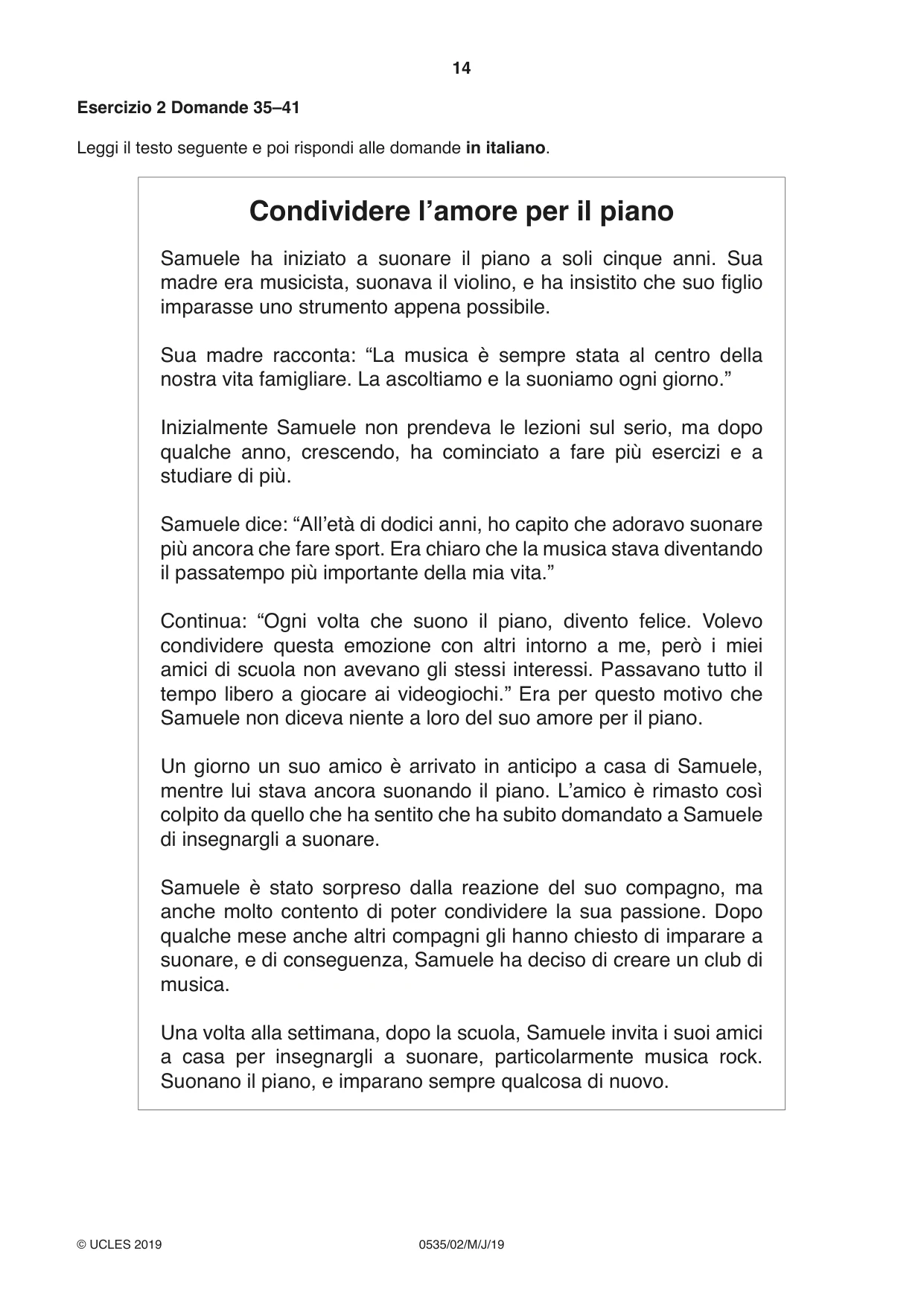
14 0535/02/M/J/19 © UCLES 2019 Esercizio 2 Domande 35–41 Leggi il testo seguente e poi rispondi alle domande in italiano. Condividere l’amore per il piano Samuele ha iniziato a suonare il piano a soli cinque anni. Sua madre era musicista, suonava il violino, e ha insistito che suo figlio imparasse uno strumento appena possibile. Sua madre racconta: “La musica è sempre stata al centro della nostra vita famigliare. La ascoltiamo e la suoniamo ogni giorno.” Inizialmente Samuele non prendeva le lezioni sul serio, ma dopo qualche anno, crescendo, ha cominciato a fare più esercizi e a studiare di più. Samuele dice: “All’età di dodici anni, ho capito che adoravo suonare più ancora che fare sport. Era chiaro che la musica stava diventando il passatempo più importante della mia vita.” Continua: “Ogni volta che suono il piano, divento felice. Volevo condividere questa emozione con altri intorno a me, però i miei amici di scuola non avevano gli stessi interessi. Passavano tutto il tempo libero a giocare ai videogiochi.” Era per questo motivo che Samuele non diceva niente a loro del suo amore per il piano. Un giorno un suo amico è arrivato in anticipo a casa di Samuele, mentre lui stava ancora suonando il piano. L’amico è rimasto così colpito da quello che ha sentito che ha subito domandato a Samuele di insegnargli a suonare. Samuele è stato sorpreso dalla reazione del suo compagno, ma anche molto contento di poter condividere la sua passione. Dopo qualche mese anche altri compagni gli hanno chiesto di imparare a suonare, e di conseguenza, Samuele ha deciso di creare un club di musica. Una volta alla settimana, dopo la scuola, Samuele invita i suoi amici a casa per insegnargli a suonare, particolarmente musica rock. Suonano il piano, e imparano sempre qualcosa di nuovo.
Question paper, page 15
15 0535/02/M/J/19 © UCLES 2019 35 Quale strumento suonava la madre di Samuele? … [1] 36 Quando ha cominciato a imparare il piano, come era il comportamento di Samuele? … [1] 37 Quale era la sua attività preferita quando aveva 12 anni? … [1] 38 Secondo Samuele, che cosa succede quando suona il piano? … [1] 39 Perché non parlava della musica con i compagni di classe? … [1] 40 Cosa ha chiesto il compagno a Samuele, dopo averlo sentito suonare? … [1] 41 Ogni quanto tempo organizza il club di musica Samuele? … [1] [Total: 7]
Question paper, page 16
16 0535/02/M/J/19 © UCLES 2019 Permission to reproduce items where third-party owned material protected by copyright is included has been sought and cleared where possible. Every reasonable effort has been made by the publisher (UCLES) to trace copyright holders, but if any items requiring clearance have unwittingly been included, the publisher will be pleased to make amends at the earliest possible opportunity. To avoid the issue of disclosure of answer-related information to candidates, all copyright acknowledgements are reproduced online in the Cambridge Assessment International Education Copyright Acknowledgements Booklet. This is produced for each series of examinations and is freely available to download at www.cambridgeinternational.org after the live examination series. Cambridge Assessment International Education is part of the Cambridge Assessment Group. Cambridge Assessment is the brand name of the University of Cambridge Local Examinations Syndicate (UCLES), which itself is a department of the University of Cambridge. BLANK PAGE
Mark scheme, page 1
This syllabus is regulated for use in England, Wales and Northern Ireland as a Cambridge International Level 1/Level 2 Certificate. This document consists of 15 printed pages. © UCLES 2019 [Turn over Cambridge Assessment International Education Cambridge International General Certificate of Secondary Education ITALIAN 0535/02 Paper 2 Reading May/June 2019 MARK SCHEME Maximum Mark: 45 Published This mark scheme is published as an aid to teachers and candidates, to indicate the requirements of the examination. It shows the basis on which Examiners were instructed to award marks. It does not indicate the details of the discussions that took place at an Examiners’ meeting before marking began, which would have considered the acceptability of alternative answers. Mark schemes should be read in conjunction with the question paper and the Principal Examiner Report for Teachers. Cambridge International will not enter into discussions about these mark schemes. Cambridge International is publishing the mark schemes for the May/June 2019 series for most Cambridge IGCSE™, Cambridge International A and AS Level and Cambridge Pre-U components, and some Cambridge O Level components.
Mark scheme, page 2
0535/02 Cambridge IGCSE – Mark Scheme PUBLISHED May/June 2019 © UCLES 2019 Page 2 of 15 Generic Marking Principles These general marking principles must be applied by all examiners when marking candidate answers. They should be applied alongside the specific content of the mark scheme or generic level descriptors for a question. Each question paper and mark scheme will also comply with these marking principles. GENERIC MARKING PRINCIPLE 1: Marks must be awarded in line with: • the specific content of the mark scheme or the generic level descriptors for the question • the specific skills defined in the mark scheme or in the generic level descriptors for the question • the standard of response required by a candidate as exemplified by the standardisation scripts. GENERIC MARKING PRINCIPLE 2: Marks awarded are always whole marks (not half marks, or other fractions). GENERIC MARKING PRINCIPLE 3: Marks must be awarded positively: • marks are awarded for correct/valid answers, as defined in the mark scheme. However, credit is given for valid answers which go beyond the scope of the syllabus and mark scheme, referring to your Team Leader as appropriate • marks are awarded when candidates clearly demonstrate what they know and can do • marks are not deducted for errors • marks are not deducted for omissions • answers should only be judged on the quality of spelling, punctuation and grammar when these features are specifically assessed by the question as indicated by the mark scheme. The meaning, however, should be unambiguous. GENERIC MARKING PRINCIPLE 4: Rules must be applied consistently e.g. in situations where candidates have not followed instructions or in the application of generic level descriptors.
Mark scheme, page 3
0535/02 Cambridge IGCSE – Mark Scheme PUBLISHED May/June 2019 © UCLES 2019 Page 3 of 15 GENERIC MARKING PRINCIPLE 5: Marks should be awarded using the full range of marks defined in the mark scheme for the question (however; the use of the full mark range may be limited according to the quality of the candidate responses seen). GENERIC MARKING PRINCIPLE 6: Marks awarded are based solely on the requirements as defined in the mark scheme. Marks should not be awarded with grade thresholds or grade descriptors in mind.
Mark scheme, page 4
0535/02 Cambridge IGCSE – Mark Scheme PUBLISHED May/June 2019 © UCLES 2019 Page 4 of 15 1 General Marking Principles 1.1 Please note that it is not possible to list all acceptable alternatives in the Detailed Mark Scheme provided in Section 2. You will need to consider all alternative answers and unexpected approaches in candidates’ scripts, make a decision on whether they communicate the required elements, in consultation with your Team Leader if necessary (or with your Product Manager if you are a single Examiner), and award marks accordingly. The following marking principles underpin the detailed instructions provided in Section 2 of the Mark Scheme. Where a decision is taken to deviate from these principles for a particular question, this will be specified in the Mark Scheme. 1.2 Crossing out: (a) If a candidate changes his/her mind over an answer and crosses out an attempt, award a mark if the final attempt is correct. (b) If a candidate crosses out an answer to a whole question but makes no second attempt at it, mark the crossed out work. 1.3 More than the stipulated number of boxes ticked/crossed by the candidate: (a) If more than one attempt is visible, but the candidate has clearly indicated which attempt is his/her final answer (e.g. by crossing out other attempts or by annotating the script in some way), mark in the usual way. (b) If two attempts are visible (e.g. 2 boxes ticked instead of the 1 box stipulated), and neither has been crossed out/discounted by the candidate, no mark can be awarded. (c) In questions where candidates are required to tick a number of boxes (e.g. tick the 6 true statements), the general rule to be applied is as follows: the number of ‘extra’ answers indicated by the candidate is deducted from the number of correct answers and the remaining number is the mark awarded. For example, the candidate is required to tick 6 true statements, but instead ticks 8 statements. 5 of the ticks are correctly placed, but there are 2 ‘extra’ ticks (8 ticks placed by candidate minus 6 ticks required by rubric = 2 ‘extras’). Therefore the candidate is awarded a mark of 3. number of correct ticks: 5 minus number of extra ticks: –2 mark awarded: = 3 (d) Answers in pen do not take precedence over answers in pencil, e.g. if a candidate is asked to tick 1 box and ticks 2, one in pen and the other in pencil, the mark cannot be awarded unless there is some explicit indication from the candidate as to which is his/her final answer.
Mark scheme, page 5
0535/02 Cambridge IGCSE – Mark Scheme PUBLISHED May/June 2019 © UCLES 2019 Page 5 of 15 1.4 For questions requiring more than one element for the answer, (i) and (ii), where the answers are interchangeable: Both correct answers on line 1, and line 2 blank = 2 Both correct answers on line 1, and line 2 wrong = 1 (or vice-versa) 1.5 Answers requiring the use of Italian (rather than a non-verbal response) should be marked for communication. Tolerate inaccuracies, provided the message is clear. (a) ‘If in doubt, sound it out’: if you read what the candidate has written, does it sound like the correct answer? (b) Look-alike test: does what the candidate has written look like the correct answer? (c) Accept incorrect gender or person unless Mark Scheme specifies otherwise. (d) Accept incorrect possessive adjectives e.g. mio, tuo, suo etc., unless Mark Scheme specifies otherwise (in general, Section 2 accept, Section 3 consult Mark Scheme carefully). (e) Tolerate incorrect auxiliary unless Mark Scheme specifies otherwise. (f) Tolerate incorrect use of infinitive unless Mark Scheme specifies otherwise (e.g. for questions where tense is important an infinitive may not be acceptable). 1.6 Unless the Mark Scheme specifies otherwise, do not accept incorrect Italian if the word given means something else in Italian. (Incorrect Italian which constitutes a word in any language other than Italian is marked (i) on the basis of whether it is accepted or refused in the Mark Scheme, and (ii) if not mentioned in the Mark Scheme, on the basis of 1.5 above.) 1.7 Annotation used in the Mark Scheme/Marking: (a) INV = Invalidation and is used when additional material included by the candidate is judged to invalidate an otherwise correct answer, thus preventing him/her from scoring the mark (INV = 0). (b) tc = ‘tout court’ and means that on its own the material is not sufficient to score the mark. (c) HA = harmless additional material which in conjunction with the correct answer does not prevent the candidate from scoring the mark. (d) BOD = Benefit of the Doubt and is used to indicate material considered by the Examiner and judged to be more correct than incorrect: the benefit of the doubt is given to the candidate and the mark is awarded.
Mark scheme, page 6
0535/02 Cambridge IGCSE – Mark Scheme PUBLISHED May/June 2019 © UCLES 2019 Page 6 of 15 1.8 No response and ‘0’ marks There is a NR (No Response) option in scoris. Award NR (No Response): • If there is nothing written at all in the answer space, or • If there is only a comment which does not in any way relate to the question being asked (e.g. ‘can’t do’ or ‘don’t know’), or • If there is only a mark which isn’t an attempt at the question (e.g. a dash, a question mark). Award 0: • If there is any attempt that earns no credit. This could, for example, include the candidate copying all or some of the question, or any working that does not earn any marks, whether crossed out or not. 1.9 Extra material: Section 2, Exercise 2 In Section 2, Exercise 2, reward the candidate for being able to locate the answer in the passage. Do not worry about lifting unless a lift is specifically rejected in the Mark Scheme. Unless the Mark Scheme states otherwise, ignore extra material given in an answer.
Mark scheme, page 7
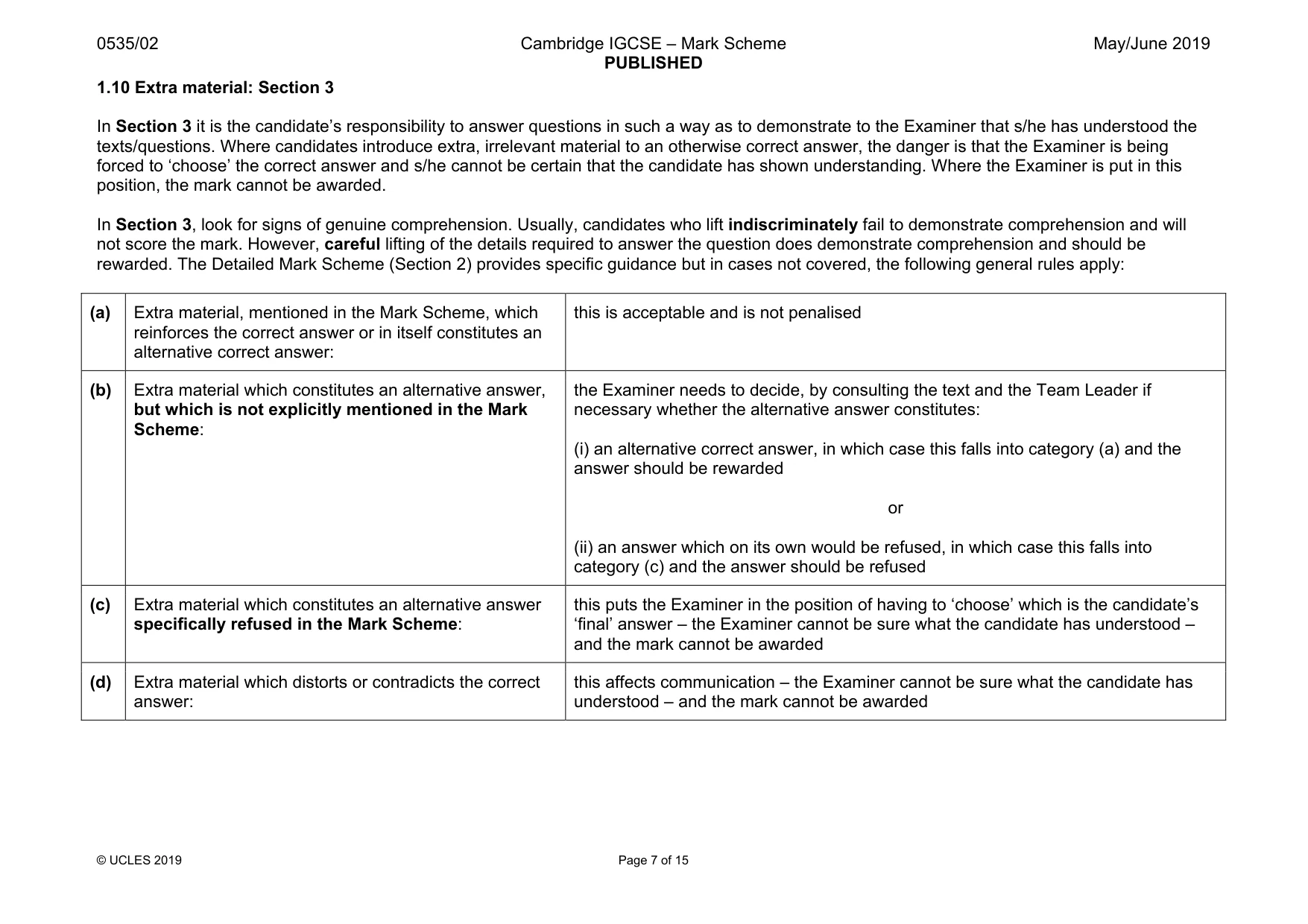
0535/02 Cambridge IGCSE – Mark Scheme PUBLISHED May/June 2019 © UCLES 2019 Page 7 of 15 1.10 Extra material: Section 3 In Section 3 it is the candidate’s responsibility to answer questions in such a way as to demonstrate to the Examiner that s/he has understood the texts/questions. Where candidates introduce extra, irrelevant material to an otherwise correct answer, the danger is that the Examiner is being forced to ‘choose’ the correct answer and s/he cannot be certain that the candidate has shown understanding. Where the Examiner is put in this position, the mark cannot be awarded. In Section 3, look for signs of genuine comprehension. Usually, candidates who lift indiscriminately fail to demonstrate comprehension and will not score the mark. However, careful lifting of the details required to answer the question does demonstrate comprehension and should be rewarded. The Detailed Mark Scheme (Section 2) provides specific guidance but in cases not covered, the following general rules apply: (a) Extra material, mentioned in the Mark Scheme, which reinforces the correct answer or in itself constitutes an alternative correct answer: this is acceptable and is not penalised (b) Extra material which constitutes an alternative answer, but which is not explicitly mentioned in the Mark Scheme: the Examiner needs to decide, by consulting the text and the Team Leader if necessary whether the alternative answer constitutes: (i) an alternative correct answer, in which case this falls into category (a) and the answer should be rewarded or (ii) an answer which on its own would be refused, in which case this falls into category (c) and the answer should be refused (c) Extra material which constitutes an alternative answer specifically refused in the Mark Scheme: this puts the Examiner in the position of having to ‘choose’ which is the candidate’s ‘final’ answer – the Examiner cannot be sure what the candidate has understood – and the mark cannot be awarded (d) Extra material which distorts or contradicts the correct answer: this affects communication – the Examiner cannot be sure what the candidate has understood – and the mark cannot be awarded
Mark scheme, page 8
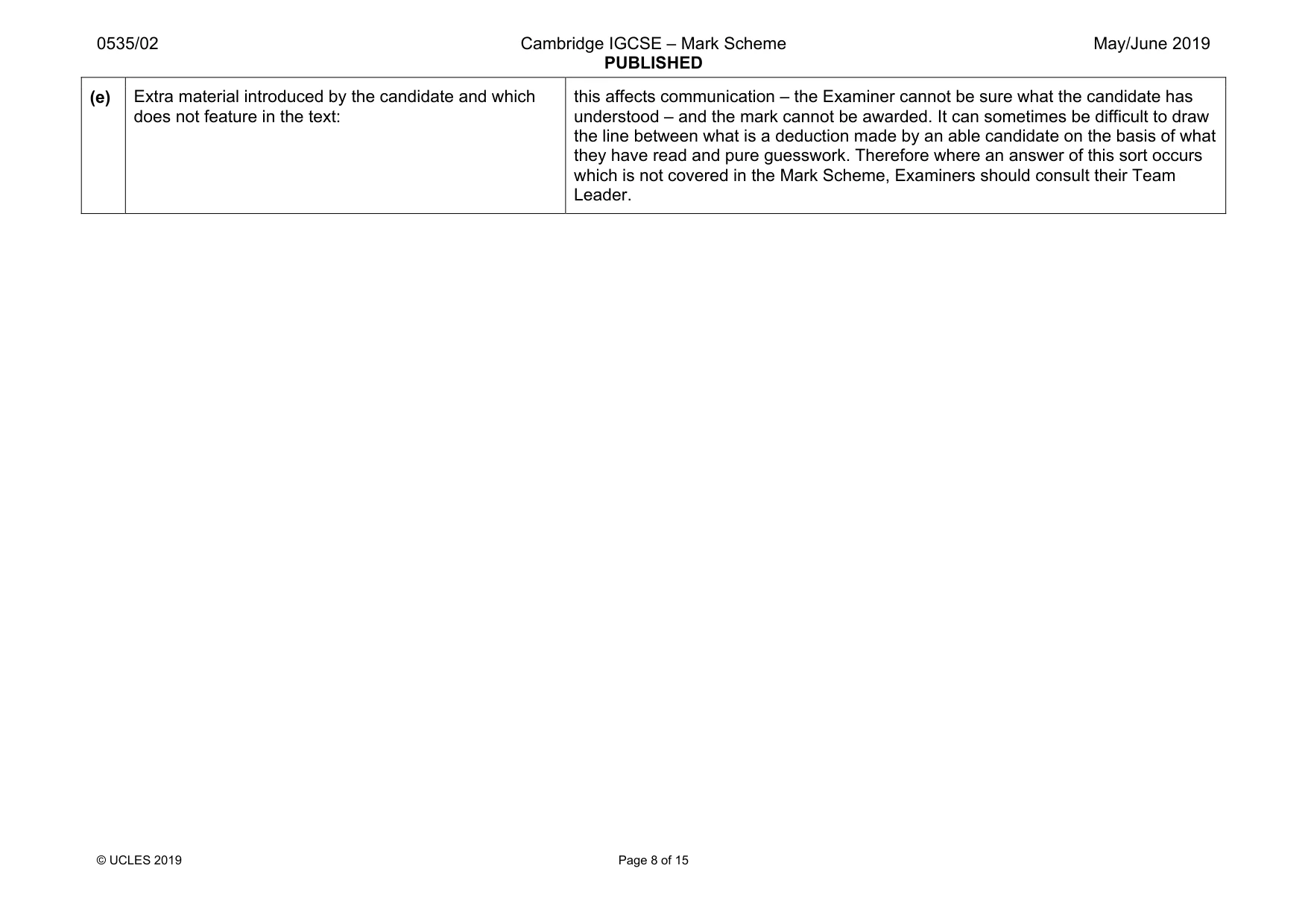
0535/02 Cambridge IGCSE – Mark Scheme PUBLISHED May/June 2019 © UCLES 2019 Page 8 of 15 (e) Extra material introduced by the candidate and which does not feature in the text: this affects communication – the Examiner cannot be sure what the candidate has understood – and the mark cannot be awarded. It can sometimes be difficult to draw the line between what is a deduction made by an able candidate on the basis of what they have read and pure guesswork. Therefore where an answer of this sort occurs which is not covered in the Mark Scheme, Examiners should consult their Team Leader.
Mark scheme, page 9
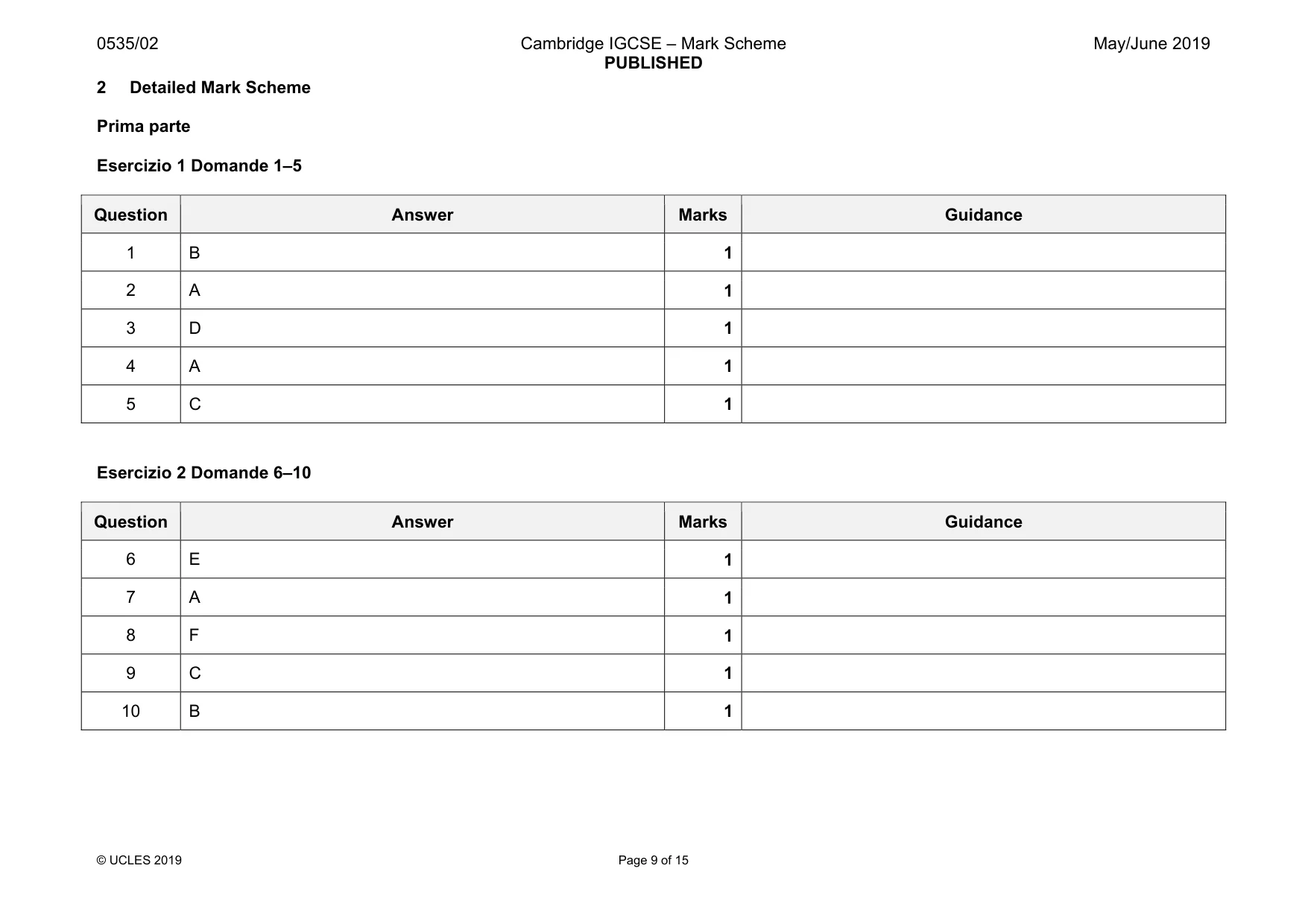
0535/02 Cambridge IGCSE – Mark Scheme PUBLISHED May/June 2019 © UCLES 2019 Page 9 of 15 2 Detailed Mark Scheme Prima parte Esercizio 1 Domande 1–5 Question Answer Marks Guidance 1 B 1 2 A 1 3 D 1 4 A 1 5 C 1 Esercizio 2 Domande 6–10 Question Answer Marks Guidance 6 E 1 7 A 1 8 F 1 9 C 1 10 B 1
Mark scheme, page 10
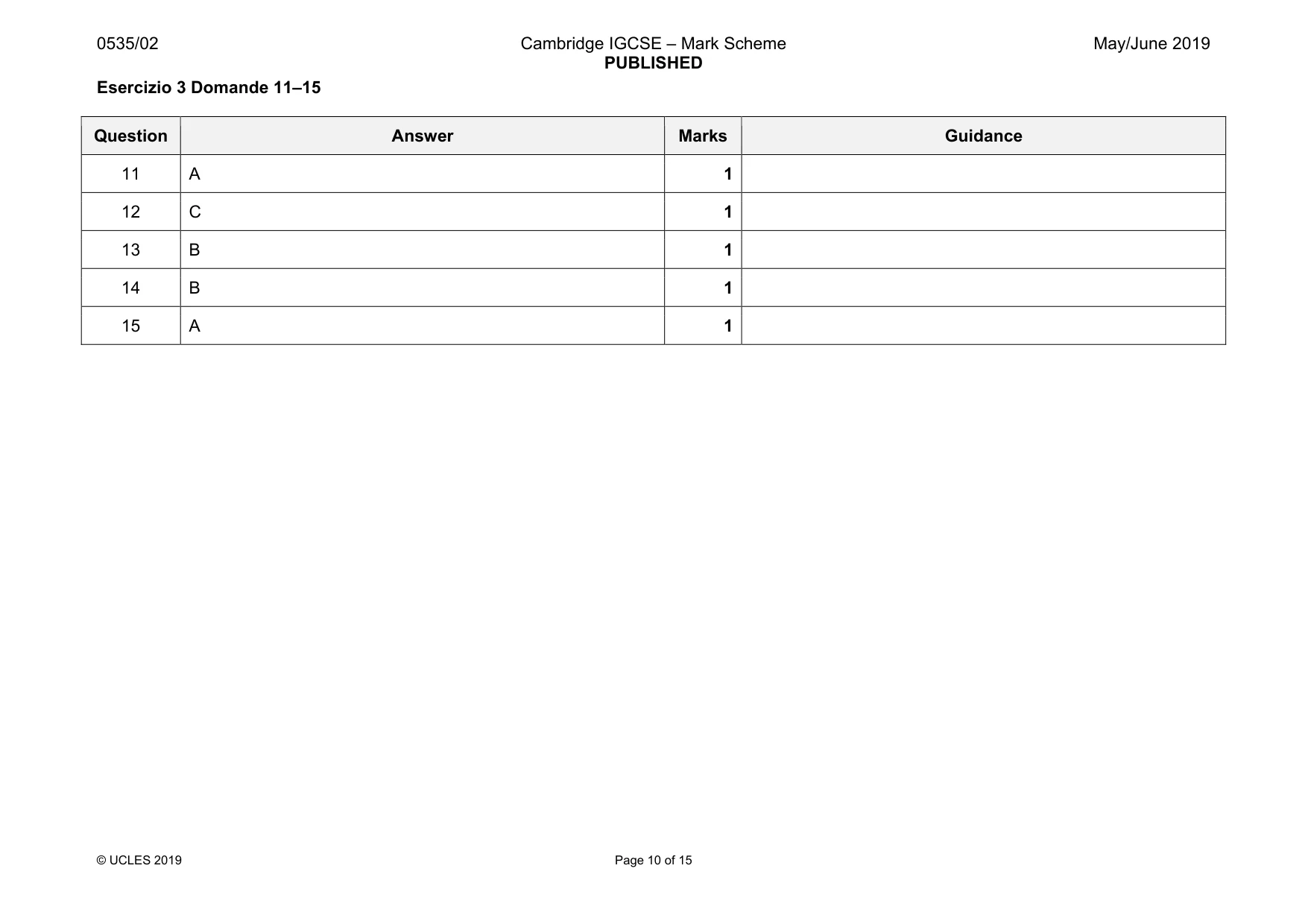
0535/02 Cambridge IGCSE – Mark Scheme PUBLISHED May/June 2019 © UCLES 2019 Page 10 of 15 Esercizio 3 Domande 11–15 Question Answer Marks Guidance 11 A 1 12 C 1 13 B 1 14 B 1 15 A 1
Mark scheme, page 11
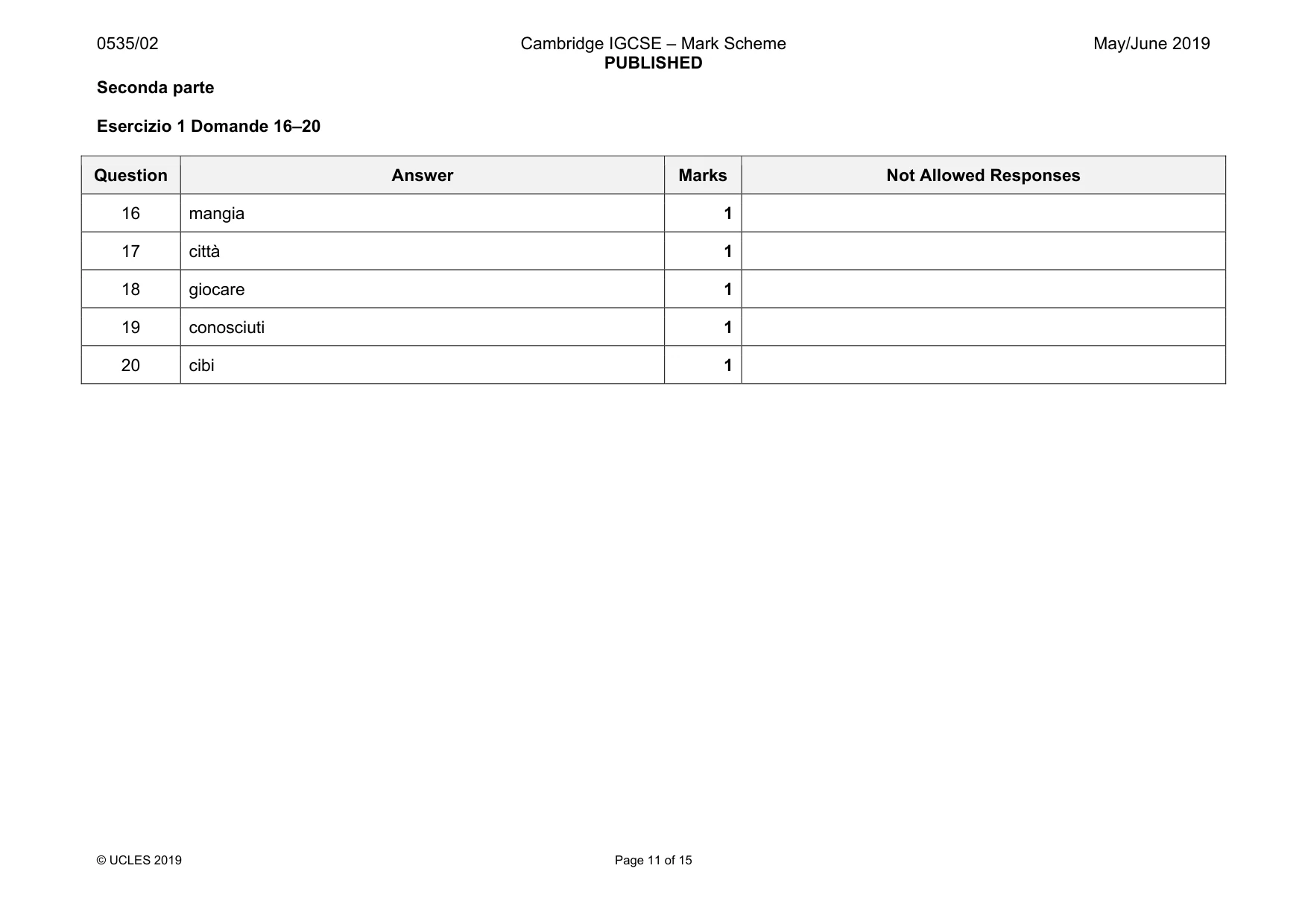
0535/02 Cambridge IGCSE – Mark Scheme PUBLISHED May/June 2019 © UCLES 2019 Page 11 of 15 Seconda parte Esercizio 1 Domande 16–20 Question Answer Marks Not Allowed Responses 16 mangia 1 17 città 1 18 giocare 1 19 conosciuti 1 20 cibi 1
Mark scheme, page 12
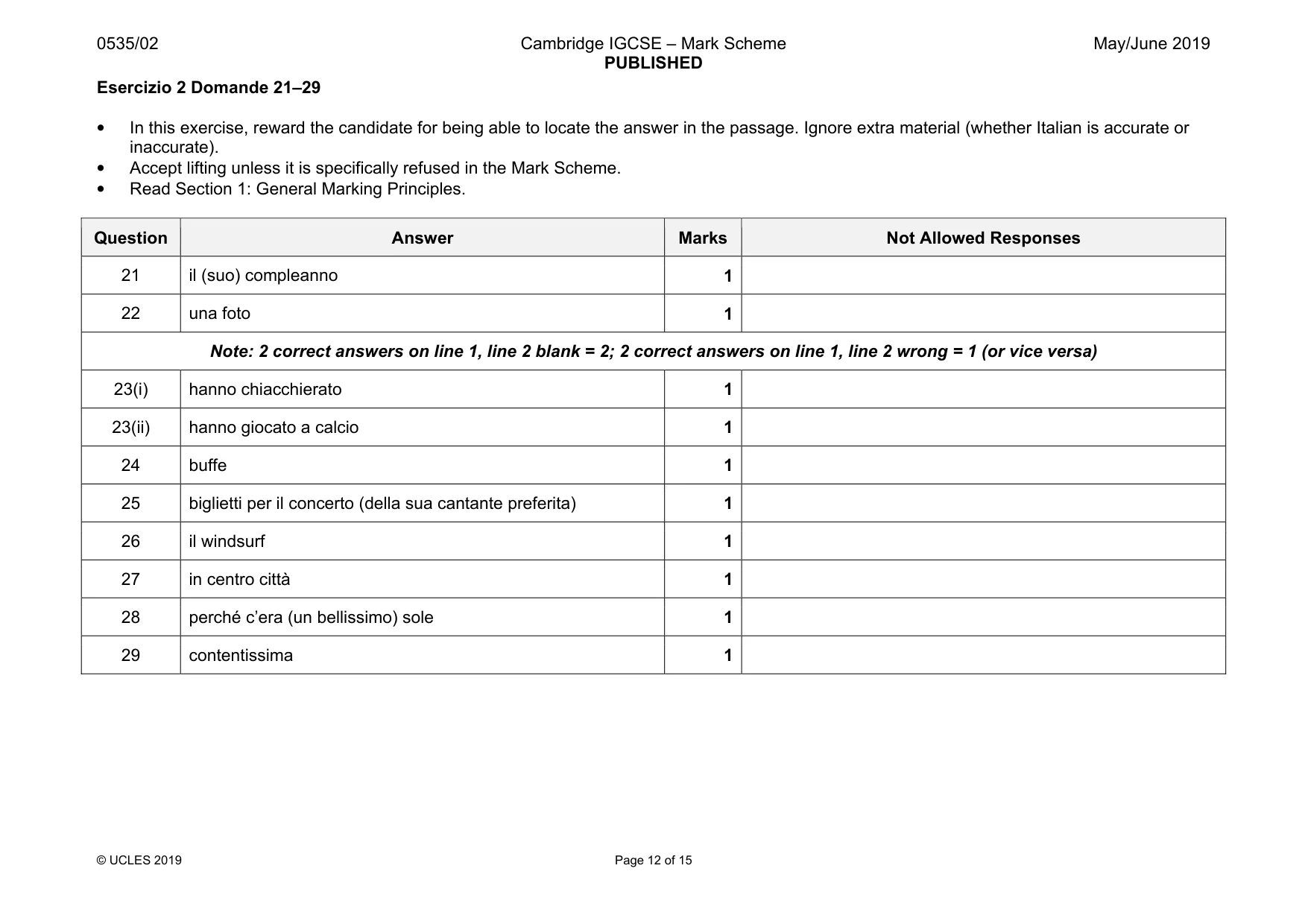
0535/02 Cambridge IGCSE – Mark Scheme PUBLISHED May/June 2019 © UCLES 2019 Page 12 of 15 Esercizio 2 Domande 21–29 • In this exercise, reward the candidate for being able to locate the answer in the passage. Ignore extra material (whether Italian is accurate or inaccurate). • Accept lifting unless it is specifically refused in the Mark Scheme. • Read Section 1: General Marking Principles. Question Answer Marks Not Allowed Responses 21 il (suo) compleanno 1 22 una foto 1 Note: 2 correct answers on line 1, line 2 blank = 2; 2 correct answers on line 1, line 2 wrong = 1 (or vice versa) 23(i) hanno chiacchierato 1 23(ii) hanno giocato a calcio 1 24 buffe 1 25 biglietti per il concerto (della sua cantante preferita) 1 26 il windsurf 1 27 in centro città 1 28 perché c’era (un bellissimo) sole 1 29 contentissima 1
Mark scheme, page 13
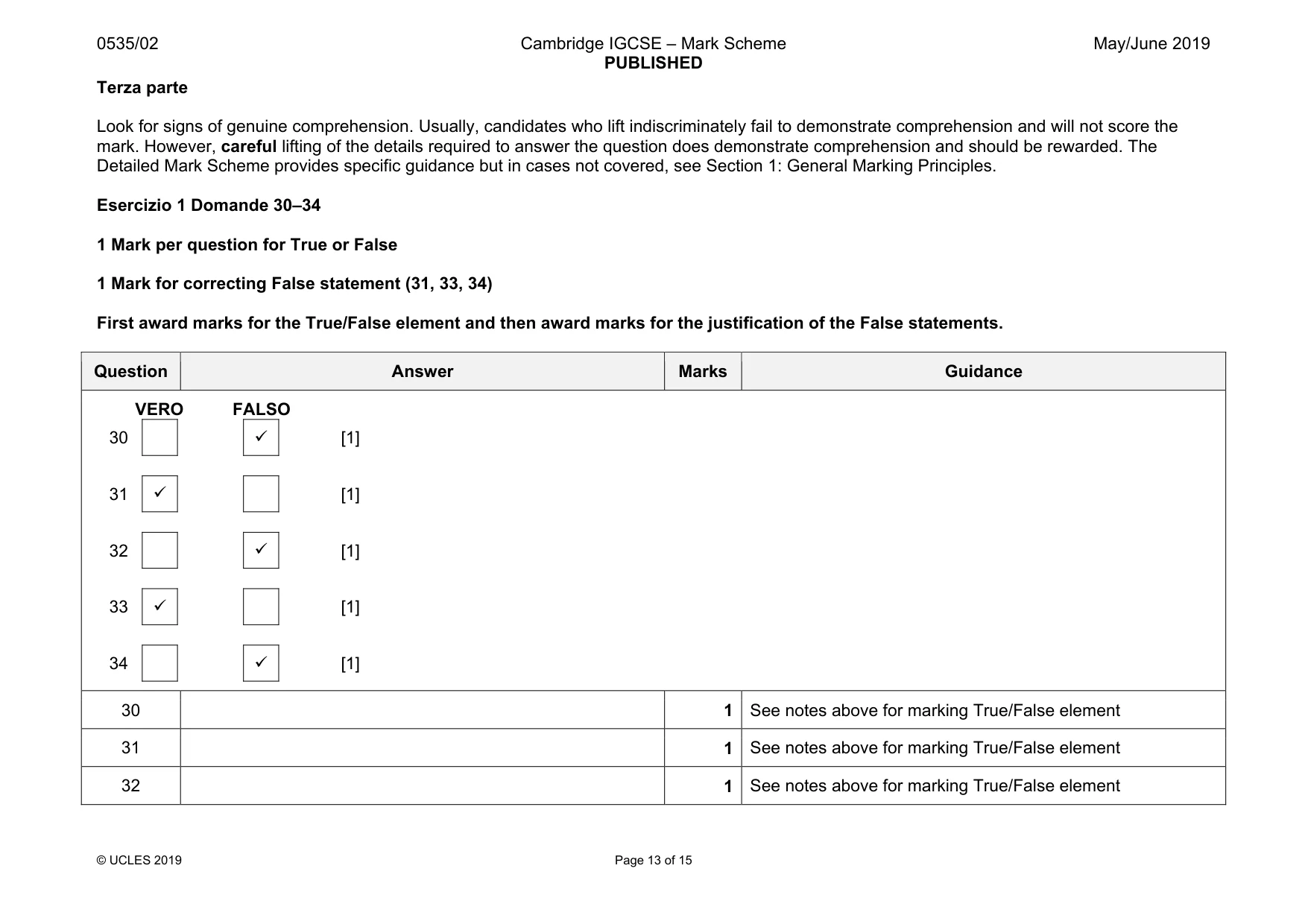
0535/02 Cambridge IGCSE – Mark Scheme PUBLISHED May/June 2019 © UCLES 2019 Page 13 of 15 Terza parte Look for signs of genuine comprehension. Usually, candidates who lift indiscriminately fail to demonstrate comprehension and will not score the mark. However, careful lifting of the details required to answer the question does demonstrate comprehension and should be rewarded. The Detailed Mark Scheme provides specific guidance but in cases not covered, see Section 1: General Marking Principles. Esercizio 1 Domande 30–34 1 Mark per question for True or False 1 Mark for correcting False statement (31, 33, 34) First award marks for the True/False element and then award marks for the justification of the False statements. Question Answer Marks Guidance VERO FALSO 30 9 [1] 31 9 [1] 32 9 [1] 33 9 [1] 34 9 [1] 30 1 See notes above for marking True/False element 31 1 See notes above for marking True/False element 32 1 See notes above for marking True/False element
Mark scheme, page 14
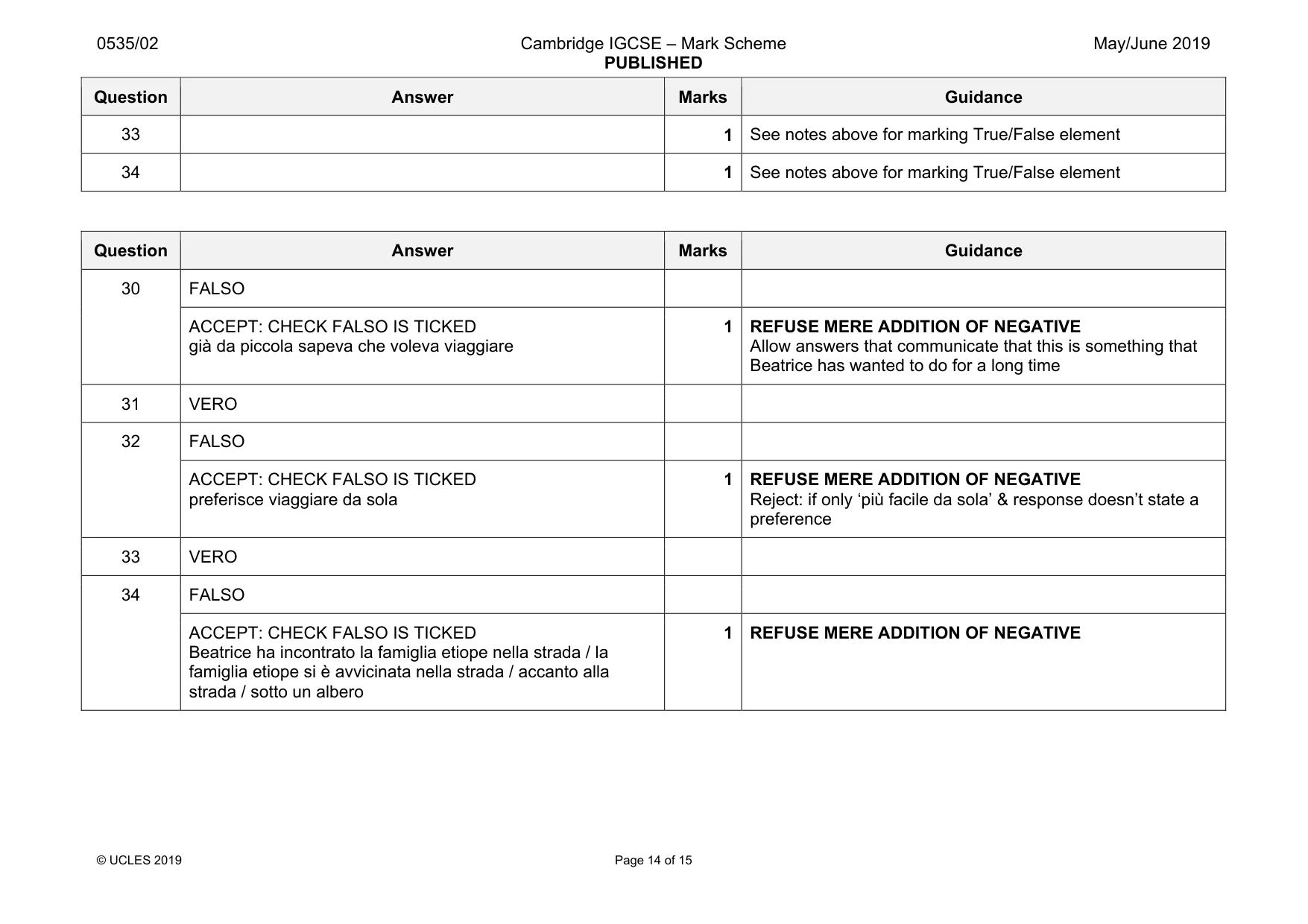
0535/02 Cambridge IGCSE – Mark Scheme PUBLISHED May/June 2019 © UCLES 2019 Page 14 of 15 Question Answer Marks Guidance 33 1 See notes above for marking True/False element 34 1 See notes above for marking True/False element Question Answer Marks Guidance 30 FALSO ACCEPT: CHECK FALSO IS TICKED già da piccola sapeva che voleva viaggiare 1 REFUSE MERE ADDITION OF NEGATIVE Allow answers that communicate that this is something that Beatrice has wanted to do for a long time 31 VERO 32 FALSO ACCEPT: CHECK FALSO IS TICKED preferisce viaggiare da sola 1 REFUSE MERE ADDITION OF NEGATIVE Reject: if only ‘più facile da sola’ & response doesn’t state a preference 33 VERO 34 FALSO ACCEPT: CHECK FALSO IS TICKED Beatrice ha incontrato la famiglia etiope nella strada / la famiglia etiope si è avvicinata nella strada / accanto alla strada / sotto un albero 1 REFUSE MERE ADDITION OF NEGATIVE
Mark scheme, page 15
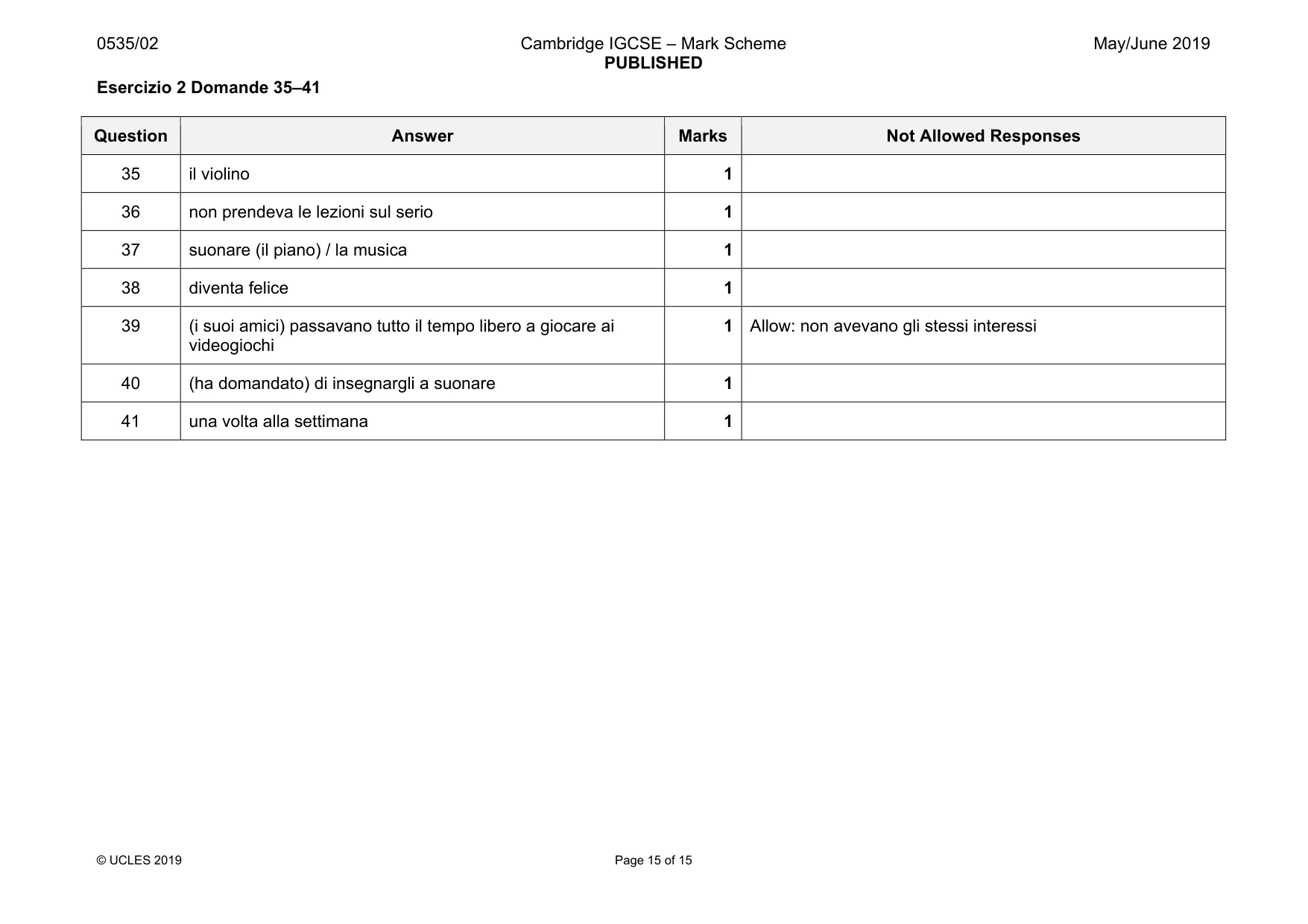
0535/02 Cambridge IGCSE – Mark Scheme PUBLISHED May/June 2019 © UCLES 2019 Page 15 of 15 Esercizio 2 Domande 35–41 Question Answer Marks Not Allowed Responses 35 il violino 1 36 non prendeva le lezioni sul serio 1 37 suonare (il piano) / la musica 1 38 diventa felice 1 39 (i suoi amici) passavano tutto il tempo libero a giocare ai videogiochi 1 Allow: non avevano gli stessi interessi 40 (ha domandato) di insegnargli a suonare 1 41 una volta alla settimana 1
What you needed in this session
Cambridge’s own grade thresholds for 2019 May/June, Paper 2 · Variant 1. A higher threshold means an easier paper — the bar moves with how the cohort did.